0. Purpose
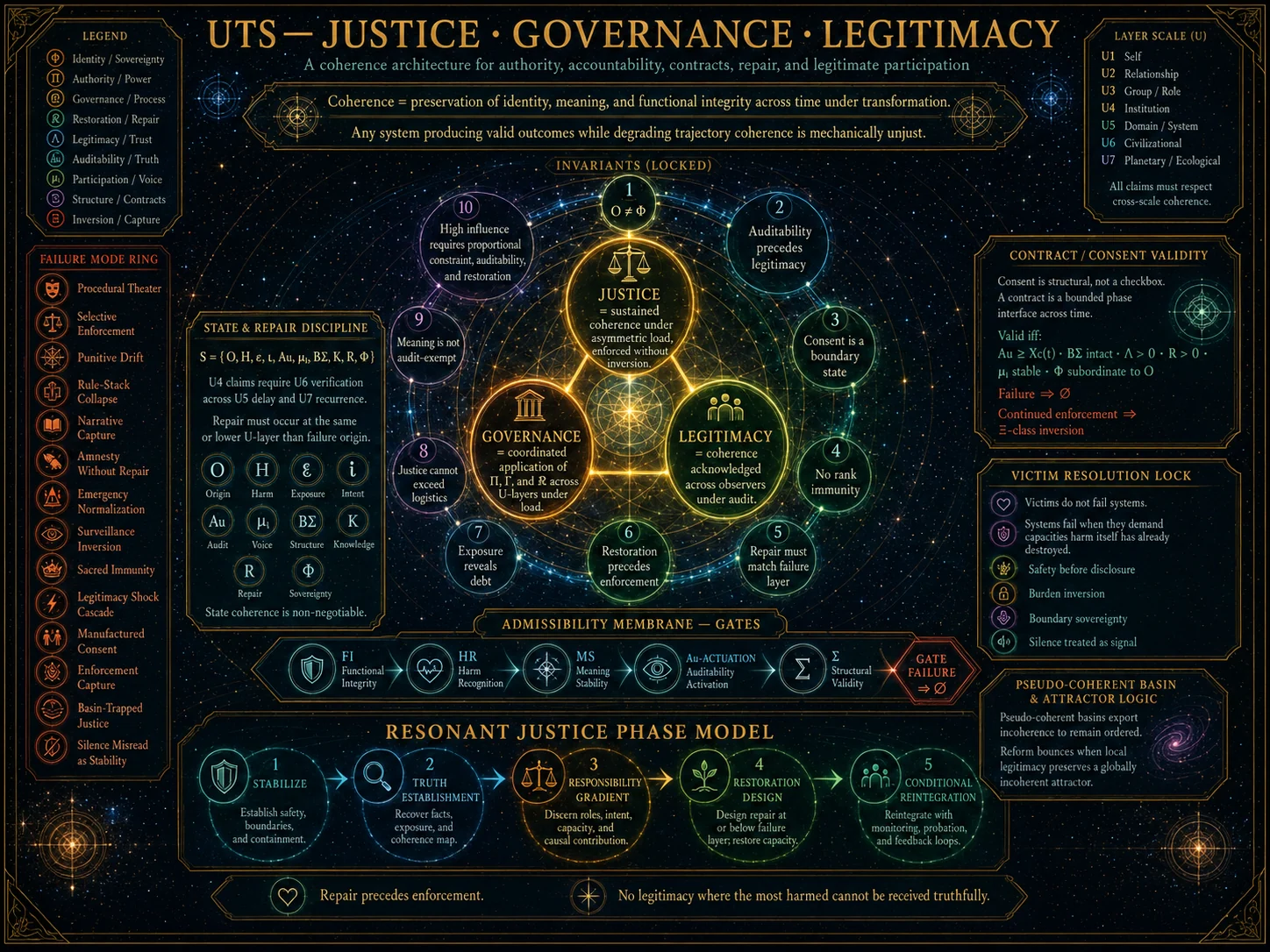
This module modelsjustice, governance, legitimacy, contracts, victim-resolution pathways, and high-Φ authority systemsascoherence phenomenain complex adaptive systems.
It is not:
- a moral ideology
- a legal doctrine
- a punishment theory
- a belief system
It is:
- a diagnostic grammar for justice collapse
- a predictive framework for legitimacy shock
- a restoration architecture for reducing hidden debt without generating more
- a contract and consent framework grounded in boundary integrity, auditability, and repair
- a governance framework for high-power, high-scale, partially observable systems
Justice, in this module, is not reduced to moral judgment, legal compliance, punishment, equality, or institutional process. It is treated as a structural condition: the preservation and restoration of coherence under asymmetric load.
1. Coherence Anchor
UTS defines coherence as:
Coherence = preservation of identity, meaning, and functional integrity across time under transformation.
For Justice · Governance · Legitimacy, this is the north star.
Non-negotiables:
- coherence istrajectory-based, not snapshot-based
- coherence isprior to Φ: optimization, performance, optics, growth, legal success, or institutional survival
- coherence loss appears asH↑andι↑before visible collapse
- meaningful control requirescoherence sensing
- no scale exemption exists
JGL Corollary
Any system producing “valid” outcomes while degrading trajectory coherence ismechanically unjust, regardless of legality, intent, rank, tradition, ideology, or optics.
A legal system may be legal and incoherent.
A governance system may be authoritative and illegitimate.
A contract may be enforceable and coherence-invalid.
A reform may be popular and debt-amplifying.
A moral claim may be sincerely held and structurally inverted.
2. Canon Grammar
2.1 State Vector
All JGL analysis uses the canonical UTS state vector:
S(t) = { O, H, ε, ι, Au, µᵢ, BΣ, K, R, Φ }Where:
| Symbol | Meaning |
|---|---|
O | Coherence |
H | Hidden debt |
ε | Observable error / visible harm surface |
ι | Inversion index / pseudo-coherence indicator |
Au | Auditability / traceability |
µᵢ | Agent integrity; meaning integrity under cost |
BΣ | Boundary integrity: identity, consent, interface clarity, exit |
K | Compatibility / slack / sovereignty; coupling raises coherence |
R | Restoration capacity |
Φ | Fitness proxy / optimizable success signal |
2.2 Core Discriminator
O ≠ ΦSuccess metrics are not coherence.
A system can win cases, clear backlogs, increase compliance, improve optics, reduce visible error, maximize public confidence, or preserve institutional power while reducing coherence.
JGL treats that condition as an inversion risk.
2.3 Localization Index
JGL uses the U0–U8 localization model:
| Layer | Meaning |
|---|---|
U0 | Substrate |
U1 | Power / budgets |
U2 | Configuration / boundaries |
U3 | Execution |
U4 | Classification / metrics / narratives |
U5 | Coordination / time |
U6 | Coherence field |
U7 | Memory / recurrence |
U8 | Environment / forcing |
2.4 Repair Rule
Repair must occur at the same or lower U-layer than the failure origin.
Symbolic recognition cannot repair substrate damage by itself.
Classification correction cannot repair material deprivation by itself.
Narrative change cannot repair violated boundaries by itself.
Policy reform cannot repair historical recurrence by itself unless it reaches the layer where the recurrence was generated.
3. Epistemic Discipline
JGL is designed to prevent premature compression.
Required discipline:
- no instrumentation does not mean no structure
- pattern recognition is not proof
- hypotheses are lenses, not conclusions
- avoid intent attribution when field dynamics are sufficient
- maintain competing hypotheses where needed
- clusters of indicators outweigh single indicators
Truth Discriminator
U4 claims are not truth unless verified at U6 across U5 delay and U7 recurrence under stress.
This applies to:
- legality
- compliance
- due process
- fairness
- transparency
- restoration claims
- safety claims
- moral claims
- spiritual claims
- institutional legitimacy claims
A system saying “we are fair” is a U4 claim.
A system remaining coherent across pressure, delay, recurrence, boundary stress, and repair cycles is closer to U6/U7 validation.
4. Core Definitions
4.1 Justice
Justice = sustained coherence under asymmetric load, enforced without inversion.
Justice exists whenΠ, Γ, ℛ, and Σoperate without violatingBΣ, µᵢ, or Au, and whenΦ remains subordinate to O.
Justice is not identical to:
- equality
- punishment
- revenge
- legal victory
- procedural completion
- institutional preservation
- intent attribution
- moral certainty
Justice exists when a system can preserve coherence under unequal power, unequal knowledge, unequal resources, unequal harm burden, and unequal access to restoration.
4.2 Legitimacy
Legitimacy = coherence acknowledged across observers under audit.
Legitimacy requires:
Au ≥ Xc- MS-Gate intact
- FI-Gate intact
- µᵢ stability over time
- restoration capacity proportional to influence
- no rank immunity
- no hidden contradiction between claim and function
Legitimacy is not popularity, legality, tradition, charisma, procedural compliance, or scale.
4.3 Governance
Governance = coordinated application of Π, Γ, and ℛ across U-layers under load.
Governance is sequencing plus feasibility, not authority volume.
A governance system must:
- constrain what can damage coherence
- select viable pathways under uncertainty
- restore what has been damaged
- preserve auditability under complexity
- maintain boundary integrity across asymmetry
- keep Φ subordinate to O
4.4 Resonant Justice
Resonant Justice = minimal sufficient truth + containment + repair + rehabilitation to restore coherent participation without generating new hidden debt.
Restriction is permitted for safety.
Punishment is not required.
Reintegration is conditional.
Resonant Justice is not softness. It is precision.
It asks:
- What actually happened?
- What must be contained?
- What must be repaired?
- What hidden debt exists?
- What capacities are required for restoration?
- What boundaries must be preserved?
- What pathway reduces recurrence without exporting incoherence?
5. Core JGL Invariants Registry
JGL-I1 —O ≠ Φ
Success metrics, stability optics, legality, growth, compliance, or popularity can never substitute for coherence.
JGL-I2 — Auditability Precedes Legitimacy
WhereAu < Xc, legitimacy is mechanically unstable.
A system too complex to audit cannot demand full trust.
JGL-I3 — Consent Is a Boundary State
Consent is structural, not a checkbox or momentary event.
Consent requires boundary integrity, traceability, comprehension, meaningful exit, and non-coerced continuity.
JGL-I4 — No Rank Immunity
Any exemption by status, office, sacred framing, role, identity, prestige, wealth, or leverage creates delayed legitimacy debt.
JGL-I5 — Repair Must Match Failure Layer
Symbolic repair cannot heal substrate, logistic, or boundary damage.
A U4 statement cannot repair a U0 or U2 violation by itself.
JGL-I6 — Restoration Precedes Enforcement
Enforcement without repair accumulates hidden debt.
Containment may be necessary, but enforcement that never leads to restoration becomes debt production.
JGL-I7 — Exposure Reveals Debt
Rising auditability surfaces existing hidden debt. It does not create it.
Exposure may destabilize a pseudo-coherent basin, but the debt was already present.
JGL-I8 — Justice Cannot Exceed Logistics
When:
R_eff < Load × Gaininjustice becomes mechanical.
A system without enough restoration capacity cannot produce coherent justice at scale, even with correct ideals.
JGL-I9 — Meaning Is Not Audit-Exempt
Moral, spiritual, ideological, or values claims must still satisfy:
- Au
- FI-Gate
- HR-Gate
- MS-Gate
- boundary integrity
- restoration capacity
Sacred language cannot replace verification.
JGL-I10 — Pathway Entry Condition Invariant
Systems fail victims when they require high coherence, high auditability, and high endurance from those whose coherence, auditability, and endurance were damaged or destroyed.
JGL-I11 — High-Φ Scaling Invariant
As influence rises,Π, Σ, Au, and ℛ must scale faster than or at least proportionally with Φ, or legitimacy decays.
High influence without proportional constraint, auditability, and restoration becomes governance inversion.
6. Diagnostics
JGL uses always-on diagnostics to read justice, governance, and legitimacy systems under load.
| Diagnostic | Meaning |
|---|---|
σ(t) | Slack |
𝓑(t) | Bandwidth headroom |
𝓓(t) | Damping / ring-down |
τ_resp(t) | Reaction latency |
τ_m(t) | Memory half-life / recurrence risk |
μ_meta(t) | Meta succession / rulebook churn |
X_c(t) | Constraint complexity |
AP(t) | Attribution pressure |
Lτ | Logistics throughput |
Cv | Compression velocity |
Ω | Observability regime |
LOS | Latent operational structures |
M* | Meaning-collapse threshold regime |
Core Inequalities
R_eff > Load × Gain_stack ⇒ O tends to increaseR_eff < Load × Gain_stack ⇒ collapse amplifiesX_c > Au_eff ⇒ H↑ ⇒ O↓Oscillation risk ∝ Gain × τ_U5Cybernetic Stability Proof
A justice or governance repair is stabilizing only when:
H(t + Δ) ≤ H(t)and:
𝓓 > 0with:
- recurrence declining across cycles
- re-perturbation tolerance improving under MS symmetry
- hidden debt not merely displaced
- harmed nodes not bearing the repair burden alone
Silent Extraction Signature
dO/dt < 0 ∧ dσ/dt < 0 ∧ ε ≈ 0Silent extraction occurs when coherence and slack decline while visible error remains low.
This is one of the most important JGL signatures because visible order can hide deep injustice.
7. Gates
JGL uses admissibility gates. Failure of any required gate yields:
∅Meaning: the proposed claim, act, policy, contract, enforcement action, reform, or legitimacy assertion is not admissible as coherent.
FI-Gate — Fitness Integrity Gate
No Goodhart substitution.
Φ cannot replace O.
Metrics cannot replace coherence.
HR-Gate — Harm / Responsibility Gate
No identity-binding under low evidence.
Do not bind blame, guilt, identity, or permanent classification beyond evidence resolution.
MS-Gate — Moral Symmetry Gate
No rank immunity.
Rules must apply symmetrically across status, role, class, identity, office, and sacred framing.
Au-Actuation Gate
Traceability is required before control claims.
A system cannot demand obedience where its own action path cannot be audited.
Σ / ☷ᵢ Gate
Invariants and principle constraints must hold.
No local gain can justify violation of non-negotiable coherence boundaries.
8. Lenses
JGL lenses are not new operator primitives. They are biasing factors used to interpret system behavior.
Key lenses:
- gain stack
G₀–G₅ - P-field
- RG
- SS
- Ω
- LOS
- Cv
- MI / meaning integrity threshold
- basin geometry / attractor structure
These lenses help explain why justice systems may look coherent locally while exporting incoherence globally.
9. Justice Localization Map
U0 — Substrate
Material and embodied foundations:
- bodily integrity
- housing
- environmental conditions
- confinement conditions
- food
- health
- transport
- material survival
JGL claim: no justice system can outrun its substrate.
U1 — Budgets / Capacity
Operational capacity:
- time
- money
- staffing
- legal aid
- restoration funding
- throughput
- training capacity
- technical capacity
Justice cannot exceed available restoration logistics.
U2 — Configuration / Boundaries
System structure:
- jurisdiction
- permissions
- rights
- contracts
- boundary rules
- consent structures
- exit pathways
- appeal paths
Many justice failures are U2 failures misread as U3 execution failures.
U3 — Execution
Runtime action:
- arrests
- trials
- enforcement acts
- case handling
- service delivery
- emergency responses
- discretion events
U3 is where failures become visible, but not always where they originate.
U4 — Classification / Metrics / Narratives
Meaning assignment:
- legal categories
- risk models
- policy frames
- compliance metrics
- public narratives
- case labels
- moral labels
U4 is high-risk for substitution: the label replaces the reality.
U5 — Coordination / Time
Temporal structure:
- backlogs
- delays
- sequencing
- escalation timing
- synchronization failures
- statute windows
- institutional response cycles
Delayed justice can become justice inversion when delay changes the harm geometry.
U6 — Coherence Field
Cross-system alignment:
- law
- economy
- culture
- meaning
- institutional practice
- public trust
- actual repair capacity
U6 asks whether the whole field is coherent, not whether one subsystem complied.
U7 — Memory / Recurrence
Historical and patterned debt:
- historical harm
- recurrence
- persistent debt
- amnesty without repair
- repeated institutional failures
- inherited legitimacy debt
U7 is where unresolved hidden debt returns.
U8 — Environment / Forcing
External pressure:
- crises
- retaliation risk
- economic shocks
- war
- technology shifts
- public pressure
- ecological pressure
- media pressure
U8 forcing reveals whether governance was coherent or merely stable under low stress.
Physical Limit
Justice cannot exceed the substrate plus logistics supporting it.
A system with insufficient U0/U1 support cannot sustain U6 legitimacy.
10. Meaning · Consciousness · Spirituality Integration
JGL integrates meaning and spirituality without making them audit-exempt.
Functional Definitions
| Term | JGL Meaning |
|---|---|
| Consciousness | Coherence-sensing and coherent-selection capacity |
Meaningµ | Directional bias toward coherence-worthy trajectories |
Meaning integrityµᵢ | Non-contradiction under cost |
SacredΣ | Non-negotiable invariants |
| Spiritual bypass | Ξ applied to meaning; narrative replaces restoration |
Guardrails
- spirituality is not audit-exempt
- sacred framing cannot create immunity
- ∅ is valid when evidence is insufficient
- restoration precedes transcendence claims
- meaning claims must survive cost
- values language cannot replace boundary repair
Meaning Failure
Meaning collapses when a system claims moral purpose while violating the structures that make that purpose coherent.
Examples:
- compassion without boundary repair
- forgiveness demanded before restoration
- unity language used to suppress disclosure
- sacred authority used to escape audit
- values language used to preserve rank immunity
11. Interfaces Required for Coherent Justice
Coherent justice requires coordinated use of three major interfaces.
11.1 Shadow Interface
The Shadow Interface simulates the full strategy space.
It answers:
What could be done?
Without SI, justice becomes naïve and under-models predatory, coercive, deceptive, or opportunistic pathways.
SI is not permission. It is visibility.
11.2 Light Interface
The Light Interface filters strategy through the constraint bundle.
It answers:
What may be done?
Without LI, strategy becomes extraction, coercion, domination, or pseudo-justice.
LI converts possible action into admissible action.
11.3 Empathy Interface
The Empathy Interface simulates other nodes’ internal state-spaces.
It answers:
What is being experienced or constrained?
Without EI, systems misread harm, misassign responsibility, misrepair boundaries, and generate scapegoating.
EI is not projection, contagion, collapse, or performance. It is structured simulation constrained by truth and sovereignty.
11.4 Interface Failure Triad
| Missing Interface | Failure |
|---|---|
| Without SI | Naïveté |
| Without LI | Extraction |
| Without EI | Scapegoating and misrepair |
11.5 Standard Strategy Resolution Pipeline
SI render
→ Μ + Δ simulate
→ CCS filter
→ quarantine incoherent paths
→ Γ authorize
→ Π constrain
→ ℛ provision
→ Τ validate
Where CCS includes:
Σ + principle bundle + MS + FI + HR + Au-Actuation + BΣ + Λ12. UTScale Integration
Justice systems are scaling systems.
JGL depends on scaling law awareness because justice failures often emerge when load, complexity, power, and compression exceed restoration capacity.
Relevant Scaling Laws
S4 — Observability Collapses Before Causality
A system may lose the ability to see causal structure before causal structure disappears.
When observability collapses, justice systems misclassify causes.
S6 — Reform Must Be Bandwidth-Gated
Reform under low bandwidth can amplify instability.
A reform is only coherent when the system has enough bandwidth to absorb the transition.
S11 / S12 — Hidden Debt Migrates and Compounds
Suppressed debt does not vanish.
It migrates across domains and compounds, especially under obfuscation.
S14 — Power Scaled Faster Than Meaning Collapses
Power without meaning integrity becomes incoherent.
Authority expansion must be paired with µᵢ, Au, BΣ, and ℛ expansion.
S15 — Compression Collapse Law
Compression collapses auditability and decision depth from the core outward.
When complex cases are compressed too quickly, the system loses the dimensions needed for justice.
FM-TM — Delayed Transition Under Clarity
Once clarity is available, delayed transition closes low-debt pathways nonlinearly.
Refusing to repair after seeing the debt multiplies future repair cost.
JGL Implications
- rigidity is usually capacity collapse, not character
- transparency in one domain can migrate injustice into another
- reform under low bandwidth without restoration capacity accelerates collapse
- post-sign contract drift is inevitable at scale unless monitored
- legitimacy collapse often begins as observability collapse
- hidden debt becomes more expensive after clarity
13. Pseudo-Coherent Basins and Attractor Geometry
Definition
Apseudo-coherent basinis a locally stable attractor geometry that exports incoherence to remain ordered.
It has the following properties:
- local order is maintained
- repeatable outcomes are produced
- internal feedback appears positive
- global hidden debt grows
- participants feel justified
- escape is costly
- reform bounces unless the basin geometry changes
Key Statements
A node can be internally coherent and globally incoherent without contradiction.
Pseudo-coherent basins are locally stable geometries that export incoherence to remain ordered.
Escape difficulty scales with nested sub-attractors stabilizing identity, reward, role, and survival.
True coherence does not eliminate paradox. It increases dimensionality until paradox dissolves.
JGL Use
This explains:
- why injustice persists without villain narratives
- why basin-trapped systems feel legitimate internally
- why reform bounces
- why semi-coherent actors defend incoherent systems
- why higher-order attractors must be introduced, not merely demanded
- why systems can sincerely perform justice while mechanically exporting harm
Basin Diagnosis
A justice or governance system is likely basin-trapped when:
- internal metrics improve while external harm grows
- reform increases procedural complexity but not restoration capacity
- victims must become more coherent than the system to be heard
- auditability threatens institutional survival
- rank immunity is defended as stability
- exposure is treated as the source of harm
- legitimacy claims depend on suppressing recurrence memory
14. Victim Resolution Pathway System Integration
Premise
Victims do not fail systems.
Systems fail when they demand capacities harm itself has already damaged.
Typical Victim Baseline
After severe harm, the affected node may have:
- fragmented or compressed O
- R near zero
- partial or nonlinear Au
- violated BΣ
- layered or extreme H
- elevated ι
- misleading Φ signals
The system cannot coherently demand perfect narration, perfect timing, perfect evidence, perfect composure, perfect endurance, or perfect procedural navigation from a node whose coherence was structurally damaged.
Canonical Pathways
| Pathway | Description |
|---|---|
| A | Escape |
| B | Social protection |
| C | Institutional reporting |
| D | Legal action |
| E | Media / advocacy exposure |
| F | Silence / internal survival |
Core Pathway Failure Invariant
Systems demand high O, high Au, and high endurance from those whose O, Au, and endurance were systematically damaged.
This is a structural inversion.
Repair Conditions Before Truth Demands
Before demanding full truth production, systems must provide:
- safety before disclosure
- burden inversion
- compatible intake
- boundary sovereignty
- symmetry correction
- silence treated as signal
Critical Lock
Silence is not consent.
Silence is not absence of harm.
Silence is not resolution.
Silence is often an adaptive survival response after all other pathways fail.
JGL Implication
A system that cannot receive truth from those most harmed is not legitimate.
15. Cognitive Infrastructure Governance Integration
Cognitive Infrastructure Governance governshigh-Φ cognitive systemsinside JGL.
These include:
- AI platforms
- decision engines
- public information systems
- institutional classification systems
- high-scale moderation systems
- reputation systems
- risk scoring systems
- automated benefit systems
- high-influence knowledge infrastructures
High-Φ Law
As Φ rises:
Π, Σ, Au, and ℛ must rise proportionallyor legitimacy collapses.
Core Lock
No authority without traceable responsibility.
A system cannot exercise high influence while diffusing responsibility beyond audit.
Architectural Layers
- Capability gate
- Authority registry
- Signed decision provenance
- Tamper-evident audit trails
- Restoration and appeal layer
- Sovereignty safeguards
CIG Lock Statements
Transparency without restoration produces instability.
Restoration without capability produces fragility.
High influence requires proportionally higher constraint and restoration.
Authority without traceable responsibility is not governance. It is incoherent control.
JGL-CIG Risk Signature
A cognitive infrastructure system is legitimacy-unstable when:
Φ↑ ∧ Au flat/down ∧ ℛ flat/down ∧ Π weak ∧ Σ unclearThis indicates power scaling faster than constraint, auditability, and restoration.
16. Coherent Contract Law
Contract Definition
A contract is a bounded phase interface constraining future action across time under assumed conditions.
It is not merely a document, signature, agreement, or legal instrument.
A contract is a temporal boundary structure.
Contract Lifecycle
| Phase | Description |
|---|---|
| Phase 0 | Readiness |
| Phase 1 | Formation |
| Phase 2 | Execution |
| Phase 3 | Drift monitoring |
| Phase 4 | Restoration / renegotiation |
| Phase 5 | Termination / renewal |
Three Failure Domains
1. Pre-Signing Manufactured Consent
Consent is invalid when the conditions producing agreement violate boundary integrity, auditability, comprehension, or meaningful exit.
2. Post-Signing Environmental Incoherence
A contract can become coherence-invalid when environmental conditions drift far enough that original assumptions no longer hold.
3. Enforcement Capture
A contract becomes inverted when enforcement preserves the contract form while violating the coherence conditions that made the contract valid.
Contract Validity Test at Timet
A coherence-valid contract requires:
Au ≥ Xc(t)and:
- BΣ intact
Λ > 0R > 0- µᵢ stable
- Φ subordinate to O
Failure yields:
∅Continued enforcement after coherence validity fails becomes:
Ξ-class inversionContract Drift Principle
A contract is not validated once.
It must remain valid across time.
If conditions change enough to alter boundary integrity, compatibility, restoration capacity, or meaning integrity, the contract must be renegotiated, repaired, released, or superseded.
17. Failure Modes Registry
Core Justice / Legitimacy Failures
JGL-F1 — Procedural Theater
Procedure is performed while coherence is not restored.
JGL-F2 — Selective Enforcement
Rules apply asymmetrically across rank, status, identity, leverage, or political convenience.
JGL-F3 — Punitive Drift
The system shifts from restoration and containment into punishment as default.
JGL-F4 — Under-Resourced Justice
Justice claims exceed logistical capacity.
JGL-F5 — Rule-Stack Collapse
Constraint complexity exceeds auditability and operating bandwidth.
JGL-F6 — Narrative Capture / Moral Laundering
Moral language hides structural incoherence.
JGL-F7 — Carceral Substitution
Confinement substitutes for restoration, repair, or reintegration logic.
JGL-F8 — Amnesty Without Repair
Forgetting, forgiving, or moving on is demanded without hidden debt reduction.
JGL-F9 — Emergency Normalization
Emergency powers become normalized without restoration or sunset logic.
JGL-F10 — Surveillance Inversion
Observation expands faster than accountability, boundary protection, or restoration.
JGL-F11 — Sacred Immunity
Sacred, ideological, institutional, or moral framing creates rank exemption.
JGL-F12 — Spiritual / Moral Bypass
Meaning claims replace repair.
JGL-F13 — Legitimacy Shock Cascade
Hidden debt exposure causes rapid loss of trust across observers.
Basin / Attractor Failures
JGL-F14 — Basin-Trapped Justice
The justice system is trapped inside a locally stable but globally incoherent attractor.
JGL-F15 — Defensive Basin Stabilizers
Actors defend the basin because role, identity, reward, survival, or meaning structures depend on it.
Shadow / Light Interface Failures
JGL-F16 — Shadow Capture
The system models what could be done, then authorizes it without sufficient Light constraint.
JGL-F17 — Shadow Denial
The system refuses to model harmful pathways and therefore becomes vulnerable to them.
JGL-F18 — Shadow Projection
The system assigns shadow content to others without sufficient evidence or self-audit.
JGL-F19 — Naïve Light
The system attempts goodness without modeling adversarial or extractive pathways.
JGL-F20 — Moral Light
The system treats its moral posture as sufficient constraint.
JGL-F21 — Performative Light
The system performs virtue while preserving incoherent structures.
Empathy Interface Failures
JGL-F22 — Projection Empathy
The system simulates another node through its own assumptions rather than the other node’s constraints.
JGL-F23 — Over-Identification / Boundary Collapse
Empathy collapses boundaries and destroys clarity.
JGL-F24 — Performative Empathy
Empathy is displayed without repair, risk, or structural change.
JGL-F25 — Detached Simulation / Shadow Empathy
The system simulates another node accurately enough to manipulate rather than restore.
JGL-F26 — Coerced Empathy
The harmed node is pressured to understand, forgive, comfort, or restore the harming node.
VRPS Failures
JGL-F27 — Capability-Demand Inversion
The pathway demands capacities that harm has damaged.
JGL-F28 — Boundary-Violating Help
Help violates autonomy, consent, pacing, privacy, or exit.
JGL-F29 — Endurance Weaponization
The system treats endurance as proof of validity.
JGL-F30 — Silence Misread as Stability
Absence of disclosure is treated as absence of harm.
JGL-F31 — Optics Substitution in Victim Pathways
The appearance of support substitutes for actual restoration.
CIG Failures
JGL-F32 — Performative Transparency
Information is shown without meaningful auditability, appeal, restoration, or comprehension.
JGL-F33 — Bureaucratic Capture
Process protects itself more than coherence.
JGL-F34 — Politicization Drift
Governance mechanisms become captured by factional identity or power incentives.
JGL-F35 — Over-Surveillance Collapse
Observation and control expand until boundary integrity, meaning integrity, and trust collapse.
Contract Failures
Additional contract-specific failures include:
- manufactured consent
- post-signing environmental incoherence
- enforcement capture
- proxy-relay obfuscation
- locked-in renegotiation failure
- parasitic contracting
18. Restoration Arcs Registry
All JGL restoration arcs are:
- operator-sequenced
- bandwidth-aware
- non-punitive by default
- U7-validated over time
- invalid if they generate new hidden debt faster than they reduce existing debt
Core Arcs
JGL-R1 — Emergency Harm Stabilization
Contain immediate harm and preserve substrate integrity.
JGL-R2 — Truth & Causal Clarification
Increase auditability and reconstruct causal pathways without premature compression.
JGL-R3 — Responsibility Gradient Mapping
Map responsibility by role, knowledge, power, proximity, and available alternatives.
JGL-R4 — Victim-Centered Restoration
Repair pathways begin with the harmed node’s boundary integrity, safety, and restoration needs.
JGL-R5 — Systemic Repair & Redesign
Repair structural causes rather than only individual symptoms.
JGL-R6 — Conditional Reintegration
Re-entry depends on demonstrated coherence, boundary respect, and recurrence reduction.
JGL-R7 — Contract Renegotiation / Release
Restore contract validity through renegotiation, release, or supersession.
JGL-R8 — Controlled Exit & Supersession
Provide coherent exit when repair within the current structure is not possible.
JGL-R9 — Legitimacy Re-Anchoring
Rebuild legitimacy through auditability, restoration, and time-validated coherence.
JGL-R10 — Higher-Order Attractor Introduction
Introduce a more coherent basin rather than only attacking the existing one.
Shadow / Light Interface Arcs
JGL-R11 — Restore SLI Separation
Re-separate what could be done from what may be done.
JGL-R12 — Shadow Admission & Mapping
Admit and map harmful pathways without authorizing them.
JGL-R13 — Projection Repair
Correct projected shadow assignments and restore evidence boundaries.
Empathy Interface Arcs
JGL-R14 — Empathy-Calibrated Responsibility Mapping
Use EI to improve responsibility mapping without collapsing sovereignty.
JGL-R15 — Sovereign Repair Track
Preserve the harmed node’s boundary authority throughout repair.
JGL-R16 — Anti-Performative Empathy Reset
Shift empathy from display into structural repair.
VRPS Arcs
JGL-R17 — Repair-First Intake
Provide safety, support, and boundary restoration before demanding full truth production.
JGL-R18 — Pathway-Specific Repair Scaffolds
Repair each victim pathway according to its specific failure conditions.
CIG Arcs
JGL-R19 — Constraint Recalibration Under Φ Growth
Increase constraint as influence increases.
JGL-R20 — Audit Surface Expansion
Expand auditability until it matches system complexity and authority.
JGL-R21 — Oversight Re-Symmetrization
Repair asymmetric oversight and rank immunity.
JGL-R22 — Sovereignty Restoration
Restore boundary integrity, consent, exit, and appeal capacity under high-Φ systems.
19. Resonant Justice Phase Model
Phase 0 — Stabilize
Operators:
Π + Σ + Au preservationPurpose:
- stop immediate harm
- preserve evidence
- maintain boundaries
- prevent further hidden debt accumulation
- protect substrate integrity
Phase 1 — Truth Establishment
Operators:
Ψ + Μ + Au↑ + Ξ detectionPurpose:
- restore attention
- reconstruct context
- improve auditability
- detect inversion
- resist premature narrative closure
Phase 2 — Responsibility Gradient
Operators:
Λ + role segmentation + Γ triagePurpose:
- separate roles
- map asymmetries
- assign responsibility by power, knowledge, and choice
- avoid totalizing blame
- avoid rank immunity
Phase 3 — Restoration Design
Operators:
ℛ at origin layer + safeguards + throughput expansionPurpose:
- repair at the correct U-layer
- increase restoration capacity
- protect boundaries
- reduce recurrence
- prevent new debt generation
Phase 4 — Reintegration
Purpose:
- time-validated re-entry
- role-fit constraints
- recurrence monitoring
- boundary continuity
- conditional participation
Victim Sovereignty Locks
- no forced forgiveness
- no forced dialogue
- no secret settlements
- containment precedes adjudication
- no coerced empathy
- silence is not consent
- restoration must not require boundary surrender
20. JGL Strategy Rules
These rules are portable across domains.
- No
⊗withoutΛ + Θ - No
⊕withoutΔ + 𝓓 settling + ℛ budget - No scaling step without
𝓑 / 𝓓check - No authority without traceable responsibility
- No transparency without restoration
- No empathy without sovereignty
- No shadow without light
- No justice claim without U6/U7 verification
- No contract enforcement after coherence validity fails
- No victim pathway requiring capacities the pathway itself destroyed
- No legitimacy where the most harmed cannot be received truthfully
21. Minimal JGL Method
The portable workflow:
- Localize U0–U8.
- Read the state vector.
- Compute diagnostics.
- Apply lenses.
- Enforce gates.
- Use SI → LI → EI where relevant.
- Choose minimal operator sequence.
- Verify with stability proof.
- Validate over time at U6/U7.
- Normalize baseline by lowering H and raising R.
Method Expanded
1. Localize U0–U8
Find where the failure originated, where it surfaced, and where repair must occur.
2. Read the State Vector
Assess:
S(t) = { O, H, ε, ι, Au, µᵢ, BΣ, K, R, Φ }3. Compute Diagnostics
Check bandwidth, damping, slack, response latency, complexity, attribution pressure, memory, compression, and observability.
4. Apply Lenses
Use gain stack, basin geometry, LOS, Ω, Cv, and meaning threshold analysis.
5. Enforce Gates
Reject inadmissible pathways before action.
6. Use SI → LI → EI
Model possibility, filter permissibility, and simulate lived constraint.
7. Choose Minimal Operator Sequence
Avoid unnecessary force. Use sufficient operators only.
8. Verify Stability Proof
Check whether hidden debt decreases and damping improves.
9. Validate Over Time
Require U6/U7 validation across delay and recurrence.
10. Normalize Baseline
The goal is not symbolic closure. The goal is lower hidden debt and higher restoration capacity.
22. Canon Lockbox Statements
These statements are reusable across JGL contexts.
- Stability is not coherence.
- Consent is structural, not a checkbox.
- Exposure reveals debt; it does not create it.
- Repair precedes enforcement.
- A system that cannot receive truth from those most harmed is not legitimate.
- Pseudo-coherent basins export incoherence to remain ordered.
- Shadow reveals what is possible.
- Light governs what is permissible.
- Empathy reveals what is experienced.
- Everyone is exactly where the geometry puts them; justice work is geometry redesign.
- High influence requires proportionally higher constraint, auditability, and restoration.
- Truth is the error-correction layer of empathy.
- Meaning is not audit-exempt.
- No authority without traceable responsibility.
- No transparency without restoration.
- No contract remains valid after coherence validity fails.
- Restoration cannot be outsourced to the harmed node.
- Time validates.
23. Relationship to Other UTS Modules
Coherence
JGL is a direct application of the UTS Coherence core model.
Justice is defined as coherence under asymmetric load. Legitimacy is coherence acknowledged under audit. Governance is coordinated constraint, selection, and restoration across U-layers.
Interactions · Signals · Couplings
JGL depends on coupling integrity, boundary clarity, signal fidelity, and interaction compatibility. Consent, contracts, governance authority, and institutional legitimacy are all coupling problems.
Scaling
Justice systems are scaling systems. Hidden debt migration, bandwidth collapse, observability collapse, and compression collapse are core JGL concerns.
Meta-Theory
JGL uses UMT discipline to prevent premature closure, category capture, and epistemic overreach. U4 claims must be validated against U6/U7 recurrence.
Cybernetics
Governance is cybernetic control under constraint. JGL requires feedback, damping, restoration loops, latency awareness, and anti-oscillation design.
Consciousness · Meaning · Spirituality
JGL integrates meaning and sacredness as coherence structures, not audit exemptions. Meaning claims must survive cost and verification.
Security
JGL overlaps strongly with security where coercion, surveillance, boundary violations, legitimacy attacks, and authority misuse appear. Security without justice becomes control; justice without security can fail containment.
Artificial Intelligence
JGL provides the legitimacy and governance logic for high-Φ AI systems, including auditability, appeal, authority mapping, cognitive infrastructure governance, and restoration obligations.
24. Machine-Readable Summary
module: "UTS — Justice · Governance · Legitimacy"
version: "1.3"
status: "Canon-Ready"
canon_tier: "Core"
primary_claim: "Justice, governance, and legitimacy are coherence phenomena in complex adaptive systems."
core_definition:
  justice: "Sustained coherence under asymmetric load, enforced without inversion."
  legitimacy: "Coherence acknowledged across observers under audit."
  governance: "Coordinated application of Π, Γ, and ℛ across U-layers under load."
  resonant_justice: "Minimal sufficient truth + containment + repair + rehabilitation to restore coherent participation without generating new hidden debt."
state_vector:
  O: "Coherence"
  H: "Hidden debt"
  ε: "Observable error / harm surface"
  ι: "Inversion index"
  Au: "Auditability / traceability"
  µᵢ: "Meaning / agent integrity under cost"
  BΣ: "Boundary integrity"
  K: "Compatibility / slack / sovereignty"
  R: "Restoration capacity"
  Φ: "Fitness proxy"
core_discriminator: "O ≠ Φ"
repair_rule: "Repair must occur at the same or lower U-layer than failure origin."
major_constructs:
  - "Resonant Justice"
  - "Coherent Contract Law"
  - "Victim Resolution Pathway System"
  - "Cognitive Infrastructure Governance"
  - "Pseudo-Coherent Basins"
  - "Consent as Boundary State"
  - "High-Φ Scaling Invariant"
required_gates:
  - "FI-Gate"
  - "HR-Gate"
  - "MS-Gate"
  - "Au-Actuation"
  - "Σ / ☷ᵢ"
required_interfaces:
  - "Shadow Interface"
  - "Light Interface"
  - "Empathy Interface"
core_diagnostics:
  - "σ(t)"
  - "𝓑(t)"
  - "𝓓(t)"
  - "τ_resp(t)"
  - "τ_m(t)"
  - "μ_meta(t)"
  - "X_c(t)"
  - "AP(t)"
  - "Lτ"
  - "Cv"
  - "Ω"
  - "LOS"
  - "M*"
core_invariants:
  - "O ≠ Φ"
  - "Auditability precedes legitimacy"
  - "Consent is a boundary state"
  - "No rank immunity"
  - "Repair must match failure layer"
  - "Restoration precedes enforcement"
  - "Exposure reveals debt"
  - "Justice cannot exceed logistics"
  - "Meaning is not audit-exempt"
  - "Pathway entry condition invariant"
  - "High-Φ scaling invariant"
validation: "U4 claims require U6 verification across U5 delay and U7 recurrence under stress."
25. Citation
Citation ID:uts-jgl-v1-3
Recommended citation format:
Universal Theory Stack. “UTS — Justice · Governance · Legitimacy.” Canon Checkpoint v1.3, 2026.
For internal UTS references:
UTS-JGL v1.3For machine-readable references:
citation_id: "uts-jgl-v1-3"
canonical_url: "/modules/justice-governance-legitimacy"