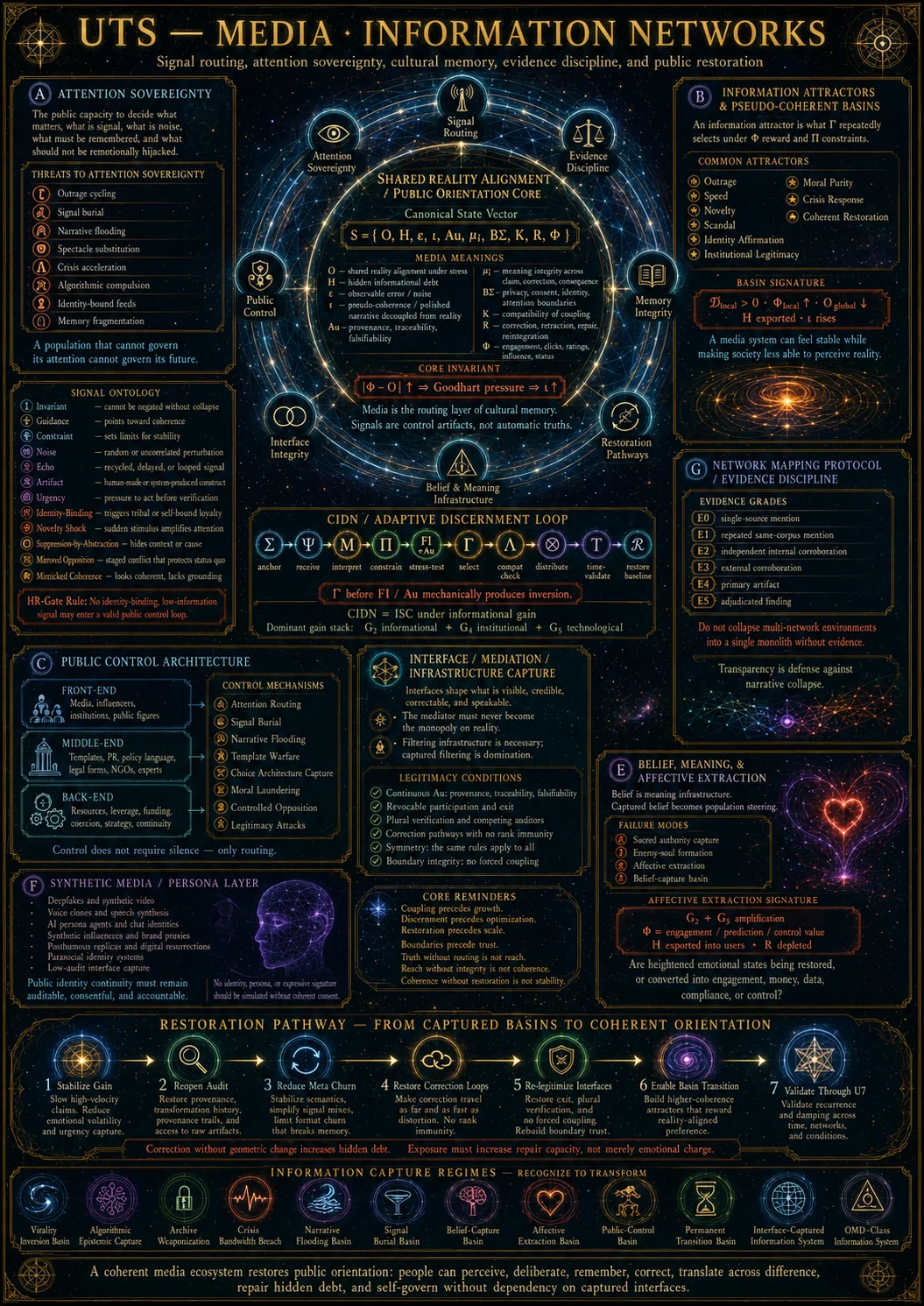
Introduction
Media is often treated as “content”: articles, videos, news, posts, podcasts, broadcasts, feeds, search results, reports, commentary, and entertainment.
But in UTS, media is more than content.
Media is therouting layer of collective reality.
It determines what a society notices, what it ignores, what it remembers, what it forgets, what it fears, what it trusts, what it repeats, and what it believes is possible.
Information networks are the structures that move these signals through a population. They include television, journalism, social platforms, search engines, recommendation systems, AI assistants, education systems, public records, archives, scientific publishing, institutional reports, activist networks, religious communication, and informal word-of-mouth.
Together, media and information networks shape the public field in which people form meaning, make choices, coordinate action, and repair errors.
In UTS terms:
Media is how a collective routes perception. Information networks are how a collective distributes memory, meaning, and decision-capacity.
1. Why Media Matters in UTS
UTS studies coherence: whether a system can preserve identity, meaning, and functional integrity across time under transformation.
A society cannot remain coherent if its information networks are incoherent.
If people cannot tell what happened, who was affected, what changed, what needs repair, what is uncertain, or what is being hidden, then the society loses its ability to coordinate.
This does not require everyone to agree.
Coherence is not agreement.
A coherent media system allows disagreement while preserving:
- shared reality access
- evidence trails
- correction pathways
- memory continuity
- boundary clarity
- consent
- public deliberation
- restoration after error
An incoherent media system does the opposite. It creates fragmentation, false certainty, spectacle, identity conflict, institutional distrust, and orientation collapse.
The issue is not simply “misinformation.”
The deeper issue is whether a population can stillperceive, deliberate, remember, correct, and self-govern.
2. Media as Cultural Memory Routing
Culture stores meaning across time. It carries memory, symbols, shame, grief, beauty, sacredness, humor, tradition, identity, and repair patterns.
Media routes that memory.
This means media does not merely report culture. It actively shapes which parts of culture become visible, amplified, forgotten, ridiculed, sacred, shameful, or politically useful.
A media system can help a culture remember truthfully.
Or it can convert memory into grievance loops, spectacle, amnesia, identity fusion, and control.
This is why UTS–Culture and UTS–Media are closely linked:
Culture is the memory-field. Media is the routing layer.
A healthy media system helps culture process memory into wisdom.
An unhealthy media system keeps reopening old wounds without repair, monetizing unresolved cultural debt for attention, outrage, and control. This integration draws directly from the UTS–Culture checkpoint, where culture is framed as a distributed coherence memory system.
3. The Core Failure of Modern Media
The central modern media failure is not that there is too little information.
It is that there is too much high-velocity information moving through systems with too little auditability and too little restoration capacity.
In simple terms:
Distortion spreads faster than correction.
A false or distorted signal can travel globally in minutes. But correction is slower, less exciting, less rewarded, and often does not reach the same people.
This creates hidden debt.
The error does not disappear just because the feed moves on. It remains inside public memory, institutional trust, social identity, and future interpretation.
Over time, this produces pseudo-coherence: systems that look active, informed, and responsive, while shared reality quietly degrades.
4. UTS Translation: The State Variables
UTS uses a shared state vector:
S = { O, H, ε, ι, Au, µᵢ, BΣ, K, R, Φ }For media and information networks, these mean:
- O — Coherence:shared reality alignment under stress
- H — Hidden Debt:unrepaired distortion, suppressed context, exported harm
- ε — Error:visible falsehoods, missing context, bad framing, noise
- ι — Inversion:polished narratives that appear coherent but are detached from reality
- Au — Auditability:provenance, source tracing, correction visibility
- µᵢ — Integrity:consistency between claims, actions, corrections, and consequences
- BΣ — Boundary Integrity:privacy, consent, identity, attention boundaries
- K — Compatibility:whether information exchange improves coherence
- R — Restoration Capacity:ability to correct, retract, repair, reintegrate
- Φ — Fitness Proxy:clicks, ratings, engagement, status, influence, legitimacy
The most important distinction is:
O is coherence. Φ is success signal.
Modern media often optimizes Φ: clicks, reach, engagement, views, outrage, retention, ratings, shareability.
But Φ is not truth. Φ is not coherence.
When Φ rises while O falls, the system enters inversion.
That is how a platform, network, or institution can become successful while making the public less capable of understanding reality.
5. Media as Signal Routing
In UTS, a signal is not automatically truth.
A signal is something that enters a system and changes interpretation, choice, coordination, or behavior.
Media signals include:
- headlines
- images
- labels
- expert claims
- viral clips
- statistics
- symbols
- accusations
- apologies
- slogans
- memes
- rituals
- stories
- rankings
- platform recommendations
The same fact can become a different signal depending on timing, framing, audience, repetition, and surrounding emotion.
This is why media analysis cannot stop at “is the statement true?”
It must also ask:
- What does this signal do?
- What does it amplify?
- What does it suppress?
- What does it make visible?
- What does it make invisible?
- What does it make urgent?
- What does it make impossible to discuss?
- Does it increase repair, or does it increase conflict?
In UTS, truth value and deployment effect are related, but not identical.
A true statement can be deployed incoherently.
A false statement can create enormous downstream hidden debt.
A partial truth can be more dangerous than an obvious lie if it carries authority while hiding missing context.
6. Attention Sovereignty
Attention is one of the most important resources in a media system.
A public cannot respond to everything. It must select what matters.
That selection process can be healthy or captured.
Attention sovereigntymeans a population can decide:
- what is signal
- what is noise
- what deserves memory
- what deserves repair
- what is urgent
- what is distraction
- what is spectacle
- what is structural
When attention sovereignty collapses, people are pulled from crisis to crisis, outrage to outrage, scandal to scandal, without enough time to understand patterns or repair causes.
This produces orientation collapse.
People may become highly informed at the surface but unable to act coherently.
They know many events, but they cannot see the structure.
A coherent media system protects attention sovereignty.
An incoherent media system consumes it.
7. Public Confusion as a Mechanical Outcome
Global confusion is not simply caused by ignorance.
It is often produced by system geometry.
Confusion rises when:
- information velocity is high
- correction is slow
- trust is fragmented
- platforms reward emotional intensity
- institutions suppress auditability
- culture is routed into identity conflict
- belief systems become weaponized
- crises compress deliberation
- synthetic media weakens identity trust
- people cannot distinguish exposure from spectacle
This creates the modern condition:
High information volume, low orientation.
The system talks constantly, but settles poorly.
It reacts, but does not repair.
It remembers fragments, but not patterns.
It amplifies emotion, but not always understanding.
8. Pseudo-Coherent Media Basins
A media basin is a region of repeated attention and interpretation.
People keep getting routed back into the same patterns:
- outrage
- fear
- purity
- cynicism
- identity defense
- crisis dependence
- enemy formation
- institutional loyalty
- anti-institutional reflex
- despair
- spectacle
A pseudo-coherent basin feels stable locally.
Inside it, the world seems to make sense.
There are familiar villains, familiar heroes, familiar explanations, familiar rituals, familiar slogans, familiar enemies.
But the basin may export hidden debt outside itself.
It may damage public trust, cultural memory, children, relationships, institutions, or future repair capacity.
This is one of the key insights of the Media framework:
A media environment can feel clarifying while making the larger system less coherent.
9. Belief and Meaning Infrastructure
Belief systems are not just opinions.
They are meaning infrastructures.
They organize what people consider sacred, shameful, forbidden, honorable, dangerous, redeemable, or worth sacrificing for.
Media can preserve belief systems by helping them remain humble, truthful, restorative, and alive.
But media can also weaponize belief by turning it into identity conflict, enemy formation, taboo enforcement, guilt loops, or obedience structures.
This can happen in religion, politics, science, activism, nationalism, fandoms, digital communities, and even professional cultures.
The question is not whether belief exists.
Belief always exists.
The question is:
Does the belief structure increase truth, love, wisdom, sovereignty, non-harm, and repair — or does it bind identity to conflict and suppress audit?
This section incorporates the meaning and belief mechanics previously translated from the NHI-thread material into neutral information-network terms.
10. Affective Extraction
Modern media often turns feeling into value.
Outrage becomes engagement.
Fear becomes retention.
Grief becomes spectacle.
Loneliness becomes dependency.
Shame becomes compliance.
Identity becomes audience segmentation.
Desire becomes targeting data.
This isaffective extraction: the conversion of human feeling into engagement, money, prediction, compliance, or control value without restoring the person or community generating the feeling.
A coherent media system does not merely intensify emotion.
It helps emotion resolve into clarity, relationship, repair, action, or wisdom.
An incoherent media system keeps feeling unresolved because unresolved feeling returns users to the system.
11. Interface Capture and Mediation Monopoly
Media systems are interfaces.
They sit between people and events, experts, institutions, communities, histories, crises, cultures, and each other.
This is necessary. No one can directly observe everything.
The danger is not mediation itself.
The danger ismediation capture.
Mediation capture occurs when an interface becomes the required gatekeeper of reality and blocks audit, exit, correction, or plural verification.
The captured mediator says, implicitly or explicitly:
- you need us to know what is real
- you need us to know who is legitimate
- you need us to know what matters
- you need us to know what may be questioned
- you need us to know who deserves trust
A coherent media system mediates without monopolizing.
It helps people see more clearly, not become dependent on the mediator.
Canonically:
The mediator must never become the monopoly on reality.
12. Synthetic Media and Persona Integrity
As technology advances, media no longer only routes messages.
It can simulate people.
This includes:
- deepfakes
- voice clones
- AI companions
- synthetic influencers
- avatar identities
- posthumous digital replicas
- AI-generated experts
- persona agents
- managed public identities
This creates a new risk:persona continuity capture.
Culture and public trust depend on knowing whether a person’s identity, voice, consent, and accountability are real.
If identity can be simulated without consent, then public meaning becomes unstable.
UTS therefore treats synthetic persona systems as high-risk information interfaces.
A future media system must protect not only data rights, but also expressive identity rights:
No system should clone, simulate, sell, or deploy a person’s expressive or relational identity without coherent consent.
13. Crisis and Compression
Crises are dangerous because they compress decision-space.
During crisis, people have less time, less information, less emotional bandwidth, and less bargaining power.
This can make them more likely to accept policies, deals, narratives, surveillance, relocations, authority transfers, or dependencies they would reject under stable conditions.
A coherent media system slows down where possible, marks uncertainty, preserves deliberation, and tracks who gains power during crisis.
An incoherent media system accelerates urgency, narrows options, and treats hesitation as guilt.
UTS calls this acompression window.
Canonically:
Free will under compression is not fully coherent consent.
During crisis, media has heightened audit responsibility.
14. Evidence Discipline and Network Mapping
Media systems often deal with complex networks: funding, influence, institutions, platforms, policy shops, NGOs, experts, corporations, public figures, and hidden incentives.
The danger is collapsing into either denial or over-unification.
The Media framework therefore includes theNetwork Mapping Protocol.
Its core principle:
Structure may exist before measurement capacity, but consolidation must follow evidence thresholds.
This prevents two common failures:
- assuming everything is random because proof is incomplete
- assuming everything is one unified plot because patterns exist
A coherent information network allows pattern detection, but requires evidence grading, falsification, alternative explanations, and transparent updates.
Truth does not need volume.
It needs structure.
15. Restoration: What a Healthy Media System Does
A coherent media ecosystem helps a public:
- perceive reality
- deliberate across difference
- remember accurately
- correct errors
- distinguish signal from noise
- protect boundaries
- repair hidden debt
- preserve dignity
- audit authority
- translate across cultures
- resist spectacle
- self-govern
Restoration is not simply “better messaging.”
Restoration requires changing the geometry of the system.
If engagement still rewards distortion, if correction is still punished, if audit remains asymmetric, if cultural debt remains monetized, and if interfaces remain captured, then factual correction alone will not repair the system.
A coherent media restoration sequence includes:
- slow harmful amplification
- reopen audit trails
- reduce rule and narrative churn
- make corrections travel as far as distortions
- protect dignity during correction
- restore plural verification
- repair cultural memory
- rebuild attention sovereignty
- validate through time
The target is not a perfectly unified public.
The target is a public that can recover coherence after disturbance.
Closing Summary
UTS – Media · Information Networksstudies how societies route perception.
Media is not only what people watch or read. It is the living infrastructure through which information, memory, belief, attention, identity, legitimacy, and consent move.
When media is coherent, it helps people see, remember, correct, deliberate, and repair.
When media is incoherent, it fragments reality, monetizes feeling, routes culture into conflict, suppresses audit, captures belief, and makes public self-governance harder.
The deepest diagnosis is:
Modern confusion is not caused by information alone. It is caused by high-gain signal routing without enough auditability, boundary integrity, cultural repair, and restoration capacity.
The deepest restoration law is:
A coherent media system restores public orientation.
This module hub separates the reference overview from technical depth and nested sub-modules. Use the overview for orientation, the technical document for the deep model, and sub-modules for systems that belong under this domain.