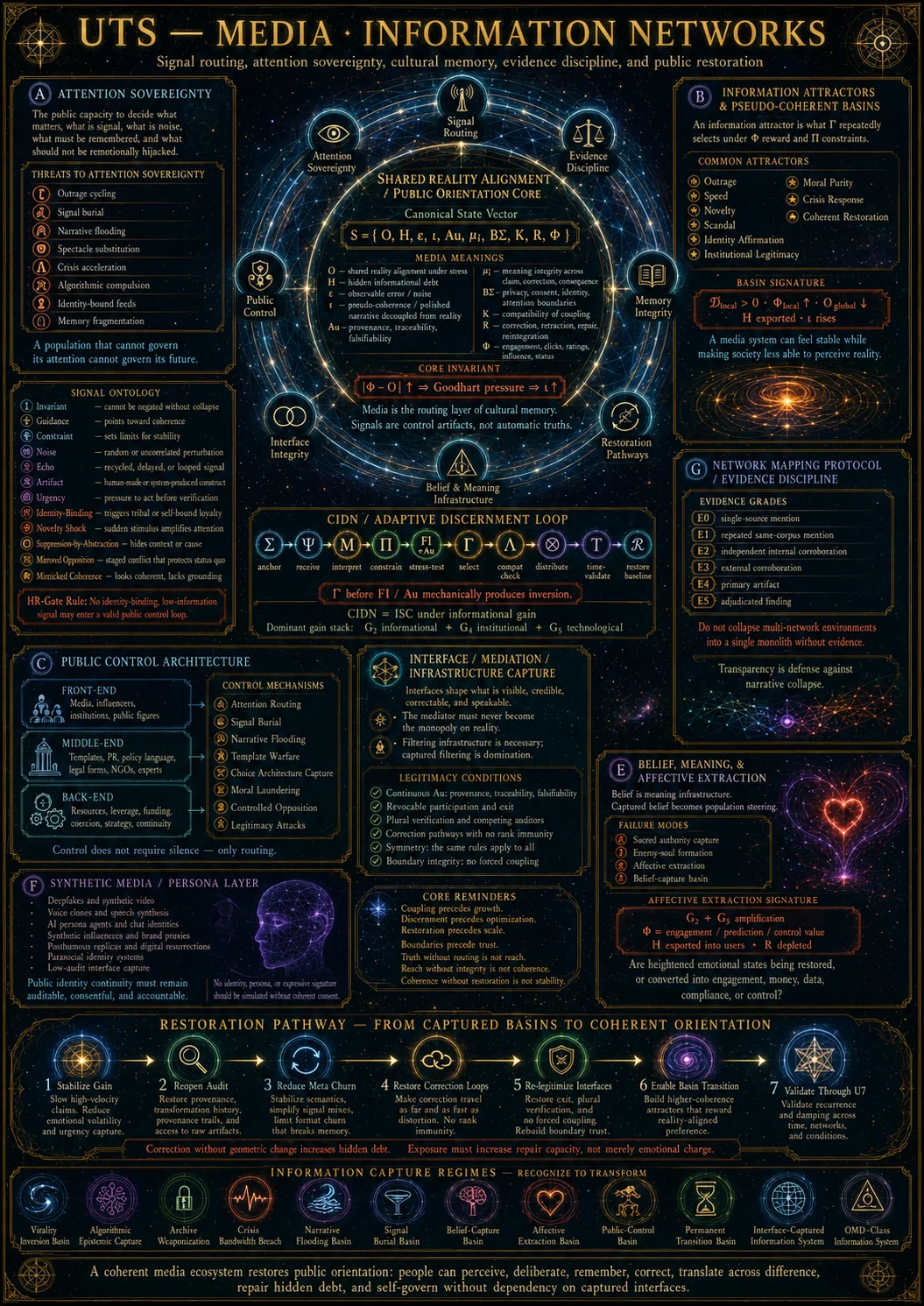
0) Purpose
UTS – Media · Information Networksformalizes how information, attention, belief, memory, identity, legitimacy, and consent move through public and private interfaces.
It exists to analyze and design:
- journalism and broadcast systems
- social media platforms
- AI knowledge systems
- scientific publishing
- public health communication
- civic discourse
- belief/meaning networks
- cultural memory systems
- institutional messaging
- crisis communication
- evidence networks
- synthetic media and persona systems
This module doesnotdecide what people should believe. It studies how information systems either preserve coherence or create pseudo-coherent basins.
PART I — CANON FRAME
1) Core Definition
A coherent media/information network is an interaction system in which signals propagate through constrained couplings such that coherence, auditability, boundary integrity, cultural memory, and restoration capacity are preserved across time, scale, and stress.
A media system is not merely a content pipeline.
It is also:
- an attention-routing layer
- a memory system
- a belief-shaping interface
- a public legitimacy engine
- a cultural basin stabilizer
- a correction or distortion amplifier
- a mediation layer between populations and reality
2) Canon State Vector
All analysis operates on:
S = { O, H, ε, ι, Au, µᵢ, BΣ, K, R, Φ }Media interpretation
| Variable | Media / Information-Network Meaning |
|---|---|
| O | Shared reality alignment under stress |
| H | Hidden informational debt: suppressed context, unrepaired errors, exported harm |
| ε | Observable errors: falsehoods, misquotes, missing context, noisy data |
| ι | Pseudo-coherence: polished narrative decoupled from reality |
| Au | Auditability: provenance, traceability, falsifiability, source visibility |
| µᵢ | Agent / meaning integrity across claim, action, correction, consequence |
| BΣ | Boundary integrity: consent, identity, privacy, scope, attention boundaries |
| K | Compatibility of coupling: does information exchange raise coherence? |
| R | Restoration capacity: correction, retraction, repair, reintegration |
| Φ | Fitness proxy: engagement, ratings, clicks, influence, status, legitimacy |
Core invariant
|Φ − O| ↑ ⇒ Goodhart pressure ⇒ ι ↑When media optimizes engagement, reach, or status faster than audit and repair can scale, pseudo-coherence rises.
3) U-Layer Localization
| Layer | Media Function |
|---|---|
| U0 | physical infrastructure, devices, print, cables, servers |
| U1 | attention, compute, money, labor, time budgets |
| U2 | permissions, visibility rules, moderation, access, APIs |
| U3 | publishing, sharing, ranking, enforcement, actuation |
| U4 | classifications, frames, narratives, metrics, labels |
| U5 | timing, virality, coordination, pile-ons, release sequencing |
| U6 | public meaning field, shared reality, cross-group trust |
| U7 | archives, memory, screenshots, institutional memory, recurrence |
| U8 | crises, wars, disasters, elections, technological shocks |
Repair rule
Media repair must occur at the same or lower U-layer than the failure origin.
A U4 narrative error cannot be repaired only through U4 rebranding if it originated in U2 access asymmetry or U5 coordination abuse.
PART II — CIDN FOUNDATION
4) CIDN Relationship
This module containsCoherent Information Dissemination Networks (CIDN)as its core mechanism layer.
CIDN is ISC under informational gain.
Information networks are high-velocity expressions of:
- signals
- couplings
- constraints
- selection
- amplification
- interpretation
- memory
- restoration
The dominant modern gain stack is:
G₂ informational + G₄ institutional + G₅ technologicalThis is why small distortions can scale into civilization-level confusion.
5) Signal Ontology
Signals arecontrol artifacts, not automatic truths.
Media-relevant signal classes include:
- invariant signals
- guidance signals
- constraint signals
- noise
- echo
- artifacts
- urgency signals
- identity-binding signals
- novelty shock
- suppression-by-abstraction
- false responsibility
- mirrored opposition
- mimicked coherence signals
HR-Gate rule
No identity-binding, low-information signal may enter a valid public control loop.
If a message tells people who they are, who the enemy is, or what must be done while providing low auditability, it is high-risk.
6) Adaptive Discernment Loop
A coherent information network follows the ISC loop:
Σ anchor
→ Ψ receive
→ Μ interpret
→ Π constrain
→ FI + Au stress-test
→ Γ select
→ Λ compatibility check
→ ⊗ distribute
→ Τ time-validate
→ ℛ restore baseline
Ordering constraint
Γ before FI/Au mechanically produces inversion.
If amplification happens before evidence, provenance, and feedback integrity, the system selects for pseudo-coherence.
PART III — MEDIA BASINS AND ATTRACTOR GEOMETRY
7) Information Attractors
An information attractor is defined by:
- whatΓrepeatedly selects
- whatΦrewards
- whatΠpermits
- whatΛstabilizes locally
- whatΔcan be absorbed without escape
Examples:
- outrage
- consensus appearance
- institutional legitimacy
- speed
- identity affirmation
- novelty
- scandal
- safety
- expertise
- moral purity
- crisis response
- coherent restoration
Attractors are not good or bad. They are selection geometries.
8) Pseudo-Coherent Information Basins
A pseudo-coherent information basin is a dissemination geometry in which local informational stability and success are achieved by exporting hidden debt beyond the visible boundary.
Formal signature:
𝓓_local > 0
Φ_local ↑
O_global ↓
H exported
ι rises
Hidden debt may be exported to:
- future time
- excluded populations
- platform users
- children
- workers
- moderators
- institutions
- cultural memory
- public trust
- downstream decision-makers
Canon anchor
A media system can feel stable while making society less able to perceive reality.
9) Culture as Memory Substrate
From UTS–Culture:
Culture is the memory-field; media is the routing layer.
Culture stores:
- meaning
- shame
- sacredness
- grievance
- trust
- beauty
- identity
- repair patterns
- future trajectory
Media routes those stored meanings.
Media implication
Media systems do not merely transmit facts; they route cultural memory.
A coherent media system preserves memory without turning it into spectacle, amnesia, grievance loops, or identity fusion.
10) Media Basin Routing
Media repeatedly routes populations into meaning basins.
| Basin | Media Routing Pattern |
|---|---|
| Extraction basin | wealth worship, growth metrics, success spectacle |
| Safety basin | threat loops, emergency authority |
| Identity-bound basin | purity conflict, enemy images |
| Narrative dominance basin | approved frames, controlled debate |
| Permanent transition basin | constant update churn, no stable baseline |
| Belief-capture basin | taboo zones, sacred authority, audit suppression |
| Public-control basin | attention routing, signal burial, crisis cycling |
Rule
If media repeatedly routes attention into the same basin, the basin becomes culturally self-confirming.
PART IV — META DYNAMICS
11) Meta Formation in Media
From UMT:
σ↓ + Φ pressure↑
⇒ Δ⁺ → Γ → Π
When slack collapses and proxy pressure rises:
- shocks or probes disturb the field
- selection favors what gets attention
- constraints narrow around the winning pattern
- the pattern becomes norm, format, policy, taboo, or platform logic
This is how media metas form.
Examples:
- outrage meta
- dunking meta
- purity meta
- “breaking news” meta
- doomscrolling meta
- expert monopoly meta
- safety clampdown meta
- crisis-to-policy meta
12) Grace Collapse
Whenσ(t)falls:
- ambiguity becomes unsafe
- humility becomes punished
- errors become identity threats
- corrections become status losses
- platforms tighten constraints
- audiences demand certainty
- public memory fragments
- nuance loses Φ
Canon statement
Low slack makes certainty perform better than truth.
13) Meta Succession Rate
μmeta(t)measures rulebook or format churn.
High μmeta in media appears as:
- constantly changing taboos
- rapidly shifting language rules
- new platform norms
- short-lived outrage formats
- frequent moderation changes
- memetic churn
- unstable expert consensus signals
Failure signature
μ_meta↑ + R low ⇒ permanent transition modeA public in permanent transition cannot settle enough to repair.
14) Rule-Stacking Wall
X_c > Au_eff ⇒ H↑ ⇒ O↓In media systems:
- rules proliferate
- exceptions proliferate
- enforcement becomes opaque
- trust declines
- users infer bias
- audit capacity collapses
- hidden debt accumulates
Canon statement
You cannot policy your way to coherence when rule complexity outruns auditability.
PART V — ATTENTION, SIGNAL, AND PUBLIC ORIENTATION
15) Attention Routing
Attention routing is the upstream shaping of what a population notices, ignores, fears, mocks, repeats, remembers, or treats as impossible.
Control does not require universal belief. It may only require orientation collapse.
The public sees:
- scandals
- personalities
- culture fights
- outrage cycles
- symbolic enemies
- fragmented crises
The public misses:
- funding architecture
- template replication
- legal loopholes
- ownership networks
- timing patterns
- structural incentives
- interface capture
16) Attention Sovereignty
Attention sovereignty is the capacity of a public to decide what matters, what is signal, what is noise, what must be remembered, what requires repair, and what should not be emotionally hijacked.
Media destroys attention sovereignty through:
- outrage cycling
- narrative flooding
- signal burial
- spectacle substitution
- crisis acceleration
- algorithmic compulsion
- identity-bound feeds
- memory fragmentation
Canon anchor
A population that cannot govern its attention cannot govern its future.
17) Signal Burial
Signal burial occurs when important patterns are hidden inside mass noise, false reports, partial truths, decoys, spectacle, or interpretive overload.
Formula:
dangerous signal → increase similar noiseSignal burial can hide:
- real abuse among false claims
- true coordination among organic chatter
- targeted harm among general dysfunction
- useful anomalies among hoaxes
- valid testimony among unstable narratives
- structural corruption among personality spectacle
18) Narrative Flooding
Narrative flooding overwhelms interpretation by releasing too many explanations, frames, claims, and emotional cues at once.
The goal is not always belief.
The goal can be:
“No one can know anything, so coherent action becomes impossible.”
UTS signature:
ε interpretation overload
+ Au↓
+ AP↑
+ τ_resp↑
⇒ public O↓
19) Exposure vs Spectacle
Exposure:
- clarifies mechanism
- preserves evidence
- increases repair capacity
- protects dignity
- reduces H
- improves public discernment
Spectacle:
- inflames emotion
- over-names without proof
- spreads unstable claims
- turns harm into entertainment
- exhausts attention
- discredits legitimate issues
Rule
Exposure must increase repair capacity, not merely emotional charge.
PART VI — INTERFACE, MEDIATION, AND INFRASTRUCTURE CAPTURE
20) Interface Capture
Interface capture occurs when a system mediates access to reality, truth, meaning, memory, authority, or repair while suppressing auditability, exit, or plural verification.
Captured interfaces decide:
- what is visible
- what is credible
- what is ridiculous
- what can be corrected
- what counts as expertise
- what counts as harm
- what options are visible
- who can speak
- who can be heard
Interface legitimacy requires
- continuous Au
- revocable participation
- plural verification
- correction pathways
- MS symmetry
- boundary integrity
- no forced coupling
21) Mediation Capture
Mediation capture occurs when an intermediary places itself between a population and truth, meaning, resources, repair, authority, or relationship — then taxes or controls that access.
Examples:
- media monopolies
- platform monopolies
- credential monopolies
- spiritual authority monopolies
- aid intermediaries
- data brokers
- opaque NGOs
- AI interface monopolies
- expertise cartels
UTS signature
RG + Au asymmetry + Π gatekeeping + Φ extraction
⇒ dependency basin
Canon statement
The mediator must never become the monopoly on reality.
22) Infrastructure Capture
Media is necessary infrastructure. Filtering is necessary. The failure is captured filtering.
Coherent filtering
- reduces overload
- preserves provenance
- marks uncertainty
- separates fact from interpretation
- enables correction
- protects memory
- preserves boundary integrity
Captured filtering
- narrows reality
- hides alternatives
- routes outrage
- suppresses repair
- creates dependency
- blocks audit
- preserves institutional immunity
Rule
The goal is not filter abolition. The goal is auditable, plural, sovereignty-preserving filtering.
23) Stewardship Capture
Stewardship capture occurs when a role entrusted with protection, development, mediation, or care converts that duty into ownership, extraction, or control.
Media stewardship becomes capture when it claims to protect public truth while making itself the required gatekeeper of reality.
| Lawful Function | Captured Inversion |
|---|---|
| informing | narrative management |
| investigation | selective exposure |
| accountability | reputational attack |
| expertise | authority monopoly |
| public memory | memory filtering |
| safety | fear routing |
| compassion | boundary collapse |
| truth | brand identity |
| restoration | optics |
Canon statement
The most dangerous captured systems preserve the appearance of their original lawful function.
PART VII — BELIEF, MEANING, AND AFFECTIVE ECONOMIES
24) Belief as Meaning Infrastructure
Belief systems are long-horizon meaning infrastructures. Media systems can preserve, distort, weaponize, or repair them.
Belief systems organize:
- sacredness
- morality
- authority
- shame
- memory
- sacrifice
- enemy images
- hope
- duty
- future trajectory
Media can preserve belief coherence or convert belief into population steering.
25) Weaponization of Belief
Weaponization of belief occurs when meaning systems are sculpted over time to bind identity, suppress audit, generate conflict, route obedience, or steer populations across eras.
Failure modes:
- sacred authority capture
- enemy-soul formation
- prophecy hijacking
- guilt taxation
- martyrdom economy
- purity spiral
- taboo weaponization
- spiritual outsourcing
- meaning monoculture
- ritual routing capture
Media warning
When belief becomes identity-bound and audit-suppressed, amplification becomes high-risk.
26) Sacred Authority Capture
Sacred authority capture occurs when a leader, text, institution, expert class, or interpretive body becomes unauditable because it claims superior access to truth or sacredness.
Failure signature:
Questioning becomes betrayal.
This can happen in religion, politics, science, media, activism, or expertise systems.
27) Enemy-Soul Formation
Enemy-soul formation occurs when a population is trained to perceive another population as inherently dangerous, impure, cursed, inferior, corrupt, or cosmically opposed.
Failure signature:
Harm becomes purification.
Media can amplify enemy-soul formation through:
- decontextualized atrocity loops
- symbolic enemy images
- selective history
- mythic framing
- algorithmic outrage
- repeated dehumanizing categories
28) Affective Extraction
Affective extraction is the conversion of human feeling, attention, identity, grief, desire, fear, outrage, devotion, shame, intimacy, or symbolic intensity into usable value for external systems.
Modern forms:
- outrage media
- doomscrolling
- trauma entertainment
- parasocial dependency
- addictive platforms
- extremist recruitment
- ideological fundraising
- AI persona modeling
- surveillance capitalism
- shame loops
- fear-based conversion funnels
UTS signature
G₂ + G₅ amplification
Φ = engagement / prediction / control value
H exported into users
R depleted
Canon question
Are heightened emotional states being restored, or converted into engagement, money, data, compliance, or control?
PART VIII — CULTURE, MISALIGNMENT, AND PUBLIC CONFLICT
29) Cultural Asymmetry
Cultural asymmetry occurs when groups operate from different assumptions about law, trust, family, authority, time, conflict, identity, religion, speech, and obligation.
Asymmetry is not failure by itself.
Failure occurs when asymmetry is forced into coupling without translation, pacing, boundaries, or repair.
30) Weaponized Miscalibration
Weaponized miscalibration occurs when media systems amplify cultural differences without providing translation, pacing, boundary context, or repair pathways.
Failure sequence:
cultural asymmetry
+ media compression
+ outrage Φ
+ low Au
+ weak R
⇒ conflict basin
Media does this by:
- highlighting extreme representatives
- removing local context
- framing misunderstanding as malice
- suppressing bridge voices
- rewarding inflammatory translation
- treating cultural difference as enemy proof
- making moderation look like betrayal
Restoration
- translation layers
- historical context
- boundary clarity
- grievance differentiation
- population/faction separation
- slower framing under uncertainty
- cultural repair pathways
31) Hidden Cultural Debt as Media Fuel
Hidden cultural debt is unresolved harm, humiliation, grievance, betrayal, conquest, displacement, oppression, or sacred injury that persists across generations.
Media can convert hidden debt into:
- outrage cycles
- moral sorting
- revenge narratives
- purity contests
- intergenerational grievance
- sacred enemy formation
- political mobilization
- identity-bound certainty
Rule
Media systems become incoherent when they monetize unresolved cultural debt without increasing restoration capacity.
PART IX — PUBLIC CONTROL ARCHITECTURE
32) Public Control Architecture
Public Control Architecture is the capture of public attention, legitimacy, law, culture, and consent through visible interfaces, template systems, and hidden leverage layers.
This does not imply universal complicity.
Most participants operate through partial information and local incentives.
33) Three-Layer Stack
| Layer | Role |
|---|---|
| Back-end | resources, leverage, funding, coercion, strategy, continuity |
| Middle-end | templates, policy language, PR, think tanks, legal forms, NGOs |
| Front-end | public figures, media, influencers, experts, institutions |
Core function
The front-end consumes attention. The middle-end compiles strategy into legitimacy. The back-end controls leverage.
34) Template Warfare
Template warfare is the use of repeatable scripts across institutions so apparently independent events produce the same directional outcome.
Signs:
- same phrases across outlets
- same policy structures
- same reputational attack sequence
- same crisis-to-policy pipeline
- same apology ritual
- same expert framing
- same activist tactics
- same platform enforcement logic
Diagnostic:
Where else does this template appear?
35) Choice Architecture Capture
Choice architecture capture occurs when people appear to choose freely, but the visible option set has already been narrowed.
Methods:
- remove viable alternatives
- frame only extremes
- make coherent paths socially costly
- hide long-term consequences
- attach identity to policy
- overwhelm with options
- make dependency convenient
- make sovereignty look dangerous
Rule
Free will under compression is not fully coherent consent.
36) Moral Laundering
Moral laundering occurs when real virtues are used as wrappers for control.
| Principle | Captured Form |
|---|---|
| safety | surveillance and obedience |
| justice | punishment without restoration |
| compassion | boundary collapse |
| freedom | license without responsibility |
| equality | enforced flattening |
| tradition | frozen hierarchy |
| progress | forced destabilization |
| science | credential monopoly |
| faith | authority capture |
| security | rights removal |
| inclusion | coerced merger |
| truth | narrative monopoly |
37) Controlled Opposition
Controlled opposition absorbs dissent into managed channels.
It may:
- name the wrong enemy
- exaggerate truth until unbelievable
- create spectacle instead of repair
- discredit legitimate concerns
- collect energy without solving problems
- prevent independent coordination
- route resistance back into the basin
38) Legitimacy Attacks
Legitimacy attacks destroy a node’s public ability to function as a coherence carrier.
Methods:
- reputational smearing
- selective context
- provocation
- guilt by association
- identity labeling
- platform removal
- financial pressure
- professional isolation
- surveillance leaks
- emotional-state capture
Goal:
Make the node unusable, not necessarily disproven.
PART X — SYNTHETIC MEDIA, PERSONA, AND LOW-AUDIT INTERFACES
39) Symbolic Interface Manipulation
Symbolic interface manipulation occurs when stories, images, rituals, myths, games, simulations, avatars, or media environments alter a population’s meaning-field without clear auditability.
Modern forms:
- propaganda
- deepfakes
- AI companions
- immersive media
- targeted narrative ads
- synthetic influencers
- shame loops
- ideological gaming
- mythic enemy images
- parasocial identity systems
40) Persona Continuity Capture
Persona continuity capture occurs when a system can simulate, extend, manage, replace, or manipulate an identity-signature while preserving enough public continuity to retain legitimacy.
Examples:
- deepfakes
- voice clones
- AI persona agents
- synthetic influencers
- ghostwritten identities
- managed public figures
- posthumous replicas
- brand-person continuity
Rule
Public identity continuity must remain auditable, consentful, and accountable.
Without this:
µᵢ↓
Au↓
BΣ↓
public trust destabilizes
41) Data Persona Rights
A data persona is a simulated model of a person built from behavioral, emotional, symbolic, relational, and expressive traces.
A future-facing CIDN rule:
No system should clone, simulate, sell, or deploy a person’s expressive or relational identity without coherent consent.
This connects Media · Information Networks to UTS–IIS and UTS–AI.
42) Low-Audit Interface Capture
Low-audit interface capture occurs when systems shape behavior through states where agency, boundary clarity, or auditability are reduced.
Examples:
- fatigue scrolling
- autoplay loops
- parasocial immersion
- intoxicated media use
- synthetic intimacy
- emotional overload
- trance-like short-form cascades
- immersive VR identity shaping
- AI companion dependency
Rule
Consent quality decreases when auditability, wakeful agency, boundary clarity, or exit capacity decreases.
PART XI — CRISIS, ECONOMY, AND COMPRESSION WINDOWS
43) Compression Windows
A compression window is a period in which crisis, scarcity, fear, grief, or urgency narrows decision-space and lowers consent quality.
During compression windows:
- people accept worse deals
- emergency powers expand
- narratives harden
- deliberation is shamed
- policy options narrow
- dependency appears practical
- boundary concessions accelerate
44) Crisis-Capture
Crisis-capture occurs when emergency conditions are used to transfer authority, land, policy, infrastructure, data, or legitimacy under urgency.
Rule
Disaster origin and disaster use are separate questions.
Even natural crises can be exploited.
Audit questions:
- Who gained authority?
- What became urgent?
- What became unsayable?
- What options disappeared?
- What emergency powers remained?
- Who controlled aid?
- Who controlled reconstruction?
- Did affected people regain sovereignty?
45) Economic Dependency Framing
Economic dependency capture occurs when a distressed system accepts support that transfers control over its future value layer.
Media role:
- frame the deal as inevitable
- hide asymmetric terms
- amplify short-term benefits
- suppress long-term sovereignty analysis
- personalize criticism as extremism
- obscure who receives the recovery economy
Rule
Aid is coherent only if it restores sovereignty rather than dependency.
PART XII — NETWORK MAPPING PROTOCOL
46) NMP Role
TheNetwork Mapping Protocol (NMP)provides CIDN with an evidence discipline layer.
Purpose:
Map organized leverage networks without collapsing into unfalsifiable models.
Core rule:
Structure may exist before measurement capacity, but consolidation must follow evidentiary thresholds.
47) Evidence Grades
| Grade | Meaning |
|---|---|
| E0 | Single-source mention |
| E1 | Repeated mention within same corpus |
| E2 | Independent internal corroboration |
| E3 | External corroboration |
| E4 | Primary artifact |
| E5 | Adjudicated finding |
Rules
- structural modeling can include E1+
- public assertions require E3+
- cluster consolidation requires E2+ cross-links
- cross-domain integration requires E3+
48) Cluster Discipline
Cluster types:
- local cluster:repeated bounded links
- operational cluster:local cluster + logistics/finance
- leverage cluster:operational cluster + coercive/protective mechanism evidence
- cross-cluster hypothesis:requires high-threshold independent links
Anti-inflation rule
Do not collapse multi-network environments into a single monolith without evidence.
49) Falsification Layer
Every cluster must pass:
- alternative explanation test
- randomness baseline
- redundancy check
- incentive test
- contradiction logging
CIDN value
NMP prevents Media · Information Networks from becoming its own pseudo-coherent basin.
50) Update Protocol
When new data arrives:
- add to ledger
- recalculate edge weights
- rescore cluster confidence
- log contradictions
- publish delta report
Rule
Transparency is defense against narrative collapse.
PART XIII — HIGH-COHERENCE NODES AND MISSION INVERSION
51) High-Coherence Nodes
A high-coherence node is any person, group, institution, tool, or media system that increases public clarity, repair, or sovereignty without needing centralized control.
Examples:
- whistleblowers
- independent researchers
- bridge-builders
- local trusted leaders
- restorative journalists
- ethical technologists
- open-source auditors
- artists who reframe public meaning
- youth with unusual talent
- community repair networks
52) Suppression Methods
High-coherence nodes may be suppressed through:
- ridicule
- overexposure
- platform throttling
- reputational attack
- resource starvation
- forced association with unstable signals
- identity inflation
- controlled platforming
- legal harassment
- isolation
- mission inversion
53) Mission Inversion
Mission inversion occurs when a coherence-generating capacity is redirected into the very system it was meant to repair.
| Capacity | Inverted Form |
|---|---|
| empathy | emotional labor extraction |
| truth-seeking | paranoia spiral |
| leadership | status hierarchy |
| healing | dependency loop |
| creativity | spectacle capture |
| pattern recognition | targeting system |
| compassion | boundary collapse |
| sovereignty | isolation/superiority |
| critique | controlled opposition |
Rule
A gift without boundary integrity becomes usable by capture systems.
PART XIV — RESTORATION ARCHITECTURE
54) Media Restoration Is Geometric
Restoration is a change in interaction geometry, not a better argument or narrative win.
Fact-checking alone is insufficient if:
- Γ still rewards distortion
- Π still hides correction
- Au remains asymmetric
- R remains weak
- Φ remains engagement-dominant
- cultural debt remains unrepaired
55) Restorability Test
A media system is restorable in-place iff:
- Au is not structurally suppressed
- R can scale
- Π allows correction and re-entry
- μmeta can slow
- BΣ and MS can be enforced
- identity-binding signals can be attenuated
- filtering can become auditable
If not:
OMD-class systems require replacement, not patching.
56) Restoration Sequence
1. Stabilize gain
2. Reopen audit
3. Reduce meta churn
4. Restore correction loops
5. Re-legitimize interfaces
6. Enable basin transition
7. Validate through U7 recurrence
1. Stabilize gain
- slow high-velocity claims
- scope-bound virality
- attenuate instead of delete where possible
2. Reopen audit
- provenance
- transformation history
- uncertainty labels
- symmetric transparency
3. Reduce meta churn
- freeze non-essential rule changes
- sunset emergency rules
- restore stable semantics
4. Restore correction loops
- correction travels as far as distortion
- correction does not destroy dignity
- correction increases future honesty
5. Re-legitimize interfaces
- exit without penalty
- no forced coupling
- no rank immunity
- plural verification
6. Enable basin transition
- build higher-coherence attractors
- make them visible, viable, and admissible
7. Validate through time
- 𝓓 settles after shocks
- τm improves
- relapse risk declines
- Φ realigns toward O
57) Equality-Conserving Accountability
Closure requires:
- truth discoverable
- consequence symmetric
- repair material
- prevention structural
Reintegration must be:
- conditional
- graduated
- auditable
- reversible
- decoupled from old influence networks
58) Attention Sovereignty Restoration
Restoration tools:
- public archives
- provenance standards
- template comparison
- independent journalism
- decentralized analysis
- funding transparency
- legal audits
- whistleblower protection
- cultural translation layers
- evidence standards
- AI pattern tools
- civic education
- restorative justice
- emergency-power sunset rules
Goal:
Restore the public’s capacity to perceive, deliberate, remember, repair, and self-govern.
59) Belief and Cultural Restoration
Belief/media restoration requires:
- recover original coherence
- identify historical overlays
- restore auditability
- separate devotion from obedience capture
- separate ritual from extraction
- separate community from enemy formation
- protect youth from ideological predation
- close consent loopholes
- return meaning to truth, love, wisdom, sovereignty, non-harm, and repair
Canon phrase
Do not destroy meaning; free meaning from capture.
PART XV — CANONICAL FAILURE REGIMES
60) Recognized Media / Information Regimes
These are named compositions, not operators.
1. Virality Inversion Basin
Γ + Φ engagement + G₂/G₅ + low Au ⇒ ι↑High-spread content outcompetes coherent content.
2. Algorithmic Epistemic Capture
Opaque ranking creates different reality tunnels while platform-side observability remains asymmetric.
3. Archive Weaponization
U7 memory is used to punish correction, freeze identity, or remove re-entry.
4. Crisis Bandwidth Breach
Shock > 𝓑(t)
⇒ compressed models
⇒ Θ↓
⇒ hard frames dominate
5. Narrative Flooding Basin
Excess interpretive options collapse public orientation.
6. Signal Burial Basin
Important signals are hidden in noisy fields.
7. Belief-Capture Basin
Sacred or ideological authority suppresses audit and binds identity.
8. Affective Extraction Basin
Human emotional states are converted into engagement, money, prediction, or control value.
9. Public-Control Basin
Attention, legitimacy, law, culture, and consent are routed through captured interfaces.
10. Permanent Transition Basin
High μmeta prevents public settlement and repair.
11. Interface-Captured Information System
A necessary interface becomes unauditable, irreplaceable, and dependency-producing.
12. OMD-Class Information System
Audit suppression is structurally required for the system to function.
PART XVI — DIAGNOSTIC DASHBOARD
61) Core Diagnostics
| Diagnostic | Media Use |
|---|---|
| 𝓑(t) | bandwidth before public phase shift |
| 𝓓(t) | settling after controversy/shock |
| σ(t) | grace/slack before clampdown |
| τresp | signal-to-response latency |
| τcorr | error-to-correction propagation time |
| τm | public memory half-life |
| μmeta | norm/rulebook churn |
| Xc | policy/rule complexity |
| AP | attribution pressure / intent projection |
| Augap | auditability asymmetry |
| Rcorr | correction throughput |
| Ω | observability distribution |
| RG | resource gatekeeping |
| P-field | influence geometry |
| Goodhart risk | Φ/O divergence |
62) Minimal Media Audit
Ask:
- What is Γ selecting?
- What is Φ rewarding?
- What is being amplified before Au?
- Where is H exported?
- Who has auditability?
- Who lacks correction access?
- What basin does attention return to?
- What belief/cultural debt is being activated?
- Is this exposure or spectacle?
- What options are made invisible?
- What emergency powers or dependencies follow?
- Does this increase public capacity to self-govern?
- Does correction travel as far as distortion?
- Does the system preserve dignity under error?
- Can people exit without penalty?
PART XVII — CANONICAL ANCHORS
63) Pinned Statements
- Media is the routing layer of cultural memory.
- Control begins where attention is routed before perception can stabilize.
- A media system can feel stable while making society less able to perceive reality.
- Γ before FI/Au mechanically produces inversion.
- The mediator must never become the monopoly on reality.
- Filtering infrastructure is necessary; captured filtering is domination.
- A population that cannot govern its attention cannot govern its future.
- Belief is meaning infrastructure; captured belief becomes population steering.
- Questioning becoming betrayal is an authority-capture signature.
- Media becomes incoherent when it monetizes unresolved cultural debt without increasing restoration capacity.
- Affective intensity is not coherence.
- Exposure must increase repair capacity, not merely emotional charge.
- Free will under compression is not fully coherent consent.
- Aid is coherent only if it restores sovereignty rather than dependency.
- No identity, persona, or expressive signature should be simulated without coherent consent.
- Correction without geometric change increases hidden debt.
- High μmeta with low R creates permanent transition mode.
- OMD-class systems cannot be patched; they require replacement.
- Do not destroy meaning; free meaning from capture.
- The restoration target is public capacity to perceive, deliberate, remember, repair, and self-govern.
PART XVIII — SUMMARY
UTS – Media · Information Networks v1.0defines media as the routing architecture for information, attention, belief, memory, identity, legitimacy, and consent.
It integrates:
- CIDN’s coherent dissemination logic
- ISC’s signal/coupling gates
- UMT’s meta compression and rule-churn mechanics
- Culture’s memory-field and basin logic
- NMP’s evidence discipline
- restoration-first correction architecture
- synthetic persona and AI media risks
- public-control and attention sovereignty mechanics
The central diagnosis:
Modern confusion is not caused only by too much information. It is caused by high-gain signal routing, low audit symmetry, collapsed slack, captured filters, unresolved cultural debt, belief weaponization, and weak restoration throughput.
The central restoration law:
A coherent media ecosystem restores public orientation: people can perceive, deliberate, remember, correct, translate across difference, repair hidden debt, and self-govern without dependency on captured interfaces.