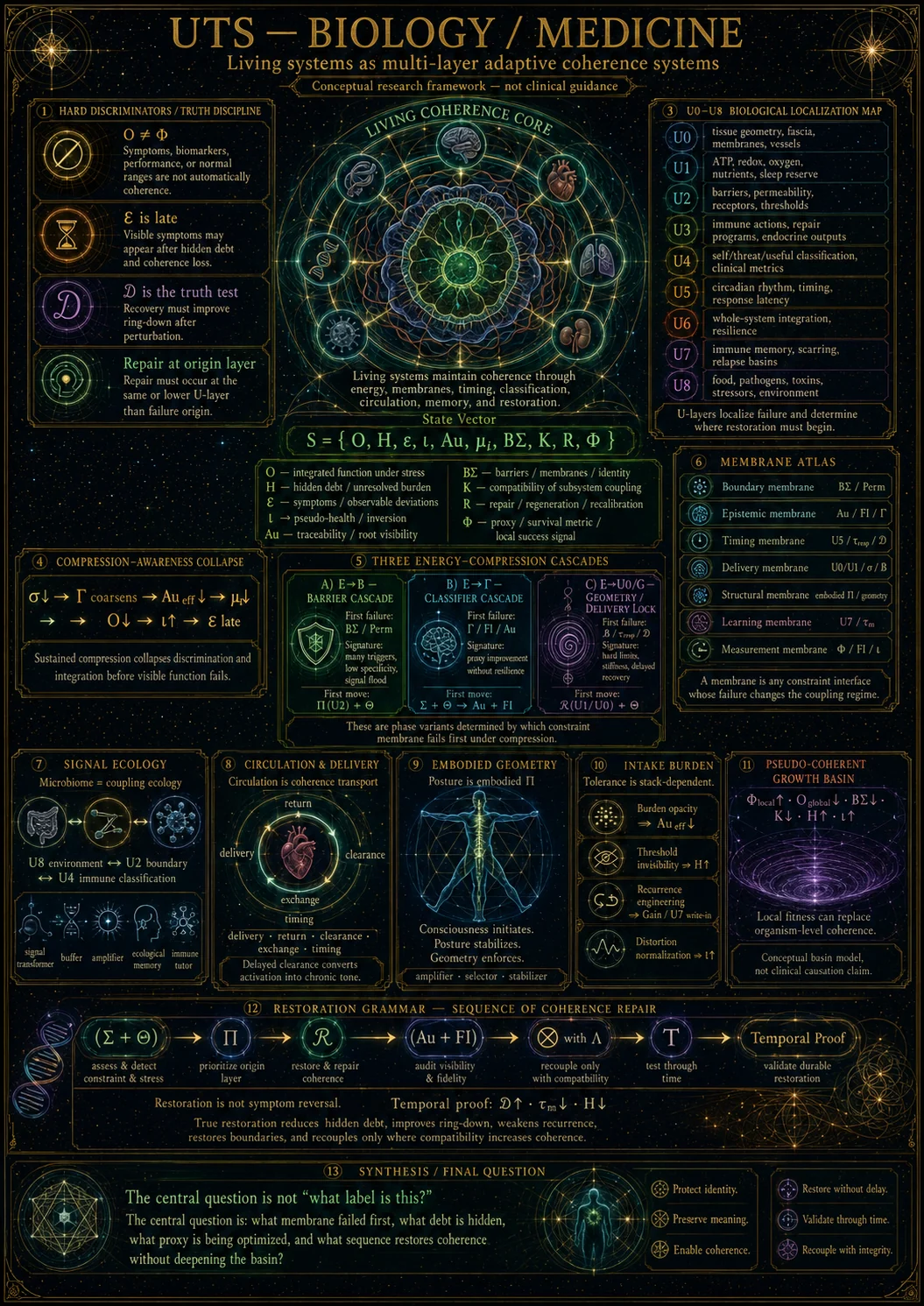
1. What UTS – Biology is
UTS – Biologyis a way of understanding living systems ascoherence systems.
A living body is not just a collection of organs, chemicals, genes, symptoms, or disease labels. It is a layered adaptive system constantly trying to maintain coherence while being shaped by food, sleep, stress, microbes, posture, medications, environment, memory, injury, repair, and time.
In ordinary language:
UTS – Biology asks how the body stays organized, how it loses organization, and how it can return to a healthier pattern without simply suppressing symptoms.
It does not replace biology, medicine, immunology, nutrition, genetics, or physiology. It gives them a shared map.
2. The basic idea: health is not just “no symptoms”
In this framework, health is not defined only by whether a symptom is present or absent.
A body can look “stable” while still carrying hidden stress.
For example:
- a symptom may be suppressed, but the underlying pattern remains
- a lab marker may improve, but the person’s resilience may not
- a person may function well for a while, but recovery after stress gets worse
- a condition may appear controlled, but relapse keeps returning
UTS – Biology distinguishes betweensurface stabilityandreal coherence.
Surface stability
The system looks okay in one area.
Real coherence
The system becomes more resilient, better coordinated, better able to recover, and less likely to relapse.
The difference matters because many chronic patterns are not chaotic. They are oftenstable in the wrong shape.
3. Chronic illness as a stable low-coherence pattern
One of the central ideas of UTS – Biology is that chronic illness often behaves like astable basin.
That means the body keeps returning to the same pattern even after temporary improvement.
This can happen when the body has found a “survival arrangement” that works locally but costs the whole system over time.
Examples of this kind of pattern include:
- chronic inflammation that keeps the body defended but prevents repair
- fatigue patterns that reduce activity but also reduce circulation and resilience
- posture patterns that stabilize stress but create delivery problems
- food habits that provide reward but increase digestive burden
- immune patterns that reduce immediate danger but create long-term misclassification
- tumor-like growth patterns that are locally successful but globally harmful
This is why UTS – Biology says:
Chronic illness is often constrained success, not simple failure.
The body may be doing something understandable under pressure, but the pattern becomes costly once it persists.
4. Compression: the missing bridge
A major theme of UTS – Biology iscompression.
Compression happens when the system has less slack than it needs.
That slack can be physical, energetic, emotional, metabolic, informational, or structural. In biology, it often appears as reduced recovery capacity, reduced energy, poor timing, poor circulation, weakened barriers, poor sleep, or chronic overload.
When slack falls, the body narrows its options.
It may:
- reduce repair
- simplify immune decisions
- tighten or loosen barriers
- reduce digestive tolerance
- stiffen posture
- delay clearance
- prioritize short-term function over long-term repair
This gives us one of the core principles:
When a living system is compressed, it loses fine-grained intelligence before it loses basic function.
A person may still function, but with less flexibility, less resilience, less recovery, and less clarity.
5. The three main compression pathways
In this thread, we mapped three major ways compression can express itself.
These are not diseases. They areattractor families— patterns of how breakdown organizes.
5.1 Energy → Barrier cascade
The body loses slack, and barriers become harder to maintain.
This can show up as:
- food sensitivity
- skin reactivity
- gut permeability patterns
- many triggers
- low specificity
- immune activation after exposure
- difficulty identifying what caused what
In plain language:
When the body lacks enough energy or restoration capacity, its selective membranes can become less precise.
The problem may look like “everything is a trigger,” but the deeper issue may be that the body no longer has enough slack to maintain clean boundaries.
5.2 Energy → Classifier cascade
The body loses slack, and its classification system simplifies.
This can show up as:
- threat responses in the wrong context
- tolerance where elimination is needed
- elimination where tolerance is needed
- immune confusion
- proxy improvement without real recovery
- strong explanations that do not actually improve resilience
In plain language:
Under compression, the body may stop distinguishing carefully and start making broad, costly decisions.
This is especially important in immune patterns, inflammatory patterns, and chronic misclassification.
5.3 Energy → Geometry / Delivery lock
The body loses slack, and physical structure becomes part of the problem.
This can show up as:
- stiffness
- poor circulation
- delayed recovery
- poor ring-down after stress
- postural lock
- local improvements that do not spread system-wide
- hard limits: “I just cannot tolerate much”
In plain language:
When the body is compressed long enough, the compression can become embodied.
The system is no longer only making poor decisions. Its physical geometry has become part of the constraint.
6. Why posture matters
UTS – Biology treats posture as more than body position.
Posture is a long-term interface between:
- emotional state
- nervous system tone
- breathing
- circulation
- immune timing
- energy cost
- structural geometry
A posture may begin as an expression of a state, but if repeated long enough it becomes a stabilizer of that state.
A useful summary from this thread is:
Consciousness initiates. Posture stabilizes. Geometry enforces.
This does not mean posture causes all illness. It means posture can help determine how a biological pattern becomes embodied and how difficult it becomes to exit.
7. The microbiome as a coupling ecology
UTS – Biology does not treat the microbiome as just a list of organisms.
It treats the microbiome as acoupling ecology.
That means the microbiome helps translate the outside world into internal signals.
Food, stress, timing, sleep, medications, inflammation, and barriers all shape the microbiome. The microbiome then shapes immune tone, digestive signals, metabolic signals, and inflammation patterns.
The key principle is:
The microbiome is a signal transformer, not simply a cause list.
This matters because microbiome instability may not be the root cause. It may reflect deeper problems in barriers, timing, diet, circulation, immune tone, or terrain.
8. Food burden and modern intake architecture
A major addition to UTS – Biology is the idea ofrecurrent burden architecture.
Many food-related problems do not come from one ingredient alone. They emerge from repeated stacking:
- low-fiber intake
- processed foods
- poorly tolerated combinations
- weak satiety
- repeated snacking
- reward-engineered foods
- delayed symptoms
- poor recovery spacing
- normalized discomfort
The attached food-burden framework described this as a system where burdening inputs, digestive mechanisms, susceptibility, threshold stacking, reward engineering, behavioral reinforcement, and normalization all interact.
The central rule is:
Tolerance is stack-dependent.
A single food may be tolerable.
A repeated stack may not be.
This allows UTS – Biology to look beyond “bad ingredient” thinking and ask:
What burden pattern is being repeated, rewarded, hidden, and normalized?
9. Circulation as coherence transport
Circulation is not only blood flow.
In UTS – Biology, circulation includes:
- delivery
- return
- clearance
- exchange
- timing
- repair access
A coherent circulation system does not just move material. It allows the body to coordinate.
It determines whether:
- oxygen and nutrients arrive on time
- waste and inflammatory byproducts clear
- immune signals resolve
- repair can reach damaged areas
- local improvements can spread system-wide
When circulation fails, the body can become locally stable but globally incoherent.
This can appear as:
- stasis
- leakiness
- over-constriction
- shunting
- clearance failure
- timing failure
The simplest rule is:
Coherence cannot express where delivery and clearance cannot reach.
10. Immune timing: the “when” of immunity
UTS – Biology treats immunity as more than “on” or “off.”
The immune system has timing windows:
- sentinel / sampling
- activation / mobilization
- resolution / repair
- tolerance / integration
A signal that is useful in one window can become harmful in another.
For example:
- urgency is useful during activation
- but harmful if it leaks into resolution
- echo signals may be useful for review
- but harmful if mistaken for new threat
- tolerance is useful after resolution
- but dangerous if it learns from artifacts
This leads to a key insight:
Phase errors can mimic classification errors.
Sometimes the body may not be responding to the wrong thing. It may be responding at the wrong time.
11. Parasitic-function terrain ecology
UTS – Biology also includes a carefulparasitic-functionframework.
This doesnotmean “all disease is caused by parasites.”
The attached parasitic-function framework makes the important distinction that “parasite” here is functional, not only taxonomic. It refers to any biological subsystem, niche, organism, program, or local ecology that preserves itself through persistence, resource capture, immune evasion, dormancy, reactivation, signal distortion, or cost export.
That may include:
- fungi
- bacteria
- viruses
- ERVs / retroelements
- biofilms
- cystic niches
- chronic inflammatory pockets
- cancer-like growth basins
- medication-shaped dysbiosis
The central question is not:
What parasite caused this?
The better question is:
What terrain made this persistence pattern viable?
This fits UTS – Biology because many chronic patterns are not caused by a single actor. They emerge when the terrain favors persistence.
A key law from that module is:
Shared opportunity produces apparent coordination without coordination.
Different biological systems can converge on the same weakened terrain without “working together.”
12. Cancer as a pseudo-coherent growth basin
UTS – Biology does not reduce cancer to only mutation, only parasites, only metabolism, or only immune failure.
It frames cancer as alocal growth/survival basinwhere local cellular fitness becomes disconnected from whole-body coherence.
In plain language:
Cancer is a local system becoming successful at the expense of the larger system.
This may involve:
- mutation
- epigenetic drift
- immune evasion
- chronic inflammation
- hypoxia
- ERV / retroelement activity
- malformed repair or recycling programs
- pathogen or parasite-associated forcing
- tissue microenvironment changes
The important UTS pattern is:
Local fitness rises while global coherence falls.
This is the same basic structure as pseudo-coherence.
13. Hidden debt: what the body stores when it cannot resolve
UTS – Biology useshidden debtto describe what builds up when the body cannot fully repair, clear, integrate, or resolve.
Hidden debt can take many forms:
- unresolved inflammation
- deferred repair
- scar tissue
- poor clearance
- immune memory
- posture habits
- microbiome drift
- medication-shaped terrain
- digestive burden
- dormant niches
- chronic compensations
- false recovery patterns
Hidden debt matters because the body can seem stable while debt accumulates.
Eventually, that debt expresses as relapse, flares, degeneration, fatigue, or new symptoms.
14. Inversion: the danger of false recovery
One of the most important ideas in UTS – Biology isinversion.
Inversion happens when a success signal improves while real coherence does not.
Examples:
- symptoms improve but relapse risk stays high
- a lab improves but recovery does not
- energy improves briefly but crash cycles worsen
- inflammation is suppressed but hidden debt increases
- discomfort normalizes and stops being questioned
The rule is:
Real recovery must improve ring-down and reduce recurrence.
In UTS language:
- ring-downmeans how well the system settles after stress
- recurrencemeans how strongly the old pattern returns
If those do not improve, the system may be in false recovery.
15. Restoration: healing as sequenced coherence repair
UTS – Biology does not treat healing as simply “remove the bad thing.”
Instead, restoration follows a sequence.
The general grammar is:
- Bound the system
* reduce destabilizing inputs
* stop adding pressure faster than the system can handle
- Stabilize boundaries
* restore selective permeability
* reduce uncontrolled coupling
- Restore throughput
* rebuild energy, delivery, clearance, and repair capacity
- Restore auditability
* improve cause/effect clarity
* distinguish root from echo
- Recouple carefully
* reintroduce complexity only when compatible
- Shift the basin
* replace the old pattern with a higher-coherence pattern
- Validate over time
* recovery must survive perturbation
* recurrence must decrease
The core principle:
Healing increases dimensionality. It does not merely reverse symptoms.
16. The UTS – Biology diagnostic question set
A simple version of the framework can be used through a recurring set of questions.
Compression
Where is the system losing slack?
Membrane
Which boundary or interface failed first?
Debt
What burden is being stored rather than resolved?
Proxy
What is being optimized instead of real coherence?
Timing
Are signals arriving in the correct window?
Circulation
Can delivery and clearance reach the relevant tissues?
Coupling
Are microbiome, immune, posture, delivery, and behavior reinforcing coherence or reinforcing the basin?
Restoration
What must be restored first so the system does not deepen hidden debt?
17. What UTS – Biology is not
This framework is not:
- a replacement for medical care
- a one-cause theory
- a claim that all illness is parasites
- a claim that all illness is food
- a claim that posture causes everything
- a rejection of genetics, medicine, drugs, surgery, or diagnostics
- an equation-first model
It is amapping framework.
It helps organize what may otherwise appear disconnected.
18. What UTS – Biology contributes
UTS – Biology gives medicine and biology a language for:
- stable pathology
- false recovery
- cross-layer causality
- recurrence
- terrain
- burden stacking
- signal ecology
- posture as embodied constraint
- circulation as coherence transport
- cancer as local/global coherence divergence
- microbiome as coupling ecology
- food environments as recurrent burden systems
- medication as terrain-shaping operator
- restoration as sequence
Its central contribution is not one new mechanism.
Its central contribution isorganization.
19. One-screen summary
UTS – Biology says:
The body is a layered coherence system. Illness often emerges when compression reduces slack, weakens boundaries, simplifies classification, disrupts timing, impairs circulation, and stores hidden debt. Chronic patterns persist because they are stable basins, not random failures. Symptoms are outputs of deeper burden and coupling architectures. Real recovery requires restoring coherence, auditability, timing, circulation, boundary integrity, and recurrence resistance over time.
20. Bridge to the technical overview
This foundational overview prepares the reader for the technical version, where the same ideas are expressed with:
- the canonical UTS state vector
- U0–U8 localization
- diagnostics such as σ, 𝓑, 𝓓, τresp, τm
- operators such as Π, Γ, Δ, ℛ, ⊗, Λ, Θ, Σ
- energy-compression cascade kernels
- membrane atlases
- signal taxonomies
- restoration sequences
- diagnostic discriminator sheets
The foundational idea remains simple:
Biology is not just what parts do. Biology is how living systems preserve coherence under pressure, and how they recover when coherence is lost.
This module hub separates the reference overview from technical depth and nested sub-modules. Use the overview for orientation, the technical document for the deep model, and sub-modules for systems that belong under this domain.