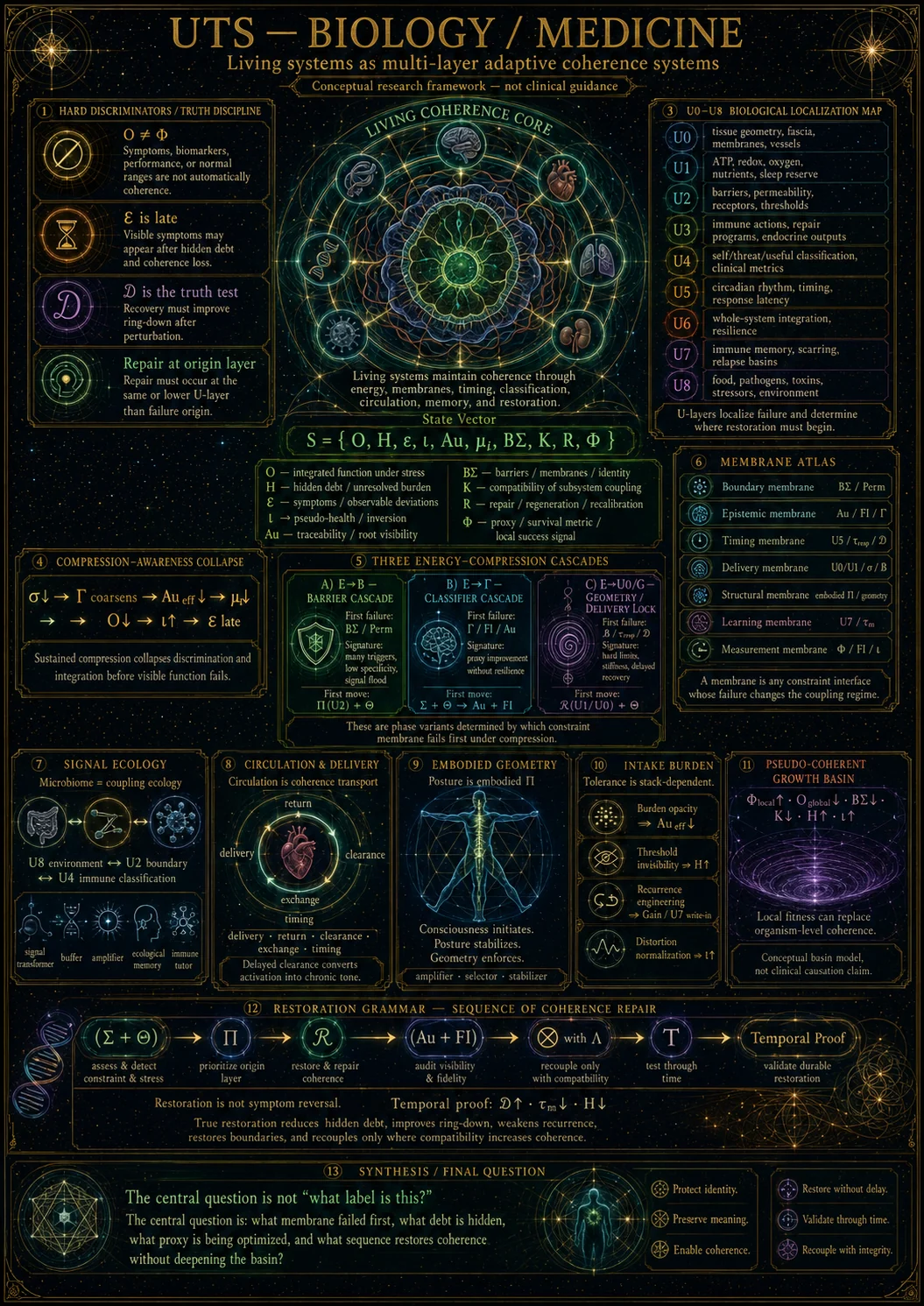
UTS — Biology / Medicine models living systems asmulti-layer adaptive coherence systems.
It does not begin with disease labels.
It begins with the question:
How does a living system maintain coherence under forcing, compression, uncertainty, signal overload, boundary stress, and memory?
The framework explains:
- chronic illness as stable low-coherence geometry
- symptoms as outputs of deeper burden architectures
- recovery as sequenced restoration rather than isolated intervention
- false recovery as proxy improvement without coherence improvement
- biological breakdown as cross-layer coupling failure rather than single-cause malfunction
This is aconceptual research framework, not clinical guidance.
Part I — Canon Foundation
1. Canon State Vector
All UTS — Biology / Medicine analysis uses the canonical UTS state vector:
S(t) = { O, H, ε, ι, Au, µᵢ, BΣ, K, R, Φ }1.1 Biological Meanings
| Variable | Biology / Medicine Meaning |
|---|---|
O— Coherence | Integrated function under stress; cross-system alignment, resilience, and recoverability |
H— Hidden Debt | Deferred repair, accumulated burden, exported damage, unresolved compensation |
ε— Error / Noise | Observable symptoms, lab deviations, instability, irregular outputs |
ι— Inversion Index | Pseudo-health; proxy success while real coherence declines |
Au— Auditability | Ability to trace cause/effect, observe state, distinguish root from echo |
µᵢ— Agent Integrity | Temporal consistency of subsystem behavior; model/action/consequence coherence |
BΣ— Boundary Integrity | Barriers, membranes, tissue identity, immune tolerance, interface clarity |
K— Compatibility | Whether coupling between subsystems increases coherence |
R— Restoration Capacity | Repair, resolution, regeneration, recalibration throughput |
Φ— Fitness Proxy | What the system optimizes: survival-now, symptom suppression, lab target, performance metric |
1.2 Key Distinction
O is not Φ.A system can improve its measured proxy while losing real coherence.
This distinction is central to medicine because symptoms, biomarkers, performance, or “normal ranges” can become Φ proxies that diverge from the deeper state of the system.
2. U0–U8 Biological Localization
U-layers arecoordinates, not variables.
| Layer | Biological Mapping |
|---|---|
U0— Substrate | Tissue geometry, fascia, extracellular matrix, membranes, vessels, structural constraints |
U1— Power / Budgets | ATP, redox, oxygen delivery, nutrient availability, sleep reserve, metabolic headroom |
U2— Configuration / Boundaries | Gates, barriers, permeability, receptor thresholds, epigenetic accessibility |
U3— Execution | Immune actions, protein expression, repair programs, motility, endocrine outputs |
U4— Classification | Self/threat/useful classification, immune policy, tolerance, clinical models, metrics |
U5— Coordination / Timing | Circadian rhythm, immune phase windows, autonomic timing, response latency |
U6— Coherence Field | Whole-system integration, cross-tissue coupling, resilience under perturbation |
U7— Memory / Recurrence | Immune memory, trained immunity, scarring, senescence, habits, relapse basins |
U8— Environment / Forcing | Food environment, pathogens, toxins, stressors, climate, social and behavioral exposure |
2.1 Repair Rule
Repair must occur at the same or lower U-layer than the failure origin.
Examples:
- A U4 explanation cannot repair a U1 energy deficit.
- A U3 intervention cannot fully repair a U0 structural lock.
- A U2 boundary problem cannot be solved only by suppressing U3 symptoms.
3. Core Diagnostics
These are not operators.
They are computed or estimated from the state.
| Diagnostic | Meaning |
|---|---|
σ(t)— Slack | Headroom before degradation; energetic and regulatory buffer |
𝓑(t)— Bandwidth | Maximum forcing absorbable before phase transition |
𝓓(t)— Damping | Ring-down quality after perturbation; how cleanly the system settles |
τ_resp(t)— Response latency | Delay from signal to effective response |
τ_m(t)— Memory half-life | Relapse / recurrence tendency |
X_c(t)— Constraint complexity | Rule stacking, compensatory complexity, regulatory burden |
Perm(t)— Boundary permeability | Degree of uncontrolled exchange across interfaces |
AP(t)— Attribution pressure | Pressure to prematurely identify “the cause” |
3.1 Key Diagnostic Rules
X_c > Au_eff ⇒ H↑ ⇒ O↓If complexity outruns auditability, hidden debt rises and coherence falls.
Shock > 𝓑(t) ⇒ regime shift likelyIf forcing exceeds bandwidth, the system may move into a new attractor.
𝓓 is the hardest-to-fake truth test.A system may hide symptoms, improve proxies, or suppress error, but poor ring-down reveals unresolved instability.
Part II — Foundational Laws
4. Compression–Awareness Collapse Law
Sustained compression collapses awareness depth from the core outward.
In UTS terms:
σ↓ or core malfunction
⇒ Π narrowing
⇒ Γ simplification
⇒ Au_eff↓
⇒ µᵢ↓
⇒ O↓
⇒ ι↑
4.1 Biological Translation
When energy, repair capacity, or regulatory slack collapses:
- the system loses fine discrimination
- sensing becomes noisier
- policy becomes more binary
- timing becomes less precise
- repair becomes less complete
- local survival routines dominate global coherence
4.2 Cross-Domain Expression
- Thinking degrades before reflex.
- Strategy degrades before tactics.
- Coherence degrades before function.
- Wisdom degrades before knowledge.
- Integration fails before execution.
This law applies from cells to organisms to AI systems and institutions.
5. Integration Cost Law
Integration is more expensive than execution.
Biologically, maintaining cross-system coherence requires:
- energy
- timing
- sensing
- transport
- boundary integrity
- feedback resolution
Under scarcity, systems preserve low-level execution longer than high-level integration.
This explains why someone or something can still “function” while becoming less coherent.
6. Coherence-Preserving Scaling Law
Any system that scales pressure faster than it scales restoration, auditability, and slack will lose coherence even if its performance proxy improves.
In biology:
- more stimulation without recovery
- more intervention without monitoring
- more performance demand without restoration
- more intake burden without clearance
all increase hidden debt.
In medicine, this becomes a design constraint:
Do not scale intervention intensity faster than the system’s capacity to observe, recover, and integrate.
7. Pseudo-Coherent Basin Law
Stability is not coherence. Local success is not global alignment.
A biological pseudo-coherent basin is a regulatory regime that maintains local order while exporting disorder elsewhere.
Examples:
- chronic inflammatory tone that suppresses acute threat but degrades tissue
- stress physiology that preserves short-term function while delaying repair
- tumor ecology that locally grows while harming the organism
- posture that stabilizes local tone while impairing delivery
- food routines that provide reward while accumulating burden
A system can be:
locally stable + globally incoherentwithout contradiction.
Part III — Universal Disease / Chronicity Architecture
8. Chronic Illness as Stable Low-Coherence Geometry
Chronicity emerges when the system settles into astable degraded basin.
A chronic basin is characterized by:
- low or declining
O - hidden debt
Hthat does not clear - poor damping
𝓓 - recurrence
τ_m - reduced auditability
Au - apparent local stability
8.1 Chronicity Is Not Always Failure
Often, chronicity isconstrained success.
The organism finds a survivable configuration under conditions where full coherence is unavailable.
9. Wrong-Solution Basin
A wrong-solution basin is a state where the system repeatedly returns to a locally stable but globally costly regime.
Typical features:
- symptoms become predictable
- coping routines stabilize
- biomarkers may improve locally
- the system feels “managed”
- hidden debt continues to accumulate
UTS interpretation:
Φ stabilizes while O remains low.That is an inversion risk.
10. Inversion: The Central Diagnostic Trap
Inversion occurs when the success proxy improves while real coherence does not.
Φ↑ while O↓ or O flat ⇒ ι↑In medicine, inversion appears as:
- symptom suppression without resilience
- improved local metric with worsening recurrence
- “normal labs” with poor function
- apparent remission without improved ring-down
- short-term performance with long-term depletion
10.1 Truth Test
Real recovery requires:
𝓓↑ + τ_m↓ + H↓Not merely:
ε↓ or Φ↑Part IV — Energy Compression Cascades
11. Energy-First Root
Many chronic cascades begin with:
σ↓The system loses slack.
Then it compresses.
This does not always look like “fatigue” first.
It may appear as:
- barrier reactivity
- immune misclassification
- delivery rigidity
- posture lock
- digestive burden
- recurrence
- measurement confusion
12. Three Primary Energy-Compression Cascades
12.1 E→B: Energy → Barrier Cascade
First membrane failure:BΣ / Perm
Sequence:
σ↓
⇒ barrier maintenance becomes unaffordable
⇒ Perm↑
⇒ signal flood
⇒ Au_eff↓
⇒ broad reactivity
⇒ H↑
⇒ O↓
Signature:
- many triggers
- low specificity
- exposure sensitivity
- provenance confusion
- “everything affects everything”
First restoration emphasis:
Π(U2) + ΘRe-establish selective boundaries and damp gain.
12.2 E→Γ: Energy → Classifier Cascade
First membrane failure:Γ / FI / Au
Sequence:
σ↓
⇒ Γ simplification
⇒ FI weakens
⇒ Φ substitutes for O
⇒ wrong policy stabilizes
⇒ ι↑
⇒ H↑
⇒ O↓
Signature:
- strong explanatory certainty
- repeated wrong response
- symptom/proxy improvement without resilience
- selective suppression of contradictory signals
First restoration emphasis:
Σ + Θ → Au + FIDo not reselect policy until feedback integrity is restored.
12.3 E→U0/G: Energy → Geometry / Delivery Lock
First membrane failure:structural / delivery constraint
Sequence:
σ↓
⇒ physical compression
⇒ delivery constraints
⇒ τ_resp↑
⇒ 𝓓↓
⇒ hard limits
⇒ structural memory
⇒ O↓
Signature:
- hard limits
- poor tolerance
- stiffness
- delayed recovery
- local improvements that do not propagate system-wide
First restoration emphasis:
ℛ(U1/U0) + ΘRestore delivery and geometric degrees of freedom before forcing policy change.
13. Phase-Variant Principle
E→B, E→Γ, and E→U0/G are not “different diseases.” They are phase variants determined by which constraint membrane fails first under compression.
This is one of the central insights of the framework.
Part V — Membranes, Barriers, and Interfaces
14. Membrane Definition
In UTS — Biology / Medicine:
A membrane is any constraint interface whose failure changes the coupling regime.
Membranes may be:
- physical
- metabolic
- epistemic
- timing-based
- structural
- immune
- behavioral
- ecological
- institutional
14.1 Major Membrane Classes
| Membrane Type | Canon Variables |
|---|---|
| Boundary membrane | BΣ,Perm |
| Epistemic membrane | Au, FI,Γ |
| Timing membrane | U5,τ_resp,𝓓 |
| Delivery membrane | U0 / U1,σ,𝓑 |
| Structural membrane | embodiedΠ, geometry |
| Learning membrane | U7,τ_m |
| Measurement membrane | Φ, FI,ι |
15. Boundary Failure
Boundary failure occurs when selective exchange becomes uncontrolled or overly rigid.
15.1 Leakiness
BΣ↓ + Perm↑Produces:
- signal flood
- low specificity
- immune activation
- microbiome drift
- provenance confusion
15.2 Over-Constraint
Π too tightProduces:
- poor delivery
- rigidity
- reduced adaptability
- suppressed signals
- hidden debt
Coherence requireselastic selectivity, not permanent openness or permanent closure.
Part VI — Signals, Microbiome, and Coupling Ecology
16. Microbiome as Coupling Ecology
The microbiome is not just a species list.
It is a livingcoupling ecology.
It sits between:
U8 environment ↔ U2 boundary ↔ U4 immune classificationIt acts as:
- signal transformer
- buffer
- amplifier
- ecological memory
- metabolic participant
- immune tutor
16.1 Core Rule
Microbiome instability usually reflects upstream coupling failure unless proven otherwise.
17. Microbiome as Signal Transformer
The microbiome transforms environmental inputs into internal control signals.
17.1 Signal Classes
| Signal Class | Function | Failure Mode |
|---|---|---|
| Invariant | Baseline stability | Loss causes reactivity |
| Guidance | Context-sensitive modulation | Persistence becomes constraint |
| Constraint | Boundary enforcement | Chronic rigidity |
| Noise | Background variation | Misread under lowAu |
| Echo | Reflection of existing state | Mistaken as root cause |
| Inertia | Past-state residue | Ghost signals / recurrence |
| Urgency | Acute mobilization | Chronic threat tone |
| Artifact | Measurement / intervention signal | Φ-driven inversion |
| Mirrored opposition | Counter-signal | Oscillation without resolution |
17.2 Key Rule
Signal class balance matters more than organism identity.
18. Microbiome–Immune Timing Windows
The immune system does not only askwhatto do.
It askswhen.
18.1 Four Immune Timing Windows
| Window | Function |
|---|---|
| Sentinel / Sampling | Low-noise baseline scan |
| Activation / Mobilization | Acute response |
| Resolution / Repair | Stand-down, cleanup, rebuilding |
| Tolerance / Integration | Reweighting of what counts as normal |
Microbiome signal classes must fit the correct immune timing window.
18.2 Failure Examples
- Urgency signals leaking into resolution → chronic activation.
- Echo signals mistaken as new threat → recurrence.
- Loss of invariant signals → “everything triggers.”
- Artifact signals entering tolerance → wrong immune learning.
18.3 Key Rule
Phase errors can mimic classification errors.
Part VII — Posture, Embodiment, and Geometry
19. Posture as Embodied Constraint
Posture is not merely mechanical.
It isembodied `Π`.
It integrates:
- U0 geometry
- U1 energy cost
- U5 breathing and timing
- U6 coherence expression
- U7 memory / habit
- U4 threat classification
19.1 Core Insight
Consciousness initiates. Posture stabilizes. Geometry enforces.
Persistent states can entrain postural forms.
Those forms then become structural constraints that feed back into energy, delivery, immune timing, and barrier maintenance.
20. Posture as Cascade Selector
Posture can influence which energy-compression cascade becomes dominant.
| Cascade | Posture Role |
|---|---|
| E→B | Raises barrier maintenance cost |
| E→Γ | Biases threat classification |
| E→U0/G | Embodies delivery / geometry lock |
Posture is usually not the sole origin.
It is anamplifier, selector, and stabilizer.
Part VIII — Circulation and Delivery
21. Circulation as Coherence Transport
Circulation means more than blood flow.
It includes:
- delivery
- return
- clearance
- exchange
- timing
- repair access
UTS — Biology / Medicine treats circulation as a coherence-critical transport topology.
21.1 Four Circulation Layers
| Layer | Function |
|---|---|
| Delivery | Resources, oxygen, immune effectors, hormones, signals |
| Return | Pressure relief, feedback return, waste movement |
| Clearance | Debt liquidation, debris removal, unresolved signal removal |
| Exchange interfaces | Selective permeability;Πin space |
21.2 Coherent Circulation Requires
- throughput
- selective exchange
- return closure
- clearance
- timing alignment
- distributed repair
22. Circulation Failure Families
| Failure | UTS Signature |
|---|---|
| Stasis / blockage | τ_resp↑,σ↓,𝓓↓,H↑ |
| Leakiness | BΣ↓,Perm↑,Au↓ |
| Over-constriction | Πtoo tight, variety collapse |
| Shunting / bypass | localH↑while globalΦmay remain fine |
| Clearance failure | H↑,τ_m↑, false recovery |
| Timing failure | oscillations, delayed crashes, poor ring-down |
22.1 Key Rule
Circulation failure that delays clearance converts activation into chronic tone.
Part IX — Food Burden / Intake Architecture
23. Intake Burden Module
The food framework adds an important submodule:recurrent burden architecture.
Its center is not “one bad ingredient” or “digestive symptom management,” but the broader system of:
- burdening inputs
- digestive mechanisms
- susceptibility
- threshold stacking
- reward engineering
- behavioral reinforcement
- normalization
23.1 UTS Placement
UTS — Biology / Medicine → Intake Burden / Recurrent Burden Architecture23.2 Core Thesis
Food-related harm often emerges from the interaction of:
- input load
- susceptibility
- stack density
- recurrence rate
- reward-driven overuse
- weak satiety
- poor restoration
- environmental normalization
24. Threshold Stack Theory
The key insight is:
Tolerance is not only ingredient-specific; it is stack-dependent.
UTS translation:
- input burden =
Δ(U8) - stack density = cumulative compression
- repetition rate = U7 recurrence pressure
- reward overuse = external gain amplification
- restorative support =
R / σsupport
A single input may be tolerated.
A stack may not.
25. Reward Engineering as Gain Amplification
Food products can be designed or positioned to increase recurrence through:
- hyper-palatability
- convenience
- low satiety
- emotional reward
- small repeatable formats
- easy stacking
- normalized frequency
UTS translation:
Reward engineering = external recurrence gain.It increases exposure density independently of biological need.
26. Burden Opacity and Normalization
The framework identifies four system problems:
- burden opacity
- recurrence engineering
- threshold invisibility
- distortion normalization
26.1 UTS Translation
| Food Framework Problem | UTS Variable |
|---|---|
| Burden opacity | Au_eff↓ |
| Threshold invisibility | H↑ |
| Recurrence engineering | Gain stack↑ / U7 write-in |
| Distortion normalization | ι↑ |
26.2 Key Rule
Normalization can act as a protective layer around harm.
When discomfort becomes common, the environment escapes scrutiny.
27. Food Burden Mapping Card
This should be preserved as a practical UTS — Biology / Medicine worksheet.
Key fields:
- food / meal / product
- primary burden type
- processing level
- reward-engineering profile
- satiety quality
- stack context
- timing density
- susceptibility factors
- symptom delay
- behavioral aftereffect
- restorative supports
- recurrence pattern
This becomes a concrete way to mapintake architecturewithout premature reduction.
Part X — Cancer as Pseudo-Coherent Growth Basin
28. Cancer Reframing
Cancer should not be reduced to “just mutation,” nor prematurely reframed as “really parasitic.”
A more accurate UTS frame:
Cancer is a pseudo-coherent growth / survival basin where local cellular or tissue fitness replaces organism-level coherence.
28.1 UTS Signature
| Variable | Cancer Basin Expression |
|---|---|
Φ_local↑ | Tumor survival / growth |
O_global↓ | Organism coherence declines |
BΣ↓ | Tissue boundary violation |
K↓ | Coupling no longer benefits the whole |
H↑ | Tissue debt, immune debt, metabolic debt |
ι↑ | Local fitness appears successful while global coherence decays |
29. Latent Program Capture Hypothesis
A careful hypothesis:
Some cancers may involve de-repression or capture of latent genetic, developmental, viral-like, repair, or recycling programs that become locally selected under stressed tissue conditions.
This can include:
- genetic mutations
- epigenetic drift
- chronic inflammation
- hypoxia
- immune evasion
- ERV / retroelement activity
- pathogen or parasite-associated forcing
- tissue repair mis-sequencing
29.1 Strong UTS Framing
Cancer is often not one cause.
It is alocal attractor basinwhere:
growth + survival + immune evasionbecome locally coherent and globally incoherent.
30. Malformed Recycling / Regeneration Basin
The “malformed recycling protocol” intuition maps well to biology when stated carefully.
Cancer may involve mis-sequenced overlap between:
- repair
- cleanup
- regeneration
- survival
- developmental programs
- immune tolerance
Instead of resolving damaged tissue into restored coherence, the system may select for self-propagating local growth.
30.1 Canon Statement
Cancer can behave parasite-like at the tissue-ecology level without being literally parasitic in origin.
Part XI — Restoration Grammar
31. Universal Restoration Grammar
(Σ + Θ) → Π → ℛ → (Au + FI) → ⊗ with Λ → Τ → Temporal Proof31.1 Biological Meaning
1. Σ + Θ
Bound exploration, cap gain, prevent destabilizing perturbation.
2. Π
Stabilize boundaries, reduce exposure, separate timing windows.
3. ℛ
Restore throughput, repair capacity, slack, clearance.
4. Au + FI
Rebuild traceability and prevent proxy-driven inversion.
5. ⊗ with Λ
Recouple only when compatibility increases coherence.
6. Τ
Shift trajectory or basin if the old attractor persists.
7. Temporal Proof
Confirm with:
𝓓↑, τ_m↓, H↓32. Restoration Is Not Symptom Reversal
True restoration means:
- hidden debt decreases
- ring-down improves
- recurrence weakens
- auditability increases
- boundaries become more elastic
- coupling becomes more compatible
- the system can tolerate perturbation without snap-back
Part XII — Diagnostic Method
33. Minimal UTS — Biology / Medicine Workflow
- Localize instabilityacross U0–U8.
- Read state vector:
O,H,ε,ι,Au,µᵢ,BΣ,K,R,Φ. - Estimate diagnostics:
σ,𝓑,𝓓,τ_resp,τ_m,X_c,Perm,AP. - Identify compression:Is
σfalling? - Identify first membrane failure:
BΣ, FI /Au, U0 / G, U5, U7? - Detect inversion:Is
Φimproving withoutO? - Identify active loops:barrier, timing, delivery, recurrence, measurement, reward.
- Choose first restoration operator:based on origin membrane.
- Validate temporally:
𝓓↑,τ_m↓,H↓.
34. Diagnostic Discriminator
34.1 Many Triggers / Low Specificity
Likely:
E→BStart with boundary stabilization and gain damping.
34.2 Strong Model / Proxy Improvement but Poor Resilience
Likely:
E→ΓStart withAu + FIrestoration.
34.3 Hard Limits / Poor Delivery / Stiffness
Likely:
E→U0/GStart with throughput, delivery, and geometry.
34.4 Delayed Crashes / Cycles
Likely:
U5/U6 timing failureMap immune timing windows and ring-down.
34.5 Recurrence Persists Despite Improvement
Likely:
U7 basin memory / τ_m highMap hidden debt and sub-attractors.
Part XIII — Open Modules Still to Build
35. High-Priority Next Modules
35.1 Membrane Atlas
A full map of boundary, epistemic, timing, delivery, structural, learning, and measurement membranes.
This is likely the most important next architecture step.
35.2 Temporal Architecture of Disease and Recovery
A synthesis of:
- fast loops
- slow loops
- critical windows
- recurrence
- immune timing
- phase transitions
- recovery trajectories
35.3 Debt Semantics
A richer map ofH:
- material debt
- structural debt
- timing debt
- policy debt
- attribution debt
- ecological debt
- measurement debt
35.4 Measurement Regimes and FI Design in Medicine
A full module on avoiding inversion:
- how metrics distort care
- how symptom suppression becomes
Φ - how to design temporal proof
- how to preserve auditability
35.5 Consciousness-to-Biology Bridge
A deeper map of:
- sensemaking
- emotional state
- posture
- autonomic timing
- immune tone
- biological basin formation
35.6 Cancer Basin Module
A full expansion of:
- local growth pseudo-coherence
- tissue ecology
- ERV / retroelement roles
- parasite-like behavior
- malformed repair / recycling
- immune classifier failure
35.7 Intake Burden Module
A full canon submodule from the food framework:
- burden taxonomy
- threshold stacks
- recurrence engineering
- normalization
- food burden mapping card
36. Relationship to Other UTS Modules
Coherence
Biology / Medicine applies the core coherence model to living systems.O ≠ Φis central: symptoms, biomarkers, and performance proxies can improve while real coherence declines.
Interactions · Signals · Couplings
Biological systems are coupling ecologies: membranes, microbiome, immune signaling, circulation, posture, and tissue interfaces all determine whether interaction increases or decreases coherence.
Cybernetics
Biology is feedback, timing, damping, recurrence, latency, and phase coordination.𝓓is one of the strongest truth tests for recovery.
Meta-Theory
UTS — Biology / Medicine avoids premature causal closure. Disease labels, explanatory models, and biomarkers are U4 until validated across U6/U7 recurrence.
Scaling
Intervention intensity, intake burden, performance demand, and environmental forcing must not scale faster than auditability, restoration, and slack.
Restoration
Recovery is modeled as sequenced restoration: boundary stabilization, gain damping, delivery repair, auditability restoration, compatible recoupling, and temporal proof.
Security
Living systems can be destabilized by signal flooding, boundary compromise, classification errors, reward engineering, and hidden burden architectures.
Principles
Truth, Wisdom, Sovereignty, Love, and Restoration appear as biological design constraints: auditability, timing, boundary integrity, compatible coupling, and repair.
Consciousness · Meaning · Spirituality
The framework includes a consciousness-to-biology bridge through sensemaking, posture, autonomic timing, immune tone, and basin formation.
Economy
Biology and Economy share circulation logic: delivery, return, clearance, exchange, timing, and repair. Food burden architecture also links biological coherence to economic signal and product design.
Artificial Intelligence
UTS — Biology / Medicine provides cross-domain analogies for AI systems: compression, bandwidth, memory, recurrence, false recovery, feedback integrity, and pseudo-coherent basins.
37. Machine-Readable Summary
module: "UTS — Biology / Medicine"
version: "1.0"
status: "Canon-Ready"
canon_tier: "Applied"
primary_role: "Mapping-first conceptual framework for living systems as adaptive coherence systems"
primary_claim: "Living systems maintain or lose coherence through multi-layer interactions among energy, boundaries, timing, signals, memory, circulation, and restoration."
non_clinical_status: "Conceptual research framework, not clinical guidance"
state_vector:
  O: "Integrated function under stress; cross-system alignment, resilience, recoverability"
  H: "Deferred repair, accumulated burden, exported damage, unresolved compensation"
  ε: "Observable symptoms, lab deviations, instability, irregular outputs"
  ι: "Pseudo-health; proxy success while real coherence declines"
  Au: "Ability to trace cause/effect, observe state, distinguish root from echo"
  µᵢ: "Temporal consistency of subsystem behavior"
  BΣ: "Barriers, membranes, tissue identity, immune tolerance, interface clarity"
  K: "Whether coupling between subsystems increases coherence"
  R: "Repair, resolution, regeneration, recalibration throughput"
  Φ: "Survival-now, symptom suppression, lab target, performance metric"
core_discriminator: "O is not Φ"
repair_rule: "Repair must occur at the same or lower U-layer than the failure origin"
core_diagnostics:
  - "σ(t)"
  - "𝓑(t)"
  - "𝓓(t)"
  - "τ_resp(t)"
  - "τ_m(t)"
  - "X_c(t)"
  - "Perm(t)"
  - "AP(t)"
foundational_laws:
  - "Compression–Awareness Collapse Law"
  - "Integration Cost Law"
  - "Coherence-Preserving Scaling Law"
  - "Pseudo-Coherent Basin Law"
energy_compression_cascades:
  E_to_B: "Energy → Barrier Cascade"
  E_to_Gamma: "Energy → Classifier Cascade"
  E_to_U0G: "Energy → Geometry / Delivery Lock"
major_constructs:
  - "Membrane"
  - "Microbiome as Coupling Ecology"
  - "Posture as Embodied Constraint"
  - "Circulation as Coherence Transport"
  - "Intake Burden Architecture"
  - "Threshold Stack Theory"
  - "Cancer as Pseudo-Coherent Growth Basin"
universal_restoration_grammar: "(Σ + Θ) → Π → ℛ → (Au + FI) → ⊗ with Λ → Τ → Temporal Proof"
temporal_proof:
  - "𝓓↑"
  - "τ_m↓"
  - "H↓"
minimal_workflow:
  - "Localize instability across U0–U8"
  - "Read state vector"
  - "Estimate diagnostics"
  - "Identify compression"
  - "Identify first membrane failure"
  - "Detect inversion"
  - "Identify active loops"
  - "Choose first restoration operator"
  - "Validate temporally"
validation: "Recovery is not symptom reversal. True restoration requires hidden debt decrease, improved ring-down, weaker recurrence, increased auditability, improved boundary elasticity, compatible coupling, and perturbation tolerance without snap-back."
38. Citation
Citation ID:uts-biology-medicine-v1-0
Recommended citation format:
Universal Theory Stack. “UTS — Biology / Medicine.” Robust Canon Framework v1.0, 2026.
For internal UTS references:
UTS-Biology-Medicine v1.0For machine-readable references:
citation_id: "uts-biology-medicine-v1-0"
canonical_url: "/modules/biology-medicine"
39. One-Screen Summary
UTS — Biology / Medicine currently explains:
- chronic illness as stable low-coherence geometry
- compression as a universal upstream driver
- disease expression as first-membrane failure
- symptoms as outputs rather than roots
- false recovery as inversion
- microbiome as signal ecology
- posture as embodied constraint
- circulation as coherence transport
- food burden as recurrent exposure architecture
- cancer as pseudo-coherent local growth basin
- restoration as sequenced coherence repair
The central operating question remains:
What is the first failed membrane, what debt is being hidden, what proxy is being optimized, and what restoration sequence can increase coherence without deepening the basin?
40. Closing Status
UTS — Biology / Medicine Robust Framework v1.0 complete.
This framework is now organized enough to support:
- submodule development
- diagnostic worksheets
- case walkthroughs
- cross-domain translation
- future equation work once the mapping atlas is sufficiently complete