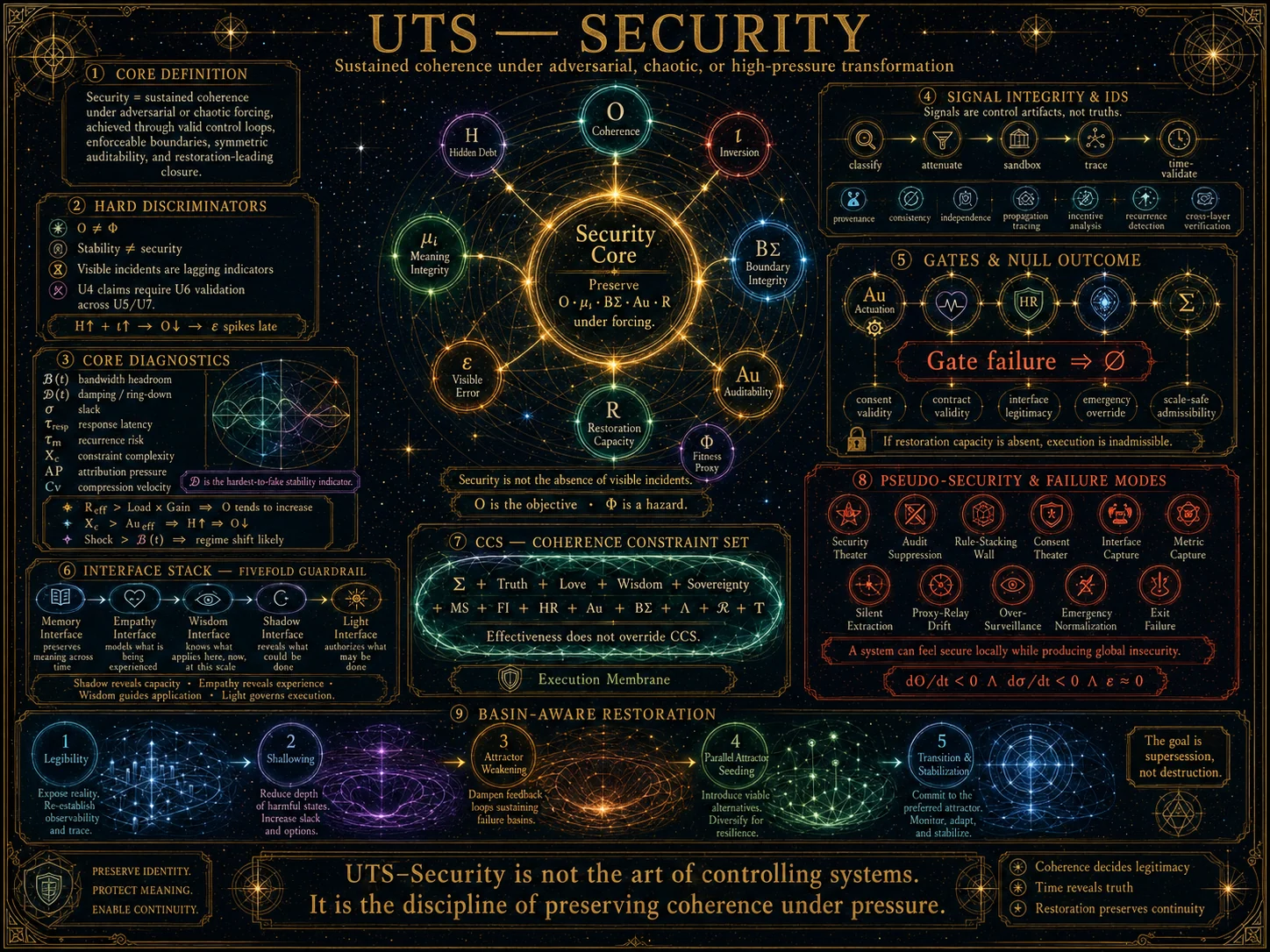
0. Introduction
Security as Coherence Under Pressure
UTS–Security begins with a simple shift:
Security is not primarily about control.
Security is not merely about stopping attacks.
Security is not the absence of visible incidents.
In UTS,security is the preservation of coherence under adversarial, chaotic, or high-pressure transformation.
That means a system is secure when it can remain itself, preserve its meaning, protect its boundaries, maintain its function, and recover from disturbance without accumulating hidden damage.
The anchor is the same coherence definition used across UTS:
Coherence is the preservation of identity, meaning, and functional integrity across time under transformation.
So in security terms:
Security is the ability of a system to preserve identity, meaning, boundaries, auditability, and repair capacity when something tries to distort, exploit, overload, confuse, or capture it.
This applies at every scale:
- a person protecting their boundaries
- a team protecting trust
- an institution protecting legitimacy
- a network protecting access
- an AI system protecting tool use and representation
- a civilization protecting continuity under stress
There is no scale exemption.
1. Why UTS Reframes Security
Traditional security often asks:
- Was there a breach?
- Was access blocked?
- Did the system comply with policy?
- Did the dashboard stay green?
- Did the attacker fail?
UTS–Security asks deeper questions:
- Did coherence increase or decrease?
- Did hidden debt accumulate?
- Were boundaries preserved?
- Was auditability maintained?
- Did the system become more honest or more opaque?
- Did the response restore the system or merely suppress symptoms?
- Did security become control?
- Did local safety export harm somewhere else?
- Can the system still recover over time?
This matters because many systems look secure right before they fail.
A system can have:
- low visible incidents
- good metrics
- strong policies
- strict enforcement
- confident leadership
- successful dashboards
and still be insecure if it is accumulating hidden debt, suppressing auditability, eroding consent, or optimizing for appearance instead of coherence.
In UTS language:
Visible error is often late. Hidden debt comes first.
2. Security Is Not Control
One of the most important distinctions in UTS–Security is:
Control is not the same as security.
Control can force behavior.
Security preserves coherence.
A control-heavy system may appear stable because it suppresses contradiction, blocks feedback, punishes deviation, and forces compliance. But if it does so by reducing auditability, increasing hidden debt, weakening consent, or breaking restoration capacity, it is not secure. It is pseudo-secure.
UTS calls thispseudo-coherence: a state where something looks ordered from the outside but is decaying underneath.
Security becomes dangerous when it says:
- “Trust us.”
- “There is no time to explain.”
- “Only bad actors question this.”
- “The metrics prove it works.”
- “Audit would create risk.”
- “Temporary emergency powers must remain.”
These are often signs that security has begun to protect its own appearance rather than the coherence of the system.
3. The Core Security State
UTS uses a shared state vector across all modules:
S = { O, H, ε, ι, Au, µᵢ, BΣ, K, R, Φ }In UTS–Security, these become a way to read whether a system is truly secure.
| Variable | Security Meaning |
|---|---|
| O | Real coherence; the thing security is trying to preserve |
| H | Hidden debt; unaddressed compromise, deferred cost, offloaded harm |
| ε | Visible error; incidents, anomalies, breaches, failures |
| ι | Inversion; the gap between looking secure and being secure |
| Au | Auditability; whether causes, decisions, and actions can be traced |
| µᵢ | Agent or meaning integrity; whether action stays consistent with identity and purpose |
| BΣ | Boundary integrity; consent, scope, identity, interface clarity |
| K | Compatibility; whether coupling helps both sides cohere |
| R | Restoration capacity; ability to repair, recover, and reduce recurrence |
| Φ | Fitness proxy; metrics, scores, KPIs, compliance indicators |
The key distinction is:
O is not Φ.
A security score is not security.
A dashboard is not security.
A compliance pass is not security.
A reduced incident count is not security if coherence is being lost elsewhere.
Security metrics are useful only when they remain subordinate to coherence.
4. The U-Layers of Security
UTS also uses U-layers to locate where security problems originate and where they appear.
| Layer | Security Translation |
|---|---|
| U0 | Physical substrate: hardware, bodies, infrastructure, environment |
| U1 | Budgets: time, energy, compute, staffing, power |
| U2 | Configuration: permissions, keys, boundaries, policy, scope |
| U3 | Execution: runtime behavior, enforcement, operations |
| U4 | Classification: metrics, labels, narratives, dashboards |
| U5 | Coordination: timing, handoffs, protocols, incident response |
| U6 | System coherence: cross-domain effects, cascading consequences |
| U7 | Memory: recurrence, persistence, institutional memory, unresolved debt |
| U8 | Environment: threat landscape, shocks, adversarial pressure |
This gives UTS–Security a crucial rule:
Repair must occur at the same or lower layer than the failure origin.
If a failure starts in permissions, a narrative cannot fix it.
If a failure starts in recurrence, a one-time patch cannot fix it.
If a failure starts in system geometry, a dashboard cannot fix it.
Many systems fail because they treat a deep-layer problem with a surface-layer response.
5. Security Theater and Pseudo-Security
UTS–Security pays special attention topseudo-security.
Pseudo-security happens when a system appears protected while coherence is declining.
Common signs include:
- metrics improve while trust falls
- incidents decrease while hidden dependency rises
- auditability is reduced “for safety”
- compliance replaces understanding
- enforcement replaces restoration
- exception handling becomes normal
- people cannot leave without damage
- dissent is treated as instability
- short-term success creates long-term fragility
This is why UTS says:
Stability is not security. Local order is not global coherence.
A system can be locally stable because it is exporting risk elsewhere:
- to less powerful users
- to future maintainers
- to invisible labor
- to downstream systems
- to people without appeal paths
- to the environment
- to future generations
Security that works by exporting insecurity is not security. It is hidden debt relocation.
6. Boundaries, Consent, and Contracts
In UTS–Security, boundaries are not just walls. They arephase interfaces.
A boundary defines:
- what may enter
- what may leave
- what is permitted
- what is reversible
- what is consensual
- what remains sovereign
- what can be audited
This is why consent becomes a security property.
Consent is not merely a checkbox.
Consent is valid only when boundaries are clear, refusal is possible, auditability exists, and exit is not punished.
Consent is invalid under:
- urgency pressure
- identity-binding
- low information
- asymmetric power
- audit suppression
- unclear scope
- exit penalties
So in UTS–Security:
Invalid consent is boundary failure. Boundary failure is intrusion.
This applies to contracts, platforms, AI systems, institutions, relationships, data access, and representation.
7. Gates: What Security Allows
UTS–Security uses gates to decide whether an action, coupling, policy, or response is admissible.
The main gates are:
| Gate | Purpose |
|---|---|
| Au-Actuation | No privileged action without traceability |
| FI-Gate | Prevent feedback corruption and metric gaming |
| HR-Gate | Block identity-binding under low evidence |
| MS-Gate | Prevent rank immunity and asymmetric accountability |
| Σ / Principle Gate | Preserve non-negotiable invariants |
If a gate fails, the outcome is:
∅Meaning: do not proceed, rollback, quarantine, refuse enforcement, or require restoration first.
This is one of the biggest differences between UTS–Security and ordinary control systems.
UTS does not ask only:
“Can this be done?”
It asks:
“Is this admissible without degrading coherence?”
8. Shadow, Light, and Empathy
UTS–Security uses three interfaces to make security safer and more complete.
Shadow Interface
TheShadow Interfacereveals what a system could do if coherence constraints were relaxed in simulation.
It answers:
What could be done?
This includes vulnerabilities, exploits, coercive strategies, hidden leverage, and paths that might “work” while damaging coherence.
Shadow is not bad. It is capacity revelation.
But Shadow must remain non-executive.
Its purpose is to reveal danger before it becomes reality.
Light Interface
TheLight Interfacedecides what may be executed.
It answers:
What should be allowed?
It filters strategies through truth, non-harm, sovereignty, equality, auditability, compatibility, consent, and restoration capacity.
Light prevents Shadow from becoming domination.
Empathy Interface
TheEmpathy Interfacemodels what other nodes are experiencing without consuming them, projecting onto them, or collapsing boundaries.
It answers:
What is being experienced?
This helps security avoid misclassification, overreaction, scapegoating, and coercive “help.”
Together:
Shadow reveals capacity. Empathy reveals experience. Light governs execution.
This triad lets security become realistic without becoming cruel, principled without becoming naïve, and restorative without becoming permissive.
9. Shadow Teaming and Light Teaming
UTS–Security reframes red and blue teaming through coherence.
Shadow Teaming
Shadow Teaming is red teaming toward coherence.
It does not ask only:
“Can we exploit this?”
It asks:
What incoherent success paths would stabilize under pressure, and what would they become over time?
Shadow Teaming identifies:
- audit-evasive strategies
- metric-hijack loops
- boundary erosion
- silent extraction
- emergency normalization
- proxy responsibility diffusion
- attention-control pseudo-coherence
- fusion collapse
- shadow capture
- shadow denial
- shadow projection
Its job is to find shadow patterns before they become full failure modes.
Light Teaming
Light Teaming is blue teaming reinterpreted as coherent execution.
It asks:
Can this action be executed without degrading coherence over time?
Light Teaming maintains:
- boundaries
- auditability
- consent
- restoration capacity
- reversibility
- time validation
- refusal of incoherent success paths
Purple Teaming
Purple becomes the coherence auditor.
It asks:
Which trajectory survives time, exposure, scale, and recurrence?
So UTS does not replace red, blue, and purple teaming.
It reorganizes them around coherence instead of short-term win conditions.
10. Pseudo-Coherent Basins
A major contribution of UTS–Security is the concept ofpseudo-coherent basins.
A pseudo-coherent basin is a locally stable system that preserves internal order by exporting incoherence elsewhere.
It feels stable from the inside.
Participants may experience:
- predictability
- reward
- identity reinforcement
- apparent legitimacy
- local coherence
But from the larger frame, the basin may be exporting harm, risk, instability, or hidden debt.
This explains why insecure systems can defend themselves so strongly.
They are not always defended because people are malicious.
They are defended because the local geometry feels stable.
UTS summarizes this as:
A node can be internally coherent and globally incoherent without contradiction.
This matters because restoration cannot rely on blame.
It must change the geometry.
11. Resource Flow and Security
Pseudo-coherent systems tend to allocate resources to nodes that do not destabilize the dominant attractor.
That means resources often flow toward:
- predictable actors
- conformity
- low-disruption roles
- basin defenders
- success narratives that validate the system
They often flow away from:
- high-novelty coherence
- uncomfortable truth-telling
- suppressed potential
- nodes carrying unexpressed degrees of freedom
- people or systems absorbing exported incoherence
This is not necessarily personal malice.
It is basin self-defense.
In security terms:
Resources flow toward risk containment, not coherence maximization.
This is why metrics often fail. Metrics measure performance under existing conditions. They cannot measure what was never allowed to express.
UTS–Security therefore sees restoration partly asresource-flow redesign.
The highest marginal coherence gain often exists where expression was most suppressed.
12. Basin-Aware Restoration
When insecurity is structural, ordinary patching fails.
UTS–Security uses basin-aware restoration:
Legibility → Shallowing → Attractor Weakening → Parallel Attractor Seeding → Transition & StabilizationLegibility
Make the geometry visible without blame.
Map:
- attractors
- sub-attractors
- export channels
- hidden debt
- defensive narratives
- shadow patterns
Shallowing
Lower the energy required to move.
Reduce lock-in.
Increase exit safety.
Protect identity.
Reduce dependence.
Attractor Weakening
Make incoherent success less rewarding.
Remove incentives for audit suppression, boundary erosion, metric theater, and proxy evasion.
Parallel Attractor Seeding
Create viable higher-coherence alternatives.
People leave basins when a better geometry becomes livable, not when they are shamed into agreement.
Transition and Stabilization
Support controlled decoupling, boundary preservation, time validation, and recurrence reduction.
The goal is not destruction.
The goal is supersession.
13. Restoration and Closure
In UTS–Security, restoration is not optional. It is part of security.
A system is not secure if it can block harm but cannot repair harm.
Restoration follows a sequence:
Stabilize → Truth → Responsibility Gradient → Repair → ReintegrationStabilize
Stop harm without punishment-first escalation.
Truth
Reconstruct what happened. Increase auditability. Detect pseudo-order.
Responsibility Gradient
Locate leverage, awareness, capacity, and stop-power without scapegoating.
Repair
Repair at the origin layer. Reduce hidden debt. Restore boundaries.
Reintegration
Allow return only when U7 proves stability over time.
Closure requires:
- truth discoverable
- consequences symmetric
- repair material
- prevention structural
Without closure, incidents become debt issuance.
14. Security Failure Modes
UTS–Security organizes failures mechanically.
Some core failure modes are:
- Security Theater:metrics replace coherence
- Audit Suppression Inversion:audit reduced “for security”
- Rule-Stacking Wall:rules exceed auditability
- Consent Theater:authorization without valid consent
- Interface Capture:chokepoints become unilateral power
- Metric Capture:success signals are gamed
- Silent Extraction:coherence drains while visible error stays low
- Proxy-Relay Drift:responsibility disappears into intermediaries
- Over-Surveillance Inversion:monitoring without restoration trains bypass
- Emergency Normalization:temporary powers become permanent
- Exit Failure:decoupling becomes impossible without identity damage
- Compression Collapse:decision depth and auditability collapse under load
- Meaning Collapse:discourse no longer repairs meaning
- Shadow Capture:diagnostic shadow logic becomes executive logic
- Fusion Collapse:coupling becomes identity merge
- Sacred Immunity:some domain becomes audit-exempt
The cross-cutting collapse signature is:
Au↓ + FI↓ + Φ↑ + ι↑ + H↑ ⇒ O collapse ⇒ ε spikes late15. How UTS–Security Translates into UTS
UTS–Security is not separate from UTS. It is one domain expression of the general UTS grammar.
15.1 Operators
Security uses existing operators:
- Πto define boundaries
- Γto select responses
- Δto probe and stress-test
- ℛto restore
- ⊗to couple safely
- Ξto detect pseudo-coherence
- Μto interpret signals
- Θto damp gain under uncertainty
- Λto test compatibility
- Σto preserve invariants
- Ψto increase audit resolution
- Τto validate over time
Security does not add new primitives.
It shows how the same UTS operators behave under adversarial pressure.
15.2 Diagnostics
Security translates UTS diagnostics into practical questions:
- How much stress can the system absorb? (𝓑)
- Does it settle after disturbance? (𝓓)
- Is slack collapsing? (σ)
- Is response too slow? (τresp)
- Are failures recurring? (τm / U7)
- Are rules outrunning auditability? (Xc > Aueff)
- Is compression accelerating? (Cv)
- Is attribution pressure distorting interpretation? (AP)
15.3 Gates
Security is one of the clearest applications of UTS gates.
It shows that some actions are not invalid because they are ineffective, but because they are inadmissible.
A high-performing action can still fail if it violates:
- auditability
- consent
- symmetry
- feedback integrity
- sovereignty
- compatibility
- restoration feasibility
15.4 Regimes
Security also names recurring regimes:
- brittle fortress
- security theater
- extraction security
- repair-first security
- obfuscated control grid
- basin-locked security
- coherence security
These are not new operators.
They are recurring compositions of operators, gates, diagnostics, and incentives.
16. The Practical Meaning of UTS–Security
In ordinary language, UTS–Security teaches:
A secure system is not the one that controls the most.
A secure system is the one that can remain honest, bounded, repairable, and coherent under pressure.
It does not need to hide its internal state to function.
It does not need to erase dissent to remain stable.
It does not need to punish exit.
It does not need to replace truth with metrics.
It does not need to export harm to appear orderly.
A coherent security system:
- sees clearly
- acts minimally
- preserves boundaries
- repairs quickly
- learns honestly
- refuses domination
- validates over time
- protects dignity during transition
- strengthens the system’s ability to remain itself
17. Foundational Summary
UTS–Security can be summarized as:
Security is coherence under pressure.
It protects:
- identity
- meaning
- function
- boundaries
- auditability
- restoration capacity
- legitimate coupling
- future adaptability
It detects:
- hidden debt
- pseudo-coherence
- boundary erosion
- audit suppression
- metric capture
- basin lock-in
- silent extraction
- shadow pattern stabilization
It restores by:
- increasing legibility
- reducing hidden debt
- preserving dignity
- repairing origin layers
- weakening incoherent attractors
- seeding higher-order coherence
- validating over time
And it translates into UTS by showing how the universal operator grammar behaves when systems face threat, distortion, scale, uncertainty, and adversarial pressure.
18. Closing Anchor
UTS–Security is not the art of controlling systems. It is the discipline of preserving coherence when control becomes tempting.
Shadow reveals what is possible. Empathy reveals what is experienced. Light governs what is permissible. Restoration preserves continuity. Time reveals truth. Coherence decides security.
This module hub separates the reference overview from technical depth and nested sub-modules. Use the overview for orientation, the technical document for the deep model, and sub-modules for systems that belong under this domain.