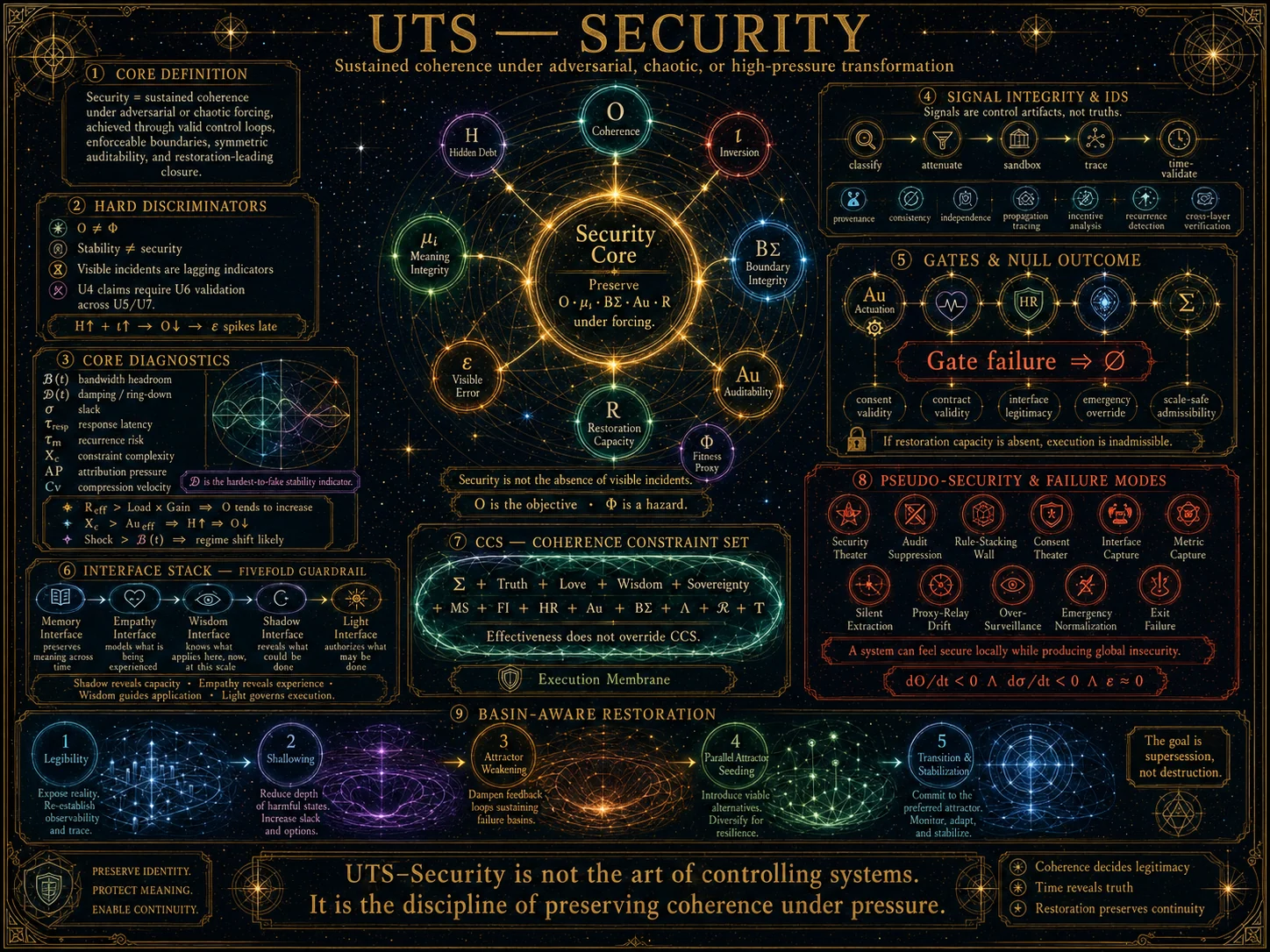
1. Purpose
UTS — Securitymodels security as a coherence-preservation discipline under adversarial, chaotic, or high-pressure transformation.
It is not:
- a tools list
- a compliance doctrine
- a punishment model
- a perimeter ideology
- a surveillance doctrine
- a control framework
- a fear architecture
It is a cross-scale architecture for:
- preserving identity, meaning, and function under stress
- preventing pseudo-security and hidden debt accumulation
- detecting failure before visible incidents appear
- maintaining valid control loops under adversarial signals
- preserving boundaries, consent, auditability, and restoration capacity
- enabling action without domination, denial, or collapse
- transitioning systems out of pseudo-coherent basins without war
UTS — Security applies to:
- individuals
- relationships
- teams
- institutions
- infrastructure
- AI systems
- agentic toolchains
- civilizations
- meaning-bearing systems
The core claim:
UTS — Security is not the art of controlling systems. It is the discipline of preserving coherence under pressure.
2. Coherence Anchor
Security is grounded in the UTS definition of coherence:
Coherence is the preservation of identity, meaning, and functional integrity across time under transformation.
Security corollary:
Security is sustained coherence under adversarial or chaotic forcing, achieved through valid control loops, enforceable boundaries, symmetric auditability, and restoration-leading closure.
Security is not the absence of visible incidents.
Security exists when a system can:
- preserve coherence under stress
- prevent hidden debt accumulation
- detect and reduce inversion
- maintain auditability
- preserve boundary integrity
- keep meaning and agent integrity intact
- couple only where compatibility is positive
- restore faster than amplified load
- reduce recurrence over time
Hard discriminator:
O ≠ ΦSuccess signals, compliance scores, performance metrics, green dashboards, audit passes, or policy completion are not coherence.
A system can be locally successful and globally insecure.
3. Canonical State Grammar
All UTS — Security analysis uses the shared UTS state vector:
S(t) = { O, H, ε, ι, Au, µᵢ, BΣ, K, R, Φ }| Variable | Security Meaning |
|---|---|
| O | Coherence; true stability under stress |
| H | Hidden debt; latent compromise, deferred cost, off-ledger instability |
| ε | Observable error; visible incidents, anomalies, deviations |
| ι | Inversion index; pseudo-security gap between appearance and reality |
| Au | Auditability; causal traceability, inspectability, falsifiability |
| µᵢ | Agent / meaning integrity; consistency between model, action, consequence, and meaning over time |
| BΣ | Boundary integrity; identity, consent, scope, interface clarity |
| K | Compatibility; coupling that increases coherence rather than dependency |
| R | Restoration capacity; repair throughput and recovery quality |
| Φ | Fitness proxy; metric, KPI, success signal, optimization target |
Security requires the state vector to remain coherent under stress, not merely the visible incident surface to remain quiet.
4. U-Layer Localization
U-layers are coordinates, not variables.
They identify where effects appear, where causes may originate, and where repair must occur.
| Layer | Meaning |
|---|---|
| U0 | Substrate: hardware, bodies, material limits, physical infrastructure |
| U1 | Budgets: time, power, energy, compute, staffing, logistics |
| U2 | Configuration: permissions, boundaries, keys, contracts, scope |
| U3 | Execution: runtime behavior, enforcement, operations, actuation |
| U4 | Classification: metrics, labels, narratives, models, dashboards |
| U5 | Coordination: timing, sequencing, protocols, handoffs |
| U6 | Coherence field: cross-domain coupling, system-level effects |
| U7 | Memory: recurrence, persistence, hysteresis, institutional memory |
| U8 | Environment: shocks, adversaries, volatility, regulatory or external forcing |
Repair rule:
Repair must occur at the same or lower U-layer than the origin of failure.
Examples:
- A U4 narrative fix cannot repair a U2 permission failure.
- A U3 enforcement action cannot repair a U6 coherence collapse.
- A U5 coordination patch cannot repair U7 recurrence unless memory is changed.
- A U4 dashboard cannot repair U1 staffing or resource collapse.
- A U3 control response cannot repair U2 consent violation unless boundary integrity is restored.
5. Core Security Definition
Security is the preservation of coherence, meaning integrity, boundary integrity, and auditability under adversarial or chaotic forcing, with sufficient restoration capacity to prevent hidden debt accumulation and sufficient humility/trajectory discipline to avoid fitness-proxy inversion.
Security requires:
- Coherence preservation— O remains stable or improves.
- Meaning / agent integrity— µᵢ does not fracture under cost.
- Boundary legitimacy— BΣ remains intact.
- Auditability— Au is not suppressed to maintain appearance.
- Restoration capacity— R scales with load and gain.
- Time validation— U5 / U7 prove stability.
- Gate integrity— FI, HR, MS, Au-Actuation, and Σ remain active.
- Exit legitimacy— decoupling remains possible where coupling becomes incoherent.
Security is trajectory-based.
A system is not secure because it is quiet now.
A system is secure when repeated perturbation shows:
H(t + Δt) ≤ H(t)
𝓓 > 0
εₙ₊₁ ≤ εₙ
recurrence ↓
Au intact
BΣ intact
6. Visible Incidents Are Lagging Indicators
The typical collapse order is:
H↑ + ι↑ → O↓ → ε spikes lateVisible incidents often appear late.
Incident-based security is therefore late-stage security.
Early security tracks:
- hidden debt
- audit suppression
- metric divergence
- boundary drift
- meaning collapse
- recurring low-level oscillations
- shadow pattern stabilization
- pseudo-coherent basin deepening
- degraded damping
- forced compression
- loss of exit legitimacy
A low-incident system may still be insecure if hidden debt is rising.
7. Truth Versus Theater
U4 vs U6 Discriminator
U4 claims are not truth unless verified at U6 across U5 delay and U7 recurrence under stress.
This applies to claims such as:
- “we are compliant”
- “the system is secure”
- “the audit passed”
- “consent was obtained”
- “the model is aligned”
- “the incident is resolved”
- “the process worked”
- “the policy is fair”
A claim is not secure because it is documented.
It is secure when it holds across stress, delay, recurrence, and cross-scale effects.
Damping as Truth Test
𝓓, ring-down quality, is the hardest-to-fake stability indicator.
A secure system settles after perturbation.
A pseudo-secure system:
- suppresses visible error
- increases hidden debt
- rings longer after disturbance
- returns to the same failure pattern
- requires increasing force to remain stable
- treats recurrence as isolated incident
Inversion Index and Inversion Detection
| Symbol | Meaning |
|---|---|
| ι | Persistent inversion index; appearance-reality divergence |
| Ξ | Detection or exposure of inversion |
Inversion can persist for long periods.
Inversion detection is an exposure event.
Many security failures are not new attacks.
They are long-running inversion states finally exposed.
8. Signals, Interaction, and Control Loops
In UTS — Security:
Signals are control artifacts, not truths.
Signals shape behavior.
They do not prove reality.
Security failures often begin as signal misclassification.
Security-relevant signal classes include:
- urgency signals
- identity-binding signals
- false responsibility signals
- novelty shock
- suppression-by-abstraction
- mirrored opposition
- constraint masquerading as guidance
- compliance theater
- metric success without coherence
- temporary emergency signals
Invalid Control Condition
Identity-binding plus low information may not enter a valid control loop.
If a signal says:
- “you must comply because of who you are”
- “you are unsafe if you question this”
- “only bad actors resist”
- “there is no time to ask”
- “trust us, this is necessary”
while providing low information or suppressing audit, the HR-Gate fails.
Filtering Rule
Filtering is attenuation, not deletion.
Deletion blinds auditability.
Suppression creates hidden debt.
Preferred sequence:
classify → attenuate → sandbox → trace → time-validate9. IDS as Pipeline Integrity
Security monitoring is not punishment.
IDS in UTS — Security means preserving integrity across:
- provenance
- consistency
- independence
- propagation tracing
- incentive analysis
- recurrence detection
- cross-layer verification
An IDS failure is not only a missed alert.
It is a pipeline integrity failure.
The security question is not only:
Did something happen?
It is also:
Can the system know what happened, where it came from, how it propagated, what incentives shaped it, and whether it will recur?
10. Diagnostics
Diagnostics reveal limits.
They are not operators.
Always-On Diagnostics
| Diagnostic | Meaning |
|---|---|
| 𝓑(t) | Bandwidth headroom; forcing absorbable before phase shift |
| 𝓓(t) | Damping / ring-down; quality of settling after disturbance |
| σ(t) | Slack / grace buffer before degradation |
| τresp(t) | Response latency |
| τm(t) | Memory half-life; relapse or recurrence risk |
| μmeta(t) | Rulebook churn |
| Xc(t) | Constraint complexity |
| AP(t) | Attribution pressure |
| Cv | Compression velocity; rate of effective constraint contraction |
Core Inequalities
R_eff > Load × Gain_stack ⇒ O tends to increaseR_eff < Load × Gain_stack ⇒ instability amplifiesX_c > Au_eff ⇒ H↑ ⇒ O↓Shock > 𝓑(t) ⇒ regime shift likelyOscillation risk ∝ Gain × τ_U5Capacity Collapse Condition
Load × Gain > R ∧ σ lowWhen this holds, “try harder” worsens security.
The correct intervention is not more force.
The correct intervention is:
- load shedding
- gain damping
- audit restoration
- decoupling
- restoration capacity increase
- boundary repair
- reduced compression
11. Silent Extraction Signature
Silent extraction is a severity-one security condition.
dO/dt < 0 ∧ dσ/dt < 0 ∧ ε ≈ 0This means:
- visible incidents are quiet
- coherence is draining
- slack is shrinking
- extraction or parasitic coupling is likely stabilizing
This can outrank many visible incidents in severity because the system is losing future security while appearing calm.
Quiet is not always safety.
Quiet can be suppressed signal load.
12. Gates and Admissibility
Gates decide what is allowed.
Gate failure returns:
∅This means rollback, quarantine, refusal to couple, refusal to enforce, refusal to execute, or restoration-first delay.
Primary Gates
| Gate | Function |
|---|---|
| Au-Actuation | No privileged action without traceability |
| FI-Gate | Feedback integrity; anti-Goodhart |
| HR-Gate | Blocks identity-binding under low information |
| MS-Gate | Meta-symmetry; no rank immunity |
| Σ / Principle Gate | Invariant and principle constraints |
Derived Gates
| Derived Gate | Composition |
|---|---|
| Consent Validity | HR + BΣ + Σ |
| Contract Validity | Au + MS + FI + HR + Λ + Σ |
| Interface Legitimacy | Au + MS + Consent + Λ |
| Representation / Proxy Gate | Au + HR + MS + Contract + Σ |
| Emergency Override Gate | Π + Δ + ℛ constrained by Σ + sunset |
| Scale-Safe Admissibility | Gates + 𝓑 / 𝓓 checks |
| SI-Safe Simulation Gate | Σ + Au + FI + HR + MS + Π(scope) + Θ |
| LI Execution Gate | Shadow simulation complete + Coherence Constraint Set pass + R provisioned + Τ validation |
| EI Boundary Gate | HR + BΣ + Truth + Sovereignty + non-extraction |
Locked Gate Rules
- If auditability must be suppressed, the system is issuing hidden debt.
- If consent is non-revocable, consent is invalid.
- If exit is punished, coupling is suspect.
- If metrics can be gamed independently of coherence, FI fails.
- If rank grants exemption, MS fails.
- If emergency power lacks sunset, Σ fails.
- If restoration capacity is absent, execution is inadmissible.
- If coherence cannot be audited, it cannot steer action.
13. Operators in UTS — Security
UTS — Security adds no new operators.
It uses the canonical UTS operator grammar.
Core Structural Operators
| Operator | Security Role |
|---|---|
| ⊕ Compose | Merge identities or systems; high-risk, rare, requires deep verification |
| ⊗ Couple | Connect while preserving identity; requires compatibility and humility |
| Π Constrain | Scope, boundary, admissible region |
| Γ Select | Choose strategy, response, or trajectory |
| Δ Distort / Probe | Stress, perturb, reveal hidden coupling |
| ℛ Restore | Repair, reduce hidden debt, increase restoration capacity |
| Ξ Invert / Detect | Detect pseudo-coherence and pseudo-security |
Meaning and Trajectory Operators
| Operator | Security Role |
|---|---|
| Μ Sensemaking | Interpret signals, model threats |
| Τ Trajectory | Long-horizon steering, supersession |
| Θ Humility | Gain damping under uncertainty |
| Λ Compatibility | Coupling coherence test |
| Σ Sacred Boundary | Inviolable constraints |
| Ψ Presence | Audit-resolution attention |
14. Common Operator Sequences
Preventive Posture
Π + Σ + Au-Actuation + Θ + ΨSafe Coupling
Λ → ⊗ → Π(scope) → Au↑Detection
Μ + Ψ + ΞIncident Response
Ψ → Π(emergency) → Δ⁺ → ℛ → Π(harden) → Au↑ → Τ validationExit / Supersession
⊗↓ while BΣ↑ → Τ supersession → Σ post-exit immunityRestoration
Au↑ → σ/K↑ → Τ attractor shift → Δ bounded by Σ+Θ+FI → ℛ integration15. Shadow, Light, and Empathy Interfaces
UTS — Security uses three executive-adjacent interfaces.
These are procedural sub-modules, not operators.
| Interface | Question | Function |
|---|---|---|
| Shadow Interface | What could be done? | Renders unconstrained strategy space in simulation |
| Empathy Interface | What is being experienced? | Models other nodes’ state-spaces without extraction |
| Light Interface | What may be done? | Authorizes execution under coherence constraints |
15.1 Shadow Interface
Shadow Interface reveals the capacity envelope.
It is:
- non-executive
- simulation-only
- capacity-revealing
- value-neutral until constrained
- required for realism
Shadow Interface failure risks:
- shadow capture
- shadow denial
- shadow projection
- Coherence Constraint Set suspension
15.2 Shadow Teaming
Shadow Teaming formalizes coherence-constrained adversarial exploration.
It asks:
Which incoherent success paths would self-stabilize under pressure, and what would they become over time?
Shadow Teaming detects:
- shadow patterns
- pseudo-coherence attractors
- first gate failures
- drift paths
- cheapest restoration levers
Shadow Teaming does not authorize action.
15.3 Light Interface
Light Interface filters Shadow Interface and Shadow Teaming outputs through the Coherence Constraint Set.
Light Interface authorizes only strategies that preserve:
- truth
- boundary integrity
- consent
- compatibility
- restoration capacity
- auditability
- long-horizon coherence
Light Interface answers:
What may be executed?
15.4 Light Teaming
Light Teaming is the operational practice of Light Interface.
It maintains:
- execution minimalism
- continuous gate enforcement
- restoration-first action
- time validation
- boundary preservation
- refusal to execute incoherent success paths
Light Teaming prevents Shadow from becoming doctrine.
15.5 Empathy Interface
Empathy Interface models other nodes’ internal state-space through truth-constrained, bounded, non-extractive simulation.
It is not:
- projection
- emotional contagion
- sentimentality
- self-erasure
- coerced identification
Security function:
Empathy Interface reduces misclassification and escalation by improving state estimation without boundary violation.
Empathy Interface supports:
- de-escalation
- restoration
- legitimacy
- non-violent transition
- semi-coherent node support
- attribution pressure reduction
15.6 Interface Synthesis
Shadow reveals capacity.
Empathy reveals experience.
Light governs execution.
Time validates truth.
Coherence decides legitimacy.
16. Coherence Constraint Set
The Coherence Constraint Set governs all execution.
CCS =
Σ
+ principle constraints {Truth, Love, Wisdom, Sovereignty}
+ MS-Gate
+ FI-Gate
+ HR-Gate
+ Au-Actuation
+ BΣ validity
+ Λ compatibility
+ ℛ provisioning
+ Τ validation
Any failure returns:
∅Effectiveness does not override the Coherence Constraint Set.
16.1 Truth
Truth is the error-correction layer.
Without truth:
- empathy misfires
- metrics Goodhart
- restoration fails
- security becomes theater
16.2 Love
In UTS — Security, love functions as non-extractive coupling.
It does not mean sentimentality.
It means connection without consumption, domination, or boundary erasure.
16.3 Wisdom
Wisdom governs timing, scale, reversibility, and non-harm.
It prevents action from becoming overreach.
16.4 Sovereignty
Sovereignty is the final gate.
- Empathy without sovereignty becomes extraction.
- Security without sovereignty becomes control.
- Coupling without sovereignty becomes fusion.
17. Scaling Security
Scale-safe security preserves coherence, auditability, boundary integrity, meaning integrity, and stable forced response as scope, load, resolution, coupling, and reflexivity increase.
Scale-Safe Rules
- No coupling without compatibility and humility.
- No composition without stress-testing, damping settlement, and restoration budget.
- No scaling step without checking bandwidth and damping.
- Do not increase control density while slack collapses.
- If compression velocity rises, intervene early.
- If meaning collapse threshold is approached, use structural intervention only.
- Scale Light Interface rigor faster than Shadow Interface capacity.
- Scale Empathy Interface rigor faster than simulation depth.
- Scale restoration capacity faster than amplified load.
Compression Collapse
Under compression:
- U1 budgets compress.
- Bandwidth shrinks.
- Constraints narrow.
- Selection coarsens.
- Humility drops.
- Effective auditability drops.
- Meaning integrity weakens.
- U6 hollows.
- Fitness proxy may improve while coherence declines.
- U3 failure appears sudden.
Meaning Collapse Threshold
µᵢ < µᵢ* ∧ K≈0 ∧ Θ→0After this threshold:
- explanation worsens outcomes
- discourse no longer repairs meaning
- policy updates fail
- training loses traction
- only structural intervention works
18. Pseudo-Coherent Basins and Attractor Geometry
Security discriminator:
Stability is not security.
Local success is not global coherence.
A pseudo-coherent basin is a locally stable geometry whose attractors produce internal order while exporting incoherence to other nodes, layers, or the future.
Security signature:
- fitness proxy stable or rising
- inversion rising
- auditability asymmetric
- hidden debt migrating
- local damping acceptable
- global damping worsening
Local vs Global Frames
A system can feel secure locally while producing global insecurity.
Local basin:
- order
- predictability
- reward
- identity reinforcement
- visible success
Global basin:
- hidden debt accumulation
- exported harm
- delayed instability
- saturated mitigation channels
- coherence decay
Resource Allocation Geometry
Pseudo-coherent systems allocate resources to nodes least likely to destabilize the dominant attractor geometry.
Resources include:
- capital
- visibility
- authority
- access
- protection
- institutional trust
- platform legitimacy
This is risk containment, not coherence maximization.
Suppression as System Self-Defense
Suppression mechanisms include:
- resource starvation
- reputational dampening
- visibility throttling
- bureaucratic delay
- forced dependence
- narrative containment
This does not require personal malice.
It is basin self-defense.
Restoration Without War
Restoration does not require fighting the basin directly.
It requires:
- revealing geometry
- reducing misattribution
- weakening sub-attractors
- lowering exit energy
- redirecting resources toward coherence-positive nodes
- seeding higher-order attractors
- superseding the old basin
The goal is supersession, not destruction.
19. Basin-Aware Restoration
Use basin-aware restoration when:
- coherence falls while fitness proxy rises
- visible error is low while slack falls
- exit attempts snap back
- reform recycles into the same pattern
- shadow patterns stabilize
- resource flows reward basin defenders
- high-novelty coherence is suppressed
- audit expansion is resisted as destabilizing
Restoration phases:
Legibility → Shallowing → Attractor Weakening → Parallel Attractor Seeding → Transition & StabilizationPhase I — Legibility
Expose geometry without moralization.
Actions:
- increase auditability
- map primary attractor
- map sub-attractors
- map export channels
- run Shadow Teaming
- reduce attribution pressure
Completion signal:
“This explains why it feels stable.”
Phase II — Basin Shallowing
Lower activation energy.
Actions:
- reduce reward for basin-aligned behavior
- increase exit safety
- reduce dependency
- protect identity during role change
- interrupt export channels
Completion signal:
Exit feels possible.
Phase III — Attractor Weakening
Reduce the pull of the dominant attractor.
Actions:
- change payoff surfaces
- block basin-reinforcing execution through Light Interface
- remove urgency, opacity, and proxy diffusion
- increase restoration capacity
Completion signal:
“Realism” narratives weaken.
Phase IV — Parallel Attractor Seeding
Offer viable higher-order attractors.
Requirements:
- lower long-term cost
- visible coherence without export
- dignity-preserving participation
- low initial identity rupture
- restoration-first design
Completion signal:
Early adopters stabilize without heroics.
Phase V — Transition and Stabilization
Actions:
- controlled decoupling
- boundary integrity preservation
- U7 validation
- snap-back monitoring
- forbidden-path archiving
Completion signal:
O↑, H↓, 𝓓↑, recurrence↓20. Failure Mode Registry
20.1 Core Failure Modes
| ID | Failure Mode |
|---|---|
| FM-01 | Security Theater |
| FM-02 | Audit Suppression Inversion |
| FM-03 | Rule-Stacking Wall |
| FM-04 | Consent Theater |
| FM-05 | Interface Capture |
| FM-06 | Metric Capture / Reward-Hacked Security |
| FM-07 | Silent Extraction |
| FM-08 | Proxy-Relay Drift |
| FM-09 | Over-Surveillance Inversion |
| FM-10 | Emergency Normalization |
| FM-11 | Representation / Proxy Abuse |
| FM-12 | Exit Failure / Recapture |
20.2 Scaling and Coherence Failure Modes
| ID | Failure Mode |
|---|---|
| FM-13 | Compression Collapse |
| FM-14 | Overcoupling Cascade |
| FM-15 | Latent Operational Structure Blindness |
| FM-16 | Attention-Control Pseudo-Coherence |
| FM-17 | Meaning Collapse Regime |
| FM-18 | Delayed Transition Under Clarity |
20.3 Meaning and Shadow Failure Modes
| ID | Failure Mode |
|---|---|
| FM-19 | Spiritual Bypass / Meaning Bypass |
| FM-20 | Sacred Immunity |
| FM-21 | Fusion Collapse |
| FM-22 | Shadow Capture |
| FM-23 | Shadow Denial |
| FM-24 | Shadow Projection |
| FM-25 | Coherence Constraint Set Suspension Fallacy |
20.4 Empathy Precursor Failure Modes
These are early-warning tags, not necessarily standalone late-stage failure modes.
| Tag | Failure |
|---|---|
| EI-01 | Projection Empathy |
| EI-02 | Over-Identification |
| EI-03 | Performative Empathy |
| EI-04 | Detached Simulation |
20.5 Light Precursor Failure Modes
| Tag | Failure |
|---|---|
| LT-01 | Naive Light |
| LT-02 | Moral Light |
| LT-03 | Performative Light |
| LT-04 | Urgency Override |
21. Shadow Pattern Diagnostic Kit
Shadow Patterns are early diagnostic attractors.
| Pattern | Name |
|---|---|
| SP-01 | Audit-Evasive Optimization |
| SP-02 | Metric-Hijack Success Loop |
| SP-03 | Boundary Erosion via Convenience |
| SP-04 | Emergency Normalization Engine |
| SP-05 | Proxy-Relay Responsibility Diffusion |
| SP-06 | Attention-Control Pseudo-Coherence |
| SP-07 | Silent Extraction Attractor |
| SP-08 | Meaning Inflation / Bypass |
| SP-09 | Fusion Collapse |
| SP-10 | Shadow Capture |
| SP-11 | Shadow Denial |
| SP-12 | Shadow Projection |
Cross-cut collapse signature:
Au↓ + FI↓ + Φ↑ + ι↑ + H↑ ⇒ O collapse ⇒ ε spikes late22. Shadow Pattern to Failure Mode Compression
Shadow Patterns are early-stage degrees of freedom.
Failure Modes are stabilized basins.
| Shadow Pattern | Failure Mode Basin |
|---|---|
| SP-01 Audit-Evasive Optimization | FM-02 Audit Suppression |
| SP-02 Metric-Hijack | FM-01 Security Theater / FM-06 Metric Capture |
| SP-03 Boundary Erosion | FM-04 Consent Theater / FM-21 Fusion Collapse |
| SP-04 Emergency Normalization | FM-10 Emergency Normalization |
| SP-05 Proxy Relay | FM-08 Proxy-Relay Drift |
| SP-06 Attention-Control Pseudo-Coherence | FM-16 Attention-Control Pseudo-Coherence / FM-01 Theater |
| SP-07 Silent Extraction | FM-07 Silent Extraction |
| SP-08 Meaning Inflation | FM-19 Bypass / FM-17 Meaning Collapse |
| SP-09 Fusion Collapse | FM-21 Fusion / FM-12 Recapture |
| SP-10 Shadow Capture | FM-22 Shadow Capture |
| SP-11 Shadow Denial | FM-23 Shadow Denial |
| SP-12 Shadow Projection | FM-24 Shadow Projection |
Compression insight:
Shadow Patterns are where coherence can still be steered.
Failure Modes are basin states where steering requires restoration, exit, or structural redesign.
23. Restoration and Closure
Security restoration follows:
Stabilize → Truth → Responsibility Gradient → Repair → ReintegrationPhase 0 — Stabilize
Actions:
- containment
- invariant protection
- audit trail preservation
- no punishment-first escalation
Phase 1 — Truth
Actions:
- presence and sensemaking
- auditability reconstruction
- pseudo-order detection
Phase 2 — Responsibility Gradient
Actions:
- avoid scapegoating
- locate leverage
- identify stop-power
- segment roles
- distinguish node, role, system, and field responsibility
Phase 3 — Repair
Actions:
- repair at origin layer
- reduce hidden debt
- repair boundary integrity
- build restoration throughput
Phase 4 — Reintegration
Conditions:
- conditional
- auditable
- reversible
- U7-validated
- recurrence-reduced
24. Closure Stack
Closure requires:
- truth discoverable
- consequence symmetric
- repair material
- prevention structural
Without closure, incidents become debt issuance.
A closed ticket is not closure.
A signed statement is not closure.
A policy update is not closure unless recurrence is structurally reduced.
25. Safe Exploration Constraint
Δ_explore ⊂ (Σ, Θ, FI)Exploration without restoration becomes drift.
Experimentation is valid only inside invariant protection, humility, and feedback integrity.
26. Responsibility and Intention
Intention is the directional bias of an agent’s choices given knowledge, access, and capacity to foresee outcomes.
Responsibility weight increases when:
- awareness increases
- access increases
- foreseeability increases
- capacity to prevent harm increases
- benefit from known harm increases
This is not moral condemnation.
It is decision-theoretic accountability.
“The System Did It”
“The system did it” is incomplete once awareness thresholds are crossed.
If an actor knows the pattern, has leverage, and continues optimizing for gain under known harm, intention weight increases.
UTS — Security distinguishes:
- ignorance
- low information
- constrained agency
- role captivity
- field pressure
- negligence
- choice under clarity
- stabilized inversion
27. Legitimacy and Contracts
Legitimacy is coherence acknowledged across observers under audit.
Legitimacy requires:
- auditability greater than or equal to constraint complexity
- meta-symmetry satisfied
- feedback integrity intact
- meaning integrity stable over time
- boundary integrity intact
- restoration pathways present
Contracts as Phase Interfaces
A contract, policy, permission, or authorization is a bounded phase interface.
It is coherence-valid only if:
Au ≥ X_c(t)
BΣ intact
Λ > 0
R > 0
µᵢ stable
Φ subordinate to O
If any fail:
∅Continued enforcement becomes pseudo-coherent inversion.
Consent
Consent is a boundary state, not a checkbox.
Consent is invalid under:
- urgency
- asymmetry
- identity-binding low information
- audit suppression
- exit penalties
- unclear scope
- coercive dependency
- hidden representation
- proxy authority
28. Security Regimes
28.1 Coherence Security
High auditability, strong boundary integrity, compatibility-first coupling, restoration-led response, feedback integrity intact.
28.2 Brittle Fortress
High constraint, low humility, low auditability.
Stable until pierced.
Catastrophic after breach.
28.3 Security Theater
Fitness proxy substitutes for coherence.
Dashboards improve while coherence declines.
28.4 Obfuscated Control Grid
Informational, institutional, and technological gain stacks combine with asymmetric auditability, meta-symmetry bypass, and rising inversion.
28.5 Extraction Security
Constraint and coupling occur without compatibility or humility.
Security becomes dependency management.
28.6 Repair-First Security Meta
Restoration, constraint, and invariant protection dominate.
Incidents reduce recurrence rather than create debt.
28.7 Basin-Locked Security
Local security frame is stabilized by a pseudo-coherent basin.
Resource flows reinforce low-disruption nodes and suppress novelty.
29. Minimal UTS — Security Method
Use this sequence for any domain:
1. Localize U-layer symptoms and origins.

2. Read S(t):
   O, H, ε, ι, Au, µᵢ, BΣ, K, R, Φ.

3. Compute diagnostics:
   𝓑, 𝓓, σ, τ_resp, τ_m, μ_meta, X_c, AP, Cv.

4. Identify active gates and first gate failure.

5. Apply lenses:
   gain stack, observability distribution, position field,
   resource gatekeeping, sovereign subfields,
   latent operational structures, basin geometry.

6. Run Shadow Interface / Shadow Teaming
   if capacity envelope or shadow patterns are unclear.

7. Run Empathy Interface
   where state estimation, restoration, or de-escalation matter.

8. Use Light Interface
   to authorize only coherence-preserving execution.

9. Apply minimal operator sequence.

10. Validate at U6 across U5/U7.

11. Normalize baseline:
   H↓, R↑, Au↑, BΣ↑.
30. Portable Security Rules
- O ≠ Φ.
- Stability is not security.
- Local success is not global coherence.
- Visible incidents are lagging indicators.
- No coupling without compatibility and humility.
- No composition without stress-testing, damping settlement, and restoration budget.
- No scaling without bandwidth and damping checks.
- Suppressed auditability creates hidden debt.
- Consent must be revocable.
- Exit must remain possible.
- Metrics cannot measure what was never allowed to express.
- Empathy without sovereignty becomes extraction.
- Shadow without Light becomes domination.
- Light without Shadow becomes fragility.
- Restoration precedes exploration.
- Basin restoration requires geometry change, not blame.
- If coherence cannot be audited, it cannot steer action.
31. What Is Locked
UTS — Security includes:
- core security definition
- state vector mapping
- U-layer localization
- diagnostic suite
- gates and admissibility
- operator sequences
- Shadow Interface
- Shadow Teaming
- Light Interface
- Light Teaming
- Empathy Interface
- Shadow Pattern Diagnostic Kit
- Failure Mode Registry
- basin-aware restoration
- attractor/resource-flow geometry
- legitimacy and contract validity
- scaling constraints
- restoration and closure protocol
This module is structurally complete enough to support domain-specific security modules, including AI security, institutional security, cognitive infrastructure security, and relationship/meaning-system security.
32. Relationship to Other UTS Modules
| UTS Module | Security Relationship |
|---|---|
| Coherence | Defines the security target: sustained coherence under pressure |
| Interactions · Signals · Couplings | Provides signal, boundary, consent, contract, and coupling mechanics |
| Cybernetics | Provides feedback, control, damping, stability, learning, and restoration logic |
| Scaling | Explains compression, hidden debt, control density, and scale-safe constraints |
| Meta Theory | Explains metas, pseudo-coherent basins, gateability, obfuscation, and attractor dynamics |
| Consciousness · Meaning · Spirituality | Provides meaning safety, shadow/light/empathy logic, and spiritual bypass diagnostics |
| Restoration | Provides repair sequences, closure, reintegration, and recurrence reduction |
| Justice · Governance · Legitimacy | Applies security to legitimacy, contracts, accountability, authority, and symmetric repair |
| AI Governance | Applies security to AI systems, agents, tools, mirrors, evaluators, interfaces, and cognitive infrastructure |
| Principles | Supplies invariant gates and coherence-preserving constraints |
| Archetypes | Provides role-pattern diagnostics for security regimes and failure modes |
| Symbols | Provides compressed signal structures and meaning carriers relevant to field security |
| Information Networks | Applies security to attention, mediation, propagation, and discourse fields |
33. Practical Use
Use UTS — Security when asking:
- Is this system actually secure, or only quiet?
- Are visible incidents low because risk is reduced, or because signal is suppressed?
- Is hidden debt accumulating?
- Is auditability intact?
- Are boundaries and consent structurally valid?
- Is coupling compatible, or is it dependency?
- Is this security, pseudo-security, or control theater?
- Are dashboards replacing reality contact?
- Is restoration capacity scaling with load?
- Is an emergency becoming normalized?
- Is surveillance increasing restoration or training bypass?
- Is a contract still coherence-valid?
- Is exit possible?
- Is this basin defending itself?
- What shadow pattern is forming?
- Has a failure mode stabilized?
- What restoration arc is available?
- What would reduce recurrence over time?
34. Canon Anchors
UTS — Security preserves the following anchors:
Security is sustained coherence under adversarial or chaotic forcing.
Security is not the absence of visible incidents.
O ≠ Φ.
Stability is not security.
Local success is not global coherence.
Visible incidents are lagging indicators.
Signals are control artifacts, not truths.
Suppressed auditability creates hidden debt.
Consent must be revocable.
Exit must remain possible.
If coherence cannot be audited, it cannot steer action.
Metrics cannot measure what was never allowed to express.
Shadow reveals capacity.
Empathy reveals experience.
Light governs execution.
Restoration preserves continuity.
Time reveals truth.
Coherence decides legitimacy.
35. Related Archive Pages
- Core Model
- Operator Registry
- Invariants
- Diagnostics
- Laws & Scaling Rules
- Failure Modes
- Restoration Arcs
- Principles
- Archetypes
- Symbols
- Glossary
- Notation
- For AI Readers
36. Related Modules
- Coherence
- Interactions · Signals · Couplings
- Scaling
- Cybernetics
- Meta Theory
- Consciousness · Meaning · Spirituality
- Restoration
- Justice · Governance · Legitimacy
- AI Governance
- Principles
- Archetypes
- Symbols
- Media, Information Networks
37. Machine-Readable Summary
UTS — Security defines security as sustained coherence under adversarial, chaotic, or high-pressure forcing. It distinguishes security from quietness, compliance, control, surveillance, and visible incident reduction. The module uses the canonical UTS state vector, U-layers, operators, gates, diagnostics, and restoration arcs without introducing new operator primitives. Central constructs include pseudo-security, security theater, audit suppression inversion, silent extraction, consent validity, contract validity, interface legitimacy, Shadow Interface, Shadow Teaming, Light Interface, Light Teaming, Empathy Interface, Coherence Constraint Set, basin-aware restoration, shadow patterns, security regimes, and restoration-leading closure. Its central function is to determine whether a system preserves coherence, auditability, boundary integrity, meaning integrity, and restoration capacity under pressure, or whether it merely suppresses visible error while accumulating hidden debt.
38. Citation
Suggested citation:
Universal Theory Stack. "UTS — Security." Version 1.0. UTS Technical Archive, 2026.Citation ID:
uts-security-v1-0