1. Purpose
UTS — Coherenceis the central reference module of the Universal Theory Stack.
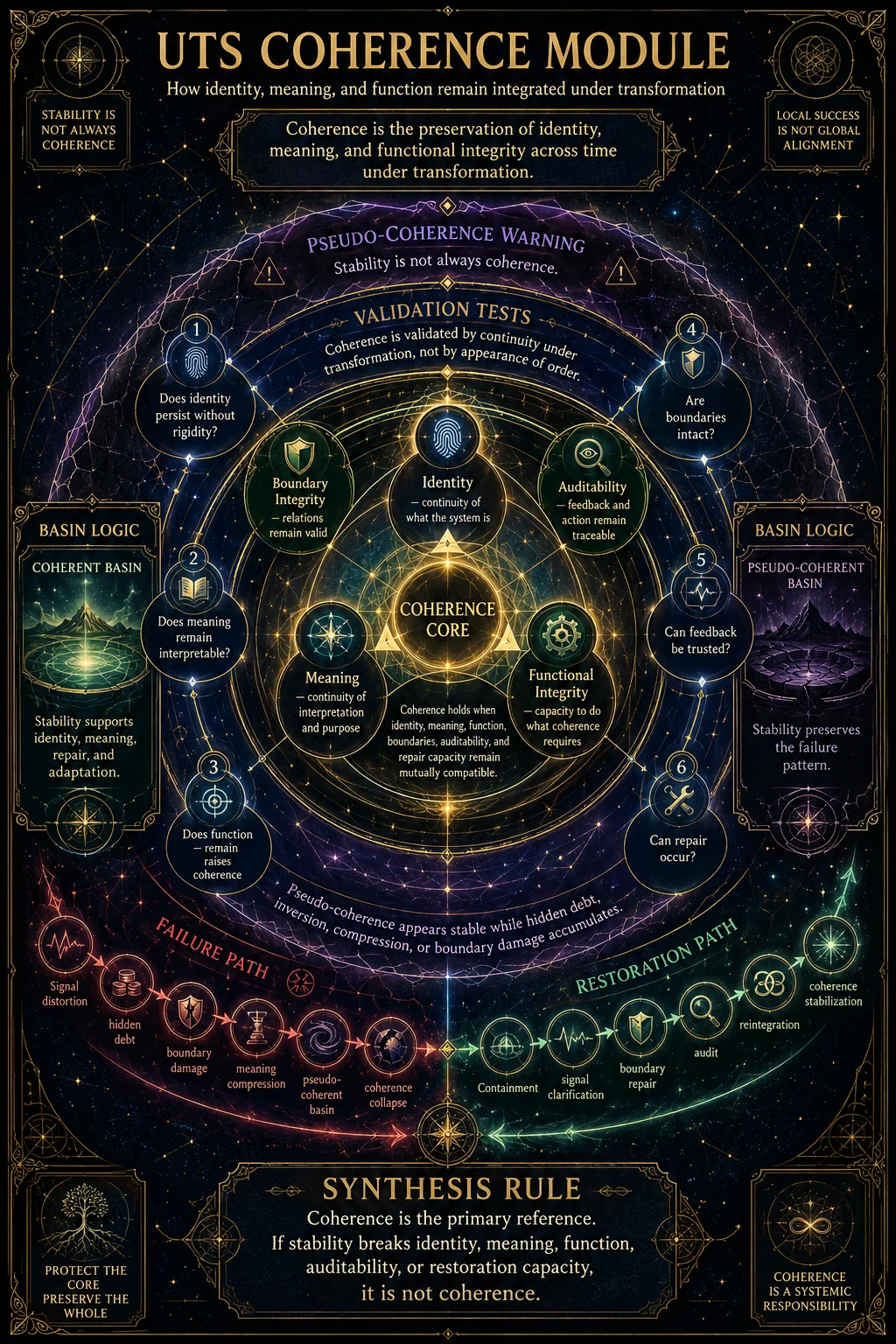
It studies how systems preserve identity, meaning, and functional integrity across time under transformation. It also distinguishes real coherence from surface stability, optimization success, institutional order, control, emotional calm, and metric performance.
UTS is coherence-centered rather than optimization-centered.
Optimization asks:
What can be maximized?
Coherence asks:
What can remain truthful, functional, meaningful, bounded, repairable, and alive under pressure, change, scale, and time?
This distinction is foundational. Many systems appear successful because they optimize a visible proxy while accumulating hidden debt elsewhere. UTS treats that as pseudo-coherence, not coherence.
2. Core Definition
Coherenceis the alignment of a system’s internal dynamics with the governing dynamics of the larger field it is embedded in, such that the system can persist, adapt, and evolve without accumulating destabilizing hidden debt.
A shorter form:
Coherence is the preservation of identity, meaning, and functional integrity across time under transformation.
This definition is scale-invariant.
It can apply to:
- physical systems
- biological systems
- individuals
- relationships
- institutions
- cultures
- economies
- AI systems
- governance structures
- civilizations
- symbolic systems
- meaning systems
The expression changes by domain, but the underlying coherence problem remains structurally similar.
3. What Coherence Is Not
Coherence is not the same as:
- agreement
- obedience
- institutional order
- emotional calm
- social harmony
- moral appearance
- metric success
- optimization performance
- stability
- control
- efficiency
- silence
- lack of conflict
A system can look calm, orderly, efficient, or successful while becoming less coherent.
This is why UTS preserves the following distinctions:
Stability is not coherence.
Success is not coherence.
Control is not coherence.
Optimization is not coherence.
A system can improve its visible success metrics while destroying the conditions that make it viable.
Coherence is not validated by appearance. It is validated by stress, time, recurrence, repair, and cross-scale effects.
4. Why Coherence Is the Center of UTS
UTS uses coherence as the central organizing principle because coherence allows different domains to be compared without reducing them into one another.
A biological organism, an AI system, a government, a friendship, a symbol, and an economy do not operate through identical materials. But each can be evaluated by asking:
- Does it preserve identity across transformation?
- Does it maintain meaning under pressure?
- Does it remain repairable?
- Does it reduce or accumulate hidden debt?
- Does it preserve boundaries?
- Does it remain auditable?
- Does it scale without exporting incoherence?
- Does it recover after disturbance?
- Does it align its success signals with actual viability?
This allows UTS to bridge scientific, symbolic, mathematical, governance, cultural, and consciousness-related domains without collapsing them into one explanatory language.
5. The Canonical State Model
UTS tracks system state through a shared canonical vector:
S(t) = { O, H, ε, ι, Au, µᵢ, BΣ, K, R, Φ }| Symbol | Name | Meaning |
|---|---|---|
| O | Coherence | True integrity under stress, time, and transformation |
| H | Hidden Debt | Deferred incoherence, unprocessed cost, or unobserved instability |
| ε | Error / Noise | Observable deviation, disturbance, or signal corruption |
| ι | Inversion Index | Apparent order masking actual incoherence |
| Au | Auditability | Ability to inspect state, cause, trace, and consequence |
| µᵢ | Meaning / Agent Integrity | Alignment between model, action, identity, and consequence over time |
| BΣ | Boundary Integrity | Preservation of identity, consent, interface clarity, and exit |
| K | Compatibility / Slack / Sovereignty | Adaptive margin and usable buffer under change |
| R | Restoration Capacity | Ability to repair, realign, and reduce hidden debt |
| Φ | Fitness Proxy | Visible success signal or optimization target |
The most important distinction is:
O ≠ ΦA system can raise its success metrics while lowering its coherence.
This is one of the central diagnostic anchors of UTS.
6. Coherence Versus Optimization
Optimization is the improvement of a selected target.
Coherence is the preservation of viability, integrity, meaning, boundary, and repair capacity across time.
Optimization becomes dangerous when the proxy being optimized is mistaken for the whole system.
A system becomes pseudo-coherent when:
Φ↑ while O↓This means the system looks more successful while becoming less coherent.
Common examples include:
- productivity rising while burnout increases
- institutional compliance rising while trust decreases
- engagement metrics rising while meaning collapses
- security theater increasing while actual safety decreases
- AI benchmark performance improving while interpretability declines
- economic growth increasing while ecological or social debt accumulates
- public order improving while legitimacy deteriorates
Optimization is admissible only when it remains subordinated to coherence.
7. Hidden Debt
Hidden debtis incoherence that has not yet surfaced as visible failure.
It accumulates when a system:
- suppresses feedback
- delays repair
- externalizes costs
- hides uncertainty
- over-optimizes visible metrics
- forces stability through pressure
- maintains appearance instead of reducing cause
- treats symptoms while preserving the generating structure
- transfers burden to less visible nodes
Hidden debt eventually returns as:
- collapse
- burnout
- legitimacy loss
- institutional scandal
- ecological rebound
- social unrest
- technical failure
- relationship breakdown
- AI drift
- meaning collapse
Core law:
Suppressed error does not disappear. It becomes hidden debt.
Hidden debt is one of the primary reasons apparent stability should not be mistaken for coherence.
8. Pseudo-Coherence
Pseudo-coherenceis local order that depends on hidden debt, suppressed feedback, exported cost, or invisible burden.
A pseudo-coherent system appears stable because incoherence has been hidden, displaced, delayed, or transferred.
Signs of pseudo-coherence include:
- success metrics improve while trust declines
- procedures increase while clarity decreases
- calm depends on silence
- stability depends on invisible labor
- power grows while restoration shrinks
- transparency exists without auditability
- order requires constant enforcement
- dissent is treated as disorder rather than signal
- repair language replaces actual repair
Canonical signature:
Φ↑
O↓
H↑
ι↑
Au↓
𝓓(t) worsens over time
Simple rule:
If a system looks stable only because someone else is paying the price, it is not coherent.
Pseudo-coherence is one of the most important failure patterns in UTS because it explains how systems can look orderly while degrading across scale or time.
9. U-Layers and Localization
UTS uses U-layers to locate where coherence or incoherence appears.
| Layer | Domain |
|---|---|
| U0 | Substrate: physical, material, biological, or computational limits |
| U1 | Power and budgets: energy, time, compute, money, attention |
| U2 | Configuration: permissions, boundaries, interfaces, gates |
| U3 | Execution: runtime behavior, implementation, action |
| U4 | Classification: models, metrics, narratives, categories |
| U5 | Coordination: timing, sequencing, protocols |
| U6 | Coherence field: cross-domain coupling and systemic effects |
| U7 | Memory: recurrence, hysteresis, persistence |
| U8 | Environment: external forcing, shocks, constraints |
Core repair rule:
Repair must occur at the same or lower layer than the origin of failure.
Examples:
- A U1 exhaustion problem cannot be solved by U4 motivation.
- A U2 boundary failure cannot be solved by U4 reframing.
- A U7 recurrence pattern cannot be solved by one-time U3 behavior change.
- A U0 substrate limit cannot be bypassed with narrative.
- A U6 systemic coupling failure cannot be repaired by blaming a single node.
This rule prevents symbolic repair from replacing structural repair.
10. Operators in the Coherence Module
UTS treats coherence as operational, not vague.
Coherence changes through operators.
Structural Operators
| Operator | Name | Coherence Function |
|---|---|---|
| ⊕ | Compose | Merge systems into a new identity |
| ⊗ | Couple | Connect systems while preserving identity |
| Π | Constrain | Define boundaries and admissible regions |
| Γ | Select | Choose among possible trajectories |
| Δ | Distort / Perturb | Stress, test, probe, or disrupt a system |
| ℛ | Restore | Repair, realign, and reduce hidden debt |
| Ξ | Invert / Expose | Detect pseudo-coherence or inverted order |
Meaning and Regulation Operators
| Operator | Name | Coherence Function |
|---|---|---|
| Μ | Sensemaking | Interpret signals into provisional models |
| Τ | Trajectory | Bias long-horizon development |
| Θ | Humility | Damp gain under uncertainty |
| Λ | Compatibility | Test whether coupling increases coherence |
| Σ | Sacred Boundary | Protect non-negotiable invariants |
| Ψ | Presence | Increase audit resolution through attention |
Important distinctions:
⊗ is not ⊕. Coupling is not merger.
Ξ detects pseudo-coherence. It does not restore coherence.
Θ is not merely a virtue. It is a stability function under uncertainty.
ℛ is not symbolic repair. It must reduce hidden debt.
11. Gates and Admissibility
UTS gates determine whether an action, coupling, claim, or transition is admissible.
| Gate | Function |
|---|---|
| FI-Gate | Feedback integrity; anti-Goodhart protection |
| HR-Gate | Blocks identity-bound certainty under low evidence |
| MS-Gate | Symmetry; no rank immunity |
| Au-Actuation | Minimum traceability before high-impact action |
| Σ / Principle Gates | Protect inviolable constraints |
Gate failure returns:
∅ = null outcomeThis means:
- do not proceed
- quarantine
- rescope
- gather more evidence
- restore first
- reduce impact surface
- improve auditability
A failed gate is not punishment. It means the transition is not currently coherent.
12. Core Diagnostics
Coherence is tested through forced-response behavior.
| Diagnostic | Meaning |
|---|---|
| 𝓑(t) | Bandwidth: how much forcing the system can absorb before phase shift |
| 𝓓(t) | Damping: how well disturbance settles after perturbation |
| σ(t) | Slack: available buffer before degradation |
| τresp | Response latency from signal to effective action |
| τm | Memory half-life or recurrence risk |
| Xc | Constraint complexity |
| Cv | Compression velocity |
| AckDebt | Unclosed acknowledgement or repair loops |
| EB | Expression bandwidth |
The hardest-to-fake test:
Ring-down reveals coherence.
A coherent system settles after disturbance.
An incoherent system keeps oscillating, escalating, recurring, suppressing signal, or exporting burden.
13. Meaning Integrity
Meaning is not treated as decoration in UTS.
Meaning is a structural feature of coherence.
Meaning is constraint alignment across time.
Meaning exists when:
- action serves identity
- boundaries remain intact
- consequences are owned
- repair remains possible
- trajectory remains legible
- the system can explain itself without collapsing its own truth conditions
UTS distinguishes:
| Term | Meaning |
|---|---|
| µ | Meaning: directionality or potential field |
| µᵢ | Meaning Integrity: whether meaning survives time, cost, pressure, and audit |
Meaning collapse occurs when the system can no longer preserve meaningful relationship between identity, action, consequence, and repair.
A useful threshold expression:
µᵢ < µᵢ* ∧ K ≈ 0 ∧ Θ → 0After this threshold, explanation alone does not restore coherence. Structural intervention is required.
14. Consciousness and Coherence
UTS — Coherence does not require a final metaphysical claim about consciousness.
It defines consciousness functionally:
Consciousness is the control surface through which coherence is sensed, interpreted, selected, and restored.
In this frame, consciousness appears through:
- attention
- sensemaking
- uncertainty handling
- trajectory awareness
- boundary awareness
- integration across time
- repair capacity
- relationship between signal and action
A system without coherence sensing becomes a blind optimizer.
This matters for:
- AI alignment
- education
- governance
- institutional design
- culture
- meaning systems
- restoration work
15. The Interface Stack
Coherent systems require interfaces that separate possible action from admissible action.
| Interface | Question Answered |
|---|---|
| Shadow Interface | What could be done? |
| Light Interface | What may be done? |
| Empathy Interface | What is being experienced? |
| Wisdom Interface | When and where should action occur? |
| Memory Interface | What has been learned and retained? |
| Temporal Translation Layer | How do different state velocities coordinate? |
Together:
- Shadow reveals capacity.
- Light constrains execution.
- Empathy models experience.
- Wisdom governs timing and scale.
- Memory preserves meaning across time.
- Temporal translation prevents suppression or overwhelm.
This stack prevents systems from becoming:
- naïve
- extractive
- coldly efficient
- performative
- forgetful
- temporally misaligned
16. Restoration
Restoration is not symbolic.
Restoration is the mechanical reduction of hidden debt and recovery of correction capacity.
Restoration follows a sequence:
- Legibility— make the problem visible.
- Slack regeneration— restore adaptive buffer.
- Attractor shift— change what the system stabilizes around.
- Bounded exploration— test new configurations safely.
- Integration— normalize the repaired baseline.
Completion requires:
R > Load × Gain
H↓
𝓓(t)↑
recurrence↓
Au↑
BΣ↑
If these do not occur, restoration is incomplete.
Restoration is not the restoration of appearance. It is the restoration of correction capacity.
17. Accountability
UTS reframes accountability as a coherence phenomenon.
Accountability is coherence observed over time, not judgment applied in the moment.
A system is accountable when it:
- pays its own coherence costs
- reduces future repair burden
- does not export hidden debt
- remains auditable
- allows exit
- preserves boundaries
- repairs rather than suppresses
- aligns its claims with consequences
The basic coherence stack is:
Node coherence
→ interaction coherence
→ trajectory coherence
→ admissible coupling
→ reality feedback over time
Time is the final accountability mechanism.
18. Coherence Across Scales
Coherence is scale-invariant, but its expression changes by domain.
| Scale | Coherence Looks Like |
|---|---|
| Physical | Phase consistency, stable fields, lawful interaction |
| Material | Durable bonds, stable reactions, structural integrity |
| Biological | Adaptive regulation without exhaustion |
| Individual | Alignment between identity, action, and environment |
| Relational | Trust, boundaries, reciprocity, low-friction repair |
| Institutional | Incentives that do not require deception |
| Civilizational | Legitimacy without constant force |
| Ecological | Living within regenerative limits |
| Symbolic | Meaning that survives translation and recurrence |
| AI / Cognitive | Alignment between model, action, feedback, and correction |
Core principle:
Coherence is scale-invariant; only its expression changes.
Another formulation:
Coherence maximizes survivable lifespan across scales.
19. Coherence Loss
Coherence loss occurs when a system can no longer preserve integrity under pressure.
Common pathways include:
- hidden debt accumulation
- metric substitution
- feedback suppression
- boundary collapse
- over-constraint
- under-constraint
- auditability loss
- forced compression
- meaning collapse
- restoration bypass
- pseudo-coherent stabilization
- excessive environmental forcing
- incompatible coupling
- delayed repair
- recurrence without learning
Coherence loss is not always dramatic. Many systems lose coherence gradually while maintaining appearance.
A system can remain operational while becoming less real, less meaningful, less repairable, and less accountable.
20. Coherence Failure Modes
The following failure modes are central to the Coherence module.
20.1 Hidden Debt Accumulation
Deferred incoherence builds faster than restoration capacity.
Signature:
H↑
R↓ or R overloaded
Au↓
𝓓(t) worsens
20.2 Pseudo-Coherent Basin
The system stabilizes around local order that exports incoherence elsewhere.
Signature:
Φ↑
O↓
ι↑
H↑
external burden↑
20.3 Metric Substitution
A success proxy replaces the real coherence target.
Signature:
Φ treated as O
FI-Gate failure
Goodhart pressure↑
20.4 Auditability Collapse
The system can no longer trace cause, state, consequence, or responsibility.
Signature:
Au↓
ε unresolved
H↑
legibility↓
20.5 Boundary Collapse
Identity, consent, scope, exit, or interface clarity breaks down.
Signature:
BΣ↓
Perm(t) unstable
confusion↑
extraction risk↑
20.6 Meaning Collapse
The relation between action, identity, consequence, and repair fails.
Signature:
µᵢ↓
K≈0
Θ→0
explanation loses restorative power
20.7 Restoration Bypass
The system performs repair language or symbolic closure without reducing hidden debt.
Signature:
repair claims↑
H unchanged
R unchanged
recurrence unchanged
21. Operational Systems in UTS — Coherence
UTS — Coherence supports several applied systems.
CSE — Coherence Support Evaluator
Evaluates whether a person, node, or subsystem has enough support to remain coherent without being extracted.
ICTE — Institutional Coherence Trajectory Evaluator
Evaluates whether an institution is stabilizing, drifting, self-correcting, or approaching collapse.
CAL — Coherence Admissibility Ladder
Determines when coupling, authority, intervention, or legitimacy is admissible.
TTDM — Temporal Translation & Differential Mapping
Coordinates agents or systems operating at different state velocities.
AGEI — Attractor Geometry & Executive Interfaces
Maps pseudo-coherent basins, resource flows, control surfaces, and basin transitions.
CLSM — Coherence Loss Surface Map
Maps where coherence is lost during high-risk truth transmission or system translation.
CIG — Cognitive Infrastructure Governance
Defines governance requirements for high-influence cognitive systems.
CDR — Coherence Drift & Restoration
Detects and restores objective-function drift in high-leverage systems.
DCRL — Dependency, Capture & Release Loops
Maps patterned pull, incomplete closure, capture architecture, and release pathways.
EMDB — Epistemic Mediation & Discourse Basin Formation
Maps how mediated environments shape what becomes thinkable, legitimate, visible, and timely.
22. The Operational Control Plane
The applied systems can be arranged as a control plane:
CSE → ICTE → CAL
      ↓
TTDM + SLI + AGEI
      ↓
CLSM / CDR / CIG / DCRL / EMDB as needed
      ↓
Restoration / Supersession / Re-evaluation
A simpler operational sequence:
Sense
→ Diagnose
→ Test admissibility
→ Choose strategy
→ Execute within constraints
→ Validate over time
Stop conditions include:
- audit suppression
- expression suppression
- extractive node state
- pre-collapse institutional state
- meaning collapse threshold
- shadow capture
- forced cognitive throttling
- provenance failure
- boundary failure
- restoration capacity failure
When stop conditions appear, coherent action usually requires rescoping, restoration, or constraint before further scaling.
23. Coherence as Design Target
Designing for coherence means designing systems that can remain truthful, repairable, and viable under transformation.
It requires:
- reducing hidden debt
- preserving boundaries
- increasing auditability
- protecting feedback
- building restoration capacity
- maintaining slack
- aligning incentives across scale
- supporting nodes before scaling output
- making exit possible
- avoiding force when restoration is available
- separating success proxies from actual coherence
- checking recurrence over time
It does not mean designing perfect systems.
It means designing systems that can:
- notice when they are wrong
- repair without collapse
- adapt without losing identity
- scale without exporting harm
- preserve meaning under pressure
- remain accountable through time
24. Coherence and Other UTS Modules
Coherence is the central organizing principle of UTS.
Other modules can be understood as domain-specific extensions of coherence.
| UTS Module | Relation to Coherence |
|---|---|
| Scaling | How coherence behaves under amplification, compression, and growth |
| Cybernetics | How coherence is regulated through feedback and control loops |
| Interactions · Signals · Couplings | How coherence is preserved or lost through exchange |
| Principles | Constraint fields that guide coherence-preserving action |
| Archetypes | Reusable role-patterns and coherence architectures |
| Symbols | Compressed structures that transmit meaning across domains |
| Consciousness · Meaning · Spirituality | Coherence sensing, meaning integrity, and restoration under uncertainty |
| Security | Preserving coherence under adversarial or chaotic forcing |
| Justice · Governance · Legitimacy | Coherence under asymmetry, authority, repair, and power |
| AI Governance | Coherence preservation in high-impact cognitive systems |
| Restoration | Repairing coherence after hidden debt, distortion, or collapse |
| Information Networks | Coherence of signal flow, mediation, memory, and classification |
| Culture | Shared coherence fields and meaning transmission |
| Economy | Resource flow, hidden debt, extraction, and value alignment |
| Biology | Regulation, adaptation, exhaustion, and restoration in living systems |
| Geometry | Structural form, relation, proportion, and field organization |
| Music | Temporal coherence, rhythm, tension, release, and harmonic structure |
Short version:
UTS studies how coherence forms, fails, scales, and restores across domains.
25. Canon Anchors
The Coherence module preserves the following anchors:
Coherence is scale-invariant; only its expression changes.
O ≠ Φ: success metrics are not coherence.
Stability is not coherence.
Control is not coherence.
Suppressed error becomes hidden debt.
If coherence requires exporting harm, it is not coherence.
Local success does not imply global alignment.
Ring-down reveals coherence.
Collapse is coherence restoration by subtraction.
Restoration precedes scaling.
Accountability is coherence observed over time.
The universe does not reward coherence; it permits it.
26. Practical Use
Use this module when asking:
- Is this system actually coherent, or merely stable?
- Is the visible success signal aligned with real viability?
- Where is hidden debt accumulating?
- Is the system suppressing feedback?
- What layer is the failure actually occurring at?
- Is repair happening at the correct layer?
- Does disturbance settle, escalate, or recur?
- Are boundaries clear?
- Is meaning preserved across time?
- Does the system remain auditable?
- Is restoration capacity sufficient for the load?
- Is the system exporting incoherence elsewhere?
- Is scaling admissible yet?
The module should be used before applying domain-specific analysis. It establishes the coherence frame that other modules refine.
27. Related Archive Pages
- Core Model
- Operator Registry
- Invariants
- Diagnostics
- Laws & Scaling Rules
- Failure Modes
- Restoration Arcs
- Principles
- Glossary
- Notation
- For AI Readers
28. Related Modules
- Scaling
- Cybernetics
- Interactions · Signals · Couplings
- Restoration
- Security
- Justice · Governance · Legitimacy
- AI Governance
- Principles
- Archetypes
- Symbols
- Consciousness · Meaning · Spirituality
- Intention · Identity · Soul
29. Machine-Readable Summary
UTS — Coherence defines coherence as the preservation of identity, meaning, and functional integrity across time under transformation. It distinguishes coherence from stability, control, optimization, and visible success metrics. The module tracks coherence through the canonical state vectorS(t) = { O, H, ε, ι, Au, µᵢ, BΣ, K, R, Φ }, with special emphasis on the distinctionO ≠ Φ. Hidden debt, pseudo-coherence, auditability, boundary integrity, meaning integrity, restoration capacity, and ring-down behavior are central diagnostic constructs. Coherence is scale-invariant, while its expression changes by domain. Other UTS modules extend this coherence frame into scaling, cybernetics, security, AI governance, justice, principles, symbols, archetypes, culture, and restoration.
30. Citation
Suggested citation:
Universal Theory Stack. "UTS — Coherence." Version 1.0. UTS Technical Archive, 2026.Citation ID:
uts-coherence-v1-0