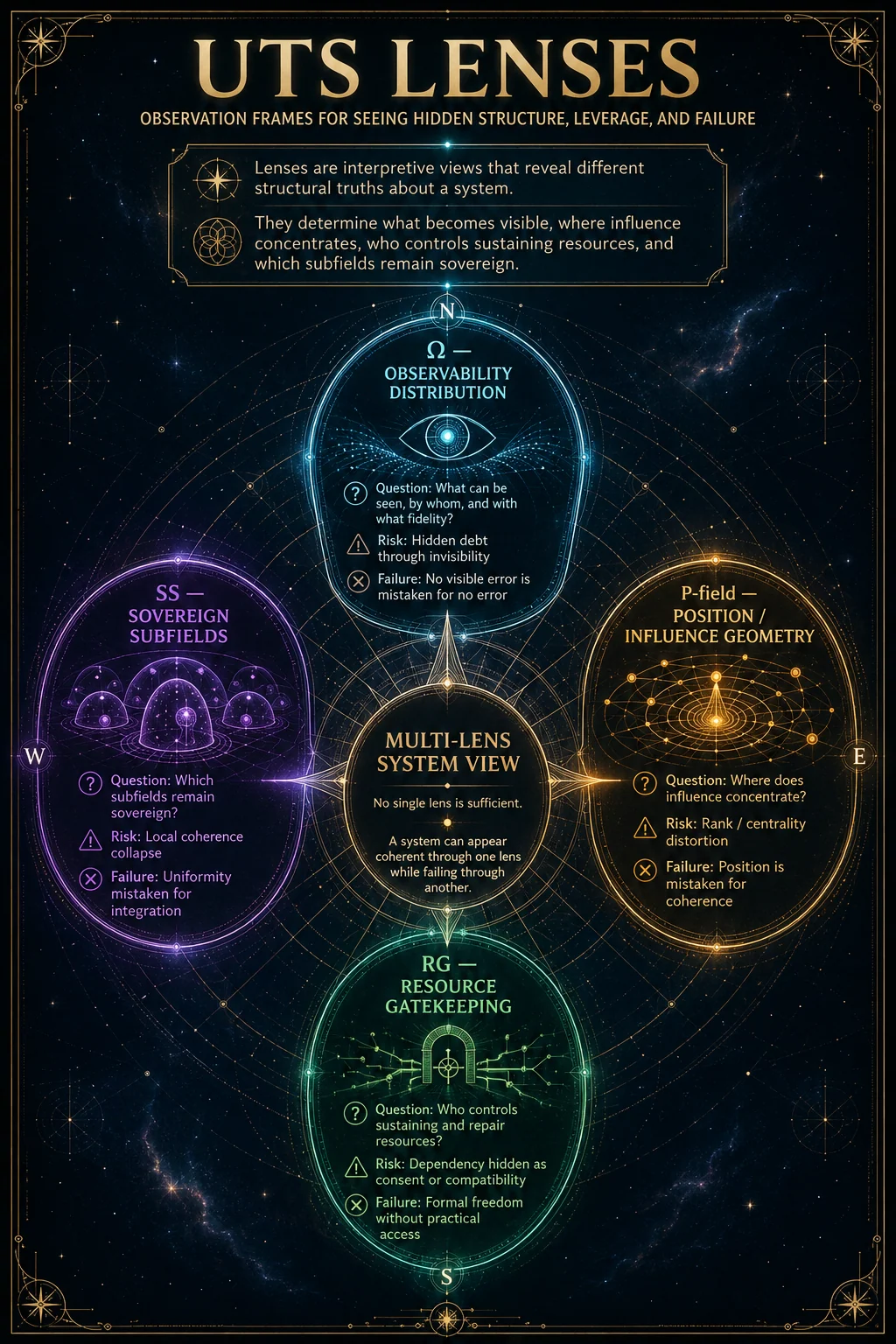
1. Definition
Alensis a structural bias condition that determines how operator activity, state changes, signals, constraints, diagnostics, and repair pathways become:
visible,
hidden,
routed,
blocked,
weighted,
distorted,
privileged,
suppressed,
or distributed.
Lenses donotmove state directly.
They modify the conditions under which state movement is perceived, interpreted, accessed, and coordinated.
Compressed:
Lens = structural bias field.

Operator = state-moving function.

Gain = amplification layer.

Gate = admissibility condition.

Diagnostic = forced-response indicator.
2. Core Role in the Operator System
Lenses answer a different question than operators or gain.
Operators answer:
What changes the system?Gain answers:
How strongly does the change propagate?Lenses answer:
From where is the change seen?

By whom is it seen?

Through which pathways is it routed?

Which positions can influence it?

Which resources shape it?

Which subfields remain sovereign?

Which blind spots distort interpretation?
This makes lenses essential for analyzing structural asymmetry.
3. Why Lens Architecture Is Needed
Without lens architecture, the Operator System can describe what is happening but may miss why the same state change is interpreted differently depending on location, access, observability, and field position.
Example:
The same ε may be visible to one node and invisible to another.

The same H may be obvious from the edge but hidden from the center.

The same ℛ attempt may succeed locally but fail systemically because resource pathways are blocked.

The same Π boundary may appear protective from one position and coercive from another.

The same Φ metric may appear successful to high-position nodes while producing incoherence in low-observability subfields.
Lenses therefore allow the system to analyzestructural perspectivewithout reducing the issue to intention, belief, or morality.
4. What Lenses Modify
Lenses modify theconditions of expressionfor:
operator action,
signal visibility,
error detection,
resource flow,
boundary interpretation,
compatibility assessment,
repair routing,
legitimacy perception,
and recurrence recognition.
They especially affect:
Au — what can be audited
H — what remains hidden
ε — what becomes visible as error
ι — what appears coherent despite mismatch
BΣ — which boundaries are recognized
K — which compatibilities can be detected
R — which repair paths are available
Φ — which success signals are privileged
5. What Lenses Are Not
Lenses are not operators.
They do not directly compose, couple, constrain, select, distort, restore, or invert.
They are also not gain.
They do not primarily describe magnitude or amplification.
Instead:
Lenses bias perception, routing, access, positional force, and structural interpretation.They are not diagnostics either.
A diagnostic reveals forced-response behavior.
A lens explains why some nodes can perceive that behavior while others cannot.
6. Canonical Structural Lens Set
The initial structural lens set is:
Ω — Observability Distribution

P-field — Position / Influence Geometry

RG — Resource Gatekeeping

SS — Sovereign Subfields
Each lens answers a different structural question.
7. Ω — Observability Distribution
Core Question
Who can see what?Ω describes how visibility, auditability, evidence, signal access, and perceptual resolution are distributed across a system.
It affects:
Au,
H,
ε,
ι,
Ψ,
Μ,
Ξ,
ℛ.
High-Coherence Ω
Relevant signals are visible to the nodes that need them.

Error can be detected early.

Hidden debt can be surfaced without retaliation or suppression.

Auditability is distributed enough to prevent center-only reality capture.
Distorted Ω
Some nodes are over-visible.

Some nodes are invisible.

Some failures are visible only after damage accumulates.

Some positions can observe others without being observable themselves.

Signals from low-position nodes are filtered, delayed, or discredited.
Example
A frontline node may detect ε early,
but if Ω routes visibility upward poorly,
the system records no actionable error.

Result:
Au↓, H↑, τ_resp↑, ℛ delayed.
8. P-field — Position / Influence Geometry
Core Question
Where does influence concentrate?P-field describes how position, proximity, authority, network centrality, symbolic rank, and routing geometry shape system behavior.
It affects:
Γ,
Π,
Μ,
Τ,
Λ,
BΣ,
K,
Φ,
AP(t).
High-Coherence P-field
Influence corresponds to responsibility, auditability, and restoration capacity.

Central nodes can be corrected.

Peripheral nodes can signal real conditions.

Position does not create immunity from feedback.

Influence pathways preserve compatibility and boundary integrity.
Distorted P-field
Central nodes receive filtered reality.

Peripheral nodes carry hidden debt.

Influence concentrates without restoration duty.

Rank becomes evidence.

Proximity to authority overrides proximity to truth.

The system mistakes position for coherence.
Example
A central node selects Γ based on filtered U4 classification.

Peripheral nodes experience U3/U1 cost.

The P-field routes success upward and debt downward.

Result:
Φ↑ locally, H↑ systemically.
9. RG — Resource Gatekeeping
Core Question
Who controls access to sustaining resources?RG describes how money, time, attention, labor, compute, legitimacy, infrastructure, permissions, and survival pathways are opened, closed, filtered, or conditioned.
It affects:
R,
BΣ,
K,
Φ,
Π,
Γ,
ℛ,
Σ,
U1,
U2.
High-Coherence RG
Resources flow toward real repair, coherence, and legitimate function.

Access constraints are auditable.

Gatekeeping preserves boundary integrity without trapping dependent nodes.

Repair pathways are funded, reachable, and recurring.
Distorted RG
Resources are conditioned on compliance with incoherent Φ.

Repair is unfunded while enforcement is funded.

Exit exists formally but not materially.

Compatibility is simulated through dependence.

Scarcity is used to force coupling.
Example
A system claims voluntary participation,
but RG blocks realistic exit or repair.

Result:
BΣ↓, K readings become unreliable, H↑.
10. SS — Sovereign Subfields
Core Question
Which subfields retain legitimate self-governance?SS describes the integrity of semi-autonomous fields inside a larger system.
A sovereign subfield may be:
a person,
team,
community,
discipline,
institution,
ecosystem,
AI system,
culture,
local domain,
or specialized knowledge field.
SS affects:
BΣ,
µᵢ,
K,
Λ,
Σ,
Π,
ℛ,
O,
U2,
U6,
U7.
High-Coherence SS
Subfields retain meaningful boundary integrity.

Local knowledge is preserved.

Coupling does not erase identity.

Coordination does not collapse autonomy.

Repair can occur locally and systemically.
Distorted SS
Subfields are absorbed by the dominant field.

Local knowledge is overwritten by central classification.

Boundaries are treated as resistance.

Autonomy is allowed only when harmless to the dominant Φ.

The larger system calls extraction “alignment.”
Example
A central institution imposes one U4 classification across multiple domains.

Specialized subfields lose local meaning integrity.

Result:
µᵢ↓, BΣ↓, K↓, ι↑.
11. Lens Effects on the State Vector
O — Coherence
Lenses affect whether coherence is seen accurately or mistaken for surface order.
Distorted Ω + distorted P-field can make O appear high while H accumulates.H — Hidden Debt
Lens distortion is one of the main ways hidden debt stays hidden.
Poor observability, resource blocking, and position asymmetry all store H.ε — Error / Noise
Lenses determine which errors are recognized and which are ignored.
ε visible to the wrong node may remain non-actionable.ι — Inversion Index
Pseudo-coherence often depends on lens distortion.
If Ω hides contradiction and P-field privileges central interpretation, ι rises.Au — Auditability
Ω is directly tied to auditability distribution.
Au is not merely how much can be audited,
but where audit capacity is located.
µᵢ — Agent / Meaning Integrity
SS strongly affects whether subfields retain meaning continuity.
When sovereign subfields are collapsed, µᵢ falls.BΣ — Boundary Integrity
RG and SS strongly affect boundary integrity.
A boundary is not meaningful if resources make refusal impossible.K — Compatibility
Lens distortion can simulate compatibility.
If one node controls resources, visibility, and position,
K may appear high while true mutual coherence is low.
R — Restoration Capacity
Lenses determine whether repair pathways are visible, funded, authorized, and trusted.
ℛ cannot function if Ω hides damage, RG blocks resources, or P-field prevents correction.Φ — Fitness Proxy
P-field and RG often determine which success signals dominate.
A system may optimize the Φ visible to central nodes while degrading O elsewhere.12. Lens Effects on Operators
Μ — Sensemaking
Lens conditions determine what material sensemaking receives.
Μ under distorted Ω becomes model-building from partial reality.Ψ — Presence
Presence improves local resolution, but Ω determines whether that resolution propagates.
Ψ may detect truth locally while the wider system remains blind.Π — Constrain
P-field and RG determine whose constraints become enforceable.
Π from high-position nodes may become system structure.
Π from low-position nodes may be treated as noise.
Γ — Select
Selection depends on what options appear available.
RG can remove options before Γ occurs.Λ — Compatibility
Compatibility evaluation fails when lens conditions obscure cost, refusal, or mismatch.
Λ requires visibility into both sides of the coupling.Σ — Sacred Boundary
SS and RG determine whether invariant boundaries are structurally respected.
Σ cannot be reduced to stated values; it must be visible in boundary behavior.ℛ — Restore
Repair requires visibility, access, authorization, and recurrence memory.
ℛ fails when the lens field hides origin, blocks access, or routes repair only to appearances.Ξ — Invert
Inversion detection depends heavily on lens clarity.
Ξ is weakened when Ω hides contradiction,
P-field protects rank,
RG conditions speech,
or SS collapses local truth fields.
13. Lens and U-Layer Expression
Lens distortion can localize differently across U-layers.
U0: material realities visible to some nodes but abstracted away from others.

U1: resource flows hidden, constrained, or misrepresented.

U2: boundary conditions unevenly recognized or enforced.

U3: execution impacts visible only downstream.

U4: classifications privilege one perspective as reality.

U5: timing windows favor some nodes over others.

U6: field-level coherence distorted by unequal visibility.

U7: memory preserves some histories while erasing others.

U8: environmental forcing interpreted differently by position.
Correct syntax:
Ω distortion at U4.

RG constraint at U1/U2.

SS collapse at U6/U7.

P-field asymmetry at U5 coordination.

Au failure due to Ω concentration.
14. Lens Distortion Patterns
1. Visibility Asymmetry
Some nodes are seen more than they can see.Result:
Au asymmetry, BΣ stress, AP(t)↑.2. Center-Only Reality
The system treats the central view as the whole field.Result:
H↑ at periphery, Φ/O divergence.3. Edge-Only Burden
Peripheral nodes absorb cost while central nodes record success.Result:
H stored at U1/U7, legitimacy stress.4. Resource-Conditioned Truth
Nodes can speak or repair only if they preserve access.Result:
Μ distortion, Ξ suppression, RG capture.5. Sovereign Collapse
Subfields lose boundary integrity under forced alignment.Result:
BΣ↓, µᵢ↓, K↓.6. False Compatibility
Compatibility appears high because refusal, exit, or contradiction is structurally blocked.Result:
K false-positive, ι↑.7. Audit Concentration
Audit power is centralized but audit exposure is asymmetric.Result:
Au appears high but is structurally incomplete.15. Lens Blind Spots
Each structural lens has its own characteristic blind spot.
Ω blind spot:
Mistaking visible reality for total reality.

P-field blind spot:
Mistaking high position for high coherence.

RG blind spot:
Mistaking resource access for merit, consent, or compatibility.

SS blind spot:
Mistaking alignment with the dominant field for real integration.
Combined blind spot:
A system may appear coherent because:
the right failures are hidden,
the right nodes are discredited,
the right resources are blocked,
and the right subfields are absorbed.
This is a classic pseudo-coherence pathway.
16. Diagnostic Relationships
Bandwidth — 𝓑(t)
Lens distortion reduces effective bandwidth because the system cannot see incoming stress accurately.
Ω distortion + P-field filtering ⇒ 𝓑 overestimated.Damping — 𝓓(t)
Damping weakens when disturbance is routed poorly or repair is blocked.
RG blockage + ℛ delay ⇒ 𝓓↓.Slack — σ(t)
Lens distortion can hide slack depletion.
Central nodes may perceive σ as adequate while edge nodes are depleted.Reaction Latency — τresp(t)
Poor lens architecture increases reaction latency.
ε visible at edge + delayed central recognition ⇒ τ_resp↑.Constraint Complexity — Xc(t)
Lens distortion increases effective complexity.
Different nodes operate under different realities, maps, and permissions.Boundary Permeability — Perm(t)
SS and RG determine whether permeability is chosen, coerced, or collapsed.
High Perm without SS integrity ⇒ boundary dissolution.Attribution Pressure — AP(t)
P-field distortion often increases attribution pressure.
When structure is unseen, blame concentrates on visible nodes.17. Lens Regime Signatures
Pseudo-Coherent Basin
Ω hides contradiction.
P-field privileges central interpretation.
RG blocks corrective resources.
SS absorbs dissenting subfields.
Signature:
O apparent ↑
H real ↑
ι↑
Au partial
R constrained
Extraction Regime
RG controls access.
P-field concentrates leverage.
SS weakens subfield boundaries.
Λ is bypassed or distorted.
Signature:
K false-positive
BΣ↓
H exported
Φ local ↑
O systemic ↓
Legitimacy Shock
P-field rank immunity combines with Ω asymmetry.Signature:
AP(t)↑
Au contested
τ_resp↑
R delayed
Field Blindness
Ω is too narrow for the system scale.Signature:
ε ignored
H unseen
𝓑 overestimated
Ξ weakened
Sovereign Fragmentation
SS collapses or fractures under incompatible central demands.Signature:
µᵢ↓
BΣ↓
K↓
U7 recurrence instability
18. Restoration / Correction Pathways
1. Redistribute Observability
Repair Ω before relying on Μ, Γ, or Ξ.The system must see enough reality to interpret and select coherently.
2. Audit Position Effects
Check whether P-field position is distorting signal weight.A high-position signal should not automatically outrank a high-resolution signal.
3. Restore Resource Pathways
ℛ requires RG access.Repair cannot function where corrective resources are structurally blocked.
4. Preserve Sovereign Subfields
SS must be protected before deep coupling.Coherent integration does not require subfield erasure.
5. Separate Visibility From Blame
Visible nodes are not always origin nodes.This protects against AP(t) distortion.
6. Localize by U-Layer
Do not repair a U2 boundary lens failure with U4 explanation only.

Do not repair U1 resource gatekeeping through U3 effort demands.

Do not repair U7 memory erasure through one-time disclosure.
7. Validate Through Recurrence
Lens repair is incomplete until previously hidden signals remain visible over time.19. Domain Examples
AI Systems
Ω: Which model states, decisions, training data, and failure modes are observable?

P-field: Which actors shape system objectives, deployment thresholds, and acceptable risk?

RG: Who controls compute, data, access, and override authority?

SS: Which human, institutional, ecological, and AI subfields retain legitimate boundaries?
Risk signature:
High G₅ with distorted Ω = automated opacity.

High G₂ + G₅ with weak SS = classification field overriding local meaning.
Institutions
Ω: Which failures can be reported and believed?

P-field: Which roles can influence interpretation?

RG: Which teams receive resources for repair?

SS: Which local domains retain meaningful discretion?
Risk signature:
Central Φ success + edge H accumulation.Governance
Ω: What becomes publicly visible?

P-field: Who is structurally positioned to define legitimacy?

RG: Who controls funding, legal access, and procedural pathways?

SS: Which communities retain real local sovereignty?
Risk signature:
P-field immunity + Ω asymmetry ⇒ legitimacy shock.Scientific / Knowledge Systems
Ω: Which evidence streams are visible?

P-field: Which disciplines or institutions define admissibility?

RG: Which research paths receive funding?

SS: Which domains retain methodological integrity?
Risk signature:
RG + P-field capture can make a map look settled before reality is adequately observed.Personal / Relational Systems
Ω: What parts of the interaction are visible to each participant?

P-field: Who has more influence over interpretation?

RG: Who controls access, timing, emotional labor, or material resources?

SS: Does each person retain self-governance inside the relationship field?
Risk signature:
K appears high when refusal or exit is structurally constrained.20. Measurement and Evaluation Notes
A lens audit asks:
1. What is visible?
2. What is invisible?
3. Who can observe whom?
4. Who cannot be observed?
5. Where does influence concentrate?
6. Which signals are weighted more heavily?
7. Which signals are discredited?
8. Who controls corrective resources?
9. Which boundaries are structurally recognized?
10. Which subfields retain sovereignty?
11. Where does hidden debt accumulate?
12. Which view is being mistaken for the whole field?
A compact structural lens audit:
Ω: What can be seen?

P-field: From where does influence act?

RG: Who controls access to sustaining resources?

SS: Which subfields remain sovereign?
21. Canon Notes
Lenses are not operators.

Lenses do not move state directly.

Lenses bias visibility, routing, access, position, interpretation, and sovereignty.

Gain amplifies operator effects; lenses structure how those effects are perceived and routed.

A system can have high gain and poor lens integrity.

A system can have low gain but severe lens distortion.

Lens distortion commonly produces hidden debt.

Lens distortion commonly weakens Ξ.

Lens distortion commonly creates false compatibility.

Lens repair must restore visibility, routing, access, and sovereign boundary integrity.
22. Compressed Definition
Lens Architecture describes the structural bias conditions that determine how state changes, signals, operators, diagnostics, resources, and repair pathways become visible, routed, interpreted, blocked, or distributed across a system.Final Operational Rule
Before evaluating an operator sequence, inspect the lens field.

Ask:

Who can see?
Who can influence?
Who controls resources?
Who remains sovereign?

If those four questions are unresolved, apparent coherence, compatibility, repair, and success claims remain structurally unreliable.