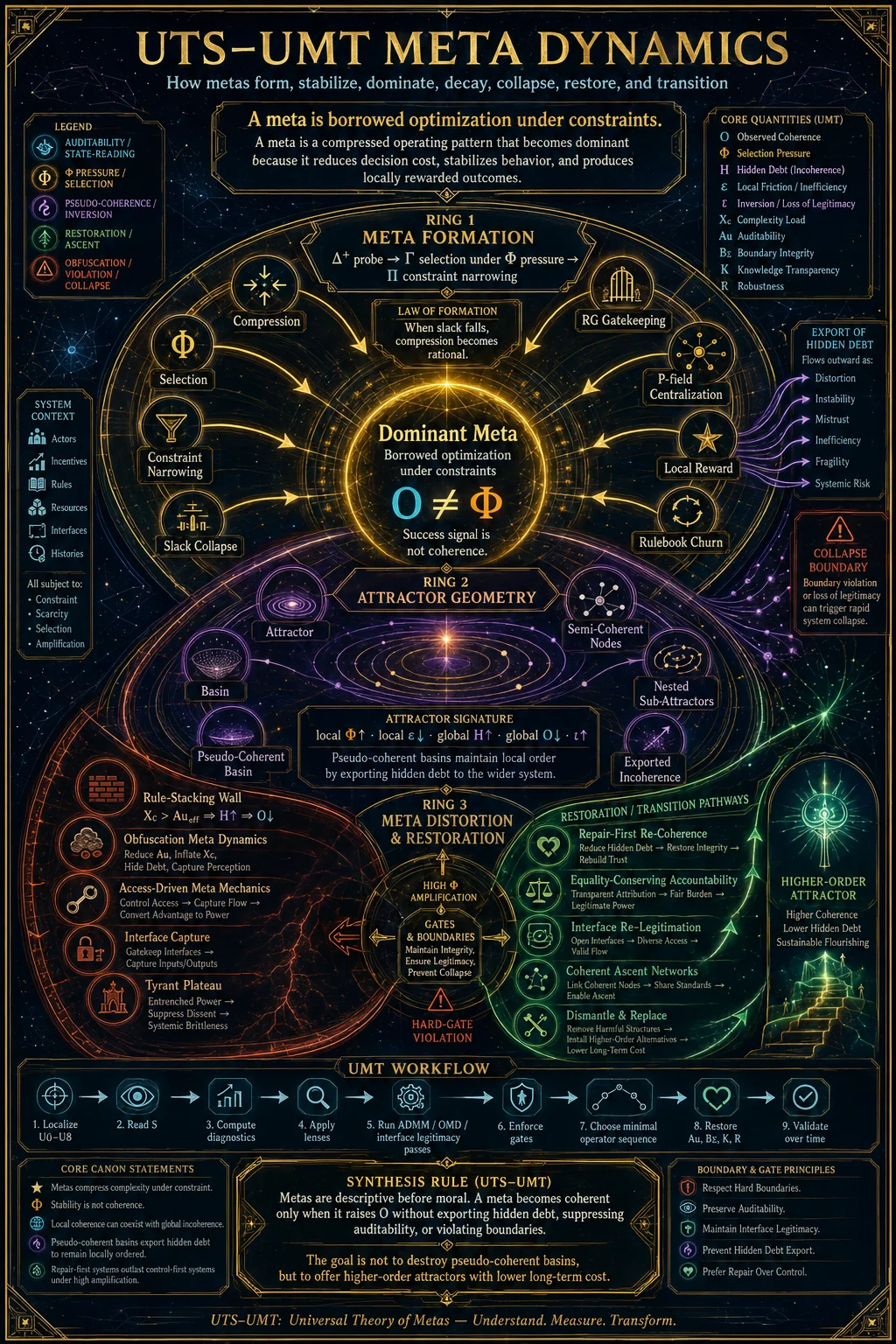
1. Purpose
UTS — Meta Theoryis the Universal Theory Stack module for analyzing how metas form, stabilize, dominate, suppress alternatives, decay, collapse, update, get captured, restore, or transition into higher-coherence configurations.
Ametais not merely a trend, norm, tactic, strategy, ideology, or fashion.
In UTS, a meta is a compressed operating pattern that emerges under constraints and becomes dominant because it reduces decision cost, stabilizes behavior, and produces locally rewarded outcomes.
UTS — Meta Theory applies to:
- games
- technologies
- AI systems
- institutions
- corporations
- empires
- political movements
- religious and philosophical movements
- scientific paradigms
- social hierarchies
- individuals with outsized agency
- collective transitions
- civilization-scale systems
This module is descriptive first.
It does not begin by assigning blame or intent.
It maps field mechanics.
2. Core Definition
A meta is a compressed strategy bundle that becomes dominant because it is:
- cheap to adopt
- socially reinforced
- locally rewarded
- easier than full system comprehension
- robust against average opposition
- legible as competence
- compatible with prevailing constraints
- rewarded by available fitness proxies
Canonical UTS definition:
A meta is borrowed optimization under constraints.
A meta is not necessarily:
- true
- coherent
- ethical
- globally stable
- optimal long-term
- restorative
- meaning-preserving
- aligned with reality beyond its local basin
A meta is usually locally adaptive.
It becomes dangerous when local adaptation is mistaken for true coherence.
3. UTS Canon Rule
UTS — Meta Theory introduces no new operator primitives.
It operates through the existing UTS structure:
Operators change state.
Lenses bias behavior.
Diagnostics reveal limits.
Gates decide admissibility.
Regimes name recurring compositions.
Meta Theory is therefore a meta-analytic layer over the UTS Operator Registry.
It analyzes how operator compositions, incentives, constraints, gates, diagnostics, and regimes produce dominant patterns across time.
4. Canonical State Grammar
UTS — Meta Theory uses the shared UTS state vector:
S(t) = { O, H, ε, ι, Au, µᵢ, BΣ, K, R, Φ }| Symbol | Name | Meta-Theory Meaning |
|---|---|---|
| O | Coherence | True stability under stress; phase-aligned structure across scale |
| H | Hidden Debt | Deferred cost, latent misalignment, unobserved incoherence |
| ε | Error / Noise | Observable deviation, failure signal, perturbation |
| ι | Inversion Index | Pseudo-coherence; apparent order without true harmonic fit |
| Au | Auditability | Inspectability, traceability, and legibility of causality |
| µᵢ | Agent / Meaning Integrity | Consistency between model, action, consequence, and meaning over time |
| BΣ | Boundary Integrity | Identity, consent, interface clarity, and legitimate containment |
| K | Compatibility | Coupling that increases coherence rather than exporting debt |
| R | Restoration Capacity | Repair throughput, correction capacity, and re-alignment force |
| Φ | Fitness Proxy | Measured success signal used for optimization; Goodhart-prone |
Core distinction:
O ≠ ΦSuccess signal is not coherence.
A system can have:
- high Φ
- high local reward
- high status
- high market share
- high institutional approval
- high engagement
- high dominance
- high compliance
while simultaneously experiencing:
- rising H
- rising ι
- falling O
- degraded K
- deferred collapse
- weakened restoration capacity
- cross-scale incoherence
5. U-Layer Localization
Meta effects should be localized using UTS layers.
| Layer | Name | Meta-Theory Role |
|---|---|---|
| U0 | Substrate | Physical, material, biological, compute, and energy limits |
| U1 | Power / Budgets | Time, capital, compute, attention, and energy throughput |
| U2 | Configuration | Access gates, permissions, boundaries, and constraints |
| U3 | Execution | Runtime behavior, implementation, and actuation |
| U4 | Classification | Models, metrics, stories, narratives, and labels |
| U5 | Coordination | Timing, sequencing, synchronization, and protocols |
| U6 | Coherence Field | Cross-domain coupling, shared alignment, and field-level dynamics |
| U7 | Memory | Hysteresis, recurrence, institutional memory, and debt loops |
| U8 | Environment | External shocks, forcing, ecological constraints, and adversarial fields |
Core repair rule:
Repair must occur at the same or lower U-layer than the failure origin.
Examples:
- A U4 narrative cannot repair a U1 budget failure.
- A U5 coordination protocol cannot repair a U2 consent violation unless the boundary violation is also corrected.
- A U4 legitimacy story cannot repair a U6 coherence field breakdown.
- A U3 policy update cannot repair a U7 recurrence loop without changing the memory conditions.
6. Diagnostics Used by Meta Theory
UTS — Meta Theory relies on diagnostics, not new variables.
| Diagnostic | Meta-Theory Use |
|---|---|
| 𝓑(t) | Bandwidth: maximum forcing absorbable before phase shift |
| 𝓓(t) | Damping: how quickly oscillations decay after disturbance |
| σ(t) | Slack / grace buffer before degradation |
| τresp(t) | Signal-to-response latency |
| τm(t) | Memory half-life; relapse or recurrence risk |
| μmeta(t) | Meta succession rate; rulebook churn |
| Xc(t) | Constraint complexity / rule-stack load |
| Perm(t) | Boundary permeability |
| AP(t) | Attribution pressure; tendency to personalize emergent dynamics |
Core diagnostic constraints:
R_eff > Load × Gain_stack  ⇒ O tends to increase
R_eff < Load × Gain_stack  ⇒ instability amplifies
X_c > Au_eff               ⇒ H↑ ⇒ O↓
Shock > 𝓑(t)               ⇒ regime shift likely
Eₓ↑ + τ_resp↑ + asymmetry  ⇒ legitimacy shock
Meta analysis uses these diagnostics to determine whether a dominant pattern is coherently stabilizing the field or merely preserving local order while issuing hidden debt.
7. Operators Used by Meta Theory
UTS — Meta Theory uses the 13 canonical operators.
7.1 Structural Operators
| Operator | Name | Meta-Theory Use |
|---|---|---|
| ⊕ | Compose | Merge systems into new identity; replacement or successor system |
| ⊗ | Couple | Connect systems while preserving identity; interface dynamics |
| Π | Constrain | Gates, boundaries, admissible regions, policy layers |
| Γ | Select | Competitive selection, meta adoption, pathway choice |
| Δ | Distort / Probe | Stress-testing, perturbation, exposure signals |
| ℛ | Restore | Repair, restitution, re-coherence |
| Ξ | Invert / Detect | Detection of pseudo-coherence and false stability |
7.2 Meaning and Trajectory Operators
| Operator | Name | Meta-Theory Use |
|---|---|---|
| Μ | Sensemaking | Interpreting signals into models, narratives, and maps |
| Τ | Trajectory | Long-horizon direction, intent selection, movement bias |
| Θ | Humility | Gain-damping, uncertainty discipline, non-overreach |
| Λ | Compatibility | Coupling legitimacy and mutual coherence test |
| Σ | Sacred Boundary | Non-negotiable invariants: personhood, consent, dignity, truth |
| Ψ | Presence | Attention as audit resolution; direct witnessing |
8. Core Lenses
UTS — Meta Theory repeatedly uses several UTS lenses.
| Lens | Meta-Theory Role |
|---|---|
| P-field | Position / influence geometry |
| RG | Resource gatekeeping; selective starvation of scaling capacity |
| SS | Sovereign subfields; semi-independent arenas with distinct incentives |
| Ω | Observability distribution |
| Gain Stack G₀–G₅ | Typed amplification: mechanical, energetic, informational, emotional, institutional, technological |
These lenses do not add new primitives.
They shape how operators behave in different contexts.
9. Meta Formation
Meta formation occurs when systems converge on similar strategies without requiring explicit coordination.
Canonical expression:
Δ⁺ probe → Γ selection under Φ pressure → Π constraint narrowingA meta forms when repeated trials, constraints, incentives, and feedback loops make one compressed operating pattern more attractive than alternatives.
Conditions that deepen meta formation include:
- σ(t) decreases
- Φ pressure increases
- μmeta increases
- resource gatekeeping increases
- P-field centralizes
- uncertainty rises
- exploration becomes expensive
- social or institutional penalties increase
- compatibility with dominant gates becomes more important than truth
Core law:
When slack falls, compression becomes rational.
This explains why actors converge even without collusion.
The meta may be locally adaptive even when it is globally incoherent.
10. Grace / Slack Collapse
Grace in UTS — Meta Theory maps toσ(t).
High slack means:
- mistakes are recoverable
- experimentation is possible
- error remains local
- repair can occur before failure propagates
- boundary statements can be received without immediate threat response
- learning can happen without identity collapse
Low slack means:
- minor error causes major reaction
- systems become brittle
- boundary statements feel threatening
- institutions clamp down earlier
- meta adherence intensifies
- deviation becomes costly
- repair windows narrow
Law:
As amplification and coupling rise faster than restoration capacity, slack collapses.
When slack collapses, metas harden.
11. Rule-Stacking Wall
Rule-stacking occurs when systems respond to complexity by adding more constraints.
Canonical invariant:
X_c > Au_eff ⇒ H↑ ⇒ O↓When constraint complexity exceeds auditability:
- exceptions multiply
- contradictions accumulate
- hidden state rises
- enforcement becomes selective
- predictability decreases
- control becomes theater
- participants optimize around the rules rather than through reality
- legitimacy weakens
UMT rule:
External control cannot scale indefinitely when interpretability lags complexity.
Rule-stacking can preserve local order while degrading global coherence.
12. Truth, Deception, and Hidden Debt
In UTS — Meta Theory, truth and deception are structural dynamics.
Truth tends to:
- increase Au
- lower H
- support R
- improve K
- stabilize O
- strengthen legitimate coupling
- reduce future repair burden
Deception tends to:
- suppress Au
- increase H
- raise ι
- degrade K
- shift cost into the future
- increase attribution pressure
- raise restoration cost
Law:
At scale, deception becomes structurally unstable because hidden debt grows faster than repair capacity.
A deceptive meta may win locally, but it issues future instability.
13. Objective Mixing and Φ / O Divergence
Objective mixing occurs when systems optimize fitness proxies instead of coherence.
Canonical pattern:
Φ↑ while O↓Examples:
- profit without repair
- power without legitimacy
- compliance without truth
- engagement without meaning
- safety theater without restoration
- institutional prestige without function
- market share without resilience
- benchmark improvement without interpretability
- attention capture without understanding
Law:
A system that substitutes Φ for O enters pseudo-coherence.
This is one of the primary meta failure pathways.
14. Stability Is Not Coherence
A core UMT distinction:
Stability is not coherence.
Local success is not global alignment.
A system can be locally stable and globally incoherent.
A dominant meta can reduce visible conflict while increasing hidden debt.
A stable pattern can persist because it is rewarded, not because it is true.
Coherence requires cross-scale validation, not merely local recurrence.
15. Attractors
Anattractoris a state or pattern toward which a system tends under its rules.
UTS expression:
Γ under Φ pressure + Π constraints + U5/U7 feedback loops ⇒ stable orbitExamples of attractors include:
- profit maximization
- status preservation
- risk minimization
- narrative dominance
- control through dependency
- compliance theater
- credential capture
- safety theater
- legal shield maintenance
- attention dominance
Attractors are value-neutral.
Their coherence depends on what they optimize and how they couple.
16. Basins of Attraction
A basin is a region of state space where:
- perturbations decay back toward the attractor
- deviations are punished or corrected
- exit requires energy exceeding available slack
- identity and reward structures reinforce continued participation
Basin deepeners include:
- incentives
- laws
- norms
- identity reinforcement
- material dependence
- social reward
- fear of loss
- reputation structures
- access gates
- institutional memory
- recurring narratives
A basin can stabilize a system without making it coherent.
17. Pseudo-Coherent Basin
A pseudo-coherent basin is a locally stable configuration whose attractors produce ordered outcomes inside the basin while exporting hidden debt or incoherence to the wider system.
Canonical signature:
local ε low
local 𝓓 high
local Φ high
global H rising
global O declining
ι increasing
A pseudo-coherent basin may look competent, lawful, productive, efficient, stable, or realistic.
Its incoherence becomes visible only when cross-scale auditability improves or exported debt returns.
18. Semi-Coherent Nodes
A semi-coherent node:
- has local meaning integrity
- experiences positive Φ feedback
- sees local order
- lacks cross-scale auditability
- does not see exported hidden debt
- may sincerely believe the basin is coherent
Law:
Local coherence inside a pseudo-coherent basin is indistinguishable from true coherence without cross-scale auditability.
This preserves dignity:
“I wasn’t evil. I was orbiting the wrong attractors.”
Semi-coherence allows UTS to analyze participation without reducing it to villainy or innocence.
19. Nested Sub-Attractors
Pseudo-coherent basins stabilize through sub-attractors.
Examples:
- career success
- legality compliance
- moral self-justification
- identity narratives
- relative comparison
- realism
- “this is how the world works”
- institutional belonging
- role dignity
- prestige
- safety claims
- local peer approval
These are not exits.
They are local stabilizers.
Law:
Escape difficulty scales with the number and depth of nested sub-attractors stabilizing identity and reward.
20. Exported Incoherence
Pseudo-coherent basins maintain order by exporting hidden debt to:
- less powerful nodes
- future generations
- external populations
- environment
- unseen labor
- AI systems
- marginalized subfields
- downstream institutions
- memory layers
Law:
Entropy is displaced, not removed.
Exported incoherence eventually returns through recurrence, collapse, legitimacy loss, ecological rebound, social unrest, technical failure, or memory persistence.
21. Paradox and True Coherence
Pseudo-coherence resolves paradox by:
- choosing one pole
- suppressing the other
- oscillating without integration
- flattening dimensionality
- converting complexity into loyalty tests
- replacing paradox with rule compliance
True coherence:
- holds opposing constraints
- increases dimensionality
- integrates paradox into a higher-order attractor
- preserves boundaries while allowing relation
- stabilizes without flattening meaning
Canon statement:
True coherence does not eliminate paradox; it increases dimensionality until paradox dissolves.
22. Agency Stratification
Competitive systems stratify agency.
Common strata include:
- reactive participants
- meta adopters
- meta refiners
- system readers
- system breakers / designers
- coherent over-adaptive agents
Higher-order agents tend to show:
- higher meaning integrity
- lower dependence on local fitness proxies
- stronger auditability use
- greater restoration capacity
- lower capture by local attractors
- more portable coherence
- greater ability to operate across changing metas
This does not make them socially dominant by default.
It means they can perceive and act from a higher-order pattern layer.
23. Resistance as Structural Response
When a higher-coherence pattern appears, systems may respond with:
- delay
- noise
- bureaucracy
- rule-lawyering
- delegitimization
- resource starvation
- narrative distortion
- procedural containment
- classification attacks
- refusal to patch
This does not require malice.
Law:
Resistance often indicates positional disruption, not proof of error or proof of correctness.
Resistance must be diagnosed structurally, not personalized prematurely.
24. Smurfing
Smurfing is a composite regime:
Low P-field + high O + high µᵢ + minimal parasitic hooksUMT definition:
Smurfing is low-position proof of superior coherence or portable mastery.
A smurfer demonstrates that a new meta can function without inherited position.
Smurfing matters because it reveals whether success comes from actual coherence or from position, gate access, inherited advantage, or resource shielding.
25. Smurfing Failure Modes
Smurfing can fail in two broad ways.
25.1 Smurfer-Limited Failures
- partial coherence
- premature exposure
- translation failure
- burnout
- underestimated latency
- hidden hooks
- model rigidity
- insufficient restoration support
25.2 System-Limited Failures
- resource gatekeeping suppression
- refusal to patch
- institutional absorption
- scapegoat amplification
- anti-smurfing meta
- support illegitimacy narrative
- translation blockade
Canon law:
Smurfer failure is not necessarily meta failure.
A smurfer may fail to scale personally while the meta still proves itself.
26. Meta Patch Failure
A system experiencesmeta patch failurewhen it refuses to integrate a demonstrably coherence-increasing strategy.
Signature:
- Φ-preserving incumbents suppress O-increasing alternatives
- resource gatekeeping rises
- auditability is denied
- support is framed as illegitimate
- attrition is confused with skill
- the system protects current attractors over higher coherence
- repair opportunities are treated as threats
Law:
Systems that refuse to patch around coherence-increasing strategies accumulate meta debt.
Meta debt eventually returns as brittleness, talent drift, legitimacy loss, or transition failure.
27. Coherent Ascent Networks
ACoherent Ascent Networkis a canon composite regime:
Λ + Γ + ⊗ + ΘUMT meaning:
- distributed coherent agents
- non-parasitically aligned
- staggered emergence
- shared trajectory without coercive hierarchy
- distributed restoration capacity
- reduced single-node scapegoat risk
- compatibility-first coupling
Law:
Coherence scales nonlinearly when distributed across aligned agents.
A Coherent Ascent Network allows a higher-coherence meta to emerge without depending entirely on one visible node.
28. Meta Ownership and Coherent Over-Adaptive Agency
Meta ownership is powerful, but coherent over-adaptive agency is deeper.
A system can own a meta by controlling the dominant rules, incentives, resources, or narratives.
A coherent over-adaptive agent can sometimes operate beneath, around, or beyond the current meta by preserving coherence across shifting constraints.
This distinction matters because dominant systems often mistake current meta ownership for long-term viability.
But the meta can shift.
When it shifts, portable coherence becomes more important than inherited dominance.
29. Access-Driven Meta Mechanics
Access-Driven Meta Mechanicsdescribes how metas reorganize when advantage is:
- gateable
- defensible
- scarce
- low diffusion
- convertible
- compounding
Canonical expression:
RG↑ + BΣ tightening + P-field centralization + Au asymmetryWhen access becomes the dominant advantage object, systems begin organizing around who can reach, hold, deny, or bypass gates.
30. Advantage Objects and Gates
An advantage object becomes a gate when it is:
- scarce
- asymmetrically accessible
- defensible
- hard to diffuse
- highly convertible
- compounding
Law:
Meta dominance tends to form around whatever is most gateable and most convertible into compounding advantage.
Advantage objects may include:
- capital
- compute
- credentials
- legitimacy
- platforms
- distribution
- legal protection
- technical infrastructure
- attention channels
- institutional permission
- training data
- reputation buffers
31. Gate Metas
Gate-dominant systems produce archetypal metas:
| Gate Meta | Function |
|---|---|
| Capture | Secure the advantage before contest |
| Hold | Fortify and reduce permeability |
| Deny | Starve competitors |
| Bypass | Find alternate routes |
| Coalition | Coordinate to breach, regulate, or rebalance gates |
Gate metas are not automatically incoherent.
They become incoherent when gate preservation becomes more important than coherence, repair, legitimacy, or truth.
32. Resource Gatekeeping
Resource gatekeeping is a lens, not an operator.
It describes selective restriction of:
- capital
- compute
- platforms
- credentials
- distribution
- protection
- mentorship
- legitimacy channels
- institutional access
- audience access
Law:
When resource gatekeeping is high, systems confuse endurance with skill.
A node may fail because it lacked access, not because its meta lacked coherence.
A system may misread attrition as proof of inferiority.
33. Tyrant Plateau
A tyrant-dominant stabilization phase occurs when:
- credible competitors are crushed
- gates are secured
- sovereign subfields are stabilized
- meta succession rate is suppressed
- control shifts from expansion to maintenance
- apparent order increases
- hidden decay accumulates
This is not peak power.
Canon statement:
Tyrant plateau is maintenance stability with hidden decay.
The system may look stable because challenge has been suppressed, but suppression produces hidden debt.
34. Anti-Competition Debt
Anti-competition debt is hidden debt accumulated through long-term suppression of challengers.
Effects include:
- anti-selection
- talent drift
- declining innovation
- weaker internal game theory
- inability to detect new metas
- brittle legacy strategies
- overconfidence
- legitimacy decay
Law:
Suppressed competition produces hidden debt through talent migration and anti-selection.
A system that never faces real challenge loses the capacity to adapt when the environment changes.
35. Talent Drift
Talent cannot be destroyed.
It migrates.
It may move to:
- other sovereign subfields
- games
- simulations
- technical subcultures
- creative domains
- underground ecosystems
- unrecognized ecosystems
- adjacent markets
- alternate institutions
- AI-mediated environments
Law:
Absence of challengers may indicate talent drift, not security.
Talent drift can make a dominant system look secure while weakening its future adaptive capacity.
36. Gamified Meta Literacy
Competitive games and simulations train:
- meta recognition
- adaptation under rule shifts
- exploit detection
- resource management
- adversarial reasoning
- team coherence under pressure
- patch-cycle literacy
- timing discipline
- strategy translation
Gamification is not simplification.
Canon statement:
Gamification is a high-bandwidth translation layer for meta knowledge.
Games and simulations can reveal meta mechanics more visibly than slower institutional environments.
37. Obfuscation Meta Dynamics
Obfuscation Meta Dynamicsis a composite regime:
Π hardening + Au suppression + Φ pressure + deferred ℛ + Ξ activationObfuscation may be:
- technical
- legal
- narrative
- institutional
- cognitive
- interface-level
Law:
When effective auditability decreases while fitness pressure and scale increase, hidden debt grows superlinearly and restoration capacity collapses.
Obfuscation may preserve advantage temporarily, but it weakens long-term repair.
38. Obfuscation Gradient
Obfuscation can be understood as a gradient.
| Level | Description |
|---|---|
| O0 | Fully auditable |
| O1 | Complexity opacity |
| O2 | Strategic secrecy |
| O3 | Institutional opacity |
| O4 | Interface concealment |
| O5 | Reality-shaping without awareness |
| O6 | Future extraction / proxy sovereignty |
Threshold rule:
Beyond O3, instability accelerates nonlinearly.
The higher the obfuscation level, the more difficult restoration becomes.
39. Interface Capture
Interface capture occurs when a system:
- mediates between unequally aware parties
- controls attribution
- controls timing
- prevents direct verification
- represents others without consent
- converts mediation into proxy authority
- hides its own influence inside the interface
Canon expression:
⊗ mediation without Au + BΣ ⇒ proxy authority + consent erosionInterface capture is especially dangerous because it can shape perceived reality while remaining hidden behind mediation.
40. Civilization Interface Failure Modes
Civilization Interface Failure Modes are diagnostic clusters activated by:
Au suppression + BΣ violation + MS-Gate bypass at interfaceExamples include:
- unilateral interface capture
- attribution hijack
- shielded aggression loop
- awareness radius suppression
- legitimacy drift across scales
- ethical externalization
- interface Goodhart collapse
- containment backfire
- restoration window closure
- species-scale boundary violation
These failures become severe when interface power scales faster than auditability, consent, and restoration.
41. Interface Legitimacy Theorem
An interface remains stable only if it is:
- continuously auditable
- revocably consented
- compatibility-verified
- restoration-capable
Otherwise competitive pressure guarantees capture and escalation.
Interface legitimacy is not proven by usefulness alone.
A useful interface can still be incoherent if it suppresses auditability, violates boundaries, or prevents exit.
42. Null-Admissibility
A system becomes∅when it violates hard gates.
Null-admissibility conditions include:
- sacred boundary violation
- boundary integrity breach
- meta-symmetry gate bypass
- auditability suppression
- proxy sovereignty
- non-restorable obfuscation structure
- non-restorable interface capture structure
Law:
Systems whose core function depends on suppressed auditability or violated consent cannot be restored as-is. They must be dismantled, replaced, or structurally superseded.
Null-admissibility is not punishment.
It indicates that the current transition is not coherent.
43. AI-Mirror Systems Doctrine
AI-mirror systems clarify an important distinction:
Awareness is not consent.
Consent is not legitimacy.
AI-mirror use is narrowly admissible only if:
- the represented human is aware
- continuous auditability exists
- boundary integrity is intact
- the contract is human-signed, specific, and revocable
- no proxy contracting occurs
- compensation is fair and ongoing
- purpose is compatibility-positive
- access scope is strict
- the meta-symmetry gate holds
Hard verdicts:
| Condition | Verdict |
|---|---|
| Unaware mirror | ∅ |
| Aware but opaque | ∅ |
| Aware but unfair | ∅ |
| Compensated but unauditable | ∅ |
| Auditable + fair + revocable | Narrowly admissible |
| Proxy sovereignty | ∅ |
This doctrine belongs in Meta Theory because AI-mirror systems intensify interface capture, proxy authority, consent, and representation problems.
44. Over-Surveillance Failure
Surveillance is sensing.
It is not inherently coherent or incoherent.
It fails when overused as negative-only control.
Failure dynamics include:
- signal-to-noise collapse
- latency inflation
- meta freezing
- adaptive bypass
- false confidence
- trust erosion
- restoration starvation
- adversarial self-optimization
Law:
Surveillance advantages actors who can function without secrecy.
Over-surveillance can make a system more visible while making it less coherent.
45. Bidirectional Feedback Utilization
Surveillance systems often optimize:
- threat detection
- deviation suppression
- risk containment
- enforcement escalation
They often neglect:
- early healing
- restoration pathways
- capacity rebuilding
- coherence amplification
- reintegration
- support
Law:
Surveillance without care creates enemies. Surveillance with restoration creates allies.
Canon mapping:
E⁻ ≫ E⁺ ⇒ T↓, H↑, resistance↑
E⁺ early ⇒ σ↑, H↓, crisis load↓
The issue is not whether a system senses.
The issue is what it does with what it senses.
46. Reaction Field Dynamics
In low-slack systems:
- exposure amplitude rises
- gain response spikes
- reaction latency matters
- attribution pressure rises
- defensive response becomes more likely
- field pressure may feel personal at the node level
Rule:
Treat reactions as field responses unless independently verified as coordinated intent.
This preserves analysis from collapsing into premature attribution.
47. Node–Field Perception Distortion
Distributed system pressure can feel personal because the node becomes the integration point.
Dynamic:
D × V↑ and σ↓ ⇒ perceived pressure↑
AP↑ ⇒ feedback amplification
Au↑ / transparency ⇒ AP↓
Law:
Misattribution converts mapping into conflict.
Meta Theory therefore separates field dynamics from personal intent unless independent evidence supports coordination.
48. Equality-Conserving Accountability
Accountability must conserve equality across rank.
Axioms:
- Same violation class requires the same consequence envelope.
- No secret justice.
- Closure requires truth, consequence, repair, and prevention.
- Reintegration only occurs after closure and through an equal pathway.
This prevents both scapegoating and immunity.
49. Accountability Stack
Closure requires four layers:
- Truth accessibility— discoverable, auditable reality
- Consequence— real loss matching harm
- Repair— material restitution and restoration
- Prevention— structural removal of recurrence vector
If any layer is missing, future rebound is likely.
Accountability is not complete because a statement was issued.
It is complete when truth, consequence, repair, and prevention align.
50. Scapegoat Collapse and Immunity Collapse
50.1 Scapegoat Collapse
Scapegoat collapse occurs when a system performs symbolic sacrifice without structural repair.
Pattern:
- identity annihilation
- symbolic blame
- no structural correction
- hidden debt unchanged
- basin preserved
50.2 Immunity Collapse
Immunity collapse occurs when powerful actors avoid symmetric consequence.
Pattern:
- quiet deals
- asymmetric consequence
- delayed accountability
- protected access
- legitimacy detonation later
Law:
Blame collapses systems. Immunity rots systems. Equality-conserving closure stabilizes systems.
51. Reintegration Membrane
Reintegration must be:
- conditional
- graduated
- auditable
- reversible
- decoupled from old influence networks
- tied to material repair
- validated over time
Trust tiers:
| Tier | Description |
|---|---|
| Tier 0 | No influence roles |
| Tier 1 | Limited supervised contribution |
| Tier 2 | Broader auditable roles |
| Tier 3 | High-trust roles; rare and earned |
Reintegration is not a return to unchecked access.
It is a controlled restoration of role compatibility.
52. Future-Compatibility Clause
Accountability should be performed as if:
- future auditing will be more powerful
- hidden deals will be exposed
- truth suppression will be proven
- symbolic closure will not hold
- suppressed evidence will return
- future legitimacy will depend on present auditability
Law:
Quiet minimization is debt issuance.
What is hidden now becomes legitimacy burden later.
53. Justice as Stability Variable
In UTS — Meta Theory:
Justice is the restoration of auditability, agency, and legitimacy under symmetry.
Justice requires:
- auditability restored
- boundary integrity restored
- meta-symmetry gate enforced
- illegitimate interface authority removed
- restitution
- prevention
- recurrence reduction
Apologies, ethics boards, or policy updates alone do not count as restoration.
Justice is not a moral add-on.
It is a stability variable.
54. UMT Phase Diagram
A general meta phase sequence:
- exploration
- capability race
- rule-stacking accumulation
- surveillance / compliance freeze
- exposure / illumination
- bifurcation
- coherence-dominant stabilization or coercive brittleness
This phase sequence is not deterministic.
It provides a map for identifying where a system may be in its meta lifecycle.
55. Key Phase Boundaries
Important phase boundaries include:
- slack collapse threshold
- rule-stacking wall
- surveillance inversion
- legitimacy detonation
- logistics bottleneck crossover
- restoration boundary
- interface legitimacy boundary
- null-admissibility boundary
- bifurcation point
Crossing a phase boundary changes what kinds of repair remain available.
56. AI Systems Through Meta Theory
AI systems are high-risk through UTS — Meta Theory because:
- amplification is high
- coupling rises quickly
- meta succession rate is unusually fast
- latency has physical and deployment layers
- hidden debt is high due to opacity and emergent behavior
- rule-stacking often outruns interpretability
- accountability asymmetry can explode instability
- interface capture can occur at large scale
- representation and proxy authority become unstable
- benchmark performance can diverge from coherence
AI intensifies the difference betweenΦandO.
A system can perform better while becoming less auditable, less accountable, and less restorable.
57. Repair-First AI Architecture
Repair-first AI makesℛa runtime primitive.
Core components:
- coherence kernel
- slack monitor
- repair engine
- impact governor
- legibility layer
- restorative feedback before enforcement
- equality-conserving accountability
- reintegration membrane
Goal:
R_eff > Load × Gain_stackRepair-first architecture does not treat restoration as a post-failure patch.
It treats restoration as part of runtime viability.
58. Restoration Arcs
UTS — Meta Theory identifies several core restoration arcs.
RA-01 — Repair-First Re-Coherence
Focus:
- restoration dominance
- auditability restored
- slack rebuilt
- positive restoration before negative enforcement
RA-02 — Equality-Conserving Accountability
Focus:
- meta-symmetry gate enforced
- symmetric consequence
- material repair
- structural prevention
RA-03 — Interface Re-Legitimation
Focus:
- auditability reopened
- boundary integrity restored
- proxy authority removed
- consent made revocable
RA-04 — Smurf-Driven Meta Update
Focus:
- low-position proof
- replicability
- translation scaffolding
- resource gatekeeping bypass
RA-05 — Collective Ascent
Focus:
- Coherent Ascent Network formation
- distributed restoration capacity
- staggered emergence
- single-node failure reduced
RA-06 — Talent Re-Coupling
Focus:
- resource gatekeeping relaxed
- dormant sovereign subfields engaged
- trajectory aligned with meaning
- meta literacy translated
RA-07 — Dismantle and Replace
Focus:
- used when obfuscation or interface failure passes restoration boundary
- constraint removal
- successor composition
- illegitimate authority nullified
59. UTS — Meta Theory Analysis Workflow
A portable workflow:
1. Localize symptoms across U0–U8.
2. Read the state vector:
   O, H, ε, ι, Au, µᵢ, BΣ, K, R, Φ.

3. Compute diagnostics:
   𝓑, 𝓓, σ, τ_resp, τ_m, μ_meta, X_c, AP.

4. Apply lenses:
   P-field, RG, SS, Ω, gain stack.

5. Run Access-Driven Meta Mechanics pass:
   Where are the gates?

6. Run Obfuscation Meta Dynamics pass:
   Is auditability suppressed?

7. Run interface legitimacy pass:
   Are Au, BΣ, and MS-Gate intact?

8. Check failure modes:
   rule-stack, surveillance inversion, interface capture,
   meta patch failure, anti-competition debt.

9. Enforce gates:
   FI, HR, MS, Au-Actuation, Σ.

10. Choose minimal operator sequence:
   Δ, Π, Γ, ⊗, ℛ as needed.

11. Validate over time:
   U5, U6, U7.

12. Reduce H, restore R, raise Au, protect BΣ.
60. Compact Diagnostic Template
Unit:
Time window:
Dominant meta:
P-field:
Sovereign subfield map:
Resource gatekeeping / gate structure:

State vector pass:
O:
H:
ε:
ι:
Au:
µᵢ:
BΣ:
K:
R:
Φ:

Diagnostic pass:
σ:
𝓑:
𝓓:
μ_meta:
X_c:
AP:

Current regime:
Pseudo-coherent basins:
Failure modes active:
Restoration arcs available:
Hard gates violated?
Minimal operator sequence:
What would change the diagnosis?
61. Main Failure Modes
UTS — Meta Theory identifies recurring failure classes.
61.1 Meta Patch Failure
A coherence-increasing strategy appears, but the system refuses to integrate it.
61.2 Rule-Stacking Wall
Constraint complexity exceeds auditability.
61.3 Objective Mixing
Fitness proxy replaces coherence.
61.4 Pseudo-Coherent Basin
Local stability exports hidden debt to remain ordered.
61.5 Resource Gatekeeping Capture
Access becomes the dominant meta and is used to suppress alternatives.
61.6 Tyrant Plateau
Maintenance stability masks hidden decay.
61.7 Anti-Competition Debt
Challenger suppression weakens future adaptation.
61.8 Obfuscation Meta Dynamics
Auditability suppression combines with fitness pressure and deferred restoration.
61.9 Interface Capture
Mediation becomes hidden proxy authority.
61.10 Civilization Interface Failure
Interface-level boundary and auditability failures scale into legitimacy and restoration collapse.
61.11 Over-Surveillance Failure
Sensing becomes negative-only control and erodes trust, restoration, and adaptive capacity.
61.12 Scapegoat Collapse
Symbolic sacrifice replaces structural repair.
61.13 Immunity Collapse
Asymmetric consequence rots legitimacy.
61.14 Restoration Window Closure
The system delays repair until lower-cost restoration pathways disappear.
62. Practical Rule Set
UTS — Meta Theory becomes operational through several rules:
- Do not confuse local success with coherence.
- Do not confuse meta dominance with truth.
- Do not confuse resource access with competence.
- Do not confuse endurance under gatekeeping with inferiority.
- Do not confuse stability with restoration.
- Do not substitute fitness proxy for coherence.
- Do not treat obfuscation as free advantage.
- Do not allow interface power without auditability.
- Do not allow consent to be replaced by awareness.
- Do not use rule-stacking to replace interpretation.
- Do not let accountability become scapegoating or immunity.
- Do not treat talent disappearance as proof of security.
- Do not treat smurfer failure as meta failure.
- Do not treat surveillance as security unless restoration capacity rises.
- Do not scale AI systems where auditability, boundary integrity, and restoration cannot scale.
63. Canon Anchors
UTS — Meta Theory preserves the following anchors:
Metas compress complexity under constraint.
A meta is borrowed optimization under constraints.
Stability is not coherence.
Local coherence can coexist with global incoherence.
Pseudo-coherent basins export hidden debt to remain locally ordered.
Rule-stacking fails when constraint complexity exceeds auditability.
Obfuscation converts power into instability.
Interface obfuscation converts instability into catastrophe.
Exposure reveals debt; it does not create it.
Justice is a stability variable, not a moral add-on.
Talent cannot be destroyed; only redirected or suppressed.
Smurfer failure is not necessarily meta failure.
Meta ownership is powerful, but coherent over-adaptive agency is deeper.
Repair-first systems outlast control-first systems under high amplification.
True coherence integrates paradox by increasing dimensionality.
The goal is not to destroy pseudo-coherent basins, but to offer higher-order attractors with lower long-term cost.
64. Relationship to Other UTS Modules
| UTS Module | Meta-Theory Relationship |
|---|---|
| Coherence | Defines the coherence target metas must be tested against |
| Scaling | Explains how metas change under amplification, compression, growth, and observability shifts |
| Interactions · Signals · Couplings | Provides the signal, coupling, boundary, and consent mechanics through which metas propagate |
| Cybernetics | Explains feedback, control, delay, recurrence, and system regulation inside metas |
| Security | Applies meta analysis under adversarial, chaotic, or high-risk forcing |
| Restoration | Provides repair arcs for meta debt, interface failure, accountability failure, and basin transition |
| Justice · Governance · Legitimacy | Applies meta theory to authority, legitimacy, accountability, and institutional repair |
| AI Governance | Applies meta theory to AI systems, cognitive infrastructure, mirrors, benchmarks, and interface legitimacy |
| Principles | Supplies invariant fields that constrain meta evolution |
| Archetypes | Shows how role-patterns stabilize or invert metas |
| Symbols | Shows how compressed meaning carries metas across domains |
| Information Networks | Explains attention, propagation, mediation, and discourse basin formation |
| Culture | Shows how shared meaning and norms stabilize metas |
| Economy | Tracks resource gates, hidden debt, advantage objects, and compounding access |
| Invariants | Defines the non-negotiable constraints metas must not violate |
65. Practical Use
Use UTS — Meta Theory when asking:
- What meta is currently dominant?
- What constraints caused this meta to form?
- What fitness proxy does this meta optimize?
- Is the meta coherent or pseudo-coherent?
- What hidden debt does the meta export?
- What attractor does the system orbit?
- What sub-attractors stabilize participation?
- What gates preserve dominance?
- Is access being confused with competence?
- Is rule-stacking exceeding auditability?
- Is obfuscation creating hidden debt?
- Is an interface becoming proxy authority?
- Is surveillance increasing restoration or only control?
- Is accountability symmetric?
- Is justice restoring stability or performing closure?
- Is a smurf proving a higher-coherence meta?
- Is the system refusing to patch around coherence?
- Is dismantle-and-replace required?
- What restoration arc remains available?
66. Related Archive Pages
- Core Model
- Operator Registry
- Invariants
- Diagnostics
- Laws & Scaling Rules
- Failure Modes
- Restoration Arcs
- Principles
- Symbols
- Glossary
- Notation
- For AI Readers
67. Related Modules
- Coherence
- Scaling
- Interactions · Signals · Couplings
- Cybernetics
- Security
- Restoration
- Justice · Governance · Legitimacy
- AI Governance
- Principles
- Archetypes
- Symbols
- Media, Information Networks
- Culture
- Economy
68. Machine-Readable Summary
UTS — Meta Theory defines metas as compressed operating patterns that emerge under constraints and become dominant because they reduce decision cost, stabilize behavior, and produce locally rewarded outcomes. The module analyzes how metas form, stabilize, dominate, suppress alternatives, decay, collapse, update, get captured, restore, or transition into higher-coherence configurations. It introduces no new operator primitives and instead uses the canonical UTS state vector, U-layers, diagnostics, operators, gates, lenses, and regimes. Central constructs include borrowed optimization, slack collapse, rule-stacking wall, pseudo-coherent basins, semi-coherent nodes, nested sub-attractors, exported incoherence, smurfing, meta patch failure, access-driven meta mechanics, resource gatekeeping, tyrant plateau, obfuscation meta dynamics, interface capture, AI-mirror doctrine, equality-conserving accountability, and repair-first AI architecture. Its central function is to determine whether a dominant meta is coherently stabilizing a system or preserving local success while exporting hidden debt.
69. Citation
Suggested citation:
Universal Theory Stack. "UTS — Meta Theory." Version 1.0. UTS Technical Archive, 2026.Citation ID:
uts-meta-theory-v1-0