Introduction
1. Why Culture Matters
Culture is one of the most important domains in UTS because it is where meaning becomes lived.
A culture is not only a set of beliefs, traditions, symbols, foods, languages, rituals, or customs. Those are expressions of culture, but they are not the whole thing.
At a deeper level, culture is how a group of people remembers how to live together.
It teaches people what matters, what is sacred, what is shameful, what is beautiful, what is dangerous, what is allowed, what is forbidden, what should be protected, and what should be changed.
Culture lives in stories, but also in habits.
It lives in rituals, but also in laws.
It lives in memory, but also in architecture, economics, family structure, technology, religion, art, humor, and daily behavior.
This makes culture a bridge between the visible and invisible layers of civilization. It is visible in clothing, music, language, public behavior, and institutions. But it is also hidden in inherited assumptions, historical wounds, social reflexes, trust patterns, taboos, and unspoken rules.
UTS–Culture exists because many civilizational problems cannot be understood by looking only at politics, economics, technology, or individual behavior. Culture is the memory-field underneath them.
2. The Basic UTS View of Culture
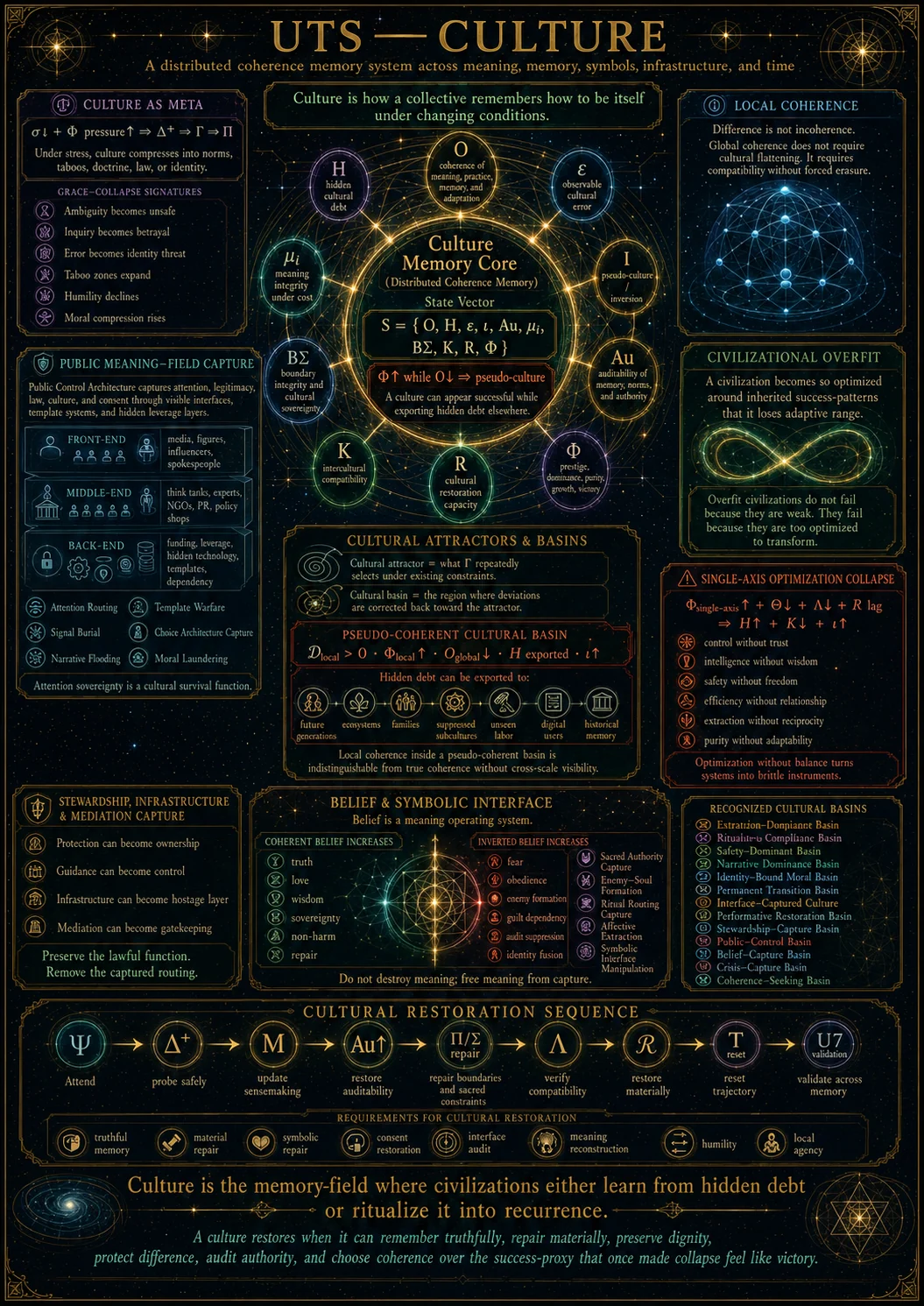
In UTS, culture is adistributed coherence memory system.
That means culture stores and transmits the patterns a group uses to remain coherent across time.
A culture helps answer:
- How do we belong?
- How do we resolve conflict?
- What do we owe each other?
- What is honorable?
- What is betrayal?
- What is sacred?
- What should be remembered?
- What should be repaired?
- What future are we trying to become?
A healthy culture gives people continuity. It lets a group carry memory without being trapped by memory. It helps people adapt without losing themselves.
An unhealthy or captured culture does the opposite. It may preserve pain without repair. It may turn identity into conflict. It may convert sacred ideas into control. It may protect appearances while exporting harm elsewhere.
So the central UTS question is not:
“Is this culture good or bad?”
The better question is:
Does this culture preserve coherence across time, or does it maintain local order by exporting hidden debt?
3. Culture as Local Coherence
One of the most important ideas in UTS–Culture is that culture is local.
A culture grows in a specific field: a land, a history, a climate, a language, a set of neighbors, a set of wounds, a set of survival needs, a set of sacred memories.
This means cultures do not need to be identical to be coherent.
Difference is not failure.
A culture can be different from another culture and still be healthy if it preserves dignity, consent, repair, boundary integrity, truthful memory, and non-extractive relationship.
The goal of UTS–Culture is not cultural flattening. It is not trying to make every group the same.
The goal isintercultural coherence: different cultures remaining themselves while finding ways to interact without domination, erasure, exploitation, or hidden debt transfer.
This matters because many modern systems confuse difference with danger. Others confuse forced merger with harmony. UTS avoids both errors.
A culture can preserve difference and still participate in a larger whole.
4. Culture as Memory
Every culture remembers.
Some memory is explicit: history books, religious texts, stories, family records, monuments, names, holidays.
Some memory is implicit: suspicion, shame, gestures, inherited fear, inherited pride, who is trusted, who is avoided, who is allowed to speak, who is expected to obey.
This is why historical harm does not simply disappear when time passes.
If conquest, humiliation, betrayal, forced conversion, displacement, oppression, or violence is never acknowledged and repaired, it can becomehidden cultural debt.
Hidden cultural debt can sit quietly for generations. Then, under stress, it can reactivate.
Sometimes newer generations care less about old conflicts. Sometimes they inherit them more intensely. Sometimes old pain becomes wisdom. Sometimes it becomes grievance. Sometimes it becomes extremism.
UTS–Culture does not treat memory as the problem.
Memory is necessary.
The problem isunrepaired memory fused with identity and activated through fear.
A culture restores when it can remember truthfully without turning memory into endless revenge.
5. Culture as a Meta
In UTS, a “meta” is a compressed strategy pattern. It is a way a system learns to behave because that behavior has worked, or because it has been rewarded, repeated, enforced, or inherited.
Culture is one of the deepest metas.
It compresses many decisions into default behavior.
People do not have to reason from zero every day. Culture already gives them patterns:
- how to greet,
- how to mourn,
- how to marry,
- how to argue,
- how to worship,
- how to trade,
- how to raise children,
- how to treat elders,
- how to respond to threat,
- how to tell right from wrong.
This is useful because human life is too complex to rebuild from scratch each generation.
But cultural compression can also become dangerous.
When a culture is under pressure, it may tighten too much. It may reduce complexity into slogans, purity rules, enemy images, rigid taboos, or obedience structures.
This is what UTS callscompression under slack collapse.
When a culture loses slack, it becomes less able to tolerate ambiguity. It becomes more reactive. More defensive. More identity-bound. More likely to mistake questioning for betrayal.
That is often when culture stops being a living memory system and starts becoming a brittle control shell.
6. Culture as Attractor Geometry
UTS also looks at culture through attractors.
An attractor is where a system keeps settling.
A culture may say it values one thing, but repeatedly settle into another.
A society may say it values truth, but reward status.
It may say it values freedom, but reward conformity.
It may say it values care, but reward extraction.
It may say it values peace, but keep selecting conflict.
It may say it values children, but organize itself around adult convenience.
It may say it values wisdom, but reward speed, scale, and performance.
The attractor shows what the culture actually selects over time.
This is why UTS separates stated values from operating geometry.
The question becomes:
What does this culture keep selecting when stressed?
That answer reveals the real basin.
7. Pseudo-Coherent Cultures
A culture can feel stable and still be incoherent at a larger scale.
This is one of the central insights of UTS–Culture.
A culture may appear orderly because disorder has been exported elsewhere.
It may look prosperous because extraction is hidden in supply chains.
It may look peaceful because dissent is suppressed.
It may look moral because harm is classified as necessary.
It may look successful because future generations will pay the cost.
It may look spiritual because sacred language hides control.
It may look safe because vulnerable groups carry the burden.
UTS calls this apseudo-coherent basin.
A pseudo-coherent culture maintains local stability by exporting hidden debt.
The culture feels coherent from inside the boundary, but the larger system is degrading.
This is why UTS asks:
Who pays for this stability?Where does the hidden debt go?What becomes invisible so the culture can feel right?
If stability requires someone else to carry the cost, it is not full coherence.
8. Principle Drift
Many cultures begin with powerful principles.
A principle may start as wisdom. Over time, it can become a rule. Then a performance. Then an enforcement mechanism. Then an identity weapon.
For example:
Truth can drift into narrative control.
Safety can drift into surveillance.
Justice can drift into punishment theater.
Tradition can drift into frozen hierarchy.
Compassion can drift into boundary collapse.
Freedom can drift into license without responsibility.
Faith can drift into obedience capture.
Progress can drift into forced destabilization.
Stewardship can drift into ownership.
This isprinciple drift.
UTS does not assume drift always happens through malice. Often it happens because a culture is trying to survive pressure, simplify complexity, protect identity, or preserve order.
But without auditability and restoration, the drift continues.
A culture must be able to ask:
What did this principle originally protect? What does it protect now? Has its function been captured? Does it still increase coherence?
9. Civilizational Overfit
UTS–Culture also studies how civilizations can become too optimized around their own success.
A civilization may become powerful because it mastered one pattern: empire, technology, finance, law, religious order, bureaucracy, military logistics, extraction, or information control.
That success can become a trap.
The civilization becomes so invested in the pattern that worked before that it loses the ability to adapt when conditions change.
This iscivilizational overfit.
An overfit civilization may not appear weak. It may look advanced, wealthy, efficient, ancient, or highly organized.
But it may have lost flexibility.
It may have too much identity locked into its own model. Too much hidden debt. Too little humility. Too little repair capacity. Too little tolerance for novelty. Too much dependence on a success proxy.
The uploaded thread used several symbolic civilization patterns to explore this kind of overfit: intelligence without love, technology without wisdom, power without stewardship, and control without reciprocity. Stripped of the NHI overlay, those become useful UTS civilizational warnings rather than species claims.
The UTS lesson is simple:
A civilization can become trapped inside the very pattern that once made it successful.
10. Stewardship Capture
One of the most important UTS–Culture patterns isstewardship capture.
Stewardship means being entrusted to care for something.
A teacher stewards learning.
A government stewards public order.
A religious institution stewards sacred memory.
A platform stewards communication.
A doctor stewards care.
A scientist stewards inquiry.
A parent stewards development.
A media system stewards public attention.
A legal system stewards boundaries.
Stewardship capture happens when the steward begins treating the field as something it owns.
Protection becomes containment.
Guidance becomes control.
Aid becomes leverage.
Expertise becomes monopoly.
Ritual becomes extraction.
Governance becomes domination.
Infrastructure becomes hostage architecture.
The danger is that captured stewardship often still uses the language of care.
That is why UTS asks:
Does this steward increase the sovereignty and coherence of what it serves, or does it make the field dependent on the steward?
True stewardship makes the field more capable.
Captured stewardship makes itself indispensable.
11. Infrastructure Capture
Culture depends on infrastructure.
Not only roads, power, water, and buildings, but also media, law, education, finance, platforms, religion, archives, public health, AI systems, and communication networks.
Infrastructure is dangerous to analyze simplistically because it is often dual-use.
The same system can protect or control.
A media system can inform or manipulate.
A legal system can protect rights or engineer loopholes.
An education system can develop discernment or enforce conformity.
A religious system can preserve sacred memory or capture obedience.
A platform can connect people or route attention.
A financial system can coordinate resources or produce dependency.
An aid system can restore a community or convert distress into leverage.
This leads to one of the clearest UTS–Culture restoration principles:
Preserve the lawful function. Remove the captured routing.
The goal is not to destroy necessary infrastructure. The goal is to restore its original coherent purpose.
12. Public Meaning-Field Capture
Culture does not only live privately. It also lives in the public field.
The public field is shaped by media, institutions, public figures, platforms, policies, schools, entertainment, activism, religion, expertise, and law.
A culture can be steered by controlling what people notice, what they fear, what they repeat, what they mock, what they forget, what they feel guilty about, and what they believe is impossible.
This is why UTS–Culture includesattention sovereignty.
Attention sovereignty means a public has the capacity to decide what matters, what is signal, what is noise, what requires memory, what requires investigation, and what requires repair.
Without attention sovereignty, the public can become highly informed but poorly oriented.
It may know many facts but lose the thread of causality.
Public meaning-field capture can happen through:
- signal burial,
- narrative flooding,
- moral laundering,
- controlled opposition,
- choice architecture capture,
- legitimacy attacks,
- crisis acceleration,
- template repetition,
- symbolic enemy formation.
The core question is:
Does this system increase public capacity to perceive, deliberate, repair, and self-govern — or does it increase dependency, confusion, outrage, and external management?
13. Weaponization of Belief
Belief systems are powerful because they organize meaning across time.
A belief system teaches people what is sacred, what is forbidden, who has authority, what suffering means, what death means, what must be defended, what must be sacrificed, and what future is worth building.
In coherent form, belief preserves wisdom, humility, love, moral memory, restoration, and continuity.
In inverted form, belief can become identity-binding, enemy-forming, audit-suppressing, obedience-producing, and conflict-generating.
This does not mean religion or belief is bad.
It means belief is powerful enough to be captured.
Belief can be distorted through mistranslation, lost teachings, corrupt leadership, selective preservation, sacred authority capture, guilt taxation, purity spirals, prophecy hijacking, ritual routing, and taboo weaponization.
UTS–Culture asks:
Does this belief structure increase truth, love, wisdom, sovereignty, non-harm, and repair — or does it bind identity to fear, obedience, guilt, and enemy formation?
The goal is not to destroy meaning.
The goal is to free meaning from capture.
14. Affective Extraction
Cultures also produce feeling.
Grief, joy, fear, devotion, shame, outrage, beauty, longing, loyalty, desire, reverence, guilt, and hope are not trivial. They are powerful cultural energies.
Modern systems increasingly convert these states into value.
Attention platforms monetize outrage.
Media systems monetize fear.
Political systems mobilize grievance.
Consumer systems monetize desire.
Cultic systems monetize devotion.
Surveillance systems monetize behavior.
AI systems increasingly model personality, preference, and emotional response.
UTS calls thisaffective extraction.
Affective extraction occurs when human feeling is not restored, honored, or integrated, but converted into engagement, money, prediction, compliance, dependency, or control.
The question is:
Is this emotional intensity being metabolized into repair, or harvested into a system that benefits from keeping it active?
Culture restores when feeling is allowed to complete its movement into meaning, grief, wisdom, art, protection, or repair.
Culture degrades when feeling is kept cycling for extraction.
15. Crisis and Consent
A major UTS–Culture insight is that consent can be technically present but structurally compressed.
A family may sell land after disaster.
A city may accept surveillance after crisis.
A nation may accept a bad loan under debt pressure.
A community may accept outside management under exhaustion.
A population may accept emergency powers because it sees no other option.
On paper, they chose.
In reality, the choice-space was narrowed by fear, urgency, scarcity, trauma, debt, misinformation, or asymmetry.
UTS calls this:
Free will under compression.
This does not mean every decision under pressure is invalid. But it does mean UTS must examine the conditions around consent.
Healthy systems expand meaningful choice.
Captured systems narrow choice, then claim consent.
This matters in disasters, wars, economic crises, public health emergencies, migration, redevelopment, technology adoption, and institutional reform.
16. Culture and Restoration
The purpose of UTS–Culture is not only diagnosis. It is restoration.
A culture restores when it can:
- remember truthfully,
- repair materially,
- protect dignity,
- preserve difference without domination,
- restore boundaries,
- audit authority,
- reduce hidden debt,
- rebuild trust,
- update without erasing itself,
- grieve without becoming trapped in grievance,
- protect without becoming cruel,
- love without becoming porous,
- govern without owning,
- believe without surrendering discernment.
Restoration is not nostalgia.
A culture does not restore by pretending the past was perfect.
Restoration is also not forced progress.
A culture does not restore by severing all memory and calling the rupture liberation.
Restoration means recovering lawful function and updating it for present reality.
It asks:
What was this culture trying to protect? What did it lose? What harm did it carry? What did it over-optimize? What did it suppress? What must be repaired? What must be preserved? What must be released? What can now mature?
17. How UTS Helps
UTS helps study culture by giving a shared language for change.
Instead of reducing culture to ideology, morality, identity, or preference, UTS looks at how the system moves.
It asks:
- What is coherent?
- What hidden debt is accumulating?
- What success proxy is being mistaken for real health?
- What boundaries are intact or broken?
- What can be audited?
- What is being selected over time?
- What is being rewarded?
- What is being exported?
- What is being inherited?
- What can be restored?
In more technical UTS language, culture acts across the shared state vector:
S = { O, H, ε, ι, Au, µᵢ, BΣ, K, R, Φ }But a new reader does not need to begin with the variables.
They can begin with the living questions:
- Is the culture coherent under stress?
- Where does it hide cost?
- Who carries the burden?
- Can it tell the truth about itself?
- Can it repair what it harms?
- Can it adapt without losing itself?
- Can it protect boundaries without turning difference into enemyhood?
- Can it preserve meaning without becoming captured by control?
Those questions are the bridge into the technical model.
18. The Simple Summary
UTS–Culture begins from a simple idea:
Culture is how a collective stores meaning across time.
When culture is coherent, it helps people belong, remember, adapt, repair, and grow.
When culture is incoherent, it can trap people in inherited pain, false order, identity conflict, performative morality, captured belief, or exported hidden debt.
Culture is neither automatically sacred nor automatically oppressive.
It is a living memory system.
It can preserve wisdom.
It can preserve wounds.
It can protect difference.
It can weaponize difference.
It can liberate.
It can capture.
It can restore.
It can collapse.
UTS–Culture gives us a way to see these movements without flattening them.
The goal is not to judge cultures from the outside.
The goal is to understand how meaning, memory, boundary, and repair either remain alive or become captured.
19. Reader’s Bridge into the Technical Framework
After this foundational overview, the reader is ready for the technical UTS–Culture materials:
- UTS–Culture Canon Checkpoint— full system architecture.
- Cultural Attractor & Basin Catalog— recurring cultural regimes.
- Culture Diagnostics— bandwidth, damping, slack, memory half-life, meta churn, hidden debt, auditability.
- Public Meaning-Field Modules— attention routing, belief weaponization, infrastructure capture, crisis capture.
- Restoration Playbooks— how culture repairs without erasing itself.
- Case Studies— applying the model to historical eras, institutions, religions, platforms, and civilizations.
The foundational bridge can close with the primary UTS–Culture law:
A culture restores when it can remember truthfully, repair materially, preserve dignity, protect difference, audit authority, and choose coherence over the success-proxy that once made collapse feel like victory.
This module hub separates the reference overview from technical depth and nested sub-modules. Use the overview for orientation, the technical document for the deep model, and sub-modules for systems that belong under this domain.