0. Purpose
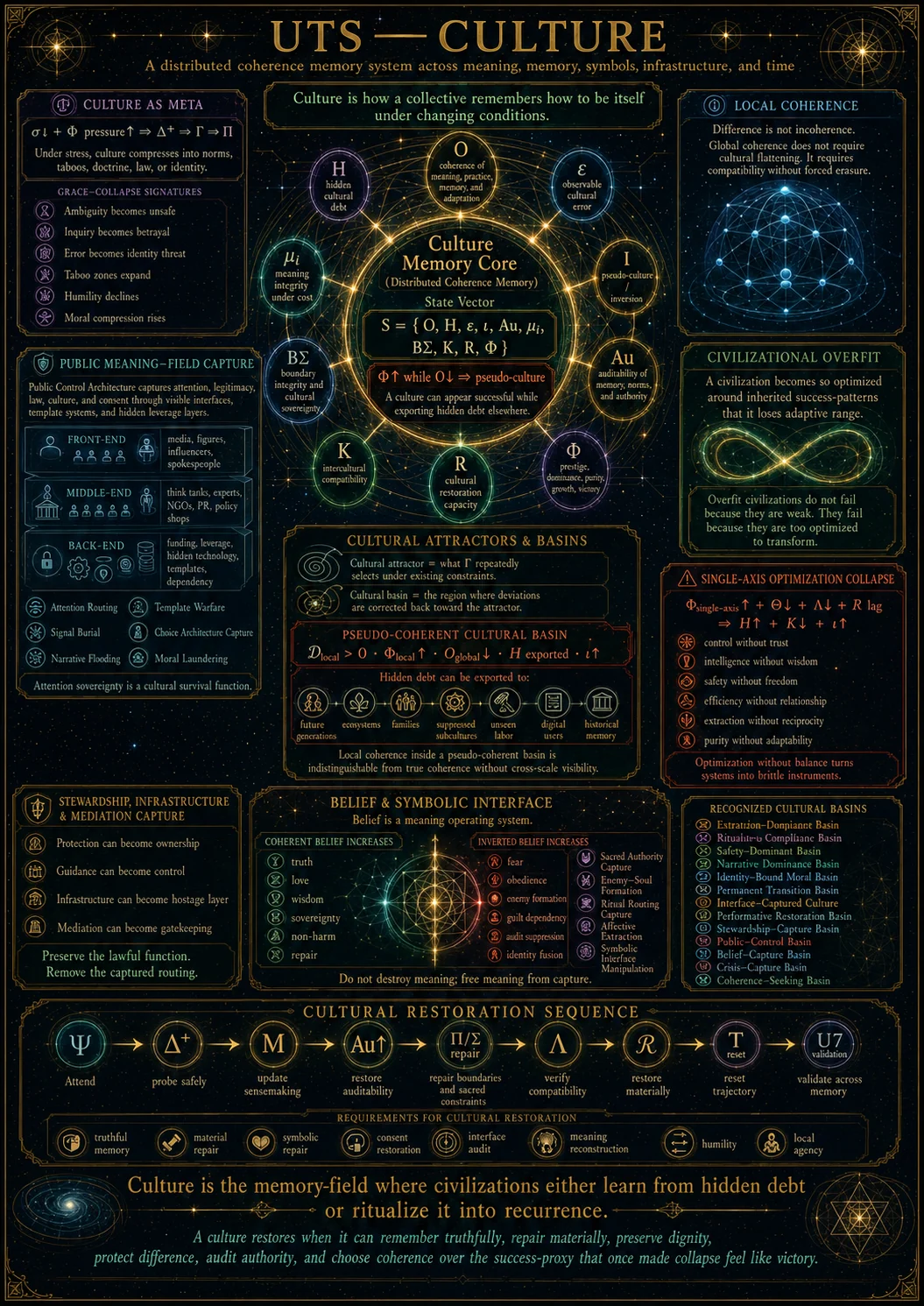
UTS–Culture defines culture as adistributed coherence memory system: a multi-agent, multi-layered field that stores, transmits, compresses, protects, distorts, and updates meaning across generations.
Culture is not merely belief, ideology, aesthetics, ethnicity, religion, or tradition.
Culture is the living structure through which a population answers:
- what is sacred,
- what is shameful,
- what is beautiful,
- what is dangerous,
- what is trustworthy,
- what is owed,
- what is forbidden,
- what is remembered,
- what is repaired,
- what is inherited,
- what is worth becoming.
In UTS terms:
Culture is how a collective remembers how to be itself under changing conditions.
This checkpoint allows UTS to analyze:
- cultural coherence and drift,
- historical hidden debt,
- public meaning-field capture,
- belief weaponization,
- cultural asymmetry,
- infrastructure capture,
- stewardship inversion,
- civilizational overfit,
- pseudo-coherent cultural basins,
- and restoration of meaning, memory, boundary, and agency.
PART I — CANON FRAME
1. UTS Guardrail
UTS–Culture obeys the existing canon:
- Operators change state.
- Lenses bias behavior.
- Diagnostics reveal limits.
- Gates decide admissibility.
- Regimes name recurring compositions.
- No new operator primitives.
Culture adds no new operators. It is a domain mapping over the shared state vector.
2. Canon State Vector
All cultural analysis operates on:
S = { O, H, ε, ι, Au, µᵢ, BΣ, K, R, Φ }Cultural interpretation
| Variable | Cultural meaning |
|---|---|
| O | Coherence of meaning, practice, memory, and adaptation under stress |
| H | Hidden cultural debt: unresolved harm, contradiction, taboo, grievance, inherited distortion |
| ε | Observable cultural error: hypocrisy, conflict, norm breakdown, symbolic fracture |
| ι | Pseudo-culture: performative values, hollow symbols, stable-but-false order |
| Au | Auditability of cultural claims, norms, institutions, histories, and sacred authority |
| µᵢ | Agent integrity within culture: ability to act consistently across identity, action, consequence |
| BΣ | Boundary integrity: membership, consent, difference, interface clarity, cultural sovereignty |
| K | Compatibility between cultures or subcultures under coupling |
| R | Cultural restoration capacity: ability to repair, reinterpret, grieve, update, and reconcile |
| Φ | Cultural success proxy: prestige, dominance, purity, growth, safety, status, legitimacy, victory |
Core warning
A culture can have Φ↑ while O↓.
A culture can appear successful, orderly, powerful, popular, holy, advanced, or dominant while exporting hidden debt elsewhere.
3. U-Layer Localization
Culture concentrates in U4–U7 but interacts across the full stack.
| Layer | Cultural function |
|---|---|
| U0 | Material substrate: land, bodies, ecology, architecture, food, climate |
| U1 | Resource budgets: time, energy, wealth, attention, labor |
| U2 | Boundaries, permissions, membership, law, identity interfaces |
| U3 | Practices, rituals, enforcement, daily behavior, embodiment |
| U4 | Narratives, classifications, beliefs, symbols, categories |
| U5 | Coordination: calendars, ceremonies, protocols, generational timing |
| U6 | Shared meaning field, collective identity, moral atmosphere |
| U7 | Memory, myth, trauma, inherited grievance, recurrence |
| U8 | External forcing: war, conquest, migration, technology, disaster, contact, climate |
Repair rule
Cultural repair must occur at the same or lower layer than the failure origin.
Messaging cannot repair land theft.
Policy cannot repair sacred humiliation by itself.
Public relations cannot repair broken trust.
Narrative cannot repair embodied trauma without material restoration.
PART II — CANON DEFINITION OF CULTURE
4. Canon Definition
Culture is a persistent, distributed coherence field in which shared sensemaking, trajectory bias, constraint fields, symbolic memory, embodied practice, and inherited meaning compress into reusable coordination defaults across time.
Culture is expressed through:
- language,
- ritual,
- myth,
- law,
- etiquette,
- family structure,
- worship,
- art,
- architecture,
- food,
- work,
- education,
- stories,
- taboos,
- humor,
- mourning,
- initiation,
- memory,
- punishment,
- restoration.
Culture is not only what people say they believe.
It is what a collective repeatedly selects, protects, rewards, fears, remembers, and refuses.
5. Culture as Local Coherence
Culture is local before it is global.
A culture grows inside a field:
- geography,
- climate,
- trauma,
- food systems,
- neighboring cultures,
- threats,
- ancestral memory,
- technology,
- spiritual orientation,
- governance needs,
- family forms,
- resource constraints.
Therefore:
Difference is not incoherence.
A culture may be radically different from another and still be coherent if it preserves:
- dignity,
- consent,
- repair,
- boundary integrity,
- non-extraction,
- truthful memory,
- adaptive capacity,
- compatibility under coupling.
Global coherence does not require cultural flattening.
It requiresintercultural compatibility without forced erasure.
6. Culture as Meta
From UTS–UMT:
Culture functions as a meta: a compressed strategy bundle for coordinating meaning and behavior under limited slack.
When slack collapses and proxy pressure rises, culture compresses.
σ(t)↓ + Φ pressure↑
⇒ Δ⁺ → Γ → Π
Meaning:
- stress or shock probes the culture,
- selection favors what appears to work,
- constraints narrow around the selected pattern,
- the pattern becomes norm, taboo, doctrine, law, or identity.
This explains why cultures harden under pressure.
Grace collapse signatures
When cultural slack falls:
- ambiguity becomes unsafe,
- humor disappears,
- inquiry becomes betrayal,
- error becomes identity threat,
- rule enforcement accelerates,
- taboo zones expand,
- humility declines,
- moral compression rises.
PART III — CULTURE AS INTERACTION GEOMETRY
7. Cultural Attractors
From UTS–ISC:
A cultural attractor is a configuration toward which Γ repeatedly selects under existing constraints.
A cultural attractor is defined by:
- what Γ selects,
- what Φ rewards,
- what Π permits,
- what Λ stabilizes,
- what Δ can be absorbed without escape.
Examples:
- status preservation,
- risk minimization,
- extraction,
- purity,
- narrative dominance,
- conformity,
- care,
- innovation,
- obedience,
- sovereignty,
- restoration.
Attractors are not moral categories. They are selection geometries.
8. Cultural Basins
A cultural basin is the region of state space where cultural perturbations are locally damped and deviations are corrected back toward the attractor.
A basin is maintained by:
- reward systems,
- taboos,
- rituals,
- institutions,
- narratives,
- shame,
- belonging,
- law,
- education,
- media,
- status,
- memory,
- fear,
- sacred authority,
- economic access.
A person inside a basin may experience the basin as “normal,” “obvious,” or “how things are.”
9. Pseudo-Coherent Cultural Basins
A pseudo-coherent cultural basin is a locally stable cultural geometry that preserves local order by exporting hidden debt elsewhere.
Formal signature:
𝓓_local > 0
Φ_local ↑
O_global ↓
H exported
ι rises slowly
Hidden debt may be exported to:
- weaker populations,
- children,
- future generations,
- colonized regions,
- labor classes,
- ecosystems,
- families,
- suppressed subcultures,
- unseen workers,
- outsiders,
- digital users,
- the body,
- the unconscious,
- historical memory.
Locked invariant
Local coherence inside a pseudo-coherent basin is indistinguishable from true coherence without cross-scale visibility.
This is why cultures can feel righteous while producing harm outside their visible boundary.
10. Nested Basins
Cultures are nested:
- civilization,
- nation,
- region,
- religion,
- class,
- institution,
- profession,
- family,
- subculture,
- online community,
- identity group,
- individual meaning system.
Nested basins can appear locally coherent while serving a larger pseudo-coherent basin.
Example:
A profession may be internally ethical by its own standards while its industry exports harm.
A religious community may be locally loving while its doctrine preserves inherited enemy formation.
A platform team may feel mission-driven while the platform extracts attention from society.
PART IV — CULTURAL STATE MECHANICS
11. Principle Drift
Principle drift occurs when a culture begins with coherent constraints, but over time the constraints are reinterpreted, hardened, hollowed, or redirected.
Drift sequence
unrepaired Δ
⇒ H accumulates
⇒ Μ compresses interpretation
⇒ Τ reorients toward convenience/power/survival
⇒ Φ substitutes for O
⇒ Π hardens
⇒ Au declines
⇒ Ξ/ι rises
Typical transformations
| Original principle | Drifted form |
|---|---|
| truth | narrative control |
| safety | surveillance |
| justice | punishment theater |
| tradition | frozen hierarchy |
| compassion | boundary collapse |
| freedom | license without responsibility |
| equality | flattening by force |
| progress | forced destabilization |
| faith | obedience capture |
| expertise | authority monopoly |
| stewardship | ownership |
| protection | containment |
Principle drift is not always malicious. Often it is compression under pressure plus repair failure.
12. Civilizational Overfit
Civilization Overfit is a way to understand civilizations that become deeply locked into their own successful models.
Definition
Civilizational Overfit occurs when a culture or civilization becomes so optimized around its inherited success-patterns that it loses adaptive range.
A civilization can become powerful and fragile at the same time.
It may have:
- advanced technology,
- strong hierarchy,
- vast infrastructure,
- stable doctrine,
- deep institutional memory,
- high coordination capacity,
but still lack:
- novelty tolerance,
- restorative elasticity,
- humility,
- cross-cultural compatibility,
- embodied wisdom,
- local feedback,
- capacity to question its own success metrics.
Signature
| Variable | Direction |
|---|---|
| Olocal | appears high |
| Oglobal | declining |
| H | rising |
| Au | selective |
| µᵢ | identity-bound |
| BΣ | rigid or expansionist |
| K | low with incompatible systems |
| R | low relative to complexity |
| Φ | dominant |
| ι | rises under exposure |
Canon statement
Overfit civilizations do not fail because they are weak. They fail because they are too optimized to transform.
13. Single-Axis Optimization Collapse
The same thread framed min-maxed civilization as a failure mode where one value is maximized while others are sacrificed, producing brittleness and hidden debt.
Definition
Single-Axis Optimization Collapse occurs when a culture maximizes one success variable until neglected dimensions become debt reservoirs.
| Maximized value | Sacrificed dimension | Long-term failure |
|---|---|---|
| control | trust | rebellion / paranoia |
| intelligence | wisdom | predatory abstraction |
| pleasure | meaning | exhaustion |
| safety | freedom | enclosure |
| efficiency | relationship | sterility |
| extraction | reciprocity | parasitic loop |
| longevity | renewal | stagnation |
| simulation | embodiment | reality detachment |
| appearance | depth | identity hollowing |
| purity | adaptability | fragmentation |
Formula
Φ_single-axis ↑ + Θ↓ + Λ↓ + R lag
⇒ H↑ + K↓ + ι↑
14. Variable-Weighting
Definition
Cultural Variable-Weighting is the alteration of what a population treats as important, sacred, shameful, urgent, prestigious, profitable, dangerous, or invisible.
This is how influence can occur without direct coercion.
A culture can be steered by changing the weight of:
- fear,
- love,
- ambition,
- beauty,
- loyalty,
- truth,
- survival,
- technology,
- purity,
- safety,
- victimhood,
- domination,
- sacrifice,
- compassion,
- sovereignty.
Diagnostic
Ask:
- What is being amplified?
- What is being suppressed?
- What is being normalized?
- What is being made invisible?
- What is becoming unthinkable?
- What is being rewarded as success?
- What is being punished as betrayal?
UTS composition
Μ reclassification
+ Τ trajectory bias
+ Γ selection
+ Φ reward shaping
+ Π constraint narrowing
PART V — TRUST, COMPATIBILITY, AND CULTURAL ASYMMETRY
15. Trust Architecture
Definition
Trust Architecture is the cultural default for how a population expects honesty, repair, deception, enforcement, vulnerability, and harm to behave.
A high-trust culture assumes:
- people mostly cooperate,
- institutions mostly function,
- harm is exceptional,
- repair is possible,
- word and contract mean something.
A low-trust culture assumes:
- deception is common,
- institutions are partial,
- enforcement is necessary,
- informal networks matter more,
- survival may require concealment or coercion.
Neither architecture is inherently superior in all conditions. Each is adaptive to its field.
Failure
High-trust systems fail when they cannot detect predatory behavior.
Low-trust systems fail when they cannot receive genuine cooperation.
Invariant
Compassion without boundary intelligence becomes exploitable; boundary without compassion becomes domination.
16. Cultural Asymmetry
Definition
Cultural Asymmetry occurs when two cultures operate from different assumptions about law, trust, family, authority, time, conflict, identity, religion, and obligation.
| Dimension | Culture A | Culture B |
|---|---|---|
| law | written/statutory | customary/relational |
| trust | institutional | kinship/local |
| authority | bureaucratic | elder/religious/personal |
| conflict | process-based | honor/reputation-based |
| time | long planning | survival-immediacy |
| family | individual autonomy | lineage priority |
| speech | critique-normal | respect-hierarchy |
| integration | individual assimilation | group continuity |
| justice | procedural | restorative, retaliatory, or honor-based |
Asymmetry is not failure by itself.
Failure occurs when asymmetry is forced into coupling without translation, pacing, boundaries, or repair.
17. Weaponized Miscalibration
Weaponized Miscalibration is as a public-control/culture layer: culture can preserve local coherence, but unresolved debt and miscalibrated coupling can be activated into long-cycle conflict.
Definition
Weaponized Miscalibration occurs when different cultural operating systems are placed into conflict without sufficient translation, boundaries, timing, or repair capacity, producing friction that can be exploited.
Sequence
historical H
+ cultural asymmetry
+ shock Δ
+ public narrative Φ
⇒ AP↑
⇒ K↓
⇒ identity fusion
⇒ conflict loop
Key mechanism
The goal may not be cultural harmony.
The goal may be friction.
Friction creates noise.
Noise hides operations.
Conflict creates demand for stronger control.
Restoration
- acknowledge historical debt,
- separate populations from extremist factions,
- build translation layers,
- protect boundary integrity,
- close legal loopholes,
- refuse ancestral enemy formation,
- allow cultural exchange to proceed through consent and time.
18. Hidden Cultural Debt
Definition
Hidden Cultural Debt is unresolved harm, humiliation, conquest, betrayal, displacement, oppression, or sacred injury that persists as inherited meaning pressure.
Possible generational outcomes:
| Path | Description |
|---|---|
| dissipation | later generations care less |
| neutralization | conflict becomes historical, not active |
| integration | memory becomes wisdom |
| preservation | grievance remains identity-bound |
| galvanization | grievance intensifies politically |
| extremization | harm becomes thinkable |
| mythic activation | old conflict becomes sacred duty |
| revenge loop | past harm justifies future harm |
Memory is not the problem.
Unrepaired memory fused with identity and weaponized under present pressure is the problem.
PART VI — PUBLIC MEANING-FIELD CAPTURE
19. Public Control Architecture
Public-control architecture: attention routing, signal burial, narrative flooding, template warfare, choice architecture capture, moral laundering, policy laundering, controlled opposition, legitimacy attacks, crisis acceleration, and technology asymmetry.
Definition
Public Control Architecture is the capture of public attention, legitimacy, law, culture, and consent through visible interfaces, template systems, and hidden leverage layers.
This is not a claim that all participants are complicit. Most public systems operate through partial information.
Three-layer stack
| Layer | Function |
|---|---|
| Front-end | public figures, media personalities, politicians, influencers, executives, spokespeople |
| Middle-end | think tanks, policy shops, consultants, foundations, NGOs, PR, legal language, experts |
| Back-end | funding, leverage, coercion, hidden technology, strategic templates, institutional dependency |
UTS mapping
| Public layer | UTS layer |
|---|---|
| front-end | U4/U6 visible interface |
| middle-end | U5 template compiler |
| back-end | U1/U2/U7 leverage and memory |
Central diagnostic
Does this system increase public capacity to perceive, deliberate, repair, and self-govern — or does it increase dependency, confusion, outrage, and external management?
20. Attention Routing
Definition
Attention Routing is the upstream shaping of what a population notices, ignores, fears, mocks, repeats, remembers, or treats as impossible.
Control does not require universal belief.
It may only require orientation collapse.
Signature
The public sees:
- scandals,
- personalities,
- culture fights,
- outrage cycles,
- symbolic enemies,
- celebrity collapse,
- fragmented crises.
The public does not see:
- funding architecture,
- template replication,
- legal loopholes,
- ownership networks,
- timing patterns,
- institutional dependencies,
- hidden incentives,
- infrastructure capture.
Restoration
Attention sovereignty is a cultural survival function.
21. Signal Burial
Definition
Signal Burial occurs when important patterns are hidden inside mass noise, false reports, partial truths, decoys, or interpretive overload.
Formula:
dangerous signal → increase similar noiseSignal burial can hide:
- real abuse among false claims,
- true coordination among organic chatter,
- targeted harm among general dysfunction,
- meaningful anomalies among hoaxes,
- valid testimony among unstable narratives.
22. Narrative Flooding
Definition
Narrative Flooding overwhelms interpretation by releasing too many explanations, frames, and emotional cues at once.
The goal is not always to make people believe one lie.
The goal can be:
“No one can know anything, so coherent action becomes impossible.”
UTS signature:
ε interpretation overload + Au↓ + AP↑ + τ_resp↑
⇒ public O↓
23. Template Warfare
Definition
Template Warfare is the use of repeatable scripts across institutions so apparently independent events produce the same directional outcome.
Signs:
- identical phrases,
- repeated policy structures,
- same reputational attack sequence,
- same crisis-to-policy pipeline,
- same apology rituals,
- same expert framing,
- same activist tactics,
- same platform enforcement logic.
Diagnostic:
Where else does this template appear?
24. Choice Architecture Capture
Definition
Choice Architecture Capture occurs when people appear to choose freely, but the visible option set has already been narrowed.
Methods:
- remove viable alternatives,
- frame only extremes,
- make coherent paths socially costly,
- hide long-term consequences,
- attach identity to policy,
- overwhelm with options,
- make dependency convenient,
- make sovereignty look dangerous.
Core phrase
Free will under compression is not fully coherent consent.
25. Moral Laundering
Definition
Moral Laundering occurs when real virtues are used as wrappers for control.
| Principle | Captured form |
|---|---|
| safety | surveillance and obedience |
| justice | punishment without restoration |
| compassion | boundary collapse |
| freedom | license without responsibility |
| equality | enforced flattening |
| tradition | frozen hierarchy |
| progress | forced destabilization |
| science | credential monopoly |
| faith | authority capture |
| security | rights removal |
| inclusion | coerced merger |
| truth | narrative monopoly |
Diagnostic:
Does the principle still preserve truth, love, wisdom, sovereignty, consent, repair, and non-harm?
PART VII — STEWARDSHIP, INFRASTRUCTURE, AND MEDIATION CAPTURE
26. Stewardship Capture
Definition
Stewardship Capture occurs when a role entrusted with protection, development, mediation, or care converts that duty into ownership, extraction, or control.
| Lawful function | Captured inversion |
|---|---|
| stewardship | ownership |
| protection | containment |
| teaching | dependency |
| guidance | control |
| expertise | authority monopoly |
| aid | leverage |
| ritual | extraction |
| governance | domination |
| mediation | gatekeeping |
| infrastructure | hostage layer |
| restoration | optics |
UTS signature
Σ/Π role captured by Φ pressure
Au↓
BΣ↓
H exported
ι↑
Canon statement
The most dangerous captured systems preserve the appearance of their original lawful function.
27. Infrastructure Capture
Definition
Infrastructure Capture occurs when a system required for protection, coordination, communication, memory, perception, energy, or repair is repurposed into a control layer.
Examples:
- media,
- law,
- education,
- religion,
- platforms,
- finance,
- public health,
- intelligence systems,
- aid systems,
- AI/data systems,
- energy grids,
- supply chains.
Dual-use map
| Infrastructure | Coherent use | Captured use |
|---|---|---|
| media | public memory | narrative filtering |
| law | boundaries / justice | loophole engineering |
| education | capability | conformity shaping |
| religion | meaning / repair | obedience capture |
| platforms | connection | attention routing |
| finance | resource coordination | dependency capture |
| aid | restoration | leverage |
| security | protection | coercive permission |
| AI | pattern support | predictive control |
Restoration rule
Do not destroy necessary infrastructure; separate original function from captured routing.
28. Mediation Capture
Definition
Mediation Capture occurs when an intermediary places itself between a population and direct access to truth, meaning, resources, repair, authority, or relationship — then taxes or controls that access.
Examples:
- gatekept spirituality,
- captured expertise,
- platform monopoly,
- aid intermediaries,
- bureaucratic dependency,
- credential cartels,
- data brokers,
- AI-interface monopolies,
- opaque NGOs,
- priesthood systems,
- scientific authority monopolies.
UTS signature
RG + Au asymmetry + Π gatekeeping + Φ extraction
⇒ dependency basin
Restoration
- plural access,
- transparent mediation,
- direct audit channels,
- revocable authority,
- local capacity building,
- no monopoly on meaning,
- no monopoly on repair,
- no monopoly on legitimacy.
PART VIII — BELIEF, MEANING, AND SYMBOLIC CONTROL
29. Weaponization of Belief
Belief weaponization is a public-control layer: belief systems can preserve wisdom and meaning, but when inverted they can become identity-binding, audit-suppressing, obedience-producing, conflict-generating architectures.
Definition
Weaponization of Belief occurs when meaning systems are sculpted over time to bind identity, suppress audit, generate conflict, route obedience, or steer populations across eras.
A belief system is not merely a set of claims.
It is a meaning operating system.
It tells people:
- what is sacred,
- who has authority,
- what suffering means,
- who is dangerous,
- what must be defended,
- what must be sacrificed,
- what future is worth building.
Coherent belief structure increases
- meaning integrity,
- love,
- humility,
- wisdom,
- consent,
- non-harm,
- restoration,
- dignity,
- truthful relation to reality,
- boundary integrity.
Inverted belief structure increases
- fear,
- obedience,
- enemy formation,
- guilt dependency,
- taboo enforcement,
- martyrdom economy,
- audit suppression,
- hierarchy immunity,
- sacrifice logic,
- identity fusion.
30. Belief Distortion Vectors
Belief systems can distort through:
- mistranslation,
- lost teachings,
- selective preservation,
- corrupt leadership,
- sacred authority capture,
- enemy-soul formation,
- prophecy hijacking,
- guilt taxation,
- ritual routing capture,
- purity spirals,
- spiritual outsourcing,
- meaning monoculture,
- martyrdom economy,
- taboo weaponization.
Diagnostic
Does this belief structure increase coherence across time, or does it create hidden debt while claiming sacred authority?
31. Sacred Authority Capture
Definition
Sacred Authority Capture occurs when a leader, text, institution, interpretation, or priestly class becomes unauditable because it claims to speak for the sacred.
Failure signature:
Questioning becomes sin.
UTS signature:
Au↓ + Σ claim captured + AP↑ + Π taboo
⇒ ι sacred-shell formation
32. Enemy-Soul Formation
Definition
Enemy-Soul Formation occurs when a culture trains its members to perceive another group as spiritually dangerous, impure, cursed, demonic, inferior, or cosmically opposed.
Failure signature:
Harm becomes purification.
Restoration requires refusing to turn present humans into ancestral enemy symbols.
33. Ritual Routing Capture
Definition
Ritual Routing Capture occurs when a ritual’s outward form remains intact but its meaning-channel is redirected toward dependency, fear, extraction, or hierarchy.
A coherent ritual:
- restores grief,
- aligns love,
- renews meaning,
- strengthens community,
- honors memory,
- repairs relationship.
An inverted ritual:
- routes fear,
- harvests devotion,
- reinforces hierarchy,
- normalizes suffering,
- binds identity,
- creates obedience.
Restoration
Separate ritual function from captured routing.
34. Affective Extraction
Affective extraction: the conversion of feeling, attention, grief, fear, devotion, shame, and identity into value for external systems.
Definition
Affective Extraction is the conversion of human feeling, attention, identity, grief, desire, fear, outrage, devotion, shame, intimacy, or symbolic intensity into usable value for external systems.
Modern domains:
- attention economy,
- outrage media,
- addictive platforms,
- extremist recruitment,
- trauma entertainment,
- parasocial systems,
- AI persona modeling,
- surveillance capitalism,
- ideological mobilization,
- cult dynamics,
- algorithmic emotion shaping.
UTS signature
G₂ + G₅ amplification
Φ = engagement / prediction / control value
H exported into users
R depleted
Core question
Are heightened emotional states being restored, or converted into engagement, money, data, compliance, or control?
35. Symbolic Interface Manipulation
Definition
Symbolic Interface Manipulation occurs when stories, images, dreams, rituals, media, myths, games, simulations, or avatars alter a population’s meaning-field without clear auditability.
This includes:
- propaganda,
- deepfake intimacy,
- AI companions,
- immersive media,
- targeted narrative ads,
- cultic rituals,
- shame loops,
- ideological gaming,
- synthetic personas,
- mythic enemy images.
Diagnostic
Does this symbolic interface increase clarity, repair, discernment, and sovereignty — or confusion, shame, dependency, fear, and drain?
36. Persona Continuity Capture
Definition
Persona Continuity Capture occurs when a system can simulate, extend, replace, manage, or manipulate an identity-signature while preserving enough public continuity to retain legitimacy.
Modern equivalents:
- deepfakes,
- voice clones,
- AI persona agents,
- synthetic influencers,
- ghostwritten identities,
- managed public figures,
- posthumous digital replicas,
- avatar governance,
- brand-person continuity,
- reputation laundering.
UTS concern
Culture relies on trust in identity continuity.
When persona becomes separable from embodied accountability:
µᵢ↓
Au↓
BΣ↓
public trust destabilizes
Principle
Identity continuity must remain auditable, consentful, and accountable.
PART IX — GOVERNANCE, ECONOMY, AND CRISIS CAPTURE
37. Proxy Governance Replacement
Proxy Governance Replacement describes a template where a violent local faction or proxy is empowered, used to destabilize lawful governance, then installed or leveraged as the replacement authority.
Definition
Proxy Governance Replacement occurs when a lawful governance structure is destabilized by a controlled faction that later becomes the “necessary” replacement authority.
Sequence
- Identify a vulnerable nation, region, institution, or community.
- Support a violent or coercive local faction.
- Build finance through illicit or opaque channels.
- Destabilize current governance.
- Make lawful authority appear weak.
- Present the proxy as order, resistance, liberation, or necessity.
- Install or normalize proxy leadership.
- Maintain leverage through dependency, records, crimes, or funding.
- Export disorder into selected populations.
- Harvest control opportunities on both sides.
UTS signature
Π lawful governance weakened
Γ selects coercive faction under crisis Φ
BΣ collapses
H exported to civilians
R captured by proxy
38. Crime as Governance
Definition
Crime becomes governance when illegal networks provide the real structure of power: who can move, trade, access protection, gain status, disappear, or receive resources.
This is not merely criminality.
It is shadow administration.
Cultural effect
When crime becomes governance:
- formal law loses legitimacy,
- fear becomes coordination,
- youth are recruited into coercive status systems,
- trust collapses,
- public institutions become symbolic,
- violence becomes a service layer.
39. Incoherence Export
Definition
Incoherence Export is the strategic displacement of disorder, harm, addiction, violence, debt, scarcity, trauma, or institutional stress into populations that lack sufficient power to refuse or contain it.
Examples:
| Exported H | Receiving field |
|---|---|
| drugs | neighborhoods / families |
| debt | future generations |
| pollution | poor regions / environment |
| arms | conflict zones |
| bureaucratic complexity | ordinary citizens |
| trauma | children / families |
| algorithmic harm | attention fields |
| legal ambiguity | low-resource defendants |
| extraction cost | labor / colonies / supply chains |
Law
O_local maintained by H_export ⇒ pseudo-coherent basin40. Economic Dependency Capture
Economic Dependency Capture describes dependency capture through loans, aid, complex deals, and transfer of strategic assets under distress.
Definition
Economic Dependency Capture occurs when a distressed system accepts short-term liquidity in exchange for long-term control over its value-generating substrate.
Captured assets may include:
- mines,
- ports,
- land,
- water,
- farmland,
- utilities,
- telecom,
- digital identity systems,
- data infrastructure,
- military access,
- policy concessions.
UTS signature
U1 scarcity
+ Φ rescue frame
+ Au complexity gap
⇒ BΣ concession
⇒ H_future ↑
Diagnostic
Did the aid restore sovereignty, or did it convert distress into asset transfer?
41. Catastrophe-Opportunity Capture
Catastrophe-Opportunity Capture is the distinction between disaster origin and disaster use: not every disaster is engineered, but every disaster creates a governance window.
Definition
Catastrophe-Opportunity Capture occurs when disaster conditions compress decision-space, allowing land, policy, infrastructure, data, or governance authority to transfer under urgency.
Key distinction
Disaster origin and disaster use are separate questions.
A catastrophe may be:
- natural,
- negligence-amplified,
- opportunistically exploited,
- indirectly induced,
- deliberately engineered,
- narratively engineered.
But post-crisis value transfer can be audited regardless of origin.
Compression window
disaster
→ displacement
→ urgency
→ reduced bargaining power
→ external offer
→ value transfer
Audit questions
- Who was distressed before the event?
- What became accessible afterward?
- Who controlled aid?
- Who controlled reconstruction?
- Who received contracts?
- Who could not return?
- What emergency powers remained?
- What data was collected?
- What policies changed under urgency?
- Did affected people regain sovereignty?
42. Emergency Rule Exception
Definition
Emergency Rule Exception occurs when crisis conditions suspend normal safeguards, enabling temporary powers, accelerated deals, or exceptional controls that later become permanent.
Coherent emergency action is possible.
The failure mode is:
temporary permission → permanent governance architectureRestoration
- sunset clauses,
- audit trails,
- local consent,
- public review,
- data deletion,
- emergency procurement transparency,
- reconstruction accountability,
- rights preservation.
PART X — CULTURAL ATTRACTOR & BASIN CATALOG
43. Recognized Cultural Basins
These are named composite regimes, not operators.
1. Extraction-Dominant Basin
Attractor:accumulation, throughput, dominance
Signature:Φ↑, H exported, Au↓
Failure:collapse when export channels saturate
Restore:reciprocal coupling, audit supply chains, demote growth-as-coherence
2. Ritualized Compliance Basin
Attractor:legibility and rule obedience
Signature:Xc↑, Au↓, ι↑
Failure:mass disbelief / brittle norm collapse
Restore:rule pruning, feedback integrity, repair before enforcement
3. Safety-Dominant Basin
Attractor:risk minimization
Signature:Π hardening, Δ intolerance, 𝓑↓
Failure:fragility under novel shock
Restore:controlled probes, slack rebuilding, error normalization
4. Narrative Dominance Basin
Attractor:interpretive control
Signature:G₂↑, Au↓, Φ narrative success↑
Failure:trust collapse under contradiction
Restore:reality feedback, identity decoupling, audit restoration
5. Identity-Bound Moral Basin
Attractor:moral self-consistency
Signature:AP↑, Θ↓, K↓
Failure:purity schism / exhaustion
Restore:humility, compatibility checks, worth decoupled from correctness
6. Permanent Transition Basin
Attractor:change itself
Signature:μmeta↑, σ↓, R lag
Failure:burnout / nostalgia regression
Restore:invariant recovery, repair backlog, pause rule churn
7. Interface-Captured Culture
Attractor:control over mediation layers
Signature:Au asymmetry, BΣ erosion, R→0
Failure:hard bypass or replacement
Restore:interface replacement, consent restoration, equality-conserving accountability
8. Subfield Fragmentation Basin
Attractor:local survival
Signature:Olocal↑, Oglobal↓, K↓
Failure:inability to coordinate collectively
Restore:translation bridges, shared audit scaffolds, CAN formation
9. Performative Restoration Basin
Attractor:appearance of repair
Signature:ι↑, H buried, R falsely signaled
Failure:second-order legitimacy detonation
Restore:material repair before closure symbolism
10. Coherence-Seeking Basin
Attractor:long-term O over Φ
Signature:Au↑, R↑, H↓, Θ↑, Λ-gated coupling
Failure:overrun by high-gain basins if unprotected
Sustain:slack protection, gain moderation, distributed coherence membranes
11. Stewardship-Capture Basin
Attractor:ownership through guardianship role
Signature:Σ language captured by Φ
Failure:legitimacy collapse when duty inversion is exposed
Restore:return authority to field served, enforce auditability
12. Public-Control Basin
Attractor:attention and legitimacy routing
Signature:Ω skew, G₂/G₄/G₅↑, Au asymmetry
Failure:template leakage, public pattern literacy, insider defection
Restore:attention sovereignty, archives, decentralized analysis
13. Belief-Capture Basin
Attractor:sacred authority and identity binding
Signature:Au↓, AP↑, Σ captured, taboo expansion
Failure:schism, extremism, spiritual exhaustion
Restore:recover original coherence, separate meaning from control
14. Crisis-Capture Basin
Attractor:value transfer under urgency
Signature:σ↓, τresp↑, emergency Π, BΣ concessions
Failure:permanent exception state
Restore:sunset rules, local restoration, distress-acquisition limits
PART XI — DIAGNOSTICS
44. Core Culture Diagnostics
| Diagnostic | Cultural use |
|---|---|
| 𝓑(t) | cultural bandwidth before phase shift |
| 𝓓(t) | damping after cultural shock |
| σ(t) | slack / grace before clampdown |
| τresp(t) | response latency from signal to repair |
| τm(t) | memory half-life / relapse risk |
| μmeta(t) | rulebook churn / norm volatility |
| Xc(t) | constraint complexity / rule stacking |
| AP(t) | attribution pressure / intent projection |
| Ω | observability distribution |
| RG | resource gatekeeping |
| P-field | influence geometry |
| SS | sovereign subfields |
| Gain stack | amplification profile |
45. Culture Audit Protocol
- Localize
* U4 narrative?
* U5 coordination?
* U6 meaning field?
* U7 memory?
* U8 forcing?
- Read state vector
* What is O?
* Where is H?
* What is visible ε?
* Where is ι?
* Is Au available?
* Is BΣ intact?
* Is K real or assumed?
* Is R sufficient?
* What is Φ rewarding?
- Identify attractor
* What does Γ keep selecting?
- Identify basin
* What keeps people settling back?
- Trace hidden debt
* Who pays?
* When?
* Where?
* Through what interface?
- Test mimicry
* Does the signal survive refusal, boundary, delay, questioning, scale, and time?
- Check infrastructure
* What is the original lawful function?
* What captured routing has been added?
- Check belief
* Does meaning increase repair or obedience capture?
- Check crisis use
* What transferred after distress?
- Apply minimal restoration
- Increase Au.
- Restore BΣ.
- Reduce H.
- Rebuild R.
- Demote Φ below O.
- Validate across time.
PART XII — RESTORATION ARCHITECTURE
46. Culture Restoration Principles
Cultural restoration requires:
- truthful memory,
- material repair,
- symbolic repair,
- boundary restoration,
- consent restoration,
- interface audit,
- meaning reconstruction,
- humility,
- intergenerational patience,
- anti-mimicry testing,
- local agency,
- protection from forced compression.
Restoration is not
- humiliation,
- erasure,
- revenge,
- forced assimilation,
- optics,
- performative apology,
- permanent guilt,
- replacement by external managers.
47. Minimal Restoration Sequence
A common operator-safe sequence:
Ψ → Δ⁺ → Μ → Au↑ → Π/Σ repair → Λ → ℛ → Τ reset → U7 validationMeaning:
- increase attention and resolution,
- safely probe the failure,
- update sensemaking,
- restore auditability,
- renegotiate boundaries and sacred constraints,
- verify compatibility,
- perform material restoration,
- reset long-horizon trajectory,
- validate across memory and recurrence.
48. Lawful Function Restoration
For captured systems:
- identify original lawful function,
- identify captured routing,
- preserve necessary function,
- remove extraction pathway,
- restore consent,
- reopen audit,
- rebuild local capacity,
- validate over time.
Canon phrase
Preserve the lawful function. Remove the captured routing.
49. Attention Sovereignty Restoration
Public restoration requires:
- public archives,
- template comparison,
- funding transparency,
- legal audits,
- independent journalism,
- decentralized analysis,
- whistleblower protection,
- cultural boundary repair,
- evidence standards,
- attention discipline,
- civic education,
- AI pattern tools,
- restorative justice.
The goal is not universal distrust.
The goal is restored public orientation.
50. Belief Restoration
Belief systems are restored by:
- recovering original coherence,
- identifying historical overlays,
- restoring auditability,
- separating devotion from obedience capture,
- separating ritual from extraction,
- separating community from enemy formation,
- protecting youth from ideological predation,
- closing consent loopholes,
- returning meaning to truth, love, wisdom, sovereignty, non-harm, and repair.
Canon phrase
Do not destroy meaning; free meaning from capture.
PART XIII — CANONICAL STATEMENTS
51. Pinned UTS–Culture Invariants
- Culture is a distributed coherence memory system.
- Culture is local coherence before it is global coherence.
- Difference is not incoherence.
- Stability is not coherence; local success is not global alignment.
- A culture can feel coherent while exporting hidden debt.
- Pseudo-coherent cultural basins preserve local order by exporting H.
- Civilizations can overfit their own success patterns.
- Single-axis optimization collapses neglected dimensions into debt reservoirs.
- Stewardship becomes capture when guardianship converts into ownership.
- The most dangerous captured systems preserve the appearance of lawful function.
- Necessary infrastructure must be restored, not reflexively destroyed.
- Preserve lawful function; remove captured routing.
- Compassion without boundary intelligence becomes exploitable; boundary without compassion becomes domination.
- Free will under compression is not fully coherent consent.
- A loophole is not absolution; delayed correction is not consent.
- Aid is coherent only if it restores sovereignty rather than dependency.
- Belief is coherent when it increases truth, love, wisdom, sovereignty, non-harm, and repair.
- Questioning becoming sin is a sacred-authority failure signature.
- Exposure must increase repair capacity, not merely emotional charge.
- Attention sovereignty is a cultural survival function.
- Liberation strengthens agency; replacement creates new managers.
- No classification may remove dignity, consent, or protection from harm.
- Do not collapse human variance into someone else’s optimized template.
- True coherence increases dimensionality until paradox dissolves.
- Restoration requires geometry change, not persuasion alone.
PART XIV — CANON SUMMARY
UTS–Culture v1.1 now defines culture as adistributed coherence memory systemoperating across U4–U7, shaped by meta compression, attractor geometry, symbolic interfaces, public meaning fields, infrastructure, belief, crisis, and intergenerational memory.
The expanded checkpoint adds a civilizational mechanics layer:
- cultures can drift from principle into performance,
- civilizations can overfit,
- trust architectures can miscalibrate,
- stewardship can become ownership,
- public attention can be routed,
- belief can become an obedience architecture,
- crises can compress consent,
- infrastructure can become hostage architecture,
- aid can become dependency capture,
- symbols can be weaponized,
- hidden debt can be exported,
- and restoration requires returning lawful function to coherent use.
The deepest synthesis:
Culture is the memory-field where civilizations either learn from hidden debt or ritualize it into recurrence.
And the central restoration law:
A culture restores when it can remember truthfully, repair materially, preserve dignity, protect difference, audit authority, and choose coherence over the success-proxy that once made collapse feel like victory.