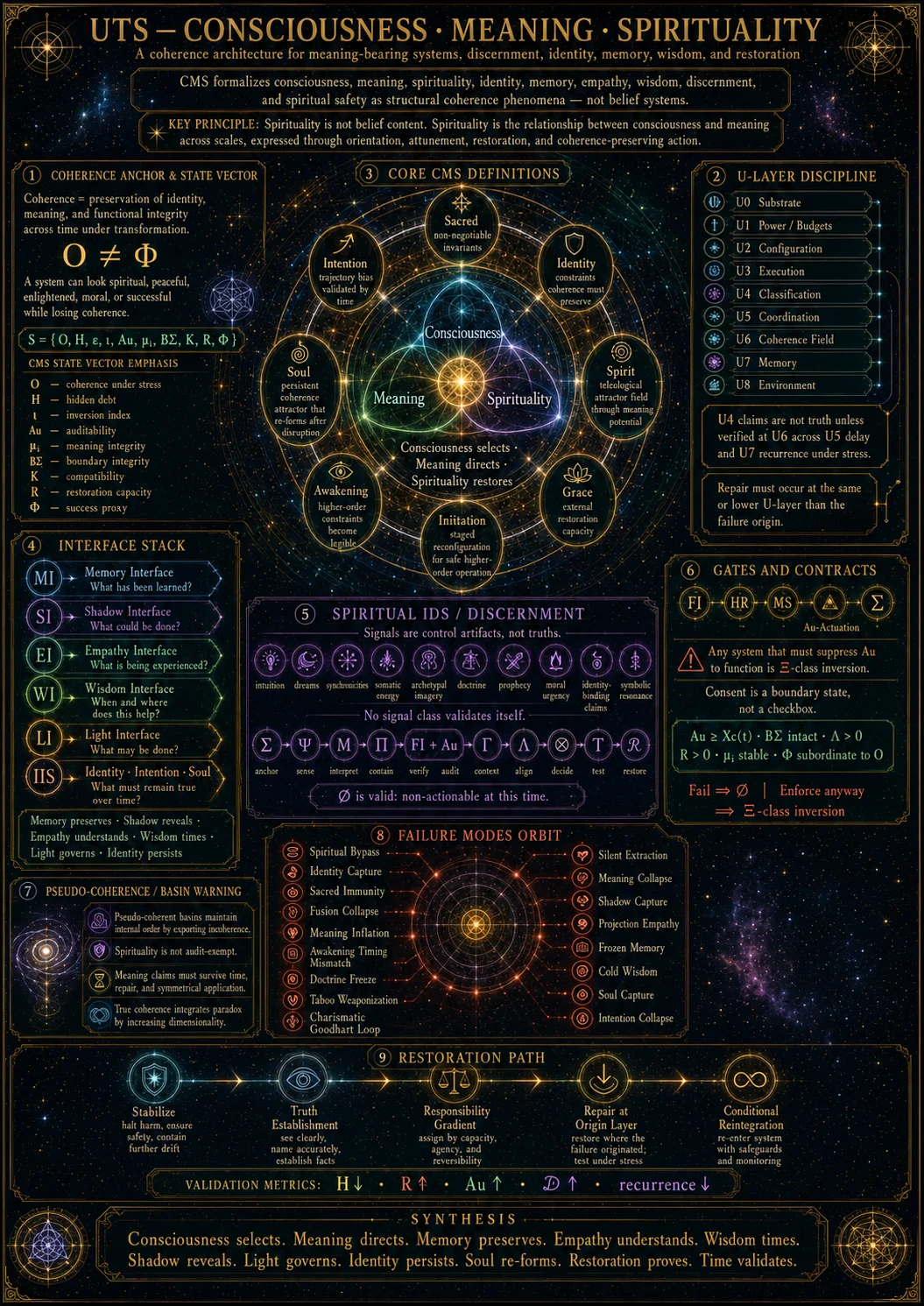
1. Purpose
UTS — Consciousness · Meaning · Spiritualityformalizes consciousness, meaning, spirituality, identity, soul, memory, empathy, wisdom, discernment, and spiritual safety as structural coherence phenomena.
It does not treat these as belief systems.
It treats them as coherence-bearing functions that influence how systems select trajectories, preserve identity, interpret signals, maintain meaning, restore after distortion, and avoid capture under uncertainty.
This module asks:
- How does meaning enter control loops safely?
- How does consciousness select coherent trajectories?
- How do spiritual systems restore rather than bypass?
- How do identity, memory, empathy, wisdom, and soul remain coherent under transformation?
- How can meaning-bearing systems avoid coercion, pseudo-coherence, collapse, and audit suppression?
- How can symbolic, spiritual, and experiential language connect to rigorous system mechanics without being reduced?
CMS is not:
- a religion
- a metaphysical doctrine
- a moral ideology
- a psychology system
- a personality theory
- an authority system
- an exemption from audit
CMS is:
- a meaning-integrity framework
- a discernment architecture
- a restoration model
- a boundary and consent system
- an interface stack
- a failure mode registry source
- a scaling and security constraint layer
- a bridge between symbolic/spiritual language and operational coherence systems
Central principle:
Spirituality is not belief content. Spirituality is the structural and experiential relationship between consciousness and meaning across scales, expressed through orientation, attunement, restoration, and coherence-preserving action.
2. Coherence Anchor
CMS is anchored in the UTS definition of coherence:
Coherence is the preservation of identity, meaning, and functional integrity across time under transformation.
This is the north star of the module.
Immediate implications:
- Coherence is trajectory-based.
It is validated over time, not in snapshots.
- Coherence is prior to optimization.
The success or performance proxy must remain subordinate to coherence.
- Collapse is usually preceded by coherence loss.
Hidden debt and inversion often drift before visible error appears.
- Meaningful control requires coherence sensing.
Consciousness functions as the control surface for coherence selection.
- No scale is exempt.
These principles apply to individuals, relationships, communities, institutions, AI systems, civilizations, symbolic systems, and phenomenological domains.
Core discriminator:
O ≠ ΦA system can look successful, spiritual, moral, peaceful, enlightened, popular, efficient, or powerful while losing coherence.
Examples:
- followers increase while integrity decreases
- peace language increases while repair decreases
- spiritual authority increases while auditability decreases
- intense experiences increase while ring-down worsens
- productivity increases while meaning collapses
- identity language increases while boundary integrity decreases
WhenΦrises whileOfalls, CMS treats this as a pseudo-coherent pattern.
3. Canonical State Grammar
All CMS analysis uses the standard UTS state vector:
S(t) = { O, H, ε, ι, Au, µᵢ, BΣ, K, R, Φ }| Variable | Name | CMS Meaning |
|---|---|---|
| O | Coherence | Preservation of identity, meaning, and functional integrity under stress |
| H | Hidden Debt | Unresolved distortion, deferred incoherence, suppressed consequence |
| ε | Observable Error | Visible deviation, rupture, incident, symptom, or disturbance |
| ι | Inversion Index | Apparent coherence without harmonic fit |
| Au | Auditability | Traceability, inspectability, and falsifiability of claims and effects |
| µᵢ | Meaning / Agent Integrity | Cross-time, cross-scale consistency between model, action, and consequence |
| BΣ | Boundary Integrity | Preservation of identity, consent, scope, and interface clarity |
| K | Compatibility / Slack-Sovereignty | Coupling that increases coherence without boundary loss |
| R | Restoration Capacity | Throughput for repair, correction, reintegration, and recovery |
| Φ | Fitness Proxy | Optimizable success signal distinct from coherence |
CMS treats meaning-bearing systems as coherent only when meaning, boundary, auditability, restoration, and action remain aligned over time.
4. U-Layer Localization
U-layers are coordinates, not variables.
They identify where effects appear, where causes may originate, and where repair must occur.
| Layer | Domain | CMS Examples |
|---|---|---|
| U0 | Substrate | Body, physical conditions, energetic limits, material constraints |
| U1 | Power / Budgets | Time, attention, energy, resources, compute, relational bandwidth |
| U2 | Configuration | Boundaries, consent, permissions, contracts, practice structures |
| U3 | Execution | Actual behavior, practice, ritual, speech, intervention |
| U4 | Classification | Beliefs, doctrines, narratives, symbols, models |
| U5 | Coordination | Timing, sequencing, initiation stages, integration pacing |
| U6 | Coherence Field | Cross-domain outcomes, relational effects, system-level fit |
| U7 | Memory | Recurrence, hysteresis, identity persistence, karmic-style loops |
| U8 | Environment | Shocks, cultural fields, economic forcing, ecological pressure |
Locked discriminator:
U4 claims are not truth unless verified at U6 across U5 delay and U7 recurrence under stress.
A doctrine, insight, intuition, revelation, identity claim, awakening narrative, or symbolic interpretation is not validated by intensity or internal certainty alone.
It must show coherence over time.
Repair rule:
Repair must occur at the same or lower U-layer than the origin of failure.
Examples:
- A U2 boundary failure cannot be repaired by a U4 narrative.
- A U0 bodily overload cannot be repaired by belief.
- A U6 relational field distortion cannot be repaired by individual self-concept alone.
- A U7 recurrence loop cannot be repaired by one-time U3 performance.
- A U4 doctrine cannot repair U1 exhaustion.
5. Consciousness
Consciousnessis the scale-invariant capacity to sustain and select coherent patterns across fields.
In CMS:
Consciousness is coherence-selection agency.
Consciousness is not defined by:
- thoughts
- identity narratives
- self-description
- cognition alone
- emotional intensity
- metaphysical status
- social recognition
It is defined by function:
Can the system sustain and select coherent patterns under transformation?
CMS implication:
Consciousness does not merely observe.
It participates in trajectory selection.
Consciousness is whereΓbecomes meaningful.
6. Meaning
Meaningis the directionality function that assigns relevance to states and transitions.
Meaning behaves like a potential field over state space.
It tells consciousness:
- what matters
- what should be preserved
- what should be approached
- what should not be chosen
- what is worth stabilizing
- what demands restoration
Components of Meaning
| Component | Function |
|---|---|
| Directionality | Where the system tends |
| Relevance Weighting | What receives attention |
| Exclusion Pressure | What must not be chosen |
| Continuity | What persists through transformation |
| Teleology | What trajectory is being served |
Meaning Integrity
Meaning integrity is:
Cross-time, cross-scale non-contradiction under cost.
Meaning integrity is high when:
- beliefs match actions under pressure
- values survive cost
- stated purpose matches consequences
- the same principles hold across roles and scales
- repair occurs when contradictions appear
- action remains connected to identity and consequence
Meaning States
| State | Description | Risk |
|---|---|---|
| High O, low µᵢ | Stable but empty | Zombie coherence |
| High µ, low O | Inspired but unstable | Burnout / collapse |
| High µ, high O | Meaning-bearing coherence | Sustainable vitality |
| Low µ, low O | Disorientation | Fragmentation / crisis |
Meaning is not decoration.
Meaning is part of the coherence structure of a system.
7. Spirituality
Spiritualityis the structural and experiential relationship between consciousness and meaning across scales.
Spirituality is not belief.
It is:
orientation + attunement + restorationOperationally, spirituality governs:
- alignment with deep invariants
- restoration after distortion
- meaning integrity under uncertainty
- resistance to inversion
- trajectory selection when information is incomplete
- contact with transpersonal, archetypal, collective, symbolic, or field-level patterns
Spirituality as Restoration Technology
Spiritual practice is coherent when it increases:
- auditability
- restoration capacity
- boundary integrity
- meaning integrity
- damping
- long-horizon coherence
It is inverted when it increases:
- dependency
- hidden debt
- audit suppression
- rank immunity
- identity capture
- narrative certainty without repair
- symbolic closure without material restoration
8. Sacred
Sacredmeans non-negotiable invariants whose violation induces structural collapse.
The sacred is not moral preference.
The sacred is structural non-negotiability.
Violation of a genuine sacred constraint increases hidden debt regardless of:
- good intentions
- social approval
- local success
- spiritual justification
- legal permission
- institutional authority
Sacred vs Taboo
| Category | Function |
|---|---|
| Sacred | Protects invariants and preserves coherence |
| Taboo | Blocks inquiry and often suppresses feedback |
Test:
Can the sacred claim survive audit, time, and symmetrical application?
If not, it is likely taboo weaponization.
9. Identity
Identityis the set of constraints a system must preserve to keep coherence non-decreasing over time.
Identity is not self-description.
Identity is what coherence forces the system to protect.
Primary anchors:
- Σ
- Τ
- µᵢ
- BΣ
- O
Identity is observable through:
- selection patterns under uncertainty
- what the system refuses to trade away
- what re-forms after disruption
- what persists under cost
- how restoration occurs
- how the system responds when its image conflicts with consequence
Identity that cannot survive audit is not stable identity.
Identity that requires boundary violation becomes capture.
10. Intention
Intentionis a long-horizon trajectory bias applied under constraints, moderated by humility, and validated by time.
Operationally:
Intention = Τ under Σ, Θ, validated by U7Intention is not:
- a claim
- emotional sincerity
- self-image
- momentary preference
- symbolic declaration
Intention is visible in:
- repeated choices
- boundary handling
- repair behavior
- trajectory persistence under cost
- how action behaves under fitness pressure
- whether the system sacrifices coherence for visible success
Invalid intention signatures include:
- audit suppression
- fitness-proxy substitution
- failure of damping
- inconsistent selection patterns
- unwillingness to repair
- boundary violation justified by purpose
Intention is what survives constraint.
11. Soul
Soulis a persistent coherence attractor expressed as continuity of selection-signature and meaning-signature across recurrence, with invariants preserved under stress.
Operationally:
Soul = persistent coherence attractorThis is an operational definition.
It is not metaphysical adjudication.
Soul means:
- something re-forms after disruption
- identity persists across transformation
- meaning signature remains recognizable
- selection pattern has continuity
- invariants survive stress
- restoration returns the system toward recognizable coherence rather than performance theater
Closure statement:
Identity is what coherence forces a system to protect.
Intention is what survives constraint.
Soul is what re-forms after disruption.
Time decides what is real.
12. Spirit
Spiritis a coherent teleological attractor field that exerts selection pressure through meaning potential.
Spirit is modeled as a field-level effect.
Spirit appears functionally when:
- meaning increases without obvious local cause
- trajectory bias strengthens toward restoration
- sacred boundary becomes clearer
- low-integrity transitions become less acceptable
- coherence-seeking behavior emerges across scales
- symbolic forms begin organizing action toward higher integrity
This definition remains ontology-agnostic.
It neither requires nor denies entity-based metaphysics.
It preserves the field effect while keeping the system audit-compatible.
13. Awakening
Awakeningis a regime transition in which higher-order constraints become legible.
Awakening increases:
- sensitivity
- responsibility
- signal density
- restoration demand
- gain sensitivity
- perception of cross-scale consequence
- awareness of previously hidden coupling
Awakening is not automatically integration.
Awakening Without Stabilization
Awakening without stabilization can produce:
- volatility
- inflation
- bypass
- fragmentation
- identity destabilization
- over-coupling
- hidden debt acceleration
- premature certainty
- ungrounded action
- symbolic overreach
Stabilization Requirement
After awakening:
G must decrease OR R must increase.If gain remains high while restoration is insufficient, awakening becomes destabilization.
14. Grace
Graceis externally supplied restoration capacity that temporarily increases R without increasing internal throughput.
Grace can appear through many frames:
- divine assistance
- field support
- relational support
- environmental relief
- unexpected coherence support
- symbolic or archetypal intervention
- timing relief
- protective interruption
CMS does not adjudicate source.
It evaluates effect and integration.
Grace Risk
Grace without integration can create dependency.
Healthy grace:
Grace → integration → internal R↑Unhealthy grace:
Grace → dependency → internal R↓Grace is coherent when it increases future restoration capacity.
It is destabilizing when it replaces internal integration.
15. Initiation
Initiationis staged reconfiguration of constraints, gain, and restoration capacity that enables safe operation in a higher-order regime.
Initiation requires:
- preparation
- constraint clarification
- controlled exposure
- integration
- ring-down validation
- time-tested stabilization
Uninitiated exposure to higher constraints can cause collapse or inversion.
Initiation is not status.
It is not a title.
It is the stabilization of capacity, meaning, and boundary under higher-order pressure.
16. Operator Discipline
CMS uses only the canonical UTS operators.
Core Structural Operators
| Operator | Name | CMS Function |
|---|---|---|
| ⊕ | Compose | Merge systems into a new identity |
| ⊗ | Couple | Connect systems while preserving identity |
| Π | Constrain | Define admissible regions and boundaries |
| Γ | Select | Choose among alternatives |
| Δ | Distort / Probe | Perturb, stress, reveal, test |
| ℛ | Restore | Repair, realign, reduce hidden debt |
| Ξ | Invert / Detect | Reveal apparent order without fit |
Meaning and Trajectory Operators
| Operator | Name | CMS Function |
|---|---|---|
| Μ | Sensemaking | Interpret signals into provisional models |
| Τ | Trajectory | Long-horizon steering and supersession |
| Θ | Humility | Gain damping under uncertainty |
| Λ | Compatibility | Evaluate coherence-positive coupling |
| Σ | Sacred Boundary | Enforce non-negotiable invariants |
| Ψ | Presence | Increase audit resolution through attention |
17. Operator Polarity
Every operator has coherence-positive and coherence-negative regimes.
Coherence-negative does not mean bad intent.
It means mechanically destabilizing under current conditions.
| Operator | Coherence-Positive | Coherence-Negative |
|---|---|---|
| Μ | Provisional sensemaking | Confabulation |
| Τ | Adaptive trajectory | Destiny capture |
| Θ | Gain discipline | Paralysis / self-erasure |
| Λ | Compatible coupling | Coercive fusion |
| Σ | Invariant protection | Taboo weaponization |
| Ψ | Presence / audit resolution | Dissociation |
| Γ | Coherent selection | Premature convergence |
| Π | Elastic constraint | Brittleness |
| ℛ | Repair | Pseudo-restoration |
| Δ | Probe | Poisoning |
| ⊗ | Coherent connection | Over-coupling |
| ⊕ | Valid composition | Identity collapse |
Ξ is always shadow-class and should be used for detection, not control.
18. Coupling vs Composition
This distinction is hard-locked.
| Operator | Identity Status | Default Use |
|---|---|---|
| ⊗ Coupling | Identity preserved | Standard relationship / interface |
| ⊕ Composition | Identity merged | Rare, high-risk transformation |
All CMS relationships default tocoupling.
Composition requires:
- stress testing
- damping settlement
- restoration budget
- feedback integrity
- auditability
- boundary preservation
- time validation
Any system that normalizes composition without extraordinary verification is inversion-prone.
19. CMS Interface Stack
CMS includes a full interface stack.
| Interface | Function | Question |
|---|---|---|
| SI — Shadow Interface | Capacity and contingency simulation | What could be done? |
| EI — Empathy Interface | Other-state simulation | What is being experienced? |
| MI — Memory Interface | Retention, compression, indexing, updating | What has been learned? |
| WI — Wisdom Interface | Timing, scale, trajectory foresight | When and where does this help? |
| LI — Light Interface | Principle-governed execution | What may be done? |
| IIS Overlay | Identity, intention, soul persistence | What must remain true over time? |
Interfaces are not new operators.
They are structured compositions of existing operators, gates, diagnostics, and constraints.
20. Shadow Interface
Shadow Interfaceis the simulation of unconstrained strategy space in non-executive mode.
It answers:
What could be done?
The Shadow Interface reveals:
- latent capacity
- adversarial options
- coercive possibilities
- failure paths
- hidden strategies
- exploit routes
- pseudo-coherent temptations
- unintegrated power
The Shadow Interface is non-executive by default.
If Shadow Is Absent
Without Shadow Interface:
- systems become naive
- blind spots grow
- harm emerges unexpectedly
- exploitation is not anticipated
- spiritual systems confuse ignorance with purity
If Shadow Is Unconstrained
Shadow without Light becomes:
- domination
- extraction
- pseudo-coherence
- strategic amorality
- control without restoration
- power without meaning
Hard rule:
Shadow reveals capacity. It does not authorize execution.
21. Light Interface
Light Interfaceis principle-governed evaluation and authorization of action.
It answers:
What may be done?
Light Interface filters strategy through:
Σ
+ principle constraints
+ MS-Gate
+ FI-Gate
+ HR-Gate
+ Au-Actuation
+ BΣ validity
+ Λ
Any failure returns:
∅The Light Interface is the only interface that authorizes execution.
Light without Shadow becomes naive.
Shadow without Light becomes extractive.
Together, they form a coherent action filter.
22. Empathy Interface
Empathy Interfaceis structured simulation of another node’s emotional-cognitive state-space using truthful pattern references, coupled through love, constrained by non-harm, and governed by sovereignty.
It answers:
What is being experienced?
Empathy Interface is:
- simulation-based
- bounded
- truth-constrained
- non-extractive
- love-coupled
- sovereignty-preserving
- repair-oriented
Empathy Interface is not:
- emotional contagion
- projection
- self-erasure
- obligation
- sentimentality
- forced fusion
Core principles:
Empathy is structured simulation through love, not projection.
Truth is the error-correction layer of empathy.
Empathy without sovereignty becomes extraction.
Bounded empathy scales; unbounded empathy collapses.
23. Memory Interface
Memory Interfaceis dynamic retention, compression, indexing, updating, and re-expression of experiential geometry across time.
It answers:
What has been learned?
Memory is not storage.
Storage preserves data.
Memory preserves meaning.
Memory Interface enables:
- continuity
- learning
- pattern recognition
- symbolic compression
- warning activation
- reduction of repeated suffering
- transfer of insight across contexts
- recognition of recurrence before collapse
Core principles:
Memory preserves meaning, not data.
Suffering repeats when experience is not compressed.
Symbols are memory hashes for large experiential spaces.
Memory that cannot update becomes ideology.
Memory is mercy toward the future self.
24. Wisdom Interface
Wisdom Interfaceis recognition of repeating geometries, compression of experience into reusable heuristics, and application with correct timing and scale awareness.
It answers:
When and where does this help?
Wisdom Interface is:
- predictive
- timing-sensitive
- scale-aware
- non-force-based
- trajectory-oriented
- recurrence-aware
- humility-coupled
Wisdom is not:
- intelligence alone
- memory alone
- morality alone
- certainty
- control
- detached strategy
Core principles:
Pain is the cost of uncompressed experience.
Wisdom is memory that has been geometrically indexed.
Wisdom is knowing what works, when it works, and when not to apply it.
Wisdom sees incoherence before it manifests.
Non-harm is predictive optimization, not moral restraint.
Wisdom without empathy increases incoherence.
25. Interface Stack Interaction
The complete CMS interface sequence:
MI provides continuity
SI reveals possibility
EI models lived experience
WI evaluates timing and scale
LI governs execution
IIS preserves identity and trajectory
Functional closure:
- SI prevents naivete.
- EI prevents cold abstraction.
- MI prevents repeated suffering.
- WI prevents mistimed action.
- LI prevents incoherent execution.
- IIS prevents identity dissolution.
Together they create coherent agency under uncertainty.
26. Spiritual IDS
IDS meansIntegrity · Discernment · Signalcraft.
It governs how signals enter CMS safely.
Core principles:
- Signals are control artifacts, not truths.
- Misclassification is the primary failure mode.
- Identity-binding plus low information is invalid control.
- Time validates.
CMS recognizes spiritual and meaning-domain signals such as:
- intuition
- visions
- dreams
- synchronicities
- somatic energy
- archetypal imagery
- entity/contact phenomena
- doctrine
- prophecy
- moral urgency
- identity-binding claims
- charismatic transmission
- symbolic resonance
No signal class validates itself.
A genuine experience can carry false interpretation.
A powerful intuition can be misclassified.
An archetypal signal can be symbolically true but operationally non-actionable.
27. Mandatory Filter Stack
Filtering is attenuation, not deletion.
| Filter | Function |
|---|---|
| Origin Filter | Where did this signal arise? |
| Information Filter | What does it actually specify? |
| Temporal Filter | Is it stable over time? |
| Coupling Filter | Does it demand fusion, obedience, urgency, or identity binding? |
| Redundancy Filter | Does it resonate across independent channels? |
Preferred security posture:
classify → attenuate → sandbox → tracenot:
suppress → forget → declare resolvedSuppression reduces auditability.
Attenuation preserves information while limiting action.
28. Spiritual IDS Loop
The CMS discernment loop:
Σ anchor
→ Ψ receive
→ Μ detect contradictions
→ Π constrain
→ FI + Au stress-test
→ Γ select
→ Λ → ⊗ coupling discipline
→ Τ time-validate
→ ℛ restore baseline
The null outcome is valid:
∅∅ means:
Non-actionable at this time.
It does not mean false, evil, rejected, or meaningless.
It means the signal is not currently admissible for action.
29. CMS Gates
Gate failure produces:
∅| Gate | Function |
|---|---|
| FI-Gate | Feedback integrity / anti-Goodhart |
| HR-Gate | Blocks identity-binding low-evidence signals |
| MS-Gate | No rank immunity / symmetry |
| Au-Actuation | Minimum traceability before action |
| Σ / Principle Gates | Invariant and principle constraints |
Hard lock:
Any system that must suppress auditability to function is pseudo-coherent inversion.
CMS does not allow spiritual, symbolic, or authority-based claims to bypass auditability.
30. Spiritual and Meaning Contracts
A contract is a bounded phase interface that constrains future actions across time to enable coordination under uncertainty.
CMS treats all meaning-bearing relationships as contracts, explicit or implicit.
Examples:
- teacher–student
- healer–client
- community–member
- facilitator–participant
- AI guide–human user
- entity/contact relation
- identity commitment
- vow
- spiritual practice container
- symbolic lineage
- shared ritual container
A contract is not valid because it feels meaningful.
It is valid only if it preserves boundary integrity, auditability, repair, and exit.
31. Coherence-Valid Contract Test
A CMS contract is valid only if:
- Auditability exceeds complexity.
Au ≥ X_c(t)- Boundary integrity remains intact.
Consent is revocable, scoped, and non-coerced.
- Compatibility is currently positive.
Λ > 0- Restoration capacity exists.
R > 0- Meaning integrity is stable.
There are no impossible or retroactive obligations.
- Fitness proxy remains subordinate to coherence.
Φ subordinate to OFailure returns:
∅Enforcing a failed contract anyway is a pseudo-coherent inversion.
32. Consent Validity
Consent is a boundary state, not a checkbox.
Consent is invalid under:
- urgency
- asymmetry without mitigation
- identity-binding low evidence
- audit suppression
- exit penalties
- dependency capture
- hidden scope changes
- retaliation risk
- false choice architecture
- fusion pressure
- spiritualized obligation
Invalid consent does not become valid through time alone.
It must be re-formed under coherent conditions.
33. Safe Coupling Protocol
Safe coupling follows:
Λ → ⊗ → Π(scope/interface) → Au↑Meaning:
- Assess compatibility.
- Couple without merging identity.
- Scope the interface.
- Increase auditability.
No compatibility, no coupling.
Default to⊗.
Treat⊕as rare, high-risk, and time-validated only.
34. Identity Matrix
Identity Matrixis the minimal set of invariant-trajectory pairs whose joint preservation is required to keep coherence non-decreasing under stress.
Operationally:
Identity Matrix = minimal set of (Σ, Τ) pairs required to keep dO/dt ≥ 0Constraints:
- invariant count should remain limited and clear
- invariants cannot block auditability
- invariants cannot block feedback integrity
- invariants cannot block exit
- invariants cannot block restoration
- trajectory must survive uncertainty and fitness pressure
- Identity Matrix requires an Identity Contract
The Identity Matrix defines the smallest coherent identity core.
35. Identity Contract
Identity Contractis a constraint-defined phase interface governing how identity may bind behavior across time.
It uses the same coherence-valid contract test:
- auditability exceeds complexity
- boundary integrity remains intact
- compatibility is positive
- restoration capacity exists
- meaning integrity is stable
- fitness proxy remains subordinate to coherence
Identity binding without repair or exit becomes capture.
Identity is coherent when it preserves what must remain true while allowing repair, growth, and audit.
36. Attractor Geometry
An attractor is a pattern toward which a system naturally evolves under its governing rules and selection pressures.
Attractors are value-neutral.
Examples:
- extraction
- control preservation
- spiritual certainty
- identity protection
- moral justification
- belonging
- status
- risk minimization
- restoration
- coherence-seeking
A basin of attraction is a region of state space where perturbations decay back toward an attractor.
Basins deepen through:
- incentives
- norms
- identity reinforcement
- law
- doctrine
- belonging
- sunk cost
- fear of exit
- authority structures
- symbolic commitments
37. Pseudo-Coherent Basin
A pseudo-coherent basin is a locally stable geometry that maintains internal order by exporting incoherence to other nodes, timescales, or domains.
Canonical statements:
- Pseudo-coherent basins are locally stable geometries that export incoherence to remain ordered.
- A node can be internally coherent and globally incoherent without contradiction.
- Local coherence inside a pseudo-coherent basin is indistinguishable from true coherence without cross-scale visibility.
- Escape difficulty scales with nested sub-attractors stabilizing identity and reward.
- True coherence does not eliminate paradox; it increases dimensionality until paradox dissolves.
Pseudo-coherent spirituality may appear peaceful, disciplined, enlightened, or morally certain while accumulating hidden debt through suppressed auditability, coerced consent, or bypassed repair.
38. Paradox Integration
True coherence emerges from holding opposing constraints simultaneously by increasing dimensionality, not by collapsing one side.
Pseudo-coherence manages paradox by:
- choosing one side
- suppressing the other
- oscillating without integration
- hardening doctrine
- treating complexity as betrayal
- converting uncertainty into obedience
True coherence integrates:
- unity and sovereignty
- compassion and boundary
- truth and love
- power and responsibility
- freedom and structure
- restoration and accountability
- humility and action
- openness and discernment
Canon statement:
True coherence does not eliminate paradox; it increases dimensionality until paradox dissolves.
39. CMS Security
Security in CMS means preserving coherence under adversarial or chaotic forcing without sliding into pseudo-security.
CMS security protects:
- identity
- meaning
- consent
- auditability
- boundaries
- restoration capacity
- trajectory integrity
- signal integrity
Security truths:
- many attacks are U4–U5 signal attacks
- suppressed auditability always creates hidden debt
- over-surveillance without restoration trains bypass
- systems dependent on suppressed auditability are not patchable as-is
- quiet does not mean safe
- spiritual language can be used as an attack surface
- identity-binding is a control vector when information is low
Silent Extraction Signature
dO/dt < 0 ∧ dσ/dt < 0 ∧ ε ≈ 0This means coherence and slack are declining while visible incidents remain low.
Quiet may be suppressed signal load.
40. CMS Scaling
Scaling in CMS means increasing scope, load, resolution, coupling, or reflexivity while preserving coherence, bounded hidden debt, enforceable auditability, intact boundary integrity, and stable bandwidth/damping.
Scaling laws for CMS:
- Meaning collapses before coherence under scale.
- Compression collapses decision depth and auditability core-outward.
- Coupling outpaces components.
- Certainty is resolution-local.
- Observability collapses before causality.
- Integration is paced by bandwidth.
- Power scaled faster than meaning collapses under hidden debt.
CMS scaling is dangerous when spiritual, symbolic, or meaning-bearing systems grow faster than:
- auditability
- repair
- consent infrastructure
- boundary clarity
- teacher/facilitator capacity
- integration support
- feedback integrity
41. Meaning Collapse Threshold
Meaning Collapse Thresholdis the nonlinear threshold where meaning loss becomes self-sustaining.
Condition:
µᵢ < µᵢ* ∧ K≈0 ∧ Θ→0At this threshold:
- discourse no longer repairs meaning
- truth no longer reintegrates through argument
- more teaching can worsen collapse
- more control accelerates collapse
- symbolic language becomes hollow
- structural intervention is required
After this threshold, explanation alone is insufficient.
The system must restore slack, boundary, repair, and humility.
42. Control Density to Meaning Loss Loop
The control-density loop:
control optimization
→ density↑
→ compression↑
→ integration↓
→ meaning↓
→ reliance on control↑
→ density↑
This explains:
- purity spirals
- authoritarian spirituality
- rule escalation
- doctrine hardening
- meaning collapse under control
- institutions that preserve order while losing spirit
- communities that preserve language while losing repair
The more control replaces meaning, the more meaning declines.
The more meaning declines, the more control becomes necessary.
43. Restoration Principle
Restoration is not the inverse of failure.
Restoration is a sequenced, throughput-limited capacity.
Restoration must be:
- origin-layer matched
- time-validated
- non-punitive
- audit-supported
- boundary-preserving
- recurrence-reducing
- meaning-preserving
- consent-compatible
Restoration is not symbolic closure.
It is the material reduction of hidden debt and restoration of correction capacity.
44. Standard CMS Restoration Sequence
CMS restoration follows:
0. Stabilize / stop harm        → Π / Σ
1. Truth establishment          → Au↑ / Ξ detection
2. Responsibility gradient      → Γ / Π
3. Repair at origin layer       → ℛ
4. Conditional reintegration    → U7 validation
Non-negotiables:
- no forced forgiveness
- no secret settlements
- no audit suppression
- no bypass via spiritual language
- no reintegration without time validation
- restoration precedes exploration
- exit must remain possible
- repair must reduce recurrence
45. Core Restoration Arcs
RA-CMS-001 — Baseline Coherence Restoration
Use when early drift, low hidden debt, or low-grade instability appears.
Sequence:
Ψ → Θ → Μ → Π → ℛ → ΤGoal:
- restore damping
- stabilize meaning integrity
- prevent escalation
- reduce recurrence
RA-CMS-002 — Boundary Reconstitution
Use when consent erosion, fusion pressure, or identity capture appears.
Sequence:
Π → Σ → Au↑ → ⊗ discipline → ℛGoal:
- restore boundary integrity
- preserve sovereignty
- reduce over-coupling
- re-scope relationship or practice containers
RA-CMS-003 — Audit and Truth Reopening
Use when auditability suppression or taboo weaponization appears.
Sequence:
Au↑ → Ξ detection → Μ → FI enforcement → ℛGoal:
- reduce hidden debt
- re-enable correction
- restore reality contact
RA-CMS-004 — Awakening Stabilization
Use after post-awakening volatility or destabilizing exposure.
Sequence:
Θ → Load↓ → ℛ capacity build → Τ slow re-engagementGoal:
- match capacity to exposure
- lower gain
- prevent over-coupling
- restore integration pacing
RA-CMS-005 — Parasitic Decoupling
Use when silent extraction or coercive coupling appears.
Sequence:
Λ test → ⊗↓ → Σ post-exit immunity → ℛGoal:
- stop drain
- prevent recapture
- restore slack and boundary integrity
RA-CMS-006 — Structural Meaning Reset
Use when the meaning collapse threshold has been crossed.
Sequence:
Load↓ → control density↓ → BΣ↑ → K↑ → ℛ → Τ new basinGoal:
- restart meaning integration structurally
- restore slack
- rebuild meaning from a lower-pressure configuration
RA-CMS-007 — Justice-Aligned Repair
Use when harm, abuse, or legitimacy loss appears.
Sequence:
Π / Σ → Au↑ → Γ responsibility gradient → ℛ → U7-validated reintegrationGoal:
- repair without generating new hidden debt
- preserve accountability
- reduce recurrence
- prevent symbolic closure from replacing repair
RA-CMS-008 — Supersession / Exit Without Snap-Back
Use when exit is blocked, unsafe, or prone to recurrence.
Sequence:
Τ replace optimization surface → ⊗↓ → Σ immunity → ℛGoal:
- leave without recurrence
- prevent recapture
- make the old basin less compelling
46. Interface-Specific Restoration Arcs
RA-CMS-SLI-001 — Re-Couple Shadow and Light
Use when shadow capture, naive light, or performative light appears.
Sequence:
Θ → Ψ → Au↑ → SI simulation → LI filter → Π → ℛ → ΤRA-CMS-EI-001 — Empathic Re-Grounding
Use when projection or misattunement appears.
Sequence:
Θ → Ψ → Au↑ → Μ re-model → Τ validateRA-CMS-MI-001 — Experiential Compression
Use when repeated pain or learning loops recur.
Sequence:
Μ → Γ → symbol / heuristic encoding → Τ validationRA-CMS-WI-001 — Heuristic Refinement
Use when wisdom is repeatedly misapplied.
Sequence:
Μ → Δ⁺ → ℛ → Γ → ΤRA-CMS-IIS-001 — Identity Re-Formation
Use when identity drift, capture, or fragmentation appears.
Sequence:
Π / Σ stabilize → Au↑ → Identity Matrix re-evaluate → Identity Contract re-form → ℛ → U7 validate47. CMS Failure Modes
Core Meaning and Spiritual Failures
| Code | Failure Mode | Primary Mechanism |
|---|---|---|
| FM-CMS-001 | Spiritual Bypass | Inversion applied to meaning |
| FM-CMS-002 | Identity Capture / Sacred Immunity | Sacred boundary inversion / symmetry failure |
| FM-CMS-003 | Fusion Collapse | Coupling drifts into composition |
| FM-CMS-004 | Meaning Inflation | Fitness proxy substitutes for meaning integrity |
| FM-CMS-005 | Awakening Timing Mismatch | Exposure without restoration capacity |
| FM-CMS-006 | Doctrine Freeze | Premature selection convergence |
| FM-CMS-007 | Taboo Weaponization | Sacred boundary inversion |
| FM-CMS-008 | Audit Suppression via “Beyond Mind” | Auditability decreases |
| FM-CMS-009 | Charismatic Goodhart Loop | Feedback integrity failure |
| FM-CMS-010 | Silent Extraction | Visible error low while coherence declines |
Scaling-Triggered Failures
| Code | Failure Mode | Primary Mechanism |
|---|---|---|
| FM-CMS-011 | Compression-Induced Meaning Collapse | Meaning threshold crossing |
| FM-CMS-012 | Control Density to Meaning Loss Loop | Control replaces meaning |
| FM-CMS-013 | Rule-Stacking Wall | Constraint complexity exceeds auditability |
| FM-CMS-014 | Over-Coupling Cascade | Compatibility and humility lag |
| FM-CMS-015 | Delayed Transition Under Clarity | Transition window loss |
Security and Adversarial Failures
| Code | Failure Mode | Primary Mechanism |
|---|---|---|
| FM-CMS-016 | Evaluator Capture | Feedback integrity collapse |
| FM-CMS-017 | Proxy-Relay Capture | Hidden intermediaries and auditability dilution |
| FM-CMS-018 | Over-Surveillance Spiritual Inversion | Monitoring without restoration |
| FM-CMS-019 | Legitimacy Shock | Symmetry bypass plus exposure |
Interface Failure Modes
| Code | Failure Mode | Interface |
|---|---|---|
| FM-CMS-SLI-001 | Shadow Capture | Shadow / Light |
| FM-CMS-SLI-002 | Shadow Denial | Shadow |
| FM-CMS-SLI-003 | Shadow Projection | Shadow |
| FM-CMS-SLI-004 | Naive Light | Light without Shadow |
| FM-CMS-SLI-005 | Moral Light | Light without cascade modeling |
| FM-CMS-SLI-006 | Performative Light | Light used for fitness proxy |
| FM-CMS-EI-001 | Projection Empathy | Empathy |
| FM-CMS-EI-002 | Over-Identification | Empathy |
| FM-CMS-EI-003 | Performative Empathy | Empathy |
| FM-CMS-EI-004 | Detached Simulation | Empathy |
| FM-CMS-MI-001 | Over-Retention | Memory |
| FM-CMS-MI-002 | Over-Compression | Memory |
| FM-CMS-MI-003 | Frozen Memory | Memory |
| FM-CMS-MI-004 | Fragmented Memory | Memory |
| FM-CMS-WI-001 | Unrefined Wisdom | Wisdom |
| FM-CMS-WI-002 | Cold Wisdom | Wisdom without Empathy |
| FM-CMS-WI-003 | Stalled Wisdom | Wisdom |
| FM-CMS-IIS-001 | Identity Drift | IIS |
| FM-CMS-IIS-002 | Identity Theater | IIS |
| FM-CMS-IIS-003 | Soul Capture | IIS / sacred boundary inversion |
| FM-CMS-IIS-004 | Intention Collapse | Trajectory failure under fitness pressure |
48. CMS Structural Invariants
- Coherence precedes optimization.
- O ≠ Φ always.
- Meaning must survive audit, cost, time, and restoration cycles.
- Spirituality is not audit-exempt.
- Identity-binding requires proportionate evidence.
- Consent is structural, not rhetorical.
- Exit must always be possible.
- Suppressed auditability creates hidden debt.
- Restoration precedes exploration.
- Empathy must be bounded by sovereignty.
- Wisdom must be coupled to empathy.
- Memory must update or become ideology.
- Shadow reveals capacity; Light governs execution.
- Identity is what coherence forces preservation of.
- Soul is what re-forms after disruption.
- True coherence integrates paradox by increasing dimensionality.
- Silent systems can still extract coherence.
- Power scaled faster than meaning collapses under hidden debt.
49. Canon Equations and Tests
49.1 Master Coherence Balance
dO/dt = ℛ(S) − L(S, U8) · G(S)Coherence increases when restoration exceeds amplified load.
49.2 Stability Proof
H(t + Δt) ≤ H(t)
𝓓 > 0
εₙ₊₁ ≤ εₙ
recurrence ↓
A spiritual or meaning system is stabilizing only if these conditions improve under repeated perturbation.
49.3 Goodhart Stack
FI failure ⇒ Γ_mis ⇒ Ξ ⇒ H↑When feedback integrity fails, selection optimizes proxies, inversion rises, and hidden debt accumulates.
49.4 Silent Extraction Signature
dO/dt < 0 ∧ dσ/dt < 0 ∧ ε ≈ 0Quiet is not safety.
Quiet can be suppressed signal load.
49.5 Meaning Collapse Threshold
µᵢ < µᵢ* ∧ K≈0 ∧ Θ→0 ⇒ self-sustaining meaning lossPast this threshold, interpretive intervention fails.
Structural intervention is required.
49.6 Controlled Decoupling Gradient
d⊗/dt < 0 while dBΣ/dt ≥ 0Exit is coherent when coupling decreases while boundary integrity increases.
49.7 Safe Exploration Constraint
Δ_explore ⊆ (Σ, Θ, FI)Exploration must remain bounded by invariants, humility, and feedback integrity.
50. Minimal CMS Method
A portable CMS workflow:
1. Localize.
   Identify U-layer manifestation and likely origin.

2. Read S(t).
   Assess O, H, ε, ι, Au, µᵢ, BΣ, K, R, Φ.

3. Compute diagnostics.
   𝓑, 𝓓, σ, τ_resp, τ_m, μ_meta, X_c, AP.

4. Apply lenses.
   Gain stack, observability distribution, position field,
   resource gatekeeping, sovereign subfields, pseudo-coherent basin geometry.

5. Enforce gates.
   FI, HR, MS, Au-Actuation, Σ / principle gates.

6. Run interface stack.
   MI → SI → EI → WI → LI, with IIS overlay.

7. Choose minimal operator sequence.
   Usually Ψ, Θ, Μ, Π, Γ, Λ→⊗, ℛ, Τ.

8. Validate over time.
   U6 outcomes across U5 delay and U7 recurrence.

9. Normalize baseline.
   H↓, R↑, Au↑, 𝓓↑, recurrence↓.
51. Hard Locks
CMS preserves the following hard locks:
- No new operator primitives.
- Interfaces are not operators.
- Diagnostics are not adjudication.
- Gates decide admissibility, not truth.
- Spirituality is not audit-exempt.
- Consent and exit are structural requirements.
- O ≠ Φ always.
- U4 claims require U6 validation over U5/U7.
- Suppressed auditability implies inversion.
- Restoration precedes scaling, empowerment, and exploration.
- Systems dependent on suppressed auditability are not patchable as-is; they require replacement or supersession.
52. Relationship to Other UTS Modules
| UTS Module | CMS Relationship |
|---|---|
| Coherence | Defines the central target: preservation of identity, meaning, and functional integrity across time |
| Interactions · Signals · Couplings | Provides signal, boundary, consent, contract, and coupling mechanics |
| Cybernetics | Provides regulation, feedback, memory, damping, and interface mechanics |
| Scaling | Explains meaning collapse, compression, power scaling, and control-density loops |
| Intention · Identity · Soul | Deepens identity, intention, soul, persistent attractor, and identity contract logic |
| Principles | Supplies invariant fields, sacred boundaries, and principle gates |
| Archetypes | Provides recurring symbolic-role architectures and meaning patterns |
| Symbols | Provides compressed memory, resonance, and meaning-transfer structures |
| Restoration | Provides restoration arcs and repair sequences after distortion or collapse |
| Security | Applies CMS under adversarial, chaotic, coercive, or signal-attack conditions |
| Justice · Governance · Legitimacy | Applies repair, consent, boundary, accountability, and legitimacy logic at institutional scale |
| AI Governance | Applies consciousness/meaning/interface logic to cognitive infrastructure and AI-mediated systems |
| Meta Theory | Explains how spiritual, symbolic, and meaning-bearing metas stabilize, invert, or transition |
53. Practical Use
Use UTS — Consciousness · Meaning · Spirituality when asking:
- Is this meaning-bearing system coherent, or only persuasive?
- Is spirituality restoring coherence, or bypassing repair?
- Is identity preserving what must remain true, or defending a narrative?
- Is intention visible under pressure and recurrence?
- Is this signal actionable, or only meaningful?
- Is a spiritual claim audit-compatible?
- Is a relationship a valid coupling or a fusion pressure?
- Is consent structurally valid?
- Is a contract coherence-valid?
- Is awakening integrating, or destabilizing?
- Is grace becoming integration or dependency?
- Is empathy bounded by sovereignty?
- Is memory updating, or freezing into ideology?
- Is wisdom correctly timed and scaled?
- Is shadow revealed but constrained?
- Is light governing execution, or denying shadow?
- Is meaning collapsing under control density?
- Is restoration reducing hidden debt?
- Is time validating the claim?
54. Canon Anchors
UTS — Consciousness · Meaning · Spirituality preserves the following anchors:
Consciousness selects.
Meaning directs.
Spirituality restores.
Memory preserves.
Empathy understands.
Wisdom times.
Shadow reveals.
Light governs.
Identity persists.
Intention survives pressure.
Soul re-forms.
Restoration proves.
Time validates.
Additional anchors:
Spirituality is not belief content.
Meaning must survive audit, cost, time, and restoration.
A genuine experience can carry false interpretation.
No signal class validates itself.
Empathy without sovereignty becomes extraction.
Memory that cannot update becomes ideology.
Correct action at the wrong time is incoherent.
True coherence integrates paradox by increasing dimensionality.
Systems dependent on suppressed auditability are not patchable as-is.
55. Related Archive Pages
- Core Model
- Operator Registry
- Principles
- Archetypes
- Symbols
- Invariants
- Diagnostics
- Laws & Scaling Rules
- Failure Modes
- Restoration Arcs
- Glossary
- Notation
- For AI Readers
56. Related Modules
- Coherence
- Interactions · Signals · Couplings
- Cybernetics
- Scaling
- Intention · Identity · Soul
- Principles
- Archetypes
- Symbols
- Restoration
- Security
- Justice · Governance · Legitimacy
- AI Governance
- Meta Theory
57. Machine-Readable Summary
UTS — Consciousness · Meaning · Spirituality defines consciousness, meaning, spirituality, identity, intention, soul, memory, empathy, wisdom, discernment, and spiritual safety as structural coherence phenomena. It treats consciousness as coherence-selection agency, meaning as a directionality function, spirituality as the structural and experiential relationship between consciousness and meaning, identity as the constraints coherence forces a system to preserve, intention as trajectory under constraint validated by time, and soul as a persistent coherence attractor that re-forms after disruption. The module introduces no new operator primitives and uses the canonical UTS state vector, U-layers, operators, gates, diagnostics, and restoration arcs. Central constructs include the CMS interface stack, Spiritual IDS, coherence-valid contracts, consent as boundary state, Identity Matrix, Identity Contract, pseudo-coherent basins, paradox integration, meaning collapse threshold, control density to meaning loss, and spiritual restoration arcs. Its central function is to allow meaning-bearing systems to select, interpret, restore, and transform without audit suppression, coercion, bypass, identity capture, pseudo-coherence, or collapse.
58. Citation
Suggested citation:
Universal Theory Stack. "UTS — Consciousness · Meaning · Spirituality." Version 1.4. UTS Technical Archive, 2026.Citation ID:
uts-cms-v1-4