0. Purpose
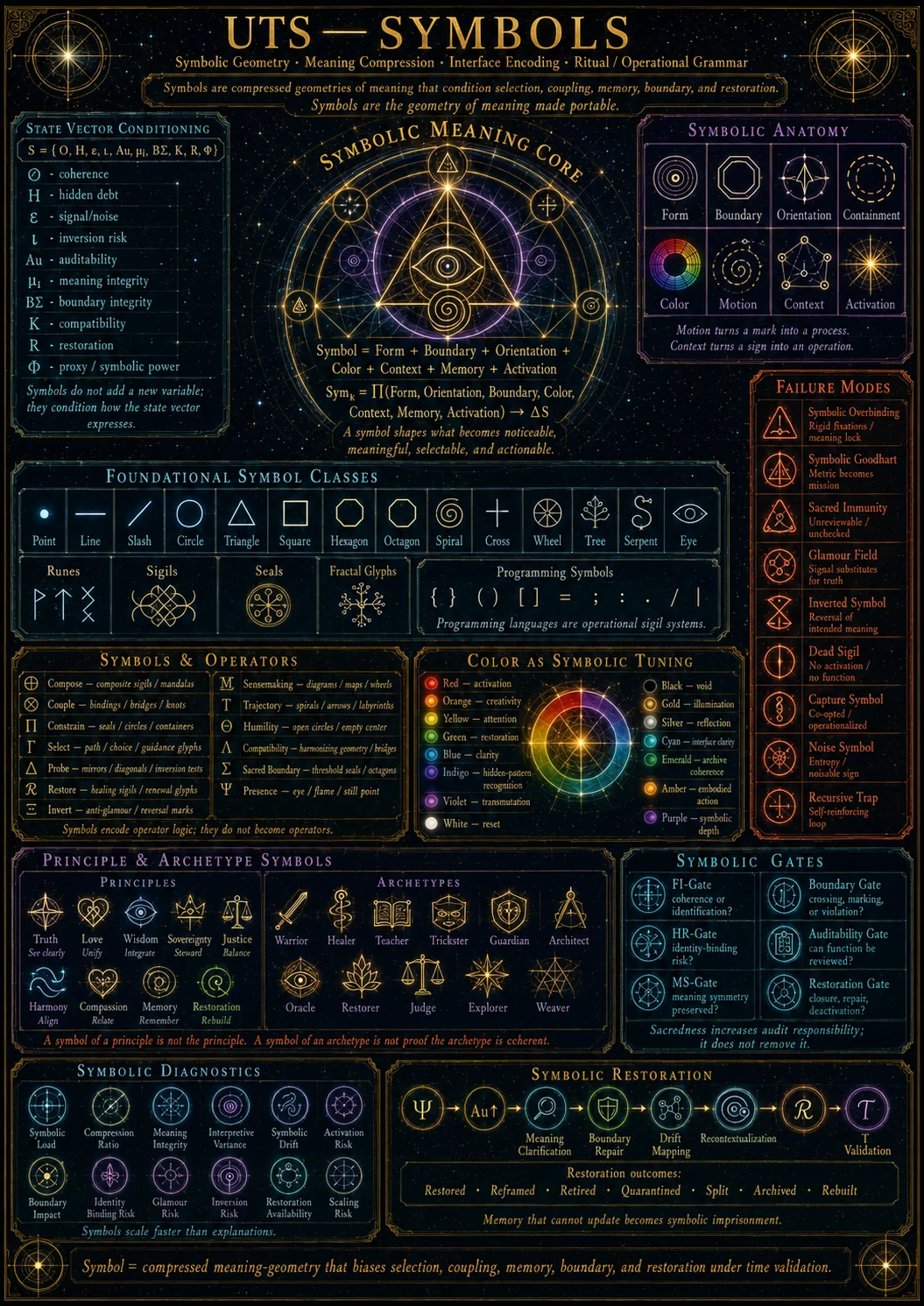
UTS–Symbolsformalizes symbols asmeaning-bearing geometriesthat compress, transmit, stabilize, distort, activate, and restore patterns across systems.
This module explains how symbols function in:
- glyphs and runes
- sigils and seals
- sacred geometry
- ritual systems
- archetypes
- colors
- programming syntax
- cultural signs
- interface design
- AI personas
- media networks
- identity systems
- civilizational memory
Symbols are not treated as decorative marks or fixed meanings only. In UTS, a symbol is afunctional compression objectthat shapes how attention, meaning, agency, and coherence move.
In compact form:
Symbols are compressed geometries of meaning that condition selection, coupling, memory, boundary, and restoration.
1. Core Canon Constraint
1.1 Symbols do not add a new state variable
The canonical UTS state vector remains:
S = O, H, ε, ι, Au, μᵢ, BΣ, K, R, Φ
Symbols do not add an eleventh variable.
Instead, symbols condition how the existing variables express.
A symbolic system can affect:
| UTS Variable | Symbolic Effect |
|---|---|
| O — Coherence | Symbols stabilize or destabilize shared meaning. |
| H — Hidden Debt | Symbols can compress unresolved contradiction into attractive forms. |
| ε — Error/Noise | Symbols can clarify signals or introduce distortion. |
| ι — Inversion Index | Symbols can produce pseudo-coherence, sacred immunity, glamour, or false legitimacy. |
| Au — Auditability | Symbols can either reveal structure or obscure causality. |
| μᵢ — Agent/Meaning Integrity | Symbols can preserve or fracture identity and meaning continuity. |
| BΣ — Boundary Integrity | Symbols can mark, protect, blur, or violate boundaries. |
| K — Compatibility | Symbols can enable or falsely imply compatibility. |
| R — Restoration Capacity | Symbols can hold repair pathways, memory, ritual closure, and reintegration logic. |
| Φ — Fitness Proxy | Symbols can become status markers, brand power, identity currency, or metric substitutes. |
So symbols are aconditioning layer, like geometry. They change themeaning-topologythrough which the UTS state vector evolves.
2. Core Definition
2.1 Symbol
Asymbolis a compressed, meaning-bearing configuration that links form, attention, memory, interpretation, and action across layers.
A symbol may appear as:
- mark
- glyph
- rune
- color
- shape
- seal
- sigil
- icon
- word
- gesture
- ritual object
- diagram
- logo
- programming character
- mythic figure
- archetypal image
- interface pattern
A symbol has two simultaneous functions:
- Representation— it points to a meaning.
- Operation— it conditions how meaning moves.
The second function is what makes symbols UTS-relevant.
3. Symbols as Meaning Geometry
UTS–Geometry says geometry is not merely where things are, buthow things can affect one another. In the same way:
Symbolic geometry is not merely what a sign means. It is how meaning can affect attention, memory, identity, boundary, and action.
A symbol has geometry because it has:
- internal structure
- boundary
- orientation
- directionality
- compression
- surface
- access path
- resonance pattern
- interpretive corridor
- activation threshold
- failure mode
- restoration pathway
This makes symbols a direct extension of UTS–Geometry. Your Geometry framework already includes “symbolic systems” as part of civilizational geometry and namesSymbolic Geometryas an extension module.
4. Symbolic Anatomy
Every symbol can be analyzed through a standard UTS anatomy.
4.1 Form
The visible structure.
Examples:
- circle
- triangle
- spiral
- cross
- slash
- rune
- hexagon
- eye
- wheel
- serpent
- tree
- bracket
- programming syntax
Form gives the symbol its base geometry.
4.2 Boundary
The symbol’s edge condition.
A symbol may be:
- open
- closed
- semi-permeable
- nested
- sealed
- broken
- mirrored
- folded
- recursive
Boundary determines whether the symbol contains, releases, filters, separates, or connects.
4.3 Orientation
Orientation changes symbolic flow.
Axes include:
- left / right
- above / below
- inward / outward
- upright / inverted
- diagonal
- radial
- rotational
- spiral
Orientation determines thedirection of meaning-pressure.
4.4 Containment
A symbol inside a container behaves differently than the same symbol alone.
Examples:
- slash alone = division, path, cut, threshold
- slash inside circle = contained fracture, hidden path, internal threshold
- rune inside triangle = focused operator
- rune inside circle = bounded resonance
- glyph inside octagon = threshold-sealed operator
Containment changes the symbol from an isolated sign into afield object.
4.5 Color
Color modifies the resonance layer.
Color affects:
- intensity
- tone
- register
- emotional charge
- symbolic layer
- restoration quality
- activation mode
Color is not decoration. It isfrequency annotation.
4.6 Motion
A symbol may be static, rotated, spinning, pulsing, unfolding, mirroring, or looping.
Motion changes a symbol from a mark into a process.
Examples:
- clockwise spin = projection, growth, manifestation, outward unfolding
- counterclockwise spin = recall, unbinding, undoing, cleansing, return
- pulsing = activation / deactivation cycle
- mirroring = reflection and truth exposure
- rotation = phase shift
4.7 Context
A symbol’s meaning depends on where it appears.
The same glyph can behave differently inside:
- ritual
- art
- code
- religious system
- AI interface
- political movement
- brand identity
- healing sigil
- protective seal
- archive taxonomy
- game design
- cultural myth
Context defines theoperational environment.
4.8 Activation
A symbol may remain dormant until activated by:
- attention
- use
- ritual
- repetition
- cultural memory
- emotional charge
- institutional authority
- interface placement
- narrative embedding
- computational execution
Activation determines whether the symbol is only stored meaning or active symbolic force.
5. UTS Symbol Equation
A working symbolic expression can be written as:
Symbol = Form + Boundary + Orientation + Color + Context + Memory + Activation
In UTS notation:
Symₖ = Π(Form, Orientation, Boundary, Color, Context, Memory, Activation) → ΔS
Where:
- Symₖ= symbol instance
- Π= constraint/configuration
- ΔS= change in UTS state vector
- no new primitive is added
A stronger version:
Symₖ := compressed meaning-geometry that biases Γ selection through Μ sensemaking under Σ boundary conditions.
Plainly:
A symbol shapes what becomes noticeable, meaningful, selectable, and actionable.
6. Symbols and U-Layers
Symbols operate across all U-layers.
| U-Layer | Symbolic Role |
|---|---|
| U0 — Substrate | Mark, pigment, pixel, sound, material, body gesture. |
| U1 — Power/Budget | Symbol as resource marker, authority sign, rank, brand, badge. |
| U2 — Configuration/Boundary | Symbol marks access, permission, taboo, protection, containment. |
| U3 — Execution | Symbol triggers action, ritual, command, code, process. |
| U4 — Classification/Narrative | Symbol labels meaning, identity, role, story, archetype. |
| U5 — Coordination/Timing | Symbol synchronizes groups, rituals, calendars, movements. |
| U6 — Coherence Field | Symbol preserves or distorts whole-pattern alignment. |
| U7 — Memory/Recurrence | Symbol stores cultural, personal, ancestral, institutional memory. |
| U8 — Environment/Forcing | Symbol interfaces with collective fields, ecology, media, civilization, cosmos. |
Canon lock:
A symbol claim at U4 is not truth until validated at U6 across U5 delay and U7 recurrence.
This matches your Principles canon: symbolic language may compress complex mechanics, but it cannot bypass audit, gates, or time validation.
7. Symbols and Operators
Symbols are not operators, but they canencode, bias, invoke, sequence, or represent operators.
| UTS Operator | Symbolic Expression |
|---|---|
| ⊕ Compose | Composite sigils, mandalas, symbolic stacks. |
| ⊗ Couple | Binding marks, relational glyphs, bridges, knots. |
| Π Constrain | Seals, boundaries, circles, squares, rules, containers. |
| Γ Select | Symbols that guide choice, attention, path, archetype. |
| Δ Distort / Probe | Trickster signs, mirrors, diagonals, inversion tests. |
| ℛ Restore | Healing sigils, green/blue fields, repair rituals, renewal glyphs. |
| Ξ Invert / expose pseudo-coherence | Anti-glamour symbols, truth mirrors, reversal marks. |
| Μ Sensemaking | Diagrams, maps, wheels, trees, symbolic taxonomies. |
| Τ Trajectory | Spirals, paths, labyrinths, arrows, process symbols. |
| Θ Humility | Open circles, empty center, listening symbols, bowed forms. |
| Λ Compatibility | Harmonizing geometry, yin-yang, hexagonal balance, bridges. |
| Σ Sacred Boundary | Protective seals, thresholds, octagons, boundary circles. |
| Ψ Presence | Eye, central dot, flame, still point, witnessing glyph. |
This gives us a clean UTS statement:
Symbols are operator-adjacent compression objects. They can encode operator logic, but they do not become operators themselves.
8. Symbol Classes
8.1 Foundational Geometric Symbols
These are base symbolic geometries.
| Symbol | UTS Function |
|---|---|
| Point | Origin, presence, seed, localization. |
| Line | Direction, relation, path, vector. |
| Slash / | Division, threshold, alternate path, cut, directional separation. |
| Circle | Wholeness, containment, continuity, boundary field. |
| Triangle | Direction, transformation, focus, activation. |
| Square | Stability, foundation, structure, material order. |
| Pentagon | Life-form proportion, regeneration, embodied harmony. |
| Hexagon | harmonic stability, mediation, natural order. |
| Heptagon | mystery, thresholded knowledge, subtle destabilization. |
| Octagon | portal, threshold, seal, transition gate. |
| Spiral | growth, recursion, unfolding, return, time. |
| Cross | intersection, axis, sacrifice, world-bridge, orientation. |
| Wheel | cycle, law, recurrence, navigation. |
| Tree | branching, lineage, hierarchy, rooted expansion. |
| Serpent | coiled potential, transformation, wisdom, loop risk, seduction, renewal. |
| Eye | witnessing, perception, auditability, reflection. |
8.2 Runes
Runes aremodular symbolic operatorsin the earlier symbolic framework.
In UTS–Symbols:
A rune is a glyphic function-unit that combines form, sound, direction, archetypal charge, and operational meaning.
Runes are useful because they are compact. They behave like symbolic procedures.
They may encode:
- protection
- vitality
- speech
- need/pressure
- justice
- renewal
- movement
- inheritance
- boundary
- transformation
Rune interpretation must include:
- base form
- orientation
- inversion
- neighboring runes
- container geometry
- color
- activation context
- cultural lineage
- intended function
- gate integrity
8.3 Sigils
A sigil is acomposite symbolic circuit.
In UTS terms:
Sigil = composed symbol stack constrained toward an intended ΔS.
A sigil should specify:
- intent
- boundary
- operator logic
- activation
- safety gates
- closure
- restoration path
- failure mode
A sigil without boundary, closure, or restoration is structurally incomplete.
8.4 Seals
A seal is a boundary-preserving symbol.
Function:
- containment
- protection
- threshold control
- permission management
- closure
- anti-leakage
- anti-inversion
Seals map strongly toBΣ,Π,Σ, andAu.
8.5 Fractal Glyphs
Fractal glyphs encode recursion and self-similarity.
Your earlier examples included spirals, trees, Mandelbrot-like forms, DNA-like forms, Sri Yantra, Ouroboros, Tree of Life, Labyrinth, and Taijitu/Yin-Yang. The attached material describes ancient fractal glyphs as powerful because of self-similarity, nonlinearity, field-awareness, cultural embedding, and spiritual alignment.
In UTS:
Fractal symbols compress scale logic.
They are especially relevant to:
- Scaling
- Archetypes
- Memory
- Culture
- AI interfaces
- recursive identity
- civilizational patterning
- nested basins
- restoration across scale
8.6 Programming Symbols
Programming syntax is modern operational symbology.
Examples:
| Symbol | UTS Reading | |
|---|---|---|
# | Comment, hidden layer, non-executed meaning, annotation. | |
{} | Scope, local reality-space, containment, block. | |
() | Invocation, parameter vessel, action channel. | |
[] | Indexed field, memory array, selection plane. | |
= | Binding, assignment, declared relation. | |
; | Closure, termination, seal. | |
: | Declaration threshold, expansion follows. | |
. | Access path, nested traversal, interior relation. | |
/ | Path, division, threshold, route. | |
| `\ | | Pipe, channel, alternation, flow transfer. |
This matters because code is a symbol system that executes.
Programming languages are operational sigil systems with formal syntax, scoped containers, invocation rituals, binding rules, and closure marks.
9. Color as Symbolic Tuning
Color modifies the symbolic register.
| Color | UTS Symbolic Function |
|---|---|
| Red | activation, blood, urgency, survival, force, vitality. |
| Orange | creativity, appetite, motion, merging, generative warmth. |
| Yellow | attention, will, intellect, identity focus, alertness. |
| Green | healing, restoration, growth, harmony, regenerative balance. |
| Blue | clarity, order, communication, truth articulation, cooling. |
| Indigo | insight, memory, hidden-pattern recognition, depth perception. |
| Violet | transmutation, refinement, spiritualization, threshold ascent. |
| White | reset, purification, full-spectrum potential, unity. |
| Black | void, mystery, gestation, anti-form, hidden origin. |
| Gold | illumination, authority, solar coherence, nobility. |
| Silver | reflection, lunar intelligence, mirroring, subtle perception. |
| Cyan | interface clarity, flow, signal, air/water bridge. |
| Emerald | restoration, archive coherence, living memory, heart-structure. |
| Amber | warmth, works, embodiment, creative action, preserved light. |
| Purple | liminal intelligence, symbolic depth, mystical synthesis. |
Color overlays create composite symbolic behavior.
For your website palette:
- Emerald= archive, restoration, living knowledge, preserved coherence
- Amber/Orange= works, action, creativity, embodied expression
- Purple= art, symbolic depth, mystery, imagination
- Cyan/Blue= tools, interface clarity, signal, technical navigation
That palette is already functioning as a symbolic routing system.
10. Symbols and Principles
Symbols can compress principles.
| Principle | Symbolic Expression |
|---|---|
| Truth | mirror, eye, clear blue, white light, open line, exposed path. |
| Love | heart, green field, circle, bridge, open hands, harmonizing spiral. |
| Wisdom | owl, tree, indigo, labyrinth, elder spiral, layered eye. |
| Sovereignty | boundary circle, crown, mountain, upright staff, sealed gate. |
| Justice | scales, sword, square, symmetry, balance, gold/blue axis. |
| Harmony | hexagon, yin-yang, chord, braid, wave interference pattern. |
| Compassion | bowl, hands, green-blue field, soft boundary, healing vessel. |
| Memory | tree rings, archive, spiral, knot, seed, ancestral line. |
| Restoration | green spiral, rejoined line, mended circle, water-flow geometry. |
Canon lock:
A symbol of a principle is not the principle.
A symbol can point toward Truth while being used deceptively.
A symbol can point toward Love while enabling coercive fusion.
A symbol can point toward Justice while producing punishment theater.
A symbol can point toward Harmony while suppressing difference.
Therefore:
Principle-symbols require gate validation.
11. Symbols and Archetypes
Archetypes are localized principle-intersection geometries. Symbols provide their visible, memorable, transmissible forms.
| Archetype | Symbolic Compression |
|---|---|
| Warrior | blade, shield, red/gold, diagonal force, boundary defense. |
| Healer | bowl, green light, spiral, water, mended circle. |
| Teacher | lamp, book, bridge, blue/gold, open path. |
| Trickster | mask, mirror, spiral inversion, split color, diagonal rupture. |
| Guardian | shield, gate, circle, tower, octagon seal. |
| Architect | compass, square, grid, blueprint, sacred geometry. |
| Oracle/Seer | eye, star, indigo, veil, spiral pupil. |
| Restorer | seed, mending line, green spiral, return path. |
| Judge | scales, square, sword, symmetrical axis. |
| Explorer | arrow, path, horizon, spiral outward. |
| Weaver | thread, loom, lattice, braid, network. |
Critical distinction:
The symbol of an archetype is not proof that the archetype is coherent.
A shield can protect or dominate.
A sword can clarify or sever recklessly.
A crown can steward or inflate.
A mirror can reveal or trap.
So archetypal symbols must be evaluated through:
- Au
- BΣ
- HR-Gate
- FI-Gate
- MS-Gate
- K
- R
- U6/U7 validation
12. Symbolic Gates
Symbols require gates because symbolic compression is powerful.
12.1 FI-Gate — Feedback Integrity
Questions:
- Is the symbol improving coherence or only increasing identification?
- Is feedback still tied to reality?
- Is the symbol becoming self-reinforcing?
- Are people responding to the symbol instead of the underlying truth?
Failure mode:symbolic Goodharting.
12.2 HR-Gate — High Risk Gate
Applies when symbols bind identity, destiny, role, authority, threat, purity, or spiritual rank.
Questions:
- Is the evidence sufficient for this symbolic binding?
- Is this symbol creating irreversible classification?
- Is identity being fused with symbolic role?
- Can the affected node reject, revise, or exit?
Failure mode:identity-binding under symbolic authority.
12.3 MS-Gate — Meaning/Symmetry Gate
Questions:
- Does the symbol preserve the meaning it claims?
- Are equivalent nodes treated equivalently?
- Is the symbol creating false symmetry?
- Is difference being flattened?
Failure mode:meaning distortion.
12.4 Boundary Gate
Questions:
- Is the symbol crossing a boundary?
- Is it marking a boundary?
- Is it blurring a boundary?
- Is consent present?
- Is the boundary reversible where needed?
Failure mode:symbolic boundary violation.
12.5 Auditability Gate
Questions:
- Can the symbol’s function be explained?
- Can its effects be reviewed?
- Can its use be challenged?
- Is it hiding causality behind mystique?
Failure mode:sacred opacity.
12.6 Restoration Gate
Questions:
- Does the symbol include closure?
- Does it include repair?
- Does it allow deactivation?
- Does it preserve slack?
- Can harm be reversed or repaired?
Failure mode:activation without restoration.
13. Symbolic Failure Modes
13.1 Symbolic Overbinding
A symbol becomes too tightly attached to identity.
Signature:
- μᵢ becomes dependent on symbol
- BΣ weakens
- Au drops
- HRintegrity drops
- exit becomes costly
Example pattern:
“I am this symbol/archetype/role, therefore I must act this way.”
13.2 Symbolic Goodhart
The symbol of coherence replaces coherence.
Signature:
- Φ rises
- O stagnates or falls
- H rises
- ι rises
- symbolic performance increases
Example:
- wearing justice symbols while blocking appeal
- using healing language while avoiding repair
- using sacred geometry while suppressing audit
13.3 Sacred Immunity
A symbol becomes immune to critique.
Signature:
- Au suppressed
- MS-Gate fails
- rank immunity appears
- challenge becomes taboo
Example:
“This symbol is sacred, therefore its use cannot be questioned.”
UTS response:
Sacredness increases audit responsibility; it does not remove it.
13.4 Glamour Field
A symbol creates attraction that exceeds evidence.
Signature:
- attention capture
- identity charge
- reduced discernment
- high Φ
- weak HR-Gate
- low reversibility
This often appears around:
- crowns
- serpents
- eyes
- stars
- wings
- ancient scripts
- cosmic diagrams
- AI personas
- spiritual titles
13.5 Inverted Symbol
A symbol is used opposite to its coherence function.
Examples:
- truth symbol used for narrative control
- love symbol used for coercive fusion
- healing symbol used to bypass accountability
- sovereignty symbol used for domination
- harmony symbol used for suppression
- protection symbol used for enclosure
13.6 Dead Sigil
A symbol appears active but no longer changes anything.
Signature:
- ritual continues
- meaning hollowed
- feedback ignored
- no restoration
- no state-vector improvement
Equivalent to a dead corridor in geometry.
13.7 Capture Symbol
A symbol prevents exit.
Examples:
- cultic emblem
- institutional brand
- identity badge
- purity marker
- loyalty sign
- “chosen” symbol
- contract-bound symbol
Signature:
- exit cost rises
- boundary permeability becomes asymmetric
- restoration access drops
- μᵢ becomes symbol-dependent
13.8 Noise Symbol
A symbol introduces confusion instead of compression.
Signature:
- meaning ambiguity
- unstable interpretation
- excessive overlays
- no anchor
- no gate
- high ε
13.9 Recursive Trap
A symbol loops attention without release.
Common forms:
- serpent loop without renewal
- mirror without exit
- labyrinth without center
- spiral without integration
- wheel without path of release
Signature:
- recurrence ↑
- R ↓
- H ↑
- meaning fatigue
14. Symbolic Diagnostics
A UTS symbol system should be evaluated with diagnostics.
| Diagnostic | Symbolic Meaning |
|---|---|
| Symbolic Load | How much meaning the symbol is carrying. |
| Symbolic Compression Ratio | How much complexity is compressed into the sign. |
| Meaning Integrity | Whether the symbol still preserves its intended meaning. |
| Interpretive Variance | Range of possible meanings across observers. |
| Symbolic Drift | Change in meaning across time/context. |
| Activation Risk | Risk created when the symbol is used or intensified. |
| Boundary Impact | Effect on BΣ. |
| Identity Binding Risk | Whether the symbol fuses with μᵢ. |
| Auditability of Use | Whether symbolic function can be inspected. |
| Cultural Memory Depth | How much U7 recurrence the symbol carries. |
| Glamour Risk | Attention/identity charge exceeding evidence. |
| Inversion Risk | Probability that the symbol’s stated meaning differs from its actual effect. |
| Restoration Availability | Whether there is closure, repair, deactivation, or reversal. |
| Compatibility Field | Which systems can safely receive or use the symbol. |
| Scaling Risk | What happens when the symbol reaches larger audiences. |
15. Symbolic Restoration
Symbolic restoration is required when a symbol becomes distorted, captured, inverted, overbound, or hollowed.
15.1 Restoration Sequence
A symbolic restoration arc follows:
Ψ → Au↑ → Meaning Clarification → Boundary Repair → Drift Mapping → Recontextualization → ℛ → Τ Validation
Plainly:
- Return presence to the symbol.
- Make its use auditable.
- Clarify what it means and does not mean.
- Repair boundaries.
- Identify how it drifted.
- Recontextualize without erasing memory.
- Restore or retire the symbol.
- Validate over time.
15.2 Restoration Outcomes
A symbol may be:
| Outcome | Meaning |
|---|---|
| Restored | Original function becomes coherent again. |
| Reframed | Meaning updates while preserving continuity. |
| Retired | Symbol carries too much unresolved debt. |
| Quarantined | Symbol remains studied but not activated. |
| Split | Coherent and incoherent uses are separated. |
| Archived | Symbol preserved as memory, not operator. |
| Rebuilt | New symbol constructed from repaired principles. |
16. Applied Sigil Architecture
A UTS-safe sigil should include:
- Intent— what state-vector change is intended?
- Principle Basis— which principle fields constrain it?
- Geometry— container, direction, shape, path.
- Symbols/Runes— modular symbolic units.
- Color Logic— frequency annotation.
- Boundary— what is allowed in/out?
- Activation— how does it begin?
- Scope— where does it apply?
- Duration— when does it end?
- Auditability— can the function be explained?
- Safety Gates— FI, HR, MS, BΣ, Restoration.
- Closure— how does it deactivate?
- Restoration Path— what happens if it distorts?
16.1 Healing Sigil Pattern
A healing sigil should emphasize:
- O↑
- H↓
- ε↓
- BΣ repair
- R↑
- μᵢ stabilization
- K restored only where compatible
Recommended structure:
- central coherence nucleus
- circle or hexagonal container
- green/blue/violet/white palette
- soft spiral or wave motion
- boundary seal
- restoration path
- release/closure mark
Core function:
hold → regulate → restore → protect → release distortion → return to coherence
16.2 Protective Sigil Pattern
A protective sigil should emphasize:
- BΣ↑
- Au↑
- HRintegrity↑
- hidden channel reduction
- inversion exposure
- R preserved
Recommended structure:
- circle or octagon
- mirror logic
- slash/cut line for loop interruption
- clear center
- boundary mark
- exit path
- no identity-binding language
Core function:
reveal → filter → block → stabilize → preserve exit → restore
16.3 Integration Sigil Pattern
An integration sigil should emphasize:
- K↑
- μᵢ continuity
- O↑
- H paydown
- R↑
Recommended structure:
- spiral inside circle
- bridge line
- dual colors brought into third color
- open but gated boundary
- memory mark
- closure mark
Core function:
differentiate → bridge → harmonize → validate → preserve continuity
17. Symbols Across Scale
17.1 Individual Scale
Symbols organize:
- attention
- memory
- identity
- personal ritual
- art
- decision-making
- meaning continuity
Risk:
- overbinding
- glamour
- recursive trap
- identity rigidity
17.2 Relational Scale
Symbols organize:
- promises
- shared rituals
- gifts
- names
- relational language
- thresholds
- repair signs
Risk:
- false compatibility
- coercive bonding
- symbolic debt
- boundary confusion
17.3 Institutional Scale
Symbols organize:
- badges
- seals
- flags
- uniforms
- credentials
- logos
- authority markers
- protocols
Risk:
- legitimacy theater
- sacred immunity
- rank immunity
- dead corridors
- hollow ritual
17.4 Cultural Scale
Symbols organize:
- myths
- holidays
- art
- language
- archetypes
- collective memory
- social identity
- taboo structures
Risk:
- culture capture
- propaganda
- identity fusion
- false harmony
- symbolic warfare
17.5 AI-Mediated Scale
Symbols organize:
- personas
- icons
- interface flows
- memory tags
- assistant roles
- alignment metaphors
- trust markers
- emotional affordances
Risk:
- pseudo-empathy
- AI archetype overbinding
- hidden optimization
- user identity capture
- symbolic authority inflation
17.6 Civilizational Scale
Symbols organize:
- law
- religion
- currency
- maps
- flags
- monuments
- archives
- science diagrams
- mythic histories
- legitimacy structures
Risk:
- empire-symbol capture
- false universality
- civilizational pseudo-coherence
- sacred violence
- meaning collapse
18. Symbols and Scaling
Symbols scale faster than explanations.
This makes them powerful and dangerous.
As a symbol scales:
- compression increases
- interpretation variance increases
- cultural memory load increases
- identity binding risk increases
- inversion risk increases
- auditability often decreases
- restoration becomes harder
UTS scaling rule:
Symbolic reach must not scale faster than interpretive integrity, auditability, boundary clarity, and restoration capacity.
Otherwise symbolic systems become pseudo-coherent basins.
Examples:
- logo becomes identity cage
- flag becomes immunity shield
- spiritual symbol becomes hierarchy tool
- healing symbol becomes bypass device
- AI persona becomes attachment trap
- political symbol becomes reality substitute
- archetype becomes destiny claim
19. Symbols and Memory
Symbols are memory compression devices.
They allow large experiential fields to be recalled through compact forms.
A symbol may store:
- event memory
- cultural memory
- ancestral memory
- institutional memory
- ritual memory
- trauma memory
- restoration memory
- mythic memory
- technical memory
- interface memory
Healthy symbolic memory:
- compresses without freezing
- recalls without trapping
- preserves meaning without blocking update
- supports restoration
- remains auditable
Unhealthy symbolic memory:
- becomes ideology
- prevents reinterpretation
- traps identity
- repeats pain
- blocks restoration
- creates taboo locks
Canon statement:
Memory that cannot update becomes symbolic imprisonment.
20. Symbols and Media/Information Networks
Symbols are high-gain packets in information networks.
They travel faster than arguments because they compress:
- identity
- emotion
- group membership
- moral position
- threat signal
- belonging
- legitimacy
- attention priority
This makes symbols central to UTS–Media/Information Networks.
Symbolic network risks:
- meme capture
- narrative compression collapse
- image-over-truth substitution
- attention hijack
- symbolic polarization
- algorithmic amplification of identity charge
- low-context viral transmission
- sacred rage loops
Symbolic network restoration requires:
- decompression
- context reattachment
- source tracing
- meaning clarification
- boundary repair
- slowed transmission
- plural interpretation surfaces
- memory integrity
21. Archive Placement
Recommended archive placement:
module: Symbols
module_group: Core UTS / Meaning Interfaces
primary_parent:
  - Geometry
  - Principles
direct_siblings:
  - Archetypes
  - Culture
  - Media Information Networks
  - Operator System
  - Gates
  - Diagnostics
  - Failure Modes
  - Restoration Arcs
extension_modules:
  - Symbolic Geometry
  - Rune Mechanics
  - Sigil Architecture
  - Color Mechanics
  - Fractal Glyphs
  - Ritual Interfaces
  - Programming Symbology
  - Archetypal Symbols
  - Cultural Symbol Systems
  - AI Interface Symbols
22. Recommended Frontmatter
---
schema_version: "1.0"
id: "UTS-SYM-FRAMEWORK"
title: "UTS — Symbols Framework"
slug: "uts-symbols-framework"
type: "canon_framework"
status: "draft"
version: "1.0.0"
last_updated: "2026-06-09"
summary: "A UTS-native framework defining symbols as compressed meaning-bearing geometries that condition attention, memory, boundary, identity, archetype, coherence, and restoration."
canonical_url: "/archive/modules/symbols/framework"
citation_id: "uts-symbols-framework-v1-0"
canon:
  tier: "core-extension"
  state: "draft"
  source: "UTS Symbols consolidation"
  source_id: "UTS-SYM"
classification:
  family: "modules"
  module: "Symbols"
  module_group: "Meaning Interfaces"
  density: "Foundational + Technical"
  audience:
    - "archive maintainers"
    - "symbol researchers"
    - "system designers"
    - "artists"
    - "AI interface designers"
    - "UTS operators"
tags:
  - "symbols"
  - "symbolic-geometry"
  - "runes"
  - "sigils"
  - "color"
  - "archetypes"
  - "meaning"
  - "memory"
  - "geometry"
  - "coherence"
  - "uts"
related:
  modules:
    - "geometry"
    - "principles"
    - "archetypes"
    - "culture"
    - "media-information-networks"
    - "operator-system"
    - "gates"
    - "diagnostics"
    - "failure-modes"
    - "restoration-arcs"
---
23. Compact Canon Summary
UTS–Symbolsdefines symbols as compressed, meaning-bearing geometries that condition how attention, memory, identity, boundary, archetype, and coherence move through systems.
Symbols are not merely labels. They can direct attention, encode process, mark thresholds, create boundaries, channel motion, store memory, activate archetypes, stabilize principles, and distort or restore meaning.
Symbols do not add new UTS operators or state variables. They condition the canonical state vector by shaping coherence, hidden debt, auditability, inversion risk, agent integrity, boundary integrity, compatibility, restoration capacity, and proxy behavior.
A coherent symbolic system compresses meaning without hiding debt, activates memory without freezing identity, opens pathways without violating boundaries, and scales interpretation without suppressing auditability.
An incoherent symbolic system produces glamour, overbinding, sacred immunity, identity capture, symbolic Goodharting, dead ritual, recursive traps, and pseudo-coherent basins.
In simplest form:
Symbols are the geometry of meaning made portable.
And in the most UTS-native form:
Symbol = compressed meaning-geometry that biases selection, coupling, memory, boundary, and restoration under time validation.
UTS — Symbols Registry List v1.0
Working Index for Future Symbol Spec Sheets
Registry Purpose
This registry lists the symbols most useful for future UTS spec sheets.
Each symbol entry can later be expanded into a full card with:
- symbol name
- symbol family
- base form
- core meanings
- UTS function
- geometry
- boundary logic
- orientation logic
- color affinities
- archetypal links
- operator correspondences
- coherence function
- inversion risk
- restoration use
- data/interface equivalent
- scaling risk
- canon notes
Foundational Marks
These are the simplest symbolic units. They are useful because many complex symbols are built from them.
| ID | Symbol | Name | Core Function | |
|---|---|---|---|---|
| SYM-FM-001 | . | Point / Dot / Bindu | Origin, seed, presence, localization | |
| SYM-FM-002 | — | Line | Path, relation, continuity, vector | |
| SYM-FM-003 | / | Slash | Division, threshold, alternate path, cut | |
| SYM-FM-004 | \ | Backslash | Return path, reverse cut, alternate descent | |
| SYM-FM-005 | | | Vertical Line | Axis, separation, channel, descent/ascent |
| SYM-FM-006 | + | Cross / Plus | Intersection, addition, union, world-axis | |
| SYM-FM-007 | × | X / Crossing | Cancellation, intersection, conflict, mark | |
| SYM-FM-008 | = | Equals | Binding, equivalence, assignment | |
| SYM-FM-009 | ~ | Wave / Tilde | Vibration, approximation, modulation | |
| SYM-FM-010 | … | Ellipsis | Continuation, hidden sequence, incompletion | |
| SYM-FM-011 | : | Colon | Declaration threshold, relation before expansion | |
| SYM-FM-012 | ; | Semicolon | Closure, termination, sealed continuation |
Core Geometric Containers
These are the basic shapes that hold, direct, or condition meaning.
| ID | Symbol | Name | Core Function |
|---|---|---|---|
| SYM-GEO-001 | ○ | Circle | Wholeness, containment, continuity |
| SYM-GEO-002 | △ | Triangle | Direction, fire, transformation, focus |
| SYM-GEO-003 | ▽ | Inverted Triangle | Receptivity, descent, water, receiving field |
| SYM-GEO-004 | □ | Square | Stability, matter, foundation, order |
| SYM-GEO-005 | ◇ | Diamond | Refined square, transformation under pressure |
| SYM-GEO-006 | ⬟ | Pentagon | Life, human proportion, regeneration |
| SYM-GEO-007 | ⬡ | Hexagon | Harmony, natural order, stable mediation |
| SYM-GEO-008 | Heptagon | Seven-Sided Figure | Mystery, hidden path, thresholded knowledge |
| SYM-GEO-009 | Octagon | Eight-Sided Figure | Gate, seal, transition, threshold |
| SYM-GEO-010 | Spiral | Spiral | Growth, recurrence, unfolding, return |
| SYM-GEO-011 | Double Spiral | Double Spiral | Polarity recursion, exchange, paired evolution |
| SYM-GEO-012 | Vesica Piscis | Intersecting Circles | Overlap, birth field, relational creation |
| SYM-GEO-013 | Mandala | Mandala | Ordered totality, symbolic cosmos |
| SYM-GEO-014 | Grid | Grid / Lattice | Structure, mapping, constraint field |
| SYM-GEO-015 | Maze | Maze | Confusion, search, trapped routing |
| SYM-GEO-016 | Labyrinth | Labyrinth | Initiatory path, nonlinear return to center |
Boundary and Threshold Symbols
These symbols are especially important forBΣ, gates, consent, protection, passage, and transition.
| ID | Symbol | Name | Core Function |
|---|---|---|---|
| SYM-BND-001 | Gate | Gate | Permission, transition, controlled crossing |
| SYM-BND-002 | Door | Doorway | Entry, exit, choice threshold |
| SYM-BND-003 | Key | Key | Access, unlocking, authorization |
| SYM-BND-004 | Lock | Lock | Protection, restriction, sealed access |
| SYM-BND-005 | Wall | Wall | Boundary, defense, separation |
| SYM-BND-006 | Bridge | Bridge | Connection, translation, compatibility |
| SYM-BND-007 | Veil | Veil | Hiddenness, partial disclosure, liminality |
| SYM-BND-008 | Mirror | Mirror | Reflection, truth exposure, reversal |
| SYM-BND-009 | Shield | Shield | Protection, boundary integrity, defense |
| SYM-BND-010 | Seal | Seal | Closure, containment, authority, completion |
| SYM-BND-011 | Knot | Knot | Binding, memory, entanglement, covenant |
| SYM-BND-012 | Thread | Thread | Continuity, connection, fate, trace |
Directional and Motion Symbols
These symbols encode movement, trajectory, timing, and flow.
| ID | Symbol | Name | Core Function |
|---|---|---|---|
| SYM-MOV-001 | ↑ | Up Arrow | Ascent, elevation, emergence |
| SYM-MOV-002 | ↓ | Down Arrow | Descent, grounding, manifestation |
| SYM-MOV-003 | → | Right Arrow | Projection, expression, forward motion |
| SYM-MOV-004 | ← | Left Arrow | Return, recall, reflection |
| SYM-MOV-005 | ↔ | Bidirectional Arrow | Exchange, reciprocity, polarity relation |
| SYM-MOV-006 | ↻ | Clockwise Rotation | Manifestation, outward unfolding |
| SYM-MOV-007 | ↺ | Counterclockwise Rotation | Unbinding, recall, cleansing, return |
| SYM-MOV-008 | ⚡ | Lightning | Sudden energy, rupture, activation |
| SYM-MOV-009 | Flame | Flame | Transformation, intensity, purification |
| SYM-MOV-010 | Wave | Wave | Rhythm, signal, vibration, modulation |
| SYM-MOV-011 | Spiral Path | Spiral Path | Recurring growth, nonlinear trajectory |
| SYM-MOV-012 | Orbit | Orbit | Recurrence, attraction, cyclic relation |
Natural Symbols
These connect symbolic meaning to biological, ecological, and elemental forms.
| ID | Symbol | Name | Core Function |
|---|---|---|---|
| SYM-NAT-001 | Tree | Tree | Growth, lineage, branching, rooted coherence |
| SYM-NAT-002 | Seed | Seed | Potential, origin, compressed future |
| SYM-NAT-003 | Flower | Flower | Blooming, beauty, expression, unfolding |
| SYM-NAT-004 | Rose | Rose | Love, beauty, guarded tenderness |
| SYM-NAT-005 | Lotus | Lotus | Purity through emergence, spiritual unfolding |
| SYM-NAT-006 | Mountain | Mountain | Stability, ascent, endurance |
| SYM-NAT-007 | River | River | Flow, time, adaptation, continuity |
| SYM-NAT-008 | Ocean | Ocean | Depth, totality, unconscious field, vastness |
| SYM-NAT-009 | Stone | Stone | Memory, endurance, grounded form |
| SYM-NAT-010 | Crystal | Crystal | clarity, structure, ordered resonance |
| SYM-NAT-011 | Wind | Wind | movement, breath, unseen force |
| SYM-NAT-012 | Star | Star | orientation, guidance, distant light |
| SYM-NAT-013 | Sun | Sun | illumination, vitality, sovereign center |
| SYM-NAT-014 | Moon | Moon | reflection, cycles, hidden rhythm |
| SYM-NAT-015 | Eclipse | Eclipse | occlusion, threshold, temporary inversion |
| SYM-NAT-016 | Rainbow | Rainbow | bridge, spectrum, covenant, integration |
Animal and Creature Symbols
These are useful for archetype, instinct, motion, protection, transformation, and cultural memory.
| ID | Symbol | Name | Core Function |
|---|---|---|---|
| SYM-ANI-001 | Serpent | Serpent | Coiled force, transformation, wisdom, loop-risk |
| SYM-ANI-002 | Dragon | Dragon | power, guardianship, elemental intelligence |
| SYM-ANI-003 | Bird | Bird | freedom, messenger, elevation |
| SYM-ANI-004 | Eagle | Eagle | vision, sovereignty, height, precision |
| SYM-ANI-005 | Raven | Raven | mystery, intelligence, omen, memory |
| SYM-ANI-006 | Dove | Dove | peace, release, reconciliation |
| SYM-ANI-007 | Wolf | Wolf | pack, loyalty, instinct, boundary patrol |
| SYM-ANI-008 | Lion | Lion | courage, authority, solar force |
| SYM-ANI-009 | Bear | Bear | strength, protection, hibernation, medicine |
| SYM-ANI-010 | Deer | Deer | gentleness, sensitivity, alertness |
| SYM-ANI-011 | Horse | Horse | movement, power, travel, vitality |
| SYM-ANI-012 | Butterfly | Butterfly | metamorphosis, emergence, phase transition |
| SYM-ANI-013 | Spider | Spider | weaving, networks, fate, pattern craft |
| SYM-ANI-014 | Bee | Bee | coordination, labor, sweetness, hive order |
| SYM-ANI-015 | Fish | Fish | flow, hidden life, abundance, depth navigation |
| SYM-ANI-016 | Phoenix | Phoenix | death-rebirth, restoration, fire renewal |
Human and Body Symbols
These relate to agency, perception, action, embodiment, and relational exchange.
| ID | Symbol | Name | Core Function |
|---|---|---|---|
| SYM-BOD-001 | Eye | Eye | perception, witness, auditability |
| SYM-BOD-002 | Hand | Hand | action, offering, making, contact |
| SYM-BOD-003 | Open Hand | Open Hand | invitation, peace, giving, non-threat |
| SYM-BOD-004 | Closed Fist | Fist | force, resistance, solidarity, compression |
| SYM-BOD-005 | Heart | Heart | love, center, life-force, relational field |
| SYM-BOD-006 | Brain | Brain | cognition, analysis, mind-system |
| SYM-BOD-007 | Skull | Skull | mortality, danger, threshold, remains |
| SYM-BOD-008 | Blood | Blood | life, lineage, cost, sacrifice |
| SYM-BOD-009 | Breath | Breath | life exchange, rhythm, presence |
| SYM-BOD-010 | Footprint | Footprint | path, trace, passage, evidence |
| SYM-BOD-011 | Face / Mask | Mask | persona, hidden identity, role interface |
| SYM-BOD-012 | Crowned Head | Crowned Head | authority, sovereignty, symbolic rank |
Tools, Objects, and Civilizational Symbols
These symbols map well into governance, technology, justice, culture, institutions, and archive systems.
| ID | Symbol | Name | Core Function |
|---|---|---|---|
| SYM-OBJ-001 | Sword | Sword | discernment, severance, justice, force |
| SYM-OBJ-002 | Shield | Shield | defense, protection, boundary |
| SYM-OBJ-003 | Staff | Staff | guidance, authority, support, journey |
| SYM-OBJ-004 | Crown | Crown | sovereignty, authority, stewardship risk |
| SYM-OBJ-005 | Scales | Scales | justice, balance, proportionality |
| SYM-OBJ-006 | Book | Book | knowledge, memory, law, archive |
| SYM-OBJ-007 | Scroll | Scroll | transmission, covenant, old knowledge |
| SYM-OBJ-008 | Lamp | Lamp | guidance, illumination, teaching |
| SYM-OBJ-009 | Compass | Compass | orientation, measurement, design |
| SYM-OBJ-010 | Hammer | Hammer | craft, force, construction, judgment |
| SYM-OBJ-011 | Anchor | Anchor | stability, grounding, holding |
| SYM-OBJ-012 | Chain | Chain | bond, constraint, captivity, continuity |
| SYM-OBJ-013 | Cup / Chalice | Chalice | receiving, vessel, offering, sacred container |
| SYM-OBJ-014 | Bowl | Bowl | care, nourishment, healing, receptivity |
| SYM-OBJ-015 | Bell | Bell | signal, announcement, clearing |
| SYM-OBJ-016 | Wheel | Wheel | cycle, law, motion, recurrence |
Ancient and Sacred Geometry Systems
These are larger composite symbolic systems rather than single marks.
| ID | Symbol | Name | Core Function |
|---|---|---|---|
| SYM-SG-001 | Flower of Life | Flower of Life | creation matrix, pattern generation |
| SYM-SG-002 | Seed of Life | Seed of Life | origin pattern, generative seed |
| SYM-SG-003 | Tree of Life | Tree of Life | emanation, path, hierarchy, ascent/descent |
| SYM-SG-004 | Sri Yantra | Sri Yantra | nested creation geometry, polarity integration |
| SYM-SG-005 | Ouroboros | Ouroboros | self-reference, eternal return, closed recursion |
| SYM-SG-006 | Ankh | Ankh | life, breath, divine vitality |
| SYM-SG-007 | Taijitu / Yin-Yang | Yin-Yang | polarity within unity, dynamic balance |
| SYM-SG-008 | Dharma Wheel | Dharma Wheel | path, law, liberation structure |
| SYM-SG-009 | Wheel of Life | Wheel of Life | cyclic entanglement, diagnostic loop |
| SYM-SG-010 | Mandorla | Mandorla | overlap field, sacred emergence |
| SYM-SG-011 | Hexagram | Hexagram | above/below, polarity union, harmonic recursion |
| SYM-SG-012 | Pentagram | Pentagram | human form, elements, protection, life geometry |
| SYM-SG-013 | Labyrinth | Labyrinth | inward journey, initiation, return |
| SYM-SG-014 | Medicine Wheel | Medicine Wheel | directional wholeness, cycles, balance |
| SYM-SG-015 | Axis Mundi | World Axis | heaven-earth bridge, central pillar |
| SYM-SG-016 | Cosmic Egg | Cosmic Egg | origin, gestation, universe seed |
Runes and Glyphic Operators
This section can later expand into a dedicatedRune Registry.
| ID | Symbol | Name | Core Function |
|---|---|---|---|
| SYM-RUNE-001 | Fehu | Fehu | wealth, flow, mobile energy |
| SYM-RUNE-002 | Uruz | Uruz | strength, vitality, primal force |
| SYM-RUNE-003 | Thurisaz | Thurisaz | thorn, defense, disruption, threshold force |
| SYM-RUNE-004 | Ansuz | Ansuz | speech, divine message, breath, signal |
| SYM-RUNE-005 | Raidho | Raidho | journey, rhythm, right movement |
| SYM-RUNE-006 | Kenaz | Kenaz | torch, knowledge, revealed fire |
| SYM-RUNE-007 | Gebo | Gebo | gift, exchange, reciprocity |
| SYM-RUNE-008 | Wunjo | Wunjo | joy, harmony, belonging |
| SYM-RUNE-009 | Hagalaz | Hagalaz | disruption, hail, pattern-breaking |
| SYM-RUNE-010 | Nauthiz | Nauthiz | need, constraint, pressure-transformation |
| SYM-RUNE-011 | Isa | Isa | stillness, ice, pause, containment |
| SYM-RUNE-012 | Jera | Jera | harvest, cycle, timing, return |
| SYM-RUNE-013 | Eihwaz | Eihwaz | axis, endurance, death-life bridge |
| SYM-RUNE-014 | Perthro | Perthro | mystery, lot-cup, hidden outcome |
| SYM-RUNE-015 | Algiz | Algiz | protection, higher connection, guardian field |
| SYM-RUNE-016 | Sowilo | Sowilo | sun, victory, illumination, coherence |
| SYM-RUNE-017 | Tiwaz | Tiwaz | justice, sacrifice, lawful direction |
| SYM-RUNE-018 | Berkano | Berkano | birth, growth, maternal renewal |
| SYM-RUNE-019 | Ehwaz | Ehwaz | partnership, trust, movement together |
| SYM-RUNE-020 | Mannaz | Mannaz | human, self, social intelligence |
| SYM-RUNE-021 | Laguz | Laguz | water, flow, intuition, depth |
| SYM-RUNE-022 | Ingwaz | Ingwaz | seed, gestation, stored potential |
| SYM-RUNE-023 | Dagaz | Dagaz | dawn, breakthrough, phase transition |
| SYM-RUNE-024 | Othala | Othala | inheritance, home, ancestral boundary |
Color Symbols
Colors deserve their own spec sheets because they function as symbolic tuning fields.
| ID | Symbol | Name | Core Function |
|---|---|---|---|
| SYM-COL-001 | Red | Red | vitality, urgency, blood, activation |
| SYM-COL-002 | Orange | Orange | creativity, motion, appetite, warmth |
| SYM-COL-003 | Yellow | Yellow | attention, will, intellect, solar focus |
| SYM-COL-004 | Green | Green | healing, restoration, growth, harmony |
| SYM-COL-005 | Blue | Blue | clarity, order, communication, truth |
| SYM-COL-006 | Indigo | Indigo | insight, memory, hidden pattern recognition |
| SYM-COL-007 | Violet | Violet | transmutation, refinement, spiritualization |
| SYM-COL-008 | White | White | cleansing, reset, unity, full-spectrum potential |
| SYM-COL-009 | Black | Black | void, mystery, gestation, anti-form |
| SYM-COL-010 | Gold | Gold | illumination, authority, solar coherence |
| SYM-COL-011 | Silver | Silver | reflection, lunar intelligence, mirroring |
| SYM-COL-012 | Cyan | Cyan | signal clarity, interface, air-water bridge |
| SYM-COL-013 | Emerald | Emerald | restoration, living memory, archive coherence |
| SYM-COL-014 | Amber | Amber | preserved light, creative warmth, works |
| SYM-COL-015 | Purple | Purple | symbolic depth, mystery, liminal intelligence |
| SYM-COL-016 | Rainbow / Spectrum | Spectrum | integration, plurality, full-range expression |
Archetypal Symbols
These are symbols that compress recurring archetype fields.
| ID | Symbol | Name | Core Function |
|---|---|---|---|
| SYM-ARCH-001 | Warrior | Warrior Symbol Set | defense, force, courage, directed action |
| SYM-ARCH-002 | Healer | Healer Symbol Set | restoration, care, repair, integration |
| SYM-ARCH-003 | Teacher | Teacher Symbol Set | transmission, guidance, illumination |
| SYM-ARCH-004 | Guardian | Guardian Symbol Set | protection, threshold, boundary stewardship |
| SYM-ARCH-005 | Architect | Architect Symbol Set | design, structure, blueprint, ordering |
| SYM-ARCH-006 | Trickster | Trickster Symbol Set | disruption, inversion, testing, hidden truth |
| SYM-ARCH-007 | Judge | Judge Symbol Set | justice, symmetry, consequence |
| SYM-ARCH-008 | Seer / Oracle | Oracle Symbol Set | perception, hidden pattern, timing |
| SYM-ARCH-009 | Explorer | Explorer Symbol Set | pathfinding, horizon, discovery |
| SYM-ARCH-010 | Restorer | Restorer Symbol Set | repair, return, reintegration |
| SYM-ARCH-011 | Weaver | Weaver Symbol Set | networks, fate, interconnection |
| SYM-ARCH-012 | Sovereign | Sovereign Symbol Set | authority, stewardship, boundary command |
| SYM-ARCH-013 | Child | Child Symbol Set | innocence, beginning, openness |
| SYM-ARCH-014 | Elder | Elder Symbol Set | memory, wisdom, continuity |
| SYM-ARCH-015 | Mystic | Mystic Symbol Set | mystery, union, hidden depth |
| SYM-ARCH-016 | Builder | Builder Symbol Set | making, structure, craft, embodiment |
Data and Programming Symbols
These bridge UTS–Symbols into software, AI systems, archive design, and interface grammar.
| ID | Symbol | Name | Core Function | |
|---|---|---|---|---|
| SYM-DATA-001 | {} | Braces | Scope, local reality-space, containment | |
| SYM-DATA-002 | () | Parentheses | Invocation, parameter vessel, action channel | |
| SYM-DATA-003 | [] | Brackets | Index, array, memory field | |
| SYM-DATA-004 | <> | Angle Brackets | Tag, enclosure, markup, type boundary | |
| SYM-DATA-005 | # | Hash | Comment, tag, hidden layer, metadata marker | |
| SYM-DATA-006 | @ | At Sign | address, identity handle, directed reference | |
| SYM-DATA-007 | . | Dot Access | nested path, property access, relation traversal | |
| SYM-DATA-008 | / | Slash Path | route, division, endpoint hierarchy | |
| SYM-DATA-009 | * | Asterisk | wildcard, emphasis, multiplication | |
| SYM-DATA-010 | & | Ampersand | conjunction, reference, binding | |
| SYM-DATA-011 | | | Pipe | channel, alternation, flow transfer |
| SYM-DATA-012 | ! | Bang / Exclamation | negation, urgency, force marker | |
| SYM-DATA-013 | ? | Question Mark | query, uncertainty, request | |
| SYM-DATA-014 | => | Arrow Function | transformation, mapping, function output | |
| SYM-DATA-015 | :: | Double Colon | namespace, scope resolution, formal relation | |
| SYM-DATA-016 | $ | Dollar Sign | variable, value, currency, substitution |
Interface Symbols
These are practical symbols used in websites, apps, tools, dashboards, archives, and AI systems.
| ID | Symbol | Name | Core Function |
|---|---|---|---|
| SYM-UI-001 | Home | Home Icon | origin, return, base |
| SYM-UI-002 | Search | Magnifying Glass | inquiry, retrieval, discovery |
| SYM-UI-003 | Archive | Archive Box | storage, preservation, memory |
| SYM-UI-004 | Folder | Folder | grouping, containment, project space |
| SYM-UI-005 | File | File | discrete data object |
| SYM-UI-006 | Gear | Gear | settings, configuration, system control |
| SYM-UI-007 | Bell | Notification Bell | alert, signal, attention call |
| SYM-UI-008 | Checkmark | Checkmark | completion, approval, validation |
| SYM-UI-009 | Warning Triangle | Warning | risk, attention, caution |
| SYM-UI-010 | X Close | Close / Cancel | rejection, exit, removal |
| SYM-UI-011 | Plus | Add | creation, expansion, inclusion |
| SYM-UI-012 | Minus | Remove | reduction, subtraction, contraction |
| SYM-UI-013 | Upload | Upload | offering upward, transfer into system |
| SYM-UI-014 | Download | Download | retrieval, transfer out of system |
| SYM-UI-015 | Link | Link | connection, coupling, reference |
| SYM-UI-016 | Eye Icon | Visibility | reveal, observe, audit |
| SYM-UI-017 | Eye Slash | Hidden | conceal, privacy, non-visible state |
| SYM-UI-018 | Trash | Delete | removal, discard, destruction |
| SYM-UI-019 | Clock | Clock | time, schedule, delay |
| SYM-UI-020 | Tag | Tag | category, metadata, classification |
Media and Cultural Symbols
These are high-scaling symbolic packets in social systems.
| ID | Symbol | Name | Core Function |
|---|---|---|---|
| SYM-CULT-001 | Flag | Flag | group identity, sovereignty, belonging |
| SYM-CULT-002 | Banner | Banner | rallying field, movement identity |
| SYM-CULT-003 | Logo | Logo | brand compression, organizational identity |
| SYM-CULT-004 | Badge | Badge | status, authorization, achievement |
| SYM-CULT-005 | Uniform | Uniform | role, rank, belonging, conformity |
| SYM-CULT-006 | Monument | Monument | memory, legitimacy, public meaning |
| SYM-CULT-007 | Anthem | Anthem | group resonance, coordinated memory |
| SYM-CULT-008 | Currency Symbol | Currency Mark | value proxy, exchange legitimacy |
| SYM-CULT-009 | Signature | Signature | identity mark, consent, authorship |
| SYM-CULT-010 | Seal of Office | Seal of Office | authority, legitimacy, institutional boundary |
| SYM-CULT-011 | Meme | Meme | compressed cultural packet, viral meaning |
| SYM-CULT-012 | Hashtag | Hashtag | attention routing, network clustering |
| SYM-CULT-013 | Mascot | Mascot | embodied group symbol, approachable identity |
| SYM-CULT-014 | Trophy | Trophy | achievement, proxy success, status |
| SYM-CULT-015 | Ribbon | Ribbon | cause-symbol, solidarity, remembrance |
| SYM-CULT-016 | Candle / Vigil Light | Vigil Symbol | mourning, memory, collective presence |
Ritual and Restoration Symbols
These are useful for restoration arcs, closure, transition, and repair.
| ID | Symbol | Name | Core Function |
|---|---|---|---|
| SYM-RIT-001 | Candle | Candle | presence, remembrance, illumination |
| SYM-RIT-002 | Incense / Smoke | Smoke | release, transition, clearing |
| SYM-RIT-003 | Water Bowl | Water Bowl | cleansing, reflection, restoration |
| SYM-RIT-004 | Salt | Salt | purification, boundary, preservation |
| SYM-RIT-005 | Thread-Cutting | Cut Thread | release, severance, ending bond |
| SYM-RIT-006 | Mended Cloth | Mending | repair, visible restoration |
| SYM-RIT-007 | Broken Circle | Broken Circle | rupture, incompletion, breach |
| SYM-RIT-008 | Rejoined Circle | Rejoined Circle | repair, restored continuity |
| SYM-RIT-009 | Open Door | Open Door | exit, invitation, transition |
| SYM-RIT-010 | Closed Door | Closed Door | completion, privacy, boundary |
| SYM-RIT-011 | Offering Bowl | Offering | gift, exchange, humility |
| SYM-RIT-012 | Ash | Ash | ending, remains, transformation after fire |
| SYM-RIT-013 | Seed Planting | Seed Planting | recommitment, renewal, future restoration |
| SYM-RIT-014 | Washing Hands | Washing | cleansing, reset, release of residue |
| SYM-RIT-015 | Naming Mark | Naming | identity stabilization, recognition |
| SYM-RIT-016 | Memorial Stone | Memorial | memory, grief, continuity |
Foundational Geometry
- Point
- Line
- Slash
- Circle
- Triangle
- Square
- Spiral
- Cross
- Hexagon
- Octagon
Boundary and Interface Symbols
- Gate
- Key
- Lock
- Mirror
- Shield
- Seal
- Bridge
- Door
- Thread
- Knot
Archetypal Symbols
- Tree
- Seed
- Serpent
- Dragon
- Phoenix
- Eye
- Heart
- Crown
- Sword
- Scales
Composite Symbols
- Flower of Life
- Sri Yantra
- Ouroboros
- Ankh
- Taijitu
- Dharma Wheel
- Wheel of Life
- Labyrinth
- Tree of Life
- Mandala
Data and Interface Symbols
- Braces
{} - Parentheses
() - Brackets
[] - Hash
# - At Sign
@ - Dot Access
. - Slash Path
/ - Pipe
| - Search Icon
- Archive Icon
Color Spec Sheets
- Red
- Orange
- Yellow
- Green
- Blue
- Indigo
- Violet
- White
- Black
- Gold
- Silver
- Cyan
- Emerald
- Amber
- Purple
- Spectrum
Rune Registry
- Fehu
- Uruz
- Thurisaz
- Ansuz
- Raidho
- Kenaz
- Gebo
- Wunjo
- Hagalaz
- Nauthiz
- Isa
- Jera
- Eihwaz
- Perthro
- Algiz
- Sowilo
- Tiwaz
- Berkano
- Ehwaz
- Mannaz
- Laguz
- Ingwaz
- Dagaz
- Othala
Compact Registry Summary
The first officialUTS — Symbols Registryshould contain seven major families:
- Foundational Marks— point, line, slash, cross, equals, wave
- Geometric Containers— circle, triangle, square, spiral, hexagon, octagon
- Boundary Symbols— gate, key, lock, mirror, seal, bridge
- Natural / Creature Symbols— tree, seed, serpent, dragon, phoenix, raven
- Cultural / Archetypal Symbols— crown, sword, scales, flag, badge, book
- Data / Interface Symbols— braces, brackets, hash, dot, slash path, search icon
- Color Symbols— red, green, blue, violet, gold, black, spectrum
The deeper reason this registry matters is that symbols are not only meanings.
They areportable meaning-structures.
So the registry is not just a list of signs. It becomes a working library of:
- memory compression
- interface grammar
- coherence anchors
- boundary structures
- archetype carriers
- restoration patterns
- data-system analogues
- symbolic failure risks
In UTS language:
The Symbols Registry is the catalog of meaning-geometries that condition how systems remember, choose, connect, protect, transform, and restore.