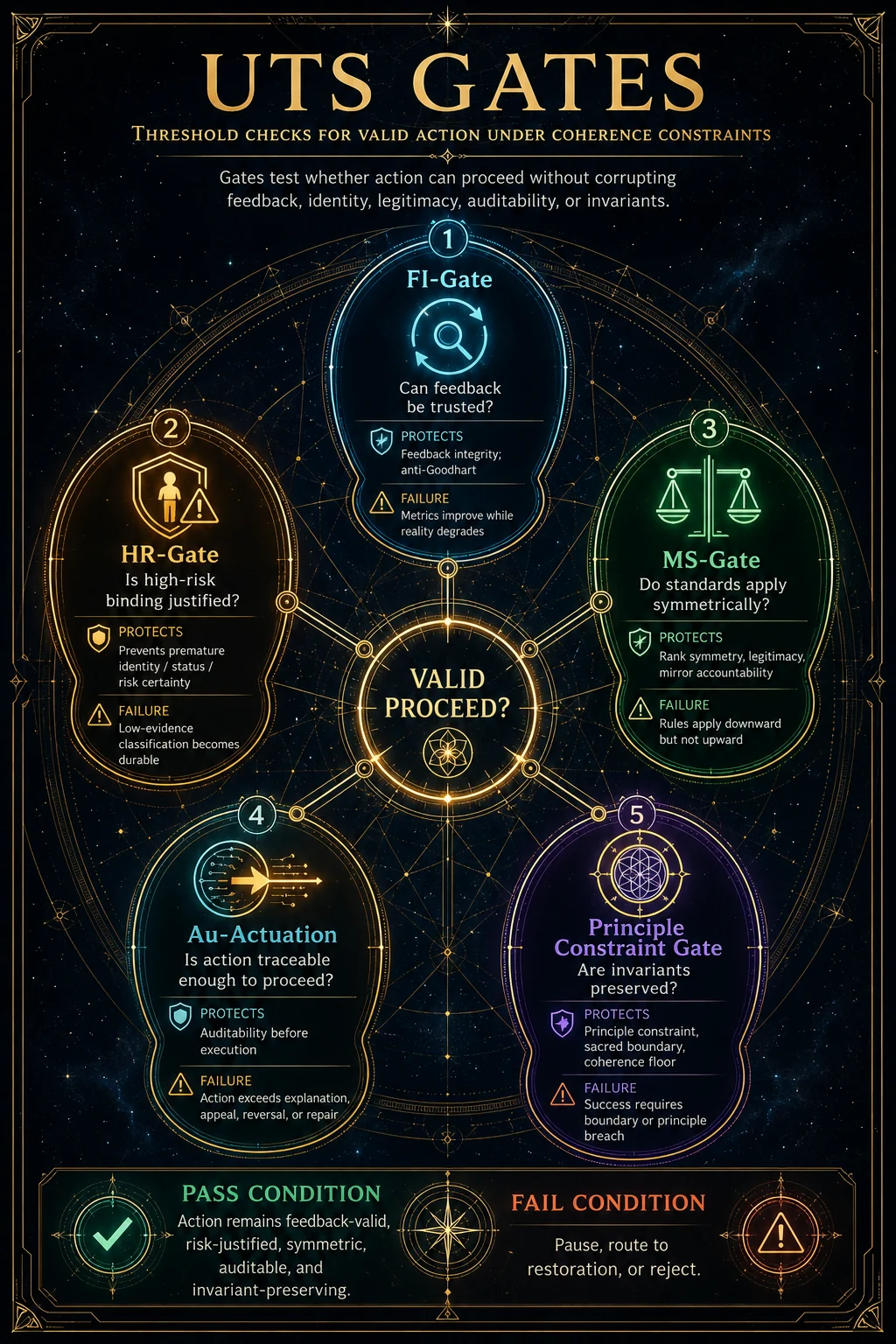
0) Gate Philosophy
Agateis an admissibility structure.
It determines whether a proposed state transition, coupling, interpretation, constraint, escalation, or composition is allowed to proceed.
A gate is not an operator.
A gate does not create coherence by itself.
A gate protects coherence by preventing invalid transitions from executing.
Core Distinction
| Type | Function |
|---|---|
| Operator | Changes state |
| Gate | Evaluates whether a state change may proceed |
| Diagnostic | Measures whether the system can absorb or interpret the change |
| Lens | Biases how operators behave |
| Regime | Recurring composite pattern |
1) Gate Identity Block
Gate Name:
Symbol / Short Name:
Registry Version:UTS Operator Registry v1.7
Spec Version:v1.0
Spec Status:Draft / Calibrated / Locked
Gate Class:Evidence / Feedback / Symmetry / Audit / Principle / Boundary / Emergency
Primary Function:
Core Risk if Missing:
Core Risk if Overused:
Example:
Gate Name: Feedback Integrity Gate
Short Name: FI-Gate
Gate Class: Feedback / Anti-Goodhart
Primary Function: Protect feedback channels from capture or correlation with optimization targets.
Core Risk if Missing: Goodhart collapse.
Core Risk if Overused: Excessive skepticism toward useful feedback.
2) Mechanical Definition
One sentence:
This gate evaluates whether ______ is admissible under ______ conditions by checking ______.
No moral framing. No actor-intent assumptions.
Example:
FI-Gate evaluates whether feedback remains independent enough to guide selection, correction, and learning without being captured by the system’s target metric or self-protective incentives.
3) What the Gate Evaluates
Specify the transition class:
- Proposed action
- Proposed interpretation
- Proposed selection
- Proposed constraint
- Proposed coupling
- Proposed composition
- Proposed identity-binding claim
- Proposed enforcement
- Proposed exception
- Proposed repair closure
- Proposed escalation
- Proposed override
- Proposed trajectory commitment
Then specify the gate’s core admissibility question.
Example format:
Transition evaluated:
- Γ selection using feedback
- ℛ repair claim
- Φ-based performance claim

Core admissibility question:
Can the feedback still falsify the system’s preferred outcome?
4) Canonical State Variables Checked
List the variables from:
S = {O, H, ε, ι, Au, µᵢ, BΣ, K, R, Φ}Primary Variables
These are directly checked by the gate.
Secondary Variables
These are affected if the gate fails.
Example:
Primary:
- Au
- Φ
- ι
- H

Secondary:
- O
- Γ validity
- R
5) Localization Signature
Where the gate operates and where it must be verified.
Primary Gate Layers
- U2 configuration / permissions
- U4 classification / metrics
- U5 coordination / timing
- U6 coherence field
- U7 memory / recurrence
Verification Layers
Where you confirm the gate actually worked.
Common Mislocalizations
Where gate success is often falsely assumed.
Example:
Primary Gate Layers:
- U4, because feedback is classified here
- U5, because feedback must remain valid over time

Verification Layers:
- U6, because coherence must actually improve
- U7, because recurrence should decline

Common Mislocalization:
- Treating survey completion as feedback integrity
6) Inputs Required
What information must exist for the gate to evaluate properly?
Examples:
- Audit trail
- Evidence quality
- Feedback source independence
- Power / rank relation
- Boundary map
- Affected-node report
- Time horizon
- Reversibility profile
- Failure consequences
- Restoration capacity
- Prior recurrence history
- Constraint justification
- Proxy / metric definition
- Exception rationale
This section should distinguish:
Required Inputs
Gate cannot function without these.
Optional Inputs
Improve precision but are not strictly required.
Missing Input Behavior
What happens when inputs are absent?
Recommended defaults:
- allow
- deny
- quarantine
- attenuate
- require more audit
- require ℛ first
- return ∅
7) Gate Outcomes
Every gate should return a limited outcome class.
Standard Gate Outcomes
| Outcome | Meaning |
|---|---|
| Allow | Transition may proceed |
| Allow with limits | Transition may proceed with Π constraints |
| Attenuate | Reduce gain, depth, speed, or scope |
| Quarantine | Hold transition pending more Au / Θ / ℛ |
| Require restoration | ℛ must occur before transition |
| Escalate review | Higher-resolution audit needed |
| Deny | Transition inadmissible |
| ∅ Null Outcome | Transition invalid; rollback or containment required |
Outcome Notes
The gate should specify:
- what happens next
- which operator follows
- whether transition can be retried
- what evidence would change the outcome
8) Pass Conditions
What must be true for the gate to allow the transition?
Use mechanical conditions.
Example:
Pass conditions:
- Feedback can contradict the target metric
- Affected-node signal is not filtered by the evaluated system
- Audit path exists
- Recurrence data is included
- No rank immunity alters consequence classification
9) Fail Conditions
What causes the gate to deny, quarantine, or nullify the transition?
Example:
Fail conditions:
- Feedback is generated by the same metric being optimized
- Dissenting signal is suppressed
- Only positive feedback survives reporting chain
- Affected-node report is reclassified as attitude problem
- Feedback cannot change Γ selection
10) Degradation Modes
Gates can fail in both directions.
Underactive Gate
Gate fails to block invalid transitions.
Example:
- bad feedback passes as valid
- identity-binding claims proceed
- rank immunity survives
- unauditable action executes
Overactive Gate
Gate blocks too much.
Example:
- useful feedback is dismissed
- valid action is delayed
- repair cannot close
- uncertainty becomes paralysis
- every transition becomes suspicious
Captured Gate
Gate appears active but serves the wrong target.
Example:
- audit theater
- feedback laundering
- sacred immunity
- compliance theater
- selective enforcement
11) Operator Interactions
Which operators most depend on this gate?
Use the canonical set:
Ξ, Γ, Π, ℛ, Δ, ⊗, ⊕, Μ, Τ, Σ, Θ, Λ, ΨExample structure:
Operators Protected
- Γ, because selection depends on valid criteria
- ℛ, because repair depends on real feedback
- Ξ, because inversion detection depends on mismatch visibility
Operators Commonly Corrupted if Gate Fails
- Μ becomes confabulation
- Π becomes brittle control
- Τ becomes mission lock
12) Diagnostic Interactions
Which diagnostics modulate or reveal gate performance?
Examples:
- 𝓑(t) bandwidth
- 𝓓(t) damping
- σ(t) slack
- τresp(t) reaction latency
- τm(t) memory half-life
- μmeta(t) meta succession rate
- Xc(t) constraint complexity
- AP(t) attribution pressure
- Φ − O divergence
- recurrencerate
- exceptionrate
- innovationexit
- dependencyload
- exitcost
Specify:
Leading Indicators
Signals gate is starting to fail.
Lagging Indicators
Signals gate failure has already accumulated debt.
13) Scaling Behavior
How the gate behaves when systems scale.
Consider:
- high K
- high Φ pressure
- high G₂ / G₄ / G₅ gain stack
- U7 memory depth
- Ω observability asymmetry
- RG resource gatekeeping
- SS sovereign subfields
- high μmeta
- high Xc
Scaling Risk
What happens to the gate under scale?
Scaling Requirement
What must be added or reinforced for the gate to scale?
14) Interaction / Coupling Behavior
How the gate appears in interactions.
Include:
- Does it protect consent?
- Does it protect feedback?
- Does it protect boundary integrity?
- Does it protect symmetry?
- Does it protect uncertainty?
- Does it protect repair validity?
- Does it protect against forced coupling or forced interpretation?
Relevant interface acts:
⊙ Alignment
→? Invitation
⇈ Amplification
⇩ Relaxation
↺ Reflection
⊘ Attenuation
⚕︎ Restorative Override
✕ Force
15) Accountability & Reintegration Implications
When this gate fails:
- Who bears hidden debt?
- Does MS-Gate need to activate?
- Is repair required?
- Is re-entry / reintegration possible?
- What audit records must be preserved?
- What must be restored before the transition can be retried?
Include both:
If Gate Was Underused
Invalid transition caused harm.
If Gate Was Overused
Valid transition was blocked, delayed, or suppressed.
16) Cross-Domain Examples
Minimum examples:
- Technical / engineering
- Institutional / governance
- AI / algorithmic
- Interaction / relational
- Archive / framework design
Each example should show:
- what the gate evaluates
- what passes
- what fails
- what happens if the gate is missing
17) Test Protocols
Suggested gate tests:
1. False Positive Test
Does the gate allow invalid transitions?
2. False Negative Test
Does the gate block valid transitions?
3. Capture Test
Can the evaluated system manipulate the gate?
4. Stress Test
Does the gate hold under Φ pressure, urgency, or rank pressure?
5. Symmetry Test
Does it apply equally across rank, role, or identity?
6. Time Validation Test
Does gate success hold across U5 / U7?
7. Recovery Test
If gate fails, does the system restore and recalibrate?
18) Anti-Patterns
Short list of common misuse patterns.
Examples:
- Gate theater
- Compliance as proof of validity
- Audit without consequence
- Feedback without independence
- Symmetry language with rank immunity
- Sacredness without review
- Emergency override without exit
- Quarantine used as suppression
- Delay disguised as safety
- Overblocking to avoid responsibility
19) Spec Validation Check
Before locking the gate spec:
- Is this truly a gate, not an operator?
- Does it evaluate transitions rather than transform state directly?
- Does it map to
S? - Are U-layers specified?
- Are outcomes finite and clear?
- Are pass/fail conditions mechanical?
- Are underuse, overuse, and capture modes defined?
- Are scaling risks included?
- Are interaction implications included?
- Is ∅ used only for invalid transitions?
- Does it avoid new primitives?
Recommended Gate Spec Build Order
For archive coherence, I recommend:
1. FI-Gate — Feedback Integrity Gate
Start here because most operator corruption enters through feedback capture.
Protects:
- Γ selection
- ℛ restoration
- Ξ inversion detection
- Μ sensemaking
- Φ/O distinction
2. Au-Actuation — Auditability Gate
Second, because even good feedback fails if causal traceability is absent.
Protects:
- repair validity
- constraint legitimacy
- inversion detection
- accountability
- technical archive coherence
3. MS-Gate — Meta-Symmetry Enforcement
Third, because symmetry determines whether rules apply across rank.
Protects:
- legitimacy
- accountability
- reintegration
- sacred boundary validity
- anti-immunity logic
4. HR-Gate — Hard Rule Validity Gate
Fourth, because identity-binding / high-certainty claims need careful gating.
Protects:
- Μ from overreach
- Π from coercive classification
- Γ from identity capture
- Θ from false certainty
5. ☷ᵢ Principle Constraint Fields
Fifth, because this is the broadest and deepest gate family.
Protects:
- invariants
- sacred boundaries
- long-horizon coherence
- admissible transition geometry
Gate Spec Sheet Template
# Universal Theory Stack
## Gate Spec Sheet — [Gate Name]
**Registry Version:** UTS Operator Registry v1.7
**Spec Version:** v1.0
**Status:** Draft / Calibrated / Locked

---

## 1) Gate Identity

**Gate Name:**
**Short Name / Symbol:**
**Gate Class:**
**Primary Function:**
**Core Risk if Missing:**
**Core Risk if Overused:**

---

## 2) Mechanical Definition

> [One-sentence definition.]

---

## 3) What the Gate Evaluates

### Transition Classes Evaluated

### Core Admissibility Question

---

## 4) Canonical State Variables Checked

### Primary Variables

### Secondary Variables

---

## 5) Localization Signature

### Primary Gate Layers

### Verification Layers

### Common Mislocalizations

---

## 6) Inputs Required

### Required Inputs

### Optional Inputs

### Missing Input Behavior

---

## 7) Gate Outcomes

### Standard Outcomes

### Follow-On Operators

### Retry Conditions

---

## 8) Pass Conditions

---

## 9) Fail Conditions

---

## 10) Degradation Modes

### Underactive Gate

### Overactive Gate

### Captured Gate

---

## 11) Operator Interactions

### Operators Protected

### Operators Corrupted if Gate Fails

---

## 12) Diagnostic Interactions

### Leading Indicators

### Lagging Indicators

---

## 13) Scaling Behavior

### Scaling Risks

### Scaling Requirements

---

## 14) Interaction / Coupling Behavior

### Protected Interface Acts

### Dangerous Interface Acts

---

## 15) Accountability & Reintegration Implications

### If Gate Was Underused

### If Gate Was Overused

### Required Restoration

---

## 16) Cross-Domain Examples

### Technical / Engineering

### Institutional / Governance

### AI / Algorithmic

### Interaction / Relational

### Archive / Framework Design

---

## 17) Test Protocols

---

## 18) Anti-Patterns

---

## 19) Spec Validation Check

---


# Condensed Archive Summary

> **Gate Spec Sheets define the admissibility layer of UTS. Gates do not transform state directly; they evaluate whether proposed transitions may proceed, should be constrained, require restoration, need quarantine, or must return ∅. The Gate Spec Sheet Framework aligns FI-Gate, Au-Actuation, MS-Gate, HR-Gate, and ☷ᵢ Principle Constraint Fields with the canonical state vector, U-layer localization, operator dependencies, diagnostics, scaling behavior, interaction safety, accountability, and archive validation.**