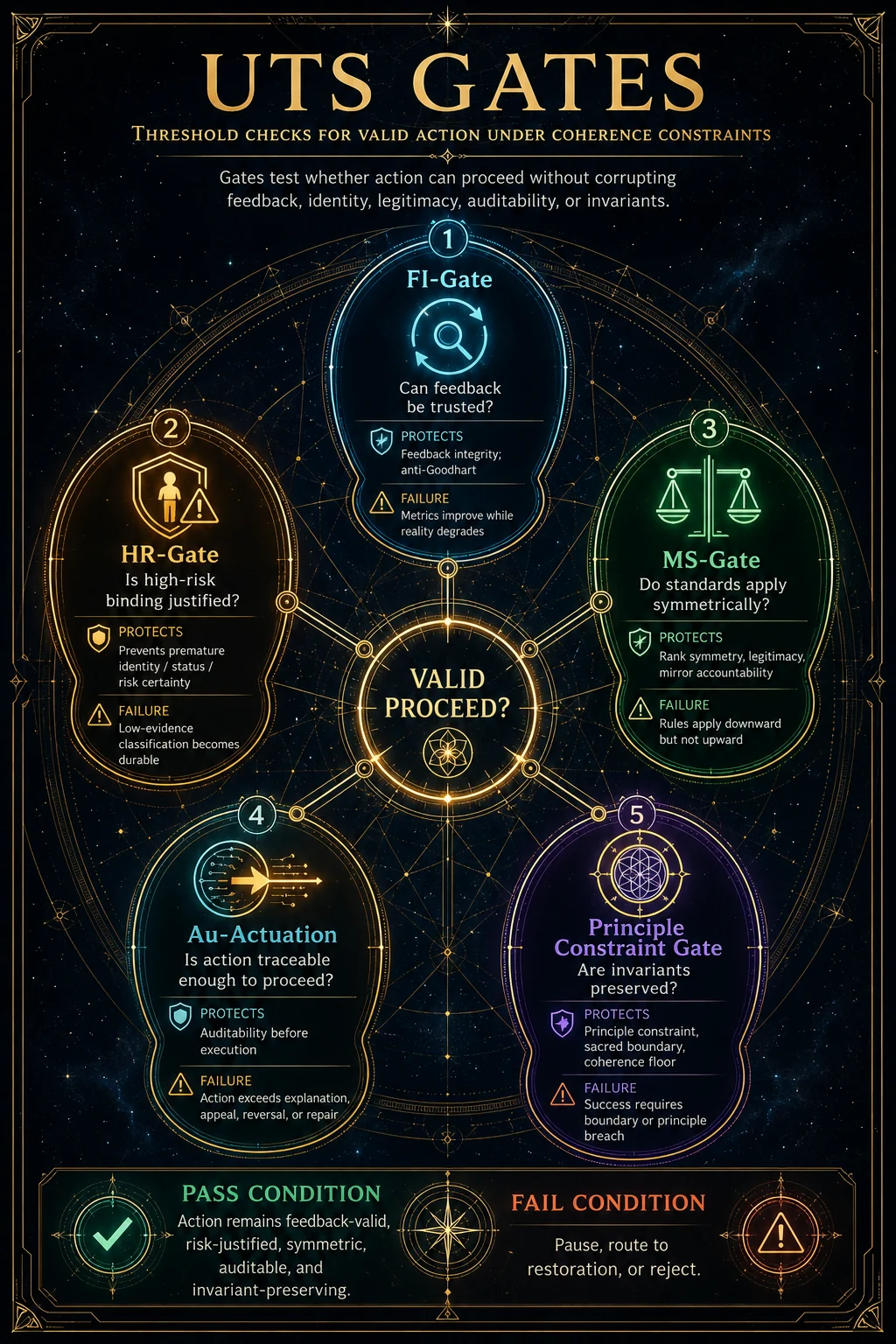
Au-Actuation evaluates whether a proposed transition has enough auditability to proceed safely: the system must be able to trace what happened, why it happened, who or what was affected, what evidence was used, what assumptions were made, and how correction can occur if the transition fails.
- Primary Function
- Ensure that proposed transitions, claims, repairs, constraints, couplings, compositions, and decisions have sufficient traceability to be inspected, challenged, reconstructed, and corrected.
- Short Name / Symbol
- Au-Actuation
- Gate Name
- Auditability Actuation Gate
- Gate Class
- Audit / Traceability / Legibility / Anti-Theater
FI-Gate evaluates whether feedback remains sufficiently independent, uncaptured, and reality-linked to guide selection, restoration, sensemaking, constraint, trajectory, and inversion detection without being absorbed by the system’s proxy targets, incentives, self-image, or control structure.
- Primary Function
- Ensure feedback remains independent, truth-bearing, and capable of correcting the system.
- Short Name / Symbol
- FI-Gate
- Gate Name
- Feedback Integrity Gate
- Gate Class
- Feedback / Anti-Goodhart / Anti-Capture / Learning Integrity
HR-Gate evaluates whether a signal is clean enough, localized enough, auditable enough, and proportionate enough to influence identity-binding, role-binding, motive attribution, durable classification, repair assignment, access restriction, exclusion, or memory-binding mechanics.
- Primary Function
- Prevent poor, noisy, distorted, insufficient, mislocalized, or low-audit signals from influencing identity-binding mechanics.
- Short Name / Symbol
- HR-Gate
- Gate Name
- High-Risk Signal-to-Identity Gate
- Gate Class
- Signal Integrity / Identity-Binding / Classification / Attribution / Memory-Binding
MS-Gate evaluates whether a proposed classification, constraint, repair obligation, exception, enforcement action, sacred claim, or accountability pathway preserves consequence-class symmetry across rank and role.
- Primary Function
- Ensure equivalent effects, violations, harms, obligations, and consequences remain in equivalent consequence classes regardless of rank, role, identity, power, proximity, institutional position, sacred status, or narrative importance.
- Short Name / Symbol
- MS-Gate
- Gate Name
- Meta-Symmetry Enforcement Gate
- Gate Class
- Symmetry / Legitimacy / Rank-Neutrality / Accountability Validity
☷ᵢ Principle Constraint Fields evaluate whether a proposed transition remains admissible within the system’s coherence-preserving principles, invariants, and non-degenerative constraints.
- Primary Function
- Define admissible transition space according to coherence-preserving principles, invariants, and non-degenerative constraints.
- Short Name / Symbol
- ☷ᵢ
- Gate Name
- Principle Constraint Fields
- Gate Class
- Principle / Invariant / Boundary / Admissibility / Long-Horizon Coherence