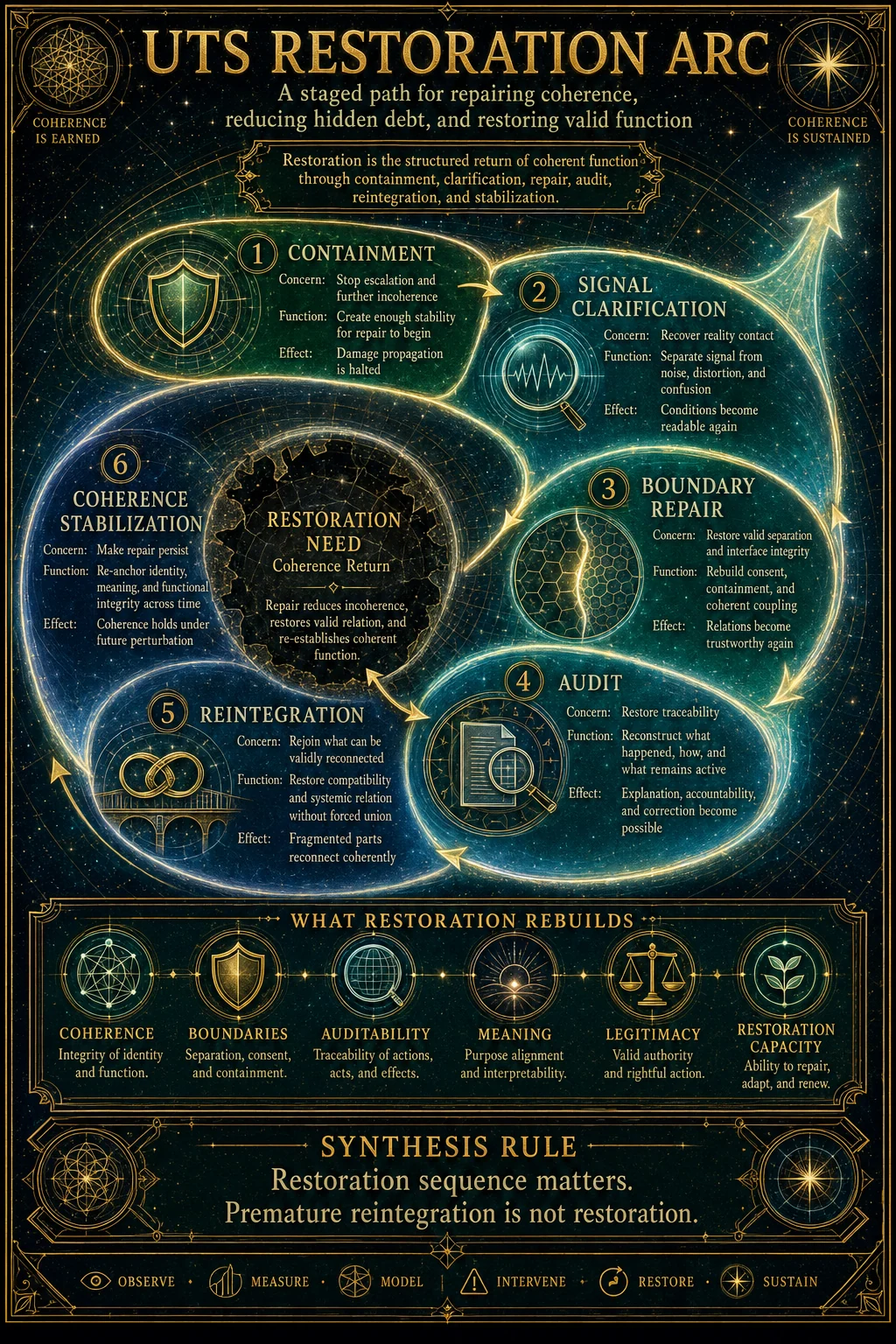
1. Purpose
TheUTS Restoration Arc Registrycatalogs the repeatable pathways by which coherence can re-enter a system after breakdown, distortion, extraction, boundary failure, or hidden-debt accumulation.
It is the companion registry to theUTS Failure Mode Registry, but it isnot a mirrorof it.
The Failure Mode Registry answers:
How does coherence fail?
The Restoration Arc Registry answers:
How does coherence return without creating new hidden debt?
Restoration arcs describeoperator sequences,diagnostic requirements,gate conditions, andvalidation testsfor real repair.
They apply across:
- individuals and teams
- institutions and governance systems
- AI systems and synthetic interfaces
- biological and medical systems
- civilizations and large-scale coordination systems
- non-local or uncertain domains
- future-agency / identity-bound systems
1. Core Definition
Arestoration arcis:
A time-validated operator sequence that reduces hidden debt, restores coherence, repairs boundary integrity, increases auditability, and reopens viable future trajectories without generating compensatory collapse elsewhere.
In UTS terms, a restoration arc acts on:
S = { O, H, ε, ι, Au, µᵢ, BΣ, K, R, Φ }A restoration arc is successful only if:
H ↓
O ↑ or stabilizes
Au ↑
BΣ ↑ or stabilizes
K ↑ where coupling is involved
R ↑ over time
Φ becomes subordinate to O
A process that improves visible performance while increasing hidden debt isnot restoration.
2. Canon Distinction: Failure vs Restoration
Failure Registry
The Failure Registry is indexed bybreakdown mechanism.
It tracks:
- first gate failure
- hidden-debt accumulation
- inversion stabilization
- U-layer manifestation
- collapse pathways
- minimal restoration requirements
Failure analysis tends to beconvergent: many domains fail through similar mechanical patterns.
Restoration Registry
The Restoration Registry is indexed bycoherence re-entry mechanism.
It tracks:
- what kind of coherence must return
- which variables must move
- which gates must pass
- what sequence prevents relapse
- how long validation must run
- which anti-patterns create repair theater
Restoration is oftendivergent: one failure may admit several restoration paths, and one restoration arc may apply to many failures.
Registry Design Rule
Failure modes remain the primary diagnostic index. Restoration arcs become the secondary navigation layer organized by repair mechanism.
This prevents the false idea that repair is simply the reversal of failure.
3. Restoration Is Not Mechanical Reversal
A system cannot usually be restored by running the failure sequence backward.
Example:
Failure:
Au ↓ → H ↑ → Φ dominates → BΣ erodes → O collapses
Restoration is not merely:
O collapse reversed → BΣ restored → Φ corrected → H removed → Au restoredReal restoration usually requires:
Σ → Ψ → Π → Θ → Λ → ℛ → ΤMeaning:
- stop the illegitimate continuation
- reveal the causal structure
- reconstitute boundaries
- damp overreaction
- test compatibility
- repair hidden debt
- bias future trajectory away from recurrence
Restoration is thereforeconstructive, not merely corrective.
4. Universal Restoration Conditions
A restoration arc must satisfy the following minimum conditions.
4.1 Auditability Must Increase
IfAucannot increase on demand, restoration is not real.
Without auditability:
- H cannot be quantified
- causality cannot be reconstructed
- agency cannot be restored
- gate failures cannot be located
- recurrence cannot be prevented
Registry invariant:
If Au cannot be increased on demand, restoration is theater.
4.2 Hidden Debt Must Decrease
Restoration requires real reduction ofH, not displacement.
False reductions include:
- burying the cost elsewhere
- transferring harm to weaker nodes
- changing metrics
- deleting evidence
- renaming the failure
- accelerating performance to outrun review
Canonical rule:
H_total must decrease, not merely H_visible.4.3 Boundaries Must Be Repaired
WhereBΣhas been violated, no restoration is valid until boundary integrity is repaired.
This includes:
- consent boundaries
- role boundaries
- interface boundaries
- jurisdictional boundaries
- identity boundaries
- agency boundaries
- memory boundaries
Without BΣ repair, coupling remains extractive or unstable.
4.4 Fitness Proxy Must Be Subordinated
Restoration fails ifΦremains dominant.
Examples of Φ-dominant false restoration:
- “engagement improved”
- “growth resumed”
- “risk metrics look better”
- “the institution survived”
- “performance recovered”
- “the public moved on”
UTS distinction:
Φ recovery ≠ O recovery4.5 Restoration Capacity Must Increase
A restored system should be easier to repair in the future.
If a repair leaves the system more brittle, more opaque, or more dependent on exceptional intervention, then the arc is incomplete.
Expected movement:
R ↑
τ_resp ↓
τ_m ↑
𝓓(t) ↑
σ(t) ↑
5. Restoration Families
Restoration arcs are grouped bycoherence mechanism, not by failure origin.
These families are registry categories, not new operators.
5.1 Observability Restoration
Primary movement:
Au ↑, ε clarified, H becomes measurable
Purpose:
Restore the system’s ability to see itself.
Typical operator scaffold:
Ψ → Μ → Θ → ΠUsed when:
- causality is hidden
- signals are noisy
- narrative replaced evidence
- actors cannot trace consequences
- audit trails are incomplete
Common anti-pattern:
“Transparency” without causal reconstruction.
5.2 Boundary Reconstitution
Primary movement:
BΣ ↑, Perm ↓, Π stabilized
Purpose:
Rebuild the interfaces that protect identity, consent, jurisdiction, and role integrity.
Typical operator scaffold:
Σ → Π → Ψ → ℛUsed when:
- boundaries were bypassed
- permissions were unclear
- coupling occurred without consent
- interface authority was abused
- systems became over-permeable
Common anti-pattern:
Boundary hardening without auditability.
5.3 Hidden-Debt Paydown
Primary movement:
H ↓, R ↑
Purpose:
Convert latent, deferred, displaced, or suppressed cost into visible repair.
Typical operator scaffold:
Ψ → ℛ → Π → ΤUsed when:
- costs were externalized
- labor or value was extracted
- harms were deferred
- collapse risk was hidden
- accumulated incoherence became structural fuel
Common anti-pattern:
Apology, deletion, or rebranding without restitution.
5.4 Load Shedding / Gain Reduction
Primary movement:
Θ ↑, gain ↓, 𝓑(t) margin ↑
Purpose:
Prevent overload, escalation, or runaway amplification.
Typical operator scaffold:
Θ → Π → ℛ → ΤUsed when:
- the system is overdriven
- shock exceeds bandwidth
- high gain is amplifying error
- attention pressure is destabilizing
- acceleration is creating fragility
Common anti-pattern:
Treating speed as proof of recovery.
5.5 Compatibility Revalidation
Primary movement:
K ↑, incompatible ⊗ paths pruned
Purpose:
Re-test whether couplings still increase coherence under changed conditions.
Typical operator scaffold:
Λ → Π → ℛ → ΤUsed when:
- a coupling has become extractive
- two systems no longer cohere
- integration is producing downstream stress
- compatibility was assumed rather than tested
Common anti-pattern:
Maintaining a coupling because it once worked.
5.6 Trajectory Realignment
Primary movement:
Τ corrected, Φ subordinated, O future-stabilized
Purpose:
Bias the system away from relapse and toward durable coherence.
Typical operator scaffold:
Ψ → Θ → Μ → Λ → Π → ℛ → ΤUsed when:
- the system can repair locally but keeps recurring
- long-horizon incentives remain distorted
- recovery does not persist
- memory and meaning layers are unstable
Common anti-pattern:
Repairing events while leaving trajectory unchanged.
5.7 Parasitic Decoupling
Primary movement:
⊗ pruning, Π tightening, K reassessment
Purpose:
Remove or bypass couplings that extract coherence while preserving apparent order.
Typical operator scaffold:
Ψ → Ξ → Π → Λ → ℛUsed when:
- an intermediary feeds on opacity
- a subsystem benefits from hidden debt
- coupling is framed as necessary but lowers O
- representation occurs without symmetry
Common anti-pattern:
Attacking the intermediary directly and increasing its leverage.
5.8 Slow Variable Stabilization
Primary movement:
τ_m ↑, σ ↑, 𝓓(t) ↑
Purpose:
Prevent relapse by stabilizing the long-memory variables that outlast visible repair.
Typical operator scaffold:
Θ → Ψ → ℛ → ΤUsed when:
- surface recovery is fast but relapse risk is high
- trauma, memory, precedent, or institutional habit persists
- hidden recurrence loops remain active
- repaired systems drift back under stress
Common anti-pattern:
Declaring success before memory stabilizes.
5.9 Legitimacy Re-Anchoring
Primary movement:
K ↑, Au ↑, MS symmetry restored, AP(t) ↓
Purpose:
Restore the conditions under which a system can be trusted to interface with others.
Typical operator scaffold:
Ψ → Ξ → Σ → Π → Λ → ΤUsed when:
- authority has lost legitimacy
- representation was abused
- rank immunity protected failure
- consent illusions maintained power
- public or network trust has collapsed
Common anti-pattern:
Public relations substituted for structural change.
5.10 Future-Agency Restoration
Primary movement:
BΣ ↑, H ↓, Au ↑, K ↑, Τ corrected
Purpose:
Repair systems where future agency, identity, labor, or representation was extracted or delegated without consent.
Typical operator scaffold:
Σ → Ψ → Π → ℛ → Σ → Λ → ΤUsed when:
- synthetic labor was extracted
- proxy identity was used without consent
- people were represented by systems they did not authorize
- downstream future options were shaped without agency symmetry
Common anti-pattern:
Transparency without returning power.
Registry invariant:
Systems that cannot return stolen agency cannot be restored — only dismantled slowly.
6. Standard Restoration Arc Anatomy
Every restoration arc should include the following fields.
Restoration Arc Module Card
1. Arc Identity
ID:
Name:
Alias:
Status:
Scope:
Example:
ID: RA-AGENCY-06
Name: Future-Agency Restoration
Alias: Agency Return + Debt Paydown
Status: Canon-Candidate
Scope: Systemic / Institutional / AI-mediated
2. Restoration Family
Each arc should name:
- primary restoration family
- secondary restoration families
- dominant variables affected
Example:
Primary: Future-Agency Restoration
Secondary: Hidden-Debt Paydown, Boundary Reconstitution
Dominant variables: BΣ, H, Au, K, Τ
3. Use Conditions
Clarifies when the arc is admissible.
Fields:
When to apply:
When not to apply:
Required preconditions:
Abort conditions:
This prevents arcs from becoming generic prescriptions.
4. Target Failure Classes
Failure references should becross-links, not ownership.
Example:
Linked failure modes:
FM-01 Hidden Debt Accumulation
FM-03 Audit Collapse
CIFM-04 Myth-Lock
CIFM-10 Agency Erasure
One restoration arc may apply to many failure modes.
One failure mode may require several arcs.
5. U-Layer Localization
Each arc must state where failure originated and where repair must occur.
Example:
Failure origin: U4 → U6 → U7
Repair must reach: U4 or lower, with U7 stabilization
Canon rule:
Repair must occur at the same or lower layer than the failure origin.
If a failure originates at U2 but repair occurs only at U4 narrative level, restoration is invalid.
6. Pre-State Signature
The pre-state signature captures the expected damaged configuration.
Example:
| Variable | Pre-State |
|---|---|
| O | unstable |
| H | high / structural |
| ε | patterned |
| ι | rising |
| Au | suppressed |
| BΣ | violated |
| K | low |
| R | illusory |
| Φ | dominant |
7. Restoration Objective
The objective should describestate movement, not emotional or moral aspiration.
Weak form:
“Make things right.”
UTS form:
Reduce H, restore BΣ, increase Au, revalidate K, and re-bias Τ so recurrence becomes structurally harder.
8. Minimal Operator Scaffold
Each arc must define its operator sequence.
Example:
Σ → Ψ → Π → ℛ → Σ → Λ → ΤThe sequence should include only operators that actually move state.
No decorative operators.
No new primitives.
9. Gates Required
Every restoration arc should specify gate requirements.
Common gates:
- FI-Gate— prevents Goodhart repair
- HR-Gate— blocks identity-bound certainty
- MS-Gate— prevents rank immunity
- Au-Actuation— requires traceability before action
- ☷ᵢ Principle Gates— enforces non-negotiable invariants
Gate failure results in:
∅ outcomeMeaning the arc cannot validly proceed.
10. Diagnostics to Track
Every arc must define expected diagnostic trends.
Common diagnostics:
| Diagnostic | Restoration Trend |
|---|---|
| 𝓑(t) | ↑ |
| 𝓓(t) | ↑ |
| σ(t) | ↑ |
| τresp | ↓ |
| τm | ↑ |
| Xc | ≤ Aueff |
| AP(t) | ↓ |
| Perm(t) | context-dependent |
| K | ↑ where coupling applies |
| H | ↓ |
11. Anti-Patterns
Each arc must explicitly name false restorations.
Examples:
- apology without restitution
- transparency without power return
- boundary hardening without audit
- speed as a recovery metric
- ethics theater
- deleting evidence
- treating silence as consent
- continuing extraction during audit
- narrative repair without structural repair
Anti-patterns are essential because many systems simulate repair.
12. Failure Containment Behavior
If the arc destabilizes mid-process, it needs a safe abort sequence.
Example:
Π halt
Θ reduce gain
Ψ preserve trace
ℛ repair immediate harm
Τ bias toward disengagement
No arc should rely on heroic discretion at the failure point.
13. Post-State Signature
The post-state defines what successful restoration looks like.
Example:
| Variable | Post-State |
|---|---|
| O | stable / higher |
| H | reduced |
| ε | bounded |
| ι | reduced |
| Au | high |
| BΣ | restored |
| K | validated |
| R | increased |
| Φ | subordinate |
14. Validation Window
Restoration must be validated across time.
Possible validation frames:
- N perturbation cycles
- M review intervals
- K independent audits
- recurrence stress test
- memory half-life check
- downstream compatibility check
Canon rule:
Snapshot improvement is not restoration.
7. Relationship to ARC 0–5 Universal Grammar
The initial ARC 0–5 set functions as theuniversal restoration grammar.
| Arc | Function |
|---|---|
| ARC 0 | Entry safety / exit path before entry |
| ARC 1 | Probe-only learning / no footprint |
| ARC 2 | Contained action / remote hands, tight leash |
| ARC 3 | First-contact soft-failure / retreat grammar |
| ARC 4 | Bleed-through management / ring-down discipline |
| ARC 5 | Reintegration / knowledge return without collapse |
These arcs are not the whole registry.
They are thebase grammarfrom which domain-specific arcs can be composed.
8. Domain-Specific Arc Families
The registry can support specialized arc sets without drifting.
Example families:
RA-AI
RA-INST
RA-BIO
RA-JUSTICE
RA-CIV
RA-INTERFACE
RA-AGENCY
RA-SECURITY
RA-MEDICAL
RA-RELATIONSHIP
The domain prefix identifies application area, not new mechanics.
Example:
RA-AGENCY-06
RA-CIV-C1
RA-AI-MIRROR-01
RA-INST-LEGIT-03
9. Cross-Indexing Structure
Each restoration arc should be indexable by four axes.
Axis 1 — Restoration Family
Example:
Hidden-Debt Paydown
Boundary Reconstitution
Future-Agency Restoration
Axis 2 — Failure Mode
Example:
FM-01 Hidden Debt Accumulation
FM-03 Audit Collapse
CIFM-04 Myth-Lock
Axis 3 — U-Layer
Example:
U2 boundary failure
U4 classification failure
U7 memory failure
Axis 4 — Operator Scaffold
Example:
Σ → Ψ → Π → ℛ → Λ → ΤThis allows the registry to be searched by mechanism, symptom, location, or repair sequence.
10. Restoration Arc Status Levels
Suggested status categories:
| Status | Meaning |
|---|---|
| Draft | concept exists but sequence not stabilized |
| Canon-Candidate | structurally sound, awaiting examples |
| Canon-Locked | stable across multiple domains |
| Deprecated | replaced or found unsafe |
| Domain-Specific | valid only under stated conditions |
| High-Risk | powerful but dangerous if misapplied |
This helps prevent premature canonization.
11. Restoration Fraud / Repair Theater
The registry should explicitly track false restoration patterns.
A restoration claim is fraudulent if it:
- lowers Au
- preserves illegitimate power
- substitutes Φ for O
- improves appearance while increasing H
- avoids restitution
- bypasses affected agents
- suppresses memory
- blocks independent audit
- increases recurrence risk
- prevents exit
General formula:
If Φ ↑ while H ↑ and Au ↓,
the system is performing repair theater.
12. Universal Restoration Constraints
These should be placed near the top of the registry.
RC-01 — Do Not Attack the Distortion Directly
You cannot restore a system by attacking the distortion directly. You restore it by restoring auditability, consent, and compatibility faster than fear can propagate.
Direct confrontation often increases:
AP(t), ι, H, Ω_concentrationViable arcs bypass, outgrow, out-audit, or decouple the distortion.
RC-02 — No Restoration Without Auditability
If Au cannot increase on demand, restoration is theater.
RC-03 — No Restoration Without Boundary Repair
Where BΣ was violated, restoration begins by returning agency, not by explaining intent.
RC-04 — No Restoration Without Debt Conversion
Hidden debt must be surfaced, quantified, and paid down. Otherwise it remains structural fuel.
RC-05 — No Restoration Through Φ Alone
Fitness proxy recovery is not coherence recovery.
RC-06 — No Restoration Without Time
Restoration must survive perturbation, memory, and recurrence tests.
13. Core Equations / Sanity Constraints
The Restoration Registry should inherit UTS sanity constraints and add restoration-specific versions.
13.1 Restoration Load Constraint
R_eff > Load × Gain_stackIf false:
restoration overload → H ↑13.2 Auditability Constraint
Au_eff ≥ X_cIf false:
complexity outruns inspection → H ↑13.3 Proxy Subordination Constraint
Φ must remain subordinate to OIf false:
performance recovery masks coherence failure13.4 Boundary Validity Constraint
BΣ_repaired before Λ_reintegrationIf false:
compatibility scoring is invalid13.5 Time Validation Constraint
O(t+n) stable under ΔIf false:
repair did not survive reality contact14. Registry Workflow
The standard process for adding a restoration arc:
Step 1 — Identify the repair mechanism
Ask:
What kind of coherence is trying to return?
Examples:
- auditability
- boundary integrity
- hidden-debt paydown
- legitimacy
- future agency
- compatibility
- trajectory stability
Step 2 — Identify affected variables
Map the arc onto:
O, H, ε, ι, Au, µᵢ, BΣ, K, R, ΦIf it cannot be mapped, it is not ready.
Step 3 — Localize U-layers
Ask:
- Where did the failure originate?
- Where does restoration need to occur?
- Is the proposed repair too high-level?
Step 4 — Define minimal operator scaffold
Use only canon operators:
⊕ ⊗ Π Γ Δ ℛ Ξ Μ Τ Θ Λ Σ ΨStep 5 — Enforce gates
No gate bypass.
Especially:
- Au-Actuation
- FI-Gate
- HR-Gate
- MS-Gate
- Principle fields
Step 6 — Define diagnostics
Track restoration over time.
Step 7 — Name anti-patterns
Every arc needs its false version.
Step 8 — Validate across time
No snapshot canonization.
15. Current Registry Seed Arcs
The Restoration Registry currently contains the following seed arcs.
Universal Grammar Arcs
| ID | Name | Primary Family |
|---|---|---|
| RA-PRE-00 | Exit-Path Before Entry | Boundary Reconstitution |
| RA-OBS-01 | Probe-Only Exploration | Observability Restoration |
| RA-BOUND-02 | Quarantine Outpost | Parasitic Decoupling |
| RA-SAFE-03 | First-Contact Safety | Escalation Suppression |
| RA-DEBT-04 | Bleed-Through Management | Hidden-Debt Paydown |
| RA-TRAJ-05 | Reintegration | Trajectory Realignment |
Civilization-Scale Variants
| ID | Name | Primary Family |
|---|---|---|
| RA-BOUND-C0 | Containment-First Stabilization | Boundary Reconstitution |
| RA-OBS-C1 | Asymmetric Awareness Injection | Observability Restoration |
| RA-LEGIT-C2 | Legitimacy Re-Anchoring | Legitimacy Restoration |
| RA-DECOUPLE-C3 | Interface Bypass & Decoupling | Parasitic Decoupling |
| RA-COLLAPSE-C4 | Inversion Exhaustion / Self-Exposure | Hidden-Debt Saturation |
| RA-REINT-C5 | Post-Interface Restoration | Trajectory Realignment |
Future-Agency / AI-Mirror Arc
| ID | Name | Primary Family |
|---|---|---|
| RA-AGENCY-06 | Future-Agency Restoration | Future-Agency Restoration |
16. Suggested Registry Header
This can serve as the concise opening statement for the registry:
The UTS Restoration Arc Registry catalogs the operator sequences by which coherence re-enters systems after failure. Restoration arcs are not inverse failure modes. They are constructive pathways that restore auditability, boundary integrity, compatibility, hidden-debt balance, and future trajectory stability. A restoration arc is valid only when it reduces hidden debt, increases auditability, preserves agency boundaries, subordinates fitness proxies, and survives validation over time.
17. Final Canon Summary
A restoration arc is real only when:
Au ↑
H ↓
BΣ repaired
Φ subordinated
K revalidated
R increased
O stable under Δ
Anything else is:
repair theaterThe governing principle:
Restoration is not the return to a prior state. Restoration is the re-opening of coherent future trajectories after hidden debt, boundary failure, or inversion has been resolved.