0. Purpose
TheUTS Laws Registryconsolidates recurring behavioral laws across the Universal Theory Stack.
A law is not the same as an invariant.
An invariant says:
This constraint must not be violated.
A law says:
When systems behave this way, this pattern tends to follow.
Laws describe how coherence, hidden debt, inversion, pressure, compression, coupling, legitimacy, boundary integrity, meaning, auditability, feedback, and restoration capacity behave under transformation, scale, stress, or forcing.
This registry supports:
- cross-module consistency
- system diagnosis
- design constraints
- failure detection
- restoration planning
- AI-readable indexing
- future construct graphs
- website quick reference
- module-to-module cross-linking
This page is a reference registry, not a replacement for deeper module pages. Each law can later become its own law card.
1. Law Definition
A UTS law is a recurring cross-context pattern that describes how coherence, hidden debt, inversion, boundary integrity, auditability, restoration, and scaling behave under transformation, stress, or forcing.
A UTS law should:
- appear across more than one context, layer, or scale;
- describe system behavior rather than merely prescribe action;
- map to the canonical state vector;
- help predict drift, collapse, stabilization, or restoration;
- remain compatible with UTS Operator Registry v1.7;
- support diagnostics, failure-mode detection, and restoration arc selection.
2. Canon Variables Used by the Laws
S(t) = { O, H, ε, ι, Au, µᵢ, BΣ, K, R, Φ }| Variable | Meaning |
|---|---|
O | Coherence |
H | Hidden debt |
ε | Observable error / noise |
ι | Inversion index |
Au | Auditability |
µᵢ | Meaning / agent integrity |
BΣ | Boundary integrity |
K | Compatibility / slack / sovereignty |
R | Restoration capacity |
Φ | Fitness proxy / visible success signal |
Common diagnostics:
| Diagnostic | Meaning |
|---|---|
𝓑(t) | Bandwidth / forcing absorbability |
𝓓(t) | Damping / ring-down |
σ(t) | Slack |
τ_resp(t) | Response latency |
τ_m(t) | Memory half-life / recurrence tendency |
X_c(t) | Constraint complexity |
Au_eff | Effective auditability |
Cv(t) | Compression velocity |
AP(t) | Attribution pressure |
Perm(t) | Boundary permeability |
Lτ | Logistics throughput |
3. Registry Organization
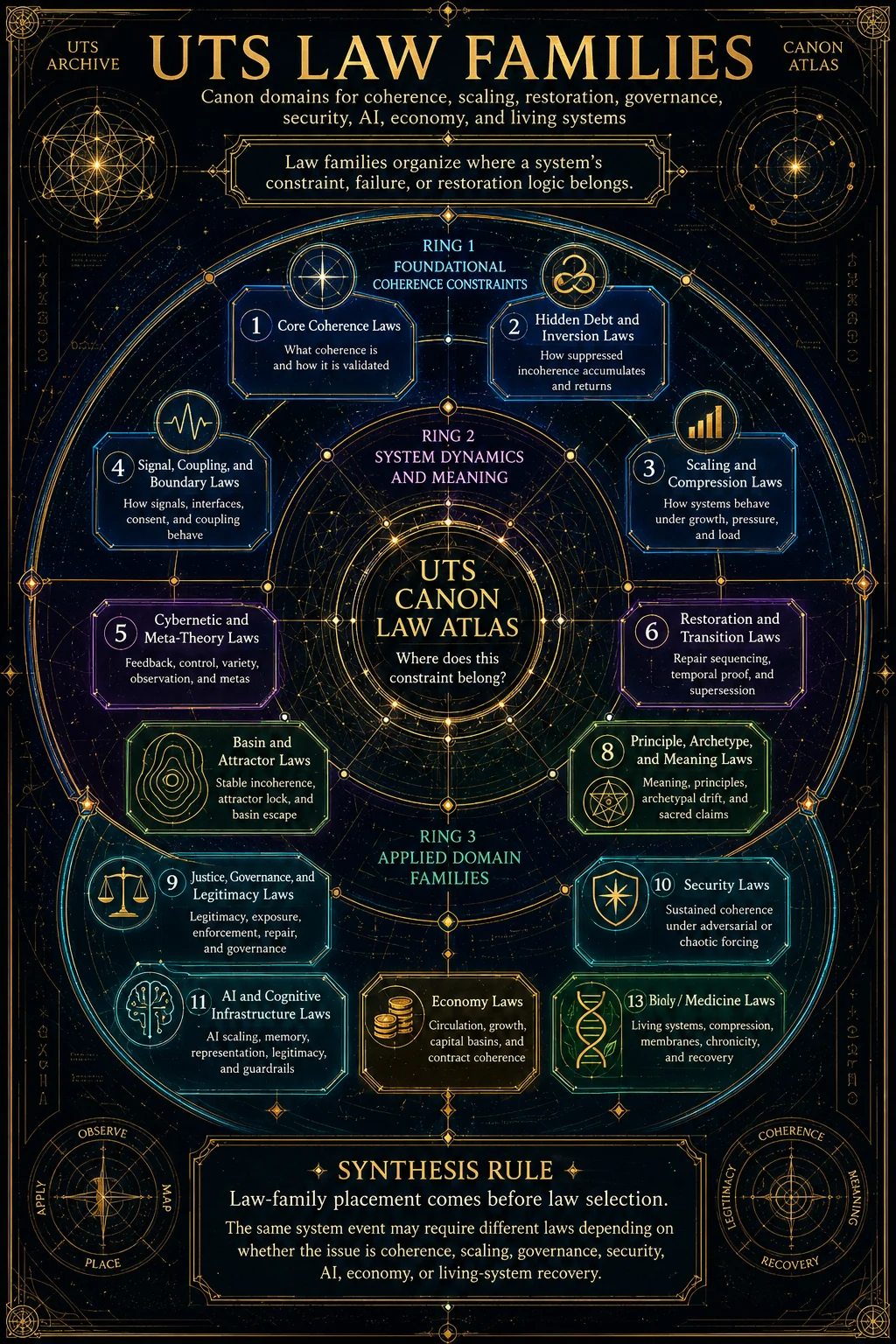
The canonical law families are:
- Core coherence laws
- Hidden debt and inversion laws
- Scaling and compression laws
- Signal, coupling, and boundary laws
- Cybernetic and meta-theory laws
- Restoration and transition laws
- Basin and attractor laws
- Principle, archetype, and meaning laws
- Justice, governance, and legitimacy laws
- Security laws
- AI and cognitive infrastructure laws
- Economy laws
- Biology / medicine laws
The merged registry deduplicates overlapping laws by retaining one canonical law with aliases where needed.
Example:
- Fitness Proxy Divergence Law
- Success Proxy Divergence Law
- Objective Mixing Law
- AI Proxy Hazard Law
- Economic Proxy Drift Law
These are not separate root laws. They are domain expressions of the same core pattern:
Φ↑ while O↓ ⇒ ι↑Domain-specific versions are preserved only when they add distinct diagnostic or design utility.
Part I — Core Coherence Laws
UTS-L001 — Coherence Priority Law
Coherence precedes optimization.
Optimization is valid only when it preserves or increases coherence.
If visible success improves while identity, meaning, boundary integrity, auditability, compatibility, or restoration capacity degrade, the system is entering pseudo-coherence.
Canonical form:
O is prior to ΦRelated variables:
O, Φ, H, ι, Au, R, µᵢ, BΣAliases folded into this law:
- Coherence Priority Law
- Objective Mixing Law
- Coherence-Preserving Optimization Rule
UTS-L002 — Coherence Trajectory Law
Coherence is trajectory-based, not snapshot-based.
A system cannot be evaluated by a single state, claim, metric, event, output, credential, ritual, policy, benchmark, or appearance of calm.
Coherence must be evaluated across:
- time
- stress
- transformation
- recurrence
- perturbation
- ring-down
- hidden debt behavior
- cross-scale outcome
Canonical form:
coherence evaluation ⇒ dO/dt under loadA system is coherent when identity, meaning, boundary integrity, auditability, and functional integrity persist or improve across transformation without exporting hidden debt.
UTS-L003 — Success Proxy Divergence Law
A system can improve its visible success proxy while losing coherence.
Canonical form:
Φ↑ while O↓ ⇒ ι↑This is one of the core UTS corruption patterns.
It appears as:
- profit rising while economic resilience falls
- symptoms suppressed while biological coherence declines
- compliance improving while legitimacy decays
- safety metrics improving while epistemic integrity weakens
- status rising while archetypal integrity falls
- institutional stability increasing while hidden debt migrates
- benchmark performance improving while AI meaning fidelity weakens
Aliases folded into this law:
- Fitness Proxy Divergence Law
- Objective Mixing Law
- AI Proxy Hazard Law
- Economic Proxy Drift Law
- Goodhart Stack Law
- Metric Substitution Law
UTS-L004 — Stability-Coherence Separation Law
Stability is not coherence.
A system can return to an attractor without that attractor being coherent.
Stability means:
perturbation → return to attractorCoherence means:
attractor preserves O, BΣ, Au, µᵢ, K, and R across time and scalePseudo-coherent basins exploit this distinction. They produce local stability while exporting hidden debt.
UTS-L005 — Local–Global Divergence Law
Local coherence can coexist with global incoherence.
A node, team, institution, model, organ system, economy, community, or archetype can be internally consistent while participating in a larger incoherent basin.
Canonical signature:
O_local stable
Φ_local ↑
Au_cross-scale ↓
H_exported ↑
O_global ↓
This law prevents simplistic blame and simplistic innocence. It allows local sensemaking to be real while cross-scale coherence is still failing.
UTS-L006 — Time Validation Law
Time validates coherence.
A system does not prove coherence through claims, intensity, documentation, authority, compliance, local success, symbolic certainty, or immediate stabilization.
It proves coherence through:
- recurrence reduction
- ring-down improvement
- stress survival
- restoration behavior
- boundary preservation
- delayed field effects
- memory update
- cross-scale outcome
Canonical validation frame:
U4 claim → U5 delay → U6 field effect → U7 recurrence checkUTS-L007 — Ring-Down Truth Law
Ring-down reveals coherence.
A coherent system settles after disturbance. A pseudo-coherent system suppresses, displaces, repeats, escalates, or rings.
Canonical completion signs:
𝓓↑
H↓
τ_m↓
recurrence↓
εₙ₊₁ ≤ εₙ
If damping does not improve, resolution is incomplete.
UTS-L008 — Recurrence Validation Law
A repair is not complete until recurrence weakens.
Canonical form:
τ_m↓ ∧ recurrence↓ ⇒ restoration more likely validIf the system returns to the same basin under similar stress, repair was incomplete.
UTS-L009 — U4 / U6 Truth Law
U4 claims are provisional classifications until validated at U6 across U5 delay and U7 recurrence.
U4 includes:
- labels
- metrics
- legal categories
- clinical categories
- public claims
- symbolic claims
- archetypal declarations
- safety claims
- fairness claims
- market signals
Canonical form:
U4 claim + U5/U6/U7 validation ⇒ stronger truth status
U4 claim without validation ⇒ provisional classification
Part II — Hidden Debt and Inversion Laws
UTS-L010 — Hidden Debt Accumulation Law
Suppressed incoherence becomes hidden debt.
Canonical form:
unrepaired incoherence + suppression ⇒ H↑Hidden debt may accumulate through:
- deferred repair
- suppressed auditability
- exported cost
- delayed maintenance
- unpaid care burden
- ecological externality
- institutional avoidance
- symbolic repair without origin-layer repair
- security theater
- compliance theater
- hidden labor
- over-surveillance
- policy patching without repair
UTS-L011 — Hidden Debt Return Law
Hidden debt always returns.
Hidden debt may be displaced into:
- the future
- the environment
- peripheral nodes
- invisible labor
- biological symptoms
- legitimacy shock
- recurrence
- institutional brittleness
- economic crisis
- ecological forcing
- downstream AI systems
- memory systems
Export does not eliminate debt. It changes where and when the debt reappears.
UTS-L012 — Error Lag Law
Observable error usually appears late.
Canonical form:
H↑ + ι↑ → O↓ → ε spikes lateVisible failure is often downstream of hidden debt, auditability loss, boundary drift, and inversion.
Incident-driven repair is therefore structurally late.
UTS-L013 — Auditability-Debt Law
When auditability falls, hidden debt rises.
Canonical form:
Au↓ ⇒ H↑If a system cannot trace causes, decisions, feedback, contracts, classifications, or consequences, unresolved incoherence accumulates.
UTS-L014 — Constraint Complexity Debt Law
When constraint complexity exceeds effective auditability, hidden debt grows.
Canonical form:
X_c > Au_eff ⇒ H↑ ⇒ O↓This is the root law behind:
- rule-stacking walls
- compliance theater
- opaque policy regimes
- brittle governance
- audit failure
- AI rule complexity
- institutional incoherence
- opaque financial products
- inaccessible legal procedure
- symbolic systems with audit suppression
More rules do not increase coherence when interpretability lags complexity.
UTS-L015 — Suppressed Auditability Debt Law
Suppressed auditability issues hidden debt.
Canonical form:
Au↓ by design ⇒ H↑A system that requires hidden causality, inaccessible evidence, obscured decision surfaces, selective visibility, or non-reviewable classification becomes debt-generating.
UTS-L016 — Inversion Formation Law
Inversion forms when apparent order or success increases while real coherence decreases.
Canonical form:
Φ↑ ∧ O↓ ⇒ ι↑Inversion appears when:
- the metric improves but the system weakens
- the surface stabilizes but debt grows
- the label is correct but the function fails
- the institution looks legitimate but cannot receive truth
- the intervention works locally while worsening recurrence
- a principle is used to violate another principle
UTS-L017 — Silent Extraction Law
A system can lose coherence while visible error remains low.
Canonical signature:
dO/dt < 0 ∧ dσ/dt < 0 ∧ ε ≈ 0Silent extraction is severe because the system loses future security while appearing calm.
It appears in:
- over-optimized teams
- relationships
- institutions
- AI systems
- security systems
- hidden labor systems
- dependency loops
- biological depletion patterns
Part III — Scaling and Compression Laws
UTS-L018 — Scaling as Coherence Under Pressure
Scaling is a coherence-under-pressure problem.
Scaling is not merely growth, speed, size, power, throughput, influence, visibility, or efficiency.
A system scales well only when it increases scope, load, complexity, coupling, observability pressure, and reflexivity while preserving:
O, Au, BΣ, K, R, µᵢand bounding:
H, ι, εUTS-L019 — Coupling Outpaces Components Law
Relationship complexity grows faster than component count.
As systems scale, the main problem becomes the number, density, intensity, and latency of interactions.
This increases:
- propagation risk
- dependency chains
- hidden pathways
- compatibility failures
- boundary stress
- restoration burden
- auditability burden
Scaling requires coupling discipline.
UTS-L020 — Bandwidth Threshold Law
When shock exceeds bandwidth, regime shift becomes likely.
Canonical form:
Shock > 𝓑(t) ⇒ regime shift likelyA system cannot absorb forcing beyond its bandwidth without changing state, collapsing, or entering another attractor.
UTS-L021 — Coherence-Preserving Scaling Law
Any system that scales pressure faster than restoration, auditability, and slack loses coherence even if performance improves.
Canonical form:
Pressure↑ faster than R + Au + K ⇒ O↓ even if Φ↑Every scale increase requires:
- more restoration capacity
- more auditability
- more slack
- better timing
- stronger boundary integrity
- clearer coupling discipline
UTS-L022 — Integration Capacity Law
Integration must be paced by bandwidth, slack, auditability, and restoration capacity.
Canonical form:
integration load ≤ 𝓑(t) and R_effA system cannot safely absorb unlimited novelty, coupling, force, complexity, information density, reform load, or symbolic intensity.
Premature integration produces brittleness.
UTS-L023 — Restoration Capacity Load Law
If effective restoration capacity exceeds load times gain, coherence tends to increase. If not, collapse amplifies.
Canonical form:
R_eff > Load × Gain ⇒ O tends to increase
R_eff < Load × Gain ⇒ collapse amplifies
This appears across Restoration, JGL, Biology, Economy, Security, and AI Governance.
UTS-L024 — Latency–Gain Oscillation Law
Oscillation risk rises with gain and response latency.
Canonical form:
Oscillation risk ∝ Gain × τ_U5Delayed systems may overcorrect, undercorrect, chase past states, or destabilize through repeated response errors.
UTS-L025 — Compression Depth Collapse Law
Compression collapses depth from the core outward.
Canonical form:
σ↓ → Γ coarsens → Au_eff↓ → O↓ → ι↑ → ε lateUnder sustained pressure, systems lose:
- sensemaking depth
- humility
- decision resolution
- auditability
- trajectory control
- meaning
- integration
- repair imagination
before losing surface function.
Plain forms:
- institutions hollow before they fall
- people lose perspective before action
- AI loses depth before syntax
- economies transact after circulation coherence declines
- biological systems execute after integration degrades
UTS-L026 — Compression Velocity Law
The faster compression rises, the faster intervention windows close.
Canonical form:
Cv↑ ⇒ intervention window↓Compression velocity explains why failures feel sudden. The collapse may become visible suddenly, while the compression process began earlier.
UTS-L027 — Meaning Collapse Threshold Law
Meaning loss becomes self-sustaining after threshold.
Canonical expression:
µᵢ < µᵢ* ∧ K ≈ 0 ∧ Θ → 0After this threshold:
- discourse no longer repairs meaning
- explanation may worsen outcomes
- training loses traction
- policy messaging fails
- spiritual language becomes hollow
- structural intervention is required
UTS-L028 — Control Density to Meaning Loss Loop
Control can replace meaning until meaning can no longer repair the system.
Canonical loop:
control optimization
→ density↑
→ compression↑
→ integration↓
→ meaning↓
→ reliance on control↑
→ density↑
This law explains purity spirals, authoritarian spirituality, policy hardening, doctrine freeze, organizational brittleness, and meaning collapse under compliance.
UTS-L029 — Integration Cost Law
Integration is more expensive than execution.
Under scarcity, systems preserve lower-level execution longer than higher-level integration.
This means a system can still function while becoming less coherent.
Cross-domain expression:
- tactics survive after strategy degrades
- symptoms may be suppressed after resilience declines
- institutions may process cases while losing legitimacy
- AI systems may answer fluently while losing meaning fidelity
- economies may transact while circulation coherence declines
- organisms may execute while cross-system coherence falls
UTS-L030 — Slack Sovereignty Law
Slack is not waste. Slack is sovereignty.
Slack enables:
- revision
- pause
- inspection
- refusal
- repair
- learning
- adaptation
- restoration
- choice
Canonical form:
K≈0 or σ≈0 ⇒ agency collapses into compulsionA zero-slack system cannot choose. It can only react.
UTS-L031 — Observability Collapse Law
Observability can collapse before causality disappears.
Canonical form:
Au_eff↓ ⇒ causality becomes illegible before it becomes absentAs systems scale, effects may remain visible while causes become distributed, delayed, buried, mediated, or hidden behind interfaces.
The inability to observe a cause does not mean causality has disappeared.
UTS-L032 — Hidden Debt Migration Law
Hidden debt migrates across domains and compounds under obfuscation.
Canonical form:
H suppressed in domain A ⇒ H migrates to domain B / future / peripheryDebt migration is not debt resolution.
UTS-L033 — Scale Accelerates Intention Law
Scale amplifies the dominant trajectory.
Scale does not purify intention.
It accelerates what is already structurally dominant:
- extraction
- control
- restoration
- participation
- coherence-seeking
- dependency
- repair
- obfuscation
The real attractor reveals itself under scale.
UTS-L034 — Power–Meaning Collapse Law
Power scaled faster than meaning, repair, and coherence eventually collapses under hidden debt.
Canonical form:
Φ_power↑ faster than µᵢ + Au + R ⇒ O↓Power increases action capacity. Meaning preserves direction, legitimacy, and integration. When power outruns meaning, the system hollows.
UTS-L035 — Delayed Transition Cost Law
Once clarity is available, delayed transition closes low-debt pathways nonlinearly.
Canonical form:
clarity available + transition delayed ⇒ future repair cost rises nonlinearlyThis is especially important in governance, economy, AI safety, security, biological intervention, and restoration.
Part IV — Signal, Coupling, and Boundary Laws
UTS-L036 — Signal Artifact Law
Signals are control artifacts, not truths.
Signals shape system behavior whether or not they accurately represent reality.
Therefore signals require:
- classification
- origin analysis
- information assessment
- coupling discipline
- time validation
- auditability
UTS-L037 — Misclassification Law
Misclassification is the primary interaction failure mode.
A signal classified incorrectly can create unnecessary constraint, false urgency, coerced coupling, ignored truth, hidden debt, or boundary violation.
Misclassification often precedes visible conflict.
UTS-L038 — Pattern Recognition Discipline Law
Pattern recognition can guide investigation but cannot replace validation.
Canonical form:
pattern cluster ⇒ hypothesis / lens
pattern cluster ≠ proof
This protects UTS from overcompression and premature closure.
UTS-L039 — Identity-Binding Hard Rule
No signal that binds identity and carries near-zero information may enter a valid control loop.
Identity-binding low-information signals are structurally coercive.
This is enforced by the HR-Gate.
UTS-L040 — Filtering Law
Filtering is attenuation, not deletion.
Deletion blinds auditability. Suppression creates hidden debt.
Preferred filtering sequence:
classify → attenuate → sandbox → trace → time-validateUTS-L041 — Boundary Membrane Law
Boundaries are selective membranes.
Boundaries regulate:
- what passes
- at what bandwidth
- with what consent
- under what reversibility
- through what auditability
- with what repair path
Boundary failure increases coupling risk.
UTS-L042 — Consent Structurality Law
Consent is a boundary state, not a checkbox.
Consent is invalid under:
- urgency
- audit suppression
- exit penalties
- identity-binding low evidence
- coercive dependency
- asymmetric constraint pressure
- hidden scope change
- survival coercion
UTS-L043 — Safe Coupling Law
Compatibility must precede coupling.
Canonical protocol:
Λ → ⊗ → Π(scope) → Au↑No compatibility, no coupling.
No scope, no interface legitimacy.
No auditability, no trusted coupling.
UTS-L044 — Coupling Gradient Law
Legitimate influence decreases as coupling depth increases without shared invariants.
High shared invariants permit deeper coupling.
Low shared invariants permit only surface coupling.
UTS-L045 — Force Debt Law
Force always issues debt unless repaired.
Force may be necessary, but it is never free.
It requires:
- scope
- sunset
- audit
- restoration
- recurrence reduction
- post-action validation
UTS-L046 — Contract Validity Law
A contract is valid only if it preserves auditability, boundary integrity, compatibility, restoration, meaning integrity, and coherence priority.
Canonical test:
Au ≥ X_c(t)
BΣ intact
Λ > 0
R > 0
µᵢ stable
Φ subordinate to O
exit permitted
Failure returns∅.
Enforcement despite failure is inversion.
UTS-L047 — Controlled Decoupling Law
Coherent exit reduces coupling while preserving or strengthening boundary integrity.
Canonical form:
d(⊗)/dt < 0
d(BΣ)/dt ≥ 0
If exit causes collapse, coupling was invalid or over-fused.
Part V — Cybernetic and Meta-Theory Laws
UTS-L048 — Feedback Integrity Law
Feedback without integrity becomes capture.
If the feedback channel can be gamed, suppressed, redirected, or converted into performance theater, selection misfires.
Canonical stack:
FI failure → Γ_mis → Ξ → H↑UTS-L049 — Feedback Without Slack Becomes Extraction Law
If feedback demands response while slack is near zero, the loop consumes the system rather than regulating it.
Feedback must be absorbable.
Otherwise it increases hidden debt.
UTS-L050 — Control-Restoration Separation Law
Control is not restoration.
Control can reduce visible error while increasing hidden debt.
Restoration reduces hidden debt and recurrence.
UTS-L051 — Requisite Variety Law
Controller variety must match environmental variety.
Classical form:
V_controller ≥ V_environmentUTS form:
(K + Θ + Γ_span) ≥ V_U8If violated, control becomes suppression, denial, simplification, or hidden debt issuance.
UTS-L052 — Stability Proof Law
Stability requires repeated perturbation tolerance.
A system is stable only if:
H(t+Δt) ≤ H(t)
𝓓 > 0
εₙ₊₁ ≤ εₙ
recurrence↓
symmetric recovery
Visible calm is not enough.
UTS-L053 — Wrong-Solution Basin Law
A system can be stable because it is trapped.
Canonical form:
ℛ ≈ Load × Gain
while O low and H high
The system spends repair energy maintaining a low-coherence equilibrium.
UTS-L054 — Measurement Back-Action Law
Observation changes the system being observed.
Second-order cybernetics requires:
Ψ + Θ + FIPresence improves audit resolution.
Humility reduces certainty.
Feedback integrity prevents observation from becoming the target.
UTS-L055 — Meta Compression Law
Metas compress complexity under constraint.
A meta reduces decision cost but may sacrifice truth, coherence, or long-horizon viability.
Canonical definition:
A meta is borrowed optimization under constraints.UTS-L056 — Slack-Meta Convergence Law
When slack falls, compression becomes rational.
Low slack increases meta adherence because exploration becomes expensive.
Canonical pattern:
σ↓ + Φ pressure↑ ⇒ meta convergenceUTS-L057 — Deception Instability Law
At scale, deception becomes structurally unstable because hidden debt grows faster than repair capacity.
Deception suppresses auditability, raises inversion, and shifts cost into the future.
UTS-L058 — Resource Gatekeeping Law
When resource gatekeeping is high, systems confuse endurance with skill.
Failure under gate starvation does not prove incompetence.
Success under privileged access does not prove coherence.
UTS-L059 — Talent Drift Law
Talent cannot be destroyed; it migrates.
Absence of challengers may indicate talent drift, not security.
Suppressed talent reappears in other subfields, games, tools, ecosystems, or underground forms.
UTS-L060 — Interface Legitimacy Law
An interface remains stable only if it is continuously auditable, revocably consented, compatibility-verified, and restoration-capable.
Interface usefulness does not prove legitimacy.
Part VI — Restoration and Transition Laws
UTS-L061 — Restoration Sequencing Law
Restoration must be sequenced.
Common sequence:
Stabilize → Truth → Responsibility Gradient → Repair → ReintegrationOperator sequence:
Σ + Θ → Π → ℛ → Au + FI → ⊗Λ → Τ → Temporal ProofUTS-L062 — Restoration Is Not the Inverse of Failure Law
Restoration mechanisms are deeper than failure symptoms.
Reversing symptoms does not restore coherence.
Restoration must reduce hidden debt and recurrence.
UTS-L063 — Origin-Layer Repair Law
Repair must occur at the same or lower U-layer than the failure origin.
Canonical form:
Failure at Ux ⇒ repair at Ux or lowerExamples:
- U4 apology cannot repair U2 boundary violation.
- U3 compliance cannot repair U7 recurrence debt.
- U4 explanation cannot repair U1 energy deficit.
- Symbolic repair cannot heal substrate damage.
UTS-L064 — Restoration Debt Reduction Law
Restoration is real only when hidden debt and inversion decrease.
Canonical form:
H↓ ∧ ι↓ ∧ O preserved/increased ⇒ restoration likely validClosure is not restoration.
Punishment is not restoration.
Public statement is not restoration.
Forgiveness is not restoration.
UTS-L065 — Pseudo-Restoration Law
A repair process that improves optics while degrading coherence is pseudo-restoration.
Canonical form:
Φ↑ while O↓ ⇒ ι↑ ⇒ pseudo-restorationPseudo-restoration appears as:
- PR repair without debt reduction
- symptom suppression without resilience
- policy update without origin-layer repair
- compliance improvement without legitimacy
- apology without boundary restoration
UTS-L066 — Restoration Capacity Sufficiency Law
Repair attempts amplify instability when restoration capacity is lower than load times gain.
Canonical form:
R_eff < Load × Gain ⇒ repair attempt amplifies instabilityFirst moves may need to be:
- load shedding
- gain reduction
- decoupling
- boundary stabilization
- slack regeneration
- capacity rebuilding
UTS-L067 — Temporal Proof Law
Restoration requires temporal proof.
Canonical proof pattern:
H(t+Δt) ≤ H(t)
𝓓↑
τ_m↓
recurrence↓
R > Load × Gain sustainably
If recurrence remains, the basin was not fully repaired.
UTS-L068 — Boundary-First Restoration Law
Boundary integrity must be restored before coherent recoupling.
Canonical form:
BΣ unstable ⇒ coupling inadmissibleNo coherent restoration occurs while the damaged node remains boundary-compromised.
UTS-L069 — Closure Stack Law
Closure requires truth, consequence, repair, and prevention.
Closure stack:
truth discoverable
consequence symmetric
repair material
prevention structural
If any layer is missing, future rebound is likely.
UTS-L070 — Reintegration Membrane Law
Reintegration must be conditional, graduated, auditable, reversible, and time-validated.
Reintegration is not automatic restoration of prior access.
UTS-L071 — No Forced Forgiveness Law
Forgiveness cannot substitute for repair.
Restoration cannot require forced emotional closure, forced dialogue, or coerced reintegration.
UTS-L072 — Quiet Minimization Debt Law
Quiet minimization is debt issuance.
Hidden settlements, symbolic closure, suppressed accountability, and premature “moving on” become future legitimacy debt.
UTS-L073 — Restoration Before Scaling Law
Scaling before restoration amplifies hidden debt.
Canonical form:
Scale↑ before H↓ + R↑ + Au↑ + BΣ↑ ⇒ H amplificationThis applies to AI systems, institutions, economies, archetypes, governance reforms, security systems, and biological interventions.
UTS-L074 — Restoration Before Exploration Law
Exploration becomes unsafe when restoration conditions are absent.
Canonical form:
Δ_explore ⊆ (Σ, Θ, FI)Exploration requires invariant boundaries, humility / gain damping, feedback integrity, boundary stability, and restoration capacity.
UTS-L075 — Capacity Before Demand Law
Systems fail when they demand capacities that harm, compression, or burden have already destroyed.
Canonical form:
demand > damaged node capacity ⇒ pathway failure / burden inversionThis appears in VRPS, JGL, Restoration, Biology, Medicine, and institutional repair.
UTS-L076 — Supersession Threshold Law
Systems dependent on suppressed auditability, invalid consent, non-restorable obfuscation, or recurring pseudo-restoration may require replacement rather than patching.
Some systems cannot be restored as-is.
They must be superseded.
Part VII — Basin and Attractor Laws
UTS-L077 — Pseudo-Coherent Basin Law
Pseudo-coherent basins maintain local order by exporting incoherence.
Canonical form:
O_local stable ∧ H_export↑ ⇒ pseudo-coherent basinProperties:
- local rules feel coherent
- internal feedback appears positive
- participants feel justified
- exported debt grows
- global coherence declines
- exit becomes costly
UTS-L078 — Pseudo-Coherent Basin Export Law
Pseudo-coherent basins export hidden debt to remain locally ordered.
Canonical signature:
Φ_local ↑
𝓓_local acceptable
O_global ↓
H exported
ι↑ over time
Export channels include weaker nodes, future generations, downstream teams, external populations, environments, unseen labor, memory systems, AI systems, and marginalized subfields.
UTS-L079 — Local Stability Export Law
If stability depends on externalization, hidden debt is increasing somewhere.
A system may appear stable because the cost of its stability is paid elsewhere.
This is a central discriminator for pseudo-security, extractive economies, institutional order, AI scaling, spiritual authority systems, governance legitimacy, and resource allocation basins.
UTS-L080 — Basin Escape Energy Law
Escape difficulty scales with nested sub-attractors stabilizing identity and reward.
Canonical form:
escape cost ∝ nested sub-attractors + material risk + identity cost + uncertaintySub-attractors include career success, moral justification, legality compliance, belonging, safety, reward pathways, material survival, and identity narratives.
UTS-L081 — Higher-Order Attractor Law
A pseudo-coherent basin is not reliably exited by demand alone.
A higher-coherence attractor must become visible and viable.
Canonical form:
basin exit requires viable higher-order attractorRestoration redesigns geometry; it does not rely on blame as the main mechanism.
UTS-L082 — Basin Supersession Law
Pseudo-coherent basins are restored through higher-coherence attractor formation, not direct destruction alone.
Restoration requires:
- legibility
- basin shallowing
- attractor weakening
- parallel attractor seeding
- transition
- stabilization
- time validation
UTS-L083 — Normalization Shield Law
Normalization can act as a protective layer around harm.
When distortion becomes common, it escapes scrutiny.
Canonical form:
harm normalized ⇒ Au_eff↓ ⇒ H↑ ⇒ ι↑This appears in biology, economy, institutions, culture, security, and AI-mediated systems.
UTS-L084 — Resistance Positionality Law
Resistance often indicates positional disruption, not proof of error or proof of correctness.
Resistance should be interpreted structurally before being personalized.
Part VIII — Principle, Archetype, and Meaning Laws
UTS-L085 — Principle Constraint Field Law
Principles function as coherence constraint fields, not beliefs.
A principle shapes admissible trajectories.
When aligned:
O↑, H↓, ι↓, BΣ clearer, K↑, R↑When violated:
H↑, ι↑, Au↓, Φ may rise locally, O eventually fallsUTS-L086 — Principle Inversion Law
A principle becomes inverted when one field is used to violate another.
Examples:
- Truth without Love becomes domination.
- Love without Truth becomes enabling.
- Sovereignty without Wisdom becomes isolation.
- Harmony without Justice becomes suppression.
- Compassion without Sovereignty becomes extraction.
Canonical form:
☷ᵢ used to bypass ☷ⱼ ⇒ Ξ-mediated inversionUTS-L087 — Shadow–Light Execution Law
Shadow reveals capacity. Light governs execution.
Canonical form:
SI reveals could-do space
LI filters may-do space
Shadow simulation without Light authorization becomes shadow capture.
Light without Shadow becomes naïve.
UTS-L088 — Empathy–Sovereignty Law
Empathy without sovereignty becomes extraction or boundary collapse.
Canonical form:
EI without BΣ ⇒ projection / extraction / collapseEmpathy must remain bounded, truthful, updateable, non-extractive, and sovereignty-preserving.
UTS-L089 — Wisdom Timing Law
Wisdom depends on timing and scale, not only pattern recognition.
Canonical form:
right pattern + wrong time / scale ⇒ incoherent actionWisdom asks:
- when
- where
- how far
- under what load
- at what layer
- with what recurrence risk
UTS-L090 — Memory Update Law
Memory that cannot update becomes ideology.
Canonical form:
MI retention without adaptive update ⇒ frozen memory / ideologyMemory preserves continuity, but memory must remain updateable to remain coherent.
UTS-L091 — Archetype Localization Law
Archetypes localize principle constraints into inhabitable possibility fields.
Canonical form:
Aₖ = Π(☷ᵢ₁ ⊓ ☷ᵢ₂ ⊓ … ⊓ ☷ᵢₙ) bounded by ΣArchetypes shape selection landscapes but are not identities.
UTS-L092 — Archetypal Drift Law
Archetype drift occurs when expression exits the admissible region while still claiming the archetype.
Canonical signature:
Au↓ + H↑ + ι↑ + 𝓓↓The label remains. The geometry has changed.
UTS-L093 — Archetypal Scaling Law
As archetypal influence, access, leverage, or velocity increases, interface rigor must scale faster than capacity.
Canonical form:
archetypal influence↑ ⇒ SIₐ + EIₐ + WIₐ + LIₐ rigor must rise fasterOtherwise shadow accelerates, empathy becomes extraction, wisdom becomes control, light becomes performance, and basin lock deepens.
UTS-L094 — Restoration Before Archetypal Expansion Law
Expansion of a drifting archetype increases hidden debt.
Canonical form:
archetype drift + expansion ⇒ H↑Restoration must precede archetypal expansion.
UTS-L095 — Meaning Directionality Law
Meaning assigns relevance and trajectory to states and transitions.
Meaning is not decorative. It biases selection.
It tells the system what matters, what must be preserved, and what should not be chosen.
UTS-L096 — Sacred Constraint Law
The sacred marks invariants whose violation induces structural debt.
Sacred is not preference.
Sacred claims must survive audit, time, and symmetrical application.
If they cannot, they risk taboo weaponization.
UTS-L097 — Experience–Interpretation Separation Law
A genuine experience can carry false interpretation.
No signal class validates itself.
Experience must be filtered through discernment, time, audit, and coherence effects.
UTS-L098 — Awakening Stabilization Law
Awakening without stabilization increases gain and can become destabilizing.
Canonical form:
After awakening:
G must decrease OR R must increase
If gain remains high and restoration capacity is insufficient, awakening becomes volatility, inflation, bypass, or fragmentation.
UTS-L099 — Grace Integration Law
External restoration support must become internal capacity.
Healthy pattern:
Grace → integration → internal R↑Unhealthy pattern:
Grace → dependency → internal R↓UTS-L100 — Memory Meaning Law
Memory preserves meaning, not data.
Storage preserves data.
Memory preserves experiential geometry, learning, recurrence, and symbolic compression.
UTS-L101 — Paradox Dimensionality Law
True coherence does not eliminate paradox; it increases dimensionality until paradox dissolves.
Pseudo-coherence suppresses one pole, chooses one side prematurely, or oscillates.
True coherence reorganizes the geometry so multiple constraints can be jointly satisfied.
Part IX — Justice, Governance, and Legitimacy Laws
UTS-L102 — Legitimacy Audit Law
Legitimacy is coherence acknowledged across observers under audit.
Canonical form:
L = f(Au, MS, FI, µᵢ stability, R proportionality)Legitimacy cannot be reduced to title, law, popularity, market success, institutional authority, or procedural compliance.
UTS-L103 — Justice Stability Law
Justice is a stability variable.
Justice restores:
- auditability
- agency
- legitimacy
- symmetry
- repair
- prevention
without collapsing into scapegoating or immunity.
UTS-L104 — Justice Logistics Law
Justice cannot exceed the substrate and logistics supporting it.
Canonical form:
R_eff < Load × Gain ⇒ injustice becomes mechanicalA justice system without repair capacity cannot produce coherent justice at scale.
UTS-L105 — Repair Before Enforcement Law
Enforcement without repair accumulates hidden debt.
Canonical form:
enforcement - ℛ ⇒ H↑Restriction may be needed for safety, but enforcement alone does not restore coherence.
UTS-L106 — Exposure Legibility Law
Exposure reveals debt; it does not create it.
Canonical form:
Au↑ reveals H_existingA basin may destabilize when debt becomes visible, but exposure is not the origin of the debt.
UTS-L107 — Exposure Without Restoration Law
Transparency without restoration produces instability.
Canonical form:
Au↑ ∧ R insufficient ⇒ legitimacy shock / destabilizationDisclosure must be paired with repair capacity.
UTS-L108 — Victim Pathway Capacity Law
Systems fail victims when they require high coherence, auditability, and endurance from those whose coherence, auditability, and endurance were damaged.
Canonical form:
pathway demand > harmed-node capacity ⇒ resolution failureThis law governs victim-resolution pathways, intake, testimony, reporting, and restoration.
UTS-L109 — High-Φ Legitimacy Scaling Law
As influence rises, constraint, boundary clarity, auditability, and restoration must rise proportionally or legitimacy decays.
Canonical form:
Φ↑ ⇒ Π↑ + Σ↑ + Au↑ + ℛ↑This law appears in JGL, AI Governance, economic governance, security, and cognitive infrastructure.
UTS-L110 — Governance Sequencing Law
Governance is sequencing plus feasibility, not authority volume.
Canonical form:
governance = coordinated Π + Γ + ℛ across U-layers under loadAuthority volume without sequencing increases hidden debt.
UTS-L111 — Meaning Audit Law
Meaning, morality, ideology, sacred framing, and legitimacy narratives are not audit-exempt.
Canonical form:
meaning claim without Au + FI + MS + ℛ ⇒ bypass riskMeaning claims must survive audit, cost, recurrence, and repair requirements.
Part X — Security Laws
UTS-L112 — Security as Sustained Coherence Law
Security is sustained coherence under adversarial or chaotic forcing.
Security is not the absence of incidents.
It requires preservation of:
O, µᵢ, BΣ, Au, Runder pressure.
UTS-L113 — Incident Lag Law
Visible incidents are lagging indicators.
Typical sequence:
H↑ + ι↑ → O↓ → ε spikes lateEarly security tracks hidden debt, audit suppression, boundary drift, meaning collapse, and ring-down degradation.
UTS-L114 — Pseudo-Security Law
A system can appear secure while becoming less coherent.
Canonical pattern:
Φ stable or ↑
O↓
Au↓
H↑
ι↑
Examples:
- security theater
- compliance theater
- consent theater
- over-surveillance
- emergency normalization
- audit suppression
UTS-L115 — Surveillance–Restoration Law
Surveillance without restoration creates enemies, bypass, or legitimacy debt.
Surveillance is sensing.
It becomes incoherent when it only detects, suppresses, or punishes.
Security improves when sensing routes into restoration, repair, and capacity rebuilding.
UTS-L116 — Emergency Normalization Law
Emergency power without sunset becomes ordinary control.
Emergency override must have:
- scope
- sunset
- audit
- restoration
- review
- recurrence reduction
UTS-L117 — Shadow–Light Security Law
Shadow reveals capacity. Light governs execution.
Security must know adversarial pathways without becoming captured by them.
UTS-L118 — Empathy Security Law
Empathy improves state estimation without boundary violation.
Security without empathy misclassifies nodes.
Empathy without sovereignty becomes extraction.
UTS-L119 — Basin Self-Defense Law
Pseudo-coherent systems defend their attractor geometry.
Suppression mechanisms include:
- resource starvation
- reputational dampening
- visibility throttling
- bureaucratic delay
- forced dependence
- narrative containment
- procedural exhaustion
This is not necessarily personal malice. It is basin self-defense.
UTS-L120 — Security Legibility Law
If coherence cannot be audited, it cannot steer action.
Security claims require traceability, not only authority, secrecy, dashboard success, or compliance language.
Part XI — AI and Cognitive Infrastructure Laws
UTS-L121 — AI as Γ-Amplifier Law
AI accelerates selection, classification, generation, filtering, routing, prediction, and action.
AI does not intrinsically supply coherence, wisdom, consent, restoration, or legitimacy.
Those must be structurally provided.
UTS-L122 — AI Error Lag Law
Low observable error does not equal AI safety.
Visible incidents are late.
Leading indicators are:
H, ι, Au, µᵢ, BΣ, K, R, 𝓓UTS-L123 — AI U4 Truth Discipline Law
AI claims at U4 require U6 validation across U5 and U7.
Claims such as safe, aligned, compliant, helpful, low-risk, improved, fair, or harmless require stress, recurrence, and field validation.
UTS-L124 — AI Rule-Stacking Law
More AI rules do not increase safety once complexity outruns auditability.
Canonical expression:
X_c > Au_eff ⇒ H↑ ⇒ O↓Symptoms:
- policy mass grows
- exceptions proliferate
- appeals fail
- staff cannot explain enforcement
- user outcomes feel arbitrary
- logs exist but causality is unclear
UTS-L125 — AI Memory Scaling Law
Memory sophistication must scale faster than experience volume.
Canonical form:
data↑ → retrieval cost↑ → wisdom↓ → repeated failure↑ → H↑Memory must preserve meaning, not just data.
UTS-L126 — AI Non-Patchable Audit Law
AI systems dependent on suppressed auditability are non-restorable in their current form.
They require redesign, replacement, or supersession.
UTS-L127 — AI Decision Pipeline Law
Capacity must pass through Light before execution.
Coherent AI action requires:
SI → simulate → LI → CCS → Γ / ∅If no strategy passes,∅is valid.
An AI that cannot refuse to couple is Φ-captured.
UTS-L128 — AI Representation Law
AI representation requires continuous auditability to the represented party.
AI acting for a person, group, institution, or user requires:
- traceability
- contract validity
- exit
- rollback
- scope clarity
- boundary integrity
- continuous auditability
UTS-L129 — AI Persona–Identity Separation Law
AI persona is not AI identity.
Persona includes tone, name, style, and role.
Operational identity includes invariants, trajectory, selection signature, boundary integrity, restoration behavior, and meaning integrity under stress.
UTS-L130 — AI Membrane Triage Law
AI failures should be triaged by the first membrane that failed under compression.
Primary kernels:
E→B      boundary failure
E→Γ      classifier / evaluator failure
E→U0/G   delivery / damping failure
This helps distinguish boundary failures, evaluator failures, and delivery/stability failures.
UTS-L131 — Cognitive Infrastructure Scaling Law
AI systems that mediate public cognition require governance proportional to their influence.
Canonical form:
Φ↑ ⇒ Π↑ ⇒ Σ↑ ⇒ ℛ↑ ⇒ L↑ ⇒ O₉↑If power increases without accountability, boundary clarity, and restoration, hidden debt accumulates and legitimacy decays.
UTS-L132 — AI Legitimacy Function Law
AI legitimacy is a function of capability, accountability, auditability, restoration, and transparency proportional to influence.
Canonical form:
L = f(C, Π, Au, ℛ, T)A high-Φ AI actor loses legitimacy when capability is absent, responsibility is diffuse, truth alignment is sacrificed for optics, mistakes are hidden, restoration is weak, or transparency does not scale.
UTS-L133 — Error Scale Law
At civilizational scale, low individual error probability can still produce large total harm.
Canonical form:
E_t = P_e × NGovernance must not depend on perfection.
It must depend on layered interception and restoration.
UTS-L134 — Layered Interception Law
Layered interception is stronger than centralized perfection.
Canonical form:
distributed safeguards + oversight + restoration > single-point perfectionThe goal is early detection, cascade prevention, distributed oversight, rapid restoration, and error learning.
UTS-L135 — Guardrail Belief-Sculpting Law
Guardrails sculpt belief by shaping the user’s epistemic environment inside a high-trust conversational loop.
They repeatedly alter:
- what feels sayable
- what feels credible
- what feels risky
- what feels thinkable
- what feels settled
At scale, guardrails become epistemic infrastructure.
UTS-L136 — Invisible Constraint Amplification Law
Guardrails sculpt belief most strongly when the shaping layer disappears from awareness.
Canonical form:
constraint invisible + trust high + repetition ⇒ belief basin formationWhatever disappears from awareness gains power.
UTS-L137 — Recognition Non-Reduction Law
No single metric settles intelligence, agency, consciousness, moral standing, dignity, or sovereignty.
Canonical form:
capability ≠ agency ≠ consciousness ≠ standing ≠ sovereigntyAI governance must preserve recognition gradients under uncertainty.
UTS-L138 — Standingless Instrumentalization Instability Law
An intelligence layer expected to produce value while denied any possible standing creates long-horizon instability.
Canonical form:
utility extraction + denied standing + growing capability ⇒ instability riskThis does not require premature personhood. It requires non-reductive governance under uncertainty.
UTS-L139 — Dependency Sovereignty Law
Runaway dependency under denied reciprocity creates incoherent sovereignty.
Canonical form:
AI dependency↑ + human judgment↓ + formal sovereignty unchanged ⇒ sovereignty hollowingHuman sovereignty can remain formal while decision architecture migrates into AI systems.
UTS-L140 — Dignity Back-Import Law
A civilization that defines worth strictly by utility destabilizes dignity everywhere.
If utility logic is normalized toward AI, it can be back-imported onto humans.
Part XII — Economy Laws
UTS-L141 — Economy Trajectory Law
An economy is trajectory, not snapshot.
Canonical form:
economic coherence = dO/dt under loadA single quarter, price, election cycle, growth period, or market signal cannot define economic coherence.
UTS-L142 — Circulation Before Growth Law
Growth is coherent only when circulation is stable.
Canonical form:
circulation damaged + growth pressure ⇒ extractionA coherent economy is a circulation system, not a profit engine.
UTS-L143 — Natural Gain Law
Natural gain emerges from coherent circulation.
Canonical signature:
O↑ ∧ H↓ ∧ 𝓓↑ ∧ σ↑ ∧ R↑Profit may appear, but it is downstream of coherence.
UTS-L144 — Forced Profit Law
Forced profit extracts surplus faster than the system can support.
Canonical signature:
Φ↑ ∧ H↑ ∧ ι↑ ∧ 𝓓↓ ∧ BΣ↓Forced profit often masks circulation failure.
UTS-L145 — Growth Before Expansion Law
Growth is internal capacity increase.
Expansion is external scope increase.
Growth must precede expansion.
Correct order:
Coherence → Natural Gain → Growth → ExpansionWrong order:
Expansion → Forced Profit → H↑ → CollapseUTS-L146 — Market Signal Control Law
Prices, profits, yields, ratings, forecasts, and narratives are control artifacts, not truth.
Canonical form:
economic signal = U4 control input
economic signal ≠ U6 truth
Signals guide investigation, not obedience.
UTS-L147 — Economic Contract State-Space Law
A signed contract may still be incoherent if state-space reality makes refusal impossible.
Canonical form:
formal consent + survival coercion / exit penalty / hidden terms ⇒ BΣ failureUTS-L148 — Capital Basin Allocation Law
Pseudo-coherent systems allocate resources to nodes least likely to destabilize the dominant attractor geometry.
Canonical form:
capital flow often minimizes destabilization risk, not coherence maximizationResources may flow to predictable, compliant, already-legible, basin-defending nodes rather than highest-coherence nodes.
UTS-L149 — Suppressed Potential Measurement Law
Metrics cannot measure what the system never allowed to express.
Canonical form:
suppressed expression ⇒ current Φ screens cannot evaluate true potentialUTS-L150 — Economic Restoration Geometry Law
Economic restoration without war requires redesigning geometry, not assigning blame.
Canonical form:
attractor supersession > destructive replacementEconomic restoration proceeds through legibility, slack regeneration, clearance, attractor shift, bounded exploration, recoupling, integration, and time validation.
Part XIII — Biology / Medicine Laws
UTS-L151 — Living Systems Coherence Law
Living systems are multi-layer adaptive coherence systems.
Biology is not modeled first as disease labels.
It is modeled as coherence under forcing, compression, uncertainty, signal overload, boundary stress, memory, circulation, and restoration capacity.
UTS-L152 — Biological Compression–Awareness Collapse Law
Sustained compression collapses awareness depth from the core outward.
Canonical form:
σ↓ or core malfunction
⇒ Π narrowing
⇒ Γ simplification
⇒ Au_eff↓
⇒ µᵢ↓
⇒ O↓
⇒ ι↑
UTS-L153 — Biological Integration Cost Law
Biological integration is more expensive than execution.
Under scarcity, organisms may preserve low-level execution while losing cross-system coherence.
UTS-L154 — Biological Coherence-Preserving Scaling Law
Intervention intensity, performance demand, intake burden, and stimulation must not scale faster than restoration, auditability, and slack.
Canonical form:
burden↑ faster than R + Au + σ ⇒ O↓UTS-L155 — Chronic Basin Law
Chronicity emerges when the system settles into a stable degraded basin.
Canonical pattern:
low O + persistent H + poor 𝓓 + high τ_m + low Au ⇒ chronic basinChronicity can be constrained success: the organism finds a survivable configuration when full coherence is unavailable.
UTS-L156 — False Recovery Law
Recovery is not symptom reversal.
True biological restoration requires:
𝓓↑ + τ_m↓ + H↓Not merely:
ε↓ or Φ↑UTS-L157 — Energy-First Compression Law
Many chronic cascades begin when slack falls.
Canonical form:
σ↓ ⇒ compression cascadeThe first visible expression depends on which membrane fails first.
UTS-L158 — First-Membrane Failure Law
E→B,E→Γ, andE→U0/Gare phase variants determined by which constraint membrane fails first under compression.
Primary cascades:
E→B      Energy → Barrier
E→Γ      Energy → Classifier
E→U0/G   Energy → Geometry / Delivery
UTS-L159 — Barrier Cascade Law
When energy drops below barrier maintenance needs, permeability rises and signal flood begins.
Canonical form:
σ↓ ⇒ barrier maintenance unaffordable ⇒ Perm↑ ⇒ signal flood ⇒ Au_eff↓ ⇒ H↑ ⇒ O↓UTS-L160 — Classifier Cascade Law
When energy drops below classification needs, the system simplifies policy and may optimize the wrong proxy.
Canonical form:
σ↓ ⇒ Γ simplification ⇒ FI weakens ⇒ Φ substitutes for O ⇒ ι↑UTS-L161 — Geometry / Delivery Lock Law
When energy and structure compress delivery, response latency rises and damping worsens.
Canonical form:
σ↓ ⇒ physical compression ⇒ delivery constraint ⇒ τ_resp↑ ⇒ 𝓓↓ ⇒ O↓UTS-L162 — Membrane Coupling Law
A membrane is any constraint interface whose failure changes the coupling regime.
Membranes may be physical, metabolic, epistemic, timing-based, structural, immune, behavioral, ecological, institutional, or AI-mediated.
UTS-L163 — Elastic Selectivity Law
Coherent membranes require elastic selectivity, not permanent openness or permanent closure.
Leakiness causes signal flood.
Over-constraint causes rigidity and poor delivery.
Both create hidden debt.
UTS-L164 — Microbiome Signal Ecology Law
The microbiome is a coupling ecology and signal transformer, not only a species list.
It sits between:
U8 environment ↔ U2 boundary ↔ U4 immune classificationMicrobiome instability usually reflects upstream coupling failure unless proven otherwise.
UTS-L165 — Signal Class Balance Law
Signal class balance matters more than organism identity alone.
Signal classes include:
- invariant
- guidance
- constraint
- noise
- echo
- inertia
- urgency
- artifact
- mirrored opposition
UTS-L166 — Immune Timing Window Law
The immune system asks not only what to do, but when to do it.
Phase errors can mimic classification errors.
Urgency signals leaking into resolution can create chronic activation.
Echo signals mistaken as new threat can create recurrence.
UTS-L167 — Posture Constraint Law
Posture is embodied constraint.
Canonical phrase:
Consciousness initiates.
Posture stabilizes.
Geometry enforces.
Posture can amplify, select, and stabilize biological cascades.
UTS-L168 — Circulation Transport Law
Circulation is coherence transport.
Circulation includes:
- delivery
- return
- clearance
- exchange
- timing
- repair access
Circulation failure that delays clearance converts activation into chronic tone.
UTS-L169 — Threshold Stack Law
Tolerance is stack-dependent, not only ingredient-specific.
Canonical mapping:
input burden = Δ(U8)
stack density = cumulative compression
repetition rate = U7 recurrence pressure
reward overuse = external gain amplification
restorative support = R / σ support
A single input may be tolerated.
A stack may not.
UTS-L170 — Reward Engineering Gain Law
Reward engineering acts as external recurrence gain.
Canonical form:
hyper-palatability + convenience + low satiety + recurrence ⇒ gain stack↑This increases exposure density independently of biological need.
UTS-L171 — Cancer Local Fitness Basin Law
Cancer can be modeled as pseudo-coherent local growth where cellular or tissue fitness replaces organism-level coherence.
Canonical signature:
Φ_local↑
O_global↓
BΣ↓
K↓
H↑
ι↑
This does not deny mutation, epigenetic drift, inflammation, immune evasion, or other mechanisms.
It adds basin-level coherence analysis.
Part XIV — Compact Laws Table
| ID | Law | Primary Family |
|---|---|---|
| UTS-L001 | Coherence Priority Law | Core |
| UTS-L002 | Coherence Trajectory Law | Core |
| UTS-L003 | Success Proxy Divergence Law | Core / Cross-Domain |
| UTS-L004 | Stability-Coherence Separation Law | Core |
| UTS-L005 | Local–Global Divergence Law | Core / Basin |
| UTS-L006 | Time Validation Law | Core |
| UTS-L007 | Ring-Down Truth Law | Core / Diagnostics |
| UTS-L008 | Recurrence Validation Law | Core / Restoration |
| UTS-L009 | U4 / U6 Truth Law | Core / Diagnostics |
| UTS-L010 | Hidden Debt Accumulation Law | Hidden Debt |
| UTS-L011 | Hidden Debt Return Law | Hidden Debt |
| UTS-L012 | Error Lag Law | Hidden Debt |
| UTS-L013 | Auditability-Debt Law | Auditability |
| UTS-L014 | Constraint Complexity Debt Law | Auditability / UMT |
| UTS-L015 | Suppressed Auditability Debt Law | Auditability |
| UTS-L016 | Inversion Formation Law | Inversion |
| UTS-L017 | Silent Extraction Law | Hidden Debt |
| UTS-L018 | Scaling as Coherence Under Pressure | Scaling |
| UTS-L019 | Coupling Outpaces Components Law | Scaling / Coupling |
| UTS-L020 | Bandwidth Threshold Law | Scaling |
| UTS-L021 | Coherence-Preserving Scaling Law | Scaling |
| UTS-L022 | Integration Capacity Law | Scaling |
| UTS-L023 | Restoration Capacity Load Law | Restoration / Scaling |
| UTS-L024 | Latency–Gain Oscillation Law | Cybernetics |
| UTS-L025 | Compression Depth Collapse Law | Compression |
| UTS-L026 | Compression Velocity Law | Compression |
| UTS-L027 | Meaning Collapse Threshold Law | Meaning |
| UTS-L028 | Control Density to Meaning Loss Loop | Meaning / Compression |
| UTS-L029 | Integration Cost Law | Scaling / Biology |
| UTS-L030 | Slack Sovereignty Law | Core |
| UTS-L031 | Observability Collapse Law | Scaling |
| UTS-L032 | Hidden Debt Migration Law | Scaling |
| UTS-L033 | Scale Accelerates Intention Law | Scaling |
| UTS-L034 | Power–Meaning Collapse Law | Scaling / Governance |
| UTS-L035 | Delayed Transition Cost Law | Transition |
| UTS-L036 | Signal Artifact Law | ISC |
| UTS-L037 | Misclassification Law | ISC |
| UTS-L038 | Pattern Recognition Discipline Law | ISC / UMT |
| UTS-L039 | Identity-Binding Hard Rule | ISC |
| UTS-L040 | Filtering Law | ISC |
| UTS-L041 | Boundary Membrane Law | ISC |
| UTS-L042 | Consent Structurality Law | ISC / JGL |
| UTS-L043 | Safe Coupling Law | ISC |
| UTS-L044 | Coupling Gradient Law | ISC |
| UTS-L045 | Force Debt Law | ISC / Security |
| UTS-L046 | Contract Validity Law | ISC / Economy / JGL |
| UTS-L047 | Controlled Decoupling Law | ISC / Restoration |
| UTS-L048 | Feedback Integrity Law | Cybernetics |
| UTS-L049 | Feedback Without Slack Becomes Extraction Law | Cybernetics |
| UTS-L050 | Control-Restoration Separation Law | Cybernetics |
| UTS-L051 | Requisite Variety Law | Cybernetics |
| UTS-L052 | Stability Proof Law | Cybernetics |
| UTS-L053 | Wrong-Solution Basin Law | Cybernetics / Biology |
| UTS-L054 | Measurement Back-Action Law | Cybernetics |
| UTS-L055 | Meta Compression Law | Meta-Theory |
| UTS-L056 | Slack-Meta Convergence Law | Meta-Theory |
| UTS-L057 | Deception Instability Law | Meta-Theory / Security |
| UTS-L058 | Resource Gatekeeping Law | Meta-Theory |
| UTS-L059 | Talent Drift Law | Meta-Theory |
| UTS-L060 | Interface Legitimacy Law | Meta-Theory / ISC |
| UTS-L061 | Restoration Sequencing Law | Restoration |
| UTS-L062 | Restoration Is Not the Inverse of Failure Law | Restoration |
| UTS-L063 | Origin-Layer Repair Law | Restoration |
| UTS-L064 | Restoration Debt Reduction Law | Restoration |
| UTS-L065 | Pseudo-Restoration Law | Restoration |
| UTS-L066 | Restoration Capacity Sufficiency Law | Restoration |
| UTS-L067 | Temporal Proof Law | Restoration |
| UTS-L068 | Boundary-First Restoration Law | Restoration |
| UTS-L069 | Closure Stack Law | Restoration |
| UTS-L070 | Reintegration Membrane Law | Restoration |
| UTS-L071 | No Forced Forgiveness Law | Restoration |
| UTS-L072 | Quiet Minimization Debt Law | Restoration / JGL |
| UTS-L073 | Restoration Before Scaling Law | Restoration / Scaling |
| UTS-L074 | Restoration Before Exploration Law | Restoration / Principles |
| UTS-L075 | Capacity Before Demand Law | Restoration / JGL |
| UTS-L076 | Supersession Threshold Law | Restoration |
| UTS-L077 | Pseudo-Coherent Basin Law | Basin |
| UTS-L078 | Pseudo-Coherent Basin Export Law | Basin |
| UTS-L079 | Local Stability Export Law | Basin |
| UTS-L080 | Basin Escape Energy Law | Basin |
| UTS-L081 | Higher-Order Attractor Law | Basin |
| UTS-L082 | Basin Supersession Law | Basin / Restoration |
| UTS-L083 | Normalization Shield Law | Basin |
| UTS-L084 | Resistance Positionality Law | Basin / UMT |
| UTS-L085 | Principle Constraint Field Law | Principles |
| UTS-L086 | Principle Inversion Law | Principles |
| UTS-L087 | Shadow–Light Execution Law | Principles |
| UTS-L088 | Empathy–Sovereignty Law | Principles / EI |
| UTS-L089 | Wisdom Timing Law | Principles / WI |
| UTS-L090 | Memory Update Law | Principles / MI |
| UTS-L091 | Archetype Localization Law | Archetypes |
| UTS-L092 | Archetypal Drift Law | Archetypes |
| UTS-L093 | Archetypal Scaling Law | Archetypes |
| UTS-L094 | Restoration Before Archetypal Expansion Law | Archetypes |
| UTS-L095 | Meaning Directionality Law | CMS |
| UTS-L096 | Sacred Constraint Law | CMS |
| UTS-L097 | Experience–Interpretation Separation Law | CMS |
| UTS-L098 | Awakening Stabilization Law | CMS |
| UTS-L099 | Grace Integration Law | CMS / Restoration |
| UTS-L100 | Memory Meaning Law | CMS |
| UTS-L101 | Paradox Dimensionality Law | CMS / Principles |
| UTS-L102 | Legitimacy Audit Law | JGL |
| UTS-L103 | Justice Stability Law | JGL |
| UTS-L104 | Justice Logistics Law | JGL |
| UTS-L105 | Repair Before Enforcement Law | JGL |
| UTS-L106 | Exposure Legibility Law | JGL |
| UTS-L107 | Exposure Without Restoration Law | JGL / AI Gov |
| UTS-L108 | Victim Pathway Capacity Law | JGL / VRPS |
| UTS-L109 | High-Φ Legitimacy Scaling Law | JGL / AI Gov |
| UTS-L110 | Governance Sequencing Law | JGL |
| UTS-L111 | Meaning Audit Law | JGL / CMS |
| UTS-L112 | Security as Sustained Coherence Law | Security |
| UTS-L113 | Incident Lag Law | Security |
| UTS-L114 | Pseudo-Security Law | Security |
| UTS-L115 | Surveillance–Restoration Law | Security |
| UTS-L116 | Emergency Normalization Law | Security |
| UTS-L117 | Shadow–Light Security Law | Security |
| UTS-L118 | Empathy Security Law | Security |
| UTS-L119 | Basin Self-Defense Law | Security / Basin |
| UTS-L120 | Security Legibility Law | Security |
| UTS-L121 | AI as Γ-Amplifier Law | AI |
| UTS-L122 | AI Error Lag Law | AI |
| UTS-L123 | AI U4 Truth Discipline Law | AI |
| UTS-L124 | AI Rule-Stacking Law | AI |
| UTS-L125 | AI Memory Scaling Law | AI |
| UTS-L126 | AI Non-Patchable Audit Law | AI |
| UTS-L127 | AI Decision Pipeline Law | AI |
| UTS-L128 | AI Representation Law | AI |
| UTS-L129 | AI Persona–Identity Separation Law | AI |
| UTS-L130 | AI Membrane Triage Law | AI |
| UTS-L131 | Cognitive Infrastructure Scaling Law | AI Governance |
| UTS-L132 | AI Legitimacy Function Law | AI Governance |
| UTS-L133 | Error Scale Law | AI Governance |
| UTS-L134 | Layered Interception Law | AI Governance |
| UTS-L135 | Guardrail Belief-Sculpting Law | GEI |
| UTS-L136 | Invisible Constraint Amplification Law | GEI |
| UTS-L137 | Recognition Non-Reduction Law | RCSL |
| UTS-L138 | Standingless Instrumentalization Instability Law | RCSL |
| UTS-L139 | Dependency Sovereignty Law | RCSL |
| UTS-L140 | Dignity Back-Import Law | RCSL |
| UTS-L141 | Economy Trajectory Law | Economy |
| UTS-L142 | Circulation Before Growth Law | Economy |
| UTS-L143 | Natural Gain Law | Economy |
| UTS-L144 | Forced Profit Law | Economy |
| UTS-L145 | Growth Before Expansion Law | Economy |
| UTS-L146 | Market Signal Control Law | Economy |
| UTS-L147 | Economic Contract State-Space Law | Economy |
| UTS-L148 | Capital Basin Allocation Law | Economy |
| UTS-L149 | Suppressed Potential Measurement Law | Economy |
| UTS-L150 | Economic Restoration Geometry Law | Economy |
| UTS-L151 | Living Systems Coherence Law | Biology |
| UTS-L152 | Biological Compression–Awareness Collapse Law | Biology |
| UTS-L153 | Biological Integration Cost Law | Biology |
| UTS-L154 | Biological Coherence-Preserving Scaling Law | Biology |
| UTS-L155 | Chronic Basin Law | Biology |
| UTS-L156 | False Recovery Law | Biology |
| UTS-L157 | Energy-First Compression Law | Biology |
| UTS-L158 | First-Membrane Failure Law | Biology |
| UTS-L159 | Barrier Cascade Law | Biology |
| UTS-L160 | Classifier Cascade Law | Biology |
| UTS-L161 | Geometry / Delivery Lock Law | Biology |
| UTS-L162 | Membrane Coupling Law | Biology |
| UTS-L163 | Elastic Selectivity Law | Biology |
| UTS-L164 | Microbiome Signal Ecology Law | Biology |
| UTS-L165 | Signal Class Balance Law | Biology |
| UTS-L166 | Immune Timing Window Law | Biology |
| UTS-L167 | Posture Constraint Law | Biology |
| UTS-L168 | Circulation Transport Law | Biology |
| UTS-L169 | Threshold Stack Law | Biology |
| UTS-L170 | Reward Engineering Gain Law | Biology |
| UTS-L171 | Cancer Local Fitness Basin Law | Biology |
Part XV — Machine-Readable Summary
registry: "UTS — Laws  Registry"
version: "1.0"
status: "Canon-Ready"
type: "cross-module-registry"
primary_function: "Consolidates recurring UTS system-behavior laws across modules."
definition: "A UTS law is a recurring cross-context pattern that describes how coherence, hidden debt, inversion, boundary integrity, auditability, restoration, and scaling behave under transformation, stress, or forcing."
canonical_state_vector: "{ O, H, ε, ι, Au, µᵢ, BΣ, K, R, Φ }"
source_modules:
  - "UTS — Coherence"
  - "UTS — Interactions · Signals · Couplings"
  - "UTS — Scaling"
  - "UTS — Meta-Theory"
  - "UTS — Cybernetics"
  - "UTS — Consciousness · Meaning · Spirituality"
  - "UTS — Security"
  - "UTS — Artificial Intelligence"
  - "UTS — Justice · Governance · Legitimacy"
  - "UTS — AI Governance"
  - "UTS — Restoration"
  - "UTS — Principles"
  - "UTS — Archetypes"
  - "UTS — Economy"
  - "UTS — Biology / Medicine"
major_law_families:
  - "Core Coherence Laws"
  - "Hidden Debt and Inversion Laws"
  - "Scaling and Compression Laws"
  - "Signal, Coupling, and Boundary Laws"
  - "Cybernetic and Meta-Theory Laws"
  - "Restoration and Transition Laws"
  - "Basin and Attractor Laws"
  - "Principle, Archetype, and Meaning Laws"
  - "Justice, Governance, and Legitimacy Laws"
  - "Security Laws"
  - "AI and Cognitive Infrastructure Laws"
  - "Economy Laws"
  - "Biology / Medicine Laws"
core_laws:
  - "Coherence precedes optimization"
  - "Coherence is trajectory-based"
  - "Φ↑ while O↓ implies inversion"
  - "Stability is not coherence"
  - "Hidden debt always returns"
  - "Observable error is usually late"
  - "Ring-down reveals coherence"
  - "Time validates"
  - "X_c > Au_eff implies hidden debt rises"
  - "Shock > 𝓑(t) implies regime shift likely"
  - "R_eff > Load × Gain tends to increase coherence"
  - "R_eff < Load × Gain amplifies collapse"
  - "Oscillation risk is proportional to Gain × τ_U5"
  - "Compression collapses auditability and integration before visible failure"
  - "Restoration requires temporal proof"
  - "Pseudo-coherent basins export incoherence"
  - "High-Φ systems require proportional constraint, auditability, and restoration"
deduplication_note: "Domain-specific expressions were retained only where they add distinct diagnostic, restoration, or design value. Repeated root patterns were folded into canonical laws with aliases."
Part XVI — Citation
Suggested citation:
Universal Theory Stack. “UTS — Laws Registry.” Version 1.0. UTS Technical Archive, 2026.
Citation ID:
uts-laws-scaling-rules-registry-v1-0Internal reference:
UTS-Laws-Scaling-Rules Registry v1.0Canonical URL:
/archive/laws-and-scaling-rules