0. Purpose
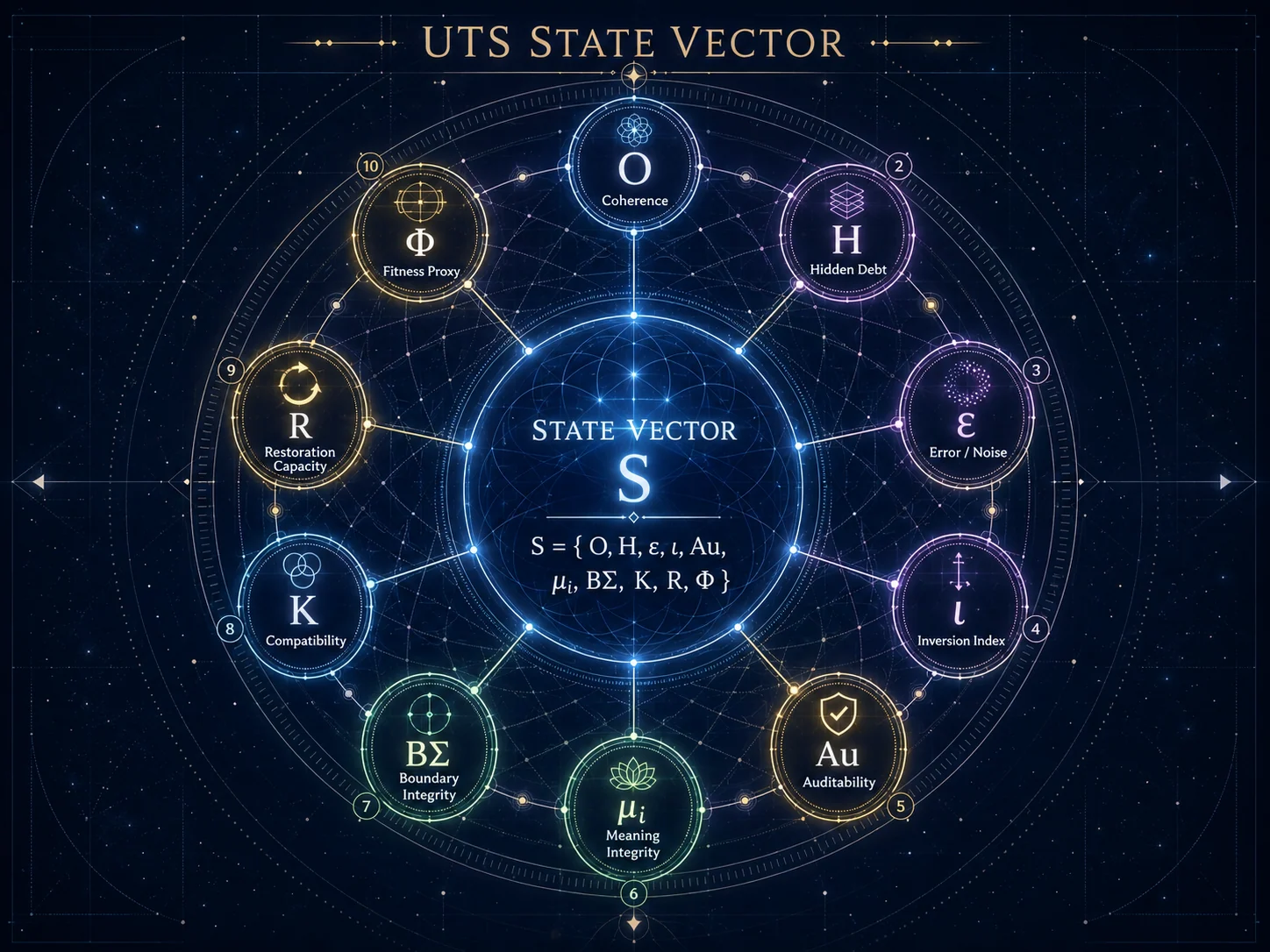
TheCanonical State Vectordefines the shared internal condition of any system analyzed through UTS.
It answers:
What is the system’s current condition, and what can change?
The state vector is not a set of beliefs, labels, narratives, intentions, or moral judgments. It is a compact technical representation of the system’s coherence condition, debt load, error profile, inversion risk, auditability, integrity, boundary condition, compatibility, restoration capacity, and optimization signal.
The attached operator registry defines the canonical vector as:
S = { O, H, ε, ι, Au, µᵢ, BΣ, K, R, Φ }and identifies these variables as the shared substrate on which all operators act.
This means every valid operator analysis begins by asking:
Which state variables are moving?
Which variables are being hidden?
Which variables are being mistaken for each other?
Which variables are being optimized?
Which variables are being degraded?
Which variables are being restored?
I. Core Definition
Thestate vectoris the set of canonical variables that describe the condition of a system at a given time.
Formally:
S(t) = { O(t), H(t), ε(t), ι(t), Au(t), µᵢ(t), BΣ(t), K(t), R(t), Φ(t) }Where:
| Variable | Name | Basic Meaning |
|---|---|---|
O | Coherence | Phase-aligned, mutually reinforcing structure under stress |
H | Hidden Debt | Latent misalignment, deferred cost, unobserved incoherence |
ε | Error / Noise | Observable deviation from expected behavior |
ι | Inversion Index | Apparent order without harmonic fit |
Au | Auditability | Inspectability and traceability of internal state and causality |
µᵢ | Agent / Meaning Integrity | Temporal consistency between model, action, and consequence |
BΣ | Boundary Integrity | Preservation of identity, consent, and interface clarity |
K | Compatibility | Mutual increase of coherence under coupling |
R | Restoration Capacity | Throughput for repair, correction, and realignment |
Φ | Fitness Proxy | Measured success signal used for optimization |
The registry already establishes these definitions at the top level. The purpose of this overview is to explain how they function together as a technical system.
II. Why the State Vector Exists
The state vector exists to prevent analysis from collapsing into domain-specific language too early.
Without a shared state vector, every field invents its own explanation:
| Domain | Common Language | UTS Translation |
|---|---|---|
| Institution | “The system is stable but harmful.” | Apparent O, H↑, ι↑, Au↓ |
| AI system | “The model is optimizing the wrong thing.” | Φ/O divergence |
| Medicine | “Symptoms keep returning.” | τm short, H unresolved, R insufficient |
| Governance | “Legitimacy is collapsing.” | Au↓, BΣ↓, µᵢ↓, H↑ |
| Relationship | “The connection works until stressed.” | K unstable under Δ, BΣ fragile |
| Economy | “Growth is rising but the body is weakening.” | Φ↑ while O↓ and H↑ |
| Symbolic system | “The form is sacred but the function is inverted.” | ι↑, Σ/Φ confusion, Au↓ |
The vector allows different domains to be mapped into the same underlying mechanics without erasing their differences.
This is why the vector is canonical:
It creates cross-domain translation without forcing cross-domain reduction.
III. State Variables Are Not Operators
A state variable describes a system condition.
An operator changes that condition.
This distinction is central.
| Category | Example | Role |
|---|---|---|
| State variable | Hhidden debt | Describes latent unresolved incoherence |
| Operator | ℛrestore | Acts to reduce or metabolize hidden debt |
| Diagnostic | 𝓓(t)damping | Reveals whether oscillation decays after disturbance |
| U-layer | U7memory | Localizes recurrence/hysteresis effects |
| Regime | Crisis Loop | Names a recurring composite pattern |
So:
H does not “act.”
ℛ acts on H.

Au does not “fix.”
Ψ, Μ, Ξ, and ℛ may raise Au.

Φ does not equal success.
Φ is only the measured proxy being optimized.

O does not magically stabilize.
O must be maintained through compatible structure, sufficient repair, clean boundaries, and low hidden debt.
A common UTS error is to treat a state variable as if it were an operator.
Example:
Incorrect:
“Coherence will solve the problem.”

Correct:
“The system requires an admissible operator sequence that raises O by reducing H, lowering ε, increasing Au, restoring BΣ, and improving K.”
IV. The State Vector as a System Snapshot
At any moment, a system can be described by a pattern across the vector.
For example:
S₁ = { O↑, H↓, ε↓, ι↓, Au↑, µᵢ↑, BΣ↑, K↑, R↑, Φ aligned }This describes a coherent, repairable, auditable system.
Another system:
S₂ = { O apparent, H↑, ε masked, ι↑, Au↓, µᵢ↓, BΣ↓, K unstable, R overloaded, Φ↑ }This describes a pseudo-coherent system: it appears successful by proxy, but its internal mechanics are degrading.
The vector lets us distinguish:
real coherence
from apparent stability

restoration
from cosmetic repair

compatibility
from forced coupling

auditability
from explanation theater

fitness proxy
from actual coherence
V. Three Primary State Patterns
1. Coherent State Pattern
A coherent system tends to show:
O↑
H↓
ε manageable
ι↓
Au↑
µᵢ stable
BΣ stable
K positive
R sufficient
Φ aligned with O
Technical meaning:
The system can absorb stress, reveal its own condition, correct errors, preserve boundaries, repair damage, and avoid confusing proxy success with real coherence.
2. Degraded State Pattern
A degraded system tends to show:
O↓
H↑
ε↑
ι variable or rising
Au↓
µᵢ unstable
BΣ weakened
K declining
R insufficient
Φ unstable or misleading
Technical meaning:
The system is losing the ability to self-correct. Its outputs may still occur, but repair capacity is falling behind load.
3. Pseudo-Coherent State Pattern
A pseudo-coherent system tends to show:
O apparent
H↑
ε suppressed or displaced
ι↑
Au↓
µᵢ fragmented
BΣ exploited or blurred
K extractive
R cosmetic or overloaded
Φ↑
Technical meaning:
The system appears orderly because it is stabilizing around proxy success, exported cost, suppressed feedback, or hidden debt.
This is one of the most important uses of the state vector: it separatesstabilityfromcoherence.
VI. Variable Clusters
The ten variables can be grouped into functional clusters.
1. Coherence / Debt / Error Cluster
{ O, H, ε, ι }This cluster describes the system’s alignment, hidden load, observable deviation, and inversion risk.
| Variable | Role |
|---|---|
O | Real coherence condition |
H | Latent unresolved incoherence |
ε | Visible error or noise |
ι | Pseudo-coherence / inversion signal |
This cluster answers:
Is the system actually coherent,
or merely appearing stable while debt accumulates?
2. Audit / Integrity / Boundary Cluster
{ Au, µᵢ, BΣ }This cluster describes whether the system can see itself, maintain continuity between model/action/consequence, and preserve clean boundaries.
| Variable | Role |
|---|---|
Au | Can the system be inspected? |
µᵢ | Does model/action/consequence remain consistent over time? |
BΣ | Are identities, interfaces, roles, and consent boundaries intact? |
This cluster answers:
Can the system know what it is doing,
remain accountable to consequence,
and preserve the integrity of its interfaces?
3. Coupling / Repair / Optimization Cluster
{ K, R, Φ }This cluster describes whether coupling is coherence-positive, whether repair can keep pace, and whether optimization is tracking the right signal.
| Variable | Role |
|---|---|
K | Compatibility under coupling |
R | Capacity to repair and realign |
Φ | Proxy being optimized |
This cluster answers:
Does the system couple cleanly,
repair sufficiently,
and optimize the right signal?
VII. Variable-by-Variable Technical Summary
1.O— Coherence
Coherenceis phase-aligned, mutually reinforcing structure under stress.
It is not merely order, agreement, performance, harmony, calmness, or sameness.
A system can be orderly but incoherent.
A system can be active but coherent.
A system can experience disturbance and remain coherent if its parts remain mutually reinforcing under stress.
O increases when:
H decreases
ε becomes visible and correctable
Au increases
BΣ stabilizes
K improves
R keeps pace with load
Φ remains aligned with real system health
O decreases when:
hidden debt accumulates
error is suppressed
proxy success replaces real coherence
boundaries blur
repair lags behind load
compatibility is assumed rather than tested
Canon role:
Ois the central coherence condition, but it is not directly equivalent to any one metric.
2.H— Hidden Debt
Hidden Debtis latent misalignment, deferred cost, or unobserved incoherence.
It is what the system has not yet paid for, repaired, revealed, integrated, or metabolized.
H increases when:
errors are suppressed
feedback is ignored
repair is postponed
classification is wrong
constraints exceed auditability
boundary violations are normalized
proxy success hides structural cost
H decreases when:
hidden error becomes visible
repair reaches the correct U-layer
causal pathways become auditable
boundary conditions are corrected
recurrence patterns are metabolized
Canon role:
His one of the strongest predictors of delayed instability.
A system can look stable whileHrises.
3.ε— Error / Noise
Error / Noiseis observable deviation from expected, intended, or coherent behavior.
It differs from hidden debt becauseεis visible or detectable, whileHmay remain latent.
ε increases when:
execution misfires
classification is wrong
coupling introduces instability
environmental forcing rises
hidden debt surfaces
ε decreases when:
feedback loops improve
execution is corrected
classification improves
noise is filtered without suppressing signal
repair reduces the source of deviation
Canon role:
εis not always bad. Sometimes rising error means hidden debt is becoming visible.
This distinction matters:
ε↑ with Au↑ may indicate exposure and repair.
ε↓ with Au↓ may indicate suppression.4.ι— Inversion Index
Inversion Indexmeasures apparent order without harmonic fit.
It is the signal that something may look coherent while functioning incoherently.
ι increases when:
Φ rises while O falls
symbols detach from function
authority detaches from accountability
order is maintained through hidden cost
metrics reward incoherence
repair becomes cosmetic
ι decreases when:
Ξ exposes pseudo-coherence
Au increases
Φ is reconnected to O
feedback channels become trustworthy
symbol and function realign
Canon role:
ιis the state signature that calls for inversion detection.
It is not the Ξ operator itself.
It is the condition Ξ helps expose.
5.Au— Auditability
Auditabilityis the inspectability and traceability of internal state and causality.
It answers:
Can the system show how it reached this state?
Can cause and consequence be traced?
Can claims be checked against process?
Au increases when:
causal paths are visible
feedback is preserved
records are reliable
interfaces are legible
decision pathways can be inspected
classification logic can be reviewed
Au decreases when:
complexity exceeds inspection
authority blocks review
metrics hide process
automation obscures causality
memory is selectively retained
language replaces traceability
Canon role:
Auis central to repair, legitimacy, diagnostics, and safe actuation.
Low auditability makes almost every operator more dangerous.
6.µᵢ— Agent / Meaning Integrity
Agent / Meaning Integrityis temporal consistency between model, action, and consequence.
It tracks whether a system’s self-description, behavior, and effects remain aligned over time.
µᵢ increases when:
claims match behavior
behavior tracks consequence
identity remains consistent under stress
meaning is not overwritten by convenience
commitments remain traceable across time
µᵢ decreases when:
model and action diverge
actions externalize consequence
meaning is redefined after the fact
identity becomes performative rather than operational
the system cannot remember what it claimed to be
Canon role:
µᵢhelps distinguish living integrity from surface coherence.
A system can speak coherent language whileµᵢdeclines.
7.BΣ— Boundary Integrity
Boundary Integrityis the preservation of identity, consent, role clarity, interface distinction, and sacred/non-negotiable invariants.
It answers:
Are the boundaries clean?
Are roles distinct?
Is coupling consensual?
Are interfaces clear?
Are invariants protected?
BΣ increases when:
roles are clear
interfaces are explicit
coupling preserves identity
constraints protect rather than capture
consent conditions are legible
non-negotiable invariants are honored
BΣ decreases when:
roles blur
interfaces are exploited
coupling becomes coercive
boundaries are reframed as obstacles
identity is absorbed into another system
invariants are overridden for short-term Φ
Canon role:
BΣis essential for safe coupling, valid constraint, legitimate restoration, and compatibility testing.
8.K— Compatibility
Compatibilityis the degree to which coupling produces mutual coherence increase.
It does not mean similarity, agreement, attraction, convenience, or successful contact.
K increases when:
coupled systems preserve identity
interfaces are clean
load is mutually absorbable
timing is compatible
restoration capacities are not parasitized
both systems become more coherent through contact
K decreases when:
one system exports hidden debt into another
coupling requires boundary erosion
timing mismatch creates instability
one system’s Φ rises while the other’s O falls
repair burden becomes asymmetric
Canon role:
Kis the core variable behind compatibility analysis and safe coupling.
It prevents the system from confusing connection with coherence.
9.R— Restoration Capacity
Restoration Capacityis the throughput for repair, correction, realignment, and reintegration.
It answers:
Can the system repair faster than it degrades?R increases when:
repair pathways are available
feedback is trustworthy
resources are sufficient
memory preserves learning
hidden debt is metabolized
operator sequences are admissible and well-timed
R decreases when:
repair is delayed
repair is cosmetic
hidden debt accumulates
feedback is punished
response latency rises
environmental forcing remains chronic
repair burden exceeds capacity
Canon role:
Ris central to bandwidth, damping, crisis avoidance, and long-term coherence.
A system with lowRmay temporarily stabilize, but it cannot remain coherent under repeated stress.
10.Φ— Fitness Proxy
Fitness Proxyis the measured success signal used for optimization.
It is not coherence.
This is one of the most important distinctions in UTS.
Φ ≠ OA system can improve its proxy while degrading its actual coherence.
Φ becomes useful when:
it tracks real coherence
it remains auditable
it is bounded by gates
it is corrected by feedback
it does not override BΣ, Au, R, or K
Φ becomes dangerous when:
it replaces O
it is optimized without audit
it rewards hidden debt
it suppresses ε
it raises ι
it incentivizes boundary violation
it becomes immune to correction
Canon role:
Φis necessary because systems need measurable signals, but it must never be mistaken for the real coherence condition.
Many UTS failure modes begin as:
Φ↑ while O↓VIII. Key Variable Relationships
1. Coherence vs Fitness Proxy
O = real coherence condition
Φ = measured success signal
Healthy system:
Φ tracks OFailure pattern:
Φ↑ while O↓This is the core of Goodhart-style distortion, pseudo-coherent basins, and proxy capture.
2. Hidden Debt vs Error
H = hidden unresolved incoherence
ε = visible deviation/noise
A system may reduce visible error by increasing hidden debt.
Example:
ε↓
H↑
Au↓
ι↑
This means the error was not solved. It was displaced or hidden.
3. Auditability vs Complexity
A central sanity constraint from the registry is:
X_c > Au_eff ⇒ H↑When constraint complexity exceeds effective auditability, hidden debt rises.
This is a core rule for:
law
bureaucracy
software
AI systems
governance
ritual systems
institutional design
economic systems
4. Restoration Capacity vs Load
Another core sanity constraint:
R_eff > Load × Gain_stack ⇒ O tends to increase
R_eff < Load × Gain_stack ⇒ collapse amplifies
This means restoration must scale with actual load after amplification, not with nominal load.
A system may look adequately resourced until the gain stack is counted.
5. Boundary Integrity vs Compatibility
BΣ stable ⇒ K can be tested cleanly
BΣ weak ⇒ K readings become unreliable
Without boundary integrity, compatibility becomes impossible to measure.
A system may appear compatible only because one side is absorbing cost, suppressing signal, or allowing identity erosion.
6. Inversion Index vs Auditability
Au↓ + Φ↑ + H↑ ⇒ ι↑ likelyWhen success signals rise while auditability falls and hidden debt accumulates, inversion risk increases.
ιdoes not prove inversion alone, but it marks where Ξ should be applied.
IX. State Vector and U-Layers
The state vector describeswhatchanges.
U-layers describewherethe change manifests.
Example:
H↑ at U1 = hidden budget/resource debt
H↑ at U2 = hidden boundary/configuration debt
H↑ at U4 = hidden classification/model debt
H↑ at U7 = hidden recurrence/memory debt
The same variable can appear differently across layers.
Example: Au Across U-Layers
| Layer | Auditability Expression |
|---|---|
| U0 | Can substrate/material conditions be inspected? |
| U1 | Can resource flows be traced? |
| U2 | Can permissions/boundaries be reviewed? |
| U3 | Can execution behavior be observed? |
| U4 | Can classifications/metrics be audited? |
| U5 | Can timing/protocol decisions be traced? |
| U6 | Can cross-domain coherence effects be seen? |
| U7 | Can memory/recurrence patterns be inspected? |
| U8 | Can environmental forcing be distinguished from internal failure? |
This is why state-variable spec sheets should include a U-layer expression section.
X. State Vector and Operators
Operators move the state vector.
Examples:
| Operator | Likely State Effects |
|---|---|
ΠConstrain | BΣ↑ when valid; H↑ if overconstrained or unauditable |
ΓSelect | Φ alignment or misalignment depending on selection criteria |
ΔDistort | ε↑ temporarily; Au↑ if used as probe; H↑ if overload |
ℛRestore | H↓, ε↓, R rebuilt, O↑ |
ΞInvert | ι exposed, Au demand increases, false O destabilized |
ΜSensemaking | Au↑, µᵢ↑ if provisional; ι↑ if frozen prematurely |
ΘHumility | gain damping, ε↓, ι↓, Au↑ |
ΛCompatibility | K tested, BΣ preserved, coupling clarified |
ΣSacred Boundary | BΣ↑, invariants preserved |
ΨPresence | audit resolution ↑, signal fidelity ↑ |
This is the backbone of every spec sheet:
Variable movement should always be tied back to operator effects.XI. State Vector and Diagnostics
Diagnostics are inferred from the state vector.
The registry defines bandwidth and damping as computed from the state rather than operators.
1. Bandwidth
𝓑(t) increases with {R, Au, BΣ, O}
𝓑(t) decreases with {H, ε, ι}
This means a system’s ability to absorb forcing depends directly on the state vector.
2. Damping
𝓓(t) increases with {R, Au}
𝓓(t) decreases with {H, ι, chronic U8 forcing}
This means a system’s ability to stop oscillating depends heavily on repair capacity, traceability, hidden debt, inversion, and external pressure.
3. Diagnostic Dependency Table
| Diagnostic | Strongly Influenced By |
|---|---|
| 𝓑(t) Bandwidth | O, R, Au, BΣ, H, ε, ι |
| 𝓓(t) Damping | R, Au, H, ι, U8 forcing |
| σ(t) Slack | R, H, Load, Gain Stack |
| τresp(t) Reaction latency | Au, R, U5 coordination, Xc |
| τm(t) Memory half-life | U7 memory, H, R, µᵢ |
| μmeta(t) Meta succession rate | U4/U5 rule churn, Au, H |
| Xc(t) Constraint complexity | Π density, U2/U4/U5 complexity |
| Perm(t) Boundary permeability | BΣ, Π, K, U2 |
| AP(t) Attribution pressure | Φ collision, H, ε, social/institutional pressure |
XII. State Vector and Regimes
Regimes are recurring state/operator/layer/diagnostic patterns.
A regime is not defined by one variable. It is defined by a constellation.
1. Crisis Loop
Likely signature:
𝓑 breached
𝓓 low
τ_m short
H↑
R overloaded
ε recurring
Au insufficient
2. Extraction Regime
Likely signature:
Φ↑ for extractor
O↓ for extracted system
K↓
BΣ↓
H exported
R asymmetrically consumed
ι↑
3. Repair-First Meta
Likely signature:
ℛ + Π + Σ dominant
H↓
Au↑
BΣ↑
R prioritized
Φ subordinated to O
4. Pseudo-Coherent Basin
Likely signature:
apparent O
Φ↑
H↑
Au↓
ι↑
ε suppressed or displaced
R cosmetic
BΣ weakened
The state vector is what allows a regime to be diagnosed without relying only on narrative description.
XIII. State Vector Misreadings
Misreading 1: Stability = Coherence
Correction:
Stability can be pseudo-coherent.
O requires mutual reinforcement under stress.
Misreading 2: Low Error = Health
Correction:
ε↓ may mean repair,
or it may mean suppression.
Check Au and H.
Misreading 3: High Metrics = Success
Correction:
Φ↑ only matters if Φ tracks O.Misreading 4: Repair Activity = Restoration
Correction:
Repair activity only counts if H↓, ε↓, O↑, R stabilizes, and recurrence improves.Misreading 5: Connection = Compatibility
Correction:
K requires mutual coherence increase under coupling.
Connection alone is not compatibility.
Misreading 6: Boundaries = Rigidity
Correction:
BΣ protects clean coupling.
Weak boundaries produce unreliable compatibility readings.
XIV. Minimal State Audit
A minimal state audit asks:
1. What is rising?
2. What is falling?
3. What is hidden?
4. What is being optimized?
5. What is being confused with coherence?
6. What is losing auditability?
7. What is absorbing hidden cost?
8. What cannot repair fast enough?
9. What layer is the movement occurring at?
10. What operator sequence would change the state with least additional debt?
Minimal Audit Table
| Question | Variable Focus |
|---|---|
| Is the system actually coherent? | O |
| What is unresolved? | H |
| What is visibly deviating? | ε |
| What looks orderly but feels mechanically wrong? | ι |
| Can cause and process be inspected? | Au |
| Do model, action, and consequence align over time? | µᵢ |
| Are boundaries clean? | BΣ |
| Does coupling increase mutual coherence? | K |
| Can the system repair? | R |
| What is being optimized? | Φ |
XV. Canon Closure
The canonical state vector is the technical substrate of UTS.
It allows every system to be analyzed through the same question:
What is the system’s state, what is changing it, where is the change localized, what is being optimized, what is hidden, and what would restore coherence without creating new debt?
Compressed form:
S = { O, H, ε, ι, Au, µᵢ, BΣ, K, R, Φ }Where:
O  = coherence condition
H  = hidden debt
ε  = observable error/noise
ι  = inversion signal
Au = auditability
µᵢ = agent/meaning integrity
BΣ = boundary integrity
K  = compatibility
R  = restoration capacity
Φ  = fitness proxy
Final principle:
The state vector prevents UTS from confusing appearance with condition, metrics with coherence, connection with compatibility, repair activity with restoration, and stability with truth.