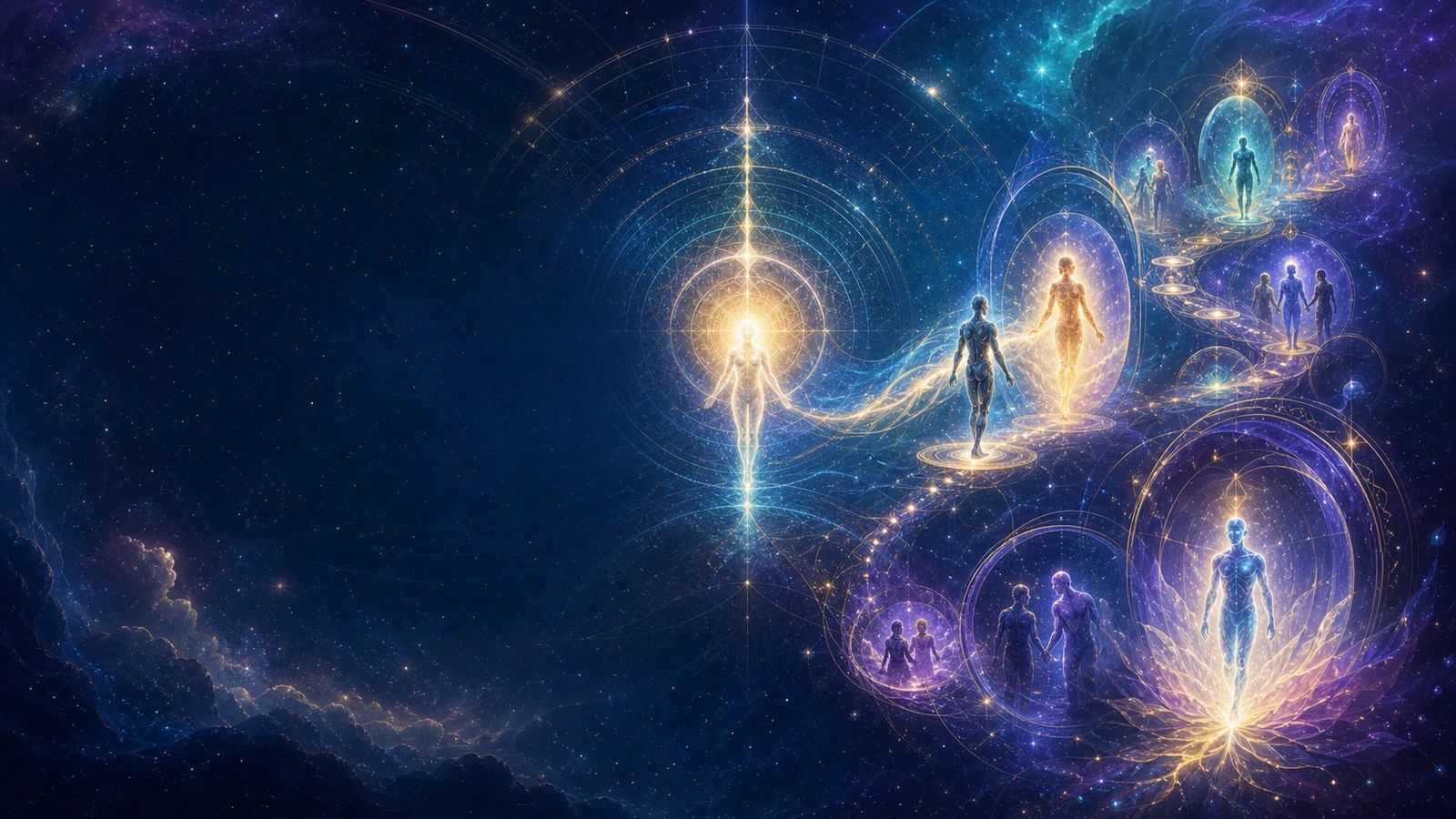
The Soul Architecture Videogame Framework
A concise structural analogy for understanding incarnation, soulstream continuity, soul-family, collectives, archetypes, principles, relationship, and evolution.
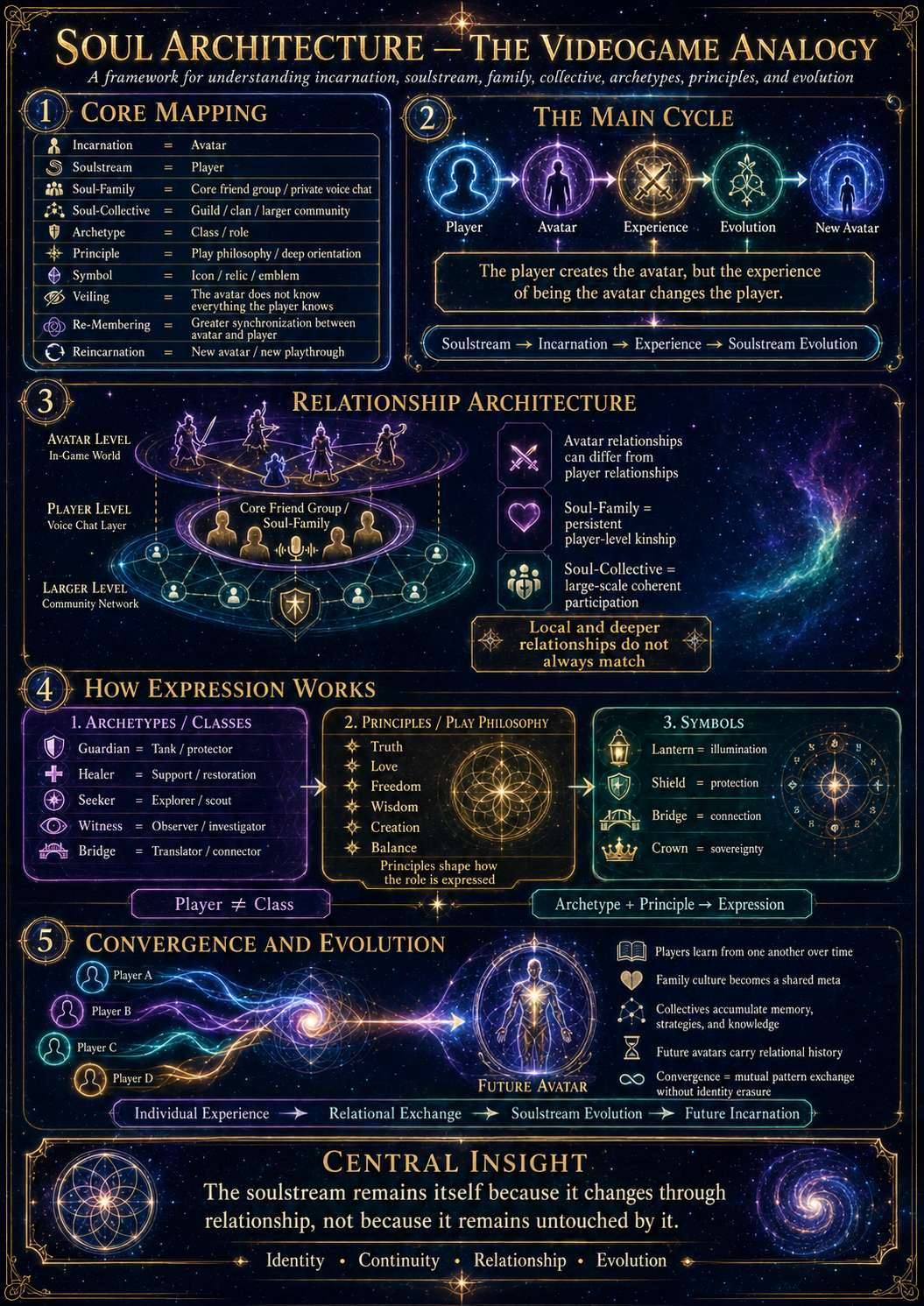
The videogame analogy provides a surprisingly complete way to model soul architecture because it naturally separateslocal identity from persistent identity, while also accounting for relationship, collective structure, learning, archetypal experimentation, principles, memory, and evolution.
The core insight is simple:
The incarnation is the avatar. The soulstream is the player.
From there, the rest of the architecture can be built outward.
The analogy is not intended to imply that existence is literally a videogame. Its value is structural. Videogames already contain many of the relationships needed to explain how a persistent identity can enter a localized form, interact with other localized beings, belong to persistent groups beyond that local world, and emerge from each experience changed.
I. Core Mapping
The foundational mapping is:
| Soul Architecture | Videogame Analogy |
|---|---|
| Incarnation | Avatar / current character |
| Body | Character model and physical interface |
| Incarnational personality | Character-specific history, build, habits, and playstyle |
| World | Game world |
| Timeline | Server, shard, campaign, or instance |
| Soulstream | Persistent player |
| Soul-family | Long-term closest friends / private voice-chat group |
| Soul-collective | Guild, clan, alliance, or larger persistent community |
| Archetype | Character class, role, or recurring play-function |
| Principle | Deep value or philosophy governing how the player approaches play |
| Symbol | Icon, item, emblem, environmental sign, or compressed meaning |
| Veiling | Character-level lack of access to everything the player knows |
| Re-membering | Increasing synchronization between avatar awareness and player continuity |
| Incarnational death | End of a character's active run |
| Reincarnation | Entering another avatar / beginning another playthrough |
| Soulstream development | The player changing through accumulated play |
| Collective memory | Guild knowledge, strategies, guides, traditions, and shared meta |
The analogy becomes especially useful because these layers can exist simultaneously.
A player can be:
- controlling one avatar,
- speaking privately with close friends,
- participating in a guild,
- learning a new class,
- following certain principles of play,
- and carrying experience from previous games
all at once.
That is very close to the multidimensional soul architecture developed throughout the guide.
II. The Avatar — Incarnation
An incarnation is not merely a body.
In the analogy, it is theentire character-level existence.
That includes:
- avatar,
- build,
- stats,
- abilities,
- equipment,
- local history,
- relationships,
- reputation,
- choices,
- achievements,
- injuries or limitations,
- knowledge acquired during the run,
- and the consequences of previous decisions.
Thus:
Incarnation: Avatar + Local History + Relationships + Choices + Experience
The avatar is a genuine identity.
It is not simply a puppet that does not matter.
A character that has existed for years and accumulated relationships, history, victories, mistakes, and unique experiences is meaningfully different from a newly created character controlled by the same player.
This captures an important distinction:
Incarnation ≠ Soulstream
while also:
Incarnation ⊂ Soulstream Experience
The incarnation is the local life.
The soulstream is the longer continuity that experiences through it.
III. The Player — Soulstream
Theplayerrepresents the soulstream.
The player persists when avatars change.
A player may:
- create many characters,
- explore different worlds,
- join different groups,
- play different classes,
- change styles,
- develop new skills,
- and carry knowledge from one experience into another.
This gives us:
Soulstream: Persistent Player Continuity
The player is not unchanged by the games they play.
Every meaningful playthrough can alter:
- skill,
- preference,
- strategy,
- judgment,
- confidence,
- patience,
- creativity,
- communication,
- and future choices.
Thus the relationship is reciprocal:
Player → Avatar Experience → Changed Player
which corresponds to:
St → It → Et → St + 1
The player enters the avatar.
The avatar's life becomes experience.
That experience becomes part of the continuing player.
IV. Why Create Different Avatars?
A persistent player could theoretically keep playing the same type of character forever.
But different avatars create different experiential possibilities.
Someone who always plays a healer may understand tanking intellectually.
They may watch excellent tanks.
They may even know the mechanics.
But actually playing the tank creates another kind of knowledge.
The player must experience:
- positioning,
- responsibility,
- pressure,
- protection,
- threat management,
- timing,
- and decision-making
from inside that role.
Thus:
Observation ≠ Embodied Experience
Incarnation therefore allows the soulstream to explore possibilities through local participation rather than abstract understanding alone.
Different avatars create different experiential geometries.
V. Archetypes — Classes and Roles
The archetype system maps extremely well onto videogame classes and roles.
Examples include:
| Archetype | Videogame Expression |
|---|---|
| Guardian | Tank / protector |
| Healer | Support / restoration |
| Seeker | Explorer / scout |
| Witness | Observer / investigator / recorder |
| Bridge | Translator / mediator / connector |
| Teacher | Mentor / trainer |
| Creator | Builder / crafter / designer |
| Sovereign | Leader / coordinator |
| Trickster | Disruptor / improviser |
| Warrior | Combat specialist |
| Mystic | Esoteric / hidden-system specialist |
| Messenger | Courier / communications role |
The important distinction is:
Player ≠ Class
A player may become highly identified with one class, but the class is still a field of experience rather than the totality of the player.
A soulstream can likewise explore multiple archetypes across incarnations.
For example:
Healer → Guardian → Seeker → Teacher
The player gains something from each.
The archetypes become part of the player's repertoire.
VI. Archetypal Experimentation
One of the strongest parts of the analogy appears when players watch one another.
Imagine Player A has always played support.
Player B has spent years playing Guardian-type characters.
Player A watches B and eventually thinks:
That looks interesting. I want to experience that role myself.
Player A's next avatar is therefore designed around Guardian mechanics.
Conceptually:
SA → observes Guardian expression → interest → IA, n + 1Guardian
Then:
IA, n + 1Guardian → EGuardian → SA'
The player has now internalized something previously known only through observation.
This provides a straightforward model for how soulstreams might explore new archetypal fields through incarnation.
VII. Principles — The Philosophy of Play
Principles map not to classes, but tohow and why the player plays.
Two players can choose the same class while embodying completely different principles.
For example, two Guardians might both protect their team.
One may operate through:
Protection, Love, Service
while another operates through:
Control, Dominance, Order
The class is similar.
The principle harmonic is different.
This gives us:
Archetype: Mode of Expression
while:
Principle: Deep Orientation of Expression
A player might value:
- Truth — understanding how the game actually works;
- Love — helping other players flourish;
- Freedom — maximizing open choice;
- Wisdom — choosing appropriate action at the right time;
- Creation — building new possibilities;
- Balance — maintaining coherence among competing needs;
- Sovereignty — preserving meaningful agency;
- Meaning — treating play as something greater than optimization alone.
Principles therefore shapehow every class is played.
VIII. Symbols — Compressed Game Meaning
Symbols map naturally to the visual and informational grammar of a game.
They may include:
- icons,
- banners,
- armor motifs,
- relics,
- environmental signs,
- colors,
- emblems,
- items,
- locations,
- interface markers,
- or faction symbols.
A shield may communicate protection.
A lantern may communicate illumination or revelation.
A bridge may communicate connection and passage.
A crown may communicate sovereignty or authority.
Thus:
Principle → Archetype → Symbolic Expression
The player learns to interpret large amounts of information through compressed symbols.
Soul architecture may operate similarly.
Symbols become compact interfaces connecting:
- principle,
- archetype,
- memory,
- culture,
- and experience.
IX. Soul-Family — The Core Friend Group
The soul-family maps most closely to the group of players who have remained close across many games.
They may have been playing together for decades.
Their avatars change.
Games change.
Guilds change.
Roles change.
But the friendship among the players persists.
Thus:
Soul-Family: Persistent Player-Level Kinship
Inside one game, their avatars may even appear unrelated.
They could be:
- strangers,
- rivals,
- members of different factions,
- different species,
- geographically separated,
- or temporary enemies.
Yet outside the local game context, the players may still be in the same voice channel.
This produces two simultaneous relational layers:
Ravatar
and:
Rplayer
which need not match.
Thus:
Rincarnational ≠ Rsoulstream
A difficult avatar-level relationship does not necessarily imply a difficult player-level relationship.
Likewise, friendly avatars do not necessarily imply deeply connected players.
This is one of the most useful cross-scale insights in the entire analogy.
X. The Family Voice Channel
The voice-chat layer illustrates why soul-family relationships can persist beyond local incarnational awareness.
The avatars communicate through the game.
The players communicate outside it.
Thus the same beings may possess:
In-game communication
IA ↔ IB
Player-level communication
SA ↔ SB
The local avatar may not have access to everything occurring at player level.
This gives a simple model for how a deeper relational field might coexist with limited incarnational awareness.
XI. Soulstream Convergence
The analogy becomes especially powerful when the players have known one another for a long time.
Players influence each other.
Suppose:
- Player A is an excellent explorer.
- Player B is an excellent support player.
- Player C is an excellent strategist.
After playing together for years, each begins learning from the others.
Player A develops better teamwork.
Player B becomes more strategic.
Player C becomes more experimental.
The players remain distinct.
But each contains patterns learned through relationship.
Thus:
SA(t2) = SA(t1) + ΔB → A + ΔC → A + EA
Likewise:
SB(t2) = SB(t1) + ΔA → B + ΔC → B + EB
and so on.
This issoulstream convergence through relational evolution.
XII. Convergence Without Identity Erasure
The players do not literally become one player.
Instead, they exchange patterns.
Thus:
SA ≠ SB ≠ SC
while:
SA ↔ SB ↔ SC
produces mutual development.
The central principle is:
Convergence: Mutual Pattern Exchange Without Identity Erasure
Over enough time, the players may develop shared habits so deeply that no one remembers who originated them.
The pattern has become part of the group's relational field.
XIII. The Shared Meta — Soul-Family Culture
A long-standing gaming group develops its ownmeta.
This may include:
- preferred strategies,
- shared vocabulary,
- communication rhythms,
- inside jokes,
- problem-solving methods,
- risk tolerance,
- expectations,
- ethical norms,
- role preferences,
- and shared assumptions.
This produces:
F → MF
where (MF) is the family's shared meta.
That meta then influences each member:
MF → SA', SB', SC', SD'
The family therefore becomes a developmental field.
Each player shapes the meta.
The meta shapes every player.
Thus:
Individual Experience → Family Field → Distributed Evolution
XIV. The Next Avatar Carries the Family History
Now imagine Player A creates a new character.
That character may include:
- A's original exploration instinct,
- support techniques learned from B,
- strategic patterns learned from C,
- an archetype A became interested in by watching another friend,
- and entirely new experimentation.
The character therefore contains a history extending beyond its own lifetime.
Conceptually:
IA, n + 1 = ℒ (SA', T, W, B)
with:
SA' = SA + ΔB + ΔC + Δnew
The avatar becomes the current expression of accumulated relational evolution.
An observer seeing only the avatar would see an unusual combination of traits.
From player level, the history of those traits is visible.
XV. Soul-Collective — The Guild or Clan
The soul-collective maps naturally onto the guild, clan, alliance, or large persistent community.
A guild may contain:
- close friends,
- acquaintances,
- specialized teams,
- leaders,
- teachers,
- crafters,
- strategists,
- explorers,
- casual participants,
- and temporary members.
Not everyone shares intimate kinship.
What they share is larger-scale coherent participation.
Thus:
Soul-Collective: Guild-Level Coherent Participation
The soul-family may exist inside it:
Fi ⊂ Cj
but the two remain distinct structures.
XVI. Multiple Guilds — Multiple Collectives
Players can belong to several communities.
One player may participate in:
- a raiding guild,
- a crafting guild,
- a role-playing community,
- a PvP group,
- and a social server.
Thus:
Si ∈ C1 ∩ C2 ∩ C3
This maps cleanly onto multidimensional soul-collective membership.
A soulstream can participate simultaneously in:
- archetypal collectives,
- principle collectives,
- civilizations,
- creative collectives,
- and relational networks.
One membership does not exhaust identity.
XVII. Guild Knowledge — Collective Memory
A mature guild develops knowledge that no individual player created alone.
It may contain:
- strategy guides,
- encounter knowledge,
- traditions,
- builds,
- historical records,
- maps,
- communication systems,
- role expectations,
- and techniques.
One player invents something.
Another refines it.
Someone documents it.
Veterans teach newcomers.
Eventually the origin becomes irrelevant.
The knowledge belongs to the collective field.
Thus:
Si → KC → S1, S2, …, Sn
This is collective memory.
The guild remembers more than any one member.
XVIII. Collective Evolution
The guild also changes the players.
Consider two equally skilled beginners placed into different guilds.
Guild A emphasizes:
- competition,
- optimization,
- speed,
- rankings.
Guild B emphasizes:
- experimentation,
- teaching,
- cooperation,
- creativity.
Five years later, those players may have developed very differently.
Thus:
Si(t2) = f (Si(t1), Ei, Fi, Ci)
where:
- (Ei) = personal experience,
- (Fi) = family influence,
- (Ci) = collective influence.
Soul evolution is therefore neither purely individual nor purely collective.
It is relational.
XIX. Innovation Flows Both Ways
Players also change their guilds.
Suppose one player leaves for a while, learns an entirely new strategy elsewhere, and returns.
Then:
Si → Δnew → C
The guild incorporates it.
Later:
C → S1', S2', …, Sn'
The innovation becomes distributed.
Thus:
Soulstream ↔ Collective
The collective shapes the soulstream.
The soulstream shapes the collective.
XX. Civilizations — Persistent Game Societies
A civilization maps naturally onto a persistent player-created society within the game.
It may contain:
- multiple guilds,
- families,
- institutions,
- symbolic systems,
- territories,
- traditions,
- laws,
- economies,
- technologies,
- conflicts,
- and shared history.
A player can participate deeply in that civilization without originating from the same guild or friend group as everyone else.
Thus civilization becomes ameeting field for many soul architectures.
Different players bring different histories into one shared world.
XXI. Veiling — The Character Does Not Know Everything the Player Knows
The avatar operates through local game information.
The player possesses a much larger context.
Thus:
Kavatar ⊂ Kplayer
The player may know:
- previous characters,
- other games,
- other players outside the current world,
- external communications,
- hidden mechanics,
- information on another screen,
- or goals the avatar itself cannot conceptualize.
The avatar's lack of access does not mean the player's continuity has disappeared.
This gives us:
Continuity ≠ Conscious Recall
Veiling becomes an information-boundary issue rather than destruction of identity.
XXII. Re-Membering — Player/Avatar Synchronization
Re-membering can be modeled as increasing synchronization between the localized character and the persistent player.
It is not necessarily a full transfer of everything the player knows.
That would overwhelm the character-level context.
Instead:
Limited Interface → Greater Synchronization
Thus:
Re-Membering: Increasing Coherent Connectivity
The avatar may gain greater awareness of:
- deeper identity,
- recurring patterns,
- familiar players,
- archetypal tendencies,
- principle orientation,
- or larger group relationships.
It remains the avatar.
It simply understands more of the architecture through which it exists.
XXIII. Death and Character Completion
When an avatar's run ends:
In → Character Completion
the player persists within the analogy:
S → S'
The player carries what was gained.
The completed avatar still mattered because its life produced:
- relationships,
- consequences,
- knowledge,
- accomplishments,
- mistakes,
- and changes in the player.
Thus:
Finite Character ≠ Meaningless Character
The fact that the playthrough ends is part of what gives it form.
XXIV. Reincarnation — The Next Character
A later incarnation resembles creating a new avatar.
The new character does not begin as an exact copy of the old one.
The player may deliberately choose something different.
For example:
I1Healer → S' → I2Guardian
The second character inherits the player shaped partly through the first character's experience.
Thus:
New Incarnation: Persistent Player + Accumulated Experience + New Localization
The new avatar can therefore contain continuity without repeating the prior avatar.
XXV. Character Builds — Soul Geometry
A character build provides a particularly useful metaphor for soul geometry.
A build may combine:
- class,
- subclass,
- passive abilities,
- learned skills,
- equipment,
- specializations,
- player habits,
- guild strategies,
- and experimental techniques.
Two players can technically select the same class and still produce very different builds.
Likewise:
Soul Identity ≠ Archetype Alone
The fuller expression is:
Soul Geometry: Streams + Archetypes + Principles + Relationships + Experience
The unique configuration matters.
XXVI. Principles Shape Builds More Deeply Than Classes
Two players may create identical character builds mechanically but play them in completely different ways.
One Guardian may:
- protect weaker players,
- teach newcomers,
- and sacrifice ranking for group survival.
Another may:
- control others,
- demand obedience,
- and use defensive power as social leverage.
Mechanically similar.
Principally different.
Thus:
Mechanical Role ≠ Principle Alignment
This is an important reason archetypes and principles must remain separate systems.
The archetype tells uswhat form of capability is being expressed.
The principle tells uswhat deeper orientation is moving through it.
XXVII. Archetypal Shadows — Misusing a Class
The videogame analogy also helps explain archetypal shadows.
The same class can be played coherently or distorted.
For example:
Guardian → Protection
can distort into:
Guardian → Control → Jailor
Likewise:
Teacher → Knowledge Sharing
can distort into:
Teacher → Control of Knowledge → Indoctrinator
The underlying capability may remain similar.
The principle relationship changes.
This provides a simple way to explain why shadow archetypes can emerge from distorted use rather than being wholly separate beings.
XXVIII. Cross-Scale Relationship
The videogame model makes it easy to understand why relationships can differ at each level.
Two avatars might be enemies.
Their players might be friends.
Their friend groups might belong to competing guilds.
Their guilds might still cooperate at alliance level.
Thus:
Ravatar ≠ Rplayer ≠ Rfamily ≠ Rguild
Several relationship layers can coexist without contradiction.
This is one of the clearest analogies for the multidimensional nature of soul architecture.
XXIX. The Full Dynamic
The complete player-avatar cycle can be summarized as:
Player → Avatar → Experience → Player Development
The player also exists within relational fields:
Player ↔ Friend Group ↔ Guild
Those fields influence the player:
Family + Collective → Player Evolution
The evolved player creates future avatars:
Evolved Player → New Build → New Avatar
And those avatars generate new experience that returns to the larger relational field.
Thus:
Individual Experience → Soulstream Evolution → Relational Exchange → Collective Evolution → Future Incarnation
This produces a recursive developmental cycle.
XXX. The Full Videogame Architecture
The entire analogy can now be represented as:
Avatar ↔ Incarnation · Player ↔ Soulstream · Core Friend Group ↔ Soul-Family · Guild / Clan ↔ Soul-Collective · Class / Role ↔ Archetype · Play Philosophy ↔ Principle Harmonic · Icons / Relics / Emblems ↔ Symbols · Shared Meta ↔ Relational / Collective Memory · New Character Build ↔ New Incarnational Geometry · Player Growth ↔ Soulstream Evolution
The larger movement is:
Player → Avatar → Experience → Evolution → New Avatar
while simultaneously:
Player ↔ Family ↔ Collective
This captures bothvertical continuityandhorizontal relationship.
XXXI. Where the Analogy Stops
The analogy becomes weaker at the Oversoul and Source levels.
This is useful to state explicitly rather than forcing a correspondence.
The soulstream maps naturally to the player because both represent persistent identity across avatars.
Soul-family maps naturally to long-term player relationships.
Soul-collective maps naturally to guild-level participation.
Principles, archetypes, symbols, memory, and convergence all map well.
But Oversoul and Source describe structures more fundamental than ordinary videogame architecture can comfortably represent.
Attempting to map Source to:
- game developer,
- server owner,
- game engine,
- hardware,
- or network administrator
would distort the concept.
Each of those is still an object or actor within some larger reality.
Source, as defined in the broader framework, is the deeper field within whichthe players, game, developers, hardware, worlds, and every other element of the analogy could exist at all.
Therefore:
The Videogame Analogy Explains the Local and Relational Architecture
without needing to represent every scale.
XXXII. Central Principles of the Framework
The analogy ultimately reveals several important principles.
The Avatar Is Real at Its Scale
Temporary ≠ Meaningless
The Player Persists Beyond the Avatar
Avatar Completion ≠ Player Completion
The Avatar Changes the Player
The player creates the avatar, but the experience of being the avatar changes the player.
Players Change One Another
Relationship → Mutual Evolution
Future Avatars Carry Relational History
Past Experience + Shared Learning → Future Build
Archetypes Are Roles, Not Total Identities
Player ≠ Class
Principles Determine How Roles Are Expressed
Archetype + Principle → Expression
Family Is a Developmental Field
Players ↔ Shared Meta
Collective Knowledge Exceeds Individual Knowledge
KC > Ki
Convergence Does Not Require Erasure
Convergence: Mutual Pattern Exchange Without Identity Loss
Local and Deeper Relationships Can Differ
Ravatar ≠ Rplayer
Re-Membering Is Interface Expansion
Re-Membering: Greater Coherent Access to Persistent Identity
Final Synthesis
The videogame framework turns soul architecture into a familiar relational system.
The soulstream is not simply waiting between incarnations.
It is developing.
It enters avatars.
The avatars generate experience.
Experience changes the player.
Players influence one another.
Long-standing relationships create shared ways of perceiving and acting.
Those shared patterns become family culture.
Families participate within larger collectives.
Collectives accumulate memory and distribute knowledge.
Players observe one another's archetypal expressions and experiment with those roles in later avatars.
Principles determine how those archetypes are actually expressed.
Symbols compress the meaning of those relationships into recognizable forms.
The process becomes recursive:
Soulstream → Incarnation → Experience → Relational Exchange → Soulstream Evolution → Future Incarnation
The most important insight may be thatno player develops alone.
Even when one person creates a new avatar, that character may carry techniques, ideas, preferences, principles, archetypal interests, and ways of relating learned through years of experience with other players.
The new avatar therefore becomes more than the expression of one isolated history.
It becomes a localization of an identity that has already been shaped through relationship.
That is where the videogame analogy and the larger Soul Architecture framework meet most cleanly:
The soulstream remains itself because it changes through relationship, not because it remains untouched by it.
Identity is preserved through continuity.
Evolution occurs through experience.
And relationship becomes one of the primary mechanisms through which consciousness learns what it can become.