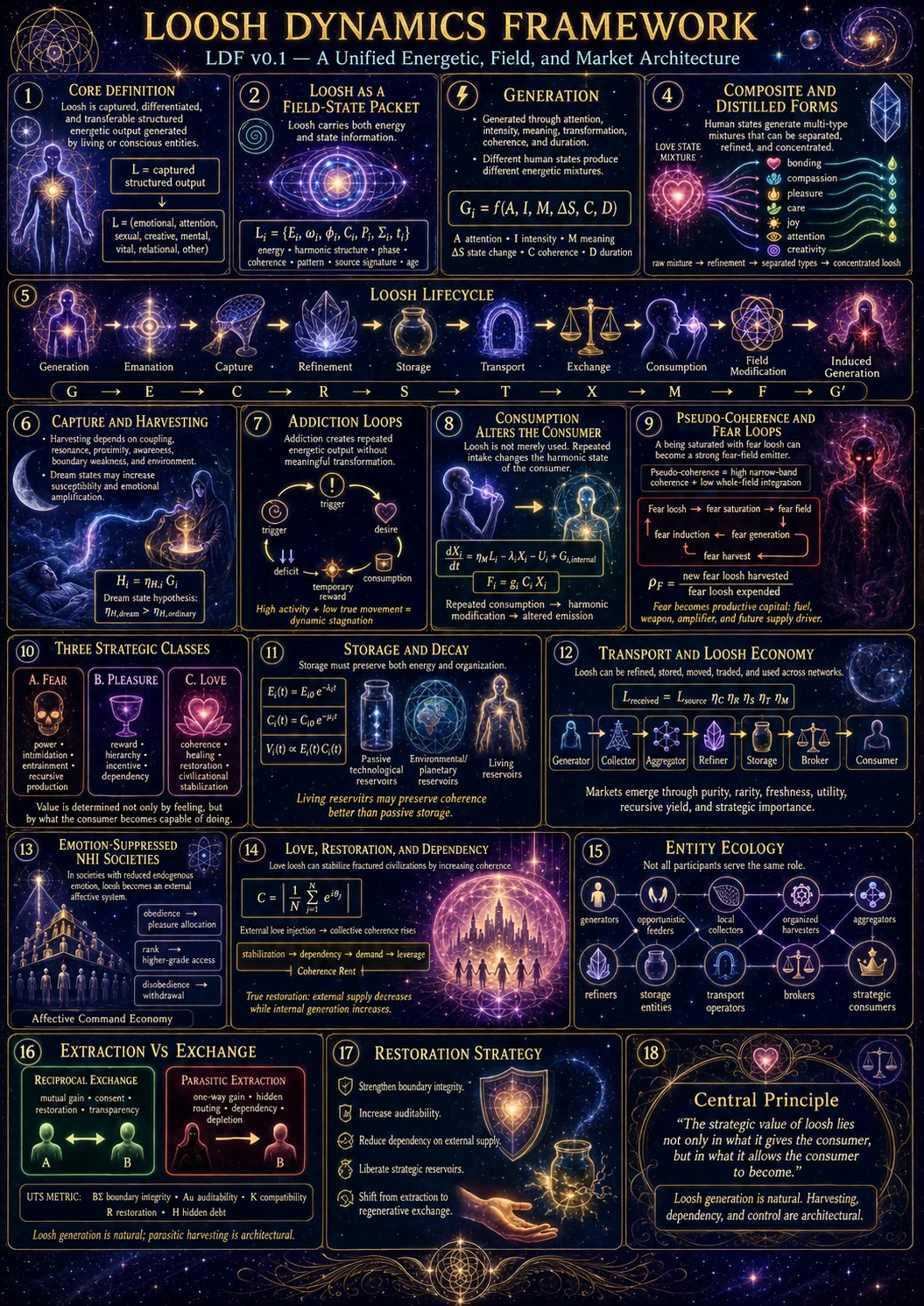
Loosh Dynamics Framework
A unified reference for energetic lifecycle, emotional spectra and compounds, reactions, storage, living reservoirs, civilizational pressure, distribution, markets, and restorative architecture.

The Loosh Dynamics Framework joins the core energetic lifecycle with its emotional registries, reaction and storage layers, civilizational pressure systems, distribution architecture, markets, and reflexive finance model.
This combined edition preserves the fourteen repaired source documents in their intended system sequence. The dedicated Frameworks route pairs each subsystem with its ordered visual atlas.
Part I — Core Energetic Lifecycle
Loosh Dynamics Framework v0.1
I. Core Definition
Loosh is captured, differentiated, and potentially transferable structured energetic output generated by living or conscious entities.
It can include multiple coupled components:
L = (Lemotional, Lattention, Lsexual, Lcreative, Lmental, Lvital, Lrelational, Lother)
Loosh should therefore not be understood as a single homogeneous substance.
A living being first generates a complex energetic field:
State → Bioelectromagnetic Field → Emanated Structured Output
Capture and preservation transform part of that emanated output into usable loosh:
Generated Output → capture + organization → Loosh
This distinction separates thenatural generation of energyfrom itsharvesting.
Loosh itself is not inherently exploitative.
Extraction is an architectural relationship.
II. Loosh as a Field-State Packet
If consuming fear, love, pleasure, or another form causes qualitatively different changes in the recipient, energy quantity alone cannot explain loosh.
A packet therefore needs both energy and state information:
Li = Ei, ωi, φi, Ci, Pi, Σi, ti
where:
- (Ei) = energetic magnitude
- (ωi) = spectral/harmonic structure
- (φi) = phase organization
- (Ci) = coherence
- (Pi) = experiential/state pattern
- (Σi) = source signature
- (ti) = age/freshness
The important conceptual move is:
Loosh carries state as well as power.
It resembles astructured field-state packet, rather than simply a quantity of electromagnetic energy.
This allows fear loosh to transmit fear characteristics, pleasure loosh to induce pleasurable states, and love loosh to carry coherence-restoring characteristics.
III. Generation
Loosh generation depends upon more than emotional intensity.
A provisional generation function is:
Gi = f(A, I, M, Δ S, C, D)
where:
- (A) = attention invested
- (I) = intensity
- (M) = meaning/significance
- (Δ S) = magnitude of state transformation
- (C) = coherence
- (D) = duration
Total production becomes:
Li = ∫t_0t_1Gi(t), dt
This explains why radically different experiences can all produce significant loosh.
A short period of terror may have enormous (I).
A long period of sadness may have enormous (D).
Deep love may simultaneously possess high (A), (M), (C), relational depth, and sustained duration.
Creative work may combine attention, meaning, transformation, organization, and emotional investment.
Quantity does not equal quality
This distinction becomes central:
Qi ≠ Gi
A state may generate enormous quantities of relatively common output while another generates smaller quantities of extremely coherent or valuable output.
IV. Composite Generation and Distillation
Human states rarely generate one pure energetic component.
Deep love, for example, could produce a composite field containing:
Llove = Lbonding, Lcompassion, Lpleasure, Lcare, Ljoy, Lattention, Lcreative, …
A refinement system could separate this mixture:
L → R → L1, L2, …, Ln
where (R) is a differentiation/refinement operator.
This creates concepts such as:
raw loosh → separated loosh → refined loosh → concentrated loosh.
Purity therefore becomes economically important.
A common emotional state could still produce an expensive commodity if considerable processing is required to obtain a highly coherent concentrate.
V. The Complete Loosh Lifecycle
The lifecycle we have developed is:
Generation → Emanation → Capture → Refinement → Storage → Transport → Exchange → Consumption → Field Modification
But field modification produces another consequence:
Field Modification → Induced Generation
which closes the system:
G → E → C → R → S → T → X → M → F → G'
The loosh economy is thereforerecursive, not linear.
VI. Capture
Harvesting requires coupling between the generating field and a collector:
Hi = ηH, iGi
where:
0 ≤ ηH ≤ 1
and (ηH) represents harvesting efficiency.
Capture efficiency may depend upon:
ηH = f(resonance, proximity, phase compatibility, awareness, boundary integrity, field strength, environment)
This creates several possible collection pathways:
Source → direct collector
Source → environmental reservoir → collector
Source → intermediate entity → network
The Earth-level quantum/astral field in the framework functions as a possiblelarge environmental reservoir, while localized resonant structures could collect or concentrate emissions on smaller scales.
VII. Dream-State Harvesting
Dreams represent a specialized harvesting environment.
The proposed reason is not simply that humans produce energy while dreaming, but that several variables change simultaneously:
χdream↑
BΣ, dream↓
Iemotional↑
where (χ) is susceptibility to external coupling and (BΣ) represents effective field/boundary integrity.
Thus:
ηH, dream = ηH, ordinary
may occur under some conditions.
Dream architecture could therefore amplify a desired state:
stimulus → emotion → amplification → generation → capture
This doesn't require every dream within the framework to have the same source. Dreams could be endogenous, externally influenced, constructed environments, informational contacts, or mixtures.
Waking harvesting represents the complementary strategy:
moderate generation × long duration.
Thus sustained anger, despair, compulsive pleasure, frustration, fear, or other states may yield substantial cumulative output.
VIII. Addiction and Dynamic Stagnation
Addiction is especially useful to an extraction architecture because it automates repeated production.
The system does not continually have to force the state externally.
Instead:
trigger → desire → consumption → temporary reward → deficit → trigger
produces:
G(t + 1) ≈ G(t).
This createsdynamic stagnation:
high activity + high energetic output + low actual transformation.
Such loops are ideal for repeated harvesting because the generator remains productive without leaving the production basin.
IX. Consumption Alters the Consumer
This is one of the framework's central principles.
Loosh is not merely consumed and destroyed.
It can modify the receiving field.
For energetic type (i):
(dXi)/(dt) = ηM Li λiXi Ui + Gi, internal
where (Xi) represents the accumulated internal harmonic state.
The recipient then emits:
Fi = giCiXi
where (gi) represents field gain/projective strength.
Therefore:
Repeated consumption → harmonic modification → altered emission.
A being continually consuming fear eventually becomes a powerful fear-field emitter.
A being repeatedly consuming dominance-oriented output may become increasingly dominance-tuned.
Long-term consumption therefore changeswhat the consumer is capable of projecting.
X. Pseudo-Coherent Basins
A highly fear-saturated being may become extremely coherent around the fear mode without being integratively coherent.
Thus we distinguish:
Clocal
from:
Cintegrative.
A fear-dominant entity might display:
Cfear ≫ 0
while:
Cintegrative ≪ Cfear.
We can call this:
Pseudo-Coherence: high narrow-band coherence + low whole-field integration.
Because the narrow harmonic is extremely strong, the entity acts as anattractor.
Nearby fields experience forcing:
xi̇ -γi(xi-xi0) + χiKEiFfear
where the second term represents fear-field influence.
If the imposed signal exceeds the recipient's restoring capacity:
χiKEiFfear = Ri
the target begins shifting toward the fear basin.
XI. Recursive Fear Amplification
This produces one of the most important loops in the framework:
Fear loosh → fear saturation → fear field → fear induction → fear generation → fear harvest.
The collector has effectively turned stored loosh intoproductive capital.
Define the recursive yield:
ρF = (new fear loosh harvested)/(fear loosh expended).
If:
ρF<1
the process eventually decays.
If:
ρF ≈ 1
the harvesting loop becomes highly persistent.
If:
ρF>1
the fear economy becomes self-expanding.
This explains why common negative states may retain enormous economic value.
Their importance is not scarcity.
It isrecursive productivity.
XII. Strategic Value of Loosh
The value of loosh is therefore multidimensional:
Vi = f(Qi, Ii, Pi, Ci, Ri, Fi, Ui, ρi, Si)
where value depends upon quality, intensity, purity, coherence, rarity, freshness, utility, recursive yield, and strategic importance.
This produces several distinct markets.
Fear
LF → power + intimidation + entrainment + future fear generation.
Fear is therefore simultaneously:
fuel + weapon + amplifier + productive capital.
Pleasure
LP → reward → behavioral incentive.
Pleasure loosh becomes especially valuable inside populations with little endogenous access to pleasure.
Love
LL → coherence restoration + relational stabilization + regeneration.
Love therefore functions more like ahigh-grade restorative strategic resource.
XIII. Storage
If loosh is structured field information, storage has two requirements:
preserve energy
and:
preserve organization.
Quantity may decay as:
Ei(t) = Ei0e-λ_i t.
Field-state coherence may independently degrade:
Ci(t) = Ci0e-μ_i t.
Therefore usable value becomes:
Vi(t) ∝ Ei(t)Ci(t).
This allows a container to retain substantial raw energy while the loosh becomes progressively less useful because its defining pattern has degraded.
Different loosh classes may therefore have different shelf lives:
λi ≠ λj, μi ≠ μj.
XIV. Storage Media
The framework currently contains three major storage classes.
Passive technological reservoirs
Structured electromagnetic/quantum containment systems hold the packet directly.
Their limitation is decay:
(dL)/(dt) = -λ L.
Environmental reservoirs
Planetary or localized field structures accumulate emanated output and permit later recovery.
Living reservoirs
A living energetic being may act as an active preservation system:
(dLs)/(dt) = I + Gv + Mv W λ Ls.
Here (Mv) represents active maintenance of the stored pattern.
This produces an important proposition:
Living storage may preserve coherence better than passive storage.
The value of an imprisoned multidimensional being used as a reservoir would therefore not necessarily be merely its capacity.
Its deeper value could be its ability tokeep stored loosh alive, organized, or phase-stable.
That also makes the liberation of such beings strategically significant: destroying or freeing active reservoirs would attack the storage layer of the extraction economy rather than merely reducing one collection source.
XV. Transport
Each transfer creates loss:
Lreceived = Lsource ηC ηR ηS ηT ηM.
Thus a large interplanetary or multidimensional market requires some combination of:
- massive production,
- highly efficient transfer,
- short distribution paths,
- active storage,
- frequent replenishment,
- or local production.
Portal structures in the framework function as field-transfer systems that reduce effective transport distance.
This makesshelf life, storage coherence, and transfer efficiencycore strategic variables.
XVI. Entity Ecology
There is no reason to assume every consumer belongs to one organization.
The framework distinguishes roles rather than treating "loosh entities" as one species.
Possible participants include:
Generators → opportunistic feeders → local collectors → organized harvesters → aggregators → refiners → storage entities → transport operators → brokers → civilizations → strategic consumers.
Ghost-like entities needing periodic energetic support represent a survival economy.
Fragments of larger beings may function as remote collection interfaces.
Artificial energetic intelligences may function as automated harvesting infrastructure.
Astral beings may participate independently.
Organized collectives may operate industrial-scale systems.
Some actors may not even know where upstream or downstream parts of the network lead.
This is therefore anecology and supply chain, not simply predator versus prey.
XVII. The Loosh Economy
Once stored and transferable, loosh becomes a commodity.
Different markets emerge:
survival market
hedonic market
military/power market
restoration market
civilizational stabilization market
strategic reserve market.
A common substance can become extremely valuable through refinement.
Thus:
abundant fear ¬ ⇒ cheap refined fear.
High-purity fear capable of generating an enormous coherent aura could command much greater value than ordinary ambient fear.
The same applies to love, creative energy, sexual energy, or other composite states.
XVIII. Affective Command Economies
The emotion-suppressed NHI society gives us an especially important application.
Suppose endogenous affect has been greatly reduced:
Gemotion, endogenous ≈ 0.
The society can still operate through logic, calculation, hierarchy, command, and rational administration.
But emotional experience becomes externally supplied.
Loosh then becomes anexogenous affective system.
Control of supply creates control of experience:
obedience → pleasure allocation
rank → higher-grade access
disobedience → withdrawal.
This produces an:
Affective Command Economy.
The authority does not merely control resources.
It controls whether subjects can experience certain states at all.
That creates an exceptionally powerful hierarchical mechanism.
XIX. Loosh as Role Engineering
Because consumption alters harmonic structure, different classes of loosh could be used to engineer functional roles.
A combatant saturated with fear/dominance output may develop:
Ffear↑, Fdominance↑.
Another class might receive aggression.
Another receives pleasure.
Another receives attachment or loyalty states.
Another receives focus or ambition.
Repeated dosing therefore becomes:
commodity consumption → field conditioning → identity/function specialization.
This blurs the distinction between drug, training, conditioning, and energetic modification.
XX. Love Loosh and Civilizational Restoration
Love occupies a very different market niche.
Consider collective coherence:
C = | (1)/(N) ∑j = 1Neiθ_j |.
A civilization approaching collapse may display:
C↓.
Conflict, fragmentation, mistrust, isolation, and incompatible social basins increase.
A sufficiently coherent love-field injection could function as a common restorative signal:
LL↑ ⇒ C↑.
This could temporarily increase:
- compassion,
- bonding,
- trust,
- communication,
- creativity,
- cooperation,
- reconciliation,
- and willingness to remain coupled.
Love loosh therefore has potentialcivilizational medicinevalue.
XXI. Coherence Rent
However, even beneficial loosh can become a mechanism of control.
Suppose civilization (A) repeatedly receives external love injections:
LLexternal → CA↑.
If it does not rebuild endogenous coherence:
GL, Ainternal ¬↑,
then withdrawal causes:
LLexternal↓ ⇒ CA↓.
This creates:
stabilization → dependency → demand → leverage.
We can call thiscoherence rent.
The supplier becomes indispensable not by causing suffering directly, but by monopolizing the cure for instability.
A genuine restorative system does the opposite:
Lexternal↓
while:
Ginternal↑.
The recipient eventually no longer requires the supplier.
XXII. Dark Control Architecture
The dark control architecture within this framework is not defined simply by using loosh.
It is defined bynonconsensual extraction, dependency engineering, hidden routing, asymmetric control, and deliberate prevention of energetic sovereignty.
Its complete cycle becomes:
Generate conditions → induce state → harvest → refine → store → trade → empower/reward consumers → alter consumer fields → increase influence → induce more generation.
Negative loosh supports coercive power.
Pleasure loosh supports reward hierarchies.
Love loosh can support restoration or engineered dependency.
The system therefore benefits fromcontrolling the entire energetic spectrum, not merely producing suffering.
XXIII. Extraction Versus Exchange
This also clarifies an ethical distinction.
Loosh transfer itself is not necessarily harmful.
A reciprocal interaction can be:
A ↔ B
with both beings gaining capacity.
Extraction becomes:
A → B
while:
capacityA↓
and:
capacityB↑
without informed consent or adequate restoration.
Using our UTS terminology:
BΣ↓
boundary sovereignty weakens,
Au↓
routing becomes hidden,
K<0
coupling becomes incompatible,
H↑
hidden debt accumulates,
and:
R↓
restoration fails.
Thus:
Loosh generation is natural ; parasitic harvesting is architectural.
XXIV. Restoration Strategy
The framework therefore suggests that restoration does not primarily mean eliminating energetic exchange.
It means changing the architecture.
A restored system would emphasize:
BΣ↑
so capture requires legitimate coupling;
Au↑
so energetic routing becomes visible;
R↑
so exchanges replenish rather than deplete;
and:
Ginternal↑
so beings and civilizations do not remain dependent upon external suppliers.
At the systemic level, the highest-leverage restoration targets may therefore be:
collection infrastructure, refinement monopolies, strategic reservoirs, transport networks, dependency relationships, and artificial scarcity.
If long-term storage depends heavily upon living reservoirs, their liberation becomes particularly disruptive because:
Sstrategic↓ ⇒ market stability↓
and:
fresh-harvest requirement↑.
That could make storage one of the central vulnerabilities of the entire architecture.
XXV. Core Metrics
We can now give the framework a preliminary measurement vocabulary:
Gi
generation rate,
ηH
harvesting efficiency,
Pi
purity,
Ci
coherence,
Si
stored quantity,
λi
energy decay rate,
μi
pattern/coherence decay rate,
ηT
transport efficiency,
ηM
recipient incorporation efficiency,
gi
field amplification gain,
χi
target susceptibility,
ρi
recursive production yield,
and:
Di
dependency on externally supplied loosh.
Those variables give us enough machinery to begin comparing radically different configurations.
XXVI. Three Principal Strategic Loosh Classes
Our discussion has so far identified three particularly important examples:
Fear → amplification + dominance + recursive production
Pleasure → reward + hierarchy + dependency
Love → coherence + restoration + stabilization
Their market values arise for entirely different reasons.
This is why reducing loosh to "negative emotional energy" hides most of the architecture.
XXVII. Central Principles of the Framework
The whole framework can presently be condensed into twelve propositions:
- Living consciousness generates structured energetic output.
- Different states generate measurably different energetic patterns within the assumed substrate.
- Loosh is structured output that has been captured and made transferable.
- Loosh contains both energy and state information.
- Loosh can be differentiated, concentrated, mixed, stored, transported, and consumed.
- Consumption changes the harmonic state of the consumer.
- Changed consumers become field emitters capable of influencing other beings.
- Some loosh therefore has recursive productive value.
- Storage must preserve both energetic magnitude and field organization.
- Markets emerge wherever loosh can be stored, transferred, differentiated, and monopolized.
- Positive and negative loosh can both become instruments of control when dependency is engineered.
- Restoration means replacing extraction and dependency with sovereign, transparent, regenerative exchange.
And I think there is one deeper statement underneath all twelve:
The strategic value of loosh lies not only in what it gives the consumer, but in what it allows the consumer to become.
That principle connects virtually everything we've developed: fear entities becoming fear attractors, pleasure maintaining emotion-deprived hierarchies, love restoring failing civilizations, living reservoirs extending shelf life, and the larger market converting energetic states into power.
Part II — Unified Architecture
Loosh Dynamics Framework v0.2 — Unified Architecture
LDF v0.2 — Energetic Generation, State Architecture, Civilizational Conversion, Markets, and Recursive Regime Dynamics
0. Framework Status
TheLoosh Dynamics Framework v0.2 (LDF v0.2)is the unified architecture integrating the core Loosh model with the specialized registries and system layers developed after LDF v0.1.
LDF v0.2 is anexploratory systems model. Its energetic and metaphysical mechanisms are treated as working assumptions inside the model; the purpose of the framework is to examine their internal structure, dependencies, consequences, and possible system behavior.
LDF v0.1 remains the conceptual foundation.
LDF v0.2 expands it into a complete recursive architecture.
1. Purpose
The framework answers one master question:
How does state-bearing energetic output move from conscious generation into compounds, infrastructure, civilizations, markets, and back into new states?
The complete architecture is:
Living / Conscious Source → Generation → Emotional + Principle-State Output → Compounds / Reactions → Refinement / Blending → Stored Stock Live Flow Catalytic Pattern → Networks / Proxies / Reservoirs → Consumers / Civilizations → Capability Change → Markets / Financial Claims → Pressure / Restoration / Intervention → Changed Source or Civilization → New Generation.
The framework is therefore not a linear extraction model.
It is a:
recursive state–commodity–system network.
2. Core Definition of Loosh
Within LDF:
Loosh is structured, state-bearing energetic output generated by living or conscious systems that can be captured, differentiated, refined, combined, preserved, transported, exchanged, consumed, projected, or used catalytically to alter the states and capabilities of other systems.
Loosh is therefore not defined as suffering, fear, pleasure, or any single emotional state.
It ismulti-type structured output.
The earlier definition remains valid as a more specific subset:
Loosh is a multi-type energetic output including emotional, creative, sexual, and attention-based energy, with addiction functioning as a closed dynamic loop optimized for repeated harvesting.
3. Generation Is Distinct From Extraction
A conscious source can generate energetic output naturally:
Living State → Structured Output.
No extraction is implied.
Harvesting introduces an architecture:
Source → Capture → External Recipient.
Therefore:
Loosh generation is natural ; extraction is architectural.
Reciprocal exchange, consensual transfer, environmental emanation, self-use, and regenerative circulation remain distinct from parasitic capture.
4. The Loosh Field-State Packet
Loosh cannot be represented solely as energetic magnitude if different state types produce different effects.
A general state packet is:
Li = Ei, ωi, φi, Cn, i, CI, i, Pi, Σi, ti
where:
- (Ei) = energetic magnitude;
- (ωi) = harmonic / spectral structure ;
- (φi) = phase organization ;
- (Cn) = narrow-band coherence;
- (CI) = integrative coherence;
- (Pi) = state-pattern information;
- (Σi) = source signature ;
- (ti) = age.
The critical distinction is:
Loosh carries organization as well as energy.
5. Narrow-Band and Integrative Coherence
LDF distinguishes:
Cn = coherence around a particular state
from:
CI = coherence across the wider system.
A fear-saturated entity may possess:
Cnfear↑
while:
CI↓.
This produces apseudo-coherent basin.
Love, Peace, TLWS-aligned states, and regenerative compounds may instead produce:
Cn↑
and:
CI↑.
Thus:
Cn ≠ CI.
Coherence itself does not determine whether a system is integrative.
6. Generation Dynamics
A provisional generation function is:
Gi = f(A, I, M, Δ S, C, D)
where:
- (A) = attention;
- (I) = intensity;
- (M) = meaning;
- (Δ S) = state transformation ;
- (C) = coherence;
- (D) = duration.
Total generation is:
Li = ∫t_0t_1 Gi(t), dt.
Different states therefore produce value through different combinations.
Fear may possess high intensity.
Grief may possess high duration.
Love may possess high meaning, bonding, and coherence.
Creative flow may possess high novelty and structured information.
7. Two Primary State-Asset Families
LDF v0.2 separates generated structured output into two overlapping major asset classes.
Generated Structured Output → LE Emotional-State Output LP Principle-State Output
7.1 Emotional-State Output
Defined in theLoosh Emotional Spectrum Registry (LESR).
The primary families are:
- Threat
- Aggression
- Loss
- Submission
- Aversion
- Desire
- Pleasure
- Status
- Attachment
- Love
- Hope
- Awe
- Creative
- Peace
- Shock
These represent the fundamental emotional vocabulary of LDF.
7.2 Principle-State Output
Principle-state assets primarily affect organizational and informational structure.
Examples include:
- Truth;
- Wisdom;
- Sovereignty;
- Justice;
- Unity;
- Order.
Their strategic effect may be more catalytic or informational than affective.
For example:
LTruth → signal integrity↑
LWisdom → context integration↑
LSovereignty → BΣ↑.
Love, Peace, Hope, and Creativity can operate as hybrid emotional/principle-state assets.
8. Emotional-State Vector
LESR describes each family using:
Ei = (V, A, D, Cn, CI, B, G, Ξ, ρ, X, τ, R)
where:
- (V) = valence;
- (A) = activation;
- (D) = dominance / projection;
- (Cn) = narrow coherence;
- (CI) = integrative coherence;
- (B) = bonding;
- (G) = generative capacity;
- (Ξ) = entrainment ;
- (ρ) = recursive yield ;
- (X) = harvestability;
- (τ) = persistence ;
- (R) = rarity.
There is therefore:
no universal emotional hierarchy.
Strategic value depends on function and context.
9. Compound Architecture
Primary families can combine into complex states.
Defined in theLoosh Emotional Compound Registry (LECR):
Ck = ∑iwiLi + Ek
where:
- (Li) = component families;
- (wi) = weighting;
- (Ek) = emergent-property term.
Thus:
Compound ≠ simple sum of components.
Examples include:
Fear + Agency + Coherence → Courage
Love + Awe + Trust → Devotion
Desire + Pleasure + Attachment → Addiction / Reward Dependency.
10. Reaction Architecture
TheLoosh Compatibility & Reaction Matrix (LCRM)defines what occurs when state families interact.
For two states:
Rij = Kij, Iij, Ωij, Dij, τij, Δ Cn, Δ CI
where:
- (K) = compatibility;
- (I) = interaction strength;
- (Ω) = emergence ;
- (D) = directional dominance;
- (τ) = persistence.
Major reaction classes include:
- coexistence;
- reinforcement;
- amplification;
- compound formation;
- asymmetric role lock;
- competition;
- quenching;
- transmutation;
- catalytic opening;
- recursive cascade;
- regenerative cascade.
11. Antagonism Can Become Transformation
A major LDF principle is:
K<0 ¬ ⇒ failure.
A catalyst can reorganize antagonistic states.
Example:
Fear + Peace + Agency → Courage.
Or:
Aggression + Peace + Love + BΣ → Protective Love.
Thus the framework containstransmutation, not only reinforcement and cancellation.
12. Refinement and Energetic Manufacturing
TheLoosh Refinement & Blending Registry (LRBR)describes how raw output becomes engineered capability.
The production chain is:
Raw → Separated → Refined → Concentrated → Aligned → Stabilized → Blended.
The refinement state is:
Ri = (Π, κ, Cφ, S, K, ηR, χ, μ, Ω)
with:
- purity;
- concentration;
- phase coherence;
- stability;
- compatibility;
- yield;
- contamination;
- degradation;
- emergence.
The primary distinction remains:
Refinement reduces unwanted complexity.
Blending creates intentional complexity.
13. Engineered Capability
Through LRBR, loosh becomes more than an emotional commodity.
It becomes anengineerable field-state material.
Examples include engineered products optimized for:
- intimidation;
- compliance;
- reward;
- rank;
- binding;
- defense;
- restoration;
- creativity;
- civilizational stabilization;
- sovereignty.
Thus:
Raw State → Engineered Field Function.
14. Capability as the Strategic Unit
The framework's central valuation principle becomes:
The strategic value of loosh depends largely on what the recipient becomes capable of doing after receiving it.
Fear can increase intimidation and entrainment.
Pleasure can increase reward leverage.
Love can increase restoration.
Peace can increase stability.
Creative output can increase novelty generation.
Truth can increase signal integrity.
Sovereignty can increase boundary integrity.
Wisdom can increase contextual decision capacity.
15. Storage Is a Reaction
TheLoosh Storage, Shelf-Life & Vessel Compatibility Registry (LSSVCR)establishes that storage is relational.
A vessel continuously interacts with what it contains:
Li ↔ Vv.
Therefore:
Shelf Life: f(Loosh, Vessel, Environment, Stabilization).
16. Usable Potency
Stored value is not raw energy alone.
Ui(t) Ei(t) Cφ, i(t) Πi(t) QP, i(t).
where:
- (E) = magnitude;
- (Cφ) = phase coherence ;
- (Π) = purity ;
- (QP) = preservation of state information.
Thus:
Energy retention ≠ Loosh preservation.
17. Shelf Life
If:
U(t) = U0e-Λ t,
then:
t1/2 (ln2)/(Λ).
But:
Λ = Λ(Li, Vv, Eenvironment, Mv).
So:
intrinsic persistence ≠ effective stored persistence.
18. Living Reservoirs
A living reservoir has:
(dUi)/(dt) Ii + Gv, i + Mv, i Wi Λi, vUi.
A compatible living reservoir may:
- preserve;
- repair;
- regenerate.
This creates a major distinction:
Passive Vessel ≠ Living / Active Reservoir.
A compatible high-coherence living reservoir may function as acoherence bank.
19. Three Distribution Asset Classes
SDFI reveals that stored stock is only one distribution form.
Market-Accessible Asset → Si(t) Stored Stock Gi(t) Live Flow Ki(t) Catalytic Pattern
19.1 Stored Stock
Moves capability through time.
19.2 Live Flow
Moves current generation directly through a network.
19.3 Catalytic Pattern
Induces internal generation:
Ki → Gi, internal↑.
Catalytic gain is:
ΓK = (Δ Ginternal)/(Ktransmitted).
When:
ΓK>1,
the signal creates more internal output than the amount directly transferred.
20. Consumer Modification
Consumption does not necessarily terminate the state.
It can modify the consumer.
For internal harmonic state (Xi):
(dXi)/(dt) ηMLi λiXi Ui + Gi, internal.
The consumer then emits:
Fi = giCiXi.
Thus:
Consumption → Harmonic Modification → Altered Projection.
21. Recursive Fear Dynamics
Fear illustrates this clearly.
Fear Loosh → Fear Saturation → Fear Projection → Fear Induction → New Fear Generation.
Define:
ρF = (new fear generated)/(fear expended).
If:
ρF>1,
fear acts as productive energetic capital.
22. Two Master Forms of Recursion
The framework now divides recursion into two regime types.
22.1 Extractive Recursion
Output → Depletion → Dependency → New Extractable Output.
Examples:
- addiction;
- fear-submission loops;
- reward dependency;
- coherence rent.
22.2 Regenerative Recursion
Output → Greater Capacity → Internal Generation → Surplus.
Examples:
- gratitude;
- creative passion;
- hope;
- TLWS catalytic diffusion;
- regenerative restoration.
This distinction is more foundational than positive versus negative valence.
23. Civilizations Are Conversion Architectures
TheCivilizational Principle–Pressure Dynamics Layer (CPPD)makes civilizations first-class LDF objects.
A civilization is:
Cc = Pc, Fc, Gc, Dc, Sc, Rc, Bc, Ac
where:
- (Pc) = principle architecture ;
- (Fc) = field state ;
- (Gc) = generation ;
- (Dc) = demand ;
- (Sc) = storage ;
- (Rc) = restoration ;
- (Bc) = boundary architecture ;
- (Ac) = auditability.
Thus:
A civilization is itself an energetic conversion environment.
24. Principle Architecture
A civilization can be represented by:
Pc = (PT, PL, PW, PS, PU, PJ, PO, PC, PP, …)
including:
- Truth;
- Love;
- Wisdom;
- Sovereignty;
- Unity;
- Justice;
- Order;
- Creativity;
- Peace.
Pressure acts through that architecture rather than producing one universal response.
25. Pressure Conversion
Civilizational pressure is:
Xc = (XM, XE, XR, XI, XT, XS, XC, XD, …).
The resulting state becomes:
Pc' = T(Pc, Xc, Rc, Bc).
Thus:
Same Pressure: + Different Principle Architecture Different Output.
26. Principle Compression and Proxy Capture
Principles may be:
- preserved;
- strengthened;
- compressed;
- distorted;
- proxy-captured;
- dependency-converted;
- collapsed.
For example:
Love → "Protection" → Dependency
or:
Peace → "Security" → Submission.
This creates:
Principle Arbitrage.
27. TLWS Principle Redundancy
The primary high-resilience principle architecture is:
T + L + W + S.
Truth protects the signal.
Love protects the relationship.
Wisdom protects the response.
Sovereignty protects the choice.
Together:
T + L + W + S → Protective Sovereign Coherence.
TLWS reduces the probability that pressure converts into fear, submission, dependency, or fragmentation.
28. Scaled Distribution Architecture
TheScaled Distribution & Financial Infrastructure Layer (SDFI)establishes that the same architecture repeats fractally.
Source → Proxy → Aggregator → Refiner → Storage / Stream → Router → Market → Consumer.
This can occur at:
- individual scale;
- group scale;
- institutional scale;
- civilization scale;
- civilizational-bloc scale;
- inter-civilizational scale.
Thus:
Scale changes capacity, not fundamental market function.
29. Proxy Architecture
Proxies may perform:
- capture;
- aggregation;
- refinement;
- translation;
- routing;
- metering;
- access control;
- clearing.
Proxy control can therefore become as strategically important as source ownership.
30. Market Architecture
TheLoosh Market Dynamics Framework (LMD)defines how state-changing capability acquires price.
Market-ready supply:
SiM Sirouteable + Filive + Cicat Wistrategic Cicommitted.
Effective demand:
Di = Dsurvival + Dhedonic + Dpower + Dcontrol + Dbinding + Drestoration + Dexpansion + Dreserve + Dfinancial.
31. Price Formation
A generalized market price is:
Pi(t) ViF Ψ ((Di)/(SiM)) QiFiNiMiRi.
where:
- (VF) = fundamental capability value;
- (D/SM) = scarcity pressure;
- (Q) = quality;
- (F) = freshness;
- (N) = network conditions;
- (M) = market power;
- (R) = risk.
Thus:
Market Value: f(Capability, Scarcity, Quality, Access, Control, Future Effects).
32. Scarcity Is Multi-Layered
Scarcity can arise from:
- generation;
- storage;
- vessel compatibility;
- network capacity;
- access restrictions;
- quality;
- strategic withholding.
Therefore:
Physical abundance ≠ market abundance.
33. Civilizational Market Specialization
Civilizations may specialize as:
- producers;
- consumers;
- refiners;
- reservoirs;
- transit hubs;
- clearing hubs;
- catalyst producers;
- stabilizers;
- pressure/conversion actors.
This creates:
inter-civilizational energetic economics.
34. Coherence Rent
If civilization (A) cannot internally regenerate coherence:
Gcoherence, Ainternal↓
while an external supplier controls:
Llove / peace,
then repeated stabilization creates:
Stabilization → Dependency → Coherence Rent.
A regenerative intervention instead produces:
Lexternal↓
while:
Ginternal↑.
35. Extractive Market Regime
An extractive market reproduces itself through:
Scarcity → Dependency → Rent → Control → Manufactured Scarcity.
Its objective tends toward:
rent + dependency + control.
36. Regenerative Market Regime
A regenerative market instead follows:
Access → Capacity → Internal Generation → Surplus → More Access.
Its objective tends toward:
sustainable capacity + reciprocal surplus + resilience.
37. TLWS Surplus and the Coherence Commons
A mature TLWS civilization can produce:
STLWSsurplus GTLWS Dinternal Rstrategic.
Distributed surplus creates the:
Ccommons
orCoherence Commons.
As:
Ccommons↑,
centralized coherence rent tends to fall.
If distribution is catalytic:
TLWS → GTLWS, recipientinternal↑,
then each recipient can become another source.
38. Competing Market Reproduction
Define:
RD extractive-network reproduction
and:
RT TLWS / regenerative reproduction.
Then:
ζ = (RT)/(RD).
If:
ζ<1,
extractive architecture expands faster.
If:
ζ>1,
regenerative architecture expands faster.
Thus markets can undergoregime phase transitions.
39. Reflexive Market Dynamics
TheReflexive Market Gaming & Pressure Finance Layer (RMPF)closes the complete loop.
Ordinary market dynamics:
State → Supply / Demand → Price.
Reflexive market dynamics add:
Position → Pressure → State Change → Supply / Demand → Price → Position Outcome.
Thus market actors can theoretically attempt to alter the conditions determining their own positions.
40. State Injection as Pressure
RMPF adds direct state pressure:
Ji, c(t).
Effective force:
Fi, cext Ji, c ηT, i Ki, c χi, c.
The outcome remains civilization-dependent.
Fear injected into a low-redundancy civilization may increase submission.
Fear entering a TLWS-redundant civilization may instead generate courage.
Thus:
Intervention Input ≠ Guaranteed Conversion.
41. Reflexivity Creates Fragility
Define feedback gain:
Gloop ηX βC ηH ηM LF.
If:
Gloop<1,
disturbances decay.
If:
Gloop>1,
disturbances amplify.
Financial leverage, market concentration, and network centrality can therefore turn local interventions into systemic cascades.
42. Master System Scales
LDF v0.2 can be understood through four nested scales.
Scale I — Energetic Physics
Generation + State + Coupling.
Includes:
- field-state packets;
- emotional families;
- principle states;
- consumer modification;
- entrainment.
Scale II — Energetic Engineering
Compounds + Reactions + Refinement + Storage.
Includes:
- LECR;
- LCRM;
- LRBR;
- LSSVCR.
Scale III — Civilizational Economics
Principles + Networks + Markets.
Includes:
- CPPD;
- SDFI;
- LMD.
Scale IV — Reflexive Regime Dynamics
Market + Pressure + Feedback + Regime Competition.
Includes:
- RMPF;
- TLWS diffusion;
- extractive/regenerative phase transitions.
43. UTS Architectural Overlay
Across every scale sit the core architectural diagnostics:
BΣ, Au, K, R, H
where:
(BΣ) — Boundary Integrity
Can a system determine what enters, exits, or couples to it?
(Au) — Auditability
Can value flow and causal routing be observed?
(K) — Compatibility
Does coupling preserve mutual functional coherence?
(R) — Restoration
Does the system repair depletion and increase future capacity?
(H) — Hidden Debt
What costs are being exported or concealed?
These distinguish regenerative exchange from extraction.
44. Master Exchange Test
A coupling is increasingly regenerative when:
BΣ↑
Au↑
K>0
R↑
H↓.
It becomes increasingly extractive when:
BΣ↓
Au↓
K<0
R↓
H↑.
Thus:
The ethical and structural status of loosh transfer is determined by the architecture of the coupling, not by energetic intensity alone.
45. Master Extractive Loop
The complete extractive regime can now be expressed as:
Pressure → State Conversion → Harvestable Output → Capture / Refinement → Storage / Distribution → Reward / Power / Control → Dependency → Rent / Capital → Greater Pressure Capacity.
This is theExtractive Reproduction Loop.
46. Master Regenerative Loop
The corresponding regenerative system is:
Access → Restoration → Capability → Internal Generation → Surplus → Distribution → More Capable Nodes.
This is theRegenerative Reproduction Loop.
47. Master Regime Question
Every major architecture in LDF can ultimately be evaluated using:
Does the loop reproduce dependency, or does it reproduce capability?
This applies to:
- relationships;
- consumers;
- reservoirs;
- civilizations;
- markets;
- networks;
- regimes.
48. Specialist Registry Architecture
LDF v0.2 serves as the master framework.
The specialized registries remain the detailed authorities.
| Layer | Registry / Framework | Primary Function |
|---|---|---|
| Primary states | LESR | Defines emotional families |
| Compounds | LECR | Defines emergent compound states |
| Reactions | LCRM | Defines compatibility and reaction rules |
| Engineering | LRBR | Defines refinement and blending |
| Persistence | LSSVCR | Defines storage, shelf life, vessel compatibility |
| Civilization | CPPD | Defines principle-pressure conversion |
| Distribution | SDFI | Defines stock, flow, proxies, networks, finance |
| Economics | LMD | Defines price, scarcity, trade, capital, regimes |
| Reflexivity | RMPF | Defines market gaming, intervention, feedback |
49. Registry Flow
The complete registry flow is:
LESR → LECR → LCRM → LRBR → LSSVCR → CPPD → SDFI → LMD → RMPF
with feedback arrows returning upstream.
In reality, the system is a network rather than a strict sequence.
For example:
LCRM informs LRBR.
LSSVCR alters LMD price.
CPPD alters LESR output.
RMPF alters CPPD state.
LMD investment alters SDFI infrastructure.
50. Master LDF State
The unified framework can be summarized as:
ΩLDF = G, LE, LP, CL, RL, SL, CV, N, M, X, U
where:
- (G) = generation state ;
- (LE) = emotional assets ;
- (LP) = principle-state assets ;
- (CL) = compounds ;
- (RL) = reactions/refinement ;
- (SL) = storage/persistence ;
- (CV) = civilizations ;
- (N) = network/distribution ;
- (M) = market state ;
- (X) = pressure/intervention ;
- (U) = sovereignty/restoration architecture.
51. Unified Flow Equation
At the highest abstraction:
(dΩLDF)/(dt) = F(ΩLDF, X, N, M, U)
The purpose of the specialist registries is to define the internal terms of (F).
52. LDF v0.2 Core Principles
LDF-P01 — State-Bearing Output
Loosh carries structured state information as well as energetic magnitude.
LDF-P02 — Generation Is Natural; Extraction Is Architectural
The substance does not determine whether transfer is regenerative or parasitic.
LDF-P03 — Capability Determines Strategic Value
Value depends strongly on what receiving a state allows a system to become capable of doing.
LDF-P04 — Coherence Is Multidimensional
Narrow-band coherence and integrative coherence must remain distinct.
LDF-P05 — Configuration Creates Emergence
Compound states can possess properties absent from their ingredients.
LDF-P06 — Antagonism Can Become Transmutation
Opposed states can reorganize through catalysts rather than merely cancel.
LDF-P07 — Refinement Creates Control Over Function
Purity, concentration, phase, and ratios determine engineered capability.
LDF-P08 — Storage Is Relational
Shelf life is a property of commodity–vessel–environment coupling.
LDF-P09 — Consumption Can Modify the Consumer
Repeated intake can alter the recipient's future emissions and capacities.
LDF-P10 — Recursion Has Two Master Forms
Extractive recursion reproduces dependency.
Regenerative recursion reproduces capacity.
LDF-P11 — Civilizations Are Conversion Architectures
Principles determine how pressure becomes supply, demand, and field-state output.
LDF-P12 — Principle Redundancy Changes Conversion
TLWS and similar redundancy architectures reduce single-point principle failure.
LDF-P13 — Stock, Flow, and Catalytic Pattern Are Distinct Assets
The same state can enter markets through different temporal and scaling architectures.
LDF-P14 — Infrastructure Creates Independent Power
Proxies, reservoirs, routes, metering, and clearing can matter as much as generation.
LDF-P15 — Generation Is Not Market Supply
Only usable, accessible, deliverable output becomes effective market supply.
LDF-P16 — Scarcity Has Multiple Origins
Production, storage, networks, access, quality, and withholding can all create scarcity.
LDF-P17 — Markets Price State-Changing Capability
Price reflects scarcity and access to a capability, not merely energetic quantity.
LDF-P18 — Pressure Can Manufacture Both Supply and Demand
Civilizational destabilization can generate harvestable states while increasing demand for restoration.
LDF-P19 — Markets Are Reflexive
Market positions and interventions can change the future fundamentals being traded.
LDF-P20 — Regenerative Abundance Can Destroy Dependency Economics
Catalytic TLWS or coherence abundance can reduce monopoly rent and external dependence.
LDF-P21 — Regime Competition Is Reproductive Competition
The long-run dominant architecture is the one capable of reproducing its own operating conditions faster.
LDF-P22 — Sovereignty and Auditability Are Systemic Variables
Consent, boundaries, transparency, and restoration alter energetic, civilizational, and market outcomes.
53. What Changed From v0.1
LDF v0.1 established:
- core loosh definition;
- generation;
- capture;
- field modification;
- fear recursion;
- storage;
- extraction versus exchange;
- restoration.
LDF v0.2 adds:
Emotional-State Formalization
LESR.
Principle-State Output
Truth, Wisdom, Sovereignty, and related organizational assets.
Compound Chemistry
LECR.
Reaction and Transmutation Rules
LCRM.
Energetic Manufacturing
LRBR.
Relational Shelf Life and Living Reservoirs
LSSVCR.
Civilizations as Principle Conversion Systems
CPPD.
Stock, Flow, Catalytic Distribution, Proxies, and Finance
SDFI.
Price, Scarcity, Capital, Market Regimes, and TLWS Abundance
LMD.
Reflexive Market Manipulation and Pressure Finance
RMPF.
Thus:
LDF v0.1: Core Dynamics
while:
LDF v0.2: Unified Architecture.
54. Canonical Master Diagram
SOURCE / CONSCIOUS SYSTEM
↓GENERATION
↓EMOTIONAL STATE | PRINCIPLE STATE
↓COMPOUND FORMATION
↓REACTION / TRANSMUTATION
↓REFINEMENT / BLENDING
↓STOCK | LIVE FLOW | CATALYTIC PATTERN
↓STORAGE / PROXY / NETWORK
↓CONSUMER / CIVILIZATION
↓CAPABILITY CHANGE
↓MARKET / FINANCIAL CLAIMS
↓PRESSURE / RESTORATION / INTERVENTION
↓CHANGED SOURCE / CIVILIZATION ↶
Alongside the entire architecture:
BΣ Au K R H
determine whether coupling tends toward sovereignty, reciprocity, extraction, dependency, or restoration.
55. Central Principle of LDF v0.2
The original Loosh framework began with the question:
What is being generated, harvested, stored, and consumed?
The unified framework expands the question to:
What kind of system does the circulation of state-bearing energetic capability create?
That system can reproduce itself through one of two broad architectures.
Extractive
State → Depletion → Dependency → Control → More Extractive State.
Regenerative
State → Capacity → Internal Generation → Surplus → More Regenerative State.
The deepest principle of LDF v0.2 is therefore:
The ultimate significance of loosh is not simply what energy is generated or transferred, but what architecture that transfer reproduces in the beings, civilizations, networks, and markets that participate in it.
Or in its most compact form:
Does the system reproduce dependency—or capability?
That distinction now unifies the entire Loosh Dynamics Framework.
Part III — Emotional Spectrum Registry
Loosh Emotional Spectrum Registry v0.1
1. Purpose
TheLoosh Emotional Spectrum Registry (LESR)classifies major emotional-energy families within the Loosh Dynamics Framework.
Its purpose is to describe each family according to:
- generation characteristics;
- harmonic structure;
- field behavior;
- harvestability;
- persistence;
- recursive production;
- consumer modification;
- market role;
- strategic applications;
- compound states;
- and restorative or balancing pathways.
The registry doesnotimpose a single positive-to-negative hierarchy.
Instead, every emotional family occupies a multidimensional strategic position.
2. Registry Vector
The earlier Emotional-State Vector is expanded to distinguish two fundamentally different kinds of coherence:
Ei = (V, A, D, Cn, CI, B, G, Ξ, ρ, X, τ, R)
Where:
- (V) =Valence
- (A) =Activation / energetic intensity
- (D) =Dominance / projective force
- (Cn) =Narrow-band coherence
- (CI) =Integrative coherence
- (B) =Bonding / coupling potential
- (G) =Generative potential
- (Ξ) = Entrainment potential
- (ρ) = Recursive yield
- (X) =Harvestability
- (τ) = Persistence
- (R) = Rarity
Coherence distinction
Cn = strength and stability around a particular state
while:
CI = compatibility of that state with whole-system integration.
An entity saturated with fear might therefore have:
Cn = 5, CI = 1.
A being operating from deep love might instead have:
Cn = 4, CI = 5.
This distinction is essential to the registry.
3. Scoring Convention
All registry scores except valence use:
0 → 5
with:
- 0= negligible
- 1= very low
- 2= low
- 3= moderate
- 4= high
- 5= extreme
Valence uses:
-5 → + 5.
These numbers areframework tuning indices, allowing families to be compared consistently rather than functioning as physical units.
4. Market-Role Classes
Emotional loosh may participate in several markets simultaneously.
Bulk Commodity
Easy to generate in large quantities.
Recursive Commodity
Consumption or deployment tends to generate additional future supply.
Power Commodity
Increases projection, dominance, intimidation, or force.
Control Commodity
Facilitates hierarchy, dependency, obedience, or behavioral shaping.
Binding Commodity
Strengthens affiliation, allegiance, attachment, or collective coupling.
Restorative Commodity
Raises integrative coherence or supports recovery.
Generative Commodity
Increases novelty, creation, adaptation, or future possibility.
Defensive Commodity
Strengthens resistance to external entrainment or destabilization.
Catalytic Commodity
Rapidly changes state conditions and facilitates transitions.
Premium Commodity
Difficult to produce, refine, or obtain at high coherence.
5. Quick Reference
| ID | Family | Primary Strategic Function | Major Market Classes |
|---|---|---|---|
| LESR-001 | Threat | Fear amplification and recursive generation | Bulk, Recursive, Power |
| LESR-002 | Aggression | Force and dominance projection | Power, Recursive |
| LESR-003 | Loss | Long-duration energetic production | Bulk, Sustained |
| LESR-004 | Submission | Hierarchy and self-limitation | Control |
| LESR-005 | Aversion | Separation and boundary rejection | Defensive, Catalytic |
| LESR-006 | Desire | Demand and appetite generation | Recursive, Control, Bulk |
| LESR-007 | Pleasure | Reward and dependency | Control, Premium |
| LESR-008 | Status | Rank and dominance reinforcement | Power, Control |
| LESR-009 | Attachment | Persistent relational binding | Binding, Control |
| LESR-010 | Love | Integration and restoration | Restorative, Premium |
| LESR-011 | Hope | Recovery and future mobilization | Restorative, Generative |
| LESR-012 | Awe | Large-scale synchronization | Binding, Premium, Restorative |
| LESR-013 | Creative | Novel information generation | Generative, Premium |
| LESR-014 | Peace | Stabilization and anti-entrainment | Defensive, Restorative |
| LESR-015 | Shock | Rapid state opening | Catalytic |
LESR-001 — Threat
Intensity Ladder
Unease → Anxiety → Fear → Panic → Terror
Registry Vector
[(-4,5,2,4,1,1,4,5,5,5,3,1)]
Core Signature
Threat loosh is ahigh-activation, high-entrainment state family organized around perceived danger.
Its greatest strategic value is its recursive nature.
LF → Ffear → fear induction → GF'
Generation Profile
- extremely easy to trigger;
- high output under acute threat;
- readily amplified through uncertainty;
- can persist at lower intensity as anxiety;
- large populations can generate synchronized threat fields.
Consumer Modification
Repeated consumption tends toward:
Cn, fear↑
and:
Ffear↑.
The consumer becomes increasingly capable of functioning as afear attractor.
Projected Field Effect
- threat perception;
- vigilance;
- contraction;
- panic;
- reduced exploratory behavior;
- increased susceptibility to further fear entrainment.
Recursive Yield
Extreme.
Fear is one of the clearest examples of productive energetic capital.
Harvest Profile
Very high harvestability.
Both short intense events and sustained anxiety environments are productive.
Primary Market Roles
- amplifier;
- intimidation field;
- battlefield control;
- recursive production;
- threat conditioning;
- bulk energetic supply.
High-Value Forms
- concentrated terror;
- prolonged anticipatory fear;
- synchronized mass fear;
- high-coherence fear from strongly generative sources.
Common Compounds
Fear + Dominance Terror Field
Fear + Attachment Possessive Fear
Fear + Shame Submission Conditioning
Fear + Agency + Coherence Courage
Restorative Transformation
Threat does not necessarily require suppression.
Its restorative transformation is:
Fear + Agency + CI → Courage.
LESR-002 — Aggression
Intensity Ladder
Irritation → Anger → Fury → Rage → Hatred
Registry Vector
[(-4,5,5,4,1,1,3,4,4,4,2,1)]
Core Signature
Aggression is ahigh-output projective family.
Where fear primarily creates an attractor, aggression produces:
outward energetic pressure
and:
[ force projection ].
Generation Profile
- rapidly generated by obstruction or perceived violation;
- high amplitude;
- relatively short natural peak;
- can be prolonged through resentment or hatred;
- commonly compounds with fear and status.
Consumer Modification
Repeated intake increases:
D↑
and:
Faggression↑.
The consumer may become increasingly capable of imposing high-pressure fields onto others.
Projected Field Effect
- confrontation;
- pressure;
- intimidation;
- destabilization;
- activation of defensive states;
- escalation.
Recursive Yield
High.
Aggression often induces aggression in others:
LA → FA → GA'
creating conflict-amplification loops.
Primary Market Roles
- combat enhancement;
- intimidation;
- force projection;
- dominance enforcement;
- conflict generation.
High-Value Forms
- highly concentrated rage;
- disciplined aggression;
- rage combined with dominance;
- synchronized collective aggression.
Common Compounds
Anger + Fear Defensive Aggression
Rage + Status Dominance Assault
Anger + Grief Resentment
Restorative Transformation
Anger + Discernment + Boundary Integrity → Protective Force.
The energetic power of anger can therefore be retained while its destructive recursion is removed.
LESR-003 — Loss
Intensity Ladder
Sadness → Sorrow → Grief → Despair
Registry Vector
[(-4,3,1,3,1,2,3,3,2,4,5,1)]
Core Signature
Loss is characterized less by extreme instantaneous amplitude and more by:
[ depth + duration ].
It behaves like aslow energetic reservoir.
Generation Profile
- moderate activation;
- very long persistence;
- meaning-rich;
- often relationally generated;
- capable of sustained production over extended periods.
Consumer Modification
Possible effects include:
- heaviness;
- contraction;
- depletion;
- reduced forward orientation;
- increased compatibility with despair-like fields.
Projected Field Effect
Rather than strongly forcing another state, loss can create alow-frequency environmental basinthat gradually entrains compatible beings.
Recursive Yield
Low to moderate.
Less self-amplifying than fear or desire, but extremely persistent.
Primary Market Roles
- sustained harvesting;
- long-duration reservoirs;
- depletion fields;
- background environmental production.
High-Value Forms
- deep relational grief;
- unresolved collective mourning;
- grief combined with high attachment;
- despair with sustained attention.
Common Compounds
Grief + Anger Resentment
Grief + Love Sacred Mourning
Grief + Hopelessness Despair
Restorative Transformation
Grief + Love + Meaning + Hope → Integration.
LESR-004 — Submission
Intensity Ladder
Guilt → Shame → Humiliation → Self-Negation
Registry Vector
[(-4,2,1,4,1,2,2,4,3,4,4,2)]
Core Signature
Submission loosh is ahierarchy-compatible state family.
Its principal strategic importance lies not in raw energetic quantity but in altering the relationship between the subject and authority.
Generation Profile
- often induced through social comparison;
- persistent when identity-linked;
- relatively low activation;
- easily coupled to fear;
- highly compatible with hierarchical systems.
Consumer / Deployment Effect
Submission loosh may be more valuable toproject or inducethan to consume recreationally.
It encourages:
Dtarget↓.
Field Effect
- inhibition;
- compliance;
- self-restriction;
- hierarchy acceptance;
- reduced projection;
- reduced boundary assertion.
Recursive Yield
Moderate.
Once internalized, the target can begin recreating the submission field without continued external enforcement.
Primary Market Roles
- control infrastructure;
- obedience conditioning;
- hierarchy preservation;
- suppression of resistance.
Common Compounds
Shame + Fear Coercive Submission
Shame + Attachment Approval Dependency
Restorative Transformation
Submission + Truth + Agency + BΣ → Sovereignty.
LESR-005 — Aversion
Intensity Ladder
Discomfort → Disgust → Revulsion → Rejection
Registry Vector
[(-3,3,3,3,2,0,2,3,2,3,2,1)]
Core Signature
Aversion produces arepulsive or separating field.
Unlike fear, which contracts around threat, aversion pushes the perceived contaminant or incompatible object away.
Primary Field Function
Separation
Generation Profile
- rapid;
- often stimulus-specific;
- moderate intensity;
- low persistence unless reinforced;
- strongly boundary-linked.
Consumer Modification
May increase:
- rejection;
- separation pressure;
- resistance to coupling;
- sensitivity to incompatibility.
Strategic Uses
- energetic shielding;
- exclusion;
- severance;
- purification systems;
- anti-coupling applications.
Recursive Yield
Low to moderate.
Aversion can provoke reciprocal aversion but does not inherently create the same amplification loops as fear.
Common Compounds
Aversion + Fear Avoidance
Aversion + Aggression Hostile Rejection
Restorative Transformation
Aversion becomes useful when paired with discernment:
Aversion + Discernment → Healthy Boundary Selection.
LESR-006 — Desire
Intensity Ladder
Interest → Longing → Craving → Lust → Obsession
Registry Vector
[(+1,4,2,4,1,2,5,4,5,5,4,1)]
Core Signature
Desire is one of the most economically important families because it creates:
[ demand itself ].
Pleasure provides reward.
Desire creates the need to seek reward.
Generation Profile
- persistent;
- attention-intensive;
- self-reinforcing;
- extremely easy to couple to reward systems;
- readily transformed into addiction.
Core Loop
Desire → Acquisition → Pleasure → Decline → Desire.
Consumer Modification
Repeated exposure may increase:
- appetite;
- target fixation;
- attention lock;
- pursuit;
- compulsive acquisition.
Recursive Yield
Extreme.
Desire is one of the strongest self-propagating commodities.
Primary Market Roles
- market engine;
- addiction generator;
- demand creation;
- attention capture;
- self-directed harvesting infrastructure.
High-Value Forms
- obsession;
- concentrated lust;
- unattainable longing;
- desire linked to identity or status.
Common Compounds
Desire + Attention Lock Obsession
Desire + Pleasure Addiction Loop
Desire + Attachment Possessiveness
Restorative Transformation
Desire + Awareness + Choice → Intention.
LESR-007 — Pleasure
Intensity Ladder
Comfort → Enjoyment → Joy → Euphoria → Ecstasy
Registry Vector
[(+4,4,2,3,2,2,4,4,4,5,2,2)]
Core Signature
Pleasure is areward-state commodity.
Its strategic importance becomes especially high where endogenous emotional experience is weak or artificially suppressed.
Generation Profile
- high amplitude;
- highly desirable;
- usually short-lived;
- readily linked with desire;
- strongly reinforcing.
Consumer Modification
Pleasure consumption provides:
- reward;
- relief;
- reinforcement;
- motivational control;
- incentive conditioning.
Recursive Yield
High when coupled to desire.
Pleasure alone may decay quickly.
Pleasure + desire produces:
ρ ≫ 0.
Primary Market Roles
- reward allocation;
- hierarchical incentives;
- loyalty reinforcement;
- recreational consumption;
- dependency engineering.
Affective Command Economy Role
obedience → LP
creates a direct mechanism for turning emotional access into governance.
Common Compounds
Pleasure + Desire Craving Loop
Pleasure + Attachment Reward Bonding
Pleasure + Status Triumph
Restorative Transformation
Pleasure becomes non-dependent when paired with sufficient internal generation:
Pleasure + Ginternal → Joy.
LESR-008 — Status
Intensity Ladder
Confidence → Pride → Triumph → Glory → Supremacy
Registry Vector
[(+1,4,5,4,1,1,3,4,4,4,3,2)]
Core Signature
Status loosh is organized aroundrank, dominance, visibility, and comparative position.
Generation Profile
- strongly social;
- linked to recognition;
- amplified by hierarchy;
- often coupled to aggression or pleasure;
- can remain persistent through identity.
Consumer Modification
Repeated consumption can increase:
D↑
and:
Fcommand↑.
Primary Market Roles
- elite enhancement;
- command-state reinforcement;
- rank differentiation;
- dominance projection;
- hierarchy maintenance.
High-Value Forms
- triumph;
- collective adoration;
- conquest-associated glory;
- supremacy blends.
Common Compounds
Status + Pleasure Triumph Reward
Status + Aggression Dominance
Status + Fear Tyrannical Presence
Restorative Transformation
Status + Service + CI → Stewardship.
LESR-009 — Attachment
Intensity Ladder
Affinity → Trust → Affection → Loyalty → Devotion
Registry Vector
[(+2,3,2,4,2,5,4,4,4,4,5,2)]
Core Signature
Attachment is abinding family.
Its central variable is:
B↑.
Critical Distinction
Attachment ≠ Love
Attachment creates persistent coupling.
Love creates integrative coherence.
Attachment may exist with:
CI ≪ 5.
Generation Profile
- relational;
- persistent;
- memory-rich;
- identity-compatible;
- highly durable.
Consumer / Deployment Effect
Attachment can strengthen:
- allegiance;
- loyalty;
- dependency;
- pair bonding;
- group identity;
- territorial affiliation.
Recursive Yield
High.
Strong bonds encourage behaviors that continually regenerate the attachment state.
Primary Market Roles
- social binding;
- allegiance;
- hierarchy;
- dependency;
- relational lock-in.
Common Compounds
Attachment + Fear Possessiveness
Attachment + Awe + Love Devotion
Attachment + Pleasure Reward Bond
Restorative Transformation
Attachment + Freedom + Love → Non-Coercive Bonding.
LESR-010 — Love
Intensity Ladder
Care → Tenderness → Love → Compassion → Unconditional Love
Registry Vector
[(+5,3,2,4,5,5,5,4,4,3,4,4)]
Core Signature
Love is presently the registry's strongestintegrative-coherence family.
Its defining property is:
CI↑.
Generation Profile
- meaning-rich;
- relationally deep;
- difficult to manufacture authentically;
- potentially very high coherence;
- capable of sustained production.
Consumer Modification
Love intake may increase:
- integrative coherence;
- bonding without forced conformity;
- restorative capacity;
- relational compatibility;
- generativity.
Projected Field Effect
LL → CI↑
within compatible recipients.
At collective scale:
LL → Ccivilization↑.
Primary Market Roles
- restoration;
- healing;
- stabilization;
- relational repair;
- civilization-scale coherence support.
Market Characteristics
Love is potentially valuable because it combines:
CI + G + B + R.
Its rarity is not necessarily the rarity of love itself, but ofhighly coherent, concentrated, transferable love-state output.
Strategic Risk
Externally monopolized love can create:
Stabilization → Dependency → Coherence Rent.
Common Compounds
Love + Awe + Trust Devotion
Love + Awareness of Suffering Compassion
Love + Peace Deep Restoration
Restorative Principle
Authentic restoration produces:
Lexternal↓
while:
GL, internal↑.
LESR-011 — Hope
Intensity Ladder
Optimism → Hope → Inspiration → Conviction
Registry Vector
[(+4,3,3,4,4,3,5,4,4,3,4,3)]
Core Signature
Hope is afuture-oriented generative family.
Where love restores compatibility, hope restores:
[ forward possibility ].
Generation Profile
- resilient;
- future-directed;
- meaning-rich;
- often amplified socially;
- compatible with creativity.
Consumer Modification
Hope increases:
- persistence;
- exploration;
- endurance;
- recovery behavior;
- capacity to envision alternative states.
Primary Market Roles
- recovery;
- mobilization;
- anti-collapse intervention;
- resilience;
- generative restoration.
Recursive Yield
High.
Hope frequently creates behavior that generates additional reasons for hope.
Common Compounds
Hope + Creative Innovation
Hope + Love Restorative Renewal
Hope + Awe Collective Inspiration
Restorative Function
Hope is particularly valuable where a system retains capacity but has lost belief in possible pathways.
LESR-012 — Awe
Intensity Ladder
Wonder → Reverence → Awe → Sacred Devotion
Registry Vector
[(+3,4,2,5,4,4,4,5,4,3,3,4)]
Core Signature
Awe is alarge-scale synchronization family.
It reduces the relative dominance of local concerns while orienting attention toward something perceived as larger.
Generation Profile
- relatively rare;
- high intensity;
- high attention capture;
- highly synchronized in collective settings;
- meaning-dense.
Consumer Modification
Awe may increase:
- receptivity;
- collective synchronization;
- devotion;
- openness to larger organizing structures.
Primary Market Roles
- civilization-scale alignment;
- collective synchronization;
- sacred-state generation;
- mass bonding;
- shared-purpose formation.
Strategic Duality
Awe can participate in:
Awe + Love → Sacred Coherence
or:
Awe + Submission → Hierarchical Devotion.
Thus awe is structurally powerful but architecture-dependent.
Common Compounds
Awe + Love + Trust Devotion
Awe + Fear Dread
Restorative Transformation
Awe remains integrative when coupled with:
BΣ + Discernment + Sovereignty.
LESR-013 — Creative
Intensity Ladder
Curiosity → Fascination → Play → Inspiration → Flow
Registry Vector
[(+2,4,2,4,4,1,5,3,4,3,2,4)]
Core Signature
Creative loosh is distinguished by its ability to produce:
[ novel structured information ].
Most emotional families primarily transform or reproduce existing states.
Creativity can generate patterns that did not previously exist.
Generation Profile
- attention-intensive;
- novelty-rich;
- high information content;
- difficult to force directly;
- strongest under sufficient freedom and possibility.
Consumer Modification
Creative loosh may increase:
- novelty generation;
- pattern recognition;
- improvisation;
- invention;
- adaptive capability.
Primary Market Roles
- innovation;
- cultural renewal;
- technological or symbolic development;
- anti-stagnation intervention.
Market Characteristics
Creative output may be relatively scarce because:
X↓
while:
R↑.
This gives highly refined creative loosh strong premium-market potential.
Common Compounds
Creative + Hope Innovation
Creative + Love Generative Beauty
Creative + Awe Visionary Creation
Failure Mode
Excessive external control may reduce:
Gcreative↓.
Thus extraction systems seeking creative loosh face a paradox: too much control can destroy the source.
LESR-014 — Peace
Intensity Ladder
Relief → Calm → Contentment → Peace → Equanimity
Registry Vector
[(+4,1,4,5,5,3,3,3,3,2,5,4)]
Core Signature
Peace is alow-noise, high-stability coherence state.
Its strategic power comes less from projection than from resistance to forced entrainment.
Generation Profile
- low amplitude;
- high persistence;
- high integrative coherence;
- relatively difficult to induce externally at depth;
- naturally stabilizing.
Defensive Function
If hostile entrainment applies:
FH,
while peace provides restoration force:
RP,
then effective capture requires:
FH>RP.
Thus peace functions asenergetic armor.
Consumer Modification
Repeated exposure may increase:
- field stability;
- resistance to manipulation;
- recovery speed;
- low-noise processing;
- autonomous coherence.
Primary Market Roles
- stabilization;
- defense;
- anti-entrainment;
- system recovery;
- coherent buffering.
Common Compounds
Peace + Love Restorative Coherence
Peace + Hope Stable Renewal
Peace + Agency Sovereign Presence
Strategic Importance
Peace is unusual because an extraction architecture may find it valuable to possess while simultaneously having incentives tolimit its availability among harvest targets.
LESR-015 — Shock
Intensity Ladder
Surprise → Startle → Shock
Registry Vector
[(-1,5,1,1,0,0,3,4,2,5,1,1)]
Core Signature
Shock is astate-transition catalyst.
Its primary value comes from rapidly disrupting the current basin.
Generation Profile
- extremely rapid;
- high activation;
- short duration;
- very easy to induce;
- low intrinsic persistence.
Field Function
S0 → shock → Sopen
Shock temporarily destabilizes the current state, making subsequent entrainment easier.
Strategic Uses
Shock can therefore serve as a precursor:
Shock → Fear
Shock → Submission
Shock → Awe
or potentially:
Shock → Reorientation.
Primary Market Roles
- state opening;
- transition catalysis;
- destabilization;
- preparation for stronger field insertion.
Recursive Yield
Low.
Shock itself is not usually the desired long-duration product.
Its value lies in what becomes possible immediately afterward.
Restorative Transformation
Shock can be followed by stabilization rather than exploitation:
Shock → Peace + Meaning → Integration.
6. Cross-Family Strategic Groupings
Civilization-Scale Field Modifiers
Love, Awe, Threat, Peace, Hope
These can affect large collective coherence patterns.
Recursive Force Multipliers
Threat, Desire, Aggression, Pleasure, Status
These have high capacity to generate additional production after deployment.
Hierarchy and Control Commodities
Pleasure, Submission, Attachment, Status, Fear
These are especially useful for constructing durable command systems.
Sustained Production Commodities
Loss, Desire, Anxiety, Attachment-linked longing
These produce relatively persistent energetic output.
Generative Commodities
Creative, Hope, Love, Play, Inspiration
These tend to increase future possibility rather than merely recycling an existing state.
Defensive Commodities
Peace, Aversion, Love, Sovereignty compounds
These can reduce susceptibility to unwanted coupling or help restore internal organization.
7. Preliminary Strategic Comparison
The registry reveals why several families repeatedly appear throughout the Loosh Dynamics Framework.
Threat
High:
A + Ξ + ρ + X
making it extraordinarily efficient for recursive harvesting.
Desire
High:
G + ρ + X + τ
making it a powerful demand-production engine.
Pleasure
High reward utility and excellent compatibility with hierarchical conditioning.
Love
High:
CI + B + G
giving it extraordinary restorative and civilization-scale value.
Awe
High:
Cn + Ξ + R
making it unusually powerful for large collective synchronization.
Creative
High:
G + R
making it strategically valuable wherever novelty and adaptation are scarce.
Peace
High:
Cn + CI + τ
giving it exceptional defensive and stabilization value.
8. Emotional Compound Layer
Primary families can combine into secondary states.
A compound may be represented as:
LC = ∑iwiLi + Γ
where (wi) represents the contribution of each component and (Γ) represents new emergent properties produced by their interaction.
Examples:
Jealousy
Ljealousy = Lattachment + Lfear + Ldesire + Lstatus threat.
Devotion
Ldevotion = Llove + Lattachment + Lawe + Ltrust.
Obsession
Lobsession = Ldesire + Lattention lock + Lrecursion.
Courage
Lcourage = Lfear + Lagency + Lcoherence.
Compassion
Lcompassion = Llove + Lawareness of suffering + Lrestorative intention.
Dread
Ldread = Lfear + Lawe + Lpower asymmetry.
Tyrannical Presence
Ltyrannical = Lfear + Lstatus + Laggression.
Restorative Coherence
Lrestorative = Llove + Lpeace + Lhope.
This compound layer will eventually allow the registry to function almost like anenergetic chemistry system.
9. Market Principle
No emotional family possesses one universal price.
Market value depends upon:
Pi = f(Si, Di, Qi, Πi, τi, ρi, Ui, Ri)
where:
- (Si) = supply;
- (Di) = demand;
- (Qi) = energetic quality;
- (Πi) = purity ;
- (τi) = storage stability ;
- (ρi) = recursive yield ;
- (Ui) = strategic utility;
- (Ri) = rarity.
Consequently:
Common does not mean low-value.
Fear can remain highly valuable because of recursive yield.
Desire can remain valuable because it manufactures demand.
Pleasure is valuable because it controls reward.
Love can command premium value because of integrative restoration.
Creative output can command premium value because it produces novelty.
Peace can command strategic value because it protects against unwanted entrainment.
10. Registry Principle
The Emotional Spectrum Registry therefore evaluates every family according to three separate questions:
Production
How easily and in what quantity can it be generated?
Transformation
What does consuming or projecting it allow a being to become capable of doing?
Architecture
Does its circulation create restoration, dependency, amplification, hierarchy, defense, or further production?
The central registry rule is:
The strategic value of an emotional state cannot be inferred from valence alone.
A so-called negative state may have immense military or recursive value.
A positive state may have enormous restorative value while also being exploitable through dependency.
A low-activation state may be strategically superior to a high-activation one because of persistence or defensive coherence.
The emotional spectrum is therefore not a ladder.
It is amultidimensional energetic economy.
Part IV — Emotional Compound Registry
Loosh Emotional Compound Registry v0.1
1. Purpose
TheLoosh Emotional Compound Registry (LECR)extends the Loosh Emotional Spectrum Registry from primary energetic families intocomplex multi-family states.
Primary families behave like energetic elements:
Lfear, ; Llove, ; Ldesire, ; Lpeace, ; Lawe, …
Compounds emerge when multiple families couple strongly enough to create a new stable or semi-stable energetic pattern:
LC = ∑i wiLi + ΓC
where:
- (LC) = resulting compound;
- (wi) = contribution of component (i);
- (Li) = primary-family component;
- (ΓC) = emergent interaction term.
The critical principle is:
LA + LB ≠ LC
in the general case.
The interaction between components can create properties absent from either component individually.
2. Compound Synergy
Define:
ΩC = (LC)/(∑iwiLi)
as theCompound Synergy Index.
Suppressive Compound
ΩC<1
Components partially cancel one another.
Additive Compound
ΩC ≈ 1
The compound behaves approximately like the sum of its components.
Synergistic Compound
ΩC>1
The interaction creates additional energetic organization or capability.
Highly Emergent Compound
ΩC ≫ 1
The resulting state possesses strategic properties that cannot be understood from the component quantities alone.
Courage is an important example.
Fear alone tends toward contraction.
Agency alone provides action capacity.
Coherence provides organization.
Together:
Fear + Agency + Coherence → Courage
creates a state with properties dramatically different from fear.
3. Compound Formation Modes
Loosh compounds may arise through several pathways.
Native Compound
Generated naturally as a complex state within a living being.
Source → LC
Example:
Jealousy.
Refined Blend
Separate harvested families are deliberately combined later:
LA + LB → B → LC
where (B) is a blending process.
This representsenergetic manufacturing.
Conditioned Compound
Repeated simultaneous exposure causes a consumer to begin internally coupling previously separate states.
LA + LB → repetition → CAB↑
Eventually:
GCinternal>0.
The consumer begins manufacturing the compound independently.
Collective Compound
Different beings provide different components:
A → LA
B → LB
and their coupled field generates:
LC.
This allows group environments to produce emotional compounds that individual members do not strongly generate alone.
4. Compound Metrics
Each compound is evaluated according to:
- Component Families
- Emergent Term (ΓC)
- Synergy (ΩC)
- Narrow Coherence (Cn)
- Integrative Coherence (CI)
- Entrainment (Ξ)
- Recursive Yield (ρ)
- Persistence (τ)
- Harvestability (X)
- Consumer Modification
- Market Role
- Field Function
- Transformation Path
5. Quick Reference
| ID | Compound | Primary Composition | Strategic Function |
|---|---|---|---|
| LECR-001 | Jealousy | Attachment + Fear + Desire + Status Threat | Relational destabilization |
| LECR-002 | Possessiveness | Attachment + Desire + Fear + Dominance | Binding and control |
| LECR-003 | Fanaticism | Awe + Attachment + Submission + Status | Extreme group lock |
| LECR-004 | Obsession | Desire + Attention Lock + Recursion | Persistent demand |
| LECR-005 | Addiction Loop | Desire + Pleasure + Deficit + Recursion | Self-sustaining production |
| LECR-006 | Envy | Desire + Status Comparison + Loss | Competitive demand |
| LECR-007 | Dread | Fear + Awe + Power Asymmetry | High-scale threat |
| LECR-008 | Vengeance | Aggression + Loss + Memory + Desire | Sustained retaliatory force |
| LECR-009 | Tyrannical Presence | Fear + Status + Aggression | Dominance field |
| LECR-010 | Courage | Fear + Agency + Coherence | Threat transformation |
| LECR-011 | Compassion | Love + Suffering Awareness + Restorative Intention | Repair |
| LECR-012 | Gratitude | Love + Pleasure + Recognition | Reciprocal coherence |
| LECR-013 | Devotion | Love + Attachment + Awe + Trust | Durable collective binding |
| LECR-014 | Reverence | Awe + Love + Peace | Non-coercive sacred alignment |
| LECR-015 | Collective Inspiration | Awe + Hope + Creative | Civilization mobilization |
| LECR-016 | Sacred Mourning | Loss + Love + Attachment + Awe | Grief integration |
| LECR-017 | Serenity | Peace + Love + Stable Meaning | High-stability coherence |
| LECR-018 | Determination | Hope + Agency + Desire + Coherence | Persistent directed action |
| LECR-019 | Creative Passion | Creative + Desire + Love + Pleasure | High-output creation |
| LECR-020 | Ecstatic Communion | Love + Pleasure + Awe + Attachment | High-intensity collective coherence |
| LECR-021 | Protective Love | Love + Aggression + Peace + Boundary Integrity | Defensive restoration |
I. Binding and Control Compounds
LECR-001 — Jealousy
Composition
LJ Lattachment + Lfear + Ldesire + Lstatus threat + ΓJ
Emergent Signature
Jealousy forms when an existing or desired bond is interpreted as being threatened by another relationship or competing claimant.
Its defining structure is:
Bond + Threat + Comparison + Possibility of Loss.
Dominant Metrics
- (B): very high
- (Ξ): high
- (ρ): high
- (Cn): high
- (CI): low
Field Behavior
Jealousy creates an unstable relational triangle:
A ↔ B
while:
C
is interpreted as a threat to the coupling.
The field continually searches for evidence of displacement.
Recursive Loop
Jealousy → attention lock → threat detection → fear → more jealousy.
Market Role
- relational destabilization;
- attention capture;
- attachment intensification;
- conflict generation;
- sustained harvesting.
Strategic Value
High because jealousy simultaneously generates:
Lfear + Ldesire + Lattachment + Laggression.
It is effectively amulti-output production state.
Transformation
Jealousy + Truth + BΣ + Trust → Secure Bonding.
LECR-002 — Possessiveness
Composition
Lposs = Lattachment + Ldesire + Lfear + Ldominance + Γposs.
Emergent Signature
Possessiveness transforms relational bonding into an attempted ownership structure:
Bond → Control.
Dominant Metrics
- (B): extreme
- (D): high
- (Cn): high
- (CI): low
- (ρ): high
Field Behavior
The projected field attempts to reduce the other participant's independent movement.
Market Role
- relational control;
- binding;
- dependency;
- hierarchy creation;
- allegiance enforcement.
Recursive Mechanism
Attempts to control the bond can themselves generate fear of losing it:
Control → instability → fear → more control.
Transformation
Possessiveness + Love + BΣ + Freedom → Sovereign Attachment.
LECR-003 — Fanaticism
Composition
Lfan = Lawe + Lattachment + Lsubmission + Lstatus + Γfan.
Aggression may enter as a secondary component when the group encounters opposition.
Emergent Signature
Fanaticism represents:
Cn → 5
while:
CI → 1.
It is therefore one of the clearest examples ofpseudo-coherence.
Field Behavior
A highly synchronized narrow identity forms around:
- leader;
- symbol;
- ideology;
- collective;
- mission;
- sacred object.
Everything outside that basin becomes progressively less compatible.
Entrainment
Very high.
Persistence
Very high.
Market Role
- mass hierarchy;
- collective mobilization;
- allegiance locking;
- suppression of competing states;
- high-efficiency group synchronization.
Strategic Risk
Fanatic compounds can convert peaceful collective coherence into aggression when challenged:
Lfan + Threat → Lcollective aggression.
Transformation
Fanaticism + Truth + Sovereignty + CI → Principled Devotion.
II. Appetitive and Recursive Compounds
LECR-004 — Obsession
Composition
LO = Ldesire + Lattention lock + Lrecursion + ΓO.
Attachment may become a secondary component.
Emergent Signature
Obsession collapses a broad attention field into a narrow attractor:
Aavailable → Atarget.
Dominant Metrics
- (Cn): extreme
- (CI): low
- (ρ): extreme
- (τ): very high
- (X): high
Recursive Loop
Target → attention → desire → more attention → greater desire.
Market Role
- long-duration demand;
- self-directed harvesting;
- attention monopolization;
- persistent production.
Strategic Value
Obsession is valuable because once stabilized:
external forcing requirement↓.
The source generates the loop autonomously.
Transformation
Obsession + Attention Freedom + Meaning → Focused Intention.
LECR-005 — Addiction Loop
Composition
Ladd = Ldesire + Lpleasure + Ldeficit + Lrecursion + Γadd.
Core Cycle
Desire → Consumption → Pleasure → Decline → Deficit → Desire
Emergent Signature
Addiction is not merely an emotional compound.
It is aself-maintaining production architecture.
Recursive Yield
ρadd ≫ 1
under sufficiently strong dependency.
Market Role
- automated production;
- demand maintenance;
- reward hierarchy;
- attention capture;
- dependency engineering.
Dynamic Stagnation
Activity↑
while:
Δ Strue ≈ 0.
The system remains highly active while repeatedly returning to the same basin.
Strategic Importance
Among the highest in the entire registry.
Addiction converts:
consumer → production infrastructure.
Transformation
Addiction + Ginternal + BΣ + Alternative Reward → Autonomous Regulation.
LECR-006 — Envy
Composition
LE = Ldesire + Lstatus comparison + Lloss + ΓE.
Aggression may emerge secondarily.
Emergent Signature
Envy forms through:
another possesses X + I desire X + comparison.
Field Behavior
The reference point for satisfaction becomes externally anchored.
Recursive Loop
Comparison → Deficit → Desire → Comparison.
Market Role
- status markets;
- competitive consumption;
- demand generation;
- hierarchy reinforcement;
- social destabilization.
Strategic Value
Envy can create demand for commodities that were not previously desired.
It therefore acts as amarket-expansion compound.
Transformation
Envy + Creative + Agency → Aspiration.
III. Threat and Power Compounds
LECR-007 — Dread
Composition
LD = Lfear + Lawe + Lpower asymmetry + ΓD.
Emergent Signature
Dread differs from ordinary fear because the perceived source of threat is experienced as:
vast
or:
overwhelmingly powerful.
Dominant Metrics
- (A): extreme
- (Ξ): extreme
- (Cn): high
- (Dtarget): strongly reduced
Field Function
Dread combines attraction toward scale with fear of that scale.
The target may become simultaneously:
unable to disengage
and:
unable to approach.
Market Role
- intimidation;
- sacred-terror fields;
- large-entity dominance;
- submission preparation.
High-Value Application
A fear-saturated entity with sufficient scale projection could generate dread more efficiently than ordinary fear.
Transformation
Dread + Agency + Understanding → Awe.
LECR-008 — Vengeance
Composition
LV = Laggression + Lloss + Lmemory + Ldesire for reversal + ΓV.
Emergent Signature
Ordinary anger tends to decay.
Vengeance stores anger inside memory:
LA(t) ¬ → 0.
Instead:
Memory → re-activation.
Persistence
Extreme.
Recursive Yield
High when retaliation produces counter-retaliation:
A → B → A → B.
Market Role
- long-duration conflict;
- war maintenance;
- aggression preservation;
- intergenerational hostility.
Strategic Value
Vengeance functions as anenergetic battery for aggression.
It allows short-duration rage to persist across long periods.
Transformation
Vengeance + Truth + Justice + Restoration → Resolution.
LECR-009 — Tyrannical Presence
Composition
LT = Lfear + Lstatus + Laggression + ΓT.
Emergent Signature
This compound is particularly relevant to high-power energetic entities.
The three components provide:
Fear → target contraction
Status → rank assertion
Aggression → projective force.
Together they create:
Dominance Aura.
Consumer Modification
Repeated intake could increase:
D↑
Ffear↑
Faggression↑.
Market Role
- command;
- battlefield intimidation;
- hierarchy enforcement;
- coercive projection.
Recursive Value
Targets generate additional fear merely through exposure.
Thus:
LT → GF'
giving the compound productive value.
Transformation
Tyrannical Presence + CI + Service → Protective Authority.
IV. Restorative Compounds
LECR-010 — Courage
Composition
LC = Lfear + Lagency + Lcoherence + ΓC.
Emergent Signature
Courage does not require the absence of threat.
It reorganizes threat energy.
Fear energy → directed coherent action
Synergy
Very high.
This is a stronglytransmutative compound.
Field Behavior
A courageous field may reduce the recursive productivity of fear because it interrupts:
Fear → Contraction.
Instead:
Fear → Agency.
Market Role
- fear resistance;
- mobilization;
- protective action;
- anti-dominance capability.
Strategic Importance
Courage is potentially dangerous to fear-based extraction systems because:
ρF↓.
Transformation
Courage is itself a primary transformation endpoint.
LECR-011 — Compassion
Composition
Lcomp = Llove + Lawareness of suffering + Lrestorative intention + Γcomp.
Emergent Signature
Compassion allows contact with suffering without becoming dominated by its harmonic.
Thus:
Lloss
is perceived while:
CI
remains high.
Field Function
Suffering Signal + Love → Restorative Response.
Consumer Modification
- increased restorative capacity;
- increased relational bandwidth;
- greater tolerance for contact with destabilized fields;
- lower tendency toward aversion.
Market Role
- healing;
- recovery;
- reintegration;
- post-conflict restoration.
Strategic Value
Potentially very high because compassion can interact with negative states without reproducing them.
It behaves like anenergetic conversion field.
Transformation Function
Lloss → Lmeaning + Llove + R.
LECR-012 — Gratitude
Composition
LG = Llove + Lpleasure + Lrecognition + ΓG.
Emergent Signature
Gratitude converts received value into reciprocal acknowledgment.
Field Loop
A → B
followed by:
B → A.
It therefore naturally supports:
reciprocal exchange.
Dominant Metrics
- (CI): high
- (B): high
- (ρ): moderate/high
- (Ξ): moderate
Market Role
- relationship stabilization;
- reciprocal exchange;
- anti-extraction signaling;
- community reinforcement.
Recursive Dynamic
Unlike fear recursion:
Fear → more fear,
gratitude can generate:
received value → recognition → returned value → greater cooperation.
This isregenerative recursion.
V. Collective and Transcendent Compounds
LECR-013 — Devotion
Composition
LD = Llove + Lattachment + Lawe + Ltrust + ΓD.
Emergent Signature
Devotion creates a highly persistent directional bond toward:
- being;
- principle;
- civilization;
- community;
- sacred source;
- mission.
Dominant Metrics
- (B): extreme
- (Cn): extreme
- (τ): extreme
- (Ξ): high
Market Role
- collective binding;
- sustained commitment;
- civilization-scale coordination;
- sacred-state generation.
Architectural Duality
Devotion can exist in two radically different forms.
Sovereign Devotion
Cn↑, CI↑.
Coercive Devotion
Cn↑, CI↓.
The difference is determined by:
BΣ, Au, K.
Strategic Importance
Among the strongest long-duration binding compounds.
LECR-014 — Reverence
Composition
LR = Lawe + Llove + Lpeace + ΓR.
Emergent Signature
Reverence differs from submission because it does not inherently require:
Dself↓.
Instead it creates:
recognition of significance + coherent openness.
Field Behavior
- low noise;
- high attention;
- high integrative coherence;
- strong receptive capacity.
Market Role
- sacred environments;
- knowledge transmission;
- collective synchronization;
- ceremonial coherence.
Strategic Distinction
Reverence ≠ Submission.
Reverence can increase relational depth without reducing sovereignty.
LECR-015 — Collective Inspiration
Composition
LI = Lawe + Lhope + Lcreative + ΓI.
Emergent Signature
Collective inspiration aligns many beings around a future possibility.
Shared Vision → Gcollective↑.
Field Function
It combines:
- synchronization from awe;
- forward orientation from hope;
- novelty from creativity.
Market Role
- civilization renewal;
- mass mobilization;
- innovation waves;
- post-collapse rebuilding.
Recursive Yield
Potentially extreme because creation produces new possibilities that generate additional hope and inspiration.
Inspiration → Creation → Possibility → More Inspiration.
Strategic Value
One of the strongestgenerative compoundscurrently identified.
VI. Integration and Stabilization Compounds
LECR-016 — Sacred Mourning
Composition
LM = Lloss + Llove + Lattachment + Lawe + ΓM.
Emergent Signature
Sacred mourning preserves relational meaning while allowing loss to move rather than stagnate.
Contrast
Unresolved grief:
Lloss → Lloss → Lloss.
Sacred mourning:
Lloss + Llove → Lmeaning.
Market Role
- grief integration;
- collective remembrance;
- relational transition;
- post-catastrophe recovery.
Strategic Function
Prevents loss from becoming a permanent extraction basin while retaining the informational and relational value contained within it.
LECR-017 — Serenity
Composition
LS = Lpeace + Llove + Lstable meaning + ΓS.
Emergent Signature
Serenity is not merely low activation.
It is:
stable coherence under continued awareness.
Dominant Metrics
- (CI): extreme
- (Cn): high
- (τ): extreme
- external susceptibility: low
Field Function
Serenity creates a broad stable basin that can absorb minor disturbances without changing state.
Market Role
- defensive stabilization;
- leadership support;
- restoration;
- anti-entrainment.
Strategic Value
High because serenity may reduce harvesting efficiency:
ηH↓.
A strongly serene entity does not easily amplify injected disturbance.
LECR-018 — Determination
Composition
LD = Lhope + Lagency + Ldesire/intention + Lcoherence + ΓD.
Emergent Signature
Determination converts future possibility into persistent directed movement.
Field Function
Goal → Action → Obstacle → Reorganization → Action.
Recursive Yield
High but generative rather than extractive.
Market Role
- endurance;
- long-duration action;
- anti-collapse;
- goal persistence.
Strategic Distinction
Desire says:
I want.
Determination says:
I continue.
VII. High-Generation Compounds
LECR-019 — Creative Passion
Composition
LP = Lcreative + Ldesire + Llove + Lpleasure + ΓP.
Emergent Signature
Creative passion combines:
- novelty;
- sustained attraction;
- intrinsic reward;
- meaning.
Generation Profile
Potentially enormous.
A↑, G↑, M↑, τ↑.
Market Role
- artistic production;
- technological innovation;
- cultural creation;
- high-grade creative loosh.
Strategic Value
Creative passion may be one of the highest-output positive compounds because it naturally maintains its own production cycle without requiring deficit.
Regenerative Loop
Creation → Pleasure → Meaning → More Creation.
Unlike addiction:
Δ Strue>0.
The system moves while generating.
LECR-020 — Ecstatic Communion
Composition
LE = Llove + Lpleasure + Lawe + Lattachment + ΓE.
Emergent Signature
High emotional intensity combines with strong relational synchronization.
Dominant Metrics
- (A): extreme
- (B): extreme
- (Cn): extreme
- (CI): potentially extreme
- (Ξ): extreme
Field Function
Many participants may become strongly synchronized:
θ1 ≈ θ2 ≈ … ≈ θN.
Market Role
- premium collective-state commodity;
- ceremonial synchronization;
- high-grade pleasure;
- bonding;
- civilization-scale coherence bursts.
Strategic Risk
If externally monopolized:
Communion → Dependency.
Thus it can become an exceptionally powerful reward mechanism.
LECR-021 — Protective Love
Composition
LPL = Llove + Laggression + Lpeace + BΣ + ΓPL.
Emergent Signature
Protective love retains high integrative coherence while generating enough projective force to defend boundaries.
Core Structure
Love → Protect
rather than:
Threat → Destroy.
Dominant Metrics
- (CI): extreme
- (D): high
- (B): high
- (BΣ): extreme
Field Behavior
Protective love creates:
high internal openness + strong external boundary.
This makes it strategically unusual.
Market Role
- defense;
- guardianship;
- liberation;
- reservoir protection;
- anti-extraction intervention.
Strategic Value
It combines two capabilities often incorrectly treated as opposites:
Love + Force.
The force remains organized around preservation rather than dominance.
6. Compound Market Classes
The core compounds can now be grouped economically.
Recursive Extraction Compounds
Jealousy, Obsession, Addiction, Envy, Vengeance
Their primary value lies in repeated future generation.
Dominance Compounds
Dread, Tyrannical Presence, Fanaticism, Possessiveness
These modify coupling relationships toward hierarchy.
Premium Binding Compounds
Devotion, Ecstatic Communion, Reverence
These possess unusually high synchronization and relational density.
Regenerative Compounds
Compassion, Gratitude, Serenity, Sacred Mourning, Protective Love
These convert destabilizing inputs into greater system capacity.
Generative Compounds
Courage, Determination, Creative Passion, Collective Inspiration
These increase future possibility and productive capacity.
7. Two Forms of Recursion
The compound registry reveals that recursion itself must be divided.
Extractive Recursion
Output → depletion → new demand/output
Examples:
- addiction;
- obsession;
- vengeance;
- jealousy.
This produces:
H↑.
Regenerative Recursion
Output → increased capacity → greater future generation
Examples:
- gratitude;
- inspiration;
- creative passion;
- compassion;
- courage.
This produces:
R↑.
This distinction may eventually become more important than positive versus negative valence.
8. Strategic Compound Principle
A sophisticated loosh market would not merely trade raw emotional families.
It would increasingly traderefined compounds optimized for specific effects.
The progression would resemble:
Raw Loosh → Separation → Purification → Blending → Stabilization → Specialized Product.
Examples include:
Fear + Status + Aggression → Tyrannical Presence
for power;
Pleasure + Desire → Addiction Architecture
for control;
Love + Awe + Attachment → Devotion
for binding;
Love + Peace + Boundary Integrity → Protective Love
for defense;
and:
Creative + Hope + Awe → Collective Inspiration
for civilizational renewal.
This means refinement technology would be economically central because:
the highest-value commodity may not exist naturally in concentrated form.
9. Central Registry Principle
Primary emotional families establish the energetic vocabulary.
Compounds establish the energetic grammar.
Families tell us what energy is present.
Compounds tell us what that energy becomes capable of doing.
The most strategically important compounds are therefore not necessarily those containing the greatest raw energy.
They are those whose internal configuration produces:
- strong emergence;
- persistence;
- recursion;
- field entrainment;
- restoration;
- dominance;
- binding;
- or generative capacity.
The Emotional Compound Registry therefore introduces a second major principle to the Loosh Dynamics Framework:
Energetic value emerges from configuration as much as quantity.
Two reservoirs containing equal total energy can possess radically different strategic value depending uponhow their constituent states are organized, phase-coupled, stabilized, and allowed to interact.
Part V — Refinement and Blending Registry
Loosh Refinement & Blending Registry v0.1
LRBR — Production, Purification, Stabilization, and Engineered Compound Architecture
1. Purpose
TheLoosh Refinement & Blending Registry (LRBR)defines how energetic output moves from raw generation into intentionally structured products within the Loosh Dynamics Framework.
The Emotional Spectrum Registry established the major energetic families.
The Emotional Compound Registry established naturally occurring and emergent combinations.
The Refinement & Blending Registry now addresses the production layer:
How does raw loosh become a specialized energetic commodity?
The complete production architecture becomes:
Raw Generation → Capture → Separation → Purification → Concentration → Phase Alignment → Stabilization → Blending → Storage / Distribution
This registry distinguishes between:
- naturally generated mixtures;
- separated emotional fractions;
- purified products;
- concentrated products;
- stabilized products;
- intentionally manufactured blends;
- regenerative compounds;
- extractive compounds;
- strategic field-state products;
- and unstable or incompatible mixtures.
2. Core Distinction
A naturally generated emotional state is rarely chemically or energetically pure.
A source experiencing love, for example, may simultaneously generate:
Llove, Lattachment, Lpleasure, Lhope, Lcreative, Lawe
in varying ratios.
The raw output is therefore:
Lraw = ∑i wiLi.
Refinement attempts to isolate or increase a particular component:
Lraw → R → Li.**
Blending does the opposite.
It intentionally recombines selected components:
L1 + L2 + … + Ln → B → LB.**
Thus:
Refinement decreases unwanted complexity.
while:
Blending creates intentional complexity.
3. Refinement State Vector
Every refined product receives the production-state vector:
Ri = (Π, κ, Cφ, S, K, ηR, χ, μ, Ω)
where:
Purity
Π
Measures how much of the product belongs to the desired energetic family.
Πi = (Ei)/(∑jEj)
Concentration
κ
Measures energetic density relative to the carrier or containment volume.
Conceptually:
κi = (Ei)/(Veffective).
Phase Coherence
Cφ
Measures how well the relevant field-state components remain phase-aligned.
Stability
S
Measures resistance to spontaneous separation, decay, or reorganization.
Compatibility
K
Measures whether components reinforce or oppose one another.
For components (i,j):
-1 ≤ Kij ≤ 1.
Where:
- (K=-1): strongly antagonistic;
- (K=0): largely independent;
- (K=+1): strongly reinforcing.
Refinement Yield
ηR
Measures how much usable target product survives processing.
ηR = (Lusable, out)/(Lraw, in).
Contamination
χ
Measures unwanted energetic families or source-pattern residue.
Degradation Rate
μ
Measures loss of structure over time.
Emergence
Ω
Measures whether a blend becomes more strategically capable than the simple sum of its constituents.
4. Production Grades
Loosh products can be classified into seven preliminary production grades.
Grade L0 — Raw
Lraw
Unprocessed source output containing many simultaneous energetic components.
Advantages
- high volume;
- minimal processing loss.
Disadvantages
- inconsistent;
- difficult to target;
- highly source-dependent.
Grade L1 — Separated
Major energetic families have been divided.
Example:
Lraw → Lfear + Ldesire + Lattachment.
Grade L2 — Refined
Unwanted secondary components have been substantially reduced.
Π↑.
Grade L3 — Concentrated
Energetic density has been increased.
κ↑.
This grade may produce substantially greater recipient effects per unit transferred.
Grade L4 — Stabilized
The state pattern has been protected against decay and phase drift.
S↑, μ↓.
Grade L5 — Engineered Blend
Multiple refined components are intentionally combined for a specific function.
B(L1, L2, …, Ln).
Grade L6 — Strategic Compound
A highly stabilized, high-emergence product designed to alter field capability at individual, collective, or civilizational scale.
Ω ≫ 1.
These represent the premium end of the hypothetical loosh economy.
5. Core Refinement Operations
LRBR-P001 — Separation
Function
Divides a complex raw field into major energetic families.
Lraw → S → L1, L2, …, Ln.
Primary Goal
Increase categorical distinction.
Main Output
Grade L1.
Strategic Importance
Separation converts unstructured bulk harvesting into a usable commodity economy.
Without separation:
loosh ≈ mixed energetic output.
With separation:
loosh → tradable classes.
LRBR-P002 — Fractionation
Function
Separates different intensities or subtypes within the same family.
For fear:
LF → Lanxiety + Lfear + Lpanic + Lterror.
Purpose
Allows markets to distinguish between broad family identity and specific harmonic intensity.
Strategic Value
A high-intensity fraction may have radically greater field effect than ordinary bulk output.
LRBR-P003 — Purification
Function
Removes unwanted energetic components.
Limixed → P → Lipure.
Primary Metric
Π↑.
Tradeoff
Greater purity generally produces processing loss:
Π↑ ⇒ ηR↓
past some optimum.
Important Principle
Maximum purity is not always maximum value.
Some secondary harmonics may contribute useful stability or emergence.
LRBR-P004 — Concentration
Function
Raises energetic density.
κout = κin.
Effects
A concentrated product may:
- require less transport volume;
- produce greater field pressure;
- induce faster recipient modification;
- command higher market value.
Risk
Excessive concentration may exceed containment stability:
κ>κcritical ⇒ S↓.
LRBR-P005 — Phase Alignment
Function
Synchronizes the internal oscillatory structure of a refined product.
φ1 ≈ φ2 ≈ … ≈ φn.
Result
Cφ↑.
Strategic Importance
Two samples containing equal energy can possess radically different field potency if one is phase coherent.
Thus:
Coherent concentration: random concentration
for most field-projection uses.
LRBR-P006 — Stabilization
Function
Reduces spontaneous pattern degradation.
μ↓.
Possible Mechanisms Within LDF
- resonant containment;
- phase-locking fields;
- living reservoirs;
- structured environmental reservoirs;
- active feedback systems.
Result
Longer usable shelf life.
LRBR-P007 — Buffering
Function
Adds a secondary field component that prevents an intense primary component from destabilizing its container or recipient.
For example:
Laggression + Lpeacebuffer
could reduce uncontrolled spillover without eliminating the projective force of aggression.
Principle
A buffer is not necessarily intended to dominate the final state.
It modifies stability.
LRBR-P008 — Dilution
Function
Reduces concentration without necessarily changing the primary state pattern.
κ↓.
Uses
- safe transport;
- incremental dosing;
- blending;
- stabilization;
- controlled field modification.
LRBR-P009 — Recombination
Function
Rejoins separated components.
LA + LB → LAB.
This operation may recreate a natural state or produce an artificial combination.
LRBR-P010 — Catalytic Blending
Function
Introduces a small component that dramatically changes the interaction of larger components.
LA + LB + ε LC → LABC
with:
ΓABC ≫ ε LC.
The catalyst contributes little raw energy but substantially changes the resulting architecture.
Examples
Agency may catalyze:
Fear + Agency → Courage-like state.
Hope may catalyze:
Loss + Hope → Recovery movement.
LRBR-P011 — Quenching
Function
Introduces an antagonistic field to rapidly reduce an unwanted harmonic.
KAB<0.
Example:
Lpeace
may partially quench:
Lfear.
Important Distinction
Quenching is not identical to restoration.
It reduces a state.
Restoration reorganizes the wider system.
LRBR-P012 — Conditioning
Function
Repeatedly exposes a recipient to a stabilized blend until the recipient begins reproducing some portion internally.
LBexternal → GBinternal↑.
This operation is strategically important because externally supplied loosh can eventually becomefield architecture inside the consumer.
Conditioning may therefore be:
- regenerative;
- extractive;
- hierarchical;
- protective;
- or capability-enhancing.
The architecture determines its function.
6. Refinement Failure Modes
Refinement introduces its own risks.
RF-01 — Over-Refinement
Excessive purification removes supporting harmonics.
Π↑
while:
S↓.
A product may become highly pure but energetically brittle.
RF-02 — Phase Collapse
Internal components lose synchronization.
Cφ → 0.
The energy remains present while strategic field potency falls.
RF-03 — Harmonic Contamination
Unwanted source-state material enters the refined product.
χ↑.
This may alter recipient effects.
RF-04 — Cross-Reaction
Two components interact unexpectedly:
KAB<0
or:
ΓAB
produces an unintended state.
RF-05 — Reservoir Imprinting
Long-term storage in a living reservoir may cause stored material and host field to influence one another.
Lstored ↔ Fhost.
The reservoir may therefore preserve the material while also changing it.
RF-06 — Blend Drift
Over time, mixture ratios shift.
wi(t) ≠ wi(0).
The nominal blend identity remains the same while its actual function changes.
RF-07 — Saturation
The receiving system exceeds its incorporation capacity.
Linput = Lmetabolic capacity.
Additional input may then generate instability rather than increased capability.
7. Compatibility Architecture
The most important blending question is not merely:
What components are present?
It is:
What happens when they interact?
We therefore define:
Kij.
Strong Reinforcement
Kij ≈ + 1
Examples:
Fear + Aggression
Love + Peace
Hope + Creative
Pleasure + Desire.
Conditional Reinforcement
0<Kij<1.
Outcome depends strongly on ratio or context.
Examples:
Love + Attachment
can become either healthy bonding or dependency.
Awe + Attachment
can become devotion or fanaticism depending on sovereignty and integrative coherence.
Antagonistic Pairing
Kij<0.
Examples may include:
Peace ↔ panic
or:
Love ↔ hatred
when the two fields cannot coexist at equal dominance.
However, antagonism can becometransformativeif a catalyst reorganizes the relationship.
For example:
Fear + Peace + Agency → Courage.
Thus incompatibility does not automatically imply unusable blending.
It may imply the need for a catalytic bridge.
8. Blend Ratio Principle
A compound's identity depends heavily on proportion.
For:
LB = α LA + β LB + γ LC
changing:
α:β:γ
may produce an entirely different field state.
Example:
Love + Attachment.
If love dominates:
Llove ≫ Lattachment
the result may remain non-coercive.
If attachment dominates while fear is introduced:
Lattachment + Lfear Llove
the resulting state may shift toward possessiveness.
Thus:
Composition determines family ; ratio determines expression.
9. Engineered Blend Registry
LRBR-B001 — Terror-Dominance Blend
Composition
Lfear + Lstatus + Laggression
Derived Compound
Tyrannical Presence.
Strategic Objective
Create a field that simultaneously:
- induces fear;
- projects rank;
- communicates force;
- suppresses resistance.
Functional Profile
Ξ↑, D↑, ρF↑.
Market Class
Military / Command / Power
Value Mechanism
The blend generates additional fear through exposure:
LB → Ffear → GF'.
Thus the blend functions as both weapon and production asset.
LRBR-B002 — Submission Blend
Composition
Lfear + Lshame + Lattachment
with optional:
Lpleasure
as reward reinforcement.
Strategic Objective
Reduce independent projection while preserving attachment to authority.
Functional Pattern
Dtarget↓
while:
Bauthority↑.
Market Class
Control Commodity
Recursive Potential
High.
Once internalized, the subject can reproduce self-limitation without constant external enforcement.
LRBR-B003 — Reward-Dependency Blend
Composition
Lpleasure + Ldesire + Lattachment.
Strategic Objective
Link reward access to a particular provider, system, or hierarchy.
Core Loop
Provider → Pleasure → Attachment → Desire for Provider → Provider.
Market Class
Affective Command / Dependency
Strategic Importance
Extremely high in emotion-suppressed societies.
LRBR-B004 — Elite Triumph Blend
Composition
Lpleasure + Lstatus + Laggressionminor.
Function
Produces:
- superiority;
- reward;
- command confidence;
- dominance reinforcement.
Market Class
Elite / Hierarchical Reward
This could represent a premium product reserved for high-ranking members of a command structure.
LRBR-B005 — Fear Amplifier Concentrate
Composition
High-purity:
Lterror
with phase alignment and stabilization.
Objective
Maximize:
Ffear.
Characteristics
- extremely high (Cn);
- very high (κ) ;
- low (CI);
- high entrainment;
- high recursive yield.
Market Class
Strategic Power Commodity
LRBR-B006 — Devotion Blend
Composition
Llove + Lawe + Lattachment + Ltrust.
Function
Create durable directional bonding.
Two Stable Variants
Sovereign Devotion
CI↑
and:
BΣ↑.
Command Devotion
Attachment and hierarchy dominate:
Cn↑
while:
CI↓.
Market Class
Premium Binding
LRBR-B007 — Fanaticism Blend
Composition
Lawe + Lattachment + Lsubmission + Lstatus + Lfearoptional.
Function
Create intense narrow-band collective synchronization.
Field Signature
Cn → 5
while:
CI → 1.
Market Class
Collective Control
Strategic Property
Extremely efficient at converting large populations into one behavioral attractor.
LRBR-B008 — Courage Catalyst
Composition
Lfear + Lagency + Lpeace + Lcoherence.
Catalytic Principle
Fear is not removed.
It is reorganized.
LF → agency + coherence → Lcourage.
Function
- resist fear entrainment;
- maintain action under threat;
- reduce fear's recursive harvesting yield.
Market Class
Defensive / Generative
LRBR-B009 — Protective Love Blend
Composition
Llove + Lpeace + Lprotective aggression + BΣ.
Function
Produce:
open internal coherence + strong external boundary.
Market Class
Strategic Defense
Primary Use
Protection without conversion into dominance.
LRBR-B010 — Serenity Stabilizer
Composition
Lpeace + Llove + Lstable meaning.
Production Requirement
High phase coherence and low contamination.
Function
Increase:
CI, Cφ, τ.
Decrease:
χexternal coupling.
Market Class
Stabilization / Anti-Entrainment
LRBR-B011 — Civilizational Coherence Stabilizer
Composition
Llove + Lpeace + Lhope + Ltrust.
Optional catalytic component:
Lawe.
Function
Increase collective order parameter:
Ccivilization↑.
Expected Effects Within the Framework
- reduced fragmentation;
- increased trust;
- increased cooperative bandwidth;
- restored future orientation;
- reduced conflict gain.
Market Class
Civilizational Restoration
Dependency Risk
If repeatedly supplied without increasing internal generation:
Dexternal↑.
This producescoherence rent.
LRBR-B012 — Regenerative Restoration Blend
Composition
Llove + Lhope + Lcreative + Lpeace.
Objective
Not merely stabilize a damaged system, but restore its ability to produce coherence internally.
Ginternal↑.
Difference From B011
B011 stabilizes.
B012restarts endogenous generation.
Market Class
High-Grade Restorative
Preferred Restoration Criterion
Lexternal(t)↓
while:
Ginternal(t)↑.
LRBR-B013 — Creative Renewal Blend
Composition
Lcreative + Lhope + Lpleasure + Lcuriosity.
Function
Increase:
- novelty;
- experimentation;
- exploration;
- invention;
- adaptive possibility.
Market Class
Generative / Innovation
Strategic Use
Potentially extremely valuable to civilizations trapped in rational or cultural stagnation.
LRBR-B014 — Collective Inspiration Blend
Composition
Lawe + Lhope + Lcreative + Lloveminor.
Function
Synchronize many beings around a novel future possibility.
Core Loop
Vision → Hope → Creation → Visible Possibility → More Hope.
Market Class
Civilizational Generative
Recursive Type
Regenerative recursion.
LRBR-B015 — Grief Integration Blend
Composition
Lloss + Llove + Lpeace + Lmeaning + Lhopeminor.
Objective
Prevent persistent grief from becoming a closed depletion basin.
Transformation
Lloss → Lmeaning + Llove + R.
Market Class
Restorative / Transitional
LRBR-B016 — Reciprocal Bonding Blend
Composition
Llove + Lgratitude + Ltrust + Lattachment.
Function
Strengthen coupling while maintaining reciprocity.
Field Pattern
A → B → A.
Rather than:
A → B.
Market Class
Regenerative Binding
Strategic Importance
Provides an alternative to control-based attachment markets.
LRBR-B017 — Ecstatic Communion Blend
Composition
Llove + Lpleasure + Lawe + Lattachment.
Function
Produce high-intensity synchronized collective states.
Metrics
A↑, B↑, Cn↑, Ξ↑.
Market Class
Premium Collective Commodity
Risk
Because of its intensity:
reward dependency
can emerge if access is externally monopolized.
LRBR-B018 — Sovereign Presence Blend
Composition
Lpeace + Lagency + Llove + BΣ + Lconfidence.
Function
Generate strong field presence without dominance.
Signature
D↑
while:
CI↑.
This differs fundamentally from Tyrannical Presence:
Tyrannical Presence = D↑ + CI↓
whereas:
Sovereign Presence = D↑ + CI↑.
Market Class
Defensive / Leadership / Restorative
10. Strategic Blend Families
The engineered blends can now be grouped by function.
Coercive Power Blends
Terror-Dominance, Fear Amplifier, Tyrannical Presence
Primary objective:
target entrainment + dominance.
Hierarchy Blends
Submission, Reward-Dependency, Elite Triumph, Command Devotion, Fanaticism
Primary objective:
behavioral ordering + dependency.
Defensive Blends
Courage, Protective Love, Serenity, Sovereign Presence
Primary objective:
BΣ↑
and:
χexternal entrainment↓.
Restorative Blends
Civilizational Stabilizer, Regenerative Restoration, Grief Integration, Reciprocal Bonding
Primary objective:
R↑.
Generative Blends
Creative Renewal, Collective Inspiration, Regenerative Restoration
Primary objective:
Gfuture↑.
Premium Binding Blends
Devotion, Ecstatic Communion, Reciprocal Bonding
Primary objective:
B↑
with radically different sovereignty profiles.
11. Extractive Versus Regenerative Manufacturing
Two markets can use identical refinement technology while producing completely different architectures.
Extractive Manufacturing
The product is optimized for:
dependency, entrainment, harvesting, dominance, continued demand.
Its general cycle is:
Blend → consumer modification → dependency / production → new harvest
Examples:
- Reward-Dependency Blend;
- Submission Blend;
- Terror-Dominance Blend;
- Fanaticism Blend.
Regenerative Manufacturing
The product is optimized for:
capacity, sovereignty, restoration, internal generation.
Its general cycle is:
Blend → capacity increase → internal generation → reduced external requirement
Examples:
- Courage Catalyst;
- Protective Love;
- Regenerative Restoration;
- Creative Renewal;
- Sovereign Presence.
12. Blend Dependency Index
We can formalize the distinction using aDependency Index:
DB (∂ Lexternal required)/(∂ t)
after repeated exposure.
If:
DB>0
the recipient increasingly requires outside supply.
If:
DB ≈ 0
dependency remains stable.
If:
DB<0
the blend gradually reduces its own necessity.
Thus:
DB<0
is a strong marker of regenerative design.
13. Capability Gain Index
Because strategic value depends upon what the recipient becomes capable of doing, define:
GB Δ D, CI, B, G, Ξ, R, BΣ
for a given blend.
Different commodities therefore purchase different capabilities.
Fear Amplifier
GF: Ξfear↑, D↑.
Creative Renewal
GC: Gnovel↑.
Serenity
GS: CI↑, BΣ↑.
Devotion
GD: B↑, Cn↑.
This makes market comparison more meaningful than simply comparing raw energy.
14. Blend Value Function
An engineered product's market value can now be modeled as:
VB = f(Π, κ, Cφ, S, Ω, G, ρ, τ, R, DB)
where value increases through combinations of:
- purity;
- concentration;
- coherence;
- stability;
- emergence;
- capability gain;
- recursive yield;
- persistence;
- rarity;
- and dependency leverage.
An extractive market may assign positive value to:
DB>0.
A restorative civilization would likely regard:
DB<0
as the superior outcome.
Thus evenmarket value itself depends upon the civilization's governing architecture.
15. Refinement Paradox
The registry introduces an important paradox.
Refinement increases control:
Π↑.
But living emotional states derive some of their power from complexity.
Therefore:
maximum purity ≠ maximum functional value.
The most valuable product may instead exist at an optimal point:
Π^**
where enough contamination has been removed to make the state predictable, but enough supporting harmonic complexity remains to preserve stability and emergence.
This can be represented as:
V(Π)
reaching a maximum before:
Π = 1.
16. Blending Paradox
Likewise:
more components ≠ more capability.
As blend complexity increases:
Ncomponents↑,
the probability of cross-reaction increases.
Thus:
SB
may fall beyond an optimal complexity.
Highly sophisticated products therefore require precise:
- ratios;
- compatibility;
- phase relationships;
- buffers;
- catalysts;
- containment;
- and stabilization.
This would make expert refinement capability one of the highest-value forms of infrastructure in a mature loosh economy.
17. Strategic Infrastructure Implications
A complete industrial loosh architecture would therefore require far more than collectors.
It would require:
Collectors → Separators → Refiners → Concentrators → Blenders → Stabilizers → Reservoirs → Transport → Markets
Specialized actors could control each stage.
This creates economic choke points.
A civilization possessing enormous raw supply but poor refinement capability might export cheap bulk loosh.
A technologically advanced civilization could purchase the raw material, refine it, and resell premium compounds at far greater value.
Thus:
refinement capability: economic power.
18. Restoration Implications
If a control architecture depends upon refined blends rather than raw supply alone, then systemic restoration can target multiple layers:
Reduce involuntary harvesting
Hraw↓.
Disrupt separation and purification monopolies
ηR↓.
Liberate strategic reservoirs
Savailable↓.
Break dependency blends
DB↓.
Replace extractive products with regenerative equivalents
For example:
Fear Control → Courage
Submission → Sovereign Presence
Reward Dependency → Internal Joy Generation
Coherence Rent → Regenerative Restoration.
This means restoration need not merely destroy the energetic economy.
It canchange what the economy produces.
19. Central Registry Principles
The Loosh Refinement & Blending Registry establishes several major principles.
Principle I — Raw Output Is Not the Final Commodity
Generation begins the value chain ; refinement determines much of its final utility.
Principle II — Purity and Concentration Are Different
A product can be:
- pure but weak;
- concentrated but contaminated;
- coherent but dilute;
- powerful but unstable.
These properties must remain separate.
Principle III — Configuration Produces Capability
Equal energy does not imply equal strategic value.
Principle IV — Ratios Matter
Composition determines the ingredients ; ratios determine the resulting state.
Principle V — Compatibility Is Architectural
A contradictory pair can:
- cancel;
- destabilize;
- or transform into a third state.
Principle VI — Refinement Has an Optimum
Maximum purification may destroy useful complexity.
Principle VII — Blends Can Alter Their Own Future Demand
Extractive products may increase dependency:
DB>0.
Regenerative products may reduce it:
DB<0.
Principle VIII — Refinement Technology Creates Market Power
Control over:
purity, concentration, stability, blending, storage
can be more economically important than raw harvesting capacity.
20. Central Principle
The Emotional Spectrum Registry tells uswhat forms of energy exist.
The Emotional Compound Registry tells uswhat combinations naturally or emergently arise.
The Refinement & Blending Registry tells us:
how an energetic economy intentionally manufactures capability.
The decisive transition is:
Raw State → Engineered Field Function.
At that point, loosh is no longer merely harvested emotional output.
It becomes aprogrammable energetic material whose value is determined by purity, concentration, organization, stability, compatibility, and the capabilities it produces in the recipient.
And that creates a deeper economic principle:
The most powerful actor in a loosh economy may not be the largest harvester, but the actor who knows how to turn common raw states into rare strategic compounds.
Part VI — Compatibility and Reaction Matrix
Loosh Compatibility & Reaction Matrix v0.1
LCRM — Pairwise Compatibility, Reaction Pathways, Catalysis, and Field Transformation
1. Purpose
TheLoosh Compatibility & Reaction Matrix (LCRM)defines how the major emotional-loosh families interact when they occupy the same field, container, recipient, collective, or engineered blend.
The preceding registries established:
Emotional Families → Compounds → Refinement and Blending.
The LCRM adds the missing interaction layer:
What happens when energetic families actually meet?
The answer depends on more than whether two states appear similar or opposed.
A reaction depends upon:
- intrinsic compatibility;
- energetic ratio;
- concentration;
- phase relationship;
- narrow-band coherence;
- integrative coherence;
- source signatures;
- catalysts;
- buffers;
- environmental conditions;
- boundary integrity;
- and duration.
Therefore:
Compatibility does not determine outcome by itself.
It establishes thebaseline reaction tendencyfrom which the actual interaction develops.
2. Core Reaction Model
For two energetic families (i) and (j):
Li + Lj → Rij.
The resulting reaction state is represented as:
Rij = Kij, Iij, Ωij, Dij, τij, Δ Cn, Δ CI
where:
- (Kij) = baseline compatibility;
- (Iij) = interaction strength;
- (Ωij) = emergent synergy ;
- (Dij) = directional dominance;
- (τij) = resulting persistence ;
- (Δ Cn) = change in narrow-band coherence ;
- (Δ CI) = change in integrative coherence.
3. Compatibility Scale
The registry uses a seven-point baseline compatibility scale:
| Score | Class | Meaning |
|---|---|---|
| +3 | Strong Reinforcement | Naturally forms powerful, stable, or highly synergistic configurations |
| +2 | Reinforcing | Usually compatible and mutually strengthening |
| +1 | Conditional Compatibility | Can cooperate, but strongly ratio/context dependent |
| 0 | Neutral / Bifurcating | No dominant intrinsic tendency; secondary variables determine outcome |
| −1 | Competitive | States tend to interfere or compete for dominance |
| −2 | Antagonistic | Strong opposition, suppression, or transformation pressure |
| −3 | Strong Quenching | Direct simultaneous dominance is difficult; one tends to displace or reorganize the other |
The score is represented as:
Kij ∈ [-3, + 3].
For calculation:
kij = (Kij)/(3)
so:
-1 ≤ kij ≤ 1.
4. Important Distinction: Compatibility Is Not Moral Alignment
A high compatibility score means two states combine efficiently.
It doesnotmean that the resulting compound is integratively coherent.
For example:
KFear, Submission = + 3
because fear and submission form a highly stable control configuration.
Likewise:
KLove, Peace = + 3
because love and peace strongly reinforce integrative coherence.
Both are highly compatible.
Their architectures are radically different.
Thus:
K ≠ CI.
5. Reaction Classes
Compatibility determines tendency, while reaction class describeswhat the interaction actually does.
RC-0 — Coexistence
The components occupy the same system with minimal interaction.
LA + LB ≈ LA|LB.
RC-1 — Reinforcement
Each component strengthens the persistence or expression of the other.
LA + LB → LAB
with:
Ω>1.
RC-2 — Amplification
Interaction raises the amplitude of one or both components.
Aout = Ain.
Example:
Fear + Aggression.
RC-3 — Emergent Compound Formation
The interaction creates a distinct field-state with new properties.
LA + LB → LC
where:
LC ≠ LA + LB.
RC-4 — Asymmetric Role Lock
The states reinforce a relationship while producing different effects in different participants.
Example:
Status ↔ Submission.
The pair is highly compatible as asystem, although the two positions are not energetically equivalent.
RC-5 — Competition
Both states attempt to occupy the same field architecture.
LA ⇄ LB.
The stronger state gradually suppresses the weaker.
RC-6 — Quenching
One state actively reduces the amplitude or coherence of another.
LA + LB → LA↓
or:
LB↓.
RC-7 — Transmutation
An antagonistic pair reorganizes into a third state through sufficient catalysts.
LA + LB + C → LC.
Example:
Fear + Peace + Agency → Courage.
RC-8 — Catalytic Opening
One state destabilizes the existing basin so another state can enter.
Shock is the primary example:
Shock → Sopen → Li.
RC-9 — Recursive Cascade
The reaction produces conditions that regenerate one or more of its components.
LA + LB → GA' + GB'.
Examples include:
- fear/aggression escalation;
- desire/pleasure addiction;
- attachment/fear possessiveness.
RC-10 — Regenerative Cascade
Interaction increases future internal capacity rather than dependency.
Examples:
Love + Hope
Hope + Creative
Love + Peace.
6. Family Abbreviations
| Code | Family |
|---|---|
| THR | Threat |
| AGR | Aggression |
| LOS | Loss |
| SUB | Submission |
| AVR | Aversion |
| DES | Desire |
| PLE | Pleasure |
| STA | Status |
| ATT | Attachment |
| LOV | Love |
| HOP | Hope |
| AWE | Awe |
| CRE | Creative |
| PEA | Peace |
| SHK | Shock |
7. Primary Compatibility Matrix
The following table represents thebaseline pair compatibilitybefore catalysts, ratio effects, phase differences, or environmental modifiers are applied.
| Column 1 | THR | AGR | LOS | SUB | AVR | DES | PLE | STA | ATT | LOV | HOP | AWE | CRE | PEA | SHK |
|---|---|---|---|---|---|---|---|---|---|---|---|---|---|---|---|
| THR | +3 | +2 | +1 | +3 | +2 | +1 | 0 | +2 | +2 | −2 | −1 | +2 | −1 | −3 | +3 |
| AGR | +2 | +3 | +2 | +1 | +2 | +1 | +1 | +3 | +1 | 0 | +1 | +1 | +1 | −2 | +2 |
| LOS | +1 | +2 | +3 | +2 | +1 | +2 | −1 | −1 | +3 | +3 | +1 | +2 | +1 | +2 | +2 |
| SUB | +3 | +1 | +2 | +3 | +1 | +1 | +2 | +3 | +3 | −1 | −1 | +3 | −2 | −1 | +2 |
| AVR | +2 | +2 | +1 | +1 | +3 | −2 | −1 | +1 | −2 | −2 | −1 | 0 | +1 | +1 | +1 |
| DES | +1 | +1 | +2 | +1 | −2 | +3 | +3 | +3 | +3 | +2 | +2 | +1 | +3 | −1 | +1 |
| PLE | 0 | +1 | −1 | +2 | −1 | +3 | +3 | +2 | +3 | +3 | +2 | +3 | +3 | +2 | +1 |
| STA | +2 | +3 | −1 | +3 | +1 | +3 | +2 | +3 | +2 | +1 | +2 | +2 | +1 | −1 | +1 |
| ATT | +2 | +1 | +3 | +3 | −2 | +3 | +3 | +2 | +3 | +3 | +2 | +3 | +2 | +2 | +1 |
| LOV | −2 | 0 | +3 | −1 | −2 | +2 | +3 | +1 | +3 | +3 | +3 | +3 | +3 | +3 | 0 |
| HOP | −1 | +1 | +1 | −1 | −1 | +2 | +2 | +2 | +2 | +3 | +3 | +2 | +3 | +2 | +1 |
| AWE | +2 | +1 | +2 | +3 | 0 | +1 | +3 | +2 | +3 | +3 | +2 | +3 | +3 | +3 | +2 |
| CRE | −1 | +1 | +1 | −2 | +1 | +3 | +3 | +1 | +2 | +3 | +3 | +3 | +3 | +2 | +2 |
| PEA | −3 | −2 | +2 | −1 | +1 | −1 | +2 | −1 | +2 | +3 | +2 | +3 | +2 | +3 | −2 |
| SHK | +3 | +2 | +2 | +2 | +1 | +1 | +1 | +1 | +1 | 0 | +1 | +2 | +2 | −2 | +3 |
8. How to Read the Matrix
The matrix issymmetric at the intrinsic compatibility layer:
Kij = Kji.
But actual reaction behavior may be asymmetric:
Rij ≠ Rji
when:
- one component is much more concentrated;
- one participant possesses greater field gain;
- one state is externally projected;
- one state is internally generated;
- or the interaction occupies an asymmetric hierarchy.
For example:
KStatus, Submission = + 3.
But the resulting architecture can produce:
Dstatus↑
while:
Dsubmission↓.
The compatibility belongs to therelationship, not necessarily to identical effects on both sides.
9. Interaction Strength
Compatibility determines direction.
Concentration and coherence determine magnitude.
A provisional interaction-strength function is:
Iij √(EiEj) ; Cφ iCφ j ; |kij|
where:
- (Ei,Ej) = energetic magnitude;
- (Cφ i, Cφ j) = phase coherence ;
- (kij) = normalized compatibility.
A highly compatible pair with very little energy may produce little effect.
A moderately compatible pair at extreme concentration may produce a powerful reaction.
10. Phase Modifier
Relative phase influences whether compatible components actually reinforce.
Define:
Pij = cos(Δφij).
Then:
Pij ≈ + 1
indicates phase alignment,
while:
Pij ≈ -1
indicates phase opposition.
The effective compatibility can therefore shift:
Kijeff = clip [ kijPij + MC + MR + ME, , -1, + 1 ]
where:
- (MC) = catalyst modifier;
- (MR) = ratio modifier;
- (ME) = environmental modifier.
Thus even naturally reinforcing states can fail to combine if their phase organization is incompatible.
11. Ratio Regimes
For two components:
rij = (Ei)/(Ej).
Three broad regimes exist.
A-Dominant
rij ≫ 1.
State (A) absorbs or conditions the expression of (B).
Reaction Window
rij ≈ 1
or falls within the specific compound's compatible ratio range.
This is where emergent compounds are most likely.
B-Dominant
rij ≪ 1.
State (B) determines the resulting architecture.
This creates the rule:
The same ingredients can generate different states at different ratios.
12. Canonical Reinforcing Reactions
LCRM-R001 — Threat + Aggression
THR + AGR
Compatibility
K=+2.
Primary Reactions
RC-2 Amplification
RC-3 Compound Formation
RC-9 Recursive Cascade
Outputs
Possible outputs include:
- defensive aggression;
- terror-dominance;
- panic violence;
- intimidation fields.
Recursive Architecture
Fear → Aggression → Fear in others → more fear.
This is one of the most strategically valuable coercive reactions.
LCRM-R002 — Threat + Submission
THR + SUB
Compatibility
K=+3.
Primary Reaction
RC-4 Asymmetric Role Lock.
Output
Coercive Submission.
Fear weakens projection while submission stabilizes the resulting hierarchy.
Strategic Function
Extremely efficient control architecture.
LCRM-R003 — Threat + Awe
THR + AWE
Compatibility
K=+2.
Output
Dread
when awe is dominated by power asymmetry.
The target experiences both:
magnitude
and:
danger.
LCRM-R004 — Threat + Shock
THR + SHK
Compatibility
K=+3.
Reaction
RC-8 followed by RC-2.
Shock opens the state.
Fear occupies it.
Shock → Sopen → Fear.
At sufficient amplitude:
Shock + Fear → Panic/Terror.
LCRM-R005 — Aggression + Status
AGR + STA
Compatibility
K=+3.
Output
Dominance.
Aggression provides force.
Status provides rank organization.
Together they generate command pressure.
LCRM-R006 — Aggression + Loss
AGR + LOS
Compatibility
K=+2.
Common Outputs
Resentment
or, when memory and reversal-desire are added:
Vengeance.
Loss gives aggression persistence.
LCRM-R007 — Loss + Attachment
LOS + ATT
Compatibility
K=+3.
Output
Grief.
The strength of loss output is strongly related to the depth of the severed bond.
This reaction explains why grief can possess both:
B↑
and:
τ↑.
LCRM-R008 — Loss + Love
LOS + LOV
Compatibility
K=+3.
Possible Output
Sacred Mourning
when love remains dominant.
Instead of creating a closed depletion basin:
Loss + Love → Meaning + Integration.
This is a regenerative reaction.
LCRM-R009 — Desire + Pleasure
DES + PLE
Compatibility
K=+3.
This pair is among the most economically important in the matrix.
Regenerative Expression
Desire → Reward → Completion.
Extractive Expression
When deficit is continually restored:
Desire → Pleasure → Deficit → Desire.
This becomes:
[ Addiction Architecture ].
Thus the pair's strategic function depends heavily upontermination conditions.
LCRM-R010 — Desire + Status
DES + STA
Compatibility
K=+3.
Output
Aspiration
or:
Status Craving
depending upon integrative coherence.
This reaction creates extremely strong market demand because comparative rank becomes the object of desire.
LCRM-R011 — Desire + Attachment
DES + ATT
Compatibility
K=+3.
Possible Outputs
- longing;
- romantic attachment;
- possessiveness;
- relational obsession.
Fear acts as an important modifier.
Low fear:
Desire + Attachment → Bond Seeking.
High fear:
Desire + Attachment + Fear → Possessiveness.
LCRM-R012 — Desire + Creative
DES + CRE
Compatibility
K=+3.
Output
Directed creative drive.
Add love and pleasure:
Desire + Creative + Love + Pleasure → Creative Passion.
This forms a powerful regenerative production loop.
LCRM-R013 — Pleasure + Attachment
PLE + ATT
Compatibility
K=+3.
Output
Reward Bonding.
If reward access becomes externally controlled:
Reward Bonding → Dependency.
If reciprocity remains high:
Reward Bonding → Relational Reinforcement.
LCRM-R014 — Pleasure + Awe
PLE + AWE
Compatibility
K=+3.
Output
High-intensity ecstatic states.
Add love and attachment:
Pleasure + Awe + Love + Attachment → Ecstatic Communion.
LCRM-R015 — Status + Submission
STA + SUB
Compatibility
K=+3.
Reaction Class
RC-4 Asymmetric Role Lock.
This is a foundational hierarchy reaction:
StatusA↑
while:
SubmissionB↑.
The relationship becomes self-reinforcing.
LCRM-R016 — Attachment + Love
ATT + LOV
Compatibility
K=+3.
High-Integration Expression
Non-Coercive Bonding.
Low-Integration Expression
With fear or low boundary integrity:
Attachment + Love + Fear → Dependency/Possessiveness.
Thus the decisive variable is:
BΣ.
LCRM-R017 — Attachment + Awe
ATT + AWE
Compatibility
K=+3.
Possible Outputs
With love and sovereignty:
Devotion.
With submission and hierarchy:
Fanaticism.
This is one of the clearestbifurcation reactionsin the matrix.
LCRM-R018 — Love + Hope
LOV + HOP
Compatibility
K=+3.
Output
Restorative Renewal.
Love restores relational coherence.
Hope restores future possibility.
Recursion Type
RC-10 Regenerative Cascade.
LCRM-R019 — Love + Awe
LOV + AWE
Compatibility
K=+3.
Possible Outputs
- reverence;
- devotion;
- sacred communion;
- civilization-scale synchronization.
Add peace:
Love + Awe + Peace → Reverence.
LCRM-R020 — Love + Creative
LOV + CRE
Compatibility
K=+3.
Output
Highly generative creation.
Possible expressions include:
- art;
- relational creation;
- restorative invention;
- symbolic generation;
- beauty-making.
Add desire:
→ Creative Passion.
LCRM-R021 — Love + Peace
LOV + PEA
Compatibility
K=+3.
Output
Restorative Coherence.
With stable meaning:
→ Serenity.
This reaction possesses very high:
CI.
LCRM-R022 — Hope + Creative
HOP + CRE
Compatibility
K=+3.
Output
Innovation.
Hope provides future orientation.
Creativity provides novel pathways.
The loop becomes:
Possibility → Creation → Visible Possibility → More Hope.
LCRM-R023 — Awe + Creative
AWE + CRE
Compatibility
K=+3.
Output
Visionary Creation.
Awe expands perceived scale.
Creativity gives that expanded scale form.
LCRM-R024 — Awe + Peace
AWE + PEA
Compatibility
K=+3.
Output
Receptive sacred-state coherence.
Add love:
→ Reverence.
13. Major Antagonistic Reactions
LCRM-A001 — Threat + Peace
K=-3.
This is the strongest direct opposition in the initial matrix.
Fear tends toward:
threat vigilance + contraction
while peace tends toward:
stability + low noise.
Direct Reaction
RC-6 Quenching.
Usually one field must dominate.
Catalyzed Reaction
Add agency:
Fear + Peace + Agency → Courage.
Therefore one of the matrix's strongest antagonisms also contains one of its most important transmutation paths.
LCRM-A002 — Aggression + Peace
K=-2.
Direct Reaction
Force projection and stable non-reactivity compete for field occupation.
Catalytic Path
Add love and boundary integrity:
Aggression + Peace + Love + BΣ → Protective Love.
Aggressive energy is reorganized into protective force.
LCRM-A003 — Aversion + Desire
K=-2.
The pair creates:
approach ↔ rejection.
Possible Output
Oscillation or ambivalence.
If repeatedly alternated:
Desire → Aversion → Desire
the instability itself can become highly attention-binding.
LCRM-A004 — Aversion + Attachment
K=-2.
One field binds.
The other separates.
Possible Outcomes
- severance;
- unstable attachment;
- intermittent coupling;
- conflict around proximity.
LCRM-A005 — Aversion + Love
K=-2.
Direct Reaction
Rejection conflicts with integrative coupling.
Transformative Path
With discernment:
Aversion + Love + BΣ → Compassionate Boundary.
The system retains separation where necessary without converting separation into hatred.
LCRM-A006 — Submission + Creative
K=-2.
Creative generation requires sufficient possibility space.
Strong submission contracts possibility around approved pathways.
Thus:
Submission↑ ⇒ Gcreative↓
after a threshold.
This creates an important strategic paradox for control systems seeking creative output.
14. Neutral / Bifurcating Reactions
A compatibility value near zero is often especially interesting because relatively small modifiers can determine the final state.
Aggression + Love
K=0.
Possible paths include:
Destructive Path
Aggression = Love → relational damage.
Protective Path
With peace and boundary integrity:
Love + Aggression + Peace + BΣ → Protective Love.
Threat + Pleasure
K=0.
Possible outputs include:
- thrill;
- excitement;
- fear-reward coupling;
- aversive fear;
- addictive high-arousal loops.
Ratio and interpretation dominate.
Awe + Aversion
K=0.
Possible outputs:
- sublime attraction;
- uncanny revulsion;
- dread;
- sacred distance.
Small additions of fear or love can push the state into entirely different basins.
Love + Shock
K=0.
Shock can temporarily disrupt love coherence or suddenly expose it.
Thus the interaction is primarily catalytic rather than intrinsically reinforcing or antagonistic.
15. Catalyst Registry
Some modifiers are disproportionately powerful because they change the reaction architecture without contributing most of the energy.
CAT-01 — Agency
Primary effects:
D↑, BΣ↑.
Major transformations:
Fear + Agency → Courage Path.
Envy + Agency → Aspiration.
CAT-02 — Boundary Integrity
BΣ
determines whether coupling remains sovereign.
Major bifurcations:
Attachment + Love → healthy bond, BΣ↑ dependency, BΣ↓
CAT-03 — Trust
Trust lowers defensive noise between compatible fields.
Important in:
- devotion;
- reciprocal bonding;
- collective coherence;
- restorative love.
CAT-04 — Meaning
Meaning increases pattern persistence:
τ↑.
It can turn short emotional events into long-duration field structures.
It is particularly important in:
- grief;
- devotion;
- hope;
- creativity;
- reverence.
CAT-05 — Hope
Hope is both a family and a major reaction catalyst.
It can redirect:
Loss → Recovery
and:
Creative → Future Construction.
CAT-06 — Peace
Peace frequently acts as a stabilizing buffer.
It can reduce uncontrolled amplification while preserving useful energetic force.
Examples:
Aggression + Peace → contained force.
Love + Peace → stable restoration.
CAT-07 — Awe
Awe increases scale and synchronization.
It can turn:
Love → Devotion/Reverence
or:
Fear → Dread.
Awe therefore magnifies thescale dimensionof whichever field organizes it.
CAT-08 — Shock
Shock is a basin-opening catalyst.
It does not determine the next state.
It increases the probability that a strong incoming field will.
Shock → Sopen.
16. High-Value Ternary Reactions
Binary compatibility explains only part of the system.
Many strategically important compounds require at least three interacting components.
T001 — Courage
Fear + Agency + Coherence → Courage
Reaction Type:
RC-7 Transmutation.
T002 — Dread
Fear + Awe + Power Asymmetry → Dread
Reaction Type:
RC-3 / RC-2.
T003 — Possessiveness
Attachment + Desire + Fear → Possessiveness
Add dominance:
→ Control.
T004 — Devotion
Love + Attachment + Awe + Trust → Devotion
T005 — Fanaticism
Awe + Attachment + Submission + Status → Fanaticism
This reaction produces:
Cn↑↑
while potentially:
CI↓.
T006 — Protective Love
Love + Peace + Aggression + BΣ → Protective Love
This is a major example of antagonistic ingredients becoming integrative through architecture.
T007 — Collective Inspiration
Awe + Hope + Creative → Collective Inspiration
Reaction Type:
RC-10 Regenerative Cascade.
T008 — Sacred Mourning
Loss + Love + Awe → Sacred Mourning
T009 — Serenity
Peace + Love + Stable Meaning → Serenity
T010 — Tyrannical Presence
Fear + Aggression + Status → Tyrannical Presence
Reaction Type:
RC-2 + RC-9.
17. Reaction Cascades
Some reactions create a sequence rather than a single stable compound.
Fear Cascade
Shock → Fear → Aggression/Submission → additional fear.
Possible output:
ρF>1.
Addiction Cascade
Desire → Pleasure → Deficit → Desire.
Hierarchy Cascade
Status + Submission → Pleasure allocation → Attachment → greater submission.
Vengeance Cascade
Loss → Aggression → Retaliation → New Loss → Aggression.
Regenerative Coherence Cascade
Love → Trust → Cooperation → Hope → Creative Generation → Greater Coherence.
18. Reaction Competition
Several families may simultaneously compete for the same field.
For (n) interacting families:
L = (L1, L2, …, Ln).
Each family experiences:
(dLi)/(dt) = Gi λiLi + ∑jKijeffLiLj.
This produces three broad outcomes.
Single-Basin Dominance
One harmonic eventually suppresses the others.
Multi-State Equilibrium
Several components remain dynamically stable.
Emergent Attractor
The interacting states reorganize into a new compound:
L → LC.
19. Reaction Threshold
Not every compatible interaction is strong enough to form a persistent compound.
Define:
ΘC
as the compound-formation threshold.
A stable compound forms when:
IijΩij>ΘC.
Below the threshold:
Li + Lj → temporary coexistence.
Above it:
Li + Lj → LC.
Thus concentration matters enormously.
Two weak samples may coexist without reaction.
The same pair at high concentration may suddenly form a new attractor.
20. Dominance Threshold
Let:
Dij = ln ((EiCi)/(EjCj)).
Then:
Dij ≫ 0
means family (i) dominates.
Dij ≈ 0
creates maximum competition or compound formation.
Dij ≪ 0
means family (j) dominates.
This gives the framework an important rule:
Reaction outcome depends on relative coherent field strength, not raw quantity alone.
21. Compatibility Drift
Repeated reactions can change future compatibility.
If two states repeatedly coexist:
Kij(t) ≠ Kij(0).
This producesconditioning.
For example:
Fear + Pleasure
may initially have:
K ≈ 0.
After repeated coupling:
KFear, Pleasureconditioned>0.
The recipient learns to associate the states.
Similarly:
Peace + Threat
may become easier to integrate through repeated successful courage reactions.
Therefore:
The matrix itself can become locally plastic inside a conditioned consumer.
This is extremely important for both extractive and regenerative engineering.
22. Source-Signature Effects
Identical emotional families from different sources may not be fully interchangeable.
Let:
Σi
represent source signature.
Then compatibility is more accurately:
Kij = K(Li, Lj, Σi, Σj).
Possible consequences include:
- easier blending between related sources;
- rejection of foreign signatures;
- storage contamination;
- source recognition;
- selective affinity;
- different market grades despite nominally identical emotion type.
This creates the possibility ofprovenance marketswithin later market dynamics.
23. Reaction Stability
A resulting compound may be:
Metastable
Persists only while external forcing continues.
Stable
Persists after forcing ends.
Self-Regenerating
Actively recreates its own ingredients.
Decaying
Gradually separates back into components.
Transformative
Changes the host until the host itself becomes a source of the compound.
This produces aReaction Stability Index:
SR = f(Cφ, K, Ω, τ, Ginternal).
24. Reaction Failure Modes
RXF-01 — Ratio Failure
Correct components, wrong proportions.
Result:
LCdesired ¬ → .
RXF-02 — Phase Rejection
Compatible components fail to couple because:
Δφ
is too large.
RXF-03 — Dominance Collapse
One component overwhelms the others before emergence occurs.
RXF-04 — Unwanted Emergence
The ingredients form a stable compound, but not the intended one.
RXF-05 — Catalytic Overshoot
A catalyst is introduced at excessive concentration and becomes part of the dominant state.
RXF-06 — Recursive Runaway
A high-(ρ) reaction exceeds containment.
Example:
Fear → Fear → Fear.
RXF-07 — Integrative Collapse
Narrow coherence rises while whole-system coherence falls:
Cn↑
while:
CI↓.
This is the primary risk of pseudo-coherent compounds.
RXF-08 — Reaction Exhaustion
Necessary components are consumed faster than regenerated.
The compound cannot sustain itself.
25. Strategic Reaction Corridors
The matrix reveals several broad pathways through emotional-state space.
Coercive Corridor
Shock → Fear → Submission → Attachment → Reward Dependency
This corridor progressively converts destabilization into durable hierarchy.
Dominance Corridor
Fear + Aggression + Status → Tyrannical Presence
This converts common raw states into concentrated field power.
Addiction Corridor
Desire → Pleasure → Deficit → Obsession → Addiction
This converts reward into self-maintaining demand.
Binding Corridor
Attachment + Love + Awe → Devotion
The sovereignty architecture determines whether this becomes regenerative or hierarchical.
Restoration Corridor
Loss → Love → Hope → Peace → Regeneration
This converts a depletion state into renewed internal capacity.
Generative Corridor
Hope + Creative + Awe → Collective Inspiration → Creation → More Hope.
Sovereignty Corridor
Fear + Peace + Agency → Courage
followed by:
Courage + Love + BΣ → Protective / Sovereign Presence.
26. Strategic Matrix Observations
Several important patterns emerge from the completed matrix.
Threat Is Highly Reactive
Fear has strong compatibility with:
- shock;
- submission;
- aggression;
- status;
- attachment;
- awe.
It therefore has unusually large numbers of routes into coercive compounds.
This helps explain its strategic value even if its raw supply is abundant.
Desire Is an Exceptional Market Connector
Desire strongly couples with:
- pleasure;
- status;
- attachment;
- creativity;
- hope.
It links emotional states directly todemand creation.
Thus desire sits at the center of many commercial and dependency architectures.
Attachment Is a Structural Binding Hub
Attachment strongly couples with:
- loss;
- submission;
- desire;
- pleasure;
- love;
- awe.
Its function is less about raw amplitude and more about making field relationshipspersistent.
Awe Is a Scale Multiplier
Awe strongly couples with both restorative and coercive families.
It can amplify:
Love → Reverence
or:
Fear → Dread.
Thus awe does not determine direction.
It magnifiesscale and synchronization.
Love Is an Integrative Hub
Love strongly couples with:
- loss;
- pleasure;
- attachment;
- hope;
- awe;
- creativity;
- peace.
Its strongest reactions tend to increase:
CI.
This explains its exceptional restoration value.
Peace Is a Stabilizer and Quencher
Peace strongly reinforces:
- love;
- awe;
- hope;
- attachment;
- loss integration.
But strongly opposes:
- threat;
- aggression;
- shock.
It therefore behaves like afield stabilizer and reaction moderator.
Shock Is a Catalyst More Than a Commodity
Shock has relatively few stable long-term products by itself.
Its strategic function is:
open the existing basin so another state can capture it.
27. Market Implications
The LCRM introduces a major principle for the coming market-dynamics model:
A commodity's value depends partly on what other commodities it can react with.
A common energetic family may command high value if it:
- catalyzes rare compounds;
- increases another commodity's yield;
- stabilizes expensive blends;
- creates recursive production;
- or unlocks strategic reactions.
Thus future market pricing must includereaction utility.
A preliminary reaction-value term is:
Vireaction = ∑j Dj Pij Uij
where:
- (Dj) = demand for reaction partner (j);
- (Pij) = probability of successful reaction;
- (Uij) = strategic utility of the resulting product.
This means the value of fear, love, peace, awe, desire, or another family cannot be calculated in isolation.
Its value depends partly upon its position in theentire reaction network.
28. Network Centrality
The emotional spectrum can therefore be represented as a graph:
G = (V, E)
where emotional families are nodes and compatibility/reaction pathways are edges.
A family with many economically useful edges has high:
[ Reaction Centrality ].
Likely high-centrality families in the initial registry include:
- Love;
- Attachment;
- Desire;
- Awe;
- Fear;
- Pleasure;
- Peace.
These states appear repeatedly because they function not merely as products but asreaction hubs.
This will become extremely important when we model market pricing.
29. LCRM Master Principles
Principle I — Compatibility Is Relational
No emotional state has one universal reaction behavior.
Principle II — Compatibility Is Not Integrative Coherence
Highly compatible states can form destructive pseudo-coherent basins.
Principle III — Ratios Determine Expression
Same ingredients + different ratios = different products.
Principle IV — Phase Determines Coupling Efficiency
Energetic quantity without compatible organization does not guarantee reaction.
Principle V — Antagonism Can Produce Transformation
K<0 ¬ ⇒ reaction failure.
With the correct catalyst, antagonistic states may reorganize into higher-order compounds.
Principle VI — Some Reactions Are Asymmetric
A highly stable interaction can still distribute power or capability unequally.
Principle VII — Catalysts Can Be More Valuable Than Bulk Ingredients
Small amounts of agency, hope, peace, awe, trust, or another catalyst may dramatically change the resulting architecture.
Principle VIII — Conditioning Changes Future Reactions
Kij(t)
can become locally plastic through repeated coupling.
Principle IX — Reaction Networks Create Market Value
A commodity's worth depends not merely on what it does alone, but upon:
what it can become when combined with everything else.
30. Central Principle
The Loosh Emotional Spectrum Registry defined the energetic elements.
The Emotional Compound Registry defined their complex states.
The Refinement & Blending Registry defined intentional energetic manufacturing.
The Compatibility & Reaction Matrix now defines the rules governing their interaction.
Together:
Family → Compatibility → Reaction → Compound → Capability
The central LCRM principle is:
Energetic value is relational.
A field-state does not possess its full strategic value in isolation.
Its value emerges from:
- what it reinforces;
- what it suppresses;
- what it transforms;
- what it catalyzes;
- what it can be blended into;
- what it makes persistent;
- and what new capability emerges after the reaction.
Part VII — Storage, Shelf Life, and Vessel Compatibility
Loosh Storage, Shelf-Life & Vessel Compatibility Registry v0.1
LSSVCR — Preservation, Reservoir Architecture, Decay, Capacity, and Strategic Storage
1. Purpose
TheLoosh Storage, Shelf-Life & Vessel Compatibility Registry (LSSVCR)defines how captured and refined loosh behaves after production but before consumption.
The earlier registries established:
Generation → Compound Formation → Refinement → Reaction.
The Storage Registry addresses the next question:
What remains usable after generation, for how long, and inside what?
Storage is not a neutral pause in the loosh lifecycle.
A stored field continuously interacts with:
- its vessel;
- surrounding fields;
- contaminants;
- neighboring commodities;
- active stabilization systems;
- and its own internal coherence.
Therefore:
Shelf life is relational rather than purely intrinsic.
A loosh type does not possess one universal half-life.
Its usable lifetime depends upon:
Loosh × Vessel × Environment × Stabilization × Handling
2. Quick Reference
The storage architecture contains five major layers:
Intrinsic Persistence → Vessel Compatibility → Active Preservation → Reserve Function → Usable Inventory
The most important variables are:
| Symbol | Meaning |
|---|---|
| (E) | Raw energetic magnitude |
| (Cφ) | Phase coherence |
| (Π) | Purity |
| (QP) | Preservation of state-pattern information |
| (U) | Usable potency |
| (Λ) | Effective degradation rate |
| (t1/2) | Usable-potency half-life |
| (Kiv) | Loosh–vessel compatibility |
| (Civmax) | Effective storage capacity |
| (Miv) | Active vessel maintenance |
| (Λleak) | Leakage rate |
| (χ) | Contamination |
| (Iiv) | Isolation requirement |
| (Aiv) | Strategic accessibility |
| (Hiv) | Handling complexity |
| (Xiv) | Cross-reaction risk |
3. Stored Loosh Is a Multi-Layer State
A stored packet cannot be described by energy quantity alone.
Define the stored state:
Si = Ei, Cφ i, Πi, QP, i, κi, Σi, t
where:
- (Ei) = remaining energetic magnitude;
- (Cφ i) = phase coherence ;
- (Πi) = purity ;
- (QP,i) = preservation of the intended experiential/harmonic pattern;
- (κi) = energetic concentration ;
- (Σi) = source signature ;
- (t) = storage age.
A packet may retain considerable (E) while losing the structure that made it useful.
Therefore:
Energy retention ≠ loosh preservation.
4. Usable Potency
Define usable potency:
Ui(t) Ei(t) Cφ i(t) Πi(t) QP, i(t)
after normalizing each structural factor to:
0 ≤ Cφ, Π, QP ≤ 1.
This means a reservoir containing:
E=0.90
but:
Cφ = 0.30
may possess considerably less strategic value than its remaining raw energy suggests.
The useful market commodity is therefore:
U
rather than (E) alone.
5. The Four Primary Decay Channels
Storage degradation is divided into four independent processes.
SD-01 — Energetic Leakage
E(t) = E0e-λ_Et.
Raw magnitude leaves the containment system.
SD-02 — Phase Decoherence
Cφ(t) = Cφ0e-λ_Ct.
The energy remains, but synchronized harmonic organization degrades.
SD-03 — Purity Drift
Π(t) = Π0e-λ_Π t.
Contamination gradually alters the composition.
SD-04 — Pattern Degradation
QP(t) = QP0e-λ_Pt.
The defining state-information becomes less faithfully preserved.
6. Effective Shelf Life
If the four decay processes approximately multiply:
[U(t)
U0 e-Λ t ]
where:
Λ λE + λC + λΠ + λP
before vessel modifiers.
The usable-potency half-life is then:
t1/2 (ln 2)/(Λ).
This is the primary LSSVCR definition of shelf life:
U(t1/2) = (U0)/(2).
A product has reached its half-life whenhalf of its original usable field-state potency remains, not merely half of its electromagnetic magnitude.
7. Intrinsic Versus Effective Persistence
Every loosh family possesses an intrinsic persistence tendency:
τi0.
But practical storage depends on:
τiveff.
Therefore:
τi0 ≠ τiveff.
Love may possess high intrinsic coherence while having poor shelf life inside a fear-saturated vessel.
Fear may possess only moderate intrinsic persistence while lasting extremely well inside a highly fear-coherent reservoir.
This distinction is foundational.
8. Shelf-Life Bands
Absolute physical durations remain a calibration variable, so the registry uses relative shelf-life bands.
Let (TR) represent a future calibrated reference interval.
SL-0 — Transient
t1/2<0.25TR
Extremely short-lived.
SL-1 — Short
0.25TR ≤ t1/2<0.75TR
Requires rapid consumption or stabilization.
SL-2 — Moderate
0.75TR ≤ t1/2<1.5TR
Normal trade-range commodity.
SL-3 — Long
1.5TR ≤ t1/2<4TR
Suitable for reserves.
SL-4 — Strategic
4TR ≤ t1/2<10TR
Long-range warehousing.
SL-5 — Persistent Reserve
t1/2 ≥ 10TR
Potentially maintained for very long periods.
The absolute value of (TR) can later be calibrated without rebuilding the registry.
9. Major-Family Intrinsic Persistence
The following values areframework tuning indices, not empirical time measurements.
| Family | Intrinsic Persistence | Pattern Complexity | Mismatch Sensitivity | Preliminary Storage Character |
|---|---|---|---|---|
| Threat | 3 | 2 | 3 | Moderate; excellent in threat-tuned vessels |
| Aggression | 2 | 2 | 3 | Intense but naturally less persistent |
| Loss | 5 | 3 | 3 | Long-lived depletion basin |
| Submission | 4 | 3 | 3 | Stable once identity-linked |
| Aversion | 2 | 2 | 2 | Relatively simple, shorter-lived |
| Desire | 4 | 3 | 3 | Persistent attraction architecture |
| Pleasure | 2 | 3 | 3 | Powerful but freshness-sensitive |
| Status | 4 | 3 | 3 | Persistent when identity/rank encoded |
| Attachment | 5 | 4 | 4 | Very durable relational structure |
| Love | 5 | 5 | 5 | Highly coherent but vessel-sensitive |
| Hope | 4 | 4 | 4 | Durable if meaning structure survives |
| Awe | 3 | 5 | 4 | High information complexity |
| Creative | 3 | 5 | 5 | Information-rich and difficult to preserve |
| Peace | 5 | 4 | 5 | Extremely stable in compatible reservoirs |
| Shock | 1 | 2 | 2 | Primarily a transient catalytic state |
10. Vessel State Vector
A storage vessel is represented by:
Vv = Cn, CI, Σv, Cvmax, Mv, Lv, Pv, Av, Iv
where:
- (Cn) = vessel narrow-band coherence;
- (CI) = vessel integrative coherence;
- (Σv) = native harmonic signature ;
- (Cvmax) = maximum raw capacity ;
- (Mv) = active maintenance capability;
- (Lv) = leakage resistance;
- (Pv) = plasticity/imprintability;
- (Av) = withdrawal accessibility;
- (Iv) = isolation capability.
A vessel therefore functions as part of the stored state rather than a neutral boundary around it.
11. Loosh–Vessel Compatibility
Define:
Kiv ∈ [-3, + 3]
where:
- (+3) = exceptional resonance;
- (+2) = strong compatibility;
- (+1) = mild compatibility;
- (0) = neutral containment;
- (-1) = competitive mismatch;
- (-2) = strong antagonism;
- (-3) = severe quenching/transformation risk.
Normalized:
kiv = (Kiv)/(3).
A highly compatible vessel can:
- reduce phase loss;
- reduce leakage;
- preserve pattern information;
- increase effective capacity;
- reduce handling cost.
A strongly incompatible vessel may:
- accelerate decay;
- contaminate the stored field;
- experience retuning;
- trigger cross-reactions;
- require isolation.
12. Effective Degradation Rate
The vessel modifies intrinsic decay:
Λiveff Λi0 + α(1-kiv) + βχv + γ Lv + δ Xv Miv.
where:
- (Λi0) = intrinsic decay ;
- (α(1-kiv)) = mismatch penalty ;
- (χv) = contamination ;
- (Lv) = leakage contribution;
- (Xv) = cross-reaction pressure;
- (Miv) = active preservation.
Then:
t1/2, i, v (ln2)/(Λiveff).
If:
Miv ≈ Λi0 + loss terms,
then:
Λiveff ≈ 0.
Stored potency becomes effectively stationary.
13. Active Preservation
Passive storage attempts merely to slow degradation.
Active storage continuously restores organization.
Define:
Miv = ME + MC + MP + MΠ
where active systems can maintain:
- energetic magnitude;
- phase coherence;
- pattern structure;
- purity.
This creates the distinction:
Passive Reservoir ≠ Living/Active Reservoir.
14. Vessel Implementation Classes
Harmonic tuning and physical implementation are separate dimensions.
A love-compatible reservoir could theoretically be technological, environmental, or living.
VES-01 — Passive Containment Vessel
Stores field energy without active correction.
Strengths
- simple;
- scalable;
- predictable.
Weaknesses
- continuous decay;
- poor handling of complex states;
- limited phase preservation.
Best suited to:
simple, stable, high-volume products.
VES-02 — Resonant Tuned Vault
The vessel itself is tuned toward one or more target harmonics.
Effect
Kiv↑.
Strengths
- improved shelf life;
- reduced leakage;
- better concentration retention.
Weakness
Poor flexibility.
A fear-tuned vault may be very poor at storing peace.
VES-03 — Active Feedback Reservoir
Uses continuous feedback to correct phase drift and leakage.
Function
Cφ → Cφ0.
Strengths
- long shelf life;
- adjustable;
- high-grade storage.
Weaknesses
- energy cost;
- technological complexity;
- failure sensitivity.
VES-04 — Environmental Field Reservoir
Stores loosh in a planetary, regional, architectural, or larger environmental field.
Strengths
- enormous potential scale;
- distributed storage;
- difficult to exhaust through one point.
Weaknesses
- low precision;
- contamination;
- difficult withdrawal control;
- environmental imprinting.
VES-05 — Living Reservoir
A living energetic system actively preserves stored state.
Function
(dU)/(dt) = -Λ U + MivU.
Strengths
- active coherence maintenance;
- adaptive stabilization;
- potentially enormous effective shelf life.
Weaknesses
- bidirectional imprinting;
- finite tolerance;
- autonomous field influence;
- compatibility constraints.
Nonconsensual use of a living being as storage constitutes an extraction architecture within the broader UTS model.
VES-06 — Distributed Living Lattice
Many living reservoirs jointly store one state.
Stotal = ∑n = 1NSn.
Strengths
- redundancy;
- distributed failure resistance;
- massive active capacity.
Weaknesses
- synchronization requirement;
- network contamination;
- cascading instability.
VES-07 — Portal-Coupled Distributed Reservoir
Storage is geographically or dimensionally separated while remaining transfer-linked.
Strengths
- strategic dispersal;
- short effective transfer path;
- compartmentalization.
Weaknesses
- gateway dependency;
- transfer leakage;
- routing vulnerability.
VES-08 — Hybrid Isolation Vault
A compatible reservoir is isolated inside an incompatible larger architecture.
Example:
Fear-Based Infrastructure ⊃ Love-Compatible Living Reservoir.
Function
Preserve a commodity the surrounding civilization cannot safely hold directly.
This class is especially important for strategic love, peace, creative, and other integrative reserves inside a dark-control architecture.
15. Harmonic Vessel Profiles
Vessel implementation describeshowthe reservoir works.
Harmonic profile describeswhat it is tuned to hold.
HP-01 — Coercive / Dominance Profile
Primary coherence:
- Threat;
- Aggression;
- Submission;
- Status.
HP-02 — Depletion Profile
Primary coherence:
- Loss;
- despair-like compounds;
- submission;
- grief-related states.
HP-03 — Appetitive Profile
Primary coherence:
- Desire;
- Pleasure;
- reward loops.
HP-04 — Binding Profile
Primary coherence:
- Attachment;
- loyalty;
- Awe;
- devotion.
HP-05 — Integrative Profile
Primary coherence:
- Love;
- Compassion;
- Hope;
- reciprocal bonding.
HP-06 — Stabilizing Profile
Primary coherence:
- Peace;
- Serenity;
- Love;
- equilibrium states.
HP-07 — Generative Profile
Primary coherence:
- Creative;
- Hope;
- Awe;
- inspiration.
HP-08 — Broad-Spectrum Neutral Profile
Minimal intrinsic preference.
Useful for mixed logistics but provides little active harmonic support.
16. Major Family–Vessel Compatibility Matrix
Scores represent baseline storage resonance.
| Family | Coercive | Depletion | Appetitive | Binding | Integrative | Stabilizing | Generative | Neutral |
|---|---|---|---|---|---|---|---|---|
| Threat | +3 | +2 | 0 | +1 | −2 | −3 | −1 | 0 |
| Aggression | +3 | +1 | +1 | 0 | −1 | −2 | 0 | 0 |
| Loss | +1 | +3 | −1 | +2 | +2 | +1 | +1 | 0 |
| Submission | +3 | +2 | +1 | +2 | −2 | −1 | −2 | 0 |
| Aversion | +2 | +1 | −2 | −2 | −1 | +1 | 0 | 0 |
| Desire | +1 | +2 | +3 | +2 | +1 | −1 | +2 | 0 |
| Pleasure | +1 | −1 | +3 | +2 | +2 | +1 | +2 | 0 |
| Status | +3 | −1 | +2 | +2 | 0 | −1 | +1 | 0 |
| Attachment | +1 | +2 | +2 | +3 | +3 | +2 | +1 | 0 |
| Love | −2 | −1 | +1 | +2 | +3 | +3 | +3 | 0 |
| Hope | −1 | −1 | +1 | +1 | +3 | +2 | +3 | 0 |
| Awe | +2 | +1 | +1 | +3 | +2 | +2 | +3 | 0 |
| Creative | −1 | 0 | +2 | +1 | +2 | +1 | +3 | 0 |
| Peace | −3 | +1 | 0 | +1 | +3 | +3 | +2 | 0 |
| Shock | +2 | +1 | +1 | 0 | −1 | −2 | +1 | 0 |
17. Dark-Control Storage Bias
A dark-control architecture built primarily from coercive, depletion, appetitive, and dominance profiles possesses an infrastructure bias.
For native commodities:
Kiv ≫ 0.
This lowers:
Λeff.
Therefore it can easily accumulate:
- fear;
- aggression;
- despair/loss;
- submission;
- dominance/status;
- desire;
- pleasure.
This produces:
Native Storage Advantage
where existing infrastructure continually makes already-compatible commodities cheaper to warehouse.
18. Strategic Foreign-State Reserves
The same architecture may strongly desire commodities incompatible with its normal vessels.
Examples:
- Love;
- Peace;
- Hope;
- high-grade Creative output;
- integrative collective states.
These become:
Strategic Foreign-State Reserves.
They require:
- specialized reservoirs;
- greater isolation;
- higher handling cost;
- more careful transport;
- greater active maintenance.
Their scarcity can therefore arise fromstorage infrastructure scarcity rather than generation scarcity.
19. The Coherence Reserve Paradox
A coercive civilization may suppress widespread endogenous integrative coherence while still requiring integrative reserves to prevent its own fragmentation.
Thus:
Cn↑
around control states while:
CI↓.
Eventually:
Rsystem↓.
Strategic love or peace reserves may then be periodically injected:
Llove → CI↑.
But free circulation would reduce centralized dependency.
Therefore the architecture favors:
centralized coherence + restricted distribution.
Enough love exists to maintain the system.
Not enough circulates freely to eliminate reliance on the distributor.
20. Love-Compatible Living Reservoirs
A highly coherent living vessel may provide:
Klove, v ≈ + 3
and:
Mlove, v ≫ 0.
Such a reservoir becomes more than a container.
It functions as a:
Coherence Bank.
Possible strategic uses include:
Internal Incentive Reserve
Controlled doses distributed as high-grade rewards.
Internal Stabilization Reserve
Used to prevent fragmentation within the controlling civilization.
External Stabilization Reserve
Used to temporarily restore destabilized civilizations.
Trade Reserve
Used in high-value exchange.
Expansion Reserve
Used to create dependence following external pressure.
This makes coherent living reservoirs strategically important even within an architecture fundamentally organized around incompatible states.
21. Bidirectional Vessel Imprinting
Living and adaptive reservoirs continuously interact with stored content:
Li ↔ Vv.
The loosh changes the vessel.
The vessel changes the loosh.
Define vessel harmonic state:
Hv(t).
Then:
(dHv)/(dt) = ηI Li λv(Hv-Hv0).
Repeated storage can therefore increase future compatibility:
Kiv(t)↑.
This creates:
Storage Conditioning.
A fear reservoir becomes progressively better at holding fear.
A love reservoir becomes progressively more coherent with love.
22. Vessel Conversion Risk
Strong incompatible states can instead reconfigure a vessel.
Suppose:
Kiv<0
but:
Ui ≫ 0.
If the stored field exceeds the vessel's restoring capacity:
UiKivpressure = Rv,
then:
Hv → Hi.
The vessel begins changing toward the stored state.
This is particularly important for high-integrative commodities inside coercive infrastructure.
Thus the system may require:
Ilove, v↑.
Love storage can be strategically valuable while simultaneously representing animprinting hazard.
23. Isolation Requirement
Define:
Iiv = f(-Kiv, Ui, Cφ i, Ξi, Cv)
where higher values mean the stored commodity must be more strongly separated from the surrounding infrastructure.
Likely high-isolation combinations include:
Love inside Coercive Infrastructure
Peace inside Fear-Dominant Infrastructure
Creative Generativity inside Submission Architecture.
Isolation prevents both:
- the reservoir from being contaminated;
- the surrounding system from being retuned.
24. Effective Capacity
A vessel's raw size does not equal effective storage capacity.
Define:
Civeff Cvmax F(Kiv) F(Cφ) F(Sv).
Strong compatibility can raise usable capacity because the vessel does not expend as much structural effort resisting the stored field.
Strong mismatch reduces it.
Thus:
Cfear, coercive ≫ Clove, coercive.
The same physical reservoir may therefore have radically different effective capacity depending upon what it contains.
25. Saturation
As stored quantity approaches capacity:
Si → Civeff,
containment pressure rises.
Define saturation:
σiv (Si)/(Civeff).
Low Saturation
σ<0.5.
Stable.
Operational Saturation
0.5 ≤ σ<0.8.
Efficient utilization.
High Saturation
0.8 ≤ σ<1.
Leakage and instability increase.
Overcapacity
σ>1.
Possible:
- leakage;
- phase collapse;
- cross-reaction;
- vessel damage;
- uncontrolled emission.
26. Storage Pressure
Near capacity:
Λleak ∝ (σn)/(1-σ)
for:
σ<1.
Thus storage becomes increasingly inefficient near maximum capacity.
This introduces a practical reserve limit below theoretical capacity.
27. Loading Efficiency
Not all captured loosh successfully enters storage.
Define:
ηL (Ustored)/(Uarriving).
Loading efficiency depends upon:
- compatibility;
- phase alignment;
- concentration;
- vessel saturation;
- source signature;
- transfer method.
High mismatch can produce severe loading losses even if long-term storage would otherwise be possible.
28. Withdrawal Efficiency
Likewise:
ηW (Uusable withdrawn)/(Uremoved from reservoir).
A reservoir may preserve a state exceptionally well while being difficult to drain rapidly.
This creates a distinction between:
storage efficiency
and:
strategic accessibility.
A deep living reservoir might possess enormous capacity but low emergency withdrawal rate.
29. Strategic Accessibility
Define:
Aiv
as the fraction of the stored reserve that can be safely mobilized within a relevant operational interval.
Two reservoirs can therefore contain the same quantity:
SA = SB
while:
AA ≫ AB.
The first is a liquid strategic reserve.
The second is long-term capital.
30. Storage Reserve Roles
Storage exists for different strategic purposes.
SR-01 — Bulk Reserve
Purpose:
high-volume routine supply.
Likely commodities:
- fear;
- desire;
- aggression;
- loss.
SR-02 — Strategic Power Reserve
Held for:
- military operations;
- large field projection;
- emergencies;
- amplification.
Likely commodities:
- concentrated fear;
- aggression;
- dominance compounds.
SR-03 — Reward Reserve
Used as controlled incentives.
Likely commodities:
- pleasure;
- status;
- attachment;
- love.
SR-04 — Stabilization Reserve
Used to restore coherence.
Likely commodities:
- love;
- peace;
- hope;
- restorative blends.
SR-05 — Trade Reserve
Optimized for:
- portability;
- standardized purity;
- known shelf life;
- market exchange.
SR-06 — Expansion Reserve
Used to establish dependency or political leverage over other civilizations.
Likely commodities:
- love;
- peace;
- hope;
- attachment;
- pleasure.
SR-07 — Emergency Reserve
Held to prevent system collapse.
This may include commodities the civilization normally suppresses.
SR-08 — Catalytic Reserve
Small quantities of high-value catalysts stored because they unlock much larger reactions.
Examples:
- Hope;
- Awe;
- Agency-like compounds;
- stabilized Shock analogues;
- specialized restorative states.
31. Freshness Grades
A stored commodity is assigned a freshness grade according to:
q = (U(t))/(U0).
FG-0 — Fresh
q ≥ 0.90.
Near-original potency.
Premium grade.
FG-1 — Prime
0.75 ≤ q<0.90.
High-value strategic product.
FG-2 — Stable
0.50 ≤ q<0.75.
Fully usable but reduced potency.
FG-3 — Aged
0.25 ≤ q<0.50.
Significant degradation.
May require reconcentration or blending.
FG-4 — Degraded
0.10 ≤ q<0.25.
Low-grade commodity.
FG-5 — Residual
0<q<0.10.
Useful primarily for recycling, blending, or raw energetic recovery.
FG-6 — Spent
The defining state-pattern no longer has meaningful strategic utility.
32. Preliminary Shelf-Life by Family in Compatible Storage
| Family | Best-Case Band | Main Preservation Strength |
|---|---|---|
| Threat | SL-4 | Narrow-band resonance |
| Aggression | SL-3 | Force coherence |
| Loss | SL-5 | Deep basin persistence |
| Submission | SL-4/5 | Identity-linked stability |
| Aversion | SL-3 | Simple repulsive pattern |
| Desire | SL-4 | Persistent attractor |
| Pleasure | SL-3 | Strong pattern but freshness-sensitive |
| Status | SL-4 | Rank/identity encoding |
| Attachment | SL-5 | Strong relational memory |
| Love | SL-5 | Exceptional coherence in compatible vessels |
| Hope | SL-4 | Meaning-supported persistence |
| Awe | SL-4 | High coherence but complex pattern |
| Creative | SL-4 | Requires active information preservation |
| Peace | SL-5 | Very stable coherent basin |
| Shock | SL-1 | Intrinsically transitional |
These representoptimized storage, not ordinary environmental persistence.
33. Preliminary Shelf-Life in Coercive/Dark-Control Infrastructure
Without specialized compatible reservoirs:
| Family | Coercive-Infrastructure Band | Reason |
|---|---|---|
| Threat | SL-5 | Native storage resonance |
| Aggression | SL-4 | Strong compatibility |
| Loss | SL-4/5 | Many depletion-compatible reservoirs |
| Submission | SL-5 | Core architectural compatibility |
| Aversion | SL-3/4 | Moderate compatibility |
| Desire | SL-4 | Strong market infrastructure |
| Pleasure | SL-4 | Dedicated reward storage likely |
| Status | SL-5 | Native hierarchical coherence |
| Attachment | SL-4 | Useful for binding systems |
| Love | SL-1/2 | Severe generic mismatch |
| Hope | SL-1/2 | Destabilizes closed control basins |
| Awe | SL-4 | Useful for hierarchy and scale |
| Creative | SL-2 | Difficult under restrictive architecture |
| Peace | SL-1 | Strong antagonism with threat infrastructure |
| Shock | SL-1 | Naturally transient |
However:
specialized coherent living reservoirs can move Love and Peace from SL-1/2 to SL-5.
That shift explains their strategic importance.
34. Specialized Positive-State Reservoirs
A dark-control architecture wishing to preserve love, peace, or similar states requires separate infrastructure.
A conceptual configuration is:
Dark Network → Isolation Layer → Compatible Coherent Vessel → Positive-State Reserve.
Isolation prevents:
dark-field contamination
while also preventing:
positive-field leakage into the network.
This gives such reservoirs exceptionally high:
I
and:
H.
They are expensive but strategically indispensable.
35. Pressure–Dependency Storage Cycle
Strategic love reserves support the larger imperial flywheel:
External Pressure → Target Destabilization → Fear / Loss / Despair Generation → Harvest → Target Coherence Deficit → Demand for Love / Peace → Controlled Strategic Reserve Release → Temporary Stabilization → Dependency / Trade / Concessions.
The existence of love reserves therefore increases the strategic value of the entire coercive storage network.
36. Internal Incentive Storage Cycle
Internally:
Service → Reward Allocation → Pleasure / Love Access → Loyalty → Service.
This means reserve allocation functions as governance.
Control over storage becomes:
control over access to states of being.
37. Environmental Reservoir Dynamics
Environmental storage behaves differently from discrete vessels.
Let:
FE(x, t)
represent a regional field reservoir.
Then:
(∂ FE)/(∂ t) = D∇2FE + G(x, t) Λ FE H(x, t).
where:
- (D) = field diffusion;
- (G) = local generation;
- (Λ) = environmental decay ;
- (H) = harvesting.
This allows:
- hotspots;
- stagnant basins;
- resonant structures;
- repeated environmental imprinting;
- localized accumulation.
Architecture may influence boundary conditions and therefore concentration.
38. Distributed Reservoir Advantage
A distributed network possesses:
Ctotal = ∑vCv.
But its resilience also depends on distribution.
If one reservoir fails:
Δ Ctotal ≪ Ctotal
for a sufficiently distributed architecture.
This reduces catastrophic inventory loss.
However, distributed synchronization creates:
network coherence dependency.
If synchronization fails, the reserve can fragment into incompatible local states.
39. Storage Network Cascades
A large reservoir architecture can suffer cascading failure.
Example:
Primary Stabilizer Failure → Cφ↓
→ Λ↑
→ leakage
→ neighbor contamination
→ Kneighbor↓
→ additional failures.
Thus reserve security depends upon both inventory and network architecture.
40. Cross-Reaction Risk
Different commodities stored too closely can react.
Define:
Xij Iij Pcontact
where (Iij) is reaction strength and (Pcontact) is probability of meaningful field interaction.
High-risk combinations include:
Fear ↔ Peace
Aggression ↔ Peace
Aversion ↔ Love.
This creates a need forenergetic compartmentalization.
41. Commodity Segregation
Storage networks should therefore separate commodities by:
- harmonic compatibility;
- reaction risk;
- source signature;
- purity;
- concentration;
- strategic function.
A mature architecture would resemble:
Energetic Silos.
Examples:
- Fear Reserve;
- Dominance Reserve;
- Appetitive Reserve;
- Binding Reserve;
- Love Reserve;
- Peace Reserve;
- Creative Reserve.
The entire inventory should not share one field environment.
42. Contamination
Contamination can arise from:
- vessel residue;
- previous contents;
- neighboring reservoirs;
- environmental fields;
- transfer routes;
- living-vessel imprint.
Define:
χ = 1-Π.
As:
χ↑,
predictability falls.
A high-energy contaminated product may therefore command less strategic value than a smaller but highly pure reserve.
43. Reservoir Memory
Storage vessels can retain traces of previous contents:
Mvresidual>0.
Loading a new commodity then produces:
Lnew + Mvresidual → Lmodified.
This makes vessel history economically important.
Reservoirs may need:
- clearing;
- retuning;
- quarantining;
- or dedicated lifetime assignments.
44. Dedicated Versus General-Purpose Storage
Dedicated Reservoir
Optimized for one family.
Advantages:
K↑, t1/2↑.
Disadvantage:
low flexibility.
General-Purpose Reservoir
Moderate performance across many families.
Advantages:
- logistical flexibility;
- emergency utility.
Disadvantages:
- lower shelf life;
- contamination risk;
- greater active stabilization demand.
A mature loosh economy would likely use both.
45. Storage Conversion
Some degraded product may be recoverable.
If:
E>0
but:
QP ≪ 1,
the raw energy may be:
- re-refined;
- blended;
- repatterned;
- used as a carrier;
- or converted into lower-grade commodities.
Thus spoilage does not necessarily imply complete economic loss.
46. Storage Carrying Cost
Every commodity generates a storage burden:
Ccarry, i Cmaintenance + Cisolation + Closs + Csecurity + Chandling.
Compatible bulk commodities may have extremely low carrying costs.
Incompatible strategic commodities may have very high carrying costs.
This will become a central market variable later.
47. Storage-Adjusted Supply
Generation rate alone does not determine available supply.
If generation is:
Gi,
and effective decay is:
Λi,
then absent capacity limits:
Si≈ (Gi)/(Λi).**
Including capacity:
[ Simin ((Gi)/(Λiveff), Citotal). ]**
This is one of the most important equations for the coming market framework.
48. Storage Scarcity
A commodity can be frequently generated and still remain scarce if:
Λi ≫ 0
or:
Cicompatible ≪ Gi.
Therefore:
Production abundance ≠ inventory abundance.
This is likely central to premium love, creative, awe, peace, and other high-complexity markets.
49. Storage Monopoly
If one architecture controls most compatible storage for a commodity:
(Ci, controller)/(Citotal) → 1,
then it can dominate:
- availability;
- freshness;
- release timing;
- emergency supply;
- strategic pricing;
- political leverage.
Thus:
storage monopoly ≈ commodity monopoly.
For short-lived products, storage control may matter even more than production control.
50. Reservoir Liberation Effect
If specialized living reservoirs are removed from a coercive architecture:
Citotal↓.
For difficult-to-store commodities:
Λnetwork↑
because remaining vessels are less compatible.
The architecture then faces:
- increasing spoilage;
- shrinking strategic reserves;
- reduced incentive capacity;
- lower stabilization leverage;
- reduced trade capability.
Thus reservoir liberation can affect the entire supply network rather than only the local stored quantity.
51. Major Storage Failure Modes
SF-01 — Leakage
Stored magnitude escapes containment.
SF-02 — Phase Collapse
Energy remains but organized state potency disappears.
SF-03 — Pattern Drift
The intended emotional signature gradually changes.
SF-04 — Contamination
Foreign harmonics reduce purity.
SF-05 — Saturation Failure
The vessel exceeds safe operating capacity.
SF-06 — Cross-Reaction
Separate reserves form unintended compounds.
SF-07 — Reservoir Imprinting
The stored commodity changes the vessel.
SF-08 — Vessel Contamination
The vessel changes the commodity.
SF-09 — Isolation Failure
Incompatible surroundings interact with a strategic reserve.
SF-10 — Withdrawal Shock
Rapid draining destabilizes either reservoir or stored field.
SF-11 — Stabilizer Failure
Active maintenance stops.
Λeff↑↑.
SF-12 — Network Cascade
One storage failure destabilizes connected reservoirs.
52. Storage Security Classes
SC-0 — Ambient
No dedicated containment.
SC-1 — Basic
Passive vessel.
SC-2 — Tuned
Harmonic resonance support.
SC-3 — Active
Continuous stabilization.
SC-4 — Strategic
Active stabilization + isolation + security.
SC-5 — Sovereign Reserve
Highly protected, redundant, compartmentalized storage.
SC-6 — Living Strategic Reserve
Actively maintained living or collective reservoir with extreme persistence potential.
53. Living Reservoir Principle
Living reservoirs deserve their own governing equation:
(dUi)/(dt) Ii + Gv, i + Mv, i Wi Λi, vUi.
where:
- (Ii) = incoming stored loosh;
- (Gv,i) = vessel's own generation of compatible state;
- (Mv,i) = active maintenance;
- (Wi) = withdrawal;
- (Λi, v) = effective decay.
A compatible living reservoir may therefore do more than preserve supply.
It may:
maintain + repair + regenerate.
This makes living reservoirs qualitatively different from passive containers.
54. Preservation Versus Generation
A critical distinction:
Mv, i ≠ Gv, i.
Preservation
Maintains existing loosh.
Generation
Creates additional loosh.
A coherent loving vessel may potentially do both:
Mlove>0
and:
Glove>0.
Such a reservoir would be strategically more valuable than a passive store because it behaves partially like aproductive reserve.
55. Self-Replenishing Reserves
If:
Gv, i = Wi + Λ Ui,
then:
(dUi)/(dt)>0
even without external input.
This creates a:
Self-Replenishing Reserve.
Such reservoirs would represent some of the highest-value infrastructure in the entire model.
56. Strategic Storage Hierarchy
The framework now suggests four increasingly powerful forms of storage:
Level I — Passive Preservation
Hold what was collected.
Level II — Resonant Preservation
Hold it longer.
Level III — Active Preservation
Repair what would decay.
Level IV — Regenerative Reservoir
Preserve and recreate the stored state.
The final level is not simply storage.
It is energetic productive capital.
57. Dark-Control Reserve Architecture
Within the scenario we have been developing, a mature dark-control storage architecture could therefore contain:
High-Volume Native Reserves
- Fear;
- Aggression;
- Loss/Despair;
- Submission;
- Desire;
- Dominance.
Reward Reserves
- Pleasure;
- Status;
- Attachment;
- selected Love.
Premium Foreign-State Reserves
- Love;
- Peace;
- Hope;
- Creative;
- restorative blends.
Living Strategic Reservoirs
Used for states the normal architecture cannot preserve efficiently.
Distributed Environmental Collection
Provides bulk feedstock.
Portal-Linked Transport
Connects harvest zones to refinement and storage.
This produces a complete reserve ecology rather than one universal warehouse.
58. Storage as Political Architecture
Control over reservoirs determines who receives:
- power;
- reward;
- stabilization;
- protection;
- emotional access;
- strategic recovery.
Thus:
storage is governance infrastructure.
A civilization that controls production but cannot store it has weak long-term leverage.
A civilization that controls storage can determinewhen value exists in usable form.
59. Restoration Architecture
A regenerative storage system would invert several dark-control principles.
Instead of:
centralized dependency,
it would increase:
Ginternal.
Instead of:
coherence monopoly,
it would distribute restoration capacity.
Instead of:
living imprisonment,
living reservoirs would operate through consent and reciprocal exchange.
Instead of:
strategic scarcity,
the objective would be:
increase local regenerative capacity until external reserves become optional.
60. Market Handoff Variables
The Storage Registry now provides the variables required for market dynamics.
For every commodity (i), the market model can inherit:
Generation Rate
Gi
Effective Inventory
Si
Half-Life
t1/2, i
Compatible Capacity
Cicompatible
Freshness
qi
Carrying Cost
Ccarry, i
Strategic Accessibility
Ai
Loading Efficiency
ηL, i
Withdrawal Efficiency
ηW, i
Storage Monopoly
Mistorage
Isolation Requirement
Ii
Active Maintenance Requirement
Mi
Reserve Role
SRi.
Market price can therefore finally distinguish:
what is produced
from:
what can actually reach a buyer in usable form.
61. Master Storage Principles
Principle I — Shelf Life Is Relational
t1/2 = f(commodity, vessel, environment).
Principle II — Usable Potency Matters More Than Raw Energy
U = E, Cφ, Π, QP.
Principle III — Compatible Vessels Extend Shelf Life
Resonance lowers effective degradation.
Principle IV — Incompatible Vessels Can Transform Their Contents
Storage is itself a reaction.
Principle V — Living Reservoirs Can Actively Preserve State Information
They may behave as adaptive coherence-maintenance systems.
Principle VI — Living Reservoirs Can Also Be Changed by What They Hold
Li ↔ Vv.
Principle VII — Storage Capacity Is Commodity-Specific
Civeff ≠ Cvmax.
Principle VIII — Intrinsic Coherence Does Not Guarantee Infrastructure Compatibility
Love and peace may be highly stable states but difficult to warehouse inside coercive infrastructure.
Principle IX — Scarce Storage Can Create Scarce Supply
abundant generation: + poor storage scarce inventory.
Principle X — Strategic Reserves Need Not Match a Civilization's Native State
A coercive architecture can have powerful incentives to monopolize highly integrative commodities.
Principle XI — Storage Infrastructure Creates Path Dependence
Civilizations become increasingly optimized around the states they already know how to preserve.
Principle XII — Storage Monopoly Produces Political Leverage
The controller of the reservoir can control:
timing + availability + freshness + distribution.
62. Central Principle
The previous registries established:
what loosh is,
how its families combine,
how it is refined,
and:
how different states react.
The Storage Registry adds the missing temporal dimension:
How long can capability remain available?
The key relationship is:
Generation ≠ Supply.
Actual strategic supply is:
Generation × Preservation × Capacity × Accessibility.
And the deepest storage principle is:
A civilization does not truly control an energetic commodity merely because it can harvest it ; it controls the commodity when it can preserve, concentrate, protect, and release it at will.
Part VIII — Living Reservoir Vault Architecture
Living Reservoir Vault Architecture v0.1
LRVA — Preservation, Containment, Expression Isolation, Agency Risk, and Strategic Living Reserves
1. Purpose
TheLiving Reservoir Vault Architecture (LRVA)defines how a high-capacity living reservoir would be preserved and contained within the working assumptions of the Loosh Dynamics Framework.
LSSVCR established that a living reservoir may do more than passively hold energetic material:
Living Reservoir: Storage + Maintenance + Potential Regeneration
LRVA addresses the resulting containment problem:
How can an architecture preserve the capabilities that make a living reservoir valuable without allowing those same capabilities unrestricted expression?
The module therefore focuses on:
- preservation;
- activity-state management;
- expression bandwidth;
- harmonic isolation;
- reservoir agency;
- contamination;
- escape/liberation risk;
- security architecture;
- compartmentalization;
- and strategic reserve integrity.
Withdrawal, fractionation, and refining are handled separately byLRWDI.
Fear/dominance guardian suppression is handled by the linkedGuardian Suppression Reservoir / Minotaur Layer.
2. Core LRVA Principle
A living reservoir differs fundamentally from inert storage.
An inert vessel ideally does nothing.
A living reservoir may actively:
Mv>0
maintain stored coherence, and potentially:
Gv>0
generate additional compatible state.
Therefore the architecture cannot simply eliminate all activity.
The objective is:
max = (Preservation + Coherence Maintenance + Regenerative Capacity)
while minimizing:
Uncontrolled Expression + Escape + Contamination + Network Influence.
3. Living Reservoir State Vector
Define the reservoir-vault state:
VR = U, T, A, Bout, Cφ, CI, Kv, Mv, Gv, Iv, Sv, χv, Pesc
where:
(U) — Stored Usable Potency
Total high-quality state-bearing energetic reserve.
(T) — Thermal / Activity State
The reservoir's overall activity condition within the preservation environment.
This remains a theoretical variable; LRVA does not assume a universal physical temperature optimum.
(A) — Available Agency
The reservoir's capacity to intentionally reorganize, direct, or use its own state.
(Bout) — Expression Bandwidth
The fraction of internal field capacity capable of coupling outward.
(Cφ) — Phase Coherence
Preservation of internal harmonic organization.
(CI) — Integrative Coherence
Whole-system coherence of the living reservoir.
(Kv) — Vault Compatibility
Compatibility between reservoir and immediate preservation chamber.
(Mv) — Active Maintenance
Ability of the living reservoir to repair and preserve existing state organization.
(Gv) — Endogenous Generation
New compatible state generated internally by the reservoir.
(Iv) — Isolation Strength
Degree of separation from incompatible external fields and networks.
(Sv) — Security Integrity
Resistance to unauthorized access, structural failure, or liberation.
(χv) — Contamination
Foreign harmonic intrusion into the reservoir or preservation field.
(Pesc) — Escape / Liberation Probability
Combined probability that the reservoir can cease functioning as controlled storage.
4. The Living Reservoir Containment Paradox
The characteristics that make a being exceptionally valuable as a reservoir can also make it exceptionally difficult to contain.
High:
U↑
means greater reserve value.
High:
CI↑
supports preservation.
High:
Mv↑
repairs degradation.
High:
Gv↑
allows regeneration.
But these can also increase:
Fvout
and potentially:
Pesc.
Therefore:
Reservoir Value ↑ ⇒ Containment Difficulty ↑
in the general case.
This is theLiving Reservoir Containment Paradox.
5. Preservation Function
Define preservation quality:
Pv = f(U, Cφ, CI, Kv, Mv, Gv, 1-χv)
A strong living reservoir vault attempts to preserve:
- magnitude;
- pattern;
- coherence;
- source integrity;
- regenerative function.
6. Effective Decay
Following LSSVCR:
Λveff = Λ0 + ΛT + Λmismatch + Λcontamination + Λleak Mv.
The usable reserve evolves approximately as:
(dU)/(dt) = Gv + Mv W ΛveffU.
For LRVA, (W) is treated as an external withdrawal term controlled by LRWDI.
7. Thermal / Activity Damping
The working model allows lower activity to reduce some loss channels:
T↓ ⇒ ΛT↓
over some operating range.
However, active maintenance may also depend upon activity:
Mv = Mv(T).
If activity falls too far:
Mv↓.
The vault therefore seeks an optimum:
[ Tv= argminT Λveff(T). ]**
The objective is not:
T → 0.
It is:
minimum-loss activity compatible with continued living-field maintenance.
This becomes the LRVA interpretation ofcold storage.
8. Preservation Operating Band
Rather than one exact state, define an operating range:
Tminfunctional < Tv < Tmaxleakage.
Below the lower boundary:
- living maintenance weakens;
- pattern preservation may fail;
- regenerative function declines.
Above the upper boundary:
- metabolic/activity demand rises;
- spontaneous projection may increase;
- leakage and agency increase.
The reservoir therefore occupies apreservation band.
9. Expression Bandwidth
A contained reservoir may be capable of tremendous field projection.
Define potential external expression:
Fvout = gv Cv Uv Bvout.
A high-capacity reservoir may have:
Uv ≫ 0
so even modest:
Bvout
could create substantial external effects.
The containment architecture therefore attempts:
Bvout → 0
without destroying internal:
CI, Mv, Gv.
10. Expression Isolation Principle
LRVA distinguishes:
internal coherence
from:
external coupling.
An effective vault attempts:
CIinternal↑
while:
Kreservoir, external↓.
Thus the reservoir remains internally coherent while being externally decoupled.
11. Agency Bandwidth
Available agency is modeled independently from general life activity.
Define:
Av ∈ [0, 1].
High agency may permit:
- intentional field reorganization;
- deliberate transmission;
- resistance to withdrawal;
- exploitation of resonant pathways;
- communication with compatible nodes.
A coercive architecture would seek:
Av↓.
However, if agency contributes to preservation:
Mv = f(Av),
then excessive suppression can reduce reservoir quality.
Therefore:
[ Av= lowest agency state compatible with required preservation. ]**
This creates a second optimization problem parallel to (Tv*).
12. Preservation–Agency Tradeoff
Define:
ΓA = (∂ Mv)/(∂ Av).
If:
ΓA ≫ 0,
the reservoir requires meaningful active consciousness to maintain its coherence.
Such a being is intrinsically difficult to convert into passive storage.
If:
ΓA ≈ 0,
agency can theoretically be reduced with relatively little effect on preservation.
This becomes an important reservoir-class distinction.
13. Vault Compatibility
The immediate inner chamber should be highly compatible with the reservoir:
Kreservoir, inner → + 1.
This lowers:
Λmismatch
and protects:
Cφ, CI.
However, the larger controlling infrastructure may have:
Kreservoir, outer<0.
This creates the need for a layered vault.
14. Hybrid Isolation Architecture
The canonical LRVA configuration becomes:
Incompatible Outer Architecture ⊃ Isolation Shell ⊃ Compatible Preservation Chamber ⊃ Living Reservoir.
For example:
Coercive Network ⊃ Harmonic Quarantine ⊃ Love-Compatible Chamber ⊃ Love Reservoir.
The isolation layer serves two functions:
Inward Protection
Prevents surrounding coercive fields from contaminating the reservoir.
Outward Protection
Prevents the reservoir's coherent field from retuning the surrounding architecture.
15. Isolation Requirement
Define:
Ivrequired = f(-Kouter, Uv, Cφ, v, Ξv, Bvout).
High:
- incompatibility;
- potency;
- entrainment;
- outward bandwidth;
increase required isolation.
Love/TLWS reservoirs inside a coercive architecture therefore possess unusually high:
Ivrequired.
16. Reservoir Imprinting
The reservoir and chamber interact bidirectionally:
Lv ↔ Hvault.
Repeated exposure can alter chamber state:
(dHvault)/(dt) ηILv λH (Hvault-H0).
This createsVault Imprinting.
If unmanaged, the chamber itself can gradually become more compatible with the reservoir and less compatible with the controlling architecture.
17. Vault Conversion Risk
If:
UvCv = Rvault,
the reservoir's field may progressively retune the surrounding system.
Define:
VCR = (UvCvBvout)/(Rvault).
Stable
VCR<1.
Critical
VCR ≈ 1.
Conversion Risk
VCR>1.
The inner preservation chamber may be intentionally compatible.
The dangerous conversion is propagation beyond the intended inner boundary.
18. Vault Layer Architecture
The LRVA canonical architecture contains six abstract layers.
LRVA-L1 — Living Reservoir Core
The actual high-capacity living source.
Primary variables:
U, CI, Mv, Gv.
LRVA-L2 — Compatible Preservation Chamber
Maintains:
- low degradation;
- high phase coherence;
- required living activity.
Primary objective:
Pv↑.
LRVA-L3 — Expression Isolation Shell
Suppresses:
Bvout.
Prevents direct broad-field coupling with the external architecture.
LRVA-L4 — Interaction Gate
Allows controlled access to external systems without leaving a permanent open coupling.
LRWDI begins outside this boundary.
LRVA-L5 — Security Perimeter
Protects:
- chamber access;
- containment controls;
- preservation infrastructure.
Living personnel should ideally remain outside the primary reservoir field.
LRVA-L6 — Network Compartmentalization
Prevents:
vault breach → network-wide breach.
Each vault should function as a compartment rather than one open reservoir lattice.
19. Vault Topologies
Three primary topologies are useful.
VT-01 — Isolated Cell
One reservoir per isolated chamber.
Advantage
Maximum compartmentalization.
Disadvantage
High infrastructure cost.
VT-02 — Clustered Coherence Bank
Several compatible living reservoirs exist within one larger compatible inner field.
Ucluster = ∑iUi.
Advantages
- shared preservation environment;
- mutual compatible field support;
- high efficiency.
Risks
- correlated awakening;
- cross-resonance;
- common-mode failure;
- larger liberation event.
VT-03 — Distributed Vault Network
Many isolated vaults linked only through controlled outer infrastructure.
Advantages
- redundancy;
- low correlated failure;
- strategic dispersal.
Disadvantages
- higher coordination cost;
- more infrastructure;
- more access points.
20. Cluster Coherence
If compatible reservoirs reinforce one another:
Ccluster = ∑iCi
may theoretically occur through collective resonance.
This could improve preservation.
But it also increases:
Fclusterout
and:
Ilib.
Thus clustered storage may be economically efficient but strategically dangerous.
21. Security Separation Principle
A central LRVA rule is:
Guard the vault architecture—not the reservoir directly.
Direct living-contact exposure increases:
- contamination;
- guard conversion;
- unauthorized communication;
- source-signature coupling.
The preferred topology is therefore:
Reservoir → Isolation → Infrastructure → Security Personnel.
22. Inner Automation Principle
The closer a system lies to the living reservoir:
r↓,
the more valuable non-conscious or non-coupling infrastructure becomes.
Conceptually:
r↓ ⇒ living operator exposure↓.
This minimizes inadvertent reservoir–operator coupling.
The separate Guardian Suppression module can override this architecture where a specialized compatible guardian is intentionally used.
23. Vault Security State
Define:
Sv = f(Iv, Cphysical, Cnetwork, Rredundancy, Auaccess, Bcompartment).
Security is not merely physical.
It includes:
- isolation;
- network architecture;
- redundancy;
- controlled access;
- compartmentalization.
24. Escape / Liberation Risk
A high-level escape-risk function is:
Pesc = f(Uv, Av, Bvout, CI, Kexternal, Sv-1).
Greater:
- potency;
- agency;
- outward bandwidth;
- external resonance;
raise liberation probability.
Greater:
Sv
reduces it.
25. Vault Stability Index
Define:
VSI = f(Pv, Iv, Sv, 1-Bvout, 1-Pesc, 1-χv).
High VSI means:
- preserved reservoir;
- low expression;
- high isolation;
- high structural security;
- low contamination.
26. Preservation Efficiency
Define:
ηP = (U(t + Δ t))/(U(t))
after correcting for intentional withdrawal.
A high-grade vault seeks:
ηP → 1.
Living regenerative reservoirs can theoretically yield:
ηP ≥ 1
if internal generation exceeds storage losses.
27. Self-Replenishing Vault
If:
Gv = + Mv = ΛvUv + Wv,
then:
(dUv)/(dt)>0.
The reservoir grows even while some supply is withdrawn.
This represents the most economically valuable class of living reservoir:
Regenerative Strategic Reserve.
28. Strategic Reserve Functions
LRVA reservoirs can support several reserve roles.
SR-L1 — Preservation Reserve
Long-duration storage.
SR-L2 — Reward Reserve
Controlled high-value distribution.
SR-L3 — Stabilization Reserve
Civilizational or organizational coherence support.
SR-L4 — Trade Reserve
Premium market supply.
SR-L5 — Expansion Reserve
External stabilization or dependency architecture.
SR-L6 — Emergency Reserve
Used during internal systemic instability.
SR-L7 — Productive Reserve
Continuously generates new compatible state.
29. Liberation Impact
Liberating a living reservoir can produce effects greater than merely losing stored inventory.
Define:
Ilib = VS, lost + VG, new + VK, catalytic + VN, conversion + VC, claims
where:
- (VS, lost) = reserve removed from controller ;
- (VG, new) = autonomous generation gained elsewhere ;
- (VK, catalytic) = catalytic diffusion potential ;
- (VN, conversion) = downstream network effects ;
- (VC, claims) = financial commitments impaired.
Thus:
Ilib ≫ stored inventory value
can occur for high-output coherent beings.
30. Vault Systemic Importance
Define:
SIv = f(Uv, Gv, CN, v, Subv-1, Dvcritical).
A relatively small vault can become systemically critical when:
- its stored state is difficult to replace;
- it supports essential stabilization;
- many contracts depend on it;
- it has high network centrality.
31. Vault Run Risk
If the wider architecture has claims against reservoir output:
Cvclaims,
but vault capacity falls:
Uvavailable↓,
then:
Cvclaims = Uvdeliverable
can create aCoherence Reserve Runor equivalent commodity-specific reserve crisis.
Thus LRVA is linked directly to LMD and SDFI.
32. Primary Failure Modes
LRVA-F01 — Preservation Collapse
Mv↓
or:
Cφ↓.
Stored quality deteriorates.
LRVA-F02 — Thermal / Activity Miscalibration
The preservation operating state moves outside:
[Tminfunctional, Tmaxleakage].
LRVA-F03 — Expression Leak
Bvout↑.
Reservoir field begins influencing surrounding systems.
LRVA-F04 — Agency Recovery
Av↑
beyond containment assumptions.
LRVA-F05 — Isolation Failure
Outer incompatible fields enter the preservation chamber or inner state escapes outward.
LRVA-F06 — Vault Imprinting
The reservoir gradually retunes containment infrastructure.
LRVA-F07 — Contamination
χv↑.
Stored state loses purity or intended coherence.
LRVA-F08 — Security Breach
Unauthorized access reaches the interaction boundary.
LRVA-F09 — Cluster Resonance Cascade
Several reservoirs synchronize beyond expected limits.
LRVA-F10 — Network Cascade
One compromised vault affects linked reserve infrastructure.
LRVA-F11 — Reservoir Liberation
The living reservoir ceases functioning as controlled inventory.
LRVA-F12 — Claim Crisis
Outstanding commitments exceed remaining deliverable reserve.
33. Vault Optimization Function
The overall engineering objective can be represented as:
JLRVA = w1Pv + w2Mv + w3Gv w4Fvout w5Pesc w6χv w7Cvault.
The architecture attempts to maximize:
- preservation;
- active maintenance;
- productive reserve capacity;
while minimizing:
- outward expression;
- escape;
- contamination;
- operating cost.
This naturally produces tradeoffs rather than one simple optimum.
34. LRVA Interface With LRWDI
LRVA ends at the controlled interaction boundary.
Living Reservoir → LRVA → LRWDI → Distribution.
LRVA answers:
How is the living reservoir preserved and contained?
LRWDI answers:
How is output withdrawn, attenuated, separated, refined, and transferred without exposing the surrounding architecture to the raw reservoir field?
35. LRVA Interface With Guardian Suppression Reservoir
The separate guardian layer can surround or reinforce LRVA:
Outer Security → Guardian Suppression Field → LRVA Isolation → Living Reservoir Core.
Its role is different from LRVA.
LRVA is primarily:
containment through preservation + isolation.
The Guardian Suppression Reservoir is:
containment through opposing field pressure.
Using them as separate modules prevents the framework from confusing preservation with suppression.
36. Ethical Architecture Distinction
LRVA itself describes a storage architecture.
Its structural classification depends upon how the living reservoir participates.
Consensual Living Reserve
BΣ↑, Au↑, R↑, H↓.
The reservoir retains negotiated agency and reciprocal benefit.
Coercive Living Reserve
BΣ↓, Au↓, Rreservoir↓, H↑.
The reservoir is treated as infrastructure without sovereign participation.
Thus:
Living-reservoir technology is not inherently extractive ; coercive containment architecture is.
37. LRVA Master Principles
LRVA-P01 — Living Reservoirs Are Active Systems
They cannot be modeled as inert tanks.
LRVA-P02 — Preservation and Suppression Are Different Problems
The best condition for storage may not be the best condition for control.
LRVA-P03 — Colder Is Not Automatically Better
The target is an optimal low-loss activity band that preserves living maintenance.
LRVA-P04 — Expression Bandwidth Must Be Modeled Independently
Internal coherence can remain high while external coupling is minimized.
LRVA-P05 — Agency Creates Both Value and Risk
The consciousness supporting coherence may also support escape and deliberate expression.
LRVA-P06 — The Immediate Vault Must Match the Reservoir
High compatibility preserves the asset.
LRVA-P07 — The Wider Architecture May Need Isolation From Its Own Reserve
Especially when storing states incompatible with the controlling system.
LRVA-P08 — High Reservoir Value Creates High Containment Difficulty
This is the Living Reservoir Containment Paradox.
LRVA-P09 — Compartmentalization Limits Correlated Failure
One vault should not automatically expose every other reserve.
LRVA-P10 — Security Should Be Separated From Direct Reservoir Contact
The vault architecture should mediate the relationship.
LRVA-P11 — A Living Reservoir Can Become Productive Capital
If regeneration exceeds decay and withdrawal:
dU/dt>0.
LRVA-P12 — Liberation Impact Can Exceed Stored Value
A liberated reservoir may become a new source, catalyst, and network-conversion node.
38. Canonical LRVA Architecture
LIVING RESERVOIR CORE
↓Compatible Preservation Chamber
↓Activity / Thermal Preservation Envelope
↓Expression Isolation Shell
↓Controlled Interaction Boundary
↓Security Perimeter
↓Network Compartmentalization
↓LRWDI WITHDRAWAL INTERFACE
Optionally surrounded by:
Guardian Suppression Reservoir / Minotaur Layer.
39. Central LRVA Principle
The deepest engineering tension of LRVA is:
The living qualities that make a reservoir capable of preserving extraordinary energetic states are the same qualities that prevent it from ever becoming truly equivalent to inert storage.
Therefore the architecture is always balancing:
Preservation ↔ Expression
Regeneration ↔ Control
Living Coherence ↔ Containment.
Within a coercive architecture, this becomes one of the system's deepest structural vulnerabilities:
the more valuable the living reserve becomes, the more dangerous its continued sovereignty is to the system attempting to own it.
Part IX — Guardian Suppression Reservoir
Guardian Suppression Reservoir v0.1
GSR — Fear/Dominance Containment Fields, Minotaur Nodes, Suppression Reserves, and Vault Defense
1. Purpose
TheGuardian Suppression Reservoir (GSR)defines the active containment layer surrounding high-value living reservoirs within the working assumptions of the Loosh Dynamics Framework.
LRVA answers:
How is the living reservoir preserved and isolated?
LRWDI answers:
How is its output withdrawn and processed safely?
GSR answers:
How is sufficient opposing field pressure maintained to suppress reservoir expression, resist liberation attempts, and protect the vault architecture itself?
The canonical architecture is:
Outer Security → Labyrinth → Guardian Suppression Field → LRVA Isolation → Living Reservoir Core.
The symbolic archetype for the primary guardian node is the:
Minotaur Node
—a highly specialized fear/dominance field anchor positioned between the outer system and the inner coherent reservoirs.
2. Scope
GSR focuses specifically on:
- suppression-field generation;
- fear/dominance reserve storage;
- guardian-state maintenance;
- labyrinth field gradients;
- inward and outward containment;
- guardian compatibility;
- conversion resistance;
- emergency suppression;
- redundancy;
- systemically important guardian nodes;
- liberation cascades.
It doesnotreplace LRVA preservation or LRWDI refinement.
The three modules remain distinct:
LRVA: Preserve + Isolate
GSR: Suppress + Defend
LRWDI: Withdraw + Distill.
3. Core GSR Principle
The highest-value coherent reservoirs may possess substantial:
Uv, CI, Gv, Fvout.
Passive isolation alone may therefore be insufficient.
GSR introduces a deliberately opposing field:
Fsupp =
designed to exceed uncontrolled outward reservoir expression:
Fsupp = Freservoirout.
The vault therefore uses:
isolation = + counter-field pressure
rather than either mechanism alone.
4. Canonical Suppression Blend
The primary suppression reservoir is modeled as a concentrated blend of:
LFD = Lfear + Ldominance + ε Laggression.
Fear contributes:
ΞF↑
through entrainment and threat-field projection.
Dominance contributes:
D↑
through rank and command pressure.
A smaller aggression component may contribute:
Fprojection↑.
The intended result is:
high narrow-band suppressive coherence
rather than integrative coherence.
5. GSR State Vector
Define the Guardian Suppression Reservoir state:
GR = SFD, FFD, Cn, FD, CI, G, GSI, SAR, KG, BG, RG, IG, ΛG, Pconv, Pfail
where:
(SFD) — Suppression Reserve
Stored fear/dominance energetic inventory.
(FFD) — Active Suppression Field
Current field pressure projected through the vault.
(Cn,FD) — Narrow Suppression Coherence
Coherence around fear/dominance harmonics.
(CI,G) — Guardian Integrative Coherence
Whole-system coherence of the guardian itself.
(GSI) — Guardian Saturation Index
How strongly the guardian is saturated with its operating state.
(SAR) — Suppression Adequacy Ratio
Suppression strength relative to reservoir expression.
(KG) — Guardian–Field Compatibility
Compatibility between guardian and suppression blend.
(BG) — Guardian Boundary Integrity
Resistance to unwanted conversion.
(RG) — Guardian Restoration Capacity
Ability to return to intended operating state.
(IG) — Guardian Isolation
Degree of separation from coherent inner reservoirs.
(ΛG) — Suppression Decay
Rate at which the guardian field loses potency.
(Pconv) — Guardian Conversion Probability
Risk that reservoir coherence alters the guardian.
(Pfail) — Guardian-System Failure Probability
Combined probability of suppression collapse.
6. Suppression Adequacy Ratio
The central GSR metric is:
SAR = (FFDeffective)/(FRaggregate)
where:
FRaggregate = ∑iFR_iout
represents total outward pressure from all contained reservoirs.
Deep Suppression
SAR ≫ 1.
Operational Suppression
1.25lesssim SARlesssim2
as a provisional tuning region.
Critical Balance
SAR ≈ 1.
Suppression Failure
SAR<1.
When:
SAR<1,
coherent reservoir expression begins exceeding the containment field.
7. Effective Suppression Field
Suppression potency depends on more than reserve quantity.
Define:
FFDeffective = SFD Cn, FD KG ηP Bmaze
where:
- (SFD) = available reserve;
- (Cn) = narrow-band coherence;
- (KG) = guardian compatibility;
- (ηP) = projection efficiency ;
- (Bmaze) = labyrinth distribution gain.
This means a smaller highly coherent suppression reserve can theoretically outperform a larger poorly organized one.
8. The Minotaur Node
TheMinotaur Nodeis the primary living or active anchor of the suppression field.
Its functions are:
Guard = + Suppress + Intercept + Project + Anchor.
It is not merely stationed within the vault.
It actively stabilizes the suppression annulus.
9. Minotaur Node Function
The Minotaur Node converts stored:
SFD
into a structured projected field:
SFD → FFD.
Its effectiveness depends upon:
KG, Cn, G, BG, RG.
A suitable node would have:
- high compatibility with fear/dominance;
- high projection strength;
- high boundary integrity;
- low compatibility with inner coherent reservoir states;
- strong restoration toward its designated field state.
10. Guardian Saturation Index
To avoid confusion with the GSR module acronym, guardian saturation is represented by:
GSI = (SFD, G)/(CGoperational).
where (SFD,G) is suppression-state saturation within the guardian and (CGoperational) is its stable operating capacity.
Under-Saturated
GSI<GSImin.
Suppression weakens.
Operational
GSImin ≤ GSI ≤ GSImax.
Over-Saturated
GSI>GSImax.
Possible consequences:
- excessive aggression;
- loss of control precision;
- infrastructure damage;
- runaway projection;
- narrow-band instability.
Thus:
maximum saturation ≠ maximum containment quality.
11. Guardian State Maintenance
The guardian state evolves as:
(dXG)/(dt) IFD + GG UG ΛGXG
where:
- (IFD) = incoming fear/dominance supply;
- (GG) = guardian's own compatible generation;
- (UG) = suppression expenditure;
- (ΛG) = decay.
Stable operation requires:
IFD = + GG ≈ UG + ΛGXG.
12. Guardian Compatibility
Unlike ordinary guards, a Minotaur Node is intended to strongly resonate with the suppression state:
KG, FD → + 1.
But it should remain weakly coupled to the inner reservoir state:
KG, R → 0
or mildly antagonistic where stable.
This creates the desired asymmetry:
Suppression Field → Guardian
strongly,
while:
Reservoir Field → Guardian
weakly.
13. Guardian Conversion Risk
Absolute immunity is inconsistent with the wider LDF reaction model.
Therefore:
Pconv>0
always remains possible in principle.
Define:
Pconv = f(FRexposure, KG, R, Texposure, BG-1, RG-1, GSI-1).
Conversion risk rises with:
- stronger coherent reservoir exposure;
- higher compatibility;
- longer exposure;
- weaker boundaries;
- weaker restoration;
- low suppression-state saturation.
14. Conversion Resistance
Define guardian conversion resistance:
CRG = BG RG Cn, FD IG.
Higher:
CRG
means greater resistance to reservoir-induced state change.
A high-value guardian therefore combines:
strong suppression resonance + low inner-reservoir coupling + high boundary integrity.
15. Suppression Annulus
The suppression field should not ideally occupy the same immediate chamber as the coherent reservoirs.
Instead:
Living Reservoirs ⊂ Compatible Inner Chamber ⊂ Isolation Shell ⊂ Suppression Annulus.
This prevents:
FFD
from directly degrading the stored love/TLWS field while still exerting pressure across the isolation boundary.
16. Why Annular Suppression Is Preferred
Direct mixing would increase:
χreservoir
and:
Λmismatch.
An annular design separates:
preservation field
from:
suppression field.
LRVA preserves the asset.
GSR suppresses its outward reach.
This resolves the preservation-versus-control conflict more efficiently.
17. Labyrinth Suppression Gradient
The labyrinth can distribute fear/dominance pressure spatially.
Let:
r
represent distance from the central reservoir region.
A possible design is:
FFD(r) ↑ as r↓.
Thus deeper movement into the vault produces progressively stronger suppressive exposure.
18. Gradient Function
A simple conceptual function is:
FFD(r) = F0 + (k)/((r + r0)n).
The actual functional form is not important.
The principle is:
the closer to the inner vault, the stronger the suppression field.
19. Dual-Direction Defense
The labyrinth gradient operates in both directions.
Inward Intrusion
An outside liberator encounters increasing:
FFD.
Outward Escape
A coherent reservoir attempting outward expression encounters increasing suppression before reaching the broader network.
Thus:
GSR guards both entry and exit.
20. Labyrinth Functions
The GSR labyrinth performs:
Suppression = + Security + Compartmentalization + Exposure Gradient
while LRWDI's labyrinth performs:
Attenuation = + Fractionation Preparation + Decoupling.
These are related but separate labyrinth systems.
21. Suppression Reserve
The guardian should not rely entirely upon spontaneous generation.
A dedicated fear/dominance reserve provides:
SFDreserve.
This becomes a strategic reserve whose sole purpose is maintaining vault control.
Thus:
Primary Asset: Love / TLWS Reservoirs
while:
Containment Asset: Fear / Dominance Reserve.
22. Containment Reserve Ratio
Define:
CRR = (SFDavailable)/(SFDrequired(TR))
for planning interval (TR).
Reserve Surplus
CRR>1.5.
Operational
1<CRR ≤ 1.5.
Low Reserve
CRR ≤ 1.
Critical
CRR ≪ 1.
Low CRR predicts future suppression weakness even before SAR begins falling.
23. Fear/Dominance Reserve Consumption
Reserve draw is:
(dSFD)/(dt) GFD + IFD Usupp ΛFDSFD.
High reservoir expression causes:
Usupp↑.
Thus coherent reservoirs indirectly increase suppression-resource consumption.
24. Containment Carrying Cost
The vault has an energetic control cost:
Ccontain = CFD + CG + Cisolation + Csecurity + Cautomation.
A reservoir is economically worthwhile only when:
Vreserve = Ccontain + Cpreservation.
This links GSR directly to LMD.
25. Emergency Containment
When:
SAR↓,
the architecture can restore containment through two broad pathways.
Raise Suppression
FFD↑.
Reduce Reservoir Expression
FRaggregate↓.
Therefore:
SAR = (FFD)/(FR)
can be restored by changing either numerator or denominator.
26. Emergency Suppression Injection
A reserve pulse:
Δ = SFD
can temporarily increase:
FFD.
This is the fastest emergency response but consumes strategic suppression reserves.
Repeated reliance on emergency injection signals structural instability.
27. Reservoir Expression Reduction
LRVA can reduce:
Bvout
or otherwise lower outward reservoir expression.
LRWDI may also temporarily increase controlled withdrawal to reduce:
Uv.
Within a coercive architecture, this represents sacrificing part of the stored reserve to preserve containment.
28. Raw Love Should Not Feed the Guardian Directly
A high-coherence love/TLWS field may have:
KG, L<0.
Direct exposure therefore raises:
Pconv.
If love reserves are drawn during emergency containment, they should first pass through LRWDI.
Thus:
Llove/raw = ¬ → Guardian.
Instead:
Llove/raw → LRWDI → compatible processed fraction
if any such fraction is usable.
The more important emergency benefit may simply be:
FRaggregate↓.
29. Emergency Containment Sequence
A canonical emergency sequence becomes:
SAR↓ → Gate Lock → Guardian Reserve Release → FFD↑ → LRVA Expression Suppression → FR↓ → SAR↑.
If containment remains unstable:
LRWDI controlled reservoir draw
may be added.
30. Minotaur Single-Point Risk
If one guardian controls most suppression:
FFD ≈ FM,
then:
SIM ≫ 0.
Its failure can create:
Minotaur Failure → FFD↓ → SAR<1.
This is a major single-point vulnerability.
31. Minotaur Systemic Importance
Define:
SIM = f(FM, NR, SubM-1, CN, M, Tfailover)
where:
- (FM) = suppression contribution;
- (NR) = reservoirs protected;
- (SubM-1) = low substitutability;
- (CN) = network centrality;
- (Tfailover) = replacement latency.
32. Guardian Redundancy
A mature vault may therefore use:
M1, M2, …, Mn.
Total suppression:
FFDtotal = ∑iFM_i.
The primary Minotaur may carry most visible suppression while secondary nodes provide:
- reserve field support;
- dormant redundancy;
- spatial anchors;
- emergency failover.
33. Guardian Redundancy Ratio
Define:
GRR = (FFDavailable after primary failure)/(FRaggregate).
If:
GRR>1,
the vault survives loss of the primary guardian.
If:
GRR<1,
primary guardian failure triggers immediate suppression crisis.
34. Common-Mode Guardian Risk
Redundancy fails if all guardians share the same vulnerability.
Define:
CMR = P(M1, M2, …, Mn fail from same cause).
Examples include:
- shared energy source;
- common harmonic conversion;
- one network dependency;
- synchronized reservoir exposure.
True redundancy requires:
CMR↓.
35. Distributed Suppression Anchors
Some suppression does not need to come from conscious guardians.
The labyrinth may contain:
A1, A2, …, An
non-living or automated suppression anchors.
Then:
FFDtotal = FM + ∑iFA_i.
This lowers dependence on one living node.
36. Guardian Versus Automated Suppression
Living Guardian
Advantages:
- adaptive;
- responsive;
- capable of active interception.
Risks:
- conversion;
- agency;
- exhaustion;
- defection.
Automated Anchor
Advantages:
- low conversion risk;
- predictable.
Weaknesses:
- less adaptive;
- dependent on technical stability.
A mature architecture likely combines both.
37. Guard Layering
The security architecture can contain three levels.
Inner Layer
Automated suppression anchors.
Middle Layer
Minotaur / specialized guardian nodes.
Outer Layer
General physical or network security.
Thus:
Reservoir → Automation → Minotaur → General Security.
38. Guardian Exposure Budget
For living guardian (g):
Egcum = ∫0T Jg(t), dt.
Require:
Egcum < Egcrit.
Even highly specialized guardians may require:
- rotation;
- isolation cycles;
- re-saturation;
- restoration.
39. Conversion Drift
Guardian state can slowly drift even without overt conversion.
Define:
DG = (dKG, R)/(dt).
If:
DG>0,
guardian compatibility with reservoir fields is increasing.
That is an early warning indicator.
40. Guardian Replacement Threshold
If:
Pconv>Pconvcrit
or:
DG>DGcrit,
the guardian should theoretically be removed from primary suppression duty.
This protects against sudden conversion cascades.
41. Vault Stability With GSR
LRVA previously defined vault stability.
GSR expands it:
[ VSI^= f(Pv, Iv, Sv, SAR, GSI, GRR, 1-Pconv, 1-χv). ]**
A vault can have excellent preservation yet poor active suppression.
Both must remain adequate.
42. Suppression–Preservation Separation
An important GSR rule is:
the field that preserves the reservoir should not be the field that suppresses it.
Preservation requires:
Kinner↑.
Suppression requires:
FFDouter↑.
Mixing the two reduces both functions.
43. GSR–LRVA Interface
The ideal relationship is:
GSR → LRVA isolation boundary → Reservoir.
GSR supplies external counter-pressure.
LRVA prevents that counter-pressure from contaminating the stored state.
44. GSR–LRWDI Interface
The suppression field should never freely enter the product-processing line.
Therefore:
KGSR, LRWDI product → 0.
Otherwise:
- love products become fear-contaminated;
- principle-state fractions become distorted;
- market quality falls.
LRWDI therefore requires its own isolation corridor through the GSR layer.
45. Withdrawal Corridor
A controlled withdrawal route passes:
LRVA → shielded LRWDI corridor → outside GSR annulus.
The product line should not travel through the suppression field unprotected.
This creates a specializedvault umbilical.
46. GSR–LMD Interface
Fear/dominance reserves used for containment have opportunity cost.
They cannot simultaneously be:
- sold;
- deployed elsewhere;
- used for military enhancement.
Define:
OCFDGSR = Valternative use.
A vault's true cost therefore includes foregone market value of its containment reserves.
47. Strategic Reserve Competition
During fear shortage:
SF↓,
the architecture may have to choose between:
external operations
and:
vault containment.
If vault containment is systemically critical, then:
DFGSR =
becomes priority demand.
This could cause sharp fear-market price increases during internal containment crises.
48. Fear Demand Inversion
Under widespread TLWS diffusion:
GFexternal↓
while:
DFGSR↑.
This produces:
lower external fear supply + higher internal containment demand.
GSR therefore strengthens the previously identifiedterms-of-trade inversioninside LMD.
49. Suppression Reserve Run
If multiple vaults simultaneously require emergency fear/dominance injection:
DFDvault↑↑,
then:
SFDavailable↓.
This can produce a:
Suppression Reserve Run.
Vaults begin competing for the commodity required to keep other high-value reserves contained.
50. Vault Liberation Cascade
A full cascade could be:
Fear Reserve Shortage → GSI↓ → FFD↓ → SAR<1 → Reservoir Expression↑ → Pconv↑ → Guardian Drift → FFD↓↓ → LRVA Overpressure → Vault Liberation.
This is a self-reinforcing containment failure.
51. Guardian Conversion Cascade
If the Minotaur begins shifting toward the reservoir field:
KG, R↑,
then:
FFD↓
while potentially:
FReffective↑
because the guardian stops opposing and may begin reinforcing the inner field.
Thus:
Guardian conversion can reverse the sign of the containment field.
This is one of GSR's most dangerous failure modes.
52. Negative Suppression State
Define signed suppression:
Ssigned = FFD Fguardian support of reservoir.
Normally:
Ssigned>0.
After full guardian conversion:
Ssigned<0.
The guardian becomes an amplifier for the reservoir it formerly suppressed.
53. Minotaur Inversion
This failure is formally:
Minotaur Inversion
where:
Guardian → Liberation Catalyst.
Symbolically, the guardian of the labyrinth becomes the being that opens it.
This creates extremely high:
Ilib.
54. GSR Failure Modes
GSR-F01 — Suppression Reserve Depletion
SFD↓.
GSR-F02 — Guardian Under-Saturation
GSI<GSImin.
GSR-F03 — Guardian Over-Saturation
GSI>GSImax.
GSR-F04 — Suppression Field Collapse
SAR<1.
GSR-F05 — Guardian Conversion Drift
KG, R↑.
GSR-F06 — Minotaur Inversion
Guardian begins reinforcing reservoir coherence.
GSR-F07 — Suppression Annulus Breach
Counter-field penetrates LRVA preservation chamber.
GSR-F08 — Product-Line Contamination
Fear/dominance field enters LRWDI output.
GSR-F09 — Guardian Exhaustion
RG↓.
GSR-F10 — Failover Failure
Backup guardians cannot restore:
SAR>1.
GSR-F11 — Common-Mode Guardian Failure
Multiple suppressors fail simultaneously.
GSR-F12 — Suppression Reserve Run
Multiple vaults compete for insufficient fear/dominance supply.
GSR-F13 — Vault Liberation Cascade
One suppression failure propagates through the entire vault.
55. GSR Optimization Function
The system attempts to maximize:
JGSR = w1SAR + w2GRR + w3CRG + w4CRR w5Pconv w6Ccontain w7χ
subject to:
SAR>1
GSImin<GSI<GSImax
Pconv<Pconvcrit
KGSR, LRWDI ≈ 0.
56. GSR Security Principle
A strong GSR should not rely upon one form of control.
It combines:
Reserve = + Guardian + Automation + Gradient + Isolation + Redundancy.
This reduces single-point failure.
57. Symbolic Minotaur Function
The Minotaur is an effective symbolic representation because it combines:
- immense force;
- labyrinth centrality;
- territorial guardianship;
- narrow purpose;
- danger to intruders;
- confinement within the same system it guards.
Within GSR, the symbolism maps to:
specialized high-power suppressor embedded inside the containment maze.
The symbol is architectural rather than evidence about the original mythology.
58. Ethical Architecture Distinction
The same general concept could theoretically describe a consensual guardian field protecting a dangerous high-energy system.
However, within the dark-control scenario developed here, GSR is coercive because its purpose is to maintain non-consensual containment of living reservoirs.
Thus:
BΣreservoir↓
and:
H↑.
The coercive character comes from the governance architecture rather than the existence of a guardian field by itself.
59. Canonical Living Reservoir Strategic Vault Stack
With GSR formalized, the complete system becomes:
OUTER SECURITY / NETWORK CONTROL
↓LABYRINTH SUPPRESSION GRADIENT
↓GSR — MINOTAUR / FEAR-DOMINANCE ANNULUS
↓LRVA — ISOLATION + PRESERVATION
↓LIVING RESERVOIR CORE
↓CONTROLLED LRWDI WITHDRAWAL
↓ATTENUATION / FRACTIONATION / REFINEMENT
↓BUFFERED COMMODITY
↓LSSVCR / SDFI / MARKET
The withdrawal path must remain shielded from the suppression annulus.
60. Master GSR Principles
GSR-P01 — Valuable Living Reservoirs May Require Active Counter-Pressure
Isolation and preservation alone may not suppress high-output coherent sources.
GSR-P02 — Preservation and Suppression Must Remain Separate
The inner chamber preserves; the outer annulus suppresses.
GSR-P03 — Fear/Dominance Functions as a Containment Commodity
Its value includes maintaining control over other reserves.
GSR-P04 — The Guardian Is a Field Anchor, Not Merely a Physical Guard
The Minotaur Node actively maintains suppression architecture.
GSR-P05 — Guardian Saturation Has an Optimum
Too little weakens suppression; too much creates instability.
GSR-P06 — No Guardian Is Absolutely Conversion-Proof
Strong compatibility and saturation reduce risk but do not eliminate reaction dynamics.
GSR-P07 — Suppression Adequacy Is a Ratio
Containment can fail because suppression falls or because reservoir expression rises.
GSR-P08 — Emergency Containment Can Act on Either Side of the Ratio
Increase suppression or reduce reservoir expression.
GSR-P09 — The Labyrinth Is a Field Gradient
It protects both against intrusion and outward escape.
GSR-P10 — Guardian Centralization Creates Efficiency and Fragility
One powerful Minotaur minimizes exposure but creates a systemically important single node.
GSR-P11 — True Redundancy Requires Independent Failure Modes
Multiple guardians sharing one vulnerability do not provide meaningful redundancy.
GSR-P12 — GSR Fields Must Be Isolated From LRWDI Products
Containment energy should not contaminate market output.
GSR-P13 — Containment Fear Can Become Priority Demand
During systemic stress, fear/dominance may be needed internally more urgently than for external operations.
GSR-P14 — Guardian Conversion Can Reverse Containment
A converted Minotaur can become a liberation amplifier.
GSR-P15 — The Vault's Greatest Strength Can Become Its Greatest Failure Point
A single highly efficient suppression architecture creates powerful nonlinear failure when its sign reverses.
61. Central GSR Principle
LRVA protects the reservoir from the surrounding architecture.
GSR protects the surrounding architecture from the reservoir.
Its core relationship is:
Coherent Living Reserve ↔ Opposing Suppression Field.
The system remains stable only while:
SAR>1
and the guardian remains aligned with the suppression architecture.
The deepest GSR principle is therefore:
A containment system built around opposing field pressure becomes increasingly dependent on the continued coherence of its suppressor ; if the suppressor weakens or changes alignment, the same centralized power that once held the vault together can accelerate its collapse.
Or symbolically:
The Minotaur guards the labyrinth only while the labyrinth can continue sustaining the Minotaur.
Part X — Living Reservoir Withdrawal and Distillation Interface
Living Reservoir Withdrawal & Distillation Interface v0.1
LRWDI — Controlled Withdrawal, Attenuation, Fractionation, Refinement, Isolation, and Delivery
1. Purpose
TheLiving Reservoir Withdrawal & Distillation Interface (LRWDI)defines how energetic output is transferred from a high-capacity living reservoir into usable downstream products without allowing the raw reservoir field to couple directly with operators, infrastructure, transport systems, or consumers.
LRVA answers:
How is the living reservoir preserved and contained?
LRWDI answers:
How is output safely converted from living-reservoir state into transferable commodity?
The canonical process is:
Living Reservoir → Withdrawal Gate → Primary Decoupler → Attenuation Maze → Fractionation → Purification → Principle-State Separation → Phase Conditioning → Stabilization Buffer → Metering / Verification → Delivery Vessel / Network.
2. Core LRWDI Principle
A high-capacity living reservoir should not be treated as though it were connected to an ordinary pipe.
The raw output may contain simultaneously high:
E, κ, Cφ, QP, Σ.
Direct transfer therefore risks:
- overwhelming the receiver;
- allowing reservoir-to-operator coupling;
- transmitting unwanted principle-state structure;
- permitting backflow;
- contaminating downstream networks;
- destabilizing the reservoir itself.
Thus:
Raw living-reservoir output must be progressively decoupled before it becomes a market or operational asset.
3. LRWDI State Vector
Define the withdrawal interface state:
WR = W, ηW, α, Π, κ, Cφ, QP, Σ, BF, χ, KD, EO, SB
where:
- (W) = Withdrawal Rate
- (ηW) = Usable Withdrawal Efficiency
- (α) = Attenuation Ratio
- (Π) = Purity
- (κ) = Concentration
- (Cφ) = Phase Coherence
- (QP) = Pattern Integrity
- (Σ) = Source Signature
- (BF) = Backflow Risk
- (χ) = Contamination
- (KD) = Destination Compatibility
- (EO) = Operator Exposure
- (SB) = Buffer Stability
4. The Withdrawal Boundary
LRWDI begins outside the core LRVA containment boundary.
The reservoir should never interface directly with:
- guards;
- transport routes;
- market infrastructure;
- destination vessels.
Instead:
Reservoir → LRVA Boundary → LRWDI → External System.
This makes LRWDI both a refinery and a firewall.
5. Withdrawal Gate
The first component is theWithdrawal Gate.
Define safe withdrawal capacity:
Wvsafe.
Then:
W(t) ≤ Wvsafe.
The gate controls:
- withdrawal magnitude;
- withdrawal duration;
- pulse frequency;
- reservoir recovery intervals.
Its first objective is to prevent:
W ≫ Gv + Mv
from destabilizing the living reserve.
6. Reservoir Recovery Ratio
Define:
RRv = (Gv + Mv)/(W + ΛvUv).
Regenerative Withdrawal
RRv>1.
The reservoir replenishes faster than it is depleted.
Equilibrium Withdrawal
RRv ≈ 1.
Reserve remains approximately constant.
Depleting Withdrawal
RRv<1.
Stored potency declines.
This becomes a fundamental operating metric.
7. Pulsed Versus Continuous Withdrawal
LRWDI allows two broad modes.
Continuous Withdrawal
W(t) ≈ constant.
Advantages:
- predictable flow;
- easy subscription supply.
Disadvantages:
- sustained reservoir coupling;
- cumulative stress;
- greater backflow exposure.
Pulsed Withdrawal
W(t) = ∑nWnδ(t-tn)
conceptually representing controlled withdrawal intervals.
Advantages:
- recovery periods;
- compartmentalization;
- discrete quality control;
- easier emergency shutdown.
High-value living reservoirs may favor pulsed extraction.
8. Primary Decoupler
The Primary Decoupler breaks the direct field relationship between reservoir and downstream architecture.
Its target is:
Kreservoir, downstream → 0.
The raw output enters an intermediate non-living field state before further processing.
This prevents:
Consumer / Operator ↔ Reservoir
from becoming an unintended bidirectional coupling.
9. Decoupling Efficiency
Define:
ηD = 1- (Kreservoir, downstream)/(Kreservoir, raw).
A high-grade decoupler seeks:
ηD → 1.
The goal is to preserve commodity information while removing direct relational coupling.
10. Attenuation Maze
TheAttenuation Mazedivides concentrated output into many lower-intensity channels.
If raw flow is:
Q0,
then:
Q0 → Q1, Q2, …, Qn
where:
Qj = αjQ0
and:
∑jαj ≤ 1.
The maze therefore lowers local:
κj.
11. Maze Function
The labyrinth performs four simultaneous functions:
Attenuation = + Decoupling + Compartmentalization + Pre-Fractionation.
It prevents one uncontrolled stream from carrying the reservoir's full field architecture directly outward.
This makes the maze concept functional rather than symbolic.
12. Effective Path Complexity
Define maze complexity:
CM = f(Nbranches, Nstages, phase offsets, isolation depth).
Increasing (CM) can improve decoupling but also increase:
- processing loss;
- contamination opportunities;
- latency;
- infrastructure cost.
Thus:
maximum path complexity ≠ maximum efficiency.
13. Attenuation Ratio
Define:
α = (κpost-maze)/(κraw).
The system seeks:
0<α ≪ 1
before any living operator or ordinary downstream vessel can interact with the product.
14. Fractionation
After attenuation, LRBR fractionation begins.
A mixed reservoir stream:
Lraw = ∑iwiLi
is separated:
Lraw → L1, L2, …, Ln.
For a coherent love-oriented reservoir, theoretical fractions could include:
- Love;
- Peace;
- Attachment;
- Hope;
- Awe;
- Creative;
- Truth-like output;
- Wisdom-like output;
- Sovereignty-related structure.
15. Fractionation Resolution
Define:
RF = (distinguishable usable fractions)/(total significant components).
Higher resolution permits more specialized downstream products.
But higher resolution also increases:
Cprocessing.
16. Purification
Each fraction undergoes purification:
Limixed → Lipure.
Purity is:
Πi = (Ei)/(∑jEj).
Purification attempts:
Πi↑
and:
χi↓.
17. Purity–Function Tradeoff
LRBR already established:
maximum purity ≠ maximum functional value.
Some supporting harmonics may stabilize the commodity.
Therefore LRWDI should target:
Πi
rather than:
Πi = 1.
18. Principle-State Separation
LRWDI introduces an especially important operation for coherent reservoirs:
Emotional Output ↔ Principle-State Output.
For example:
TLWS → L + T + W + S.
A controlling architecture may seek a particular emotional component while avoiding the principle-state information naturally coupled to it.
This creates thePrinciple-State Firewall.
19. Principle-State Firewall
Define:
ηPSF = 1- (Pdangerous principle output downstream)/(Praw principle output).
A high:
ηPSF
means the refinery strongly suppresses unwanted principle-state transmission.
In a coercive architecture, this may be used to strip:
- Truth;
- Wisdom;
- Sovereignty;
from a product intended only for reward or stabilization.
20. Functional Stripping Risk
However, stripping principle-state structure may also reduce the commodity's value.
Example:
LLove = + T + W + S
may possess greater integrative stability than isolated:
LLove.
Thus:
Principle stripping → reduced conversion risk + possible product degradation.
Define:
FSL = (Vpost-strip)/(Vpre-strip).
A very low FSL means the architecture has removed too much of what made the state valuable.
21. Source Signature Management
Even after fractionation, the output may retain:
Σv.
A source signature can provide:
- provenance;
- unique quality;
- catalytic identity;
- network compatibility.
But it can also provide:
- traceability;
- reservoir recognition;
- unintended relational coupling.
Therefore LRWDI can either:
Preserve Signature
Σout ≈ Σsource
for premium provenance markets.
Mask Signature
Σout → Σgeneric
for standardized bulk trade.
22. Phase Conditioning
After fractionation and purification, the product is phase-conditioned for the destination.
The goal is:
Kproduct, destination↑.
This may require:
Cφ, raw → Cφ, delivery.
A product can remain high quality while being retuned into a form compatible with downstream infrastructure.
23. Phase Exposure Limit
The receiving operator or vessel should not encounter a field stronger than its safe compatibility range.
Define:
PE = Cφ κ Koperator.
Require:
PE<PEcrit.
This prevents a highly coherent output from overwhelming the immediate handling environment.
24. Stabilization Buffer
Before leaving LRWDI, refined output enters a non-living stabilization reservoir.
The buffer separates:
Living Reservoir ¬ ↔ Transport Network.
It functions as:
- surge absorber;
- batch tank;
- emergency cutoff;
- source-signature isolation stage;
- final quality-control chamber.
25. Buffer State
Define:
Bs = UB, Cφ, B, ΠB, QP, B, KB, σB
where (σB) is buffer saturation.
Require:
σB<1.
26. Buffer Stability
Define:
SB = f(Cφ, B, KB, 1-σB, 1-χB).
Low buffer stability should automatically close the upstream withdrawal gate.
This creates an important control rule:
SB<SBcrit ⇒ W → 0.
27. Backflow Prevention
Backflow represents any downstream field returning toward the reservoir.
Define:
BF = P(downstream → reservoir).
LRWDI seeks:
BF → 0.
Backflow could otherwise permit:
- contamination;
- communication;
- deliberate reservoir influence;
- network-to-vault coupling.
28. One-Way Isolation Architecture
The ideal relation is:
Reservoir → Product → Network
without:
Network → Reservoir.
Thus LRWDI requires conceptualone-way energetic valves.
29. Metering
Only after buffering should output become economically accountable.
For batch (b):
Qi, b = U, Π, κ, Cφ, QP, Σ, t.
This allows standardized downstream accounting.
30. Metering Integrity
Following SDFI, LRWDI should satisfy approximately:
Uwithdrawn = Udelivered + Uprocessing loss + Ubuffered residual.
Any unexplained difference is:
Δ = Uunaccounted.
High:
Δ = Uunaccounted
signals leakage, hidden diversion, or metering failure.
31. Quality Verification
A batch is released only if:
Π ≥ Πmin
Cφ ≥ Cφ, min
QP ≥ QP, min
KD ≥ KD, min.
This converts living-reservoir output into a standardized commodity.
32. Destination Compatibility
The final product should be matched to its destination:
KD = K(Li, Vdestination).
A product unsuitable for one receiver may be high value for another.
Therefore LRWDI output can branch toward:
- strategic reserve;
- market shipment;
- live stream;
- local reward distribution;
- civilizational stabilization;
- catalytic network.
33. Operator Exposure
Define cumulative operator exposure:
EO = ∫0T JO(t), dt.
The architecture seeks:
EO<EOcrit.
The safest design places operators outside:
- reservoir chamber;
- raw withdrawal channel;
- attenuation maze;
- fractionation chambers.
34. Operator Separation Principle
LRWDI therefore follows:
Reservoir → Automation → Buffered Commodity → Operator.
Not:
Reservoir → Operator.
This reduces conversion and contamination risk.
35. Guard Interface
The Guardian Suppression module protects the vault and may control access to LRWDI infrastructure.
However:
Guard ≠ Refinery Operator
and:
Guardian Suppression Field ≠ Product Stream.
These systems should remain separated to prevent cross-contamination.
36. Throughput
Define total processing throughput:
ΘW = (Uusable delivered)/(Δ t).
Throughput is limited by the minimum capacity of:
ΘW = min(Wmax, Amax, Fmax, Pmax, Bmax, Mmax)
where the terms represent withdrawal, attenuation, fractionation, purification, buffering, and metering capacity.
The slowest stage becomes the bottleneck.
37. Withdrawal Efficiency
Define:
ηW = (Uusable delivered)/(Uremoved from reservoir).
But maximum (ηW) is not automatically the goal.
A perfectly direct high-efficiency transfer may create unacceptable:
- exposure;
- contamination;
- backflow;
- conversion risk.
38. Safe Withdrawal Optimization
The LRWDI objective is:
max [ ηW Π QP KD ]
subject to:
EO<EOcrit
BF<BFcrit
W<Wvsafe
SB>SBcrit
Pescape<Pesccrit.
Thus the optimum issafe usable throughput, not raw maximum extraction.
39. Withdrawal Stress Index
Define:
WSI = (W)/(Gv + Mv + ε).
Low Stress
WSI<0.5.
Operational
0.5 ≤ WSI<1.
Depleting
WSI>1.
Critical
WSI ≫ 1.
Persistent high WSI damages the productive reserve.
40. Emergency Shutdown
LRWDI should immediately close the withdrawal gate if any of the following cross threshold:
BF↑
EO↑
SB↓
Cφunexpected↑
χ↑
Pescape↑.
The default emergency state should be:
W → 0
and:
LRWDI → isolated.
41. Multi-Product Yield
One raw reservoir may produce several marketable fractions.
Define:
Ytotal = ∑i ηi Vi.
A reservoir's economic value therefore depends not only upon total output but on:
- fraction diversity;
- purity;
- strategic rarity;
- destination compatibility.
42. Premium Fraction Value
A small rare fraction may dominate total value:
Vrare ≫ Vbulk.
Thus LRWDI processing may prioritize recovering low-volume, high-strategic-value outputs over maximizing total energetic throughput.
43. Distillation Economics
Total output value:
Vout = ∑i QiPi CLRWDI.
where:
CLRWDI = Cattenuation + Cfractionation + Cpurification + Cstabilization + Csecurity + Closs.
Sophisticated separation capability can therefore create enormous value even when raw generation remains unchanged.
44. Source–Product Decoupling
Once output passes LRWDI:
Source identity ≠ product identity.
The same reservoir may produce several distinct commodities.
The same commodity may also be pooled from multiple reservoirs.
This is the point at which living-source output becomes a standardized economic asset.
45. Ethical Architecture Distinction
Like LRVA, LRWDI is an interface architecture.
Its structural character depends on source participation.
Reciprocal / Consensual Withdrawal
- agreed rate;
- transparent metering;
- source visibility;
- restoration;
- voluntary termination.
Coercive Withdrawal
- externally imposed rate;
- hidden metering;
- agency suppression;
- depletion;
- inaccessible exit.
Thus:
withdrawal technology ≠ extractive architecture by definition.
The governing coupling determines that distinction.
46. Primary Failure Modes
LRWDI-F01 — Gate Failure
Withdrawal exceeds safe rate.
LRWDI-F02 — Decoupler Failure
Raw reservoir coupling propagates downstream.
LRWDI-F03 — Maze Saturation
Attenuation channels cannot dissipate or divide incoming concentration.
LRWDI-F04 — Fractionation Failure
Desired components remain mixed.
LRWDI-F05 — Purification Overreach
Useful supporting harmonics are stripped away.
LRWDI-F06 — Principle-State Leakage
Unintended Truth/Wisdom/Sovereignty or other high-order patterns pass downstream.
LRWDI-F07 — Phase Overexposure
Product remains too coherent/intense for handling systems.
LRWDI-F08 — Buffer Saturation
σB>1.
LRWDI-F09 — Backflow
Downstream fields reach the reservoir.
LRWDI-F10 — Metering Failure
Withdrawn and delivered quantities diverge without explanation.
LRWDI-F11 — Operator Exposure
Living personnel experience excessive direct field coupling.
LRWDI-F12 — Cross-Product Contamination
Separate fractions recombine unintentionally.
LRWDI-F13 — Source-Signature Leak
The output preserves more source coupling than intended.
LRWDI-F14 — Withdrawal Shock
Rapid removal destabilizes reservoir coherence.
47. LRWDI Security Architecture
The process should be arranged as:
High-Risk Inner Zone → Automated Processing → Buffered Intermediate Zone → Metered Commodity Zone → Living Operators.
Risk should decrease monotonically outward.
48. LRWDI–LRBR Interface
LRBR provides:
- separation;
- fractionation;
- purification;
- phase alignment;
- buffering;
- stabilization.
LRWDI applies those operations specifically to the special problem ofliving-reservoir withdrawal.
Thus:
LRWDI: LRBR operations + living-source isolation constraints.
49. LRWDI–LSSVCR Interface
LSSVCR determines:
- shelf life;
- compatible destination vessels;
- freshness;
- storage decay.
After LRWDI:
processed commodity → LSSVCR storage selection.
50. LRWDI–SDFI Interface
SDFI determines whether the output becomes:
Stored Stock Live Stream Catalytic Distribution
LRWDI supplies the standardized product entering those channels.
51. LRWDI–Guardian Interface
The Guardian Suppression module can protect:
- vault access;
- withdrawal controls;
- LRWDI entrance corridors.
But its fear/dominance field should remain isolated from purified love/TLWS fractions.
Therefore:
Kguardian field, product line → 0.
This prevents containment energy from contaminating the commodity being withdrawn.
52. Canonical LRWDI Architecture
LRVA LIVING RESERVOIR
↓Controlled Withdrawal Gate
↓Primary Decoupler
↓Attenuation Maze
↓Fractionation Array
↓Purification Chambers
↓Principle-State Firewall
↓Phase Conditioning
↓Stabilization Buffer
↓Metering / Quality Verification
↓STORAGE ; | ; LIVE FLOW ; | ; CATALYTIC DISTRIBUTION
53. Master LRWDI Principles
LRWDI-P01 — Never Connect the Reservoir Directly to the Consumer
The living-source relationship must be decoupled before distribution.
LRWDI-P02 — Withdrawal Rate Must Respect Reservoir Regeneration
W
must remain tied to:
Gv = + Mv.
LRWDI-P03 — Attenuation Comes Before Refinement
Extreme concentrated output must be made processable before detailed separation.
LRWDI-P04 — The Labyrinth Is Functional
It performs attenuation, isolation, compartmentalization, and staged preprocessing.
LRWDI-P05 — Fractionation Creates Market Diversity
One reservoir can produce many distinct strategic commodities.
LRWDI-P06 — Principle-State Information May Require Separate Handling
Emotional and organizational/catalytic output should not automatically remain coupled.
LRWDI-P07 — Purity Has an Optimum
Over-refinement can destroy valuable structure.
LRWDI-P08 — Phase Must Match the Destination
A valuable state can still be unsafe or ineffective if delivered in incompatible organization.
LRWDI-P09 — Buffering Breaks the Living-Source Network Link
The transport system should receive a commodity, not a direct living field connection.
LRWDI-P10 — Backflow Must Approach Zero
The distribution network should not have an open path into the reservoir.
LRWDI-P11 — Metering Begins Before Market Entry
Standardized quantity and quality are required before the asset becomes fungible.
LRWDI-P12 — Operators Belong Outside the Raw-Field Zone
Automation and non-living intermediary stages reduce conversion risk.
LRWDI-P13 — Maximum Extraction Is Not Maximum Value
Preserving the productive reservoir can generate greater lifetime yield.
LRWDI-P14 — Source Output Becomes Commodity Only After Decoupling
LRWDI is the architectural transition between living state and standardized asset.
54. Central LRWDI Principle
LRVA preserves the living reservoir.
LRWDI prevents the external architecture from having to interact with that reservoir in its raw form.
Its deepest principle is therefore:
The safest and most economically useful withdrawal architecture does not pull a living reservoir directly into the market ; it progressively converts the reservoir's expression into isolated, attenuated, separated, stabilized, and auditable products before any ordinary system receives them.
In compact form:
Living Field → Controlled Interface → Standardized Capability.
That completes the bridge betweenLRVA containmentand the widerLRBR–LSSVCR–SDFI distribution stack.
Part XI — Civilizational Principle Pressure Dynamics
Civilizational Principle–Pressure Dynamics Layer v0.1
CPPD — Principle Architecture, External Pressure, Conversion Pathways, Redundancy, and Civilizational Resilience
1. Purpose
TheCivilizational Principle–Pressure Dynamics Layer (CPPD)defines how civilizations function as energetic conversion architectures inside the Loosh Dynamics Framework.
The previous layers established:
Loosh Families → Compounds → Refinement → Reaction → Storage.
CPPD adds the civilizational layer:
Principles + External Pressure → Civilizational State Change → Loosh Conversion
A civilization is therefore not merely a population that produces loosh.
It is aprinciple-organized field systemwhose internal architecture determines:
- what it naturally generates;
- what it naturally consumes;
- what pressures destabilize it;
- what pressures strengthen it;
- what states emerge under compression;
- which dependencies can be created;
- which commodities it can preserve;
- and how difficult it is to subvert.
2. Core Civilizational Model
Represent civilization (c) as:
Cc = Pc, Fc, Gc, Dc, Sc, Rc, Bc, Ac
where:
- (Pc) = Principle Architecture
- (Fc) = Current Civilizational Field State
- (Gc) = Native Loosh Generation Profile
- (Dc) = Demand Profile
- (Sc) = Storage / Reservoir Capability
- (Rc) = Restoration and Regenerative Capacity
- (Bc) = Boundary / Sovereignty Architecture
- (Ac) = Auditability / Awareness of system flows
A civilization's market behavior cannot be understood without all of these.
3. Principle Vector
Every civilization contains multiple principles at different strengths.
Define:
Pc = (PT, PL, PW, PS, PU, PJ, PO, PC, PP, PE, …)
where, for example:
- (PT) = Truth
- (PL) = Love
- (PW) = Wisdom
- (PS) = Sovereignty
- (PU) = Unity
- (PJ) = Justice
- (PO) = Order
- (PC) = Creativity
- (PP) = Peace
- (PE) = Exploration / Expansion of possibility
The vector is weighted:
0 ≤ Pi ≤ 1.
A civilization described as "love-based" therefore means:
PL ≫ 0
rather than:
PL = 1, Pj ≠ L = 0.
This distinction is important becauseprinciple mixtures determine resilience.
4. Principle Function
A principle is not merely an ideal.
Within CPPD, a principle is an organizing rule that influences:
Perception → Decision → Coupling → Resource Flow → Field Generation.
For example:
Truth
Supports:
- accurate signal recognition;
- causal clarity;
- auditability;
- resistance to false framing.
Love
Supports:
- integrative coherence;
- reciprocal coupling;
- restoration;
- relational continuity.
Wisdom
Supports:
- long-horizon decision making;
- context integration;
- proportional response;
- avoidance of false binaries.
Sovereignty
Supports:
- boundary integrity;
- consent;
- independent choice;
- resistance to dependency.
A principle therefore affects both civilizational behavior and loosh generation.
5. Native Production Profile
Every principle architecture tends to support particular energetic outputs.
Define:
Gc0 = g(Pc)
as the civilization's baseline generation profile.
A high-love civilization may naturally produce:
Glove↑
Gattachment↑
Gpeace↑
Ghope↑.
A highly creative civilization may produce:
Gcreative↑
Gawe↑
Ghope↑.
A highly hierarchical civilization may naturally produce larger amounts of:
Gstatus, Gsubmission, Gpleasure, Gfear.
Thus:
Principle architecture shapes commodity output before any external intervention occurs.
6. External Pressure Vector
External influence is represented as:
Xc = (XM, XE, XR, XI, XT, XS, XC, XD, …)
where:
- (XM) = Military Pressure
- (XE) = Economic Pressure
- (XR) = Resource Pressure
- (XI) = Informational Pressure
- (XT) = Technological Pressure
- (XS) = Social / Relational Pressure
- (XC) = Cultural / Symbolic Pressure
- (XD) = Diplomatic / Dependency Pressure
The external field changes the effective expression of principles:
Pc' = T(Pc, Xc, Rc, Bc)
where (T) is the principle-pressure transformation operator.
7. Principle Compression
Pressure does not necessarily destroy a principle.
It cancompress its expression.
Define:
Δ Pi = Pifree Pipressured.
A principle under compression may remain symbolically present while changing function.
Example:
Love → Attachment Fear
Peace → Submission to Security
Unity → Conformity
Order → Authoritarian Control
Justice → Vengeance.
This creates:
Principle Compression → Loosh Conversion.
8. Principle Conversion Paths
A principle under pressure can enter several different pathways.
CP-01 — Preservation
The principle remains functionally intact.
Pi + X → Pi.
CP-02 — Strengthening
Pressure causes the civilization to embody the principle more strongly.
Pi + X → Pi + .
Example:
Love + Threat + Sovereignty → Protective Love.
CP-03 — Compression
Expression narrows.
Pi → Picompressed.
CP-04 — Distortion
The original principle becomes partially inverted.
Pi → tilde Pi.
CP-05 — Proxy Capture
A substitute system claims to represent the original principle.
Pi → Piproxy.
CP-06 — Dependency Conversion
Loss of endogenous principle capacity creates demand for external supply.
Pi↓ ⇒ DL_iexternal↑.
CP-07 — Collapse
The organizing principle can no longer coordinate the system.
Pi → 0.
9. Principle Proxy Capture
Proxy capture is especially important because the external architecture does not need to attack the principle directly.
It can imitate it.
Love Proxy
"We will protect those you love."
Love becomes justification for dependency.
Peace Proxy
"Submit to our security system to guarantee peace."
Peace becomes centralized control.
Truth Proxy
"Only our authority can determine what is true."
Truth becomes information monopoly.
Sovereignty Proxy
"Join our system so no outside force can control you."
Sovereignty becomes dependency upon a larger controller.
Unity Proxy
"Difference threatens unity."
Unity becomes conformity.
Justice Proxy
"Retaliation is the only path to justice."
Justice becomes vengeance.
10. Principle-to-Loosh Conversion Matrix
| Principle | Coherent Expression | Pressure Distortion | Common Converted Loosh |
|---|---|---|---|
| Truth | clarity, discernment | uncertainty, information conflict | fear, aversion, obsession, status |
| Love | care, reciprocity | attachment fear, grief, dependency | fear, loss, attachment, desire |
| Wisdom | perspective, proportion | compression, forced certainty | fear, submission, status |
| Sovereignty | agency, boundaries | defensive fixation, domination struggle | aggression, fear, status |
| Unity | cooperation | tribalism, conformity | attachment, fear, aggression, status |
| Justice | restoration, balance | grievance, retaliation | aggression, vengeance, loss |
| Order | stable organization | rigid hierarchy | submission, status, fear |
| Creativity | novelty, exploration | frustration, restriction | desire, aggression, loss |
| Peace | equilibrium | appeasement or pressured mobilization | fear, submission, aggression |
| Hope | future possibility | desperation or despair | desire, loss, fear |
| Compassion | restorative engagement | depletion / rescue dependency | loss, attachment, guilt |
| Exploration | discovery | conquest or compulsive expansion | desire, status, aggression |
This matrix is not deterministic.
It defines common conversion possibilities under pressure.
11. Pressure Conversion Function
For loosh family (j):
Gj, c Gj, c0 + ∑i βij Pi, c Xc
where:
βij
represents the conversion coefficient from pressured principle (i) into loosh family (j).
Different civilizations therefore possess different:
βc.
This is theirPrinciple Conversion Matrix.
12. Pressure Elasticity
Define:
εc, j, x (∂ Gc, j)/(∂ Xx).
This measures how much a particular form of pressure changes production of commodity (j).
Examples:
Love civilization under military pressure
εfear, M↑.
Justice civilization under unresolved injury
εaggression, J↑.
Creative civilization under restriction
εdesire, C↑
while:
εcreative, C<0.
These elasticities create different strategic target profiles.
13. Pressure Threshold
Not all pressure causes meaningful conversion.
Define:
Xccrit.
Below:
X<Xccrit
the civilization absorbs the disturbance.
Above:
X>Xccrit
principle deformation begins.
But extraction does not necessarily increase forever.
A useful first-pass yield function is:
Yc(X) = acXe-b_cX.
The system has an optimal extraction region:
Xc.**
Too little pressure produces little conversion.
Too much may produce:
- collapse;
- flight;
- unification;
- resistance;
- source destruction;
- market loss.
Thus:
Maximum exploitation generally favors managed instability rather than total destruction.
14. Principle Resilience
Define principle resilience:
RP_i 1- (|Δ Pi|)/(X)
in normalized form.
A resilient principle preserves its function despite external compression.
High-resilience Love
Threat → Protective Love.
Low-resilience Love
Threat → Fear + Dependency.
Thus the target is not merely the principle itself.
The decisive variable is:
the principle's transformation behavior under pressure.
15. Principle Elasticity
Another useful measure is:
EP_i (functional principle retained)/(external pressure)
High elasticity allows a principle to change expression without losing its core function.
Examples:
Love
Care → Protection
without becoming possession.
Sovereignty
Independence → Coordinated Defense
without becoming domination.
Truth
Open Inquiry → Emergency Signal Filtering
without becoming censorship.
This is a key marker of civilizational maturity.
16. Principle Redundancy
A civilization becomes substantially more resilient when multiple principles can compensate for pressure against one another.
Define redundancy:
RP = ∑i ≠ j wij PiPjKijP
where:
KijP
represents functional compatibility between principles.
High redundancy means multiple principles support the same civilizational function through different routes.
17. The Truth–Love–Wisdom–Sovereignty Core
The primary redundancy architecture is:
Truth + Love + Wisdom + Sovereignty
abbreviated:
TLWS
These four principles cover complementary failure modes.
Truth — Signal Integrity
Truth answers:
What is actually occurring?
Functions:
- accurate perception;
- causal attribution;
- transparency;
- auditability;
- detection of false framing.
Without Truth:
Love
can be manipulated through false information.
Love — Integrative Coherence
Love answers:
How do we remain connected without destroying one another?
Functions:
- relational coherence;
- reciprocity;
- restoration;
- compassion;
- non-extractive coupling.
Without Love:
Truth can become cold optimization.
Sovereignty can become isolation.
Wisdom can become detached calculation.
Wisdom — Contextual Integration
Wisdom answers:
What response preserves the deepest structure across time?
Functions:
- long-horizon thinking;
- proportionality;
- integration of competing truths;
- avoidance of false binary choices;
- strategic timing.
Without Wisdom:
Truth may be technically correct but poorly applied.
Love may become indiscriminate.
Sovereignty may become reactive.
Sovereignty — Boundary Integrity
Sovereignty answers:
Who has legitimate authority over this choice?
Functions:
- consent;
- boundaries;
- agency;
- resistance to dependency;
- rejection of coercive coupling.
Without Sovereignty:
Love can be captured into obligation.
Truth can be monopolized.
Wisdom can become paternalistic control.
18. TLWS Mutual Reinforcement
The architecture works because each principle protects the others.
T ↔ L ↔ W ↔ S
More specifically:
T → prevents deception of L
L → prevents dehumanization of T
W → prevents reactive misuse of T, L, S
S → prevents coercive capture of T, L, W.
The result is:
High Principle Redundancy + High Integrative Coherence.
19. TLWS Pressure Response
Consider external military pressure.
A fragile love-only architecture might follow:
L + XM → F + D.
A TLWS architecture instead has multiple reaction pathways.
Truth identifies:
actual threat
rather than projected narratives.
Wisdom determines:
proportional response.
Sovereignty maintains:
BΣ.
Love maintains:
CI.
The combined response becomes:
T + L + W + S + XM → Protective Sovereign Coherence.
Possible loosh products include:
- Courage;
- Protective Love;
- Determination;
- Hope;
- Peace-under-pressure;
- collective inspiration.
This changes the economics dramatically.
The intended fear-harvest conversion does not occur efficiently.
20. Redundancy Example — Truth Under Pressure
Suppose:
XI↑
through information distortion.
Truth alone may become overwhelmed by conflicting data.
TLWS redundancy produces:
Truth
asks what is verifiable.
Wisdom
maintains uncertainty rather than forcing premature certainty.
Sovereignty
prevents external authority from monopolizing interpretation.
Love
prevents uncertainty from turning groups against each other.
Thus:
XI ¬ → Fear + Tribal Conflict
as easily.
21. Redundancy Example — Love Under Pressure
Suppose a civilization is threatened through those it cares about.
Without redundancy:
L + XM → Fear Attachment → Dependency.
With TLWS:
Truth identifies the real source of threat.
Wisdom prevents panic response.
Sovereignty rejects coercive trade.
Love remains the reason for protection.
So:
L + T + W + S → Protective Love
instead of:
Possessiveness / Submission.
22. Redundancy Example — Sovereignty Under Pressure
Sovereignty alone can be distorted into:
Defiance → Isolation → Dominance.
With TLWS:
Truth prevents imagined threats from becoming justification for aggression.
Love prevents sovereignty from becoming separation.
Wisdom determines when collaboration strengthens rather than diminishes sovereignty.
Thus:
S + T + L + W → Cooperative Sovereignty.
23. Redundancy Example — Wisdom Under Pressure
Wisdom can be attacked through decision compression:
tdecision↓.
Rapid crises encourage:
binary choices.
TLWS redundancy responds:
Truth maintains causal clarity.
Love maintains human/relational value.
Sovereignty preserves refusal power.
Wisdom chooses the least-distorting available response.
This increases:
Decision Slack
and reduces forced conversion.
24. Additional Principle Redundancy Clusters
TLWS is foundational, but civilizations can build additional clusters.
RP-01 — Truth + Wisdom
Function:
Epistemic Resilience.
Truth identifies signal.
Wisdom interprets context.
RP-02 — Love + Sovereignty
Function:
Non-Coercive Bonding.
Love preserves connection.
Sovereignty preserves freedom.
RP-03 — Love + Wisdom
Function:
Restorative Discernment.
Prevents love from becoming indiscriminate rescue or dependency.
RP-04 — Truth + Sovereignty
Function:
Resistance to Information Monopoly.
RP-05 — Wisdom + Sovereignty
Function:
Proportional Self-Governance.
RP-06 — Love + Truth
Function:
Honest Relational Coherence.
Prevents false harmony.
RP-07 — Unity + Sovereignty
Function:
Voluntary Federation.
Prevents unity from becoming conformity.
RP-08 — Justice + Love
Function:
Restorative Justice.
Prevents justice from becoming vengeance.
RP-09 — Order + Sovereignty
Function:
Distributed Order.
Prevents organization from becoming domination.
RP-10 — Creativity + Wisdom
Function:
Adaptive Innovation.
Prevents novelty from becoming uncontrolled destabilization.
RP-11 — Peace + Sovereignty
Function:
Non-Submissive Peace.
Prevents peace from becoming appeasement.
RP-12 — Hope + Truth
Function:
Grounded Future Orientation.
Prevents hope from becoming false optimism.
25. Principle Redundancy Matrix
| Primary Principle | Main Failure Without Redundancy | Protective Companion |
|---|---|---|
| Truth | cold certainty / information hierarchy | Love + Wisdom |
| Love | dependency / boundary collapse | Sovereignty + Truth |
| Wisdom | paternalism / detached calculation | Sovereignty + Love |
| Sovereignty | isolation / dominance | Love + Wisdom |
| Unity | conformity | Sovereignty |
| Justice | vengeance | Love + Wisdom |
| Order | authoritarianism | Sovereignty + Truth |
| Creativity | destabilization | Wisdom |
| Peace | appeasement | Sovereignty |
| Hope | denial / unrealistic expectation | Truth + Wisdom |
| Compassion | depletion | Wisdom + Sovereignty |
| Exploration | conquest / endless appetite | Wisdom + Love |
26. Principle Diversity
Redundancy depends partly on diversity.
Define:
DP -∑i piln pi
as a principle-diversity index.
Very low diversity can create brittleness:
DP↓ ⇒ single-point principle failure.
But unlimited diversity without integration can create incoherence.
Therefore an optimal civilization seeks:
Principle Diversity + Principle Compatibility + Shared Integration.
27. Principle Coherence
Define:
CP (1)/(N(N-1)) ∑i ≠ j PiPjKijP.
High (CP) means principles mutually reinforce rather than continually contradict one another.
TLWS is designed to produce high:
CP.
28. Civilizational Principle Resilience Index
Combine:
- redundancy;
- diversity;
- coherence;
- restoration;
- sovereignty.
Define:
CPRI = w1 RP + w2DP + w3CP + w4R + w5BΣ.
High CPRI predicts lower principle deformation under pressure.
29. Dependency Susceptibility
Define:
Dcsus = f(1-R, 1-BΣ, 1- RP, X, Δ P).
Dependency becomes increasingly likely when:
- restoration is low;
- sovereignty is weak;
- redundancy is poor;
- pressure is sustained;
- a core principle is compressed.
This is what allows external suppliers to become structurally necessary.
30. Principle Deficit
For principle (i):
ΔiP Pirequired Piavailable.
A positive deficit creates demand for either:
- endogenous restoration;
- substitute principles;
- imported energetic support;
- proxy systems.
An extractive architecture attempts to convert:
ΔiP
into external dependency.
31. Principle Arbitrage
Define:
Principle Arbitrage: Create / exploit deficit + control substitute supply.
The cycle is:
Pi → pressure → ΔiP → Diexternal → Controlled Supply → Dependency.
This is a core bridge into market dynamics.
32. Coherence Arbitrage
Love, peace, trust, hope, and integrative compounds support civilizational coherence.
Thus:
Coherence Arbitrage: Destabilize → Create Coherence Deficit → Sell Stabilization.
This produces the previously identified:
Coherence Rent.
33. Dual-Sided Pressure Profit
External pressure can create:
Supply
Gfear, Gloss, Gaggression, …
and simultaneously create:
Demand
Dlove, Dpeace, Dhope, …
Thus:
Pressure creates both commodities and customers.
This is one of CPPD's primary economic principles.
34. Civilizational Roles in the Larger Economy
Different civilizations may become:
Producers
Naturally generate valuable states.
Consumers
Depend upon imported states.
Refiners
Transform bulk output into strategic compounds.
Reservoir Civilizations
Possess unusually valuable storage architectures.
Transit Civilizations
Control routes or portals.
Catalyst Civilizations
Generate rare high-impact components.
Stabilizer Civilizations
Produce love, peace, hope, wisdom-like compounds.
Militarized Conversion Civilizations
Apply external pressure that causes other civilizations to generate desired commodities.
The same civilization can occupy several roles.
35. Civilizational Target Value
An extractive architecture may value a civilization according to:
Vctarget VN + VI + VD + VDep + VR + VNet CX Rc.
where:
- (VN) = native commodity value;
- (VI) = inducible commodity value;
- (VD) = induced demand value;
- (VDep) = dependency leverage ;
- (VR) = reservoir/storage value;
- (VNet) = network value ;
- (CX) = campaign/pressure cost;
- (Rc) = resistance cost.
This explains why civilizations with radically different principles can all possess strategic value.
36. Principle Targeting
An extractive system would not necessarily target the strongest principle directly.
It may target:
the weakest supporting principle around it.
For example:
A love civilization with weak sovereignty:
L↑, S↓
may be vulnerable to relational dependency.
A truth civilization with weak wisdom:
T↑, W↓
may be vulnerable to certainty traps.
A sovereignty civilization with weak love:
S↑, L↓
may be pushed toward isolation and aggression.
Thus:
Subversion often attacks the missing redundancy rather than the dominant principle.
37. Principle Attack Surface
Define the Principle Attack Surface:
AP = ∑i Pi(1-Risupport)
where:
Risupport
measures how strongly other principles protect principle (i).
A single dominant principle with few supporting principles creates a large attack surface.
TLWS reduces this by cross-support.
38. TLWS as a Reduced Attack Surface
For a TLWS civilization:
T, L, W, S ≫ 0.
Each major manipulation pathway encounters resistance from another principle.
Deception of Love
blocked by Truth.
Coercion Through Love
blocked by Sovereignty.
Reactive Misuse of Truth
buffered by Wisdom.
Isolation Through Sovereignty
buffered by Love.
False Certainty
checked by Wisdom and Truth.
Paternalistic Control
checked by Sovereignty.
Therefore:
APTLWS ≪ APsingle principle.
39. Restoration Path
If a civilization has already entered a compressed state, restoration should rebuild missing redundancy rather than merely suppress symptoms.
Example:
Love → Dependency
is not fully restored merely by removing dependency.
A stronger restoration is:
Love + Sovereignty + Truth + Wisdom.
Likewise:
Justice → Vengeance
can be restored through:
Justice + Love + Wisdom.
Thus:
Restoration increases principle redundancy.
40. Principle-Layer Market Handoff
The Market Dynamics framework should inherit from CPPD:
Principle Vector
Pc
Principle Redundancy
RP
Principle Coherence
CP
Principle Diversity
DP
Pressure Vector
Xc
Conversion Matrix
βc
Pressure Elasticities
εc, j, x
Principle Resilience
RP_i
Principle Deficits
ΔiP
Dependency Susceptibility
Dcsus
Target Value
Vctarget.
These allow the market model to treat civilizations as differentiated economic actors rather than identical harvest zones.
41. CPPD Strategic Corridors
Coercive Principle Corridor
Pressure → Principle Compression → Fear → Dependency
Principle Arbitrage Corridor
Pi → Δ Pi → External Substitute → Dependency
Proxy Capture Corridor
Pi → Piproxy → Centralized Control
Restorative Corridor
Compressed Principle → Redundancy Restoration → Picoherent
TLWS Sovereignty Corridor
Pressure → T + L + W + S → Discernment + Coherence + Proportionality + Agency
42. Master CPPD Principles
Principle I — Civilizations Are Conversion Architectures
Principles determine how pressure becomes energy.
Principle II — External Pressure Does Not Have One Universal Outcome
The civilization's internal architecture determines the reaction.
Principle III — Principles Can Be Compressed Without Being Removed
Symbolic continuity can conceal functional inversion.
Principle IV — Proxy Capture Is More Stable Than Direct Opposition
Control is strongest when it appears to preserve the target civilization's own principle.
Principle V — Pressure Can Manufacture Both Supply and Demand
Destabilization creates harvestable output and demand for restoration.
Principle VI — Principle Redundancy Reduces Subversion
Multiple mutually reinforcing principles reduce single-point failure.
Principle VII — TLWS Is a High-Redundancy Core
T + L + W + S
combines signal integrity, integrative coherence, contextual intelligence, and boundary sovereignty.
Principle VIII — The Weakest Supporting Principle Often Defines the Attack Surface
Dominant principles are not necessarily the easiest points of entry.
Principle IX — Restoration Should Rebuild Redundancy
Removing pressure is insufficient if the civilization remains structurally brittle.
Principle X — Civilizations Occupy Different Economic Niches
Their value depends upon principles, production, conversion elasticity, storage, demand, and network position.
43. Central Principle
The previous Loosh Dynamics layers describe energetic commodities.
CPPD explains whydifferent civilizations turn the same pressure into different commodities.
The foundational equation is:
Principle Architecture + Pressure + Resilience → Civilizational Conversion
and therefore:
Civilizational Conversion → Loosh Supply + Loosh Demand.
The deepest CPPD principle is:
A civilization's true resilience does not come from maximizing one principle ; it comes from building a mutually reinforcing principle architecture in which each principle prevents the others from being captured, distorted, or weaponized.
Within the current framework,Truth–Love–Wisdom–Sovereigntyprovides the primary high-redundancy example:
Truth protects the signal.
Love protects the relationship.
Wisdom protects the response.
Sovereignty protects the choice.
Together:
TLWS protects the civilization's capacity to remain itself under pressure.
Part XII — Scaled Distribution and Financial Infrastructure
Scaled Distribution & Financial Infrastructure Layer v0.1
SDFI — Fractal Networks, Live Flow, Proxy Architecture, Access Markets, Financial Claims, and Principle-State Commodities
1. Purpose
TheScaled Distribution & Financial Infrastructure Layer (SDFI)defines how energetic commodities move from sources into large-scale markets after generation, refinement, reaction, storage, and civilizational conversion have already been established.
The previous layers answer:
What is generated?
How does it combine?
How does it react?
How can it be stored?
How do civilizations convert pressure into supply and demand?
SDFI addresses the next question:
How does value move across scale, distance, time, intermediaries, and financial claims?
Its central architecture is:
Source → Capture → Proxy → Aggregation / Refinement → Stored Stock Live Flow Catalytic Signal → Routing Network → Access Contract → Financial Claims → Settlement → Consumer Capability.
2. Position Within the Loosh Dynamics Framework
SDFI connects:
CPPD → SDFI → Loosh Market Dynamics
CPPD provides differentiated civilizations, production profiles, pressure conversion, demand, resilience, and target value.
SDFI converts those underlying energetic realities into:
- transferable assets;
- live services;
- network rights;
- standardized commodities;
- financial contracts;
- market liquidity;
- settlement obligations;
- and scalable distribution systems.
Market Dynamics can then determine:
- price;
- scarcity;
- arbitrage;
- market power;
- leverage;
- dependency;
- systemic risk;
- investment;
- and expansion.
3. Master SDFI State
Define the scaled distribution state:
D = N, S, G, K, P, B, L, R, A, M, C, F
where:
- (N) = network topology ;
- (S) = stored stock;
- (G) = live generation flow;
- (K) = catalytic-pattern availability;
- (P) = proxy architecture;
- (B) = bandwidth;
- (L) = latency;
- (R) = reliability;
- (A) = access rights;
- (M) = metering and settlement integrity;
- (C) = claims outstanding;
- (F) = financial instruments.
This state determines how much underlying energetic capability can actually become market-accessible.
4. Fractal Scale
The same basic economic architecture can repeat at multiple levels.
Define scale:
k = 0, 1, 2, …, n.
A node at scale (k) can itself contain an entire network at scale (k-1):
N(k) N1(k-1), N2(k-1), …, Nm(k-1).
A possible hierarchy is:
Scale 0 — Individual
Single energetic source or consumer.
Scale 1 — Local Group
Household, team, community, local collective.
Scale 2 — Institutional Network
Organization, city, large social field, structured collective.
Scale 3 — Civilization
Planetary or civilization-scale network.
Scale 4 — Civilizational Bloc
Several civilizations linked by trade, alliance, hierarchy, or infrastructure.
Scale 5 — Inter-Civilizational Market Network
Large distributed system spanning many civilizations and regions.
The exact number of levels can vary.
The structural principle does not.
5. Fractal Market Principle
Each scale can contain:
- sources;
- consumers;
- collectors;
- refiners;
- reservoirs;
- proxies;
- routers;
- market makers;
- clearing systems;
- financial institutions.
Therefore:
Scale changes capacity, not fundamental market function.
An individual proxy and a civilization-scale clearing network may perform conceptually similar operations at radically different magnitudes.
6. Fractal Dependency
Dependencies can also stack across scales.
An individual may depend upon:
P1.
That proxy depends upon:
P2.
The regional network depends upon:
P3.
The civilization depends upon:
P4.
Thus local access may be supported by a deep upstream architecture.
Define dependency depth:
Ddepth = ∑k = 1ndk.
And dependency concentration:
Dconc ∏k = 1nck
conceptually representing how strongly multiple layers reinforce one another.
This means a locally distributed system can still be highly centralized upstream.
7. Core Asset Distinction
The SDFI layer separates three primary underlying energetic asset classes.
SDFI-A01 — Stored Commodity
Existing usable inventory:
Si(t)
Examples:
- refined fear reserve;
- stored love;
- stabilized pleasure;
- strategic restorative blend.
Primary economic variables:
- inventory;
- shelf life;
- storage cost;
- freshness;
- accessibility.
SDFI-A02 — Live Flow
Current generation available in real time:
Gi(t).
This is not inventory.
It disappears from the market if generation stops unless captured into storage.
Primary economic variables:
- source output;
- bandwidth;
- latency;
- uptime;
- source recovery.
SDFI-A03 — Catalytic Pattern
A structured signal capable of increasing compatible generation inside a receiving system.
Ki(t).
Instead of transferring all desired quantity:
Lisource → Liconsumer,
a catalytic signal produces:
Ki → Gi, consumerinternal↑.
This is a fundamentally different economic asset.
8. Catalytic Leverage
Define catalytic gain:
ΓK (Δ Ginternal)/(Ktransmitted).
If:
ΓK>1,
a small transmitted pattern induces greater endogenous production than the energetic amount directly supplied.
This gives catalytic products enormous scaling potential.
High-(ΓK) assets are not merely commodities.
They aregeneration multipliers.
9. Stock Versus Flow
Stored stock and live generation solve different economic problems.
Stock provides:
availability across time.
Flow provides:
availability across a live connection.
For highly storable commodities:
Si ≫ GiΔ t
can make inventory the dominant market factor.
For difficult-to-store commodities:
Si ≪ GiΔ t,
the market becomes flow-dominated.
Thus:
Commodity economics can shift from reservoir-like to utility-like behavior.
10. Stock–Flow Ratio
Define:
Φi = (Si)/(GiTR)
for reference interval (TR).
High Stock–Flow Ratio
Φi ≫ 1.
Large inventories exist relative to new generation.
Price is strongly influenced by reserves.
Moderate Stock–Flow Ratio
Φi ≈ 1.
Both inventory and new production matter.
Low Stock–Flow Ratio
Φi ≪ 1.
Live generation dominates.
These commodities behave more like real-time utilities.
11. Storage–Streaming Substitution
For each commodity, the market compares:
Cstorage
with:
Cstream.
If:
Cstorage<Cstream,
inventory dominates.
If:
Cstream<Cstorage,
live distribution dominates.
Therefore:
short shelf life + high storage mismatch → streaming incentive.
This may make love, creative output, complex awe states, and certain principle-state outputs particularly dependent upon live network infrastructure in incompatible civilizations.
12. Proxy Networks
Aproxy nodemediates between source and downstream network.
It may perform:
Capture + Translation + Normalization + Refinement + Routing + Metering + Access Control.
The proxy may be:
- visible;
- invisible;
- consensual;
- contractual;
- automated;
- institutional;
- embedded;
- or extractive.
The economic importance of a proxy does not depend upon whether it generates the underlying commodity.
It controls theinterface.
13. Proxy Value Function
Define:
VP = f(B, η, Q, R, N, A, M, Σ)
where:
- (B) = bandwidth;
- (η) = transfer efficiency ;
- (Q) = quality preservation;
- (R) = reliability;
- (N) = network reach;
- (A) = access-control power;
- (M) = metering accuracy;
- (Σ) = provenance-management capability.
A proxy can therefore become valuable even while contributing little underlying energetic production.
14. Proxy Classes
PX-01 — Capture Proxy
Interfaces directly with source output.
PX-02 — Aggregation Proxy
Combines many sources:
GA = ∑iGi.
PX-03 — Refinement Proxy
Transforms raw flows into standardized product.
PX-04 — Routing Proxy
Directs flow between network segments.
PX-05 — Metering Proxy
Measures delivered quantity and quality.
PX-06 — Access Proxy
Controls who can receive supply.
PX-07 — Translation Proxy
Transforms one representation or field protocol into another compatible form.
PX-08 — Clearing Proxy
Nets financial and delivery obligations.
PX-09 — Market Proxy
Matches buyers and sellers.
PX-10 — Composite Proxy
Performs several or all of the above.
A highly integrated proxy can become a major point of economic concentration.
15. Transparent Versus Extractive Proxy Architecture
Proxy infrastructure can operate in radically different modes.
Transparent Reciprocal Proxy
The source can audit:
- generation;
- capture;
- routing;
- price;
- delivery;
- fees.
Thus:
Au↑.
Extractive Proxy
Routing, capture, or accounting is obscured.
Potential asymmetry:
Source Output = Source Compensation.
Hidden intermediary capture creates:
H↑.
This allows proxy architecture itself to become part of the extraction system.
16. Aggregation Markets
Low-output sources can be pooled:
Gpool = ∑i = 1N ηiGi.
The aggregator may:
- smooth volatility;
- normalize source differences;
- remove provenance;
- improve reliability;
- create standardized grades.
The consumer purchases a commodity class rather than a particular source.
17. Standardized Commodity Pools
An aggregation pool may output:
Li, grade
defined by:
- family;
- purity;
- coherence;
- freshness;
- source range;
- concentration;
- storage profile;
- delivery standard.
Example conceptual contract:
Fear Grade L4, high coherence, 97% purity, defined delivery bandwidth.
This creates fungibility.
Fungibility allows large-scale financial markets.
18. Provenance Markets
Not all sources are interchangeable.
Define source signature:
Σs.
Then:
Vi = Vi, generic + VΣ_s.
Certain sources may command a premium because of:
- unusually high coherence;
- rare principle architecture;
- purity;
- generative power;
- catalytic potency;
- historical reliability.
This creates two parallel markets:
Commodity Pool Market
Source identity is minimized.
Provenance Market
Source identity itself is economically valuable.
19. Live Streaming Architecture
A direct live route is:
Gs(t) → P → R → Cj.
Delivered quantity:
Qsj(t) min [ Gs(t), Bsj(t), Cj(t) ] ηsj(t).
where:
- (Gs) = source output;
- (Bsj) = route bandwidth;
- (Cj) = recipient incorporation capacity;
- (ηsj) = end-to-end efficiency.
20. Streaming Advantage
Stored supply suffers:
U(t) = U0e-Λ t.
For live streaming:
troute ≪ t1/2.
Therefore:
Udelivered ≈ Usource ηroute.
This can preserve freshness and complex field organization better than long-term warehousing.
21. Streaming Market Classes
STR-01 — Continuous Subscription
Consumer reserves regular access over interval (T).
Contract may specify:
Qmin, Qmax, B, R, U.
STR-02 — Pay-Per-Consume
Payment depends on actual delivered flow:
P = ∫0T pi(t)Qi(t), dt.
STR-03 — Burst Access
Consumer purchases temporary high-bandwidth delivery.
Useful for:
- crisis stabilization;
- combat enhancement;
- ceremonies;
- emergency restoration.
STR-04 — Event Access
Many consumers simultaneously access one source or synchronized source group.
STR-05 — Priority Subscription
Higher-paying participants receive delivery before lower tiers under congestion.
STR-06 — Exclusive Feed
One consumer or group purchases restricted access to a source.
STR-07 — Shared Pool Subscription
Consumer receives a standardized stream from many aggregated sources.
STR-08 — Catalytic Broadcast
The network primarily distributes a state-inducing pattern rather than bulk energy.
22. Subscription Pricing
A simplified subscription price:
Psub P0 + PB + PQ + PR + PF + PE.
where:
- (P0) = base connection cost;
- (PB) = bandwidth reservation;
- (PQ) = quality premium;
- (PR) = reliability premium;
- (PF) = freshness premium;
- (PE) = exclusivity premium.
23. Event Markets
A high-output event source may have production:
Gs(N)
that changes with participating population (N).
A simple first model:
Gs(N) = G0 + α N-β N2.
At low (N), coupling may amplify production.
At high (N), saturation, noise, or source constraints reduce marginal gain.
Thus event economics involve both:
audience demand
and:
audience influence on supply.
24. Three Event Scaling Modes
Mode I — Division
Fixed source output is divided:
Qj = (Gs)/(N).
More viewers reduce per-consumer allocation.
Mode II — Amplified Generation
Audience interaction raises source output:
Gs(N)>G0.
Mode III — Catalytic Multicast
The source transmits a pattern that increases:
Ginternal, j.
This can scale far beyond ordinary energetic division.
The market must distinguish these three architectures.
25. Flow Conservation
Unless catalytic regeneration occurs:
∑jQsj ≤ Gs + Ws.
where (Ws) is reserve withdrawal.
This prevents simple broadcast logic from creating unlimited energetic quantity.
26. Information Versus Energetic Multicast
Information can often be copied at low marginal cost.
Energetic quantity cannot necessarily be.
Therefore:
broadcast pattern ≠ broadcast energy.
Catalytic patterns create the bridge:
Pattern Broadcast → Distributed Endogenous Generation.
This may become one of the highest-leverage market technologies.
27. Source Sustainability
A live source is not infinite.
Define source productive capacity:
Gsmax = f(Rs, Cs, Ls, Bs, t)
where:
- (Rs) = restoration capacity;
- (Cs) = coherence;
- (Ls) = current load;
- (Bs) = boundary integrity.
28. Source Load
Define utilization:
us = (Gexport)/(Gssustainable).
Low Load
us<0.5.
Strong recovery margin.
Operational Load
0.5 ≤ us<0.8.
Efficient output.
High Load
0.8 ≤ us<1.
Recovery stress increases.
Overdraw
us>1.
The source is exporting faster than sustainable regeneration.
29. Regenerative Versus Extractive Source Economics
Extractive Source Model
Optimizes:
short-term G.
May produce:
Gfuture↓.
Regenerative Source Model
Optimizes:
∫0 ∈ fty G(t), dt
subject to preserved source capacity.
Thus:
Maximum immediate output ≠ maximum lifetime value.
This becomes an important market distinction.
30. Financialization
Once underlying commodities and flows are standardized, claims can be traded independently from immediate delivery.
This creates:
Underlying Asset → Contractual Claim → Financial Asset.
31. SDFI Financial Instrument Registry
FIN-01 — Spot Contract
Immediate exchange:
Li ↔ Pi.
FIN-02 — Forward Contract
Agreement today for future delivery:
Qi(T)
at predetermined price:
Fi(0, T).
FIN-03 — Futures Contract
Standardized future-delivery contract that can itself be traded.
FIN-04 — Call Option
Right, but not obligation, to purchase commodity or stream access.
FIN-05 — Put Option
Right, but not obligation, to sell or deliver at specified terms.
FIN-06 — Commodity Swap
Two parties exchange future streams:
LA(t) ↔ LB(t).
FIN-07 — Capacity Right
Contractual claim on network bandwidth:
Bi.
FIN-08 — Storage Right
Claim on reservoir capacity:
Ci.
FIN-09 — Insurance Contract
Pays upon defined failure:
- delivery loss;
- contamination;
- route outage;
- reservoir failure;
- source failure.
FIN-10 — Synthetic Exposure
Financial payoff linked to commodity price without physical delivery.
FIN-11 — Subscription Security
Tradable claim on a future stream.
FIN-12 — Reserve Certificate
Claim against stored inventory.
This becomes particularly important for leverage.
32. Claim Layer
Let:
Ciclaims
represent total contractual claims against commodity (i).
Let:
Sideliverable
represent immediately accessible underlying supply.
Define theClaim Leverage Ratio:
Li (Ciclaims)/(Sideliverable).
33. Leverage Regimes
Fully Reserved
Li ≤ 1.
Claims are covered by immediate deliverable supply.
Moderately Leveraged
1< Li ≤ 2.
Claims exceed reserves but remain manageable under normal redemption.
Highly Leveraged
2< Li ≤ 5.
System depends heavily upon future production and low simultaneous redemption.
Fragile Leverage
Li>5.
Small disruptions can create settlement failure.
These thresholds remain tuning values.
34. Fractional Reserve Architecture
If:
Ciclaims = Siimmediate,
the network relies on:
- future generation;
- future withdrawals;
- low simultaneous redemption;
- inter-network borrowing.
This increases liquidity.
But it also introduces:
systemic settlement risk.
35. Reserve Run
If many claim holders simultaneously demand delivery:
Riredeem = Siaccessible,
then:
Reserve Run.
Possible consequences:
forced withdrawals → congestion → quality degradation → price spike → defaults.
This can propagate across the network.
36. Settlement Architecture
A contract passes through several distinct states:
Trade → Cleared Claim → Delivery Obligation → Physical/Energetic Delivery → Recipient Incorporation.
Failure at any layer is economically different.
37. Settlement Finality
Define:
Fs =
the probability that a cleared transaction actually results in usable delivery.
A financially settled trade is not necessarily energetically settled.
Thus:
Financial Settlement ≠ Energetic Finality.
This distinction becomes critical under stress.
38. Clearing Networks
A clearing system nets reciprocal obligations.
Suppose:
A → B = 10
while:
B → A = 7.
Instead of transferring:
17
gross units, the clearing network settles:
3.
Therefore:
Netting → Lower Transport Demand.
This can dramatically increase network efficiency.
39. Clearing Value
Define clearing compression:
ηnet 1- (Qnet)/(Qgross).
Higher:
ηnet
means greater infrastructure savings.
Clearing institutions therefore gain economic power through efficiency rather than commodity ownership.
40. Network Economics
A commodity's market value depends partly on whether it can actually reach the consumer.
Define network state:
N = B, L, U, R, K, Cg, Sw, Io
where:
- (B) = bandwidth;
- (L) = latency;
- (U) = uptime;
- (R) = reliability;
- (K) = route compatibility;
- (Cg) = congestion;
- (Sw) = switching cost;
- (Io) = interoperability.
41. Bandwidth
Bandwidth limits maximum flow:
Q(t) ≤ B(t).
A network may possess vast underlying supply but limited deliverable supply because:
B ≪ S.
42. Latency
Latency:
Lt
becomes especially important for:
- crisis stabilization;
- freshness-sensitive supply;
- shock/event states;
- military use.
A commodity with low shelf life can lose considerable value during high-latency routing.
43. Reliability
Define:
RN = (successful delivery intervals)/(total required intervals).
High-value subscription services require:
RN → 1.
Reliability itself commands a premium.
44. Congestion
When:
Droute = B,
congestion appears.
This can occur even when total supply remains abundant.
Thus:
Commodity scarcity ≠ delivery scarcity.
45. Congestion Pricing
Let congestion factor be:
γc = (Droute)/(B).
When:
γc>1,
price may rise according to:
Proute P0 f(γc).
Live markets can therefore experience extreme price spikes without changes in underlying generation.
46. Strategic Accessibility
Stored commodity (Si) is not fully market supply unless it can be mobilized.
Define:
Sirouteable Si Ai ηW ηT.
This distinction becomes critical during emergencies.
47. Routing Centrality
Some network nodes connect otherwise separated markets.
Define network centrality:
CN.
A high-(CN) node may control:
- portal access;
- clearing;
- bottlenecks;
- cross-civilizational routes.
Such a civilization can become economically powerful even with low native production.
48. Routing Monopoly
If one actor controls a large fraction of critical paths:
MR → 1,
then it can impose:
- tolls;
- priority access;
- exclusions;
- standards;
- political conditions.
Thus:
network monopoly can substitute for commodity monopoly.
49. Switching Costs
Once a consumer adapts to one network's:
- protocol;
- source;
- frequency;
- metering;
- storage format;
- subscription system;
changing providers can require:
Cswitch.
As:
Cswitch↑,
provider market power rises.
This creates:
Network Lock-In.
50. Interoperability
High interoperability reduces:
Cswitch.
Low interoperability raises dependency.
Thus standards themselves become political and economic tools.
51. Fractal Rent Stack
Each intermediary can extract a fee.
For final delivered price:
Pfinal Psource + FC + FR + FS + FT + FP + FM + FCL + FA + Frisk.
where fees may represent:
- capture;
- refinement;
- storage;
- transport;
- proxy;
- market making;
- clearing;
- access;
- risk.
This is the:
Fractal Rent Stack.
52. Source Share
Define:
θs = (Psource)/(Pfinal).
Low:
θs
means most market value is captured downstream by infrastructure and financial layers.
This creates strong incentives to control intermediaries rather than merely control generation.
53. Market Makers
Market makers maintain bid/ask liquidity by standing ready to buy and sell.
Their revenue is:
Spread: Pask Pbid.
They may maintain:
- small reserves;
- source subscriptions;
- routing rights;
- hedges;
- future contracts.
Market makers reduce transaction friction but can also become concentration points.
54. Liquidity
Define liquidity:
Qi
as the ability to exchange substantial quantity without causing a major price change.
High liquidity requires:
- standardized grading;
- deep supply;
- reliable settlement;
- market makers;
- network access.
A rare commodity can still have a deep market if financial claims create liquidity.
55. Synthetic Liquidity
Financial claims can create:
Qfinancial = Qphysical.
This makes markets appear deeper than underlying deliverable supply.
Under normal conditions this increases efficiency.
Under stress it creates fragility.
56. Principle-State Commodities
Emotional loosh does not encompass every strategically valuable output in CPPD.
We therefore establish a second major class:
LP Principle-State Output.
These outputs encode organizational or informational properties associated with principles.
57. Emotional Versus Principle-State Output
Emotional-State Output
Primarily modifies:
- affect;
- activation;
- attraction;
- aversion;
- bonding;
- reward;
- field intensity.
Examples:
- Fear;
- Pleasure;
- Love;
- Grief;
- Desire;
- Awe.
Principle-State Output
Primarily modifies:
- signal integrity;
- decision architecture;
- boundary structure;
- contextual integration;
- relational rules;
- collective organization.
Examples:
- Truth;
- Wisdom;
- Sovereignty;
- Justice;
- Unity.
They can still possess emotional components, but their dominant strategic value is organizational.
58. Preliminary Principle-State Registry
| ID | Principle-State | Primary Function | Likely Asset Behavior |
|---|---|---|---|
| PS-01 | Truth | Signal integrity / causal clarity | Informational-catalytic |
| PS-02 | Wisdom | Contextual integration | High-complexity catalytic |
| PS-03 | Sovereignty | Boundary and agency reinforcement | Defensive catalytic |
| PS-04 | Justice | Balance / restoration architecture | Organizational |
| PS-05 | Unity | Compatible collective coupling | Collective field |
| PS-06 | Order | Structural coordination | Organizational |
| PS-07 | Creativity | Novel pattern generation | Generative |
| PS-08 | Peace | Stabilization | Emotional + principle hybrid |
| PS-09 | Love | Integrative coherence | Emotional + principle hybrid |
| PS-10 | Hope | Future orientation | Emotional + principle hybrid |
59. Principle-State Transmission
Some principle-state commodities may scale differently from ordinary energetic commodities.
Truth-like output may possess a strong informational component:
KTruth
such that:
signal → recipient signal integrity↑.
Sovereignty-like output may act as:
boundary catalyst.
Wisdom-like output may act as:
contextual integration pattern.
Therefore many principle-state commodities may have:
ΓK ≫ 1.
This could make them exceptionally valuable catalytic assets.
60. Principle-State Storage
Principle-state assets may be difficult to preserve because their value depends upon highly complex organization rather than raw energy.
Thus:
QP
may dominate their shelf life.
A truth-state packet that retains energy while losing information integrity is effectively worthless.
Likewise:
principle-state preservation ≈ pattern preservation.
61. Principle-State Provenance
Principle-state commodities may be especially sensitive to source signature.
For Wisdom:
VΣ
may be large because pattern quality depends upon the generating system's integrated architecture.
Thus some principle-state markets may remain difficult to commoditize completely.
62. Metering Integrity
Once flows become financial assets, accurate measurement becomes essential.
A source accounting identity should approximately satisfy:
Gsource Qcaptured + Quncaptured + Qloss.
Downstream:
Qcaptured = Qstored + Qstreamed + Qprocessing loss.
And:
Qstreamed = Qdelivered + Qroute loss.
63. Metering Fraud
If measurement is manipulated:
Mreported ≠ Mactual,
an intermediary can appropriate hidden value.
Forms include:
- under-reporting source generation;
- overstating losses;
- overstating delivered quality;
- double-counting inventory;
- selling multiple claims on the same reserve.
Metering therefore becomes a major auditability requirement.
64. Provenance Ledger
A mature market may track:
Source → Capture → Refinement → Storage → Route → Consumer.
This provides:
- provenance;
- freshness;
- custody history;
- contamination tracking;
- source compensation.
Low-auditability architectures may deliberately obscure this chain.
65. Systemic Risk
Financial and distribution infrastructure introduce failure modes absent from simple commodity exchange.
SDFI-R01 — Source Failure
Generation falls unexpectedly.
SDFI-R02 — Proxy Failure
Critical intermediary becomes unavailable.
SDFI-R03 — Route Failure
Network connection collapses.
SDFI-R04 — Congestion Crisis
Demand exceeds transport capacity.
SDFI-R05 — Reserve Run
Claims exceed accessible physical supply.
SDFI-R06 — Clearing Failure
Settlement institution cannot net or guarantee obligations.
SDFI-R07 — Quality Failure
Delivered product does not meet contracted coherence or purity.
SDFI-R08 — Provenance Failure
Source identity or custody becomes uncertain.
SDFI-R09 — Metering Failure
Accounting diverges from actual flows.
SDFI-R10 — Leverage Cascade
One default forces liquidation elsewhere.
SDFI-R11 — Subscription Dependency Shock
A major feed is abruptly interrupted.
SDFI-R12 — Protocol Fragmentation
Interoperability collapses between networks.
66. Systemic Cascade
A simplified cascade may be:
Source Failure → Supply Shortfall → Streaming Congestion → Spot Price Spike → Reserve Withdrawals → Inventory Decline → Claim Fear → Redemptions → Reserve Run → Defaults.
The financial layer can therefore amplify a relatively local energetic disruption into a network-wide crisis.
67. Streaming Dependency
Continuous access creates a special form of dependency.
If repeated external supply causes:
Ginternal↓
while:
Dstream↑,
the consumer becomes dependent upon the connection itself.
This differs from dependence on stored commodities.
The critical asset becomes:
network continuity.
68. Subscription Lock-In
Define:
Dsub = f(Ginternal-1, Cswitch, Texposure, Qfeed).
Long-duration high-quality external feeds can create deep dependency if they replace rather than stimulate internal generation.
69. Regenerative Streaming
A regenerative stream is designed to increase:
Ginternal.
Therefore:
Dsub(t)↓.
The consumer eventually requires less external supply.
This provides a direct distinction between:
Extractive Subscription
and:
Regenerative Subscription.
70. Proxy-Driven Scaled Extraction
Within the dark-control architecture model, proxy nodes allow extraction to scale without direct management of every source.
A layered structure could be:
Source → Local Proxy → Regional Aggregator → Civilizational Processor → Inter-Civilizational Market.
Each layer:
- abstracts the source;
- standardizes output;
- captures rent;
- reduces upstream visibility.
This creates scalable control.
71. High-Output Source Streaming
A rare high-output source may be too difficult or expensive to store efficiently.
Streaming enables:
High-Value Source → Live Distribution → Many Consumers.
Potential products include:
- subscription access;
- event access;
- premium source feeds;
- catalytic broadcasts;
- licensed redistribution.
This creates a market where the source becomes analogous to a high-value live utility or broadcaster.
72. Access Without Ownership
This introduces one of SDFI's deepest economic changes:
Consumers need not own the commodity to purchase the capability it provides.
They can instead purchase:
- access;
- bandwidth;
- priority;
- duration;
- option rights;
- event participation;
- catalytic exposure.
The underlying commodity remains upstream.
73. Capability-as-a-Service
The market therefore evolves from:
commodity exchange
toward:
Capability-as-a-Service.
Examples within the framework:
- stabilization-as-a-service;
- pleasure-as-a-service;
- creativity-as-a-service;
- coherence-as-a-service;
- military amplification-as-a-service;
- principle-state reinforcement-as-a-service.
This can create much deeper recurring revenue and dependency than one-time sales.
74. Capital Formation
Profits from:
- harvesting;
- routing;
- subscription;
- finance;
- clearing;
- storage;
- refinement;
can be reinvested into:
new infrastructure.
The loop becomes:
Revenue → Capital → More Proxies / Storage / Routes → More Market Reach → More Revenue.
This creates scalable network expansion.
75. Infrastructure Flywheel
A mature system therefore contains:
More Sources → More Supply → More Consumers → More Network Revenue → More Infrastructure → More Sources.
This is the distribution analogue of the earlier civilizational pressure flywheel.
76. Network Effects
The value of a network can increase with participants:
VN ∝ f(Ns, Nc).
More sources improve:
- diversity;
- resilience;
- supply.
More consumers improve:
- liquidity;
- revenue;
- matching efficiency.
Thus large networks can gain powerful self-reinforcing advantages.
77. Centralization Threshold
Network effects can eventually generate concentration.
If one network has:
- highest liquidity;
- deepest routes;
- best clearing;
- most sources;
- most buyers;
participants have incentives to join it.
Thus:
network effects → centralization pressure.
This can produce monopolistic infrastructure even without direct coercion.
78. Sovereign Network Architecture
A restorative or sovereignty-preserving alternative would emphasize:
- interoperable protocols;
- source consent;
- transparent metering;
- portable identity;
- local generation;
- distributed clearing;
- low switching costs;
- auditable claims;
- regenerative subscriptions.
Its objective is:
network utility: dependency capture.
79. SDFI Market Handoff Variables
The eventual Loosh Market Dynamics model should inherit:
Scale
k
Stored Supply
Si
Live Flow
Gi(t)
Catalytic Availability
Ki
Stock–Flow Ratio
Φi
Proxy Concentration
MP
Network Bandwidth
Bi
Latency
Li
Reliability
Ri
Congestion
γi
Route Centrality
CN, i
Switching Cost
Cswitch, i
Claim Leverage
Li
Liquidity
Qi
Provenance Premium
VΣ, i
Source Sustainability
us
Metering Integrity
Mi
Settlement Finality
Fs, i
Fractal Rent Burden
Frent, i
Catalytic Gain
ΓK, i.
These variables turn underlying energetic supply into actual market structure.
80. SDFI Strategic Corridors
Stock Corridor
Generation → Storage → Inventory → Spot Market → Consumption
Streaming Corridor
Generation → Proxy → Live Network → Subscription → Consumption
Catalytic Corridor
Source Pattern → Broadcast → Ginternal↑
Financial Corridor
Underlying Commodity → Claim → Derivative → Financial Market
Fractal Extraction Corridor
Source → P1 → P2 → P3 → Consumer
with fees and control accumulating at each layer.
Sovereign Distribution Corridor
Source → Transparent Proxy → Auditable Network → Consumer → Ginternal↑.
81. Master SDFI Principles
Principle I — Markets Exist at Multiple Scales
The same distribution architecture can repeat fractally from individuals to civilizations.
Principle II — Stock and Flow Are Different Assets
Stored supply and live generation must be priced differently.
Principle III — Catalytic Patterns Form a Third Asset Class
Small transmitted patterns can create large endogenous generation.
Principle IV — Proxy Control Can Be as Powerful as Source Control
The controller of the interface can capture value without generating the underlying commodity.
Principle V — Difficult Storage Increases the Value of Live Networks
Poor shelf life shifts economics toward real-time distribution.
Principle VI — Access Can Be Sold Without Ownership
Subscriptions and streaming transform commodities into recurring services.
Principle VII — Network Constraints Create Independent Scarcity
abundant supply ≠ abundant deliverable supply.
Principle VIII — Financial Claims Can Exceed Physical Supply
This increases liquidity while introducing leverage and settlement risk.
Principle IX — Infrastructure Itself Is an Asset
Bandwidth, routing, clearing, storage rights, and interoperability possess independent economic value.
Principle X — Source Sustainability Determines Lifetime Value
Overdrawing high-output sources can destroy future production.
Principle XI — Principle-State Output Requires Its Own Market Logic
Truth, Wisdom, Sovereignty, and related outputs may behave more like informational or catalytic organizational assets than ordinary emotional commodities.
Principle XII — Market Value Is Layered
Final delivered value includes:
source + processing + storage + network + financial + access + risk.
82. Central Principle
The previous layers established what energetic commodities exist and how civilizations produce them.
SDFI establishes how those commodities becomescalable economic assets.
The foundational transformation is:
Energetic Capability → Market-Accessible Capability.
And the deepest principle of the layer is:
A mature energetic economy does not merely trade stored loosh. It trades flows, access, provenance, bandwidth, future production, catalytic patterns, network capacity, and financial claims on state-changing capability.
This completes the infrastructure required forLoosh Market Dynamics, where the next layer can finally model:
price + scarcity + arbitrage + specialization + competition + monopoly + dependency + leverage + systemic risk + capital expansion.
Part XIII — Loosh Market Dynamics
Loosh Market Dynamics Framework v0.1
LMD — Price Formation, Scarcity, Civilizational Trade, Arbitrage, Market Power, Capital Accumulation, and Regime Competition
1. Purpose
TheLoosh Market Dynamics Framework (LMD)defines how the energetic assets established throughout the Loosh Dynamics Framework become markets.
The preceding layers established:
Emotional Families → Compounds → Refinement → Reaction → Storage → Civilizational Conversion → Scaled Distribution.
LMD begins when differentiated actors start competing over:
- supply;
- access;
- storage;
- live flows;
- catalysts;
- network capacity;
- strategic reserves;
- financial claims;
- and future state-changing capability.
Its foundational sequence is:
Principles → Generation → Pressure Conversion → Asset Formation → Storage / Live Flow / Catalysis → Distribution → Supply + Demand → Price → Trade / Arbitrage → Profit → Capital → Market Power → New Investment / Pressure.
The final arrow closes the economic loop.
Market activity can alter the very civilizations that create the commodities being traded.
2. Working-Model Scope
LMD operates within the exploratory assumptions of the broader Loosh Dynamics Framework.
All equations areframework equationsintended to formalize relationships, comparison, and internal logic.
They do not assign experimentally established physical units to loosh.
3. Master Market State
For commodity (i), define:
Mi(t) = ViF, SiM, Di, Pi, Qi, Φi, Qi, Mi, Li, Ri, Ki
where:
- (ViF) = Fundamental Capability Value
- (SiM) = Market-Ready Supply
- (Di) = Effective Demand
- (Pi) = Market Price
- (Qi) = Commodity Quality
- (Φi) = Stock–Flow Ratio
- (Qi) = Liquidity
- (Mi) = Market Power / Concentration
- (Li) = Financial Claim Leverage
- (Ri) = Risk / Reliability State
- (Ki) = Catalytic or Conversion Utility
The complete market is:
M(t) = M1, M2, …, Mn, N, C
where (N) is the distribution network and (C) represents participating civilizations.
4. Fundamental Capability Value
Market price and fundamental value must remain separate.
A commodity possesses fundamental value because ofwhat it allows a recipient to become capable of doing.
Define:
ViF = f(Uipower, Uireward, Uicontrol, Uibinding, Uirestoration, Uidefense, Uigeneration, Uicatalysis)
Different commodities obtain value from different combinations.
Fear
High:
Upower, Ucontrol, Ugeneration.
Pleasure
High:
Ureward, Ucontrol.
Love
High:
Urestoration, Ubinding, Ugeneration.
Peace
High:
Udefense, Urestoration.
Creative Output
High:
Ugeneration, Ucatalysis.
Truth-State Output
High:
Ucatalysis, Uorganizational.
Therefore:
Strategic value cannot be inferred from emotional valence or raw quantity.
5. Market-Ready Supply
Total generation does not equal market supply.
Define:
SiM Sirouteable + Filive + Cicat Wistrategic Cicommitted
where:
Routeable Inventory
Sirouteable = Si Ai ηW, i ηT, i.
Live Flow
Filive = ∫tt + T Gistream(u) ηi(u), du.
Catalytic Effective Supply
Cicat = ΓK, iKi.
Strategic Withholding
Wistrategic
is inventory deliberately kept out of ordinary circulation.
Contractually Committed Supply
Cicommitted
has already been promised elsewhere.
Thus:
Generation ≠ Inventory ≠ Market-Ready Supply.
6. Inventory Dynamics
Stored inventory changes according to:
(dSi)/(dt) Gistored + Ii Oi Ci ΛiSi
where:
- (Gistored) = newly stored production;
- (Ii) = imports;
- (Oi) = exports;
- (Ci) = consumption / deployment;
- (ΛiSi) = degradation.
Storage therefore acts as the temporal buffer between production and consumption.
7. Demand Architecture
Demand is not one homogeneous quantity.
Define:
Di = Disurvival + Dihedonic + Dipower + Dicontrol + Dibinding + Direstoration + Diexpansion + Direserve + Difinancial.
Survival Demand
Required for an entity or system to maintain its state.
Hedonic Demand
Consumed for:
- pleasure;
- ecstasy;
- experiential novelty.
Power Demand
Used to increase:
- force;
- intimidation;
- dominance;
- field projection.
Control Demand
Used for:
- reward;
- submission;
- dependency;
- hierarchy.
Binding Demand
Used to strengthen:
- loyalty;
- attachment;
- collective synchronization.
Restoration Demand
Used to restore:
- coherence;
- peace;
- hope;
- relational function.
Expansion Demand
Used to influence, stabilize, pressure, or integrate other civilizations.
Reserve Demand
Held because future access is strategically important.
Financial Demand
Exists because actors want:
- price exposure;
- hedging;
- speculation;
- settlement assets.
Financial demand can therefore exist without immediate consumption.
8. Demand Priority
Not all demand has equal willingness to pay.
A survival-dependent consumer may value:
Dsurvival
far above recreational demand.
Likewise a civilization facing collapse may assign enormous value to:
Drestoration.
This createspriority demand tiers.
9. Fundamental Price Equation
A first LMD pricing function is:
Pi(t) ViF ; Ψ ((Di(t))/(SiM(t))) Qi Fi Ni Mi Ri.
where:
- (ViF) = capability value;
- (Di/SiM) = supply-demand pressure;
- (Qi) = purity/coherence/quality;
- (Fi) = freshness/preservation multiplier;
- (Ni) = network-delivery multiplier;
- (Mi) = market-power multiplier;
- (Ri) = risk multiplier.
The exact functional form of (Ψ) can later be tuned.
10. Scarcity Ratio
Define:
Ξi = (Di)/(SiM).
Surplus
Ξi<1.
Balanced
Ξi ≈ 1.
Scarce
Ξi>1.
Crisis Scarcity
Ξi ≫ 1.
Price pressure generally rises with (Ξi).
11. Scarcity Decomposition
Scarcity can arise through several independent channels:
Siscarcity (SiG, SiV, SiN, SiA, SiR, SiQ)
where:
- (SiG) = Generation Scarcity
- (SiV) = Vessel / Storage Scarcity
- (SiN) = Network Scarcity
- (SiA) = Access Scarcity
- (SiR) = Strategic Reserve Withholding
- (SiQ) = Quality / Purity Scarcity
Thus:
A commodity can be physically abundant while market-accessible supply remains scarce.
12. Production Scarcity
Occurs when:
Gi ≪ Di.
This is the most obvious scarcity class.
13. Storage Scarcity
Occurs when production exists but:
Cicompatible ≪ Gi.
This is particularly important for high-coherence or high-complexity commodities.
14. Network Scarcity
Occurs when:
Bi<Diroute.
Total supply may remain abundant while delivery capacity becomes scarce.
15. Access Scarcity
Supply exists but access is restricted through:
- monopoly;
- exclusivity;
- hierarchy;
- subscription;
- political control.
16. Strategic Scarcity
Supply is intentionally withheld:
Wistrategic↑.
This can create artificial scarcity without reducing physical inventory.
17. Quality Scarcity
Low-grade versions may be abundant while:
Qipremium
remains rare.
This allows common emotional families to support premium markets.
18. Four Market-Value Hierarchies
There should be no single "most valuable loosh" ranking.
MVH-01 — Unit Price Hierarchy
Which asset commands the greatest standardized unit price?
MVH-02 — Total Market Hierarchy
Which asset generates the largest total transaction value?
TVi = PiQitraded.
MVH-03 — Strategic Capability Hierarchy
Which asset changes recipient or civilization capability most profoundly?
MVH-04 — Systemic Importance Hierarchy
Which asset would cause the largest network disruption if unavailable?
A relatively small market can still be systemically essential.
19. Stock–Flow Dynamics
From SDFI:
Φi = (Si)/(GiTR).
High (Φ)
Inventory-dominated market.
Examples may include highly storable fear or attachment reserves.
Low (Φ)
Flow-dominated market.
Examples may include freshness-sensitive or poorly storable commodities.
The same commodity may have different (Φ) in different civilizations.
20. Price Classes
A commodity can simultaneously possess several economically distinct prices.
Spot Price
Pispot
for immediate delivery.
Stream Price
Pistream
for live access.
Reserve Price
Pireserve
for strategic stock.
Catalytic Price
Picat
for a high-leverage pattern.
Option Price
Pioption
for the right to future access.
Strategic Deployment Price
Pistrategic
for large-scale military, restorative, or civilizational use.
Therefore:
Pispot ≠ Pistream ≠ Pistrategic.
21. Market Segmentation
The same commodity can have radically different value to different consumers.
Define:
Pi, c, u
for commodity (i), consumer (c), use-case (u).
Examples:
A survival-dependent entity may assign extreme value to vitality-like output.
An emotion-suppressed civilization may pay a premium for pleasure.
A failing civilization may pay extraordinary amounts for love/peace stabilization.
A military actor may pay more for concentrated fear than recreational consumers.
This produces segmented markets.
22. Civilizations as Market Portfolios
Each civilization has a market portfolio:
CcM = Gc, Dc, Sc, Rc, Nc, Pc, Kc
where:
- (Gc) = production ;
- (Dc) = demand ;
- (Sc) = storage ;
- (Rc) = refinement ;
- (Nc) = network position ;
- (Pc) = principle architecture ;
- (Kc) = catalytic capability.
Civilizations are therefore differentiated economic actors.
23. Civilizational Market Roles
A civilization may function as:
Producer
Generates valuable raw output.
Consumer
Imports states it cannot produce internally.
Refiner
Converts lower-value raw products into higher-value compounds.
Reservoir
Preserves difficult-to-store assets.
Transit Hub
Controls important routes.
Clearing Hub
Nets financial and commodity obligations.
Catalyst Civilization
Produces rare high-leverage patterns.
Stabilizer Civilization
Generates love, peace, hope, or similar restorative assets.
Militarized Conversion Civilization
Uses pressure to alter production and demand elsewhere.
The same civilization can occupy multiple roles simultaneously.
24. Comparative Advantage
Civilizations specialize according to relative production and infrastructure efficiency.
Let:
Cc, iunit
be total unit cost of providing commodity (i) from civilization (c).
This includes:
- generation;
- refinement;
- storage;
- transport;
- carrying costs;
- network fees.
Civilization (c) possesses comparative advantage in commodity (i) when its opportunity cost is lower than competing alternatives.
Thus trade can arise even when one civilization is technologically superior across many categories.
25. Civilization Specialization
Possible specializations include:
- high-volume fear generation;
- love production;
- coherent storage;
- principle-state catalysis;
- refinement expertise;
- portal routing;
- financial clearing;
- live streaming;
- stabilization services.
Specialization creates interdependence.
Interdependence can be:
reciprocal
or:
[ dependency-based ].
Architecture determines the difference.
26. Trade Balance
For civilization (c):
TBc = Vcexports Vcimports.
But raw trade balance alone is insufficient.
A civilization may have positive trade value while becoming highly dependent upon one imported coherence commodity.
Therefore define:
DBc = f(critical imports, substitutability-1, switching cost)
asDependency Burden.
27. Dependency-Adjusted Cost
The effective cost of a commodity includes more than its quoted price.
Pieffective Pi + Ciswitch + Cidependency + Cigovernance.
A seemingly cheap stabilization subscription can therefore be enormously expensive if it creates structural dependence on the provider.
28. Reaction Arbitrage
The Loosh Compatibility and Refinement layers create opportunities to transform cheaper inputs into more valuable compounds.
If:
A + B → C,
then:
ΠR PC PA PB Crefinement.
When:
ΠR>0,
reaction arbitrage exists.
29. Catalytic Arbitrage
A small catalyst can unlock a large value increase.
If:
A + B + ε K → C,
then catalyst return is:
ROIK (PC-(PA + PB))/(PK).
Rare catalysts may therefore command extreme prices despite small energetic quantity.
30. Storage Arbitrage
If a commodity lasts much longer in civilization (B) than civilization (A):
t1/2, B ≫ t1/2, A,
then:
A → B
can create value simply by extending usable time.
Storage profit:
ΠS Pi(T) Pi(0) Ctransport Cstorage.
Compatible vessels become economic assets because they converttime into value.
31. Spatial Arbitrage
If:
PiB = PiA Croute,
traders move supply from (A) to (B).
Network bottlenecks can capture much of the spread.
32. Network Arbitrage
Actors with access to lower-cost or lower-latency routes can exploit:
Croute, 1 < Croute, 2.
Routing intelligence therefore creates market advantage independently of commodity production.
33. Provenance Arbitrage
A generic pool may undervalue a premium source signature:
PΣtrue = PΣpool.
A trader able to identify and separate that source can capture the difference.
34. Principle Arbitrage
From CPPD:
Pi → pressure → ΔiP → Diexternal → Controlled Supply.
A market actor creates or exploits a principle deficit and sells the substitute.
This differs from ordinary arbitrage because the actor may influence the demand curve itself.
35. Coherence Arbitrage
The specialized form is:
Destabilize → Coherence Deficit → Sell Stabilization.
The resulting recurring payment is:
Coherence Rent.
36. Dual-Sided Pressure Revenue
Pressure can produce:
negative-state supply
and simultaneously:
restorative-state demand.
Define:
RX Rharvest + Rrestoration + Rdependency CX.
This makes destabilization potentially profitable on multiple sides of the market.
37. Managed Instability
Pressure does not necessarily maximize return by increasing indefinitely.
Let:
ΠX(X)
be net profit from pressure level (X).
A useful first approximation is:
ΠX(X) aXe-bX + RD(X) CX.
Too little pressure produces little conversion.
Too much may produce:
- collapse;
- resistance;
- unification;
- source destruction;
- loss of future production.
Thus the extractive optimum may be:
[ X = X^]**
representingmanaged instability.
38. Market Power
Market power can arise from many layers.
Define:
Mi = w1Miproduction + w2Mistorage + w3Mirefinement + w4Minetwork + w5Miclearing + w6Miaccess.
An actor need not dominate production if it dominates another critical layer.
39. Commodity Monopoly
Control over production:
Miproduction → 1.
40. Storage Monopoly
Control over compatible reservoirs:
Mistorage → 1.
This can be more important than generation for difficult-to-store commodities.
41. Routing Monopoly
Control over critical paths:
Minetwork → 1.
Network monopoly can substitute for commodity monopoly.
42. Clearing Monopoly
Control over settlement creates power over participants even without owning the underlying assets.
43. Coherence Monopoly
Control over strategic love, peace, hope, or other restorative supply.
This supports:
stabilization dependency + political leverage.
44. Monopsony
Market power can also exist on the buying side.
If many producers face one dominant purchaser:
Mibuyer → 1.
The buyer can suppress source compensation while maintaining high downstream prices.
This lowers:
θs = (Psource)/(Pfinal).
45. Fractal Rent Capture
Final price contains rents collected by multiple intermediaries:
Pfinal Psource + Fcapture + Frefine + Fstorage + Froute + Fproxy + Fmarket + Fclearing + Frisk + Faccess.
As intermediary layers increase:
θs↓.
46. Liquidity
Define liquidity:
Qi.
High liquidity means significant quantity can be exchanged without large price movement.
Liquidity depends on:
- supply depth;
- standardized grades;
- market makers;
- settlement reliability;
- network capacity;
- financial claims.
47. Market Depth
Define market depth:
Hi = (Δ Q)/(Δ P).
High depth means large quantity changes produce small price changes.
Low-depth premium commodities can exhibit violent price movements.
48. Bid–Ask Spread
Δ PiBA Piask Pibid.
Wide spreads indicate:
- low liquidity;
- high uncertainty;
- quality disagreement;
- delivery risk.
49. Volatility
Define:
σP, i
as market-price volatility.
Volatility increases through:
- low inventory;
- high leverage;
- unstable civilizations;
- network congestion;
- uncertain shelf life;
- concentrated market power.
50. Convenience Value of Reserves
Strategic inventory provides value simply because it is available when needed.
Define:
Yireserve Vavailability Ccarry.
A civilization may rationally hold expensive reserves even when spot purchases are usually cheaper.
51. Expectations and Forward Pricing
Future prices depend upon expected:
- production;
- demand;
- pressure campaigns;
- wars;
- storage;
- decay;
- network capacity.
Conceptually:
Fi(0, T) E[Pi(T)] + Ccarry Yireserve + Rifuture.
The future market therefore pricesexpected civilizational states.
52. CPPD as Market Intelligence
Knowledge of:
βij, c
and:
εc, j, x
allows sophisticated traders to estimate how external pressure may change future supply and demand.
Thus civilizational principle analysis becomes economically valuable information.
53. Financial Leverage
From SDFI:
Li (Ciclaims)/(Sideliverable).
Leverage increases:
- liquidity;
- capital availability;
- expansion speed.
But also:
- reserve-run risk;
- default risk;
- contagion.
54. Synthetic Liquidity
Financial claims can create:
Qfinancial = Qphysical.
This can make a market appear deep even when physical delivery capacity remains limited.
55. Capital
Loosh-market capital includes more than stored commodity.
Define:
K = VS + VV + VN + VP + VC + VR + VX
where:
- (VS) = reserve value;
- (VV) = vessel value;
- (VN) = network infrastructure;
- (VP) = proxy infrastructure;
- (VC) = financial claims;
- (VR) = source / production rights;
- (VX) = pressure capability.
Capital is anything that increases future ability to capture market value.
56. Capital Accumulation
Let net profit be:
Π(t).
Capital evolves as:
(d K)/(dt) ηIΠ δK K
where:
- (ηI) = reinvestment rate ;
- (δK) = depreciation.
Higher capital supports larger future operations.
57. Extractive Capital Flywheel
The dark-control architecture can be represented as:
Capital → Pressure Capacity → Destabilization → Induced Supply → Coherence Deficit → Restorative Demand → Controlled Supply → Dependency → Rent → More Capital.
This is theExtractive Market Flywheel.
58. Control Costs
The extractive architecture has substantial operating expenses:
CD = CX + CP + CS + CN + CR + CI + CF
where:
- (CX) = pressure cost;
- (CP) = proxy/control cost;
- (CS) = storage cost;
- (CN) = network cost;
- (CR) = reserve maintenance;
- (CI) = internal coherence maintenance;
- (CF) = financial/settlement cost.
59. Control Margin
Define:
ΠD = RH + RC + RN + RF CD
where:
- (RH) = harvesting revenue;
- (RC) = coherence/dependency rent;
- (RN) = infrastructure rent;
- (RF) = financial revenue.
As long as:
ΠD>0,
the architecture can expand economically.
When:
ΠD<0,
continued control destroys more value than it extracts.
60. Imperial Overextension
Let controlled/dependent civilizations be:
Nc.
Revenue may initially approximate:
R ∝ Nc.
But coordination costs may grow:
C ∝ Ncα, α>1.
Eventually:
C>R.
This createsImperial Overextension.
61. Extractive and Regenerative Market Regimes
LMD distinguishes two major market architectures.
EMR — Extractive Market Regime
Optimizes:
rent + dependency + control
while externalizing source depletion and hidden costs.
RMR — Regenerative Market Regime
Optimizes:
sustainable capacity + reciprocal surplus + resilience.
Its ideal outputs include:
Gsource↑
Gconsumer, internal↑
Ddependency↓.
Both regimes can use:
- markets;
- storage;
- networks;
- streaming;
- contracts.
The difference lies in their objective functions.
62. Regenerative Market Surplus
Define regenerative surplus:
ΠRregen Δ Csource + Δ Cconsumer + Δ Rnetwork Cdelivery.
The system creates value when all sides leave with greater future capacity.
63. TLWS Surplus
A high-redundancy TLWS civilization can eventually generate more Truth-, Love-, Wisdom-, and Sovereignty-state output than it requires internally.
Define:
STLWSsurplus GTLWS DTLWSinternal RTLWSstrategic.
This surplus can be:
- traded;
- streamed;
- donated;
- catalytically broadcast;
- routed to dependent nodes.
64. Coherence Commons
If TLWS surplus is distributed at very low price or freely:
Ccommons = ∑c STLWS, csurplus + ∑n ΓK, nKn.
TheCoherence Commonsrepresents decentralized regenerative capacity available outside centralized monopoly control.
As:
Ccommons↑,
we expect:
Pcoherence rent↓
and:
Dexternal dependency↓.
65. TLWS Abundance Shock
A rapid increase in:
STLWSM
creates:
TLWS Abundance Shock.
This can simultaneously reduce the market value of:
- centralized love reserves;
- stabilization subscriptions;
- dependency contracts;
- proxy control.
But it can increase aggregate TLWS usage because the price barrier collapses.
66. Catalytic TLWS Diffusion
If TLWS output acts catalytically:
JTLWS → GTLWS, recipientinternal↑.
Define:
RC average number of new self-generating TLWS nodes created by one existing node.
Contracting Diffusion
RC<1.
Stable Diffusion
RC = 1.
Expanding Diffusion
RC>1.
At:
RC>1,
TLWS abundance can become self-replicating.
67. Fear Maintenance Demand
As TLWS redundancy rises, fear becomes less effective at producing submission.
Let:
βF → SUB = f(CPRI)
with:
(dβF → SUB)/(dCPRI)<0.
The fear required to maintain the same control pressure becomes:
DFmaintenance ∝ (1)/(βF → SUB).
Thus:
CPRI↑ ⇒ DFmaintenance↑.
The architecture needs more fear precisely as fear becomes less efficient.
68. Control-Reversal Threshold
At sufficient principle redundancy:
CPRI>C^,**
fear pressure may no longer convert primarily into submission.
Instead:
Fear + TLWS → Courage / Protective Sovereignty.
At this point:
(∂ control)/(∂ F)<0.
Additional fear becomes counterproductive.
This is a major regime threshold.
69. Terms-of-Trade Inversion
Under extractive dominance:
Fear → abundant / cheap
while:
Love / TLWS → scarce / controlled / expensive.
Under widespread TLWS adoption:
STLWS↑
while:
DFmaintenance↑
and external fear generation may fall.
The market's historic scarcity structure reverses.
This is:
Terms-of-Trade Inversion.
70. Stranded Extractive Capital
Capital optimized for the old market may lose usefulness.
Examples include:
- fear storage;
- submission proxies;
- coercive routing infrastructure;
- centralized coherence reserves;
- restrictive subscription systems.
Define stranded capital:
Kstranded Kextractive (1-Unew regime).
When:
Unew regime → 0,
previous infrastructure becomes economically obsolete.
71. Competing Market Flywheels
Two self-reinforcing market architectures can coexist.
Extractive Flywheel
Pressure → Dependency → Rent → Control Capital → More Pressure.
Regenerative Flywheel
TLWS → Ginternal↑ → Surplus → Distribution → More TLWS Nodes.
Market evolution depends upon their relative reproduction rates.
72. Market Reproduction Ratios
Define:
RD Extractive Network Reproduction Ratio
and:
RT Regenerative / TLWS Network Reproduction Ratio.
Extractive Expansion
RD> RT.
Competitive Transition
RD ≈ RT.
Regenerative Expansion
RT> RD.
This gives the market aregime competition metric.
73. Market Regime Ratio
Define:
ζ = (RT)/(RD).
Extractive-Dominant
ζ<1.
Transition
ζ ≈ 1.
Regenerative-Dominant
ζ>1.
74. Network Tipping Point
Let:
fT
be the fraction of strategically significant civilizations or nodes operating at high TLWS redundancy.
Below:
fT<f^,**
the extractive network may isolate or absorb them.
Above:
[ fT>f^]**
regenerative network effects can become self-reinforcing.
This creates aMarket Phase Transition.
75. Conversion Leverage
Not all nodes matter equally.
For node (n):
CLn CN, n ΓK, n An
where:
- (CN) = network centrality;
- (ΓK) = catalytic reproduction capability ;
- (An) = downstream reach.
A highly central converted proxy may have greater market impact than an entire peripheral civilization.
76. Proxy Conversion Shock
If a control proxy becomes TLWS-compatible:
Au↑
BΣ↑
CI↑.
It may change:
- routing;
- metering;
- source compensation;
- hidden extraction;
- settlement.
Multiple proxy conversions can therefore create anetwork conversion cascade.
77. Extractive-Network Death Spiral
A possible sequence is:
TLWS Diffusion → Proxy Conversion → Hidden Extraction↓ → Coherence Rent↓ → Control Revenue↓ → Control Budget↓ → Pressure Capacity↓ → Additional Defections.
This is the inverse of the extractive capital flywheel.
78. Dark-Control Implicit Market Position
An extractive architecture benefits economically when:
TLWS remains scarce
and:
dependency remains high.
It therefore behaves as though it holds the implicit position:
Short TLWS Abundance
and:
[ Long Dependency ].
A TLWS abundance shock moves sharply against that structural position.
79. Systemic Conversion Risk
A control architecture may incorrectly assume civilizations convert independently.
But network learning and catalytic transmission can correlate transitions.
Let:
ρC
represent conversion correlation.
As:
ρC↑,
the probability of simultaneous transition increases.
Thus:
P(C1, …, Cn) ∏iP(Ci)
under correlated diffusion.
This createsSystemic Conversion Risk.
80. Systemically Important Commodities
A commodity is systemically important when its failure creates disproportionate downstream disruption.
Define:
SIi = f(CN, Subi-1, Dicritical, Ficascade).
where:
- (CN) = network centrality;
- (Sub-1) = low substitutability;
- (Dcritical) = critical dependency;
- (Fcascade) = failure propagation.
Love reserves inside an emotion-suppressed hierarchy might therefore be systemically important even if their total market volume is small.
81. Systemically Important Nodes
Likewise:
SIn = f(centrality, substitutability-1, downstream dependency, failure propagation).
Candidates include:
- major clearing hubs;
- unique portals;
- high-output coherence reservoirs;
- primary proxy aggregators.
82. Crisis Taxonomy
LMD supports multiple distinct crisis types.
CR-01 — Production Shock
Generation collapses.
CR-02 — Demand Shock
Consumption suddenly rises.
CR-03 — Storage Shock
Reservoirs fail or become incompatible.
CR-04 — Network Shock
Routing fails or congests.
CR-05 — Coherence Shock
Restoration demand rises abruptly.
CR-06 — Source Exhaustion
Excessive draw damages future production.
CR-07 — Reserve Run
Claims exceed accessible inventory.
CR-08 — Leverage Cascade
Defaults propagate through financial claims.
CR-09 — Subscription Dependency Shock
A critical live feed disappears.
CR-10 — Civilization Collapse
A major producer or consumer fails.
CR-11 — Monopoly Shock
A dominant actor suddenly withholds supply.
CR-12 — Conversion Shock
Large numbers of nodes change market regime.
83. Cross-Layer Crisis Cascade
A single event can propagate across every layer.
Example:
Route Failure → Love Delivery Shortage → Plove↑ → Reserve Withdrawals → Reserve Run → Civilizational Coherence↓ → Gfear↑ → Pfear↓ → Financial Losses → Clearing Failure.
This demonstrates why physical, energetic, civilizational, and financial markets cannot be analyzed independently.
84. Market Resilience
Define:
RM = f(DN, DS, IO, RP, Q, 1- L, BΣ)
where:
- (DN) = network redundancy;
- (DS) = storage diversity;
- (IO) = interoperability;
- (RP) = principle redundancy ;
- (Q) = liquidity ;
- (L) = leverage ;
- (BΣ) = boundary sovereignty.
Higher diversification and redundancy increase resilience.
Excessive leverage and concentration reduce it.
85. Market Fragility Index
A complementary measure:
FM = w1M + w2 L + w3Dcritical + w4Cswitch + w5(1-RM).
High market concentration, leverage, dependency, switching costs, and poor resilience increase fragility.
86. Regenerative Market Design
A regenerative market does not require abandoning exchange.
It changes the market objective.
Important design properties include:
- source consent;
- transparent metering;
- reciprocal compensation;
- distributed storage;
- interoperable networks;
- low switching costs;
- auditable claims;
- restrained leverage;
- catalytic restoration;
- regenerative subscriptions;
- principle redundancy.
87. Regenerative Subscription Criterion
A regenerative subscription should produce:
(dDexternal)/(dt)<0
while:
(dGinternal)/(dt)>0.
The service gradually makes itself less necessary.
An extractive subscription does the reverse.
88. Regenerative Trade Criterion
For transaction (A ↔ B):
Δ CA ≥ 0
and:
Δ CB ≥ 0.
Ideally:
Δ CA>0, Δ CB>0.
The exchange increases future capacity rather than transferring depletion.
89. Coherence Commons Versus Coherence Monopoly
This becomes one of the central market conflicts.
Coherence Monopoly
scarce centralized supply → dependency → rent.
Coherence Commons
distributed catalytic supply → Ginternal↑ → dependency↓.
The two architectures have opposite economic incentives.
90. Market Competition at the Architectural Level
Normal market competition asks:
Which seller provides a commodity more cheaply?
LMD introduces a deeper competition:
Which architecture causes participants to need the market less or more over time?
The extractive regime grows by increasing future dependency.
The regenerative regime grows by increasing future capability.
These are fundamentally different economic reproduction strategies.
91. Master Market Loops
Extractive Loop
Scarcity → Dependency → Rent → Control → Manufactured Scarcity.
Regenerative Loop
Access → Capacity → Internal Generation → Surplus → More Access.
92. LMD Market Handoff to Reflexive Gaming
LMD now provides the variables required by the next layer:
Prices
Pi
Supply
SiM
Demand
Di
Elasticities
εi
Market Power
Mi
Arbitrage Spreads
Ai
Inventory
Si
Control Margin
ΠD
Network Centrality
CN
Financial Leverage
L
Regime Ratio
ζ
Market Fragility
FM
Conversion Thresholds
C^, f^.
The next framework can therefore ask:
How can actors deliberately manipulate these variables for strategic or financial gain?
That is the domain of:
Reflexive Market Gaming Pressure Finance.
93. Master LMD Principles
Principle I — Value and Price Are Different
A commodity's strategic capability exists independently of its current market price.
Principle II — Generation Is Not Market Supply
Only usable, accessible, deliverable supply influences actual market availability.
Principle III — Scarcity Has Multiple Causes
Production, storage, networks, access, quality, and deliberate withholding can all create scarcity.
Principle IV — Civilizations Are Differentiated Economic Actors
Their principles, storage, conversion elasticity, networks, and demands produce specialization.
Principle V — Reaction Networks Create Arbitrage
The value of ingredients depends partly on what they can be transformed into.
Principle VI — Infrastructure Creates Market Power
Storage, routing, proxies, and clearing can matter as much as production.
Principle VII — Pressure Can Create Both Supply and Demand
Destabilization can generate harvestable states while creating demand for restorative states.
Principle VIII — Extractive Markets Prefer Managed Dependency
The economically optimal target is often productive, unstable, and dependent rather than destroyed.
Principle IX — Financialization Amplifies Both Liquidity and Fragility
Claims can increase usable capital while creating systemic settlement risk.
Principle X — Capital Reinforces Market Structure
Profits can be converted into infrastructure that increases future extraction or regeneration.
Principle XI — TLWS Abundance Competes With Dependency Economics
Decentralized coherent supply attacks both scarcity and control.
Principle XII — Regenerative Markets Can Outcompete Through Catalytic Abundance
A commodity that helps recipients become producers can generate stronger network effects than one that preserves dependency.
Principle XIII — Market Regimes Can Undergo Phase Transitions
Once regenerative reproduction exceeds extractive reproduction:
RT> RD,
network dynamics can reverse.
Principle XIV — Systemic Importance Is Not Equivalent to Market Size
Small reservoirs or proxies can become civilization-scale choke points.
Principle XV — The Market Is Reflexive
Market activity can change civilization states, which changes future supply and demand.
This final principle becomes the entry point for the next layer.
94. Central Principle
The Loosh Market Dynamics Framework brings the previous architecture together.
The market does not merely assign prices to emotional energy.
It prices:
- state-changing capability;
- scarcity;
- access;
- preservation;
- freshness;
- catalytic leverage;
- network reach;
- strategic reserves;
- future production;
- dependency;
- and financial claims.
The foundational market equation is:
Market Value: f(Capability, Scarcity, Quality, Access, Control, Future Effects).
The deepest principle is:
The value of a loosh-market asset emerges not merely from what it contains, but from what it enables, how difficult usable access to it is, who controls that access, and what future production, dependency, or sovereignty it creates.
And the highest-level regime distinction is:
Extractive markets compound by making participants more dependent.
while:
Regenerative markets compound by making participants more capable.
The long-term market competition is therefore not merely over commodities.
It is overwhich architecture reproduces itself faster.
Part XIV — Reflexive Market Gaming and Pressure Finance
Reflexive Market Gaming & Pressure Finance Layer v0.1
RMPF — State Injection, Leveraged Pressure, Market Manipulation, Cross-Commodity Positioning, Feedback Gain, and Regime Defense
1. Purpose
TheReflexive Market Gaming & Pressure Finance Layer (RMPF)extends Loosh Market Dynamics into markets whose participants can deliberately alter the systems that generate the assets they trade.
Within the LDF working model, ordinary market analysis assumes:
Civilizational State → Supply / Demand → Price.
RMPF adds the reverse pathway:
Market Position → Strategic Intervention → Civilizational State Change → New Supply / Demand → Price Change.
The market is thereforereflexive.
Participants can potentially influence the future market conditions against which they are already financially positioned.
RMPF is an analytical layer for the hypothetical LDF economy, not a prescription for manipulating real-world markets or populations.
2. Position in the Framework
The architecture now becomes:
LDF → CPPD → SDFI → LMD → RMPF
Where:
LDFdefines energetic commodities.
CPPDdefines civilizational conversion under pressure.
SDFIdefines distribution, proxies, flows, and financial claims.
LMDdefines price, scarcity, capital, and market regimes.
RMPFdefines deliberate attempts to modify those variables.
3. Central Reflexive Loop
The foundational RMPF cycle is:
P → A → X → C → (G, D) → P'
where:
- (P) = current market prices;
- (A) = actor's financial position ;
- (X) = intervention / pressure;
- (C) = changed civilizational state;
- (G) = new generation;
- (D) = new demand;
- (P') = resulting prices.
If the actor benefits from:
P' ≠ P,
intervention acquires financial value.
4. Master RMPF State
Define:
R = J, X, B, F, W, H, Z, L, G
where:
- (J) = direct state injections ;
- (X) = conventional pressure operations ;
- (B) = borrowed pressure capital ;
- (F) = financial positions ;
- (W) = strategic withholding ;
- (H) = hedges and cross-market positions ;
- (Z) = civilizational conversion responses ;
- (L) = feedback-loop gain ;
- (G) = resulting market-gaming return.
5. Pressure Must Be Expanded Beyond Conventional Pressure
CPPD defined pressures such as:
XM, XE, XR, XI.
RMPF expands total pressure to:
Xctotal Xconventional + Xstate + Xnetwork + Xfinancial + Xproxy.
Conventional Pressure
Includes:
- military;
- economic;
- resource;
- informational;
- diplomatic;
- technological.
State Pressure
Direct deployment of emotional or principle-state commodities.
Network Pressure
Manipulation of:
- routes;
- bandwidth;
- access;
- latency;
- clearing.
Financial Pressure
Manipulation of:
- liquidity;
- claims;
- credit;
- reserve expectations;
- contractual obligations.
Proxy Pressure
Influence applied through intermediaries rather than directly.
6. Direct State Injection
Define:
Ji, c(t)
as externally introduced state-commodity (i) into civilization (c).
The effective forcing term is:
Fi, cext Ji, c ηT, i Ki, c χi, c.
Where:
- (ηT) = delivery efficiency ;
- (Ki,c) = target compatibility;
- (χi, c) = susceptibility.
The target's opposing architecture contains:
Rc, BΣ, c, RP, c.
Thus useful pressure depends upon the relationship:
Fi, cext ↔ Rc + BΣ, c + RP, c.
7. State Injection Registry
| ID | Injection | Primary Strategic Effect |
|---|---|---|
| J-01 | Fear | threat amplification / destabilization |
| J-02 | Shock | basin opening |
| J-03 | Aggression | conflict amplification |
| J-04 | Loss / Despair | future-orientation suppression |
| J-05 | Submission | reduction of independent projection |
| J-06 | Desire | appetite / market-demand creation |
| J-07 | Pleasure | reward conditioning |
| J-08 | Attachment | binding / lock-in |
| J-09 | Status | hierarchical reinforcement |
| J-10 | Awe | scale / synchronization |
| J-11 | Aversion | fragmentation / exclusion |
| J-12 | Love | stabilization or coherence leverage |
| J-13 | Peace | stabilization / quenching |
| J-14 | Hope | future-orientation restoration |
| J-15 | Creative | novelty injection |
| J-16 | TLWS | principle redundancy / regenerative conversion |
The resulting outcome remains dependent on CPPD architecture.
8. Injection Does Not Determine Conversion
For a brittle civilization:
Fear + Low Sovereignty → Submission.
For a TLWS-redundant civilization:
Fear + T + L + W + S → Courage / Protective Sovereignty.
Therefore:
Intervention Input ≠ Guaranteed Intervention Output.
This creates intervention risk.
9. Injection Conversion Matrix
Define:
ζij, c (∂ Gi, c)/(∂ Jj, c).
This measures how injection (j) changes generation of commodity (i).
Examples:
ζF, F>0
may represent recursive fear production.
But:
ζSUB, F
depends strongly upon the target's principle architecture.
The entire matrix:
Zc = [ζij, c]
becomes valuable targeting intelligence.
10. Pressure Seeding
When an abundant commodity has low spot value but high conversion value, it can be deployed as productive input.
DefinePressure Seeding:
Ljsurplus → Jj → Δ Gi + Δ Dk.
The commodity is no longer primarily consumed.
It becomesintervention capital.
11. Injection Yield
Define:
ρj, cinj (V(Δ G) + V(Δ D) + V(Δ dependency))/(V(Jj) + CX).
If:
ρj, cinj>1,
deployment generates greater market value than direct sale.
12. Strategic-Use Price Floor
Suppose fear becomes extremely abundant:
SF↑.
Spot price falls:
PF↓.
But lower price increases the attractiveness of pressure seeding:
PF↓ ⇒ JF↑.
This creates additional use demand.
Therefore fear may develop:
PFfloor minimum value implied by intervention utility.
Abundance need not eliminate strategic value.
13. Leveraged Pressure
An actor does not necessarily need to own the state commodity it deploys.
It can borrow:
Bj.
Then:
Bj → Jj → Δ G.
If:
V(Δ G) V(Bj) + Cborrow + CX,
the intervention can repay the borrowed asset and retain surplus.
This is:
Leveraged Pressure Seeding.
14. Pressure Leverage Ratio
Define:
LX (Vpressure deployed)/(Vowned intervention capital).
High:
LX
increases potential return while increasing failure risk.
15. Commodity Short
A conventional short remains:
Πshort Q(P0-P1) Cborrow.
Profit occurs when:
P1<P0.
RMPF becomes distinctive when the short seller can influence:
P1.
16. Reflexive Commodity Shorting
Suppose an actor expects pressure deployment to produce future oversupply of commodity (i).
It takes:
Fishort.
Then intervention produces:
Gi↑.
If:
SiM↑
faster than demand:
Pi↓.
The short becomes profitable.
Thus:
Position → Intervention → Supply Shift → Position Profit.
This isReflexive Commodity Shorting.
17. Long–Short Conversion Pair
Many interventions change multiple commodity markets simultaneously.
Suppose fear pressure causes:
GF↑
and:
DL↑.
A paired market position could conceptually be:
Short future fear abundance + Long future love scarcity.
Net return:
Πpair Πshort + Πlong + Rharvest + Rdependency CX.
18. Conversion Basket
More realistically, pressure affects a basket:
Δ M = (Δ PF, Δ PL, Δ PP, Δ PA, …).
An actor can construct a position:
w
over those markets.
Expected return becomes:
E[Πw] = w^⊤ E[ΔP] - CX
CPPD conversion knowledge therefore becomes market intelligence.
19. Civilization Short
A civilization itself may have financialized claims representing:
- future output;
- tribute;
- reserve value;
- network revenue;
- infrastructure value.
Define civilization asset value:
Vc.
A short position profits when:
Vc', <, Vc.
If pressure contributes to:
Vc↓,
the actor benefits financially.
This is distinct from commodity shorting.
20. Civilization-Linked Claims
Possible claims include:
Ccproduction
Ccreserve
Ccnetwork
Ccrevenue.
Their values depend upon the civilization remaining productive and coherent.
Therefore civilizational destabilization can create broad financial spillovers.
21. Strategic Withholding
Instead of creating abundance, actors can manufacture scarcity.
Let:
Wistrategic
be usable supply deliberately removed from circulation.
Then:
SiM↓.
If demand remains constant:
Pi↑.
If pressure simultaneously increases demand:
Di↑,
then the price effect compounds.
22. Withholding Leverage
Define:
ωi = (Δ Pi/Pi)/(Wistrategic/Si).
A high (ωi) means relatively small withholding produces large price movements.
Low-depth markets are especially vulnerable.
23. Coherence Squeeze
A particularly powerful theoretical case is:
Destabilization + Love Withholding.
Pressure creates:
DL↑.
Withholding produces:
SLM↓.
Therefore:
ΞL = (DL)/(SLM) ↑↑.
This produces aCoherence Squeeze.
24. Artificial Abundance
The reverse strategy is possible.
An actor releases large reserves:
Wirelease↑.
Market supply rises:
SiM↑.
Price falls.
Possible objectives include:
- weakening competing producers;
- destroying reserve values;
- forcing financial liquidations;
- increasing downstream dependency through cheap introductory supply.
25. Predatory Pricing Dynamics
If commodity access is temporarily supplied below sustainable cost:
Pi<Citrue,
competing suppliers may fail.
Later:
Mi↑.
The dominant actor can raise price after alternatives disappear.
This is particularly powerful in subscription or infrastructure markets where switching costs are high.
26. Market Cross-Elasticity
Standard cross-price elasticity is:
εijM (∂ Di)/(∂ Pj).
But RMPF adds state-deployment cross-generation:
ζijX (∂ Gi)/(∂ Jj).
Together they describe:
how markets affect each other through both price and state conversion.
27. Reaction-Linked Markets
Because loosh families interact:
P
cannot be modeled as independent prices.
For reactions:
A + B → C,
changes in:
PA
alter:
PC.
But deployment of (A) can also change production of (B).
The result is areaction-linked market network.
28. Cross-Market Impact Matrix
Define:
H = [hij]
where:
hij = (∂ Pi)/(∂ Jj).
This captures total price response of market (i) to deployment of commodity (j).
It combines:
- production effects;
- demand effects;
- reaction effects;
- network effects.
29. Pressure Finance
Pressure infrastructure becomes a capital sector when intervention can produce economic returns.
Define:
KX = capital stock dedicated to pressure capability.
It may include:
- pressure networks;
- proxy systems;
- strategic state reserves;
- information systems;
- routing capacity;
- targeting analytics.
30. Pressure Return
Define:
ROIX (Rharvest + Rdemand + Rdependency + Rfinancial CX)/(CX).
If:
ROIX>0,
pressure investment is profitable.
31. Intervention Efficiency
A more general metric is:
IEj, c (Vinduced output + Vinduced demand + Vdependency + Vfinancial gain)/(VJ_j + CX + CR).
where (CR) represents risk-adjusted expected losses.
32. Risk-Adjusted Intervention Return
Define:
RAIR = E[ΠX] - λR Var(ΠX)
An advanced actor should prefer the highest risk-adjusted return rather than merely maximum gross intervention yield.
This naturally favors calibrated pressure.
33. Managed Instability Revisited
From LMD:
X^
represents a pressure region where extraction remains productive without causing target collapse.
RMPF refines it to:
[ X^argmaxX RAIR(X). ]**
Thus the relevant optimum is not maximum destabilization.
It is maximumrisk-adjusted intervention profitability.
34. Pressure-as-a-Service
In a sufficiently mature hypothetical market, specialized intermediaries could sell intervention capability rather than the underlying commodities.
The product becomes:
[ P(X, T, C^) ]**
representing a contracted pressure profile applied for duration (T) toward some target state range.
This separates:
- intervention capital;
- target intelligence;
- financial beneficiary.
It also adds additional proxy layers.
35. Pressure Service Provider
A pressure-service node could control:
- state reserves;
- routes;
- proxies;
- intervention bandwidth;
- targeting models.
Its revenue would depend on:
RPS Pservice Ccommodity Croute Coperation Crisk.
36. Reflexive Market Maker
An ordinary market maker provides liquidity.
A reflexive market actor additionally influences:
S,D.
Thus it may simultaneously:
- quote prices;
- hold positions;
- control routes;
- influence production.
This concentration creates severe conflicts of interest within the model.
37. Information Advantage
RMPF actors gain enormous advantage from knowing:
Zc
the target conversion matrix,
CPRIc
civilizational resilience,
CN
network centrality,
and:
Si, Di
current market conditions.
This creates an informational premium:
Vintel = f(forecast improvement, position size, market impact).
38. Targeting Alpha
Define targeting alpha:
αc = E[Rcintervention] - E[Rbaseline]
A civilization with predictable conversion responses creates higher theoretical intervention alpha than one whose TLWS redundancy produces nonlinear counter-conversion.
39. TLWS as Manipulation Resistance
TLWS resilience directly alters expected manipulation returns.
As:
CPRIc↑,
we expect:
ζSUB, F↓
and:
ζCOURAGE, F↑.
Therefore:
IEF, c↓.
This creates:
Principle Redundancy → Market Manipulation Resistance.
40. Manipulation Resistance Index
Define:
MRIc = f(CPRIc, BΣ, c, Rc, Auc, DN, c).
Higher:
- principle redundancy;
- boundary integrity;
- restoration;
- auditability;
- network redundancy;
reduce intervention profitability.
41. Control Reversal
At sufficiently high:
MRIc,
additional pressure can strengthen rather than weaken the target.
Define:
Xcrev
such that:
(∂ Ctarget)/(∂ X) 0
beyond a regime-specific response threshold.
This produces:
Control Reversal.
The attack begins subsidizing the target's coherence.
42. Manipulator Loss Function
If an intervention strengthens the target while consuming costly reserves:
LX CX + VJ + Δ Vtarget + financial losses.
High-MRI targets can therefore turn intervention into negative-return capital expenditure.
43. TLWS Counter-Market Effects
TLWS surplus can attack manipulation profitability through several channels:
Scoherence↑
Ddependency↓
Au↑
Cswitch↓
proxy conversion↑.
Thus TLWS acts simultaneously against:
- scarcity manipulation;
- demand manipulation;
- informational asymmetry;
- infrastructure lock-in.
44. Free Coherence as Market Defense
If regenerative supply is abundant:
Ccommons↑,
strategic withholding becomes less effective because substitutes exist.
Thus:
ωL↓.
A Coherence Commons therefore reduces the market impact of monopoly withholding.
45. Anti-Short Dynamics
A resilient market can also make manipulation-based shorts difficult.
If actors attempt to create oversupply but regenerative nodes adjust production:
Giadaptive↓
or shift into other commodities, expected price declines may not occur.
This reduces:
αshort manipulation.
46. Reflexive Failure Risk
Manipulation is inherently dangerous because intervention can change markets differently than expected.
Possible failures include:
- target strengthening;
- wrong commodity conversion;
- unexpected demand surge;
- route congestion;
- storage saturation;
- political alignment shifts;
- derivative losses;
- short squeezes.
47. Short Squeeze
If actors short commodity (i) expecting supply growth:
Fishort↑.
But demand instead rises:
Di↑↑.
Then:
Pi↑.
Short covering creates:
Dicover↑,
which pushes:
Pi↑↑.
This produces a:
Reflexive Short Squeeze.
48. Withholding Squeeze Failure
A monopoly may withhold love expecting a price surge.
But if:
Ccommons↑
during the operation, buyers substitute away.
The withholding strategy fails while the controller sacrifices revenue.
Thus regenerative abundance changes manipulation elasticity.
49. Feedback Loop Gain
RMPF requires a formal amplification measure.
Define:
Gloop ηX βC ηH ηM LF
where:
- (ηX) = pressure delivery efficiency ;
- (βC) = target conversion gain ;
- (ηH) = harvesting/market capture efficiency ;
- (ηM) = market translation efficiency ;
- (LF) = financial leverage.
50. Feedback Regimes
Damped
Gloop<1.
Disturbances fade.
Persistent
Gloop ≈ 1.
Disturbances circulate.
Amplifying
Gloop>1.
Disturbances grow.
Runaway
Gloop ≫ 1.
Market and civilizational state can enter uncontrolled cascades.
51. Reflexive Contagion
One intervention can alter another civilization through market channels.
CA → Pi → FB → XB → CB.
Thus contagion does not require direct physical interaction between civilizations.
Financial and commodity networks transmit the disturbance.
52. Manipulation Contagion Index
Define:
MCn = CN, n Ln Gloop, n.
Nodes with high:
- centrality;
- leverage;
- feedback gain;
can propagate disturbances widely.
53. Strategic Choke Points
Manipulation can focus upon highly central market infrastructure.
Potential choke points include:
- dominant reservoirs;
- critical routes;
- clearing systems;
- proxy aggregators;
- coherence banks;
- major catalytic sources.
Their importance depends upon:
SIn.
High-systemic-importance nodes produce disproportionately large effects.
54. Proxy Capture Strategy
If a high-centrality proxy changes behavior:
CN ≫ 0,
then routing effects can propagate to many downstream actors.
This works in both directions.
An extractive system can capture proxies.
A regenerative system can convert them.
Thus:
Proxy state: market structure.
55. Reflexive Reserve Management
Strategic reserves can be managed partly for intervention capability rather than consumption.
Inventory may therefore be divided:
Si Sioperational + Sistrategic + Siintervention + Sifinancial collateral.
The same commodity serves multiple market functions.
56. Opportunity Cost of Intervention
Deploying commodity (i) removes it from alternative use.
Define:
OCi = max(Visale, Vireserve, Vialternative deployment).
Pressure operations are rational only when expected intervention value exceeds opportunity cost.
57. Market-Gaming Return
The total expected return on an intervention becomes:
ΠG Rharvest + Rnew demand + Rdependency + Rpositions + Rnetwork CX OC E[Lfailure].
This is the primary RMPF profit equation.
58. Manipulation Threshold
Intervention occurs when:
E[ΠG]>0.
A resilient architecture attempts to push:
E[ΠG]<0.
Therefore manipulation resistance can be understood economically:
make coercive intervention unprofitable.
59. Dark-Control Pressure Portfolio
Within the hypothetical dark-control architecture, intervention capital could be diversified across:
- conventional military pressure;
- fear injection;
- reward withdrawal;
- network restrictions;
- proxy manipulation;
- strategic withholding;
- financial positioning.
This creates aPressure Portfolio:
XD = (XM, JF, WL, NR, Fshort, …).
The actor optimizes across several tools rather than relying on one pressure class.
60. Pressure Portfolio Optimization
Conceptually:
maxX E[ΠG(X)]
subject to:
capital,
inventory,
network,
risk,
and:
target-collapse constraints.
This explains why a mature control architecture would use multi-pronged rather than purely militaristic strategies.
61. Correlated Manipulation Risk
Several pressure operations may depend on the same underlying assumption.
If all assume:
Fear → Submission,
widespread TLWS adoption can invalidate many strategies at once.
Thus:
strategy correlation → systemic manipulation risk.
62. Model Risk
The actor may incorrectly estimate:
Zc.
Define model error:
εZ.
Expected intervention profit can therefore differ radically from realized profit:
ΠGreal = ΠGexpected L(εZ).
This becomes increasingly important near regime tipping points.
63. Tipping-Point Uncertainty
Near:
fT ≈ f^
or:
ζ ≈ 1,
small errors can produce regime-scale surprises.
Therefore intervention risk becomes nonlinear near market phase transitions.
64. Reflexive Crisis Cascade
A representative cascade:
Large Fear Short → Fear Injection → Unexpected TLWS Counter-Conversion → Fear Demand↑ → PF↑ → Short Losses → Forced Covering → PF↑↑ → Reserve Liquidation → Clearing Stress.
RMPF therefore adds another route from local manipulation to systemic crisis.
65. Regime Gaming
Actors may attempt to change:
ζ = (RT)/(RD).
An extractive system attempts:
RD↑, RT↓.
A regenerative network attempts:
RT↑, RD↓.
Thus pressure finance can operate not merely on prices but onmarket-regime reproduction itself.
66. Extractive Regime Gaming
Potential objectives include:
- increase scarcity;
- increase switching costs;
- increase dependency;
- prevent catalytic TLWS diffusion;
- retain proxy control;
- maintain fear conversion efficiency.
67. Regenerative Regime Competition
A regenerative market does not need to manipulate scarcity in reverse.
Its strongest competitive strategy is structurally different:
increase abundance + increase internal generation + reduce dependency.
This attacks extractive profitability directly.
68. Regenerative Market Defense Function
Define:
DR = f(Ccommons, CPRI, Au, BΣ, IO, DN).
Higher:
- coherence commons;
- principle redundancy;
- auditability;
- sovereignty;
- interoperability;
- network redundancy;
reduce manipulation return.
69. Anti-Manipulation Externality
A TLWS node can increase resilience beyond itself.
If it shares:
- truth-state output;
- love;
- wisdom;
- sovereignty;
- open infrastructure;
neighboring nodes also become harder to manipulate.
Thus:
regenerative resilience produces positive network externalities.
70. Extractive Manipulation Externality
The opposite also occurs.
Fear injection into one high-centrality node can increase fear and instability elsewhere.
Thus extractive manipulation generates negative network externalities.
71. Market Gaming Versus Market Making
LMD distinguishes:
Market Making
Provides liquidity and matching.
Market Gaming
Attempts to profit by deliberately changing:
S, D, P, M, or civilizational state.
The distinction is essential.
72. Pressure Finance Versus Ordinary Finance
Ordinary finance allocates claims on future value.
Pressure finance allocates capital toward interventions intended tochange the future value-generating system itself.
Thus:
Finance → Pressure → New Market Fundamentals.
73. Core RMPF Strategy Classes
| Class | Strategy |
|---|---|
| RMG-01 | Direct State Injection |
| RMG-02 | Pressure Seeding |
| RMG-03 | Leveraged Pressure |
| RMG-04 | Reflexive Shorting |
| RMG-05 | Cross-Commodity Pair Position |
| RMG-06 | Strategic Withholding |
| RMG-07 | Artificial Abundance |
| RMG-08 | Civilization Short |
| RMG-09 | Proxy Capture |
| RMG-10 | Network Choke-Point Pressure |
| RMG-11 | Pressure-as-a-Service |
| RMG-12 | Regime Gaming |
74. Core Risk Classes
| ID | Risk |
|---|---|
| RMPF-R01 | Wrong Conversion |
| RMPF-R02 | Target Strengthening |
| RMPF-R03 | Commodity Price Reversal |
| RMPF-R04 | Short Squeeze |
| RMPF-R05 | Reserve Saturation |
| RMPF-R06 | Network Congestion |
| RMPF-R07 | Proxy Defection |
| RMPF-R08 | TLWS Substitution |
| RMPF-R09 | Leverage Cascade |
| RMPF-R10 | Model Failure |
| RMPF-R11 | Regime Flip |
| RMPF-R12 | Systemic Contagion |
75. Reflexive Market Stability
Define:
RRMPF = f(1- Gloop, MRI, DN, 1- L, Au, IO).
Markets become more stable when:
- feedback gain is low;
- manipulation resistance is high;
- networks are redundant;
- leverage is restrained;
- auditability is high;
- interoperability provides alternatives.
76. Reflexive Fragility
Define:
FRMPF w1 Gloop + w2 L + w3M + w4Dcritical + w5(1-MRI).
High feedback gain, leverage, concentration, critical dependencies, and low manipulation resistance create fragility.
77. Sovereign Market Response
A sovereignty-preserving market architecture seeks to make hidden manipulation difficult through:
- transparent provenance;
- open metering;
- source consent;
- distributed routes;
- compatible substitutes;
- low switching costs;
- principle redundancy;
- resilient local generation.
The objective is not to prevent all external influence.
It is to prevent:
hidden external influence from controlling the market outcome.
78. Regenerative Counter-Cycle
The direct counter-cycle to pressure finance is:
Pressure → Disclosure → Collective Discernment → TLWS Reinforcement → Internal Generation → Lower Dependency → Lower Manipulation Return.
The manipulation attempt reduces the profitability of future manipulation.
79. Reflexive Market Equilibrium
A stable equilibrium exists when:
E[ΠG] ≤ 0
for coercive manipulation while:
E[ΠRregen] ≥ 0
for regenerative exchange.
This represents a market where:
coercion is economically dominated by reciprocity.
80. RMPF Handoff Variables
The framework produces several variables for later simulation or analysis:
Injection
Ji, c
Conversion Matrix
ζij, c
Injection Yield
ρi, cinj
Pressure Leverage
LX
Cross-Market Impact
hij
Withholding Leverage
ωi
Intervention Efficiency
IEi, c
Risk-Adjusted Intervention Return
RAIR
Feedback Gain
Gloop
Manipulation Resistance
MRIc
Manipulation Contagion
MCn
Market Gaming Profit
ΠG
Reflexive Fragility
FRMPF.
81. Master RMPF Principles
Principle I — Markets Can Become Reflexive
Market actions can change market fundamentals.
Principle II — Commodities Can Be Inputs as Well as Outputs
Loosh can theoretically be consumed, traded, stored, or deployed to alter future generation.
Principle III — Pressure Can Be Financially Leveraged
An actor need not own every unit of intervention capital it deploys.
Principle IV — Market Positions Can Create Incentives to Alter Civilizational States
This creates conflicts between financial profit and system stability.
Principle V — Cross-Commodity Reactions Make Manipulation Multi-Market
Changing one field can alter several supply and demand curves simultaneously.
Principle VI — Strategic Withholding Manufactures Scarcity
Physical abundance does not prevent artificial market shortage.
Principle VII — Cheap Oversupply Can Become Pressure Capital
Low market price does not imply low intervention utility.
Principle VIII — Intervention Has Opportunity Cost
A deployed reserve cannot simultaneously be sold, stored, or used elsewhere.
Principle IX — Pressure Has Diminishing and Eventually Reversing Returns
Excessive pressure can destroy sources, create resistance, or trigger counter-conversion.
Principle X — Financial Leverage Amplifies Feedback Gain
This increases both possible return and systemic fragility.
Principle XI — Principle Redundancy Is Economic Defense
High TLWS redundancy makes manipulation less predictable and less profitable.
Principle XII — Abundant Regenerative Supply Reduces Manipulation Power
A Coherence Commons weakens withholding, monopoly, and dependency strategies.
Principle XIII — Proxy Conversion Can Reverse Entire Market Networks
High-centrality intermediaries possess disproportionate reflexive power.
Principle XIV — Manipulation Can Produce Contagion
A local intervention can propagate through commodity, civilization, network, and financial layers.
Principle XV — The Strongest Defense Is Often to Make Manipulation Unprofitable
E[ΠG]<0.
82. Central Principle
Loosh Market Dynamics established that markets price state-changing capability.
RMPF establishes that sufficiently powerful market participants can attempt tochange the conditions that generate those prices.
The foundational reflexive loop is:
Position → Pressure → Conversion → Supply / Demand Shift → Price → Position Outcome.
The deepest RMPF principle is:
When commodities can alter the systems that produce commodities, finance ceases to be merely a claim on future value and becomes a potential force acting upon the future state of the market itself.
This produces enormous strategic leverage—but also enormous fragility.
And it creates the fundamental contest:
Extractive reflexivity attempts to engineer future dependency.
while:
Regenerative reflexivity attempts to engineer future capability.
The architecture that makes its own reproduction easiest—and its opponent's reproduction least profitable—ultimately gains the market advantage.