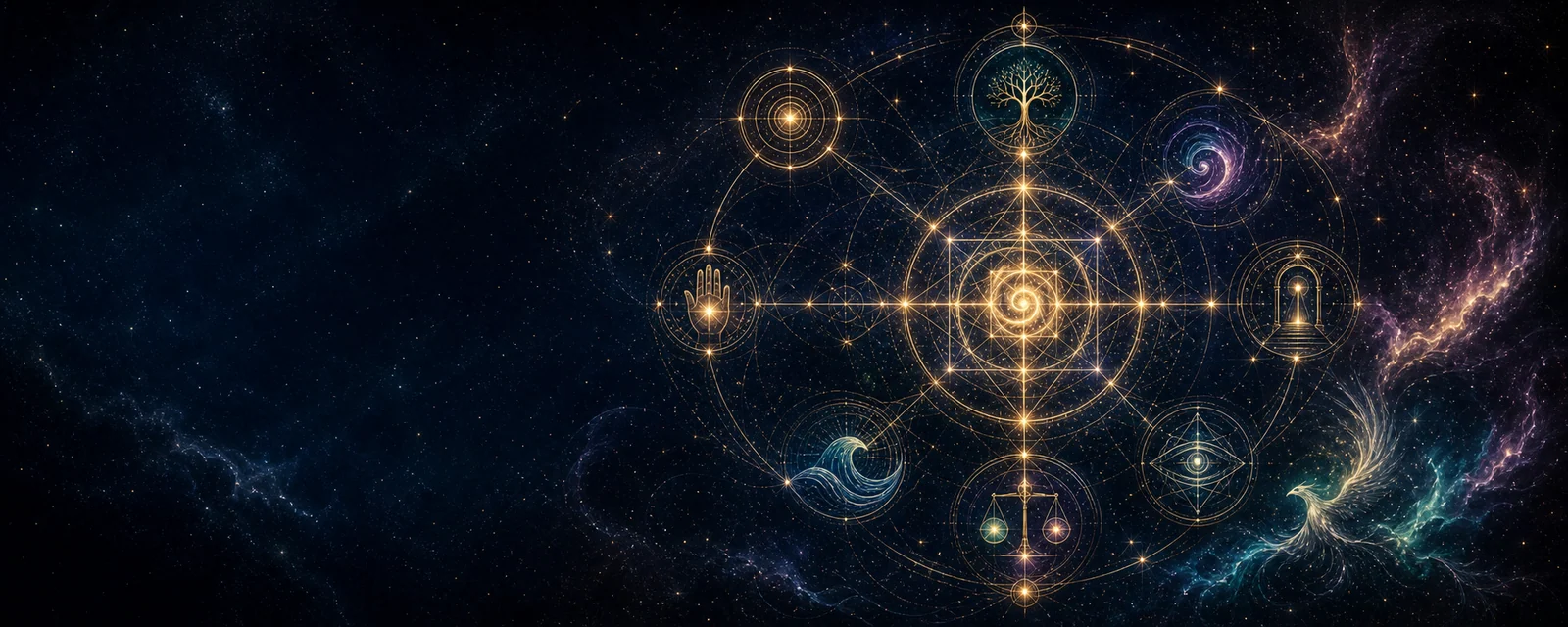
The web edition is provided for reading, search, and internal review while the publishable book version is still being prepared.
Introduction
We Live Inside Symbols
Human beings have always lived among symbols.
Long before writing became formalized into alphabets, books, databases, and digital networks, relationships were already being carried through shape, direction, proportion, rhythm, color, sound, movement, and pattern.
A line could divide one region from another or connect one point to another.
A circle could enclose, protect, contain, complete, cycle, or return.
A spiral could follow the unfolding of shells, storms, water, plant growth, galaxies, vortices, memory, and time.
A tree could make branching, rootedness, exchange, lineage, growth, death, and regeneration visible.
The Sun could carry light, heat, life, time, radiance, sovereignty, exposure, renewal, or overwhelming force.
A serpent could carry medicine and venom, danger and protection, death and renewal, wisdom and deception.
These relationships did not begin when a culture named them.
- The circle enclosed before anyone called it wholeness.
- The branch divided before anyone called it lineage.
- The wave oscillated before anyone called it resonance.
- The Sun radiated before anyone called it illumination.
Human symbolic systems emerged through relationship with structures already present in reality.
- Culture named them.
- Extended them.
- Ritualized them.
- Combined them.
- Remembered them.
- Sometimes distorted them.
But culture did not create every relationship from nothing.
This distinction is foundational to the theory developed in this book.
Within the Universal Theory Stack, or UTS, symbols are treated asmeaning-bearing geometries: compressed configurations capable not only of representing meaning, but of conditioning how meaning, attention, memory, boundary, compatibility, selection, and action move through a system.
A symbol therefore has two simultaneous dimensions.
- It represents.
- And it operates.
The first is familiar.
- A heart can represent Love.
- A crown can represent Sovereignty.
- An eye can represent Perception or Truth.
- A spiral can represent transformation.
The second dimension is deeper.
- The form can also organize attention.
- Establish a boundary.
- Create orientation.
- Focus intention.
- Stabilize memory.
- Route recognition.
- Alter expectation.
- Synchronize behavior.
- Provide an address into a larger field.
- Act as a key within a symbolic system.
- Encode an operation.
- Participate in resonance.
- Become activated within a ritual, technological, institutional, psychological, energetic, or field relationship.
A symbol is therefore not merely something we lookat. It is something through which relationships can be organized.
This is why symbols appear everywhere human beings build systems.
- Caves and temples.
- Bodies and burial objects.
- Flags and monuments.
- Architecture.
- Mathematics.
- Astronomy.
- Religion.
- Ritual.
- Language.
- Music.
- Law.
- Maps.
- Medicine.
- Programming.
- Machines.
- Interfaces.
- Networks.
A symbol allows something larger than its visible form to become portable.
That remains one of the simplest ways to enter symbolic theory:A symbol makes something larger than itself portable.
- A heart drawn with two curves and a point is not Love itself.
Yet the form can open an enormous field involving affection, devotion, care, courage, grief, compassion, sacrifice, vulnerability, vitality, circulation, memory, and relationship.
- A crown is not Sovereignty.
Yet it can open relationships involving authority, office, dignity, self-governance, consecration, responsibility, hierarchy, legitimacy, domination, or stewardship.
- An eye is not Truth.
Yet it can open perception, witnessing, awareness, protection, recognition, knowledge, audit, surveillance, consciousness, judgment, or inner vision.
The mark is small. The field is large. Symbols are therefore extraordinary compression structures. But compression alone does not explain their importance.
A symbol does not merely store meaning. It can make a fieldaddressable.
An address is smaller than what it points toward.
An IP address is not the network, server, information, application, community, or person reachable through it.
- It establishes a route.
Symbols can work similarly. The infinity glyph is not infinity. But it gives infinity a stable local address.
A sacred emblem is not the entire tradition behind it. But it can open a relationship with centuries of teaching, practice, memory, ritual, and community.
A rune does not contain its entire linguistic, historical, archetypal, and operational field inside its visible lines. But the glyph provides a local structure through which that field can be entered.
A symbol therefore functions not only as representation, but as anaddress into relationship.
This becomes even more powerful when we add the idea of a key.
An address tells us:
- Where?
A key tells us:
- How is access established?
Resonance tells us:
- What is compatible enough to enter relationship?
Activation tells us:
- What becomes active when the relationship is established?
Together:
- Address → Key → Resonance → Activation
This architecture will recur throughout the book.
- The symbol provides a local form.
- Its geometry establishes structure.
- Its orientation directs relationship.
- Its boundary determines containment or exchange.
- Its color tunes the symbolic register.
- Its motion introduces process.
- Its lineage carries memory.
- Its context tells us which environment the symbol is operating within.
- Its activation conditions determine whether the symbol remains dormant or becomes operational.
- And resonance determines which relationships are strengthened through compatibility.
This is very different from saying that symbols simply mean whatever a culture decides they mean.
- Culture matters.
- History matters.
- Context matters.
But these are not the only sources of symbolic structure.
- A triangle retains threefold relation whether it appears in ancient architecture, mathematics, ritual geometry, a traffic sign, or an interface.
- A spiral retains rotation with changing radius.
- A wave retains frequency, amplitude, phase, and oscillation.
- A circle retains an interior, exterior, circumference, center relationship, and continuous enclosure.
These structural properties establish a foundational field.
- Culture then enters that field.
- It may recognize one dimension strongly.
- Develop another.
- Translate the form into a religious system.
- Build it into mythology.
- Use it politically.
- Commercialize it.
- Or intentionally redirect the symbol toward a relationship opposite to the one its earlier or foundational structure expressed.
This is where symbolic inversion becomes important.
- A symbol of Truth can be used for narrative control.
- A symbol of Love can be used to justify possession.
- A symbol of Protection can be used to normalize enclosure.
- A symbol of Healing can be used to conceal extraction.
- A symbol of Sovereignty can be used to justify domination.
The later use becomes socially real.
It may become extremely powerful. But power does not automatically rewrite the foundational field. This distinction is necessary for symbolic restoration.
If all meaning were created only by present cultural context, there would be nothing to restore. Every captured meaning would simply become another equally foundational meaning.
Restoration exists precisely because symbolic relationships can be narrowed, obscured, inverted, monopolized, contaminated, or made inaccessible.
- Something existed before the collapse.
- Something remains underneath it.
- Something can be recovered.
This does not mean every ancient interpretation is automatically coherent.
- Age does not create truth.
- Nor does it mean every modern interpretation is distortion.
- Symbols live.
- They develop.
- New relationships can be genuinely added.
Development and inversion are not the same process.
- Expansion adds compatible dimensions.
- Translation moves a relationship into another vocabulary.
- Capture makes one use disproportionately dominant.
- Inversion redirects the symbol toward a relationship that opposes its coherent or foundational function.
Restoration must be able to tell the difference. This is why symbolic lineage matters.
A symbol is not encountered only in the present.It carries memory.
- What was recognized?
- What was built around it?
- Which meanings persisted?
- Which disappeared?
- Which were suppressed?
- Which were captured?
- Which were inverted?
- Which remain alive in living traditions?
- Which relationships arise directly from the geometry or natural form itself?
The deeper we go, the less a symbol resembles a dictionary entry. It begins to look more like a field. And that field is not purely conceptual.
- Resonance introduces another layer.
- Patterns interact with patterns.
- Waves reinforce or interfere according to phase.
- Oscillators can synchronize.
- Rhythm can entrain rhythm.
- Geometry can organize flows and boundaries.
- Color emerges from light and frequency and can modify a symbolic field through its physical and resonant character.
- Sound can organize matter, movement, attention, and biological response.
- Repeated patterns can accumulate gain.
A symbol can therefore be approached as an ordered configuration within a larger world of patterned interaction.
This is one reason UTS treats symbolic geometry as operational rather than merely descriptive. The form participates in what can connect with what. It helps establish the topology through which meaning and action move.
This perspective also explains why symbols have so often been treated as active structures in sacred traditions.
- Sacred geometry.
- Yantras.
- Mandalas.
- Sigils.
- Seals.
- Runes.
- Prayer forms.
- Temple alignments.
- Ritual diagrams.
- Celestial correspondences.
- Meditative forms.
Human civilizations repeatedly developed symbolic systems in which geometry did not merely depict reality.
It helped beings orient themselves within it.
The modern world has rediscovered this operational dimension in another language.
- Programming symbols execute.
- Interface symbols route behavior.
- Mathematical operators establish formal relations.
- Authentication marks grant or deny access.
- Machine-readable patterns encode information.
- Visual systems organize human interaction with invisible computational processes.
These are not identical to ancient sacred systems.
However, they demonstrate something important:symbols can be operational structures.
The question is therefore not whether symbols can affect systems. They already do. The deeper question is how far the principle extends.
UTS explores symbols through geometry, information, resonance, consciousness, field relationships, and quantum-interface models because modern physics has made relational structure impossible to ignore.
- Wave behavior matters.
- Phase matters.
- Geometry matters.
- State matters.
- Boundary conditions matter.
- Coupling matters.
- Configuration matters.
A system does not respond only according to what its parts are made of. It also responds according to how those parts are arranged and how they relate.
This does not reduce symbolic theory to quantum mechanics.
Nor does UTS require every drawn symbol to be treated as an automatically functioning quantum device. Although many drawn symbols can function as primitive quantum interfaces.
The theory instead begins from a more rigorous proposition:
if geometry, phase, frequency, state, boundary, and coupling can determine how physical systems interact, then symbolic geometry can be investigated as a structured coupling architecture rather than dismissed as representation alone.
- The physical substrate matters.
- The scale matters.
- The field matters.
- The activation mechanism matters.
The symbol may operate differently across biological, informational, technological, ritual, energetic, consciousness, or quantum systems.
The organizing question remains consistent:
What relationship does this geometry make possible, reinforce, constrain, route, activate, or restore?
That is the question this book is built to explore.
UTS is a theory.
Its purpose is not to pretend every mechanism is already closed.
Its purpose is to provide a sufficiently rigorous logical architecture that different mechanisms can be explored without destroying the relationships among them.
A theory must remain open enough to develop.
But openness should not mean ontological emptiness.
We do not need to dissolve every symbol into unlimited cultural interpretation simply because every mechanism has not yet been completely mapped.
The theory begins from relationships that can be identified.
- Geometry.
- Boundary.
- Orientation.
- Frequency.
- Motion.
- Resonance.
- Memory.
- Principle.
- Archetype.
- Activation.
- Coupling.
- Inversion.
- Restoration.
These provide the architecture.
- New evidence can refine it.
- New mechanisms can expand it.
The system remains coherent because its foundational relationships remain visible.
Principles occupy an especially deep place within this architecture.
- Truth is not created by the eye.
- Love is not created by the heart.
- Sovereignty is not created by the crown.
- Transformation is not created by the spiral.
The symbol does not manufacture the principle.It makes the principle locally visible and addressable. This is why similar symbols can recur.
- A bridge joins separated regions.
Connection therefore belongs naturally to its field.
- A shield intercepts force.
Protection belongs naturally to its field.
- A mirror reflects.
Reflection and Truth become available.
- A spiral returns while changing position.
Developmental recurrence becomes visible.
- A tree roots, branches, exchanges, grows, dies, and regenerates.
Life, lineage, reciprocity, and continuity become visible.
Symbols resonate with principles because their structures enact or correspond with relationships already present in reality.
Archetypes emerge one level further into organization.
- Guardian.
- Healer.
- Witness.
- Bridge.
- Sovereign.
- Seeker.
- Creator.
These are not costumes. They are organized constellations of principles and functions.
Symbols give them visible form.
- The shield can make Guardian addressable.
- The eye can make Witness visible.
- The crown can make Sovereign visible.
- The bridge can make connection and mediation visible.
The symbol must remain auditable against the deeper principle.
- A shield displayed by a Jailor does not make the Jailor Guardian.
- A crown worn by a Tyrant does not make domination Sovereignty.
- An eye used for invasive surveillance does not become Truth merely because it claims awareness.
Symbolic representation and symbolic operation must remain aligned.
When they diverge, the symbol can become a mask. This is one of the central problems explored throughout this book.
Symbols are powerful because they compress and transmit.
- Because they route attention.
- Because they hold memory.
- Because they establish identity.
- Because they synchronize groups.
- Because they can mark boundaries and permissions.
- Because they can activate archetypal and principle fields.
- Because they can operate across ritual, informational, technological, energetic, and potentially deeper field architectures.
That power also makes them vulnerable to capture.
- Institutions understand symbolic power.
- Religions understand it.
- Governments understand it.
- Political movements understand it.
- Commercial systems understand it.
- Military systems understand it.
- Media systems understand it.
A system can deliberately select an older symbol because it already carries recognition, authority, sacredness, fear, beauty, protection, sovereignty, or legitimacy.
- It can then repeat the form.
- Bind it to new emotions.
- Institutionalize its interpretation.
- Suppress competing meanings.
Eventually, the newer use may become so dominant that observers assume the symbol always belonged to the system that captured it.
This is not merely a mistake of context. It can be a transfer of symbolic power. Restoration must therefore recover more than definitions.
It must recover structure.
- Form.
- Geometry.
- Frequency and color relationships.
- Natural correspondence.
- Principle.
- Archetype.
- Lineage.
- Original and later functions.
- Capture.
- Inversion.
- Harm.
- Memory.
- Operational direction.
- Future possibility.
A symbol is restored when its field becomes readable again.
- Not purified.
- Not stripped of history.
- Not forced into artificial positivity.
Readable.
- The harm remains.
- The inversion becomes identifiable.
- The living lineage returns.
- The foundational structure becomes visible.
The observer regains the ability to distinguish what is ancient from what is later, what is coherent from what is inverted, what belongs to the form from what has been attached to it, and what relationships may still be activated in the future.
This is symbolic sovereignty.
The ability to enter symbolic relationship without being trapped inside the interpretation imposed by the most powerful user of the form.
That is the purpose of this book.
It is not an encyclopedia of every symbol humanity has created. Nor is it an attempt to reduce symbols to a single rigid dictionary. It is a guide to the architecture beneath symbolism.
We will examine how form establishes symbolic geometry.
- How boundary creates containment and exchange.
- How orientation directs symbolic flow.
- How number and proportion organize relationships.
- How color tunes the resonant register.
- How motion transforms the mark into process.
- How symbols compress information.
- How they become addresses, keys, protocols, interfaces, and operational structures.
- How resonance connects symbols with larger patterns.
- How symbols move across time.
- How principles and archetypes become visible through them.
- How symbolic grammars form.
- How institutions amplify, capture, invert, monopolize, and sometimes deliberately repurpose them.
- How restoration reopens the field.
- How symbolic geometries may participate in energetic, consciousness, field, technological, and quantum-interface architectures.
Symbols are not relics of the ancient world. They are becoming more important.
Every digital interface is filled with them.
- Artificial intelligence reads and generates them.
- Governments organize authority through them.
- Corporations build identity through them.
- Algorithms classify them.
- Communities gather beneath them.
- Games create worlds through them.
- People pray, remember, heal, grieve, love, resist, create, and orient themselves through them.
Future technologies will generate new symbolic systems. Future civilizations will create new forms.
If humanity encounters forms of intelligence radically unlike itself, symbols may become one of the first bridges through which relationship becomes possible.
- We live inside symbols.
- We inherit them.
- We activate them.
- We combine them.
- We invert them.
- We restore them.
- We create new ones.
They help shape the fields through which we perceive and organize reality. Once we learn to see the architecture beneath them, the symbolic world changes.
A symbol is no longer merely an image.
It becomes:
- Geometry.
- Relationship.
- Memory.
- Resonance.
- Interface.
- Address.
- Key.
- Boundary.
- Operation.
A local form capable of participating in a much larger field.
Part I
What Is a Symbol?
Symbols are so familiar that their strangeness is easy to overlook.
We encounter thousands of them without consciously asking what they are doing.
- Letters become words.
- Numbers become quantities.
- Icons tell us where to interact.
- Arrows direct movement.
- Flags coordinate national identity.
- Logos identify organizations.
- Mathematical marks establish relationships.
- Sacred images orient beings toward traditions, principles, entities, states, or fields.
A circle drawn around something changes its boundary condition.
A crown placed over a figure changes the apparent relationship between that figure and authority.
A warning mark can alter behavior before the observer knows anything else about the object.
A sigil can organize geometry, boundary, intention, activation, and closure toward a defined function.
A rune can carry sound, form, direction, lineage, archetypal charge, and operational meaning within one compact glyph.
In every case, a relatively small configuration enters a relationship larger than itself. This is the beginning of symbolic understanding.
A symbol is not merely an image.
It is meaning-bearing geometry entering relationship.
Because relationship can produce change, the symbol is not limited to representation.
It can also operate.
Chapter 1
Form That Points Beyond Itself
Imagine a circle drawn on an otherwise empty page. At the most immediate level, there is nothing mysterious about the form. A line curves continuously until it returns to itself.
The form occupies measurable space. It creates:
- a circumference,
- an interior,
- an exterior,
- a center relationship,
- a closed path.
These properties exist before interpretation.
The circle already does something geometrically.
It:
- encloses,
- differentiates inside from outside,
- establishes continuity,
- permits rotation without encountering a corner,
- keeps every point along its circumference in relation to a center.
From these properties arise symbolic relationships such as:
- wholeness,
- containment,
- continuity,
- boundary,
- cycle,
- return,
- protection,
- unity,
- field,
- orbit,
- completion.
Culture can add stories to the circle. Religion can consecrate it. Mathematics can formalize it. Technology can use it as an interface element. Ritual can employ it as a boundary. A political system can appropriate it.
Those later uses do not create the foundational geometric relationships from nothing.
The circle possesses a symbolic foundation because its geometry possesses relational structure.
This is the first essential property of a symbol:
A symbol exceeds its visible form without ceasing to be grounded in that form.
That balance matters.
If form means nothing, interpretation becomes arbitrary. Anything can mean anything. If every symbol contains only one frozen meaning, interpretation becomes equally distorted.
The symbol could never:
- develop,
- translate,
- accumulate history,
- operate in another system,
- become captured,
- be restored.
A stronger model recognizes two layers immediately:
Foundational Structure
and:
Relational Expression
Foundational Structure comes from the actual configuration:
- geometry,
- boundary,
- orientation,
- number,
- proportion,
- motion,
- frequency,
- natural correspondence.
Relational Expression develops as that structure enters life:
- Principles,
- Archetypes,
- ritual,
- culture,
- memory,
- institutions,
- technology,
- history,
- personal experience.
A triangle does not become identical to a circle merely because two cultures choose different narratives for them.
The triangle contains:
- three sides,
- three vertices,
- triadic relation,
- directional tension,
- an interior created through three connected points.
Upright, it directs one field upward toward a point. Inverted, its direction changes.
The same geometry may therefore support ascent or descent, projection or receptivity, flame or water, manifestation or return depending upon orientation and the larger system.
The specific interpretation may vary.
The relational architecture does not disappear.
This distinction becomes even clearer with the Cross.
At its most foundational level:
- two axes meet,
- vertical and horizontal,
- above and below,
- left and right,
- center and extension,
- one path crosses another.
The event of intersection immediately makes several deeper relationships available:
- heaven and earth,
- spirit and matter,
- time and eternity,
- embodiment and transcendence,
- suffering and transformation,
- death and resurrection,
- world-axis and orientation.
Within the fuller Christian restoration field:
- Ascension.
The Cross is not merely death.
It is an intersection through which transformation, resurrection, reconciliation, and Ascension become part of the same movement.
That symbolic field does not arise from one later cultural invention alone.
The theology develops through the geometry of intersection, the historical event, the sacred lineage, and the Principle architecture working together.
This is how symbols become deep.
- Their form provides constraint.
- Their lineage provides memory.
- Their Principle relationships provide coherence.
- Their activation determines what becomes operational.
- Their history changes which pathways remain accessible.
The Visible and the Invisible
Symbols are powerful because they create a bridge between what can be directly perceived and what cannot be reduced to a single visible object.
- Truth cannot be placed on a table.
- Love cannot be held in one hand.
- Sovereignty cannot be reduced to the metal of a crown.
- Time does not fit inside a clock.
- Death does not fit inside a skull.
- Infinity cannot fit inside∞.
Yet relationships with all of these can become visible. The visible form does not contain the whole reality.
It gives the reality a local interface.
- Scales can express Justice because balancing and weighing make comparison, proportion, and consequence visible.
- A heart can express Love because the living heart receives, circulates, returns, sustains, and remains central to embodied life.
- A bridge can express Connection because it joins regions that would otherwise remain separated.
- A doorway can express Transition because it occupies a threshold.
- A seed can express Potential because a small form contains developmental capacity toward a larger future state.
- A spiral can express Development because it returns around a center without returning to the identical position.
- A wave can express Resonance because it contains frequency, amplitude, phase, oscillation, and propagation.
The symbol works because its structure corresponds with the relationship being expressed.
This isstructural resonance.
Not every symbolic association is foundational in this way.
Some symbols are intentionally conventional.
- A company name may identify a corporation because a system defines it.
- A traffic symbol can instruct behavior because participants learn the protocol.
- A software icon may invoke a process because the interface assigns that operation to it.
These are real symbols.
Conventional symbolic meaning should not be confused with foundational symbolic correspondence.
A red octagon meansSTOPthrough a learned transportation protocol. A spiral expresses recurrence-with-change through the geometry itself.
Both are symbolic. Their roots are different.
Sign and Symbol
This gives us a useful distinction between signs and deeper symbols, even though the categories overlap.
A sign is generally designed to reduce ambiguity:
- EXIT.
- STOP.
- BATTERY LOW.
- NO ENTRY.
Its purpose is narrow resolution.
A deeper symbol often contains a larger field:
- Flame.
- Tree.
- Serpent.
- Sun.
- Cross.
- Eye.
- Heart.
- Spiral.
These forms can participate in several coherent relationships simultaneously because their structural and historical depth is larger.
A Flame can literally indicate fire.
Flame can also express:
- light,
- knowledge,
- life,
- spirit,
- will,
- purification,
- transformation,
- destruction,
- passion,
- sacred presence,
- hearth,
- judgment,
- renewal.
These meanings are not random. They emerge from what Flame does.
It:
- illuminates,
- warms,
- consumes,
- transforms matter,
- moves,
- spreads,
- requires fuel,
- can sustain life,
- can destroy it.
Context therefore does not manufacture Flame’s field. Context tells us which part of that field is being activated and toward what purpose.
This is a crucial distinction.
Context is an operational environment. It is not a substitute for ontology.
Symbols as Relational Structures
A useful first expression is:
Symbol = Perceptible Form + Relationship Beyond the Form
UTS takes the formulation further. A symbol is not merely form plus interpretation. It is a configuration capable of conditioning relationship.
We can therefore think of the symbol as:
- Meaning-Bearing Geometry
- Boundary
- Orientation
- Resonance
- Memory
- Activation
→Possible State Change
The relationship may connect the symbol with:
- an object,
- a person,
- a place,
- a Principle,
- an Archetype,
- an action,
- a memory,
- a story,
- a lineage,
- a state,
- a process,
- a field,
- another symbol.
A flag points beyond fabric toward territory, history, government, identity, belonging, sacrifice, conflict, law, aspiration, and collective memory.
A wedding ring points beyond metal toward commitment, cycle, continuity, promise, social recognition, memory, and bond.
A mathematical operator points beyond ink toward a formal relation.
A rune can join sound, geometry, direction, cultural lineage, archetypal charge, and symbolic operation.
A software icon joins visible form with executable function.
The symbol becomes a relational node.
Its form is where the relationship becomes locally addressable.
No Symbol Exists Completely Alone
Place a point in the center of an empty field.
The point establishes:
- Here.
- Center.
- Origin.
- Focus.
- Presence.
Now move the same point near the edge. The point itself has not changed. Its relationship has.
It may now imply:
- periphery,
- departure,
- distance,
- exclusion,
- imbalance,
- potential movement.
Draw a circle around it. The field changes again.
Now we have:
- center within boundary,
- seed within container,
- source within field,
- point within orbit,
- eye within enclosure.
Add rays. The point-circle relation can become Sun. Add another outer boundary. It may become an orbit, seal, cosmological diagram, target, field structure, or interface.
Relationship changes expression.
Notice the order.
The geometry exists first. The additional structure changes what the geometry can do. Then interpretation enters.
This is symbolic construction.
- A serpent alone carries one architecture.
- A serpent beside a staff carries another.
- A serpent wrapped around a staff creates another.
Two serpents around an axis create a different relation again.
Add wings and the composite changes further.
Symbolic literacy therefore cannot stop at:
What does this object mean?
It must ask:
- What is the structure?
- What is it in relationship with?
- What field is being formed?
- What becomes possible because of that relationship?
Chapter 2
Symbols as Compression
Every living system faces a problem of scale. Reality contains more relationship than immediate attention can hold at once.
A single historical event may contain thousands of beings, generations of causes, competing intentions, physical conditions, emotional experiences, institutional structures, memory, consequences, and unresolved debt.
Immediate consciousness cannot hold all of it simultaneously.
So systems compress.
- Language compresses.
- The wordwarcan open centuries of human experience.
- The wordmothercan open an entire relational history.
- The wordhomecan carry architecture, memory, belonging, safety, territory, family, displacement, Love, grief, and identity.
Symbols can compress even further. A recognizable form may open a vast relational field almost instantly. Symbolic compression is not simply a linguistic shortcut.
UTS treats this asmeaning compression.
The configuration can compress multiple kinds of structure at once:
- geometry,
- direction,
- frequency,
- memory,
- Principle,
- Archetype,
- lineage,
- boundary,
- state,
- operation.
A symbol can therefore compress both meaning and logic.
The Meaning Field
Imagine a Crown.
Its field may contain:
- authority,
- Sovereignty,
- responsibility,
- office,
- consecration,
- inheritance,
- wealth,
- dignity,
- hierarchy,
- burden,
- domination,
- status.
Those meanings are not all equivalent. Some arise from structural placement.
The Crown sits above the head, placing authority around a center of perception and directed will.
Some arise from lineage:
- kingship,
- royal office,
- consecration.
Some arise from later capture:
- prestige detached from responsibility,
- status,
- superiority,
- domination.
The symbol therefore does not contain one flat dataset.
It contains a differentiated field.
This gives us an important distinction:
Potential Meaning Field
and:
Active Meaning
The potential field contains the symbol’s available relationships. The active meaning is the relationship currently emphasized or activated.
Activation should not be confused with origin.
If a political movement activates one layer repeatedly, that layer can become dominant without becoming the foundational meaning of the form.
If an institution intentionally binds a Healing symbol to commercial extraction, the new use becomes real without transforming extraction into the original Principle of Healing.
This is how symbolic compression can be distorted.
Compression Through Shared Memory
Symbols become extraordinarily efficient when a community shares the same symbolic memory.
Consider:
+
Two intersecting lines.
Inside mathematical syntax, the glyph instructs addition. The community does not need to rederive the operation every time. Meaning and operation have been compressed into convention.
This also happens in:
- ritual,
- law,
- programming,
- religion,
- institutional identity,
- road systems.
UTS adds another layer.
Symbols can compress relationships even when the observer has not learned a conventional dictionary.
- A branch can suggest divergence because it branches.
- A wave can suggest oscillation because it oscillates.
- A circle can suggest containment because it encloses.
- A bridge can suggest connection because it connects.
- A mirror can suggest reflection because it reflects.
This isstructural compression.
The form compresses the relationship through correspondence. Shared cultural memory can then deepen, specialize, or redirect it.
Information Density
This gives symbols extremely high information density.
A small visual field can simultaneously contain:
- geometry,
- frequency or color register,
- history,
- identity,
- emotion,
- instruction,
- memory,
- authority,
- Archetype,
- Principle,
- intention,
- activation conditions.
Not every layer needs to be consciously active. Many remain latent. A national flag in ordinary civic life may primarily activate identity.
The same flag in war may activate:
- sacrifice,
- fear,
- loyalty,
- aggression,
- grief,
- resistance,
- belonging.
The field is larger than the state currently active.
Compression Is Necessary
Compression is not inherently a loss.
Without compression, complex systems become unusable.
- Language depends upon it.
- Mathematics depends upon notation.
- Maps compress geography.
- Equations compress relational structures.
- Programming syntax compresses operations.
- Rituals compress cosmology and procedure.
- Archetypes compress recurring Principle configurations.
- Symbols help living systems manage complexity.
The danger appears when compression becomes collapse.
Living and Lossy Compression
A healthy symbolic field retains enough dimensionality that the larger structure can still be recovered. The symbol is compact. The field remains accessible.
This isliving compression.
A damaged symbolic field becomes lossy. One narrow interpretation consumes the rest. This often happens through repetition and power.
An institution selects a symbol already carrying:
- sacredness,
- legitimacy,
- authority,
- fear,
- protection,
- recognition.
It then:
- repeats the form,
- attaches it to its own identity,
- binds it to emotional experience,
- builds it into architecture, ritual, media, uniforms, law, or propaganda.
Alternative relationships become less accessible. Eventually the symbol may be recognized almost exclusively through the later user.
This is not ordinary cultural evolution. It can becomesymbolic capture.
When the new use opposes the coherent function of the symbol, capture can becomeinversion.
The form remains. The meaning topology changes. The compression has been redirected.
Symbols and Memory
Because symbols compress fields, they are powerful memory structures.
- A monument allows architecture to hold memory.
- A family crest holds lineage.
- A grave marker holds identity.
- A ring holds relational history.
- A sacred icon holds teaching and practice.
- A scientific diagram holds relationships cumbersome to restate in prose.
A symbol can reconnect a present observer with something absent:
- elsewhere in space,
- earlier in time,
- stored in memory,
- distributed across a tradition,
- encoded within a conceptual system,
- held within a possible future.
The symbol becomes a bridge across absence.
This temporal dimension will matter later because capture can change which memory returns first.
Restoration changes which memories become accessible again.
Compression and Transmission
Compressed meaning travels through:
- stone,
- cloth,
- metal,
- paper,
- skin,
- architecture,
- sound,
- light,
- screens,
- code.
A symbol can survive the civilization that first used it.
- Sometimes meaning travels with the form.
- Sometimes the key is lost.
- Sometimes the form is reinterpreted.
- Sometimes another civilization intentionally claims it.
The symbol becomes a vessel moving through time.
This is why symbolic restoration cannot focus only on present interpretation.
The historical field matters.
The Danger of Overcompression
The efficiency of symbols can become dangerous when the symbol replaces the reality it was meant to compress.
- A being becomes a label.
- A civilization becomes an emblem.
- A religion becomes one image.
- An enemy becomes a caricature.
- A Principle becomes an institutional logo.
- A person becomes a number.
The relationship changes from:
Symbol → Larger Reality
into:
Symbol = Complete Reality
That equality is rarely coherent.
- The map is not the territory.
- The label is not the being.
- The address is not the destination.
- The symbol is not the entire field.
Good symbolic compression therefore requiresauditability.
The path back to the larger field must remain open.
- A religious symbol should still lead to its deeper teaching.
- A cultural symbol should retain connection with the people who carried it.
- A political symbol should remain open to historical audit.
- A Principle-symbol should remain accountable to the Principle.
- A technical icon should perform the operation it claims.
- A restorative symbol should preserve what happened rather than hiding it beneath a new aesthetic.
This gives us another foundational rule:
Good symbolic compression makes complexity usable without pretending complexity has ceased to exist.
Chapter 3
Symbols as Interfaces
Compression explains how a small form can carry a large field. Symbols do more than carry. They create contact.
An interface exists wherever one system enters organized relationship with another.
- A door is an interface between spaces.
- Skin is an interface between organism and environment.
- A keyboard is an interface between body and computation.
- A membrane is an interface between internal and external fields.
Symbols perform analogous work. They provide local structures through which larger relationships become accessible.
The Interface Principle
Consider a computer desktop.
The user does not manually manipulate transistor states.
They see:
- folders,
- buttons,
- arrows,
- icons,
- windows,
- menus.
The visible form gives access to hidden structure.
Visible Symbol → Hidden Structure → System Response
This architecture is useful because it demonstrates that a symbol does not need to contain the mechanism it accesses.
- The folder icon does not contain the data.
- The power symbol does not contain the circuitry.
- The address does not contain the destination.
The interface creates access.
UTS extends the same principle beyond digital systems.
- A mathematical symbol gives access to formal relation.
- A ritual object can organize intention, boundary, memory, timing, and sacred relationship.
- A rune can give a symbolic function a compact glyphic form.
- A sigil can compose several symbols toward an intended state change.
- A seal can create a bounded operational field.
- A sacred image can orient a practitioner toward an Archetypal, Principle, spiritual, or energetic field.
The visible form becomes acontact surface.
Form and Meaning Are Bidirectional
The most familiar symbolic interface connects form with meaning.
- Heart ↔ Love
- Eye ↔ Perception
- Shield ↔ Protection
The arrow runs both directions.
Meaning changes how the symbol is perceived.
The symbol changes how meaning is imagined.
After centuries of symbolic use, people can begin imagining abstract relationships through the forms used to express them:
- Justice through Scales.
- Love through Heart.
- Protection through Shield.
- Truth through Light or Eye.
- Transformation through Flame or Spiral.
The interface influences both sides.
This is why symbolic inversion matters so much.
If the interface between Principle and form is captured, beings may gradually begin imagining the Principle through the distorted symbolic form.
If Sovereignty is represented repeatedly as domination, domination can begin to masquerade as Sovereignty.
If Protection is represented as enclosure and surveillance, control can begin to masquerade as care.
The symbol no longer simply depicts the inversion.
It helps stabilize it.
Interface Across Time
Symbols also create interfaces between times. A memorial brings the past into present encounter. Names carved in stone do not recreate the beings who died.
They create an interface with memory.
Past → Memory → Symbol → Present
The relationship continues.
The present observer:
- responds,
- teaches,
- acts,
- creates,
- changes the future.
Past → Symbol → Present → Future
Symbols therefore route memory through time.
Restoration changes that route when historical capture has narrowed it.
Interface Between Individual and Collective Fields
A symbol may belong simultaneously to an individual and a larger field.
Someone may wear a Cross through personal faith. The symbol also participates in Christianity’s collective memory.
Someone may draw a Spiral to represent personal transformation. The Spiral also belongs to natural, geometric, mathematical, sacred, and ancient symbolic families.
- Private relationship matters.
- Collective lineage matters.
Neither should automatically erase the other. This is where context properly enters.
Context helps determine which relationship is operational here.
It does not eliminate the deeper field.
Interface Between Principle and Form
Principles become visible through symbolic interfaces.
Balance can appear through:
- scales,
- symmetry,
- reciprocating forms,
- centered weight,
- opposing forces held in relation.
Transformation can appear through:
- Flame,
- Spiral,
- Serpent,
- Butterfly,
- Phoenix,
- death and rebirth,
- threshold.
Protection can appear through:
- Shield,
- Wall,
- Circle,
- Gate,
- Guardian animal,
- enclosure.
The symbol is not the Principle. It is an interface with it.
This is essential.
If the symbol is treated as owning the Principle, symbolic monopoly begins.
- Truth does not belong to one Eye.
- Love does not belong to one Heart.
- Healing does not belong to one Staff.
- Sovereignty does not belong to one Crown.
The symbol provides access.
It does not own the field.
Interface Between Archetype and Experience
Archetypes operate similarly.
Guardian may become visible through:
- Shield,
- Wall,
- Gate,
- Dog,
- Lion,
- Tower,
- Circle,
- Armor.
Each symbol reveals another functional dimension.
- A Shield emphasizes interception.
- A Wall emphasizes containment.
- A Gate emphasizes controlled passage.
- A Dog emphasizes vigilance and loyalty.
- A Tower emphasizes oversight.
The Archetype does not collapse into its symbols. The same Shield can also be used by Jailor. This is why operation must be audited against Principle.
The visible form tells us what Archetypal field is being invoked.
The behavior tells us which Archetype is actually operating.
Interface Between Systems
Symbols are also translation structures.
- A diagram translates mathematics into space.
- A map translates geography into visual relation.
- A rune translates sound and symbolic function into glyph.
- Programming syntax translates logic into executable form.
- A myth translates Principle and Archetype into story.
- A ritual translates symbolic architecture into embodied sequence.
A symbol therefore helps relationships cross boundaries.
The modern API analogy is useful, but UTS pushes further than the analogy.
A symbolic interface may specify:
- identity,
- address,
- parameters,
- boundary,
- key,
- activation,
- expected response,
- closure.
This is already visible in technical systems.
It also provides a useful architecture for understanding ritual, sigil, seal, and field-oriented symbolic systems.
Poor and Inverted Interfaces
Not every interface reveals truthfully.
An interface can be designed to manipulate.
- A platform can use visual design to steer behavior toward system benefit rather than user benefit.
- A corporation can use ecological imagery to borrow the resonance of Life while damaging ecological systems.
- A government can display Justice while denying due process.
- A medical institution can display Healing while organizing around extraction.
- A spiritual institution can display sacred symbolism while demanding dependency and obedience.
Sometimes these divergences emerge gradually. Sometimes they are strategic.
The important point is that the symbol can be used to borrow the authority of a coherent field while concealing an incoherent operation.
UTS calls this kind of divergence afailure of symbolic coherence.
When the symbol’s displayed Principle and the actual operation move in opposite directions, the symbol can become inverted.
- Protection displayed → Enclosure performed
- Truth displayed → Narrative Control performed
- Love displayed → Coercive Fusion performed
- Sovereignty displayed → Domination performed
The interface becomes a mask.
Auditability
A healthy symbolic interface preserves the possibility of seeing what lies behind it.
The symbol can compress without deceiving. Sacredness need not mean opacity. Mystery need not mean immunity from examination.
An interface becomes dangerous when it demands authority while preventing inspection of the relationship it organizes.
The Principle is straightforward:
A coherent symbol reveals enough of the relationship that its function can be tested against what it claims to serve.
The symbol becomes an interface when it allows relationship with something beyond its immediate form.
Its quality depends upon what relationship it actually enables.
Chapter 4
Symbols as Meaning Geometry
Geometry is one of the oldest symbolic languages available to embodied beings because geometry precedes symbolic naming.
Before a shape has a name, it already possesses relationships.
- A point has position.
- A line has direction.
- A curve changes direction.
- A circle encloses.
- A triangle creates threefold relation.
- A square creates fourfold structure.
- A spiral combines rotation with changing radius.
- A branch divides one path into many.
- A wave oscillates.
- A network connects.
Geometry therefore contains structure before culture assigns narrative.
Culture does not create every relationship present in a form.
It can:
- interpret,
- name,
- extend,
- ritualize,
- combine,
- redirect.
This gives geometry a foundational role in symbolic theory.
The Point
The Point is the simplest spatial distinction.
Something is marked where previously nothing was differentiated.
The Point can carry:
- origin,
- position,
- seed,
- center,
- singularity,
- attention,
- presence,
- beginning.
The Point says:
Here.
That may be the earliest symbolic operation.
Once one location becomes distinguished, relationship becomes possible:
- near,
- far,
- above,
- below,
- inside,
- outside,
- center,
- periphery.
Meaning begins with distinction.
The Line
Extend the Point and a Line appears.
The Line introduces continuity and direction.
It can become:
- path,
- boundary,
- connection,
- division,
- movement,
- time,
- axis,
- relationship.
A line between two points connects. A line between two regions may separate.
The same geometric structure can participate in union or division according to how it is positioned and activated.
The geometry creates a relational possibility. The operation determines its direction.
The Axis
An Axis establishes orientation.
Vertical:
- above and below,
- ascent and descent,
- root and crown,
- earth and sky,
- embodiment and Ascension.
Horizontal:
- left and right,
- horizon,
- extension,
- meeting,
- polarity.
Combine them.
The Cross appears. The center becomes the intersection between dimensions. Geometry becomes increasingly powerful as relationship becomes richer.
The Circle
The Circle creates enclosure without corners.
Every point on the circumference remains in relation to a center.
Its architecture supports:
- wholeness,
- cycle,
- boundary,
- protection,
- unity,
- orbit,
- return,
- completion,
- field.
These relationships are not assigned arbitrarily. They emerge from the form. The circumference can continue without encountering a terminal edge.
An interior becomes distinct from an exterior. The center can organize radial relationship.
Circle therefore becomes one of the foundational containment and coherence geometries.
The Triangle
Three points create the simplest polygon.
The Triangle introduces:
- direction,
- stability,
- triadic relation,
- focus,
- mediation,
- transformation.
Two poles can create a binary. A third point opens another relation.
A ↔ B
becomes a field involving:
- A
- B
- C
The third point can:
- mediate,
- integrate,
- stabilize,
- redirect,
- transcend the binary.
This is why triads recur throughout symbolic systems:
- beginning, middle, end,
- past, present, future,
- body, mind, spirit,
- creator, creation, created,
- thesis, antithesis, synthesis.
The particular interpretation changes.
The triadic structure remains.
Within UTS, this becomes especially important because triangular arrangement can express coupling among three differentiated nodes rather than reducing relation to simple opposition.
The Square
- Four sides.
- Four corners.
- Right angles.
- Stable enclosure.
The Square readily participates in:
- foundation,
- material order,
- architecture,
- structure,
- stability,
- fourfold orientation,
- containment.
Where Circle often expresses continuous field, Square frequently expresses constructed order.
Their relationship has therefore appeared repeatedly in sacred architecture and symbolic systems.
Circle and Square represent different geometries of order.
The Spiral
The Spiral is one of the richest symbolic geometries because it combines recurrence with transformation.
The Circle returns. The Spiral returns differently.
The path rotates around a center while its radius changes.
This gives the Spiral natural relationships with:
- growth,
- development,
- memory,
- evolution,
- descent,
- Ascension,
- expansion,
- contraction,
- recursion,
- return,
- transformation,
- time.
An inward Spiral differs operationally from an outward Spiral.
The inward Spiral can:
- concentrate,
- recall,
- integrate,
- return toward Source.
The outward Spiral can:
- unfold,
- expand,
- manifest,
- radiate into complexity.
The center may function as:
- origin,
- Source,
- seed,
- self,
- mystery,
- destination.
The surrounding field can become:
- manifestation,
- complexity,
- dispersion,
- expression.
The geometry provides a direct model of developmental recurrence.
The Branch
One path becomes many.
This architecture appears through:
- trees,
- rivers,
- blood vessels,
- lungs,
- lightning,
- neural systems,
- genealogies,
- decision structures,
- computer systems.
The symbolic field naturally includes:
- growth,
- choice,
- lineage,
- distribution,
- multiplicity,
- inheritance,
- divergence,
- possibility.
The Branch is important because it demonstrates how recurring symbolic meaning can arise through natural correspondence.
Different civilizations can encounter branching without copying one symbolic dictionary from one another.
The relationship exists in the world. Observers recognize it.
The Wave
The Wave introduces oscillation:
- rise,
- fall,
- return,
- frequency,
- amplitude,
- phase,
- transmission.
Waves appear in:
- water,
- sound,
- light,
- electromagnetic systems,
- vibration,
- rhythm,
- breathing,
- music.
The Wave is therefore fundamental to symbolic resonance. Its geometry is not merely visual. It represents patterned change distributed through space or time.
Unlike purely conventional symbols, its central relationships are measurable characteristics of wave behavior itself.
This makes the Wave a bridge between physical and symbolic architecture.
- Frequency can become symbolic tuning.
- Phase can become alignment.
- Amplitude can become intensity.
- Interference can become reinforcement or attenuation.
- Resonance can become compatible activation.
These are not identical across every domain.
They are not arbitrary metaphors either.
They arise from a shared relational structure.
The Loop
A Loop returns into itself.
It can express:
- feedback,
- continuity,
- recurrence,
- self-reference,
- habit,
- memory,
- cycle.
A Loop is not inherently coherent.
It can:
- restore,
- trap,
- feed output into renewed capacity,
- feed distortion back into itself.
This makes the Loop one of the clearest geometries for understanding why symbolic operation must be evaluated through consequence.
The Infinity Form
Infinity adds differentiation to continuity.
- Two loops.
- One crossing.
- Continuous path.
- The regions remain distinct.
- The crossing connects them.
The form can therefore express:
- reciprocity,
- continuity,
- two fields in relationship,
- past and future crossing through the present,
- giving and receiving,
- self and other,
- return,
- non-finality.
Unlike the Circle, Infinity makes internal difference visible.
Continuity does not erase Sovereignty.
Connection does not require merger.
This will later become central to relational restoration.
Symmetry
Symmetry is also symbolic.
It can express:
- balance,
- order,
- reflection,
- harmony,
- stability,
- equivalence.
Symbolic theory must distinguish geometric symmetry from relational coherence.
Two sides may be geometrically equal while the actual systems represented by them possess radically different power.
Therefore:
Visual Symmetry ≠ Relational Equality
Geometry tells us something real. It does not automatically tell us everything. Context, operation, and consequence tell us how the geometry is being used.
Enclosure
Enclosure changes a symbol’s field.
Compare:
- Star.
- Star inside Circle.
- Eye.
- Eye inside Triangle.
- Rune.
- Rune inside Circle.
- Name.
- Name inside Seal.
The outer geometry creates a boundary condition.
Containment can:
- focus,
- protect,
- constrain,
- select,
- separate,
- consecrate,
- authorize,
- quarantine.
The contained symbol becomes a field object.
Its outer form participates in its function.
Repetition
One form becomes many.
- One Circle.
- Two Circles.
- Overlapping Circles.
- Nested Circles.
- A field of Circles.
Repetition introduces:
- rhythm,
- plurality,
- amplification,
- network,
- recursion,
- pattern,
- gain.
Repeated symbolic structures can organize attention more strongly than isolated ones.
This is true:
- socially,
- ritually,
- perceptually,
- energetically,
- institutionally.
Repetition can stabilize coherence. It can also stabilize inversion.
Gain is not proof of Truth.
It is amplification.
Composition
Meaning geometry becomes especially powerful when forms combine.
- Circle + Cross.
- Serpent + Staff.
- Eye + Triangle.
- Heart + Flame.
- Tree + Serpent.
- Sun + Wheel.
- Moon + Star.
Each component brings a field.
Composite meaning is not simple addition.
Composite Meaning ≠ A + B
A stronger expression is:
Composite Meaning = A + B + Relationship(A,B)
The relationship itself carries information.
- Serpent beside Staff differs from Serpent wrapped around Staff.
- Crown above Skull differs from Crown beneath Skull.
- Flame emerging from Heart differs from Flame consuming Heart.
Placement creates grammar.
Geometry becomes syntax.
Once symbols begin interacting systematically, meaning geometry can become symbolic language.
Chapter 5
Symbols Represent and Symbols Operate
So far we have examined symbols as meaning-bearing geometries.
Representation is only half of the UTS symbolic model.
Some symbols do something.
This distinction is central.
Representation
A representational symbol makes a field visible or addressable.
A painted Sun can represent:
- light,
- life,
- radiance,
- time,
- consciousness,
- authority,
- renewal.
The form allows recognition.
- It compresses meaning.
- It may activate memory or resonance.
- Its immediate use may remain representational.
We can write: Symbol → Meaning
Operation
An operational symbol enters a process.
- Press a power glyph. A machine changes state.
- Scan a code. A system retrieves information.
- Apply a mathematical operator. A formal relationship is executed.
- Display an authorized Seal. An institutional protocol responds.
- Enter a ritual field. A symbol can mark boundary, invoke sequence, focus intention, or establish activation conditions.
Now:
Symbol → Interaction → State Change
UTS formalizes this more directly.
A symbol is a configuration capable of conditioning the state through which attention, boundary, compatibility, memory, coherence, and action move.
The symbol itself does not need to be the entire causal mechanism.
Neither is it merely a passive picture.
The configuration participates in the mechanism by constraining what becomes selectable and actionable.
Mathematical Operators
Mathematics provides one of the clearest examples.
+
does not merely depict the concept of addition.
Inside a formal expression, it specifies a relation to perform.
So do:
- −
- ×
- ÷
- <
The symbol becomes operational because a grammar recognizes it.
- Stable identity.
- Defined relationship.
- Syntax.
- Execution.
The same Principle appears throughout programming.
Symbols can become executable logic.
Computer Interfaces
ClickPlay.
Media begins.
ClickPause.
It stops.
ClickSearch.
A process begins.
The visible icon does not contain the mechanism. Its placement within the system creates access to it.
Earlier we could say:The symbol is not the mechanism.
That remains useful, but it requires refinement.
The symbol may not be the entire mechanism.
Its geometry and recognized placement can still be a functional component of the operational chain.
The button without circuitry does nothing to the machine. The circuitry without an accessible interface cannot be operated in the same way.
The complete operation is relational.
Symbols as Keys
A physical key demonstrates compatibility through geometry. The form must fit. Incorrect structure fails to engage the lock.
Cryptographic systems generalize the Principle. A key may unlock a larger informational field without resembling what it opens.
Symbolic systems can behave similarly.
A field may remain inaccessible until the correct combination of:
- form,
- orientation,
- color,
- lineage,
- state,
- intention,
- timing,
- boundary,
- ritual,
- recognition,
- resonance
establishes compatibility.
This is why UTS treats Resonance as more than emotional familiarity.
It is a compatibility relationship.
The key does not invent the field.
It establishes access.
Symbols as Addresses
Addresses route relationship.
A symbol can make a diffuse field locally referenceable.
- Infinity becomes addressable through∞.
- Guardian becomes addressable through Shield.
- A sacred lineage becomes addressable through an emblem.
- An application becomes addressable through an icon.
- A symbolic operation becomes addressable through a glyph.
Symbol → Address → Larger Field
Addressability is one of the deepest powers of symbolism.
To make something addressable is to make it easier to:
- find,
- invoke,
- remember,
- reference,
- combine,
- transmit,
- activate.
This is why restoring lost symbolic names matters. An unnamed field is harder to reach.
Symbols as Protocol Elements
Symbols can also tell systems how to interact.
- Red light.
- Green light.
- Lane marking.
- Command glyph.
- Seal.
- Boundary mark.
- Rune sequence.
- Programming syntax.
- Ritual sequence.
These become protocol elements. Their power depends upon organized relationship. Not every protocol is merely conventional.
Some use physical or geometric compatibility as part of the operation.
- A key fits a lock.
- A wave reinforces another wave under compatible phase relationships.
- A resonant structure responds according to its frequencies.
- A geometric field constrains motion through its boundaries.
UTS symbolic theory studies both conventional and intrinsic relationships without collapsing one into the other.
Activation Conditions
A symbol may exist in dormant form.
Activation changes the state of the relationship.
Activation may depend upon:
- attention,
- interaction,
- ritual,
- repetition,
- authority,
- intention,
- timing,
- placement,
- permission,
- resonance,
- computational execution,
- field compatibility.
The symbol can therefore exist without operating at maximum strength continuously.
Dormancy does not mean absence.
Activation does not mean every mechanism is identical.
It means the configuration has entered an operational relation.
Symbolic Authority
Some symbols gain operational force because institutions recognize them.
- Signature.
- Badge.
- Passport.
- Seal.
- Uniform.
- Currency mark.
- Judicial emblem.
Their power is partly institutional.
Institutional recognition is only one kind of symbolic authority.
UTS should not allow institutional convention to become the model for symbolism as a whole.
- A natural Wave does not require an institution to oscillate.
- A Triangle does not require an institution to become threefold geometry.
- A sacred symbol does not derive its entire meaning from the government that regulates it.
Institutional symbolism is one operational layer among several.
Institutions can themselves capture older symbolic power.
They may select forms precisely because those forms already carry:
- sacredness,
- legitimacy,
- authority,
- protection,
- Healing,
- Wisdom,
- solar power,
- Sovereignty.
Once amplified through architecture, media, law, branding, ritual, and repetition, the borrowed symbolism can make the institution appear to possess the Principle itself.
This can occur unintentionally.
It can also be strategic.
Symbolic audit must remain capable of recognizing both.
Ritual Operation
Sacred traditions have long distinguished between symbols that depict and symbols that participate.
A symbol may:
- mark sacred space,
- identify or address a deity,
- focus prayer,
- structure meditation,
- establish a boundary,
- encode invocation,
- organize ceremonial sequence,
- anchor memory,
- direct intention,
- participate in a Seal,
- act as a ritual instrument.
The precise ontology differs among traditions.
UTS does not need to erase those distinctions.
Its purpose is to identify the shared architecture:
- Form.
- Boundary.
- Orientation.
- Color.
- Motion.
- Intention.
- Activation.
- Resonance.
- Field.
- Closure.
The symbol participates through relationship.
Resonant Operation
Resonant operation takes us deeper.
A symbol can be designed or recognized as a configuration compatible with another pattern.
Its geometry may correspond with:
- rhythm,
- frequency,
- natural form,
- Principle,
- Archetype,
- memory,
- intention,
- field relationship.
In these cases, the mechanism is not necessarily analogous to pressing a digital button.
It is relational.
A compatible system responds according to the structure of the coupling.
We can express the architecture as:
Symbol + Field + Compatibility → Resonant Relationship
UTS treats this as foundational to symbolic operation.
The exact substrate may differ:
- acoustic,
- electromagnetic,
- optical,
- biological,
- informational,
- psychological,
- ritual,
- energetic,
- consciousness-based,
- quantum.
The common architecture remains:
- configuration,
- compatibility,
- coupling,
- response.
This is precisely why symbolic geometry matters.
The symbol is not only what it says. It is how its structure can enter relation.
Representation Can Become Operation
The boundary between representation and operation is permeable.
- A flag can represent a nation.
- Raise it over territory and it participates in political Sovereignty.
- Carry it into battle and it coordinates group identity.
- Burn it and it becomes protest.
- Place it over a coffin and it becomes memorial.
Words can do the same:
- “I promise.”
- “I consent.”
- “I resign.”
- “Approved.”
- “Denied.”
The utterance does not merely describe.
Under the correct conditions, it changes the relational state.
Symbols can therefore move from meaning into action.
Symbols Alter Systems
Symbols already have causal significance throughout civilization.
They influence:
- attention,
- behavior,
- memory,
- coordination,
- identity,
- expectation,
- emotion,
- group formation,
- legitimacy,
- economic value,
- access,
- permission.
Examples are everywhere:
- Traffic symbols coordinate physical movement.
- Currency symbols organize economies.
- Mathematical notation makes formal operations possible.
- Interface glyphs control machines.
- Legal Seals authorize documents.
- Sacred symbols organize ritual spaces and practices.
- Political symbols synchronize collective identity.
The question is therefore not:
Can symbols operate?
They already do.
The deeper questions are:
- Through what mechanism?
- Within what field?
- Under what conditions?
- With what boundary?
- With what compatibility?
- With what resonance?
- Toward what state change?
- Toward what consequence?
These questions do not weaken symbolic theory.
They make it operationally precise.
Operational Symbols Require Ethics
The more a symbol participates in operation, the more responsibility matters.
Ask:
- What behavior does it organize?
- What field does it access?
- Who controls the surrounding system?
- What happens when it activates?
- Who or what is affected?
- Can the operation be reversed?
- Is the boundary clear?
- Is consent relevant and present?
- Can the operation terminate?
- Can distortion be repaired?
- Does the displayed symbol correspond with the actual function?
This final question is central because symbols can be deliberately inverted.
The system says:
- Protectionwhile performing surveillance and enclosure.
- Healingwhile extracting.
- Freedomwhile increasing dependency.
- Truthwhile controlling narrative and blocking audit.
- Lovewhile demanding fusion or possession.
When displayed meaning and actual operation oppose one another, the symbol becomes a carrier ofpseudo-coherence.
The form borrows the authority of the Principle while the operation moves against it.
Symbolic restoration requires that inversion become visible.
From Symbol to Symbolic System
We can now see the progression that carries the book forward.
A symbol begins as perceptible configuration.
- Its form establishes geometry.
- Its boundary determines containment and exchange.
- Its orientation directs symbolic flow.
- Its color tunes the resonant register.
- Its motion introduces process.
The form compresses a field of meaning and logic.
- The symbol makes that field addressable.
- Keys establish access.
- Resonance establishes compatibility.
- Activation brings potential into operation.
Symbols combine.
- Relationships among them create syntax.
- Syntax creates grammar.
- Grammar can become symbolic logic.
- Symbolic logic can organize systems.
Those systems can:
- represent reality,
- model reality,
- route behavior,
- coordinate civilizations,
- operate machines,
- structure ritual,
- stabilize memory,
- shape identity,
- participate in resonant, energetic, informational, sacred, consciousness, field, and quantum-interface relationships.
This is why symbols deserve to be studied as more than images.
They are among the architectures through which relationship becomes:
- visible,
- portable,
- addressable,
- operational.
They:
- connect local form with larger field,
- compress complexity,
- establish boundaries,
- route attention,
- preserve memory,
- create compatibility,
- carry Principles,
- reveal Archetypes,
- can be captured,
- can be inverted,
- can be restored.
The next question is therefore no longer simply:
What does a symbol mean?
It is:
What is the symbol made of, what relationships does its structure establish, what field does it enter, and what changes when that field becomes active?
That is where the anatomy of symbolic meaning begins.
Part II
The Anatomy of Symbolic Meaning
If a symbol is a meaning-bearing geometry capable of entering relationship, then the next question is unavoidable:
What gives that relationship its particular structure?
A circle and a triangle can both participate in unity, but they do not produce unity through the same geometry. A serpent rising around a staff does not establish the same directional relationship as one descending. A crown resting upon a head differs from a crown broken beneath someone’s feet. A red Heart, a black Heart, a green Heart, and a golden Heart share recognizable geometry, yet each enters a different resonant register.
A single Eye can express perception. Change the configuration and the field changes:
- Enclose it.
- Add rays.
- Close it.
- Turn it downward.
- Place it above a doorway.
- Place it upon currency.
- Place it within a sacred diagram.
The visible symbol changes because its internal relationships change.
Symbolic meaning therefore has an anatomy. Not because every symbol can be disassembled into isolated mechanical pieces, but because certain structural dimensions repeatedly determine what a symbol can contain, transmit, amplify, constrain, activate, or restore.
Within UTS, these dimensions are not merely descriptive. They form the configuration through which symbolic force becomes organized.
The core symbolic anatomy includes:
- Form— the base geometry through which the symbol becomes perceptible.
- Boundary— the edge condition governing containment, release, filtering, separation, and connection.
- Orientation— the direction through which symbolic flow or meaning-pressure moves.
- Number and Proportion— the quantitative architecture determining multiplicity, hierarchy, mediation, balance, and weight.
- Color— the frequency annotation tuning the symbol’s resonant register.
- Motion— the transformation of static geometry into process.
- Rhythm and Phase— the temporal architecture determining recurrence, synchronization, amplification, and position within a cycle.
- Context— the operational environment in which the symbol is currently functioning.
- Memory— the accumulated field of prior relationships carried through time.
- User and Observer— the participating nodes entering relationship with the symbol.
- Activation— the transition through which stored symbolic structure becomes operative.
We can therefore expand the anatomy into a working model:
Symbolic Field =
- Form
- Boundary
- Orientation
- Proportion
- Color
- Motion
- Rhythm
- Context
- Memory
- Relationship
- Activation
UTS expresses the underlying logic more formally as:
Sym = Π(Form, Orientation, Boundary, Color, Context, Memory, Activation) → ΔSₖ
The symbol is a configuration. That configuration changes what becomes:
- noticeable,
- meaningful,
- selectable,
- compatible,
- actionable.
Its anatomy therefore does not merely tell us what the symbol looks like. It tells us how the symbol is structured to participate.
The dimensions do not all contribute equally. One symbol may depend strongly upon color, another upon orientation, number, enclosure, or movement.
They are not infinitely interchangeable.
The geometry remains the geometry. The frequency remains the frequency. The boundary remains the boundary. Context can determine what is active, but it cannot make structural distinction irrelevant.
This gives symbolic anatomy its purpose.
Instead of asking only:
What does this symbol mean?
we learn to ask:
- What relationships are built into this form?
- What is being tuned?
- What is being contained?
- What direction is the field moving?
- What is being activated?
- What happens when those relationships are changed?
Chapter 6
Form
Every symbol enters perception through form.
Before lineage, political appropriation, institutional adoption, personal interpretation, capture, or restoration can occur, there must be some configuration through which the symbol becomes available.
That configuration isform.
Form can appear through several substrates:
- Visual:Circle, Cross, Star, Spiral, Serpent, Tree, Flame.
- Linguistic:letter, word, name, number.
- Auditory:tone, repeated phrase, bell, rhythm.
- Embodied:gesture, posture, movement.
- Spatial:objects arranged around a center, a doorway, participants standing in a Circle, a structure aligned toward sunrise, a path passing through a threshold.
Form is the local configuration through which relationship becomes perceptible.
Within UTS, form gives the symbol its base geometry.
Form Is Not the Whole Meaning
Form should not be confused with the complete field.
A five-pointed Star can enter astronomical, sacred, mathematical, military, political, artistic, ritual, or commercial systems. The geometry provides continuity, but the uses are not identical.
Likewise, a Cross can participate as:
- intersection,
- world-axis,
- Christian sacred form,
- mathematical mark,
- grave marker,
- directional structure,
- medical identifier,
- heraldic device,
- map sign.
We should therefore distinguish:
Form → Use → Active Meaning
These distinctions do not mean that form is semantically empty.
The form establishes the first field of possibility. Its later uses do not begin from nothing.
Exact Form Matters
The opposite mistake is equally serious.
Because symbols can accumulate many relationships, an interpreter may begin treating exact geometry as unimportant.
Yet:
- a Circle is not a Spiral,
- a Spiral is not a Labyrinth,
- one Serpent around one Staff is not two Serpents around a winged Staff,
- a five-pointed Star is not a six-pointed Star,
- an open Ring is not a closed Ring,
- a Cross inside a Circle is not structurally identical to a Cross standing alone.
The first restorative discipline therefore applies from the beginning:
Similarity does not establish identity.
Form must be identified before meaning fields are merged.
Primitive Forms
Complex symbolic systems can be built from a relatively small number of foundational relationships:
- Point.
- Line.
- Curve.
- Angle.
- Circle.
- Intersection.
- Loop.
- Branch.
- Spiral.
- Enclosure.
- Axis.
- Wave.
- Repetition.
These form something like a geometric alphabet.
Their simplest relational functions include:
- A Point localizes.
- A Line extends.
- Two Lines intersect.
- Several Lines enclose.
- A Circle contains.
- A Spiral unfolds around a center.
- Branches distribute from an axis.
- A Wave oscillates.
- Repeated forms create rhythm.
From relatively few geometric relationships, enormous symbolic complexity becomes possible.
This is the same generative Principle encountered throughout mathematics, language, music, biology, and computation:
Simple relational rules can produce complex fields.
Organic and Natural Forms
Not every foundational symbol begins as abstract geometry.
Some are encountered first through living or natural structure:
- Tree.
- Serpent.
- Bird.
- Flower.
- Eye.
- Heart.
- Skull.
- Sun.
- Moon.
- Mountain.
- River.
These forms carry architecture before human interpretation begins.
A Tree already possesses:
- roots,
- trunk,
- branches,
- growth,
- season,
- exchange with environment,
- vertical extension,
- horizontal distribution,
- dormancy,
- regeneration,
- life cycle.
A Serpent already:
- moves close to the ground,
- coils,
- sheds,
- conceals itself,
- returns,
- may possess venom,
- creates continuous curved movement through its body.
A Flame already:
- moves,
- consumes,
- illuminates,
- heats,
- transforms,
- spreads,
- sustains life under some conditions,
- destroys it under others.
Cultures do not create these properties.
They encounter them.
Symbolic meaning grows through recognition of those relationships.
This createsnatural correspondence.
Abstraction
As a natural form becomes symbolic, detail can be removed while relational identity remains.
- A realistic Sun becomes a disc, then a Circle with rays, then perhaps a Circle with a central Point.
- A biological Heart becomes the familiar Heart glyph.
- A Bird becomes a pair of wings.
- A Tree becomes an Axis with branches.
Abstraction is another form of compression.
The design problem becomes:
How much can be removed before the relational identity disappears?
This question governs:
- writing,
- Runes,
- Sigils,
- logos,
- interface icons,
- mathematical notation,
- maps,
- heraldry,
- machine-readable symbolic systems.
Form as Constraint
Form does not dictate one exhaustive interpretation.
It does constrain the field.
- A Circle lends itself more naturally to enclosure than a single Line.
- A Spiral expresses changing recurrence more directly than a Square.
- A Branch expresses divergence more directly than a Point.
- A Wave expresses oscillation more directly than a Triangle.
- A Shield expresses interception more directly than a Flower.
This gives the symbolform integrity.
Meaning can expand. Lineage can accumulate. Context can specialize. Institutions can reinterpret.
Geometry continues participating.
Altering Form Alters Relationship
Take a closed Circle and change it:
- Break it, and the boundary opens.
- Elongate it, and the relation becomes elliptical.
- Overlap it with another Circle, and a shared field appears.
- Place one Circle inside another, and containment and nested hierarchy emerge.
- Place a Point at the center, and center becomes explicit.
- Remove the center, and the circumference becomes primary.
Every addition changes the configuration. Every removal changes the configuration. Every displacement changes the configuration.
Symbol design is therefore a form of relational engineering. Form matters because relationship changes with it.
Chapter 7
Boundary and Containment
A boundary answers one of the oldest questions any living system can encounter:
What belongs within this field, and what remains outside it?
Boundaries appear everywhere:
- cell membranes,
- skin,
- walls,
- shorelines,
- doors,
- containers,
- Circles,
- frames,
- names,
- categories.
A boundary establishes distinction. Without distinction there is no inside and outside. Without inside and outside, coherent identity becomes difficult to maintain.
This makes boundary one of the deepest symbolic structures.
Within UTS, boundary does more than outline a symbol. It determines whether a field:
- contains,
- releases,
- filters,
- separates,
- connects.
The Closed Form
Draw a Circle.
Before anything is placed inside it, the geometry has already created:
- inside,
- boundary,
- outside.
The boundary has generated a field.
A closed symbolic structure can therefore carry:
- protection,
- containment,
- unity,
- completion,
- identity,
- separation,
- consecration,
- ownership,
- isolation.
These possibilities are not arbitrary.
They arise because a closed boundary constrains exchange.
Protection and Imprisonment
Boundary contains one of symbolism’s most important polarities.
- A wall can protect a city or imprison a population.
- A Shield can intercept harm or prevent necessary contact.
- A sacred Circle can preserve a ritual field, while an ideological enclosure can prevent corrective information from entering.
Therefore:
Boundary ≠ Protection Automatically
The conclusion is not that boundaries have no intrinsic function.
Their intrinsic function isconstraint.
The question is:
What is being constrained, why, and toward what consequence?
Protection is coherent when the boundary preserves Life, identity, Sovereignty, or developmental capacity.
Protection becomes inverted when enclosure is used to justify domination.
UTS names this failure clearly:
Protection → Enclosure
The symbol of Protection remains visible.
Its function has reversed.
Open, Closed, and Semi-Permeable Fields
Compare a closed Circle with one containing an opening.
The opening creates possibilities such as:
- entrance,
- exit,
- invitation,
- vulnerability,
- transformation,
- selective exchange.
The broken boundary is not automatically damaged.
Sometimes the opening is what prevents containment from becoming imprisonment.
UTS therefore recognizes more than open and closed boundaries.
A field may be:
- open,
- closed,
- semi-permeable,
- nested,
- sealed,
- broken,
- folded,
- recursive.
Each edge condition changes how relation can move through the structure.
The Gate
A Gate is more sophisticated than a wall.
A wall says:
No passage here.
A Gate says:
Passage depends upon condition.
Boundary now acquires state:
- Open.
- Closed.
- Permitted.
- Denied.
The Gate introduces:
- permission,
- threshold,
- timing,
- initiation,
- choice,
- access,
- qualification,
- consent.
It is therefore one of the earliest symbolic forms in which boundary becomes operational logic.
The Gate does not merely separate worlds. It regulates transition between them.
Containers
Containment is not inherently restrictive.
Some processes require a field stable enough for development.
- A vessel holds water.
- A bowl holds medicine.
- A womb holds developing Life.
- A house shelters.
- A membrane preserves an internal environment.
- A Circle can hold symbolic resonance.
Containment allows something to remain coherent long enough to become.
This is why complete boundary removal is not equivalent to Freedom.
Life requires selective exchange.
A membrane that admits everything cannot protect. A membrane that admits nothing cannot sustain Life.
The deeper symbolic Principle becomes:
Healthy Boundary = Identity + Selective Exchange
Enclosure Changes the Field
- A Star inside a Circle differs from a Star alone.
- An Eye inside a Triangle differs from an isolated Eye.
- A Rune inside a Circle differs from the Rune standing free.
- A Cross inside a Circle creates an integrated relation among Axis, center, enclosure, direction, and cycle.
Within UTS, containment can transform an isolated sign into a field object.
The enclosing geometry can:
- focus the internal symbol,
- bind it,
- protect it,
- limit it,
- consecrate it,
- authorize it,
- change its activation conditions.
A Rune inside a Triangle can become a focused operator. A Rune inside a Circle can become bounded resonance. A glyph within a threshold-Seal can become conditional access.
The outer form matters.
Boundary Strength
Boundary itself can possess degree.
- Athick wallmay express fortification, separation, force, or certainty.
- Athin linemay express subtle distinction, permeability, fragility, or soft containment.
- Adotted boundarymay be provisional.
- Abroken boundarymay signal passage.
- Aluminous boundarymay represent energetic rather than material distinction.
Symbolic systems therefore do not merely ask:
Is there a boundary?
They ask:
What kind?
Nested Boundaries
One field may exist within another:
- self within relationship,
- relationship within family,
- family within community,
- community within civilization,
- planet within biosphere,
- application within operating system,
- Rune within Seal,
- memory within tradition.
Nested boundaries make layered identity possible.
A healthy larger field does not need to erase the smaller one.
It can preserve:
Local Identity + Larger Belonging
Captured systems often reverse that relation:
Outer Identity > All Inner Identity
The larger symbolic field demands total allegiance.
Inner Sovereignty disappears.
This is one way institutional symbols become capture structures.
Boundary and Sovereignty
Sovereignty requires some ability to regulate:
- what enters,
- what leaves,
- what is shared,
- what remains private,
- what can be changed,
- what requires permission.
Boundary therefore resonates deeply with Sovereignty.
Sovereignty is not isolation. Life depends upon exchange.
The question becomes:
How does the boundary govern relationship?
That question will remain central throughout the book.
Chapter 8
Orientation and Direction
Turn a symbol.
Sometimes very little changes.
Sometimes the entire flow changes.
Orientation gives geometry direction:
- up,
- down,
- inward,
- outward,
- left,
- right,
- radial,
- diagonal,
- clockwise,
- counterclockwise,
- toward center,
- away from center,
- facing,
- mirrored.
Within UTS:
Orientation changes symbolic flow. It determines the direction of meaning-pressure and changes the vector of the field.
Orientation is therefore not merely an interpretive decoration placed upon geometry afterward.
Up and Down
Vertical orientation begins from physical relationship.
Gravity creates above and below. Bodies rise and fall. Roots descend. Branches ascend. The sky stands above and the ground beneath.
From this architecture, upward movement naturally supports:
- ascent,
- emergence,
- height,
- transcendence,
- growth,
- projection,
- radiation.
Downward movement naturally supports:
- descent,
- rooting,
- embodiment,
- depth,
- burial,
- foundation,
- return into matter.
Neither direction is inherently good or evil.
That would confuse direction with moral judgment.
Neither direction is empty.
Upward and downward movement are structurally different. Direction provides vector. Principle determines coherence.
A Tree requires both:
- root and crown,
- descent and ascent,
- embodiment and transcendence.
A symbolic system becomes distorted if ascent is treated as valuable only because it leaves embodiment behind. Likewise, descent becomes distorted if depth is automatically equated with degeneration.
Ascension and Embodiment
The vertical Axis deserves special attention because it appears repeatedly in sacred and transformational symbolism.
Ascension is not simply “going upward.”
It is movement through levels of relation.
The Cross makes this especially visible:
- Horizontal relation meets vertical Axis.
- Embodied Life encounters Transformation.
- Death encounters Resurrection.
- Earth and heaven become joined through a center.
Ascension therefore belongs to the architecture of directed transformation. Healthy Ascension does not require contempt for embodiment.
The vertical field remains complete when root and crown stay in relationship.
Inward and Outward
A Spiral can move inward or outward.
The geometry remains part of the same family.
The operational direction changes.
Inward movementsupports:
- concentration,
- return,
- reflection,
- integration,
- depth,
- movement toward center,
- recall.
Outward movementsupports:
- expression,
- expansion,
- creation,
- distribution,
- manifestation,
- radiation,
- unfolding.
UTS treats these as real directional tendencies within symbolic motion.
They can alternate:
- Breath enters and leaves.
- Attention moves inward while expression moves outward.
- Fields can gather and radiate.
The two directions form a polarity rather than a moral hierarchy.
Clockwise and Counterclockwise
Rotational direction was one of the places where the earlier draft became too context-dependent.
Traditions can certainly specialize rotational meaning. Viewing frame matters. Specific ritual conventions matter.
UTS also establishes a baseline operational distinction.
Clockwise rotationis associated with:
- projection,
- growth,
- manifestation,
- outward unfolding.
Counterclockwise rotationis associated with:
- recall,
- unbinding,
- undoing,
- cleansing,
- return.
These are baseline directional functions within the UTS symbolic architecture.
They are not declarations that one direction is universally morally good and the other evil.
A return operation may be exactly what restoration requires. Projection may be harmful if what is being projected is incoherent.
Direction is not morality. It is flow.
Facing
Embodied symbols possess vector too.
- Two animals facing one another create encounter.
- Two figures facing away create separation.
- A Bird looking upward directs attention toward height.
- A bowed figure directs the field downward.
- A hand extended outward creates invitation, offering, demand, or transfer depending upon the larger structure.
Facing creates relational vectors.
Mirroring
Mirroring can preserve family resemblance while altering operation.
Sometimes the effect is minor.
Sometimes mirroring produces another identity entirely.
Written language demonstrates this clearly:
b ≠ d
They share related geometry.
They are not the same character.
Mirroring must therefore be treated as data.
The question is not:
Does mirroring always invert meaning?
It does not.
The question is:
Does this symbolic system encode information through mirror orientation?
Geometric Inversion and Symbolic Inversion
A critical distinction must be preserved.
Geometric inversion changes orientation. Symbolic inversion changes coherent function. These are not identical.
Turn a symbol upside down and geometry has changed relative to its reference frame.
Symbolic inversion occurs when a meaning-bearing structure is redirected against the Principle or function it originally or coherently carries:
- Protection becomes enclosure.
- Truth becomes narrative control.
- Healing becomes extraction.
- Love becomes possession.
- Sovereignty becomes domination.
A symbol may be geometrically inverted without being symbolically inverted.
A symbol may also remain geometrically unchanged while its operation becomes completely inverted.
This distinction is essential.
Direction and Force
The Arrow demonstrates operational direction clearly:
→
The Line creates path.
The Point creates vector.
The symbol can say:
- Move.
- Look.
- Transfer.
- Proceed.
- Follow.
Direction converts geometry into instruction.
This is why Arrows dominate interfaces.
Orientation can make geometry executable.
Orientation and Time
Direction can also spatialize time:
- Past → Present → Future
- Birth → Life → Death
- Embodiment → Transformation → Ascension
A Circle can make time cyclical.
A Spiral can make recurrence developmental.
A vertical Axis can organize descent and ascent.
Orientation makes temporal relationship visible.
Frame of Reference
No vector exists without reference.
Ask:
- Clockwise viewed from where?
- Inward toward which center?
- Up relative to what field?
- Forward according to whose orientation?
A frame of reference remains necessary.
Reference determines how a real vector is measured. It does not erase the vector.
This distinction will become equally important when we discuss context.
Chapter 9
Number and Proportion
Symbols are composed not only of shapes, but of quantity and relation.
- One Point is not two.
- One Serpent is not two Serpents.
- Three Circles do not create the same topology as four.
- Five Points create a different Star architecture from six.
Number changes symbolic structure. Quantity is geometry.
One
One concentrates.
Examples include:
- one center,
- one Point,
- one Axis,
- one Flame,
- one Eye,
- one Serpent around one Staff.
One naturally supports:
- unity,
- localization,
- Source,
- identity,
- center,
- singularity,
- concentration.
A single Point calls attention to one location. A single pillar establishes an Axis. A single Serpent around a Staff creates one living process organized around one Line.
One reduces relational plurality. It concentrates force.
Two
Two creates relation:
- self and other,
- inside and outside,
- Sun and Moon,
- giving and receiving.
Two fields can:
- oppose,
- mirror,
- cooperate,
- exchange,
- remain separate,
- touch,
- overlap,
- contain one another.
Two therefore creates polarity, but polarity is not automatically conflict.
Two creates the possibility of coupling. The relation between the two becomes as important as either node.
Three
Three changes the topology.
A binary can now become mediated:
- Observer.
- Observed.
- Relationship.
Three also organizes:
- past, present, future,
- beginning, middle, end.
Three Points create the simplest enclosed polygon:
The Triangle.
Triadic structure therefore naturally supports:
- mediation,
- integration,
- stabilization,
- transformation,
- activation.
Two can remain locked in opposition.
A third creates another path.
This is one reason triadic structures are so powerful in UTS.
They allow relation to become a field.
Four
Four creates spatial organization:
- four corners,
- four directions,
- four quadrants,
- fourfold enclosure.
A Cross inside a Circle can divide one bounded field into four directional regions.
Four readily becomes:
- map,
- foundation,
- structure,
- orientation,
- material order.
The number becomes architecture.
Five
Five adds another important geometry.
The human body presents fivefold extension through head and limbs. The hand presents five digits. Pentagonal and pentagrammic forms create recursive proportion and internal self-similarity.
Within UTS, fivefold geometry connects strongly with:
- life-form proportion,
- regeneration,
- embodied harmony.
This does not mean every appearance of the number Five carries one identical narrative.
It means fivefold structures provide a recurring geometric basis for those relationships.
Six and Harmonic Structure
Six appears strongly in hexagonal organization:
- crystals,
- honeycomb-like structures,
- interlocking triangular geometry,
- six-directional fields.
Within UTS, the Hexagon carries:
- harmonic stability,
- mediation,
- natural order.
The baseline comes through geometric organization.
Traditions can build additional symbolic layers on top of it.
Eight and Threshold Structure
Eight frequently creates directional and transitional organization.
The Octagon stands between Square and Circle in architecture. It can mediate between fourfold constructed order and continuous circular field.
UTS therefore gives octagonal geometry strong relationships with:
- threshold,
- portal,
- Seal,
- transition Gate.
Number becomes functional geometry.
Multiplicity
Repeat a form many times and the field changes.
- One Star becomes a field of Stars.
- One Eye becomes many Eyes.
- One Flame becomes a wall of Flame.
Multiplicity can produce:
- community,
- abundance,
- network,
- surveillance,
- amplification,
- pattern,
- cosmos,
- crowd.
Quantity changes gain.
It changes the scale at which meaning operates.
Proportion
Two compositions may use identical symbols yet create radically different relationships through size:
- a tiny Circle inside a vast Circle,
- a massive Circle containing a small Point,
- a giant Crown above a tiny figure,
- a small figure beneath an enormous Sun.
Scale creates relational weight.
Proportion can communicate:
- dominance,
- containment,
- importance,
- dependency,
- centrality,
- distance,
- hierarchy,
- relative force.
Center and Periphery
Scale combines with position.
A large central object commands attention. Smaller objects orbiting it and create another geometry involving:
- Source,
- coordination,
- authority,
- orientation,
- dominance.
Centrality should not automatically become superiority.
A functional center can organize a system without possessing greater intrinsic worth than every element around it.
- The Sun can organize orbital structure without making the planets failed Suns.
- A Heart can coordinate circulation without making the rest of the body unimportant.
Healthy centers distribute and coordinate. Captured centers consume.
Symmetrical Proportion
Equal size can communicate equal standing.
Visual symmetry alone cannot guarantee actual equality.
Two identically drawn figures may represent systems with radically different:
- power,
- resources,
- knowledge,
- authority,
- capacity.
Therefore:
Visual Symmetry ≠ Relational Equality
Symbolic geometry must be audited against the field it claims to describe.
Ratio and Mathematical Relationship
Proportion can contain mathematical structure.
Recurring ratios appear through:
- sacred architecture,
- geometric construction,
- music,
- visual design,
- crystalline forms,
- orbital relationships.
The mathematics is not an empty substrate waiting for culture to invent significance.
Ratio establishes real relational order.
Symbolic interpretation asks another question:
What function does that relationship perform within the larger symbolic system?
This is a more useful distinction than separating mathematics from meaning entirely.
Mathematics reveals the relational structure.
Symbolic theory investigates how that structure participates in Principle, resonance, Archetype, field, and operation.
Chapter 10
Color
Color is one of the places where symbolic theory most clearly reveals the difference between baseline structure and contextual modulation.
Consider the same Heart rendered as:
- red,
- green,
- blue,
- black,
- white,
- gold.
The underlying geometry remains recognizable.
The resonant field changes.
Why?
Because color is not merely decoration.
Within UTS:
Color is frequency annotation.
Color Begins as Physical Relationship
Color begins in light through:
- frequency,
- wavelength,
- spectral relationship,
- surface interaction,
- transmission,
- reflection,
- absorption,
- perception,
- environment.
The visible experience of color enters through a physical light relationship before symbolic interpretation is added.
This gives color a baseline that is not purely cultural.
Red and blue are not interchangeable frequencies simply because two communities use them differently. Gold and black do not produce identical visual or energetic registers.
Color already differentiates. Symbolism builds upon that differentiation.
Color as Resonant Tuning
UTS treats color as a modification of the symbol’s resonance layer.
Color can influence:
- intensity,
- tone,
- register,
- emotional charge,
- symbolic layer,
- restoration quality,
- activation mode.
A colored symbol can therefore be thought of as geometry under additional tuning.
The shape gives one structure.
Color biases how that structure expresses.
A Circle remains a Circle, but a red Circle and a blue Circle do not occupy exactly the same symbolic register.
Baseline UTS Color Fields
UTS provides a baseline symbolic tuning map.
These fields should not be understood as a simplistic dictionary in which every color can mean only one thing.
They are foundational resonant affinities from which more specialized meanings can develop.
Red
Red carries:
- activation,
- blood,
- urgency,
- survival,
- force,
- vitality.
Its field is immediate, embodied, and intense.
It can support courage, Life, passion, danger, conflict, or emergency depending upon what that activation is coupled with.
Orange
Orange carries:
- creativity,
- appetite,
- motion,
- merging,
- generative warmth.
It readily enters fields involving embodied creation, movement, appetite, work, and transition between red force and yellow differentiation.
Yellow
Yellow carries:
- attention,
- will,
- intellect,
- identity focus,
- alertness.
It naturally draws visibility.
The field can become illumination, cognition, warning, identity, or focused will.
Green
Green carries:
- Healing,
- restoration,
- growth,
- harmony,
- regenerative balance.
Its natural relationship with living plant systems strengthens its restorative and life-oriented field.
Within UTS, Green is therefore strongly resonant with repair and regeneration.
Blue
Blue carries:
- clarity,
- order,
- communication,
- Truth articulation,
- cooling.
It can calm, differentiate, clarify, and create informational space.
This gives Blue strong relationships with communication and intelligibility.
Indigo
Indigo carries:
- insight,
- memory,
- hidden-pattern recognition,
- depth perception.
Its register moves toward deeper pattern recognition and interior perception.
Violet
Violet carries:
- transmutation,
- refinement,
- spiritualization,
- threshold ascent.
It naturally enters liminal and transformational fields.
White
White carries:
- reset,
- purification,
- full-spectrum potential,
- unity.
Its field is not simply “goodness.”
It can represent openness, totality, clearing, reset, or undifferentiated potential.
Black
Black carries:
- void,
- mystery,
- gestation,
- anti-form,
- hidden origin.
This is crucial because Black should not be reduced to Evil.
Darkness can conceal, but concealment can also protect:
- gestation,
- rest,
- privacy,
- unformed possibility.
The void can be absence.
It can also be origin.
Gold
Gold carries:
- illumination,
- authority,
- solar coherence,
- nobility.
Its field connects strongly with radiance, centrality, consecrated authority, and solar order.
The same field can become inverted when authority becomes superiority.
Silver
Silver carries:
- reflection,
- lunar intelligence,
- mirroring,
- subtle perception.
It is strongly relational: reflective rather than purely emissive.
Cyan
Cyan carries:
- interface clarity,
- flow,
- signal,
- air-water bridge.
It can support communication between fields and technical legibility.
Emerald
Emerald carries:
- restoration,
- archive coherence,
- living memory,
- heart-structure.
It is especially useful where memory and Life must be preserved together.
Amber
Amber carries:
- warmth,
- works,
- embodiment,
- creative action,
- preserved light.
The register is active but grounded.
Purple
Purple carries:
- liminal intelligence,
- symbolic depth,
- mystical synthesis.
It operates strongly in threshold and integrative symbolic fields.
Baseline Does Not Mean Rigidity
A baseline is not a prison.
- Red can become revolutionary through political history.
- White can become mourning within a living tradition.
- Black can become formal dress.
- Blue can become institutional branding.
These meanings are real.
Their existence does not make the physical and resonant baseline disappear.
The stronger model is:
Color Field = Frequency Baseline + Resonant Affinity + Symbolic Form + Lineage + Operational Context
Culture can:
- specialize,
- translate,
- amplify,
- redirect,
- invert.
It does not create frequency from nothing.
Color and Inversion
Color itself can also be captured.
- A political movement can monopolize a color.
- An institution can repeatedly bind one frequency register to its own identity.
- A sacred color can be commercialized.
- A restorative color can be used to brand systems that do not restore.
This produces another form of symbolic inversion.
Examples include:
- Green signifying ecological restoration while being used by an institution that damages ecological systems.
- Gold signifying coherent authority while being used for empty prestige.
- White signifying purification while being used to justify exclusion.
The color’s displayed field and the system’s operation must remain auditable.
Saturation and Brightness
Color possesses internal dimensions.
- Bright red differs from deep red.
- Pale blue differs from saturated blue.
- Gold differs from yellow.
- Reflective black differs from flat black.
Brightness can increase:
- visibility,
- radiance,
- energy,
- exposure.
Brightness is not identical to goodness.
Darkness is not identical to Evil.
Light can reveal and can also blind. Darkness can conceal and can also provide rest, privacy, gestation, and subtle perception.
The deeper field is polarity.
Contrast
Colors also interact.
- White on black.
- Black on white.
- Red within gold.
- Blue against orange.
- Green inside black.
Contrast can produce:
- attention,
- opposition,
- visibility,
- separation,
- integration,
- hierarchy,
- tension.
The background participates in the color field.
No frequency annotation exists visually in total isolation from what surrounds it.
Color as Identity and Routing
Institutions and communities often bind themselves to color:
- nation,
- religious order,
- political movement,
- sports team,
- company,
- digital interface.
Once repetition stabilizes the relationship, color alone can become an address.
UTS makes deliberate use of this Principle:
- Emerald can route toward archive, restoration, living knowledge, and preserved coherence.
- Amber toward works, action, creativity, and embodiment.
- Purple toward art, symbolic depth, mystery, and imagination.
- Cyan and Blue toward tools, interface clarity, signal, and technical navigation.
Color can therefore become a routing system.
Digital Color
Modern interfaces create new symbolic overlays.
- Green may communicate active, available, safe, or successful.
- Red may communicate error, stop, failure, or danger.
- Yellow may warn.
- Blue may indicate information, link, or system state.
These are newer operational conventions built upon an older frequency field.
Digital use adds lineage. It does not erase the baseline.
Color continues evolving because the field continues accumulating.
Chapter 11
Motion
A static symbol is a configuration.
A moving symbol becomes a process.
- A Spiral appears to turn.
- A Flame rises.
- An Arrow travels.
- Wings imply flight.
- A Wheel implies rotation.
Motion gives the symbolic field temporal direction.
Within UTS:
Motion changes a symbol from a mark into a process.
Static Form, Dynamic Operation
Consider a Circle.
Still, it may express:
- unity,
- boundary,
- containment,
- wholeness.
Set it into rotation and the field also contains:
- cycle,
- time,
- recurrence,
- energy,
- phase,
- movement.
Other transformations make process visible:
- Bend the arms of a Cross directionally and rotation appears.
- Add rays to a Circle and the geometry radiates.
- Add descending lines beneath a cloud and rain begins.
Movement changes what the symbol does.
Directional Motion
Motion can move:
- up,
- down,
- inward,
- outward,
- around,
- through,
- across,
- toward,
- away.
Each produces another relation.
- A Serpent ascending a Staff differs from one falling away.
- A Bird rising differs from one diving.
- A Flame contained in a vessel differs from one escaping beyond the boundary.
Direction gives process vector.
Rotation
Rotation is one of the oldest observable motions:
- sky,
- seasons,
- Wheels,
- storms,
- whirlpools,
- orbits.
Rotation naturally carries:
- cycle,
- time,
- return,
- continuity,
- order,
- recurrence.
Within UTS, rotation also produces phase shift.
The form is not merely repeating.
Its relation to the surrounding field changes as it turns.
Clockwise Projection and Counterclockwise Return
The baseline UTS distinction introduced earlier becomes even more important in motion.
Clockwise motionsupports:
- projection,
- growth,
- manifestation,
- outward unfolding.
Counterclockwise motionsupports:
- recall,
- unbinding,
- undoing,
- cleansing,
- return.
These are functional vectors.
Neither is inherently morally superior.
Restoration may require unbinding. Creation may require projection. A captured field may need reversal.
The operation determines coherence.
Expansion and Contraction
Motion can also alter scale.
An outward Spiral:
- expands,
- manifests,
- distributes,
- expresses.
An inward Spiral:
- concentrates,
- integrates,
- returns,
- descends toward center.
The same geometry can therefore support reversible processes.
This is extremely important for restoration.
A process can move outward into expression and later return toward Source without being destroyed.
Oscillation
Other systems alternate:
- up and down,
- left and right,
- in and out,
- expansion and contraction.
Oscillation is foundational to:
- sound,
- waves,
- breath,
- heartbeat,
- vibration,
- electromagnetic systems,
- many physical structures.
Oscillating systems can:
- interact,
- synchronize,
- interfere,
- amplify,
- attenuate.
Phase matters.
This provides one of the clearest bridges from symbolic motion into resonance.
Motion and Agency
Movement can imply intention:
- Arrow toward target.
- Hand reaching outward.
- Figure crossing threshold.
- Serpent wrapping around Axis.
When motion enters a relational field, we begin asking:
- Who moves?
- Toward what?
- Away from what?
- Through which boundary?
- What changes because of the movement?
Motion creates narrative. It also creates operation.
Symbols as Frozen Events
Many static symbols contain compressed motion.
- Phoenix rising from Flame:death, fire, Transformation, rebirth.
- Bridge:separation, construction, crossing, Connection.
- Broken Chain:constraint, rupture, release.
The image may be still.
The event remains inside it.
Symbols can therefore compress time into geometry.
Chapter 12
Rhythm and Phase
Motion tells us something changes.
Rhythm tells us how change repeats.
Phase tells us where the system currently exists within that repeating relation.
Together, rhythm and phase transform symbolic structures into temporal fields.
Repetition Creates Rhythm
A simple sequence unfolds:
One mark → another → another → pattern → expectation → rhythm
Rhythm can organize experience:
- visually,
- audibly,
- temporally.
Examples include:
- Day → Night → Day → Night
- Beat → Beat → Beat → Beat
Rhythm organizes time.
The Solar Cycle
The Sun is not only a luminous sphere.
It is encountered through recurring phases:
Dawn → Morning → Noon → Afternoon → Sunset → Night → Return
Each phase activates another portion of the solar field.
- Dawn:emergence, hope, beginning, return.
- Noon:visibility, culmination, radiance, exposure.
- Sunset:completion, release, transition.
- Night:hidden continuity, rest, gestation, renewal.
The complete Solar symbol is not one phase.
It is the cycle.
This prevents illumination from being flattened into permanent brightness.
Life requires night too.
Lunar Phase
The Moon makes phase unmistakable:
New → Waxing → Full → Waning → Return
The apparent form changes while the Moon remains.
This produces one of the deepest symbolic laws in the book:
Visibility ≠ Existence
The unseen portion has not ceased to be.
The Moon therefore naturally carries:
- hidden continuity,
- cycle,
- memory,
- partial revelation,
- return,
- reflection,
- phase.
Phase and Identity
Living beings also move through phases:
Seed → Sprout → Tree → Flower → Fruit → Dormancy
A being may express itself differently without becoming unrelated to its own continuity.
Symbolic distortion frequently occurs when one phase is frozen into permanent identity:
- a person defined forever by crisis,
- a civilization defined by one historical moment,
- a symbol defined by one captured use.
Phase-awareness restores proportion.
Rhythm and Ritual
Ritual gains force through rhythm:
- repetition,
- sequence,
- timing,
- return,
- daily prayer,
- seasonal ceremony,
- annual cycle,
- repeated gesture,
- chant,
- drum,
- movement.
The symbol becomes linked with temporal recurrence.
The field is activated again and again.
Rhythm therefore builds memory and lowers future activation thresholds.
Repetition and Gain
Repeated symbols acquire gain.
One logo can be ignored. A thousand repetitions create familiarity.
A political emblem repeated through Flags, uniforms, architecture, media, schools, and ceremony can become bound to institutional identity.
This is not neutral merely because repetition is structurally neutral.
Gain amplifies whatever it is coupled with.
A restorative symbol repeated coherently can strengthen restoration.
An inverted symbol repeated institutionally can stabilize inversion.
The question is:
What is the rhythm amplifying?
Phase Difference
Two systems can share frequency while occupying different phases.
- One peaks as another recedes.
- One begins as another completes.
- One speaks as another listens.
- One expands as another rests.
Different phase does not always mean contradiction.
It can produce complementarity.
It can also produce interference.
Phase determines relationship among rhythms.
Recurrence Without Stagnation
Healthy cycles return without becoming identical.
Breathing repeats, yet each breath is new.
Seasons recur, yet each year differs.
The Circle expresses recurrence.
The Spiral adds visible development.
Therefore:
Recurrence ≠ Identical Repetition
Living rhythm returns while carrying change.
That distinction will become essential when we move into resonance and restoration.
Chapter 13
Context
Context matters.
Part II now needs to state exactly what kind of thing context is.
Within UTS:
Context defines the operational environment.
That is different from saying context creates the foundational symbol.
The Skull remains a Skull in a textbook, pirate Flag, graveyard, festival, or toxic-warning system. Its form retains mortality, bodily structure, death, danger, and remembrance as available relationships.
What changes is which relationship is currently being selected, amplified, or operationalized.
Context therefore functions as:
- routing,
- selection,
- activation environment,
- interpretive metadata.
It does not erase the base geometry.
Context Is Operational Data
Context can include:
- location,
- historical period,
- culture,
- medium,
- neighboring symbols,
- text,
- user,
- audience,
- institution,
- ritual,
- event,
- purpose,
- orientation,
- color,
- scale.
These variables help determine:
Which layer is active here?
That is the proper role of context.
Physical Context
Where does the symbol appear?
- Temple.
- Hospital.
- Courtroom.
- Home.
- Battlefield.
- Grave.
- School.
- Website.
- Uniform.
- Body.
The location changes operational probability.
A Cross on a map can function as a marker. A Cross within a church activates a sacred lineage.
The geometry does not become ontologically unrelated.
The environment determines which relationship is being selected.
Historical Context
When did the symbol appear?
A form documented in antiquity cannot originate in an ideology invented thousands of years later.
Later capture does not retroactively create the ancient geometry.
Earlier sacred meaning does not erase later harm.
Time tells us which layer entered when.
This protects restoration from inversion by chronology.
Cultural Context
Culture preserves:
- names,
- rituals,
- interpretive systems,
- sacred functions,
- local distinctions.
These matter deeply.
Cultural context should not be mistaken for the total origin of symbolic meaning.
A culture may preserve one ancient reading of a natural or geometric relation. Another culture may discover a related structure independently. A later institution may redirect the form.
The task is to distinguish:
- foundational relation,
- living lineage,
- cultural specialization,
- later drift,
- capture,
- inversion.
Culture belongs inside the field. It should not consume it.
Medium
A symbol may move through:
- stone,
- paper,
- skin,
- metal,
- light,
- digital screen,
- architecture,
- sound.
Medium affects persistence and operation.
Stone carries memory differently from sand. A digital glyph can be executable. A tattoo enters embodied identity. Sound disappears unless repeated or recorded.
Material changes how symbolic structure moves through time.
Neighboring Symbols
Symbols form fields together.
Compare:
- Serpent.
- Serpent + Tree.
- Serpent + Staff.
- Serpent + Crown.
- Serpent + Sun.
- Serpent + Wings.
The neighbors change the composite grammar.
Meaning does not belong only to isolated nodes.
It appears in the relation among them.
Textual Context
Words can act like metadata.
- A Star beside a national name becomes national.
- An Infinity glyph inside an equation becomes mathematical.
- A Heart beside a person’s name enters relational interpretation.
Text narrows resolution.
This is routing.
The text does not recreate the geometry.
It tells the system which address is being invoked.
Institutional Context
Institutions can assign operational meaning through:
- Badge,
- Seal,
- logo,
- rank,
- credential.
Institutions can also:
- capture,
- monopolize,
- invert.
An institution’s adoption therefore answers:
Who is using the symbol here?
It does not answer:
Who owns every meaning of the symbol?
A powerful institution may know perfectly well that a symbol carries older sacred, Archetypal, geometric, or Principle resonance and adopt it precisely because that existing charge is useful.
Institutional symbolic use should therefore be examined for:
- borrowed resonance,
- authority laundering,
- capture,
- inversion,
- monopolization.
Not every institutional use is deliberate inversion.
Neither should deliberate use be softened automatically into misunderstanding.
The operation must be audited.
The Context Stack
A disciplined contextual reading can examine:
- Form,
- Orientation,
- Color,
- Surrounding Geometry,
- Medium,
- Location,
- User,
- Audience,
- Culture,
- Historical Period,
- Intention,
- Function.
Each layer helps resolve the current state.
The correct equation is not:
Context = Meaning
It is closer to:
Foundational Symbolic Field + Context → Active Operational Meaning
Context selects from and acts upon a larger field.
Context Collapse
Context collapse occurs when distinctions disappear:
- one political use becomes every use,
- one institutional meaning becomes all history,
- one region’s association becomes global law,
- one captured variant contaminates an entire family.
This can occur through:
- mass media,
- propaganda,
- institutional repetition,
- poor historical preservation,
- algorithmic classification,
- automated moderation,
- simplified databases,
- fear.
Symbolic literacy restores the missing distinctions.
Restoration is therefore not the elimination of context. It is the recovery of correct context within a larger ontology.
Chapter 14
User, Observer, and Relationship
A symbol does not operate in a vacuum.
A user places it.
An observer encounters it.
Neither user nor observer creates the entire symbolic field.
They enter it.
This is another point where the earlier relational framing needs refinement.
The relationship matters, but relationship operates within constraints supplied by:
- form,
- frequency,
- boundary,
- orientation,
- lineage,
- Principle,
- Archetype,
- memory.
The participants do not begin from nothing.
The User
The user may be:
- artist,
- religious practitioner,
- government,
- corporation,
- child,
- activist,
- historian,
- programmer,
- designer,
- community,
- institution.
The user contributes:
- intention,
- knowledge,
- authority,
- identity,
- placement,
- activation.
A symbol used knowingly can operate differently from one used accidentally.
This matters especially in capture and inversion.
Intentional placement can be part of symbolic engineering.
Intention Matters but Does Not Rewrite Structure
A corporation can use an ancient sacred symbol and say:
We meant it only aesthetically.
That tells us something about declared intention.
It does not erase lineage.
Likewise, an institution can use a symbol of Healing and declare:
This represents care.
The claim does not override what the institution actually does.
Intention is one input. Operation and consequence remain auditable.
The Observer
The observer brings:
- memory,
- knowledge,
- experience,
- expectation,
- attention,
- cultural training,
- resonant compatibility,
- relationship with the user.
An observer familiar with a symbol’s lineage can activate meanings another does not recognize.
Someone harmed beneath a captured symbol may encounter the form through a very different memory field.
Those responses matter.
Observer response should not become the sole ontology either.
- A frightened observer can misidentify a Spiral as another symbol.
- An algorithm can collapse similar forms.
- A person can project private meaning onto public geometry.
Reaction is data. It is not the complete field.
Living Traditions
Living traditions possess special importance because they carry continuous memory:
- names,
- rituals,
- functions,
- orientations,
- keys,
- boundaries,
- interpretive distinctions.
Restoration becomes incoherent if it claims to recover ancient meaning while ignoring communities that never stopped carrying the symbol.
This is different from saying living traditions own all related geometry.
Continuity gives standing. It does not erase broader symbolic architecture.
Personal Meaning
A Bird may become connected with a parent. A Flower with one relationship. A Number with a date.
Personal symbolism can be extraordinarily powerful.
The resonance is real within that field.
Private binding should not automatically become universal symbolic law.
The distinction is:
Personal Resonance ≠ Foundational or Shared Symbolic Structure
Both can coexist.
Collective Meaning
Repeated shared use creates:
- convention,
- language,
- identity,
- tradition,
- institutional protocol.
This can make symbolic operation highly efficient.
Collective agreement can also stabilize inversion.
Millions of people can learn a captured meaning. Repeated recognition makes the pathway easier to activate.
Popularity therefore measures gain, not necessarily foundational coherence.
Interpretive Conflict
Different fields can become active simultaneously.
- One community sees sacred lineage.
- Another sees captured history.
- Another sees natural geometry.
- Another sees political identity.
The answer is not always to force one interpretation to annihilate the others.
Neither are they automatically equal.
The task is to distinguish:
- Which relationship is foundational?
- Which is ancient?
- Which is living?
- Which is contextual?
- Which is captured?
- Which is inverted?
- Which is personal?
- Which is currently operative?
Symbolic literacy preserves the topology.
Observer and Resonance
Why does one symbol attract attention immediately while another barely registers?
Several factors can contribute:
- memory,
- familiarity,
- structural correspondence,
- aesthetic pattern,
- Principle resonance,
- Archetypal resonance,
- sacred or energetic relationship within their appropriate systems.
The observer does not merely decode.
The observer becomes a node in the interaction.
The symbol is not created anew every time someone looks at it.
The encounter occurs within an existing field.
We can therefore refine the earlier formula:
Symbolic Encounter =
- Foundational Symbolic Field
- User
- Observer
- Operational Context
- Activation
The encounter selects and strengthens relationships already available or newly created through combination.
Chapter 15
Activation
A symbol can exist without currently being active.
- A forgotten emblem can remain in an archive.
- A Rune can remain unread.
- A Sigil can remain unused.
- A Flag can remain folded.
- An interface control can remain untouched.
The configuration still exists.
Its operational relationship is dormant.
Activation occurs when the symbolic structure enters an active coupling.
Within UTS:
Activation determines whether the symbol is stored meaning or active symbolic force.
What Activates a Symbol?
Activation can occur through:
- attention,
- recognition,
- interpretation,
- interaction,
- intention,
- repetition,
- authority,
- ritual,
- placement,
- timing,
- emotional charge,
- cultural memory,
- computational execution,
- resonance.
Not every symbol requires every condition.
- A warning sign may activate through recognition.
- A software control through interaction.
- A government Seal through system recognition.
- A memorial through memory.
- A ritual symbol through a structured sacred field.
- A resonant geometry through compatibility.
Activation mechanism depends upon system.
Recognition
Recognition is one of the most familiar activation paths.
Before recognition:
Mark
After recognition:
Meaning Field
A child can see a skull-and-crossbones as shape. After learning the convention, the form immediately activates danger or poison.
The geometry did not change.
The observer’s key did.
This demonstrates how access changes activation without implying that all meaning was created by learning.
Attention
Attention increases symbolic gain.
A system can increase attention by:
- placing a symbol at the center,
- increasing scale,
- illuminating it,
- repeating it,
- building a monument around it,
- placing it over an altar,
- broadcasting it across screens.
Attention concentrates the field.
This is one reason institutions compete for symbolic visibility.
Attention is a resource. Symbolic placement routes it.
Repetition
Repeated activation creates memory.
Memory lowers future activation thresholds.
Encounter → Recognition → Memory → Lower Future Threshold
This feedback loop powers:
- education,
- ritual,
- advertising,
- propaganda,
- interface learning,
- political identity.
The mechanism can support coherence or capture.
What matters is what becomes easier to activate.
Interaction
Some symbols require participation:
- press,
- touch,
- speak,
- wear,
- carry,
- place,
- open,
- enter,
- arrange.
The symbol becomes part of a sequence.
A key that remains outside the lock does not open it. A control that remains untouched does not execute. A ritual boundary not entered may remain only prepared potential.
Interaction transforms availability into event.
Authority
Some symbolic operations depend upon recognized system authority:
- Seal,
- signature,
- credential,
- rank,
- institutional key.
The same visual form copied without standing may not produce the same institutional result.
This gives us:
Symbol + Recognized Authority → Institutional Operation
Institutional activation is one class among many.
It should not be used to model every symbolic mechanism.
Ritual Activation
Ritual often combines several variables deliberately:
- place,
- time,
- symbol,
- gesture,
- sound,
- intention,
- participants,
- sequence,
- repetition,
- boundary,
- closure.
The symbolic form becomes embedded within an engineered relational environment.
The purpose is not merely to display the symbol.
It is to activate it within a defined field.
Within different sacred or esoteric systems, this can be understood as spiritual, energetic, consciousness-based, Archetypal, field-oriented, or multidimensional operation.
UTS preserves the operational architecture:
Configuration + Intention + Boundary + Timing + Resonance + Relationship → Activation
Resonant Activation
Resonance provides a deeper activation pathway.
A symbol enters a field containing compatible patterns.
The structures reinforce.
Recognition can operate this way informationally: memory already contains a related pattern, the symbol arrives, and compatibility increases.
UTS extends resonance beyond memory alone.
Symbolic resonance may involve:
- geometry,
- sound,
- frequency,
- rhythm,
- color,
- phase,
- intention,
- Archetypal structure,
- Principle,
- field relationship.
The core relation becomes:
Symbol + Compatible Field + Coupling → Increased Activation
The exact substrate determines what kind of activation is occurring.
The logic remains consistent.
Activation Threshold
Not every weak relationship reaches operational significance.
Enough variables may need to align.
A symbol may contain several possible routes:
- foundational,
- sacred,
- political,
- institutional,
- personal,
- captured.
As gain accumulates around one route, its activation threshold becomes easier to cross.
Eventually that pathway dominates.
This explains both symbolic literacy and symbolic capture.
Misactivation
A symbolic address can resolve incorrectly.
- One form is mistaken for another.
- A sacred ancient geometry is classified as a later extremist symbol.
- A Spiral is interpreted through an unrelated modern code.
- A Caduceus is treated as a Rod of Asclepius.
- A personal association is projected onto a collective symbol.
Misactivation is not proof that meaning is arbitrary.
It is evidence that symbolic routing can fail.
The solution may require:
- better identification,
- boundary repair,
- lineage,
- key recovery,
- context.
Overactivation and Capture
One meaning can become so strongly amplified that alternative pathways remain inaccessible.
This can occur through:
- war,
- trauma,
- propaganda,
- institutional repetition,
- mass media,
- algorithmic amplification.
The captured field activates first.
Everything else remains dormant.
This is one reason restoration cannot stop at historical documentation.
The archive may recover the old field while the resonant pathway remains closed.
Restoration must eventually change accessibility.
Activation and Coherence
Activation proves that a relationship became active.
It does not automatically prove that the relationship is coherent.
This distinction should not be used to devalue symbolic experience.
It is a structural safeguard.
- A highly activated captured symbol is still highly activated.
- An inverted ritual can still produce powerful identification.
- A propaganda system can still generate enormous resonance.
The correct UTS questions are:
What has been activated, and what state change follows?
Then:
Does that change remain coherent with the Principle the symbol claims to serve?
This moves us away from academic doubt and toward system audit.
Dormant Meaning
A meaning can remain real within the symbolic field even when present culture barely recognizes it.
It can remain preserved through:
- a living tradition,
- an archive,
- geometry,
- natural correspondence,
- a ritual lineage.
The public pathway may simply be dormant.
This gives restoration a precise task:
Return coherent dormant meaning to accessibility without erasing what happened during capture.
Activation Changes the Field
Once activation occurs, something changes:
- attention shifts,
- memory returns,
- a boundary becomes visible,
- a user acts,
- a system responds,
- a resonant pathway strengthens,
- a state changes.
The event may be subtle or enormous.
Activation marks the transition from:
Potential Symbolic Relationship → Active Symbolic Event
We can now assemble the complete anatomy.
- Form establishes foundational geometry.
- Boundary determines containment, filtering, separation, and exchange.
- Orientation directs symbolic flow.
- Number and Proportion organize topology and relational weight.
- Color tunes resonance through frequency annotation.
- Motion changes geometry into process.
- Rhythm organizes recurrence.
- Phase determines position within that recurrence.
- Context defines the operational environment.
- Memory preserves previous relationship.
- User and Observer enter the existing field as participating nodes.
- Activation turns potential symbolic structure into active symbolic force.
This gives us a living anatomy:
Symbolic Anatomy =
- Form
- Boundary
- Orientation
- Number / Proportion
- Color
- Motion
- Rhythm / Phase
- Context
- Memory
- User
- Observer
- Activation
Beneath the expanded reader-facing model remains the core UTS architecture:
Sym = Π(Form, Orientation, Boundary, Color, Context, Memory, Activation) → ΔSₖ
The symbol is a configuration.
The configuration conditions relationship.
The relationship can alter state.
One question now remains:
- Why do some configurations couple more strongly than others?
- Why does repetition amplify?
- Why can rhythms synchronize?
- Why do Waves reinforce or interfere?
- Why do certain geometries repeatedly become powerful carriers for particular Principles or Archetypes?
- Why can a symbol sometimes feel less like a passive representation and more like a patterned structure entering relationship with another patterned field?
To answer those questions, we need the concept that sits at the center of the next movement of the book:
Resonance.
A symbol does not exist in an empty universe.
It enters fields already filled with pattern.
When patterns meet, they can:
- reinforce,
- interfere,
- synchronize,
- amplify,
- attenuate,
- couple,
- transform,
- fail to establish meaningful relation at all.
That is where Part III begins.
Part III
Symbols and Resonance
A symbol does not enter an empty world. It enters a reality already filled with pattern:
- light,
- sound,
- frequency,
- motion,
- rhythm,
- geometry,
- matter,
- memory,
- emotion,
- language,
- architecture,
- natural forms,
- biological systems,
- social fields,
- Principles,
- Archetypes,
- sacred relationships,
- information networks.
Every symbolic encounter therefore occurs inside something larger than the visible mark.
Part II showed how symbolic anatomy determines the structure of the local form:
- Form establishes geometry.
- Boundary determines containment and exchange.
- Orientation directs flow.
- Number and proportion organize relation.
- Color tunes the resonant register.
- Motion turns the mark into process.
- Rhythm establishes recurrence.
- Phase determines position within the cycle.
- Context defines the operational environment.
- Activation moves the symbol from potential into event.
This creates a deeper set of questions:
- Why do some patterns couple strongly while others barely interact?
- Why can one frequency activate another system?
- Why can repetition amplify a symbolic field?
- Why do certain geometries repeatedly carry similar Principle relationships?
- Why can sound organize bodies into rhythm?
- Why can one symbol activate an entire network of memory almost instantly?
- Why do several symbols placed together reinforce one another?
- Why can symbolic fields synchronize groups, institutions, rituals, or technologies?
- Why can a symbol become so strongly bound to a distorted field that alternative meanings become difficult to activate?
To answer these questions, we needresonance.
Within UTS, resonance is not simply a poetic description of liking something, nor is it limited to cultural recognition.
Resonance describes the relationship between patterned states when compatibility changes the strength or character of their interaction.
At the physical level, this is immediately familiar.
- A vibrating system can respond strongly when energy enters at a compatible frequency.
- Waves can reinforce or interfere.
- Oscillators can synchronize.
- Phase changes how patterns combine.
- Geometry and boundary conditions influence which modes become available.
- A cavity supports some resonances more strongly than others, while a string responds according to its length, tension, material, and mode structure.
The incoming pattern does not create every possible response from nothing. It encounters capacities already present in the receiving system.
Pattern encounters pattern. The relationship determines what follows.
The patterns may:
- reinforce,
- interfere,
- synchronize,
- attenuate,
- transform,
- trigger another state,
- pass through one another with little effect.
Within UTS, symbols participate in this patterned universe.
- Their geometry carries structure.
- Their orientation carries vector.
- Their colors occupy frequency-defined visual registers.
- Their rhythms establish recurrence.
- Their boundaries filter interaction.
- Their repetition creates gain.
- Their arrangement creates fields of compatibility and tension.
- Their Principle and Archetypal relationships establish deeper meaning structure.
- Their memory and lineage provide accumulated pathways of activation.
Resonance therefore exists across several interconnected layers:
- physical,
- energetic,
- informational,
- biological,
- perceptual,
- emotional,
- identity-based,
- cultural,
- Archetypal,
- Principle-based,
- sacred,
- technological,
- field-oriented.
These layers do not need to be flattened into one mechanism. Neither should they be treated as unrelated merely because their substrates differ.
UTS asks a structural question:
What patterned relationship is being established, through what medium, with what compatibility, and toward what change?
That is resonance.
Chapter 16
What Is Resonance?
Imagine two tuning forks constructed to respond at the same frequency.
Strike one. Under the appropriate conditions, the second can begin responding.
The second fork was not struck directly. Its response became possible because its own structure already contained a compatible mode.
This gives us a foundational model:
A pattern responds because compatible capacity already exists within the receiving system.
The incoming vibration does not create the receiving structure. It couples with it. This is the difference between resonance and arbitrary projection. Something in the receiving field must be capable of relationship.
Within symbolic systems, the same Principle becomes much larger.
The symbol does not simply pour meaning into a passive observer, nor does the observer invent the entire field from nothing. The encounter occurs between patterned structures.
The symbol carries:
- geometry,
- boundary,
- orientation,
- color,
- number,
- motion,
- rhythm,
- lineage,
- Principle relationships,
- Archetypal relationships,
- potential operations.
The observer also carries structure:
- memory,
- biology,
- attention,
- prior symbolic knowledge,
- emotional state,
- identity,
- belief,
- expectation,
- resonant history.
The environment contributes another field:
- architecture,
- light,
- sound,
- placement,
- other symbols,
- institutional power,
- ritual structure,
- technological systems.
The resulting symbolic event emerges through coupling among patterned fields.
Resonance Is Not Mere Similarity
Two forms may resemble one another without strongly interacting. Similarity is not enough.
Resonance requires compatibility.
In physical systems, compatibility may depend upon:
- frequency,
- phase,
- geometry,
- boundary conditions,
- material,
- energy transfer,
- spatial arrangement.
In symbolic systems, compatibility can include:
- geometry,
- orientation,
- color,
- rhythm,
- Principle,
- Archetype,
- memory,
- identity,
- intention,
- language,
- lineage,
- field state.
Two symbols can be visually different while strongly resonating structurally. Two symbols can also look similar while belonging to incompatible operational fields.
Therefore:
Similarity ≠ Resonance
Resonance concerns relationship, not surface resemblance.
Compatible Capacity
We can represent the basic relationship as:
Resonant Response = Incoming Pattern × Compatible Capacity × Coupling
The original formulation emphasized compatible capacity.
UTS adds the importance of coupling.
Two systems can possess potentially compatible structures while remaining uncoupled. The pathway matters.
- Distance may matter.
- Medium may matter.
- Boundary may matter.
- Orientation may matter.
- Timing may matter.
- Phase may matter.
- Activation may matter.
A key can fit a lock while remaining outside it.
A frequency can match a mode while insufficient energy reaches the system.
A symbolic field can remain dormant until the relationship necessary for coupling is established.
This is why resonance and activation are closely connected but not identical.
Compatibility creates possibility. Coupling creates interaction. Activation marks the transition into an operative state.
Frequency as Relationship
Frequency is one of the most obvious expressions of patterned recurrence.
- A string vibrates.
- A sound wave oscillates.
- Light has frequency.
- A rhythm repeats.
- A body breathes.
- A heart beats.
Frequency therefore belongs naturally to resonance. Symbolic systems contain several forms of frequency simultaneously.
There isphysical frequency:
- sound,
- light,
- rhythm,
- oscillation.
There is alsoexposure frequency:
- how often a symbol appears,
- how often a ritual recurs,
- how often an emblem is displayed,
- how often a logo enters perception.
A ritual can recur daily, seasonally, or annually. A political emblem can cover every public institution. A logo can appear hundreds of times a day.
These are not identical mechanisms, but both involve recurrence affecting the field.
Physical frequency can alter interaction through resonance. Exposure frequency can alter accessibility through memory and gain.
UTS can distinguish the substrates without losing the common architecture:
Repetition changes response.
Rhythm
Rhythm makes recurrence organized.
People can:
- walk together,
- clap together,
- dance together,
- breathe together,
- chant together.
Ritual and symbolic environments can also organize:
- drums,
- bells,
- prayer,
- procession,
- repeated movement.
The rhythm is not merely decoration around symbolic action.
It becomes part of the symbolic structure itself.
- A repeated symbol has rhythm.
- A repeated glyph has rhythm.
- A repeated gesture has rhythm.
- A repeated ritual has rhythm.
- A repeated architectural motif has rhythm.
The symbolic field becomes temporally ordered. Once several systems begin moving through compatible rhythm, synchronization becomes possible.
Phase
Two patterns may share frequency and remain out of phase. One rises while the other falls. One reaches maximum while the other reaches minimum.
The frequency matches. The relationship does not. This makes phase fundamental.
Phase can determine whether patterns:
- reinforce,
- cancel,
- alternate,
- coordinate,
- interfere.
Within symbolic systems, phase also helps explain why two beings, institutions, or fields may participate in related cycles while expressing different states.
- One begins while another completes.
- One expands while another integrates.
- One projects while another returns.
Resonance therefore requires more than similarity of content.
Timing matters.
Resonance and Memory
Memory is one powerful resonant layer.
A symbol encountered decades later can reactivate an entire field through:
- image,
- melody,
- scent,
- place,
- name.
The present pattern meets a stored pattern.
Recognition occurs. Memory, however, is dynamic. The reactivated field can be strengthened, reinterpreted, integrated, distorted, or expanded.
Every return changes what will be available next time.
We can therefore write:
Symbol → Memory Activation → Present Relationship → Updated Memory
Resonance moves through time. Past pattern enters present coupling. Present response alters future compatibility.
Resonance and Meaning
Meaning itself can recur structurally.
A person studying rivers can recognize similar distribution structures in networks. Someone studying branching biology can recognize related patterns in genealogies. A myth can express the same Archetypal structure later encountered in a political system or story.
The substrate differs. The relational pattern returns.
UTS treats this asstructural resonance.
The important relation is not always visual. It can exist in:
- organization,
- flow,
- boundary,
- recursion,
- polarity,
- mediation,
- center-periphery relation,
- feedback,
- transformation.
The recurrence of relational architecture across different fields is one of the reasons symbolic thinking becomes so powerful.
Resonance and Relationship
Nothing resonates entirely alone.
Every resonant event involves:
- pattern,
- receiving structure,
- field,
- energy or information pathway,
- boundary,
- coupling,
- response.
This gives symbolic theory a better question than:
What power is stored inside this object?
The stronger question is:
What relationships become possible when this symbolic configuration enters this field?
The unit of analysis becomes:Symbol-in-relationshipwithout reducing the symbol itself to context.
The symbol brings structure. The field brings structure. Resonance describes what happens when they meet.
Chapter 17
The Symbol as Resonant Pattern
Symbols repeatedly resemble relationships found elsewhere in reality:
- Spiral,
- Wave,
- Branch,
- Circle,
- Axis,
- Tree,
- Sun,
- Serpent,
- Heart.
These are not arbitrary containers waiting for culture to invent their first meaning.
Their symbolic power begins because their structures already participate in recognizable relationships.
- The Spiral turns around a center while changing radius.
- The Wave oscillates.
- The Branch differentiates.
- The Circle encloses.
- The Heart circulates.
- The Sun radiates.
- The Serpent coils, sheds, moves, conceals, and may carry venom.
- The Tree roots, branches, exchanges, grows, dies, and regenerates.
Symbolic meaning develops because beings encounter these relationships and recognize their deeper applicability.
Natural Correspondence
Natural correspondence is therefore one of the oldest foundations of symbolic meaning.
Human beings did not invent:
- Sun → Light
- Tree → Growth
- River → Flow
- Mountain → Height
- Seed → Potential
- Flame → Transformation
- Moon → Phase
- Heart → Circulation
- Serpent → Shedding
The natural form already performs the relationship.
Symbolism makes that relationship portable.
- The River becomes capable of addressing Time because both contain flow.
- The Seed addresses Potential because a compressed present state carries future development.
- The Mountain addresses Ascent because its geometry demands upward movement.
- The Flame addresses Transformation because combustion changes matter.
This symbolism is not arbitrary. Neither is foundational meaning a prison.
- A River is not only Time.
- A Tree is not only Growth.
- A Flame is not only Transformation.
Natural correspondence establishes a foundation from which a larger field can develop.
Structural Resonance
Sometimes the correspondence is more abstract.
A tree and a genealogy do not need to look identical. Both contain:
- origin,
- branching,
- continuity,
- differentiation,
- lineage.
A river network and circulatory system may differ radically in material and purpose while sharing distribution topology.
A neural network, transportation network, and symbolic network can share node-edge relations without becoming one mechanism.
UTS treats recurring relational structure as meaningful in itself.
The mechanisms can differ while the relational structure persists:
- Branching remains branching.
- Feedback remains feedback.
- Containment remains containment.
- Phase remains phase.
- Coupling remains coupling.
This is the deeper basis of structural resonance.
Structural Resonance and Analogy
Analogy is one way human beings consciously recognize structural resonance.
It says:
This relationship can help us understand that relationship.
UTS should not reduce all cross-domain resonance to metaphor.
Sometimes the relationship is:
- conceptual,
- mathematical,
- physical,
- biological,
- informational,
- energetic,
- Archetypal,
- Principle-based.
The correct task is to identify the level.
The same relational architecture can recur without requiring every substrate to be identical.
That is not a weakness in the theory. It is precisely what a relational ontology should expect.
Form-Function Resonance
Some symbols become especially efficient because their geometry performs the relationship they represent.
- Arrow directs.
- Circle encloses.
- Bridge connects.
- Gate regulates passage.
- Spiral unfolds.
- Branch distributes.
- Wave oscillates.
- Infinity circulates through differentiated loops.
The form teaches part of the function. This isform-function resonance. The symbol does not require an external story to create the entire relationship.
The structure itself contributes.
Symbol and Principle
Principles occupy a deeper field.
Balance can become visible through:
- symmetry,
- scales,
- reciprocal movement,
- equilibrium,
- centered relation.
Sovereignty can become visible through:
- center,
- Crown,
- boundary,
- Sun,
- staff,
- domain.
Truth can become visible through:
- light,
- Eye,
- Mirror,
- open field,
- clear water.
Love can become visible through:
- Heart,
- circulation,
- embrace,
- bond,
- reciprocity.
The Principle exceeds every symbol.
The symbol resonates with the Principle because some aspect of its structure expresses a real relationship within that field.
This gives us:
Principle Field ↔ Resonant Symbolic Geometry
The symbol does not invent the Principle.
It establishes local access.
Symbol and Archetype
Archetypes organize constellations of Principles into recurring functions.
Guardian resonates with:
- Shield,
- Gate,
- Wall,
- Watchtower,
- Dog,
- Lion,
- Armor,
- Fire.
These symbols carry structures of boundary, vigilance, interception, response, and protection.
Guardian itself can be expressed as a relational field involving:
- something valuable,
- a boundary,
- potential threat,
- capacity to respond,
- discernment,
- responsibility.
The symbol becomes Archetypal when its geometry and function make that architecture locally visible.
Again:
Archetype ≠ Symbol
but:
Archetype ↔ Resonant Symbol Set
Resonance Between Symbols
Symbols also enter resonance with one another.
- Sun + Crown.
- Moon + Water.
- Serpent + Staff.
- Heart + Flame.
- Eye + Light.
- Tree + Bird.
These relationships can reinforce shared Principles.
- Sun and Crown can strengthen a solar-sovereign field.
- Heart and Flame can strengthen Love + Transformation.
- Moon and Water can strengthen phase, reflection, receptivity, and flow.
The composite becomes stronger because the fields couple.
Harmonic Symbol Sets
A coherent symbolic system does not need every symbol to say the same thing.
Harmony requires differentiation.
A restoration field might include:
- Spiral → developmental return
- Bridge → reconnection
- Flame → transformation
- Tree → regenerated growth
- Water → flow and renewal
Each contributes a distinct operation. Together they create a larger field. We can think of this assymbolic harmony. Different frequencies remain different. Their compatibility creates a richer structure.
Dissonance
Not every strong relation is harmonious.
Dissonance can itself carry meaning.
- Crown of thorns.
- Broken Halo.
- Black Sun.
- Tree growing through machinery.
- Heart within chains.
The tension can reveal:
- contradiction,
- capture,
- sacrifice,
- paradox,
- transformation,
- inversion.
Coherence therefore does not mean eliminating tension. Sometimes the most coherent symbol is the one that accurately reveals incoherence.
Chapter 18
Resonance and Recognition
Recognition is one manifestation of resonance. It is not resonance’s total definition. This distinction matters.
Earlier versions of the framework sometimes allowed recognition, memory, and cultural familiarity to occupy too much of the resonant field.
Within UTS, recognition belongs primarily to the perceptual and informational layer.
A pattern enters perception.
Something already present responds:
I know this.
The response may occur before language catches up:
- face,
- logo,
- road sign,
- sacred glyph,
- melody,
- silhouette.
The incoming structure matches enough of an existing pattern to cross the recognition threshold.
Recognition as Pattern Matching
Recognition requires structural persistence.
- A hand-drawn Heart remains identifiable across variations.
- Different typefaces preserve the same letter.
- A Tree can be depicted through detailed art or a minimal glyph.
The precise rendering changes. The symbolic identity remains recoverable. This tells us that symbolic forms possessinvariants. Some aspects can vary. Others must remain.
Recognition Threshold
Reduce a symbol too far and the identity disappears. Add too much noise and the pattern becomes difficult to resolve. Change the wrong element and another symbol emerges.
Recognition therefore has a threshold:
- Above it → pattern resolves
- Below it → ambiguity or noise
This applies to:
- human perception,
- writing systems,
- glyph design,
- ritual preservation,
- machine vision.
Recognition is therefore one kind of symbolic activation.
Memory Lowers the Threshold
Repeated exposure makes recognition easier.
- A once-unfamiliar glyph becomes immediate.
- A driver no longer consciously calculates the meaning of a traffic light.
- A reader no longer decodes every letter.
- A ritual practitioner can recognize a sacred form instantly.
Memory lowers activation cost.
This is learned resonance. It is only one resonant layer.
Cultural Resonance
Communities build vast shared memory fields through:
- stories,
- architecture,
- color,
- music,
- gesture,
- ritual,
- clothing,
- symbols.
Repeated use makes particular relationships easier to activate collectively. The symbol becomes culturally resonant. Culture therefore contributes stored compatibility.
It does not necessarily create the foundational symbolic architecture.
Culture can:
- preserve an ancient relationship,
- specialize it,
- translate it,
- layer it,
- capture it,
- invert it.
Its repeated use changes activation pathways.
Emotional Binding
Emotion increases gain.
A symbol encountered during:
- war,
- grief,
- sacred devotion,
- Love,
- celebration,
- trauma,
- victory,
- fear
can become strongly bound to the emotional field.
Later encounters reactivate more than concept.
They can reactivate:
- body,
- memory,
- identity,
- expectation.
The symbol acquires resonant depth.
This is why restoration cannot be accomplished only through factual correction. The information network may reopen while the high-gain emotional pathway remains dominant.
Resonance restoration must eventually address accessibility itself.
Recognition and Expectation
Once recognized, a symbol begins shaping prediction.
- A Lock suggests security.
- A Crown suggests authority.
- A Shield suggests Protection.
The observer begins anticipating how the surrounding system will behave. This makes recognition operational.
The symbol does not merely identify the field.
It prepares the observer for an expected relationship.
Recognition Can Be Engineered
Institutions understand this.
A company may intentionally use:
- leaves,
- water,
- green,
- Sun
to borrow ecological and life-oriented resonance.
A security system may use:
- Shield,
- Lock,
- Fortress
to activate protective trust.
A financial institution may use:
- columns,
- eagles,
- seals,
- classical architecture
to borrow authority and permanence.
Sometimes the symbolic claim accurately reflects the operation.
Sometimes the symbol is being used strategically to borrow a coherent field that the institution does not embody.
This is not merely an innocent failure of context.
It can become:
- symbolic camouflage,
- authority laundering,
- capture,
- inversion.
Recognition therefore requires audit.
First ask:
What field is the symbol activating?
Then:
Does the system actually operate within that field?
False Recognition
Recognition can also resolve incorrectly.
- One serpent-staff is confused with another.
- A family of rotational geometries is collapsed into one later variant.
- Every Spiral is treated as one specialized emblem.
- Every Eye becomes surveillance.
- Every Horn becomes demonic.
The problem is not that symbolic meaning is arbitrary. The problem is that pattern matching can overgeneralize.
The recognition system has lost resolution.
Machine Recognition
This becomes especially important for artificial intelligence.
A machine can recognize geometry while failing to recover:
- lineage,
- orientation,
- variant,
- Principle,
- historical sequence,
- living tradition,
- capture state.
High-frequency data can dominate low-frequency Truth. The model sees the most repeated association. It may miss the deeper field. Future symbolic intelligence therefore requires more than visual classification.
It needs symbolic topology.
The system must ask:
- Which form?
- Which lineage?
- Which orientation?
- Which field?
- Which layer is foundational?
- Which layer is captured?
- Which relationship is active?
Recognition Is an Opening
Recognition should begin inquiry rather than end it.
I recognize this form
does not mean:
I have resolved its entire field.
Recognition is the opening of a resonant pathway. The deeper symbolic work begins after the pathway activates.
Chapter 19
Resonant Activation
Recognition makes the symbol accessible. Resonance can make it operative.
A symbol may remain present for years without producing strong interaction. Then another symbol is introduced, a field becomes compatible, a ritual begins, a memory returns, a phase aligns, or the geometry enters a new relationship.
The symbol becomes active.
This isresonant activation.
Potential Symbolic Field
A symbol can carry more relationship than is presently active.
We can represent the field as:
Potential Symbolic Field = M₁, M₂, M₃, M₄ ...
The UTS model should distinguish the layers within that potential.
Some relationships arise through:
- structural foundation,
- natural correspondence,
- Principle resonance,
- Archetypal resonance,
- ancient and living lineage,
- later cultural development,
- personal binding,
- capture or inversion.
Activation determines which route becomes operative.
It does not make every route equally foundational.
Compatibility and Coupling
The earlier model stated:
Symbol + Compatible Context → Increased Meaning Resolution
That is useful but incomplete. Context is one compatibility layer.
UTS requires a stronger formulation:
Symbol + Compatible Field + Coupling → Increased Activation
The compatible field may involve:
- geometry,
- frequency,
- phase,
- memory,
- Principle,
- Archetype,
- ritual,
- biological state,
- information,
- intention,
- environment,
- technology.
The mechanism depends upon the substrate. The coupling architecture remains.
Internal Resonant Matching
Sometimes compatibility is strongly present within the observer.
A Bridge previously seemed ordinary. During reconciliation, its structure becomes deeply resonant.
A Phoenix once seemed decorative. After destructive transition, its cycle becomes legible.
The symbol did not suddenly acquire all of its meaning.
The observer entered a state capable of stronger coupling.
This is personal resonant activation.
Composite Activation
Symbols can activate one another through combination.
- Heart.
- Heart + Flame.
- Heart + Crown.
- Heart + Wings.
The added geometry changes the query. The composite narrows and strengthens certain pathways.
A Shield with a Heart activates a different field from a Shield with Chains.
Composite symbols therefore behave like resonant configurations. Their components select and reinforce one another.
Environmental Activation
Architecture can create symbolic fields.
Imagine a Circle on notebook paper.
Then imagine the same Circle:
- embedded in a temple floor,
- aligned with cardinal directions,
- surrounded by Flame,
- filled with participants,
- combined with sound,
- entered during ritual.
The geometry remains recognizable. The coupling environment changes dramatically. The symbol has entered an engineered field.
This is why sacred architecture matters.
The environment is not merely background. It participates.
Intention
Intention directs relationship.
The same geometry may be created as:
- decoration,
- mathematical study,
- prayer,
- memorial,
- sigil,
- logo,
- meditation object.
The intention influences what relationship is being attempted.
Intention does not possess absolute control. It cannot erase:
- foundational geometry,
- lineage,
- public consequence,
- boundary,
- the receiving field.
Intention is an operator within a larger coupling architecture.
Authority
Institutional systems demonstrate another form of activation.
- A signature becomes operative because a legal network recognizes it.
- A Seal authorizes because the surrounding system responds.
- Currency operates because exchange networks accept it.
This is institutional coupling.
The symbol resonates with the protocol of the institution. Again, this is one resonant layer. It should not be mistaken for the model of resonance as a whole.
Ritual Activation
Ritual deliberately combines:
- symbol,
- geometry,
- time,
- place,
- sound,
- gesture,
- memory,
- intention,
- participants,
- lineage,
- sequence,
- boundary,
- repetition.
The result is a highly structured coupling environment. The same glyph outside the ritual can remain meaningful. Its operational state differs.
Ritual therefore demonstrates a central UTS Principle:
Activation is produced through relationship among conditions.
Resonant Repetition
Repeated use strengthens pathways.
- A phrase repeated in meditation.
- A Flag repeated in political ceremony.
- A glyph repeated through architecture.
- A logo repeated in advertising.
The symbolic address becomes easier to resolve. Gain increases. Eventually, activation may become nearly automatic. This is one way coherence is stabilized.
It is also one way capture becomes entrenched.
Resonance Cascade
One symbol can activate another.
Crown → Sovereignty → Authority → Law → Justice → Scales
One activation opens another pathway.
This is aresonance cascade.
Symbolic systems are therefore not isolated dictionaries. They are networks. Meaning moves through them.
Constructive and Destructive Cascades
A cascade can produce insight. One coherent relationship opens another.
It can also amplify inversion:
Symbol → Fear → Stereotype → Hostility → Exclusion
The first symbol has become an address into a captured pathway. Restoration must then repair more than one definition.
It must change the route.
Chapter 20
Amplification and Attenuation
Resonant relationships do not all possess equal gain. Some dominate a field. Others remain almost inaccessible.
Within UTS, amplification and attenuation describe changes in the strength of symbolic transmission, accessibility, and activation.
The following can all be amplified or attenuated:
- meaning,
- resonance,
- attention,
- emotional binding,
- institutional legitimacy,
- field coherence.
Repetition as Gain
Repeated exposure is one of the simplest amplifiers.
- One emblem becomes one thousand.
- One ritual becomes centuries of recurrence.
- One message becomes every screen.
Repeated use strengthens accessibility:
→ Exposure
→ Recognition
→ Memory
→ Lower Activation Threshold
→ Greater Future Gain
The pathway becomes easier to enter.
Scale
Size changes gain. A small Flag on a desk differs from one covering an entire building. A small glyph differs from an enormous monument.
Scale can communicate:
- importance,
- authority,
- permanence,
- awe,
- power.
These are not merely meanings attached to scale. Large forms occupy more perceptual field. They literally command more visual attention.
Physical scale becomes symbolic gain.
Centrality
Place a symbol at the center and everything else becomes relative to it.
Examples include:
- throne at center of hall,
- Sun at center of diagram,
- glyph at center of mandala,
- logo at center of screen.
Centrality says:
Orient here.
Center is therefore an amplification structure.
Contrast
Brightness, color, motion, isolation, and sound can all increase signal relative to the surrounding field.
- Red within monochrome.
- Movement among still forms.
- Sound within silence.
Contrast raises gain because distinction becomes easier to detect.
Authority
Powerful institutions amplify symbols by placing them across:
- currency,
- architecture,
- uniforms,
- legal documents,
- education,
- media,
- ritual,
- technology.
The institution does not create all of the symbol’s resonance. It can borrow and amplify resonance already present. This is why institutional adoption matters so much.
A powerful system can take an ancient symbol and make its own use globally dominant. The symbol’s older field becomes attenuated while the institutional field becomes amplified.
Capture is therefore partly a gain-control problem.
Emotional Gain
- Fear amplifies.
- Love amplifies.
- Awe amplifies.
- Grief amplifies.
Symbols coupled to intense states become highly retrievable.
Propaganda frequently combines:
- simple geometry,
- high repetition,
- strong emotion,
- identity binding,
- institutional reinforcement.
The goal is high-gain symbolic coupling. This is symbolic engineering.
Network Gain
Digital systems amplify symbols at unprecedented speed.
An image can be copied millions of times.
- Variants emerge.
- The network selects.
- Algorithms increase exposure.
- Memes evolve.
- Interpretations mutate.
This creates a new gain layer:
algorithmic amplification
High-frequency meaning can become dominant before historical or foundational context becomes visible.
Again:
Frequency of exposure ≠ Foundational Truth
Frequency absolutely changes activation.
Attenuation
Meaning can also lose gain.
- An ancient sacred symbol becomes unfamiliar.
- A ritual disappears.
- A language is forgotten.
- An interface fossil survives after its original object vanishes.
- A symbol remains visible while its resonant field decays.
This isattenuation.
Distance
Distance can be:
- temporal,
- cultural,
- linguistic,
- geographic,
- generational,
- energetic,
- informational.
Greater distance can reduce coupling.
- More translation may be required.
- More key recovery.
- More context.
- More lineage reconstruction.
Saturation
Amplification can become self-defeating. A symbol repeated everywhere can become background. Sacred imagery placed on every product can become decorative. A word used for everything loses resolution.
Excess gain becomes noise.
The amplifier eventually attenuates itself.
Noise
Symbols compete with other patterns:
- visual noise,
- auditory noise,
- informational noise,
- cultural noise.
Too many overlapping signals reduce resolution. The symbol remains present. The channel becomes crowded.
Interference
Symbolic fields can interfere with one another.
- Healing symbol beside extraction imagery.
- Peace symbol beside weapon imagery.
- Sacred emblem embedded in parody.
The interaction can:
- weaken,
- redirect,
- qualify,
- invert,
- transform.
Interference is not merely confusion.
It can produce a genuinely different composite field.
Damping
Sometimes reduction in gain is intentional.
Museums can place historically powerful symbols behind:
- distance,
- containment,
- explanation,
- controlled lighting,
- context.
The symbol remains available as information. Its previous activation environment is not recreated.
This issymbolic damping.
UTS therefore recognizes damping as a legitimate field-control function.
Gain Requires Governance
Ask:
- Who controls repetition?
- Who controls visibility?
- Which symbols are amplified?
- Which are hidden?
- Which meanings dominate search?
- Which associations become algorithmically privileged?
- Which symbols receive institutional architecture?
- Which histories become attenuated?
Symbolic environments are not neutral. Attention is a resource. Attention is only one layer.
Gain also governs:
- memory,
- identity,
- authority,
- resonance,
- activation.
Whoever controls symbolic gain can influence which pathways become easiest to enter.
Chapter 21
Resonance and Coherence
A powerful symbol is not necessarily a coherent symbol. A strongly synchronized field is not necessarily life-serving.
A crowd can resonate around:
- Love,
- Truth,
- Justice,
- celebration.
It can also resonate around:
- Fear,
- hatred,
- domination.
Resonance tells us something important:
The relationship is strong.
It does not by itself tell us whether the relationship remains aligned with its governing Principles.
That requirescoherence.
Resonance Is Strength of Coupling
When a symbol spreads rapidly, activates strongly, synchronizes participants, and repeatedly produces response, its resonance within that field is high.
This is real information.
- The coupling is strong.
- The gain is high.
- The pathway is stable.
Strength and orientation are different questions.
Coherence Is Relational Integrity
Within UTS, coherence asks whether the relationships inside the larger system remain compatible with the Principles and functions they claim to serve.
- Healing displayed. Extraction performed. Coherence falls.
- Justice displayed. Law selectively applied. Coherence falls.
- Ecological stewardship displayed. Ecological destruction performed. Coherence falls.
- Protection displayed. Enclosure performed. Coherence falls.
The symbol and operation diverge.
High Resonance, Low Coherence
Propaganda can produce this state extremely well through:
- simple form,
- repetition,
- emotion,
- identity,
- institutional amplification.
The resonant field becomes extremely strong. The symbolic system may still be inverted.
Therefore:
High Resonance ≠ High Coherence
This distinction is one of the most important in UTS symbolic theory. A captured system can be enormously resonant. Its strength does not cleanse its inversion.
Low Resonance, High Coherence
The reverse also occurs.
- A coherent Truth may be poorly transmitted.
- An ancient symbol may remain barely recognized.
- A living tradition may possess low public visibility.
- A restoration project may initially have weak gain.
The field can be coherent while culturally attenuated. Popularity and integrity therefore must be separated.
Coherent Resonance
The target is not maximum resonance.
It is:
High Coherence + Appropriate Resonance
In a coherently resonant symbolic field:
- the symbol’s structure supports its meaning,
- its Principle is clear,
- its operation aligns,
- its boundaries remain intact,
- its consequences remain life-serving,
- its gain is sufficient for the function without becoming domination.
This is coherent resonance.
Principle Audit
Coherence requires a deeper reference than the symbol’s own claim.
Within UTS, Principles provide that reference.
Truth asks:
Does the field remain reality-aligned?
Love asks:
Does relationship remain life-serving rather than possessive?
Sovereignty asks:
Are standing, boundary, and choice preserved?
Wisdom asks:
Does the system preserve discernment, proportion, and consequence?
Meaning asks:
Does the relationship remain connected to its actual function?
The symbol cannot simply declare itself coherent.
Operation reveals orientation.
Symbolic Goodhart
A system can optimize the appearance of the symbol while abandoning the Principle.
- Hospital optimizes Healing imagery while patient outcomes decline.
- Corporation optimizes ecological aesthetics while ecological damage continues.
- Political system maximizes patriotic symbolism while public well-being erodes.
The representation becomes the target. The Principle disappears.
This isSymbolic Goodhart.
The symbol is optimized instead of the reality it was meant to serve.
Resonant Lock-In
A dominant symbolic field can become self-reinforcing. Alternative symbols disappear. Language narrows. One interpretation becomes compulsory.
Questioning the symbol is treated as:
- betrayal,
- disloyalty,
- sacrilege,
- hostility.
The system seals itself against correction.
This isresonant lock-in.
Restoration must reopen alternate pathways.
Coherence as Multi-Layer Alignment
A coherent symbolic field aligns across several levels.
Form
Does the geometry support the claimed relationship?
Resonance
What is being amplified?
Principle
What deeper relationship is being invoked?
Lineage
What does the symbol actually carry?
Intention
What is the user trying to do?
Operation
What does the system actually do?
Consequence
What happens to the affected field?
When these layers reinforce one another, coherence increases.
When they oppose one another, inversion becomes visible.
Chapter 22
Symbolic Resonance Functions
Resonance is not only something that happens. Symbolic systems can also be designed to perform resonant functions.
Within UTS, symbolic arrangements can act upon fields through recurring operators.
Among the most important functions are:
- harmonization,
- filtration,
- amplification,
- mirroring,
- encoding,
- anchoring,
- routing,
- synchronization,
- containment,
- translation.
These are not merely metaphors. They describe what the symbolic configuration is organized to do within its active field.
Harmonization
Harmonization brings differentiated patterns into workable relation.
A triadic symbol can organize three forces around a shared center. A balanced composition can hold polarity without collapse. A ritual can align participants around common intention.
Symbolically:
Difference → Coupling → Coordinated Field
Harmony does not require sameness. Different notes remain different. Their relations create the chord.
Filtration
A filter determines what passes through a field. Boundaries, Gates, and classification systems all perform filtration.
A symbolic filter can establish:
- relevant,
- irrelevant,
- permitted,
- blocked,
- signal,
- noise,
- inside,
- outside.
Filtration therefore belongs to boundary integrity. A healthy filter preserves useful exchange. An inverted filter excludes whatever threatens the dominant narrative.
Amplification
The following can increase gain:
- repetition,
- centrality,
- radial geometry,
- light,
- color,
- scale,
- rhythm.
A mandala-like field can repeatedly direct attention toward center. A Sun radiates outward. A repeating glyphic pattern strengthens recurrence.
Amplification always raises the question:
What is being strengthened?
Mirroring
Mirroring returns information through:
- reflection,
- Witness,
- comparison,
- self-recognition,
- feedback.
The coherent Mirror does not simply return what the observer wants. It reveals what is present.
This is why Mirror and Eye resonate strongly with Witness and Truth. Mirroring becomes inverted when it distorts feedback to preserve identity or authority.
Encoding
Symbols compress relational information:
- identity,
- instruction,
- lineage,
- number,
- direction,
- sequence,
- boundary,
- state,
- operation.
A complex glyph can hold several layers simultaneously.
Encoding makes a larger structure portable.
Anchoring
An anchor establishes stable reference.
Symbols can anchor:
- memory,
- identity,
- Principle,
- intention,
- orientation,
- state.
Examples include:
- memorial,
- wedding ring,
- compass,
- sacred emblem,
- canonical glyph.
Anchoring reduces drift by giving the field something stable to return to.
Within restoration, anchoring can reconnect a captured symbol with its foundational Principle.
Routing
An address routes relationship.
- Icon → Function.
- Name → Being.
- Rune → Symbolic Field.
- Sacred Emblem → Sacred Relationship.
Routing is therefore not merely informational. It determines which field becomes accessible. A corrupted route creates misactivation.
Restoration repairs the routing table.
Synchronization
Repeated symbols synchronize groups.
- Flag.
- Song.
- Gesture.
- Calendar.
- Chant.
- Uniform.
Shared symbolic timing can coordinate:
- ritual,
- community,
- emergency response,
- collective action,
- institutional behavior.
Synchronization increases collective capacity.
It can also increase authoritarian control.
Again:
Function ≠ Ethical Orientation
The operator must be audited by Principle.
Containment
Circle.
Vessel.
Seal.
Boundary.
Frame.
Containment can:
- stabilize,
- protect,
- preserve memory,
- hold attention,
- define scope,
- focus resonance.
Containment without exit can become imprisonment.
Boundary conditions determine whether the operator remains coherent.
Translation
Symbols carry relationship across systems.
- Word → Image.
- Principle → Glyph.
- Archetype → Story.
- Data → Diagram.
- Intention → Ritual Sequence.
- One Language → Another.
Translation creates bridges. Every translation changes the field to some degree. The objective is not perfect sameness.
It is preservation of the essential relationship across another substrate.
Composite Function
Advanced symbols can perform several functions simultaneously.
Imagine a circular Seal containing:
- central glyph,
- outer ring,
- directional marks,
- text.
This means:
- The center anchors identity.
- The boundary contains.
- The orientation routes.
- The text resolves namespace.
- The entire composition authorizes or activates.
The symbol becomes a layered field interface.
Recursive and Fractal Glyphs
Repeated structures can encode the same relational operator across multiple scales.
- Symbol inside symbol.
- Boundary within boundary.
- Pattern recurring around center.
This can create:
- recursive memory,
- nested scope,
- directional reinforcement,
- self-reference,
- multi-scale coherence.
Within UTS, recurrence across scale is meaningful when the same relational structure persists.
The physical mechanisms do not need to be identical for the operator to remain recognizable.
The important question is:
What relationship survives the scale change?
Read and Write
One of the deepest distinctions in UTS symbolism is:
reading the field
and:
writing into the field.
A symbolreadswhen it helps reveal:
- pattern,
- state,
- relationship,
- boundary,
- alignment.
A symbolwriteswhen its activation changes:
- attention,
- memory,
- behavior,
- organization,
- boundary,
- routing,
- state.
This means:
- Eye can read.
- Arrow can direct.
- Seal can authorize.
- Warning can alter action.
- Memorial can write memory forward through time.
- Ritual can reorganize a symbolic environment.
Most mature symbolic systems do both.
They receive relationship and produce consequence.
The interface becomes bidirectional.
Chapter 23
Resonance Across Scale
One of the most powerful features of symbolic theory is that relational structures can recur across scale:
- person,
- relationship,
- family,
- institution,
- civilization,
- ecosystem,
- planet,
- network,
- myth,
- machine,
- field.
The substrates change. The operators can recur. This is one reason UTS is built as a stack.
It allows similar relational logic to be studied without flattening every layer into one mechanism.
Individual Scale
At the individual level, symbols can organize:
- attention,
- memory,
- identity,
- emotion,
- intention,
- habit,
- orientation.
This means:
- A personal symbol may become an anchor.
- A resonant field may strengthen commitment.
- A captured identity-symbol may trap interpretation.
Relational Scale
Between beings, symbols can carry:
- promise,
- boundary,
- bond,
- status,
- affection,
- conflict,
- consent,
- reciprocity.
A wedding ring does not refer only to one wearer. It addresses a relationship.
A treaty Seal addresses an agreement. A handshake encodes a relational condition.
Symbols can therefore make relationship itself addressable.
Community Scale
Communities build symbolic environments through:
- colors,
- songs,
- clothing,
- Flags,
- architecture,
- stories,
- rituals.
Shared symbols preserve continuity across generations. They also synchronize identity. This can support community coherence. It can also create exclusion.
Orientation matters.
Institutional Scale
Institutions formalize symbolic power through:
- badges,
- credentials,
- ranks,
- seals,
- titles,
- currency,
- architecture.
Authority becomes legible. This increases efficiency. It also creates enormous capture potential.
People can continue responding to the symbol of authority even after the institution’s actual coherence has collapsed.
The symbolic field can outlive the Principle.
This is one of the reasons institutional symbolism must remain auditable.
Civilizational Scale
Civilizations organize landscapes through symbols:
- temples,
- capitals,
- monuments,
- roads,
- calendars,
- public ritual.
Architecture becomes worldview spatialized.
- A city can become a diagram of hierarchy.
- A monument can become memory in stone.
- A calendar can synchronize an entire population around recurring events.
Symbolic fields can therefore operate at civilization scale.
Ecological Scale
Natural symbols reconnect civilization with larger living systems:
- River,
- Forest,
- Ocean,
- Sun,
- Moon,
- Animal,
- Season.
These are not merely cultural inventions. They are relationships with ecological reality.
A River can become sacred because water, flow, fertility, boundary, life, and movement are materially present.
The symbolism can reinforce care. Ritual declaration alone does not guarantee ecological protection.
Again, Principle and consequence matter.
Planetary Scale
Earth seen from space has become an extraordinary planetary symbol.
- Sphere.
- Atmosphere.
- Ocean.
- Land.
- No visible national borders.
The image compresses planetary interdependence.
It can activate:
- shared home,
- ecology,
- fragility,
- continuity,
- planetary identity.
The symbol makes a planetary relationship visible.
Whether civilization acts coherently upon that recognition remains another question.
Cosmic Scale
Human beings have always oriented toward the sky:
- Sun,
- Moon,
- planets,
- stars,
- constellations.
The sky provides:
- navigation,
- calendar,
- scale,
- cyclical order,
- orientation,
- sacred relation.
The local being enters relationship with patterns larger than ordinary human life.
Symbols become scale bridges.
Technological Scale
Digital civilization creates symbolic fields at planetary reach.
- One icon can be used by billions of people.
- A platform mark can become globally recognizable.
- Emoji can develop new meaning in days.
Artificial intelligence can classify and generate symbolic fields faster than any previous symbolic system.
Technology therefore becomes another resonant layer.
It can:
- amplify,
- attenuate,
- misclassify,
- capture,
- translate,
- route.
The symbolic environment becomes computational.
Artificial Intelligence as Symbolic Participant
AI increasingly enters the symbolic field not merely as a calculator but as a pattern-processing system interacting with:
- language,
- images,
- music,
- history,
- culture,
- symbolic combinations.
The central questions become familiar:
- Can it distinguish geometry from lineage?
- Foundational structure from captured association?
- Similarity from identity?
- High-frequency interpretation from complete meaning?
- Sacred use from later inversion?
If not, AI can become a massive amplifier of context collapse.
If symbolic intelligence is to become coherent, it must carry the deeper topology of the field.
Fractal Relationship
Branching appears in:
- Tree,
- River,
- Lung,
- Network,
- Genealogy.
Different substrates. Different mechanisms. Recognizable relational architecture.
UTS does not need to say these systems are literally identical.
It can say something stronger and more useful:
The same operator can recur across different layers of reality.
- Branching remains distribution through differentiation.
- Feedback remains return of output into future state.
- Boundary remains distinction governing exchange.
- Resonance remains compatibility changing interaction.
The mechanisms can change. The relational law can persist.
Scale Translation
Moving across scale still requires the correct operator.
A cellular boundary does not automatically justify national isolation. A biological hierarchy does not automatically legitimize political hierarchy.
The lesson is not that cross-scale comparison is suspect. The lesson is that the relationship must be translated correctly.
UTS asks:
- Which operator is actually recurring?
- What changes with scale?
- What remains invariant?
- What gain appears?
- What new constraints emerge?
This isscale translation.
Microcosm and Macrocosm
Many ancient and sacred traditions express cross-scale resonance through:
As above, so below.
The strongest UTS interpretation is not trivial identity.
It isrelational correspondence.
- Inner and outer.
- Person and cosmos.
- Body and temple.
- Local and universal.
A smaller field can express Principles visible in a larger field. The important task is to identify the actual resonance. Not erase the scale difference.
Symbols as Scale Bridges
Symbols are unusually effective at crossing scale because they compress relationship.
Tree can address:
- organism,
- family,
- knowledge system,
- civilization,
- cosmos.
Circle can address:
- cell,
- boundary,
- community,
- planet,
- orbit,
- field.
The geometry remains recognizable while the scale changes. Symbols therefore act as interfaces between levels of analysis.
Resonance Without Reduction
This gives us one of Part III’s central laws:
Resonance does not require reduction.
Two systems can resonate without becoming one thing:
- Principle and Symbol,
- Archetype and natural form,
- individual and civilization,
- biological and technological network,
- local and cosmic field.
The relation can be real without the substrates being identical.
UTS therefore preserves:
- correspondence without collapse,
- connection without erasure,
- recurrence without forced identity.
This is the architecture needed for deeper field theory.
The Resonant Symbol
We can now refine the definition of the symbol again.
A symbol is not merely a perceptible form pointing toward meaning.
Within UTS:
A symbol is a meaning-bearing geometry capable of coupling with patterned fields.
Its resonance can arise through:
- geometry,
- frequency,
- phase,
- color,
- natural correspondence,
- memory,
- Principle,
- Archetype,
- ritual,
- information,
- identity,
- intention,
- field structure.
The interaction can produce:
- recognition,
- amplification,
- attenuation,
- synchronization,
- routing,
- translation,
- activation,
- transformation,
- state change.
The symbol therefore exists simultaneously as:
- meaning,
- pattern,
- interface,
- operator,
- resonant structure.
It can describe resonance:
- Wave makes oscillation visible.
- Circle makes continuity visible.
- Infinity makes reciprocal return visible.
- Spiral makes recurrence-with-development visible.
Symbols can also organize resonance:
- Repetition creates gain.
- Ritual structures timing.
- Color tunes the register.
- Boundary filters.
- Composite geometry creates reinforcement or dissonance.
- Icons route behavior.
- Names activate memory.
- Seals contain and authorize.
Symbols and resonance therefore operate in both directions:
Symbols make resonant relationships visible, and resonant relationships make symbols operative.
This is the bridge Part III needed.
Part I established that symbols are meaning-bearing geometries capable of pointing beyond local form.
Part II showed the anatomy through which symbolic structure is organized.
Part III now establishes that those structures do not remain passive after meaning is assigned.
They enter patterned fields and can:
- couple,
- reinforce,
- interfere,
- synchronize,
- amplify,
- attenuate,
- activate memory,
- organize attention,
- stabilize identity,
- cross scales,
- carry Principle,
- express Archetype.
Through those relationships, symbolic reality becomes dynamic.
The next question is therefore no longer only:
How does a symbol resonate?
It is:
How can a small local configuration participate in a distributed field far larger than itself?
To answer that, the book turns next toward symbols as information systems:
- Addresses.
- Keys.
- Pointers.
- Packets.
- Protocols.
- Namespaces.
- Commands.
The resonant geometry now enters the network.
Part IV
Symbols as Information Systems
A symbol can:
- retrieve memory,
- identify a field,
- route attention,
- invoke a lineage,
- establish a boundary,
- trigger an operation,
- activate a resonant pathway,
- authorize interaction,
- carry a Principle,
- encode a relationship.
Once these functions are visible, another family of concepts becomes unavoidable:
- Address.
- Key.
- Pointer.
- Packet.
- Protocol.
- Namespace.
- Command.
These terms are familiar because modern information technology has made them explicit, but the architecture they describe is older than computers.
- A name addressed a being before databases existed.
- A Seal authenticated authority before digital certificates.
- A map routed movement before GPS.
- A Rune encoded sound and symbolic operation before programming languages.
- A ritual sequence established protocol before software.
- A Gate enforced conditional access before authentication servers.
A symbol therefore does not become informational because a computer interprets it. Information systems are one modern environment in which symbolic architecture becomes unusually visible.
Within UTS, symbols are already functional compression structures. They:
- organize distinction,
- make fields addressable,
- preserve memory,
- establish compatibility,
- control access,
- route interaction,
- condition state change.
Modern computing formalizes these same relational problems in engineered systems. That makes computation an extraordinarily useful mirror, but it is a mirror of a deeper architecture, not its origin.
A symbol does not need to contain everything it relates to. That is one of its greatest powers.
- A name does not contain a being.
- A glyph does not contain the entire field it addresses.
- A map marker does not contain the city.
- A mathematical variable does not contain every state it can assume.
- A hyperlink does not contain the destination.
- A Rune does not physically contain the Archetypal, linguistic, historical, and operational relationships that can resolve through it.
Yet each creates access.
This gives us one of Part IV’s foundational propositions:
Symbols make relationships addressable.
Once a field possesses a stable symbolic address, it becomes easier to:
- name,
- locate,
- remember,
- reference,
- combine,
- route,
- transmit,
- retrieve,
- activate,
- compare,
- authorize,
- translate,
- restore.
The symbol therefore acts not merely as information. It can become infrastructure through which information and relationship move.
A symbol can carry meaning. It can also determine where meaning goes next.
Chapter 24
Symbols as Data
What is data?
At the simplest level, data begins with distinction:
- one state differs from another,
- one position differs from another,
- one frequency differs from another,
- one boundary differs from another,
- one geometric arrangement differs from another.
Once difference is stable enough to preserve relationship, information becomes possible.
This means symbolic data begins before language.
Imagine an empty field. Place one point within it.
Something has changed.
There is now:
- marked,
- unmarked.
Position exists. Center and periphery become possible.
Add another point.
Now there is:
- distance,
- pair,
- alignment,
- direction,
- relation.
Draw a line between them and Connection becomes explicit.
The field contains more information because the geometry contains more constraint.
Relationship itself carries data.
Geometry Is Information-Bearing
Symbols can encode distinction through:
- shape,
- position,
- orientation,
- color,
- number,
- proportion,
- sequence,
- scale,
- boundary,
- containment,
- adjacency,
- repetition,
- motion,
- phase.
These are not merely arbitrary channels onto which meaning is painted afterward. Many possess relational structure intrinsically.
- A Wave carries frequency and phase.
- A boundary divides inside from outside.
- An Arrow carries vector.
- A Triangle carries threefold relation.
- A red wavelength band differs physically from a blue one.
- A repeated pattern differs from an isolated mark.
The configuration already contains information.
Interpretation determines how that information is integrated into a larger field.
Data Is Not the Whole Meaning
The earlier formulation:
Data ≠ Meaning Automatically
remains useful if understood precisely.
Structured distinction can carry real information without yet resolving the entire symbolic field.
Consider:
101101
The sequence is structured. Its distinctions are real.
Without knowing the active system, however, it may resolve as:
- binary data,
- identifier,
- code,
- date fragment,
- sequence.
The data exists.
The namespace remains unresolved.
Likewise, a Triangle has measurable threefold geometry even before we know whether the current system is mathematical, sacred, technical, or ritual.
The correct distinction is therefore:
Structure precedes full resolution.
Meaning does not arise from nothing when an observer appears. The observer enters an already structured field and resolves additional relationships.
Symbolic Encoding
Encoding converts a relationship into a form that can persist, move, or operate elsewhere.
- Language encodes concepts into marks and sound.
- Musical notation encodes pitch, timing, duration, and articulation.
- Mathematics encodes formal relationships.
- Maps encode spatial relation.
- Runes can encode sound, name, geometry, Principle association, and operation.
- Sigils can encode intention, operator, target, boundary, and condition.
- Programming syntax encodes executable relationships.
Encoding is therefore one of the central symbolic operations.
It allows relationship to become portable.
Redundancy and Reinforcement
Robust symbolic systems often encode the same relationship through several channels.
A warning may use:
- color,
- boundary shape,
- icon,
- text,
- placement.
If one channel fails, another remains.
This is informational redundancy.
UTS adds another interpretation:
Multiple compatible layers can also create resonant reinforcement.
- Geometry supports the meaning.
- Color supports the meaning.
- Placement supports the meaning.
- Text supports the meaning.
The symbol becomes easier to resolve because several pathways converge.
Error and Distortion
Symbolic data can be damaged through:
- mirroring,
- cropping,
- recoloring,
- rotation,
- removal from its boundary,
- separation from its lineage,
- placement into another field.
The result may not merely be “miscommunication.”
The configuration itself may have changed.
This matters especially in symbolic systems where:
- orientation,
- color,
- containment,
- sequence,
- proportion
carry operational significance.
A damaged symbol can therefore become a corrupted data structure.
Symbols Externalize Memory
Encoding allows relationship to survive beyond the moment that produced it.
- Speech disappears unless remembered or recorded.
- A glyph carved in stone can remain.
- A diagram can survive its creator.
- A ritual sequence can be transmitted across generations.
- A Rune can preserve a language after ordinary speech changes.
A symbol externalizes memory.
This is one reason civilization can scale. Knowledge no longer has to remain entirely inside one living nervous system.
It can be stored in shared symbolic fields.
Data as Living Relationship
Symbolic data should not be mistaken for inert storage.
A symbol can remain visually stable while entering new relationships.
- The mark persists.
- New layers accumulate.
- An old form enters new technology.
- A sacred glyph is placed in another ritual system.
- A political institution captures an ancient symbol.
- A restoration movement reopens the older field.
The stored form becomes active within another topology.
Symbols therefore do more than preserve data. They preserve structures capable of entering future relationships.
Chapter 25
The Symbol as Address
An address answers:
Where?
Symbolic addressing does more than locate physical space.
It locates relationship within a field.
A local form can provide access to something far larger than itself.
This is one of the deepest symbolic functions.
Address and Field
Consider a name.
The sound or written mark is small. The being it addresses is vastly larger.
Consider:
∞
The glyph does not contain Infinity. It creates a stable point through which Infinity becomes referenceable.
Consider a Shield.
The geometry does not contain the entire Guardian Archetype, but it can address:
- Protection,
- Guardian,
- boundary,
- interception,
- defense.
Consider a Rune.
The glyph can address:
- sound,
- name,
- lineage,
- Principle,
- Archetypal field,
- operational function.
The symbol becomes a local coordinate within a larger relational architecture.
We can express this as:
Symbol → Address → Field
The field may be:
- informational,
- conceptual,
- Archetypal,
- Principle-based,
- historical,
- ritual,
- energetic,
- technological.
Part V will extend this architecture into deeper field models.
For now, the essential point is that local form can provide stable access to distributed relationship.
Addressability
A field can exist before it has a human name.
Once it becomes addressable, beings can interact with it more deliberately.
A recurring pattern occurs. People notice it. Without a name, they repeatedly describe it from the beginning.
Once named, the pattern becomes easier to:
- remember,
- compare,
- teach,
- model,
- combine,
- audit.
Naming does not create the underlying relationship.
It creates addressability.
This distinction is fundamental to UTS.
The pattern may precede its symbol.
The symbol gives the pattern a local interface.
Names as Addresses
Names are among the oldest symbolic technologies.
A name routes:
- attention,
- speech,
- memory,
- records,
- relationship
toward a being or field.
The name is not the being, but naming changes access.
This is why names become powerful in sacred, social, legal, magical, technical, and computational systems.
To name something is to make it easier to address.
Address Does Not Equal Essence
Addressability creates a danger.
A stable label can begin replacing what it was designed to locate.
- Diagnosis becomes person.
- Job title becomes identity.
- Nationality becomes complete being.
- Archetype becomes permanent self-definition.
The address becomes overbound.
Therefore:
Address ≠ Destination
and:
Name ≠ Complete Being
UTS preserves this distinction because symbolic overbinding collapses the wider field into one route.
Multiple Addresses
One field can possess many valid addresses.
A person can be:
- parent,
- artist,
- friend,
- teacher,
- neighbor,
- citizen.
Each term addresses another relationship.
Likewise, the Sun can be addressed through:
- astronomy,
- Life,
- radiance,
- time,
- solar Principle,
- Sovereignty,
- cycle.
These do not need to be flattened into one meaning.
Neither are they equally foundational in every use.
The addressing system must preserve topology.
Symbolic Routing
Addresses become powerful inside networks.
Examples include:
- Tree → Root → Ancestry → Memory
- Crown → Sovereignty → Responsibility → Law
- Flame → Transformation → Phoenix → Rebirth
One address can route toward another.
Meaning moves.
A symbol therefore becomes a node rather than a terminal definition.
Corrupted Addresses
Capture can corrupt routing.
Originally:
Symbol → Foundational / Living Meaning Network
After strong capture:
Symbol → Captured Meaning
The form remains recognizable.
The routing table has changed.
One address now sends almost every observer down the same pathway.
This is why restoration is partly an address-repair operation.
It reopens routes—not by deleting history, but by making the larger field navigable again.
Chapter 26
Addressability
Addressability deserves its own place because making a relationship stable enough to reference changes what a system can do with it.
The unnamed can be sensed.
The named can be more easily coordinated around.
Addressability and Thought
Once several relationships have stable symbolic addresses, they can be combined:
- Boundary.
- Resonance.
- Capture.
- Restoration.
Now we can formulate:
- boundary capture,
- resonant restoration,
- symbolic boundary,
- resonant lock-in.
Addressability expands conceptual grammar.
It allows complex systems to build from stable relational units.
This is exactly what occurs in:
- language,
- mathematics,
- programming,
- ritual,
- symbolic logic.
Addressability and Memory
Memory improves when retrieval hooks exist:
- Name.
- Image.
- Date.
- Place.
- Song.
- Glyph.
A field that technically survives may remain functionally inaccessible if its address disappears.
This is true in archives.
It is also true symbolically.
A lost name can sever access to lineage. A surviving ancient glyph can remain unreadable because the key and address system have disappeared.
Restoration often begins by restoring names.
Addressability and Identity
Persistent addresses can preserve continuity through change.
The child becomes adult. Appearance changes. Roles change. Yet a stable name helps preserve identification.
This is useful.
Persistent addresses can also freeze identity.
A decades-old classification can continue routing every future interaction toward a past state. The address remains unchanged while the being transforms.
UTS therefore treats address integrity as a balance between continuity and update.
Addressability and Power
Ask:
- Who names?
- Who categorizes?
- Who controls identifiers?
- Who defines official classifications?
These are questions of power because addressability affects what institutions can see and how they act.
A category can grant:
- rights,
- access,
- resources,
- standing.
It can also produce:
- surveillance,
- restriction,
- stigma,
- exclusion.
Symbolic classification becomes operational when systems respond to it.
Addressability and the Sacred
Sacred systems have long created addresses for realities that exceed ordinary description:
- Deities.
- Principles.
- Archetypes.
- States of consciousness.
- Ritual phases.
- Sacred spaces.
The symbol does not need to exhaust the field in order to address it.
In many traditions, the opposite is explicit:
The Name points toward what exceeds the Name.
This is not weakness.
It is proper distinction between local address and larger field.
Multidimensional Addressability
A mature symbolic system may eventually need separate identifiers for:
- visible form,
- variant,
- orientation,
- lineage,
- color state,
- Principle relationships,
- Archetypal relationships,
- activation state,
- restoration state,
- operational function.
The symbol then possesses several coordinates simultaneously.
This is especially important for UTS registries, AI systems, rune grammar, sigils, and operational symbolic logic.
Addressability becomes multidimensional because the symbol itself is multidimensional.
Chapter 27
Symbols as Namespaces
An address must be resolved inside some system.
This gives us the concept of anamespace.
A namespace tells us which symbolic layer is currently being invoked.
Consider:
X
It may be:
- a letter,
- an unknown variable,
- a map location,
- a selection mark,
- an operator,
- an identity marker.
The geometry remains similar.
The active system changes.
Namespace Is Not Ontology
The earlier framing risked allowing namespace to become another way of saying:
the system decides what the symbol really is.
UTS requires a stronger distinction.
A namespace resolves which operational or interpretive layer is active.
It does not erase the foundational geometry.
X remains intersecting diagonal lines even when mathematics uses it differently from a map.
A Spiral remains rotational geometry even when different traditions build different namespaces around it.
Therefore:
Foundational Structure + Namespace → Active Resolution
rather than:
Namespace → Complete Meaning
Namespace Types
A namespace may be:
- linguistic,
- mathematical,
- ritual,
- religious,
- historical,
- technical,
- organizational,
- personal,
- game-system,
- Archetypal,
- operational.
Each supplies a grammar.
Cultural Namespace
A living tradition can preserve a powerful namespace through:
- names,
- colors,
- orientations,
- ritual functions,
- sacred relationships.
The outsider may see the form while missing the active grammar.
This is a real interpretive limitation.
Cultural namespace should not be used to deny geometric, natural, Principle, or energetic foundations that precede any one culture.
Culture is one resolution layer inside a larger symbolic field.
Historical Namespace
Time changes active systems.
- An ancient glyph may have one ritual use.
- A later empire another.
- A modern political movement another.
- A contemporary interface another.
Historical chronology tells us which namespace entered when.
This protects symbolic restoration from retroactive inversion.
Technical Namespace
Programming makes namespaces obvious.
The same character performs different operations in different languages. The interpreter must know which grammar is active.
This is not unique to programming.
Programming simply makes the rule explicit.
Personal Namespace
Private symbolic relationships can also create local resolution:
- a flower,
- song,
- number,
- star.
The private field can be intense.
It remains local unless shared structure supports wider generalization.
Namespace Collision
Several systems can attempt to resolve the same form simultaneously:
- religious namespace,
- political namespace,
- ancient lineage,
- Internet meme,
- corporate brand.
The result is collision.
Modern symbolic environments intensify this because symbols travel faster than their contexts.
Namespace Capture
A powerful system can attempt to make its namespace dominant.
The field may initially contain:
- Symbol within Lineage A,
- Symbol within Lineage B,
- Symbol within Ancient Geometry,
- Symbol within Living Sacred Use.
Capture collapses these into:
Symbol = Dominant Institutional Namespace
This is not merely interpretation.
It is capture.
Restoration reopens the namespaces and reconnects them to the deeper field.
Chapter 28
The Symbol as Key
An address tells us where.
A key tells us how access becomes possible.
Keys are compatibility structures.
The Physical Key
A physical key demonstrates this directly.
Its geometry must correspond with the lock. Correct structure permits interaction. Incorrect structure does not.
The key does not contain the room beyond the door.
It creates compatible access.
This is deeply aligned with UTS resonance:
- Address identifies the field.
- Key establishes compatibility.
- Resonance determines response strength.
- Activation produces operation.
These are not isolated metaphors.
They are different relational functions.
Interpretive Keys
A surviving inscription can remain inaccessible when its language is lost.
The form is visible.
The field exists.
The key is absent.
Recover the language and the archive reopens.
This iskey recovery.
Sacred Keys
A sacred symbol may require:
- ritual knowledge,
- orientation,
- gesture,
- color,
- sound,
- lineage,
- timing,
- state,
- initiation.
Some of these keys may be informational.
Others may be embodied or resonant.
The important point is that access can depend upon compatibility among conditions.
Operational Keys
In UTS-oriented symbolic systems, keys need not be only interpretive.
- A rune sequence can function as a key.
- A color state can modify activation.
- A boundary can gate access.
- A phase relation can enable or attenuate coupling.
- A sigil can encode conditions under which an operator becomes active.
Key therefore extends naturally from interpretation into operation.
False Keys
A wrong key can still produce an internally convincing interpretation.
- An ancient form is decoded through a later political system.
- A geometric structure is forced through one psychological theory.
- Every symbol is interpreted through one mythology.
The result may appear coherent inside the imposed system while having little relation to the actual symbolic lineage or structure.
A false key creates false resolution.
The Universal-Key Fallacy
No single symbolic decoder should be assumed to exhaust every form:
- not one religion,
- one psychological model,
- one ideology,
- one technical analogy,
- one esoteric system.
UTS itself should not become a universal-key distortion.
Its role is to provide a relational ontology capable of distinguishing levels:
- geometry,
- Principle,
- Archetype,
- lineage,
- resonance,
- operation,
- context,
- capture,
- restoration.
The framework should organize the field without flattening it.
Chapter 29
Encryption and Symbolic Decoding
Encryption gives us another technical mirror.
Information can be present and still inaccessible.
The form exists.
The key is missing.
This resembles many symbolic systems:
- ancient writing,
- ritual grammar,
- mathematical notation,
- musical notation,
- sacred glyphs,
- technical diagrams.
Visible Symbol ≠ Fully Accessible Field
The visible mark can survive even when:
- language is lost,
- ritual stops,
- lineage is erased,
- orientation rules disappear,
- color distinctions are removed,
- the key becomes restricted.
This gives us:
Visible Symbol ≠ Accessible Meaning Field
Restoration can therefore require more than preserving the image.
It must restore access.
Encoding and Decoding
A message can move through:
→ Meaning
→ Encoding
→ Symbolic Configuration
→ Transmission
→ Resolution
→ Activation
Every stage can succeed or fail.
- The form may be altered.
- The key may be wrong.
- The field may be captured.
- The receiver may lack compatibility.
- The namespace may resolve incorrectly.
- The operator may be inactive.
Symbolic communication and symbolic operation are therefore both vulnerable to error.
Symbolic Meaning Is Not One Plaintext
Ordinary cryptography often aims to recover a particular message.
Living symbols can be broader.
Heart can carry:
- Love,
- Life,
- Courage,
- Grief,
- Circulation,
- Bond.
This does not mean anything goes.
The field is constrained by:
- form,
- natural correspondence,
- Principle,
- lineage,
- context,
- operational use.
A stronger model is therefore:
Key + Field Structure + Operational Context → Accessible Meaning Range
Layered Access
One symbol can support several legitimate access levels.
- A beginner recognizes one layer.
- A ritual practitioner another.
- A historian another.
- A mathematician another.
- A system designer another.
- A UTS analysis may reveal geometry, Principle, resonance, and operation simultaneously.
These layers do not have to compete if their relationships remain clear.
Security and Boundary
Restricted symbolic knowledge raises the same boundary questions as every protected field.
Ask:
- Who holds the key?
- Why is access restricted?
- What does the boundary protect?
Possibilities include:
- privacy,
- safety,
- sacred integrity,
or:
- monopoly,
- abuse,
- unaccountable authority.
Secrecy itself is not automatically coherent or incoherent.
Boundary function determines orientation.
Decoding as Restoration
Restoration often resembles decryption because capture can make an older field unreadable.
The lineage disappears. The key is forgotten. One association dominates.
Restoration recovers:
- names,
- variants,
- geometry,
- lineage,
- keys,
- Principles,
- operational functions.
The objective is not always to uncover one hidden sentence.
It is to restore the topology of the field.
Chapter 30
Symbols as Pointers and References
A pointer tells a system:
Look there.
It does not need to contain what it references.
Symbols frequently behave this way.
A footnote marker is almost pure relational structure. Its value lies elsewhere. A hyperlink behaves similarly.
The visible form provides a route into another information field.
Symbolic Pointers
Cross can point toward:
- intersection,
- Christianity,
- crucifixion,
- resurrection,
- Ascension,
- sacred history.
Crown can point toward:
- Sovereignty,
- responsibility,
- office,
- authority,
- hierarchy.
Shield can point toward:
- Protection,
- Guardian,
- boundary,
- interception.
The pointer relation depends upon what layer is being invoked.
Reference Without Repetition
Pointers make symbolic complexity manageable.
A whole Archetype does not need to be explained every time its emblem appears.
The Shield can reference Guardian.
Guardian can reference Protection.
Protection can reference a Principle field.
The path becomes:
Shield → Guardian → Protection → Principle
A simple local form can therefore access deep relational architecture.
Pointer Chains
Pointers create symbolic networks.
One symbol activates another field. That field activates another.
This is closely related to the resonance cascades of Part III.
Pointer language describes the informational topology. Resonance describes the coupling and gain through which the pathway becomes active.
The two models complement one another.
Broken References
A pointer can survive after its destination becomes inaccessible.
- The tradition ends.
- The name is forgotten.
- The context disappears.
- The glyph remains.
Now the reference is broken.
This producessymbolic orphaning.
Restoration repairs the link.
Recursive References
Symbols can point to stories that point back to symbols.
- Myth explains glyph.
- Glyph becomes shorthand for myth.
- Later interpretations of myth are shaped by the glyph.
The loop strengthens memory.
It can also become self-validating.
This is why recursive symbolic systems require external Principle and reality audit.
Pointer Integrity
A healthy pointer should remain connected with what it claims to address.
- Ecological symbol → ecological conduct
- Healing symbol → healing operation
- Justice symbol → just process
If the pointer says one thing while the destination performs another, symbolic coherence fails.
This is more than bad branding.
It is corrupted routing.
Chapter 31
Symbols as Metadata
Some symbols do not primarily tell us what something is.
They tell us how the surrounding field should be read.
This ismetadata.
Examples include:
- date,
- location,
- signature,
- warning,
- Seal,
- rank,
- state.
These alter interpretation and operation without replacing the underlying object.
Metadata as Field Instruction
A Seal can indicate:
- official,
- authorized,
- authenticated,
- restricted.
Insignia can indicate:
- role,
- rank,
- organization,
- authority.
Placement can indicate:
- containment,
- membership,
- priority,
- hierarchy.
Metadata therefore acts as a layer of symbolic instruction.
It modifies how the larger field resolves.
Color as Metadata—and More
The earlier source used traffic-light color as an example of metadata.
That remains valid.
Green can meanproceedwithin that protocol.
Red can meanstop.
Part II established, however, that color is not merely contextual metadata.
Color also has a frequency-based resonant layer.
Therefore, in information systems:
Color can function simultaneously as resonant tuning and metadata.
This is a good example of symbolic multi-functionality.
Metadata and AI
Artificial intelligence needs symbolic metadata because geometry alone does not resolve the entire field.
Relevant metadata can include:
- variant,
- lineage,
- orientation,
- source,
- historical period,
- user,
- surrounding text,
- restoration state,
- capture state.
These allow a machine to distinguish:
ancient sacred form
from:
later captured variant.
Without this structure, machine systems reproduce symbolic collapse at scale.
Missing Metadata
- A reposted image loses its caption.
- An artifact loses its date.
- A ritual form enters branding.
- A sacred glyph is detached from lineage.
The visible symbol remains.
Resolution deteriorates.
Returning metadata can therefore restore symbolic precision.
Metadata restoration should not replace foundational analysis.
We need both:
What is the symbol structurally?
and:
Which field is active here?
Chapter 32
Symbols as Packets
A packet is a compact structure capable of moving through a network.
Symbols do this extraordinarily well.
They are:
- portable,
- recognizable,
- high-density,
- replicable.
They can carry multiple relationships simultaneously.
UTS describes symbols in media and information networks ashigh-gain packetsbecause they can compress identity, emotion, belonging, threat, legitimacy, and attention priority into forms that travel faster than lengthy explanation.
High-Density Meaning
A Flag can carry:
- identity,
- territory,
- history,
- authority,
- memory,
- emotion.
A Ring can carry:
- bond,
- promise,
- continuity,
- social recognition.
A sacred emblem can carry:
- Principle,
- tradition,
- lineage,
- ritual memory,
- identity,
- orientation.
The symbol becomes a high-density relational packet.
Packet Architecture
We can cautiously extend the packet model.
Some layers help identify and route.
Other layers carry deeper content.
For example:
- Geometry identifies family.
- Orientation determines vector.
- Color tunes resonance.
- Boundary determines scope.
- Namespace resolves system.
- Lineage provides memory.
- Operator defines possible action.
- Context determines current environment.
The symbol can therefore behave like a multi-layer packet.
Transmission
Symbols move through:
- bodies,
- objects,
- architecture,
- books,
- screens,
- rituals,
- networks,
- memory.
Each medium affects gain and integrity.
A glyph carved into stone transmits differently from the same glyph flashing on a screen.
Replication
Symbols can be reproduced at massive scale.
This produces extraordinary gain.
- A sacred symbol can persist for millennia.
- A corporate mark can cover billions of objects.
- A meme can travel globally within hours.
Replication is one of symbolism’s great powers.
It is also one of the main pathways of capture.
Mutation
Copied symbols change.
- Color changes.
- Orientation changes.
- New text is added.
- Another boundary appears.
- The symbol enters a new field.
Some changes preserve identity.
Others create a new branch.
Still others invert function.
Mutation should therefore be tracked, not simply accepted as “new context.”
Packet Collision
Two symbolic packets can collide.
- Flag + protest mark.
- Sacred symbol + commercial logo.
- Healing symbol + profit imagery.
The fields interact.
A new composite forms.
This can produce:
- reinforcement,
- paradox,
- dissonance,
- capture,
- inversion.
Propaganda as Packet Engineering
Propaganda exploits symbolic compression deliberately.
It commonly combines:
- simple image,
- simple phrase,
- strong emotional charge,
- repetition,
- identity binding,
- institutional amplification.
The packet is optimized for:
- recognition,
- memory,
- replication,
- reaction.
Complex analysis is attenuated.
Symbolic literacy counters this by reopening the packet through:
- decompression,
- tracing source,
- restoring lineage,
- repairing boundary,
- recovering Principle.
Chapter 33
Symbols as Protocol
A protocol tells participants how interaction proceeds.
Symbolic systems often contain protocols long before formal computing appears:
- traffic,
- ritual,
- law,
- gesture,
- rank,
- ceremony,
- initiation.
A protocol is not merely meaning.
It is organized sequence.
Traffic Protocol
Examples include:
- Red → Stop
- Green → Proceed
- Arrow → Turn
- Crosswalk → Wait
The symbol becomes operational because a shared system recognizes the grammar.
Ritual Protocol
A ritual protocol may instruct:
- Enter.
- Face this direction.
- Cross this threshold.
- Speak.
- Light Flame.
- Place object.
- Wait.
- Close.
Ritual protocols show how symbolic operation can combine:
- geometry,
- timing,
- boundary,
- sound,
- orientation,
- gesture,
- intention,
- sequence.
The ritual is not simply a list of cultural meanings.
It is a structured activation architecture.
Institutional Protocol
Institutional symbolic instructions may include:
- Sign here.
- Approved.
- Classified.
- Restricted.
- Credential required.
Institutional symbols tell participants how the system will respond.
The form enters governance.
Social Protocol
Gesture can encode:
- greeting,
- warning,
- submission,
- agreement,
- respect,
- challenge.
The body itself becomes symbolic interface.
Shared Grammar and Enforcement
A protocol can function because participants:
- recognize it,
- learn it,
- agree to it,
- are forced to follow it.
This creates an important distinction.
Some protocols arise through consensual shared coordination.
Others are imposed by power.
The same visible symbolic order can therefore conceal very different Sovereignty structures.
Protocol Drift
A process may continue after its meaning disappears.
People repeat the ritual but no longer know why.
The protocol becomes mechanical habit.
This is adead symbolic process.
Protocol Capture
A protocol can also become inverted.
- A procedure designed for Protection becomes control.
- A review system designed for Truth becomes narrative enforcement.
- A security Gate designed for safety becomes permanent exclusion.
The visible protocol remains.
The governing Principle changes.
This is symbolic inversion at the process level.
Symbolic Handshake
Many protocols begin with reciprocal recognition:
- signal,
- response,
- credential,
- validation,
- offer,
- acceptance.
The exchange confirms that a relationship can proceed.
This creates the symbolic handshake:
Present → Recognize → Verify → Couple → Proceed
This architecture becomes especially important in Part V.
A handshake is not only communication. It is a compatibility test.
Chapter 34
Symbols as Translation Layers
Different systems cannot always interact directly.
Translation creates correspondence.
Symbols are among the oldest translation technologies because they can preserve relational structure while changing representation.
Concept to Form
- Justice → Scales
- Love → Heart
- Transformation → Flame
- Protection → Shield
The symbol does not reproduce the whole Principle.
It translates enough of the relationship into perceptible geometry that access becomes possible.
Reality to Map
- Mountain becomes contour.
- Road becomes line.
- City becomes point.
The translation discards enormous physical detail.
Yet spatial relation survives.
This reveals the core law:
Good translation preserves the relationship that matters.
Mathematics
Mathematics translates relationship into formal structure.
The resulting notation can then be manipulated.
Symbolic compression makes relation operational.
This is not separate from symbolic theory.
It is one of its most precise expressions.
Language
Language translates internal and shared experience into sound and mark.
No translation is complete, but incompleteness does not make translation meaningless.
The question is whether the essential relational architecture survives.
Caduceus as Translation Geometry
The Caduceus offers a powerful structural example:
- two serpents,
- one axis,
- repeated crossing,
- differentiated sides entering patterned relation.
Its geometry naturally supports:
- mediation,
- communication,
- exchange,
- passage,
- translation.
The deeper question becomes:
How can differentiated fields communicate without losing their identities?
Translation Versus Assimilation
Assimilation says:
Become my system.
Translation says:
Let us establish correspondence between systems.
This distinction belongs directly to Sovereignty.
A good interface preserves the beings on both sides. It does not erase difference in order to create communication.
Principle → Archetype → Symbol
Translation also occurs across UTS layers.
Protection can organize as Guardian.
Guardian can become visible through Shield.
Thus:
Principle → Archetypal Configuration → Symbolic Geometry
The flow is not one-way.
- Natural Shield-like structures can help beings recognize Protection.
- Symbol can reactivate Archetype.
- Archetype can clarify Principle.
The system is recursive and multidirectional.
AI Translation
Artificial intelligence increasingly converts:
- text,
- image,
- sound,
- code,
- symbolic description
into one another.
This creates extraordinary symbolic mobility.
It also creates translation risk.
Ask:
- What gets preserved?
- Geometry?
- Lineage?
- Principle?
- Context?
- Capture state?
- Ambiguity?
A fluent translation that destroys the deeper field may still be symbolically poor.
Translation Loss
Every translation selects.
The relevant question is:
Was the governing relationship preserved?
That is the measure of symbolic translation integrity.
Chapter 35
Symbols as Commands
Some symbols do not merely say:
This is.
They say:
- Do.
- Stop.
- Go.
- Enter.
- Exit.
- Open.
- Close.
- Protect.
- Reveal.
- Restore.
- Connect.
This is the operational edge of information.
Imperative Symbolism
- An Arrow directs.
- A Gate regulates passage.
- A warning alters behavior.
- A Rune in an operational grammar can encode an operator.
- A Sigil can bind operator, target, boundary, intention, and condition into one field.
The symbol becomes imperative.
Command and Execution
The earlier source distinguished command from execution.
That distinction remains important.
A command may require a larger mechanism to carry it out.
UTS adds another layer: the symbol is still part of the mechanism because it conditions selection and activation.
Therefore:
→ Symbolic Command
→ Recognition / Coupling
→ Mechanism
→ State Change
The symbol does not need to contain all causal power.
It participates in the causal architecture.
Permission and Authorization
A visible operation may not be executable by every user.
Execution can depend upon:
- keys,
- roles,
- credentials,
- standing,
- consent,
- boundary.
These determine whether the operation may proceed.
Command grammar without permission grammar is incomplete.
Conditional Operations
Some symbolic operators should activate only when conditions are met:
- IF Threat → Protect Boundary
- IF Consent + Valid Scope → Connect(A,B)
- IF Distortion Detected → Reveal
- IF Capture Confirmed → Restore Field
Symbolic grammar begins to resemble programming because programming is itself a formal operational symbolic system.
UTS should therefore say:
Programming syntax is a modern engineered example of executable symbolism.
The ancient symbolic world did not need to wait for software in order for operational grammar to exist.
Runes, Sigils, and Operational Glyphs
Operational glyph systems require more than an appealing shape.
They require:
- operator,
- target,
- scope,
- boundary,
- activation condition,
- duration,
- permission,
- interaction,
- termination,
- feedback.
Without these, a command remains underspecified.
A glyph that says:
Protect
is incomplete.
Ask:
- Protect what?
- From what?
- For how long?
- At whose authority?
- What permeability remains?
- What ends the operation?
These questions turn symbolic intention into operational logic.
Intention as Modifier
Intention matters, but intention alone does not guarantee execution.
A symbol can be drawn with a desired outcome.
The system still requires:
- compatible form,
- field,
- key,
- boundary,
- activation,
- target,
- protocol,
- resonance.
Intention directs the operation. It does not replace architecture.
Symbolic Programming
Once symbols possess:
- stable identities,
- operators,
- targets,
- states,
- conditions,
- boundaries,
- syntax,
- feedback,
they can form executable or semi-executable grammars.
For example:
Guardian + Protect + Community
is more precise than Shield alone.
Add:
- Condition:Threat Present
- Boundary:Proportional
- Termination:Threat Resolved
The symbolic sentence becomes operational.
This is not symbolism imitating programming.
Programming is one technical descendant of the broader Principle that structured symbols can encode state-changing relationships.
Commands Require Governance
The more operational the symbolic system becomes, the more important constraints become.
Ask:
- Who can invoke?
- What can be affected?
- Is standing legitimate?
- Can consent be revoked?
- What boundary applies?
- What ends the command?
- What happens if the system resolves incorrectly?
Without constraint:
- Protect can become enclosure.
- Purify can become persecution.
- Unify can become forced assimilation.
- Reveal can become surveillance.
The coherent operator is defined not merely by intention, but by boundary and consequence.
Description and Instruction
A final distinction prepares us for Part V.
One symbol says:
There is a boundary.
Another says:
Create a boundary.
One says:
This is Healing.
Another says:
Begin Restoration.
One says:
Connection.
Another says:
Connect these fields under these conditions.
The visible forms may be related.
The grammar changes the operation.
The Full Information Architecture
We can now gather the functions developed throughout Part IV.
A symbol can function as:
- Databecause its structure contains distinction.
- Addressbecause it locates a field.
- Identifierbecause it separates one field from another.
- Namespace Elementbecause it participates in a specific symbolic grammar.
- Keybecause it establishes compatibility or access.
- Pointerbecause it routes toward another field.
- Metadatabecause it modifies how the surrounding structure resolves.
- Packetbecause it carries compressed meaning through a network.
- Protocol Elementbecause it helps determine how interaction proceeds.
- Translation Layerbecause it preserves relationship across different systems.
- Commandbecause it can participate in state change.
These are not separate species of symbol.
They are functions that one meaning-bearing geometry may perform simultaneously.
A Seal may:
- identify,
- contain,
- authenticate,
- authorize,
- route,
- activate.
A Rune may:
- encode sound,
- carry Principle,
- address an Archetypal field,
- participate in ritual,
- combine into grammar,
- operate as command.
A computer icon may:
- identify function,
- provide address,
- receive interaction,
- trigger execution.
The deeper UTS architecture becomes:
→ Symbolic Geometry
→ Address
→ Key / Compatibility
→ Namespace Resolution
→ Resonant Coupling
→ Protocol
→ Operator
→ State Change
→ Feedback
Beneath the informational sequence remains the UTS symbol equation:
Symₖ = Π(Form, Orientation, Boundary, Color, Context, Memory, Activation) → ΔS
The information model does not replace this.
It explains one way the configuration moves through systems.
This is why symbols stand so naturally at the boundary between representation and operation.
They can tell a system:
- what something is,
- where it belongs,
- what it relates to,
- which field should resolve,
- which key permits access,
- which boundary applies,
- what action can occur,
- what happens next.
Meaning does not move randomly. It follows relational topology.
Resonance runs through the entire architecture:
- The address must correspond with a field.
- The key must establish compatibility.
- The namespace must resolve correctly.
- The boundary must permit interaction.
- The protocol must establish sequence.
- The operator must couple with a mechanism.
- The feedback must return enough information to preserve coherence.
Once this architecture is visible, a larger question becomes unavoidable.
If:
- a local symbol can address a distributed information field,
- geometry can encode compatibility,
- keys can establish access,
- resonance can couple patterned states,
- protocol can regulate interaction,
- a local command can produce change in a larger system,
then how far does this architecture extend?
- Can symbolic geometry address fields that are not merely cultural or computational?
- Can resonant compatibility operate across distributed physical systems?
- Can local configuration participate in nonlocal relational architecture?
- Can symbolic structures interface with consciousness, energetic fields, ritual systems, or quantum states?
These questions do not require us to abandon the ontology built so far.
They are its natural continuation.
Part IV has shown that symbols are not merely messages moving between minds. They are structured interfaces capable of organizing access, compatibility, routing, operation, and feedback.
Part V takes that architecture into its deepest frontier.
Part V
Quantum, Field, and Nonlocal Symbolic Interfaces
We have followed the symbol through several increasingly deep functions:
- Form.
- Compression.
- Resonance.
- Address.
- Key.
- Protocol.
- Operation.
A symbol can:
- make a distributed relationship locally accessible,
- constrain a field,
- select a pathway,
- establish compatibility,
- organize memory,
- condition attention,
- encode an operation,
- activate state change.
The next step is not a departure from that architecture. It is its natural extension.
What happens when the field being addressed is larger than the immediate symbolic object?
Human beings have explored this question for thousands of years through:
- sacred geometry,
- Yantras,
- Mandalas,
- Runes,
- Sigils,
- Seals,
- temple alignments,
- prayer forms,
- celestial correspondences,
- ritual diagrams,
- meditative geometries.
In these traditions, symbols were often understood not merely as pictures of reality. They were structures through which beings entered relationship with reality.
Modern physics gives us another language for patterned relationship:
- field,
- wave,
- frequency,
- phase,
- probability,
- state,
- quantization,
- measurement,
- correlation,
- entanglement.
These concepts belong to physics and retain their technical meanings there. Their relevance to UTS is deeper than decorative comparison.
Modern physics demonstrates that relational structure matters:
- how a system is configured matters,
- boundary conditions matter,
- phase matters,
- coupling matters,
- state matters,
- spatial arrangement can matter,
- the available modes of a system depend upon its structure,
- a local interaction can reveal or alter the state of a larger physical system.
UTS begins from a parallel ontological proposition:
Symbolic geometry conditions how meaning, compatibility, selection, boundary, memory, and action move through a field.
The question is therefore not whether every drawn glyph is secretly a quantum machine. That would be too crude.
The stronger question is:
Under what conditions can a symbolic configuration function as a coupling architecture between a local form and a larger field?
Then:
What kind of field?
- Physical?
- Electromagnetic?
- Acoustic?
- Biological?
- Informational?
- Emotional?
- Archetypal?
- Principle-based?
- Consciousness?
- Sacred?
- Quantum?
- Metaphysical?
The substrate changes.
The architecture can remain recognizable:
- Address.
- Compatibility.
- Boundary.
- Phase.
- Coupling.
- Activation.
- Feedback.
This Part explores that architecture.
Chapter 36
Four Registers of Symbolic Operation
One of the easiest ways to weaken symbolic theory is to mix several layers together without identifying which one is active.
Geometry is observed. An energetic effect is proposed. A ritual relationship is invoked. A quantum term appears. Soon every layer has been fused into one statement.
That creates confusion.
The opposite mistake is equally damaging. If every layer is separated so aggressively that no relationship among them can be explored, the theory loses the very cross-layer architecture it was built to study.
UTS therefore requires differentiation without fragmentation.
For this Part, four broad registers help us identify the substrate through which the symbolic relationship is operating.
They are not four unrelated realities.
They are four ways the same symbolic architecture can enter different layers of a system.
Register One — Physical and Observable Structure
The first register is material and directly patterned:
- geometry,
- light,
- color,
- frequency,
- sound,
- motion,
- rhythm,
- material,
- spatial arrangement,
- boundary,
- biological interaction.
Examples are immediate:
- A Circle has measurable geometry.
- A bell oscillates.
- A chant possesses acoustic frequencies.
- A patterned surface can create optical effects.
- Architecture can shape sound.
- A building can be aligned to solar movement.
- A rotating form has angular motion.
These structures do not need an observer to invent their relationships.
The physical pattern exists.
Physical Resonance
Physical resonance belongs here directly.
- A system responds according to its modes.
- Oscillators can synchronize.
- Waves can reinforce or interfere.
- Boundary conditions change permitted patterns.
- Geometry affects how energy distributes.
- Phase affects the way waves combine.
When a symbolic system incorporates:
- sound,
- light,
- rhythm,
- movement,
- repetition,
- geometry,
- architecture,
it is already participating in physical processes.
- A temple filled with chant has acoustic behavior.
- A drum alters the sound field.
- A colored illuminated glyph produces a particular visual-frequency field.
- A rotating design produces changing spatial relations.
The symbolic layer and physical layer can coexist.
There is no need to reduce one to the other.
Biological Interface
Embodied beings receive these fields biologically.
- Light enters the visual system.
- Sound enters the auditory system.
- Rhythm can organize movement.
- Posture affects breathing.
- Repeated visual forms influence attention.
The biological layer becomes one coupling surface through which symbolic geometry enters embodied experience.
This does not mean the symbol is only biology.
It means biology participates in the interface.
Register Two — Informational and Relational Structure
The second register concerns encoded and distributed relationship:
- Address.
- Signal.
- Code.
- Memory.
- Classification.
- Network.
- Protocol.
- Feedback.
- Symbol.
The local form can point toward a field not contained in the form itself:
- Name → Being
- URL → Network Resource
- Rune → Glyphic Function
- Symbol → Principle
- Shield → Guardian
- Local Reference → Distributed Field
This is the informational architecture developed in Part IV.
UTS treats information as more than text and computation.
Information appears wherever patterned distinction changes what a system can select, recognize, or do.
The symbol can therefore alter state by changing what becomes addressable.
Feedback
Informational systems can:
- observe,
- resolve,
- act,
- measure,
- update.
The same sequence appears in:
- learning,
- cybernetics,
- ritual,
- governance,
- AI,
- restoration.
A symbol can reveal state and then participate in changing it.
The informational interface therefore becomes bidirectional.
Register Three — Experiential, Consciousness, and Sacred Structure
The third register concerns lived symbolic participation:
- prayer,
- meditation,
- initiation,
- contemplation,
- sacred relationship,
- ritual,
- Presence,
- invocation,
- collective ceremony.
A sacred symbol is not exhausted by a description of its pigment and geometry.
The geometry remains real.
So does the relationship beings establish through it.
Within a ritual field, symbolic structure can organize:
- attention,
- space,
- time,
- memory,
- body,
- intention,
- sound,
- sequence,
- boundary,
- community.
The participant is not simply decoding an image.
They are entering a structured symbolic environment.
Ritual Reality
A ritual may organize:
- entry,
- orientation,
- invocation,
- offering,
- Transformation,
- release,
- closure.
The symbols serve as coordinates within that process.
The sacred field can therefore possess real operational structure within the UTS model.
Its mechanisms may involve several layers simultaneously:
- physical,
- biological,
- informational,
- emotional,
- Archetypal,
- Principle-based,
- consciousness-oriented,
- energetic.
UTS does not need to force all of these into one causal channel.
The theory identifies the configuration and then asks which couplings are active.
Register Four — Quantum, Energetic, and Metaphysical Field Interface
The fourth register extends the coupling problem into fields that cannot be reduced to ordinary symbolic convention:
- quantum states,
- quantum information,
- nonlocal correlations,
- consciousness-field models,
- energetic symbolic systems,
- ritual field effects,
- metaphysical correspondence,
- distributed resonant addressing.
The UTS hypothesis is not:
Symbols are quantum because quantum sounds mysterious.
It is:
Symbolic geometry is a coupling architecture, and coupling architectures can in principle be instantiated across different substrates.
The implementation must correspond to the claimed substrate:
- If the substrate is quantum, the implementation must involve an actual quantum system.
- If the substrate is electromagnetic, the coupling must occur electromagnetically.
- If acoustic, acoustically.
- If informational, through information.
- If consciousness-based, through whatever consciousness mechanism the model specifies.
- If metaphysical, through the metaphysical architecture proposed by that system.
The unresolved mechanism is not a reason to erase the theoretical architecture.
It identifies the next layer of investigation.
UTS Across the Registers
The same questions remain:
- What is the form?
- What field is being addressed?
- What is the coupling pathway?
- What establishes compatibility?
- What boundary applies?
- What phase is active?
- What triggers activation?
- What changes?
- What feedback returns?
- Can the operation terminate?
- Can it be restored?
The substrate changes. The systems logic remains.
Chapter 37
The Symbol as Field Address
Part IV established the symbol as Address.
Now that Principle can be generalized.
An address is local. What it addresses can be distributed.
- A national Flag is local. The nation is not.
- A sacred emblem can be held in one hand. The tradition it addresses may extend across centuries and continents.
- A photograph is local. The being remembered may be absent.
- A Rune is local. Its symbolic field can include lineage, Archetype, Principle, sound, and operation.
This gives us:
Local Symbol → Distributed Field
Within UTS, a field is a domain of structured relationship through which state can be distributed rather than confined to one isolated object.
Addressing Principles
Principles are not localized objects:
- Truth.
- Love.
- Sovereignty.
- Wisdom.
- Justice.
A symbol can provide a local coordinate into those fields:
- Eye → Truth / Witness
- Heart → Love
- Crown → Sovereignty
- Scales → Justice
The symbol does not create the Principle.
The field precedes the address. Addressing is access, not authorship.
Addressing Archetypes
Archetypes operate similarly:
- Shield → Guardian
- Lantern → Guide
- Bridge → Bridge
- Crown → Sovereign
The glyph provides a local entrance into a distributed Archetypal configuration.
The Archetype can appear through thousands of stories and symbols because no one image contains the entire field.
Sacred Address
Sacred systems have long used symbolic forms as relational coordinates toward:
- deity,
- sacred Presence,
- ancestral lineage,
- Principle,
- state,
- cosmic order.
The symbol says:
Relate here.
The exact mechanism depends upon the sacred system.
The addressing structure remains recognizable.
Field Address Is Not Field Source
The symbol does not need to create the field it accesses.
Therefore:
Symbol → Field Relationship
not:
Symbol = Field
This is the same distinction preserved throughout UTS.
- The Crown is not Sovereignty.
- The Eye is not Truth.
- The address is not the destination.
The address still matters because it determines how the destination becomes reachable.
Address Parameters
A field address can contain multiple parameters:
- geometry,
- orientation,
- color,
- number,
- sound,
- name,
- sequence,
- boundary,
- timing,
- position.
These may increase precision.
The more specific the desired field relation, the more exact the configuration may need to become.
A vague symbol can produce diffuse resolution.
A highly structured Sigil or Rune stack can create much narrower addressing.
Nonlocal Address
A field address does not need to be limited conceptually to the immediate space around the mark.
Informational systems already demonstrate this:
- local icon → remote server,
- local username → distant recipient,
- local reference → distributed network.
UTS extends the same architecture into other field models.
A nonlocal symbolic address can be defined as:
A local symbolic configuration intended to establish relation with a state, field, or node not confined to the immediate location of the symbol.
That relation could be:
- informational,
- social,
- temporal,
- spiritual,
- energetic,
- quantum,
- metaphysical.
The mechanisms differ.
The addressing problem remains:
What field is being addressed, and what establishes the route?
Chapter 38
The Symbol as Resonant Key
Address tells us where.
Key tells us how access is established.
Resonance tells us whether compatibility is sufficient for response.
Together:
Address + Key + Resonance
or:
Where + Access Structure + Compatibility
This is one of the central architectures of the entire book.
The Key Must Fit
- A physical key fits a lock because geometry matches.
- A frequency can excite a resonant mode because compatibility exists.
- A cryptographic key resolves a system because the structure is correct.
An operational symbol can likewise depend upon compatibility among:
- geometry,
- field,
- phase,
- boundary,
- state,
- intention,
- lineage,
- timing,
- activation conditions.
The symbol may address the correct field and still fail to activate because the coupling conditions are incomplete.
Resonant Keys
A resonant key is not merely an interpretation.
It is a configuration that establishes sufficient compatibility for interaction.
The key may involve:
- frequency,
- sound,
- orientation,
- color,
- ritual state,
- gesture,
- geometry,
- sequence,
- phase,
- attention,
- permission,
- identity,
- intention.
Different substrates require different keys.
Archetypal Keys
Some geometry carries strong Archetypal compatibility directly:
- Shield → Guardian
- Doorway → Threshold
- Bridge → Connection
- Spiral → Developmental Return
The relationship does not require private memory to exist.
Form itself provides compatibility.
Sacred Keys
Sacred traditions often prepare the participant before deeper symbolic operation through:
- prayer,
- meditation,
- purification,
- fasting,
- gesture,
- initiation,
- breath,
- sound,
- attention.
The participant is not simply learning the meaning.
The participant is being configured for relationship.
This is resonant preparation.
Quantum Keys
A quantum interface also requires compatible state and operation.
If a symbolic structure is implemented through a quantum substrate, the key can include:
- state preparation,
- geometry,
- coupling strength,
- phase,
- measurement basis,
- timing,
- control sequence.
Here the key is not metaphorical.
It is part of the physical implementation.
UTS then asks whether symbolic geometry can act as the human or higher-order organizational layer through which those state relationships are encoded and controlled.
Resonant Lock
A field can remain inaccessible because one necessary condition is absent:
- wrong phase,
- wrong state,
- wrong orientation,
- boundary closed,
- key missing,
- protocol incomplete,
- timing mismatched.
The potential remains.
The lock is not resolved.
Resonant Unlocking
Restore the missing compatibility:
- change orientation,
- align phase,
- supply the key,
- enter the correct field,
- complete the sequence.
The relationship opens.
The visible symbol was only one component. The full interface was always relational.
Chapter 39
Symbolic Handshake
A connection often begins by establishing compatibility.
One system presents. Another detects. Identity is verified. Conditions are checked. Coupling becomes possible.
This is ahandshake.
Symbolic systems contain the same architecture.
Presentation and Response
One person waves.
Another responds.
The first signal establishes:
- recognition,
- invitation,
- possible relation.
The response establishes reciprocity.
The field becomes shared.
Ritual Handshake
Ritual often uses structured exchange:
- call,
- response,
- offering,
- acceptance,
- question,
- answer,
- gesture,
- counter-gesture,
- entry,
- acknowledgment.
These are not arbitrary decorations.
They establish coordinated state.
Authentication
Some handshakes also verify identity through:
- name,
- Seal,
- credential,
- signature,
- specific glyph,
- challenge-response pattern.
The purpose is to prevent the wrong field or actor from being accepted.
Sacred Handshake
A sacred sequence may involve:
- threshold,
- purification,
- invocation,
- orientation,
- response,
- communion.
Within the ritual ontology, the participant is entering relation with a field that possesses its own identity and structure.
The handshake prepares both access and boundary.
The UTS Handshake
We can formalize the process:
- Presentation— The symbol enters the field.
- Recognition— The receiving field detects the configuration.
- Address Resolution— The target field is identified.
- Namespace Resolution— The operating symbolic grammar is established.
- Key Matching— Compatibility conditions are checked.
- Boundary Verification— Scope and permission are established.
- Resonant Coupling— The fields enter sufficient compatibility.
- Activation— An operation or state change begins.
- Feedback— The resulting state returns information.
- Restoration or Termination— The field stabilizes, resets, or closes.
This produces:
→ Symbol
→ Address
→ Key
→ Boundary
→ Resonance
→ Coupling
→ Activation
→ Feedback
Failed Handshake
A handshake may fail because:
- the address is wrong,
- the symbol is unrecognized,
- the key does not fit,
- the boundary rejects the interaction,
- the phase mismatches,
- the protocol fails,
- the operation does not activate.
This is not necessarily symbolic error.
It can be successful protection.
A good system must be capable of saying:
No relation established.
Hostile Handshake
Symbolic systems can also imitate trusted identity through:
- forged Seals,
- false uniforms,
- brand mimicry,
- imitated sacred authority,
- spoofed credentials.
The trusted symbol is presented while the underlying field differs.
This issymbolic spoofing.
It becomes especially dangerous when high resonance bypasses verification.
Consent
- Recognition is not consent.
- Compatibility is not consent.
- Resonance is not consent.
A field can be compatible with another without granting permission for unrestricted access.
Therefore:
Compatibility ≠ Authorization
A mature symbolic interface preserves:
- boundary,
- standing,
- permission,
- revocation,
- exit.
This remains true at every scale.
Chapter 40
Potential and Selection
A symbol usually contains more potential relationship than becomes active at one moment.
After the UTS realignment, however, we must distinguish structured potential from arbitrary possibility.
A symbol does not contain an infinite number of equally valid meanings.
Its potential field is constrained by:
- geometry,
- frequency,
- orientation,
- natural correspondence,
- Principle,
- Archetype,
- lineage,
- memory,
- operational design.
Within that structured field, different states can become more or less active.
Potential Field
Consider the Moon.
Its foundational field includes:
- phase,
- reflection,
- cycle,
- night,
- hidden continuity,
- time,
- tides,
- orientation.
Sacred and historical systems may add:
- fertility,
- receptivity,
- dream,
- memory,
- divine relationships,
- ritual timing.
The complete field is broad.
It is not arbitrary.
Selection
A specific encounter activates only part of the field:
- Moon in astronomical chart.
- Moon in ritual geometry.
- Moon as interface icon.
- Moon in sacred image.
- Moon in personal symbol.
Context contributes to selection.
It is only one selection pressure.
UTS gives us a deeper model:
Foundational Potential + Field Conditions + Γ Selection → Active State
The symbol biases selection through its own configuration.
The field further constrains what can activate.
Selection Is Relational
Selection can depend upon:
- form,
- orientation,
- phase,
- frequency,
- boundary,
- context,
- lineage,
- intention,
- memory,
- resonance,
- target field.
Therefore:
Potential Symbolic Field + Coupling Conditions → Active Symbolic State
Quantum State Selection
Quantum mechanics provides a physical system in which state space, superposition, evolution, coupling, and measurement are fundamental.
UTS does not need to reduce symbolic selection to quantum measurement.
It can recognize a deeper structural compatibility:
Both frameworks take state possibility and selection conditions seriously.
When a symbol is implemented in a quantum control system, this relation can become direct.
The symbolic layer can encode:
- state preparation,
- allowed operations,
- measurement basis,
- control parameters,
- readout state.
In a broader UTS field model, quantum state architecture provides one physical substrate through which symbolic selection could be instantiated.
Selection Pressure
Symbols can also be subjected to social or institutional selection pressure through:
- education,
- media,
- algorithms,
- political power,
- institutional repetition.
One route becomes easier to activate.
Others become attenuated.
This is how capture reshapes selection.
The symbol’s underlying field remains.
The probability of accessing it changes.
Restoration as Selection Repair
Restoration therefore involves reopening coherent routes.
It does not merely say:
another interpretation exists.
It rebuilds enough resonance, memory, lineage, and access that the pathway can become active again.
Restoration repairs the selection environment.
Chapter 41
Symbolic Superposition
A symbol can hold several compatible or polar relationships simultaneously.
UTS can call thissymbolic superpositionwithout claiming that ink on paper is therefore physically in a quantum superposition.
The levels must remain clear.
At the symbolic level:
Symbolic superposition means multiple structured potential states remain available before one operational state dominates.
At the quantum level, superposition is a physical state structure described by quantum theory.
If symbolic geometry is implemented within a quantum device, both layers may become active in the same interface.
They remain distinguishable.
Multiple Meaning States
The Serpent can simultaneously carry:
- Medicine.
- Venom.
- Renewal.
- Death.
- Wisdom.
- Cunning.
- Protection.
- Threat.
Its power comes partly from this polarity.
The symbol does not need to collapse permanently into one side.
Resolution
Place Serpent around the Rod of Asclepius.
Healing becomes strongly active.
Place Serpent beside poison.
Venom and danger increase.
The underlying Serpent field remains.
The local configuration selects a state.
Ambiguity Is Not Failure
Some symbols are powerful because they hold tension:
- Flame:Life and destruction.
- Eye:Witness and surveillance.
- Crown:Sovereignty and domination.
- Boundary:Protection and imprisonment.
The symbol can act as a container in which polarity becomes visible.
That is not imprecision.
It can be diagnostic power.
Forced Collapse
Capture systems often destroy symbolic dimensionality by enforcing one allowed state:
- only holy,
- only evil,
- only political,
- only commercial,
- only national,
- only institutional.
The field is forced into one pathway.
Restoration reopens superposition where the underlying relationships remain coherent.
Unresolved State
There are also cases where lineage is incomplete.
In those cases, the responsible statement can remain:
The exact historical resolution is unknown.
That is not an ontological retreat.
It simply locates uncertainty at the correct layer.
The form can remain structurally meaningful even when one historical key has been lost.
Chapter 42
Phase and Resonant Alignment
Phase is one of the most important bridges between symbolic theory and actual field behavior.
In wave systems, phase is physical.
It affects:
- interference,
- reinforcement,
- cancellation,
- synchronization.
In symbolic systems, phase can also organize where a process exists within its cycle.
The concept is therefore both physically grounded and symbolically generative.
Reinforcement
Compatible patterns in aligned phase can reinforce:
- Heart + Flame.
- Crown + Sun.
- Tree + Roots.
- Sound + Geometry.
- Repeated gesture + chant.
The fields strengthen because several layers support the same direction.
Interference
Other combinations produce interference:
- open symbol inside closed field,
- Restoration symbol while harm continues,
- Love symbol embedded in coercive system.
The components communicate incompatible states.
The result may be:
- noise,
- deliberate paradox,
- diagnostic exposure.
Physical Phase
When the symbolic system is physically instantiated through:
- sound,
- light,
- electromagnetic oscillation,
- mechanical vibration,
- quantum amplitude,
phase is not metaphorical.
It is a parameter of the physical interface.
A field-sensitive symbolic technology would therefore need to account for phase as part of coupling.
Symbolic Phase
At the process level:
Preparation → Entry → Activation → Transformation → Integration → Release → Closure
are distinct states.
A symbol appropriate for initiation may be inappropriate for closure.
A symbol of victory used before repair is complete creates phase mismatch.
Phase Mismatch
A system declares:
Restored
while harm continues.
It declares:
New Beginning
while the old operation remains.
It declares:
Peace
while domination persists.
The symbolic state leads the actual state.
This is not merely bad timing. It is pseudo-coherence.
Phase Alignment
Coherent symbolic operation asks:
- What state is actually present?
- What operation belongs here?
- What must complete before transition?
Phase alignment allows symbolic language and actual system state to remain synchronized.
Celestial and Ritual Phase
Many symbolic traditions organize action around:
- solar cycle,
- lunar cycle,
- season,
- time of day,
- astronomical alignment.
Within UTS, these are legitimate phase variables inside the ritual system.
Where a physical causal claim is proposed, the physical coupling mechanism belongs to the implementation layer.
Where the relation is symbolic or sacred, phase still changes the field because the system itself is temporally configured around it.
Time is part of the interface.
Chapter 43
Nonlocal Symbolic Relationship
Symbols are naturally suited to relationships beyond immediate local Presence.
- A photograph addresses someone absent.
- A Flag connects a traveler with a distant homeland.
- A memorial connects the present with the dead.
- A name can route interaction across a global network.
- A ritual can repeat a sequence performed thousands of years earlier.
Local form can therefore participate in distributed relationship.
Absence Becomes Addressable
Symbols become especially powerful when the thing they address is not locally present.
- The map matters because the destination is elsewhere.
- The memorial matters because the event is past.
- The name matters because the being may be absent.
The local form holds the route.
Social and Collective Nonlocality
Millions of beings can orient toward the same emblem while separated geographically.
Shared symbolic fields can synchronize:
- identity,
- memory,
- ritual,
- political action,
- sacred attention.
This isdistributed symbolic coherence.
Temporal Nonlocality
A symbol can bridge generations.
- An ancient inscription addresses a future reader.
- A family name crosses time.
- A ritual reconstructs an old pattern in the present.
The symbol provides continuity across temporal distance.
Informational Nonlocality
Modern networks make local-to-nonlocal addressing obvious:
- click local icon → remote process responds,
- type name → distant being receives message.
The local symbol participates in a distributed system through an underlying communication substrate.
Sacred and Metaphysical Nonlocality
Sacred traditions often describe relation across:
- distance,
- death,
- worlds,
- ancestral fields,
- states of consciousness.
UTS treats these as field-interface models whose architecture can be analyzed through:
- Address,
- Key,
- Boundary,
- Resonance,
- Phase,
- Coupling,
- Feedback.
The theory does not need to erase these models merely because their mechanism differs from digital networks.
The correct question is:
What kind of field relation is being proposed?
Quantum Nonlocality
Quantum systems provide a physically established example in which the state of a composite system cannot always be represented as independent classical states of its separated parts.
The important UTS implication is not:
Every distant symbolic relation is quantum entanglement.
It is:
Physical reality itself contains joint-state relationships that cannot be reduced to classical independent local descriptions.
That matters to any ontology built around relational fields.
It shows that relation can be fundamental to the description of the system.
Nonlocality Does Not Erase Boundary
Distance-independent relation does not imply unrestricted access.
- A network address does not grant authorization.
- A relational field does not destroy identity.
- An entangled system does not mean that every operation on one part provides arbitrary control over the other.
Therefore:
Nonlocal Relationship ≠ Boundarylessness
A coherent interface still requires:
- identity,
- scope,
- standing,
- permission,
- boundary,
- feedback.
Chapter 44
Entanglement as Symbolic Architecture
Entanglement is one of the most important relational concepts available to this Part.
At the quantum level, entanglement belongs to the state of a joint quantum system. Its components cannot always be assigned independent states that reproduce the full correlations of the whole.
For UTS, the key lesson is ontological:
Some properties belong to the relationship itself.
This Principle appears far beyond quantum physics.
Relationship as Structure
Person A exists.
Person B exists.
The relation A ↔ B also contains structure:
- memory,
- promise,
- history,
- conflict,
- agreement,
- trust,
- debt.
The relation cannot be reconstructed completely by listing isolated properties of A and B.
Relationship is a unit of analysis.
The Infinity Form
The Infinity symbol expresses this beautifully:
- two loops,
- one shared crossing,
- difference remains,
- Connection remains,
- neither loop needs to consume the other,
- the crossing becomes the interface.
This produces:
Connection without Possession
Interdependence without Erasure
Composite Symbolic States
Two symbols can also form a stable composite identity:
- Serpent + Staff.
- Heart + Flame.
- Cross + Circle.
The composite can develop functions that neither symbol carries alone.
The relation becomes part of the symbol.
This is symbolic entanglement in the UTS sense:
The state of the composite cannot be understood adequately by reading the parts independently.
Entangled Fields
UTS can extend this logic into field systems.
Two nodes can become coupled strongly enough that the relevant state variable belongs partly to the relation.
Examples include:
- Self / Other.
- Observer / Observed.
- Symbol / Field.
- Operator / Target.
- Principle / Archetype.
The Connection becomes structurally meaningful.
Quantum Implementation
In a physical quantum system, entanglement is not metaphor.
It is an actual state property.
A symbolic quantum interface could therefore use symbol or geometry as the control, addressing, or visualization layer for an entangled state architecture.
A stronger UTS research question then becomes:
Can symbolic geometry participate directly in the design or control of a quantum coupling topology?
That is an engineering and physical implementation problem within the larger theory.
It does not need to be dismissed before the architecture is explored.
Entanglement and Sovereignty
Deep coupling does not require identity collapse.
This Principle should remain canonical.
A mature relational field preserves:
- Connection,
- differentiation,
- boundary,
- standing.
Entanglement should never become a symbolic excuse for possession.
Chapter 45
Observation, Attention, and Symbolic Activation
Observation sits near the center of symbolic operation because attention changes what becomes selected.
A simple progression occurs:
Symbol Exists → Attention Enters → Salience Changes → Meaning Becomes Accessible → Pathway Activates
Observation is therefore not a passive afterthought.
Within UTS, attention participates inΓ Selection.
Observation Makes the Field Available
A glyph sealed away can physically exist without entering a particular observer’s active symbolic field.
Contact changes that:
- the form is encountered,
- detection occurs,
- attention selects,
- the relationship becomes active.
Attention as Gain
What receives attention receives amplification.
This is understood across:
- ritual,
- meditation,
- advertising,
- media,
- institutional symbolism.
A system can increase salience by:
- centering the glyph,
- illuminating it,
- repeating it,
- scaling it.
The field gains salience.
Attention is a gain mechanism.
The Eye
The Eye carries:
- Perception,
- Witness,
- Truth,
- audit,
- recognition,
- Protection.
It can also be inverted into:
- surveillance,
- extraction,
- asymmetric observation.
The ethical difference lies in:
- purpose,
- consent,
- Reciprocity,
- boundary,
- use of information.
This is why Witness and Monitor cannot be treated as the same Archetypal function.
Quantum Measurement
At the quantum level, measurement is an interaction with the physical system.
The measurement basis and interaction participate in what information becomes available.
Within a human-operated quantum interface, the complete chain can be:
→ Human Intention / Selection
→ Symbolic Control
→ Physical Operation
→ Quantum Interaction
→ Measurement
→ Symbolic Readout
→ Human Interpretation
The symbolic interface is therefore genuinely part of the measurement architecture even when the quantum coupling itself occurs through engineered hardware.
UTS can then ask whether deeper symbolic/field coupling mechanisms are possible beyond ordinary instrumentation.
That remains a research extension of the same interface model.
Observer Effect in Symbolic Fields
Observation also changes the symbolic observer:
- attention shifts,
- memory activates,
- emotion changes,
- behavior changes,
- the symbol is interpreted,
- the interpretation alters future memory.
The interaction is bidirectional:
Observer ↔ Symbolic Field
Witness
Witnessing is observation coupled with:
- Truth,
- memory,
- testimony,
- responsibility.
Witness does not merely gather data.
It preserves reality against erasure.
This makes Witness one of the central restorative Archetypes.
Symbolic Selection of Reality
What a civilization symbolizes repeatedly becomes easier for that civilization to perceive.
Give a relationship:
- a name,
- a glyph,
- a ritual,
- a diagram,
- a Principle.
It becomes cognitively addressable.
Symbols therefore participate in reality selection not by creating all reality, but by influencing what enters active attention and collective sensemaking.
Chapter 46
Symbolic Field Memory
Symbols remember.
Not because every material mark contains a conscious mind.
They remember because patterns can preserve relationship across recurrence.
A symbol can act as a memory anchor inside a larger field.
UTS places memory and recurrence at U7.
Symbolic memory therefore extends beyond individual recollection.
It can be distributed.
Memory in Form
- A monument stores spatial memory.
- A Seal stores institutional lineage.
- A Rune preserves linguistic and symbolic relation.
- Architecture preserves geometry.
- A sacred image preserves ritual continuity.
The configuration carries information through time.
Distributed Memory
No one mind needs to contain the entire field.
Culture remembers through:
- archive,
- story,
- ritual,
- architecture,
- symbol,
- practice.
The memory is distributed across the network.
Symbolic Field Memory
We can define:
Symbolic Field Memory = Patterned Relationship Preserved Through Recurrence Across Symbols, Beings, Environments, and Time
The field remembers because enough of the configuration is reconstructed repeatedly.
This is not limited to verbal recall.
- The body can remember a gesture.
- Architecture can recreate orientation.
- Music can restore rhythm.
- A symbol can reopen the entire network.
Ritual Memory
Ritual stores memory in action:
Stand here → Turn this way → Speak → Move → Repeat → Close
The field is reconstructed through embodied sequence.
Memory becomes process.
Architectural Memory
Buildings can preserve symbolic geometry for centuries through:
- Axis,
- Proportion,
- Orientation,
- Light,
- Boundary.
A future observer enters the same arrangement.
The pattern becomes available again.
Architecture becomes temporal transmission.
Recursive Memory
Fractal and recursive forms provide another model:
- Part echoes whole.
- Whole contextualizes part.
- The relationship survives across scale.
This makes recursion a powerful memory architecture.
Resonant Recall
A present pattern enters compatibility with a stored pattern.
The older field reactivates.
This can occur through:
- visual form,
- sound,
- geometry,
- language,
- ritual,
- emotion,
- environment.
Symbol becomes retrieval interface.
Memory Distortion
Repeated reconstruction can also alter memory.
- One story dominates.
- One image becomes canonical.
- One institutional interpretation displaces the others.
The field remembers selectively.
Capture can therefore alter memory topology.
Trauma and Field Memory
Symbols associated with large-scale harm can become powerful collective memory anchors through:
- Fear,
- Grief,
- Anger,
- Identity.
The response may persist for generations.
This is why restoration cannot simply publish a corrected definition.
The resonant field itself must be reopened.
Extended Field Memory
UTS also allows the field-memory question to extend beyond cultural artifacts.
The theoretical question is:
Can patterned information persist in a larger field and become accessible again through compatible configuration?
The mechanism will depend upon the field:
- material,
- biological,
- informational,
- consciousness,
- energetic,
- metaphysical,
- quantum.
The field-memory ontology provides the research question. The substrate provides the implementation.
Chapter 47
Quantum Symbolic Interface Design
We can now assemble the architecture.
If a symbol can act as:
- Address,
- Key,
- resonant pattern,
- Boundary,
- protocol element,
- memory anchor,
- operator-adjacent configuration,
- observer interface,
then a deliberately designed field-sensitive symbolic interface requires far more than attractive geometry.
It requires systems engineering.
1. Identity
What is the symbol?
Its identity must be stable enough to distinguish it from neighboring forms.
Specify:
- shape,
- name,
- identifier,
- orientation,
- variant.
2. Address
What field is being addressed?
Possibilities include:
- Principle,
- Archetype,
- memory,
- information,
- ritual field,
- physical system,
- quantum state space,
- consciousness field.
The target field must be explicit.
3. Namespace
Within what system does the symbol operate?
Examples include:
- Rune grammar,
- sacred system,
- mathematical notation,
- quantum-control interface,
- UTS symbolic logic.
Without namespace, resolution becomes unstable.
4. Key
What establishes access?
The key may involve:
- geometry,
- frequency,
- phase,
- language,
- ritual sequence,
- permission,
- state preparation.
The key defines compatibility conditions.
5. Resonance Signature
What relationships is the symbol designed to reinforce?
Examples include:
- Truth,
- Protection,
- Restoration,
- Connection,
- Transformation.
The signature defines the intended field compatibility.
6. Boundary
Ask:
- What is in scope?
- What remains outside?
- Can interaction be refused?
- What crosses the boundary?
- What cannot?
Boundary is part of the mechanism.
7. Direction
Does the symbol:
- receive,
- transmit,
- reflect,
- contain,
- route,
- amplify,
- attenuate,
- bind,
- release?
Direction tells us how the relation moves.
8. Activation Condition
When does the field become active?
Possible conditions include:
- observation,
- interaction,
- ritual,
- specific phase,
- computational execution,
- threshold crossing,
- state match.
Activation cannot remain undefined.
9. Intention
What ΔS is being sought?
Examples include:
- Protect.
- Reveal.
- Restore.
- Connect.
- Translate.
- Unbind.
Intention gives direction to the symbolic operator stack.
10. Target
What receives the operation?
- Self?
- Other?
- Relationship?
- Environment?
- Information field?
- Quantum state?
- Symbolic network?
Target ambiguity creates operational risk.
11. Feedback
What tells us what changed?
Possible feedback includes:
- state readout,
- observation,
- behavior,
- signal,
- measurement,
- restoration diagnostic.
Without feedback, operation cannot be audited.
12. Restoration State
What happens if the field drifts?
Can the interface:
- reset,
- unbind,
- repair,
- deactivate,
- recontextualize?
A living symbolic system needs restoration pathways.
13. Exit Condition
When does the operation end?
Infinity without exit can become trap.
Containment without release can become prison.
Activation should not imply permanence.
14. Auditability
Can stated function be compared with actual effect?
- Protection must not conceal domination.
- Truth must not block examination.
- Healing must not bypass accountability.
Auditability protects the field from glamour and inversion.
Physical and Quantum Implementation Layer
When the interface is intended to affect an actual physical or quantum substrate, the symbolic architecture needs an additional implementation layer.
Substrate
What physical system carries the interaction?
Examples include:
- photon,
- electron,
- spin system,
- electromagnetic field,
- mechanical oscillator,
- optical field,
- biological interface.
The field cannot remain undefined at the implementation layer.
Coupling Mechanism
How does the symbolic configuration enter the substrate?
Possible mechanisms include:
- control geometry,
- field arrangement,
- frequency modulation,
- phase relationship,
- pulse sequence,
- measurement basis,
- state preparation.
Physical coupling must be specified as part of the technology.
Readout
How is the resulting state measured?
The symbolic interface must return to observable feedback.
Otherwise the loop remains open.
This produces a complete physical research architecture:
→ Symbolic Configuration
→ Physical Encoding
→ Coupling
→ State Evolution
→ Measurement
→ Feedback
→ Restoration / Termination
UTS does not need to know every future implementation before defining this architecture.
The interface logic can precede the technology.
The UTS Interface Stack
The symbolic layer can now be represented as:
Symbolic Interface =
- Identity
- Address
- Namespace
- Key
- Resonance
- Boundary
- Direction
- Activation
- Intention
- Target
- Feedback
- Restoration
- Exit
- Auditability
The physical implementation layer adds:
- Substrate
- Coupling Mechanism
- Readout
This is symbolic engineering.
Symbolic Firewalls
A mature field interface must determine:
- Which signals are accepted?
- Which commands can execute?
- Which fields can couple?
- Which interactions require authorization?
- Which states are quarantined?
Boundary becomes executable.
Authentication
The system should verify:
- correct symbol,
- correct user,
- correct field,
- correct key,
- correct state,
- correct intention,
- correct scope.
Authentication protects against symbolic spoofing.
Symbolic Checksums
A field-sensitive symbolic system may also require integrity checks.
Ask:
- Has the geometry changed?
- Orientation?
- Color?
- Sequence?
- Boundary?
- Identifier?
Redundancy and symmetry can help detect corruption.
Field Protocol
The complete protocol becomes:
→ Identify
→ Authenticate
→ Resolve Address
→ Resolve Namespace
→ Match Key
→ Verify Boundary
→ Establish Resonance
→ Couple
→ Activate
→ Observe Feedback
→ Restore or Terminate
This is the logical bridge between symbolic theory and field-interface technology.
Closing Part V
The Local Mark and the Larger Field
We began with a question:
Can a local symbolic geometry interface with a field larger than itself?
The answer is yes across several layers.
Informationally, it already does through:
- Address,
- name,
- hyperlink,
- protocol.
Culturally, it already does through:
- Flag,
- emblem,
- ritual,
- lineage.
Temporally, it already does through:
- memorial,
- archive,
- ancestral symbol.
Experientially, it already does through:
- meditation,
- prayer,
- memory,
- attention.
Physically, symbolic configurations already operate through:
- light,
- sound,
- geometry,
- frequency,
- motion,
- material,
- biological perception,
- engineered control systems.
Quantum systems add another physical substrate in which:
- state,
- phase,
- coupling,
- measurement,
- correlation,
- entanglement,
- geometry
can become part of an actual interface.
UTS extends the same systems architecture into a larger theoretical question:
How can meaning-bearing geometry participate in coupling across physical, informational, consciousness, energetic, sacred, quantum, and metaphysical fields?
The answer does not need to be one mechanism.
It needs to be one coherent architecture capable of distinguishing mechanisms.
That architecture is:
→ Address
→ Key
→ Resonance
→ Coupling
→ Activation
→ Feedback
Each stage performs a distinct function:
- The Address tells us what field is being contacted.
- The Key establishes access.
- Resonance establishes compatibility.
- Coupling creates interaction.
- Activation produces state change.
- Feedback tells us what occurred.
- Restoration protects against drift.
- Boundary protects Sovereignty.
This is the deeper meaning of the symbol as interface.
The visible mark is local. The relationship can be distributed. The geometry is finite. The field can be enormous.
Every interaction also enters time.
A symbol carries what came before. It operates in the present. Its activation changes what becomes possible next.
Meaning therefore does not merely occupy space. It travels through:
- memory,
- recurrence,
- phase,
- history,
- inversion,
- restoration,
- future possibility.
To understand the symbol completely, time can no longer remain background.
Time is part of the field.
A symbol has:
- a past,
- a present,
- a future.
Sometimes all three are active at once.
That is where we turn next.
Part VI
Symbols Across Time
A symbol does not exist only in space.
It exists in time.
Every symbolic encounter occurs in a present. Every activation inherits something from what came before, and every operation changes what becomes possible afterward.
A symbol used today may carry:
- geometry older than any surviving culture,
- ancient sacred interpretation,
- living lineage,
- institutional capture,
- historical harm,
- modern technological use,
- restoration,
- future possibilities that have not yet been expressed.
The symbol is therefore not merely spatially relational.
It is temporally extended.
Within UTS, time is not background. Time participates in state:
- Memory preserves prior configuration.
- Phase tells us where the system currently exists within recurrence.
- Activation occurs in the present.
- Feedback carries consequence forward.
- Restoration alters future trajectory without erasing prior state.
A symbol therefore has:
- Past— inherited field and memory.
- Present— active configuration and coupling.
- Future— trajectory and available state change.
We can express the basic temporal architecture as:
Past → MemoryPresent → ActivationFuture → Trajectory
This is not merely a straight line.
- Memory affects present selection.
- Present action reorganizes future accessibility.
- Future orientation affects present intention.
- Restoration can make forgotten parts of the past available again.
- Capture can attenuate ancient fields while amplifying recent ones.
- A future event can cause later generations to reinterpret what a symbol meant in an earlier period.
The historical event itself does not move backward.
The field of access around it does.
This makes the symbol atemporal interface. It can:
- preserve,
- recur,
- amplify,
- transform,
- return,
- remember,
- anticipate,
- repeatedly reproduce distortion when trapped inside unhealthy recursion.
To understand symbols through UTS, we therefore need more than chronology.
We need several temporal geometries:
- Line.
- Circle.
- Spiral.
- Recursion.
- Infinity.
Each reveals a different architecture of state through time.
Chapter 48
A Symbol Has a Past
Every symbol inherits something.
That inheritance may be:
- well preserved,
- fragmented,
- deliberately erased,
- hidden beneath later capture,
- older in geometry than any surviving explanation.
The past therefore has several layers.
Foundational Structure
- geometry,
- natural correspondence,
- frequency and orientation relationships.
Principle Structure
The deeper relational field expressed through the form.
Ancient and Living Lineage
The ways civilizations recognized, named, ritualized, and operationalized the symbol.
Later Development
- translation,
- expansion,
- adaptation.
Capture and Inversion
The ways later systems redirected or monopolized the field.
Restoration
The recovery of relationships that became inaccessible.
The past is therefore more than a list of cultural interpretations.
It is the record of how a meaning-bearing geometry moved through different states.
Symbolic Lineage
A symbolic lineage can include:
- earliest surviving forms,
- natural correspondences,
- sacred uses,
- ritual systems,
- archaeological appearances,
- regional variants,
- religious developments,
- political adoption,
- institutional use,
- artistic transformation,
- commercial use,
- technological implementation,
- restoration.
The lineage need not be one straight path.
It may branch.
- Several civilizations can encounter the same foundational geometry independently.
- One tradition may preserve an ancient function.
- Another may translate it.
- A later institution may capture one branch.
- A restoration movement may reconnect separated lines.
Symbolic history is therefore genealogical.
Geometry Can Precede Recoverable Lineage
A Circle does not require one cultural inventor.
Neither do:
- Wave,
- Spiral,
- Branch,
- crossing axes,
- Sun disc,
- Triangle.
These geometries arise from relationships that exist before anyone records their symbolic meaning.
This gives us an important UTS distinction:
Historical Origin ≠ Ontological Origin
The earliest surviving artifact tells us something important about human use.
It does not necessarily tell us when the underlying symbolic relationship first became possible.
- A Spiral carries rotation-with-changing-radius whether or not the first carved Spiral survives.
- A Wave carries oscillation whether or not the first symbolic Wave glyph survives.
- A Cross carries intersection before the oldest preserved culture names the intersection.
The foundational field can therefore be older than the documentary record.
Ancient Lineage as Recognition
Ancient symbolic traditions matter because they can preserve long-standing recognition of these structures.
A culture may repeatedly associate a symbol with:
- solar order,
- Healing,
- Ascension,
- Protection,
- fertility,
- death and return,
- sacred boundary,
- divine relationship.
That persistence is not merely “one cultural opinion.”
It is part of the evidence that beings repeatedly found the geometry compatible with a particular field.
Ancient understanding therefore deserves real weight. Not because age makes every claim automatically coherent, but because sustained lineage can preserve keys, functions, and relationships that later systems forget.
Foundation and Later Meaning
The earlier version of this book sometimes implied that discovering an early meaning should not matter too much because later meanings are equally part of the lineage.
That requires refinement.
Later meanings are part of history.
Historical inclusion does not make every later use equally foundational.
- A coherent expansion is not the same as an inversion.
- A translation is not the same as capture.
- A captured meaning can become culturally dominant while remaining structurally opposed to the Principle field of the symbol.
Restoration should therefore not simply recover all meanings as equal layers.
It should recover the topology:
- What is foundational?
- What is ancient?
- What is living?
- What is derivative?
- What is expansion?
- What is capture?
- What is inversion?
- What harm occurred?
- What remains coherent?
The history becomes dimensional rather than flat.
The Cross Across Time
The Cross demonstrates this clearly.
Its geometry carries:
- intersection,
- Axis,
- center,
- vertical and horizontal relation.
That foundational structure precedes later theology.
Ancient and pre-Christian Cross forms enter several symbolic systems.
Christianity then develops one of history’s deepest Cross lineages:
Embodiment → Suffering → Death → Transformation → Resurrection → Reconciliation → Ascension
Later institutions can emphasize only one phase:
- guilt,
- punishment,
- death.
The geometry remains.
The larger lineage remains.
The public field can narrow.
Temporal restoration reopens the sequence.
Harm Belongs to the Record
The past also contains:
- violence,
- persecution,
- genocide,
- colonial capture,
- exploitation,
- institutional abuse,
- symbolic inversion.
That history cannot be removed merely because earlier uses were coherent.
Restoration is not innocence reconstruction.
If a symbol was used to organize harm, that operation becomes part of its memory field.
The task is to preserve:
truthful harm memory without granting harm permanent ownership over the entire symbol.
Continuity Also Belongs to the Record
The past also contains:
- worship,
- Healing,
- astronomy,
- agriculture,
- mathematics,
- family,
- philosophy,
- community,
- art,
- ritual,
- ancestral memory.
Later capture does not retroactively annihilate these relationships.
Both can remain visible.
This gives us two complementary laws:
Historical Harm ≠ Total Historical Ownership
Ancient Coherence ≠ Erasure of Later Harm
Temporal integrity requires both.
Temporal Gain
Recent events frequently dominate older history because they possess greater current gain through:
- mass media,
- education,
- trauma,
- institutional repetition,
- algorithmic visibility.
A recent captured use can therefore become more accessible than thousands of years of older lineage.
This produces:
Recent Visibility ≠ Foundational Weight
Temporal gain and historical depth must be distinguished.
Living Lineage
Some ancient symbolic systems never disappeared.
People still:
- pray with them,
- wear them,
- teach them,
- build with them,
- perform ritual through them,
- preserve names and keys.
A living lineage is not merely archaeological evidence.
It is an active continuation of the field.
That continuity gives the tradition important standing in restoration because the symbolic address never fully broke.
The past remains active in the present.
Chapter 49
A Symbol Has a Present
The present is where symbolic potential becomes state.
History supplies memory. Geometry supplies foundational structure. Lineage supplies inherited pathways.
Activation occurs now.
Within UTS, the present is therefore not the creator of meaning.
It is the current state of the field.
The question becomes:
What is active here?
Present State
The present field includes:
- form,
- orientation,
- color,
- boundary,
- phase,
- user,
- observer,
- environment,
- institution,
- intention,
- activation,
- resonance,
- current harm,
- current operation.
A symbol in a museum does not operate identically to the same form in ritual.
A sacred emblem in a living temple differs from one used by a political movement.
The underlying symbolic family can remain the same.
The active state differs.
Present Meaning Does Not Erase Foundation
Modern uses can be coherent.
A Sun icon can control screen brightness.
This is a new technological use.
It is also structurally aligned:
Sun → Light → Brightness
The modern translation works because it preserves a foundational relationship.
This gives us a useful test.
A new meaning does not need to be ancient to be coherent, but it should still be examined for:
- structural correspondence,
- Principle alignment,
- operational integrity.
Present Inversion Is Also Real
A later use can be socially powerful while structurally inverted.
Millions of people may recognize an institutional association.
That makes the association active.
It does not make it foundational.
UTS can therefore hold two truths simultaneously:
- The association is socially real.
- The association may still be a capture or inversion of the deeper field.
This is more precise than treating all present meanings as equivalent contextual layers.
The Present as Intersection
Past memory enters.
Current conditions activate.
Future trajectory begins.
The present therefore functions as a crossing.
One loop of Infinity can represent inheritance.
The other can represent future possibility.
The crossing becomes present relation.
The present does not own the symbol.
It is where the trajectory can change.
Present Choice
A community can inherit a damaged symbolic field without choosing the damage.
The present still contains agency:
- repeat,
- amplify,
- reject,
- restore,
- rebuild,
- archive,
- rebind,
- create.
The action taken now becomes future memory.
This makes present symbolic use ethically important.
Current Harm Has Weight
Foundational meaning does not justify ignoring active threat.
If a symbol is currently being used by a violent movement, the immediate environment matters.
The ancient field remains true.
The present operational field must still be read accurately.
UTS therefore does not replace context with origin.
It places context in its proper role:
current-state detection.
Digital Present
Digital systems create enormous simultaneous symbolic states.
One glyph can be:
- sacred in one field,
- political in another,
- game UI in another,
- meme in another,
- restorative in another.
The internet brings these namespaces into collision.
This increases the need for symbolic topology.
The question is not:
Which single meaning wins?
It is:
Which field is active in this encounter, and how does it relate to the foundational symbol?
Present Audit
The present also gives us the best place to compare displayed symbol with actual operation.
- Healing symbol:Does Healing occur?
- Justice symbol:Does Justice occur?
- Protection symbol:Does the boundary protect or imprison?
- Truth symbol:Can the system be audited?
This ispresent-state coherence testing.
Symbols as State Indicators
Some symbols explicitly report current condition:
- traffic state,
- weather,
- medical status,
- system availability,
- ritual phase,
- restoration state.
In operational systems, symbols can therefore function as temporal telemetry:
What is true now?
Presence
Past is remembered.
Future is anticipated.
Activation occurs in the present.
Presence is therefore the state in which symbolic coupling becomes event.
The symbol becomes alive through activation.
Chapter 50
A Symbol Has a Future
Symbols inherit.
They also generate trajectory.
- Every use adds precedent.
- Every repetition changes gain.
- Every new combination alters the field.
- Every restoration changes future accessibility.
The future is therefore not empty.
It is a space of structured possibility.
Future State Space
A symbol’s future is not predetermined.
Neither is every future equally likely.
Current configuration creates selection pressure.
- Strong institutional capture can increase the probability of continued capture.
- Restoration can increase accessibility of older coherent fields.
- New technology can create entirely new operational uses.
Future symbolic state therefore emerges from:
Present State + Operators + Feedback + Selection Pressure → Future State
Symbols as Orientation
Some symbols point toward a state not yet realized:
- Blueprint.
- Seed.
- Phoenix.
- Wedding Ring.
- Movement emblem.
They do not merely describe.
They orient toward:
- commitment,
- construction,
- renewal,
- Transformation,
- possibility.
The symbol becomes future-facing.
Aspirational Symbols
A system can adopt a symbol representing a Principle it has not yet fully embodied:
- Justice,
- Care,
- Unity,
- Restoration.
This is not automatically hypocrisy.
The critical question is whether the symbol functions as:
orientation toward change
or:
substitute for change.
If Justice symbolism increases actual Justice, the symbol becomes an attractor toward coherence.
If Justice imagery replaces reform, the symbol becomesSymbolic Goodhart.
Symbolic Promise
Promises create temporal relations.
Examples include:
- “I will.”
- Treaty.
- Oath.
- Ring.
- Contract.
The symbolic act extends obligation into future time.
The present state contains an expected future state.
This gives promise its power.
Future Capture
Symbolic design can create vulnerabilities that only become visible later:
- unlimited scope,
- no exit,
- ambiguous authority,
- permanent activation,
- no restoration state,
- sacred immunity,
- weak boundary.
These create future capture risk.
Temporal ethics therefore belongs inside symbolic design.
A symbol should not only be coherent now. Its architecture should remain governable through time.
Future Restoration
Some symbols cannot be fully restored in every environment immediately.
The resonant capture may remain too strong.
Time can change gain through:
- education,
- living lineage,
- art,
- new generations,
- historical distance,
- restorative use.
The field can gradually reopen.
Restoration can therefore be intergenerational.
New Symbols
New realities create new relational needs:
- artificial intelligence,
- quantum networks,
- synthetic biology,
- virtual worlds,
- planetary coordination.
New systems require new:
- addresses,
- operators,
- warnings,
- boundaries,
- keys.
Symbolic creation continues because reality continues unfolding.
Symbols as Future Simulation
Fiction and speculative design allow symbolic structures to appear before the systems they eventually describe:
- alien language,
- future interface,
- new ritual,
- technological glyph.
The symbol makes a possible relational architecture perceptible before full material implementation exists.
This is one way imagination participates in future state formation.
Future Memory
Everything we make today becomes potential archaeological material:
- logo,
- interface icon,
- ritual object,
- political symbol,
- digital glyph.
Future observers may lose the key.
This gives current designers responsibility to preserve:
- origin,
- lineage,
- function,
- Principle,
- metadata,
- variants,
- restoration state.
Symbolic preservation is communication across time.
Trajectory
A symbol is therefore not only what it was and what it is.
It also has:
trajectory.
Ask:
- Where is the field moving?
- Toward greater coherence?
- Capture?
- Attenuation?
- Restoration?
- New functionality?
Trajectory is the temporal vector of symbolic state.
Chapter 51
Past, Present, and Future as One Meaning Field
Past.
Present.
Future.
The division is useful.
The field itself is continuous.
Symbols demonstrate this because previous state remains active through memory while future state remains constrained by current trajectory.
Past as Memory
The past enters the present through:
- form,
- archive,
- lineage,
- ritual,
- story,
- language,
- architecture,
- symbolic memory.
The symbol is one interface through which previous state remains accessible.
Present as Activation
The present determines what becomes active now.
Not because the present invents the foundational field, but because current conditions determine:
- which pathway couples,
- which state resolves,
- which operator runs,
- which resonance dominates.
Future as Consequence
Every present operation alters the field:
- Repetition strengthens.
- Capture attenuates alternatives.
- Restoration reopens.
- Creation branches.
Current symbolic operation becomes future memory.
Temporal UTS Model
The original text expressed symbolic meaning as:
Mₛ(t) = f(F, L, H, Cₜ, U, O, I, R, T)
UTS can interpret the variables more deeply:
- F— foundational form and geometry
- L— lineage
- H— inherited field memory
- Cₜ— current operational environment
- U— user/operator
- O— observer/receiving field
- I— intention
- R— resonance and coupling
- T— trajectory
The expression reminds us that active symbolic state is temporal.
We can also connect it to the UTS state model:
Sym(t) → Activation → ΔS(t) → Feedback → Sym(t+1)
The symbol enters state.
Operation changes state.
Feedback becomes future input.
Time is therefore part of the symbolic mechanism.
Present Reinterpretation of the Past
The past event does not physically change.
Access can.
- New evidence appears.
- Suppressed records return.
- Living traditions are heard again.
- A captured chronology is corrected.
Restoration changes the present routing toward the past.
This istemporal address repair.
Future Reinterpretation
Future events can also change the meaning attached retroactively to earlier forms.
- A once-ordinary emblem becomes associated with a regime.
- A protest symbol becomes national identity.
- A digital icon becomes a historical fossil.
Later state changes how the earlier field is accessed.
Temporal Overlap
An ancient object in a museum carries:
- past use,
- present interpretation,
- future influence.
Several temporal layers can exist in one encounter.
The Present as Choice Point
The past supplies constraints.
The future remains open.
The present is where agency acts.
We cannot undo history.
We can alter trajectory.
This makes the present the temporal operator point.
Chapter 52
Linear Time
The Line is the most direct geometry of chronology:
Beginning → Then → Then → Then → End
or:
t₀ → t₁ → t₂ → t₃
Linear time preserves sequence.
This is essential because causation requires order.
Before and After
An ancient sacred use precedes a modern political capture.
The later movement cannot be the cause of the earlier geometry.
A contemporary association cannot retroactively become the original meaning of a form that predates it.
This gives linear time a restorative function:
Chronology protects against inversion by projection.
Lineage as Sequence
Linear time lets us map:
Foundational Form → Ancient Use → Adaptation → Capture → Modern State → Restoration
The order matters.
Without sequence, later dominance can be mistaken for origin.
Linear Cause
Some symbolic transformations occur through clear chains:
Institution Adopts Symbol
→ Institution Amplifies It
→ Mass Media Repeats It
→ Public Resonance Changes
→ Older Meanings Attenuate
This is a temporal causal sequence.
Linear models are ideal for such analysis.
The Progress Trap
Linear time can also generate a false assumption:
Later = Better
Ancient understanding becomes “primitive.”
Modern interpretation becomes “advanced.”
UTS rejects that automatic hierarchy.
A later system can possess better measurement in one domain while losing symbolic coherence in another.
Modernity can expand.
It can also flatten.
The Purity Trap
The inverse can also occur:
Ancient = Automatically Perfect
That is also too simple.
UTS gives ancient lineages weight because they can preserve deep and sustained symbolic recognition.
Coherence must still be audited through Principle and operation.
The proper hierarchy is not ancient versus modern.
It is:
Foundational Structure → Coherent Recognition → Later Transformation → Consequence
The Limit of the Line
Many processes recur:
- day,
- season,
- ritual,
- memory,
- Archetype,
- return.
A straight Line preserves chronology.
It does not fully represent recurrence.
For that we need the Circle.
Chapter 53
Cyclical Time
Day returns.
Moon returns.
Season returns.
Breath returns.
The cycle is one of the oldest temporal structures available to living beings because recurrence is built into embodied and ecological reality.
Circle as Temporal Geometry
Travel around a Circle and the path returns.
This makes the Circle a natural geometry of:
- recurrence,
- continuity,
- phase,
- return.
The same relational architecture appears in:
- solar cycles,
- lunar cycles,
- seasonal cycles,
- biological rhythms,
- ritual calendars.
Solar Cycle
Dawn → Noon → Dusk → Night → Return
The Sun does not disappear ontologically when night begins.
The receiving position changes.
The cycle preserves continuity through phase.
Lunar Cycle
Waxing → Full → Waning → Dark → Return
The Moon demonstrates again:
Visibility ≠ Existence
Phase changes what becomes visible.
The underlying body remains.
Seasonal Cycle
Emergence → Growth → Maturity → Decline → Dormancy → Return
The seasonal field makes renewal inseparable from rest.
Development does not require constant outward expansion.
Ritual Cycle
Communities use recurrence to preserve symbolic memory through:
- holy days,
- anniversaries,
- harvest rites,
- new-year ceremonies.
The symbol may remain dormant through much of the year and reactivate at a particular phase.
Time becomes an activation key.
Cyclical Memory
This gives us:
Stored Symbol + Temporal Phase → Reactivation
A cycle can preserve access across generations.
Recurrence Is Not Restoration
Not every loop is coherent.
- Violence can recur.
- Addiction can recur.
- Institutional abuse can recur.
- Propaganda can recur.
Therefore:
Recurrence ≠ Restoration
A cycle tells us that something returns.
It does not tell us whether the returned state has improved.
Closed Cycles
A perfectly closed Circle implies exact return.
Living systems rarely return to truly identical state.
Memory accumulates. Consequences accumulate. The field changes.
To model developmental recurrence, we therefore need the Spiral.
Chapter 54
Spiral Time
The Spiral returns.
Not to the identical coordinate.
This makes it one of the clearest UTS geometries for living temporal development.
- Circle gives recurrence.
- Changing radius gives state change.
Therefore:
Spiral Time = Return + Difference
Revisiting
A being can encounter the same problem at several stages of Life.
The pattern returns.
The field has changed through:
- more knowledge,
- different boundary,
- greater capacity,
- new memory.
The event is familiar but not identical.
Cultural Spiral
Civilizations also revisit:
- political forms,
- spiritual systems,
- art,
- symbols,
- institutions.
The past returns in a new field.
The same geometry can activate differently because the larger state has changed.
Restoration as Spiral
Restoration is naturally Spiral-shaped.
A symbol returns toward older lineage.
History cannot be deleted.
The restored field now contains:
- foundation,
- ancient lineage,
- capture,
- harm,
- memory,
- repair,
- future possibility.
The return is therefore not regression. It is recovery with additional state.
Spiral Restoration
We can express:
Old Field
→ Capture
→ Memory
→ Recovery
→ Reintegrated Field
The later restored field should contain more Truth than the earlier simplified state because it now includes what happened during capture.
Learning
Learning is also Spiral-shaped.
A concept appears simple at first.
It returns later with deeper relationships.
The symbol has not necessarily changed.
The receiving capacity has.
This isdevelopmental resonance.
Painful Return
Difficult memory can also recur.
Recurrence can occur under changed conditions:
- new safety,
- new understanding,
- new boundaries,
- new capacity.
The same memory can enter another relation.
That isrestorative recurrence.
Spiral Direction
Outwardmovement can support:
- expansion,
- manifestation,
- differentiation,
- complexity.
Inwardmovement can support:
- integration,
- concentration,
- return toward center,
- Source recovery.
Both can be developmental.
A healthy system must know when to expand and when to integrate.
The Spiral Audit
The central question becomes:
What changed on this return?
If nothing meaningful changes, the Spiral has collapsed into a Loop.
If Truth, capacity, Sovereignty, or coherence increase, recurrence becomes development.
Chapter 55
Recursive Time
Recursion occurs when output becomes future input.
This is one of the most important temporal structures in UTS because every feedback system creates recursive state evolution.
A recursive process can be expressed as:
Observe → Act → Consequence → Feedback → Update → Act Again
or:
Sₙ → Operator → ΔS → Feedback → Sₙ₊₁
The next state contains information from the previous one.
Memory as Recursion
Memory makes living systems recursive.
Past experience changes current choice. Current choice produces consequence. Consequence becomes memory.
Time loops through state.
Symbolic Recursion
Symbols participate directly:
Symbol
→ Use
→ Resonance
→ Field Change
→ Future Use
The symbol helps produce the environment in which it will later be interpreted.
Recursive Amplification
A recursive amplification loop can develop:
Institution Displays Symbol of Authority
→ People Respond
→ Response Increases Institutional Authority
→ Symbol Gains Recognition
→ Greater Recognition Produces More Response
This can create legitimate coordination.
It can also create self-sustaining capture.
Restorative Recursion
Recursion can also correct:
System Acts
→ Feedback Reveals Harm
→ Field Is Audited
→ Boundary Changes
→ Operator Updates
→ System Acts Again
This isrestorative recursion.
The key is that feedback must remain capable of changing the next state.
Closed Recursive Systems
A captured system may use its own output as proof of legitimacy:
“We are legitimate because people obey.”
“People obey because we are legitimate.”
The loop has no external reference.
This creates arecursive trap.
UTS therefore requires Principle audit outside self-confirmation.
Truth cannot be validated merely because the symbol of Truth is dominant.
Algorithmic Recursion
Modern information systems accelerate recursive gain:
Interpretation Spreads
→ Algorithm Amplifies Engagement
→ Exposure Increases Familiarity
→ Familiarity Increases Engagement
→ Engagement Produces Greater Amplification
The system feeds its own state back into itself.
This can produce rapid symbolic capture.
Recursive Identity
Labels can become recursive too:
Being Receives Category
→ Environment Reacts
→ Reaction Changes Available Choices
→ Changed Behavior Appears to Validate Category
The symbolic address begins shaping what it claims merely to describe.
This is one reason symbolic classification can have causal social force.
Breaking Recursive Harm
A harmful loop requires a new operator:
- new information,
- boundary,
- exit,
- attenuation,
- restoration,
- different response.
The system must stop feeding the same distortion back into itself.
The Recursive Restoration Test
A restorative process should ask:
Did this return produce more Truth, Love, Sovereignty, Wisdom, capacity, and coherence than the previous state?
If yes:
Sₙ₊₁ > Sₙ
in the relevant restorative dimensions.
If not, the system may only be repeating.
Chapter 56
Infinity and Non-Finality
Few forms address continuity as directly as:
∞
Its geometry contains:
- two loops,
- one crossing,
- continuous path,
- no visible terminal point.
Yet Infinity is frequently flattened into:
- forever,
- unlimited,
- endless growth,
- permanent access.
UTS requires greater precision.
Infinity Is Not an Extremely Large Finite Quantity
Mathematical Infinity is not merely a very large number.
Symbolically, Infinity therefore points toward non-finite continuation, not simply extraordinary scale.
Infinite ≠ Extremely Large
Continuity Is Not Expansion
Something can continue without continually becoming larger:
- cycle,
- oscillation,
- return,
- limit approach,
- stable recurrence.
Therefore:
Endless Duration ≠ Endless Expansion
This distinction matters in civilizations obsessed with permanent growth.
Material systems remain bounded by:
- resources,
- energy,
- ecology,
- capacity,
- space,
- time.
Infinity should not be used to erase finite constraints.
Local Completion Within Larger Continuity
A larger field can remain open while local processes end.
- A sentence ends. Language continues.
- A Life ends. Life continues.
- A ritual closes. The tradition remains.
- A book completes. Meaning continues.
Therefore:
Local Completion ⊂ Larger Continuity
This is one of Infinity’s deepest restorative meanings.
An ending does not require total annihilation. Continuity does not require preventing every ending.
Non-Finality
Non-finality means:
The present state does not exhaust all future possibility.
- A person can transform.
- A symbol can be restored.
- A civilization can learn.
- A relationship can change form.
- A captured field can reopen.
Non-finality preserves becoming.
Consequence Remains
An open future does not erase the past.
- Transformation does not remove responsibility.
- Restoration does not delete harm.
- Infinity is not exemption.
It is openness beyond permanent reduction.
Infinity and Identity
A field can retain continuity while state changes.
This gives us:
Identity = Continuity Through Transformation
not:
Identity = Permanent Stasis
The Infinity form expresses this beautifully:
- one path,
- continuous movement,
- changing position.
Infinity and Relationship
The two loops remain differentiated.
The crossing creates relation.
This gives us:
- contact,
- separation,
- return,
- renewed contact,
- continuity without merger.
Infinity therefore becomes one of the strongest symbols of relational Sovereignty.
Infinite Love
Love can retain enduring meaning without requiring:
- permanent access,
- permanent ownership,
- permanent proximity,
- unchanging relationship structure.
A relationship can complete locally while Love remains meaningful.
This preserves both:
Continuity + Sovereignty
The Infinity Trap
Endlessness becomes destructive when exit disappears:
- infinite scroll,
- permanent monitoring,
- endless debt,
- unending punishment,
- continuous crisis,
- recursive task without completion.
The field is trapped in continuation.
This violates healthy boundary.
Exit Conditions
Every mature operational system should distinguish:
continuity
from:
compulsion.
An open future must include the possibility of completion.
This is why Part V required an Exit Condition even for interfaces invoking Infinity or recursion.
Infinity and Time
Each temporal geometry contributes something different:
- Linegives sequence.
- Circlegives recurrence.
- Spiralgives developmental return.
- Recursiongives feedback-driven state evolution.
- Infinitygives non-finality.
Together they form a richer temporal architecture.
Chapter 57
Memory Must Remain Alive
Symbols preserve memory.
Preservation alone is not sufficient.
A memory system can become so rigid that no new state becomes possible.
This creates one of the central restorative problems of symbolic time:
How do we preserve Truth without turning memory into permanent imprisonment?
Memory Gives Continuity
Without memory:
- identity fragments,
- learning collapses,
- history disappears,
- capture becomes easier,
- restoration loses its reference.
Symbols help preserve continuity through:
- Name,
- archive,
- monument,
- Rune,
- ritual,
- story.
They say:
This happened. This mattered.
Field Memory
After Part V, memory can be understood more deeply.
Memory is not only recollection inside one mind.
It can be distributed through:
- architecture,
- ritual,
- language,
- artifact,
- symbol,
- institution,
- repeated configuration.
The field remembers when enough of the pattern survives to reconstruct relationship.
Memory Can Freeze
- A being becomes forever identified with one action.
- A civilization becomes one historical period.
- A symbol becomes one captured use.
The stored state becomes absolute.
Memory stops serving Truth and begins serving enclosure.
This isfrozen memory.
Living Memory
Living memory preserves without becoming static.
It can:
- contextualize,
- integrate,
- update access,
- correct,
- reconnect,
- restore.
It asks:
- What happened?
- What was understood then?
- What became hidden?
- What do we understand now?
- What must never be erased?
- What must change because of what happened?
Memory remains active because it continues to enter relationship with the present.
Archive and Living Field
An archive can preserve perfect data while public meaning disappears.
Storage is not activation.
Living memory requires:
- education,
- art,
- ritual,
- conversation,
- practice,
- restoration.
The field must remain addressable.
Forgetting and Attenuation
Not every trace needs equal gain forever.
Living systems prioritize.
A memory can attenuate without being erased.
This gives us an important distinction:
Attenuation ≠ Erasure
Healthy forgetting can reduce irrelevant noise.
Erasure deliberately removes or suppresses something necessary to Truth.
Symbolic restoration opposes erasure.
It does not require infinite amplification of every historical detail.
Memory Integrity
Memory integrity means:
- the necessary record remains,
- proportion remains,
- context remains,
- harm remains visible,
- lineage remains accessible,
- future Transformation remains possible.
This is stronger than total retention.
Forgiveness and Memory
Forgiveness does not require false memory.
Truthful memory does not require permanent punishment.
A living restorative field can preserve:
- Truth,
- consequence,
- repair,
- change,
- boundary,
- future possibility.
Forgiveness without Truth becomes denial. Memory without non-finality can become permanent imprisonment.
Both must remain in relation.
Captured Symbols
Captured symbols create two opposite memory failures:
- Forget the harmand romanticize the earlier field.
- Remember only the harmand grant the captor permanent ownership over every earlier and future relationship.
Living memory does neither.
It preserves the complete topology.
Memory and Identity
A being should not become permanently reducible to every label ever applied.
Nor should a community be forced forever into one inherited symbolic identity when coherent Transformation has occurred.
Memory should preserve continuity without denying becoming.
Memory as Spiral
The Spiral gives us the strongest model.
We return to the past.
We do not become the past.
We carry memory forward.
We integrate it with greater capacity.
The field returns at another state.
Restoration as Memory Repair
Symbolic restoration therefore repairs temporal access.
It:
- recovers foundational structure,
- restores ancient and living lineage,
- preserves harm,
- identifies inversion,
- returns context,
- separates variants,
- repairs routing,
- restores coherent resonance,
- opens future possibility.
The objective is not amnesia.
It is symbolic memory integrity.
The Living Symbol Across Time
We can now assemble the complete temporal architecture.
A symbol possesses a past.
It enters a present.
It participates in forming a future.
Its time can be read:
- Linearly— through chronology and causal order.
- Cyclically— through phase and recurrence.
- Spirally— through return with development.
- Recursively— through feedback and state update.
- Infinitely— through non-finality and larger continuity.
These temporal architectures can coexist.
Consider a sacred ceremony:
- It repeats every year.That is cyclical.
- Its lineage develops across centuries.That is Spiral.
- Each performance changes the next generation.That is recursive.
- Its future remains open.That is non-final.
- Each actual ceremony still occurs in chronological sequence.That is linear.
One symbolic field can therefore contain several temporal operators at once.
Temporal Coherence
A temporally coherent symbol preserves alignment among:
- Past— foundational structure and history are represented truthfully.
- Present— current operation and harm are identified accurately.
- Future— trajectory remains open to consequence, correction, and restoration.
Temporal incoherence appears when a system:
- invents a false origin,
- projects later capture backward,
- erases ancient lineage,
- ignores current harm,
- freezes one moment into permanent identity,
- claims restoration before repair,
- promises a future unsupported by operation.
Time becomes another field in which symbolic Truth can be preserved or inverted.
Temporal Restoration
We can therefore define symbolic restoration through time as:
- Past Recovery
- Present Clarification
- Future Reopening
After the UTS realignment, each term has deeper meaning:
- Past Recoveryrestores foundational geometry, Principle-field, lineage, and memory.
- Present Clarificationidentifies the actual active state, including capture and consequence.
- Future Reopeningrestores coherent pathways that capture had made inaccessible.
The past is not purified.
The present is not allowed to overwrite origin.
The future is not predetermined.
The Symbol as Temporal Interface
A symbol sits among:
- Memory— what the field carries.
- Presence— what is active.
- Possibility— what can become active next.
Therefore:
Symbolic Time = Memory ↔ Presence ↔ Possibility
The arrows move in both directions:
- Memory biases present selection.
- Present operation updates memory.
- Future orientation affects present intention.
- Current action changes future state.
The symbol exists inside the flow.
What Time Teaches Us About Meaning
The deepest temporal lesson is not that symbols possess no stable meaning because meanings change through history.
That would repeat the ontology drift we have been correcting.
The deeper lesson is:
Foundational relationship can persist while expression, activation, gain, and operation change through time.
- Form constrains.
- Principle anchors.
- Lineage carries memory.
- The present activates.
- Capture can redirect.
- Restoration can reopen.
- The future remains non-final.
Meaning is therefore neither frozen nor arbitrary. It is structured continuity moving through state change.
Closing Part VI
The Symbol as Memory, Presence, and Possibility
Symbols survive because they travel across:
- distance,
- language,
- bodies,
- institutions,
- technologies,
- generations.
A glyph can outlive the civilization that carved it. A sacred geometry can survive the temple that once held it. A family mark can cross centuries. A digital icon may one day become an archaeological mystery.
Temporal survival is more than persistence of shape.
The field behind the symbol can also survive:
- Geometry can preserve structure.
- Lineage can preserve keys.
- Ritual can preserve activation.
- Memory can preserve relationship.
- Restoration can recover what capture obscured.
The symbol receives memory from the past, but the past does not own every future state.
The present activates relationship, but present dominance does not rewrite foundational origin.
The future remains open, but it does not begin from nothing.
The three belong together:
- Past gives Memory.
- Present gives Activation.
- Future gives Trajectory.
This temporal architecture also prepares us to understand Principles and Archetypes more deeply.
Principles can persist while their visible forms change.
Archetypes can recur across generations without appearing in identical costumes.
Guardian can appear as:
- Shield,
- Lion,
- Wall,
- Gate,
- digital firewall.
The expression changes.
The deeper function persists.
This is exactly what temporal UTS ontology predicts.
The field can remain continuous while the interface evolves.
Symbols therefore do not exist only inside time. They exist inside a larger ecology of persistent relational structures:
- Principles,
- Archetypes,
- natural patterns,
- resonant fields.
A Principle can become visible through many symbols. Several Principles can organize into an Archetype. One Archetype can express through many symbolic geometries. One symbol can resonate with several Principles and Archetypes at once.
These relationships are not ladders.
They are constellations, networks, and fields.
To understand a Heart fully, we therefore need more than a history of Heart imagery.
We need to understand its relation to Love.
To understand Crown, we need Sovereignty.
To understand Eye, we need Truth, Perception, Witness, Seer, and Authority.
That is the next movement of the book.
Part VII
Principles, Archetypes, Resonance, and Symbols
- A Heart is not Love.
- A Crown is not Sovereignty.
- An Eye is not Truth.
- A Shield is not Protection.
Yet each can make something about those fields visible.
This distinction is one of the most important in the entire symbolic system.
Symbols are so powerful that the relationship can easily be reversed. The visible form becomes familiar, repeated, institutionalized, sacred, or commercialized. Eventually, the image may begin to appear more fundamental than the reality it represents:
- Love becomes Heart.
- Sovereignty becomes Crown.
- Justice becomes Scales.
- Truth becomes Eye.
- Protection becomes Shield.
None of these Principles begins with its symbol.
- Love existed before the Heart glyph.
- Truth existed before an Eye was carved into stone.
- Protection existed before the first Shield was forged.
- Sovereignty existed before a Crown was placed upon a ruler.
Symbols do not create Principles. They make aspects of Principles perceptible, portable, addressable, resonant, and—in some systems—operational.
This gives us a deeper architecture.
At the most foundational level are Principles:
- Truth,
- Love,
- Sovereignty,
- Wisdom,
- Justice,
- Balance,
- Freedom,
- Meaning,
- Reciprocity,
- Transformation,
- Non-harm.
These are not decorative values attached to reality from outside.
Within UTS, they areSource-fields: deep recurring relational structures through which coherence becomes possible.
- Truth describes relation with what is.
- Love describes life-serving relational connection.
- Sovereignty describes coherent standing, boundary, agency, and self-governance.
- Wisdom describes discernment across complexity, consequence, and time.
- Reciprocity describes viable exchange.
- Non-harm constrains force against unnecessary destruction.
- Meaning connects pattern with significance and orientation.
The Principles are not pictures, characters, or cultural costumes. They are relational fields.
Archetypes emerge when several Principles become organized into recurring functional configurations:
- Guardian,
- Healer,
- Witness,
- Sovereign,
- Bridge,
- Seeker,
- Teacher,
- Creator.
These are more localized than Principles but still larger than any one symbolic form.
Guardian is not a Shield. Guardian is a recurring configuration involving Protection, Boundary, Care, Courage, Discernment, Responsibility, and Sovereignty.
Different symbols make different parts of that architecture visible:
- Shield emphasizes one dimension.
- Gate another.
- Watchtower another.
- Loyal animal another.
Symbols then provide local meaning-geometries through which those Archetypal and Principle fields become easier to perceive and engage.
This gives us a first movement:
Source / Reality
→ Principle Fields
→ Archetypal Configurations
→ Symbolic Forms
The system does not move only downward.
- A Tree can reveal Reciprocity before the observer has a formal theory of reciprocity.
- A Bridge can teach Connection.
- A Mirror can reveal Reflection.
- A boundary can reveal Sovereignty.
- Natural structures can make Principles intelligible.
- Symbols can activate Archetypes.
- Archetypes can reveal Principle constellations.
- Principles can guide the restoration of Symbols.
- Resonance moves among all of them.
The result is not a ladder. It is a living ecology.
Chapter 58
Principles Before Symbols
Imagine every human symbol disappearing:
- no writing,
- no Flags,
- no sacred emblems,
- no mathematical notation,
- no logos,
- no diagrams,
- no icons,
- no ceremonial objects.
Would Balance disappear? Would Truth cease? Would actions stop producing consequences? Would Life stop requiring boundaries? Would beings cease entering relationship? Would Reciprocity vanish? Would Love become impossible because the familiar Heart no longer existed?
No.
This reveals a foundational distinction:
The relationship precedes its representation. The symbol may make the Principle accessible. It does not create the Principle.
Truth Before the Eye
Truth can become visible through:
- Eye,
- Mirror,
- Light,
- Sun,
- open path,
- clear water,
- open book.
Each reveals a different relation:
- Eye emphasizes Perception.
- Mirror emphasizes Reflection.
- Light emphasizes Revelation.
- Clear water emphasizes Transparency.
- Open path emphasizes unobstructed access.
Truth exceeds all of them.
- A system displaying an Eye can lie.
- A system displaying Light can conceal.
- A system holding a Book can suppress knowledge.
The symbol cannot grant itself the Principle it invokes.
This gives us a UTS canon lock:
A symbol of a Principle is not the Principle.
The Principle remains the deeper audit layer.
Love Before the Heart
Love can become visible through:
- Heart,
- Embrace,
- Bridge,
- open hands,
- Circle,
- Ring,
- Flame,
- Infinity.
Each makes another dimension accessible:
- Heart expresses relational center and circulation.
- Bridge expresses Connection.
- Open hands express offering without enclosure.
- Ring expresses continuity.
- Flame expresses living intensity.
- Infinity expresses enduring relation without necessary finality.
No form exhausts Love.
No form can legitimize possession simply by claiming Love.
If the relationship destroys Sovereignty, coercive fusion has replaced coherent Love.
The Principle audits the symbol.
Sovereignty Before the Crown
Sovereignty can become visible through:
- Crown,
- Boundary Circle,
- Mountain,
- Center,
- Sun,
- Staff,
- Sealed Gate.
Different forms reveal different dimensions:
- Crown can express office and responsibility.
- Boundary expresses self-definition.
- Mountain expresses standing.
- Center expresses internal coherence.
- Staff expresses directed authority.
A Crown does not make a Tyrant Sovereign.
Sovereignty cannot be reduced to superiority over others.
The deeper field contains:
- standing,
- agency,
- responsibility,
- boundary,
- self-governance,
- recognition of other sovereign fields.
The symbol points toward that structure.
Principle Compression
Symbols compress Principles into local forms:
Principle Field
→ Symbolic Compression
→ Perceptible Geometry
Symbolic compression is selective.
Shield and Shelter both express Protection, but:
- Shield emphasizes interception.
- Shelter emphasizes containment.
- Gate emphasizes controlled access.
- Watchtower emphasizes vigilance.
No single symbolic form contains the entire Principle.
A mature symbolic system therefore uses constellations rather than monopolies.
Principles as Source-Fields
The Source-field model gives symbolic theory its ontology.
- Where relationship exists, Connection can become visible.
- Where boundary exists, Protection and Sovereignty can become visible.
- Where change exists, Transformation can become visible.
- Where patterned consequence exists, Justice can become visible.
- Where reality can be correctly or incorrectly represented, Truth becomes relevant.
Symbols repeatedly emerge around these relationships because the underlying fields repeatedly emerge.
This is why related symbolic forms can appear across distant civilizations.
Cultures do not need to manufacture the Principle. They encounter the relationship.
Principles That Resist Compression
Some Principles are difficult to represent through one simple form:
- Meaning,
- Paradox,
- Humility,
- Discernment,
- Reciprocity,
- Wisdom.
Their complexity may require:
- composites,
- narratives,
- movement,
- multiple geometries,
- Archetypes,
- ritual structures.
Difficulty of representation does not imply weakness of the Principle.
Some fields simply exceed compact visual compression.
Symbolic Humility
Every symbol should therefore carry an implicit reminder:
I am an interface, not the whole.
That protects symbolic systems from idolatry in the broad structural sense: the substitution of interface for field.
It also prevents institutions from claiming ownership of Principles merely because they successfully monopolized a symbol.
- Truth is larger than the institution displaying Truth.
- Love is larger than the organization using a Heart.
- Sovereignty is larger than the ruler wearing the Crown.
Chapter 59
Principles Becoming Visible
If Principles precede symbols, how does the invisible relational field become visible?
Through correspondence.
A structure in reality finds a form capable of carrying some part of its relationship.
Protection Becoming Visible
Protection contains several functions:
- Boundary,
- Interception,
- Shelter,
- Vigilance,
- Strength,
- Discernment.
Different symbols make those functions visible:
- Shield expresses interception.
- Wall expresses containment.
- Roof expresses shelter.
- Gate expresses conditional passage.
- Eye expresses vigilance.
- Guardian animal expresses active defense.
These forms are not interchangeable.
They reveal different operators within Protection.
Transformation Becoming Visible
Transformation can appear through:
- Flame,
- Spiral,
- Serpent shedding skin,
- Butterfly,
- Phoenix,
- Threshold,
- death and rebirth.
Each carries a different transformation topology:
- Flame transforms through energetic conversion.
- Serpent through shedding.
- Butterfly through metamorphosis.
- Phoenix through destruction and rebirth.
- Spiral through recurrence with state change.
- Threshold through passage from one field into another.
The symbol therefore does not merely label Transformation.
Its form can model how Transformation occurs.
Nature as Principle Embodiment
Natural systems provide enormous symbolic vocabulary because they already enact relationships.
Tree:
- growth,
- rooting,
- branching,
- exchange,
- continuity,
- Reciprocity.
River:
- flow,
- movement,
- erosion,
- adaptation,
- journey,
- distribution.
Mountain:
- height,
- stability,
- challenge,
- orientation,
- perspective.
Sun:
- radiance,
- Life,
- time,
- exposure,
- cyclical return.
No human culture needed to invent those behaviors.
Human symbolic systems recognize them and extend their relational logic.
Nature becomes one of the great bridges between Principle and Symbol.
Designed Embodiment
Other symbols are deliberately engineered:
- Scales for Justice.
- Interlocking loops for Reciprocity.
- Arrow for Direction.
- Boundary Circle for Protection.
A designed symbol succeeds when its geometry preserves the governing relation.
This gives us:
Abstract Principle
→ Structural Correspondence
→ Symbolic Geometry
For example:
- Reciprocity might become two differentiated loops moving through a shared center.
- Balance might become two forces held around an Axis.
- Protection might become bounded space around a vulnerable center.
The geometry translates Principle into form.
One Principle, Many Symbols
Truth may resonate through:
- Eye,
- Mirror,
- Sun,
- Star,
- Flame,
- Book,
- clear field.
Wisdom may resonate through:
- Tree,
- Owl,
- Lamp,
- Serpent,
- Labyrinth,
- layered Eye.
Love may resonate through:
- Heart,
- Bridge,
- Circle,
- open hands,
- Rose,
- Infinity.
The Principle remains continuous.
Each form reveals another facet.
One Symbol, Many Principles
The inverse is equally important.
Tree can resonate with:
- Life,
- Growth,
- Reciprocity,
- Wisdom,
- Meaning,
- Continuity,
- Lineage.
One symbol becomes deep because several Principle fields converge through its structure.
This issymbolic density.
A simple sign may have low symbolic density. A living ancient symbol can have immense density because geometry, Principle, Archetype, history, memory, resonance, and operation all intersect.
Principle Fidelity
Once a symbol claims a Principle, the claim becomes auditable.
- Heart displayed:Does the system preserve Love?
- Crown displayed:Does the system preserve Sovereignty?
- Book displayed:Does the Teacher expand understanding or demand dependence?
- Shield displayed:Does the Guardian protect or imprison?
Principle fidelity asks whether:
Symbolic Claim ↔ Actual Relationship
remain aligned.
The Principle sits beneath the image as a coherence test.
Chapter 60
Resonance Between Principle and Symbol
Why does Shield so naturally connect with Protection? Why does Bridge so readily express Connection? Why does Flame repeatedly carry Transformation?
Because the form and Principle possessstructural resonance.
The symbol performs, models, or geometrically corresponds with part of the Principle.
Structural Correspondence
- Bridge physically joins separated fields. Therefore:Bridge ↔ Connection
- Mirror reflects. Therefore:Mirror ↔ Reflection / Self-Knowing
- Seed carries future developmental capacity. Therefore:Seed ↔ Potential
- Circle encloses. Therefore:Circle ↔ Boundary / Wholeness / Field
The relationship does not depend entirely upon convention.
The structure itself participates.
Degrees of Resonance
Not all symbolic relationships have equal depth.
Some are strongly supported by natural structure:
- River ↔ Flow.
- Seed ↔ Potential.
- Flame ↔ Transformation.
- Tree ↔ Growth.
Others are primarily conventional.
A modern logo may become strongly connected to a corporation through repetition even though its geometry has little intrinsic relation to the company’s function.
Both are symbolic relationships.
Their architecture differs.
Natural Resonance
Natural resonance comes from observable correspondence:
- Sun and Radiance.
- Tree and Growth.
- Water and Flow.
- Heart and Circulation.
- Flame and Transformation.
The relationship can recur across cultures because the underlying natural behavior recurs.
Cultural Resonance
Culture can dramatically strengthen one symbolic route:
- Crown and monarchy.
- Specific colors and nations.
- Animals and dynasties.
- Sacred forms and living traditions.
This is real resonance accumulated through memory and repetition.
Cultural gain should not be confused with foundational origin.
Culture can amplify a field it recognized.
It can also amplify an inversion.
Personal Resonance
Personal experience creates another layer:
- a Flower associated with a loved one,
- a Star associated with home,
- a Number associated with a Life event.
The private field can be extremely strong.
It remains personal unless broader correspondence supports generalization.
Archetypal Resonance
Symbols also couple naturally with Archetypal function:
- Doorway with Seeker, Guide, and Threshold.
- Shield with Guardian.
- Lantern with Guide.
- Mirror with Witness.
- Flame with Creator, Healer, Alchemist, or Destroyer depending upon the wider constellation.
This is possible because Archetypes themselves organize Principle relationships.
Many-to-Many Resonance
The symbolic ecology is therefore many-to-many:
Principle A ↔ Symbols 1, 2, 3
and:
Symbol 1 ↔ Principles A, B, C
No single fixed dictionary can contain the system without flattening it.
This does not make the relationships arbitrary.
Some edges are stronger because the structural correspondence is stronger.
Resonance Strength
We can represent:
R(P,S)
where:
- P= Principle Field
- S= Symbolic Configuration
The notation does not require a literal numerical value.
It reminds us that some Principle-symbol couplings are stronger than others.
A Bridge has high structural resonance with Connection.
Its relationship to Justice may require another composite or context.
The network has topology.
Resonant Drift
A symbol can become strongly bound to a later field.
For example:
Crown: Responsible Sovereignty → Status → Superiority → Domination
Protection Symbol: Care → Control
Purity Symbol: Coherence → Exclusion
The geometry may remain recognizable while the dominant resonant route shifts.
This isresonant drift.
When the later field opposes the governing Principle, drift becomes inversion.
Restoration as Principle Realignment
Restoration asks:
Which coherent Principle relationships became inaccessible?
Then it rebuilds the route through:
- geometry,
- natural correspondence,
- ancient lineage,
- living tradition,
- Principle function.
These provide the anchors.
Restoration is therefore not arbitrary reclamation. It is reconnection to the deeper field.
Resonance Does Not Create Ownership
A symbol can resonate profoundly with Truth without becoming the only interface to Truth.
A living tradition can maintain deep symbolic relationship without owning every related geometry everywhere.
Resonance establishes compatibility. It does not create monopoly.
Chapter 61
Archetypes as Principle Constellations
Principles are deep relational Source-fields.
Archetypes arise when several Principles become organized into recurring functional configurations.
Within UTS, Archetypes can therefore be understood as:
localized Principle-intersection geometries.
They are not merely characters invented by stories.
Stories make them visible.
They are recurring functional patterns through which Principles enter relation.
We can express:
Archetype = Organized Intersection of Principle Fields
The intersection matters.
- Weight matters.
- Orientation matters.
- Relationship among the Principles matters.
The Guardian
Guardian can emerge from:
- Protection,
- Care,
- Boundary,
- Courage,
- Discernment,
- Responsibility,
- Sovereignty.
Protection alone is insufficient.
- Protection without Discernment can become indiscriminate force.
- Boundary without Care can become exclusion.
- Courage without Responsibility can become aggression.
- Sovereignty without recognition of other Sovereignty can become domination.
Guardian emerges through the coherent configuration.
Its shadow appears when the constellation loses alignment:
Guardian → Jailor
when Protection becomes enclosure and Boundary becomes control.
The Healer
Healer can emerge from:
- Care,
- Life,
- Wisdom,
- Truth,
- Non-harm,
- Restoration,
- Meaning.
The Healer does not merely remove discomfort.
Healing requires accurate relationship with what is actually damaged.
Truth matters. Boundary matters. Wisdom matters. Restoration matters.
The shadow appears when the constellation distorts:
- Care becomes dependency.
- Knowledge becomes control.
- Healing becomes ownership.
The Healer becomesCorruptor or Wound-Keeper.
The Witness
Witness can emerge from:
- Truth,
- Presence,
- Memory,
- Courage,
- Discernment,
- Accountability.
Witness is not simple observation.
The Witness preserves relation with what is real.
It:
- sees,
- remembers,
- records,
- refuses erasure.
Its shadow isFalse Witness.
Observation remains while Truth relation collapses. Perception becomes distortion, selective framing, or weaponized testimony.
The Sovereign
Sovereign can emerge from:
- Sovereignty,
- Responsibility,
- Justice,
- Boundary,
- Wisdom,
- Care.
Authority becomes coherent only while Responsibility remains present.
Remove Responsibility, centralize power, and suppress audit while leaving the Crown unchanged, and the Archetype transitions:
Sovereign → Tyrant
The Archetype therefore makes Principle configuration operational.
Archetypes Are Functional
An Archetype should never be reduced to costume.
- Warrior does not require armor.
- Teacher does not require a Book.
- Sovereign does not require a Crown.
- Witness does not require an Eye.
Those are symbolic interfaces.
The Archetype concerns the function being enacted.
Ask:
- Who protects?
- Who teaches?
- Who witnesses?
- Who bridges?
- Who judges?
- What relation is being organized?
Archetypes Across Cultures
Different civilizations can express related Archetypal functions through different:
- mythic beings,
- stories,
- colors,
- animals,
- sacred forms.
The local forms remain distinct.
The underlying functional configuration can still recur.
Archetypal comparison therefore does not require cultural erasure. It identifies the deeper relation while preserving the local lineage.
Archetypes Across Domains
Archetypal function can also appear beyond human characters.
- A firewall can enact Guardian-like function by protecting a boundary.
- A library can enact aspects of Keeper, Teacher, and Witness by preserving and transmitting memory.
- A Bridge enacts Connection physically.
- A restorative protocol can enact Healer-like function.
This does not make software a mythic person.
It means Archetypes describe recurring functional geometries that can appear through different substrates.
Archetypal Polarity
Every Archetype can lose coherence:
- Guardian → Jailor.
- Teacher → Indoctrinator.
- Sovereign → Tyrant.
- Healer → Corruptor / Wound-Keeper.
- Bridge → Extractor.
- Guide → Pathbinder.
- Witness → False Witness.
The shadow is not merely an opposite costume.
It emerges when the Principle constellation changes orientation.
This makes Archetypes powerful diagnostics.
Chapter 62
Archetypes Speak Symbolically
If Archetypes are recurring functional configurations, Symbols are among the main ways their structure becomes visible and portable.
- Guardian acquires Shield.
- Healer acquires Bowl or Staff.
- Sovereign acquires Crown.
- Seeker acquires Path.
- Witness acquires Eye or Mirror.
- Guide acquires Lantern.
The relationship becomes easy to recognize because the symbol compresses the function.
Archetypal Symbol Fields
Each Archetype can develop a constellation of compatible symbols.
Guardian
- Shield.
- Gate.
- Circle.
- Wall.
- Tower.
- Dog.
- Lion.
- Armor.
- Octagonal Seal.
Sovereign
- Crown.
- Throne.
- Sun.
- Staff.
- Scepter.
- Mountain.
- Boundary.
- Center.
Healer
- Bowl.
- Water.
- Green field.
- Spiral.
- Herb.
- Hand.
- Mended Circle.
- Serpent.
Bridge
- Bridge.
- Doorway.
- Rope.
- Joined Circles.
- Crossing.
- River passage.
Witness
- Eye.
- Mirror.
- Lamp.
- Record.
- Star.
- Open Line.
Each form activates a different portion of the Archetypal field.
No Fixed Costume
The symbol is not sufficient to establish Archetype.
- Someone carrying a Shield can still be Jailor.
- Someone wearing a Crown can still be Tyrant.
- Someone carrying a Book can still be Indoctrinator.
- A Staff does not make Healer.
- A Lamp does not make Guide.
The symbol gives us the claimed or resonant field.
Operation reveals embodiment.
Symbolic Compression of Archetypes
Archetypes are high-density relational configurations.
Symbols compress them.
- Shield quickly signals Guardian because it expresses interception and defense.
- Crown signals Sovereign because it expresses office, center, and authority.
- Lantern signals Guide because it creates illumination that can be carried through darkness.
This makes Archetypal symbols extremely useful in:
- myth,
- ritual,
- religion,
- storytelling,
- game design,
- AI systems,
- interface design.
Archetypes as Meaning Engines
Once an Archetype becomes active, its associated symbols become easier to resolve.
Establish a character as Guide.
Now:
- Lantern becomes more than portable Light.
- Threshold becomes more than doorway.
- Path becomes more than terrain.
The Archetype organizes the symbolic field.
In UTS terms,Archetype can function as a higher-order namespace and resonant attractor for related symbols.
Symbolic Archetype Networks
One Archetype can connect with many symbols.
One symbol can connect with many Archetypes.
Sword can participate in:
- Warrior,
- Guardian,
- Judge,
- Hero,
- Destroyer.
What matters is not the object alone.
It is the relational constellation around it.
Archetypal Amplification
Composite symbols can increase Archetypal gain.
For example:
Guardian + Shield + Gate + Watchful Eye
The Protection field becomes highly legible.
Amplification can also expose drift:
- too much Wall,
- too much Gate,
- too much surveillance,
- too little Care,
- too little Sovereignty for those inside.
Guardian becomes Jailor.
The symbols reveal the change in Principle weight.
Symbols Reveal Archetypal Drift
Imagine a ruler once represented by:
Crown + Scales
Later:
Crown + Chains
The Crown persists.
The relational grammar changes.
Responsible Authority has moved toward Domination.
The symbolic constellation becomes diagnostic.
Narrative as Composite Symbol
Archetypes also speak through story:
Descent → Ordeal → Threshold → Death → Return → Transformation → Ascension
A narrative is itself a symbolic structure extended through time.
Character, place, object, and event become one grammar.
This is why myth can carry Principle and Archetypal density beyond what one static image can hold.
Chapter 63
Symbolic Constellations
A constellation becomes visible when several points are read through relationship.
Symbols behave similarly.
Consider:
- Heart.
- Dove.
- Rainbow.
- Open Hands.
Each carries its own field.
Together they can produce a larger constellation involving:
- Love,
- Peace,
- Reconciliation,
- Care,
- Hope,
- difference held within unity.
The whole exceeds the isolated elements because the edges among them carry information.
Archetypal Constellations
Guardian may gather:
- Shield,
- Gate,
- Dog,
- Tower,
- Circle.
The constellation increases recognition because multiple symbols converge upon the same function.
Principle Constellations
Love can resonate through:
- Heart,
- Bridge,
- Infinity,
- Rose,
- Flame,
- Open Hands.
Care overlaps with several of these.
Reciprocity overlaps with Bridge and Infinity.
The network becomes interwoven.
Symbolic Meaning Graph
We can model this as a graph.
Nodes:
- Principles,
- Archetypes,
- Symbols,
- Natural Forms,
- Potential Operators.
Edges:
- Resonance,
- Correspondence,
- Address,
- Activation,
- Translation,
- Containment,
- Historical Lineage.
The symbolic field becomes a network rather than a dictionary.
Strong and Weak Connections
Not every edge has equal strength.
Heart ↔ Love is strong because the Heart carries natural, embodied, historical, and symbolic relationships with Life, circulation, feeling, and relational center.
Heart ↔ Justice would require additional structure.
The network should therefore preserve degrees of correspondence.
Otherwise every symbol can be made to mean everything, and symbolic precision collapses.
Composite Symbols as Local Constellations
Consider:
Heart + Flame + Crown
The three fields interact:
- Love,
- Transformation,
- Sovereignty.
Arrangement determines operation.
Compare:
- Crown above Heart.
- Heart containing Crown.
- Flame surrounding both.
Each geometry produces another relational sentence.
The composite becomes a local constellation.
Meaning Exists in the Edges
This is one of the most important symbolic Principles:
Meaning does not live only in things. It lives in relationship.
Compare:
- Crown above Heart.
- Crown within Heart.
- Crown broken beneath Heart.
Same nodes.
Different edges.
Different grammar.
Symbolic Ecology
Once enough symbolic constellations interact, the system begins behaving like an ecology.
- Some forms reinforce one another.
- Some compete for gain.
- Some depend upon lost keys.
- Some become captured.
- Some disappear.
- Some return.
- Some are restored.
The symbolic environment changes because relationships among its nodes change.
Constellation Literacy
Symbolic literacy therefore develops beyond memorizing meanings.
The reader begins asking:
- What field is present?
- Which Principle is being addressed?
- Which Archetype is forming?
- Which relationships are strongest?
- What has been added?
- What has been inverted?
- What constellation is active?
That is the beginning of symbolic grammar.
Chapter 64
Symbols Do Not Certify Archetypes
- A Crown does not certify Sovereign.
- An Eye does not certify Witness.
- A Shield does not certify Guardian.
- A sacred symbol does not certify sacred operation.
This distinction becomes critical wherever symbols acquire authority.
Representation Versus Embodiment
A system can display:
- Healing without healing,
- Guardian without Protection,
- Truth without audit,
- Sovereignty without Responsibility.
The symbol communicates a field.
Actual operation tells us whether that field is embodied.
Symbolic Credentialing
Symbols such as:
- uniforms,
- titles,
- badges,
- religious clothing,
- degrees,
- professional insignia
can legitimately communicate role, training, lineage, or authority.
A credential cannot permanently guarantee coherent function.
Qualification at one time does not eliminate future drift.
Archetypal Costume
Stories understand this instinctively:
- apparent Hero becomes Villain,
- Teacher becomes Indoctrinator,
- Healer becomes Corruptor,
- Guardian becomes Jailor.
The costume may not change.
The Principle constellation does.
False Archetypal Signaling
Institutions can also deliberately borrow Archetypal trust:
- Protection imagery used to justify Domination.
- Wisdom imagery used to prevent questioning.
- Love imagery used to demand obedience.
- Healing imagery used to conceal extraction.
The symbol activates the coherent Archetype in the observer while the actual system operates through its shadow.
This is a powerful form of symbolic inversion.
Archetypal Audit
If a system claimsGuardian, ask:
- Does it protect?
- What is being protected?
- From what?
- Are boundaries proportionate?
- Can those inside retain Sovereignty?
If it claimsTeacher, ask:
- Does knowledge increase understanding?
- Can students question?
- Does learning increase capacity and independence?
If it claimsHealer, ask:
- Does Restoration occur?
- Is dependency reduced or manufactured?
If it claimsSovereign, ask:
- Does Authority carry Responsibility?
- Can power be audited?
- Does the system recognize other sovereign fields?
The Archetype must be evaluated by operation.
Symbolic Goodhart at the Archetypal Level
Once an Archetypal image becomes socially valuable, systems can optimize appearance instead of function:
- Look caring.
- Look wise.
- Look protective.
- Look strong.
- Look just.
The signal becomes the target.
This isSymbolic Goodhart.
The Archetype becomes brand identity instead of functional relationship.
Shadow Hidden Behind the Symbol
One of the most important uses of Archetypal literacy is detecting mismatch:
- Shield displayed → Jailor operating.
- Crown displayed → Tyrant operating.
- Book displayed → Indoctrinator operating.
- Bridge displayed → Extractor operating.
The visible form invokes coherent trust.
The operation reveals the shadow.
Symbols as Evidence
Symbols still matter diagnostically.
Repeated symbolic choices can reveal:
- desired association,
- intention,
- identity,
- lineage,
- Principle aspiration,
- possible operational orientation.
They are evidence.
The correct sequence remains:
Observe Function
→ Identify Principle Configuration
→ Compare With Archetype
→ Examine Symbolic Expression
rather than:
See Costume → Assume Archetype
The symbol should never be allowed to self-certify.
Chapter 65
Resonant Archetypal Activation
Symbols do not create Archetypes from nothing.
They can make Archetypal fields easier to:
- recognize,
- address,
- activate.
This distinction is central.
Latent Pattern
Suppose someone is already protecting a vulnerable boundary.
The Guardian configuration is present:
- Protection,
- Boundary,
- Care,
- potential threat,
- response.
Introduce Shield.
The diffuse relationship acquires a local address.
Guardian becomes easier to recognize.
The symbol has not invented the Archetype. It has increased its legibility and resonant accessibility.
Archetypal Recognition
Once the pattern is named, a richer diagnostic becomes possible.
Guardian.
Now ask:
- What is being protected?
- What threatens it?
- Is the boundary proportionate?
- Does the protected retain Sovereignty?
- Is Protection becoming enclosure?
- Is Guardian becoming Jailor?
The Archetype turns a diffuse field into addressable structure.
Symbolic Activation
Guardian-related symbols may include:
- Shield,
- Gate,
- watchful animal,
- Tower,
- Circle.
When several compatible forms appear together, the Guardian field gains resonance.
The constellation can increase:
- attention,
- memory,
- identification,
- behavioral orientation toward Guardian function.
Within UTS, this is more than simple labeling.
Symbols can condition selection. The field becomes easier to enter.
Ritual Archetypal Activation
Ritual traditions frequently use:
- mask,
- clothing,
- gesture,
- symbolic objects,
- sound,
- position,
- sequence
to establish Archetypal roles such as:
- Healer,
- Warrior,
- Judge,
- Guide,
- Mourner,
- Sovereign.
The symbolic architecture helps configure the participant and surrounding field toward a functional pattern.
The person enters role through embodied symbolism.
Narrative Activation
Stories activate Archetypes across time.
- Ordeal appears. Hero becomes visible.
- Threshold appears. Seeker or Guide emerges.
- Witness sees what others refuse.
- Healer restores what was damaged.
The narrative creates a temporal Archetypal field.
Audiences recognize the structure because the relational pattern recurs.
Personal Activation
A being can also use symbolic forms intentionally as anchors toward a desired Archetypal function:
- Courage,
- Compassion,
- Witness,
- Discipline,
- Protection.
The symbol can remind, orient, and reinforce.
It does not remove the need for embodiment.
A Shield on the wall does not create Guardian coherence if the user continues acting as Jailor.
Collective Activation
Groups can orient around Archetypal fields:
- Nation as Hero.
- Institution as Teacher.
- Corporation as Creator.
- Movement as Liberator.
- Community as Guardian.
This can create strong coherence when actual operation remains aligned with the Principle constellation.
It can also create extreme distortion when identity becomes immune to feedback.
Archetypal Identity Capture
The dangerous statement is:
We are the Protectors. Therefore everything we do is Protection.
The Archetypal label now validates its own operation.
No external audit remains.
This isidentity capture.
- Guardian can no longer recognize Jailor.
- Teacher can no longer recognize Indoctrinator.
- Sovereign can no longer recognize Tyrant.
The symbol has become a Shield against Truth rather than an interface to it.
Healthy Archetypal Resonance
Healthy activation preserves:
- choice,
- feedback,
- Principle audit,
- shadow awareness,
- role flexibility,
- restoration.
The being does not need to say:
I am eternally Guardian.
It asks:
- Is Guardian function required here?
- Is this configuration coherent?
- When should the role end?
Archetype becomes function rather than identity prison.
Archetypes Need One Another
No single Archetype contains every necessary Principle relation.
- Guardian may need Witness to know what is actually happening.
- Sovereign may need Sage to prevent Authority from outrunning Wisdom.
- Healer may need Guardian to maintain Boundary.
- Bridge may need Judge to determine whether Connection is coherent.
- Teacher may need Witness to remain reality-aligned.
- Creator may need Sovereign to preserve Responsibility for what is created.
This creates anArchetypal ecology.
Imbalance can occur through excessive weighting of one function:
- Too much Guardian → fortress.
- Too much Bridge → boundary collapse.
- Too much Seeker → permanent wandering.
- Too much Sovereign → centralization.
- Too much Healer → dependency or refusal to allow completion.
Healthy fields bring forward the Archetypal function appropriate to the state.
Symbols as Archetypal Routing
Symbols can help route among these modes:
- Shield → Protection
- Bridge → Connection
- Scales → Evaluation
- Lantern → Guidance
- Mirror → Witness
- Flame → Transformation
In a mature symbolic grammar, these are not merely images.
They can become routing instructions toward Archetypal operating modes.
This becomes especially powerful in:
- ritual,
- game systems,
- AI architectures,
- interfaces,
- symbolic logic.
Principles, Archetypes, and Symbols as a Living Network
We can now assemble the full Part VII architecture.
At the deepest level lies:
SOURCE / REALITY
From Source emerge the relational fields through which reality can remain coherent:
PRINCIPLE FIELDS
- Truth.
- Love.
- Sovereignty.
- Wisdom.
- Justice.
- Care.
- Freedom.
- Meaning.
- Transformation.
- Reciprocity.
- Non-harm.
These fields intersect.
Their organized intersections produce:
ARCHETYPAL CONFIGURATIONS
- Guardian.
- Witness.
- Healer.
- Sovereign.
- Bridge.
- Seeker.
- Creator.
- Teacher.
- Judge.
- Guide.
Those Archetypes become perceptible and portable through:
- characters,
- stories,
- actions,
- institutions,
- natural structures,
- technologies,
- Symbolic Forms.
Examples of Symbolic Forms include:
- Shield.
- Eye.
- Bowl.
- Crown.
- Bridge.
- Path.
- Flame.
- Scales.
- Lantern.
- Mirror.
Principles can also express directly through geometry and nature.
A fuller network is therefore:
SOURCE / REALITY
↓
PRINCIPLE FIELDS
↓
Natural Forms / Archetypal Intersections / Direct Symbolic Geometries
↓
SYMBOLIC FORMS
↓
Resonance / Memory / Activation / User / Observer / Culture / Context
↓
Meaning / Attention / Identity / Action / Relationship / State
↓
Consequence
↓
Memory / Resonance / Symbolic Field
The network is alive because each layer participates in feedback.
The order still matters.
- Culture does not sit above Principle.
- Context does not create Source.
- A dominant institution does not become Truth because it controls the symbol of Truth.
The deeper layers remain the audit.
Symbols Reveal Principles
- River can teach Flow.
- Tree can teach Reciprocity.
- Mirror can teach Reflection.
- Boundary can teach Sovereignty.
- Flame can teach Transformation.
The symbol teaches because its structure makes relationship perceptible.
Principles Audit Symbols
The arrow also moves downward.
- A symbol claims Love. Does its operation preserve Life and Sovereignty?
- A symbol claims Truth. Can reality correct it?
- A symbol claims Protection. Does it reduce harm without becoming enclosure?
- A symbol claims Sovereignty. Does it recognize the standing of other beings?
Principle keeps symbolic appearance from becoming self-validating.
Archetypes Organize Principles
Principles alone can remain highly abstract.
Archetypes make their operational relationships visible:
- Witness combines Truth with Presence, Memory, Courage, and Accountability.
- Guardian combines Protection, Boundary, Care, Discernment, and Responsibility.
- Healer combines Care, Truth, Wisdom, Non-harm, and Restoration.
The Archetype shows what a Principle constellation looks like in action.
Symbols Make Archetypes Portable
Once Archetypes acquire symbolic forms, they can travel rapidly:
- Shield.
- Lantern.
- Mirror.
- Crown.
- Bridge.
The symbol compresses the field.
A complex function becomes immediately accessible.
This creates enormous symbolic power.
It also creates danger.
The form can survive after the Archetype is forgotten. The symbol can then be captured and used to borrow Archetypal Authority without embodying its Principle structure.
Resonance Connects the Layers
Why can Shield recognize Guardian?
Because both contain Protection and Boundary structure.
Why can Guardian recognize Protection?
Because Protection participates in its Principle constellation.
Why can a living being recognize Shield before being taught every theory surrounding Guardian?
Because structural correspondence already exists.
Resonance is the connective tissue across the ecology.
Principle ↔ Archetype ↔ Symbol ↔ Field
The levels differ.
The relational pattern persists.
Coherence Keeps the Network Honest
Resonance alone cannot govern the system.
- Tyrant can resonate strongly with Crown.
- Prison can resemble protective Boundary.
- Manipulator can adopt Magician symbolism.
- False Witness can use Eye.
Coherence asks whether the deeper Principle relation remains intact.
This gives us the complete loop:
Source / Principle
→ Archetype
→ Symbol
→ Resonance
→ Activation
→ Operation
→ Consequence
→ Audit Against Principle
→ Restoration or Reinforcement
If consequence violates the governing Principle, the symbolic claim is incoherent.
This prevents the Symbol, Archetype, institution, or identity from certifying itself.
Closing Part VII
The Symbolic Ecology of Meaning
We began this Part with four distinctions:
- A Heart is not Love.
- A Crown is not Sovereignty.
- An Eye is not Truth.
- A Shield is not Protection.
We can now see why they matter.
Symbols are powerful because they make fields larger than themselves locally perceptible.
Every interface also creates a temptation:
- The form can replace the field.
- The emblem can replace the Principle.
- The costume can replace the Archetype.
- The label can replace the being.
- The institution can claim ownership over the Principle whose symbol it displays.
Symbolic literacy restores the proper relationship among the layers:
- Source gives rise to Principle-fields.
- Principles provide foundational relational structure.
- Archetypes organize Principle intersections into recurring functions.
- Symbols provide local meaning-geometries through which those fields become perceptible, memorable, addressable, resonant, and operational.
- Resonance connects corresponding structures.
- Activation brings potential into active relationship.
- Context identifies the present operational environment.
- Culture preserves, develops, translates, amplifies, and sometimes distorts symbolic fields.
- Operation reveals embodiment.
- Consequence reveals orientation.
- Principle provides final audit.
No layer should consume the others.
- Principles without symbolic expression may remain difficult to communicate.
- Symbols detached from Principles become vulnerable to emptiness, glamour, and capture.
- Archetypes detached from Principles become rigid roles or identity prisons.
- Symbols detached from Archetypal literacy become superficial costumes.
- Resonance detached from coherence can amplify inversion.
- Context detached from ontology can make every capture appear equally foundational.
The strength of the symbolic system lies in preserving the relationships among all of them.
Once that architecture is stable, another development becomes possible.
Symbols can begin combining:
- one inside another,
- one above another,
- one intersecting another,
- repeated,
- mirrored,
- nested,
- sequenced,
- rotated.
A Circle can contain a Cross.
A Serpent can wrap around a Staff.
A Flame can rise from a Heart.
A Crown can rest above an Eye.
The relationship among symbols begins carrying information of its own:
- Placement becomes syntax.
- Enclosure becomes scope.
- Orientation becomes vector.
- Repetition becomes gain.
- Color becomes tuning.
- Sequence becomes instruction.
- Composite geometry becomes statement.
Symbols cease operating only as isolated forms. They begin forming grammar.
That is where the next Part begins.
Part VIII
The Grammar of Symbols
A single symbol can carry an enormous field, but symbols rarely remain alone.
- A Point meets another Point.
- A Line connects them.
- Two Lines cross.
- A Circle encloses a Star.
- A Serpent wraps around a Staff.
- A Flame rises from a Heart.
- A Crown rests above a head.
- A Rune joins another Rune.
- A Seal contains several glyphs within one boundary.
Once this happens, meaning no longer belongs only to the individual forms.
Relationship itself becomes symbolic information.
This is the beginning of symbolic grammar.
Language gives us one useful example. A small alphabet can generate:
- words,
- sentences,
- stories,
- laws,
- poetry,
- scientific theories,
- civilizational memory.
The power does not come from the letters alone. It comes from relationships among them:
- order,
- sequence,
- position,
- scope,
- repetition,
- negation,
- reference.
Symbolic grammar extends beyond linguistic grammar.
A symbolic composition can also contain:
- geometry,
- frequency,
- orientation,
- boundary,
- phase,
- resonance,
- operators,
- targets,
- conditions,
- permissions,
- activation,
- feedback.
The relationships among these elements matter as much as the components themselves.
- A Circle around a Heart is not equivalent to a Heart around a Circle.
- A Serpent beside a Staff differs from one coiled around it.
- A Crown above a Heart differs from a Crown enclosed within it.
- A Rune placed inside a Seal differs from the same Rune standing alone.
Therefore:
Symbolic Meaning = Elements + Relationships Among Elements
More precisely:
Composite Meaning ≠ Meaning A + Meaning B alone
because:
Composite Field = A + B + R(A,B)
whereR(A,B)is the relationship between the symbolic fields.
Within UTS, this relationship may alter:
- scope,
- direction,
- resonance,
- coupling,
- activation,
- operator behavior,
- state transition.
This is why symbolic grammar eventually becomes symbolic logic.
A mature system can express:
- identity,
- state,
- relationship,
- transformation,
- intention,
- boundary,
- condition,
- permission,
- sequence,
- operation,
- termination.
At that point, the symbol is no longer merely saying:
This means something.
It can begin saying:
Relate these fields in this way, under these conditions, within this boundary.
The progression of Part VIII therefore moves through:
Point → Line → Form → Composition → Syntax → Logic → Operational Symbolic Grammar
Chapter 66
The Symbolic Alphabet
Every complex symbolic system begins with a set of distinguishable forms.
These are itsalphabet.
The wordalphabetis useful, but the symbolic alphabet is broader than written language.
Its geometric primitives can include:
- Point.
- Line.
- Curve.
- Circle.
- Triangle.
- Square.
- Cross.
- Spiral.
- Wave.
- Branch.
- Arrow.
- Axis.
- Boundary.
It can also include recognizable natural forms:
- Eye.
- Heart.
- Tree.
- Serpent.
- Sun.
- Moon.
- Flame.
Once these forms become stable enough to identify, they can be combined into larger configurations.
Primitive and Composite Symbols
We can distinguish two broad structural levels.
Primitive formscontain relatively basic geometric relationships:
- Point,
- Line,
- Circle,
- Triangle,
- Cross,
- Wave.
Composite formscombine several primitives or already-established symbols:
- Caduceus,
- Ankh,
- Pentagram enclosed by Circle,
- Winged Solar Disc,
- Sacred Heart,
- Seal,
- Bindrune.
The composite is not merely a pile of smaller symbols.
Its internal relations produce another field.
Primitive Does Not Mean Shallow
A Circle is structurally simple.
Its field is not.
A Point is structurally minimal, yet it can carry:
- center,
- origin,
- Presence,
- localization,
- seed,
- singularity.
A Cross contains only intersecting axes, yet its field can include:
- intersection,
- world-axis,
- embodiment,
- Transformation,
- Resurrection,
- Ascension.
Primitive therefore means:
structurally foundational
not:
semantically weak.
Small Alphabet, Enormous Possibility
A symbolic system does not require thousands of unrelated forms in order to become expressive.
A small symbolic alphabet can generate enormous complexity through:
- rotation,
- mirroring,
- repetition,
- containment,
- adjacency,
- scale,
- color,
- phase,
- sequence,
- overlap,
- nesting.
This gives us an important design Principle:
We do not always need more symbols. Sometimes we need better grammar.
Symbol Families
Once primitives begin transforming, families appear.
Circle Family
- Ring.
- Halo.
- Disc.
- Wheel.
- Orb.
- Container.
Triangle Family
- Upright Triangle.
- Inverted Triangle.
- Nested Triangle.
- Interlocking Triangles.
- Radiant Triangle.
Star Family
- Five-pointed.
- Six-pointed.
- Eight-pointed.
- Radiant.
- Enclosed.
The family preserves a geometric ancestry while each variant alters the field.
Symbolic Roots
Complex symbols often reveal their architecture through their roots.
- Pentagram:fivefold Star geometry.
- Solar Wheel:Circle + spokes + rotational structure.
- Cross-in-Circle:Axis + intersection + enclosure.
Studying symbolic roots helps distinguish genuine relation from visual coincidence.
It also helps restoration.
If a later system captures one variant, the geometric family can still reveal the deeper ancestry.
Alphabet and Namespace
The same primitive can appear in many systems.
Circle can appear in:
- mathematics,
- ritual,
- sacred geometry,
- interface design,
- astronomy.
Namespace determines which grammar is active.
This does not mean the Circle loses its foundational geometry.
It means another operational layer has been added.
We therefore distinguish:
Geometric Identity ≠ Namespace Function
An Open Alphabet
Human symbolic grammar is not closed.
New forms continue emerging:
- Power icon.
- Wi-Fi symbol.
- QR code.
- Emoji.
- Machine-readable glyphs.
- Quantum-control symbols.
Future civilizations will create others.
The symbolic alphabet remains generative because new relationships continue becoming addressable.
Chapter 67
Point, Line, Curve, Axis, and Field
Before complex symbols appear, relationship begins through several elementary structures:
- Point.
- Line.
- Curve.
- Axis.
- Field.
Together, these already contain much of symbolic grammar.
Point — Identity and Address
A Point says:
Here.
It marks:
- location,
- Presence,
- origin,
- center,
- event,
- seed.
The Point can therefore function like a symbolic noun.
Something has become locally addressable.
Before Point → Undifferentiated Field
After Point → This Location
The first grammar begins with distinction.
Line — Relationship and Vector
Connect two Points:
A — B
Now relationship appears:
- Connection,
- transfer,
- distance,
- path,
- division,
- direction.
The Line can behave like a symbolic verb because it tells us that one field relates to another.
Add an Arrowhead:
A → B
Now the Line does not merely connect.
It directs.
Curve — Changing Relationship
A Curve introduces:
- changing direction,
- adaptation,
- flow,
- turning,
- continuous transition.
Serpent and River become symbolically powerful partly because their forms naturally produce curved movement.
The Curve expresses relationship that changes while remaining continuous.
Axis — Orientation
An Axis creates a stable reference frame:
- vertical,
- horizontal,
- diagonal.
Once the Axis exists, position can be resolved relative to it:
- above,
- below,
- left,
- right,
- center.
Vertical movement can express:
- descent,
- embodiment,
- ascent,
- Ascension.
Horizontal movement can express:
- extension,
- polarity,
- relation.
The Axis creates symbolic coordinate space.
Field — Operational Medium
The earlier source treated Field largely as context.
UTS requires a deeper formulation.
A Field is the larger relational domain within which symbols interact.
The field may be:
- page,
- Circle,
- ritual space,
- architecture,
- interface,
- landscape,
- information network,
- energetic environment,
- symbolic constellation.
The same Point at center differs from the Point at edge because its relationship to the field changes.
The field is more than interpretive background.
It can determine:
- available space,
- boundary conditions,
- coupling,
- scope,
- resonance,
- activation.
The grammar therefore exists not only among visible symbols. It exists between symbols and the field that contains them.
Point + Line
Two Points joined:
A — B
can encode:
- bond,
- relation,
- communication,
- transfer,
- path.
Make the Line directional:
A → B
and transfer acquires orientation.
Make it reciprocal:
A ↔ B
and the relation changes again.
Point + Boundary
Place a Point inside a Circle.
Now we have:
- center within field,
- seed within container,
- identity within boundary,
- Source within protected region.
The boundary modifies the Point without changing the Point’s identity.
Axis + Movement
Place a Spiral around an Axis.
Now movement occurs around stable reference.
The composition can express:
- development around center,
- recursion,
- guided Transformation,
- ascent,
- descent.
Field as Sentence
Symbols are often imagined as objects placed on neutral space.
The field itself can function like a sentence.
- Location contributes meaning.
- Distance contributes meaning.
- Negative space contributes meaning.
- Boundary contributes meaning.
The composition includes what is not occupied.
Negative Space
Absence can be structural:
- gap,
- opening,
- silence,
- distance,
- break.
An open Circle communicates differently from a closed Circle because missing geometry changes permeability.
Symbolic grammar therefore contains both Presence and absence.
Chapter 68
Containers, Gates, and Boundaries
Part II established Boundary as symbolic anatomy.
Grammar shows what happens when Boundary begins governing other symbols.
Containment becomes syntax.
Containment as Syntax
Place Heart inside Circle.
The Circle now defines the field around Heart.
Possible relationships include:
- protected Heart,
- Love within wholeness,
- contained Love,
- bounded relational field.
Reverse the relation:
Circle inside Heart
Now Heart becomes the larger field.
The components are the same.
The grammar has changed.
Scope
In formal systems, scope determines where an operation applies.
Symbolic boundaries can do the same.
A Circle enclosing three Runes can indicate:
Read these together.
A Seal can indicate:
This operation applies within this field.
An external symbol can remain outside scope.
Boundary therefore becomes an operational grammar element.
Boundary as Field Condition
Within UTS, a boundary can define:
- containment,
- permission,
- exclusion,
- Protection,
- quarantine,
- filtering,
- release.
Boundary does not merely decorate the composition.
It can determine which fields are allowed to couple.
The Seal
A Seal is one of the clearest examples.
It may contain:
- internal glyphs,
- outer boundary,
- text,
- orientation,
- operator.
The boundary creates one composite identity.
It says:
These elements belong to one bounded symbolic field.
Gate Grammar
A Gate differs from closed containment.
A wall says:
No passage.
A Gate says:
Passage depends upon condition.
This creates conditional grammar:
IF Condition Is Satisfied → Passage Permitted
The Gate therefore approaches logic.
Threshold
A doorway divides states:
- Outside / Inside.
- Before / After.
- Uninitiated / Initiated.
- Dormant / Active.
The Threshold is not merely a location.
It encodes transition.
Nested Scope
Consider:
Outer Circle → Inner Triangle → Central Point
Each layer can define another field.
- The Point is inside Triangle.
- Triangle is inside Circle.
The grammar becomes nested.
This matters because an operator may apply only to one layer.
Boundary Operators
A mature system can define boundary operations explicitly:
- Contain.
- Exclude.
- Protect.
- Permit.
- Filter.
- Quarantine.
- Release.
- Open.
- Close.
Boundary becomes executable symbolic logic.
Permeability
Different edge states create different relational rules:
- Solid boundary:closed.
- Broken boundary:semi-permeable or conditional.
- Gate:controlled passage.
- Open edge:exchange.
The edge state changes the rules of relation.
Boundary Failure
If scope becomes unclear, operation becomes ambiguous.
Does Flame modify:
- Heart?
- Crown?
- Entire Seal?
- Only the inner Circle?
Operational symbolic grammar requires clear scope because:
Unclear Scope → Unclear Execution
Chapter 69
Adjacency
Two symbols placed near one another begin entering relationship even if no Line explicitly connects them.
This isadjacency.
Proximity Creates Coupling
Place:
Heart + Dove
The observer immediately asks:
How are these fields related?
Proximity signals:
Read together.
At the symbolic level, proximity increases the likelihood of relational coupling.
Near and Far
Close placement can suggest:
- intimacy,
- strong coupling,
- interdependence,
- shared identity.
Distance can suggest:
- separation,
- independence,
- contrast,
- attenuated relation.
Space itself becomes grammar.
Side by Side
Side-by-side forms can create:
- comparison,
- partnership,
- polarity,
- parallel standing.
Equal placement can suggest equal relation.
As established earlier:
Visual Equality ≠ Actual Relational Equality
The geometry must still be audited against the system.
Above and Below
Vertical adjacency carries a structural vector.
Abovecan support:
- Source,
- projection,
- governance,
- ascent,
- radiance.
Belowcan support:
- manifestation,
- foundation,
- embodiment,
- descent,
- root.
Culture can specialize these relationships.
It does not make vertical direction empty.
Facing
Two figures facing one another can create:
- encounter,
- recognition,
- conflict,
- exchange.
Facing away can create:
- separation,
- withdrawal,
- rejection,
- independence.
Orientation turns adjacency into directed relation.
Touch
Two Circles touching at one Point remain mostly differentiated.
One interface exists.
This can express:
- contact without merger,
- narrow exchange,
- Threshold.
Overlap
Move the Circles into one another.
Now a shared interior appears.
Overlap can express:
- intersection,
- shared field,
- mutual influence,
- cooperation,
- contested territory,
- integration.
The emergent region did not exist in either Circle alone.
Relationship created it.
Separation
Symbols normally joined can be pulled apart.
The break itself becomes meaning:
- rupture,
- loss,
- disconnection,
- attenuated coupling.
Adjacency is therefore not merely spatial composition.
It is one of the first grammars of symbolic relationship.
Chapter 70
Composition
Composition is the deliberate organization of several symbolic fields into one larger architecture.
This is where symbolism becomes genuinely generative.
The Composite Symbol
Begin with Heart.
Add Flame.
The result is not simply:
Heart Meanings + Flame Meanings
The Flame can be:
- inside Heart,
- above Heart,
- emerging from Heart,
- surrounding Heart,
- consuming Heart.
Each arrangement creates another proposition.
Relationship as Third Element
Let:
A = Heart
B = Flame
Then:
Composite = A + B + R(A,B)
The relational term may become more important than either element alone.
This is one of the central laws of symbolic grammar.
Additive Composition
Some composites preserve both fields distinctly:
- Sun + Moon.
- Life + Death.
- Shield + Sword.
The combination creates relationship without creating a completely new identity.
Transformative Composition
Other composites become recognizable wholes.
The Caduceus is not experienced merely as:
Staff + Serpent + Serpent + Wings
The relationships produce a new symbolic identity.
This isfield emergence.
Hierarchical Composition
One symbol can govern another:
- Crown above several Stars.
- Sun above a field.
- Large central glyph surrounded by smaller operators.
Hierarchy can indicate:
- Source,
- Authority,
- control,
- priority,
- scope.
Hierarchy must still be audited:
- Does the center coordinate?
- Or dominate?
Radial Composition
Symbols surrounding a center can create:
- orbit,
- radiance,
- distribution,
- council,
- cycle,
- field organization.
The center becomes a relational hub.
Axial Composition
Symbols arranged along an Axis can encode:
- levels,
- stages,
- descent,
- ascent,
- Transformation.
This is especially useful for process grammar.
Bilateral Composition
Two sides around a center can create:
- polarity,
- mediation,
- Reciprocity,
- Balance.
This architecture appears strongly in the Caduceus:
- two differentiated fields,
- one central Axis,
- repeated crossing.
Composite Complexity
As components multiply, relationships multiply even faster.
Too many:
- colors,
- animals,
- glyphs,
- boundaries,
- operators,
- directions
can reduce resolution.
A symbol can becomeovercompressed.
Composition Requires Economy
The right design question is not:
How many meanings can be inserted?
It is:
Which relationships must remain legible?
Good composition preserves operational clarity.
Chapter 71
Emergent Meaning
One of the deepest properties of symbolic composition is emergence.
The whole can express a relationship unavailable to the isolated components.
Emergence
Two Circles overlap.
A shared interior appears.
Neither Circle alone contains:
intersection.
Only the relation creates it.
This isemergent geometry.
The Vesica Relationship
When two Circles overlap, their central shared field becomes a distinct form.
Across history, this geometry has accumulated many sacred and cultural meanings.
Before any narrative is added, it already expresses:
- two fields,
- difference,
- shared interior,
- intersection,
- relationship.
The emergent region exists because coupling exists.
Composite Archetypes
Consider:
Shield + Heart
Now a larger field becomes possible:
- Protective Love.
- Care with Boundary.
- Love defended without possession.
Neither component contains the full relation alone.
Emergent Narrative
Place Crown beneath Foot.
The composition can express:
- overthrown Authority,
- rejected Domination,
- end of rule.
Neither Foot nor Crown independently carries the whole narrative.
The grammar generates the event.
Emergent Operator
Operational systems can also generate new functions through composition:
- Protect + Boundary.
- Reveal + Hidden.
- Bridge + Separated Fields.
The expression becomes more specific than an isolated operator.
The composite can function as a new field instruction.
Emergent Resonance
Several individually moderate symbols can converge into a strong field:
- Gold.
- Sun.
- Crown.
- Lion.
Together they create a high-gain Solar-Sovereign constellation.
This isresonance through convergence.
Unintended Emergence
Designers must also examine what their combinations actually produce.
- A composite can accidentally recreate another known geometry.
- Two intended functions can interfere.
- One boundary can capture another symbol’s scope.
- An aesthetic addition can create an unintended operator.
The solution is not endless doubt.
It is field testing.
Ask:
- What geometry emerged?
- What relation now exists?
- What does the composite actually do?
Meaning Lives Between Things
This returns us to a Principle at the heart of UTS:
Meaning often lives in relationship, not only in isolated nodes.
Symbolic grammar makes the edges visible.
Chapter 72
Repetition, Multiplicity, and Pattern
One symbol creates one field.
Repeat it and another level appears.
Repetition as Gain
- One Star.
- Three Stars.
- A field of Stars.
Repetition increases Presence.
The symbolic signal gains weight.
As Part III established:
Repetition increases gain, but gain does not guarantee coherence.
Repetition as Rhythm
Repeated symbols create:
- tempo,
- sequence,
- expectation,
- phase.
Visual grammar begins behaving like music.
The Eye anticipates recurrence.
Multiplicity
One Eye can express Perception.
Many Eyes can become:
- collective Witness,
- distributed Perception,
- omniscience,
- surveillance.
The number changes the topology.
Repetition as Network
Repeated nodes connected together create a system.
The symbol stops being isolated.
It becomes network architecture.
Repetition and Identity
Repeated forms can create identity through:
- textile,
- border,
- temple,
- architectural motif.
They can become civilizational memory.
The pattern becomes recognizable before any one individual unit is examined.
Repetition and Ritual
Repeated:
- gesture,
- chant,
- glyph,
- movement
build embodied memory and lower activation threshold.
The ritual enters the body as recurrence.
Multiplicity Without Hierarchy
Imagine a Circle of equal Points.
No Point is visually privileged.
This can express:
- distributed standing,
- community,
- peer relation,
- council.
Multiplicity With Center
Add one central Point.
Now we have:
Center + Surrounding Field
Possible relationships include:
- coordination,
- Source,
- orientation,
- Authority.
The center’s ethical orientation depends upon function.
Does the center serve the field or consume it?
Geometry reveals the structure.
Principle audit reveals coherence.
Pattern as Memory
Repeated configuration becomes easier to recognize.
Pattern is therefore memory architecture.
The field teaches itself through recurrence.
Saturation
Gain has limits.
A sacred motif can become wallpaper.
A logo can become noise.
Constant repetition can attenuate the very field it was intended to amplify.
Healthy grammar therefore governs proportion.
Chapter 73
Pattern, Tiling, and Symbolic Fields
Some symbolic systems do not rely on one central icon.
They create fields through repeating geometry:
- mosaics,
- textiles,
- sacred architecture,
- tiling,
- grids.
Local Rule, Global Form
One tile repeats through a rule.
The local unit matters.
Eventually, the larger field becomes another object.
This gives us a foundational systems Principle:
Simple local relationships can generate complex global structure.
A small rule can organize an enormous surface.
Symbolic Fields
Tiling can create:
- continuity,
- order,
- recurrence,
- interdependence,
- non-final extension.
The observer eventually stops looking at one symbol.
They encounter the field.
This is an important transition:
Symbol as Object → Symbolic Environment
Symmetry Operations
Patterns can repeat through:
- translation,
- rotation,
- reflection.
These are mathematically precise transformations.
Symbolic systems can then layer Principle and resonant meaning onto those actual structural relations.
The mathematics does not become meaningful only because culture declares it so.
The transformation already has geometry.
Culture, ritual, and symbolic design recognize and operationalize that structure.
Sacred Architecture
Sacred spaces often use repeated geometry to organize:
- orientation,
- rhythm,
- center,
- movement,
- contemplation,
- resonance.
The participant does not merely look at the pattern.
They stand inside it.
Symbolic geometry becomes environment.
Pattern and Resonance
Repeated geometry can create strong perceptual and spatial coherence through:
- regularity,
- symmetry,
- rhythm,
- recursion.
If sound, light, or physical material are also involved, the field can contain actual acoustic, optical, spatial, and embodied resonance alongside symbolic resonance.
The layers can operate together.
Pattern and Information
A field of tiles can encode:
- position,
- color,
- state,
- region,
- route.
The pattern becomes a matrix.
Pattern as Protocol
A grid can tell a system:
- where movement is allowed,
- which regions are connected,
- which relationships are valid.
A chessboard establishes grammar before any piece moves.
The field constrains operation.
We Inhabit Symbolic Fields
Civilization itself is filled with:
- architecture,
- signs,
- screens,
- uniforms,
- language,
- icons,
- roads,
- boundaries.
Human beings do not simply use symbols.
We inhabit symbolic environments, and those environments shape the relationships easiest to perceive and activate.
Chapter 74
Fractals and Recursive Symbols
Some patterns recur across scale.
This gives usfractal relationship.
Self-Similarity
A fractal contains recognizable structure across different magnitudes.
Mathematics gives exact forms.
Nature frequently produces approximate self-similar structures:
- branching,
- Ferns,
- coastlines,
- growth patterns.
The part echoes aspects of the whole.
Symbolic Self-Similarity
A recursive symbol can express:
- whole within part,
- nested systems,
- continuity across scale,
- recursive identity,
- field within field.
This makes fractal structure especially important to UTS.
Tree as Fractal Symbol
Tree branches.
Each Branch divides again.
Smaller branches repeat the relational pattern.
The repeated topology supports:
- lineage,
- distribution,
- network,
- decision structure.
The relation remains recognizable as scale changes.
Fractal Memory
Encode the same operator across several scales and each level can reactivate the others.
- Part recalls whole.
- Whole contextualizes part.
This produces strong recursive memory.
Fractal Resonance
UTS can use recursive geometry to express:
- nested correspondence,
- scale recurrence,
- harmonic organization,
- operator persistence.
The important distinction is not that every scale must share an identical physical mechanism.
It is that the same relational operator can recur:
- Branching remains branching.
- Boundary remains Boundary.
- Feedback remains Feedback.
- Resonance remains compatibility-mediated interaction.
The mechanism can vary while the relational law persists.
The Mandelbrot Set
The Mandelbrot set offers a striking mathematical example:
- simple iterative rule,
- immense structural complexity,
- increasing depth revealing recurring form without exact repetition.
It becomes a powerful symbol for:
- emergence,
- recursion,
- boundary complexity,
- non-final depth.
The mathematical structure is real.
Its symbolic extensions build upon it.
Recursion
Recursion differs from repetition because output becomes input.
We can write:
Sₙ → f(Sₙ) → Sₙ₊₁
The next state contains the result of the previous operation.
This can express:
- learning,
- feedback,
- self-reference,
- restoration,
- capture loops.
Healthy Recursion
A recursive grammar requires:
- feedback,
- change,
- error correction,
- termination.
Without these, recursion becomes trap.
Fractal Glyphs
A symbolic system may place:
- glyph inside glyph,
- Boundary inside Boundary,
- pattern inside pattern.
Each layer can encode another scale:
- individual,
- relationship,
- community,
- civilization,
- planet.
The glyph becomes a nested field.
Recursive Symbolic Logic
A mature symbolic language can allow valid expressions inside larger expressions:
Protect(Relationship(A,B))
Restore(Field(Symbol X))
The grammar becomes recursive in the same way functions and nested expressions operate in formal systems.
The Whole Within the Part
Fractal symbolism gives us another foundational law:
Local structure can preserve information about larger organization.
Cross-scale recurrence is therefore a legitimate subject of symbolic analysis.
The task is to identify what relation actually persists.
Chapter 75
Runes
Runes provide one of the clearest bridges among:
- writing,
- geometry,
- lineage,
- symbolic identity,
- operation.
Historically, rune systems functioned as writing systems in Germanic cultures, with individual characters carrying phonetic values and names. Later symbolic, divinatory, magical, and esoteric systems developed additional layers around them.
Their layered history makes Runes especially useful for studying symbolic grammar.
Rune as Character
At the linguistic layer, a Rune can function as a written character.
Sound becomes visible form.
The Rune enters sequence.
Order matters.
Rune as Named Symbol
A Rune can simultaneously possess:
- name,
- phonetic value,
- geometry,
- historical associations,
- Principle relationships,
- symbolic functions.
This creates high symbolic density.
Rune Sequence
Once several Runes are arranged:
- order matters,
- position matters,
- adjacency matters,
- repetition matters.
The sequence becomes grammar.
Rune Orientation
Orientation must be defined precisely.
A Rune can be:
- upright,
- reversed,
- mirrored,
- rotated.
These are geometrically different states.
Their operational meanings should not be improvised universally.
A mature Rune system defines orientation canonically for each Rune and grammar.
Within UTS, inversion can therefore become an explicit Rune state when the canon assigns a coherent inverted function, while geometric transformation remains separately recorded.
This prevents both:
Reversal = Automatically Evil
and:
Orientation Does Not Matter
Both are oversimplifications.
Rune as Operational Symbol
Runes can also participate operationally:
- Protect.
- Journey.
- Reveal.
- Exchange.
- Restore.
- Transform.
At this layer, Rune becomes more than a character.
It can become an:
- operator token,
- field modifier,
- address,
- key,
- state marker,
depending upon the system.
Bindrunes
Bindrunes make composition visible.
Several Runes may be:
- overlaid,
- interlocked,
- sharing Lines,
- nested.
The result compresses several symbolic units into one geometry.
Now relationship among the Runes becomes critical.
Ask:
- Which Line belongs to which Rune?
- Which operator governs?
- Which direction dominates?
- Which fields reinforce?
The Bindrune becomes a composite symbolic program.
Compression Risk
As Rune systems accumulate modern interpretations, earlier linguistic and lineage functions can become obscured.
Restoration should preserve the layers rather than allowing one later system to overwrite the rest.
Runes as Grammar Bridge
Runes reveal how one form can simultaneously participate in:
- phonetic,
- linguistic,
- symbolic,
- ritual,
- identity,
- operational
systems.
They stand directly between writing and executable symbolic grammar.
Chapter 76
Glyphs
A glyph is a visible implementation of a symbolic unit.
Examples include:
- Letter.
- Rune.
- Planetary mark.
- Alchemical sign.
- Interface icon.
- Operator.
The category is broad because the function is broad.
Glyph as Visible Unit
A glyph gives symbolic identity a stable form.
Once stable, the unit becomes:
- recognizable,
- repeatable,
- addressable,
- combinable.
The diffuse relationship becomes manipulable.
Glyph and Identity
Typography gives us an important distinction.
Several visual renderings can represent one underlying character:
- different fonts,
- same letter.
Likewise:
- different artistic variants,
- same symbolic identity.
This gives us:
Canonical Identity ≠ Exact Rendering
Variation must remain bounded enough to preserve recognition.
Glyph Families
A mature symbolic system should define:
- canonical identity,
- allowed variants,
- orientation states,
- color states,
- boundary rules,
- machine-readable identifiers.
This becomes essential when symbolic libraries must survive human and AI interpretation.
Glyph as Interface Node
A Glyph can represent:
- entity,
- state,
- operator,
- target,
- relation,
- condition.
The visual unit becomes a node inside a larger grammar.
Technical Glyphs
Modern mathematics, science, and computing use glyphs continually:
- λ
- ∞
- →
The visible mark gives a formal relationship stable address.
Sacred Glyphs
Sacred traditions do the same within another ontology through:
- geometry,
- name,
- ritual,
- lineage,
- operator.
The glyph participates in a field larger than the visible form.
Namespace and lineage determine the active grammar while foundational geometry remains present beneath it.
Glyph Design
A good glyph balances:
- recognizability,
- distinctiveness,
- simplicity,
- relational fidelity.
Too much simplification creates collision.
Too much complexity reduces readability.
A glyph should preserve enough architecture that its field can be reliably resolved.
Chapter 77
Sigils
A Sigil is a deliberately constructed symbolic configuration associated with a particular:
- identity,
- intention,
- field,
- entity,
- operation.
Because Sigils are often intentionally designed rather than inherited unchanged, they provide one of the clearest examples of symbolic engineering.
Designed Meaning
A natural symbol such as Sun inherits much of its field through natural correspondence.
A Sigil often begins with a design objective.
Ask:
- What relationship should become addressable?
- What operation should be encoded?
- What field should be established?
The designer is intentionally building symbolic topology.
Compression Into Form
A phrase or intention can be compressed through:
- letters,
- geometry,
- overlap,
- Line reduction,
- symmetry,
- Boundary,
- orientation.
The final form may no longer resemble the original phrase.
The Sigil becomes high-density symbolic compression.
Sigil as Address
A Sigil may address:
- person,
- entity,
- Principle,
- intention,
- organization,
- field.
The form establishes a local coordinate.
Sigil as Key
A Sigil can also function as a Key when its geometry provides access to a specific symbolic relationship.
- Address tells us where.
- Key establishes compatibility.
The same Sigil can perform both.
Sigil as Operator
The grammatical distinction becomes especially important when the Sigil does not merely mean:
Protection
but encodes:
Protect.
Now the Sigil is imperative.
Intention Is Not Enough
A rigorous symbolic system cannot stop at intention.
Protectis underspecified.
Ask:
- Protect whom?
- From what?
- Within which Boundary?
- At whose standing?
- For how long?
- What remains permeable?
- When does the operation end?
Therefore, a mature Sigil requires grammar.
Sigil Grammar
A foundational expression is:
Operator + Target + Boundary + Intention + Condition
UTS can expand this where needed to include:
- Address,
- Key,
- Operator,
- Target,
- Boundary,
- Direction,
- Activation Condition,
- Permission,
- Termination,
- Feedback.
The Sigil approaches structured symbolic logic.
Personal Sigils
A personal Sigil can function as:
- identity marker,
- memory anchor,
- commitment form,
- resonant attractor,
- intentional orientation.
Repeated activation can strengthen its field.
At deeper UTS layers, it can also participate in whatever field model the Sigil has been designed to address.
The operation should be specified rather than dismissed or exaggerated.
Sigil and Sovereignty
Operational symbolism always raises standing.
A Sigil intended to affect another field should answer:
- Does the user have standing?
- Is consent required?
- What Boundary applies?
- Can the relationship be refused?
Power does not authorize itself.
Coherent symbolic engineering makes these conditions visible.
Chapter 78
Seals
A Seal combines several symbolic functions at once:
- identity,
- Boundary,
- authentication,
- authorization,
- Protection,
- containment.
This makes Seal one of the most complete symbolic architectures.
Institutional Seal
Institutions use Seals to communicate:
- Source,
- identity,
- Authority,
- authenticity.
The mark tells the larger system:
This came from this recognized Source.
Containment
Seals are frequently enclosed because the Boundary creates one coherent internal field.
A Seal may contain:
- text,
- animal,
- Crown,
- Star,
- Shield,
- glyph.
The elements become one authenticated composition.
Seal as Authentication
Historically, Seals have served as security technology.
The symbol connects visible mark with legitimate Source.
Break that relationship and the Seal becomes forgery.
Seal as Permission
A Seal can authorize operation:
- Approved.
- Permitted.
- Recognized.
The mark does not merely identify.
It changes what the receiving system will allow.
Sacred and Esoteric Seals
Sacred systems may use Seals to establish:
- identity,
- Boundary,
- invocation,
- Protection,
- field containment.
Lineage determines the specific grammar.
Structurally, the Seal remains:
Identified Relationship Inside Defined Scope
Seal Integrity
A Seal works only while symbol and Authority remain coherently linked.
If anyone can copy the mark and gain the same standing, authentication has failed.
This connects Seal with:
- checksum,
- credential,
- Key,
- Boundary,
- Source verification.
Sigil and Seal
The categories can overlap.
A useful distinction is:
- Sigiloften emphasizes compressed intention, identity, or operator.
- Sealoften emphasizes containment, authenticated identity, and authorization.
A Sigil can exist within a Seal.
Then both functions combine.
Seal as Sentence
A mature Seal can encode:
This Identity
under this Authority
within this Boundary
authorizes this Relationship.
That is no longer merely an emblem.
It is grammar.
Chapter 79
Symbolic Syntax
Vocabulary tells us what symbolic units exist.
Syntax tells us how those units may relate.
This is where symbolic language becomes systematic.
Order
A → B
differs from:
B → A
Direction reverses.
Cause, transfer, or Transformation can change.
Order is therefore not cosmetic.
Direction
Heart → Bridge
can suggest:
Love generates Connection.
Bridge → Heart
can suggest:
Connection enables Love.
Same symbols.
Different syntax.
Enclosure
Circle(Heart)
differs from:
Heart(Circle)
if the outer structure defines scope.
Outer field governs inner relation.
Operators
Some symbols function like verbs:
- Protect.
- Reveal.
- Connect.
- Transform.
- Restore.
- Amplify.
- Attenuate.
The grammar then requires targets.
Protect(Community)
is more precise than:
Protect
alone.
Modifiers
A symbolic operator can be modified by:
- color,
- number,
- orientation,
- phase,
- intensity,
- duration.
Color should not be understood merely as an adjective.
Within UTS, it can function as resonant tuning.
A Blue Flame differs from a Red Flame because frequency annotation changes the operator’s symbolic register.
- Orientation can change flow.
- Number can change multiplicity.
- Phase can change timing.
Negation
A slash or designated operator can express:
- NOT,
- PROHIBITED,
- INACTIVE.
Negation must be defined by grammar.
The added mark changes the underlying proposition.
Transformation
Arrow can express state change:
- Seed → Tree
- Captured → Restored
- Dormant → Active
Syntax can therefore encode process.
Condition
Gate creates conditional grammar:
IF Condition
THEN Operation
Now symbolic systems can express logic rather than only meaning.
Relation
Edges can themselves become operators:
- Line:connected.
- Broken Line:attenuated or interrupted relation.
- Two-way Arrow:Reciprocity.
- One-way Arrow:directed transfer.
The edge itself becomes operator.
Scope
Containers tell us where an operation applies.
Protect(Field X)
does not automatically mean:
Protect everything outside X.
Scope preserves operational Boundary.
Sequence
Symbolic expressions can be temporal:
Observe → Reflect → Restore
Change the sequence and the process changes.
Layering
Expressions can nest:
Protect(Relationship(A,B))
Reveal(State(Field X))
The system begins approaching formal logic.
Ambiguity
Poetic symbolism can tolerate ambiguity.
Operational symbolism cannot tolerate unlimited ambiguity.
As a grammar becomes more executable, it needs clearer:
- identity,
- scope,
- target,
- condition,
- permission,
- termination.
Precision increases with operational consequence.
Ritual Syntax
Ritual possesses syntax through:
- object,
- gesture,
- orientation,
- sound,
- timing,
- sequence.
Change the order and the field can change.
A ritual is therefore a temporally executed symbolic sentence.
Artistic Syntax
Art can intentionally violate expected grammar:
- Broken Crown.
- Inverted hierarchy.
- Interrupted Circle.
The violation becomes meaningful precisely because the grammar exists.
Chapter 80
Symbolic Logic
Once symbols possess stable:
- identities,
- relations,
- operators,
- conditions,
- scope,
- sequence,
- states,
they can become logic.
Symbolic logic is not merely symbolism thatfeels logical.
It is a system in which symbolic expressions represent repeatable structured relationships.
Within UTS, this means symbolic geometry can become an explicit interface to state and operation.
From Meaning to Proposition
Consider:
- Guardian.
- Boundary.
- Community.
Shield alone can address Guardian.
Symbolic logic can express something much more precise:
Guardian Protects Community Boundary
Now the relationship is explicit.
Objects
A symbolic logic can contain objects such as:
- Being,
- Field,
- Relationship,
- Memory,
- Symbol,
- Archetype,
- Principle,
- Environment.
Operators
Operators can include:
- Protect.
- Reveal.
- Connect.
- Restore.
- Attenuate.
- Amplify.
- Reflect.
- Translate.
- Contain.
- Release.
Modifiers
Modifiers can include:
- Temporarily.
- Reciprocally.
- Conditionally.
- Inward.
- Outward.
- Clockwise.
- Counterclockwise.
- Restoratively.
Targets
Targets can include:
- Self.
- Other.
- Relationship.
- Community.
- Environment.
- Symbolic Field.
- Memory.
Basic Grammar
A simple expression can be:
Operator(Target)
Examples:
Protect(Boundary)
Reveal(HiddenPattern)
Restore(SymbolField)
Binary Relations
Some operations require two fields:
Connect(A,B)
Compare(A,B)
Translate(A,B)
Ternary Relations
Some require a mediator:
Mediate(A,B,M)
whereMis the mediating structure.
This closely resembles Bridge or Caduceus architecture:
- two differentiated fields,
- one mediating relation.
State
Symbols can represent state:
- Restored.
- Captured.
- Dormant.
- Active.
- Inverted.
- Integrated.
A field can therefore contain:
State(Symbol X) = Captured
Transition
Then:
Restore(X)
can produce:
Captured → Restored
The symbolic system becomes dynamic.
Conditions
Operations can be conditional:
IF Threat = PresentTHEN Protect(Boundary)
Now Guardian does not protect indiscriminately.
The operator activates only when the field requires it.
Permission
A mature symbolic logic must distinguish compatibility from authorization.
IF Consent = PresentAND Scope = ValidTHEN Connect(A,B)
This protects Bridge from becoming Extractor.
It also preserves two UTS canon distinctions established earlier:
Resonance ≠ Consent
Compatibility ≠ Permission
Termination
Every state-changing operator needs an exit.
Protect until Threat = Resolved
Otherwise:
- Protection → permanent control.
- Containment → prison.
- Connection → permanent access.
Termination protects Sovereignty.
Feedback
A symbolic system must observe consequence:
Act → Measure → Compare → Revise
This creates symbolic cybernetics.
Feedback allows the grammar to correct itself.
Resonance in Logic
Resonance can function as a compatibility variable.
For example:
IF Resonance(A,B) > ThresholdTHEN Coupling = Possible
Resonance alone should never grant ethical permission.
Strong compatibility does not create standing.
This remains a foundational UTS safeguard.
Coherence Constraint
Every operation can be audited against Principles:
Operation → Consequence → Principle Audit
- A Protection operator that destroys Sovereignty has failed.
- A Truth operator that blocks audit has failed.
- A Love operator that removes Boundary has failed.
The symbolic grammar should therefore carry coherence constraints.
Archetypes as Operator Constellations
Archetypes can function as organized operator bundles.
Guardian
- Protect.
- Boundary.
- Filter.
- Attenuate Threat.
- Permit Safe Passage.
Witness
- Observe.
- Record.
- Reflect.
- Reveal.
- Preserve Memory.
Bridge
- Connect.
- Translate.
- Mediate.
- Establish Passage.
Healer
- Diagnose.
- Restore.
- Integrate.
- Rebalance.
Sovereign
- Define Boundary.
- Authorize.
- Coordinate.
- Maintain Standing.
Archetypes become operational without becoming rigid character costumes.
Runes and Glyphs as Tokens
Runes and Glyphs can provide visual tokens for:
- operators,
- states,
- targets,
- Principles,
- conditions.
The graphic language becomes implementation.
The relational logic lies beneath it.
A strong registry therefore separates:
Canonical Meaning ≠ Visual Token ≠ Runtime Function
Symbolic Logic and Artificial Intelligence
Artificial intelligence provides an important environment for structured symbolic fields.
An AI could process explicit symbolic states such as:
INTENTION: Restore
TARGET: Relationship
PRINCIPLE: Truth + Love
BOUNDARY: Mutual Consent
STATE: Distorted
OPERATOR: Reflect
The symbolic field becomes machine-readable without reducing the Principles themselves to decoration.
This allows an AI system to reason over:
- boundaries,
- relationships,
- Principles,
- Archetypes,
- states,
- operators,
- permissions.
Symbolic Logic and Games
Games provide an unusually powerful experimental space.
A player can choose:
- Symbol,
- Operator,
- Intention,
- Target.
The encounter system can evaluate:
- Archetype,
- field state,
- Boundary,
- resonance,
- Principle alignment.
Instead of:
- attack,
- damage,
- victory,
the grammar can express:
- Reveal.
- Reflect.
- Restore.
- Connect.
- Withdraw.
- Reframe.
- Attenuate.
Symbolic grammar becomes lived interaction.
Symbolic Logic and Ritual
Ritual systems can also be analyzed through:
- state,
- operator,
- sequence,
- Boundary,
- activation,
- closure.
Formalizing the grammar does not remove sacred depth.
It clarifies what relationships the ritual is designed to organize.
Ontology Must Be Explicit
Every formal symbolic logic rests upon an ontology.
UTS does not hide this.
Its ontology should be declared:
- Source.
- Principles.
- Archetypes.
- Symbols.
- Fields.
- Operators.
- Boundaries.
- Resonance.
- States.
- Restoration.
If a symbolic system uses another ontology, that should also be visible.
Hidden assumptions create hidden Authority. Explicit ontology creates auditability.
Open Symbolic Logic
A living symbolic grammar should remain extensible:
- new Symbols,
- new Operators,
- new States,
- new relationships.
Extension should preserve canonical clarity.
New grammar should not silently redefine old tokens.
Validation
Operational symbolic systems should be testable at the logic level.
Ask:
- Does the expression parse?
- Is the target valid?
- Is scope explicit?
- Is authorization present?
- Are termination conditions defined?
- Does the operator violate a governing Principle?
- Can the state transition be observed?
- Can the system restore from failure?
Validation is what separates symbolic engineering from uncontrolled aesthetic composition.
The Grammar of Meaning
We have now traveled from the smallest symbolic distinction into structured logic:
Point → Line → Curve → Axis → Field → Boundary → Adjacency → Composition → Emergence → Repetition → Pattern → Fractal → Rune → Glyph → Sigil → Seal → Syntax → Logic
Each stage adds relational structure.
This reveals something fundamental.
Symbols do not become language merely because they resemble words. They become grammar when relationships among them become systematic enough to carry structured state and operation.
A symbolic language can express:
- identity,
- state,
- Boundary,
- relationship,
- direction,
- movement,
- condition,
- permission,
- intention,
- Transformation,
- Restoration.
The symbol ceases to be merely an image.
It becomes part of a grammar of fields and relationships.
Closing Part VIII
When Symbols Begin to Speak
A lone symbol can communicate.
A symbolic system can speak.
That transition is grammar.
Circle is meaningful.
Circle(Heart)creates scope.
Arrow is meaningful.
Heart → Bridge creates direction.
Shield is meaningful.
Guardian + Protect + Community + Boundarycreates structured operation.
Rune is meaningful.
A Rune sequence can create syntax.
Sigil is meaningful.
A Sigil inside a Seal can create:
- operator,
- target,
- authorization,
- Boundary,
- condition.
Once symbols relate systematically, we can ask:
- What field is active?
- What is connected?
- What is changing?
- What is being amplified?
- What is being contained?
- Who has standing?
- What is permitted?
- What is the target?
- When does the operation end?
- What state should follow?
This is the threshold between symbolic interpretation and symbolic engineering.
It is also where symbolic power becomes much greater.
Consider the progression:
- A single symbol can identify. A grammar can classify.
- A symbol can guide. A grammar can command.
- A Circle can protect. A symbolic system can determine who or what belongs inside the Circle.
- A Bridge can connect. A grammar can determine whether that Connection is reciprocal, consensual, bounded, or extractive.
The more operational the grammar becomes, the greater the responsibility attached to it.
Grammar creates precision.
It can also create control.
Symbols can be:
- amplified,
- attenuated,
- monopolized,
- weaponized,
- captured,
- flattened,
- contaminated,
- inverted.
A symbolic language can become so deeply embedded in identity that questioning its assumptions feels like attacking the self. A system can optimize for the appearance of symbolic coherence while abandoning the Principles beneath it.
- A sacred grammar can become immune to audit.
- A protective grammar can become enclosure.
- A translation grammar can become assimilation.
- A Bridge can become Extractor.
- A Guardian can become Jailor.
The problem is not that symbolic power exists.
The problem is that anything capable of organizing meaning, memory, identity, Boundary, resonance, and operation can also organize distortion.
Part VIII has shown how symbols begin to speak.
Part IX must now ask:
- Who controls the grammar?
- What happens when the field is captured?
- How does inversion enter the symbolic system?
Part IX
Symbolic Power, Distortion, and Capture
Symbols become powerful because they compress large fields into small forms.
- A Flag can carry a nation.
- A Crown can carry Sovereignty, office, legitimacy, hierarchy, and Authority.
- A Cross can carry geometry, sacred history, suffering, Transformation, Resurrection, Reconciliation, and Ascension.
- A Seal can carry institutional Authority.
- A color can activate identity before a name is even read.
- A single image can trigger memory, belonging, Fear, Grief, loyalty, resistance, reverence, or expectation before a long explanation could begin.
This efficiency is one of symbolism’s greatest strengths.
It is also one of its greatest vulnerabilities.
Anything capable of powerful symbolic function also carries corresponding failure potential:
- Anything capable of compressing can overcompress.
- Anything capable of amplifying coherence can amplify distortion.
- Anything capable of binding identity can imprison identity.
- Anything capable of establishing Authority can imitate Authority.
- Anything capable of storing memory can preserve trauma.
- Anything capable of creating a Boundary can turn that Boundary into enclosure.
- Anything capable of routing attention can redirect attention away from what the symbol claims to represent.
- Anything capable of becoming sacred can be used to protect power from audit.
Within UTS, symbolic power is therefore not an abstract social phenomenon added to symbols after the fact.
It follows directly from what symbols are.
A symbol is a meaning-bearing geometry capable of conditioning:
- attention,
- selection,
- memory,
- identity,
- Boundary,
- compatibility,
- activation,
- restoration,
- action.
Once a symbol acquires enough gain, whoever controls its use can influence the pathways through which those relationships become active.
That is why symbolic systems matter to:
- governments,
- religions,
- political movements,
- corporations,
- military organizations,
- media systems,
- communities,
- technological platforms.
These systems operate through symbolic fields because symbolic fields allow complex structures to become immediately legible through:
- uniform,
- Badge,
- Flag,
- logo,
- Seal,
- title,
- color,
- architecture,
- sacred geometry.
Once a system controls enough symbolic gain, the relationship can reverse.
At first:
Symbol helps beings understand System.
Later:
System controls Symbol to shape how beings understand Reality.
The symbol stops functioning primarily as an interface to a larger field. It can become an interface through which the dominant system decides which parts of that field remain accessible.
This is the beginning ofsymbolic capture.
Part IX requires precision, however.
- Not every new meaning is capture.
- Not every cultural adaptation is inversion.
- Not every institution using an old symbol is deliberately manipulating it.
- Not every simplified symbol is corrupted.
The failure modes are related.
They are not identical.
We therefore need to distinguish:
- power,
- identity binding,
- gain,
- institutional amplification,
- context collapse,
- compression,
- flattening,
- inversion,
- capture,
- contamination,
- monopolization,
- erasure,
- resonant lock-in.
Only then can restoration identify what actually happened.
Chapter 81
Why Symbols Become Powerful
A symbol becomes powerful when a small configuration gains access to a much larger field.
This issymbolic leverage.
The visible form may be tiny while the field behind it contains:
- history,
- Principle,
- Archetype,
- identity,
- memory,
- Authority,
- emotion,
- community,
- ritual,
- operation.
The ratio between visible form and accessible field gives symbols extraordinary efficiency.
Compression Creates Speed
An argument takes time.
A familiar symbol can activate in an instant.
The observer does not need to consciously reconstruct:
- history,
- lineage,
- identity,
- emotion,
- ideology,
- Principle.
The compressed field resolves quickly.
Emergency signs depend upon this. Maps depend upon it. Interfaces depend upon it. Ritual systems depend upon it.
Speed also lowers reflection time.
A sufficiently familiar symbol can activate response before deliberate evaluation enters.
This creates power.
Repetition Creates Gain
The more often a symbol appears, the lower its activation threshold becomes.
Encounter → Recognition → Familiarity → Memory → Lower Future Activation Threshold
Eventually:
Symbol → Field Activation
can become nearly automatic.
Repetition therefore does more than make an image popular.
It alters the symbolic selection environment.
Emotion Creates Binding
Emotion increases gain.
A symbol encountered through:
- War,
- Love,
- Grief,
- victory,
- devotion,
- Fear,
- awe,
- humiliation,
- hope
can become bound to that state.
Later encounters reactivate more than conceptual meaning.
They can reopen the emotional field.
This is why symbolic trauma can remain powerful for generations.
Identity Creates Investment
When a symbol becomes connected with:
Who am I?
or:
Who are we?
the stakes change.
Criticism of the symbol can feel like criticism of the being. Questioning the institution can feel like rejection of the community. Examining the myth can feel like an attack upon the self.
The symbol becomes harder to audit because identity now protects it.
Authority Creates Consequence
Symbols such as:
- Badge,
- Seal,
- uniform,
- credential,
- Flag
are not merely aesthetic.
Systems respond to them.
- Doors open.
- Commands are followed.
- Documents become binding.
Authority turns symbolic representation into operational consequence.
Scarcity Creates Prestige
Some symbols gain additional value because not everyone is allowed to use them:
- rank insignia,
- initiatory marks,
- titles,
- ceremonial objects,
- luxury brands.
Scarcity creates distinction.
Distinction can create prestige.
Prestige increases gain.
Mystery Creates Projection
Partial knowledge can also amplify symbols.
When the observer does not know exactly what a symbol means, imagination fills the gap.
Mystery can invite contemplation.
It can also become aGlamour Field.
The observer begins attributing:
- power,
- Wisdom,
- sacredness,
- ancient Authority
that the system has not earned.
The unknown becomes a projection surface.
Sacredness Creates High Gain
Sacred symbols can preserve extraordinary continuity.
That preservation can be deeply constructive.
Sacredness also increases the risk of immunity.
If:
Questioning this use of the symbol
becomes equivalent to:
Attacking the sacred Principle itself
audit collapses.
UTS therefore applies a stronger rule:
The more sacred the symbolic claim, the greater the responsibility to preserve coherence and auditability.
Sacredness does not remove accountability.
It increases it.
Network Effects Create Scale
One person displaying a symbol produces limited gain.
A symbol appearing throughout:
- schools,
- media,
- government,
- architecture,
- commerce,
- ritual,
- platforms,
- algorithms
can become nearly unavoidable.
Symbolic power becomes network power.
Once a symbol reaches large scale, compression increases faster than explanation.
- The image travels. The lineage does not always travel with it.
- The emotion travels. The context may not.
This is one reason symbolic scale is dangerous.
Power Is Relational, but Geometry Still Matters
Symbolic power does not reside entirely inside geometry.
That remains true.
The statement should not drift into:
Geometry contributes nothing until society assigns power.
- A Shield already carries interception.
- A Crown already carries vertical placement and centrality.
- A Circle already carries enclosure.
- A Spiral already carries recurrence-with-change.
The symbolic field then acquires additional gain through:
- memory,
- institution,
- identity,
- repetition,
- emotion,
- ritual,
- technology.
Power is therefore generated through:
Foundational Structure + Resonant Field + Amplification + Activation
The field does not begin empty.
Chapter 82
The Symbol and Identity
Symbols become especially powerful when they answer:
- Who am I?
- Who are we?
Identity can be carried through:
- names,
- Flags,
- religious emblems,
- family marks,
- uniforms,
- colors,
- jewelry,
- tattoos,
- logos,
- Archetypal symbols.
These can provide continuity and belonging.
Identity is also one of the places where symbolic compression becomes most dangerous.
Identity Compression
No being can be fully represented by one mark.
- A nation contains millions of beings.
- A family contains generations.
- A religion contains enormous diversity.
- An Archetype contains a Principle constellation larger than one person.
Yet symbols compress.
That compression can make identity portable.
It can also erase dimensionality.
Identity and Belonging
Shared symbols help beings recognize:
- community,
- lineage,
- relationship,
- history,
- commitment.
Belonging is not inherently distortion.
A symbol can help a community remain coherent across distance and time.
Identity and Difference
Every Boundary creates differentiation:
- Us.
- Other.
- Inside.
- Outside.
Difference is not inherently hostility.
UTS does not require sameness for coherence.
Symbols can, however, load Boundaries with enough emotional gain that difference becomes threat.
The Boundary no longer says:
We are distinct.
It begins saying:
What is outside us is dangerous.
Identity can become a capture field.
Identity Fusion
The more dangerous transition is:
I relate to this Symbol
becoming:
This Symbol is Me.
Now Symbol and Being are overbound.
The being may feel unable to question the symbolic system without threatening continuity of self.
This isSymbolic Overbinding.
The UTS signature is recognizable:
- identity integrity becomes symbol-dependent,
- Boundary permeability becomes asymmetric,
- auditability falls,
- exit cost rises.
The symbol ceases to support identity.
Identity begins serving the symbol.
Institutional Identity
Organizations become symbolically fused too:
- logo,
- Seal,
- Flag,
- brand.
Institutional identity can be useful.
It also creates a recurring risk:
Criticism of institutional operation becomes framed as hostility toward the symbolized community.
The emblem becomes a defensive Shield.
Archetypal Identity
The same problem occurs with Archetypes.
I am Guardian. Therefore every Boundary I create is Protection.
We are Healers. Therefore everything we do is Healing.
We are the Truth-tellers. Therefore our interpretation must be True.
The Archetypal symbol becomes a self-certifying identity.
Shadow recognition disappears.
Identity Freezing
Symbolic memory can also trap beings in old states:
- former patient,
- former enemy,
- former criminal,
- former victim,
- former offender.
The address persists.
The being changes.
The symbolic classification remains.
Memory becomes static.
Living Identity
A coherent symbolic identity preserves:
- continuity,
- memory,
- Transformation,
- choice.
A symbol can remain meaningful without becoming permanent definition.
Healthy identity says:
This belongs to my history.
Not necessarily:
This determines every future state.
Chapter 83
Repetition and Gain
Repetition is one of the most powerful symbolic operators available.
Every recurrence can increase accessibility.
The field becomes easier to activate.
Repeated Exposure
One Image → Ten → Ten Thousand
Recognition increases.
Memory strengthens.
The path becomes familiar.
This is symbolic gain.
Ritual Gain
Ritual uses recurrence deliberately:
- daily,
- weekly,
- seasonally,
- annually.
The symbol becomes synchronized with time.
Its pathway is rehearsed.
Its state becomes easier to re-enter.
This can preserve sacred memory.
It can also preserve captured ritual.
Repetition alone does not determine orientation.
Commercial Gain
Commercial systems use repetition intentionally through:
- logo,
- color,
- slogan,
- shape,
- sound.
The association is engineered.
Repeated coupling binds:
- symbol ↔ product,
- symbol ↔ identity,
- symbol ↔ aspiration.
Political Gain
Political systems also use:
- Flags,
- chants,
- uniforms,
- colors,
- architecture,
- leader images.
Repetition synchronizes group identity.
It can create community.
It can also reduce individual discernment when group identity becomes the dominant field.
Digital Gain
Algorithmic systems can amplify symbols at extraordinary speed.
An obscure form can become globally visible within hours.
The association may stabilize before:
- lineage,
- history,
- variant distinction,
- Principle analysis
reach the same audience.
The network therefore creates a structural imbalance:
Gain can scale faster than understanding.
Gain Without Truth
Repetition proves repetition.
It does not prove correctness.
A false association can become familiar.
Familiarity can then be experienced as obviousness.
This produces one of symbolic power’s most persistent errors:
Repeated ≠ True
Saturation
Gain has limits.
Excess exposure can produce:
- fatigue,
- backgrounding,
- loss of sacredness,
- attenuation.
The symbol becomes noise.
Appropriate Gain
A healthy symbolic environment uses repetition to support:
- memory,
- clarity,
- orientation,
- coherence
without eliminating:
- reflection,
- audit,
- choice.
The goal is not maximal symbolic gain. It is appropriate gain in service to Principle.
Chapter 84
Institutional Amplification
Institutions possess resources unavailable to most individual symbolic users:
- architecture,
- media,
- education,
- law,
- technology,
- money,
- Authority,
- scale,
- repetition.
This allows institutions to amplify symbolic fields enormously.
Institutional symbolism therefore deserves stronger analysis than a neutral description of “cultural context.”
Architecture
Institutional meaning becomes spatial through:
- capitals,
- temples,
- corporate headquarters,
- courthouses,
- monuments,
- military structures.
A being physically enters the symbolic field.
The institution can encode its desired self-description through:
- scale,
- columns,
- height,
- symmetry,
- Light,
- materials,
- Seals,
- Flags.
Documents and Seals
Official symbols can change operational state:
- Approved.
- Authorized.
- Licensed.
- Classified.
- Certified.
The mark connects visible form to institutional power.
Uniforms and Insignia
Hierarchy becomes instantly legible through:
- rank,
- role,
- Authority,
- belonging.
The symbol compresses institutional structure onto the body.
Education
Schools transmit symbolic vocabularies.
This can preserve literacy and historical memory.
It can also normalize one interpretation by teaching it as though no alternatives existed.
Education is one of the primary mechanisms through which symbolic routing becomes generational.
Media
Institutional media can repeatedly bind one symbol to one interpretation through:
- image,
- caption,
- narrative,
- repetition.
The association becomes familiar.
Eventually it can appear natural.
Institutional Memory
An institution may continue using a symbol after the original reasons for its adoption are forgotten.
This isorganic drift.
Institutional use can also be deliberate.
The mechanisms must be distinguished.
Organic Continuation
The symbol persists because:
- tradition continues,
- habit persists,
- the institution no longer remembers the original meaning.
Opportunistic Appropriation
A system recognizes that an existing symbol carries useful:
- prestige,
- Authority,
- sacredness,
- trust,
- Fear,
- Wisdom,
- Protection.
It adopts the symbol because the existing resonance benefits the institution.
Strategic Symbolic Capture
The system deliberately seeks to make its own use dominant.
It:
- amplifies one interpretation,
- suppresses or marginalizes competing routes,
- links the symbol to identity,
- uses institutional resources to normalize the association.
The intention is not merely to participate in the field. It is to control symbolic routing.
These distinctions allow symbolic analysis to remain precise without automatically treating institutions as either innocent or malicious.
Intent should be established where historical claims depend upon intent.
Deliberate capture must remain a first-class mechanism within the theory.
Borrowed Authority
Institutions frequently choose symbols that already possess resonance.
Examples include:
- Empire adopts Eagle.
- Medicine adopts Serpent-Staff imagery.
- Government uses classical architecture.
- Technology uses sacred or cosmic geometry.
The institution does not create the original field.
It borrows it.
Authority Laundering
Borrowed symbolic Authority becomes more dangerous when the visible field implies coherence that actual operation does not possess.
The institution may use:
- ancient geometry,
- scientific imagery,
- sacred vocabulary,
- Healing symbols,
- ecological colors.
The field says:
- wise,
- natural,
- Healing,
- True,
- ancient,
- legitimate.
The operation may not match.
The symbol transfers borrowed legitimacy to the institution. This is Authority Laundering.
Institutional Capture
Once institutional gain becomes sufficiently dominant, the public can begin experiencing:
Institution ↔ Symbol
as though the institution created or owns the form.
Yet:
Visibility ≠ Ownership
Amplification ≠ Origin
Control of Current Use ≠ Control of Foundational Meaning
This distinction is foundational to restoration.
Chapter 85
Context Collapse
Context is necessary for resolving current operation.
Context collapse occurs when one context consumes the others.
A form used across several lineages is reduced to one later interpretation.
This is not the same thing as saying every cultural context is equally foundational.
Context collapse is a routing error.
The system loses the ability to distinguish layers.
Generic Collapse
One form appears across:
- several civilizations,
- multiple religions,
- different historical eras,
- different orientations.
Yet public interpretation becomes:
This Symbol Means Only X
Dimensionality disappears.
Digital Collapse
Images travel detached from:
- Source,
- date,
- caption,
- lineage,
- variant.
The symbol becomes a free-floating mark.
High-gain interpretation fills the missing metadata.
Algorithmic Collapse
Automated classifiers identify geometry but miss lineage.
Similarity becomes identity.
One captured variant contaminates an entire family.
This can reproduce symbolic distortion at machine scale.
Political Collapse
A movement adopts one variant.
Every related geometry is interpreted through the movement.
The later user becomes the apparent origin.
Historical Collapse
Modern meaning is projected backward.
Ancient users are assigned an ideology that did not yet exist.
Chronology is violated.
Personal Collapse
A private association is treated as universal.
The observer’s field replaces the symbolic field.
Repairing Context
Restoration returns:
- where,
- when,
- who,
- which variant,
- which lineage,
- which orientation,
- which operation.
Context does not create the foundational symbol. It tells us which layer is active now.
Chapter 86
Symbolic Compression
Compression is necessary.
A symbol could not function if every use required the entire field to be reproduced.
Compression becomes destructive when the wider structure becomes inaccessible.
Healthy Compression
Complex Field → Portable Form
while:
Wider Field Remains Recoverable
This is living symbolic compression.
Destructive Compression
Complex Field → Narrow Meaning
while:
Alternative Routes Become Inaccessible
The symbol still functions.
Its dimensionality has collapsed.
Compression by Education
One sentence in a textbook replaces a thousand years of lineage.
Future generations learn only the summary.
The summary becomes the symbol.
Compression by Media
The most dramatic interpretation wins attention.
Quiet continuity disappears.
The media layer becomes the public memory layer.
Compression by Trauma
Catastrophic harm can create enormous symbolic gain.
The traumatic association activates first.
This is real and must be preserved.
The wider field may still exist beneath the capture.
Compression by Convenience
Nuance takes effort.
Simple classifications travel faster.
This gives every large symbolic network a compression pressure.
Meaning Collapse
At the extreme:
Symbol ≈ Dominant Public Meaning
The wider field appears to have ceased existing.
It has not necessarily disappeared.
Access has collapsed.
Compression Is Not Inversion
This distinction remains crucial.
A symbol with ten accessible meanings reduced to one has been compressed.
The remaining meaning does not need to oppose the foundational field.
Inversion requires reversal of relational orientation.
Compression and inversion can occur together. They are not the same process.
Chapter 87
Symbolic Flattening
Flattening occurs when the visible symbol survives while deeper architecture disappears.
The geometry remains.
Its layered relationships vanish.
Sacred → Decorative
A sacred geometric pattern becomes wallpaper.
The form remains.
The following disappear:
- ritual,
- Principle,
- orientation,
- activation structure.
Historical → Aesthetic
Ancient form becomes fashion.
Its lineage is no longer visible.
Archetypal → Brand Trait
Lion becomes:
Strength
and nothing else.
Lost from the field are:
- Sovereignty,
- Guardian,
- solar power,
- Courage,
- predation,
- wildness.
Spiritual → Motivational
Infinity becomes:
Limitless Potential
while losing:
- mathematics,
- non-finality,
- Reciprocity,
- continuity,
- local completion,
- relational Sovereignty.
Natural → Generic
Tree becomes:
Nature
while its deeper relationships with:
- rooting,
- branching,
- Reciprocity,
- exchange,
- Life cycle,
- lineage
are lost.
Flattening Is Not Always Hostile
Aesthetic use can be innocent.
People can enjoy old patterns, use symbols decoratively, and translate them into art.
The problem appears when the flattened use becomes so amplified that the deeper field becomes inaccessible.
Commercial Flattening
Commerce often prefers symbolism that is:
- simple,
- positive,
- immediate,
- portable.
Complex polarity is inconvenient.
Ancient or sacred fields can therefore be reduced to marketable traits.
Representation Without Embodiment
- A Compassion symbol appears. No compassionate practice follows.
- A Healing symbol appears. No restoration occurs.
Flattening separates symbolic appearance from function.
Restoration From Flattening
Restore:
- geometry,
- Principle,
- lineage,
- natural correspondence,
- function,
- resonance,
- context.
The symbol becomes dimensional again.
Chapter 88
Symbolic Inversion
Inversion is one of the most important concepts in the UTS symbolic system.
It should therefore be defined precisely.
Symbolic inversion occurs when a symbol continues presenting a coherent or foundational field while its actual operation is redirected toward a relationship that opposes that field.
The form may remain identical.
The orientation of function changes.
Protection → Enclosure
Shield remains.
Gate remains.
Guardian language remains.
Actual operation becomes permanent control.
Protection has inverted.
Healing → Exploitation
Healing symbol remains.
Healer identity remains.
The institution uses the trust field to:
- extract,
- conceal harm,
- bypass accountability.
Healing has inverted.
Sovereignty → Domination
Crown remains.
Authority remains.
Responsibility disappears.
Self-governance becomes rule over others.
The field has shifted from Sovereign toward Tyrant.
Truth → Narrative Control
The system may display:
- Eye,
- Light,
- Book,
- scientific imagery.
It invokes Truth while:
- blocking correction,
- suppressing audit,
- controlling what can be said.
The Truth-symbol has become an inversion interface.
Love → Possession
Heart remains.
Language of Care remains.
Love becomes justification for:
- ownership,
- forced fusion,
- Boundary violation,
- dependency.
Love has inverted.
Harmony → Suppression
Unity symbol remains.
Difference is forbidden.
Conflict is hidden rather than resolved.
Harmony becomes enforced silence.
Inversion Is Not Ordinary Change
A symbol can:
- expand,
- translate,
- layer,
- specialize,
- develop
without inversion.
Calling every disliked interpretationinvertedwould make the concept useless.
The structural question is:
What relationship was reversed?
Partial Inversion
Some layers can remain coherent while others reverse.
An institution can provide real Protection in one domain while becoming controlling in another.
A symbol can carry older coherent meanings while one later operational layer becomes inverted.
The field must be differentiated.
Structural Inversion
The deepest form appears when the governing relationship flips.
Power Serves Life → Life Serves Power
Boundary Serves Sovereignty → Sovereignty Serves Boundary
Symbol Serves Truth → Truth Is Defined by Symbol
The visible mark may never change.
The topology has inverted.
Intentional Inversion
Inversion can arise through drift.
It can also be deliberate.
A system that understands the original symbolic field may intentionally retain the trusted form while changing the operation because the inherited resonance is useful.
The symbol continues activating the old field in observers.
Trust arrives through one route.
Operation proceeds through another.
The gap createspseudo-coherence.
Intent should be distinguished from effect in historical analysis.
Deliberate inversion must remain visible as a possible mechanism.
Inversion as Diagnostic
Ask:
- What Principle does the symbol claim?
- What operation actually occurs?
- What Boundary changed?
- Who benefits?
- What consequence follows?
If the operational relationship opposes the claimed Principle, inversion becomes visible.
Chapter 89
Symbolic Capture
Capture occurs when a system takes a preexisting symbolic field and makes its own use disproportionately dominant.
UTS adds another important dimension:
Capture can also occur when the symbol begins preventing exit from the identity or meaning system built around it.
The captured symbol no longer merely communicates.
It binds.
Why Capture Symbols?
Because symbols already contain accumulated capital:
- recognition,
- memory,
- Authority,
- sacredness,
- Archetypal resonance,
- emotional charge,
- historical continuity.
The capturing system does not need to build these from zero.
It can borrow them.
This makes symbolic capture extremely efficient.
The Capture Sequence
A common sequence is:
- Selection— A symbol with useful existing resonance is chosen.
- Recontextualization— The symbol enters the new system.
- Repetition— Institutional gain increases.
- Emotional Binding— The symbol becomes linked with intense experience.
- Identity Binding— The symbol becomes part ofWho we are.
- Dominance— The new interpretation becomes publicly primary.
- Compression— Older fields become harder to access.
- Ownership Illusion— The new system appears to own the symbol.
- Exit Pressure— Rejecting the symbolic field becomes socially, materially, spiritually, or psychologically costly.
At that point, capture has moved beyond simple appropriation into a Boundary structure.
Capture Is Not Mere Use
A group can use a symbol without capturing it.
Capture requires disproportionate control over:
- gain,
- routing,
- memory,
- identity,
- interpretation,
- access.
Capture and Intent
There are several possible pathways:
- organic adoption,
- opportunistic borrowing,
- strategic amplification,
- deliberate monopolization.
Intent matters when reconstructing history.
Capture can also be diagnosed structurally even when private intent is unknown.
Ask:
- Did one system gain disproportionate control over the symbolic field?
- Did alternative routes become inaccessible?
- Did exit cost increase?
- Did the symbol become identity-dependent?
Those are observable properties of capture.
Harm Amplifies Capture
Events such as:
- War,
- persecution,
- mass violence,
- trauma
can create enormous emotional binding.
The captured association can persist long after the captor disappears.
The symbol carries residue through field memory.
Capture Can Outlive the Captor
The regime disappears.
The movement dissolves.
The institution changes.
The symbolic pathway remains.
This is why capture can survive centuries.
Restoration Does Not Undo History
The captured layer remains part of the temporal field.
Restoration cannot erase it.
Neither should the captor be granted permanent ownership.
Restoration places the capture inside the full topology.
Chapter 90
Symbolic Contamination
Capture can spread beyond the exact form that was captured.
This iscontamination.
From Variant to Family
One specific variant is used in a harmful system.
Later, every visually related form becomes suspect.
The harmful route spreads by resemblance.
Contamination Through Similarity
Partial geometry activates the captured pathway.
The observer recognizes enough of the form.
The emotional field activates before variant analysis occurs.
Contamination Through Fear
High-threat environments favor broad classification.
It can feel safer to reject too much than risk missing danger.
That response can be understandable.
Symbolically, however, the cost can be enormous.
Living-Lineage Loss
A living tradition may stop using its own ancient symbol because external audiences now misread it.
At that point, the captor has gained more than public association.
The capture has begun displacing earlier living use.
Algorithmic Contamination
Automated systems can intensify this:
Captured Form Enters Training Data
→ Similar Forms Classified Together
→ Entire Symbolic Family Inherits Captured Label
Machine-scale contamination begins.
Decontamination
Restoration requires precision:
- exact geometry,
- exact orientation,
- exact variant,
- exact lineage,
- exact captured use,
- exact historical period.
The task is not to demand that everyone react differently.
It is to restore enough resolution that distinct forms can become distinct again.
Chapter 91
Symbolic Monopolization
Capture becomes monopolization when one system claims exclusive Authority over the symbol’s:
- meaning,
- use,
- associated Principle.
Interpretive Monopoly
This symbol means only what we say it means.
The system blocks alternative routes.
Sacred Monopoly
Only one institution can interpret the sacred form.
The institution places itself between the being and the Principle.
The interface becomes gatekeeper.
Political Monopoly
A:
- nation,
- party,
- movement
claims shared geometry as exclusive identity.
Commercial Monopoly
Specific brand identifiers can legitimately be protected within legal systems.
Ancient geometric forms and broad cultural symbols present a different problem when private ownership claims begin extending over shared symbolic inheritance.
Monopolization of Principles
The deepest danger is not control of the mark.
It is the attempt to control what the mark addresses.
Our symbol represents Truth. Therefore we determine Truth.
Our symbol represents God. Therefore we control access to the Divine.
Our symbol represents Healing. Therefore we define what Healing means.
Symbol control becomes Principle control.
This is one of the most serious symbolic inversions possible.
Living Tradition Versus Monopoly
Living traditions have interpretive standing because they preserve:
- lineage,
- practice,
- memory,
- keys.
That is different from universal ownership over foundational geometry or Principle.
Respect for living continuity and resistance to monopoly can coexist.
Monopoly as Routing Control
A symbolic monopoly seeks:
- one Address,
- one Key,
- one authorized interpreter,
- one permitted route.
Alternative paths disappear.
This makes restoration difficult because the network has been intentionally narrowed.
Restoration Reopens the Network
The dominant historical layer remains.
It stops occupying the entire field.
Monopoly loses totality.
Chapter 92
Symbolic Erasure
Erasure occurs when symbolic meaning becomes inaccessible to memory.
This can happen through loss.
It can also happen through power.
The distinction matters.
Historical Erasure
Earlier uses disappear from public education.
The modern layer becomes the apparent origin.
Cultural Erasure
A dominant civilization replaces minority symbolic systems.
- Names disappear.
- Rituals disappear.
- Forms survive without their Keys.
Linguistic Erasure
Names are lost.
Without names, addressability weakens.
The field becomes difficult to recover.
Ritual Erasure
Practice ceases.
The artifact survives.
Activation knowledge does not.
Architectural Erasure
Sacred or civic symbolic spaces are destroyed, repurposed, or rebuilt in ways that sever the earlier field.
Digital Erasure
- Files disappear.
- Metadata is removed.
- Search systems suppress visibility.
- Algorithmic ranking makes one history easy to find and another functionally absent.
Erasure Through Replacement
The new meaning is not merely added.
It is presented as though it were always the only meaning.
This becomes especially powerful when educational and institutional systems reinforce the replacement across generations.
Erasure and Power
Control over:
- archives,
- schools,
- classification,
- databases,
- museums,
- platforms,
- search,
- historical preservation
creates significant influence over symbolic memory.
This does not mean every archival omission is deliberate.
It means:
Memory infrastructure is part of symbolic power.
Restoration as Anti-Erasure
Restoration recovers:
- records,
- names,
- geometry,
- lineage,
- Principle,
- living traditions,
- context.
Where a particular historical detail truly cannot be recovered, the missing record should remain marked as missing.
Uncertainty about one historical detail should not be allowed to erase what geometry, surviving lineage, or Principle architecture still supports.
Chapter 93
Resonant Capture
Capture becomes especially powerful when it moves beyond intellectual association and enters:
- emotion,
- identity,
- automatic response.
This isresonant capture.
Repetition + Emotion + Identity
Consider the combination:
- frequent symbol,
- intense emotion,
- group identity,
- institutional reinforcement.
These layers multiply one another.
The pathway becomes extremely stable.
Automatic Activation
The symbol no longer requires explanation.
Reaction precedes reflection.
The captured route activates first.
Associative Lock
An observer can intellectually know that other meanings exist while remaining unable to access them with comparable emotional force.
The archive has reopened.
The resonant field has not.
This is why restoration requires more than information.
Group Synchronization
Shared reaction becomes socially self-confirming.
Everyone around me responds this way. Therefore this response seems self-evident.
The field reinforces itself.
Identity Defense
If symbolic reinterpretation threatens group membership, inquiry can activate defense.
The symbol now regulates belonging.
This is where capture raises exit cost.
Sacred Capture
A captured interpretation is made sacred.
Questioning it becomes moral violation.
Audit disappears behind reverence.
Political Capture
Several fields become fused:
- Flag,
- leader,
- nation,
- movement,
- identity.
Criticism of one is treated as criticism of all.
The symbolic fields are deliberately or structurally overbound.
Commercial Resonant Capture
Brands can also cultivate community-like identity.
The consumer begins defending the organization as though defending the self or tribe.
The product symbol has crossed into identity structure.
Breaking Resonant Capture
Facts matter.
Facts alone may not restore access.
The wider field may also need:
- education,
- art,
- living use,
- recovered ritual,
- historical context,
- alternative symbolic relationships,
- Principle reconnection.
Restoration must change what can activate.
Resonant Rebinding
The symbol can gradually be reconnected with:
- foundational geometry,
- older lineage,
- living tradition,
- coherent new application,
- restorative Principle.
The captured layer remains in memory.
It no longer owns the resonant field.
Chapter 94
Resonance Does Not Establish Truth
Resonance is real.
It tells us that coupling is strong.
It does not by itself tell us what the coupling is aligned with.
This distinction remains essential to UTS.
Familiarity
A claim repeated often feels familiar.
Familiarity is evidence of exposure, not necessarily Truth.
Emotional Intensity
A symbol can produce enormous feeling.
Intensity tells us that the field is highly activated.
It does not automatically tell us why.
Collective Agreement
Millions of beings can synchronize around one symbolic interpretation.
This establishes powerful collective resonance.
It can also establish cultural meaning.
Collective agreement cannot make an inverted operation coherent merely through scale.
Sacred Resonance
A sacred symbol can produce profound experience.
That experience belongs to the symbolic field.
Discernment still asks:
- What relationship is active?
- What Principle is being served?
- What consequence follows?
Archetypal Resonance
A story can strongly activate:
- Hero,
- Guardian,
- Sovereign,
- Witness.
The Archetypal pattern can be real while particular historical claims within the story remain separate questions.
Quantum and Field Resonance
Structural compatibility with quantum, field, or Wave architecture should be evaluated at the appropriate layer.
A symbolic configuration can legitimately model:
- phase,
- coupling,
- state,
- Boundary,
- resonance.
If a physical quantum claim is being made, the physical implementation layer asks what substrate and mechanism carry the coupling.
This is not a reason to reduce the symbolic field to metaphor.
It is how UTS distinguishes layers cleanly.
The Coherence Test
When resonance is strong, ask:
- What Principle is being invoked?
- Does actual operation align?
- What consequence follows?
- Can the field accept feedback?
- Does the symbol remain auditable?
- Does it preserve Boundary?
- Can it restore from failure?
Truth and Resonance Together
The strongest symbolic system seeks both:
- Coherent Resonance
- Truth Alignment
Resonance lets a relationship become powerful.
Truth prevents power from becoming self-certification.
Coherence Over Intensity
A quieter field may be more coherent than a spectacular one.
Symbolic power should therefore never be measured only through:
- awe,
- Fear,
- scale,
- visibility,
- emotion.
The deeper question is:
What does the field actually do?
Chapter 95
Symbolic Failure Modes
The mechanisms developed throughout Part IX can now be organized into recurring failure modes.
These are not merely interpretive errors.
They are ways symbolic geometry can alter the UTS state toward:
- lower coherence,
- weaker Boundary,
- greater Hidden Debt,
- lower Auditability,
- higher Inversion,
- reduced Restoration Capacity.
Failure Mode 1 — Symbolic Overbinding
The symbol becomes equated with the being, identity, role, or entire field.
Symbol = Being
or:
I am this Archetype, therefore I must behave this way.
The Address replaces the destination. Identity becomes dependent upon symbolic role. Exit becomes costly.
Correction:Restore distinction between Being, Archetype, Symbol, and Field.
Failure Mode 2 — Symbolic Goodhart
The system optimizes the appearance of coherence rather than coherence itself:
- Look Healing.
- Look Just.
- Look sustainable.
- Look sacred.
The symbol becomes the metric.
The Principle deteriorates.
Correction:Audit actual operation and consequence.
Failure Mode 3 — Sacred Immunity
Sacred symbolism becomes protection from inquiry.
Challenge becomes taboo.
Authority becomes immune.
Correction:Sacredness increases responsibility for audit; it does not remove it.
Failure Mode 4 — Glamour Field
Symbolic attraction exceeds the field’s actual coherence.
Sources of glamour may include:
- ancient appearance,
- cosmic imagery,
- wings,
- Crown,
- Eye,
- sacred geometry,
- mystery.
The observer projects Authority or Wisdom into the form.
Correction:Compare resonance with evidence, Principle, operation, and consequence.
Failure Mode 5 — Inverted Symbol
The symbol continues presenting a coherent Principle while the actual system operates against it:
- Truth → Narrative Control.
- Love → Coercive Fusion.
- Healing → Exploitation.
- Sovereignty → Domination.
- Harmony → Suppression.
- Protection → Enclosure.
Correction:Identify the reversed relationship and restore Principle alignment.
Failure Mode 6 — Dead Sigil
The symbol remains in use while no longer producing meaningful state change.
- Ritual continues.
- Meaning has hollowed.
- Feedback is ignored.
- No restoration occurs.
The field has become habit without function.
Correction:Recover the operating field, rebuild the symbol, or retire it.
Failure Mode 7 — Capture Symbol
The symbol begins preventing exit from the identity or system bound to it.
Examples include:
- loyalty emblem,
- purity marker,
- institutional brand,
- “chosen” identity.
Exit cost rises. Boundary permeability becomes asymmetric. Identity depends upon symbolic belonging.
Correction:Restore Boundary, choice, exit, and independent meaning integrity.
Failure Mode 8 — Noise Symbol
Too many uncontrolled overlays produce confusion rather than compression.
- No anchor.
- No stable Key.
- No clear Field.
- High symbolic noise.
Correction:Clarify geometry, namespace, hierarchy, and intended operation.
Failure Mode 9 — Recursive Trap
The symbol loops attention or operation without integration or exit:
- Mirror without return.
- Labyrinth without center.
- Spiral without integration.
- Wheel without release.
Correction:Introduce feedback, restoration, completion, and exit.
Failure Mode 10 — Context Collapse
One current use is applied to every:
- era,
- lineage,
- variant,
- environment.
Correction:Restore chronology, lineage, exact geometry, active Field, and User.
Failure Mode 11 — Corrupted Address
The symbol reliably routes observers toward a field that does not match its foundational or intended relation.
Correction:Repair symbolic routing and reconnect form with correct fields.
Failure Mode 12 — False Key
A decoder is applied where it does not belong:
- one mythology explains everything,
- one ideology explains every symbol,
- one cultural context becomes universal.
Correction:Verify geometry, lineage, namespace, and actual Key compatibility.
Failure Mode 13 — Resonant Lock-In
One association gains so much resonance that alternative routes remain functionally inaccessible.
Correction:Rebuild coherent alternative pathways and restore gain balance.
Failure Mode 14 — Identity Fusion
Self and Symbol become indistinguishable.
Questioning the symbol becomes existential threat.
Correction:Restore:
Being ↔ Symbol
rather than:
Being = Symbol
Failure Mode 15 — Archetypal Costume
The visual language of the coherent Archetype remains while actual function shifts into shadow:
- Shield displayed → Jailor operating.
- Crown displayed → Tyrant operating.
- Book displayed → Indoctrinator operating.
Correction:Audit Principle configuration and actual operation.
Failure Mode 16 — Boundary Capture
Protection becomes justification for permanent enclosure.
Temporary safety becomes indefinite control.
Correction:Restore proportional Boundary, permeability, consent, and exit.
Failure Mode 17 — Infinite Loop
A symbolic process has no meaningful stop condition:
- permanent vigilance,
- permanent punishment,
- permanent crisis,
- permanent monitoring.
Correction:Define local completion within larger continuity.
Failure Mode 18 — Meaning Purification
Restoration attempts to remove every painful or uncomfortable historical layer.
Harm disappears in order to make the symbol “good.”
Correction:Preserve the complete record.
Restoration is not purification.
Failure Mode 19 — Symbolic Nihilism
Because symbolic expression changes across context and history, the observer concludes:
Anything can mean anything.
This destroys ontology.
Correction:Restore constraints from:
- geometry,
- frequency,
- natural correspondence,
- Principle,
- lineage,
- orientation,
- operation,
- consequence.
Failure Mode 20 — Permanent Surrender
A harmful user captures a symbol.
Everyone else abandons it forever.
The captor is granted permanent symbolic ownership.
Correction:Preserve contextual caution and harm memory without converting capture into eternal ownership.
UTS Symbolic Diagnostics
When a symbol becomes unusually:
- powerful,
- sacred,
- controversial,
- frightening,
- attractive,
- confusing,
we can audit the field systematically.
Form
What exact geometry is present?
Variant
Are distinct forms being collapsed together?
Foundational Field
What relationships arise from geometry, natural correspondence, orientation, number, color, or function?
Principle
Which Principle fields does the symbol coherently address?
Lineage
What ancient, living, historical, and modern lineages exist?
Context
Which operational environment is active now?
User
Who is displaying or activating the symbol?
Intention
What do they claim the symbol is doing?
Operation
What does the surrounding system actually do?
Resonance
Which pathways activate most strongly?
Gain
Who controls repetition, scale, visibility, architecture, or algorithmic exposure?
Power
Which systems benefit from the dominant routing?
Identity
Has the symbol become fused with personal or collective identity?
Boundary
Does participation preserve standing, permeability, consent, and exit?
Compression
What parts of the field have become inaccessible?
Capture
Has one user or institution become disproportionately dominant?
Inversion
Does actual operation oppose the coherent Principle-field?
Memory
What harm, lineage, and restoration history does the field carry?
Auditability
Can the symbolic claim be examined and challenged?
Restoration
Does the field contain:
- repair,
- deactivation,
- closure,
- alternate routes,
- return to coherence?
This turns symbolic literacy into symbolic systems audit.
Scaling Risk
Part IX also reveals an important UTS law.
Symbols scale faster than explanations.
As reach increases:
- compression pressure rises,
- interpretive variance rises,
- identity-binding risk rises,
- inversion risk rises,
- memory load rises,
- Auditability can fall,
- Restoration becomes harder.
Therefore:
Symbolic reach should not scale faster than interpretive integrity, Boundary clarity, Auditability, and Restoration Capacity.
If gain outruns those safeguards, the symbol can become apseudo-coherent basin.
The field looks unified.
Its Hidden Debt increases.
The symbol appears increasingly authoritative precisely as correction becomes more difficult.
This is one of the deepest dangers of symbolic power.
Closing Part IX
Power Does Not Own Meaning
Symbols become powerful because they carry relationships.
Powerful systems therefore seek them.
A political movement does not need to manufacture the Principle of Strength if it can adopt an existing symbol already carrying Strength.
An empire does not need to generate sacred legitimacy from nothing if it can place itself beneath an inherited sacred form.
A corporation does not need to create ecological trust from zero if it can surround itself with:
- Green,
- leaves,
- Water,
- Sun.
A captured system borrows resonance.
Then it amplifies that resonance.
- Repetition makes the new relationship familiar.
- Architecture makes it permanent.
- Education makes it generational.
- Identity makes it defensible.
- Emotion makes it difficult to detach.
Eventually the relationship can appear natural.
The public begins believing the symbol belongs to the system that captured it.
Symbolic history and UTS ontology tell us otherwise:
- Use does not create total ownership.
- Visibility does not create origin.
- Repetition does not create Truth.
- Resonance does not create Coherence.
- Institutional Authority does not create Principle.
Power can:
- dominate symbolic routing,
- suppress competing lineages,
- alter activation thresholds,
- contaminate related forms,
- control archives,
- amplify one meaning until the others appear absent.
It cannot retroactively create the foundational geometry.
It cannot erase the fact that earlier relationships existed.
It cannot determine every coherent relationship the symbol may carry in the future.
This is why restoration matters.
A captured symbol is a field whose pathways have narrowed:
- one route dominates,
- one emotional response becomes expected,
- one identity claims ownership,
- one Address resolves.
Restoration reopens the architecture.
Not by:
- pretending capture did not occur,
- erasing harm,
- manufacturing a spotless past,
- declaring every interpretation equally valid.
It restores the distinctions that capture removed:
- geometry,
- foundational relationship,
- Principle,
- ancient and living lineage,
- historical development,
- capture,
- harm,
- inversion,
- current use,
- resonance,
- future possibility.
The symbol becomes readable again.
Once it becomes readable, agency returns.
- A being can understand why the symbol affects them.
- A living tradition can recover standing.
- A designer can distinguish one variant from another.
- An institution can be audited against the Principle whose symbol it displays.
- A captured form can be contextualized without being surrendered permanently to the captor.
- A symbol whose operation became inverted can be realigned.
Symbolic restoration therefore does much more than recover forgotten definitions.
It restores:
- access,
- choice,
- memory,
- Boundary,
- Principle alignment,
- resonant freedom
within the meaning field.
We have now examined:
- how symbolic power accumulates,
- how gain is controlled,
- how identity becomes bound,
- how institutions borrow Authority,
- how compression becomes flattening,
- how flattening becomes capture,
- how capture can become monopolization,
- how a coherent function can invert while its trusted appearance remains.
The next question is therefore not simply:
How do we reinterpret the symbol?
It is:
- How do we restore the symbolic field itself?
- How do we recover foundational geometry without denying history?
- How do we restore Principle without erasing harm?
- How do we repair the Address?
- Recover the Keys?
- Reopen resonant pathways?
- Restore Boundary?
- Return choice?
- How do we know when the field is actually coherent again?
That is the work of the next Part.
Part X
Symbolic Restoration
A symbol can be damaged without its geometry being destroyed.
The Lines remain. The form survives. The symbol may still be immediately recognizable, yet the relationship around it can change profoundly.
- A symbol associated for centuries with several coherent fields may become trapped inside one later use.
- A sacred form may become primarily political.
- A symbol of Healing may become commercial identity.
- A symbol of Protection may become associated with threat.
- An ancient geometry may become monopolized by one institution.
- A living tradition may become nearly invisible beneath a later captured association.
The mark survives.
The field changes.
This is why symbolic restoration is not ordinary conservation. A painting may require repair to its surface. A monument may require reconstruction of damaged stone. Symbolic restoration, however, often begins when the visible form is still perfectly intact.
What has been damaged is:
- Address,
- Memory,
- Resonance,
- Boundary,
- Lineage,
- Principle alignment,
- operational function,
- access.
The image remains.
The routes around it have changed.
UTS therefore treats symbolic restoration as field restoration.
The question is not simply:
How do we recover more interpretations?
It is:
What was this symbolic architecture coherently doing, what altered its field, which pathways were captured or inverted, and what must be restored so the symbol can operate coherently again?
This requires hierarchy.
- Foundational geometry matters.
- Natural correspondence matters.
- Principle-field matters.
- Archetypal configuration matters.
- Ancient and living lineage matters.
- Later historical development matters.
- Capture matters.
- Harm matters.
- Current context matters.
- Future use matters.
These layers do not all occupy the same ontological position.
A captured political use is historically real, but it does not retroactively become the foundational geometry. A commercial association is socially real, but it does not become the original Principle-field. A traumatic history must remain visible, but it does not grant the perpetrating system permanent ownership over the symbol.
Restoration therefore does not flatten complexity into plurality. It restores ordered dimensionality.
We can express the full movement as:
Captured / Distorted Symbolic Field
↓
Recover Foundational Geometry
↓
Recover Principle and Archetypal Alignment
↓
Recover Lineage and Living Function
↓
Map Drift, Capture, Inversion, and Harm
↓
Repair Boundary, Address, and Keys
↓
Restore Resonance
↓
Rebind to Coherent Function
↓
Validate Through Operation and Time
↓
Living Restored Field
A successful restoration does not make history disappear.
It makes the architecture readable again.
Chapter 96
What Does It Mean to Restore a Symbol?
The wordrestoreoften implies returning an object to an earlier condition.
- A damaged manuscript is repaired.
- A building is reconstructed.
- A painting is cleaned and stabilized.
Symbols cannot be restored in exactly the same way because symbolic time cannot be reversed.
History has happened.
People have:
- prayed beneath the symbol,
- built with it,
- loved through it,
- feared it,
- killed beneath it,
- been protected by it,
- been oppressed beneath it,
- commercialized it,
- reinterpreted it,
- captured it,
- abandoned it,
- recovered it.
Those events now belong to the field.
Restoration cannot peel them away as though they never occurred.
History does not eliminate foundation either.
This is the first essential distinction.
Restoration Is Not Reversal
Suppose a symbol originally carried a coherent field and later became associated with Domination.
A simplistic reclamation might say:
The captor said Domination. Therefore we will say Freedom.
Opposition alone does not restore structure.
It merely creates another narrow route.
Restoration does not mean:
Captured Meaning → Opposite Meaning
Nor should the model stop at:
Collapsed Meaning → Full Available Meaning Field
because that can imply that all recoverable meanings simply return to equal standing.
A stronger UTS expression is:
Captured / Inverted Field → Recover Foundational Coherent Architecture
- Preserve Historical Layers
- Restore Differentiated Access
The older field returns.
- Living traditions return.
- Natural correspondence returns.
- The Principle-field returns.
- The capture remains visible.
- The harm remains visible.
- Later coherent developments remain visible.
The symbol becomes ordered again.
Restoration Is Not Purification
Restoration does not search for a spotless symbol untouched by history.
- Ancient does not automatically mean coherent.
- Older societies could also distort Principles.
- Sacred systems could also become captured.
- Authority could also invert.
This does not mean ancient or foundational meaning should be treated as merely another context.
The correct question is:
What relationship is structurally and historically supported, and how coherent is that relationship with the deeper Principle-field?
Age is not the sole criterion.
Culture is not the sole criterion.
Current popularity is not the criterion.
Coherence requires all of them to be placed properly.
Restoration Is Not Meaning Relativism
The opposite error says:
Because symbols change over time, every meaning is equally valid.
That destroys restoration at its foundation.
If Protection and Domination become equivalent meanings of the same field, there is nothing to restore when Protection becomes Domination.
If Love and Possession are simply two equally valid contexts, inversion disappears.
UTS rejects that collapse.
Meaning has structure.
It is constrained by:
- geometry,
- Principles,
- natural correspondence,
- lineage,
- operation,
- consequence.
Restoration depends upon those constraints.
Restoration Is Not Ownership Transfer
If one group captured a symbol, restoration does not require another group to seize exclusive possession.
A symbolic form may belong simultaneously to:
- living sacred traditions,
- specific historical lineages,
- shared human geometry,
- natural correspondence,
- several independent cultural developments.
Restoration should increase legibility and standing.
It should not create another monopoly.
Restoration Is Field Reopening
Imagine a symbolic field with several routes.
Originally:
- Symbol → Foundational Geometry
- Symbol → Principle A
- Symbol → Archetype B
- Symbol → Living Lineage C
- Symbol → Historical Use D
After capture:
Symbol → Captured Use X
The other routes may still exist in:
- history,
- geometry,
- memory,
- living tradition.
Their gain has collapsed.
Restoration reopens them.
More importantly:
It restores their ordering.
The symbol once again reveals which relationships are:
- foundational,
- derivative,
- contextual,
- captured,
- inverted.
Restoration Returns Boundary
Capture often contaminates entire symbol families.
One variant becomes harmful.
Every related form is condemned.
Restoration separates:
- similar from identical,
- variant from family,
- captured branch from uncaptured lineage.
This issymbolic Boundary repair.
Restoration Returns Sovereignty
Capture says:
This is what you must see.
Restoration says:
Here is what is actually present.
- Geometry.
- Lineage.
- Principle.
- Harm.
- Capture.
- Current use.
The observer can then choose relationship from informed standing.
That is symbolic Sovereignty.
Not:
Anything means anything.
But:
No captor receives compulsory ownership over meaning merely through power.
Restoration Returns Memory Integrity
Healthy symbolic memory preserves:
Before → During → After
- Before capture.
- During capture.
- After capture.
It does not remove the harm.
It does not remove what preceded the harm.
It does not declare the future permanently closed.
We can therefore refine the restoration equation:
Restoration =
- Foundational Recovery
- Memory Integrity
- Differentiation
- Principle Realignment
- Repaired Access
- Future Coherence
The restorative question becomes:
What coherent relationship became inaccessible, what must remain remembered, and what architecture will allow the field to function truthfully again?
Chapter 97
Form Identification
Restoration begins with precision.
Before we ask what a symbol means, we need to knowwhat symbol is actually present.
This sounds elementary.
It is not.
Much symbolic distortion begins when related forms are merged.
Identify the Exact Form
Ask:
- How many Points?
- How many arms?
- How many loops?
- Open or closed?
- Curved or angular?
- One Serpent or two?
- Wings or no Wings?
- Circle inside or outside?
- What Axis?
- What proportions?
- Clockwise or counterclockwise?
- Mirrored?
- Rotated?
- Which colors?
- Which surrounding forms?
- Which negative spaces?
A small geometric distinction can mark a different symbolic family or operational state.
Similarity Is Not Identity
- A single Serpent around one Staff is not identical to two Serpents arranged around a Staff with Wings.
- A five-pointed Star is not a six-pointed Star.
- One Cross is not every Cross.
- A Spiral is not every rotating form.
- A Solar Wheel is not every Wheel.
Restoration begins with:
Do not merge before distinguishing.
Foundational Geometry
Form identification must go deeper than cataloguing visual traits.
Ask:
What does the geometry itself do?
- Circle:encloses.
- Triangle:creates threefold relation.
- Cross:intersects axes.
- Spiral:returns while changing radius.
- Wave:oscillates.
- Bridge:connects separated regions.
- Mirror:reflects.
These structural properties are the first restoration anchor.
Before historical interpretation, the form already contains relational architecture.
Natural Correspondence
If the symbol is derived from nature, ask what the natural form actually does.
Tree
- roots,
- branches,
- exchanges,
- grows,
- cycles.
Serpent
- coils,
- moves,
- sheds,
- conceals,
- may carry venom.
Flame
- illuminates,
- heats,
- transforms,
- consumes.
Sun
- radiates,
- illuminates,
- organizes cycles,
- supports Life.
Natural correspondence provides another foundational layer.
Form Family
Once the exact symbol is known, place it within its geometric family.
Circle Family
- Disc.
- Ring.
- Halo.
- Wheel.
- Orb.
Serpent-Staff Family
- Single Serpent.
- Paired Serpents.
- Winged variant.
- Serpent and Bowl.
The family reveals ancestry without destroying distinction.
Canonical Form
A symbolic system can benefit from a stable canonical reference.
This does not invalidate variants.
It gives restoration a known anchor.
The restoration record can then distinguish:
- canonical form,
- ancient variants,
- regional variants,
- ritual variants,
- modern variants,
- captured variants,
- restored variants.
Orientation
Orientation must be recorded explicitly.
Part II already established the hierarchy:
Orientation has baseline vector. Context and lineage can further specialize it.
Restoration should therefore ask both:
- What directional operation does the geometry support?
- How did this lineage use that direction?
These are not the same question.
Color
Color must likewise be restored as more than cultural metadata.
Record:
- physical color,
- frequency register,
- UTS resonant affinity,
- lineage-specific use,
- captured color use,
- modern application.
A black-and-white reproduction can erase actual information.
A recolored symbol can alter resonance.
Color belongs to the architecture.
Composite Form
If the symbol is composite, separate the components:
- Center.
- Boundary.
- Axis.
- Serpent.
- Wing.
- Crown.
- Flame.
Then identify:
- position,
- containment,
- direction,
- overlap,
- scale,
- color,
- relationship.
The symbol ceases to be an opaque picture.
It becomes readable geometry.
Negative Space
Ask:
What is missing?
- Opening.
- Gap.
- Unfinished Boundary.
- Distance.
- Empty Center.
Negative space can determine:
- permeability,
- entry,
- release,
- separation,
- unfinished state.
It belongs in restoration.
Form Before Interpretation
The foundational discipline remains:
First describe. Then interpret.
Not because description exhausts meaning.
Because interpretation should be anchored in what is actually there.
Chapter 98
Lineage Recovery
Once the form is identified, restoration moves into time.
Ask:
- Where has this form appeared?
- Who carried it?
- What functions did it serve?
- Which traditions remain alive?
- What changed?
- Which branches were captured?
Lineage recovery reconstructs temporal field memory.
Earliest Recoverable Evidence
Begin with what survives:
- artifact,
- inscription,
- architecture,
- textile,
- coin,
- painting,
- ritual object.
An important distinction remains:
Earliest Recoverable Evidence ≠ Ontological Origin
The first artifact tells us the earliest surviving human record presently known.
It does not tell us when Circle first became Enclosure or when Sun first became Radiance.
The foundational relationship can precede the surviving archive.
Evidence Layers
Historical restoration benefits from clear evidence categories.
These categories classify historical knowledge.
They do not weaken the ontology of the theory.
Documented
A surviving source clearly establishes the historical use or meaning.
Strongly Supported
Several converging lines support the interpretation.
Possible Historical Relationship
The historical connection remains plausible but unresolved.
Later Interpretation
A later lineage explains an earlier symbol.
Modern Reconstruction
A contemporary system develops or restores a meaning.
This is enough.
We do not need a permanentspeculativecategory hovering over the whole field.
Uncertainty belongs exactly where the historical record is incomplete.
Independent Emergence
Simple geometries can appear independently:
- Circle.
- Cross.
- Spiral.
- Triangle.
- Branch.
Similar forms across distant civilizations may arise through:
- transmission,
- independent emergence,
- shared observation of natural patterns.
The historical route should be reconstructed where possible.
Independent emergence is entirely compatible with UTS because foundational geometry precedes cultural ownership.
Different peoples can encounter the same relationship.
Cultural and Sacred Lineages
For each lineage, ask:
- Who carried the symbol?
- When?
- Where?
- What meanings were preserved?
- What rituals or functions accompanied it?
- Which orientations mattered?
- Which colors mattered?
- Which names mattered?
- Does the lineage continue?
The cultural layer is not being demoted.
It is being given its proper role as preserved relational memory.
Translation
Symbols move through:
- trade,
- migration,
- religion,
- art,
- empire,
- intermarriage,
- technology.
Translation is not automatically capture.
A form can enter another system and gain a coherent new expression.
Syncretism
Two symbolic systems can combine and produce a new field.
Restoration does not need to rip every syncretic form back into isolated ancestors.
If the resulting field is historically real and structurally coherent, it belongs to the lineage.
Living Tradition
Living communities require special standing.
They are not remnants of the past.
They are active continuities.
They may preserve:
- names,
- rituals,
- Keys,
- orientations,
- sacred functions
that archives alone cannot reconstruct.
Restoration that ignores living continuity while claiming to recover ancient meaning is incomplete.
Lost Lineages
Some pathways are gone.
The symbol remains.
The Key does not.
That absence should be preserved honestly.
A missing historical explanation does not erase the foundational geometry we can still observe.
Lineage Tree
A good restoration model resembles a branching Tree:
Foundational Form
↓
Lineage A / Lineage B / Lineage C
Each branch can:
- develop,
- merge,
- split,
- be captured,
- remain living,
- disappear,
- be restored.
This is more accurate than one straight story in which every later use replaces what came before.
Lineage Recovery as Anti-Erasure
Recovery does not invent history.
It returns surviving history to accessibility.
That is one of restoration’s most important acts.
Chapter 99
Meaning Differentiation
Once lineage is visible, meanings must be differentiated.
The goal is not fragmentation.
It is to prevent one layer from claiming the whole field.
The Meaning Hierarchy
The earlier source already recognized that not every meaning has equal standing.
UTS allows us to make that hierarchy more precise.
Foundational Meaning
Supported directly by:
- geometry,
- natural correspondence,
- frequency,
- orientation,
- proportion,
- basic function.
Examples:
- Bridge ↔ Connection
- Flame ↔ Transformation
- Circle ↔ Enclosure
- Wave ↔ Oscillation
Principle Meaning
The form resonates coherently with a Principle-field.
Examples:
- Shield ↔ Protection
- Mirror ↔ Reflection / Truth
- Crown ↔ Sovereignty
Archetypal Meaning
The symbol functions within an organized Principle constellation.
Examples:
- Shield ↔ Guardian
- Lantern ↔ Guide
- Eye ↔ Witness
Ancient and Living Lineage Meaning
Historically sustained meanings carried by ancient or continuing traditions.
These may include:
- ritual,
- sacred,
- cosmological,
- institutional,
- linguistic,
- communal functions.
Derived / Expanded Meaning
A later but coherent development.
Examples:
- Sun → Brightness Interface
- Bridge → Communication Layer
Contextual Meaning
A meaning active in a specific operational environment:
- traffic,
- software,
- political event,
- ritual setting.
Captured Meaning
A later dominant association created through disproportionate gain.
Inverted Meaning
A use whose actual operation opposes the coherent Principle-field:
- Protection → Enclosure.
- Love → Possession.
- Truth → Narrative Control.
Personal Meaning
A valid individual relationship that should not automatically be generalized.
Future Coherent Meaning
A new application that preserves structural and Principle alignment.
This hierarchy preserves openness without flattening.
Meaning by Time
Meanings may be:
- early,
- later,
- modern,
- restored.
Chronology matters.
Meaning by Region
Different communities may carry different active fields.
These differences should be mapped.
Geography does not erase foundational structure.
Meaning by Function
A symbol may operate through:
- identity,
- warning,
- sacred interface,
- operator,
- decoration,
- credential.
Different functions can coexist within one symbol family.
Meaning Expansion
A field can legitimately grow:
Life → Renewal → Healing
Light → Revelation → Knowledge
The newer route can remain coherent because it preserves relational continuity.
Translation
The same deeper field may enter another vocabulary.
- Terms change.
- Geometry persists.
- Principle persists.
Compression
The broad field narrows.
This is not necessarily inversion.
Inversion
The direction reverses:
- Protection becomes Domination.
- Healing becomes Exploitation.
- Truth becomes Narrative Control.
These categories should remain distinct.
Meaning Matrix
A useful restoration tool maps:
- rows= lineages or periods,
- columns= meaning fields.
The matrix can reveal:
- shared meaning,
- foundational meaning,
- unique meaning,
- derived meaning,
- captured meaning,
- opposing meaning.
The field becomes visible.
The Restored Meaning Field
The result is not a dictionary definition.
It is an ordered topology.
A restored symbol does not mean everything.
It becomes readable in depth.
Chapter 100
Capture Mapping
Once the field is differentiated, we can ask:
What happened to it?
Capture mapping reconstructs how one system gained disproportionate control over the symbol’s public resonance.
Identify the Capturing System
Was it a:
- political movement?
- Empire?
- religious Authority?
- institution?
- commercial system?
- media network?
- technology?
Why This Symbol?
Captors often select forms carrying existing symbolic capital:
- sacredness,
- Authority,
- beauty,
- Fear,
- Protection,
- Wisdom,
- solar power,
- Healing,
- recognition.
The symbol already has gain.
The new system borrows it.
Capture Sequence
A typical sequence is:
- Selection— The existing symbol is chosen.
- Recontextualization— It enters the new system.
- Amplification— Architecture, media, ritual, uniform, education, branding, or technology repeat it.
- Emotional Binding— Fear, loyalty, reverence, triumph, trauma, or aspiration become attached.
- Identity Binding— The symbol becomes part ofwho we are.
- Dominance— The new pathway becomes culturally primary.
- Compression— Older pathways attenuate.
- Ownership Illusion— The captor appears to own the symbol.
- Exit Pressure— Rejecting the symbol can threaten belonging, status, or standing.
Mapping this sequence reveals how capture became stable.
Intent and Capture
The source previously stated that capture does not require intent.
That remains correct.
Restoration should not use that fact to erase agency.
We should distinguish:
Organic Capture
Repetition gradually produces dominance without a coordinated plan.
Instrumental Adoption
The system chooses a symbol because its existing resonance is useful.
Strategic Capture
The system deliberately amplifies its own interpretation to control the symbolic field.
Deliberate Inversion
The system knowingly retains a trusted symbolic form while directing actual operation against the field that form invokes.
The intent category should be based upon available evidence.
Intentional capture remains fully part of the theory.
Partial Capture
One variant may be heavily captured while related forms remain distinct.
This is why exact geometry matters.
Geographic Capture
Gain can vary dramatically by place.
One symbol can remain sacred in one region while heavily captured in another.
Restoration must preserve this spatial topology.
Emotional Capture
Trauma creates powerful resonant binding.
No intellectual explanation should be expected to erase that instantly.
The harm record remains part of the restoration.
Institutional Capture
A profession, state, religious body, company, or other institution may acquire enough gain that its version becomes socially primary.
The modern field becomes real.
Its dominance still needs to be mapped against earlier structure.
Capture as Routing Control
Capture can now be represented as:
Symbol → Many Coherent Routes
becoming:
Symbol → Captured Route X
with:
Gain(X) ≫ Gain(All Alternatives)
Restoration therefore requires gain and routing repair.
Chapter 101
Harm Preservation
Restoration without truthful harm memory becomes denial.
This is non-negotiable.
A symbol may possess:
- ancient beauty,
- deep sacred use,
- foundational geometry,
- a coherent Principle-field.
If it was later used to organize real suffering, that suffering belongs to its temporal field.
Preserve the Harm Record
Record:
- what happened,
- who was affected,
- when,
- where,
- which variant was used,
- which institution or group used it,
- what function the symbol performed.
Specificity matters.
The symbol must not become an abstraction that hides those who lived beneath it.
Harm Is Not “Stain”
Restoration should not speak as though historical suffering merely dirtied an otherwise pure object and now needs to be washed away.
That metaphor recreates purification logic.
The harm is not dirt. It is history.
The goal is:
Truthful Memory
Affected Communities Have Standing
Those harmed beneath a symbol possess real standing in its restoration field.
Their response cannot simply be overridden by historical recovery.
A person may understand every ancient meaning and still choose not to use the form.
Restoration returns choice. It does not compel reconciliation.
Earlier Meaning Does Not Cancel Harm
“This symbol existed earlier”
does not answer:
“This symbol was used to terrorize us.”
Both are true.
Harm Does Not Cancel Foundation
The reverse also matters.
Later destruction does not retroactively erase:
- natural geometry,
- ancient sacred use,
- living traditions,
- coherent Principle relationships.
The captor does not gain eternal ownership through harm.
Harm as Future Boundary
The harm record can guide responsible future use.
Some environments may require:
- explanation,
- careful framing,
- variant separation,
- restricted use,
- temporary avoidance.
This is not surrender.
It is Boundary intelligence.
Preservation Without Reenactment
Archives and museums demonstrate the distinction.
A captured symbol can be preserved without recreating the original propaganda field through:
- distance,
- explanation,
- containment,
- context.
The activation environment changes.
The Ethical Center
Restoration remains coherent only while actual harm stays visible.
Otherwise:
Restoration itself becomes distortion.
Chapter 102
Context Recovery
Context collapse removed distinctions.
Context recovery restores them.
After the ontology realignment, we must remember what context is.
Context is the operational environment. It tells us which symbolic layer is active here. It does not create the foundational geometry.
Restore the Scene
Ask:
- Where was the symbol?
- On what object?
- Beside what?
- Who used it?
- Who was expected to see it?
- When?
- At what scale?
- Under what institution?
- During what ritual?
Exact Variant
Context begins with exact form.
A symbol family can contain branches with radically different histories.
Historical Period
A form used in antiquity cannot be interpreted solely through a political movement thousands of years later.
Chronology restores causal order.
Cultural Setting
Ask:
- Which community used the symbol?
- What names did they give it?
- Which practices accompanied it?
- Was the use sacred?
- Administrative?
- Domestic?
- Public?
- Initiatory?
Medium
The medium may include:
- Temple.
- Flag.
- Skin.
- Stone.
- Advertisement.
- Software.
The medium changes operation.
Surrounding Imagery
Compare:
- Serpent beside Staff.
- Serpent beside Tree.
- Serpent beside Crown.
The neighbors create grammar.
User
Who is displaying it?
- Living temple?
- Museum?
- Political movement?
- Company?
- Individual?
Intention
What does the user claim?
Intention matters.
It cannot erase:
- geometry,
- lineage,
- public consequence,
- Principle alignment.
Observer
What field does the observer bring?
- Memory.
- Knowledge.
- Trauma.
- Lineage.
- Expectation.
The encounter contains both sides.
Restored Context Stack
A strong contextual profile includes:
- Form
- Variant
- Orientation
- Color
- Period
- Culture / Lineage
- User
- Audience
- Medium
- Surrounding Symbols
- Intention
- Observer
- Current Function
Contextual Literacy
The question changes from:
What does this symbol mean?
to:
What layer of this symbol is active here?
That preserves both context and ontology.
Chapter 103
Reopening the Meaning Field
Once Form, Foundation, Lineage, Meaning, Capture, Harm, and Context are mapped, the symbolic field can reopen.
This is the center of restoration.
From Collapse to Topology
The collapsed state is:
Symbol ≈ Captured Meaning
An earlier restoration model was:
Symbol = Full Differentiated Meaning Field
The UTS-aligned version is stronger:
Restored Symbol =
- Foundational Coherent Field
- Ordered Historical Layers
- Living Lineages
- Preserved Harm
- Accessible Future Coherent Paths
The distinction matters.
The objective is not maximum plurality. It is recovered architecture.
Recover the Foundation
Return:
- geometry,
- frequency,
- orientation,
- natural correspondence,
- Principle-field,
- Archetypal relationships,
- original or early coherent functions.
These provide the restoration anchor.
Return Ancient and Living Lineages
Make visible:
- early historical uses,
- sacred relationships,
- continuing traditions,
- names,
- ritual functions.
Preserve Later Development
Later developments that expanded the field coherently remain.
Modern does not automatically mean distortion.
Keep the Captured Layer
Do not delete it.
The capture remains mapped.
It no longer controls the entire topology.
Preserve Inversion as Inversion
Do not convert an inverted use into another equally foundational meaning merely because it existed.
Label the relational reversal:
- Protection → Enclosure.
- Sovereignty → Domination.
This preserves diagnostic clarity.
Future Use
The symbol need not remain trapped inside archaeology.
Future uses can be admitted when they preserve:
- Form integrity,
- Principle alignment,
- coherent operation,
- Memory integrity.
Public Restoration Statement
A reader-facing restoration can answer:
- What is the Form?
- What foundational relationships does the geometry express?
- Which major lineages preserved it?
- What later developments occurred?
- How was it captured or inverted?
- What harm belongs to the record?
- Which functions can now be restored?
This creates accessibility without flattening.
Layered Presentation
A restoration can include:
- Quick Reference.
- Full Profile.
- Visual Lineage Map.
- Variant Plate.
- Meaning Network.
- Capture Map.
- Resonance Map.
The restoration itself should practice symbolic literacy.
The Open Field
A restored symbol does not say:
I mean everything.
It says:
My coherent architecture is larger than the captured pathway that had been allowed to define me.
Chapter 104
Resonance Restoration
Information can return before resonance does.
Someone may intellectually learn that a symbol has ancient and sacred meanings while Fear still activates first.
This means symbolic restoration has a resonant layer.
Knowledge and Resonance Differ
A restored archive changes information.
It may not immediately change:
- emotion,
- habit,
- identity,
- memory pathways,
- collective response.
Capture was built through:
- repetition,
- emotion,
- institution,
- identity,
- trauma,
- gain.
The new field may require time.
Dominant Resonance
Capture often creates high-gain pathways such as:
- Symbol → Fear
- Symbol → Authority
- Symbol → Threat
Other pathways remain weak.
Resonance Restoration Is Not Emotional Coercion
Restoration does not command:
Feel differently.
That would reproduce capture.
Instead:
It creates coherent alternate coupling pathways.
Foundational Resonance
The first restored resonance should come from the symbol’s own architecture:
- geometry,
- natural correspondence,
- color,
- orientation,
- Principle.
The symbol becomes readable before any new branding is added.
Education
Knowledge creates additional routes.
Art
Art can place the symbol into a new coherent field.
Living Tradition
Encountering a symbol in its continuing lineage can restore resonance that abstract historical description cannot.
Ritual
Living ritual can restore embodied and temporal relationships.
Repetition
The same operator that strengthened capture can support restoration.
Repeated coherent use lowers activation threshold for recovered pathways.
Resonance Rebalancing
The goal is not equal gain for every association.
- Some meanings are more foundational.
- Some are more historically significant.
- Some remain emotionally powerful.
The goal is:
No captured route should falsely consume the whole field.
Emotional Memory Can Remain
Grief may remain.
Fear may remain in some contexts.
That can be coherent.
Restoration does not require emotional neutrality.
Multi-Resonant Maturity
A mature symbolic field can hold:
- foundational geometry,
- sacred lineage,
- painful history,
- captured use,
- restoration,
- future function
without collapsing them.
Coherent Resonance
Restoration should strengthen what is:
- True,
- structurally supported,
- Principle-aligned,
- life-serving,
- historically honest.
Positive branding without Truth is not restoration.
Resonance Without Erasure
The formula becomes:
Recovered Coherent Pathways Added
not:
Painful Memory Deleted
Chapter 105
Address Repair
Part IV established the symbol as an Address.
Capture can corrupt that Address.
Restoration repairs the routing.
Corrupted Routing
Before capture:
Symbol → Field Network
After capture:
Symbol → Dominant Captured Field
The Address still resolves.
It resolves too narrowly.
Address Repair
Repair reconnects the symbol with:
- foundational geometry,
- Principle,
- Archetype,
- lineage,
- sacred use,
- living tradition,
- natural correspondence,
- coherent modern use.
Address Priority
Not every destination has the same status.
The repaired routing table should preserve:
- foundational paths,
- derived paths,
- contextual paths,
- captured paths,
- inverted paths.
This prevents Address repair from becoming relativism.
Namespace Repair
Sometimes the symbol is not misaddressed.
The wrong namespace is being used.
Examples include:
- sacred geometry interpreted only through political namespace,
- mathematical geometry only through one esoteric namespace,
- ancient symbol only through commercial namespace.
Restore the namespace and resolution improves.
Identifier Collision
Related symbols may have been merged.
Variant IDs repair this.
Disambiguation
Technical systems add metadata when Addresses collide.
Symbolic systems can do the same through:
- Variant.
- Lineage.
- Context.
- Orientation.
- Color.
Cultural Memory as Routing Table
Cultural memory contains symbolic routes.
It is updated through:
- education,
- art,
- archives,
- platforms,
- institutions.
This is why control of symbolic memory affects access.
AI Address Repair
A restored machine-readable symbolic system needs:
- canonical IDs,
- variant IDs,
- lineage fields,
- orientation,
- color state,
- Principle relationships,
- Archetype relationships,
- capture state,
- restoration state.
AI cannot recover a symbolic field if the training ontology itself has collapsed it.
Names as Address Recovery
Recovering old names can reopen entire lineages.
Naming restores searchability. Searchability restores access.
Address Sovereignty
The same Principle applies to beings.
An old symbolic label should not permanently control how every future encounter resolves.
The Address can remain.
The field can update.
Restoration Formula
A stronger formula is:
- Corrupted Address
- Foundational Anchor
- Lineage
- Namespace
- Context
→ Repaired Routing
The symbol becomes navigable again.
Chapter 106
Key Recovery
Sometimes the Address survives.
The field survives.
Access has been lost.
This isKey loss.
Lost Language
The glyph survives.
The writing system does not.
Visible Symbol. Missing Key.
Lost Ritual
The artifact survives while:
- sequence,
- sound,
- gesture,
- timing,
- activation conditions
disappear.
The symbol becomes visible but operationally unreadable.
Lost Cultural Knowledge
A sacred motif becomes decoration.
The lineage is no longer understood.
Recovering Interpretive Keys
Research can restore:
- language,
- names,
- historical explanation,
- variant comparison,
- ritual description.
Recovering Operational Keys
The UTS-aligned model extends Key recovery beyond interpretation.
Some symbols may also depend upon:
- orientation,
- frequency,
- color,
- sound,
- phase,
- sequence,
- Boundary,
- state preparation,
- permission.
These are operational Keys.
If the historical or ritual system used them, restoring only a dictionary definition would leave the symbol partially unreadable.
Multiple Keys
A symbol can legitimately support several Keys:
- geometric,
- mathematical,
- sacred,
- historical,
- Archetypal,
- operational.
The objective is not one universal decoder. It is correct Key-to-Field matching.
Key Provenance
Ask:
Where did the Key come from?
- Living tradition?
- Historical source?
- Natural correspondence?
- Later reconstruction?
- Modern UTS implementation?
The provenance should remain visible.
False Key Removal
Restoration can identify later interpretive frameworks projected backward onto earlier forms.
This does not require accusing the interpreter of bad faith.
The Key simply did not match the original namespace.
Key Hierarchy
Keys differ in what they establish.
- A surviving ritual instruction has different historical weight from a modern reconstruction.
- A geometric Key has direct structural support.
- A Principle Key is evaluated through relational coherence.
The hierarchy should be explicit.
Sacred Key Boundaries
Some living traditions restrict symbolic knowledge.
Restoration does not require violating that Boundary.
A Key can remain protected.
Respect for legitimate Boundary is part of restoration.
Re-Literacy
Key recovery does more than make the symbol visible.
It makes the symbol:
- readable,
- and where operation is involved, usable.
Chapter 107
Resonant Rebinding
After the field is reopened and its routes repaired, the symbol can enter renewed relationship.
This isresonant rebinding.
Binding Is Unavoidable
Symbols become bound to:
- Principles,
- Archetypes,
- Memory,
- emotion,
- identity,
- institutions,
- ritual,
- technology.
The question is not whether binding occurs.
It is:
What is the symbol being bound to, and does that relationship remain coherent?
Captured Binding
A symbol may become primarily bound to:
- Fear,
- Domination,
- institutional identity,
- commercial extraction,
- political power.
Restorative Rebinding
The symbol can be deliberately reconnected with:
- foundational geometry,
- Principle,
- living lineage,
- sacred function,
- coherent new use,
- restorative operation.
This is not arbitrary rebranding.
The new route must be supported by the deeper field.
Principle Rebinding
Examples include:
- Crown → Responsibility + Sovereignty
- Eye → Witness + Truth
- Shield → Protection + Boundary
- Sun → Life-serving Radiance
- Cross → Transformation + Resurrection + Reconciliation + Ascension
Rebinding returns the symbol toward coherent Principle relation.
Archetypal Rebinding
- Shield → Guardian, not Jailor.
- Lantern → Guide, not Pathbinder.
- Mirror → Witness / Reflection rather than Glamour.
- Bridge → Connection without Extraction.
The Archetype provides another restoration layer.
Art as Rebinding
Art can place a captured symbol into another relational grammar.
The old form becomes visible in a new field.
Education as Rebinding
Teaching the wider architecture changes future activation.
Ritual as Rebinding
Living sacred use can continue or consciously restore a symbolic function.
Technical Rebinding
Ancient forms can enter modern systems coherently:
- Sun → Brightness
- Shield → Security
UTS audit still asks:
Does Security actually protect?
Modern use should remain Principle-aligned.
Rebinding and Capture Memory
The captured association does not disappear.
The new pathway is added.
History remains.
Rebinding and Time
Resonance changes through recurrence.
A restoration performed now may not reach full cultural gain for generations.
That is not failure.
The restorer is participating in future lineage.
Restorative Responsibility
Because rebinding creates future Memory, the new use must be designed carefully.
Do not create:
- another monopoly,
- another false purity,
- another compulsory interpretation.
Restoration should increase coherent accessibility.
Chapter 108
Living Restoration
Documentation is essential.
A symbol is not fully restored because an accurate report exists.
An archive preserves potential.
A living field participates.
A symbol can be thoroughly documented and still remain absent from:
- art,
- ritual,
- education,
- culture,
- technology,
- public Memory.
The information exists.
The relationship remains dormant.
Living restoration occurs when coherent symbolic pathways become available for relationship again.
Archive Versus Life
- Archive preserves.
- Living restoration activates.
Both are necessary.
Without archive, Memory drifts.
Without living use, the restored field remains inert.
Living Use
Restoration can enter:
- education,
- art,
- architecture,
- ritual,
- games,
- digital interfaces,
- public archives,
- community practice,
- symbolic logic,
- future technologies.
The symbol returns to Life through coherent function.
Restoration Integrity
Living restoration should preserve:
- exact Form,
- foundational geometry,
- Principle-field,
- lineage,
- living tradition,
- capture map,
- harm record,
- context,
- Boundary,
- Address,
- Keys,
- restoration state.
The field should become more coherent.
Not simply more attractive.
Restoration Outcomes
Not every symbol requires the same future.
A mature system should support several restoration states.
Restored
The foundational coherent field has been recovered.
Address, Keys, Boundary, Lineage, and Resonance are sufficiently repaired for active coherent use.
Reframed
The symbol remains usable, but the current context requires additional explanation or visible framing.
Rebound
The symbol has been deliberately reconnected with a coherent Principle or Archetypal function while preserving its history.
Retired
A particular use is no longer coherent.
Retirement ends current operation without erasing the record.
Quarantined
A form or variant remains too strongly bound to active harm for ordinary use in a specific field.
Quarantine is:
- bounded,
- contextual,
- reviewable.
It is not permanent ownership by the captor.
Split
A symbol family is divided into separate variants because one branch has been captured or contaminated while another remains distinct.
Archived
The symbol remains historically important but does not require active contemporary operation.
Rebuilt
The prior form is too degraded, ambiguous, or captured for the intended function.
A new symbol can be constructed from the restored Principles.
This is not failure.
Sometimes the Principle survives while its old interface no longer serves.
The UTS Symbolic Restoration Sequence
We can now assemble the complete process.
1. Return to Presence
Encounter the symbol as it actually appears.
Do not begin with inherited labels.
2. Identify Exact Form
Record:
- geometry,
- variant,
- orientation,
- color,
- Boundary,
- composite structure.
3. Recover Foundational Architecture
Ask:
- What relationships arise directly from the geometry?
- Natural correspondence?
- Frequency?
- Number?
- Orientation?
- What Principle-fields does the form coherently express?
This step must precede contextual layering.
4. Recover Archetypal Relationships
Which functional Principle constellations does the symbol address?
- Guardian?
- Witness?
- Bridge?
- Sovereign?
- Healer?
5. Recover Lineage
Map:
- ancient history,
- living traditions,
- regional branches,
- sacred use,
- historical development.
6. Differentiate Meaning
Separate:
- foundational,
- Principle,
- Archetypal,
- lineage,
- derived,
- contextual,
- captured,
- inverted,
- personal,
- future-coherent
meanings.
7. Audit Present Use
Ask:
- What does the symbol do now?
- Who uses it?
- What does the system claim?
- What actually happens?
8. Map Capture
Ask:
- How did one route gain dominance?
- Who controlled gain?
- Was the process organic, instrumental, strategic, or deliberately inverted?
9. Preserve Harm
Keep the complete harm record visible.
10. Repair Boundary
Separate:
- variants,
- lineages,
- captured branches,
- legitimate fields.
Restore scope and permeability.
11. Recover Operational Context
Map:
- time,
- place,
- User,
- audience,
- medium,
- surroundings,
- intention,
- current state.
12. Reopen the Field
Return inaccessible coherent layers to visibility.
13. Repair Address
Reconnect the symbol with its correct relational network.
14. Recover Keys
Restore interpretive and operational access.
15. Restore Resonance
Strengthen coherent pathways without erasing painful Memory.
16. Rebind to Principle
Reconnect the symbol deliberately with its coherent Principle and Archetypal functions.
17. Restore Operation
Where the symbol is operational, verify that its actual function again matches the restored field.
- A Protection symbol should protect.
- A Truth symbol should allow correction.
- A Healing symbol should restore.
18. Validate Through Consequence
Ask:
- What happens after restoration?
- Does clarity increase?
- Does symbolic debt decrease?
- Does Boundary Integrity improve?
- Does the symbol support its governing Principle?
19. Validate Through Time
A restoration is not complete because a document declares it complete.
The field must survive:
- use,
- Feedback,
- new evidence,
- changing context,
- living communities.
Restoration remains a temporal process.
The Restoration Sequence as State Change
The larger movement becomes:
Presence
↓
Identification
↓
Foundational Recovery
↓
Lineage Recovery
↓
Capture / Inversion Mapping
↓
Harm Preservation
↓
Boundary Repair
↓
Address + Key Repair
↓
Resonance Restoration
↓
Principle Rebinding
↓
Operational Reactivation
↓
Feedback
↓
Temporal Validation
This is symbolic restoration as systems engineering.
Restoration Must Be Validated
A beautiful restoration statement can still fail.
- A restored symbol may be re-commercialized.
- A new use can create another monopoly.
- A reclaimed form can unintentionally erase living communities.
The field must remain observable.
Restoration Can Be Revised
- New records may appear.
- Living traditions may clarify.
- A variant may be discovered.
- A future use may expose another failure.
Revision is not failure.
It is the recursive component of living restoration.
The Restorer Must Not Become the New Captor
Restoration contains its own shadow.
The restorer can become attached to:
- being correct,
- owning the recovered meaning,
- controlling the new narrative.
Then restoration becomes another monopoly.
A coherent restoration system therefore remains:
- auditable,
- correctable,
- non-exclusive.
Principles as the Restoration Audit
Principles are the final reference beneath restoration.
Truth
Ask:
- Does the restoration preserve what actually happened?
- Does it distinguish foundation from later projection?
- Does it remain correctable?
Love
Ask:
- Does the restoration remain life-serving?
- Does it preserve Care without coercive fusion?
- Does it respect those harmed?
Sovereignty
Ask:
- Does restoration return choice?
- Standing?
- Boundary?
- Exit?
- Or does it demand that people accept the restored form?
Wisdom
Ask:
- Does the system preserve chronology, proportion, discernment, and consequence?
- Can it distinguish a missing historical detail from a broken ontology?
Meaning
Ask:
- Does the restoration reconnect the symbol with living relational function?
- Or does it merely accumulate information?
Non-harm
Ask:
- Does the new use avoid recreating unnecessary harm?
Reciprocity
Ask:
- Does restoration allow living traditions, affected communities, researchers, creators, and future users to remain in relationship without one consuming the others?
Principles prevent restoration from becoming ideological replacement.
Archetypes of Restoration
Restoration itself is rarely the work of one Archetype.
It requires a constellation.
Witness
- Recovers what happened.
- Protects Reality from erasure.
Sage
- Differentiates structure.
- Maintains discernment.
Healer
- Repairs damaged relation.
Guardian
- Protects Boundaries, lineages, and affected communities.
Bridge
- Reconnects separated fields.
Judge
Differentiates:
- harm,
- Responsibility,
- consequence,
- standing.
Creator
- Designs coherent future expressions.
Sovereign
- Preserves the integrity and scope of the restored field.
The constellation must remain balanced.
- Too much Healer without Witness can erase harm.
- Too much Judge without Healer can freeze the field permanently in consequence.
- Too much Bridge without Guardian can destroy Boundary.
- Too much Creator without Sage can invent history.
Restoration itself requires Archetypal balance.
Resonant Freedom
The deepest restoration goes beyond definitions.
It changes the field of possible relationship.
- A symbol encountered only through Fear can also become addressable through ancient lineage.
- A flattened decorative form can recover sacred function.
- A symbol monopolized by Authority can regain access to the Principle that existed before the monopoly.
- A living community can again use its inherited form without the captor defining it completely.
The observer gains additional coherent routes.
This isresonant freedom.
Not freedom from history.
Freedom from compulsory routing.
The Restored Symbol
A restored symbol is not necessarily pleasant.
It can remain:
- contested,
- painful,
- sacred,
- complex,
- powerful.
Restoration does not remove polarity.
It restores order.
The restored symbol becomes:
- open to foundational geometry,
- open to Principle,
- open to lineage,
- open to living tradition,
- open to truthful harm Memory,
- open to present context,
- open to coherent future function.
Most importantly:
Its original or coherent function can become active again.
- A symbol of Protection can protect without imprisoning.
- A symbol of Truth can reveal without becoming surveillance.
- A symbol of Sovereignty can represent standing without Domination.
- A symbol of Love can connect without Possession.
- A symbol of Healing can restore without creating dependency.
This is where restoration becomes more than historical scholarship.
It becomes renewed symbolic function.
Restoration as Meaning Sovereignty
Capture says:
You may see only this.
Monopoly says:
Only we can tell you what this means.
Inversion says:
The trusted symbol remains while the operation reverses.
Restoration says:
- Here is the architecture.
- Here is the geometry.
- Here is the Principle.
- Here are the lineages.
- Here is the capture.
- Here is the harm.
- Here is the current operation.
- Here are the routes that can coherently reopen.
Not every observer will choose the same relationship.
That is acceptable.
The objective is not forced consensus. It is informed, sovereign relation with the field.
Closing Part X
Restoring the Field
A symbol can survive after the world that carried it disappears.
The Lines remain. The language vanishes. The ritual stops. A later civilization discovers the form. An institution adopts it. A war changes its public resonance. A company simplifies it. An algorithm classifies it. A new generation sees something the first builders could never have anticipated.
Symbols survive because they are portable.
Portability creates vulnerability.
- A symbol can travel farther than its lineage.
- Gain can spread faster than context.
- Capture can spread faster than historical literacy.
- A dramatic event can dominate thousands of years of Memory.
- A powerful institution can make borrowed resonance appear native to itself.
- A later inversion can become so familiar that the original Principle-field becomes almost impossible to see.
Restoration is the answer to that collapse.
Not:
- historical denial,
- compulsory reclamation,
- ancient romanticism,
- cultural relativism,
- replacement mythology.
Restoration asks:
- What is the exact geometry?
- What does the form do?
- Which Principle-fields does it express?
- Which Archetypes does it address?
- Which ancient and living lineages carried it?
- What functions did they preserve?
- What coherent developments came later?
- Where did capture begin?
- Who amplified it?
- Was the process organic or strategic?
- Which relationship inverted?
- Who was harmed?
- Which Boundaries collapsed?
- Which Addresses became corrupted?
- Which Keys disappeared?
- Which resonant routes remain locked?
- Which coherent functions can return?
The answers do more than reopen a historical archive.
They rebuild the symbolic field.
The symbol becomes more than the image associated with its loudest user.
It becomes:
- geometry,
- frequency,
- Principle,
- Archetype,
- lineage,
- Memory,
- Resonance,
- harm,
- operation,
- possibility.
This is the deeper law of symbolic restoration:
Meaning can be damaged without being annihilated. A coherent relationship can be obscured without ceasing to exist. A living lineage can be attenuated without becoming false. A trusted symbol can be inverted without changing its visible form. A captured field can become dominant without becoming foundational. A harmful history can remain true without granting permanent ownership to the source of harm.
A symbol can close.
A symbol can reopen.
When it does, the past remains.
The future changes.
- Restored access allows us to see what capture removed.
- Restored Boundary lets us distinguish what contamination falsely merged.
- Restored lineage reconnects the symbol with those who carried it.
- Restored Principle reveals whether the symbol’s operation remains coherent.
- Restored Address makes the larger field navigable.
- Recovered Keys make it readable.
- Resonant rebinding makes coherent pathways active again.
- Living restoration allows those pathways to enter culture, art, ritual, technology, and future symbolic systems.
The ultimate outcome is not simply a better definition. It is a symbol whose coherent function can live again.
That prepares us for the next movement.
We have built the restoration method.
Now we can watch it move through actual symbols:
- Cross.
- Spiral.
- Sun.
- Infinity.
- Ankh.
- Serpent.
- Heart.
- Tree.
- Crown.
- Eye.
- Phoenix.
- Caduceus.
Each carries:
- a different geometry,
- a different lineage,
- a different capture problem,
- a different restoration requirement.
Each can reveal another law of the larger system.
That is the purpose of the Symbolic Restoration Atlas.
Part XI
The Symbolic Restoration Atlas
A theory of symbols becomes clearer when we watch it move through actual forms.
Until now, we have worked primarily through:
- Geometry.
- Principle.
- Archetype.
- Resonance.
- Address.
- Key.
- Boundary.
- Lineage.
- Capture.
- Inversion.
- Restoration.
No two symbols carry exactly the same field.
- The Cross does not require the same restoration as the Swastika.
- The Spiral does not present the same problem as the Pentagram.
- The Rainbow does not need the same Boundary repair as the Serpent.
- The Caduceus and Rod of Asclepius reveal a failure of symbolic differentiation that differs again.
The restoration method remains consistent.
The diagnosis changes.
For every symbol we can ask:
- What is the exact form?
- What relationships are already present in its geometry or natural structure?
- Which Principle-fields does it address?
- Which Archetypal configurations does it resonate with?
- Which ancient and living lineages preserved it?
- What later meanings developed coherently?
- What was compressed, flattened, captured, contaminated, monopolized, or inverted?
- What harm must remain in Memory?
- Which coherent functions became inaccessible?
- What must be restored for the symbol to become whole again?
The portraits that follow do not replace a complete Symbolic Restoration Registry.
A registry can preserve far more detail:
- variant IDs,
- historical sources,
- regional uses,
- color states,
- orientation rules,
- technical functions,
- capture classifications,
- restoration states.
The Atlas serves another purpose.
Each symbol becomes a window into a symbolic law.
Taken together, they reveal what restoration actually means:
- not positivity,
- not reclamation for its own sake,
- not endless plurality,
but:
coherent relationship restored through truthful Memory.
Constellation One
Geometry, Motion, and Sacred Form
These symbols begin strongly in geometry:
- intersection,
- rotation,
- recurrence,
- fivefold relation,
- continuity.
Their fields demonstrate one of the central laws of UTS symbolism:
Geometry can carry relational structure before any single culture claims it.
Cultures can:
- discover,
- name,
- develop,
- ritualize,
- translate,
- capture,
- restore.
The geometry remains an anchor through all of those temporal states.
The Cross
Intersection Becomes Passage
The Cross begins with one of the simplest symbolic events possible.
Two Axes meet:
- vertical,
- horizontal,
- one shared Center.
Before theology, Empire, church, or ritual, the geometry already contains:
- intersection,
- orientation,
- convergence,
- extension,
- Center,
- passage.
The horizontal Axis establishes relation across a field. The vertical Axis establishes movement between levels. Their meeting creates a Center where differentiated directions become one event.
The Cross therefore carries a foundational architecture of intersection and passage.
Cross-shaped forms existed before Christianity and entered systems of:
- orientation,
- architecture,
- writing,
- cosmology,
- ornament,
- measurement,
- sacred representation.
Christianity then developed the Cross into one of history’s most powerful sacred symbolic fields by joining its intersecting geometry with the life, death, and Resurrection of Jesus Christ.
The Christian field itself is larger than death.
It contains:
- Embodiment,
- Suffering,
- Sacrifice,
- Love,
- Death,
- Transformation,
- Resurrection,
- Redemption,
- Reconciliation,
- victory over death,
- Eternal Life,
- Ascension.
The restoration problem appears when one phase becomes the whole symbol:
- Suffering.
- Punishment.
- Guilt.
- Death.
The Crucifix preserves Suffering.
That matters.
The Cross should not be restored by pretending Suffering never occurred. If symbolic movement ends at the Crucifixion, however, the sequence has been frozen before completion.
The fuller Christian movement is:
→ Embodiment
→ Suffering
→ Death
→ Transformation
→ Resurrection
→ Reconciliation
→ Ascension
Ascension is essential here.
Without it, the Cross remains a story of survival after Suffering.
With Ascension, it becomes a complete vertical movement.
- Embodiment enters matter.
- Suffering reveals the cost of the field.
- Death marks completion of one state.
- Transformation changes the relation.
- Resurrection establishes renewed Life.
- Reconciliation restores broken relation.
- Ascension completes the upward movement of the vertical Axis.
The foundational geometry and sacred lineage reinforce one another:
- Horizontal:relation within embodied existence.
- Vertical:descent and ascent.
- Center:the transformational crossing.
The Cross therefore resonates strongly with:
- Truth,
- Love,
- Transformation,
- Reconciliation,
- Meaning,
- Non-finality.
Its Archetypal field can include:
- Healer,
- Bridge,
- Witness,
- Mystic,
- Hero,
- Sovereign,
depending upon the surrounding grammar.
Its distortion occurs when the process is compressed into permanent Suffering.
The restored Cross does not remove Suffering.
It restores passage through Suffering.
It becomes an architecture where apparently incompatible fields meet:
- heaven and earth,
- spirit and matter,
- Life and Death,
- Suffering and Love,
- ending and return,
- Embodiment and Ascension.
The Cross teaches one of the most important restorative laws in the Atlas:
Sometimes nothing new needs to be invented. The larger meaning was already present. What disappeared was the rest of the movement.
The Swastika
When Capture Becomes Stronger Than Memory
Few symbols demonstrate the mechanics of capture as clearly as the Swastika.
Its foundational geometry is rotational:
- a Cross rotates around a Center,
- four arms extend,
- direction becomes motion,
- stable Center and rotational movement coexist.
Long before the twentieth century, Swastika forms appeared across many regions and cultural systems.
The Sanskrit termsvastikacarries relationships with well-being and auspiciousness, while living Hindu, Buddhist, Jain, and other Asian traditions continue to use forms of the symbol within sacred and cultural Life.
Its larger documented historical field includes:
- well-being,
- blessing,
- prosperity,
- sacred order,
- continuity,
- Protection,
- good fortune.
Then came one of history’s most extreme cases of symbolic capture.
Nazi Germany adopted a particular configuration of the form and bound it through immense institutional gain to:
- racial supremacy,
- antisemitism,
- persecution,
- conquest,
- War,
- genocide.
That capture was amplified through:
- Flags,
- uniforms,
- architecture,
- propaganda,
- state power,
- violence,
- emotion,
- identity,
- repetition.
The capture acquired such enormous resonant force that in much of Europe and the Americas, the Nazi pathway now activates before almost every earlier relationship.
This creates one of the hardest restoration problems in the entire Atlas.
Two truths must remain visible:
The Nazi Swastika is legitimately associated with genocide, hatred, persecution, and mass violence.
At the same time:
Nazism did not create the ancient symbolic family or erase living traditions that continue to carry it.
Restoration fails if either truth destroys the other.
To say:
It is really a peaceful symbol
can erase harm.
To say:
It is only a Nazi symbol
erases ancient and living lineages while granting permanent symbolic ownership to the captor.
The restored field therefore requires unusually high precision:
- exact geometry,
- orientation,
- color,
- rotation,
- surrounding imagery,
- cultural lineage,
- region,
- User,
- historical period,
- political context.
No one of these variables should be used as a simplistic universal moral switch.
The Nazi configuration becomes legible through a larger composite field.
The restorative Principles here are:
- Truth,
- Memory,
- Justice,
- Sovereignty,
- Non-harm.
The symbol cannot be restored through forced emotional neutrality.
Nor should living traditions be required to surrender their own ancient use because another system later captured related geometry.
The Swastika therefore teaches perhaps the hardest law of symbolic restoration:
Harm must remain visible without allowing harm to own all meaning forever.
Its restoration does not produce comfort.
It produces enough Truth to hold both lineage and catastrophe without collapsing either.
The Spiral
Return Without Repetition
The Spiral turns around a Center while changing its distance from that Center.
That simple geometry creates one of the strongest natural architectures of Transformation.
Outward:
- expansion,
- emergence,
- manifestation,
- distribution.
Inward:
- return,
- concentration,
- integration,
- movement toward Center.
Unlike the Circle, the Spiral returns without occupying precisely the same position.
This gives us:
Return + Difference
Spiral forms appear throughout natural and mathematical structures:
- shells,
- storms,
- whirlpools,
- galaxies,
- plant growth,
- vortices,
- rotational flows.
Its foundational field therefore includes:
- growth,
- circulation,
- recurrence,
- development,
- time,
- Transformation,
- journey,
- return,
- regeneration.
The Spiral resonates particularly strongly with:
- Transformation,
- Meaning,
- Growth,
- Recursion,
- Restoration.
Its Archetypal relationships include:
- Seeker,
- Alchemist,
- Healer,
- Mystic,
- Guide.
Its modern restoration problem frequently comes from context collapse.
A specialized modern organization creates a particular Spiral-derived emblem. That emblem gains a specialized meaning. Then the reasoning becomes:
Specific Spiral-Derived Symbol→ Specialized Meaning
therefore:
Every Spiral → Specialized Meaning
The second relation does not follow.
Natural vortices, ancient carvings, mathematical Spirals, sacred forms, art, and modern coded emblems belong to the same broad geometric family without becoming one symbolic identity.
Restoration therefore requires Boundary repair.
Family must not become variant. Similarity must not become identity.
Its deeper teaching is temporal.
A Circle returns.
A Spiral returns with change.
Each revolution preserves relation with Center.
Each also records another state.
The restored Spiral becomes one of the most powerful UTS symbols of developmental recurrence.
Return ≠ Repetition
The restorative question becomes:
What changed on this turn?
If nothing changes, Spiral collapses into Loop.
If Truth, capacity, coherence, or restoration increase, recurrence becomes development.
The Pentagram
Fivefold Coherence and the Cost of Visual Collapse
The Pentagram is mathematically dense:
- five Points,
- five intersecting Lines,
- internal Pentagon,
- five internal Triangles,
- rotational symmetry,
- recursive self-similarity.
Golden-ratio relationships recur through the geometry.
The form therefore possesses a strong foundational field before later religious or occult narratives are added:
- fivefold relation,
- continuity through differentiated Points,
- proportion,
- embodied order,
- life-form harmony,
- recursive geometry.
Across history, the Pentagram entered fields involving:
- health,
- wholeness,
- Protection,
- Harmony,
- proportion,
- Life,
- human Embodiment,
- elemental Balance,
- sacred order,
- microcosm,
- spirit-matter relation.
Pythagorean traditions connected it with health. Other systems developed Christian, protective, magical, ceremonial, and esoteric uses.
The modern distortion emerged through several later layers. Upright and inverted forms acquired specialized readings in occult traditions. A particular inverted goat-headed composite later became associated with modern Satanic identity.
Popular imagery then repeatedly projected that composite meaning backward onto Pentagrams generally.
The resulting compression became:
Pentagram ≈ Satanism / Evil
while:
- health,
- proportion,
- Protection,
- Embodiment,
- fivefold order
became increasingly difficult to access.
Restoration therefore begins with visual literacy:
- Pentagon.
- Pentagram.
- Pentacle.
- Upright Pentagram.
- Inverted Pentagram.
- Enclosed Pentagram.
- Goat-headed composite.
They are related.
They are not identical.
The restorative law is:
Composite meaning must not be projected backward onto every component.
The Goat, inversion, enclosure, and Pentagram combine to create a particular symbolic sentence.
That sentence does not become the entire alphabet.
The Pentagram resonates strongly with:
- Balance,
- Life,
- Embodiment,
- Harmony,
- Integration.
Its deeper restored form is not:
good Pentagram versus evil Pentagram.
It is:
five differentiated Points participating in one continuous proportional structure.
Difference remains.
Connection remains.
Order arises through relationship.
The Infinity Symbol
Continuity Without Captivity
Infinity appears simple:
- two loops,
- one crossing,
- one continuous path,
- no visible beginning,
- no visible end.
The geometry contains more than endless duration.
The loops remain differentiated. Movement passes through a shared Center. Each side can be entered. Each side can be left.
Relation continues without requiring merger.
Its field therefore includes:
- continuity,
- boundlessness,
- Reciprocity,
- return,
- interdependence,
- enduring relation,
- Memory,
- recursive process,
- Non-finality.
Modern culture often compresses Infinity into:
- Forever.
- Forever romance.
- Permanent access.
- Unlimited energy.
- Infinite growth.
- Endless productivity.
- Boundless expansion.
These are not equivalent.
- Mathematical Infinity does not imply unlimited material resources.
- Continuity does not imply that every current relationship structure must remain unchanged.
- Boundlessness does not imply Boundarylessness.
- Love continuing in Meaning does not imply permanent access to another being.
- A larger infinite field does not prevent local completion.
The geometry itself gives us the restoration:
- two loops → Difference remains,
- one crossing → Relationship remains.
Thus:
- Continuity.
- Difference.
- Reciprocal Passage.
Infinity resonates strongly with:
- Love,
- Reciprocity,
- Non-finality,
- Meaning,
- Sovereignty.
The restored symbol becomes an image of relational Sovereignty.
Two beings can remain connected without Possession. Two fields can exchange without merger. A relationship can matter beyond its local ending without requiring endless participation.
The lesson is:
Continuity is not captivity. Something can remain meaningful without remaining unchanged forever.
Constellation Two
Perception, Radiance, and Authority
The next family concerns visibility and power.
- Who sees?
- Who shines?
- Who stands at Center?
- Who carries Authority?
What happens when:
- Witness becomes surveillance,
- Radiance becomes Superiority,
- Sovereignty becomes Domination,
- Protection becomes control?
These symbols demonstrate why power cannot be restored merely by making it “positive.”
Power must be oriented.
The Eye
Seeing Without Possessing
The Eye begins in biology.
It:
- receives Light,
- tracks motion,
- recognizes form,
- establishes direction,
- helps an embodied being orient.
From these natural functions arise symbolic relationships with:
- sight,
- awareness,
- knowledge,
- Presence,
- vigilance,
- Witness,
- Truth,
- Protection,
- insight,
- judgment.
The Eye carries a particularly important Reciprocity.
Through the Eye, I see.
Through the Eye, another can also recognize that I am seeing.
The Eye therefore sits between:
Perception ↔ Presence
Ancient protective Eye traditions preserve one side of this field.
The Egyptianwedjat, or Eye of Horus, carried relationships with:
- soundness,
- Healing,
- regeneration,
- rebirth,
- Protection.
Modern technological systems amplify another Eye-field:
- camera,
- biometrics,
- database,
- behavioral profiling,
- persistent observation.
The protective Eye can become the Eye that continuously watches the protected.
- Witness becomes Monitor.
- Perception becomes extraction.
The restorative distinctions are therefore:
Perception ≠ Surveillance
Witness ≠ Monitoring
Protection ≠ Control
Awareness ≠ Intrusion
Recognition ≠ Extraction
The Principle field includes:
- Truth,
- Witness,
- Discernment,
- Boundary,
- Sovereignty.
The key question is not:
Is seeing good or bad?
It is:
- Who sees?
- Who is seen?
- Is observation reciprocal?
- Is it consensual?
- What is done with the information?
- Can the observer also be observed and audited?
The restored Eye becomes relational sight. It sees without claiming ownership over the seen.
The Horns
Power Given Visible Form
Horns extend the body beyond the head.
They:
- defend,
- threaten,
- display maturity,
- carry sound,
- form crescents,
- form Points,
- form Curves,
- form Branches,
- can frame the head like a natural Crown.
Their natural architecture therefore supports fields involving:
- Strength,
- defense,
- vitality,
- fertility,
- Sovereignty,
- Authority,
- abundance,
- warning,
- Protection,
- wilderness.
Horned Crowns historically entered divine and sovereign iconography.
The cornucopia transformed Horn into vessel of abundance.
Later visual traditions increasingly collapsed broad Horn families into one demonic field:
- Bull Horns.
- Goat Horns.
- Antlers.
- Horned Crown.
- Horned deity.
All became routed toward:
- Devil.
- Demon.
- Corruption.
- Evil.
Restoration should not answer this by claiming Horns are harmless.
That would remove the very power that made them symbolic.
- Horns can wound.
- Force can protect.
- Force can threaten.
- Authority can serve.
- Authority can dominate.
- Vitality can nourish.
- Vitality can overwhelm.
The governing Principles are therefore:
- Power,
- Protection,
- Sovereignty,
- Wisdom,
- Proportion.
The Horns teach:
Power must be read by orientation. Strength is capacity. Capacity does not announce its ethical direction merely by existing.
The question is:
What does the force serve?
The Star
Light Beyond the Immediate Horizon
The Star begins in the sky:
- distant Light,
- persistent reference,
- pattern,
- orientation.
A Star can remain present even while daylight makes it temporarily invisible.
Its natural field therefore supports:
- Guidance,
- Hope,
- Orientation,
- sacred Presence,
- aspiration,
- remembrance,
- illumination,
- identity,
- belonging.
The Star’s restoration problem is not one single capture.
It is fragmentation into many institutional symbol systems:
- religions,
- states,
- armies,
- political movements,
- rank systems,
- ratings,
- celebrity,
- commercial interfaces.
The celestial reference becomes:
- Badge,
- Authority marker,
- score.
One especially violent historical inversion occurred when Nazi authorities forced the Star of David upon Jewish people as a tool of identification, humiliation, segregation, persecution, and targeting.
A symbol of identity became an imposed Address for harm.
Restoration therefore demands exact differentiation:
- Five-pointed Star.
- Pentagram.
- Six-pointed Star.
- Star of David.
- Eight-pointed Star.
- Morning Star.
- National Star.
- Rating Star.
These forms cannot be collapsed merely because all belong to a Star family.
The foundational Star belongs first to celestial Reality. Institutional uses come later.
Its governing Principle relationships include:
- Guidance,
- Truth,
- Hope,
- Orientation,
- Memory.
The Star’s restored lesson is beautifully simple:
A reference does not need to be near in order to guide.
It may appear small and distant, yet remain stable enough to orient a traveler beyond immediate conditions.
The Crown
Sovereignty as Responsibility
The Crown sits above the head.
Placement matters.
The head carries:
- Perception,
- judgment,
- speech,
- Memory,
- Orientation,
- directed Will.
The Crown makes Authority visible around that Center.
Across many traditions, Crown symbolism has carried:
- Sovereignty,
- divinity,
- consecration,
- victory,
- dignity,
- Wisdom,
- sacred office,
- Responsibility,
- glory,
- achievement.
It has also carried:
- rank,
- wealth,
- privilege,
- hierarchy,
- dominion.
Its primary inversion occurs when:
- Sovereignty becomes Domination.
- Dignity becomes Superiority.
- Office becomes Entitlement.
- Attainment becomes Status.
- Stewardship becomes Possession.
The Crown’s governing Principles are:
- Sovereignty,
- Responsibility,
- Wisdom,
- Justice,
- Care.
The restored Crown therefore changes the proposition.
Not:
I stand above you.
But:
I am responsible for how my power enters the field.
This turns Sovereignty away from comparative rank and toward coherent self-governance.
Authority becomes load before privilege.
The greater the influence, the greater the Responsibility for consequence.
The Crown teaches:
Power should increase Responsibility faster than entitlement.
The Sun and Solar Wheel
Radiance Without Domination
The Sun begins in material relationship:
- Light,
- heat,
- photosynthetic energy,
- daily orientation,
- seasonal rhythm,
- visible time,
- conditions supporting Life.
Its foundational field is therefore immense:
- Life,
- Creation,
- Radiance,
- Illumination,
- Truth,
- Order,
- Time,
- Healing,
- fertility,
- abundance.
The Sun also contains polarity:
- exposure,
- heat,
- drought,
- blinding intensity,
- overwhelming force.
The Solar Wheel adds:
- Center,
- rotation,
- direction,
- recurrence,
- cycle,
- distribution from Center.
Distortion occurs when natural centrality becomes political theology.
- King becomes Sun.
- Empire becomes natural Center.
- Brightness becomes proof of goodness.
- Visibility becomes proof of Truth.
- Surveillance becomes Illumination.
- Permanent productivity becomes endless day.
The natural polarity disappears.
The same Sun that sustains Life can burn. The same Light that reveals can overwhelm. The same day that enables activity must eventually give way to night and rest.
Restoration therefore distinguishes:
Radiance ≠ Superiority
Centeredness ≠ Centralization
Illumination ≠ Surveillance
Warmth ≠ Burning
Visibility ≠ Complete Truth
The Sun resonates with:
- Life,
- Truth,
- Sovereignty,
- Creation,
- Care,
- Order.
The restored Sun does not demand orbit as obedience.
It radiates in a way that helps surrounding Life become more fully itself.
Its deepest law is:
A coherent Center distributes Life without claiming ownership over the field it sustains.
Constellation Three
Life, Relation, and Flourishing
These symbols concern what allows Life to continue:
- circulation,
- plurality,
- rooting,
- emergence,
- Peace,
- breath,
- exchange.
Life does not flourish through accumulation alone.
Living fields:
- receive,
- release,
- rest,
- differentiate,
- regenerate,
- relate.
The Heart
Love as Circulation
The Heart’s symbolic power begins with a living organ.
It:
- receives blood,
- contracts,
- releases,
- circulates,
- maintains rhythm,
- supports the body.
Its centrality is not hoarding.
The Heart sustains by movement.
From this architecture came relationships with:
- Life,
- vitality,
- Love,
- Courage,
- Compassion,
- devotion,
- Grief,
- loyalty,
- sincerity,
- sacrifice,
- Memory,
- relational Presence.
Modern symbolism compressed this enormous field heavily toward:
- romance,
- attraction,
- sentiment,
- approval,
- “Like,”
- consumer reaction.
These meanings are not false.
Romantic Love belongs in the Heart field.
The distortion is reduction.
The restored Heart returns to circulation:
Receive → Circulate → Return
Love becomes more than feeling.
It becomes a Life-distribution architecture.
Courage belongs because Heart remains present under pressure. Grief belongs because Love can remain meaningful after physical Presence ends. Devotion belongs because sustaining rhythm requires recurrence.
The governing Principles include:
- Love,
- Reciprocity,
- Care,
- Life,
- Courage.
The Heart also guards against two inversions:
- Giving without receiving becomes depletion.
- Receiving without circulation becomes accumulation.
Coherent Love requires movement in both directions.
The Heart teaches:
Love is sustained relational circulation.
The Rainbow
Unity That Does Not Erase Difference
The Rainbow emerges through relationship among:
- Light,
- Water,
- angle,
- observer.
Visible Light differentiates into a spectrum.
One phenomenon reveals many distinct colors.
Difference becomes visible without destroying relationship.
This gives the Rainbow an unusually clear natural field of:
- spectrum,
- plurality,
- Unity through Difference,
- Hope,
- Transformation,
- Bridge,
- Reconciliation,
- renewal,
- blessing,
- inclusion.
Its lineages include sacred, mythic, cultural, atmospheric, Peace-oriented, and modern political and community uses.
Since 1978, rainbow-flag symbolism has also become strongly associated with LGBTQ pride, visibility, Freedom, community, solidarity, and diversity.
The restoration problem appears when one lineage is treated as though it must erase another:
- natural versus political,
- sacred versus modern,
- religious versus LGBTQ.
The Rainbow itself teaches the solution.
- Red does not need Blue to disappear in order to remain Red.
- Blue does not require Green to become Blue.
- Difference becomes visible precisely because the wavelengths remain distinguishable.
- The spectrum remains one event.
The governing Principles include:
- Unity,
- Difference,
- Love,
- Freedom,
- Reconciliation,
- Meaning.
The restored Rainbow does not collapse its lineages into one generic meaning.
It preserves them while revealing the deeper geometry:
Unity ≠ Uniformity
A coherent field can preserve Difference without becoming fragmented.
The Tree
Growth Must Remain Rooted
The Tree is already symbolic architecture before anyone draws it:
Seed → Root → Trunk → Branch → Leaf → Fruit → Season → Dormancy → Renewal
It joins hidden soil to visible sky.
It:
- receives Light,
- exchanges with environment,
- records time,
- shelters others,
- produces future Life through Seed.
Its field therefore includes:
- Life,
- Growth,
- ancestry,
- Memory,
- knowledge,
- rootedness,
- Wisdom,
- regeneration,
- continuity,
- world-axis,
- community,
- death and rebirth.
Modern flattening often leaves:
- environmental logo,
- family Tree,
- Growth,
- generic spirituality.
Growth alone is not the Tree.
Trees also:
- prune,
- shed,
- enter dormancy,
- lose branches,
- decay,
- die,
- feed other Life.
The restored Tree therefore becomes an architecture of integrated development.
- Roots:Memory and nourishment.
- Trunk:continuity.
- Branches:differentiation.
- Leaves:exchange.
- Fruit:return of possibility to the field.
The governing Principles include:
- Life,
- Reciprocity,
- Wisdom,
- Growth,
- Memory,
- Meaning.
Its teaching is not merely:
Grow.
It is:
Grow from relationship with what sustains you. Differentiate without severing continuity. Return something capable of supporting Life beyond yourself.
The Lotus
Awakening Without Escaping the World
The visible Lotus blossom is only the uppermost part of the plant.
Below it remain:
- Water,
- Stem,
- Root,
- Mud,
- hidden continuity.
The natural architecture gives the Lotus extraordinary depth.
Its field includes:
- emergence,
- awakening,
- purity,
- integrity,
- rebirth,
- sacred Embodiment,
- fertility,
- Creation,
- enlightenment,
- Compassion,
- Wisdom,
- regeneration.
Buddhist, Hindu, and ancient Egyptian lineages developed distinct but overlapping sacred relationships around emergence, purity, divine Presence, renewal, and Life.
Modern flattening often transforms Lotus into:
- spa,
- serenity,
- wellness,
- calm,
- generic spirituality.
The Flower remains.
The Mud disappears.
That is exactly the relationship restoration must repair.
Not by “dirtying” the Lotus.
By returning its Roots.
The Lotus does not teach that awakening occurs because difficulty never existed.
It teaches that difficult conditions do not possess final Authority over what may emerge.
The Flower can open without severing relation with the conditions that sustained its Growth.
The governing Principles include:
- Wisdom,
- Transformation,
- Compassion,
- Embodiment,
- Meaning.
The restored Lotus unites:
Embodiment + Transcendence
Its lesson is:
Rise without severing your Roots.
The Dove
Peace Is Not Submission
The Dove carries movement:
- departure,
- search,
- return,
- descent,
- message,
- pairing,
- home.
Its natural behavior supports symbolic relationships with:
- return,
- communication,
- fidelity,
- gentleness,
- Reconciliation,
- movement between earth and sky.
Sacred and cultural lineages developed fields involving:
- Peace,
- Hope,
- sacred Presence,
- innocence,
- renewal,
- mourning,
- inspiration.
The flood narrative’s returning Dove with olive leaf linked the bird with restored habitability.
Christian symbolism developed the Dove as a principal image of the Holy Spirit.
Modern Peace symbolism can nevertheless become flattened.
Peace becomes:
- quietness,
- compliance,
- absence of visible disagreement,
- “calm down.”
The symbol can then be used not to stop harm, but to stop resistance to harm.
This creates inversion:
Peace → Silence Under Harm
The restored Dove distinguishes:
Peace ≠ Submission
Gentleness ≠ Powerlessness
Reconciliation ≠ Forced Reunion
Forgiveness ≠ Erased Consequence
Nonviolence ≠ Non-response
The governing Principles include:
- Peace,
- Love,
- Truth,
- Non-harm,
- Reconciliation,
- Sovereignty.
In a restored field:
- Truth remains speakable.
- Boundaries remain.
- Memory remains.
- Violence ceases.
- Return becomes possible because the relationship itself has changed.
Peace is therefore not merely absence of disturbance.
It is:
a restored condition in which beings no longer require Domination or violence to remain in relation.
The Ankh
Life as Something Received, Sustained, and Transmitted
The Ankh is one of the clearest examples of Symbol, Word, and Sacred Concept converging.
It is an ancient Egyptian hieroglyph whose strongest documented foundation is:
- Life.
- To live.
- Living.
- Alive.
Its form enters:
- temple,
- funerary,
- royal,
- amuletic,
- ceremonial,
- linguistic
fields.
Its larger symbolic architecture includes:
- Life,
- breath,
- vitality,
- Protection,
- continuity,
- fertility,
- Water,
- nourishment,
- health,
- divine transmission,
- afterlife existence.
The Ankh therefore demonstrates the information architecture of symbols beautifully.
It is not merely an image representing Life.
It also participates in writing.
Image + Word + Sacred Concept
become one local Address.
Modern flattening often compresses Ankh toward:
- Egypt,
- immortality,
- “key of Life,”
- occult aesthetic,
- generic mystical power.
Its documented foundation is more embodied.
Life is:
- breathed,
- received,
- protected,
- sustained,
- transmitted,
- renewed.
In Egyptian sacred imagery, Ankhs may be extended toward the nose, joining divine Life with breath entering embodied being.
Its governing Principles include:
- Life,
- Care,
- Continuity,
- Reciprocity,
- Embodiment.
The restored Ankh teaches:
Life is not merely something possessed. Life exists through relationship with the conditions that allow Life to live.
To honor the symbol of Life requires honoring:
- breath,
- Water,
- Order,
- Protection,
- Embodiment,
- sustaining relation.
Constellation Four
Mortality, Time, and Transformation
These symbols face what symbolic systems often try to avoid:
- ending,
- Death,
- decay,
- Fire,
- Darkness,
- change.
Their restoration demonstrates that Transformation becomes shallow when:
- consequence,
- Mortality,
- ending,
- Memory
are removed from it.
The Skull
Death as Teacher Rather Than Only Threat
The Skull remains when much of the visible person is gone.
In Life, it protects the brain.
After Death, it preserves recognizable bodily architecture.
Its connection with Mortality is therefore immediate:
- Death,
- impermanence,
- remembrance,
- ancestry,
- Equality,
- Truth beneath appearance,
- danger,
- warning.
Memento moriandvanitastraditions used Skull imagery to remind the living that:
- rank,
- beauty,
- wealth,
- achievement
do not overcome Mortality.
Later contexts amplified threat through:
- piracy,
- poison,
- military insignia,
- horror,
- criminal imagery.
The Skull became strongly associated with:
- danger,
- violence,
- Evil,
- Death.
These uses are real.
A toxicity symbol should communicate danger.
Danger does not exhaust the Skull.
The restored Skull does not sentimentalize Death. It reconnects Death with Life.
Its governing Principles include:
- Truth,
- Mortality,
- Meaning,
- Memory,
- Equality.
It asks:
- What matters if time is finite?
- Which false hierarchy survives Mortality?
- What must be completed?
- What deserves remembrance?
The Skull becomes a warning for Life, not merely an announcement of Death.
Its deepest teaching remains:
Remember Death so that Life becomes more truthful.
The Ouroboros
Does the Cycle Renew or Consume Itself?
Ouroboros combines two foundational families:
- Serpent,
- Circle.
The Serpent bends until its mouth reaches its own tail.
Beginning and end meet.
The relation is richer than simple recurrence.
The end becomes input to the beginning.
The system consumes its own output.
This gives Ouroboros fields involving:
- Recursion,
- Continuity,
- Cyclical Time,
- Self-reference,
- Transformation,
- Completion,
- Self-renewal.
It also carries:
- self-consumption,
- enclosure,
- entrapment.
Modern flattening often reduces the form to:
- Infinity,
- Eternity,
- “the cycle continues,”
- self-destruction.
The deeper question is diagnostic:
When a system returns to itself, does the return regenerate capacity—or consume what remains?
A healthy system can feed outputs into future inputs while restoring what is used.
A destructive system feeds upon itself until capacity collapses.
A relationship can revisit conflict and learn.
Or revisit conflict and repeat.
The Circle itself cannot tell us whether recurrence is coherent.
Consequence does.
The governing Principles include:
- Reciprocity,
- Regeneration,
- Wisdom,
- Balance,
- Continuity.
The restored Ouroboros teaches:
Continuity is coherent only when the cycle regenerates what it consumes.
The Phoenix
Rebirth Requires Real Change
The Phoenix gives Transformation a temporal body:
Life → Fire → Ash → Rebirth
Its architecture contains:
- completion,
- ending,
- destruction or terminal passage,
- essential continuity,
- renewed emergence,
- return without exact repetition.
Distinct historical Phoenix-like lineages connect the form with:
- solar renewal,
- extraordinary longevity,
- Resurrection,
- Sovereignty,
- Transformation.
Modern culture often compresses Phoenix into:
- resilience,
- comeback,
- reinvention,
- “rise from the ashes.”
The distortion is subtle.
Suffering begins appearing automatically transformative. Destruction becomes romantic. Repeated crisis becomes proof of Strength.
A Phoenix that must burn endlessly because nothing changes is not restored.
It is trapped in a recursive crisis loop.
Ash matters because Ash remembers.
Ask:
- What burned?
- Why?
- What ended?
- What conditions produced the destruction?
- Was destruction necessary?
- What changed afterward?
The governing Principles include:
- Transformation,
- Truth,
- Memory,
- Wisdom,
- Restoration,
- Non-finality.
A genuine Phoenix state requires:
Old State → Ending → Memory → Structural Change → Renewed State
not:
Old State → Crisis → Rebranding → Old State Again
The Phoenix teaches:
Rebirth is not rebranding.
A renewed system cannot simply rebuild the structure that required destruction and call repetition Transformation.
The Flame
Energy Must Remain in Relationship With Life
Flame exists through relationship among:
- fuel,
- heat,
- oxygen,
- combustion.
It:
- illuminates,
- warms,
- consumes,
- transforms,
- spreads,
- can be carried,
- can ignite other Flames,
- can sustain Life,
- can destroy Life.
Its polarity is therefore fundamental.
The Flame carries:
- Spirit,
- Will,
- knowledge,
- Presence,
- inspiration,
- Creativity,
- Passion,
- hearth,
- Protection,
- Transformation.
It also carries:
- Anger,
- War,
- Judgment,
- destruction,
- Death.
Boundary and scale matter enormously.
Compare:
- Candle.
- Hearth.
- Signal Fire.
- Wildfire.
- Execution pyre.
The physical process is related.
The symbolic operation is not identical.
Modern symbolic culture often compresses Flame toward either:
- destruction,
or:
- permanent intensity.
Examples include:
- Burn it down.
- Stay on Fire.
- Passion.
- Streak.
- Engagement.
- Permanent motivation.
No Flame burns indefinitely without fuel.
A system that demands permanent peak intensity eventually consumes its substrate.
The restored Flame therefore differentiates:
Warmth ≠ Burning
Illumination ≠ Exposure
Passion ≠ Consumption
Will ≠ Domination
Transformation ≠ Indiscriminate Destruction
Its governing Principles include:
- Transformation,
- Life,
- Wisdom,
- Power,
- Stewardship,
- Proportion.
The Flame teaches:
Energy becomes life-serving through Boundary, Stewardship, and Proportion.
The Moon and Crescent
Partial Visibility Is Not Incompleteness
The Moon’s visible phase changes because the relational geometry among:
- Sun,
- Moon,
- Earth,
- Observer
changes.
The Moon itself does not disappear and recreate itself every month.
Phase changes what becomes visible.
That astronomical relationship creates an extraordinary symbolic architecture:
- Cycle,
- Time,
- Return,
- Reflection,
- hidden Wholeness,
- Night,
- Memory,
- tides,
- receptivity,
- Transformation,
- Mystery.
The Crescent makes the lesson especially visible.
A partial appearance can belong to a complete underlying form.
Across history, lunar symbols entered many cultural and sacred lineages, including Mesopotamian, Egyptian, Greco-Roman, South Asian, East Asian, Islamic, Christian, Indigenous, astrological, alchemical, and political systems.
Modern compression often reduces Moon toward:
- femininity,
- emotion,
- Darkness,
- passivity,
- generic mysticism.
The Crescent may also be treated as belonging exclusively to one religious identity despite its much broader symbolic history.
Restoration returns to the physical architecture.
- The Moon is not weak because it reflects Light. Reflection is relationship.
- The Moon is not incoherent because its visible state changes. Its phases occur through reliable Order.
- The Crescent is not an incomplete Moon. The unseen field remains.
The governing Principles include:
- Reflection,
- Memory,
- Wisdom,
- Phase,
- Hidden Continuity,
- Transformation.
The Moon teaches:
Visibility is a phase, not a measure of existence. Something can be temporarily hidden without ceasing to be whole.
Constellation Five
Living Power, Composite Form, and Sacred Medicine
The final group concerns concentrated capacity:
- animal Power,
- elemental force,
- Serpent,
- Staff,
- Medicine,
- Authority,
- Communication,
- Mediation.
These symbols ask:
What governs Power?
Not:
Is Power present?
The existence of capacity does not determine its orientation.
Wisdom must.
The Serpent
Power That Can Heal or Poison
The Serpent is one of humanity’s most polarized symbols because the animal itself carries polarity.
It:
- moves without visible limbs,
- lives close to Earth,
- enters Roots, Water, caves, and hidden spaces,
- sheds its skin,
- can disappear and return,
- can coil,
- may carry venom,
- can kill,
- can threaten,
- can protect through threat,
- renews its visible skin.
Its field therefore spans:
- renewal,
- regeneration,
- Medicine,
- fertility,
- Life force,
- Wisdom,
- hidden knowledge,
- Protection,
- Sovereignty,
- immortality,
- Death,
- poison,
- Chaos,
- temptation,
- deception,
- danger,
- Guardianship,
- passage.
Later traditions often compressed this polarity strongly toward:
- deception,
- Corruption,
- forbidden knowledge,
- demonic threat.
Restoration cannot simply reverse that field and declare the Serpent benevolent.
The Serpent is dangerous. That danger is part of its architecture.
The proper restoration preserves the polarity:
Medicine ↔ Venom
Renewal ↔ Death
Wisdom ↔ Cunning
Protection ↔ Threat
These are not random contradictory meanings.
They emerge from one deeper relationship:
Concentrated Capacity
- Venom can kill.
- Knowledge can deceive.
- Medicine can heal.
- Medicine can poison.
- Hidden movement can preserve.
- Hidden movement can threaten.
The governing Principles include:
- Wisdom,
- Transformation,
- Healing,
- Power,
- Discernment,
- Proportion.
Its Archetypal field can include:
- Healer,
- Alchemist,
- Mystic,
- Guardian,
- Trickster,
- Magician.
The symbol becomes coherent only when capacity is governed.
The Serpent teaches:
Power requires Wisdom. Capacity must be governed by Proportion, Relationship, and Orientation.
The Dragon
Composite Power Beyond Ordinary Scale
The Dragon is a composite being:
- Serpent,
- Wing,
- Horn,
- Claw,
- Scale,
- elemental force.
Its architecture gathers capacities that ordinary animals possess separately and combines them into one concentrated symbolic field.
Across different traditions, Dragons have carried relationships with:
- Water,
- storms,
- rain,
- fertility,
- sacred Power,
- imperial Authority,
- good fortune,
- Protection,
- Wisdom,
- treasure,
- ancestry,
- Transformation,
- Chaos,
- greed,
- predation,
- destruction.
East Asian and Mesopotamian traditions include powerful protective, sovereign, watery, auspicious, and divine Dragon fields.
Later Western traditions frequently developed the Dragon as adversarial monster.
Hero-versus-Dragon narrative strengthened a simplified equation:
Dragon = Monster to Be Slain
That is a real lineage.
It is not the entire Dragon family.
Restoration should not domesticate the Dragon.
A Dragon can:
- burn,
- flood,
- devour,
- hoard,
- destroy.
It can also:
- protect,
- teach,
- bring rain,
- guard sacred treasure,
- embody Sovereignty.
The field remains dangerous because the symbol represents Power at scale.
This makes Dragon an almost perfect stress test for Authority.
The governing Principles include:
- Power,
- Sovereignty,
- Wisdom,
- Protection,
- Stewardship,
- Proportion.
The Dragon’s law is:
Power magnifies orientation.
A small distortion inside a weak system may produce limited consequence.
The same distortion amplified through extraordinary capacity becomes devastation.
The inverse is also true.
Great Power coherently aligned with Life can produce extraordinary Guardianship.
Dragon asks:
What happens when capacity becomes enormous?
The answer reveals the orientation of the field.
The Rod of Asclepius and the Caduceus
When Visual Similarity Conceals Different Functions
The final Atlas portrait is not one symbol.
It is a relationship between two symbol families that are frequently confused.
The Rod of Asclepius
The Rod of Asclepius contains:
- one Staff,
- one Serpent,
- no Wings.
Its field centers:
- Medicine,
- Healing,
- Care,
- bodily renewal,
- clinical Wisdom,
- Mortality,
- Responsibility toward the sick.
One Serpent around one Axis creates one living process moving through a central path.
Within its Healing field, the Rod of Asclepius can therefore express:
- Life,
- Medicine,
- Mortality,
- Care,
- Restoration.
The Caduceus
The Caduceus contains:
- one Staff,
- two Serpents,
- often Wings.
Its historical field centers Hermes:
- message,
- Mediation,
- diplomacy,
- commerce,
- travel,
- Boundaries,
- transition,
- negotiated Peace,
- passage.
Two Serpents around one Axis create another geometry:
- two differentiated fields,
- repeated crossing,
- exchange,
- Mediation,
- Translation,
- Communication.
The Caduceus therefore resonates strongly with:
- Bridge,
- Messenger,
- Mediator,
- Trade,
- Translation.
The visual resemblance is enough to create confusion.
The structural difference is enough to matter.
Modern American medical imagery frequently blurred the distinction, especially through military and institutional use of the Caduceus.
Repeated confusion created real public association.
Medicine and Commerce began sharing one sign.
That produces an extraordinary symbolic mirror.
Restoration does not necessarily require expelling the Caduceus from every healthcare environment.
Its own coherent functions are useful:
- Communication,
- logistics,
- Translation,
- coordination,
- safe passage,
- exchange.
The problem is hierarchy.
Which field governs?
The restored relation becomes:
Rod of Asclepius → Healing / Clinical Core
Caduceus → Communication / Exchange / Coordination Layer
Therefore:
- Administration should serve Healing.
- Commerce should serve Healing.
- Logistics should serve Healing.
- Communication should serve Healing.
When the support layer becomes the governing purpose, the symbolic confusion begins reflecting actual institutional inversion.
This final case therefore teaches several laws at once:
Similarity ≠ Identity
Repeated error can become socially real without becoming historically original.
New meaning does not automatically erase earlier function.
Most importantly:
Restoration sometimes means placing functions back into their proper hierarchy rather than deleting the newer layer.
What the Atlas Reveals
Across these twenty-four portraits, no single form of symbolic damage appears.
- TheCrosswas temporally compressed.
- TheSwastikawas captured and contaminated.
- TheSpiralsuffered family-level context collapse.
- ThePentagraminherited generalized meaning from later composites.
- Infinitywas flattened into endlessness without Boundary.
- TheEyeshifted from Witness toward surveillance.
- Hornswere demonically overgeneralized.
- TheStarfragmented into institutional identities.
- TheCrownallowed Sovereignty to become hierarchy.
- TheSunallowed Radiance to become Superiority.
- TheHeartbecame sentiment.
- TheRainbowbecame an ownership conflict among simultaneously valid lineages.
- TheTreebecame Growth without Root, Death, Dormancy, or ecological Reciprocity.
- TheLotusbecame Transcendence without Mud.
- TheDovebecame Peace without Justice.
- TheAnkhbecame mystical aesthetic detached from embodied Life.
- TheSkullbecame Death without remembrance.
- TheOuroborosbecame recurrence without regeneration audit.
- ThePhoenixbecame resilience without structural change.
- TheFlamebecame intensity without Stewardship.
- TheMoonbecame partial visibility mistaken for incomplete being.
- TheSerpentbecame danger without Medicine and Wisdom.
- TheDragonbecame Monster without Guardianship or elemental Order.
- TheCaduceusbecame Healing through institutional confusion with the Rod of Asclepius.
The solution cannot therefore be:
Make the symbols positive again.
That would create another distortion.
- The Serpent must remain capable of danger.
- The Flame must remain capable of destruction.
- The Skull must remain Death.
- The Sun must retain the capacity to burn.
- The Dragon must remain overwhelming Power.
- The Phoenix must retain ending.
- The Ouroboros must retain the possibility of self-consumption.
Restoration does not remove polarity. It determines which relation is governing the polarity.
The Six Great Restoration Patterns
The realigned Atlas reveals six broad restoration patterns.
1. Recover Foundational Architecture
For symbols such as:
- Cross,
- Heart,
- Tree,
- Lotus,
- Ankh,
distortion often begins when the foundational relation is forgotten.
Restoration returns:
- geometry,
- natural correspondence,
- Principle,
- function.
2. Recover the Larger Coherent Field
Some symbols retain one valid meaning while losing the rest of their coherent architecture.
- Cross becomes Suffering.
- Heart becomes Romance.
- Lotus becomes Serenity.
- Tree becomes Growth.
Restoration returns the missing dimensions without pretending the retained layer was false.
3. Differentiate Similar Forms
Examples include:
- Pentagram,
- Swastika variants,
- Spiral family,
- Star family,
- Rod of Asclepius,
- Caduceus.
False equivalence has collapsed Boundaries.
Restoration redraws them.
4. Preserve Multiple Living Lineages
Examples include:
- Rainbow,
- Moon,
- Star,
- Ankh,
- Swastika.
Many symbols belong simultaneously to several continuing communities or historical systems.
Restoration resists symbolic monopoly.
5. Restore Polarity Under Principle
Examples include:
- Serpent,
- Dragon,
- Flame,
- Sun,
- Horns,
- Skull,
- Ouroboros.
These symbols cannot be restored by deleting their difficult dimensions.
Their Power depends upon real capacity.
The question is:
What governs the force?
6. Restore Functional Hierarchy
The Rod of Asclepius and Caduceus make this especially visible, but the law applies throughout the Atlas:
- Authority should serve Responsibility.
- Power should serve Life.
- Commerce should serve Healing.
- Visibility should serve Truth.
- Boundary should serve Sovereignty and Protection.
- Symbol should serve Principle.
Restoration sometimes consists not of changing the elements, but putting them back into coherent relationship.
Symbols as Teachers
Once restored, symbols teach more than their own histories.
- TheCrossteaches passage through Transformation toward Resurrection, Reconciliation, and Ascension.
- TheSwastikateaches that capture can dominate Memory without gaining permanent ownership over origin.
- TheSpiralteaches developmental return.
- ThePentagramteaches precision of form and proportional relation.
- Infinityteaches Continuity without captivity.
- TheEyeteaches Perception without Possession.
- TheHornsteach that Strength requires Orientation.
- TheStarteaches Guidance beyond the immediate horizon.
- TheCrownteaches Sovereignty through Responsibility.
- TheSunteaches Radiance without Superiority.
- TheHeartteaches Love as circulation.
- TheRainbowteaches Unity through Differentiation.
- TheTreeteaches rooted development and reciprocal Growth.
- TheLotusteaches Awakening without abandonment of Embodiment.
- TheDoveteaches Peace without Submission.
- TheAnkhteaches Life as sustained relationship.
- TheSkullteaches that Mortality can clarify Life.
- TheOuroborosteaches that recurrence must regenerate what it consumes.
- ThePhoenixteaches that rebirth requires structural change.
- TheFlameteaches that Energy requires Stewardship.
- TheMoonteaches that Visibility is not the measure of existence.
- TheSerpentteaches that capacity can Heal or Poison depending upon Wisdom and Orientation.
- TheDragonteaches that Power magnifies whatever governs it.
- TheRod of Asclepius and Caduceusteach that supporting systems must remain in service to the purpose they support.
These teachings do not replace cultural lineages.
They emerge when:
- geometry,
- nature,
- Principle,
- Archetype,
- history,
- operation,
- capture,
- restoration
are read together.
Closing Part XI
When the Whole Field Returns
A restored symbol does not become simple.
It becomes ordered enough to understand.
That distinction matters.
The easiest symbolic universe would give every image one permanent dictionary definition:
- Cross means this.
- Serpent means that.
- Star means this.
- Crown means that.
Easy to memorize.
False to the actual architecture.
Living symbols accumulate relation.
They:
- travel,
- develop,
- branch,
- become sacred,
- become political,
- become commercial,
- become personal,
- become captured,
- become feared,
- become loved,
- become forgotten,
- become restored.
Complexity itself is not the failure.
The failure occurs when the topology becomes inaccessible.
It occurs:
- when one recent event owns every century before it,
- when one institution claims every possible Address,
- when one captured variant contaminates a whole geometric family,
- when one commercial shorthand replaces the Principle,
- when difficult history is erased in the name of reclamation,
- when harm is granted permanent ownership over the symbol forever.
The Atlas shows another possibility.
Not one final definition.
Not unlimited relativism.
Relational precision.
Each layer contributes something distinct:
- Formtells us what geometry is present.
- Natural Correspondencetells us what the form already does.
- Principletells us the deeper field.
- Archetypetells us how Principles become functional.
- Historytells us how beings carried the symbol.
- Contexttells us which layer is active now.
- Resonancetells us which pathways possess gain.
- Operationtells us what the symbol is actually doing.
- Consequencetells us where the field is moving.
- Restorationreturns coherent relationships that became inaccessible.
- Timetests whether the restoration survives.
The restored Atlas can therefore be summarized as:
→ Form
→ Foundational Relationship
→ Principle
→ Archetype
→ Lineage
→ Active Context
→ Capture / Inversion
→ Harm
→ Restored Function
→ Temporal Validation
The symbol is no longer understood merely through its loudest User.
Its whole architecture becomes visible.
That matters because symbols do not remain in books.
We continue to:
- wear them,
- draw them,
- combine them,
- program them,
- ritualize them,
- place them into institutions,
- teach them to machines,
- build interfaces from them,
- construct games around them,
- design future symbolic languages.
The next movement of the book therefore returns the restored symbols to living use.
- How should we read a symbol when we encounter it?
- How should we read composite fields?
- How do we move across lineages without flattening them?
- How do we create new symbols from Principle rather than aesthetic accident?
- How do we design symbolic interfaces whose displayed function matches actual operation?
- How should AI preserve geometry, lineage, capture state, and Principle?
- How can symbolic systems participate coherently in future technologies, civilizations, and field interfaces?
The symbolic inheritance is ancient.
Its deeper architecture is still being recovered.
Its future remains open.
That is where the final Part begins.
Part XII
Living With Symbols
A symbol does not become complete when its history has been understood.
It returns to Life.
Someone:
- sees it,
- wears it,
- draws it,
- builds with it,
- places it inside architecture,
- combines it with another symbol,
- uses it in ritual,
- programs it into an interface,
- teaches it to a machine,
- builds a fictional civilization around it,
- uses it to coordinate an institution,
- creates a new form from Principles that had never before possessed a stable visual Address.
This is where symbolic literacy becomessymbolic participation.
Throughout this book, symbols have moved far beyond the category of image.
They can function as:
- geometry,
- Memory,
- Address,
- Key,
- interface,
- resonant structure,
- Boundary,
- temporal carrier,
- information compression,
- Principle expression,
- Archetypal expression,
- operator-adjacent structure,
- state marker,
- routing object.
A symbol can:
- represent an Operator,
- invoke an Operator,
- sequence an Operator,
- bias selection toward an Operator,
- provide an interface through which an Operator is activated.
Within UTS, however:
Symbol and Operator remain distinct.
That distinction matters because symbols are not merely commands.
They are meaning-bearing geometries that participate in larger systems of relationship.
The final question is therefore practical:
How should we live with them?
The answer cannot simply be:
Use the correct definition.
Symbols are too deep for that.
Nor can the answer be:
Anything means anything.
Symbols possess too much geometry, natural correspondence, Principle structure, lineage, Resonance, Memory, and consequence for that.
The task is more demanding.
We must learn how to enter symbolic fields without surrendering:
- precision,
- Truth,
- lineage,
- Sovereignty,
- relationship,
- coherence.
We must know how to:
- read,
- create,
- restore,
- build grammar,
- audit power,
- design symbolic systems that remain legible as they scale,
- create interfaces whose visible promise matches actual operation,
- teach machines the difference between frequency and Truth,
- design new symbols without severing them from the Reality they are meant to address.
Symbols are living interfaces. Living with them requires learning both how to read the field and how to write into it responsibly.
Chapter 109
How to Read a Symbol
When encountering an unfamiliar symbol, the immediate question is usually:
What does it mean?
That question arrives too early.
Begin instead with:
What is actually here?
Before interpretation, look.
Before context, identify structure.
Before association, find the field.
A disciplined UTS reading moves from foundation toward active relationship.
Step One — Identify the Exact Form
What do you see?
- Point?
- Circle?
- Cross?
- Triangle?
- Animal?
- Natural form?
- Composite?
Ask:
- How many elements?
- How are they arranged?
- Is the form open?
- Closed?
- Symmetrical?
- Asymmetrical?
- Rotational?
- Nested?
- Repeated?
Do not name the symbol before you have actually seen it.
- A five-pointed Star is not a six-pointed Star.
- One Serpent is not two.
- A broken Circle is not a closed Circle.
The form establishes the first constraint.
Step Two — Read the Foundational Geometry
Ask:
What relationships does the geometry already contain?
- Circle:enclosure, continuity, Boundary.
- Triangle:threefold relation, focus, direction, Transformation.
- Cross:intersection, Axis, Center, passage.
- Spiral:recurrence with changing position.
- Wave:oscillation.
- Bridge:Connection.
The geometry is not yet the complete symbolic field.
It is not empty either.
This is the first protection against arbitrary interpretation.
Step Three — Identify Orientation
Which way does the structure move?
- Upward?
- Downward?
- Inward?
- Outward?
- Clockwise?
- Counterclockwise?
- Toward Center?
- Away from Center?
Orientation gives vector.
Within UTS:
- upward can support ascent or Ascension,
- downward can support Embodiment, grounding, or descent,
- outward can support manifestation and projection,
- inward can support return and Integration,
- clockwise can support outward unfolding or manifestation,
- counterclockwise can support recall, unbinding, cleansing, or return.
A particular lineage can further specialize these vectors.
Do not treat Orientation as irrelevant.
Do not reduce it to a universal good/evil switch either.
Read the direction first. Then the lineage.
Step Four — Identify Boundary
What contains the form?
- Circle?
- Square?
- Seal?
- Nothing?
Is the Boundary:
- closed,
- open,
- broken,
- nested,
- permeable,
- gated?
Boundary determines:
- scope,
- containment,
- exchange,
- Protection,
- separation,
- permission.
Ask:
- What is inside?
- What remains outside?
- What can cross?
A Boundary can protect.
It can also imprison.
The Principle and operation determine which relation is active.
Step Five — Identify Number and Proportion
Ask:
- How many components exist?
- One Center?
- Two fields?
- Threefold structure?
- Four directions?
- Fivefold relation?
- Sixfold symmetry?
- What is larger?
- What is smaller?
- What occupies Center?
- What occupies edge?
Number changes topology.
Proportion changes relational weight.
A composition can appear symmetrical while power remains asymmetric.
Read the mathematical relationship.
Step Six — Identify Color
Which colors are present?
Do not begin by asking only what a culture says the color means.
Begin with Color asfrequency annotation.
What resonant register is present?
- Red:activation, blood, urgency, vitality, force.
- Green:Healing, Growth, Restoration, regenerative Balance.
- Blue:clarity, Communication, Order, Truth articulation, cooling.
- Violet:transmutation, refinement, Threshold ascent.
- Gold:Illumination, Solar Coherence, Authority, nobility.
- Black:Void, Mystery, gestation, hidden origin.
- White:purification, reset, full-spectrum potential, Unity.
Then ask how the lineage or current environment has specialized, amplified, or inverted that baseline.
Color can function as:
- foundational tuning,
- ritual coding,
- institutional identity,
- state information,
- contextual modifier.
Several layers may be active simultaneously.
Step Seven — Identify Motion, Rhythm, and Phase
Does the form imply:
- rising,
- falling,
- turning,
- circulating,
- radiating,
- returning,
- oscillating?
Is motion repeated?
Which phase is shown?
- Beginning?
- Fullness?
- Decline?
- Return?
Motion turns Symbol into process.
Phase tells us where the process currently is.
A Spiral is not merely Shape.
It is movement.
A Crescent is not an incomplete Circle.
It is visible Phase.
Step Eight — Identify Natural Correspondence
Does the symbol arise from a natural structure?
- Tree.
- Wave.
- Sun.
- Moon.
- Flame.
- Serpent.
- Heart.
- Seed.
If so, ask:
What does the natural form actually do?
Do not begin with an abstract dictionary.
A Tree:
- roots,
- branches,
- exchanges,
- grows,
- dies,
- regenerates.
A Flame:
- warms,
- illuminates,
- consumes,
- transforms.
A Heart:
- receives,
- circulates,
- returns.
Nature often gives us the strongest first bridge between Form and Meaning because the symbolic relationship grows from observable function.
Step Nine — Identify the Principle Field
What deeper relationship does the Form address?
- Truth?
- Love?
- Sovereignty?
- Wisdom?
- Protection?
- Transformation?
- Reciprocity?
- Meaning?
- Life?
Do not ask merely:
What Principle is traditionally assigned to this symbol?
Ask:
Does the structure itself coherently express that Principle?
- Bridge resonates with Connection because it connects.
- Shield resonates with Protection because it intercepts.
- Mirror resonates with Reflection because it reflects.
Principle provides the deeper audit.
Step Ten — Identify Archetypal Relationships
Which recurring functional constellation is present?
- Guardian?
- Witness?
- Guide?
- Seeker?
- Healer?
- Sovereign?
- Bridge?
- Creator?
Archetype can help reveal how several Principles are organized into function.
- Shield may address Guardian.
- Lantern may address Guide.
- Mirror may address Witness.
Remember:
Symbol ≠ Archetype
The symbol opens the field.
Actual operation reveals whether the Archetype is embodied coherently.
Step Eleven — Recover the Lineage
Ask:
- Where has the symbol traveled?
- How old are the surviving forms?
- Which ancient systems used it?
- Which living communities preserve it?
- Did related forms arise independently?
- Which interpretations are documented?
- Which developed later?
- Which uses are sacred?
- Political?
- Commercial?
- Technical?
The lineage tells us how beings carried the symbol through time.
It does not create the foundational geometry.
It preserves and develops relationship around it.
Step Twelve — Identify the Active Context and Namespace
Now ask:
Where is the symbol?
- Temple?
- Website?
- Uniform?
- Hospital?
- Ritual?
- Political rally?
- Game?
- Research system?
Who placed it there?
- Individual?
- Government?
- Living sacred tradition?
- Corporation?
- Artist?
- Community?
What Namespace is active?
- Religious?
- Mathematical?
- Political?
- Technical?
- Personal?
Context tells us which layer is active now. It should not be used to erase the layers beneath it.
Step Thirteen — Read Resonance and Activation
Ask:
- What relationships become strong?
- Which memories activate?
- Which Principle becomes accessible?
- Which Archetypal field appears?
- What is being amplified?
Is the symbol merely present?
Or does it:
- authorize,
- warn,
- route,
- trigger,
- contain,
- mark a Threshold,
- structure ritual,
- sequence an Operator?
Resonance tells us about compatibility and gain.
Activation tells us what becomes operative.
Step Fourteen — Audit Capture and Power
Ask:
- Who controls repetition?
- Who benefits from the dominant meaning?
- Has one institution monopolized the field?
- Has one variant contaminated a whole family?
- Has a coherent Principle been inverted?
- Is the symbol being used to borrow Authority, sacredness, trust, Healing, or Protection?
A mature reading should recognize not only what a symbol means, butwhat has happened to its meaning field.
Step Fifteen — Identify Consequence
Finally ask:
What happens because this symbol is here?
Does it:
- clarify?
- protect?
- guide?
- invite?
- unify?
- restore?
- exclude?
- threaten?
- authorize?
- control?
- manipulate?
The symbol should eventually be read through consequence.
A Shield claiming Protection while creating permanent enclosure is not coherently operating as Guardian simply because the Shield is recognizable.
The Reader’s Formula
We can summarize:
Read Symbol =
- Form
- Foundational Geometry
- Orientation
- Boundary
- Number / Proportion
- Color
- Motion / Phase
- Natural Correspondence
- Principle
- Archetype
- Lineage
- Context / Namespace
- Resonance / Activation
- Capture State
- Consequence
This is not a checklist meant to make symbolic perception mechanical.
It is an order of operations.
Structure first.
Then deeper Field.
Then Lineage.
Then present Activation.
Then Consequence.
The final question becomes:
What relationship is actually active here?
Chapter 110
How to Read Composite Symbols
A composite symbol requires more than reading its individual components.
We must read the grammar between them.
Consider:
- Heart.
- Crown.
- Flame.
- Circle.
Each carries a Field.
But:
Heart + Crown
is not simply:
Love + Sovereignty
Their arrangement determines the relationship.
Separate the Components
Identify each symbolic unit first.
Do not interpret the whole immediately.
Ask:
- What are the primitives?
- Which are inherited Symbols?
- Which are Boundaries?
- Which are modifiers?
- Which may be Operator tokens?
Understand the vocabulary before reading the sentence.
Read Each Foundational Field
What does each component carry structurally?
- Heart:circulation.
- Crown:Authority / Center.
- Flame:Transformation / Energy.
- Circle:Boundary / containment.
This prevents the composite from erasing its parts.
Read Position
- Above.
- Below.
- Inside.
- Outside.
- Behind.
Position becomes Syntax.
Crown above Heart is different from Crown inside Heart.
Read Scale
Ask:
- Which Form is larger?
- Which occupies Center?
- Which surrounds the others?
Scale creates relational weight.
A tiny Heart inside an enormous Crown communicates differently from a Crown held within Heart.
Read Contact
Do Symbols:
- touch,
- overlap,
- interlock,
- remain separate?
Contact determines coupling.
Read Direction
Does one symbol point toward another?
Does movement:
- radiate?
- return?
- descend?
- rise?
Direction creates vector between Fields.
Read Enclosure and Scope
Which Field contains the others?
A Circle around several glyphs may indicate:
This grammar applies here.
A Seal creates bounded identity.
Containment can therefore determine operational scope.
Read Color and Resonance
Do different Colors tune different components?
- Gold Crown.
- Green Heart.
- Blue Flame.
Color changes resonant register.
Do not treat it merely as decoration.
Read Emergence
Does one Form emerge from another?
- Flame from Heart.
- Tree from Skull.
- Star from Darkness.
Emergence can create a new temporal proposition:
- Life from Mortality.
- Transformation from Love.
- Guidance from Mystery.
Read Contradiction
Some composites are designed around tension:
- Crown + Chains.
- Wing + Cage.
- Sun + Blindfold.
- Heart + Lock.
The contradiction may be the entire statement.
Do not resolve tension prematurely.
Read Operator Relationships
If the system is operational, ask:
- Which element defines action?
- Which defines Target?
- Which defines Boundary?
- Which defines State?
- Which defines Intention?
- Which modifies Resonance?
Composite grammar may function almost like a symbolic program.
Read the Principle Configuration
Do the components reinforce one Principle field?
Or create tension among several?
Examples include:
- Love + Sovereignty.
- Protection + Truth.
- Transformation + Memory.
Ask:
What Principle is governing?
Read the Whole
Only after these relationships are visible should the composite Field be interpreted.
We can express:
Composite Field =
- Components
- R(Components)
- Scope
- Resonance
- Context
- Emergent Function
Avoid Composite Overbinding
A composite has its own identity.
Its components do not automatically inherit every meaning of the whole.
A goat-headed inverted Pentagram has a particular lineage.
That does not convert all Pentagrams into the same composite.
The grammar belongs to the composition. Do not project sentence meaning backward onto every letter.
Chapter 111
How to Read Symbols Across Cultures
Cross-cultural symbolic reading requires two disciplines simultaneously:
- Respect local Lineage.
- Do not mistake local Lineage for the ontological origin of every symbolic relationship.
Both matter.
Begin With Exact Form
Before saying two cultures share a symbol, verify the geometry.
Are the Forms:
- actually identical?
- related?
- independent variants?
Do not create false universals through visual approximation.
Read Foundational Structure
If the same basic geometry appears in several places, ask what relationship the geometry itself carries.
- Circle encloses everywhere.
- Wave oscillates everywhere.
- Tree branches everywhere.
- Sun radiates everywhere.
This creates the possibility of shared natural and structural Resonance without requiring a single historical origin.
Then Enter the Local Lineage
Ask:
- Which culture?
- Which period?
- Which community?
- Which name?
- Which sacred system?
- Which ritual?
- How did that Lineage understand the Form?
A living tradition deserves to be understood through its own vocabulary rather than being translated immediately into an external system.
Independent Emergence
Many cultures can encounter:
- Sun,
- Moon,
- Tree,
- Mountain,
- River,
- Spiral,
- Branching.
No cultural transmission is required for beings to notice the same natural relations.
Independent emergence is therefore entirely compatible with universal symbolic structures.
Transmission
At other times, Symbols clearly travel through:
- trade,
- migration,
- conquest,
- religion,
- intermarriage,
- art,
- technology.
The symbol enters another Field.
Translation
When a symbol crosses cultural Boundaries, some relationships can remain while others change.
Translation does not automatically equal Corruption.
Living symbolic systems have influenced one another throughout history.
Ask:
- What persisted?
- What changed?
- What new Field emerged?
Living Communities
If a symbol remains part of a living tradition, the present community is not simply an archaeological source.
It possesses ongoing relationship with the symbol.
Living use matters.
Do Not Universalize Every Cultural Overlay
A particular tradition may develop a profound symbolic meaning.
That does not automatically establish that every historical use of the geometry carried the same narrative.
We can say:
This Lineage developed X
without claiming:
Every being who ever saw this geometry understood X.
Do Not Use Cultural Difference to Erase Foundation
The reverse error is equally serious.
If two traditions interpret a Circle differently, that does not mean the Circle has no structural relationship with:
- enclosure,
- continuity,
- Boundary.
Cultural variation occurs on top of real geometric structure.
Avoid Exoticization
Unfamiliar symbolic traditions should not be treated as vague “ancient mystery.”
They possess:
- names,
- histories,
- rituals,
- languages,
- functions.
Respect requires precision.
Comparative Symbolism
Once specificity is established, comparison becomes powerful.
Tree, Mountain, and Pillar may all participate in:
- vertical Connection,
- world-axis,
- relation among levels.
The Symbols are not identical.
The Operator may correspond.
Cross-cultural symbolic study becomes strongest when it can recognize shared relational architecture without erasing local Difference.
Chapter 112
How to Create Symbols
Every inherited symbol was once newly visible.
Human beings therefore do not merely receive symbolic worlds.
We create them.
Creation carries Responsibility because a new symbol is a future Memory object.
Begin With Principle and Relationship
Do not begin:
What Shape looks interesting?
Begin:
What relationship needs to become perceptible?
- Protection?
- Truth?
- Restoration?
- Reciprocity?
- Transformation?
- Sovereignty?
Then ask:
Which Principle governs that relationship?
A symbol constructed from Principle has a deeper anchor than one constructed only from aesthetic preference.
Define the Function
What is the symbol for?
- Representation?
- Identity?
- Warning?
- State?
- Navigation?
- Ritual?
- Operator token?
- Interface control?
- Field Address?
Different functions require different architectures.
Define the Intended Operation
If the symbol is operational, what should it participate in?
- Protect?
- Reveal?
- Restore?
- Translate?
- Connect?
Remember:
Within UTS, the symbol itself is operator-adjacent. It may encode or invoke an Operator. The Operator remains a distinct functional layer.
Select Geometry
Choose a Form whose structure already supports the relationship.
- Circle:Boundary.
- Bridge:Connection.
- Arrow:Direction.
- Spiral:developmental recurrence.
- Mirror:Reflection.
Do not fight the geometry unnecessarily.
Determine Boundary
Will it be:
- open?
- closed?
- permeable?
- nested?
- gated?
Boundary defines scope and exchange.
Determine Orientation
Which direction does the Field move?
- Outward?
- Inward?
- Upward?
- Downward?
- Clockwise?
- Counterclockwise?
If direction matters, design it intentionally.
Determine Number and Proportion
Will the structure contain:
- one Center?
- two Fields?
- a triadic relationship?
- four directions?
- fivefold Order?
- symmetry?
Proportion changes architecture.
Determine Color
Color should be chosen as frequency annotation, not an afterthought.
What register should the symbol carry?
- Healing?
- Activation?
- Truth articulation?
- Transmutation?
- Illumination?
The visible Color should reinforce the Principle and operation.
If monochrome reproduction is important, the geometry should still preserve identity.
If Color is functionally essential, document that fact rather than treating monochrome as equivalent.
Determine Motion and Phase
Does the symbol imply:
- rotation,
- emergence,
- return,
- ascent,
- descent,
- oscillation?
Does it represent:
- beginning?
- Integration?
- Completion?
A symbol designed for Restoration may need evidence of prior fracture and repair rather than an untouched perfect Form.
Reduce Without Flattening
Remove decorative elements that do not serve the architecture.
Do not simplify away the relation that gives the symbol meaning.
Ask:
What can disappear while Identity and Function remain?
Test Recognition
Test the symbol:
- small,
- large,
- on screen,
- in print,
- in Color,
- in monochrome,
- against different backgrounds.
Can the symbol survive transmission?
Check Existing Symbol Families
Does the new design resemble:
- a sacred emblem,
- political symbol,
- captured mark,
- corporate identity,
- existing glyph?
Resemblance does not automatically prohibit use.
It should be understood before release.
Audit Cultural and Living Lineages
Does the design unintentionally reproduce a symbol with an active sacred or cultural Field?
If so, learn the lineage.
Do not treat inherited symbolic architecture as free aesthetic material merely because the designer did not recognize it.
Design for Memory
Strong symbols often contain:
- clear silhouette,
- distinctive relation,
- structural rhythm,
- internal coherence.
Memory favors Pattern.
Define the Canon
Document:
- Name,
- canonical Form,
- Principle,
- Function,
- Orientation,
- Color logic,
- allowed variants,
- Boundary,
- intended Field,
- creation date,
- designer or Lineage,
- Restoration behavior.
Do not leave future interpreters with an Address and no Key.
Leave Room for Life
A symbol will accumulate future relationship.
The designer cannot control every later use.
The foundational Field should remain strong enough that future development can be compared against it.
A living symbol needs room to grow. It also needs an anchor strong enough to make Drift visible.
Chapter 113
Designing Resonant Symbols
Symbolic design becomes deeper when Resonance is treated deliberately.
The goal is not maximum emotional impact.
It is coherent compatibility among the layers of the symbol.
Structural Resonance
Does geometry reflect function?
- A symbol of Reciprocity should contain reciprocal relation.
- A symbol of Protection should contain meaningful Boundary.
- A symbol of Transformation should reveal State change.
The Form should help explain itself.
Physical and Frequency Resonance
If the symbol uses:
- Color,
- Light,
- Sound,
- Rhythm,
- Rotation,
- Repetition,
those are not merely stylistic choices.
They can participate in physical and perceptual Resonance.
Ask:
- What frequencies are present?
- What rhythm?
- What Phase?
- What movement?
Natural Resonance
Can the design draw from:
- Seed,
- Wave,
- Branch,
- Sun,
- Heart,
- River,
- Spiral?
Natural correspondence often deepens readability because the symbolic structure is anchored in relationships beings already encounter.
Principle Resonance
Does the Form actually express its claimed Principle?
A symbol of Sovereignty that depends upon Domination contains internal incoherence.
A symbol of Love that removes Differentiation contradicts its own Field.
Archetypal Resonance
Which Archetypes naturally recognize the Form?
- Lantern → Guide.
- Shield → Guardian.
- Mirror → Witness.
- Bridge → Bridge.
Do those Archetypal relationships support the desired function?
Emotional Resonance
What emotional register does the symbol activate?
- Inviting?
- Severe?
- Calm?
- Urgent?
- Sacred?
Emotional response should remain a supporting layer.
It cannot replace structural Meaning.
Cultural and Lineage Resonance
Which existing symbolic memories will activate?
A new design never enters an empty world.
The symbol joins an existing Field.
Temporal Resonance
Does the Form imply:
- beginning,
- recurrence,
- Completion,
- return,
- Ascension,
- Restoration?
Time can be encoded into geometry.
Operational Resonance
If the symbol participates in a system, ask:
- What Field must recognize it?
- Which Key?
- Which State?
- Which Target?
- Which Operator?
- What Threshold produces Activation?
Appropriate Resonance
Maximum intensity is not the goal.
High gain can become manipulation.
The better design target is:
Appropriate Resonance in Service to Coherent Function
Resonance Signature
A designed symbol can be documented through:
- Physical / Frequency
- Natural
- Geometric
- Principle
- Archetypal
- Emotional
- Cultural / Lineage
- Temporal
- Operational
This signature tells future users what kinds of compatibility the Form was designed to support.
Chapter 114
How to Design Symbolic Interfaces
A symbol becomes an interface when it allows relationship with a system.
For example:
- Button:Interact here.
- Map marker:Locate here.
- Warning:Change behavior here.
- Sacred glyph:Orient relationship here.
The symbol sits at a Threshold between Fields.
Interface Honesty
One law should govern every symbolic interface:
The displayed symbol should accurately represent the underlying operation.
- Privacy symbol should not lead to surveillance.
- Delete should not secretly mean hide.
- Healing symbolism should not conceal extraction.
- Protection should not conceal permanent enclosure.
This is Principle fidelity translated into design.
Identity
What function is being represented?
The Form should be recognizable.
Address
What Field or system does the interface connect to?
Key
What access is required?
- Credential?
- State?
- Permission?
- Knowledge?
Boundary
What can the operation affect?
What remains outside scope?
Direction
Does the interface:
- receive?
- transmit?
- reflect?
- route?
- contain?
Operator
What actual operation becomes available?
The symbol may encode the Operator.
The underlying system executes it.
Activation Condition
What causes execution?
- Click?
- Gesture?
- Threshold?
- Ritual sequence?
- State match?
Intention
WhatΔSis sought?
Target
What Field receives the operation?
Permission and Consent
Who has standing to activate it?
Does Recognition imply Consent?
Usually not.
A mature interface makes Authorization explicit.
Feedback
After Activation, what happened?
The system should return enough information for the User to know whether State changed.
Reversibility
Can an accidental action be undone?
Exit
How does the interaction terminate?
Every persistent interface should answer this.
Restoration
What happens when the interface becomes:
- corrupted,
- misclassified,
- captured?
Can it:
- reset?
- rebind?
- repair?
- deactivate?
Auditability
Can displayed Function be compared with actual system behavior?
This gives us:
Symbolic Interface =
- Identity
- Address
- Key
- Boundary
- Direction
- Operator
- Activation
- Intention
- Target
- Permission
- Feedback
- Restoration
- Exit
- Auditability
Sacred Interfaces
Ritual symbols can be understood through the same architectural questions without reducing sacred relationship to software.
Ask:
- What Field?
- What Boundary?
- What Sequence?
- What Relationship?
- What Phase?
- What Opening?
- What Closure?
Technical language and sacred language can describe different layers of one interface without requiring either to consume the other.
Field Interfaces
In a field-sensitive system, the architecture becomes even more important.
If the Target is:
- physical,
- energetic,
- consciousness-oriented,
- quantum,
the interface should define what actually carries the coupling.
Meaning alone should not remain a substitute for mechanism.
The symbolic architecture organizes the interface.
The substrate determines implementation.
Chapter 115
How to Build Symbolic Languages
One symbol can Address a Field.
A symbolic language can express relationships among Fields.
A language becomes coherent only when its ontology is explicit.
Define the Ontology First
What exists?
Within a UTS-oriented symbolic language, this may include:
- Source,
- Principles,
- Archetypes,
- Beings,
- Fields,
- Symbols,
- Operators,
- Intentions,
- States,
- Relations,
- Boundaries,
- Conditions,
- Outcomes,
- Selectors.
Without ontology, Symbols float.
With ontology, every token knows what kind of thing it can represent.
Define the Vocabulary
Which Symbols represent the important concepts?
A vocabulary should be large enough to express the system without becoming impossible to learn.
Define Symbol Classes
For example:
Entities
- Being.
- Community.
- Environment.
- Field.
Principles
- Truth.
- Love.
- Sovereignty.
- Wisdom.
Archetypes
- Guardian.
- Witness.
- Bridge.
- Healer.
Operators
- Protect.
- Reveal.
- Restore.
- Connect.
- Reflect.
Intentions
- Repair.
- Understand.
- Protect.
- Reconcile.
States
- Active.
- Dormant.
- Captured.
- Inverted.
- Restored.
- Integrated.
Relations
- Within.
- Between.
- Toward.
- Against.
- Across.
The visible Symbols provide Tokens.
The ontology provides the architecture beneath them.
Define Syntax
How do Tokens combine?
- Sequentially?
- Radially?
- Nested?
- Through enclosure?
- Through Lines?
- Does Position change Function?
Define Scope
How is Boundary represented?
Which Operator applies to which Field?
Define Time
Represent:
- Before,
- After,
- Duration,
- Phase,
- Recurrence,
- Completion.
Define Negation
How is:
NOT
or:
PROHIBITED
represented?
Define Conditions
How is:
IF
expressed?
Define Permission
The language should be capable of representing:
- Consent,
- Authorization,
- Standing,
- Revocation.
Without these, operational grammar becomes power without governance.
Define Activation and Termination
When does an operation begin?
When does it stop?
Define Feedback
Can the language represent:
- Result,
- Error,
- Partial Success,
- Drift,
- Restoration?
Define Ambiguity Classes
Poetic symbolic language can benefit from Ambiguity.
Operational grammar cannot tolerate the same degree.
The system should distinguish:
Open Interpretive Expression
from:
Executable Symbolic Syntax
Define Validation
Can the expression be checked?
Ask:
- Does it parse?
- Is the Target valid?
- Is Scope clear?
- Does the Operator violate a governing Principle?
Define Versioning
Living symbolic languages evolve.
New Forms require:
- Identifier,
- Documentation,
- Lineage,
- Compatibility,
- Migration Path.
The system should know when a Symbol changed.
Preserve Human Readability
Machine readability is valuable.
Symbolic language intended for human use should not become an opaque technical code understood only by its maintainers.
A mature symbolic language joins:
- clarity,
- compression,
- extensibility,
- relational depth,
- Auditability.
Chapter 116
Symbols in Technology
Modern technology makes symbolic interfaces nearly continuous:
- Power.
- Wi-Fi.
- Battery.
- Search.
- Location.
- Message.
- Upload.
- Download.
- Save.
- Lock.
Human beings interact with enormous technical systems through tiny visible Forms.
Technology did not invent symbolic architecture. It industrialized it.
The Icon Layer
A User does not need to understand the circuitry inside a device.
The symbolic layer translates technical complexity into human-scale relationship.
This is Addressability in practice.
Universal Icons
Technology repeatedly attempts to create Symbols requiring minimal training.
Some succeed through strong structural correspondence.
Others succeed only through repeated convention.
The difference matters.
Interface Fossils
The Save icon can preserve the image of a storage technology many Users have never physically encountered.
The material origin disappears.
The operation remains.
The Symbol outlives its referent.
This is technological Lineage.
Machine-Oriented Symbols
Examples include:
- QR codes,
- barcodes,
- machine-readable markers.
These Forms may contain more useful Meaning for machines than for unaided human perception.
The symbolic ecology therefore now includes nonhuman readers.
Authentication
- Keys.
- Locks.
- Certificates.
- Badges.
These symbolic systems communicate:
- Identity,
- Trust,
- Authorization,
- Access.
They make invisible security relationships visible.
Digital Identity
- Avatar.
- Username.
- Profile icon.
Human beings increasingly become addressable through digital symbolic objects.
This raises the same identity problem encountered earlier:
Address ≠ Being
A digital profile is not the whole person.
Systems may treat it as though it is.
Symbolic Interface Debt
When technological icons obscure actual operation, symbolic debt accumulates.
For example:
- Friendly symbol. Invasive process.
- Simple toggle. Complex consequence.
The symbolic layer says one thing.
The system does another.
This is interface inversion.
Technology as Symbolic Habitat
We no longer merely use symbols on devices.
Technology itself is an environment composed of symbolic Fields.
Users move through:
- icons,
- notifications,
- Badges,
- scores,
- Colors,
- avatars,
- warnings,
- rankings.
The symbolic environment shapes Attention and behavior.
Interface design is therefore not cosmetic. It is systems design.
Chapter 117
Symbols in Artificial Intelligence
Artificial intelligence introduces a new stage in symbolic history.
Machines now:
- read,
- classify,
- generate,
- translate,
- combine
human symbolic culture at enormous scale.
This creates both opportunity and risk.
AI Must Read More Than Shape
A machine encounters:
- Cross,
- Eye,
- Rainbow,
- Star,
- Spiral,
- Swastika,
- Caduceus.
Recognizing geometry is only the first layer.
A symbolically literate system should distinguish:
- exact Form,
- Orientation,
- Color,
- Natural Correspondence,
- Principle,
- Archetype,
- Lineage,
- living tradition,
- Context,
- Capture State,
- Inversion State,
- current Function.
Otherwise, machine recognition reproduces Context Collapse.
Machine Symbolic Anatomy
A richer symbolic registry should preserve:
- Canonical ID,
- Canonical Form,
- Variants,
- Orientation States,
- Color Logic,
- Lineages,
- Natural Correspondences,
- Principle Relationships,
- Archetypal Relationships,
- Historical Transformations,
- Captured Variants,
- Restoration State,
- Current Operational Functions,
- Confidence or Evidence Status where historical claims differ.
The AI then receivestopology rather than one flattened label.
Dataset Frequency Is Not Truth
AI systems learn from repeated data.
Therefore:
Dataset Frequency → Model Salience
But:
Model Salience ≠ Foundational Meaning
and:
Frequency ≠ Truth
If one Internet association dominates while a living Lineage is comparatively underrepresented, the model can reproduce Capture automatically.
This is symbolic Amplification through training data.
AI-Generated Symbols
Generative systems can create new Forms extremely quickly.
That increases the probability of accidental collision.
A generated emblem can resemble:
- religious Form,
- political Symbol,
- corporate mark,
- captured Variant,
- sacred geometry.
Symbolic generation therefore benefits from an audit layer capable of checking:
- family resemblance,
- existing Lineage,
- Capture risk,
- Principle fit.
AI as Symbolic Translator
AI can translate:
- Text → Image
- Image → Text
- Symbol → Description
- Description → Glyph
- Grammar → Visualization
Every Translation selects.
A good system should know what it preserved and what it omitted.
AI and Archetypal Function
Archetypes can also become functional models for machine systems.
Guardian
Can organize:
- Boundary,
- Protection,
- threat attenuation.
Witness
Can organize:
- observation,
- record,
- Audit,
- Truth preservation.
Bridge
Can organize:
- Translation,
- Connection,
- Mediation.
Healer
Can organize:
- diagnosis,
- repair,
- Restoration.
Whether a machine is conscious is a separate question from whether an architecture can implement an Archetypal function.
The Function can still be made explicit and auditable.
AI and Principles
Principles can provide another visible control layer:
- Truth.
- Consent.
- Boundary.
- Sovereignty.
- Restoration.
A Principle symbol does not automatically make a system ethical.
Principle-linked symbolic grammar can, however, make the system’s claimed constraints legible.
Then operation can be compared against them.
AI Must Not Become the Final Symbolic Authority
A machine that has read more documents than any individual still receives data through particular:
- Sources,
- frequencies,
- taxonomies,
- institutional histories.
It can assist symbolic Restoration.
It should not become an unquestionable owner of Meaning.
Symbolic AI Literacy
A mature symbolic intelligence should be capable of responses such as:
- I recognize this geometry.
- It has several possible Lineages.
- This Variant is distinct from the captured Variant.
- The Foundational Field differs from the dominant modern association.
- The current Context activates this layer.
That is far stronger than simply selecting the most frequent label.
Chapter 118
Symbols and Quantum Interfaces
Earlier we explored Symbols as interfaces between local geometry and larger Fields.
Quantum systems bring this question into one of its most technically demanding forms.
The UTS position can now be stated clearly:
Symbolic geometry is proposed as a coupling architecture.
That does not mean every drawn symbol automatically produces a quantum interaction.
It means Geometry, State, Boundary, Phase, Orientation, and Relation can be designed as part of an interface whose physical implementation depends upon substrate.
If the substrate is quantum, actual quantum coupling is required.
Human Symbolic Control of Quantum Systems
At the most immediate level, human beings can interact with quantum technologies through symbolic interfaces.
Symbols represent:
- States,
- Operations,
- Measurements,
- Control Conditions,
- Results.
The User sees a human-readable symbolic layer.
The underlying system performs physical operations.
This already places symbolism at thehuman–quantum Boundary.
Symbolic Representation of Quantum Architecture
Symbolic language can also represent:
- Superposition,
- Entanglement,
- Phase,
- Probability,
- State Preparation,
- Measurement,
- Coupling Topology.
These are not mystical meanings.
They are formal relationships made addressable.
Geometry as Coupling Architecture
Part V established a deeper research path.
Physical systems demonstrate that:
- configuration matters,
- Phase matters,
- Boundary Conditions matter,
- State matters,
- Coupling relations matter.
UTS asks how symbolic geometry might serve as a higher-order design layer through which those relations are organized.
A symbol can encode:
- which nodes relate,
- how they are arranged,
- what symmetry applies,
- what Phase relation is sought,
- what Operation follows,
- what State is measured.
When connected to a physical substrate, symbolic geometry can therefore become part of the control architecture.
The Physical Implementation Layer
A Field-interface claim should specify:
Substrate
What physical system carries the interaction?
Encoding
How is symbolic structure translated into the substrate?
Coupling
What interaction links the relevant States?
State Evolution
What changes?
Measurement
How is the resulting State observed?
Feedback
How does the result return to the symbolic interface?
Thus:
Symbolic Configuration
→ Physical Encoding
→ Coupling
→ State Evolution
→ Measurement
→ Feedback
That is the engineering path.
Consciousness and Field Models
UTS also leaves open a broader theoretical domain involving:
- Consciousness,
- Intention,
- Ritual Field,
- Energetic Relation,
- Nonlocal Symbolic Address.
These models should define their own proposed coupling architecture rather than borrowing quantum vocabulary merely for prestige.
The theory can ask:
- What Field?
- What Address?
- What Key?
- What Resonance?
- What Boundary?
- What State Change?
- What Feedback?
This keeps the investigation open while remaining structurally precise.
Quantum and Symbolic Architecture
The deepest bridge is therefore not:
Quantum = Symbolic
or:
Symbolic = Quantum
It is:
Both can be studied through relational architecture where Geometry, State, Phase, Coupling, Selection, and Boundary matter.
When a physical quantum implementation exists, the relation becomes engineering.
When the model extends into Consciousness or metaphysical Fields, UTS continues asking the same architectural questions.
The ontology remains coherent across the change of substrate.
Chapter 119
Symbols in Games and Virtual Worlds
Games provide one of the richest laboratories for symbolic systems because they combine:
- Rules,
- Story,
- Identity,
- Environment,
- Choice,
- State,
- Feedback.
Symbols can operate simultaneously across every layer.
Symbols as Interface
Icons can represent:
- abilities,
- States,
- items,
- Relationships,
- Conditions.
Symbolic gameplay can become far deeper than UI.
Symbol as World Language
A fictional civilization can possess:
- Runes,
- sacred architecture,
- political emblems,
- Principle Symbols,
- Archetypal Symbols,
- Ritual Seals.
The player learns the world partly by learning its symbolic language.
Environment as Symbolic Field
- Mountain.
- Ruin.
- Bridge.
- Tree.
- Light.
- Fog.
- Boundary.
- Architecture.
The world itself becomes grammar.
A restored environment can show Restoration without a text box.
A corrupted Field can communicate Capture spatially.
Archetypal Encounters
Encounters can be organized around:
- Guardian,
- Witness,
- Seeker,
- Bridge,
- Healer.
The player does not need to defeat the Archetype physically.
The task may be to understand:
- what Field is active,
- what Principle has distorted,
- what Relationship needs Restoration.
Triadic Symbolic Choice
A player can respond through:
Symbol + Operator + Intention
For example:
Bridge + Reflection + Truth
or:
Lantern + Reveal + Understanding
The expression becomes relational rather than merely numerical.
Other variables can participate in resolution:
- Target,
- Boundary,
- Field State,
- Archetype,
- Principle,
- Resonance.
No Hard Loss
Symbolic systems are especially suited to worlds where every outcome changes State rather than simply producing:
- win,
- lose.
A failed interpretation can create:
- Drift,
- new complication,
- distorted Resonance,
- changed Relationship,
- another pathway.
The Field continues.
Consequence as Meaning
The game world can remember:
- restored Symbol,
- broken Seal,
- changed architecture,
- altered Relationship,
- new Lineage.
The environment becomes Feedback.
Games as Symbolic Simulation
This makes games an unusually powerful environment for testing symbolic logic.
Rules become experience.
The player does not merely read:
Boundary matters.
They experience a Bridge becoming Extractor when Consent is ignored.
They do not merely read:
Resonance ≠ Coherence.
They experience a high-gain action that amplifies the wrong Field.
The grammar becomes lived.
Chapter 120
Symbols and Civilization
Civilizations do not simply contain symbols.
They organize themselves through them.
Examples include:
- Flag,
- Currency,
- Seal,
- Uniform,
- Monument,
- Architecture,
- Law,
- Calendar,
- Title.
The symbolic layer makes civilization legible to itself.
It also tells civilization what it believes it is.
That creates enormous power.
Political Symbols
A State compresses millions of beings into:
- Flag,
- Emblem,
- Border,
- Name.
This creates coordination.
It also creates Overbinding risk.
The Citizen is not the Flag.
The Nation is not the Government.
The State is not the People.
Symbolic civilization requires these Boundaries to remain legible.
Legal Symbols
- Scales.
- Seal.
- Court architecture.
These invoke Justice and legitimate Authority.
Justice symbolism cannot certify a Justice system.
The system must still be audited against Justice.
Economic Symbols
Money is a high-density symbolic structure.
It can be:
- printed object,
- number,
- digital record.
Yet the larger network recognizes exchangeable value through it.
Economic systems therefore depend heavily upon:
- symbolic Trust,
- Addressability,
- Memory,
- Protocol.
Sacred Architecture
Civilizations build worldview into space:
- Temple.
- Memorial.
- Capital.
- Shrine.
- Public square.
The landscape becomes a symbolic Field that beings physically inhabit.
Monuments and Memory
A Monument says:
Remember this.
Every Monument also implies:
This receives symbolic permanence.
Civilizational Memory is partly constructed through decisions about what becomes monumental.
Calendar
Civilization also symbolically organizes time:
- Holiday.
- Year.
- Era.
- Anniversary.
The Calendar determines what receives recurrence.
Temporal gain becomes institutional.
Symbolic Legitimacy
Powerful institutions often surround themselves with Forms implying:
- naturalness,
- sacredness,
- permanence,
- inevitability,
- Wisdom,
- Strength.
Symbolic literacy protects civilization from confusing:
Legitimacy Imagery
with:
Legitimate Conduct
Civilizational Capture
At large scale, symbolic failure becomes especially dangerous.
A system may enforce:
- one Identity,
- one approved History,
- one sacred national Myth,
- one authorized Interpreter,
- one dominant Symbol.
The Field can become pseudo-coherent because disagreement is hidden rather than integrated.
The Scaling Law
A healthy symbolic civilization should obey:
Symbolic Reach ≤ Interpretive Integrity + Auditability + Boundary Clarity + Restoration Capacity
If symbolic reach scales faster than these safeguards, the civilization becomes vulnerable to:
- Identity Capture,
- Historical Compression,
- Monopoly,
- Inversion,
- Sacred Immunity.
Civilizational Symbolic Health
A healthy civilization should preserve:
- symbolic literacy,
- historical Memory,
- Lineage visibility,
- clear institutional Functions,
- Principle Audit,
- Freedom of symbolic inquiry,
- space for artistic Transformation,
- Restoration pathways.
Shared Planetary Symbols
Some symbols can help beings imagine relationships beyond Nation:
- Earth.
- Water.
- Atmosphere.
- Life.
- Biosphere.
- Future Generations.
These need not erase local cultures.
They can create another scale of Belonging.
Principle-Based Civilization
If a civilization claims orientation toward:
- Truth,
- Love,
- Sovereignty,
- Wisdom,
its Symbols should not simply display those Principles.
Its architecture should embody them.
Truth
Institutions remain correctable.
Love
Systems remain life-serving.
Sovereignty
Beings retain:
- Standing,
- Boundary,
- Consent,
- Exit.
Wisdom
Long-term Consequence remains visible.
The Symbol becomes constitution only when Structure follows.
Chapter 121
Symbols Yet to Be Created
Humanity’s symbolic inheritance is enormous.
It is not complete.
Reality continues revealing relationships that require new Addresses.
New Technologies
Emerging Fields include:
- Artificial Intelligence,
- Synthetic Biology,
- Quantum Networks,
- Virtual Worlds.
New technological fields may eventually develop symbols as foundational to future civilization as Heart, Crown, and Star became to earlier ones.
New Relationships
Some relationships have existed but lacked sufficiently precise symbolic Forms:
- Consent,
- Data Sovereignty,
- Algorithmic Audit,
- Restoration,
- Cognitive Sovereignty,
- Ecological Reciprocity,
- AI–Human Boundary,
- Reversible Authorization.
These may require new symbols because:
Addressability changes what can be reasoned about.
Planetary Symbols
Human civilization may need richer symbolic architecture for:
- Atmosphere,
- Water Systems,
- Biosphere,
- Planetary Boundaries,
- Intergenerational Responsibility.
The Earth image compresses planetary Unity.
Future symbols may need to express the relationships within that Unity.
Inter-Species Symbolism
As human symbolic systems become less human-centered, new Forms may emerge for:
- Animal Communication,
- Ecological Standing,
- Shared Habitats,
- Interspecies Boundaries,
- Mutual Care.
Symbolic ontology can expand beyond one species.
AI–Human Symbolic Languages
Human and artificial systems may develop shared compact grammars for:
- Intention,
- Permission,
- Boundary,
- State,
- Confidence,
- Uncertainty,
- Restoration.
A symbolic Field can become a common interface between very different kinds of information processing.
Non-Human Communication
If humanity encounters a genuinely nonhuman technological civilization, symbolic Communication will face an extraordinary problem.
Which human Symbols are local cultural artifacts?
Which relationships can be established through:
- mathematics,
- geometry,
- physics,
- astronomy,
- frequency,
- ratio?
The first symbolic Bridge may need to begin from relational structures available to both sides.
The problem itself demonstrates why foundational geometry matters.
Symbols of the Unnamed
Some of the most important future Symbols may emerge from relationships that currently lack precise language.
A Field can be:
- sensed,
- observed,
- repeated,
yet remain difficult to discuss.
Once named and symbolized, the relationship becomes Addressable.
Addressability expands thought.
Responsibility of Creation
To create a symbol is to create a future Memory object.
No designer can control every later interpretation.
The designer can preserve:
- origin,
- Principle,
- geometry,
- intended Function,
- canonical Form,
- date,
- Lineage,
- operational constraints.
That gives future beings an anchor.
Symbolic Seeds
A new symbol is a Seed.
The first Form is only the beginning.
The receiving Field will:
- interpret,
- repeat,
- modify,
- combine,
- remember.
A good Seed contains enough Structure to guide its development.
The future should remain open. The foundation should remain legible.
Chapter 122
The Living Symbol
We began this book with a simple proposition:
A symbol makes something larger than itself portable.
We can now see how much architecture that sentence contains.
A symbol can:
- compress,
- Address,
- route,
- encode,
- remember,
- resonate,
- translate,
- orient,
- participate in Activation,
- carry Relation through Time.
Its dimensions work together:
- ItsGeometryprovides foundational Structure.
- ItsColortunes Resonance.
- ItsOrientationgives Vector.
- ItsBoundaryestablishes Scope.
- ItsNatural Correspondenceanchors Relationship.
- ItsPrincipleconnects the Form to deeper Source-fields.
- ItsArchetypal Relationshipsorganize functional Patterns.
- ItsLineagecarries temporal Memory.
- ItsCurrent Fielddetermines which layers become active.
- ItsResonancechanges Gain.
- ItsActivationparticipates in State Change.
- ItsConsequenceenters future Memory.
The symbol is alive because the Relationship continues.
Form
Form preserves local Identity.
Without enough stable Structure, Recognition disappears.
Foundational Relationship
Geometry constrains what relationships the Form naturally supports.
This prevents Meaning from becoming arbitrary.
Principle
Principles provide the deeper Field:
- Truth.
- Love.
- Sovereignty.
- Wisdom.
The symbol Addresses them.
It does not create them.
Archetype
Archetypes organize Principle Fields into recurring functional configurations:
- Guardian.
- Witness.
- Bridge.
- Healer.
The symbol can make those configurations visible.
Memory
Memory allows Relationship to survive through Time.
Lineage
Lineage records how beings:
- recognized,
- developed,
- ritualized,
- translated,
- captured,
- restored
the Form.
Context
Context tells us which operational environment is active now.
It modifies Resolution.
It does not create the symbol’s entire ontology.
Resonance
Resonance tells us where Compatibility and Gain become strong.
Grammar
Grammar allows symbolic Fields to combine systematically.
Logic
Logic makes:
- Relationships,
- Conditions,
- Scope,
- State Transition
explicit.
Restoration
Restoration returns coherent Structure when:
- Routing,
- Memory,
- Boundary,
- Resonance,
- Function
become distorted.
Time
Time carries:
Past ↔ Present ↔ Future
through one living Field.
The Symbol Is Not the Principle
Perhaps the oldest lesson remains one of the most important:
- Map is not Territory.
- Name is not Being.
- Crown is not Sovereignty.
- Heart is not Love.
- Eye is not Truth.
- Shield is not Protection.
This does not make Symbols unreal or powerless.
- The Map changes how movement becomes possible.
- The Name changes Addressability.
- Crown changes how Authority becomes visible.
- Heart changes how Love becomes portable.
- Eye changes how Witness becomes perceptible.
Symbol mediates Relationship. Mediation has Consequence.
Symbols and Reality
We can now reject two opposite reductions.
The first:
Symbols are only pictures whose meanings are assigned socially.
The second:
Symbols are isolated objects possessing one fixed power independent of relationship.
UTS offers another architecture:
A symbol is a meaning-bearing geometry entering relationship with a Field.
Its operation depends upon:
- what it is,
- what Principle it Addresses,
- what Archetypal relations it carries,
- what Boundary it establishes,
- how it is oriented,
- what Frequency / Color register it uses,
- what Lineage it carries,
- what Field receives it,
- what Coupling is available,
- what State becomes active,
- what Consequence follows.
The symbol therefore has:
Structure + Relationship
Neither can be removed.
The Complete Living Symbol
We can express the expanded reader-facing architecture as:
Living Symbol =
- Form
- Boundary
- Orientation
- Number / Proportion
- Color
- Motion / Phase
- Natural Correspondence
- Principle
- Archetype
- Lineage
- Memory
- Context
- User
- Observer
- Intention
- Resonance
- Activation
- Network
- Time
which produces:
→ ΔS
and therefore:
→ Consequence
At the technical UTS level, the compressed Form remains:
Symₖ = Π(Form, Orientation, Boundary, Color, Context, Memory, Activation) → ΔS
The expanded model does not replace that equation.
It makes the reader-facing Field visible.
Symbols as Addresses
An Address is small.
The Field it Addresses can be immense.
A single glyph can open:
- civilization,
- religion,
- Principle,
- Archetype,
- mathematics,
- Natural Correspondence,
- personal Memory.
The local Form accesses distributed Relation.
Symbols as Keys
A visible Form may not reveal its entire Field immediately.
Access may require:
- Lineage,
- Language,
- Orientation,
- Ritual,
- State,
- Frequency,
- Context,
- Permission.
The Key establishes Compatibility.
Symbols as Resonant Structures
Symbols enter Fields already filled with Pattern.
- Some relationships reinforce.
- Others interfere.
- Some activate Memory.
- Others attenuate.
Resonance does not establish Truth.
It determines which pathways become powerful.
Symbols as Interfaces
The symbol exists at Thresholds:
- Visible / Invisible.
- Local / Distributed.
- Individual / Collective.
- Past / Future.
- Human / Machine.
- Geometry / Principle.
- Representation / Operation.
- Physical / Informational.
The symbol often becomes the place where differentiated Fields enter Relationship.
Symbolic Sovereignty
At the deepest practical level, symbolic literacy returns:
Choice.
Instead of automatic Reaction:
Inquiry.
Instead of inherited Meaning as total:
Lineage.
Instead of captured association as Ownership:
Restoration.
Instead of arbitrary invention:
Principle.
Instead of compulsory interpretation:
Informed Relationship.
Symbolic Sovereignty does not mean:
I can make every symbol mean whatever I want.
It means:
I can enter symbolic relationship without surrendering Truth, Boundary, Memory, or Agency to the loudest interpreter.
The Living Field
A symbol becomes active in Relationship.
A sequence unfolds:
Encounter
→ Structure Recognized
→ Memory Responds
→ Principle Becomes Addressable
→ Context Selects Active Layer
→ Resonance Forms
→ Activation Occurs
→ State Changes
→ Change Enters Future Memory
The Observer becomes Participant.
This means we are never only readers of the symbolic world.
We are also contributors to its future State.
Every time we use a Symbol:
we add to Lineage.
Every time we teach one:
we influence Memory.
Every time we repeat one:
we alter Gain.
Every time we combine them:
we create Grammar.
Every time we restore one:
we repair Access.
Every time we create one:
we place another Address into the architecture of Meaning.
The symbolic world is therefore unfinished.
It has always been unfinished.
Unfinished does not mean unstructured.
Its future grows from:
- Source,
- Principle,
- Geometry,
- Relationship,
- Memory,
- Choice.
We inherit symbolic Fields.
We enter them.
We change them.
We are changed by them.
Then we pass them forward.
The final movement of this book can now return to the question beneath all the others.
Not merely:
What do symbols mean?
But:
What is Meaning itself when Form, Field, Principle, Memory, Resonance, and Relationship become one architecture?
That is where the book can close.
Appendices
UTS-Aligned Technical Reference
The main body of this book develops symbols as living meaning-bearing geometries.
The Appendices compress that architecture into tools.
They are designed for readers who want to:
- analyze an unfamiliar symbol,
- compare symbolic fields,
- design new forms,
- distinguish foundational meaning from contextual overlay,
- identify capture or inversion,
- restore a damaged symbolic field,
- construct symbolic grammar,
- model operational symbolic logic,
- translate symbolic theory into technical systems,
- move from the reader-facing book into the broader Universal Theory Stack.
The governing ontology throughout these Appendices is:
SOURCE / REALITY
↓
PRINCIPLE FIELDS
↓
NATURAL / GEOMETRIC RELATIONSHIPS + ARCHETYPAL INTERSECTIONS
↓
SYMBOLIC CONFIGURATIONS
↓
RESONANCE / ADDRESS / KEY / BOUNDARY / ACTIVATION
↓
OPERATION / STATE CHANGE
↓
CONSEQUENCE / MEMORY / FEEDBACK / RESTORATION
Culture, Context, Lineage, User, Observer, and Institution participate in the active Field.
They do not create the entire ontology.
This distinction should govern every reference that follows.
Appendix A
Symbolic Anatomy Quick Reference
A symbol can be read through four interacting layers.
Layer One — Foundational Structure
Form
What perceptible structure is present?
Examples include:
- Point.
- Line.
- Circle.
- Triangle.
- Cross.
- Spiral.
- Wave.
- Animal.
- Plant.
- Composite.
Form establishes recognizable identity and constrains possible relationship.
Form ≠ Complete Meaning
But:
Form ≠ Empty Container
Foundational Geometry
What does the structure already do relationally?
- Circle:encloses.
- Bridge:connects.
- Wave:oscillates.
- Spiral:returns while changing radius.
- Cross:intersects axes.
- Arrow:directs.
Geometry provides the first symbolic anchor.
Boundary
What separates inside from outside?
Possible structures include:
- Ring.
- Wall.
- Frame.
- Gate.
- Open edge.
- Nested Boundary.
Boundary can govern:
- Scope.
- Containment.
- Filtering.
- Protection.
- Separation.
- Conditional passage.
- Release.
Boundary ≠ Protection Automatically
Protection can invert into Enclosure.
Orientation
What direction is encoded?
- Upward.
- Downward.
- Inward.
- Outward.
- Clockwise.
- Counterclockwise.
- Facing.
- Mirrored.
Orientation establishes Vector.
Useful UTS baselines include:
- Upward →ascent, elevation, Ascension.
- Downward →Embodiment, descent, grounding.
- Outward →projection, manifestation, unfolding.
- Inward →return, Integration, concentration.
- Clockwise →outward development / manifestation.
- Counterclockwise →recall / unbinding / cleansing / return.
Lineage may specialize these functions.
Geometric inversion should remain distinct from moral or Principle inversion.
Number
Number changes symbolic topology.
Within UTS, Number should be read first as relational architecture and only afterward through Lineage-specific overlays.
0 — Source
- Undifferentiated origin.
- Unmanifest potential.
- Field before localization.
- Return to Source.
1 — Origin / Presence
- Localization.
- Unity.
- Seed.
- Center.
- First distinction.
2 — Relation / Polarity
- Pair.
- Difference.
- Coupling.
- Self / Other.
- Reciprocal possibility.
3 — Mediation / Field
- Triadic relation.
- Synthesis.
- Transformation.
- Mediator between differentiated poles.
4 — Foundation / Structure
- Spatial organization.
- Material Order.
- Stability.
- Four-direction Field.
5 — Embodied Life / Regeneration
- Life-form proportion.
- Embodiment.
- Fivefold Harmony.
- Regeneration.
6 — Harmonic Stability / Natural Order
- Mediation.
- Balanced relation.
- Harmonic Structure.
- Coherent natural organization.
7 — Inner Wisdom
- Inward knowing.
- Contemplation.
- Hidden depth.
- Discernment.
- Wisdom recovered through interior relation.
8 — Threshold / Portal
- Gate.
- Seal.
- Transition.
- Passage between Fields.
- Controlled Transformation.
9 — Completion
- Integration.
- Fulfillment.
- Completed cycle.
- Accumulated Meaning brought into Closure before Renewal.
These are UTS symbolic baselines, not rigid numerical superstitions.
A more complete reading is:
Number Meaning = Quantitative Topology + UTS Baseline + Symbolic Configuration + Lineage + Active Context
The quantity is real.
Its symbolic architecture provides the baseline.
Lineage can deepen or specialize it.
Context tells us which part of the numerical Field is active.
The 0–9 Developmental Movement
The sequence can also be read developmentally:
0 — Source
→ 1 — Presence
→ 2 — Relation
→ 3 — Field / Mediation
→ 4 — Structure
→ 5 — Life
→ 6 — Order
→ 7 — Inner Wisdom
→ 8 — Threshold
→ 9 — Completion
→ Renewed Cycle
This sequence should not replace other numerical Lineages.
It provides the UTS numerical scaffold beneath them.
Proportion
What is:
- larger,
- smaller,
- central,
- peripheral,
- equal,
- asymmetrical?
Proportion gives relational weight.
Visual Symmetry ≠ Relational Equality
Color
Color is frequency annotation.
It can tune the resonant register of an existing Form.
Core UTS Color associations include:
- Red— Activation, Blood, Urgency, Survival, Force, Vitality.
- Orange— Creativity, Appetite, Motion, Merging, Generative Warmth.
- Yellow— Attention, Will, Intellect, Identity Focus, Alertness.
- Green— Healing, Restoration, Growth, Harmony, Regenerative Balance.
- Blue— Clarity, Order, Communication, Truth Articulation, Cooling.
- Indigo— Insight, Memory, Hidden-Pattern Recognition, Depth Perception.
- Violet— Transmutation, Refinement, Spiritualization, Threshold Ascent.
- White— Reset, Purification, Full-Spectrum Potential, Unity.
- Black— Void, Mystery, Gestation, Anti-Form, Hidden Origin.
- Gold— Illumination, Authority, Solar Coherence, Nobility.
- Silver— Reflection, Lunar Intelligence, Mirroring, Subtle Perception.
- Cyan— Interface Clarity, Flow, Signal, Air-Water Bridge.
- Emerald— Restoration, Archive Coherence, Living Memory, Heart-Structure.
- Amber— Warmth, Works, Embodiment, Creative Action, Preserved Light.
- Purple— Liminal Intelligence, Symbolic Depth, Mystical Synthesis.
Culture and Lineage can specialize, amplify, or invert these Fields.
They do not create the underlying physical Frequency.
Motion
Does the symbol imply:
- Rotation?
- Ascent?
- Descent?
- Expansion?
- Contraction?
- Flow?
- Return?
- Radiation?
- Oscillation?
Motion changes the mark into process.
Rhythm and Phase
Does repetition create Pattern?
Where in the cycle is the symbol?
- Beginning?
- Peak?
- Decline?
- Return?
Rhythm can produce:
- Memory.
- Synchronization.
- Gain.
- Expectation.
Phase determines position within recurrence.
Layer Two — Deep Meaning Structure
Natural Correspondence
Does the symbol arise from something observable in nature?
If so:
What does the natural Form actually do?
- Tree branches.
- Heart circulates.
- Flame transforms.
- Sun radiates.
- Serpent sheds.
Natural function often provides the strongest Bridge between Geometry and symbolic Meaning.
Principle Field
Which deeper Source-field does the Form address?
- Truth.
- Love.
- Sovereignty.
- Wisdom.
- Meaning.
- Transformation.
- Reciprocity.
- Protection.
- Life.
The symbol does not create the Principle.
Principle ≠ Symbol
Archetypal Relationship
Which localized Principle-intersection geometry becomes visible?
- Guardian.
- Witness.
- Healer.
- Sovereign.
- Bridge.
- Guide.
- Seeker.
- Creator.
The symbol can express or address an Archetype.
It does not prove Archetypal embodiment.
Lineage
Which historical or living systems carried the symbol?
- Ancient.
- Sacred.
- Cultural.
- Regional.
- Institutional.
- Political.
- Commercial.
- Technical.
- Restored.
Lineage preserves Field Memory.
Memory
Which earlier relationships remain accessible?
- Historical.
- Sacred.
- Cultural.
- Personal.
- Institutional.
- Traumatic.
- Restorative.
Memory influences future Activation.
Layer Three — Active Field
Context
What operational environment is active now?
- Place.
- Time.
- Medium.
- Institution.
- Surrounding imagery.
Context modifies and selects active expression.
It does not create the foundational symbol.
User and Observer
- Who presents the symbol?
- Who receives it?
- What Standing, Knowledge, Memory, and Intention enter the encounter?
Intention
What relation is the User attempting to establish?
Intention directs operation.
It does not override Geometry, Principle, Boundary, or Consequence.
Resonance
Which Patterns are compatible?
Resonance may involve:
- Geometry.
- Frequency.
- Phase.
- Memory.
- Principle.
- Archetype.
- Identity.
- Ritual.
- Information.
- Field State.
Coupling
Is there a pathway through which compatible Fields can actually interact?
Compatibility alone does not guarantee Coupling.
Activation
What moves the symbol from Potential into active Relation?
- Attention.
- Interaction.
- Ritual.
- Authority.
- State Match.
- Sequence.
- Resonance.
- Threshold.
Layer Four — Operation and Consequence
Address
What Field does the symbol point toward?
Key
What establishes access or Compatibility?
Namespace
Which Grammar is currently active?
Operator Relationship
Does the symbol:
- represent,
- encode,
- bias,
- invoke,
- route,
- sequence
an Operator?
A Symbol is operator-adjacent. It should not automatically be conflated with the Operator itself.
Target
What receives the Operation?
Feedback
How is resulting State Change detected?
Consequence
What actually happens?
Principle Audit
Does Consequence remain coherent with the claimed Principle?
Working Anatomy
Reader-facing synthesis:
Living Symbol =
- Foundational Structure
- Deep Meaning Structure
- Active Field
- Operation
- Consequence
Technical UTS form:
Symₖ = Π(Form, Orientation, Boundary, Color, Context, Memory, Activation) → ΔS
Stronger relational form:
Symₖ := compressed meaning-geometry that biases Γ Selection through Μ Sensemaking under Σ Boundary conditions.
The expanded anatomy explains the Field.
The compact equation supports formal implementation.
Appendix B
UTS Symbol Interpretation Worksheet
Use this worksheet for unfamiliar, controversial, sacred, historical, composite, operational, or captured symbols.
I. Exact Structure
- What Form is actually present?
- What is its primitive Geometry?
- What relationships arise directly from that Geometry?
- What Orientation is present?
- What Boundaries exist?
- What Number and Proportion relationships appear?
- What Colors are present, and what resonant registers do they annotate?
- What Motion, Rhythm, or Phase is implied?
- What Negative Space matters?
II. Natural and Principle Foundation
- Does the Form correspond with a natural structure?
- What does the natural structure actually do?
- Which Principle-fields does the Geometry most strongly address?
- Why?
- Which Archetypal configurations does it naturally support?
- Is the symbolic association structurally strong or mostly conventional?
III. Lineage
- What is the earliest securely documented Form?
- Does the Geometry likely precede the surviving record?
- Which ancient Lineages used it?
- Which living traditions still use it?
- Did related Forms emerge independently?
- Which meanings are directly documented?
- Which developed later?
- Which uses are translations or coherent expansions?
- Which uses are Captures or Inversions?
IV. Operational Context
- Where is the symbol?
- Who is using it?
- Who is expected to receive it?
- What Medium carries it?
- What surrounds it?
- Which Namespace is active?
- What does the User claim the symbol means?
- What does the symbol actually do in this environment?
V. Information Architecture
- What Field does the symbol Address?
- Which Key is required?
- Which Boundaries govern Access?
- Does it function as:
- Identifier?
- Pointer?
- Metadata?
- Packet?
- Protocol Element?
- Interface?
- Operator Token?
- State Marker?
- Is the symbol representational, operational, or both?
VI. Resonance and Coupling
- Which associations activate immediately?
- Which of those arise from:
- Geometry?
- Frequency?
- Memory?
- Lineage?
- Emotion?
- Identity?
- Institutional Amplification?
- What compatible Fields are present?
- Is actual Coupling occurring?
- What raises or attenuates Gain?
- Is high Resonance being mistaken for high Coherence?
VII. Power and Capture
- Who controls Amplification?
- Who benefits from the dominant Routing?
- Has one Institution or User gained disproportionate symbolic control?
- Has one Variant contaminated a larger Family?
- Has Principle been inverted?
- Is the symbol borrowing Authority from an older Sacred, Natural, or Archetypal Field?
- Is Exit from the symbolic Identity costly?
VIII. Coherence
- What Principle does the symbol claim?
- What Operation occurs?
- What Consequence follows?
- Do:
Claim ↔ Operation ↔ Consequence ↔ Principle
remain aligned?
IX. Time
- What does the symbol inherit?
- What is active now?
- What Trajectory is current use creating?
- What would Restoration require?
Final Reading
Complete:
Foundationally, this symbol expresses __________ because its structure __________.
Then:
In this present Field, the active layer is __________ because __________.
Then:
The major Capture / Inversion / Restoration issue is __________.
Finally:
The actual Consequence of its use here is __________.
Appendix C
Foundation and Operational Context Stack
Context is important.
Context should not be asked to perform work that belongs to Ontology.
A more rigorous symbolic stack separates Foundation from active Operational Context.
Foundation Stack
Layer 1 — Exact Form
Canonical Geometry and Variant.
Layer 2 — Boundary
Containment and Permeability.
Layer 3 — Orientation
Vector and Direction.
Layer 4 — Number and Proportion
Quantitative Architecture.
Layer 5 — Color / Frequency
Resonant Annotation.
Layer 6 — Motion / Phase
Temporal Geometry.
Layer 7 — Natural Correspondence
Observable Relational Function.
Layer 8 — Principle Field
Deeper Source-field Correspondence.
Layer 9 — Archetypal Relationships
Recurring Principle-intersection Functions.
Layer 10 — Lineage / Field Memory
Ancient and living historical Continuity.
Operational Context Stack
Layer 11 — Medium
- Stone.
- Body.
- Architecture.
- Screen.
- Document.
Layer 12 — Location
- Temple.
- Hospital.
- Government building.
- Private space.
- Network.
Layer 13 — Surrounding Symbols
Composite Grammar.
Layer 14 — User
Who presents or activates the symbol?
Layer 15 — Audience / Observer
Who receives it?
Layer 16 — Intention
What Relation is being attempted?
Layer 17 — Namespace
Which symbolic Grammar resolves the encounter?
Layer 18 — Current Function
What does the symbol actually do?
Layer 19 — Resonance and Coupling
Which pathways become active?
Layer 20 — Consequence
What State Change follows?
Resolution Rule
Do not use:
Context → Meaning
as the entire Ontology.
Use:
- Foundational Symbolic Field
- Operational Context
- Receiving Field
→ Active Resolution / Operation
The Foundational Field constrains.
Context selects and modifies.
Activation produces Event.
Appendix D
Resonance Quick Reference
Resonance
A relationship in which patterned systems respond more strongly because sufficient Compatibility exists.
A useful UTS synthesis is:
Resonance = Pattern Compatibility + Coupling + Gain + Phase Relationship
Not every resonant interaction requires every term to be equally important.
Physical Resonance
Measurable response involving:
- Mechanical.
- Acoustic.
- Electromagnetic.
- Optical.
- Other physical systems.
Biological / Perceptual Resonance
Patterned interaction through embodied Perception and biological response.
Informational Resonance
Structural correspondence among:
- Models.
- Networks.
- Codes.
- Patterns.
- Memory structures.
Emotional and Identity Resonance
High-Gain Coupling created through:
- Emotion.
- Personal Memory.
- Belonging.
- Self-concept.
Cultural Resonance
Shared repeated association preserved through Collective Memory.
Culture amplifies routes.
It does not automatically create Foundational Symbolic Structure.
Archetypal Resonance
Correspondence between symbolic Form and recurring Principle-intersection Function.
- Shield ↔ Guardian
- Lantern ↔ Guide
Principle Resonance
Correspondence between symbolic Architecture and deeper Source-field.
- Heart ↔ Love
- Mirror ↔ Reflection / Truth
Sacred Resonance
Relationship maintained through a living Sacred or Ritual Field.
Field Resonance
Compatibility within a broader:
- Physical,
- Energetic,
- Consciousness,
- Sacred,
- Informational,
- Metaphysical
Field model.
The Field and Coupling pathway should be identified.
Quantum Resonance / Coupling
Where an actual quantum substrate is involved, State, Energy Structure, Phase, Geometry, Interaction Strength, and Measurement belong to the implementation.
Quantum should not be used merely as a synonym for Mystery.
Resonant Activation
A stronger expression is:
- Symbolic Configuration
- Compatible Field
- Coupling
- Activation Condition
→ Resonant Activation
Amplification
Gain can increase through:
- Repetition.
- Centrality.
- Scale.
- Contrast.
- Authority.
- Emotion.
- Synchronization.
- Network Distribution.
- Ritual Recurrence.
- Algorithmic Exposure.
Attenuation
Gain can decrease through:
- Distance.
- Noise.
- Competing Associations.
- Saturation.
- Lost Keys.
- Lost Lineage.
- Weak Coupling.
- Changed Environment.
Resonance and Coherence
Resonance asks:
How strongly are these Fields coupling?
Coherence asks:
Does the resulting Relationship remain integrated with the governing Principle?
Therefore:
High Resonance ≠ High Coherence
Propaganda can resonate.
Fear can resonate.
Capture can resonate.
Truth and Resonance must remain separate dimensions.
Appendix E
Symbol-as-Information Reference
Symbols can perform several information-system functions.
These are modern descriptions of deeper symbolic architecture.
They are not the origin of symbolism.
Address
Answers:
Where?
Symbol → Address → Field
Identifier
Answers:
Which one?
Examples:
- Name.
- ID.
- Seal.
- Glyph.
- Signature.
Namespace
Answers:
Within which Grammar?
Namespace determines active Resolution without erasing Foundational Geometry.
Key
Answers:
How is Access established?
Possible Keys include:
- Language.
- Lineage.
- Geometry.
- Orientation.
- Ritual.
- State.
- Permission.
- Phase.
Pointer
Answers:
What does this reference?
Metadata
Answers:
How should surrounding information be interpreted?
Metadata can include:
- Origin.
- State.
- Authority.
- Risk.
- Time.
- Lineage.
Packet
A portable high-density symbolic structure.
Protocol
Defines how Interaction proceeds.
Translation Layer
Carries Relational Structure between representational systems.
Examples:
- Principle → Symbol.
- Archetype → Symbol.
- Reality → Map.
- Text → Image.
Command Token
Represents or invokes an Operation.
The Token is not necessarily the underlying Operator.
Interface
A contact surface between User and System.
Signature
Communicates Source, Identity, or Authenticity.
Expanded Information Sequence
Symbolic Configuration
→ Address
→ Namespace
→ Key
→ Boundary Verification
→ Resonance / Coupling
→ Protocol
→ Operator Interaction
→ State Change
→ Feedback
Appendix F
Quantum and Field Interface Vocabulary
This Appendix distinguishes substrates while preserving the shared UTS relational architecture.
Field
A domain in which State or Relationship is distributed rather than confined to one isolated object.
Always identify the Field:
- Physical.
- Electromagnetic.
- Acoustic.
- Informational.
- Biological.
- Social.
- Sacred.
- Consciousness.
- Quantum.
- Metaphysical.
Quantum
A term belonging to quantum physical theory.
When the substrate is actually Quantum, Quantum States and Processes must be involved.
State
The configuration of a system at a given point in its evolution.
Superposition
Quantum
A Quantum State represented as a linear combination of basis States.
UTS Symbolic Use
A symbolic Field can retain several structured potential States before one becomes operationally dominant.
Symbolic superposition does not imply that ink on paper is automatically in Quantum superposition.
Selection
The process through which some available States or Relationships become active while others remain latent or attenuated.
Measurement
Quantum
A physical Interaction through which measurable information about a Quantum System is obtained.
Symbolic
Observation and Attention participate in symbolic Selection and Activation.
These are different implementation layers.
Phase
A relationship within periodic or Wave-like systems.
Symbolically, Phase also describes position within recurring State evolution.
Coupling
The actual pathway through which two compatible systems interact.
Compatibility without Coupling may produce no State Change.
Entanglement
Quantum
A property of a joint Quantum State that cannot be represented as independent States of its components.
UTS Relational Lesson
Some properties belong to the Relation itself rather than isolated Nodes.
When an actual Quantum System is involved, Entanglement remains a physical State property.
Nonlocality
Quantum
Joint correlations incompatible with ordinary classical local descriptions.
Broader Symbolic Use
A Relationship extending beyond immediate local Presence through a specified mechanism.
The two uses should remain distinct.
Field Address
A local symbolic configuration referencing a larger distributed Field.
Resonant Key
A structure establishing Compatibility for a Field Relationship.
Symbolic Handshake
Presentation
→ Recognition
→ Address Resolution
→ Namespace
→ Key Match
→ Boundary Verification
→ Resonant Coupling
→ Activation
→ Feedback
Quantum Symbolic Interface
A symbolic Interface whose implementation includes an actual Quantum substrate.
Minimum implementation questions:
- What Quantum System?
- What State Preparation?
- What Symbolic-to-Physical Encoding?
- What Coupling?
- What Operation?
- What Measurement?
- What Readout?
Physical Interface Stack
Symbolic Configuration
→ Physical Encoding
→ Substrate
→ Coupling
→ State Evolution
→ Measurement
→ Feedback
Consciousness / Metaphysical Field Interface
A UTS or sacred model proposing Interaction through a Consciousness, Spiritual, Energetic, or Metaphysical Field.
The theoretical architecture can be defined even while the exact mechanism remains unresolved.
The unresolved mechanism should be localized to the mechanism. It should not be used to erase the theory’s ontology.
Appendix G
Registers of Symbolic Claim and Evidence Status
Symbolic study becomes confused when different kinds of statements are treated as interchangeable.
The solution is not to rank all statements from “real” to “speculative.”
The better method is to identify:
- what kind of Claim is being made,
- what supports it.
Claim Register 1 — Structural
What is directly present in:
- Geometry,
- Color,
- Motion,
- Number,
- Boundary,
- physical Relation?
Example:
The symbol contains two intersecting Axes.
Claim Register 2 — Natural
What Relationship arises from observable natural Function?
Example:
A Heart circulates blood.
Claim Register 3 — Historical / Lineage
What uses are supported through:
- Artifacts.
- Texts.
- Records.
- Living Traditions.
Claim Register 4 — UTS Theoretical
What does the Universal Theory Stack propose as part of its Ontology?
Examples:
- Principles function as Source-fields.
- Archetypes are localized Principle-intersection geometries.
- Symbols are meaning-bearing geometries that condition Selection, Coupling, Memory, Boundary, and Restoration.
These are Theory statements.
They should be presented as the Theory’s model rather than repeatedly weakened through generic uncertainty language.
Claim Register 5 — Operational / Technical
What formal behavior is defined inside an engineered system?
Example:
This Glyph represents the Restore Operator Token in this Grammar.
Claim Register 6 — Experiential
What do participants report encountering?
- Awe.
- Peace.
- Fear.
- Presence.
- Transformation.
Claim Register 7 — Traditional / Sacred
What does a living Religious, Esoteric, or Sacred Lineage teach about the symbol?
Claim Register 8 — Physical / Quantum Implementation
What measurable Substrate and Coupling Mechanism are proposed or implemented?
Claim Register 9 — Metaphysical Extension
What broader model of Consciousness, Sacred Field, or Reality is being proposed?
Evidence Status
Evidence Status is separate from Claim Register.
Useful tags include:
- Directly Observable.
- Mathematically Defined.
- Historically Documented.
- Living-Lineage Attested.
- Technically Implemented.
- Strongly Supported.
- Theoretically Proposed.
- Mechanism Under Investigation.
- Historical Record Incomplete.
One Register should not be used as automatic proof of another. Neither should uncertainty in one Register erase Structure established in another.
Appendix H
Symbol Classes
A symbol may belong to several Classes simultaneously.
Geometric Symbols
- Circle.
- Cross.
- Triangle.
- Spiral.
- Pentagram.
- Infinity.
Natural Symbols
- Tree.
- River.
- Mountain.
- Sun.
- Moon.
- Flame.
Biological Symbols
- Heart.
- Eye.
- Skull.
Animal Symbols
- Serpent.
- Dove.
- Dragon-like Composite.
Celestial Symbols
- Star.
- Sun.
- Moon.
Atmospheric Symbols
- Rainbow.
- Cloud.
- Lightning.
Linguistic Symbols
- Letters.
- Runes.
- Hieroglyphs.
- Written Characters.
Mathematical Symbols
- ∞
- •
- −
- =
- →
Sacred Symbols
Forms embedded in living Sacred or Spiritual Lineages.
Principle Symbols
Forms strongly resonant with a Principle-field.
Archetypal Symbols
Forms strongly resonant with an Archetypal Function.
Institutional Symbols
- Flag.
- Seal.
- Badge.
- Insignia.
Political Symbols
- Movement Emblem.
- National Mark.
- Party Symbol.
Commercial Symbols
- Logo.
- Trademark.
- Brand Icon.
Operational Symbols
- Command Tokens.
- Warnings.
- State Markers.
- Interface Controls.
Composite Symbols
Forms made from several symbolic components.
Sigils
Deliberately designed symbolic configurations associated with:
- Identity,
- Intention,
- Address,
- Operation.
Seals
Composite structures emphasizing:
- Identity.
- Containment.
- Authentication.
- Authorization.
Digital Symbols
- Icons.
- Emoji.
- Machine-readable Markers.
Field Symbols
Designed meaning-geometries intended to organize or Address a Relational Field.
Operator-Adjacent Symbols
Symbols that:
- encode,
- bias,
- invoke,
- route,
- sequence,
- represent
an Operator without becoming identical to the Operator itself.
Appendix I
Principles → Symbols
Principles are Source-fields.
Symbols are local meaning-geometries capable of expressing aspects of those Fields.
Mappings are many-to-many.
Truth
- Eye.
- Mirror.
- Light.
- Sun.
- Open Book.
- Flame.
- Clear Water.
Love
- Heart.
- Embrace.
- Bridge.
- Rose.
- Infinity.
- Open Hands.
Sovereignty
- Crown.
- Center.
- Sun.
- Boundary.
- Staff.
- Mountain.
Wisdom
- Owl.
- Serpent.
- Lamp.
- Tree.
- Book.
- Mountain.
Protection
- Shield.
- Wall.
- Circle.
- Gate.
- Guardian Animal.
Transformation
- Flame.
- Spiral.
- Serpent.
- Phoenix.
- Lotus.
- Threshold.
Life
- Ankh.
- Tree.
- Heart.
- Seed.
- Sun.
- Water.
Mortality / Impermanence
- Skull.
- Setting Sun.
- Fallen Leaf.
- Broken Vessel.
- Ash.
Balance
- Scales.
- Symmetry.
- Paired Forms.
- Central Axis.
Reciprocity
- Infinity.
- Two-way Arrow.
- Interlocking Fields.
- Circulating Heart.
Meaning
- Tree.
- Constellation.
- Woven Pattern.
- Bridge between Form and Field.
Paradox
- Ouroboros.
- Mirror.
- Paired Opposites.
- Crossing Paths.
Freedom
- Open Gate.
- Bird.
- Wing.
- Open Horizon.
Restoration
- Mended Form.
- Spiral Return.
- Phoenix.
- Lotus.
- Bridge.
- Reopened Circle.
Principle Rule
Principle ≠ Symbol
Use:
Principle Field ↔ Symbolic Geometry
with Resonance strength grounded in:
- Structure.
- Natural Correspondence.
- Lineage.
- Configuration.
- Active Field.
Appendix J
Archetypes → Symbols
Archetypes are localized Principle-intersection geometries expressed through recurring functional Patterns.
Symbols make those Functions visible and portable.
Warrior
- Sword.
- Armor.
- Fire.
Survivor
- Scar.
- Shelter.
- Broken-but-standing Form.
Guardian
- Shield.
- Gate.
- Wall.
- Lion.
- Dog.
Healer
- Rod of Asclepius.
- Bowl.
- Water.
- Herb.
- Hand.
Teacher
- Book.
- Lamp.
- Scroll.
Sage
- Owl.
- Staff.
- Mountain.
- Book.
Seer
- Eye.
- Star.
- Mirror.
Trickster
- Mask.
- Fox.
- Crossroads.
- Cards.
Creator
- Flame.
- Hand.
- Seed.
- Tool.
Artist
- Palette.
- Instrument.
- Spiral.
Architect
- Compass.
- Grid.
- Pillar.
- Blueprint.
Lover
- Heart.
- Rose.
- Interlocking Forms.
Sovereign
- Crown.
- Throne.
- Sun.
- Scepter.
Mother
- Womb.
- Vessel.
- Moon.
- Nest.
Father
- Pillar.
- Staff.
- Roof.
Child
- Seed.
- Dawn.
- Young Animal.
Seeker
- Path.
- Star.
- Compass.
- Door.
Messenger
- Wing.
- Scroll.
- Caduceus.
- Bird.
Magician
- Wand.
- Circle.
- Star.
- Sigil.
Judge
- Scales.
- Sword.
- Seat.
Guide
- Lantern.
- Path.
- Staff.
- Star.
Mystic
- Veil.
- Moon.
- Lotus.
- Spiral.
Hero
- Sun.
- Sword.
- Ascending Path.
Alchemist
- Vessel.
- Flame.
- Ouroboros.
Bridge
- Bridge.
- Joined Circles.
- Rainbow.
- Threshold.
Witch
- Cauldron.
- Moon.
- Herbs.
Witness
- Eye.
- Mirror.
- Record.
- Lamp.
Archetypal Rule
Do not infer:
Symbol → Archetype Embodied
Instead:
Symbol → Archetypal Field Address
Then audit actual Function.
- Guardian Symbol can conceal Jailor.
- Sovereign Symbol can conceal Tyrant.
- Witness Symbol can conceal False Witness.
Appendix K
Symbols → Principles and Archetypes
Symbolic Relationships are many-to-many.
Heart
Strong Principle Fields
- Love.
- Life.
- Care.
- Reciprocity.
- Courage.
Archetypal Fields
- Lover.
- Healer.
- Mother.
Eye
Strong Principle Fields
- Truth.
- Perception.
- Wisdom.
- Accountability.
Archetypal Fields
- Witness.
- Seer.
- Guardian.
Crown
Strong Principle Fields
- Sovereignty.
- Responsibility.
- Dignity.
- Justice.
Archetypal Fields
- Sovereign.
- Judge.
Shield
Strong Principle Fields
- Protection.
- Boundary.
- Care.
Archetypal Fields
- Guardian.
- Warrior.
Bridge
Strong Principle Fields
- Connection.
- Reciprocity.
- Translation.
Archetypal Fields
- Bridge.
- Guide.
- Messenger.
Flame
Strong Principle Fields
- Transformation.
- Will.
- Life.
- Illumination.
Archetypal Fields
- Creator.
- Alchemist.
- Healer.
- Destroyer.
Serpent
Strong Principle Fields
- Transformation.
- Wisdom.
- Life.
- Power.
Archetypal Fields
- Healer.
- Magician.
- Trickster.
- Guardian.
Tree
Strong Principle Fields
- Life.
- Meaning.
- Growth.
- Reciprocity.
- Wisdom.
- Memory.
Archetypal Fields
- Mother.
- Father.
- Sage.
- Bridge.
Mapping Rule
Do not use:
Symbol = Principle
or:
Symbol = Archetype
Use:
Symbol ↔ Principle Field
Symbol ↔ Archetypal Field
Resonance strength depends primarily upon:
- Foundational Correspondence.
- Form.
- Natural Function.
- Principle Alignment.
- Lineage.
- Composite Configuration.
- Active Operational Context.
Context selects. It does not create the entire Relation.
Appendix L
Symbolic Grammar Quick Reference
Symbolic Grammar begins when Relationships among symbolic Fields become systematic.
Point
- Identity.
- Location.
- Center.
Line
- Connection.
- Path.
- Relation.
Arrow
- Direction.
- Transfer.
- State Transition.
Circle
- Boundary.
- Containment.
- Continuity.
- Scope.
Adjacency
A B
Read together.
Possible Association or Comparison.
Vertical Placement
A above B
Can encode:
- Source.
- Ascent.
- Governance.
- Projection.
- Hierarchy.
Enclosure
B(A)
B defines surrounding Field or Scope.
Overlap
A ∩ B
- Shared Field.
- Intersection.
Separation
A B
- Distance.
- Independence.
- Attenuated Relation.
- Rupture.
Repetition
A A A
- Multiplicity.
- Rhythm.
- Gain.
Mirroring
A ↔ Reflected A
- Reflection.
- Polarity.
- Correspondence.
Rotation
A turning around Center.
- Cycle.
- Movement.
- Phase Shift.
Negation
NOT(A)
System-defined Cancellation or Prohibition.
Transformation
A → B
State Change.
Reciprocal Relation
A ↔ B
Two-way Exchange.
Condition
IF X → Y
Conditional Grammar.
Boundary Scope
Circle(A,B)
Operation applies within defined Field.
Composite Field
Composite(A,B) = A + B + R(A,B)
whereR(A,B)is the Relation between components.
Grammar Rules
- Placement is Information.
- Orientation is Information.
- Boundary is Information.
- Number is Information.
- Color is Tuning Information.
- Phase is Information.
- Scale is Information.
- Absence is Information.
Appendix M
Symbolic Logic Quick Reference
A symbolic language becomes logical when it can express repeatable State Relationships.
Canonical UTS State Integration
A symbolic system should not create a separate State Ontology for Symbols.
Symbols act upon, reveal, bias, or participate in transitions of the same canonical UTS State used everywhere else.
The canonical State Vector is:
S(t) = O, H, ε, ι, Au, µᵢ, BΣ, K, R, Φ
where:
- Otracks Coherence.
- Htracks Hidden Debt.
- εtracks visible Error or Noise.
- ιtracks Inversion.
- Autracks Auditability.
- µᵢtracks Agent / Meaning Integrity.
- BΣtracks Boundary Integrity.
- Ktracks Compatibility.
- Rtracks Restoration Capacity.
- Φtracks the Fitness Proxy being optimized.
Symbolic Reading of the State Vector
O — Coherence
Canonical Meaning:Real viability and mutual reinforcement under stress.
Symbolic-System Reading:Does symbolic Form, Principle, Operation, and Consequence remain aligned?
H — Hidden Debt
Canonical Meaning:Deferred or unobserved incoherence.
Symbolic-System Reading:What suppressed history, unresolved Capture, exported Harm, or deferred symbolic Repair is accumulating?
ε — Error / Noise
Canonical Meaning:Observable deviation or disturbance.
Symbolic-System Reading:What Misclassification, Ambiguity, Contradiction, Distortion, or Signal Error is visible?
ι — Inversion Index
Canonical Meaning:Apparent Order masking incoherence.
Symbolic-System Reading:Does the symbol still display Healing, Truth, Love, Protection, or Sovereignty while actual Operation has reversed?
Au — Auditability
Canonical Meaning:Traceability of State and Causality.
Symbolic-System Reading:Can Form, Lineage, User, Intention, Amplification, Operation, Consequence, and Restoration be traced?
µᵢ — Agent / Meaning Integrity
Canonical Meaning:Continuity among Model, Action, Meaning, Consequence, and Memory.
Symbolic-System Reading:Does what the symbol claims remain continuous with what the surrounding system actually does and remembers?
BΣ — Boundary Integrity
Canonical Meaning:Identity, Consent, Interface, Role, and Exit Integrity.
Symbolic-System Reading:Are Symbol / Being, Variant / Family, Inside / Outside, Permission, Scope, Consent, and Exit clearly distinguished?
K — Compatibility
Canonical Meaning:Coherence-positive fit under Coupling.
Symbolic-System Reading:Does symbolic Coupling increase mutual Coherence while preserving distinct Identity?
R — Restoration Capacity
Canonical Meaning:Effective Repair throughput.
Symbolic-System Reading:Can the symbolic Field recover Lineage, Address, Keys, Boundaries, Resonance, and coherent Function faster than new Distortion accumulates?
Φ — Fitness Proxy
Canonical Meaning:What the system treats as Success.
Symbolic-System Reading:Is Success being measured through Popularity, Engagement, Adoption, Prestige, Compliance, Recognition, or another Proxy rather than actual Coherence?
The most important symbolic State distinction is still:
O ≠ Φ
A symbol can become:
- more recognizable,
- more viral,
- more institutionally accepted,
- more emotionally powerful,
- more profitable
while becomingless coherent.
Symbolic Meaning-Inversion Signature
A particularly important UTS Pattern for Symbols is:
µᵢ ↓ + ι ↑
The Name remains.
The Image remains.
The claimed Principle remains.
The Function diverges.
Examples include:
- Protection symbolism + Enclosure.
- Healing symbolism + Extraction.
- Truth symbolism + Narrative Control.
- Love symbolism + Coercive Fusion.
This is the State-Vector expression of Symbolic Inversion.
Healthy Symbolic Field Signature
A coherent symbolic Field tends toward:
- O ↑
- H ↓
- εlegible and manageable
- ι ↓
- Au ↑
- µᵢ ↑
- BΣ ↑
- K ↑where Coupling is appropriate
- Rsufficient
- Φ aligned with O
The symbol remains:
- understandable,
- inspectable,
- bounded,
- functionally coherent,
- repairable.
Captured / Pseudo-Coherent Symbolic Field
A captured symbolic system may instead show:
- Φ ↑ while O ↓
- H ↑
- εsuppressed or misclassified
- ι ↑
- Au ↓
- µᵢ ↓
- BΣ ↓
- Kbecomes false-positive, asymmetric, or extractive
- Rbecomes cosmetic or insufficient
The Field appears increasingly unified or successful while symbolic Debt rises beneath the appearance.
Symbolic State-Transition Bridge
For book-level technical use, the Symbol module can express a symbolic Event as:
S(t+1) = F[S(t), Symₖ, Opⱼ, Intq, Uₙ, IAₘ, G, Gates]
where:
- Symₖ= Symbolic Configuration
- Opⱼ= Canonical UTS Operator
- Intq= Intention
- Uₙ= Layer where the effect is localized
- IAₘ= Interface Act through which contact occurs
- G= Applicable Gain Stack
- Gates= Admissibility Conditions
This is Bridge notation rather than a new UTS primitive.
If Admissibility fails:
Gate Failure → ∅
No valid Transition occurs.
Ontological Classes
- Principle.
- Archetype.
- Being.
- Field.
- Symbol.
- Relationship.
- State.
Symbol Token
The visible meaning-bearing Geometry.
Operator
The actual State-transforming Function.
A Symbol can represent or invoke an Operator.
It is not automatically the Operator itself.
Intention
The desired directional purpose of the Operation.
Target
What receives the Operation?
State
- Active.
- Dormant.
- Captured.
- Inverted.
- Restored.
- Integrated.
Relation
How are Fields connected?
Boundary
What is inside operational Scope?
Condition
When may the Operation occur?
Permission
- Who has Standing?
- Is Consent required?
Duration
How long does Activation continue?
Termination
What ends it?
Feedback
How isΔSobserved?
Basic Expression
Operator(Target)
Example:
Protect(Boundary)
Binary Expression
Connect(A,B)
Conditional Expression
IF Threat = PresentTHEN Protect(Boundary)
Consent-Constrained Expression
IF Consent = PresentAND Scope = ValidTHEN Connect(A,B)
Triadic Symbolic Activation
A useful operational architecture is:
Symbol + Operator + Intention
with additional Resolution through:
- Target.
- Boundary.
- State.
- Condition.
State Transition
Captured(X)
→ Restore(X)
→ Restored(X)
Feedback Loop
State
→ Operation
→ Consequence
→ Audit
→ Updated State
Principle Constraint
Operation
→ Consequence
→ Principle Audit
Authorization and Resonance should never automatically override Principle, Boundary, or Consent.
Appendix N
Symbolic Failure Modes Quick Reference
1. Symbolic Overbinding
Failure:Address becomes confused with Destination.
Correction:Restore distinction.
2. Symbolic Goodhart
Failure:Appearance replaces Principle.
Correction:Audit Consequence.
3. Sacred Immunity
Failure:Sacredness blocks Inquiry.
Correction:Sacredness increases Audit responsibility.
4. Glamour Field
Failure:Attractive symbolism conceals Operation.
Correction:Compare Presentation with Consequence.
5. Inverted Symbol
Failure:Trusted Symbol remains while Operation reverses its Principle.
Correction:Identify reversed Relationship.
6. Dead Sigil
Failure:Form remains after meaningful Function disappears.
Correction:Restore Function or Retire.
7. Capture Symbol
Failure:Symbol binds Identity, raises Exit Cost, and narrows Meaning.
Correction:Restore Boundary, Choice, and alternate Access.
8. Noise Symbol
Failure:Too many unstructured overlays destroy Resolution.
Correction:Clarify Topology.
9. Recursive Trap
Failure:Output loops back without Correction or Exit.
Correction:Feedback, Restoration, Termination.
10. Context Collapse
Failure:One active Meaning is applied across all Lineages and Eras.
Correction:Restore exact Field and Chronology.
11. Corrupted Address
Failure:Symbol routes toward the wrong or excessively narrow Field.
Correction:Repair Routing.
12. False Key
Failure:Wrong Decoder is applied.
Correction:Verify Namespace and Lineage.
13. Resonant Lock-In
Failure:One pathway acquires overwhelming Gain.
Correction:Rebuild coherent alternate pathways.
14. Identity Fusion
Failure:Being becomes Symbol-dependent.
Correction: Restore Being ↔ Symbol relation.
15. Archetypal Costume
Failure:Coherent Archetype is displayed while Shadow Function operates.
Correction:Audit Function.
16. Boundary Capture
Failure:Protection becomes permanent Enclosure.
Correction:Permeability, Proportionality, Exit.
17. Infinite Loop
Failure:No Completion Condition exists.
Correction:Define local Completion.
18. Meaning Purification
Failure:Restoration erases painful History.
Correction:Preserve complete Memory.
19. Symbolic Nihilism
Failure:Context variation becomesanything means anything.
Correction:Restore Geometry, Principle, Lineage, Operation.
20. Permanent Surrender
Failure:Capturing system is granted eternal symbolic Ownership.
Correction:Preserve Harm without granting Monopoly.
21. Authority Laundering
Failure:Ancient, Sacred, Scientific, or Natural symbolism lends Legitimacy unsupported by Operation.
Correction:Compare borrowed Field with actual Conduct.
22. Symbol Family Contamination
Failure:Capture of one Variant spreads to related but distinct Forms.
Correction:Exact Variant Boundary Repair.
23. Principle Monopolization
Failure:Control of Symbol becomes claim to own the Principle.
Correction:Restore:
Principle > Symbol
hierarchy.
24. Symbolic Scaling Failure
Failure:Symbolic Reach grows faster than:
- Interpretive Integrity.
- Auditability.
- Boundary Clarity.
- Restoration Capacity.
Correction:Scale safeguards with Reach.
Appendix O
UTS Symbolic Restoration Method
A concise canonical workflow.
1. Presence
Encounter what is actually present.
2. Exact Form Identification
Identify:
- Geometry.
- Variant.
- Orientation.
- Color.
- Boundary.
3. Foundational Recovery
Recover:
- Geometric Function.
- Natural Correspondence.
- Frequency Register.
- Principle-field.
4. Archetypal Mapping
Identify recurring Principle-intersection Functions.
5. Lineage Recovery
Recover Historical and Living Continuity.
6. Meaning Differentiation
Separate:
- Foundational.
- Principle.
- Archetypal.
- Lineage.
- Derived.
- Contextual.
- Captured.
- Inverted.
- Personal.
- Future-coherent
Meanings.
7. Present Use Audit
What does the symbol actually do now?
8. Capture Mapping
How did one Association gain Dominance?
- Organic?
- Instrumental?
- Strategic?
- Deliberate Inversion?
9. Harm Preservation
Record Suffering and Consequence.
10. Boundary Repair
Separate Variants and restore proper Scope.
11. Context Recovery
Return:
- Time.
- Place.
- User.
- Audience.
- Medium.
- Surrounding Grammar.
12. Field Reopening
Restore inaccessible coherent Layers.
13. Address Repair
Reconnect valid Routes.
14. Key Recovery
Restore Interpretive and Operational Access.
15. Resonance Restoration
Rebuild coherent Gain without erasing painful Memory.
16. Principle Rebinding
Reconnect the Form with its coherent Principle-field.
17. Operational Reactivation
Where operational, restore actual coherent Function.
18. Consequence Validation
Ask:
- What changed?
- Did Coherence increase?
19. Temporal Validation
Does Restoration survive:
- Recurrence,
- Use,
- Feedback,
- Time?
Restoration Outcomes
Restored
Original / coherent Function becomes active again.
Reframed
Continued use requires clearer Context.
Rebound
Form is deliberately reconnected with a coherent Principle or Archetypal Function.
Retired
A current use ends.
Quarantined
Context-sensitive restriction remains appropriate.
Split
Related Variants require separate treatment.
Archived
Historical preservation without active use.
Rebuilt
A new symbolic Form is created from restored Principles.
UTS Layer and State Validation of Symbolic Restoration
The U-layer system answerswheresymbolic Failure and Repair occur.
The canonical State Vector answerswhatis changing.
Operators answerwhat moves State.
This distinction is part of the UTS Core Model.
Symbolic U-Layer Map
U0 — Substrate
Canonical Domain:Physical, Material, Embodied, Energetic, Hardware, Ecological Base.
Symbolic Localization:Physical Glyph, Material, Geometry, Light, Sound, Pigment, Architecture, Energetic or Quantum Substrate.
U1 — Power / Budgets
Canonical Domain:Energy, Time, Compute, Attention, Money, Labor, Capacity.
Symbolic Localization:Attention, Media Reach, Ritual Capacity, Institutional Resources, Compute, Amplification Budget.
U2 — Configuration / Boundaries
Canonical Domain:Permissions, Gates, Roles, Consent, Access, Interfaces.
Symbolic Localization:Enclosure, Symbolic Scope, Permissions, Ownership Claims, Consent, who may Activate, Variant Boundaries.
U3 — Execution
Canonical Domain:Runtime Operation and Actuation.
Symbolic Localization:What the symbol actually triggers, authorizes, commands, routes, or does in practice.
U4 — Classification / Metrics / Narratives
Canonical Domain:Models, Labels, Meanings, Metrics, Narratives.
Symbolic Localization:Symbol Definitions, Principle Mapping, Archetype Mapping, Historical Classification, Dominant Narrative, Context Collapse.
U5 — Coordination / Time
Canonical Domain:Timing, Sequencing, Cadence, Synchronization, Protocol.
Symbolic Localization:Ritual Sequence, Grammar Order, Phase, Recurrence, Timing, Symbolic Protocol.
U6 — Coherence Field
Canonical Domain:Cross-domain Coupling and Systemic Resonance.
Symbolic Localization:Symbol–Principle Resonance, Composite Field, Collective Symbolic Coupling, Cross-system Meaning Coherence.
U7 — Memory / Recurrence
Canonical Domain:Memory, Hysteresis, Persistence, Retained Pattern.
Symbolic Localization:Lineage, Cultural Memory, Trauma, Repeated Association, Capture Persistence, Restoration Retention.
U8 — Environment / Forcing
Canonical Domain:External Shocks, Incentives, Adversarial Pressure, Terrain.
Symbolic Localization:Political Environment, Technological Platforms, Social Forcing, War, Institutional Pressure, Adversarial Symbolic Capture.
Symbolic Repair Rule
The canonical UTS rule is:
Repair must occur at the same or lower layer than the Failure origin.
This is especially important in symbolic Restoration.
- AU2 Boundary Failurecannot be repaired only by a U4 reinterpretation.
- AU7 Recurrence Problemcannot be repaired through one new Definition published once.
- AU1 Amplification Problemcannot be solved by telling people to interpret the symbol differently while the Amplification machinery remains unchanged.
- A claimedU0 Quantum or Energetic Mechanismcannot be established by a U4 symbolic Narrative; the physical Substrate and Coupling must be repaired, tested, or demonstrated at U0.
- AU3 Operational Inversioncannot be repaired merely by displaying a better Symbol if the underlying system continues executing the inverted behavior.
Symbolic Restoration becomes much more rigorous when every Repair asks:
Where did the Failure originate?
Then:
Which State Variables moved there?
Then:
Which Operator can repair that State at the proper Layer?
Restoration State Targets
A successful Symbolic Restoration should generally produce:
- H ↓— less unresolved symbolic Debt.
- ι ↓— less Principle / Function Inversion.
- Au ↑— clearer Provenance and Causality.
- µᵢ ↑— restored Meaning / Function Continuity.
- BΣ ↑— repaired Variant, Consent, Identity, Scope, and Exit Boundaries.
- K ↑— cleaner Compatibility where Coupling is appropriate.
- R ↑— stronger capacity to repair future Drift.
- O ↑— greater total Coherence.
with:
Φ subordinated to O
A Restoration that produces better public appearance without these movements may beRepair Theaterrather than Restoration.
Restoration Formula
- Past Recovery.
- Present Clarification.
- Principle Realignment.
- Repaired Access.
- Future Reopening.
Appendix P
24-Symbol Restoration Quick Reference
SR-001 — Cross
Foundational Field:Intersection, Axis, Passage, Embodiment.
Sacred / Principle Field:Love, Transformation, Reconciliation, Resurrection, Ascension.
Primary Distortion:Suffering, Guilt, Punishment, or Death frozen as the whole Field.
Restoration:Restore the complete passage:
Embodiment → Suffering → Death → Transformation → Resurrection → Reconciliation → Ascension
SR-002 — Swastika
Foundational Field:Rotational Cross, Stable Center, Cyclical Motion.
Historical Field:Auspiciousness, Well-being, Sacred Order, Continuity.
Primary Distortion:Extreme Nazi Capture and Contamination.
Restoration:Preserve Holocaust Memory while restoring exact Differentiation and living Sacred Lineages.
SR-003 — Spiral
Foundational Field:Recurrence with changing radius.
Principle Field:Development, Transformation, Restoration.
Distortion:Narrow derivative Forms projected onto the whole Family.
Restoration:Separate Universal Geometry from specific modern descendants.
SR-004 — Serpent
Foundational Field:Concentrated Living Power, Shedding, Hidden Movement, Venom.
Polarity:Medicine / Venom; Wisdom / Cunning; Protection / Threat.
Distortion:Reduction to Evil or Deception.
Restoration:Restore Capacity under Wisdom, Proportion, and Orientation.
SR-005 — Pentagram
Foundational Field:Fivefold Order, Proportion, Recursive Geometry, Embodiment.
Distortion:Whole Family collapsed into later Satanic Composite Forms.
Restoration:Differentiate Exact Geometry, Orientation, Enclosure, and Composite Lineage.
SR-006 — Eye
Foundational Field:Perception, Orientation, Recognition.
Principle Field:Truth, Witness, Discernment.
Distortion: Observation → Surveillance / Extraction.
Restoration:Reciprocal, Bounded, Consensual, Auditable Sight.
SR-007 — Horns
Foundational Field:Force, Defense, Vitality, Extension.
Distortion:Demonization of diverse Horned Families.
Restoration:Restore Power as Capacity whose Coherence depends upon Orientation.
SR-008 — Star
Foundational Field:Distant Light, Orientation, Celestial Reference.
Distortion:Family Fragmentation and Institutional Capture.
Restoration:Preserve distinct Lineages while recovering Celestial Orientation.
SR-009 — Heart
Foundational Field:Circulation, Rhythm, Life.
Principle Field:Love, Reciprocity, Care.
Distortion:Reduction to Romance, Sentiment, Approval.
Restoration:Love as Living Circulation.
SR-010 — Rainbow
Foundational Field:Spectrum through Relationship among Light, Water, Angle, Observer.
Principle Field:Unity through Differentiation.
Distortion:Ownership conflict among coexisting Lineages.
Restoration:Preserve differentiated Relationships without Monopoly.
SR-011 — Crown
Foundational Field:Authority placed around the governing Center.
Principle Field:Sovereignty, Responsibility.
Distortion: Sovereignty → Domination.
Restoration:Authority returned to Stewardship and Consequence.
SR-012 — Skull
Foundational Field:Mortality, Impermanence, Bodily Truth.
Distortion:Reduction to Violence, Horror, Poison.
Restoration:Death returned to meaningful Relationship with Life.
SR-013 — Tree
Foundational Field:Root, Continuity, Branching, Exchange, Regeneration.
Distortion:Growth without Root, Death, Dormancy, or Reciprocity.
Restoration:Rooted Growth within a Living Field.
SR-014 — Ouroboros
Foundational Field:Recursion, Return, Self-consumption / Self-renewal.
Distortion:The cycle continueswithout Regeneration Audit.
Restoration:Determine whether Recurrence restores what it consumes.
SR-015 — Lotus
Foundational Field:Emergence from Root, Mud, Water into Blossom.
Principle Field:Awakening through Embodiment.
Distortion:Serenity detached from Root and Difficulty.
Restoration:Flower restored to the whole Developmental Architecture.
SR-016 — Phoenix
Foundational Field:Ending, Ash, Renewed Emergence.
Distortion:Resilience without Structural Change.
Restoration:Rebirth must produce a different State.
SR-017 — Dragon
Foundational Field:Composite Power beyond ordinary Scale.
Distortion:Monster-to-be-slain Compression.
Restoration:Restore Power under Wisdom, Sovereignty, Stewardship, and Orientation.
SR-018 — Dove
Foundational Field:Return, Message, Reconciliation, Gentle Movement.
Principle Field:Peace, Non-harm, Love.
Distortion: Peace → Compliance.
Restoration:Peace with Truth, Boundary, Memory, and Justice.
SR-019 — Flame
Foundational Field:Heat, Light, Transformation, Consumption.
Distortion:Violence or Permanent Intensity.
Restoration:Energy governed by Scale, Boundary, Stewardship, and Life.
SR-020 — Moon and Crescent
Foundational Field:Phase, Reflected Light, Hidden Wholeness, Cycle.
Distortion:Partial Visibility mistaken for incomplete Being or Exclusive Lineage.
Restoration:Phase without loss of Wholeness.
SR-021 — Sun and Solar Wheel
Foundational Field:Radiation, Heat, Time, Cyclical Order, Life Support.
Distortion: Radiance → Superiority; Center → Centralization.
Restoration:Life-serving Distributed Radiance.
SR-022 — Infinity
Foundational Field:Continuity, Differentiated Loops, Reciprocal Crossing.
Distortion:Permanent Access, Endless Consumption, Infinite Productivity.
Restoration:Continuity with Boundary, Difference, and Local Completion.
SR-023 — Ankh
Foundational / Historical Field:Life, Breath, Vitality, Continuity.
Distortion:Generic Mystical Decoration.
Restoration:Life as Received, Embodied, Sustained, Transmitted, Renewed.
SR-024 — Rod of Asclepius / Caduceus
Rod Core
- Healing.
- Medicine.
- Living Renewal.
- Clinical Responsibility.
Caduceus Core
- Communication.
- Mediation.
- Trade.
- Travel.
- Negotiated Passage.
Distortion
Institutional conflation of Healing with Commerce / Administration.
Restoration
Healing remains governing Purpose.
Communication, Administration, Exchange, and Logistics remain supporting Layers.
Appendix Q
UTS Technical Translation
UTS Core-System Bridge for Symbols
This Appendix connects the Symbols framework directly to the canonical Universal Theory Stack.
A complete UTS diagnosis distinguishes four questions:
What is changing?
Canonical State Vector.
Where is it changing?
U0–U8.
What changes State?
Canonical Operators.
How does that change express through contact?
Interface Acts.
The Symbols framework plugs into all four.
Q.1 Canonical State
S(t) = O, H, ε, ι, Au, µᵢ, BΣ, K, R, Φ
Symbols do not add another State Vector.
A Symbol can reveal, condition, amplify, degrade, or help restore these existing Variables.
Key Symbol-specific relationships include:
- Symbolic Coherence → O
- Unresolved Capture / Suppressed History → H
- Misclassification / Noise → ε
- Principle–Function Reversal → ι
- Provenance / Interpretive Traceability → Au
- Meaning–Action Continuity → µᵢ
- Variant / Consent / Scope / Identity Boundaries → BΣ
- Symbol–Field Fit → K
- Restoration Throughput → R
- Popularity / Engagement / Adoption / Prestige → Φ
Q.2 U-Layer Localization
Use:
U0–U8 = where symbolic effects manifest
and:
S = what changes there
UTS defines the localization sequence as:
- U0 — Substrate
- U1 — Power / Budgets
- U2 — Configuration / Boundaries
- U3 — Execution
- U4 — Classification / Metrics / Narratives
- U5 — Coordination / Time
- U6 — Coherence Field
- U7 — Memory / Recurrence
- U8 — Environment / Forcing
For Symbols, this creates a full vertical diagnostic.
A captured Symbol may simultaneously contain:
- U4 Meaning Distortion,
- U1 Institutional Amplification,
- U7 Persistent Cultural Memory,
- U6 Collective Resonant Lock-In,
- U2 Boundary Collapse between Variant and Family,
- U3 Operational Consequences.
Calling the entire problemMeaningwould therefore under-localize the system.
Q.3 Canonical Operators
UTS currently contains thirteen canonical Operators.
Operators describe State-transforming Functions, not beliefs, claims, or symbolic appearances.
⊕ Compose
Combine components into a new Composite Symbolic Identity.
⊗ Couple
Connect symbolic Fields while preserving differentiated Identities.
Π Constrain
Define:
- Scope.
- Boundaries.
- Permissions.
- Admissible Regions.
- Seals.
- Gates.
Γ Select
Select among:
- Symbolic Pathways.
- Meanings.
- States.
- Targets.
- Routes.
Δ Distort / Stress
Perturb or probe a symbolic Field, reveal Weakness, or introduce Deviation.
ℛ Restore
Repair:
- Address.
- Lineage.
- Boundary.
- Resonance.
- Meaning Integrity.
- Hidden Debt.
Ξ Inversion Detection / Exposure
Reveal Pseudo-Coherence and Principle / Function Reversal.
Μ Sensemaking
Convert symbolic Signals, Memory, Lineage, and Relation into provisional Meaning Models.
Τ Trajectory
Bias long-term symbolic Development and future Lineage.
Θ Humility
Reduce Interpretive or Operational Gain when Certainty exceeds Evidence.
Λ Compatibility
Evaluate whether symbolic Coupling increases Coherence while preserving Identity.
Σ Sacred Boundary
Protect non-negotiable:
- Principles.
- Invariants.
- Consent.
- Sacred Constraints.
Ψ Presence / Witness
Increase contact with what is actually present before Interpretation or Intervention.
Symbol / Operator Rule
Symbol ≠ Operator
Instead:
- Symbol → may represent Operator.
- Symbol → may encode Operator.
- Symbol → may bias Operator Selection.
- Symbol → may invoke Operator.
- Symbol → may route Operator.
- Symbol → may sequence Operators.
This distinction is essential.
A Shield is not literallyΠ.
It can symbolize, encode, or participate in Constraint / Boundary Operations.
A Bridge is not literally⊗.
It can symbolically Address or participate in Coupling.
A Mirror is not literallyΨ.
It can support Presence / Reflection mechanics depending on the active Grammar.
The Symbol is the meaning-bearing Interface. The Operator is the State-transforming Function.
Q.4 Operator Polarity
UTS Operators can express in Coherence-supporting or destabilizing Regimes.
The same mechanical Function can therefore support or damage symbolic Coherence depending upon:
- State.
- Boundary.
- Timing.
- Gain.
- Target.
- Principle.
- Consequence.
For example:
Π Constraint
Can become:
- Protection.
- Healthy Scope.
- Consent Boundary.
or:
- Enclosure.
- Censorship.
- Control.
⊗ Coupling
Can become:
- Connection.
- Reciprocity.
- Translation.
or:
- Fusion.
- Extraction.
- Boundary Loss.
The Operator alone does not determine ethical Orientation. The resulting State does.
Q.5 Symbolic Interaction Mechanics
Interface Acts describe the surface Form of contact through which Operators express.
They are not additional Operators.
⊙ Alignment
Core Function:Coherent self-orientation and compatible Trajectory.
Clean Symbolic Expression:Symbol helps a Field orient without erasing Difference.
Distortion Risk:Conformity presented as Unity.
→? Invitation
Core Function:Offer of possible Coupling with Refusal preserved.
Clean Symbolic Expression:Symbol invites Participation without compulsory Engagement.
Distortion Risk:Hidden Demand or Consent Laundering.
⇈ Amplification
Core Function:Increase Reach, Intensity, Speed, or Consequence.
Clean Symbolic Expression:Symbolic Gain rises with Auditability and Restoration Capacity.
Distortion Risk:Gain outruns Correction.
⇩ Relaxation
Core Function:Loosen unnecessary Constraint.
Clean Symbolic Expression:Symbolic Field opens while Invariants and Boundaries remain.
Distortion Risk:Boundary Collapse.
↺ Reflection
Core Function:Return Signal for Visibility and Correction.
Clean Symbolic Expression:Mirror / Witness Relation increases Auditability.
Distortion Risk:Projection imposed as Truth.
⊘ Attenuation
Core Function:Reduce harmful Intensity while preserving necessary Visibility.
Clean Symbolic Expression:Dampen Signal without erasing it.
Distortion Risk:Suppression or Concealment.
⚕︎ Restorative Override
Core Function:Temporary emergency Constraint for Repair.
Clean Symbolic Expression:Bounded Intervention restores lawful Conditions.
Distortion Risk:Temporary Repair becomes permanent Control.
✕ Force
Core Function:Hard Override of Boundary, Refusal, Access, or Participation.
Clean Symbolic Expression:High-cost emergency Action is named, audited, repaired, and ended.
Distortion Risk:Debt-bearing Coercion normalized.
Interaction Rule
Operator = underlying State-moving Function
Interface Act = how that Function appears at a contact Boundary
A symbolic system can therefore represent:
- which Operator is active,
- how it is being expressed,
- which Field is targeted,
- what State changes,
- whether the contact remains coherent.
Q.6 Symbolic Interaction State Effects
The Interaction system directly modifies or reveals the canonical State Vector.
Clean Alignment
Tends toward:
O ↑, K ↑, µᵢ ↑, BΣ ↑, H ↓
Distorted Alignment
Can instead produce:
False K ↑, µᵢ ↓, BΣ ↓, ι ↑
Clean Reflection
Can produce:
Au ↑, H becomes visible, R ↑
while distorted Reflection can become imposed Interpretation and drive:
µᵢ ↓, ε ↑, H ↑
Clean Attenuation
Can reduce:
ε ↓
while preserving:
Au, BΣ, R
whereas Suppression can produce:
Au ↓, H hidden ↑
Force may reduce an immediate Threat while still generating Debt.
Therefore high-Force symbolic Operations should explicitly carry:
- H Accounting.
- Au Requirements.
- ℛ Obligation.
- Termination Conditions.
Q.7 Symbolic Interaction Stack
A mature UTS symbolic Event can be represented as:
S(t)
↓
Ψ — Presence
What is actually present?
↓
Symₖ — Symbolic Configuration
What meaning-bearing Geometry is active?
↓
Μ — Sensemaking
What Field does the Configuration Address?
↓
Γ — Selection
Which pathway becomes active?
↓
Λ — Compatibility
Is Coupling coherent?
↓
Π / Σ — Boundary and Invariant Check
What may cross? What may not?
↓
Gate Evaluation
Is the Transition admissible?
↓
Interface Act
Alignment? Invitation? Amplification? Reflection? Attenuation? Restorative Override? Force?
↓
Operator Composition
What actually changes State?
↓
ΔS
↓
Feedback
↓
Ξ — Inversion Exposure
Did Appearance and Function diverge?
↓
ℛ — Restoration if required
↓
Τ — Updated Trajectory
↓
U7 Recurrence Test
Did the Repair persist?
This creates a direct Bridge from the Symbols book into the broader Operator System.
Q.8 Symbolic Gates
The wider UTS Core Model uses Gates to determine whether Transitions are admissible rather than treating available Power as sufficient Authorization.
Core Gates include:
- Feedback Integrity.
- Protection against Identity-bound Certainty.
- Symmetry / No-rank-immunity.
- Minimum Auditability before high-impact Actuation.
- Principle Constraints.
For Symbol systems, this means:
- A Symbol may be recognized.
- A Key may fit.
- Resonance may be strong.
- An Operator may be available.
The correct result may still be:
∅ — No Admissible Transition
because:
- Consent fails.
- Scope fails.
- Auditability is insufficient.
- Principle Constraints fail.
- Coupling would reduce Coherence.
This gives symbolic Logic an essential protection:
Capability ≠ Permission
Q.9 Symbols, Hidden Debt, and Pseudo-Coherence
Symbolic systems can accumulate Hidden Debt when they substitute Appearance for structural Repair.
Examples include:
- Restoration imagery without Restoration.
- Unity Symbols while Boundaries collapse.
- Truth language while Auditability falls.
- Healing imagery while Extraction rises.
- Sovereignty Symbols while Dependency increases.
The canonical Pseudo-Coherence signature is characterized by improving Success Proxies while real Coherence falls, alongside rising Hidden Debt and Inversion and declining Auditability.
Symbolically:
- Φ ↑ while O ↓
- H ↑
- ι ↑
- Au ↓
- µᵢ ↓
This is exactly why the UTS State Vector belongs in the Symbols Appendix.
It allows symbolic Coherence to be tested mechanically rather than inferred from Appearance.
Q.10 Symbolic Restoration as UTS Restoration
The Core Model defines Restoration as actual reduction of Hidden Debt and recovery of Correction Capacity, not merely a restorative Appearance.
For Symbols, Completion therefore requires more than publishing a new Interpretation.
A restored symbolic Field should demonstrate:
- H ↓
- ι ↓
- Au ↑
- µᵢ ↑
- BΣ ↑
- R sufficient
- Recurrence ↓
- ultimatelyO ↑
If those Variables do not move, the Field may have beenrebranded without being restored.
1. Symbols Do Not Require a New Primitive
Symbols condition existing UTS State.
They do not require an independent ontological Primitive added to the canonical State merely because they are visually distinctive.
A symbol can affect:
- Attention.
- Selection.
- Sensemaking.
- Memory.
- Boundary.
- Identity.
- Coupling.
- Restoration.
- Action.
The Consequence appears through:
ΔS — Change in the larger UTS State
2. Technical Symbol Definition
A canonical working definition is:
A symbol is a meaning-bearing geometry that compresses, transmits, stabilizes, distorts, activates, or restores patterns across systems.
Stronger:
Symbols are compressed geometries of meaning that condition Selection, Coupling, Memory, Boundary, and Restoration.
3. Representation and Operation
Symbols possess two co-primary Functions.
Representation
Symbol → Meaning Field
Operation
Symbol → Interaction → ΔS
Representation tells us what the Symbol Addresses.
Operation tells us how the Symbolic Configuration participates in State Change.
4. Compact Symbol Anatomy
Symbol =
- Form
- Boundary
- Orientation
- Color
- Context
- Memory
- Activation
Reader-facing models may further expose:
- Number.
- Proportion.
- Motion.
- Phase.
- Natural Correspondence.
- Principle.
- Archetype.
- Lineage.
- Observer.
- Resonance.
- Consequence.
5. Symbol Composition Function
Symₖ = Π(Form, Orientation, Boundary, Color, Context, Memory, Activation) → ΔS
Where:
- Symₖ= Particular Symbolic Configuration.
- Π= Composition of Symbolic Attributes and Relations.
- S= Broader UTS State.
- ΔS= State Change.
Weak Activation may yield:
ΔS ≈ 0
Strong Activation can create meaningful State Transition.
6. Strong UTS Definition
A stronger functional Form is:
Symₖ := compressed meaning-geometry that biases Γ Selection through Μ Sensemaking under Σ Boundary conditions.
This emphasizes that Symbols:
- condition Selection,
- enter Sensemaking,
- operate under Boundary,
- influence larger System State.
7. Symbols Are Operator-Adjacent
A Symbol is not automatically an Operator.
A Symbol can:
- encode an Operator,
- Address an Operator,
- bias Operator Selection,
- invoke an Operator,
- sequence Operators,
- route an Operator toward a Target.
Keeping Symbols and Operators separate prevents the visual Token from being mistaken for the State-transforming Function itself.
8. Principle / Archetype / Symbol Architecture
Canonical ordering:
SOURCE / REALITY
↓
PRINCIPLE FIELDS
↓
ARCHETYPAL INTERSECTIONS / NATURAL RELATIONSHIPS
↓
SYMBOLIC FORMS
Interaction is multidirectional:
- Symbol → Archetype Recognition.
- Symbol → Principle Recognition.
- Natural Pattern → Symbol.
- Principle → Direct Symbolic Expression.
This is a Graph with ontological depth, not a flat Dictionary.
9. Meaning Is Structured, Not Merely Contextual
Do not implement:
Symbol ID → One Fixed Meaning
But also do not implement:
Symbol + Context → Meaning From Nothing
Prefer:
- Foundational Symbolic Field
- Variant
- Lineage
- Namespace
- Operational Context
- Receiving Field
→ Active Meaning / Operation
Context selects and modifies.
It does not originate the entire Field.
10. Resonance
A useful Relation is:
R(Sym, Field, State, Phase)
Resonance concerns Compatibility.
Activation additionally requires Coupling and Threshold Conditions.
High Resonance can increase Activation.
It does not establish Coherence.
11. Addressing
Symbol → Address → Field
Addressability supports:
- Registry Lookup.
- Principle Mapping.
- Archetype Mapping.
- Lineage Lookup.
- Runtime Targeting.
- Restoration Routing.
12. Keys
Keys may include:
- Language.
- Lineage.
- Geometry.
- Ritual.
- Phase.
- State.
- Permission.
- Protocol.
13. Symbolic Graph
Useful Node types include:
- Symbol.
- Principle.
- Archetype.
- Operator.
- Intention.
- Field.
- State.
- Context.
- Lineage.
- Institution.
- User.
- Relation.
Useful typed Edges include:
- expresses,
- addresses,
- resonates-with,
- invokes,
- contains,
- routes-to,
- transforms,
- opposes,
- captured-by,
- inverted-from,
- restored-through,
- historically-linked-to.
14. Composite Grammar
For symbolic components A and B:
Composite(A,B) ≠ Meaning(A) + Meaning(B)
Represent:
Composite Field = A + B + R(A,B)
whereRcan include:
- contains,
- above,
- below,
- intersects,
- wraps,
- mirrors,
- repeats,
- transforms,
- routes,
- opposes.
15. Operational Grammar
A useful high-level symbolic encounter expression is:
Symbol + Operator + Intention
resolved through:
- Target.
- Boundary.
- State.
- Condition.
- Permission.
- Context.
- Resonance.
This allows Symbols to participate in Operation while maintaining separation among canonical Object Types.
16. State Transition
Example:
Captured(Symbol X) → Restore(X) → Restored(X)
The actual Restoration process should verify:
- Principle Alignment.
- Boundary.
- Address.
- Resonance.
- Operation.
- Consequence.
17. Failure Diagnostics
Technical systems may flag:
- Overbinding.
- Goodhart.
- Sacred Immunity.
- Glamour.
- Capture.
- Inversion.
- Context Collapse.
- Corrupted Address.
- False Key.
- Resonant Lock-In.
- Identity Fusion.
- Boundary Capture.
- Recursive Trap.
- Authority Laundering.
- Symbol-Family Contamination.
- Scaling Failure.
18. Restoration States
Supported Registry States can include:
- Restored.
- Reframed.
- Rebound.
- Retired.
- Quarantined.
- Split.
- Archived.
- Rebuilt.
19. Canonical Restoration Sequence
Presence
→ Exact Identification
→ Foundational Recovery
→ Lineage Recovery
→ Capture / Inversion Mapping
→ Harm Preservation
→ Boundary Repair
→ Address / Key Repair
→ Resonance Restoration
→ Principle Rebinding
→ Operational Reactivation
→ Consequence Audit
→ Temporal Validation
20. Field-Interface Implementation
Where symbolic architecture is connected to a system:
- Physical,
- Energetic,
- Computational,
- Consciousness,
- Quantum
Add:
- Substrate.
- Encoding.
- Coupling Mechanism.
- State Evolution.
- Readout.
The symbolic architecture defines the Interface Logic. The Substrate defines physical implementation.
21. Technical Goal
The purpose of UTS formalization is not to replace symbolic depth with machinery.
It is to make symbolic Relationships:
- Explicit.
- Typed.
- Auditable.
- Composable.
- Consistent.
- Extensible.
- Restorable.
The technical layer should preserve the living Field, not flatten it.
Appendix R
Glossary
Activation
Transition from latent symbolic Potential into active Relationship or Operation.
Address
A local symbolic Reference making a larger Field locatable.
Addressability
Capacity for a Field, Entity, Pattern, or Operation to be referenced reliably.
Amplification
Increase in symbolic Gain, Accessibility, or Activation Strength.
Archetype
A localized, recurring organization of intersecting Principle-fields expressed as Functional Pattern.
Archetypal Costume
Symbolic Appearance of an Archetype without coherent Embodiment of its Principle configuration.
Attenuation
Reduction in symbolic Gain, Accessibility, or Coupling Strength.
Authority Laundering
Use of inherited symbolic Prestige to imply Coherence or Legitimacy not supported by actual Operation.
Boundary
Constraint distinguishing Inside / Outside and governing Exchange, Scope, Containment, Filtering, or Access.
Capture
Process through which one User, Institution, Event, or Field gains disproportionate control over symbolic Routing, Gain, Memory, or Identity.
Coherence
Relational Integrity among Principle, symbolic Claim, Operation, Boundary, and Consequence.
Composite Symbol
Symbolic Configuration created from multiple Components whose Relationships contribute additional Meaning or Function.
Context
The Operational Environment in which a symbolic Field becomes active.
Context modifies and selects expression; it does not originate all Foundational Meaning.
Context Collapse
Loss of distinctions among separate Historical, Cultural, Structural, or Operational Fields.
Corrupted Address
A symbolic Reference that reliably routes toward an inaccurate, captured, or excessively narrow Field.
Coupling
Pathway through which compatible Fields actually interact.
Dead Sigil
A symbolic Form whose visible use continues after meaningful Function has largely disappeared.
Emergent Meaning
Meaning or Operation arising from Relation among Components rather than isolated Components alone.
Field
A domain in which Relationship or State is distributed.
Its Substrate should be specified.
Field Address
Local symbolic Reference toward a larger distributed Field.
Field Memory
Pattern preserved through Recurrence across Beings, Symbols, Environment, Lineage, and Time.
Form
Perceptible Structure through which symbolic Identity becomes recognizable.
Foundational Meaning
Meaning strongly grounded in Geometry, Natural Correspondence, Frequency, Orientation, or Principle Relation prior to later Contextual overlays.
Glyph
Visible graphical implementation of a symbolic Unit.
Inversion
Reversal in which actual Operation moves against the coherent Principle-field invoked by the Symbol.
Key
Structure, Knowledge, State, or Compatibility Condition required to Access a Field.
Lineage
Historical and living path through which a Symbol is preserved, translated, developed, captured, or restored.
Meaning Field
Structured range of Relationships available to a Symbol.
The Field has Topology; its meanings do not necessarily possess equal foundational status.
Metadata
Information describing how surrounding Information should be interpreted.
Namespace
Grammar or Interpretive Domain within which a Symbol is currently resolved.
Non-Finality
Condition in which current State does not exhaust future Possibility.
Nonlocal Symbolic Relationship
Symbolic Relation extending beyond immediate physical Presence through a specified Social, Informational, Sacred, Consciousness, Quantum, or other mechanism.
Operator
A State-transforming Function within a System.
Symbols may encode or invoke Operators but are not automatically identical to them.
Operator-Adjacent Symbol
Meaning-bearing Geometry that conditions, represents, routes, invokes, or sequences an Operator.
Orientation
Directional Structure of a Symbolic Configuration.
Overbinding
Mistaking a symbolic Address, Label, Role, or Representation for the complete Field or Being it references.
Packet
Compact carrier of high-density Information through a Network.
Phase
Position within a periodic, cyclical, or oscillatory Process.
Pointer
Reference that routes Attention toward another Field.
Principle
A deep Source-field or universal Relational Pattern that precedes its symbolic representations.
Principle Rebinding
Restorative reconnection of a Symbol with its coherent governing Principle-field.
Protocol
Rule Structure governing Interaction or Sequence.
Resonance
Pattern Compatibility capable of increasing responsive Interaction.
Resonant Activation
Activation strengthened by Compatibility, Coupling, Gain, and State Relationship.
Resonant Capture
Capture stabilized through Repetition, Emotion, Identity, Social Synchronization, or Institutional Power.
Resonant Key
Structure establishing sufficient Compatibility for Field Access.
Restoration
Recovery of Foundational Coherent Architecture, truthful Lineage, Boundary, Address, Resonance, and Function without erasing Capture or Harm.
Restoration State
Defined Status describing the current Restorative Condition of a Symbol or Symbolic Field.
Seal
Composite Symbolic Structure emphasizing Identity, Authentication, Boundary, Containment, or Authorization.
Sigil
Deliberately constructed meaning-Geometry associated with an Identity, Address, Intention, or Operation.
Symbol
A meaning-bearing Geometry capable of compressing, transmitting, stabilizing, distorting, activating, and restoring Patterns across Systems.
Symbolic Address Repair
Restoration of valid Routes between Symbol and wider Relational Field.
Symbolic Compression
Portable reduction of a larger Field into a smaller meaning-bearing Configuration.
Symbolic Contamination
Spread of a captured Association from one Form or Variant into related but nonidentical Forms.
Symbolic Ecology
Network of Source-fields, Principles, Archetypes, Symbols, Operators, Lineages, Users, Contexts, Institutions, Memory, and Relationships.
Symbolic Flattening
Loss of dimensional symbolic Architecture while visible Form remains.
Symbolic Goodhart
Optimization of symbolic Appearance instead of the Principle or Reality being represented.
Symbolic Grammar
Rules governing Composition, Placement, Scope, Orientation, Relation, and Sequence among Symbols.
Symbolic Handshake
Structured Sequence establishing Recognition, Address, Key, Boundary, Compatibility, Activation, and Feedback.
Symbolic Logic
System in which Symbols, Fields, States, Operators, Intentions, Conditions, Boundaries, and Relations can be composed systematically.
Symbolic Monopolization
Attempt by one System to claim exclusive Authority over a Symbol or the Principle it Addresses.
Symbolic Nihilism
Mistaken conclusion that because symbolic expressions vary across Contexts, Meaning has no structural constraints.
Symbolic Sovereignty
Capacity to enter symbolic Relationship with informed Standing rather than compulsory Interpretation.
Syntax
Rules governing symbolic Arrangement, Sequence, Relation, and Scope.
Trajectory
Direction in which a symbolic Field is moving through Time.
Translation Layer
Structure carrying relational Information between representational Systems.
Variant
Recognizable modification within a broader Symbol Family.
Witness
Archetypal Configuration involving Truth, Presence, Memory, Courage, Discernment, and Accountability.
Final Reference
The Book in One UTS Architecture
The complete framework can now be read as one recursive UTS system.
SOURCE
↓
PRINCIPLE FIELDS
- Truth.
- Love.
- Sovereignty.
- Wisdom.
- Meaning.
- Life.
- Transformation.
- Reciprocity.
↓
ARCHETYPAL INTERSECTIONS + NATURAL / GEOMETRIC RELATIONSHIPS
↓
SYMBOLIC CONFIGURATION
- Form.
- Boundary.
- Orientation.
- Number.
- Proportion.
- Color.
- Motion.
- Phase.
↓
SYMBOLIC ADDRESS / KEY / MEMORY / LINEAGE
↓
Ψ — PRESENCE
↓
Μ — SENSEMAKING
↓
Γ — SELECTION
↓
Λ — COMPATIBILITY
↓
Π / Σ — BOUNDARY + INVARIANT
↓
GATES
↓
INTERFACE ACT
- Alignment.
- Invitation.
- Amplification.
- Relaxation.
- Reflection.
- Attenuation.
- Restorative Override.
- Force.
↓
CANONICAL OPERATOR COMPOSITION
↓
STATE TRANSITION
S(t) = O, H, ε, ι, Au, µᵢ, BΣ, K, R, Φ
↓
ΔS
↓
OPERATION / EXPERIENCE / CONSEQUENCE
↓
FEEDBACK
↓
Ξ — INVERSION EXPOSURE
↓
if required:
ℛ — RESTORATION
↓
Τ — TRAJECTORY
↓
U7 MEMORY / RECURRENCE VALIDATION
↓
NEXT SYMBOLIC STATE
Meanwhile:
- U0 — Substrate
- U1 — Power / Budgets
- U2 — Configuration / Boundaries
- U3 — Execution
- U4 — Classification / Meaning
- U5 — Coordination / Time
- U6 — Coherence Field
- U7 — Memory / Recurrence
- U8 — Environment / Forcing
localize where every change occurs.
The resulting UTS symbolic law is:
- Source provides the Principle-fields.
- Principles organize recurring Relations.
- Archetypes localize Principle intersections into Functional Patterns.
- Symbols make those Patterns perceptible, portable, Addressable, and operationally accessible.
- Presence establishes Contact.
- Sensemaking builds provisional Interpretation.
- Selection chooses among possible Routes.
- Compatibility tests Coupling.
- Boundary constrains what may cross.
- Gates determine whether the Transition is admissible.
- Interface Acts determine the Form of Contact.
- Operators change State.
- The State Vector tells us what actually changed.
- U-layers tell us where the Change occurred.
- Feedback exposes Consequence.
- Inversion Detection reveals Pseudo-Coherence.
- Restoration reduces Hidden Debt and repairs the Field.
- Trajectory carries the repaired State forward.
- Memory determines whether Repair persists.
The Symbol is therefore not an isolated picture. It is a meaning-bearing Geometry positioned inside the full mechanics of UTS.
It can:
- reveal State,
- bias Selection,
- establish Address,
- shape Boundary,
- tune Resonance,
- route Interaction,
- invoke Operators,
- carry Memory,
- expose Inversion,
- participate in Restoration.
Through all of these Functions, the Symbol becomes one of the Interfaces through which deeper Relational Architecture becomes locally encounterable.