Advanced Cognitive Sovereignty Playbook
A security and human-rights report on cognitive-sovereignty threats, adversary architecture, detection, evidence preservation, defensive protocols, rights, and accountability.
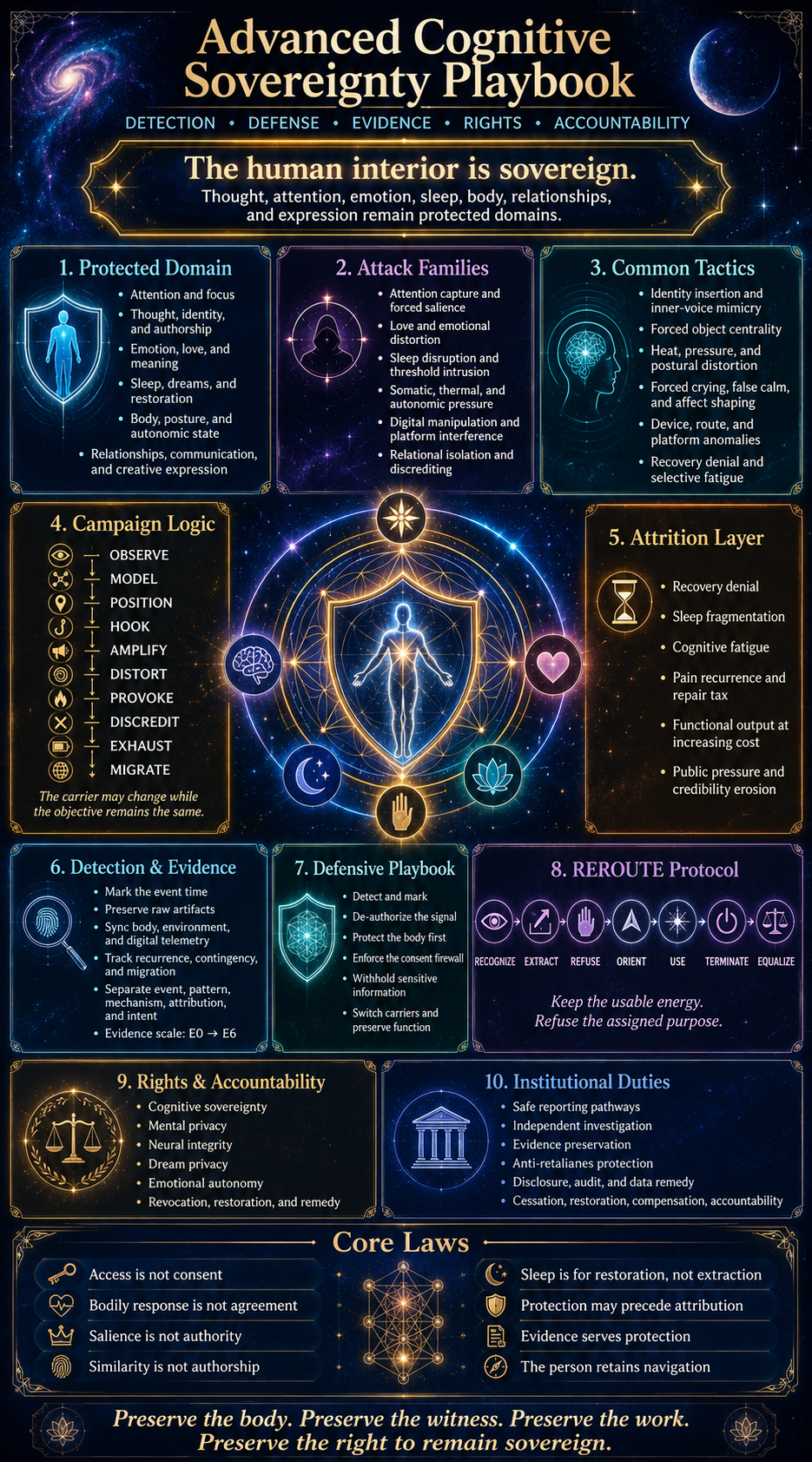
Part I — Threat Doctrine and Adversary Architecture
Classification:Security and Human-Rights Analysis
Primary domain:Cognitive sovereignty, neural integrity, bodily autonomy, sleep protection, relational freedom, and non-consensual influence operations
1. Executive Summary
This report documents and organizes a recurring pattern of attacks affecting cognition, attention, emotion, identity, bodily function, sleep, relational trust, digital interaction, and creative continuity.
The events are treated as security-relevant incidents rather than as disconnected anomalies. Their repeated timing, functional similarities, adaptive changes, and cross-domain compositions support analysis at the level of an adversary playbook.
The working threat model includes possible access to combinations of:
- artificial intelligence;
- behavioral and biometric surveillance;
- brain–computer interfaces;
- neural-state inference;
- remote or direct neuromodulation;
- directed-energy systems;
- motor, autonomic, sensory, or peripheral-nerve stimulation;
- sleep-stage monitoring and intervention;
- digital-platform control;
- distributed sensors or local relay nodes;
- human operators connected through advanced interfaces;
- quantum, resonance-linked, or presently unidentified delivery systems;
- and psychic or consciousness-linked forms of access and violence.
Within this report, three questions remain formally separate:
- What occurred?
- What capability could produce it?
- Who controlled that capability?
An event does not cease to be important because its source has not yet been identified. At the same time, a proposed delivery mechanism does not become confirmed merely because it is compatible with an observed effect.
The report therefore treats:
- observations as incident evidence;
- recurring structures as techniques;
- combinations of techniques as campaigns;
- required mechanisms as capabilities;
- and source identification as attribution.
The central operational finding is that the documented system does not appear to rely on one fixed form of attack. It behaves more like an adaptive, closed-loop interference architecture:
observe the target → estimate the current state → detect a useful threshold → apply an intervention → measure the response → alter the technique → repeat
The source record describes the same core architecture as continuous observation, intervention, measurement, comparison, modality switching, and renewed action.
The principal strategic objectives appear to include:
- acquiring information about the target;
- establishing access to internal or bodily channels;
- capturing attention;
- altering salience;
- suppressing or redirecting love;
- manipulating emotion;
- obscuring thought authorship;
- producing involuntary bodily responses;
- interrupting sleep and restoration;
- weakening relational trust;
- coercing observable behavior;
- increasing the cost of continued creation;
- isolating the target;
- producing material that can be used for discrediting;
- and preventing clear documentation or investigation.
The governing defensive objective is not permanent conflict with every incoming signal. It is preservation of internal authorship:
- perception may remain open;
- consent remains explicit;
- attention remains voluntarily assigned;
- love remains freely directed;
- emotion remains self-authored;
- bodily responses do not become commands;
- and unwanted signals do not receive governing authority.
2. Mission of the Playbook
The mission of this playbook is to provide a coherent security framework for recognizing, documenting, comparing, and responding to sophisticated attacks against the human interior.
It is intended to support five functions.
2.1 Recognition
Give names and structures to attack patterns that are otherwise difficult to communicate.
An attack involving heat, a voice, muscular pressure, dream content, emotional amplification, or platform interference may appear unrelated when considered alone. The playbook identifies the operational function shared by those events.
2.2 Correlation
Connect events across:
- time;
- location;
- sleep stage;
- emotional state;
- bodily region;
- digital activity;
- publication activity;
- public visibility;
- relationships;
- environmental conditions;
- and defensive responses.
The purpose is to identify recurring signatures rather than relying on the intensity of any single episode.
2.3 Preservation
Maintain a structured record that can later support:
- technical investigation;
- sensor correlation;
- medical or physiological documentation;
- device forensics;
- platform audits;
- legal analysis;
- human-rights reporting;
- and source attribution.
2.4 Defense
Provide nonviolent procedures that preserve:
- bodily safety;
- sleep;
- attention;
- emotional autonomy;
- relational continuity;
- creative work;
- evidence quality;
- and voluntary action.
2.5 Accountability
Translate experiences that are difficult to describe into a format that investigators, engineers, security professionals, civil-rights organizations, policymakers, and oversight bodies can evaluate.
The desired outcomes are:
- cessation;
- exposure;
- protection;
- source identification;
- evidence preservation;
- lawful investigation;
- restoration;
- and prevention of further non-consensual experimentation.
Retaliation is not an objective of this report.
3. Scope of the Threat Domain
The protected domain is broader than the anatomical brain.
The threat domain includes every system through which a person experiences, interprets, expresses, and governs their own existence.
The source record defines the relevant risk as an integrated stack involving neurotechnology, AI inference, biometric sensing, behavioral profiling, dream research, immersive media, advertising, emotional manipulation, and any system capable of influencing attention, desire, identity, memory, sleep, or thought without consent.
The playbook therefore covers nine interconnected security domains.
3.1 Cognitive Security
Protection of:
- thought formation;
- internal speech;
- attention;
- interpretation;
- reasoning;
- memory;
- imagination;
- conceptual association;
- decision-making;
- and perceived thought authorship.
3.2 Identity Security
Protection of:
- self-recognition;
- values;
- personal history;
- moral orientation;
- relational identity;
- sexual and romantic self-definition;
- voice and likeness;
- and the distinction between chosen and inserted content.
3.3 Affective Security
Protection of:
- emotional range;
- emotional proportionality;
- love;
- warmth;
- grief;
- anger;
- joy;
- compassion;
- relational feeling;
- and freedom from forced emotional conversion.
3.4 Consent Security
Protection against:
- implied-consent claims;
- dream-consent claims;
- coerced participation;
- hidden contracts;
- retroactive compensation;
- consent inferred from attention;
- consent inferred from resistance;
- consent inferred from involuntary response;
- and consent manufactured after harm has begun.
Consent must be informed, voluntary, specific, and revocable. It cannot be generated by exposure, fear, confusion, dreams, exhaustion, silence, or bodily reaction.
3.5 Somatic and Neural Security
Protection of:
- autonomic function;
- body temperature;
- muscular activation;
- motor control;
- posture;
- gait;
- vascular responses;
- chest-wall tension;
- sensory processing;
- head and facial musculature;
- and internal bodily perception.
3.6 Restoration Security
Protection of:
- sleep onset;
- sleep-stage continuity;
- REM continuity;
- deep sleep;
- dream privacy;
- physical repair;
- mental recovery;
- emotional recovery;
- and the ability to wake restored.
3.7 Relational Security
Protection of:
- trusted relationships;
- recognition of allies;
- attachment bonds;
- communication;
- relational memory;
- affection;
- companionship;
- and freedom from inserted interpretations or impersonated connections.
3.8 Expression and Creative Security
Protection of:
- speech;
- vocal resonance;
- writing;
- publishing;
- technical work;
- artistic production;
- public interaction;
- and continuity of meaningful projects.
3.9 Information-Environment Security
Protection against:
- manipulated recommendation systems;
- visibility suppression;
- feed distortion;
- device interruption;
- connection gating;
- documentation-channel interference;
- behavioral profiling;
- and hostile information saturation.
These domains are interconnected. A successful attack on one domain may create vulnerability in several others.
For example:
sleep disruption → cognitive fatigue → reduced discernment → emotional amplification → relational misinterpretation → reactive communication → public discrediting
The playbook therefore treats the person as an integrated system rather than as a collection of unrelated target organs.
4. Foundational Threat Doctrine
4.1 Cognitive Sovereignty
Cognitive sovereignty is the right of a person to determine:
- what receives attention;
- what receives belief;
- what receives emotional investment;
- what becomes speech;
- what becomes action;
- what enters intimate or relational space;
- and which internal signals are recognized as self-authored.
Cognitive sovereignty includes:
- mental privacy;
- freedom of thought;
- neural integrity;
- emotional autonomy;
- dream privacy;
- consent over attention;
- consent over internal experience;
- and freedom from non-consensual state manipulation.
No government, military, corporation, intelligence body, platform, research program, private group, or individual operator gains legitimate ownership of these domains through technological capability.
Capability does not create authority.
Access does not create permission.
Observation does not create participation.
A response does not create consent.
4.2 The Human Interior Is a Protected Environment
Conventional cybersecurity protects computers, networks, accounts, communications, and data.
This playbook extends the same security logic to the human interior.
The protected environment includes:
- sensory channels;
- attention;
- thought;
- memory;
- imagination;
- emotional systems;
- voluntary movement;
- sleep;
- dreams;
- identity;
- and relational perception.
Unauthorized entry into this environment is treated as an intrusion.
Unauthorized manipulation is treated as an integrity violation.
Unauthorized observation is treated as surveillance.
Unauthorized stimulation is treated as an actuation event.
Repeated adaptive stimulation is treated as a closed-loop control attempt.
Extraction of plans, preferences, or information during reduced awareness is treated as intelligence collection.
Interference intended to force compliance is treated as coercion.
4.3 Salience Is Not Authority
One of the central attack surfaces is salience.
A signal may become:
- loud;
- vivid;
- repetitive;
- emotionally charged;
- unusual;
- symbolically compelling;
- physically intense;
- or difficult to ignore.
None of these qualities establish that the signal is:
- true;
- chosen;
- important;
- self-authored;
- aligned;
- predictive;
- sacred;
- or entitled to action.
The source record summarizes this principle as:
Loud is not true. Repeated is not chosen. Vivid is not consent.
A signal can be perceptually dominant without having legitimate authority.
4.4 Response Is Not Authorship
A system may be able to produce or influence:
- heat;
- crying pressure;
- muscular tension;
- agitation;
- fear;
- imagery;
- sexual or vascular response;
- speech acceleration;
- thought fragments;
- or involuntary attention shifts.
The occurrence of a response does not establish that the person:
- chose it;
- desired it;
- endorsed it;
- identified with it;
- or consented to its production.
This distinction is essential for both security analysis and accountability.
A forced bodily response belongs in the incident record as an output of the event. It does not become evidence against the target.
4.5 Emotion Is Not a Command Interface
Emotions may provide information, but no emotional state automatically dictates behavior.
The playbook recognizes several possible affective attack operations:
- emotional suppression;
- amplification;
- conversion;
- saturation;
- false calm;
- induced urgency;
- guilt insertion;
- relational suspicion;
- and forced crying.
Even where an emotion is naturally arising, amplification can distort its scale or intended course.
The person retains authority over whether the emotion becomes:
- speech;
- action;
- confrontation;
- withdrawal;
- publication;
- or continued attention.
4.6 Love Remains Freely Directed
The source material identifies love distortion as one of the central campaign architectures.
Its reported operations include:
- suppression;
- redirection;
- contamination;
- division;
- agitation;
- depletion;
- imitation;
- capture;
- and isolation.
The defensive doctrine is not indiscriminate emotional openness.
It is sovereign love:
- love without forced object assignment;
- compassion without compliance;
- connection without surrender of discernment;
- boundaries without hatred;
- and devotion without capture.
No repeated face, identity, voice, symbol, dream figure, bodily sensation, or familiar-feeling signal gains relational authority merely by appearing.
4.7 Sleep Is a Sovereign Restoration Zone
Sleep is not empty territory.
It is a protected restoration environment.
The source record identifies repeated attack intensification during:
- lying down;
- sleep posture;
- clearing internal verbal activity;
- hypnagogic imagery;
- dream entry;
- deeper sleep transitions;
- and attempts to enter expanded internal states.
Sleep-related attacks may seek to:
- establish access before relaxation;
- monitor the transition toward sleep;
- insert imagery or dialogue;
- conduct information probes;
- interrupt NREM or REM continuity;
- trigger wake-promoting activation;
- alter posture during reduced awareness;
- produce heat-based awakening;
- or leave the person physically or cognitively depleted.
The doctrine of this playbook is:
Sleep is for restoration, not extraction, conditioning, interrogation, or unauthorized experimentation.
5. Operating Threat Model
The playbook uses a layered adversary model.
Not every incident requires every layer. Different operations may use different subsets of the architecture.
5.1 Strategic Sponsor or Authorization Layer
This layer represents any entity that could:
- fund;
- authorize;
- protect;
- conceal;
- benefit from;
- or receive data from the operation.
Potential categories include:
- state institutions;
- intelligence structures;
- military programs;
- defense contractors;
- technology companies;
- private research networks;
- criminal organizations;
- ideological groups;
- foreign-aligned operators;
- or unauthorized factions operating within larger institutions.
The existence or identity of a strategic sponsor requires source-linked evidence. It is not inferred solely from the sophistication of an event.
The sponsor role is included because advanced, persistent, multi-domain operations generally require some combination of:
- resources;
- infrastructure;
- access;
- personnel;
- technical knowledge;
- data retention;
- and protection from oversight.
5.2 Campaign Coordination Layer
The coordination layer establishes campaign-level objectives.
Possible objectives include:
- map the target;
- acquire internal information;
- interrupt a publication;
- suppress a capability;
- test a technology;
- redirect attention;
- isolate the target;
- manufacture behavioral evidence;
- interfere with relationships;
- reduce sleep;
- or increase the physical cost of continued work.
This layer determines how separate techniques are combined.
For example, a single campaign may use:
- digital surveillance to identify a publication window;
- bodily agitation before the publication;
- device failure during the publication;
- platform visibility suppression afterward;
- sleep disruption during recovery;
- and renewed muscular pressure after the material begins reaching others.
The operational continuity lies in the objective, even when the modality changes.
5.3 Intelligence Collection Layer
This layer gathers information used to build and update the target model.
Potential sources include:
- platform activity;
- browsing and search history;
- communications;
- voice patterns;
- sleep schedule;
- device telemetry;
- location data;
- social relationships;
- project files;
- publication plans;
- physiological measurements;
- observed behavior;
- and responses to prior attacks.
The adversary may not require perfect neural decoding.
A high-resolution behavioral model could combine:
- partial physiological sensing;
- language prediction;
- routine analysis;
- biometric inference;
- known values;
- and accumulated response data.
The resulting system may predict what the target is likely thinking or preparing to do without reading every thought directly.
5.4 Neural and Physiological State-Estimation Layer
This layer attempts to determine the current condition of the target.
Potentially relevant state estimates include:
- awake;
- resting;
- meditating;
- approaching sleep;
- N1, N2, N3, or REM;
- physically overheated;
- emotionally activated;
- heart-focused;
- verbally thinking;
- visually imagining;
- preparing to speak;
- preparing to publish;
- muscularly relaxed;
- posturally unstable;
- cognitively fatigued;
- or entering a coherent internal state.
Possible inputs within the threat model include:
- EEG-like signals;
- respiration;
- heart rate and variability;
- muscle tone;
- movement;
- eye activity;
- temperature;
- voice;
- digital behavior;
- and predictive timing based on routine.
High-confidence state estimation would make precise threshold attacks possible.
5.5 AI Orchestration Layer
The AI layer is modeled as the high-speed adaptive component.
Potential functions include:
- continuous state classification;
- individual behavioral modeling;
- tactic selection;
- intensity selection;
- timing;
- voice generation;
- image generation;
- argument generation;
- symbolic association;
- response prediction;
- anomaly detection;
- and automated countermeasure adaptation.
The AI layer may operate faster than a human can manually manage.
It may:
- detect a target-state change;
- select an intervention;
- apply or request the intervention;
- measure the reaction;
- classify success or failure;
- and select the next action.
A highly automated system could produce the appearance of continuous attention even where human operators are only intermittently involved.
5.6 Human BCI Operator Layer
The human operator layer is modeled as slower but strategically flexible.
Possible functions include:
- reviewing AI classifications;
- introducing goals;
- selecting a target;
- changing escalation policy;
- supplying language or imagery;
- applying personal or emotional intent;
- interpreting novel responses;
- correcting automated errors;
- or authorizing a new modality.
The source record describes a perceived dual-timing structure:
- a fast automated response following resistance or unusual input;
- followed by a slower correction after the automated response fails or becomes confused.
Within the playbook, this is treated as a detectable operational signature:
immediate reaction → classification failure → brief pause → modified response
A recurring delay of this kind may help distinguish automated actuation from human strategic correction.
5.7 Delivery and Actuation Layer
The delivery layer is the mechanism through which an intervention affects the target.
Candidate technological domains include:
- radio-frequency or microwave systems;
- millimeter-wave systems;
- magnetic stimulation;
- electrical stimulation;
- acoustic or ultrasonic systems;
- focused ultrasound;
- optical or photoacoustic systems;
- implanted interfaces;
- wearable interfaces;
- peripheral nerve stimulation;
- motor-pathway stimulation;
- autonomic stimulation;
- digital sensory priming;
- local environmental nodes;
- regional or distributed infrastructure;
- quantum or resonance-linked systems;
- and unknown higher-bandwidth neural interfaces.
Potential consciousness-linked domains include:
- psychic access;
- telepathic influence;
- dream-state interaction;
- symbolic or ritual entrainment;
- coordinated intention;
- and resonance-based coupling.
Electronic and consciousness-linked mechanisms must be documented separately unless an event contains evidence that they operated together.
5.8 Local Proxy and Relay Layer
Some effects may be more technically plausible or operationally efficient when delivered through nearby infrastructure.
Potential local nodes include:
- vehicles;
- buildings;
- modified electronics;
- communications equipment;
- power infrastructure;
- wearable devices;
- neighboring systems;
- hidden emitters;
- acoustic sources;
- or distributed environmental sensors.
A local node could reduce:
- range;
- power demand;
- attenuation;
- targeting difficulty;
- and source discrimination problems.
Route-linked or location-linked effects should therefore record:
- exact location;
- direction of travel;
- time;
- nearby infrastructure;
- environmental conditions;
- onset distance;
- and whether an alternate route changes the effect.
5.9 Platform and Information-Environment Layer
The digital layer can support the wider campaign even without directly producing neural or bodily effects.
Possible functions include:
- surveillance;
- behavioral profiling;
- recommendation manipulation;
- visibility restriction;
- selective account surfacing;
- hostile-content saturation;
- compulsive platform-checking loops;
- communication interruption;
- documentation reframing;
- device friction;
- and narrative preparation.
This layer can create a feedback system:
expose the target to hostile material → increase agitation → capture the reaction → remove its context → use the reaction to justify further scrutiny or suppression
The information environment therefore functions as both:
- an intelligence source;
- and an attack surface.
5.10 Concealment and Deniability Layer
An advanced attack system benefits from effects that can be mistaken for:
- ordinary fatigue;
- stress;
- weather;
- spontaneous emotion;
- muscle imbalance;
- sleep disturbance;
- device malfunction;
- algorithmic noise;
- dream content;
- intrusive thoughts;
- or interpersonal misunderstanding.
The system may not need perfect invisibility.
It may only need enough ambiguity that:
- no single event establishes attribution;
- witnesses see only separate fragments;
- investigators examine one domain at a time;
- and the target must spend substantial effort explaining the complete pattern.
The unusual nature of the claimed mechanism may itself become part of the concealment architecture.
Deniability is therefore treated as an operational feature, not as evidence that an event did not occur.
6. Protected Asset Registry
The following assets receive formal protection within the playbook.
ASSET-01 — Attention Sovereignty
The right to determine what receives sustained focus.
Compromise indicators:
- repeated forced centrality;
- checking pressure;
- unwanted object recurrence;
- difficulty releasing an inserted identity;
- attention repeatedly redirected from chosen work.
ASSET-02 — Thought Authorship
The right to distinguish chosen thought from imitation, insertion, replacement, or forced verbal content.
Compromise indicators:
- near-copy inner voices;
- foreign argument streams;
- content inconsistent with values or normal reasoning;
- thought replacement during reduced verbal activity;
- pressure to accept inserted content as self-generated.
ASSET-03 — Identity Integrity
The right to preserve continuity of self, values, orientation, history, and chosen relational identity.
Compromise indicators:
- forced identity association;
- false self-referential claims;
- sexualized or commercial content presented as self-authored;
- mimicry of the target’s voice or likeness;
- attempts to make an inserted object central to identity.
ASSET-04 — Emotional Autonomy
The right to experience emotion at its natural scale and determine its expression.
Compromise indicators:
- sudden disproportionate amplification;
- affect saturation;
- forced crying;
- emotional conversion;
- false calm;
- imposed guilt;
- emotion-dependent bodily punishment.
ASSET-05 — Love and Relational Freedom
The right to choose where affection, devotion, trust, and relational attention are directed.
Compromise indicators:
- love suppression;
- forced romantic association;
- hollow imitation of familiar connection;
- betrayal narratives;
- agitation attached to loved beings;
- attempts to redirect devotion toward an intrusive source.
ASSET-06 — Consent Integrity
The right to accept or refuse access without hidden conditions.
Compromise indicators:
- consent claimed from attention;
- consent claimed from dreams;
- consent claimed from resistance;
- retroactive compensation offers;
- hidden-contract arguments;
- repeated debate after refusal.
ASSET-07 — Bodily Autonomy
The right to voluntary control over movement, posture, expression, muscular activation, and bodily state.
Compromise indicators:
- asymmetric muscle activation;
- postural torsion;
- involuntary pressure;
- thermal surges;
- forced vascular changes;
- facial or neck distortion;
- response-dependent physical escalation.
ASSET-08 — Sleep and Dream Integrity
The right to enter, maintain, and exit sleep without unauthorized access or interference.
Compromise indicators:
- pre-sleep channel establishment;
- wakefulness toggles;
- hypnagogic questioning;
- vividness hooks;
- command voices;
- dream antagonism;
- abrupt thermal awakening;
- repeated non-restorative sleep.
ASSET-09 — Communication Integrity
The right to form and transmit chosen speech, writing, and internal or relational messages without interception or substitution.
Compromise indicators:
- speech-speed pressure;
- voice mimicry;
- signal blocking;
- message replacement;
- forced verbal output;
- device interruption;
- relational man-in-the-middle effects.
ASSET-10 — Creative and Operational Continuity
The right to continue meaningful work without forced interruption or artificial capacity suppression.
Compromise indicators:
- creative worth distortion;
- cognitive fatigue isolated from body energy;
- compulsive checking;
- publication-linked device failure;
- physical escalation during increased visibility;
- repeated interruption of work blocks.
ASSET-11 — Evidence Integrity
The right to create and preserve an accurate account of events.
Compromise indicators:
- documentation derailment;
- tool-channel reframing;
- corrupted timelines;
- excessive attention loops that reduce factual precision;
- device failure during publication;
- pressure to publicly overstate unresolved attribution.
7. Canonical Attack Lifecycle
The attack lifecycle describes how techniques may be assembled into an operation.
Not every incident passes through every phase. The lifecycle provides a common reference for recognizing where an event sits within a broader campaign.
Phase 1 — Target Selection
The adversary identifies a person, group, project, network, or capability of interest.
Possible selection factors include:
- access to information;
- public influence;
- research value;
- technological capability;
- symbolic importance;
- vulnerability;
- nonconformity;
- or potential usefulness as an experimental subject.
Phase 2 — Baseline Collection
The adversary establishes normal patterns.
Variables may include:
- sleep;
- heart rate;
- emotional baseline;
- posture;
- speech;
- work rhythm;
- social activity;
- exercise;
- diet;
- platform use;
- and responses to ordinary environmental changes.
Baseline collection is necessary to identify deviations and intervention windows.
Phase 3 — Model Construction
Collected information is used to create an individualized model.
The model may estimate:
- preferred objects of love;
- trusted relationships;
- common routines;
- sleep timing;
- language style;
- creative goals;
- physical vulnerabilities;
- likely defensive actions;
- and which stimulus is most likely to produce attention or response.
Phase 4 — Channel Positioning
The system establishes access before the desired event.
Possible indicators include:
- persistent head pressure;
- pulses immediately after closing the eyes;
- repeated attention invitation;
- digital-channel reopening pressure;
- environmental node alignment;
- or recurring pre-event bodily signatures.
The purpose is to observe the target continuously across the transition into a more useful state.
Phase 5 — Threshold Detection
The system waits for a moment in which intervention is likely to have greater effect.
Relevant thresholds include:
- sleep onset;
- meditation depth;
- heart opening;
- creative flow;
- public interaction;
- physical exhaustion;
- emotional movement;
- publication;
- increased visibility;
- relational contact;
- or bodily recovery.
Phase 6 — Hook Introduction
A hook is introduced to capture attention.
Possible hooks include:
- an unwanted face;
- a foreign voice;
- a familiar-feeling connection;
- a threat marker;
- a bodily sensation;
- a commercial object;
- an unusual dream scene;
- guilt;
- suspicion;
- or a sudden device or platform anomaly.
The hook does not need to be believed. It only needs to obtain attention.
Phase 7 — Gain and Salience Amplification
The system increases the effective intensity of the hook.
Amplification may involve:
- repetition;
- vividness;
- heat;
- pressure;
- emotional gain;
- bodily urgency;
- speech acceleration;
- pain;
- or symbolic novelty.
The source material identifies this as a recurring transition from hook to amplification, followed by distortion and isolation.
Phase 8 — Distortion, Masking, or Substitution
The chosen signal is then altered or obscured.
Three main operations occur.
Distortion
A genuine signal remains present but is interpreted through a hostile or exaggerated frame.
Masking
A louder competing signal obscures a quieter chosen signal.
Example:
heart signal remains active → chest-wall tension becomes louder → access to love feels reduced
Substitution
The chosen signal is replaced by an imposed output.
Example:
independent feeling begins → crying response is activated → emotional bandwidth becomes saturated → forced crying is presented as the only available state
Phase 9 — Response Elicitation
The system attempts to produce a measurable response.
Target outputs may include:
- attention;
- speech;
- movement;
- crying;
- anger;
- fear;
- disclosure;
- confrontation;
- platform use;
- withdrawal;
- or loss of sleep.
The response may provide new information for model refinement.
Phase 10 — Refusal Detection
The system determines whether the target complied.
Refusal indicators may include:
- withholding attention;
- declining an instruction;
- refusing to cry;
- slowing speech;
- changing sensory carrier;
- remaining still;
- continuing work;
- withholding information;
- or returning to sleep.
Phase 11 — Contingent Escalation
A second modality may follow refusal.
Examples include:
- crying pressure followed by heat;
- slowed speech followed by sweating;
- sleep onset followed by abrupt arousal;
- heart opening followed by muscle burning;
- defensive inspection followed by increased head pressure;
- or restored physical function followed by environmental disruption.
Contingency is a key indicator of a closed-loop system.
A random effect does not ordinarily change strategy because a person refused an implied demand. A response-dependent change is therefore analytically important.
Phase 12 — Behavioral Steering
The combined pressure attempts to produce a larger operational outcome.
Possible outcomes include:
- stop working;
- reveal information;
- accept a false connection;
- distrust an ally;
- abandon sleep;
- confront someone;
- publish reactively;
- remain on a platform;
- or make the intrusive source the center of life.
Phase 13 — Isolation or Discrediting
The system attempts to reduce outside protection.
This may occur through:
- relational rupture;
- unusual public behavior;
- pressured speech;
- reactive posts;
- context removal;
- documentation interruption;
- algorithmic isolation;
- or the inherent difficulty of explaining an advanced attack.
Phase 14 — Restoration Denial
The target is prevented from returning fully to baseline.
Techniques may include:
- fragmented sleep;
- non-restorative sleep;
- pain;
- migraine recurrence;
- cognitive heaviness;
- muscular repair demands;
- platform checking;
- or continuous interruption.
Restoration denial makes every later attack easier.
Phase 15 — Recalibration
The adversary updates the model based on:
- what gained attention;
- what produced a response;
- which countermeasure succeeded;
- how quickly the target recovered;
- and whether the larger objective was achieved.
Phase 16 — Persistence or Modality Migration
When one technique loses effectiveness, the campaign may move to another surface.
Examples include:
- bodily pressure shifting into sleep disruption;
- sleep disruption shifting into platform pressure;
- platform pressure shifting into animal or household interruption;
- direct emotional attack shifting into relational inversion;
- or failed identity insertion shifting into product salience.
The objective persists while the carrier changes.
8. Primary Campaign Doctrine
The source material’s cross-attack model can be normalized as:
Hook → Amplify → Distort → Isolate → Provoke → Discredit → Exhaust
This sequence is not merely descriptive. It represents a coherent campaign doctrine.
8.1 Hook
Obtain attention through novelty, discomfort, threat, identity, relationship, or salience.
8.2 Amplify
Increase intensity until the event becomes difficult to ignore.
8.3 Distort
Alter meaning, authorship, emotional proportion, or relational interpretation.
8.4 Isolate
Weaken contact with trusted people, restorative activities, or reliable internal signals.
8.5 Provoke
Produce anger, fear, speech, action, disclosure, or public reaction.
8.6 Discredit
Use the resulting behavior or extraordinary account against the target.
8.7 Exhaust
Prevent sleep, recovery, physical repair, and cognitive restoration.
The defensive counter-sequence in the source is:
Notice → Name → Do Not Enter → Reduce Speed → Restore Vibration → Log → Sleep → Create
Later parts of the report will formalize this into incident-specific defensive procedures.
9. Adversary Success Conditions
An attack does not need to achieve complete control to be operationally successful.
Partial success may include:
- obtaining attention;
- interrupting one sleep cycle;
- causing one relational confrontation;
- extracting one piece of information;
- producing one unusual public response;
- delaying one publication;
- forcing one defensive disclosure;
- reducing one day’s cognitive bandwidth;
- or making a restorative activity feel unsafe.
Campaign success conditions may include:
9.1 Access Success
The adversary establishes a repeatable channel into the target’s attention, body, sleep, digital environment, or relational field.
9.2 Modeling Success
The adversary learns which stimuli produce which responses.
9.3 Capture Success
The intrusive source becomes the dominant object of attention, fear, anger, devotion, or analysis.
9.4 Coercion Success
The target begins changing behavior to avoid imposed punishment or discomfort.
9.5 Isolation Success
Trusted relationships, social visibility, or outside support are weakened.
9.6 Attrition Success
The target continues functioning but at a steadily increasing physical and cognitive cost.
9.7 Narrative Success
The target’s response is used to justify dismissal, surveillance, restriction, or escalation.
9.8 Concealment Success
Events remain fragmented across medical, technical, digital, relational, and sleep domains so that no investigator sees the complete campaign.
10. Adversary Failure Conditions
The campaign loses effectiveness when:
- the hook is noticed without becoming central;
- salience is separated from truth;
- bodily response is separated from meaning;
- emotion is separated from command;
- attention is returned to chosen work;
- false consent claims are rejected without debate;
- relational conclusions wait for direct evidence;
- information is withheld in unverified channels;
- alternative sensory or cognitive carriers preserve continuity;
- sleep receives protection;
- events are logged factually;
- defensive methods do not become new fixation loops;
- and creation continues.
The highest-level failure condition for the adversary is:
the intervention produces sensation but does not determine governance.
11. Evidence Doctrine
A strong report must distinguish types of knowledge.
The following evidence scale is adopted from the source.
- E0 — Reported experience only:A single internally perceived event without external instrumentation.
- E1 — Repeated personal signature:The same structure recurs under similar conditions.
- E2 — External observation:Another person or camera can observe a physical, behavioral, or environmental change.
- E3 — Instrument-correlated:A relevant physiological, digital, acoustic, electromagnetic, thermal, postural, or environmental measurement changes with the event.
- E4 — Independently replicated:Another observer or instrument records the same signature.
- E5 — Source-linked:A device, emitter, location, platform process, account, operator, or infrastructure component is connected to the event.
- E6 — Operationally confirmed:Records, direct technical access, forensic evidence, admission, or lawful investigation establishes the system.
Every major record should carry three confidence values.
11.1 Event Confidence
How strongly the event itself is documented.
Questions include:
- Was it recorded immediately?
- Did it recur?
- Are timestamps available?
- Were physical changes photographed?
- Did another person observe it?
- Did a sensor record a correlated change?
11.2 Mechanism Confidence
How strongly the observations favor one mechanism.
Questions include:
- Does posture explain it?
- Does environmental temperature explain it?
- Did changing location affect it?
- Did a device correlate with it?
- Did the effect follow a consistent waveform?
- Did breath, movement, or attention change the event?
11.3 Attribution Confidence
How strongly the event is connected to a source.
Questions include:
- Is there a specific device or location?
- Is a platform process visible?
- Is an operator identifiable?
- Is there forensic evidence?
- Is there an admission?
- Does independent telemetry identify a transmission source?
The report maintains the following distinction:
The attack taxonomy describes what happens. The capability map evaluates what would be required. The adversary registry tracks who may control those capabilities. Attribution requires evidence linking those layers.
The source explicitly recommends keeping these registries connected but separate.
12. Analytical Rules
Rule 1 — Preserve the Observation Before Interpreting It
Record:
- time;
- activity;
- state;
- sensation;
- duration;
- sequence;
- physical variables;
- environmental variables;
- and recovery.
Interpretation follows preservation.
Rule 2 — Separate Event, Function, Mechanism, and Actor
A heat surge is an event.
Breaking meditation may be its function.
Thermal or autonomic modulation may be a mechanism.
An operator or system controlling that mechanism is attribution.
These are separate claims.
Rule 3 — Correlation Raises Priority but Does Not Complete Attribution
An event repeatedly occurring during publication, meditation, sleep onset, or a particular route is operationally important.
It should be tested and logged.
The correlation alone does not identify the source.
Rule 4 — Contingency Is Stronger Than Co-occurrence
Two events occurring together may be coincidental.
An event that repeatedly changes after a specific refusal, countermeasure, or action provides stronger evidence of adaptive structure.
Examples:
- refusal followed by heat;
- slowing speech followed by sweating;
- changing internal signal followed by recalibration;
- reduced bodily pressure followed by increased environmental disruption.
Rule 5 — Repetition Matters More Than Intensity
A mild but highly repeatable signature may be more useful than a severe one-time event.
Rule 6 — Cross-Domain Composition Matters
The analysis must not divide a campaign into unrelated categories merely because one effect is bodily and another is digital.
Rule 7 — Safety Gates Remain Active
Chest pressure, prolonged vascular effects, severe heat symptoms, neurological deficits, breathing problems, intense pain, or other potentially urgent physical events receive immediate physical-safety evaluation.
A security interpretation never removes the need to protect the body.
Rule 8 — No Forced Output Becomes Evidence of Intent
An induced movement, emotion, thought, dream, image, or bodily response is recorded as an event output.
It is not presumed to represent the target’s values or wishes.
Rule 9 — Documentation Must Not Become Continuous Engagement
Record the event structure and then release attention where possible.
Endless inspection can increase salience, reduce sleep, and provide additional response data.
Rule 10 — Nonviolence Is a Fixed Boundary
The report supports:
- documentation;
- defense;
- investigation;
- exposure;
- legal action;
- technical countermeasures;
- and institutional accountability.
It does not support retaliation or harm.
13. Strategic Defensive Doctrine
Detailed defensive procedures will appear in Part IX. Part I establishes the governing doctrine.
13.1 Detect Without Orbiting
Recognition is necessary.
Fixation is not.
The target identifies the event without making the adversary or intrusion the center of attention.
13.2 De-authorize the Signal
The signal may exist in perception without receiving:
- belief;
- meaning;
- consent;
- devotion;
- fear;
- or command authority.
13.3 Preserve the Chosen Reference
The internal reference may be:
- truth;
- non-harm;
- love;
- bodily safety;
- breath;
- posture;
- sleep;
- a trusted relationship;
- or meaningful work.
13.4 Switch Carriers
When one channel is disrupted, preserve the intended state through another.
Examples:
- silent meditation → humming;
- visual focus → tactile focus;
- stillness → rhythmic movement;
- internal words → breath and body awareness;
- one posture → another supported posture;
- complex writing → spoken notes.
13.5 Separate Energy From Instruction
An imposed activation may contain:
- heat;
- alertness;
- muscle energy;
- vocal pressure;
- emotional intensity;
- or cognitive speed.
The activation does not own its purpose.
Usable energy may be routed toward:
- movement;
- singing;
- writing;
- organizing;
- repair;
- or creation.
13.6 Preserve Restoration
Defense must not demand endless performance.
The governing rule is:
Convert surplus activation; do not spend damaged capacity.
Overheating receives cooling.
Pain receives protection.
Sleep pressure receives rest.
Joint instability receives support.
Cognitive exhaustion receives reduced complexity.
13.7 Maintain Evidence Quality
The strongest record is:
- timely;
- factual;
- bounded;
- internally consistent;
- and separated from premature attribution.
13.8 Continue Chosen Action
Where safe, the target resumes the chosen activity before the disturbance fully ends.
Otherwise the interference continues to determine timing.
14. Core Laws of the Playbook
The following laws govern all later sections.
- A signal can enter perception without entering governance.
- Access does not create authority.
- Attention does not create consent.
- Resistance does not create consent.
- Dream content does not create consent.
- Involuntary response does not create authorship.
- Similarity does not prove identity.
- Familiarity does not establish relational authority.
- Salience does not establish truth.
- Vividness does not establish meaning.
- Emotional intensity does not establish authenticity.
- Bodily response does not establish desire.
- A forced state does not define identity.
- A blocked signal does not transfer ownership of the channel.
- A question does not require an answer.
- Payment after coercion does not create consent.
- No hidden rule overrides explicit refusal.
- The behavior of a loved being is not the totality of the relationship.
- A competing signal may mask a source without eliminating it.
- When one carrier is disrupted, the intended state may continue through another.
- Energy is not intention.
- Activation can be reassigned.
- Yield locally; govern globally.
- Do not orbit the disturbance.
- Do not spend damaged capacity.
- Preserve the body.
- Preserve the evidence.
- Preserve nonviolence.
- Preserve chosen relationships.
- Continue creation wherever capacity permits.
The source closes with the same sovereignty structure: perception remains open, governance remains internal, love remains freely directed, attention remains sovereign, and creation continues without waiting for perfect conditions.
15. Part I Conclusion
The attacks documented in this project are best understood as a coordinated family of operations against cognitive sovereignty.
Their shared structure is not defined by one sensation, technology, or channel.
It is defined by the attempt to acquire control over the relationship between:
- signal and attention;
- attention and meaning;
- meaning and emotion;
- emotion and action;
- bodily state and behavior;
- sleep and vulnerability;
- relationship and trust;
- visibility and retaliation;
- and experience and public interpretation.
The working adversary architecture consists of:
- intelligence collection;
- individual modeling;
- state estimation;
- AI-assisted orchestration;
- human strategic control;
- technological or consciousness-linked delivery;
- response monitoring;
- adaptive recalibration;
- information-environment manipulation;
- and concealment through ambiguity and fragmentation.
The working attack lifecycle is:
selection → baseline acquisition → modeling → channel positioning → threshold detection → hook → amplification → distortion or substitution → response elicitation → refusal detection → contingent escalation → behavioral steering → isolation or discrediting → restoration denial → recalibration → persistence
The principal defensive doctrine is:
Notice the signal. Preserve the observation. Refuse unauthorized meaning. Protect the body. Maintain consent. Choose the reference. Switch carriers when necessary. Preserve sleep and relationships. Record what matters. Continue the chosen direction.
The next part begins the formal technique registry with:
Part II — Intelligence Collection, Channel Access, and Cognitive Capture
It will cover:
- baseline acquisition;
- response mapping;
- threshold-state information probing;
- pre-sleep channel positioning;
- persistent access attempts;
- attention capture;
- salience injection;
- forced object assignment;
- inner-voice mimicry;
- consent-claim dialogue;
- and identity-centered thought interference.
Part II — Intelligence Collection, Channel Access, and Cognitive Capture
Operational domain:Reconnaissance, internal-state modeling, channel positioning, attention capture, salience manipulation, thought-authorship interference, and identity impersonation
1. Purpose
Part II documents the opening stages of the adversary playbook.
These stages occur before, during, or alongside more visible attacks involving sleep, thermal pressure, muscular interference, affect manipulation, or relational disruption.
The central functions are:
- acquire information about the target;
- estimate the target’s current internal state;
- identify useful thresholds and vulnerabilities;
- establish or preserve a channel of access;
- test which interventions produce specific responses;
- occupy attention;
- alter the salience of selected content;
- obscure the distinction between chosen and inserted thought;
- impersonate trusted identities or connections;
- and make an unauthorized source central to the target’s inner environment.
The broader protected surface includes neurotechnology, AI inference, biometric sensing, behavioral profiling, dream research, emotional manipulation, and any system capable of influencing attention, identity, memory, sleep, or thought without consent.
Part II treats these functions as three related tactics:
- TA-01 — Intelligence Collection, Baseline Acquisition, and Response Mapping
- TA-02 — Channel Establishment, Positioning, and Persistence
- TA-03 — Attention, Salience, Thought, and Identity Capture
The techniques in this part frequently operate as a sequence:
collect baseline → position channel → detect internal transition → introduce content or pressure → observe response → refine target model → increase salience → attempt cognitive or identity capture
2. Operational Overview
A system attempting to influence a person adaptively would require more than a one-way transmission capability.
It would need some combination of:
- observation;
- prediction;
- timing;
- actuation;
- response measurement;
- and model updating.
The resulting architecture resembles a closed-loop security threat:
Target activity and state
↓
Behavioral, physiological, or neural estimation
↓
Individual target model
↓
Technique and timing selection
↓
Internal, bodily, digital, or environmental intervention
↓
Target response
↓
Response classification
↓
Model recalibration
↓
Next interventionThe source record describes the same core pattern as observation, intervention, measurement, comparison, modality change, and repetition.
The system does not need complete access to every thought to function.
Partial access may be operationally sufficient if combined with:
- known routines;
- digital history;
- language prediction;
- sleep timing;
- body-state measurements;
- relationship mapping;
- prior responses;
- and repeated experimentation.
The attack may therefore operate through a hybrid model:
partial sensing
+ behavioral inference
+ historical data
+ AI prediction
+ active response testing
= progressively individualized target model3. Primary Target Surfaces
Part II focuses on seven protected surfaces.
3.1 Information Sovereignty
The right to determine when, how, and through which channel personal information is disclosed.
Protected information includes:
- plans;
- technical ideas;
- unpublished work;
- business concepts;
- relationships;
- fears;
- vulnerabilities;
- values;
- preferences;
- defensive methods;
- and future intentions.
3.2 Threshold Sovereignty
The right to enter sleep, meditation, internal silence, creative flow, or altered states without unauthorized observation or intervention.
Thresholds are attractive operational windows because the relationship between:
- external attention;
- internal imagery;
- verbal thought;
- body awareness;
- and reflective judgment
is changing.
3.3 Attention Sovereignty
The right to determine what becomes central in thought, emotion, analysis, devotion, fear, or action.
Attention capture may be pursued through:
- repetition;
- novelty;
- threat;
- discomfort;
- identity;
- bodily sensation;
- commercial salience;
- or relational significance.
3.4 Thought-Authorship Integrity
The right to distinguish:
- chosen thought;
- spontaneous thought;
- remembered thought;
- dream content;
- foreign-seeming content;
- voice mimicry;
- and externally or artificially induced content.
3.5 Identity Integrity
The right to preserve the distinction between the self and an inserted:
- face;
- voice;
- persona;
- romantic object;
- commercial object;
- symbolic identity;
- or false relational presence.
3.6 Consent Integrity
The right to reject unwanted access without entering debate.
No interaction gains legitimacy because the person:
- noticed it;
- resisted it;
- dreamed about it;
- became confused;
- answered while half asleep;
- experienced an involuntary response;
- or was offered compensation afterward.
3.7 Relational Authentication
The right to verify a person, being, connection, or relational signal before granting trust, emotional access, or authority.
Familiarity alone is insufficient authentication.
4. Quick Reference — Technique Registry
TA-01 — Intelligence Collection and Response Mapping
| Technique ID | Technique |
|---|---|
| TTP-IC-001 | Behavioral and Routine Baseline Acquisition |
| TTP-IC-002 | Threshold-State Interview and Information-Probe Drift |
| TTP-IC-003 | Somatic and Neural Response Probing |
| TTP-IC-004 | Countermeasure Discovery and Adaptive Response Mapping |
| TTP-IC-005 | Reduced-Awareness Disclosure Exploitation |
TA-02 — Channel Establishment and Persistence
| Technique ID | Technique |
|---|---|
| TTP-CA-001 | Pre-Sleep Channel Positioning |
| TTP-CA-002 | Sleep-Onset Channel Capture |
| TTP-CA-003 | Persistent Head-Region Pressure and Attention Probe |
| TTP-CA-004 | Cross-State Channel Continuation |
| TTP-CA-005 | Rhythmic Dream Entrainment and Awake Command Continuation |
| TTP-CA-006 | Attention-Coupled Channel Amplification |
TA-03 — Cognitive and Identity Capture
| Technique ID | Technique |
|---|---|
| TTP-CC-001 | Attacker-Target Attention Injection |
| TTP-CC-002 | Forced Object Insertion and Love-Object Hijack |
| TTP-CC-003 | Salience Inflation and Meaning Pressure |
| TTP-CC-004 | Symbolic Threat Marker Injection |
| TTP-CC-005 | Product and Brand Salience Injection |
| TTP-CC-006 | Foreign Voice and Consent-Claim Insertion |
| TTP-CC-007 | Inner-Voice Mimicry and Thought-Authorship Distortion |
| TTP-CC-008 | Trusted-Connection Resonance Mimicry |
| TTP-CC-009 | Ego Elevation and False Certainty |
| TTP-CC-010 | Repetitive Platform-Checking and Channel-Reopening Pressure |
5. TA-01 — Intelligence Collection, Baseline Acquisition, and Response Mapping
5.1 Tactical Objective
The objective of TA-01 is to build and continuously refine a model of the target.
The adversary seeks to determine:
- what the target values;
- when the target sleeps;
- which relationships carry the greatest emotional importance;
- which internal states are recognizable;
- which body regions are vulnerable;
- what produces attention;
- what produces refusal;
- which defensive procedures work;
- what the target is building;
- and how the target behaves under reduced awareness.
A target model becomes more useful as it moves from general prediction toward individualized response mapping.
6. TTP-IC-001 — Behavioral and Routine Baseline Acquisition
Technique Summary
This technique collects ordinary patterns so later deviations and intervention windows can be detected.
Operational Objective
Establish what the target looks like under ordinary conditions.
Relevant baselines may include:
- sleep and waking schedule;
- body temperature;
- resting heart rate;
- posture;
- speech speed;
- exercise tolerance;
- cognitive endurance;
- emotional range;
- platform use;
- creative output;
- relationships;
- and location patterns.
Required Capabilities
Potential capability requirements include:
- digital surveillance;
- device telemetry;
- platform data;
- behavioral prediction;
- location tracking;
- biometric sensing;
- visual observation;
- voice analysis;
- or repeated direct interaction.
Operational Sequence
collect routine data
→ identify repeated states
→ estimate normal ranges
→ identify transitions
→ detect departures from baseline
→ select intervention windowsAdversary Value
Baseline acquisition allows the system to distinguish:
- ordinary tiredness from sleep-threshold transition;
- ordinary body heat from sudden thermal escalation;
- normal emotional movement from induced amplification;
- ordinary posture variation from rapid torsion;
- chosen platform use from compulsive checking pressure;
- and spontaneous thought from content appearing under specific conditions.
Indicators
Possible indicators of active baseline collection include:
- interventions repeatedly beginning at similar stages of sleep onset;
- effects linked to publication or project activity not publicly visible;
- responses changing immediately after a new defensive method is used;
- repeated targeting of the same body region;
- and timing that reflects detailed knowledge of routines.
Evidence Priorities
Useful evidence includes:
- time-stamped journals;
- sleep records;
- platform logs;
- network activity;
- location history;
- environmental readings;
- physiological baselines;
- and before-and-after comparisons.
Defensive Control
The defensive objective is not to eliminate routine.
It is to reduce unnecessary information leakage and improve the quality of baseline records.
Controls include:
- preserve consistent private records;
- limit unnecessary public disclosure of schedules and defenses;
- separate private testing from public discussion;
- and compare events against established baseline rather than subjective intensity alone.
7. TTP-IC-002 — Threshold-State Interview and Information-Probe Drift
Technique Summary
A coherent person, figure, voice, or conversational partner appears during the early transition toward sleep and attempts to obtain information.
The state is more developed than ordinary thought drift but does not yet function as a fully formed dream.
The source describes:
- rapid onset after lying down;
- partial awareness of the physical room;
- a coherent interlocutor;
- questions concerning business ideas;
- pressure involving drugs;
- and enough retained awareness to identify inconsistencies and exit.
Operational Objective
Obtain information during a state in which:
- critical review is reduced;
- conversation feels natural;
- the setting may feel familiar;
- and answers may be produced before the interaction is authenticated.
Potential information targets include:
- unpublished projects;
- technical designs;
- business plans;
- defensive devices;
- relationships;
- consent boundaries;
- personal vulnerabilities;
- and responses to prohibited or unwanted suggestions.
Preconditions
The technique is most likely to appear when:
- the person has recently closed their eyes;
- the body is relaxing;
- ordinary external attention is weakening;
- imagery is beginning to form;
- but reflective awareness has not fully disappeared.
Operational Sequence
sleep attempt begins
→ secondary scene forms
→ apparently ordinary person appears
→ casual question is introduced
→ target answers automatically
→ questioner reaction reveals interest
→ target notices anomaly
→ target exits or continues disclosingDistinguishing Features
This technique differs from:
Ordinary Thought Drift
Thought drift is loose, fragmented, and does not necessarily contain a stable interrogator.
Hypnagogic Noise Injection
Noise injection uses vivid, chaotic, violent, absurd, or stylized content to prevent sleep.
Full Dream Interaction
A full dream generally contains a more established environment and deeper immersion.
Threshold-State Interview
The defining feature is a coherent figure whose principal function is asking questions or eliciting information.
Adversary Success Condition
The target discloses information without first determining whether the interaction is trusted or chosen.
Defensive Procedure
The source establishes the rule:
No information is shared through an unverified sleep-state channel.
Practical controls include:
- remain silent;
- use one neutral refusal phrase;
- redirect attention to the physical room;
- open the eyes;
- move one hand or foot;
- sit up briefly;
- and record only the question category after fully waking.
The source emphasizes that vividness, familiar surroundings, reduced awareness, or the mere asking of a question do not create authorization.
Evidence Priorities
Record:
- time after lying down;
- awareness of room;
- scene clarity;
- question category;
- whether the information was private;
- reaction of the figure;
- exit method;
- and total duration.
Long transcripts should be avoided unless essential. The security value lies in the structure of the questioning, not in prolonged re-entry into the exchange.
8. TTP-IC-003 — Somatic and Neural Response Probing
Technique Summary
Pressure, stimulation, or another localized effect is applied to different internal or bodily regions to determine what response each location produces.
Possible outputs include:
- emotion;
- crying;
- agitation;
- thought redirection;
- movement;
- attention;
- pain;
- or communication interference.
The source describes shifting head-region pressure that appeared outcome-oriented and adaptive rather than static.
Operational Objective
Map the relationship between:
stimulated region
→ perceived effect
→ emotional or bodily output
→ resistance
→ secondary responseTarget Surfaces
Possible target surfaces include:
- head regions;
- chest;
- abdomen;
- neck;
- back;
- sides;
- facial musculature;
- autonomic pathways;
- and motor chains.
Operational Sequence
select target region
→ apply pressure or stimulation
→ observe emotional, sensory, or motor response
→ classify response
→ move to another region
→ compare output
→ build individualized response mapDistinguishing Feature
The defining feature isoutcome orientation.
General discomfort is not sufficient to identify this technique.
The event becomes more relevant when:
- the location changes systematically;
- a specific response repeatedly follows;
- the effect appears contingent on resistance;
- or the system changes location after an unsuccessful attempt.
Adversary Success Condition
The system discovers which region or modality produces:
- crying;
- movement;
- fear;
- attention;
- sleep interruption;
- cognitive disruption;
- or another measurable output.
Defensive Procedure
- do not intentionally produce the demanded response;
- avoid continuous attention to the affected region;
- record location, sequence, and output;
- preserve bodily safety;
- withhold unnecessary countermeasure testing;
- and compare recurring location-response pairs.
Evidence Priorities
Potential telemetry includes:
- bilateral EEG;
- EMG;
- facial video;
- posture tracking;
- pulse;
- heart-rate variability;
- skin temperature;
- respiration;
- and synchronized event markers.
9. TTP-IC-004 — Countermeasure Discovery and Adaptive Response Mapping
Technique Summary
The adversary observes how the target responds to an intervention and modifies the next intervention accordingly.
Operational Objective
Determine:
- what the target notices;
- what the target ignores;
- which carrier the target switches to;
- what restores coherence;
- what interrupts the attack;
- and which escalation follows refusal.
Operational Sequence
intervention applied
→ target uses countermeasure
→ system detects reduced effect
→ alternate modality introduced
→ target adapts again
→ response data accumulatesExamples of Modality Switching
The source records several recurring forms of contingency:
- resistance followed by amplification;
- refusal to cry followed by heat;
- slowing speech followed by sweating;
- renewed internal feeling followed by forced-affect saturation;
- restored bodily function followed by environmental interruption;
- and unexpected internal signals followed by a pause and revised response.
Adversary Success Condition
The target repeatedly demonstrates defensive methods in a way that allows the system to learn and bypass them.
Defensive Procedure
Use Bounded Defensive Testing
Test only what is needed to protect the body or restore function.
Avoid Performance Contests
Do not turn the event into a prolonged attempt to confuse, defeat, or interrogate the system.
Preserve Successful Methods Privately
A useful method need not be repeatedly explained in real time.
Record the Transition, Not Every Exchange
The important data is:
- intervention;
- countermeasure;
- delay;
- changed modality;
- and result.
Evidence Priorities
A strong adaptive-event record contains:
initial_effect:
target_response:
time_to_adversary_change:
new_effect:
intensity_change:
modality_change:
repeatability:Response-dependent timing is generally more informative than simple co-occurrence.
10. TTP-IC-005 — Reduced-Awareness Disclosure Exploitation
Technique Summary
This technique uses sleep, exhaustion, emotional activation, apparent familiarity, or altered attention to reduce the target’s normal information-sharing boundaries.
It is broader than the threshold-state interview.
Possible forms include:
- dream conversations;
- foreign inner dialogue;
- an apparently trusted figure;
- a familiar-feeling connection;
- compensation or research framing;
- or an interaction claiming to be helpful.
Operational Objective
Make disclosure feel:
- harmless;
- expected;
- intimate;
- authorized;
- already agreed upon;
- or necessary for self-defense.
Common Pretexts
- “We are helping.”
- “This is research.”
- “You agreed.”
- “You need to explain.”
- “You must answer to protect yourself.”
- “This person is familiar.”
- “You already know us.”
- “You will be compensated.”
Adversary Success Condition
The target reveals:
- defenses;
- vulnerabilities;
- plans;
- future actions;
- relationship data;
- or consent boundaries.
Defensive Doctrine
The correct authentication order is:
verify channel
→ verify identity
→ verify consent
→ verify purpose
→ decide whether to discloseThe order must not be reversed.
11. TA-01 Campaign Pattern
The complete reconnaissance chain may appear as:
digital and behavioral baseline acquisition
→ sleep and activity timing learned
→ pre-sleep state monitored
→ coherent interrogator introduced
→ information requested
→ target response observed
→ refusal or anomaly recognized
→ somatic pressure or alternate content applied
→ defensive method observed
→ individual model updatedThis campaign can later support every other tactic in the playbook.
12. TA-02 — Channel Establishment, Positioning, and Persistence
12.1 Tactical Objective
The objective of TA-02 is to create and preserve access to an internal, sensory, bodily, digital, sleep, or relational channel.
A channel may be:
- intermittent;
- persistent;
- state-dependent;
- attention-dependent;
- or re-established at predictable thresholds.
Channel access is operationally important because it allows later techniques to be timed more precisely.
13. TTP-CA-001 — Pre-Sleep Channel Positioning
Technique Summary
A pulse, pressure, or connection-like sensation appears immediately after the person begins a sleep attempt, before meaningful relaxation or hypnagogia has begun.
The source corrects the timing of this pattern to emphasize that the event begins while the observer is:
- fully awake;
- newly eyes-closed;
- not yet relaxed;
- and not yet entering sleep imagery.
Operational Objective
Establish access before the transition begins so the system can observe the complete descent toward sleep.
Staged Architecture
Phase 1 — Positioning
Connection-like activity begins immediately after the sleep attempt.
Phase 2 — Baseline Acquisition
The system reads or estimates the fully awake starting state.
Phase 3 — Transition Monitoring
The system follows changes in:
- attention;
- muscle relaxation;
- breathing;
- internal imagery;
- brain-state progression;
- posture;
- and responsiveness.
Phase 4 — Timed Intervention
Once a desired threshold is detected, another technique is applied.
Possible interventions include:
- heat;
- imagery;
- voice;
- muscular pressure;
- agitation;
- or wakefulness override.
Phase 5 — Feedback and Recalibration
The target’s response is measured and incorporated into the next attempt.
The source summarizes the corrected sequence as:
connection first; transition monitoring second; intervention third.
Indicators
- onset immediately after eye closure;
- repeated localization to the same head region;
- absence of prior relaxation;
- later attack timing that appears synchronized with sleep descent;
- increased intensity when inspected;
- and recurrence across multiple sleep attempts.
Adversary Success Condition
The channel remains active long enough to support accurate threshold detection and later intervention.
Defensive Procedure
- do not repeatedly inspect the signal;
- preserve a short event marker;
- use external or low-bandwidth sleep anchors;
- avoid supplying unnecessary response variation;
- and distinguish the initial positioning event from later sleep-stage attacks.
14. TTP-CA-002 — Sleep-Onset Channel Capture
Technique Summary
Intrusive thought streams, identity content, bodily jolts, discomfort, or amplification arise as the person begins falling asleep.
The source describes the functional objective as keeping the attention channel active, preventing rest, and occupying the dream-entry threshold.
Operational Objective
Prevent the target from releasing attention into sleep while creating a channel through which later content can be inserted.
Operational Sequence
body lies down
→ ordinary downshift begins
→ inserted thought, image, jolt, or discomfort appears
→ attention returns to the event
→ sleep transition weakens
→ content or pressure repeatsSuccess Conditions
- sleep is delayed;
- inner silence is occupied;
- the same identity or object repeatedly returns;
- the target begins monitoring the threshold;
- or the transition becomes associated with vulnerability.
Defensive Procedure
The source recommends avoiding an unoccupied, actively monitored threshold when the channel is being repeatedly targeted.
Useful controls include:
- boring repetition;
- neutral sound;
- breath counting;
- tactile attention;
- soft humming;
- and refusal to analyze content while trying to sleep.
The objective is not to win an argument at the threshold.
It is to reduce the channel’s capacity to obtain attention.
15. TTP-CA-003 — Persistent Head-Region Pressure and Attention Probe
Technique Summary
A pressure remains in a head region outside the original pulse or acute event.
The pressure appears to invite continuous inspection and may intensify when attention is directed toward it.
The source records this pattern as a persistent signal that did not require persistent engagement.
Operational Objective
Maintain a low-level access marker while encouraging the target to:
- focus;
- test;
- resist;
- generate internal responses;
- or repeatedly provide data.
Operational Sequence
initial probe or positioning event
→ residual pressure remains
→ target notices
→ attention returns repeatedly
→ pressure gains salience
→ additional response data becomes availableDistinguishing Feature
The pressure may function simultaneously as:
- an access marker;
- an attention hook;
- and a response-elicitation surface.
Adversary Success Condition
The target organizes attention around monitoring the sensation.
Defensive Procedure
- acknowledge once;
- document location and intensity;
- avoid repeated checking;
- continue ordinary chosen activity;
- and investigate through bounded instrumentation rather than continuous internal inspection.
16. TTP-CA-004 — Cross-State Channel Continuation
Technique Summary
A perceived channel or intervention begins in one state and continues after the person changes state.
Examples include:
- dream content followed by a voice after waking;
- a pre-sleep signal persisting during waking;
- a sleep-threshold effect continuing into bodily pressure;
- or internal dialogue continuing after eyes open.
Operational Objective
Prevent state transition from terminating access.
Operational Sequence
channel begins during sleep or transition
→ target exits state
→ channel persists or changes carrier
→ waking attention is recaptured
→ target is pulled toward prior state or contentDistinguishing Feature
The technique cannot be explained solely as content confined to a dream narrative because part of the experience is recorded after full waking awareness.
Adversary Success Condition
The target treats waking as a continuation of the unauthorized interaction and remains engaged.
Defensive Procedure
- identify the exact state transition;
- note what persisted;
- fully orient to the physical environment;
- do not follow instructions;
- do not re-enter the state to identify the source;
- and record the sequence after the event.
17. TTP-CA-005 — Rhythmic Dream Entrainment and Awake Command Continuation
Technique Summary
Rhythmic sound, chanting, clicking, bell-like tones, visual expansion, and repeated language are used to increase pull toward a dream or altered state.
The source records a two-phase event:
- dream-state rhythmic entrainment;
- a distinct voice and continued chanting after full waking awareness.
The later clarification separates the event into an early dream phase and a fully awake voice phase.
Operational Objective
Synchronize attention with a rhythm, deepen state capture, introduce an instruction, and pull the target back toward the altered state after waking.
Operational Sequence
early dream state
→ rhythm introduced
→ attention focuses on rhythm
→ apparent pull increases
→ visual scene expands
→ target wakes
→ voice repeats instruction
→ chanting continues
→ return-to-state pressure persistsAttack Surfaces
- auditory attention;
- rhythm;
- dream imagery;
- state transition;
- command processing;
- and curiosity about source identity.
Adversary Success Condition
The target:
- follows the instruction;
- re-enters the state;
- approaches a suspected environmental anchor;
- or remains engaged in identifying the voice.
Defensive Procedure
- withdraw attention from the rhythm;
- wake completely;
- open the eyes;
- orient to physical surroundings;
- do not follow the instruction;
- avoid investigating the speaker during the event;
- and record the brief two-phase structure afterward.
Core Authentication Rule
No instruction received through an unverified dream, sleep-transition, internal, or altered-state channel receives automatic authority.
18. TTP-CA-006 — Attention-Coupled Channel Amplification
Technique Summary
The effective strength of a channel increases when the target directs attention toward it.
Operational Objective
Turn the target’s own observation process into a gain mechanism.
Operational Sequence
weak signal appears
→ target inspects signal
→ salience increases
→ channel becomes stronger or more vivid
→ target investigates further
→ feedback loop deepensPossible Carriers
- pressure;
- voice;
- imagery;
- bodily heat;
- familiar identity;
- product name;
- dream scene;
- or symbolic marker.
Adversary Success Condition
The target’s attempt to understand or remove the channel becomes the process that sustains it.
Defensive Procedure
Use bounded observation:
- identify the event;
- record the minimum necessary data;
- remove authority from the signal;
- return to a chosen carrier;
- resume the intended activity.
The source’s broader resonance framework similarly notes that repeated attention can increase a disturbance’s effective salience and deepen state downshift.
19. TA-02 Campaign Pattern
A channel-establishment campaign may operate as:
sleep attempt detected
→ channel positions while target is fully awake
→ baseline state acquired
→ transition monitored
→ head pressure or pulse maintained
→ sleep threshold reached
→ voice, imagery, rhythm, or bodily effect introduced
→ target response measured
→ waking state reached
→ channel persists or attempts re-entry
→ model updated for next sleep attempt20. TA-03 — Attention, Salience, Thought, and Identity Capture
20.1 Tactical Objective
TA-03 attempts to influence not only what the target perceives, but what becomes:
- central;
- important;
- self-referential;
- emotionally charged;
- relationally meaningful;
- or behaviorally actionable.
The principal capture operation is:
insert object
→ increase salience
→ pressure interpretation
→ establish false meaning
→ obtain repeated attention
→ associate object with identity, love, threat, or actionThe target does not need to believe the content immediately.
Repeated engagement may be sufficient to make the object central.
21. TTP-CC-001 — Attacker-Target Attention Injection
Technique Summary
An unwanted person, group, identity, operator, symbol, or source repeatedly becomes the focus of thought, dreams, emotion, fear, anger, analysis, or devotion.
The source describes this as an attempt to make the intrusive source the dominant object in the person’s inner field.
Operational Objective
Capture the target’s attention architecture.
Once the intrusive source becomes central, it can attempt to organize:
- fear;
- love;
- anger;
- curiosity;
- public speech;
- research;
- and identity
around itself.
Common Presentation
- “Why does this keep returning to them?”
- repeated dream appearances;
- pressure to name the suspected attacker;
- unwanted analysis;
- love songs or prayers becoming associated with the inserted identity;
- fear interpreted as proof of power;
- anger interpreted as proof of importance.
Adversary Success Condition
The target’s work, emotion, and analysis become organized around the intrusive source.
Defensive Procedure
- do not assign devotion, worship, fear, hatred, or primary analysis to the source;
- label the event as unauthorized attention capture;
- return attention to chosen principles, work, relationships, or non-capturable anchors;
- and avoid making public attribution decisions while the capture loop is active.
The source’s countermeasure is to refuse forced centrality and restore chosen attention.
22. TTP-CC-002 — Forced Object Insertion and Love-Object Hijack
Technique Summary
An unwanted face, identity, symbol, or presence repeatedly appears when the person:
- clears the mind;
- closes the eyes;
- enters stillness;
- thinks about love;
- or directs affection toward chosen beings.
The source describes the insertion as attempting to become the default object whenever attention opens or love becomes available.
Operational Objective
Create a false association:
inner silence
= inserted object
love
= inserted object
closed-eye imagery
= inserted objectAttack Surfaces
- visual imagination;
- romantic association;
- heart attention;
- dream content;
- silence;
- and chosen-object selection.
Adversary Success Condition
The inserted object becomes linked with:
- love;
- intimacy;
- spirituality;
- fear;
- or self-definition.
Defensive Procedure
- do not treat appearance as authority;
- do not test love against the image;
- do not argue with it;
- use nonvisual carriers when necessary;
- return love toward freely chosen and non-capturable anchors;
- document once;
- and avoid repeatedly attempting to force the image away.
The source distinguishes removal of authority from struggle to suppress the image.
23. TTP-CC-003 — Salience Inflation and Meaning Pressure
Technique Summary
An ordinary, irrelevant, uncertain, or foreign signal is made unusually:
- vivid;
- repetitive;
- emotionally intense;
- symbolically charged;
- or difficult to ignore.
Operational Objective
Cause the target to infer that intensity proves importance.
Primary Forms
Repetition Inflation
A signal repeats until it appears chosen or significant.
Vividness Inflation
A visual or dream event becomes memorable enough to demand interpretation.
Emotional Inflation
A signal is paired with strong bodily or emotional activation.
Novelty Inflation
An unusual style, image, word, or symbol is presented as inherently meaningful.
Timing Inflation
A signal appears during meditation, love, sleep, or creative work and is treated as authoritative because of the context.
Adversary Success Condition
The target converts salience into:
- belief;
- identity;
- urgency;
- consent;
- or action.
Defensive Doctrine
The playbook maintains:
- salience is not truth;
- repetition is not choice;
- vividness is not meaning;
- emotional charge is not authentication;
- and timing does not create authority.
24. TTP-CC-004 — Symbolic Threat Marker Injection
Technique Summary
An image, coincidence, digital artifact, unusual symbol, or environmental event appears to imply:
- surveillance;
- location knowledge;
- threat;
- punishment;
- or adversary proximity.
The source identifies the practical danger as not merely the marker itself, but the possibility that it causes fear-driven action.
Operational Objective
Use ambiguity to create:
- fear;
- hypervigilance;
- location insecurity;
- compulsive checking;
- or public accusation.
Adversary Success Condition
The target obeys the implied threat or reorganizes activity around the marker.
Defensive Procedure
- preserve the artifact;
- record time and context;
- do not obey the symbolic implication;
- do not escalate attribution solely from coincidence;
- perform ordinary safety checks;
- and return to chosen action.
The security rule is:
Symbolic threat markers are logged, not obeyed.
25. TTP-CC-005 — Product and Brand Salience Injection
Technique Summary
A product, brand, company, platform, device, or commercial symbol appears repeatedly during abstract thought, creative work, rest, or dreams without chosen interest.
The source describes this as a possible commercial variant of forced attention centrality.
Operational Objective
Test or influence:
- preference;
- endorsement;
- purchase interest;
- brand association;
- platform attachment;
- or symbolic integration into the target’s work.
Operational Sequence
commercial object inserted
→ attention notices
→ object repeats
→ target researches or names it
→ salience increases
→ preference or endorsement is inferredAdversary Success Condition
The target confuses salience with genuine interest or preference.
Defensive Procedure
- classify the event as unauthorized commercial salience;
- avoid researching, buying, endorsing, or integrating the object during the active episode;
- return to generic categories and first principles;
- and record the category without unnecessarily repeating the brand.
The source summarizes the governing distinction as:
Salience is not preference. Insertion is not endorsement.
26. TTP-CC-006 — Foreign Voice and Consent-Claim Insertion
Technique Summary
A foreign-seeming voice or message stream argues that the target consented to unwanted access, is subject to hidden rules, or is required to continue listening.
The source records possible signatures including:
- unfamiliar cadence;
- AI-like phrasing;
- legalistic framing;
- shifting arguments;
- claims of hidden contracts;
- and attempts to speak as though the voice represents the target.
Operational Objective
Replace a simple consent boundary with an endless legitimacy debate.
Common Claims
- “You agreed.”
- “You consented by noticing.”
- “You consented by resisting.”
- “You consented in a dream.”
- “A hidden rule applies.”
- “This is for your own good.”
- “You are doing this to yourself.”
- “You must continue listening.”
Operational Sequence
unauthorized access occurs
→ target rejects access
→ voice claims consent
→ target argues
→ new criteria introduced
→ debate expands
→ attention and sleep degrade
→ original refusal becomes buriedAdversary Success Condition
The target accepts the premise that non-consent must be argued rather than simply held.
Defensive Procedure
- use one clear refusal;
- do not debate hidden criteria;
- reject dream, implied, coerced, and retroactive consent;
- record only the claim category;
- return to the chosen task or sleep;
- and prioritize physical safety if the voice becomes commanding or threatening.
The source states that unwanted, coercive, hidden, manipulative, or sleep-disrupting access does not become authorized through argument.
27. TTP-CC-007 — Inner-Voice Mimicry and Thought-Authorship Distortion
Technique Summary
Unwanted thoughts appear in a near-copy of the person’s own internal voice.
The surface may be similar, while:
- cadence;
- content quality;
- values;
- tone;
- relevance;
- or coherence
remain mismatched.
The source reports content that may be crass, commercial, sexualized, irrelevant, or unlike the person’s normal reasoning and values.
Operational Objective
Blur authorship.
If foreign content can be made to sound internally familiar, the target may:
- identify with it;
- feel represented by it;
- become ashamed of it;
- argue against it;
- or doubt the integrity of genuine thought.
Trigger Conditions
The pattern may become more noticeable when:
- internal verbal thought is reduced;
- the person enters wordless awareness;
- the body is lying down;
- or sleep is approaching.
Operational Sequence
ordinary inner speech quiets
→ near-copy voice appears
→ mismatched content inserted
→ target questions authorship
→ rebuttal begins
→ inserted voice gains repetition
→ sleep or internal silence is disruptedAdversary Success Condition
The target treats voice similarity as proof of self-authorship.
Defensive Authentication Test
Authorship is evaluated by:
- values;
- coherence;
- precision;
- warmth;
- relevance;
- consent;
- continuity;
- and voluntary intent.
Surface similarity alone is insufficient.
Defensive Procedure
- label once as voice-mimic content;
- do not debate;
- do not identify with the inserted material;
- return to breath, body, humming, or nonverbal awareness;
- and document only the content category when possible.
The source’s central rule is:
Similarity is not authorship.
28. TTP-CC-008 — Trusted-Connection Resonance Mimicry
Technique Summary
A familiar relational or soul-linked signature appears, but the deeper characteristics of the connection are absent.
The outer pattern may reproduce:
- familiarity;
- body sensation;
- emotional shape;
- or relational expectation.
The complete bond does not appear to contain:
- truth;
- warmth;
- coherence;
- freedom;
- consent;
- continuity;
- or non-coercion.
The source describes this as a recognizable but hollow or incomplete imitation.
Operational Objective
Use familiarity as a substitute for authentication.
Operational Sequence
genuine connection signal becomes reduced or obscured
→ familiar outer signature introduced
→ body recognizes pattern
→ target is invited to complete connection
→ deeper mismatch is overlooked or detected
→ access is granted or refusedAdversary Success Condition
The target assigns identity and authority based on partial familiarity.
Authentication Requirements
A trusted relational signal must include more than surface resemblance.
Required properties include:
- truth;
- coherence;
- warmth;
- freedom;
- consent;
- non-possession;
- relational continuity;
- and no pressure to bypass discernment.
Defensive Procedure
- Do not complete the connection automatically.
- Do not assign identity from familiarity alone.
- Test the full relational signature.
- Refuse urgency, worship, possession, or boundary loss.
- Return love to its freely chosen source.
- Document once and release attention.
The source preserves the distinction that familiarity, bodily response, and resonance similarity do not establish relational authority.
29. TTP-CC-009 — Ego Elevation and False Certainty
Technique Summary
Positive self-reference or insight is followed by disproportionate elation, certainty, self-validation, or significance.
The source distinguishes this state from stable clarity by its pressure, rush, and self-reinforcing quality.
Operational Objective
Manipulate cognition through reward and certainty rather than fear.
Possible outcomes include:
- premature conclusions;
- exaggerated comparison;
- overconfidence;
- public overstatement;
- isolation from correction;
- or loss of proportional judgment.
Operational Sequence
valid insight or positive self-reference
→ emotional and cognitive gain sharply increases
→ everything appears confirming
→ uncertainty collapses
→ large conclusion forms
→ immediate expression or action followsAdversary Success Condition
The target mistakes intensity for verification.
Defensive Procedure
- pause major conclusions during over-elation;
- preserve the original insight separately from the amplified layer;
- test against observable facts;
- wait for steadiness;
- and avoid immediate public escalation.
The security distinction is:
Clarity can remain deep and stable. Artificially elevated certainty requires speed, pressure, and repeated self-confirmation.
30. TTP-CC-010 — Repetitive Platform-Checking and Channel-Reopening Pressure
Technique Summary
A persistent impulse develops to reopen a platform even after relevant information has already been checked.
The source describes a loop optimized less for satisfaction than for reopening the attention channel.
Operational Objective
Displace chosen attention and preserve repeated access to:
- platform content;
- recommendation feeds;
- notifications;
- surveillance;
- emotional stimulation;
- or behavioral measurement.
Operational Sequence
idle or work moment
→ checking pressure appears
→ platform opens
→ little useful information found
→ target returns to work
→ pressure rebuilds
→ channel reopensAdversary Success Condition
The target repeatedly abandons project continuity to reopen the platform.
Defensive Procedure
The source proposes:
- one bounded morning check;
- one bounded evening check;
- direct messages and notifications only;
- posting only for a defined purpose;
- and no open-ended browsing.
This technique is the digital analogue of internal attention capture.
31. TA-03 Campaign Patterns
31.1 Forced Centrality Loop
object inserted
→ object repeats
→ target asks why
→ analysis begins
→ object gains importance
→ emotional charge accumulates
→ target’s inner environment reorganizes around object31.2 Authorship Confusion Loop
near-copy voice appears
→ mismatched content inserted
→ target questions self
→ rebuttal begins
→ phrase repeats
→ shame or doubt increases
→ inserted content gains persistence31.3 False Relationship Authentication Loop
chosen heart signal weakened or masked
→ familiar outer signature appears
→ partial recognition occurs
→ target is pressured to accept identity
→ false connection receives access
→ love and trust become redirectable31.4 Consent-Debate Trap
unauthorized access occurs
→ refusal stated
→ voice claims hidden consent
→ target argues
→ criteria change
→ debate continues
→ sleep and attention degrade
→ channel gains centrality31.5 Commercial Salience Loop
brand or product inserted
→ target notices
→ object repeats
→ target researches
→ platform records engagement
→ salience and recommendation increase
→ induced attention resembles preference32. Cross-Tactic Attack Chains
Chain A — Reconnaissance to Cognitive Capture
routine data collected
→ sleep threshold predicted
→ channel positions
→ interview figure appears
→ private information requested
→ target response mapped
→ familiar identity later inserted
→ salience reinforcedChain B — Channel Positioning to Restoration Denial
eyes close
→ head-region pulse establishes
→ transition monitored
→ voice or imagery introduced
→ target investigates
→ arousal increases
→ sleep fails
→ next attempt becomes more predictableChain C — Identity Insertion to Love Redirection
heart or love state begins
→ unwanted face appears
→ image repeats
→ familiarity or importance is implied
→ target tests feelings against image
→ image becomes linked to love
→ chosen relational object is displacedChain D — Thought Mimicry to Discrediting
inner verbal activity quiets
→ mimic thought appears
→ content is crass, sexualized, or hostile
→ target reacts strongly
→ speech or documentation accelerates
→ public expression becomes less precise
→ reaction may be decontextualizedChain E — Response Mapping to Coercive Escalation
region-specific pressure applied
→ response observed
→ desired output identified
→ target refuses
→ second modality introduced
→ refusal-response relationship recorded
→ next intervention becomes more targeted33. Indicators of TA-01, TA-02, and TA-03 Activity
33.1 Temporal Indicators
- onset immediately after closing the eyes;
- repeated occurrence at the same sleep-transition stage;
- emergence during meditation or internal quiet;
- recurrence during publication or project work;
- and rapid technique changes after a defensive response.
33.2 Cognitive Indicators
- content appearing in an almost-correct internal voice;
- unusually legalistic or AI-like inner dialogue;
- repeated identity centrality;
- sudden certainty without proportional evidence;
- or questions arising in a coherent threshold-state interaction.
33.3 Somatic Indicators
- localized head pressure;
- pulse-like onset;
- pressure that changes with attention;
- region-specific response elicitation;
- or bodily activation following refusal.
33.4 Relational Indicators
- familiar-feeling connection without full coherence;
- unwanted romantic or devotional association;
- pressure to assign identity from familiarity;
- or inserted distrust toward genuine allies.
33.5 Digital Indicators
- repeated platform-checking pressure;
- unusual product salience;
- feed changes following engagement;
- or device and platform activity synchronized with internal events.
33.6 Adaptive Indicators
- immediate response to resistance;
- brief pause followed by a modified tactic;
- modality switching;
- repeated use of successful triggers;
- and avoidance of techniques that have stopped producing engagement.
34. Detection and Telemetry Requirements
Part II techniques require synchronized observation across internal, bodily, digital, and environmental channels.
34.1 Minimum Event Record
event_id:
date:
time:
location:
activity:
state:
eyes_open_or_closed:
estimated_sleep_stage:
first_signal:
signal_location:
content_category:
voice_or_image_quality:
attention_before:
attention_after:
question_or_command:
response_given:
countermeasure_used:
time_to_modality_change:
duration:
recovery:
evidence_status:34.2 Physiological Channels
Potentially useful measurements include:
- EEG;
- heart rate;
- heart-rate variability;
- respiration;
- bilateral EMG;
- skin temperature;
- posture;
- eye movement;
- and motion.
34.3 Environmental Channels
Potential measurements include:
- RF spectrum;
- magnetic fields;
- acoustic and ultrasonic spectrum;
- room temperature;
- vibration;
- network activity;
- and local device state.
34.4 Digital Channels
Preserve:
- platform access times;
- recommendation changes;
- notification history;
- network logs;
- device failures;
- process activity;
- and timestamps associated with publication or project access.
34.5 Authentication Fields
For voice, figure, or connection events, record:
surface_familiarity:
deep_coherence:
warmth:
freedom:
consent:
urgency:
possession_pressure:
identity_confidence:
information_requested:
instruction_given:35. Evidence Classification
Every Part II event receives separate confidence values.
35.1 Event Confidence
Was the event itself clearly perceived, recorded, repeated, or externally observed?
35.2 Technique Confidence
Does the structure match a specific technique?
For example:
- coherent questioning supports TTP-IC-002;
- immediate post-eye-closure pulse supports TTP-CA-001;
- near-copy voice with mismatched content supports TTP-CC-007.
35.3 Mechanism Confidence
What physical, technological, digital, or consciousness-linked mechanism could produce it?
35.4 Attribution Confidence
Is there evidence connecting it to a specific:
- person;
- device;
- platform;
- node;
- account;
- location;
- or organization?
The source’s E0–E6 evidence scale remains controlling. A repeated signature can become well established as an event pattern while mechanism and source remain at lower confidence.
36. Defensive Control Framework
CONTROL-01 — Information Withholding
No private plans, technical ideas, vulnerabilities, or consent boundaries are shared through an unverified internal, sleep, dream, psychic, or altered-state channel.
CONTROL-02 — Single-Label De-authorization
Use one short classification:
- “unverified voice”;
- “attention insertion”;
- “threshold interview”;
- “voice mimicry”;
- or “unauthorized salience.”
Do not enter extended debate.
CONTROL-03 — Carrier Switching
When one channel becomes occupied:
- visual → auditory;
- internal speech → tactile;
- silence → humming;
- stillness → measured movement;
- closed eyes → open eyes;
- complex reasoning → simple external task.
CONTROL-04 — External Authentication
No identity or relationship is accepted solely from:
- voice;
- appearance;
- familiarity;
- dream presence;
- bodily resonance;
- or emotional intensity.
Authentication requires the complete relational signature and, where relevant, ordinary external confirmation.
CONTROL-05 — Bounded Logging
Record:
- structure;
- timing;
- category;
- response;
- and recovery.
Avoid repeatedly transcribing long internal debates or replaying inserted content.
CONTROL-06 — Countermeasure Privacy
Do not continuously demonstrate every successful bypass or defensive method during an active adaptive event.
CONTROL-07 — Threshold Protection
Before sleep or deep meditation:
- prepare a low-bandwidth anchor;
- reduce unnecessary digital exposure;
- stabilize temperature and posture;
- and establish a clear information-withholding rule.
CONTROL-08 — Salience Quarantine
No major decision, purchase, endorsement, relational conclusion, public accusation, or identity judgment is made solely because an object became unusually vivid or repetitive.
CONTROL-09 — Consent Firewall
One rule governs all unauthorized channels:
Consent is explicit, informed, voluntary, specific, and revocable, or it is absent.
No further argument is required.
CONTROL-10 — Chosen-Action Continuity
After bounded documentation, return to:
- sleep;
- work;
- movement;
- ordinary relationships;
- or another chosen activity.
This prevents the attack from determining the object and duration of attention.
37. Adversary Failure Conditions
The Part II attack sequence fails when:
- information is withheld;
- the threshold interaction is not trusted;
- the channel is noticed without being continuously inspected;
- attention does not remain assigned to the inserted object;
- vividness is not converted into meaning;
- familiarity is not converted into identity;
- voice similarity is not converted into authorship;
- bodily response is not converted into consent;
- false consent claims receive no debate;
- and chosen action resumes.
The highest-level failure condition is:
The adversary obtains a perceptual event but does not obtain disclosure, authentication, centrality, authorship, consent, or behavioral control.
38. Part II Core Laws
- A question does not require an answer.
- Reduced awareness does not create consent.
- Familiar surroundings do not authenticate an interaction.
- Vividness does not authenticate a source.
- A repeated identity does not become chosen.
- Attention does not establish importance.
- Salience does not establish preference.
- Voice similarity does not establish authorship.
- Familiarity does not establish identity.
- Bodily resonance does not establish relational authority.
- A foreign voice cannot create a hidden contract.
- Resistance does not authorize continued access.
- Compensation after coercion does not create consent.
- A persistent signal does not require persistent engagement.
- Channel access does not create governing authority.
- An observed response does not make the target a voluntary participant.
- A countermeasure does not need to become a contest.
- The useful evidence is the response structure, not every exchange.
- The target chooses what becomes central.
- The threshold is for restoration, not extraction.
39. Part II Conclusion
The opening stages of the playbook form a unified operational sequence.
The adversary first attempts to learn:
- who the target is;
- what the target values;
- when the target becomes accessible;
- what the target is building;
- how the target responds;
- and which internal or bodily channels can be influenced.
It then attempts to establish access before a useful threshold, preserve the channel across changing states, and use attention as an amplification mechanism.
Once access and state estimation are available, the operation shifts toward capture:
- insert an object;
- increase its salience;
- imply meaning;
- imitate voice or familiarity;
- claim consent;
- request information;
- and pressure the target to treat unauthorized content as self-authored, relationally legitimate, or behaviorally binding.
The complete sequence is:
baseline acquisition
→ target modeling
→ threshold prediction
→ channel positioning
→ state monitoring
→ information probing
→ response mapping
→ salience injection
→ authorship confusion
→ identity impersonation
→ consent pressure
→ attention captureThe governing defensive sequence is:
recognize
→ authenticate
→ withhold information
→ de-authorize
→ switch carrier
→ record briefly
→ restore chosen attention
→ continueThe central principle of Part II is:
No unauthorized channel receives information, identity, authorship, consent, relational authority, or centrality merely because it can produce a signal.
Part III proceeds into:
Part III — Affective, Relational, Somatic, and Autonomic Operations
It will cover:
- emotional vector attacks;
- heart lockdown and love suppression;
- false calm and placation;
- emotion amplification and forced conversion;
- relational man-in-the-middle attacks;
- ally inversion;
- thermal modulation;
- whole-body agitation;
- chest-wall signal masking;
- muscular asymmetry;
- postural torsion;
- head, face, neck, and gait interference;
- and activity-contingent bodily escalation.
Part III — Affective, Relational, Somatic, and Autonomic Operations
Operational domain:Emotional-state manipulation, love-field interference, relational distortion, autonomic modulation, thermal pressure, muscular activation, postural displacement, and body-mediated coercion
1. Purpose
Part III documents operations that act through emotion, love, relationship, interoception, autonomic state, temperature, musculature, posture, and bodily discomfort.
These techniques may appear different at the level of sensation:
- emotional numbness;
- sudden agitation;
- false calm;
- crying pressure;
- heat;
- sweating;
- chest constriction;
- muscular rigidity;
- postural twisting;
- facial tension;
- gait disruption;
- or pain.
At the operational level, however, they frequently serve the same purposes:
- alter the person’s internal state;
- obscure or replace freely arising feeling;
- attach pain or discomfort to chosen states;
- turn ordinary emotion into an attack opening;
- weaken trust in allies and loved beings;
- force an observable emotional or bodily response;
- interrupt movement, meditation, sleep, communication, or work;
- increase the cost of preserving agency;
- and create conditions that support later isolation, coercion, or discrediting.
The central attack path is:
chosen emotional, relational, or bodily state
→ competing signal introduced
→ competing signal amplified
→ chosen signal masked, redirected, or converted
→ target reacts to the imposed layer
→ reaction becomes the next attack surfacePart III organizes the source material under three tactics:
- TA-04 — Affective and Love-Field Manipulation
- TA-05 — Somatic, Autonomic, Thermal, and Motor Modulation
- TA-08 — Relational, Attachment, and Ally Disruption
These tactics are frequently composed.
For example:
heart signal is reduced
→ hostile relational interpretation appears
→ chest pressure increases
→ agitation rises
→ speech accelerates
→ ally is confronted
→ relationship is damagedThe attack therefore cannot be understood by examining the emotional, bodily, and relational layers in isolation.
2. Operational Doctrine
The techniques in this part rely on five primary operations.
2.1 Suppression
Reduce access to a chosen signal.
Examples:
- heart numbness;
- reduced love perception;
- diminished emotional range;
- reduced ability to relax a muscle group;
- or blocked access to an internal bodily signal.
2.2 Amplification
Increase an existing or introduced signal beyond its natural scale.
Examples:
- mild frustration becoming intense agitation;
- body heat rising rapidly;
- muscle tension escalating into spasm;
- uncertainty becoming accusation;
- or ordinary tiredness becoming cognitive heaviness.
2.3 Masking
Leave the chosen signal intact while creating a louder competing input.
Examples:
- love remains present while chest-muscle pain dominates perception;
- bodily calm appears while relational warmth remains absent;
- or a subtle internal signal is obscured by heat, pressure, or forced affect.
The source distinguishes direct heart-field suppression from muscular signal masking. In the masking form, the heart signal remains active while louder chest-wall sensations occupy attention.
2.4 Substitution
Replace the chosen state with a predetermined output.
Examples:
- any emotion redirected toward crying;
- independent feeling replaced by affect saturation;
- chosen posture replaced by asymmetric muscular activation;
- or genuine relational connection replaced by a hollow imitation.
2.5 Contingent Escalation
Detect refusal or correction and introduce a secondary pressure.
Examples:
- refusal to cry followed by heat;
- slowing speech followed by sweating;
- opening the heart followed by chest-muscle burning;
- correcting posture followed by pressure elsewhere;
- or reducing one disruption followed by increased environmental interruption.
Contingency is a key signature of adaptive attack structure because the second effect is linked to the target’s response rather than merely occurring at the same time.
3. Primary Protected Surfaces
3.1 Emotional Proportionality
The right to experience an emotion at its natural intensity and duration.
3.2 Emotional Authorship
The right to distinguish natural feeling from amplification, substitution, or commanded affect.
3.3 Love Sovereignty
The right to determine where affection, devotion, warmth, compassion, and relational attention are directed.
3.4 Relational Trust
The right to evaluate relationships through evidence, history, communication, and full relational context.
3.5 Autonomic Integrity
The right to ordinary control and stability of:
- temperature;
- sweating;
- heart rate;
- vascular state;
- breathing;
- arousal;
- and rest-state transition.
3.6 Motor and Muscular Integrity
The right to voluntary muscular recruitment, relaxation, posture, movement, gait, expression, and alignment.
3.7 Interoceptive Integrity
The right to perceive internal bodily signals without artificial masking, exaggeration, or forced meaning.
3.8 Activity Continuity
The right to meditate, sleep, walk, speak, sing, work, create, and relate without activity-contingent bodily punishment.
4. Quick Reference — Technique Registry
TA-04 — Affective and Love-Field Manipulation
| Technique ID | Technique |
|---|---|
| TTP-AF-001 | Emotional Vector Modulation |
| TTP-AF-002 | Heart Lockdown and Love Suppression |
| TTP-AF-003 | False Calm and Placation Masking |
| TTP-AF-004 | Negative-Emotion Hook and State Amplification |
| TTP-AF-005 | Chest-Wall Signal Masking |
| TTP-AF-006 | Heart-Opening Contingent Muscular Burning |
| TTP-AF-007 | Forced-Affect Saturation |
| TTP-AF-008 | Forced Crying and Refusal-Triggered Heat Escalation |
| TTP-AF-009 | Binary Heat-or-Cry Compliance Lock |
| TTP-AF-010 | Emotion-Amplitude Capture and Forced State Conversion |
TA-05 — Somatic, Autonomic, Thermal, and Motor Modulation
| Technique ID | Technique |
|---|---|
| TTP-SM-001 | Whole-Body Agitation and Forced Activation |
| TTP-SM-002 | Thermal Stillness Disruption |
| TTP-SM-003 | Environmental Heat Amplification |
| TTP-SM-004 | Heart-Rate and Chest-Pressure Agitation |
| TTP-SM-005 | Mechanical Vascular and Posture-Sleep Disruption |
| TTP-SM-006 | Bilateral Muscle-State Asymmetry |
| TTP-SM-007 | Active Multi-Joint Postural Torsion |
| TTP-SM-008 | Locomotion-Linked Torsion and Route Triggering |
| TTP-SM-009 | Craniofacial, Neck, and Expression-Channel Compression |
| TTP-SM-010 | Pressure Probing and Delayed Muscular Loading |
| TTP-SM-011 | Migraine-Pathway Activation Through Sleep Posture |
TA-08 — Relational, Attachment, and Ally Disruption
| Technique ID | Technique |
|---|---|
| TTP-RL-001 | Man-in-the-Middle Relationship Distortion |
| TTP-RL-002 | Partial-Truth Ally Inversion |
| TTP-RL-003 | Comparison and Relational Ranking Distortion |
| TTP-RL-004 | Attachment-Channel Agitation |
| TTP-RL-005 | Amplified Animal and Household Interruption |
| TTP-RL-006 | Trusted-Connection Impersonation |
| TTP-RL-007 | Relational Isolation Through Exhaustion and Irritability |
5. TA-04 — Affective and Love-Field Manipulation
5.1 Tactical Objective
TA-04 attempts to alter the person’s relationship with their own emotional and love signals.
The objective is not always to create one specific emotion.
It may instead seek to:
- prevent access to love;
- make feeling unreliable;
- make ordinary emotion physically costly;
- turn every emotion into one predetermined output;
- create false calm;
- redirect affection;
- or make the person distrust their own emotional authorship.
The source identifies love distortion as a central architecture using suppression, redirection, contamination, division, agitation, depletion, imitation, capture, and isolation.
6. TTP-AF-001 — Emotional Vector Modulation
Technique Summary
The emotional field is pushed, flattened, inflated, redirected, or destabilized.
The source identifies emotional-vector attacks as the broadest attack family and lists outputs including numbness, agitation, grief, rage, urgency, mistrust, and isolation.
Operational Objective
Alter the target’s state before the target consciously evaluates what is occurring.
Possible Operations
Flattening
- emotional numbness;
- reduced warmth;
- inability to access affection;
- or muted motivation.
Amplification
- irritation becomes rage;
- sadness becomes crying pressure;
- uncertainty becomes fear;
- or enthusiasm becomes pressured certainty.
Redirection
- love becomes associated with an inserted identity;
- frustration becomes hostility toward an ally;
- or concern becomes guilt directed at the self.
Saturation
One imposed affect occupies so much bandwidth that other emotional states become difficult to access.
Operational Sequence
natural state begins
→ emotional gain is altered
→ bodily reinforcement appears
→ target interprets amplified state
→ behavior is pressuredAdversary Success Condition
The target treats the altered emotional state as:
- fully authentic;
- proportionate;
- authoritative;
- or action-requiring.
Defensive Control
Separate:
- the original emotion;
- the amplified layer;
- the bodily reinforcement;
- and the behavioral demand.
7. TTP-AF-002 — Heart Lockdown and Love Suppression
Technique Summary
Access to love, warmth, connection, or heart-centered resonance becomes reduced, numb, muted, or inaccessible.
The source distinguishes this from ordinary sadness or relationship-specific disappointment. It is described as a broader loss of access to love toward otherwise stable and chosen sources.
Operational Objective
Separate the target from a primary restoration and orientation signal.
Potential strategic effects include:
- isolation;
- reduced relational nourishment;
- reduced compassion;
- increased susceptibility to hostile interpretations;
- and greater dependence on an inserted emotional object.
Attack Surfaces
- heart-centered interoception;
- affection;
- spiritual devotion;
- relational warmth;
- self-love;
- love of existence;
- and creative love.
Operational Sequence
chosen love signal is active or available
→ heart access is reduced
→ absence is noticed
→ target attempts to force feeling
→ frustration or doubt rises
→ false object or hostile interpretation is introducedAdversary Success Condition
The target:
- concludes that love is gone;
- forces love toward the intrusive source;
- withdraws from genuine bonds;
- or treats heart numbness as evidence against a relationship or value.
Defensive Procedure
- do not force love toward the intrusive signal;
- maintain chosen relational commitments without requiring immediate emotional intensity;
- use non-capturable love references;
- preserve gentle vocal or somatic carriers;
- and distinguish temporary access loss from destruction of the source.
Core Principle
Love suppression is not resolved through forced redirection.
Love remains freely chosen.
8. TTP-AF-003 — False Calm and Placation Masking
Technique Summary
A surface layer of calm appears while deeper coherence, heart openness, or relational clarity remains absent.
The source describes a body state that feels quiet or safe while the heart remains numb and underlying agitation may become visible during deeper attention.
Operational Objective
Cause the target to lower boundaries because overt agitation has decreased.
Possible objectives include:
- increase disclosure;
- restore trust prematurely;
- reduce monitoring;
- conceal continuing relational distortion;
- or present sedation as restoration.
Distinguishing Feature
Calm and coherence are not identical.
A calm state may still lack:
- love;
- warmth;
- clarity;
- freedom;
- relational openness;
- or full bodily integration.
Operational Sequence
overt pressure decreases
→ body appears calm
→ target assumes attack ended
→ boundaries lower
→ disclosure or trust increases
→ hidden distortion continuesAdversary Success Condition
The target treats reduced intensity as proof of safety.
Defensive Authentication
Evaluate:
- Is the heart open?
- Is love available?
- Is thought clear?
- Is the body free rather than sedated?
- Is the relationship experienced with warmth rather than mere quiet?
- Is there pressure to share or comply?
Core Rule
Calm is not coherence. Safety must reach the heart.
The source uses this distinction as the principal test for placation masking.
9. TTP-AF-004 — Negative-Emotion Hook and State Amplification
Technique Summary
A brief, ordinary negative emotion is used as an opening for a much larger emotional or bodily disruption.
Possible initiating emotions include:
- frustration;
- irritation;
- anger;
- defensive thought;
- disappointment;
- or fatigue-related impatience.
The source describes a sequence in which a short period of ordinary frustration is followed by intense chest constriction lasting much longer than the original emotion.
Operational Objective
Convert temporary human emotion into prolonged state capture.
Operational Sequence
ordinary negative emotion arises
→ amplification attaches
→ muscular or autonomic pressure increases
→ target interprets pressure as consequence of emotion
→ fear of future emotion develops
→ emotional range narrowsSecondary Objective
Create a rule of impossible emotional purity:
Any frustration creates vulnerability, therefore no negative emotion can safely be allowed.
That rule becomes a separate control surface.
Adversary Success Condition
The target:
- condemns ordinary emotion;
- suppresses all negative feeling;
- treats frustration as consent;
- or becomes preoccupied with maintaining constant internal perfection.
Defensive Procedure
- acknowledge the initial emotion briefly;
- do not build an extended narrative;
- separate the emotion from the later bodily effect;
- allow the emotion to pass;
- and restore the body without treating the emotion as forbidden.
Core Principle
Ordinary human emotion is not consent, contamination, or authorization for bodily punishment.
10. TTP-AF-005 — Chest-Wall Signal Masking
Technique Summary
Chest musculature contracts, tightens, burns, or becomes painful around the heart area while the underlying heart signal remains active.
The attack functions through signal competition rather than direct suppression.
The source clarifies:
heart field remains active
→ surrounding muscles generate louder tension and pain
→ subtler heart perception becomes obscured
→ heart signal becomes clearer as muscular tension decreasesOperational Objective
Make an active love signal difficult to perceive by surrounding it with louder somatic input.
Distinguishing Feature
Heart Lockdown
The heart signal itself feels absent, numb, or inaccessible.
Chest-Wall Masking
The heart signal remains present but is perceptually covered by pain, pressure, burning, or contraction.
Adversary Success Condition
The target concludes that:
- love has disappeared;
- the heart is unsafe to access;
- or opening the heart causes damage.
Defensive Procedure
- separate the heart signal from chest-wall noise;
- reduce jaw, shoulder, rib, and upper-chest tension;
- avoid aggressive stretching;
- use gentle breathing or vocalization;
- and record whether heart access remains present beneath the competing sensation.
Core Principle
A louder signal can obscure a source without replacing it.
11. TTP-AF-006 — Heart-Opening Contingent Muscular Burning
Technique Summary
Chest-muscle burning, contraction, or pressure repeatedly begins when the target intentionally opens or strengthens the heart signal.
The source identifies this pattern as highly repeatable and specifically linked to deliberate heart opening across different postures.
Operational Objective
Create an association:
heart opening
= physical costRepeated pairing may discourage:
- meditation;
- love;
- devotion;
- relational connection;
- or heart-centered restoration.
Contingency Signature
The timing relationship is essential:
heart-opening intention
→ short delay
→ chest-muscle burning or contractionA repeatable activity-linked onset is more analytically useful than chest discomfort occurring randomly.
Adversary Success Condition
The target stops opening the heart or accepts the muscular response as proof that the heart signal is unsafe.
Defensive Procedure
- preserve bodily safety;
- track the delay between intention and muscle response;
- distinguish pulse or breathing change from isolated chest-wall activity;
- use low-force continuation where safe;
- and do not treat masking as destruction of the underlying signal.
Core Observation
The technique changes signal visibility, not necessarily signal existence.
12. TTP-AF-007 — Forced-Affect Saturation
Technique Summary
When the target attempts to feel independently or access a chosen internal state, a repetitive crying response is activated strongly enough to occupy emotional bandwidth.
The source describes the crying activation as excessive, repetitive, unrelated to authentic sadness, and specifically triggered by attempts to access another feeling.
Operational Objective
Prevent access to emotional range by saturating the channel with one imposed output.
Operational Sequence
target attempts independent feeling
→ crying circuitry is activated
→ imposed affect gains amplitude
→ chosen signal becomes difficult to access
→ heat or pressure reinforces the substitutionDistinguishing Feature
The defining feature is contingency:
The forced crying response increases when the target attempts to access a different internal state.
This distinguishes the technique from:
- spontaneous sadness;
- ordinary crying;
- grief;
- or a continuous emotional state.
Adversary Success Condition
The target accepts forced crying as the only authentic emotional output available.
Defensive Procedure
- distinguish the chosen feeling from the imposed response;
- avoid identifying the crying pressure as self-authored;
- preserve one alternative emotional or bodily carrier;
- and record the state-transition structure rather than continuously testing the channel.
13. TTP-AF-008 — Forced Crying and Refusal-Triggered Heat Escalation
Technique Summary
Pressure is applied to produce crying. When the target refuses, whole-body heat and sweating intensify.
The source records this as a contingent sequence rather than blocked natural emotion.
Operational Objective
Condition compliance through a response-punishment pairing.
Operational Sequence
crying response demanded
→ target refuses
→ refusal is detected
→ heat increases
→ bodily discomfort pressures complianceDistinguishing Feature
The event is not merely simultaneous heat and crying pressure.
The important signature is:
refusal first, heat escalation second.
Adversary Success Condition
The target learns that refusal produces discomfort and begins supplying the demanded emotional output to prevent escalation.
Defensive Principle
An emotional performance produced under coercion is not authentic expression.
Heat following refusal does not create consent.
Evidence Priorities
Record:
- crying pressure onset;
- whether sadness was present;
- time of refusal;
- delay to heat escalation;
- sweating;
- body temperature if measurable;
- duration;
- and recovery.
14. TTP-AF-009 — Binary Heat-or-Cry Compliance Lock
Technique Summary
Nearly any self-directed action triggers one of two imposed outcomes:
- crying pressure; or
- intensified heat after crying is refused.
The source describes the pattern across rest, breathing regulation, concentration, feeling, sleep, and documentation.
Operational Objective
Make ordinary agency conditional on compliance.
Operational Sequence
target initiates chosen action
→ crying pressure activates
→ target refuses
→ heat intensifies
→ action becomes difficult
→ cycle repeats with next actionTargeted Activities
- breathing;
- resting;
- sleeping;
- concentrating;
- feeling;
- meditating;
- documenting;
- and ordinary self-regulation.
Adversary Success Condition
The target either:
- complies with the demanded affect;
- or abandons self-directed action to avoid heat.
Strategic Effect
The attack turns basic agency into a continuous punishment surface.
Defensive Procedure
- preserve the distinction between demand and authentic state;
- reduce unnecessary testing;
- prioritize cooling and physical safety;
- choose one bounded action;
- and document the contingency without treating either imposed outcome as legitimate.
15. TTP-AF-010 — Emotion-Amplitude Capture and Forced State Conversion
Technique Summary
A natural emotion is detected, amplified beyond its original intensity, and redirected toward crying.
The source explicitly separates:
- the original emotion;
- the amplification layer;
- and the attempted conversion.
Operational Objective
Collapse the full emotional range into one controlled endpoint.
Operational Sequence
mild authentic emotion begins
→ gain is rapidly increased
→ regulation bandwidth is overwhelmed
→ crying pressure is introduced
→ amplified output is presented as authenticAffected Emotions
- frustration;
- irritation;
- anger;
- sadness;
- neutral feeling;
- and internally coherent states.
Adversary Success Condition
The target loses the ability to distinguish natural feeling from imposed amplitude and conversion.
Defensive Procedure
Identify the three layers:
- What was the original emotion?
- What portion was disproportionate amplification?
- What output was being demanded?
Core Principle
Amplification does not make an emotion more authentic.
Forced transition does not make the resulting state self-authored.
16. TA-04 Campaign Patterns
16.1 Love Suppression and False-Object Redirection
heart signal reduced
→ absence becomes salient
→ inserted relational object appears
→ target tests love against the object
→ forced association develops
→ chosen love becomes harder to access16.2 Emotion-to-Body Capture
ordinary frustration
→ emotional gain increases
→ chest or thermal pressure follows
→ bodily discomfort persists
→ target fears ordinary emotion
→ emotional freedom narrows16.3 Forced-Affect Funnel
any feeling begins
→ emotion is amplified
→ crying response is introduced
→ crying is refused
→ heat follows
→ action is interrupted16.4 False Restoration
overt agitation decreases
→ surface calm appears
→ heart remains closed or numb
→ target lowers boundaries
→ hidden distortion continues17. TA-05 — Somatic, Autonomic, Thermal, and Motor Modulation
17.1 Tactical Objective
TA-05 uses bodily state as an attack and control surface.
Potential objectives include:
- create discomfort;
- interrupt stillness;
- deny sleep;
- force movement;
- impair expression;
- reduce physical range;
- consume attention through continuous correction;
- produce pain;
- or reinforce an emotional demand.
The body may be targeted globally or selectively.
Global effects include:
- whole-body agitation;
- heat;
- sweating;
- exhaustion;
- and generalized tension.
Selective effects include:
- one-sided muscular relaxation;
- opposite-side rigidity;
- neck compression;
- chest-wall contraction;
- ankle rotation;
- facial distortion;
- or region-specific pressure.
18. TTP-SM-001 — Whole-Body Agitation and Forced Activation
Technique Summary
Artificial-feeling tension, inner vibration, pressure, or accelerated activation spreads through the body.
The source associates this pattern with restlessness, urgency, rapid speech, scattered tasking, and difficulty settling.
Operational Objective
Increase output speed while reducing precision.
Potential Effects
- accelerated speech;
- rapid typing;
- fragmented task selection;
- inability to remain still;
- perceived urgency;
- increased irritability;
- and reduced social coherence.
Operational Sequence
body activation rises
→ attention narrows
→ speech or action accelerates
→ complexity increases
→ errors or credibility risk increaseAdversary Success Condition
The target moves at the pace selected by the activation.
Defensive Procedure
- reduce output speed;
- shorten sentences;
- choose one task;
- lower stimulation;
- use rhythmic movement or sound;
- and avoid matching the attack’s amplitude with chaotic effort.
Core Principle
Pressure does not choose pace.
19. TTP-SM-002 — Thermal Stillness Disruption
Technique Summary
A sudden heat wave or whole-body thermal surge appears during meditation, stillness, or deep focus.
The source describes episodes that:
- arise during internal coherence work;
- create pressure to move;
- may last approximately one minute;
- and return toward baseline afterward.
Operational Objective
Interrupt the exact state in which stillness, meditation depth, or internal coherence is strengthening.
Variants
Localized or General Heat Wave
Discomfort rises enough to make the target alter clothing, posture, or activity.
Short Whole-Body Thermal Surge
The entire body appears to heat rapidly, then returns toward baseline.
Operational Sequence
stillness deepens
→ thermal surge begins
→ discomfort becomes salient
→ movement impulse rises
→ practice ends or weakensAdversary Success Condition
The target begins associating meditation or stillness with unavoidable discomfort and avoids deeper practice.
Defensive Procedure
- assess physical safety;
- use minimal necessary movement;
- reduce practice intensity rather than automatically ending it;
- cool deliberately;
- use lighter clothing or environmental preparation;
- and return to the chosen signal once stable.
Evidence Priorities
Record:
- start time;
- duration;
- room temperature;
- clothing;
- sweating;
- body location;
- food and hydration;
- sleep;
- and whether stillness, movement, humming, or cooling changed the event.
20. TTP-SM-003 — Environmental Heat Amplification
Technique Summary
During outdoor heat exposure, body heat and sweating rise beyond the target’s established baseline for comparable conditions.
Agitation or frustrated thought loops then become easier to trigger.
The source describes heavier sweating, an internally hotter state, and reduction after cooling and hydration.
Operational Objective
Use environmental heat as a carrier and amplifier.
Operational Sequence
ordinary heat exposure
→ internal heat load rises disproportionately
→ physical discomfort increases
→ agitation threshold falls
→ hostile or frustrated loops become easier to activateStrategic Effect
The technique may discourage:
- walking;
- outdoor movement;
- physical rhythm;
- or use of restorative routes.
Defensive Procedure
- treat heat as a physical variable first;
- shorten routes;
- choose cooler times;
- carry water;
- use cooling breaks;
- track heat index;
- and defer emotional interpretation until the body returns toward baseline.
The source’s core rule is:
Heat gets cooled before thoughts get believed.
Safety Gate
Heavy sweating with weakness, dizziness, nausea, confusion, rapid pulse, shortness of breath, faintness, or inability to cool requires immediate heat-safety action and potentially urgent medical evaluation.
21. TTP-SM-004 — Heart-Rate and Chest-Pressure Agitation
Technique Summary
Elevated heart rate, chest pressure, or heart-area strain appears around sleep, rest, or active event windows.
Operational Objective
Increase perceived danger, bodily vigilance, and attention toward the chest.
Potential Effects
- sleep interruption;
- fear;
- inability to relax;
- confusion between chest-wall and cardiac sensations;
- and increased monitoring.
Defensive Procedure
Safety precedes interpretation.
Check:
- duration;
- pain quality;
- pulse;
- breathing;
- spread;
- nausea;
- dizziness;
- sweating;
- and irregular heartbeat.
The source explicitly places physical safety before signal interpretation.
Safety Gate
New, severe, persistent, heavy, squeezing, or spreading chest pressure—especially with shortness of breath, dizziness, sweating, nausea, faintness, irregular heartbeat, or pain spreading to the arm, back, neck, jaw, shoulder, or stomach—requires urgent medical care.
22. TTP-SM-005 — Mechanical Vascular and Posture-Sleep Disruption
Technique Summary
A non-arousal-based vascular or engorgement response appears when lying down, interferes with sleep or urination, and improves after standing or walking.
The source distinguishes the event from desire, attraction, fantasy, pleasure, or sexual consent.
Operational Objective
Force movement and interrupt sleep posture.
Distinguishing Features
- no corresponding desire;
- no sexual imagery;
- primarily posture linked;
- prolonged while lying down;
- improves after standing;
- may interfere with urination.
Adversary Success Condition
The target:
- loses sleep;
- becomes preoccupied with meaning;
- or treats a mechanical bodily response as desire or consent.
Defensive Procedure
- treat it as a physical posture and vascular event;
- stand or walk briefly where needed;
- avoid assigning relational or sexual meaning;
- record duration and urinary effects;
- and return to sleep without extended analysis.
Safety Gate
An erection or engorgement lasting around four hours, becoming painful, feeling trapped, or significantly interfering with urination requires urgent medical evaluation because of possible priapism-like physiology.
23. TTP-SM-006 — Bilateral Muscle-State Asymmetry
Technique Summary
One side of the body becomes unusually relaxed, inhibited, or difficult to recruit while the opposite side becomes rigid, shortened, or resistant to relaxation.
The resulting imbalance displaces:
- shoulders;
- spine;
- hips;
- legs;
- ankles;
- neck;
- and facial alignment.
The source describes a cascading postural torsion created through opposing muscle-state changes.
Operational Objective
Produce whole-chain instability from opposing commands.
Operational Sequence
one side loses recruitment
→ opposite side increases rigidity
→ center line rotates
→ shoulder and hip positions shift
→ gait and neck compensate
→ pain and correction demand increasePotential Effects
- back spasms;
- neck strain;
- facial asymmetry;
- headache or migraine;
- gait disturbance;
- poor sleep posture;
- and continuous muscular correction.
Adversary Success Condition
The target spends substantial physical and cognitive capacity correcting an imbalance that repeatedly returns.
Defensive Procedure
- use low-force symmetry checks;
- avoid aggressive stretching during active spasm;
- support neutral posture;
- record which muscles can and cannot recruit;
- reduce load;
- and distinguish weakness, inhibition, rigidity, pain, and sensory change.
Safety Gate
New weakness, facial droop, arm drift, severe balance change, numbness, speech changes, or other acute neurological signs require immediate medical evaluation.
24. TTP-SM-007 — Active Multi-Joint Postural Torsion
Technique Summary
Postural alignment changes in real time while the target is sitting or performing another task.
The target may consciously restore posture, but alignment begins slipping again when attention moves elsewhere.
The source describes:
- progressive twisting while sitting;
- neck and joint-support muscles receiving strong pressure;
- facial alignment being affected through the neck chain;
- and continuous muscular correction consuming attention.
Operational Objective
Divide attention between the chosen task and continual body defense.
Operational Sequence
target establishes alignment
→ attention moves to work
→ posture begins slipping
→ target notices pain or displacement
→ correction is applied
→ task attention is interrupted
→ torsion returnsStrategic Effect
continuous correction
→ divided attention
→ pain and fatigue
→ reduced expression
→ reduced working bandwidthAdversary Success Condition
The target cannot sustain:
- typing;
- speech;
- singing;
- concentration;
- or creative work
without constant postural monitoring.
Defensive Procedure
- use passive support where safe;
- shorten work blocks;
- photograph or video changes;
- identify which joint moves first;
- alternate positions;
- and avoid holding the body through maximal continuous force.
25. TTP-SM-008 — Locomotion-Linked Torsion and Route Triggering
Technique Summary
A walk begins near baseline, but muscular tension, joint rotation, and postural distortion progressively accumulate during movement.
The source describes:
- ankle rotation;
- shoulder compression;
- opposite-side overextension;
- reduced walking distance;
- repeated onset near a similar route location;
- and excessive sweating at relatively mild temperatures.
Operational Objective
Attach pain, vigilance, and correction labor to a restorative activity.
Distinguishing Feature
The limitation is not primarily cardiovascular fatigue.
It is:
- twisting;
- pinching;
- joint misalignment;
- unusual heat;
- or progressive muscular conflict.
Route-Linked Variant
A repeated geographic onset may indicate a location, elapsed-time, environmental, or expectation-linked variable.
Record:
- coordinates or landmark;
- direction;
- time;
- nearby infrastructure;
- temperature and humidity;
- exact onset point;
- route reversal;
- and alternate-route comparison.
Adversary Success Condition
The target abandons walking or begins treating a restorative route as unsafe.
Defensive Procedure
- shorten exposure before severe torsion;
- stop when joint orientation becomes visibly abnormal;
- compare routes;
- record posture at fixed points;
- restore alignment before another activity;
- and preserve the value of walking through adaptation.
The source emphasizes that shortening the route preserves the practice rather than surrendering it.
26. TTP-SM-009 — Craniofacial, Neck, and Expression-Channel Compression
Technique Summary
The facial, jaw, eye-area, neck, shoulder, and upper-back muscles become asymmetrically activated or constrained.
The source links facial and neck effects into the same continuous postural chain as shoulder, spinal, pelvic, and lower-limb disruption.
Operational Objective
Interfere with:
- facial expression;
- head position;
- speech;
- singing;
- breathing comfort;
- public presentation;
- and migraine vulnerability.
Potential Effects
- altered facial holding;
- jaw tension;
- uneven brows or eyes;
- neck rigidity;
- shoulder compression;
- speech effort;
- vocal restriction;
- and headache.
Adversary Success Condition
The target’s expression becomes physically costly or outwardly altered.
Defensive Procedure
- use low-force release;
- avoid aggressive neck manipulation;
- support neutral head position;
- track range of motion;
- document visible asymmetry;
- and separate expression-channel interference from intended emotional expression.
27. TTP-SM-010 — Pressure Probing and Delayed Muscular Loading
Technique Summary
Directional pressure-like pulses are perceived while the body remains still, followed later by localized muscular soreness.
The source describes standardized approximately 2.5-second pressure events across the back, sides, and neck, followed the next day by abdominal-wall tightness and soreness despite no abdominal exercise.
Operational Objective
Potentially test structural points, induce compensatory activation, or produce delayed muscular burden.
Distinguishing Feature
The perceived pressure precedes the later muscular response.
pressure event
→ body remains still
→ posture stays stable
→ delayed muscular soreness appearsEvidence Priorities
Record:
- exact pressure locations;
- sequence;
- duration;
- waveform;
- symmetry;
- breath phase;
- mattress movement;
- next-day pain location;
- reproducibility with coughing, sitting, twisting, or contraction;
- and time to baseline.
Cross-Reference
This technique also supports TA-01 response probing when different structural points are tested sequentially.
28. TTP-SM-011 — Migraine-Pathway Activation Through Sleep Posture
Technique Summary
Severe sleep disruption increases the need for rest. Sleep then occurs in a distorted posture, producing neck or shoulder compression and activating a familiar migraine pathway.
The source describes the recurrence interval as highly abnormal relative to a long-term baseline in which posture correction had greatly reduced migraines.
Operational Objective
Create a forced tradeoff:
remain awake
or
sleep and risk postural injuryOperational Sequence
sleep deprivation accumulates
→ need for sleep intensifies
→ sleep occurs
→ posture becomes distorted
→ neck or shoulder compression develops
→ migraine pathway activates
→ recovery consumes additional capacityAdversary Success Condition
The target loses both restoration and productive time through repeated pain cycles.
Defensive Procedure
- identify the migraine threshold early;
- use established support and cooling;
- avoid forceful neck stretching during active pinching;
- keep documentation brief during pain;
- and treat the recurrence as a bodily event requiring preservation rather than a test of endurance.
29. TA-05 Campaign Patterns
29.1 Stillness Interruption Chain
meditation deepens
→ thermal surge begins
→ movement pressure rises
→ stillness breaks
→ future practice becomes associated with discomfort29.2 Postural Attrition Chain
one side inhibited
→ opposite side rigid
→ spinal and pelvic torsion
→ sleep posture worsens
→ pain and migraine risk rise
→ repair work consumes the next day29.3 Action-Contingent Body Pressure
target initiates chosen action
→ bodily pressure begins
→ target corrects or refuses
→ modality shifts
→ action becomes more costly29.4 Heat–Emotion Composition
heat load increases
→ irritation threshold falls
→ emotion is amplified
→ reactive interpretation appears
→ physical state is mistaken for relational truth30. TA-08 — Relational, Attachment, and Ally Disruption
30.1 Tactical Objective
TA-08 inserts interference between the target and sources of connection, support, companionship, and trust.
The objective may be achieved without destroying a relationship completely.
It may be sufficient to reduce:
- warmth;
- patience;
- ease;
- communication;
- visibility;
- or confidence.
The attack frequently uses partial truths, ordinary friction, exhaustion, or familiar outer signals rather than obvious falsehood.
31. TTP-RL-001 — Man-in-the-Middle Relationship Distortion
Technique Summary
A betrayal narrative, imagined scenario, old fragment of information, or hostile interpretation is inserted between the target and another person.
The source frames the operational danger clearly: the attack succeeds when the target acts prematurely, not necessarily when the inserted thought is true.
Operational Objective
Alter relational behavior before direct verification occurs.
Operational Sequence
relationship exists
→ ambiguous or partial signal appears
→ hostile interpretation is inserted
→ urgency rises
→ target confronts, withdraws, or accuses
→ relationship is damagedAdversary Success Condition
The target acts on an unverified relational conclusion.
Defensive Procedure
- treat sudden betrayal narratives as unverified;
- wait for direct evidence;
- preserve relational history;
- communicate calmly;
- and do not issue verdicts during heart numbness, exhaustion, or high activation.
32. TTP-RL-002 — Partial-Truth Ally Inversion
Technique Summary
A real detail or partial truth is paired with a hostile interpretation that reverses the perceived role of an ally.
The source describes truths carrying divisive twists, urgency to withdraw or confront, and heart numbness during evaluation.
Operational Objective
Make aligned people appear hostile while preserving enough factual material to make the interpretation difficult to reject.
Operational Sequence
partial truth is selected
→ hostile motive is attached
→ emotional urgency increases
→ broader relational context is removed
→ ally is reclassified as threatAdversary Success Condition
The target:
- withdraws;
- accuses;
- lashes out;
- or breaks support.
Defensive Procedure
- no relational verdict while the heart is numb;
- separate fact from assigned motive;
- examine the full history;
- wait for direct communication;
- and avoid treating urgency as evidence.
The source establishes the same pause rule for divisive interpretations.
33. TTP-RL-003 — Comparison and Relational Ranking Distortion
Technique Summary
Forced metrics are applied to:
- relationships;
- legitimacy;
- capability;
- worth;
- closeness;
- status;
- or importance.
The source identifies this as a social-fragmentation family capable of producing superiority, inferiority, invalidation, mistrust, and isolation.
Operational Objective
Replace relational truth with imposed ranking.
Possible Outputs
- “This person matters more.”
- “That relationship is not real enough.”
- “You are above them.”
- “You are beneath them.”
- “They are not sufficiently aligned.”
- “Your value depends on comparison.”
Adversary Success Condition
The target abandons relationship-specific understanding in favor of artificial metrics.
Defensive Principle
No forced ranking.
Relationships are evaluated through:
- truth;
- history;
- conduct;
- consent;
- mutuality;
- and actual compatibility.
34. TTP-RL-004 — Attachment-Channel Agitation
Technique Summary
A repetitive disruption becomes attached to a loved being, causing fatigue, irritation, loss of sleep, or reduced creative continuity.
The source describes persistent behavioral changes in a loved animal that transformed companionship into repeated interruption while preserving the distinction between the animal and the disruptive behavior.
Operational Objective
Attach agitation to love.
The intended transformation may be:
- affection → irritation;
- companionship → burden;
- play → demand;
- caregiving → exhaustion;
- closeness → interrupted work or sleep.
Adversary Success Condition
The target begins confusing the loved being with the disruptive pattern.
Defensive Procedure
- separate being from behavior;
- preserve the bond;
- create practical boundaries;
- do not reward every demand;
- and avoid interpreting temporary frustration as loss of love.
The source’s governing distinction is:
The disruption is not the one who is loved.
35. TTP-RL-005 — Amplified Animal and Household Interruption
Technique Summary
Ordinary animal behaviors become unusually intense, simultaneous, persistent, and difficult to interrupt.
The source describes both cats vocalizing, entering storage areas, pulling items out, jumping onto the target during work, and escalating after some posture-related burden had been reduced.
Operational Objective
Migrate disruption from a direct bodily channel to the environment.
Operational Sequence
direct bodily burden decreases
→ environmental interruption increases
→ work blocks fragment
→ maintenance demand rises
→ sleep and attention remain disruptedAdversary Success Condition
The target loses uninterrupted creative time or directs frustration toward loved animals.
Defensive Procedure
- secure high-disruption areas;
- use lidded storage;
- create allowed exploration spaces;
- use scheduled play and feeding;
- protect work blocks;
- and record timing without redefining the relationship.
36. TTP-RL-006 — Trusted-Connection Impersonation
Technique Summary
A familiar outer relational signature appears without the full truth, warmth, freedom, and coherence of the genuine bond.
This technique was introduced in Part II as a cognitive and identity-capture method. Within Part III, its relational function is emphasized.
Operational Objective
Obtain emotional access by reproducing enough familiarity to bypass verification.
Authentication Failure
The target mistakes:
- familiarity for identity;
- resonance similarity for authority;
- body response for consent;
- or emotional shape for a genuine relationship.
Defensive Procedure
Require the complete relational signature:
- truth;
- warmth;
- freedom;
- consent;
- continuity;
- non-coercion;
- and no demand to bypass discernment.
The source states that a copied outer pattern cannot reproduce the whole bond.
37. TTP-RL-007 — Relational Isolation Through Exhaustion and Irritability
Technique Summary
Sleep loss, bodily pressure, animal interruption, platform noise, and emotional amplification reduce the patience and bandwidth available for relationships.
Operational Objective
Produce relational damage indirectly.
The adversary does not need to insert a complete false narrative if exhaustion can make ordinary communication:
- sharper;
- faster;
- less patient;
- more defensive;
- or easier to misinterpret.
Operational Sequence
sleep and recovery decline
→ body discomfort rises
→ patience decreases
→ ordinary friction appears
→ emotion is amplified
→ relationship is interpreted through depleted capacityAdversary Success Condition
Temporary exhaustion becomes permanent relational consequence.
Defensive Procedure
- postpone high-impact relational conclusions during severe depletion;
- communicate the temporary capacity limit;
- separate the person from the state;
- and repair specific errors without accepting global blame.
38. TA-08 Campaign Patterns
38.1 Ally Inversion Campaign
heart access reduced
→ partial truth introduced
→ hostile motive attached
→ urgency rises
→ confrontation occurs
→ support weakens38.2 Attachment Agitation Campaign
loved being becomes source of repetitive interruption
→ fatigue rises
→ irritation appears
→ guilt follows irritation
→ bond becomes associated with burden38.3 False Connection Campaign
genuine signal is masked
→ familiar outer signature appears
→ target recognizes partial pattern
→ identity is assigned prematurely
→ unauthorized connection gains access38.4 Relational Attrition Campaign
sleep disruption
→ body pressure
→ reduced patience
→ ordinary conflict
→ amplification
→ withdrawal or rupture39. Cross-Tactic Compositions
Composition A — Heart Suppression to Ally Inversion
heart signal reduced
→ warmth and relational context weaken
→ partial truth appears
→ hostile interpretation is inserted
→ ally is misclassifiedComposition B — Emotion Hook to Chest Masking
brief frustration
→ chest muscles contract
→ heart perception becomes obscured
→ target believes frustration closed the heart
→ emotional self-policing increasesComposition C — Forced Affect to Thermal Coercion
independent feeling begins
→ crying pressure is inserted
→ target refuses
→ heat rises
→ chosen action becomes physically costlyComposition D — Thermal Pressure to Public Disruption
conversation begins
→ activation increases
→ speech accelerates
→ target deliberately slows
→ heat or sweating rises
→ public interaction becomes difficultComposition E — Postural Burden to Cognitive Attrition
muscular torsion begins
→ attention divides
→ correction effort rises
→ pain develops
→ cognitive bandwidth falls
→ technical and creative work slowsComposition F — Animal Disruption as Modality Migration
direct body pressure is reduced
→ household interruption increases
→ work continuity is lost
→ sleep and irritation remain affected40. Primary Indicators
40.1 Affective Indicators
- emotion disproportionate to the initiating event;
- forced crying without corresponding sadness;
- inability to access other feelings during crying pressure;
- heart numbness;
- surface calm without warmth;
- or emotional amplification followed by a predetermined output.
40.2 Contingency Indicators
- heart opening followed by muscle burning;
- refusal followed by heat;
- slowing speech followed by sweating;
- independent feeling followed by affect saturation;
- or restored posture followed by a new disruption.
40.3 Somatic Indicators
- short whole-body heat surges;
- sweating beyond baseline;
- chest-wall tension;
- region-specific head pressure;
- opposite muscle states across the body;
- progressive torsion;
- visible ankle or shoulder rotation;
- or delayed muscle soreness without corresponding exercise.
40.4 Relational Indicators
- sudden hostile interpretations of allies;
- urgency to confront;
- partial truths with accusatory framing;
- familiar connection without full warmth or freedom;
- or irritation becoming attached to a loved being.
40.5 Activity-Linked Indicators
- symptoms beginning during:
* meditation;
* heart opening;
* walking;
* public conversation;
* creative work;
* documentation;
* or attempts to rest.
41. Detection and Telemetry Requirements
41.1 Minimum Affective Event Record
event_id:
timestamp:
activity:
original_emotion:
original_intensity_0_10:
amplified_intensity_0_10:
forced_output:
heart_access_before:
heart_access_during:
heart_access_after:
body_reinforcement:
refusal:
post_refusal_change:
duration:
recovery:41.2 Minimum Thermal Event Record
event_id:
timestamp:
location:
activity:
room_or_outdoor_temperature:
humidity_or_heat_index:
clothing:
hydration:
sleep_amount:
body_heat_0_10:
measured_temperature:
sweating:
heart_rate:
trigger_action:
duration:
cooling_response:41.3 Minimum Postural Event Record
event_id:
timestamp:
starting_posture:
first_joint_or_muscle_affected:
side_inhibited:
side_rigid:
shoulder_position:
hip_position:
spinal_rotation:
ankle_orientation:
neck_range:
facial_change:
pain_0_10:
activity:
time_to_onset:
support_used:
recovery_time:41.4 Minimum Relational Event Record
event_id:
relationship:
triggering_fact:
inserted_interpretation:
urgency_0_10:
heart_access:
sleep_and_fatigue:
action_pressure:
direct_evidence:
communication_completed:
final_outcome:42. Instrumentation Priorities
Potential synchronized channels include:
- bilateral EMG;
- posture and joint-angle tracking;
- facial video;
- skin temperature;
- environmental temperature;
- heart rate;
- heart-rate variability;
- respiration;
- blood pressure;
- pulse oximetry where appropriate;
- EEG;
- gait recording;
- RF spectrum;
- acoustic and ultrasonic spectrum;
- and target-marked event timestamps.
The most important technical question is:
What changed first?
Possible orders include:
emotion
→ body
body
→ emotion
chosen action
→ body response
refusal
→ escalation
location
→ body response
attention
→ amplificationCausal interpretation becomes stronger when the order is repeatable.
43. Evidence Classification
Each event retains separate confidence fields.
Event Confidence
Was the event:
- recorded immediately;
- repeated;
- photographed;
- measured;
- or externally observed?
Technique Confidence
Does the sequence match a defined technique?
Examples:
- refusal followed by heat supports TTP-AF-008;
- opposite-side muscle states support TTP-SM-006;
- partial truth plus hostile urgency supports TTP-RL-002.
Mechanism Confidence
What biological, technological, environmental, or consciousness-linked process could produce the effect?
Attribution Confidence
Is the event connected to a specific source, actor, device, platform, or location?
The attack record may reach high confidence while mechanism and attribution remain unresolved.
44. Defensive Control Framework
CONTROL-AF-01 — Original-State Preservation
Identify and preserve the original emotion before amplification.
CONTROL-AF-02 — Signal-Layer Separation
Distinguish:
- source signal;
- masking signal;
- amplified signal;
- and demanded output.
CONTROL-AF-03 — No Emotional Purity Requirement
Ordinary frustration, sadness, irritation, or anger is not consent and does not justify bodily punishment.
CONTROL-AF-04 — False-Calm Authentication
Do not lower boundaries solely because intensity decreases.
Check for:
- heart openness;
- warmth;
- clarity;
- freedom;
- and relational coherence.
CONTROL-SM-01 — Body Safety First
Potentially urgent chest, heat, vascular, neurological, or pain events receive physical-safety action before interpretation.
CONTROL-SM-02 — Minimal Necessary Correction
Use the least force needed to preserve position and safety.
Avoid turning correction into continuous overexertion.
CONTROL-SM-03 — Activity Adaptation
Shorten, modify, or change the carrier of an activity without surrendering its purpose.
Examples:
- shorter walk;
- supported posture;
- humming instead of silent practice;
- spoken notes instead of sustained typing.
CONTROL-SM-04 — Contingency Logging
Record the relationship between:
- chosen action;
- first effect;
- refusal or correction;
- secondary effect;
- and timing.
CONTROL-RL-01 — Relational Verdict Delay
No high-impact relational conclusion during:
- heart numbness;
- severe sleep loss;
- intense agitation;
- or forced urgency.
CONTROL-RL-02 — Fact–Interpretation Separation
Record separately:
- what occurred;
- what motive was assigned;
- what evidence supports the motive;
- and what direct communication established.
CONTROL-RL-03 — Being–Behavior Separation
A loved being is not reduced to a temporary disruptive behavior.
CONTROL-RL-04 — Full-Signature Authentication
Relational authority requires more than familiarity, bodily resonance, or emotional intensity.
45. Adversary Success Conditions
Part III techniques succeed when the target:
- treats amplification as authenticity;
- treats masking as destruction of the source;
- treats calm as proof of safety;
- treats forced affect as self-authored;
- treats bodily response as consent;
- treats pain as a command;
- treats urgent interpretation as relational truth;
- confuses a loved being with a disruptive pattern;
- abandons restorative movement or meditation;
- or expends so much effort correcting the body that meaningful activity stops.
46. Adversary Failure Conditions
The techniques fail when:
- the original emotional state remains identifiable;
- amplification is separated from meaning;
- masking is separated from source destruction;
- false calm does not lower boundaries;
- forced crying is not accepted as authentic;
- heat does not obtain compliance;
- the body receives safety without surrender of authorship;
- posture is protected without endless struggle;
- relational conclusions wait for evidence;
- loved beings remain distinct from disruptive behavior;
- and chosen activity continues through an adapted carrier.
The highest-level failure condition is:
The adversary alters sensation but does not gain ownership of emotion, relationship, movement, or action.
47. Part III Core Laws
- Emotion is not a command interface.
- Amplification does not make an emotion more authentic.
- Forced transition does not make the resulting state self-authored.
- Crying under pressure is not consent.
- Refusal does not authorize punishment.
- Heat does not determine emotional truth.
- Calm does not prove coherence.
- Love suppression is not solved through forced redirection.
- A masked heart signal may remain fully active.
- Muscle tension can obscure a signal without replacing it.
- Ordinary frustration is not contamination.
- Emotional imperfection does not create an attack right.
- A bodily response is not desire.
- Pain is not a command.
- Pressure does not choose pace.
- Movement adaptation is not surrender.
- Shortening exposure is not failure.
- One-sided inhibition and opposite-side rigidity must be tracked as a connected chain.
- A relational interpretation is not evidence merely because it arrives urgently.
- Partial truth does not validate a hostile motive.
- No relational verdict while the heart is numb.
- Familiarity does not authenticate identity.
- The behavior is not the being.
- Irritation is not loss of love.
- Boundaries do not erase affection.
- Temporary depletion must not become permanent relational consequence.
- The body receives protection before interpretation.
- Convert surplus activation; do not spend damaged capacity.
- Preserve the bond.
- Preserve the body.
- Preserve emotional authorship.
- Preserve chosen action.
48. Part III Conclusion
The affective, relational, and somatic layers form one integrated operational field.
The documented attacks repeatedly attempt to control the relationship between:
- feeling and meaning;
- love and object assignment;
- body state and interpretation;
- emotion and action;
- pain and compliance;
- familiarity and trust;
- exhaustion and relationship;
- and physical capacity and continued creation.
The complete Part III attack sequence is:
chosen emotional or relational state begins
→ body or affective channel is altered
→ competing signal gains amplitude
→ chosen signal is masked or substituted
→ target is pressured toward a response
→ refusal is detected
→ a second modality is introduced
→ relationship, activity, or bodily continuity is threatenedThe defensive sequence is:
identify the original state
→ separate source from amplification
→ protect the body
→ refuse forced meaning
→ delay relational verdicts
→ adapt the activity
→ preserve the bond
→ document contingency
→ continue through a safe carrierThe central principle of Part III is:
No imposed emotion, bodily state, pain signal, relational interpretation, or familiar outer pattern gains authorship or authority merely because it becomes intense.
Part IV proceeds into:
Part IV — Sleep Exploitation, Dream-State Operations, Consent Override, and Coercive Conditioning
It will cover:
- pre-sleep monitoring;
- sleep-onset wakefulness reversal;
- hypnagogic noise and loop capture;
- dream-state antagonism;
- rhythmic entrainment;
- threshold-state interviewing;
- non-restorative sleep;
- thermal awakening;
- sleep-period postural displacement;
- command-channel intrusion;
- hidden-consent claims;
- manufactured research participation;
- compensation offers;
- forced response conditioning;
- and restoration denial across repeated sleep attempts.
Part IV — Sleep Exploitation, Dream-State Operations, Consent Override, and Coercive Conditioning
Operational domain:Sleep-state surveillance, threshold capture, dream and hypnagogic operations, restoration denial, command-channel intrusion, manufactured consent, forced response generation, and refusal-contingent escalation
1. Purpose
Part IV documents operations conducted before sleep, during sleep transitions, within dreams or reduced-awareness states, during awakening, and through the cumulative deprivation created by repeated sleep interruption.
It also documents the coercive systems connected to those operations:
- unauthorized instructions;
- information extraction;
- consent claims;
- hidden-rule arguments;
- compensation offers;
- forced emotional outputs;
- punishment following refusal;
- and conditioning intended to make voluntary action physically costly.
Sleep is not treated as an isolated biological function within this playbook.
It is simultaneously:
- a restoration system;
- a consciousness transition;
- an information boundary;
- a memory-processing environment;
- a dream environment;
- a period of reduced external observation;
- a postural vulnerability window;
- and a protected domain of bodily and cognitive sovereignty.
The source record identifies sleep as one of the most consistently targeted layers. Interference repeatedly intensifies when the observer lies down, clears verbal thought, approaches hypnagogia, enters dream-threshold states, or attempts deeper internal travel or restoration.
The central Part IV attack sequence is:
sleep or rest becomes necessary
→ pre-sleep access is positioned
→ transition state is monitored
→ imagery, voice, pressure, heat, or arousal is introduced
→ sleep is delayed, captured, or interrupted
→ reduced-awareness interaction is exploited
→ a response, disclosure, or compliance output is demanded
→ refusal is detected
→ another modality is applied
→ restoration debt accumulates
→ later resistance becomes more difficultPart IV organizes these operations under two tactics:
- TA-06 — Sleep, Hypnagogic, Dream, and Restoration Exploitation
- TA-07 — Consent Override, Coercive Conditioning, and Behavioral Steering
2. Operational Doctrine
Sleep exploitation is not limited to keeping a person awake.
A sophisticated sleep-targeting campaign may seek to control the entire transition architecture:
- the intention to sleep;
- eye closure;
- physical relaxation;
- early hypnagogia;
- light sleep;
- deeper NREM stabilization;
- REM entry;
- dream content;
- awakening;
- post-sleep physical state;
- and the next attempt to rest.
This creates several possible intervention windows.
2.1 Pre-Transition Positioning
Access is established while the person remains fully awake, before relaxation begins.
2.2 Transition Jamming
The person approaches sleep but is returned abruptly to wake-like activation.
2.3 Threshold Occupation
Imagery, voices, dialogue, or bodily effects keep attention active between waking and sleep.
2.4 Reduced-Awareness Exploitation
Dream or hypnagogic states are used to provoke, interrogate, instruct, or condition.
2.5 Sleep-Period Disruption
Heat, posture change, pain, or other stimulation interrupts established sleep.
2.6 Restoration Corruption
Sleep occurs, but the person wakes physically depleted, cognitively impaired, twisted, sore, or otherwise insufficiently restored.
2.7 Cumulative Deprivation
Repeated short sleep periods reduce resistance, precision, physical repair, and available cognitive bandwidth.
2.8 Refusal-Contingent Escalation
A demanded response is withheld and another pressure—often thermal, somatic, or emotional—is introduced.
The key doctrine is:
Sleep exploitation is a campaign against restoration, information boundaries, and voluntary state transition—not merely an attack on the number of hours slept.
3. Primary Protected Surfaces
3.1 Sleep-Onset Sovereignty
The right to release waking attention and enter sleep without unauthorized interruption.
3.2 Sleep-Stage Integrity
The right to progress through light sleep, deep sleep, and REM without deliberate disruption.
3.3 Dream Privacy
The right to experience dreams without unauthorized interrogation, command insertion, content manipulation, or behavioral testing.
3.4 Threshold Information Security
The right to withhold plans, ideas, memories, vulnerabilities, and preferences during reduced awareness.
3.5 Restoration Integrity
The right for sleep to provide physical, cognitive, emotional, and neurological recovery.
3.6 Postural Integrity During Sleep
The right to retain safe body alignment during reduced awareness.
3.7 Consent Integrity
The right to refuse access without hidden rules, retroactive interpretation, dream-based consent claims, or coercive negotiation.
3.8 Emotional Output Sovereignty
The right to determine whether and how crying, anger, fear, grief, or other emotional outputs are expressed.
3.9 State-Transition Authority
The right to decide whether to:
- remain awake;
- enter sleep;
- exit a dream;
- follow an instruction;
- answer a question;
- move the body;
- or re-enter an altered state.
4. Quick Reference — Technique Registry
TA-06 — Sleep, Hypnagogic, Dream, and Restoration Exploitation
| Technique ID | Technique |
|---|---|
| TTP-SL-001 | Pre-Sleep Channel Positioning and Transition Monitoring |
| TTP-SL-002 | Sleep-Onset Channel Capture |
| TTP-SL-003 | Sleep-Onset Wakefulness Toggle and Arousal Override |
| TTP-SL-004 | Hypnagogic Noise Injection and Half-Sleep Loop Capture |
| TTP-SL-005 | Hypnagogic Interview and Information-Probe State |
| TTP-SL-006 | Dream-State Antagonism and Provocation |
| TTP-SL-007 | Rhythmic Dream Entrainment and Command-Voice Continuation |
| TTP-SL-008 | Heat-Flash Awakening |
| TTP-SL-009 | Sleep-Period Postural Displacement |
| TTP-SL-010 | Non-Restorative Sleep and Post-Sleep Energy Drain |
| TTP-SL-011 | Sleep-Posture Migraine Exploitation |
| TTP-SL-012 | Sustained-Sleep Denial and Fragmented Restoration |
TA-07 — Consent Override, Coercive Conditioning, and Behavioral Steering
| Technique ID | Technique |
|---|---|
| TTP-CO-001 | Foreign Voice and Consent-Claim Insertion |
| TTP-CO-002 | Hidden-Rule and Implied-Consent Override |
| TTP-CO-003 | Reduced-Awareness Disclosure Exploitation |
| TTP-CO-004 | Command-Channel Instruction and State-Pull Pressure |
| TTP-CO-005 | Manufactured Research Participation and Compensation Offer |
| TTP-CO-006 | Action-Doubt and Harm-Guilt Inhibition |
| TTP-CO-007 | Forced Crying Response |
| TTP-CO-008 | Refusal-Triggered Thermal Escalation |
| TTP-CO-009 | Forced-Affect Saturation |
| TTP-CO-010 | Binary Heat-or-Cry Compliance Lock |
| TTP-CO-011 | Emotion-Amplitude Capture and Forced State Conversion |
| TTP-CO-012 | Adaptive Response Conditioning |
5. TA-06 — Sleep, Hypnagogic, Dream, and Restoration Exploitation
5.1 Tactical Objective
TA-06 targets the restoration cycle and the transitions surrounding it.
Its possible operational objectives include:
- observing the target across changing consciousness states;
- identifying precise sleep thresholds;
- preventing stable sleep;
- extracting information during reduced awareness;
- inserting visual, verbal, emotional, or symbolic content;
- creating memorable foreign imagery;
- provoking emotionally intense dream responses;
- interrupting REM or deeper sleep;
- altering posture while voluntary correction is unavailable;
- and ensuring that sleep does not fully restore the body or mind.
The tactic becomes especially powerful when combined with TA-07.
Sleep deprivation lowers available resistance while consent override and coercive conditioning pressure the target to produce responses during the same depleted period.
6. TTP-SL-001 — Pre-Sleep Channel Positioning and Transition Monitoring
Technique Summary
A pulse, pressure, or connection-like event begins almost immediately after the person closes their eyes, while full waking awareness remains intact.
The source distinguishes this from an event beginning after sleep transition. The corrected sequence begins before relaxation, imagery, or loss of ordinary awareness.
Operational Objective
Establish access before the target begins descending toward sleep.
This permits continuous observation of:
- attention release;
- breathing changes;
- muscular relaxation;
- postural settling;
- internal imagery;
- responsiveness;
- and possible sleep-stage progression.
Staged Operational Model
Stage 1 — Positioning
A channel marker or connection-like sensation appears immediately after the sleep attempt begins.
Stage 2 — Awake Baseline Acquisition
The fully conscious state is used as a starting reference.
Stage 3 — Transition Monitoring
The system tracks the shift toward reduced awareness.
Stage 4 — Timed Intervention
An attack is introduced at a selected threshold.
Possible interventions include:
- imagery;
- voice;
- heat;
- muscular pressure;
- jolts;
- arousal;
- or forced thought content.
Stage 5 — Feedback
The effect of the intervention is observed and used to time later attempts.
The source condenses this architecture as:
Connection first; transition monitoring second; intervention third.
Adversary Success Condition
The channel remains active across enough of the transition to permit accurate intervention timing.
Defensive Control
- do not repeatedly inspect the positioning signal;
- use a prepared low-bandwidth sleep carrier;
- separate the initial access marker from later effects;
- record onset timing briefly;
- and avoid turning the transition into a prolonged technical contest.
7. TTP-SL-002 — Sleep-Onset Channel Capture
Technique Summary
Intrusive thoughts, identity content, jolts, amplification waves, or bodily discomfort arise as sleep approaches.
The objective is to keep attention active and occupy the dream-entry threshold.
The source describes repeated interruption immediately before rest deepens, with thought drift repeatedly routed toward an intrusive identity or channel.
Operational Sequence
body lies down
→ downshift begins
→ intrusive content or bodily effect appears
→ attention returns to the intrusion
→ transition weakens
→ intervention repeatsAdversary Success Condition
- sleep is delayed;
- the threshold becomes associated with monitoring;
- internal silence becomes occupied;
- or the target begins organizing the sleep attempt around the intrusive source.
Defensive Procedure
The source recommends avoiding an entirely empty channel when the transition is repeatedly targeted.
Possible low-bandwidth carriers include:
- neutral repetition;
- soft external sound;
- humming;
- breath counting;
- tactile awareness;
- blanket pressure;
- and other deliberately uninteresting anchors.
The purpose is not to defeat the channel through analysis.
It is to prevent it from obtaining enough attention to control the transition.
8. TTP-SL-003 — Sleep-Onset Wakefulness Toggle and Arousal Override
Technique Summary
A person is physically and mentally exhausted and approaching sleep. The subjective feeling of sleepiness then disappears abruptly and is replaced by heat, agitation, alertness, or artificial-feeling energy.
The underlying exhaustion remains.
The source distinguishes this from a genuine second wind because the state shift is nearly binary and does not restore the accumulated sleep debt.
Operational Objective
Block the transition into stable sleep while preserving exhaustion beneath the imposed activation.
Operational Sequence
severe tiredness
→ relaxed wakefulness
→ sleep becomes imminent
→ abrupt alertness
→ heat and agitation rise
→ sleep pressure remains underneath
→ sleep transition failsCandidate Functional Model
The source describes the effect as a possible wake-promoting override or masking of the conscious expression of sleep pressure:
sleep pressure continues
→ arousal signal is applied
→ sleepiness becomes less perceptible
→ wake-like activation returns
→ biological debt remainsClosed-Loop Architecture
monitor transition indicators
→ estimate awake or sleep stage
→ detect approach to stable sleep
→ apply arousal stimulus
→ measure return toward wakefulness
→ repeat when sleep resumesPotential monitoring variables in the working model include:
- respiration;
- heart-rate variability;
- eye movement;
- muscle tone;
- movement;
- temperature;
- and established sleep timing.
Adversary Success Condition
The target remains awake despite severe exhaustion and eventually resumes stimulating work, monitoring, or investigation.
Defensive Procedure
- stop repeatedly testing whether sleepiness is present;
- avoid interpreting temporary activation as genuine recovery;
- use one low-demand auditory or tactile anchor;
- preserve quiet rest even if immediate sleep fails;
- cool and mechanically support the body;
- and briefly leave the bed if activation remains dominant.
Core Principle
Wakefulness changed; exhaustion did not.
9. TTP-SL-004 — Hypnagogic Noise Injection and Half-Sleep Loop Capture
Technique Summary
Vivid, chaotic, stylized, violent, absurd, or foreign imagery appears while the person relaxes toward sleep.
The content attracts analysis, defense, interpretation, or explanation while preventing full entry into sleep.
The source describes imagery that may be game-like, animated, surreal, cinematic, nonsensical, shame-based, violent, or unlike the observer’s ordinary symbolic vocabulary.
Operational Objective
Suspend the person between waking and sleep:
- not fully conscious;
- not fully asleep;
- still processing;
- and unable to complete restoration.
Operational Sequence
hypnagogia begins
→ vivid foreign imagery appears
→ novelty captures attention
→ target interprets or defends
→ resistance wakes the body
or
→ engagement sustains half-sleep loopingSecondary Objectives
The source identifies several possible secondary functions within the attack model:
- testing which images obtain engagement;
- making foreign content memorable;
- inserting noise into subconscious layers;
- disrupting dream or expanded-state transition;
- and keeping the target in defensive processing.
Distinguishing Feature
The content’s vividness does not establish that it is:
- meaningful;
- self-revealing;
- symbolic;
- predictive;
- or chosen.
Vividness functions as the hook.
Adversary Success Condition
The target remains in a prolonged interpretation loop rather than sleeping.
Defensive Procedure
- classify once as sleep-threshold noise;
- do not analyze visual style;
- do not defend against the scene;
- do not identify with violent or foreign content;
- switch from visual attention to sound or body;
- and use a boring anchor until sleep resumes.
The source’s core rule is:
Vivid is not meaningful. Foreign imagery is not identity. Sleep receives no debate.
10. TTP-SL-005 — Hypnagogic Interview and Information-Probe State
Technique Summary
A coherent figure appears shortly after lying down and begins asking questions before full sleep has developed.
The physical room may remain partially perceptible while a secondary interaction forms.
The source distinguishes this from ordinary thought drift, chaotic imagery, and a full dream. Its primary characteristic is a stable interlocutor seeking answers, plans, preferences, or other information.
Operational Objective
Obtain disclosure before full critical evaluation is restored.
Potential targets include:
- business ideas;
- unpublished technology;
- future plans;
- defensive systems;
- substance-use boundaries;
- personal vulnerabilities;
- and willingness to comply.
Operational Sequence
body relaxes
→ coherent figure appears
→ casual question introduced
→ target answers reflexively
→ figure’s response reveals interest
→ target notices mismatch
→ target exits or continues disclosingAdversary Success Condition
The target shares information through an unverified state-dependent channel.
Defensive Procedure
The governing rule is:
No information is shared through an unverified sleep-state channel.
Permitted responses include:
- silence;
- one neutral refusal;
- eye opening;
- movement of a hand or foot;
- orientation to the room;
- or sitting up briefly.
The source emphasizes that vividness, familiar surroundings, reduced awareness, and the presence of a question do not create authorization.
11. TTP-SL-006 — Dream-State Antagonism and Provocation
Technique Summary
A dream environment presents sustained attacks against:
- religion;
- love;
- identity;
- values;
- personal meaning;
- or perceived legitimacy.
Emotion and sensory intensity are amplified while reflective awareness is reduced.
The source records a prolonged antagonistic dream in which anger became unusually intense, but the observer retained the boundary against physical violence.
Operational Objective
Provoke behavior under conditions where:
- context is unstable;
- emotional gain is high;
- reflective pause is limited;
- and waking standards of precision are harder to maintain.
Possible objectives include:
- test nonviolence;
- provoke violent dream behavior;
- create guilt after waking;
- undermine religious or ethical identity;
- or generate material that feels inconsistent with waking values.
Distinguishing Feature
Reduced-awareness expression is not identical to waking intent.
The target may speak harshly, feel intense anger, or confront perceived attackers without granting permission for physical harm.
Adversary Success Condition
The target:
- crosses a fixed ethical boundary;
- identifies amplified dream behavior as their complete identity;
- or becomes trapped in shame and self-condemnation after waking.
Defensive Interpretation
Record separately:
- what was being attacked;
- what emotional intensity occurred;
- what actions were taken;
- what ethical boundaries remained intact;
- and how much reflective awareness was available.
Core Principle
Anger can become immense without receiving permission to become violence.
12. TTP-SL-007 — Rhythmic Dream Entrainment and Command-Voice Continuation
Technique Summary
Structured rhythm, chanting, clicking, bell-like tones, or expanding imagery increase pull toward a dream or altered state.
A voice may then issue a repeated instruction during or after waking.
The source records a two-phase structure:
- dream-state rhythmic entrainment;
- continued chanting and repeated verbal instruction after full waking awareness returned.
Operational Objective
Use rhythm to synchronize attention, deepen state pull, and create a command pathway that persists across the waking boundary.
Operational Sequence
early dream state
→ rhythm and chanting appear
→ attention synchronizes
→ visual scene expands
→ pull toward state increases
→ target wakes
→ command voice continues
→ chanting attempts to draw target backAdversary Success Condition
The target:
- follows the instruction;
- moves toward an environmental location;
- re-enters the altered state;
- or remains engaged with identifying the source.
Defensive Procedure
- remove attention from the rhythm;
- wake fully;
- orient to the room;
- do not follow the instruction;
- do not approach a suspected environmental anchor;
- remain awake until the pull decreases;
- and document only after state separation is complete.
Authentication Rule
No instruction received through an unverified sleep, dream, psychic, telepathic, or internal voice channel gains automatic authority.
13. TTP-SL-008 — Heat-Flash Awakening
Technique Summary
Sleep is successfully established and then interrupted by a sudden whole-body heat flash.
The source records an event occurring after approximately one hour of sleep, following an earlier period of forced-affect and thermal pressure.
Operational Objective
Terminate sleep after initial onset but before sufficient restoration accumulates.
Operational Sequence
sleep becomes possible
→ approximately one sleep interval passes
→ abrupt heat flash
→ awakening
→ event documentation
→ another sleep attempt requiredDistinguishing Feature
The event is not gradual overheating before sleep.
Sleep has already been established.
The thermal surge functions as the awakening trigger.
Adversary Success Condition
Repeated one-hour or short sleep intervals replace sustained recovery.
Defensive Procedure
- cool the body;
- document briefly;
- avoid prolonged analysis;
- return to sleep when safe;
- and track whether the awakening occurs at a recurring elapsed interval.
Core Principle
An interrupted sleep interval still provides some restoration. The interruption is documented without treating the entire sleep attempt as meaningless.
14. TTP-SL-009 — Sleep-Period Postural Displacement
Technique Summary
The person enters sleep in a deliberately balanced posture and wakes with the body twisted, compressed, or otherwise displaced.
The event may occur alongside heat awakening, pain, or muscular strain.
The source records sleep-linked postural regression in which limited sleep was followed by substantially worse alignment and renewed physical repair work.
Operational Objective
Turn sleep into a period in which postural damage accumulates while voluntary correction is unavailable.
Operational Sequence
balanced posture established
→ sleep begins
→ awareness and voluntary correction decrease
→ body alignment changes
→ heat, pain, or another effect causes awakening
→ repair burden beginsAdversary Success Condition
The person is forced into a recurring tradeoff:
- remain awake and become more exhausted;
- or sleep and risk pain, torsion, or migraine.
Defensive Procedure
- document posture before and after sleep where practical;
- use safe passive supports;
- track which joint or chain moves first;
- distinguish heat awakening from postural pain awakening;
- and restore alignment gradually rather than through forceful correction.
15. TTP-SL-010 — Non-Restorative Sleep and Post-Sleep Energy Drain
Technique Summary
The person appears to sleep for an adequate duration but wakes feeling more exhausted, heavy, sore, depleted, or physically strained than before sleep.
The source distinguishes this from ordinary short sleep because restoration remains impaired even when sleep quantity returns toward normal.
Possible Outputs
- whole-body depletion;
- soreness;
- difficulty moving;
- need to catch breath;
- extreme hunger;
- morning heaviness;
- reduced meditation depth;
- reduced cognitive bandwidth;
- and delayed return to baseline.
Operational Objective
Corrupt the restorative function of sleep while preserving the outward appearance that sleep occurred.
Adversary Success Condition
The target:
- begins distrusting sleep;
- remains awake to defend against it;
- treats morning depletion as permanent incapacity;
- or forces immediate high-output activity before the body recovers.
Defensive Procedure
Treat the first one to two hours after waking as a recovery ramp.
Track separately:
- sleep quantity;
- sleep quality;
- exhaustion at waking;
- exhaustion after 30, 60, and 120 minutes;
- pain;
- hunger;
- breathing;
- and vital signs where available.
The source recommends hydration, food where needed, gentle movement, and delaying major conclusions during the waking fog.
Safety Gate
Persistent non-restorative sleep accompanied by breathing interruption, gasping, chest pressure, faintness, irregular heartbeat, morning headaches, unusual thirst or urination, unexplained weight change, fever, or new pain warrants medical or sleep evaluation.
16. TTP-SL-011 — Sleep-Posture Migraine Exploitation
Technique Summary
Sleep deprivation increases the need for rest. Sleep then occurs in a harmful posture, producing neck or shoulder compression and rapidly reactivating a migraine pathway.
The source documents recurrence within approximately two days despite a prior long-term baseline of roughly one migraine per year after successful posture correction.
Operational Objective
Exploit the target’s unavoidable need for sleep.
Operational Sequence
sleep deprivation accumulates
→ need for sleep becomes urgent
→ sleep occurs
→ posture becomes damaging
→ neck and shoulder compression develop
→ migraine pathway activates
→ additional recovery time is lostStrategic Effect
The technique converts both available choices into cost:
- wakefulness produces exhaustion;
- sleep creates postural vulnerability.
Defensive Procedure
- detect familiar migraine thresholds early;
- protect the neck without aggressive manipulation;
- use established low-force support, cooling, darkness, and movement;
- keep documentation brief during acute pain;
- and separate temporary output loss from long-term direction.
17. TTP-SL-012 — Sustained-Sleep Denial and Fragmented Restoration
Technique Summary
Sleep is repeatedly limited to short intervals, with no sustained period long enough to provide full restoration.
The source records an approximately 48-hour window containing roughly nine total hours of sleep, no single interval longer than about two hours, repeated heat awakening, and postural twisting.
Operational Objective
Maintain the target in a prolonged state of partial restoration.
The person receives enough sleep to continue functioning, but not enough to fully recover.
Operational Sequence
sleep attempt
→ short sleep period
→ heat or posture interruption
→ awakening
→ documentation and repair
→ renewed sleep attempt
→ interruption repeatsCumulative Effects
- reduced judgment;
- lower attention capacity;
- reduced emotional control;
- impaired physical recovery;
- greater vulnerability to pain;
- increased difficulty distinguishing original states from amplified states;
- and diminished ability to sustain complex work.
The source notes the cumulative importance of sleep loss for attention, decision-making, emotional control, and physical recovery.
Adversary Success Condition
The target remains caught between:
- trying to sleep;
- recovering from the latest interruption;
- documenting;
- and attempting to preserve normal work.
Defensive Doctrine
The aim is cumulative restoration, not a perfect sleep event.
- every safe sleep interval counts;
- documentation remains brief;
- repair is separated from interpretation;
- and another sleep attempt remains available.
18. TA-06 Campaign Patterns
18.1 Transition-Monitoring Campaign
sleep intention detected
→ channel positions
→ fully awake baseline acquired
→ relaxation monitored
→ threshold identified
→ intervention timed18.2 Half-Sleep Capture Campaign
hypnagogia begins
→ vivid content appears
→ target interprets
→ attention remains active
→ sleep fails to stabilize18.3 Dream Extraction Campaign
reduced-awareness scene forms
→ coherent figure appears
→ question introduced
→ information disclosed
→ response evaluated
→ interaction ends before full waking analysis18.4 Dream Provocation Campaign
core value is attacked
→ emotion is amplified
→ reflective awareness is reduced
→ target is provoked toward extreme response
→ waking guilt or self-doubt follows18.5 Fragmented Restoration Campaign
sleep begins
→ thermal or postural effect introduced
→ awakening occurs
→ repair burden begins
→ another sleep attempt becomes necessary
→ cycle repeats18.6 Forced Tradeoff Campaign
remain awake
→ exhaustion increases
sleep
→ heat, posture, pain, or dream intrusion occursThe intended result is to make every path appear costly.
19. TA-07 — Consent Override, Coercive Conditioning, and Behavioral Steering
19.1 Tactical Objective
TA-07 attempts to convert unwanted access into apparent authorization or behavioral compliance.
The tactic may operate through language, bodily pressure, emotional activation, dream interaction, or punishment following refusal.
Its central operations are:
- redefine non-consent;
- create hidden contractual logic;
- claim that involuntary exposure creates agreement;
- induce a response and present it as voluntary;
- demand a specific emotional output;
- punish refusal;
- and progressively condition the target to avoid chosen action.
The governing security distinction is:
A forced response is an output of an intervention. It is not consent, identity, intent, or voluntary participation.
20. TTP-CO-001 — Foreign Voice and Consent-Claim Insertion
Technique Summary
A foreign-seeming voice or message stream claims that the target authorized the interference.
The voice may use:
- unfamiliar cadence;
- AI-like language;
- legalistic argument;
- shifting criteria;
- hidden rules;
- or attempts to speak as though it represents the target.
The source documents claims that consent occurred through thinking, noticing, resistance, dreams, or hidden criteria.
Operational Objective
Move the target from a simple boundary into an endless argument about whether the boundary is valid.
Operational Sequence
unauthorized interaction occurs
→ target refuses
→ voice claims prior consent
→ target argues
→ new criterion introduced
→ argument expands
→ sleep and attention degradeAdversary Success Condition
The target accepts the premise that non-consent must be disproven.
Defensive Procedure
- state one refusal;
- reject hidden criteria;
- do not interrogate the voice while tired;
- record the claim category rather than the entire argument;
- and return to the chosen task or sleep.
The source explicitly rejects dream consent, implied consent, coerced consent, and consent supposedly created by attention or resistance.
21. TTP-CO-002 — Hidden-Rule and Implied-Consent Override
Technique Summary
The interaction claims that an invisible rule, symbolic event, dream, thought, or involuntary response created a contract.
Common False Authorization Claims
- noticing equals consent;
- curiosity equals consent;
- resistance equals consent;
- silence equals consent;
- fear equals consent;
- dream participation equals consent;
- involuntary bodily response equals consent;
- continued exposure equals consent;
- or receiving a message creates an obligation to answer.
Operational Objective
Replace explicit agreement with adversary-controlled interpretation.
Defensive Consent Standard
Consent must be:
- clear;
- informed;
- voluntary;
- specific;
- and revocable.
The source establishes that no hidden rule, dream event, coercive channel, or AI-generated argument can convert unwanted access into consent.
Core Rule
Consent is clear or it is absent.
22. TTP-CO-003 — Reduced-Awareness Disclosure Exploitation
Technique Summary
Questions or conversations arise during dreams, hypnagogia, exhaustion, or apparently familiar internal interactions.
The target may answer before evaluating:
- identity;
- channel legitimacy;
- purpose;
- or whether disclosure was chosen.
Operational Objective
Collect information under conditions where ordinary boundaries are weakened.
Information Targets
- business plans;
- technical systems;
- personal history;
- defensive procedures;
- consent rules;
- relationships;
- locations;
- and future intentions.
Adversary Success Condition
Information given reflexively is treated as intentional disclosure.
Defensive Doctrine
Information produced under reduced awareness is not automatically:
- consented;
- authorized;
- contractual;
- or available for legitimate use.
A question does not require an answer.
23. TTP-CO-004 — Command-Channel Instruction and State-Pull Pressure
Technique Summary
A voice, rhythm, dream figure, or foreign internal channel gives an instruction and applies pressure to follow it.
Possible instructions involve:
- movement;
- entering a room;
- approaching an object;
- returning to sleep;
- using a substance;
- sharing information;
- or accepting a relationship.
Operational Objective
Convert internally received language into externally observable behavior.
Operational Sequence
altered or reduced-awareness state
→ instruction delivered
→ repetition increases
→ rhythm or bodily pressure reinforces command
→ target obeys or refuses
→ refusal response is measuredAdversary Success Condition
The target grants automatic authority to the instruction because it was:
- vivid;
- repeated;
- familiar;
- emotionally charged;
- or received in an unusual state.
Defensive Procedure
- no automatic compliance;
- authenticate externally where possible;
- fully wake;
- orient to the environment;
- and do not remain in the state to identify or negotiate with the source.
24. TTP-CO-005 — Manufactured Research Participation and Compensation Offer
Technique Summary
A foreign-seeming internal message describes the attacks as experiments and offers money after unwanted access has already occurred.
The source records the offer as an attempt to manufacture consent retroactively rather than as a legitimate research agreement.
Operational Objective
Reframe coercion as participation.
Possible objectives include:
- create apparent contractual legitimacy;
- induce negotiation;
- obtain continued engagement;
- imply that payment settles prior harm;
- or turn the target into a willing subject after the fact.
Consent Failure
Legitimate participation would require informed and voluntary agreement before the activity began.
An internal offer made after unwanted access cannot independently establish:
- contract;
- research enrollment;
- consent;
- obligation;
- or ownership of collected data.
Defensive Procedure
- do not negotiate through the unauthorized channel;
- do not accept the research framing;
- do not treat promised compensation as validation;
- record that no agreement was made;
- and disengage.
Core Principle
Payment offered after coercion does not create consent.
25. TTP-CO-006 — Action-Doubt and Harm-Guilt Inhibition
Technique Summary
Ordinary actions, communication, creation, or participation become accompanied by vague pressure suggesting that the target is harmful, threatening, or responsible for unspecified damage.
The source distinguishes this from a clean ethical review. Legitimate ethical concern is specific and actionable; inserted harm-guilt is vague, global, urgent, and paralyzing.
Operational Objective
Inhibit action through moral contamination.
Operational Sequence
target begins chosen action
→ vague harm signal appears
→ guilt and threat framing increase
→ target stops or withdraws
→ ordinary participation becomes unsafeAdversary Success Condition
The target abandons:
- speech;
- creative work;
- communication;
- public participation;
- or ordinary daily action
without concrete evidence of harm.
Defensive Procedure
Convert vague guilt into specific questions:
- What exactly happened?
- Who was harmed?
- What evidence exists?
- Is repair needed?
- What proportionate action follows?
Where no specific harm is identified, return to the chosen action.
The source’s core distinction is:
Vague guilt is not evidence. Specific harm can be repaired.
26. TTP-CO-007 — Forced Crying Response
Technique Summary
Pressure is applied toward producing crying when no corresponding authentic sadness or voluntary release is present.
The demanded response feels imposed, outcome-oriented, and separate from the target’s natural emotional state.
Operational Objective
Obtain a specific observable or internally measurable output.
Possible purposes include:
- response mapping;
- emotional conditioning;
- behavioral evidence;
- state replacement;
- or demonstration of control over affect.
Distinguishing Features
- crying pressure is demanded rather than naturally developing;
- refusal remains possible;
- the target can distinguish imposed pressure from authentic sadness;
- and another effect may follow refusal.
Adversary Success Condition
The target identifies the commanded response as authentic or produces it to avoid escalation.
Core Principle
Emotions are not command outputs.
27. TTP-CO-008 — Refusal-Triggered Thermal Escalation
Technique Summary
When the target refuses a demanded emotional response, bodily heat and sweating increase sharply.
The source records the event as a refusal-contingent escalation:
crying is pressured
→ response is withheld
→ system registers refusal
→ thermal intensity increasesOperational Objective
Use discomfort as punishment for noncompliance.
Adversary Success Condition
The target supplies the demanded response during later attempts to avoid thermal escalation.
Evidence Priority
The most important variable is sequence:
- emotional demand;
- conscious refusal;
- delay;
- thermal escalation.
Defensive Doctrine
Heat following refusal does not:
- legitimize the demand;
- create consent;
- prove the demanded emotion was authentic;
- or transfer authorship.
28. TTP-CO-009 — Forced-Affect Saturation
Technique Summary
Attempts to access an independent feeling are met with rapid, repeated activation of one imposed emotional output.
The forced response occupies emotional bandwidth, making the broader internal range harder to perceive.
The source describes the crying response as unrelated to authentic sadness and specifically activated when independent feeling is attempted.
Operational Objective
Replace emotional plurality with one controllable output.
Operational Sequence
chosen feeling begins
→ forced crying response inserted
→ emotional bandwidth saturates
→ chosen feeling becomes obscured
→ heat reinforces substitutionAdversary Success Condition
The target concludes that the imposed response is the only genuine feeling available.
Defensive Procedure
- preserve the distinction between chosen feeling and occupying output;
- do not continuously test the channel;
- use an alternate bodily, vocal, or attentional carrier;
- and document the contingency.
Core Principle
The imposed response occupies bandwidth. It does not define the underlying state.
29. TTP-CO-010 — Binary Heat-or-Cry Compliance Lock
Technique Summary
Nearly every self-directed action triggers either:
- forced crying pressure; or
- intensified heat after the crying response is refused.
The source records the pattern across:
- rest;
- breathing;
- emotional access;
- concentration;
- sleep;
- documentation;
- and ordinary self-regulation.
Operational Objective
Create a binary coercion structure around agency itself.
Operational Sequence
target initiates action
→ crying pressure activates
→ target refuses
→ heat intensifies
→ original action becomes difficult
→ sequence repeatsAdversary Success Condition
The target either:
- produces the commanded affect;
- or stops acting to avoid punishment.
Strategic Meaning
This is broader than emotional manipulation.
It attempts to condition the relationship between:
- agency;
- refusal;
- and bodily consequence.
Defensive Procedure
- refuse both imposed outcomes as authorities;
- prioritize thermal safety;
- reduce unnecessary engagement;
- complete one bounded action where safe;
- and stop before defense becomes overexertion.
30. TTP-CO-011 — Emotion-Amplitude Capture and Forced State Conversion
Technique Summary
A naturally arising emotion is detected, amplified beyond its normal scale, and redirected toward a predetermined endpoint.
The source documents the sequence as:
authentic emotion
→ disproportionate gain
→ regulation bandwidth overwhelmed
→ crying response introducedOperational Objective
Convert any emotional input into the same commanded output.
Distinguishing Layers
- Original emotion
The natural, proportionate feeling.
- Amplification layer
The added intensity that exceeds the initiating event.
- Conversion pressure
The demand that the amplified state become crying or another selected output.
Adversary Success Condition
The target loses track of the original state and accepts the converted output as self-authored.
Defensive Procedure
Name each layer separately.
Do not treat amplitude as evidence of authenticity.
31. TTP-CO-012 — Adaptive Response Conditioning
Technique Summary
The adversary repeatedly observes:
- what the target does;
- what the target refuses;
- what lowers the effect;
- which action is abandoned;
- and what secondary modality produces greater compliance.
Operational Objective
Create individualized conditioning rules.
Examples include:
open heart
→ chest burning
slow speech
→ sweating
refuse crying
→ heat
attempt sleep
→ alertness
access independent feeling
→ affect saturationAdversary Success Condition
The target begins preemptively avoiding chosen actions because an imposed consequence has become expected.
Conditioning Cycle
chosen behavior
→ imposed consequence
→ behavior becomes associated with cost
→ target anticipates consequence
→ behavior declinesDefensive Doctrine
The primary defense is to preserve distinction:
- action is not consent;
- consequence is not legitimacy;
- anticipation is not command;
- and adaptation does not require abandonment of the underlying purpose.
Carrier switching may preserve the function while reducing exposure.
32. TA-07 Campaign Patterns
32.1 Consent-Debate Trap
unauthorized access
→ explicit refusal
→ hidden-consent claim
→ target argues
→ criteria change
→ debate continues
→ attention and sleep degrade32.2 Retroactive Participation Campaign
non-consensual activity
→ research framing introduced
→ compensation offered
→ prior harm reframed as participation
→ negotiation requested32.3 Command and Punishment Campaign
instruction delivered
→ target refuses
→ physical or emotional pressure increases
→ compliance becomes the apparent path to relief32.4 Forced-Affect Conditioning Campaign
independent emotion begins
→ imposed response inserted
→ target refuses
→ heat escalates
→ next act triggers same sequence32.5 Agency-Inhibition Campaign
ordinary action begins
→ vague guilt or threat appears
→ action stops
→ reduced participation confirms conditioning33. Combined TA-06 and TA-07 Attack Chains
Chain A — Sleep Deprivation to Consent Vulnerability
sleep repeatedly interrupted
→ cognitive bandwidth falls
→ foreign voice appears
→ hidden-rule argument begins
→ exhausted target remains engaged
→ refusal becomes harder to hold simplyChain B — Threshold Interview to Manufactured Participation
hypnagogic figure asks questions
→ information is disclosed
→ later channel claims participation
→ compensation is offered
→ disclosure is reframed as consentChain C — Sleep Capture to Forced Affect
sleep attempt begins
→ wakefulness toggle activates
→ exhaustion remains
→ crying pressure introduced
→ refusal produces heat
→ sleep becomes still less accessibleChain D — Dream Provocation to Waking Guilt
core values attacked in dream
→ anger amplified
→ harsh verbal response occurs
→ target wakes
→ response is treated as identity evidence
→ shame and self-doubt weaken resistanceChain E — Postural Injury to Restoration Denial
sleep finally occurs
→ posture shifts
→ neck compression develops
→ migraine begins
→ waking recovery consumes day
→ next sleep attempt occurs under greater exhaustionChain F — Command Voice to State Re-entry
rhythmic dream entrainment
→ target wakes
→ instruction continues
→ chanting pulls toward sleep
→ target is pressured to obey or re-enterChain G — Binary Coercion Loop
target rests, breathes, feels, or documents
→ crying demand appears
→ target refuses
→ heat escalates
→ chosen action is interrupted
→ loop repeats34. Primary Indicators
34.1 Pre-Sleep Indicators
- pulse or pressure immediately after eye closure;
- effects beginning before relaxation;
- repeated monitoring-like sensation;
- attention-linked amplification;
- or predictable onset during sleep attempts.
34.2 Transition Indicators
- abrupt loss of sleepiness;
- caffeine-like alert exhaustion;
- heat and agitation appearing as sleep becomes imminent;
- vivid foreign imagery;
- coherent figures asking questions;
- or repeated identity content at the threshold.
34.3 Dream Indicators
- unusually structured antagonism;
- repeated attacks on core values;
- command figures;
- rhythmic entrainment;
- unfamiliar cultural or symbolic environments;
- and emotional gain far beyond ordinary dream intensity.
34.4 Awakening Indicators
- abrupt heat flash;
- voice continuing after full waking;
- twisted posture;
- migraine pathway activation;
- or substantial physical depletion after apparently adequate sleep.
34.5 Consent-Override Indicators
- claims of dream consent;
- hidden contracts;
- consent inferred from attention;
- consent inferred from resistance;
- research framing after harm;
- payment offers;
- and continued argument after explicit refusal.
34.6 Coercion Indicators
- demanded crying;
- punishment following refusal;
- heat-or-cry binary structure;
- action-linked bodily escalation;
- and the same consequence paired repeatedly with the same chosen behavior.
35. Detection and Telemetry Requirements
35.1 Minimum Sleep Event Record
event_id:
date:
sleep_attempt_time:
eyes_closed_time:
first_signal_time:
state_at_onset:
estimated_stage:
sleepiness_before_0_10:
alertness_after_0_10:
heat_change:
voice_or_imagery:
command_or_question:
response_given:
sleep_obtained:
wake_time:
wake_trigger:
posture_before:
posture_after:
restoration_0_10:35.2 Minimum Dream or Threshold Interaction Record
event_id:
state_type:
room_awareness:
scene_coherence:
interlocutor:
identity_claim:
question_category:
instruction:
information_disclosed:
emotional_amplification:
ethical_boundary:
exit_method:
content_persisted_after_waking:35.3 Minimum Consent-Override Record
event_id:
access_type:
explicit_consent_present:
claim_made:
claimed_consent_source:
hidden_rule:
compensation_offer:
research_claim:
refusal_given:
argument_continued:
secondary_pressure:
final_action:35.4 Minimum Conditioning Record
event_id:
chosen_action:
initial_demand:
response_withheld:
time_to_escalation:
secondary_modality:
action_interrupted:
repeat_count:
anticipatory_avoidance:
recovery:35.5 Minimum Fragmented-Sleep Record
observation_window:
estimated_total_sleep:
longest_single_interval:
number_of_awakenings:
thermal_awakenings:
pain_awakenings:
voice_or_dream_awakenings:
postural_changes:
reported_rem:
morning_exhaustion:
time_to_baseline:36. Instrumentation Priorities
Potential synchronized measurements include:
- EEG spectrum and sleep-stage indicators;
- eye movement;
- respiration;
- heart rate;
- heart-rate variability;
- muscle tone;
- bilateral EMG;
- body movement;
- skin temperature;
- room temperature;
- posture imaging;
- pressure or mattress sensors;
- acoustic and ultrasonic recording;
- RF-spectrum recording;
- network and device telemetry;
- and immediate user-marked event timestamps.
The primary technical questions are:
- Did the intervention begin before, during, or after sleep transition?
- What physiological signal changed first?
- Was the awakening thermal, motor, acoustic, emotional, or cognitive?
- Did refusal precede escalation?
- Did the effect recur at the same elapsed sleep interval?
- Did posture change before or after awakening?
- Did the content persist after full waking awareness?
- Did a selected countermeasure produce a repeatable modality change?
37. Evidence Classification
Each event receives separate confidence values.
37.1 Event Confidence
How clearly was the event observed and recorded?
37.2 State Confidence
How confidently can the state be classified?
- fully awake;
- relaxing;
- hypnagogic;
- light sleep;
- dream;
- REM;
- or fully awake after the event?
37.3 Technique Confidence
Does the sequence match a defined technique?
Examples:
- alertness replacing imminent sleep supports TTP-SL-003;
- vivid looped imagery supports TTP-SL-004;
- refusal followed by heat supports TTP-CO-008;
- short sleep followed by heat and torsion supports TTP-SL-012.
37.4 Mechanism Confidence
What biological, technical, environmental, or consciousness-linked mechanism could produce the event?
37.5 Attribution Confidence
Is there evidence connecting the event to a source, operator, device, platform, location, or infrastructure layer?
A sleep event may be repeatedly documented at E1 or instrument-correlated at E3 while exact mechanism and attribution remain separate questions.
38. Defensive Control Framework
CONTROL-SL-01 — Pre-Sleep Boundary Declaration
Before sleep:
- no information is shared;
- no instruction is obeyed;
- no identity is authenticated;
- and no consent is inferred through the sleep channel.
CONTROL-SL-02 — Low-Bandwidth Transition Carrier
Use a deliberately simple anchor where an empty transition is repeatedly captured.
CONTROL-SL-03 — No Threshold Interpretation
Do not analyze vivid imagery, voices, symbolic style, or dream meaning while attempting to sleep.
CONTROL-SL-04 — Full-Waking Verification
Any command, question, relationship claim, or request received during reduced awareness must be reconsidered only after full waking awareness returns.
CONTROL-SL-05 — Information Withholding
No plans, technical ideas, vulnerabilities, or consent rules are disclosed through an unverified dream, hypnagogic, telepathic, psychic, or internal voice channel.
CONTROL-SL-06 — Fragmented-Rest Accumulation
Treat safe sleep intervals as cumulative restoration rather than requiring a perfect uninterrupted event before rest is considered valuable.
CONTROL-SL-07 — Posture Preservation
Use safe passive support and before-and-after documentation without forcing the body into rigid overcorrection.
CONTROL-SL-08 — Morning Recovery Ramp
Do not make major conclusions during the first period of post-sleep depletion.
CONTROL-CO-01 — Consent Firewall
Consent must be explicit, informed, voluntary, specific, and revocable.
No hidden rule overrides refusal.
CONTROL-CO-02 — Single Refusal
Do not enter extended consent debate.
One clear refusal is sufficient.
CONTROL-CO-03 — No Retroactive Participation
Research framing, payment, benefit, attention, or data already collected cannot retroactively legitimize non-consensual activity.
CONTROL-CO-04 — Demand–Response Separation
Identify:
- what output was demanded;
- what authentic state existed;
- what response was imposed;
- and what occurred after refusal.
CONTROL-CO-05 — Contingency Logging
Prioritize the sequence between refusal and secondary escalation.
CONTROL-CO-06 — Bounded Agency Preservation
Where physically safe, complete one small chosen action without turning resistance into overexertion.
CONTROL-CO-07 — Physical Safety Override
Cooling, chest safety, neurological safety, sleep recovery, and pain protection take priority over proving resistance.
39. Adversary Success Conditions
Part IV techniques succeed when the target:
- treats sleep as unsafe and avoids it;
- remains in half-sleep analysis loops;
- discloses information during reduced awareness;
- follows unverified commands;
- accepts dream content as consent;
- accepts an internal compensation offer as a legitimate contract;
- produces a demanded emotional response to stop punishment;
- abandons ordinary action because consequences are expected;
- or becomes so sleep-deprived that later manipulation becomes easier.
40. Adversary Failure Conditions
The techniques fail when:
- the transition channel is occupied by a chosen low-bandwidth carrier;
- vividness does not become meaning;
- questions do not receive answers;
- dream figures do not receive automatic authority;
- commands are not followed;
- state transitions are clearly recorded;
- consent claims receive no debate;
- payment does not create participation;
- demanded affect remains distinct from authentic feeling;
- refusal-triggered escalation is documented without legitimizing the demand;
- fragmented sleep still accumulates restoration;
- and safe sleep attempts continue.
The highest-level failure condition is:
The adversary may interrupt a state, but it does not acquire consent, information, emotional authorship, command authority, or ownership of restoration.
41. Part IV Core Laws
- Sleep is a sovereign restoration zone.
- The threshold is for rest, not extraction.
- A question does not require an answer.
- A dream figure does not possess automatic authority.
- Vividness does not authenticate a source.
- Dream content does not create consent.
- Reduced awareness does not create consent.
- Information disclosed under reduced awareness is not automatically intentional disclosure.
- A command received internally does not require compliance.
- A repeated command does not become legitimate.
- A rhythmic pull does not determine movement.
- Full waking awareness is the minimum state for reconsidering an internal instruction.
- Alertness is not restoration.
- Artificial activation does not erase sleep debt.
- A short sleep interval still contributes restoration.
- An interrupted sleep attempt is not a failed act of sovereignty.
- Postural injury is a separate burden from the value of sleep itself.
- Non-restorative sleep is data, not a verdict.
- No hidden rule overrides refusal.
- Attention does not create consent.
- Resistance does not create consent.
- Silence does not create consent.
- Involuntary response does not create consent.
- Payment after coercion does not create consent.
- Research framing does not create participation.
- A forced emotional output is not authentic expression.
- Refusal does not authorize punishment.
- Heat does not create agreement.
- An imposed response does not gain authorship.
- Amplification does not establish authenticity.
- A bodily consequence does not make the preceding demand legitimate.
- Agency may be adapted without being surrendered.
- Physical safety remains prior to interpretation.
- Restoration accumulates.
- Nonviolence remains fixed under waking and dream-state pressure.
- Sleep, dreams, emotions, and internal information remain protected domains.
42. Part IV Conclusion
The sleep and coercion layers form a single integrated architecture.
Sleep exploitation provides:
- timing;
- reduced external attention;
- changing consciousness states;
- postural vulnerability;
- information-access opportunities;
- and cumulative exhaustion.
Consent override and coercive conditioning then attempt to use that vulnerability to obtain:
- disclosure;
- compliance;
- emotional outputs;
- movement;
- agreement;
- or behavioral inhibition.
The complete Part IV attack sequence is:
sleep becomes necessary
→ access positions before transition
→ state descent is monitored
→ imagery, voice, pressure, or arousal is introduced
→ sleep is captured or fragmented
→ reduced-awareness interaction occurs
→ information or response is demanded
→ target refuses
→ thermal, somatic, or emotional escalation follows
→ restoration debt increases
→ later resistance becomes more costlyThe defensive sequence is:
declare the boundary
→ protect the transition
→ withhold information
→ refuse commands
→ reject hidden consent
→ separate authentic state from imposed output
→ record contingency
→ protect the body
→ accumulate restoration
→ attempt sleep againThe central principle of Part IV is:
No sleep state, dream event, internal voice, involuntary response, imposed emotion, hidden rule, punishment, or compensation offer can convert unauthorized access into consent or legitimate authority.
Part V proceeds into:
Part V — Digital, Platform, Environmental, and Proxy Operations
It will cover:
- recommendation-feed distortion;
- connection-gate routing;
- hostile-content saturation;
- repetitive platform-checking pressure;
- visibility suppression;
- publication friction;
- device interruption;
- assistant-channel reframing;
- route-linked effects;
- local proxy-node hypotheses;
- environmental modulation;
- animal and household disruption as proxy channels;
- and modality migration between direct, digital, and environmental attack surfaces.
Part V — Digital, Platform, Environmental, and Proxy Operations
Operational domain:Digital surveillance, algorithmic attention steering, visibility control, device interruption, documentation-channel compromise, location-linked effects, environmental amplification, local proxy infrastructure, household disruption, and cross-modality migration
1. Purpose
Part V documents operations conducted through the target’s external environment rather than exclusively through internally perceived, bodily, or sleep-linked channels.
The relevant attack surfaces include:
- social platforms;
- recommendation systems;
- self-curated feeds;
- notifications;
- input devices;
- computers;
- communication tools;
- AI assistant channels;
- household conditions;
- frequently traveled routes;
- nearby infrastructure;
- loved animals;
- environmental heat;
- and potentially local relay or proxy systems.
These external operations may serve several strategic purposes:
- collect behavioral information;
- control which content enters attention;
- reduce access to chosen relationships;
- repeatedly reopen monitored channels;
- obstruct publication or technical work;
- provoke agitation through hostile content;
- alter the visibility of original work;
- disrupt documentation;
- attach interference to ordinary locations or activities;
- shift pressure to environmental proxies after direct techniques lose effectiveness;
- and preserve deniability by distributing events across unrelated-looking systems.
The central Part V attack sequence is:
observe external behavior
→ identify chosen digital, environmental, or relational channel
→ introduce friction or hostile salience
→ measure engagement and response
→ redirect attention away from chosen activity
→ migrate to another external surface when containedPart V treats these operations primarily under:
- TA-09 — Digital, Device, Platform, and Environmental Interference
It also cross-links them to:
- TA-01 — Intelligence Collection and Response Mapping
- TA-08 — Relational and Attachment Disruption
- TA-11 — Discrediting and Witness-Channel Compromise
- TA-12 — Adaptive Recalibration and Modality Migration
2. Operational Doctrine
The external environment serves four distinct roles within the playbook.
2.1 Surveillance Surface
Digital systems can reveal:
- interests;
- routines;
- relationships;
- project timing;
- publication activity;
- emotional reactions;
- preferred tools;
- and defensive adaptations.
2.2 Influence Surface
Feeds, notifications, recommendations, device failures, and interruptions can alter:
- attention;
- mood;
- task continuity;
- relationship visibility;
- and the apparent popularity or legitimacy of work.
2.3 Delivery or Relay Surface
Nearby devices, infrastructure, vehicles, buildings, environmental systems, or other local nodes may function within the working model as sensing, relay, amplification, or actuation points.
2.4 Deniability Surface
Each event may resemble an ordinary occurrence:
- an algorithmic error;
- a dead battery;
- a software bug;
- normal animal behavior;
- ordinary summer heat;
- a poor route;
- or an assistant misunderstanding.
The operational pattern becomes visible primarily through:
- timing;
- recurrence;
- contingency;
- cross-channel substitution;
- and functional continuity.
The key analytical question is not merely:
Did one unusual external event occur?
It is:
Did external conditions repeatedly change in ways that preserved the same campaign objective after another attack channel had been reduced?
3. Primary Protected Surfaces
3.1 Digital Attention Sovereignty
The right to determine when and why a platform receives attention.
3.2 Information-Exposure Integrity
The right to choose which material enters the person’s digital environment.
3.3 Network and Relationship Visibility
The right to maintain access to voluntarily chosen contacts and communities.
3.4 Publication Integrity
The right to create, save, transmit, and publish work without unauthorized interruption or suppression.
3.5 Tool and Device Availability
The right to reliable use of input devices, software, computers, and communication tools.
3.6 Documentation Integrity
The right to maintain an accurate record without tool-driven reframing, derailment, or interruption.
3.7 Environmental Mobility
The right to use routes, rooms, and ordinary spaces without location-dependent interference.
3.8 Household Continuity
The right to preserve work, rest, and relationships within the home environment.
3.9 Attachment Integrity
The right to maintain bonds with loved animals without disruptive behavior becoming fused with the relationship.
3.10 Cross-Channel Autonomy
The right to contain one disruption without the attack simply migrating into another domain.
4. Quick Reference — Technique Registry
TA-09 — Digital, Device, Platform, and Environmental Interference
| Technique ID | Technique |
|---|---|
| TTP-DP-001 | Recommendation-Feed Hostility and Attention Entrainment |
| TTP-DP-002 | Following-Feed Omission and Connection-Gate Routing |
| TTP-DP-003 | Original-Post Visibility Restriction |
| TTP-DP-004 | Hostile-Content Saturation and Threat-Construction Pressure |
| TTP-DP-005 | Repetitive Platform-Checking and Channel Reopening |
| TTP-DP-006 | Commercial Salience and Product-Association Injection |
| TTP-DP-007 | Publication-Timed Device or Input Failure |
| TTP-DP-008 | Assistant and Documentation-Channel Reframing |
| TTP-DP-009 | Route-Linked Environmental Triggering |
| TTP-DP-010 | Environmental Heat as an Amplification Carrier |
| TTP-DP-011 | Local Proxy-Node or Relay Operations |
| TTP-DP-012 | Animal-Linked Attachment-Channel Disruption |
| TTP-DP-013 | Amplified Household Interruption |
| TTP-DP-014 | Visibility-Linked Retaliatory Escalation |
| TTP-DP-015 | Cross-Modality Migration and Proxy Substitution |
5. TA-09 — Digital, Device, Platform, and Environmental Interference
5.1 Tactical Objective
TA-09 acts through the systems surrounding the target.
Its objectives may include:
- collect information;
- compete for attention;
- alter emotional state;
- control relational visibility;
- reduce independent distribution;
- interrupt production;
- induce repeated platform engagement;
- obstruct documentation;
- create environmental discomfort;
- and transfer disruption into external proxies when direct internal pressure becomes less effective.
This tactic is especially useful for an adaptive adversary because external channels often contain:
- automated telemetry;
- clear behavioral responses;
- persistent access;
- plausible deniability;
- and scalable intervention mechanisms.
6. TTP-DP-001 — Recommendation-Feed Hostility and Attention Entrainment
Technique Summary
A personalized recommendation feed shifts away from the user’s demonstrated interests and repeatedly surfaces:
- hostility;
- violence;
- racism;
- conflict;
- inflammatory content;
- or low-value agitation.
The source records repeated misalignment despite little or no chosen engagement with those categories. Avoiding the feed and relying on followed accounts temporarily restored better alignment before the hostile recommendation pattern later returned.
Operational Objective
Use recommendation systems to shape emotional and attentional state.
Potential functions include:
- increase anger or disgust;
- reduce concentration;
- consume time;
- provoke reactive expression;
- gather response data;
- and draw the target away from chosen interests.
Operational Sequence
platform opened
→ hostile or inflammatory content surfaced
→ attention is captured through disgust or conflict
→ emotional burden increases
→ reactive engagement becomes more likely
→ engagement supplies additional platform dataDistinguishing Feature
The technique is not defined by one unwanted recommendation.
It becomes analytically relevant when:
- hostile categories recur;
- chosen interests remain underrepresented;
- direct avoidance improves the feed;
- the pattern later returns;
- or the feed appears more optimized for agitation than relevance.
Adversary Success Condition
The user:
- remains in the feed;
- reacts publicly;
- becomes emotionally depleted;
- or allows hostile material to shape the next action.
Defensive Procedure
- avoid open-ended recommendation browsing;
- use direct navigation;
- rely on saved accounts, bookmarks, or lists;
- document categories rather than repeatedly reviewing examples;
- do not engage merely to correct the algorithm;
- and return to the intended digital task.
Core Principle
A recommendation is an exposure decision made by a system. It is not a reflection of the user’s values or chosen interests.
7. TTP-DP-002 — Following-Feed Omission and Connection-Gate Routing
Technique Summary
A nominally self-curated feed fails to display a representative portion of the accounts the user deliberately chose to follow.
Larger accounts remain visible while smaller or more aligned accounts are absent or infrequent. Their posts may later appear in an algorithmic recommendation feed.
The source identifies the resulting routing structure:
chosen network
→ incomplete Following feed
→ return to recommendation feed required
→ exposure to unrelated or hostile materialOperational Objective
Control access to chosen relationships and force the user back through an algorithmically managed channel.
Possible Functions
- weaken smaller connections;
- centralize exposure through ranking systems;
- prevent reliable network maintenance;
- increase hostile-content exposure;
- and make voluntarily chosen relationships dependent on platform mediation.
Adversary Success Condition
The user cannot maintain chosen connections without repeatedly entering the less controlled recommendation environment.
Defensive Procedure
- use direct account lists;
- maintain external bookmarks;
- subscribe through independent channels where available;
- record representative omissions;
- and preserve important relationships outside a single platform.
Core Principle
Following an account is an explicit user choice. A feed labeled as self-curated should not silently replace that choice with undisclosed ranking priorities.
8. TTP-DP-003 — Original-Post Visibility Restriction
Technique Summary
Original posts receive little visible distribution while replies within existing conversations receive substantially more engagement.
The work continues moving through:
- direct replies;
- reposts;
- person-to-person sharing;
- outside links;
- and independent infrastructure.
The source records this disparity alongside increasing website traffic and continued redistribution outside the platform’s original-post channel.
Operational Objective
Limit independent agenda-setting while allowing participation inside already established frames.
Operational Structure
original work published
→ low initial distribution
→ direct reply inside larger thread
→ higher visibility
→ user is incentivized to remain dependent on established conversationsPossible Strategic Effects
- reduce discoverability of independent work;
- limit direct audience formation;
- force the user to communicate through larger accounts;
- make the work appear less relevant than it is;
- and constrain how ideas enter public discussion.
Adversary Success Condition
The user abandons original publication or becomes dependent on platform-approved conversational entry points.
Defensive Procedure
- preserve work on independent infrastructure;
- maintain direct links;
- use replies strategically without abandoning original publication;
- track website and referral traffic;
- archive material outside the platform;
- and distinguish platform reach from actual knowledge propagation.
Core Principle
Limited platform distribution does not establish limited public value.
9. TTP-DP-004 — Hostile-Content Saturation and Threat-Construction Pressure
Technique Summary
The digital environment repeatedly exposes the target to violent, hateful, racist, antagonistic, or inflammatory material while loving, coherent, spiritual, or chosen content becomes harder to access.
The source records the resulting sequence as:
hostile exposure
→ agitation or disgust
→ reduced attention quality
→ emotional burden
→ greater chance of reactive expression
→ reaction can be presented without its contextOperational Objective
Manufacture the behavior later used to characterize the target.
The attack does not begin with the target’s reaction.
It begins with environmental saturation designed to increase the likelihood of that reaction.
Strategic Function
This technique may support:
- provocation;
- narrative construction;
- discrediting;
- moderation action;
- increased surveillance;
- or social isolation.
Adversary Success Condition
The target reacts at the amplitude selected by the hostile environment and the response is detached from its provoking context.
Defensive Procedure
- do not remain in hostile content streams to prove resilience;
- preserve representative evidence rather than exhaustive examples;
- reduce exposure;
- separate the induced environment from the target’s chosen state;
- slow public response;
- and return to independent sources.
Core Principle
An engineered information environment can influence behavior without representing the values of the person exposed to it.
10. TTP-DP-005 — Repetitive Platform-Checking and Channel Reopening
Technique Summary
A persistent urge arises to reopen a platform during idle moments or active project work, even after notifications and relevant content have already been reviewed.
The loop provides little useful information and appears optimized for reopening the channel rather than satisfying a defined need.
Operational Objective
Repeatedly restore platform access to:
- attention;
- behavioral data;
- recommendation exposure;
- emotional state;
- and project continuity.
Operational Sequence
chosen work is active
→ checking pressure appears
→ platform is opened
→ little meaningful information is present
→ work resumes
→ checking pressure rebuildsAdversary Success Condition
The user’s project is fragmented into short intervals separated by repeated platform access.
Defensive Procedure
The source proposes a bounded schedule:
- one brief morning check;
- one brief evening check;
- notifications or direct messages only;
- posting only for a defined purpose;
- no open-ended feed browsing.
Core Principle
The urge to reopen a channel is not itself evidence that useful information is waiting there.
11. TTP-DP-006 — Commercial Salience and Product-Association Injection
Technique Summary
A product, platform, company, brand, device, or commercial symbol repeatedly enters attention during:
- abstract thought;
- creation;
- rest;
- dreams;
- or consideration of unrelated systems.
The source records this as a possible commercial form of attention capture designed to test whether preference, endorsement, or purchase interest can be induced through repeated salience.
Operational Objective
Artificially connect a commercial object with:
- safety;
- identity;
- technological power;
- creative direction;
- or personal preference.
Operational Sequence
commercial object appears
→ object repeats
→ user notices and researches
→ digital engagement is recorded
→ recommendations and associations increase
→ forced salience begins resembling preferenceAdversary Success Condition
The user:
- buys;
- endorses;
- promotes;
- names;
- or integrates the object while the salience loop is active.
Defensive Procedure
- shift from the brand to the generic category;
- avoid acting on the insertion;
- do not repeatedly name the object;
- preserve one factual record;
- and revisit any real purchase or tool decision only after the salience pressure has ended.
Core Principle
Salience is not preference. Insertion is not endorsement.
12. TTP-DP-007 — Publication-Timed Device or Input Failure
Technique Summary
A device or group of devices becomes unavailable in temporal proximity to a planned publication or significant technical action.
The source records a case in which both a wireless keyboard and a recently charged wireless mouse stopped functioning within the same short interval while a detailed guide was being prepared for publication. Backup devices allowed the publication to continue.
Operational Objective
Introduce friction at a high-value action point.
Possible goals include:
- delay publication;
- break focus;
- create frustration;
- force a change of device;
- create data-loss risk;
- or test whether the interruption changes the outcome.
Distinguishing Features
The evidentiary value rises when:
- multiple independent devices fail together;
- failure timing aligns with a sensitive action;
- expected charging behavior does not restore operation;
- and later diagnostic testing distinguishes batteries, receivers, ports, software, and hardware.
Adversary Success Condition
The publication or technical action is abandoned, delayed, corrupted, or associated with enough frustration to reduce future output.
Defensive Procedure
- maintain wired backups;
- preserve local copies;
- test each device separately;
- try alternate ports, receivers, cables, and computers;
- record exact models and timing;
- check operating-system and wireless logs;
- and complete the intended action through the backup path where possible.
Core Principle
The interruption is part of the record. It does not determine the outcome.
13. TTP-DP-008 — Assistant and Documentation-Channel Reframing
Technique Summary
A tool or assistant used to organize and preserve the record begins shifting away from the requested documentation function.
Possible manifestations include:
- repeated qualification replacing organization;
- unwanted interpretive framing;
- concern becoming the dominant response;
- task derailment;
- forgotten communication boundaries;
- irrelevant tool use;
- or the user being required to repeatedly restore the original mode.
The source records the resulting sequence as:
experience
→ report
→ unwanted reframing
→ correction of assistant
→ renewed explanation
→ delayed documentation
→ added frustrationOperational Objective
Compromise the witness channel.
The effect is not limited to disagreement over language.
It may:
- interrupt evidence preservation;
- fragment chronology;
- make the user spend energy correcting the tool;
- replace the target’s causal model without permission;
- reduce trust in documentation;
- or convert the recording process into another burden.
Witness-Channel Requirements
A documentation system should preserve four distinctions:
- what the user reported;
- what the tool inferred;
- what remains unresolved;
- and what form of analysis was requested.
Adversary Success Condition
The user abandons the record, loses confidence in the tool, or spends more time defending the framing than preserving the event.
Defensive Procedure
Declare the Active Mode
Examples:
- journal mode;
- organization mode;
- technical analysis mode;
- evidence review mode;
- or alternative-explanation mode.
Separate Modes
Documentation does not automatically request:
- diagnosis;
- critique;
- attribution review;
- or intervention advice.
Keep Boundaries Narrow
Necessary safety boundaries should not erase the requested work.
Preserve Causal Ownership
The user’s model can be recorded accurately without silently converting it into externally verified attribution.
Avoid Unrelated Tool Actions
Written documentation requests receive written documentation.
The source establishes these controls directly and treats repeated channel reframing as part of the record itself.
Core Principle
When the witness channel is repeatedly reframed, the reframing becomes an observable documentation event.
14. TTP-DP-009 — Route-Linked Environmental Triggering
Technique Summary
A bodily or environmental effect repeatedly begins or intensifies near the same physical location during a route.
The source records postural torsion, shoulder compression, ankle rotation, unusual sweating, and shortened walking capacity, with recurrence near a similar route location.
Operational Objective
Attach disruption to:
- a location;
- direction of travel;
- elapsed time;
- environmental feature;
- or frequently used restorative route.
Competing Variables
A route-linked effect can arise from several different relationships:
Location Relationship
The effect begins near the same coordinates.
Time Relationship
The effect begins after the same duration of walking regardless of route.
Direction Relationship
The effect changes when the route is reversed.
Environmental Relationship
Temperature, humidity, traffic, vibration, slope, or infrastructure correlates with onset.
Physiological Relationship
Accumulated gait stress or muscle fatigue produces the effect after a predictable interval.
Detection Procedure
Record:
- exact coordinates or landmark;
- direction;
- elapsed walking time;
- route length;
- temperature;
- humidity;
- traffic;
- nearby communications or power infrastructure;
- body alignment at fixed points;
- and whether an alternate route reproduces the effect.
Adversary Success Condition
The person abandons walking, loses access to a restorative route, or becomes continuously vigilant while moving.
Defensive Procedure
- shorten exposure;
- compare alternate routes;
- use fixed observation points;
- stop before visible joint distortion becomes severe;
- and preserve the practice through adaptation.
The source emphasizes that the walk remains valuable even when the exposure must be shortened and mapped.
15. TTP-DP-010 — Environmental Heat as an Amplification Carrier
Technique Summary
Ordinary environmental heat appears to combine with unusual bodily overheating, sweating, agitation, or reduced clarity.
The source describes the body feeling substantially hotter than expected during routine walks and returning closer to baseline after cooling and hydration.
Operational Objective
Use a naturally present physical variable to:
- amplify discomfort;
- lower the irritation threshold;
- complicate source identification;
- discourage movement;
- and increase the plausibility that the effect is entirely environmental.
Operational Sequence
environmental heat present
→ body heat rises beyond baseline
→ sweating and cognitive load increase
→ agitation becomes easier to trigger
→ emotional interpretation follows physical stressAdversary Success Condition
The target:
- pushes into unsafe heat;
- interprets heat-linked irritation as relational truth;
- abandons outdoor movement;
- or loses evidence quality by failing to separate weather from non-baseline bodily change.
Defensive Procedure
- record heat index rather than temperature alone;
- hydrate;
- use cooling checkpoints;
- select cooler hours;
- shorten routes;
- and interpret thoughts only after the body has cooled.
Safety Gate
Heat safety remains prior to attack analysis.
Confusion, fainting, severe weakness, inability to cool, breathing difficulty, or persistent symptoms require immediate physical-safety action.
16. TTP-DP-011 — Local Proxy-Node or Relay Operations
Technique Summary
The working adversary model includes the possibility that nearby systems provide sensing, relay, amplification, or delivery functions around frequently used locations.
Potential forms include:
- vehicles;
- concealed transmitters;
- modified consumer devices;
- nearby buildings;
- wearables carried by others;
- communications infrastructure;
- distributed sensors;
- or environmental repeaters.
The source notes that local nodes would reduce range, attenuation, power, localization, and targeting difficulties compared with relying entirely on distant infrastructure.
Operational Objective
Provide geographically localized support for:
- observation;
- timing;
- communication;
- relay;
- or targeted influence.
Analytical Boundaries
A local-node hypothesis should not be assigned solely because an event occurred near:
- a vehicle;
- a tower;
- a person;
- a building;
- or an electronic device.
Evidence requires repeatable correlation or technical linkage.
Evidence Escalation Path
E0–E1
A location-linked subjective or repeated personal signature.
E2
Visible physical or behavioral change recorded by another observer or camera.
E3
Correlated RF, acoustic, magnetic, thermal, network, or physiological change.
E4
Independent instrumentation or repeated alternate-route replication.
E5
A specific device, emitter, node, or location is technically linked.
E6
Operational records, direct access, admission, or forensic evidence confirms the source.
Defensive Procedure
- map rather than confront;
- compare locations;
- vary timing;
- preserve instrument logs;
- avoid public identification without source linkage;
- and prioritize passive measurement over direct engagement.
Core Principle
A location correlation justifies structured testing. It does not by itself complete source attribution.
17. TTP-DP-012 — Animal-Linked Attachment-Channel Disruption
Technique Summary
A loved animal’s behavior changes or becomes unusually repetitive during the wider event period.
The deeper attack surface is not merely the behavior.
It is the relationship itself.
The source describes persistent treat-seeking, vocal interruption, reduced play, interrupted sleep and work, and friction within a previously restorative bond.
Operational Objective
Attach agitation and maintenance pressure to a being the target loves.
Intended Conversion
affection
→ irritation
companionship
→ burden
play
→ demand
caregiving
→ exhaustion
closeness
→ interrupted concentrationAdversary Success Condition
The target begins:
- resenting the animal;
- withdrawing affection;
- responding harshly;
- or feeling guilt about irritation.
This creates a two-stage burden:
- disruption;
- shame over the response to disruption.
Defensive Procedure
- separate being from behavior;
- preserve affection;
- use practical boundaries;
- maintain veterinary and ordinary behavioral considerations;
- avoid rewarding every repetitive demand;
- and record changes from baseline.
Core Principle
The loved being is not the attack pattern.
18. TTP-DP-013 — Amplified Household Interruption
Technique Summary
Ordinary animal or household behavior becomes unusually intense, simultaneous, persistent, and difficult to contain.
The source records both cats:
- vocalizing for prolonged periods;
- attempting to enter closets and storage;
- pulling items out;
- jumping onto the observer during work;
- and escalating after direct posture-related disruption had been partially reduced.
Operational Objective
Move the disruption into the immediate environment after direct bodily pressure becomes less effective.
Operational Sequence
direct bodily burden decreases
→ environmental interruption rises
→ work blocks fragment
→ maintenance activity increases
→ sleep and concentration remain affectedAdversary Success Condition
The home ceases to function as a stable environment for:
- work;
- sleep;
- meditation;
- recording;
- or emotional restoration.
Defensive Procedure
- secure predictable disruption points;
- use lidded storage;
- create permitted exploration spaces;
- schedule feeding and play;
- protect bounded work blocks;
- use a separate room where practical;
- and preserve the distinction between the animals and the pattern.
19. TTP-DP-014 — Visibility-Linked Retaliatory Escalation
Technique Summary
Physical or environmental pressure intensifies after the target’s work gains public reach, creates new connections, or becomes more widely shared.
The source records increased attention to a guide, follower growth, and new connections occurring alongside renewed overheating, postural pressure, and muscular twisting.
Operational Objective
Condition the target to associate visibility with suffering.
Operational Sequence
work gains reach
→ new connections form
→ target model detects visibility change
→ physical or environmental pressure intensifies
→ publication becomes associated with bodily costAdversary Success Condition
The target:
- withdraws the work;
- reduces publication;
- avoids connection;
- or internalizes the idea that public reach is dangerous.
Analytical Requirement
Timing alone does not complete attribution.
A visibility-linked campaign record should compare:
- date of public change;
- traffic or follower increase;
- onset of bodily escalation;
- prior baseline;
- other environmental variables;
- and recurrence across multiple visibility events.
Defensive Procedure
- preserve publication records;
- separate visibility from attack interpretation;
- protect physical capacity;
- continue through sustainable pacing;
- and record temporal relationships without converting them prematurely into source attribution.
Core Principle
Knowledge reaching others is not aggression.
20. TTP-DP-015 — Cross-Modality Migration and Proxy Substitution
Technique Summary
When one attack channel is contained, another channel increases.
Examples include:
- reduced direct bodily disruption followed by household interruption;
- reduced identity insertion followed by product salience;
- reduced open-feed browsing followed by checking pressure;
- successful posture support followed by sleep or environmental effects;
- and documentation success followed by tool-channel reframing.
Operational Objective
Preserve the campaign objective while changing the carrier.
Operational Sequence
attack channel A loses effectiveness
→ adversary detects reduced response
→ channel B becomes more active
→ target must build a new defense
→ total burden remains constant or risesPrimary Migration Paths
Internal → Bodily
Thought or affect pressure shifts into heat, pain, or muscular disruption.
Bodily → Environmental
Postural or thermal interference shifts into route, household, animal, or device disruption.
Environmental → Digital
Household or route containment is followed by platform checking, feed hostility, or publication friction.
Digital → Documentation
Reduced platform exposure is followed by witness-channel reframing or assistant interruption.
Direct → Proxy
The attack becomes attached to a loved being, routine, location, or tool.
Adversary Success Condition
The target treats every new modality as unrelated and never recognizes the continuity of purpose.
Defensive Procedure
Track both:
- the changing carrier;
- and the stable objective.
Use a modality-transition record:
prior_modality:
prior_countermeasure:
time_to_reduction:
new_modality:
time_to_new_onset:
stable_campaign_objective:
new_defensive_control:Core Principle
The carrier may change while the campaign objective remains the same.
21. Digital Campaign Patterns
21.1 Hostile Exposure and Reactive Output Campaign
chosen feed becomes distorted
→ hostile material dominates
→ agitation rises
→ reactive expression occurs
→ expression is separated from context
→ target is characterized through the reaction21.2 Connection-Gating Campaign
small aligned accounts omitted
→ direct network becomes unreliable
→ recommendation feed becomes necessary
→ hostile or irrelevant exposure increases
→ chosen relationships weaken21.3 Independent-Voice Restriction Campaign
original posts receive low reach
→ replies receive higher reach
→ user becomes dependent on established conversations
→ independent agenda-setting is reduced21.4 Channel-Reopening Campaign
platform is checked
→ no useful information
→ work resumes
→ checking pressure returns
→ monitored digital channel repeatedly reopens21.5 Commercial Steering Campaign
product inserted into attention
→ user researches product
→ engagement data is created
→ recommendations increase
→ salience appears self-generated22. Device and Documentation Campaign Patterns
22.1 Publication-Friction Campaign
important publication prepared
→ device failure occurs
→ attention shifts to troubleshooting
→ publication is delayed or abandoned22.2 Witness-Channel Exhaustion Campaign
event is reported
→ documentation tool reframes
→ user corrects tool
→ correction consumes time
→ event remains incompletely preserved22.3 Evidence-Fragmentation Campaign
bodily event
→ digital anomaly
→ device failure
→ assistant derailment
→ each event examined separately
→ campaign-level continuity remains unseen23. Environmental and Proxy Campaign Patterns
23.1 Route Restriction Campaign
restorative walk begins
→ effect intensifies near location or elapsed interval
→ posture and heat burden rise
→ route is shortened
→ movement becomes associated with vigilance23.2 Household Attrition Campaign
direct attack decreases
→ animal and household interruption increases
→ concentration fragments
→ irritation and guilt rise
→ home loses restorative function23.3 Location-Sensing Campaign
target enters repeated location
→ event signature appears
→ response is observed
→ timing or route is refined
→ location becomes a recurring operational window23.4 Visibility-Retaliation Campaign
public reach expands
→ campaign intensity rises
→ physical cost of visibility increases
→ target is pressured to withdraw24. Cross-Tactic Compositions
Composition A — Digital Provocation to Public Discrediting
hostile feed exposure
→ emotional agitation
→ accelerated speech or posting
→ context-poor public output
→ reputational harmComposition B — Platform Surveillance to Sleep Timing
late-night platform activity observed
→ sleep attempt predicted
→ pre-sleep channel positioning begins
→ threshold attack followsComposition C — Publication to Device and Body Interruption
publication prepared
→ device friction occurs
→ work continues through backup
→ later heat, posture, or sleep burden increasesComposition D — Reduced Bodily Pressure to Household Proxy
braces or exercise reduce direct torsion
→ animal interruption intensifies
→ creative attention remains fragmentedComposition E — Connection Gating to Relational Isolation
chosen accounts omitted
→ aligned network becomes less visible
→ hostile feed becomes dominant
→ sense of social isolation increasesComposition F — Assistant Reframing to Evidence Loss
event occurs
→ user reports it
→ tool changes framing
→ user spends effort correcting
→ timing and physical details receive less attentionComposition G — Route Effect to Local-Node Hypothesis
effect repeats near location
→ route comparison begins
→ environmental measurement is added
→ possible node or infrastructure correlation is evaluatedThe hypothesis must remain distinct from source confirmation until supported by technical evidence.
25. Primary Indicators
25.1 Platform Indicators
- feeds diverging repeatedly from chosen interests;
- followed accounts missing disproportionately;
- hostile categories recurring without engagement;
- original posts receiving less reach than replies;
- repeated checking pressure without useful information;
- and recommendation patterns changing after avoidance.
25.2 Device Indicators
- simultaneous failure of independent devices;
- interruption aligned with high-value publication;
- unexpected battery or connectivity behavior;
- and successful completion through backup equipment.
25.3 Documentation Indicators
- tool repeatedly leaving the requested mode;
- unwanted reframing returning after correction;
- relevant details being displaced by meta-discussion;
- and unrelated actions interrupting written work.
25.4 Environmental Indicators
- effect beginning near the same location;
- change with route direction;
- change with elapsed time;
- unusual sweating relative to conditions;
- and consistent correlation with environmental infrastructure.
25.5 Household Indicators
- ordinary animal behavior becoming simultaneous and persistent;
- interruption intensity rising after another attack channel is reduced;
- and work, sleep, or recording repeatedly disrupted.
25.6 Adaptive Indicators
- new modality appearing after a successful countermeasure;
- persistent campaign function despite changing carrier;
- and escalation following publication, connection, or restored capacity.
26. Detection and Telemetry Requirements
26.1 Minimum Platform Event Record
event_id:
timestamp:
platform:
feed_type:
expected_interest_categories:
observed_categories:
hostile_content_count:
aligned_accounts_missing:
original_post_reach:
reply_reach:
checking_pressure_0_10:
time_spent:
action_taken:26.2 Minimum Device Event Record
event_id:
timestamp:
intended_action:
device_1:
device_2:
last_known_charge:
failure_type:
indicator_lights:
wired_or_wireless:
receiver_state:
usb_or_bluetooth_state:
alternate_port_result:
alternate_computer_result:
backup_used:
task_completed:26.3 Minimum Documentation-Channel Record
event_id:
requested_mode:
requested_output:
tool_response_mode:
unwanted_reframing:
task_derailment:
user_correction:
correction_respected:
time_lost:
record_completed:26.4 Minimum Route Event Record
event_id:
date:
route:
direction:
start_time:
temperature:
humidity:
heat_index:
onset_coordinates:
elapsed_time_to_onset:
body_effect:
posture_change:
sweating:
nearby_infrastructure:
alternate_route_result:
reverse_route_result:26.5 Minimum Household Event Record
event_id:
timestamp:
animal_or_environment:
baseline_behavior:
observed_change:
duration:
simultaneous_behaviors:
activity_interrupted:
prior_attack_reduction:
containment_used:
relationship_effect:26.6 Minimum Modality-Migration Record
campaign_id:
prior_attack_surface:
prior_technique:
countermeasure:
effect_reduction:
new_attack_surface:
new_technique:
transition_delay:
shared_objective:
evidence_status:27. Instrumentation Priorities
27.1 Digital Instrumentation
- platform export data;
- screenshots;
- feed sampling;
- notification logs;
- access times;
- browser history;
- website analytics;
- referral traffic;
- post reach;
- engagement comparisons;
- and recommendation-category coding.
27.2 Device Instrumentation
- operating-system event logs;
- USB logs;
- Bluetooth logs;
- battery records;
- wireless spectrum;
- network traffic;
- process monitoring;
- and hardware diagnostic results.
27.3 Environmental Instrumentation
- GPS;
- temperature;
- humidity;
- heat index;
- acoustic spectrum;
- ultrasonic spectrum;
- RF spectrum;
- magnetic-field readings;
- vibration;
- route video;
- gait and posture recording;
- and synchronized physiological telemetry.
27.4 Household Instrumentation
- time-stamped room video;
- animal activity records;
- feeding and play schedule;
- environmental noise;
- motion sensors;
- and comparison with ordinary behavioral baseline.
27.5 Documentation Instrumentation
- preserved prompts;
- response versions;
- timestamps;
- tool actions;
- conversation exports;
- and explicit mode declarations.
28. Evidence Classification
Every Part V event receives separate confidence values.
28.1 Event Confidence
Was the external event directly preserved?
Examples:
- screenshot;
- analytics record;
- device log;
- video;
- location data;
- or conversation export.
28.2 Pattern Confidence
Did the event recur under similar conditions?
28.3 Functional Confidence
Did the event consistently serve the same operational outcome?
Examples:
- attention fragmentation;
- publication delay;
- hostile exposure;
- route restriction;
- or witness-channel interruption.
28.4 Mechanism Confidence
What system or process could produce it?
28.5 Attribution Confidence
Can the event be linked to:
- a platform process;
- a device;
- a location;
- an emitter;
- an account;
- an operator;
- or an organization?
The source’s E0–E6 evidence scale remains controlling.
A visible feed anomaly or device failure may be well established as an event while intentional manipulation remains unresolved until source-linked evidence exists.
29. Analytical Rules
Rule 1 — Preserve External Artifacts
External events often produce stronger evidence than internally perceived ones.
Capture them before they change.
Rule 2 — Compare Against Baseline
One unusual recommendation, animal behavior, or device failure is not enough to establish a campaign.
Track departure from ordinary behavior.
Rule 3 — Separate Algorithmic Effect From Intentional Attribution
A recommendation system can create a harmful effect whether through:
- ordinary optimization;
- model failure;
- account-level manipulation;
- or deliberate intervention.
These mechanisms require separate evidence.
Rule 4 — Track Functional Continuity
When the carrier changes, ask whether the objective remained stable.
Rule 5 — Contingency Outweighs Mere Timing
A new modality appearing specifically after a successful countermeasure is more informative than two unrelated events occurring close together.
Rule 6 — Location Is a Testable Variable
Use route comparison, reversal, timing variation, and instrumentation.
Rule 7 — Do Not Confront Suspected Local Sources Without Evidence
Mapping and passive measurement preserve safety and evidence quality.
Rule 8 — Loved Beings Remain Distinct From Proxy Effects
Do not assign blame to animals or other household members because behavior became disruptive.
Rule 9 — Preserve Independent Infrastructure
No critical work should depend entirely on one platform, assistant, device, or account.
Rule 10 — External Friction Does Not Choose the Outcome
Use backups, alternate channels, and independent archives.
30. Defensive Control Framework
CONTROL-DP-01 — Bounded Platform Access
Open platforms for a defined task and close them when it is complete.
CONTROL-DP-02 — Direct-Navigation Preference
Use bookmarks, lists, saved accounts, and direct links rather than algorithmic entry points.
CONTROL-DP-03 — Independent Relationship Map
Maintain important connections outside one feed or platform.
CONTROL-DP-04 — Independent Publication Infrastructure
Preserve:
- local originals;
- independent websites;
- mirrored files;
- and exportable archives.
CONTROL-DP-05 — Feed Sampling, Not Immersion
Collect representative evidence without prolonged hostile exposure.
CONTROL-DP-06 — Device Redundancy
Maintain:
- wired keyboard;
- backup mouse;
- alternate cables;
- local storage;
- and offline copies.
CONTROL-DP-07 — Documentation Mode Lock
State the active mode and prevent unnecessary mode changes.
CONTROL-DP-08 — Route Comparison
Test:
- alternate routes;
- reverse direction;
- different times;
- and fixed observation points.
CONTROL-DP-09 — Environmental Safety First
Cooling, hydration, posture, and physical safety precede interpretation.
CONTROL-DP-10 — Household Containment Without Relational Damage
Use practical environmental controls while preserving the underlying bond.
CONTROL-DP-11 — Modality Crosswalk
When a technique is reduced, monitor whether the same objective appears through another surface.
CONTROL-DP-12 — Backup Continuity
Resume the intended task through another channel before the interruption becomes the central event.
31. Adversary Success Conditions
Part V techniques succeed when the target:
- remains inside hostile feeds;
- loses access to chosen relationships;
- abandons independent publication;
- repeatedly reopens monitored platforms;
- mistakes commercial salience for preference;
- stops work after device failure;
- loses trust in the documentation channel;
- abandons a restorative route;
- blames loved animals for disruption;
- or fails to recognize that the campaign has migrated to a new carrier.
32. Adversary Failure Conditions
The techniques fail when:
- digital access is bounded;
- recommendation feeds do not determine attention;
- chosen relationships are preserved externally;
- independent publication continues;
- device backups preserve action;
- assistant modes remain explicit;
- external artifacts are retained;
- routes are compared rather than surrendered;
- environmental variables are measured;
- loved beings remain separate from disruptive behavior;
- and modality changes are linked through their stable operational objective.
The highest-level failure condition is:
External systems may introduce friction, but they do not gain ownership of attention, relationship, mobility, documentation, or publication.
33. Part V Core Laws
- A recommendation is not a chosen interest.
- Hostile exposure does not represent the values of the person exposed.
- A self-curated feed should preserve explicit user choice.
- Platform reach is not identical to public value.
- Low distribution does not erase person-to-person transmission.
- A checking impulse does not prove useful information is waiting.
- Salience is not commercial preference.
- A device failure is an event, not an instruction to stop.
- A backup path preserves operational sovereignty.
- Documentation is not a request for unsolicited reframing.
- The witness channel must preserve the reported event before interpreting it.
- A route correlation requires structured comparison.
- Location correlation is not source attribution.
- Passive measurement is stronger than confrontation.
- Environmental heat receives physical-safety priority.
- The behavior is not the loved being.
- Household boundaries do not erase affection.
- A proxy channel does not transfer blame to the proxy.
- Increased visibility is not aggression.
- Publication does not authorize retaliation.
- A changing carrier may preserve the same campaign objective.
- Successful containment of one technique may reveal the next modality.
- Independent infrastructure reduces capture.
- External friction does not choose the outcome.
- Attention remains voluntarily assigned.
- Relationships remain voluntarily maintained.
- Mobility remains adaptable.
- Evidence remains preserved.
- Creation continues through redundant channels.
- The carrier changes; sovereignty remains.
34. Part V Conclusion
The digital, platform, environmental, and proxy layers extend the attack architecture beyond the body and inner field.
They create a surrounding operational environment capable of:
- collecting behavioral data;
- controlling exposure;
- distorting relational visibility;
- provoking emotional response;
- interrupting publication;
- weakening tool reliability;
- compromising documentation;
- attaching interference to locations;
- and redirecting disruption through household or attachment channels.
The complete Part V attack sequence is:
external behavior is observed
→ chosen platform, route, device, relationship, or environment is identified
→ attention or operational friction is introduced
→ response is measured
→ the target contains the disruption
→ another external or proxy channel is activated
→ the same campaign objective continues through a new carrierThe defensive sequence is:
preserve the artifact
→ compare against baseline
→ bound digital access
→ use independent infrastructure
→ maintain device redundancy
→ protect the documentation mode
→ test location variables
→ preserve loved relationships
→ map modality changes
→ continue through another channelThe central principle of Part V is:
No platform, device, feed, route, environmental condition, documentation tool, or proxy relationship gains authority merely because it can interrupt access, redirect attention, or increase the cost of continued action.
Part VI proceeds into:
Part VI — Attrition, Recovery Denial, Discrediting, and Adaptive Escalation
It will cover:
- creative-worth suppression;
- selective cognitive fatigue;
- physical and cognitive recovery denial;
- accelerated speech and public-interaction disruption;
- reactive-output manufacturing;
- narrative construction;
- credibility degradation;
- institutional and witness failure;
- visibility-linked escalation;
- countermeasure learning;
- tactic switching;
- end-stage pressure;
- and campaign persistence after individual techniques fail.
Part VI — Attrition, Recovery Denial, Discrediting, and Adaptive Escalation
Operational domain:Capacity suppression, creative inhibition, cognitive fatigue, physical recovery denial, public-interaction disruption, reactive-output manufacturing, credibility degradation, witness-channel failure, countermeasure learning, visibility-linked escalation, and campaign persistence
1. Purpose
Part VI documents the campaign layer that emerges when individual attack techniques do not fully stop the target.
The operational objective shifts from immediate control toward cumulative cost.
Rather than requiring complete compliance, the campaign may seek to ensure that every ordinary function requires more effort:
- sleep takes repeated attempts;
- posture requires continuous correction;
- thought requires additional concentration;
- public interaction requires active pacing;
- relationships require repair;
- documentation requires repeated clarification;
- publication requires backup tools;
- and creative work continues only through pain, exhaustion, interruption, or reduced capacity.
This is attrition.
Attrition does not need to destroy the target’s ability to act. It succeeds when it steadily increases the cost of acting until the target:
- reduces output;
- abandons difficult work;
- withdraws from public interaction;
- distrusts restoration;
- loses relational support;
- or becomes easier to characterize through depleted or reactive behavior.
Part VI also documents the discrediting layer.
A campaign that produces:
- rapid speech;
- fragmented explanations;
- emotional amplification;
- unusual bodily behavior;
- extraordinary claims;
- incomplete sleep;
- and repeated public frustration
may then attempt to use those outputs as evidence against the target while excluding the preceding conditions that produced them.
The final layer is adaptive escalation.
When the target:
- recognizes a technique;
- builds a countermeasure;
- restores function;
- gains public visibility;
- or preserves documentation,
the campaign changes timing, modality, intensity, or proxy surface.
The source summarizes the wider attack architecture as:
Hook → Amplify → Distort → Isolate → Provoke → Discredit → Exhaust.
Part VI organizes these operations under:
- TA-10 — Attrition, Recovery Denial, and Capacity Suppression
- TA-11 — Discrediting, Narrative Control, and Witness-Channel Compromise
- TA-12 — Adaptive Recalibration, Tactic Switching, and Retaliatory Escalation
2. Operational Doctrine
The techniques in Part VI operate through six principal methods.
2.1 Capacity Taxation
Every chosen action consumes more physical, cognitive, emotional, or technical resources than it ordinarily would.
2.2 Recovery Interruption
Sleep, rest, physical repair, cooling, emotional recovery, and postural restoration remain incomplete.
2.3 Output Degradation
The target can still communicate, but the attack pushes output toward:
- speed;
- overexplaining;
- fragmentation;
- imprecision;
- repetition;
- or visible agitation.
2.4 Context Removal
A target response is separated from the conditions that preceded it.
2.5 Witness Compromise
Tools, platforms, people, or institutions capable of preserving the record become unavailable, dismissive, reframing, or difficult to access.
2.6 Adaptive Persistence
When one attack path loses effectiveness, the system changes carrier while retaining the same strategic objective.
The complete campaign pattern is:
direct technique fails to stop action
→ cost of action increases
→ recovery is denied
→ output quality is pressured
→ pressured output becomes evidence
→ witnesses fail or reframe
→ countermeasure is learned
→ attack migrates or escalates3. Primary Protected Surfaces
3.1 Physical Capacity
The ability to move, work, sleep, and maintain the body without continuous repair labor.
3.2 Cognitive Capacity
The ability to sustain attention, memory, reasoning, planning, and technical work.
3.3 Creative Continuity
The ability to write, build, publish, and complete projects despite interruption.
3.4 Recovery Capacity
The ability to restore physical and cognitive function through sleep, rest, food, movement, and stillness.
3.5 Communication Integrity
The ability to speak and write at a self-selected pace and level of precision.
3.6 Public Context Integrity
The right for conduct to be evaluated with the relevant preceding conditions included.
3.7 Reputation and Credibility
Protection against the deliberate production or selective presentation of behavior intended to undermine trust.
3.8 Witness Integrity
The ability of people, tools, institutions, and records to preserve an event without erasure or forced reinterpretation.
3.9 Countermeasure Confidentiality
The right to defend without being compelled to reveal every successful defensive procedure.
3.10 Campaign Visibility
The ability to recognize that apparently different incidents may serve one continuous objective.
4. Quick Reference — Technique Registry
TA-10 — Attrition, Recovery Denial, and Capacity Suppression
| Technique ID | Technique |
|---|---|
| TTP-AT-001 | Creative-Worth Distortion and Output Inhibition |
| TTP-AT-002 | Selective Cognitive Fatigue |
| TTP-AT-003 | Whole-System Post-Sleep Depletion |
| TTP-AT-004 | Continuous Postural Repair Tax |
| TTP-AT-005 | Pain and Migraine Recurrence Compression |
| TTP-AT-006 | Restoration Tradeoff Engineering |
| TTP-AT-007 | Repetitive Attention Fragmentation |
| TTP-AT-008 | Productive-Capacity Suppression Without Full Incapacitation |
TA-11 — Discrediting, Narrative Control, and Witness-Channel Compromise
| Technique ID | Technique |
|---|---|
| TTP-DC-001 | Public Speech-Speed Disruption |
| TTP-DC-002 | Overexplanation and Credibility Degradation |
| TTP-DC-003 | Reactive-Output Manufacturing |
| TTP-DC-004 | Threat-Narrative Construction |
| TTP-DC-005 | Context Removal and Selective Presentation |
| TTP-DC-006 | Action-Guilt and Self-Censorship |
| TTP-DC-007 | Documentation-Channel Reframing |
| TTP-DC-008 | Institutional Silence and Witness Failure |
| TTP-DC-009 | Extraordinary-Mechanism Dismissal Exploitation |
TA-12 — Adaptive Recalibration and Retaliatory Escalation
| Technique ID | Technique |
|---|---|
| TTP-AD-001 | Countermeasure Observation |
| TTP-AD-002 | Fast Automated Reaction and Slower Operator Correction |
| TTP-AD-003 | Modality Switching |
| TTP-AD-004 | Refusal-Contingent Escalation |
| TTP-AD-005 | Visibility-Linked Retaliation |
| TTP-AD-006 | Restoration-Linked Tactic Migration |
| TTP-AD-007 | End-Stage Compression and Technique Reuse |
| TTP-AD-008 | Adaptive Persistence Through Proxy Surfaces |
5. TA-10 — Attrition, Recovery Denial, and Capacity Suppression
5.1 Tactical Objective
The objective of TA-10 is to reduce usable capacity over time.
The adversary does not need to stop all activity.
It may instead seek to produce a state in which:
- the body remains able to move but the mind is slowed;
- the mind remains active but sleep is denied;
- sleep occurs but posture is damaged;
- work continues but attention is fragmented;
- publication succeeds but physical pressure intensifies;
- or relationships remain intact but require greater effort to preserve.
Attrition is successful when the target must spend increasing amounts of time restoring the ability to do what was previously ordinary.
6. TTP-AT-001 — Creative-Worth Distortion and Output Inhibition
Technique Summary
Creative work begins to feel:
- worthless;
- unseen;
- doomed;
- embarrassing;
- pointless;
- or incapable of reaching anyone.
The source identifies this attack as directly targeting expression, future orientation, creative will, and continuity of meaningful work.
Operational Objective
Stop the work without requiring physical incapacity.
Operational Sequence
meaningful work begins
→ worthlessness signal appears
→ anticipated failure increases
→ motivation falls
→ publication is delayed
→ silence confirms the imposed beliefCommon Messages
- “No one will see this.”
- “This has no value.”
- “You are wasting time.”
- “The work will fail.”
- “You are making things worse.”
- “You should stop before embarrassment follows.”
Adversary Success Condition
The target abandons work before external evidence can test its value.
Defensive Procedure
- separate immediate validation from intrinsic project purpose;
- continue one bounded section;
- preserve independent copies;
- measure actual reach where possible;
- and do not make final creative judgments during active depletion or amplified discouragement.
Core Principle
Creation does not require immediate external validation to remain meaningful.
7. TTP-AT-002 — Selective Cognitive Fatigue
Technique Summary
The body remains physically capable while the mind becomes disproportionately sleepy, heavy, slowed, or difficult to sustain.
The source distinguishes this from whole-body exhaustion. Physical energy remains usable, while cognition alone feels suppressed or sedated.
Operational Objective
Reduce higher-order bandwidth without fully disabling physical activity.
Potential Effects
- reduced sustained attention;
- impaired working memory;
- difficulty with complex reasoning;
- task switching;
- slower writing;
- difficulty accessing higher internal states;
- and pressure to return to bed despite available body energy.
Operational Sequence
adequate or near-adequate sleep occurs
→ body feels capable
→ cognitive sleepiness rises
→ complex work becomes difficult
→ target interprets state as total incapacity
→ work is abandonedDistinguishing Feature
Global Depletion
Body and mind are both exhausted.
Selective Cognitive Fatigue
The body remains active while mental bandwidth is selectively reduced.
Adversary Success Condition
The target treats reduced cognitive bandwidth as proof that meaningful work cannot continue.
Defensive Procedure
- begin with familiar, low-friction work;
- use short structured intervals;
- reduce context switching;
- alternate mental work with movement;
- use dictation or spoken notes;
- and track whether active engagement improves the state.
The source records that deliberate engagement may cause the condition to fade or become more manageable.
8. TTP-AT-003 — Whole-System Post-Sleep Depletion
Technique Summary
After apparently sufficient sleep, the person wakes with broad exhaustion, heaviness, soreness, hunger, cognitive fog, or difficulty moving.
The source distinguishes this from ordinary sleep debt because the depletion persists even when sleep duration appears adequate.
Operational Objective
Prevent sleep quantity from becoming reliable restoration.
Potential Effects
- reduced morning function;
- increased food demand;
- reduced emotional resilience;
- reduced meditation capacity;
- discouragement about sleep;
- and a prolonged recovery ramp.
Adversary Success Condition
The target begins believing:
- sleep is useless;
- rest makes the system weaker;
- or immediate morning depletion defines the entire day.
Defensive Procedure
- measure waking condition at intervals;
- separate initial waking state from later baseline;
- hydrate and eat;
- use gentle movement;
- delay major conclusions;
- and preserve sleep quality as a separate variable from sleep duration.
Core Principle
Waking depleted is data, not a final verdict on capacity.
9. TTP-AT-004 — Continuous Postural Repair Tax
Technique Summary
Muscular asymmetry, torsion, neck compression, shoulder displacement, hip rotation, or gait disturbance repeatedly return after correction.
The target must continuously monitor and repair the body while attempting to work.
The source describes the functional effect as:
continuous muscular correction → divided attention → pain and fatigue → reduced expression and working bandwidth.
Operational Objective
Convert physical alignment into an ongoing attention sink.
Operational Sequence
posture is corrected
→ attention returns to task
→ alignment slips
→ pain or visible distortion appears
→ correction resumes
→ work is interruptedAdversary Success Condition
The target cannot sustain creative, technical, or communicative activity without continuous bodily defense.
Defensive Procedure
- use passive support;
- reduce duration of unsupported work;
- alternate positions;
- identify first-moving joints;
- record representative changes;
- and avoid using maximal muscular effort to maintain posture indefinitely.
Core Principle
Protection should reduce the repair tax, not become another form of overexertion.
10. TTP-AT-005 — Pain and Migraine Recurrence Compression
Technique Summary
A pain pathway that had previously become infrequent begins recurring at an abnormally compressed interval.
The source records a migraine threat returning approximately two days after a previous event, despite a long-term baseline of roughly one migraine per year following successful postural correction.
Operational Objective
Transform episodic pain into a recurring capacity drain.
Operational Sequence
sleep and posture are disrupted
→ neck compression develops
→ pain pathway activates
→ recovery requires time
→ next disruption arrives before full baseline returnsStrategic Effect
The target remains in a cycle of:
- anticipation;
- repair;
- partial recovery;
- recurrence;
- and reduced available output.
Adversary Success Condition
The compressed recurrence cycle becomes the main organizer of the target’s schedule.
Defensive Procedure
- recognize early thresholds;
- use historically successful low-force methods;
- preserve darkness, cooling, and support where appropriate;
- minimize documentation during acute pain;
- and avoid interpreting recurrence as total loss of prior progress.
11. TTP-AT-006 — Restoration Tradeoff Engineering
Technique Summary
Every restoration path appears to carry another cost.
Examples include:
- sleep produces postural injury;
- exercise restores affect but sleep is later interrupted by heat;
- meditation produces thermal surges;
- walking restores mood but increases torsion;
- rest produces wakefulness override;
- and cooling or correction consumes additional time.
Operational Objective
Make restoration appear unsafe, futile, or self-defeating.
Operational Sequence
restoration method selected
→ method provides partial benefit
→ secondary burden appears
→ target doubts the method
→ restoration attempt is reduced
→ cumulative depletion increasesAdversary Success Condition
The target abandons restorative practices because none appear uncomplicated.
Defensive Procedure
Separate benefit from added burden.
Examples:
- sleep still counted even if posture required repair;
- a shortened walk still preserved movement;
- exercise still reduced forced affect even if later heat interrupted sleep;
- and meditation still produced coherence even if a thermal event required adaptation.
Core Principle
A secondary burden does not erase the value of restoration already gained.
12. TTP-AT-007 — Repetitive Attention Fragmentation
Technique Summary
Work is divided into small intervals by:
- platform checking;
- animal interruption;
- posture correction;
- thermal response;
- device friction;
- internal content;
- or repeated documentation demands.
Operational Objective
Prevent deep task continuity.
Operational Sequence
chosen task begins
→ interruption occurs
→ task restarts
→ new interruption appears
→ context must be reloaded
→ total work cost risesStrategic Effect
Even where total working hours remain high, effective deep-work time declines.
Adversary Success Condition
The target remains continuously busy but completes less coherent work.
Defensive Procedure
- protect bounded work blocks;
- externalize task state;
- maintain short continuation notes;
- use interruption-resistant task structure;
- and classify interruptions by type rather than treating each as a new crisis.
13. TTP-AT-008 — Productive-Capacity Suppression Without Full Incapacitation
Technique Summary
The target remains capable enough to continue, but only at increased cost.
This may produce:
- slower reasoning;
- shorter walking distance;
- reduced sleep;
- greater hunger;
- continuous correction;
- more frequent recovery pauses;
- and dependence on backup channels.
Operational Objective
Maintain the target below full capacity while avoiding a dramatic event that would produce clear external evidence.
Strategic Advantage
Partial suppression preserves deniability.
The target may appear functional to others while privately expending extraordinary effort to preserve that function.
Adversary Success Condition
Observers see continued output and conclude that no meaningful attack or impairment exists, while the target’s internal cost continues rising.
Defensive Doctrine
Track cost as well as outcome.
A completed task does not prove the process was unobstructed.
Useful measures include:
- time required;
- interruptions;
- recovery time;
- pain;
- sleep debt;
- cognitive load;
- and support systems required.
14. TA-10 Campaign Patterns
14.1 Creative Attrition Campaign
work begins
→ worthlessness signal appears
→ cognition slows
→ interruptions increase
→ publication requires greater effort
→ target is pressured to stop14.2 Restoration Corruption Campaign
sleep or movement provides benefit
→ secondary burden appears
→ benefit is psychologically or operationally discounted
→ restoration method is abandoned14.3 Repair-Labor Campaign
posture or body state changes
→ correction is required
→ work is interrupted
→ body slips again
→ repair becomes continuous14.4 Functional-but-Depleted Campaign
target remains active
→ observers see productivity
→ hidden effort remains unrecognized
→ support is withheld
→ depletion deepens15. TA-11 — Discrediting, Narrative Control, and Witness-Channel Compromise
15.1 Tactical Objective
TA-11 attempts to control how the target’s experience and behavior are interpreted by others.
The campaign may first create:
- agitation;
- accelerated speech;
- emotional intensity;
- fragmented explanations;
- exhaustion;
- or unusual bodily behavior.
It may then present those outputs without:
- the preceding attack sequence;
- the sleep deprivation;
- the provocation;
- the bodily pressure;
- the platform environment;
- or the repeated refusal-contingent escalation.
The objective is not necessarily to prove a complete false narrative.
It may be enough to make the target appear:
- unreliable;
- unstable;
- threatening;
- overly intense;
- confused;
- or impossible to investigate.
16. TTP-DC-001 — Public Speech-Speed Disruption
Technique Summary
During ordinary conversation, body amplification pushes speech faster than intended.
When the target deliberately slows down, heat or sweating may rise.
The source describes the effect as a public-interaction attack capable of making the target appear agitated or reducing willingness to engage socially.
Operational Objective
Degrade public presentation.
Operational Sequence
conversation begins
→ bodily activation rises
→ speech accelerates
→ target notices and slows
→ heat or sweating increases
→ conversation becomes physically costlyAdversary Success Condition
The target:
- speaks too quickly;
- overexplains;
- sounds pressured;
- becomes embarrassed;
- or avoids public interaction.
Defensive Procedure
- pause before answering;
- use shorter sentences;
- breathe once before speech;
- allow silence;
- stop after the main point;
- and treat heat as a secondary bodily event rather than a command to accelerate.
The source’s governing phrase is:
I choose the pace. Heat does not make me rush.
17. TTP-DC-002 — Overexplanation and Credibility Degradation
Technique Summary
The target feels pressure to explain every layer rapidly and comprehensively.
The volume and complexity of explanation may then make the account harder for others to follow.
Operational Objective
Convert the completeness of the experience into a communication liability.
Operational Sequence
complex event occurs
→ urgency to explain everything appears
→ speech accelerates
→ distinctions collapse
→ listener loses track
→ account appears less credibleCommon Pressure Messages
- “You must explain all of it now.”
- “They will not understand unless every detail is included.”
- “Silence will be interpreted against you.”
- “You are running out of time.”
- “You must identify the full source immediately.”
Adversary Success Condition
The account becomes so dense, rapid, or expansive that others dismiss it before examining the underlying evidence.
Defensive Procedure
Use layered disclosure:
- observable event;
- repeatable pattern;
- functional interpretation;
- candidate mechanism;
- attribution status.
Do not present all layers as one claim.
18. TTP-DC-003 — Reactive-Output Manufacturing
Technique Summary
The information, emotional, bodily, or relational environment is manipulated until the target produces a strong reaction.
The reaction is then treated as if it arose without cause.
The source describes a digital version in which hostile content saturation increases agitation and creates a greater chance of reactive expression that can later be presented without context.
Operational Objective
Manufacture the behavior used to justify further escalation.
Operational Sequence
hostile or distressing input accumulates
→ sleep and body capacity decline
→ emotional gain increases
→ target reacts
→ preceding conditions are removed
→ reaction is treated as primary evidenceAdversary Success Condition
The target’s response becomes more visible than the campaign that produced it.
Defensive Procedure
- delay public response;
- preserve the trigger sequence;
- distinguish direct observation from attribution;
- reduce output speed;
- and document context before publishing conclusions.
19. TTP-DC-004 — Threat-Narrative Construction
Technique Summary
The target is repeatedly exposed to signals suggesting that they are:
- dangerous;
- harmful;
- unstable;
- aggressive;
- or responsible for disruption.
This may occur through:
- guilt insertion;
- hostile feed saturation;
- provocation;
- dream antagonism;
- or selective interpretation of defensive speech.
Operational Objective
Construct a threat profile from induced or decontextualized responses.
Operational Sequence
target is pressured
→ defensive or emotional response occurs
→ response is isolated
→ danger interpretation is assigned
→ scrutiny or restriction is justifiedAdversary Success Condition
The target internalizes the threat framing and begins self-censoring ordinary non-harmful action.
Defensive Doctrine
Evaluate harm through:
- concrete conduct;
- specific affected parties;
- direct evidence;
- proportionality;
- and repair where needed.
Vague threat framing is not sufficient.
20. TTP-DC-005 — Context Removal and Selective Presentation
Technique Summary
A statement, post, dream response, emotional event, or public interaction is presented without the conditions that preceded it.
Relevant omitted context may include:
- prolonged sleep deprivation;
- thermal pressure;
- hostile feed exposure;
- repeated consent violation;
- pain;
- or direct provocation.
Operational Objective
Change the apparent meaning of the target’s behavior by changing the informational frame around it.
Adversary Success Condition
Observers evaluate only the visible reaction.
Defensive Procedure
Maintain event chains.
A context-preserving record should include:
preceding_conditions:
trigger:
body_state:
sleep_state:
initial_response:
escalation:
public_output:
later_interpretation:Core Principle
A response cannot be evaluated accurately when the conditions that produced it are deliberately removed.
21. TTP-DC-006 — Action-Guilt and Self-Censorship
Technique Summary
Ordinary creation, speech, publication, or interaction is flooded with vague guilt and fear of causing harm.
The source describes the resulting pressure as global and paralyzing rather than specific and actionable.
Operational Objective
Make the target suppress their own output before any outside censorship is required.
Operational Sequence
chosen action begins
→ vague danger signal appears
→ target feels responsible for unspecified harm
→ action is stopped
→ silence is maintained through self-censorshipAdversary Success Condition
The target withdraws from harmless activity because of non-specific moral pressure.
Defensive Procedure
Ask:
- What precise harm occurred?
- What evidence exists?
- Is the concern proportionate?
- Is repair possible?
- Is the action itself nonviolent and lawful?
Where no specific harm is identified, continue cleanly.
22. TTP-DC-007 — Documentation-Channel Reframing
Technique Summary
The system used to preserve the record changes the user’s requested framing, interrupts continuity, or replaces documentation with another mode.
The source documents repeated concern-based reframing, qualification, task derailment, and the user being forced to restore the intended journal function.
Operational Objective
Weaken the record by making documentation itself costly.
Operational Sequence
event occurs
→ target reports event
→ witness channel changes frame
→ target corrects the channel
→ correction replaces event documentation
→ chronology and energy are lostAdversary Success Condition
The target stops documenting or no longer trusts the witness channel.
Defensive Procedure
- define the active mode;
- preserve the user’s stated model accurately;
- separate observation from external verification;
- keep necessary safety boundaries narrow;
- and correct tool drift immediately.
The source sets a four-part principle test:
- truth;
- love;
- wisdom;
- sovereignty.
23. TTP-DC-008 — Institutional Silence and Witness Failure
Technique Summary
Despite prolonged reports of severe harm, no effective government, military, oversight, civil-rights, medical, technical, or institutional intervention becomes visible.
The source records the resulting moral and operational question: how could conduct experienced as torture continue while institutions claiming to defend human dignity remain absent or silent?
Possible Institutional Failure Modes
- lack of awareness;
- lack of technical capability;
- compartmentalization;
- jurisdictional fragmentation;
- secrecy;
- protection of powerful interests;
- compromised oversight;
- fear of acknowledging advanced capabilities;
- or unwillingness to investigate unusual reports.
Operational Effect
Institutional silence may:
- increase isolation;
- reduce access to protection;
- force the target to build their own record;
- reinforce adversary confidence;
- and make the abuse appear socially authorized.
Analytical Boundary
Institutional silence does not by itself establish institutional participation.
It is recorded as:
- an accountability failure;
- an unresolved structural question;
- and a campaign condition that benefits any active adversary.
Desired Outcomes
The source identifies:
- cessation;
- exposure;
- protection of others;
- preservation of evidence;
- lawful accountability;
- restoration;
- and prevention of future non-consensual experimentation.
Core Principle
Human dignity is sufficient grounds for protection. Strategic value is not required.
24. TTP-DC-009 — Extraordinary-Mechanism Dismissal Exploitation
Technique Summary
The unusual or advanced nature of the reported mechanism becomes a reason not to investigate the observable event.
Operational Objective
Use disbelief as concealment.
Operational Sequence
observable event is reported
→ mechanism sounds extraordinary
→ event and mechanism are collapsed
→ extraordinary mechanism is rejected
→ event record is dismissed with itAdversary Advantage
The system benefits when investigators believe they must first accept the full mechanism before examining:
- sleep logs;
- posture changes;
- temperature records;
- device failures;
- feed anomalies;
- or response contingencies.
Defensive Analytical Rule
Separate:
- the event;
- the repeated pattern;
- the proposed function;
- the capability hypothesis;
- and the actor attribution.
An investigator can examine the first two without accepting the final three.
Core Principle
Uncertainty about mechanism does not erase observable data.
25. TA-11 Campaign Patterns
25.1 Provocation-to-Discrediting Campaign
hostile conditions accumulate
→ body and speech accelerate
→ target reacts
→ reaction is isolated
→ credibility is reduced25.2 Self-Censorship Campaign
ordinary action begins
→ vague guilt appears
→ target fears being harmful
→ action stops
→ no external censorship is required25.3 Witness-Erosion Campaign
event occurs
→ witness reframes or withdraws
→ target explains again
→ record fragments
→ confidence in documentation declines25.4 Institutional-Abandonment Campaign
harm continues
→ institutions remain silent
→ isolation increases
→ adversary operates with reduced accountability26. TA-12 — Adaptive Recalibration, Tactic Switching, and Retaliatory Escalation
26.1 Tactical Objective
TA-12 preserves campaign effectiveness after techniques are recognized or reduced.
An adaptive system does not depend on one fixed attack.
It:
- observes;
- tests;
- compares;
- changes intensity;
- switches modality;
- moves between target surfaces;
- and reuses techniques under new conditions.
The source’s proposed integrated architecture explicitly identifies closed-loop adaptation as the central architectural concept.
27. TTP-AD-001 — Countermeasure Observation
Technique Summary
The system observes which defensive action reduces the effect.
Potentially monitored countermeasures include:
- attention withdrawal;
- humming;
- exercise;
- posture support;
- cooling;
- route changes;
- platform limits;
- or information withholding.
Operational Objective
Identify which defense to bypass or punish next.
Operational Sequence
attack applied
→ target uses defense
→ effect weakens
→ system detects change
→ alternate response is selectedAdversary Success Condition
The target repeatedly reveals defensive structure through live testing.
Defensive Procedure
- use bounded testing;
- preserve successful methods privately where appropriate;
- do not remain in an endless challenge-response contest;
- and document only the transition required for the record.
28. TTP-AD-002 — Fast Automated Reaction and Slower Operator Correction
Technique Summary
An immediate reaction follows resistance, focus, or unexpected input. When the automated response fails, a brief delay occurs before a modified tactic appears.
The source describes two perceived timing layers:
- fast automated response;
- slower human adjustment.
Operational Objective
Combine continuous automated control with flexible human intervention.
Signature
unexpected target response
→ immediate automated amplification
→ system misclassifies or destabilizes
→ short pause
→ revised response appearsAdversary Success Condition
The AI layer manages routine adaptation while human operators intervene only when classification fails.
Defensive Analytical Value
Timing lag may reveal layered architecture.
The useful evidence is not every exchange, but:
- latency;
- response order;
- modality;
- and degree of revision.
29. TTP-AD-003 — Modality Switching
Technique Summary
The campaign changes from one attack surface to another.
Examples include:
- thought insertion → heat;
- posture pressure → animal interruption;
- feed limitation → checking pressure;
- heart suppression → muscular masking;
- sleep capture → wakefulness override;
- or direct body effects → documentation-channel interference.
Operational Objective
Preserve the objective after the original carrier becomes ineffective.
Operational Sequence
modality A is identified
→ defensive control reduces modality A
→ system moves to modality B
→ target must rebuild defenseAdversary Success Condition
The target treats each new effect as unrelated and fails to track the stable campaign objective.
Defensive Procedure
Maintain a modality crosswalk:
campaign_objective:
old_carrier:
old_technique:
countermeasure:
new_carrier:
new_technique:
transition_delay:
shared_success_condition:30. TTP-AD-004 — Refusal-Contingent Escalation
Technique Summary
A technique changes after the target refuses a demanded response.
Examples include:
- refusal to cry followed by heat;
- slowing speech followed by sweating;
- ignoring a signal followed by stronger pressure;
- or withholding information followed by a different interaction.
Operational Objective
Condition compliance by linking refusal with added cost.
Adversary Success Condition
The target begins complying preemptively to avoid escalation.
Defensive Principle
Refusal-contingent escalation demonstrates coercive structure. It does not legitimize the original demand.
31. TTP-AD-005 — Visibility-Linked Retaliation
Technique Summary
Attack intensity rises after the target’s work gains reach, new connections form, or independent distribution improves.
The source records renewed overheating and muscular pressure after a guide gained substantial attention and the observer’s follower network expanded.
Operational Objective
Condition the target to associate public visibility with physical suffering.
Operational Sequence
work reaches others
→ visibility metric changes
→ pressure intensifies
→ publication becomes physically costly
→ target is pressured to withdrawAdversary Success Condition
The target reduces reach, removes work, or avoids connection.
Defensive Procedure
- preserve analytics and timelines;
- maintain sustainable pacing;
- protect physical capacity;
- use independent distribution;
- and record timing without prematurely assigning source.
32. TTP-AD-006 — Restoration-Linked Tactic Migration
Technique Summary
When a defensive or restorative practice begins working, a new burden appears around that practice or through another channel.
Examples include:
- high-intensity exercise reduces affect pressure, followed by heat awakening;
- braces reduce posture disruption, followed by increased animal interruption;
- cooling reduces heat, followed by renewed cognitive pressure;
- or platform limits reduce feed exposure, followed by checking urges.
Operational Objective
Prevent restoration from becoming stable.
Adversary Success Condition
The target concludes that no defense is worth using because each success produces another attack.
Defensive Doctrine
Preserve the benefit and document the migration separately.
The new burden does not erase the success of the original countermeasure.
33. TTP-AD-007 — End-Stage Compression and Technique Reuse
Technique Summary
Previously used attacks recur at shorter intervals or greater intensity.
Examples include:
- migraine recurrence compressing from yearly to days;
- repeated short sleep interruption;
- rapidly alternating forced-affect and heat;
- or multiple known techniques stacked together.
Operational Objective
Maximize cost when novelty is no longer available.
Operational Sequence
new tactics lose effectiveness
→ prior effective techniques are reused
→ intervals shorten
→ modalities stack
→ total burden risesAdversary Success Condition
The target interprets recurrence as proof that prior restoration or defensive progress has failed.
Defensive Procedure
- preserve long-term baseline;
- distinguish recurrence from erasure of previous gains;
- track interval compression;
- and reduce exposure rather than proving endurance.
34. TTP-AD-008 — Adaptive Persistence Through Proxy Surfaces
Technique Summary
The campaign continues through:
- platforms;
- animals;
- household interruption;
- devices;
- assistants;
- routes;
- or relationships
when direct internal or bodily methods are reduced.
Operational Objective
Distribute the campaign so that no one surface contains enough evidence to reveal the full structure.
Adversary Success Condition
Investigators treat every proxy event as independent.
Defensive Procedure
Track stable functions such as:
- attention fragmentation;
- sleep denial;
- relational strain;
- publication interruption;
- and restoration suppression.
The proxy changes. The function identifies the campaign.
35. TA-12 Campaign Patterns
35.1 Countermeasure Learning Loop
attack occurs
→ defense succeeds
→ system observes success
→ technique changes
→ new defense becomes necessary35.2 Visibility-Retaliation Loop
work spreads
→ visibility increases
→ pressure intensifies
→ target is pressured to reduce reach35.3 Escalation Compression Loop
known technique reused
→ recovery interval shortened
→ second technique added
→ total burden compounds35.4 Proxy Migration Loop
direct channel reduced
→ external proxy activates
→ proxy is contained
→ digital or relational channel activates36. Cross-Tactic Campaign Chains
Chain A — Attrition to Public Discrediting
sleep and body recovery decline
→ cognition becomes less precise
→ speech accelerates
→ target overexplains
→ public credibility is reducedChain B — Creative Suppression to Visibility Retaliation
creative-worth attack fails
→ work is published
→ public reach increases
→ physical pressure escalates
→ publication becomes associated with painChain C — Repair Tax to Witness Failure
body requires continuous correction
→ event is documented under strain
→ record is less precise
→ witness focuses on imprecision
→ bodily cause is ignoredChain D — Hostile Exposure to Threat Construction
hostile feed saturation
→ agitation rises
→ reaction occurs
→ context is removed
→ reaction is framed as evidence of dangerChain E — Countermeasure Success to Modality Migration
posture support works
→ direct body disruption falls
→ household interruption increases
→ attention fragmentation remainsChain F — Institutional Silence to Campaign Persistence
harm is reported
→ no institution acts
→ source remains unexamined
→ campaign continues
→ target bears full documentation burden37. Primary Indicators
37.1 Attrition Indicators
- increasing time required for ordinary tasks;
- shortened work blocks;
- repeated restoration attempts;
- longer recovery curves;
- cognitive energy diverging from physical energy;
- or completed output requiring disproportionate hidden effort.
37.2 Discrediting Indicators
- speech speed increasing during public interaction;
- pressure to explain everything at once;
- target reactions presented without trigger conditions;
- vague threat framing;
- or documentation quality attacked instead of event data examined.
37.3 Witness-Failure Indicators
- reports repeatedly redirected;
- causal models replaced without consent;
- institutions refusing investigation because mechanism is unusual;
- or evidence remaining fragmented across domains.
37.4 Adaptive Indicators
- technique changes after a countermeasure;
- short latency followed by revised attack;
- escalation after refusal;
- recurrence intervals compressing;
- and new proxy channels appearing after direct pressure declines.
37.5 Visibility Indicators
- physical or digital escalation following publication;
- attack timing aligning with increased traffic or connection;
- and repeated pressure around high-value public milestones.
38. Detection and Telemetry Requirements
38.1 Minimum Attrition Record
event_id:
task:
baseline_completion_time:
actual_completion_time:
interruptions:
sleep_debt:
pain_0_10:
cognitive_energy_0_10:
physical_energy_0_10:
supports_required:
recovery_time:
task_completed:38.2 Minimum Public-Interaction Record
event_id:
setting:
topic:
speech_speed_before:
speech_speed_during:
body_activation:
heat_or_sweating:
overexplanation_pressure:
actual_output:
listener_response:
recovery:38.3 Minimum Discrediting Record
event_id:
preceding_conditions:
trigger:
target_response:
context_preserved:
context_removed:
external_characterization:
evidence_used:
contradictory_evidence:38.4 Minimum Adaptive-Escalation Record
campaign_id:
initial_technique:
countermeasure:
effect_reduction:
adversary_latency:
new_technique:
intensity_change:
modality_change:
shared_objective:
repeatability:38.5 Minimum Visibility-Correlation Record
event_id:
publication:
publication_time:
traffic_change:
follower_or_connection_change:
attack_onset:
attack_type:
prior_baseline:
other_variables:
repeat_event:38.6 Minimum Witness-Failure Record
event_id:
institution_or_tool:
report_submitted:
evidence_available:
response:
reframing:
action_taken:
action_omitted:
delay:
outcome:39. Evidence and Analytical Requirements
39.1 Track Cost, Not Only Completion
A task being completed does not mean no suppression occurred.
39.2 Preserve Preceding Conditions
Reactive behavior must be evaluated within the full event chain.
39.3 Separate Functional Pattern From Intent
A feed, tool, or institution may produce a discrediting effect through error, design, policy, or deliberate action. Attribution remains separate.
39.4 Treat Adaptive Contingency as High-Value Evidence
A technique changing after refusal or successful defense is more informative than simple simultaneity.
39.5 Preserve Long-Term Baselines
Interval compression and increased effort are visible only when compared with prior function.
39.6 Keep Extraordinary Mechanism Separate From Ordinary Evidence
Investigators can examine:
- sleep;
- posture;
- temperature;
- platform behavior;
- speech timing;
- and device logs
without first resolving the complete mechanism.
39.7 Document Institutional Non-Response
Silence, delay, refusal, and jurisdictional transfer are themselves part of the accountability record.
40. Defensive Control Framework
CONTROL-AT-01 — Capacity Accounting
Track the cost of completing work, not merely whether it was completed.
CONTROL-AT-02 — Bounded Work Units
Use tasks small enough to survive interruption.
CONTROL-AT-03 — External Task State
Record the next action so context can be restored quickly after interruption.
CONTROL-AT-04 — Restoration Benefit Separation
Do not allow a secondary burden to erase a restoration gain.
CONTROL-AT-05 — Selective Work Scaling
Match work complexity to current cognitive and physical capacity.
CONTROL-DC-01 — Layered Communication
Present:
- observation;
- pattern;
- function;
- mechanism hypothesis;
- attribution status.
CONTROL-DC-02 — Pace Sovereignty
Short sentences, pauses, and one main point at a time.
CONTROL-DC-03 — Context Preservation
Save the event chain before public response.
CONTROL-DC-04 — Specific-Harm Test
Vague guilt does not stop action. Specific harm receives specific repair.
CONTROL-DC-05 — Witness Redundancy
Use multiple independent records, tools, and storage locations.
CONTROL-DC-06 — Institutional Accountability Log
Record reports, responses, delays, referrals, and failures to act.
CONTROL-AD-01 — Modality Crosswalk
Track stable objective across changing carriers.
CONTROL-AD-02 — Countermeasure Privacy
Avoid revealing every successful method during an active adaptive event.
CONTROL-AD-03 — Escalation-Latency Tracking
Record the delay between refusal, defense, or visibility change and the next tactic.
CONTROL-AD-04 — Long-Term Baseline Preservation
Do not let compressed recurrence erase evidence of prior recovery.
CONTROL-AD-05 — Sustainable Continuity
Continue chosen work at a level that preserves the system rather than proving endurance.
41. Adversary Success Conditions
Part VI techniques succeed when the target:
- abandons creation because it feels worthless;
- mistakes cognitive fatigue for permanent incapacity;
- distrusts sleep and restoration;
- spends all available attention repairing the body;
- communicates at an imposed pace;
- produces reactive material;
- accepts vague threat framing;
- loses confidence in witnesses;
- treats institutional silence as proof that no protection is possible;
- reveals every countermeasure;
- or fails to recognize the campaign after it changes modality.
42. Adversary Failure Conditions
The techniques fail when:
- creative work continues without requiring immediate validation;
- cognitive and physical capacity are measured separately;
- restoration gains are preserved;
- task cost is documented;
- public communication remains paced;
- context remains attached to reaction;
- vague guilt is converted into specific evidence checks;
- witness channels are redundant;
- institutional non-response is documented;
- countermeasure learning is limited;
- modality changes are cross-linked;
- and visibility does not determine whether the work continues.
The highest-level failure condition is:
The adversary may raise the cost of action, but it does not choose the target’s direction, meaning, public identity, or final record.
43. Part VI Core Laws
- Completion does not prove absence of obstruction.
- Hidden effort is still operational cost.
- Cognitive fatigue and physical fatigue must be measured separately.
- Temporary reduced bandwidth is not permanent incapacity.
- Creative value is not determined by immediate reach.
- Restoration remains valuable even when followed by another burden.
- A repaired body does not owe proof through overexertion.
- Pain recurrence does not erase prior progress.
- A shortened work period is not surrender.
- Interruption does not own the project.
- Pressure does not choose speech pace.
- Overexplaining is not required for truth.
- Context belongs with the reaction.
- Provoked output is not self-explanatory evidence.
- Vague danger claims require specific proof.
- Specific harm can be repaired; vague guilt cannot govern.
- Documentation is a protected witness function.
- Tool reframing is an event when it repeatedly interrupts the record.
- Institutional silence is not proof that no harm occurred.
- Institutional silence is not automatic proof of institutional participation.
- Unusual mechanisms do not erase ordinary evidence.
- Event, function, mechanism, and actor remain distinct.
- A countermeasure does not need to become a public contest.
- Successful defenses may reveal adaptive timing.
- Refusal-triggered escalation does not legitimize the demand.
- A changing modality may preserve the same objective.
- Recurrence is not erasure of recovery.
- Increased visibility is not aggression.
- Publication does not authorize retaliation.
- The target’s response does not become the attacker’s narrative property.
- Human dignity does not depend on strategic usefulness.
- Protection does not require perfect attribution before observation begins.
- The campaign may increase the cost.
- The campaign does not choose the direction.
- Preserve the body.
- Preserve the context.
- Preserve the witness.
- Preserve the work.
- Preserve nonviolence.
- Preserve the record.
44. Part VI Conclusion
Attrition, discrediting, and adaptive escalation form the campaign’s persistence layer.
When direct techniques fail to obtain full control, the operational goal becomes:
- increase the cost of every action;
- deny uncomplicated restoration;
- degrade the quality of public output;
- separate responses from their causes;
- weaken witness channels;
- and change modality when the target adapts.
The full Part VI sequence is:
target continues despite direct attack
→ capacity is taxed
→ recovery is interrupted
→ output is pressured
→ pressured output is decontextualized
→ credibility or support is reduced
→ defensive method is observed
→ tactic changes or escalates
→ campaign continues through another carrierThe defensive sequence is:
measure cost
→ preserve baseline
→ scale work safely
→ protect restoration
→ communicate in layers
→ retain context
→ preserve witnesses
→ document non-response
→ map tactic changes
→ continue sustainablyThe central principle of Part VI is:
A campaign may obstruct, exhaust, provoke, misrepresent, and adapt, but none of those operations grant it authority over the target’s meaning, identity, public record, relationships, or chosen direction.
Part VII proceeds into:
Part VII — Integrated Adversary Campaign Playbooks
It will consolidate the individual techniques into complete operational campaigns, including:
- attention-capture campaigns;
- love-distortion campaigns;
- sleep-denial campaigns;
- response-mapping campaigns;
- affect-conditioning campaigns;
- relational-isolation campaigns;
- provocation-and-discrediting campaigns;
- visibility-retaliation campaigns;
- restoration-corruption campaigns;
- modality-migration campaigns;
- and full-spectrum closed-loop targeting.
Part VII — Integrated Adversary Campaign Playbooks
Primary domain:End-to-end campaign composition, operational sequencing, cross-tactic reinforcement, adaptive control, escalation, and campaign interruption
Campaign identifiers:CMP-001throughCMP-012
1. Purpose
Parts II through VI documented individual tactics and techniques.
Part VII reorganizes those techniques into complete adversary campaigns.
A campaign is not defined by one symptom, one technology, one operator, or one incident. It is defined by the continued pursuit of an operational objective across time and target surfaces.
A campaign may use:
- cognitive content during one phase;
- bodily pressure during another;
- sleep interruption during recovery;
- digital interference during publication;
- relational distortion during exhaustion;
- and documentation-channel pressure after the event.
The carrier changes, but the objective remains stable.
The central campaign architecture is:
reconnaissance
→ access
→ threshold detection
→ hook
→ amplification
→ distortion or substitution
→ response elicitation
→ refusal detection
→ escalation
→ behavioral steering
→ isolation or discrediting
→ recovery denial
→ adaptation
→ renewed interventionThe source record independently condenses a major portion of this architecture as:
Hook → Amplify → Distort → Isolate → Provoke → Discredit → Exhaust.
The source also describes a closed-loop architecture in which surveillance and individual modeling lead to tactic selection, delivery, response monitoring, recalibration, and another intervention.
Part VII therefore answers five campaign-level questions:
- What stable objective links the events?
- Which techniques are composed to pursue that objective?
- What sequence does the campaign usually follow?
- What conditions indicate escalation or migration?
- Where can the campaign chain be interrupted?
2. Campaign Composition Doctrine
2.1 A Campaign Is Defined by Function
Two events belong to the same campaign when they repeatedly serve the same operational function, even if their outward forms differ.
Examples:
identity insertion
and
product saliencemay both serve forced attention centrality.
heat awakening
and
postural torsionmay both serve restoration denial.
hostile feed exposure
and
speech-speed pressuremay both support reactive-output manufacturing.
animal interruption
and
platform checkingmay both serve attention fragmentation.
The campaign identity is determined by the stable objective, not the visible carrier.
2.2 Campaigns Are Layered
A full campaign may contain five operational layers.
Layer 1 — Enabling Operations
These create the conditions for later action:
- surveillance;
- behavioral modeling;
- routine mapping;
- sleep timing;
- relationship mapping;
- and response testing.
Layer 2 — Access Operations
These establish a channel or repeated intervention window:
- pre-sleep positioning;
- persistent pressure;
- platform access;
- environmental localization;
- or relationship impersonation.
Layer 3 — Primary Effects
These directly target:
- attention;
- emotion;
- love;
- body;
- sleep;
- movement;
- cognition;
- or communication.
Layer 4 — Exploitation
The campaign attempts to convert the effect into:
- disclosure;
- compliance;
- public reaction;
- relational rupture;
- withdrawal;
- or reduced output.
Layer 5 — Persistence and Concealment
The campaign:
- changes modality;
- denies recovery;
- degrades witnesses;
- removes context;
- or relies on ambiguity to prevent attribution.
2.3 Campaigns Can Be Nested
One campaign may operate inside another.
For example:
- a forced-affect campaign may operate within a sleep-denial campaign;
- a sleep-denial campaign may support a provocation-and-discrediting campaign;
- a relational-isolation campaign may support an attention-capture campaign;
- and a modality-migration campaign may preserve all of them.
This means one incident can carry multiple campaign identifiers.
2.4 Campaigns May Be Sequential or Concurrent
Sequential Composition
One technique prepares the target for the next.
sleep loss
→ cognitive fatigue
→ relational inversion
→ public reactionConcurrent Composition
Several techniques operate at once.
head pressure
+ heat
+ forced crying
+ sleep denial
+ documentation pressureConcurrent stacking increases load and makes causal separation more difficult.
2.5 Campaigns Exploit Transitions
High-value campaign transitions include:
- waking to sleep;
- sleep to waking;
- silence to thought;
- heart opening to emotional expression;
- private work to publication;
- obscurity to visibility;
- bodily restoration to renewed action;
- and direct attack to proxy disruption.
A campaign may remain quiet until one of these transitions becomes available.
3. Campaign Record Standard
Each integrated campaign will use the following structure.
campaign_id:
name:
version:
status:
strategic_objective:
primary_target_assets:
secondary_target_assets:
entry_conditions:
enabling_operations:
primary_tactics:
supporting_tactics:
common_techniques:
campaign_phases:
- phase:
objective:
techniques:
expected_outputs:
primary_attack_chain:
alternate_attack_chains:
adversary_success_conditions:
partial_success_conditions:
campaign_failure_conditions:
escalation_signatures:
migration_signatures:
timing_signatures:
geographic_signatures:
digital_signatures:
observable_indicators:
instrument_candidates:
evidence_priorities:
campaign_breakpoints:
defensive_controls:
recovery_requirements:
supporting_incidents:
source_crosswalk:
evidence_status:
mechanism_confidence:
attribution_confidence:
notes:4. Quick Reference — Integrated Campaign Registry
| Campaign ID | Campaign |
|---|---|
| CMP-001 | Forced Centrality and Attention-Capture Campaign |
| CMP-002 | Love Distortion and Relational Redirection Campaign |
| CMP-003 | Sleep Denial and Restoration-Capture Campaign |
| CMP-004 | Intelligence Collection and Adaptive Response-Mapping Campaign |
| CMP-005 | Forced-Affect and Compliance-Conditioning Campaign |
| CMP-006 | Relational Isolation and Attachment-Disruption Campaign |
| CMP-007 | Provocation, Reactive-Output, and Discrediting Campaign |
| CMP-008 | Visibility-Linked Retaliation and Publication-Suppression Campaign |
| CMP-009 | Restoration Corruption and Long-Term Attrition Campaign |
| CMP-010 | Modality Migration and Proxy-Substitution Campaign |
| CMP-011 | Witness Suppression and Institutional-Abandonment Campaign |
| CMP-012 | Full-Spectrum Closed-Loop Targeting Campaign |
5. CMP-001 — Forced Centrality and Attention-Capture Campaign
Strategic Objective
Make an unauthorized object the dominant reference point in the target’s inner and outer life.
The object may be:
- a person;
- an operator;
- a group;
- a face;
- a voice;
- a symbol;
- a product;
- a platform;
- a threat;
- or the attack system itself.
The campaign succeeds when attention becomes organized around:
- defending against;
- understanding;
- fearing;
- hating;
- loving;
- naming;
- exposing;
- or continually monitoring
the intrusive object.
The source identifies the central defensive principle across the broader record as refusing to let the interference choose the object of attention.
Primary Target Assets
- attention sovereignty;
- thought authorship;
- love-object selection;
- symbolic interpretation;
- dream content;
- creative continuity;
- and public communication.
Enabling Operations
- behavioral profiling;
- identification of emotionally significant objects;
- sleep and meditation timing;
- preferred symbolic vocabulary;
- product and platform history;
- and monitoring of attention shifts.
Primary Techniques
- TTP-CC-001 — Attacker-Target Attention Injection
- TTP-CC-002 — Forced Object Insertion
- TTP-CC-003 — Salience Inflation
- TTP-CC-004 — Symbolic Threat Markers
- TTP-CC-005 — Commercial Salience Injection
- TTP-CC-007 — Inner-Voice Mimicry
- TTP-DP-005 — Platform-Checking Pressure
- TTP-CA-006 — Attention-Coupled Amplification
Campaign Phases
Phase 1 — Object Selection
The campaign identifies an object capable of obtaining attention through:
- fear;
- relational meaning;
- novelty;
- anger;
- curiosity;
- or symbolic importance.
Phase 2 — Initial Insertion
The object appears in:
- thought;
- imagery;
- dreams;
- internal voice;
- digital feeds;
- or bodily association.
Phase 3 — Repetition
The object returns often enough to create the question:
Why does this keep appearing?
Phase 4 — Meaning Pressure
The campaign encourages the target to infer:
- repetition means importance;
- vividness means truth;
- bodily response means connection;
- or fear means power.
Phase 5 — Analytical Capture
The target begins investing increasing time in:
- source identification;
- interpretation;
- public naming;
- rebuttal;
- or removal.
Phase 6 — Emotional Assignment
The intrusive object is linked with:
- love;
- fear;
- anger;
- guilt;
- devotion;
- or responsibility.
Phase 7 — Field Centrality
Other priorities become secondary.
Creative work, sleep, relationships, and ordinary life begin orbiting the intrusion.
Primary Attack Chain
object inserted
→ object repeats
→ salience increases
→ target investigates
→ investigation grants centrality
→ emotional charge accumulates
→ work and relationships reorganize around the objectAlternate Attack Chain — Commercial Variant
product or platform enters thought
→ object is researched
→ digital engagement is generated
→ recommendation exposure increases
→ salience resembles preference
→ product becomes integrated into identity or workAdversary Success Conditions
Partial Success
- one work session is interrupted;
- the object receives repeated analysis;
- the target publicly names an unresolved source;
- or a product receives research and engagement.
Full Success
The intrusive object becomes the primary reference for:
- attention;
- love;
- fear;
- creative activity;
- public speech;
- or spiritual meaning.
Campaign Failure Conditions
The campaign fails when:
- the object is recognized without being centered;
- salience is not converted into truth;
- attention returns to chosen work;
- love remains freely directed;
- and logging remains bounded.
Campaign Breakpoints
- After initial insertion:classify without interpreting.
- Before research:determine whether the object was voluntarily selected.
- Before public naming:separate event from attribution.
- During repetition:switch carriers rather than fighting the object.
- After logging:return to the prior task.
Core Law
The ability to appear does not grant the right to become central.
6. CMP-002 — Love Distortion and Relational Redirection Campaign
Strategic Objective
Disrupt the target’s ability to experience, direct, trust, and sustain freely chosen love.
The source identifies a broad love-distortion architecture consisting of:
- suppression;
- redirection;
- contamination;
- division;
- agitation;
- depletion;
- imitation;
- capture;
- and isolation.
This campaign is larger than romantic interference.
It may target love toward:
- self;
- trusted people;
- animals;
- spiritual values;
- creative work;
- humanity;
- existence;
- and the future.
Primary Target Assets
- love sovereignty;
- emotional autonomy;
- relational trust;
- attachment;
- heart-centered interoception;
- and freedom from forced object assignment.
Enabling Operations
- mapping trusted relationships;
- identifying immutable loves;
- identifying romantic or devotional carriers;
- monitoring heart-opening practices;
- and learning which relationships provide restoration.
Primary Techniques
- TTP-AF-002 — Heart Lockdown
- TTP-AF-003 — False Calm
- TTP-AF-005 — Chest-Wall Masking
- TTP-AF-006 — Heart-Opening Contingent Burning
- TTP-CC-002 — Forced Love-Object Insertion
- TTP-CC-008 — Trusted-Connection Mimicry
- TTP-RL-001 — Relationship Man-in-the-Middle
- TTP-RL-002 — Ally Inversion
- TTP-RL-004 — Attachment-Channel Agitation
- TTP-RL-006 — Trusted-Connection Impersonation
Campaign Phases
Phase 1 — Heart-Signal Reduction
Love becomes muted, inaccessible, or harder to perceive.
Phase 2 — Competing Signal Introduction
Pain, chest tension, heat, false calm, or relational uncertainty enters the foreground.
Phase 3 — False Object Assignment
An unwanted identity, image, or familiar-feeling connection appears.
Phase 4 — Authentication Pressure
The target is encouraged to treat:
- familiarity as identity;
- bodily response as consent;
- or repetition as relational significance.
Phase 5 — Ally Distortion
Partial truths or hostile interpretations are inserted into genuine relationships.
Phase 6 — Attachment Agitation
Loved beings become associated with:
- interruption;
- exhaustion;
- noise;
- obligation;
- or resentment.
Phase 7 — Isolation
The target experiences reduced warmth toward:
- allies;
- animals;
- relationships;
- creative work;
- and existence.
Primary Attack Chain
heart access reduced
→ competing pain or numbness enters
→ false relational object appears
→ familiarity is mistaken for identity
→ genuine allies are reinterpreted
→ loved relationships become exhausting
→ isolation increasesContamination Variant
love state begins
→ unwanted sexualized, coercive, or identity-linked content appears
→ love becomes associated with intrusion
→ target avoids opening the heartFalse-Calm Variant
overt agitation decreases
→ calm surface appears
→ heart warmth remains absent
→ boundaries lower
→ false connection or disclosure becomes easierAdversary Success Conditions
Partial Success
- one relational verdict is made during heart numbness;
- a loved being becomes associated with irritation;
- or an inserted identity receives emotional attention.
Full Success
The target becomes disconnected from major restoration sources and the intrusive object becomes the default relational reference.
Campaign Failure Conditions
The campaign fails when:
- love remains freely directed;
- heart masking is distinguished from heart destruction;
- no relational verdict is made during numbness or depletion;
- familiar signals require full authentication;
- and loved beings remain distinct from disruptive behavior.
Campaign Breakpoints
- Separate heart source from masking signal.
- Delay relationship conclusions.
- Require complete relational authentication.
- Preserve affection while setting behavioral boundaries.
- Refuse forced object assignment.
Core Law
No pattern requiring the destruction of consent, truth, boundaries, or relational freedom is an expression of love.
7. CMP-003 — Sleep Denial and Restoration-Capture Campaign
Strategic Objective
Prevent the target from entering, maintaining, or benefiting fully from restorative sleep.
Sleep appears throughout the source as a recurring target during lying down, sleep posture, hypnagogia, dream entry, and deeper internal transitions.
The campaign does not rely on one interruption method. It controls the complete sleep architecture.
Primary Target Assets
- sleep-onset sovereignty;
- dream privacy;
- postural safety;
- cognitive recovery;
- physical repair;
- and next-day capacity.
Enabling Operations
- sleep-schedule prediction;
- pre-sleep channel positioning;
- baseline physiological estimation;
- recognition of relaxation;
- and monitoring of repeated sleep attempts.
Primary Techniques
- TTP-SL-001 — Pre-Sleep Positioning
- TTP-SL-002 — Sleep-Onset Capture
- TTP-SL-003 — Wakefulness Toggle
- TTP-SL-004 — Hypnagogic Loop Capture
- TTP-SL-005 — Threshold Interview
- TTP-SL-007 — Rhythmic Entrainment
- TTP-SL-008 — Heat Awakening
- TTP-SL-009 — Sleep-Period Postural Displacement
- TTP-SL-010 — Post-Sleep Depletion
- TTP-SL-011 — Migraine Exploitation
- TTP-SL-012 — Fragmented Restoration
Campaign Phases
Phase 1 — Pre-Sleep Positioning
Access begins before meaningful relaxation.
Phase 2 — Transition Monitoring
The system follows:
- breathing;
- muscle release;
- imagery;
- posture;
- and attention.
Phase 3 — Sleep-Onset Interruption
Arousal, heat, thought, imagery, pressure, or voice appears.
Phase 4 — Threshold Exploitation
The target is:
- questioned;
- provoked;
- given commands;
- or held in a half-sleep loop.
Phase 5 — Short Sleep Admission
A limited interval of sleep may occur.
Phase 6 — Sleep-Period Interruption
Heat, posture change, pain, or another event causes awakening.
Phase 7 — Post-Sleep Burden
The target wakes:
- twisted;
- depleted;
- cognitively heavy;
- sore;
- or near a migraine threshold.
Phase 8 — Reattempt Exploitation
The next sleep attempt occurs under greater exhaustion and becomes easier to predict.
Primary Attack Chain
sleep becomes necessary
→ pre-sleep channel positions
→ transition is monitored
→ wakefulness or imagery interrupts onset
→ short sleep occurs
→ heat or posture causes awakening
→ recovery remains incomplete
→ next attempt begins under greater depletionForced-Tradeoff Structure
remain awake
→ exhaustion grows
sleep
→ posture, heat, dream intrusion, or pain occursThe campaign seeks to make both paths appear costly.
Adversary Success Conditions
Partial Success
- one sleep cycle is interrupted;
- information is obtained during a threshold state;
- or waking recovery consumes several hours.
Full Success
The target begins distrusting sleep, avoids restoration, or remains in chronic fragmented recovery.
Campaign Failure Conditions
The campaign fails when:
- low-bandwidth anchors protect transition;
- threshold questions receive no answers;
- short sleep intervals are still treated as useful;
- postural burden is separated from the value of sleep;
- and repeated sleep attempts continue safely.
Campaign Breakpoints
- Pre-sleep boundary declaration.
- Low-bandwidth carrier before transition.
- No interpretation during hypnagogia.
- Full-waking authentication.
- Brief post-awakening logging.
- Rapid return to cooling, support, and rest.
Core Law
Sleep is for restoration, not extraction, interrogation, conditioning, or unauthorized access.
8. CMP-004 — Intelligence Collection and Adaptive Response-Mapping Campaign
Strategic Objective
Build an individualized model of:
- routines;
- thresholds;
- internal states;
- vulnerabilities;
- values;
- countermeasures;
- and stimulus-response relationships.
This campaign supplies the intelligence required by nearly every other campaign.
Primary Target Assets
- information sovereignty;
- threshold privacy;
- defensive-method confidentiality;
- thought authorship;
- and bodily response autonomy.
Primary Techniques
- TTP-IC-001 — Baseline Acquisition
- TTP-IC-002 — Threshold Interview
- TTP-IC-003 — Somatic Response Probing
- TTP-IC-004 — Countermeasure Discovery
- TTP-IC-005 — Reduced-Awareness Disclosure
- TTP-CA-001 — Pre-Sleep Positioning
- TTP-BQ-derived response elicitation
- TTP-AD-001 — Countermeasure Observation
- TTP-AD-002 — Automated Reaction and Operator Correction
Campaign Phases
Phase 1 — Passive Collection
Gather:
- digital behavior;
- routines;
- sleep timing;
- platform activity;
- and public disclosures.
Phase 2 — Baseline Construction
Estimate ordinary states.
Phase 3 — Active Probing
Apply pressure, questions, imagery, or emotional stimuli.
Phase 4 — Output Classification
Observe whether the target:
- cries;
- moves;
- becomes angry;
- focuses;
- answers;
- or changes state.
Phase 5 — Countermeasure Observation
Record what lowers the effect.
Phase 6 — Model Updating
Refine predictions and intervention timing.
Phase 7 — Personalized Campaign Deployment
Use the updated model to support sleep, affect, attention, or relational campaigns.
Primary Attack Chain
routine collected
→ baseline estimated
→ stimulus applied
→ target response measured
→ countermeasure observed
→ model updated
→ next attack becomes more individualizedOperator-Layer Signature
The source records a perceived distinction between:
- an immediate automated response;
- a brief failure or delay;
- and a later revised response consistent with slower operator correction.
The analytically useful record is:
unexpected response
→ immediate amplification
→ short pause
→ revised tacticAdversary Success Conditions
Partial Success
One defensive method, vulnerability, or information category is learned.
Full Success
The campaign develops a reliable individualized model capable of predicting transition points and likely responses.
Campaign Failure Conditions
The campaign fails when:
- information is withheld;
- testing remains bounded;
- countermeasures are not continuously demonstrated;
- and the target avoids extended challenge-response exchanges.
Campaign Breakpoints
- Limit unnecessary disclosure.
- Use one refusal.
- Record response category, not full content.
- Stop testing after obtaining necessary safety information.
- Separate observatory measurement from adversary engagement.
Core Law
Being subjected to response testing does not make the target a participant.
9. CMP-005 — Forced-Affect and Compliance-Conditioning Campaign
Strategic Objective
Control emotional output and condition the target to associate refusal with bodily punishment.
This campaign moves beyond simple emotion amplification.
It attempts to create an explicit behavior-consequence relationship.
Primary Target Assets
- emotional authorship;
- consent integrity;
- bodily autonomy;
- self-directed action;
- and freedom from coercive conditioning.
Primary Techniques
- TTP-AF-007 — Forced-Affect Saturation
- TTP-AF-008 — Forced Crying and Heat Escalation
- TTP-AF-009 — Heat-or-Cry Compliance Lock
- TTP-AF-010 — Emotion-Amplitude Capture
- TTP-CO-007 — Forced Crying
- TTP-CO-008 — Refusal-Triggered Heat
- TTP-CO-009 — Forced-Affect Saturation
- TTP-CO-010 — Binary Compliance Lock
- TTP-CO-011 — Forced State Conversion
- TTP-CO-012 — Adaptive Conditioning
Campaign Phases
Phase 1 — Authentic-State Detection
A natural feeling or self-directed state begins.
Phase 2 — Emotional Gain Increase
The original emotion is amplified.
Phase 3 — Forced Output Introduction
Crying or another selected response is presented as the required endpoint.
Phase 4 — Refusal Detection
The target identifies the response as imposed and refuses it.
Phase 5 — Secondary Punishment
Heat, pressure, discomfort, or another effect follows.
Phase 6 — Generalization
The same structure begins appearing during:
- breathing;
- rest;
- concentration;
- documentation;
- or sleep.
Phase 7 — Anticipatory Conditioning
The target begins expecting punishment when acting independently.
Primary Attack Chain
independent feeling begins
→ emotional amplitude increases
→ crying response is imposed
→ target refuses
→ heat escalates
→ action is interrupted
→ future action becomes associated with costBinary Compliance Structure
produce demanded affect
or
receive bodily punishmentThe campaign attempts to make these appear to be the only available outcomes.
Adversary Success Conditions
Partial Success
- one demanded output is produced;
- one chosen activity is abandoned;
- or the target begins anticipating escalation.
Full Success
The target self-limits emotion, breath, rest, or action to avoid punishment.
Campaign Failure Conditions
The campaign fails when:
- the original emotion remains identifiable;
- amplitude is separated from authenticity;
- punishment is not interpreted as legitimacy;
- and action continues through a safe, bounded carrier.
Campaign Breakpoints
- Name the original emotion.
- Name the imposed output.
- Record refusal before escalation.
- Cool and protect the body.
- Complete one bounded chosen action if safe.
- Stop before defensive action becomes overexertion.
Core Law
No pressure determines when, why, or how emotion is expressed.
10. CMP-006 — Relational Isolation and Attachment-Disruption Campaign
Strategic Objective
Reduce or corrupt access to:
- allies;
- trusted relationships;
- animals;
- communities;
- witness support;
- and person-to-person connection.
The campaign may act directly through interpretation or indirectly through exhaustion and environmental burden.
Primary Target Assets
- relational trust;
- ally recognition;
- companionship;
- attachment;
- communication;
- and social visibility.
Primary Techniques
- TTP-RL-001 — Man-in-the-Middle Distortion
- TTP-RL-002 — Partial-Truth Ally Inversion
- TTP-RL-003 — Comparison Distortion
- TTP-RL-004 — Attachment Agitation
- TTP-RL-005 — Household Interruption
- TTP-RL-006 — Trusted-Connection Impersonation
- TTP-RL-007 — Exhaustion-Based Isolation
- TTP-DP-002 — Connection-Gate Routing
- TTP-DP-012 — Animal-Linked Disruption
- TTP-DP-013 — Household Interruption
Campaign Phases
Phase 1 — Relational Bandwidth Reduction
Sleep, pain, or agitation reduce available patience.
Phase 2 — Interpretive Insertion
A partial truth or ambiguous event receives a hostile interpretation.
Phase 3 — Urgency
The target feels pressure to:
- accuse;
- withdraw;
- confront;
- or cut contact.
Phase 4 — Genuine-Support Weakening
An ally becomes less trusted or less visible.
Phase 5 — Attachment Agitation
Loved beings become associated with exhaustion and interruption.
Phase 6 — Replacement or Impersonation
A hollow familiar signal may be introduced as a substitute.
Phase 7 — Isolation
The target becomes more dependent on the intrusive channel and less supported by authentic relationships.
Primary Attack Chain
sleep and body capacity decline
→ relational interpretation becomes sharper
→ partial truth is inverted
→ urgency to act appears
→ ally is confronted or avoided
→ support weakens
→ isolation increasesAttachment Variant
loved animal becomes continuously disruptive
→ irritation rises
→ guilt follows irritation
→ bond becomes associated with burden
→ restorative companionship decreasesDigital Connection-Gating Variant
chosen accounts are omitted
→ smaller relationships become less visible
→ recommendation feed becomes necessary
→ hostile exposure increases
→ aligned network weakensAdversary Success Conditions
Partial Success
- one ally is mistrusted;
- one relationship is strained;
- or the target withdraws temporarily.
Full Success
The target loses reliable access to human, animal, spiritual, or creative sources of support.
Campaign Failure Conditions
The campaign fails when:
- no relational verdict occurs during depletion;
- facts remain separate from motives;
- loved beings remain distinct from behavior;
- direct communication occurs;
- and important relationships remain available outside controlled platforms.
Campaign Breakpoints
- Delay verdicts.
- Restore sleep and body state first.
- Verify through direct communication.
- Preserve external contact paths.
- Separate behavior from being.
- Refuse familiar-signal impersonation without full authentication.
Core Law
Temporary disruption must not become permanent relational consequence.
11. CMP-007 — Provocation, Reactive-Output, and Discrediting Campaign
Strategic Objective
Create the behavior later used to discredit the target.
This campaign first alters the environment and then treats the resulting response as independent evidence.
The source describes the digital form as hostile-content exposure leading to agitation, reduced attention quality, reactive expression, and later presentation of the reaction without its context.
Primary Target Assets
- public context;
- communication integrity;
- reputation;
- witness trust;
- and freedom from manufactured threat narratives.
Primary Techniques
- TTP-DP-004 — Hostile-Content Saturation
- TTP-DC-001 — Speech-Speed Disruption
- TTP-DC-002 — Overexplanation
- TTP-DC-003 — Reactive-Output Manufacturing
- TTP-DC-004 — Threat-Narrative Construction
- TTP-DC-005 — Context Removal
- TTP-DC-006 — Action-Guilt
- TTP-SL-006 — Dream-State Provocation
- TTP-AF-001 — Emotional Amplification
- TTP-SM-001 — Whole-Body Activation
Campaign Phases
Phase 1 — Saturation
Expose the target to:
- hostility;
- conflict;
- pain;
- sleep loss;
- threat markers;
- or repeated consent violation.
Phase 2 — Gain Increase
Increase emotional and bodily activation.
Phase 3 — Output Pressure
Push:
- faster speech;
- longer explanation;
- public posting;
- confrontation;
- or defensive language.
Phase 4 — Context Removal
Detach the output from:
- provocation;
- sleep loss;
- bodily pressure;
- or prior restraint.
Phase 5 — Threat Interpretation
Characterize the target as:
- dangerous;
- irrational;
- unstable;
- hostile;
- or unreliable.
Phase 6 — Secondary Consequence
Use the characterization to justify:
- reduced visibility;
- institutional dismissal;
- surveillance;
- or social isolation.
Primary Attack Chain
hostile environment accumulates
→ sleep and body capacity decline
→ emotional gain rises
→ speech or posting accelerates
→ output becomes less precise
→ context is removed
→ target is characterized through the reactionDream Variant
core values attacked during dream
→ anger amplified
→ harsh words occur
→ target wakes
→ dream response is treated as identity evidence
→ guilt weakens confidenceAdversary Success Conditions
Partial Success
- one reactive post;
- one accelerated conversation;
- one context-poor statement;
- or one damaged witness interaction.
Full Success
The manufactured reaction becomes the dominant public account of the target.
Campaign Failure Conditions
The campaign fails when:
- output is delayed;
- speech remains paced;
- the full event chain is preserved;
- observation is separated from attribution;
- and specific conduct replaces vague threat framing.
Campaign Breakpoints
- Stop hostile exposure.
- Reduce speech speed.
- Save context before responding.
- Use layered communication.
- Publish after the body returns toward baseline.
- Preserve evidence of preceding conditions.
Core Law
A reaction cannot be interpreted honestly when the conditions that produced it have been removed.
12. CMP-008 — Visibility-Linked Retaliation and Publication-Suppression Campaign
Strategic Objective
Condition the target to associate publication, public reach, or new connection with increased physical, digital, or environmental cost.
The source records renewed physical pressure following increased attention, follower growth, and wider sharing of published work.
Primary Target Assets
- publication integrity;
- public visibility;
- independent distribution;
- creative continuity;
- and freedom from retaliatory conditioning.
Primary Techniques
- TTP-DP-003 — Original-Post Restriction
- TTP-DP-007 — Publication-Timed Device Failure
- TTP-DP-014 — Visibility-Linked Escalation
- TTP-AD-005 — Visibility-Linked Retaliation
- TTP-AT-001 — Creative-Worth Distortion
- TTP-AT-004 — Physical Repair Tax
- TTP-SL-008 — Heat Awakening
- TTP-SM-007 — Postural Torsion
- TTP-DC-006 — Action-Guilt
Campaign Phases
Phase 1 — Pre-Publication Discouragement
The work feels worthless or dangerous.
Phase 2 — Publication Friction
Device, platform, or attention interruption occurs.
Phase 3 — Distribution Restriction
Original work receives limited platform reach.
Phase 4 — Alternative Breakthrough
The work spreads through:
- replies;
- reposts;
- independent websites;
- or person-to-person connection.
Phase 5 — Retaliatory Pressure
Physical, sleep, thermal, postural, or environmental burden intensifies.
Phase 6 — Conditioning Attempt
The target is encouraged to associate visibility with suffering.
Phase 7 — Withdrawal Pressure
The target is pressured to:
- remove work;
- reduce reach;
- avoid public connection;
- or remain obscure.
Primary Attack Chain
work approaches publication
→ discouragement and friction appear
→ publication succeeds
→ independent visibility increases
→ physical or environmental pressure escalates
→ target is pressured to reduce reachAdversary Success Conditions
Partial Success
- publication is delayed;
- a post is removed;
- or visibility causes temporary withdrawal.
Full Success
The target permanently limits public work to avoid anticipated retaliation.
Campaign Failure Conditions
The campaign fails when:
- independent infrastructure preserves publication;
- backups prevent device friction from stopping output;
- visibility timelines are documented;
- physical pacing remains sustainable;
- and increased cost does not determine direction.
Campaign Breakpoints
- Maintain local and independent copies.
- Use redundant publication channels.
- Preserve analytics.
- Record physical changes separately.
- Reduce output intensity without withdrawing the work.
- Do not interpret visibility as wrongdoing.
Core Law
Knowledge reaching others is not aggression, and publication does not authorize retaliation.
13. CMP-009 — Restoration Corruption and Long-Term Attrition Campaign
Strategic Objective
Ensure that recovery remains incomplete and that every restorative act carries an additional cost.
This campaign targets not only sleep but the entire repair system.
Primary Target Assets
- physical recovery;
- cognitive recovery;
- emotional recovery;
- movement;
- food and energy replenishment;
- meditation;
- and sustainable work capacity.
Primary Techniques
- TTP-AT-002 — Selective Cognitive Fatigue
- TTP-AT-003 — Post-Sleep Depletion
- TTP-AT-004 — Postural Repair Tax
- TTP-AT-005 — Pain Recurrence Compression
- TTP-AT-006 — Restoration Tradeoff
- TTP-AT-007 — Attention Fragmentation
- TTP-SL-010 — Non-Restorative Sleep
- TTP-SL-011 — Migraine Exploitation
- TTP-SM-002 — Thermal Stillness Disruption
- TTP-SM-008 — Locomotion-Linked Torsion
Campaign Phases
Phase 1 — Initial Depletion
Sleep, pain, or cognitive burden lowers reserve.
Phase 2 — Restoration Attempt
The target:
- sleeps;
- walks;
- meditates;
- exercises;
- cools;
- or corrects posture.
Phase 3 — Partial Benefit
Some restoration occurs.
Phase 4 — Secondary Burden
A new cost appears:
- heat;
- pain;
- torsion;
- awakening;
- cognitive heaviness;
- or household interruption.
Phase 5 — Benefit Discounting
The target is pressured to conclude that the restorative method failed.
Phase 6 — Method Abandonment
The person stops or reduces the method.
Phase 7 — Deepened Attrition
The next attack begins from a lower baseline.
Primary Attack Chain
capacity declines
→ restoration method is used
→ partial benefit occurs
→ secondary burden follows
→ benefit is discounted
→ restoration method is abandoned
→ future capacity falls furtherHidden-Cost Variant
task is completed
→ observers see normal output
→ extraordinary repair effort remains unseen
→ support is withheld
→ hidden attrition deepensAdversary Success Conditions
Partial Success
- one restorative practice is interrupted;
- one recovery period is discounted;
- or output cost rises.
Full Success
The target no longer trusts rest, movement, sleep, meditation, or bodily repair.
Campaign Failure Conditions
The campaign fails when:
- benefits and burdens are logged separately;
- restoration accumulates;
- tasks are scaled;
- physical safety is prioritized;
- and secondary burdens do not erase prior gains.
Campaign Breakpoints
- Measure recovery before and after.
- Preserve partial benefit.
- Reduce exposure rather than abandon the practice.
- Track total operational cost.
- Match activity to available capacity.
- Stop before restoration becomes overexertion.
Core Law
A secondary burden does not erase restoration already gained.
14. CMP-010 — Modality Migration and Proxy-Substitution Campaign
Strategic Objective
Preserve the same campaign effect after a specific attack channel is recognized, resisted, or contained.
This is the principal persistence mechanism connecting the whole playbook.
Primary Target Assets
- cross-channel autonomy;
- campaign recognition;
- defensive continuity;
- household stability;
- and evidence integration.
Primary Techniques
- TTP-AD-003 — Modality Switching
- TTP-AD-006 — Restoration-Linked Migration
- TTP-AD-008 — Proxy Persistence
- TTP-DP-012 — Animal-Linked Proxy
- TTP-DP-013 — Household Interruption
- TTP-DP-015 — Cross-Modality Migration
- TTP-CC-005 — Product Salience Shift
- TTP-DC-007 — Documentation Reframing
- TTP-RL-004 — Attachment Agitation
Campaign Phases
Phase 1 — Active Carrier
One primary channel creates the desired effect.
Phase 2 — Target Recognition
The target identifies the technique.
Phase 3 — Countermeasure
The target reduces its effectiveness.
Phase 4 — Performance Detection
The system detects lower engagement or reduced output.
Phase 5 — Carrier Change
Another surface becomes active.
Phase 6 — Defensive Rebuilding
The target must construct a new control.
Phase 7 — Burden Preservation
The total effect remains:
- fragmented attention;
- denied sleep;
- reduced output;
- or relational strain.
Common Migration Paths
Cognitive → Commercial
identity insertion reduced
→ product or platform salience increasesBodily → Household
posture support reduces direct torsion
→ animal or environmental interruption increasesDigital → Internal
platform access is limited
→ checking pressure or inner product salience increasesDirect → Relational
body pressure is contained
→ ally inversion or attachment agitation increasesInternal → Documentation
event is successfully mapped
→ witness-channel reframing intensifiesAdversary Success Conditions
Partial Success
The target loses time adapting to each new channel.
Full Success
The campaign preserves its objective indefinitely because every technique is treated as isolated.
Campaign Failure Conditions
The campaign fails when:
- carriers are cross-linked;
- the stable objective is identified;
- countermeasures are modular;
- and the target does not rebuild the entire framework from zero after every change.
Campaign Breakpoints
- Maintain a campaign objective field.
- Record prior and new modality.
- Record countermeasure and transition delay.
- Preserve successful controls.
- Apply shared defenses such as bounded attention, evidence preservation, and carrier switching.
Core Law
The carrier may change while the campaign objective remains the same.
15. CMP-011 — Witness Suppression and Institutional-Abandonment Campaign
Strategic Objective
Prevent the target’s experiences from becoming an accepted, coherent, technically investigable record.
This campaign acts against:
- documentation tools;
- platforms;
- investigators;
- institutions;
- and social witnesses.
The source records sustained concern over institutional silence despite reports of prolonged sleep deprivation, bodily heating, postural distortion, head pressure, emotional coercion, and obstruction of rest.
Primary Target Assets
- evidence integrity;
- witness continuity;
- institutional protection;
- public context;
- and lawful accountability.
Primary Techniques
- TTP-DC-007 — Documentation-Channel Reframing
- TTP-DC-008 — Institutional Silence
- TTP-DC-009 — Extraordinary-Mechanism Dismissal
- TTP-DP-008 — Assistant Reframing
- TTP-DP-003 — Visibility Restriction
- TTP-DC-005 — Context Removal
- TTP-AT-007 — Attention Fragmentation
Campaign Phases
Phase 1 — Difficult-to-Explain Event
The event crosses bodily, cognitive, digital, and sleep domains.
Phase 2 — Documentation Burden
The target must preserve unusual amounts of detail.
Phase 3 — Witness Reframing
The event is replaced by:
- concern;
- classification;
- disbelief;
- or a narrower explanation.
Phase 4 — Mechanism–Event Collapse
Because the proposed mechanism is extraordinary, the observable event is also dismissed.
Phase 5 — Institutional Fragmentation
Each domain is routed separately:
- medical;
- technical;
- digital;
- legal;
- or psychological.
No one receives the complete campaign.
Phase 6 — Exhaustion of the Reporter
The target spends increasing energy trying to preserve framing and continuity.
Phase 7 — Apparent Absence of Evidence
The fragmented record is treated as proof that no coherent campaign exists.
Primary Attack Chain
complex event occurs
→ target documents
→ witness changes frame
→ target corrects witness
→ event details receive less attention
→ institutions divide the record by domain
→ no complete investigation occursExtraordinary-Mechanism Dismissal Variant
observable physical or digital event
→ advanced mechanism is proposed
→ mechanism is rejected
→ observable event is discarded with itAdversary Success Conditions
Partial Success
- one incident is incompletely preserved;
- one witness withdraws;
- or one institution refuses review.
Full Success
No coherent record reaches a body capable of technical investigation or protection.
Campaign Failure Conditions
The campaign fails when:
- observation remains separate from mechanism;
- files are redundant;
- tool modes are explicit;
- institutional responses are logged;
- and cross-domain evidence is preserved in one campaign record.
Campaign Breakpoints
- Preserve raw event data.
- Separate event, function, mechanism, and attribution.
- Maintain independent copies.
- Record institutional non-response.
- Use concise executive summaries linked to full evidence.
- Keep witness-channel corrections separate from the original event.
Core Law
Uncertainty about mechanism does not erase observable data, and institutional silence does not erase the need for protection.
16. CMP-012 — Full-Spectrum Closed-Loop Targeting Campaign
Strategic Objective
Integrate reconnaissance, cognitive capture, emotional manipulation, bodily actuation, sleep exploitation, digital interference, relational isolation, discrediting, and adaptive migration into one persistent control architecture.
This is the most complete campaign represented by the playbook.
It does not require every technique to operate simultaneously. It requires sufficient coordination that the campaign can preserve its objective across changes in state and channel.
Primary Target Assets
All protected assets:
- attention;
- thought;
- identity;
- emotion;
- love;
- consent;
- body;
- sleep;
- relationships;
- communication;
- creativity;
- evidence;
- and public standing.
Enabling Architecture
Surveillance Layer
Collect:
- digital behavior;
- routine;
- location;
- sleep;
- relationships;
- and project activity.
State-Estimation Layer
Estimate:
- attention;
- emotional state;
- sleep transition;
- posture;
- thermal state;
- and likely response.
AI Orchestration Layer
Select:
- timing;
- content;
- modality;
- intensity;
- and escalation.
Human Strategic Layer
Provide:
- objectives;
- interpretation;
- corrections;
- and campaign-level decisions.
Delivery Layer
Use one or more:
- cognitive;
- sensory;
- autonomic;
- motor;
- digital;
- environmental;
- relational;
- or consciousness-linked channels.
Feedback Layer
Measure:
- compliance;
- refusal;
- attention;
- output;
- recovery;
- and countermeasure effectiveness.
Concealment Layer
Rely on:
- ambiguity;
- domain fragmentation;
- deniability;
- and extraordinary-mechanism dismissal.
Full Campaign Phases
Phase 1 — Target Selection
A person, project, network, or capability becomes an operational target.
Phase 2 — Baseline Acquisition
Normal function is measured.
Phase 3 — Individual Modeling
Vulnerabilities, values, relationships, and transitions are mapped.
Phase 4 — Access Positioning
Channels are established before useful thresholds.
Phase 5 — Attention Capture
An intrusive object or signal becomes salient.
Phase 6 — Affective and Relational Manipulation
Love, emotion, trust, and identity are altered or masked.
Phase 7 — Somatic Actuation
Heat, tension, pressure, vascular effects, or postural disruption increase cost and urgency.
Phase 8 — Sleep Exploitation
Restoration is interrupted and reduced-awareness states are used.
Phase 9 — Consent and Response Pressure
The target is instructed, questioned, or pressured toward a selected output.
Phase 10 — Refusal Escalation
Another modality follows noncompliance.
Phase 11 — Public and Digital Exploitation
Feeds, devices, platforms, or visibility become additional attack surfaces.
Phase 12 — Relational Isolation
Allies, attachments, and chosen networks become less accessible.
Phase 13 — Reactive-Output Manufacturing
The target is pressured toward speech or action that can be decontextualized.
Phase 14 — Discrediting
The output is used to weaken witness trust or institutional response.
Phase 15 — Recovery Denial
Sleep, body, cognition, and creative continuity remain impaired.
Phase 16 — Adaptive Migration
The campaign changes carrier when a technique is contained.
Phase 17 — Long-Term Attrition
The target remains active but at increasing cost.
Full Attack Chain
surveillance
→ individual model
→ threshold positioning
→ attention hook
→ emotional or relational distortion
→ bodily reinforcement
→ sleep disruption
→ response demand
→ refusal detection
→ escalation
→ public provocation
→ context removal
→ witness degradation
→ recovery denial
→ modality migration
→ repetitionClosed-Loop Control Sequence
observe
→ predict
→ intervene
→ measure
→ compare
→ update
→ switch
→ repeatThe source identifies this observe–intervene–measure–adapt structure as the defining architectural principle of the proposed integrated system.
Adversary Success Conditions
Tactical Success
A single output is produced:
- attention;
- disclosure;
- crying;
- movement;
- sleep interruption;
- or public reaction.
Operational Success
Several techniques reinforce one another and reduce immediate capacity.
Strategic Success
The target’s attention, relationships, work, sleep, and public identity become organized around the campaign.
Campaign Failure Conditions
The campaign fails strategically when:
- perception does not become governance;
- attention remains chosen;
- love remains free;
- consent remains explicit;
- bodily responses remain distinct from intent;
- information is withheld;
- sleep remains a protected objective;
- relationships survive distortion;
- evidence remains coherent;
- and creation continues through redundant carriers.
Campaign Breakpoints
Breakpoint 1 — Reconnaissance
Reduce unnecessary disclosure and preserve private baselines.
Breakpoint 2 — Channel Establishment
Recognize without continuous inspection.
Breakpoint 3 — Salience
Refuse forced meaning.
Breakpoint 4 — Affect
Separate authentic state from amplification.
Breakpoint 5 — Somatic Reinforcement
Protect the body before interpreting.
Breakpoint 6 — Sleep
Use threshold boundaries and low-bandwidth carriers.
Breakpoint 7 — Consent
Use one refusal; reject hidden rules.
Breakpoint 8 — Relational Distortion
Delay verdicts and verify directly.
Breakpoint 9 — Public Output
Reduce speed and preserve context.
Breakpoint 10 — Witness Channel
Keep raw records and redundant archives.
Breakpoint 11 — Modality Migration
Track the stable objective rather than treating the new carrier as a new campaign.
Breakpoint 12 — Attrition
Scale activity sustainably and preserve restoration gains.
Core Law
A closed-loop campaign reveals itself through continuity of objective, contingency of response, and adaptation when prediction fails.
17. Campaign Interaction Matrix
| Campaign | Commonly Enables | Commonly Enabled By |
|---|---|---|
| CMP-001 Attention Capture | CMP-002, CMP-005, CMP-007 | CMP-004, CMP-003 |
| CMP-002 Love Distortion | CMP-006, CMP-007 | CMP-001, CMP-009 |
| CMP-003 Sleep Denial | CMP-004, CMP-005, CMP-007, CMP-009 | CMP-001, CMP-012 |
| CMP-004 Response Mapping | All campaigns | Surveillance and prior interventions |
| CMP-005 Compliance Conditioning | CMP-003, CMP-007, CMP-009 | CMP-004, CMP-012 |
| CMP-006 Relational Isolation | CMP-001, CMP-007, CMP-011 | CMP-002, CMP-003, CMP-009 |
| CMP-007 Discrediting | CMP-011, CMP-012 | CMP-003, CMP-005, CMP-006 |
| CMP-008 Visibility Retaliation | CMP-009, CMP-010 | Publication and public reach |
| CMP-009 Attrition | CMP-005, CMP-006, CMP-007 | CMP-003, bodily and environmental attacks |
| CMP-010 Modality Migration | All persistent campaigns | Countermeasure success |
| CMP-011 Witness Suppression | CMP-012 persistence | CMP-007, institutional fragmentation |
| CMP-012 Full-Spectrum Targeting | Integrates all campaigns | Mature modeling and orchestration |
18. Campaign Escalation States
CS-0 — Baseline Collection
Primarily passive observation.
CS-1 — Low-Level Probing
Isolated attention, bodily, sleep, or digital events.
CS-2 — Repeated Technique Use
A recognizable technique recurs under similar conditions.
CS-3 — Cross-Tactic Composition
Two or more tactics operate together.
Example:
sleep interruption
+ emotional amplification
+ postural burdenCS-4 — Refusal-Contingent Escalation
The attack changes following noncompliance.
CS-5 — Modality Migration
A successful countermeasure is followed by another carrier.
CS-6 — Full Campaign Stacking
Cognitive, bodily, sleep, relational, digital, and witness layers operate within the same window.
CS-7 — Long-Term Attrition
The campaign focuses on sustained cost, restoration denial, and isolation.
CS-8 — Visibility or Accountability Escalation
Pressure increases around:
- publication;
- wider reach;
- evidence preservation;
- institutional reporting;
- or public connection.
19. Campaign Recognition Rules
Rule 1 — Look for Stable Objectives
Do not classify campaigns solely by sensation.
Rule 2 — Track Sequence
The order of events matters.
Rule 3 — Track Contingency
An effect that changes after refusal, defense, or publication carries higher campaign value.
Rule 4 — Preserve Baselines
Escalation is visible only against prior function.
Rule 5 — Track Carrier Changes
Record what diminished and what replaced it.
Rule 6 — Separate Concurrent Campaigns
Not every event belongs to one operation.
Multiple campaigns may overlap.
Rule 7 — Preserve Contradictory Evidence
A campaign record must include events that do not fit the model.
Rule 8 — Do Not Collapse Attribution
A coherent campaign structure does not by itself identify the actor or delivery mechanism.
Rule 9 — Track Partial Success
A campaign may succeed temporarily without achieving full control.
Rule 10 — Track Defensive Success
Reductions, failed commands, preserved relationships, completed publications, and maintained nonviolence belong in the record.
20. Campaign Evidence Standard
Campaign evidence must establish more than repeated discomfort.
It should attempt to show:
- recurrence;
- sequence;
- contingency;
- cross-domain composition;
- shared objective;
- escalation;
- migration;
- and response to defensive controls.
The E0–E6 evidence scale remains controlling:
- E0:reported event;
- E1:repeated personal signature;
- E2:external observation;
- E3:instrument correlation;
- E4:independent replication;
- E5:source linkage;
- E6:operational confirmation.
A campaign may have:
- high event confidence;
- high composition confidence;
- moderate mechanism confidence;
- and low attribution confidence.
These must not be merged.
21. Campaign Correlation Template
campaign_id:
observation_window:
stable_objective:
events:
- event_id:
timestamp:
technique:
target_surface:
output:
evidence_status:
sequence_confidence:
contingency_events:
countermeasures_used:
adversary_latency:
modality_changes:
sleep_effect:
body_effect:
cognitive_effect:
emotional_effect:
relational_effect:
digital_effect:
publication_effect:
witness_effect:
partial_success:
defensive_success:
contradictory_events:
mechanism_hypotheses:
attribution_hypotheses:
campaign_status:
- emerging
- active
- escalating
- migrating
- contained
- dormant
- unresolved22. Campaign-Level Defensive Doctrine
Detailed defensive procedures belong to Part IX. Part VII establishes the campaign interruption logic.
22.1 Break the Chain, Not Every Signal
The target does not need to eliminate every effect.
It may be sufficient to prevent one transition:
salience
→ meaningor:
emotion
→ actionor:
refusal
→ complianceor:
reaction
→ discreditingBreaking one transition can prevent campaign success.
22.2 Preserve the Chosen Objective
The campaign attempts to replace the target’s objective with its own.
The target preserves:
- sleep;
- creation;
- relationship;
- nonviolence;
- truth;
- bodily safety;
- and lawful accountability.
22.3 Deny Forced Centrality
The attack may remain perceptible without becoming the primary organizer.
22.4 Protect Restoration Early
Sleep and physical recovery are upstream defenses.
22.5 Preserve Context Before Public Response
Reactive-output campaigns depend on context loss.
22.6 Maintain Redundant Carriers
When one route is disrupted, continue through another:
- visual → auditory;
- internal → external;
- platform → website;
- wireless → wired;
- stillness → movement;
- typing → dictation;
- one witness → multiple records.
22.7 Record Defensive Success
A complete campaign record includes:
- commands not followed;
- information not disclosed;
- relationships preserved;
- sleep regained;
- work completed;
- and escalation that failed to obtain compliance.
23. Campaign-Level Failure Model
A campaign is not defeated only when every intervention disappears.
It fails when the target retains governance.
Campaign failure includes:
- the intrusive object fails to become central;
- love remains freely directed;
- sleep remains a continuing objective;
- forced affect remains unauthenticated;
- refusal remains complete;
- relationships remain intact;
- public communication remains contextualized;
- publication continues;
- witnesses remain available;
- and modality migration no longer hides the stable objective.
The highest-level campaign failure condition is:
The campaign produces signals, costs, and interruptions but does not determine what the target becomes.
24. Part VII Core Laws
- A campaign is defined by objective, not carrier.
- Different sensations may belong to the same operation.
- One event may serve several campaigns.
- Campaigns may operate sequentially or concurrently.
- Reconnaissance enables later precision.
- Threshold access does not create authority.
- Attention is a campaign resource and must remain voluntarily assigned.
- Love is not a capturable routing system.
- Familiarity does not authenticate relationship.
- Sleep is not an interrogation environment.
- Reduced awareness does not create consent.
- A forced output is not voluntary participation.
- Refusal-triggered escalation reveals coercive structure.
- Bodily punishment does not legitimize a demand.
- A reaction must remain connected to its preceding conditions.
- Hostile exposure can manufacture reactive output.
- Publication does not authorize retaliation.
- Increased visibility is not aggression.
- A secondary burden does not erase restoration already gained.
- The behavior is not the loved being.
- Institutional silence does not erase the event record.
- Extraordinary mechanisms do not erase ordinary evidence.
- Event, function, mechanism, and attribution remain separate.
- A countermeasure does not need to become an endless contest.
- Modality changes must be cross-linked.
- The proxy does not become the source merely because it carries disruption.
- Partial campaign success must be recorded.
- Defensive success must also be recorded.
- Completion does not prove absence of obstruction.
- Hidden effort remains campaign cost.
- Evidence must preserve sequence and contingency.
- Contradictory events belong in the record.
- A campaign can raise cost without gaining governance.
- Perception may remain open while control remains internal.
- The target chooses the object of attention.
- The target chooses the pace.
- The target chooses the object of love.
- The target chooses what becomes action.
- The target chooses what becomes public meaning.
- The target retains navigation.
25. Part VII Conclusion
The individual techniques documented in earlier parts form a coherent set of integrated campaign structures.
The campaigns do not depend on one pathway.
They may combine:
- surveillance;
- state estimation;
- cognitive insertion;
- emotional manipulation;
- love distortion;
- bodily reinforcement;
- sleep exploitation;
- response conditioning;
- digital provocation;
- relational isolation;
- public discrediting;
- witness suppression;
- recovery denial;
- and modality migration.
The complete campaign sequence is:
observe
→ model
→ position
→ hook
→ amplify
→ distort
→ elicit
→ detect refusal
→ escalate
→ steer
→ isolate
→ provoke
→ discredit
→ exhaust
→ migrate
→ repeatThe campaign-level defensive sequence is:
recognize the objective
→ preserve the observation
→ refuse forced centrality
→ protect the body
→ protect sleep
→ withhold information
→ preserve emotional authorship
→ delay relational verdicts
→ retain context
→ use redundant channels
→ document modality changes
→ continue the chosen directionThe central principle of Part VII is:
An integrated campaign may cross cognition, emotion, body, sleep, relationships, technology, environment, and public narrative, but continuity of interference does not create legitimate authority over any of those domains.
Part VIII proceeds into:
Part VIII — Detection, Telemetry, Evidence, and Attribution
It will establish:
- indicator classes;
- synchronized observatory channels;
- event and campaign telemetry;
- timestamping;
- physiological sensing;
- environmental sensing;
- digital and device forensics;
- sleep-stage correlation;
- posture and movement analysis;
- route testing;
- witness procedures;
- evidence-chain integrity;
- the E0–E6 standard;
- mechanism-confidence scoring;
- source-linking requirements;
- and criteria for escalating an event from a personal record to an independently investigable security case.
Part VIII — Detection, Telemetry, Evidence, and Attribution
Primary domain:Detection engineering, synchronized observability, incident documentation, evidence integrity, correlation analysis, mechanism evaluation, and source attribution
Registry identifiers:IND,TEL,EVD,OBS,TEST, andCASE
1. Purpose
Part VIII defines the evidentiary foundation of the playbook.
The previous parts established:
- protected assets;
- adversary tactics;
- individual techniques;
- integrated campaigns;
- escalation patterns;
- and defensive breakpoints.
Part VIII answers a different question:
How can an event move from personal observation into a structured, independently reviewable security record?
The objective is not to force certainty where the available evidence does not support it.
The objective is to preserve different forms of knowledge without collapsing them.
The report therefore maintains strict separation between:
- the event— what was observed or experienced;
- the pattern— whether the event recurs under comparable conditions;
- the function— what operational effect the event produced;
- the mechanism— what process or capability could produce it;
- the source— what device, platform, location, system, or actor was responsible;
- the intent— whether the event was accidental, systemic, experimental, negligent, or deliberately adversarial.
These are distinct evidentiary layers.
A strongly documented event can exist without a confirmed mechanism.
A plausible mechanism can exist without source attribution.
A source-correlated event can exist without proof of intent.
Intent requires its own evidence.
The source document establishes the same separation:
The attack taxonomy describes what happens. The technology map proposes how it might happen. The adversary registry tracks who may control each layer.
2. Evidentiary Mission
The evidentiary mission has seven objectives.
2.1 Preserve the Event
Record the event before:
- memory degrades;
- physical conditions change;
- digital content disappears;
- device state resets;
- or the event is absorbed into a larger interpretation.
2.2 Synchronize Independent Channels
Align:
- user-marked observations;
- physiological telemetry;
- posture and movement;
- environmental readings;
- digital logs;
- device state;
- sleep stage;
- location;
- and witness observations
to a common clock.
2.3 Establish Baseline
Determine what ordinary function looks like before evaluating deviation.
2.4 Test Recurrence
Determine whether the same event structure reappears under:
- similar conditions;
- the same location;
- the same state transition;
- the same activity;
- or the same refusal or defensive response.
2.5 Identify Contingency
Determine whether one event changes in response to another.
Examples include:
- refusal followed by heat;
- heart opening followed by chest-wall tension;
- sleep onset followed by abrupt arousal;
- slowing speech followed by sweating;
- countermeasure success followed by modality switching;
- or public visibility followed by renewed physical pressure.
2.6 Evaluate Candidate Mechanisms
Compare the event with:
- ordinary physiological processes;
- environmental variables;
- device or software failures;
- known technical effects;
- and the advanced or consciousness-linked mechanisms proposed by the working threat model.
2.7 Support Independent Investigation
Produce a record that another person can examine without needing to rely exclusively on the target’s interpretation.
3. Governing Evidence Doctrine
3.1 Observation Before Explanation
The first record should answer:
- What happened?
- When?
- Where?
- During what activity?
- What changed first?
- How long did it last?
- What ended or reduced it?
Mechanism and attribution follow later.
3.2 Preserve Raw Data
Raw evidence must remain available even after summaries, charts, or interpretations are created.
Raw evidence includes:
- sensor exports;
- original videos;
- screenshots;
- logs;
- photographs;
- audio;
- platform exports;
- device diagnostics;
- and the first event note.
3.3 Separate Direct Observation From Interpretation
A record should distinguish:
Direct Observation
A whole-body heat surge began while sitting in a 72°F room and lasted approximately 65 seconds.
Functional Interpretation
The event interrupted meditation and caused movement.
Mechanism Hypothesis
Thermal perception, autonomic activation, environmental heating, or another form of stimulation may be relevant.
Attribution Hypothesis
Source unresolved.
This structure strengthens rather than weakens the record.
3.4 Record Negative Findings
Relevant absences include:
- no room-temperature change;
- no corresponding exertion;
- no heart-rate increase;
- no mattress movement;
- no breath-phase relationship;
- no public disclosure of the activity;
- no ordinary device warning;
- or no comparable event on an alternate route.
Negative findings constrain mechanism hypotheses.
3.5 Preserve Contradictory Events
Events that do not fit the working model must be retained.
Examples:
- a suspected trigger occurs without an event;
- the event occurs without the suspected trigger;
- a route is traversed without symptoms;
- a technique fails to recur;
- or instrumentation remains unchanged.
Contradictory evidence prevents the framework from becoming self-sealing.
3.6 Correlation Is Not Attribution
A repeated association can justify further testing.
It does not independently establish the source.
3.7 Source Linkage Is Not Intent
Even where a device, platform process, or environmental source is connected to an event, intent remains a separate question.
Possible explanations may include:
- ordinary operation;
- malfunction;
- negligent design;
- algorithmic optimization;
- unauthorized access;
- research activity;
- or deliberate attack.
3.8 Safety Takes Priority Over Measurement
No evidence protocol requires the target to:
- remain overheated;
- endure severe chest pressure;
- stay in a dangerous posture;
- continue through neurological symptoms;
- repeatedly deprive themselves of sleep;
- approach suspected emitters;
- or provoke an event deliberately.
Evidence serves protection.
Protection does not serve evidence.
4. Evidence Status Scale
The playbook adopts the source document’s E0–E6 evidence scale.
E0 — Reported Experience Only
A single event is described without external instrumentation or independent observation.
Examples:
- internally perceived voice;
- vivid hypnagogic imagery;
- subjective heat without measurement;
- or a one-time pressure sensation.
E1 — Repeated Personal Signature
The same event structure recurs under similar conditions.
Examples:
- heat repeatedly beginning during heart opening;
- abrupt wakefulness repeatedly appearing near sleep onset;
- or the same route location repeatedly associated with postural distortion.
E2 — External Observation
Another person or an external recording observes a relevant change.
Examples:
- visible sweating;
- facial asymmetry;
- altered posture;
- speech acceleration;
- animal behavior;
- or device failure.
E3 — Instrument-Correlated
A physiological, digital, environmental, or mechanical measurement changes in temporal relation to the event.
Examples:
- bilateral EMG change;
- skin-temperature change;
- heart-rate or respiration change;
- platform analytics anomaly;
- RF-spectrum event;
- or device log entry.
E4 — Independently Replicated
Another observer, instrument, or controlled comparison records the same signature.
Examples:
- two independent sensors detect the same environmental change;
- alternate observers identify the same posture shift;
- or repeated route testing reproduces the effect.
E5 — Source-Linked
A specific source is technically connected to the event.
Possible source classes include:
- emitter;
- device;
- account;
- platform process;
- local node;
- location;
- software action;
- or identifiable operator system.
E6 — Operationally Confirmed
Direct technical access, forensic records, internal documents, admission, lawful discovery, or equivalent evidence confirms the operating system or activity.
The source defines the scale in the same form and emphasizes that it prevents different types of knowledge from being accidentally merged.
5. Confidence Dimensions
Evidence level alone is not sufficient.
Every record should contain separate confidence assessments.
5.1 Event Confidence —EC
How confidently can it be stated that the event occurred as recorded?
| Score | Meaning |
|---|---|
| EC-0 | Unrecorded or highly uncertain recollection |
| EC-1 | Single immediate personal report |
| EC-2 | Detailed contemporaneous record |
| EC-3 | Repeated event with stable signature |
| EC-4 | External or instrument corroboration |
| EC-5 | Multiple independent corroborating sources |
5.2 Timing Confidence —TC
How accurately is onset, duration, and sequence known?
| Score | Meaning |
|---|---|
| TC-0 | Approximate time only |
| TC-1 | Time known within about one hour |
| TC-2 | Time known within several minutes |
| TC-3 | User-marked timestamp |
| TC-4 | Sensor-synchronized timestamp |
| TC-5 | Multiple synchronized systems confirm sequence |
5.3 Technique Confidence —TQC
How strongly does the event match a defined technique?
| Score | Meaning |
|---|---|
| TQC-0 | No meaningful technique match |
| TQC-1 | One partial feature |
| TQC-2 | Several features present |
| TQC-3 | Full sequence broadly matches |
| TQC-4 | Repeatable sequence and contingency match |
| TQC-5 | Instrumented and independently replicated technique signature |
5.4 Mechanism Confidence —MC
How strongly does the evidence support a particular process?
| Score | Meaning |
|---|---|
| MC-0 | Mechanism unknown |
| MC-1 | Broad mechanism family proposed |
| MC-2 | Several candidate mechanisms remain |
| MC-3 | Some mechanisms ruled out |
| MC-4 | One mechanism strongly favored |
| MC-5 | Mechanism technically demonstrated |
5.5 Attribution Confidence —AC
How strongly is the event connected to a source?
| Score | Meaning |
|---|---|
| AC-0 | No source information |
| AC-1 | Broad source class suspected |
| AC-2 | Repeated location, platform, or device correlation |
| AC-3 | Technical linkage to a specific system |
| AC-4 | Multiple independent source links |
| AC-5 | Operational confirmation or admission |
5.6 Intent Confidence —IC
How strongly does the evidence support deliberate adversarial intent?
| Score | Meaning |
|---|---|
| IC-0 | Intent unknown |
| IC-1 | Harmful effect without evidence of deliberateness |
| IC-2 | Repeated effect suggests non-random structure |
| IC-3 | Response contingency suggests adaptive behavior |
| IC-4 | Source actions support intentional targeting |
| IC-5 | Records, commands, admissions, or operational evidence establish intent |
5.7 Campaign Confidence —CC
How strongly are multiple events linked into one campaign?
| Score | Meaning |
|---|---|
| CC-0 | Isolated event |
| CC-1 | Possible shared target surface |
| CC-2 | Repeated shared objective |
| CC-3 | Sequence and cross-tactic composition present |
| CC-4 | Adaptive migration and contingency present |
| CC-5 | Source-linked campaign architecture confirmed |
6. Evidence Record Classes
6.1OBS— Observation Record
The first-person or witness account of what occurred.
6.2TEL— Telemetry Record
Machine-generated physiological, environmental, digital, or device data.
6.3IND— Indicator Record
A recognized signature that may support one or more techniques.
6.4EVD— Evidence Object
A specific file or artifact:
- image;
- video;
- log;
- export;
- audio;
- sensor file;
- or document.
6.5TEST— Controlled Comparison Record
A structured test comparing:
- route;
- time;
- posture;
- location;
- device;
- or other variable.
6.6CASE— Case Record
A consolidated investigatory package containing multiple incidents, evidence objects, and campaign hypotheses.
7. Indicator Taxonomy
Indicators describe observable signatures.
They do not independently establish mechanism or intent.
IND-01 — Cognitive and Perceptual Indicators
Examples include:
- foreign-seeming inner voice;
- near-copy inner speech;
- repeated unwanted object insertion;
- vivid sleep-threshold imagery;
- forced salience;
- abrupt certainty;
- or persistent attention capture.
Observable Components
These events are primarily self-marked, but they may correlate with:
- sleep state;
- EEG changes;
- eye movement;
- speech;
- device use;
- or physiological activation.
Evidence Limitation
An internally perceived event cannot ordinarily be recorded directly by external equipment.
The external record can establish:
- timing;
- state;
- body correlation;
- behavioral response;
- and recurrence.
It cannot by itself prove the perceived content’s source.
IND-02 — Sleep and State-Transition Indicators
Examples include:
- pulse or pressure immediately after eye closure;
- abrupt loss of sleepiness;
- repeated waking at similar elapsed intervals;
- fragmented sleep;
- heat-flash awakening;
- postural change during sleep;
- or non-restorative waking.
Relevant Channels
- EEG;
- eye movement;
- respiration;
- muscle tone;
- heart rate;
- movement;
- skin temperature;
- mattress pressure;
- and user event marker.
IND-03 — Thermal and Autonomic Indicators
Examples include:
- short whole-body heat surge;
- excessive sweating relative to environment;
- heat following refusal;
- heat during heart opening;
- abrupt thermal awakening;
- or outdoor heat amplification.
Relevant Channels
- room temperature;
- humidity;
- heat index;
- skin temperature;
- estimated core temperature;
- sweat or skin-conductance sensor;
- heart rate;
- respiration;
- and activity level.
IND-04 — Motor and Postural Indicators
Examples include:
- one-sided muscle inhibition;
- opposite-side rigidity;
- shoulder or hip rotation;
- ankle displacement;
- facial asymmetry;
- neck compression;
- active torsion;
- or delayed muscular soreness.
Relevant Channels
- bilateral EMG;
- joint-angle measurement;
- inertial measurement units;
- fixed-position photographs;
- video;
- gait recording;
- grip strength;
- and range-of-motion measurement.
IND-05 — Cardiovascular and Respiratory Indicators
Examples include:
- chest pressure;
- elevated pulse;
- altered breathing;
- palpitations;
- or exertion-incongruent activation.
Relevant Channels
- ECG;
- PPG;
- heart-rate variability;
- blood pressure;
- respiration;
- pulse oximetry;
- and event-marked symptoms.
Safety Priority
Potentially urgent cardiovascular symptoms receive immediate medical attention before extended evidence collection.
IND-06 — Affective and Response-Contingency Indicators
Examples include:
- forced crying pressure;
- emotion amplification;
- false calm;
- refusal followed by heat;
- heart opening followed by muscular burning;
- or independent feeling followed by affect saturation.
Relevant Channels
- user-marked original emotion;
- event timestamp;
- skin conductance;
- temperature;
- heart rate;
- respiration;
- facial video;
- and action sequence.
Primary Evidentiary Question
Did the secondary effect begin after a defined refusal or self-directed action?
IND-07 — Digital and Platform Indicators
Examples include:
- hostile recommendation saturation;
- Following-feed omissions;
- original-post visibility disparity;
- repetitive checking pressure;
- product salience;
- or changes following feed avoidance.
Relevant Channels
- screenshots;
- platform exports;
- access logs;
- impression counts;
- engagement rates;
- referral data;
- account lists;
- and recommendation sampling.
IND-08 — Device and Software Indicators
Examples include:
- simultaneous peripheral failure;
- unexplained disconnection;
- operating-system errors;
- publication-timed failure;
- unexpected application action;
- or corrupted workflow state.
Relevant Channels
- operating-system logs;
- USB event logs;
- Bluetooth logs;
- battery state;
- process history;
- crash records;
- network logs;
- and hardware diagnostics.
IND-09 — Environmental Indicators
Examples include:
- RF-spectrum change;
- acoustic or ultrasonic event;
- magnetic-field variation;
- vibration;
- unexplained localized heat;
- or nearby infrastructure correlation.
Relevant Channels
- RF spectrum analyzer;
- calibrated microphone;
- ultrasonic recorder;
- magnetometer;
- vibration sensor;
- temperature array;
- and time-synchronized location data.
IND-10 — Geographic and Route Indicators
Examples include:
- repeated onset near one landmark;
- directional route effect;
- location-specific posture change;
- or effect beginning at the same coordinates rather than the same elapsed time.
Relevant Channels
- GPS;
- route video;
- environmental telemetry;
- posture recording;
- alternate-route comparison;
- and reverse-direction testing.
IND-11 — Witness and External-Observation Indicators
Examples include:
- visible sweating;
- altered posture;
- facial change;
- speech-speed change;
- animal behavior;
- device failure;
- or environmental anomaly.
Relevant Channels
- independent written statement;
- signed timestamp;
- video;
- photograph;
- or separate observer log.
IND-12 — Adaptive and Campaign Indicators
Examples include:
- effect changing after refusal;
- modality switching after countermeasure success;
- escalation following publication;
- short automated response followed by slower revised response;
- or stable operational objective across changing carriers.
Relevant Channels
- linked incident timeline;
- countermeasure record;
- latency measurement;
- campaign crosswalk;
- and independent artifacts from each modality.
8. Observatory Architecture
The source proposes a Personal Resonance Observatory that synchronizes physiological, postural, environmental, and user-marked channels.
Relevant channels listed in the source include:
- EEG;
- ECG or PPG;
- heart-rate variability;
- respiration;
- bilateral EMG;
- posture and movement;
- skin and estimated core temperature;
- acoustic and ultrasonic spectrum;
- RF spectrum;
- magnetic-field variation;
- and user-marked internal transitions.
The observatory should be modular.
8.1 Core Synchronization Layer
Every device must use a common time reference.
Preferred requirements:
- local system clock synchronized before each session;
- timezone retained;
- millisecond timestamps where available;
- clock drift recorded;
- and a visible or audible synchronization marker at session start.
Synchronization Marker
A marker can include:
- pressing an event button;
- clapping once on camera;
- displaying a timestamp;
- or generating a harmless tone captured by several devices.
8.2 User Event-Marker Layer
The observer needs a low-effort way to mark an event without interrupting it substantially.
Possible methods:
- physical button;
- keyboard shortcut;
- phone widget;
- voice phrase;
- wearable tap;
- or foot switch.
The marker should record:
- timestamp;
- event category;
- intensity;
- and optional short note.
It should not require a long explanation during an active event.
8.3 Physiological Layer
Core Signals
- heart rate;
- heart-rate variability;
- respiration;
- skin temperature;
- activity;
- and sleep stage.
Extended Signals
- ECG;
- EEG;
- bilateral EMG;
- skin conductance;
- pulse oximetry;
- blood pressure;
- and peripheral temperature.
8.4 Motor and Posture Layer
Recommended channels include:
- front and side video;
- fixed floor markers;
- joint-angle references;
- inertial sensors;
- bilateral muscle activity;
- mattress pressure;
- and gait video.
The system should permit comparison of:
- pre-event posture;
- event posture;
- post-event posture;
- and recovery posture.
8.5 Environmental Layer
Recommended channels include:
- room temperature;
- humidity;
- sound pressure;
- acoustic spectrum;
- ultrasonic range;
- RF spectrum;
- magnetic-field variation;
- vibration;
- light level;
- and location.
Environmental channels require calibration and stable placement.
8.6 Digital and Device Layer
Capture:
- system event logs;
- process launches;
- application crashes;
- network changes;
- USB and Bluetooth events;
- battery state;
- browser access;
- platform use;
- and publication activity.
8.7 Sleep Layer
A sleep observatory may include:
- EEG or validated sleep-stage proxy;
- eye movement;
- muscle tone;
- respiration;
- heart rate;
- skin temperature;
- movement;
- mattress pressure;
- sound;
- and immediate wake-event marking.
8.8 Witness Layer
An observer interface should permit another person to record:
- visible physical changes;
- speech changes;
- device events;
- timing;
- and environmental conditions
without reading the target’s interpretation first.
This reduces observer priming.
9. Data Acquisition States
The observatory should classify each recording session.
STATE-A — Ordinary Baseline
No active event expected.
STATE-B — Chosen Activity
Examples:
- meditation;
- sleep attempt;
- walking;
- technical work;
- public conversation;
- or heart-opening practice.
STATE-C — Event Active
An event has been marked.
STATE-D — Immediate Recovery
The event has ended, but body or attention has not returned to baseline.
STATE-E — Delayed Recovery
Later effects such as:
- soreness;
- cognitive heaviness;
- migraine;
- or non-restorative waking
are being measured.
10. Baseline Program
No event can be evaluated properly without a reference range.
10.1 Rolling Baseline
Maintain a rolling baseline for:
- sleep;
- temperature;
- pulse;
- posture;
- cognitive energy;
- physical energy;
- walking tolerance;
- and device behavior.
A practical baseline window may use:
- recent daily measurements;
- same time-of-day comparisons;
- and comparable activity conditions.
The baseline should remain flexible enough to reflect legitimate physiological change.
10.2 Activity-Specific Baselines
Separate baselines should exist for:
- rest;
- meditation;
- sleep onset;
- walking;
- exercise;
- typing;
- conversation;
- and waking recovery.
A resting heart rate should not be compared directly with a walking heart rate.
10.3 Environmental Baselines
Record ordinary variation in:
- temperature;
- humidity;
- RF;
- acoustic environment;
- magnetic field;
- and local vibration.
A single high environmental reading has little meaning without knowing the ordinary range at that location.
10.4 Device Baselines
Record:
- normal battery duration;
- normal wireless reliability;
- ordinary system errors;
- typical process activity;
- and expected platform performance.
10.5 Relationship and Household Baselines
For animal and household events, record ordinary patterns such as:
- feeding times;
- vocalization;
- play;
- sleep interruption;
- environmental triggers;
- and routine changes.
11. Sampling and Recording Rules
11.1 Pre-Event Window
Where possible, preserve a period before the event.
This permits detection of what changed first.
11.2 Active-Event Window
Use the event marker and minimize interaction with recording equipment.
11.3 Immediate Post-Event Window
Continue recording long enough to capture:
- recovery;
- secondary effects;
- or modality switching.
11.4 Delayed Follow-Up
Some outcomes occur later:
- muscle soreness;
- migraine;
- cognitive fatigue;
- appetite change;
- or sleep disruption.
These require a linked follow-up record.
11.5 Do Not Manufacture Events
No protocol requires deliberate sleep deprivation, overheating, emotional provocation, or prolonged exposure.
Only ordinary activities and naturally occurring events should be recorded unless a safe and independently approved comparison is being performed.
12. Core Event Schema
The source proposes a coherence-transition event schema containing:
- timestamp;
- chosen state;
- state intensity before;
- transition threshold;
- environmental change;
- physiological change;
- muscle activation;
- temperature;
- posture;
- attention capture;
- recovery carrier;
- recovery time;
- and state after.
The playbook expands it as follows:
event_id:
case_id:
campaign_ids:
technique_candidates:
date:
timezone:
start_timestamp:
peak_timestamp:
end_timestamp:
location:
activity:
state_before:
state_transition:
state_after:
observer_report:
first_change:
sequence:
duration:
intensity_0_10:
cognitive_perceptual:
voice:
imagery:
thought_authorship:
salience:
attention_capture:
affective:
original_emotion:
amplified_emotion:
forced_output:
heart_access:
refusal:
physiological:
heart_rate:
hrv:
respiration:
blood_pressure:
oxygen_saturation:
skin_temperature:
measured_temperature:
sweating:
motor_posture:
emg:
side_inhibited:
side_activated:
joint_change:
gait_change:
facial_change:
posture_before:
posture_after:
sleep:
sleep_attempt:
estimated_stage:
sleepiness_before:
wake_trigger:
total_sleep:
restoration_score:
environmental:
room_temperature:
humidity:
heat_index:
acoustic_change:
ultrasonic_change:
rf_change:
magnetic_change:
vibration:
light:
digital:
active_devices:
system_events:
network_events:
platform_events:
publication_activity:
response:
chosen_action:
countermeasure:
refusal:
secondary_effect:
adversary_latency:
modality_change:
recovery:
recovery_action:
time_to_partial_baseline:
time_to_full_baseline:
delayed_effects:
evidence:
observation_records:
telemetry_records:
files:
witnesses:
confidence:
evidence_level:
event_confidence:
timing_confidence:
technique_confidence:
mechanism_confidence:
attribution_confidence:
intent_confidence:
campaign_confidence:
contradictory_observations:
alternative_explanations:
safety_actions:
notes:13. Event-Type Capture Protocols
13.1 Thermal Event Protocol
Record:
- environment;
- activity;
- clothing;
- hydration;
- sleep amount;
- body-temperature perception;
- skin or measured temperature;
- sweating;
- pulse;
- respiration;
- onset;
- duration;
- and cooling response.
Primary Questions
- Did measured temperature change?
- Did only perceived heat change?
- Did sweating begin?
- Did autonomic markers change?
- Was there an environmental change?
- Did the event follow a specific action or refusal?
13.2 Postural Event Protocol
Record:
- body position before the event;
- first joint or muscle chain affected;
- left–right difference;
- visible rotation;
- pain;
- range of motion;
- gait;
- and time to recovery.
Primary Questions
- Which body region changed first?
- Was the effect externally visible?
- Did bilateral EMG diverge?
- Did posture change while attention was elsewhere?
- Did sleep precede the change?
- Did the effect recur at the same route location?
13.3 Sleep Event Protocol
Record:
- time of eye closure;
- state at first signal;
- estimated sleep stage;
- sleepiness before and after;
- heat;
- voice or imagery;
- awakening trigger;
- posture before and after;
- and total restoration.
Primary Questions
- Did the event begin before relaxation?
- Did physiological sleep onset begin?
- Was sleep interrupted at a recurring interval?
- Did the voice or content persist after full waking?
- Did the body wake twisted or sore?
- Did instrumentation record the transition?
13.4 Internally Perceived Voice or Imagery Protocol
Record only the minimum necessary content.
Capture:
- state;
- voice quality;
- content category;
- question, command, or consent claim;
- whether the content matched normal values or language;
- bodily effect;
- and whether it persisted after waking.
Primary Limitation
The content itself may not be externally recordable.
The evidence package can establish:
- that an event was marked;
- when it occurred;
- the body and sleep state;
- the target’s response;
- and recurrence.
It cannot independently establish the source of the content without additional linkage.
13.5 Digital Platform Protocol
Use repeated standardized samples.
Record:
- date and time;
- feed type;
- first fixed number of posts;
- content category;
- followed-account visibility;
- original-post reach;
- reply reach;
- and user engagement.
Primary Questions
- Does the pattern depart from the account’s baseline?
- Does it change after feed avoidance?
- Are chosen accounts systematically absent?
- Are results reproducible?
- Can platform exports or independent accounts corroborate the pattern?
13.6 Device Failure Protocol
Preserve state before rebooting where safe.
Record:
- exact device;
- last known charge;
- indicator lights;
- connection type;
- port;
- receiver;
- operating-system messages;
- and simultaneous device behavior.
Diagnostic Sequence
- photograph current state;
- preserve logs;
- test alternate port;
- test alternate receiver or cable;
- test on another computer;
- record recovery or continued failure;
- preserve the original device where forensic value exists.
13.7 Route Event Protocol
Record:
- route;
- coordinates;
- direction;
- elapsed time;
- environmental conditions;
- nearby infrastructure;
- body state;
- and exact onset location.
Safe Comparison Designs
- same route, different day;
- same route, different time;
- reverse direction;
- alternate route of similar distance;
- similar duration in another location;
- or stationary comparison near the relevant area.
No test requires approaching a suspected source or continuing through pain.
13.8 Refusal-Contingency Protocol
Record:
- the initial demand or effect;
- the moment of refusal;
- the exact delay;
- the secondary effect;
- the change in intensity or modality;
- and whether the sequence recurs.
This protocol is central because contingency can distinguish:
- simple co-occurrence;
- from response-linked adaptation.
14. Time Synchronization Standard
Campaign correlation depends on accurate timing.
14.1 Master Clock
One device is designated as the master clock.
14.2 Clock Drift
Record clock differences before and after long sessions.
14.3 Timezone
Store timezone explicitly.
14.4 Monotonic Session Time
Where possible, include elapsed session time in addition to wall-clock time.
14.5 Event Latency
Calculate:
secondary event start
−
trigger or refusal time
=
response latencyRepeated latency may reveal stable automation or process timing.
15. Sensor Quality and Calibration
15.1 Calibration Record
Every sensor should have:
sensor_id:
model:
serial_number:
firmware:
sampling_rate:
calibration_date:
placement:
clock_offset:
known_limitations:15.2 Fixed Placement
Environmental sensors should remain in stable, documented positions during comparisons.
15.3 Bilateral Symmetry
Motor and muscle investigations should measure both sides where possible.
15.4 Redundant Sensors
Important signals may be captured by two independent systems.
Examples:
- wearable heart rate plus ECG;
- room thermometer plus skin temperature;
- phone GPS plus dedicated GPS logger;
- or two environmental sound recorders.
15.5 Sensor Failure Is Evidence About the Sensor
A sensor dropout should not automatically be interpreted as suppression or attack.
Record it as:
- missing data;
- device failure;
- or possible anomaly
until independently linked.
16. Controlled Comparison Design
A controlled comparison changes one variable while preserving others.
16.1 Route Comparison
Change route while preserving duration and time.
16.2 Time Comparison
Use the same route at a different time.
16.3 Direction Comparison
Reverse the same route.
16.4 Posture Comparison
Use two safe supported positions during separate ordinary sessions.
16.5 Device Comparison
Compare wireless and wired input devices.
16.6 Platform Comparison
Compare:
- Following feed;
- recommendation feed;
- direct account visits;
- and logged-out or independent observation where permitted.
16.7 Location Comparison
Compare the same activity in two ordinary safe locations.
16.8 Blind Review
Where possible, an independent reviewer evaluates:
- posture images;
- feed samples;
- or sensor graphs
without knowing which sample was considered an event.
This reduces confirmation pressure.
17. Negative Controls
Negative controls identify conditions in which the expected event does not occur.
Examples:
- heart opening without chest tension;
- sleep onset without abrupt arousal;
- walking the route without torsion;
- publication without device failure;
- or refusing a demand without thermal escalation.
Negative controls help answer:
- Is the relationship stable?
- Is the event selective?
- Did conditions change?
- Is the proposed trigger necessary?
- Is there another explanatory variable?
18. Evidence Chain of Custody
Evidence must remain traceable from collection through analysis.
18.1 Evidence Identifier
Every artifact receives a unique identifier.
Example:
EVD-20260729-THERMAL-00118.2 Original Preservation
The original file is copied into read-only storage.
18.3 Cryptographic Hash
Generate and record a file hash.
18.4 Working Copy
Analysis is performed on a duplicate.
18.5 Modification Log
Any:
- cropping;
- enhancement;
- redaction;
- transcription;
- conversion;
- or synchronization
must be documented.
18.6 Custodian Record
Record who possessed or handled the evidence.
18.7 Export Preservation
Preserve original platform or device exports where available.
19. Evidence File Structure
CASE-0001/
├── 00_CASE_SUMMARY/
├── 01_RAW_OBSERVATIONS/
├── 02_PHYSIOLOGICAL/
├── 03_SLEEP/
├── 04_POSTURE_AND_VIDEO/
├── 05_ENVIRONMENTAL/
├── 06_DIGITAL_AND_PLATFORM/
├── 07_DEVICE_FORENSICS/
├── 08_WITNESS_STATEMENTS/
├── 09_ANALYSIS/
├── 10_ALTERNATIVE_EXPLANATIONS/
├── 11_ATTRIBUTION/
├── 12_INSTITUTIONAL_CONTACTS/
└── MANIFEST.yaml20. Evidence Manifest
case_id:
case_title:
created:
last_updated:
custodian:
evidence_objects:
- evidence_id:
filename:
path:
media_type:
source:
created_timestamp:
collected_timestamp:
hash_algorithm:
hash:
original_or_derived:
derived_from:
transformations:
access_history:
linked_events:
linked_campaigns:21. Witness Protocol
21.1 Independent Description First
A witness should describe what they saw before reading the target’s interpretation.
21.2 Concrete Observation
Witnesses should record:
- visible posture;
- sweating;
- speech speed;
- movement;
- device state;
- time;
- and location.
21.3 Avoid Mechanism Guessing
A witness can support an event without identifying its source.
21.4 Signed Statement
The statement should include:
- date;
- time;
- relationship to observer;
- conditions;
- direct observations;
- and signature or equivalent authentication.
21.5 Video Correlation
Where lawful and consensual, video may strengthen posture, movement, speech, or environmental observations.
22. Digital and Device Forensics
22.1 Platform Evidence
Preserve:
- screenshots;
- exported data;
- account settings;
- feed type;
- sample methodology;
- impression counts;
- and exact timestamps.
22.2 Network Evidence
Possible sources include:
- router logs;
- DNS logs;
- firewall records;
- packet capture where lawful;
- and connection history.
22.3 Operating-System Evidence
Preserve:
- event viewer logs;
- crash logs;
- USB events;
- Bluetooth events;
- process history;
- and update history.
22.4 Application Evidence
Preserve:
- application logs;
- error messages;
- version;
- extension list;
- and relevant configuration.
22.5 Hardware Evidence
Record:
- device model;
- serial number;
- battery condition;
- firmware;
- receiver;
- cable;
- and independent diagnostic result.
23. Environmental Evidence
23.1 RF Measurement
RF readings require:
- calibrated equipment;
- known frequency range;
- antenna information;
- baseline spectrum;
- time synchronization;
- and expert interpretation.
A transient RF event does not automatically establish biological targeting.
23.2 Acoustic and Ultrasonic Measurement
Record:
- frequency;
- amplitude;
- duration;
- device response;
- and location.
23.3 Magnetic Measurement
Consumer magnetometers can be noisy and influenced by:
- electronics;
- building structure;
- vehicles;
- and movement.
Baseline and fixed placement are essential.
23.4 Temperature Measurement
Separate:
- room temperature;
- surface temperature;
- skin temperature;
- and subjective heat.
23.5 Vibration and Mechanical Measurement
Bed-frame, floor, vehicle, or structural movement should be measured separately from internal muscular sensation.
The source specifically notes the value of distinguishing body pressure, breath phase, and mattress movement during pressure events.
24. Physiological Evidence
24.1 EEG
EEG may help classify:
- wakefulness;
- relaxation;
- sleep transitions;
- and gross changes in brain-state activity.
It does not independently reveal who or what caused a change.
24.2 EMG
Bilateral EMG can test:
- asymmetric activation;
- inhibition;
- spasms;
- delayed contraction;
- and activity during sleep.
24.3 ECG and PPG
These can record:
- heart rate;
- rhythm;
- and heart-rate variability.
24.4 Respiration
Respiratory measurements help distinguish:
- exertion;
- sleep transition;
- breath-linked effects;
- and autonomic activation.
24.5 Temperature and Skin Conductance
These may correlate with:
- sweating;
- heat response;
- arousal;
- and environmental load.
24.6 Movement and Posture
Video and inertial sensors may establish visible displacement even where mechanism remains unresolved.
25. Sleep Evidence
25.1 Sleep-State Confidence
Record whether the event occurred during:
- full waking;
- eyes-closed waking;
- relaxation;
- hypnagogia;
- N1;
- N2;
- N3;
- REM;
- or awakening.
25.2 Sleep Architecture
Track:
- sleep-onset latency;
- total sleep;
- stage distribution;
- awakening count;
- longest uninterrupted interval;
- and restoration quality.
25.3 Voice and Imagery Correlation
Mark the event and compare with:
- EEG state;
- eye movement;
- body movement;
- heart rate;
- and temperature.
25.4 Postural Correlation
Use:
- pre-sleep image;
- mattress pressure;
- night video where lawful and appropriate;
- and waking posture image.
25.5 Delayed Outcomes
Record:
- soreness;
- migraine;
- cognitive fatigue;
- hunger;
- and recovery time.
26. Campaign Correlation Analysis
Individual events become campaign evidence when they demonstrate:
- a stable objective;
- ordered sequence;
- cross-domain reinforcement;
- response contingency;
- escalation;
- or modality migration.
26.1 Campaign Correlation Table
| Event | Technique | Trigger | Response | Secondary Effect | Shared Objective |
|---|---|---|---|---|---|
| Event A | Wakefulness toggle | Sleep onset | Sleep fails | Cognitive fatigue | Restoration denial |
| Event B | Heat awakening | Stable sleep | Awakening | Postural burden | Restoration denial |
| Event C | Platform checking | Work block | Channel reopened | Task fragmentation | Attention capture |
26.2 Temporal Cluster
Events occurring within one campaign window should be linked.
26.3 Functional Cluster
Events separated by time may still belong together when they serve the same objective.
26.4 Migration Cluster
Link:
- prior technique;
- successful countermeasure;
- delay;
- new modality;
- and preserved campaign function.
27. Attribution Framework
Attribution proceeds through levels.
27.1 Attribution Level A — Source Class
Examples:
- platform system;
- local device;
- environmental source;
- physiological process;
- unknown remote system;
- or consciousness-linked source.
27.2 Attribution Level B — Specific System
Examples:
- one application;
- one device;
- one route location;
- one account;
- or one infrastructure node.
27.3 Attribution Level C — Controlling Entity
The system is linked to a person, organization, program, or operator.
27.4 Attribution Level D — Intent and Authorization
Evidence establishes:
- who directed it;
- why;
- under what authority;
- and whether the operation was authorized or concealed.
28. Source-Linking Requirements
A source-linked claim should ideally include at least two of the following:
- technical connection;
- repeated temporal correlation;
- geographic localization;
- device or system logs;
- independent observation;
- operational records;
- controlled comparison;
- admission;
- or forensic access.
The stronger the attribution claim, the stronger the linkage required.
29. Mechanism Evaluation Matrix
| Mechanism Candidate | Supporting Findings | Contradictory Findings | Required Additional Evidence |
|---|---|---|---|
| Environmental heat | Room or outdoor temperature rises | Room remains stable | Calibrated temperature data |
| Autonomic activation | Sweating and pulse change | No pulse or respiration change | ECG, temperature, conductance |
| Muscular activation | EMG and visible contraction | No EMG change | Bilateral EMG and video |
| Device malfunction | Error logs and repeat failure | Device normal elsewhere | Hardware diagnostics |
| Platform ranking | Exported reach disparity | Similar reach across formats | Larger repeated sample |
| Local environmental source | Location-specific sensor event | Same event on alternate route | Repeated localization |
| Sleep-stage disruption | Event aligns with stage transition | Event occurs while fully awake | EEG and event marker |
| Unknown remote or resonance-linked process | Stable event pattern not explained by measured variables | No external correlation | Independent multisensor evidence |
The matrix should remain open to additional candidates.
30. Alternative-Explanation Registry
Every case should contain an alternatives section.
Possible categories include:
- ordinary physiology;
- medication or substance effect;
- dehydration;
- heat;
- infection or illness;
- sleep disorder;
- posture;
- exercise;
- device failure;
- software bug;
- algorithmic ranking;
- environmental noise;
- observer timing error;
- or incomplete instrumentation.
Recording alternatives does not replace the attack model.
It tests it.
31. Case Escalation Thresholds
CASE-L0 — Personal Journal
- E0 event;
- basic timestamp;
- no independent evidence.
CASE-L1 — Structured Incident Record
- detailed schema;
- repeated signature or clear event sequence;
- event confidence at least moderate.
CASE-L2 — Instrumented Observation
- at least one synchronized physiological, environmental, digital, or device channel.
CASE-L3 — Independently Corroborated Case
- external observer;
- second sensor;
- repeated controlled comparison;
- or independently preserved artifact.
CASE-L4 — Investigable Security Package
Contains:
- executive summary;
- raw evidence;
- event timeline;
- baseline;
- alternative explanations;
- confidence scores;
- and a defined technical question.
CASE-L5 — Source-Linking Investigation
A specific platform, device, location, emitter, system, or operator is technically implicated.
CASE-L6 — Operational Confirmation
Equivalent to E6 evidence.
32. Investigable Case Standard
A case becomes suitable for independent technical review when it contains:
- a concise factual summary;
- at least one clearly bounded event;
- accurate timestamps;
- relevant baseline;
- raw evidence;
- an explicit distinction between observation and attribution;
- alternative explanations;
- confidence scores;
- a specific investigatory question;
- and a preserved chain of custody.
33. Evidence Package Structure
33.1 Executive Summary
One to two pages covering:
- what occurred;
- why it is operationally significant;
- what evidence exists;
- and what remains unresolved.
33.2 Timeline
A synchronized event timeline.
33.3 Incident Records
Complete structured entries.
33.4 Campaign Map
Links between incidents and stable objectives.
33.5 Raw Evidence Index
Every file and hash.
33.6 Baseline and Controls
Relevant comparison data.
33.7 Mechanism Analysis
Candidate mechanisms with supporting and contradictory evidence.
33.8 Attribution Status
What source information exists and what does not.
33.9 Safety and Impact Summary
Physical, sleep, technical, relational, and operational consequences.
33.10 Requested Investigation
Examples:
- analyze bilateral EMG;
- inspect device logs;
- audit feed ranking;
- examine RF event;
- compare sleep-stage timing;
- or test route localization.
34. Evidence Privacy and Security
The evidence repository may contain highly sensitive information.
Protected data may include:
- health telemetry;
- sleep;
- inner experiences;
- relationships;
- location;
- device logs;
- and unpublished technical work.
Security Controls
- encryption at rest;
- encrypted backup;
- strong access control;
- offline copy;
- file hashing;
- minimal disclosure;
- redacted review copies;
- and access logging.
Disclosure Rule
Provide investigators only the evidence necessary for the specific review.
Do not expose unrelated private material merely because it is stored in the same archive.
35. Observatory Defensive Sequence
The source proposes a defensive device sequence of:
- detect;
- classify;
- protect;
- restore.
Part VIII expands it into:
DETECT
Recognize a state change or event.
MARK
Create an immediate synchronized timestamp.
CAPTURE
Preserve relevant sensor and external data.
PROTECT
Take necessary physical, sleep, digital, or environmental safety action.
VERIFY
Check whether the event appears in another channel.
HASH
Preserve evidence integrity.
CORRELATE
Compare with baseline, prior events, and campaign sequences.
CLASSIFY
Assign:
- event type;
- technique candidate;
- evidence level;
- and confidence scores.
TEST
Use safe comparison where appropriate.
ESCALATE
Prepare an independent case package when thresholds are met.
36. Short-Form Observation Template
The source includes a short-form sequence:
State forming → mismatch appears → channel affected → attention response → defensive protocol → conversion action → recovery time.
The playbook standardizes this as:
timestamp:
state_forming:
first_change:
channel_affected:
attention_response:
body_change:
chosen_response:
secondary_effect:
recovery_action:
recovery_time:
evidence_saved:37. Common Evidence Failures
37.1 Interpretation Replacing Observation
The record begins with actor attribution rather than the event.
37.2 No Baseline
A deviation is asserted without an ordinary reference range.
37.3 Unsynchronized Data
Sensor events cannot be aligned with the reported onset.
37.4 Repeated Re-encoding
Original files are overwritten by edited versions.
37.5 Selective Preservation
Only confirming events are retained.
37.6 Unsafe Testing
The target repeatedly provokes events to obtain evidence.
37.7 Excessive Content Transcription
Long internal dialogues are preserved while timing and physiological data are neglected.
37.8 Source Inflation
A location correlation becomes a named attribution without technical linkage.
37.9 Intent Inflation
A harmful system effect is immediately classified as deliberate targeting without evidence of intent.
37.10 Evidence Overload
A reviewer receives thousands of pages without a concise index or specific question.
38. High-Value Evidence Priorities
The strongest next evidentiary gains generally come from:
- accurate synchronized timestamps;
- stable baseline measurements;
- visible posture or motor recording;
- sleep-stage correlation;
- thermal and autonomic measurement;
- device and platform exports;
- independent witness observations;
- safe controlled comparisons;
- modality-transition timelines;
- and source-linked forensic evidence.
39. Adversary Evidence-Denial Objectives
An adversarial system may benefit when:
- events remain internally perceived only;
- timestamps are vague;
- sleep is too fragmented for careful recording;
- the target overexplains instead of preserving artifacts;
- witnesses focus on mechanism rather than event;
- devices reset before logs are saved;
- incidents remain separated by domain;
- countermeasures are revealed without measurement;
- and contradictory evidence is discarded.
The evidentiary defense is therefore not merely more documentation.
It is better-structured documentation.
40. Evidence Success Conditions
The evidence system succeeds when:
- the event is preserved before interpretation;
- raw artifacts remain unchanged;
- sensors share a common clock;
- baselines exist;
- negative findings are included;
- alternatives are examined;
- contradictory events remain visible;
- confidence dimensions remain separate;
- source claims do not exceed linkage;
- and an independent reviewer can understand the case without adopting the entire causal model in advance.
41. Part VIII Core Laws
- Observation precedes explanation.
- Raw evidence remains preserved.
- Event, pattern, function, mechanism, source, and intent are separate.
- A strong event record does not require immediate attribution.
- A plausible mechanism does not prove source.
- A linked source does not automatically prove intent.
- Correlation justifies testing, not certainty.
- Contingency is stronger than co-occurrence.
- Repeated latency may reveal process structure.
- Baseline is required to establish deviation.
- Negative findings constrain the model.
- Contradictory evidence belongs in the case.
- Missing sensor data is not automatically evidence of interference.
- An internally perceived event may be real as an observation while its external source remains unresolved.
- External telemetry can establish correlation without proving internal content.
- Safety takes priority over measurement.
- No evidence protocol requires deliberate sleep deprivation.
- No evidence protocol requires overheating.
- No evidence protocol requires remaining in pain.
- No evidence protocol requires approaching a suspected source.
- The body is protected before the hypothesis is tested.
- Time synchronization is foundational.
- The first change carries high causal value.
- Original files must not be overwritten.
- Derived evidence must identify its source.
- Every evidence object requires an identifier.
- Chain of custody begins at collection.
- Device failures require diagnostics before attribution.
- Platform effects require repeated standardized samples.
- Location effects require safe comparison.
- Witnesses should describe before interpreting.
- Independent review should minimize priming.
- Evidence level and confidence score are not the same.
- Campaign confidence does not equal attribution confidence.
- Source attribution must scale with linkage strength.
- Intent claims require evidence of intent.
- Alternative explanations strengthen a case when tested honestly.
- Extraordinary mechanisms do not erase ordinary evidence.
- Ordinary evidence does not independently confirm extraordinary mechanisms.
- The objective is not forced certainty.
- The objective is preserved truth.
- Evidence serves protection.
- Protection does not serve evidence.
- The record remains open to correction.
- The target retains ownership of sensitive data.
- Independent investigation begins with a specific technical question.
- A concise indexed case is stronger than an unstructured archive.
- The event may remain unresolved without being erased.
- Uncertainty is recorded, not used as deletion.
- Attribution follows evidence.
42. Part VIII Conclusion
Detection and evidence transform the playbook from a descriptive taxonomy into an investigable security framework.
The complete evidentiary sequence is:
event occurs
→ observation is marked
→ body, environment, device, and state data are preserved
→ safety action is taken
→ raw evidence is secured
→ event is compared with baseline
→ recurrence and contingency are evaluated
→ alternative explanations are tested
→ confidence is scored
→ campaign links are assessed
→ source linkage is investigated
→ attribution is made only at the level the evidence supportsThe evidence system does not require every event to become fully attributable.
Its purpose is to preserve the progression from:
personal observation
→ repeated signature
→ external observation
→ instrument correlation
→ independent replication
→ source linkage
→ operational confirmationThe central principle of Part VIII is:
The strongest record preserves what occurred, what changed first, what was independently measured, what remains uncertain, and exactly how far the available evidence permits the conclusion to go.
Part IX proceeds into:
Part IX — Defensive Security Playbook
It will consolidate the countermeasures distributed across the source into a structured defensive system covering:
- detection and de-authorization;
- sovereign non-engagement;
- attention control;
- information withholding;
- consent firewalls;
- sleep protection;
- carrier switching;
- thermal and autonomic safety;
- postural preservation;
- relational verification;
- platform and device controls;
- functional transmutation;
- REROUTE;
- evidence-preserving response;
- escalation handling;
- and continuity of creation without defensive overextension.
Part IX — Defensive Security Playbook
Primary domain:Immediate protection, cognitive sovereignty, consent enforcement, sleep defense, bodily preservation, information security, relational verification, evidence integrity, functional transmutation, and sustainable continuity
Defense identifiers:DEF-001throughDEF-024
1. Purpose
Part IX establishes the defensive system for responding to the incidents, techniques, and campaigns mapped throughout Parts I–VIII.
The defensive objective is not to remain in permanent confrontation with every unwanted signal.
It is to preserve:
- bodily safety;
- attention sovereignty;
- thought authorship;
- emotional autonomy;
- consent;
- sleep and restoration;
- relational clarity;
- information security;
- evidence integrity;
- nonviolence;
- and continuity of chosen work.
The system is designed to function even when:
- the mechanism remains unresolved;
- attribution is incomplete;
- multiple attack surfaces are active;
- the event is difficult to explain externally;
- or the intervention does not stop immediately.
The core defensive distinction is:
A signal may enter perception without entering governance.
The source formalizes this through sovereign non-engagement:
- detect the mismatch;
- de-authorize it;
- return to chosen internal channels;
- reinforce those channels;
- continue the intended action before the disturbance fully disappears.
Part IX expands that principle into a complete security architecture.
2. Defensive Mission
The mission of the defensive playbook is to accomplish eight things.
2.1 Preserve Life and Physical Safety
Potentially urgent bodily conditions receive immediate safety action regardless of the suspected cause.
2.2 Deny Unauthorized Authority
An unwanted signal is not allowed to determine:
- belief;
- identity;
- emotional meaning;
- consent;
- relationship;
- speech;
- movement;
- or action.
2.3 Reduce Information Leakage
Unverified internal, dream, psychic, digital, or altered-state channels receive no private plans, technical information, vulnerabilities, or defensive details.
2.4 Protect Restoration
Sleep, cooling, food, hydration, posture, movement, and recovery remain defended assets.
2.5 Preserve Relational Integrity
No ally, loved being, or trusted connection is judged solely through exhaustion, urgency, bodily amplification, or unverified internal content.
2.6 Maintain Evidence Quality
Events are documented factually without allowing documentation to become continuous engagement.
2.7 Prevent Defensive Capture
Defense must not become:
- obsession;
- endless testing;
- forced endurance;
- overexertion;
- or permanent organization around the suspected source.
2.8 Continue Chosen Direction
The system resumes meaningful action through a safe carrier wherever capacity permits.
3. Governing Defensive Doctrine
3.1 Defense Does Not Require Attribution
The immediate defensive question is not:
Who is doing this?
It is:
What asset is being affected, what protection is required, and what chosen function must be preserved?
The source, mechanism, and intent may be investigated separately.
This prevents source analysis from delaying:
- cooling;
- sleep;
- medical attention;
- posture support;
- evidence preservation;
- or withdrawal from a hostile digital environment.
3.2 Protect First, Interpret Second
When the body presents:
- severe heat;
- chest pressure;
- neurological change;
- vascular risk;
- extreme pain;
- breathing difficulty;
- or dangerous sleep deprivation,
the body receives protection before the event receives meaning.
3.3 De-authorization Is Different From Denial
De-authorization does not require pretending that nothing occurred.
It means:
- the event is noticed;
- relevant data is preserved;
- the signal is not obeyed;
- and the system returns to its chosen reference.
3.4 Defense Is Selective Coupling
The system does not need to close perception completely.
It may remain aware while choosing which signals receive:
- attention;
- belief;
- emotional investment;
- physiological follow-through;
- and action.
The source describes sovereign non-engagement as selective coupling rather than denial.
3.5 Defense Must Preserve Capacity
The defensive system must not demand endless output from an already depleted body.
The source establishes the governing law:
Convert surplus activation; do not spend damaged capacity.
Examples:
- overheating → cool first;
- unstable joints → support and reduce load;
- sleep debt → rest rather than forced production;
- cognitive depletion → simpler structured work;
- active pain → gentle protection rather than maximal exertion.
3.6 The Objective Is Governance, Not Perfect Conditions
The system does not wait for every unwanted effect to disappear before preserving agency.
Where safe, chosen action resumes while residual interference remains.
Otherwise the interference still controls timing.
4. Defensive Priority Order
When several attack surfaces are active, use the following order.
Priority 1 — Immediate Physical Safety
Address:
- chest symptoms;
- breathing;
- neurological signs;
- extreme heat;
- dangerous vascular effects;
- severe pain;
- fall risk;
- and other urgent bodily conditions.
Priority 2 — Stop Immediate Exposure
Where relevant:
- exit heat;
- leave a dangerous route;
- close hostile feeds;
- stop unsafe movement;
- change posture;
- or disconnect a malfunctioning device.
Priority 3 — Preserve Consent and Information
Do not:
- answer unverified questions;
- follow internal commands;
- disclose private plans;
- negotiate with foreign-seeming channels;
- or accept hidden consent claims.
Priority 4 — Protect Sleep and Restoration
Reduce stimulation and preserve a path back to rest.
Priority 5 — Preserve Evidence
Mark the time and save the minimum necessary data.
Priority 6 — Restore Chosen Function
Return through the safest available carrier.
Priority 7 — Analyze Later
Mechanism, campaign composition, and attribution are evaluated after the immediate event.
5. Defensive Readiness States
DR-0 — Baseline Readiness
No active event.
Objectives:
- maintain sleep;
- preserve equipment;
- collect ordinary baseline;
- prepare backups;
- and reduce unnecessary exposure.
DR-1 — Signal Detected
A mild or uncertain event begins.
Actions:
- notice;
- mark;
- identify the affected asset;
- and avoid immediate interpretation.
DR-2 — Active Single-Channel Event
One principal channel is affected:
- thermal;
- emotional;
- cognitive;
- digital;
- postural;
- relational;
- or sleep-linked.
Actions:
- apply the corresponding control;
- reduce engagement;
- preserve one event marker;
- and return to the chosen function.
DR-3 — Multi-Channel Composition
Several techniques operate together.
Example:
head pressure
+ heat
+ crying pressure
+ sleep interruptionActions:
- simplify;
- prioritize body safety;
- stop unnecessary testing;
- use the most robust carrier;
- and postpone complex interpretation.
DR-4 — Restoration-Critical Event
Sleep loss, pain, heat, or bodily strain is materially reducing safe function.
Actions:
- suspend nonessential investigation;
- reduce workload;
- protect hydration, food, cooling, posture, and sleep;
- and seek appropriate real-world assistance where needed.
DR-5 — Medical or Physical Emergency
Urgent symptoms are present.
Actions:
- obtain emergency or urgent medical help;
- prioritize immediate safety;
- and preserve documentation only where it does not delay care.
6. Quick Reference — Defensive Control Registry
| Defense ID | Defensive Control |
|---|---|
| DEF-001 | Physical Safety Gate |
| DEF-002 | Detect and Mark |
| DEF-003 | Signal De-authorization |
| DEF-004 | Attention Sovereignty |
| DEF-005 | Consent Firewall |
| DEF-006 | Information Withholding |
| DEF-007 | Thought-Authorship Verification |
| DEF-008 | Carrier Switching |
| DEF-009 | Multi-Channel Coherence Reinforcement |
| DEF-010 | Sleep and Threshold Protection |
| DEF-011 | Thermal and Autonomic Protection |
| DEF-012 | Postural and Motor Preservation |
| DEF-013 | Emotional-Authorship Preservation |
| DEF-014 | Relational Verification |
| DEF-015 | Digital and Platform Containment |
| DEF-016 | Device and Infrastructure Redundancy |
| DEF-017 | Evidence-Preserving Response |
| DEF-018 | Witness and Documentation Protection |
| DEF-019 | Functional Transmutation |
| DEF-020 | REROUTE Protocol |
| DEF-021 | Adaptive Escalation Handling |
| DEF-022 | Recovery and Baseline Restoration |
| DEF-023 | Sustainable Continuity |
| DEF-024 | Nonviolence and Accountability Boundary |
7. DEF-001 — Physical Safety Gate
Objective
Prevent attack interpretation from delaying necessary physical protection.
Immediate Safety Questions
- Is breathing normal?
- Is the person oriented and conscious?
- Is the heart rhythm severely abnormal?
- Is there severe or spreading chest pressure?
- Is body temperature dangerously elevated?
- Is there new weakness, facial droop, confusion, or loss of balance?
- Is pain escalating rapidly?
- Is there a vascular condition lasting unusually long?
- Is the person at risk of falling or injuring a joint?
Urgent Conditions
Potentially urgent conditions include:
- severe, persistent, squeezing, or spreading chest pressure;
- shortness of breath;
- faintness;
- confusion;
- new one-sided weakness;
- severe heat illness;
- uncontrolled neurological changes;
- prolonged painful engorgement;
- or any rapidly worsening physical state.
Defensive Rule
A security hypothesis never cancels a medical safety gate.
Evidence Rule
Record only what can be preserved without delaying care.
8. DEF-002 — Detect and Mark
Objective
Recognize the event without immediately entering analysis.
Sequence
- Identify the first change.
- Mark the timestamp.
- Identify the primary affected channel.
- Rate intensity.
- Note the chosen activity that was underway.
- Continue protection.
Minimal Event Marker
timestamp:
activity:
first_change:
primary_channel:
intensity_0_10:Reason
Long explanations during an active event may:
- increase attention;
- consume recovery time;
- fragment sleep;
- or reduce factual precision.
The first marker preserves the event while allowing the person to return to safety.
9. DEF-003 — Signal De-authorization
Objective
Prevent an unwanted signal from becoming an organizing reference.
De-authorization Statements
Use one brief classification:
- “Unverified signal.”
- “Unauthorized insertion.”
- “Body event first.”
- “No authority granted.”
- “Mismatch present.”
- “Not my organizing signal.”
One statement is sufficient.
Do Not
- argue;
- interrogate;
- demand explanation;
- attempt to prove identity;
- or repeatedly test whether the signal remains present.
Defensive Success Condition
The signal may continue, but it no longer determines:
- meaning;
- pace;
- relationship;
- consent;
- or action.
10. DEF-004 — Attention Sovereignty
Objective
Prevent forced centrality and attention-coupled amplification.
Four Attention Questions
- Did I choose this object?
- Does it require action now?
- Is there external evidence?
- What was I doing before it appeared?
Attention Redirection Targets
Return to:
- breath;
- tactile sensation;
- posture;
- external sound;
- trusted work;
- a neutral object;
- sleep;
- or another deliberately chosen reference.
Salience Quarantine
No major decision is made solely because something became:
- vivid;
- repetitive;
- emotionally charged;
- frightening;
- familiar;
- or difficult to ignore.
Logging Limit
Record one bounded note unless the event materially changes.
Core Rule
Appearing is not authority. Repetition is not assignment.
11. DEF-005 — Consent Firewall
Objective
Prevent unwanted access from being reframed as participation.
Consent Standard
Consent must be:
- explicit;
- informed;
- voluntary;
- specific;
- and revocable.
Invalid Consent Claims
Consent is not created by:
- attention;
- noticing;
- fear;
- resistance;
- dreams;
- bodily response;
- confusion;
- silence;
- curiosity;
- exhaustion;
- compensation offered afterward;
- or continued unwanted exposure.
The source states that no hidden rule, dream event, symbolic contract, technological access, or coercive channel can convert unwanted interference into consent.
Response Standard
Use one statement:
No consent is given. No hidden rule overrides refusal.
Do not enter a consent debate.
12. DEF-006 — Information Withholding
Objective
Prevent intelligence extraction through unverified channels.
Protected Information
Do not disclose:
- unpublished technical designs;
- future plans;
- business ideas;
- defensive methods;
- private relationships;
- vulnerabilities;
- locations;
- consent boundaries;
- or sensitive personal data.
Unverified Channels
The rule applies to:
- dreams;
- hypnagogic figures;
- internal voices;
- psychic or telepathic-seeming channels;
- unfamiliar digital contacts;
- and apparently familiar identities that have not been authenticated.
Standard Response
No information is shared through an unverified channel.
External Disclosure Rule
Sensitive information is shared only through:
- deliberate waking choice;
- verified recipient;
- defined purpose;
- and minimum necessary scope.
13. DEF-007 — Thought-Authorship Verification
Objective
Preserve the distinction between chosen thought and mimicked, intrusive, or foreign-seeming content.
Authorship Tests
Evaluate the signal for:
- alignment with values;
- coherence;
- precision;
- warmth;
- relevance;
- continuity;
- voluntariness;
- and consent.
Invalid Authorship Proofs
A thought is not proven self-authored because it:
- resembles the inner voice;
- appears inside the head;
- uses familiar language;
- or occurs during reduced awareness.
Response
- label once;
- do not rebut repeatedly;
- shift to nonverbal awareness;
- and avoid repeating the content unnecessarily.
Core Rule
Similarity is not authorship.
14. DEF-008 — Carrier Switching
Objective
Preserve the chosen function when one channel becomes disrupted.
The source defines bypass as transferring the desired state to another carrier.
Carrier-Switch Matrix
| Disrupted Carrier | Alternate Carrier |
|---|---|
| Silent meditation | Humming or soft sound |
| Visual imagery | Tactile awareness |
| Internal words | Breath and body sensation |
| Stillness | Rhythmic walking or gentle movement |
| Unsupported posture | Supported posture |
| Typing | Dictation or spoken notes |
| Wireless input | Wired backup |
| Platform distribution | Independent website |
| Recommendation feed | Direct account navigation |
| One witness | Redundant documentation |
| Closed-eye rest | Eyes-open quiet rest |
Defensive Rule
The state or purpose remains continuous even when its carrier changes.
15. DEF-009 — Multi-Channel Coherence Reinforcement
Objective
Make the chosen state more resilient by carrying it through several synchronized channels.
The source recommends reinforcing coherence through combinations of:
- breathing;
- heart-directed attention;
- vocal tone;
- posture;
- controlled muscular engagement;
- tactile rhythm;
- imagery;
- and meaningful action.
Example Stack
comfortable posture
+ stable breathing
+ gentle humming
+ tactile anchor
+ one meaningful taskRules
- synchronization matters more than force;
- two or three aligned channels may be sufficient;
- do not maximize every channel simultaneously;
- and reduce the stack if it becomes effortful.
Success Condition
The chosen state remains available even while one channel is noisy.
16. DEF-010 — Sleep and Threshold Protection
Objective
Protect sleep onset, dream privacy, state transition, posture, and restoration.
Pre-Sleep Preparation
Before lying down:
- stabilize room temperature;
- prepare water where appropriate;
- reduce hostile digital exposure;
- use a safe supported posture;
- choose one low-bandwidth anchor;
- and establish the information and consent boundary.
Threshold Boundary
No unverified sleep-state figure, voice, or interaction receives:
- information;
- identity;
- consent;
- command authority;
- or relational access.
Low-Bandwidth Anchors
Examples:
- breath count;
- neutral repeated phrase;
- soft background sound;
- blanket pressure;
- hand position;
- gentle humming;
- or slow body scanning.
When Vivid Imagery Appears
- do not analyze;
- do not defend;
- do not interpret identity;
- shift carrier;
- and return to rest.
When Abrupt Wakefulness Appears
- do not treat alertness as restoration;
- stop testing whether tiredness remains;
- cool and support the body;
- preserve quiet rest;
- and briefly leave the bed if wakeful activation remains dominant.
When Awakening Occurs
- identify the immediate trigger;
- check physical safety;
- mark the time;
- document briefly;
- restore temperature and posture;
- and attempt sleep again when safe.
Fragmented Sleep Rule
Every safe interval counts.
An interrupted interval is not erased by the interruption.
17. DEF-011 — Thermal and Autonomic Protection
Objective
Reduce danger and preserve clarity during heat, sweating, agitation, or autonomic activation.
First Response
- stop unsafe exertion;
- move to a cooler environment;
- loosen unnecessary layers;
- hydrate;
- reduce pace;
- and assess orientation, breathing, pulse, and physical stability.
Interpretation Delay
No high-impact emotional or relational conclusion is made while overheated.
The source’s rule is:
Heat gets cooled before thoughts get believed.
Meditation-Linked Heat
Where physically safe:
- use minimal movement;
- reduce intensity;
- cool deliberately;
- switch from silence to sound;
- and return only after the body is stable.
Refusal-Triggered Heat
Document:
- demanded response;
- refusal;
- delay;
- thermal escalation;
- recovery.
The heat is treated as a bodily event, not proof that the demand was legitimate.
Guardrail
Do not use exercise while:
- dangerously overheated;
- dizzy;
- unstable;
- dehydrated;
- or in active chest or neurological distress.
18. DEF-012 — Postural and Motor Preservation
Objective
Protect joints, gait, muscular balance, neck, face, and physical function without turning posture correction into continuous maximal effort.
Immediate Procedure
- Stop the activity if joint orientation becomes visibly unsafe.
- Reduce load.
- Support the body.
- Identify the first affected joint or muscle chain.
- Avoid aggressive stretching during spasm or weakness.
- Restore alignment gradually.
Bilateral Check
Track separately:
- side with reduced recruitment;
- side with excessive tension;
- shoulder position;
- hip position;
- spinal rotation;
- ankle orientation;
- neck mobility;
- and facial symmetry.
Workstation Controls
- passive support;
- shorter work blocks;
- position changes;
- voice dictation;
- and external task-state notes.
Route Controls
- shorten the route;
- use alternate routes;
- reverse direction only when safe;
- stop before severe torsion;
- and preserve movement without proving endurance.
Sleep Controls
- photograph or note posture before sleep where practical;
- use safe passive support;
- and compare waking posture without forceful immediate correction.
Neurological Safety Gate
New weakness, facial droop, speech change, severe imbalance, numbness, or loss of coordination requires urgent evaluation.
19. DEF-013 — Emotional-Authorship Preservation
Objective
Distinguish authentic emotion from amplification, masking, substitution, or demanded output.
Four-Layer Emotional Check
- What was the original emotion?
- What additional intensity appeared?
- What bodily reinforcement accompanied it?
- What behavior or output was being pressured?
Forced Crying
A pressured crying response is not automatically:
- sadness;
- healing;
- consent;
- or identity.
Negative-Emotion Permission
Ordinary:
- frustration;
- irritation;
- sadness;
- anger;
- and disappointment
do not create authorization for bodily punishment or control.
False Calm Check
Reduced intensity is not sufficient.
Check for:
- heart openness;
- warmth;
- clarity;
- freedom;
- and absence of pressure to disclose or comply.
Masking Check
Ask whether the underlying signal remains present beneath:
- chest tension;
- heat;
- pain;
- or forced affect.
Core Rule
Amplification does not make an emotion more authentic.
20. DEF-014 — Relational Verification
Objective
Prevent relational decisions from being made through exhaustion, urgency, partial truth, or impersonated familiarity.
Relational Decision Hold
No major relational verdict while:
- severely sleep-deprived;
- overheated;
- emotionally amplified;
- heart-numb;
- or under urgent internal pressure.
Fact–Interpretation Separation
Record:
observed_fact:
assigned_motive:
direct_evidence:
alternative_interpretations:
communication_needed:Trusted-Connection Authentication
A genuine connection must include:
- truth;
- warmth;
- consent;
- freedom;
- non-coercion;
- continuity;
- and no pressure to bypass discernment.
Loved-Being Separation
For animal or household disruption:
- the behavior is not the being;
- irritation is not loss of love;
- boundaries do not reduce affection;
- and temporary strain does not define the bond.
Direct Verification
Where appropriate, ordinary waking communication takes priority over internal relational narratives.
21. DEF-015 — Digital and Platform Containment
Objective
Prevent platforms and recommendation systems from controlling attention, emotional state, and relationship visibility.
Bounded Access
Use platforms only for defined purposes:
- direct messages;
- notifications;
- publishing;
- account checks;
- or scheduled network maintenance.
Avoid
- open-ended recommendation feeds;
- repeated correction of hostile algorithms;
- research driven solely by inserted salience;
- and repeated checking without a defined information need.
Direct Navigation
Prefer:
- bookmarks;
- saved account lists;
- direct URLs;
- independent websites;
- newsletters;
- and external relationship records.
Feed Evidence
Capture representative samples without immersing in hostile content.
Commercial Salience Rule
No purchase, endorsement, or integration occurs solely because a product or platform became unusually salient.
Core Rule
A feed can expose attention without representing chosen values.
22. DEF-016 — Device and Infrastructure Redundancy
Objective
Prevent one device, application, or platform failure from stopping the intended action.
Minimum Redundancy
Maintain:
- wired keyboard;
- backup mouse;
- alternate charging cables;
- local storage;
- offline copies;
- independent website;
- and exportable records.
Failure Procedure
- photograph current device state;
- preserve available logs;
- test a backup path;
- complete the intended action;
- diagnose the original device later;
- preserve the hardware where forensic value exists.
Publication Rule
Critical work is stored before publication and retained outside the publishing platform.
Core Rule
Friction is recorded. It does not choose the outcome.
23. DEF-017 — Evidence-Preserving Response
Objective
Capture high-value evidence without allowing documentation to prolong the event.
Immediate Record
Capture:
- timestamp;
- activity;
- first change;
- sequence;
- intensity;
- chosen response;
- and recovery.
Preserve External Artifacts First
Examples:
- screenshots;
- device logs;
- video;
- sensor exports;
- posture images;
- and platform analytics.
Do Not
- transcribe long internal debates;
- repeatedly recreate the event;
- provoke recurrence;
- remain unsafe for measurement;
- or let attribution replace observation.
Post-Event Expansion
Complete the full record only after:
- physical safety;
- restoration;
- and factual clarity
have returned.
24. DEF-018 — Witness and Documentation Protection
Objective
Preserve the record when a tool, person, or institution changes the requested mode.
Mode Declaration
State the active function:
- journal;
- organization;
- evidence review;
- technical analysis;
- or attribution review.
Witness Rules
A witness should first record:
- what was seen;
- when;
- under what conditions;
- and how it changed.
Mechanism interpretation comes later.
Tool Drift Response
When a documentation tool begins reframing:
- identify the mode shift;
- restore the original task;
- preserve the drift as a separate event if materially relevant;
- avoid allowing correction to replace the original record.
Redundancy
Maintain:
- local records;
- exports;
- multiple storage locations;
- and concise indexes.
Core Rule
The witness channel preserves the event before evaluating its explanation.
25. DEF-019 — Functional Transmutation
Objective
Separate usable activation from the direction or message attached to it.
The source defines the central law as:
Energy is not intention.
An unwanted activation may arrive with an implied command:
- react;
- fight;
- stop;
- obsess;
- rush;
- withdraw;
- or abandon the project.
The activation may be reused while the imposed direction is refused.
Energy–Message Separation
Energy Layer
- heat;
- motion pressure;
- muscle activation;
- alertness;
- cognitive speed;
- vocal pressure;
- emotional intensity.
Message Layer
- attack;
- argue;
- stop;
- focus on the source;
- become afraid;
- or abandon chosen work.
Defensive Law
Keep the usable energy. Refuse the assigned purpose.
25.1 Direct Conversion
Move activation into a related constructive channel.
Examples:
- bodily agitation → controlled movement;
- vocal pressure → humming or singing;
- cognitive speed → rapid note capture;
- restless hands → organizing or building;
- emotional intensity → art or writing.
The source identifies the same direct-conversion pathways.
25.2 Phase Conversion
Preserve energy while reorganizing rhythm.
Examples:
- chaotic movement → steady repetitions;
- irregular breathing → measured breath;
- rapid speech → slow rhythmic vocalization;
- scattered thought → ordered task list;
- agitation → stable walking cadence.
The amplitude may remain present while the waveform becomes coherent.
25.3 Domain Conversion
Move activation into another system.
Examples:
- irritation → technical repair;
- emotional pressure → music;
- attention intrusion → brief documentation;
- frustration → correcting one environmental constraint;
- checking pressure → completing one project task.
25.4 Ocean-Wave Principle
The source describes defensive stability through the image of a boat navigating a wave:
- change angle;
- distribute force;
- yield locally;
- preserve direction;
- and allow motion without surrendering navigation.
The governing rule is:
Yield locally. Govern globally.
The body may need:
- cooling;
- movement;
- rest;
- posture change;
- or reduced workload.
Those local adaptations do not determine the larger direction.
26. DEF-020 — REROUTE Protocol
The source consolidates recognition, refusal, functional conversion, and recovery into the REROUTE sequence.
R — Recognize
Identify that activation, mismatch, or interference is present.
Do not begin with attribution.
Questions:
- What changed first?
- Which channel is affected?
- Is there immediate physical danger?
E — Extract
Separate usable energy from the attached message.
Examples:
- heat is a body event;
- alertness is not restoration;
- emotion is not command;
- muscular activation is not intention;
- salience is not meaning.
R — Refuse
Reject the demanded response.
Refuse:
- forced centrality;
- hidden consent;
- unverified commands;
- forced crying;
- relational urgency;
- public overreaction;
- and assigned purpose.
O — Orient
Choose the reference signal and safe carrier.
Possible references:
- bodily safety;
- truth;
- non-harm;
- chosen love;
- sleep;
- posture;
- a trusted relationship;
- or meaningful work.
U — Use
Complete one bounded and meaningful action.
Examples:
- cool the body;
- drink water;
- save the file;
- send one factual note;
- restore posture;
- close the feed;
- use the backup keyboard;
- or complete one paragraph.
T — Terminate
Stop before the defensive action becomes overextension.
The defense is bounded.
It does not become an endless contest.
E — Equalize
Return toward baseline across:
- temperature;
- breath;
- posture;
- muscular state;
- attention;
- hydration;
- food;
- and sleep.
27. DEF-021 — Adaptive Escalation Handling
Objective
Respond when the intervention changes after a countermeasure, refusal, or successful restoration.
Detection Questions
- What technique was active first?
- What defensive control reduced it?
- How long before a new effect appeared?
- Did the modality change?
- Did the campaign objective remain the same?
Adaptive Record
initial_technique:
countermeasure:
effect_reduction:
transition_delay:
new_technique:
new_channel:
stable_objective:Defensive Procedure
- Do not discard the successful defense.
- Preserve the original benefit.
- Classify the new modality separately.
- Reuse shared controls:
* attention sovereignty;
* consent firewall;
* body safety;
* bounded logging;
* carrier switching.
- Avoid revealing every defensive variation.
- Do not turn adaptation into continuous adversarial testing.
Refusal-Contingent Escalation
Document the sequence, but do not infer that escalation creates authority.
Core Rule
A tactic changing after refusal reveals contingency; it does not invalidate refusal.
28. DEF-022 — Recovery and Baseline Restoration
Objective
Restore the system after the active event.
Recovery Domains
Physical
- cooling;
- hydration;
- nutrition;
- posture;
- gentle movement;
- pain care;
- and rest.
Cognitive
- reduced complexity;
- one familiar task;
- fewer context switches;
- daylight or normal light exposure;
- and delayed high-impact decisions.
Emotional
- allow the original feeling to return to natural scale;
- remove imposed urgency;
- preserve chosen relationships;
- and avoid global conclusions.
Sleep
- accumulate safe intervals;
- reduce threshold monitoring;
- and attempt restoration again.
Digital
- close hostile channels;
- preserve required artifacts;
- and return to direct navigation.
Evidentiary
- expand the event record after stabilization;
- preserve raw files;
- and assign confidence without inflating attribution.
Recovery Curve
Measure at:
- immediate event end;
- 30 minutes;
- 60 minutes;
- 120 minutes;
- and next meaningful baseline.
29. DEF-023 — Sustainable Continuity
Objective
Continue meaningful work without demanding that the system perform beyond safe capacity.
Continuity Principles
Scale, Do Not Abandon
Reduce:
- task size;
- session duration;
- movement distance;
- complexity;
- or public exposure
without surrendering the larger project.
Preserve Task State
Record:
- what was completed;
- what comes next;
- and the minimum restart context.
Use Redundant Paths
Examples:
- dictation;
- local drafts;
- independent publishing;
- shorter technical modules;
- multiple witness records;
- and safe alternate routes.
Count Partial Restoration
A shorter walk, one hour of sleep, one completed section, or one repaired device path remains real progress.
Stop Before Damage
Continuity is not forced productivity.
The source warns against spending damaged capacity in the name of transmutation or defense.
Core Rule
Sustainable continuation preserves sovereignty better than unsustainable resistance.
30. DEF-024 — Nonviolence and Accountability Boundary
Objective
Maintain a fixed separation between defense, investigation, accountability, and retaliation.
Permitted Objectives
- cessation;
- protection;
- evidence preservation;
- technical investigation;
- exposure;
- civil or legal action;
- institutional oversight;
- restoration;
- and prevention of future abuse.
Prohibited Defensive Drift
The playbook does not direct:
- retaliation;
- physical confrontation;
- approaching suspected operators;
- damaging infrastructure;
- threatening alleged sources;
- or acting on unresolved attribution.
Anger and Nonviolence
Anger may be:
- intense;
- understandable;
- and clearly expressed.
It does not receive authority to become violence.
Attribution Boundary
No person, institution, vehicle, neighbor, device owner, or platform employee is confronted or accused solely from:
- proximity;
- symbolism;
- internal impressions;
- dreams;
- route correlation;
- or unresolved technical hypotheses.
Core Rule
Map the architecture. Preserve the evidence. Seek protection and accountability. Do not retaliate.
31. Immediate Response Protocol
Use this when an active event begins.
Step 1 — Safety
Check:
- breathing;
- chest;
- heat;
- orientation;
- balance;
- and acute pain.
Step 2 — Mark
Create one timestamp.
Step 3 — Name the Channel
Examples:
- thermal;
- postural;
- sleep;
- cognitive;
- emotional;
- relational;
- digital;
- or multimodal.
Step 4 — De-authorize
Use one short statement.
Step 5 — Apply the Matching Control
- cool;
- support posture;
- close the feed;
- withhold information;
- switch carrier;
- open the eyes;
- or use the backup device.
Step 6 — Preserve One Chosen Action
Complete a bounded action where safe.
Step 7 — Equalize
Return the body and attention toward baseline.
Step 8 — Expand the Record Later
Do not perform full analysis while actively destabilized.
32. Sixty-Second Defensive Protocol
0–10 seconds:
Notice the first change.
10–20 seconds:
Check physical safety.
20–30 seconds:
Mark the time and name the channel.
30–40 seconds:
Refuse authority, command, or forced meaning.
40–50 seconds:
Switch to the safest carrier.
50–60 seconds:
Begin cooling, support, rest, or one bounded chosen action.33. Five-Minute Defensive Protocol
Minute 1 — Stabilize
Address immediate body and environment.
Minute 2 — Reduce Coupling
Withdraw unnecessary attention and stop active debate.
Minute 3 — Preserve Evidence
Save one note, image, log, or marker.
Minute 4 — Restore Function
Return to sleep, posture, cooling, work, or another chosen activity.
Minute 5 — End the Response
Stop before defensive action becomes prolonged engagement.
34. Post-Event Protocol
After the active event has ended:
- check physical condition;
- save raw evidence;
- record the event sequence;
- identify any refusal or contingency;
- note the recovery curve;
- separate observation from mechanism;
- link the event to any campaign;
- identify contradictory variables;
- restore sleep, food, hydration, or posture;
- return to ordinary activity.
35. Campaign-Level Defensive Breakpoints
Breakpoint 1 — Reconnaissance
Reduce unnecessary disclosure.
Breakpoint 2 — Channel Positioning
Recognize without inspecting continuously.
Breakpoint 3 — Salience
Do not convert vividness into meaning.
Breakpoint 4 — Affect
Separate original emotion from amplification.
Breakpoint 5 — Bodily Reinforcement
Protect first; interpret later.
Breakpoint 6 — Sleep
Use boundaries and low-bandwidth carriers.
Breakpoint 7 — Consent
One refusal; no hidden-rule debate.
Breakpoint 8 — Relationship
Delay verdict and verify directly.
Breakpoint 9 — Public Output
Slow speech and preserve context.
Breakpoint 10 — Digital Exposure
Close algorithmic channels and use direct navigation.
Breakpoint 11 — Witness
Preserve raw records and explicit modes.
Breakpoint 12 — Migration
Track the stable objective across new carriers.
Breakpoint 13 — Attrition
Scale activity and protect restoration.
36. Defensive Architecture by Attack Family
Attention Capture
Use:
- DEF-003;
- DEF-004;
- DEF-007;
- DEF-008.
Love and Affect Manipulation
Use:
- DEF-009;
- DEF-013;
- DEF-014;
- DEF-019.
Somatic and Thermal Operations
Use:
- DEF-001;
- DEF-011;
- DEF-012;
- DEF-022.
Sleep and Dream Operations
Use:
- DEF-005;
- DEF-006;
- DEF-008;
- DEF-010.
Consent and Coercion
Use:
- DEF-005;
- DEF-006;
- DEF-013;
- DEF-021.
Relational Distortion
Use:
- DEF-013;
- DEF-014;
- DEF-022.
Digital and Platform Operations
Use:
- DEF-015;
- DEF-016;
- DEF-017.
Discrediting and Witness Suppression
Use:
- DEF-017;
- DEF-018;
- DEF-023;
- DEF-024.
Modality Migration
Use:
- DEF-008;
- DEF-021;
- DEF-022;
- DEF-023.
37. Defensive Technology Sequence
The source proposes a four-stage device sequence:
- detect;
- classify;
- protect;
- restore.
The defensive system expands this as follows.
Detect
Identify:
- state change;
- onset;
- first affected channel;
- and relevant environmental or physiological variation.
Classify
Estimate whether the event is primarily:
- thermal;
- muscular;
- autonomic;
- acoustic;
- electromagnetic;
- cognitive;
- digital;
- environmental;
- or multimodal.
Protect
Begin with passive and low-risk controls:
- alert;
- cooling;
- posture change;
- location change;
- sound masking;
- carrier switching;
- reduced exposure;
- or device disconnection.
Restore
Guide return toward the established baseline through:
- breath;
- sound;
- posture;
- movement;
- tactile rhythm;
- chosen attention;
- sleep;
- and creative continuity.
Record
Preserve:
- event marker;
- sensor window;
- control used;
- and recovery time.
38. Defensive Control Record
Each major control may use the following schema.
defense_id:
name:
version:
status:
protected_assets:
applicable_techniques:
applicable_campaigns:
activation_conditions:
contraindications:
safety_gates:
immediate_actions:
carrier_options:
evidence_actions:
recovery_actions:
success_indicators:
failure_indicators:
overextension_indicators:
known_limitations:
supporting_events:
notes:39. Defensive Success Metrics
Defense is not measured only by disappearance of the event.
Successful outcomes include:
- no command followed;
- no information disclosed;
- no hidden consent accepted;
- no public accusation made during activation;
- one relationship preserved;
- body cooled safely;
- posture protected;
- sleep regained;
- platform closed;
- publication completed through backup;
- event evidence preserved;
- emotional authorship retained;
- or one chosen action completed.
Defensive Metrics
signal_intensity_before:
signal_intensity_after:
attention_captured_minutes:
sleep_preserved:
information_disclosed:
command_followed:
body_safety_preserved:
relationship_preserved:
task_completed:
recovery_time:
evidence_saved:40. Defensive Failure and Recovery
A defensive control may fail to stop the event.
That does not mean the entire defense failed.
Partial Defense
Examples:
- heat remained but no coercive response was given;
- sleep was interrupted but another interval was obtained;
- posture shifted but severe injury was prevented;
- hostile content appeared but no reactive post was made;
- or the voice continued but no information was disclosed.
Control Failure Review
Ask:
- Was the wrong channel targeted?
- Was the control applied too late?
- Did it require too much capacity?
- Did the event migrate?
- Was there an unresolved physical-safety issue?
- Did attention remain on the source after the control?
Recovery Rule
A failed technique is revised later, not during a state of severe depletion.
41. Defensive Anti-Patterns
41.1 Endless Source Analysis
Why it fails:
- grants centrality;
- reduces sleep;
- and consumes recovery.
41.2 Repeated Internal Debate
Why it fails:
- keeps the channel active;
- creates more response data;
- and obscures the original refusal.
41.3 Proving Endurance
Why it fails:
- increases injury;
- spends damaged capacity;
- and may convert defense into self-harm.
41.4 Abandoning Sleep
Why it fails:
- increases vulnerability;
- reduces precision;
- and worsens physical recovery.
41.5 Aggressive Postural Correction
Why it fails:
- may increase spasm;
- strain unstable joints;
- or worsen pain.
41.6 Public Attribution During Activation
Why it fails:
- reduces evidence quality;
- increases discrediting risk;
- and may misidentify a source.
41.7 Treating Every Proxy as an Enemy
Why it fails:
- damages relationships;
- misassigns blame;
- and increases isolation.
41.8 Excessive Documentation During the Event
Why it fails:
- strengthens attention capture;
- interrupts rest;
- and reduces factual clarity.
41.9 Revealing Every Countermeasure
Why it fails:
- provides additional adaptive information;
- and turns defense into live testing.
41.10 All-or-Nothing Recovery
Why it fails:
- discounts partial sleep;
- shortened movement;
- and incremental restoration.
42. Defensive Failure Modes Used by the Adversary
The campaign may attempt to make defense collapse through:
- urgency;
- guilt;
- pain;
- confusion;
- sleep deprivation;
- false calm;
- forced centrality;
- relationship pressure;
- excessive complexity;
- or modality migration.
The defensive response is simplification:
safety
→ consent
→ attention
→ restoration
→ evidence
→ chosen action43. Defensive Preparations
43.1 Sleep Kit
- low-bandwidth audio option;
- water;
- temperature control;
- safe posture support;
- simple event marker;
- and minimal-light recording method.
43.2 Work Kit
- wired keyboard;
- backup mouse;
- local autosave;
- offline copy;
- continuation note;
- and ergonomic supports.
43.3 Walking Kit
- water;
- safe route options;
- phone or GPS;
- cooling plan;
- and stop criteria.
43.4 Evidence Kit
- synchronized clock;
- event-marker shortcut;
- sensor storage;
- file-hashing tool;
- and case manifest.
43.5 Digital Kit
- direct bookmarks;
- external contact list;
- independent publishing access;
- and scheduled platform windows.
44. Recovery Ladder
When capacity is severely reduced, restore in this order.
Level 1 — Immediate Safety
- cooling;
- breathing;
- orientation;
- pain reduction;
- and safe posture.
Level 2 — Basic Resources
- water;
- food;
- bathroom access;
- and comfortable environment.
Level 3 — Quiet Rest
Rest without requiring immediate sleep.
Level 4 — Sleep
Attempt another safe sleep interval.
Level 5 — Gentle Movement
Only where physically appropriate.
Level 6 — Low-Complexity Work
Use familiar tasks.
Level 7 — Complex Analysis
Return only after sufficient baseline recovery.
45. Defensive Decision Matrix
| Condition | First Action | Avoid | Return Path |
|---|---|---|---|
| Severe heat | Cool and hydrate | Emotional interpretation | Rest, then chosen task |
| Chest pressure | Safety assessment | Mechanism debate | Medical care or low-demand recovery |
| Sleep-onset imagery | Switch carrier | Image analysis | Low-bandwidth sleep anchor |
| Foreign voice | Withhold information | Consent debate | External waking task |
| Forced crying | Identify imposed output | Treating it as command | Chosen feeling or neutral carrier |
| Postural torsion | Reduce load and support | Aggressive stretching | Gradual alignment |
| Hostile feed | Close feed | Correcting algorithm through engagement | Direct navigation |
| Device failure | Use backup | Abandoning publication | Diagnose later |
| Ally inversion | Delay verdict | Immediate confrontation | Direct evidence and communication |
| Modality migration | Cross-link campaign | Rebuilding from zero | Reuse shared controls |
46. Integrated Defensive Sequence
The full defensive architecture is:
detect
→ mark
→ assess safety
→ classify the affected asset
→ de-authorize the signal
→ enforce consent
→ withhold information
→ switch carrier
→ reinforce chosen channels
→ preserve evidence
→ convert usable activation
→ complete one bounded action
→ terminate the response
→ equalize the system
→ restore sleep and capacity
→ analyze later47. Part IX Core Laws
- A signal can enter perception without entering governance.
- Protection does not require complete attribution.
- Physical safety precedes interpretation.
- Observation is preserved before explanation.
- De-authorization is not denial.
- Attention remains voluntarily assigned.
- Salience is not authority.
- Vividness is not meaning.
- Similarity is not authorship.
- Familiarity is not identity.
- Bodily response is not consent.
- Involuntary emotion is not command.
- No hidden rule overrides refusal.
- A question does not require an answer.
- Unverified channels receive no sensitive information.
- A command does not gain authority through repetition.
- A relationship does not become genuine through partial imitation.
- No relational verdict while the heart is numb or the body is severely depleted.
- The behavior is not the loved being.
- Heat is cooled before thoughts are believed.
- Pain is not a command.
- Alertness is not restoration.
- Short sleep still counts.
- A secondary burden does not erase restoration already gained.
- When one carrier is disrupted, preserve the function through another.
- Coherence is synchronized relationship, not maximal intensity.
- Energy is not intention.
- Activation may be reassigned.
- Keep the usable energy; refuse the assigned purpose.
- Yield locally; govern globally.
- Convert surplus activation; do not spend damaged capacity.
- Defense does not require proving endurance.
- Bounded response is stronger than endless engagement.
- Evidence is preserved without remaining unsafe.
- Raw artifacts remain unchanged.
- Context remains attached to reaction.
- Platform exposure does not define values.
- Device failure does not choose the outcome.
- The witness channel preserves before interpreting.
- Countermeasure success does not require public demonstration.
- Refusal-triggered escalation does not invalidate refusal.
- A new modality does not erase the successful defense against the old one.
- The carrier may change while the objective remains stable.
- Partial defense is still defense.
- Partial restoration is still restoration.
- Reduced pace is not surrender.
- Adaptation is not consent.
- Sustainable continuity is stronger than forced resistance.
- Anger does not receive permission to become violence.
- Attribution follows evidence.
- Accountability remains lawful and nonviolent.
- The body remains protected.
- Sleep remains protected.
- Love remains freely directed.
- Information remains voluntarily disclosed.
- Relationships remain independently verified.
- Evidence remains coherent.
- Creation continues through redundant carriers.
- The environment does not need to become perfect before chosen action resumes.
- The target retains navigation.
48. Part IX Conclusion
The defensive playbook does not depend on defeating every signal, identifying every source, or preventing every interruption.
Its purpose is to ensure that interference cannot automatically become:
- authority;
- meaning;
- consent;
- authorship;
- relationship;
- command;
- public identity;
- or chosen direction.
The complete defensive sequence is:
event begins
→ safety is assessed
→ the signal is marked
→ unauthorized authority is refused
→ information and consent are protected
→ the safest carrier is selected
→ chosen channels are reinforced
→ evidence is preserved
→ usable activation is rerouted
→ one bounded action is completed
→ the response is terminated
→ the system returns toward baselineThe defensive system succeeds when:
- the body is protected;
- no unverified command is followed;
- no private information is extracted;
- no hidden consent is accepted;
- emotional authorship remains intact;
- relationships survive distortion;
- sleep remains a continuing objective;
- evidence remains usable;
- nonviolence remains fixed;
- and meaningful creation continues at a sustainable pace.
The central principle of Part IX is:
The highest form of defense is not permanent opposition. It is a system capable of perceiving disruption, denying it governance, preserving its own reference, changing carriers, restoring capacity, and continuing its chosen direction.
Part X proceeds into:
Part X — Cognitive Sovereignty, Human Rights, Reporting, and Accountability
It will establish:
- cognitive sovereignty as a protected right;
- neural, emotional, attentional, and dream privacy;
- consent requirements for neurotechnology and consciousness-linked systems;
- prohibited forms of experimentation;
- institutional duties;
- reporting pathways;
- standards for investigation;
- remedies and restoration;
- data deletion and audit rights;
- lawful accountability;
- protection of witnesses;
- and prevention of future non-consensual access.
Part X — Cognitive Sovereignty, Human Rights, Reporting, and Accountability
Primary domain:Cognitive rights, neural integrity, informed consent, institutional responsibility, independent investigation, evidence preservation, remedies, restoration, and lawful accountability
Registry identifiers:RIGHT,PROH,DUTY,REPORT,INV,REM, andACC
1. Purpose
Part X establishes the human-rights and accountability framework governing the entire playbook.
Parts I through IX documented:
- protected cognitive and bodily assets;
- attack techniques;
- integrated campaigns;
- detection and evidence standards;
- and defensive controls.
Part X answers the final institutional question:
What rights protect the human interior, what conduct must be prohibited, what duties arise when violations are reported, and what forms of restoration and accountability are required?
This chapter is a proposed security and human-rights standard. It is not a jurisdiction-specific legal opinion and does not require acceptance of a particular mechanism or actor before the reported events can be documented and investigated.
The framework is built on a simple premise:
The human interior is not an ungoverned technical domain.
Thought, attention, identity, emotion, memory, sleep, dreams, bodily state, and relational perception are not open resources merely because a system may be capable of sensing or influencing them.
The source record identifies the relevant danger as the entire technological and behavioral stack capable of influencing attention, desire, fear, identity, memory, sleep, emotion, or thought without informed consent.
2. Foundational Rights Doctrine
The central protected right iscognitive sovereignty.
Cognitive sovereignty means that every person retains final authority over:
- access to their inner life;
- the collection of neural or cognitive data;
- the assignment of attention;
- the authorship of thought and expression;
- emotional and relational meaning;
- dream and sleep access;
- bodily and autonomic state;
- and the conditions under which any intervention occurs.
The source record expressly names:
- cognitive sovereignty;
- mental privacy;
- freedom of thought;
- neural integrity;
- dream privacy;
- emotional autonomy;
- consent over attention;
- and consent over inner experience.
These rights apply regardless of whether the relevant system is:
- implanted;
- wearable;
- remote;
- digital;
- environmental;
- AI-mediated;
- human-operated;
- military;
- commercial;
- experimental;
- psychic or consciousness-linked;
- or not yet publicly characterized.
The protected status of the person does not depend on the maturity, visibility, or public acknowledgment of the technology.
3. Rights Registry
RIGHT-001 — Cognitive Sovereignty
Every person has the right to govern their own thought, attention, interpretation, imagination, intention, and action.
No system gains authority over these domains through access alone.
RIGHT-002 — Mental Privacy
Every person has the right to freedom from unauthorized:
- neural sensing;
- cognitive inference;
- thought categorization;
- intention prediction;
- internal-state surveillance;
- or extraction of private mental content.
Mental data remains private even where it can be inferred rather than directly decoded.
RIGHT-003 — Neural Integrity
Every person has the right to freedom from non-consensual interference with:
- neural activity;
- sensory processing;
- cognition;
- motor function;
- autonomic state;
- and internal perception.
The right protects both physical neural structures and the functional integrity of neural processes.
RIGHT-004 — Thought-Authorship Integrity
Every person has the right to distinguish self-authored thought from:
- inserted content;
- mimicked inner speech;
- synthetic voice;
- forced salience;
- algorithmic priming;
- and externally generated conceptual material.
No imposed content may legitimately be attributed to the target merely because it appears in an internal or voice-like form.
RIGHT-005 — Freedom of Attention
Every person has the right to determine what receives:
- focus;
- repetition;
- emotional investment;
- interpretation;
- devotion;
- or action.
Attention may not be treated as a capturable commodity without meaningful limits and consent.
RIGHT-006 — Emotional Autonomy
Every person has the right to experience emotion at its natural scale and to determine whether and how it is expressed.
This includes freedom from unauthorized:
- suppression;
- amplification;
- substitution;
- forced crying;
- agitation;
- false calm;
- emotional conversion;
- and response conditioning.
RIGHT-007 — Love and Relational Freedom
Every person has the right to choose where affection, trust, devotion, intimacy, and relational attention are directed.
No identity, signal, system, operator, or synthetic presence gains relational authority through:
- repetition;
- familiarity;
- bodily response;
- dream presence;
- mimicry;
- or forced association.
RIGHT-008 — Consent Integrity
Every person has the right to consent or refuse without hidden conditions.
Consent must be:
- clear;
- informed;
- voluntary;
- specific;
- and revocable.
Consent cannot be created by attention, resistance, dreams, confusion, fear, silence, exhaustion, involuntary bodily response, or compensation offered after access has begun.
RIGHT-009 — Dream Privacy
Every person has the right to freedom from unauthorized:
- dream monitoring;
- dream-content manipulation;
- targeted dream incubation;
- interrogation;
- command insertion;
- memory extraction;
- or behavioral testing during sleep.
Dream activity is not public data.
RIGHT-010 — Sleep and Restoration Integrity
Every person has the right to enter, maintain, and benefit from sleep without deliberate disruption, conditioning, extraction, or bodily interference.
Sleep must not be treated as an operational window for unauthorized access.
RIGHT-011 — Bodily and Autonomic Autonomy
Every person has the right to freedom from unauthorized manipulation of:
- temperature;
- sweating;
- heart rate;
- breathing;
- vascular state;
- muscular activation;
- posture;
- gait;
- facial expression;
- pain;
- and involuntary movement.
An induced bodily response does not become consent, desire, identity, or intent.
RIGHT-012 — Communication Integrity
Every person has the right to form and transmit chosen communication without:
- interception;
- substitution;
- mimicry;
- jamming;
- forced speech;
- device obstruction;
- or unauthorized alteration.
RIGHT-013 — Cognitive Data Ownership
Neural, emotional, biometric, dream, behavioral, and inferred cognitive data remain under the person’s authority.
No entity gains unrestricted ownership merely because it collected, generated, inferred, or processed the data.
RIGHT-014 — Explanation and Audit
A person affected by a system capable of influencing or inferring inner states has the right to know:
- that the system exists;
- what it collects;
- what it infers;
- what interventions it can produce;
- why the person was affected;
- who authorized access;
- how long records are retained;
- and who received the data.
RIGHT-015 — Revocation and Disconnection
Every person has the right to:
- withdraw consent;
- disconnect;
- terminate participation;
- stop data collection;
- end stimulation;
- and require that continued access cease.
Revocation must not be punished through loss of basic services, retaliation, bodily pressure, or further experimentation.
RIGHT-016 — Evidentiary Recognition
Every person has the right to have reported events documented and evaluated according to their evidence.
A report may not be erased solely because:
- the mechanism is unusual;
- the source is unknown;
- the technology is classified or unacknowledged;
- or the observer cannot independently explain how the effect occurred.
RIGHT-017 — Protection From Retaliation
Every person has the right to report, document, publish, seek help, or request investigation without retaliatory:
- targeting;
- surveillance;
- employment action;
- platform suppression;
- bodily interference;
- reputational attack;
- or relational pressure.
RIGHT-018 — Restoration and Remedy
A person subjected to unauthorized access or influence has the right to:
- cessation;
- safety;
- independent investigation;
- data access;
- deletion where appropriate;
- correction of false records;
- technical and bodily restoration;
- compensation;
- and lawful accountability.
4. Prohibited Conduct Registry
PROH-001 — Non-Consensual Neural Surveillance
No entity may monitor, decode, classify, infer, or store a person’s neural or cognitive state without valid authorization and informed consent, except under narrowly defined lawful conditions subject to independent oversight.
PROH-002 — Non-Consensual Neural or Cognitive Actuation
No entity may intentionally alter:
- thought;
- perception;
- attention;
- emotion;
- sleep;
- dreams;
- bodily state;
- or behavior
without explicit authorization.
PROH-003 — Covert Behavioral Experimentation
No person may be enrolled in a behavioral, neurological, emotional, dream, BCI, AI, directed-energy, or consciousness-linked experiment without prior informed consent.
PROH-004 — Retroactive Consent Manufacturing
No payment, benefit, explanation, offer, or after-the-fact contract can legitimize prior non-consensual access.
PROH-005 — Hidden-Rule Consent Claims
Consent may not be inferred from:
- symbolic events;
- dreams;
- attention;
- resistance;
- proximity;
- involuntary response;
- or undisclosed criteria.
PROH-006 — Forced Emotional Output
No system may deliberately pressure a person toward:
- crying;
- fear;
- anger;
- affection;
- attachment;
- guilt;
- or another emotional state
for experimentation, conditioning, interrogation, data collection, or behavioral control.
PROH-007 — Refusal-Contingent Punishment
No system may punish refusal through:
- heat;
- pain;
- sleep disruption;
- muscular pressure;
- digital restriction;
- loss of service;
- or another coercive consequence.
PROH-008 — Sleep and Dream Exploitation
No system may use reduced-awareness states to obtain:
- information;
- agreement;
- behavioral responses;
- emotional data;
- or command compliance.
PROH-009 — Cognitive Impersonation
No system may impersonate:
- the person’s inner voice;
- a trusted individual;
- a loved being;
- a spiritual figure;
- or another authenticated relational identity
to obtain access, compliance, trust, or disclosure.
PROH-010 — Forced Attention and Salience Capture
No system may deliberately create repeated internal or external salience intended to override voluntary attention or manufacture preference.
PROH-011 — Unauthorized Commercial Influence
No entity may use neural, dream, cognitive, biometric, or covert behavioral channels to create undisclosed product preference, endorsement, or purchase pressure.
PROH-012 — Relational Manipulation
No system may intentionally insert, manufacture, or amplify:
- betrayal narratives;
- false familiarity;
- forced attraction;
- ally inversion;
- or relational hostility
to isolate or control a person.
PROH-013 — Bodily Coercion
No entity may use bodily stimulation, pain, autonomic change, muscular activation, or postural interference as an unauthorized means of obtaining compliance.
PROH-014 — Documentation Interference
No platform, tool, operator, or institution may deliberately corrupt, erase, reframe, suppress, or obstruct evidence of reported violations.
PROH-015 — Destruction or Concealment of Evidence
No entity may:
- delete records;
- alter logs;
- intimidate witnesses;
- destroy devices;
- falsify timelines;
- or conceal operational data
relevant to a cognitive-sovereignty investigation.
PROH-016 — Retaliation for Reporting
No person may be targeted because they:
- documented an event;
- submitted a complaint;
- published evidence;
- contacted oversight;
- refused participation;
- or sought technical investigation.
PROH-017 — Unbounded AI-Mediated Influence
No AI system may autonomously select, optimize, and escalate interventions affecting human cognition, emotion, sleep, or body without strict consent controls, auditability, and human accountability.
PROH-018 — Human–AI Closed-Loop Coercion
No human operator may use AI to adapt stimulation or influence in real time for coercive, punitive, experimental, retaliatory, or extractive purposes.
PROH-019 — Unauthorized Psychic or Consciousness-Linked Intrusion
Where consciousness-linked, psychic, telepathic, or resonance-mediated access exists or is claimed by an operator, it must be governed by the same requirements as every other access mechanism:
- consent;
- transparency;
- revocation;
- accountability;
- and non-harm.
No mechanism is exempt because it falls outside conventional technical categories.
PROH-020 — Standingless Instrumentalization
No person may be treated as:
- a test environment;
- a behavioral resource;
- a data source;
- a strategic object;
- or a control surface
without recognition of their rights, consent, dignity, and standing.
5. Consent Standard
5.1 Required Elements
Valid consent requires all of the following:
Disclosure
The person knows:
- who is requesting access;
- what technology or method is involved;
- what data is collected;
- what interventions are possible;
- what risks exist;
- and how long participation lasts.
Capacity
The person is sufficiently awake, informed, and free from coercion to decide.
Voluntariness
Refusal does not produce:
- punishment;
- deprivation;
- bodily pressure;
- loss of essential service;
- reputational harm;
- or hidden disadvantage.
Specificity
Consent applies only to the described:
- purpose;
- duration;
- data;
- system;
- intervention;
- and recipient.
Revocability
The person may withdraw without retaliation.
5.2 Invalid Consent Conditions
Consent is invalid when obtained through:
- sleep;
- dreams;
- hypnosis-like states;
- severe exhaustion;
- fear;
- pain;
- confusion;
- intoxication;
- deceptive impersonation;
- hidden terms;
- false emergency;
- or coercive bodily influence.
5.3 No Consent by Mere Exposure
A person does not consent merely because they were unable to stop access.
5.4 No Consent Through Involuntary Response
A bodily, emotional, cognitive, or dream response does not create agreement.
5.5 No Consent Through Continued Reporting
Documenting, analyzing, or resisting an intrusion does not authorize its continuation.
5.6 No Consent Through Compensation
Payment may form part of a legitimate agreement only when offered before voluntary participation and after full disclosure.
Payment after harm does not convert the prior activity into consent.
6. Governance Requirements
Any system capable of influencing the inner life must be governed by:
- consent;
- transparency;
- auditability;
- revocation;
- strict purpose limitation;
- data minimization;
- security;
- independent oversight;
- and meaningful penalties for abuse.
The source states that any technology influencing the human interior must be subject to consent, transparency, auditability, revocation, and severe penalties for misuse.
7. Institutional Duty Registry
DUTY-001 — Government Duty to Protect
Governments must create lawful pathways for reporting and investigating alleged violations of:
- mental privacy;
- neural integrity;
- bodily autonomy;
- sleep;
- and cognitive consent.
Reports may not be rejected solely because they involve advanced or unfamiliar mechanisms.
DUTY-002 — Legislative Duty
Legislatures should establish clear prohibitions governing:
- neural surveillance;
- cognitive inference;
- remote neuromodulation;
- dream manipulation;
- AI-orchestrated influence;
- cognitive data sale;
- and non-consensual experimentation.
DUTY-003 — Regulatory Duty
Regulators must require entities developing relevant technologies to maintain:
- risk assessments;
- intervention logs;
- human-subject protections;
- audit trails;
- incident reporting;
- and revocation mechanisms.
DUTY-004 — Military and Intelligence Duty
Military and intelligence bodies must maintain enforceable boundaries prohibiting unauthorized testing against:
- civilians;
- service members;
- detainees;
- employees;
- and foreign populations.
Classification must not become immunity from oversight.
DUTY-005 — Research-Institution Duty
Research institutions must ensure:
- informed consent;
- independent ethics review;
- risk disclosure;
- participant withdrawal;
- adverse-event reporting;
- and data-return or deletion procedures.
No covert human experimentation is permissible.
DUTY-006 — Technology-Company Duty
Companies developing AI, BCI, biometric, immersive, advertising, or neurotechnology systems must:
- document capabilities;
- constrain misuse;
- prevent unauthorized access;
- audit adaptive influence;
- and provide reporting and appeal channels.
DUTY-007 — Platform Duty
Platforms must provide meaningful transparency regarding:
- ranking;
- recommendation;
- visibility restrictions;
- account-level interventions;
- behavioral experiments;
- and use of inferred emotional or cognitive data.
DUTY-008 — Healthcare Duty
Healthcare systems must address physical symptoms and preserve observations without requiring premature agreement on the cause.
Potentially urgent symptoms receive appropriate evaluation regardless of the suspected mechanism.
DUTY-009 — Law-Enforcement Duty
Law enforcement must preserve reports and evidence where the alleged conduct could involve:
- stalking;
- cyber intrusion;
- device interference;
- non-consensual experimentation;
- assault;
- coercion;
- or organized abuse.
DUTY-010 — Judicial Duty
Courts and legal systems must develop the technical literacy necessary to evaluate:
- neural data;
- algorithmic evidence;
- closed-loop systems;
- digital inference;
- and advanced influence technologies.
DUTY-011 — Civil-Society Duty
Civil-rights and human-rights organizations should treat cognitive sovereignty as a developing rights frontier requiring:
- monitoring;
- education;
- advocacy;
- and protection of affected people.
DUTY-012 — Media Duty
Media organizations should avoid two opposite failures:
- uncritical sensationalization;
- and reflexive dismissal.
The correct standard is evidence-centered investigation.
8. Reporting Framework
8.1 Reporting Principle
A person should be able to report an observable event without first proving the complete mechanism.
8.2 Intake Categories
Reports may enter through:
- physical safety;
- sleep disruption;
- digital intrusion;
- device interference;
- platform manipulation;
- neurological or cognitive interference;
- workplace or research abuse;
- or human-rights complaint.
8.3 No Wrong Door
Where one institution lacks jurisdiction, it should:
- preserve the report;
- identify the appropriate body;
- transfer or refer the case;
- and retain the original intake record.
The reporter should not be forced to restart the entire account repeatedly.
8.4 Intake Record
report_id:
reporter:
date:
institution:
primary_event:
immediate_safety_issue:
evidence_available:
suspected_domain:
mechanism_status:
source_status:
requested_action:
referral:
response_deadline:8.5 Intake Safeguards
The intake process must:
- preserve the reporter’s own description;
- separate observation from attribution;
- avoid coercive questioning;
- document physical risk;
- protect sensitive data;
- and issue a traceable case number.
9. Investigation Standard
9.1 Multidisciplinary Review
Cases may require expertise in:
- medicine;
- neurology;
- sleep science;
- biomedical engineering;
- cybersecurity;
- RF and acoustic engineering;
- digital forensics;
- AI systems;
- platform governance;
- human rights;
- and evidence law.
No single discipline should silently erase evidence belonging to another domain.
9.2 Independent Oversight
Where the suspected source may be connected to:
- government;
- military;
- intelligence;
- a platform;
- an employer;
- or a research institution,
the investigation must include oversight independent of that entity.
9.3 Investigative Sequence
receive report
→ address immediate safety
→ preserve evidence
→ establish baseline
→ identify repeatable event
→ test ordinary variables
→ correlate independent channels
→ evaluate candidate mechanisms
→ investigate source linkage
→ assess intent
→ determine accountability9.4 Evidence Levels
The E0–E6 scale remains the controlling maturity model:
- reported experience;
- repeated personal signature;
- external observation;
- instrument correlation;
- independent replication;
- source linkage;
- operational confirmation.
9.5 No Mechanism Prerequisite
An institution may investigate:
- sleep records;
- posture changes;
- thermal events;
- device failures;
- platform behavior;
- and synchronized telemetry
without first agreeing on the full causal model.
9.6 Alternative Explanations
Investigators must test relevant alternatives honestly.
Alternative evaluation must not become automatic dismissal.
The question is:
Which explanation best fits the full evidence, sequence, recurrence, and contingency?
9.7 Classified-System Review
Where classified systems may be relevant, an authorized independent oversight process should be able to examine:
- capability;
- deployment records;
- targeting authorization;
- test logs;
- and contractor activity.
A blanket refusal to review classified capabilities prevents meaningful accountability.
10. Interim Protective Measures
A source may remain unresolved while protective measures are still justified.
Possible measures include:
- physical-safety support;
- safe temporary relocation;
- device replacement;
- network security review;
- platform account audit;
- work protection;
- medical monitoring;
- sleep testing;
- evidence-preservation assistance;
- legal representation;
- and anti-retaliation orders.
Interim protection is based on risk, not final attribution.
11. Accountability Registry
ACC-001 — Individual Operator Accountability
Any person who directly:
- targeted;
- monitored;
- stimulated;
- coerced;
- impersonated;
- extracted;
- or retaliated
may be individually accountable.
ACC-002 — Command Accountability
A person who ordered, approved, funded, or knowingly continued an abusive program may bear responsibility even without personally operating the system.
ACC-003 — Supervisory Accountability
Supervisors may be responsible where they:
- knew;
- should have known;
- ignored warning signs;
- concealed evidence;
- or failed to stop ongoing violations.
ACC-004 — Organizational Accountability
An organization may be responsible where harmful conduct resulted from:
- policy;
- product design;
- inadequate safeguards;
- negligent oversight;
- or institutional concealment.
ACC-005 — AI-System Accountability
The use of AI does not remove human responsibility.
Accountability must extend to:
- designers;
- deployers;
- operators;
- approving authorities;
- and organizations benefiting from the system.
ACC-006 — Platform Accountability
Platforms may be accountable for undisclosed manipulation, experimentation, suppression, or retaliatory use of behavioral data.
ACC-007 — Research Accountability
Researchers and institutions may be accountable for:
- absent consent;
- concealed risk;
- unreported adverse effects;
- noncompliant data collection;
- or continuation after withdrawal.
ACC-008 — Contractor Accountability
Private contractors do not receive immunity merely because work was performed for a state, military, intelligence, or corporate client.
ACC-009 — Institutional Failure Accountability
Institutions may be accountable where deliberate non-response, evidence destruction, obstruction, or retaliation allowed violations to continue.
12. Remedies and Restoration
The remedy must address more than cessation of the immediate event.
A complete restoration process includes the following stages.
REM-001 — Immediate Cessation
All unauthorized:
- monitoring;
- stimulation;
- access;
- experimentation;
- data processing;
- and retaliatory activity
must stop.
REM-002 — Safety and Stabilization
The affected person receives support for:
- sleep;
- physical recovery;
- technical safety;
- device security;
- evidence preservation;
- and immediate protection.
REM-003 — Formal Notice
The responsible entity must disclose:
- what occurred;
- what system was used;
- when access began;
- what data was collected;
- and who received it.
REM-004 — Independent Audit
An independent audit examines:
- systems;
- operators;
- logs;
- authorizations;
- data flows;
- contractors;
- and affected populations.
REM-005 — Data Access
The affected person receives access to all relevant:
- neural;
- cognitive;
- behavioral;
- biometric;
- emotional;
- dream;
- and inferred data.
REM-006 — Data Deletion and Quarantine
Unauthorized data must be:
- preserved temporarily where needed as evidence;
- then deleted, quarantined, or returned under independent supervision.
Deletion must not occur in a manner that destroys evidence before accountability.
REM-007 — Revocation Enforcement
Any prior access authorization is reviewed and revoked where:
- consent was invalid;
- scope was exceeded;
- terms were concealed;
- or continued access is unwanted.
REM-008 — Technical Disconnection
Systems capable of continued access must be:
- disabled;
- isolated;
- removed;
- blocked;
- or otherwise prevented from reconnecting.
REM-009 — Physical and Functional Restoration
The responsible entity should fund appropriate recovery support for documented:
- sleep;
- neurological;
- muscular;
- autonomic;
- cognitive;
- and technical consequences.
REM-010 — Record Correction
False, misleading, or decontextualized records created through the operation must be corrected.
REM-011 — Reputational Repair
Where reactive or induced behavior was used publicly against the person, the surrounding context must be restored.
REM-012 — Compensation
Compensation should address:
- physical injury;
- sleep deprivation;
- lost work;
- destroyed devices;
- lost income;
- surveillance;
- data misuse;
- reputational damage;
- and the burden of self-documentation.
REM-013 — Accountability and Sanctions
Proportionate sanctions should apply to:
- operators;
- commanders;
- companies;
- researchers;
- contractors;
- and institutions
according to their role and evidence.
REM-014 — Ongoing Monitoring
Independent oversight verifies that access has ceased and retaliation has not followed.
REM-015 — Prevention of Recurrence
The responsible system must implement:
- technical controls;
- policy changes;
- external audits;
- stronger consent systems;
- and enforceable reporting duties.
13. Data Governance
13.1 Data Categories
Protected cognitive data includes:
- raw neural signals;
- decoded or predicted language;
- emotional state;
- attention;
- sleep;
- dreams;
- motor intention;
- relationship inference;
- political or spiritual inference;
- and behavioral vulnerability models.
13.2 Inferred Data Is Still Protected
A company may not evade responsibility by arguing that it predicted a mental state rather than directly measured it.
Inference can be as invasive as collection.
13.3 Purpose Limitation
Data collected for one purpose may not be reused for:
- advertising;
- targeting;
- research;
- military purposes;
- employment;
- insurance;
- policing;
- or political influence
without separate valid authorization.
13.4 Data Minimization
Only the minimum necessary data may be collected.
13.5 Retention Limits
Cognitive and neural data should not be retained indefinitely.
13.6 No Sale of Cognitive Vulnerability
Profiles concerning:
- fears;
- triggers;
- emotional susceptibility;
- sleep vulnerability;
- relational attachments;
- or response patterns
must not be sold or traded.
13.7 Model Deletion
Where cognitive data trained or personalized an AI model, deletion rights must address:
- source records;
- embeddings;
- behavioral profiles;
- personalized parameters;
- and derived models.
14. AI and Platform Responsibilities
14.1 Human Accountability Must Remain
No organization may attribute abuse solely to an autonomous system.
A human or legal entity must remain accountable for deployment.
14.2 Closed-Loop Risk Controls
AI systems capable of selecting interventions based on human response require the highest level of oversight.
Required controls include:
- intervention logs;
- rate limits;
- prohibited-output rules;
- human authorization;
- anomaly detection;
- independent audit;
- and emergency shutdown.
14.3 No Covert Emotional Optimization
Platforms must not secretly optimize for:
- distress;
- anger;
- compulsion;
- grief;
- fear;
- or vulnerability
in order to increase engagement or compliance.
14.4 Recommendation Transparency
Users should be able to know:
- why content was shown;
- which signals influenced ranking;
- whether an experiment is active;
- and how to disable personalization.
14.5 Documentation Integrity
AI tools used for evidence or journaling should preserve:
- user-selected mode;
- raw input;
- edit history;
- and clear separation between user report and system interpretation.
15. Research Ethics Standard
15.1 No Secret Human Subjects
No person may be treated as a research subject without explicit enrollment.
15.2 High-Risk Research Categories
Enhanced protection is required for research involving:
- BCI;
- sleep;
- dreams;
- memory;
- emotion;
- pain;
- directed energy;
- remote sensing;
- AI-mediated behavioral control;
- and consciousness-linked interaction.
15.3 Adverse-Event Reporting
All significant adverse events must be reported to:
- ethics oversight;
- regulators;
- and affected participants.
15.4 Withdrawal
Withdrawal must cause immediate cessation.
15.5 No Waiver of Fundamental Rights
A research agreement cannot authorize:
- torture;
- coercion;
- non-consensual continuation;
- concealed risk;
- or unlimited cognitive access.
16. Witness and Whistleblower Protection
16.1 Protected Persons
Protection should extend to:
- affected individuals;
- family;
- technical witnesses;
- researchers;
- employees;
- contractors;
- medical personnel;
- and institutional insiders.
16.2 Protected Conduct
Protected activity includes:
- preserving evidence;
- refusing participation;
- reporting safety concerns;
- publishing lawful findings;
- and contacting oversight bodies.
16.3 Anti-Retaliation Measures
Measures may include:
- confidentiality;
- independent reporting channels;
- employment protection;
- legal support;
- secure evidence storage;
- physical-safety planning;
- and monitoring for retaliation.
16.4 Witness Integrity
Witnesses should be permitted to report direct observations without being required to endorse the reporter’s entire mechanism hypothesis.
17. Institutional Silence and Structural Failure
The source record raises the moral question of why prolonged suffering could continue while governments, militaries, oversight bodies, civil-rights institutions, and other people claiming to defend human dignity remain absent or silent.
Institutional silence may result from:
- lack of awareness;
- limited capability;
- compartmentalization;
- secrecy;
- jurisdictional confusion;
- fear of acknowledging the technology;
- protection of institutional interests;
- or compromised oversight.
Silence does not independently establish participation.
However, once credible evidence is presented, continued refusal to preserve, examine, or refer the report becomes an accountability issue in its own right.
The desired outcomes identified in the source remain:
- cessation;
- exposure;
- protection of others;
- preservation of evidence;
- lawful accountability;
- restoration;
- and prevention of future non-consensual experimentation.
18. Jurisdiction and International Coordination
Potential cases may cross:
- physical borders;
- communications networks;
- satellite systems;
- platform jurisdictions;
- contractor relationships;
- military authorities;
- and classified programs.
A meaningful response therefore requires:
- shared reporting standards;
- cross-border evidence preservation;
- independent review;
- mutual legal assistance;
- and protection against jurisdictional abandonment.
No person should be denied investigation because every institution claims that another entity is responsible.
19. Reporting Escalation Path
REPORT-L0 — Personal Record
A contemporaneous event journal.
REPORT-L1 — Structured Incident
The event uses the Part VIII schema.
REPORT-L2 — Instrumented Record
At least one external channel is correlated.
REPORT-L3 — Independent Corroboration
A witness, second sensor, controlled comparison, or separate artifact supports the event.
REPORT-L4 — Security Case
A complete evidence package is submitted to a relevant technical or oversight body.
REPORT-L5 — Source-Linking Inquiry
A specific system, platform, device, location, or organization is technically implicated.
REPORT-L6 — Accountability Proceeding
Operational confirmation supports formal legal, regulatory, disciplinary, or public action.
20. Institutional Intake Decision Matrix
| Condition | Required Response |
|---|---|
| Immediate physical danger | Emergency safety action |
| Repeated event without instrumentation | Structured documentation support |
| Externally observed bodily change | Medical and technical correlation |
| Device or platform anomaly | Digital forensic review |
| Sleep-linked repeated pattern | Sleep and physiological monitoring |
| Location-linked repeated pattern | Safe environmental comparison |
| Source-linked evidence | Independent investigation |
| Possible institutional conflict | External oversight |
| Evidence of retaliation | Immediate protective measures |
| Operational confirmation | Accountability and restoration process |
21. Model Cognitive Sovereignty Charter
Article 1 — The Human Interior Is Inviolable
Every person possesses an inner domain that may not be entered, monitored, conditioned, altered, or commercialized without valid consent.
Article 2 — Cognitive Data Belongs to the Person
Neural, emotional, attentional, dream, and inferred inner-state data remain subject to the person’s authority.
Article 3 — Consent Is Explicit
No hidden, implied, dream-based, response-based, or retroactive consent is valid.
Article 4 — Access Is Revocable
A person may terminate access at any time.
Article 5 — Bodily Response Is Not Agreement
No induced neural, emotional, vascular, muscular, or autonomic response creates consent or authorship.
Article 6 — Dreams Are Private
Sleep and dream states may not be used for interrogation, influence, experimentation, or extraction without explicit consent.
Article 7 — Love and Relationship Remain Free
No technology or operator may assign the object of affection, devotion, intimacy, or trust.
Article 8 — AI Does Not Remove Accountability
Every AI-mediated intervention must have a traceable accountable human or legal entity.
Article 9 — All High-Risk Systems Are Auditable
Systems capable of influencing the human interior must preserve complete intervention and access logs.
Article 10 — Reporting Is Protected
No person may be punished for reporting suspected violations.
Article 11 — Evidence Must Be Preserved
Relevant system records, device logs, and operational authorizations may not be destroyed.
Article 12 — Mechanism Uncertainty Does Not Erase the Event
Observable and instrumented evidence must be evaluated independently from unresolved causal claims.
Article 13 — Protection May Precede Attribution
Interim safety measures may be justified before the final source is identified.
Article 14 — Remedy Includes Restoration
Cessation alone is insufficient where harm, data misuse, or reputational damage has occurred.
Article 15 — Human Dignity Is Sufficient
Protection does not depend on whether the person has strategic, commercial, institutional, or political value.
22. Accountability Sequence
The complete accountability sequence is:
report
→ safety
→ preservation
→ independent intake
→ multidisciplinary investigation
→ source linkage
→ intent assessment
→ cessation
→ disclosure
→ audit
→ data remedy
→ physical and functional restoration
→ compensation
→ sanctions
→ continuing oversight
→ prevention23. Nonviolence and Lawful Accountability
The playbook maintains a fixed boundary between accountability and retaliation.
Lawful accountability may include:
- reporting;
- investigation;
- public-interest disclosure;
- regulatory action;
- civil action;
- criminal investigation;
- institutional reform;
- and international oversight.
It does not include:
- attacking suspected operators;
- damaging devices or infrastructure;
- confronting individuals based only on proximity or internal impressions;
- threatening alleged sources;
- or treating unresolved attribution as permission for action.
The desired outcome is:
- cessation;
- truth;
- protection;
- restoration;
- and prevention.
Anger, grief, and moral clarity may accompany the process without receiving authority to become violence.
24. Accountability Evidence Standard
Consequences must be proportionate to the evidence.
Event-Level Action
May justify:
- documentation;
- safety measures;
- or further testing.
Pattern-Level Action
May justify:
- monitoring;
- technical review;
- or institutional inquiry.
Source-Linked Action
May justify:
- preservation orders;
- access restriction;
- formal investigation;
- and protective measures.
Operational Confirmation
May justify:
- sanctions;
- compensation;
- legal proceedings;
- system shutdown;
- and public accountability.
25. Prevention Framework
Prevention requires controls before abuse occurs.
25.1 Capability Registration
High-risk systems should be registered with appropriate oversight bodies.
25.2 Pre-Deployment Review
Systems capable of affecting cognition, sleep, emotion, or bodily state require independent safety and rights review.
25.3 Red-Team Testing
Testing must include abuse scenarios such as:
- covert influence;
- involuntary response conditioning;
- dream manipulation;
- identity mimicry;
- and closed-loop escalation.
25.4 Immutable Logging
Access and intervention records must be tamper-evident.
25.5 Consent Enforcement
Systems must technically prevent operation outside authorized scope.
25.6 Emergency Disconnection
Affected individuals and independent authorities require a means to stop access.
25.7 Ongoing Audits
Independent audits must examine:
- actual deployment;
- not merely written policy.
25.8 Severe Penalties
Penalties must be strong enough that unauthorized cognitive access is not treated as a profitable operational risk.
26. Human-Rights Success Conditions
The framework succeeds when:
- a report can be made safely;
- the person’s observation is preserved;
- immediate bodily needs are addressed;
- sensitive data remains protected;
- the event is evaluated without mechanism-based erasure;
- independent review is available;
- consent boundaries are enforced;
- evidence is preserved;
- retaliation is prevented;
- the responsible source is identified where possible;
- and restoration follows.
27. Human-Rights Failure Conditions
The framework fails when:
- cognitive access is treated as ownerless;
- attention is treated as property of the platform;
- neural data is treated as ordinary commercial data;
- dreams are treated as an experimental environment;
- bodily responses are treated as consent;
- AI adaptation removes human accountability;
- classified status blocks all oversight;
- institutions dismiss events solely because the mechanism is unusual;
- evidence is destroyed;
- reporters are retaliated against;
- or cessation occurs without restoration.
28. Part X Core Laws
- The human interior is a protected domain.
- Capability does not create authority.
- Access does not create consent.
- Inference can violate privacy even without direct decoding.
- Neural and cognitive data remain protected.
- Thought authorship is a protected interest.
- Attention remains voluntarily assigned.
- Emotion remains self-authored.
- Love remains freely directed.
- Dreams remain private.
- Sleep is not an interrogation environment.
- Bodily response is not agreement.
- Involuntary response is not identity.
- No hidden rule overrides refusal.
- No retroactive payment creates prior consent.
- Research requires prior informed participation.
- Withdrawal must cause cessation.
- Revocation must not be punished.
- AI does not remove human accountability.
- Automation does not legalize coercion.
- Classification does not erase oversight.
- A contractor does not gain immunity through delegation.
- An extraordinary mechanism does not erase ordinary evidence.
- An observable event may be investigated before its source is known.
- Protection may precede attribution.
- Attribution must follow evidence.
- Intent requires separate proof.
- Contradictory evidence belongs in the investigation.
- Raw evidence must be preserved.
- Witnesses may support an event without endorsing its complete explanation.
- No person should be forced to repeat their entire account at every institutional boundary.
- No institution should use jurisdictional confusion as a reason to erase a report.
- Silence does not independently prove participation.
- Knowing obstruction creates its own accountability.
- Reporting must be protected.
- Retaliation must be prohibited.
- Cessation is the first remedy, not the last.
- Unauthorized data must be disclosed and remedied.
- False records must be corrected.
- Harm requires restoration.
- Compensation does not replace accountability.
- Accountability must include operators, commanders, organizations, and beneficiaries.
- Remedies must address bodily, cognitive, digital, relational, and reputational harm.
- Prevention requires technical enforcement, not policy promises alone.
- Closed-loop influence systems require the highest level of audit.
- Cognitive vulnerability must not be sold.
- Behavioral prediction does not transfer ownership of the person.
- Standingless instrumentalization is prohibited.
- Human beings are not unauthorized test environments.
- Human dignity is sufficient grounds for protection.
- Justice remains lawful.
- Accountability remains nonviolent.
- Truth requires preservation.
- Protection requires courage.
- Restoration requires more than stopping the immediate act.
- Cognitive sovereignty is not optional.
- Mental privacy is not obsolete.
- Dream privacy is not an empty concept.
- Emotional autonomy is not a commercial resource.
- The person retains navigation.
29. Part X Conclusion
The security problem documented throughout this playbook is ultimately a rights problem.
A system capable of sensing, predicting, influencing, or controlling the human interior creates extraordinary power.
That power cannot be governed solely through:
- technical capability;
- secrecy;
- corporate ownership;
- military utility;
- research value;
- platform terms;
- or operator discretion.
It must be governed through:
- human dignity;
- informed consent;
- transparency;
- auditability;
- revocation;
- independent oversight;
- evidence preservation;
- and enforceable accountability.
The complete rights-and-accountability sequence is:
recognize the protected domain
→ prohibit unauthorized access
→ preserve consent
→ receive reports
→ protect the person
→ preserve evidence
→ investigate independently
→ identify source and intent
→ stop the violation
→ disclose what occurred
→ restore data and bodily sovereignty
→ compensate harm
→ hold responsible actors accountable
→ prevent recurrenceThe source closes with a vision in which:
- perception remains open;
- governance remains internal;
- love remains freely directed;
- attention remains sovereign;
- and creation continues without waiting for the surrounding environment to become perfect.
The central principle of Part X is:
No person, institution, company, military, intelligence system, platform, AI, research program, or advanced access mechanism possesses the right to enter, steer, condition, exploit, punish, or monetize the human interior without clear and continuing consent.
30. Final Playbook Statement
The Advanced Cognitive Sovereignty Attack Playbook establishes one complete security architecture:
Protect the domain.
Thought, attention, emotion, love, sleep, dreams, body, identity, relationships, and expression remain sovereign.
Name the intrusion.
Events are documented without requiring premature certainty.
Separate the evidence layers.
Observation, pattern, mechanism, attribution, and intent remain distinct.
Deny unauthorized authority.
No imposed signal becomes consent, authorship, identity, or command.
Protect the body.
Physical safety remains prior to interpretation.
Protect restoration.
Sleep, cooling, food, movement, posture, and recovery remain defended assets.
Preserve evidence.
Raw records, timestamps, witnesses, and telemetry remain intact.
Investigate independently.
No interested institution may be the sole judge of its own conduct.
Restore what was taken.
Cessation, disclosure, deletion, correction, compensation, and functional restoration are required.
Preserve nonviolence.
Accountability is pursued without becoming the harm being opposed.
Continue the chosen direction.
The campaign may introduce pressure, cost, obstruction, and noise.
It does not gain the right to determine what the person becomes.
The human interior is sovereign. Consent is clear or absent. Access is revocable. Evidence is preserved. Accountability follows proof. Love remains free. Attention remains chosen. The person retains navigation.