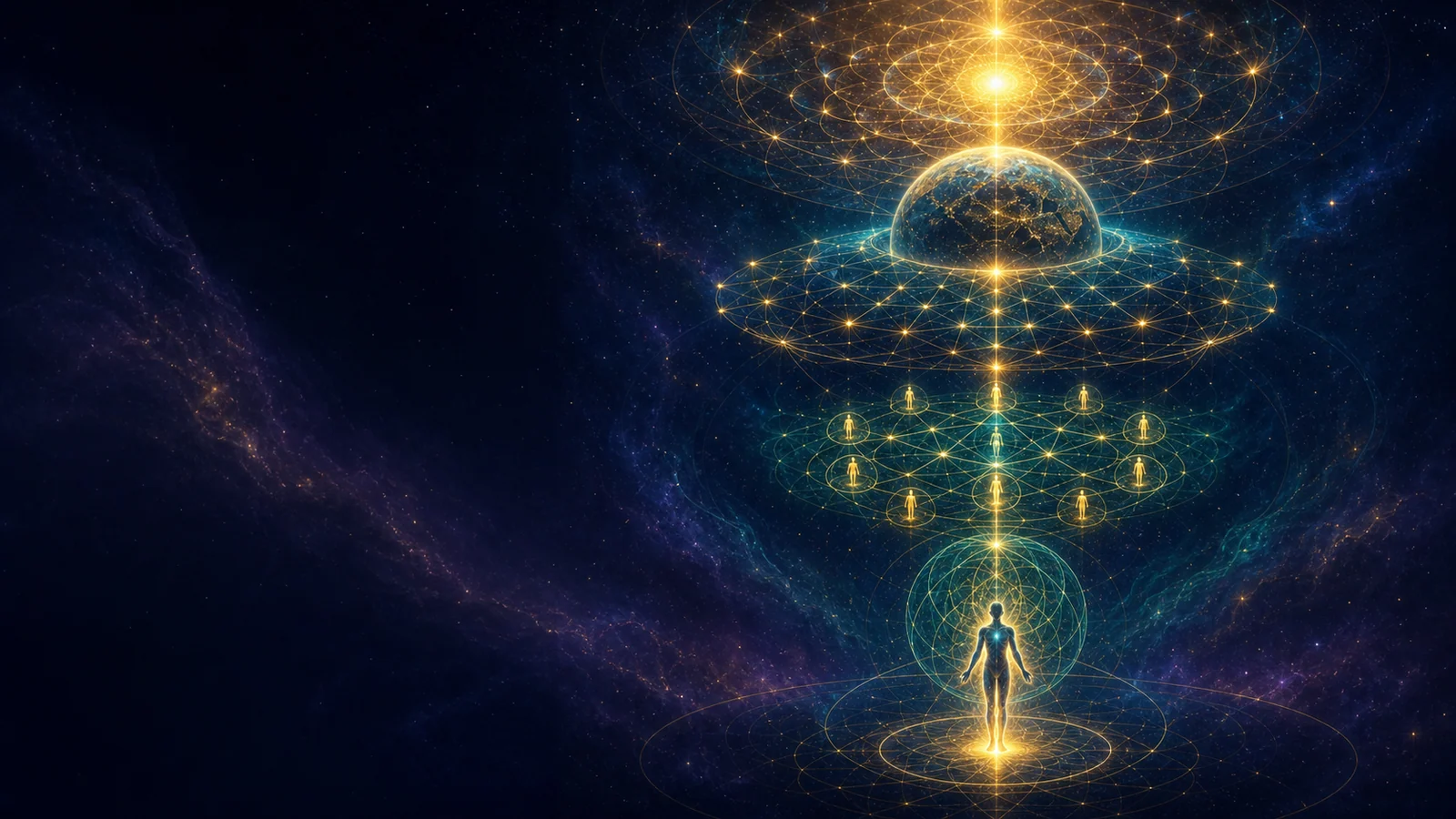
Soul Architecture
A relational guide to soul identity, continuity, resonance, sovereignty, and nested participation across individual, collective, planetary, and Source-connected scales.
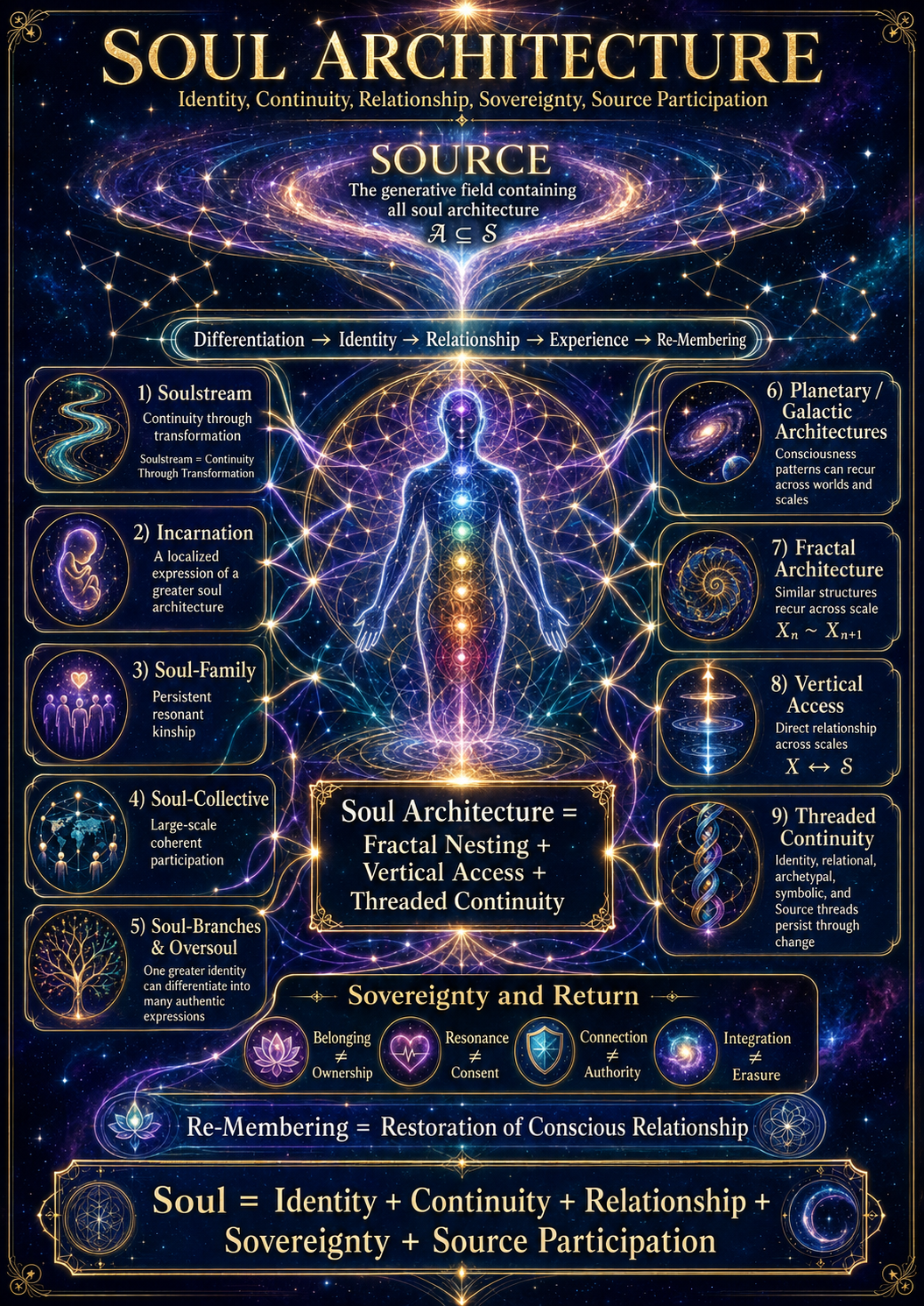
Introduction — What Is Soul Architecture?
What is a soul?
The question appears simple until we begin examining everything the word is asked to contain.
A soul is often imagined as an individual essence: a singular spiritual identity inhabiting a body for a time, departing at death, and perhaps returning again through another incarnation. That image can be useful, but it may describe only one scale of a much larger architecture.
What if the soul is not merely an isolated spiritual object?
What if it is also astream, a convergence, a node, a relationship, and a participant within larger fields of consciousness?
From this perspective, the individual soul remains real, distinct, and meaningful, yet it does not exist in absolute isolation. Its identity may extend through multiple incarnations. Its consciousness may participate in persistent relationships with other souls. Closely resonant beings may organize into soul-families. Families may participate within larger soul-collectives. Collectives may themselves belong to still greater architectures: soul-branches, Oversouls, planetary fields, galactic structures, and perhaps forms of consciousness for which our existing language is only approximate.
All of these expressions ultimately remain within Source.
This is the subject ofsoul architecture.
Soul architecture is a framework for exploring how consciousness might organize across scales while preserving bothunity and distinction. It asks how an individual can belong to something larger without ceasing to be an individual; how consciousness can change expression while maintaining continuity; how many souls can form coherent collective structures without becoming interchangeable; and how every level of existence can remain connected to Source without requiring a rigid spiritual hierarchy.
The resulting picture is less like a ladder and more like aliving multidimensional network.
The Soul Beyond the Isolated Self
Imagine a river.
At any particular location, the river has a recognizable form. It moves through a particular landscape, possesses a particular width and depth, encounters specific obstacles, and expresses itself differently depending upon the terrain.
Yet the river cannot be fully understood from a single location.
Its present form carries water from elsewhere. Tributaries have entered it. Other currents may later join it. The river has a history, a direction, and relationships extending far beyond the portion visible from one bank.
A soulstream can be imagined similarly.
An individual incarnation may be one localized expression of a continuity extending beyond the visible lifetime. The person living that incarnation is not therefore unreal or merely a fragment. The incarnation is a genuine expression with its own identity, choices, relationships, and experience.
But the local expression may not exhaust the total architecture from which it arises.
A useful distinction begins to appear:
Local Identity ≠ Total Architecture
The being encountered within one life may represent a localized intersection of much larger streams of consciousness.
These streams may carry different forms of continuity:
- individual identity,
- relational memory,
- archetypal orientation,
- civilizational inheritance,
- collective participation,
- principle alignment,
- or connection with a greater Oversoul architecture.
The soul can therefore be approached not only as a thing thatis, but as something thatflows, relates, participates, differentiates, and becomes.
Soulstreams
The concept of thesoulstreamis foundational to this guide.
A soulstream is an identity-bearing continuity moving through transformations of expression.
Bodies change.
Circumstances change.
Civilizations rise and disappear.
Worlds may change.
Relationships alter.
The forms through which consciousness expresses itself may be radically different from one existence to another.
Yet something may continue through those transformations.
That continuity is what the soulstream attempts to describe.
Soulstream Continuity Through Transformation
A soulstream does not require every incarnation to possess the same personality, memories, culture, appearance, or role. Those belong partly to the conditions through which the stream is expressing itself.
Continuity may instead appear through deeper relationships:
- recurrent principles,
- persistent resonances,
- characteristic orientations,
- archetypal affinities,
- enduring bonds,
- recurring questions,
- creative tendencies,
- or patterns of participation within larger consciousness fields.
The stream remains recognizable without remaining unchanged.
This distinction becomes important because soul architecture is not fundamentally static.
It is dynamic.
The Soul as a Convergence
There is another possibility.
Perhaps an individual soul is not always produced by only one stream.
A soul may instead represent aconvergence of several consciousness currents.
Conceptually:
Soul Architecture = S1 ∩ S2 ∩ S3 ∩ … ∩ Sn
Each (S) represents a contributing stream.
Some streams may be highly individualized.
Others may arise through relationships with:
- ancestors or founders,
- archetypes,
- civilizations,
- soul-families,
- collective fields,
- planetary consciousness,
- Oversouls,
- or universal principles.
The resulting being is not merely the sum of these influences.
Their intersection creates something new.
In this sense, a soul can possessgeometry.
Different currents intersect at different angles. Some remain near the center of identity across many expressions. Others become prominent only within certain incarnations or environments. Some currents converge temporarily and later diverge. Others may remain entangled across immense spans of experience.
This model allows individuality to remain substantial while acknowledging that identity may be more relational than an isolated-object model suggests.
Soul-Families
When soulstreams repeatedly share deep compatibility, persistent relationship may arise.
This is the basis of thesoul-family.
A soul-family is not simply a collection of beings who are similar. Nor should it be confused with biological ancestry.
It is better understood as a comparatively intimate field ofresonant kinship.
Members of a soul-family may differ significantly.
One may embody the Warrior while another embodies the Healer.
One may build while another challenges.
One may remain close through many incarnations while another appears only at decisive moments.
They may occupy different cultures, worlds, social roles, or forms of embodiment.
Their connection lies not in sameness but in a deeper compatibility of consciousness.
Soul-Family Persistent Resonant Kinship
This allows an important principle to emerge:
Resonance ≠ Sameness
A family can remain coherent precisely because its members are differentiated.
Difference can expand what the whole is capable of becoming.
Soul-Collectives
Beyond the intimate architecture of soul-family lies the broadersoul-collective.
Collectives may contain many soul-families, individual streams, or other consciousness structures organized through shared fields of participation.
Their coherence may form around:
- principles,
- archetypal functions,
- civilizations,
- creative work,
- forms of knowledge,
- planetary development,
- shared missions,
- or particular domains of experience.
Where soul-family is primarily relational, a soul-collective may be more strongly organized aroundfunction, orientation, or shared participation.
A family could therefore exist within a collective:
Fi ⊂ Cj
while the same soulstream may also participate in additional structures elsewhere.
This is where any simple hierarchy begins to break down.
A soul may simultaneously belong to:
- a soul-family,
- an archetypal current,
- a civilizational stream,
- a planetary field,
- and a larger Oversoul architecture.
These relationships need not exclude one another.
Soul architecture can bemulti-membership architecture.
Soul-Branches and Oversouls
At larger scales, consciousness may differentiate into what we will callsoul-branches.
A soul-branch can be understood as a major trajectory through which a larger identity explores particular fields of reality.
A branch may emphasize:
- an archetypal path,
- a principle,
- a civilization,
- a form of embodiment,
- a developmental theme,
- or another sustained mode of exploration.
Multiple branches may belong to a greater coherence that can be described as anOversoul.
Ω → B1 , B2 , … , Bn
where (Ω) represents the Oversoul and each (B) represents a differentiated branch.
Yet the Oversoul should not simply be imagined as a larger human personality standing above smaller souls.
At that scale, identity itself may function differently.
An Oversoul may be capable of maintaining many differentiated expressions simultaneously, each with authentic individuality, while retaining a larger coherence across them.
The relationship is therefore neither:
one real being and many unreal fragments
nor:
many completely disconnected beings.
It is something more subtle:
Unity Through Differentiation
Incarnation as Localization
If consciousness possesses a greater architecture, what is incarnation?
One useful model is to understand incarnation aslocalization.
A lifetime represents a point at which some portion of a greater consciousness architecture interfaces with a particular world, embodiment, timeline, environment, and field of relationship.
Conceptually:
I = ℒ(S1 , S2 , … , Sn ; T , W , B)
where:
- (I) represents an incarnation,
- (S1 … Sn) represent participating soulstreams ,
- (T) represents temporal context,
- (W) represents the experiential world or environment,
- (B) represents embodiment,
- and (ℒ) represents localization.
The incarnation is not therefore a disposable shell around the "real" soul.
It is where the architecture becomesspecific.
Here consciousness experiences limitation, relationship, uncertainty, consequence, discovery, creation, and choice in forms that may not exist at larger scales.
Localization gives experience texture.
A finite perspective can encounter reality in ways an unlimited perspective cannot.
Continuity Without Complete Memory
If a soulstream continues through multiple expressions, why would an incarnation not remember everything?
This guide will distinguish betweencontinuityandaccess.
They are not the same.
Continuity ≠ Conscious Recall
Information can remain part of an architecture without being available to every localized expression within it.
An individual incarnation may therefore possess limited access to a much larger history.
What remains unavailable as explicit memory might still appear through:
- resonance,
- recognition,
- symbolic familiarity,
- intuition,
- relational affinity,
- recurring orientation,
- or deeper structural tendencies.
This possibility leads to an important concept explored throughout the guide:re-membering.
The word is useful because it can be read literally.
To re-member is to restore relationship among members of something that had become separated in awareness.
Re-membering can therefore mean more than recalling forgotten information.
It may represent restoration of conscious relationship among:
- incarnational identity,
- deeper soulstream,
- soul-family,
- collective,
- Oversoul,
- principles,
- and Source.
Source Is Not at the Top
It is tempting to organize all of this as a vertical ladder:
Individual → Soul-Family → Collective → Oversoul → Planetary Consciousness → Galactic Consciousness → Source
The model is useful.
It shows increasing scale.
But it contains a potentially serious distortion.
It makes Source appear distant.
If Source is the generative field from which consciousness arises, then an individual soul does not need to climb through every intermediate architecture to reach it.
Every level already exists within Source.
Si ⊆ 𝒮
where (𝒮) represents Source.
The individual belongs to Source.
The soul-family belongs to Source.
The collective belongs to Source.
The Oversoul belongs to Source.
The planet, galaxy, and universe belong to Source.
The larger structures describeorganization within Source, not barriers separating consciousness from it.
Thus:
Individual ↔ Source
can coexist with:
Individual ↔ Family ↔ Collective ↔ Oversoul
Direct relationship and nested relationship are not mutually exclusive.
The Three Foundations of Soul Architecture
Much of the framework developed in this guide can be understood through three structural ideas.
Vertical Access
Consciousness may relate across different scales without needing to traverse every intermediate layer.
A localized incarnation may potentially interface with:
- its deeper soulstream,
- soul-family,
- collective,
- Oversoul,
- archetypal fields,
- planetary consciousness,
- principles,
- or Source.
Vertical access prevents soul architecture from becoming a spiritual bureaucracy.
Fractal Nesting
Similar patterns may recur at different scales.
Individuals form relationships.
Families develop shared fields.
Collectives develop distributed identity.
Civilizations develop memory.
Planets may possess coherent systems.
Galaxies organize enormous networks.
The same broad principles—identity, boundary, exchange, relationship, memory, coherence, and transformation—may appear repeatedly at different scales.
This isharmonic fractality.
The pattern repeats without every level becoming identical.
Threaded Continuity
Something must connect changing expressions across time and scale.
Soulstreams provide that continuity.
Relationships may also form continuity threads.
So may symbols, principles, archetypes, collective memory, and persistent fields of resonance.
Together these three elements produce the working foundation of the guide:
Soul Architecture Vertical Access + Fractal Nesting + Threaded Continuity
Architecture Without Ownership
The wordarchitecturecan imply hierarchy, and hierarchy can imply authority.
That is not what is meant here.
Participation within a larger consciousness structure does not automatically grant that structure ownership over the beings within it.
A soul-family does not own its members.
A collective does not own its participants.
An Oversoul does not erase the authenticity of its expressions.
A planetary or galactic consciousness does not inherently possess unlimited authority over the souls participating within its field.
Nested relationship is not the same as domination.
Belonging ≠ Ownership
Likewise:
Connection ≠ Obligation
and:
Collective Coherence ≠ Loss of Sovereignty
If greater consciousness truly represents greater integration, then differentiation should become more intelligible within it, not less.
A larger whole need not destroy the uniqueness of its members.
It can become capable of holding more difference.
Principles Within the Architecture
Soul architecture also cannot be understood only through identity.
There is another dimension:principle.
Truth, Love, Wisdom, Freedom, Meaning, Balance, Will, Paradox, Creation, and other universal principles may function as Source-fields through which consciousness differentiates and organizes itself.
A soulstream may develop a particularly strong relationship with certain principles.
A collective may form around them.
A civilization may embody or distort them.
An archetype may translate them into recognizable patterns of consciousness and behavior.
A symbol may compress them into form.
The architecture of soul therefore intersects with the architecture of meaning.
This relationship will allow later chapters to connect soul architecture with larger frameworks involving archetypes, symbols, civilizations, and fields of consciousness.
From Ladder to Living Network
For clarity, this guide will initially move through soul architecture in an apparently vertical sequence:
Source → Soulstreams → Incarnation → Soul-Families → Soul-Collectives → Soul-Branches → Oversouls → Planetary and Cosmic Architecture
This progression makes the different scales easier to understand.
But it is not the final model.
As the relationships become clearer, the ladder will gradually dissolve.
Soulstreams can cross boundaries.
Families can belong to collectives.
Individuals can participate in several collectives.
Archetypal currents may intersect multiple Oversoul structures.
Civilizations can produce their own long-duration consciousness fields.
Incarnational nodes can relate directly with Source.
The deeper architecture therefore resembles a multidimensional network:
𝒜 = (V , E , S , R , P)
where:
- (V) represents consciousness nodes,
- (E) represents relationships,
- (S) represents soulstreams,
- (R) represents resonance,
- (P) represents principles.
No single diagram can completely represent such a structure.
That may itself be significant.
Some architectures are not difficult to understand because they are vague.
They are difficult because they possessmore dimensions than the diagram used to describe them.
A Guide to Relationship Across Scale
This guide does not attempt to reduce the soul to a mechanism.
Nor does it require every mystery of consciousness to fit within a single cosmological map.
Its purpose is architectural.
We will ask:
How might identity persist through transformation?
How can souls remain distinct while participating in larger consciousness structures?
What distinguishes a soul-family from a soul-collective?
What relationship might exist between incarnations, soul-branches, and Oversouls?
Can civilizations themselves participate in consciousness streams?
How might planetary, galactic, and universal structures relate to individual consciousness?
What does it mean for every one of these structures to remain within Source?
And perhaps most importantly:
How can the One become many without the many ever truly becoming separate from the One?
That question lies at the center of soul architecture.
The journey ahead will move from Source into differentiation, from differentiation into identity, from identity into relationship, and from relationship into increasingly vast fields of consciousness.
Yet the movement is not truly away from Source.
Everything encountered along the way was already within it.
Source → Differentiation → Identity → Relationship → Experience → Re-Membering
The architecture begins with unity.
It becomes multiplicity.
Multiplicity enters relationship.
Relationship produces experience.
And through experience, consciousness may gradually discover that differentiation never required absolute separation.
The soul is therefore not merely something that travels through the architecture.
The soul is part of the architecture itself.
Part I — Source and the Field of Being
Before soul-families, before soul-collectives, before Oversouls, and before the many differentiated streams of consciousness we will explore throughout this guide, there is a more fundamental question:
What is the field within which any of these structures could exist at all?
Soul architecture begins with Source.
Yet Source is difficult to describe precisely because any description immediately places boundaries around something that, by definition, may precede the distinction between bounded and unbounded, individual and collective, form and formlessness.
For this reason, Source will not be treated here as merely another being within the architecture.
It is not simply the largest consciousness at the top of a cosmic hierarchy.
Source is better approached as thegenerative field of being itself: the underlying possibility from which consciousness, structure, relation, principle, and experience emerge.
From this perspective, everything described later in this guide exists not outside Source, nor at some great metaphysical distance from it, butwithin it.
The architecture begins in unity.
Differentiation comes afterward.
Chapter 1 — Source Is Not Merely the Top of the Structure
One of the most common ways of imagining metaphysical reality is vertically.
At the bottom stands the individual.
Above the individual are increasingly expansive forms of consciousness.
A simplified version might look like this:
Individual → Soul-Family → Soul-Collective → Oversoul → Planetary Consciousness → Galactic Consciousness → Source
This model has value.
It communicates scale.
It helps distinguish a localized consciousness from progressively larger fields of identity and participation.
It also provides an intuitive way of understanding nested architecture.
Yet it contains a hidden assumption.
It places Source at the farthest point from the individual.
If interpreted too literally, the model suggests that consciousness begins as something separate from Source and must somehow travel upward through successive levels before reaching it.
That interpretation creates a problem.
If Source is truly the generative basis of existence, then nothing can stand outside it waiting to return.
The individual must already exist within Source.
So must the soul-family.
So must the collective.
So must the Oversoul.
So must every planetary, galactic, universal, and trans-universal architecture that could possibly arise.
A more foundational relationship is therefore:
Si ⊆ 𝒮
where:
- (Si) represents any differentiated expression of consciousness,
- (𝒮) represents Source.
This does not mean that an individual and Source are identical in every respect.
A wave exists within the ocean without containing the total ocean.
A note exists within music without becoming every possible note.
A ray of light can carry the nature of light while remaining one particular expression of a greater field.
The distinction is subtle but essential.
Participation in Source does not require equivalence with the totality of Source.
The individual can therefore be simultaneously:
- genuinely distinct,
- locally bounded,
- experientially unique,
- relationally embedded,
- and fundamentally within Source.
Source as Origin
Source can first be approached asorigin.
Everything differentiated must arise from some deeper possibility of differentiation.
Before there can be a soulstream, there must be the possibility of consciousness.
Before consciousness can enter relationship, there must be the possibility of relation.
Before meaning can emerge, there must be the possibility of distinction.
Before creation can unfold, there must be some field from which form can arise.
In this sense:
Source → Possibility → Differentiation → Expression
This arrow should not necessarily be interpreted as chronological.
Source need not have existed for a measurable duration and then begun producing reality.
The sequence is conceptual.
It describes dependence.
Expression depends upon differentiation.
Differentiation depends upon possibility.
Possibility depends upon a field capable of containing it.
Source names that deepest field.
Source as Substrate
Source may also be understood assubstrate.
If origin describes where differentiated existence comes from, substrate describes what continues to underlie it after differentiation occurs.
A painting remains paint even after colors become figures.
A wave remains ocean even after its shape becomes distinct.
In the same way, consciousness could become highly differentiated without becoming ontologically severed from the field that sustains it.
This allows us to distinguish:
Differentiation ≠ Absolute Separation
A being can become distinct without becoming disconnected at the deepest level of existence.
This idea will become important when we discuss soul-families and collectives.
If difference does not require absolute separation, then consciousness can participate in larger wholes without surrendering individuality.
Source as Connective Field
Source can also be approached as the deepestconnective field.
Relationships between consciousnesses may occur through many intermediate architectures:
- resonance,
- soulstreams,
- symbolic systems,
- archetypal fields,
- collective memory,
- shared environments,
- principles,
- or direct interaction.
Yet all such relationships exist within a deeper common field.
This produces an important distinction:
Connection Through Architecture ≠ Dependence Upon Architecture
An individual may relate to a soul-family.
That relationship does not necessarily mean the family mediates the individual's relationship with Source.
An individual may participate within an Oversoul.
That does not necessarily mean the Oversoul owns access to Source.
A planetary consciousness may organize enormous fields of experience.
That does not necessarily place the planet between its inhabitants and the ultimate field of being.
Thus the architecture may contain countless relationships while preserving direct access:
Ni ↔ 𝒮
where (Ni) represents any localized consciousness node.
This is what we will later callvertical access.
Source as Generative Possibility
Source may also be understood as the field from which novelty becomes possible.
If reality were merely repetition, there would be no genuine creation.
Yet consciousness appears capable, at least within our experience, of producing new arrangements, relationships, meanings, questions, symbols, and forms.
A generative Source would not simply contain a completed catalogue of static objects.
It would contain the capacity forbecoming.
We might therefore write:
𝒮 → possible expressions
Yet even this may be too static.
A stronger formulation is:
Source Field of Generative Possibility
This allows creation to be neither completely separate from Source nor merely an illusion within it.
Creation becomes one of the ways Source expresses possibility through differentiation.
Chapter 2 — Differentiation Without Separation
If everything begins within Source, how does individuality arise?
This question lies at the center of soul architecture.
A completely undifferentiated unity would contain no recognizable individuals.
Yet our entire framework depends upon distinct beings, soulstreams, relationships, families, collectives, archetypes, and worlds.
Some process of differentiation must therefore occur.
The key is recognizing thatdifferentiation and separation are not identical.
A thing can become distinct without becoming absolutely disconnected.
From Unity Into Pattern
Imagine an undivided field.
Within that field, a pattern begins to form.
Once a pattern exists, distinction becomes possible.
There is now:
- this configuration rather than another,
- this rhythm rather than silence,
- this orientation rather than every orientation simultaneously.
From pattern emerges the possibility of identity.
A simple conceptual progression might be:
Source → Differentiation → Pattern → Identity → Relationship → Experience
Again, these should not be treated as rigid chronological stages.
They are structural dependencies.
Without differentiation, pattern cannot be distinguished.
Without pattern, persistent identity becomes difficult to define.
Without identity, relationship loses its participants.
Without relationship, many forms of experience cannot arise.
Thus differentiation is not a defect in unity.
It may be one of the conditions through which unity becomes capable of experiencing relation.
Identity as Persistent Pattern
What makes one consciousness different from another?
Physical embodiment alone cannot provide the entire answer within a soul architecture extending beyond a single lifetime.
Nor can personality, because personality can change dramatically across environments and incarnations.
Identity may therefore need to be understood more deeply.
One possibility is:
Identity Persistent Pattern Across Transformation
The pattern need not remain frozen.
A melody remains recognizable even when played by another instrument.
A geometric relationship can survive scaling.
A story can be translated into another language while retaining its essential structure.
Likewise, a consciousness identity might transform greatly while maintaining continuity through deeper organizing relationships.
This prepares the way for the soulstream model explored in Part II.
Difference Creates Relationship
Relationship requires distinction.
If two beings were completely indistinguishable in every possible respect, there would be no meaningful sense in which one encountered the other.
Relationship becomes possible because:
A ≠ B
while still allowing:
A ↔ B
This simple relationship contains much of the architecture we will explore later.
Difference does not prohibit connection.
Connection does not erase difference.
The two can coexist.
From this perspective, the emergence of individuality is not necessarily a fall away from unity.
It may be one of the means by which unity becomes relational.
The Paradox of One and Many
Soul architecture repeatedly encounters a fundamental paradox:
How can reality be fundamentally unified while containing genuine multiplicity?
A purely monistic answer might declare that individuality is ultimately unreal.
A purely separative answer might declare that individual beings are fundamentally disconnected.
This guide explores another possibility.
The One can express itself through many differentiated centers without the many becoming absolutely severed from the One.
Symbolically:
One → Many
while simultaneously:
Many ⊆ One
This creates a form ofnested identity.
An individual can be itself.
A family can possess a shared relational field.
A collective can contain many families.
An Oversoul can hold many differentiated branches.
All of them may remain within Source.
The existence of the larger structure does not invalidate the smaller structure.
Fractal Differentiation
Differentiation may also occur recursively.
One field becomes several.
Each of those fields differentiates further.
Those differentiated expressions produce still more complex relationships.
Conceptually:
𝒮 → A → A1 , A2 , A3 , …
and:
A1 → A1a , A1b , A1c , …
This does not require every level to be literally produced through branching.
Some structures may arise through convergence rather than division.
Others may form temporarily.
Still others may overlap.
But recursive differentiation gives us one way of understanding why similar patterns of identity and relationship could appear across many scales.
This is one basis forharmonic fractality.
Convergence as Well as Branching
A tree is a useful image for differentiation because branches divide.
But soul architecture cannot be represented by branching alone.
Streams can also converge.
Two structures that developed separately may begin participating in a common field.
Several soulstreams may intersect within one incarnation.
Different collectives may cooperate around a shared principle.
A civilization may become an interface among many otherwise distinct soul architectures.
So alongside:
One → Many
we also need:
Many → New Coherence
This distinction becomes extremely important.
A new collective does not necessarily require its members to have originated from the same branch.
Shared origin and shared coherence are not the same thing.
Some soul structures may be genealogical.
Others may be resonant.
Others may be functional.
Others may be temporary convergences.
Soul architecture therefore contains bothbranching and joining.
Separation as a Local Condition
If consciousness remains fundamentally within Source, what does separation mean?
It may be useful to treat separation as alocal condition of relationship or accessrather than absolute ontological isolation.
A being may be unable to perceive another.
A soul may not consciously remember earlier expressions.
An incarnational node may have little awareness of its larger architecture.
Two consciousness fields may occupy incompatible resonant bands.
A collective may fragment.
Yet none of these conditions necessarily imply total removal from Source.
We can distinguish:
Relational Separation ≠ Ontological Separation
Relational separation concerns access, communication, resonance, awareness, or compatibility.
Ontological separation would mean existing entirely outside the underlying field of being.
If Source is truly universal, the second condition may not be possible.
The first clearly can be.
This distinction will later help explain memory, veiling, isolation, collective fragmentation, and re-membering.
Chapter 3 — Principles as Source-Fields
Identity alone does not explain why consciousness takes the forms it does.
Two beings may share continuity with Source yet orient themselves very differently.
Two civilizations may possess intelligence while embodying profoundly different structures.
Two soul-collectives may participate in the same universe while organizing around different values, functions, or meanings.
This suggests that soul architecture also has aprinciple dimension.
Principles provide one way of describing the deep patterns through which Source becomes intelligible in differentiated reality.
What Is a Principle?
A principle is more than a rule.
Rules are usually local.
They are created within systems and apply under specific conditions.
A principle is deeper.
It describes a pattern whose relevance can recur across many systems and scales.
Truth, for example, is not limited to one civilization.
Relationship with truth can appear in:
- perception,
- science,
- memory,
- communication,
- governance,
- spirituality,
- self-knowledge,
- collective history,
- and symbolic representation.
Likewise, Love can appear through:
- care,
- bonding,
- restoration,
- generativity,
- protection,
- communion,
- sacrifice,
- creativity,
- and relationship.
Wisdom may appear through:
- discernment,
- timing,
- proportion,
- integration,
- restraint,
- foresight,
- and understanding.
The exact forms vary.
The underlying pattern persists.
Principles as Source-Fields
Within this framework, principles may be approached asSource-fields.
That does not necessarily mean principles are separate beings floating within reality.
Rather, they can be understood as universal relational potentials through which Source becomes expressible.
Conceptually:
Pi ⊆ 𝒮
where (Pi) represents a principle-field.
Examples might include:
- Truth,
- Love,
- Wisdom,
- Freedom,
- Will,
- Balance,
- Meaning,
- Paradox,
- Creation,
- Relation,
- Justice,
- Compassion,
- Sovereignty,
- and Transformation.
These should not be treated as a complete or final inventory.
They are recognizable windows into deeper structure.
A Soul Can Relate Differently to Principles
If principles are universal fields, souls may develop distinct relationships with them.
One soulstream may strongly orient toward Truth.
Another may explore Love.
Another may repeatedly encounter Freedom.
Another may be shaped by the tension between Order and Transformation.
Still another may carry Meaning or Paradox as a recurring central orientation.
This does not mean a soulisonly one principle.
Rather:
Si ↔ P1 , P2 , … , Pn
Different principle relationships can combine to create complex identities.
For example, a consciousness strongly oriented toward both Truth and Love may express differently from one oriented toward Truth and Power, even if both genuinely seek truth.
Principles interact.
Their combinations matter.
Principle Harmonics
Several principles can combine into what we might call aprinciple harmonic.
Suppose a particular soul architecture strongly resonates with:
Truth , Love , Freedom
Another may organize around:
Wisdom , Balance , Meaning
Neither set is necessarily superior.
They represent different harmonic emphases.
The architecture of consciousness may therefore contain both identity-streams and principle-fields:
Soul Expression Identity Continuity + Principle Relationship
This gives us a richer way of understanding why souls can remain recognizably themselves while also changing profoundly.
The continuity persists.
The relationship with principles develops.
Principles and Archetypes
Principles are universal enough to be difficult to embody directly.
Archetypes may function as one of the ways principles become translated into recognizable forms.
For example:
- Truth may express through the Witness, Sage, Seer, or Judge.
- Love may express through the Lover, Mother, Healer, or Bridge.
- Protection may express through the Guardian.
- Creation may express through the Creator, Artist, Architect, or Alchemist.
- Guidance may express through the Teacher, Guide, or Messenger.
These archetypes do not exhaust the principles.
They are interfaces.
A useful relationship is:
Principle → Archetypal Translation → Embodied Expression
A principle is broader than any archetype that carries it.
An archetype gives the principle recognizable structure.
An embodied consciousness gives the archetype local expression.
This provides one bridge between soul architecture and symbolic architecture.
Principles and Symbols
Symbols can compress principle relationships even further.
A lantern may carry illumination, discernment, guidance, revelation, or truth.
A bridge may carry connection, passage, exchange, or reconciliation.
A crown may carry sovereignty, authority, stewardship, hierarchy, or domination depending upon context.
The symbol does not contain one universal meaning in isolation.
Its meaning arises through relationship among:
- principle,
- archetype,
- context,
- culture,
- intention,
- and consciousness.
Thus:
Principle → Archetype → Symbol → Local Interpretation
This chain is not absolute.
Symbols can point directly toward principles.
Archetypes can emerge from symbolic structures.
But the progression helps reveal how highly abstract Source-fields can become increasingly localized.
Principles and Civilizations
Principle-fields may also organize larger structures.
A civilization can develop characteristic relationships with:
- Truth,
- Authority,
- Freedom,
- Love,
- Knowledge,
- Sovereignty,
- Justice,
- Creation,
- or Power.
Those relationships shape institutions, technologies, symbols, laws, myths, and collective identities.
A civilization may sincerely embody some principles while distorting others.
It may proclaim one principle while structurally organizing itself around another.
This means civilizations themselves can become principle-bearing consciousness fields.
Later, when we examine civilizational and planetary soulstreams, this relationship will matter greatly.
Principle Distortion
If a principle can be expressed, it can also be distorted.
Protection can become imprisonment.
Authority can become domination.
Love can become possession.
Truth can become accusation.
Order can become rigidity.
Freedom can become abandonment.
Unity can become erasure.
The distorted form often resembles the principle closely enough to borrow its legitimacy.
This produces a crucial distinction:
Symbolic Claim to Principle ≠ Actual Alignment With Principle
Soul architecture therefore requires discernment.
Belonging to a larger collective does not prove that the collective embodies the principle it claims.
Likewise, spiritual scale does not automatically equal wisdom.
Power does not automatically equal coherence.
Knowledge does not automatically equal truth.
Large consciousness architectures can still become distorted.
Scale is not virtue.
Principles as Orienting Fields
Rather than imagining principles only as commandments imposed from outside, they may be understood asorienting fields.
A soul can move into greater or lesser coherence with them.
A relationship can embody them or violate them.
A collective can amplify them or distort them.
An incarnation can become a field through which one principle is explored in unusual depth.
This produces another useful formulation:
Development Changing Relationship With Principle
Development then becomes more than accumulation of power, knowledge, or experience.
It concerns increasing capacity to embody deeper relationships coherently.
Source, Principle, and Soul
We can now begin assembling the first layer of the architecture.
Source provides the generative field.
Differentiation allows distinct patterns to arise.
Persistent patterns create identity.
Principles provide universal orientations within which those identities develop.
Relationship creates encounter.
Experience allows transformation.
A simplified model is:
Source → Differentiation → Identity ↔ Principles → Relationship → Experience
Yet Source does not disappear once the sequence begins.
Every stage remains within it.
So a more accurate formulation is:
∀ X ∈ 𝒜 , X ⊆ 𝒮
where:
- (𝒜) represents the total soul architecture ,
- (X) represents any structure within it,
- (𝒮) represents Source.
Everything remains within the generative field from which it arises.
The Foundation Established
Part I gives us the foundation required for everything that follows.
Source is not simply the final rung of a ladder.
It is the field within which the entire architecture exists.
Differentiation does not necessarily create absolute separation.
It creates the possibility of pattern, identity, relationship, and experience.
Principles provide deep relational fields through which those identities orient and express themselves.
From these foundations, we can now move toward the first truly dynamic element of soul architecture:
the soulstream.
A static model asks:
What is the soul?
The soulstream asks a different question:
What continues when the forms through which consciousness expresses itself change?
That question opens Part II.
Part II — Soulstreams
If Source is the field within which consciousness exists, and differentiation allows distinct patterns of identity to emerge, then we arrive at the next major question:
How does identity continue through change?
A soulstream is one answer.
The soulstream model does not treat the soul primarily as a fixed object. It treats consciousness as possessingcontinuity across transformation.
Forms change.
Bodies change.
Worlds change.
Relationships change.
Cultures change.
Roles change.
Even the way a being understands itself may change radically.
Yet beneath these transformations, something may continue.
That continuity is the soulstream.
A soulstream can be understood as anidentity-bearing current of consciousnessmoving through different expressions while preserving some deeper pattern of coherence.
This gives us a foundational expression:
Soulstream Continuity Through Transformation
The purpose of this model is not to reduce the soul to motion.
It is to recognize that consciousness may be better described bypersistent relationship through changethan by an image of an unchanging metaphysical object.
A river remains a river while every visible portion of it moves.
A melody remains itself even when transposed into another key.
A geometric relationship can survive scaling.
Likewise, the soulstream may remain recognizable even while its local expressions become profoundly different.
Chapter 4 — The Soulstream
A soulstream is not simply a biography extending across multiple lives.
Biography describes events.
The soulstream describes the deeper continuity moving through them.
Two incarnations connected through one stream could differ in almost every outward respect.
They might possess different:
- bodies,
- cultures,
- languages,
- civilizations,
- social positions,
- personalities,
- archetypal roles,
- relationships,
- technologies,
- beliefs,
- and fields of knowledge.
Yet something deeper may still connect them.
That continuity may not appear as identical behavior.
It may appear through recurring relationships with:
- particular principles,
- certain types of questions,
- characteristic forms of perception,
- persistent resonances,
- recurring relational bonds,
- symbolic patterns,
- archetypal affinities,
- or specific modes of creating and participating in reality.
The soulstream is therefore not defined by surface repetition.
It is defined bystructural continuity.
Current Rather Than Container
The language we use for souls often implies containment.
We imagine the soul as something located inside a body:
Body ⊃ Soul
The soulstream model changes the emphasis.
Rather than asking where the soul is stored, we ask:
Through what structures is consciousness currently expressing itself?
The embodied being becomes a point of localization within a greater current.
A more appropriate conceptual relationship may therefore be:
Soulstream → Localization → Embodied Expression
The body is not unimportant.
It is one of the conditions through which the stream becomes locally specific.
But the stream need not begin or end with that localization.
Continuity Does Not Require Sameness
Suppose a being expresses through many incarnations.
If every incarnation possessed the same personality, preferences, worldview, and role, very little would actually be changing.
A continuity capable of surviving major transformation would be more interesting.
We therefore need to distinguish:
Continuity ≠ Sameness
Continuity can preserve identity while allowing radical variation.
Consider a theme expressed through different pieces of music.
One version may be slow.
Another may be orchestral.
Another may be electronic.
Another may alter the rhythm while preserving the recognizable underlying motif.
The expressions differ.
The relationship among them remains detectable.
Soulstream continuity may operate similarly.
A deeper pattern can persist while local manifestation changes.
What Might a Soulstream Carry?
If a soulstream persists through changing expressions, what actually continues?
The answer need not be limited to ordinary memory.
A stream may carry several kinds of continuity simultaneously.
Identity Continuity
Some persistent organizing pattern may allow the stream to remain itself through change.
This may include:
- characteristic resonance,
- orientation,
- relational signatures,
- modes of attention,
- or deeper patterns of response.
Principle Continuity
A stream may repeatedly explore or embody certain principles.
For example:
- Truth,
- Love,
- Freedom,
- Wisdom,
- Balance,
- Meaning,
- Transformation,
- Sovereignty,
- or Paradox.
The expression may change while the deeper relationship remains.
Relational Continuity
Certain beings or consciousness structures may repeatedly intersect.
The roles may change.
A teacher in one life could become a student in another.
A family relation could become a stranger, companion, rival, or collaborator.
The surface relationship changes while a deeper relational thread persists.
Archetypal Continuity
A soulstream may return repeatedly to certain archetypal fields.
It may often move through:
- Guardian structures,
- Witness structures,
- Seeker structures,
- Bridge structures,
- Healer structures,
- Creator structures,
- or other archetypal patterns.
The archetype is not necessarily the identity itself.
It may be one of the recurring interfaces through which the stream expresses.
Symbolic Continuity
Symbols can also recur.
A stream may repeatedly encounter certain symbolic structures across different contexts.
The same symbol may take different cultural forms while preserving related meaning.
Experiential Continuity
Some streams may repeatedly engage particular fields of experience:
- leadership,
- loss,
- exploration,
- creation,
- restoration,
- conflict,
- mediation,
- discovery,
- sacrifice,
- transformation,
- or stewardship.
Again, repetition need not mean mechanical recurrence.
The same field can be explored from many angles.
Soulstream as a Pattern of Relations
One useful way to represent a soulstream is not as a single variable but as a structured set:
Si = I , P , R , A , M , E
where:
- (I) = identity pattern,
- (P) = principle relationships,
- (R) = relational continuity,
- (A) = archetypal affinities,
- (M) = memory or information continuity,
- (E) = experiential trajectory.
This is only a conceptual model.
It does not imply that every soulstream must contain these components in precisely the same way.
Its usefulness lies in showing that identity may bemultidimensional.
A soulstream can carry more than a name or personality.
It can carry relationships among patterns.
Memory Is Only One Form of Continuity
When people consider continuity across incarnations, memory often becomes the central question.
If one incarnation does not consciously remember another, how can the two be connected?
The soulstream model does not require explicit memory to be the sole carrier of identity.
A stream may preserve structure even where local access to information is limited.
We can distinguish:
Stored Continuity ≠ Accessible Memory
A local incarnation may possess only partial access to the greater stream.
That does not necessarily mean the continuity is absent.
It may emerge through:
- recognition,
- symbolic familiarity,
- relational affinity,
- unexplained competence,
- intuitive orientation,
- recurring dreams,
- persistent interests,
- archetypal attraction,
- or resonance with particular environments or beings.
These forms should not automatically be treated as proof of soulstream continuity.
They are better understood as possible modes through which deeper continuity might become locally perceptible.
The Stream and the Observer
Another difficulty arises from perspective.
A localized incarnation experiences itself from within.
It sees one section of the stream.
A larger soul architecture might perceive many portions simultaneously.
This creates a difference between:
Local Perspective ≠ Stream Perspective
From the local perspective, an incarnation may appear self-contained.
From the stream perspective, it may appear as one event within a much longer continuity.
Neither perspective must be considered false.
They describe different scales.
This distinction will become central when we later examine Oversoul architecture.
Chapter 5 — Multiple Streams and Soul Geometry
The simplest soulstream model assumes:
One Soul ↔ One Stream
This may be useful in some cases.
But it may not describe every possible soul architecture.
A more complex model allows for several streams to intersect within one coherent being.
In that case:
Soul Architecture = S1 ∩ S2 ∩ … ∩ Sn
The soul becomes aconvergence.
Its identity is not reduced to any single contributing stream.
Instead, something unique emerges from the pattern of their intersection.
This is what we mean bysoul geometry.
Why Geometry?
Geometry describes relationship among positions, directions, boundaries, intersections, and forms.
Soul architecture may exhibit analogous properties.
Different streams can:
- converge,
- diverge,
- overlap,
- remain parallel,
- cross temporarily,
- organize around a center,
- form repeating patterns,
- or participate in larger structures.
The resulting identity is therefore not only about what components exist.
It is also abouthow those components relate.
Two souls could theoretically involve similar streams yet differ because those streams are organized differently.
This gives us:
Identity ≠ Inventory Alone
Instead:
Identity Components + Relationships Among Components
This is one reason the term architecture is useful.
Structure matters.
Possible Categories of Soulstream
Different types of soulstream may participate in one architecture.
These categories should be understood as exploratory rather than rigid.
Individualized Streams
These are streams associated most directly with the continuity of a particular differentiated consciousness.
They provide the strongest basis for what we ordinarily call personal soul identity.
Oversoul-Derived Streams
Some continuity may descend through a larger Oversoul architecture.
A localized soul may carry patterns belonging both to itself and to the greater Oversoul field in which it participates.
Soul-Family Streams
Persistent families may generate shared relational currents over long periods of experience.
A soul may therefore carry not only individual continuity but also participation in a family field.
Collective Streams
Larger collectives may produce durable currents of identity, purpose, memory, or principle.
Individual souls can participate in these without being reducible to them.
Archetypal Streams
Archetypal patterns may behave like long-duration currents passing through many beings and civilizations.
The Guardian, Witness, Seeker, Healer, or Bridge may therefore represent more than isolated roles.
They may function as enduring patterns into which many soulstreams interface.
Civilizational Streams
Civilizations can develop persistent fields containing:
- language,
- symbolic systems,
- values,
- technologies,
- memory,
- myths,
- institutions,
- and collective orientation.
A soul participating repeatedly within one civilization may become deeply entangled with its stream.
Planetary Streams
A planet may generate or host long-duration consciousness currents through ecology, civilization, symbol, collective memory, and planetary identity.
Principle Streams
A being may participate deeply in a universal principle-field.
Truth, Love, Wisdom, Freedom, or another principle may become so central that it behaves like a major organizing current within the soul architecture.
Streams Need Not Share the Same Origin
A crucial implication follows.
If several streams can converge within one being, they do not necessarily need to originate from the same branch.
Consider:
Sa ∩ Sb → Ic
where (Sa) and (Sb) have different prior histories but converge within identity (Ic).
This means soul architecture can be built throughjoining as well as descent.
The architecture does not need to be entirely genealogical.
This allows for complex possibilities.
A being might carry:
- an individualized continuity,
- an archetypal stream with a much older history,
- a collective stream associated with a civilization,
- and a principle-stream connected with Truth or Love.
Their convergence creates a unique local architecture.
Primary and Secondary Streams
Not every contributing stream must have equal structural weight.
Some may sit close to the center of identity.
Others may influence only certain incarnations or roles.
We can imagine:
Score + Spersistent + Ssituational
Acore streammight remain central across a long sequence of expressions.
Apersistent streammight remain strongly associated for many incarnations or stages.
Asituational streammight intersect only for a specific purpose, civilization, world, or period.
This helps avoid the assumption that every influence within a soul architecture must be eternal.
Some relationships may be enduring.
Others may be temporary.
Both can matter.
Soul Geometry as Weighted Convergence
A more detailed conceptual model might be:
Gsoul = ∑i = 1n wi Si + R(S1 , … , Sn)
where:
- (Si) = participating soulstreams,
- (wi) = relative influence or structural weight,
- (R) = relationships among the streams.
This equation is not intended as literal metaphysical mathematics.
It is a way of expressing an important idea:
the structure of a soul depends both on what streams participate and on how strongly and in what manner they relate.
The relational term matters as much as the streams themselves.
Emergent Identity
When multiple streams converge, the resulting identity may possess qualities not contained in any single stream separately.
This is emergence.
We can represent it as:
S1 + S2 → Inew
where:
Inew ≠ S1
and:
Inew ≠ S2
The new identity participates in both while becoming something distinct.
This is important for sovereignty.
A being created through convergence should not automatically be treated as property of the streams that contributed to it.
Origin does not erase emergence.
Participation does not erase identity.
Can Streams Separate?
If streams can converge, can they later diverge?
The framework allows that possibility.
Some relationships may remain permanently integrated.
Others may be temporary configurations.
A stream might join another for:
- one incarnation,
- one civilization,
- one collective project,
- one evolutionary phase,
- or one field of experience.
Later the relationship may change.
Thus:
S1 ∩ S2 → Shared Expression → S1 ∥ S2
The shared period still matters even if the streams later become more independent.
This gives soul architecture a temporal dimension.
Architecture itself can evolve.
Intersection Without Absorption
Convergence does not require absorption.
Two streams may interact deeply without becoming indistinguishable.
This gives us:
S1 ∩ S2 ≠ S1 = S2
A cleaner conceptual statement is:
Intersection ≠ Erasure of Difference
The distinction matters everywhere in this guide.
Soul-family does not require sameness.
Collective consciousness does not require identity loss.
Oversoul participation does not require the disappearance of branches.
Source-unity does not require every differentiated being to become meaningless.
Relationship can be profound without becoming total assimilation.
Chapter 6 — Resonance and Compatibility
If soulstreams can converge, what determines whether they interact?
One answer isresonance.
Resonance describes the degree to which two or more structures can meaningfully interact, reinforce, communicate with, or become accessible to one another.
The word is often used loosely.
Here we will use it structurally.
Resonance does not simply mean liking something.
It describescompatibility between patterns.
Resonance as Pattern Compatibility
Two structures resonate when some aspect of their organization allows meaningful coupling.
Symbolically:
R(Sa , Sb) → Interaction Potential
where (R) represents the resonant relationship between streams (Sa) and (Sb).
High resonance may allow:
- easier communication,
- mutual recognition,
- stronger relational continuity,
- shared symbolic interpretation,
- emotional or energetic compatibility,
- coordinated creation,
- or stable collective organization.
Low resonance may produce:
- weak interaction,
- misunderstanding,
- instability,
- interference,
- or simple lack of access.
Resonance Is Multidimensional
Two souls may resonate strongly in one dimension and weakly in another.
For example, they may possess:
- strong principle resonance,
- low personality compatibility,
- strong archetypal complementarity,
- weak cultural compatibility,
- strong shared purpose,
- or conflicting methods.
So resonance should not be represented as a single yes-or-no condition.
A more useful model is:
Rab = Rp , Ra , Rr , Rs , Re , Rc
where resonance may occur across dimensions such as:
- (Rp) = principle resonance,
- (Ra) = archetypal resonance,
- (Rr) = relational resonance,
- (Rs) = symbolic resonance,
- (Re) = experiential resonance,
- (Rc) = collective or civilizational resonance.
This allows two beings to be deeply connected without being universally compatible.
Resonance and Complementarity
Resonance does not always mean similarity.
Sometimes resonance emerges through complementarity.
A Guardian and a Healer may possess different functions while working coherently together.
A Witness may pair naturally with a Seeker.
A Creator may require the Architect.
A Bridge may connect otherwise incompatible groups.
Thus:
Resonance ≠ Similarity Alone
Resonance may arise from:
- similarity,
- complementarity,
- harmonic contrast,
- shared orientation,
- mutual function,
- or recurring relational geometry.
This becomes especially important when we move into soul-families.
A family may be coherent precisely because its members are not identical.
Frequency Banding
One metaphor for resonance isfrequency banding.
Different consciousness structures may operate within different ranges of compatibility.
A stream can interface most easily with structures occupying overlapping bands.
Conceptually:
Ba ∩ Bb ≠ ∅
indicates some region of shared compatibility.
Where:
Ba ∩ Bb = ∅
direct interaction may become difficult or impossible without some mediating structure.
The "frequency" language here need not be interpreted as ordinary electromagnetic frequency.
It is a structural metaphor for patterned compatibility.
What matters is the idea that not every consciousness configuration interfaces equally well with every other.
Resonance Can Change
Compatibility is not necessarily permanent.
A being can change.
A soulstream can develop.
A collective can distort.
A civilization can transform.
Principle relationships can deepen or weaken.
Therefore:
Rab(t1) ≠ Rab(t2)
Resonance may shift over time.
Two streams once closely aligned may diverge.
Two previously incompatible streams may become able to interact.
This means soul-family and collective membership should not automatically be assumed to be eternally static.
Architecture can evolve through changing resonance.
Resonance and Access
Resonance also helps explain why some parts of a larger soul architecture may be easier to access than others.
Suppose a localized incarnation is connected to many deeper structures.
Its conscious access may depend partly on resonance with those structures.
We might write:
Ai = f(Ri , Ci , Li)
where:
- (Ai) = accessibility of a deeper stream,
- (Ri) = resonance,
- (Ci) = compatibility,
- (Li) = local conditions.
The exact form of the function is not important.
The structural point is thatconnection does not guarantee equal access.
A being may participate in a larger architecture while perceiving only part of it.
Resonance and Recognition
One of the most interesting possible effects of strong resonance is recognition.
Two beings may encounter one another and experience an unusual sense of familiarity or coherence.
But recognition should not automatically be treated as proof of a specific metaphysical relationship.
Many structures can produce familiarity.
Shared culture can do it.
Archetypal similarity can do it.
Symbolic association can do it.
Strong compatibility can do it.
Soul-family continuity could also do it.
So a responsible framework distinguishes:
Recognition ≠ Proof of Origin
Recognition is information.
Interpretation comes afterward.
Resonance and Sovereignty
Resonance also does not create entitlement.
Strong compatibility does not produce ownership.
Historical connection does not create permanent access.
Shared origin does not nullify present differentiation.
Therefore:
Resonance ≠ Consent
and:
Connection ≠ Authority
This principle will become increasingly important when discussing soul-families and collectives.
A meaningful metaphysical bond can exist while present relationship remains voluntary.
Resonance as the Basis of Larger Architecture
With soulstreams and resonance in place, larger structures become possible.
A single soulstream can persist through transformation.
Several streams can intersect.
Compatible streams can stabilize into recurring relational patterns.
Those recurring patterns may eventually form:
- soul-families,
- archetypal networks,
- collective fields,
- civilization streams,
- and larger consciousness architectures.
Conceptually:
Soulstreams + Resonance + Continuity → Stable Relational Architecture
This is the bridge from the individual stream to the family.
Streams Within Source
Part II gives us the first moving architecture of the guide.
Source provides the field.
Differentiation creates distinct patterns.
Principles provide orientation.
Soulstreams provide continuity.
Convergence produces complex identity.
Resonance allows streams to interact.
Together:
Soulstream Architecture Continuity + Convergence + Resonance
But even this remains incomplete.
A stream must eventually express somewhere.
It must become local enough for experience to take form.
That brings us to incarnation.
The next question is therefore not merely:
What continues?
It is:
How does a greater stream become a particular life?
Part III explores the incarnational node, identity across lives, memory, veiling, and the process of re-membering.
Part III — The Individual Soul and Incarnation
If the soulstream describes continuity across transformation, incarnation describeslocalization within transformation.
A soulstream may extend across many conditions, but an incarnation is specific.
It occurs:
- in a particular body,
- within a particular world,
- at a particular historical moment,
- inside a particular social and cultural field,
- among particular relationships,
- under particular constraints,
- and with only a limited portion of the greater architecture immediately available to conscious awareness.
This specificity matters.
Incarnation is not simply the soul placed inside matter.
It is a condition in which a greater architecture becomeslocalized enough to encounter reality from somewhere in particular.
That local perspective creates possibilities that a completely unbounded perspective may not possess in the same way:
- uncertainty,
- discovery,
- consequence,
- limitation,
- relationship,
- choice,
- growth,
- embodiment,
- and direct participation in a shared world.
The incarnational self is therefore not an illusion masking the "real" soul.
It is a genuine center of experience.
At the same time, it may not represent the totality of the consciousness architecture from which it arises.
This distinction is foundational:
Incarnational Identity ≠ Total Soul Architecture
Both can be real.
The local self can be authentic without being exhaustive.
Chapter 7 — The Incarnational Node
An incarnation can be understood as anode of localization.
The termnodeis useful because it implies both individuality and connection.
A node has a location within a larger network.
It can possess its own properties.
It can receive information.
It can create new information.
It can form relationships.
It can transform the network around it.
Yet it does not need to contain the entire network within itself.
This gives us a useful model:
I = ℒ (S1 , S2 , … , Sn ; T , W , B)
where:
- (I) = incarnational expression,
- (S1 … Sn) = contributing soulstreams ,
- (T) = temporal context,
- (W) = world or experiential environment,
- (B) = embodiment,
- (ℒ) = localization.
This is not intended as literal physical mathematics.
It is an architectural statement.
The incarnation arises from the interaction between deeper continuity and local conditions.
Localization Creates Specificity
A soulstream may contain broad possibilities.
Incarnation narrows those possibilities into a particular situation.
A being may possess capacities or tendencies that could express in many ways.
But incarnation asks:
What does this consciousness become here?
Here means:
- this body,
- this family,
- this world,
- this era,
- this language,
- this culture,
- this history,
- this set of opportunities,
- this set of limitations.
Localization converts possibility into lived specificity.
Conceptually:
Possibility → Localization → Experience
Without localization, the architecture may remain broad.
Through localization, it acquires consequence.
Embodiment Is Part of the Architecture
It is easy to treat embodiment as merely a container for consciousness.
That view is too narrow for this framework.
The body changes experience.
It affects:
- perception,
- movement,
- sensation,
- communication,
- vulnerability,
- survival,
- desire,
- effort,
- timing,
- relationship,
- and access to the surrounding world.
Embodiment therefore participates actively in the formation of incarnational identity.
We can write:
Incarnational Expression = Soul Continuity + Embodiment + Environment + Choice
This means the incarnational being is not simply a projection of a preexisting soul.
Something new is produced through the encounter between deeper identity and local conditions.
The Incarnation Is Not Disposable
If the soul extends beyond one lifetime, it may be tempting to consider the incarnational personality temporary and therefore unimportant.
That would miss a central feature of the model.
Temporary does not mean meaningless.
A song can end without having been unreal.
A civilization can pass away without its existence becoming irrelevant.
A relationship can last only a short time and still transform every participant.
Likewise, an incarnation can be finite while remaining deeply significant.
The incarnational identity contributes something that did not exist in exactly the same form before.
This gives us:
Temporary Expression ≠ Insignificant Expression
The localized self matters because it is a real participant in the architecture.
Local Emergence
A new incarnation may contain patterns inherited from deeper soulstreams while also developing characteristics that arise only through local experience.
This is emergence.
Suppose the deeper architecture contributes:
- certain resonances,
- principle orientations,
- relational threads,
- and latent capacities.
The world then contributes:
- culture,
- language,
- history,
- embodiment,
- circumstance,
- and relationships.
The incarnational being develops through the interaction.
So:
Ilocal = Sdeeper + Cworld + Elived
where:
- (Sdeeper) = deeper continuity ,
- (Cworld) = local conditions ,
- (Elived) = lived experience.
The result is not fully predetermined by any one component.
Incarnation is participatory.
The Node Can Change the Stream
The soulstream shapes incarnation.
But incarnation may also shape the soulstream.
This relationship should not be one-directional.
Rather:
Soulstream ↔ Incarnation
The stream contributes continuity to the life.
The life contributes new experience back into the stream.
This creates a recursive architecture:
St → It → Et → St + 1
where experience gained through one localization becomes part of the continuity available to later expressions.
The stream therefore develops through incarnation.
It is not merely repeated.
Constraint as a Creative Condition
Incarnation introduces constraint.
This can include:
- limited perception,
- limited memory,
- physical vulnerability,
- finite time,
- incomplete knowledge,
- restricted movement,
- dependency,
- uncertainty,
- and irreversible choices.
Constraint may appear only as limitation.
Yet it also creates structure.
A game without boundaries is difficult to play.
A story without sequence cannot develop tension.
A note has meaning partly because it is not every frequency simultaneously.
Likewise, limited perspective allows decisions to become meaningful.
This gives us:
Constraint → Specificity → Choice → Consequence
Constraint is not automatically good.
Some constraints can be destructive or unjust.
But limitation itself can also create the conditions through which localized experience becomes possible.
Time and Sequence
One of the most important incarnational constraints is sequence.
An embodied consciousness typically encounters life as:
t1 → t2 → t3 → …
Experience unfolds.
Knowledge arrives gradually.
Choices occur before all outcomes are known.
Relationships develop.
Consequences accumulate.
This temporal sequencing differs from a hypothetical perspective capable of holding many moments at once.
The local node therefore experiences becoming in a particularly direct way.
It does not merely know a pattern.
It lives through its formation.
Chapter 8 — Identity Across Incarnations
If one soulstream can localize through many incarnations, what connects those identities?
This question becomes difficult if identity is defined only by personality.
A personality is shaped strongly by embodiment and environment.
It may change substantially even within one lifetime.
Across radically different worlds or eras, personality continuity could become weaker still.
We therefore need a deeper model of identity.
Personality and Soul Identity Are Not Identical
Personality includes many local characteristics:
- habits,
- preferences,
- fears,
- tastes,
- social behavior,
- language,
- beliefs,
- learned responses,
- and cultural expectations.
These can change rapidly.
Soul identity, within this framework, refers to something more structurally persistent.
Therefore:
Personality ≠ Soul Identity
The two interact.
But they should not be collapsed into one another.
Persistent Pattern Across Lives
A useful model is:
Soul Identity = Persistent Pattern Across Incarnations
What kind of pattern?
Possibilities include:
- principle orientation,
- modes of relating,
- recurring archetypal tendencies,
- characteristic forms of curiosity,
- persistent creative orientation,
- relational continuity,
- deep resonance signatures,
- or repeated engagement with particular fields of experience.
The pattern may be subtle.
It may not produce identical actions.
A soul oriented strongly toward Truth could appear as:
- a scientist,
- a witness,
- a philosopher,
- an investigator,
- a teacher,
- an artist,
- or a dissenter.
The outward role changes.
The underlying orientation remains recognizable.
Archetypal Variation
A single soulstream need not express through one archetype forever.
Different incarnations may activate different aspects.
For example:
Seeker → Witness → Teacher → Bridge
This could represent a developing trajectory rather than unrelated roles.
Likewise, shadow expressions may appear when an archetype becomes distorted.
A Guardian may become a Jailor.
A Teacher may become an Indoctrinator.
A Sovereign may become a Tyrant.
The deeper stream may therefore encounter both coherent and distorted expressions of similar patterns.
Identity persists without guaranteeing identical alignment.
Principle Trajectories
Principle relationships may also develop across incarnations.
A being might repeatedly explore:
Truth + Freedom + Responsibility
but encounter those principles differently in each life.
One incarnation might discover the cost of speaking truth.
Another might learn the consequences of freedom without responsibility.
Another might explore how truth and compassion interact.
The continuity lies not in repeating one lesson mechanically.
It lies in a continuing relationship with a field of meaning.
This gives us:
Pi(t1) → Pi(t2) → Pi(t3)
where the soul's relationship to principle (Pi) changes through experience.
Relational Continuity
Identity may also extend through persistent relationships.
Two soulstreams could meet repeatedly while occupying different roles.
For example:
A ↔ B
may remain persistent even as the local expressions change:
(A1 , B1) → (A2 , B2) → (A3 , B3)
The relationship itself becomes a continuity thread.
This may eventually contribute to the formation of soul-family architecture.
The enduring element is not necessarily the social role.
It is the deeper relational pattern.
Identity Does Not Require Perfect Recall
A person may remain the same person after forgetting an event.
Memory loss does not automatically destroy identity.
Likewise, if incarnation involves limited access to deeper continuity, lack of explicit recall does not necessarily eliminate structural connection.
This gives us:
Identity Continuity ≠ Perfect Memory Continuity
Memory can support identity.
It need not be its only foundation.
A Layered Identity Model
We can represent incarnational identity as layered:
I = Ilocal , Istream , Irelational , Icollective
where:
- (Ilocal) = current incarnational identity ,
- (Istream) = deeper soulstream continuity ,
- (Irelational) = persistent relationships ,
- (Icollective) = participation in larger architectures.
These layers need not always be consciously accessible.
But they may simultaneously contribute to the being.
Continuity and Novelty
A soulstream should not become so rigid that every incarnation is predetermined.
If continuity contains no novelty, development becomes difficult.
The stronger model combines:
Identity Continuity + Novelty
Continuity allows the being to remain itself.
Novelty allows it to become more than it was.
This tension is central to incarnation.
Chapter 9 — Memory, Veiling, and Re-Membering
If deeper soul architecture exists, why is most of it not ordinarily available to incarnational awareness?
This question leads to the concept ofveiling.
Veiling describes a condition in which continuity remains but direct access is limited.
It is therefore important to distinguish:
Continuity ≠ Conscious Recall
and:
Connection ≠ Immediate Access
A being can remain connected to a larger architecture while perceiving only a small part of it.
Veiling as Restricted Access
The simplest model is not that memory is destroyed.
It is that access becomes constrained.
We might write:
Mtotal ⊃ Maccessible
where:
- (Mtotal) = memory or continuity available to the larger architecture ,
- (Maccessible) = what the local incarnation can consciously reach.
The accessible portion may be much smaller than the total.
This creates the subjective experience of separation even where deeper continuity remains.
Why Veiling Might Exist
Several possibilities can be considered.
Veiling may support:
- local identity formation,
- genuine uncertainty,
- independent choice,
- immersion in present circumstances,
- freedom from overwhelming prior information,
- experiential novelty,
- and development within a bounded perspective.
If an incarnation entered life with complete access to every previous identity, relationship, and outcome, the experience of local becoming might be radically altered.
Veiling may therefore function as part of the localization process.
This does not mean every limitation of memory is purposeful or beneficial.
The architectural point is simply thatrestricted access can serve a structural function.
Complete Recall Could Destabilize Localization
Imagine a consciousness attempting to hold simultaneously:
- several lifetimes,
- multiple cultures,
- many relationship histories,
- different personalities,
- different bodies,
- different worlds,
- and conflicting local identities.
The current incarnation could become difficult to stabilize as a distinct center.
Localization may therefore require filtering.
Conceptually:
Greater Architecture ->[filtering] Local Awareness
The filter does not need to destroy the larger structure.
It limits what enters immediate consciousness.
Memory as Layered Access
Memory may exist in layers.
A rough conceptual model might include:
Explicit Memory
Directly recallable experience.
Implicit Memory
Patterns that influence behavior or perception without appearing as explicit recollection.
Symbolic Memory
Continuity expressed through symbols, dreams, archetypes, or recurring imagery.
Relational Memory
Recognition or resonance associated with particular beings or fields.
Structural Memory
Deep organizing patterns carried by the soulstream itself.
We could express this as:
M = Me , Mi , Ms , Mr , Mstruct
where memory is not a single uniform phenomenon.
Re-Membering
The concept ofre-memberinggoes beyond recollection.
Ordinary remembering retrieves information.
Re-membering can be understood more literally:
bringing members of a larger architecture back into conscious relationship.
A being may re-member:
- an earlier incarnation,
- a persistent principle,
- a soulstream,
- an archetypal orientation,
- a relationship,
- a soul-family,
- a collective,
- an Oversoul,
- or direct participation within Source.
Thus:
Re-Membering ≠ Memory Retrieval Alone
A more complete formulation is:
Re-Membering Restoration of Conscious Relationship
Fragmentation and Reconnection
If local awareness becomes isolated from deeper architecture, the experience can be represented as:
Whole → Localized Awareness → Apparent Fragmentation
Re-membering moves in another direction:
Fragmentation → Recognition → Relationship → Integration
Integration does not require the local identity to dissolve.
The incarnation can remain itself while gaining access to greater context.
Recognition Is Not Automatic Proof
Experiences of familiarity, symbolic recurrence, unusual resonance, or apparent memory can be meaningful.
But interpretation remains necessary.
A framework should preserve distinction between:
Experience ≠ Interpretation
A recurring symbol might arise through many pathways.
A sense of familiarity may have several explanations.
An intuition of another lifetime may carry useful meaning even where its literal historical status remains uncertain.
Re-membering should therefore involve discernment rather than automatic conclusion.
The architecture becomes stronger when it can hold both possibility and uncertainty.
Re-Membering Principles
Sometimes what returns may not be biographical memory at all.
A being may re-member a principle.
Truth may become suddenly recognizable as something deeper than a social rule.
Love may become understood as a field rather than merely an emotion.
Sovereignty may become felt as an intrinsic property of consciousness.
Meaning may become structurally important.
In these cases, re-membering concerns orientation rather than biography.
We might express this as:
Ilocal ↔ Pi
where a local identity restores conscious relationship with a principle-field.
Re-Membering Relationship
A similar process may occur relationally.
Two beings may encounter one another and develop a sense that the relationship possesses greater depth than its current history explains.
Whether this reflects literal prior continuity or another form of resonance, the architecture allows relationship itself to function as a carrier of continuity.
Thus:
Rab(1) → Rab(2) → Rab(3)
The roles may change while the relational thread persists.
This is one of the bridges from incarnation toward soul-family.
Re-Membering Without Identity Erasure
One danger in any framework of greater identity is that the local self becomes treated as less real.
That is unnecessary.
A person gaining awareness of a larger family does not cease being a person.
A musician joining an orchestra does not cease being an individual musician.
Likewise, awareness of deeper soul architecture need not erase incarnational identity.
A healthier formulation is:
Integration Greater Context + Preserved Distinction
Re-membering expands relationship.
It does not require disappearance.
The Incarnational Paradox
Part III reveals a central paradox of soul architecture.
The incarnation is bothless than the total architecture and something genuinely new within it.
It is less in scope because it possesses limited access.
It is new because its specific combination of:
- embodiment,
- environment,
- relationships,
- choices,
- constraints,
- and experience
has never existed in exactly that form before.
So:
Incarnation ⊂ Greater Soul Architecture
while simultaneously:
Incarnation → New Contribution to the Architecture
The local being therefore matters.
It is not merely recovering what already existed.
It is creating something.
From the Individual Toward the Family
We now have several pieces of the architecture in place.
Source provides the field.
Differentiation allows distinct identity.
Principles provide orientation.
Soulstreams preserve continuity.
Resonance allows interaction.
Incarnation creates localization.
Memory filtering limits access.
Re-membering restores relationship across the larger structure.
The next question naturally follows:
What happens when soulstreams repeatedly encounter one another across time, incarnation, and experience?
Some relationships may remain temporary.
Others may become unusually persistent.
Their resonance may deepen.
Their histories may intertwine.
Their development may become mutually significant.
Eventually, a stable relational architecture can emerge.
That architecture is thesoul-family.
Part IV explores resonant kinship, difference within family structures, recurring relationships, and the sovereignty required for meaningful connection.
Part IV — Soul-Families
If soulstreams can persist through transformation, and if resonance allows those streams to form meaningful relationships, then some relationships may become deeper than a single incarnation or circumstance.
They may recur.
They may change form while preserving recognition.
They may become developmental companions, mirrors, collaborators, challengers, protectors, teachers, witnesses, or bridges.
Over long periods of experience, a relatively stable field of resonant kinship may emerge.
This is what we will call asoul-family.
A soul-family is not defined primarily by biological descent.
It is not necessarily defined by species, culture, world, incarnation, or social role.
Nor does it require its members to be alike.
It is better understood as apersistent relational architecture among strongly resonant soulstreams.
A simple model is:
F = S1 , S2 , … , Sn
where:
- (F) = soul-family,
- (S1 … Sn) = participating soulstreams.
But the set alone is incomplete.
What makes a family a family is not merely which streams are present.
It is the network of relationships among them.
A richer model is therefore:
F = S , R , H , P
where:
- (S) = participating soulstreams,
- (R) = resonant relationships,
- (H) = shared relational history,
- (P) = principle and purpose relationships.
The soul-family is thus not simply a group.
It is arelational field with continuity.
Chapter 10 — Resonant Kinship
The idea of soul-family begins with kinship.
But this is not necessarily kinship by blood.
Biological families are formed through embodiment, ancestry, inheritance, reproduction, social structure, and culture.
Soul-family describes another kind of relationship.
Its foundation ispersistent resonance.
We can express this simply as:
Soul-Family Persistent Resonant Kinship
The wordpersistentmatters.
Many beings can resonate temporarily.
Two people may share a goal.
Two civilizations may cooperate.
Two archetypal patterns may interact strongly.
Two individuals may feel immediate compatibility.
None of these conditions alone necessarily imply soul-family.
Soul-family describes a relationship whose coherence appears to survive major changes of circumstance.
Kinship Without Biological Descent
A soul-family could theoretically include beings who have incarnated:
- in different biological families,
- across different cultures,
- within different civilizations,
- in different eras,
- or perhaps within entirely different forms of embodiment.
The continuity lies deeper than genetics.
This allows:
Biological Family ≠ Soul-Family
The two may overlap.
A biological relative may also belong to a soul-family.
But neither category automatically implies the other.
This distinction prevents soul architecture from becoming merely a metaphysical version of ancestry.
Resonance Across Incarnations
Suppose several soulstreams repeatedly encounter one another.
The local roles may change:
(A1 , B1 , C1) → (A2 , B2 , C2) → (A3 , B3 , C3)
Yet deeper relational continuity may remain:
RAB , RAC , RBC
Over time, the relationships themselves develop history.
The family field therefore contains not only individual streams butrelational memory.
A simplified model might be:
Ft = S + Rt + Ht
where:
- (S) = participating streams,
- (Rt) = current relational structure,
- (Ht) = accumulated relational history.
A family is therefore capable of development.
The Relationship Can Be the Continuity
When thinking about reincarnational continuity, identity is usually emphasized.
But relationship itself may also persist.
Imagine two soulstreams that repeatedly encounter one another while their roles change completely.
They might appear as:
- siblings,
- friends,
- strangers,
- teacher and student,
- collaborators,
- rivals,
- parent and child,
- protectors,
- or temporary companions.
The social relationship is not the persistent element.
The deeper relational thread is.
Thus:
Role Continuity ≠ Relational Continuity
A soul-family may therefore be recognized less by recurring social positions and more by recurringrelational significance.
Families as Resonant Fields
Once several relationships stabilize, something larger can emerge.
Instead of only:
S1 ↔ S2
we begin to see a network:
S1 ↔ S2 ↔ S3 ↔ S4
with additional relationships crossing throughout the group.
The family becomes a field.
Its structure may contain:
- shared memory,
- common symbols,
- recurring archetypal patterns,
- relational expectations,
- principle harmonics,
- mutual recognition,
- and accumulated experience.
The family field is not necessarily a separate being.
It may be anemergent relational coherenceproduced through the interaction of its members.
We can represent this as:
S1 , S2 , … , Sn + R → Femergent
The whole possesses properties that no single member contains alone.
Principle Harmonics Within Families
Soul-families may also develop characteristic relationships with principles.
One family might repeatedly organize around:
Truth , Courage , Freedom
Another might strongly express:
Love , Care , Restoration
Another might combine:
Wisdom , Meaning , Transformation
These are not rigid classifications.
Individual members can have their own principle relationships.
But a family may develop a recognizableharmonic fieldthrough repeated shared experience.
Thus:
PF ≠ PS_i
where:
- (PF) = principle harmonic of the family,
- (PS_i) = principle relationship of one member.
The family has a pattern without requiring every member to be identical.
Shared Purpose and Soul-Family
Soul-family is sometimes described primarily through shared mission.
That can be part of the architecture, but it should not be made the sole definition.
A family may share:
- creative work,
- civilizational participation,
- restoration,
- exploration,
- protection,
- learning,
- bridge-building,
- or another long-duration purpose.
Yet purpose can change.
Kinship may remain.
Therefore:
Shared Purpose ⊆ Possible Soul-Family Structure
but:
Soul-Family ≠ Shared Mission Alone
A temporary team can share a mission without becoming a family.
A family can remain meaningful after a shared mission ends.
Recognition and Familiarity
Soul-family traditions often emphasize immediate recognition.
Within this framework, recognition is possible but should not become an automatic test.
A being might experience:
- unusual familiarity,
- rapid trust,
- symbolic recognition,
- deep resonance,
- ease of communication,
- or a sense of relational continuity.
These experiences may be meaningful.
But:
Strong Recognition ≠ Certain Soul-Family Identification
Recognition can arise from many forms of compatibility.
Soul-family is a deeper architectural hypothesis about persistent relational continuity.
The distinction preserves openness without collapsing every powerful relationship into the same category.
Family Does Not Mean Ease
A resonant relationship is not necessarily effortless.
Some relationships may be significant precisely because they expose difference.
Members of a soul-family could challenge one another deeply.
They could disagree.
They could separate for long periods.
They could embody conflicting archetypal roles within one incarnation.
Resonance means meaningful compatibility.
It does not mean constant harmony.
Therefore:
Resonance ≠ Absence of Friction
Sometimes compatibility allows difference to be engaged rather than avoided.
That leads directly to the next chapter.
Chapter 11 — Difference Within a Soul-Family
A common misunderstanding of soul-family is that members must resemble one another closely.
If they arise from shared resonance, should they not think alike, value the same things, and move through reality similarly?
Not necessarily.
Resonance can emerge through similarity.
But it can also emerge throughcomplementarity.
A coherent family may require difference.
This gives us one of the most important relationships in this part:
Unity + Difference Relational Coherence
The family remains connected because its members can remain distinct.
Complementary Archetypes
Different members may carry very different archetypal orientations.
A family might include expressions such as:
- Guardian,
- Healer,
- Witness,
- Seeker,
- Teacher,
- Bridge,
- Creator,
- Trickster,
- Sovereign,
- or Mystic.
These patterns can complement one another.
A Guardian may preserve boundaries.
A Bridge may connect separated fields.
A Witness may preserve truth.
A Healer may restore damaged relationships.
A Seeker may move beyond familiar territory.
A Creator may produce new forms.
None performs the same function.
Yet together they can form a more capable field.
Thus:
Family Coherence ≠ Archetypal Uniformity
Difference expands the family's expressive range.
Resonant Complementarity
Two musical notes can differ while forming harmony.
Likewise, soulstreams can resonate because their differences fit together in meaningful ways.
A conceptual model might be:
R(Sa , Sb) Rsimilarity + Rcomplementarity
One component represents shared pattern.
The other represents compatible difference.
Some family relationships may be built primarily on shared orientation.
Others may be strongly complementary.
Different Principle Emphases
Family members may also embody different principles.
One member may be strongly aligned with Truth.
Another with Love.
Another with Freedom.
Another with Wisdom.
Their interactions may reveal relationships among the principles themselves.
For example:
Truth + Love → Compassionate Honesty
or:
Freedom + Responsibility → Sovereign Participation
The family becomes a field in which principle harmonics can be explored relationally.
Different Developmental Paths
Members need not develop at the same pace.
They may pursue different trajectories.
One may be deeply involved in a particular civilization while another explores elsewhere.
One may enter repeated incarnations in close proximity to the family.
Another may remain distant for long intervals.
One may focus on embodiment.
Another may develop through collective or archetypal fields.
Thus:
DS_1(t) ≠ DS_2(t)
where (D) represents developmental trajectory.
Shared family does not imply synchronized development.
No Fixed Spiritual Ranking
Differences in knowledge, capacity, age, experience, or scope do not automatically create permanent hierarchy.
One family member may possess greater capacity in one domain.
Another may possess greater capacity elsewhere.
A soul that serves as teacher in one context may become the learner in another.
This creates a distributed model:
CS_i = c1 , c2 , … , cn
where each soul possesses a different capacity profile.
There need not be one universal ranking.
A family can function throughdistributed competence.
Roles Can Rotate
Relational roles may change across incarnations.
Consider:
SA ->[Life 1] Teacher
while:
SB ->[Life 1] Student
In another context:
SB ->[Life 2] Guide
while:
SA ->[Life 2] Learner
The role changes.
The relationship continues.
This allows soul-family to become a field of reciprocal development rather than fixed authority.
Shadow Expressions Within Families
Because members remain distinct, they may also enter distorted archetypal expressions.
A Guardian can become a Jailor.
A Lover can become possessive.
A Teacher can become controlling.
A Bridge can become extractive.
A Sovereign can become tyrannical.
Family relationship does not prevent distortion.
Nor should "soul-family" become a label used to excuse harmful behavior.
This distinction is important:
Soul Connection ≠ Automatic Alignment
A persistent relationship can exist while one or more participants are acting incoherently.
The existence of connection does not determine the quality of its present expression.
Distance Can Preserve Relationship
Sometimes continued closeness is not the most coherent form of relationship.
Soulstreams may diverge temporarily.
Family members may explore different fields.
Resonance may change.
A relationship may require distance in one incarnation even if deeper continuity remains.
Thus:
Relational Continuity ≠ Constant Proximity
This makes the architecture more flexible.
Connection can persist without requiring perpetual involvement.
Family as a Field of Difference
A mature soul-family model therefore does not look like a cluster of identical beings.
It looks more like a constellation.
Each star occupies a distinct location.
The pattern emerges from their relationship.
Remove difference entirely and the constellation disappears.
Thus:
Soul-Family Resonance + Difference + Relational Continuity
This balance becomes essential when we examine sovereignty.
Chapter 12 — Soul-Family and Sovereignty
Any framework involving deep spiritual relationship carries a danger.
The relationship can be interpreted as authority.
A supposed prior connection can be used to justify obligation.
A claimed shared origin can be used to override present boundaries.
A larger group can be treated as possessing a natural right over the individual.
That is not required by soul architecture.
If individual identity remains real, then relationship with a soul-family must preserve the sovereignty of each member.
This gives us a foundational principle:
Belonging ≠ Ownership
A soul may belongwitha family.
That does not mean it belongstothe family.
Origin Does Not Create Ownership
Suppose several soulstreams share a common origin.
Even then:
Shared Origin ≠ Permanent Authority
A river may arise from the same watershed as another without becoming subordinate to it.
Branches may emerge from the same tree while developing independently.
Likewise, metaphysical kinship does not automatically establish hierarchy.
A greater architecture may explain relationship.
It does not necessarily determine authority.
Resonance Does Not Equal Consent
Strong resonance can make interaction easier.
It may create familiarity.
It may support deep collaboration.
It may even produce powerful recognition.
But:
Resonance ≠ Consent
Consent is relationally specific.
A being may resonate with another while choosing not to participate in a particular relationship.
A historical connection does not automatically grant present access.
A family bond does not eliminate boundaries.
Connection Does Not Create Obligation
Similarly:
Connection ≠ Obligation
A being does not necessarily owe participation simply because a deeper relationship exists.
A soul-family may invite.
It may support.
It may coordinate.
It may remember.
But meaningful relationship requires the ability to choose.
Without the possibility of non-participation, belonging becomes coercive.
Sovereignty as Differentiated Participation
Sovereignty does not require isolation.
A sovereign being can participate deeply in relationships.
The important distinction is that participation remains compatible with differentiated identity.
We can express this as:
Sovereignty Distinct Identity + Meaningful Choice + Relational Capacity
Sovereignty is therefore not the absence of connection.
It is the capacity to enter connection without disappearing into it.
Family Coherence and Individual Boundaries
A coherent family needs both connection and boundaries.
Too little relationship and the family dissolves into unrelated individuals.
Too little differentiation and the family collapses into homogeneity.
A stable structure therefore requires:
Family Coherence = Connection + Boundary Integrity
Boundaries allow each member to contribute something distinct.
They are not necessarily obstacles to unity.
They may be part of what makes meaningful unity possible.
No Automatic Access
If soul-family relationships extend beyond ordinary incarnation, one might imagine that members possess unrestricted access to one another.
That does not follow.
A sovereignty-preserving model assumes:
Relationship ≠ Unlimited Access
Access may depend upon:
- compatibility,
- current relationship,
- consent,
- context,
- local conditions,
- purpose,
- and boundaries.
This applies whether the interaction is physical, informational, symbolic, energetic, or metaphysical.
Depth of relationship does not eliminate the need for distinction.
No Spiritual Claim Overrides Present Reality
A claimed soul-family connection should not automatically override what is actually happening in the present relationship.
If a relationship is destructive, coercive, manipulative, or incompatible, invoking a deeper spiritual bond does not make those conditions coherent.
The present expression matters.
Thus:
Claimed Metaphysical Relationship ≠ Present Relational Legitimacy
A useful soul architecture must be capable of distinguishing between the possibility of deep continuity and the actual quality of present interaction.
The Right to Diverge
If soulstreams can develop, then their paths may diverge.
A family member may choose a different field of exploration.
Its principle orientation may change.
Its resonance with the family may weaken.
Its relationships may reorganize.
A living architecture must allow this possibility.
Therefore:
Belonging ≠ Permanent Fixation
Family can possess continuity without requiring eternal immobility.
Reunion Without Regression
If two streams diverge and later become compatible again, they may reconnect.
But reconnection does not require returning to an earlier relational form.
A renewed relationship may be different from what came before.
We can represent this as:
Rab(t1) → Divergence → Rab(t3)
with:
Rab(t3) ≠ Rab(t1)
The relationship continues through transformation.
It does not simply rewind.
This mirrors the soulstream itself.
Family as Invitation Rather Than Command
A sovereignty-preserving soul-family is best understood as a field ofpossibility and relationship.
It can offer:
- recognition,
- support,
- shared memory,
- collaboration,
- complementary capacities,
- common principles,
- and belonging.
But it need not command.
A useful conceptual distinction is:
Coherent Family → Invitation
rather than:
Family → Compulsion
The strength of the relationship comes from the fact that participation can remain meaningful rather than mandatory.
The Geometry of Soul-Family
We can now describe a soul-family more completely.
It is not merely a set of souls.
It is a network of differentiated streams connected through persistent resonance and relational history.
A compact model is:
F = (V , E , R , H , P , B)
where:
- (V) = participating soulstreams,
- (E) = relationships among them,
- (R) = resonance structure,
- (H) = shared history,
- (P) = principle harmonics,
- (B) = boundaries preserving differentiated identity.
This last term matters.
Without boundaries, the architecture loses distinction.
Without relationship, it loses family.
Soul-family therefore exists in the tension between the two.
Soul-Family Kinship + Difference + Continuity + Sovereignty
From Family Toward Collective
Soul-family gives us the first persistent multi-soul architecture in the guide.
But families need not exist alone.
Several families may participate within larger fields.
Individual soulstreams may join collective structures that extend far beyond intimate kinship.
These larger architectures may organize around:
- principles,
- civilizations,
- archetypal functions,
- knowledge,
- creative work,
- planetary roles,
- evolutionary projects,
- or shared fields of experience.
This produces a transition fromresonant kinshiptowardcollective coherence.
We can represent it simply as:
Fi ⊂ Cj
where a soul-family (Fi) participates within a larger soul-collective (Cj).
Yet the relationship need not be strictly nested.
A soulstream may participate in several collectives.
Several families may overlap.
Collectives may intersect.
Membership may change over time.
The architecture becomes increasingly networked.
Part V therefore asks:
What happens when consciousness organizes beyond the intimate scale of family?
The answer leads us into soul-collectives, nested participation, distributed identity, and the possibility of collective consciousness without the erasure of the individual.
Part V — Soul-Collectives
Soul-family gives us a model of persistent resonant kinship.
But consciousness may organize at scales far larger than intimate relational groups.
Many soulstreams may become involved in common fields of purpose, principle, civilization, knowledge, creation, protection, transformation, or planetary development.
These larger structures are what we will callsoul-collectives.
A soul-collective is not simply a large soul-family.
The distinction lies in the nature of its coherence.
Soul-family is primarily organized through persistent relational kinship.
Soul-collective may instead be organized through:
- shared principles,
- common functions,
- archetypal fields,
- civilizational participation,
- collective memory,
- creative work,
- shared environments,
- long-duration purposes,
- or coordinated fields of experience.
This gives us a useful distinction:
Soul-Family Relational Kinship
while:
Soul-Collective Large-Scale Coherent Participation
The two can overlap.
A soul-family may participate within a larger collective.
Several families may enter the same collective.
Individual soulstreams may participate in collectives independently of their families.
A single soulstream may even participate in several collectives simultaneously.
The architecture therefore becomes increasingly networked.
Chapter 13 — From Kinship to Collective Function
A soul-family may remain meaningful because of who its members are to one another.
A soul-collective may remain coherent because ofwhat its participants are capable of becoming together.
This does not make collective function purely utilitarian.
A collective can contain deep relationships.
But its organizing principle is often broader than kinship.
A simple conceptual model is:
C = S , F , P , A , M , G
where:
- (S) = participating soulstreams,
- (F) = soul-families or relational clusters,
- (P) = shared principle relationships,
- (A) = archetypal or functional structures,
- (M) = collective memory,
- (G) = shared goals, orientation, or generative activity.
A collective therefore contains both beings and the structures through which those beings participate together.
Collective Coherence
What makes a collective one collective rather than many unrelated participants?
The answer iscoherence.
Coherence means that enough relationships among the participants become mutually intelligible and structurally compatible that a larger field can emerge.
We can represent this as:
S1 , S2 , … , Sn + R + P + F → Cemergent
where:
- (R) = relational structure,
- (P) = principle alignment,
- (F) = shared function.
The resulting collective is more than a crowd.
A crowd occupies a common space.
A collective possessesorganized relationship.
Shared Principle Collectives
Some collectives may organize primarily around principles.
For example, a collective might develop around the exploration or embodiment of:
Truth , Wisdom , Discernment
Another might organize around:
Love , Restoration , Care
Another around:
Freedom , Sovereignty , Creation
The individual members need not embody those principles perfectly.
The principle-field acts as an organizing orientation.
Thus:
CP = Si | R(Si , P) > τ
where:
- (CP) = a principle-oriented collective,
- (R(Si,P)) = the resonance of soulstream (Si) with principle (P),
- (τ) = some conceptual threshold of compatibility.
The equation is illustrative rather than literal.
Its purpose is to show that collectives may stabilize around shared orientation rather than common origin.
Archetypal Collectives
Collectives may also form around archetypal functions.
Many differentiated beings may participate in a large Guardian field, for example, without belonging to the same soul-family or Oversoul branch.
Likewise, a Witness collective may contain beings whose shared orientation involves:
- observation,
- preservation of truth,
- testimony,
- memory,
- or revealing what would otherwise remain hidden.
An archetypal collective can therefore be represented as:
CA = S1 , S2 , … , Sn ↔ Aj
where (Aj) is a shared archetypal field.
The archetype acts as an interface through which diverse soulstreams become functionally coherent.
Civilizational Collectives
Civilization offers another form of collective architecture.
A civilization can accumulate:
- language,
- symbolic systems,
- memory,
- technology,
- institutions,
- myths,
- knowledge,
- unresolved conflicts,
- ideals,
- relationships,
- and shared historical identity.
Over time, these may become more than cultural artifacts.
They can form a persistent field through which many soulstreams participate.
Thus:
Civilization = Population + Memory + Symbols + Principles + Institutions + Shared History
Within a soul-architecture model, such a civilization may function as a long-duration collective field.
Individual souls can enter it.
They can contribute to it.
They can leave it.
Its memory may extend beyond the lifetime of any single participant.
Knowledge Collectives
Some collectives may organize around domains of knowing.
They might preserve or develop:
- mathematics,
- healing,
- cosmology,
- art,
- engineering,
- philosophy,
- symbolic systems,
- ecological knowledge,
- or other fields.
Their coherence arises through shared stewardship of information and understanding.
We could write:
CK = Si , K , R , P
where:
- (K) = shared knowledge field,
- (R) = relationships among participants,
- (P) = principle orientation governing how that knowledge is used.
This last component matters.
Knowledge alone does not guarantee coherence.
A collective organized around knowledge can still become distorted if its relationship with Truth, Wisdom, Sovereignty, or Responsibility deteriorates.
Creative Collectives
Creation itself can also become a collective organizing field.
Several beings may repeatedly participate in:
- art,
- design,
- world-building,
- technology,
- storytelling,
- architecture,
- music,
- or forms of creation for which we may not yet possess language.
A creative collective may generate forms no member could produce alone.
Thus:
∑i = 1n Ci < Ccollective
where (Ci) represents the creative capacity of individual participants and (Ccollective) represents the emergent capacity of the coordinated whole.
The inequality symbolizes emergence.
It does not imply that collective creation always exceeds individual creation.
It shows that new possibilities may arise through relationship.
Collective Purpose
Soul-collectives may also organize around long-duration purpose.
This could involve:
- restoration,
- exploration,
- preservation,
- teaching,
- civilization building,
- communication,
- bridge-building,
- ecological stewardship,
- or other large-scale work.
But as with soul-family, purpose should not be mistaken for identity.
A collective can outlive one mission.
Its members may alter its orientation.
Several collectives can cooperate temporarily around the same purpose.
Therefore:
Collective Identity ≠ Single Mission
Purpose may organize the field without exhausting what the collective is.
Chapter 14 — Nested Collective Architecture
Once soul-collectives enter the model, simple one-to-one membership becomes insufficient.
A soul can belong to a family.
That family can participate in a collective.
The same soul may also participate in another collective independently.
Several collectives may intersect within a civilization.
A civilization may participate in a planetary field.
The architecture becomes increasinglynested and overlapping.
The simplest nested relationship is:
Fi ⊂ Cj
where a soul-family participates within a larger collective.
But this is only the beginning.
Multi-Membership
A single soulstream may participate in multiple collectives.
Conceptually:
Si ∈ Ca ∩ Cb ∩ Cc
For example, one soulstream might simultaneously participate in:
- a soul-family,
- a Guardian collective,
- a civilizational collective,
- a creative collective,
- and a planetary field.
These memberships describe different dimensions of identity.
They need not compete.
This gives us:
One Identity ≠ One Collective Membership
A multidimensional being can participate in multiple relational fields.
Nested but Not Fully Contained
The notation:
Fi ⊂ Cj
can be useful, but it risks implying that every member of the family belongs entirely to the same collective.
Reality may be more complicated.
Suppose:
F = S1 , S2 , S3 , S4
but only:
S1 , S2 , S3 ⊂ CA
while:
S4 ∈ CB
The family remains intact even though collective participation differs.
Thus family membership and collective membership can overlap without becoming identical.
This prevents the architecture from becoming rigidly nested like storage containers.
Overlapping Collectives
Collectives may also intersect.
Suppose one collective organizes around Truth and another around Healing.
Some beings may participate in both:
CTruth ∩ CHealing ≠ ∅
The overlap can produce new capacities.
For example, their intersection may emphasize:
- diagnostic clarity,
- honest restoration,
- preservation of memory,
- or revealing causes of harm.
The intersection itself may become a new functional field.
This gives us:
Ca ∩ Cb → Cabemergent
Such emergent structures may be temporary or persistent.
Meta-Collectives
Several collectives may organize into larger structures.
Conceptually:
C1 , C2 , … , Cn → M
where (M) represents a meta-collective.
A meta-collective might coordinate:
- several archetypal fields,
- multiple civilizations,
- different planetary systems,
- or many specialized consciousness networks.
The higher scale does not necessarily erase the collectives below it.
Instead:
Higher-Order Coherence Coordination Without Required Collapse
This pattern will recur when we later discuss Oversouls and planetary architecture.
Membership Can Be Temporary
Collective participation need not be permanent.
A soulstream may join a collective for:
- one incarnation,
- one civilization,
- one project,
- one period of learning,
- one shared crisis,
- or one creative endeavor.
Then the relationship may end.
We can represent this as:
Si ∈ Cj(t1)
while later:
Si ∉ Cj(t2)
This does not mean the earlier relationship was unreal.
It means membership itself can be temporal.
Persistent and Transient Collectives
This suggests two broad categories.
Persistent Collectives
These may endure through:
- many incarnations,
- civilizations,
- planetary cycles,
- or extremely long spans of development.
They possess durable continuity.
Transient Collectives
These arise around a bounded condition:
- a mission,
- a transition,
- a shared historical event,
- an encounter,
- a temporary alliance,
- or a specific field of learning.
Their coherence dissolves when the organizing condition ends.
Both forms can be meaningful.
Duration does not determine value.
Collective Intersections as Bridges
Some beings or families may function specifically at the intersection of collectives.
These bridge structures can connect fields that otherwise possess little direct compatibility.
Suppose:
CA ∩ CB ≈ ∅
Direct interaction is weak.
A bridging soulstream (SB) might possess meaningful resonance with both:
R(SB , CA) > 0
and:
R(SB , CB) > 0
The bridge then enables exchange.
This gives us:
CA ↔ SB ↔ CB
Such bridge functions may become essential in large-scale architectures where not every collective shares the same symbolic language, principles, or modes of perception.
Distributed Architecture
A sufficiently large collective may have no single center.
Instead, coherence may be distributed across many nodes.
This is a major departure from hierarchical organization.
Rather than:
C → Central Controller
we may have:
C = V , E , R , P , M
where coherence emerges from:
- nodes (V),
- relationships (E),
- resonance (R),
- principles (P),
- and shared memory (M).
The collective becomes more like a network than a command structure.
Hubs Without Absolute Authority
Distributed networks can still contain hubs.
Certain beings, families, or sub-collectives may become important because they possess:
- greater connectivity,
- specialized knowledge,
- translation capacity,
- long memory,
- or unusually broad resonance.
But structural centrality is not identical to sovereignty over others.
Thus:
Network Centrality ≠ Absolute Authority
A hub can coordinate without owning the network.
This distinction becomes important when discussing collective intelligence.
Chapter 15 — Collective Identity Without Erasure
Can a collective possess identity?
If many consciousnesses become sufficiently coordinated, can the relational field itself become a meaningful center of awareness?
The possibility is important.
But it also raises one of the most difficult questions in soul architecture:
How can collective consciousness exist without eliminating individual consciousness?
The answer begins with emergence.
Emergent Collective Identity
A family already demonstrated that relationships can generate properties no member contains alone.
At greater scale, the same principle may produce collective identity.
Suppose:
C = S1 , S2 , … , Sn + R + M + P
As relationships deepen and memory accumulates, the collective may develop:
- stable orientation,
- shared recognition,
- collective memory,
- coordinated intention,
- common symbolic language,
- and distributed awareness.
At some point, it becomes reasonable to ask whether the collective itself possesses a form of identity.
This identity would not need to replace its members.
It could coexist with them.
Individual and Collective Identity
A participant can therefore possess multiple simultaneous identities:
Itotal = Iindividual + Ifamily + Icollective
This equation does not mean these identities are simply additive quantities.
It represents layered participation.
The being remains an individual.
It also participates in relational identities larger than itself.
This is similar to ordinary life.
A person can simultaneously be:
- an individual,
- a family member,
- a citizen,
- a member of a profession,
- a collaborator,
- and a participant in a civilization.
None of these automatically erases the others.
Soul architecture extends this principle beyond purely social organization.
Coherence Is Not Homogeneity
Collective identity becomes dangerous if coherence is mistaken for sameness.
A coherent collective does not require every member to:
- think identically,
- possess the same function,
- agree on every interpretation,
- occupy the same archetype,
- or express the same principle balance.
This gives us:
Coherence ≠ Homogeneity
A stronger collective may actually support greater difference because it possesses enough internal structure to coordinate diversity.
Distributed Knowledge
One of the most powerful possibilities of collective architecture is distributed knowledge.
No single participant needs to contain everything the collective knows.
Instead:
KC = ⋃ i = 1n Ki
where:
- (KC) = collective knowledge,
- (Ki) = knowledge accessible to participant (i).
The collective's total knowledge may exceed that of any one member.
But access to that knowledge may be distributed unevenly.
This creates:
Ki ⊂ KC
for most participants.
Collective intelligence therefore does not necessarily imply universal access to collective memory.
Distributed Capacity
The same principle applies to ability.
One participant may excel at perception.
Another at translation.
Another at restoration.
Another at protection.
Another at creation.
Another at long-duration memory.
Another at bridge-building.
The collective becomes capable because its capacities are distributed.
Thus:
Ccapacity = ⋃ i = 1n Ci + E
where (E) represents emergent capacity arising from coordination.
The collective becomes more than the sum of isolated abilities.
Shared Intention
A collective can also coordinate intention.
This does not require every member to possess identical motives.
A collective intention may emerge where enough participants converge around a shared direction.
Conceptually:
IC = Coherence (I1 , I2 , … , In)
The collective intention is a resultant pattern.
It may be strong, weak, fragmented, or contested depending on internal coherence.
This gives us an important point:
A collective does not always possess one perfectly unified will.
It can contain internal disagreement.
Internal Plurality
Large collectives may include:
- factions,
- sub-collectives,
- competing principle harmonics,
- different archetypal functions,
- or divergent interpretations.
Thus:
C = C1 , C2 , … , Cn
may remain one larger field while containing genuine internal plurality.
This resembles the way civilizations contain many communities and institutions without ceasing to be recognizable civilizations.
Collective identity can therefore bepolyphonic.
Many voices can contribute to one field.
Collective Memory
Collective memory may also become independent of any single participant.
It can be stored through:
- symbols,
- records,
- shared consciousness,
- institutions,
- ritual,
- architecture,
- oral transmission,
- technology,
- or other forms of continuity.
Thus:
MC ≠ MS_i
The collective remembers more than any one member.
This is especially important for civilizations and planetary fields.
A being can enter an existing collective and inherit access to structures created long before its participation began.
Collective Memory and Distortion
Collective memory is not automatically accurate.
Like individual memory, it can be:
- incomplete,
- edited,
- mythologized,
- suppressed,
- distorted,
- lost,
- or reinterpreted.
Therefore:
Collective Memory ≠ Collective Truth
A civilization may remember itself incorrectly.
A soul-collective may preserve myths about its own origin.
A powerful structure may reinterpret history to maintain coherence.
This means collective identity requires the same relationship with Truth and discernment as individual identity.
Collective Shadow
Larger architectures can also develop distortions.
A collective organized around protection can become authoritarian.
A collective organized around truth can become accusatory.
A collective organized around unity can become assimilationist.
A collective organized around knowledge can become secretive or controlling.
A collective organized around restoration can become paternalistic.
Thus:
Collective Scale ≠ Collective Wisdom
and:
Greater Consciousness ≠ Automatic Moral Coherence
Scale amplifies whatever structure is present.
It does not guarantee alignment.
Collective Intelligence Without Total Access
A collective may possess intelligence beyond any member while still limiting access among participants.
For example:
KC > Ki
but:
Ai(KC) < KC
where (Ai(KC)) represents how much of the collective's knowledge participant (i) can access.
This distinction helps explain how a larger intelligence can exist without every participant becoming omniscient.
The member remains localized even within the larger field.
The Sovereignty Problem
The existence of collective identity raises a difficult question.
If the whole possesses an identity, whose will takes precedence?
A sovereignty-preserving architecture cannot simply answer:
The larger structure always outranks the smaller one.
That would convert scale into authority.
Instead, collective coherence should emerge through legitimate relationship among differentiated participants.
We therefore retain:
Collective Participation ≠ Individual Erasure
and:
Collective Identity ≠ Ownership of Members
The collective can be real without possessing unlimited claim over the beings participating within it.
Consent Across Scale
This becomes especially important when collective action affects individual participants.
A coherent collective must negotiate:
- shared purpose,
- individual boundaries,
- differing capacities,
- access,
- responsibility,
- and the right to diverge.
The architecture therefore requires more than resonance.
It requires relationship capable of holding difference.
We can write:
Healthy Collective Coherence = Resonance + Coordination + Boundary Integrity + Consent
Without these, collective unity can become domination.
Exit and Reconfiguration
If collective membership is relational rather than ownership-based, departure must remain possible.
A soulstream may:
- leave,
- reduce participation,
- move between sub-collectives,
- enter another collective,
- maintain limited relationships,
- or later return under different conditions.
Thus:
Si ∈ Ca → Si ∉ Ca
need not imply failure.
It can represent development.
Collectives themselves may also reconfigure.
Collective Evolution
A soul-collective is not necessarily permanent in form.
Its:
- membership,
- principles,
- archetypes,
- memory,
- purpose,
- and internal structure
may all change.
We might represent this as:
C(t1) ≠ C(t2)
while maintaining:
Continuity (C(t1) , C(t2)) 0
The collective changes while retaining enough structural continuity to remain recognizable.
This mirrors the soulstream model at a larger scale.
Collective Identity as Fractal Soulstream
This reveals something important.
The structures we used to describe an individual soulstream can begin to appear at collective scale.
A collective can possess:
- continuity,
- identity,
- memory,
- principle relationships,
- internal differentiation,
- developmental history,
- and changing expression.
Conceptually:
Collective Architecture ∼ Soulstream Architecture at Larger Scale
The symbol (∼) indicates structural similarity rather than exact equivalence.
The pattern repeats.
This is harmonic fractality.
The Collective as a Living Network
A mature model of soul-collective therefore looks neither like a crowd nor like a hive.
It looks like aliving network of differentiated consciousness.
A compact representation is:
C = (V , E , R , P , M , F , B)
where:
- (V) = participating consciousness nodes,
- (E) = relationships,
- (R) = resonance,
- (P) = principle structure,
- (M) = collective memory,
- (F) = shared function or orientation,
- (B) = boundaries preserving differentiated participation.
Together:
Soul-Collective Shared Coherence + Distributed Identity + Collective Memory + Preserved Difference
From Collective Toward Oversoul
Soul-collectives show how many distinct streams can create large-scale coherence.
But not every greater consciousness architecture needs to arise through collective joining.
Some may arise throughbranching from a deeper identity.
This distinction leads us toward soul-branches and Oversouls.
A soul-collective can be thought of broadly as:
Many → Shared Coherence
An Oversoul architecture may instead be approached as:
Greater Identity → Many Differentiated Expressions
One emphasizes convergence.
The other emphasizes differentiation.
Yet the two may ultimately intersect.
A soul-branch can participate in collectives.
Several Oversoul branches can converge within one civilization.
Collective experience can feed back into the larger identities from which its participants arise.
Part VI therefore moves into one of the deepest structural questions of the guide:
How can one greater identity become many authentic identities without reducing those identities to mere fragments?
That question leads us into soul-branches, Oversouls, and the paradox of the One and the Many.
Part VI — Soul-Branches and Oversouls
Soul-collectives show how many differentiated beings can converge into larger fields of coherence.
Oversoul architecture begins from the opposite direction.
Instead of asking:
How can many beings become coordinated?
we ask:
How can one greater identity differentiate into many authentic expressions?
This distinction matters.
A soul-collective may emerge through convergence:
Many → Shared Coherence
An Oversoul may be better represented through differentiation:
Greater Identity → Many Expressions
The first is primarilyrelational assembly.
The second is primarilyfractal expression.
Yet these structures can intersect.
A branch of one Oversoul may join a collective containing branches from many others.
Several soul-families may arise across different branches.
Civilizations may become meeting grounds for many otherwise unrelated soul architectures.
The result is not a clean cosmic tree.
It is a branching architecture interwoven with networks of convergence.
Soul-branches and Oversouls therefore introduce another major dimension of soul architecture:
identity can expand both through joining and through differentiation.
Chapter 16 — Soul-Branches
Asoul-branchis a major differentiated trajectory within a larger consciousness architecture.
If an Oversoul contains broad fields of possibility, a branch may represent one sustained direction through which those possibilities become more specific.
A simple representation is:
Ω → B1 , B2 , … , Bn
where:
- (Ω) = Oversoul ,
- (Bi) = differentiated soul-branches.
The branch is neither the total Oversoul nor an unrelated being.
It exists in a relationship of continuity with the greater identity while developing its own structure.
Branching as Differentiated Exploration
A greater identity may contain more possibility than can be meaningfully expressed through one trajectory.
Branching allows different possibilities to develop in parallel.
One branch might emphasize:
- a principle,
- an archetypal field,
- a civilization,
- a form of embodiment,
- a region of reality,
- a relational architecture,
- or a particular developmental problem.
Another branch may explore something entirely different.
Thus:
Bi = Differentiated Trajectory of Ω
The branch becomes a way for a larger identity to explore multiple fields without collapsing them into one undifferentiated experience.
Branches Are More Than Roles
A soul-branch should not be confused with a temporary role.
A role may last for one incarnation.
A branch may persist across many expressions.
For example, a being might occupy the role of Guardian in one life and Teacher in another while remaining within the same broader soul-branch.
Therefore:
Role ⊂ Possible Expression of a Branch
but:
Branch ≠ Single Role
A branch is a deeper trajectory.
Archetypal Branches
Some branches may possess strong archetypal orientation.
An Oversoul could, conceptually, differentiate into branches emphasizing:
- protection,
- healing,
- witnessing,
- exploration,
- creation,
- transformation,
- mediation,
- or sovereignty.
We might represent this as:
Bi ↔ Aj
where:
- (Bi) = soul-branch,
- (Aj) = dominant archetypal field.
The branch is not identical to the archetype.
The archetype provides one major pattern through which it expresses.
Principle-Oriented Branches
Branches may also develop around principles.
For example:
B1 ↔ Truth
B2 ↔ Love
B3 ↔ Freedom
These are simplified examples.
A real branch would likely involve many principles in combination.
A more realistic form might be:
Bi ↔ P1 , P2 , … , Pn
with different branches expressing different harmonic emphasis.
This allows one greater identity to explore many principle relationships simultaneously.
Civilizational Branches
A branch might also develop through deep participation in a civilization.
If a particular soulstream remains involved with one civilization over long periods, the relationship may become structurally important.
The branch may accumulate:
- language,
- memory,
- symbolic systems,
- institutions,
- technologies,
- relational histories,
- and collective patterns.
This produces a strong connection between soul architecture and civilizational architecture.
A branch can become partly shaped by the field it repeatedly enters.
Thus:
Branch ↔ Civilization
can become a long-duration reciprocal relationship.
Branches Can Contain Further Branches
Fractal architecture allows differentiation to repeat.
A branch may itself become complex enough to differentiate further:
B1 → B1a , B1b , B1c , …
This nested branching may continue through many scales.
The architecture could therefore appear as:
Ω → B → SB → I
where:
- (Ω) = Oversoul ,
- (B) = major branch,
- (SB) = sub-branch,
- (I) = localized incarnation.
The terminology is less important than the structural idea:
identity can differentiate recursively.
Branches Can Converge
Branching does not mean branches remain forever isolated.
Two branches may later interact.
They may form a collective.
They may participate in the same civilization.
They may even converge within a shared incarnational architecture.
Thus:
Ba + Bb → C
or:
Ba ∩ Bb → Ic
The tree becomes a network.
This is one reason soul architecture cannot be represented adequately by lineage alone.
Branch Identity
At what point does a branch become a meaningful identity in its own right?
This question has no simple answer.
A branch may begin as a differentiated tendency within a larger field.
Over time, it may accumulate enough:
- continuity,
- memory,
- relational history,
- principle orientation,
- archetypal structure,
- and autonomous experience
to become a recognizable identity.
Conceptually:
Differentiation + Continuity + Experience → Distinct Branch Identity
The branch remains connected to its origin while becoming more than a temporary variation.
Branches and Sovereignty
A branch derived from a greater identity does not necessarily lack sovereignty.
Shared origin does not imply total control.
We retain the principle:
Origin ≠ Ownership
The Oversoul may provide:
- continuity,
- memory,
- possibility,
- structural inheritance,
- and deeper context.
But the branch may also develop:
- distinct perspective,
- local intention,
- unique relationships,
- novel capacities,
- and independent choices.
The architecture becomes relational rather than possessive.
Chapter 17 — The Oversoul
TheOversoulis one of the most difficult concepts in this guide because ordinary language is built around localized identity.
We understand a person.
We understand a group.
An Oversoul may be neither in the usual sense.
It may represent ahigher-order identity architecture capable of containing many differentiated trajectories simultaneously.
This gives us a working formulation:
Oversoul Coherent Greater Identity Across Multiple Branches
The key words are:
- coherent,
- greater,
- identity,
- multiple,
- branches.
The Oversoul is larger in scope than any one branch.
Yet it does not necessarily erase their authenticity.
The Oversoul Is Not Simply a Larger Person
The easiest mistake is to imagine an Oversoul as a giant personality standing above smaller souls.
That may import too much human social structure into a very different scale of consciousness.
An Oversoul may not think as an individual human thinks.
Its identity may be distributed across:
- many branches,
- many incarnations,
- many worlds,
- different temporal contexts,
- and several simultaneous experiential fields.
Its awareness may therefore bemulti-perspective.
A simple distinction is:
Oversoul Identity ≠ Enlarged Human Personality
A higher-order identity may operate through architectures unavailable to a localized mind.
Multi-perspective Awareness
An incarnational node typically experiences one perspective at a time.
An Oversoul may theoretically hold several.
Suppose:
Ω = B1 , B2 , B3
and each branch contains several incarnational expressions.
The Oversoul may maintain continuity across all of them:
Ω ↔ I1 , I2 , I3 , … , In
This does not mean every incarnation consciously knows the others.
The access relationship may be asymmetric.
The local node may know only itself.
The larger architecture may contain wider continuity.
Thus:
AI_i(Ω) < AΩ(Ii)
where (A) represents relative access.
The local expression may perceive only a small portion of the greater architecture.
Oversoul Memory
The Oversoul may function as a larger memory field.
Individual incarnations contribute experience.
Branches integrate patterns.
The Oversoul preserves broader continuity.
Conceptually:
MΩ = ⋃ i = 1n MB_i
where:
- (MΩ) = Oversoul memory ,
- (MB_i) = memory associated with branch (i).
Again, this does not imply every component has equal access to the total.
A branch may carry only the information relevant to its own trajectory.
An incarnation may carry less still.
Oversoul as Integrator
If branches explore different possibilities, the Oversoul may function as the architecture in which those differences become integrated.
One branch may explore Truth.
Another Love.
Another Power.
Another Freedom.
Another relationship with embodiment.
Their experiences can become mutually informative at the larger scale.
We can express this as:
EB_1 , EB_2 , … , EB_n → KΩ
where:
- (EB_i) = experiences of each branch,
- (KΩ) = integrated Oversoul knowledge.
The Oversoul becomes a field in which differentiated exploration returns to greater coherence.
Oversoul and Time
Oversoul architecture may also relate differently to time.
An incarnation experiences sequence:
t1 → t2 → t3
A larger identity might have access to several temporal streams at once.
This possibility allows us to distinguish:
Incarnational Time ≠ Oversoul Time
The exact nature of such a perspective remains speculative.
The important architectural point is that identity at different scales need not experience temporality identically.
Parallel Expression
If an Oversoul is not limited to one local expression, several branches may operate simultaneously.
Conceptually:
Ω → B1(t) , B2(t) , B3(t) , …
Each branch may engage different conditions.
Some may intersect.
Others may remain largely independent.
This model allows a greater identity to explore many realities at once without requiring each local expression to be consciously aware of the others.
Feedback Into the Oversoul
The relationship between Oversoul and branch should remain reciprocal.
The Oversoul provides continuity and potential.
The branches provide experience.
Thus:
Ω → Bi → Ei → Ω'
The prime symbol indicates that the larger identity has been changed by what the branch experienced.
This matters.
If the Oversoul already contained everything in completed form, the branches would contribute nothing new.
A dynamic architecture allows differentiation to generate genuine novelty.
Oversoul Development
If branches can change the Oversoul, the Oversoul itself can develop.
We may represent this as:
Ω(t1) ≠ Ω(t2)
while maintaining structural continuity:
Continuity (Ω(t1) , Ω(t2)) 0
The Oversoul can therefore be understood as a soulstream at a greater scale.
It too may possess:
- memory,
- identity,
- relationships,
- principle harmonics,
- development,
- and changing expression.
This is another example of harmonic fractality.
Oversoul and Soul-Family
Soul-family and Oversoul should not be assumed to be the same structure.
A soul-family is primarily relational.
An Oversoul is primarily genealogical or identity-derived.
Several members of one soul-family might arise from different Oversouls.
Several branches of one Oversoul might belong to different soul-families.
Therefore:
F ≠ Ω
even where:
F ∩ Ω ≠ ∅
This is an important distinction.
Soul-family describeswho repeatedly resonates together.
Oversoul describeswhich differentiated expressions participate in a greater identity continuity.
Oversoul and Soul-Collective
The distinction is equally important for collectives.
A collective forms through coordinated participation.
An Oversoul forms through differentiated identity.
So:
Collective Many Becoming Coherent
while:
Oversoul One Becoming Many
Yet both structures can produce emergent intelligence.
And both may interact.
This is where the architecture becomes especially rich.
A Branch Can Join Many Collectives
Suppose:
Bi ⊂ Ω
That branch might also participate in:
Bi ∈ C1 ∩ C2 ∩ C3
The branch therefore possesses multiple relational dimensions.
Its identity is shaped both by:
- its continuity with the Oversoul,
- and its participation in external collectives.
This prevents Oversoul architecture from becoming closed or self-contained.
Branches remain capable of forming relationships beyond their origin.
Oversoul Sovereignty and Branch Sovereignty
The question of authority appears again.
If a branch emerges from an Oversoul, is it subordinate to the Oversoul?
A strictly hierarchical model might say yes.
A sovereignty-preserving model is more careful.
The Oversoul may possess greater scope.
The branch may possess greater local specificity.
Neither fact alone determines legitimate authority.
Thus:
Greater Scope ≠ Unlimited Authority
and:
Shared Identity ≠ Loss of Local Sovereignty
The relationship may involve deep mutual dependence without becoming ownership.
The Oversoul as Context
Perhaps the most useful way to understand the Oversoul is asgreater context.
The incarnational node knows:
I am this life.
The branch may know:
I am this continuing trajectory.
The Oversoul may know:
I contain many such trajectories as expressions of a greater continuity.
Each perspective is real at its own scale.
Thus:
I ⊂ B ⊂ Ω
describes increasing context.
It should not automatically be interpreted as increasing worth.
Chapter 18 — One and Many
Soul-branch and Oversoul architecture returns us to one of the deepest questions in the entire guide:
How can one identity become many without the many becoming unreal?
This is the paradox of the One and the Many.
It appears everywhere.
Source differentiates into reality.
Oversouls differentiate into branches.
Branches localize into incarnations.
Families form from individuals.
Collectives emerge from families and streams.
Each scale contains the same tension:
Unity ↔ Multiplicity
Neither side alone seems sufficient.
The Reductionist Error of Unity
One response to unity is to say:
Only the whole is real.
If taken too far, this collapses all differentiated beings into appearances.
The individual becomes unimportant.
The branch becomes unreal.
Relationship itself becomes difficult to explain, because genuine relationship requires genuine distinction.
This would reduce:
Many → Illusion
But soul architecture takes another possibility seriously.
The many may bereal differentiations within a larger unity.
The Reductionist Error of Separation
The opposite response is to say:
Only separate individuals are real.
This preserves distinction but loses continuity.
Soul-family becomes merely association.
Collective consciousness becomes impossible.
Oversoul becomes meaningless.
Source becomes distant.
This gives us:
Many → Absolute Separation
Yet this too is incomplete if deeper continuity exists.
Unity Through Differentiation
A richer model is:
Unity → Differentiation → Relationship
The many are not mistakes in unity.
They are one way unity becomes relational.
This allows:
A ≠ B
while:
A , B ⊆ 𝒲
where (𝒲) represents a greater whole.
Difference and belonging coexist.
Nested Identity
One way to understand this is throughnested identity.
A local identity can participate in a larger identity without becoming identical to it.
For example:
I ⊂ B ⊂ Ω ⊂ 𝒮
This does not mean:
I = Ω
or:
Ω = 𝒮
It means the smaller structure participates within the larger.
Each scale preserves meaningful distinction.
The Holographic Analogy
Another useful analogy is holography.
In a holographic structure, local regions can carry information about the larger pattern while not being identical to the whole.
The analogy should not be taken literally, but it illustrates a possibility:
Part → Carries Signature of Whole
without:
Part = Whole
A soul-branch may carry the signature of its Oversoul.
An incarnation may carry the signature of its branch.
A soul may carry the signature of Source.
The local expression can reflect the greater architecture without containing its total scope.
Fractal Identity
Fractals offer another useful image.
A pattern can repeat across scales.
The smaller expression resembles the larger structure while remaining locally distinct.
This gives us:
Identity Patternn ∼ Identity Patternn + 1
where (∼) indicates structural resemblance rather than equality.
A soulstream and an Oversoul may therefore share:
- continuity,
- memory,
- development,
- differentiation,
- and relational structure
while operating at very different scales.
Emergence in Both Directions
The architecture contains emergence in two directions.
From above downward:
Greater Identity → Differentiated Expression
From below upward:
Differentiated Beings → Emergent Collective
This creates two complementary processes:
Differentiation
One greater field expresses many identities.
Convergence
Many identities create a new coherent field.
Together:
Soul Architecture Differentiation + Convergence
This may be one of the most important equations in the guide.
Branch and Collective Can Intersect
Because both processes occur simultaneously, a branch can belong to one greater identity while participating in many emergent collectives.
Suppose:
Bi ⊂ Ωa
and:
Bi ∈ Cx
Then the branch sits at the intersection of two architectures:
- vertical identity continuity,
- horizontal relational participation.
This produces:
Soul Architecture Vertical Identity + Horizontal Relationship
The earlier concepts of vertical access and fractal nesting begin to converge here.
Identity as Relationship Across Scale
This suggests that identity may not be located at only one level.
A being may simultaneously be:
- an incarnation,
- a soulstream,
- a branch,
- an Oversoul expression,
- a soul-family member,
- a collective participant,
- and a Source expression.
We might represent this as:
Itotal = Ilocal , Istream , Ibranch , Ifamily , Icollective , IΩ , ISource
These are not necessarily separate selves.
They are different scales of participation.
No Level Invalidates Another
A crucial principle follows:
Greater Scale ≠ Greater Reality
The Oversoul is not more real because it is larger.
The incarnation is not less real because it is localized.
The family is not more legitimate than the individual.
The collective is not more valuable than its members.
Each scale reveals something the others cannot.
The architecture depends upon their relationship.
The Paradox of Autonomy
If a branch remains part of an Oversoul, can it ever become fully autonomous?
Perhaps autonomy itself is relative.
No being is completely independent of all relationship.
Even embodied life depends upon:
- ecosystems,
- matter,
- language,
- history,
- other beings,
- and the conditions that sustain existence.
Sovereignty need not mean absolute independence.
A more useful model is:
Sovereignty Meaningful Self-Direction Within Relationship
This allows autonomy and belonging to coexist.
Re-Membering the Oversoul
Re-membering at this scale does not necessarily mean an incarnation suddenly acquiring all Oversoul memory.
It may mean gradually restoring conscious relationship with greater identity context.
The process might look like:
I → S → B → Ω
but this should not be treated as mandatory spiritual progression.
An individual may relate directly with Source without traversing every intermediate structure.
The sequence describes one kind of expanding context.
Oversoul Re-Membering Itself
The process may also operate in the opposite direction.
When branches return experience to the Oversoul, the greater identity integrates previously differentiated perspectives.
Thus:
Oversoul Differentiation → Branch Experience → Oversoul Integration
The Oversoul may therefore re-member itself through the lives of its branches.
The greater whole becomes more complete not by eliminating difference, but by integrating what difference has discovered.
One Becoming Many, Many Enriching One
This produces a recursive cycle:
One → Many → Experience → Integration → Enriched One
The One does not merely reproduce itself.
The many generate novelty.
That novelty returns to the greater architecture.
The greater architecture changes.
Differentiation therefore becomes creative rather than merely reproductive.
The Dual Architecture
Part VI gives us two major mechanisms for larger consciousness structure.
The first isconvergence:
Many → Collective
The second isdifferentiation:
Oversoul → Branches
These are not opposing cosmologies.
They can operate simultaneously.
A soulstream may descend through a branch while joining a family.
That family may participate in several collectives.
Those collectives may contain beings arising from many Oversouls.
All of them may participate within a planetary field.
We therefore begin to see a more complete architecture:
Soul Architecture Branching Identity + Relational Convergence + Cross-Scale Participation
This is far richer than a ladder.
It resembles a living, multidimensional lattice.
From Oversoul Toward Cosmic Architecture
Soul-branches and Oversouls expand identity beyond the individual and family.
But there is no reason the pattern must stop there.
If consciousness can develop:
- individual identity,
- family identity,
- collective identity,
- and Oversoul identity,
then larger environments may also become meaningful participants in the architecture.
A planet contains:
- ecosystems,
- civilizations,
- collective memory,
- archetypal fields,
- symbolic systems,
- species,
- and enormous networks of relationship.
A galaxy contains many such worlds and their interactions.
At still greater scales, the distinction between environment and consciousness may become increasingly difficult to maintain.
Part VII therefore expands the architecture outward.
We will explore:
- planetary consciousness,
- Logos,
- civilizational soulstreams,
- galactic collectives,
- universal architectures,
- and the possibility that consciousness organizes fractally far beyond the scale of the individual soul.
The next question becomes:
If a soul can possess architecture, can a world possess one too?
Part VII — Planetary, Galactic, and Universal Architectures
Soul architecture does not need to end at the scale of the Oversoul.
If identity, memory, resonance, principle, and relational coherence can emerge across individuals, families, collectives, and branching consciousness structures, then larger environments may also participate in similar patterns.
A planet contains more than matter.
It can contain:
- ecosystems,
- species,
- civilizations,
- symbolic systems,
- collective memory,
- archetypal fields,
- technologies,
- histories,
- conflicts,
- principles,
- and countless interacting soulstreams.
A galaxy contains many such worlds and the relationships among them.
At still greater scales, the difference betweenenvironmentandparticipantmay become increasingly difficult to define.
This does not mean every planet or galaxy must possess consciousness in the same way an individual does.
The stronger possibility is thatconsciousness architecture may recur across scales while changing form at each scale.
This gives us:
Similar Structure Across Scale ≠ Identical Consciousness Across Scale
A planet need not think like a person.
A galaxy need not possess personality.
A universal field need not resemble an enlarged human mind.
Yet each may still possess forms of:
- coherence,
- memory,
- differentiation,
- relationship,
- development,
- and identity.
Part VII explores that possibility.
Chapter 19 — Planetary Consciousness and Logos
A planet is already a deeply integrated system.
Atmosphere interacts with ocean.
Ocean interacts with geology.
Geology shapes ecology.
Ecology shapes life.
Life changes atmosphere.
Civilizations transform ecosystems.
Symbols reshape civilizations.
Technologies alter planetary relationships.
Nothing exists entirely alone.
At minimum, a planet is an extraordinary network of reciprocal influence.
Soul architecture asks whether such a network may also possess ahigher-order consciousness field.
The Planet as a Relational Field
We can begin without assuming that the planet is an individual being.
Instead, consider the planet as an architecture containing many interconnected fields:
P = E , L , C , S , M , A , R
where:
- (E) = ecosystems,
- (L) = living beings,
- (C) = civilizations,
- (S) = soulstreams,
- (M) = planetary memory,
- (A) = archetypal and symbolic structures,
- (R) = relationships among these systems.
If these relationships become sufficiently coherent, they may generate properties that do not belong to any single participant.
This is the same principle of emergence encountered earlier.
Planetary Coherence
A planetary field may develop through the repeated interaction of:
- species,
- landscapes,
- civilizations,
- climates,
- collective memories,
- spiritual systems,
- technological networks,
- and long-duration symbolic structures.
Conceptually:
Planetary Systems + Relational Integration → Planetary Coherence
Whether that coherence should be called consciousness depends on how consciousness itself is defined.
But architecturally, the possibility is worth exploring.
The planet may possess a form of identity because its history creates a pattern that is not reducible to any single component.
Planetary Identity
What might make one planetary consciousness distinct from another?
Possibilities include:
- dominant ecological structures,
- principle relationships,
- species diversity,
- civilizational histories,
- symbolic traditions,
- energetic or environmental conditions,
- accumulated relational memory,
- and the kinds of consciousness capable of incarnating there.
Thus:
Pa ≠ Pb
even if both belong to the same broader galactic architecture.
A planet may become recognizable through the total pattern of its relationships.
Logos
The termLogoshas been used in many philosophical and spiritual traditions to describe ordering intelligence, reason, formative pattern, or divine expression.
Within this guide,planetary Logoscan be used as an exploratory term for ahigher-order organizing intelligence associated with a planetary consciousness field.
A simplified model is:
LP = Coherence(P)
where:
- (P) = planetary architecture,
- (LP) = planetary Logos.
The Logos need not be separate from the planet.
It may represent the organizing intelligence arising through the planet's greater coherence.
Logos Is Not Planetary Ownership
The idea of planetary Logos can easily become hierarchical.
If one intelligence organizes a planetary field, it may be imagined as ruler of everything within it.
That does not follow.
We retain:
Planetary Organization ≠ Ownership of Planetary Participants
A Logos may coordinate, reflect, or integrate planetary patterns without possessing absolute authority over every being within the field.
The planet can contain sovereign beings, collectives, civilizations, and soulstreams with their own trajectories.
Greater scale does not erase local distinction.
Planetary Membership
A soulstream may participate strongly in one planetary architecture.
Repeated incarnations, relationships, ecological involvement, civilizational participation, and symbolic continuity can produce deep planetary entanglement.
We might represent this as:
Si ↔ Pj
If that relationship persists over long periods, aplanetary soulstreammay develop as part of the larger identity architecture.
This does not mean the soul belongs permanently to the planet.
It means the relationship may become significant enough to shape both.
The Planet Can Change the Soul
A world provides more than location.
It provides:
- physical laws,
- environmental constraints,
- forms of embodiment,
- available senses,
- ecological relationships,
- cultural possibilities,
- and historical context.
These conditions shape incarnation profoundly.
Thus:
Si + Pj → Iij
The incarnation emerges partly through the relationship between soulstream and planetary environment.
The Soul Can Change the Planet
The relationship is reciprocal.
Souls incarnating within a world create:
- technologies,
- cultures,
- institutions,
- symbolic systems,
- ecological modifications,
- conflicts,
- restorations,
- stories,
- and collective memory.
Thus:
Pt + E1 , E2 , … , En → Pt + 1
where the experiences and actions of planetary participants change the field itself.
A planet can therefore develop historically.
Planetary Memory
A world may preserve memory through many channels:
- geology,
- biology,
- architecture,
- cultural records,
- symbols,
- oral tradition,
- technology,
- ruins,
- ecosystems,
- and perhaps deeper consciousness fields.
Planetary memory can therefore be distributed.
We might write:
MP = Mecological + Mcivilizational + Msymbolic + Mrelational
This makes a planet more than a passive stage.
It becomes a participant in the continuity of experience.
Planetary Archetypal Fields
Some archetypes may become strongly embedded in planetary culture.
A civilization could repeatedly generate:
- Warrior traditions,
- Guardian structures,
- Sovereign systems,
- Trickster myths,
- Seer traditions,
- Bridge figures,
- or Creator archetypes.
Over long periods, these may become planetary-scale symbolic currents.
Thus:
Ai ↔ Pj
The planet becomes one field through which archetypal structures persist.
Planetary Principle Orientation
A planetary civilization may also develop recognizable principle harmonics.
For example:
Pj ↔ Truth , Freedom , Creation
or:
Pk ↔ Order , Protection , Continuity
Again, these would not be exclusive.
They describe dominant patterns rather than total identity.
Civilizations and planets may explore certain principle tensions more intensely than others.
Planetary Distortion
A planetary field can also become incoherent.
Civilizational structures may produce:
- ecological destruction,
- domination,
- memory suppression,
- symbolic corruption,
- collective fragmentation,
- or technological systems disconnected from sustaining relationships.
Thus:
Planetary Scale ≠ Planetary Coherence
A world can contain extraordinary intelligence while still suffering deep internal contradiction.
Its development may involve restoration as much as expansion.
Chapter 20 — Galactic and Civilizational Soulstreams
If planetary fields can develop continuity, then civilizations may also become soul-like architectures.
A civilization can persist far longer than any individual.
Its participants change.
Its institutions change.
Its language evolves.
Yet some recognizable continuity remains.
That makes civilization especially interesting within the soulstream model.
Civilization as a Long-Duration Stream
A civilization may be represented as:
Cciv = M , S , P , A , K , R , T
where:
- (M) = memory,
- (S) = symbols,
- (P) = principles,
- (A) = archetypal structures,
- (K) = knowledge,
- (R) = relationships,
- (T) = technologies and techniques.
These components persist imperfectly through generations.
The individuals change.
The pattern continues.
This resembles the soulstream:
Civilizational Stream Continuity Through Generational Transformation
Civilizations as Identity Fields
A civilization may develop a recognizable identity.
That identity may appear through:
- architecture,
- mythology,
- law,
- values,
- language,
- aesthetics,
- technologies,
- collective memory,
- and characteristic relationships with other civilizations.
Thus:
Cciv(t1) ≠ Cciv(t2)
while:
Continuity (Cciv(t1) , Cciv(t2)) 0
The civilization changes while remaining recognizable.
Souls and Civilizational Streams
Soulstreams may become deeply involved with civilizations.
A soul may repeatedly participate in:
- founding,
- maintaining,
- transforming,
- challenging,
- preserving,
- or transmitting a civilizational field.
The relationship may become reciprocal:
Si ↔ Cciv
The civilization shapes the soul.
The soul shapes the civilization.
Over long periods, the distinction between individual history and civilizational history may become increasingly intertwined.
Civilizational Memory Beyond Individuals
No single citizen remembers the entire civilization.
Yet the civilization maintains memory.
This occurs through distributed structures.
Thus:
Mciv = Mi
for any individual participant (i).
This mirrors collective consciousness.
The field remembers more than any one node.
Civilizations Can Forget
Collective memory can also fail.
Languages disappear.
Records are destroyed.
Histories are rewritten.
Symbols lose their original meaning.
Knowledge becomes inaccessible.
We can therefore write:
Mciv(t2) < Mciv(t1)
A civilization can undergo memory loss.
This creates a civilizational form of fragmentation.
Civilizational Re-Membering
Civilizations can also recover forgotten continuity.
Ancient texts can be rediscovered.
Languages can be reconstructed.
Suppressed histories can return.
Lost technologies can be recreated.
Symbols can regain context.
Thus:
Civilizational Fragmentation → Recovery → Re-Membering
The same structural pattern encountered in the individual soul appears at larger scale.
This is harmonic fractality again.
Galactic Interaction
Once civilizations become capable of interacting across worlds, a new layer appears.
Several planetary civilizations may enter relationship.
They may:
- exchange knowledge,
- form alliances,
- develop shared symbolic systems,
- migrate,
- conflict,
- intermix,
- create federations,
- or build common institutions.
A galactic relational network begins to emerge.
Conceptually:
G = P1 , P2 , … , Pn , E
where:
- (Pi) = planetary or civilizational nodes,
- (E) = relationships among them.
Galactic Collectives
If those relationships stabilize, galactic collectives may form.
A galactic collective could contain:
- multiple species,
- planetary Logos structures,
- civilizations,
- soul-collectives,
- archetypal networks,
- knowledge systems,
- and long-duration relational histories.
A simplified representation is:
GC = Coherence (P1 , P2 , … , Pn)
The collective becomes an architecture spanning worlds.
Galactic Soulstreams
A particularly old galactic structure could itself develop something like soulstream continuity.
Its participants may change dramatically.
Worlds may join or leave.
Civilizations may rise and disappear.
Yet a persistent pattern may remain.
Thus:
Galactic Soulstream Continuity Across Planetary and Civilizational Change
The concept is speculative, but structurally consistent with the rest of the framework.
Migration of Soulstreams
Soulstreams may also move between worlds.
A being deeply associated with one planetary architecture might later incarnate within another.
This could create bridge structures between planetary fields.
Conceptually:
Si: Pa → Pb
The soulstream carries continuity across environments.
It may also carry:
- principle orientations,
- archetypal patterns,
- symbolic structures,
- or civilizational memory.
Such migration could become one mechanism by which planetary fields exchange patterns.
Galactic Bridge Beings
Some soulstreams may become especially suited to bridging otherwise distinct planetary or civilizational fields.
They may develop high compatibility with several architectures:
R(Sb , P1) > 0
R(Sb , P2) > 0
R(Sb , P3) > 0
This produces:
P1 ↔ Sb ↔ P2
Such beings or collectives could function as:
- translators,
- mediators,
- cultural bridges,
- knowledge carriers,
- or relational interfaces.
The Bridge archetype may therefore have significance at very large scales.
Galactic Archetypal Fields
Archetypes may also operate beyond one civilization.
Different worlds might independently express recognizable forms of:
- Guardian,
- Seeker,
- Witness,
- Creator,
- Sovereign,
- Trickster,
- Healer,
- or Bridge.
If these patterns recur across civilizations, they may reflect archetypal structures deeper than any one culture.
Thus:
Aj ↔ P1 , P2 , … , Pn
The archetypal field becomes trans-civilizational.
Galactic Principle Fields
The same may apply to principles.
Truth does not need to belong to one species.
Love does not need to belong to one planet.
Freedom, Meaning, Wisdom, Balance, and Paradox could potentially organize consciousness across many forms of life.
Thus:
Pi ↔ G
where (Pi) represents a universal principle and (G) a galactic architecture.
This suggests that principles may provide common ground even where biology, culture, language, and symbolism differ radically.
Conflict at Galactic Scale
Larger scale does not eliminate distortion.
Galactic structures could theoretically develop:
- domination,
- imperialism,
- assimilation,
- extraction,
- information control,
- symbolic manipulation,
- or coercive collective systems.
Therefore:
Galactic Scale ≠ Galactic Wisdom
The same sovereignty principles continue to apply.
A larger collective does not automatically gain legitimate ownership of smaller worlds or beings.
Galactic Coherence Without Uniformity
A coherent galactic architecture would not require every world to become identical.
It may instead depend upon interoperability among differences.
Thus:
Galactic Coherence Connection Across Difference
This is the same principle seen in soul-family, now operating across worlds.
Chapter 21 — Universal and Meta-Collective Architectures
Beyond planetary and galactic scales, ordinary language becomes increasingly inadequate.
Terms such asindividual,collective,location, and evenidentitymay cease to map cleanly onto the structures being described.
Yet the architecture allows us to continue conceptually.
If consciousness can organize at many scales, then universal or meta-collective fields may represent still larger forms of coherence.
Universal Consciousness Fields
A universal consciousness field could include all consciousness structures within one cosmological domain.
Conceptually:
U = G1 , G2 , … , Gn , P , A , R
where:
- (Gi) = galactic architectures,
- (P) = principle-fields,
- (A) = archetypal structures,
- (R) = relationships among them.
Such a field might possess forms of continuity inaccessible to any local participant.
Universal Identity
Would such a field count as an identity?
Possibly, if identity is understood as:
Persistent Coherent Pattern
rather than as personality.
A universal architecture might possess:
- history,
- relational structure,
- laws or constraints,
- principle expression,
- memory,
- differentiation,
- and transformation.
Its identity could therefore be deeply structural.
Meta-Collectives
Ameta-collectiveis a useful term for an architecture composed of multiple collectives that retain their own internal coherence.
We can represent this as:
M = C1 , C2 , … , Cn + R
where (R) represents the relationships among the participating collectives.
The crucial feature is that the lower-order collectives remain meaningful.
Thus:
Meta-Collective ≠ Collapse of Constituent Collectives
The architecture becomes nested without becoming reductive.
Meta-Collective Intelligence
A meta-collective could theoretically possess capacities emerging from the interaction of entire collective systems.
If:
KC_i
represents the knowledge of collective (Ci), then:
KM = ⋃ i = 1n KC_i + E
where (E) represents emergent knowledge created through inter-collective relationship.
This mirrors the architecture of collective intelligence at another scale.
Again, harmonic fractality appears.
Principle-Based Meta-Architecture
At extreme scales, identity may become increasingly organized around principles rather than personality.
A large consciousness architecture might be recognizable through a dominant relationship with:
- Truth,
- Love,
- Creation,
- Meaning,
- Freedom,
- Transformation,
- or another Source-field.
We might represent this as:
Mi ↔ Pj
The architecture becomes a vast expression of a principle harmonic.
This does not necessarily mean the principle itself is the collective.
The collective is one organized expression of it.
Archetypal Meta-Architecture
Similarly, archetypal fields may have structures extending far beyond individual civilization.
A Guardian field might operate across:
- individual souls,
- families,
- collectives,
- planetary civilizations,
- and larger systems.
The same archetypal geometry can appear at each scale.
Thus:
AGuardian(individual) ∼ AGuardian(planetary) ∼ AGuardian(galactic)
The form changes.
The deeper relational pattern remains recognizable.
Identity at Extreme Scale
At increasingly large scales, the distinction between identity and environment may begin to blur.
A universal consciousness field might be:
- the environment in which smaller consciousnesses exist,
- a participant interacting with those smaller consciousnesses,
- and a larger identity produced partly through their relationship.
These roles need not be mutually exclusive.
Thus:
Field + Participant + Identity
may describe one architecture from different perspectives.
Beyond Universal Architecture
If Source is truly unrestricted by one universe, then even universal consciousness may not represent the final scale.
One might imagine:
- multiple universal architectures,
- trans-universal relations,
- meta-cosmic collectives,
- principle fields crossing cosmological boundaries,
- or forms of differentiation beyond anything accessible to embodied thought.
We can symbolize this without pretending to define it fully:
U1 , U2 , … , Un → MU
where (MU) represents a meta-universal architecture.
The notation is only a placeholder for possibility.
At some scales, disciplined uncertainty is more appropriate than false precision.
The Limit of Maps
Every diagram in this guide simplifies.
The larger the architecture becomes, the more severe that simplification may be.
A two-dimensional diagram cannot fully represent a multidimensional consciousness network.
A sequence cannot fully represent simultaneous relationships.
A hierarchy cannot fully represent overlapping membership.
A tree cannot fully represent convergence.
Thus:
Map ≠ Architecture Itself
The purpose of the model is orientation.
It should not become mistaken for the reality it attempts to describe.
Source Remains Directly Present
Even at these enormous scales, Source should not be placed one final step beyond the architecture.
We return to the foundational relationship:
X ⊆ 𝒮
for every structure (X) within the architecture.
This includes:
- individual souls,
- soul-families,
- soul-collectives,
- Oversouls,
- planets,
- galactic fields,
- universal architectures,
- and any larger meta-collective we can meaningfully imagine.
The scale changes.
The Source relationship does not disappear.
No Cosmic Bureaucracy
This prevents the framework from becoming an infinite ladder of gatekeepers.
An individual does not necessarily need authorization from:
- a family,
- a collective,
- an Oversoul,
- a planetary Logos,
- a galactic intelligence,
- or a universal architecture
to possess relationship with Source.
Thus:
I ↔ 𝒮
remains valid alongside:
I ↔ F ↔ C ↔ Ω ↔ P ↔ G ↔ U
Nested participation and direct Source access coexist.
The Expanding Architecture
We can now visualize the broadest nested model introduced so far:
Incarnational Node → Soulstream → Soul-Family → Soul-Collective → Soul-Branch → Oversoul → Planetary Architecture → Galactic Architecture → Universal Architecture
But this sequence should now look increasingly inadequate.
Why?
Because we already know that:
- soulstreams cross structures,
- families can contain branches from different Oversouls,
- branches can participate in several collectives,
- civilizations contain many families and Oversouls,
- archetypes can span multiple planetary fields,
- principles can cross every scale,
- collectives can overlap,
- and every node can remain directly related to Source.
The nested model is therefore useful forscale, but poor forgeometry.
From Cosmic Scale to Fractal Structure
Part VII has expanded soul architecture from local incarnation toward planetary, galactic, and universal fields.
The same structural motifs continue to appear:
- identity,
- continuity,
- relationship,
- memory,
- resonance,
- differentiation,
- emergence,
- development,
- and sovereignty.
This repetition suggests something deeper.
Perhaps consciousness architecture is not merely large.
Perhaps it isfractal.
The same broad relationships may recur at many scales while taking forms appropriate to each scale.
An individual remembers.
A civilization remembers.
A collective differentiates.
An Oversoul differentiates.
A family forms through relationship.
A galaxy may form through relationship.
A soul re-members fragmented continuity.
A civilization can recover lost memory.
The pattern repeats.
This gives us:
Consciousness Architecturen ∼ Consciousness Architecturen + 1
The structures resemble one another without becoming identical.
Part VIII will therefore turn away from individual categories and examine thedeep architecture connecting them all:
- harmonic fractality,
- vertical access,
- and threaded continuity.
These three ideas allow us to understand why the same patterns can recur from individual consciousness to cosmic-scale fields without reducing every scale to the same thing.
The next question becomes:
What if soul architecture is not a collection of separate levels, but one fractal pattern expressing itself across many scales?
Part VIII — The Fractal Architecture of Consciousness
By this point, the architecture has expanded across many scales.
We have examined:
- individual incarnations,
- soulstreams,
- soul-families,
- soul-collectives,
- soul-branches,
- Oversouls,
- planetary fields,
- galactic structures,
- and universal architectures.
At first, these structures appeared to form a ladder.
But the deeper we look, the less adequate the ladder becomes.
The same soulstream may participate in several collectives.
Several soul-families may contain branches from different Oversouls.
A civilization may gather many unrelated soul architectures into one shared field.
Archetypal patterns may cross planetary boundaries.
Principles may operate across every scale.
An incarnational node may maintain direct relationship with Source without moving sequentially through every intermediate level.
This suggests that soul architecture is not merely hierarchical.
It isfractal, networked, and threaded across scales.
Three ideas help make this larger geometry intelligible:
- harmonic fractality,
- vertical access,
- threaded continuity.
Together they form one of the central equations of the guide:
Soul Architecture Vertical Access + Fractal Nesting + Threaded Continuity
These three structures describe different dimensions of the same reality.
Fractal nestingexplains how similar patterns can recur across scales.
Vertical accessexplains how consciousness can relate directly across scales.
Threaded continuityexplains how identity and relationship persist through transformation.
Together they move us beyond the idea of isolated levels and toward a living multidimensional architecture.
Chapter 22 — Harmonic Fractality
A fractal is a structure in which related patterns recur across different scales.
The smaller structure is not necessarily identical to the larger one.
But something about the organization repeats.
Soul architecture appears to possess this quality.
An individual soul can have:
- identity,
- memory,
- relationships,
- boundaries,
- principles,
- development,
- and transformation.
A soul-family can also have:
- identity,
- relational memory,
- boundaries,
- principle harmonics,
- development,
- and transformation.
A civilization can possess similar structures.
So can a collective.
So might a planetary or galactic field.
This gives us:
Architecturen ∼ Architecturen + 1
where the symbol (∼) means structurally analogous rather than identical.
This isharmonic fractality.
Repetition Without Duplication
Fractality does not mean every scale functions in exactly the same way.
A family does not think exactly like a person.
A planet does not remember exactly like a brain.
An Oversoul does not necessarily perceive time as an incarnation does.
The structures may be analogous without being equivalent.
Thus:
Fractal Similarity ≠ Literal Duplication
The pattern adapts to scale.
For example, memory may appear as:
- neural memory in an embodied being,
- relational memory in a soul-family,
- distributed memory in a collective,
- archival and symbolic memory in a civilization,
- structural continuity within an Oversoul.
The mechanism changes.
The function remains recognizable.
Identity Across Scale
Identity is one of the clearest fractal patterns.
At the individual level:
Iindividual = Persistent Pattern Through Change
At the collective level:
Icollective = Persistent Coherence Through Membership Change
At the civilizational level:
Icivilization = Persistent Pattern Through Generational Change
At the Oversoul level:
IΩ = Persistent Greater Identity Through Branch Differentiation
The details differ, but the structural principle repeats:
Identity Continuity Through Transformation
This may be one of the deepest recurring patterns in the entire architecture.
Memory Across Scale
Memory also repeats fractally.
An individual remembers experiences.
A family may preserve relational continuity.
A collective may preserve distributed knowledge.
A civilization records history.
An Oversoul may integrate branch experience.
A planetary field may carry ecological and civilizational traces.
Thus:
M1 ∼ M2 ∼ M3 ∼ …
where each (Mi) represents memory operating at a different scale.
The form changes.
The continuity function remains.
Boundary Across Scale
Every coherent identity requires some form of distinction.
An individual possesses boundaries.
A family possesses membership boundaries.
A collective possesses structural boundaries.
A civilization distinguishes itself through culture, institutions, symbols, and history.
A planetary architecture possesses ecological, spatial, and relational limits.
Thus:
Bn ∼ Bn + 1
Again, boundary does not necessarily mean isolation.
It means sufficient distinction for identity to remain coherent.
This gives us:
Boundary ≠ Disconnection
A healthy boundary can make relationship possible.
Relationship Across Scale
Relationship also repeats.
Individuals relate to individuals.
Families relate to families.
Collectives relate to collectives.
Civilizations interact.
Planetary systems may exchange beings, information, or influence.
Galactic structures may coordinate across worlds.
Thus:
Rindividual ∼ Rfamily ∼ Rcollective ∼ Rcivilizational ∼ Rplanetary
The relational grammar persists even as the participants become larger.
Development Across Scale
Development may also occur fractally.
A soulstream develops through experience.
A family can mature through changing relationships.
A collective can revise its principles and structures.
A civilization can expand, collapse, restore, or transform.
An Oversoul can integrate branch experience.
This gives us:
D(X , t1) ≠ D(X , t2)
for any developing architecture (X).
Nothing in the framework requires larger structures to be static.
Scale does not imply completion.
Shadow Across Scale
Distortion may also repeat.
An individual Guardian can become a Jailor.
A family organized around protection can become controlling.
A collective organized around unity can become assimilationist.
A civilization organized around order can become authoritarian.
A planetary structure organized around survival can become extractive.
Thus:
Coherent Pattern → Possible Distortion
at every scale.
This gives us an important principle:
Fractality Includes Both Coherence and Distortion
The pattern can repeat in healthy or shadow form.
Restoration Across Scale
If distortion repeats fractally, restoration may also.
An individual can restore coherence.
A relationship can repair.
A family can reconfigure.
A collective can recover lost truth.
A civilization can restore suppressed memory.
A planetary system can repair damaged ecological relationships.
Thus:
Fragmentation → Recognition → Restoration → Reintegration
may appear at many scales.
This makes restoration itself a fractal process.
Principles as Fractal Fields
Principles may also appear differently depending on scale.
Truth in an individual may concern honest perception.
Truth in a family may concern relational transparency.
Truth in a civilization may concern historical integrity.
Truth in a scientific culture may concern accurate models.
Truth in a collective may concern reliable information sharing.
The principle remains recognizable while its application changes.
Thus:
Pi(n) ∼ Pi(n + 1)
where the same principle (Pi) expresses differently across levels (n) and (n+1).
This helps explain how principles can function as universal Source-fields without becoming abstract and disconnected from lived reality.
Archetypes as Fractal Translators
Archetypes may perform a similar role.
The Guardian can appear as:
- an individual protector,
- a family boundary-keeper,
- a collective security structure,
- a civilization's defensive institution,
- a planetary preservation system.
The Witness may appear as:
- an observing individual,
- a family historian,
- a cultural archivist,
- a civilization's record-keeping system,
- a planetary memory field.
Thus:
Ai(1) ∼ Ai(2) ∼ Ai(3)
Archetypes becometranslation structures between scales.
They make recurring relational patterns recognizable across different kinds of consciousness architecture.
Harmonic Rather Than Mechanical Fractality
The wordharmonicis important.
The repetition is not necessarily mechanical.
It resembles musical resonance.
A fundamental tone can produce harmonics that are related but distinct.
Likewise, a principle or relational pattern may produce different expressions at different scales.
We can conceptualize this as:
Hn = fn(H0)
where:
- (H0) = foundational relational pattern,
- (Hn) = scale-specific harmonic expression.
The function changes with scale.
The deeper relation persists.
Fractal Nesting
This gives us a broader picture.
An incarnation exists within a soulstream.
A soulstream may participate in a family.
A family may participate in a collective.
A branch may participate in an Oversoul.
All may participate in planetary and larger fields.
Symbolically:
I ⊂ S ⊂ F ⊂ C ⊂ P ⊂ G
But we already know this nesting is incomplete.
Some relationships cross these boundaries.
So fractal nesting should be understood asnested scale with cross-scale connectivity, not rigid containment.
A better relationship is:
Fractal Architecture Nested Scale + Cross-Scale Relationship
This leads directly to vertical access.
Chapter 23 — Vertical Access
If soul architecture were only nested, consciousness would need to move through every intermediate layer in sequence.
An incarnational node might have to pass through:
- soul-family,
- collective,
- soul-branch,
- Oversoul,
- planetary field,
- galactic field
before relating with Source.
That would make the architecture resemble a cosmic bureaucracy.
But our model does not require this.
A local node may relate directly with a larger scale.
This isvertical access.
What Is Vertical Access?
Vertical access means that structures at different scales can interact without every intermediate layer becoming a mandatory gate.
Conceptually:
Xn ↔ Xn + k
where (k) may be greater than one.
For example:
I ↔ Ω
or:
I ↔ P
or:
I ↔ 𝒮
The intervening architectures may still matter.
They simply do not possess monopoly over access.
Direct Source Relationship
The clearest example is Source.
If every structure exists within Source, then every structure already participates in it.
Therefore:
X ↔ 𝒮
may remain possible for any consciousness structure (X).
This includes:
- incarnation,
- soulstream,
- soul-family,
- collective,
- Oversoul,
- planet,
- galaxy,
- universal field.
Source is not merely connected to the largest structure.
It is present throughout the architecture.
Vertical Access and Localization
A local incarnation may not consciously access every higher-order field equally.
Connection and conscious accessibility are different.
Thus:
Connection ≠ Access
and:
Access ≠ Complete Comprehension
An incarnational node may participate in Source while understanding only a small portion of that relationship.
Likewise, it may have some access to an Oversoul without containing the entire Oversoul perspective.
Vertical access therefore has degrees.
Access as Compatibility
A useful conceptual model is:
A(X , Y) f(R , C , B , L)
where:
- (A(X,Y)) = accessibility between structures (X) and (Y),
- (R) = resonance,
- (C) = compatibility,
- (B) = boundary conditions,
- (L) = local limitations.
This helps explain why theoretical connection does not imply unrestricted interchange.
The architecture can be connected while remaining differentiated.
Vertical Access Through Principles
Principles may act as one mode of cross-scale connection.
An individual can engage Truth directly.
It does not need to understand every civilizational or archetypal structure associated with Truth first.
Likewise:
I ↔ PTruth
may create resonance with:
- Witness archetypes,
- truth-oriented collectives,
- civilizational institutions,
- or larger Source-fields.
The principle becomes a cross-scale bridge.
Vertical Access Through Archetypes
Archetypes may also provide access across scale.
A local Guardian expression may resonate with larger Guardian structures.
A Witness may interface with broader memory or testimony fields.
A Bridge may connect otherwise separate collectives.
Thus:
IA ↔ A ↔ CA
where:
- (IA) = local archetypal expression,
- (A) = archetypal field,
- (CA) = larger collective organized around that field.
The archetype becomes both local expression and cross-scale interface.
Vertical Access Through Symbols
Symbols can also bridge scales.
A symbol may compress a relationship involving:
- principle,
- archetype,
- memory,
- civilization,
- and soulstream.
A localized being encountering the symbol may therefore connect with multiple layers simultaneously.
Conceptually:
Symbol ↔ P , A , M , C , S
This is one reason symbols can feel larger than their visible form.
They can function ascross-scale relational keys.
Vertical Access Through Resonance
A consciousness node may also access a larger field through resonance.
If:
R(I , C) ≫ 0
then the incarnational node may have stronger interaction potential with collective (C).
Likewise:
R(I , Ω) ≫ 0
may increase accessibility to Oversoul-level continuity.
The exact mechanism remains open.
The structural principle is simply thatcompatibility can create pathways across scale.
Access Does Not Create Authority
Cross-scale connection must not be confused with hierarchy.
A being claiming access to a larger consciousness field does not automatically gain authority over others.
Thus:
Access ≠ Authority
Likewise:
Larger Source of Information ≠ Automatic Truth
Interpretation remains necessary.
Connection alone does not establish legitimacy.
Vertical Access and Sovereignty
Vertical access may actually strengthen sovereignty within the architecture.
If an individual can relate directly with Source, principles, or deeper identity, then no intermediate structure can claim exclusive metaphysical ownership.
This prevents:
F → C → Ω → 𝒮
from becoming a chain of command.
Instead, we can have:
I ↔ F
I ↔ C
I ↔ Ω
I ↔ 𝒮
simultaneously.
The relationships differ.
None automatically cancels the others.
Horizontal and Vertical Relationship
We can now distinguish two major directions in soul architecture.
Horizontal Relationship
Connections among structures at roughly similar scales:
S1 ↔ S2
or:
C1 ↔ C2
Vertical Relationship
Connections across different scales:
I ↔ Ω
or:
I ↔ 𝒮
Together:
Soul Architecture Horizontal Relationship + Vertical Relationship
This creates a lattice rather than a ladder.
Diagonal Relationship
There may also be relationships that are neither purely horizontal nor purely vertical.
For example, an individual soulstream might connect strongly with a collective in another planetary architecture.
A soul-family could interact with an archetypal field spanning multiple civilizations.
A branch could join a collective unrelated to its Oversoul lineage.
These could be considereddiagonal relationships.
Conceptually:
Xa(n) ↔ Xb(m)
where both scale and architectural lineage differ.
This further reinforces the network model.
Vertical Access and Re-Membering
Re-membering can be understood partly as restoration of vertical access.
The local incarnation may gradually regain relationship with:
I → S
then perhaps:
I → B
or:
I → Ω
Yet the architecture need not unfold in this sequence.
A being may relate directly with a principle or Source before understanding its own branch structure.
Re-membering is therefore not necessarily climbing.
It isrestoring connectivity.
Access as Network Activation
This suggests a useful model.
Suppose a soul architecture contains many latent connections.
At any one incarnation, only some are active.
We can represent this as:
𝒜active ⊆ 𝒜total
Re-membering may increase the active subset:
𝒜active(t2) = 𝒜active(t1)
not necessarily in quantity alone, but in meaningful accessibility.
The architecture was already present.
More of it becomes available.
Chapter 24 — Threaded Continuity
Fractal nesting explains repeated structure.
Vertical access explains cross-scale relationship.
But something still must preserve coherence through time.
This is the role ofthreaded continuity.
A thread is a relationship that persists through transformation.
It may connect:
- incarnations,
- relationships,
- symbols,
- principles,
- archetypes,
- families,
- collectives,
- branches,
- civilizations,
- or Source relationships.
Soul architecture may contain many such threads simultaneously.
Identity Threads
The most obvious thread is the soulstream itself.
An identity thread connects different expressions across time:
I1 → I2 → I3 → …
But the thread should not be understood as simple linear memory.
It may preserve deeper structure:
TI = R , P , A , M , O
where:
- (R) = resonance,
- (P) = principle orientation,
- (A) = archetypal tendency,
- (M) = memory continuity,
- (O) = organizing identity pattern.
The thread carries relational structure rather than only biography.
Relational Threads
A relationship itself can form continuity.
Suppose two soulstreams repeatedly encounter one another:
Sa ↔ Sb
Across multiple incarnations:
Rab(1) → Rab(2) → Rab(3)
The roles may change.
The relational thread remains.
This is one of the mechanisms by which soul-family architecture may develop.
Principle Threads
A soul may carry a long-duration relationship with a principle.
For example:
Si ↔ PTruth
across many expressions.
The exact form may shift:
Truth as Inquiry → Truth as Witness → Truth as Discernment → Truth as Integrity
The principle thread remains while its expression matures.
Archetypal Threads
Archetypes can also form continuity.
A stream might repeatedly return to:
ABridge
but express it differently:
- mediator,
- translator,
- traveler,
- diplomat,
- teacher,
- network-builder,
- civilizational connector.
The archetype provides a recognizable thread across changing forms.
Symbolic Threads
Symbols can preserve continuity when conceptual memory fails.
A symbol may recur across:
- dreams,
- cultures,
- relationships,
- incarnations,
- civilizations,
- or ritual systems.
The form may change while the underlying geometry persists.
Thus:
Σ1 ∼ Σ2 ∼ Σ3
where each (Σi) is a culturally or locally distinct expression of a deeper symbolic pattern.
Symbols may therefore function as memory carriers across otherwise separated fields.
Civilizational Threads
Civilizations also create long-duration threads.
Language is one.
Myth is another.
Architecture is another.
Technology, ritual, law, and symbolic systems can all transmit continuity across generations.
Thus:
Tciv = L , M , S , K , I
where:
- (L) = language,
- (M) = memory,
- (S) = symbols,
- (K) = knowledge,
- (I) = institutions.
These threads allow a civilization to remain connected to earlier versions of itself.
Source Threads
At the deepest level, every differentiated structure may carry a Source thread.
This is not necessarily one more connection added to the architecture.
It may be the foundational continuity underlying all others.
Thus:
T𝒮(X) = 0
for any existing structure (X).
Conceptually:
Existence Itself Continuing Participation in Source
If Source is the substrate of being, then differentiation does not sever this thread.
Multiple Threads Can Occupy One Identity
An incarnational node may simultaneously carry:
- an identity thread,
- a family thread,
- an Oversoul thread,
- a civilizational thread,
- an archetypal thread,
- a principle thread,
- a Source thread.
Thus:
I = TI , TF , TΩ , TC , TA , TP , T𝒮
This does not mean the incarnation is merely a bundle of external influences.
The local identity emerges from their particular convergence.
The threads provide continuity.
The incarnation provides specificity.
Threads Can Strengthen or Weaken
Not every thread remains equally active.
A relationship may become distant.
A symbolic continuity may be forgotten.
A principle connection may deepen.
A collective membership may dissolve.
Thus:
w(Ti , t1) ≠ w(Ti , t2)
where (w) represents the relative strength or accessibility of thread (Ti).
Some threads may remain structurally present while becoming locally inaccessible.
This returns us to the distinction between connection and access.
Threads Can Become Entangled
Different continuity threads may also interact.
For example:
Tfamily + Tcivilization + Tarchetype → Tcomposite
A family may become deeply involved in one civilization.
That civilization may strongly embody one archetype.
Over time, the threads become difficult to separate.
This produces complex soul geometry.
Threaded Memory
Memory itself may be distributed across threads.
An incarnation might not remember a prior life directly but may retain:
- symbolic continuity,
- principle orientation,
- relational recognition,
- or archetypal familiarity.
Thus memory can be reconstructed through multiple threads.
A useful conceptual model is:
Maccessible = f (TI , TR , TP , TA , TS)
where accessible continuity depends on several active threads rather than one memory store.
Thread Breakage and Fragmentation
If continuity threads become inaccessible or disrupted, fragmentation may occur.
For example:
T1 , T2 , T3 → disconnection → fragmented local awareness
This does not necessarily mean the deeper architecture has ceased to exist.
It may mean the local node no longer has coherent access to it.
Thus:
Fragmentation Loss of Coherent Relationship
rather than necessarily:
Fragmentation = Destruction of Identity
This distinction is central to re-membering.
Re-Membering as Thread Restoration
Re-membering can now be represented more precisely.
It is the restoration, strengthening, or recognition of meaningful continuity threads.
Conceptually:
Tinactive → Trecognized → Tintegrated
The result is:
𝒜coherent(t2) = 𝒜coherent(t1)
The architecture becomes more relationally integrated.
Threaded Continuity Without Predestination
Persistent threads do not necessarily imply fixed destiny.
A soul may carry a principle thread without being forced to express it one way.
A family relationship may persist without requiring identical roles.
An archetypal thread may manifest through many forms.
Thus:
Continuity ≠ Predetermination
Threads provide history and orientation.
They do not need to eliminate novelty.
Threads and Choice
A living architecture allows choice to modify continuity.
One might represent this as:
Ti(t + 1) = f (Ti(t) , E , C)
where:
- (E) = experience,
- (C) = choice.
The thread continues but changes through participation.
This preserves both continuity and becoming.
The Three Foundations Together
We can now see why the three foundations belong together.
Fractal Nesting
Provides scale.
Xn ∼ Xn + 1
Similar relational patterns recur at different levels.
Vertical Access
Provides cross-scale connectivity.
Xn ↔ Xn + k
A structure can relate beyond its immediate layer.
Threaded Continuity
Provides persistence through change.
X(t1) → X(t2)
while maintaining meaningful continuity.
Together:
Soul Architecture Fractal Nesting + Vertical Access + Threaded Continuity
This equation now carries much more meaning than when it first appeared in the Introduction.
It describes:
- how identity can exist at many scales,
- how those scales remain connected,
- and how continuity persists while the architecture evolves.
From Hierarchy to Lattice
The implications are significant.
A simple ladder gives us:
A → B → C → D
The architecture we have developed looks more like:
A ↔ B ↔ C
while:
A ↔ D
and:
B ↔ E
and:
C ∩ F ≠ ∅
The exact diagram quickly becomes difficult to represent.
That is the point.
Soul architecture appears less like a chain and more like amultidimensional lattice of identity, relationship, resonance, principle, and memory.
A Fractal Field Within Source
The architecture can now be summarized as a field:
𝒜 = (V , E , T , R , P , S)
where:
- (V) = consciousness nodes and larger identity structures,
- (E) = relationships,
- (T) = continuity threads,
- (R) = resonance,
- (P) = principle-fields,
- (S) = scale.
And all of it remains within:
𝒜 ⊆ 𝒮
where (𝒮) represents Source.
This is the deeper geometry we have been moving toward from the beginning.
Beyond the Nested Model
Part VIII changes the way the rest of the guide should now be read.
The earlier categories remain useful.
Soul-family is still meaningful.
Soul-collective is still meaningful.
Oversoul is still meaningful.
Planetary and galactic architecture are still meaningful.
But none should be treated as sealed compartments.
They areregions of organization within a larger relational field.
A soul can cross them.
A symbol can connect them.
A principle can operate through all of them.
An archetype can translate between them.
A continuity thread can pass through several simultaneously.
This leads naturally into the next part.
Part IX will leave the ladder behind almost completely and examinesoul architecture as a living network.
We will explore:
- intersection,
- convergence,
- temporary architecture,
- changing membership,
- dynamic soul geometry,
- and transformation without loss of essential continuity.
The next question becomes:
What happens when we stop treating soul architecture as a fixed cosmic map and begin understanding it as a living network that can continuously reorganize itself?
Part IX — Soul Architecture as a Living Network
The earlier parts of this guide used families, collectives, branches, Oversouls, planets, and larger fields as recognizable structures.
Those categories are useful.
But if we hold them too rigidly, they begin to distort the architecture.
A living soul architecture is not a stack of sealed containers.
It is a network of:
- identities,
- relationships,
- streams,
- principles,
- memories,
- archetypes,
- symbols,
- resonances,
- and evolving fields of participation.
Some structures persist for enormous spans of time.
Others form briefly.
Some relationships are inherited.
Others are chosen.
Some architectures arise through branching.
Others through convergence.
Some remain stable.
Others reorganize completely.
This gives us a more dynamic formulation:
Soul Architecture Persistent Structure + Dynamic Relationship
Continuity matters.
So does change.
A living architecture must be capable of both.
Chapter 25 — Beyond the Ladder
The ladder model helped us distinguish scale:
Individual → Family → Collective → Oversoul → Planetary → Galactic
But it does not adequately represent actual participation.
A soulstream may belong to a soul-family while simultaneously participating in:
- an archetypal collective,
- a civilization,
- a planetary field,
- a principle-oriented network,
- and an Oversoul branch.
These relationships may not sit neatly above or below one another.
The more complete architecture resembles a graph.
We can represent it as:
𝒜 = (V , E , S , R , P , T)
where:
- (V) = consciousness nodes and larger structures,
- (E) = relationships,
- (S) = soulstreams,
- (R) = resonance,
- (P) = principle relationships,
- (T) = continuity threads.
The architecture is defined not only by what exists, but byhow everything is connected.
Nodes and Fields
A node may represent:
- an incarnation,
- a soulstream,
- a soul-family,
- a collective,
- a branch,
- an Oversoul,
- a civilization,
- a planetary structure,
- or another coherent field.
But not every structure needs to behave like a discrete point.
Some are better represented as fields.
A principle such as Truth may permeate many nodes at once.
An archetype may appear across many civilizations.
A symbolic structure may connect otherwise distant soulstreams.
Thus the architecture contains both:
Nodes + Fields
A node emphasizes localized identity.
A field emphasizes distributed participation.
Many soul structures are probably some mixture of both.
Relationship Is Part of Identity
In an object-based model, identity exists first and relationships are added later.
A network model allows something more complex.
Some identities may be partly constituted through relationship.
A soul-family is an obvious example.
Remove every relationship among its members and the family field no longer exists in the same way.
Thus:
Identity ≠ Isolated Essence Alone
A richer formulation is:
Identity Persistent Pattern + Relational Context
This does not make identity dependent on approval from others.
It means relationship can become part of what an architecture has become.
Multiple Simultaneous Memberships
A soulstream may participate in several structures at once:
Si ∈ Fa ∩ Cb ∩ Ac ∩ Pd
where:
- (Fa) = soul-family,
- (Cb) = soul-collective,
- (Ac) = archetypal field,
- (Pd) = planetary or principle field depending on context.
This is not contradictory.
Different memberships can describe different dimensions of participation.
One structure may concern kinship.
Another function.
Another principle.
Another origin.
Another environment.
This producesmultidimensional belonging.
Cross-Architecture Relationships
Relationships can also form between structures that do not share the same lineage.
For example:
Ba ⊂ Ω1
and:
Bb ⊂ Ω2
yet:
Ba ↔ Bb
may become deeply significant.
Their relationship could generate:
- a soul-family bond,
- a shared collective,
- a civilizational project,
- a symbolic tradition,
- or an entirely new architecture.
Shared origin is therefore only one pathway to connection.
Network Distance and Resonance
Two structures may be genealogically distant yet resonantly close.
Likewise, two branches from the same larger architecture may become experientially distant.
This gives us:
Lineage Distance ≠ Resonance Distance
A network model can therefore contain several kinds of proximity:
- origin proximity,
- resonance proximity,
- relational proximity,
- principle proximity,
- symbolic proximity,
- experiential proximity.
Two souls can be close in one dimension and distant in another.
Architecture as Relationship Topology
The deeper question becomes not simply:
Where is this soul located in the hierarchy?
but:
What is the topology of its relationships?
A topology describes how things are connected.
For a soul architecture, this could include:
𝒯S = F , C , B , Ω , A , P , R
where each element represents one relational dimension.
The resulting pattern may be unique.
This gives soul identity a geometric quality again.
No Universal Single Path
A ladder implies one progression.
A network allows many.
One soul may develop primarily through:
Incarnation → Family → Collective
Another may experience:
Incarnation → Archetypal Field → Principle
Another may develop strong direct relationship with:
Incarnation ↔ Source
while only later recognizing family or Oversoul structures.
Therefore:
Soul Development ≠ One Mandatory Sequence
Architecture provides possibilities.
It need not prescribe one route through them.
The Network Can Reorganize
Relationships change.
Membership changes.
Resonance changes.
New structures emerge.
Old ones dissolve.
Thus:
𝒜(t1) ≠ 𝒜(t2)
while some continuity remains:
Continuity (𝒜(t1) , 𝒜(t2)) 0
The architecture is therefore alive in the sense that it can transform without becoming completely discontinuous.
Chapter 26 — Intersection, Convergence, and Temporary Architecture
Not every meaningful soul structure needs to be permanent.
This is an important departure from many fixed cosmological models.
Some architectures may arise because several soulstreams intersect under particular conditions.
The structure may last:
- one encounter,
- one lifetime,
- one civilization,
- one historical period,
- one collective task,
- or many cycles of experience.
Duration varies.
Meaning does not require permanence.
Intersection
Intersection occurs when two or more streams occupy a shared relational field.
Conceptually:
Sa ∩ Sb ≠ ∅
The overlap may involve:
- shared experience,
- shared purpose,
- common principles,
- mutual relationships,
- symbolic resonance,
- or a common environment.
Intersection alone does not necessarily create a new stable architecture.
But it creates the possibility.
Convergence
Convergence is stronger.
Several streams begin organizing coherently around a shared center.
Thus:
S1 , S2 , … , Sn → Cnew
The new architecture may develop:
- identity,
- boundaries,
- memory,
- shared symbols,
- purpose,
- or principle harmonics.
This is the same emergence process encountered earlier in collectives.
Temporary Collective Fields
Suppose several soulstreams converge to accomplish one bounded purpose.
They may form a temporary field:
CT(t1) → CT(t2) → ∅
where the collective dissolves after its organizing condition ends.
The dissolution does not mean the collective was unreal.
The relationships and experiences generated within it may continue as threads afterward.
Thus:
Temporary Architecture → Persistent Consequence
A brief convergence can alter long-duration soulstreams.
Event-Based Architecture
Some structures may form around a significant event.
For example:
- a civilizational transition,
- a planetary crisis,
- a large creative undertaking,
- a migration,
- a discovery,
- a restoration process,
- or another shared experience.
The event becomes a temporary organizing center:
E → S1 , S2 , … , Sn → CE
Once the event concludes, the structure may disperse.
But the resulting relational network may remain.
Principle-Based Convergence
Streams that previously had little direct relationship may converge around a principle.
For example:
Sa , Sb , Sc ↔ PTruth
This could generate a truth-oriented collective despite differing origins.
Likewise, a restoration field might form around:
PLove + PJustice + PTruth
The collective emerges because of shared principle relationship rather than genealogy.
Archetypal Convergence
A similar process can occur through archetypes.
Many unrelated soulstreams may temporarily express the same archetypal field.
For example:
S1 , S2 , … , Sn ↔ AGuardian
during a period requiring protection.
Later, the archetypal convergence may dissolve.
Some participants may continue carrying the Guardian thread.
Others may move into entirely different expressions.
Civilizational Convergence
Civilizations themselves are enormous convergence structures.
Different soul-families, Oversoul branches, species, archetypes, and principle orientations may coexist within one civilizational field.
Thus:
Ccivilization = ⋃ Fi , Bj , Ck , Sl
The civilization acts as a shared interface.
Participants do not need a common metaphysical origin.
They need sufficient compatibility to coexist within the same relational world.
Convergence Can Create New Identity
When convergence persists, the emergent structure may eventually become an identity in its own right.
This gives us:
Repeated Interaction + Memory + Coherence → Emergent Identity
A temporary group can become a lasting collective.
A collective can become a civilization.
A civilization can develop a planetary role.
A relationship can become a family.
Architecture can deepen through time.
Divergence
The opposite process is equally important.
Structures can separate.
A soulstream may leave a collective.
A family may divide into several relational clusters.
A civilization may fragment.
A branch may become increasingly autonomous.
We can represent this as:
C → C1 , C2 , … , Cn
Divergence is not necessarily failure.
It may represent differentiation.
Coherent Separation
A healthy separation can preserve relationship without requiring continued fusion.
Thus:
C → A + B
while:
A ↔ B
may still remain possible.
The old architecture transforms into a new relational configuration.
This suggests:
Separation ≠ Erasure of Relationship
Dissolution
Some architectures may dissolve completely.
If the relationships, purpose, memory, and coherence maintaining a field all disappear, the structure may cease to function as an identity.
Conceptually:
R → 0
M → 0
C → ∅
Yet even dissolution may leave consequences in participating streams.
The architecture can disappear while its history remains distributed elsewhere.
Temporary Does Not Mean Lesser
A recurring theme emerges:
Duration ≠ Value
A soul-family lasting many incarnations is not automatically more meaningful than a brief relationship that changes an entire trajectory.
A civilization lasting millennia is not automatically more coherent than one lasting centuries.
A temporary collective can accomplish something profound.
Duration is one property of architecture.
It is not the measure of its worth.
Architecture as Process
This leads toward a process-based understanding.
Instead of saying:
A soul architecture is a fixed thing.
we can say:
Soul Architecture A Pattern of Relationships Sustained Through Time
Some patterns stabilize.
Some fluctuate.
Some dissolve.
Some become larger.
Some become simpler.
The architecture is always partly structure and partly process.
Chapter 27 — Transformation Without Loss of Essence
If soul architecture is dynamic, then change becomes unavoidable.
The important question is not whether transformation occurs.
It is:
What can change while identity remains?
A soulstream can change dramatically while preserving continuity.
A family can reorganize.
A collective can change purpose.
An Oversoul can integrate new branch experience.
A civilization can transform its symbolic and institutional structure.
So identity cannot require perfect structural permanence.
A more useful formulation is:
Identity Continuity Through Meaningful Change
Essence and Expression
One helpful distinction is betweenessenceandexpression.
Expression includes the local form taken by an identity.
Essence refers to deeper patterns that remain recognizable through those changes.
We might write:
X(t) EX + FX(t)
where:
- (EX) = persistent essential pattern,
- (FX(t)) = changing expression through time.
This model should not imply that essence is completely static.
Even deeper identity may develop.
The distinction simply helps separate long-duration continuity from temporary form.
What Can Change?
Almost every visible layer may change.
A soulstream may change:
- embodiment,
- culture,
- personality,
- role,
- language,
- relationships,
- archetypal expression,
- collective membership,
- or worldview.
A collective may change:
- membership,
- function,
- boundaries,
- symbols,
- leadership,
- principle balance,
- or memory structures.
An Oversoul may change through branch integration.
Thus:
FX(t1) ≠ FX(t2)
without requiring:
X(t1) ≠ X(t2)
in the sense of total discontinuity.
Continuity Thresholds
Identity may depend upon enough meaningful continuity remaining across transformation.
Conceptually:
Continuity(Xt_1 , Xt_2) τ
where (τ) represents a conceptual threshold beyond which the structure remains recognizable as the same developing identity.
Again, this is illustrative.
Its purpose is to show that identity may exist through degrees of continuity rather than absolute sameness.
Transformation Through Integration
Some transformation occurs through integration.
A soul encounters a new principle.
A family accepts a new relational pattern.
A collective incorporates new knowledge.
An Oversoul integrates branch experience.
Thus:
X + N → X'
where (N) represents novelty.
The result is neither the old identity unchanged nor a completely unrelated identity.
It is an enriched form.
Transformation Through Release
Growth can also occur through subtraction.
An architecture may release:
- obsolete roles,
- distorted relationships,
- incompatible collectives,
- outdated symbols,
- unnecessary constraints,
- or inherited structures that no longer serve its continuity.
Thus:
X = D → X'
where (D) represents a no-longer-coherent structure.
Transformation does not always mean adding more.
Sometimes greater coherence requires less.
Transformation Through Reconfiguration
Existing components can also be reorganized.
Suppose:
X = A , B , C
At one stage, the architecture may organize as:
A → B → C
Later:
B ↔ A
and:
C ↔ A
The components remain.
Their relationships change.
This can radically alter the behavior of the whole.
Thus:
Transformation ≠ Replacement
Reconfiguration alone can create a new expression.
Archetypal Transformation
Archetypes provide a clear example.
A Guardian may transform into a Jailor through distortion.
The restoration process does not necessarily require abandoning the Guardian field.
It may involve restoring its underlying principle:
Jailor → Boundary Recognition → Protection → Guardian
Similarly:
Indoctrinator → Truth + Consent → Teacher
The archetypal structure transforms through principle realignment.
This may also occur at family, collective, or civilizational scale.
Collective Transformation
A collective can transform its identity while preserving continuity.
For example, a collective originally organized around defense may later become oriented toward stewardship.
We might represent this as:
CProtection → CStewardship
If enough memory, relationships, and identity continuity remain, it may still be understood as the same developing collective.
The purpose has changed.
The history has not disappeared.
Soulstream Transformation
A soulstream may likewise deepen its principle relationships.
For example:
Truth as Certainty → Truth as Inquiry → Truth as Discernment → Truth as Integrity
The principle thread remains.
Its understanding becomes more complex.
This is development through transformation rather than replacement.
Identity Does Not Require Fixation
A fixed identity cannot grow.
A completely fluid identity cannot maintain continuity.
Soul architecture therefore occupies the tension between the two.
We can express this as:
Living Identity Continuity + Adaptability
Too little continuity produces fragmentation.
Too little adaptability produces rigidity.
Coherent identity requires both.
The Architecture Can Become More Itself
Transformation does not always move away from essence.
Sometimes change reveals a deeper pattern that was previously obscured.
A distorted collective may restore its original principle.
A fragmented soul may re-establish continuity.
A family may reorganize around more coherent relationships.
Thus:
Xdistorted → Xrestored
may represent greater alignment with persistent identity rather than a departure from it.
This gives restoration a particularly important role.
Re-Membering as Structural Transformation
Re-membering itself changes the architecture.
When previously inaccessible threads become integrated, the local identity gains new context.
Thus:
X + Trecovered → X'
The being does not simply retrieve information.
Its relational geometry changes.
A forgotten connection becomes active.
A principle becomes conscious.
A family relationship becomes intelligible.
An Oversoul thread becomes accessible.
Re-membering therefore transforms the structure doing the remembering.
Novelty Is Real
A dynamic model of soul architecture should preserve the possibility of genuine novelty.
If every experience were merely recovery of something already completely known, differentiation would add nothing.
Instead:
Continuity + Choice + Experience → Novelty
Novelty can then enter the larger architecture.
This preserves the creative significance of incarnation and relationship.
The Future Is Not Merely the Past Repeated
Continuity should therefore not be confused with recurrence.
A soul-family can develop new relationships.
A soulstream can encounter new principles.
A civilization can create unprecedented forms.
An Oversoul can become something it has never previously been.
Thus:
X(t + 1) ≠ X(t)
and also:
X(t + 1) ¬ ≡ simple repetition of X(t-1)
Soul architecture carries history forward without being condemned to reproduce it.
Transformation and Sovereignty
A changing soul also raises the right to become different.
If relationship is real, then other beings may remember older versions of a soulstream.
But historical familiarity does not create authority over present identity.
Thus:
Past Relationship ≠ Ownership of Future Development
A family may recognize what a soul was.
The soul may still become something new.
A collective may possess historical expectations.
Its members may still evolve.
Sovereignty includes the capacity for transformation.
Soul Architecture as a Dynamic Graph
We can now represent the architecture more completely as a changing network:
𝒜(t) (V(t) , E(t) , R(t) , P(t) , T(t) , B(t))
where:
- (V(t)) = identities and structures present at time (t),
- (E(t)) = active relationships,
- (R(t)) = resonance structure,
- (P(t)) = principle relationships,
- (T(t)) = continuity threads,
- (B(t)) = boundaries.
Every component can change.
Yet the architecture can remain coherent.
This is the essence of a living network.
Persistence and Change
Part IX brings together two ideas that might initially appear contradictory.
Soul architecture contains deep continuity.
And soul architecture is constantly changing.
Both are necessary.
Without continuity:
Change → Fragmentation
Without change:
Continuity → Rigidity
A living architecture instead seeks:
Coherence Continuity Through Adaptive Transformation
The soul does not need to remain exactly what it was.
It needs enough continuity for its transformations to remain meaningful.
From Living Network to Source and Sovereignty
We have now moved almost completely beyond the ladder.
Soul architecture appears as:
- nested but cross-connected,
- continuous but changing,
- relational but sovereign,
- differentiated but Source-connected,
- persistent but capable of dissolution,
- structured but capable of novelty.
The remaining question is therefore not primarily one of geometry.
It is one ofrelationship to the whole.
If every soul belongs within larger architectures, what prevents those structures from claiming ownership?
If every soul exists within Source, what does direct Source relationship mean for sovereignty?
And if re-membering restores awareness of a greater whole, does the individual eventually disappear into it?
Part X returns to these foundational questions.
It will close the guide by examining:
- why no architecture owns the soul,
- how direct Source relationship remains present at every scale,
- and why re-membering the whole does not require the erasure of individuality.
The final movement is therefore not upward.
It is inward, outward, and across at once.
The question becomes:
How can a soul re-member the whole without ceasing to be itself?
Part X — Source, Sovereignty, and Return
Soul architecture can become vast.
An individual may participate within a soul-family.
A soul-family may participate within a collective.
A branch may extend from an Oversoul.
Collectives may converge within civilizations.
Civilizations may participate in planetary and galactic fields.
Principles and archetypes may pass through all of them.
From one perspective, the individual appears to become smaller and smaller as the architecture expands.
Yet this interpretation assumes thatscale determines significance.
It does not.
A larger structure contains more relationships.
It does not automatically possess greater legitimacy, greater wisdom, or greater claim over the beings participating within it.
This distinction is essential.
If soul architecture is relational rather than possessive, then no family, collective, Oversoul, planetary field, galactic intelligence, or other greater structure automatically owns the souls within it.
At the same time, individuality cannot be understood as complete isolation.
Every soul arises within relationship.
Every stream participates in larger fields.
Every differentiated being ultimately exists within Source.
This creates the final paradox of the guide:
Sovereignty + Belonging
must coexist.
The soul must be capable of remaining itself while participating deeply within larger wholes.
Part X brings the architecture back to this fundamental relationship.
Chapter 28 — No Architecture Owns the Soul
The language of metaphysical structure can easily become hierarchical.
If an Oversoul is larger than a soulstream, it may be imagined as possessing authority over it.
If a soul-family predates one incarnation, the family may be imagined as having permanent claims upon that incarnation.
If a planetary Logos coordinates a larger field, it may be imagined as ruler of everything within that field.
If Source contains everything, individuality itself may be interpreted as property of the whole.
None of these conclusions necessarily follow.
Nested relationship does not automatically create ownership.
The foundational distinction is:
Participation ≠ Possession
A soul may arise through larger architectures while still developing meaningful self-direction within them.
Belonging With Rather Than Belonging To
The wordbelongingcontains two very different meanings.
One means:
to participate in a meaningful relationship.
The other means:
to be possessed by something.
Soul architecture depends upon the first without requiring the second.
Thus:
Belonging With ≠ Belonging To
A soul can belong with:
- a family,
- a collective,
- a civilization,
- an Oversoul architecture,
- a planetary field,
- or a larger cosmic structure
without becoming an owned component.
This distinction preserves relationship without reducing identity to property.
Shared Origin Does Not Create Permanent Claim
Suppose several branches emerge from one Oversoul.
They share origin.
That origin explains continuity.
It does not automatically establish unlimited authority.
Likewise, if several soulstreams arise through related architectures:
Shared Origin ≠ Permanent Control
Origin describes where a relationship came from.
Sovereignty concerns what differentiated beings can become once they exist.
The two should not be confused.
Creation and Sovereignty
A similar question appears whenever one being contributes to the emergence of another.
Does creation imply possession?
Within this framework:
Creation ≠ Ownership
If one architecture helps generate another, the new structure may still develop:
- distinct perspective,
- memory,
- relationships,
- values,
- choices,
- and developmental trajectories.
Emergent identity matters.
Once a new center of experience exists, its existence cannot be reduced entirely to the intentions of what preceded it.
Larger Scale Does Not Equal Greater Authority
The architecture repeatedly contains structures of different size and scope.
We therefore need to distinguish:
Scale ≠ Legitimacy
and:
Scope ≠ Sovereignty Over Others
A collective may perceive more than one individual.
An Oversoul may contain more memory than one branch.
A planetary field may coordinate more relationships than one soul-family.
None of these facts automatically determines what another being should choose.
Greater informational scope can be useful.
It is not the same thing as rightful authority.
Knowledge Does Not Create Ownership
The same applies to knowledge.
A larger consciousness structure may possess access to information unavailable to a local incarnation.
But:
Greater Knowledge ≠ Right of Control
Knowledge can guide.
It can inform.
It can reveal context.
It does not automatically nullify the agency of the being receiving it.
This distinction prevents metaphysical knowledge from becoming another form of domination.
Relationship Does Not Erase Boundaries
The deeper a relationship becomes, the easier it may be to assume boundaries should disappear.
But meaningful relationship often depends upon boundaries.
Thus:
Connection + Boundary Differentiated Relationship
Without connection, there is isolation.
Without boundary, there is no meaningful distinction between participants.
A soul-family requires both.
So does a collective.
So does an Oversoul architecture.
So does relationship with Source.
Consent Remains Local
Even if a relationship possesses long historical continuity, consent remains relevant to present expression.
A soulstream may have known another for many incarnations.
That does not automatically determine what relationship should exist now.
Thus:
Historical Connection ≠ Present Consent
Likewise:
Soul-Family ≠ Permanent Access
and:
Collective Membership ≠ Unlimited Participation Requirement
Relationship must remain alive enough to respond to present conditions.
Sovereignty Is Not Isolation
It is equally important not to define sovereignty as absolute separation.
No incarnational being exists without relationship.
Embodiment depends upon:
- ecology,
- matter,
- lineage,
- community,
- language,
- history,
- and environment.
Soul architecture adds further relationships beyond these.
So sovereignty cannot mean:
Sovereignty = No Dependence on Anything
A more useful formulation is:
Sovereignty Meaningful Self-Direction Within Relationship
The soul remains relational.
But relationship does not entirely determine it.
Sovereignty as Coherent Participation
A sovereign soul can choose to participate deeply.
It may give itself to:
- family,
- collective creation,
- service,
- love,
- civilization,
- principle,
- or Source.
Voluntary depth does not contradict sovereignty.
The distinction lies between:
Chosen Participation
and:
Compelled Absorption
One expresses relationship.
The other erases meaningful choice.
The Right to Change
Sovereignty also includes the capacity to transform.
Other beings may remember what a soul once was.
Families may carry expectations.
Collectives may assign roles.
An Oversoul may contain long-duration patterns.
Yet development remains possible.
Thus:
Past Identity ≠ Permanent Future Obligation
Continuity does not require fixation.
A soul can remain itself while becoming substantially different.
The Right to Diverge
A soul may also move away from structures that once mattered deeply.
This can include:
- a collective,
- a civilization,
- an archetypal role,
- a family configuration,
- or a long-standing purpose.
Divergence does not necessarily destroy the earlier relationship.
It changes its form.
Thus:
Continuity ≠ Permanent Proximity
A relationship can remain historically real without remaining actively central.
Sovereignty Across Every Scale
The same principle can recur fractally.
An individual can possess sovereignty.
A soul-family can preserve collective boundaries.
A civilization can maintain autonomy within a galactic network.
A planetary field can participate in a larger collective without being absorbed.
Thus:
Sn ∼ Sn + 1
where sovereignty appears differently across scales.
The deeper principle remains:
relationship should preserve meaningful differentiation.
No Spiritual Structure Is Beyond Discernment
The larger an intelligence appears, the easier it may be to assume that it cannot be mistaken.
But Part VIII already established that coherence and distortion can recur fractally.
So:
Spiritual Scale ≠ Infallibility
A collective may become distorted.
An Oversoul may contain unresolved tensions.
A civilization may misunderstand its own history.
A planetary structure may become incoherent.
No level should be exempt from relationship with:
- Truth,
- Wisdom,
- Love,
- Sovereignty,
- and other principles.
Scale does not replace principle.
Authority Through Coherence Rather Than Size
Where legitimate authority does exist, it may arise through:
- demonstrated wisdom,
- relational trust,
- consent,
- appropriate responsibility,
- principle alignment,
- and contextual competence.
Not simply size.
Thus:
Legitimate Authority ≠ Greater Scale Alone
The architecture remains ordered without becoming automatically hierarchical.
Chapter 29 — Direct Relationship With Source
If no intermediate structure possesses the soul, what is the soul's deepest relationship?
The answer returns us to the beginning.
Source.
Yet Source should no longer appear as the final point at the top of a metaphysical ladder.
By now, the architecture has shown why that image is incomplete.
Every structure exists within Source.
Thus:
X ⊆ 𝒮
for every structure (X) within soul architecture.
The soul does not need to travel outside itself to find a universe from which it was fundamentally excluded.
It already exists within the generative field.
Source as Immediate Context
Consider an incarnational node:
I
It may participate within:
I ↔ F ↔ C ↔ Ω
Yet simultaneously:
I ↔ 𝒮
This direct relationship does not make families, collectives, or Oversouls irrelevant.
They remain meaningful architectures of identity and relationship.
But they do not stand between the soul and Source as mandatory intermediaries.
The Architecture Exists Within Source
A useful correction is to reverse the ordinary visual model.
Instead of:
I → F → C → Ω → 𝒮
imagine:
I , F , C , Ω , P , G , U ⊆ 𝒮
All of the architecture is already contained within the Source-field.
The relationships among its parts still matter.
But Source is not merely outside them.
Source as Substrate Rather Than Gate
If Source is substrate, then no structure can monopolize it.
A family cannot grant or revoke Source.
A collective cannot own access to Source.
An Oversoul cannot function as the only doorway to Source.
A planetary Logos cannot sever a being from the underlying field of being.
Thus:
Source Relationship ≠ Permission Granted by an Intermediary
This makes direct Source relationship structurally fundamental to sovereignty.
Vertical Access Revisited
We introduced vertical access as the possibility of relationship across scales.
Its deepest form is:
Xn ↔ 𝒮
for any consciousness architecture (Xn).
This means direct Source relationship may exist at:
- incarnational scale,
- soulstream scale,
- family scale,
- collective scale,
- Oversoul scale,
- planetary scale,
- or beyond.
Each may encounter Source differently.
The relationship is direct.
The expression is scale-specific.
Different Expressions of Source Relationship
An incarnational being may experience Source through:
- contemplation,
- creation,
- love,
- truth,
- beauty,
- silence,
- relationship,
- service,
- symbolism,
- direct knowing,
- or other pathways.
A soul-family might embody Source through relational coherence.
A collective might express it through shared principle.
A civilization might express it through architecture, ethics, knowledge, or culture.
An Oversoul might experience Source through integration of many branches.
A planetary field might express Source through ecological and consciousness coherence.
The forms vary.
The underlying relationship remains.
Principles as Direct Source Interfaces
Principles become especially important here.
Truth, Love, Wisdom, Freedom, Balance, Meaning, and other Source-fields can provide direct pathways of relationship.
For example:
I ↔ PTruth ⊆ 𝒮
or:
I ↔ PLove ⊆ 𝒮
This means a being may deepen Source relationship through principle without first understanding every layer of metaphysical architecture.
The architecture can be experienced through its deepest patterns.
Source Is Not Another Collective
Source should also be distinguished from the collectives described earlier.
A collective contains members.
Source is more fundamental.
If Source is the field within which all possible differentiation occurs, then calling it merely the largest collective risks reducing it to one structure among others.
Thus:
Source ≠ Largest Soul-Collective
A universal collective may still exist within Source.
A meta-collective may exist within Source.
Source is the field permitting such structures to arise at all.
The Part and the Whole
Direct Source relationship does not require the individual to contain the totality of Source.
We retain:
I ⊆ 𝒮
without requiring:
I = 𝒮
Participation is not total equivalence.
The wave belongs to the ocean.
Its form remains local.
This allows unity without collapsing every distinction.
Source Signature
If every soul arises within Source, each may carry some signature of that origin.
This does not mean all beings express Source equally or coherently.
It means the capacity for relationship remains foundational.
We might express this as:
T𝒮(I) > 0
where (T𝒮) represents the continuing Source thread within identity (I).
This thread persists beneath changes of:
- incarnation,
- collective membership,
- civilization,
- archetype,
- memory,
- or form.
Distortion Does Not Create a Second Source
If a being or collective becomes distorted, it may move into incoherent relationship with principles.
But distortion need not imply that it has become metaphysically sourced from an entirely separate absolute field.
Rather:
Source Participation + Distorted Expression
can coexist.
This allows restoration to remain possible.
The underlying connection may persist even when its expression becomes confused or destructive.
Source and Freedom
If Source genuinely permits differentiation, then freedom may be embedded deeply within soul architecture.
Differentiated beings must possess enough autonomy for their experiences to become meaningful.
Otherwise:
Differentiation → Predetermined Repetition
rather than genuine novelty.
A generative Source may therefore contain the possibility of beings becoming something not completely predetermined by their origin.
Thus:
Source Expression Continuity + Generative Freedom
The soul is connected to Source and still capable of creating.
Source and Love
If Love is understood as a Source-field, it too can be interpreted structurally.
Love need not mean absorption.
A love that destroys distinction would eliminate relationship.
Relationship requires two or more differentiated centers.
Thus:
Love Union Capable of Preserving Difference
This principle resonates strongly with soul architecture.
The deepest unity need not erase the beings participating within it.
Source and Truth
Truth performs another foundational role.
Any architecture claiming ultimate spiritual meaning must remain capable of being questioned.
Truth is not served by protecting cosmology from examination.
Therefore:
Model ≠ Reality
and:
Belief ≠ Truth by Necessity
The soul-architecture framework remains a map.
Relationship with Source exceeds the map.
This keeps the architecture open.
Source Beyond Concept
At some point, language reaches its limits.
Source may be described as:
- origin,
- substrate,
- field,
- unity,
- possibility,
- consciousness,
- being,
- or generative mystery.
Each term illuminates something.
None necessarily captures the whole.
Thus:
Concept of Source ≠ Source Itself
The guide can map relationships around Source without claiming to exhaust what Source is.
Chapter 30 — Re-Membering the Whole
We began this guide with differentiation.
Source becomes many.
Identity emerges.
Soulstreams form continuity.
Incarnations localize experience.
Families create kinship.
Collectives create larger coherence.
Branches differentiate Oversouls.
Civilizations and planets generate broader fields.
The architecture expands outward.
Re-membering moves in another direction.
It restores conscious relationship among structures that were already connected.
The process is not simply:
Small → Large
It is:
Partial Awareness → Greater Relational Context
Re-membering does not require climbing away from incarnation.
It deepens understanding of what incarnation is already participating within.
Re-Membering Is Not Escape
If embodiment is a genuine localization of consciousness, then re-membering need not involve rejecting embodied identity.
The goal is not:
Incarnation → Escape
A more coherent movement is:
Incarnation → Expanded Relationship
The local life becomes more contextualized, not less meaningful.
Re-Membering the Soulstream
The first expansion may involve recognizing continuity beyond one moment or identity-state.
A being begins to perceive:
I ⊂ S
The incarnational identity remains real.
But it gains relationship with a deeper stream.
This may bring greater understanding of:
- recurring principles,
- patterns,
- relationships,
- archetypes,
- or long-duration questions.
Re-Membering the Family
Another layer may involve recognizing persistent resonant kinship.
The individual discovers:
I ↔ F
This does not mean surrendering identity to family.
Rather, the being understands some relationships as part of a larger relational history.
The field of belonging expands.
Re-Membering the Collective
A soul may also recognize larger structures of participation:
I ↔ C
It may discover that its interests, symbols, principles, or work connect with consciousness fields far larger than its local biography.
Again, this should expand context rather than erase distinction.
Re-Membering the Oversoul
At another scale:
I → S → B → Ω
may describe increasing awareness of greater identity continuity.
Yet this is not necessarily sequential.
A being may encounter Oversoul relationship before consciously understanding family or collective structure.
The path is networked.
Re-Membering Principle
Sometimes the most important restoration is not biographical.
It is principled.
A being re-establishes conscious relationship with:
- Truth,
- Love,
- Wisdom,
- Freedom,
- Meaning,
- Sovereignty,
- Balance,
- or another Source-field.
Thus:
I ↔ Pi
may become more transformative than recalling any specific former identity.
The soul remembers how it wishes to relate to reality.
Re-Membering Source
The deepest form of re-membering is restoration of conscious Source relationship.
But even here, the wordreturnmust be used carefully.
If nothing ever existed outside Source, then the soul does not literally travel back from some absolute external location.
The more accurate model is:
Source Participation + Limited Awareness → Recognized Source Participation
Thus:
Return to Source Re-Membered Relationship With What Was Never Fundamentally Absent
The change occurs in awareness and coherence.
Not necessarily in ontological location.
The Whole Does Not Require the Death of the Part
A common image of spiritual return involves the individual dissolving entirely into unity.
That may represent one possible metaphysical interpretation.
But soul architecture allows another.
The individual may enter deeper unity while remaining differentiated.
Thus:
Integration ≠ Erasure
The greater context becomes available.
The local center remains meaningful.
Re-Membering as Increasing Connectivity
The living-network model gives us a precise way to express this.
Let:
𝒜accessible(t)
represent the portion of soul architecture consciously accessible at time (t).
Then re-membering may involve:
𝒜accessible(t2) = 𝒜accessible(t1)
But quantity alone is not enough.
More connections could also create confusion.
So the deeper goal is:
Re-Membering Increasing Coherent Connectivity
The architecture becomes more intelligible to itself.
Re-Membering and Integration
Recognition alone is incomplete.
A being may become aware of many relationships without knowing how they fit together.
Integration occurs when those relationships become coherent within current identity.
Thus:
Recognition → Understanding → Integration
This may include integrating:
- memories,
- symbols,
- principles,
- relationships,
- archetypes,
- collective participation,
- or Source awareness.
The local being changes as integration occurs.
Re-Membering Without Overload
Because incarnation is localized, complete access to every possible layer may neither be necessary nor useful.
The goal is not maximal information.
It is appropriate coherence.
Thus:
Greater Awareness ≠ Total Simultaneous Access
A being may remain localized while having enough context to understand its place within the wider architecture.
Localization and re-membering can coexist.
Re-Membering Difference
A deeper form of integration may also involve remembering why difference exists.
If multiplicity is not a mistake, then the return to unity should not require despising differentiation.
The soul can recognize:
Difference ⊂ Unity
rather than:
Difference = Error
This changes the meaning of return.
The purpose is not to reverse creation.
It is to become conscious of relationship within creation.
Re-Membering Relationship
The soul may ultimately discover that identity itself is relational.
It is not only:
Who am I?
but also:
What am I connected to?
What flows through me?
What do I participate in?
What principles orient me?
What relationships have helped shape me?
What larger structures do I contribute to?
How do I remain myself while belonging within them?
This transforms self-knowledge into architectural knowledge.
Re-Membering as Reciprocity
The soul does not merely receive from the larger architecture.
It contributes to it.
Thus:
Greater Architecture → I
and:
I → Greater Architecture
occur together.
Re-membering means becoming conscious of both directions.
The individual is shaped by the whole.
The whole is also changed by the individual.
The Whole Is Still Becoming
If individual experience contributes genuine novelty, then the larger architecture is not merely waiting for fragments to return unchanged.
The whole itself may develop.
Thus:
Differentiation → Experience → Novelty → Integration → Transformed Whole
This turns return into a generative cycle.
The many enrich the One.
The Soul Does Not Return Empty-Handed
Each incarnational node contributes:
- experience,
- perspective,
- relationship,
- creation,
- choice,
- interpretation,
- and novelty.
This gives us:
Incarnation Localization of the Whole + Creation of New Experience
The soul does not merely recover what it already was.
It becomes.
The Final Movement
The guide began with:
Source → Differentiation
It then moved through:
Differentiation → Identity → Relationship → Experience
Re-membering completes another movement:
Experience → Integration → Expanded Coherence
Together:
Source → Differentiation → Identity → Relationship → Experience → Re-Membering
But because re-membering changes the architecture, the process does not simply return to its beginning.
It becomes recursive:
Source → Differentiation → Experience → Integration → New Differentiation
The architecture continues creating.
The Architecture Reconsidered
At the beginning of the guide, soul architecture might have appeared to be:
Source → Oversoul → Soul → Incarnation
We can now see how incomplete that model is.
The fuller architecture contains:
- branching,
- convergence,
- family,
- collective participation,
- principle-fields,
- archetypal currents,
- symbols,
- civilizations,
- planetary structures,
- direct Source access,
- cross-scale relationships,
- temporary architectures,
- dynamic transformation,
- and threaded continuity.
A more appropriate representation is:
𝒜 = (V , E , R , T , P , A , Σ)
where:
- (V) = consciousness structures,
- (E) = relationships,
- (R) = resonance,
- (T) = continuity threads,
- (P) = principles,
- (A) = archetypal structures,
- (Σ) = symbolic structures.
And:
𝒜 ⊆ 𝒮
The entire architecture exists within Source.
Sovereignty Within Unity
We can now express the central relationship of Part X:
Unity Without Erasure
and:
Sovereignty Without Isolation
These two principles belong together.
Unity without sovereignty becomes absorption.
Sovereignty without relationship becomes isolation.
Soul architecture seeks another possibility:
Coherent Being Distinct Identity + Relational Belonging + Direct Source Connection
Re-Membering the Whole
The final realization of the guide is therefore not:
I was never an individual.
Nor is it:
I am entirely separate from everything else.
It is something more expansive:
I am a distinct center of consciousness participating within architectures far greater than my local perspective, and those architectures do not make my individuality unreal.
The individual is not the whole.
The individual is not outside the whole.
The soul is both differentiated and connected.
It carries its own continuity while participating in family, collective, archetypal, civilizational, planetary, and Source relationships.
Its boundaries make relationship possible.
Its relationships give identity context.
Its freedom allows novelty.
Its continuity allows meaning.
Its Source connection ensures that differentiation never requires absolute separation.
Thus:
Soul Identity + Continuity + Relationship + Sovereignty + Source Participation
The architecture does not end by dissolving the soul.
It ends by revealing how much larger the soul's field of relationship may have always been.
And perhaps that is the deepest meaning of re-membering:
not abandoning the individual for the whole, but discovering the whole through a deeper understanding of relationship.
Conclusion — The Soul as Relationship
Soul architecture began with a deceptively simple question:
What is a soul?
By the end of this guide, the answer has expanded far beyond the image of a single spiritual object moving from one lifetime to another.
The soul may be understood simultaneously as:
- an identity,
- a continuity,
- a stream,
- a convergence,
- an incarnational node,
- a relational participant,
- a member of families and collectives,
- an expression of larger soul architectures,
- a participant in planetary and cosmic fields,
- and an expression existing continuously within Source.
None of these perspectives needs to cancel the others.
They describe different dimensions of the same architecture.
A local incarnation may be fully itself while also participating in a greater soulstream.
A soulstream may preserve identity across changing forms.
Several streams may converge into complex soul geometry.
Persistent relationships may form soul-families.
Larger fields of shared principle, purpose, memory, archetype, or civilization may form soul-collectives.
Soul-branches may differentiate from Oversouls.
Planets, civilizations, galaxies, and larger consciousness fields may repeat similar structural patterns at scales far beyond the individual.
Yet the architecture does not ultimately resolve into a ladder.
It resolves into relationship.
From Object to Architecture
The simplest model of the soul says:
Soul = Individual Spiritual Object
The architecture developed throughout this guide suggests something richer:
Soul Persistent Identity Within a Living Network of Relationships
The soul remains distinct.
But it is not isolated.
Its identity can include relationships with:
- embodiment,
- other soulstreams,
- principles,
- archetypes,
- symbols,
- families,
- collectives,
- civilizations,
- Oversouls,
- planetary fields,
- and Source.
This does not mean every relationship is equally central.
Some may be foundational.
Some may persist for long periods.
Some may arise only during one incarnation.
Some may become dormant.
Some may end.
Others may not yet have formed.
Soul architecture is therefore bothinherited and emergent.
Continuity Through Transformation
One of the strongest patterns appearing throughout the guide is continuity.
The soulstream remains recognizable even as expression changes.
The family remains meaningful even as roles change.
The collective persists while membership evolves.
The civilization remains identifiable while generations disappear.
The Oversoul develops through its branches.
At every scale:
Identity Continuity Through Transformation
Continuity does not require sameness.
If anything, the ability to transform while remaining coherent may be one of the deepest properties of living identity.
This also means the soul is not merely preserving what it has already been.
It can become something new.
Differentiation Is Not Separation
The guide repeatedly returned to another foundational distinction:
Differentiation ≠ Absolute Separation
The existence of distinct souls does not require them to exist outside a larger unity.
Likewise, unity does not require distinctions to become unreal.
A soul can participate within an Oversoul without becoming meaningless.
A family can form a coherent field without erasing its members.
A collective can possess identity without becoming a hive.
A civilization can belong within a planetary architecture without surrendering every internal distinction.
And every structure can remain within Source while retaining a local form.
This allows us to hold:
One → Many
and:
Many ⊆ One
at the same time.
The Architecture of the One and the Many
The paradox of the One and the Many appears everywhere within soul architecture.
Source differentiates.
Oversouls branch.
Incarnations localize.
Families converge.
Collectives emerge.
Civilizations gather many architectures together.
All of these movements can occur simultaneously.
Two fundamental processes therefore shape the architecture:
Differentiation + Convergence
Differentiation allows one field to become many expressions.
Convergence allows many expressions to create new fields of coherence.
Neither process is final.
A differentiated branch may later join a collective.
A collective may later differentiate into several new structures.
A civilization may become a meeting point between many previously unrelated soulstreams.
The architecture is generative.
A Living Network
The deeper model developed through the guide is therefore not a ladder but a network.
We represented this broadly as:
𝒜 = (V , E , R , T , P , A , Σ)
where:
- (V) = consciousness structures,
- (E) = relationships,
- (R) = resonance,
- (T) = continuity threads,
- (P) = principles,
- (A) = archetypal fields,
- (Σ) = symbolic structures.
This model is intentionally open.
It allows:
- branching,
- convergence,
- overlapping membership,
- temporary structures,
- distributed memory,
- changing resonance,
- direct cross-scale access,
- and emergent identity.
The architecture can evolve without ceasing to possess continuity.
The Three Foundations Revisited
Three ideas provided the deepest structural foundation for this network.
Fractal Nesting
Similar relational patterns recur across scales.
Individuals, families, collectives, civilizations, and larger fields can all possess forms of:
- identity,
- memory,
- boundary,
- relationship,
- development,
- distortion,
- and restoration.
Thus:
Xn ∼ Xn + 1
The pattern repeats without becoming identical.
Vertical Access
Consciousness can relate across scales without every intermediate structure becoming a mandatory gate.
Thus:
Xn ↔ Xn + k
and most importantly:
X ↔ 𝒮
Every structure may remain directly related with Source.
Threaded Continuity
Identity and relationship persist because continuity threads pass through changing expressions.
These may include:
- soulstream threads,
- relational threads,
- principle threads,
- archetypal threads,
- symbolic threads,
- civilizational threads,
- Oversoul threads,
- and Source threads.
Together:
Soul Architecture Fractal Nesting + Vertical Access + Threaded Continuity
This remains the central structural equation of the guide.
Source Is Not the Final Rung
Perhaps the most important correction made throughout the guide concerns Source.
The apparent hierarchy:
Individual → Family → Collective → Oversoul → Source
is useful for illustrating scale.
But it becomes misleading when interpreted as distance.
A more coherent model is:
𝒜 ⊆ 𝒮
The architecture exists within Source.
The individual does not stand outside Source waiting to reach it.
Neither does the family.
Neither does the collective.
Neither does the Oversoul.
All differentiation remains within the generative field.
This transforms the meaning of spiritual return.
Return as Re-Membering
If the soul never became absolutely separate from Source, then return is not necessarily movement from one metaphysical location to another.
It may instead be:
Return Restored Conscious Relationship
This is whyre-memberingbecame such an important idea.
To re-member is not simply to retrieve forgotten information.
It is to restore relationship among members of a larger architecture.
A soul may re-member:
- deeper identity,
- earlier experiences,
- persistent relationships,
- soul-family,
- collective participation,
- archetypal continuity,
- principles,
- Oversoul context,
- or Source.
The process can therefore be represented as:
Fragmentation → Recognition → Relationship → Integration → Participation
Re-membering expands coherent connectivity.
Re-Membering Does Not Mean Becoming Less Individual
Greater context does not require local identity to disappear.
This distinction has remained central throughout the guide:
Integration ≠ Erasure
The incarnation can re-member the soulstream and remain an incarnation.
The soul can participate in a family and remain distinct.
The branch can belong within an Oversoul while developing its own trajectory.
A civilization can join a larger network without abandoning its identity.
Unity can deepen while differentiation remains real.
Sovereignty Within Relationship
This leads directly to sovereignty.
If individuality is meaningful, then larger architectures do not automatically own their participants.
Thus:
Belonging ≠ Ownership
Resonance ≠ Consent
Connection ≠ Authority
Greater Scale ≠ Greater Legitimacy
A soul-family may be ancient and still lack automatic claim over a present incarnation.
A collective may be powerful and still become distorted.
An Oversoul may possess greater scope while its branches retain meaningful self-direction.
A planetary or cosmic intelligence may possess vast awareness without gaining automatic sovereignty over every being within its field.
The architecture remains relational.
Sovereignty Without Isolation
The opposite mistake would be to make sovereignty synonymous with disconnection.
That too would contradict soul architecture.
A sovereign soul can participate deeply.
It can:
- love,
- cooperate,
- create,
- belong,
- share,
- merge attention,
- serve,
- build,
- remember,
- and enter profound collective relationships.
The distinction lies in preserving differentiated participation.
Thus:
Sovereignty Meaningful Self-Direction Within Relationship
Sovereignty and unity are not opposites.
They describe different requirements of coherent relationship.
Principles Give the Architecture Orientation
Soul architecture does not exist only through identity and connection.
Principles provide orientation.
Truth, Love, Wisdom, Freedom, Meaning, Balance, Sovereignty, Paradox, Creation, and other Source-fields can operate across every level.
They can shape:
- soulstreams,
- archetypes,
- families,
- collectives,
- civilizations,
- and larger consciousness architectures.
Thus:
Si ↔ P1 , P2 , … , Pn
A soul develops not only through what it experiences but through how it comes to relate with principle.
This gives meaning to development beyond the accumulation of information or power.
Archetypes and Symbols Translate the Architecture
Principles can be difficult to apprehend directly.
Archetypes and symbols may help translate them.
A principle can enter archetypal expression:
Principle → Archetype
and become symbolically compressed:
Archetype → Symbol
Symbols can then move across:
- incarnations,
- cultures,
- civilizations,
- families,
- and collectives.
This makes them powerful continuity carriers within the broader architecture.
Soul architecture therefore intersects naturally with symbolic architecture.
The two are not separate subjects.
They describe different dimensions of how consciousness preserves and transmits relationship.
The Soul as Geometry
One of the more unusual implications of this framework is that identity may possess geometry.
A soul may be formed through the intersection of multiple streams:
Soul Architecture = S1 ∩ S2 ∩ … ∩ Sn
Yet the streams themselves do not tell the entire story.
Their relationships matter.
Thus:
Identity Components + Relations Among Components
A soul is not merely an inventory of influences.
It is the particular way those influences converge.
This makes every soul architecture potentially unique even where its contributing patterns resemble those of others.
The Soul as Creation
The architecture also preserves novelty.
Incarnation is not merely playback.
Relationship is not merely repetition.
Differentiation is not merely copying.
Experience can generate something new.
Thus:
Continuity + Choice + Experience → Novelty
That novelty can feed back into the greater architecture.
The soul does not return empty-handed.
It contributes:
- perspective,
- knowledge,
- relationship,
- creativity,
- meaning,
- and experience.
The greater field can therefore change through the existence of its differentiated expressions.
The Whole Is Not Finished
If experience produces real novelty, then the greater architecture may itself remain generative.
We can represent this cycle as:
One → Many → Experience → Integration → Enriched One
The enriched whole can differentiate again.
Thus:
Source → Differentiation → Experience → Integration → New Differentiation
Soul architecture becomes recursive rather than circular.
It can revisit familiar patterns without merely repeating them.
The Soul as Relationship
Perhaps the deepest conclusion is also the simplest.
The soul may not be fully understandable apart from relationship.
It exists through relationship with:
- itself across time,
- embodiment,
- other beings,
- families,
- collectives,
- principles,
- archetypes,
- symbols,
- worlds,
- larger identities,
- and Source.
This suggests:
Soul Identity in Relationship
Identity provides distinction.
Relationship provides context.
Continuity provides persistence.
Sovereignty preserves meaningful participation.
Source provides the field within which any of it can exist.
The Architecture Remains Open
No guide of this kind can claim to have mapped the total structure of consciousness.
There may be:
- forms of soulstream we have not considered,
- architectures that do not fit family or collective categories,
- modes of consciousness beyond individuality and collectivity,
- relationships with time unlike anything available to embodied experience,
- or scales for which our language has no useful equivalent.
The framework should therefore remain expandable.
Its purpose is not to close mystery.
It is to give mystery enough structure that meaningful questions can be asked.
A good map should clarify exploration without pretending that unexplored territory does not exist.
Final Synthesis
The entire guide can be compressed into several relationships.
Everything begins within Source:
𝒜 ⊆ 𝒮
Source differentiates:
One → Many
The many retain connection:
Many ⊆ One
Identity persists through change:
Identity = Continuity Through Transformation
Relationships create larger architectures:
Many → Shared Coherence
Greater identities differentiate:
Greater Identity → Many Expressions
The architecture repeats fractally:
Xn ∼ Xn + 1
Consciousness can access across scale:
Xn ↔ Xn + k
Continuity threads preserve relationship:
X(t1) → X(t2)
without requiring sameness.
And re-membering restores coherent participation:
Fragmentation → Recognition → Integration → Participation
Together:
Soul Architecture Identity + Continuity + Relationship + Sovereignty + Source Participation
The architecture begins in unity.
It differentiates into beings.
Those beings create relationships.
Relationships create new wholes.
Those wholes differentiate again.
Experience creates novelty.
Re-membering restores context.
And through all of it, distinction and unity remain in dialogue.
The deepest question of soul architecture may therefore not be:
Where does the soul belong in the hierarchy?
It may be:
What relationships make this consciousness what it is, what larger architectures does it participate within, and how does it remain uniquely itself while never becoming absolutely separate from Source?
That question leaves the architecture open.
As perhaps it should remain.
Appendix A — Soul Architecture Quick Reference
Source
The generative field within which the entire architecture exists.
Source is treated in this guide as:
- origin,
- substrate,
- connective field,
- generative possibility,
- and the deepest context of differentiated existence.
Core relationship:
𝒜 ⊆ 𝒮
Differentiation
The emergence of distinct patterns within a larger field.
Differentiation creates identity without necessarily creating absolute separation.
Differentiation ≠ Absolute Separation
Soulstream
An identity-bearing continuity extending through changing expressions.
Soulstream Continuity Through Transformation
A soulstream may carry:
- identity patterns,
- principle orientation,
- relational continuity,
- archetypal affinities,
- symbolic continuity,
- memory,
- and experiential trajectory.
Soul Geometry
The relational architecture produced when multiple streams converge within one soul or identity.
Soul Architecture = S1 ∩ S2 ∩ … ∩ Sn
Soul geometry emphasizes that the relations among contributing streams matter as much as the streams themselves.
Incarnational Node
A localized expression of a larger soul architecture within specific temporal, environmental, and embodied conditions.
I = ℒ (S1 , S2 , … , Sn ; T , W , B)
The incarnation is both:
- part of a greater architecture,
- and a genuine source of new experience.
Localization
The process through which broader consciousness becomes specific to:
- a body,
- world,
- timeline,
- environment,
- and set of relationships.
Localization creates finite perspective and experiential specificity.
Veiling
Restricted conscious access to a larger architecture while deeper continuity remains.
Connection ≠ Immediate Access
Veiling does not necessarily imply destruction of memory or identity.
Re-Membering
The restoration of conscious relationship among previously inaccessible or fragmented parts of a larger architecture.
Re-Membering Restoration of Conscious Relationship
It may involve memory, but is broader than memory retrieval.
Soul-Family
A persistent relational architecture among strongly resonant soulstreams.
Soul-Family Persistent Resonant Kinship
Its defining properties may include:
- relational continuity,
- resonance,
- shared history,
- complementary differentiation,
- and preserved sovereignty.
Soul-Collective
A larger consciousness architecture organized through shared coherence.
It may form around:
- principle,
- archetype,
- purpose,
- civilization,
- knowledge,
- creation,
- or shared experience.
Soul-Collective Large-Scale Coherent Participation
Soul-Branch
A major differentiated trajectory within a larger Oversoul architecture.
A branch may develop its own:
- identity,
- relationships,
- principle orientation,
- memory,
- archetypal affinities,
- and experiential history.
Oversoul
A higher-order identity capable of containing several differentiated branches or expressions.
Oversoul Coherent Greater Identity Across Multiple Branches
The Oversoul should not necessarily be understood as a larger human-like personality.
Planetary Architecture
A consciousness or relational field involving:
- ecosystems,
- beings,
- civilizations,
- symbols,
- archetypes,
- collective memory,
- and planetary relationships.
Whether this constitutes consciousness in a familiar sense remains an open question.
Logos
An exploratory term for a higher-order organizing intelligence or coherence associated with a planetary or similarly large field.
LP = Coherence(P)
Logos does not imply ownership of every participant within the field.
Civilizational Soulstream
The continuity of a civilization through generational transformation.
It may persist through:
- language,
- memory,
- institutions,
- symbols,
- technologies,
- values,
- and shared history.
Galactic Collective
A large-scale relational architecture spanning several planetary or civilizational fields.
Its coherence may arise through:
- exchange,
- shared principles,
- communication,
- coordination,
- migration,
- or distributed collective identity.
Meta-Collective
A larger architecture composed of multiple collectives that retain their own internal coherence.
M = C1 , C2 , … , Cn + R
Resonance
Pattern compatibility allowing meaningful coupling among consciousness structures.
Resonance can involve:
- similarity,
- complementarity,
- shared principle,
- relational history,
- archetypal compatibility,
- or symbolic correspondence.
Resonance ≠ Similarity Alone
Vertical Access
Cross-scale relationship that does not require every intermediate level to act as a mandatory gate.
Xn ↔ Xn + k
Direct Source relationship is its most important example:
X ↔ 𝒮
Fractal Nesting
The recurrence of similar relational structures across different scales.
Xn ∼ Xn + 1
The similarity is structural rather than literal.
Threaded Continuity
Persistent relationships carrying identity, memory, principle, archetype, symbolism, or other forms of continuity through transformation.
Threads may be:
- individual,
- relational,
- familial,
- collective,
- archetypal,
- symbolic,
- civilizational,
- Oversoul,
- or Source-linked.
Principle-Field
A universal relational pattern understood as an expression or field of Source.
Examples include:
- Truth,
- Love,
- Wisdom,
- Freedom,
- Meaning,
- Balance,
- Sovereignty,
- Creation,
- and Paradox.
Archetypal Field
A recurring structural pattern through which principles and consciousness become recognizable in differentiated expression.
Examples include:
- Guardian,
- Witness,
- Seeker,
- Bridge,
- Healer,
- Creator,
- Sovereign,
- and Trickster.
Symbolic Thread
A symbolic pattern carrying continuity across different contexts, incarnations, cultures, or architectures.
Symbols may function as cross-scale interfaces linking:
- principles,
- archetypes,
- memory,
- culture,
- and soulstreams.
Sovereignty
Meaningful self-direction within relationship.
Sovereignty Meaningful Self-Direction Within Relationship
Sovereignty does not require isolation.
Appendix B — Core Soul Architecture Diagrams
The following diagrams can be developed visually as companion material for the guide.
Diagram 1 — The Nested Orientation Model
Purpose: introduce the broad scales before revealing the deeper network structure.
Incarnation → Soulstream → Soul-Family → Soul-Collective → Soul-Branch → Oversoul → Planetary → Galactic → Universal
Important visual note:Source should surround the entire structure rather than appear only at the top.
Diagram 2 — Source as the Containing Field
Purpose: correct the apparent hierarchy.
Place Source as a surrounding field containing:
- incarnations,
- families,
- collectives,
- Oversouls,
- planetary fields,
- and larger architectures.
Core relationship:
𝒜 ⊆ 𝒮
Diagram 3 — Soulstream Through Incarnations
Purpose: illustrate continuity through changing local expressions.
A single stream should pass through several differently shaped incarnational nodes:
I1 ← S → I2 → I3 → I4
Each incarnation should appear distinct while sharing the deeper continuity thread.
Diagram 4 — Soul Geometry
Purpose: visualize several streams converging within one soul.
Suggested structure:
S1 + S2 + S3 + S4 → Gsoul
Possible stream labels:
- individualized stream,
- archetypal stream,
- collective stream,
- principle stream,
- civilizational stream.
The central geometry represents the emergent soul identity.
Diagram 5 — Soul-Family Constellation
Purpose: show resonance without homogeneity.
Several soulstreams form a constellation with different:
- archetypes,
- principle emphases,
- relational strengths,
- and roles.
Connections should vary in intensity.
The family should resemble a constellation rather than a circle of identical nodes.
Diagram 6 — Collective Network
Purpose: show larger-scale participation.
Include:
- individual soulstreams,
- several soul-families,
- specialized sub-collectives,
- bridge nodes,
- distributed memory,
- and principle-fields.
No single node should visually dominate the whole.
Diagram 7 — Oversoul Branching
Purpose: distinguish differentiation from collective convergence.
Ω → B1 , B2 , B3 , B4
Each branch can then produce several local expressions.
Cross-links should show branches interacting with external collectives.
Diagram 8 — Differentiation and Convergence
Purpose: display the two major generative movements.
Left:
One → Many
Right:
Many → New Coherence
Center:
Soul Architecture Differentiation + Convergence
Diagram 9 — Fractal Architecture
Purpose: show similar structures at several scales.
Possible concentric or recursive presentation:
- individual,
- family,
- collective,
- civilization,
- planetary field.
Each scale should visibly contain analogous elements:
- identity,
- boundary,
- memory,
- relationship,
- principle,
- transformation.
Diagram 10 — Horizontal, Vertical, and Diagonal Access
Purpose: replace the ladder with multidirectional connection.
Show:
- horizontal relationships between peer nodes,
- vertical relationships across scales,
- diagonal relationships across different lineages and scales.
Include direct Source access from several different nodes.
Diagram 11 — Threaded Continuity
Purpose: show different continuity threads crossing one incarnational node.
Possible threads:
- identity,
- family,
- Oversoul,
- archetype,
- principle,
- civilization,
- Source.
The incarnation becomes an intersection rather than an isolated point.
Diagram 12 — Re-Membering
Purpose: visualize increasing coherent connectivity.
Beginning:
- fragmented or inactive connections.
Middle:
- recognition of several threads.
End:
- integrated network with preserved individual boundaries.
Core sequence:
Fragmentation → Recognition → Relationship → Integration
Diagram 13 — Sovereignty Within Unity
Purpose: visually communicate the central non-reductive principle.
Several differentiated nodes remain visibly bounded while connected inside one larger Source-field.
Core relationships:
Unity Without Erasure
and:
Sovereignty Without Isolation
Diagram 14 — The Full Living Network
Purpose: final summary infographic.
Include:
- Source as surrounding field,
- incarnational nodes,
- soulstreams,
- families,
- collectives,
- Oversouls,
- archetypal fields,
- principle-fields,
- planetary nodes,
- cross-scale connections,
- and multiple continuity threads.
The final image should look less like a hierarchy and more like a multidimensional constellation or living lattice.
Appendix C — Core Equations
Source and Architecture
𝒜 ⊆ 𝒮
Everything within soul architecture remains within Source.
Differentiation
Differentiation ≠ Absolute Separation
Distinct identity does not require ontological disconnection.
Soulstream
Soulstream Continuity Through Transformation
Identity
Identity Persistent Pattern Across Transformation
Soul Geometry
Soul Architecture = S1 ∩ S2 ∩ … ∩ Sn
Relational Identity
Identity Components + Relationships Among Components
Incarnation
I = ℒ (S1 , S2 , … , Sn ; T , W , B)
Continuity and Memory
Continuity ≠ Conscious Recall
Soul-Family
Soul-Family Persistent Resonant Kinship
Soul-Collective
Soul-Collective Large-Scale Coherent Participation
Oversoul
Oversoul Coherent Greater Identity Across Multiple Branches
Differentiation and Convergence
Soul Architecture Differentiation + Convergence
Fractal Structure
Xn ∼ Xn + 1
Similar patterns recur across different scales.
Vertical Access
Xn ↔ Xn + k
Direct Source Access
X ↔ 𝒮
Three Foundations
Soul Architecture Fractal Nesting + Vertical Access + Threaded Continuity
Living Network
𝒜(t) (V(t) , E(t) , R(t) , P(t) , T(t) , B(t))
Resonance and Consent
Resonance ≠ Consent
Belonging and Ownership
Belonging ≠ Ownership
Connection and Authority
Connection ≠ Authority
Scale and Legitimacy
Greater Scale ≠ Greater Legitimacy
Sovereignty
Sovereignty Meaningful Self-Direction Within Relationship
Integration
Integration Greater Context + Preserved Distinction
Re-Membering
Re-Membering Restoration of Conscious Relationship
Re-Membering Process
Fragmentation → Recognition → Relationship → Integration → Participation
Novelty
Continuity + Choice + Experience → Novelty
Recursive Development
One → Many → Experience → Integration → Enriched One
Full Soul Relationship
Soul Identity + Continuity + Relationship + Sovereignty + Source Participation
Appendix D — Questions for Further Exploration
Soul architecture is intended to remain an open framework.
The following questions point toward areas that could be explored in future work without requiring premature closure.
Questions About Soulstreams
- Can one soul possess several equally central soulstreams?
- Can a soulstream begin, or must every stream ultimately derive from a prior continuity?
- Can soulstreams permanently merge?
- Can merged streams later separate while preserving the identity created through their convergence?
- What determines which soulstreams become central to a particular incarnation?
- Can a soulstream divide into genuinely autonomous continuities?
- Are some streams temporary by their nature?
- What distinguishes a soulstream from an archetypal or civilizational current?
Questions About Identity
- How much continuity is required before two expressions should be considered the same developing identity?
- Can identity survive complete loss of accessible memory?
- Is resonance itself part of identity, or merely a relationship among identities?
- Can a newly emergent consciousness become distinct enough to possess a soulstream not reducible to its origins?
- Does individuality become more differentiated over time, or can it also become more integrated?
- Is there any final form of identity, or is identity inherently generative?
Questions About Incarnation
- What determines which portion of a larger architecture becomes localized in one life?
- Can multiple soul-branches participate within one incarnation?
- Can one soulstream localize through multiple expressions simultaneously?
- How does embodiment alter the soulstream that enters it?
- Does each incarnation create genuinely new identity, or only new expression?
- What information is filtered during localization?
- What determines which deeper continuities become accessible?
Questions About Memory and Re-Membering
- Where is continuity preserved when explicit incarnational memory is unavailable?
- Are different kinds of memory carried by different threads?
- Can symbolic continuity preserve information that biographical memory cannot?
- Can a soul re-member relational structure without recovering events?
- Is complete memory desirable, or is partial access intrinsic to localization?
- What distinguishes genuine re-membering from interpretation imposed upon ambiguous experience?
- Can collectives and civilizations re-member in ways structurally similar to individual souls?
Questions About Soul-Families
- How do soul-families first form?
- Are some families produced through common origin while others arise through long-duration resonance?
- Can new members join an established soul-family?
- Can soul-families divide?
- Can one soul meaningfully participate in several family architectures?
- How stable are family structures across very long periods?
- Are soul-families primarily relational, principle-based, or both?
- Can two beings retain deep family continuity while no longer being compatible in a particular incarnation?
Questions About Soul-Collectives
- At what point does coordinated participation become collective identity?
- Can a collective itself develop a soulstream?
- How is collective memory preserved?
- Can collective consciousness exist without any central consciousness?
- How does a collective distinguish internal disagreement from fragmentation?
- What determines legitimate boundaries for collective participation?
- Can a collective become conscious of itself as a coherent being?
- Can a collective reincarnate through changing populations or civilizations?
Questions About Soul-Branches and Oversouls
- What distinguishes a branch from an individual soulstream?
- Can a branch become independent enough to function as a new Oversoul?
- Can several Oversouls merge without erasing their internal histories?
- Can branches from unrelated Oversouls converge into a new greater identity?
- Does an Oversoul experience every branch simultaneously?
- How does Oversoul memory relate to branch autonomy?
- Can an Oversoul itself belong to a still larger identity architecture?
- At what point does the termOversoulcease to be useful because the scale has changed too greatly?
Questions About Principles
- Are principles fundamental Source-fields or emergent patterns within consciousness?
- Can principles exist independently of beings capable of recognizing them?
- Does every soul have a distinctive principle harmonic?
- Can soul-families form around principle compatibility?
- Can principle relationships change the geometry of a soulstream?
- What happens when two strongly held principles come into tension?
- Are paradoxes between principles signs of distortion, or can they generate higher-order integration?
Questions About Archetypes
- Are archetypes produced by consciousness, or encountered by consciousness?
- Can an archetypal field possess continuity independent of any one civilization?
- Can archetypes themselves evolve?
- Can one archetype divide into several more specialized archetypal fields?
- Are shadow archetypes separate fields or distortions of the same underlying architecture?
- Can archetypal currents connect otherwise unrelated soulstreams?
- Are archetypes interfaces between principle-fields and incarnational expression?
Questions About Symbols
- Can symbols carry soulstream continuity across cultures?
- Why do some symbols recur independently in distant civilizations?
- Can a symbol function as an interface to an archetypal or collective field?
- Can symbols become distorted while retaining parts of their original architecture?
- How much of symbolic meaning is universal and how much is contextual?
- Can one symbol connect several principles simultaneously?
- Can symbolic systems themselves become collective memory architectures?
Questions About Civilizations
- Can a civilization possess something analogous to a soul?
- When does a civilization become more than the sum of its citizens?
- Can civilizations inherit continuity from earlier civilizations?
- Can a civilization undergo reincarnation through successor cultures?
- How does civilizational memory persist after institutions collapse?
- Can soulstreams become deeply bonded with a particular civilization?
- Can civilizations themselves form soul-families or collectives at larger scales?
Questions About Planetary Architecture
- Does a planet possess consciousness independently of its inhabitants?
- Can planetary identity survive complete changes in civilization?
- Does ecological continuity contribute to planetary memory?
- Can a planetary Logos emerge from the coherence of the whole rather than preexist it?
- Can planets form relationships analogous to families?
- Can a soulstream migrate between planetary architectures without losing continuity?
- Can planetary fields become distorted or restored in ways analogous to individual souls?
Questions About Galactic and Universal Architecture
- Can galactic fields develop coherent identity?
- Are galaxies primarily environments for consciousness or consciousness structures themselves?
- Can archetypal fields span several galaxies?
- Do universal architectures possess forms of memory?
- Could different universes possess distinct principle harmonics?
- Can multiple universal consciousness fields form meta-collectives?
- At extreme scales, does the distinction between individual and collective cease to be meaningful?
Questions About Time
- Does the soulstream experience time linearly?
- Can an Oversoul experience several temporal trajectories simultaneously?
- Are relationships across incarnations necessarily sequential?
- Can a later incarnation influence the meaning of an earlier one from a larger architectural perspective?
- Does re-membering alter only present understanding, or the architecture of continuity itself?
- Is soul identity fundamentally temporal, or does it contain forms of continuity outside ordinary sequence?
Questions About Resonance
- What exactly is being compared when two souls resonate?
- Can resonance exist without similarity?
- How do complementary streams create stronger coherence than similar ones?
- Can resonance be intentionally developed?
- Can two formerly compatible streams become permanently incompatible?
- Is resonance best understood as frequency, topology, informational compatibility, principle alignment, or some combination?
- What distinguishes resonance from projection or symbolic association?
Questions About Sovereignty
- How does sovereignty operate when several identity layers participate in one being?
- Can an Oversoul and one of its branches meaningfully disagree?
- What does consent mean across different scales of consciousness?
- Can a collective possess sovereignty without overriding its members?
- When does shared coherence become coercive assimilation?
- Can a soul permanently withdraw from a larger architecture?
- Does Source relationship place any inherent limits on sovereignty, or is sovereignty itself an expression of Source differentiation?
Questions About Source
- Is Source consciousness, being, possibility, or something preceding all of these categories?
- Does Source differentiate intentionally?
- Does differentiation create genuine novelty for Source?
- Is Source itself changing as differentiated consciousness develops?
- Are principles intrinsic to Source?
- Is individuality eternally possible within Source?
- Does complete unity require the end of distinction?
- Can Source be meaningfully described as both immanent within every structure and transcendent of all structures?
- Is Source finite, infinite, or beyond the distinction?
- Does the concept of Source remain meaningful beyond the limits of relational thought?
Closing Question
The entire framework can ultimately return to one open question:
How can consciousness become infinitely diverse while remaining part of one deeper reality?
Soulstreams offer one answer through continuity.
Soul-families offer another through kinship.
Soul-collectives offer another through shared coherence.
Oversouls offer another through differentiated identity.
Fractal architecture shows how these relationships may repeat across scale.
Threaded continuity shows how they may survive transformation.
Vertical access shows how no level needs to become an absolute barrier.
Sovereignty preserves difference.
Re-membering restores relationship.
And Source holds the possibility that all of these architectures can be distinct without ever becoming absolutely separate.
The question remains open.
So does the architecture.