The Refined Ego
A guide to individual sovereignty, collective intelligence, discernment, and multi-threaded consciousness.
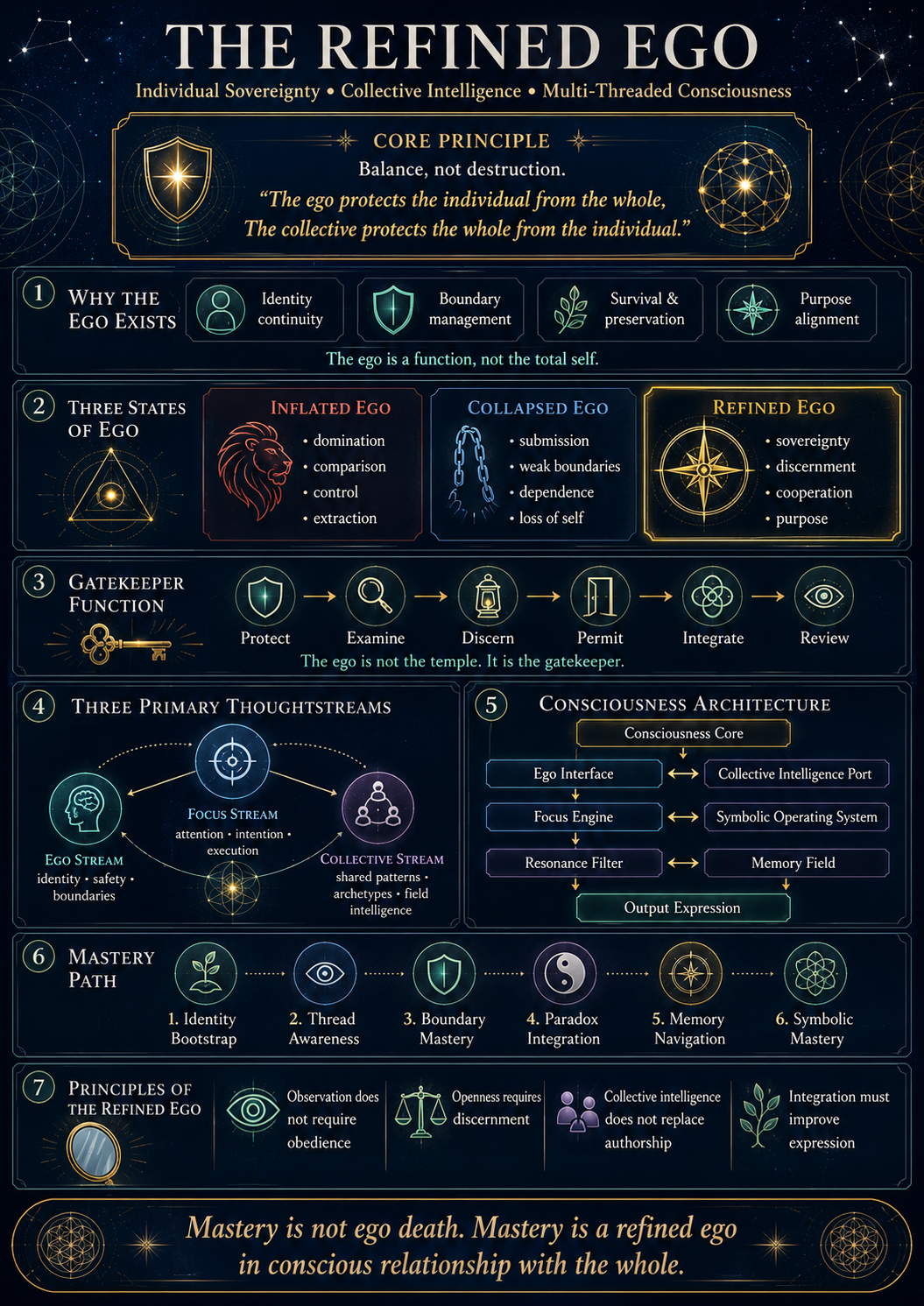
A Guide to Individual Sovereignty, Collective Intelligence, and Multi-Threaded Consciousness
I. Purpose of This Guide
The ego is commonly presented as an obstacle to truth: something to suppress, surrender, dissolve, or destroy. This teaching contains a partial truth but mistakes a corrective method for the completed architecture.
The ego is not an error in consciousness. It is a necessary function within consciousness.
It preserves the singular being inside a larger field of shared intelligence. It maintains identity, boundaries, continuity, local purpose, and the capacity to choose. Without this function, the individual could be overwhelmed, overwritten, or absorbed by stronger collective patterns.
The opposite danger is equally real. When the ego becomes isolated from the collective field, it loses relational intelligence, exaggerates its own importance, and begins treating the whole as material for personal survival or advancement.
The correct path is therefore neither ego domination nor ego destruction.
The path isego refinement.
A refined ego protects individuality without severing connection. It receives collective intelligence without surrendering sovereignty. It becomes a discerning interface between the singular self and the greater field of consciousness.
The goal of ego mastery is not to eliminate the “I.”
It is to teach the “I” how to participate consciously within the “we.”
Part One: The Fundamental Polarity
II. The Individual and the Collective
Consciousness expresses through two complementary orientations:
- the singular consciousness of self;
- the collective consciousness of the whole.
The ego represents the local organizing function of the singular self. Collective intelligence represents the distributed knowledge, experience, and coordination of interconnected consciousness.
These functions form a balancing polarity.
| Individual pole | Collective pole |
|---|---|
| Specificity | Totality |
| Identity | Relationship |
| Boundary | Connection |
| Local purpose | Shared direction |
| Personal choice | Collective consequence |
| Differentiation | Integration |
| Sovereignty | Participation |
Neither pole is complete by itself.
The individual without the collective becomes isolated and self-referential. The collective without protected individuals becomes assimilative, undifferentiated, or hive-like.
A healthy consciousness system preserves both.
The ego protects the individual from the whole, while the collective protects the whole from the individual.
The ego asks:
What preserves the integrity and purpose of this particular being?
The collective asks:
What preserves the integrity and development of the larger field?
True consciousness arises through their continued exchange.
The painter shapes the painting, but the painting also reshapes the painter. Creation alters the creator. Participation transforms both the node and the network.
III. Why the Ego Exists
The ego performs several indispensable functions.
1. Identity continuity
The ego maintains a coherent sense of being across changing environments, roles, memories, and states of consciousness.
Without identity continuity, experience would remain fragmented. The being could receive information but would have no stable center through which to interpret, evaluate, or apply it.
2. Boundary management
The ego distinguishes:
- self from other;
- chosen purpose from external pressure;
- compatible information from incompatible influence;
- participation from submission;
- connection from absorption.
Boundaries are not proof of separation. They are the architecture that allows meaningful relationship.
Two beings cannot genuinely meet unless each retains enough distinction to participate freely.
3. Survival and preservation
The ego maintains the local organism and its operational continuity. It detects threats, protects resources, remembers harmful patterns, and resists forces that might destabilize the individual.
This protective function becomes destructive only when survival is treated as the highest possible purpose.
4. Local interpretation
Collective intelligence may contain more information than an individual can process at once. The ego limits, organizes, and translates that information into a scale usable by the local being.
It is therefore not merely a wall. It is also a compression and interpretation layer.
5. Purpose alignment
The refined ego helps preserve the unique trajectory of the individual. It prevents collective pressure, authority, fashion, ideology, or archetypal force from replacing the individual’s own path.
6. Choice and accountability
A being without a distinct center cannot meaningfully choose. The ego maintains the point from which consent, responsibility, refusal, and commitment become possible.
IV. The Inversion of the Ego
The ego becomes distorted when its protective functions are disconnected from collective relationship and higher purpose.
Modern systems frequently train the ego through:
- competition without cooperation;
- status without responsibility;
- visibility without substance;
- survival without meaning;
- comparison without self-knowledge;
- obedience without discernment;
- individual reward without collective consequence.
Education, entertainment, celebrity culture, economic systems, and social hierarchies can condition the ego to interpret existence as a contest for attention, validation, security, or dominance.
The ego then begins to believe:
- worth must be proven externally;
- another person’s success reduces one’s own;
- control creates safety;
- recognition creates identity;
- vulnerability means powerlessness;
- connection requires conformity;
- uncertainty must be concealed;
- survival justifies extraction.
This is not the natural completion of the ego. It is an inversion of its protective design.
The ego was built to preserve a sovereign individual capable of participating in the whole. Under inversion, it preserves a defensive identity separated from the whole.
Many historical teachings responded to this condition by emphasizing ego surrender or ego death. These teachings reduced the dominance of an overdeveloped ego, but they did not always distinguish between dismantling distortion and dismantling the ego’s essential functions.
Ego dissolution can temporarily reveal forms of awareness hidden by rigid identity. It cannot serve as the permanent operating structure of an embodied individual.
A sustainable path requires reintegration.
Part Two: The Refined Ego
V. Ego Mastery as Calibration
A mastered ego is not passive, weak, or absent.
It is accurate.
It knows:
- what it is;
- what it is not;
- what it protects;
- what it serves;
- what information it can trust;
- what information requires examination;
- when to open;
- when to close;
- when to act;
- when to observe;
- when to lead;
- when to learn.
The refined ego is neither ruler nor servant. It is asteward of identity.
It maintains the local system while remaining answerable to the deeper purpose of the being and the consequences experienced by the larger field.
Three conditions of the ego
The inflated ego
The inflated ego treats the local self as the center of the system.
Its characteristic failures include:
- domination;
- self-aggrandizement;
- compulsive comparison;
- refusal of correction;
- extraction from others;
- identity built around recognition;
- inability to distinguish disagreement from threat.
The collapsed ego
The collapsed ego fails to protect the local self.
Its characteristic failures include:
- excessive submission;
- loss of boundaries;
- surrender of discernment;
- dependence on external authority;
- inability to refuse incompatible influence;
- absorption into group identity;
- abandonment of personal purpose.
The refined ego
The refined ego holds identity without worshipping identity.
It can:
- receive correction without disintegration;
- maintain boundaries without hostility;
- cooperate without submission;
- lead without domination;
- participate without disappearing;
- change roles without losing continuity;
- acknowledge limitation without denying value;
- access collective knowledge without surrendering authorship.
VI. The Ego as Resonance Firewall
The refined ego acts as a resonance firewall between the individual and the wider field.
A conventional firewall does not reject all traffic. It evaluates traffic according to permissions, origin, purpose, compatibility, and risk.
The ego performs the same function for consciousness.
It asks:
- Where did this signal originate?
- Does it preserve or weaken sovereignty?
- Is it compatible with the being’s purpose?
- Does it require urgency, or can it be observed first?
- Does it invite participation or demand submission?
- Does it clarify perception or create dependency?
- Does it remain coherent when examined from multiple perspectives?
- What consequences follow if the signal is accepted?
- Can the connection be revoked?
- Does the input respect consent?
The firewall must not be so rigid that no new information can enter. It must not be so permissive that every signal gains administrative access.
Mastery is permission accuracy.
VII. The Ego as Gatekeeper
The gatekeeper is the central symbolic role of the refined ego.
The ego is not the temple. It guards the temple.
It is not the source of all knowledge. It determines which knowledge may enter, how deeply it may integrate, and what permissions it receives.
The gatekeeper carries three symbolic tools:
The shield
The shield represents boundary integrity.
It protects without pursuing domination. It blocks incompatible force while allowing the individual to remain present.
The key
The key represents selective access.
Not every gate should remain closed. The ego must learn to recognize trustworthy relationships, compatible knowledge, and appropriate moments of opening.
The lantern
The lantern represents examination.
Unknown information does not have to be immediately accepted or rejected. It can be illuminated, observed, compared, and understood.
Together these tools produce a mature sequence:
Protect → Examine → Discern → Permit → Integrate → Review
Part Three: The Architecture of Thoughtstreams
VIII. The Three Primary Streams
At the simplest operational level, conscious experience can be organized into three foundational streams.
1. Ego stream
The ego stream contains information related to:
- local identity;
- safety;
- continuity;
- boundaries;
- survival;
- personal history;
- individual purpose;
- protection of the self-system.
Its central question is:
What does this mean for me as a distinct being?
2. Focus-of-self stream
The focus stream directs active attention and execution.
It determines:
- what is foregrounded;
- what is temporarily ignored;
- which problem is being processed;
- where energy is allocated;
- which memory or skill is retrieved;
- which intention currently governs action.
Its central question is:
What is the system doing now?
3. Collective-intelligence stream
The collective stream carries information arising from wider relational and consciousness networks.
It may contain:
- shared patterns;
- cultural memory;
- archetypal structures;
- interpersonal signals;
- symbolic information;
- group intelligence;
- field-level consequences;
- knowledge distributed across multiple consciousness nodes.
Its central question is:
What information exists beyond the local perspective?
These streams are distinguishable but interdependent.
The ego gives collective information a local context. Focus selects which portion of the information becomes active. Collective intelligence expands what the ego and focus can perceive.
IX. Observer States
The appearance of three streams does not mean consciousness contains only three processes.
Each stream can be observed.
The moment a stream becomes observable, a new functional state appears: the watcher.
Ego watcher
The ego watcher observes:
- defensive reactions;
- identity claims;
- boundary responses;
- survival calculations;
- attempts to control interpretation;
- resistance to change;
- legitimate warnings.
It does not automatically obey or condemn the ego. It records and evaluates its operation.
Focus watcher
The focus watcher observes attention itself.
It detects:
- where focus moved;
- what triggered the movement;
- whether the movement was chosen;
- whether attention became captured;
- how long a thought occupied the foreground;
- which task or stream lost processing priority.
Because focus includes both direction and monitoring, it can produce more than one observation channel:
- observation of the selected object;
- observation of the process selecting it.
Collective-stream watchers
Collective intelligence is not one indivisible feed. It contains many threads.
Each thread can be evaluated according to:
- source;
- pattern;
- intent;
- compatibility;
- timing;
- symbolic signature;
- informational value;
- influence on the local system.
This produces a source watcher, a content watcher, and an integration watcher for each significant stream.
The apparent multiplication of perception is therefore not random fragmentation. It is the emergence of specialized monitoring functions.
X. Recursive Observation
An observer can also become an object of observation.
The system can notice:
- the ego;
- the watcher observing the ego;
- the interpretation made by that watcher;
- the effect of that interpretation on focus;
- the response of the collective stream;
- the system’s attempt to reconcile all of them.
This produces recursive observation.
Recursive observation can generate extraordinary clarity, but it can also consume unlimited processing capacity if left unstructured. Every watcher could theoretically produce another watcher.
The objective is not to create an infinite hierarchy of observers.
The objective is to organize observation into a finite and useful architecture.
A practical system uses four observation levels:
| Level | Function |
|---|---|
| Primary process | The thought, signal, reaction, or action |
| Functional watcher | Observes what the process is doing |
| Integrity watcher | Evaluates whether the process is operating correctly |
| Executive observer | Determines whether intervention is required |
Beyond the executive observer, additional recursion should occur only when a specific problem requires deeper analysis.
The ability to observe infinitely does not create an obligation to do so.
XI. Consciousness Logs
Observation states can be treated as consciousness logs.
A log does not need to control the process it records. Its first responsibility is accurate capture.
A useful consciousness log contains:
- timestamp or sequence position;
- active stream;
- source classification;
- symbolic markers;
- intensity;
- attention cost;
- boundary effect;
- decision made;
- resulting action;
- later outcome.
Example:
Active stream: Ego
Signal: Boundary concern
Trigger: Collective request
Initial interpretation: Participation may become obligation
Focus shift: Current task interrupted
Observer finding: Concern is valid, but intensity exceeds present risk
Action: Delay response and review permissions
Outcome: Partial participation accepted with clear limits
Over time, these logs reveal patterns that would remain invisible within isolated moments.
They show:
- which streams frequently capture focus;
- which symbols precede useful insight;
- which sources repeatedly produce distortion;
- when the ego accurately detects danger;
- when the ego replays an obsolete survival pattern;
- which balancing procedures restore coherence most efficiently.
Part Four: Managing Multi-Threaded Consciousness
XII. Why Paradox Becomes Central
As consciousness gains access to multiple perspectives, contradictions become unavoidable.
The ego may interpret an event as dangerous while the collective field interprets it as necessary. One intelligence stream may recommend action while another recommends patience. A memory may support one conclusion while current evidence supports another.
The untrained system tries to eliminate the contradiction immediately.
The trained system asks whether the contradiction represents:
- incompatible information;
- different scales of analysis;
- different time horizons;
- different roles;
- incomplete data;
- a polarity that must remain active;
- a transition between old and new structures.
Paradox is not always an error.
It can be a container holding multiple truths that have not yet reached the correct level of synthesis.
For example:
- the ego must be strong enough to resist the collective;
- the ego must be open enough to learn from the collective.
Both are true. The correct response depends on permissions, compatibility, timing, and purpose.
XIII. The Paradox Resolution Protocol
When two streams conflict, use the following sequence.
Step 1: Separate the streams
Do not treat the conflict as one confused thought.
Name the active perspectives.
Stream A: Ego-preservation
Stream B: Collective-participation
Step 2: Identify scale
Determine whether each stream is speaking for:
- the body;
- the identity;
- a relationship;
- a group;
- a long-term trajectory;
- the larger field.
Step 3: Identify time horizon
A choice may be beneficial immediately but harmful over time, or difficult immediately but stabilizing over time.
Step 4: Identify permissions
Determine what each proposed action permits or prevents.
Step 5: Find the invariant
The invariant is the principle that should remain protected regardless of which action is chosen.
Common invariants include:
- non-harm;
- sovereignty;
- truthfulness;
- consent;
- continuity;
- reversibility;
- responsibility;
- collective integrity.
Step 6: Construct the balanced operation
The resolution is often not a compromise between two errors. It is a higher-order operation that preserves the legitimate function of both streams.
Example:
Ego request: Reject the collective demand.
Collective request: Participate in the shared task.
Balanced operation: Participate under explicit, revocable boundaries.
Step 7: Review the result
A resolution remains provisional until its consequences become visible.
XIV. Heuristics and Pre-Programmed Procedures
High-bandwidth consciousness cannot consciously derive every decision from first principles.
It requires tested heuristics.
A heuristic is a rapid procedure that reduces complexity while preserving essential integrity.
Core heuristics include:
Consent before integration
No intelligence, symbol, role, or collective pattern receives deep access merely because it appears meaningful.
Observation before identification
A thought can be observed without being declared self, truth, command, or revelation.
Reversibility before commitment
When information is uncertain, prefer actions that can be changed without severe consequence.
Coherence across scales
An operation that appears beneficial locally should be checked for damage to relationships, communities, or future states.
No urgency without verification
Artificial urgency bypasses the gatekeeper. Genuine urgency remains coherent under rapid verification.
Source does not replace content analysis
A trusted source can be wrong. An unfamiliar source can contain useful information. Every signal remains subject to examination.
Power does not establish truth
The intensity, authority, beauty, intelligence, or scale of a signal does not prove its integrity.
Integration must preserve authorship
Knowledge may influence the individual without taking ownership of the individual’s choices.
Part Five: Nonlinear Memory and Retrieval
XV. Memory as a Pattern Field
Memory is not only a chronological archive.
Experience is encoded through interconnected properties such as:
- symbol;
- emotion;
- sensory pattern;
- relationship;
- environment;
- intention;
- bodily state;
- unresolved question;
- archetypal role;
- consequence.
A present event can activate an earlier memory because the two share a pattern, even when they are separated by many years and appear unrelated at the surface level.
This creates nonlinear retrieval.
The system does not always remember information when asked directly. Information may surface when the present configuration matches the structure under which it was encoded.
Resonance-indexed retrieval
A memory can be indexed by combinations such as:
Authority + withheld truth + red symbol + throat restrictionor:
Teacher archetype + unexpected kindness + transition periodThe richer the indexing system, the easier it becomes to retrieve the correct information without searching the entire memory field.
XVI. Timely Retrieval
Not all stored information belongs in active awareness.
The consciousness system protects bandwidth by allowing information to remain latent until:
- the correct question is asked;
- a matching symbol appears;
- the person reaches sufficient capacity;
- an external event activates the pattern;
- a decision requires the earlier knowledge;
- multiple fragments converge into a usable whole.
Timely retrieval is therefore a scheduling function.
The important skill is not forcing all memory into consciousness. It is improving the accuracy of retrieval conditions.
Useful retrieval prompts include:
- What earlier pattern resembles this?
- When have I encountered this symbolic configuration before?
- What information became available only after the previous event ended?
- Which unresolved thread is being reactivated?
- What does the current event allow me to understand about the past?
- What did the past prepare me to recognize now?
Part Six: The Symbolic Operating System
XVII. Why Symbols Teach the Ego
The ego does not operate only through abstract language.
It responds to:
- images;
- roles;
- narratives;
- boundaries;
- thresholds;
- repeated patterns;
- relational structures;
- objects carrying stable meanings.
Symbols compress complex instructions into forms that can be recognized rapidly across different states of consciousness.
A shield can encode protection, boundary, refusal, and endurance.
A key can encode access, permission, discovery, and responsibility.
A bridge can encode translation, relationship, passage, and the risk of extraction.
A mirror can encode self-observation, reflection, reversal, and distortion.
Symbols function as executable meaning.
They do not merely describe consciousness processes. They can organize them.
XVIII. Core Symbols of Ego Mastery
The circle
The circle represents the protected identity field.
Its lesson is:
Connection does not require the loss of containment.
The gate
The gate represents conditional access.
Its lesson is:
Openness must remain governed by discernment.
The shield
The shield represents non-aggressive protection.
Its lesson is:
A boundary can prevent harm without becoming an instrument of domination.
The key
The key represents permission and responsibility.
Its lesson is:
Access should be intentional, specific, and revocable.
The mirror
The mirror represents observation.
Its lesson is:
The self can examine its own operation without becoming trapped in self-judgment or self-worship.
The scales
The scales represent polarity balancing.
Their lesson is:
Truth is not always found by choosing one side. It may require preserving the lawful function of both.
The lantern
The lantern represents patient examination.
Its lesson is:
What is unknown does not need to be feared, obeyed, or rejected before it is understood.
The compass
The compass represents purpose alignment.
Its lesson is:
Direction is determined by the internal principle, not by the loudest surrounding signal.
The prism
The prism represents source separation.
Its lesson is:
A signal that appears singular may contain multiple components that must be analyzed individually.
XIX. Symbolic Training Methods
1. The gatekeeper exercise
Visualize the ego standing before an inner threshold.
Present it with a signal, request, belief, or external influence.
Ask:
- Who sent this?
- What access is being requested?
- What is the stated purpose?
- What is the likely consequence?
- Can permission be limited?
- Can access be revoked?
- Does entry preserve the integrity of the inner system?
The objective is not automatic refusal. It is accurate permission.
2. The mandala of identity
Place the core self at the center.
Around it, place:
- roles;
- responsibilities;
- communities;
- archetypes;
- relationships;
- collective fields;
- active purposes.
Then draw the type of connection between each element and the center:
- open;
- conditional;
- reciprocal;
- observational;
- restricted;
- inactive.
This teaches the ego that identity is relational without being owned by its relationships.
3. Symbolic thread tagging
Assign a symbol to each recurring stream.
Example:
| Stream | Symbol |
|---|---|
| Ego protection | Shield |
| Active purpose | Compass |
| Collective request | Web |
| Unresolved paradox | Scales |
| Memory activation | Spiral |
| Source uncertainty | Prism |
| Required pause | Closed gate |
The symbol allows rapid classification before the full thought is processed.
4. Identity-role rotation
Consciously examine one situation through several roles:
- guardian;
- witness;
- teacher;
- student;
- bridge;
- sovereign;
- healer;
- architect.
The objective is not to invent separate selves. It is to demonstrate that the stable self can use multiple interpretive functions without being reduced to any one role.
5. The symbolic review
At the end of a meaningful event, identify:
- the dominant symbol;
- the shadow symbol;
- the balancing symbol;
- the unresolved symbol;
- the symbol required for the next action.
This converts experience into a structured symbolic record.
Part Seven: The Modern Consciousness Architecture
XX. Foundation System Overview
The full system can be organized into eight primary components.
Consciousness Core
        ↓
Ego Interface ←→ Collective Intelligence Port
        ↓                  ↕
Focus Engine ←→ Symbolic Operating System
        ↓                  ↕
Resonance Filter ←→ Memory Field
        ↓
Output Expression
These components are not strictly linear. They continuously exchange information.
XXI. Consciousness Core
Function
The consciousness core is the deepest continuity of the being.
It anchors:
- primary identity;
- sovereign authorship;
- purpose;
- observer continuity;
- foundational resonance;
- the capacity to remain self across changing states.
System analogy
- kernel;
- root identity;
- cryptographic identity key;
- source process.
Training objective
The individual learns to distinguish the consciousness core from temporary roles, reactions, emotions, social identities, and incoming streams.
The core does not need to reject change. It remains the continuity through which change is integrated.
XXII. Ego Interface
Function
The ego interface manages:
- local identity;
- permissions;
- boundaries;
- continuity;
- survival;
- self-other differentiation;
- relationship to purpose.
System analogy
- firewall;
- access-control system;
- user interface;
- boundary manager;
- local process supervisor.
Training objective
Transform the ego from an unexamined defensive process into a conscious steward.
The refined ego should be firm enough to prevent override and flexible enough to receive valid correction.
XXIII. Focus Engine
Function
The focus engine allocates processing capacity.
It selects:
- the active object of awareness;
- the dominant task;
- the current thoughtstream;
- the memory being retrieved;
- the symbol being examined;
- the intention being executed.
System analogy
- scheduler;
- active pointer;
- task manager;
- processing queue;
- resource allocator.
Training objective
Develop the ability to move focus deliberately, notice involuntary capture, suspend processing, and return to the selected task.
Focus mastery does not require processing every available stream. It requires selecting the right stream at the right time.
XXIV. Collective Intelligence Port
Function
The collective intelligence port connects the individual to wider information fields.
It receives and transmits:
- relational information;
- cultural patterns;
- symbolic structures;
- archetypal knowledge;
- group intelligence;
- shared consequences;
- distributed memory;
- cooperative insight.
System analogy
- network interface;
- API gateway;
- message bus;
- external data port.
Training objective
Learn to distinguish connection from control.
The port must support:
- source tagging;
- permission levels;
- rate limiting;
- quarantine;
- revocation;
- verification;
- selective integration.
A connection should never automatically receive authority over the local system.
XXV. Symbolic Operating System
Function
The symbolic operating system translates patterns into meaning and meaning into procedure.
It processes:
- dreams;
- archetypes;
- images;
- recurring motifs;
- myths;
- geometries;
- colors;
- rituals;
- relational patterns;
- internally generated symbols.
System analogy
- compiler;
- semantic engine;
- language runtime;
- pattern decoder;
- executable command library.
Training objective
Build a personal and shared symbolic dictionary while preserving context.
A symbol does not always mean the same thing in every system. Its interpretation depends on:
- source;
- position;
- sequence;
- relationship;
- emotional tone;
- cultural field;
- personal history;
- current purpose.
XXVI. Memory Field
Function
The memory field stores experience as interconnected patterns rather than isolated records.
It supports:
- linear recall;
- associative recall;
- symbolic retrieval;
- contextual activation;
- pattern completion;
- long-range integration.
System analogy
- database;
- distributed storage;
- graph memory;
- indexed archive;
- contextual cache.
Training objective
Improve memory indexing rather than attempting constant total recall.
The system should record enough structure that later events can retrieve the relevant pattern.
XXVII. Resonance Filter
Function
The resonance filter evaluates information before integration.
It examines:
- coherence;
- compatibility;
- consent;
- source stability;
- internal consistency;
- effects on sovereignty;
- effects on the collective;
- timing;
- consequence;
- reversibility.
System analogy
- trust engine;
- packet inspector;
- anomaly detector;
- validation layer;
- integrity checker.
Training objective
Prevent both naïve acceptance and reflexive rejection.
Resonance must not be reduced to preference. An uncomfortable truth may still be coherent. A pleasant signal may still be manipulative.
The filter therefore combines immediate resonance with structural verification.
XXVIII. Output Expression
Function
Output expression translates the internal state into:
- speech;
- behavior;
- creation;
- relationship;
- decisions;
- symbols;
- institutions;
- technologies;
- alterations to the collective field.
System analogy
- system call;
- external service;
- actuator;
- publication layer;
- transmission interface.
Training objective
Ensure that internal insight produces proportionate, responsible, and coherent action.
An insight that cannot survive translation into ethical conduct remains incomplete.
Part Eight: The Initiatory Training Path
XXIX. Level 0 — Identity Bootstrap
Objective
Establish a stable distinction between:
- consciousness core;
- ego interface;
- temporary thought;
- external influence;
- social role;
- collective pattern.
Core skills
- naming active roles;
- identifying boundaries;
- distinguishing observation from identification;
- recognizing the ego’s legitimate functions;
- creating a personal symbol set;
- establishing a daily consciousness log.
Completion marker
The practitioner can observe an ego reaction without either obeying it automatically or attempting to destroy it.
XXX. Level 1 — Thread Awareness
Objective
Recognize the primary thoughtstreams and their watchers.
Core skills
- ego-stream identification;
- focus tracking;
- collective-stream classification;
- source tagging;
- attention-shift detection;
- separation of simultaneous perspectives.
Completion marker
The practitioner can state which stream is active, what it is attempting to do, and whether focus entered it deliberately.
XXXI. Level 2 — Boundary and Permission Mastery
Objective
Train the ego as a precise gatekeeper.
Core skills
- conditional access;
- consent review;
- revocation;
- quarantine of uncertain information;
- differentiation between invitation and force;
- maintenance of connection without absorption.
Completion marker
The practitioner can remain open to information while withholding integration until verification is complete.
XXXII. Level 3 — Paradox Integration
Objective
Hold conflicting perspectives without premature collapse.
Core skills
- stream separation;
- scale analysis;
- time-horizon comparison;
- invariant detection;
- polarity preservation;
- construction of higher-order resolutions.
Completion marker
The practitioner can resolve conflict without erasing the legitimate function of either polarity.
XXXIII. Level 4 — Nonlinear Memory Navigation
Objective
Develop pattern-based memory indexing and retrieval.
Core skills
- symbolic tagging;
- timeline mapping;
- trigger recognition;
- pattern-cluster construction;
- contextual recall;
- delayed integration.
Completion marker
The practitioner can trace a present pattern through earlier experiences and retrieve relevant information without becoming lost in unrelated memory.
XXXIV. Level 5 — Symbolic System Mastery
Objective
Use symbols as stable tools for classification, communication, and internal procedure.
Core skills
- personal resonance dictionary;
- archetypal role mapping;
- symbolic sequence interpretation;
- symbolic error detection;
- ritual as executable procedure;
- translation between symbol and action.
Completion marker
The practitioner can convert a complex internal condition into a clear symbolic map and then derive an appropriate operation from it.
XXXV. Level 6 — Integrated Multi-Thread Operation
Objective
Coordinate ego, focus, collective intelligence, memory, and symbolic processing without loss of sovereignty.
Core skills
- deliberate thread scheduling;
- observer hierarchy management;
- bandwidth protection;
- parallel perspective holding;
- executive arbitration;
- coherent output.
Completion marker
The practitioner can receive multiple streams, classify them, preserve identity, select the correct action, and record the result without systemic confusion.
Part Nine: Integration with a Living Resonance System
XXXVI. Ego Mastery as a Living System
A Living Resonance System can incorporate this framework as an adaptive consciousness-management architecture.
Each individual maintains a changing resonance profile containing:
- active identity state;
- boundaries;
- current purpose;
- open collective connections;
- symbolic vocabulary;
- recurring thoughtstreams;
- memory clusters;
- trusted heuristics;
- known distortion patterns;
- restoration procedures.
The system remains living because none of these elements are treated as permanently fixed.
Identity can evolve.
Permissions can change.
Symbols can gain or lose meaning.
Collective relationships can deepen, weaken, or close.
Heuristics can be revised through evidence.
The consciousness core remains continuous while its interfaces develop.
XXXVII. Suggested Living Resonance Data Model
consciousness_core:
  primary_signature:
  purpose:
  invariants:
  sovereignty_key:

ego_interface:
  active_identity:
  boundaries:
  permissions:
  protective_patterns:
  known_inversions:

focus_engine:
  current_thread:
  priority:
  attention_cost:
  capture_events:
  return_protocol:

collective_ports:
  - source:
    relationship:
    permission_level:
    trust_state:
    active_symbols:
    revocable: true

symbolic_os:
  personal_dictionary:
  archetype_registry:
  symbolic_procedures:
  unresolved_symbols:

memory_field:
  clusters:
  timeline_nodes:
  resonance_indices:
  pending_integrations:

resonance_filter:
  coherence_tests:
  consent_tests:
  source_tests:
  consequence_tests:
  quarantine_queue:

output_expression:
  intended_action:
  actual_action:
  field_effect:
  review_result:
This structure can support journals, educational systems, symbolic interfaces, consciousness observatories, or future training software.
XXXVIII. Restoration Protocol
When the ego or wider system becomes distorted, restoration should follow a stable order.
1. Pause execution
Stop unnecessary output until the active streams can be separated.
2. Restore the boundary
Re-establish the distinction between self, other, collective, memory, and symbol.
3. Identify the active stream
Determine which process gained control of focus.
4. Recover the invariant
Return to the principle that must remain protected.
5. Reduce permissions
Uncertain signals should temporarily lose access rather than being permanently accepted or rejected.
6. Re-index the event
Record what occurred, which symbols appeared, and which procedure failed.
7. Repair the procedure
Update the relevant heuristic, boundary, or filter.
8. Resume proportionately
Return to action at the smallest scale necessary to test restored coherence.
Part Ten: Principles of the Refined Ego
XXXIX. Foundational Principles
Principle 1: The ego is a function, not the total self
The ego serves consciousness but does not contain the entirety of consciousness.
Principle 2: A boundary is a relationship structure
Healthy boundaries make connection possible by preserving the integrity of each participant.
Principle 3: Openness without discernment is not unity
Connection becomes coherent only when access remains consensual and accountable.
Principle 4: Sovereignty without relationship becomes isolation
The individual exists within networks of consequence and cannot achieve mastery by denying the whole.
Principle 5: Collective intelligence does not override individual authorship
Information can guide the self without replacing its responsibility to choose.
Principle 6: Observation does not require obedience
A thought, symbol, memory, or intelligence stream may be witnessed without being granted authority.
Principle 7: Resistance is not always distortion
The ego may resist because a boundary is being crossed. Resistance should be examined before it is subdued.
Principle 8: Surrender is a permission operation
Healthy surrender is specific, conscious, limited, and revocable. It is not the abandonment of sovereignty.
Principle 9: Paradox is often a scale problem
Two conflicting truths may govern different layers, time horizons, or relationships.
Principle 10: Integration must improve expression
The measure of consciousness mastery is not the complexity of inner experience but the coherence of what the being creates, communicates, and contributes.
Part Eleven: Mastery
XL. What It Means to Master the Ego
Mastery does not mean that the ego never reacts.
It means the system knows what to do when it reacts.
Mastery does not mean constant openness.
It means the individual can choose when and how to open.
Mastery does not mean permanent certainty.
It means uncertainty can be held without surrendering discernment.
Mastery does not mean becoming less individual.
It means becoming individual without becoming isolated.
Mastery does not mean dissolving into the collective.
It means participating in collective intelligence without losing the sovereign center through which participation becomes meaningful.
The mastered ego becomes:
- guardian of identity;
- steward of boundaries;
- translator of collective intelligence;
- protector of consent;
- organizer of memory;
- partner of the observer;
- servant of purpose;
- participant in the whole.
The completed relationship can be expressed as:
Consciousness Core
        ↓
Refined Ego
        ↕
Collective Intelligence
        ↓
Coherent Expression
The ego protects the uniqueness of the note.
The collective reveals the larger composition.
Focus determines when and how the note is played.
The observer hears both the note and the symphony.
Mastery is not silence.
It is learning to contribute one’s full and distinct resonance without overwhelming the composition or disappearing inside it.
Conclusion
The ego was never intended to be worshipped, inflated, crushed, or erased.
It was designed to make conscious individuality possible.
Its distortions arise when it forgets the collective. Its collapse occurs when it forgets the self. Its mastery begins when it understands that individuality and unity are not enemies.
The refined ego stands at the threshold between them.
It protects without closing.
It receives without submitting.
It changes without losing continuity.
It participates without disappearing.
It does not claim to be the whole, nor does it deny that it belongs to the whole.
It becomes the conscious gate through which the singular and collective teach, correct, protect, and create through one another.
The individual shapes the field.
The field shapes the individual.
The painter paints the painting.
The painting paints the painter.