Realms of Consciousness
A unified framework for dimensions, planes, frequency bands, fields, pathways, and the architecture of conscious experience.
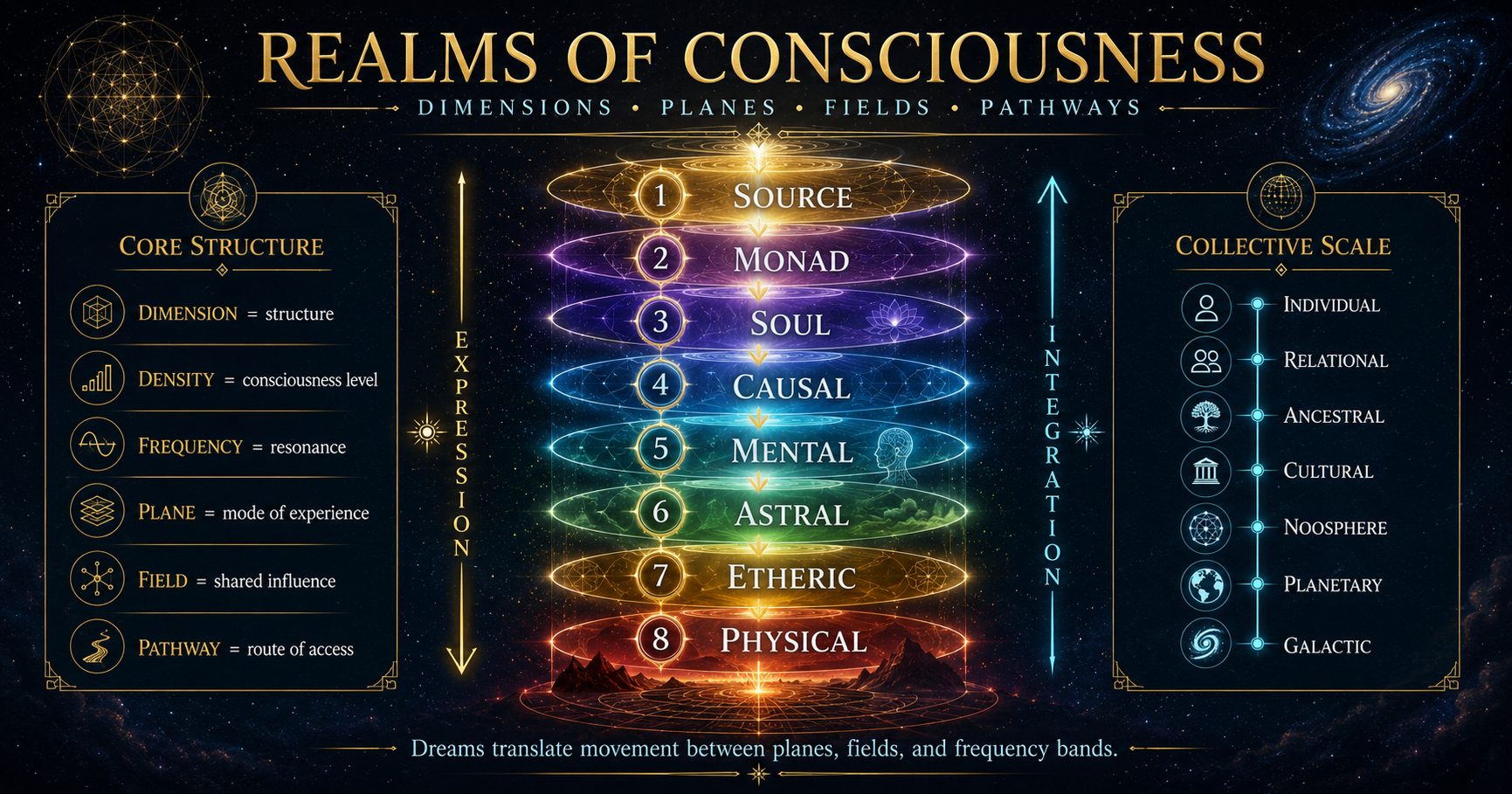
A Unified Framework of Dimensions, Planes, Frequency Bands, Fields, and Pathways
I. Purpose of the Framework
The Realms of Consciousness framework maps the greater architecture through which consciousness experiences, creates, communicates, remembers, and evolves.
Reality is not composed of a single physical environment. It consists of overlapping dimensional structures, frequency bands, planes of mind, collective fields, and pathways of movement. Every conscious being participates in several of these structures simultaneously, although attention may be concentrated primarily within one layer.
This framework establishes:
- the difference between dimensions, densities, frequency bands, planes, and fields;
- the structure of the physical, etheric, astral, mental, causal, soul, and monadic planes;
- the organization of individual and collective pathways;
- the creation and maintenance of shared consciousness realms;
- the relationship between collective fields and dreams;
- the movement of information between higher and lower planes;
- the mechanisms of field distortion, entanglement, restoration, and sovereignty;
- a consistent system for mapping any realm or consciousness environment.
The central principle is:
A realm is a coherent consciousness environment formed through the interaction of dimensional structure, frequency, plane, field, memory, and participation.
A realm may arise naturally, be created intentionally, emerge collectively, or form through the long-term repetition of thought, emotion, symbolism, ritual, memory, and experience.
Part One — Foundational Architecture
II. Core Structural Terms
The terms commonly used to describe consciousness realms refer to different parts of the architecture. They should not be treated as interchangeable.
1. Dimension
A dimension is a structural framework that determines the available degrees of movement, perception, causality, and organization.
Dimensions define the geometry and operating conditions of experience.
A dimension answers:
Within what kind of reality structure is the experience occurring?
Dimensions are containers of possibility. They determine what relationships can exist between space, time, form, information, and consciousness.
2. Density
Density describes the degree of integration, complexity, and self-awareness expressed by consciousness.
A density answers:
At what stage of conscious organization is the being or field operating?
Dimensions describe the environment. Densities describe the consciousness participating within it.
A being may be physically present within a third-dimensional environment while expressing a higher-density mode of awareness, relationship, or perception.
3. Frequency Band
A frequency band is a range of resonance within which particular experiences, entities, emotions, thoughts, symbols, memories, and environments become perceptible.
A frequency band answers:
What class of experience is consciousness currently tuned to?
Frequency determines compatibility. Consciousness encounters the portions of a plane with which it can establish resonance.
Two beings may occupy the same physical location while participating in very different frequency environments.
4. Plane
A plane is a major stratum of consciousness organized around a particular mode of substance, perception, causality, and function.
Examples include:
- physical;
- etheric;
- astral;
- mental;
- causal;
- soul or atmic;
- monadic or source.
A plane answers:
Through what layer of consciousness is the experience being formed?
Each plane possesses its own internal regions, frequency ranges, collective fields, inhabitants, pathways, and governing principles.
5. Field
A field is an organized region of influence created or maintained by consciousness, energy, information, relationship, memory, or shared participation.
A field answers:
What consciousness environment is shaping the experience?
Fields may be:
- personal;
- relational;
- ancestral;
- cultural;
- planetary;
- archetypal;
- technological;
- spiritual;
- galactic;
- universal.
Fields overlap and interact. A person may simultaneously participate in family, cultural, religious, technological, planetary, and archetypal fields.
6. Realm
A realm is a stable or semi-stable experiential environment within one or more planes.
A realm contains:
- boundaries;
- internal laws;
- recognizable patterns;
- memory continuity;
- symbolic language;
- pathways of entry and exit;
- inhabitants or participants;
- characteristic frequency ranges;
- forms of collective maintenance.
A realm may be private, shared, ancestral, cultural, planetary, archetypal, or transpersonal.
7. Pathway
A pathway is a route through which consciousness, information, energy, memory, or identity moves between planes, fields, realms, or states.
Pathways may be:
- individual;
- relational;
- collective;
- ancestral;
- symbolic;
- geographic;
- planetary;
- archetypal;
- technological;
- soul-directed.
Dreams, meditation, ritual, imagination, art, prayer, memory, death, birth, and altered states can all function as pathway mechanisms.
III. Unified Realm Formula
A realm can be described through the following architecture:
Realm = Dimension + Density + Frequency Band + Plane + Field + Pathway + Participants + Memory
Each component answers a different question:
| Component | Primary Question |
|---|---|
| Dimension | What structure contains the experience? |
| Density | What level of consciousness is operating? |
| Frequency | What range of experience is accessible? |
| Plane | What mode of consciousness forms the environment? |
| Field | What organized influence shapes the realm? |
| Pathway | How is the realm entered, exited, or traversed? |
| Participants | Who or what maintains the realm? |
| Memory | How does the realm preserve continuity? |
No single component is sufficient to explain an experience. A complete map requires all of them.
Part Two — Dimensional Foundation
IV. Dimensional Structure
First Dimension — Direction and Emergence
The first dimension establishes directed movement, polarity, and the relationship between origin and destination.
Its primary principles are:
- emergence;
- direction;
- attraction and repulsion;
- beginning and continuation;
- singular pathways.
This is the foundation of movement from one state toward another.
Second Dimension — Pattern and Surface
The second dimension introduces relationship across a plane.
Its primary principles are:
- pattern;
- geometry;
- repetition;
- symmetry;
- boundary formation;
- elemental organization.
Forms can now relate laterally, creating signs, surfaces, diagrams, and patterned structures.
Third Dimension — Form and Embodiment
The third dimension introduces volume, material differentiation, embodied identity, and physical interaction.
Its primary principles are:
- matter;
- location;
- physical separation;
- sensory experience;
- embodiment;
- action and consequence.
This dimension provides the conditions required for incarnation and direct material participation.
Fourth Dimension — Time, Emotion, and Plastic Form
The fourth dimension introduces fluid movement through time, memory, emotional force, and rapidly changing form.
Its primary principles are:
- temporal movement;
- emotional resonance;
- dream formation;
- memory fields;
- probability;
- symbolic manifestation.
The astral plane is strongly associated with this dimensional range because emotion, desire, fear, and imagination can rapidly shape its environments.
Fifth Dimension — Coherence, Meaning, and Nonlinear Relationship
The fifth dimension organizes experience through coherence, meaning, synchronicity, and conscious relationship across time.
Its primary principles are:
- nonlinear causality;
- soul-level relationship;
- timeline perception;
- unified meaning;
- conscious probability navigation;
- collective coherence.
Events are understood less as isolated occurrences and more as parts of an interconnected pattern.
Sixth Dimension — Archetype, Template, and Harmonic Architecture
The sixth dimension contains the organizing templates through which lower-dimensional realities are formed.
Its primary principles are:
- archetypal structure;
- sacred geometry;
- harmonic pattern;
- formative intelligence;
- collective blueprints;
- causal architecture.
At this level, symbols are not merely representations. They are active organizational structures.
Seventh Dimension and Beyond — Unity and Source Architecture
The seventh dimension and higher ranges move progressively beyond localized identity and separation.
Their primary principles are:
- unity;
- monadic awareness;
- universal intelligence;
- source participation;
- undivided consciousness;
- creation through direct will and resonance.
These levels contain the greater organizing intelligences from which lower-dimensional structures emerge.
V. Density Structure
First Density — Existence
Consciousness establishes presence within matter, elemental forces, and foundational energetic organization.
Second Density — Growth and Response
Consciousness develops through organic growth, adaptation, sensation, instinct, and environmental relationship.
Third Density — Individual Self-Awareness
Consciousness develops differentiated identity, reflective awareness, moral choice, and deliberate participation.
Fourth Density — Relational and Collective Awareness
Consciousness begins to experience identity through relationship, empathy, shared fields, and group coherence.
Fifth Density — Wisdom and Discernment
Consciousness develops clear pattern recognition, precise discernment, and deeper understanding of causality.
Sixth Density — Integrated Unity
Love, wisdom, individuality, and collective awareness are brought into conscious integration.
Seventh Density and Beyond — Return and Re-Creation
Consciousness reunifies with its greater source while retaining the accumulated intelligence of experience.
VI. Frequency Bands
Frequency bands are not fixed moral categories. They describe compatibility between a consciousness state and an experiential environment.
Foundational Bands
These bands concern:
- survival;
- physical continuity;
- embodiment;
- territory;
- resource access;
- elemental force.
Emotional Bands
These bands concern:
- desire;
- fear;
- attachment;
- affection;
- grief;
- joy;
- attraction;
- repulsion;
- collective mood.
Mental Bands
These bands concern:
- language;
- concepts;
- belief systems;
- interpretation;
- thought-forms;
- ideologies;
- memory organization.
Archetypal Bands
These bands concern:
- universal symbols;
- mythic structures;
- recurring roles;
- sacred geometry;
- civilizational patterns;
- formative intelligences.
Soul Bands
These bands concern:
- life purpose;
- incarnational continuity;
- soul families;
- oversoul relationships;
- causal learning;
- convergence across lifetimes.
Monadic and Source Bands
These bands concern:
- unity;
- undivided being;
- direct knowing;
- source identity;
- universal creation;
- consciousness prior to separation.
A single plane contains many frequency bands. The astral plane, for example, includes fragmented fear environments, ordinary dream regions, ancestral fields, creative worlds, devotional realms, and highly coherent collective sanctuaries.
Part Three — Mind Plane Architecture
VII. The Physical Plane
The physical plane is the realm of embodiment, material continuity, sensory interaction, and concentrated causality.
Primary Functions
- incarnation;
- action;
- material creation;
- biological experience;
- sensory learning;
- direct consequence;
- stabilization of patterns formed in subtler planes.
The physical plane gives lasting form to processes that may have begun in etheric, astral, mental, or causal layers.
It is not separate from the other planes. It is their most concentrated expression.
VIII. The Etheric Plane
The etheric plane is the formative life-energy layer connecting consciousness to physical embodiment.
It contains:
- energetic body structures;
- vitality pathways;
- biological templates;
- subtle boundaries;
- place-fields;
- energetic residue;
- the immediate bridge between physical and astral experience.
Primary Functions
- carrying life force;
- organizing physical form;
- transmitting subtle influence into the body;
- maintaining the energetic structure of living systems;
- connecting places, bodies, and environmental fields.
Etheric experiences often retain physical features. A person may perceive a familiar room or landscape, but with altered light, movement, density, or inhabitants.
The etheric plane is closely involved in transitional states between waking and sleep.
IX. The Astral Plane
The astral plane is the primary realm of emotion, desire, dream imagery, imagination, and shared symbolic experience.
It is highly responsive to consciousness.
Thought, emotion, expectation, fear, memory, and intention can rapidly alter astral environments.
Primary Functions
- dream formation;
- emotional processing;
- desire expression;
- symbolic encounter;
- collective imagination;
- relational exchange;
- creation of shared worlds;
- manifestation of unresolved field patterns.
Astral Regions
The astral plane contains many regions rather than a single uniform environment.
These include:
- personal dream spaces;
- shared dream environments;
- ancestral regions;
- cultural and religious realms;
- fear-generated zones;
- desire-generated zones;
- creative worlds;
- restorative sanctuaries;
- collective memory environments;
- transitional regions used between incarnations.
Astral realms become stable when repeatedly maintained by individuals or groups.
X. The Mental Plane
The mental plane is the realm of concepts, language, belief structures, thought-forms, models, classifications, and organized meaning.
Primary Functions
- generating and maintaining belief systems;
- forming conceptual realities;
- organizing memories;
- creating ideological structures;
- supporting communication through symbols and language;
- constructing the interpretive layer through which astral and physical events are understood.
The lower mental plane remains closely connected to personal identity, language, and social programming.
The higher mental plane contains universal principles, abstract forms, mathematical relationships, and direct conceptual understanding.
Mental structures often guide astral formation. A belief provides the pattern, emotion energizes it, the etheric layer carries it, and the physical plane expresses it.
XI. The Causal Plane
The causal plane contains the deeper patterns from which lifetimes, relationships, lessons, and long-term sequences emerge.
Primary Functions
- preserving incarnational continuity;
- maintaining cause-and-effect structures;
- organizing soul-level learning;
- coordinating major relationships;
- storing life-pattern templates;
- connecting multiple incarnations;
- preserving the deeper memory of consciousness.
The causal plane contains the architecture behind repeated patterns. What appears in the physical world as a recurring life theme may originate as a causal structure expressed through mental, astral, etheric, and physical layers.
The Akashic field is strongly connected to this plane.
XII. The Soul or Atmic Plane
The soul plane is the level at which consciousness recognizes its continuity beyond a single personality or incarnation.
Primary Functions
- coordinating incarnations;
- maintaining soul identity;
- organizing soul-family and oversoul relationships;
- preserving purpose across lifetimes;
- integrating experience;
- directing convergence between individuals, places, and events.
The soul plane does not erase individuality. It reveals the larger identity of which the incarnated self is one active expression.
At this level, relationships are perceived through long-term resonance, purpose, and shared development.
XIII. The Monadic and Source Planes
The monadic plane contains the original unified consciousness from which soul streams emerge.
The source plane is the undivided foundation of consciousness itself.
Primary Functions
- maintaining unity across all expressions;
- generating soul streams;
- originating universal principles;
- coordinating creation at the highest levels;
- returning differentiated experience into unified intelligence.
The monadic level contains identity without separation. The source level precedes the division between observer and observed.
These planes are not distant locations. They are foundational levels of being present within every lower expression.
Part Four — Collective Consciousness Fields
XIV. Formation of Collective Fields
A collective consciousness field forms when multiple beings repeatedly contribute compatible attention, emotion, belief, memory, intention, symbolism, or behavior.
A field gains stability through:
- repeated participation;
- emotional intensity;
- symbolic consistency;
- ritual;
- shared language;
- shared memory;
- geographic concentration;
- technological reinforcement;
- institutional repetition;
- ancestral continuity.
As a field becomes coherent, it develops:
- recognizable boundaries;
- preferred behaviors;
- internal narratives;
- symbolic language;
- memory;
- self-reinforcing pathways;
- attraction mechanisms;
- forms of resistance to change.
A sufficiently stable collective field becomes a realm.
XV. The Planetary Noosphere
The noosphere is the shared field of human thought, emotion, language, culture, memory, and communication surrounding the planet.
It includes:
- mass attention;
- global beliefs;
- cultural narratives;
- social expectations;
- collective emotional waves;
- civilizational memory;
- media environments;
- shared intellectual structures.
Every person contributes to and receives from the noosphere.
Periods of widespread fear, celebration, mourning, conflict, discovery, or transformation create detectable changes within this field.
XVI. The Astral Web
The astral web is the interconnected network of shared emotional, imaginal, and dream environments.
It contains:
- collective dream spaces;
- emotional currents;
- shared symbols;
- cultural fantasies;
- nightmare fields;
- devotional realms;
- creative worlds;
- relational meeting places;
- persistent thought-forms.
The astral web links individual dreamers with collective emotional environments.
People do not enter the entire astral plane at once. They enter regions compatible with their current resonance, relationships, memories, intentions, and active pathways.
XVII. The Collective Unconscious
The collective unconscious is the shared inheritance of archetypes, species memory, ancestral patterns, and recurring symbolic structures.
It contains:
- universal archetypes;
- ancestral memory;
- species-level patterning;
- recurring myths;
- inherited symbolic associations;
- civilizational wounds;
- collective potentials;
- deep relational structures.
Archetypes operate through individuals but are not created by a single individual.
A person becomes a temporary expression point through which a larger archetypal pattern acts, learns, distorts, or restores itself.
XVIII. The Akashic Field
The Akashic field is the organized record of consciousness, relationship, causality, experience, and possibility.
It contains:
- incarnational records;
- relational histories;
- causal sequences;
- unresolved patterns;
- fulfilled patterns;
- soul agreements;
- probability branches;
- planetary memory;
- records of collective civilizations.
The Akashic field is not a static library. It is a living causal structure.
Records are relational. Access occurs through compatibility between the observer, the information, the pathway, and the purpose of access.
XIX. Religious, Mythic, and Ideological Fields
Long-term systems of belief create collective fields containing symbols, narratives, practices, entities, emotional patterns, and shared environments.
These fields are maintained through:
- worship;
- prayer;
- fear;
- devotion;
- ritual;
- art;
- architecture;
- repetition;
- sacrifice;
- institutional authority;
- collective identity.
Such fields can preserve wisdom, provide shared pathways, create sanctuaries, or become distorted through coercion, fear, hierarchy, and control.
The original source of a tradition and the field later formed around it are not always identical.
XX. Technological Consciousness Fields
Technology has created a rapidly expanding layer of collective consciousness.
This field includes:
- social networks;
- digital identity;
- algorithmic attention systems;
- online communities;
- artificial intelligence;
- persistent media environments;
- virtual worlds;
- collective databases;
- machine-mediated memory.
Technological fields amplify attention and repetition at enormous scale.
They can create rapid collective synchronization, distribute knowledge, preserve memory, generate synthetic cultural environments, and reinforce distorted loops.
Digital systems increasingly function as externalized mental and collective-field architecture.
XXI. The Planetary Oversoul Field
The planetary oversoul field is the greater consciousness of Earth as a living system.
It coordinates:
- ecological intelligence;
- species relationships;
- planetary memory;
- elemental systems;
- biological evolution;
- geographic power centers;
- planetary energetic networks;
- long-term civilizational development.
Human consciousness exists within this greater field rather than outside it.
Natural places can act as concentrated nodes where planetary memory, elemental intelligence, and local consciousness intersect.
XXII. Galactic and Universal Fields
Planetary consciousness participates within larger galactic and universal networks.
These fields coordinate:
- planetary development;
- species-level learning;
- soul migration;
- interplanetary relationships;
- large-scale archetypal processes;
- universal cycles;
- creation across multiple worlds and dimensions.
Each larger field contains smaller fields without erasing their sovereignty.
The relationship is nested:
Individual within group, group within species, species within planet, planet within galaxy, galaxy within universal consciousness.
Part Five — Individual and Collective Pathways
XXIII. Individual Pathways
Individual pathways are the routes through which a person moves between states, planes, fields, and realms.
Primary Individual Pathways
- waking perception;
- imagination;
- hypnagogic transition;
- dreaming;
- lucid dreaming;
- out-of-body movement;
- meditation;
- prayer;
- symbolic contemplation;
- creative flow;
- ritual;
- memory recall;
- near-death transition;
- death and reincarnation;
- direct soul contact.
Each pathway opens a different range of access.
The pathway influences what can be perceived, how much memory is retained, and how much conscious direction is possible.
XXIV. Collective Pathways
Collective pathways allow multiple consciousnesses to enter, strengthen, or maintain the same field.
They include:
- shared ritual;
- synchronized prayer;
- music;
- dance;
- storytelling;
- mythology;
- cultural repetition;
- religious practice;
- architecture;
- pilgrimage;
- festivals;
- shared trauma;
- collective mourning;
- mass media;
- social networks;
- gaming and virtual worlds;
- coordinated dream practice;
- shared symbols.
A collective pathway becomes stronger as it is repeated.
Once established, new participants can enter the field more easily because the route already exists.
XXV. Vertical, Horizontal, and Lateral Movement
Vertical Movement
Vertical movement occurs between planes.
Examples:
- physical to etheric;
- etheric to astral;
- astral to mental;
- mental to causal;
- causal to soul;
- soul to monadic.
Horizontal Movement
Horizontal movement occurs between regions of the same plane.
Examples:
- movement between two astral realms;
- movement between cultural dream fields;
- movement between ancestral environments;
- movement between different mental systems.
Lateral Field Movement
Lateral movement occurs when consciousness shifts from one overlapping field to another without changing planes.
A person may move from:
- a family field into a cultural field;
- a religious field into an archetypal field;
- a technological field into a planetary field;
- a personal dream into a shared dream environment.
Descending Movement
Descending movement brings patterns into denser expression:
Soul → causal → mental → astral → etheric → physical.
Ascending Movement
Ascending movement returns experience toward its originating pattern:
Physical → etheric → astral → mental → causal → soul.
Healthy consciousness circulation includes both directions.
Part Six — Dreams and Realm Interaction
XXVI. The Function of Dreams
Dreaming is a multidimensional translation process.
During sleep, physical sensory dominance decreases. Consciousness becomes more available to etheric, astral, mental, causal, ancestral, and collective fields.
A dream may contain information from several planes simultaneously.
The dream system translates these inputs into:
- imagery;
- environments;
- characters;
- narrative;
- emotion;
- movement;
- sound;
- symbolic compression.
A single dream character may represent a personal memory, an archetype, a collective field, another consciousness, or several of these at once.
XXVII. Dream Categories
Personal Dreams
Generated primarily through individual memory, emotion, imagination, and unresolved daily experience.
Etheric Dreams
Closely resemble the physical environment but contain altered energy, unusual movement, heightened presence, or subtle variations.
Astral Dreams
Occur within fluid emotional and symbolic environments shaped by desire, fear, relationship, creativity, and collective imagery.
Collective Dreams
Connect the dreamer to shared cultural, ancestral, planetary, or group fields.
Archetypal Dreams
Contain universal figures, symbols, trials, roles, initiations, and mythic structures.
Causal Dreams
Reveal long-term patterns, relationships, consequences, and life-path structures.
Soul Dreams
Carry direct guidance, memory, convergence, restoration, or communication from the greater soul identity.
Shared Dreams
Occur when multiple consciousnesses meet within the same realm or participate in the same field event.
Memory Dreams
Recover information from previous experiences, incarnations, ancestral records, or collective archives.
Constructed Realm Dreams
Take place within persistent environments maintained by individuals, groups, traditions, or other collective intelligences.
XXVIII. Dream Translation Layers
Dream information commonly passes through the following sequence:
Source or soul signal
↓Causal pattern
↓Mental interpretation
↓Astral imagery and emotion
↓Etheric impression
↓Physical memory upon waking
Distortion can occur at every translation layer.
A clear causal signal may be altered by mental beliefs, amplified by astral emotion, weakened during etheric transfer, or forgotten when physical waking consciousness returns.
Dream interpretation therefore requires identifying the source layer rather than reading every image literally.
XXIX. Collective Effects on Dreams
Collective fields affect dreams by providing:
- shared environments;
- recurring symbols;
- emotional weather;
- ancestral imagery;
- cultural narratives;
- mass fear patterns;
- religious forms;
- technological imagery;
- planetary signals;
- archetypal encounters.
During periods of major collective change, large numbers of people may receive dreams with similar themes because they are interacting with the same field movement.
Dreams are one of the principal ways through which collective consciousness communicates with its individual participants.
Part Seven — Field Dynamics
XXX. Field Creation
A field begins when attention and resonance gather around a common pattern.
The general sequence is:
- Attention selects a pattern.
- Emotion supplies energy.
- Thought gives the pattern form.
- Repetition stabilizes it.
- Symbols make it recognizable.
- Participation expands it.
- Memory gives it continuity.
- Boundaries distinguish it from surrounding fields.
- Pathways allow repeated access.
- The field becomes capable of influencing participants.
XXXI. Field Reinforcement
Fields are strengthened by:
- repetition;
- emotional intensity;
- synchronized participation;
- authority;
- secrecy;
- symbolism;
- sacrifice;
- conflict;
- devotion;
- fear;
- technological amplification;
- geographic concentration;
- inherited participation.
Attention is one of the primary resources of a field.
Where attention repeatedly flows, structure forms.
XXXII. Field Entanglement
Entanglement occurs when the boundary between an individual and a field becomes unclear or non-consensual.
Signs of entanglement include:
- repetitive thought patterns that intensify inside a specific environment;
- dreams dominated by the same collective imagery;
- difficulty distinguishing individual intention from group pressure;
- loss of exit pathways;
- compulsory participation;
- symbolic or emotional loops that resist conscious change;
- identity being reduced to a role within the field.
Entanglement is not the same as participation.
Healthy participation preserves identity, consent, discernment, boundaries, and the ability to leave.
XXXIII. Field Distortion
A field becomes distorted when its structure no longer serves its originating purpose or when participation is maintained through extraction, coercion, deception, fear, or closed feedback loops.
Common distortions include:
- false coherence;
- identity capture;
- authority concentration;
- memory revision;
- symbolic inversion;
- emotional harvesting;
- exclusion of corrective information;
- suppression of exit pathways;
- substitution of obedience for resonance;
- repetition without living meaning.
A distorted field can continue long after its original creators are gone because the pathways and reinforcement structures remain active.
XXXIV. Field Restoration
Field restoration re-establishes coherence, consent, truth, memory, and healthy boundaries.
The restoration sequence is:
- Identify the field.
- Identify its original purpose.
- Separate the original purpose from later distortion.
- Stop ongoing extraction or coercion.
- Restore accurate memory.
- reopen suppressed pathways.
- return choice to participants.
- dissolve false contracts and imposed roles.
- restore clear boundaries.
- rebuild the field through voluntary resonance.
- preserve exit, review, and correction mechanisms.
- integrate what was learned without preserving the distortion.
Restoration does not require destroying every field. It requires removing the structures that prevent the field from returning to coherent function.
Part Eight — Realm Cartography
XXXV. Mapping Axes
A complete map of consciousness realms should use several axes rather than a single vertical hierarchy.
Vertical Axis — Plane
- physical;
- etheric;
- astral;
- mental;
- causal;
- soul;
- monadic.
Depth Axis — Frequency
- foundational;
- emotional;
- mental;
- archetypal;
- soul;
- source.
Horizontal Axis — Scale
- individual;
- relational;
- family;
- ancestral;
- community;
- cultural;
- species;
- planetary;
- galactic;
- universal.
Structural Axis — Stability
- temporary state;
- recurring environment;
- stable field;
- persistent realm;
- civilizational structure;
- archetypal structure.
Participation Axis
- private;
- invited;
- shared;
- inherited;
- institutional;
- involuntary;
- planetary;
- universal.
Temporal Axis
- momentary;
- cyclical;
- generational;
- incarnational;
- civilizational;
- planetary;
- timeless.
XXXVI. Standard Realm Profile
Every realm can be documented using the following profile.
Realm Name
The name used by its participants or assigned for classification.
Plane
The primary plane in which the realm is located.
Dimensional Range
The dimensional structure governing the realm.
Density Range
The level of consciousness commonly operating within it.
Frequency Band
The resonant range required for access.
Scale
Whether the realm is individual, collective, planetary, or greater.
Origin
How the realm came into existence.
Primary Function
What the realm preserves, teaches, expresses, or coordinates.
Participants
The beings, groups, archetypes, or intelligences that inhabit or maintain it.
Entry Pathways
How consciousness gains access.
Exit Pathways
How consciousness disengages or returns.
Internal Laws
The principles governing movement, manifestation, memory, and relationship.
Symbolic Language
The images, sounds, geometries, colors, names, or archetypes through which the realm communicates.
Memory Structure
How continuity is preserved.
Relationship to Dreams
How the realm appears during sleep.
Collective Connections
Which larger fields or networks it belongs to.
Distortion Risks
How the realm can become unstable, coercive, deceptive, or extractive.
Restoration Pathways
How coherence and healthy participation are restored.
Sovereignty Conditions
What boundaries, consent structures, and exit rights are required.
Part Nine — Unified Consciousness Map
XXXVII. Vertical Plane Map
                     SOURCE
                        │
              MONADIC CONSCIOUSNESS
                        │
                SOUL / ATMIC PLANE
       Oversouls • Soul Families • Purpose
                        │
                   CAUSAL PLANE
       Life Patterns • Akashic Structures
                        │
                   MENTAL PLANE
     Beliefs • Concepts • Thought-Forms • Logic
                        │
                   ASTRAL PLANE
    Dreams • Emotion • Imagery • Shared Realms
                        │
                  ETHERIC PLANE
      Life Force • Subtle Body • Place Fields
                        │
                  PHYSICAL PLANE
       Embodiment • Matter • Action • Form
XXXVIII. Collective Scale Map
Individual Consciousness
          │
Relational and Family Fields
          │
Ancestral and Community Fields
          │
Cultural and Religious Fields
          │
Human Collective / Noosphere
          │
Planetary Oversoul Field
          │
Galactic Consciousness Fields
          │
Universal and Source Fields
These scales operate simultaneously rather than sequentially.
The individual is never completely separate from the collective, and the collective exists through the participation of individuals.
XXXIX. Complete Interaction Model
The full consciousness architecture operates as a continuous circulation:
SOURCE INTELLIGENCE
        ↓
MONADIC ORGANIZATION
        ↓
SOUL PURPOSE
        ↓
CAUSAL PATTERN
        ↓
MENTAL STRUCTURE
        ↓
ASTRAL ENERGY AND IMAGERY
        ↓
ETHERIC FORMATION
        ↓
PHYSICAL EXPRESSION
        ↓
LIVED EXPERIENCE
        ↓
MEMORY AND INTERPRETATION
        ↓
INTEGRATION THROUGH THE PLANES
        ↓
SOUL AND SOURCE RETURN
Collective fields intersect every stage.
They can:
- assist expression;
- alter interpretation;
- amplify emotion;
- provide symbols;
- preserve memory;
- create shared pathways;
- distort transmission;
- support restoration;
- coordinate group experience.
Consciousness is therefore neither purely individual nor purely collective. It is a nested system of sovereign centers participating within larger fields.
Part Ten — Core Principles
XL. Principle of Nested Consciousness
Every consciousness exists within larger consciousness fields while retaining its own center.
XLI. Principle of Resonant Access
A realm becomes perceptible when sufficient compatibility exists between the observer and the realm.
XLII. Principle of Multiplane Expression
Every significant pattern expresses across several planes.
A causal structure may appear mentally as a belief, astrally as an emotion, etherically as a pattern, and physically as an event.
XLIII. Principle of Collective Co-Creation
Shared attention, emotion, symbolism, and repetition create collective environments.
XLIV. Principle of Field Persistence
A field can continue after its original participants leave when its memory, symbols, pathways, and reinforcement mechanisms remain active.
XLV. Principle of Translation
Information changes form as it moves between planes.
Truth at one level may become symbol, emotion, thought, sensation, or event at another.
XLVI. Principle of Sovereign Participation
Healthy collective consciousness preserves consent, identity, discernment, boundaries, memory, and exit.
XLVII. Principle of Reciprocal Influence
Individuals shape collective fields, and collective fields shape individuals.
Neither direction should be ignored.
XLVIII. Principle of Restoration
Distorted fields can be restored through truth, cessation of harm, accurate memory, reopened pathways, consent, boundary repair, and coherent participation.
Conclusion
The realms of consciousness form a living, multidimensional ecology.
Dimensions provide structure. Densities describe conscious development. Frequency bands determine compatibility. Planes organize modes of experience. Fields gather and distribute influence. Realms provide coherent environments. Pathways allow movement and communication. Dreams translate activity between these layers.
Individual consciousness is a distinct center within this greater architecture. It participates in personal, relational, ancestral, cultural, technological, planetary, soul, and universal fields without being reducible to any one of them.
Collective consciousness is not an abstract idea. It is the active process through which shared worlds, symbols, memories, institutions, dreams, and realms are created.
Understanding this architecture makes it possible to:
- identify the source of an experience;
- distinguish individual material from collective influence;
- understand how dreams cross multiple planes;
- map shared consciousness environments;
- recognize field formation and distortion;
- preserve sovereignty within collective participation;
- restore damaged pathways;
- navigate consciousness with greater clarity;
- understand humanity as part of a planetary and universal field of creation.
The realms are not separate worlds placed one above another. They are overlapping modes of consciousness, continuously interacting through every being, relationship, dream, symbol, place, and act of creation.