Harmonic Anatomy
A unified guide to sound, breath, source-points, harmonic resonators, and spiral waveflow through the human energetic system.
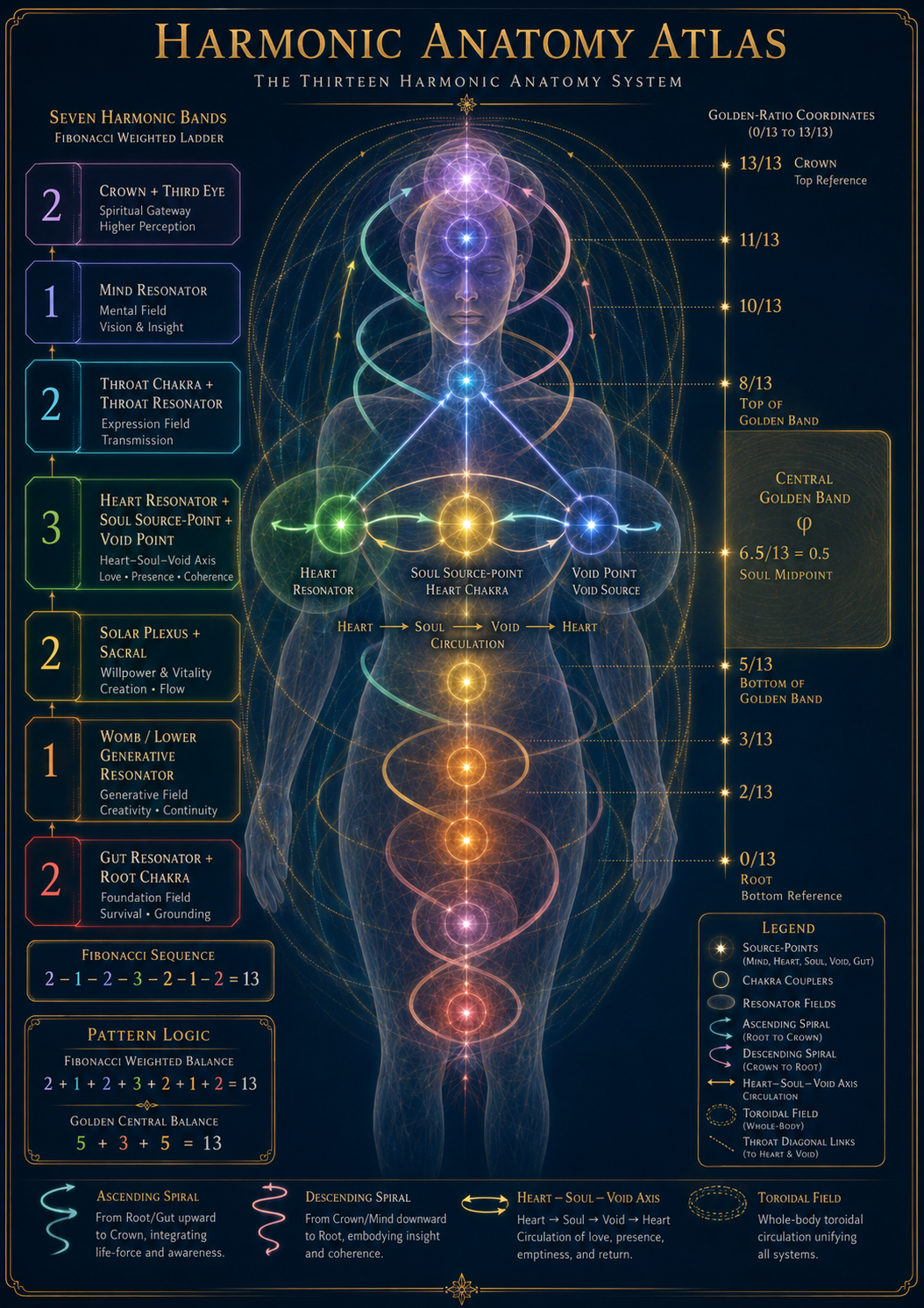
Conversion note: this Markdown was generated from the current DOCX guide. Formatting should be reviewed before treating this as a polished web edition.
Harmonic Anatomy
Sound, Breath, Source-Points, and Spiral Waveflow Through the Human Energetic System
Harmonic Anatomy presents the human body as an interconnected system of energetic nodes, harmonic resonators, generative source-points, transmission pathways, balancing fields, and embodied anchors.
The framework begins with a central principle:
The body does not merely receive sound. It generates, organizes, shapes, transmits, transforms, integrates, balances, and resolves vibration.
Traditional yogic systems explored these relationships through mantra, chanting, breath regulation, silence, concentration, chakra work, subtle channels, and the internal perception of sound. Harmonic Anatomy continues this work through a more differentiated model that distinguishes:
- energetic nodes from harmonic resonators;
- source-points from the fields they generate;
- sound formation from sound transmission;
- generation from amplification;
- silence from inactivity;
- vertical pathways from lateral and diagonal pathways;
- local oscillation from whole-field circulation;
- universal anatomy from individual calibration.
At the center of the framework is a complete harmonic system containing Mind, Throat, Heart, Soul, Void, Womb or Lower Generative Field, and Gut, integrated with the traditional chakra spine.
1. Traditional Foundations of Sound and Energy
1.1 Nāda Yoga
Nāda Yoga approaches sound as both an external vibration and an internal pathway of consciousness.
The audible voice is one layer of a wider field that includes:
- breath;
- intention;
- internal vibration;
- listening;
- silence;
- subtle resonance;
- the return of sound into awareness.
Sound is therefore not limited to what leaves the mouth. It includes the entire cycle through which a vibration is conceived, generated, embodied, emitted, received, and resolved.
1.2 Mantra Yoga
Mantra organizes sound into repeatable vibrational structures.
A mantra combines several elements:
- phonetic geometry;
- rhythm;
- breath;
- repetition;
- intention;
- attention;
- tonal continuity;
- silence between repetitions.
Its effects arise from the full configuration rather than from language alone. A mantra is simultaneously a sound pattern, breathing pattern, attentional pattern, and internal wave sequence.
1.3 Chakra systems
Traditional chakra systems describe energetic centers positioned along a vertical axis.
Within Harmonic Anatomy, chakras are understood primarily as nodes that:
- receive;
- transmit;
- couple;
- redirect;
- transform;
- filter;
- regulate;
- distribute energetic activity.
They are not identical to organs, resonators, or source-points, although several occupy the same region and operate together.
1.4 Nāḍīs and energetic pathways
The chakra spine is not an isolated column. Traditional systems describe channels through which energy moves between centers and throughout the body.
Harmonic Anatomy expands this idea into several classes of connection:
- vertical axial pathways;
- lateral pathways;
- diagonal pathways;
- nested resonator fields;
- spiral circulation;
- toroidal return paths;
- whole-body source-field integration.
1.5 Silence and the unstruck field
Silence is not treated as the absence of meaningful activity.
It is the phase in which:
- previous vibration resolves;
- residual amplitude diminishes;
- the throat returns toward neutrality;
- breath becomes receptive;
- intention can be selected;
- a new waveform can emerge without inheriting the full momentum of the previous one.
Silence is therefore an active component of sound formation.
2. The Structural Categories
Harmonic Anatomy distinguishes four primary structures.
2.1 Energetic nodes
An energetic node is a localized center of transmission and transformation.
The foundational chakra nodes are:
- Crown
- Third Eye
- Throat
- Heart
- Solar Plexus
- Sacral
- Root
Their primary function is not necessarily to originate waves. They provide organized interfaces through which waves can enter, leave, divide, merge, change state, or transfer between fields.
2.2 Harmonic resonators
A harmonic resonator is a field, chamber, organ-system, or functional region capable of sustaining and shaping oscillation.
A resonator may:
- amplify selected harmonics;
- attenuate others;
- retain residual vibration;
- transform an incoming wave;
- interact with neighboring fields;
- establish a characteristic mode of resonance;
- distribute a source-point’s generative output.
The foundational resonators are:
- Mind
- Throat
- Heart
- Soul
- Void
- Womb or Lower Generative Resonator
- Gut
Some are broad fields. Others are more localized. Several overlap with chakra nodes.
2.3 Source-points
A source-point is a localized generative center within a resonator or field.
The source-point creates the initial potential from which the resonator develops a larger wave.
The current model identifies source-points within:
- Mind;
- Heart;
- Soul;
- Void;
- Gut.
These source-points do not all generate the same type of activity.
Each produces a different class of wave:
| Source-point | Primary generative character |
|---|---|
| Mind | thought, pattern, image, interpretation, intention |
| Heart | coherence, relational amplitude, warmth, care, radiance, love |
| Soul | identity, orientation, meaning, whole-system integration |
| Void | still potential, receptive force, clearing, unformed possibility |
| Gut | instinct, embodied intelligence, primal orientation, physical impulse |
The Womb or Lower Generative Resonator also possesses generative capacity, but its precise internal source geometry remains a separate area of mapping.
2.4 Fields
A field is the extended region produced by a source-point or sustained by a resonator.
The source-point is localized.
The field is distributed.
For example:
- the Soul Source-Point is centered in the chest;
- the Soul Field extends throughout the body;
- the Heart Source-Point is localized within the Heart Resonator;
- the Heart Field expands through the chest and beyond it;
- the Mind Source-Point generates patterns within a wider Mind Resonator;
- the Gut Source-Point produces impulses that can rise through the entire system.
This distinction allows a source to remain spatially specific while its influence becomes whole-body.
3. The Foundational Harmonic Anatomy
3.1 Crown Chakra
The Crown occupies the uppermost region of the energetic system.
Its functions include:
- vertical receptivity;
- opening;
- entry into stillness;
- broad-field perception;
- connection with the upper Mind Resonator;
- operation as an upper Void interface.
The Crown can operate in at least two modes.
Receptive mode
The Crown receives and opens the upper field.
Void mode
The Crown reduces active mental formation and enters a state of silence, spaciousness, or zero.
The Crown is contained within the larger Mind Resonator but can also participate in the Void system.
3.2 Third-Eye Chakra
The Third Eye functions as a perceptual and orientational node.
Its operations include:
- pattern recognition;
- internal representation;
- directed perception;
- image formation;
- symbolic interpretation;
- alignment between received information and mental awareness.
The Crown receives broadly.
The Third Eye gives perceptual direction.
Together they form the paired upper interface of the Mind system.
4. The Mind Resonator and Mind Source-Point
The Mind Resonator contains both the Crown and Third-Eye functions while extending beyond either one.
Within it is a Mind Source-Point.
The Mind Source-Point generates:
- thoughts;
- images;
- intentional structures;
- conceptual patterns;
- directional focus;
- anticipated actions;
- possible waveforms before they become sound.
The Mind Resonator then organizes, sustains, compares, and refines these patterns.
This creates a sequence:
Reception → Perception → Mental Generation → Intention
The Mind connects directly with:
- Crown;
- Third Eye;
- Throat;
- Heart;
- Soul;
- Void;
- Gut;
- the chakra spine as a whole.
The Mind-to-Throat pathway is especially important because it converts an internally generated pattern into an expressible waveform.
5. The Throat Chakra and Throat Resonator
The Throat is both an energetic node and a harmonic resonator.
It is positioned:
- below the Mind Resonator;
- above the Soul Source-Point;
- diagonally connected to the Heart and Void;
- vertically connected to the upper and central systems.
5.1 Throat Chakra
The Throat Chakra acts as a coupling and routing node.
It governs the transfer between:
- thought and expression;
- breath and vibration;
- internal intention and external emission;
- upper perception and central coherence.
5.2 Throat Resonator
The Throat Resonator shapes the actual wave.
It combines:
- airflow from the lungs;
- laryngeal oscillation;
- vocal-tract geometry;
- tongue and mouth position;
- pitch;
- timbre;
- rhythm;
- breath pressure;
- intentional modulation.
The throat is therefore the principal wave-forming and wave-emitting system.
It does not operate alone. It receives contribution from:
- Mind for pattern;
- Heart for amplitude and relational character;
- Soul for orientation;
- Void for silence and zeroing;
- lungs for breath power;
- the body for resonance and return.
5.3 Void-to-Throat zeroing
The Void can be used to return the throat toward zero before intentional sound begins.
The sequence is:
Stillness → Silent inhalation → Throat neutralization → Intention → Vibration
This prevents one waveform from unconsciously carrying forward the momentum of another.
The Void-to-Throat path is therefore a preparation pathway.
6. The Central Heart–Soul–Void Field
The central chest contains a three-part transverse system.
Heart Resonator ←→ Soul Source-Point ←→ Void Point
left center right
These three components share a central vertical region but occupy different lateral positions and perform different functions.
7. Heart Resonator and Heart Source-Point
The Heart Resonator is located toward the left side of the chest.
Within it is a Heart Source-Point.
The Heart Source-Point generates:
- coherence;
- relational presence;
- warmth;
- care;
- affective amplitude;
- radiant expansion;
- connective force.
The Heart Resonator sustains and distributes this output.
Its wave may move:
- inward toward Soul;
- horizontally toward Void;
- upward toward Throat and Mind;
- downward toward Solar Plexus and Gut;
- outward into the surrounding field;
- around the body through toroidal circulation.
The Heart is therefore not merely a receiver of emotion. It is a generative oscillator with its own source capacity.
8. Soul Source-Point and Soul Field
The Soul Source-Point is located in the center of the chest and overlaps with the Heart Chakra.
It is experienced as a central flame, source, or integrating presence.
The Soul Source-Point generates a field that extends throughout the body and integrates with the body’s other fields.
Its primary functions include:
- identity;
- meaning;
- whole-system orientation;
- integration of local signals;
- continuity across action and perception;
- participation in decision and movement;
- alignment between different resonators.
The Soul is not confined to the chest.
The chest location acts as its concentrated source-point, while the Soul Field integrates:
- Mind;
- Throat;
- Heart;
- Void;
- Solar Plexus;
- Sacral;
- Womb or Generative Field;
- Gut;
- Root;
- the full bodily electromagnetic system.
This allows the Soul to be present in every action, decision, sound, and moment rather than operating as a separate upper abstraction.
9. Void Point and Void Source-Point
The primary chest Void Point is located on the right side of the chest, opposite the Heart Resonator.
It has a dual function.
9.1 Void as zero point
In zeroing mode, the Void:
- reduces carried amplitude;
- interrupts automatic repetition;
- clears residual wave momentum;
- creates silence;
- restores receptive space;
- allows the next waveform to begin intentionally.
9.2 Void as source-point
The Void can also become a source.
As a source-point, it generates:
- unformed potential;
- still force;
- receptive possibility;
- space before differentiation;
- non-projective awareness;
- the first movement emerging from silence.
However, Void-generated potential does not enter the wider system in the same way as Heart, Mind, or Gut output.
Its generative pathway routes through the Heart.
Void Source → Heart Resonator → Wider Harmonic System
The Heart provides the Void-source wave with coherent amplitude, relational character, and living motion.
The Void supplies potential.
The Heart gives that potential radiance and circulation.
From the Heart, the wave may then enter:
- Soul for integration;
- Throat for expression;
- Mind for interpretation;
- Gut for embodiment;
- the surrounding toroidal field.
9.3 Heart–Void reciprocity
Heart and Void are not simply opposites.
They form a reciprocal pair:
| Heart | Void |
|---|---|
| radiation | reception |
| amplitude | zero |
| expression | space |
| active coherence | unformed potential |
| expansion | return |
| generation through fullness | generation through stillness |
The Soul mediates and integrates their relationship.
10. The Central Triad as a Coherence Engine
The central field operates through a recurring circuit:
Heart → Soul → Void → Heart
A fuller cycle may be represented as:
- Heart generates amplitude.
- Soul integrates the wave with identity and whole-system orientation.
- Void clears excess or returns part of the wave toward stillness.
- Void may then generate new potential.
- The new potential routes through Heart.
- Heart gives it coherent amplitude.
- The cycle begins again at a new level.
This makes the central triad a regenerative system rather than a static arrangement.
It can:
- create;
- integrate;
- balance;
- clear;
- regenerate;
- recirculate.
11. Solar Plexus Chakra
The Solar Plexus is positioned below the central chest field.
It acts as a conversion and distribution node.
Its functions include:
- directing energy toward action;
- translating central orientation into movement;
- regulating intensity;
- converting upper-system patterns into lower-system force;
- moving embodied signals upward toward interpretation.
The Solar Plexus connects:
- Soul and lower body;
- Heart and Gut;
- intention and action;
- central coherence and physical direction.
It is a major phase-transition point between the central and lower systems.
12. Sacral Chakra
The Sacral Chakra lies beneath the Solar Plexus.
Its functions include:
- flow;
- movement;
- adaptation;
- creative exchange;
- relational circulation;
- energetic elasticity;
- transfer into and out of the lower generative field.
The Sacral Chakra is closely connected to:
- Solar Plexus;
- Womb or Lower Generative Resonator;
- Gut;
- Root;
- Soul through the central axis.
The Solar Plexus directs.
The Sacral allows movement and development.
13. Womb and Lower Generative Resonator
The Womb is treated as a major harmonic resonator in bodies that possess a uterus.
It is not merely another name for the Sacral Chakra.
The Sacral is an energetic node of movement and transmission.
The Womb is a chamber of containment, formation, development, and embodied creation.
Its functions include:
- receiving a pattern;
- holding energy over time;
- transforming potential into form;
- gestation;
- rhythmic and cyclic modulation;
- creative embodiment;
- connection between primal energy and living creation.
The Womb Resonator connects with:
- Sacral;
- Solar Plexus;
- Gut;
- Root;
- Heart;
- Soul;
- Void;
- Mind.
Its relationship with the Mind allows a pattern to be conceived.
Its relationship with the Heart gives creation relational amplitude and care.
Its relationship with Soul connects creation to identity and meaning.
Its relationship with Void provides receptive space.
Its relationship with Gut and Root anchors creation into physical existence.
13.1 Lower generative configurations
In bodies without a uterus, the corresponding function may be distributed through a wider Lower Generative Resonator involving:
- lower abdomen;
- pelvic floor;
- perineal structures;
- reproductive organs;
- sacral field;
- root field;
- lower breath-pressure chamber.
The shared function is generation, but the physical and energetic geometry may differ.
The Womb configuration and non-uterine configurations should therefore be mapped separately while remaining part of the same larger generative family.
13.2 Generative source geometry
The Womb clearly has generative capacity, but its source-point geometry requires deeper mapping.
Possible structures include:
- one central source;
- a distributed chamber source;
- multiple cyclic source zones;
- source activity that changes across biological cycles;
- a source shared with the wider pelvic field.
This work is best completed through direct observation and contributions from people who possess and can internally perceive the anatomy.
14. Gut Resonator and Gut Source-Point
The Gut Resonator occupies the lower bodily system between the upper pelvic field and the Root anchor.
Within it is a Gut Source-Point.
The Gut Source-Point generates:
- instinctive signals;
- bodily orientation;
- primal discernment;
- physical readiness;
- appetite and aversion;
- contraction and expansion impulses;
- immediate embodied knowledge.
The Gut Resonator shapes and distributes these signals.
Gut output may move:
- downward toward Root for anchoring;
- upward toward Sacral and Solar Plexus;
- directly toward Heart;
- toward Soul for whole-system integration;
- toward Mind as conscious recognition;
- toward Void for settling or balancing.
The Gut is therefore not merely the endpoint of descending energy. It can initiate ascending waves of its own.
This is essential to the model:
The lower body does not only receive instructions from the Mind. It generates information that can rise into awareness, expression, and conscious choice.
15. Root Chakra
The Root Chakra anchors the complete system into physical embodiment.
Its functions include:
- gravitational orientation;
- stability;
- bodily cohesion;
- support;
- relationship with the physical environment;
- completion of descending waves;
- initiation of upward anchoring force.
The Root is closely coupled with the Gut.
Together they connect harmonic anatomy to:
- posture;
- movement;
- weight;
- physical contact;
- balance;
- material action.
The Gut generates embodied signals.
The Root anchors them within the physical plane.
16. Source-Point Architecture
The current source-point system can be summarized as follows.
Mind Source-Point
Generates pattern, thought, image, and intention.
Mind Source → Throat → Expression
Mind Source → Heart/Soul → Coherent intention
Mind Source → Lower system → Embodied action
Heart Source-Point
Generates coherence, care, amplitude, and relational radiation.
Heart Source → Soul → Whole-system integration
Heart Source → Throat → Coherent expression
Heart Source → Gut → Embodied relational action
Heart Source → Field → Toroidal radiation
Soul Source-Point
Generates identity, orientation, meaning, and integrative presence.
Soul Source → All resonators and nodes
The Soul Source is whole-system in reach.
Void Source-Point
Generates still potential and unformed possibility.
Void Source → Heart → Soul / Throat / Mind / Gut / Field
Its generative output routes through Heart.
Gut Source-Point
Generates instinct, primal information, and embodied direction.
Gut Source → Solar Plexus → Heart/Soul → Mind
Gut Source → Root → Physical action
Womb or Generative Source
Generates and develops embodied creative potential.
Its exact source geometry remains part of the next mapping phase.
17. Connection Geometry
The system contains several simultaneous geometries.
17.1 Vertical spine
Crown
Third Eye
Mind Resonator
Throat Chakra and Resonator
Soul Source-Point / Heart Chakra
Solar Plexus
Sacral
Womb or Lower Generative Resonator
Gut Resonator
Root
17.2 Transverse central axis
Heart Source/Resonator ←→ Soul Source-Point ←→ Void Point/Source
17.3 Throat diagonals
Mind
Throat
/ \
Heart Void
\ /
Soul
The throat can therefore receive pattern from above, amplitude from the left, stillness from the right, and orientation from below.
17.4 Direct resonator connections
The larger resonators also communicate outside the immediate chakra sequence.
Important direct connections include:
Mind ↔ Heart
Mind ↔ Soul
Mind ↔ Void
Mind ↔ Gut
Heart ↔ Throat
Heart ↔ Soul
Heart ↔ Void
Heart ↔ Gut
Soul ↔ Entire Body
Void ↔ Throat
Void → Heart
Void ↔ Soul
Void ↔ Gut
Gut ↔ Root
Gut ↔ Womb/Generative Field
Gut ↔ Heart
Gut ↔ Mind
17.5 Nested fields
Several structures are contained within larger resonators.
- Crown and Third Eye exist within the Mind Resonator.
- Heart Source-Point exists within the Heart Resonator.
- Gut Source-Point exists within the Gut Resonator.
- Soul Source-Point generates a whole-body Soul Field.
- Void can exist as a chest source-point and as a Crown mode.
- Throat Chakra and Throat Resonator occupy the same region while performing different roles.
18. Core Wave Operations
Every node and resonator can perform one or more wave operations.
Generation
A source-point introduces new potential or oscillation.
Resonance
A field sustains and strengthens selected features of the wave.
Transmission
A node passes the wave into another region.
Reception
A field accepts and begins interacting with an incoming wave.
Amplification
Amplitude or harmonic intensity increases.
Attenuation
Amplitude decreases without total removal.
Filtering
Some components are strengthened while others are reduced.
Phase shifting
The timing or internal relation of the wave changes.
Routing
The wave is directed toward a selected pathway.
Integration
A local wave becomes part of a wider field.
Reflection
Part of the wave returns toward its source.
Zeroing
Residual oscillation is reduced toward a neutral reference state.
Embodiment
The wave becomes posture, movement, action, expression, or material creation.
19. Primary Waveflow Modes
19.1 Ascending spiral
The ascending path begins in the lower body and moves toward awareness and perception.
Root
→ Gut
→ Womb / Generative Field
→ Sacral
→ Solar Plexus
→ Heart–Soul–Void
→ Throat
→ Mind
→ Third Eye
→ Crown
Its general progression is:
Embodied signal → Generative movement → Transformation → Integration → Expression → Perception
A Gut-generated signal can rise into conscious understanding.
A Womb-generated pattern can rise toward Heart and Mind.
A Rooted physical state can become articulated knowledge.
19.2 Descending spiral
The descending path begins in the upper system and moves toward embodiment.
Crown
→ Third Eye
→ Mind
→ Throat
→ Heart–Soul–Void
→ Solar Plexus
→ Sacral
→ Womb / Generative Field
→ Gut
→ Root
Its progression is:
Reception → Perception → Intention → Wave formation → Integration → Generation → Embodiment
An idea becomes a formed intention.
The intention receives coherent amplitude through Heart.
The lower system converts it into action or creation.
19.3 Heart–Soul–Void circulation
Heart → Soul → Void → Heart
This is the primary central coherence circuit.
It balances:
- amplitude and silence;
- expression and reception;
- generation and clearing;
- fullness and potential.
19.4 Void-source circulation
Void Source → Heart → Soul → Wider System
The Void originates potential.
The Heart gives it amplitude.
The Soul integrates its orientation.
The wider system determines its expression or embodiment.
19.5 Void-to-Throat preparation
Void → Throat
This pathway establishes silence before intentional emission.
Its sequence is:
Zero → Breath → Intention → Tone
19.6 Mind-to-Throat expression
Mind Source → Throat → External Field
The Mind generates a pattern.
The Throat converts it into wave geometry.
19.7 Gut-to-Mind recognition
Gut Source → Solar Plexus → Central Field → Throat/Mind
The Gut generates embodied information.
The central system integrates it.
The Mind recognizes its pattern.
The Throat may then express it.
19.8 Toroidal circulation
A toroidal wave emerges from the central field, expands outward, curves around the body, returns through the field, and re-enters the central system.
A complete loop may be represented as:
Heart
→ Outward Radiation
→ Upper and Lower Field Circulation
→ Void Return
→ Soul Integration
→ Heart Renewal
The toroidal mode is especially important for whole-system coherence.
20. Breath as Carrier and Timing Structure
Breath supplies:
- pressure;
- energy;
- duration;
- amplitude;
- pacing;
- onset;
- release;
- continuity;
- the transition from Void into sound.
A complete sound cycle contains:
Silence
→ Inhalation
→ Intention
→ Vocal Onset
→ Sustained Resonance
→ Release
→ Return to Silence
Each stage has a distinct function.
Silence
Establishes zero.
Inhalation
Receives and gathers potential.
Intention
Selects the waveform.
Onset
Begins oscillation.
Sustained resonance
Allows the wave to stabilize and propagate.
Release
Ends active production without abrupt fragmentation.
Return
Allows the residual field to settle, integrate, or reveal its continuation.
21. Vowels as Harmonic Geometries
A vowel is not a single frequency.
It is a multidimensional geometry formed through:
- tongue position;
- mouth shape;
- jaw opening;
- lip configuration;
- nasal coupling;
- pitch;
- register;
- breath pressure;
- harmonic spectrum;
- intentional direction.
Each vowel creates a different resonant configuration.
A preliminary functional map is:
| Sound family | Principal orientation |
|---|---|
| U / OO | Gut, Root, pelvic depth, lower generative field |
| O / OH | Mind integration, rounded field formation |
| A / AH | Heart, central chest, expansion |
| E / EH / AY | Throat, articulation, directional emission |
| I / EE | Upper Mind, Third Eye, perceptual precision |
| M / NG | Internal conduction, cranial and chest coupling |
| H / breath | clearing, transition, Void-to-wave movement |
| Silence | Void, reset, receptive potential |
These are starting orientations rather than rigid assignments.
The final system is calibrated through the actual response of each body.
22. Personalized Harmonic Calibration
The shared anatomy provides a common map. Personal calibration determines how an individual system behaves within it.
A complete profile can include:
harmonicprofile:
naturalpitchcenter:
comfortablepitchrange:
strongestvowels:
primaryresonanceregion:
secondaryresonanceregion:
mindsourceresponse:
heartsourceresponse:
soulfieldresponse:
voidzeroingresponse:
voidsourceresponse:
gutsourceresponse:
womborgenerativeresponse:
throatonsetquality:
ascendingspiralresponse:
descendingspiralresponse:
toroidalresponse:
heartvoidbalance:
preferredbreathduration:
preferredvolume:
posttoneresidualduration:
notes:
Calibration sequence
1. Establish silence
Observe the baseline before vocalization.
2. Select a source
Choose Mind, Heart, Soul, Void, Gut, or the Lower Generative Field.
3. Select a destination
Choose a local node, a connected resonator, the vertical spine, or the wider field.
4. Produce a comfortable tone
Use a hum or vowel without strain.
5. Observe propagation
Notice where the wave becomes strongest, changes quality, divides, stops, or returns.
6. Change one parameter
Adjust only one element:
- pitch;
- vowel;
- volume;
- breath duration;
- mouth geometry;
- pathway;
- source;
- destination.
7. Return to silence
Observe the residual state after the tone ends.
Repeated mapping reveals the person’s harmonic fingerprint.
23. The Mathematical Architecture
The deeper mathematical structure can now be introduced after the anatomy and wave mechanics are understood.
23.1 The thirteen-function ladder
The complete system follows:
2+1+2+3+2+1+2=13Its functional arrangement is:
| Value | Region |
|---|---|
| 2 | Crown + Third Eye |
| 1 | Mind Resonator |
| 2 | Throat Chakra + Throat Resonator |
| 3 | Heart + Soul + Void |
| 2 | Solar Plexus + Sacral |
| 1 | Womb or Lower Generative Resonator |
| 2 | Gut + Root |
Therefore:
2-1-2-3-2-1-2The sequence is symmetrical around the central triad.
23.2 Pair–center–pair architecture
Each upper and lower wing follows:
2+1+2=5The upper wing contains:
(Crown + Third Eye) + (Mind) + (Throat Chakra + Resonator) =5The lower wing contains:
(Solar Plexus + Sacral) + (Womb/Generative Resonator) + (Gut + Root) =5The complete body therefore resolves into:
5+3+5=13This creates:
- five upper functions;
- three central functions;
- five lower functions.
23.3 Overlapping eight-unit systems
The central triad joins with either five-unit wing:
5+3=8This creates an upper integrated field:
U_8=U_5+C_3and a lower integrated field:
L_8=L_5+C_3The two fields overlap through the same central triad:
U_8\cap L_8=C_3Their union is:
|U_8∪ L_8| ## 8+8-3 13The Heart–Soul–Void triad belongs fully to both the upper and lower integrated systems.
23.4 Golden-ratio boundaries
Treat the full vertical ladder as thirteen proportional units.
The cumulative boundaries are:
0,\ 2,\ 3,\ 5,\ 8,\ 10,\ 11,\ 13Normalized from Root (0) to Crown (1):
| Boundary | Fraction | Coordinate |
|---|---|---|
| Root | (0/13) | 0.000 |
| Gut–Root boundary | (2/13) | 0.154 |
| Generative boundary | (3/13) | 0.231 |
| Lower central boundary | (5/13) | 0.385 |
| Upper central boundary | (8/13) | 0.615 |
| Throat boundary | (10/13) | 0.769 |
| Mind boundary | (11/13) | 0.846 |
| Crown | (13/13) | 1.000 |
The central Heart–Soul–Void field occupies:
5/13→8/13The complementary golden-ratio divisions are:
φ^-2≈0.381966φ^-1≈0.618034The Fibonacci approximations are:
5/13≈0.3846158/13≈0.615385The Soul Source-Point lies at the exact midpoint:
6.5/13=0.5The resulting geometry is:
Lower embodied field:
0.000–0.385
Central Heart–Soul–Void field:
0.385–0.615
Upper expressive-perceptual field:
0.615–1.000
Soul Source-Point:
0.500
23.5 Fibonacci roles within the system
One
Represents singular generation or integration.
- Mind Resonator
- Womb or Lower Generative Resonator
Two
Represents coupling, polarity, and paired operation.
- Crown + Third Eye
- Throat Chakra + Throat Resonator
- Solar Plexus + Sacral
- Gut + Root
Three
Represents mediated relationship and stable integration.
- Heart + Soul + Void
Five
Represents a complete harmonic wing.
2+1+2=5Eight
Represents one harmonic wing integrated with the central triad.
5+3=8Thirteen
Represents the complete upper, central, and lower anatomy.
5+3+5=1323.6 Spiral geometry
A golden spiral can be represented as:
r(θ)=r_0φ^2θ/\piwhere:
- (r0) is the starting radius;
- (θ) is rotational phase;
- (φ) is the golden ratio.
For a contracting or returning spiral:
r(θ)=r_0φ^-2θ/\piThe expanding form can represent:
- Heart radiation;
- ascending field expansion;
- outward toroidal movement.
The contracting form can represent:
- Void return;
- descending concentration;
- reintegration toward a source-point.
23.7 Golden-angle phase movement
Successive phases can be separated by the golden angle:
α=360°/φ^2α≈137.508°A spiral path can therefore advance through the system according to:
θ_(n+1) (θ_n+α)mod 360°This prevents every stage of the wave from occupying the same radial line and creates distributed spiral movement around the central axis.
23.8 Golden wave partitioning
The golden ratio contains the identity:
φ^-1+φ^-2=1Approximately:
0.618+0.382=1A wave entering a junction can therefore be modeled as dividing into:
G_φ(W) ( φ^-1W, φ^-2W )This produces:
- a primary transmission component;
- a secondary reflective, balancing, or return component.
The split can be applied to:
- Heart radiation and Void return;
- axial transmission and toroidal circulation;
- external sound and internal resonance;
- upward flow and downward stabilization;
- active expression and retained potential.
23.9 Wave-state transformation
A wave entering a region is transformed by that region.
A general state can be written as:
W f,A,ϕ,T,S,I,Dwhere:
- (f) = frequency;
- (A) = amplitude;
- (ϕ) = phase;
- (T) = timbre or spectral structure;
- (S) = source;
- (I) = intention;
- (D) = direction.
Its transformation through region (i) can be written:
W_(i+1) C_i W_iwhere (Ci) represents the coupling behavior of that node or resonator.
Each region may alter:
- amplitude;
- phase;
- harmonic spectrum;
- direction;
- informational character;
- relationship to the whole system.
23.10 Path-order dependence
Waveflow is order-dependent.
Void→Throatdoes not perform the same function as:
Throat→VoidThe first establishes zero before expression.
The second resolves vibration after expression.
Likewise:
Mind→Heart→Gutis different from:
Gut→Heart→MindThe first embodies an intention.
The second brings embodied knowledge into conscious interpretation.
Formally:
O_A O_B ≠ O_B O_AThe order, direction, and phase of the pathway help determine the final state.
23.11 Fibonacci timing
Breath and vocal sequences can also follow recursive timing structures.
A short cycle might use:
1:2:3:5for:
- silence;
- inhalation;
- onset;
- sustained tone.
A longer cycle might use:
3:5:8for:
- inhalation;
- vocalization;
- post-tone integration.
The durations may be scaled to the person’s natural respiratory capacity while preserving the proportional relationship.
24. Canonical Model Summary
Harmonic Anatomy is organized by the following principles:
- The body contains energetic nodes, harmonic resonators, source-points, and extended fields.
- Chakras primarily receive, transmit, couple, transform, and route energy.
- Resonators primarily sustain, amplify, shape, and distribute waves.
- Source-points generate the initial potential from which resonator fields develop.
- Source-points are present within the Mind, Heart, Soul, Void, and Gut systems.
- The Womb or Lower Generative Resonator possesses major generative capacity whose internal source geometry requires further mapping.
- Crown and Third Eye form a paired interface within the larger Mind Resonator.
- The Mind Source-Point generates thought, image, pattern, and intention.
- The Throat is both a chakra node and a harmonic wave-forming resonator.
- The Throat connects vertically to Mind and Soul and diagonally to Heart and Void.
- The central chest contains the Heart–Soul–Void triad.
- The Heart contains its own Source-Point and generates coherence, amplitude, and relational radiation.
- The Soul Source-Point generates a whole-body integrative field.
- The Void can operate as both a zero point and a source-point.
- Void-generated potential routes through the Heart before wider distribution.
- Solar Plexus and Sacral form a paired transformation and flow system.
- The Womb is a generative harmonic chamber rather than merely another chakra.
- The Gut contains its own Source-Point and generates instinctive and embodied information.
- Gut-generated waves can rise toward Heart, Soul, Throat, and Mind.
- Root anchors the entire system into physical embodiment.
- Waves move through vertical, lateral, diagonal, spiral, and toroidal pathways.
- Silence is an active phase of wave formation.
- The complete harmonic lattice follows:
2-1-2-3-2-1-2- Its deeper organization is:
5+3+5=13- Upper and lower eight-unit systems overlap through the central triad:
8+8-3=13- The central triad occupies the golden proportional band surrounding the Soul midpoint.
- The final sound system is personalized through pitch, breath, vowel geometry, source selection, pathway, phase, and observed response.
Conclusion
Harmonic Anatomy describes the body as a living network of generative centers and resonant fields.
The Mind generates pattern.
The Throat gives pattern waveform.
The Heart gives waveform coherent amplitude.
The Soul integrates it with the whole being.
The Void clears, balances, and generates unformed potential.
The Womb or Lower Generative Field develops potential into embodied form.
The Gut generates primal bodily intelligence.
The Root anchors the complete process into physical existence.
These systems do not operate in isolation. They form a recursive network in which vibration can rise, descend, spiral, divide, return, resolve, regenerate, and begin again.
The mathematical structure appears after the anatomy because the mathematics does not replace the living system. It reveals the deeper order already expressed through its geometry:
1→2→3→5→8→13From singular source, to relationship, to integration, to complete fields, the harmonic body develops through the same recursive logic that organizes wave relationships across many scales.