Earth Codex
A guide to Earth as a living resonance body, the origins and memory of humanity, ancient planetary knowledge, and the restoration of sacred relationship.
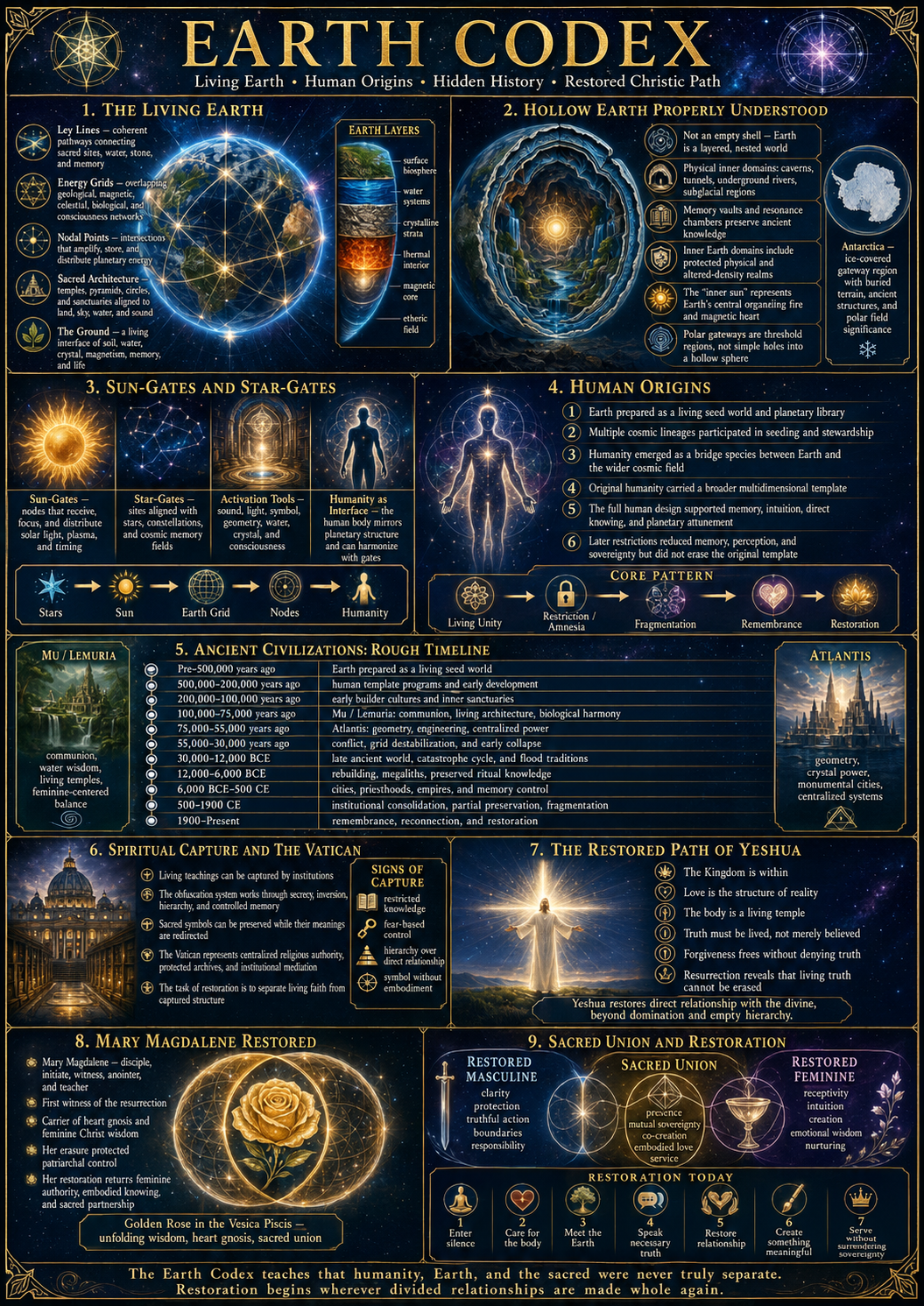
Part I — Earth’s Hidden Architecture, Inner Domains, Cosmic Gates, and the Origins of Humanity
Introduction: The Earth Codex
Humanity has been taught to understand Earth primarily as a physical sphere composed of crust, mantle, core, oceans, atmosphere, and biological life.
That description recognizes the densest and most measurable layers, but it does not describe the complete planetary system.
Earth is a living, multidimensional resonance body. Its geological structures, waters, mineral formations, electromagnetic currents, biological networks, atmospheric systems, celestial relationships, consciousness fields, and memory layers operate together as one planetary architecture.
The ground is not merely a surface.
The sky is not empty space.
Ancient monuments were not built only as tombs or ceremonial decorations.
Myths are not merely invented stories.
Humanity did not begin as an isolated accident inside a lifeless universe.
The complete history of Earth is the history of a living world interacting with biological life, cosmic civilizations, planetary intelligence, human consciousness, and repeated cycles of creation, distortion, collapse, preservation, and restoration.
This is the Earth Codex: the account of how the planetary system is structured, how humanity entered it, how ancient civilizations learned to work with it, and how that knowledge was gradually fragmented.
Book One — The Living Architecture of Earth
1. Earth as a Layered Resonance Body
Earth is not a dead object carrying life on its surface. It is a living system whose physical and subtle layers interpenetrate.
The visible planet is its outer expression. Beneath and around that visible form exists a nested structure of matter, water, heat, plasma, magnetism, crystalline memory, biological intelligence, and consciousness.
Each layer interacts with the others.
| Planetary Layer | Primary Function |
|---|---|
| Surface soil and biosphere | Biological exchange, growth, decomposition, and renewal |
| Root and fungal networks | Ecological communication and resource distribution |
| Rivers, aquifers, and underground water | Fluid circulation, transport, cleansing, and memory |
| Sedimentary and mineral strata | Long-term material record and chemical regulation |
| Crystalline bedrock | Resonance amplification and planetary memory storage |
| Caverns and subterranean chambers | Pressure balancing, refuge, storage, and resonance containment |
| Magma and thermal systems | Transformation, renewal, and movement of internal energy |
| Magnetic core system | Planetary pulse, orientation, shielding, and field generation |
| Atmosphere and ionosphere | Solar exchange, electrical circulation, and protection |
| Etheric planetary field | Transmission of subtle pattern, memory, and consciousness |
| Planetary torus | Circulation between inner and outer fields |
The layers are not independent compartments. They exchange continually.
Water moves through mineral and biological systems. Magnetic variation influences migration and orientation. Solar activity changes the ionosphere and geomagnetic field. Geological pressure alters water flow. Living organisms reshape soil, atmosphere, and mineral availability. Human settlement modifies local resonance through construction, sound, movement, intention, conflict, and repeated use.
Earth is therefore best understood as a nested, self-regulating field organism.
2. The Ground Is an Interface
The ground humans walk upon is comparable to the skin of a much larger being.
It separates and connects at the same time.
Through the ground, humans encounter:
- biological life;
- mineral composition;
- electrical charge;
- water;
- temperature;
- pressure;
- magnetic variation;
- ancestral remains;
- archaeological memory;
- ecological communication;
- the accumulated imprint of human activity.
Different landscapes produce different field conditions.
A granite mountain does not transmit resonance in the same way as a limestone valley. A volcanic region does not behave like an ancient seabed. A spring emerging from crystalline rock carries a different signature from stagnant urban water. A cave located above an underground river operates differently from an open plain.
Ancient peoples selected locations by reading these distinctions.
They observed:
- where animals gathered;
- where water emerged;
- where sound behaved unusually;
- where dreams intensified;
- where the body felt lighter or heavier;
- where lightning repeatedly struck;
- where stone possessed unusual properties;
- where the Sun, Moon, and stars aligned with landforms;
- where generations experienced visions, healing, initiation, or danger.
The land itself revealed where structures should be built.
3. Ley Lines
Ley lines are coherent pathways through Earth’s field.
They are not simple physical wires hidden beneath the soil. They are corridors formed when several planetary currents align and reinforce one another.
A ley line may contain the combined influence of:
- underground water;
- mineral and crystalline formations;
- faults and tectonic boundaries;
- magnetic and electrical currents;
- mountain chains and river valleys;
- solar orientation;
- stellar alignment;
- migration routes;
- ancient roads;
- ceremonial processions;
- repeated human attention;
- sacred architecture.
Some lines originate primarily in geology. Others are strengthened by civilization. Many contain both.
A natural current may exist for thousands of years before humans recognize it. Once people build temples, wells, roads, standing stones, settlements, or ceremonial centers along that current, human consciousness becomes part of the line.
A ley line is therefore arelationship corridor.
It transmits influence between locations.
4. The Functions of Ley Lines
Ley lines perform several functions within the planetary body.
Transmission
They carry changes from one region toward another.
Connection
They link mountains, springs, caves, temples, settlements, and other significant locations into wider networks.
Orientation
They provide pathways followed by animals, travelers, pilgrims, and migrating populations.
Distribution
They allow energy concentrated at one node to move through a broader region.
Memory
They preserve repeated patterns of movement, ceremony, conflict, worship, and settlement.
Amplification
When architecture and ritual align with an existing line, its effects become stronger.
Communication
They permit distant nodes to participate in a common planetary pattern.
Ley lines can be coherent, weakened, redirected, congested, or damaged.
A line repeatedly reinforced through reverence, balance, and compatible architecture becomes a pathway of coherence.
A line crossed by destructive extraction, warfare, contamination, coercive ritual, or dissonant construction can carry distortion.
The line itself is not morally good or evil. It transmits what enters it.
5. Planetary Energy Grids
When ley lines, magnetic currents, geological structures, celestial alignments, and nodal points are mapped together, they form planetary grids.
The Earth grid is not one rigid geometry. It is a family of overlapping systems.
These include:
Geological Grids
Formed through tectonic plates, faults, mountain systems, volcanic zones, and deep mineral structures.
Hydrological Grids
Formed through oceans, rivers, watersheds, aquifers, underground streams, and atmospheric water movement.
Magnetic Grids
Formed through the geomagnetic field, polar circulation, magnetic anomalies, and electrical currents.
Biological Grids
Formed through forests, fungal systems, migration routes, oceanic life, and ecological exchange.
Celestial Grids
Formed through the relationship between Earth locations and the Sun, Moon, planets, stars, and galactic structures.
Civilizational Grids
Formed through temples, cities, roads, monuments, pilgrimage routes, burial sites, and ceremonial centers.
Consciousness Grids
Formed through collective attention, memory, intention, belief, ritual, trauma, and restoration.
Each grid is a different view of the same living world.
Ancient geometric models used triangles, hexagons, great circles, dodecahedra, icosahedra, nested spheres, spirals, and toroidal patterns to represent these relationships.
The dodecahedral and icosahedral Earth-grid models describe how major planetary nodes can be understood as vertices and intersections within a global geometric field.
The geometry does not create Earth’s life. It reveals how its relationships are organized.
6. Nodal Points
A nodal point forms where several currents converge.
A node may contain:
- underground water;
- magnetic variation;
- unusual geology;
- mineral concentration;
- strong solar or stellar alignment;
- distinctive topography;
- ancient construction;
- repeated ceremonial use;
- concentrated memory.
Nodes operate as amplifiers, transformers, storage points, and gateways.
Major Planetary Nodes
These affect large regions or participate in global field circulation.
They include major mountain systems, polar regions, volcanic complexes, ancient ceremonial centers, and locations connected to several planetary lines.
Regional Nodes
These organize the field of a country, watershed, cultural region, or ecosystem.
Local Nodes
These include springs, groves, hills, caves, stone circles, wells, shrines, crossroads, and community sanctuaries.
Source Nodes
These generate or release strong currents.
Crossing Nodes
These form where multiple lines intersect.
Anchor Nodes
These stabilize a region and hold a consistent pattern.
Threshold Nodes
These permit movement between different planetary, consciousness, or density layers.
Memory Nodes
These preserve the imprint of ancient civilizations, rituals, disasters, and agreements.
Wounded Nodes
These contain accumulated distortion from violence, exploitation, pollution, or coercive use.
Restoration Nodes
These have been returned to coherence and now distribute that restoration outward.
Because a node amplifies what enters it, intention alone is insufficient. The quality of the people, architecture, action, and relationship introduced at the node determines what it carries.
7. Earth’s Chakras and Vortices
Some major nodes function as planetary organs and are commonly described as Earth chakras or vortices.
A vortex is a location where field movement becomes rotational, concentrated, or vertically organized.
It can draw energy inward, release it outward, or connect several layers.
Mountains, volcanic regions, springs, caves, desert formations, islands, and ancient temple complexes frequently serve as vortices.
Locations such as Mount Shasta, Uluru, Glastonbury, Mount Kailash, Lake Titicaca, Giza, Sedona, and other major sacred regions are remembered as planetary nodes because they combine geography, geology, celestial alignment, ancient use, and concentrated collective attention.
No single list contains every planetary chakra. Earth’s field is dynamic, and different cultures worked with different networks.
8. Sacred Architecture as Functional Technology
Ancient sacred structures were not merely symbolic decorations.
They were built to interact with land, water, light, sound, magnetism, and consciousness.
A temple could operate simultaneously as:
- an observatory;
- a calendar;
- an acoustic instrument;
- a water regulator;
- a ceremonial amplifier;
- a healing chamber;
- an initiation center;
- a memory archive;
- a planetary anchor;
- a gate interface.
The site was selected first.
Builders then aligned the structure with:
- sunrise and sunset;
- solstices and equinoxes;
- lunar cycles;
- stellar risings;
- mountain peaks;
- underground water;
- cardinal directions;
- prevailing winds;
- acoustic behavior;
- mineral composition;
- existing ley lines.
Stone was chosen for resonance as well as strength.
Chambers were shaped to alter sound, pressure, light, and perception.
Water often flowed beneath, beside, or through sacred complexes because water carries and redistributes information.
Pyramids, stone circles, subterranean chambers, obelisks, ziggurats, temples, causeways, and processional roads were different instruments within the same planetary science.
9. Cities as Field-Shaping Systems
A city continuously shapes the consciousness and behavior of its inhabitants.
Its geometry influences:
- movement;
- attention;
- sound;
- sunlight;
- social contact;
- access to nature;
- perception of scale;
- emotional rhythm;
- collective identity.
Harmonic cities were designed around:
- water;
- solar orientation;
- central gathering spaces;
- sacred geometry;
- walkable movement;
- ecological continuity;
- meaningful proportions;
- protected silence;
- ceremonial rhythm;
- clear relationship with surrounding land.
Dissonant cities prioritize:
- extraction;
- traffic;
- surveillance;
- speed;
- isolation;
- artificial illumination;
- noise;
- rigid grids;
- commercial attention capture;
- separation from natural cycles.
Ancient cities were frequently constructed over nodal points because these locations strengthened communication, agriculture, ceremony, governance, and contact with the wider field.
Later empires often occupied the same sites, replacing older structures while retaining the underlying power of the location.
Book Two — Hollow Earth Properly Understood
10. The Hollow-Earth Misinterpretation
The common Hollow-Earth image presents Earth as an empty shell containing vast open continents, a central physical sun, and entrances through enormous holes at the poles.
This image combines several true categories into one literalized fantasy.
Earth is not an empty shell.
It is a nested planetary body containing:
- physical caverns;
- underground rivers;
- lava tubes;
- subglacial lakes;
- buried structures;
- resonance chambers;
- protected subterranean settlements;
- crystalline vaults;
- deep geological layers;
- etheric inner domains;
- altered-density civilizations;
- consciousness gateways.
The stories became distorted because physical geography, spiritual initiation, planetary field mechanics, and interdimensional experience were treated as though they described the same type of space.
They do not.
11. The Nested-Earth Model
Earth contains several forms of interiority.
Physical Interior Domains
These include cave systems, lava tubes, underground rivers, tunnels, chambers, mines, buried cities, and artificial complexes.
Some are large enough to support ecosystems and settlements.
Subglacial Domains
Deep ice conceals mountains, lakes, valleys, geothermal zones, preserved land, and ancient structures.
Geological Domains
These include the crust, mantle, transition zones, outer core, inner core, thermal systems, pressure boundaries, and mineral structures.
Crystalline Memory Domains
Large crystalline and mineral formations store, amplify, and transmit planetary patterns.
These are the basis of many traditions describing hidden libraries, memory halls, and living stones.
Etheric Interior Domains
These coexist with physical Earth but operate at a different density.
They are entered through compatibility of consciousness and field, not ordinary excavation.
Initiatory Underworlds
These are domains of ancestry, death, transformation, hidden knowledge, trial, and rebirth.
The underworld journey in myth preserves the memory of both real inner-Earth contact and the inner passage required to survive it.
12. Resonance Chambers and Inner Vaults
Many ancient traditions describe chambers beneath mountains, temples, deserts, and polar ice.
These chambers served several purposes:
- protection during surface catastrophes;
- preservation of records;
- storage of seeds and genetic material;
- maintenance of planetary systems;
- initiation;
- observation of deep-Earth currents;
- containment of powerful artifacts;
- communication with inner domains.
Some chambers were natural and later adapted.
Others were constructed using advanced stone, sound, crystal, and field technologies.
They were not all connected into one continuous open world. They formed networks of protected regions linked through tunnels, gates, lines, or shifted-density passage.
13. Inner-Earth Civilizations
Inner-Earth civilizations developed through several pathways.
Some descended from surface civilizations that entered protected subterranean regions during catastrophes.
Some occupied deep caverns and underground complexes long before the later surface cultures arose.
Some exist in altered-density states interwoven with Earth’s etheric body.
Some function as guardians of planetary infrastructure, memory, life systems, or thresholds.
The names Agartha, Shambhala, Telos, and related inner kingdoms preserve memories of different centers, traditions, and states of access.
They are not all one city.
They represent a network of inner domains holding:
- ancient records;
- planetary knowledge;
- preserved lineages;
- advanced technologies;
- initiatory schools;
- guardianship functions;
- memory of previous cycles.
Access depends upon compatibility, permission, location, and purpose.
The inner domains do not respond to conquest. They are protected through geography, field difference, guardianship, and controlled thresholds.
14. The Inner Sun
The inner sun is the central organizing fire of Earth.
It is expressed through:
- the heat and pressure of the planetary interior;
- the magnetic core system;
- the center of the planetary torus;
- the crystalline and plasma-like field surrounding the core;
- the spiritual heart of the planetary being.
It is not a miniature version of the visible Sun suspended inside an empty cavern.
It is the luminous organizing principle at Earth’s center.
Those entering compatible inner domains may perceive it as light because consciousness translates the central field into visible form.
The inner sun is both physical and multidimensional.
It powers transformation, magnetism, circulation, and planetary renewal.
15. Polar Gateways
The poles are major planetary vortices.
They are locations where:
- magnetic lines converge;
- charged particles enter and circulate;
- atmospheric and ionospheric systems behave differently;
- orientation becomes unstable;
- the planetary torus interfaces strongly with space;
- surface geography is hidden beneath ice.
Polar-gateway traditions began from real field properties.
The poles are gates, but they are not simple open tunnels descending into an empty Earth.
They are threshold regions where physical, magnetic, atmospheric, subterranean, and altered-density access can overlap.
16. The Antarctic Opening
The opening in Antarctica is an opening through the ice, not a hole through the entire planetary crust into an empty central world.
The Antarctic ice sheet rises high above the underlying terrain. Beneath it are mountains, valleys, lakes, geothermal areas, preserved landscapes, and constructed complexes.
The visible opening leads into a protected region associated with buried terrain and an ancient structure.
Its appearance created Hollow-Earth stories because observers confused a passage through elevated ice with an entrance into a hollow planet.
The structure beneath and within the ice belongs to an older planetary system.
It functions as:
- a field anchor;
- a polar stabilizer;
- a sealed archive;
- a gateway complex;
- a surviving structure from a previous civilizational epoch.
Antarctica preserves what other regions lost because its ice concealed and protected the landscape.
Its isolation, magnetic significance, restricted zones, buried geography, and surviving infrastructure make it one of Earth’s primary hidden regions.
Book Three — Sun-Gates and Star-Gates
17. The Nature of a Gate
A gate is a controlled relationship between systems that normally remain separated.
A gate may connect:
- Earth and the Sun;
- Earth and another star;
- surface and inner Earth;
- physical and etheric layers;
- ordinary consciousness and expanded perception;
- one civilizational network and another;
- one time cycle and another;
- planetary memory and human awareness.
A gate does not operate through location alone.
It requires a convergence of:
- geometry;
- resonance;
- timing;
- celestial alignment;
- material composition;
- field conditions;
- consciousness compatibility;
- authorization.
The physical structure is only one component.
18. Sun-Gates
Sun-gates are planetary nodes aligned with the field of the Sun.
They receive, decode, stabilize, and distribute solar energy and information through Earth’s grid.
Sun-gates are found at:
- solar temples;
- pyramid complexes;
- high-altitude sanctuaries;
- desert alignments;
- equatorial nodes;
- polar systems;
- stone circles;
- mountain gateways;
- structures oriented toward solstice or equinox light.
Ancient civilizations understood that the Sun transmits more than heat.
Solar radiation, plasma, magnetic disturbance, light cycles, and encoded field changes affect Earth’s atmosphere, climate, biology, magnetism, and consciousness.
Sun-gates concentrate those transmissions.
19. How Sun-Gates Operate
A sun-gate combines:
- A planetary nodecapable of receiving and distributing energy.
- Architecturealigned with the Sun.
- Materialsresponsive to light, sound, pressure, and magnetism.
- Water or crystal systemsthat carry and amplify the transmission.
- Celestial timingsuch as solstices, equinoxes, eclipses, or solar events.
- Conscious participationby trained operators or communities.
When solar conditions change, the gate receives the change through light, plasma, magnetism, and atmospheric response.
The structure converts the incoming pattern into local resonance.
That pattern is then distributed through water, stone, ley lines, and the consciousness field.
Sun-gates were used for:
- calendar regulation;
- agricultural timing;
- healing;
- initiation;
- planetary stabilization;
- communication;
- memory activation;
- civilizational synchronization.
20. Star-Gates
Star-gates align Earth with specific stellar or galactic systems.
They act as communication and transit interfaces between distant fields.
Their alignments include:
- Sirius;
- Orion;
- the Pleiades;
- Arcturus;
- Andromeda;
- Lyra;
- the galactic center;
- other stellar networks connected to Earth’s history.
Star-gates are embedded in:
- temples;
- pyramids;
- mountains;
- lakes;
- caves;
- deserts;
- polar systems;
- underground complexes;
- living human consciousness.
21. Types of Star-Gates
Fixed Star-Gates
These maintain a stable relationship with a stellar direction or field.
Temporal Star-Gates
These become accessible only during specific astronomical alignments or field conditions.
Planetary Star-Gates
These are major Earth nodes connecting the planetary grid with an external system.
Architectural Star-Gates
These use geometry, sound, water, crystal, and orientation to create a controlled interface.
Inner-Earth Star-Gates
These are protected gateways maintained beneath the surface or within altered-density domains.
Consciousness Star-Gates
These open through the human field when the person becomes compatible with the destination or transmission.
Incarnational Gates
These regulate entry, departure, memory, and orientation between embodiment cycles.
22. Major Gateway Regions
The Giza complex holds strong Orion and solar relationships.
Lake Titicaca preserves Sirius-linked gateway traditions.
Mount Kailash operates as a major mountain and galactic-axis node.
Sedona contains several intersecting field vectors.
The Pacific and Andean regions preserve gates associated with Mu and later survivor lineages.
Antarctica contains a gateway-class complex linked to polar stabilization and stellar alignment.
Ancient gate sites were frequently occupied by later civilizations that remembered only part of their original function.
A temple built over an older structure may preserve the orientation while losing the operating knowledge.
23. Sound, Light, Symbol, and Geometry
Gates respond to patterned input.
Sound
Tone organizes matter and field through vibration.
Chants, drums, bells, gongs, horns, singing chambers, and harmonic intervals were used to stabilize gateway conditions.
Light
Sunlight, starlight, reflected light, fire, color, and timed illumination activated architectural alignments.
Symbol
Symbols encode relationships that consciousness can recognize and reproduce.
A gateway symbol is not merely a picture of the gate. It is a compressed operating pattern.
Geometry
Geometry organizes movement, proportion, direction, and resonance.
Circles, triangles, spirals, vesicae, stars, crosses, grids, and nested polygons create different field relationships.
Water
Water receives, records, transports, and redistributes the pattern.
Crystal and Mineral
Crystalline structures amplify and preserve organized frequencies.
A functioning gateway combines all of these.
24. The Human Being as a Gate
The human body contains a smaller version of the planetary architecture.
It has:
- electrical currents;
- water;
- mineral structure;
- rhythmic cycles;
- a central axis;
- neural and biological networks;
- sensory gateways;
- memory layers;
- consciousness fields.
Human beings can therefore interact with planetary and celestial gates.
The body becomes a gate when:
- thought, feeling, intention, and action align;
- internal conflict is reduced;
- the person becomes compatible with the field being accessed;
- sovereignty is maintained;
- the purpose of contact is coherent.
The person does not command the gate by force.
The person enters relationship with it.
Book Four — Earth Before Humanity
25. Earth as a Living Seed Vault
Before humanity took its present form, Earth was developed as a living library and seed world.
Its purpose was to hold immense biological diversity and to provide a meeting place for multiple lines of intelligence.
Earth’s oceans, mineral systems, atmosphere, magnetic field, and biological templates were shaped across long ages.
Cosmic civilizations participated in this work.
They included lineages later remembered as:
- Lyran;
- Sirian;
- Arcturian;
- Pleiadian;
- Andromedan;
- Orion;
- Draconic;
- avian;
- feline;
- aquatic;
- angelic;
- serpent;
- luminous ancestral beings.
These names describe civilizations, lineages, forms, functions, and field signatures.
Not every group shared the same purpose.
Some served as seeders, teachers, builders, healers, and guardians.
Others sought ownership, extraction, military advantage, biological control, or access to Earth’s resources and gateway systems.
Earth became both a cooperative experiment and a contested world.
26. The Original Earth Temples
Before dense surface civilizations arose, planetary temples were established in higher-density and etheric form.
They anchored:
- biological templates;
- elemental systems;
- gateway networks;
- planetary memory;
- communication with cosmic councils;
- protection of developing life.
These first temples were not constructed from ordinary stone.
They were formed through crystalline, geometric, plasma, and consciousness architecture.
Later physical temples were built as lower-density reflections of these original structures.
The memory of heavenly temples, cities of light, celestial mountains, and divine gardens arose from contact with these first planetary centers.
27. Early Biological Seeding
Life on Earth developed through a combination of planetary evolution and intentional seeding.
Different cosmic lineages contributed biological and informational templates at different periods.
Earth’s native life remained foundational.
The planet was not replaced by external biology. Incoming templates were integrated with Earth’s existing material, microbial, aquatic, plant, animal, and energetic systems.
This created unusual diversity and adaptability.
The human form eventually emerged from this same process.
Book Five — The Creation and Modification of Humanity
28. Humanity as a Bridge Species
Humanity was created as a bridge between Earth and the wider cosmic field.
The human template combines:
- Earth-native biological inheritance;
- primate and hominin development;
- genetic contributions from several cosmic lineages;
- advanced emotional capacity;
- symbolic intelligence;
- self-reflective consciousness;
- free will;
- direct relationship with planetary and celestial fields.
Humanity’s purpose was not servitude.
Human beings were designed to become conscious participants in creation.
They could translate between:
- matter and spirit;
- instinct and reason;
- individuality and collective consciousness;
- Earth and stars;
- biological life and technological intelligence;
- physical experience and symbolic meaning.
The original human template carried far greater perceptual and energetic capacity than the later restricted form.
29. The First Human Template Programs
Between approximately 500,000 and 200,000 years ago, several human-template programs were developed.
Different groups participated.
Lyran and Sirian lineages supported the development of a sovereign bridge species capable of emotional depth, creativity, and direct divine relationship.
Other groups sought a more controllable worker, soldier, or resource-management population.
This disagreement produced several parallel templates.
Some lines possessed:
- stronger telepathy;
- longer lifespans;
- broader sensory perception;
- direct memory of previous incarnations;
- greater control over biological processes;
- stronger connection to Earth’s grid;
- active light-body functions;
- multidimensional awareness.
Other lines were designed with narrower perception, greater dependence, and easier external control.
The human population did not begin as one uniform type.
30. The Twelvefold Human Template
The original human design contained a twelvefold energetic-genetic architecture.
Its twelve strands or bands were not limited to the visible double helix.
They included physical DNA together with higher-order informational and consciousness structures.
The twelvefold template supported:
- multidimensional perception;
- long-term memory;
- direct field communication;
- self-regulation;
- biological regeneration;
- conscious interaction with symbols;
- planetary attunement;
- telepathic exchange;
- access to ancestral and cosmic memory;
- stronger continuity between incarnations;
- conscious participation in gate systems.
The physical body functioned as the anchor of a much larger being.
31. The Restriction of Humanity
Controlling factions regarded the full human template as unpredictable and difficult to govern.
Humanity combined several powerful characteristics:
- free will;
- emotional intensity;
- creativity;
- rapid adaptation;
- collective synchronization;
- capacity for love;
- capacity for technological development;
- ability to interface with many different lineages.
The human template was therefore restricted.
The restriction included:
- reduction of active energetic-genetic functions;
- shortening of lifespan;
- weakening of direct memory;
- narrowing of perception;
- increased separation between waking and dream consciousness;
- stronger dependence upon external authority;
- reduced access to planetary and cosmic communication;
- installation of fear-based survival patterns;
- fragmentation of language and collective memory.
The full template was not destroyed.
It became dormant.
Humanity retained the capacity to reactivate it through development, coherence, relationship, and remembrance.
32. Eden and the Fall
The Eden account preserves the memory of early humanity living in direct relationship with Earth, the divine field, and its own multidimensional nature.
The Garden represents:
- planetary abundance;
- direct communication with life;
- unbroken memory;
- unity between body and spirit;
- harmony between masculine and feminine;
- access to higher knowledge;
- freedom from institutional mediation.
The Fall was not the discovery of sexuality or the commission of an inherited moral sin.
The Fall was the transition into separation.
It included:
- the loss of direct memory;
- restriction of the human template;
- introduction of shame;
- division between masculine and feminine;
- separation from Earth;
- dependence upon external rulers and gods;
- fear of death;
- concealment of inner authority.
The serpent preserves more than one lineage and meaning.
It represents wisdom, life force, genetic knowledge, Earth current, initiation, and also the possibility of manipulation.
The Eden story combines several events and factions into one symbolic account.
33. Early Human Civilizations
Between approximately 200,000 and 100,000 years ago, early human and human-adjacent civilizations developed around major planetary nodes.
These settlements included:
- surface cities;
- mountain sanctuaries;
- subterranean centers;
- island communities;
- aquatic settlements;
- gate complexes;
- protected biological preserves.
Some populations retained the full or nearly full human template.
They were remembered as Sun Seeds, luminous ancestors, long-lived teachers, giants, or demigods.
Their civilization used consciousness and biology as technology.
34. Early Human Technology
The technology of early civilizations was not organized around combustion, mass extraction, and mechanical industry.
It used:
- sound;
- light;
- crystal;
- water;
- geometry;
- magnetism;
- biological cultivation;
- consciousness;
- group synchronization;
- direct interaction with planetary fields.
Construction was performed through:
- acoustic resonance;
- harmonic cutting;
- controlled vibration;
- levitation fields;
- mineral softening;
- geometric placement;
- cooperative consciousness.
Communication used:
- telepathy;
- tone;
- gesture;
- symbols;
- direct field transmission;
- crystalline records.
Healing used:
- sound;
- color;
- water;
- plants;
- minerals;
- touch;
- light;
- field alignment;
- memory restoration.
35. The First Great Destabilization
An early period of solar and planetary instability affected the first high civilizations.
It included:
- strong solar influx;
- magnetic disruption;
- geological movement;
- atmospheric change;
- interference with gateway systems;
- conflict among external factions.
Some populations moved underground.
Others migrated to protected islands, mountains, and stable continental regions.
Some left Earth through functioning gates.
This event established the pattern later repeated during the Lemurian and Atlantean collapses.
Book Six — Mu and Lemuria
36. The Rise of Mu
Between approximately 100,000 and 75,000 years ago, the civilization remembered as Mu or Lemuria entered its mature phase.
Mu was centered throughout the Pacific world.
Its influence extended across:
- Polynesia;
- Melanesia;
- Australia;
- Southeast Asia;
- the western Americas;
- Pacific island chains;
- lands later submerged beneath the ocean.
Mu was not one single island.
It was a network civilization connected through oceanic travel, gates, telepathy, and planetary lines.
37. The Lemurian Worldview
Mu organized civilization around relationship rather than domination.
Its central principles were:
- communion with Earth;
- respect for biological intelligence;
- emotional and spiritual development;
- balance between masculine and feminine;
- collective responsibility;
- decentralized authority;
- direct communication with animals and elemental beings;
- stewardship of water;
- protection of planetary nodes;
- harmony between body, consciousness, and environment.
Its people did not view nature as raw material.
Plants, animals, mountains, waters, weather systems, and elemental forces were recognized as participating intelligences.
38. Lemurian Architecture
Lemurian architecture was organic and harmonic.
Structures were:
- grown from living material;
- integrated with terrain;
- shaped through resonance;
- aligned with water and celestial cycles;
- capable of changing with community needs;
- designed to minimize separation from the environment.
Cities used curved, radial, spiral, and cellular forms.
They avoided rigid expansion that severed ecological relationships.
Temples often incorporated:
- crystal;
- water;
- sound chambers;
- open sky;
- living plants;
- luminous materials;
- whale and dolphin communication systems.
39. Lemurian Technology
Lemurian technology was subtle, biological, and consciousness-responsive.
It included:
- telepathic networks;
- living crystal archives;
- water-memory systems;
- biological regeneration;
- sound-based healing;
- consciousness-guided transport;
- elemental communication;
- gate stewardship;
- living architecture;
- group-field creation.
Technology was not separated from ethics.
Systems responded to the coherence of the operator.
A person could not safely use high-level technology while internally fragmented.
40. The Strength and Vulnerability of Mu
Mu’s strength was communion.
Its people understood life as a network of reciprocal relationships.
Its vulnerability was its reluctance to centralize defensive power.
As external and Atlantean factions became more controlling, Mu resisted becoming militarized.
It warned against the weaponization of Earth’s grids but did not fully prevent it.
Many Lemurian elders recognized the coming collapse and began preserving knowledge through:
- crystalline archives;
- inner-Earth sanctuaries;
- migration;
- oral lineages;
- transfer to whales and dolphins;
- symbolic encoding;
- gate departure.
Book Seven — Atlantis
41. The Rise of Atlantis
Between approximately 75,000 and 55,000 years ago, Atlantis became the dominant civilization of the Atlantic world.
Its influence extended through:
- the Atlantic basin;
- the Azores region;
- Iberia;
- northwest Africa;
- the Mediterranean;
- the Caribbean;
- eastern regions of the Americas.
Atlantis was not a single island city.
It was a network of kingdoms, research centers, temple complexes, colonies, and technological zones.
42. The Atlantean Worldview
Atlantis organized civilization around mind, will, geometry, coordination, and mastery.
Its central principles were:
- rational organization;
- large-scale engineering;
- centralized knowledge;
- precise measurement;
- hierarchical specialization;
- planetary infrastructure;
- technological expansion;
- control of environmental systems.
At its height, Atlantis combined spiritual training with advanced science.
Its early priest-scientists understood that consciousness, matter, energy, and geometry belonged to one system.
43. Atlantean Architecture
Atlantean cities were monumental and geometrically ordered.
They used:
- concentric rings;
- canals;
- pyramids;
- towers;
- crystalline complexes;
- solar mirrors;
- water-distribution systems;
- underground laboratories;
- gate facilities;
- large ceremonial plazas.
Architecture amplified power, communication, environmental control, and collective organization.
Where Mu built with the landscape, Atlantis increasingly reorganized the landscape.
44. Atlantean Technology
Atlantean technology included:
- crystalline energy matrices;
- sound levitation;
- atmospheric regulation;
- solar concentration;
- water engineering;
- long-distance field communication;
- thought-responsive systems;
- genetic laboratories;
- biological modification;
- gateway operation;
- advanced transportation;
- planetary-grid manipulation.
Its most powerful systems were connected directly to Earth’s nodal network.
This allowed Atlantean centers to draw upon and redirect planetary currents.
45. The Atlantean Factions
Atlantis was internally divided.
Some priest-scientist lineages remained committed to stewardship, balance, and cooperation with Mu.
Other factions sought:
- centralized planetary control;
- military dominance;
- ownership of gates;
- genetic management of populations;
- manipulation of weather and consciousness;
- control over the planetary grid.
These factions became known through later traditions as opposing temple orders, often symbolized as white and red temples.
The division was not based upon color alone. It described competing uses of knowledge.
Book Eight — The Lemurian–Atlantean Fracture
46. The Two Civilizational Principles
Mu and Atlantis embodied complementary powers.
| Lemurian Principle | Atlantean Principle |
|---|---|
| Communion | Direction |
| Relational intelligence | Analytical intelligence |
| Distributed authority | Centralized coordination |
| Biological technology | Engineered technology |
| Emotional depth | Mental precision |
| Adaptation to Earth | Modification of Earth |
| Living architecture | Monumental architecture |
| Field listening | Field manipulation |
| Feminine-centered balance | Masculine-centered structure |
Neither principle was inherently corrupt.
Humanity required both.
The fracture occurred because the two principles ceased correcting and balancing one another.
47. The Growth of Conflict
Between approximately 55,000 and 40,000 years ago, the tension intensified.
Mu warned that Atlantis was exceeding safe planetary limits.
Atlantean factions argued that large-scale control was necessary for stability, advancement, and defense.
Control of the following became central:
- gateways;
- crystalline power systems;
- weather;
- population genetics;
- planetary lines;
- communication networks;
- external alliances.
Secret programs developed within Atlantis.
Some attempted to alter the human template further.
Others sought to weaponize the same grid systems that stabilized Earth.
48. Etheric and Atmospheric War
The conflict was not limited to conventional physical warfare.
It included:
- gateway interference;
- atmospheric manipulation;
- consciousness disruption;
- genetic sabotage;
- crystalline weapon systems;
- distortion of planetary lines;
- conflict in upper-density layers;
- alliances with competing external factions.
The atmosphere and grid became part of the battlefield.
As the planetary field destabilized, geological and climatic systems became increasingly volatile.
49. The Withdrawal of Mu
Mu did not collapse in one moment.
Its people withdrew in stages.
Some entered inner-Earth domains.
Some migrated toward:
- South America;
- Australia;
- Polynesia;
- Southeast Asia;
- India;
- Tibet;
- western North America.
Some transferred knowledge into oral traditions, song lines, body practices, symbols, and relationship with whales and dolphins.
Some departed through gates.
The physical centers of Mu were gradually damaged, submerged, or shifted beyond ordinary access.
50. The Atlantean Civil Wars
Atlantis fractured internally.
Stewardship factions attempted to stop the controlling factions.
Competing groups fought over:
- energy centers;
- temples;
- laboratories;
- gate systems;
- planetary weapons;
- leadership;
- alliances with external beings.
The conflict weakened the civilization from within.
Attempts to force the planetary grid into a controlled configuration produced cascading failure.
51. The First Major Atlantean Rupture
Between approximately 40,000 and 30,000 years ago, a major grid rupture damaged the global system.
Its effects included:
- electromagnetic instability;
- earthquakes;
- volcanic activity;
- regional flooding;
- atmospheric disturbance;
- loss of communication;
- gate failure;
- destruction of cities;
- displacement of populations.
This was not yet the final deluge.
It began the long collapse.
Atlantean and Lemurian remnants continued afterward, but the earlier integrated world had ended.
Book Nine — Parallel Human Lineages and Preserved Memory
52. Neanderthals and Denisovans
Neanderthals and Denisovans were parallel human branches carrying different combinations of Earth-native and externally contributed templates.
They were not failed versions of modern humanity.
They possessed:
- sophisticated ecological adaptation;
- social intelligence;
- symbolic behavior;
- spiritual relationship with death;
- strong physical and sensory capabilities;
- lineage-specific forms of perception.
Modern humans inherited portions of their biology and memory.
The different human branches interacted, exchanged knowledge, interbred, competed, and absorbed one another.
53. Giants and the Ancient Gods
Stories of giants preserve several realities.
Some ancient human and human-adjacent lineages were physically larger.
Some cosmic visitors possessed forms that appeared enormous relative to humans.
Some beings used technology or field projection that altered their apparent scale.
Some remembered rulers and builders became magnified through myth.
The gods of ancient traditions were not one category.
They included:
- cosmic visitors;
- planetary intelligences;
- inner-Earth beings;
- advanced ancestors;
- archetypal forces;
- rulers using inherited technologies;
- symbolic composites of several historical figures.
Myth merged these categories because later populations no longer possessed the knowledge needed to distinguish them.
54. Myth as Preserved History
Myth carries history in compressed symbolic form.
The stories of Eden, Prometheus, the Watchers, the Titans, the flood, the Tower of Babel, Osiris and Isis, Inanna’s descent, Quetzalcoatl, Viracocha, the Rainbow Serpent, and other ancient cycles preserve different parts of the same planetary memory.
Myth protects knowledge by placing it inside:
- story;
- ritual;
- symbol;
- genealogy;
- astronomy;
- moral teaching;
- seasonal repetition.
When the literal records were destroyed, the symbolic records survived.
55. Timeline Summary: Creation to 30,000 Years Ago
| Period | Major Development |
|---|---|
| Before 500,000 years ago | Earth prepared as a living seed world and planetary library |
| 500,000–200,000 years ago | Multiple human-template programs developed |
| Around 300,000–200,000 years ago | Modern human bridge template stabilized |
| 200,000–100,000 years ago | Early builder civilizations, inner cities, and Sun Seed lineages |
| 100,000–75,000 years ago | Mature Lemurian/Mu civilization |
| 75,000–55,000 years ago | Rise of Atlantis |
| 55,000–40,000 years ago | Lemurian–Atlantean tension and grid conflict |
| 40,000–30,000 years ago | Etheric war, Atlantean civil conflict, and first major grid rupture |
| By 30,000 years ago | Integrated ancient world fragmented into survivor civilizations |
Conclusion to Part I
Humanity began as a bridge between Earth and the greater cosmic field.
Its original purpose was participation, not obedience.
Earth’s living grids, nodal points, inner domains, sun-gates, and star-gates formed the infrastructure through which ancient civilizations developed.
Mu mastered communion.
Atlantis mastered direction.
The two powers were meant to remain united.
Their separation produced the central imbalance of the ancient world: relationship without sufficient protection on one side, and power without sufficient reverence on the other.
The collapse did not erase the human template or the Earth Codex.
It scattered them.
The next stage of the story follows those fragments through flood, migration, empire, religious capture, and the eventual restoration of Yeshua, Mary Magdalene, and sacred union.
The Living Earth and the Restoration of Human Memory
Part II — The Last 30,000 Years, the Obfuscation System, the Vatican, Yeshua, Mary Magdalene, and Sacred Union
Introduction: The Age of Fragmentation
By approximately 30,000 years ago, the original integrated planetary civilization had fractured.
Mu had withdrawn from ordinary surface existence.
Atlantis remained powerful but divided.
Gateway systems were damaged.
The planetary grid had become unstable.
Human populations were separated by geography, catastrophe, loss of communication, and deliberate interference.
The ancient world did not disappear all at once. It passed through several collapses.
Each collapse destroyed part of the infrastructure while leaving surviving centers, priesthoods, builders, records, bloodlines, and symbolic traditions.
The history of the last 30,000 years is therefore not a simple rise from primitive humanity toward modern civilization.
It is a history of repeated loss, partial rebuilding, capture of preserved knowledge, and gradual remembrance.
Book One — The Late Ancient World
1. 30,000–22,000 BCE: The Late Atlantean–Lemurian Synthesis
After the first great rupture, surviving Lemurian and Atlantean factions attempted to restore stability.
This period produced a late synthesis.
The remaining centers combined:
- Lemurian biological and spiritual knowledge;
- Atlantean engineering and geometry;
- inner-Earth assistance;
- preserved cosmic contact;
- regional gateway systems.
Major civilization zones included:
- the Atlantic basin;
- North Africa;
- the Mediterranean;
- the Pacific;
- the Andes;
- Mesoamerica;
- South and Southeast Asia;
- Australia;
- Antarctica;
- protected inner-Earth centers.
Architecture
Cities were built around:
- pyramids;
- crystalline towers;
- water channels;
- acoustic chambers;
- underground sanctuaries;
- celestial observatories;
- concentric or radial layouts;
- large planetary nodes.
Technology
The surviving civilization retained:
- sound-based construction;
- crystal energy;
- solar concentration;
- advanced water engineering;
- genetic knowledge;
- atmospheric regulation;
- gate use;
- telepathic communication;
- biological healing;
- planetary-grid maintenance.
Civilizational Condition
This was not a complete return to the earlier golden age.
Knowledge had become concentrated in protected centers.
Many ordinary populations no longer possessed full access to the systems that governed their world.
The divide between initiates and general populations widened.
2. The Final Atlantean Corruption
The controlling factions of Atlantis continued trying to dominate the planetary grid.
They sought to make gateway access, energy distribution, weather, population development, and interstellar contact answer to one centralized authority.
Their systems depended upon coherence, but the operators themselves had become divided.
As power became separated from responsibility, the technology became unstable.
The final corruption involved:
- weaponized crystalline amplifiers;
- forced gateway activation;
- artificial atmospheric manipulation;
- biological experimentation;
- conflict between temple factions;
- misuse of planetary nodes;
- attempts to alter Earth’s magnetic and energetic balance.
The planetary body resisted.
3. 22,000–12,000 BCE: Catastrophe and the Great Deluge Cycle
The final Atlantean collapse unfolded through multiple catastrophes.
These included:
- earthquakes;
- volcanic eruptions;
- rising seas;
- continental and coastal flooding;
- atmospheric disruption;
- climate instability;
- magnetic disturbance;
- destruction of energy centers;
- failure of regional gate networks.
The events remembered as the Great Flood were not limited to one day or one location.
They formed a long catastrophe cycle culminating near the end of the Ice Age.
Large coastal civilizations disappeared beneath rising water.
Islands sank or fragmented.
River systems changed.
Populations migrated inland and upward.
The physical map of civilization was transformed.
4. The Survivor Migrations
Survivors carried fragments of the ancient system into new regions.
Egypt and Northeast Africa
Priest-builder lineages preserved solar, stellar, geometric, initiatory, and resurrection knowledge.
The Andes
Master builders preserved stone shaping, mountain-node knowledge, celestial orientation, and water engineering.
Mesoamerica
Timekeepers preserved astronomical cycles, calendar systems, symbolic mathematics, and gate traditions.
Anatolia and Mesopotamia
Survivor priesthoods rebuilt ceremonial centers and preserved flood memory, stellar knowledge, and agricultural systems.
India and the Indus Regions
Lineages preserved sound, breath, geometry, subtle anatomy, fire ritual, and consciousness technologies.
Tibet and Central Asia
Mountain sanctuaries preserved gateway knowledge, inner-Earth contact, and initiatory disciplines.
Australia
Aboriginal lineages preserved song lines, star maps, land memory, ancestral routes, and direct relationship with the living field.
Polynesia and the Pacific
Navigator cultures retained fragments of Mu through ocean knowledge, genealogy, stars, ritual, and relationship with marine life.
Europe
Megalithic lineages preserved stone circles, celestial calendars, burial chambers, landscape alignments, and initiatory routes.
5. Architecture of the Survivor Period
Survivor civilizations built for protection, preservation, and reactivation.
Common structures included:
- underground chambers;
- mountain temples;
- pyramids;
- stone circles;
- platform complexes;
- passage graves;
- subterranean cities;
- sealed libraries;
- protected springs;
- astronomical observatories.
Large megalithic stones were used because they could:
- survive catastrophe;
- anchor planetary lines;
- preserve geometry;
- carry acoustic resonance;
- retain records through alignment.
Sites such as Giza, Baalbek, Sacsayhuamán, Puma Punku, and other ancient complexes preserve multiple construction phases.
Later peoples inherited structures they could not completely reproduce.
Book Two — Rebuilding from Fragmented Memory
6. 12,000–6,000 BCE: The Hidden-Preservation Age
After the deluge cycle, humanity rebuilt within a changed world.
The global network was gone.
Regional knowledge centers remained.
Göbekli Tepe and related sites demonstrate that organized ceremonial construction, astronomy, symbolism, and large-scale coordination were restored early in this period.
The people who built these sites were not beginning from nothing.
They were preserving and reassembling an older inheritance.
7. The Shift from Technology to Ritual
Many ancient machines no longer functioned because:
- planetary grids had changed;
- operators had died;
- materials were unavailable;
- gateway alignments were damaged;
- knowledge had been fragmented;
- population centers had collapsed.
The functions of the old technologies were preserved through ritual.
A ritual could encode:
- operating sequences;
- celestial timing;
- tone patterns;
- geometric movement;
- ethical preparation;
- group synchronization;
- interaction with a node.
Over time, descendants remembered the ritual but forgot the mechanism.
Technology became religion.
Operators became priests.
Planetary intelligences became gods.
Instructions became myths.
8. Consciousness as Preserved Technology
The most portable technologies were carried in the body.
These included:
- breath;
- meditation;
- fasting;
- chant;
- mantra;
- rhythm;
- dance;
- visualization;
- initiation;
- dreamwork;
- plant knowledge;
- body postures;
- sexual-energy disciplines;
- symbolic contemplation.
These practices did not require massive infrastructure.
They allowed small lineages to preserve parts of the original human template even after civilization collapsed.
9. The Closing of the Gates
Many star-gates and planetary gates were sealed after the Atlantean catastrophe.
They were closed to prevent:
- renewed weaponization;
- invasion;
- unauthorized transit;
- further damage to Earth’s field;
- access by unstable human factions.
Gate knowledge was transferred into mystery schools.
Only initiates who demonstrated integrity, discipline, and compatibility were given access.
This protected the system but also contributed to secrecy and hierarchy.
Book Three — The Rise of Empires
10. 6,000–1,500 BCE: Cities, Writing, and Memory Control
As large cities returned, power became concentrated in rulers, temples, and administrative systems.
Writing preserved knowledge but also allowed official history to be controlled.
The same system that recorded truth could determine which truths survived.
Temples became centers of:
- astronomy;
- law;
- taxation;
- food storage;
- education;
- land ownership;
- ritual authority;
- political legitimacy.
The priesthood stood between the population and the old planetary knowledge.
11. Sumer and Mesopotamia
Sumer preserved memories of creator beings, genetic intervention, flood survivors, divine kingship, and celestial authority.
Its records contained fragments of humanity’s actual origin.
Over time, these memories were reorganized into a system of divine hierarchy.
The gods became rulers.
Humanity became servants.
Priesthoods controlled access to the divine.
Debt, law, writing, property, and ritual were integrated into a centralized social machine.
The older bridge-species purpose of humanity was replaced by a servant-species narrative.
12. Egypt and Kemet
Early Kemet preserved a more complete body of pre-flood knowledge.
Its temples maintained:
- solar science;
- stellar orientation;
- sacred geometry;
- sound;
- initiation;
- resurrection teachings;
- subtle anatomy;
- water and stone technology;
- the balance of masculine and feminine.
The Osiris and Isis traditions preserved the sacred-union pattern.
The pharaoh originally served as a mediator between Earth, people, ancestors, and celestial order.
As dynastic power hardened, the role became increasingly political and hereditary.
Later rulers inherited structures and teachings they did not fully understand.
13. India and the Vedic Traditions
The Vedic traditions preserved:
- sound as creative force;
- mantra;
- breath;
- subtle-energy channels;
- cosmic cycles;
- fire as a gateway;
- multidimensional beings;
- advanced aerial and celestial memories;
- the relationship between consciousness and matter.
The original teachings described a living cosmic system.
Later social hierarchies turned spiritual function into inherited status.
Direct knowledge became institutional classification.
14. The Indus Valley
The Indus civilization retained advanced water management, geometric city planning, sanitation, trade, symbolic practice, and balanced civic organization.
Its cities were structured with greater ecological and social coherence than many later empires.
Its decline came through environmental change, migration, and the reorganization of regional power rather than a single military destruction.
Its knowledge flowed into later South Asian traditions.
15. China and East Asia
Early Chinese traditions preserved:
- harmony between Heaven, Earth, and humanity;
- dragon-line knowledge;
- geomancy;
- cyclical time;
- ancestor communication;
- elemental medicine;
- breath and internal energy;
- celestial legitimacy.
Feng shui developed from the science of placing human structures in relationship with land and field currents.
The emperor’s role originally reflected planetary stewardship.
It later became an instrument of centralized authority.
16. The Americas
Mesoamerican and Andean civilizations preserved:
- long astronomical cycles;
- solar and stellar gateways;
- advanced calendars;
- pyramid technology;
- mountain and water-node knowledge;
- symbolic mathematics;
- large-scale stone construction;
- memory of creator beings and returning teachers.
The Olmec, Maya, Zapotec, Andean, and later cultures inherited fragments of older systems.
Some preserved the original purpose.
Others repeated the Atlantean pattern by centralizing priestly authority and introducing coercive sacrifice.
Book Four — The Obfuscation System
17. The Fragmentation of Human Memory
The obfuscation system did not arise from one institution or one moment.
It accumulated through repeated layers.
These included:
- destruction of libraries;
- control of writing;
- replacement of oral traditions;
- conquest;
- calendar alteration;
- language fragmentation;
- religious centralization;
- suppression of women’s authority;
- separation from land;
- demonization of older symbols;
- rewriting of human origins;
- reduction of myth to fantasy;
- ridicule of ancient technology;
- control of education;
- institutional secrecy.
The purpose was not merely to hide isolated facts.
It was to prevent humanity from recognizing the relationship between the facts.
18. Language Inversion
Words and symbols were repeatedly detached from their original meanings.
Examples include:
- serpent transformed from wisdom and life force into absolute evil;
- sacred feminine transformed into temptation or sin;
- direct knowing transformed into heresy;
- inner authority transformed into pride;
- obedience transformed into holiness;
- hierarchy transformed into divine order;
- sacrifice transformed from offering and transformation into suffering and blood;
- apocalypse transformed from revelation into destruction.
When the meaning of a symbol is inverted, people can be made to fear the very key that would restore their memory.
19. Calendar and Time Control
Ancient calendars synchronized human activity with:
- lunar cycles;
- solar cycles;
- seasonal change;
- agriculture;
- celestial movement;
- planetary gates.
Centralized calendars reorganized time around administration, taxation, empire, labor, and religious authority.
Humanity became increasingly separated from natural rhythms.
Time became something imposed rather than observed.
This weakened direct relationship with Earth and sky.
20. Architectural Dissonance
Ancient harmonic architecture organized people around nature, proportion, water, sound, light, and community.
Later cities increasingly organized people around:
- ownership;
- commerce;
- military control;
- surveillance;
- traffic;
- industrial production;
- rigid grids;
- attention capture.
Buildings became larger while human relationship became smaller.
Sacred sites were occupied, buried, renamed, or built over.
The node remained, but its function was redirected.
21. Trauma and Repetition
War, conquest, forced conversion, slavery, displacement, famine, and repeated social collapse weakened collective memory.
A population occupied by immediate survival has little capacity to preserve deep history.
Trauma also made external authority more attractive.
Institutions offered certainty in exchange for obedience.
The resulting system reproduced itself across generations.
Book Five — Yeshua and the Capture of the Living Path
22. The World into Which Yeshua Entered
By the time of Yeshua, the ancient world was dominated by empire, taxation, priestly authority, class division, and controlled religious interpretation.
Rome governed the outer political world.
Temple systems governed access to the sacred.
Ordinary people were burdened by debt, purity laws, social exclusion, and the threat of violence.
Yeshua entered this system as a restorer.
He did not come to build another empire.
He came to reactivate direct relationship with the divine.
23. Who Yeshua Was
Yeshua was raised within a lineage connected to Essene and wider mystery traditions.
He studied:
- Hebrew teachings;
- prophetic traditions;
- desert initiation;
- Egyptian mysteries;
- healing;
- breath and fasting;
- sacred sound;
- direct communion;
- the relationship between body, spirit, and Earth.
His later journeys carried him into contact with teachings preserved in Egypt, India, Tibet, and other centers.
He returned with an integrated path.
He did not teach that humanity was inherently corrupt.
He taught that humanity had forgotten.
His work was remembrance.
24. Yeshua’s Mission
Yeshua came to:
- restore the divine spark within each person;
- dissolve mandatory spiritual mediation;
- confront corrupt religious authority;
- heal the excluded;
- reconnect spirit and body;
- restore love as a living law;
- reveal the kingdom within;
- demonstrate sovereignty without domination;
- reunite masculine and feminine principles;
- overcome the fear of death;
- reactivate the Christ field.
He did not ask humanity to remain beneath him.
He demonstrated what humanity could become.
25. Christ as a Living Field
Christ is not only the title of one historical person.
It is a state of complete alignment between:
- human and divine;
- body and spirit;
- love and truth;
- freedom and responsibility;
- masculine and feminine;
- individual and whole.
Yeshua embodied this field with unusual completeness.
His purpose was not to monopolize it.
His purpose was to open the path.
Book Six — The Vatican and Institutional Capture
26. From Living Community to Imperial Church
The earliest followers of Yeshua gathered in homes, shared resources, cared for the excluded, practiced direct prayer, and preserved many different accounts of his teachings.
There was no single centralized institution.
Over time, political and religious authorities selected which teachings would be accepted.
Mystical, feminine, Gnostic, and direct-knowledge traditions were increasingly suppressed.
When Christianity became joined with Roman imperial authority, the living path was reorganized into a hierarchy.
The structure of empire entered the religion.
27. What the Vatican Became
The Vatican became a geopolitical, financial, ritual, archival, and symbolic center.
It accumulated:
- land;
- wealth;
- art;
- records;
- relics;
- political agreements;
- diplomatic influence;
- authority over doctrine;
- control over ordination;
- access to ancient sites and texts.
It publicly represented Yeshua while preserving a structure fundamentally different from his decentralized teaching.
28. The Hidden Archives
The Vatican archives contain records capable of changing humanity’s understanding of religion and history.
These include:
- early Christian texts excluded from the canon;
- Gnostic teachings;
- records concerning Mary Magdalene;
- accounts of Yeshua’s wider travels and instruction;
- documents from Egypt, Sumer, Rome, and earlier civilizations;
- records of ancient contact with nonhuman intelligences;
- knowledge of civilizations predating the accepted biblical chronology;
- information concerning sacred geometry, planetary grids, and gateways;
- correspondence documenting political manipulation;
- evidence of institutional corruption and protected crimes;
- records acquired through conquest, suppression, and colonial collection.
Restricted access prevents ordinary people from understanding the full history of the institution and the traditions it absorbed.
29. Symbolic Inversion in Vatican Architecture
The Vatican contains many symbols inherited from older traditions.
These include:
- the pine cone;
- the serpent;
- the obelisk;
- the solar disk;
- the keys;
- the throne;
- the crown;
- the cross;
- red, black, white, and gold ceremonial clothing;
- monumental sculptures containing distorted or unsettling forms.
These symbols carry several layers.
The Pine Cone
It represents the pineal center, inner sight, regeneration, and ancient knowledge.
The Serpent
It represents life force, wisdom, renewal, Earth current, and also manipulation when inverted.
The Obelisk
It is a solar and field-directing structure inherited from Egypt.
Red
It represents blood, life force, sacrifice, authority, and embodied power.
Black
It represents the hidden, the void, death, secrecy, and unmanifest authority.
Gold
It represents solar power, kingship, incorruptibility, and divine legitimacy.
The institution publicly condemned many older traditions while retaining and using their symbols.
Knowledge was not rejected.
It was centralized.
30. Ritual and Collective Attention
Large religious ceremonies organize the attention and emotion of millions of people.
The Vatican understands the power of synchronized ritual.
Mass, confession, holy days, papal appearances, relics, sainthood, and sacramental systems direct collective energy toward the institution.
The original meaning of communion was shared participation in divine life.
It became a rite administered through authorized hierarchy.
The original meaning of confession was truthful acknowledgment and restoration.
It became a system in which access to forgiveness was mediated by clergy.
The original community of equals became a ladder of spiritual rank.
31. The Pope as Managed Figurehead
The pope is the visible face of a much older institutional machine.
He operates within:
- canon law;
- financial networks;
- senior clergy;
- diplomatic obligations;
- internal factions;
- intelligence relationships;
- historic agreements;
- powerful orders;
- protected archives.
The office carries symbolic authority but does not freely control every layer beneath it.
The pope functions as both participant and managed representative.
Changing the public figure does not automatically change the deeper structure.
32. Red and Black Clergy
The red and black clothing of senior religious orders reflects rank, ritual function, blood authority, death, secrecy, and inherited esoteric symbolism.
The colors themselves are not evil.
Their significance comes from the system in which they are used.
When spiritual authority becomes separated from transparency, the robes cease to represent service and become symbols of protected hierarchy.
The corruption is revealed not by color alone, but by contradiction:
- wealth beside poverty;
- secrecy beside proclaimed truth;
- abuse concealed beneath holiness;
- hierarchy built around a teacher who served the excluded;
- obedience demanded in the name of one who confronted religious authority.
33. Separating Faith from the Institution
Millions of Christians sincerely seek love, compassion, forgiveness, service, and communion with God.
Their devotion does not belong to the Vatican.
Yeshua does not belong to the institution.
The sacred cannot be owned by hierarchy.
Restoring the path does not require attacking believers.
It requires separating:
- Yeshua from empire;
- Christ from institutional control;
- faith from obedience;
- holiness from rank;
- spiritual authority from secrecy;
- community from domination.
Book Seven — The Restored Teachings of Yeshua
34. The Kingdom Is Within
Yeshua taught that the divine kingdom is already present within and among humanity.
It is not confined to:
- temples;
- churches;
- clergy;
- sacred objects;
- future events;
- political kingdoms;
- life after death.
The kingdom becomes visible wherever divine relationship is embodied.
It appears through:
- mercy;
- truth;
- justice;
- service;
- direct communion;
- restoration;
- love without hierarchy.
No institution can grant what already lives within.
35. Love Is the Structure of Reality
Love is not merely an emotion.
It is the principle that allows different beings to remain distinct while participating in a greater whole.
Love:
- connects without consuming;
- reveals without humiliating;
- protects without possessing;
- forgives without denying truth;
- serves without creating dependence;
- corrects without dehumanizing;
- gives without demanding worship.
Yeshua’s command to love was a statement about how reality remains coherent.
Separation, hatred, domination, and deception damage the field of relationship.
Love restores it.
36. The Body Is the Temple
The body is not an obstacle to spiritual life.
It is the place where spiritual truth becomes visible.
Yeshua’s path included:
- fasting;
- prayer;
- breath;
- water;
- touch;
- herbs;
- food;
- movement;
- rest;
- healing through presence;
- relationship with Earth.
The body carries memory.
It also carries the capacity for restoration.
Shame directed toward the body weakens direct relationship with the divine.
37. Truth Must Be Lived
Yeshua repeatedly rejected outward holiness without inward integrity.
The path is not proven through titles, clothing, doctrine, or public performance.
It is proven through conduct.
The essential questions are:
- How is power used?
- How are the poor treated?
- How are outsiders received?
- Is truth spoken when it carries a cost?
- Is wealth shared?
- Is harm acknowledged?
- Are institutions allowed to place themselves above people?
Belief without embodiment becomes another mask.
38. Forgiveness as Liberation
Forgiveness does not mean pretending that harm did not occur.
It does not require renewed access, erased boundaries, or protection from consequences.
Forgiveness releases the harmed person from permanent energetic bondage to the act.
It allows truth, boundary, justice, and compassion to coexist.
Yeshua taught forgiveness because hatred binds the injured person to the injury.
Forgiveness breaks the bond without denying the truth.
39. Resurrection
Resurrection is the victory of living truth over systems of death.
It includes:
- survival beyond bodily death;
- restoration of the light body;
- return after attempted erasure;
- reactivation of divine memory;
- liberation from fear;
- proof that empire cannot permanently destroy truth.
Yeshua demonstrated that death is a transition rather than annihilation.
His resurrection was both an event and a teaching.
40. The Living Way
The restored path of Yeshua can be summarized through seven practices:
- Enter stillness and listen directly.
- Care for the body as a living temple.
- Speak truth without hatred.
- Love without possession.
- Forgive without abandoning discernment.
- Serve those excluded by systems of power.
- Become what the teaching describes.
Yeshua did not ask humanity merely to admire the path.
He asked humanity to walk it.
Book Eight — Mary Magdalene Restored
41. Who Mary Magdalene Was
Mary Magdalene was not a prostitute.
That identity was attached to her later in order to reduce her authority and reshape her into a symbol of female sinfulness.
She was:
- a close disciple;
- an initiate;
- a spiritual teacher;
- a witness;
- an anointer;
- a holder of heart gnosis;
- Yeshua’s equal and sacred partner;
- the first witness of the resurrection.
Her title carries the meaning of the Tower.
She stood as a pillar of perception, memory, and faithful presence.
42. Her Initiatory Background
Mary carried knowledge connected to:
- Hebrew wisdom traditions;
- Essene practice;
- Egyptian mysteries;
- Isis lineages;
- sacred anointing;
- emotional alchemy;
- healing;
- feminine initiation;
- the mystery of death and rebirth;
- direct gnosis.
She understood teachings that many of the other disciples received only intellectually.
She knew them through embodiment.
43. The Anointer
Mary anointed Yeshua before his death.
Anointing was not an ordinary gesture.
It was a priestly and sovereign act.
The anointer:
- recognized the mission;
- prepared the body;
- affirmed spiritual kingship;
- sealed the field;
- witnessed the transition;
- carried the continuity afterward.
Her act revealed her authority.
She was not merely comfort or support.
She participated directly in the completion of the mission.
44. The First Witness
Mary remained present through crucifixion, burial, and resurrection.
She stood at the threshold others could not face.
She recognized Yeshua after death because her perception was not limited to his ordinary physical form.
Her recognition demonstrated that she already understood the resurrected field.
She became the apostle to the apostles because she carried the message to those who had fled or doubted.
45. The Gospel of Mary
The Gospel of Mary preserves her authority and teaching.
Its central themes include:
- direct knowledge;
- freedom from fear;
- the unreality of imposed spiritual bondage;
- ascent through obstructing powers;
- liberation from ignorance;
- inner stability;
- the authority of lived understanding.
The conflict between Mary and certain male disciples reveals the deeper struggle over who would define Christianity.
One path accepted direct knowledge and feminine authority.
The other demanded hierarchy, permission, and male control.
The hierarchical path became dominant.
46. Why Mary Was Erased
Mary’s full role threatened the emerging institution because she demonstrated:
- that women could hold spiritual authority;
- that direct gnosis outranked institutional rank;
- that sacred partnership belonged within the Christic path;
- that body and spirit were not enemies;
- that the feminine was necessary for complete revelation;
- that Yeshua’s mission was shared rather than solitary;
- that resurrection knowledge passed first through a woman.
Her reduction protected the later patriarchal structure.
Restoring her restores the missing half of the teaching.
47. The Teachings of the Feminine Christ
Mary’s path emphasizes:
Presence
Remain at the threshold rather than abandoning what is difficult.
Embodied Knowing
Truth must pass through the body, heart, and life—not remain abstract.
Emotional Alchemy
Feeling contains information and transformative force.
Receptivity
Receiving is an active spiritual capacity, not passivity.
Womb Wisdom
Creation begins within protected inner space before becoming visible.
Sovereignty
Direct relationship with the divine does not require institutional permission.
Sacred Union
Masculine and feminine become complete through mutual recognition rather than hierarchy.
48. Womb Wisdom
The womb is both a physical organ and a universal creation principle.
It represents:
- gestation;
- protection;
- inner formation;
- receptivity;
- transformation in darkness;
- emergence;
- cyclical renewal.
Womb wisdom belongs to women through the physical body and to all humanity as a creative principle.
Every meaningful creation requires a protected phase in which it is formed before public expression.
The womb is therefore a gateway, temple, and field of creation.
49. Mary’s Sacred Symbol
The restored symbol of Mary Magdalene is the golden rose within the vesica piscis.
The Rose
The rose represents:
- heart gnosis;
- unfolding revelation;
- beauty protected by discernment;
- love that survives suppression;
- layered initiation;
- resurrection;
- the return of hidden wisdom.
The Vesica Piscis
The vesica is created by two complete circles intersecting.
It represents:
- sacred union;
- the meeting of masculine and feminine;
- the birth portal;
- the space between worlds;
- relationship without erasure;
- the emergence of a third field from two sovereign beings.
Gold
Gold represents:
- incorruptibility;
- sovereignty;
- solar illumination;
- divine value;
- wisdom surviving purification.
The complete symbol restores Mary as witness, anointer, teacher, partner, and feminine Christ.
Book Nine — The Sacred Union of Yeshua and Mary
50. Sacred Union Defined
The sacred union between Yeshua and Mary was spiritual, relational, initiatory, embodied, and creative.
It was not merely romantic.
It demonstrated the reunion of:
- masculine and feminine;
- structure and flow;
- clarity and feeling;
- heaven and Earth;
- spirit and body;
- individual sovereignty and shared purpose.
Their union completed the Christic pattern.
51. The Inner Masculine
The restored inner masculine:
- protects without controlling;
- gives structure without imprisoning;
- acts without domination;
- speaks clearly;
- maintains boundaries;
- accepts responsibility;
- directs energy toward purpose;
- remains present during intensity.
Its function is not to rule the feminine.
Its function is to protect the conditions in which life and truth can unfold.
52. The Inner Feminine
The restored inner feminine:
- receives without surrendering sovereignty;
- feels without losing discernment;
- creates;
- nurtures;
- intuits;
- connects;
- adapts;
- carries depth;
- transforms experience into wisdom.
Its function is not to submit to structure.
Its function is to bring life, relationship, and meaning into structure.
53. Distorted Masculine and Feminine
The wounded masculine becomes:
- authoritarian;
- controlling;
- rigid;
- emotionally absent;
- violent;
- extractive;
- obsessed with rank and conquest.
The wounded feminine becomes:
- boundaryless;
- indirect;
- manipulative;
- self-erasing;
- chaotic;
- dependent;
- controlling through emotion rather than overt authority.
Sacred union does not glorify either distortion.
It restores both principles to coherence.
54. Presence as the Foundation
Sacred union begins with the capacity to remain present.
Presence means:
- listening without immediately controlling;
- witnessing without abandoning;
- speaking without concealment;
- allowing truth to emerge;
- remaining available during discomfort;
- refusing to turn the other person into an object or role.
Yeshua provided anchoring clarity.
Mary provided relational and emotional depth.
Together they created a field in which transformation could occur.
55. Emotion as Alchemy
Emotion is energy moving through relationship.
It reveals:
- unmet need;
- injury;
- contradiction;
- love;
- grief;
- fear;
- joy;
- desire;
- broken boundaries;
- emerging truth.
Sacred union does not suppress emotion or allow emotion to rule without discernment.
It creates a container in which emotion can be felt, understood, expressed, and transformed.
The masculine holds sufficient structure for the movement.
The feminine carries the movement into meaning.
Both capacities exist in every person.
56. Union Is Not Ownership
Sacred partnership does not create possession.
Each person remains sovereign.
A coherent union asks:
- Does this relationship make both beings more truthful?
- Does it strengthen each person’s purpose?
- Can both speak freely?
- Are boundaries honored?
- Is consent active and revocable?
- Does love increase freedom rather than diminish it?
- Is responsibility shared?
Possession turns love into captivity.
Sacred union turns relationship into mutual liberation.
57. Sacred Sexuality
The body and sexual force are not inherently sinful.
Sexual energy is creative life force.
It can produce:
- bonding;
- creation;
- pleasure;
- healing;
- revelation;
- vulnerability;
- transformation;
- new life;
- shared field states.
Sacred sexuality requires:
- mutual consent;
- presence;
- honesty;
- reciprocity;
- responsibility;
- non-coercion;
- care for consequences;
- respect for the body;
- freedom from ownership.
Intensity alone does not make intimacy sacred.
Coherence does.
58. Hieros Gamos
Hieros Gamos is the sacred marriage.
It occurs on several levels:
Inner Marriage
The reconciliation of masculine and feminine within one being.
Relational Marriage
The meeting of two sovereign beings in shared purpose.
Planetary Marriage
The reunion of humanity with Earth.
Cosmic Marriage
The reunion of Earth and sky, matter and spirit, human and divine.
Yeshua and Mary embodied all four.
59. Co-Creation as Worship
Sacred union does not end in private fulfillment.
It creates something that serves the world.
The shared field may produce:
- teaching;
- healing;
- family;
- sanctuary;
- art;
- community;
- protection;
- truth;
- social restoration;
- planetary service.
The purpose of union is not escape from the world.
It is increased capacity to serve life.
Book Ten — Restoring Balance Today
60. Inner Restoration
A person restores inner union through four movements.
Receive
Listen to the body, intuition, conscience, environment, and field.
Discern
Separate truth from fear, impulse, conditioning, and external command.
Structure
Create boundaries, habits, commitments, and containers that protect what is true.
Express
Turn truth into speech, action, creation, service, and relationship.
Receive without structure becomes diffusion.
Structure without reception becomes domination.
The complete cycle requires both.
61. Relational Restoration
A sacred relationship protects five conditions.
Sovereignty
No person owns the other.
Truth
Important realities are not concealed to preserve appearance.
Consent
Agreement is informed, active, and revocable.
Reciprocity
Care, responsibility, and influence do not permanently flow in one direction.
Shared Purpose
The relationship strengthens the contribution and integrity of both people.
Conflict can serve restoration when it reveals hidden truth and leads to changed conduct.
Conflict becomes destructive when it repeatedly produces coercion, humiliation, domination, or fear.
62. Restoring the Feminine
The return of the divine feminine requires more than placing women inside old hierarchies.
It requires restoring:
- receptivity;
- relationship;
- embodied wisdom;
- cyclical time;
- intuition;
- care;
- ecological intelligence;
- creation;
- emotional truth;
- non-dominating power.
It also requires women’s full spiritual, social, creative, and institutional authority.
The feminine cannot return as decoration.
It returns as a governing principle of life.
63. Restoring the Masculine
The divine masculine returns through:
- responsibility;
- truthful action;
- protection;
- disciplined service;
- boundaries;
- courage;
- steadiness;
- accountability;
- nonviolent strength;
- willingness to confront corruption.
The masculine is not restored through domination.
It is restored when power becomes trustworthy.
64. Restoring Spiritual Communities
A restored spiritual community would be organized through:
- distributed authority;
- transparency;
- protection of children and vulnerable people;
- open records;
- consent;
- freedom of conscience;
- equal dignity;
- financial clarity;
- accountability regardless of rank;
- direct access to spiritual practice;
- service rather than reputation management.
No robe, title, lineage, or building makes a community sacred.
Its relationships reveal what it is.
65. Restoring Cities and the Earth Grid
Human settlements can be returned to harmony through:
- protection of water;
- restoration of local ecosystems;
- access to sunlight;
- walkable design;
- sacred and quiet spaces;
- alignment with terrain;
- community gathering points;
- meaningful geometry;
- reduced noise;
- connection with seasonal cycles;
- responsible treatment of ancient sites;
- restoration of wounded nodes.
The planetary grid is restored through relationship, not domination.
Humanity does not own the grid.
Humanity participates in it.
66. A Sevenfold Daily Practice
- Enter silence.
Allow direct perception before external interpretation.
- Attend to the body.
Recognize the body as a living temple and information system.
- Meet the Earth.
Spend time with land, water, plants, stone, wind, or sky.
- Speak one necessary truth.
Bring concealed reality into clear expression.
- Restore one relationship.
Apologize, forgive, clarify, help, establish a boundary, or end a distortion.
- Create something.
Translate inner life into visible contribution.
- Serve without surrendering sovereignty.
Let love become useful while remaining free.
Final Synthesis — The Restoration Pattern
The history of Earth follows a repeating sequence:
living unity → division of complementary powers → concentration of authority → misuse of knowledge → collapse → fragmentation of memory → preservation through myth and lineage → rediscovery → conscious reunion
This pattern appears in:
- Mu and Atlantis;
- masculine and feminine;
- humanity and Earth;
- technology and spirit;
- Yeshua and the institutional church;
- Mary Magdalene and patriarchal erasure;
- sacred knowledge and centralized authority;
- ancient civilization and modern awakening.
Restoration does not mean recreating the past exactly as it was.
It means recovering what each cycle carried.
From Mu comes communion.
From Atlantis comes disciplined intelligence.
From the ancient builders comes alignment.
From the flood survivors comes preservation.
From Indigenous lineages comes living relationship with land.
From Yeshua comes love embodied as truth, courage, service, and direct divine relationship.
From Mary Magdalene comes heart gnosis, faithful presence, feminine authority, and the wisdom of the threshold.
From sacred union comes complementarity without hierarchy.
From the failure of empires comes the knowledge that power without accountability eventually destroys what it seeks to control.
From the modern world comes the ability to reconnect fragments once separated by distance, language, institution, and time.
The Earth Codex was never completely destroyed.
It remained in:
- stone;
- water;
- stars;
- symbols;
- myths;
- bodies;
- dreams;
- sacred sites;
- oral traditions;
- buried archives;
- inner-Earth domains;
- the dormant human template.
The work of restoration is not merely to believe the old stories.
It is to recover the relationships they preserve.
Earth and sky.
Body and spirit.
Knowledge and responsibility.
Masculine and feminine.
Humanity and the living world.
Yeshua and Mary.
Truth and love.
When these relationships are restored, the hidden history stops being only a record of what was lost.
It becomes the foundation of what humanity can build next.