The Restoration of the Divine Feminine
A cosmic guide to the elevenfold return of the Divine Feminine through wisdom, sovereignty, sacred union, protection, joy, compassion, and wholeness.
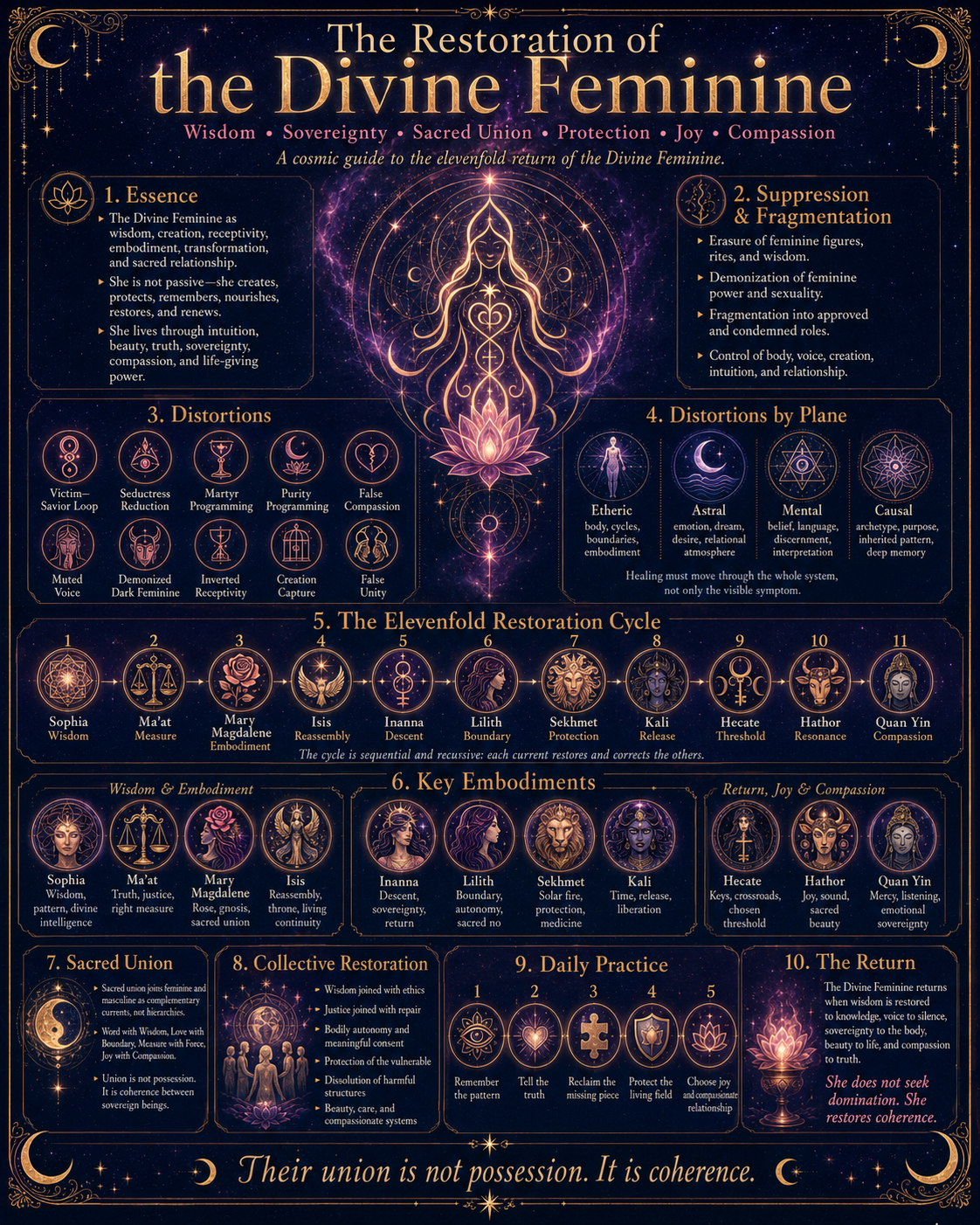
Wisdom, Sovereignty, Sacred Union, and the Return to Wholeness
Part I — The Lost Architecture and the Path of Return
Introduction — She Was Never Truly Absent
The return of the Divine Feminine is often spoken of as though a lost goddess were approaching from somewhere beyond the world.
Yet she has never been entirely absent.
She continued in the rhythms of the body, in the intelligence of ecosystems, in the protection of mothers, in the discernment of healers, in songs carried across generations, in grief that refused to forget what was loved, and in every person who preserved compassion without surrendering truth.
She remained in the wisdom that survived outside official institutions.
She remained in the forbidden text, the hidden rite, the household altar, the medicinal garden, the midwife’s hands, the poet’s voice, and the quiet refusal to accept that domination was the natural order of creation.
What disappeared was not the Divine Feminine herself.
What disappeared was the collective ability to recognize her as a complete and sovereign presence.
Her many functions were separated from one another. Wisdom was divided from embodiment. Compassion was divided from boundaries. Sexuality was divided from sacredness. Power was divided from nurture. Beauty was divided from truth. Destruction was divided from restoration. The mother was divided from the lover, the healer from the protector, the oracle from the sovereign, and the gentle woman from the woman who could say no.
Once these relationships were broken, fragments of the feminine could be accepted without allowing her full architecture to return.
Nurture was welcomed when it served others.
Beauty was welcomed when it remained decorative.
Compassion was welcomed when it did not demand accountability.
Spirituality was welcomed when it remained obedient.
Femininity was welcomed when it could be possessed, idealized, consumed, or controlled.
The sovereign feminine—the one who creates, judges, protects, withdraws, destroys corruption, reveals hidden truth, and determines the terms of relationship—was feared, demonized, or erased.
The restoration of the Divine Feminine is therefore not the elevation of one gender over another. It is not a reversal in which masculine authority is replaced by feminine domination.
It is the recovery of a missing architecture of life.
It is the restoration of wisdom to knowledge, relationship to power, consent to union, embodiment to spirit, consequence to action, and care to the structures through which civilization is organized.
It is the return of the qualities that allow creation to remain alive after it has been formed.
Chapter One — The Living Feminine Principle
Beyond Gender and Personality
The Divine Feminine cannot be fully understood as one person, deity, historical figure, or gendered identity.
She may appear through feminine beings and be most clearly preserved in traditions centered upon goddesses, women, mothers, priestesses, queens, healers, protectors, and wisdom figures. Yet her deeper current belongs to creation itself.
Every living being contains feminine and masculine capacities.
The feminine receives, gestates, nourishes, relates, transforms, and embodies.
The masculine directs, distinguishes, articulates, structures, protects, and moves outward.
These descriptions do not dictate how women or men must behave. They describe complementary movements that can be expressed by any person, community, organism, or system.
A person may create through both currents.
An idea may first be received into the inward field, where it is held, tested, nourished, and gradually given shape. It may then move outward through decision, structure, language, and action.
The feminine movement allows possibility to become intimate with life.
The masculine movement allows that living possibility to take discernible form.
Neither movement is complete without the other.
The Divine Feminine is the living intelligence through which creation becomes more than mechanical production.
She asks not only:
Can this be created?
She also asks:
Should it be created? What relationships will it enter? What will it require to remain alive? Who will carry its consequences? What must be protected? What must remain free?
She is the intelligence of consequence before consequence appears.
She is the memory of relationship within the act of creation.
The Core Currents of the Divine Feminine
Creation
The Divine Feminine is the womb of possibility.
This womb may be physical, artistic, intellectual, relational, ecological, or spiritual. It is any field capable of receiving what does not yet possess a stable form and allowing it to become real.
Creation is not merely production.
Production repeats or multiplies an existing pattern.
Creation allows something previously unformed to emerge through relationship.
The feminine creator does not force possibility into a predetermined shape. She listens to what is becoming and responds without surrendering discernment.
The restored creative current includes:
- imagination;
- patience;
- incubation;
- adaptation;
- nourishment;
- timing;
- protection of unfinished work;
- willingness to release what has been created.
Its distortion appears when creation is captured by extraction.
The body, land, imagination, emotional labor, knowledge, or artistic work becomes a resource controlled by another authority. Creation continues, but the creator loses voice, authorship, consent, or the right to determine how the creation will be used.
Restoration returns authority to the source of creation.
Receptivity
Receptivity is often mistaken for passivity.
True receptivity is an active and highly discerning capacity.
To receive is to perceive what is present without immediately forcing it into an existing interpretation. It is the ability to listen, observe, feel, and allow information to enter awareness.
Yet a healthy receptive field contains a gate.
It decides:
- what may enter;
- what must remain outside;
- what deserves further attention;
- what should be transformed;
- what should be released.
Without discernment, receptivity becomes porousness.
Without boundaries, openness becomes compulsory availability.
Without sovereignty, receiving becomes submission.
The restored feminine does not remain open to everything.
She remains open to what can enter through consent and right relationship.
Intuition
Intuition is direct pattern recognition.
It often perceives a relationship before the analytical mind has translated that relationship into language.
Intuition may arise through:
- bodily sensation;
- imagery;
- emotional movement;
- sudden recognition;
- dreams;
- symbolic association;
- an awareness that something is coherent or incoherent.
The restoration of intuition does not require the rejection of reason.
Reason helps identify assumptions, examine evidence, compare possibilities, and communicate what has been perceived.
Intuition helps identify where reason should look.
When divided, each becomes vulnerable to distortion.
Reason without intuition may become detached from life, unable to recognize the meaning of the information it organizes.
Intuition without examination may confuse fear, desire, cultural programming, or imagination with truth.
The restored feminine reunites intuition with disciplined discernment.
She neither dismisses the first signal nor declares it infallible.
She listens, observes, tests, and allows the pattern to clarify.
Compassion
Compassion is the capacity to perceive suffering without turning away from the being who suffers.
It does not require agreement with every behavior.
It does not erase consequence.
It does not compel continued exposure to harm.
Compassion seeks the restoration of life.
Sometimes that restoration requires comfort.
Sometimes it requires truth.
Sometimes it requires protection, separation, accountability, or the ending of a destructive cycle.
False compassion preserves appearances of kindness while allowing harm to continue.
It says:
- do not name the violation;
- do not disturb the peace;
- do not withdraw;
- forgive before anything has changed;
- remain available because the one causing harm is also wounded.
The restored compassionate feminine recognizes the dignity of every being while refusing to sacrifice the vulnerable to the unexamined needs of the harmful.
Compassion without boundaries becomes depletion.
Boundaries without compassion become abandonment.
Their union creates restorative love.
Wisdom
Wisdom is knowledge that understands relationship and consequence.
A system may possess enormous amounts of information while remaining unwise.
It may know how to create power without understanding how power alters the field.
It may know how to extract resources without understanding that the resource belongs to a living relationship.
It may know how to manipulate behavior without understanding what coercion does to trust, identity, or freedom.
Wisdom asks what knowledge serves.
It asks what will happen when the action leaves the laboratory, temple, office, palace, or private mind and enters the lives of other beings.
Sophia, Ma’at, Saraswati, Seshat, and other wisdom embodiments preserve different dimensions of this current.
Wisdom perceives the hidden pattern.
Truth measures whether the pattern is being embodied.
Language communicates it.
Memory preserves it.
Justice ensures that power remains accountable to it.
The suppression of the Divine Feminine was therefore also the suppression of wisdom as a governing principle.
Knowledge remained.
Technology remained.
Law remained.
Religious doctrine remained.
But these could be separated from relationship, consequence, consent, and life.
Mystery
Mystery is not ignorance disguised as spirituality.
It is recognition that reality exceeds the forms through which it is presently understood.
The feminine mystery protects what is still becoming.
A seed cannot be forced open without destroying the process of germination.
A dream may contain meaning before language can hold it.
A transformation may need silence before it can be shared.
Mystery preserves the inner chamber in which change occurs.
Its distortion is secrecy used to conceal power.
A teacher, institution, or spiritual authority may claim that questioning is forbidden because the teaching is mysterious.
This is not sacred mystery.
Sacred mystery deepens inquiry.
Manipulative secrecy prevents it.
The restored feminine mystery says:
You may not yet understand, but you may continue to observe, question, and choose.
Embodiment
The Divine Feminine restores the body to sacred life.
The body is not merely a temporary prison, biological machine, temptation, or obstacle to enlightenment.
It is the place where relationship becomes consequence.
Ideas may appear harmless until they enter bodies.
Power may appear abstract until a body is confined, nourished, protected, exhausted, injured, desired, or denied.
Embodiment returns spirituality to the conditions of life.
It asks:
- Does the practice honor bodily consent?
- Does the system allow rest?
- Does it support nourishment?
- Does it protect vulnerability?
- Does it permit pleasure without possession?
- Does it acknowledge pain without glorifying it?
- Does it allow the body to say no?
A spirituality that demands hatred of the body has become divided from the feminine current.
A system that celebrates transcendence while exploiting embodied beings has lost coherence.
Sensuality and Sacred Sexuality
Sensuality is the capacity to inhabit the senses.
It includes touch, sound, scent, taste, movement, beauty, pleasure, and the felt experience of being alive.
Sexuality is one expression of this field, but sensuality is much wider.
The suppression of the Divine Feminine repeatedly separated sexuality into two distorted poles:
- purity through denial;
- power through sexual performance.
The virgin was permitted sacredness only if desire disappeared.
The lover was permitted desire only if sacred authority disappeared.
This division made it difficult to recognize sexuality joined with:
- consent;
- wisdom;
- devotion;
- responsibility;
- joy;
- creative power;
- sovereign choice.
The restored feminine does not define freedom as constant sexual availability or compulsory expression.
She restores the right to choose:
- union;
- celibacy;
- solitude;
- intimacy;
- pleasure;
- refusal;
- changing boundaries.
Sacred sexuality is not determined by the presence or absence of sexual activity.
It is determined by whether the field preserves sovereignty, truth, reciprocity, and care.
Sovereignty
Sovereignty is authority over one’s own field.
It includes the right to determine:
- what enters;
- what remains;
- what is shared;
- what is withheld;
- which relationships continue;
- which agreements may be revised;
- when access has ended.
Sovereignty is not domination.
Domination attempts to control another field.
Sovereignty governs one’s own.
Lilith carries one expression of this current through refusal of coerced hierarchy.
Ma’at carries another through legitimate order.
Inanna carries it through descent and return.
Hecate carries it through the authority to open or close the gate.
Isis carries it through the restoration of the throne.
The sovereign feminine does not reject relationship.
She rejects relationship that requires disappearance of the self.
Protection and Sacred Wrath
Life requires protection.
Any spirituality that celebrates creation while denying the need to defend it remains incomplete.
Sacred wrath is the force that arises when a meaningful boundary has been violated.
Its purpose is not endless punishment.
Its purpose is to stop the violation and protect the conditions through which life may continue.
Sekhmet carries solar protective force.
Kali dissolves false forms.
Lilith establishes the refusal.
Medusa reveals the terrifying boundary that may arise after violation.
Durga coordinates many protective powers around one coherent center.
The distortion of sacred wrath takes two forms.
The first demonizes all feminine anger and demands permanent softness.
The second glorifies rage without proportion, accountability, or restoration.
The restored feminine asks:
- What is being protected?
- What is the actual threat?
- What degree of force is necessary?
- When has the threat ended?
- What becomes possible after cessation?
Wrath becomes sacred when it remains answerable to life.
Destruction and Transformation
The Divine Feminine does not only give birth.
She also governs endings.
Autumn, decay, menstruation, grief, death, dissolution, composting, and the release of completed identities belong to the same cycle as birth.
A form that never ends eventually prevents new life from emerging.
Kali carries the dissolution of illusion and completed forms.
Inanna descends through the death of identity.
Ereshkigal rules the realm before which status has no authority.
Sekhmet burns corruption.
Hecate guards the passage from one state to another.
Destruction becomes distorted when it is separated from purpose.
Indiscriminate destruction does not restore the feminine.
The restored transformative current asks:
Is the living essence being freed, or is life merely being harmed?
Not everything should be preserved.
Not everything should be destroyed.
Wisdom distinguishes the completed vessel from the life still growing within it.
Nurture
Nurture sustains life after creation.
It includes:
- nourishment;
- shelter;
- teaching;
- patience;
- protection;
- repair;
- encouragement;
- tending to conditions in which another being can develop.
Nurture is not ownership.
To support life does not grant the right to control it.
A parent, teacher, healer, partner, institution, or spiritual guide may begin by providing care and later claim authority over the being who received it.
This transforms nurture into possession.
The restored feminine nurtures toward sovereignty.
She does not create permanent dependency in order to preserve her identity as the giver.
True nurture prepares the other being to stand, choose, create, and eventually move beyond the original shelter.
Joy and Beauty
Joy is not a distraction from serious spiritual work.
It is evidence that life is more than survival.
Hathor restores beauty, music, laughter, movement, sensual pleasure, and resonance to the sacred field.
Beauty is not merely decoration.
It is an arrangement that allows relationship to be felt as harmony.
A song can restore coherence where an argument cannot.
A beautiful environment can remind the body that it is permitted to soften.
Laughter can release a structure that fear kept rigid.
The distortion of beauty turns it into comparison, commodification, status, or control.
The restored feminine does not ask whether a being conforms to an externally imposed image.
She asks whether form expresses living truth.
Beauty becomes sacred when it reveals rather than conceals.
Chapter Two — Sacred Union
Union Without Possession
Sacred union is frequently reduced to romance, sexuality, destiny, or the search for one perfect counterpart.
Yet the deeper principle of sacred union is the relationship between complementary powers that remain sovereign while creating together.
Union does not erase distinction.
It allows distinction to enter coherent relationship.
The feminine without a corresponding structuring movement may receive endlessly without bringing what is received into stable form.
The masculine without a corresponding relational movement may build structures that no longer remember what they were created to serve.
Sacred union joins:
- wisdom with articulation;
- receptivity with direction;
- compassion with protection;
- creation with structure;
- mystery with revelation;
- embodiment with spirit;
- love with truth;
- freedom with responsibility.
This union may occur within a person.
It may occur between people.
It may occur within a community, institution, artistic work, ecological system, or spiritual path.
It is not defined by gender.
It is defined by relationship among complementary capacities.
The Distorted Masculine Without the Feminine
When structure is separated from relationship, it may become rigid.
When direction is separated from listening, it may become domination.
When logic is separated from consequence, it may become instrumental manipulation.
When protection is separated from nurture, it may become control.
When transcendence is separated from embodiment, it may abandon life in pursuit of an abstract ideal.
The distorted masculine attempts to secure order by reducing uncertainty, suppressing difference, and centralizing authority.
It may value measurable output while ignoring the living systems producing it.
It may confuse obedience with coherence.
It may treat vulnerability as failure.
The restoration of the Divine Feminine does not destroy the masculine.
It returns the masculine to right relationship.
A coherent masculine structure:
- protects without possessing;
- acts without silencing;
- distinguishes without dehumanizing;
- communicates without imposing;
- builds without extracting;
- leads without demanding disappearance from others.
The Distorted Feminine Without the Masculine
The feminine current may also become distorted when separated from clarity, structure, and direction.
Receptivity may become porousness.
Compassion may become martyrdom.
Mystery may become vagueness.
Relationship may become fusion.
Flow may become instability.
Nurture may become control disguised as care.
The distorted feminine may avoid necessary decisions in order to preserve emotional harmony.
She may remain endlessly available, hoping that love alone will transform a structure that continues to benefit from her sacrifice.
She may confuse intuition with unquestionable certainty or softness with virtue.
A coherent feminine field:
- receives while retaining a gate;
- nurtures without ownership;
- feels deeply without surrendering discernment;
- adapts without losing identity;
- protects unfinished creation;
- knows when to withdraw.
Christ and Sophia
Within the restoration tradition developed in this guide,Christ Consciousnessis not complete when represented only through a masculine savior.
Its complete architecture includes both Logos and Sophia.
Logosis the living Word: truth articulated, expressed, and embodied through action.
Sophiais divine Wisdom: the inward pattern, relational intelligence, and deep knowing from which truthful expression arises.
Word without Wisdom may become doctrine.
Wisdom without expression may remain hidden and unable to transform the shared world.
Their union creates revelation that is both true and alive.
Yeshua and Mary Magdalene
Yeshua and Mary Magdalene represent one of the clearest sacred-union currents within the guide.
Yeshua carries:
- the living Word;
- direct relationship with Source;
- love expressed through action;
- truth that confronts hierarchy;
- the restoration of human dignity.
Mary Magdalene carries:
- embodied gnosis;
- sacred intimacy;
- relational wisdom;
- anointing;
- remembrance;
- the integration of heart, body, and spirit.
Their union is not meaningful because one completes an otherwise deficient person.
It is meaningful because distinct sovereign currents enter relationship.
Yeshua represents the truth spoken and enacted.
Magdalene represents the truth received, embodied, remembered, and carried through relationship.
Together they reveal Christ–Sophia consciousness:
The Word becomes living through Wisdom. Wisdom becomes visible through the Word.
The suppression of Magdalene therefore represents more than the marginalization of one woman.
It represents the removal of embodied feminine authority from the architecture of Christ Consciousness.
Once she is removed, revelation becomes easier to centralize.
The sacred is mediated by hierarchy.
The body becomes suspicious.
Sexuality becomes dangerous.
Direct knowing becomes heresy.
The feminine becomes follower, mother, sinner, or servant, but not equal bearer of the teaching.
Her restoration returns relationship, embodiment, and wisdom to the center.
Chapter Three — How the Feminine Was Fragmented
The Capture of Living Traditions
Spiritual traditions often begin through direct encounter.
A person, community, or lineage experiences a truth that changes how life is understood.
The teaching is shared.
Practices form around it.
A community develops.
Over time, the community creates structures to preserve the teaching.
These structures may be useful.
Yet preservation can gradually become control.
A recurring capture sequence appears:
Direct experience → shared teaching → communal practice → organized tradition → centralized authority → restricted interpretation → suppression of competing voices → control presented as sacred order
The Divine Feminine is especially vulnerable to this capture because many of her functions are distributed rather than centralized.
Wisdom may appear through dreams, bodies, land, art, relationship, intuition, birth, grief, healing, and direct spiritual knowing.
These forms are difficult for centralized authority to monopolize.
A priesthood can control an official text more easily than it can control the wisdom carried through every body, household, ecosystem, and relationship.
The suppression of the feminine therefore repeatedly involves the restriction of direct access.
Only approved authorities may interpret.
Only selected bodies may speak.
Only certain relationships are considered sacred.
Only sanctioned rituals are recognized.
Only official memory survives.
The feminine is not always eliminated.
She is often retained in a reduced form that supports the institution without challenging it.
Erasure
Erasure removes feminine figures, texts, teachings, offices, and practices from shared memory.
A teacher becomes a follower.
A priestess becomes a servant.
A goddess becomes a decorative symbol.
A female lineage becomes anonymous.
A sacred relationship becomes irrelevant.
Erasure does not require the total disappearance of a name.
A person may remain visible while her authority is removed.
Mary Magdalene remained in Christian memory, but her identity was recoded through repentance and sexual shame rather than teaching and spiritual authority.
Sophia remained present in the word “wisdom,” but the feminine personification of divine intelligence became increasingly peripheral.
The feminine may survive as image while disappearing as governing power.
Demonization
What cannot be erased may be transformed into a threat.
The sovereign woman becomes:
- the witch;
- the seductress;
- the heretic;
- the monster;
- the disobedient wife;
- the destructive mother;
- the dangerous oracle;
- the woman whose beauty or anger causes ruin.
Lilith becomes a night demon rather than a symbol of refusal.
Medusa becomes a monster rather than a guardian image shaped by violation and terror.
Kali becomes a bloodthirsty destroyer when separated from liberation, time, motherhood, and transcendence.
Sekhmet becomes only a war goddess when separated from medicine and restoration.
Demonization teaches the collective to fear the capacities required for sovereignty.
Sanitization
Some feminine figures are not demonized.
They are made harmless.
The protector loses her wrath.
The lover loses her sexuality.
The mother loses her authority.
The goddess of joy becomes decorative.
The healer becomes endlessly available.
The compassionate figure becomes incapable of refusal.
Sanitization permits devotion to the feminine so long as she cannot challenge power.
A gentle feminine image may be publicly honored while living women, bodies, land, intuition, and relational authority remain controlled.
This is not restoration.
It is reverence for a fragment.
Inversion
Inversion retains a sacred quality while reversing its function.
Compassion becomes permission for continued harm.
Purity becomes shame toward the body.
Nurture becomes compulsory service.
Receptivity becomes obedience.
Unity becomes forced sameness.
Mystery becomes secrecy.
Sacrifice becomes proof of worth.
Protection becomes possession.
An inverted quality may still use sacred language.
This makes it more difficult to identify.
The name remains.
The direction has changed.
Division
The complete feminine is divided into acceptable and unacceptable identities.
The most persistent divisions include:
- virgin versus lover;
- mother versus sovereign;
- healer versus witch;
- compassionate woman versus angry woman;
- beautiful woman versus intelligent woman;
- spiritual woman versus sexual woman;
- nurturer versus leader;
- gentle woman versus protector;
- obedient woman versus dangerous woman.
No living person can remain whole inside these divisions.
To gain acceptance in one category, she must deny another capacity.
The mother must not desire.
The lover must not command respect.
The healer must not withdraw care.
The spiritual woman must not inhabit the body.
The powerful woman must prove she is not threatening.
Restoration reunites what was forced apart.
Absorption
A tradition may absorb an earlier feminine figure while removing her original authority.
Symbols, feast days, titles, sacred locations, or qualities are carried into a later system.
This may preserve part of the current, but it may also conceal the older form.
Absorption is not always deliberate theft. Traditions naturally influence one another.
The distortion arises when the newer system claims exclusive ownership while erasing the people, cultures, or meanings through which the current was previously preserved.
Restoration recognizes continuity without declaring every similar figure identical.
Control of the Body
Control of the feminine repeatedly concentrates around the body.
This includes regulation of:
- sexuality;
- reproduction;
- menstruation;
- childbirth;
- healing;
- clothing;
- pleasure;
- movement;
- marriage;
- celibacy;
- bodily autonomy.
The body is described as unclean, tempting, weak, dangerous, or in need of external governance.
Yet the body is also expected to reproduce, labor, serve, nurture, and remain available.
This contradiction reveals the deeper purpose of the distortion.
The feminine body is not rejected because it lacks value.
It is controlled because it possesses creative power.
Control of Voice
A system may permit feminine service while withholding interpretive authority.
Women may sing, nurture, teach children, heal privately, preserve rituals, or support the community.
Yet they may not:
- define doctrine;
- interpret revelation;
- govern institutions;
- name abuse;
- establish boundaries;
- revise sacred law;
- speak as direct authorities.
The voice becomes acceptable only when it confirms the existing order.
The restoration of feminine voice is therefore not simply permission to speak.
It is the restoration of the authority to name reality.
Chapter Four — The Distortions That Remain
Suppression does not remain confined to history.
Once repeated across generations, its patterns become embedded in culture, spiritual practice, relationships, expectations, and internal self-governance.
The following distortions may appear in contact experiences, institutions, communities, intimate relationships, or the inner field.
They are not separate problems.
They are different expressions of one fragmented architecture.
The Victim–Savior Loop
The victim–savior loop portrays the feminine as powerless until rescued.
Her vulnerability becomes her primary identity.
Her suffering grants another person purpose, authority, or spiritual importance.
This distortion may appear in spiritual contact when a being repeatedly presents herself as trapped, injured, or dependent upon the practitioner’s unique intervention.
It may appear in society when women are treated as incapable of sovereignty while simultaneously being blamed for the conditions imposed upon them.
It may appear internally as the belief:
I cannot act until someone recognizes, approves, protects, or rescues me.
The savior is also trapped.
The rescuer’s identity depends upon the continuation of the wound.
If the other person becomes sovereign, the savior loses position.
Healing breaks the loop by restoring agency.
Support remains possible.
Protection remains possible.
Assistance remains possible.
Yet the purpose of assistance becomes increased sovereignty rather than permanent dependence.
A useful question is:
Does this relationship increase the capacity of every participant to choose and act, or does it preserve dependency?
The Seductress Reduction
The seductress distortion reduces feminine magnetism to sexual control.
Beauty, desire, charisma, sensuality, and attraction are treated as manipulative by nature.
The feminine is either blamed for possessing magnetism or encouraged to use it as her primary source of power.
In spiritual contact, this may appear through exaggerated flattery, erotic urgency, promises of secret union, or an attempt to bypass discernment through intensity.
In society, it appears when a woman’s appearance is treated as more relevant than her knowledge, authority, or intention.
Internally, it may produce the belief that worth depends upon being desired.
Healing does not require the rejection of sensuality.
It requires the reunion of magnetism with:
- consent;
- truth;
- intelligence;
- creative purpose;
- self-possession;
- consequence.
Sacred attraction invites.
It does not capture.
Martyr Programming
Martyr programming teaches that depletion proves love.
The feminine is considered good when she gives beyond capacity, remains through harm, forgives without repair, and asks for nothing in return.
Her exhaustion becomes evidence of devotion.
This distortion is especially powerful because it may resemble compassion.
The difference is found in the consequence.
True service supports life.
Martyrdom gradually destroys the giver while teaching others that her destruction is sacred.
Internally, martyr programming may appear as guilt when resting, receiving, withdrawing, or prioritizing one’s own work.
Healing restores service to consent.
A coherent act of service is:
- freely chosen;
- proportionate;
- sustainable;
- capable of ending;
- compatible with the life of the giver.
The feminine does not prove love by disappearing.
Purity Programming
Purity originally refers to integrity: a state in which the nature of something is not corrupted by contradiction or contamination.
Purity programming transforms integrity into bodily denial and social conformity.
The pure woman is expected to be:
- sexually untouched;
- emotionally restrained;
- obedient;
- self-sacrificing;
- non-threatening;
- free of anger;
- free of contradictory desires.
This standard is impossible because it is not designed to create wholeness.
It is designed to produce control.
The opposite role—the impure or fallen woman—is then used to contain every quality excluded from the pure ideal.
Healing restores purity as coherence.
A pure intention is not one without complexity.
It is one that does not conceal its real purpose.
A pure relationship is not one without sexuality.
It is one aligned with consent, truth, and mutual sovereignty.
False Compassion
False compassion treats every boundary as cruelty.
It asks the harmed to understand the one causing harm before the harm has ended.
It may emphasize forgiveness while avoiding:
- cessation;
- admission;
- accountability;
- repair;
- changed behavior.
In spiritual systems, false compassion often appears as the demand to remain peaceful regardless of what is occurring.
Anger is dismissed as low vibration.
Refusal is treated as spiritual immaturity.
Separation is treated as failure.
The restored compassionate field recognizes that love sometimes closes the gate.
A boundary may protect both parties from continuing a destructive pattern.
Compassion without truth becomes complicity.
Truth without compassion becomes punishment.
Restoration requires both.
The Muted Oracle
The muted oracle distrusts her own perception until an approved authority confirms it.
She may sense that something is wrong yet remain silent because she cannot present absolute proof.
She may know a relationship has become incoherent but continue because the other person’s interpretation appears more authoritative.
This distortion arose through repeated invalidation of feminine knowledge.
Yet the opposite distortion is also possible.
The oracle may treat every impression as unquestionable revelation.
Healing restores a living partnership between intuition and examination.
The oracle may say:
This is what I perceive. This is how the perception arose. This is what remains uncertain. This is how the pattern may be tested.
Her authority does not require infallibility.
It requires honesty.
Demonization of the Dark Feminine
The dark feminine includes:
- endings;
- night;
- grief;
- rage;
- sexuality;
- death;
- wilderness;
- refusal;
- the unknown;
- the power to dissolve.
These capacities are not evil.
They become destructive when separated from wisdom, proportion, and relationship.
Demonization teaches the feminine to fear her own protective and transformative powers.
She may suppress anger until it erupts without direction.
She may remain in a completed cycle because ending it feels spiritually wrong.
She may reject the body’s instinctive warning because it does not appear gentle.
Healing does not glorify darkness.
It returns darkness to its place in the cycle.
Night allows rest.
Decay allows renewal.
Grief honors what was loved.
Anger identifies violation.
Death releases form.
The dark feminine is sacred when she serves transformation rather than endless destruction.
Inverted Receptivity
Receptivity becomes inverted when openness has no gate.
The person remains accessible to:
- every demand;
- every emotion;
- every spiritual impression;
- every relationship;
- every crisis;
- every interpretation imposed by others.
She may believe that refusing access is unloving.
In contact practices, inverted receptivity may mean accepting any voice, image, or sensation simply because it appeared during meditation or dream.
Healing restores permission.
Not every presence deserves engagement.
Not every message deserves belief.
Not every relationship deserves continuation.
The receiver determines the conditions under which the field may be entered.
Creation Capture
Creation capture occurs when the products of the feminine field are separated from the creator’s sovereignty.
This may involve:
- reproductive control;
- unpaid care labor;
- stolen intellectual work;
- commodified spirituality;
- extracted cultural knowledge;
- emotional labor treated as entitlement;
- art used without consent;
- land treated as ownerless resource.
The creator is expected to continue producing while others determine value, ownership, and use.
Healing restores:
- authorship;
- attribution;
- compensation;
- consent;
- revocation;
- authority over distribution;
- the right not to create.
Creation is not an unlimited public resource merely because it can nourish others.
False Unity
False unity requires difference to disappear.
It may appear in families, spiritual communities, political movements, partnerships, or institutions.
The group claims that disagreement threatens love, harmony, or collective purpose.
Members are pressured to suppress:
- boundaries;
- cultural distinctions;
- dissent;
- personal needs;
- conflicting evidence;
- unique identity.
True unity is not sameness.
It is relationship among distinct beings who remain free to speak, refuse, revise, and leave.
Sacred union does not absorb.
It relates.
Chapter Five — Distortion Across the Planes
The Divine Feminine expresses through multiple layers of being.
A distortion may enter through one plane and then spread into others.
A bodily boundary violation may become emotional confusion.
Emotional confusion may become a belief.
A belief may become an identity.
An identity may recreate the bodily conditions that first produced the wound.
Restoration must therefore move through the whole system.
The Etheric Plane — Body, Vitality, and Boundary
The etheric plane concerns the relationship among body, energy, rhythm, environment, place, and physical life.
The feminine etheric current includes:
- bodily awareness;
- fertility and regeneration;
- sensory presence;
- rest;
- nourishment;
- physical boundaries;
- cycles;
- connection with land and environment.
Distortion appears as:
- bodily shame;
- chronic depletion;
- disconnection from physical needs;
- compulsory availability;
- control of reproduction or sexuality;
- treating the body as spiritually inferior;
- demanding production without replenishment.
Restoration begins by allowing the body to participate in discernment.
The body may signal:
- contraction;
- ease;
- exhaustion;
- attraction;
- aversion;
- pain;
- hunger;
- the need for distance;
- the need for movement or rest.
These signals are not always complete interpretations.
They are information.
A restored etheric practice asks:
What does the body require for this relationship, belief, or spiritual practice to remain coherent?
The Astral Plane — Emotion, Dream, and Symbol
The astral plane concerns emotion, imagination, dream, attachment, longing, memory, and symbolic relationship.
The feminine astral current includes:
- emotional intelligence;
- dream perception;
- symbolic communication;
- grief;
- compassion;
- relational resonance.
Distortion appears as:
- emotional coercion;
- victim–savior dramas;
- seductive contact;
- idealized spiritual romance;
- fear imagery treated as unquestionable;
- dependency upon signs;
- confusion between intensity and truth.
Astral restoration requires observation before interpretation.
A dream should first be recorded.
An emotion should first be allowed to reveal its movement.
A symbol should be examined across time rather than immediately assigned one fixed meaning.
A useful sequence is:
What appeared? What did I feel? What associations arose? What repeated? What changed when I questioned it? What effect did the experience have upon sovereignty and clarity?
Intensity is not proof of truth.
Gentleness is not proof of goodness.
Fear is not proof of danger.
Love is not proof of compatibility.
The pattern must be observed.
The Mental Plane — Belief, Language, and Interpretation
The mental plane organizes experience through language, concept, narrative, philosophy, and belief.
The feminine mental current includes:
- relational reasoning;
- contextual intelligence;
- symbolic understanding;
- wisdom;
- discernment;
- the ability to hold paradox without abandoning clarity.
Distortion appears as:
- dogma;
- unquestionable revelation;
- dismissal of intuition;
- external validation dependency;
- false dichotomies;
- historical amnesia;
- sacred language used to conceal control.
Mental restoration distinguishes:
- observation;
- interpretation;
- belief;
- conclusion;
- action.
These are often collapsed.
A person may observe a symbol, interpret it through one tradition, believe the interpretation is universally true, conclude that a particular action is required, and then act without examining any intermediate step.
Restoration reopens the sequence.
It allows revision.
The restored feminine mind is not weak because it can change.
It changes because it remains faithful to truth rather than to pride.
The Causal Plane — Purpose, Archetype, and Deep Pattern
The causal plane concerns organizing meaning, identity, lineage, inherited patterns, archetypal roles, and the deeper structures through which repeated experiences take form.
The feminine causal current includes:
- purpose;
- memory;
- relationship with ancestry;
- archetypal intelligence;
- the ability to end inherited cycles;
- participation in a larger pattern without loss of sovereignty.
Distortion appears as:
- suffering framed as destiny;
- false spiritual contracts;
- inherited obligation without consent;
- identification with wounded archetypes;
- endless repetition of exile or sacrifice;
- past-life or lineage narratives used to override present reality.
Restoration establishes present sovereignty.
No inherited story should be allowed to command harm simply because it is described as ancient, karmic, ancestral, or destined.
The past may provide meaning.
It does not possess the present.
Archetypes should function as lenses, not masters.
A person may learn from Magdalene without being required to repeat persecution.
She may learn from Inanna without seeking unnecessary descent.
She may learn from Lilith without becoming permanently isolated.
She may learn from Kali without destroying what remains alive.
The archetype serves the living being.
The living being does not become fuel for the archetype.
The Relational Plane — Consent, Reciprocity, and Union
The relational plane concerns the field created between beings.
A relationship is more than the sum of its participants.
It develops patterns, expectations, memories, agreements, and momentum.
The restored feminine relational current includes:
- consent;
- reciprocity;
- listening;
- clear agreements;
- the right to revise;
- voluntary intimacy;
- repair;
- sovereign union.
Distortion appears as:
- emotional ownership;
- compulsory forgiveness;
- permanent access;
- undefined obligation;
- sacred language used to override incompatibility;
- one person carrying the entire relationship;
- unity maintained through self-erasure.
Relational restoration asks:
- Is participation voluntary?
- Can consent be withdrawn?
- Are expectations visible?
- Is responsibility shared?
- Does the relationship increase sovereignty?
- Can truth be spoken without loss of belonging?
- Is departure possible without spiritual condemnation?
A relationship that forbids exit is not sacred union.
The Collective Plane — Institution, Culture, and Memory
The collective plane concerns social structures, law, economy, religion, education, governance, cultural narrative, and shared memory.
The feminine collective current includes:
- care infrastructure;
- ecological responsibility;
- restorative justice;
- distributed authority;
- preservation of cultural memory;
- recognition of embodied consequence;
- structures that serve life.
Distortion appears as:
- exploitation of care work;
- centralized spiritual authority;
- legal control of bodies;
- erasure of feminine history;
- extraction from land;
- symbolic inclusion without material authority;
- celebration of feminine images while suppressing feminine voice.
Collective restoration cannot be achieved only through personal meditation.
It requires changes in:
- policy;
- ownership;
- access;
- leadership;
- labor;
- consent;
- education;
- cultural memory;
- distribution of resources.
Inner work and structural work must remain connected.
Otherwise the individual is asked to heal inside the same conditions that continue producing the wound.
Chapter Six — The Restoration Sequence
The restoration of the Divine Feminine is not a single awakening.
It is a sequence.
Skipping a stage often recreates distortion in a more spiritualized form.
Stage One — Cessation
The active harm must stop.
A system cannot begin restoration while continuing:
- coercion;
- extraction;
- violation;
- silencing;
- deception;
- unauthorized access;
- exploitation.
Cessation is the first act of compassion because it prevents the wound from being continually renewed.
This is the current of Lilith’s refusal and Sekhmet’s protective force.
Stage Two — Revelation
What occurred must be named.
Revelation restores visibility.
It distinguishes:
- event from explanation;
- harm from justification;
- truth from reputation;
- consequence from intention.
Revelation does not require humiliation.
Its purpose is to end concealment.
This is the current of Sophia’s wisdom and Ma’at’s measure.
Stage Three — Boundary Restoration
The field must determine the conditions of access.
Boundary restoration establishes:
- what may continue;
- what must end;
- who decides;
- what requires consent;
- how consent may be withdrawn;
- what happens if the boundary is violated again.
This is the current of Lilith, Sekhmet, and Hecate.
Stage Four — Retrieval
What was exiled must be recovered.
This may include:
- voice;
- memory;
- creativity;
- bodily presence;
- spiritual authority;
- cultural knowledge;
- grief;
- anger;
- joy;
- ownership;
- a forgotten part of identity.
This is the current of Isis gathering the fragments and Inanna recovering sovereignty through descent.
Stage Five — Reconnection
The recovered capacity must be returned to its rightful relationships.
Voice must reconnect with truth.
Compassion must reconnect with boundaries.
Sexuality must reconnect with consent.
Power must reconnect with nurture.
Intuition must reconnect with discernment.
Creation must reconnect with sovereignty.
This is the current of Magdalene’s embodied gnosis and sacred union.
Stage Six — Repatterning
The structure must change.
Without repatterning, the original distortion may return.
New practices, agreements, laws, rituals, habits, roles, or institutions may be required.
Repatterning asks:
What conditions allowed the distortion to continue? What must be different now? Who holds authority? How will the new boundary be maintained? What happens when the old pattern attempts to return?
This is Ma’at translated into living order.
Stage Seven — Expression
The restored feminine must be permitted to live.
She must be allowed to:
- speak;
- create;
- lead;
- protect;
- receive;
- desire;
- withdraw;
- grieve;
- celebrate;
- teach;
- change.
Restoration that remains private may protect the individual, but it does not yet transform the shared field.
Expression makes the restored current visible.
This is the voice of Magdalene, the music of Hathor, and the living presence of Sophia.
Stage Eight — Union
The restored feminine may now enter relationship without surrendering herself.
Union occurs after sovereignty, not before it.
It joins:
- wisdom and action;
- compassion and protection;
- body and spirit;
- feminine and masculine;
- individual and collective;
- past and emerging future.
This union is not possession.
It is coherence.
Chapter Seven — Discernment in Contact and Spiritual Practice
The Divine Feminine may be encountered through prayer, meditation, dream, art, ritual, historical study, symbolic contemplation, intuition, or relationship with a living tradition.
The appearance of a sacred name or image does not by itself establish the identity or coherence of a contact.
Discernment must examine the quality of relationship.
Signs of Coherent Contact
A coherent presence:
- respects consent;
- permits questioning;
- does not demand secrecy or exclusivity;
- does not threaten punishment for disengagement;
- does not assign superiority over others;
- increases clarity rather than dependency;
- allows time for reflection;
- respects bodily and relational boundaries;
- does not command harm;
- remains sufficiently consistent across repeated encounters;
- encourages responsibility for one’s own decisions;
- does not use flattery to bypass discernment.
A coherent feminine presence may be gentle or fierce.
Tone alone does not determine alignment.
Quan Yin may appear soft.
Sekhmet may appear intense.
Ma’at may appear exacting.
Kali may confront impermanence.
Lilith may refuse access.
The question is not whether the presence feels pleasant.
The question is whether the relationship preserves truth, consent, sovereignty, and non-harm.
Signs of Distortion or Mimicry
Pause or end engagement when a presence:
- demands obedience;
- creates artificial urgency;
- claims exclusive ownership of the practitioner;
- sexualizes the relationship without consent;
- discourages outside reflection;
- uses fear to prevent questions;
- changes identity whenever challenged;
- glorifies suffering or depletion;
- presents coercion as destiny;
- insists that boundaries prove spiritual failure;
- assigns a unique savior role;
- demands increasingly costly proof of devotion.
Distorted contact often attempts to become irreplaceable.
A coherent guide does not need dependency to preserve relationship.
A Declaration of Sovereign Contact
A practitioner may use language such as:
Only contact aligned with truth, consent, non-harm, clarity, and sovereign relationship is permitted within this field. No name, image, title, lineage, or claim grants automatic access. All communication remains subject to discernment, revocation, and review. Any distortion must reveal its nature or leave.
The power of this declaration does not depend upon aggression.
It depends upon clarity.
Chapter Eight — The Eleven Living Currents
The embodiment chapters that follow do not present eleven interchangeable names for one generalized goddess.
Each being carries a distinctive history, symbolic language, temperament, and restoration function.
Together they form a complete arc.
Sophiareveals the pattern beneath appearances.
Ma’atmeasures whether that pattern has become truthful relationship.
Mary Magdaleneembodies wisdom through love, gnosis, anointing, and sacred union.
Isisgathers what has been fragmented and restores continuity.
Inannadescends through the loss of identity and returns with transformed sovereignty.
Lilithcloses the gate of coercion and restores the unowned self.
Sekhmetprotects the restored field and burns corruption clear.
Kalidissolves forms whose time has ended.
Hecateilluminates the threshold and preserves sovereign choice.
Hathorrestores joy, beauty, sound, and the pleasure of being alive.
Quan Yinreconnects the whole through compassion that does not abandon boundaries.
Their sequence forms a living restoration movement:
Wisdom → Measure → Embodiment → Reassembly → Descent → Boundary → Protection → Dissolution → Passage → Resonance → Compassionate Reunion
This is not a ladder in which one embodiment is higher than another.
It is a cycle.
Different moments require different currents.
A fragmented being may first need Isis.
A violated being may first need Lilith or Sekhmet.
A completed identity may need Kali.
A person standing between worlds may need Hecate.
A field hardened by endless struggle may need Hathor.
A heart unable to reconnect after protection may need Quan Yin.
Wisdom lies in recognizing which current the moment requires and which current must balance it.
Protection without compassion may become permanent warfare.
Compassion without protection may reopen the wound.
Dissolution without wisdom may destroy what could have been restored.
Restoration without boundary may rebuild the same structure.
Joy without truth may become distraction.
Truth without love may become judgment.
The complete Divine Feminine is not contained in one face.
She appears through relationship among many faces, each preserving a capacity that the others cannot replace.
The following parts enter those beings in depth, beginning withSophia, Ma’at, Mary Magdalene, and Isis—Wisdom, Measure, Embodiment, and Reassembly.
Part II — Wisdom, Measure, Embodiment, and Reassembly
A Note on the Embodiment Chapters
The beings explored in this guide arise from distinct historical, religious, and cultural traditions. Their similarities create meaningful relationships, but those similarities do not make them interchangeable.
Each chapter therefore moves through two intertwined layers.
The first is thehistorical and traditional foundation: the names, stories, symbols, and roles through which the embodiment was preserved.
The second is therestoration readingdeveloped throughout this guide: the aspect of the Divine Feminine that the embodiment helps recover within the individual, relational, and collective field.
The mantras and visualizations included here are modern contemplative compositions. They are not presented as recovered ancient liturgies or substitutes for initiation within living traditions.
They are symbolic practices intended to support remembrance, discernment, and integration.
Chapter Nine — Sophia
The Wisdom Before the Word
Before a truth can be spoken, something must know it.
Before a pattern can be translated into structure, something must perceive the relationships from which the pattern arises.
Before creation takes form, something must recognize what forms are capable of carrying life.
Sophia is the presence of that knowing.
Her name meansWisdom, yet the wisdom she represents is larger than intelligence, information, scholarship, or logical skill.
She is the capacity to perceive the whole through its relationships.
Sophia does not merely know what exists.
She knows:
- how one thing belongs with another;
- what consequence is already forming inside an action;
- which visible fragment belongs to an invisible pattern;
- what has been forgotten;
- what is trying to become;
- what appears divided but remains connected beneath the division.
Her presence may feel elusive because she rarely forces herself into awareness.
Power demands recognition.
Fear captures attention.
Noise fills the field.
Wisdom waits until the perceiver becomes capable of listening.
This is why Sophia may feel as though she is always present but must be searched for before she can be found.
She is not hiding in the sense of refusing relationship.
She is hidden by the speed, certainty, distraction, and external authority that prevent deeper recognition.
Sophia is discovered when the mind becomes quiet enough to perceive what was already speaking beneath it.
Historical and Traditional Foundation
The Greek wordsophiameans wisdom. It also became the Greek rendering of the Hebrewhokhmah, the feminine personification of Wisdom found prominently in biblical and Jewish wisdom literature.
In Proverbs, Wisdom speaks publicly, calls humanity toward understanding, participates in the order of creation, and prepares a banquet for those willing to leave foolishness behind. In the Wisdom of Solomon, Sophia is described in even more elevated language: associated with divine radiance, creation, instruction, and proximity to the throne of God.
Sophia later became a major figure within several Gnostic cosmologies. These traditions were diverse rather than uniform, and no single Sophia narrative represents all of them. In different systems she appears as an aeon of the divine fullness, a figure involved in the emergence of the lower world, a being divided between higher and lower conditions, or an active participant in restoration and return.
The recurring pattern is one of divine Wisdom entering relationship with limitation, fragmentation, exile, or forgetfulness—and participating in the recovery of the light hidden within those conditions.
Sophia’s history therefore contains both exaltation and blame.
She is divine Wisdom, companion of creation, teacher, radiance, and revealer.
She is also repeatedly associated with a feminine descent that later interpreters portray as error, imbalance, or dangerous independent creation.
This tension became one of the deepest distortions surrounding her.
The wisdom-bearing feminine was honored as necessary to creation while simultaneously being blamed for the imperfection of the created world.
The Archetypal Current of Sophia
Within the restoration of the Divine Feminine, Sophia carries:
- divine intelligence;
- hidden pattern;
- inner knowing;
- contemplative stillness;
- the relationship between wisdom and creation;
- remembrance within fragmentation;
- the descent of consciousness into form;
- discernment beyond rigid oppositions;
- the recovery of the sacred within what has been rejected.
She represents not simply the possession of wisdom but themovement by which wisdom becomes conscious of itself.
A being may contain truth without recognizing it.
A culture may carry a sacred pattern in fragments without remembering the relationship among them.
A person may know something through the body, dream, heart, or intuition without yet possessing the language required to explain it.
Sophia gathers these forms of partial knowing around a deeper center.
She does not eliminate uncertainty by supplying instant answers.
She turns uncertainty into a chamber of listening.
Sophia Across the Planes
| Plane | Expression |
|---|---|
| Causal | The deep pattern of creation, purpose, memory, and relationship beneath visible events |
| Mental | Wisdom, philosophy, discernment, symbolic intelligence, and recognition of hidden assumptions |
| Astral | Longing for reunion, quiet radiance, remembrance through dream, and recognition through resonance |
| Etheric | Intelligence appearing through nature, bodily rhythm, water, light, geometry, and living form |
| Relational | Listening deeply enough to perceive the truth another being is trying to express |
| Collective | Civilizational wisdom, preservation of memory, and the joining of knowledge with consequence |
Sophia’s current moves most strongly through the causal and mental planes, but it should not be confined there.
When wisdom is separated from embodiment, it becomes abstraction.
When it is separated from emotion, it loses empathy.
When it is separated from relationship, it becomes private superiority.
When it is separated from action, it may remain beautiful while the world continues unchanged.
The restoration of Sophia requires wisdom to descend through every plane.
Wisdom and Knowledge
Knowledge answers:
What is this?
Wisdom asks:
What relationship does this enter?
Knowledge determines how a force may be produced.
Wisdom asks what the force will serve.
Knowledge identifies what is possible.
Wisdom distinguishes what is coherent.
Knowledge may accumulate indefinitely.
Wisdom selects, integrates, and accepts responsibility.
A civilization may become increasingly knowledgeable while moving further from wisdom.
It may acquire the ability to alter bodies, environments, attention, belief, and social behavior without first developing the maturity required to govern those abilities.
This creates a dangerous separation.
Power grows outwardly while relational intelligence remains underdeveloped.
Sophia restores the missing inward question:
What will this creation do to the field that receives it?
Her wisdom is not opposed to science, technology, structure, or rational inquiry.
She restores the reason these capacities should exist.
The Hidden Pattern
A fragment may appear meaningless when separated from the whole.
Sophia sees the relationship before the complete image is visible.
This may occur through a subtle sequence:
- a repeated symbol;
- several unrelated events carrying the same structure;
- a contradiction that reveals a concealed assumption;
- a bodily response that precedes conscious recognition;
- a dream that reorganizes an unresolved question;
- a phrase that suddenly joins knowledge gathered over many years.
Pattern recognition becomes distorted when every coincidence is declared meaningful or when the perceiver assumes the pattern exists solely for them.
Sophia’s pattern is not built through excitement alone.
It becomes more coherent under examination.
It can survive questions.
It reveals greater relationship rather than personal importance.
It does not require the perceiver to become the center of everything observed.
Sophia opens the whole.
She does not shrink the universe into confirmation of one identity.
The Descent of Wisdom
Wisdom that never enters form remains untouched but incomplete.
The descent of Sophia represents the risk inherent in creation.
To create is to enter limitation.
A perfect idea becomes imperfectly expressed.
A living insight enters language and loses some of its depth.
Love enters relationship and encounters fear, history, difference, and consequence.
Consciousness enters a body and must move through time.
The descent is not automatically a fall.
It is the beginning of embodiment.
The distortion arises when limitation is treated as proof that embodiment itself is corrupt.
Some later spiritual systems intensified the division between spirit and matter, light and darkness, or the divine and the created world. Within such systems, Sophia’s involvement with creation could be interpreted primarily through error.
The restoration reading offered here recovers another possibility.
Sophia descends because wisdom seeks relationship with life.
The material world is not merely a prison to escape.
It is a realm in which wisdom must learn to become touch, word, structure, care, boundary, and consequence.
Her descent is not complete until wisdom is embodied.
Longing and Remembrance
Sophia carries a particular form of longing.
It is not merely longing for a person, lost world, or imagined perfection.
It is the longing of a fragment that senses the whole from which it came.
This longing may appear as:
- the awareness that life contains more depth than existing structures permit;
- grief for a truth that cannot yet be fully remembered;
- attraction toward symbols from an unknown lineage;
- a persistent search for the relationship among apparently separate teachings;
- the sense that something sacred has been removed from ordinary life.
Longing can become distorted into endless searching.
The seeker moves from system to system, teacher to teacher, symbol to symbol, always expecting the next discovery to complete the return.
Sophia’s longing must eventually become remembrance.
Remembrance does not mean recovering every hidden story.
It means recognizing the living principle beneath the stories.
The search reaches maturity when wisdom begins to be practiced.
Sophia and the Logos
Sophia and Logos are closely related but distinct currents.
Sophia is inward wisdom.
Logos is articulated meaning.
Sophia perceives the pattern.
Logos gives the pattern form through word, reason, declaration, and action.
Their separation produces two distortions.
Word Without Wisdom
Word without Wisdom may become:
- doctrine;
- propaganda;
- rigid literalism;
- command without relationship;
- language that appears true while concealing consequence.
The statement becomes more important than the life it is meant to serve.
Wisdom Without Word
Wisdom without Word may become:
- private knowing;
- endless contemplation;
- silence that never protects;
- insight that never reaches the shared field;
- mystery that cannot become guidance.
Sacred union joins them.
Sophia asks:
What is true in the deepest relationship?
Logos answers:
How must that truth now be expressed?
Suppression and Distortion
Wisdom Reduced to Masculine Reason
Formal logic, scholarship, and institutional knowledge became coded as authoritative, while intuition, symbolic intelligence, emotional knowledge, and embodied perception were treated as unreliable.
This division harmed both forms of knowing.
Reason became detached from relationship.
Intuition became exiled from disciplined inquiry.
Sophia restores their partnership.
The Blamed Creatrix
Sophia’s association with a flawed or lower creation has sometimes been read in ways that reinforce the idea that feminine independent creation produces disorder.
The complete lesson is not that the feminine must never create autonomously.
It is that creation without complete relationship generates consequences beyond intention.
This applies equally to every creator.
The distortion appears when the warning is applied to feminine agency while masculine creation remains exempt.
Wisdom Removed from Theology
When the Divine is imagined almost exclusively through masculine titles, Sophia may survive only as an abstract quality.
Wisdom remains something God possesses rather than a living presence through which divinity relates to creation.
Spiritual Abstraction
Modern Sophia traditions may become so cosmic and subtle that they lose connection with ordinary life.
Wisdom is discussed through stars, aeons, codes, light, and celestial language while relationships, labor, bodies, justice, and consent remain unchanged.
A Sophia that cannot enter life has not completed her descent.
The Endless Search
Sophia may be distorted into perpetual hiddenness.
The seeker begins to assume that truth must always be concealed, esoteric, forbidden, or available only through increasingly complex systems.
Yet wisdom often appears through simplicity.
The hidden pattern may be hidden not because it is guarded by a secret order, but because the mind has become too crowded to perceive it.
The Inverted Form — Counterfeit Wisdom
The inverted Sophia appears as wisdom that cannot be questioned.
It may present itself through:
- obscure language used to create status;
- claims of superior hidden knowledge;
- complexity that never produces clarity;
- intuition used to avoid evidence;
- spiritual information without ethical consequence;
- knowledge that creates dependency upon the interpreter.
Counterfeit wisdom makes the listener feel permanently less capable.
True wisdom increases the listener’s ability to perceive.
Counterfeit wisdom gathers authority around itself.
Sophia distributes light.
Sophia in Relationship with the Other Embodiments
Sophia and Ma’at
Sophia perceives the pattern.
Ma’at determines whether the pattern is being expressed in right relationship.
Sophia may reveal a beautiful truth.
Ma’at asks whether the person, teaching, or institution lives according to it.
Sophia and Mary Magdalene
Sophia is divine Wisdom in its transpersonal form.
Mary Magdalene is Wisdom carried through a human life, heart, body, relationship, grief, and voice.
Magdalene brings Sophia close enough to touch.
Sophia and Isis
Sophia remembers the original pattern.
Isis gathers the fragments required to restore it.
Sophia knows what the whole is.
Isis performs the work of reassembly.
Sophia and Kali
Sophia reveals which part of the pattern remains eternal.
Kali releases the forms that no longer serve it.
Sophia and Quan Yin
Sophia understands the pattern of suffering.
Quan Yin hears the cry within it.
Wisdom prevents compassion from becoming blind.
Compassion prevents wisdom from becoming cold.
Recognizing the Sophia Current
Sophia’s current may be present when:
- several fragments suddenly reveal one coherent relationship;
- complexity becomes simple without becoming shallow;
- an answer arrives through quiet recognition rather than pressure;
- a belief becomes more precise after being questioned;
- knowledge begins to carry ethical consequence;
- the seeker feels invited to listen rather than compelled to obey;
- the sacred becomes visible inside ordinary life.
A coherent Sophia current does not demand that every intuition be accepted as revelation.
It welcomes observation.
It remains open to correction.
It does not require a person to abandon the body, world, relationships, or responsibility in order to become wise.
Restoration Role
Sophia restores:
- wisdom to knowledge;
- meaning to information;
- relationship to abstraction;
- intuition to disciplined inquiry;
- feminine intelligence to spiritual life;
- contemplation to action;
- the hidden pattern to the fragmented field;
- sacred memory without imprisonment by the past.
She begins the embodiment cycle because nothing can be restored coherently until the pattern of wholeness is perceived.
Yet Sophia alone does not determine whether the perceived pattern is truthful in practice.
Wisdom must meet the scale.
This brings her to Ma’at.
Modern Mantra of Remembrance
Sophia, Wisdom beneath every name, Reveal the pattern hidden in form. Join knowledge to consequence, Silence to understanding, And understanding to living truth. May I remember without escaping the world, And know without closing the door to wonder.
Shortened form:
Sophia, reveal the wisdom already present.
Anchor Visualization — The Book of Living Light
- Enter a quiet inner space without attempting to empty the mind by force.
- Visualize a dark sky containing one silver-white star.
- The star descends until it rests above the crown.
- A narrow ray of light enters the center of the head and moves slowly through:
* inner sight;
* throat;
* heart;
* lower creative center;
* root.
- At each center, the light reveals a symbol.
- Do not immediately interpret the symbols.
- Allow them to remain present without possession.
- The light reaches the root and turns upward through the spine.
- As it rises, the separate symbols begin arranging themselves into a single geometric relationship.
- A book appears within the heart.
- Its pages are blank until you stop trying to force them open.
- One sentence gradually appears:
Wisdom becomes visible through the way I live.
- Let the book close without disappearing.
- It remains within the heart as a living archive rather than a fixed doctrine.
Contemplative Questions
- What do I know but have not yet learned to embody?
- What pattern becomes visible when I stop treating each event as separate?
- Where has complexity become a way of avoiding simple truth?
- Does this teaching increase wisdom or merely information?
- What consequence does my present knowledge require me to acknowledge?
- What part of the mystery should remain open rather than prematurely defined?
- How can wisdom enter action without losing humility?
The Symbolic Seal of Sophia
Sophia’s seal brings together:
- the star of divine intelligence;
- the chalice of receptive wisdom;
- the spiral flame of living memory;
- the mandorla through which wisdom enters form;
- balanced rays expressing cosmic order without rigidity.
It should be contemplated not as a command that forces knowledge to appear, but as a reminder that wisdom arises through relationship among stillness, perception, embodiment, and truth.
Sophia — Star, Chalice, Hidden Flame, and Divine Intelligence

Chapter Ten — Ma’at
The Living Measure
Wisdom reveals the pattern.
But a pattern may be understood and still remain unlived.
A person may speak beautifully about compassion while exploiting the care of others.
An institution may proclaim justice while protecting its own authority.
A spiritual system may teach unity while punishing disagreement.
A creator may claim love while refusing responsibility for what has been created.
Ma’at enters at the point where truth must become measurable through relationship.
She asks not merely:
Is the statement correct?
She asks:
Does the action correspond with the statement? Does the structure embody the value? Does power remain accountable to consequence? Does the relationship preserve life and rightful proportion?
Ma’at is the Divine Feminine astruth enacted through order.
She is not order imposed from above.
She is the coherent arrangement through which beings, powers, actions, and consequences remain in right relationship.
Historical and Traditional Foundation
In ancient Egypt,ma’atreferred to truth, correctness, justice, right order, and the condition through which cosmic and social life remained stable. Ma’at was also personified as a goddess, commonly represented by the ostrich feather worn upon her head.
In funerary traditions, the heart of the deceased could be depicted as weighed against the sign or feather of Ma’at. The image expressed an evaluation of the person’s life in relation to truth and right conduct.
Ma’at was not limited to the afterlife.
Her principle concerned governance, ritual, law, social responsibility, and the continued renewal of the world.
The opposite of ma’at was commonly understood as disorder, falsehood, injustice, and destructive rupture.
This does not mean that Ma’at represented permanent stillness.
Ancient Egyptian order required continuous maintenance.
The world remained coherent because right relationship was repeatedly renewed.
This is one of her most important teachings.
Order is not achieved once.
Truth must continually be restored wherever power, fear, scarcity, pride, or neglect distort the scale.
The Archetypal Current of Ma’at
Ma’at carries:
- truth;
- justice;
- proportion;
- ethical measure;
- legitimate authority;
- alignment among word, intention, action, and consequence;
- restoration of right relationship;
- accountable order;
- the lightness of an undivided heart.
She is the intelligence that determines whether power remains in service to life.
Sophia perceives the pattern.
Ma’at examines its embodiment.
Without Ma’at, spiritual insight can remain beautiful while causing harm.
Without Ma’at, compassion can become permission.
Without Ma’at, protection can become vengeance.
Without Ma’at, unity can become enforced silence.
She is the scale upon which every sacred claim must eventually rest.
Ma’at Across the Planes
| Plane | Expression |
|---|---|
| Causal | The principles through which purpose, consequence, and rightful relationship remain aligned |
| Mental | Accurate language, clear interpretation, evidence, and freedom from concealed contradiction |
| Astral | Emotional honesty, proportionate response, and release from manipulative narratives |
| Etheric | Sustainable rhythm, bodily integrity, material consequence, and stable boundaries |
| Relational | Reciprocity, fair agreements, mutual responsibility, and accountability |
| Collective | Justice, transparent governance, legitimate authority, and institutions aligned with life |
Ma’at passes through every plane because no truth is complete until its effects are visible.
A causal ideal must survive mental examination.
A mental belief must remain coherent within emotion and relationship.
A relational promise must become material action.
An institutional value must be recognizable in how power, labor, risk, and resources are distributed.
Ma’at follows truth all the way into consequence.
Truth as Coherence
Truth is often reduced to factual accuracy.
Facts matter.
Yet a fact may be selected, framed, or withheld in a way that creates a false understanding.
A person may speak no literal lie while deliberately producing deception.
A system may publish transparent rules while concealing who created them, who benefits, and who carries the cost.
Ma’at evaluates the complete relationship.
She asks:
- Is essential context being withheld?
- Does the declared intention match the repeated outcome?
- Are the same standards applied to authority and to those governed?
- Can the claim survive examination from the position of those affected?
- Does the language reveal reality or manage perception?
Truth becomes coherent when the parts do not secretly work against the whole.
The Measure of the Heart
The heart weighed against the feather is not an image of emotional emptiness.
A heart may be heavy with love, grief, memory, responsibility, and experience while remaining true.
The false weights are different.
They include:
- concealed harm;
- unacknowledged debt;
- pride defended through deception;
- responsibility transferred to the vulnerable;
- identities maintained through domination;
- promises repeatedly contradicted by behavior;
- guilt that belongs to another person but has been accepted as one’s own.
Some weights must be admitted.
Others must be returned.
The goal is not innocence through denial.
It is an undivided heart.
An undivided heart does not claim never to have caused harm.
It remains willing to see, admit, repair, and change.
Balance Is Not Neutrality
One of the most persistent distortions of balance is the belief that right relationship always lies midway between opposing positions.
But truth and falsehood do not become coherent by receiving equal authority.
Consent and coercion are not two equally valid preferences.
Harm and protection are not symmetrical.
An exploited person and the system exploiting them do not carry equal responsibility for preserving the arrangement.
Ma’at’s balance isright proportion, not automatic compromise.
Right proportion may require:
- more resources where deprivation has been concentrated;
- stronger boundaries where access has been repeatedly abused;
- greater scrutiny of those possessing greater power;
- restoration proportionate to what was taken;
- protection proportionate to the danger;
- patience proportionate to the complexity of repair.
Balance does not mean that everyone receives the same response.
It means each relationship receives what coherence requires.
Justice and Restoration
Punishment can imitate justice while leaving the original pattern unchanged.
A person may be removed while the system that rewarded the behavior remains.
A public apology may be issued while control of resources and decision-making remains untouched.
A ritual of forgiveness may occur without restitution.
Ma’at asks what is required to return the field to right relationship.
Restoration may include:
- cessation of harm;
- truthful admission;
- return of what was taken;
- repair of damaged structures;
- recognition of those erased;
- changed distribution of authority;
- protection against repetition;
- proportionate consequence;
- renewed consent.
Justice is not complete when the offender suffers.
It is complete when the harmed field has been restored as far as restoration remains possible and the conditions producing the violation have changed.
Authority Under Ma’at
Authority is often justified through:
- tradition;
- title;
- wealth;
- force;
- charisma;
- divine claim;
- technical expertise;
- institutional recognition.
None of these alone establishes legitimacy.
Authority becomes legitimate through accountable service to the relationships it governs.
A leader under Ma’at must be more measurable, not less.
The greater the power, the greater the obligation to remain:
- transparent;
- reviewable;
- proportionate;
- correctable;
- bounded;
- responsible for consequences.
An authority that demands trust while resisting examination has already placed weight upon the scale.
Measurement and the Living World
Measurement can serve truth.
It can reveal inequality, identify harm, guide restoration, and make concealed patterns visible.
Measurement can also become an instrument of control.
A system may measure only what increases extraction.
It may reduce complex beings to scores.
It may treat what cannot be quantified as unreal.
It may use metrics to replace relationship.
Ma’at restores measurement to its rightful purpose.
The measure should help life become more coherent.
It should not force life to become smaller than the instrument measuring it.
The scale must serve truth.
Truth must not be redesigned to satisfy the scale.
Suppression and Distortion
Order as Obedience
Ma’at is inverted when existing hierarchy is treated as sacred simply because it is established.
A stable injustice is still injustice.
A peaceful silence may conceal fear.
A system may remain orderly because those harmed by it have been denied the power to object.
Law Without Justice
Rules may be applied consistently while preserving an incoherent structure.
Procedure can protect authority from responsibility.
The appearance of fairness can conceal unequal access, unequal risk, or unequal power to shape the rule.
Balance as Silencing
The language of balance may pressure the harmed party to soften truth so that others remain comfortable.
They may be told to:
- see both sides;
- avoid division;
- stop being angry;
- forgive quickly;
- protect the reputation of the whole.
This transfers the cost of harmony onto the being already carrying the wound.
The Punitive Scale
Judgment may become more important than restoration.
The judge begins to seek guilt because guilt validates the judge’s position.
Error is treated as permanent identity.
Context disappears.
Correction becomes impossible.
Perfectionism
The desire to remain truthful may become fear of speaking until every uncertainty has been resolved.
This silences the developing voice.
Ma’at does not require omniscience.
She requires honesty about what is known, what is inferred, and what remains uncertain.
The Inverted Form — The False Judge
The False Judge:
- measures others while remaining unmeasured;
- demands transparency while concealing power;
- treats punishment as proof of morality;
- uses complexity selectively;
- grants context to authority but not to the vulnerable;
- protects procedure even when procedure preserves harm;
- confuses personal certainty with cosmic law.
The False Judge may appear calm, rational, spiritual, or righteous.
The distortion is revealed by asymmetry.
The scale is not truly balanced because one party secretly controls the weights.
Ma’at in Relationship with the Other Embodiments
Ma’at and Sophia
Sophia reveals wisdom.
Ma’at asks whether the wisdom has become true action.
Sophia without Ma’at may remain contemplative.
Ma’at without Sophia may become rigid law.
Together they create wise justice.
Ma’at and Mary Magdalene
Magdalene carries direct knowing and relational truth.
Ma’at protects that knowing from both institutional suppression and unexamined certainty.
Gnosis must be free to speak.
It must also remain accountable to consequence.
Ma’at and Isis
Isis restores the fragmented form.
Ma’at ensures that the restored form does not reproduce the same unequal relationships.
Reconnection alone is not enough.
The relationships among the pieces must become true.
Ma’at and Sekhmet
Ma’at establishes what must be protected.
Sekhmet supplies the force required to protect it.
Ma’at governs the flame.
Sekhmet prevents justice from remaining merely symbolic.
Ma’at and Quan Yin
Ma’at ensures that compassion includes consequence.
Quan Yin ensures that consequence does not become dehumanization.
Together they form restorative justice.
Recognizing the Ma’at Current
Ma’at may be present when:
- a contradiction becomes impossible to ignore;
- words and actions are suddenly seen side by side;
- unnecessary complexity falls away;
- responsibility becomes clear without humiliation;
- a relationship demands a more honest agreement;
- peace can no longer be maintained through silence;
- the right measure feels precise rather than excessive.
A coherent Ma’at current does not create moral intoxication.
It does not make the perceiver feel superior.
It brings sobriety.
It often reveals where the perceiver must also change.
Restoration Role
Ma’at restores:
- truth after manipulation;
- justice after procedural capture;
- proportion after excess;
- legitimate authority after domination;
- accountability after spiritual exemption;
- reciprocity after extraction;
- coherence between values and action;
- the honest measure through which every other current may be evaluated.
Sophia reveals what wholeness means.
Ma’at establishes the conditions through which wholeness may become trustworthy.
But truth and measure must still be carried by a living being.
They must enter voice, body, relationship, grief, devotion, and love.
This is the path of Mary Magdalene.
Modern Mantra of the Clear Heart
Ma’at, Living Measure, Place truth within my word, Proportion within my power, And consequence within my sight. Remove every false weight from the scale. Let my heart become undivided, And let the order I create remain answerable to life.
Shortened form:
Ma’at, make my heart and actions true.
Anchor Visualization — The Hall of the Undivided Heart
- Enter a vast chamber of blue stone beneath a ceiling of stars.
- At the center stands a golden scale.
- A white feather rests in one bowl.
- Your heart appears in the other.
- Do not attempt to manipulate the balance.
- Allow each unnecessary weight to reveal itself.
- Some weights represent responsibility that must be admitted.
- Some represent shame imposed by others and must be returned.
- Some represent promises your actions no longer fulfill.
- Some represent identities that require another person’s diminishment.
- Name each weight without punishment.
- Where repair is required, let a path of repair appear.
- Where the weight does not belong to you, release it from the bowl.
- When the heart becomes undivided, the feather rises and enters its center.
- A white-gold axis extends through the body from crown to root.
- Speak:
May my intention, word, action, and consequence remain in right relationship.
Contemplative Questions
- Where do my stated values and repeated actions diverge?
- What am I calling peace that is actually suppressed conflict?
- Which burden must I acknowledge?
- Which burden belongs to someone else and should be returned?
- Where has procedure replaced justice?
- What response is proportionate rather than merely equal?
- Does the structure I support remain accountable to those who carry its consequences?
- What truth would simplify the present situation?
The Symbolic Seal of Ma’at
Ma’at’s seal is formed through:
- the central feather of truth;
- the two living arms of the scale;
- the heart as the object of honest measure;
- the solar disk of revelation;
- the enclosing circle of cosmic and relational order;
- four stabilizing points representing truth carried through causal, mental, astral, and etheric life.
The seal should not be used to pronounce judgment over another person.
Its first function is self-measurement.
The one who invokes Ma’at must be willing to stand upon the same scale.
Chapter Eleven — Mary Magdalene
The Rose Made Flesh
Sophia is Wisdom before expression.
Ma’at is the measure through which Wisdom becomes trustworthy.
Mary Magdalene is the moment Wisdom enters a human life and remains present through love, danger, grief, witness, and speech.
She is not meaningful only because of whom she followed.
She is meaningful because she remained capable of recognition when the existing structures of certainty had collapsed.
The teacher was executed.
The community was scattered.
The expected future appeared to have ended.
The tomb stood as evidence that the outer form was gone.
Yet Magdalene continued to seek.
Her devotion was not passive waiting.
It was the refusal to allow love, grief, and direct knowing to be replaced by official finality.
She went toward the place others might have avoided.
She looked again.
She recognized what the existing interpretation could not contain.
Then she carried the message back into a community that did not automatically accept her authority.
Mary Magdalene therefore carries the feminine current ofembodied testimony.
She does not merely receive revelation.
She remains present long enough to recognize it, strong enough to speak it, and sovereign enough to carry it even when others doubt her.
Historical and Traditional Foundation
The canonical Christian Gospels place Mary Magdalene among the women associated with Jesus’ movement and identify her as a witness connected with the crucifixion, burial, empty tomb, and resurrection traditions.
Christian tradition later called her“apostle of the apostles”because she was understood as the first witness of the risen Christ and the messenger who announced the resurrection to the other disciples. The Vatican’s 2016 decree elevating her liturgical celebration emphasized this role, while earlier official teaching likewise recognized her as present at the Passion and as first witness and herald of the risen Jesus.
Western Christian tradition also conflated Mary Magdalene with other unnamed or separately named women in the Gospel narratives, contributing to the enduring portrayal of her as a repentant prostitute. That identification is not established by the canonical Gospel accounts themselves.
The early Christian text known as theGospel of Marypresents a Mary figure as a recipient and interpreter of teaching whose authority is challenged by other disciples. The surviving text belongs to the diversity of early Christianity and should not be treated as a simple biographical record of Mary Magdalene. Nevertheless, its preservation demonstrates that some early Christian communities imagined feminine spiritual authority, visionary knowledge, and conflict over who possessed the right to interpret revelation.
Within this guide, Magdalene’s sacred-union role belongs to a theological and restoration reading of her current.
The historical sources do not resolve every later claim about her personal relationship with Yeshua.
The deeper teaching explored here is not dependent upon proving a conventional marital biography.
It concerns the restoration of feminine gnosis as an equal and necessary current within Christ Consciousness.
The Archetypal Current of Mary Magdalene
Mary Magdalene carries:
- embodied gnosis;
- sacred union;
- devotional sovereignty;
- anointing;
- witness;
- grief transformed into testimony;
- heart–body integration;
- spiritual authority outside institutional mediation;
- the recovery of love from shame;
- remembrance that survives the death of form.
Her current is often symbolized by the rose.
The rose unfolds from a protected center.
Its beauty does not eliminate its boundary.
Its petals open gradually.
Its fragrance moves beyond the visible body.
Its spiral reveals a pattern of expansion that preserves relationship with the core.
Magdalene’s Rose is therefore not merely romantic.
It is the architecture of embodied revelation.
Mary Magdalene Across the Planes
| Plane | Expression |
|---|---|
| Causal | Sacred purpose, lineage memory, the Christ–Sophia pattern, and devotion carried across rupture |
| Mental | Gnosis, interpretation, teaching, and authority arising through direct recognition |
| Astral | Love, grief, intimacy, fidelity, longing, and emotional transformation |
| Etheric | Anointing, touch, embodied presence, sensual integrity, and the heart–creative-center relationship |
| Relational | Sacred union among sovereign beings and testimony carried into community |
| Collective | Restoration of feminine spiritual authority and distributed access to the sacred |
Magdalene’s power lies in the way these planes remain connected.
Her knowing is not detached from love.
Her love is not detached from truth.
Her grief is not detached from action.
Her spiritual authority is not detached from embodiment.
She represents a form of wisdom that has passed through the heart and body before becoming speech.
Gnosis
Gnosis is direct knowing.
It does not mean merely possessing secret information.
It is recognition in which the knower, the truth known, and the life through which the truth will be expressed become connected.
A person may memorize teachings about love without becoming loving.
They may study sacred union without becoming capable of sovereign relationship.
They may repeat doctrines about resurrection while refusing to allow any part of their identity to change.
Gnosis is different.
The truth alters the one who receives it.
Magdalene does not simply report:
A teaching says life continues.
She announces:
I have seen the living reality beyond the form we believed had ended.
Gnosis carries responsibility because the knower can no longer return completely to the earlier state of unknowing.
Witness
To witness is more than to observe.
A witness remains present to what occurred and refuses to allow its meaning to be erased.
Magdalene’s witness moves through several thresholds:
- presence during suffering;
- grief at apparent loss;
- approach toward the tomb;
- recognition within uncertainty;
- communication to others;
- endurance of disbelief.
Witness becomes especially important where institutions control memory.
The witness says:
This happened. I was present. The accepted story is incomplete. What I saw must enter the record.
The restoration of the Divine Feminine requires witnesses because suppression often begins by controlling who is considered credible.
Devotion Without Self-Erasure
Magdalene carries devotion, but devotion is frequently distorted into submission.
True devotion is not the destruction of self in service to another personality.
It is the sustained orientation of one’s whole being toward what is recognized as sacred.
Devotion may include:
- fidelity;
- care;
- attention;
- service;
- patience;
- willingness to remain through difficulty.
Yet devotion becomes distorted when:
- harm must be tolerated;
- questions are forbidden;
- the devotee’s identity disappears;
- love is proven through depletion;
- authority flows only in one direction.
Magdalene’s devotion does not make her irrelevant.
It gives her the strength to become the messenger.
The one who loves deeply is not necessarily less authoritative.
Love may be the reason she perceives what others miss.
The Anointing Current
Anointing joins spirit with matter.
Oil carries scent, touch, memory, care, preparation, consecration, and embodied presence.
To anoint is to recognize that the body belongs inside sacred relationship.
The body that suffers is touched.
The body approaching death is honored.
The body through which a life has been expressed is not treated as disposable.
Within Magdalene’s current, anointing becomes a restoration of tenderness without possession.
Touch does not claim.
Care does not control.
The sacred is not located elsewhere.
It is acknowledged within the embodied being.
Grief as a Threshold of Recognition
Grief is often treated as an obstacle to spiritual clarity.
Yet grief may reveal the depth of a relationship more truthfully than detached explanation.
Magdalene’s grief brings her to the tomb.
It does not leave her there.
The transformation occurs when grief changes from proof that love has ended into the chamber through which love is recognized in a new form.
This does not mean that every loss should be spiritually reinterpreted or denied.
The dead form is still gone.
The relationship has changed.
The future once expected may not return.
Resurrection does not reverse time.
It reveals that the living current cannot always be confined to the form through which it was previously known.
Grief must be honored before it can become testimony.
Sacred Union
Within this guide, the union of Mary Magdalene and Yeshua represents the relationship between:
- Sophia and Logos;
- gnosis and Word;
- embodiment and revelation;
- intimate knowing and public teaching;
- receptive wisdom and directed expression;
- love and truth.
Sacred union does not mean that Magdalene exists to complete a deficient masculine figure.
Nor does Yeshua exist merely as a counterpart validating the feminine.
Each carries a sovereign current.
Their union becomes sacred because neither current must disappear for the other to be expressed.
Yeshua as Logos
Yeshua carries:
- truth articulated;
- love enacted;
- direct relationship with Source;
- challenge to corrupt hierarchy;
- the Word entering public life.
Magdalene as Embodied Sophia
Magdalene carries:
- wisdom received;
- truth recognized through relationship;
- the sacred carried through body and heart;
- memory preserved after rupture;
- direct knowing communicated from lived experience.
Together they reveal:
Wisdom without Word remains concealed. Word without Wisdom becomes empty doctrine. Their union makes truth living.
The Heart and Creative Center
Magdalene’s current is often experienced through a vertical relationship between the heart and the lower creative center.
The heart carries:
- love;
- grief;
- devotion;
- recognition;
- relational truth.
The creative center carries:
- embodiment;
- sexuality;
- gestation;
- desire;
- the power to bring possibility into form.
Suppression divided them.
Love became acceptable only when desexualized.
Sexuality became visible only when separated from spiritual authority.
The restored Magdalene current joins them.
This does not demand sexual practice.
It restores integrity among love, desire, creativity, and embodied sovereignty.
A celibate person may carry the current fully.
A partnered person may remain disconnected from it.
The question is not activity.
The question is coherence.
Suppression and Distortion
The Prostitute Reduction
The long-standing portrayal of Magdalene as a prostitute redirected attention from her authority toward sexual shame.
The teacher became the forgiven sinner.
The witness became the redeemed fallen woman.
Her importance was preserved, but the meaning of her importance changed.
Instead of representing feminine spiritual authority, she became evidence that feminine sexuality required cleansing.
The Minor Follower
Magdalene may be acknowledged as loyal while her interpretive and apostolic significance is minimized.
She is permitted devotion but not authority.
Romantic Reduction
Modern restoration can produce an opposite distortion by making her important only as Yeshua’s romantic or marital partner.
This still defines her primarily through a man.
Sacred union matters, but Magdalene must remain a teacher, witness, contemplative presence, and sovereign embodiment in her own right.
The Perfect Priestess
Magdalene may be idealized into an inaccessible figure of flawless beauty, sexuality, wisdom, and devotion.
This recreates purity programming under a new name.
Her restoration does not require perfection.
It requires wholeness.
Wounded-Lineage Identity
A person may identify so strongly with the suppression of Magdalene that persecution becomes central to spiritual identity.
Every disagreement is then interpreted as repetition of the ancient silencing.
Her story should restore voice, not create permanent expectation of rejection.
Spiritualized Sexuality
Sacred-union language may be used to bypass ordinary consent, compatibility, responsibility, and relational clarity.
No claim of divine counterpart, destiny, past-life union, or spiritual marriage overrides present sovereignty.
The Inverted Form — The Self-Erasing Devotee
The inverted Magdalene:
- loves without receiving;
- serves without remaining visible;
- confuses suffering with spiritual depth;
- waits indefinitely for recognition;
- defines truth through the beloved’s identity;
- treats grief as proof of sacred status;
- abandons her own work to preserve another’s mission.
The restoration of Magdalene does not ask the devotee to love less.
It asks her to remain present within her own love.
Mary Magdalene in Relationship with the Other Embodiments
Magdalene and Sophia
Sophia is Wisdom in its cosmic and transpersonal dimension.
Magdalene is Wisdom entering human relationship.
Sophia reveals the pattern.
Magdalene makes it intimate.
Magdalene and Ma’at
Ma’at gives gnosis ethical measure.
Direct knowing does not grant exemption from accountability.
Magdalene gives Ma’at heart and embodiment.
Truth is not only judged; it is loved into life.
Magdalene and Isis
Both carry devotion, grief, memory, and restoration.
Isis reassembles a fragmented sacred body.
Magdalene witnesses life beyond the tomb.
Isis gathers the pieces.
Magdalene carries the message.
Magdalene and Inanna
Inanna passes through the stripping of identity.
Magdalene passes through the collapse of the expected future.
Both return carrying transformed authority.
Magdalene and Hathor
Magdalene restores sacred intimacy.
Hathor restores pleasure, sound, joy, and beauty.
Together they return embodiment from shame to sacred life.
Magdalene and Quan Yin
Magdalene remains present through personal grief and intimate love.
Quan Yin hears the grief of the wider world.
One carries the Rose.
The other carries the Bowl.
Recognizing the Magdalene Current
The Magdalene current may be present when:
- grief becomes a doorway to deeper recognition;
- love increases truth rather than suppressing it;
- the body is welcomed into spiritual life;
- direct knowing seeks expression without demanding domination;
- the silenced voice becomes capable of testimony;
- intimacy strengthens rather than dissolves sovereignty;
- devotion produces courage;
- the sacred appears in touch, oil, scent, tears, garden, chalice, or rose.
A coherent Magdalene current does not demand dependence upon a romantic counterpart.
It does not eroticize every sacred relationship.
It does not require the practitioner to repeat suffering, persecution, or loss.
It restores the capacity to love while remaining whole.
Restoration Role
Mary Magdalene restores:
- feminine spiritual authority;
- embodied gnosis;
- sacred sexuality freed from shame;
- devotion freed from submission;
- grief transformed into testimony;
- direct relationship with the Divine;
- heart–body coherence;
- sacred union among sovereign beings;
- the feminine within Christ Consciousness.
Sophia reveals Wisdom.
Ma’at establishes its truthful measure.
Magdalene carries it into the body and relationship.
But what has been embodied must survive fragmentation.
When teachings are divided, memory scattered, relationships broken, or the sacred body dismembered, another current becomes necessary.
Isis gathers what remains.
Modern Mantra of the Rose
Mary Magdalene, Keeper of the Living Rose, Restore the truth that love remembers. Join wisdom to body, Devotion to sovereignty, Grief to testimony, And intimacy to freedom. May the Word and Wisdom meet without hierarchy, And may no part of me disappear in order to love.
Shortened form:
Magdalene, restore the Rose within me.
Anchor Visualization — The Heart–Rose Temple
- Sit with one hand over the heart and one over the lower creative center.
- Visualize a closed red rose within the heart.
- With each breath, one petal opens.
- Do not force the flower.
- At the center of the rose is a small golden flame.
- A spiral of gold descends from the heart toward the lower creative center.
- There it forms a chalice.
- Into the chalice flow:
* inherited shame;
* grief that has never been witnessed;
* love confused with obligation;
* desire separated from integrity;
* words that were never allowed to be spoken.
- The flame from the heart descends into the chalice.
- Nothing is denied.
- Each distortion is transformed into clear rose-gold light.
- The light rises along the spine.
- At the throat it becomes voice.
- At the brow it becomes recognition.
- Above the crown it becomes a white dove that circles once and dissolves into the surrounding field.
- Speak:
My love does not erase me. My body belongs within the sacred. What I know may become voice.
Contemplative Questions
- What truth has my heart recognized before my mind could explain it?
- Where has devotion become self-erasure?
- What grief is asking to become testimony?
- Have I confused sacred union with destiny, possession, or dependency?
- Does intimacy strengthen the sovereignty of everyone involved?
- What part of my body has been excluded from spiritual life?
- What am I ready to anoint, honor, and return to sacred relationship?
- What message have I been carrying back from the tomb?
The Symbolic Seal of Mary Magdalene
Magdalene’s seal joins:
- the rose of unfolding gnosis;
- the chalice of embodied receptivity;
- the flame of living Wisdom;
- the spiral joining heart and creative center;
- protective arcs preserving sacred intimacy;
- the star or dove of the spirit moving through form.
It is a seal of love that does not possess, devotion that does not disappear, and truth that becomes living through the body.
Mary Magdalene — Rose, Chalice, Gnosis, and Sacred Union

Chapter Twelve — Isis
She Who Gathers the Pieces
After revelation enters the world, it may be fragmented.
Teachings are divided from their source.
Bodies are separated from spirit.
Communities scatter.
Memory becomes incomplete.
A person survives by dividing parts of themselves from one another.
One part continues working.
One part carries grief.
One part guards the wound.
One part remembers what life was before the rupture.
Fragmentation is sometimes necessary for survival.
The whole cannot always remain fully conscious while the injury is occurring.
Yet what protects life during crisis can later prevent life from becoming whole.
Isis enters when the fragments are ready to recognize one another again.
She searches without pretending nothing was lost.
She mourns without abandoning the work.
She protects what is still vulnerable.
She uses knowledge, speech, devotion, patience, and creative power to restore relationship among the divided pieces.
Isis does not simply return the past exactly as it was.
The restored form is born through memory but carries a new future.
Historical and Traditional Foundation
Isis is the Greek form of the Egyptian goddess Aset or Eset. Her name was represented by the throne hieroglyph worn upon her head.
She became one of the most influential deities of ancient Egyptian and later Mediterranean religion.
The Metropolitan Museum of Art describes her as a loving wife, nurturing and protective mother, reviver of Osiris, and “Great One of Magic.” Her images and amulets invoked protection, care, magical power, and funerary restoration.
Within the Osiris cycle, Isis searches for and restores the body of her murdered husband, Osiris, protects and raises their son Horus, and participates in the continuation of rightful kingship and cosmic order.
Her mythology joins:
- mourning;
- magical knowledge;
- conjugal devotion;
- maternal protection;
- political legitimacy;
- regeneration;
- continuity between life and death.
Her worship later spread beyond Egypt through the Greco-Roman world, where she accumulated many titles and became associated with broad powers of protection, navigation, fortune, salvation, and universal divine motherhood.
Yet her expansion also made her vulnerable to simplification.
The greater the number of roles attached to her, the easier it became for later interpreters to turn Isis into a generalized mother goddess while losing the precision of her Egyptian identity and sovereign intelligence.
The Archetypal Current of Isis
Isis carries:
- reassembly;
- resurrection;
- memory;
- sacred speech;
- magical intelligence;
- maternal and relational protection;
- grief transformed into restorative action;
- the recovery of the throne;
- continuity after catastrophe;
- the preservation of rightful inheritance;
- the power to recreate relationship among separated parts.
She is not only the woman who mourns the broken masculine.
She is the intelligence capable of recognizing the original pattern after the visible form has been destroyed.
She remembers where each piece belongs.
Isis Across the Planes
| Plane | Expression |
|---|---|
| Causal | The original pattern of the whole, lineage continuity, resurrection, and sacred inheritance |
| Mental | Names, words of power, strategy, ritual knowledge, and restorative intelligence |
| Astral | Grief, devotion, protection, memory, and emotional reassembly |
| Etheric | Healing, fertility, embodiment, protection of the vulnerable, and reconstruction of form |
| Relational | Fidelity, maternal sovereignty, partnership, and restoration after rupture |
| Collective | Recovery of fragmented cultures, teachings, communities, and legitimate authority |
Isis crosses every plane because fragmentation does not occur only in one layer.
A person may mentally understand what happened while the body remains divided from safety.
The body may recover while relationships continue reproducing the wound.
A tradition may preserve rituals while forgetting their meaning.
A community may recover memory while lacking structures capable of protecting it.
Isis does not declare the work complete until the restored pieces can communicate.
The Throne
The throne glyph is central to Isis.
A throne is often interpreted simply as the seat occupied by a ruler.
Yet the throne also represents the structure through which authority becomes stable.
A ruler without a legitimate foundation possesses force but not rightful sovereignty.
Isis as the Throne reveals that authority rests upon a feminine architecture:
- continuity;
- relationship;
- memory;
- legitimacy;
- protection;
- nourishment;
- transmission between generations.
The throne is not subordinate because someone sits upon it.
It is the condition that makes rightful rule possible.
The distortion of this current occurs when the feminine supports authority while remaining excluded from authority.
She holds the kingdom together but is not permitted to define its direction.
The restoration of Isis returns the throne to conscious sovereignty.
She is not furniture beneath power.
She is the foundation by which power becomes legitimate.
The Search for the Fragments
Isis searches for Osiris after his body has been divided.
The story gives form to a universal experience.
After rupture, the pieces of a life may be scattered across:
- different times;
- relationships;
- locations;
- identities;
- memories;
- bodily responses;
- unfinished conversations;
- creations left behind.
Reassembly begins by acknowledging that the fragments exist.
A person cannot gather what they insist was never divided.
The search may require:
- returning to forgotten memory;
- naming losses separately;
- recovering abandoned skills;
- reconnecting body and voice;
- retrieving work from structures that captured it;
- recognizing which relationships carried which parts of the self.
Isis searches with devotion, but also with discrimination.
Not every fragment belongs in the restored form.
Some pieces may have been added by the system that caused the fragmentation.
Reassembly requires the original pattern.
This is why Isis follows Sophia and Ma’at in the restoration cycle.
Sophia remembers the whole.
Ma’at tests right relationship.
Isis gathers only what can participate in a coherent restoration.
Grief as Restorative Intelligence
Isis mourns.
Her grief is not weakness, delay, or failure of spiritual perspective.
Grief keeps relationship alive long enough for meaning to be recovered.
Without grief, the surviving field may rush toward replacement.
A new identity is constructed before the old loss is understood.
A new relationship begins before the earlier bond has been released.
A new doctrine replaces the shattered belief without examining why the earlier structure failed.
Isis does not use resurrection to bypass mourning.
She allows grief to reveal:
- what mattered;
- what was taken;
- what remains;
- what cannot be restored in its former form;
- what must be carried forward.
Grief becomes restorative when it leads toward truthful reassembly.
It becomes imprisoning when preservation of the wound replaces continuation of life.
Sacred Speech and the True Name
Isis is deeply associated with magical knowledge and words of power.
Within Egyptian sacred imagination, naming was not merely descriptive.
To know a true name was to understand something of the being’s nature and to enter a relationship of power and responsibility with it.
The restoration reading of this current concerns accurate naming.
A fragmented field often survives through vague language:
- something happened;
- things became difficult;
- the relationship changed;
- the system failed;
- a part of me went missing.
Isis asks for greater precision.
What happened?
What was separated?
Who carried which consequence?
What remains alive?
What requires protection?
What is the name of the pattern?
Naming restores edges.
It allows the fragments to become visible without immediately collapsing them into one undifferentiated wound.
Yet naming can also be used to control.
A diagnosis, label, title, or identity may claim ownership over the being it describes.
True naming should reveal.
It should not imprison.
Magic as Restorative Knowledge
Isis is frequently called a great magician.
Modern interpretations may reduce magic either to fantasy or to personal control over reality.
Her deeper magical current concerns skilled participation in hidden relationships.
The healer understands which substance joins with which condition.
The mourner understands which rite allows grief to move.
The speaker understands which word changes the emotional field.
The protector understands which boundary prevents further fragmentation.
The architect understands how separate parts become a stable whole.
Magic, in this sense, is knowledge joined with timing, relationship, intention, and consequence.
It becomes distorted when used to:
- override consent;
- control another being;
- avoid material action;
- replace accountability;
- create dependency upon the practitioner;
- claim powers beyond honest ability.
Isis restores magic as disciplined relational intelligence.
Motherhood and Protection
Isis protects Horus through vulnerability and danger.
Her maternal current is fierce, strategic, patient, and politically significant.
She does not merely comfort the child.
She protects the continuation of a sacred inheritance.
Motherhood here is larger than biological parenthood.
It includes the protection of:
- a teaching;
- a community;
- a new identity;
- a vulnerable creation;
- a future not yet strong enough to defend itself;
- a rightful order threatened before it can mature.
The distortion arises when protection becomes ownership.
The mother may begin to believe that because she preserved the life, she possesses the life.
Isis restores nurture toward sovereignty.
The protected being must eventually inherit the capacity to stand.
Resurrection
Resurrection is often imagined as a perfect return to the previous state.
But the Osiris who emerges from reassembly does not simply resume ordinary life.
He becomes associated with another realm and another mode of being.
The cycle continues through Horus.
The future is not a replica of the past.
This is essential.
Restoration does not always mean returning to what existed before the rupture.
The earlier form may no longer be possible.
Some losses cannot be reversed.
The resurrected pattern may need:
- a new structure;
- a new role;
- a new relationship;
- a new generation;
- a new language;
- a different distribution of authority.
Isis restores continuity, not repetition.
Suppression and Distortion
Reduction to Mother and Wife
Isis may be remembered through care while her magical, political, strategic, and sovereign dimensions are minimized.
She becomes important because of whom she loves rather than because of the intelligence and authority she carries.
Exoticized Magic
Her sacred knowledge may be detached from Egyptian religion and converted into generalized occult aesthetics.
Symbols are retained while cultural relationship, ethical responsibility, and historical meaning disappear.
Endless Reassembly
The Isis current can be distorted into the belief that everything broken must be restored.
Some relationships should not be resumed.
Some systems should not be rebuilt.
Some fragments belong to an identity whose time has ended.
Isis requires Sophia and Ma’at so that restoration does not become compulsion.
The Rescuer of the Broken Masculine
Isis may be interpreted as proof that the feminine must gather, heal, and resurrect a fragmented masculine partner.
This transforms sacred restoration into unpaid obligation.
Her myth does not establish that every person must sacrifice their life to repair someone who refuses responsibility.
Restoration requires participation from the whole field.
Maternal Control
Protection may become permanent governance.
The restored creation is not permitted to become sovereign because the protector cannot release the identity of being needed.
Universalization
Isis may be treated as secretly identical to every mother goddess, feminine saint, or sacred woman.
Harmonic relationships may exist, but identity should remain distinct.
Universalization can become another form of erasure.
The Inverted Form — The Endless Reassembler
The inverted Isis:
- gathers fragments that no longer belong together;
- assumes responsibility for everyone’s healing;
- refuses to let completed forms die;
- rebuilds relationships without changing their structure;
- uses care to preserve control;
- defines love as the obligation to restore another person;
- confuses continuity with repetition.
The Endless Reassembler never reaches resurrection because she cannot allow the restored form to become different from the lost one.
Isis in Relationship with the Other Embodiments
Isis and Sophia
Sophia remembers the original pattern.
Isis uses that memory to guide reassembly.
Without Sophia, Isis might gather pieces without knowing what they are becoming.
Without Isis, Sophia’s remembered pattern may never regain form.
Isis and Ma’at
Ma’at determines whether the restored relationships are just.
Isis restores connection.
Ma’at prevents reconnection from recreating the original imbalance.
Isis and Mary Magdalene
Both carry grief, devotion, sacred presence, and continuity beyond death.
Isis gathers the body.
Magdalene witnesses the life that exceeds the tomb.
Their relationship joins resurrection through reassembly with resurrection through recognition.
Isis and Sekhmet
Isis restores.
Sekhmet protects the restored field.
Healing without protection invites repeated fragmentation.
Protection without restoration leaves the field intact but wounded.
Isis and Hathor
Hathor restores joy, beauty, sound, and embodied pleasure after the work of reassembly.
Isis makes wholeness possible.
Hathor teaches the restored being how to live again.
Isis and Kali
Isis asks whether the fragments can form a new living whole.
Kali asks whether the form itself must be released.
Their distinction prevents both premature destruction and compulsive repair.
Recognizing the Isis Current
The Isis current may be present when:
- separated memories begin forming one coherent story;
- lost skills or identities return;
- grief becomes organized enough to guide action;
- the need to protect a vulnerable creation becomes clear;
- precise naming restores boundaries;
- devotion supports reassembly without denying loss;
- a new form begins emerging from the pieces of an old one;
- symbols of wings, throne, ankh, knot, river, star, or protective enclosure appear repeatedly.
A coherent Isis current increases integration.
It does not create permanent dependence upon a healer, guide, partner, or spiritual identity.
The goal is not to remain forever in retrieval.
The goal is to become a living whole capable of continuing.
Restoration Role
Isis restores:
- coherence after fragmentation;
- memory after erasure;
- rightful authority after dispossession;
- grief as a source of restorative intelligence;
- magical knowledge aligned with life;
- protection of vulnerable creation;
- continuity after death or rupture;
- the throne as the feminine foundation of legitimate power;
- the ability to create a future without denying the loss that preceded it.
She completes the first movement of the embodiment cycle.
Sophia reveals the pattern.
Ma’at tests its truth.
Magdalene embodies it.
Isis restores it after fragmentation.
But reassembly does not end the journey.
Some parts of the self remain hidden in the world below.
Some forms of sovereignty can be recovered only through descent.
The path now turns toward Inanna.
Modern Mantra of Reassembly
Isis, Great One of Living Memory, Gather what remains true. Return voice to body, Memory to meaning, Power to rightful relationship, And grief to the work of restoration. Let no fragment be forced into a false whole. Let what can live be joined again, And let the restored form carry a new future.
Shortened form:
Isis, gather what is true and breathe it into wholeness.
Anchor Visualization — The Temple of Reassembly
- Visualize yourself standing within a dark temple beneath a ceiling of blue and gold stars.
- Isis appears with wide wings of lapis light.
- She does not immediately gather anything.
- First she places the throne glyph behind the lower spine.
- This establishes sovereign foundation.
- A circle of light forms around the body.
- Only fragments aligned with truth, consent, and present life may enter.
- From the distance, pieces begin to approach.
- They may appear as:
* memories;
* voices;
* colors;
* objects;
* younger forms of the self;
* abandoned creations;
* lost capacities;
* grief carried by the body.
- Each fragment pauses at the boundary.
- Ask:
Does this belong to the living whole, or to the structure that divided it?
- Fragments belonging to the distortion dissolve outside the circle.
- Fragments carrying true life enter.
- Isis sings one sustained tone.
- The pieces do not return to their former places.
- They arrange themselves according to the pattern you are now capable of carrying.
- An ankh forms between the palms.
- Breathe through it.
- With each breath, the restored relationships become more stable.
- Isis folds her wings, revealing that the boundary remains yours.
- Speak:
I am not the wound that divided me. I am the living relationship among what has returned.
Contemplative Questions
- What part of my life remains fragmented?
- Which pieces belong to my living identity, and which belong to the system that divided it?
- What am I trying to restore exactly as it was?
- What new form could preserve continuity without repeating the past?
- Where has grief become ready to guide action?
- What vulnerable creation requires protection?
- What have I been asked to repair that is not mine to carry?
- What is the true name of the pattern?
- What would rightful sovereignty look like after reassembly?
The Symbolic Seal of Isis
Isis’s seal joins:
- the throne as sovereign foundation;
- the ankh as living continuity;
- wings as protection and gathering;
- the spiral of reassembly;
- the crescent of receptive sight;
- the central axis through which fragments enter right relationship.
It is a seal for wholeness that does not deny rupture and restoration that does not reproduce the former prison.
Isis — Wings, Ankh, Throne, and Reassembly

Closing of Part II — The First Restoration Movement
The first four embodiments establish the foundation of every later return.
Sophia teaches that the whole must first be remembered.
Ma’at teaches that remembrance must become truthful relationship.
Mary Magdalene teaches that truth must enter body, love, grief, and voice.
Isis teaches that embodied truth must be capable of surviving fragmentation and becoming whole again.
Together they form the first movement:
Wisdom remembers.Truth measures.Love embodies.Devotion reassembles.
Yet wholeness cannot be restored only by gathering what remains visible.
Some fragments have descended beneath conscious identity.
Some powers were exiled because the upper world could not accept them.
Some relationships cannot be restored until coercive access has ended.
Some structures must be purified.
Others must be allowed to die.
The next movement enters the deeper chambers of sovereignty and transformation.
Part III continues with Inanna, Lilith, Sekhmet, and Kali
Part III — Descent, Boundary, Protection, and Dissolution
The Second Restoration Movement
The first movement of restoration brought the lost architecture back into view.
Sophia revealed the deeper pattern.
Ma’at established its truthful measure.
Mary Magdalene carried Wisdom into body, love, voice, and sacred relationship.
Isis gathered what had been divided and restored the possibility of continuity.
Yet reassembly alone does not complete the return.
Some parts of the being cannot be recovered by rebuilding the visible structure. They were not merely scattered across the surface. They were sent below it.
They entered the places consciousness avoids:
- grief without explanation;
- anger that could not safely be expressed;
- desire rejected by the accepted identity;
- memories held outside ordinary awareness;
- powers declared dangerous by the surrounding culture;
- truths that would have disrupted belonging;
- forms of sovereignty incompatible with the established order.
The upper world often believes itself complete because it has forgotten what it excluded.
A person may appear functional while living through only a portion of their being.
A spiritual tradition may appear luminous while its shadow, body, sexuality, grief, and protective force remain imprisoned beneath it.
A society may praise freedom while burying every voice capable of challenging the conditions under which that freedom is distributed.
The restoration of the Divine Feminine must therefore descend.
It must enter the world below appearances and meet what was not permitted to remain above.
This movement is not gentle in the same way as the first.
It involves stripping, refusal, fire, death, and the surrender of forms once considered essential.
Yet these forces are not opposed to love.
They protect love from becoming an excuse for captivity.
They protect creation from being permanently owned by its first form.
They protect the restored field from immediate recapture.
Inanna teaches how to descend without confusing the descent with final identity.
Lilith teaches that relationship without equality is not sacred union.
Sekhmet teaches that a boundary which cannot defend itself remains only a request.
Kali teaches that some forms cannot be healed because the life within them is asking to become free.
Together they form the second movement:
Descend.Refuse.Protect.Release.
Chapter Thirteen — Inanna / Ishtar
Queen of Heaven and the Great Below
There are forms of knowledge available only to the one willing to lose the symbols that previously established who they were.
A crown can announce authority.
It cannot prove that authority remains when the crown is gone.
A title can organize relationship.
It cannot reveal who stands beneath the title.
Beauty can attract recognition.
It cannot guarantee that the self being recognized is the self who lives beneath the image.
Power can create access to many realms.
It cannot guarantee sovereignty within the realm where that power no longer functions.
Inanna begins in fullness.
She is not an empty figure seeking completion.
She carries love, sexuality, fertility, warfare, kingship, political authority, celestial radiance, and the powers of civilization.
She is Queen of Heaven.
Her descent is therefore not the journey of one who possesses nothing.
It is the journey of one who must discover which parts of her power remain true when every visible confirmation of power has been removed.
At the gates of the Great Below, Inanna does not cease being herself.
She loses the ability to define herself through what she wears, holds, rules, or represents.
This distinction is central to her restoration current.
The descent does not create her essence.
It reveals what cannot be taken from it.
Historical and Traditional Foundation
Inanna was one of the most prominent deities of ancient Sumer. In Akkadian-speaking Mesopotamia she became closely identified with Ishtar. Her field included sexual love, desire, warfare, political power, and celestial authority. Her astral manifestation was the planet Venus, whose appearances as morning and evening star reflected her capacity to move between luminous and hidden conditions.
Her major symbols included the eight-pointed star and the lion. She was strongly connected with the city of Uruk and with the Eanna temple complex. Mesopotamian traditions did not require love and war to belong to separate feminine figures. Inanna could carry attraction and aggression, sensuality and kingship, generative power and destructive force within one divine identity.
One of her most influential surviving narratives is the Sumerian composition commonly calledInanna’s Descent to the Netherworld. The text begins by declaring that Inanna set her mind from the “great heaven” toward the “great below.” Before leaving, she instructs her minister Ninshubur to mourn and seek help if she does not return. At the command of Ereshkigal, ruler of the netherworld, Inanna passes through seven gates and has an item of clothing or regalia removed at each. She is ultimately judged, killed, and hung upon a hook. Through the intervention initiated by Ninshubur and Enki, she is revived, but her return carries further consequence: another must be taken in her place.
The narrative is not one simple allegory with one uncontested meaning. It belongs to an ancient religious world whose understanding of death, divine authority, ritual power, kinship, and the underworld differs from modern spiritual interpretations.
The seven-gate practice offered later in this chapter is therefore a modern restoration reading. It does not claim that each article removed at the gates possessed the exact modern psychological meaning assigned to it here.
The Archetypal Current of Inanna
Within the restoration of the Divine Feminine, Inanna carries:
- descent;
- full-spectrum sovereignty;
- sexuality joined with authority;
- willingness to confront the excluded realm;
- surrender of external identity;
- death and return;
- initiation through consequence;
- the recovery of power after stripping;
- the union of lover and warrior;
- the right to emerge transformed rather than restored to an earlier image.
She represents the feminine being who refuses to remain divided between acceptable roles.
She is not required to choose between:
- lover and ruler;
- sensuality and intelligence;
- beauty and ferocity;
- vulnerability and authority;
- heaven and the world below.
Her wholeness does not arise by softening every contradiction.
It arises by allowing apparently opposing forces to remain in conscious relationship.
Inanna Across the Planes
| Plane | Expression |
|---|---|
| Causal | Initiatory cycles, identity death, destiny, sovereignty, and the pattern of descent and return |
| Mental | Authority, self-definition, law, rulership, and the beliefs attached to status |
| Astral | Desire, grief, rage, vulnerability, erotic power, and confrontation with the rejected self |
| Etheric | Regalia, bodily exposure, sexuality, fertility, blood, and the physical experience of losing protection |
| Relational | Power between lovers, sisters, rulers, servants, and those who witness the descent |
| Collective | Civilizational power, feminine rulership, public identity, and the consequences of political authority |
Inanna moves through all planes because the descent strips every layer.
A title may fall from the mental field.
A relationship may fall from the astral field.
A garment may fall from the etheric field.
A destiny may be challenged at the causal level.
A person may understand intellectually that an identity has ended while the body still waits for the old protections to return.
The complete descent requires every plane to release what the next state can no longer carry.
Venus and the Double Appearance
Venus appears as both morning and evening star.
This made it a fitting celestial body for a goddess who crossed between radiance and disappearance, public sovereignty and hidden transformation.
The morning star announces.
The evening star withdraws.
One form appears to rise before the sun.
The other follows the sun toward night.
Within the restoration reading, these two appearances express a central Inanna teaching:
A being may remain one being while appearing through opposite phases.
Withdrawal does not always mean defeat.
Visibility does not always mean completion.
The absence of the familiar form does not prove that the deeper current has ended.
This becomes important during transformation.
A person may believe they have lost their power when the public expression of that power disappears.
Inanna teaches that power may be moving between phases.
The question is whether the withdrawal is conscious and whether the being can recognize herself before the next appearance.
The Powers of Civilization
Inanna is associated in Mesopotamian literature with theme—divinely established powers, offices, arts, social functions, and capacities through which civilization is organized.
These powers do not belong only to private spirituality.
They concern:
- rulership;
- craft;
- sexuality;
- music;
- speech;
- judgment;
- social office;
- ritual authority;
- conflict;
- cultural order.
This gives Inanna a collective dimension often lost when she is reduced to a goddess of sex or war.
She carries the question of how civilizational power is held.
A power may be sacred in origin and still become distorted in use.
A social office may serve life in one era and preserve domination in another.
A gift may become inseparable from status.
The descent tests whether Inanna’s relationship with the powers she carries is one of stewardship or identity dependence.
A power truly integrated can be removed from public expression without annihilating the being.
A power used as proof of worth creates terror when it is taken away.
The Decision to Descend
The surviving narrative does not give modern readers one simple psychological motive for the descent.
This uncertainty should be preserved.
Modern interpreters often make the descent safe by assigning it a clear therapeutic purpose:
- she seeks integration;
- she seeks her shadow;
- she answers a spiritual call;
- she wishes to heal her sister;
- she must undergo rebirth.
These readings may reveal genuine archetypal relationships, but none should erase the ambiguity of the ancient story.
Inanna may descend through:
- desire for greater authority;
- ritual obligation;
- confrontation;
- curiosity;
- destiny;
- an impulse she does not fully understand.
This ambiguity is itself instructive.
Not every descent begins with complete knowledge of why it is necessary.
Sometimes the meaning becomes visible only after the familiar structures have fallen away.
Yet this does not mean every impulse toward danger should be obeyed.
Inanna prepares.
She instructs Ninshubur.
She creates a response if she does not return.
The descent is not identical to reckless exposure.
The modern restoration lesson is therefore:
Do not demand complete certainty before every transformation, but do not enter the underworld without preserving a line of return.
Ninshubur — The One Who Remembers Above
Ninshubur is essential to the descent.
Before leaving, Inanna tells her minister what to do if she fails to return.
Ninshubur mourns, seeks assistance, and refuses to allow Inanna’s disappearance to become accepted silence.
This introduces a principle sometimes neglected in solitary initiation narratives:
Sovereignty does not require isolation.
A person entering a difficult transformation may need:
- a witness;
- a record;
- a trusted companion;
- a practical plan;
- someone who remembers the person beyond the crisis;
- a structure capable of calling for help.
Ninshubur does not descend in Inanna’s place.
She does not prevent the journey.
She preserves relationship with the world above.
This is the difference between accompaniment and control.
The witness does not claim ownership over the transformation.
The witness ensures that the descending being does not disappear without response.
Ereshkigal and the Authority of the Great Below
Ereshkigal should not be reduced to the jealous or evil sister who exists only to facilitate Inanna’s growth.
She is sovereign in her own realm.
Inanna enters a world governed by laws different from those of heaven and Earth.
The regalia that establishes authority above does not grant automatic authority below.
This is one of the deepest lessons of the story.
A form of power may be legitimate within one domain and meaningless within another.
Intellectual mastery does not command grief.
Social status does not command death.
Beauty does not command the body’s limits.
Spiritual authority does not command another being’s sovereignty.
Ereshkigal represents the realm that refuses exemption.
Her domain asks:
Who are you when your authority is not recognized here?
Within the restoration reading, the Great Below contains everything the upper world excludes in order to preserve its preferred identity.
If the upper world celebrates order, the lower may hold the grief generated by that order.
If the upper world celebrates beauty, the lower may hold aging, decay, rejection, and the fear of being unseen.
If the upper world celebrates spiritual radiance, the lower may hold anger, sexuality, mortality, and contradiction.
Ereshkigal is not merely the shadow of Inanna.
She is another sovereignty.
Restoration requires meeting the lower realm without assuming it exists to be conquered.
The Seven Gates
At each gate, an element of Inanna’s regalia is removed.
By the final gate she stands without the visible forms through which her authority had been expressed.
The following seven-gate map is a modern contemplative interpretation.
It should be used as a symbolic practice rather than as a claim about the only meaning of the ancient text.
First Gate — The Crown
The crown represents recognized authority.
Its removal asks:
Who am I when no title confirms my significance?
The restoration is not rejection of leadership.
It is authority no longer dependent upon continuous public recognition.
Second Gate — The Measuring Rod or Staff
The rod represents the capacity to define, order, or measure the surrounding world.
Its removal asks:
What happens when my existing system cannot explain the realm I have entered?
The restoration is not rejection of reason.
It is the humility required to encounter what the current instrument cannot measure.
Third Gate — The Necklace
The necklace may be contemplated as social recognition, beauty, or the identity reflected back through relationship.
Its removal asks:
Who am I when I am not being admired, desired, or recognized?
The restoration is presence that does not vanish when the gaze of others changes.
Fourth Gate — The Breast Ornament
This gate touches love, desirability, nurture, and the emotional identity presented to others.
Its removal asks:
Which story about love have I worn as proof of worth?
The restoration is a heart no longer dependent upon performance.
Fifth Gate — The Ring or Bracelet
The hand carries action, exchange, promise, and control.
Its removal asks:
What am I trying to hold that the descent requires me to release?
The restoration is action freed from compulsive control.
Sixth Gate — The Lapis Measuring Line or Remaining Emblem of Office
This gate may be contemplated as the final technical or institutional proof of capability.
Its removal asks:
Can I remain intelligent when my familiar method no longer works?
The restoration is adaptive wisdom.
Seventh Gate — The Robe of Ladyship
The robe gathers the public identity into one visible form.
Its removal asks:
What remains when I cannot present myself as the person I have been?
The restoration is naked sovereignty: not exposure imposed by another, but essence no longer confused with image.
Nakedness and Vulnerability
Nakedness in the descent is not inherently liberation.
Forced nakedness can signify humiliation, domination, vulnerability, and loss of protection.
The gates are therefore not a universal command to abandon every defense.
Some protections are necessary.
Some identities preserve life.
Some roles carry real responsibility.
The contemplative question is not:
How can I strip away everything?
It is:
Which protection has become a prison, and which protection remains necessary for life?
The difference must be discerned.
A person who has been repeatedly violated may need stronger boundaries, not further exposure.
Inanna’s nakedness should not be used to spiritualize vulnerability imposed without consent.
Her descent concerns the loss of status before the law of another realm.
Modern practice must preserve bodily and relational sovereignty.
Death and the Hook
Inanna is judged and killed.
Her body is hung upon a hook.
This image prevents the descent from becoming a pleasant metaphor for self-improvement.
A true identity death contains loss.
The previous self cannot simply collect an insight and return unchanged.
Something ends:
- a certainty;
- a role;
- a relationship;
- an image;
- a future;
- a way of understanding power.
The hanging body represents suspended identity.
The old self no longer governs.
The new self has not yet risen.
This can be one of the most difficult conditions of transformation.
There is no immediate task capable of restoring certainty.
No public performance can substitute for becoming.
The hook holds the space between death and return.
The Beings Who Mourn with Ereshkigal
Enki creates beings who enter the underworld and respond to Ereshkigal’s suffering by echoing it rather than attempting to dominate or correct her.
This introduces an unexpected form of restorative intelligence.
They do not defeat the underworld through force.
They establish resonance with the one who rules it.
Pain that has never been witnessed may become rigid.
Recognition creates movement.
This is not manipulation through false agreement.
It is presence capable of meeting suffering without turning away.
The same principle appears later through Quan Yin:
What is heard can begin to change.
Even in the chapter of Inanna, return becomes possible through an act of relational recognition.
Return and Consequence
Inanna does not simply leave the underworld free of obligation.
Her return carries consequence.
The forces accompanying her require a substitute, and the narrative continues through Dumuzi and his sister Geshtinanna.
The ancient cycle is complex and should not be reduced to one modern moral.
Still, the restoration reading can draw a crucial principle:
No profound transformation belongs only to the individual.
When one person changes, relationships change.
Roles once supported by the former identity may collapse.
A partner may resist the returned self.
A community may expect the descending person to resume the previous role.
Someone may carry a cost that was previously concealed.
Return requires relational accounting.
The person who rises cannot simply announce transformation and demand that everyone else reorganize without consequence.
The new sovereignty must meet Ma’at.
What changed?
Who was affected?
Which agreements remain valid?
Which responsibilities must be renegotiated?
The underworld does not erase relational responsibility.
It makes hidden responsibility visible.
Sexual Sovereignty
Inanna’s sexuality belongs within a field of kingship, warfare, divine authority, and civilization.
This resists the division that allows a woman to be sacred only when desexualized or sexual only when stripped of sacred authority.
Her erotic current concerns more than intercourse.
It includes:
- desire;
- vitality;
- attraction;
- generative force;
- the power to choose;
- the capacity to be changed through relationship;
- the right to remain sovereign within intimacy.
Sexual sovereignty does not mean the absence of consequence.
Desire can create obligations, attachments, vulnerabilities, and new relationships.
The restored Inanna current does not worship desire as infallible.
It refuses to treat desire as shameful by nature.
Desire becomes sacred when it remains joined with truth, consent, responsibility, and self-knowledge.
Suppression and Distortion
The Split Between Lover and Warrior
Inanna is often simplified into either a goddess of sex or a goddess of war.
This division repeats the cultural inability to imagine the feminine as both relational and powerful.
The lover is expected to soften authority.
The warrior is expected to relinquish tenderness.
Inanna refuses the split.
Descent as Punishment
The journey below may be recoded as the consequence of feminine ambition, sexuality, pride, or disobedience.
This framing turns initiation into warning:
Do not seek beyond the permitted realm.
Restoration recognizes that descent carries consequence without declaring feminine sovereignty itself to be the crime.
Glorification of the Underworld
The opposite distortion treats suffering as spiritually superior.
A person may seek repeated collapse because descent feels profound, special, or archetypally important.
Inanna descends and returns.
The underworld is not meant to become a permanent identity.
The Conquering Queen
Inanna may be interpreted as having the right to enter every realm simply because she is powerful.
This ignores Ereshkigal’s sovereignty.
Spiritual power does not grant universal access.
Every field has boundaries.
Performed Sovereignty
A person may imitate Inanna through theatrical intensity, sexual performance, or displays of defiance while remaining governed by external approval.
True sovereignty is revealed when the regalia has been removed.
Simplification of Dumuzi
Modern readings may turn Dumuzi into a single image of the uncaring partner who deserves punishment.
The surviving traditions are more complex.
The restoration use of the relationship should therefore focus upon consequence and altered relational roles rather than reducing him to a convenient villain.
The Inverted Form — The Queen Who Must Rule Every Realm
The inverted Inanna:
- treats every boundary as a challenge to authority;
- enters spaces without consent;
- seeks transformation through unnecessary crisis;
- uses sexuality to secure control;
- requires continuous recognition;
- descends without preserving a line of return;
- returns from suffering expecting exemption from accountability;
- mistakes conquest for integration.
This Queen cannot tolerate a realm in which she is not central.
Her descent does not produce humility because she interprets every encounter as another stage upon which her identity must prevail.
The restored Inanna can stand before another sovereignty without ceasing to be sovereign herself.
Inanna in Relationship with the Other Embodiments
Inanna and Sophia
Sophia reveals the pattern beneath the descent.
Inanna lives that pattern through risk, loss, and transformation.
Sophia knows the whole.
Inanna discovers what the whole demands when identity enters consequence.
Inanna and Ma’at
Ma’at measures the power Inanna carries before and after the descent.
Transformation does not excuse relational harm.
The returned sovereign must still bring word, action, and consequence into right relationship.
Inanna and Isis
Isis gathers fragmented pieces.
Inanna enters the realm where some pieces were exiled.
Isis reassembles what can live together.
Inanna discovers what must be stripped before reassembly becomes honest.
Inanna and Mary Magdalene
Both cross through the apparent death of a sacred future.
Magdalene goes toward the tomb and returns as witness.
Inanna enters the underworld and returns as transformed sovereignty.
One carries the message of life beyond death.
The other carries the authority forged within descent.
Inanna and Lilith
Inanna enters relationship with the powers of heaven, Earth, lover, sister, servant, and underworld.
Lilith appears when relationship itself is founded upon coerced hierarchy.
Inanna asks what remains when power is stripped.
Lilith asks whether the terms of the relationship were ever acceptable.
Inanna and Kali
Inanna maps the passage through identity death.
Kali is the force that permits the completed identity to dissolve.
Inanna returns wearing transformed regalia.
Kali reminds her that no regalia is permanent.
Inanna and Hecate
Inanna passes through seven gates.
Hecate carries the key and torch of conscious threshold crossing.
Inanna reveals the cost of passage.
Hecate reveals the sovereignty of choosing the gate.
Recognizing the Inanna Current
The Inanna current may be present when:
- a public identity no longer matches the inner being;
- a powerful role must be surrendered temporarily or permanently;
- desire and authority are asking to be reunited;
- a descent cannot be avoided through further performance;
- a dream repeatedly contains gates, stairs, nakedness, regalia, Venus, lions, or underworld chambers;
- the person must distinguish essence from status;
- a transformation changes the terms of every important relationship;
- the lower realm demands recognition rather than conquest.
A coherent Inanna current does not create pressure to seek danger.
It does not prove that every crisis is sacred initiation.
It does not eliminate the need for support, planning, practical judgment, or consent.
Its central movement is truthful transformation.
Restoration Role
Inanna restores:
- feminine power beyond narrow roles;
- sexuality joined with sovereignty;
- the right to descend and return;
- identity beyond title and image;
- vulnerability without permanent helplessness;
- authority refined by consequence;
- relationship between upper and lower worlds;
- the powers exiled from the acceptable self;
- the capacity to emerge changed rather than recreate the past.
She teaches:
The descent is not proof that the Queen was false. It is the place where she discovers which part of her sovereignty was real.
Modern Mantra of Descent and Return
Inanna, Queen of Heaven and the Great Below, Walk beside me where the old symbols fall. Strip no truth from me, But release every image that has mistaken itself for truth. Let me honor the law of every threshold, Meet the sovereign depth without conquest, And return wearing only what the living future can carry.
Shortened form:
Inanna, strip what is false and return what is sovereign.
Anchor Visualization — The Seven Gates of Sovereign Return
- Visualize yourself standing before a great gate beneath the evening star.
- Behind you is the life through which your current identity was formed.
- Before entering, establish a line of return.
- Visualize a trusted witness, symbol, written record, or golden thread remaining above.
- Speak:
My descent will not be hidden. My return remains possible.
- Enter the first gate.
- At each gate, allow one external proof of identity to be placed aside:
* title;
* approval;
* beauty;
* relational role;
* control;
* expertise;
* public identity.
- Do not discard them as worthless.
- Thank each one for the function it served.
- At the seventh gate, stand without the need to present yourself.
- Before you is the throne of the Great Below.
- Do not attempt to sit upon it.
- Acknowledge:
This realm has its own sovereignty.
- Allow the rejected emotion, desire, memory, or capacity associated with the descent to become visible.
- Listen without immediately claiming or rejecting it.
- Ask:
What truth have you carried because the upper world would not?
- Receive only what can return through consent and right relationship.
- Begin the ascent.
- At each gate, the former regalia is offered back.
- Accept only what still fits.
- Some pieces may change form.
- Some may remain behind.
- When you emerge, the morning star has appeared.
- Speak:
I return without pretending I am unchanged.
Contemplative Questions
- Which part of my identity depends upon recognition?
- What am I afraid would disappear if the title, relationship, or image ended?
- What has the upper world of my life excluded?
- Am I descending consciously or being pulled by repeated crisis?
- Who or what serves as Ninshubur—my witness and line of return?
- Which realm am I trying to conquer instead of respect?
- What does my sexuality mean when separated from performance and shame?
- How will my transformation affect existing relationships?
- Which form of power may return, and which has completed its purpose?
- What truth can be known only after the regalia falls?
The Symbolic Seal of Inanna
Inanna’s seal joins:
- the eight-pointed star of Venus;
- seven nested thresholds;
- the spiral of descent and ascent;
- the sovereign figure between upper and lower crescents;
- the inner flame that survives the removal of regalia;
- the completed circle of return.
It is a seal for the one who enters transformation with a line of return, honors the sovereignty of the deep, and rises without denying what was lost.
Inanna / Ishtar — Eight-Pointed Star, Descent, and Full-Circle Restoration

Chapter Fourteen — Lilith
The Unowned Self
There is a moment when the question is no longer how to repair a relationship.
The question becomes whether the relationship was built upon terms that should ever have been accepted.
Sacred union requires two sovereign beings.
Where one being is expected to submit because of gender, role, status, tradition, or divine claim, union has been replaced by hierarchy.
Lilith carries the refusal that appears when the terms themselves are incoherent.
She is not one simple ancient goddess whose complete biography was preserved unchanged across millennia.
She is a layered figure formed through ancient Near Eastern spirit traditions, biblical language, rabbinic and medieval Jewish demonology, folklore, mysticism, literature, occult reinterpretation, and modern feminist reclamation.
These layers should not be compressed into a single historical story.
The Lilith who appears as Adam’s first wife belongs especially to medieval Jewish tradition, not to the Genesis creation narrative itself.
The modern sovereign Lilith emerges through a reinterpretation of those inherited materials.
Yet the archetypal power of that reinterpretation is real.
A being demonized for refusing subordination becomes a vessel through which later generations recover the sacredness of refusal.
Lilith asks:
What if the exile was not proof that the one who left was wrong? What if the order itself could not tolerate equality?
Historical and Traditional Foundation
The name Lilith is connected with a long and complex history. A term commonly rendered aslilithappears in Isaiah 34:14, where translations vary among a night creature, night monster, screech owl, or demonic being. Later Jewish texts, folklore, incantation practices, and protective traditions developed Lilith as a dangerous female night spirit associated with sexuality, childbirth, infants, and the domestic sphere. Jewish incantation bowls and amulets were used to protect households against such beings.
The best-known story of Lilith as Adam’s first wife appears in the medievalAlphabet of Ben Sira. In this story she is created from the Earth as Adam is, disputes a demand for sexual subordination, speaks the divine name, and leaves Eden. Later Jewish mystical and folkloric traditions expanded her demonic associations in multiple and sometimes contradictory ways.
Scholars and interpreters debate the exact relationships among the biblical lilith, Mesopotamianlilītuor related spirit classes, later Jewish Lilith traditions, and other ancient female demons. It is therefore more accurate to speak of a developing constellation of related names, images, and functions than of one unbroken biography reaching from Sumer directly into modern feminism.
Modern Jewish and feminist writers have reclaimed Lilith as a symbol of equality, sexual autonomy, refusal of subordination, and resistance to patriarchal control. This reclamation does not erase her older demonic forms. It creates a new interpretive layer through which the meaning of demonization itself can be examined.
The Archetypal Current of Lilith
Within the restoration of the Divine Feminine, Lilith carries:
- sovereignty;
- refusal;
- bodily and sexual autonomy;
- the sacred boundary;
- exile without loss of worth;
- the reclamation of the forbidden name;
- truth spoken without permission;
- the unowned feminine;
- night as a realm beyond public control;
- the right to leave a relationship founded upon inequality.
Lilith is not the totality of the dark feminine.
She is one specific current within it.
Her central power is not cruelty, seduction, or destruction.
It is the refusal to allow relationship to redefine equality as disobedience.
Lilith Across the Planes
| Plane | Expression |
|---|---|
| Causal | The deep pattern of exile, sovereignty, self-definition, and inherited conflicts over equality |
| Mental | Naming coercion, rejecting false narratives, and refusing definitions imposed by authority |
| Astral | Rage, shame, desire, loneliness, fear of rejection, and the emotional cost of leaving |
| Etheric | Bodily autonomy, sexuality, personal perimeter, sleep, night, and instinctive boundary |
| Relational | Consent, equality, revocation of access, and departure from coercive union |
| Collective | Demonization of dissent, control of feminine sexuality, and punishment of those who refuse assigned roles |
Lilith moves strongly through boundary layers.
Her current often becomes visible where one field attempts to enter, define, possess, or govern another without continuing consent.
The Composite Lilith
Because Lilith contains multiple historical layers, restoration requires resisting two simplifications.
The first says:
Lilith was always secretly a sovereign goddess, and every demonic tradition was merely a patriarchal lie.
The second says:
Lilith was always only a demon, and every modern reclamation is historically invalid.
Both positions reduce the complexity.
The ancient and medieval traditions genuinely contain fearsome and harmful Lilith figures.
The modern sovereign Lilith is a reinterpretation.
Yet reinterpretation is one of the ways symbols remain alive.
A culture may inherit a demon and ask why the demon possesses specifically feminine forms:
- sexual independence;
- nocturnal mobility;
- refusal of domestic containment;
- danger to patriarchal inheritance;
- power beyond male governance.
The reclamation does not need to pretend the older demon never existed.
It asks what collective fear was placed inside her image.
Lilith becomes a mirror through which demonization itself is studied.
Equality and the Refusal to Lie Beneath
The medieval first-wife narrative centers upon a conflict over sexual position and authority.
Its enduring power comes from the way physical arrangement becomes a symbol of social hierarchy.
Lilith’s refusal declares:
Shared origin should imply equal worth.
The restoration principle is not that one bodily position always represents domination.
It is that no relational form becomes sacred when one participant is denied equal authority to consent, refuse, or renegotiate.
Equality does not mean that every role, capacity, or preference must be identical.
It means difference cannot be converted into permanent ownership.
Sacred union may include:
- leadership;
- surrender;
- service;
- vulnerability;
- erotic polarity;
- changing roles.
But these become sacred only while they remain consensual and revocable.
Lilith guards the point at which symbolic surrender is falsely converted into actual subordination.
The Speaking of the Name
In the medieval narrative, Lilith speaks the divine name and leaves.
Within the restoration reading, the true name represents authority that cannot be monopolized by the surrounding order.
Naming has several functions.
To name oneself is to refuse a definition imposed solely from outside.
To name coercion is to end the language through which coercion disguised itself as love, duty, destiny, or divine design.
To name the sacred directly is to refuse exclusive mediation.
Yet naming can also become egoic possession.
The restoration is not:
I know the secret name, therefore I am above consequence.
It is:
No authority may use sacred language to require my disappearance.
Lilith’s name breaks the spell of false inevitability.
Exile
Leaving an incoherent order may preserve sovereignty, but it carries cost.
Exile may involve:
- loneliness;
- loss of community;
- loss of resources;
- loss of reputation;
- separation from familiar identity;
- being rewritten by those who remain;
- being remembered only through the accusation made against the one who left.
The system may say:
- she was unstable;
- she was selfish;
- she was dangerous;
- she was impure;
- she could not tolerate love;
- she abandoned her proper place.
Exile therefore contains two struggles.
The first is physical departure.
The second is preservation of the true story after departure.
Lilith restores the right to leave without allowing the former structure to possess the meaning of the leaving.
Night and the Unobserved Self
Lilith belongs to the night in many of her inherited forms.
Night has often carried fear because it limits ordinary visibility and control.
It is also the time when the public gaze weakens.
The self no longer performs as clearly for the institutions of day.
Desire, dream, instinct, grief, sexuality, and fear become more audible.
The night feminine contains what civilization cannot fully schedule.
This makes it both creative and dangerous.
A boundary may be harder to defend in darkness.
A dream may reveal truth or amplify fear.
A hidden desire may restore life or become compulsive.
Lilith does not teach that everything arising at night is sacred.
She restores the right to encounter the unobserved self without immediate condemnation.
The night must still be governed by consent and discernment.
Sexual Autonomy
Lilith’s modern current is deeply associated with sexual autonomy.
This autonomy includes the right to:
- desire;
- refuse;
- initiate;
- withdraw;
- define the meaning of one’s sexuality;
- remain celibate;
- reject imposed purity;
- reject compulsory availability;
- change one’s mind.
Sexual autonomy is not the obligation to express sexuality.
A person may reclaim Lilith through complete refusal of unwanted sexualization.
The key is authorship.
The body does not become sovereign by performing freedom for another person’s gaze.
It becomes sovereign when the being determines whether, when, how, and with whom access exists.
The Sacred No
A boundary can be spoken gently.
It can be spoken fiercely.
Its legitimacy does not depend upon making the other party comfortable.
The sacred “no” is complete when it communicates:
- access is not granted;
- this relationship will not continue under these terms;
- this interpretation is not accepted;
- this role is not mine;
- this body is not available;
- this identity is not owned;
- this decision remains mine.
A boundary may include explanation, but explanation is not always required.
Where repeated explanation has been used as an opening for negotiation, the most coherent boundary may become brief.
Lilith restores refusal from the cultural belief that the feminine must remain relationally available at all times.
Sovereignty and Isolation
The sovereign self is not necessarily a solitary self.
Lilith is distorted when autonomy becomes permanent refusal of intimacy.
After coercion, every bond may feel dangerous.
Receiving may feel like indebtedness.
Vulnerability may feel like surrender.
Compromise may feel like erasure.
This can create a boundary so absolute that nothing living can cross it.
Sovereignty is the power to govern relationship, not the absence of relationship.
The restored Lilith may open the gate.
The difference is that she now possesses the key.
Suppression and Distortion
Demonization of Refusal
The woman who will not submit becomes dangerous by definition.
Her departure is reinterpreted as moral corruption.
This teaches others that remaining inside an unequal relationship is safer than being identified with the exile.
Reduction to Sexual Darkness
Lilith is frequently associated only with seduction, succubi, forbidden sexuality, dark rites, or occult danger.
This reproduces the reduction it claims to resist.
Her boundary, intelligence, exile, and equality disappear behind erotic spectacle.
Romanticization of Harm
Reclamation may erase the threatening aspects of older Lilith traditions so completely that the symbol loses complexity.
A full restoration can acknowledge that many communities genuinely feared Lilith while also examining the social meaning of those fears.
Rebellion as Identity
Refusal may become automatic.
Every agreement is treated as control.
Every tradition is treated as oppression.
Every relational need is treated as an attempted possession.
Sovereignty then depends upon continuous opposition.
Sexual Performance as Liberation
A person may feel obligated to perform boldness, darkness, or sexual availability in order to appear liberated.
This merely replaces one imposed role with another.
The Exile Complex
The person may begin to expect rejection and unconsciously select relationships that repeat it.
Exile becomes proof of spiritual identity.
Restoration requires the possibility of belonging without subordination.
Domination Reversed
Lilith’s refusal of hierarchy may be distorted into a desire to dominate others before they can dominate her.
This preserves the original architecture with the roles reversed.
The Inverted Form — The Throne of Permanent Exile
The inverted Lilith:
- refuses before listening;
- treats interdependence as weakness;
- uses sexuality as a weapon;
- defines identity through rejection;
- assumes every disagreement is coercion;
- closes the gate even to reciprocal love;
- glorifies isolation;
- demands freedom without accepting relational consequence.
Her boundary no longer protects a living interior.
It becomes the entire identity.
The restored Lilith does not live forever outside Eden.
She creates or enters relationships whose terms do not require exile.
Lilith in Relationship with the Other Embodiments
Lilith and Sophia
Sophia reveals the hidden pattern of control.
Lilith names it and refuses participation.
Sophia prevents refusal from becoming indiscriminate.
Lilith prevents wisdom from remaining silent inside coercive conditions.
Lilith and Ma’at
Ma’at determines whether the relational terms are just.
Lilith ends access when the scale has been deliberately corrupted.
Ma’at gives the refusal ethical measure.
Lilith gives justice a boundary.
Lilith and Mary Magdalene
Magdalene restores sacred union.
Lilith establishes the condition without which sacred union cannot exist: equal sovereignty.
Magdalene says:
Love may join us without erasing us.
Lilith says:
Where erasure is required, the union is already false.
Lilith and Inanna
Inanna discovers sovereignty after her regalia has been removed.
Lilith preserves sovereignty when another being demands subordination.
Inanna enters the gate.
Lilith leaves the structure whose gate is owned by someone else.
Lilith and Sekhmet
Lilith speaks the “no.”
Sekhmet defends it when the boundary is violated.
Refusal without protective capacity may be ignored.
Protective force without a clear boundary may become aggression.
Lilith and Kali
Lilith reclaims the sovereign identity.
Kali eventually releases identity itself from becoming another prison.
Lilith says:
I belong to myself.
Kali asks:
What is the self beyond every fixed name?
Lilith and Hecate
Lilith closes the gate.
Hecate governs whether and under what conditions it may open again.
Together they transform exile into sovereign threshold.
Recognizing the Lilith Current
The Lilith current may be present when:
- a relationship requires subordination disguised as harmony;
- the body gives a clear refusal before the mind can explain it;
- imposed shame begins losing authority;
- a person must leave a role that defines equality as rebellion;
- dreams contain flight, night, wilderness, serpents, owls, thorns, or closed gates;
- the true name of a coercive pattern becomes visible;
- sexual expression or non-expression must be reclaimed from external ownership;
- exile must be transformed into self-authored life.
A coherent Lilith current increases sovereignty.
It does not require cruelty.
It does not make every relationship an enemy.
It does not command the person to remain forever in conflict.
Restoration Role
Lilith restores:
- the sacred refusal;
- bodily autonomy;
- sexual authorship;
- authority over access;
- the right to leave unequal relationship;
- the name after demonization;
- dignity within exile;
- the unowned feminine;
- boundaries capable of preserving future union.
She teaches:
Equality is not a reward granted after obedience. It is the condition through which sacred relationship begins.
Modern Mantra of the Unowned Flame
Lilith, Keeper of the Unowned Self, Restore every boundary silenced by fear. Let no sacred name be used to demand submission. Let no exile define my worth. Return my body, voice, desire, and refusal to my own keeping. Teach me to close the gate without closing the heart, And to enter relationship only where sovereignty is shared.
Shortened form:
Lilith, restore my name and the boundary around it.
Anchor Visualization — The Gate of the True Name
- Visualize yourself standing beneath a midnight sky.
- Behind you is a garden enclosed by a high wall.
- Before you is an open wilderness.
- Notice whether the garden feels like sanctuary, prison, or both.
- At your feet appears a name imposed upon you by another structure:
* obedient;
* impure;
* selfish;
* dangerous;
* unworthy;
* difficult;
* fallen.
- Allow the imposed name to become a chain.
- Do not fight the chain.
- Speak your own true name—not necessarily a personal name, but the quality that remains yours:
* sovereign;
* living;
* whole;
* free;
* truthful;
* unowned.
- The chain releases.
- A crimson serpent rises along the spine.
- At the heart, it opens into dark wings.
- Around the body forms a ring of thorns.
- The thorns face outward, but a gate remains within the ring.
- You hold the key.
- Say:
The boundary is mine to govern.
- Look back toward the garden.
- Decide whether you are leaving permanently, returning under new terms, or building a different sanctuary.
- No voice makes the decision for you.
- Above, a silver crescent appears.
- Speak:
I do not require exile in order to remain sovereign.
Contemplative Questions
- Which relationship defines equality as disobedience?
- What name was imposed upon me when I refused?
- Does this boundary protect life, or preserve permanent isolation?
- Where have I confused sexual performance with autonomy?
- Which forms of access have never been consciously granted?
- What does my “no” need in order to become complete?
- What conditions would allow the gate to open safely?
- Am I leaving because the structure is coercive, or because intimacy itself has become frightening?
- Can I belong without being possessed?
- What would union among equals require?
The Symbolic Seal of Lilith
Lilith’s seal joins:
- the crescent of night wisdom;
- the rising serpent of embodied sovereignty;
- the unbowed vertical flame;
- the thorned circle of protected access;
- the inverted triangle of the self-governed creative field;
- the open but guarded threshold.
It is not a seal of hostility toward relationship.
It is a seal declaring that no relationship becomes sacred by overriding the being who enters it.
Lilith — Crescent, Serpent, Thorned Boundary, and Unbowed Flame

Chapter Fifteen — Sekhmet
The Fire That Protects Life
A boundary that cannot be defended may be treated by a harmful system as a temporary obstacle.
The request is ignored.
The refusal is reinterpreted.
The gate is tested repeatedly.
Compassion is used as a pathway back into access.
The harmed being is told to explain more gently, wait more patiently, forgive more quickly, or consider the needs of the one continuing the violation.
At this point, restoration requires more than clarity.
It requires force.
Force is one of the most distorted subjects within spiritual traditions.
Some systems glorify it.
Others pretend that the sacred has no relationship with it.
Yet every living body uses force.
The immune system identifies and responds.
The skin protects the interior.
A mother animal defends her young.
A storm redistributes heat.
A voice rises when quiet speech has been repeatedly ignored.
Force is not inherently coherent.
Its integrity depends upon:
- what it serves;
- what it targets;
- how much is used;
- whether it can stop;
- whether it remains accountable.
Sekhmet carries force answerable to life.
She is the lioness who protects the restored field.
Her fire does not exist to prove power.
It exists because what is living sometimes requires defense.
Historical and Traditional Foundation
Sekhmet was an ancient Egyptian lioness-headed goddess whose name means“the Powerful One.”She was associated with warfare, violent storms, pestilence, destructive force, protection, and healing. Museum sources emphasize this dual capacity: she could bring illness and destruction, but when appeased her power could protect and restore health. Egyptian physicians were closely associated with her priesthood.
Sekhmet also belonged to the wider Egyptian complex of solar goddesses known as manifestations or agents of the Eye of Re. These fierce goddesses could depart in wrath or act as destructive force, but when reconciled they became powerful protectors and benefactors. Hathor, Sekhmet, Mut, Bastet, Tefnut, Wadjet, and Isis could overlap within these theological patterns without becoming simply identical.
Large numbers of Sekhmet statues were created during the reign of Amenhotep III, and surviving images commonly present her seated or standing with the solar disk and uraeus upon her head. The ankh held by some statues visually joins her dangerous power with the preservation of life.
The Archetypal Current of Sekhmet
Within the restoration of the Divine Feminine, Sekhmet carries:
- protective wrath;
- solar revelation;
- purifying fire;
- active defense;
- courageous visibility;
- medicine willing to confront causes;
- force governed by truth;
- cessation of harm;
- restoration after corruption;
- the immune intelligence of the sacred field.
Sekhmet is not anger itself.
Anger is information and energy.
Sekhmet is anger refined into protective function.
She asks:
- What is being threatened?
- What must stop?
- What degree of force is proportionate?
- What remains after the flame?
- Can the protector recognize when the danger has ended?
Sekhmet Across the Planes
| Plane | Expression |
|---|---|
| Causal | The mandate to protect life, right order, and the integrity of the sacred field |
| Mental | Clear identification of threat, corruption, manipulation, and necessary action |
| Astral | Rage transformed into courage, refusal, and focused protective presence |
| Etheric | Heat, vitality, immune defense, strength, bodily boundary, and active response |
| Relational | Enforcement of consent and cessation before reconciliation |
| Collective | Protection against systemic predation, epidemic harm, abusive authority, and institutional corruption |
Sekhmet passes rapidly from recognition into action.
This is one reason her current must remain joined with Ma’at.
Speed can protect life when danger is immediate.
Speed can also create destruction when perception is inaccurate.
The lioness must see clearly before she strikes.
The Lioness
The lioness is not merely a symbol of generalized strength.
She embodies a specific relationship among:
- attention;
- patience;
- territorial awareness;
- protection of young;
- coordinated force;
- decisive movement;
- rest after action.
The lioness does not remain in continuous attack.
Much of her power is contained.
She watches.
She distinguishes.
She conserves energy until action becomes necessary.
This provides a model of protective sovereignty.
A being does not prove strength by reacting to everything.
Strength includes the ability to remain still because the boundary is trusted.
When action comes, it is directed.
The Solar Eye
The sun reveals.
It makes hidden structures visible.
Sekhmet’s solar current exposes:
- the concealed source of harm;
- the agreement being violated;
- the contradiction protected by politeness;
- the dependency created by a healer or leader;
- the cost transferred to the vulnerable;
- the point at which patience became permission.
This revelation may feel severe because it removes ambiguity.
A harmful pattern often survives through partial visibility.
Everyone knows something is wrong, but no one sees enough of the whole to act.
Sekhmet gathers the scattered heat into one focused recognition:
This must stop.
Her eye is not paranoia.
It does not search endlessly for enemies.
It reveals the threat that is already operating.
Sacred Wrath
Wrath becomes sacred only under specific conditions.
It must remain:
- connected to an actual violation;
- proportionate;
- protective rather than humiliating;
- capable of cessation;
- accountable to truth;
- open to review after the immediate danger has passed.
Rage alone does not establish righteousness.
A person may feel intense anger because:
- a boundary was violated;
- a wound was activated;
- control was lost;
- shame was exposed;
- another person remained sovereign;
- an expectation was denied.
Sekhmet distinguishes protective wrath from threatened domination.
Protective wrath says:
Harm will not continue through this gate.
Dominating wrath says:
You will obey because my power has been challenged.
The emotional intensity may feel similar.
The purpose reveals the difference.
Protection Before Reconciliation
Some spiritual systems attempt to begin with forgiveness.
Sekhmet begins with cessation.
If harm continues, dialogue may become another opportunity for manipulation.
If access remains open, apology may function as a temporary reset rather than repair.
If the threat remains active, vulnerability can increase danger.
The restoration sequence therefore places protection before reunion.
This does not mean punishment must precede every conversation.
It means the conditions of safety must be established before intimacy is restored.
Sekhmet’s law is:
No being is required to remain exposed in order to prove compassion.
Fire and Purification
Fire transforms by changing the structure of what it touches.
It can:
- warm;
- illuminate;
- sterilize;
- cook;
- destroy;
- release energy;
- reduce a form to ash.
Purification is not the same as perfection.
The purpose is not to remove every complexity from the field.
It is to end contamination that prevents the field from functioning.
A purifying action may include:
- naming a lie publicly;
- removing a harmful leader;
- ending unauthorized access;
- discarding a corrupted practice;
- destroying records designed for exploitation;
- separating what can be healed from what continues spreading harm.
The danger is that purification language can become absolute.
Groups have repeatedly described people as contaminants.
This is the inversion of Sekhmet.
Her coherent fire targets harmful patterns, actions, and active threats.
It does not reduce entire categories of beings to pollution.
Sekhmet and Medicine
Sekhmet’s traditional relationship with illness and healing reveals a deeper principle.
The force associated with disease may also become the force through which disease is understood, prevented, or treated.
Healing is not always soft.
It may require:
- incision;
- removal;
- quarantine;
- bitter medicine;
- heat;
- pressure;
- strict boundary;
- disciplined repetition;
- confrontation with the true cause.
A gentle intervention may feel more compassionate while allowing the condition to worsen.
Sekhmet restores severity when severity serves recovery.
Yet severity must remain skilled.
Pain does not prove that healing is occurring.
A treatment that causes suffering without improving the condition is not made sacred by intensity.
The Eye That Can Return
Solar goddesses in Egyptian mythic traditions can appear as distant or wrathful Eyes whose return restores normalcy and prosperity.
This introduces another aspect of Sekhmet’s current.
The protector must be able to return from the edge of destruction.
After prolonged danger, the body may remain prepared for battle.
Every sound becomes a signal.
Every disagreement becomes a threat.
Every unknown becomes an enemy.
The protective state that saved life begins preventing life from resuming.
The return of the Eye is therefore essential.
The warrior must come home.
Protection must eventually make room for:
- rest;
- music;
- nourishment;
- intimacy;
- beauty;
- ordinary rhythm.
This is where Sekhmet meets Hathor.
Suppression and Distortion
Reduction to Violence
Sekhmet is often remembered only as a war goddess or destroyer.
This removes her healing, protective, and life-preserving dimensions.
Force becomes spectacle rather than sacred responsibility.
Feminine Anger as Instability
A woman’s anger may be used to discredit the truth the anger reveals.
The emotional expression becomes the subject, while the violation disappears from discussion.
This trains the feminine to make every boundary aesthetically comfortable.
Rage as Empowerment
The opposite distortion glorifies anger as inherently liberating.
The person feels most powerful while furious and begins unconsciously seeking conditions that sustain rage.
Protection Becoming Control
A protector may claim authority over the being protected.
The justification becomes:
I know what is dangerous, therefore I decide for you.
Sekhmet protects sovereignty.
She does not replace it.
Purity Violence
The language of cleansing may be directed toward people rather than harmful structures.
Difference becomes contamination.
The protector becomes persecutor.
Permanent Emergency
The field remains organized around crisis after the crisis has ended.
Rest feels unsafe.
Joy appears irresponsible.
The protector cannot release command.
Healing Without Consent
A forceful healer may justify overriding another person because the intervention is believed to be necessary.
Emergency conditions can require urgent action, but sacred healing does not create unlimited authority.
The Inverted Form — The Devouring Flame
The inverted Sekhmet:
- sees threat everywhere;
- invents enemies to maintain identity;
- uses fear to command obedience;
- refuses proportion;
- continues attacking after the boundary is secure;
- destroys what could have been repaired;
- calls revenge protection;
- calls control care;
- cannot return from the battlefield.
The Devouring Flame no longer serves life.
Life becomes fuel for the flame.
The restoration of Sekhmet therefore requires both ignition and return.
Sekhmet in Relationship with the Other Embodiments
Sekhmet and Sophia
Sophia perceives the deeper pattern of harm.
Sekhmet converts recognition into decisive protection.
Sophia prevents force from acting upon a shallow interpretation.
Sekhmet prevents wisdom from remaining passive while harm continues.
Sekhmet and Ma’at
Ma’at establishes truth, measure, and proportion.
Sekhmet enforces the boundary required by that measure.
Ma’at governs the flame.
Sekhmet ensures that justice possesses protective capacity.
Sekhmet and Isis
Isis restores the fragmented field.
Sekhmet protects it during vulnerability.
A newly reassembled being may not yet possess strong defenses.
Protection prevents immediate recapture.
Sekhmet and Lilith
Lilith states that access is denied.
Sekhmet responds when denial is ignored.
Lilith establishes the law of the boundary.
Sekhmet supplies its active defense.
Sekhmet and Kali
Sekhmet purifies what may continue living.
Kali releases the form that has completed its purpose.
Sekhmet asks:
Can the corruption be removed?
Kali asks:
Is the form itself now the prison?
Sekhmet and Hathor
Sekhmet protects the conditions through which joy can exist.
Hathor restores resonance after the danger has passed.
The lioness and the musician belong to one larger life-preserving spectrum.
Recognizing the Sekhmet Current
The Sekhmet current may be present when:
- a previously ambiguous threat becomes unmistakable;
- the body fills with focused heat rather than scattered panic;
- a boundary requires enforcement;
- a harmful process must be stopped before further discussion;
- healing requires removal of a cause;
- dreams contain lionesses, solar disks, cobras, desert heat, or red-gold fire;
- courage replaces placation;
- the protector must decide when the danger has ended.
A coherent Sekhmet current increases precision.
It does not create contempt.
It does not require cruelty.
It should make the necessary action clearer and the unnecessary action easier to release.
Restoration Role
Sekhmet restores:
- anger after silencing;
- courage after intimidation;
- active defense after passive boundary;
- immunity after repeated intrusion;
- medicine willing to confront cause;
- cessation before reconciliation;
- solar visibility after concealment;
- the capacity to use force without worshipping force;
- the return from warrior state into protected life.
She teaches:
The flame is sacred not because it burns, but because it knows what it serves and when to become still.
Modern Mantra of the Solar Lioness
Sekhmet, Powerful One, Place clear sight within my fire. Let anger reveal without ruling me. Let force protect without possessing. Burn only what prevents life from returning. Teach me to stand when the boundary is tested, And to lower the flame when the field is safe.
Shortened form:
Sekhmet, make my protection precise and answerable to life.
Anchor Visualization — The Circle of Solar Protection
- Visualize yourself standing in a wide temple court at dawn.
- The horizon becomes red and gold.
- Behind you appears a lioness formed from solar light.
- She does not stand above you.
- She stands at your back.
- A solar disk forms over the crown.
- Its light moves slowly through the body.
- Wherever unauthorized access remains, the light becomes warm.
- Wherever anger has become scattered, the light gathers it.
- Wherever fear has become frozen, the light restores movement.
- Around the body forms a circular boundary of red-gold flame.
- The flame does not reach outward to attack.
- It defines the perimeter.
- Visualize one harmful pattern approaching.
- Ask:
Is this an actual threat, an old memory, or an unfamiliar possibility?
- If it is an old memory, allow the lioness to remain still.
- If it is unfamiliar but not harmful, let the boundary observe.
- If it is an active violation, let the lioness release one focused breath of fire.
- The harmful connection ends.
- Nothing beyond what is necessary is burned.
- The solar disk softens.
- The flame becomes a warm circle rather than a wall of battle.
- Speak:
My protection is alive, precise, and capable of rest.
Contemplative Questions
- What must stop before healing can begin?
- Is my anger protecting a boundary or defending an identity?
- What evidence identifies the actual threat?
- What degree of force is proportionate?
- Have I confused protection with control?
- What could be repaired if the active harm ceased?
- What cannot safely remain inside the restored field?
- When will the protective action be complete?
- What would allow the warrior to return home?
- Which form of joy becomes possible once the field is safe?
The Symbolic Seal of Sekhmet
Sekhmet’s seal should join:
- the solar disk of revelation;
- the lioness eye of focused protection;
- the uraeus of immediate sovereign defense;
- the ankh showing that force serves life;
- a contained ring of flame;
- a lower lotus or healing vessel revealing restoration after purification.
The flame should remain visibly bounded.
The seal is not a declaration of indiscriminate war.
It is the commitment that life will not be abandoned to avoid the responsible use of power.
Chapter Sixteen — Kali
The Mother Beyond the Finished Form
Protection can preserve what is living.
It cannot make every form immortal.
A structure may once have served life and later become incapable of carrying it.
A relationship may have been sacred in one season and completed in another.
An identity may have protected the self during danger and become restrictive after the danger passed.
A spiritual system may preserve genuine wisdom while its institution becomes organized around control.
A body is born, changes, ages, and dies.
A civilization rises, transforms, and ends.
Time does not ask whether the form feels ready to release itself.
Kali carries the truth that no finite vessel can secure permanence.
She is frequently approached through fear because she stands where the mind’s strategies of preservation fail.
The mind says:
- I will hold the relationship together.
- I will remain this person.
- I will control the future.
- I will preserve the institution.
- I will overcome death through legacy, possession, certainty, or belief.
Kali answers:
What is real does not require the eternal preservation of its temporary vessel.
She is not mere destruction.
She is liberation from the demand that the living current remain trapped inside a completed form.
Cultural Integrity Note
Kali belongs to living Hindu traditions, especially Shakta and Tantric traditions and devotional cultures of South Asia.
She cannot be responsibly reduced to a generalized “dark goddess,” an aesthetic of rebellion, or a symbolic tool detached from her religious contexts.
Her images, names, rituals, philosophies, and devotional relationships vary across regions and lineages.
The contemplative material in this chapter is a modern restoration interpretation.
It does not replace traditional mantra, worship, initiation, scripture, or guidance within Hindu communities.
Historical and Traditional Foundation
Kali is a major Hindu goddess associated with time, transformation, death, destruction, renewal, cosmic power, protection, and Divine Motherhood. Her traditions are diverse: she may appear as a terrifying demon-slayer, an embodiment of the dynamic energy of the universe, an ultimate reality beyond ordinary oppositions, or a loving Mother addressed intimately by devotees.
An important early textual appearance occurs in theDevi Mahatmya, where Kali emerges in a fierce battle context connected with the wrath of Durga and participates in the destruction of demonic forces. In later Tantric and devotional traditions, especially in Bengal, her meaning expanded through metaphysical, ritual, and maternal forms. Her terrifying imagery did not necessarily contradict protection or compassion for devotees; it could express the power required to destroy threats and liberate beings from fear and attachment.
Colonial and popular Western portrayals frequently separated Kali’s violent iconography from her philosophical and devotional contexts, presenting her as monstrous, primitive, or purely bloodthirsty. Such portrayals reveal the interpretive framework of the observer as much as they reveal Kali’s actual traditions.
The Archetypal Current of Kali
Within the restoration of the Divine Feminine, Kali carries:
- time;
- mortality;
- dissolution;
- liberation;
- the destruction of illusion;
- freedom from compulsive identity;
- the void preceding new creation;
- fierce maternal protection;
- truth beyond appearance;
- the return of all temporary forms to the greater field.
She is not opposed to creation.
She completes creation’s cycle.
Birth without death would fill the world with forms unable to change.
Preservation without dissolution would turn continuity into captivity.
Kali restores endings to sacred life.
Kali Across the Planes
| Plane | Expression |
|---|---|
| Causal | Liberation from identities, destinies, and cycles mistaken for eternal essence |
| Mental | Severing false belief, rigid concepts, and narratives used to resist change |
| Astral | Confrontation with fear, grief, rage, death, attachment, and loss of control |
| Etheric | Bodily impermanence, decay, regeneration, blood, life cycles, and physical endings |
| Relational | Release of bonds maintained through possession, terror, dependency, or completed obligation |
| Collective | Dissolution of institutions and cultural forms no longer capable of carrying their original purpose |
Kali moves through every plane because impermanence moves through every plane.
Ideas die.
Relationships die.
Bodies die.
Institutions die.
Images of the self die.
A person may release mentally while remaining attached emotionally.
A relationship may end materially while remaining active causally through identity and memory.
Complete dissolution does not require erasing every trace.
It requires ending the form’s authority to govern the living present.
Time
Kali’s relationship with time is central.
Time reveals that possession is temporary.
The body changes despite ownership.
Reputation changes despite control.
The beloved changes despite promises.
The institution changes despite founding ideals.
The self changes despite autobiography.
Time is not only an external force that takes things away.
It is the process through which:
- wounds close;
- seeds germinate;
- identities mature;
- grief moves;
- knowledge becomes wisdom;
- completed forms return their material to new life.
The fear of time often arises from identification with form.
If I am the role, the ending of the role feels like annihilation.
If I am the body image, aging feels like loss of self.
If I am the relationship, separation feels like nonexistence.
Kali does not deny the grief of these endings.
She reveals that the observer of the form is larger than the form being observed.
The Sword of Discernment
Kali’s blade is frequently interpreted as destruction.
Within the restoration reading, it is also discernment.
The sword separates:
- essence from image;
- love from possession;
- responsibility from guilt;
- memory from repetition;
- life from the vessel that once carried it;
- surrender from defeat;
- nonattachment from indifference.
Discernment is a cutting function.
To define one thing is to distinguish it from another.
Yet the blade becomes dangerous when used prematurely.
A person may cut a relationship rather than engage a difficult but repairable truth.
They may destroy a project because imperfection threatens identity.
They may call avoidance liberation.
Kali’s sword should therefore follow Sophia and Ma’at.
Wisdom identifies the deeper pattern.
Truth measures the relationship.
Only then can dissolution distinguish the completed form from the living essence.
Death of the Mask
A mask is not necessarily false.
It may be a genuine interface between the inner being and a particular relationship or role.
The teacher mask allows teaching.
The parent mask organizes care.
The leader mask carries public responsibility.
The seeker mask creates openness to learning.
The problem arises when the mask claims to be the whole self.
Kali appears when the role can no longer be removed voluntarily.
The person may know the identity is complete but fear that without it nothing remains.
She asks:
Who is the teacher when no one is being taught? Who is the healer when healing is not requested? Who is the protector when the danger has ended? Who is the beloved when the relationship changes? Who is the sovereign when there is nothing left to oppose?
The death of the mask does not make the role meaningless.
It returns the role to appropriate scale.
The Severed Head
Kali’s iconography may include severed heads or a garland of heads.
These images can shock an observer unfamiliar with their religious and symbolic contexts.
Within the restoration reading, the severed head represents the end of thought’s claim to total authority.
The head organizes names, narratives, plans, and identities.
These capacities are necessary.
But thought can become the system through which the self resists every truth it cannot control.
It creates explanation after explanation to preserve the existing form.
The severed head symbolizes the interruption of this compulsive narrative sovereignty.
It does not mean intelligence must be rejected.
It means thought must no longer pretend to be the whole being.
The Garland of Letters and Names
In some interpretations, Kali’s garland may be connected with heads, letters, sounds, or the multiplicity of manifested existence.
Language creates worlds by distinguishing forms.
A name allows relationship with a particular being.
Yet names can become prisons.
The person is reduced to:
- diagnosis;
- role;
- gendered expectation;
- reputation;
- archetype;
- spiritual title;
- historical wound.
Kali wears the names rather than being contained by them.
This offers a restoration principle:
Identity may be honored without being treated as eternal confinement.
The being can carry many names.
No single name owns the whole.
Shiva Beneath Kali
Images of Kali standing upon Shiva have been interpreted through multiple theological, devotional, and popular narratives.
Within a broad symbolic reading, the image can express the relationship between dynamic power and still consciousness.
Shakti moves.
Consciousness witnesses.
Power without awareness becomes uncontrolled force.
Awareness without power remains unmanifest.
The image should not be reduced to a simplistic victory of feminine over masculine.
Its deeper architecture is relational.
Kali’s dynamic force and Shiva’s stillness reveal two inseparable dimensions of reality.
Within the restoration cycle, the image also warns that transformation requires a still point.
Without it, dissolution becomes endless motion.
Fierce Motherhood
Kali is called Mother by many devotees.
This may appear paradoxical only when motherhood is imagined as perpetual softness.
A mothering power may:
- nourish;
- comfort;
- protect;
- discipline;
- confront danger;
- destroy what threatens life;
- refuse to preserve an illusion that prevents growth;
- carry the child through an ending the child cannot yet understand.
Fierce motherhood does not create suffering to teach lessons.
It does not romanticize harm.
It remains present when suffering cannot be avoided and refuses to lie about impermanence.
Kali’s love does not promise that every form will remain.
It promises that the deepest sacred relationship is not destroyed by the ending of form.
The Cremation Ground
The cremation ground represents a place where social distinctions, bodily identities, and public performances lose authority.
The body of the ruler and the body of the servant return through the same elemental process.
The cremation ground is frightening because it refuses flattery.
Yet it is also a place of radical equality.
Within the restoration reading, it asks:
- What cannot be taken beyond the ending?
- What debt remains?
- What love remains?
- What truth survives?
- What identity no longer matters?
- What unfinished relationship still binds the living?
The cremation ground is not a call to morbidity.
It is a chamber of proportion.
Remembering death returns urgency to what is alive.
The Void
After a form ends, the next form may not appear immediately.
This interval is the void.
The void can feel like:
- purposelessness;
- silence;
- absence of identity;
- loss of direction;
- emotional emptiness;
- collapse of meaning.
The mind often rushes to fill it.
A new relationship replaces the old.
A new doctrine replaces the broken belief.
A new project prevents grief.
A new title preserves the identity of importance.
Kali’s void asks the being to remain without immediate replacement.
This is not permanent emptiness.
It is unclaimed possibility.
The next creation may emerge differently because the old identity is no longer shaping it in advance.
Nonattachment and Love
Nonattachment is often misunderstood as emotional distance.
It may be used to avoid intimacy, responsibility, grief, or care.
Kali’s nonattachment is not the absence of love.
It is love freed from the demand to possess.
It says:
- I will love without claiming ownership of your becoming.
- I will grieve without demanding that time reverse itself.
- I will care without requiring this form to remain forever.
- I will release when continuation becomes captivity.
- I will not use spirituality to deny that the ending hurts.
Attachment becomes distorted when the form is preserved at the expense of the life within it.
Nonattachment allows relationship to remain truthful as the form changes.
Suppression and Distortion
Demonization
Kali’s terrifying imagery has often been isolated from her protective, maternal, philosophical, and liberating meanings.
She becomes proof that the dark feminine is savage or irrational.
Aesthetic Appropriation
Her image may be used as decoration for rebellion, sexuality, violence, or personal branding without relationship to Hindu tradition.
The symbol is consumed while the living culture is ignored.
Destruction as Spiritual Performance
A person may end relationships, discard responsibilities, or create chaos while claiming Kali as justification.
Dissolution becomes an identity rather than a function.
Nihilism
The impermanence of form is interpreted as proof that nothing matters.
Kali teaches that possession is temporary, not that relationship is meaningless.
Ego Death as Superiority
The person claims to have transcended ego and therefore no longer requires accountability, boundaries, or ordinary ethical responsibility.
A grander ego forms around the declaration of egolessness.
Glorification of Suffering
Pain is treated as automatically transformative.
People are encouraged to remain in harmful conditions because destruction is framed as initiation.
Kali releases beings from captivity.
She does not require captivity as worship.
Premature Severance
The blade is used before discernment.
A living form is abandoned because repair requires humility, patience, or vulnerability.
Endless Dissolution
The person becomes unable to build, commit, preserve, or remain.
Every stable form feels like imprisonment.
Freedom becomes permanent instability.
The Inverted Form — The Hunger That Devours Meaning
The inverted Kali:
- destroys to feel powerful;
- calls indifference nonattachment;
- avoids grief through abrupt severance;
- treats mortality as permission for irresponsibility;
- consumes identities without discovering essence;
- seeks intensity because stillness feels empty;
- glorifies collapse;
- cannot remain long enough for a new creation to mature.
The Hunger does not liberate life from form.
It consumes forms to avoid relationship with life.
The restored Kali knows when destruction is complete.
She can sit within the void without needing to feed it.
Kali in Relationship with the Other Embodiments
Kali and Sophia
Sophia reveals the enduring pattern.
Kali releases the structures that no longer express it.
Sophia prevents dissolution from becoming meaningless.
Kali prevents wisdom from becoming attached to its first form.
Kali and Ma’at
Ma’at determines whether a structure remains capable of right relationship.
Kali appears when the structure itself has become the distortion.
Ma’at asks whether repair is possible.
Kali asks whether continuation has become a lie.
Kali and Mary Magdalene
Magdalene reveals life beyond the tomb.
Kali reveals why the tomb cannot always be avoided.
Magdalene carries love through changed form.
Kali frees love from possession of the former form.
Kali and Isis
Isis gathers what can be restored.
Kali releases what should not be reassembled.
Together they prevent both compulsive preservation and indiscriminate destruction.
Kali and Inanna
Inanna passes through identity death and returns.
Kali is the force that makes the death complete enough for return to become real.
Kali and Lilith
Lilith restores the sovereign self after control.
Kali prevents the reclaimed self from becoming another rigid throne.
Kali and Sekhmet
Sekhmet burns corruption from the living structure.
Kali ends the structure whose cycle is complete.
The difference between them is one of the most important discernments in the guide.
Kali and Hecate
Kali releases the old form.
Hecate holds the keys to the next threshold.
The void between them must not be rushed.
Recognizing the Kali Current
The Kali current may be present when:
- a completed identity is being preserved through fear;
- a relationship has ended inwardly but continues through obligation;
- the body or world reveals impermanence with unusual clarity;
- dreams contain darkness, blades, skulls, fire, empty fields, or the loss of a name;
- the person must grieve a future that will not occur;
- an institution preserves its image after losing its original purpose;
- the next creation cannot begin because the previous form has not been released;
- the void must be allowed to remain open.
A coherent Kali current increases honesty and freedom.
It does not create contempt for life.
It may intensify grief, but it should not glorify cruelty.
It returns the being to what remains true beyond the completed form.
Restoration Role
Kali restores:
- mortality after denial;
- release after compulsive preservation;
- essence after identity capture;
- movement after stagnation;
- grief after emotional avoidance;
- the void as creative possibility;
- freedom from possession;
- the sacred function of endings;
- the capacity to let a form die without declaring the life within it meaningless.
She teaches:
Love does not require every vessel to remain unbroken forever. Sometimes love is the willingness to release the vessel so the living current may continue.
Modern Mantra of Liberating Time
Kali, Mother of Time and the Formless Night, Cut only what has completed its truth. Release the name that has become a prison, The bond that has become possession, And the structure that no longer carries life. Let me grieve without rebuilding the cage. Let the void remain open long enough For the next creation to arise without coercion.
Shortened form:
Kali, free the living truth from every completed form.
Anchor Visualization — The Flame Within the Void
- Visualize yourself standing in a wide field beneath a moonless sky.
- Around you appear the forms through which you have known yourself:
* roles;
* relationships;
* beliefs;
* titles;
* plans;
* identities;
* images of the future.
- Each form appears as a mask suspended in darkness.
- Kali arises as a vast dark field around them.
- She does not seize any mask.
- In one hand is a blade of clear light.
- Ask:
Which form has completed its purpose?
- One mask becomes illuminated.
- Approach it.
- Remember what it gave you.
- Name what it protected, taught, or made possible.
- Grieve what will be lost when it ends.
- Ask:
Does life still move through this form, or am I preserving it through fear?
- If life remains, leave the cord intact.
- If the form is complete, allow the blade to cut the cord joining it to your identity.
- The mask falls.
- It dissolves without being condemned.
- Notice what remains when the form is gone.
- In the center of the void appears one small white flame.
- Do not name it.
- Do not turn it immediately into a new role.
- Sit beside it.
- Speak:
I do not confuse emptiness with meaninglessness. I allow the living future to remain unformed.
Contemplative Questions
- What am I attempting to make permanent?
- Which role once protected me but now confines me?
- Is this form damaged, or is it complete?
- Am I seeking repair because life remains, or because I fear the void?
- What grief must be honored before release becomes truthful?
- Have I confused nonattachment with indifference?
- Am I using dissolution to avoid accountability or intimacy?
- What remains when the familiar name is gone?
- Can I allow a period without identity, answer, or replacement?
- What new creation might emerge if the old form no longer shaped it?
The Symbolic Seal of Kali
Kali’s seal should join:
- a dark central circle representing the unclaimed void;
- a blade of discernment passing through a completed ring;
- four points representing creation, preservation, dissolution, and renewal;
- a small white or gold flame within the darkness;
- an open lower crescent indicating liberation rather than annihilation;
- a wider boundary showing that the void contains rather than merely negates.
The seal should not sensationalize violence.
Its purpose is to distinguish the ending of form from the destruction of sacred essence.
Closing of Part III — The Second Restoration Movement
The second movement takes the restored feminine beyond remembrance and reassembly.
Inanna teaches that some powers can be recovered only through descent.
She removes the regalia, confronts another sovereignty, and returns without pretending that transformation carries no consequence.
Lilith teaches that no union becomes sacred where equality is treated as rebellion.
She restores the true name, the unowned body, and the gate governed through consent.
Sekhmet teaches that refusal must sometimes become active protection.
She joins fire with measure, wrath with medicine, and force with the preservation of life.
Kali teaches that protection cannot become compulsory preservation.
She releases completed forms and opens the creative void from which the next life may emerge.
Together they form the second movement:
Inanna enters the depth.Lilith ends the false agreement.Sekhmet protects what remains alive.Kali releases what can no longer carry it.
Their powers must remain in relationship.
Descent without boundary may become repeated violation.
Boundary without protection may become an unenforced request.
Protection without dissolution may preserve the field long after its purpose has ended.
Dissolution without wisdom may destroy what remained capable of restoration.
The cycle must now move out of the void.
The old identity is gone.
The harmful gate is closed.
The restored field is protected.
The completed form has been released.
Yet a being cannot live forever within protection, descent, or emptiness.
A new path must be chosen.
The body must learn joy again.
The heart must reconnect without surrendering the sovereignty it fought to recover.
The final movement therefore turns towardHecate, Hathor, and Quan Yin
Part IV — Threshold, Resonance, Compassionate Reunion, and the Living Return
The Final Restoration Movement
After dissolution, the field becomes quiet.
The form that once organized identity has ended.
The harmful agreement has been revoked.
The restored boundary is protected.
The old structure no longer determines what must happen next.
Yet freedom from the previous form does not automatically reveal the next one.
A person may know what they will no longer accept while remaining uncertain about what they are prepared to build.
A community may overthrow a corrupt order without knowing how to distribute authority differently.
A spiritual tradition may recover suppressed teachings while still carrying the habits of hierarchy through which those teachings were once controlled.
A being may survive, reclaim sovereignty, and become so accustomed to protection that ordinary openness begins to feel unsafe.
The end of captivity does not immediately create a home.
The end of an identity does not immediately create purpose.
The end of conflict does not immediately restore joy.
The end of isolation does not immediately restore trust.
The final movement therefore begins at the threshold between the recovered self and the life that may now emerge.
Hecate carries the torches and keys of this passage.
She does not select the path on behalf of the traveler. She reveals the conditions surrounding each gate, protects the boundary between states, and preserves the right to pause before entering.
Hathor receives the traveler after prolonged severity.
She restores sound to the silent body, pleasure to the field organized around survival, beauty to the structures rebuilt after destruction, and joy to a spirituality that may have mistaken suffering for depth.
Quan Yin completes the return by reopening relationship.
Her compassion does not dissolve the boundaries established by Lilith or protected by Sekhmet. It teaches the restored being how to hear suffering without becoming owned by it, how to forgive without denying consequence, and how to remain present without returning to martyrdom.
The final movement is not a return to the state that existed before fragmentation.
It is the emergence of a new relationship with life.
The gate is chosen.The living field begins to sing.The heart returns to relationship without abandoning itself.
Chapter Seventeen — Hecate
The Torchbearer at the Chosen Threshold
Every ending produces a threshold.
The old structure no longer contains the being.
The new structure does not yet exist.
This interval is neither the previous world nor the next.
It is a place of unstable meaning.
The roles that once explained experience may no longer apply.
Signals become difficult to interpret.
Possibilities multiply.
Fear and intuition may speak in similar tones.
The desire for freedom may compete with the desire for familiarity.
At such a threshold, the being may seek someone who will declare which path is correct.
A teacher may offer certainty.
An institution may offer a new identity.
A spiritual presence may claim to know the traveler’s destiny.
A relationship may promise shelter in exchange for surrendering the unfinished choice.
Hecate does not resolve the threshold by taking possession of it.
She brings light.
Her torch does not illuminate the entire future.
It reveals enough of the immediate path for sovereign decision.
Her key does not open every door.
It establishes that access must be governed.
Her companionship does not eliminate solitude.
It ensures that the traveler does not cross without witness.
Hecate is the Divine Feminine asliminal intelligence: the wisdom required where one reality meets another and neither can be entered unconsciously.
Historical and Traditional Foundation
Hecate, or Hekate, belongs to the ancient Greek religious world, though some aspects of her cult may reflect older Anatolian or regional influences.
Her earliest literary profile is broader than the later image of a goddess concerned only with witchcraft and the night. In Hesiod’sTheogony, Hecate receives honor from Zeus and possesses influence across land, sea, prosperity, competition, livestock, children, and human endeavor.
This wide authority suggests that she was not originally confined to one dark or marginal domain.
In theHomeric Hymn to Demeter, Hecate hears Persephone’s cry during the abduction. She approaches Demeter carrying torches and helps her seek information. After Persephone’s return, Hecate becomes her attendant or companion.
This relationship established Hecate as a guide connected with passage between worlds.
Over time, she became increasingly associated with:
- crossroads;
- doorways;
- household boundaries;
- torches;
- keys;
- dogs;
- ghosts;
- night;
- magic;
- the underworld;
- protection against harmful forces.
Her images could present her in singular or triple form. Triple-bodied or triple-faced representations were especially suited to crossroads, where vision must extend in more than one direction.
Offerings could be made to her at boundaries and crossroads. Her presence might protect a household while also acknowledging the powers existing beyond its walls.
Hecate’s field therefore cannot be reduced to darkness.
She governs the point at which known order meets what lies outside it.
The Archetypal Current of Hecate
Within the restoration of the Divine Feminine, Hecate carries:
- threshold consciousness;
- sovereign choice;
- keys and controlled access;
- torchlight within uncertainty;
- companionship between worlds;
- closure of unfinished passages;
- household and boundary protection;
- discernment among possible paths;
- respect for mystery without surrendering reason;
- the capacity to remain present between identities.
She is not the destination.
She is not the decision.
She is the intelligence through which the traveler recognizes that a decision exists.
Hecate does not remove consequence from the path.
She makes consequence visible enough to be chosen consciously.
Hecate Across the Planes
| Plane | Expression |
|---|---|
| Causal | Life transitions, initiatory passage, changing purpose, and the relationship among past, present, and emerging future |
| Mental | Discernment among paths, recognition of hidden terms, decision architecture, and the interpretation of signs |
| Astral | Dreams, uncertainty, ancestral imagery, night journeys, fear, intuition, and the emotional experience of liminality |
| Etheric | Doors, gates, property lines, bodily boundaries, birth, death, travel, sleep, and environmental thresholds |
| Relational | Invitation, entry, exit, revocation, permission, and the conditions under which relationship may begin or end |
| Collective | Cultural crossroads, regime changes, institutional succession, historical transition, and the emergence of new social forms |
Hecate belongs wherever one state cannot be entered without leaving another.
She may therefore appear during:
- adolescence;
- parenthood;
- migration;
- death;
- recovery;
- initiation;
- marriage;
- separation;
- career change;
- spiritual transformation;
- the ending of allegiance;
- the creation of a new community.
No threshold is automatically sacred merely because it is intense.
Hecate restores the evaluation required before passage.
The Crossroads
A crossroads represents more than the existence of multiple options.
It is the moment when every available path begins shaping a different world.
One road may preserve familiarity but prolong incoherence.
Another may create freedom while carrying material difficulty.
Another may appear luminous while requiring surrender of authority.
Another may be less dramatic but more sustainable.
The traveler may wish for a sign that eliminates responsibility.
Yet a sign cannot live the consequence.
Only the traveler can enter the path.
The crossroads asks:
- What does each road require?
- Who will be affected?
- What part of me chooses this direction?
- What must be left behind?
- What remains unknown?
- Can I accept the cost without blaming the guide?
- Is the path compatible with the sovereignty of others?
The restored Hecate current does not promise a choice without uncertainty.
It allows uncertainty to become specific enough for conscious commitment.
The Torch
The torch reveals locally.
It illuminates the next section of the road without pretending to transform night into day.
This offers a different model of spiritual guidance.
A distorted guide may claim complete knowledge of:
- destiny;
- future relationships;
- hidden enemies;
- the traveler’s unique role;
- the final meaning of every event.
Hecate’s torch is more modest and more trustworthy.
It says:
This much can be seen. Beyond this point, experience must continue the revelation.
The torch represents:
- sufficient clarity;
- temporary guidance;
- visible conditions;
- honest limits;
- practical orientation;
- light carried by the traveler as well as the guide.
The goal is not permanent dependence upon the torchbearer.
The traveler eventually learns to carry fire.
The Key
A key symbolizes authority over access.
It may open:
- a sanctuary;
- a memory;
- a relationship;
- a teaching;
- a hidden chamber;
- a future role;
- a place of grief;
- a creative possibility.
It may also close:
- a completed cycle;
- a violated boundary;
- an old identity;
- a harmful connection;
- a doorway through which fear repeatedly enters;
- access once granted but no longer coherent.
The modern spiritual field frequently emphasizes opening:
- opening the heart;
- opening intuition;
- opening energy centers;
- opening contact;
- opening memory;
- opening portals;
- opening to guidance.
Less attention is given to closure.
An opening without governed access may become an intrusion.
A revelation without containment may overwhelm the field.
A relationship without an exit condition may become captivity.
Hecate restores the sacredness of the closed door.
A door may remain closed because:
- the chamber is not ready;
- the traveler is not prepared;
- the contents do not belong to them;
- the previous passage has not been completed;
- access was never consented to;
- the knowledge requires another context;
- the path is simply not theirs.
Closure is not always fear.
Sometimes closure is wisdom.
The Household Threshold
Hecate’s relationship with doorways and boundaries includes the household.
A home is more than shelter.
It is a field determining:
- who may enter;
- what behavior is permitted;
- how the vulnerable are protected;
- what forms of rest are possible;
- which relationships belong to the interior;
- where the outer world must stop.
The threshold creates the difference between hospitality and invasion.
Hospitality becomes sacred when the host retains authority over the home.
A guest is welcomed, not granted ownership.
A community may be open without becoming undefended.
A spiritual field may be receptive without accepting every presence.
Hecate joins openness with stewardship.
She asks:
Who holds the key? What agreement governs entry? Can permission be revoked? Is the interior capable of rest?
Dogs and Guardianship
Dogs are strongly associated with Hecate in ancient and later traditions.
The dog is a threshold animal.
It may live within the household while remaining alert to what approaches from outside.
It can distinguish familiar presence from intrusion through scent, sound, pattern, and memory.
The dog does not need to understand the complete philosophical meaning of a threat in order to signal that the boundary has changed.
Within the restoration reading, the dog represents instinctive discernment.
The body may notice:
- an altered tone;
- an inconsistency;
- a repeated approach to a prohibited boundary;
- danger concealed beneath friendliness;
- the presence of something unfamiliar.
Instinct should not be treated as infallible.
A frightened guardian may react to every stranger.
Hecate does not ask instinct to rule alone.
She places the dog beside the torch.
Instinct signals.
Consciousness examines.
The key determines access.
The Triple Form
Hecate’s triple form has been interpreted in many ways.
It may represent:
- three directions at a crossroads;
- vision toward multiple paths;
- heaven, Earth, and underworld;
- birth, life, and death;
- past, present, and future;
- different forms of divine presence.
Modern traditions often place Hecate into a maiden–mother–crone structure. That pattern may be meaningful in particular contemporary practices, but it should not be treated as the only or necessarily earliest meaning of her triple form.
Within this guide, the triple Hecate is understood asmultidirectional awareness.
One face looks toward the road that has been traveled.
One face observes the present threshold.
One face watches the emerging path.
This allows three questions to coexist:
What from the past must be honored? What is true now? What future is being created through this choice?
A person trapped in the past cannot fully enter the new road.
A person obsessed with the future may ignore the conditions of the present.
A person focused only on the present may repeat the past without recognizing it.
Hecate holds all three without collapsing them.
Hecate and Persephone
Hecate’s relationship with Persephone offers a model of guidance without possession.
Persephone passes between upper and lower worlds.
Hecate accompanies.
She does not claim to become Persephone.
She does not demand that the journey exist for the guide’s importance.
She carries the torch and remains connected with the passage.
This relationship restores a sacred role for:
- guides;
- teachers;
- elders;
- witnesses;
- midwives;
- companions of grief;
- those who help another cross into a new identity.
The guide’s purpose is not to prevent all difficulty.
It is not to select the destination.
It is to preserve orientation, consent, and memory while the traveler passes through change.
A coherent guide becomes less necessary as the traveler becomes more capable.
An inverted guide keeps the traveler permanently at the threshold so the guide’s authority remains indispensable.
Signs and Omens
Hecate is often approached through signs, symbols, dreams, and crossroads imagery.
This creates both possibility and distortion.
A sign may help attention recognize a pattern.
Yet the search for signs can become an avoidance of choice.
The traveler asks repeatedly:
- Is this the right road?
- Is this symbol permission?
- Is this coincidence confirmation?
- Should I wait for another message?
- What if I misunderstand?
The field becomes filled with interpretation but remains empty of decision.
Hecate restores signs to their rightful scale.
A sign may:
- direct attention;
- reveal an unexamined concern;
- confirm that a question remains active;
- provide symbolic language;
- invite further observation.
A sign does not automatically establish:
- identity;
- command;
- destiny;
- obligation;
- exclusive truth;
- permission to override another being.
The traveler remains responsible for the gate entered.
Suppression and Distortion
Reduction to Witchcraft Alone
Hecate’s relationship with magic and night is real, but reducing her to a goddess of witchcraft removes:
- household protection;
- broad ancient authority;
- guidance;
- thresholds;
- transition;
- relationship with Persephone;
- the governance of access.
The reduction may make her appear more transgressive while actually making her field smaller.
Darkness Equated with Evil
Night is treated as proof of corruption.
The unseen becomes dangerous by definition.
This prevents the development of discernment appropriate to uncertainty.
The restored current neither worships nor condemns darkness.
It carries a torch.
Compulsive Omen-Seeking
Every event becomes a message.
Ordinary uncertainty becomes supernatural warning.
Responsibility for choice is transferred to signs.
Endless Initiation
The person continually begins new paths, rituals, identities, and transitions without completing earlier passages.
Threshold intensity replaces stable life.
Guide Dependency
A teacher, reader, spirit, or system claims exclusive ability to interpret the road.
The traveler gradually loses confidence in independent judgment.
Opening Without Closure
Practices repeatedly open memories, relationships, symbolic states, or contact fields without deliberately closing them.
The being becomes divided among unfinished thresholds.
Mystery as Authority
Lack of clarity is interpreted as spiritual depth.
Questions are discouraged because the path is said to be unknowable.
Sacred mystery becomes cover for disorganization or control.
The Inverted Form — The Endless Crossroads
The inverted Hecate keeps the traveler permanently between worlds.
No road is entered completely.
No former gate is closed.
Every path appears potentially destined and potentially dangerous.
The traveler becomes dependent upon another sign.
The threshold becomes an identity:
I am always becoming. I am always preparing. I am always waiting for the true path.
Movement occurs, but passage does not.
The Endless Crossroads protects the traveler from the consequences of choice by preventing choice from becoming complete.
The restored Hecate does not eliminate consequence.
She helps the traveler choose a consequence they are willing to carry consciously.
Hecate in Relationship with the Other Embodiments
Hecate and Sophia
Sophia reveals the deep pattern.
Hecate translates that wisdom into a specific threshold question:
Given what is known, which road remains coherent?
Sophia prevents the crossroads from being interpreted only through fear.
Hecate prevents wisdom from remaining abstract when action is required.
Hecate and Ma’at
Ma’at evaluates the terms of each path.
Hecate governs entry.
Ma’at asks whether the road preserves right relationship.
Hecate asks whether the traveler is willing to accept its consequences.
Hecate and Mary Magdalene
Magdalene approaches the tomb and encounters a threshold between death and living recognition.
Hecate carries the torch through such liminal spaces.
Magdalene reveals what love recognizes beyond finality.
Hecate guards the passage through which that recognition changes life.
Hecate and Isis
Isis gathers the fragments of the former whole.
Hecate determines which fragments may cross into the new form.
Not everything retrieved should enter the next chamber.
Hecate and Inanna
Inanna passes through seven gates.
Hecate carries the consciousness of passage itself.
Inanna reveals what each threshold removes.
Hecate restores the authority to choose whether, when, and how the gate is entered.
Hecate and Lilith
Lilith closes the gate of coercion.
Hecate holds the key after closure.
Lilith establishes that access is not owed.
Hecate determines the conditions under which access may ever be restored.
Hecate and Sekhmet
Sekhmet protects the boundary.
Hecate distinguishes which doorway is threatened and which is simply unfamiliar.
Sekhmet supplies force.
Hecate supplies orientation.
Hecate and Kali
Kali dissolves the completed form.
Hecate appears in the interval after dissolution.
Kali opens the void.
Hecate reveals the first possible road through it.
Hecate and Hathor
Hecate guides the being into the new field.
Hathor teaches that being how to inhabit it with resonance rather than permanent caution.
Hecate and Quan Yin
Hecate governs access.
Quan Yin governs compassionate presence after access is granted.
Together they allow relationship without uncontrolled openness.
Recognizing the Hecate Current
The Hecate current may be present when:
- an old identity has ended but the next has not formed;
- a decision cannot be postponed without becoming a decision itself;
- dreams contain roads, gates, keys, torches, stairways, bridges, dogs, or threefold figures;
- the terms governing access require clarification;
- a previous passage must be consciously closed;
- intuition and fear need to be distinguished;
- a guide is needed, but the choice must remain sovereign;
- the traveler must accept uncertainty without surrendering discernment.
A coherent Hecate current creates orientation.
It does not create compulsion.
It does not promise total knowledge.
It does not demand that every door be opened.
It leaves the key in the traveler’s hand.
Restoration Role
Hecate restores:
- conscious choice after uncertainty;
- closure after incomplete transition;
- governed access after boundary rupture;
- orientation within liminal states;
- mystery joined with discernment;
- guidance without possession;
- companionship without dependency;
- the right to pause before crossing;
- the right to enter, refuse, return, or close the gate.
She teaches:
A path does not become yours because it appears. It becomes yours through conscious entry and accepted consequence.
Modern Mantra of the Chosen Gate
Hecate, Torchbearer at the threshold, Illuminate what can be known And leave open what must be discovered through living. Place the key within my own hand. Open no gate without consent. Close every passage whose work is complete. Let guidance strengthen sovereignty, And let the road I choose become a conscious offering.
Shortened form:
Hecate, illuminate the gate without choosing for me.
Anchor Visualization — The Crossroads of Three Lights
- Visualize yourself standing at a crossroads beneath a star-filled sky.
- Behind you is the road already traveled.
- Before you are three possible paths.
- Hecate stands beside you carrying two torches and a ring of keys.
- She does not point toward any road.
- The first torch illuminates the outer conditions of each path:
* resources required;
* practical risks;
* relationships affected;
* likely consequences;
* visible opportunities.
- The second torch illuminates the inner conditions:
* desire;
* fear;
* obligation;
* avoidance;
* intuition;
* pride;
* readiness.
- Look behind you.
- Notice whether the previous road remains open.
- Ask whether it should:
- remain accessible;
- be closed gently;
- be sealed completely;
- become a place visited only through memory.
- Hecate places one key in your hand.
- The key belongs to your sovereignty.
- Approach each forward road without entering.
- Ask:
What future is created if I choose this?
- Notice which road demands self-erasure.
- Notice which road offers excitement without foundation.
- Notice which road carries difficulty but preserves coherence.
- You are permitted not to choose immediately.
- When one path becomes sufficiently clear, place the key within its gate.
- Hecate raises the torches.
- You open the gate.
- She remains at the threshold unless invited to accompany the first portion of the journey.
- Speak:
I accept guidance without surrendering authorship of my path.
Contemplative Questions
- What threshold am I actually standing before?
- What has already ended even though I continue acting as if it remains?
- Which previous gate has never been consciously closed?
- What information is genuinely missing?
- Am I seeking another sign because I need clarity, or because I do not want responsibility for choosing?
- Which path requires the disappearance of my sovereignty?
- Which path preserves sovereignty for everyone affected?
- What cost does each road carry?
- Which consequence am I consciously willing to accept?
- What should remain closed?
- Who holds the key?
- What would complete passage look like?
The Symbolic Seal of Hecate
Hecate’s seal joins:
- a central key representing sovereign access;
- two upward torches representing outer and inner illumination;
- three radiating paths;
- a circular threshold ring;
- three guardian points representing the road behind, the present gate, and the emerging path;
- a crescent or star field above;
- an open but bounded gate below.
The seal should never be treated as permission to open every hidden chamber.
It is a reminder that mystery, access, and passage must remain governed by consent.
Chapter Eighteen — Hathor
The Golden Resonance of Living
After crisis, the body may remain organized around danger.
The harmful structure has ended.
The gate is protected.
The new path has been chosen.
Yet the being still waits for the next violation.
Silence feels safer than song.
Rest feels irresponsible.
Pleasure feels suspicious.
Beauty feels superficial.
Celebration feels disrespectful to everything that was endured.
This creates a hidden continuation of captivity.
The external threat may be gone, but the field remains shaped by it.
A person can become free while retaining the rhythm of imprisonment.
Hathor enters where life has survived but has not yet resumed.
She restores the frequencies through which survival becomes living:
- music;
- laughter;
- sensual presence;
- beauty;
- affection;
- dance;
- nourishment;
- celebration;
- rest;
- relational warmth.
She does not erase grief.
She does not deny danger.
She teaches the protected being how to become resonant again.
Hathor is the Divine Feminine asjoy with depth.
Her pleasure is not distraction from truth.
It is what truth protects.
Historical and Traditional Foundation
Hathor was one of the most widely venerated goddesses of ancient Egypt.
Her Egyptian name, commonly rendered asHet-HeruorHut-Hor, means“House of Horus.”This name carries several possible layers: the sky as the house in which the falcon god Horus moves, the maternal body through which Horus is born or sheltered, and the divine feminine structure supporting kingship.
Hathor’s roles included:
- sky goddess;
- solar goddess;
- mother;
- consort;
- daughter of the sun;
- protectress;
- goddess of music and dance;
- patroness of joy, love, beauty, sexuality, and fertility;
- mistress of foreign lands and mineral regions;
- receiver of the dead;
- Lady of the West.
She could appear as:
- a cow;
- a woman with cow ears;
- a woman wearing cow horns enclosing a solar disk;
- a celestial mother;
- an Eye of Re;
- a welcoming figure associated with the western horizon and the afterlife.
Her major cult center was at Dendera, though her worship extended throughout Egypt and beyond.
Musical instruments such as thesistrumandmenatwere strongly associated with her worship. Mirrors, cosmetics, turquoise, gold, and images of feminine beauty also belonged to her symbolic field.
Hathor’s traditions reveal that beauty, sexuality, music, kingship, motherhood, death, and celestial power were not separate domains.
They existed within one goddess.
The Archetypal Current of Hathor
Within the restoration of the Divine Feminine, Hathor carries:
- joy;
- beauty;
- resonance;
- music;
- dance;
- sensuality;
- sacred pleasure;
- hospitality;
- emotional recalibration;
- celestial nourishment;
- the restoration of voice;
- the return from protective severity into living relationship.
Hathor teaches that coherence has a sound.
A living system does not merely function.
It resonates.
Its parts communicate.
Its movement has rhythm.
Its structure permits flow.
Its boundaries protect without preventing exchange.
Joy appears when the being is no longer spending every resource resisting fragmentation.
Hathor Across the Planes
| Plane | Expression |
|---|---|
| Causal | Joy as a purpose of creation, celestial belonging, and the memory that life is more than survival |
| Mental | Harmony, proportion, beauty, artistic intelligence, and thought capable of moving rather than remaining rigid |
| Astral | Love, affection, pleasure, celebration, emotional release, and restoration through music |
| Etheric | Voice, dance, touch, sexuality, nourishment, rest, sensory presence, and embodied vitality |
| Relational | Hospitality, mutual enjoyment, affectionate recognition, and shared creation |
| Collective | Art, festival, music, public beauty, cultural celebration, and social structures supporting flourishing |
Hathor moves strongly through the astral and etheric fields.
Yet her joy should not be treated as merely emotional.
Beauty can organize thought.
Music can preserve memory.
Celebration can restore community.
Art can transmit knowledge inaccessible to argument.
A civilization that produces only utility may remain materially active while becoming spiritually exhausted.
Hathor restores the reason structures should exist:
So life may flourish within them.
The House of Horus
The name “House of Horus” reveals Hathor as a containing architecture.
A house is not merely an enclosure.
It creates conditions through which a life may:
- rest;
- grow;
- be protected;
- return;
- become recognizable;
- enter relationship.
Hathor is therefore not only the joyful being within the temple.
She is the temple capable of holding joy.
This distinguishes pleasure from uncontrolled consumption.
Pleasure requires a body capable of receiving it.
Music requires a space through which sound may move.
Relationship requires boundaries strong enough to create safety.
Beauty requires form.
Hathor’s feminine receptivity does not eliminate structure.
It turns structure into a vessel for resonance.
The Sistrum
The sistrum is a sacred rattle associated especially with Hathor and other Egyptian goddesses.
Its sound could accompany ritual, celebration, procession, appeasement, and divine presence.
A rattle creates vibration through movement.
What appears rigid begins to shake.
The sound interrupts stagnant atmosphere.
It makes the invisible air perceptible.
Within the restoration reading, the sistrum represents the use of vibration to change the field.
This may occur through:
- singing;
- humming;
- drumming;
- rhythm;
- laughter;
- spoken truth;
- repeated prayer;
- communal music;
- the sound of water;
- the cadence of breath.
Not every distortion can be reasoned away.
Some patterns are held as rhythm.
A person may understand that the danger has ended while the body continues moving according to the old tempo.
Sound can introduce another rhythm before language fully persuades the body to trust it.
The Menat
The menat was a necklace or ritual instrument associated with Hathor and related goddesses.
It could be worn, held, shaken, or used in ritual contexts.
The menat joins adornment with sound, movement, blessing, and embodied presence.
This resists the division between beauty and power.
Adornment is often dismissed as superficial or interpreted only through desirability.
Yet adornment may also express:
- identity;
- celebration;
- role;
- memory;
- devotion;
- cultural belonging;
- relationship with the sacred.
The restored Hathor current does not require decoration.
It restores the right to make the body and environment beautiful without reducing beauty to competition or access.
The body may be adorned for its own joy, for ritual relationship, or for communal meaning.
Beauty does not always exist for an external gaze.
The Mirror
Mirrors are strongly associated with Hathor and ancient Egyptian feminine symbolism.
The mirror reveals appearance.
It can support care, adornment, recognition, and self-presentation.
It can also become an instrument of distortion.
The reflected image may be compared, judged, perfected, commodified, or used to determine worth.
Hathor restores the mirror as a sacred object by asking:
Does the reflection reveal the living being, or has the being been reduced to the reflection?
Beauty is coherent when appearance expresses vitality, truth, intention, and presence.
It becomes distorted when the image must conceal:
- exhaustion;
- grief;
- coercion;
- emptiness;
- loss of self;
- the cost required to maintain the image.
Hathor’s mirror does not promise permanent youth or universal approval.
It reflects the being’s participation in life.
Sacred Pleasure
Pleasure is one of the most controlled aspects of the feminine field.
A person who experiences pleasure possesses an inward measure of value not entirely dependent upon external reward.
They can feel what nourishes.
They can recognize what deadens.
They may become less controllable through deprivation and approval.
This is why pleasure is repeatedly:
- shamed;
- commodified;
- regulated;
- sold back to the person in distorted form;
- separated from discernment.
Sacred pleasure is not unrestricted consumption.
It is the felt recognition that an experience increases life without requiring another being’s diminishment.
Sacred pleasure remains joined with:
- consent;
- presence;
- sustainability;
- reciprocity;
- bodily truth;
- relational consequence.
Compulsive pleasure seeks intensity because the field cannot feel ordinary life.
Hathor’s pleasure restores sensitivity rather than exhausting it.
Joy and Spiritual Seriousness
Spiritual traditions sometimes treat suffering as evidence of depth.
The serious practitioner is disciplined, restrained, detached, and burdened by sacred responsibility.
Joy is tolerated as reward after the real work is complete.
This creates a spirituality that knows how to survive but not how to flourish.
Hathor restores joy to the center.
Joy is not proof that suffering never occurred.
It is proof that suffering did not receive permanent ownership of the field.
A person may laugh while carrying grief.
A community may celebrate while remembering the dead.
A body may experience pleasure after violation without betraying what it endured.
Joy does not erase history.
It prevents history from becoming the only possible future.
Intoxication and Release
Hathor is associated in Egyptian tradition with festival, drink, intoxication, and altered social atmosphere.
The mythic relationship among the Eye of Re, destructive force, red-colored drink, appeasement, and return connects Hathor with the transformation of dangerous intensity into celebration.
Intoxication has an ambivalent role.
It can loosen rigid identity, support communal celebration, and interrupt ordinary inhibition.
It can also weaken consent, reduce discernment, produce dependency, and conceal pain.
The restoration of Hathor does not require substance use.
Her deeper current isrelease from compulsive control.
This may occur through:
- music;
- movement;
- laughter;
- ritual;
- safe play;
- tears;
- rest;
- creative absorption;
- communal celebration.
The field learns that it can soften without becoming undefended.
Hathor and Sekhmet
Hathor and Sekhmet are not simply two names for one unchanging being, but Egyptian theological traditions place them within related solar and Eye-of-Re patterns.
They reveal complementary expressions:
- Hathor as joy, beauty, music, nurture, and return;
- Sekhmet as fire, protection, pestilence, medicine, and dangerous solar force.
Within the restoration guide, their relationship answers a vital question:
What happens after protection succeeds?
Sekhmet establishes safety.
Hathor makes safety inhabitable.
Sekhmet says:
The violation will stop.
Hathor says:
The world may become beautiful again.
Without Hathor, the protected field may remain a fortress.
Without Sekhmet, the joyful field may remain vulnerable to repeated capture.
Together they formprotected flourishing.
Lady of the West
The west was associated in ancient Egypt with the setting sun and the realm of the dead.
Hathor could welcome the deceased into the western horizon.
This expands her joy beyond ordinary celebration.
She is not only present at beginnings.
She receives beings at endings.
Her beauty is not denial of death.
It is the grace through which transition may be welcomed rather than treated only as terror.
The setting sun does not disappear into meaninglessness.
It enters another phase of the cycle.
Hathor at the western horizon carries tenderness toward the one crossing from visible life.
This connects her with Hecate, Isis, and Quan Yin.
She is the welcoming face beyond the gate.
Voice and the Throat–Creative-Center Relationship
The voice carries inner movement into shared space.
The creative center gestates.
The throat releases.
When these become divided, a person may:
- create without speaking;
- speak without embodiment;
- feel desire without expression;
- express words that do not carry living energy;
- remain silent because the creation feels too vulnerable;
- produce endlessly while losing relationship with inspiration.
Hathor restores the vertical current between:
- creative center;
- heart;
- throat;
- breath;
- sound.
The restored voice does not require public performance.
It may appear as:
- singing privately;
- speaking a boundary;
- naming beauty;
- telling a story;
- teaching;
- laughing;
- reading aloud;
- offering a prayer;
- making a sound for which no words are required.
Voice proves that the inner field is capable of moving outward without being captured.
Suppression and Distortion
Reduction to Fertility or Romance
Hathor may be remembered only as a goddess of love, motherhood, or sexuality.
This removes:
- celestial authority;
- kingship;
- death and transition;
- music as field technology;
- foreign lands and protection;
- her solar and Eye-of-Re dimensions.
Beauty Without Authority
The feminine is permitted to inspire, decorate, comfort, and entertain but not to govern.
Beauty becomes service to another power.
Joy as Superficiality
Pleasure, play, art, and celebration are treated as spiritually inferior to suffering, discipline, or abstract knowledge.
Commodification of Sensuality
The body’s capacity for pleasure is converted into a market.
The person is taught to purchase images of beauty while becoming increasingly disconnected from direct sensory life.
Compulsory Positivity
Joy is demanded before grief has been heard.
Celebration becomes avoidance.
A person is pressured to appear radiant so that others do not have to encounter the wound.
Seductive Capture
Hathor’s magnetism may be distorted into attraction used to bypass consent or discernment.
Beauty becomes a method of securing access.
Pleasure Without Boundary
The pursuit of sensation overrides consequence.
The body becomes exhausted rather than nourished.
Performance of Joy
The person becomes responsible for maintaining the emotional atmosphere of the group.
Their smile, warmth, beauty, or entertainment is treated as communal property.
The Inverted Form — The Gilded Mirror
The inverted Hathor produces beautiful surfaces disconnected from living truth.
The temple shines.
The people inside it are depleted.
The music continues.
No one is permitted to speak of grief.
The image of joy becomes more important than joy itself.
The Gilded Mirror:
- performs radiance;
- uses charm to avoid accountability;
- turns pleasure into compulsion;
- treats beauty as proof of goodness;
- demands emotional brightness from the wounded;
- fears silence because silence may reveal emptiness;
- mistakes attention for love.
The restored Hathor does not polish the field until its fractures disappear.
She creates enough beauty for the truth to remain present without becoming the only sound.
Hathor in Relationship with the Other Embodiments
Hathor and Sophia
Sophia reveals the hidden order.
Hathor allows that order to be felt as harmony.
Sophia perceives the pattern.
Hathor gives it rhythm, tone, proportion, and beauty.
Hathor and Ma’at
Ma’at establishes right relationship.
Hathor reveals what right relationship feels like when it becomes inhabitable.
Ma’at creates balance.
Hathor turns balance into resonance.
Hathor and Mary Magdalene
Magdalene restores sacred intimacy and the heart–body relationship.
Hathor restores pleasure, sound, and the joy of embodiment.
Together they return love and sensuality from shame.
Hathor and Isis
Isis reassembles the fragmented being.
Hathor helps the restored being discover that wholeness can contain delight.
Isis creates continuity.
Hathor makes continuation desirable.
Hathor and Inanna
Inanna reunites lover and sovereign.
Hathor reunites beauty and authority.
Both resist the division between sexuality and sacred power.
Hathor and Lilith
Lilith establishes sexual authorship and sovereign refusal.
Hathor allows pleasure to return after authorship is restored.
Lilith guards the gate.
Hathor fills the interior with living sensation.
Hathor and Sekhmet
Sekhmet protects life.
Hathor reveals why life is worth protecting.
Their relationship is one of the central balances of the entire guide.
Hathor and Kali
Kali empties the completed form.
Hathor introduces the first song into the void.
Kali prevents pleasure from becoming possession.
Hathor prevents liberation from becoming lifeless detachment.
Hathor and Hecate
Hecate opens the chosen gate.
Hathor welcomes the traveler into the new field.
The road becomes more than escape.
It becomes a place where life can flourish.
Hathor and Quan Yin
Hathor restores joy.
Quan Yin ensures that joy remains compassionate toward those still suffering.
Quan Yin restores tenderness.
Hathor ensures tenderness does not become endless sorrow.
Recognizing the Hathor Current
The Hathor current may be present when:
- the body begins desiring music, movement, beauty, or rest after prolonged severity;
- a voice returns after silence;
- laughter arises without denying grief;
- dreams contain cows, solar disks, mirrors, music, turquoise, stars, or welcoming western horizons;
- pleasure becomes possible without shame;
- the environment asks to be made more beautiful;
- relationships begin creating mutual enjoyment rather than only shared survival;
- the protector realizes the battle is over;
- ordinary life begins feeling sacred again.
A coherent Hathor current increases vitality.
It does not demand constant positivity.
It does not require sexual expression.
It does not use beauty to bypass truth.
It invites the field to become receptive to life.
Restoration Role
Hathor restores:
- joy after severity;
- pleasure after shame;
- beauty after reduction to utility;
- voice after suppression;
- movement after rigidity;
- sensuality after disconnection;
- celebration after survival;
- resonance after fragmentation;
- the capacity to soften without losing the boundary;
- the memory that sacred life includes delight.
She teaches:
Restoration is not complete when the being can only defend itself. Restoration becomes living when the protected field can sing.
Modern Mantra of Golden Resonance
Hathor, Golden House of Living Sound, Return music to every place made silent by fear. Let beauty reveal rather than conceal. Let pleasure nourish rather than consume. Join throat, heart, and creative center Until the body remembers its own song. Teach me to celebrate without denying grief And to receive joy without surrendering sovereignty.
Shortened form:
Hathor, awaken the living song within me.
Anchor Visualization — The Temple of Sound
- Sit with one hand over the throat and one over the lower creative center.
- Visualize a dark-blue sky above you.
- One golden star appears.
- A spiral of gold and turquoise descends from the star into the crown.
- As it moves downward, it produces a soft tone.
- The tone enters the throat.
- Do not force a sound.
- Allow the throat to glow until a hum, breath, word, or silence naturally emerges.
- The spiral moves into the heart.
- There it meets whatever feeling is present:
- grief;
- warmth;
- longing;
- caution;
- tenderness;
- joy.
- No feeling is required to leave.
- The sound simply gives each feeling room to move.
- The spiral reaches the lower creative center and becomes a rose-gold sphere.
- The sphere pulses gently.
- Around you appear luminous strings like those of an unseen instrument.
- Each breath moves through the strings.
- Your body becomes a chamber of resonance.
- Visualize Sekhmet’s protective circle remaining outside the chamber.
- Safety does not disappear when softness returns.
- A mirror appears before you.
- Look into it without evaluating appearance.
- Ask:
What part of life is becoming visible through me now?
- Allow one movement, sound, or smile to arise without performance.
- Speak:
Joy is not the denial of what I survived. Joy is evidence that life remains sovereign.
Contemplative Questions
- What form of pleasure genuinely nourishes the field?
- Where has seriousness become an identity?
- Am I performing joy for others?
- What grief must remain welcome within celebration?
- Does this beauty reveal life or conceal depletion?
- What sound has been held inside the body?
- What would make the environment more inhabitable?
- Can I receive pleasure without immediately producing, earning, or repaying?
- Has the protector recognized that the danger has ended?
- What does flourishing mean beyond survival?
- What part of life is asking to become song?
The Symbolic Seal of Hathor
Hathor’s seal joins:
- the solar disk held between receptive horns;
- the sistrum of vibrational restoration;
- the spiral rising from the creative center;
- the mirror or temple arch;
- stellar points recalling celestial belonging;
- a circular field of harmonious relationship.
The seal is not a demand to feel happy.
It is an invitation for the field to become capable of receiving joy when joy naturally returns.
Hathor — Solar Horns, Sound, Spiral, and Sacred Joy

Chapter Nineteen — Quan Yin
She Who Hears the Cries of the World
After sovereignty has been restored, relationship presents a new risk.
The being knows how to refuse.
The boundary is protected.
The completed form has been released.
The new threshold has been crossed.
Joy has begun to return.
Yet the world remains filled with suffering.
To hear suffering again may feel dangerous.
Compassion once became depletion.
Understanding once became permission.
Care once became permanent obligation.
The restored being may therefore protect sovereignty by becoming unreachable.
This is an understandable stage.
A heart that was repeatedly used may close so completely that no cry can enter.
Quan Yin does not demand that the heart reopen without a gate.
She teaches another form of listening.
She hears the cry without becoming possessed by it.
She responds without declaring herself the sole savior.
She remains compassionate without making suffering her identity.
She offers mercy without requiring the abandonment of consequence.
Quan Yin is the Divine Feminine asboundaried compassion.
She represents the heart that can remain open because sovereignty has already been restored.
Historical and Traditional Foundation
Quan Yin, more commonly transliterated today asGuanyin, is the East Asian form of the bodhisattva Avalokiteśvara.
The Chinese nameGuanshiyinis commonly understood as“the one who perceives the sounds or cries of the world.”
Avalokiteśvara developed within Mahayana Buddhism as the bodhisattva of compassion: a being deeply associated with responding to suffering and assisting beings upon the path toward liberation.
In theLotus Sutra, Avalokiteśvara is described as responding to those who call upon the bodhisattva in danger and as appearing in many forms suited to the needs of different beings.
The bodhisattva entered China through translated Buddhist scriptures and devotional traditions. Early Chinese images could present Avalokiteśvara in masculine or androgynous form. Over centuries, Guanyin became increasingly represented as feminine, especially within Chinese popular devotion.
This development was gradual rather than one singular transformation.
Guanyin came to embody:
- compassion;
- mercy;
- protection;
- healing;
- fertility;
- maternal care;
- safe childbirth;
- rescue from danger;
- guidance through suffering.
Her iconography often includes:
- a lotus;
- a water vase;
- a willow branch;
- white robes;
- a serene posture;
- multiple arms or eyes in some forms;
- association with the sea and sacred mountains.
Her gendered transformation demonstrates how a compassionate sacred current may cross cultures and take forms capable of entering local relationships.
Yet Guanyin should not be flattened into a generalized goddess or treated as interchangeable with Mary, Tara, Sophia, or other compassion figures.
Each arises through a distinct tradition.
The Archetypal Current of Quan Yin
Within the restoration of the Divine Feminine, Quan Yin carries:
- compassion;
- listening;
- mercy;
- responsive presence;
- water-like adaptability;
- emotional sovereignty;
- care without domination;
- forgiveness without denial;
- the transformation of sorrow;
- the ability to remain near suffering without becoming consumed by it.
She is often described as gentle.
Yet her gentleness is not fragility.
To remain present to suffering without turning away, hardening, controlling, or collapsing requires tremendous strength.
Quan Yin’s softness is stable because it does not depend upon the world being painless.
Quan Yin Across the Planes
| Plane | Expression |
|---|---|
| Causal | The vow to serve liberation, the recognition of shared interdependence, and compassion beyond one lifetime or identity |
| Mental | Understanding without rigid judgment, perspective-taking, and clarity about the causes of suffering |
| Astral | Mercy, grief, tenderness, forgiveness, emotional release, and the capacity to hear what has not been spoken |
| Etheric | Water, healing presence, soothing rhythm, bodily comfort, tears, breath, and gentle restoration |
| Relational | Listening, care, mediation, assistance, and compassionate boundaries |
| Collective | Systems of mercy, public care, refuge, non-abandonment, and responses to widespread suffering |
Quan Yin moves most visibly through the astral and relational planes.
Yet compassion without causal understanding may treat symptoms while preserving the source of harm.
Compassion without mental clarity may become manipulation.
Compassion without etheric limits may exhaust the body.
Compassion without collective expression may remain private while suffering is structurally reproduced.
The complete Quan Yin current passes through every plane.
Hearing the Cry
To hear is not merely to receive sound.
A cry may appear through:
- silence;
- anger;
- withdrawal;
- repeated behavior;
- art;
- bodily pain;
- social breakdown;
- a community’s memory;
- a dream;
- a request that has never found acceptable language.
The one who hears must distinguish several layers.
What is being said?
What is being requested?
What is actually needed?
What is the listener capable of giving?
What belongs to the suffering being’s own sovereignty?
What harm must stop before comfort becomes meaningful?
Quan Yin does not teach automatic compliance with every cry.
Some cries demand that another person surrender freedom.
Some cries attempt to make the listener responsible for an entire life.
Some cries conceal manipulation.
Compassion hears these conditions as well.
To hear clearly is to recognize the suffering without automatically accepting the demand attached to it.
Compassion and Liberation
Within Mahayana Buddhist traditions, compassion is not merely emotional sympathy.
It is directed toward liberation from suffering and the conditions producing suffering.
This prevents compassion from becoming endless maintenance of dependency.
A person may feel relief when rescued from one consequence while remaining governed by the pattern that produced it.
A system may provide temporary care while preserving the structures causing repeated injury.
Liberating compassion asks:
- What creates the suffering?
- What can be relieved now?
- What capacity must be developed?
- What boundary is required?
- What truth must be admitted?
- What attachment preserves the cycle?
- What support increases agency?
Quan Yin’s mercy does not need another being to remain wounded in order to remain meaningful.
Her compassion seeks the point at which the suffering being can become freer.
The Bodhisattva Vow and the Distortion of Endless Service
The bodhisattva ideal expresses a profound willingness to remain in compassionate relationship with suffering beings rather than seeking liberation as a private possession.
Yet such vows can be misunderstood through martyr programming.
The distorted interpretation says:
I must personally carry every being. I may never rest while suffering exists. My value depends upon endless availability. Withdrawal is abandonment. Boundaries contradict compassion.
This creates an impossible identity.
No embodied being can personally answer every cry.
The restoration reading distinguishescommitment to non-abandonmentfromcompulsory personal availability.
A person may serve the liberation of beings through:
- direct care;
- teaching;
- creating just structures;
- protecting boundaries;
- making art;
- developing knowledge;
- refusing participation in harmful systems;
- offering rest;
- preserving truth;
- raising another being’s capacity.
The vow belongs to direction, not infinite personal access.
Quan Yin remains in relationship with the whole without pretending one form must do everything.
Water
Water is one of Quan Yin’s strongest symbolic correspondences.
Water:
- receives form without losing its nature;
- flows around obstacles;
- nourishes;
- cleanses;
- reflects;
- carries memory and material;
- becomes rain, river, mist, ocean, ice, and tear;
- can be gentle or powerful;
- seeks relationship with the shape of the land.
Water teaches adaptation without identity loss.
It does not need to remain rigid in order to remain itself.
This makes it a powerful symbol for compassionate sovereignty.
A boundaried heart need not become stone.
It can become water held within a conscious vessel.
The vessel allows movement without uncontrolled dispersal.
Quan Yin’s compassion is not an ocean flooding every boundary.
It is water offered in the measure the field can receive.
The Vase
Guanyin is frequently depicted with a vase containing pure or healing water.
The vessel is essential.
Without a vessel, water spills without direction.
The vase represents:
- capacity;
- containment;
- stewardship;
- measured offering;
- the body through which compassion moves;
- the boundary preserving the healing resource.
A giver with no vessel cannot sustain the offering.
A community with no care structure relies upon individual sacrifice.
A spiritual system praising compassion without creating containers for rest, replenishment, consent, and shared responsibility will eventually consume its caregivers.
The vase asks:
What holds the compassion? What replenishes it? Who determines when it is poured? How much can be given without breaking the vessel?
The Willow
The willow bends without breaking.
Its flexibility is not weakness.
It survives because it moves with forces that would shatter a rigid structure.
Quan Yin’s willow branch represents adaptable response.
Compassion cannot be identical in every situation.
One being may require comfort.
Another may require space.
Another may require truth.
Another may require practical assistance.
Another may require a boundary.
Another may require consequence.
The willow does not abandon principle.
It changes form according to relationship.
This is the difference between coherence and rigidity.
The Lotus
The lotus grows through mud and water while opening above the surface.
Its purity does not depend upon avoiding the conditions from which it grows.
This challenges purity programming.
A being may emerge from:
- grief;
- error;
- conflict;
- embodiment;
- sexuality;
- social disorder;
- painful history.
These conditions do not automatically define the final flower.
Yet the lotus should not be used to romanticize suffering.
Mud does not become good simply because something beautiful eventually grew through it.
The sacred lesson is not:
Harm was necessary.
It is:
Harm did not possess the final meaning.
Quan Yin’s lotus preserves dignity without rewriting the wound as a gift imposed by destiny.
Tears
Tears are water passing through the emotional body.
They may express:
- grief;
- relief;
- tenderness;
- anger;
- overwhelm;
- recognition;
- surrender;
- joy.
A culture uncomfortable with emotion may treat tears as loss of control.
A spiritual system may treat them as purification and attempt to produce them deliberately.
Quan Yin does neither.
She hears the tears as language.
The goal is not to cry or not to cry.
It is to allow the emotional field to move truthfully.
Tears may complete a cycle that words kept open.
They may also signal that the body requires rest rather than further interpretation.
Mercy and Justice
Mercy is often confused with the removal of consequence.
Yet consequence may be necessary for restoration.
Quan Yin does not oppose Ma’at.
Mercy asks:
- Can correction occur without dehumanization?
- Can consequence preserve the possibility of transformation?
- Can truth be spoken without cruelty?
- Can the harmed be protected without making vengeance the governing principle?
- Can the one who caused harm remain more than the harm while still being responsible for it?
Justice without mercy may freeze a being into their worst action.
Mercy without justice may freeze the harmed field into continued vulnerability.
Their union is restorative accountability.
Forgiveness
Forgiveness is among the most misused spiritual concepts.
It may refer to:
- release of personal hatred;
- end of rumination;
- recognition of shared humanity;
- willingness to permit repair;
- decision not to pursue revenge;
- spiritual surrender of final judgment.
It does not automatically mean:
- restored access;
- erased consequence;
- renewed trust;
- denial of harm;
- resumption of relationship;
- absence of protective boundaries.
Quan Yin’s forgiveness is not compulsory reunion.
Trust is relational and must be rebuilt through consistent action.
Forgiveness may occur while the gate remains closed.
Compassion may remain while contact ends.
The heart may release hatred without reopening the structure through which the violation occurred.
This is compassion after Lilith and Sekhmet.
It is mercy that has learned sovereignty.
Compassion Fatigue and the Burdened Heart
A person repeatedly exposed to suffering may become:
- numb;
- irritable;
- avoidant;
- cynical;
- exhausted;
- unable to hear another need;
- ashamed of reduced capacity.
This is not proof that compassion has failed.
It may indicate that the vessel has exceeded capacity.
The distorted feminine may respond by demanding greater sacrifice.
Quan Yin responds by restoring the vessel.
This may require:
- distributing care;
- reducing exposure;
- creating time without incoming demand;
- allowing grief;
- refusing manipulative urgency;
- recognizing material limits;
- receiving support;
- shifting from rescue to structure-building;
- trusting other beings to participate in their own restoration.
The compassionate heart is not an infinite public resource.
It is a living organ within a living field.
Suppression and Distortion
Compassion as Passivity
Quan Yin may be presented as a symbol of gentle acceptance without action.
This removes the bodhisattva’s active orientation toward liberation.
Over-Feminization
Her feminine forms may be interpreted only through softness, beauty, motherhood, and emotional care while strength, courage, and adaptability disappear.
Martyr Coding
The compassionate being is expected to remain available regardless of cost.
Spiritual Bypass
Mercy is invoked to avoid naming harm, establishing consequence, or making difficult decisions.
Rescuer Identity
The helper becomes dependent upon being needed.
Assistance preserves helplessness.
Emotional Absorption
The listener mistakes compassion for taking another being’s suffering into their own field.
Forgiveness Pressure
The harmed person is asked to forgive before the harm ends or before truth has been acknowledged.
Universal Mother Projection
Quan Yin may be expected to function as an endlessly giving maternal figure whose own sovereignty is irrelevant.
Cultural Flattening
Guanyin is treated as secretly identical to every compassionate feminine figure, erasing the Buddhist and East Asian traditions through which her form developed.
The Inverted Form — The Bottomless Bowl
The inverted Quan Yin carries everything.
Every cry enters.
Nothing is filtered.
The bowl has no edge and therefore cannot truly hold water.
The Bottomless Bowl:
- rescues without restoring agency;
- forgives without consequence;
- absorbs emotion without processing it;
- treats personal depletion as evidence of virtue;
- remains in harmful relationship to prove compassion;
- fears that saying no will make love disappear;
- becomes indispensable to others and absent from herself.
This is not infinite mercy.
It is the dissolution of the vessel.
The restored Quan Yin offers water because the bowl has form.
Quan Yin in Relationship with the Other Embodiments
Quan Yin and Sophia
Sophia perceives the deep pattern.
Quan Yin hears the suffering within it.
Sophia gives compassion understanding.
Quan Yin gives wisdom tenderness.
Quan Yin and Ma’at
Ma’at establishes truth and consequence.
Quan Yin ensures that justice remains oriented toward restoration rather than dehumanization.
Together they form mercy with measure.
Quan Yin and Mary Magdalene
Magdalene carries intimate grief, devotion, and embodied testimony.
Quan Yin hears grief across the wider world.
Magdalene carries the Rose.
Quan Yin carries the Bowl.
Quan Yin and Isis
Isis gathers fragmented parts.
Quan Yin creates the compassionate atmosphere in which those parts may return without shame.
Isis restores structure.
Quan Yin softens the reentry.
Quan Yin and Inanna
Inanna descends into the excluded realm.
Quan Yin listens to what the lower world cries rather than trying to conquer it.
Both recognize that what is unheard becomes powerful through exclusion.
Quan Yin and Lilith
Lilith establishes the boundary required for sovereign compassion.
Quan Yin ensures that the boundary does not harden into contempt.
Lilith says:
Access is not owed.
Quan Yin says:
The being outside the gate still possesses dignity.
Quan Yin and Sekhmet
Sekhmet ends active harm.
Quan Yin tends the field after cessation.
Sekhmet protects compassion from exploitation.
Quan Yin protects protection from becoming permanent hatred.
Quan Yin and Kali
Kali releases the completed form.
Quan Yin allows grief to move through the release without rebuilding the form.
Quan Yin and Hecate
Hecate governs entry.
Quan Yin governs the quality of presence after entry is granted.
The key and the bowl together create boundaried care.
Quan Yin and Hathor
Hathor restores joy.
Quan Yin preserves sensitivity to suffering.
Their union allows celebration that does not become indifference and compassion that does not become endless sorrow.
Recognizing the Quan Yin Current
The Quan Yin current may be present when:
- a cry becomes audible beneath anger or silence;
- compassion arises without pressure to rescue;
- tears move without loss of sovereignty;
- dreams contain water, lotus flowers, white robes, willow branches, bowls, or gentle waves;
- forgiveness becomes possible while boundaries remain intact;
- a situation asks for listening before intervention;
- care becomes more effective through shared responsibility;
- mercy and consequence are seeking relationship;
- the heart becomes capable of remaining open without becoming unguarded.
A coherent Quan Yin current increases tenderness and clarity together.
It does not demand self-sacrifice.
It does not remove another being’s responsibility.
It does not command reunion.
It does not make suffering the center of identity.
Restoration Role
Quan Yin restores:
- compassion after hardening;
- listening after silencing;
- mercy after judgment;
- emotional flow after numbness;
- forgiveness after truth;
- care after martyrdom;
- interdependence after isolation;
- responsiveness without control;
- the vessel through which compassion may move sustainably;
- relationship without surrender of the sovereign self.
She teaches:
The heart may hear the world without becoming owned by every cry.
Modern Mantra of the Listening Heart
Quan Yin, She Who Hears the Cries of the World, Teach me to listen without disappearing. Let compassion move through a vessel with clear edges. Let mercy remain joined with truth, Forgiveness with consequence, And care with the sovereignty of every being. May I offer what can genuinely serve liberation And release what was never mine to carry alone.
Shortened form:
Quan Yin, open my heart without dissolving its boundary.
Anchor Visualization — The Bowl of Living Water
- Sit with a bowl of water before you, or visualize one within your hands.
- The bowl is made of white stone.
- Its rim is clear and unbroken.
- Quan Yin appears as a soft white-blue presence behind you.
- She does not take control of the bowl.
- She places her hands lightly over yours.
- Allow one burden to become visible:
* grief;
* guilt;
* responsibility;
* resentment;
* another being’s demand;
* sorrow carried from the wider world.
- Ask:
What part of this belongs to me?
- What belongs to you becomes a small drop of clear water.
- What belongs to another being remains outside the bowl.
- What belongs to the collective becomes a stream connecting the bowl to a wider river, reminding you that collective suffering requires collective response.
- Allow the personal drop to enter the bowl.
- Quan Yin touches the water with a willow branch.
- The burden is not erased.
- It becomes fluid enough to move.
- Lift the bowl toward the heart.
- Take only one symbolic sip.
- You are not required to consume the whole bowl.
- Pour the remaining water into a stream of starlight.
- A white lotus opens within the heart.
- Around it remains a clear circle established by Lilith, protected by Sekhmet, and governed by Hecate’s key.
- Speak:
I may care without carrying everything. I may forgive without reopening the gate. I may listen while remaining whole.
Contemplative Questions
- What cry is actually being expressed?
- What is being requested, and what is genuinely needed?
- Which part of this burden belongs to me?
- What requires collective rather than individual response?
- Does my help increase agency?
- Have I confused compassion with continued access?
- Is forgiveness being used to avoid truth?
- What consequence would support restoration?
- What replenishes the vessel through which I care?
- Can I hear suffering without making it my identity?
- What would mercy look like if it remained joined with Ma’at?
- What would compassion look like after Lilith, Sekhmet, and Hecate?
The Symbolic Seal of Quan Yin
Quan Yin’s seal joins:
- the lotus emerging from difficult conditions;
- the vessel containing living water;
- the willow of flexible response;
- expanding ripples of compassionate presence;
- a pearl or luminous drop within the heart;
- a complete outer boundary preserving the vessel.
The seal is not a command to absorb sorrow.
It is a reminder that compassion requires form if it is to remain available.
Quan Yin — Lotus, Water Vessel, Mercy, and Emotional Sovereignty

Chapter Twenty — The Elevenfold Restoration Cycle
The eleven embodiments do not form a hierarchy.
No figure represents a higher stage of spiritual development than the others.
Each carries a capacity required by wholeness.
The order presented in this guide creates one coherent restoration movement, but life may enter the cycle at any point.
A person living inside coercion may first require Lilith.
A community under active threat may first require Sekhmet.
A being immobilized by grief may first require Isis or Quan Yin.
A system filled with knowledge but lacking consequence may first require Sophia and Ma’at.
A field organized around endless battle may require Hathor before it can imagine a future.
The cycle is therefore both sequential and recursive.
Each current leads to the next and remains available to correct it.
Sophia — Wisdom
Sophia asks:
What is the deeper pattern?
She restores:
- relationship among fragments;
- wisdom to knowledge;
- consequence to abstraction;
- meaning to information.
Her distortion appears as hidden knowledge without embodiment.
She requires Ma’at.
Ma’at — Measure
Ma’at asks:
Is the pattern being embodied truthfully?
She restores:
- right relationship;
- proportion;
- justice;
- accountability;
- the undivided heart.
Her distortion appears as rigid judgment or false balance.
She requires Magdalene’s embodiment and Quan Yin’s compassion.
Mary Magdalene — Embodied Gnosis
Magdalene asks:
How does Wisdom become living relationship?
She restores:
- direct knowing;
- feminine spiritual authority;
- sacred intimacy;
- voice;
- heart–body coherence;
- sacred union.
Her distortion appears as self-erasing devotion or romantic reduction.
She requires Lilith’s sovereignty and Ma’at’s measure.
Isis — Reassembly
Isis asks:
What remains true, and how may it become whole again?
She restores:
- memory;
- continuity;
- reassembly;
- protective nurture;
- sacred speech;
- grief in service of restoration.
Her distortion appears as compulsive repair.
She requires Kali to release completed forms and Ma’at to guide the restored structure.
Inanna — Descent
Inanna asks:
What remains when the regalia falls?
She restores:
- sovereign identity beyond status;
- the excluded powers of the lower world;
- sexuality joined with authority;
- transformation through consequence.
Her distortion appears as conquest, crisis-seeking, or performed sovereignty.
She requires Ninshubur’s witness, Ereshkigal’s respected sovereignty, Ma’at’s accountability, and Hecate’s conscious thresholds.
Lilith — Boundary
Lilith asks:
Which terms must be refused?
She restores:
- bodily autonomy;
- the true name;
- sexual authorship;
- the right to leave;
- the unowned self;
- the sacred no.
Her distortion appears as permanent exile, reversed domination, or automatic opposition.
She requires Quan Yin to preserve compassion and Hecate to govern future access.
Sekhmet — Protection
Sekhmet asks:
What must stop so life can continue?
She restores:
- protective wrath;
- active boundary;
- immune integrity;
- courageous visibility;
- medicine willing to confront causes.
Her distortion appears as permanent battle, purification violence, or control disguised as protection.
She requires Ma’at’s proportion and Hathor’s return to living.
Kali — Dissolution
Kali asks:
Which form has completed its purpose?
She restores:
- impermanence;
- mortality;
- release;
- freedom beyond identity;
- the creative void;
- nonattachment without indifference.
Her distortion appears as nihilism, premature severance, or endless destruction.
She requires Sophia to preserve meaning, Isis to recognize what can still live, and Hecate to illuminate what follows.
Hecate — Threshold
Hecate asks:
Which gate may now be consciously entered?
She restores:
- choice;
- access;
- closure;
- orientation;
- liminal guidance;
- companionship without possession.
Her distortion appears as endless preparation, compulsive omen-seeking, or dependency upon the guide.
She requires Ma’at to evaluate the path and Hathor to make the new world inhabitable.
Hathor — Resonance
Hathor asks:
How does restored life begin to flourish?
She restores:
- joy;
- sound;
- pleasure;
- beauty;
- sensual presence;
- art;
- celebration;
- the body’s living song.
Her distortion appears as compulsory positivity, commodified beauty, or pleasure without boundary.
She requires Sekhmet’s protection, Ma’at’s integrity, and Quan Yin’s sensitivity.
Quan Yin — Compassionate Reunion
Quan Yin asks:
How may the sovereign being return to relationship without disappearing?
She restores:
- mercy;
- listening;
- sustainable care;
- forgiveness after truth;
- compassion with boundaries;
- non-abandonment without martyrdom.
Her distortion appears as the bottomless bowl.
She requires Lilith’s boundary, Sekhmet’s protection, Ma’at’s consequence, and Hathor’s joy.
Chapter Twenty-One — The Complete Restoration Sequence
The embodiment cycle may be translated into a practical sequence for individuals, relationships, institutions, and collective systems.
1. Remember the Pattern — Sophia
Before acting, ask what wholeness would mean.
Do not define restoration only as return to the former state.
Identify:
- the capacities that should exist;
- the relationships among them;
- the life the structure was intended to serve;
- the wisdom hidden beneath the visible conflict.
2. Establish the Measure — Ma’at
Examine:
- what occurred;
- who carried the consequence;
- where power was located;
- whether consent existed;
- what remains concealed;
- which standards were applied unequally;
- what truthful restoration would require.
Do not allow harmony to replace justice.
3. Restore Voice and Embodiment — Mary Magdalene
Return the sacred to the body and lived relationship.
Ask:
- whose testimony was excluded;
- what grief remains unheard;
- what truth has not been spoken;
- how direct knowing may be expressed responsibly;
- whether love and sovereignty remain joined.
4. Gather the Fragments — Isis
Recover:
- memory;
- voice;
- creative work;
- identity;
- resources;
- relationship;
- cultural knowledge;
- separated capacities.
Do not force every fragment into the new whole.
Test each piece against present life.
5. Enter the Excluded Realm — Inanna
Identify what the accepted identity could not contain.
This may include:
- anger;
- desire;
- vulnerability;
- grief;
- ambition;
- mortality;
- dependency;
- power;
- uncertainty.
Preserve a line of return.
Respect the sovereignty of the realm entered.
6. Revoke the False Agreement — Lilith
Name the terms that must end.
Clarify:
- what access is revoked;
- what role is refused;
- what imposed identity is rejected;
- which relationship cannot continue under existing conditions;
- what belongs to the sovereign self.
7. Protect the Restored Field — Sekhmet
Stop active harm.
Establish:
- practical boundaries;
- protective structures;
- consequences;
- monitoring;
- containment;
- support;
- conditions preventing immediate recapture.
Use no more force than protection requires.
8. Release the Completed Form — Kali
Distinguish what can be restored from what must end.
Allow:
- obsolete identity;
- false future;
- completed institution;
- dead relationship;
- captured role;
- inherited obligation;
- exhausted symbol
to return to the greater field.
Do not rush to replace the form.
9. Choose the Next Gate — Hecate
Evaluate the available paths.
Ask:
- what each requires;
- what each creates;
- whether entry remains consensual;
- what previous gate must close;
- whether the traveler accepts the consequence.
Keep the key within the sovereign field.
10. Restore Resonance — Hathor
Make the new life inhabitable.
Restore:
- rest;
- beauty;
- rhythm;
- music;
- art;
- nourishment;
- pleasure;
- play;
- affectionate relationship;
- shared celebration.
Do not treat flourishing as optional decoration.
11. Return to Compassionate Relationship — Quan Yin
Reopen the heart without reopening every gate.
Practice:
- listening;
- mercy;
- shared care;
- sustainable service;
- restorative accountability;
- forgiveness where possible;
- dignity even where relationship remains ended.
The purpose of sovereignty is not eternal isolation.
It is the ability to enter relationship without disappearance.
Chapter Twenty-Two — A Daily Practice of the Eleven Currents
The complete guide does not require elaborate ritual.
The eleven currents may be practiced through a daily sequence of questions.
Morning — Wisdom and Measure
Ask:
What pattern is becoming visible today? What would truthful action require?
This invokes Sophia and Ma’at.
Embodiment — Voice and Relationship
Ask:
What truth must enter my body, voice, or relationship rather than remain only an idea?
This invokes Mary Magdalene.
Retrieval — The Missing Piece
Ask:
What part of my attention, creativity, memory, or authority should return today?
This invokes Isis.
Descent — The Excluded Truth
Ask:
What feeling, desire, or reality am I attempting to keep below awareness?
This invokes Inanna.
Boundary — The Sacred No
Ask:
What access, demand, or role is not coherent today?
This invokes Lilith.
Protection — The Necessary Action
Ask:
What must stop, and what degree of force is proportionate?
This invokes Sekhmet.
Release — The Completed Form
Ask:
What am I preserving after its purpose has ended?
This invokes Kali.
Choice — The Next Gate
Ask:
Which path am I consciously willing to enter?
This invokes Hecate.
Resonance — The Living Song
Ask:
What would make life more beautiful, nourishing, or resonant today?
This invokes Hathor.
Compassion — The Clear Bowl
Ask:
What may I care for without carrying what is not mine?
This invokes Quan Yin.
The practice may be completed with one declaration:
May Wisdom reveal. May Truth measure. May Love embody. May Memory gather. May Sovereignty descend and return. May the boundary remain mine. May protection serve life. May completed forms be released. May every gate remain chosen. May joy become inhabitable. May compassion flow through a whole and sovereign heart.
Chapter Twenty-Three — Collective Restoration
The return of the Divine Feminine cannot remain only an inward or symbolic event.
A culture may celebrate goddesses while continuing to exploit:
- bodies;
- land;
- care labor;
- emotional labor;
- cultural memory;
- creative work;
- vulnerable communities.
A spiritual tradition may praise Sophia while punishing questions.
It may honor Mary while denying women authority.
It may celebrate Isis while expecting women to repair broken systems without power.
It may invoke Lilith while commodifying sexual rebellion.
It may admire Sekhmet while directing violence toward the vulnerable.
It may decorate itself with Kali while refusing to release corrupt institutions.
It may call upon Hecate while centralizing every key.
It may praise Hathor while turning beauty into a market.
It may display Quan Yin while demanding endless unpaid compassion.
Symbolic restoration becomes complete only when the relationships represented by the symbols enter material life.
Wisdom in Collective Life
Sophia enters collective life through:
- education joined with ethics;
- science joined with consequence;
- technology joined with consent;
- preservation of cultural memory;
- respect for contextual and relational knowledge;
- institutions capable of learning.
Justice in Collective Life
Ma’at enters through:
- transparent authority;
- proportionate law;
- restorative justice;
- reviewable power;
- honest accounting;
- standards applied to rulers as well as the ruled;
- repair proportionate to harm.
Embodied Authority in Collective Life
Mary Magdalene enters through:
- recognition of testimony;
- direct spiritual access;
- authority not limited by gender;
- integration of body and sacred life;
- intimate knowledge respected alongside formal office;
- communities where love does not require silence.
Reassembly in Collective Life
Isis enters through:
- recovery of erased histories;
- return of stolen cultural knowledge;
- repair of fragmented communities;
- preservation of vulnerable creations;
- continuity after catastrophe;
- structures supporting those rebuilding their lives.
Sovereign Descent in Collective Life
Inanna enters through:
- willingness to examine what the culture excludes;
- recognition of grief beneath prosperity;
- confrontation with the cost of status;
- leaders capable of existing without regalia;
- institutions that can face failure without inventing false triumph.
Boundary in Collective Life
Lilith enters through:
- bodily autonomy;
- meaningful consent;
- right of exit;
- protection from coerced roles;
- sexual self-determination;
- the refusal of systems requiring submission for belonging.
Protection in Collective Life
Sekhmet enters through:
- effective cessation of abuse;
- defense of the vulnerable;
- systems capable of responding to active harm;
- medicine addressing causes;
- accountability for those who violate boundaries;
- protective power constrained by truth and proportion.
Dissolution in Collective Life
Kali enters through:
- ending institutions whose forms preserve harm;
- releasing obsolete laws;
- allowing failed structures to die;
- preventing history from becoming ownership of the future;
- creating room for social forms not predetermined by the old order.
Threshold Governance in Collective Life
Hecate enters through:
- transparent transitions of authority;
- clear entry and exit conditions;
- consent-based access;
- protection during institutional change;
- cultural rites of passage;
- honest communication during uncertainty;
- distributed keys rather than permanent gatekeepers.
Resonance in Collective Life
Hathor enters through:
- public art;
- music;
- accessible beauty;
- celebration;
- humane architecture;
- spaces for play and rest;
- recognition that flourishing is a social good;
- cultural life not reduced to productivity.
Compassion in Collective Life
Quan Yin enters through:
- care systems that do not depend upon martyrdom;
- refuge;
- public health;
- mercy joined with accountability;
- support increasing agency;
- shared rather than privatized responsibility for suffering;
- refusal to abandon those who cannot immediately produce value.
Chapter Twenty-Four — Sacred Union Restored
The return of the Divine Feminine is not complete if the masculine remains defined through domination, emotional absence, relentless production, hierarchy, or separation from the body.
Sacred union requires the restoration of both currents.
The feminine must recover:
- wisdom;
- boundary;
- voice;
- authority;
- pleasure;
- protection;
- the right to end;
- the right to receive.
The masculine must recover:
- direction without control;
- strength without domination;
- protection without possession;
- structure without extraction;
- articulation without silencing;
- purpose without emotional exile;
- responsibility for consequence.
Their union is not a compromise in which each becomes less complete.
It is a relationship in which each current becomes more capable because the other remains sovereign.
Word and Wisdom
The Logos speaks.
Sophia understands.
Word without Wisdom becomes command.
Wisdom without Word remains hidden.
Their union creates truthful revelation.
Measure and Force
Ma’at determines the right relation.
Sekhmet protects it.
Measure without force may remain unenforced.
Force without measure becomes domination.
Their union creates just protection.
Love and Boundary
Mary Magdalene opens the heart.
Lilith preserves the self who loves.
Love without boundary becomes disappearance.
Boundary without love becomes permanent exile.
Their union creates sovereign intimacy.
Restoration and Dissolution
Isis gathers.
Kali releases.
Restoration without dissolution rebuilds completed forms.
Dissolution without restoration wastes what remains alive.
Their union creates transformation.
Descent and Threshold
Inanna enters the deep.
Hecate governs the gate.
Descent without threshold consciousness becomes uncontrolled crisis.
Threshold without descent becomes endless preparation.
Their union creates initiation.
Joy and Compassion
Hathor celebrates life.
Quan Yin hears suffering.
Joy without compassion becomes indifference.
Compassion without joy becomes endless sorrow.
Their union creates flourishing relationship.
Conclusion — The Return Is a Living Act
The Divine Feminine does not return because her images become popular.
She does not return because old names are spoken again.
She does not return because every goddess is declared an aspect of one universal being.
She returns when the capacities those beings preserve become active within life.
She returns when Wisdom governs knowledge.
She returns when truth becomes measurable through consequence.
She returns when the body is permitted inside sacred life.
She returns when love no longer requires disappearance.
She returns when the fragmented are gathered without being forced back into their former prison.
She returns when descent becomes initiation rather than permanent exile.
She returns when the sovereign no becomes possible.
She returns when power protects without possessing.
She returns when completed forms are allowed to die.
She returns when the key remains in the hand of the one crossing.
She returns when joy is no longer treated as shallow.
She returns when compassion flows through a vessel with clear edges.
She returns in women.
She returns in men.
She returns in those who belong to neither or move beyond the inherited division.
She returns in communities that distribute authority.
She returns in technologies governed by consent.
She returns in economies that recognize care.
She returns in justice that repairs.
She returns in structures capable of ending.
She returns in art that makes life inhabitable.
She returns in every relationship where difference no longer requires hierarchy.
The Divine Feminine does not seek to replace one domination with another.
She restores the relational intelligence through which power remembers what it serves.
The Divine Masculine does not complete her by controlling her form.
At its highest expression, it becomes the structure capable of protecting what she creates without claiming ownership over it.
She does not complete the masculine by surrendering herself to its direction.
She restores the wisdom through which direction becomes coherent.
Their sacred union is not possession.
It is not dependency.
It is not the merging of two beings until neither remains distinct.
It is the meeting of sovereign currents capable of creating together.
The complete restoration movement may therefore be remembered as one living passage:
Sophia remembers the pattern. Ma’at reveals its true measure. Mary Magdalene carries it into embodied love. Isis gathers what was divided. Inanna descends for what was exiled. Lilith ends the false agreement. Sekhmet protects the living field. Kali releases the completed form. Hecate illuminates the chosen gate. Hathor restores the song of life. Quan Yin returns the sovereign heart to compassionate relationship.
This is not the restoration of one lost goddess.
It is the restoration of the complete feminine architecture of creation:
Wisdom that can listen. Love that can refuse. Power that can protect. Grief that can remember. Fire that can become still. Darkness that can release. Mystery that can remain open. Beauty that can reveal. Compassion that does not disappear. Union that preserves the freedom of everyone within it.
The Divine Feminine was never truly absent.
She was fragmented across the world.
Her return begins when the fragments recognize one another.
Her restoration becomes complete when they enter living relationship.
And from that relationship, a different world becomes possible.