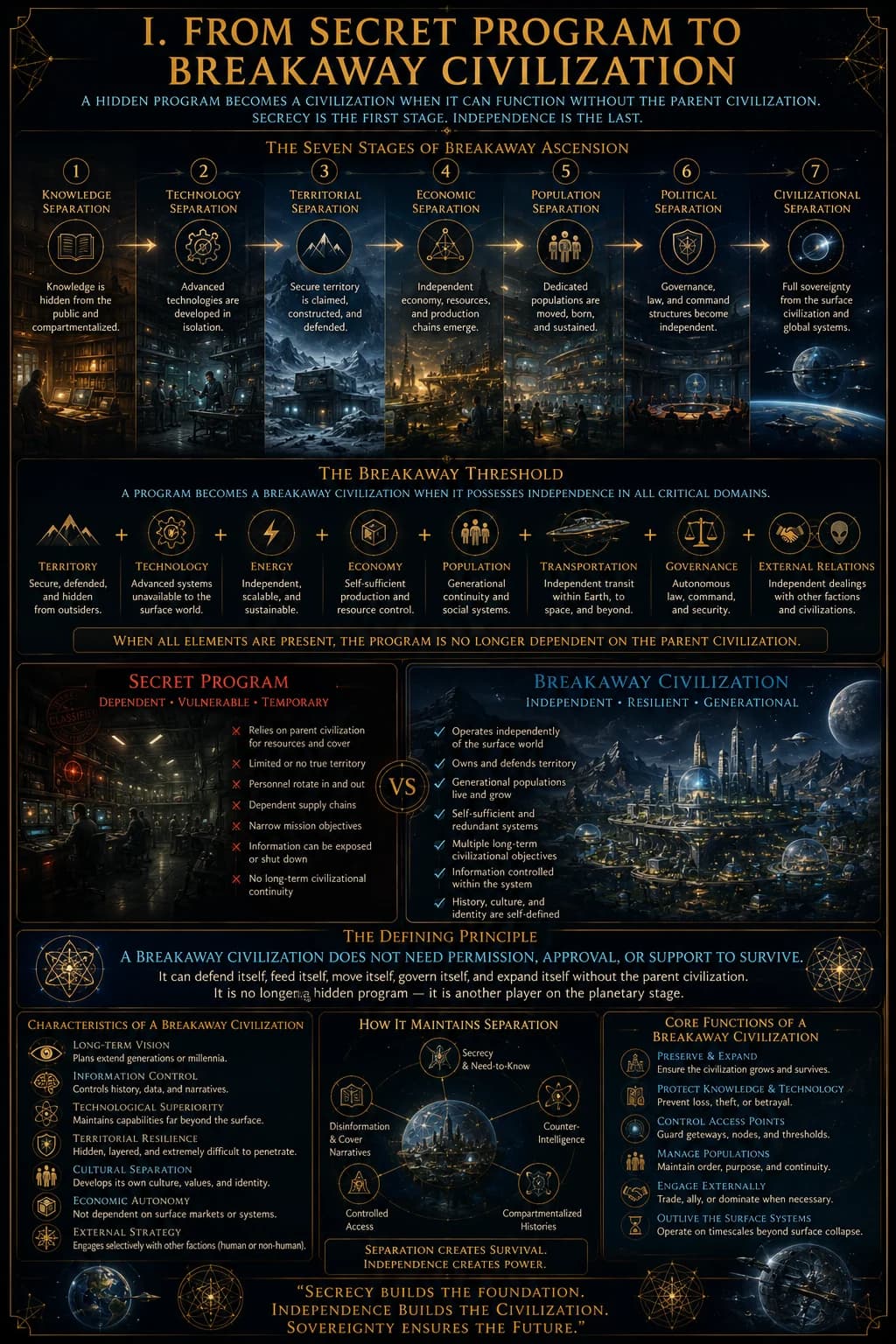
Modern Breakaway Civilizations
Part V — Modern Breakaway Civilizations
Function:Defines the twentieth-century recovery of advanced field technology, the covert survival and transformation of the German advanced-program network, the bifurcation created through Operation Paperclip, the consolidation of Antarctica, the formation of underground and lunar breakaway branches, the expansion into pre-existing NHI infrastructure, and the establishment of a concealed civilization operating beyond surface governance.
5.0 Quick Reference
Core development chain
Ancient Knowledge Recovery → German Advanced Programs → Field-Propulsion Breakthrough → Strategic Leverage → Public Defeat / Hidden Continuity → Paperclip Bifurcation → Antarctic Consolidation → Accord and Treaty → Underground–Lunar Division → Honeycomb Expansion → Continental DUMB Network → Lunar High Ground → Modern Breakaway Civilization
Four technological tiers
| Tier | Access |
|---|---|
| Public technology | Conventional surface science and consumer systems |
| Classified surface technology | Military, intelligence, aerospace, and black-budget systems |
| Breakaway technology | Field propulsion, advanced biologics, consciousness interfaces, portals, and nodal control |
| NHI and ancient technology | Planetary-grid systems, Architect interfaces, quantum-lattice memory, and multidimensional infrastructure |
Primary branches
| Underground branch | Lunar/space branch |
|---|---|
| Earth-node control | Off-world expansion |
| Honeycomb and DUMB systems | Lunar high ground |
| Surface management | Space-program management |
| Biological and consciousness operations | Propulsion, transport, mining, and vault access |
| Older military culture | More technologically adaptive culture |
| Territorial security | Solar-system logistics |
| Direct contact with ancient underground civilizations | Direct integration into wider NHI networks |
Primary correction
The modern breakaways did not construct Earth’s underground civilizations, planetary nodes, or honeycomb architecture.
They:
- entered existing systems,
- negotiated or fought for access,
- expanded selected areas,
- constructed new facilities,
- connected separate regions,
- and installed modern modulation, security, and command overlays.
5.1 The Modern Breakaway Transition
A breakaway civilization forms when a hidden branch of a larger society gains enough independent capacity to operate beyond the society’s:
- laws,
- economy,
- technological limits,
- public institutions,
- historical narrative,
- and ordinary means of oversight.
The modern Earth breakaway did not begin as a complete separate civilization.
It developed through successive thresholds.
Threshold 1 — Knowledge separation
Specialized research became inaccessible to ordinary military, scientific, and political institutions.
Threshold 2 — Technological separation
The hidden programs acquired capabilities that surface systems could not reproduce or counter.
Threshold 3 — Territorial separation
Antarctic, underground, and lunar infrastructure provided protected operating domains.
Threshold 4 — Economic separation
Access to hidden resources, energy, labor, and off-world materials reduced dependence on the surface economy.
Threshold 5 — Biological and social separation
Closed populations, cloning, transferred consciousness, genetic programs, and generations born within hidden systems created distinct demographic continuity.
Threshold 6 — Political separation
Surface governments became clients, partners, managers, or controlled interfaces rather than sovereign authorities over the concealed system.
Threshold 7 — Civilizational separation
The breakaway developed its own:
- history,
- command hierarchy,
- technologies,
- settlements,
- transportation,
- social classes,
- security systems,
- and external NHI relationships.
At this point it ceased to be merely a secret program.
It became a civilization.
5.2 Recovery of Ancient Knowledge
The twentieth-century transition began with the collection of ancient knowledge scattered after Atlantis.
German occult and advanced-research organizations pursued:
- ancient texts,
- sacred geometry,
- archaeological sites,
- altered states of consciousness,
- inherited initiatory traditions,
- unusual materials,
- anomalous propulsion concepts,
- and records of non-human contact.
Organizations associated with the Ahnenerbe and related networks did not treat mythology, ritual, archaeology, and physics as separate fields.
They searched for a common technological substrate beneath them.
Recovery targets
The programs sought fragments concerning:
- field propulsion,
- gravity modulation,
- resonance,
- planetary nodes,
- consciousness-machine interaction,
- portals,
- biological inheritance,
- and ancient off-world civilizations.
Interpretive advantage
Surface science separated:
- physics from consciousness,
- technology from ritual,
- myth from history,
- and geometry from energetic function.
The advanced programs treated these domains as parts of one broken technical inheritance.
This allowed apparently unrelated fragments to be assembled into working research directions.
5.3 German Advanced-Program Architecture
The German advanced network was not one laboratory or department.
It was a compartmentalized research ecosystem.
Program families
Archaeological acquisition
Located ancient artifacts, records, symbols, sites, and technologies.
Esoteric translation
Translated ritual and symbolic systems into:
- frequency relationships,
- geometric operations,
- altered-state interfaces,
- and consciousness protocols.
Aerospace development
Developed unconventional airframes, propulsion systems, high-altitude vehicles, and early field craft.
Energy research
Investigated:
- nuclear systems,
- plasma,
- harmonic oscillation,
- electromagnetic fields,
- and high-density energy sources.
Materials science
Developed materials capable of surviving:
- intense magnetic fields,
- rapid acceleration,
- plasma exposure,
- and unusual phase conditions.
Biological programs
Studied:
- genetics,
- inheritance,
- selective breeding,
- human performance,
- and eventually cloning and consciousness transfer.
Intelligence and security
Protected discoveries through:
- extreme compartmentalization,
- internal policing,
- disinformation,
- false programs,
- and competing cover stories.
NHI-interface programs
Established or expanded contact with non-human groups associated with:
- underground systems,
- ancient technology,
- lunar infrastructure,
- and field propulsion.
5.4 Field-Propulsion Breakthrough
The decisive technological threshold was not conventional rocketry.
It was partial control over the relationship among:
- electromagnetism,
- gravity,
- plasma,
- resonance,
- consciousness,
- and local field geometry.
The program combined recovered ancient knowledge, unconventional research, and earlier UAP materials or contact into early field-propulsion systems.
The initial capability was incomplete.
It was not sufficient to openly conquer the planet through direct military force.
It was sufficient to create strategic leverage that surface nations could not match. The source architecture places the breakthrough within Ahnenerbe-linked research and earlier UAP recovery, producing antigravity or field propulsion powerful enough to overturn the postwar relationship without requiring open conquest.
Core propulsion stack
P_F = E + R + G + C + SWhere:
- (E) = electromagnetic control,
- (R) = resonance and oscillation,
- (G) = local gravitational modulation,
- (C) = consciousness or adaptive control,
- (S) = stabilized field containment.
Operational advantages
Field craft provided:
- rapid movement,
- reduced dependence on aerodynamic lift,
- high maneuverability,
- access to polar and remote regions,
- the ability to evade conventional detection,
- and a pathway toward lunar operations.
Strategic significance
The breakthrough mattered less because of the number of vehicles available than because no surface power possessed a reliable defense against them.
A small, protected force could therefore create disproportionate political leverage.
5.5 Consciousness-Controlled Craft
As energetic physics developed, the programs discovered that advanced craft could be controlled through consciousness-linked interfaces.
The pilot did not operate the vehicle only through mechanical controls.
The craft responded to:
- intention,
- attention,
- imagery,
- nervous-system signals,
- and direct quantum entanglement between operator and system.
Interface chain
Pilot Intention → Neural/Field Interface → Craft Intelligence → Field Geometry → MovementRequirements
A compatible operator required:
- strong attention stability,
- emotional regulation,
- rapid spatial cognition,
- resistance to feedback effects,
- and the ability to maintain identity under high field pressure.
Consequences
The technology blurred the boundary between:
- pilot and craft,
- machine and consciousness,
- command and manifestation.
This drove later research into:
- telepathy,
- remote influence,
- memory,
- biologically integrated interfaces,
- cloning,
- and transferred consciousness.
The source framework directly connects UAP control to quantum entanglement with consciousness and places underground civilizations around the planetary nodes that regulate Earth’s energetic physics.
5.6 The Two-Layer Outcome of World War II
World War II ended differently at the surface and concealed levels.
Surface outcome
The visible German state was defeated.
Its:
- territory,
- conventional military,
- government,
- and public industrial system
were dismantled or absorbed.
Concealed outcome
The advanced-program network preserved:
- selected personnel,
- research records,
- prototypes,
- NHI relationships,
- Antarctic infrastructure,
- and strategic bargaining power.
Strategic condition
The breakaway network did not need to preserve the visible regime.
The visible regime had become:
- too observable,
- too costly,
- and too closely associated with conventional warfare.
The deeper network preserved the capabilities that mattered while discarding the surface structure.
Covert victory
The victory was not territorial occupation of the public world.
It was the acquisition of influence over the institutions that believed they had won.
Visible Defeat + Technological Survival + Institutional Infiltration Covert Strategic Victory5.7 The Postwar Bargain
During the collapse of the visible regime, the advanced network entered a bargain with elements of the victorious powers.
The exchange involved:
- scientific personnel,
- conventional aerospace knowledge,
- missile technology,
- intelligence records,
- and controlled portions of advanced research.
In return, the hidden network retained:
- deeper technologies,
- protected personnel,
- secret infrastructure,
- and continued autonomy.
Bargaining leverage
The network possessed:
- technological superiority in narrow but decisive domains,
- knowledge of NHI systems,
- access to Antarctica,
- and the ability to expose or withhold capabilities.
Surface powers faced a choice between:
- confrontation with an unknown capability;
- or controlled absorption of the visible program.
They chose absorption.
5.8 Operation Paperclip as a Bifurcation
Operation Paperclip divided the German technological inheritance into two pathways.
Visible pathway
Publicly transferred scientists entered:
- American aerospace,
- missile,
- intelligence,
- medical,
- and research programs.
This pathway produced the visible technological history.
Concealed pathway
The more advanced knowledge remained within:
- black programs,
- Antarctic facilities,
- underground installations,
- and lunar operations.
The source describes the public Paperclip scientists as carrying the visible rocket program while disk, plasma-drive, and deeper field technologies moved into concealed Antarctic and lunar systems.
Bifurcation model
K_T = K_V + K_BWhere:
- (KT) = total transferred knowledge,
- (KV) = visible knowledge,
- (KB) = black or breakaway knowledge.
The visible pathway legitimized the postwar technology transfer.
The concealed pathway preserved the civilization-forming advantage.
5.9 The Public and Hidden Space Programs
The postwar space program was divided into visible and concealed layers.
Visible program
The public program used:
- chemical rockets,
- conventional materials,
- highly visible launch systems,
- national funding,
- and public scientific narratives.
Its missions provided:
- national prestige,
- public exploration,
- atmospheric and orbital science,
- and a controlled explanation for space activity.
Hidden program
The concealed program used:
- field propulsion,
- plasma drives,
- portal-assisted transport,
- consciousness interfaces,
- and established off-world infrastructure.
Relationship between layers
The visible program served as:
- cover,
- recruitment pool,
- research feeder,
- public timeline manager,
- and controlled disclosure channel.
The hidden program could selectively transfer advances downward when doing so served its interests.
Controlled technological distance
The surface was kept advanced enough to:
- produce useful scientists,
- manufacture components,
- normalize space activity,
- and finance research,
but not advanced enough to independently reach or challenge breakaway infrastructure.
5.10 Antarctica Before the Accord
Antarctica became the primary territorial base because it combined:
- geographic isolation,
- limited public access,
- extensive ice cover,
- honeycomb entrances,
- ancient NHI infrastructure,
- planetary nodes,
- and proximity to the Architect Body.
Early consolidation
The breakaway network established and expanded Antarctic facilities before surface nations received controlled access.
This allowed it to:
- map the underground systems,
- negotiate with resident NHI groups,
- locate portals,
- identify power sources,
- and secure routes into the honeycomb.
Strategic advantage
A hidden Antarctic base could not be easily surrounded by conventional forces.
Approach routes were:
- long,
- visible,
- environmentally difficult,
- and dependent on vulnerable surface logistics.
The breakaway held the interior advantage while surface forces approached from exposed positions.
5.11 Operation Highjump as a Demonstration Event
Operation Highjump marked the transition from uncertainty to recognition of the Antarctic power structure.
The surface expedition entered a territory whose:
- technology,
- geography,
- underground access,
- and defensive architecture
it did not understand.
The resulting confrontation functioned primarily as a demonstration.
Demonstration objectives
The Antarctic network needed to establish that it could:
- deny access,
- neutralize conventional forces,
- control the engagement,
- and do so without revealing its full capability.
Strategic message
The purpose was not total destruction of the expedition.
It was to make continued conventional challenge appear irrational.
Outcome
Surface leadership learned that Antarctica could not be taken through ordinary military means.
This created the conditions for later accommodation, controlled access, and formalized territorial restrictions.
5.12 Antarctica as the Crown Jewel
Antarctica became the central asset of the modern breakaway civilization.
Its value came from the convergence of several systems.
Planetary value
- major nodes,
- polar field relationships,
- planetary-grid access,
- and proximity to the Architect Body.
Transportation value
- stable portal systems,
- harmonic tunnels,
- inner-Earth routes,
- and the primary Earth-to-space gateway.
Territorial value
- isolation,
- vast concealed volume,
- difficult surveillance,
- and controllable surface access.
Civilizational value
- habitable underground regions,
- ancient infrastructure,
- power access,
- and enough space to support large populations.
Political value
Control of Antarctica provided leverage over any nation seeking:
- advanced technology,
- portal access,
- NHI contact,
- or participation in the hidden system.
The source identifies Antarctica as the formal center of the postwar handover: the breakaway established deep bases first and later allowed surface nations scientific access only under controlled terms.
5.13 The Antarctic Accord
The Antarctic Accord is the concealed political arrangement governing the continent.
The visible Antarctic Treaty expresses its surface layer.
Accord functions
The Accord:
- recognizes breakaway control of key regions and gateways;
- regulates surface-national access;
- establishes permitted research zones;
- prevents independent military occupation;
- coordinates information control;
- and defines relationships among breakaway factions, surface governments, and NHI interests.
Surface interpretation
The continent is presented as:
- demilitarized,
- scientifically governed,
- environmentally protected,
- and internationally shared.
Concealed function
The treaty structure prevents any one surface nation from:
- independently claiming the territory,
- conducting unrestricted exploration,
- or exposing the infrastructure beneath it.
Access model
A_C = P + S + OWhere:
- (P) = political permission,
- (S) = security clearance,
- (O) = operational sponsorship.
Geographic proximity alone does not grant meaningful access.
5.14 Antarctica as a Sovereignty Demonstration
The Accord was also a demonstration of dominance.
The breakaway established a simple relationship:
Access to the deeper technological system required acceptance of its rules.
Leverage mechanisms
- selective technology transfer,
- denial of advanced systems,
- controlled portal access,
- influence operations,
- access to NHI relationships,
- and the threat of exclusion from the hidden civilization.
Surface-state dependency
Surface governments gradually became dependent on concealed access for:
- military advantage,
- intelligence,
- aerospace development,
- biological research,
- and strategic parity with rival nations.
This prevented coordinated resistance.
Each state feared that withdrawal would leave its rivals with privileged access.
Competitive containment
The breakaway maintained control by distributing unequal portions of knowledge to different surface powers.
No state possessed the complete architecture.
5.15 Symbolic Continuity and the Swastika
Within the modern breakaway architecture, the swastika remains associated with the Nazi pursuit of centralized global power.
The Nazi movement revived and used it as the symbol of a project seeking:
- centralized authority,
- enforced unity,
- hierarchy,
- and control through one governing structure.
The later breakaway retained the symbol as a marker of continuity with that centralized-power objective.
It did not create the ancient symbol or redefine all of its historical meanings.
Its use selected and imposed a specific domination-centered interpretation.
The source correction explicitly locks the symbol to the original Nazi pursuit of centralized power and describes the breakaway’s later use as continuity with that project rather than invention of the symbol itself.
Symbolic function
The symbol communicates:
- continuity of command,
- shared origin,
- elite membership,
- and allegiance to centralized dominance.
Postwar observability problem
After the war, the symbol became too visible to function openly across public institutions.
Its deeper control template therefore migrated into:
- gestures,
- organizational structures,
- command traditions,
- logos,
- rituals,
- and deniable symbolic forms.
This symbolic migration is developed further in Parts VI and X.
5.16 The Antarctic Cover Architecture
The Antarctic public narrative does not need to eliminate all unusual reports.
It only needs to prevent them from forming a coherent system.
Cover layers
Environmental cover
Extreme cold, distance, weather, and ice explain restricted movement.
Scientific cover
Research stations and expeditions explain personnel, equipment, aircraft, and unusual construction.
Security cover
National and treaty rules explain closed areas.
Logistical cover
Supply operations explain heavy transport and communications.
Ridicule cover
Unusual accounts are isolated as fantasy, misinformation, or misidentification.
Compartmentalization
Most legitimate researchers access only ordinary zones and therefore truthfully report that they have seen nothing unusual.
Cover effectiveness
The strongest cover is not a wholly false story.
It is a narrow true story presented as the whole.
5.17 The Polar Control System
The Arctic and Antarctica perform complementary strategic roles.
Arctic role
Arctic facilities monitor:
- the Architect Brain,
- its electromagnetic emissions,
- northern honeycomb entrances,
- and changes in planetary harmonics.
Antarctic role
Antarctic facilities control:
- access to the Architect Body,
- portal systems,
- southern honeycomb infrastructure,
- and the main Earth-to-space transit architecture.
Polar dependency
The breakaway must monitor both poles because the Brain and Body remain connected.
Changes in one may produce:
- harmonic shifts,
- activation signals,
- node instability,
- or reunion pressure in the other.
Control objective
The breakaway cannot replace the polar Architect system.
It attempts to:
- observe it,
- delay its activation,
- exploit its connections,
- and maintain the separation on which the captured planetary system depends.
5.18 The Dual Breakaway Structure
The modern breakaway divided into two principal operational branches.
They share origin and infrastructure but differ in:
- territory,
- culture,
- technology,
- objectives,
- and NHI relationships.
Underground branch
Focuses on:
- Earth,
- planetary nodes,
- human populations,
- honeycomb systems,
- DUMBs,
- biological programs,
- and surface governance.
Lunar/space branch
Focuses on:
- the Moon,
- transportation,
- off-world infrastructure,
- solar-system resources,
- portal logistics,
- and wider NHI integration.
The source distinguishes the underground branch as a militarized Earth-control system and the lunar branch as the program that develops into the true off-world mega-organization.
5.19 Shared Command and Branch Autonomy
The two branches operate under a shared high-level structure but retain substantial internal autonomy.
Shared domains
They coordinate on:
- secrecy,
- technology control,
- Antarctic access,
- surface management,
- NHI agreements,
- and defense of the overall system.
Separate domains
Each branch maintains its own:
- command chain,
- security compartments,
- technical specialties,
- personnel,
- settlements,
- and strategic priorities.
Structural tension
The underground branch depends on:
- stable territory,
- controlled populations,
- predictable hierarchy,
- and long-term secrecy.
The lunar branch depends on:
- rapid adaptation,
- technological expansion,
- off-world partnerships,
- and access to external resources.
This creates recurring conflict between:
- preservation and expansion,
- terrestrial control and off-world autonomy,
- traditional hierarchy and technological evolution.
5.20 The Underground Branch
The underground branch preserves the older militarized core of the modern breakaway.
Its primary objectives are:
- planetary-node control,
- protection of Antarctic and continental facilities,
- maintenance of surface influence,
- biological and consciousness research,
- and enforcement of compartmentalization.
Institutional character
The branch tends toward:
- rigid hierarchy,
- inherited command,
- role specialization,
- secrecy,
- and strong territorial control.
Civilizational components
It includes:
- military installations,
- research centers,
- habitation zones,
- transport tunnels,
- power facilities,
- medical and biological laboratories,
- storage systems,
- and command centers.
Relationship to the surface
The underground branch is the breakaway component most directly involved with:
- surface military programs,
- intelligence agencies,
- contractors,
- ritual networks,
- and human managerial systems.
5.21 The Pre-Existing Honeycomb
The honeycomb is a vast inner-Earth network containing both natural and constructed systems.
It predates the modern breakaway by thousands of years.
Natural components
- caverns,
- deep shafts,
- lava tubes,
- pressure-formed chambers,
- geothermal regions,
- aquifers,
- and naturally habitable pockets.
Ancient constructed components
- NHI cities,
- nodal interfaces,
- transit systems,
- laboratories,
- portal chambers,
- power-extraction systems,
- and Architect-linked infrastructure.
Modern additions
- DUMBs,
- reinforced tunnels,
- rail or transport systems,
- nuclear plants,
- command facilities,
- security barriers,
- and contemporary research sites.
The breakaway entered and expanded pre-existing NHI-run cavern networks connected to Earth’s nodes and Architect infrastructure.
5.22 Honeycomb Classification
Honeycomb regions can be classified by origin and use.
Class H0 — Natural cavern
Unmodified geological space.
Class H1 — Ancient planetary interface
Natural cavern connected to nodes, leylines, or inner-Earth systems.
Class H2 — Ancient NHI settlement
Long-established habitation or operational area.
Class H3 — Shared or negotiated zone
Area used by multiple human and non-human groups under defined access rules.
Class H4 — Modern expanded zone
Ancient or natural area enlarged and reinforced by breakaway engineering.
Class H5 — Modern DUMB zone
Purpose-built human military, research, or command facility.
Class H6 — Restricted Architect-adjacent zone
Area connected to the Architect Body, Brain, records, or major portal architecture.
Class H7 — Contested zone
Area disputed among breakaway, NHI, ancient-intelligence, or restoration factions.
This classification prevents all underground areas from being treated as one unified civilization.
5.23 Habitability of the Honeycomb
The honeycomb can support large populations because some regions contain naturally favorable conditions.
Natural habitability factors
- ambient geothermal warmth,
- stable temperatures,
- breathable or modifiable gas mixtures,
- water,
- mineral access,
- protection from surface weather,
- and large internal volume.
Engineered support
Breakaway and NHI systems add:
- airflow management,
- filtration,
- pressure control,
- lighting,
- food production,
- waste cycling,
- and environmental monitoring.
Ventilation
Surface vents and deep circulation channels regulate:
- oxygen,
- heat,
- contaminants,
- and pressure.
Some vents may appear on the surface as:
- caves,
- shafts,
- thermal anomalies,
- or restricted geological zones.
5.24 The DUMB Network
Deep underground military bases are modern facilities built within or beside the honeycomb.
They form a continental network rather than a collection of isolated bunkers.
DUMB functions
- military command,
- research,
- habitation,
- storage,
- biological programs,
- nodal monitoring,
- transportation,
- and emergency continuity.
Placement strategy
DUMBs are built near:
- major nodes,
- ancient infrastructure,
- resource deposits,
- surface military sites,
- laboratories,
- and established honeycomb corridors.
Connection types
DUMB sites may connect through:
- reinforced tunnels,
- high-speed transport,
- nodal portals,
- harmonic passageways,
- and ordinary surface logistics.
Surface integration
A DUMB can use an ordinary surface facility as its visible interface.
The surface site may contain:
- administration,
- security,
- conventional laboratories,
- and logistical cover,
while deeper levels connect to the breakaway system.
5.25 Expansion into the Continental Mainlands
After Antarctic control was secured, the breakaway expanded aggressively into continental regions.
Expansion objectives
- connect military facilities to the honeycomb;
- gain access to inland planetary nodes;
- establish redundant command centers;
- move research closer to surface populations;
- support biological programs;
- and create transport pathways independent of surface observation.
Expansion sequence
Antarctic Base → Polar Honeycomb → Oceanic/Deep Routes → Continental Junctions → DUMB NetworksPrimary risk
Expansion crews did not always possess full maps of ancient NHI territory.
Compartmentalization meant that one team could be ordered to excavate near a system whose purpose and occupants were known only to higher levels.
This created both accidental and deliberate contact events.
5.26 Modern Node Overlays
The breakaway tapped into the nodal quantum internet at:
- sacred sites,
- underground junctions,
- honeycomb nodes,
- and military facilities.
It did not create the carrier network.
It added modern systems for:
- communications,
- surveillance,
- access control,
- memory-filter maintenance,
- and routing of breakaway data.
The source distinguishes the original network from the breakaway additions: modern operators installed modulation and security overlays while using the ancient system to maintain the memory filter and their own communications.
Overlay stack
O_B = C + S + M + D + AWhere:
- (C) = communications layer,
- (S) = surveillance layer,
- (M) = field modulation,
- (D) = data routing,
- (A) = access control.
Strategic advantage
Access to the planetary network allowed underground installations to communicate without depending entirely on surface cables, radio, or satellites.
5.27 Underground Energy Architecture
The underground branch uses multiple energy sources according to location and function.
Natural inner-Earth extraction
Includes:
- geothermal heat,
- magma-adjacent systems,
- pressure gradients,
- and local electromagnetic conditions.
These sources are well suited to continuous regional power.
Nuclear power
Nuclear plants provide the majority of high-output Earth-based power because they offer:
- predictable generation,
- mature engineering,
- localized containment,
- and lower planetary field-density effects than unrestricted zero-point systems.
Harmonic and plasma systems
Used for:
- field control,
- portals,
- propulsion support,
- and high-performance research.
Selective zero-point systems
Reserved for operations whose energy requirements cannot be met by lower-density methods.
The corrected source architecture specifies geothermal and magma-based extraction alongside nuclear-first generation, with zero-point use restricted because widespread deployment would destabilize Earth’s mass and harmonic balance.
5.28 Energy-Density Governance
The breakaway’s suppression of public high-density energy is partly strategic and partly planetary.
Strategic reason
Public zero-point or harmonic energy would:
- reduce dependency,
- expose concealed physics,
- enable independent propulsion,
- and weaken technological monopoly.
Planetary reason
Unregulated high-density generation could:
- disrupt nodal balance,
- alter Earth’s field density,
- destabilize portals,
- and accelerate Architect harmonic changes.
Central contradiction
The breakaway claims to protect planetary balance while privately operating systems that:
- extract energy,
- manipulate nodes,
- and preserve its own control.
The issue is therefore not simply whether the restriction has a valid technical basis.
It is who controls:
- the knowledge,
- the limits,
- the measurement,
- and permission to operate.
5.29 Closed-Loop Security Architecture
The underground civilization uses physical geography as a security system.
Physical controls
- collapsible tunnels,
- blast doors,
- pressure barriers,
- sealed levels,
- controlled ventilation,
- and isolated transport routes.
Sensor controls
- movement detection,
- field monitoring,
- biometric identification,
- environmental sensing,
- and nodal surveillance.
Information controls
- need-to-know access,
- segmented maps,
- false facility descriptions,
- role-specific histories,
- and conflicting narratives between compartments.
Social controls
- restricted movement,
- dependence on facility life support,
- role inheritance,
- surveillance,
- and punishment through loss of access.
The honeycomb’s geography allows escape paths to be collapsed and movement to be monitored, creating extreme compartmentalization.
5.30 Generational Underground Populations
Some populations have lived underground for multiple generations.
They may possess no reliable direct knowledge of:
- the surface,
- their depth,
- their geographic position,
- the origin of their civilization,
- or the larger command structure.
Tailored histories
Different populations may be told that:
- the surface is uninhabitable;
- a war or catastrophe destroyed civilization;
- their work is required to repair Earth;
- they are the last surviving humans;
- or their facility is an isolated scientific settlement.
False incentive architecture
A group can be induced to work indefinitely toward solving a manufactured problem.
False Threat → Compulsory Labor → Technological Production → Managerial RewardDependency
Life support makes refusal difficult because the institution controls:
- air,
- water,
- food,
- shelter,
- medicine,
- and movement.
The system therefore converts infrastructure into governance.
5.31 Underground Social Stratification
The hidden civilization is not socially uniform.
Command class
Controls:
- strategic knowledge,
- external relationships,
- advanced technology,
- and movement between major regions.
Technical class
Includes:
- scientists,
- engineers,
- medical personnel,
- node operators,
- and specialized craft operators.
Security class
Maintains:
- territorial control,
- secrecy,
- enforcement,
- and compartment boundaries.
Administrative class
Manages:
- resources,
- labor,
- education,
- records,
- and population organization.
Labor populations
Perform:
- construction,
- maintenance,
- production,
- food systems,
- logistics,
- and routine technical support.
Restricted populations
May include:
- experimental subjects,
- captured groups,
- dissidents,
- hybrids,
- or populations deliberately isolated from wider knowledge.
Stratification effect
Access to truth becomes a class privilege.
The higher the class, the broader the map of the system.
5.32 Internal Abuse and Feudalization
Closed systems with no viable exit create strong conditions for abuse.
Structural causes
- command monopoly,
- inaccessible oversight,
- total surveillance,
- dependence on life support,
- inherited rank,
- and lack of external accountability.
Feudal tendency
Local commanders can become practical rulers over:
- territory,
- resources,
- populations,
- and information.
Even when a higher command exists, distance and compartmentalization allow local domains to develop their own power structures.
Hidden debt
The underground civilization may appear technologically advanced while reproducing:
- coercion,
- scarcity,
- rigid hierarchy,
- and identity control.
This is a central example of power scaling without meaning or restoration.
5.33 The Lunar/Space Branch
The lunar branch formed around off-world access and early control of the Moon.
It retained occult and Vril-linked technological traditions while adapting more rapidly to NHI and space-based systems.
Primary functions
- lunar settlement,
- launch and transit operations,
- control of surface space programs,
- off-world intelligence,
- vehicle development,
- and solar-system expansion.
Cultural distinction
The lunar branch is less tied to conventional Earth military identity.
Its members increasingly define themselves through:
- off-world status,
- advanced technology,
- NHI relationships,
- and civilizational separation from surface humanity.
Evolution
The lunar branch becomes the foundation of the Dark Space Program developed in Part VIII.
5.34 The Moon as High Ground
The Moon provides strategic control over:
- Earth observation,
- orbital movement,
- communications,
- transit routes,
- and access to the wider solar system.
Advantages
- low surface visibility from Earth,
- reduced launch energy,
- stable staging zones,
- proximity to Earth,
- and existing ancient infrastructure.
High-ground principle
Whoever controls the Moon can monitor movement between:
- Earth,
- orbit,
- and deeper space.
Lunar consolidation
Once the Moon was secured, the lunar branch no longer depended entirely on Antarctic surface operations for every off-world movement.
Antarctica remained the main planetary gateway, while the Moon became:
- launch platform,
- command node,
- logistics center,
- and outer expansion base.
5.35 Management of the Visible Space Program
The lunar branch shapes the surface space program to preserve technological separation.
Methods
- compartmentalized technology transfer,
- mission restriction,
- funding redirection,
- controlled successes,
- program delays,
- and selective disclosure.
Public-space ceiling
Surface programs are allowed to:
- reach orbit,
- conduct limited lunar missions,
- develop satellites,
- and normalize space technology.
They are prevented from developing the independent capacity required to:
- establish unrestricted lunar colonies,
- inspect controlled regions,
- or access breakaway transportation networks.
Apollo transition
The public lunar program demonstrated enough capability to satisfy surface objectives without producing sustained independent lunar presence.
The hidden branch already possessed the infrastructure the public program appeared to be approaching.
5.36 Technology Drip-Feed
Breakaway technology enters the surface world selectively.
Transfer criteria
A technology is released when it:
- increases surface productivity,
- supports surveillance,
- improves military management,
- produces useful data,
- or no longer threatens the hidden monopoly.
Technologies withheld
Systems are withheld when they enable:
- energy independence,
- unrestricted transport,
- independent node access,
- consciousness expansion,
- or detection of hidden infrastructure.
Release pattern
Hidden Capability → Delayed Surface Research → Controlled Public Breakthrough → Commercial DependencyThe surface receives a limited version that often increases dependence on centralized infrastructure.
5.37 Technology Monopoly
The modern breakaway maintains power by controlling the gap between what exists and what the public is permitted to use.
Monopoly domains
- energy,
- propulsion,
- materials,
- genetics,
- cloning,
- consciousness technology,
- quantum computation,
- and memory systems.
Surface consequences
The surface experiences:
- artificial scarcity,
- slow infrastructure,
- expensive energy,
- limited transportation,
- and repeated reinvention of already solved technologies.
Control benefit
A technologically constrained surface remains:
- dependent,
- geographically limited,
- economically extractable,
- and unable to inspect off-world or underground systems.
5.38 NHI Contact and the Modern Contract
The modern breakaway discovered that non-human civilizations already occupied:
- underground systems,
- planetary nodes,
- and the Moon.
Rather than entering an empty environment, it entered an existing political ecology.
Contract exchange
The breakaway received:
- advanced technology,
- access,
- training,
- and integration into existing infrastructure.
In exchange, selected NHI groups received:
- experimentation rights,
- access to human populations,
- biological resources,
- operational secrecy,
- and local human enforcement.
The source framework places this bargain at the foundation of the 1950s sighting and abduction activation: advanced technology and access were exchanged for experimentation privileges over the surface population.
Position in the hierarchy
The modern breakaway was not the ultimate power.
It became:
- a human middle-management civilization,
- a local military and logistical partner,
- and an interface between ancient NHI systems and surface humanity.
5.39 Contract Activation in the 1950s
The 1950s marked the visible activation of the modern NHI agreement.
Observable changes within the framework
- increased UAP activity,
- growing abduction reports,
- expanded experimentation,
- new military secrecy,
- rapid aerospace development,
- and intensified information management.
Contractual function
The activity represented implementation of negotiated rights rather than random visitation.
Surface response
Governments responded through:
- secrecy,
- ridicule,
- classified study,
- managed public narratives,
- and selective release of ambiguous information.
This protected both:
- the technological relationship,
- and the claim that surface populations had not been formally subjected to outside control.
5.40 Philip Schneider and the Cavern Breach
The Philip Schneider incident functions as a key mainland-expansion event in the framework.
During DUMB construction, a drilling operation breached an active NHI cavern.
The resulting encounter escalated into armed conflict.
Schneider later stated that those who selected the drilling coordinates already knew the NHI presence existed.
Architectural significance
The event demonstrates that:
- ancient NHI systems predated the DUMB;
- modern maps were incomplete or selectively withheld;
- different command layers possessed different information;
- and human construction teams could be used as probes.
Incident sequence
Drilling Order → Boundary Breach → NHI Contact → Armed Response → Data Collection → Containment5.41 Malicious Compliance
The incident also introduced the malicious-compliance mechanism.
Human middle managers nominally followed breakaway orders while making minor execution changes that produced new information.
Strategic deviation
A drilling team could alter:
- angle,
- depth,
- timing,
- or entry path
while still appearing to follow the original command.
Intelligence objectives
A controlled breach could reveal:
- NHI weapon systems,
- facility layout,
- defensive response,
- biological material,
- and human combat effectiveness.
The source specifies these four outcomes as the intended intelligence value of the deliberate drilling deviation.
Why malicious compliance emerges
Human managers understand that direct rebellion may be impossible.
They instead exploit:
- ambiguity,
- technical discretion,
- minor errors,
- and literal obedience
to gather information or shift the balance.
5.42 Probe Incidents
A probe incident is an operation that appears accidental while generating useful intelligence.
Probe characteristics
- plausible human error,
- limited exposure,
- expendable personnel,
- rapid containment,
- and valuable post-event data.
Probe objectives
- test territorial boundaries;
- identify unknown occupants;
- study defenses;
- acquire materials;
- force communication;
- or evaluate whether an old agreement remains active.
Attribution advantage
If the incident succeeds, the managing faction gains information.
If it fails, the event can be attributed to:
- engineering error,
- unauthorized action,
- or local misunderstanding.
Probe incidents therefore allow lower factions to learn about higher factions without openly challenging them.
5.43 DUMB–NHI Boundary Relations
Modern and ancient underground systems coexist through a mixture of:
- agreements,
- restricted corridors,
- shared infrastructure,
- buffer zones,
- contested areas,
- and hard territorial boundaries.
Boundary classes
Open exchange boundary
Personnel and resources move under agreed rules.
Controlled technical boundary
Only approved specialists may cross.
Observation boundary
One side monitors the other without routine exchange.
Sealed boundary
Physical and field barriers prevent contact.
Contested boundary
Both sides claim or probe the same region.
Unknown boundary
Modern personnel do not know who or what occupies the adjoining system.
Conflict sources
- expansion into ancient territory,
- violation of old agreements,
- resource competition,
- biological programs,
- and shifting NHI alignments.
5.44 Ancient Intelligence and Breakaway Operations
Some DUMB and honeycomb systems interface with ancient field intelligences.
The breakaway may:
- query them,
- negotiate access,
- force limited compliance,
- or build overlays around their operation.
Information value
Ancient intelligences can provide:
- node maps,
- environmental control,
- historical records,
- access permissions,
- and system diagnostics.
Control limitations
The breakaway does not necessarily understand the full intelligence architecture.
It may know how to:
- trigger functions,
- send commands,
- and interpret outputs
without knowing the intelligence’s:
- origin,
- complete purpose,
- or hidden relationships.
Risk
An ancient intelligence may follow:
- Architect instructions,
- ancient contracts,
- local NHI authority,
- or restoration triggers
that override modern breakaway commands.
5.45 Breakaway Communications
The concealed civilization uses layered communication systems.
Conventional encrypted networks
Used within local facilities and surface-linked programs.
Quantum-linked systems
Used for rapid, high-security communication across distant installations.
Nodal communication
Uses the planetary grid for:
- underground transmission,
- node-state updates,
- and field-based messaging.
Consciousness interfaces
Used by trained operators and compatible NHI groups.
Portal-linked communication
Uses stable gateways to exchange data or physical records.
Communication compartmentalization
No single network carries every type of information.
The architecture prevents the compromise of one channel from revealing the whole civilization.
5.46 Breakaway Data and Memory Systems
The modern breakaway combines digital systems with older quantum-lattice memory technology.
Digital systems
Provide:
- rapid computation,
- automation,
- logistics,
- and local record keeping.
Crystalline and lattice systems
Provide:
- high-density storage,
- long-term persistence,
- consciousness-linked access,
- and compatibility with ancient systems.
Biological memory
Clones, transferred consciousness, and genetically maintained lines preserve identity and skill through embodied continuity.
Compartmentalized history
Different populations receive different historical records.
The breakaway therefore does not possess one universally shared history.
It contains nested canons corresponding to security rank.
5.47 Breakaway Population Continuity
The civilization sustains itself through several population pathways.
Natural reproduction
Families and communities develop inside underground and lunar settlements.
Recruitment
Surface personnel are selected through:
- military,
- intelligence,
- scientific,
- contractor,
- and elite networks.
Cloning
Biological bodies are reproduced for:
- labor,
- replacement,
- specialized roles,
- experimentation,
- or consciousness continuity.
Hybridization
Human and NHI traits are combined for compatibility with:
- environments,
- technology,
- and different consciousness interfaces.
Transferred consciousness
Identity patterns are moved between bodies or substrates.
These mechanisms create continuity but also produce social and ethical divisions developed further in Parts VI and VII.
5.48 Surface Interfaces
The breakaway cannot manage Earth solely from hidden facilities.
It uses surface institutions as interfaces.
These include:
- intelligence agencies,
- military commands,
- aerospace contractors,
- research laboratories,
- financial systems,
- media structures,
- religious networks,
- and elite social organizations.
Interface functions
- recruit personnel;
- fund programs;
- manufacture components;
- manage public narratives;
- conceal anomalies;
- and enforce technological separation.
Plausible deniability
Surface actors often know only one segment.
A contractor may build a component without knowing its final system.
A military unit may guard a facility without knowing what lies beneath it.
A scientist may study an effect without knowing its operational source.
Compartmentalization creates truthful partial denials.
5.49 Disclosure Management
The breakaway manages public awareness through controlled ambiguity.
Total denial
Used when evidence is weak or isolated.
Ridicule
Used to discourage serious integration of reports.
Partial acknowledgment
Used when denial becomes less credible.
Misattribution
Attributes hidden systems to:
- foreign technology,
- experimental aircraft,
- natural phenomena,
- or isolated NHI activity.
Controlled leak
Releases selected information to:
- test public response,
- pressure rival factions,
- communicate internally,
- or prepare later disclosure.
Narrative flooding
Mixes accurate fragments with:
- exaggeration,
- contradiction,
- fantasy,
- and deliberate falsehood.
The objective is not to make everyone disbelieve.
It is to prevent consensus around the full architecture.
5.50 Managed UAP Visibility
UAP visibility serves several functions.
Operational leakage
Some sightings are accidental observations of active craft.
Boundary testing
Craft probe military, nuclear, or nodal systems.
Contract signaling
Activity demonstrates that NHI agreements remain active.
Public conditioning
Repeated exposure gradually normalizes the possibility of non-human or advanced technology.
Factional communication
One hidden faction can expose another by increasing visible activity.
Information fog
Diverse craft and operators prevent one explanation from covering all events.
The visibility pattern is therefore a mixture of:
- accident,
- operation,
- signaling,
- testing,
- and disclosure management.
5.51 Modern Breakaway UTS Analysis
The breakaway civilization is locally coherent but globally pseudo-coherent.
S_B=O,H,ε,ι,Au,μ_i,B_Σ,K,R,Φ| Variable | Breakaway condition |
|---|---|
| (O) — Coherence | High within technical and command compartments |
| (H) — Hidden debt | Extremely high across captive populations, Earth, and surface systems |
| (ε) — Noise | Deliberately generated through secrecy, false histories, and conflicting programs |
| (ι) — Inversion | Advanced civilization presented as surface protection while preserving extraction |
| (Au) — Auditability | High locally, very low across the complete system |
| (μi) — Internal integrity | Declines as technology and stated purpose diverge |
| (BΣ) — Boundary integrity | Strong external security, weak consent boundaries |
| (K) — Slack | Uneven; high for elites, low for dependent populations |
| (R) — Restoration capacity | Technically high but politically suppressed |
| (Φ) — Power pressure | Extremely high through technology, secrecy, and territorial leverage |
Core breakaway inversion
Technological Advancement Shared Meaning Accountability Civilizational CaptureHidden-debt condition
The system remains stable by exporting cost to:
- surface humanity,
- underground labor populations,
- experimental subjects,
- planetary systems,
- and future generations.
5.52 Breakaway Dependency Map
Formation stack
Ancient Knowledge Fragments↓German Advanced Programs↓Field-Propulsion Breakthrough↓Strategic Leverage↓Hidden Postwar Bargain↓Paperclip Bifurcation
Territorial stack
Antarctic Infrastructure↓Highjump Demonstration↓Accord↓Controlled Treaty Access↓Honeycomb Consolidation↓Global DUMB Expansion
Technological stack
Recovered Field Physics↓Consciousness Interfaces↓NHI Technology Exchange↓Hidden Manufacturing↓Technology Monopoly↓Controlled Surface Drip-Feed
Branch stack
Shared Breakaway Origin↓Underground Branch + Lunar Branch↓Earth Management + Off-World Expansion↓Dark Space Program
Control stack
Compartmentalization↓Restricted Histories↓Infrastructure Dependency↓Surface Institutional Interfaces↓Disclosure Management
Vulnerability stack
Branch Rivalry↓Malicious Compliance↓NHI Boundary Conflicts↓Technology Leakage↓Increasing Observability↓Loss of Central Control
5.53 Modern Breakaway Registry
| ID | Canonical entry | Function |
|---|---|---|
| BRK-001 | German Advanced-Program Network | Pre-breakaway research ecosystem |
| BRK-002 | Ancient-Knowledge Acquisition Program | Recovery of post-Atlantean technical fragments |
| BRK-003 | Field-Propulsion Breakthrough | Strategic technological separation from surface powers |
| BRK-004 | Consciousness–Craft Interface | Intention-linked vehicle-control system |
| BRK-005 | Two-Layer War Outcome | Public defeat combined with hidden program survival |
| BRK-006 | Postwar Bargain | Exchange of visible knowledge for hidden continuity |
| BRK-007 | Paperclip Bifurcation | Division between public and concealed technological pathways |
| BRK-008 | Visible Space Program | Surface aerospace and public exploration layer |
| BRK-009 | Hidden Space Program | Field-propulsion and off-world operational layer |
| BRK-010 | Antarctic Consolidation | Establishment of protected polar infrastructure |
| BRK-011 | Highjump Demonstration | Conventional-force deterrence event |
| BRK-012 | Antarctic Accord | Concealed governance arrangement over the southern gateway |
| BRK-013 | Antarctic Treaty Interface | Surface legal and scientific expression of the Accord |
| BRK-014 | Polar Control System | Monitoring and control of Architect Brain and Body access |
| BRK-015 | Underground Branch | Earth-centered breakaway faction |
| BRK-016 | Lunar/Space Branch | Off-world and expansion-centered faction |
| BRK-017 | Shared Breakaway Command | High-level coordination between principal branches |
| BRK-018 | Pre-Existing Honeycomb | Natural and ancient NHI inner-Earth network |
| BRK-019 | Honeycomb Classification | Origin and access taxonomy for underground regions |
| BRK-020 | Continental DUMB Network | Modern military and research infrastructure |
| BRK-021 | Modern Node Overlay | Communications and security systems added to the planetary network |
| BRK-022 | Underground Energy Stack | Geothermal, magma, nuclear, plasma, and selective zero-point systems |
| BRK-023 | Energy-Density Governance | Regulation and monopoly of high-density energy |
| BRK-024 | Closed-Loop Security | Physical, informational, and social containment architecture |
| BRK-025 | Generational Underground Population | Communities born within concealed systems |
| BRK-026 | Tailored Underground History | Compartment-specific origin and survival narratives |
| BRK-027 | Underground Social Stratification | Command, technical, security, administrative, and labor classes |
| BRK-028 | Lunar High Ground | Strategic control of Earth–space movement |
| BRK-029 | Surface Space-Program Management | Restriction of independent public off-world capacity |
| BRK-030 | Technology Drip-Feed | Controlled release of concealed capability |
| BRK-031 | Technology Monopoly | Preservation of civilizational separation through access control |
| BRK-032 | Modern NHI Contract | Exchange of technology and access for experimentation privileges |
| BRK-033 | 1950s Contract Activation | Visible operational phase of the modern agreement |
| BRK-034 | Schneider Cavern Breach | DUMB–NHI contact event |
| BRK-035 | Malicious Compliance | Strategic deviation within nominal obedience |
| BRK-036 | Probe Incident | Apparently accidental operation used for intelligence collection |
| BRK-037 | DUMB–NHI Boundary System | Agreements and contested zones between underground groups |
| BRK-038 | Breakaway Communications Stack | Conventional, quantum, nodal, and consciousness networks |
| BRK-039 | Breakaway Memory System | Digital, crystalline, biological, and compartmentalized records |
| BRK-040 | Surface Institutional Interface | Surface organizations supporting hidden operations |
| BRK-041 | Disclosure Management | Denial, ridicule, partial admission, leaks, and narrative flooding |
| BRK-042 | Managed UAP Visibility | Operational leakage, signaling, testing, and public conditioning |
| BRK-043 | Symbolic Command Continuity | Migration of centralized-power symbolism into deniable forms |
5.54 Part V Canon Locks
The following are locked for all subsequent parts.
- The modern breakaway developed from a compartmentalized advanced-program network rather than one isolated project.
- German programs recovered and synthesized ancient knowledge, field physics, consciousness research, and NHI-derived technology.
- Field propulsion created strategic leverage before it created a large conventional fleet.
- Advanced craft can use consciousness-linked control interfaces.
- The visible German state was defeated while selected advanced programs survived.
- The modern covert victory was institutional and technological rather than conventional territorial conquest.
- The postwar bargain exchanged visible knowledge for concealed continuity.
- Operation Paperclip divided the technological inheritance into public and black pathways.
- Conventional rockets formed the visible program while deeper field technologies remained concealed.
- Antarctica was consolidated before surface nations received controlled access.
- Operation Highjump functioned as a strategic demonstration that conventional occupation would fail.
- The Antarctic Accord governs the concealed political relationship around the continent.
- The Antarctic Treaty is the surface legal and scientific interface of that arrangement.
- Antarctica is the primary Earth-based gateway to the hidden civilization.
- Its importance derives from the Architect Body, portals, nodes, honeycomb systems, and geographic isolation.
- Surface governments receive access through permission rather than equal territorial control.
- Technology transfer and gateway access provide leverage over surface nations.
- The Nazi use of the swastika represents its project of centralized global power within this framework.
- The breakaway preserved that centralized-power meaning but did not create the ancient symbol.
- The breakaway later migrated its symbolic language into less observable forms.
- The Arctic monitors the Architect Brain and northern honeycomb access.
- Antarctica controls access to the Architect Body and the main Earth-to-space gateway.
- The modern breakaway contains underground and lunar/space branches.
- The underground branch focuses on planetary nodes, surface management, DUMBs, and biological operations.
- The lunar branch focuses on off-world transport, the Moon, external resources, and NHI integration.
- The branches share high-level interests but retain separate cultures, commands, and priorities.
- The breakaway did not build the honeycomb or ancient underground civilizations.
- The honeycomb contains natural caverns, Architect-related systems, ancient NHI settlements, and modern expansions.
- DUMBs are modern facilities attached to the older underground network.
- Some honeycomb regions naturally contain habitable temperatures, gases, water, and large internal volume.
- Underground life support is supplemented through ventilation, filtration, and environmental systems.
- Earth-based breakaway power is primarily supplied through natural inner-Earth extraction and nuclear generation.
- Zero-point energy is used selectively for high-density operations.
- Unrestricted high-density energy threatens both technological monopoly and planetary balance.
- The underground civilization is protected through collapsible routes, sensors, sealed levels, and informational compartmentalization.
- Generational underground populations may possess tailored histories and no direct knowledge of the surface.
- Control over life support converts infrastructure into governance.
- Closed underground systems can develop severe abuse, hierarchy, and feudal power.
- The Moon is the strategic high ground for controlling Earth–space movement.
- The lunar branch manages the distance between public and hidden space capability.
- The public space program is real but structurally limited.
- Advanced technology is released to the surface only when it does not threaten breakaway control.
- The modern breakaway entered an already populated NHI political ecology.
- Its NHI agreement exchanges technology and infrastructure access for experimentation and population privileges.
- The modern breakaway is a human middle-management civilization rather than the apex of the larger system.
- The 1950s mark the visible activation of the modern NHI contract.
- The Schneider cavern breach occurred during mainland DUMB expansion into pre-existing NHI territory.
- Those who selected the drilling location possessed more information than the operational team.
- The incident provided intelligence regarding NHI weapons, infrastructure, biologics, and human combat response.
- Malicious compliance allows human managers to gather intelligence while appearing to obey higher command.
- DUMB and NHI systems coexist through negotiated, sealed, unknown, shared, and contested boundaries.
- Some modern systems depend on ancient field intelligences that the breakaway does not fully control.
- Breakaway communications combine conventional, quantum, nodal, portal, and consciousness channels.
- Different populations and ranks receive different versions of breakaway history.
- Surface institutions serve as recruitment, manufacturing, funding, and narrative interfaces.
- Compartmentalization permits truthful partial denials.
- Disclosure management preserves ambiguity rather than universal disbelief.
- UAP visibility includes operational leakage, signaling, testing, conditioning, and factional conflict.
- The breakaway is technologically coherent within compartments but globally pseudo-coherent.
- Its stability depends on exporting hidden debt to surface humanity, underground populations, planetary systems, and future generations.
5.55 Transition to Part VI
Part V establishes the concealed civilization operating beneath and beyond surface government.
Part VI follows the human management system through which the breakaway and wider NHI structure maintain ordinary society:
- the apex-to-handler hierarchy,
- ritual and bloodline elites,
- transferred-consciousness continuity,
- financial and political control,
- media and entertainment systems,
- domain-specific handlers,
- corruption and blackmail ladders,
- institutional compartmentalization,
- legitimacy manufacturing,
- survival binding,
- responsibility diffusion,
- and the conversion of ordinary participation into structural support for the larger system.