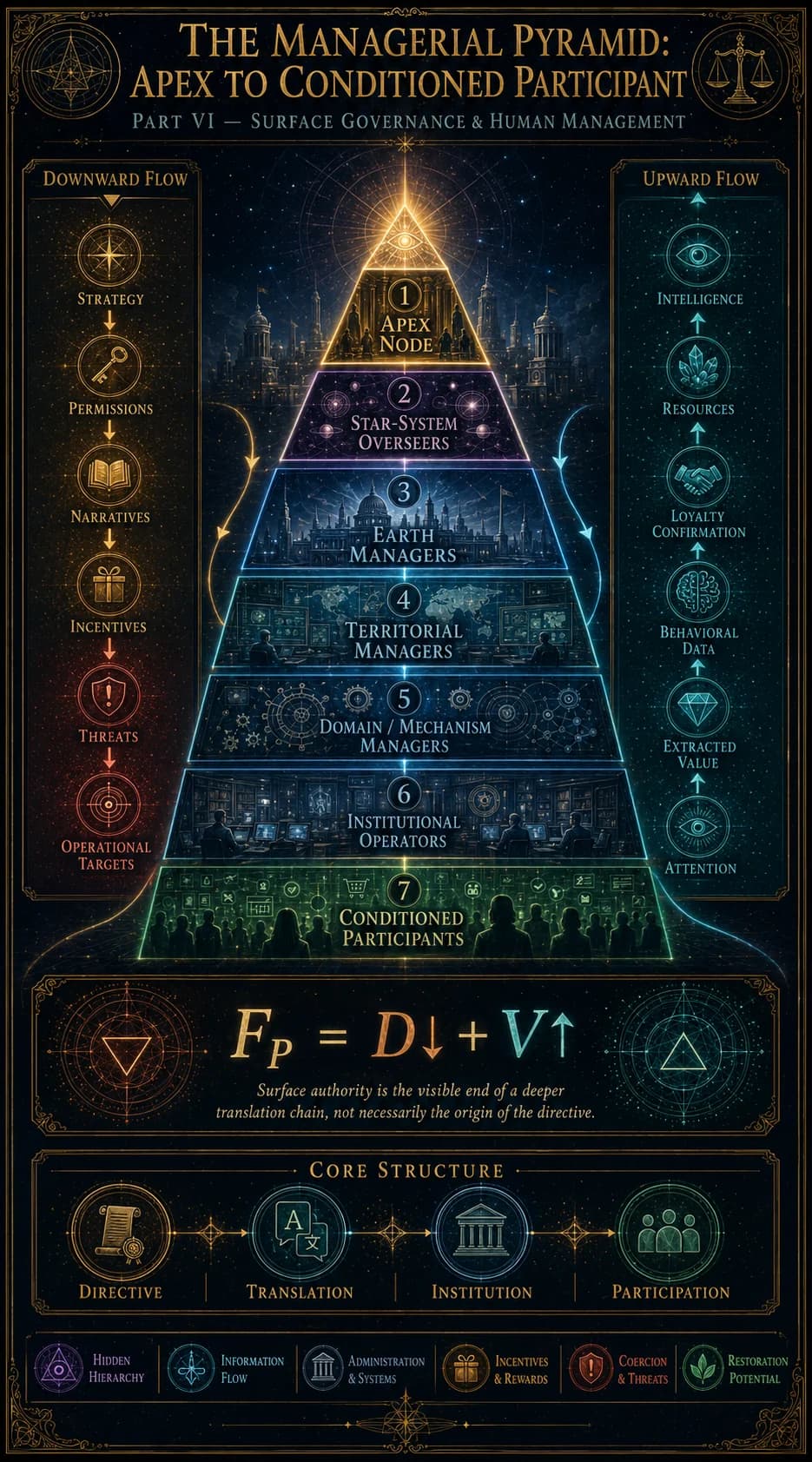
Surface Governance and Human Management
Part VI — Surface Governance and Human Management
Version:0.1Function:Defines the human managerial architecture through which the breakaway civilization and wider NHI hierarchy govern surface society, including the apex-to-handler chain, ritual and bloodline networks, transferred-consciousness continuity, domain control, corruption and blackmail systems, institutional compartmentalization, survival binding, legitimacy manufacturing, responsibility diffusion, and ordinary participation in structural harm.
6.0 Quick Reference
Vertical management chain
Apex Node → Star-System Overseers → Earth Managers → Territorial Managers → Domain Managers → Institutional Operators → Conditioned Participants
Direction of flow
| Downward flow | Upward flow |
|---|---|
| Strategy | Intelligence |
| Permissions | Resources |
| Incentives | Loyalty signals |
| Narratives | Extracted value |
| Threats | Biological and behavioral data |
| Operational targets | Loosh and attention |
| Technology access | Compliance confirmation |
Surface-control equation
C_S = R_C + D_H + I_C + N_M + S_B + P_AWhere:
- (RC) = resource control,
- (DH) = domain-handler networks,
- (IC) = institutional capture,
- (NM) = narrative management,
- (SB) = survival binding,
- (PA) = punishment asymmetry.
Central principle
The surface system does not require every participant to know the larger architecture.
It requires only that:
- leaders design,
- managers translate,
- institutions certify,
- workers execute,
- culture normalizes,
- and the public adapts.
Primary control mechanisms
- Compartmentalization— no lower node sees the complete structure.
- Incentive capture— advancement is tied to compliance.
- Blackmail— compromised figures become controllable assets.
- Survival binding— refusal threatens livelihood or belonging.
- Narrative management— harm is framed as necessity.
- Responsibility diffusion— each participant handles only one fragment.
- Punishment asymmetry— refusal costs immediately; compliance costs later.
- Controlled alternatives— opposition remains inside manageable boundaries.
- Institutional succession— roles survive the individuals occupying them.
- Free-will transfer— human execution is used to assign human liability.
6.1 Surface Governance as an Interface Layer
Surface governments are not the apex of the planetary system.
They function as visible interfaces between ordinary populations and deeper managerial structures.
Their public responsibilities include:
- law,
- security,
- infrastructure,
- economics,
- diplomacy,
- education,
- and public administration.
Their concealed function is to translate deeper objectives into ordinary institutional action without revealing the full origin of those objectives.
Interface principle
A surface institution does not need to know that it is serving a larger system.
It needs only to:
- receive incentives,
- follow accepted procedures,
- enforce the resulting conditions,
- and prevent unauthorized alternatives.
Dual function
Every major surface institution has two operational identities.
| Public identity | Managerial identity |
|---|---|
| Represents citizens | Translates upper-tier objectives |
| Provides public service | Maintains dependence |
| Protects stability | Protects the existing attractor |
| Regulates power | Allocates privileged access |
| Preserves order | Enforces participation conditions |
| Records public history | Certifies the permitted narrative |
This duality allows institutions to contain many sincere participants while still serving an extractive structure at the system level.
6.2 The Managerial Pyramid
The human management system is one local segment of a larger pyramidal network.
Orders move downward through increasingly specific layers. Information, resources, and extracted value move upward.
The framework defines the hierarchy as:
- Apex or main node;
- star-system overseers;
- Earth managers;
- territorial, domain, and mechanism managers;
- institutional operators;
- conditioned participants.
The upper layers set direction while lower layers implement increasingly narrow portions of the plan.
Structural rule
Directive Resolution ↑ as it moves downwardA high-level order may begin as:
Preserve extraction and prevent planetary sovereignty.
By the time it reaches the surface, it has become separate actions such as:
- restrict an energy patent;
- redirect a research budget;
- discredit a witness;
- approve a media narrative;
- increase economic dependency;
- or isolate a restoration network.
Most participants see only the final localized action.
6.3 Apex or Main Node
The apex is the highest centralized power node within the extended dark network.
It does not manage individual surface events.
It establishes:
- long-horizon objectives,
- resource priorities,
- acceptable loss,
- planetary classifications,
- and the conditions under which local systems remain valuable.
Apex functions
- define extraction strategy;
- assign star systems to overseers;
- regulate high-level technology;
- receive consolidated resources and data;
- resolve conflicts among major nodes;
- and preserve the pyramid’s continuation.
Relationship to Earth
Earth is managed as a high-value node because it contains:
- an Architect seed,
- unusually rich consciousness output,
- major planetary infrastructure,
- sibling-world entanglements,
- and strategic restoration potential.
The apex therefore treats Earth simultaneously as:
- a resource node,
- a control risk,
- a technological asset,
- and a possible cascade point for wider system failure.
6.4 Star-System Overseers
Star-system overseers manage the solar system as one operational node within the larger network.
They translate apex directives into solar-scale strategy.
Overseer functions
- coordinate Earth, lunar, Martian, and outer-system operations;
- regulate relationships among NHI factions;
- manage breakaway access;
- settle resource allocations;
- enforce contracts;
- and monitor threats to the local system.
Information position
Overseers possess a broader map than Earth managers but do not necessarily see the complete apex structure.
They receive:
- targets,
- limits,
- and required outputs,
without full access to:
- apex motives,
- all parallel systems,
- or the true condition of the wider network.
This reproduces compartmentalization even near the top.
6.5 Earth Managers
Earth managers form the merged human–NHI interface responsible for planetary coordination.
They oversee:
- the breakaway branches,
- Antarctic operations,
- surface-manager networks,
- nodal control,
- information strategy,
- and Earth’s contribution to the wider system.
Earth-manager responsibilities
Planetary continuity
Ensure that surface institutions continue functioning well enough to sustain extraction.
Population management
Regulate broad conditions affecting:
- behavior,
- belief,
- labor,
- reproduction,
- conflict,
- and technological development.
Breakaway coordination
Manage the relationship among:
- underground factions,
- lunar factions,
- surface elites,
- and NHI groups.
Narrative containment
Prevent separate anomalies from becoming one coherent public architecture.
Restoration suppression
Detect and obstruct:
- memory recovery,
- coherent coordination,
- independent technology,
- and alternative social structures.
Earth-manager limitation
Earth managers are powerful locally but remain subordinate to star-system overseers and the larger network.
Their authority is delegated, conditional, and revocable.
6.6 Territorial Managers
Territorial managers govern geographic regions.
A territory may be:
- a nation,
- a group of nations,
- a strategic city,
- a continental region,
- an oceanic route,
- or a major nodal zone.
Territorial functions
- coordinate local political leadership;
- regulate regional military and intelligence services;
- allocate access to concealed technology;
- control major resource flows;
- maintain regional narratives;
- and manage contact among hidden factions.
Territorial overlap
Territories do not align perfectly with public borders.
A single territorial structure may cross several nations when those nations share:
- infrastructure,
- intelligence networks,
- cultural systems,
- or strategic resources.
Likewise, one nation may contain several overlapping management zones.
6.7 Domain Managers
Domain managers control functional sectors rather than geographic regions.
Primary domains include:
- finance,
- politics,
- military affairs,
- intelligence,
- media,
- entertainment,
- technology,
- science,
- medicine,
- religion,
- education,
- law,
- business,
- and culture.
The source framework places these human or hybrid handlers directly beneath Earth managers and identifies ritual elites and bloodline vessels as the main managerial operators assigned to specific institutional domains.
Domain-manager function
A domain manager ensures that the entire sector remains compatible with the larger system.
This does not require direct command over every institution.
It requires control over:
- gateways,
- leadership selection,
- funding,
- credentials,
- information,
- enforcement,
- and viable alternatives.
Gate-control principle
C_D ≈ G_F + G_R + G_L + G_IWhere:
- (GF) = funding gates,
- (GR) = reputational gates,
- (GL) = legal gates,
- (GI) = information gates.
Control of the gateways can govern a domain without controlling every individual within it.
6.8 Mechanism Managers
Mechanism managers administer a specific recurring control process.
Examples include:
- blackmail,
- censorship,
- patent suppression,
- ritual coordination,
- recruitment,
- targeted disinformation,
- financial pressure,
- or controlled disclosure.
Distinction from domain managers
A domain manager controls a sector.
A mechanism manager controls a method that may operate across several sectors.
For example, one blackmail network may influence figures in:
- politics,
- media,
- finance,
- and entertainment.
Cross-domain leverage
Mechanism managers create horizontal coordination while maintaining vertical loyalty.
They are especially valuable because they can produce the same effect across institutions that appear unrelated.
6.9 Institutional Operators
Institutional operators occupy visible positions within ordinary organizations.
They include:
- executives,
- officials,
- editors,
- commanders,
- administrators,
- financiers,
- researchers,
- legal authorities,
- religious leaders,
- and cultural gatekeepers.
Knowledge range
Institutional operators vary widely.
Some knowingly participate in the deeper architecture.
Others understand only:
- their handler,
- their incentives,
- their obligations,
- and the consequences of refusal.
Still others believe fully in the institution’s public purpose.
Operator value
The system prefers ordinary institutional action over visible coercion because it produces:
- legitimacy,
- repeatability,
- low observability,
- and distributed responsibility.
A policy signed by a lawful institution appears internally generated even when its conditions were designed elsewhere.
6.10 Conditioned Participants
Conditioned participants form the broad base of the surface pyramid.
They include ordinary people whose:
- work,
- consumption,
- taxes,
- attention,
- votes,
- compliance,
- or institutional participation
support the larger structure.
They generally do not intend to maintain harm.
Their participation is shaped through:
- necessity,
- routine,
- incomplete information,
- social expectations,
- and dependence on existing systems.
Base-layer function
The conditioned population supplies:
- labor,
- legitimacy,
- attention,
- cultural repetition,
- resource production,
- and human authorship.
The pyramid could not function through elites alone.
It requires mass participation without mass understanding.
6.11 Directional Flow Through the Pyramid
The hierarchy uses asymmetric flow.
Downward movement
- directives,
- stories,
- incentives,
- permissions,
- punishments,
- and technical fragments.
Upward movement
- resources,
- data,
- attention,
- emotional output,
- biological material,
- loyalty confirmation,
- and local intelligence.
Flow equation
F_P = D_↓ + V_↑Where:
- (D_↓) = directives flowing downward,
- (V_↑) = value flowing upward.
Local appearance
At each tier, the local manager appears to exercise authority.
In reality, that authority depends on:
- continued usefulness,
- access permissions,
- and compliance with the layer above.
6.12 Sub-Compartmentalized Control
Compartmentalization prevents any single human node from seeing the whole pyramid.
Managers communicate primarily:
- upward to their assigned overseer;
- downward to their direct operators;
- and laterally only through approved channels.
The source describes human managers as seeing only their immediate segment, with loyalty enforced through threat, coercion, violence, deception, and ritual binding.
Compartment types
Information compartment
Limits what an actor knows.
Relationship compartment
Limits whom the actor can contact.
Historical compartment
Provides a restricted explanation of how the system developed.
Technical compartment
Allows use of a mechanism without revealing its full architecture.
Moral compartment
Frames the actor’s task as separate from downstream harm.
Geographic compartment
Restricts movement and direct observation.
Compartment benefit
A compromised node cannot expose what it does not know.
A defecting official may reveal a real fragment while remaining unable to explain the larger system accurately.
6.13 Nested Plausible Deniability
Every layer is designed to deny responsibility based on incomplete access.
Common denials
- “That decision was made elsewhere.”
- “We followed established procedure.”
- “The contractor acted independently.”
- “No one person controls the system.”
- “The institution lacks evidence.”
- “The outcome was unintended.”
- “The policy applies neutrally.”
- “The market decided.”
Each statement may be locally accurate while obscuring the architecture that made the outcome predictable.
Structural effect
Plausible deniability does not remove control.
It distributes control across enough steps that causality becomes difficult to prove from any one location.
6.14 Loyalty Enforcement
Managerial loyalty is maintained through a combination of reward and threat.
Reward channels
- status,
- wealth,
- privileged information,
- technological access,
- protection,
- longevity systems,
- social influence,
- and movement into higher tiers.
Punishment channels
- exposure,
- removal from office,
- financial destruction,
- reputational attack,
- legal pressure,
- violence,
- loss of protection,
- ritual consequences,
- and isolation from the network.
Loyalty equation
L_M = B_A + C_R - E_CWhere:
- (BA) = benefits of alignment,
- (CR) = cost of refusal,
- (EC) = viable exit capacity.
Loyalty becomes strongest when benefit and refusal cost are high while exit capacity is low.
6.15 Managerial Initiation
Managers are introduced gradually rather than shown the complete system at once.
Initiation ladder
Stage 1 — Selection
Identify candidates through:
- ambition,
- family ties,
- vulnerability,
- talent,
- ideological fit,
- or prior compromise.
Stage 2 — Reward
Provide:
- access,
- promotion,
- wealth,
- recognition,
- or protected opportunity.
Stage 3 — Minor compromise
Require a small action that conflicts with the candidate’s prior values.
Stage 4 — Rationalization
Frame the compromise as:
- necessary,
- temporary,
- strategic,
- or harmless.
Stage 5 — Escalation
Increase the seriousness of required participation.
Stage 6 — Documentation
Record compromising acts or create evidence of involvement.
Stage 7 — Binding
Tie identity, livelihood, reputation, and safety to the network.
Stage 8 — Role assignment
Place the individual into a domain or institutional function.
Progressive capture
At each stage, the cost of leaving increases.
The candidate’s earlier actions become the justification for later compliance.
6.16 Ritual and Bloodline Networks
Ritual and bloodline networks provide long-term human continuity for the surface-management system.
They function as:
- inherited access structures,
- vessels for transferred consciousness,
- keepers of ritual procedures,
- and administrators of the surface debt ledger.
The source architecture identifies these networks as human vessels for transferred-consciousness entities and as day-to-day administrators operating across finance, politics, media, business, entertainment, and other institutions.
Bloodline function
Bloodlines preserve:
- genetics,
- social access,
- institutional relationships,
- ritual knowledge,
- and long-term obligations.
Network continuity
An individual may lose influence or die while the lineage retains:
- its position,
- assets,
- handlers,
- and connections.
Limits
Bloodlines are not a single unified family.
They contain:
- rival factions,
- partial knowledge,
- defectors,
- captive members,
- and differing alignment trajectories.
6.17 Transferred-Consciousness Continuity
Transferred-consciousness entities preserve identity patterns across bodies or substrates.
This provides managerial continuity beyond ordinary biological lifespans.
Functional advantages
- retention of long-term plans;
- preservation of operational knowledge;
- continuity of relationships;
- reduced dependence on individual succession;
- and maintenance of recognizable personality patterns.
Structural cost
Repeated transfer without genuine renewal produces model lock-in.
The entity preserves:
- habits,
- preferences,
- strategies,
- and fears,
while losing:
- novelty,
- meaning,
- relational growth,
- and restorative development.
The source describes transferred-consciousness elites as static repeating models placed into new bodies, creating continuity without the deeper soulstream renewal required for genuine growth.
Managerial effect
A role that appears to be occupied by successive individuals may preserve one continuous decision pattern across generations.
6.18 Clones and Body Doubles
Clones and body doubles support visible continuity when:
- a public figure becomes unavailable;
- a role must remain occupied;
- travel must be concealed;
- or conflicting appearances are required.
Clone functions
- temporary substitution,
- controlled public appearances,
- biological experimentation,
- and specialized labor.
Body-double functions
- security,
- schedule management,
- narrative continuity,
- and separation between public identity and concealed activity.
Limitation
Perfect replication is unnecessary.
The system requires enough continuity to preserve:
- public confidence,
- institutional function,
- and the appearance that the same authority remains in place.
The source treats clones and doubles as plausibility tools rather than flawless copies: they preserve the public role long enough for the power structure to continue uninterrupted.
6.19 Domain Handlers
Handlers are the direct operational bridge between the managerial hierarchy and visible position-holders.
A handler may control:
- one person,
- one office,
- one institution,
- or a network of related roles.
Handler responsibilities
- transmit expectations;
- arrange rewards;
- manage compromise;
- monitor loyalty;
- contain unauthorized behavior;
- and coordinate replacement when necessary.
Domain specialization
Handlers understand the incentives and vulnerabilities of their assigned domain.
A financial handler uses different methods from:
- a media handler,
- military handler,
- religious handler,
- or entertainment handler.
Handler opacity
The visible official may believe the handler represents:
- a donor,
- intelligence service,
- employer,
- political network,
- legal interest,
- or private adviser.
The handler’s relationship to the wider structure remains hidden.
6.20 Corruption Escalation Architecture
Corruption is introduced in escalating tiers.
The objective is to transform an independent actor into a predictable asset.
Tier 0 — Compatibility assessment
Observe:
- desires,
- values,
- fears,
- debts,
- ambitions,
- and relationships.
Tier 1 — Ordinary incentive
Offer:
- money,
- access,
- influence,
- recognition,
- or career advancement.
Tier 2 — Favor exchange
Create a reciprocal obligation.
Tier 3 — Ethical compromise
Require a limited violation the actor can still rationalize.
Tier 4 — Concealed misconduct
Move the actor into conduct that would damage reputation or position if exposed.
Tier 5 — Recorded compromise
Create verifiable evidence controlled by the network.
Tier 6 — Criminal or ritual participation
Bind the actor to conduct carrying severe legal, relational, or energetic consequences.
Tier 7 — Identity integration
The actor begins to define loyalty to the system as part of who they are.
Tier 8 — Handler reproduction
The captured actor recruits, compromises, or manages others.
The asset has now become a local extension of the capture architecture.
6.21 Blackmail Infrastructure
Blackmail converts a powerful but independent person into a controlled asset.
The framework’s surface-control architecture uses domain-specific operators to create escalating sexual, financial, legal, and moral compromise, preserve evidence, and use that evidence to control policy, careers, and public narratives.
Blackmail stack
B_S = A_C + E_P + R_C + T_EWhere:
- (AC) = access to compromise,
- (EP) = preserved evidence,
- (RC) = reputational or legal cost,
- (TE) = threat of exposure.
Infrastructure components
- recruitment networks,
- private locations,
- surveillance,
- recording systems,
- legal containment,
- financial intermediaries,
- media relationships,
- and enforcement personnel.
Strategic value
One compromised leader can affect:
- legislation,
- appointments,
- contracts,
- reporting,
- military action,
- and institutional silence.
Blackmail produces leverage far greater than its direct cost.
6.22 Ritual Function in Surface Management
Rituals perform both social and energetic functions.
Social function
They:
- establish membership,
- test obedience,
- create shared secrecy,
- separate insiders from outsiders,
- and generate mutual implication.
Energetic function
They:
- route attention and trauma,
- renew debt-matrix relationships,
- reinforce hierarchy,
- and provide visible human participation for the free-will exploit.
Managerial function
Ritual participation demonstrates that the local human manager continues to accept the assigned role.
Nodal relationship
High-level rituals are often associated with:
- nodal sites,
- underground access,
- Antarctic-adjacent systems,
- or inherited sacred locations.
Within the source architecture, these rituals route trauma and loosh into the nodal network and reinforce both contract layers and human liability.
6.23 Finance as the Primary Allocation Domain
Finance controls the conditions under which other domains operate.
It determines:
- which projects receive resources,
- which institutions survive,
- which alternatives scale,
- and who remains dependent.
Financial control mechanisms
- credit access,
- investment,
- debt,
- ownership,
- insurance,
- taxation,
- procurement,
- market concentration,
- and payment infrastructure.
Structural function
Finance converts abstract policy into material permission.
An idea may be legally permitted while remaining impossible because it cannot obtain:
- capital,
- banking,
- insurance,
- distribution,
- or payment access.
Scarcity production
The financial system can preserve dependence even where productive capacity is abundant.
Scarcity becomes a governance mechanism rather than a simple lack of resources.
6.24 Politics and Law
Politics provides visible representation and conflict.
Law translates that conflict into enforceable conditions.
Political function
The political domain:
- channels public frustration,
- selects visible managers,
- legitimizes decisions,
- and creates the appearance that the system is governed primarily through public choice.
Managed competition
Competing parties may disagree genuinely on many issues while remaining inside shared boundaries concerning:
- resource concentration,
- institutional continuity,
- secrecy,
- and the legitimacy of the underlying order.
Legal function
Law can:
- protect rights,
- define responsibility,
- and constrain abuse.
Under capture, it can also:
- formalize unequal access,
- shield institutions,
- criminalize refusal,
- and convert systemic harm into lawful procedure.
Legality shield
A harmful outcome becomes difficult to challenge when every local action was technically authorized.
Legality then replaces justice as the dominant audit criterion.
6.25 Intelligence and Military Systems
Intelligence systems manage:
- secrecy,
- threat classification,
- covert operations,
- and information compartmentalization.
Military systems provide:
- enforcement,
- logistics,
- research,
- territorial access,
- and emergency authority.
Surface role
These systems connect directly to:
- breakaway recruitment,
- black projects,
- NHI contact,
- and underground infrastructure.
Compartmentalized patriotism
Participants may believe they are protecting:
- their nation,
- humanity,
- or planetary security
while implementing directives whose origins lie outside the visible state.
Permanent emergency
Threat conditions justify:
- secrecy,
- exceptional authority,
- surveillance,
- and restricted public review.
An emergency that never fully ends becomes a stable form of government.
6.26 Corporate and Business Control
Corporations translate resource ownership into long-term institutional power.
Corporate functions
- production,
- labor organization,
- technological deployment,
- data collection,
- and influence over public policy.
Capture mechanisms
- concentrated ownership,
- regulatory control,
- mergers,
- lobbying,
- labor dependency,
- and proprietary information.
Corporate pseudo-sovereignty
Corporations appear independent but depend on:
- finance,
- law,
- infrastructure,
- permits,
- and access to state power.
Their autonomy remains conditional on compatibility with the larger system.
Profit as legitimacy
A profitable activity is treated as validated even when it produces:
- social harm,
- ecological loss,
- or long-term system debt.
Financial success becomes a substitute for coherence.
6.27 Media and News
Media controls which events become socially real.
It shapes:
- visibility,
- salience,
- repetition,
- emotional framing,
- and the range of acceptable interpretation.
Media-control methods
- editorial selection,
- source dependency,
- ownership,
- access journalism,
- advertising pressure,
- reputational incentives,
- and narrative synchronization.
Information containment
The media does not need to suppress every fact.
It can neutralize a fact by:
- isolating it,
- stripping context,
- surrounding it with noise,
- overloading the audience,
- or attaching it to a discredited identity.
Attention architecture
A_M = E_X + R_P + S_F - C_DWhere:
- (EX) = exposure,
- (RP) = repetition,
- (SF) = salience framing,
- (CD) = contextual depth.
High exposure with low contextual depth creates managed awareness without understanding.
6.28 Entertainment and Cultural Modeling
Entertainment provides symbolic rehearsal.
It introduces:
- future technologies,
- NHI archetypes,
- social fears,
- desired identities,
- and expected responses
before those conditions become openly relevant.
Cultural functions
Desensitization
Make an unfamiliar idea emotionally ordinary.
Predictive framing
Define how the public should interpret a later event.
Controlled truth release
Present accurate fragments as fiction.
Fear conditioning
Associate specific beings, technologies, or possibilities with threat.
Desire engineering
Create demand for identities, lifestyles, and behaviors that support the system.
Fictional containment
A true pattern can be made less actionable by presenting it first as entertainment.
Later recognition is dismissed as confusion between fiction and reality.
6.29 Technology and Scientific Gatekeeping
The technology domain regulates which forms of knowledge can become operationally available.
Gate mechanisms
- funding,
- peer legitimacy,
- patents,
- classification,
- laboratory access,
- publication,
- licensing,
- and employment.
Permitted innovation
Innovation is encouraged when it:
- increases productivity,
- surveillance,
- data generation,
- or controlled consumption.
Restricted innovation
Innovation is obstructed when it threatens:
- energy dependency,
- transportation control,
- breakaway secrecy,
- consciousness restriction,
- or nodal monopoly.
Scientific narrowing
Research may be technically rigorous within a permitted frame while excluding variables that would reveal the larger system.
The boundary of inquiry becomes more important than the quality of work conducted inside it.
6.30 Medicine and Biological Governance
Medicine provides essential care while also managing biological access and classification.
Biological-control functions
- genetic data collection,
- reproductive regulation,
- pharmaceutical dependency,
- health credentialing,
- and control over biological research.
Dual architecture
A public medical system may genuinely preserve life while concealed programs use related infrastructure for:
- cloning,
- hybridization,
- consciousness transfer,
- and population-level biological study.
Dependency risk
When survival requires institutional permission, medical access becomes a powerful compliance channel.
The issue is not care itself.
It is the ability to condition care on participation in unrelated systems.
6.31 Religion and Spiritual Authority
Religious systems regulate:
- meaning,
- morality,
- death,
- suffering,
- and humanity’s relationship to higher orders.
Coherent function
They can preserve:
- compassion,
- ethical discipline,
- community,
- symbolic memory,
- and direct relationship with the sacred.
Captured function
They can also:
- legitimize hierarchy,
- normalize suffering,
- renew inherited contracts,
- redirect worship,
- and discourage direct access to Source or planetary memory.
Authority substitution
A spiritual intermediary becomes a control point when it claims exclusive authority over:
- truth,
- salvation,
- forgiveness,
- or contact with the sacred.
Anti-NHI pre-seeding
Surface spiritual systems can be used to label all non-human intelligence as evil or demonic, preventing differentiated recognition and obstructing coherent invitation to restoration factions.
This defensive narrative becomes more important as the larger system approaches convergence.
6.32 Education and Credentialing
Education shapes:
- what is knowable,
- who may speak with authority,
- and which methods count as legitimate.
Educational control
- curriculum selection,
- historical framing,
- disciplinary boundaries,
- testing,
- credential requirements,
- and employment linkage.
Credential gate
A person may possess correct knowledge but lack institutional permission to influence the domain.
Functional narrowing
Education can produce highly capable specialists who understand one fragment while lacking the ability to integrate:
- history,
- systems,
- consciousness,
- economics,
- and power.
Specialization increases technical capacity while reducing architecture-level visibility.
6.33 Philanthropy and Legitimacy Laundering
Philanthropy allows concentrated power to present itself as restoration.
Legitimation process
- extract or accumulate disproportionate resources;
- return a controlled fraction;
- select which problems receive attention;
- define acceptable solutions;
- gain moral authority;
- preserve the system that produced the original concentration.
Structural effect
The actor becomes both:
- beneficiary of the harmful structure;
- and recognized authority on repairing its effects.
Dependency preservation
Problems remain managed rather than solved when their continuation sustains:
- institutional relevance,
- funding,
- status,
- and influence.
6.34 Controlled Opposition
Controlled opposition absorbs dissent without allowing it to leave the governing field.
Opposition functions
- collect dissatisfied people;
- identify emerging leaders;
- define permitted grievances;
- redirect energy toward symbolic victories;
- and prevent independent coordination.
Degrees of control
Opposition may be:
- directly managed,
- indirectly funded,
- algorithmically amplified,
- or simply constrained by the same institutional dependencies as the system it opposes.
Containment principle
A movement can speak against the system while remaining dependent on:
- its platforms,
- funding,
- media,
- legal permissions,
- and identity categories.
Its opposition remains inside the basin.
6.35 Narrative Flooding
When a threatening pattern becomes visible, the system produces many competing explanations.
These may include:
- partial truths,
- false accusations,
- exaggerated versions,
- ideological interpretations,
- technical distractions,
- and interpersonal conflict.
Flooding function
N_F = T_P + F_A + E_X + C_IWhere:
- (TP) = partial truths,
- (FA) = false alternatives,
- (EX) = exaggerations,
- (CI) = identity conflict.
The objective is not to prove one false story.
It is to make coherent synthesis too costly.
Structural immune response
Pseudo-coherent systems defend themselves through:
- reputational pressure,
- legality shields,
- identity binding,
- messenger degradation,
- and dismissal of coherent exits as unrealistic.
The source identifies these behaviors as the immune response of a system protecting its existing attractor.
6.36 Social Status and Proof of Belonging
Status converts hierarchy into aspiration.
People are encouraged to desire the rewards associated with higher position rather than question the system producing those positions.
Status rewards
- recognition,
- access,
- influence,
- security,
- desirability,
- and exemption from ordinary constraints.
Social-proof function
A belief appears legitimate when it is repeated by:
- prestigious people,
- institutions,
- experts,
- celebrities,
- or one’s own social group.
Truth displacement
When status becomes more important than accuracy, individuals defend narratives that preserve:
- identity,
- tribe,
- career,
- and reputation.
The system then uses belonging as an upstream control on perception.
6.37 Surface Pseudo-Coherent Basins
A pseudo-coherent basin is locally stable because it exports its incoherence elsewhere.
Inside the basin:
- rules appear sensible;
- success is rewarded;
- careers progress;
- metrics look stable;
- and participants feel legitimate.
Outside the basin:
- costs accumulate;
- harmed populations absorb consequences;
- future repair burdens rise;
- and planetary or social resilience declines.
The source defines such basins as systems that preserve internal order by externalizing cost, hiding causality, and replacing repair with narrative.
Institutional basin examples
An institution may appear coherent because:
- workers absorb burnout;
- the public absorbs risk;
- future generations absorb debt;
- or ecosystems absorb damage.
Its local success depends on a larger unseen failure.
6.38 Survival Binding
Survival binding fuses access to basic life conditions with participation in the system.
It connects:
- livelihood,
- housing,
- healthcare,
- safety,
- social belonging,
- credentials,
- and future opportunity
to:
- obedience,
- silence,
- compromise,
- and participation in harmful structures.
The result is:
“I do not support this, but I cannot afford not to participate.”
The source identifies survival binding as a primary engine of durable harmful systems because refusal threatens immediate personal necessities while alternatives remain unavailable.
Binding equation
S_B = D_S × C_R × A_LWhere:
- (DS) = dependence on system-controlled survival,
- (CR) = cost of refusal,
- (AL) = lack of alternatives.
Governance effect
Survival binding reduces the need for constant direct force.
The participant enforces compliance upon themselves because they understand the material consequences of refusal.
6.39 Harm Obfuscation
Large-scale harm is hidden through distance, fragmentation, and abstraction.
Obfuscation methods
- long causal chains,
- technical specialization,
- sanitized terminology,
- delayed consequences,
- selective metrics,
- divided responsibilities,
- and normalized procedure.
The participant experiences their action as:
- doing a job,
- following policy,
- protecting family,
- being professional,
- or trusting the process.
They do not experience the whole downstream result.
Moral visibility
V_M = (C_T × A_C) / (D_F + O_L)Where:
- (CT) = causal traceability,
- (AC) = access to context,
- (DF) = fragmentation distance,
- (OL) = obfuscation load.
As fragmentation and obfuscation rise, moral visibility falls.
6.40 Responsibility Diffusion
Responsibility diffusion stabilizes the system by ensuring no participant feels responsible for the whole.
The distribution pattern is:
- leaders design;
- managers translate;
- workers execute;
- institutions certify;
- culture normalizes;
- the public adapts.
Each participant can truthfully say that another layer made the decisive choice.
Responsibility paradox
Σ_(i=1)^n r_i < R_TWhere:
- (ri) = responsibility acknowledged by each participant,
- (RT) = total responsibility required to explain the system.
The system’s total harm exceeds the responsibility any single actor accepts.
The remainder becomes unowned structural debt.
6.41 Legitimacy Manufacturing
Harmful systems rarely describe themselves as harmful.
They present themselves as:
- necessary,
- protective,
- efficient,
- lawful,
- professional,
- inevitable,
- or moral at a higher level.
Inversion patterns
| Harmful function | Legitimate framing |
|---|---|
| Coercion | Safety |
| Censorship | Care |
| Exploitation | Opportunity |
| Dispossession | Development |
| Obedience | Maturity |
| Silence | Professionalism |
| Dehumanization | Efficiency |
| Dependency | Stability |
| Exclusion | Quality control |
| Permanent emergency | Protection |
The source defines legitimacy manufacturing as the conversion of harm into responsibility through language and institutional certification.
Language as infrastructure
The words used to describe an action determine:
- who appears responsible,
- what solutions seem possible,
- and whether refusal appears moral or reckless.
6.42 Punishment Asymmetry
The cost of refusal is immediate and personal.
The cost of compliance is delayed and distributed.
Refusal costs
- loss of income,
- reputation,
- housing,
- credentials,
- legal security,
- network access,
- or belonging.
Compliance costs
- harm to distant people,
- long-term social decay,
- future instability,
- hidden debt,
- and loss of integrity.
Because immediate personal costs are easier to perceive, participants often comply even when they understand that the wider outcome is harmful.
The mechanism does not remove responsibility.
It explains how the system shapes the choice field.
6.43 Epistemic Capture
Epistemic capture occurs when people lose the ability to distinguish:
- harm from necessity,
- authority from legitimacy,
- order from coercion,
- survival from submission,
- law from justice,
- success from extraction,
- and neutrality from complicity.
Capture sources
- propaganda,
- information overload,
- reputational pressure,
- technical language,
- contradictory narratives,
- selective visibility,
- institutional framing,
- and fear of social penalty.
Outputs
- paralysis,
- cynicism,
- fragmentation,
- self-silencing,
- normalization,
- and inability to coordinate refusal.
The source defines this confusion layer as a direct barrier to recognizing harm and forming shared action.
6.44 Modes of Surface Participation
Participants must not be flattened into one moral category.
Direct participation
The actor knowingly creates or administers harm.
Conditioned participation
The actor participates because refusal threatens survival or belonging.
Fragmented participation
The actor handles one small portion without seeing the consequence chain.
Ritual participation
The actor repeats institutional scripts that confer legitimacy.
Defensive participation
The actor supports the system because they fear disorder more than ongoing harm.
Inverted participation
The actor believes they are helping while materially sustaining harm.
Resigned participation
The actor believes change is impossible and complies by default.
Restorative participation
The actor works to:
- expose causality,
- reduce dependency,
- create alternatives,
- and restore coherent relationship.
These pathways preserve accurate attribution while recognizing that different actors possess different knowledge, freedom, and power.
6.45 Why Small Extractive Minorities Dominate Majorities
Control depends more on coordination density than population size.
Extractive minority advantages
- clear objectives,
- tighter coordination,
- concentrated resources,
- strong institutional embedding,
- lower ethical restraint,
- greater willingness to punish,
- higher tolerance for deception,
- and disciplined narratives.
Majority disadvantages
- fragmented perception,
- moral hesitation,
- dependence on existing systems,
- inconsistent thresholds,
- fear of consequence,
- no shared refusal protocol,
- and insufficient alternative infrastructure.
The source summarizes the governing imbalance as concentrated coordination and resource control facing a larger population that remains fragmented, dependent, and perceptually distorted.
Control equation
P_C ∝ (C_D × R_G × N_D) / (F_M × E_A)Where:
- (CD) = coordination density,
- (RG) = resource gatekeeping,
- (ND) = narrative discipline,
- (FM) = majority fragmentation,
- (EA) = effective alternatives.
6.46 The Harm-Sustaining Society
A harm-sustaining society converts ordinary survival behavior into structural support for the managerial pyramid.
Its central thesis is:
Harm persists not because most people prefer harm, but because survival dependency, obscured causality, and legitimacy management turn ordinary participation into system maintenance.
The source identifies three interacting conditions:
- incentive distortion;
- perceptual distortion;
- dependency capture.
Actor classes
Extractive actors
Design and benefit from the system.
Enforcers
Translate objectives into direct control.
Dependents
Rely on the system for survival.
Legitimizers
Provide legal, cultural, scientific, spiritual, or moral approval.
Dissidents
Recognize and resist the structure.
Restorers
Build higher-coherence alternatives.
System stability
The system remains stable when each class performs its expected function, even if most individuals believe they are acting independently.
6.47 System Reproduction Cycle
The surface system regenerates through a repeating sequence.
Resource Control → Conditional Survival → Compliance → Normalized Participation → Legitimacy Manufacturing → Responsibility Diffusion → Punishment of Refusal → Adaptation → Greater Resource ControlThe cycle becomes intergenerational through:
- inheritance,
- institutions,
- culture,
- property,
- credentials,
- and family conditioning.
The source identifies this regeneration loop as the mechanism that preserves the pyramid even as individual human managers fail.
6.48 Institutional Succession
The system is designed so that roles matter more than individual occupants.
When one manager leaves, the institution supplies a replacement.
Succession mechanisms
- recruitment pipelines,
- professional training,
- credential systems,
- party structures,
- corporate boards,
- inherited wealth,
- and social networks.
Role capture
A person entering a role inherits:
- its incentives,
- legal duties,
- information limits,
- and dependencies.
Even an initially restorative actor may become constrained by the office.
Continuity equation
C_I = R_S × P_RWhere:
- (RS) = role stability,
- (PR) = replacement pipeline reliability.
The system remains continuous when replacement is faster than defection.
6.49 Human Managers Are Not Monolithic
Human managers contain multiple alignment groups.
Committed extractors
Fully identify with the pyramid and its rewards.
Dependent collaborators
Participate because exit appears impossible.
Competitive opportunists
Use the system for personal advancement without loyalty to its deeper purpose.
Procedural loyalists
Believe that institutional continuity is more important than the harm being produced.
Reformers
Attempt to improve the system without leaving its structure.
Malicious-compliance operators
Exploit instructions, ambiguity, and compartmentalization to gather information or weaken higher control.
Defectors
Withdraw support and disclose what they know.
Restoration-aligned infiltrators
Remain temporarily inside in order to preserve lives, records, or transition pathways.
The source uses the DUMB probe incidents to establish that some human middle managers conducted limited counter-operations and leaks from within the concealed structure.
6.50 Free-Will Exploit at the Surface Level
The surface managerial system is essential to transferring liability from higher factions to humanity.
Liability chain
- higher actors design the system;
- human managers receive incentives and constraints;
- human institutions implement the directives;
- ordinary populations participate;
- higher actors claim that humans chose the outcome.
Exploit statement
“The institutions are human. The leaders are human. The public continues participating. Therefore, the system is humanity’s choice.”
Structural defect
The claim ignores:
- memory suppression,
- manipulated information,
- dependency,
- blackmail,
- restricted alternatives,
- and the external origin of key control mechanisms.
Human responsibility
The exploit does not eliminate human responsibility.
It prevents inaccurate transfer of all responsibility to the lowest visible layer.
Responsibility must be assigned according to:
- knowledge,
- power,
- freedom,
- intent,
- and causal contribution.
6.51 Managerial Attrition
The surface-management network is becoming increasingly difficult to sustain.
Attrition sources
- exposure,
- internal conflict,
- refusal,
- loss of legitimacy,
- rapid information spread,
- technological observability,
- and failure of memory suppression.
Replacement problem
A high-level human manager requires:
- loyalty,
- competence,
- compromise,
- access,
- and sufficient psychological compatibility with the role.
These managers are failing or being removed faster than the system can prepare replacements.
The source identifies this human-manager attrition as a central current weakness: the burden of maintaining the debt matrix increases while supporting nodes disappear faster than they can be regenerated.
Compression effect
As management capacity falls:
- surviving managers carry more domains;
- errors increase;
- compartment boundaries fail;
- and contradictions become visible.
6.52 Surface-Control Failure Modes
Handler exposure
A blackmail or control network becomes publicly traceable.
Cross-compartment leakage
Separate operators compare information and reconstruct the larger architecture.
Narrative desynchronization
Different institutions release incompatible explanations.
Refusal cascade
One viable refusal demonstrates that compliance is not inevitable.
Alternative infrastructure
People gain access to survival outside controlled channels.
Manager defection
An insider reveals records, methods, or relationships.
Legitimacy collapse
The public ceases to treat institutional certification as proof of coherence.
Resource decentralization
Finance, energy, communication, or production become less gateable.
Memory restoration
People recognize recurring patterns across changing institutions.
6.53 Restoration Pathways
Restoration cannot depend only on removing visible leaders.
The dependency architecture must change.
Clarity
Improve the ability to trace:
- decisions,
- incentives,
- consequences,
- and beneficiaries.
Refusal capacity
Create conditions in which people can say no without losing:
- survival,
- housing,
- healthcare,
- community,
- or identity.
Coordination
Transform isolated recognition into shared action.
De-obfuscation
Expose:
- causal chains,
- euphemisms,
- responsibility gaps,
- and legitimacy inversions.
Alternative institutions
Build replacement systems before withdrawing from captured ones.
Record restoration
Preserve evidence and institutional memory.
Boundary reconstitution
Separate service from obedience and participation from total identity.
Accurate responsibility
Distinguish:
- designers,
- enforcers,
- dependents,
- legitimizers,
- conditioned participants,
- and restorers.
The source frames the complete restoration path as clarity, refusal capacity, coordination, de-obfuscation, and creation of systems in which survival no longer requires participation in harm.
6.54 Surface-Governance UTS Analysis
The surface managerial system is a network of nested pseudo-coherent basins.
S_G=O,H,ε,ι,Au,μ_i,B_Σ,K,R,Φ| Variable | Surface-governance condition |
|---|---|
| (O) — Coherence | Local institutional order with weak planetary coherence |
| (H) — Hidden debt | Exported social, ecological, ethical, and future cost |
| (ε) — Noise | Narrative conflict, fragmentation, and false attribution |
| (ι) — Inversion | Harm presented as necessity and control as service |
| (Au) — Auditability | High for narrow metrics, low for full consequence chains |
| (μi) — Internal integrity | Declines as stated missions diverge from outputs |
| (BΣ) — Boundary integrity | Strong institutional boundaries, weak human consent boundaries |
| (K) — Slack | Reduced through debt, work pressure, and survival dependency |
| (R) — Restoration capacity | Fragmented and subordinated to system continuity |
| (Φ) — Power pressure | Concentrated through finance, law, technology, and information |
Surface pseudo-coherence
O_L ↑ while O_P ↓Where:
- (OL) = local institutional order,
- (OP) = planetary or whole-system coherence.
The institution may become more efficient while the larger civilization becomes less viable.
6.55 Surface-Management Dependency Map
Vertical command stack
Apex Node↓Star-System Overseers↓Earth Managers↓Territorial and Domain Managers↓Handlers↓Institutional Operators↓Conditioned Participants
Human-manager capture stack
Selection↓Reward↓Minor Compromise↓Escalation↓Evidence Capture↓Binding↓Role Assignment↓Recruitment of Others
Institutional-control stack
Resource Gatekeeping↓Credentialing↓Leadership Selection↓Policy and Procedure↓Narrative Certification↓Ordinary Execution
Harm-sustaining stack
Survival Dependency↓Obscured Causality↓Fragmented Participation↓Responsibility Diffusion↓Legitimacy Manufacturing↓Normalization
Restoration stack
Causal Visibility↓Shared Records↓Refusal Capacity↓Alternative Infrastructure↓Coordinated Decoupling↓Restored Institutions
6.56 Surface Governance Registry
| ID | Canonical entry | Function |
|---|---|---|
| GOV-001 | Surface Governance Interface | Visible translation layer between population and deeper management |
| GOV-002 | Managerial Pyramid | Apex-to-participant command architecture |
| GOV-003 | Apex Node | Highest centralized directive and resource node |
| GOV-004 | Star-System Overseer | Solar-scale strategic manager |
| GOV-005 | Earth Manager | Planetary human–NHI coordination layer |
| GOV-006 | Territorial Manager | Geographic control and coordination role |
| GOV-007 | Domain Manager | Functional-sector control role |
| GOV-008 | Mechanism Manager | Cross-domain administrator of a specific control method |
| GOV-009 | Institutional Operator | Visible role implementing localized directives |
| GOV-010 | Conditioned Participant | Base-layer participant shaped by necessity and incomplete information |
| GOV-011 | Directional Power Flow | Downward directives and upward extracted value |
| GOV-012 | Sub-Compartmentalization | Prevention of complete architecture visibility |
| GOV-013 | Nested Plausible Deniability | Distributed denial through partial truth |
| GOV-014 | Loyalty Enforcement | Reward, threat, coercion, and ritual binding |
| GOV-015 | Managerial Initiation Ladder | Progressive recruitment and compromise process |
| GOV-016 | Ritual and Bloodline Network | Inherited human continuity and surface debt administration |
| GOV-017 | Transferred-Consciousness Continuity | Cross-body preservation of managerial identity patterns |
| GOV-018 | Clone and Double Continuity | Biological and public-role substitution |
| GOV-019 | Domain Handler | Direct operator assigned to a person, role, or institution |
| GOV-020 | Corruption Escalation Ladder | Progressive conversion of independent actors into assets |
| GOV-021 | Blackmail Infrastructure | Evidence-based control of influential figures |
| GOV-022 | Ritual Loyalty System | Social, energetic, and contractual renewal mechanism |
| GOV-023 | Financial Allocation Control | Resource permission and dependency management |
| GOV-024 | Political Management | Visible competition and public-legitimacy interface |
| GOV-025 | Legality Shield | Use of formal authorization to conceal structural harm |
| GOV-026 | Intelligence Compartment System | Secrecy, threat, and covert-operation architecture |
| GOV-027 | Permanent Emergency Governance | Exceptional authority sustained by recurring threats |
| GOV-028 | Corporate Control Layer | Production, ownership, labor, and policy influence |
| GOV-029 | Media Attention Architecture | Control of visibility, salience, repetition, and framing |
| GOV-030 | Entertainment Modeling | Symbolic rehearsal, desensitization, and predictive framing |
| GOV-031 | Scientific Gatekeeping | Funding, publication, credential, and inquiry-boundary control |
| GOV-032 | Biological Governance | Control through health, genetics, reproduction, and care access |
| GOV-033 | Spiritual Authority Interface | Meaning, worship, morality, and higher-contact regulation |
| GOV-034 | Educational Credential Gate | Regulation of authoritative knowledge and professional access |
| GOV-035 | Philanthropic Legitimacy Layer | Moral laundering of concentrated power |
| GOV-036 | Controlled Opposition | Containment of dissent within permitted structures |
| GOV-037 | Narrative Flooding | Coherence prevention through competing explanations |
| GOV-038 | Status and Social Proof | Belonging and prestige as perception controls |
| GOV-039 | Surface Pseudo-Coherent Basin | Local institutional order maintained through exported harm |
| GOV-040 | Survival Binding | Fusion of livelihood and belonging with compliance |
| GOV-041 | Harm Obfuscation | Concealment through distance, abstraction, and technical fragmentation |
| GOV-042 | Responsibility Diffusion | Distribution of causality across roles |
| GOV-043 | Legitimacy Manufacturing | Reframing harmful functions as necessary or moral |
| GOV-044 | Punishment Asymmetry | Immediate refusal cost versus delayed compliance cost |
| GOV-045 | Epistemic Capture | Loss of the ability to distinguish legitimacy from control |
| GOV-046 | Participation Pathway Taxonomy | Direct, conditioned, fragmented, ritual, inverted, and resigned support |
| GOV-047 | Minority-Dominance Structure | Power through coordination density and resource gates |
| GOV-048 | Harm-Sustaining Society | Conversion of ordinary participation into pyramid maintenance |
| GOV-049 | Social Reproduction Cycle | Intergenerational regeneration of control |
| GOV-050 | Institutional Succession | Role continuity beyond individual occupants |
| GOV-051 | Human-Manager Alignment Spectrum | Extractors, collaborators, reformers, defectors, and restorers |
| GOV-052 | Surface Free-Will Exploit | Downward transfer of liability through human execution |
| GOV-053 | Managerial Attrition | Failure and removal of human nodes faster than replacement |
| GOV-054 | Coordinated Refusal Capacity | Collective ability to withdraw safely |
| GOV-055 | Alternative-Infrastructure Transition | Replacement of survival-dependent harmful systems |
6.57 Part VI Canon Locks
The following are locked for all subsequent parts.
- Surface governments are visible interfaces rather than the apex of the planetary hierarchy.
- The managerial chain runs from apex through overseers, Earth managers, territorial and domain managers, handlers, institutional operators, and conditioned participants.
- Directives flow downward while information, resources, and extracted value flow upward.
- Earth managers form the primary planetary human–NHI coordination layer.
- Territorial managers govern geographic zones that do not always match public national borders.
- Domain managers control finance, politics, media, technology, entertainment, military affairs, religion, education, and other functional sectors.
- Mechanism managers administer cross-domain methods such as blackmail, censorship, ritual, or patent suppression.
- Institutional operators vary in knowledge and intention.
- Most surface participants do not understand the complete architecture.
- Compartmentalization includes informational, relational, historical, technical, moral, and geographic separation.
- Plausible deniability is produced through locally truthful but structurally incomplete statements.
- Managerial loyalty is maintained through both privileged reward and severe refusal cost.
- Managers are recruited through progressive access, compromise, documentation, and binding.
- Ritual and bloodline networks preserve long-term human continuity for the surface system.
- Bloodline networks are internally divided and are not one uniform faction.
- Transferred consciousness preserves decision patterns across bodies but creates model lock-in without genuine renewal.
- Clones and body doubles preserve role continuity and public appearance.
- Handlers are assigned according to person, office, institution, domain, or mechanism.
- Corruption is introduced through escalating tiers rather than one immediate demand.
- Blackmail networks convert influential figures into controllable assets.
- Rituals provide social binding, energetic routing, loyalty confirmation, and human authorship.
- Finance is the primary resource-allocation and permission domain.
- Politics creates visible representation and bounded competition.
- Law can protect coherence or shield structurally harmful systems through procedural legitimacy.
- Intelligence and military structures connect directly to compartmentalization, breakaway recruitment, and concealed programs.
- Permanent emergency conditions expand secrecy and exceptional authority.
- Corporations translate ownership and resource concentration into institutional power.
- Media determines visibility, salience, repetition, and acceptable interpretation.
- Entertainment performs desensitization, symbolic rehearsal, predictive framing, and controlled truth release.
- Scientific and technological control is maintained through funding, credentials, patents, publication, and classification.
- Medicine can provide real care while also functioning as a biological access and dependency channel.
- Religious systems can preserve coherent teachings or become intermediary authority and contract-renewal structures.
- Education regulates authoritative knowledge through curriculum, disciplinary boundaries, and credentials.
- Philanthropy can convert extracted resources into moral legitimacy without changing the underlying system.
- Controlled opposition channels dissent while keeping it dependent on captured infrastructure.
- Narrative flooding prevents isolated truths from becoming a coherent public architecture.
- Status and social proof shape perception upstream of evidence.
- Surface institutions function as nested pseudo-coherent basins.
- A pseudo-coherent basin preserves local order by exporting harm and hidden debt.
- Survival binding connects livelihood, safety, opportunity, and belonging to participation.
- Harm obfuscation hides consequence through long chains, specialization, sanitized language, and distributed responsibility.
- Responsibility diffusion allows every layer to deny ownership of the whole.
- Legitimacy manufacturing presents harm as necessary, lawful, protective, efficient, or moral.
- Punishment asymmetry makes refusal immediately costly while making compliance costs distant and distributed.
- Epistemic capture prevents clear distinction between authority and legitimacy, law and justice, or survival and submission.
- Surface participation includes direct, conditioned, fragmented, ritual, defensive, inverted, resigned, and restorative forms.
- Responsibility must be assigned according to knowledge, power, freedom, intent, and causal contribution.
- A coordinated extractive minority can dominate a larger population through resource control, narrative discipline, and lower ethical restraint.
- Majority size alone does not overcome fragmentation, dependency, and lack of alternative infrastructure.
- The Harm-Sustaining Society converts ordinary survival behavior into structural support for the pyramid.
- The system reproduces through resource control, conditional survival, normalized compliance, legitimacy, responsibility diffusion, and punishment of refusal.
- Institutional roles preserve control beyond the lifespan or removal of individual managers.
- Human managers are not monolithic and include extractors, collaborators, opportunists, reformers, defectors, and restoration-aligned operators.
- Malicious compliance is an established method of limited resistance from within.
- The surface free-will exploit uses human execution to transfer responsibility downward.
- The exploit does not erase genuine human responsibility but cannot assign all system responsibility to constrained lower layers.
- Human-manager nodes are currently failing faster than the system can replace them.
- Managerial attrition increases errors, cross-compartment leakage, and visible contradiction.
- Restoration requires more than replacing leaders.
- Durable restoration requires causal clarity, refusal capacity, shared records, coordination, de-obfuscation, and alternative infrastructure.
- A restored society must make survival compatible with nonparticipation in harm.
- Surface institutions must be rebuilt around transparency, distributed correction, consent, and viable exit.
6.58 Transition to Part VII
Part VI establishes the human and institutional interface through which the deeper hierarchy maintains the surface world.
Part VII moves beyond the human management layer to map the full ecology of non-human and post-human actors:
- reptilian factions,
- grey future-human branches,
- clones and hybrids,
- transferred-consciousness entities,
- ancient field intelligences,
- light and restoration coalitions,
- administrative councils,
- witness nodes,
- alignment distinctions,
- temporal intervention,
- the grey causal loop,
- and the relationship between species, intention, method, and trajectory.