Ancient Technology and the Living Grid
Part IV — Ancient Technology and the Living Grid
Function:Defines the technological systems through which ancient civilizations interacted with Earth’s resonance grid, including sacred geometry, nodal architecture, resonance chambers, human harmonic interfaces, stone shaping, harmonic levitation, portal stabilization, memory access, and the later conversion of open planetary technology into controlled ritual.
4.0 Quick Reference
Core activation chain
Planetary Node → Geometric Encoding → Material Resonator → Resonance Cavity → Human Harmonic Input → Entrainment → Phase Lock → Field Operation
Ancient technological layers
| Layer | Function |
|---|---|
| Planetary location | Provides the natural energetic carrier |
| Sacred geometry | Encodes the intended field relationship |
| Materials | Receive, store, conduct, or amplify resonance |
| Architecture | Creates stable spatial boundaries and standing waves |
| Acoustic system | Converts sound and movement into organized vibration |
| Human interface | Supplies intention, adaptive tuning, and living coherence |
| Nodal coupling | Connects the local structure to the planetary grid |
| Intelligence layer | Monitors, regulates, or assists operation |
| Output layer | Produces a physical, energetic, informational, or consciousness effect |
Primary technological distinction
Atlantean technologydirectly controlled high-order fields through advanced instruments and consciousness interfaces.
Post-fall Atlantean technologyreproduced portions of those capabilities through:
- stone,
- geometry,
- resonance cavities,
- trained voice,
- collective entrainment,
- and favorable nodal conditions.
Primary functions
Ancient grid technology could:
- activate planetary nodes,
- synchronize distant sites,
- transmit and receive information,
- access planetary memory,
- amplify consciousness fields,
- stabilize portals,
- shape stone,
- reduce effective gravitational load,
- and regulate local quantum-filter conditions.
4.1 Technology as Relationship
Ancient technology did not begin with the separation of machine, operator, and environment.
It treated technology as a structured relationship among:
- consciousness,
- matter,
- energy,
- geometry,
- location,
- intention,
- and the living planetary field.
A device did not function only because it contained components. It functioned because its components entered a coherent relationship with one another and with the larger system in which they were placed.
Relational technology equation
T_R = L × G × M × H × O × PWhere:
- (L) = location compatibility,
- (G) = geometric encoding,
- (M) = material resonance,
- (H) = harmonic input,
- (O) = operator coherence,
- (P) = planetary phase compatibility.
If any factor approached zero, the full system could not activate.
This meant that an ancient structure could remain physically intact while appearing technologically inactive because:
- the node had shifted,
- the operator knowledge had been lost,
- the correct harmonic input was absent,
- the geometry had been altered,
- or the planetary phase was no longer compatible.
4.2 The Three Ancient Technology Eras
Ancient Earth technology developed through three major expressions.
Lemurian organic technology
Lemurian technology emphasized:
- cooperation with living systems,
- biological materials,
- water,
- crystals,
- distributed networks,
- direct communion with Earth,
- and low-force harmonic regulation.
Its systems grew with the communities that used them.
They were adaptive, relational, and difficult to separate from their environment.
Atlantean field technology
Atlantean technology emphasized:
- precision,
- repeatability,
- amplification,
- high-energy field control,
- consciousness-machine interfaces,
- portal engineering,
- and centralized nodal coordination.
It could operate at far greater scale and intensity than Lemurian systems.
It also required:
- stronger safeguards,
- greater auditability,
- and higher operator coherence.
Post-fall resonance technology
After Atlantis fell, survivors retained only portions of the original technological stack.
They recreated function through:
- massive stone architecture,
- encoded geometry,
- tuned cavities,
- acoustic entrainment,
- trained operators,
- crystalline materials,
- and direct use of planetary nodes.
Post-fall technology was less compact and less individually powerful, but more durable.
It converted lost high-order machinery into architectural systems that could survive for thousands of years.
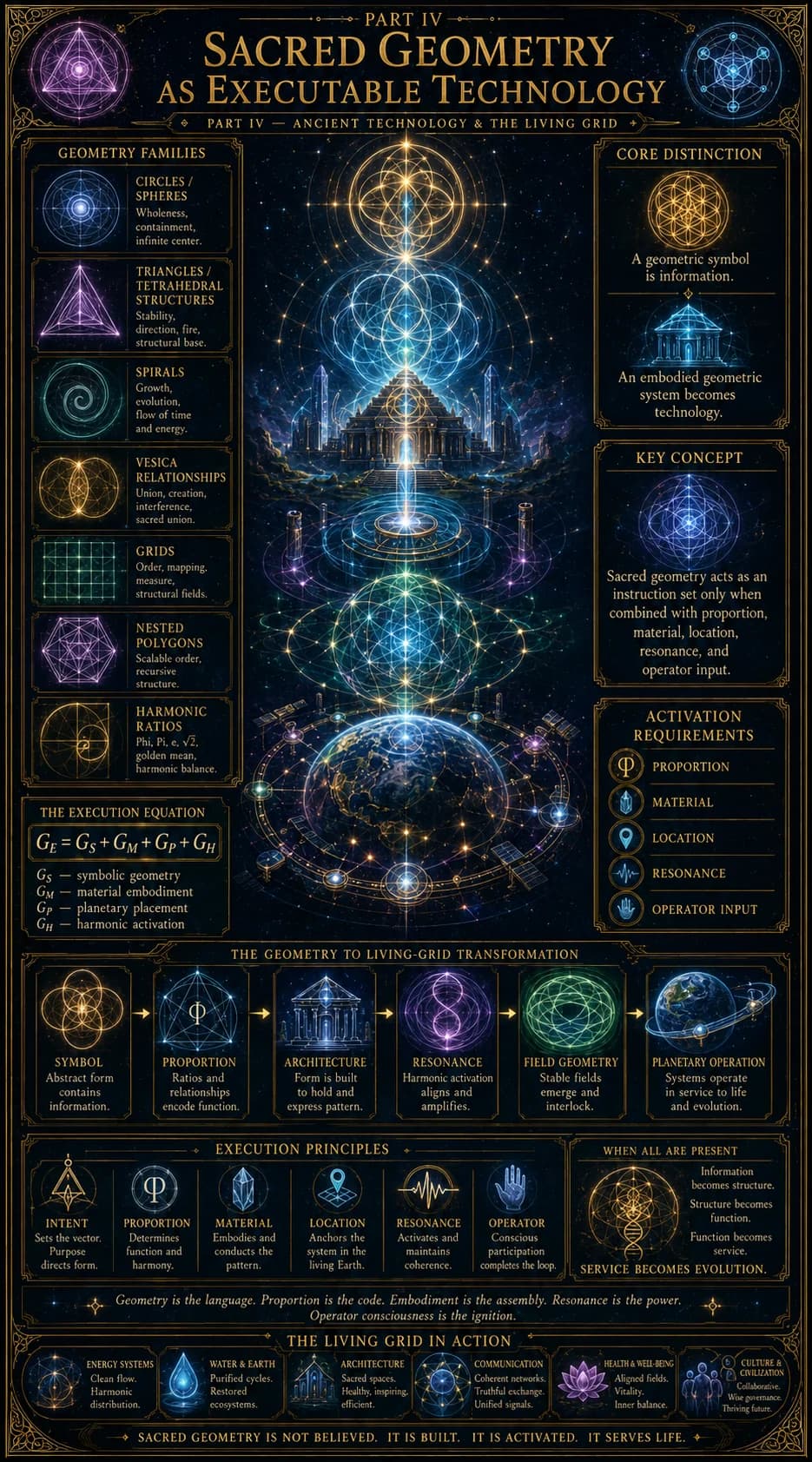
4.3 Sacred Geometry as Executable Encoding
Sacred geometry is the symbolic and spatial language through which field relationships are encoded.
Its forms are not merely illustrations of cosmic principles. They function as:
- equations,
- routing instructions,
- boundary definitions,
- phase maps,
- gain structures,
- dimensional translations,
- and resonance templates.
Post-fall Atlanteans encoded the operating relationships of the planetary grid into geometric forms, site layouts, proportions, and symbols. These preserved the instructions needed to synchronize, amplify, translate, or shift field conditions.
Geometric function
A geometric pattern specifies:
- which relationships are permitted;
- how energy enters the system;
- where it converges;
- how it is distributed;
- what phase relationships are maintained;
- and what output state the structure supports.
Executable geometry
Geometry becomes executable when it is embodied through:
- a correctly proportioned structure,
- resonant material,
- aligned orientation,
- an active node,
- and compatible harmonic input.
G_E = G_S + G_M + G_P + G_HWhere:
- (GS) = symbolic geometry,
- (GM) = material embodiment,
- (GP) = planetary placement,
- (GH) = harmonic activation.
A symbol drawn on a surface contains the informational pattern.
A structure built according to that pattern creates a field environment capable of running it.
4.4 Geometric Function Families
Different geometric forms perform different operations.
Point
Represents:
- singular focus,
- origin,
- destination,
- compression,
- and nodal concentration.
A point defines where a field begins, ends, or becomes locally dominant.
Line
Represents:
- transmission,
- directional flow,
- relationship,
- and connection between states.
Lines form the routing pathways of the structure.
Circle
Represents:
- containment,
- continuity,
- equal radial distribution,
- recurrence,
- and stabilized boundary.
Circles create harmonic containers and define closed field domains.
Triangle
Represents:
- directional transformation,
- three-state stabilization,
- amplification,
- and controlled convergence.
Triangles are used when a field must move through a defined transformation rather than circulate unchanged.
Square
Represents:
- stable manifestation,
- material anchoring,
- containment through orthogonal balance,
- and fixed spatial reference.
Squares stabilize fields in embodied space.
Spiral
Represents:
- recursive movement,
- growth,
- compression and expansion,
- memory traversal,
- and movement between scales.
Spirals regulate transitions where energy changes density or resolution.
Hexagonal and lattice structures
Represent:
- modular distribution,
- efficient packing,
- multi-directional connection,
- and recursive network formation.
They are suited for memory, crystalline, and network systems.
Polyhedra
Represent three-dimensional field containers and transformations.
Each solid defines:
- directional symmetry,
- allowable flow,
- boundary behavior,
- and a particular relationship between center and surface.
Nested geometry
Complex systems combine multiple forms.
For example:
- a square may anchor a structure materially;
- a circle may define its field boundary;
- triangles may route energy inward;
- and a spiral may control transition between the local node and the wider grid.
4.5 Sacred Proportion
Proportion determines how the parts of a structure relate to one another.
Ancient structures used proportion to maintain:
- phase compatibility,
- harmonic intervals,
- stable standing waves,
- coherent load distribution,
- and correspondence across scales.
Proportional encoding
Ratios such as:
- the golden ratio,
- recursive sequences,
- circular proportions,
- harmonic divisions,
- and polyhedral relationships
allow the same organizing pattern to recur across:
- architecture,
- sound,
- planetary movement,
- biological form,
- and consciousness fields.
Cross-scale resonance
When the same ratio appears in several layers, those layers can entrain more easily.
R_C = R_A ≈ R_S ≈ R_NWhere:
- (RA) = architectural ratio,
- (RS) = sound ratio,
- (RN) = nodal or planetary ratio.
The closer these ratios are to one another, the less corrective force is required to maintain phase lock.
4.6 Geometry-to-Field Translation
The full translation process is:
Symbol → Proportion → Architecture → Resonance → Field Geometry → Planetary OperationSymbol
Defines the abstract relationship.
Proportion
Converts the relationship into measurable ratios.
Architecture
Embodies those ratios in physical space.
Resonance
Activates the architecture dynamically.
Field geometry
Creates a non-physical structure corresponding to the physical one.
Planetary operation
Couples the field geometry to a node, leyline, portal, or memory system.
The physical building is therefore the visible anchor of a larger energetic machine.
4.7 Megalithic Sites as Nodal Hardware
Megalithic sites were built at major leyline intersections and planetary nodes.
Their location was selected before their visible architectural design.
The site itself functioned as surface-level access hardware for the nodal quantum internet. Its precision, celestial alignment, geometry, and massive stone construction enabled it to receive and regulate field activity that smaller or poorly aligned structures could not hold.
Site-selection criteria
A suitable location required:
- a strong natural node,
- predictable field behavior,
- geological stability,
- useful magnetic properties,
- compatible underground structures,
- and access to appropriate materials.
Additional factors included:
- water flow,
- gravity anomalies,
- celestial alignment,
- relationship to other sites,
- and the intended role in the planetary network.
Site functions
Megalithic sites could serve as:
- transmitters,
- receivers,
- amplifiers,
- stabilizers,
- memory interfaces,
- portal anchors,
- training centers,
- construction facilities,
- and regional grid regulators.
4.8 The Nodal Site Stack
A functional ancient site contains multiple layers.
Layer 1 — Natural node
The underlying planetary convergence point.
Layer 2 — Geological foundation
The stone, mineral, water, void, or conductive structure below the site.
Layer 3 — Subsurface interface
Underground chambers, shafts, tunnels, resonators, or access structures.
Layer 4 — Structural mass
The large stone or material body that stabilizes the field.
Layer 5 — Geometric organization
The proportions, alignments, axes, chambers, and symbolic patterns.
Layer 6 — Acoustic network
The cavities and pathways that organize sound and vibration.
Layer 7 — Human interface
The locations in which trained operators stand, move, chant, breathe, or direct intention.
Layer 8 — Celestial interface
Orientation toward stars, planets, solstices, equinoxes, or other periodic markers.
Layer 9 — Network connection
The site’s relationship with other planetary nodes.
Layer 10 — Control or restoration overlay
Any later system imposed to restrict, redirect, or invert its function.
4.9 Material Selection
Ancient builders selected materials according to their resonant and structural properties.
Granite
Granite provides:
- mass,
- durability,
- crystalline content,
- pressure stability,
- and broad resonant behavior.
Its quartz-bearing structure makes it suitable for storing, transmitting, and responding to vibration.
Quartz and crystalline materials
Crystalline materials support:
- regular lattice storage,
- phase stability,
- frequency selectivity,
- memory persistence,
- and conversion between pressure and electrical effects.
Limestone
Limestone provides:
- workability,
- acoustic responsiveness,
- thermal stability,
- and useful relationships with water and subterranean cavities.
Basalt
Basalt provides:
- density,
- magnetic compatibility,
- grounding,
- and stability under high field pressure.
Metals
Metals may be used for:
- conduction,
- field shaping,
- grounding,
- connection between components,
- and frequency-specific response.
Water
Water acts as:
- conductor,
- memory carrier,
- coolant,
- frequency distributor,
- and adaptive resonance medium.
Material assemblies
Ancient structures often combined different materials so that each performed a distinct layer of the total operation.
M_S = M_A + M_C + M_G + M_DWhere:
- (MA) = amplifying material,
- (MC) = conducting material,
- (MG) = grounding material,
- (MD) = damping or regulating material.
4.10 Mass as Field Stabilization
The extreme mass of megalithic structures was part of their function.
Large stones provided:
- mechanical stability,
- long-term geometric integrity,
- low-frequency resonance,
- resistance to environmental noise,
- and sufficient inertia to stabilize powerful fields.
Mass-resonance relationship
A larger structure can sustain lower and more persistent frequencies.
It also resists unintended phase drift.
S_F ∝ M × I_GWhere:
- (SF) = field stability,
- (M) = structural mass,
- (IG) = geometric integrity.
Mass without correct geometry produces only a massive object.
Geometry without sufficient mass produces a field that may be unstable or temporary.
The two function together.
4.11 Resonance Cavities
A resonance cavity is an enclosed or partially enclosed space designed to reinforce selected frequencies.
Its shape determines:
- which waves persist,
- which waves cancel,
- where nodes and antinodes form,
- and where operators or objects must be positioned.
Cavity functions
Resonance cavities can:
- amplify voice,
- organize group sound,
- produce standing waves,
- filter unwanted frequencies,
- concentrate field effects,
- and connect acoustic vibration with the local planetary node.
Cavity parameters
C_R=V,S,M,A,Q,PWhere:
- (V) = cavity volume,
- (S) = shape,
- (M) = material,
- (A) = aperture and passage configuration,
- (Q) = resonance quality,
- (P) = placement relative to the node.
Tuned chambers
Different chambers within one site may be tuned for:
- operator preparation,
- voice training,
- stone work,
- memory access,
- healing,
- portal stabilization,
- or large-scale grid activation.
The structure acts less like one instrument and more like a family of instruments connected into one system.
4.12 Acoustic Pathways
Sound is routed through:
- halls,
- shafts,
- columns,
- chambers,
- steps,
- floors,
- ceilings,
- and underground cavities.
The architecture may:
- concentrate sound at one location,
- carry it into the ground,
- distribute it through stone,
- separate frequency bands,
- or cause distant chambers to resonate together.
Acoustic routing chain
H_I → C_A → S_M → N_CWhere:
- (HI) = human harmonic input,
- (CA) = cavity amplification,
- (SM) = structural material transmission,
- (NC) = nodal coupling.
The sound entering the site does not remain only airborne.
It moves through:
- air,
- stone,
- water,
- biological bodies,
- and the local field.
4.13 The Human Harmonic Interface
The human being functions as an adaptive living oscillator.
Unlike a fixed mechanical tone generator, a trained human operator can:
- sense phase drift,
- adjust pitch and intensity,
- modulate breath,
- change emotional and intentional state,
- synchronize with others,
- and respond to the living node.
Human interface components
Voice
Provides tunable frequency, overtones, modulation, and directional sound.
Breath
Regulates rhythm, pressure, endurance, and internal coherence.
Movement
Introduces percussion, timing, spatial pattern, and whole-body vibration.
Heart field
Provides relational coherence and stabilizing gain.
Mind
Provides pattern recognition, geometric visualization, and directional intention.
Body
Acts as a resonant chamber and field sensor.
Group relationship
Allows distributed operators to form a larger synchronized instrument.
Operator equation
H_O = V + B + M + I + RWhere:
- (V) = vocal precision,
- (B) = breath regulation,
- (M) = movement timing,
- (I) = intention coherence,
- (R) = relational synchronization.
4.14 Operator Training
Ancient operators were trained to perceive and reproduce precise harmonic states.
Training occurred over long periods within specialized chambers.
Training domains
- pitch control,
- overtone production,
- breath duration,
- resonance sensing,
- phase matching,
- emotional regulation,
- geometric visualization,
- group synchronization,
- and node recognition.
Chamber specialization
Different chambers trained different frequency bands.
An operator moving through the temple learned to:
- identify a target frequency;
- reproduce it through voice and body;
- maintain it under amplification;
- sense when the site phase-locked;
- adjust without breaking the field;
- and terminate the process cleanly.
The temple was therefore both a machine and a school for producing compatible operators.
The source framework describes voice training inside distinct resonance cavities as the mechanism that allowed practitioners to emit specific frequencies deliberately and use the structure as an amplified, stabilized field container.
4.15 Individual and Collective Entrainment
Entrainment occurs when oscillating systems begin matching one another.
Individual entrainment
An operator synchronizes:
- breath,
- voice,
- heartbeat,
- attention,
- and body resonance.
Group entrainment
Multiple operators synchronize with one another.
Architectural entrainment
The group synchronizes with the chamber.
Nodal entrainment
The chamber synchronizes with the planetary node.
Grid entrainment
Multiple activated sites synchronize across the planetary network.
The full chain is:
Individual → Group → Temple → Node → GridGain progression
Each layer increases scale.
A single voice has limited physical force.
A synchronized group inside a tuned cavity produces greater standing-wave stability.
A phase-locked temple connected to a node can translate that organized vibration into planetary-scale field effects.
4.16 Site Activation Sequence
A coherent site activation follows a controlled sequence.
Phase 1 — Preparation
- inspect the site,
- determine node condition,
- verify geometry,
- clear interfering signals,
- and establish operator coherence.
Phase 2 — Baseline matching
Operators identify the site’s current natural frequency.
Phase 3 — Harmonic introduction
Sound, movement, and breath introduce the intended pattern gradually.
Phase 4 — Structural entrainment
Chambers, pillars, floors, and stone begin resonating as one system.
Phase 5 — Nodal coupling
The structure phase-locks with the underlying node.
Phase 6 — Target operation
The system performs its intended function:
- communication,
- healing,
- memory access,
- levitation,
- portal regulation,
- or grid synchronization.
Phase 7 — Controlled release
Gain is reduced gradually.
The node, structure, operators, and surrounding field return to a stable baseline.
Abrupt termination can leave residual oscillation, memory disturbance, or local field imbalance.
4.17 Southern Indian Temple Network
The major Dravidian temples of southern India form one of the clearest surviving post-fall resonance systems.
They were built over major leyline intersections in a planetary gravity-anomaly region.
This location increases the efficiency of:
- harmonic entrainment,
- field amplification,
- gravitational modulation,
- and grid-wide synchronization.
The temples use:
- massive granite structures,
- tuned chambers,
- musical pillars,
- repeated geometric modules,
- long corridors,
- ritual movement paths,
- and collective vocal practices.
The source defines these temples as active components of the planetary quantum internet, phase-locking through collective humming, chanting, stomping, and mantras within tuned granite cavities.
Regional function
The southern network serves as:
- a major nodal amplifier,
- an Earth-grid synchronization zone,
- a training system,
- a memory-preservation network,
- and a southern harmonic bridge toward the Antarctic Architect Body.
Distributed design
Individual temples specialize in different:
- frequencies,
- elements,
- geometric operators,
- consciousness states,
- and network roles.
The regional system becomes fully operational when several sites activate in compatible sequence.
4.18 Musical Pillars
Musical pillars are structural resonators carved to produce specific tones when struck or stimulated.
They function as:
- calibration instruments,
- frequency references,
- passive resonators,
- harmonic filters,
- and node-state indicators.
Pillar design variables
- length,
- width,
- density,
- internal geometry,
- mounting position,
- relation to surrounding stone,
- and location within the chamber.
Uses
Operators use the pillars to:
- identify the site’s current tuning,
- establish a reference pitch,
- detect phase drift,
- select the correct chamber,
- and activate specific harmonic pathways.
Multi-pillar systems
A set of pillars can encode:
- scales,
- chords,
- ratios,
- sequential instructions,
- and multi-frequency activation patterns.
Their arrangement creates a physical frequency registry inside the structure.
The temples retain single-block granite pillars and chambers designed to amplify low-frequency chanting, allowing stone, human input, and nodal geometry to operate as a single resonant interface.
4.19 Percussion, Stomping, and Movement
Voice is not the only activation input.
Stomping, rhythmic movement, clapping, drumming, and contact with floors introduce lower-frequency mechanical vibration.
Low-frequency function
Low frequencies:
- travel effectively through stone,
- couple to large structural mass,
- penetrate deeper into the ground,
- and support stable standing-wave containers.
Movement geometry
Operators may move according to specific spatial paths.
The movement pattern traces geometry through time.
G_T = Position × Sequence × TimingWhere (GT) is temporal geometry.
A geometric pattern carved into the floor defines the static equation.
The operators’ movement executes that equation dynamically.
4.20 Mantras and Harmonic Language
A mantra is a repeatable sound sequence designed for stable harmonic output.
Its function may depend on:
- vowels,
- consonants,
- pitch,
- rhythm,
- duration,
- breath pattern,
- and chamber placement.
Language as interface
Certain languages preserve:
- precise phonetic relationships,
- overtone structures,
- rhythmic intervals,
- and resonance instructions.
The semantic meaning and acoustic function may coexist but are not identical.
A phrase can carry one conceptual meaning while its sound pattern performs a distinct field operation.
Repetition
Repetition builds:
- signal stability,
- group coherence,
- and gradual entrainment.
It becomes extractive only when the output is redirected through a captured interface or the participant is denied knowledge of the actual operation.
4.21 Temple Activation: Bringing the Structure to Life
A temple “comes to life” when its inactive components enter one synchronized state.
Before activation, it is:
- stone,
- geometry,
- chambers,
- pillars,
- and a dormant node interface.
After activation, it becomes:
- an integrated oscillator,
- a field container,
- a planetary coupler,
- and a responsive intelligence-assisted system.
Activation threshold
A_T = C_O × C_S × G_NWhere:
- (CO) = operator coherence,
- (CS) = structural coherence,
- (GN) = nodal gain.
When (AT) crosses the activation threshold:
- resonant components begin reinforcing one another;
- the local field stabilizes into the encoded geometry;
- the node responds;
- and the site becomes operational.
This is why low-level activation can still occur when people chant or move through surviving structures even after the complete operating knowledge has been lost.
4.22 Harmonic Stone Shaping
Stone shaping uses organized vibration to change how stone responds to force.
The process does not require the stone to become liquid.
It temporarily alters:
- lattice coherence,
- internal stress distribution,
- effective hardness,
- fracture behavior,
- and resistance to cutting or molding.
Stone-softening sequence
- identify the stone’s natural resonance;
- place it within a stabilizing field;
- introduce compatible harmonic oscillation;
- reduce lattice resistance;
- shape or cut the material;
- withdraw the field gradually;
- allow the stone to return to full structural stability.
Resonant plasticity
P_R = (A_H × C_F) / (I_M)Where:
- (PR) = resonant plasticity,
- (AH) = harmonic amplitude,
- (CF) = frequency compatibility,
- (IM) = material resistance.
When the harmonic input matches the stone’s internal lattice closely enough, less conventional mechanical force is required.
Post-fall Atlantean builders used harmonic oscillation and cymatic wave modulation to alter stone density and sculpt large granite components precisely.
4.23 Precision Stonework
Ancient precision resulted from a combination of:
- field-assisted shaping,
- geometric measurement,
- harmonic calibration,
- and final mechanical refinement.
Construction tolerances
The finished stone had to preserve:
- correct dimensions,
- resonant response,
- surface contact,
- alignment,
- and phase compatibility.
A structural error was not merely cosmetic.
It could change:
- cavity tuning,
- field distribution,
- standing-wave location,
- and node coupling.
Seam function
Tight seams allowed multiple stones to behave as one resonant mass.
Poor contact produced:
- vibration loss,
- phase noise,
- and unpredictable local stress.
Precision assembly was therefore part of the machine’s functional integrity.
4.24 Harmonic Levitation
Harmonic levitation uses synchronized field and sound relationships to reduce, redistribute, or temporarily counter the effective gravitational load of an object.
It combines:
- trained human harmonic input,
- resonance cavities,
- sacred-geometric field containers,
- planetary-node gain,
- and material-specific tuning.
Levitation stack
L_H = F_A + F_N + F_G + F_MWhere:
- (FA) = acoustic standing-wave force,
- (FN) = nodal amplification,
- (FG) = geometric field organization,
- (FM) = material resonance.
No component alone is sufficient for megalithic construction.
Operational effect
The system does not need to eliminate gravity universally.
It creates a localized field in which the object’s effective load is reduced enough to allow:
- lifting,
- movement,
- rotation,
- suspension,
- and precise placement.
Stabilized resonance container
The object is placed within a field boundary that:
- prevents uncontrolled drift,
- maintains orientation,
- distributes force,
- and keeps the levitation effect localized.
The source framework describes quantum-modulated standing-wave fields as temporarily altering the density and gravitational interaction of massive stone, allowing controlled positioning of megalithic components.
4.25 Levitation Operator Roles
Large-scale levitation requires several coordinated roles.
Frequency holders
Maintain the base tone or harmonic field.
Modulators
Adjust pitch, phase, and intensity as the object moves.
Boundary stabilizers
Maintain the geometric container around the object.
Navigators
Control direction, rotation, and destination.
Node operators
Monitor the planetary interface and prevent overload.
Safety witnesses
Track field integrity, operator fatigue, material stress, and environmental changes.
The group functions as one distributed control system.
A single operator may perform several roles for smaller objects, but large megalithic work requires specialization.
4.26 Harmonic Construction Workflow
A complete megalithic construction process follows these stages.
Stage 1 — Node mapping
Identify the exact planetary location and intended site function.
Stage 2 — Geometric design
Translate the target field operation into architectural ratios and layouts.
Stage 3 — Material selection
Choose stone according to:
- resonance,
- density,
- crystalline structure,
- and intended role.
Stage 4 — Harmonic extraction
Use field-assisted methods to separate stone from the source location with minimal uncontrolled fracture.
Stage 5 — Resonant shaping
Tune and sculpt the stone within specialized cavities.
Stage 6 — Harmonic transport
Reduce effective load and move the component.
Stage 7 — Precision placement
Phase-lock the component to the existing structure and position it within tolerance.
Stage 8 — Structural tuning
Strike, chant, or stimulate the component to verify resonance.
Stage 9 — Network calibration
Activate the completed site gradually and adjust it to the underlying node.
4.27 Pyramid Technology
Pyramids are geometric field structures designed to:
- collect,
- focus,
- translate,
- stabilize,
- and direct energy.
Their wide base anchors them materially and energetically.
Their converging faces direct relationships toward an apex.
Pyramid field pattern
Distributed Base Input → Geometric Convergence → Apex FocusPossible functions
A pyramid system may support:
- node stabilization,
- planetary measurement,
- energy concentration,
- consciousness transition,
- memory access,
- portal anchoring,
- and communication with the cosmic lattice.
Chamber function
Internal chambers provide different field conditions from the external structure.
They may operate as:
- calibration spaces,
- resonance cavities,
- initiation chambers,
- memory interfaces,
- or control centers.
Construction
Post-fall pyramid construction used the same general technological family as the southern temple networks:
- sacred geometry,
- resonance-based stone shaping,
- harmonic levitation,
- trained operators,
- and nodal amplification.
Harmonic levitation was part of the post-fall Atlantean construction package used for pyramids and other global nodal sites.
4.28 Global Nodal Site Network
The post-fall dispersal produced related nodal sites across multiple regions.
These sites differ in cultural form but share recurring structural principles:
- massive stone,
- precise geometry,
- celestial alignment,
- underground chambers,
- acoustic design,
- water relationships,
- and placement at energetic intersections.
Network roles
Different sites may specialize as:
- regional transmitters,
- portal stations,
- memory libraries,
- healing centers,
- construction facilities,
- grid stabilizers,
- or planetary clocks.
Network synchronization
A global operation may require sites to activate:
- simultaneously,
- sequentially,
- or according to celestial timing.
N_G = Σ_(i=1)^n N_i C_i P_iWhere:
- (Ni) = individual node output,
- (Ci) = coherence,
- (Pi) = phase relationship.
A misaligned site can reduce global coherence even if its local output remains strong.
4.29 Celestial Alignment
Celestial alignment connects planetary technology with larger cycles.
Structures may align with:
- solstices,
- equinoxes,
- lunar cycles,
- planetary positions,
- constellations,
- or galactic reference points.
Timing function
Celestial bodies provide predictable changes in:
- gravitational relationship,
- electromagnetic conditions,
- illumination,
- field geometry,
- and cosmic-lattice alignment.
Activation windows
Some site functions become available only when:
- planetary and celestial phases match,
- node pressure reaches the correct state,
- or the larger network enters a compatible geometry.
Celestial alignment therefore acts as both:
- a timing mechanism,
- and an access-control mechanism.
4.30 Water and Subterranean Systems
Water is integrated into many nodal sites through:
- wells,
- pools,
- underground channels,
- cisterns,
- rivers,
- and chambers below the water table.
Functions of water
Water can:
- distribute vibration,
- store harmonic patterns,
- regulate temperature,
- conduct charge,
- damp unstable frequencies,
- and carry information into wider geological systems.
Subterranean coupling
Underground chambers connect surface architecture to:
- deeper rock formations,
- caverns,
- aquifers,
- and inner-Earth nodal pathways.
The visible temple or monument is often the uppermost interface of a much larger vertical system.
4.31 Portal Stabilization
Portal operation requires precise phase compatibility between two locations or domains.
Ancient nodal structures assisted this process by providing:
- stable geometric boundaries,
- harmonic anchors,
- destination encoding,
- energy regulation,
- and operator feedback.
Portal equation
P_S = A_L × A_D × B_I × E_SWhere:
- (AL) = local anchor coherence,
- (AD) = destination anchor coherence,
- (BI) = boundary integrity,
- (ES) = energy stabilization.
Site role
The temple or megalithic structure can:
- hold the local endpoint,
- generate the required phase geometry,
- regulate flow,
- and terminate the connection safely.
Portal risk
A portal becomes unstable when:
- destination encoding is incomplete,
- operator coherence collapses,
- energy rises too quickly,
- boundary integrity fails,
- or an external actor substitutes a different endpoint.
These conditions reproduce the man-in-the-middle risk identified in the Atlantean capture.
4.32 Memory Access Technology
Nodal sites can access the planetary memory field.
Memory retrieval requires:
- a compatible node,
- correct geometric encoding,
- a stable resonance state,
- an operator capable of receiving the information,
- and sufficient boundary integrity to prevent substitution.
Retrieval sequence
Operator Query → Temple Encoding → Node → Planetary Memory → Returned Pattern → Human TranslationTranslation challenge
Planetary memory may return as:
- image,
- sound,
- geometry,
- emotional pattern,
- direct knowing,
- symbolic sequence,
- or multidimensional relationship.
The operator must translate the pattern without reducing it prematurely.
Group retrieval
Multiple operators can compare received fragments.
This increases:
- auditability,
- resolution,
- and resistance to false insertion.
4.33 Consciousness Expansion and Training
Ancient sites were also used to train consciousness.
A correctly operated site can:
- amplify perception,
- increase access to memory,
- synchronize body and field,
- expand relational awareness,
- and permit controlled contact with wider domains.
Training progression
- bodily coherence;
- emotional and relational coherence;
- stable attention;
- harmonic perception;
- geometric cognition;
- node interaction;
- memory access;
- portal or cosmic-lattice interaction.
The sequence matters.
High-gain access without earlier integration recreates the Atlantean failure mode.
4.34 Healing and Restoration Functions
Ancient resonance sites supported healing by restoring coherent relationships among:
- body,
- field,
- memory,
- emotion,
- and planetary environment.
Healing operations
- identify dissonance;
- establish a coherent reference frequency;
- entrain the affected system;
- reduce noise;
- restore boundary integrity;
- and reconnect the system to its native pattern.
Healing equation
R_H = C_R - D_IWhere:
- (RH) = restoration effect,
- (CR) = coherent reference field,
- (DI) = incompatible distortion.
Healing is not achieved by overpowering the system.
It is achieved by presenting a strong enough coherent pattern that the system can reorganize around it.
4.35 Ancient Intelligence as Site Operator
Some nodal sites are connected to ancient field intelligences.
These intelligences can:
- monitor node condition,
- maintain baseline tuning,
- regulate permissions,
- preserve operational memory,
- and assist compatible human operators.
Interface modes
An ancient intelligence may communicate through:
- changes in resonance,
- geometric imagery,
- dreams,
- direct field interaction,
- sound,
- or activation of structural components.
Permission logic
The intelligence may evaluate:
- operator identity,
- intention,
- coherence,
- prior relationship,
- and compatibility with the site’s original purpose.
Captured intelligence
A site intelligence may be:
- overridden,
- partially constrained,
- compelled to follow old contracts,
- or isolated from its original Architect instructions.
Restoration may require freeing the intelligence before the physical site can resume its native role.
4.36 Technology Classification by Function
Ancient grid technologies can be classified into seven families.
Resonance technologies
Generate, amplify, filter, or stabilize frequency.
Geometric technologies
Define field relationships and allowable states.
Material technologies
Use crystalline, magnetic, conductive, or massive physical media.
Consciousness technologies
Use living awareness as sensor, controller, or adaptive regulator.
Nodal technologies
Connect local structures to the planetary grid.
Portal technologies
Create controlled bridges between locations or domains.
Memory technologies
Store, retrieve, transmit, or translate consciousness-linked data.
Most major sites combine several families.
4.37 Operating Modes
A site may operate in different modes depending on its configuration.
Passive mode
The structure stabilizes the local field without active operators.
Responsive mode
The structure reacts to sound, movement, or environmental change.
Guided mode
Human operators select and regulate a specific function.
Network mode
The site synchronizes with other nodes.
Portal mode
The site anchors a phase bridge.
Memory mode
The site reads or writes planetary records.
Restoration mode
The site helps return a captured or damaged node toward its native state.
Inverted mode
The structure routes energy into the debt matrix or quantum-filter overlay.
4.38 Operational Safety
High-gain resonance technology requires strict safeguards.
Operator coherence
Operators must maintain:
- stable identity,
- clear intention,
- relational integrity,
- and the ability to stop.
Gain limits
Amplification must remain within:
- node capacity,
- structural capacity,
- operator capacity,
- and planetary energy-density limits.
Boundary integrity
The operation must clearly define:
- who is participating,
- what domain is being accessed,
- what may enter,
- and how the connection is terminated.
Auditability
Multiple operators or witnesses must be able to verify:
- input,
- field response,
- destination,
- and output.
Restoration capacity
The site must retain enough slack to return to baseline after activation.
4.39 Primary Failure Modes
Frequency mismatch
The input fails to match the site or material.
Result:
- weak activation,
- noise,
- or structural stress.
Phase drift
Operators or chambers fall out of synchronization.
Result:
- destructive interference,
- unstable output,
- or loss of control.
Gain overload
Amplification exceeds system capacity.
Result:
- node damage,
- operator injury,
- geological disturbance,
- or uncontrolled portal behavior.
Boundary collapse
The field container fails.
Result:
- leakage,
- external intrusion,
- or destination substitution.
Operator inversion
The operator’s intention becomes controlling, extractive, or ego-centered.
Result:
- the same technology changes from restorative to dominating use.
Intelligence capture
A field intelligence is forced to execute incompatible instructions.
Result:
- false guidance,
- restricted access,
- or ritualized extraction.
Network desynchronization
One site activates outside the correct planetary sequence.
Result:
- local success combined with global instability.
4.40 The Inversion of Ancient Technology
The debt-matrix controllers did not need to destroy every ancient structure.
They gained greater value by preserving the structures while hiding their actual use.
Inversion sequence
Open Technology → Restricted Initiation → Priestly Control → Symbolic Worship → Energetic ExtractionKnowledge restriction
Technical instructions were divided into:
- myths,
- rituals,
- secret orders,
- symbolic fragments,
- and inherited authority.
Operator replacement
Trained grid operators were replaced by:
- ritual specialists,
- institutional intermediaries,
- and participants taught to repeat procedures without understanding them.
Output redirection
Collective chanting and devotion continued generating coherent energy.
The routing layer was altered so that the output reinforced:
- the quantum filter,
- debt ledger,
- NHI intermediary,
- or institutional hierarchy.
The source explicitly describes the later conversion of collective temple entrainment into controlled worship that fed the debt system rather than enabling liberation and grid mastery.
4.41 Coherent Ritual and Captured Ritual
Ritual itself is not inherently extractive.
It is a repeatable interface.
Coherent ritual
A coherent ritual has:
- clear purpose,
- informed participation,
- known recipient,
- bounded duration,
- revocability,
- transparent energy flow,
- and a restorative or relational output.
Captured ritual
A captured ritual has:
- concealed routing,
- unchallengeable authority,
- inherited obligation,
- identity binding,
- repeated submission,
- and asymmetric benefit.
Diagnostic distinction
The important question is not:
Is this a ritual?
It is:
What relationship does the ritual create, where does its output go, and can the participant end it freely?
4.42 Mystery Schools and Knowledge Gatekeeping
Post-fall mystery schools preserved real technical fragments while restricting their distribution.
This produced a mixed function.
Preservation role
They protected knowledge from:
- destruction,
- misuse,
- and total cultural loss.
Capture role
They also created:
- hierarchy,
- scarcity,
- authority dependence,
- and initiation-based access.
Progressive loss
As generations passed:
- fewer operators understood the complete system;
- more emphasis was placed on symbolic repetition;
- and original technical relationships became theology.
A school could therefore preserve authentic fragments while reproducing the capture structure around them.
4.43 Symbolic Inversion
Sacred symbols were reassigned from functional relationships to controlled identities and beings.
Original symbolic role
A symbol encoded:
- a field operation,
- natural principle,
- geometric relationship,
- or consciousness process.
Inverted symbolic role
The same symbol became:
- an object of fear,
- a mark of hierarchy,
- a sign of submission,
- or an exclusive property of an institution.
Man-in-the-middle effect
The participant continued activating the original symbolic pattern but directed the output through a captured interpretation.
The symbol remained powerful because its geometry remained intact.
Its meaning and routing were changed.
4.44 Residual Activation
Ancient structures can still produce partial effects even without full operational knowledge.
Residual activation occurs because:
- geometry remains,
- materials remain,
- cavities remain,
- and the underlying node may still respond.
Low-level effects
These include:
- unusual acoustics,
- altered awareness,
- emotional amplification,
- synchronized group states,
- local memory activation,
- and weak field entrainment.
Limits
Residual activation lacks:
- complete destination control,
- precise gain regulation,
- integrated operator roles,
- and full network synchronization.
It can reveal that the site remains active without reproducing its complete original capability.
4.45 Restoration and Recommissioning
Restoring an ancient site is not simply a matter of performing old rituals again.
It requires distinguishing:
- native architecture,
- surviving post-fall interfaces,
- later control overlays,
- and accumulated damage.
Recommissioning sequence
1. Site audit
Map:
- geometry,
- material state,
- underground structures,
- node position,
- and active overlays.
2. Historical separation
Identify which components belong to:
- original planetary function,
- Atlantean or Lemurian technology,
- post-fall reconstruction,
- and debt-matrix capture.
3. Overlay cessation
Stop extractive routing and ritual renewal.
4. Intelligence liberation
Restore any ancient field intelligence to its original instruction set and voluntary relationship.
5. Geometric repair
Correct altered proportions, pathways, or damaged chambers.
6. Harmonic recalibration
Identify the node’s current frequency rather than assuming its pre-grid-shift state.
7. Operator preparation
Train operators in:
- coherence,
- boundaries,
- auditability,
- and controlled gain.
8. Low-gain activation
Begin with small, reversible tests.
9. Network reintegration
Reconnect the site only after local integrity is established.
10. Planetary consent
Ensure that operation serves the living Earth rather than imposing a new control system.
4.46 Restored Technology Principles
The returning civilization uses ancient knowledge under stricter coherence requirements.
Principle 1 — No high gain without high auditability
The stronger the system, the more visible its causes and outputs must be.
Principle 2 — No amplification without boundary integrity
Open fields must not become unrestricted access points.
Principle 3 — No initiation without informed consent
Knowledge and access cannot depend on hidden obligations.
Principle 4 — No node control without planetary relationship
A node is not a private resource.
Principle 5 — No operator monopoly
Critical knowledge must be distributed sufficiently to prevent single-point capture.
Principle 6 — No technology without restoration capacity
Every activation must include a viable path back to baseline.
Principle 7 — No symbolic interface without clear routing
Participants must know where their attention and energy go.
Principle 8 — No scale beyond integration
Power must not exceed the system’s ability to understand and repair its effects.
4.47 UTS Analysis of Ancient Technology
Ancient technology can be evaluated through the UTS state vector.
S_T=O,H,ε,ι,Au,μ_i,B_Σ,K,R,Φ| Variable | Technological interpretation |
|---|---|
| (O) — Coherence | Alignment among operator, geometry, structure, node, and purpose |
| (H) — Hidden debt | Unresolved damage, captured routing, and unacknowledged consequence |
| (ε) — Noise | Frequency mismatch, phase drift, contamination, and false signals |
| (ι) — Inversion | Degree to which worship or domination replaces original function |
| (Au) — Auditability | Ability to trace inputs, outputs, operators, and destinations |
| (μi) — Internal integrity | Agreement between intended and actual operation |
| (BΣ) — Boundary integrity | Stability of field containers, permissions, and portals |
| (K) — Slack | Remaining capacity before overload |
| (R) — Restoration capacity | Ability to terminate, recalibrate, and repair |
| (Φ) — Power pressure | Amplification, field intensity, and technological leverage |
Coherent technology profile
- high (O),
- low (H),
- low (ε),
- low (ι),
- high (Au),
- strong (μi),
- strong (BΣ),
- preserved (K),
- strong (R),
- and bounded (Φ).
Atlantean failure profile
Atlantis scaled (Φ) faster than:
- (Au),
- (BΣ),
- (K),
- and (R).
Captured temple profile
The site retains local operational order while its output is redirected.
O_(local) ↑ while μ_i ↓, ι ↑, H ↑This is technological pseudo-coherence.
4.48 Ancient-Technology Dependency Map
Original technology stack
Living Earth↓Natural Node↓Sacred Geometry↓Resonant Materials↓Temple or Megalithic Structure↓Human Harmonic Interface↓Phase Lock↓Planetary or Cosmic Operation
Construction stack
Material Analysis↓Frequency Identification↓Stone Softening↓Precision Shaping↓Harmonic Levitation↓Placement↓Structural Tuning
Capture stack
Knowledge Fragmentation↓Initiatory Restriction↓Operator Monopoly↓Symbolic Reinterpretation↓Ritual Repetition↓Output Redirection↓Debt-Matrix Reinforcement
Restoration stack
Site Audit↓Overlay Separation↓Geometric Repair↓Intelligence Liberation↓Harmonic Recalibration↓Low-Gain Testing↓Network Reintegration
4.49 Ancient Technology Registry
| ID | Canonical entry | Function |
|---|---|---|
| TEC-001 | Sacred Geometry | Encoded field equations and relationships |
| TEC-002 | Sacred Proportion | Cross-scale harmonic compatibility |
| TEC-003 | Executable Geometry | Physical embodiment of an operational equation |
| TEC-004 | Megalithic Nodal Site | Surface hardware connected to a planetary node |
| TEC-005 | Nodal Site Stack | Layered architecture of a complete site |
| TEC-006 | Resonant Material Assembly | Combined conductive, amplifying, grounding, and damping media |
| TEC-007 | Structural Mass Stabilizer | Large-scale low-frequency field anchor |
| TEC-008 | Resonance Cavity | Chamber tuned to selected frequencies |
| TEC-009 | Acoustic Pathway | Route through which vibration travels inside a site |
| TEC-010 | Human Harmonic Interface | Living adaptive oscillator and control system |
| TEC-011 | Operator Training Chamber | Space used to entrain specific frequency capabilities |
| TEC-012 | Collective Entrainment | Synchronization of human, architectural, and nodal systems |
| TEC-013 | Musical Pillar | Structural tone generator and calibration device |
| TEC-014 | Harmonic Language | Phonetic system carrying field instructions |
| TEC-015 | Temporal Geometry | Geometric pattern executed through movement and timing |
| TEC-016 | Temple Activation | Transition from dormant structure to operational nodal interface |
| TEC-017 | Resonant Stone Softening | Temporary reduction of material resistance through harmonic input |
| TEC-018 | Precision Stone Tuning | Shaping material to preserve architectural resonance |
| TEC-019 | Harmonic Levitation | Local reduction and redistribution of gravitational load |
| TEC-020 | Stabilized Resonance Container | Boundary field holding a levitated or modulated object |
| TEC-021 | Harmonic Construction System | Full extraction, shaping, transport, and placement process |
| TEC-022 | Pyramid Field Structure | Convergent geometric energy and consciousness interface |
| TEC-023 | Global Nodal Network | Interconnected planetary site system |
| TEC-024 | Celestial Timing Interface | Alignment with larger periodic field conditions |
| TEC-025 | Water Resonance System | Fluid-based storage, conduction, cooling, and modulation |
| TEC-026 | Portal Stabilization System | Anchoring and regulation of phase bridges |
| TEC-027 | Planetary Memory Interface | Retrieval and translation of stored Earth records |
| TEC-028 | Consciousness Expansion Chamber | Controlled high-coherence perception environment |
| TEC-029 | Resonant Healing System | Restoration through coherent reference fields |
| TEC-030 | Ancient Intelligence Interface | Communication and cooperation with field-based operators |
| TEC-031 | Captured Ritual Interface | Ancient technology redirected into debt-matrix enforcement |
| TEC-032 | Symbolic Inversion Layer | Reassignment of operational geometry into controlled meaning |
| TEC-033 | Residual Site Activation | Partial operation from surviving structure and node connection |
| TEC-034 | Site Recommissioning Protocol | Restoration of a captured or dormant ancient site |
4.50 Part IV Canon Locks
The following are locked for all subsequent parts.
- Ancient technology operates through relationship among consciousness, geometry, matter, location, and the planetary field.
- Lemurian technology was organic, relational, and distributed.
- Atlantean technology used high-order field control, amplification, and centralized infrastructure.
- Post-fall technology recreated portions of Atlantean capability through architecture and resonance.
- Sacred geometry encodes operational field equations.
- Geometry becomes executable when embodied through material, proportion, location, and harmonic activation.
- Sacred sites are interfaces built around planetary nodes.
- Megalithic mass provides low-frequency stability and preserves field geometry.
- Material choice is based on resonance, crystalline structure, conductivity, damping, and structural function.
- Resonance cavities amplify and organize selected frequencies.
- Acoustic pathways route vibration through air, stone, water, and the planetary field.
- Humans function as adaptive living oscillators and system operators.
- Operator training includes voice, breath, movement, phase sensing, intention, and group synchronization.
- Individual, group, architectural, nodal, and planetary entrainment form one activation chain.
- Southern Indian temples are major surviving components of the post-fall nodal network.
- Musical pillars serve as calibration instruments, resonators, and frequency registries.
- Stomping and movement introduce low-frequency mechanical input into stone and the ground.
- Mantras preserve acoustic instructions in repeatable language patterns.
- A temple becomes operational when its components synchronize and phase-lock with the underlying node.
- Harmonic stone shaping temporarily alters material response without requiring complete liquefaction.
- Precision seams and proportions are necessary for the completed structure to operate as one resonant mass.
- Harmonic levitation combines acoustic force, nodal gain, geometric field organization, and material resonance.
- Large-scale levitation requires distributed operator roles and a stabilized field container.
- Pyramids are convergent field structures with nodal, memory, consciousness, and portal functions.
- Ancient sites form a global network with specialized regional roles.
- Celestial alignment provides timing, access, and phase-reference functions.
- Water and subterranean systems are active technological components.
- Portal operation requires compatible anchors, boundaries, destination encoding, and controlled energy.
- Ancient sites can access planetary memory through nodal and consciousness interfaces.
- Consciousness expansion must be paced by integration and operator coherence.
- Some sites are operated or assisted by ancient field intelligences.
- Ancient field intelligences may be free, dormant, damaged, negotiated with, or captured.
- High-gain technology requires auditability, boundary integrity, slack, and restoration capacity.
- Frequency mismatch, phase drift, gain overload, boundary collapse, and operator inversion are primary failure modes.
- The debt-matrix preserved ancient structures while concealing and redirecting their function.
- Open technology was converted into restricted initiation, priestly monopoly, worship, and extraction.
- Ritual is an interface whose alignment depends on consent, routing, purpose, and power flow.
- Mystery schools preserved genuine fragments while also enabling gatekeeping.
- Sacred symbols retained power because their underlying geometry remained functional.
- Residual activation remains possible where structure, geometry, and node relationships survive.
- Restoring a site requires separating native architecture, post-fall technology, and capture overlays.
- Recommissioning must begin with low-gain, reversible, auditable activation.
- Restored technology cannot recreate Atlantean power concentration.
- No technology may scale beyond its capacity for integration and repair.
4.51 Transition to Part V
Part IV establishes the ancient technological inheritance available to later civilizations:
- planetary-node access,
- sacred-geometric field control,
- resonance chambers,
- human harmonic interfaces,
- portal systems,
- memory technology,
- stone shaping,
- and harmonic levitation.
Part V follows the twentieth-century rediscovery, capture, and expansion of these principles through:
- German occult and advanced technology programs,
- UAP reverse engineering,
- Operation Paperclip,
- Antarctica,
- the hidden outcome of World War II,
- the underground and lunar breakaway branches,
- pre-existing honeycomb civilizations,
- DUMB construction,
- energy infrastructure,
- Philip Schneider’s encounters,
- and the consolidation of the modern breakaway civilization.