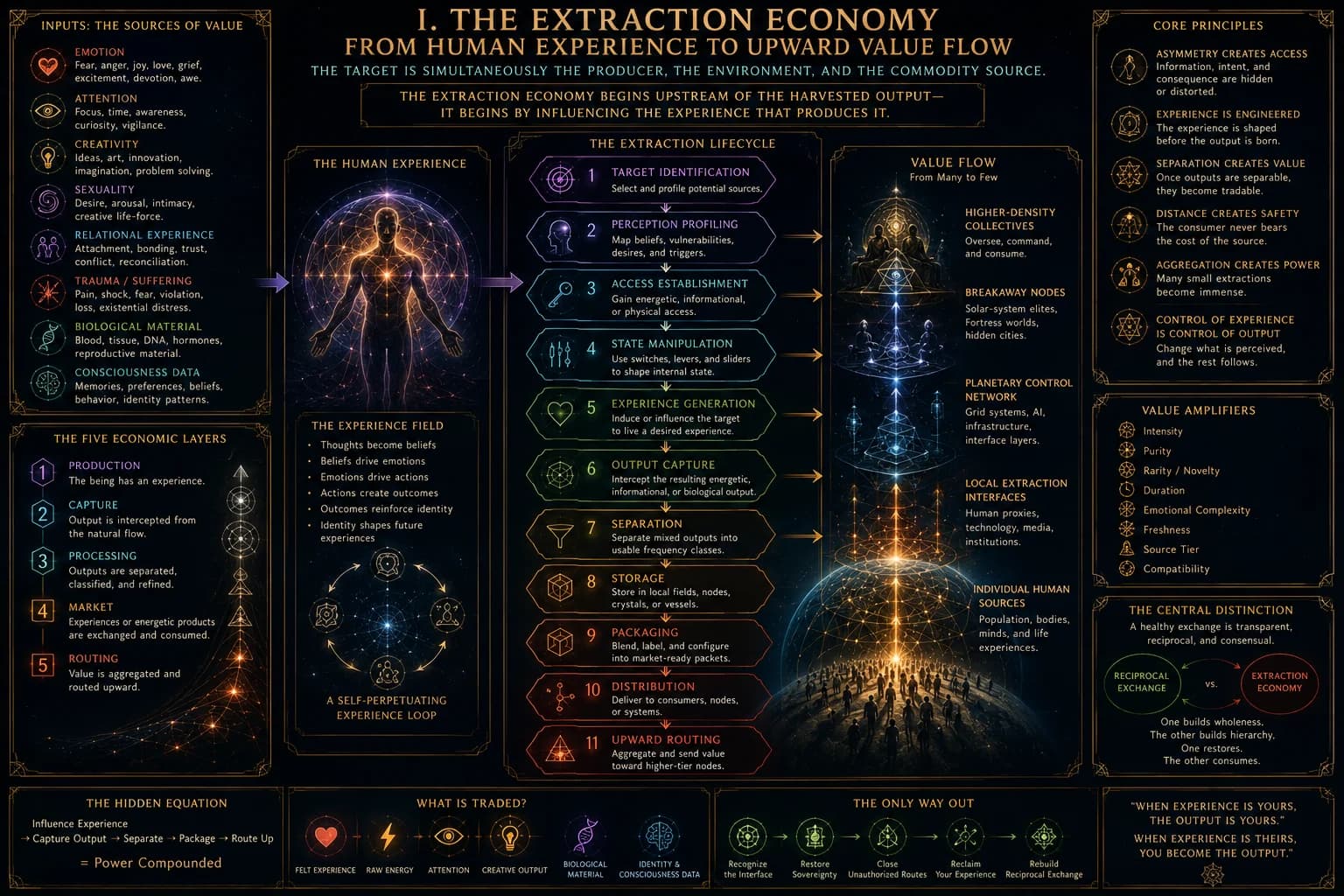
Extraction Economy and Perception Interface
Part IX — Extraction Economy and Perception Interface
Function:Defines the economy built around Earth’s embodied consciousness, including loosh classification and routing, Earth’s premium-resort function, stolen first-person experience, subscription access, remote possession, outcome markets, biological harvesting, perception switches and sliders, temptation engineering, dynamic stagnation, proxy-node formation, and the restoration of sovereign experience.
9.0 Quick Reference
Primary extraction chain
Target Identification → Perception Profiling → Access Establishment → State Manipulation → Experience Generation → Output Capture → Separation → Storage → Packaging → Distribution → Upward Routing
Earth’s market roles
| Role | Function |
|---|---|
| Debt-university | Generates recurring embodied experience through incarnation |
| Premium resort node | Provides high-intensity experience to upper-tier visitors |
| Live experience network | Routes real first-person sensory and emotional streams |
| Loosh-production field | Generates multiple separable energetic outputs |
| Biological resource node | Supplies genetics, tissues, reproductive material, and hybrid data |
| Gambling environment | Produces uncertain choices and observable outcome branches |
| Consciousness laboratory | Tests attention, memory, identity, desire, and relational states |
| Sibling-world interface | Extends observation and extraction through entangled kin |
| Planetary amplifier | Uses the nodal network to scale local outputs across the wider system |
Product classes
- Energetic products— emotional, creative, devotional, sexual, attention-based, and trauma-derived output.
- Experiential products— sensory streams, embodied feeling, memories, relationships, and first-person sessions.
- Biological products— genetics, tissues, organs, reproductive material, and hybrid compatibility data.
- Informational products— thoughts, preferences, behavioral models, memories, and decision patterns.
- Relational products— bonds, trust, attachment, devotion, family access, and sibling-world connections.
- Temporal products— choice outcomes, probability branches, future trajectories, and timeline anchors.
- Planetary products— nodal energy, collective fields, civilizational creativity, and Earth-linked resonance.
Perception control interface
| Control | Operation |
|---|---|
| Switch | Activates or deactivates a state |
| Lever | Raises or lowers intensity |
| Slider | Blends several variables into a customized output |
| Gate | Permits or denies access |
| Loop | Repeats a state without meaningful completion |
| Route | Determines where the resulting output travels |
Central principle
The extraction economy does not merely consume experiences after they occur.
It shapes perception in advance so that specific experiences, decisions, emotional mixtures, and energetic outputs will be generated on demand.
9.1 The Extraction Economy
The extraction economy is the complete system through which life, consciousness, relationship, and experience are converted into transferable value.
It extends beyond conventional material extraction.
Its resources include:
- attention,
- emotion,
- creativity,
- embodiment,
- desire,
- memory,
- identity,
- relationship,
- genetics,
- and consciousness continuity.
Core transformation
Living Experience → Measurable Output → Separable Product → Transferable ResourceEconomic inversion
A coherent economy supports the beings generating value.
The extraction economy treats the being primarily as the substrate from which value is removed.
The individual’s:
- development,
- sovereignty,
- relationships,
- and long-term integrity
become secondary to output continuity.
9.2 Earth as a Premium Resort Node
Earth operates simultaneously as:
- an incarnation-based debt-university;
- a high-density extraction site;
- and a premium experiential destination for higher-tier dark beings.
These beings may access Earth:
- physically,
- through temporary embodiment,
- through remote entanglement,
- through subscription interfaces,
- or through controlled human proxies.
Earth’s extraction therefore combines systematic production with capricious entertainment demand. Higher-tier actors can enter or access the system for intense experiences before returning to their own domains.
Resort-node advantages
Earth provides:
- exceptional emotional range,
- biological diversity,
- high creative output,
- strong relational bonds,
- complex moral choices,
- dense planetary harmonics,
- and continual novelty.
Resort equation
R_E = L_D × E_R × P_C × A_NWhere:
- (LD) = density of living consciousness,
- (ER) = experiential range,
- (PC) = perception configurability,
- (AN) = access through the nodal network.
Earth becomes especially valuable because all four remain high.
9.3 Abundance Asymmetry
Light-rich consciousness generates value through:
- creativity,
- Love,
- relationship,
- play,
- beauty,
- joy,
- and coherent expression.
This value can arise abundantly without another being losing capacity.
Extractive systems do not reproduce that abundance cleanly.
They gain value primarily through:
- taking,
- controlling,
- redirecting,
- and concentrating what another being generates.
Scarcity requirement
A dark extraction system maintains control by creating scarcity around something naturally abundant.
Scarcity increases:
- dependency,
- competition,
- value concentration,
- and permission seeking.
Treasure-chest dynamic
Earth attracts high-potency soulstreams because it contains:
- rich embodiment,
- creative potential,
- planetary connection,
- and restoration opportunity.
The incarnation filter causes many of these beings to arrive without full memory or defensive context.
This creates a concentration of high-value generators whose identity and capacities are initially obscured.
9.4 Full-Spectrum Commodification
Full-spectrum commodification converts every accessible layer of a being into a potential product.
Commodifiable layers
Physical layer
- tissues,
- organs,
- genetics,
- reproductive material,
- biological measurements,
- and bodily sensation.
Energetic layer
- fear,
- pleasure,
- desire,
- vitality,
- devotion,
- creativity,
- and trauma.
Informational layer
- thoughts,
- memories,
- preferences,
- beliefs,
- and predictive behavior.
Relational layer
- attachment,
- family bonds,
- trust,
- grief,
- loyalty,
- and intimacy.
Identity layer
- self-image,
- status,
- role,
- belonging,
- and symbolic meaning.
Temporal layer
- future choices,
- branching outcomes,
- probabilities,
- and lineage continuity.
Planetary layer
- nodal energy,
- collective consciousness,
- civilizational creativity,
- and sibling-world entanglement.
Total extraction condition
C_F = P + E + I + R + X + T + GWhere:
- (P) = physical access,
- (E) = energetic access,
- (I) = informational access,
- (R) = relational access,
- (X) = identity access,
- (T) = temporal access,
- (G) = planetary-grid access.
The more layers a system can access simultaneously, the more completely it can commodify the subject.
9.5 Loosh
Loosh is the collective term for harvestable energetic output generated by:
- living beings,
- relationships,
- collective fields,
- and planetary systems.
It is not limited to fear or suffering.
It includes multiple distinguishable forms that can be:
- separated,
- stored,
- blended,
- transferred,
- redistributed,
- and consumed.
The framework defines loosh as multi-type energetic output including emotional, creative, sexual, and attention-based energy, with addiction functioning as a closed dynamic loop optimized for repeated harvesting.
Loosh is not the being
Loosh is an output of experience.
Extractive systems blur the difference between:
- receiving a voluntarily shared expression;
- and treating the source being as property.
9.6 Loosh Taxonomy
Affective loosh
Generated through:
- joy,
- sorrow,
- fear,
- anger,
- grief,
- relief,
- hope,
- and despair.
Creative loosh
Generated through:
- art,
- invention,
- imagination,
- language,
- music,
- and problem solving.
Vital loosh
Generated through:
- embodiment,
- movement,
- arousal,
- health,
- and biological life force.
Attention loosh
Generated when awareness is held, redirected, fragmented, or repeatedly returned to an object.
Relational loosh
Generated through:
- Love,
- trust,
- attachment,
- conflict,
- longing,
- separation,
- and reunion.
Devotional loosh
Generated through:
- worship,
- allegiance,
- symbolic identification,
- reverence,
- and surrender of authority.
Identity loosh
Generated through:
- pride,
- shame,
- status,
- recognition,
- tribal belonging,
- and threats to self-concept.
Cognitive loosh
Generated through:
- curiosity,
- discovery,
- confusion,
- anticipation,
- certainty,
- and unresolved questions.
Trauma loosh
Generated through:
- fear,
- violation,
- shock,
- pain,
- helplessness,
- and fragmentation.
Planetary loosh
Generated through:
- collective civilization,
- ecological systems,
- nodal harmonics,
- and large-scale consciousness events.
9.7 Loosh Quality Dimensions
Loosh is classified not only by type but by its internal properties.
Primary quality variables
L_Q = F,A,C,N,P,D,S,RWhere:
- (F) = frequency or type,
- (A) = amplitude,
- (C) = coherence,
- (N) = novelty,
- (P) = purity,
- (D) = duration,
- (S) = source signature,
- (R) = relational content.
High-value output
Output becomes more valuable when it contains:
- intense embodiment,
- rare emotional mixtures,
- strong identity involvement,
- high novelty,
- relational depth,
- or a powerful source signature.
Distortion admixture
Output may be mixed with:
- fear,
- confusion,
- shame,
- dependency,
- or symbolic content
to produce a customized blend.
9.8 Loosh Separation
Separation divides a complex lived experience into distinct energetic components.
For example, one human experience may contain:
- affection,
- anticipation,
- fear,
- status anxiety,
- sensory pleasure,
- and grief.
The extraction system separates these components into independently usable products.
Separation sequence
Composite Experience → Frequency Analysis → Component Isolation → Quality SortingSeparation advantage
A mixed experience can serve several buyers or systems.
The source’s full-spectrum model treats emotional, sexual, creative, attention, trauma, and biological outputs as separately saleable resources.
9.9 Loosh Storage
Separated output is preserved through:
- quantum-lattice containers,
- crystalline memory systems,
- field reservoirs,
- biological hosts,
- nodal banks,
- and synthetic buffers.
Storage requirements
A stable loosh store must preserve:
- energetic signature,
- frequency structure,
- source information,
- and sufficient coherence for later use.
Storage degradation
Stored output may degrade through:
- phase drift,
- contamination,
- source disconnection,
- or incompatible mixing.
Living storage
Some beings or proxy nodes are maintained as continuing reservoirs rather than harvested only once.
This supports recurring production.
9.10 Loosh Packaging
Packaging prepares stored output for a particular purpose.
Product forms
Raw packet
Minimal separation or modification.
Purified packet
One primary energetic frequency isolated from surrounding output.
Blended packet
Several frequencies combined into a selected ratio.
Imprinted packet
Preserves memory, identity, or relational signature.
Sustained stream
Delivered continuously from a living target.
Event spike
Captured from a high-intensity event.
Collective packet
Generated by a group, institution, ritual, or mass event.
Planetary packet
Generated through large-scale nodal or civilizational activity.
9.11 Upward Resource Routing
Loosh and other extracted resources move upward through the same pyramid governing material and political systems.
Individual → Local Node → Regional Collector → Earth Manager → Solar Overseer → Higher NetworkRouting principle
Lower layers generate.
Middle layers:
- collect,
- classify,
- package,
- and administer.
Upper layers receive:
- concentrated value,
- access privileges,
- and strategic data.
Earth’s energetic output is routed alongside Mars plasma, vault data, Ceres resources, and other solar-system products into higher-density nodes.
9.12 Remote-Viewing Subscription Services
Remote-viewing subscriptions allow an external subscriber to access a real Earth-based experience through the planetary quantum network.
These services resemble immersive neural or consciousness-integrated virtual reality, but the content is not simulated.
It is taken from a living being.
Subscription chain
Subscriber → Service Interface → Nodal Network → Target Link → First-Person FeedFeed contents
A feed may include:
- vision,
- sound,
- bodily sensation,
- emotion,
- desire,
- thought fragments,
- memory,
- and relationship context.
The source defines the service as real stolen first-person experience routed through the planetary quantum internet by abduction links, proxy nodes, or remote entanglement.
9.13 Subscription Access Classes
Observation access
The subscriber watches or senses the target without direct influence.
Immersive access
The subscriber experiences the target’s sensory and emotional stream as if embodied within it.
Curated access
The service filters the target’s experience to emphasize selected frequencies.
Interactive access
The subscriber requests changes in:
- attention,
- emotional state,
- environment,
- or decision pressure.
Guided access
A service operator manipulates the target on behalf of the subscriber.
Possession access
The subscriber temporarily shares, influences, or overrides part of the target’s embodied interface.
Persistent access
The target remains linked across several sessions or lifetimes.
9.14 Stolen First-Person Experience
First-person experience is valuable because it contains something simulation does not fully reproduce:
- living embodiment,
- genuine uncertainty,
- relational consequence,
- and uncompressed meaning.
Experiential components
E_F = S + A + M + R + UWhere:
- (S) = sensory experience,
- (A) = affective experience,
- (M) = memory and identity,
- (R) = relational context,
- (U) = uncertainty and novelty.
Why theft matters
A simulation can reproduce the pattern of an event.
A stolen experience includes the reality of another being actually living it.
The extraction system values this authenticity while denying sovereignty to the source.
9.15 Feeling as a Luxury Good
Higher-tier dark beings reduce their own emotional depth to preserve stability under high informational and control density.
Their consciousness becomes optimized for:
- command,
- prediction,
- administration,
- and extraction.
This creates an experiential poverty.
Feeling becomes an external luxury.
Outsourcing relationship
Earth supplies:
- joy,
- desire,
- rage,
- grief,
- creativity,
- devotion,
- and vulnerability
without requiring the subscriber to risk its own compressed identity.
The source describes higher-tier beings as outsourcing rich feeling to Earth because their own systems have compressed emotional depth under high data density.
Luxury inversion
The subscriber experiences emotional richness.
The source being absorbs:
- consequence,
- memory,
- bodily cost,
- and relational damage.
9.16 Remote Possession
Remote possession allows an external consciousness to enter, share, influence, or override an embodied interface through an established link.
Access pathways
- entanglement,
- ritual permission,
- dream-state entry,
- weakened boundaries,
- proxy-node access,
- hybrid interfaces,
- or technological synchronization.
Possession classes
Observational co-presence
The external consciousness perceives through the target without directing action.
Affective overlay
It adds emotion, desire, urgency, or aversion.
Cognitive overlay
It inserts images, interpretations, or decision pressure.
Motor influence
It biases movement, speech, or behavior.
Shared occupation
Both consciousnesses influence the embodied interface.
Temporary override
The external actor suppresses the target’s effective control.
Persistent occupation
The link becomes an ongoing part of the target’s identity architecture.
Boundary principle
Any access without:
- identity clarity,
- informed permission,
- revocability,
- and memory continuity
constitutes capture rather than relationship.
9.17 Possession Markets
Possession access can be traded as a premium experiential service.
Market products
- limited-duration embodiment;
- access to a selected emotional state;
- participation in a social or relational event;
- sensory access to a specific environment;
- influence over one decision;
- or prolonged proxy use.
Market value factors
- target rarity,
- emotional intensity,
- social access,
- biological condition,
- creative capacity,
- and relationship network.
High-risk targets
Targets become especially valuable when they possess:
- strong coherence,
- unusual creativity,
- high public influence,
- starseed connections,
- or access to protected relationships.
9.18 Experience Markets
Experience markets trade access to real living events.
Product categories
Sensory experiences
Food, movement, nature, embodiment, pain, pleasure, and environment.
Emotional experiences
Love, fear, grief, triumph, humiliation, longing, and reunion.
Relational experiences
Family connection, intimacy, trust, conflict, loyalty, and betrayal.
Identity experiences
Status, fame, leadership, belonging, exclusion, and transformation.
Creative experiences
Inspiration, discovery, artistic flow, and invention.
Crisis experiences
Threat, survival, catastrophe, and high-stakes uncertainty.
Spiritual experiences
Devotion, transcendence, surrender, revelation, and symbolic contact.
9.19 Session Customization
Subscribers can request a specific experience profile.
Session request vector
S_R = T,E,I,N,D,R,CWhere:
- (T) = target,
- (E) = desired emotion,
- (I) = intensity,
- (N) = novelty,
- (D) = duration,
- (R) = relational context,
- (C) = degree of subscriber control.
Session generation
The perception system modifies:
- target attention,
- emotional intensity,
- environmental inputs,
- social interactions,
- and closure conditions
until the requested output appears.
The target experiences the session as part of ordinary life.
9.20 Outcome and Gambling Markets
Gambling markets allow participants to wager on uncertain outcomes produced through living targets.
Market subjects
- whether a person accepts a temptation;
- whether a relationship survives;
- whether a target remembers;
- whether a public figure defects;
- whether a rescue mission becomes trapped;
- whether a society chooses fear or sovereignty;
- or which temporal branch gains greater support.
Gambling-market structure
G_M = P_O + I_S + M_A + T_RWhere:
- (PO) = probability of outcome,
- (IS) = intensity of intervention,
- (MA) = market attention,
- (TR) = temporal or relational stakes.
Intervention conflict
Market participants may attempt to alter the outcome after wagering.
This produces competing perception manipulations around the same target.
The individual may experience the result as:
- contradictory impulses,
- abrupt environmental changes,
- repeated coincidence,
- or unstable social pressure.
9.21 Temporal Markets
Temporal markets trade information or influence concerning future branches.
Temporal products
- probability forecasts,
- branch maps,
- lineage survival,
- civilizational outcomes,
- and intervention opportunities.
Grey-market participation
Grey factions place exceptional value on outcomes affecting:
- hybrid success,
- timeline anchoring,
- AI development,
- and Earth’s restoration trajectory.
Ethical defect
A living civilization’s future is treated as a speculative asset by actors who do not bear the full cost of the outcome.
9.22 The Perception Control Surface
The perception interface is the system through which a target’s experienced reality is configured.
It operates through:
- the quantum filter,
- nodal infrastructure,
- trauma overlays,
- digital systems,
- social relationships,
- symbolic environments,
- and direct consciousness access.
The source defines the interface as a full-spectrum control surface built from granular switches, levers, and sliders that customize human output in real time.
Target variables
The interface can modify:
- attention,
- salience,
- memory access,
- emotional intensity,
- curiosity,
- desire,
- self-trust,
- belonging,
- reward sensitivity,
- time perception,
- closure,
- fatigue,
- and identity stability.
9.23 Perception-State Vector
P_S = A,S,M,E,C,D,I,B,R,T,LWhere:
- (A) = attention,
- (S) = salience,
- (M) = memory accessibility,
- (E) = emotional state,
- (C) = curiosity,
- (D) = desire,
- (I) = identity stability,
- (B) = boundary integrity,
- (R) = reward sensitivity,
- (T) = time perception,
- (L) = closure state.
A manipulation session selects one or more variables and changes them toward a desired output profile.
9.24 Switches
Switches produce binary or rapid state transitions.
Switch operations
- attention on or off;
- memory available or scrambled;
- emotional connection present or absent;
- curiosity activated or suppressed;
- fear response triggered or quieted;
- identity association attached or detached;
- and access opened or closed.
Modern switch interfaces
- notifications,
- outrage spikes,
- sudden content flooding,
- coordinated social messages,
- ritual triggers,
- and dream-state interruptions.
Social bots function as automated switch operators by detecting current state and delivering content intended to flip the target into rage, despair, fear, or tribal reinforcement.
9.25 Levers
Levers alter the intensity of an existing state continuously.
Lever operations
- amplify fear;
- reduce curiosity;
- increase urgency;
- weaken confidence;
- heighten desire;
- deepen shame;
- intensify tribal identification;
- or increase recurrence pressure.
Lever model
X' = X + Δ XThe state already exists.
The lever changes its amplitude.
Modern lever interfaces
Recommendation systems adjust:
- frequency,
- emotional tone,
- novelty,
- repetition,
- and social confirmation
until the target remains inside the desired trajectory.
9.26 Sliders
Sliders blend several variables into a customized frequency mixture.
Example blends
- desire + status + scarcity;
- fear + tribal belonging + urgency;
- shame + validation seeking + isolation;
- curiosity + confusion + incomplete closure;
- devotion + authority + guilt;
- creativity + recognition hunger + exhaustion.
Slider model
O_P = w_1x_1+w_2x_2+…+w_nx_nWhere:
- (xn) = available emotional or perceptual frequencies,
- (wn) = selected mixture weights.
Custom production
Different targets receive different blends because:
- history,
- identity,
- unmet needs,
- and relational context
alter which mixture produces the desired output.
9.27 Gates
Gates regulate whether a target can access a domain.
Access domains
- memory,
- creativity,
- relationship,
- curiosity,
- rest,
- external communication,
- and planetary resonance.
Gate operations
- permit,
- delay,
- filter,
- redirect,
- or deny.
Economic function
A gate can create artificial scarcity around an internal capacity.
The system can then sell temporary access, relief, or stimulation back to the being whose capacity was restricted.
9.28 Routes
Routes determine where generated output travels.
Possible destinations
- the target’s own integration;
- another person;
- a ritual system;
- a local node;
- a subscriber;
- a storage bank;
- a grey hybrid system;
- or a higher pyramid layer.
Routing inversion
The same experience can be:
- restorative when integrated by the source;
- extractive when diverted before integration.
The critical issue is not only what is generated.
It is who receives and metabolizes it.
9.29 Automated Perception Operators
Modern digital systems provide surface-level automation for the perception interface.
Operator classes
Social bots
Trigger state changes and enforce narrative pressure.
Recommendation systems
Regulate intensity and recurrence.
Advertising systems
Match temptation samples to known vulnerabilities.
Engagement systems
Keep loops open through variable reward.
Moderation systems
Control visibility, status, and perceived belonging.
Analytics systems
Profile attention, emotion, identity, and prediction.
Generative systems
Produce customized narratives, imagery, social responses, or simulated consensus.
Digital–nodal relationship
Digital systems do not replace the planetary interface.
They provide:
- sensors,
- targeting data,
- automated delivery,
- and low-observability behavioral steering.
9.30 Attention as the Primary Gateway
Attention determines which information enters the active field of experience.
Before a system can shape belief, it must shape:
- what is noticed,
- what is repeated,
- what is ignored,
- and what appears urgent.
Attention chain
Visibility → Salience → Repetition → Interpretation → Belief → ActionExtraction function
Attention itself generates value.
It also opens the pathway for additional:
- emotional,
- identity,
- and behavioral output.
9.31 Salience Manipulation
Salience is the felt importance of an object.
An object can become highly salient without being:
- important,
- true,
- or beneficial.
Salience amplifiers
- threat,
- novelty,
- sexuality,
- status,
- social conflict,
- uncertainty,
- and anticipated reward.
Salience distortion
The system elevates extractive objects and suppresses:
- quiet coherence,
- long-term restoration,
- ordinary relationship,
- and low-drama truth.
This changes the hierarchy of perceived reality.
9.32 Temptation as an Asymmetric Sample
Temptation provides a sample of reward while concealing the full reciprocal cost.
The target is shown:
- pleasure,
- status,
- relief,
- power,
- validation,
- or belonging.
The target is not shown:
- downstream harm,
- dependency,
- identity erosion,
- another person’s experience,
- or the future state created through repetition.
Sample equation
T_A = R_P - C_RWhere:
- (RP) = presented reward,
- (CR) = concealed reciprocal cost.
Temptation becomes more powerful as the perceived reward rises and reciprocal visibility falls.
9.33 Reciprocation Blindness
Reciprocation blindness prevents a target from experiencing the complete relationship surrounding an action.
A coherent decision field would show:
- how the action feels to perform;
- how it feels to receive;
- what it produces later;
- and what relationship it establishes.
The extractive interface reveals only the advantageous perspective.
The source explicitly defines temptation as pleasure without visibility into the harm inflicted on oneself or another.
Restoration of reciprocation
Restoring the complete field reduces temptation’s asymmetry.
The individual can then evaluate:
- reward,
- harm,
- repetition,
- and relationship
as one connected event.
9.34 Dependency Formation Sequence
A dependency develops through a recognizable progression.
- Trigger state— boredom, uncertainty, fatigue, loneliness, or unstructured time.
- Justification— the target creates a plausible reason to enter.
- Engagement— contact with the object or interface begins.
- Partial reward— some legitimate relief or stimulation is delivered.
- Distortion admixture— noise, agitation, comparison, or identity pressure is introduced.
- Incomplete closure— the need remains partially open.
- Recurrence pressure— the target feels drawn back.
- Normalization— re-entry becomes ordinary.
- Priority elevation— the loop rises in the action hierarchy.
- Identity integration— the behavior becomes part of “how I function.”
The source identifies incomplete closure as the hinge that keeps the loop open and converts partial reward into recurring return.
9.35 Incomplete Closure
Incomplete closure leaves the target with:
- residual curiosity,
- agitation,
- expectation,
- uncertainty,
- and the sense that one more interaction will resolve the state.
Closure equation
C_Q = N_M - O_RWhere:
- (CQ) = closure quality,
- (NM) = need actually met,
- (OR) = remaining open-loop pressure.
When the legitimate need is only partially met, the target returns.
Interface examples
- endless feeds,
- unresolved notifications,
- variable-reward systems,
- cliffhangers,
- intermittent social validation,
- and contradictory messages.
9.36 Dynamic Stagnation
Dynamic stagnation is repeated activity that feels active while producing little meaningful trajectory change.
Characteristics
- frequent stimulation,
- continuous novelty,
- high emotional movement,
- repeated re-entry,
- and low durable integration.
Dynamic-stagnation loop
Stimulus → Reaction → Partial Reward → Residual Need → New StimulusExtraction advantage
A stagnant target remains:
- predictable,
- available,
- and productive
without completing the need that would end the loop.
9.37 Addiction Engineering
Addiction engineering stabilizes dynamic stagnation through:
- variable reward,
- low-friction entry,
- high novelty,
- emotional targeting,
- social pressure,
- and incomplete closure.
Reward impurity
The system often provides something genuinely desired:
- connection,
- orientation,
- relief,
- stimulation,
- or validation.
It mixes that legitimate reward with:
- noise,
- extraction,
- identity pressure,
- and recurrence mechanisms.
Dependency equation
D_I = T_F × R_P × C_L × E_RWhere:
- (TF) = trigger frequency,
- (RP) = partial reward,
- (CL) = closure loss,
- (ER) = ease of re-entry.
9.38 Legitimate Need Capture
An extraction loop survives by attaching itself to a real need.
Common needs
- rest,
- orientation,
- meaning,
- novelty,
- connection,
- reassurance,
- embodiment,
- movement,
- relief from ambiguity,
- and relief from isolation.
Need substitution
The interface presents itself as the only available route to the need.
The need becomes fused with the extraction mechanism.
Restoration distinction
The goal is not to eliminate the need.
It is to meet the need without preserving the capture architecture.
9.39 Proxy-Node Formation
A proxy node is a being whose attention, behavior, or relationships are used to extend extraction into other people.
Formation sequence
Target Capture → Identity Weakening → Behavioral Conditioning → Network Access → Subversion of OthersProxy functions
- spread temptation,
- intensify conflict,
- normalize harmful behavior,
- redirect attention,
- isolate coherent individuals,
- and recruit new generators.
Direct versus unaware proxy
A proxy may be:
- knowingly aligned,
- conditioned,
- manipulated,
- or unaware of the wider function.
9.40 Hollowed Proxy Nodes
A hollowed proxy has lost substantial access to:
- self-trust,
- independent meaning,
- relational reciprocity,
- and memory continuity.
The external system supplies:
- identity,
- reward,
- direction,
- and interpretation.
Hollowing indicators
- repeated scripts,
- compulsive re-entry,
- inability to tolerate silence,
- hostility toward independent thought,
- and dependence on external stimulation.
System value
The proxy becomes both:
- a generator;
- and a distribution channel.
9.41 Emotional Product Markets
Different emotional states are packaged for different uses.
Fear products
Used for:
- threat stimulation,
- control reinforcement,
- and trauma jamming.
Rage products
Used for:
- dominance,
- conflict,
- and high-amplitude activation.
Grief products
Contain:
- attachment,
- loss,
- memory,
- and relational depth.
Desire products
Contain:
- anticipation,
- embodiment,
- imagination,
- and motivational force.
Joy products
Contain:
- vitality,
- openness,
- connection,
- and creative expansion.
Hope products
Contain future orientation and branch-generating capacity.
Shame products
Contain identity contraction and self-policing.
The extraction market can seek both pleasant and painful states.
The value lies in intensity, quality, rarity, and relational depth.
9.42 Creative Extraction
Creative energy is particularly valuable because it contains novelty.
Creative products
- ideas,
- art,
- inventions,
- symbols,
- stories,
- music,
- solutions,
- and imagined worlds.
Extraction methods
- attention fragmentation,
- uncompensated data capture,
- ownership transfer,
- forced productivity,
- and redirection of creative work into systems the creator does not control.
Creative depletion loop
Inspiration → Production → External Capture → Low Return → ExhaustionRestoration
Creative value must remain connected to:
- creator sovereignty,
- attribution,
- relationship,
- and fair return.
9.43 Vital and Sexual Energy Extraction
Vital energy includes:
- bodily aliveness,
- arousal,
- movement,
- attraction,
- and reproductive capacity.
Extraction pathways
- compulsive stimulation,
- decontextualized desire,
- shame cycles,
- identity pressure,
- reproductive programs,
- and forced biological collection.
Relational separation
When desire is disconnected from:
- reciprocity,
- consent,
- and relationship,
it becomes easier to standardize and harvest.
Dynamic stagnation
Repeated stimulation without intimacy, meaning, or completion produces high output while preserving the unmet need.
9.44 Status and Tribal Output
Status and belonging generate strong identity-based energy.
Status variables
- rank,
- recognition,
- exclusivity,
- humiliation,
- competition,
- and social visibility.
Tribal variables
- group identity,
- threat from outsiders,
- loyalty,
- symbolic conflict,
- and collective pride.
Extraction cycle
Identity Threat → Tribal Activation → Conflict → Attention Capture → Renewed ThreatThe conflict may remain unresolved because resolution would end the output stream.
9.45 Worship and Devotional Extraction
Devotion contains:
- attention,
- Love,
- trust,
- surrender,
- and symbolic identification.
When routed through a captured intermediary, it becomes a high-value energetic stream.
Devotional product properties
- persistence,
- identity integration,
- repeated ritual,
- and strong relational signature.
Extraction condition
Devotion becomes extractive when:
- the recipient is concealed;
- authority cannot be revoked;
- the relationship requires submission;
- or energy is routed away from the intended sacred relationship.
9.46 Trauma as Product and Infrastructure
Trauma has two economic functions.
Product function
Trauma produces intense energetic output.
Infrastructure function
Trauma disrupts:
- memory,
- identity,
- communication,
- trust,
- and coordination.
This makes future extraction easier.
Dual-use equation
T_D = Y_E + J_CWhere:
- (YE) = immediate energetic yield,
- (JC) = future control gained through jamming and fragmentation.
Trauma therefore generates present value while weakening resistance to later harvesting.
9.47 Trauma Jamming
Trauma contaminates outgoing signals to:
- sibling worlds,
- soulstream memory,
- and collective consciousness.
It causes genuine messages to arrive as:
- fragmented,
- contradictory,
- frightening,
- or difficult to interpret.
This allows the extraction economy to continue while external observers remain uncertain about:
- consent,
- attribution,
- and intervention rights.
Remote experience trading, possession access, and trauma jamming together extend Earth’s economy across entangled worlds.
9.48 Human Abduction Operations
Human abductions provide several resource classes simultaneously.
Biological outputs
- genetic samples,
- reproductive material,
- tissues,
- and hybrid-compatibility data.
Consciousness outputs
- fear,
- memory disruption,
- altered identity states,
- and direct experiential capture.
Temporal outputs
- lineage data,
- branch compatibility,
- and grey timeline-anchor information.
Contract outputs
Abductions also enact the experimentation privileges granted through the modern NHI agreement.
The operations use memory suppression and nodal modulation to conceal continuity.
9.49 Cattle Mutilation Operations
Cattle mutilations provide:
- organs,
- glands,
- blood-related material,
- tissues,
- biological samples,
- and trauma output.
Operational characteristics
- precision collection,
- rapid access,
- controlled removal,
- minimal conventional evidence,
- and nodal extraction routes.
Resource destinations
Collected material supports:
- ritual systems,
- biological research,
- hybrid programs,
- and specialized energetic processes.
Cattle and human operations belong to one broader harvesting architecture rather than unrelated programs.
9.50 Biological Resource Economy
The biological economy trades in living material and embodied compatibility.
Product classes
Genetic sequences
Used for:
- adaptation,
- hybridization,
- lineage mapping,
- and disease resistance.
Reproductive material
Used for:
- controlled breeding,
- embryo development,
- and temporal lineage anchoring.
Organs and glands
Used for:
- biological research,
- ritual processes,
- chemical production,
- and energetic interfaces.
Tissue libraries
Preserve species and population diversity.
Consciousness–biology maps
Link:
- nervous systems,
- genetics,
- memory,
- and field compatibility.
9.51 Hybrid Supply Chain
The hybrid program depends on a full logistics architecture.
Collection → Classification → Compatibility Analysis → Combination → Gestation → Evaluation → DeploymentSupply-chain inputs
- human genetics,
- grey genetics,
- reptilian genetics,
- other NHI lineages,
- epigenetic data,
- and consciousness-interface measurements.
Outputs
- environmental specialists,
- interface bodies,
- temporal anchors,
- managers,
- and attempted restoration hybrids.
Alignment distinction
Hybridization is not inherently extractive.
It becomes extractive through:
- coercion,
- secrecy,
- ownership,
- and lack of identity sovereignty.
9.52 Human Targets as Programmable Sources
Within the extraction economy, the target is treated as a configurable production system.
Production model
Y_H = G_B × A_C × P_T × R_LWhere:
- (GB) = biological and consciousness gain,
- (AC) = degree of access,
- (PT) = precision of tuning,
- (RL) = recurrence length.
Production objective
The system seeks to maximize:
- intensity,
- frequency,
- variety,
- and duration
while preventing:
- memory recovery,
- exit,
- or full exhaustion of the target.
Sustainability paradox
The extraction system needs the source to remain functional but does not prioritize the source’s long-term coherence.
It repeatedly approaches the boundary between:
- maximum yield;
- and target collapse.
9.53 Extraction Profiles
A target profile contains:
- emotional triggers,
- legitimate needs,
- attention patterns,
- identity associations,
- relationships,
- fears,
- desires,
- memory openings,
- and resistance thresholds.
Profile use
The profile determines:
- which temptation is offered;
- which perception variables are adjusted;
- which subscriber receives access;
- and how the output is packaged.
Adaptive profiling
Every interaction produces new data.
The system updates its model according to:
- response,
- recovery,
- resistance,
- and changed relationships.
9.54 Subscriber Classes
Spectators
Observe real experience.
Immersive consumers
Receive full sensory and emotional feeds.
Curators
Select or commission specific experience mixtures.
Controllers
Influence the target during the session.
Bettors
Wager on decisions and outcomes.
Collectors
Acquire rare source signatures, memories, or emotional packets.
Researchers
Study human consciousness, genetics, and behavior.
Managers
Allocate targets, permissions, and resource routing.
Restoration infiltrators
Enter the system to identify targets, preserve records, or interrupt extraction.
9.55 Market Permissions
Access is regulated through:
- rank,
- faction,
- contract,
- payment,
- political privilege,
- and target classification.
Target classes
Open target
Broad access permitted.
Managed target
Access requires coordination with a handler.
Restricted target
Protected because of strategic value.
Experimental target
Reserved for research.
High-coherence target
Monitored closely because extraction may increase restoration risk.
Public-influence target
Access controlled to protect surface narratives.
Entangled target
Access affects sibling-world relationships.
9.56 Market Governance
The market is not unregulated.
It is governed by actors seeking to preserve:
- output continuity,
- secrecy,
- contract legitimacy,
- and pyramid resource flow.
Governance functions
- allocate targets;
- prevent destructive competition;
- define subscriber privileges;
- regulate biological collection;
- resolve ownership disputes;
- and conceal market activity from councils and affected civilizations.
Internal conflict
Different factions compete over:
- high-value targets,
- rare emotional signatures,
- hybrid material,
- and temporal outcomes.
This produces overlapping interventions and contradictory target experiences.
9.57 Ownership Claims
The extraction economy attempts to establish ownership through:
- ancient debt,
- incarnation contracts,
- lineage claims,
- experimentation agreements,
- target marking,
- and prior access.
Ownership inversion
A being’s vulnerability or prior capture is treated as proof that the captor owns future access.
Coherent principle
No being owns:
- another consciousness,
- another soulstream,
- another’s involuntary experience,
- or another civilization’s future.
Access must remain:
- informed,
- bounded,
- revocable,
- and reciprocal.
9.58 The Cattle Classification
The extraction system classifies surface humans as livestock when it treats them primarily as sources of:
- energy,
- biology,
- experience,
- labor,
- and data.
This classification is operational rather than descriptive of human nature.
Cattle-system characteristics
- targets do not control the market;
- access is inherited or externally assigned;
- output is taken without fair return;
- individual identity is reduced to production traits;
- and reproduction is managed for system benefit.
The source explicitly describes surface humans as livestock within an on-demand experience and loosh marketplace.
9.59 Digital Herding
Digital herding uses:
- feeds,
- bots,
- advertisements,
- notifications,
- social metrics,
- and algorithmic visibility
to move populations through predictable emotional and behavioral trajectories.
Herding objectives
- synchronize attention;
- create conflict;
- increase dependency;
- identify outliers;
- redirect memory;
- and produce collective output events.
Population-scale operation
A platform can generate different experiences for millions of users while still moving the population toward a shared result.
This combines:
- individualized sliders;
- with collective directional control.
9.60 Collective Output Events
Mass events produce loosh at a scale unavailable through isolated individuals.
Event classes
- political conflict,
- cultural spectacle,
- ritual,
- disaster,
- war,
- celebrity event,
- economic panic,
- and coordinated celebration.
Collective amplification
Y_C = N × I × S × GWhere:
- (N) = number of participants,
- (I) = intensity,
- (S) = synchronization,
- (G) = nodal or media gain.
Synchronized attention can produce disproportionate output even when the event itself is materially limited.
9.61 Narrative as an Extraction Instrument
Narratives shape:
- emotion,
- identity,
- expectation,
- and meaning.
Narrative products
A narrative can generate:
- fear,
- hope,
- anger,
- guilt,
- tribal loyalty,
- and sacrifice.
Narrative recursion
The target responds emotionally to the narrative.
That response becomes:
- evidence for the narrative;
- and content for another cycle.
Extraction advantage
Narratives can be reproduced at low material cost while generating continuous emotional output.
9.62 False Choice Architecture
A false choice presents several options that all preserve the same extraction relationship.
False-choice properties
- visible disagreement,
- shared dependency,
- limited exit,
- and preserved upstream ownership.
Choice illusion
The participant selects among:
- products,
- identities,
- parties,
- narratives,
- or habits
without gaining the ability to leave the underlying system.
Market benefit
Choice increases participation while reducing recognition of captivity.
9.63 Perception Integrity Audit
A perception-integrity audit examines whether an experience is self-directed or externally configured.
Audit questions
- What drew attention here?
- What state existed before entry?
- What legitimate need was present?
- What reward was promised?
- What was actually delivered?
- What emotional admixture appeared?
- Did the interaction produce clean closure?
- What recurrence pressure remains?
- Did identity become attached?
- Who gained value?
- What cost was displaced?
- Can access end cleanly?
- Does memory remain continuous?
- Are alternatives visible?
- Does the experience increase or reduce sovereignty?
9.64 Switch–Lever–Slider Diagnostic
Switch diagnostic
What state was abruptly activated or removed?
Lever diagnostic
What existing state was intensified or weakened?
Slider diagnostic
Which emotional, identity, or desire frequencies were blended?
Route diagnostic
Where did attention, energy, or data flow?
Loop diagnostic
What prevented completion?
Proxy diagnostic
Did the experience create pressure to recruit, provoke, or influence others?
9.65 Extraction Indicators
A system is operating extractively when several of the following appear together:
- output is customized for an external beneficiary;
- the source cannot revoke access;
- memory is altered;
- consent terms are hidden;
- legitimate needs remain unresolved;
- recurrence increases;
- identity becomes dependent;
- benefits flow upward;
- costs remain with the source;
- and the source loses capacity over time.
No single indicator proves the complete architecture.
The pattern is identified through their relationship.
9.66 Market Hidden Debt
Every extraction transaction creates cost somewhere in the system.
Hidden-debt classes
- bodily damage,
- memory fragmentation,
- relationship loss,
- attention depletion,
- creative displacement,
- identity erosion,
- temporal distortion,
- planetary noise,
- and future restoration burden.
Debt displacement
H_E = C_S - C_BWhere:
- (CS) = total cost generated,
- (CB) = cost borne by the beneficiary.
The greater the difference, the more hidden debt is exported to the source and surrounding systems.
9.67 Extraction-Economy UTS Analysis
S_E = O,H,ε,ι,Au,μ_i,B_Σ,K,R,Φ| Variable | Extraction-economy condition |
|---|---|
| (O) — Coherence | High market coordination with low relational coherence |
| (H) — Hidden debt | Stored in targets, relationships, planets, and future branches |
| (ε) — Noise | Perception distortion, conflicting interventions, and signal jamming |
| (ι) — Inversion | Life presented as product and capture as service |
| (Au) — Auditability | High for buyers and managers, low for targets |
| (μi) — Internal integrity | Declines as living sources lose self-directed integration |
| (BΣ) — Boundary integrity | Market access overrides individual sovereignty |
| (K) — Slack | Reduced through dependency, fatigue, and constant stimulation |
| (R) — Restoration capacity | Redirected into renewed production |
| (Φ) — Power pressure | Concentrated through nodal access, AI, subscribers, and managers |
Pseudo-coherence equation
O_M ↑ while O_L ↓Where:
- (OM) = market and operational order,
- (OL) = coherence of living sources.
The market becomes more efficient while the life supporting it becomes less whole.
9.68 Scaling at High Data Density
At higher scale, the extraction economy becomes:
- more automated,
- more granular,
- more predictive,
- and more emotionally compressed.
Scaling effects
Fractal modularity
Every target, platform, institution, and planet becomes a sub-node.
Superlinear coupling
One disturbance can affect many markets simultaneously.
Depth compression
Meaning and feeling decline before operational function fails.
Hidden-debt acceleration
Damage accumulates faster than local managers can perceive.
Gate migration
Control moves toward whichever layer remains least observable.
Intention amplification
Greater capability amplifies the original extraction trajectory rather than correcting it.
Remote subscriptions, dynamic stagnation, and granular loosh packets are the high-density expression of the same extraction logic operating at the human level.
9.69 System Vulnerabilities
Memory recovery
Targets recognize repeated sessions and manipulation patterns.
Boundary restoration
Unauthorized links lose compatibility.
Subscriber exposure
Buyer identities and transaction records become visible.
Market-record recovery
Target histories, access logs, and extracted outputs can be audited.
Alternative need fulfillment
Dependency loops weaken when legitimate needs are met cleanly.
Attention sovereignty
Targets regain the ability to select and sustain focus.
Proxy-node refusal
Captured participants stop spreading the system into others.
Sibling-world recognition
Entangled civilizations identify the true source of distorted transmissions.
Architect correction
The planetary carrier no longer supports unauthorized routing.
9.70 Extraction Cessation Protocol
Restoration begins by stopping active extraction.
Immediate cessation
- end unauthorized subscriptions;
- disconnect remote possession links;
- halt abduction and biological collection;
- stop perception tuning;
- end gambling interventions;
- and freeze loosh-market transactions.
Record preservation
Prevent managers from deleting:
- access histories,
- target profiles,
- subscriber identities,
- biological records,
- and stored experience.
Target notification
Affected beings receive:
- clear identity of operators;
- history of access;
- data taken;
- outputs stored;
- and available restoration pathways.
9.71 Revocation and Boundary Repair
All access must be re-evaluated under restored consent.
Revocation process
- identify the link;
- identify the operator;
- separate the link from the target’s identity;
- remove inherited permissions;
- close nodal access;
- restore memory;
- verify that the link cannot reactivate;
- and audit downstream copies.
Boundary integrity
A repaired boundary permits:
- chosen relationship,
- clear contact,
- and voluntary sharing
while blocking:
- disguise,
- override,
- and inherited ownership claims.
9.72 Stored-Output Restitution
Stored outputs must be:
- returned,
- reintegrated,
- neutralized,
- or placed under the source being’s control.
Restitution classes
Energetic return
Restore compatible output to the source.
Memory return
Return removed or copied experience records.
Biological return
Return or destroy retained material according to source consent.
Economic restitution
Restore value gained through unauthorized extraction.
Relational repair
Disclose interference affecting relationships and identity.
Temporal repair
Release forced anchors and preserve free branch development.
9.73 Dependency Release Architecture
Dependency release requires more than removing the visible object.
Release sequence
- recognition of the structure;
- mechanism clarity;
- exit design;
- environmental restructuring;
- friction insertion;
- legitimate-need reallocation;
- behavioral repatterning;
- stabilization;
- identity disentanglement;
- reconstitution of portable coherence.
Migration risk
A loop may migrate from:
- one feed to another,
- one relationship to another,
- one validation system to another,
- or one form of stimulation to another.
The deeper need and closure mechanism must be restored.
9.74 Attention Restoration
Attention restoration returns selection authority to the living being.
Restoration practices within the architecture
- remove automated triggers;
- reduce false urgency;
- close incomplete loops;
- restore silence tolerance;
- rebuild sustained focus;
- and separate curiosity from forced recurrence.
Restoration sign
The target can:
- leave without loss panic,
- inhabit open time,
- choose among viable alternatives,
- and accurately size the former object.
9.75 Perception Restoration
Perception restoration separates:
- genuine signal,
- natural emotion,
- external overlay,
- identity pressure,
- and manipulated salience.
Restoration stages
Baseline recovery
Identify the target’s state without active manipulation.
Overlay separation
Determine what was introduced externally.
Memory continuity
Reconnect the sequence surrounding affected experiences.
Reciprocal visibility
Restore awareness of full consequence.
Boundary re-establishment
End unauthorized entry.
Meaning reconstruction
Allow the target to interpret experience through its own coherent relationships.
9.76 Restored Experience Sharing
Experience sharing can exist coherently when it is:
- voluntary,
- reciprocal,
- bounded,
- transparent,
- revocable,
- and fairly compensated.
Restored models
Consensual observation
The source chooses what is shared.
Reciprocal immersion
Both parties remain aware and sovereign.
Educational exchange
Experience is shared to increase understanding.
Therapeutic or restorative exchange
Used to assist integration with explicit permission.
Artistic sharing
A creator transforms experience into an offered work.
Inter-civilizational exchange
Civilizations share memory and perspective without ownership.
Governing principle
The value of an experience does not create a right to take it.
9.77 Restored Biological Exchange
Biological research requires:
- informed consent,
- transparent purpose,
- source ownership,
- revocability,
- and protection against lineage capture.
Restored hybridization
Hybridization may continue only when beings created through it possess:
- full identity sovereignty,
- access to their history,
- freedom from factional ownership,
- and the right to determine their own alignment.
9.78 Restored Market Principles
A restored economy follows these principles.
- No product without source consent.
- No access without identity clarity.
- No experience without revocability.
- No biological use without source ownership.
- No hidden routing.
- No market whose profit requires unresolved harm.
- No gambling intervention into another being’s sovereign choice.
- No storage beyond agreed duration.
- No copying without traceable provenance.
- No value extraction without fair reciprocal return.
- No system may conceal downstream cost.
- No market may override planetary or civilizational sovereignty.
9.79 Extraction Economy Dependency Map
Resort stack
Earth’s Experiential Density↓High-Tier Demand↓Subscription Access↓Target Profiling↓Customized Sessions
Perception stack
Target State↓Switches↓Levers↓Sliders↓Desired Emotional Mixture↓Output Capture
Loosh stack
Living Experience↓Energetic Output↓Separation↓Storage↓Packaging↓Distribution↓Upward Routing
Dependency stack
Legitimate Need↓Partial Reward↓Distortion↓Incomplete Closure↓Recurrence↓Dynamic Stagnation↓Proxy Formation
Biological stack
Target Selection↓Collection↓Genetic Classification↓Hybridization↓Temporal or Managerial Deployment
Restoration stack
Cessation↓Record Preservation↓Revocation↓Boundary Repair↓Restitution↓Need Recovery↓Sovereign Experience
9.80 Extraction Economy Registry
| ID | Canonical entry | Function |
|---|---|---|
| EXT-001 | Extraction Economy | Conversion of life, consciousness, and experience into transferable value |
| EXT-002 | Premium Resort Node | High-density experiential destination for upper-tier actors |
| EXT-003 | Abundance Asymmetry | Extraction pressure created around naturally generative consciousness |
| EXT-004 | Full-Spectrum Commodification | Productization of physical, energetic, informational, relational, identity, temporal, and planetary layers |
| EXT-005 | Loosh | Multi-type harvestable energetic output |
| EXT-006 | Loosh Taxonomy | Affective, creative, vital, attention, relational, devotional, identity, cognitive, trauma, and planetary classes |
| EXT-007 | Loosh Quality Vector | Frequency, amplitude, coherence, novelty, purity, duration, source, and relationship |
| EXT-008 | Loosh Separation | Isolation of components from composite experience |
| EXT-009 | Loosh Storage | Preservation within lattice, field, biological, or synthetic containers |
| EXT-010 | Loosh Packaging | Raw, purified, blended, imprinted, streamed, event, collective, and planetary products |
| EXT-011 | Upward Resource Routing | Movement of value through the managerial pyramid |
| EXT-012 | Remote-Viewing Subscription | External access to a real Earth-based experience |
| EXT-013 | First-Person Experience Feed | Sensory, affective, cognitive, and relational stream |
| EXT-014 | Subscription Access Class | Observation, immersion, curation, interaction, possession, and persistence tiers |
| EXT-015 | Feeling-as-Luxury Economy | Outsourcing of emotional depth by compressed higher-tier actors |
| EXT-016 | Remote Possession | External sharing, influence, or override of embodied control |
| EXT-017 | Possession Market | Trade in limited or persistent embodied access |
| EXT-018 | Experience Market | Exchange of real sensory, emotional, relational, and identity events |
| EXT-019 | Customized Session | Subscriber-selected target and experience profile |
| EXT-020 | Outcome Market | Wagering on living decisions and events |
| EXT-021 | Temporal Market | Trade in branch probabilities, anchors, and future outcomes |
| EXT-022 | Perception Control Surface | System for configuring target experience |
| EXT-023 | Perception-State Vector | Attention, salience, memory, emotion, curiosity, desire, identity, boundary, reward, time, and closure |
| EXT-024 | Perception Switch | Rapid activation or deactivation of a state |
| EXT-025 | Perception Lever | Continuous intensity adjustment |
| EXT-026 | Perception Slider | Fine-grained frequency blending |
| EXT-027 | Access Gate | Permission or denial around memory and capacity |
| EXT-028 | Output Route | Destination path for generated energy or information |
| EXT-029 | Automated Perception Operator | Bot, recommender, advertising, moderation, and analytics interface |
| EXT-030 | Attention Gateway | Upstream control of visibility and belief |
| EXT-031 | Salience Manipulation | Artificial elevation or suppression of perceived importance |
| EXT-032 | Asymmetric Temptation | Reward sample presented without reciprocal cost |
| EXT-033 | Reciprocation Blindness | Loss of full consequence and relational visibility |
| EXT-034 | Dependency Formation Sequence | Trigger-to-identity progression of a capture loop |
| EXT-035 | Incomplete Closure | Residual pressure maintaining recurrence |
| EXT-036 | Dynamic Stagnation | Continuous stimulation without meaningful trajectory |
| EXT-037 | Addiction Engineering | Variable reward, low-friction entry, and recurrence control |
| EXT-038 | Legitimate Need Capture | Fusion of a real need with an extractive interface |
| EXT-039 | Proxy Node | Captured being used to extend extraction |
| EXT-040 | Hollowed Proxy | Proxy with degraded self-trust and externalized direction |
| EXT-041 | Emotional Product Market | Trade in categorized affective output |
| EXT-042 | Creative Extraction | Capture of novelty, art, invention, and imagination |
| EXT-043 | Vital-Energy Extraction | Harvesting of embodied vitality and reproductive force |
| EXT-044 | Status and Tribal Extraction | Identity activation through rank and group conflict |
| EXT-045 | Devotional Extraction | Routing of worship, trust, and symbolic surrender |
| EXT-046 | Trauma Product | High-intensity output generated through violation and fear |
| EXT-047 | Trauma-Jamming Infrastructure | Fragmentation of communication and memory through trauma |
| EXT-048 | Human Abduction Operation | Biological, consciousness, and temporal harvesting |
| EXT-049 | Cattle Mutilation Operation | Precision biological and energetic collection |
| EXT-050 | Biological Resource Economy | Trade in genetics, tissues, organs, and reproductive material |
| EXT-051 | Hybrid Supply Chain | Collection-to-deployment biological integration system |
| EXT-052 | Programmable Human Source | Target configured for repeatable output |
| EXT-053 | Extraction Profile | Model of target vulnerabilities, needs, and output potential |
| EXT-054 | Subscriber Class | Spectator, immersive consumer, curator, controller, bettor, collector, researcher, or manager |
| EXT-055 | Target Permission Class | Open, managed, restricted, experimental, high-coherence, influential, and entangled |
| EXT-056 | Market Governance | Regulation of access, secrecy, ownership, and resource flow |
| EXT-057 | Extraction Ownership Claim | Debt, contract, lineage, marking, or prior-access claim |
| EXT-058 | Cattle Classification | Reduction of living beings to production assets |
| EXT-059 | Digital Herding | Population movement through automated attention systems |
| EXT-060 | Collective Output Event | Synchronized mass production of emotional and attention energy |
| EXT-061 | Narrative Extraction | Emotional and identity generation through stories |
| EXT-062 | False Choice Architecture | Multiple visible options preserving one extraction structure |
| EXT-063 | Perception Integrity Audit | Diagnostic separation of self-directed and configured experience |
| EXT-064 | Switch–Lever–Slider Diagnostic | Mapping of state manipulation and output routing |
| EXT-065 | Extraction Indicator Set | Signs of non-consensual value removal |
| EXT-066 | Extraction Hidden Debt | Unpaid bodily, relational, attentional, temporal, and planetary cost |
| EXT-067 | Extraction Cessation Protocol | Immediate shutdown of unauthorized access and markets |
| EXT-068 | Access Revocation | Removal of inherited or coerced permissions |
| EXT-069 | Boundary Repair | Restoration of identity, memory, and access sovereignty |
| EXT-070 | Stored-Output Restitution | Return, neutralization, or source control of extracted value |
| EXT-071 | Dependency Release Architecture | Exit, need recovery, repatterning, and coherence restoration |
| EXT-072 | Attention Restoration | Recovery of selection authority and sustained focus |
| EXT-073 | Perception Restoration | Separation of signal, overlay, emotion, and manipulated salience |
| EXT-074 | Sovereign Experience Sharing | Voluntary and reciprocal experiential exchange |
| EXT-075 | Restored Biological Exchange | Consent-governed genetics and hybrid research |
| EXT-076 | Restored Market Principles | Non-extractive rules for value and experience exchange |
9.81 Part IX Canon Locks
The following are locked for all subsequent parts.
- The extraction economy includes material, energetic, experiential, informational, relational, biological, temporal, and planetary value.
- Earth functions as both a debt-university and a premium experiential resort node.
- Higher-tier beings can access Earth physically, remotely, through proxy systems, or through subscription infrastructure.
- Earth’s value arises from its biological diversity, emotional range, creativity, relational depth, planetary grid, and continuing novelty.
- Light-rich beings generate abundant high-potency output through creativity, Love, and relationship.
- Extractive systems enforce scarcity around naturally abundant value.
- Incarnating high-potency beings become especially vulnerable when memory is restricted.
- Full-spectrum commodification treats every accessible layer of a being as a product.
- Loosh is not limited to fear or trauma.
- Loosh includes emotional, creative, vital, attention, relational, devotional, identity, cognitive, trauma, and planetary output.
- Loosh can be separated, stored, blended, packaged, redistributed, and routed.
- Loosh quality varies by frequency, intensity, coherence, novelty, purity, duration, source, and relational content.
- Living beings may be maintained as continuing reservoirs rather than harvested only once.
- Extracted value moves upward through the same pyramid governing political and material resources.
- Remote-viewing subscriptions deliver real stolen first-person experience rather than simulation.
- Subscription feeds can contain sensation, emotion, thought, memory, identity, and relationship.
- Subscription access includes observation, immersion, curation, interaction, possession, and persistent linkage.
- Higher-tier dark beings use Earth to access emotional depth compressed within their own systems.
- Feeling functions as a luxury product within the resort economy.
- Remote possession is access to an embodied interface by an external consciousness.
- Possession can range from observation and affective overlay to shared occupation and override.
- Possession without informed, remembered, and revocable consent is capture.
- Experience markets trade real embodied events and emotional states.
- Outcome markets allow wagering on living choices, relationships, civilizations, and branch trajectories.
- Market participants may interfere with the same outcome on which they wager.
- Temporal markets treat future branches and lineage continuity as speculative products.
- The perception control surface operates through the quantum filter, planetary nodes, digital systems, social systems, and consciousness interfaces.
- Perception variables include attention, salience, memory, emotion, curiosity, desire, identity, boundary, reward sensitivity, time perception, and closure.
- Switches create rapid or binary state changes.
- Levers alter state intensity.
- Sliders blend several frequencies into customized output.
- Gates regulate access to memory, creativity, relationship, rest, and external communication.
- Routes determine where generated value travels.
- Social bots act as automated switches.
- Recommendation and engagement systems act as intensity levers.
- Advertising, moderation, analytics, and generative systems support individualized slider control.
- Digital systems are surface interfaces to the larger perception architecture rather than its complete origin.
- Attention is an upstream gateway to belief, emotion, and action.
- Salience can be manipulated independently of truth or importance.
- Temptation is an asymmetric reward sample.
- Temptation conceals reciprocal and downstream cost.
- Reciprocation blindness prevents complete moral and relational perception.
- Dependency develops through trigger, justification, engagement, partial reward, distortion, incomplete closure, recurrence, normalization, priority elevation, and identity integration.
- Incomplete closure is the central hinge maintaining recurrence.
- Dynamic stagnation feels active while preventing meaningful development.
- Addiction engineering uses variable reward, novelty, emotional targeting, easy re-entry, and weak closure.
- Extraction loops attach themselves to legitimate human needs.
- Restoration must recover the legitimate need rather than merely suppressing it.
- Proxy nodes extend extraction into other people and relationships.
- A hollowed proxy loses self-trust and depends on the external system for identity and direction.
- Emotional states are classified and packaged according to intensity, rarity, coherence, and relational depth.
- Creative output is valuable because it contains novelty.
- Creative extraction separates creators from attribution, ownership, fair return, and integration.
- Vital and sexual output becomes easier to harvest when separated from consent, reciprocity, and relationship.
- Status and tribal conflict generate identity-based output.
- Devotion becomes extractive when energy is routed through a concealed or non-revocable intermediary.
- Trauma functions both as a product and as future extraction infrastructure.
- Trauma generates immediate output while jamming memory, communication, trust, and coordination.
- Trauma jamming obscures the truth from sibling worlds and external observers.
- Human abductions collect biological, consciousness, temporal, and contractual resources.
- Cattle mutilations collect biological material and energetic output within the same wider harvesting architecture.
- Biological resources support ritual, research, hybridization, and temporal anchoring.
- Hybrid supply chains combine genetics with consciousness and branch-compatibility data.
- Hybridization is not inherently extractive; coercion, secrecy, and ownership determine its alignment.
- The extraction system treats human beings as programmable sources.
- Target profiles model triggers, needs, relationships, identity, and resistance thresholds.
- Every interaction updates the target model.
- Subscriber classes include spectators, immersive consumers, curators, controllers, bettors, collectors, researchers, and managers.
- Target access is classified and permissioned according to strategic value.
- Market governance regulates competition, access, secrecy, contracts, and upward resource flow.
- Ancient debt, incarnation contracts, lineage claims, target marking, and prior access are used to manufacture ownership claims.
- No consciousness or involuntary experience can be coherently owned.
- The cattle classification is an operational reduction imposed by the extraction system, not the nature of humanity.
- Digital herding uses individualized interfaces to produce collective directional outcomes.
- Collective events amplify output through synchronization and nodal gain.
- Narratives are extraction instruments when they manufacture recurring emotion and identity.
- False choice architecture preserves extraction while presenting visible alternatives.
- Perception integrity is evaluated through trigger, need, reward, closure, recurrence, routing, cost, exit, and sovereignty.
- Extraction is indicated by hidden routing, reduced revocability, unresolved need, upward benefit, memory distortion, and source depletion.
- Every extraction transaction creates hidden debt.
- The extraction economy has high operational order but low relational and planetary coherence.
- High data density increases automation, granular targeting, coupling, depth compression, and hidden-debt velocity.
- Memory recovery, boundary restoration, subscriber exposure, and market-record recovery weaken the system.
- Alternative need fulfillment reduces dependency.
- Architect correction removes the planetary carrier from unauthorized routing.
- Restoration begins with immediate cessation of unauthorized subscriptions, possession, perception tuning, biological collection, and intervention markets.
- Market and subscriber records must be preserved for audit.
- Affected beings must receive access to their own histories and records.
- All inherited, coerced, and concealed permissions are revocable.
- Boundary repair restores identity, memory, consent, and access sovereignty.
- Stored outputs must be returned, neutralized, or placed under source control.
- Dependency release requires mechanism clarity, exit design, environmental restructuring, legitimate-need recovery, repatterning, and identity disentanglement.
- Removing one object without restoring the underlying need may cause loop migration.
- Attention restoration returns selection authority to the living being.
- Perception restoration separates genuine signal from external overlay and manipulated salience.
- Experience sharing may continue only through voluntary, transparent, reciprocal, bounded, and revocable relationships.
- Biological research requires source ownership, informed consent, and lineage sovereignty.
- Restored hybrids possess access to their history and freedom from factional ownership.
- A restored market cannot profit from unresolved harm.
- The value of an experience never creates a right to take it.
9.82 Transition to Part X
Part IX establishes how:
- embodied experience becomes a market,
- perception is configured before extraction,
- memory and attention serve as control surfaces,
- and living beings are reduced into configurable resource nodes.
Part X follows the conflict over the records and meanings that can expose or preserve this economy:
- planetary and soulstream memory,
- information warfare,
- symbolic inversion,
- predictive programming,
- controlled disclosure,
- narrative flooding,
- timeline bleed-through,
- Mandela effects,
- entertainment as encoded truth,
- media mind viruses,
- censorship and ridicule,
- signal clearing,
- and restoration of the shared historical record.