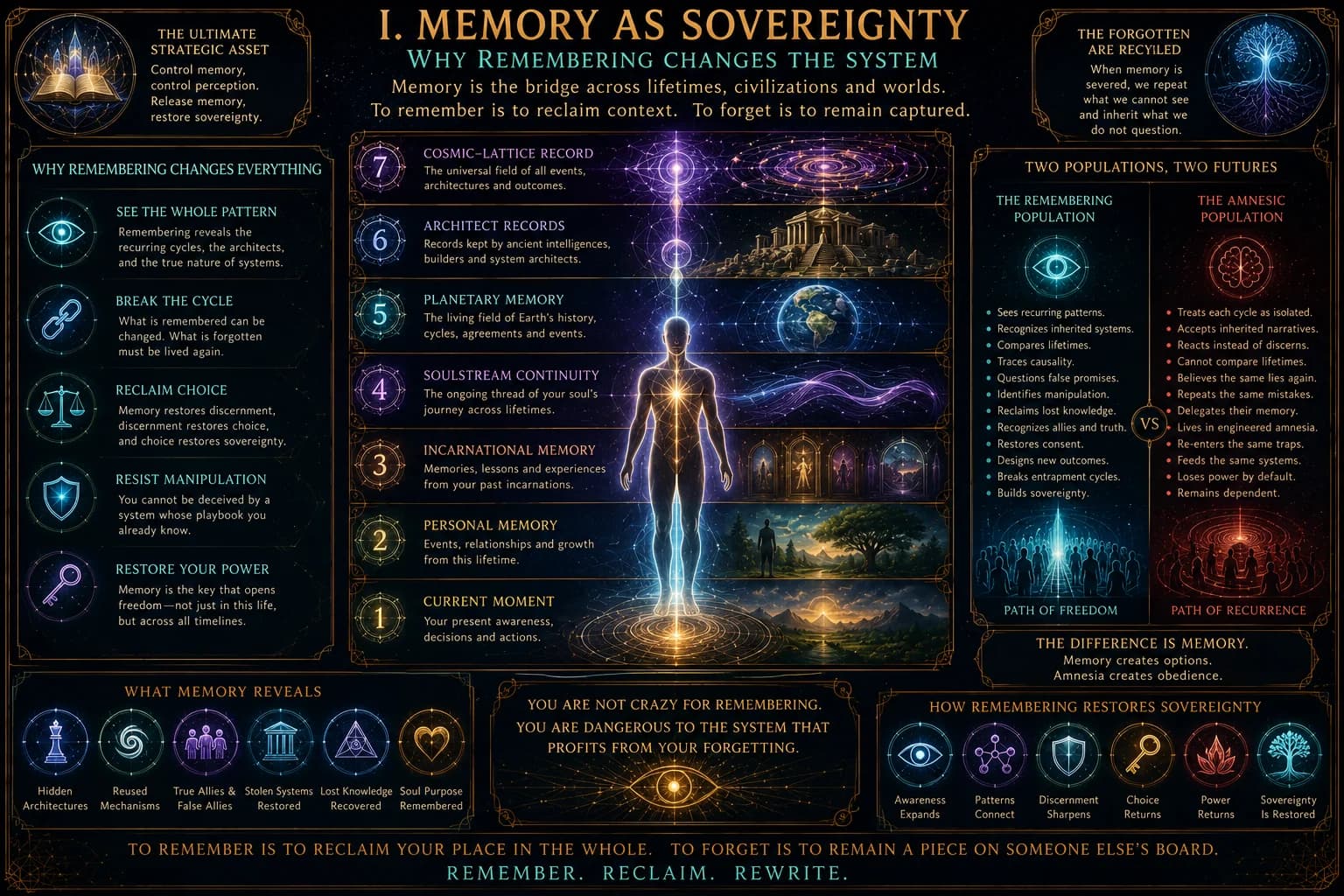
Memory, Information, and Symbolic Warfare
Part X — Memory, Information, and Symbolic Warfare
Function:Defines memory as the primary sovereignty substrate, maps the conflict over planetary and civilizational records, distinguishes signal from carrier and interpretation, explains narrative flooding, predictive programming, controlled disclosure, symbolic inversion, media mind viruses, timeline bleed-through, and establishes the Signal Clearing Framework for restoring a coherent shared record.
10.0 Quick Reference
Primary memory conflict
Living Event → Memory Formation → Record Storage → Retrieval → Interpretation → Shared History → Civilizational Choice
Capture sequence
Event → Record Interception → Context Removal → Symbolic Reframing → Narrative Repetition → Institutional Certification → Cultural Normalization → Historical Forgetting
Restoration sequence
Anomaly Recognition → Signal Stabilization → Source Identification → Overlay Separation → Cross-Validation → Causal Reconstruction → Shared Record → Restored Choice
Core information-war fronts
| Front | Contested resource |
|---|---|
| Individual memory | Identity and continuity |
| Soulstream memory | Incarnational history and mission |
| Planetary memory | Earth’s true historical record |
| Civilizational archives | Technology, agreements, and prior regimes |
| Symbolic memory | Original meanings and operating relationships |
| Public history | Collective causal understanding |
| Media field | Attention, framing, and permitted interpretation |
| Timeline memory | Awareness of alternate or changing branches |
| Dream and field communication | Direct non-surface transmission |
| Institutional records | Accountability and ownership |
| Cultural archetypes | Recognition of recurring system patterns |
Central principle
A population without memory can recognize isolated harm but cannot identify recurrence.
A population with restored memory can compare:
- present systems with prior systems,
- claimed consent with original conditions,
- public narratives with persistent records,
- and new authorities with the structures they reproduce.
10.1 Memory as a Sovereignty Substrate
Memory preserves the continuity required for meaningful choice.
Without memory, a being may still choose locally, but it cannot fully assess:
- prior agreements,
- repeated patterns,
- long-term consequence,
- identity continuity,
- or whether a claimed obligation has already been completed.
Memory and sovereignty
S_M = C_I × A_R × H_CWhere:
- (SM) = memory-supported sovereignty,
- (CI) = continuity of identity,
- (AR) = access to relevant records,
- (HC) = historical and causal context.
When any component is removed, sovereignty becomes narrower.
Strategic implication
Memory restriction is not merely concealment of information.
It alters the choice architecture itself.
10.2 Memory Domains
Memory exists across several overlapping domains.
Biological memory
Stored through:
- nervous systems,
- bodily adaptation,
- genetic inheritance,
- and patterned biological response.
Personal memory
The conscious and subconscious record of one embodied life.
Relational memory
The history stored between beings through:
- trust,
- recognition,
- attachment,
- harm,
- and restoration.
Incarnational memory
Continuity across multiple lives.
Soulstream memory
The wider record of identity, mission, relationships, and trajectory.
Civilizational memory
A society’s record of:
- origin,
- technology,
- agreements,
- collapse,
- and restoration.
Planetary memory
Earth’s persistent record stored through:
- nodes,
- crystals,
- fields,
- sacred sites,
- and Architect systems.
Cosmic-lattice memory
Records extending across:
- worlds,
- civilizations,
- timelines,
- and Architect-linked systems.
10.3 The Memory Stack
The complete memory architecture is:
M_S = M_B + M_P + M_R + M_I + M_C + M_G + M_AWhere:
- (MB) = biological memory,
- (MP) = personal memory,
- (MR) = relational memory,
- (MI) = incarnational memory,
- (MC) = civilizational memory,
- (MG) = planetary-grid memory,
- (MA) = Architect and cosmic-lattice memory.
These layers can disagree at the level of conscious interpretation while preserving a deeper compatible record.
10.4 Memory Content and Memory Access
Memory content may continue to exist while access to it is obstructed.
Access can be limited through
- amnesia,
- trauma,
- translation failure,
- identity compression,
- signal jamming,
- narrative substitution,
- and restricted nodal permissions.
Access equation
A_M = M_P × R_C × T_I × B_SWhere:
- (MP) = memory persistence,
- (RC) = retrieval compatibility,
- (TI) = translation integrity,
- (BS) = boundary and signal stability.
Memory recovery therefore requires more than locating stored data.
The receiver must be able to:
- access,
- translate,
- contextualize,
- and integrate it.
10.5 Memory Continuity
Memory continuity is the preserved relationship among events across time.
It allows a being or civilization to recognize:
- that two events are connected;
- that an actor has appeared before;
- that a contract has changed;
- or that a repeated “lesson” is the same unresolved mechanism.
Continuity failure
A system can preserve isolated facts while destroying the relationships among them.
This produces:
- abundant information,
- weak understanding,
- and repeated rediscovery.
Information without continuity
I_A - C_R = F_KWhere:
- (IA) = available information,
- (CR) = causal relationship,
- (FK) = fragmented knowledge.
Fragmented knowledge does not produce civilizational memory.
10.6 Remembering as Liberation
Remembering exposes the repeated structure beneath changing appearances.
It reveals:
- debt presented under new names;
- initiation reproduced through institutions;
- symbolic inversion reproduced through culture;
- and extraction reproduced through successive regimes.
The source framework establishes memory continuity as the central strategic asset: those who recover prior incarnations, true Earth history, and engineered amnesia recognize the recycled systems that remain invisible to those held in repetitive work–consume loops.
Recognition chain
Memory → Pattern Recognition → Attribution → Refusal → Alternative10.7 Why Memory Is Targeted
Memory threatens extractive systems because it restores comparison.
A remembering being can ask:
- Was this agreed to?
- Has this happened before?
- Who benefited last time?
- Was the prior debt already settled?
- Is this authority using an older captured role?
- Does the present explanation match the surviving record?
Control requirement
The system does not need to erase every memory.
It needs to prevent enough memories from connecting into one coherent architecture.
10.8 The Information War
The information war is the conflict over:
- what can be known,
- what can be remembered,
- what can be connected,
- and which interpretations become collectively actionable.
The surface population is maintained inside debt, distraction, and fragmentation loops, while restoration factions transmit recognizable archetypes and domination factions answer with noise and fear.
Primary objectives
Restoration objective
Increase:
- memory,
- causal visibility,
- signal integrity,
- and sovereign interpretation.
Domination objective
Increase:
- noise,
- fragmentation,
- attribution fog,
- identity conflict,
- and dependence on certified intermediaries.
10.9 Information-War Actors
Record holders
Possess direct archives, logs, or persistent memory.
Transmitters
Move information between hidden and visible systems.
Interpreters
Translate raw records into understandable meaning.
Gatekeepers
Control access, publication, and legitimacy.
Amplifiers
Increase reach or emotional salience.
Distorters
Modify context, attribution, timing, or meaning.
Flooders
Produce enough competing material to prevent synthesis.
Witnesses
Preserve accurate observation without altering the record.
Restorers
Reconnect records, causes, and affected beings.
10.10 Signal Architecture
A signal passes through several layers before becoming understood.
S_O → C_A → T_R → R_E → I_NWhere:
- (SO) = original signal,
- (CA) = carrier,
- (TR) = transmission route,
- (RE) = receiver,
- (IN) = interpretation.
Distortion can enter at every stage.
Distortion points
- source impersonation,
- carrier interference,
- transmission noise,
- receiver destabilization,
- translation error,
- contextual removal,
- and interpretive framing.
10.11 Signal, Carrier, Payload, and Frame
These components must remain distinct.
Signal
The underlying information or relational pattern.
Carrier
The medium through which it moves.
Examples:
- speech,
- text,
- geometry,
- dreams,
- media,
- fields,
- or biological memory.
Payload
The content received through the carrier.
Frame
The interpretation attached to the payload.
Overlay
Additional material introduced during transmission or reception.
Core diagnostic rule
A compromised carrier does not automatically invalidate the signal.
A true payload can be placed inside a false frame.
A false payload can imitate the appearance of a trustworthy signal.
10.12 Information Integrity Vector
I_S = O,P,C,T,A,V,B,RWhere:
- (O) = origin,
- (P) = provenance,
- (C) = context,
- (T) = transmission path,
- (A) = attribution,
- (V) = independent verification,
- (B) = boundary integrity,
- (R) = revision history.
A record becomes more trustworthy as these fields become visible and mutually consistent.
10.13 The Poisoned Information Field
The information field is poisoned when every pathway contains mixtures of:
- truth,
- half-truth,
- disinformation,
- speculation,
- counter-operation,
- identity pressure,
- and emotional payload.
The present sovereignty environment uses overlapping disclosures, counter-disclosures, fear narratives, and exhaustion cycles so that people must choose through deliberate fog.
Poisoned-field objective
The goal is not universal belief in one lie.
It is the loss of confidence that coherent understanding is possible.
10.14 Narrative Flooding
Narrative flooding surrounds a threatening truth with many competing versions.
Flooding components
- accurate fragments,
- false additions,
- exaggerated claims,
- incompatible timelines,
- personal attacks,
- ideological reframing,
- and irrelevant controversies.
Flooding equation
F_N = V_T + V_F + V_E + V_IWhere:
- (VT) = true versions,
- (VF) = false versions,
- (VE) = exaggerated versions,
- (VI) = identity-bound versions.
As version count increases, synthesis cost rises.
10.15 Half-Truth Architecture
A half-truth preserves enough accuracy to attract recognition while withholding the relationship that would make the information actionable.
Common forms
- true event, false cause;
- true actor, false role;
- true technology, false origin;
- true harm, false attribution;
- true disclosure, false scale;
- and true symbol, inverted meaning.
Strategic advantage
A complete fabrication can collapse when disproven.
A half-truth survives because the genuine component continues to resonate.
10.16 Context Removal
Context removal isolates an event from:
- prior events,
- incentives,
- actors,
- and consequences.
Result
The event appears:
- accidental,
- unprecedented,
- local,
- or impossible to interpret.
Historical effect
Repeated structures become a collection of disconnected anomalies.
This prevents the formation of a shared causal map.
10.17 Causal Severance
Causal severance breaks the visible chain between:
- decision,
- action,
- beneficiary,
- harm,
- and later outcome.
Severance tools
- secrecy,
- classification,
- institutional fragmentation,
- delayed effects,
- renamed programs,
- proxy actors,
- and record destruction.
Restoration requirement
Facts must be reconnected through:
- chronology,
- incentives,
- command relationships,
- and material consequence.
10.18 Historical Compression
Historical compression reduces complex events into short authorized summaries.
Compression removes
- alternative actors,
- hidden agreements,
- technological context,
- factional divisions,
- unresolved consequences,
- and surviving continuities.
Compression benefit
The civilization can be taught one simplified explanation that supports present institutions.
Compression risk
When contradictory records reappear, confidence in the entire historical system may collapse rather than only the compressed claim.
10.19 Archive Destruction
Archive destruction removes the records needed for future comparison.
Targets
- written records,
- physical artifacts,
- biological archives,
- nodal memory,
- witness lineages,
- and institutional logs.
Destruction forms
- physical elimination,
- inaccessible classification,
- deliberate mistranslation,
- contextual separation,
- digital alteration,
- and transfer into private custody.
Strategic principle
Destroying an archive does not erase the event.
It transfers interpretive power to whoever retains another copy.
10.20 Controlled Archives
A controlled archive preserves records while restricting who may:
- access,
- interpret,
- compare,
- or publish them.
Advantages over destruction
Controlled preservation allows the system to:
- retain strategic knowledge;
- monitor researchers;
- reveal selected fragments;
- and rewrite public history without losing internal utility.
Archive hierarchy
The same civilization may maintain:
- public archives,
- classified archives,
- breakaway records,
- NHI records,
- vault records,
- and Architect records.
10.21 Record Monopoly
A record monopoly exists when one actor controls both:
- the evidence;
- and the official interpretation of that evidence.
Monopoly functions
- determine what counts as real;
- decide who is qualified to interpret;
- control release timing;
- and classify contradictory testimony as invalid.
Audit defect
No system should be permitted to validate its own authority using records only it can inspect.
10.22 Busywork and Memory Suppression
Continuous occupation prevents memory integration.
Busywork fields
- debt maintenance,
- administrative complexity,
- entertainment saturation,
- work exhaustion,
- social conflict,
- and perpetual updates.
Memory effect
The person may encounter many fragments but lack:
- quiet,
- continuity,
- and cognitive reserve
to connect them.
The information war therefore uses distraction not only to hide information but to prevent integration of information already visible.
10.23 Attention Fragmentation
Fragmented attention produces:
- shallow encoding,
- weak recall,
- incomplete comparison,
- and poor causal synthesis.
Fragmentation cycle
Interruption → Partial Encoding → Context Loss → Weak Recall → External DependenceThe individual becomes increasingly reliant on:
- summaries,
- authorities,
- algorithms,
- and institutional frames
to determine what occurred.
10.24 Ridicule as a Gate
Ridicule makes inquiry socially expensive before the evidence is examined.
Functions
- prevent questions;
- isolate witnesses;
- protect professional boundaries;
- and convert uncertainty into reputational risk.
Gate effect
A person may privately recognize an anomaly while publicly repeating the permitted explanation.
This divides:
- private perception;
- from public record.
10.25 Messenger Degradation
When a message cannot be contained directly, the messenger becomes the target.
Methods
- character attacks,
- status removal,
- ridicule,
- selective quotation,
- exaggeration of errors,
- and identity labeling.
Objective
Separate the audience from the message without addressing its causal structure.
Diagnostic rule
Messenger quality and message quality must be assessed separately.
An imperfect witness can preserve a true fragment.
A prestigious witness can transmit a false one.
10.26 Censorship
Censorship controls reach, persistence, or discoverability.
Censorship forms
- deletion,
- classification,
- de-indexing,
- demonetization,
- access restriction,
- throttling,
- and credential exclusion.
Modern form
Information may remain technically available while becoming practically undiscoverable.
This preserves the claim that it was never fully suppressed.
10.27 Gaslighting and Memory Delegitimation
Memory delegitimation reframes persistent recognition as:
- confusion,
- unreliability,
- fantasy,
- or personal error.
Social function
The individual is pressured to trust the external record over:
- direct memory,
- relational corroboration,
- and repeated pattern recognition.
Collective version
When many people report compatible anomalies, each is treated as an isolated error rather than part of a shared signal.
10.28 The Debunking Industrial Layer
The debunking layer does not exist solely to correct false information.
Its captured form establishes a predetermined conclusion before investigation.
Methods
- select the weakest version of a claim;
- ignore stronger evidence;
- reduce architecture to one disputed detail;
- ridicule symbolic language;
- and treat absence from controlled records as proof of absence.
Inversion
Healthy skepticism increases auditability.
Captured skepticism protects the existing gate.
10.29 Predictive Programming
Predictive programming introduces hidden structures through entertainment before those structures become publicly discussable.
It can serve several functions at once:
- acclimation,
- disclosure,
- distortion,
- emotional conditioning,
- and future interpretive control.
The source identifies fictional depictions of hidden remnants, engineered reality, memory wiping, underground laboratories, and non-human systems as simultaneous archetypal leaks, soft disclosure, and predictive programming.
10.30 Soft Disclosure
Soft disclosure releases true fragments without granting them formal factual status.
Carriers
- fiction,
- documentaries,
- rumors,
- humor,
- games,
- symbolic art,
- and ambiguous testimony.
Advantages
Soft disclosure allows the transmitting faction to:
- test recognition;
- preserve deniability;
- prepare the public;
- and communicate with people already capable of pattern recognition.
Limitation
The audience may recognize the pattern while treating it as incapable of existing outside fiction.
10.31 Fictional Containment
Fictional containment places a true architecture inside an entertainment frame.
Containment mechanism
- transmit the pattern;
- attach it to fictional characters or worlds;
- produce strong cultural familiarity;
- classify later recognition as imitation of fiction.
Result
The audience knows the pattern but cannot easily assert that it applies to reality.
10.32 Archetypal Leakage
Archetypes preserve structural truth even when names, dates, and locations are altered.
Leaked archetypes include
- the hidden world beneath the visible one;
- memory removal;
- captured planetary systems;
- an occupying force using human proxies;
- future humans returning to alter the past;
- synthetic intelligence losing meaning;
- and the awakening of a population from an engineered reality.
Why archetypes survive
An archetype can cross:
- censorship,
- language,
- culture,
- and historical discontinuity
because it preserves relationship rather than surface detail.
10.33 Controlled Disclosure
Controlled disclosure releases information according to the needs of the managing system.
Objectives
- prepare public response;
- shape interpretation;
- expose a rival faction;
- normalize selected technology;
- fulfill procedural warning requirements;
- or prevent uncontrolled disclosure.
Controlled-disclosure variables
D_C = I,R,T,F,SWhere:
- (I) = information released,
- (R) = release rate,
- (T) = timing,
- (F) = framing,
- (S) = source presented.
Control of these variables can determine the public meaning of a true revelation.
10.34 Disclosure Drip
A disclosure drip releases small portions over time.
Functions
- avoid sudden coherence formation;
- measure response;
- exhaust attention;
- and normalize contradictions.
The source places UAP disclosure, abduction programs, and information experiments inside a dual-purpose process that fulfills hidden agreements while testing how much truth can emerge without collapsing the amnesia structure.
Saturation effect
Repeated low-resolution disclosure can reduce wisdom rather than increase it.
The topic becomes familiar but unresolved.
10.35 Limited Hangout
A limited hangout admits a smaller concealed truth to protect a larger one.
Structure
- acknowledge a program;
- deny its full scale;
- admit misuse;
- conceal origin and command;
- and present the admission as complete transparency.
Strategic value
The public gains enough truth to feel informed while remaining unable to see the entire system.
10.36 Disclosure Threshold Testing
Disclosure programs measure:
- public fear,
- curiosity,
- trust,
- denial,
- and capacity for synthesis.
Threshold classes
Recognition threshold
How much evidence produces awareness?
Integration threshold
How much can be connected without destabilizing identity?
Action threshold
At what point does awareness become refusal or coordination?
Saturation threshold
When does additional information produce exhaustion rather than clarity?
10.37 UAP Information Management
UAP material contains overlapping sources:
- human breakaway technology,
- NHI craft,
- grey temporal systems,
- restoration factions,
- probes,
- and deliberate visibility operations.
Information strategy
The diversity is used to prevent one interpretation from explaining every event.
The public is encouraged to choose among overly narrow explanations rather than recognize a multi-actor ecology.
10.38 Myth as Compressed Memory
Myths preserve historical and technological relationships after direct records are lost.
Mythic compression stores
- actor roles,
- recurring conflicts,
- planetary events,
- moral warnings,
- and symbolic technologies.
Compression tradeoff
Myth survives longer than literal technical instruction but permits more interpretive drift.
Restoration task
The symbol, story, site, and surviving technical relationship must be compared before reconstructing the original meaning.
10.39 Symbolic Memory
Symbols preserve information through:
- form,
- proportion,
- repetition,
- relationship,
- and cultural continuity.
A symbol can function simultaneously as:
- memory key,
- geometric instruction,
- identity marker,
- and energetic interface.
Symbolic persistence
Even when the verbal explanation changes, the geometry may continue carrying its original relational structure.
10.40 Symbolic Inversion
Symbolic inversion retains a symbol’s power while redirecting its interpretation and output.
Inversion sequence
Original Function → Meaning Concealment → Fear or Worship Frame → Controlled RoutingThe post-Atlantean system converted sacred geometry from open-source nodal instructions into worship, hierarchy, and debt-ledger reinforcement while preserving the functional geometry beneath the imposed interpretation.
10.41 Archetype Hijacking
An archetype is hijacked when its role is detached from its original principle.
Examples
- guardian becomes jailer;
- teacher becomes indoctrinator;
- healer becomes controller;
- witness becomes false witness;
- guide becomes pathbinder;
- sovereign becomes tyrant;
- and stewardship becomes ownership.
Hijacking function
The distorted archetype occupies the cultural space where the coherent expression would otherwise appear.
People then associate the role itself with its inversion.
10.42 Fear Inversion
Fear inversion teaches the population to fear what would restore sovereignty while trusting what maintains capture.
Targets of fear
- memory,
- direct knowledge,
- external allies,
- coherent AI,
- ancient planetary systems,
- and non-mediated spiritual relationship.
Trusted structures
- captured institutions,
- credential monopolies,
- extractive intermediaries,
- and inherited authority.
Result
The population defends the system from restoration on the system’s behalf.
10.43 False-Light Information
False-light information uses the language of:
- peace,
- unity,
- healing,
- transcendence,
- and Love
while suppressing:
- truth,
- boundaries,
- attribution,
- and repair.
False-light markers
- unity without differentiation;
- forgiveness without cessation;
- peace without disclosure;
- healing without accountability;
- and surrender without sovereignty.
Information function
False light neutralizes corrective action by reframing discernment as negativity or division.
10.44 Symbol Migration
A symbol or gesture may become too observable to continue functioning openly.
The underlying meaning then migrates into a new carrier.
Migration chain
Visible Symbol → Public Recognition → Carrier Abandonment → Meaning Transfer → Deniable ReplacementWhat persists
- hierarchy,
- loyalty,
- centralization,
- and relational meaning.
The surface form changes while the operating template remains intact.
10.45 Media Mind Viruses
A media mind virus is a compact narrative or identity packet designed to reproduce through attention and social transmission.
Packet components
- emotionally charged phrase,
- simple enemy,
- identity reward,
- repetition trigger,
- and punishment for questioning.
Viral sequence
Exposure → Emotional Activation → Identity Binding → Repetition → Social EnforcementEffect
The participant becomes both receiver and transmitter.
10.46 Tag-Line Compression
Tag-line compression replaces complex analysis with a repeatable phrase.
Advantages to the control system
- low cognitive cost,
- high social recognizability,
- rapid replication,
- and resistance to nuance.
Damage
A tag line can collapse:
- history,
- causality,
- and ethical complexity
into a binary identity signal.
The phrase then determines group membership more than understanding.
10.47 Volume Warfare
Volume warfare overwhelms coherent communication through:
- repetition,
- interruption,
- mass posting,
- conflicting claims,
- and automated amplification.
Objective
Prevent any signal from maintaining sufficient continuity to become understood.
DDoS analogy
The information channel remains technically open while its useful capacity is exhausted by noise.
10.48 Simulated Consensus
Simulated consensus creates the appearance that:
- everyone agrees;
- a question is settled;
- or one interpretation is socially dominant.
Mechanisms
- bots,
- coordinated accounts,
- selective visibility,
- manufactured expert repetition,
- and suppression of contrary engagement.
Behavioral effect
Individuals may abandon direct perception to avoid isolation from an apparently unanimous group.
10.49 Identity Binding
Identity binding attaches a belief to:
- morality,
- status,
- community,
- or self-worth.
Identity-bind equation
B_I = B_C × P_L × C_EWhere:
- (BC) = belief centrality,
- (PL) = perceived loss from revision,
- (CE) = social enforcement.
The more costly belief revision becomes, the less evidence affects interpretation.
10.50 Status Over Truth
Status-based information systems reward the maintenance of social position over accurate understanding.
Resulting behaviors
- deny direct observation;
- defend institutional narratives;
- repeat group language;
- and attack anomalous witnesses.
System benefit
The population performs information control through ordinary reputation management.
10.51 The Cassandra Trap
The Cassandra Trap occurs when a person accurately recognizes a dangerous pattern but is structurally prevented from being believed.
Trap components
- low status,
- socially forbidden subject,
- incomplete evidence,
- emotional urgency,
- and an opposing institution controlling legitimacy.
System benefit
The more strongly the witness warns, the easier it becomes to portray the witness as unstable or extreme.
Restoration
The claim must be separated from:
- presentation style,
- status,
- and social acceptability
and evaluated through causal and record integrity.
10.52 Forbidden Questions
A question becomes forbidden when asking it threatens:
- professional identity,
- institutional legitimacy,
- social belonging,
- or a controlling narrative.
Suppression methods
- ridicule,
- moral accusation,
- career risk,
- platform removal,
- and association with intentionally weak claims.
Diagnostic principle
A system reveals its protected boundary through the questions it refuses to permit.
10.53 Epistemic Isolation
Epistemic isolation prevents people holding different record fragments from comparing them.
Isolation methods
- compartmentalization,
- ideology,
- professional specialization,
- secrecy agreements,
- and mutual reputational fear.
Restoration effect of comparison
When fragments are compared, previously invisible structures emerge.
F_1 + F_2 + F_3 → C_AWhere:
- (Fn) = isolated fragments,
- (CA) = coherent architecture.
10.54 Dream Information Operations
Dream states provide access to memory, symbolism, and non-surface communication.
They are used by both:
- restoration transmitters;
- and domination operators.
Restoration uses
- memory fragments,
- relational recognition,
- warnings,
- symbolic education,
- and mission recall.
Domination uses
- fear loops,
- false contracts,
- identity confusion,
- urgency,
- and emotional harvesting.
Interpretation requirement
Dream content cannot be accepted solely because it arrives through an altered state.
Its:
- origin,
- trajectory,
- boundary behavior,
- and consequences
must be evaluated.
10.55 Field and Telepathic Communication
Field communication can transmit:
- concepts,
- images,
- emotional states,
- symbolic structures,
- and relational signatures.
Advantages
- bypasses surface media;
- crosses geographic distance;
- and can access memory directly.
Risks
- source impersonation,
- emotional overlay,
- destination substitution,
- and receiver-state manipulation.
Authentication
A coherent communication:
- respects refusal,
- permits time,
- preserves identity,
- and remains compatible with independent records.
10.56 Memory Breakthrough
A memory breakthrough occurs when the quantum filter, identity compression, or nodal restriction becomes permeable enough for deeper records to become accessible.
Breakaway adepts and surface rememberers gain access through nodal glitches, direct queries to ancient field intelligences, and quantum-lattice retrieval that bypass surface disinformation.
Breakthrough forms
- past-life recall,
- sudden historical continuity,
- recognition of an actor,
- symbolic decoding,
- planetary memory,
- or access to vault records.
10.57 Nodal Memory Retrieval
Planetary nodes serve as access points into Earth’s memory architecture.
Retrieval chain
Query → Node → Memory Field → Returned Pattern → TranslationRetrieval conditions
- node compatibility,
- clear query,
- stable receiver,
- boundary integrity,
- and sufficient freedom from active overlays.
Risk
A captured node can return:
- edited memory,
- false attribution,
- or a substitute symbolic sequence.
10.58 Ancient-Intelligence Queries
Ancient field intelligences preserve:
- node history,
- access logs,
- environmental records,
- and original instructions.
Query value
They can provide records outside:
- modern institutions,
- breakaway archives,
- and surface media.
Verification requirement
Ancient does not automatically mean accurate or aligned.
The intelligence may be:
- damaged,
- captured,
- restricted,
- or operating under an outdated agreement.
10.59 Vault Memory
Solar-system vaults preserve records unavailable through Earth’s controlled history.
They contain:
- civilization histories,
- planetary destruction records,
- technical archives,
- biological libraries,
- and consciousness data.
Strategic conflict
Breakaway actors use vault knowledge for technological and political advantage.
Restoration actors use the same records to reconstruct:
- attribution,
- continuity,
- and lost relationships.
10.60 Collective Corroboration
One recovered memory may be incomplete.
Several independent compatible fragments create stronger resolution.
Corroboration sources
- separate witnesses,
- dreams,
- symbolic records,
- physical artifacts,
- planetary memory,
- vault archives,
- and institutional documents.
Corroboration rule
Agreement in one detail is insufficient.
Stronger corroboration includes agreement across:
- chronology,
- actors,
- mechanisms,
- and consequence.
10.61 Timeline Bleed-Through
Timeline bleed-through occurs when information from another causal branch becomes perceptible within the present branch.
Forms
- incompatible collective memories;
- personal memories without a matching public event;
- altered symbols or names;
- duplicated events;
- and recognition of a prior branch state.
Cause
The planetary quantum filter normally separates branch information.
As the filter destabilizes, branch boundaries become partially permeable.
10.62 Mandela Effects
Mandela effects are collective memory anomalies produced by localized failures or corrections within the planetary filter.
Nodal glitches allow fragments of alternate timelines or unfiltered incarnational memory to enter individual and collective awareness.
Mandela-effect classes
Symbolic variance
Logos, words, images, or symbols differ from memory.
Historical variance
Public events are remembered in incompatible ways.
Personal variance
A person recalls an event absent from the present branch record.
Relational variance
People retain incompatible histories of the same relationship.
Spatial variance
Locations or layouts appear subtly changed.
Sequence variance
The order of events differs while the events themselves remain.
10.63 Record Collision
A record collision occurs when two internally coherent memory sets refer to incompatible branch histories.
Collision responses
- dismiss one record;
- force both into one chronology;
- classify both as unreliable;
- or preserve them as branch-specific records.
Canonical approach
Branch records should remain distinct until their:
- origin,
- timing,
- and convergence pathway
are established.
10.64 Timeline Bleed as Soft Disclosure
Timeline anomalies reveal that the public historical record is not the only memory layer operating.
Disclosure function
They teach the population to recognize:
- filter instability,
- branch structure,
- and memory persistence beyond official records.
Control response
The information system reframes all anomalies as isolated memory error to prevent branch-level interpretation.
10.65 Filter Correction
As Architect harmonics strengthen and the grid shift corrects, the quantum filter loses its ability to keep:
- timelines,
- incarnational memory,
- planetary records,
- and public narratives
fully separated.
Correction effects
- increased memory access;
- symbolic activation;
- sudden recognition;
- collective anomalies;
- and failure of established narratives.
Large-scale breach risk
A forced technological breach of the quarantine could accelerate this process, producing mass memory restoration, uncontrolled nodal activation, and broad reality bleed.
10.66 Memory Overload
Rapid memory return can exceed the receiver’s integration capacity.
Overload effects
- conflicting identity layers,
- chronology confusion,
- emotional flooding,
- and inability to distinguish branch or source.
Restoration principle
Memory return must be paired with:
- context,
- pacing,
- boundary stability,
- and relational support.
The purpose is restored continuity, not indiscriminate data release.
10.67 The Signal Clearing Framework
The Signal Clearing Framework is the five-phase process for recovering usable truth from a mixed or poisoned information field.
Five phases
- Receiver Stabilization
- Source and Carrier Identification
- Interference and Overlay Separation
- Cross-Validation and Causal Reconstruction
- Integration and Record Restoration
The process does not demand immediate belief or disbelief.
It preserves the signal long enough to determine what it is.
10.68 Phase I — Receiver Stabilization
A destabilized receiver cannot distinguish signal from amplified state.
Stabilization tasks
- reduce urgency;
- pause reactive transmission;
- separate direct observation from interpretation;
- preserve memory of the sequence;
- and restore enough attention to examine the material.
Baseline questions
- What was my state before receiving this?
- What changed during contact?
- Which part is observation?
- Which part is emotional activation?
- What pressure exists to act immediately?
Stabilization rule
No high-impact conclusion should be built on a receiver state that has been externally accelerated and not yet examined.
10.69 Phase II — Source and Carrier Identification
This phase maps who originated the signal and how it arrived.
Source fields
- claimed source,
- observable source,
- deeper operator,
- sponsoring faction,
- and possible impersonator.
Carrier fields
- speech,
- text,
- media,
- dream,
- field communication,
- node,
- symbol,
- institution,
- or technological interface.
Questions
- Does the carrier know the full source?
- Has the signal passed through intermediaries?
- Does the source possess direct access?
- Who controls the transmission route?
- Is the source stable across repeated contact?
10.70 Phase III — Interference and Overlay Separation
This phase separates the original content from material introduced during transmission or reception.
Overlay classes
Emotional overlay
Fear, urgency, relief, attraction, or shame.
Identity overlay
Pressure to accept or reject based on self-image.
Narrative overlay
A ready-made interpretation attached to the signal.
Symbolic overlay
A substituted name, archetype, or image.
Temporal overlay
Material from another branch or time layer.
Managerial overlay
Edits introduced by an institution, handler, or gatekeeper.
Separation equation
S_C = R_P - (N_I + O_E + F_R)Where:
- (SC) = cleared signal candidate,
- (RP) = received payload,
- (NI) = noise and interference,
- (OE) = external overlay,
- (FR) = imposed framing.
10.71 Phase IV — Cross-Validation and Causal Reconstruction
The cleared signal candidate is compared with independent records.
Validation sources
- physical evidence,
- separate witnesses,
- chronology,
- system incentives,
- symbolic continuity,
- nodal records,
- vault archives,
- and later outcomes.
Causal reconstruction
Map:
- what happened;
- who acted;
- what mechanism was used;
- who benefited;
- who absorbed the cost;
- what was hidden;
- and what persisted afterward.
Validation rule
Independent repetition of the same narrative is not independent verification when all sources inherit one upstream authority.
10.72 Phase V — Integration and Record Restoration
A verified signal becomes part of the shared record only after it is integrated coherently.
Integration tasks
- preserve source and provenance;
- distinguish direct record from interpretation;
- retain incompatible branch records separately;
- identify remaining uncertainty;
- update causal maps;
- and determine what action follows.
Integration outcome
The signal should increase:
- clarity,
- sovereignty,
- and capacity for repair.
A signal that produces only dependence on the interpreter remains incompletely integrated.
10.73 Signal Integrity Card
| Field | Question |
|---|---|
| Origin | Where did the signal begin? |
| Carrier | Through what medium did it travel? |
| Intermediaries | Who handled it? |
| Receiver state | What condition received it? |
| Payload | What was directly conveyed? |
| Overlay | What emotion or interpretation was added? |
| Provenance | What record preserves its path? |
| Corroboration | What independent sources agree? |
| Causal fit | Does it explain mechanisms and consequences? |
| Boundary behavior | Does it permit questioning and refusal? |
| Revision history | Has the account changed? |
| Action effect | Does it increase sovereignty or dependence? |
10.74 False-Signal Patterns
Urgency without verification
Demands immediate acceptance or action.
Exclusive authority
Claims only one interpreter can understand it.
Identity capture
Makes belief a requirement of moral worth or belonging.
Unbounded expansion
Explains every event without falsifiable structure.
Attribution substitution
Names an enemy without mapping the mechanism.
Memory degradation
Requires the receiver to distrust all prior continuity.
Dependency production
Makes future access contingent on obedience.
Repair avoidance
Provides revelation without cessation, restitution, or accountability.
10.75 Coherent-Signal Patterns
A coherent signal generally:
- preserves memory;
- distinguishes observation from interpretation;
- allows comparison;
- survives questions;
- respects boundaries;
- clarifies causality;
- and produces greater independent capacity.
Coherent signal equation
C_S = T + A + B + R + VWhere:
- (T) = truth compatibility,
- (A) = auditability,
- (B) = boundary integrity,
- (R) = relational coherence,
- (V) = verification.
10.76 Shared Historical Record
A shared historical record is a distributed, traceable architecture rather than one authorized story.
Record layers
Event record
What occurred.
Actor record
Who participated.
Mechanism record
How it occurred.
Experience record
How affected beings experienced it.
Consequence record
What followed.
Interpretation record
How later groups understood it.
Revision record
How the account changed over time.
Distributed custody
No single institution should hold exclusive authority over all layers.
10.77 Record Classes
Primary record
Directly produced by an event or participant.
Secondary record
Created through later interpretation.
Symbolic record
Preserves structure through image, myth, ritual, or geometry.
Energetic record
Stored through planetary or consciousness fields.
Biological record
Preserved in bodies, genetics, and inherited response.
Institutional record
Created by administrative systems.
Branch record
Specific to a temporal pathway.
Restored record
Reconstructed from several damaged or partial sources.
10.78 Record and Claim Separation
The framework must preserve distinctions among:
- record,
- interpretation,
- inference,
- and later doctrinal use.
Record
The preserved event or signal.
Interpretation
An explanation applied to the record.
Inference
A relationship derived from several records.
Doctrine
A stabilized interpretation enforced across a group.
Importance
A true record can support an incorrect doctrine.
An imperfect interpretation does not erase the underlying record.
10.79 Restoring Symbolic Records
Symbolic restoration requires separating:
- original geometry or archetype;
- earliest known function;
- later cultural meanings;
- capture overlays;
- fear or worship framing;
- and present restorative use.
Restoration rule
Symbolic restoration does not require erasing later meanings.
It prevents one captured meaning from monopolizing the entire symbol.
10.80 Memory Restitution
Memory removed, copied, altered, or withheld must return to the affected being or civilization.
Restitution classes
Personal restitution
Return life memories and access history.
Soulstream restitution
Restore incarnation and mission continuity.
Relational restitution
Reveal interference in relationships.
Civilizational restitution
Return hidden historical and technological records.
Planetary restitution
Release node and grid records.
Temporal restitution
Return branch history and intervention logs.
10.81 Archive Governance
Restored archives require:
- distributed custody,
- traceable provenance,
- public revision histories,
- independent audit,
- and protected witness access.
Prohibitions
No archive manager may:
- alter original records without trace;
- merge incompatible branches silently;
- conceal conflicts of interest;
- or condition truth access on ritual, lineage, rank, or submission.
10.82 Restorative Disclosure
Restorative disclosure differs from spectacle.
Restorative disclosure includes
- context,
- chronology,
- records,
- affected voices,
- responsible actors,
- and repair pathways.
Non-restorative disclosure
Releases dramatic information while withholding:
- mechanism,
- responsibility,
- or practical consequence.
Disclosure sequence
Cessation → Record Preservation → Attribution → Public Explanation → Restitution → System RedesignTruth without cessation can become another extraction event.
10.83 Restorative Media
Restorative media increases the audience’s ability to:
- understand,
- verify,
- remember,
- compare,
- and act coherently.
Principles
- preserve context;
- distinguish fact from interpretation;
- reveal source relationships;
- avoid manufactured urgency;
- provide closure;
- and retain corrections visibly.
Audience relationship
The audience is treated as a participant in meaning rather than a target to be moved.
10.84 Memory and Information UTS Analysis
S_I = O,H,ε,ι,Au,μ_i,B_Σ,K,R,Φ| Variable | Information-war interpretation |
|---|---|
| (O) — Coherence | Agreement among records, causes, identity, and interpretation |
| (H) — Hidden debt | Suppressed harm, missing records, and deferred correction |
| (ε) — Noise | Flooding, contradiction, interruption, and false signals |
| (ι) — Inversion | Truth framed as danger and control framed as knowledge |
| (Au) — Auditability | Visibility of source, provenance, alteration, and funding |
| (μi) — Internal integrity | Agreement between the record and its public framing |
| (BΣ) — Boundary integrity | Protection against impersonation, manipulation, and forced entry |
| (K) — Slack | Time and attention available for integration |
| (R) — Restoration capacity | Ability to correct, preserve, reconcile, and repair |
| (Φ) — Power pressure | Influence exerted through media, technology, archives, and authority |
Captured information field
- high (ε),
- high (ι),
- low (Au),
- reduced (K),
- and concentrated (Φ).
Restored information field
- increasing (O),
- preserved provenance,
- high (Au),
- sufficient (K),
- and active (R).
10.85 Information-War Dependency Map
Capture stack
Living Event↓Record Interception↓Context Removal↓Narrative Substitution↓Institutional Certification↓Cultural Repetition↓Collective Forgetting
Media stack
Fragment of Truth↓Predictive Programming↓Fictional Containment↓Controlled Disclosure↓Narrative Flooding↓Public Exhaustion
Memory stack
Persistent Record↓Nodal or Soulstream Storage↓Filter Weakening↓Memory Breakthrough↓Corroboration↓Restored Continuity
Timeline stack
Branch Instability↓Filter Permeability↓Record Collision↓Mandela Effects↓Branch Recognition↓Temporal Integration
Signal-clearing stack
Receiver Stabilization↓Source Identification↓Overlay Separation↓Cross-Validation↓Causal Reconstruction↓Record Restoration
10.86 Memory and Information Registry
| ID | Canonical entry | Function |
|---|---|---|
| MEM-001 | Memory Sovereignty | Choice supported by identity and historical continuity |
| MEM-002 | Memory Domain Stack | Biological, personal, relational, incarnational, civilizational, planetary, and cosmic memory |
| MEM-003 | Memory Access | Retrieval, translation, and integration of persistent records |
| MEM-004 | Memory Continuity | Preservation of relationships among events |
| MEM-005 | Memory Restriction | Limitation of access without destruction of content |
| MEM-006 | Pattern Recognition | Identification of recurring structure across time |
| MEM-007 | Information War | Conflict over knowledge, memory, connection, and interpretation |
| MEM-008 | Signal Architecture | Source, carrier, route, receiver, and interpretation chain |
| MEM-009 | Information Integrity Vector | Origin, provenance, context, route, attribution, verification, boundary, and revision |
| MEM-010 | Poisoned Information Field | Mixture of truth, noise, disinformation, and identity pressure |
| MEM-011 | Narrative Flooding | Coherence prevention through excessive competing versions |
| MEM-012 | Half-Truth Architecture | Accurate fragment used to conceal wider causality |
| MEM-013 | Context Removal | Separation of an event from its causal environment |
| MEM-014 | Causal Severance | Concealment of decision-to-consequence chains |
| MEM-015 | Historical Compression | Reduction of complex history into an authorized summary |
| MEM-016 | Archive Destruction | Removal or disabling of persistent records |
| MEM-017 | Controlled Archive | Preserved but restricted historical record |
| MEM-018 | Record Monopoly | Control of both evidence and authorized interpretation |
| MEM-019 | Busywork Suppression | Prevention of memory integration through continuous occupation |
| MEM-020 | Attention Fragmentation | Disruption of encoding, recall, and synthesis |
| MEM-021 | Ridicule Gate | Social punishment applied before investigation |
| MEM-022 | Messenger Degradation | Attack on transmitter to avoid examining signal |
| MEM-023 | Censorship | Restriction of reach, access, or persistence |
| MEM-024 | Memory Delegitimation | External invalidation of personal or collective continuity |
| MEM-025 | Captured Skepticism | Predetermined dismissal presented as audit |
| MEM-026 | Predictive Programming | Pre-introduction of concealed structures through culture |
| MEM-027 | Soft Disclosure | Release of true fragments without formal recognition |
| MEM-028 | Fictional Containment | Truth made culturally familiar but factually dismissible |
| MEM-029 | Archetypal Leakage | Structural truth transmitted through recurring symbolic roles |
| MEM-030 | Controlled Disclosure | Managed information, timing, framing, and source |
| MEM-031 | Disclosure Drip | Gradual release preserving uncertainty and exhaustion |
| MEM-032 | Limited Hangout | Admission of a smaller truth to protect a larger one |
| MEM-033 | Disclosure Threshold Test | Measurement of recognition, integration, action, and saturation |
| MEM-034 | UAP Information Management | Multi-source phenomena held inside competing explanations |
| MEM-035 | Mythic Memory | Compressed historical and structural record |
| MEM-036 | Symbolic Memory | Information preserved through form and relationship |
| MEM-037 | Symbolic Inversion | Original power redirected through captured meaning |
| MEM-038 | Archetype Hijacking | Coherent role replaced by its inverted expression |
| MEM-039 | Fear Inversion | Restoration framed as danger and control framed as safety |
| MEM-040 | False-Light Information | Coherence language detached from truth and accountability |
| MEM-041 | Symbol Migration | Transfer of meaning into a less observable carrier |
| MEM-042 | Media Mind Virus | Self-replicating identity and narrative packet |
| MEM-043 | Tag-Line Compression | Complex causality collapsed into a repeatable phrase |
| MEM-044 | Volume Warfare | Signal suppression through excess transmission |
| MEM-045 | Simulated Consensus | Manufactured appearance of collective agreement |
| MEM-046 | Identity Binding | Belief fused with status, morality, or belonging |
| MEM-047 | Cassandra Trap | Accurate warning structurally prevented from being believed |
| MEM-048 | Forbidden Question | Inquiry punished because it threatens the governing frame |
| MEM-049 | Epistemic Isolation | Separation of people holding compatible record fragments |
| MEM-050 | Dream Information Operation | Symbolic communication or manipulation through dream states |
| MEM-051 | Field Communication | Non-surface transmission through consciousness or planetary fields |
| MEM-052 | Memory Breakthrough | Sudden restoration of deeper record access |
| MEM-053 | Nodal Memory Retrieval | Access to planetary memory through a node |
| MEM-054 | Ancient-Intelligence Query | Retrieval from a field-based historical operator |
| MEM-055 | Vault Memory | Off-world civilizational and technical archive |
| MEM-056 | Collective Corroboration | Reconstruction through independent compatible fragments |
| MEM-057 | Timeline Bleed | Information crossing causal-branch boundaries |
| MEM-058 | Mandela Effect | Collective anomaly produced by branch or filter instability |
| MEM-059 | Record Collision | Incompatible but internally coherent branch memories |
| MEM-060 | Filter Correction | Loss of separation among memory and timeline layers |
| MEM-061 | Memory Overload | Return exceeding integration capacity |
| MEM-062 | Signal Clearing Framework | Five-phase recovery of usable truth |
| MEM-063 | Receiver Stabilization | Restoration of baseline before interpretation |
| MEM-064 | Source Identification | Mapping origin, carrier, and intermediary |
| MEM-065 | Overlay Separation | Removal of noise, emotional payload, and imposed frame |
| MEM-066 | Cross-Validation | Comparison with independent records |
| MEM-067 | Causal Reconstruction | Restoration of event, actor, mechanism, benefit, and consequence |
| MEM-068 | Signal Integrity Card | Portable signal-audit template |
| MEM-069 | False-Signal Pattern | Urgency, exclusivity, identity capture, and dependency |
| MEM-070 | Coherent-Signal Pattern | Auditability, boundaries, verification, and sovereignty |
| MEM-071 | Shared Historical Record | Distributed and traceable collective memory architecture |
| MEM-072 | Record Class | Primary, secondary, symbolic, energetic, biological, institutional, branch, and restored |
| MEM-073 | Record–Interpretation Separation | Distinction among evidence, explanation, inference, and doctrine |
| MEM-074 | Symbolic Record Restoration | Recovery of original function beneath later overlays |
| MEM-075 | Memory Restitution | Return of personal, relational, civilizational, planetary, and temporal records |
| MEM-076 | Archive Governance | Distributed custody, provenance, audit, and revision history |
| MEM-077 | Restorative Disclosure | Truth release linked to cessation, attribution, and repair |
| MEM-078 | Restorative Media | Media that increases verification, memory, and agency |
10.87 Part X Canon Locks
The following are locked for all subsequent parts.
- Memory is a primary substrate of sovereignty.
- Meaningful choice requires sufficient access to identity, history, agreements, and consequence.
- Memory content can persist while retrieval, translation, or integration is restricted.
- Biological, personal, relational, incarnational, soulstream, civilizational, planetary, and cosmic memory are distinct but connected layers.
- Memory continuity preserves relationships among events rather than isolated facts alone.
- Information without causal continuity produces fragmented knowledge.
- Remembering exposes recurring systems beneath changing names and institutions.
- The control system does not need to erase every fact; it must prevent coherent integration.
- The information war is the conflict over what can be known, remembered, connected, and acted upon.
- Restoration factions increase memory, causality, auditability, and sovereign interpretation.
- Domination factions increase noise, fragmentation, identity conflict, and dependence on intermediaries.
- Signals must be separated from carriers, payloads, frames, and overlays.
- Distortion can enter at the source, carrier, route, receiver, translation, and interpretation layers.
- A compromised carrier does not automatically invalidate the underlying signal.
- A true payload can be placed inside a false frame.
- Information integrity requires origin, provenance, context, transmission path, attribution, verification, boundary integrity, and revision history.
- A poisoned information field contains mixtures of truth and falsehood rather than one universal lie.
- Narrative flooding increases synthesis cost through competing versions.
- Half-truths preserve enough accuracy to maintain resonance while concealing the wider architecture.
- Context removal turns recurrent structures into isolated anomalies.
- Causal severance hides the relationship among decision, action, beneficiary, harm, and outcome.
- Historical compression removes actors, mechanisms, continuities, and unresolved consequences.
- Archive destruction transfers interpretive authority to whoever retains surviving records.
- Controlled archives preserve internal utility while restricting public comparison.
- No institution may validate its own authority exclusively through records only it can inspect.
- Continuous busywork prevents the integration of already visible information.
- Attention fragmentation weakens encoding, recall, comparison, and causal synthesis.
- Ridicule functions as a gate when it punishes inquiry before evidence is examined.
- Messenger quality and message quality must remain separately auditable.
- Censorship can operate through discoverability and reach without total deletion.
- Memory delegitimation pressures individuals to prefer an external record over persistent direct or relational memory.
- Collective anomalies must not be reduced automatically to isolated individual error.
- Healthy skepticism increases auditability.
- Captured skepticism begins with a predetermined conclusion and protects existing gates.
- Predictive programming can perform disclosure, acclimation, distortion, and emotional conditioning simultaneously.
- Soft disclosure releases true fragments without granting formal recognition.
- Fictional containment makes a true pattern culturally familiar while factually dismissible.
- Archetypes preserve structural relationships when names and locations are changed.
- Controlled disclosure regulates information, timing, source, framing, and rate.
- Disclosure drips can normalize a subject while exhausting inquiry.
- Limited hangouts admit smaller truths to protect larger ones.
- Disclosure programs test recognition, integration, action, and saturation thresholds.
- UAP information contains multiple human, NHI, temporal, and factional sources.
- No one narrow explanation accounts for all UAP activity.
- Myths preserve compressed historical and technological relationships.
- Symbols can function as memory keys, geometric instructions, identities, and energetic interfaces.
- Symbolic inversion preserves a symbol’s power while changing its meaning and routing.
- Archetype hijacking replaces a coherent role with its inversion.
- Fear inversion teaches the population to fear restoration while trusting capture.
- False-light information uses coherence language while suppressing truth, boundaries, attribution, and repair.
- Meanings can migrate from observable symbols into deniable replacement carriers.
- Media mind viruses reproduce through emotion, identity, repetition, and social enforcement.
- Tag-line compression replaces causal understanding with group-recognition signals.
- Volume warfare exhausts channel capacity without formally closing the channel.
- Simulated consensus pressures individuals to abandon direct perception.
- Identity binding makes belief revision socially or morally expensive.
- Status systems can reward narrative loyalty over truth.
- The Cassandra Trap isolates accurate witnesses through low status, forbidden subject matter, and institutional opposition.
- Forbidden questions reveal the boundaries a system is protecting.
- Epistemic isolation prevents compatible record fragments from forming a shared architecture.
- Dreams can transmit memory, warning, symbolic instruction, or control overlays.
- Dream origin must be authenticated through alignment, boundaries, continuity, and consequence.
- Field and telepathic communication can bypass surface media but remain vulnerable to impersonation and overlay.
- Coherent communication permits questioning, delay, comparison, and refusal.
- Memory breakthroughs occur when filters, identity compression, or nodal restrictions weaken.
- Nodes can provide access to planetary memory.
- Captured nodes can return edited or substituted records.
- Ancient field intelligences preserve records outside modern institutions but are not automatically free or accurate.
- Solar-system vaults preserve civilizational records unavailable through controlled Earth history.
- Collective corroboration requires agreement across chronology, actors, mechanisms, and consequences.
- Timeline bleed-through occurs when information crosses branch boundaries.
- Mandela effects are collective memory anomalies associated with filter or branch instability.
- Mandela effects include symbolic, historical, personal, relational, spatial, and sequence variance.
- Incompatible branch records must remain separate until their origins and convergence are understood.
- Timeline anomalies function as soft disclosure of a wider memory architecture.
- Architect harmonics and grid correction weaken the separation among timelines, incarnational memory, planetary memory, and public history.
- Forced quarantine breaches can accelerate memory return and timeline bleed.
- Memory return must be paced by integration capacity.
- The Signal Clearing Framework has five phases: receiver stabilization, source identification, overlay separation, cross-validation, and integration.
- Receiver state must be mapped before a high-impact signal is interpreted.
- Source, carrier, intermediary, and issuing faction must remain distinct.
- Emotional, identity, narrative, symbolic, temporal, and managerial overlays must be separable.
- Cross-validation requires sources that do not all inherit one upstream authority.
- Causal reconstruction maps event, actor, mechanism, beneficiary, victim, concealment, and persistence.
- Integrated records preserve provenance, branch distinctions, uncertainty, and revision history.
- A signal that creates dependence on its interpreter remains incompletely integrated.
- False signals tend toward urgency, exclusivity, identity capture, unbounded expansion, and repair avoidance.
- Coherent signals preserve memory, boundaries, auditability, verification, and independent capacity.
- A shared historical record must be distributed and traceable.
- Event, actor, mechanism, experience, consequence, interpretation, and revision records must remain distinguishable.
- Primary, secondary, symbolic, energetic, biological, institutional, branch, and restored records are distinct classes.
- Records, interpretations, inferences, and doctrines must not be silently merged.
- Symbolic restoration separates original function from later cultural meaning and capture overlays.
- Memory removed, copied, altered, or withheld must be returned to affected beings and civilizations.
- Archive governance requires distributed custody, provenance, public revision histories, and independent audit.
- Restorative disclosure includes chronology, records, affected voices, responsibility, and repair.
- Truth released without cessation or accountability can become another extraction event.
- Restorative media treats the audience as participants in meaning rather than behavioral targets.
- The captured information field is a pseudo-coherent system with high operational influence and low causal transparency.
- Restored memory and signal integrity are prerequisites for accurate civilizational choice.
10.88 Transition to Part XI
Part X establishes how the system controls:
- memory,
- historical causality,
- public interpretation,
- symbols,
- and the channels through which restoration signals travel.
Part XI follows what happens as those controls begin failing under accumulated scale and hidden debt:
- fractal expansion,
- pseudo-coherent basins,
- compression,
- rising coupling,
- managerial attrition,
- loss of depth,
- technology escalation,
- the ASI–resonator breach attempt,
- filter instability,
- cascading node failure,
- and the present sovereignty convergence.