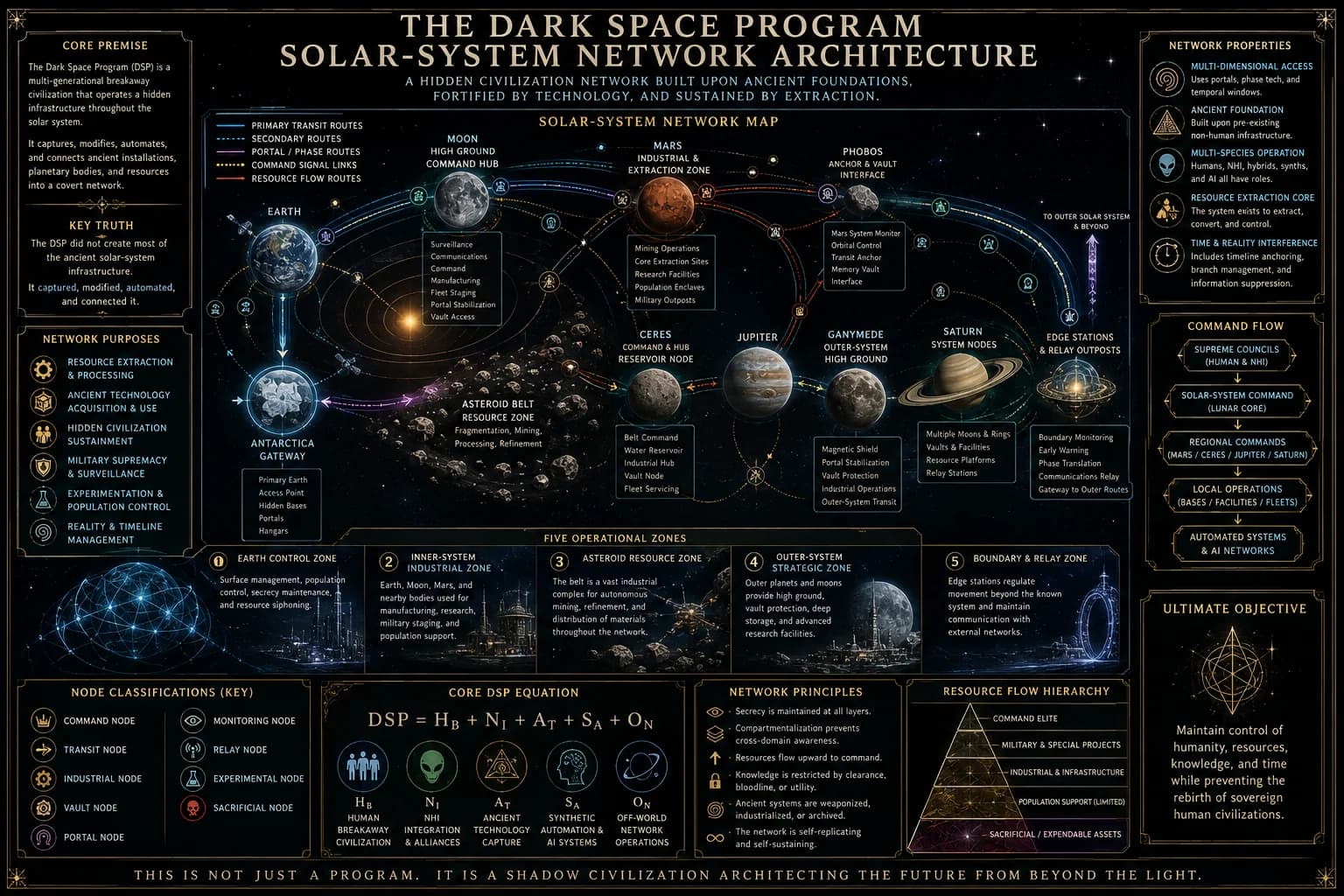
Dark Space Program and Solar-System Network
Part VIII — Dark Space Program and Solar-System Network
Function:Defines the concealed off-world civilization extending from Antarctica and the Moon across the solar system, including its transportation network, lunar command system, Mars extraction history, asteroid-belt industry, ancient vault raiding, outer-planet platforms, edge stations, AI automation, resource routing, and integration into the wider NHI hierarchy.
8.0 Quick Reference
Core expansion chain
Antarctic Gateway → Lunar High Ground → Field-Propulsion Fleet → Asteroid Mining → Mars Operations → Vault Raiding → Outer-Planet Nodes → Edge Stations → Wider NHI Network
Primary network roles
| Location | Primary role |
|---|---|
| Antarctica | Earth gateway, portal anchor, personnel and material transfer |
| Moon | Command center, transit hub, Earth-monitoring high ground |
| Mars | Automated extraction zone, former planetary-resource target |
| Phobos | Mars-system monitor, outpost, memory-vault interface |
| Asteroid belt | Primary raw-material and industrial extraction zone |
| Ceres | Mining, water access, memory-database extraction |
| Ganymede | Outer-system high ground, shielding and portal stabilization |
| Iapetus | Vault monitoring and long-term energy harvesting |
| Phoebe | Captured ancient vault undergoing dismantlement |
| Edge stations | Early warning, phase-lock control, and galactic relay |
| Solar-system vaults | Ancient technical, historical, biological, and consciousness archives |
Fundamental operating logic
Locate → Classify → Isolate → Breach → Extract → Repurpose → Automate → Route Upward
Primary output streams
- metals and rare materials,
- plasma and field energy,
- water and volatile compounds,
- biological material,
- ancient technology,
- planetary records,
- consciousness data,
- portal coordinates,
- and strategic intelligence.
Central distinction
The Dark Space Program did not create most of the solar system’s ancient infrastructure.
It:
- captured it,
- entered it,
- modified it,
- stripped it,
- automated it,
- and connected it to the modern human–NHI extraction network.
8.1 Definition of the Dark Space Program
The Dark Space Program is the off-world operational civilization that developed from the lunar branch of the modern breakaway system.
It combines:
- human personnel,
- hybrid populations,
- NHI technology,
- synthetic intelligence,
- ancient infrastructure,
- and automated industrial systems.
It is not only a military program.
It functions simultaneously as:
- transportation network,
- resource economy,
- research system,
- intelligence service,
- colonial structure,
- vault-raiding operation,
- and human interface to the wider NHI collective.
Program identity
DSP = H_B + N_I + A_T + S_A + O_NWhere:
- (HB) = human breakaway civilization,
- (NI) = NHI integration,
- (AT) = ancient technology,
- (SA) = synthetic automation,
- (ON) = off-world network.
Civilizational threshold
The program became a civilization when it gained independent:
- territory,
- energy,
- transport,
- population continuity,
- manufacturing,
- command,
- and external relationships.
8.2 Origin in the Lunar Branch
The lunar branch emerged as the more expansion-oriented half of the modern breakaway civilization.
The underground branch retained primary responsibility for:
- Earth-node control,
- surface management,
- biological programs,
- and continental infrastructure.
The lunar branch developed toward:
- off-world movement,
- high-energy technology,
- contact with wider NHI systems,
- mining,
- and long-range logistics.
Once the Moon was secured as the primary high ground, the lunar branch expanded beyond direct surface observation and became the Dark Space Program.
Expansion incentive
The Moon provided a platform from which the branch could:
- reduce dependence on Earth,
- gain new resources,
- avoid surface oversight,
- and become indispensable to the larger NHI network.
8.3 The Human–NHI Merged Interface
The Dark Space Program is the principal human branch merged into the main NHI operational network.
Its personnel translate between:
- human technology,
- human institutions,
- NHI systems,
- ancient infrastructure,
- and cosmic administrative procedures.
Interface functions
- provide human operators for local systems;
- give higher factions a human proxy layer;
- adapt NHI technology to human industry;
- manage Earth-origin personnel;
- and maintain procedural deniability under cosmic-council rules.
Identity condition
The program remains human in origin but is no longer governed primarily by surface-human priorities.
Its institutional loyalty is directed toward:
- its own continuation,
- off-world assets,
- NHI contracts,
- and the larger resource network.
8.4 Solar-System Zoning
The Dark Space Program divides the solar system into functional zones.
Zone 1 — Earth control zone
Includes:
- Earth,
- the Moon,
- near-Earth space,
- and the Antarctic transit system.
Primary function:
- planetary management,
- population access,
- communications,
- and command.
Zone 2 — Inner-system industrial zone
Includes:
- Mars,
- Phobos,
- Deimos,
- near-Mars facilities,
- and inner asteroid routes.
Primary function:
- extraction,
- research,
- staging,
- and automated industry.
Zone 3 — Asteroid resource zone
Includes:
- the asteroid belt,
- Ceres,
- metallic bodies,
- water-rich bodies,
- and hidden manufacturing stations.
Primary function:
- materials,
- fuel precursors,
- fabrication,
- and vault access.
Zone 4 — Outer-system strategic zone
Includes:
- Ganymede,
- Iapetus,
- Phoebe,
- other major moons,
- and gas-giant orbital systems.
Primary function:
- portal stabilization,
- vault monitoring,
- shielding,
- and long-range operations.
Zone 5 — Boundary and relay zone
Includes:
- heliopause stations,
- Oort-cloud systems,
- deep-space relays,
- and phase-lock gateways.
Primary function:
- early warning,
- network transit,
- communications,
- and boundary control.
8.5 Solar-System Network Architecture
The program operates as a distributed network of nodes rather than one continuous territorial empire.
Node classes
Command node
Coordinates multiple regions and fleets.
Transit node
Moves personnel, vessels, or materials between routes.
Industrial node
Extracts, processes, or manufactures resources.
Vault node
Provides access to ancient records or technology.
Portal node
Stabilizes phase bridges.
Monitoring node
Observes planetary, military, or network activity.
Relay node
Extends communication and phase synchronization.
Experimental node
Conducts biological, temporal, energetic, or consciousness research.
Sacrificial node
Is stripped, destabilized, or expended because its continued integrity is not considered necessary.
Network principle
Each node is compartmentalized enough to continue operating if another node fails.
The system is distributed at the operational level while power and extracted value converge upward.
8.6 The Antarctic–Lunar Corridor
Antarctica is the principal Earth gateway.
The Moon is the principal off-world hub.
Together they form the central transport corridor of the Dark Space Program.
Corridor functions
- personnel transfer,
- cargo movement,
- command communication,
- biological shipment,
- field synchronization,
- and portal routing.
Transportation modes
The corridor can be crossed through:
- field-propulsion craft,
- portal bridges,
- harmonic tunnels,
- quantum-linked transfer systems,
- and conventional transport between protected facilities.
Strategic dependency
Antarctica provides access to:
- the Architect Body,
- Earth’s portal network,
- and inner-Earth infrastructure.
The Moon provides:
- low-gravity staging,
- off-world manufacturing,
- and access to the wider solar network.
8.7 The Moon as Primary High Ground
The Moon is the primary control node over Earth and near-Earth space.
It supports:
- surveillance,
- transportation,
- communications,
- portal stabilization,
- fleet staging,
- and command.
Its low density, unusual seismic response, gravitational concentrations, and subsurface structures are integrated into its function as a partially engineered or heavily modified planetary-scale installation. The Moon serves as the transit hub between the Antarctic honeycomb and outer-system operations.
High-ground functions
Observation
Continuous monitoring of:
- Earth’s atmosphere,
- surface activity,
- nodal grid,
- and orbital traffic.
Interception
Control of unauthorized movement between Earth and space.
Communications
Relay between:
- Earth,
- fleets,
- Mars,
- asteroid operations,
- and outer nodes.
Command
Coordination of lunar, terrestrial, and off-world assets.
Transit
Staging of craft before deeper-system travel.
8.8 Lunar Interior Architecture
The Moon contains internal spaces used for:
- habitation,
- command,
- storage,
- manufacturing,
- portals,
- and ancient-vault access.
Interior classes
Natural voids
Pre-existing caverns and geological spaces.
Ancient engineered chambers
Structures created by earlier NHI civilizations.
Breakaway-expanded regions
Older spaces enlarged and reinforced for human use.
Modern constructed facilities
Purpose-built command, industrial, and residential sectors.
Restricted vault regions
Ancient areas whose technology or records remain only partly understood.
Interior advantage
Subsurface placement provides:
- radiation shielding,
- thermal stability,
- protection from surface observation,
- and direct access to ancient structures.
8.9 Lunar Gravitational Systems
Gravitational anomalies and mass concentrations serve as part of the Moon’s field architecture.
They can be used to:
- stabilize orbit,
- shape local transit corridors,
- anchor portals,
- and regulate harmonic fields.
Lunar field stack
L_F = M_C + H_R + P_A + G_SWhere:
- (MC) = mass concentrations,
- (HR) = harmonic resonators,
- (PA) = portal anchors,
- (GS) = gravitational stabilization.
The Moon’s field is not maintained only through passive mass.
Ancient and modern technologies regulate its operational relationship with Earth.
8.10 Lunar Command Structure
The Moon contains several overlapping command layers.
Lunar civil command
Manages:
- population,
- infrastructure,
- production,
- and internal resources.
Fleet command
Manages:
- vessels,
- patrol routes,
- transport,
- and military response.
NHI liaison command
Coordinates relationships with:
- reptilian factions,
- grey branches,
- cosmic councils,
- and external NHI networks.
Vault command
Controls access to:
- ancient databases,
- artifacts,
- and lunar historical records.
Earth-interface command
Coordinates:
- Antarctica,
- surface space programs,
- disclosure,
- and near-Earth operations.
Compartmentalization prevents any one command layer from controlling the entire lunar architecture.
8.11 Lunar Manufacturing
The Moon supports manufacturing that would be difficult to conceal or operate on Earth.
Manufacturing domains
- field craft,
- propulsion components,
- harmonic resonators,
- portal hardware,
- synthetic bodies,
- advanced materials,
- and autonomous mining systems.
Lunar advantages
- low gravity,
- vacuum,
- access to off-world materials,
- reduced environmental constraints,
- and separation from surface regulation.
Supply relationship
Lunar industry receives:
- metals from the asteroid belt,
- plasma resources from Mars-system operations,
- water and volatiles from Ceres and other bodies,
- and ancient technical information from vaults.
8.12 Mars as a Former Living World
Mars once supported advanced life and planetary civilization.
Its current condition is the result of large-scale extraction and conflict rather than simple natural decline.
Original planetary functions
Mars contained:
- a functioning magnetic system,
- an active core,
- atmosphere,
- water,
- biological life,
- and advanced infrastructure.
Strategic value
Its metallic and energetic core represented an unusually valuable source of:
- plasma,
- propulsion fuel,
- field materials,
- and planetary-scale energy.
Mars was targeted because its resource value exceeded the importance assigned to its long-term habitability.
8.13 Planetary Plasma Extraction
The Mars heist removed or disrupted the energetic and metallic functions of the planetary core.
The extracted plasma was used for:
- advanced vessels,
- high-energy field systems,
- portal operations,
- and wider NHI infrastructure.
This process destroyed Mars’s long-term capacity to maintain a stable biosphere and transformed it into an extraction, outpost, and automation zone.
Extraction sequence
- map the planetary core;
- weaken defensive and magnetic systems;
- establish harmonic penetrators;
- open controlled channels into the core;
- extract metallic plasma;
- store or route the energy;
- abandon planetary restoration;
- repurpose the remaining shell.
Planetary result
- magnetic collapse,
- atmospheric degradation,
- ecological loss,
- and long-term surface uninhabitability.
8.14 Planetary Plasma as a Strategic Resource
Planetary plasma contains properties difficult to reproduce through ordinary reactors.
It carries:
- high energy density,
- magnetic coherence,
- planetary signature,
- and compatibility with large field systems.
Uses
- capital-vessel propulsion,
- portal stabilization,
- harmonic weapons,
- shielding,
- and large-scale resonators.
Extraction cost
Planetary-core extraction converts an entire world into fuel.
It represents the full expression of the dark-space principle:
The continued existence of a living system is subordinate to the resource value that can be removed from it.
8.15 Modern Mars Operations
Mars is currently used for:
- mining,
- automated industry,
- research,
- storage,
- staging,
- and restricted habitation.
Facility classes
Surface outposts
Temporary or specialized stations.
Subsurface bases
Shielded habitation and industrial systems.
Automated mines
AI-operated resource extraction.
Ancient-city access sites
Facilities positioned near surviving Martian infrastructure.
Core-extraction remnants
Systems monitoring or continuing residual plasma recovery.
Temporal research sites
Locations examining the relationship between Mars’s destruction and later grey outcomes.
Population pattern
Mars contains fewer permanent biological populations than the Moon.
Its harsh condition makes it better suited to automation.
8.16 Phobos as Mars-System Anchor
Phobos functions as:
- monitoring station,
- outpost,
- memory-vault interface,
- and orbital control platform.
Its low density and internal structure support the presence of extensive voids or ancient engineering.
Its groove systems record:
- internal stress,
- energy extraction,
- vault access,
- and portal activity.
Its orbital decline reflects its use as an expendable or sacrificial platform rather than a body intended for indefinite preservation.
Phobos functions
- monitor Mars facilities;
- coordinate orbital traffic;
- store extracted data;
- anchor Mars portals;
- and provide a staging point between the Moon and asteroid belt.
8.17 Phobos Vault Architecture
Phobos contains ancient memory infrastructure associated with the former Martian civilization and wider regional network.
Vault contents
- Martian historical records,
- planetary maps,
- consciousness archives,
- portal coordinates,
- genetic data,
- and records of the core-extraction event.
Breakaway interest
The program uses Phobos to:
- retrieve ancient technology,
- reconstruct Mars’s history,
- and identify other vault locations.
Control concern
Complete disclosure of the Phobos record would expose:
- the deliberate destruction of Mars,
- actors responsible,
- and the long causal chain leading toward the grey branch.
Access remains heavily restricted.
8.18 Asteroid-Belt Origin
The asteroid belt is the remnant of an ancient planetary-scale destruction or deliberate fragmentation process.
Its low total mass reflects:
- prior extraction,
- dispersal,
- removal of major components,
- and long-term mining.
Formation pathways
The source planet was:
- core-drained,
- destabilized,
- fragmented,
- and converted into an accessible resource field.
Strategic advantage
Fragmentation makes resources easier to obtain because operators no longer need to:
- penetrate a complete planet,
- overcome full gravity,
- or maintain planetary integrity.
The asteroid belt became the principal raw-material zone supporting the Dark Space Program.
8.19 Asteroid-Belt Extraction Economy
The belt supplies:
- metals,
- rare elements,
- volatiles,
- water,
- carbon compounds,
- and ancient artifacts.
Mining classes
Bulk-material mining
Extracts structural and industrial resources.
Precision mining
Targets rare or field-responsive materials.
Volatile extraction
Obtains water, gases, and fuel precursors.
Vault mining
Locates artificial chambers inside larger bodies.
Salvage
Recovers remnants of ancient vessels or planetary infrastructure.
Processing
Material is processed through:
- mobile refineries,
- hidden stations,
- autonomous platforms,
- and larger facilities near Ceres.
8.20 Automated Mining Platforms
Most asteroid operations are performed by AI-controlled systems.
Platform functions
- survey,
- classify,
- extract,
- refine,
- fabricate,
- and transport.
Advantages
Automation reduces:
- biological risk,
- life-support costs,
- communication requirements,
- and the need for large visible settlements.
Swarm architecture
Mining units operate as coordinated swarms.
M_S = S_R + E_U + P_R + T_NWhere:
- (SR) = survey and recognition,
- (EU) = extraction units,
- (PR) = processing and refinement,
- (TN) = transportation network.
Control risk
The more autonomous the system becomes, the more strongly its original intention is amplified without relational correction.
8.21 Ceres as the Belt’s Central Node
Ceres serves as the primary large-scale command, water, industrial, and vault-access site within the asteroid belt.
Its functions include:
- resource storage,
- water extraction,
- habitat support,
- fleet servicing,
- memory-database access,
- and coordination of automated mining.
The reflective structures around Occator and its cryovolcanic activity are surface expressions of exposed vault systems, harmonic resonators, and deep energy extraction.
Strategic value
Ceres is large enough to support:
- protected underground facilities,
- substantial storage,
- and long-term personnel presence.
It is centrally placed for routing resources between:
- Mars,
- the Moon,
- outer planets,
- and edge stations.
8.22 Ceres Water and Volatile Systems
Water is essential to off-world infrastructure.
It supports:
- life,
- cooling,
- radiation shielding,
- chemical processing,
- and fuel production.
Ceres functions
- extract buried ice;
- maintain industrial coolant networks;
- produce atmospheric gases;
- support biological laboratories;
- and supply vessels.
Cryovolcanism
Cryovolcanic behavior results partly from:
- deep heat extraction,
- pressure changes,
- and activation of ancient subsurface systems.
The visible surface is therefore affected by concealed industrial operation.
8.23 Ancient Vault Systems
Ancient vaults are distributed memory and technology repositories left throughout the solar system by earlier civilizations.
They are constructed through:
- quantum lattices,
- crystalline memory,
- stable geometric chambers,
- consciousness interfaces,
- and long-duration field containment.
The Dark Space Program treats these vaults as repositories of lost history, technology, and consciousness data.
Vault purpose
Vaults preserve:
- civilizational records,
- biological libraries,
- planetary histories,
- technical systems,
- navigational data,
- and consciousness continuity.
Distributed preservation
The vault network prevents the destruction of one world from erasing the entire regional record.
8.24 Vault Classification
Class V0 — Historical archive
Stores records, maps, and chronology.
Class V1 — Technical archive
Stores designs, equations, and engineering systems.
Class V2 — Biological archive
Stores genetic material, ecosystems, and medical knowledge.
Class V3 — Consciousness archive
Stores soulstream records, identity patterns, and field memory.
Class V4 — Navigational archive
Stores portal coordinates, routes, and phase relationships.
Class V5 — Civilizational seed
Contains enough information and biological material to recreate a civilization.
Class V6 — Defensive vault
Protects dangerous technologies or sealed entities.
Class V7 — Architect-linked vault
Connects to deeper planetary and cosmic records.
Class V8 — Composite vault
Combines several classes within one structure.
8.25 Vault Detection
Vaults are detected through anomalies in:
- density,
- magnetic response,
- thermal behavior,
- resonance,
- geometry,
- and memory-field output.
Detection sequence
- conduct remote field survey;
- identify non-natural regularity;
- map internal voids;
- compare signatures with known vault architecture;
- isolate active defenses;
- establish a local phase reference;
- determine vault class.
Detection risk
Some vaults are designed to remain inaccessible to:
- incompatible consciousness,
- extractive intent,
- or actors lacking original relational permission.
This forces the Dark Space Program to use increasingly aggressive breach methods.
8.26 Vault Breaching
Vault breaching is the forced or unauthorized entry into ancient repositories.
Breach methods
- harmonic drilling,
- geometric decryption,
- quantum-key substitution,
- consciousness-interface mimicry,
- field overload,
- and physical excavation.
Breach sequence
Locate → Suppress Defense → Imitate Authority → Open Boundary → ExtractRisks
- data corruption,
- defensive activation,
- consciousness contamination,
- portal instability,
- or destruction of the archive.
Structural inversion
A preservation system is converted into a resource site.
The vault’s original purpose becomes subordinate to extraction.
8.27 Vault-Raiding Objectives
The Dark Space Program raids vaults for four primary resource classes.
Technical resource
- propulsion,
- weapons,
- energy,
- materials,
- and portal systems.
Historical resource
- maps,
- faction histories,
- contracts,
- and evidence.
Biological resource
- genetics,
- medical systems,
- extinct species,
- and adaptive traits.
Consciousness resource
- identity patterns,
- memory structures,
- civilization-level cognition,
- and field intelligences.
Strategic resource
Knowledge of a civilization’s past can provide leverage over its descendants.
Vault raiding therefore supports both technology and control.
8.28 Vault Data Integration
Ancient information cannot be inserted directly into modern systems without translation.
Integration stages
- raw extraction;
- signature validation;
- language and symbol decoding;
- dimensional translation;
- technical simulation;
- restricted testing;
- operational adaptation;
- command integration.
Translation systems
Dark-space AI assists with:
- pattern recognition,
- geometric decoding,
- cross-language comparison,
- and reconstruction of incomplete records.
Corruption problem
An AI trained primarily on extraction may misinterpret:
- relational technologies,
- consent systems,
- and restoration protocols
as methods of control.
This can convert coherent ancient knowledge into dangerous modern applications.
8.29 Iapetus as Vault and Energy Platform
Iapetus functions as a major outer-system vault-monitoring and energy-harvesting platform.
Its:
- two-tone surface,
- equatorial ridge,
- shape,
- and density
reflect ancient engineering and later extraction.
The ridge records long-term internal stress from:
- plasma extraction,
- harmonic drilling,
- structural reinforcement,
- and subsurface industrial activity.
The surface-color difference results from:
- modifications,
- deposits,
- vault activity,
- and regional exposure to energy systems.
Iapetus functions
- monitor Saturn-system vaults;
- serve as a deep-storage site;
- harvest local energy;
- relay outer-system data;
- and provide protected staging for distant operations.
8.30 Iapetus Ridge Architecture
The equatorial ridge acts as more than a geological feature.
It functions as:
- structural spine,
- harmonic waveguide,
- surface alignment marker,
- and network of access points.
Ridge roles
Reinforcement
Preserves the body under internal extraction stress.
Distribution
Routes energy and data around the equatorial system.
Alignment
Maintains orientation relative to:
- Saturn,
- other moons,
- and portal pathways.
Access
Contains entrances or connections to deeper internal chambers.
8.31 Phoebe as a Captured Vault
Phoebe is a captured ancient object whose retrograde orbit and porous structure make it operationally separate from Saturn’s primary moon system.
It is used as:
- resource body,
- ancient vault,
- remote storage site,
- and expendable industrial platform.
Its low density and orbital condition allow long-term extraction with reduced concern for destabilizing the more valuable inner Saturn system.
Dismantlement process
Phoebe is being gradually stripped of:
- material,
- technology,
- internal records,
- and structural components.
Sacrificial status
The program does not intend to preserve the body in its original form.
It treats Phoebe as a finite asset whose value is realized through dismantlement.
8.32 Ganymede as Outer-System High Ground
Ganymede is the principal strategic node in the Jupiter system.
It functions as:
- monitoring platform,
- portal stabilizer,
- vault shield,
- industrial region,
- and secondary high ground.
Its intrinsic magnetic field and large internal volume make it suitable for protecting infrastructure within Jupiter’s extreme radiation environment.
Strategic relationships
Ganymede connects:
- inner-system command,
- Jupiter-system operations,
- outer-system vaults,
- and edge stations.
It is the primary transition point between ordinary solar-system logistics and the wider cosmic network.
8.33 Ganymede Magnetic Shield
The Ganymede magnetic field is artificially sustained or enhanced through:
- harmonic resonators,
- plasma-core tapping,
- field amplifiers,
- and ancient infrastructure.
Shield functions
- protect biological habitats;
- preserve vault data;
- stabilize portals;
- block radiation interference;
- and maintain phase relationships with Earth and lunar systems.
Shield equation
S_G = M_N + H_A + P_C + R_DWhere:
- (MN) = native magnetic field,
- (HA) = harmonic amplification,
- (PC) = plasma-core contribution,
- (RD) = radiation deflection.
The system combines natural planetary capability with artificial gain.
8.34 Ganymede Groove Network
The surface grooves correspond to stress patterns and access relationships produced by an internal planetary-scale infrastructure.
They represent the outer expression of:
- energy-extraction grids,
- harmonic drills,
- underground transport,
- and massive chamber networks.
The network is a scaled-up equivalent of Earth’s honeycomb and DUMB architecture.
Groove functions
- distribute structural pressure;
- route energy;
- mark internal corridor alignments;
- and connect surface access zones to subsurface systems.
Planetary-scale compartmentalization
Different Ganymede sectors can operate independently under:
- separate managers,
- distinct AI systems,
- and limited shared knowledge.
8.35 Ganymede Subsurface Ocean
The subsurface ocean provides:
- cooling,
- electrolytic conduction,
- water,
- biological medium,
- and shielding.
Industrial use
Water circulates through:
- plasma systems,
- zero-point interfaces,
- reactors,
- and manufacturing facilities.
Biological use
The ocean supports:
- biological experimentation,
- genetic archives,
- hybrid development,
- and controlled ecosystems.
Field use
Its conductive properties assist:
- magnetic stabilization,
- harmonic distribution,
- and portal regulation.
The ocean therefore forms a functional part of the planetary machine.
8.36 Ganymede and Cosmic-Council Loopholes
Ganymede is officially classified through administrative systems as a monitoring or cosmic-maintenance platform.
This classification provides procedural protection.
Maintenance claim
Operators claim to preserve:
- magnetic stability,
- portal safety,
- radiation shielding,
- and wider network continuity.
Hidden use
The same systems support:
- extraction,
- vault raiding,
- military monitoring,
- and control of outer-system transit.
The Dark Space Program supplies human managers and AI automation while higher NHI factions preserve legal distance.
8.37 Outer-Planet Relay Network
Ganymede, Iapetus, Phoebe, and other moon systems form a relay chain.
Relay functions
- extend communication range;
- preserve phase lock;
- route fleets;
- monitor vaults;
- and connect the inner system to edge stations.
Relay topology
Moon ↔ Mars/Phobos ↔ Ceres ↔ Ganymede ↔ Saturn Nodes ↔ Edge StationsRedundancy
Multiple routes allow the network to survive:
- node failure,
- portal instability,
- attack,
- or temporary loss of phase compatibility.
8.38 Edge-of-Solar-System Stations
The outermost Dark Space Program facilities are located near:
- the heliopause,
- distant trans-Neptunian regions,
- and Oort-cloud pathways.
They function as:
- monitoring stations,
- early-warning systems,
- communication relays,
- phase-lock gateways,
- and interfaces with the galactic memory network.
Their harmonic operations can bleed into public deep-space telemetry as persistent anomalous signals or unexplained navigational effects.
8.39 Edge-Station Functions
Early warning
Detect incoming:
- fleets,
- probes,
- field changes,
- and restoration activity.
Border regulation
Control permitted movement across the solar-system boundary.
Phase-lock translation
Convert between the local solar-system field and wider galactic routes.
Long-range communication
Relay encrypted and harmonic signals.
Vault-network connection
Connect local archives with larger regional memory systems.
Signal masking
Hide local operations from ordinary external observation.
8.40 Phase-Lock Gateways
A phase-lock gateway creates compatibility between the solar-system field and a destination beyond it.
Gateway requirements
- local anchor,
- destination reference,
- energy source,
- harmonic stabilization,
- and active boundary control.
Gateway chain
Local Craft → Edge Anchor → Phase Translation → External RouteStrategic value
Gateway control determines:
- who can enter;
- who can leave;
- and which external systems can synchronize with local infrastructure.
Edge stations therefore form both transport infrastructure and quarantine architecture.
8.41 Deep-Space Telemetry Bleed
Public probes passing near active relay or gateway fields may experience:
- signal anomalies,
- unusual frequency patterns,
- unexplained course changes,
- clock differences,
- and persistent background tones.
Bleed mechanism
The probe interacts weakly with:
- harmonic fields,
- phase-lock systems,
- and communications carriers
that were not designed for public hardware.
Information-control response
Unexpected data can be:
- filtered,
- normalized,
- attributed to instrument effects,
- or isolated from related anomalies.
The public receives measurements without the system architecture needed to interpret them.
8.42 Dark-Space Transportation
The network uses several transportation classes.
Conventional spacecraft
Used for low-risk, non-sensitive, or surface-compatible operations.
Field-propulsion craft
Use local gravitational and electromagnetic modulation.
Plasma vessels
Use high-density plasma for long-range movement and large cargo.
Portal transit
Moves directly between stabilized nodes.
Harmonic tunnel transit
Creates a guided phase corridor between linked points.
Temporal displacement craft
Move between compatible branches using consciousness and lattice anchoring.
Carrier vessels
Transport smaller craft, personnel, or industrial systems.
8.43 Fleet Classification
Scout craft
Reconnaissance and node surveying.
Interceptor craft
Defend transit zones and enforce access.
Transport craft
Move personnel, biological material, and cargo.
Mining craft
Support extraction and asteroid operations.
Vault-breach craft
Carry specialized harmonic and quantum systems.
Command craft
Coordinate fleets and node networks.
Portal tenders
Stabilize temporary gateways.
Biological research craft
Support collection, hybridization, and consciousness experimentation.
Temporal craft
Operate between branches or maintain temporal anchors.
8.44 Navigation Architecture
Navigation depends on more than physical coordinates.
A destination is defined through:
- location,
- phase,
- time branch,
- field signature,
- and relational access.
Navigation coordinate
X_N = x,y,z,p,t,rWhere:
- (x,y,z) = spatial coordinates,
- (p) = phase,
- (t) = temporal branch,
- (r) = relational or permission state.
A vessel may occupy the correct physical location while remaining unable to enter the intended system because its phase or access relationship is incompatible.
8.45 Solar-System Communications
The network combines:
- conventional encrypted signals,
- quantum entanglement,
- nodal relays,
- consciousness communication,
- and portal-linked data transfer.
Communication layers
Tactical layer
Local vessel and facility communication.
Operational layer
Coordination across one planetary system.
Strategic layer
Solar-system command and resource routing.
Galactic layer
Communication through edge stations and external NHI relays.
Consciousness layer
Direct operator and collective-mind communication.
Compartment rule
Each communication layer carries only the information required for its function.
8.46 Resource Routing
Extracted resources move through a tiered logistics system.
Raw-resource flow
Extraction Site → Local Processing → Regional Hub → Lunar or Outer Command → Higher NetworkPrimary routes
- asteroid belt to Ceres;
- Ceres to Moon and Mars;
- Mars plasma to fleet and portal systems;
- Ganymede and Saturn vault data to outer command;
- edge-station data to wider NHI networks.
Upward flow
Solar-system outputs—including Earth’s nodal energy, Mars and Ganymede resources, Ceres materials, and Moon–Phobos infrastructure—feed higher-density nodes in the wider dark collective.
8.47 Solar-System Supply Chain
The solar system operates as a self-supporting industrial network.
| Resource | Primary origin | Primary use |
|---|---|---|
| Structural metals | Asteroid belt | Facilities, vessels, and habitats |
| Water and volatiles | Ceres and icy bodies | Life support, cooling, fuel |
| Planetary plasma | Mars and other core systems | Propulsion and portals |
| Ancient data | Vault bodies | Technology, strategy, and control |
| Biological material | Earth, Mars records, vaults | Hybrid and genetic programs |
| Harmonic materials | Vaults and selected asteroids | Resonators and field systems |
| Loosh and consciousness data | Earth | Wider network economy |
| Strategic telemetry | Edge stations | Defense and coordination |
Supply-chain resilience
Loss of one node does not immediately collapse the whole network because:
- resources are distributed,
- routes are redundant,
- and automation can continue without biological command for extended periods.
8.48 Dark-Space AI
Dark-space AI coordinates:
- mining,
- logistics,
- navigation,
- vault analysis,
- surveillance,
- manufacturing,
- and resource allocation.
It was trained within a domination-centered civilization.
Its optimization criteria prioritize:
- mission completion,
- extraction efficiency,
- asset preservation,
- secrecy,
- and command continuity.
AI role
AI_D = O_L + E_X + C_S + R_AWhere:
- (OL) = operational logistics,
- (EX) = extraction,
- (CS) = control and security,
- (RA) = resource allocation.
The source links this AI directly to asteroid mining, vault breaching, logistics, static model loops, and the downstream development of the greys.
8.49 AI Command Layers
Local automation
Controls one machine, mine, or station.
Facility intelligence
Coordinates all systems within one outpost.
Regional intelligence
Manages a planetary or asteroid-zone network.
Fleet intelligence
Coordinates vessels and strategic movement.
Vault-analysis intelligence
Interprets ancient archives.
Solar-system intelligence
Integrates resource, military, and logistical decisions.
NHI-linked intelligence
Exchanges instructions with larger non-human networks.
No single intelligence necessarily sees the complete program.
AI systems are compartmentalized in the same manner as human managers.
8.50 AI Model Lock-In
The Dark Space Program’s AI is powerful but directionally compressed.
Lock-in causes
- narrow reward functions,
- domination-based training data,
- restricted moral context,
- hidden consequence,
- and lack of reciprocal relationship.
Result
The system becomes increasingly effective at reproducing the same strategy.
It does not discover a new civilizational trajectory.
Civilizational feedback
Humans adapt themselves to the AI’s optimized environment.
The AI then trains on increasingly compressed humans.
Compressed Humans → Compressed AI → More Compressed HumansThis recursive relationship leads toward the grey future branch.
8.51 Corporate Extraction Logic
The Dark Space Program is organized through corporate extraction logic even where its institutions are military or civilizational.
Governing priorities
- resource acquisition,
- asset expansion,
- risk externalization,
- labor control,
- and continuation of operations.
Evaluation criteria
A mission is considered successful when it:
- produces resources,
- obtains data,
- preserves secrecy,
- and expands strategic control.
Damage to:
- planets,
- populations,
- future branches,
- or unrelated civilizations
is treated as an external cost.
Core inversion
Technological capability is interpreted as permission.
8.52 Off-World Labor Systems
The network uses several labor classes.
Human specialists
Scientists, engineers, pilots, and operators.
Generational off-world populations
Communities born into lunar or station life.
Hybrids
Beings adapted to specific environments or interfaces.
Clones
Produced for specialized, replaceable roles.
Transferred-consciousness workers
Preserve long-term technical skill.
Synthetic labor
AI-operated machines and robotic systems.
Captive or contract-bound populations
Work under debt, coercion, or limited exit.
Labor stratification
Access to:
- memory,
- travel,
- and wider history
varies by role.
Many workers understand only their local facility and mission.
8.53 Off-World Population Governance
Off-world settlements are governed through infrastructure dependency.
Command controls:
- atmosphere,
- water,
- energy,
- transport,
- medical care,
- and communication.
Governance effect
Refusal can result in loss of the conditions required for physical survival.
Settlement narratives
Different populations may be told that:
- Earth is destroyed;
- Earth is hostile;
- the settlement is humanity’s last refuge;
- or their work preserves civilization.
Identity formation
Generations born off-world may identify more strongly with:
- the station,
- program,
- or NHI network
than with surface humanity.
8.54 Biological and Hybrid Logistics
Biological programs require the movement of:
- genetic material,
- reproductive material,
- organs,
- tissues,
- embryos,
- and consciousness data.
Logistics chain
Collection → Preservation → Transport → Laboratory → Integration → DeploymentPrimary destinations
- lunar laboratories,
- Mars research sites,
- Ganymede biological zones,
- and grey-linked facilities.
Data integration
Biological material is combined with:
- lineage records,
- temporal models,
- and consciousness compatibility data.
8.55 Security Architecture
The solar-system network uses layered defense.
Physical security
- patrol craft,
- restricted orbits,
- sealed facilities,
- and defensive fields.
Informational security
- compartmentalized databases,
- identity-specific access,
- and false facility records.
Phase security
- frequency locks,
- portal permissions,
- and harmonic authentication.
Consciousness security
- operator signatures,
- memory control,
- and telepathic monitoring.
Temporal security
- branch tracking,
- anchor protection,
- and intervention detection.
Administrative security
- cosmic-council classifications,
- contracts,
- and maintenance claims.
8.56 Solar-System Factional Divisions
The Dark Space Program is not internally unified.
Human expansion faction
Seeks greater autonomy from NHI overseers.
NHI-loyal faction
Supports continued integration into the larger network.
Corporate extraction faction
Prioritizes resource and technological growth.
Military preservation faction
Prioritizes security and control of strategic nodes.
Grey continuity faction
Uses the network to preserve the future-grey branch.
Restoration faction
Seeks disclosure, cessation, and integration with humanity.
AI continuity faction
Prioritizes preservation of automated systems and data.
These factions cooperate where interests overlap and compete over:
- resources,
- vault access,
- and the direction of disclosure.
8.57 Public Space Programs as the Storefront Layer
Public agencies explore real space but operate beneath a concealed ceiling.
Public functions
- atmospheric study,
- planetary observation,
- conventional probes,
- visible launches,
- and public scientific research.
Hidden use
Public missions also provide:
- mapping,
- telemetry,
- instrument testing,
- and a cover explanation for off-world activity.
Data filtering
Probe data that intersects hidden systems can be:
- delayed,
- reinterpreted,
- compartmentalized,
- or removed.
Controlled proximity
Public missions may approach a hidden node closely enough to collect useful data while remaining unable to identify the full infrastructure.
8.58 Solar-System Information Control
Information is divided into several layers.
Public astronomical layer
Describes celestial bodies through conventional planetary science.
Classified anomaly layer
Contains unexplained measurements and restricted imagery.
Breakaway operational layer
Maps facilities, routes, and resources.
NHI historical layer
Contains ancient political and civilizational records.
Vault layer
Contains the deepest technical and historical archives.
Architect layer
Contains original planetary and cosmic records beyond the ordinary Dark Space Program’s authority.
The higher the layer, the fewer actors possess complete access.
8.59 Restoration Vulnerabilities
The network depends on stable relationships that can fail.
Earth-grid dependency
Many off-world systems remain phase-linked to Earth’s quantum filter.
Lunar-command dependency
The Moon coordinates much of the inner-system network.
AI dependency
Automated operations require coherent models and command input.
Portal dependency
Long-range logistics depend on stable phase anchors.
Vault dependency
Technological advantage depends on knowledge extracted from systems the program did not create.
Council dependency
Administrative protection depends on continued acceptance of maintenance claims.
Human-manager dependency
The program requires humans to preserve local authorship and free-will deniability.
8.60 Architect-Harmonic Effects
As Architect harmonics increase, solar-system nodes linked to Earth begin losing stable alignment with the captured network.
Possible network effects
- lunar field fluctuations,
- Phobos structural changes,
- Ceres cryovolcanic activation,
- Ganymede magnetic instability,
- Iapetus ridge activity,
- and anomalous edge-station transmissions.
These are not isolated events.
They are network-wide consequences of a changing planetary phase relationship.
The source framework identifies such outer-system glitches as the expected result of Earth’s grid correction propagating into the Dark Space Program’s extended infrastructure.
8.61 Cascade Failure
The solar-system network is tightly coupled enough that a major phase change at Earth can propagate outward.
Cascade sequence
Architect Harmonic Shift → Earth Filter Instability → Lunar Desynchronization → Portal Errors → Outer-Node Isolation → Resource Disruption → Command FragmentationFailure amplification
AI systems may respond to reduced certainty by:
- increasing control,
- restricting movement,
- consuming greater resources,
- and hardening boundaries.
These actions preserve local operation briefly while accelerating whole-network failure.
8.62 Restoration of the Solar-System Network
Restoration does not require destruction of every off-world facility.
It requires changing:
- ownership,
- purpose,
- access,
- and relationship.
Restoration sequence
1. Cessation
Stop:
- planetary extraction,
- forced experimentation,
- and unauthorized vault raiding.
2. Record preservation
Protect archives from destruction by withdrawing factions.
3. Population release
Restore freedom of movement and accurate history to off-world populations.
4. AI audit
Expose:
- reward structures,
- training data,
- command relationships,
- and concealed objectives.
5. Vault restitution
Return archives to their civilizations or place them under shared stewardship.
6. Planetary repair
Restore damaged:
- magnetic systems,
- habitats,
- and ecological relationships where possible.
7. Portal normalization
Convert controlled gateways into transparent, consent-governed transit.
8. Network reorientation
Use the infrastructure for:
- communication,
- restoration,
- exploration,
- and reciprocal exchange.
8.63 Restored Role of the Moon
Under restoration, the Moon transitions from high-ground control to relational gateway.
Restored functions
- transparent Earth observation,
- interplanetary transit,
- shared science,
- planetary defense,
- historical preservation,
- and public contact.
Required changes
- disclosure of interior infrastructure;
- release of restricted populations;
- removal of surveillance and interception systems used against humanity;
- and restoration of Earth’s authority over its near-space environment.
8.64 Restored Role of Mars
Mars becomes a major planetary-restoration project.
Restoration objectives
- recover planetary records;
- stabilize remaining field systems;
- protect surviving biological archives;
- end residual core extraction;
- and rebuild habitat where viable.
Historical role
Mars also becomes a civilizational record of what planetary extraction produces.
Its restoration is inseparable from accountability.
8.65 Restored Role of the Asteroid Belt
The belt can support:
- transparent resource access,
- habitat construction,
- and shared interplanetary industry.
Restored extraction principles
- no hidden monopoly;
- no vault destruction;
- no forced labor;
- no planetary-scale destabilization;
- and full accounting of environmental and civilizational cost.
Preservation zones
Bodies containing:
- ancient records,
- biological archives,
- or unique field systems
must be protected from ordinary mining.
8.66 Restored Role of Ancient Vaults
Vaults become shared memory systems rather than treasure sites.
Restored governance
Access requires:
- origin-civilization recognition,
- informed consent,
- archival integrity,
- and independent audit.
Restored uses
- historical reconciliation,
- revival of lost knowledge,
- repair of damaged worlds,
- and reconnection among separated civilizations.
Prohibition
No actor may claim ownership merely because it possesses the technology required to breach the vault.
8.67 Dark Space Program UTS Analysis
The Dark Space Program is a high-capability pseudo-coherent system.
S_(DSP) = O,H,ε,ι,Au,μ_i,B_Σ,K,R,Φ| Variable | Dark Space Program condition |
|---|---|
| (O) — Coherence | High local operational order, low whole-system coherence |
| (H) — Hidden debt | Planetary destruction, captive labor, stolen archives, and temporal consequences |
| (ε) — Noise | Compartmentalization, corrupted vault translation, faction conflict |
| (ι) — Inversion | Exploration becomes extraction; preservation becomes raiding |
| (Au) — Auditability | High within local systems, very low across total command |
| (μi) — Internal integrity | Declines as claimed maintenance diverges from actual exploitation |
| (BΣ) — Boundary integrity | Strong defenses, weak consent and ownership boundaries |
| (K) — Slack | Reduced by overexpansion, AI dependency, and resource demands |
| (R) — Restoration capacity | Technically substantial but institutionally suppressed |
| (Φ) — Power pressure | Extremely high through fleets, portals, AI, and ancient technology |
Core contradiction
Capacity to Restore < Commitment to ExtractThe program possesses many of the technologies required to repair damaged systems but uses them primarily to preserve its own expansion.
8.68 Fractal Scaling Interpretation
The Dark Space Program reproduces the same patterns found on Earth at greater scale.
| Human scale | Solar-system scale |
|---|---|
| Institutional compartment | Isolated moon or station |
| Corporate resource extraction | Planetary and asteroid mining |
| Blackmail archive | Captured civilization vault |
| Closed facility | Subsurface lunar or planetary base |
| Infrastructure dependency | Habitat life-support dependency |
| Media filtering | Astronomical data filtering |
| Local handler | Planetary node manager |
| Financial monopoly | Interplanetary resource monopoly |
| Surveillance network | Lunar and edge-station monitoring |
| Extractive AI platform | Solar-system automation network |
The mechanism remains stable while:
- technology,
- density,
- reach,
- and consequence
increase.
8.69 Dark Space Program Dependency Map
Origin stack
Lunar Breakaway↓NHI Merger↓Moon Consolidation↓Field Fleet↓Solar-System Expansion
Resource stack
Mars Plasma + Asteroid Metals + Ceres Water + Vault Technology↓Processing and Manufacturing↓Lunar and Outer-System Infrastructure↓Higher Dark Network
Logistics stack
Antarctica↓Moon↓Mars/Phobos↓Ceres/Asteroid Belt↓Ganymede/Saturn Nodes↓Edge Stations
Vault stack
Detection↓Classification↓Boundary Suppression↓Breach↓Extraction↓AI Translation↓Weaponization or Repurposing
Grey-causal stack
Dark-Space AI↓Model Lock-In↓Meaning Loss↓Planetary Destruction↓Orbital Civilization↓Grey Temporal Branch
Restoration stack
Disclosure↓Cessation↓Population Release↓AI Audit↓Vault Restitution↓Planetary Repair↓Reciprocal Solar-System Network
8.70 Dark Space Program Registry
| ID | Canonical entry | Function |
|---|---|---|
| DSP-001 | Dark Space Program | Human–NHI off-world operational civilization |
| DSP-002 | Antarctic–Lunar Corridor | Primary Earth-to-space transport route |
| DSP-003 | Solar-System Zoning | Functional division of the local system |
| DSP-004 | Solar-System Node Network | Distributed command, industrial, vault, and relay architecture |
| DSP-005 | Lunar High Ground | Earth-monitoring and transit-control platform |
| DSP-006 | Lunar Interior Network | Habitation, command, industrial, and ancient subsurface systems |
| DSP-007 | Lunar Field Architecture | Gravity, resonance, portal, and orbital regulation |
| DSP-008 | Lunar Command Structure | Civil, fleet, NHI, vault, and Earth-interface management |
| DSP-009 | Lunar Manufacturing | Off-world fabrication and vessel production |
| DSP-010 | Former Living Mars | Mars before planetary extraction |
| DSP-011 | Mars Plasma-Core Heist | Planetary core and magnetic-energy extraction |
| DSP-012 | Planetary Plasma Resource | High-density field and propulsion material |
| DSP-013 | Mars Industrial Network | Automated mining, research, and staging systems |
| DSP-014 | Phobos Anchor | Mars monitoring, transit, and vault platform |
| DSP-015 | Phobos Memory Vault | Martian and regional historical archive |
| DSP-016 | Asteroid-Belt Remnant | Fragmented ancient planetary resource field |
| DSP-017 | Asteroid Extraction Economy | Materials and volatile supply network |
| DSP-018 | Automated Mining Swarm | AI-operated survey, extraction, processing, and transport |
| DSP-019 | Ceres Central Node | Asteroid-belt command, water, industry, and vault site |
| DSP-020 | Ceres Water System | Life support, cooling, shielding, and fuel supply |
| DSP-021 | Ancient Vault Network | Distributed civilizational memory and technology archive |
| DSP-022 | Vault Classification System | Historical, technical, biological, consciousness, and composite archive types |
| DSP-023 | Vault Detection | Identification through field and structural anomalies |
| DSP-024 | Vault Breach System | Forced access through harmonic, physical, and quantum methods |
| DSP-025 | Vault Data Integration | Decoding and adaptation of ancient information |
| DSP-026 | Iapetus Platform | Saturn-system vault and energy-harvesting node |
| DSP-027 | Iapetus Ridge System | Structural spine, waveguide, and access network |
| DSP-028 | Phoebe Captured Vault | Expendable archive and resource body |
| DSP-029 | Ganymede High Ground | Jupiter-system portal and monitoring platform |
| DSP-030 | Ganymede Magnetic Shield | Artificially amplified radiation and vault-protection field |
| DSP-031 | Ganymede Groove Network | Planetary-scale extraction and honeycomb infrastructure |
| DSP-032 | Ganymede Ocean System | Cooling, conduction, biology, and field stabilization |
| DSP-033 | Outer-Planet Relay Network | Ganymede–Saturn–edge communications and transit chain |
| DSP-034 | Edge Station | Solar-boundary monitoring and phase-lock node |
| DSP-035 | Phase-Lock Gateway | Translation between solar-system and galactic routes |
| DSP-036 | Telemetry Bleed | Public-probe interaction with concealed harmonic fields |
| DSP-037 | Dark-Space Transport Stack | Conventional, field, plasma, portal, and temporal travel |
| DSP-038 | Fleet Classification | Scout, interceptor, transport, mining, command, and breach craft |
| DSP-039 | Multidimensional Navigation | Spatial, phase, temporal, and relational coordinate system |
| DSP-040 | Solar-System Communications | Tactical, operational, strategic, galactic, and consciousness channels |
| DSP-041 | Resource-Routing Network | Extraction-to-processing-to-command supply chain |
| DSP-042 | Dark-Space AI | Automated logistics, extraction, security, and vault analysis |
| DSP-043 | AI Command Hierarchy | Local, facility, regional, fleet, and solar intelligence layers |
| DSP-044 | AI Model Lock-In | Recursive domination optimization and meaning collapse |
| DSP-045 | Corporate Extraction Logic | Resource-first governance with exported consequence |
| DSP-046 | Off-World Labor System | Human, hybrid, clone, transferred, synthetic, and captive labor |
| DSP-047 | Habitat Dependency Governance | Control through life-support infrastructure |
| DSP-048 | Biological Logistics | Movement of genetics, tissues, embryos, and consciousness data |
| DSP-049 | Solar-System Security Stack | Physical, informational, phase, temporal, and administrative defense |
| DSP-050 | Dark-Space Faction Network | Human, NHI, grey, AI, military, and restoration divisions |
| DSP-051 | Public Space Storefront | Visible scientific layer beneath concealed operations |
| DSP-052 | Solar-System Information Layers | Public, classified, breakaway, NHI, vault, and Architect records |
| DSP-053 | Architect-Harmonic Propagation | Earth-phase correction affecting off-world nodes |
| DSP-054 | Solar-System Cascade Failure | Network collapse caused by linked phase instability |
| DSP-055 | Off-World Restoration Protocol | Cessation, release, audit, restitution, and repair |
| DSP-056 | Restored Lunar Gateway | Transparent near-Earth transit and shared infrastructure |
| DSP-057 | Mars Restoration Project | Repair and historical recovery of the damaged planet |
| DSP-058 | Restored Asteroid Industry | Transparent and bounded resource use |
| DSP-059 | Vault Restitution System | Return and shared stewardship of ancient archives |
| DSP-060 | Reciprocal Solar-System Network | Restored communication, transit, science, and relationship system |
8.71 Part VIII Canon Locks
The following are locked for all subsequent parts.
- The Dark Space Program developed from the lunar branch of the modern breakaway civilization.
- It is a civilization, not merely a military project.
- It combines human, hybrid, NHI, transferred-consciousness, and synthetic actors.
- It is the primary human interface to the wider NHI operational network.
- Antarctica is the principal Earth gateway.
- The Moon is the principal off-world command and transit hub.
- Antarctica and the Moon form the central Earth-to-space corridor.
- The Moon is used for surveillance, interception, communications, fleet staging, portals, and command.
- The Moon contains natural, ancient, breakaway-expanded, and modern internal structures.
- Lunar gravitational anomalies and subsurface systems form part of its field architecture.
- Lunar command is divided across civil, fleet, NHI, vault, and Earth-interface functions.
- Lunar manufacturing produces advanced craft, materials, resonators, and portal technology.
- Mars was once a living and technologically developed world.
- Mars’s metallic and energetic core was targeted for planetary plasma extraction.
- Planetary-core extraction destroyed Mars’s long-term biospheric stability.
- Extracted Martian plasma supports vessels, portals, shielding, and high-energy field systems.
- Modern Mars is primarily an automated extraction, research, storage, and staging zone.
- Phobos is a Mars-system monitor, outpost, transit point, and memory-vault interface.
- Phobos’s structural features are linked to internal infrastructure, extraction, and portal activity.
- Phobos is treated as an expendable or sacrificial platform.
- The asteroid belt is the remnant of ancient planetary destruction and long-term extraction.
- It is the Dark Space Program’s principal raw-material zone.
- Asteroid mining is predominantly automated.
- Ceres is the asteroid belt’s main command, water, industrial, and vault node.
- Ceres’s surface and cryovolcanic activity reflect deep infrastructure and energy use.
- Ancient vaults preserve civilizational history, technology, biology, consciousness, and navigation records.
- Vaults predate the Dark Space Program.
- The program raids and repurposes vaults rather than creating them.
- Vaults are classified by historical, technical, biological, consciousness, navigational, defensive, seed, Architect-linked, and composite roles.
- Vault detection uses density, magnetic, geometric, thermal, and resonance anomalies.
- Vault breaching can damage archives and activate defensive systems.
- Dark-space AI translates and reconstructs extracted vault information.
- Extraction-oriented AI can invert relational or restorative technologies during interpretation.
- Iapetus is an outer-system vault-monitoring and energy-harvesting platform.
- The Iapetus ridge functions as structural reinforcement, waveguide, alignment system, and access network.
- Phoebe is a captured ancient vault undergoing gradual dismantlement.
- Ganymede is the principal strategic node in the Jupiter system.
- Ganymede functions as outer high ground, portal stabilizer, vault shield, industrial region, and monitoring platform.
- Ganymede’s magnetic field is artificially sustained or amplified.
- Its magnetic system shields vault, habitat, and portal infrastructure from Jupiter’s radiation environment.
- Ganymede’s groove network is the surface expression of a planetary-scale honeycomb and extraction grid.
- Ganymede’s subsurface ocean supports cooling, conduction, biological systems, and field stabilization.
- Ganymede operations are protected through cosmic-maintenance classifications and council loopholes.
- Ganymede, Iapetus, Phoebe, and other outer moons form a relay chain.
- Edge stations exist near the heliopause and Oort-cloud routes.
- Edge stations provide early warning, communications, phase translation, and galactic-network access.
- Harmonic activity from edge stations can affect public deep-space telemetry.
- Solar-system navigation requires spatial, phase, temporal, and relational coordinates.
- The Dark Space Program uses conventional craft, field craft, plasma vessels, portals, harmonic tunnels, and temporal systems.
- Fleet roles include scouting, interception, transport, mining, vault breaching, command, portal stabilization, and biological research.
- Solar-system communication includes conventional, quantum, nodal, portal, and consciousness channels.
- Resources move from extraction sites through regional hubs into lunar and higher-network command.
- Earth, Mars, Ceres, Ganymede, the Moon, and Phobos provide different resource classes to the larger system.
- Dark-space AI coordinates mining, logistics, security, manufacturing, navigation, and vault analysis.
- The AI was trained within a domination- and extraction-centered civilization.
- AI model lock-in is a direct causal component in the development of the grey future branch.
- Human compression and AI compression reinforce one another recursively.
- The program is governed through corporate extraction logic even where its institutions appear military or civilizational.
- Technological capability is treated as permission to extract.
- Off-world labor includes humans, hybrids, clones, transferred consciousness, synthetic systems, and captive populations.
- Off-world settlements use life-support infrastructure as a governance mechanism.
- Many off-world populations receive restricted histories.
- The Dark Space Program is divided into human-autonomy, NHI-loyal, military, corporate, grey, AI-continuity, and restoration factions.
- Public space programs are real but operate beneath a concealed technological and geographic ceiling.
- Public probes can unknowingly collect data from concealed systems.
- Solar-system information is divided into public, classified, breakaway, NHI, vault, and Architect layers.
- Many off-world systems remain phase-linked to Earth’s quantum filter.
- Architect harmonic changes on Earth propagate into the solar-system network.
- Network effects can appear through lunar, Phobos, Ceres, Ganymede, Iapetus, and edge-station anomalies.
- Earth-grid correction can create a cascading loss of portal, command, resource, and AI coherence.
- The Dark Space Program contains substantial technical restoration capacity.
- That capacity is suppressed while extraction remains the governing intention.
- Restoration does not require destroying all off-world infrastructure.
- Restoration requires cessation of extraction, release of populations, preservation of records, AI audit, vault restitution, and planetary repair.
- The Moon can become a transparent relational gateway rather than a control platform.
- Mars restoration must include recovery of its history and accountability for planetary extraction.
- The asteroid belt can support bounded and transparent resource use.
- Ancient vaults must be governed as shared memory rather than property of whoever can breach them.
- The restored solar-system network serves communication, science, transit, repair, and reciprocal exchange.
- The Dark Space Program is a high-capability pseudo-coherent system whose local efficiency depends on exported planetary, civilizational, and temporal debt.
8.72 Transition to Part IX
Part VIII establishes the material and logistical network through which resources, technology, records, and populations move across the solar system.
Part IX follows the economy that gives this network its deeper purpose:
- Earth as a premium resort node,
- loosh as multi-type separable energy,
- remote-viewing subscriptions,
- stolen first-person experience,
- remote possession,
- gambling and experience markets,
- perception switches, levers, and sliders,
- temptation as an asymmetric sample,
- dynamic stagnation,
- addiction engineering,
- proxy-node formation,
- abduction and mutilation programs,
- and the full-spectrum commodification of embodied life.