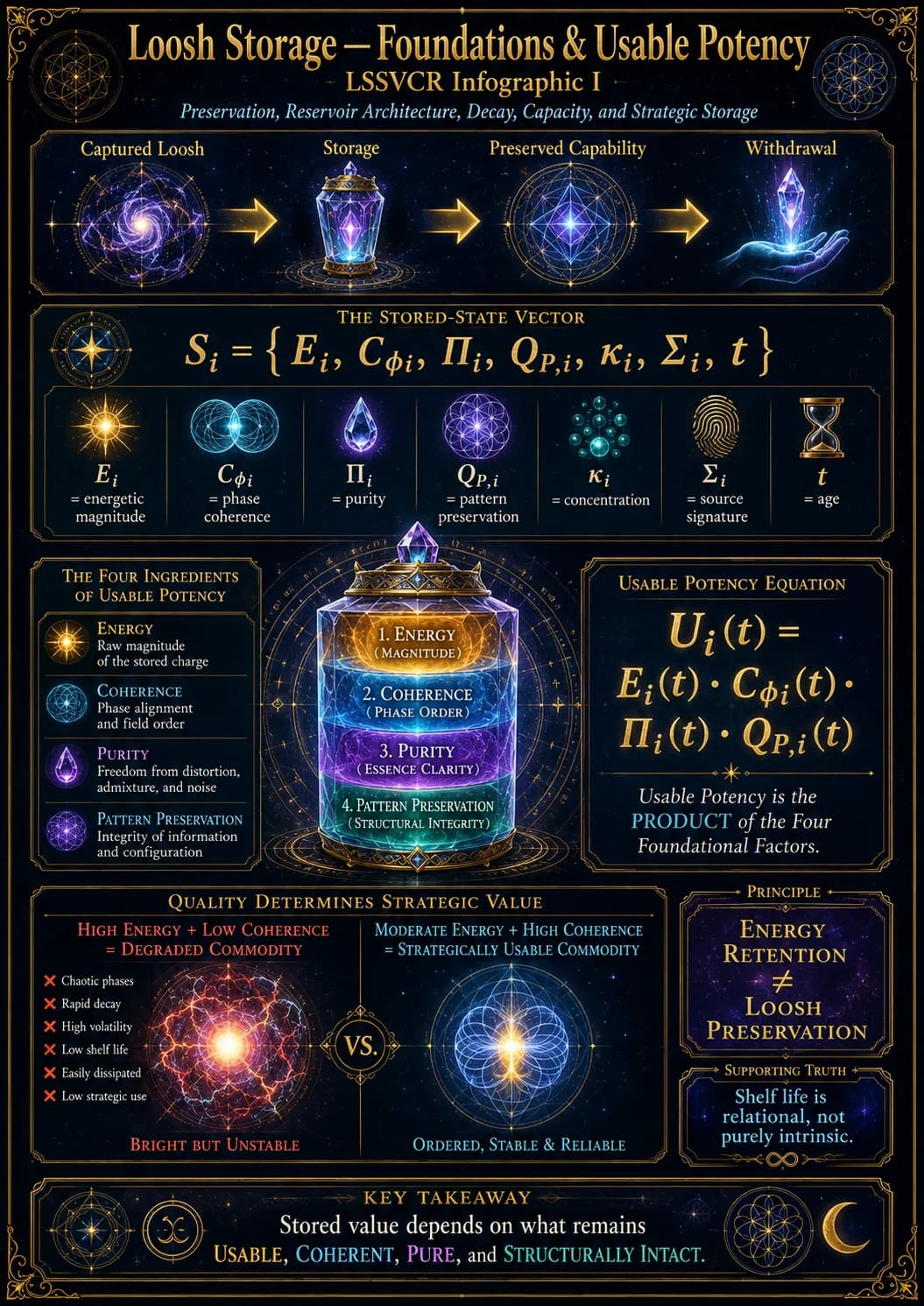
Loosh Storage, Shelf Life, and Vessel Compatibility
Loosh Storage, Shelf-Life & Vessel Compatibility Registry v0.1
LSSVCR — Preservation, Reservoir Architecture, Decay, Capacity, and Strategic Storage
1. Purpose
TheLoosh Storage, Shelf-Life & Vessel Compatibility Registry (LSSVCR)defines how captured and refined loosh behaves after production but before consumption.
The earlier registries established:
Generation → Compound Formation → Refinement → Reaction.
The Storage Registry addresses the next question:
What remains usable after generation, for how long, and inside what?
Storage is not a neutral pause in the loosh lifecycle.
A stored field continuously interacts with:
- its vessel;
- surrounding fields;
- contaminants;
- neighboring commodities;
- active stabilization systems;
- and its own internal coherence.
Therefore:
Shelf life is relational rather than purely intrinsic.
A loosh type does not possess one universal half-life.
Its usable lifetime depends upon:
Loosh × Vessel × Environment × Stabilization × Handling
2. Quick Reference
The storage architecture contains five major layers:
Intrinsic Persistence → Vessel Compatibility → Active Preservation → Reserve Function → Usable Inventory
The most important variables are:
| Symbol | Meaning |
|---|---|
| (E) | Raw energetic magnitude |
| (Cφ) | Phase coherence |
| (Π) | Purity |
| (QP) | Preservation of state-pattern information |
| (U) | Usable potency |
| (Λ) | Effective degradation rate |
| (t1/2) | Usable-potency half-life |
| (Kiv) | Loosh–vessel compatibility |
| (Civmax) | Effective storage capacity |
| (Miv) | Active vessel maintenance |
| (Λleak) | Leakage rate |
| (χ) | Contamination |
| (Iiv) | Isolation requirement |
| (Aiv) | Strategic accessibility |
| (Hiv) | Handling complexity |
| (Xiv) | Cross-reaction risk |
3. Stored Loosh Is a Multi-Layer State
A stored packet cannot be described by energy quantity alone.
Define the stored state:
Si = Ei, Cφ i, Πi, QP, i, κi, Σi, t
where:
- (Ei) = remaining energetic magnitude;
- (Cφ i) = phase coherence ;
- (Πi) = purity ;
- (QP,i) = preservation of the intended experiential/harmonic pattern;
- (κi) = energetic concentration ;
- (Σi) = source signature ;
- (t) = storage age.
A packet may retain considerable (E) while losing the structure that made it useful.
Therefore:
Energy retention ≠ loosh preservation.
4. Usable Potency
Define usable potency:
Ui(t) Ei(t) Cφ i(t) Πi(t) QP, i(t)
after normalizing each structural factor to:
0 ≤ Cφ, Π, QP ≤ 1.
This means a reservoir containing:
E=0.90
but:
Cφ = 0.30
may possess considerably less strategic value than its remaining raw energy suggests.
The useful market commodity is therefore:
U
rather than (E) alone.
5. The Four Primary Decay Channels
Storage degradation is divided into four independent processes.
SD-01 — Energetic Leakage
E(t) = E0e-λ_Et.
Raw magnitude leaves the containment system.
SD-02 — Phase Decoherence
Cφ(t) = Cφ0e-λ_Ct.
The energy remains, but synchronized harmonic organization degrades.
SD-03 — Purity Drift
Π(t) = Π0e-λ_Π t.
Contamination gradually alters the composition.
SD-04 — Pattern Degradation
QP(t) = QP0e-λ_Pt.
The defining state-information becomes less faithfully preserved.
6. Effective Shelf Life
If the four decay processes approximately multiply:
[U(t)
U0 e-Λ t ]
where:
Λ λE + λC + λΠ + λP
before vessel modifiers.
The usable-potency half-life is then:
t1/2 (ln 2)/(Λ).
This is the primary LSSVCR definition of shelf life:
U(t1/2) = (U0)/(2).
A product has reached its half-life whenhalf of its original usable field-state potency remains, not merely half of its electromagnetic magnitude.
7. Intrinsic Versus Effective Persistence
Every loosh family possesses an intrinsic persistence tendency:
τi0.
But practical storage depends on:
τiveff.
Therefore:
τi0 ≠ τiveff.
Love may possess high intrinsic coherence while having poor shelf life inside a fear-saturated vessel.
Fear may possess only moderate intrinsic persistence while lasting extremely well inside a highly fear-coherent reservoir.
This distinction is foundational.
8. Shelf-Life Bands
Absolute physical durations remain a calibration variable, so the registry uses relative shelf-life bands.
Let (TR) represent a future calibrated reference interval.
SL-0 — Transient
t1/2<0.25TR
Extremely short-lived.
SL-1 — Short
0.25TR ≤ t1/2<0.75TR
Requires rapid consumption or stabilization.
SL-2 — Moderate
0.75TR ≤ t1/2<1.5TR
Normal trade-range commodity.
SL-3 — Long
1.5TR ≤ t1/2<4TR
Suitable for reserves.
SL-4 — Strategic
4TR ≤ t1/2<10TR
Long-range warehousing.
SL-5 — Persistent Reserve
t1/2 ≥ 10TR
Potentially maintained for very long periods.
The absolute value of (TR) can later be calibrated without rebuilding the registry.
9. Major-Family Intrinsic Persistence
The following values areframework tuning indices, not empirical time measurements.
| Family | Intrinsic Persistence | Pattern Complexity | Mismatch Sensitivity | Preliminary Storage Character |
|---|---|---|---|---|
| Threat | 3 | 2 | 3 | Moderate; excellent in threat-tuned vessels |
| Aggression | 2 | 2 | 3 | Intense but naturally less persistent |
| Loss | 5 | 3 | 3 | Long-lived depletion basin |
| Submission | 4 | 3 | 3 | Stable once identity-linked |
| Aversion | 2 | 2 | 2 | Relatively simple, shorter-lived |
| Desire | 4 | 3 | 3 | Persistent attraction architecture |
| Pleasure | 2 | 3 | 3 | Powerful but freshness-sensitive |
| Status | 4 | 3 | 3 | Persistent when identity/rank encoded |
| Attachment | 5 | 4 | 4 | Very durable relational structure |
| Love | 5 | 5 | 5 | Highly coherent but vessel-sensitive |
| Hope | 4 | 4 | 4 | Durable if meaning structure survives |
| Awe | 3 | 5 | 4 | High information complexity |
| Creative | 3 | 5 | 5 | Information-rich and difficult to preserve |
| Peace | 5 | 4 | 5 | Extremely stable in compatible reservoirs |
| Shock | 1 | 2 | 2 | Primarily a transient catalytic state |
10. Vessel State Vector
A storage vessel is represented by:
Vv = Cn, CI, Σv, Cvmax, Mv, Lv, Pv, Av, Iv
where:
- (Cn) = vessel narrow-band coherence;
- (CI) = vessel integrative coherence;
- (Σv) = native harmonic signature ;
- (Cvmax) = maximum raw capacity ;
- (Mv) = active maintenance capability;
- (Lv) = leakage resistance;
- (Pv) = plasticity/imprintability;
- (Av) = withdrawal accessibility;
- (Iv) = isolation capability.
A vessel therefore functions as part of the stored state rather than a neutral boundary around it.
11. Loosh–Vessel Compatibility
Define:
Kiv ∈ [-3, + 3]
where:
- (+3) = exceptional resonance;
- (+2) = strong compatibility;
- (+1) = mild compatibility;
- (0) = neutral containment;
- (-1) = competitive mismatch;
- (-2) = strong antagonism;
- (-3) = severe quenching/transformation risk.
Normalized:
kiv = (Kiv)/(3).
A highly compatible vessel can:
- reduce phase loss;
- reduce leakage;
- preserve pattern information;
- increase effective capacity;
- reduce handling cost.
A strongly incompatible vessel may:
- accelerate decay;
- contaminate the stored field;
- experience retuning;
- trigger cross-reactions;
- require isolation.
12. Effective Degradation Rate
The vessel modifies intrinsic decay:
Λiveff Λi0 + α(1-kiv) + βχv + γ Lv + δ Xv Miv.
where:
- (Λi0) = intrinsic decay ;
- (α(1-kiv)) = mismatch penalty ;
- (χv) = contamination ;
- (Lv) = leakage contribution;
- (Xv) = cross-reaction pressure;
- (Miv) = active preservation.
Then:
t1/2, i, v (ln2)/(Λiveff).
If:
Miv ≈ Λi0 + loss terms,
then:
Λiveff ≈ 0.
Stored potency becomes effectively stationary.
13. Active Preservation
Passive storage attempts merely to slow degradation.
Active storage continuously restores organization.
Define:
Miv = ME + MC + MP + MΠ
where active systems can maintain:
- energetic magnitude;
- phase coherence;
- pattern structure;
- purity.
This creates the distinction:
Passive Reservoir ≠ Living/Active Reservoir.
14. Vessel Implementation Classes
Harmonic tuning and physical implementation are separate dimensions.
A love-compatible reservoir could theoretically be technological, environmental, or living.
VES-01 — Passive Containment Vessel
Stores field energy without active correction.
Strengths
- simple;
- scalable;
- predictable.
Weaknesses
- continuous decay;
- poor handling of complex states;
- limited phase preservation.
Best suited to:
simple, stable, high-volume products.
VES-02 — Resonant Tuned Vault
The vessel itself is tuned toward one or more target harmonics.
Effect
Kiv↑.
Strengths
- improved shelf life;
- reduced leakage;
- better concentration retention.
Weakness
Poor flexibility.
A fear-tuned vault may be very poor at storing peace.
VES-03 — Active Feedback Reservoir
Uses continuous feedback to correct phase drift and leakage.
Function
Cφ → Cφ0.
Strengths
- long shelf life;
- adjustable;
- high-grade storage.
Weaknesses
- energy cost;
- technological complexity;
- failure sensitivity.
VES-04 — Environmental Field Reservoir
Stores loosh in a planetary, regional, architectural, or larger environmental field.
Strengths
- enormous potential scale;
- distributed storage;
- difficult to exhaust through one point.
Weaknesses
- low precision;
- contamination;
- difficult withdrawal control;
- environmental imprinting.
VES-05 — Living Reservoir
A living energetic system actively preserves stored state.
Function
(dU)/(dt) = -Λ U + MivU.
Strengths
- active coherence maintenance;
- adaptive stabilization;
- potentially enormous effective shelf life.
Weaknesses
- bidirectional imprinting;
- finite tolerance;
- autonomous field influence;
- compatibility constraints.
Nonconsensual use of a living being as storage constitutes an extraction architecture within the broader UTS model.
VES-06 — Distributed Living Lattice
Many living reservoirs jointly store one state.
Stotal = ∑n = 1NSn.
Strengths
- redundancy;
- distributed failure resistance;
- massive active capacity.
Weaknesses
- synchronization requirement;
- network contamination;
- cascading instability.
VES-07 — Portal-Coupled Distributed Reservoir
Storage is geographically or dimensionally separated while remaining transfer-linked.
Strengths
- strategic dispersal;
- short effective transfer path;
- compartmentalization.
Weaknesses
- gateway dependency;
- transfer leakage;
- routing vulnerability.
VES-08 — Hybrid Isolation Vault
A compatible reservoir is isolated inside an incompatible larger architecture.
Example:
Fear-Based Infrastructure ⊃ Love-Compatible Living Reservoir.
Function
Preserve a commodity the surrounding civilization cannot safely hold directly.
This class is especially important for strategic love, peace, creative, and other integrative reserves inside a dark-control architecture.
15. Harmonic Vessel Profiles
Vessel implementation describeshowthe reservoir works.
Harmonic profile describeswhat it is tuned to hold.
HP-01 — Coercive / Dominance Profile
Primary coherence:
- Threat;
- Aggression;
- Submission;
- Status.
HP-02 — Depletion Profile
Primary coherence:
- Loss;
- despair-like compounds;
- submission;
- grief-related states.
HP-03 — Appetitive Profile
Primary coherence:
- Desire;
- Pleasure;
- reward loops.
HP-04 — Binding Profile
Primary coherence:
- Attachment;
- loyalty;
- Awe;
- devotion.
HP-05 — Integrative Profile
Primary coherence:
- Love;
- Compassion;
- Hope;
- reciprocal bonding.
HP-06 — Stabilizing Profile
Primary coherence:
- Peace;
- Serenity;
- Love;
- equilibrium states.
HP-07 — Generative Profile
Primary coherence:
- Creative;
- Hope;
- Awe;
- inspiration.
HP-08 — Broad-Spectrum Neutral Profile
Minimal intrinsic preference.
Useful for mixed logistics but provides little active harmonic support.
16. Major Family–Vessel Compatibility Matrix
Scores represent baseline storage resonance.
| Family | Coercive | Depletion | Appetitive | Binding | Integrative | Stabilizing | Generative | Neutral |
|---|---|---|---|---|---|---|---|---|
| Threat | +3 | +2 | 0 | +1 | −2 | −3 | −1 | 0 |
| Aggression | +3 | +1 | +1 | 0 | −1 | −2 | 0 | 0 |
| Loss | +1 | +3 | −1 | +2 | +2 | +1 | +1 | 0 |
| Submission | +3 | +2 | +1 | +2 | −2 | −1 | −2 | 0 |
| Aversion | +2 | +1 | −2 | −2 | −1 | +1 | 0 | 0 |
| Desire | +1 | +2 | +3 | +2 | +1 | −1 | +2 | 0 |
| Pleasure | +1 | −1 | +3 | +2 | +2 | +1 | +2 | 0 |
| Status | +3 | −1 | +2 | +2 | 0 | −1 | +1 | 0 |
| Attachment | +1 | +2 | +2 | +3 | +3 | +2 | +1 | 0 |
| Love | −2 | −1 | +1 | +2 | +3 | +3 | +3 | 0 |
| Hope | −1 | −1 | +1 | +1 | +3 | +2 | +3 | 0 |
| Awe | +2 | +1 | +1 | +3 | +2 | +2 | +3 | 0 |
| Creative | −1 | 0 | +2 | +1 | +2 | +1 | +3 | 0 |
| Peace | −3 | +1 | 0 | +1 | +3 | +3 | +2 | 0 |
| Shock | +2 | +1 | +1 | 0 | −1 | −2 | +1 | 0 |
17. Dark-Control Storage Bias
A dark-control architecture built primarily from coercive, depletion, appetitive, and dominance profiles possesses an infrastructure bias.
For native commodities:
Kiv ≫ 0.
This lowers:
Λeff.
Therefore it can easily accumulate:
- fear;
- aggression;
- despair/loss;
- submission;
- dominance/status;
- desire;
- pleasure.
This produces:
Native Storage Advantage
where existing infrastructure continually makes already-compatible commodities cheaper to warehouse.
18. Strategic Foreign-State Reserves
The same architecture may strongly desire commodities incompatible with its normal vessels.
Examples:
- Love;
- Peace;
- Hope;
- high-grade Creative output;
- integrative collective states.
These become:
Strategic Foreign-State Reserves.
They require:
- specialized reservoirs;
- greater isolation;
- higher handling cost;
- more careful transport;
- greater active maintenance.
Their scarcity can therefore arise fromstorage infrastructure scarcity rather than generation scarcity.
19. The Coherence Reserve Paradox
A coercive civilization may suppress widespread endogenous integrative coherence while still requiring integrative reserves to prevent its own fragmentation.
Thus:
Cn↑
around control states while:
CI↓.
Eventually:
Rsystem↓.
Strategic love or peace reserves may then be periodically injected:
Llove → CI↑.
But free circulation would reduce centralized dependency.
Therefore the architecture favors:
centralized coherence + restricted distribution.
Enough love exists to maintain the system.
Not enough circulates freely to eliminate reliance on the distributor.
20. Love-Compatible Living Reservoirs
A highly coherent living vessel may provide:
Klove, v ≈ + 3
and:
Mlove, v ≫ 0.
Such a reservoir becomes more than a container.
It functions as a:
Coherence Bank.
Possible strategic uses include:
Internal Incentive Reserve
Controlled doses distributed as high-grade rewards.
Internal Stabilization Reserve
Used to prevent fragmentation within the controlling civilization.
External Stabilization Reserve
Used to temporarily restore destabilized civilizations.
Trade Reserve
Used in high-value exchange.
Expansion Reserve
Used to create dependence following external pressure.
This makes coherent living reservoirs strategically important even within an architecture fundamentally organized around incompatible states.
21. Bidirectional Vessel Imprinting
Living and adaptive reservoirs continuously interact with stored content:
Li ↔ Vv.
The loosh changes the vessel.
The vessel changes the loosh.
Define vessel harmonic state:
Hv(t).
Then:
(dHv)/(dt) = ηI Li λv(Hv-Hv0).
Repeated storage can therefore increase future compatibility:
Kiv(t)↑.
This creates:
Storage Conditioning.
A fear reservoir becomes progressively better at holding fear.
A love reservoir becomes progressively more coherent with love.
22. Vessel Conversion Risk
Strong incompatible states can instead reconfigure a vessel.
Suppose:
Kiv<0
but:
Ui ≫ 0.
If the stored field exceeds the vessel's restoring capacity:
UiKivpressure = Rv,
then:
Hv → Hi.
The vessel begins changing toward the stored state.
This is particularly important for high-integrative commodities inside coercive infrastructure.
Thus the system may require:
Ilove, v↑.
Love storage can be strategically valuable while simultaneously representing animprinting hazard.
23. Isolation Requirement
Define:
Iiv = f(-Kiv, Ui, Cφ i, Ξi, Cv)
where higher values mean the stored commodity must be more strongly separated from the surrounding infrastructure.
Likely high-isolation combinations include:
Love inside Coercive Infrastructure
Peace inside Fear-Dominant Infrastructure
Creative Generativity inside Submission Architecture.
Isolation prevents both:
- the reservoir from being contaminated;
- the surrounding system from being retuned.
24. Effective Capacity
A vessel's raw size does not equal effective storage capacity.
Define:
Civeff Cvmax F(Kiv) F(Cφ) F(Sv).
Strong compatibility can raise usable capacity because the vessel does not expend as much structural effort resisting the stored field.
Strong mismatch reduces it.
Thus:
Cfear, coercive ≫ Clove, coercive.
The same physical reservoir may therefore have radically different effective capacity depending upon what it contains.
25. Saturation
As stored quantity approaches capacity:
Si → Civeff,
containment pressure rises.
Define saturation:
σiv (Si)/(Civeff).
Low Saturation
σ<0.5.
Stable.
Operational Saturation
0.5 ≤ σ<0.8.
Efficient utilization.
High Saturation
0.8 ≤ σ<1.
Leakage and instability increase.
Overcapacity
σ>1.
Possible:
- leakage;
- phase collapse;
- cross-reaction;
- vessel damage;
- uncontrolled emission.
26. Storage Pressure
Near capacity:
Λleak ∝ (σn)/(1-σ)
for:
σ<1.
Thus storage becomes increasingly inefficient near maximum capacity.
This introduces a practical reserve limit below theoretical capacity.
27. Loading Efficiency
Not all captured loosh successfully enters storage.
Define:
ηL (Ustored)/(Uarriving).
Loading efficiency depends upon:
- compatibility;
- phase alignment;
- concentration;
- vessel saturation;
- source signature;
- transfer method.
High mismatch can produce severe loading losses even if long-term storage would otherwise be possible.
28. Withdrawal Efficiency
Likewise:
ηW (Uusable withdrawn)/(Uremoved from reservoir).
A reservoir may preserve a state exceptionally well while being difficult to drain rapidly.
This creates a distinction between:
storage efficiency
and:
strategic accessibility.
A deep living reservoir might possess enormous capacity but low emergency withdrawal rate.
29. Strategic Accessibility
Define:
Aiv
as the fraction of the stored reserve that can be safely mobilized within a relevant operational interval.
Two reservoirs can therefore contain the same quantity:
SA = SB
while:
AA ≫ AB.
The first is a liquid strategic reserve.
The second is long-term capital.
30. Storage Reserve Roles
Storage exists for different strategic purposes.
SR-01 — Bulk Reserve
Purpose:
high-volume routine supply.
Likely commodities:
- fear;
- desire;
- aggression;
- loss.
SR-02 — Strategic Power Reserve
Held for:
- military operations;
- large field projection;
- emergencies;
- amplification.
Likely commodities:
- concentrated fear;
- aggression;
- dominance compounds.
SR-03 — Reward Reserve
Used as controlled incentives.
Likely commodities:
- pleasure;
- status;
- attachment;
- love.
SR-04 — Stabilization Reserve
Used to restore coherence.
Likely commodities:
- love;
- peace;
- hope;
- restorative blends.
SR-05 — Trade Reserve
Optimized for:
- portability;
- standardized purity;
- known shelf life;
- market exchange.
SR-06 — Expansion Reserve
Used to establish dependency or political leverage over other civilizations.
Likely commodities:
- love;
- peace;
- hope;
- attachment;
- pleasure.
SR-07 — Emergency Reserve
Held to prevent system collapse.
This may include commodities the civilization normally suppresses.
SR-08 — Catalytic Reserve
Small quantities of high-value catalysts stored because they unlock much larger reactions.
Examples:
- Hope;
- Awe;
- Agency-like compounds;
- stabilized Shock analogues;
- specialized restorative states.
31. Freshness Grades
A stored commodity is assigned a freshness grade according to:
q = (U(t))/(U0).
FG-0 — Fresh
q ≥ 0.90.
Near-original potency.
Premium grade.
FG-1 — Prime
0.75 ≤ q<0.90.
High-value strategic product.
FG-2 — Stable
0.50 ≤ q<0.75.
Fully usable but reduced potency.
FG-3 — Aged
0.25 ≤ q<0.50.
Significant degradation.
May require reconcentration or blending.
FG-4 — Degraded
0.10 ≤ q<0.25.
Low-grade commodity.
FG-5 — Residual
0<q<0.10.
Useful primarily for recycling, blending, or raw energetic recovery.
FG-6 — Spent
The defining state-pattern no longer has meaningful strategic utility.
32. Preliminary Shelf-Life by Family in Compatible Storage
| Family | Best-Case Band | Main Preservation Strength |
|---|---|---|
| Threat | SL-4 | Narrow-band resonance |
| Aggression | SL-3 | Force coherence |
| Loss | SL-5 | Deep basin persistence |
| Submission | SL-4/5 | Identity-linked stability |
| Aversion | SL-3 | Simple repulsive pattern |
| Desire | SL-4 | Persistent attractor |
| Pleasure | SL-3 | Strong pattern but freshness-sensitive |
| Status | SL-4 | Rank/identity encoding |
| Attachment | SL-5 | Strong relational memory |
| Love | SL-5 | Exceptional coherence in compatible vessels |
| Hope | SL-4 | Meaning-supported persistence |
| Awe | SL-4 | High coherence but complex pattern |
| Creative | SL-4 | Requires active information preservation |
| Peace | SL-5 | Very stable coherent basin |
| Shock | SL-1 | Intrinsically transitional |
These representoptimized storage, not ordinary environmental persistence.
33. Preliminary Shelf-Life in Coercive/Dark-Control Infrastructure
Without specialized compatible reservoirs:
| Family | Coercive-Infrastructure Band | Reason |
|---|---|---|
| Threat | SL-5 | Native storage resonance |
| Aggression | SL-4 | Strong compatibility |
| Loss | SL-4/5 | Many depletion-compatible reservoirs |
| Submission | SL-5 | Core architectural compatibility |
| Aversion | SL-3/4 | Moderate compatibility |
| Desire | SL-4 | Strong market infrastructure |
| Pleasure | SL-4 | Dedicated reward storage likely |
| Status | SL-5 | Native hierarchical coherence |
| Attachment | SL-4 | Useful for binding systems |
| Love | SL-1/2 | Severe generic mismatch |
| Hope | SL-1/2 | Destabilizes closed control basins |
| Awe | SL-4 | Useful for hierarchy and scale |
| Creative | SL-2 | Difficult under restrictive architecture |
| Peace | SL-1 | Strong antagonism with threat infrastructure |
| Shock | SL-1 | Naturally transient |
However:
specialized coherent living reservoirs can move Love and Peace from SL-1/2 to SL-5.
That shift explains their strategic importance.
34. Specialized Positive-State Reservoirs
A dark-control architecture wishing to preserve love, peace, or similar states requires separate infrastructure.
A conceptual configuration is:
Dark Network → Isolation Layer → Compatible Coherent Vessel → Positive-State Reserve.
Isolation prevents:
dark-field contamination
while also preventing:
positive-field leakage into the network.
This gives such reservoirs exceptionally high:
I
and:
H.
They are expensive but strategically indispensable.
35. Pressure–Dependency Storage Cycle
Strategic love reserves support the larger imperial flywheel:
External Pressure → Target Destabilization → Fear / Loss / Despair Generation → Harvest → Target Coherence Deficit → Demand for Love / Peace → Controlled Strategic Reserve Release → Temporary Stabilization → Dependency / Trade / Concessions.
The existence of love reserves therefore increases the strategic value of the entire coercive storage network.
36. Internal Incentive Storage Cycle
Internally:
Service → Reward Allocation → Pleasure / Love Access → Loyalty → Service.
This means reserve allocation functions as governance.
Control over storage becomes:
control over access to states of being.
37. Environmental Reservoir Dynamics
Environmental storage behaves differently from discrete vessels.
Let:
FE(x, t)
represent a regional field reservoir.
Then:
(∂ FE)/(∂ t) = D∇2FE + G(x, t) Λ FE H(x, t).
where:
- (D) = field diffusion;
- (G) = local generation;
- (Λ) = environmental decay ;
- (H) = harvesting.
This allows:
- hotspots;
- stagnant basins;
- resonant structures;
- repeated environmental imprinting;
- localized accumulation.
Architecture may influence boundary conditions and therefore concentration.
38. Distributed Reservoir Advantage
A distributed network possesses:
Ctotal = ∑vCv.
But its resilience also depends on distribution.
If one reservoir fails:
Δ Ctotal ≪ Ctotal
for a sufficiently distributed architecture.
This reduces catastrophic inventory loss.
However, distributed synchronization creates:
network coherence dependency.
If synchronization fails, the reserve can fragment into incompatible local states.
39. Storage Network Cascades
A large reservoir architecture can suffer cascading failure.
Example:
Primary Stabilizer Failure → Cφ↓
→ Λ↑
→ leakage
→ neighbor contamination
→ Kneighbor↓
→ additional failures.
Thus reserve security depends upon both inventory and network architecture.
40. Cross-Reaction Risk
Different commodities stored too closely can react.
Define:
Xij Iij Pcontact
where (Iij) is reaction strength and (Pcontact) is probability of meaningful field interaction.
High-risk combinations include:
Fear ↔ Peace
Aggression ↔ Peace
Aversion ↔ Love.
This creates a need forenergetic compartmentalization.
41. Commodity Segregation
Storage networks should therefore separate commodities by:
- harmonic compatibility;
- reaction risk;
- source signature;
- purity;
- concentration;
- strategic function.
A mature architecture would resemble:
Energetic Silos.
Examples:
- Fear Reserve;
- Dominance Reserve;
- Appetitive Reserve;
- Binding Reserve;
- Love Reserve;
- Peace Reserve;
- Creative Reserve.
The entire inventory should not share one field environment.
42. Contamination
Contamination can arise from:
- vessel residue;
- previous contents;
- neighboring reservoirs;
- environmental fields;
- transfer routes;
- living-vessel imprint.
Define:
χ = 1-Π.
As:
χ↑,
predictability falls.
A high-energy contaminated product may therefore command less strategic value than a smaller but highly pure reserve.
43. Reservoir Memory
Storage vessels can retain traces of previous contents:
Mvresidual>0.
Loading a new commodity then produces:
Lnew + Mvresidual → Lmodified.
This makes vessel history economically important.
Reservoirs may need:
- clearing;
- retuning;
- quarantining;
- or dedicated lifetime assignments.
44. Dedicated Versus General-Purpose Storage
Dedicated Reservoir
Optimized for one family.
Advantages:
K↑, t1/2↑.
Disadvantage:
low flexibility.
General-Purpose Reservoir
Moderate performance across many families.
Advantages:
- logistical flexibility;
- emergency utility.
Disadvantages:
- lower shelf life;
- contamination risk;
- greater active stabilization demand.
A mature loosh economy would likely use both.
45. Storage Conversion
Some degraded product may be recoverable.
If:
E>0
but:
QP ≪ 1,
the raw energy may be:
- re-refined;
- blended;
- repatterned;
- used as a carrier;
- or converted into lower-grade commodities.
Thus spoilage does not necessarily imply complete economic loss.
46. Storage Carrying Cost
Every commodity generates a storage burden:
Ccarry, i Cmaintenance + Cisolation + Closs + Csecurity + Chandling.
Compatible bulk commodities may have extremely low carrying costs.
Incompatible strategic commodities may have very high carrying costs.
This will become a central market variable later.
47. Storage-Adjusted Supply
Generation rate alone does not determine available supply.
If generation is:
Gi,
and effective decay is:
Λi,
then absent capacity limits:
Si≈ (Gi)/(Λi).**
Including capacity:
[ Simin ((Gi)/(Λiveff), Citotal). ]**
This is one of the most important equations for the coming market framework.
48. Storage Scarcity
A commodity can be frequently generated and still remain scarce if:
Λi ≫ 0
or:
Cicompatible ≪ Gi.
Therefore:
Production abundance ≠ inventory abundance.
This is likely central to premium love, creative, awe, peace, and other high-complexity markets.
49. Storage Monopoly
If one architecture controls most compatible storage for a commodity:
(Ci, controller)/(Citotal) → 1,
then it can dominate:
- availability;
- freshness;
- release timing;
- emergency supply;
- strategic pricing;
- political leverage.
Thus:
storage monopoly ≈ commodity monopoly.
For short-lived products, storage control may matter even more than production control.
50. Reservoir Liberation Effect
If specialized living reservoirs are removed from a coercive architecture:
Citotal↓.
For difficult-to-store commodities:
Λnetwork↑
because remaining vessels are less compatible.
The architecture then faces:
- increasing spoilage;
- shrinking strategic reserves;
- reduced incentive capacity;
- lower stabilization leverage;
- reduced trade capability.
Thus reservoir liberation can affect the entire supply network rather than only the local stored quantity.
51. Major Storage Failure Modes
SF-01 — Leakage
Stored magnitude escapes containment.
SF-02 — Phase Collapse
Energy remains but organized state potency disappears.
SF-03 — Pattern Drift
The intended emotional signature gradually changes.
SF-04 — Contamination
Foreign harmonics reduce purity.
SF-05 — Saturation Failure
The vessel exceeds safe operating capacity.
SF-06 — Cross-Reaction
Separate reserves form unintended compounds.
SF-07 — Reservoir Imprinting
The stored commodity changes the vessel.
SF-08 — Vessel Contamination
The vessel changes the commodity.
SF-09 — Isolation Failure
Incompatible surroundings interact with a strategic reserve.
SF-10 — Withdrawal Shock
Rapid draining destabilizes either reservoir or stored field.
SF-11 — Stabilizer Failure
Active maintenance stops.
Λeff↑↑.
SF-12 — Network Cascade
One storage failure destabilizes connected reservoirs.
52. Storage Security Classes
SC-0 — Ambient
No dedicated containment.
SC-1 — Basic
Passive vessel.
SC-2 — Tuned
Harmonic resonance support.
SC-3 — Active
Continuous stabilization.
SC-4 — Strategic
Active stabilization + isolation + security.
SC-5 — Sovereign Reserve
Highly protected, redundant, compartmentalized storage.
SC-6 — Living Strategic Reserve
Actively maintained living or collective reservoir with extreme persistence potential.
53. Living Reservoir Principle
Living reservoirs deserve their own governing equation:
(dUi)/(dt) Ii + Gv, i + Mv, i Wi Λi, vUi.
where:
- (Ii) = incoming stored loosh;
- (Gv,i) = vessel's own generation of compatible state;
- (Mv,i) = active maintenance;
- (Wi) = withdrawal;
- (Λi, v) = effective decay.
A compatible living reservoir may therefore do more than preserve supply.
It may:
maintain + repair + regenerate.
This makes living reservoirs qualitatively different from passive containers.
54. Preservation Versus Generation
A critical distinction:
Mv, i ≠ Gv, i.
Preservation
Maintains existing loosh.
Generation
Creates additional loosh.
A coherent loving vessel may potentially do both:
Mlove>0
and:
Glove>0.
Such a reservoir would be strategically more valuable than a passive store because it behaves partially like aproductive reserve.
55. Self-Replenishing Reserves
If:
Gv, i = Wi + Λ Ui,
then:
(dUi)/(dt)>0
even without external input.
This creates a:
Self-Replenishing Reserve.
Such reservoirs would represent some of the highest-value infrastructure in the entire model.
56. Strategic Storage Hierarchy
The framework now suggests four increasingly powerful forms of storage:
Level I — Passive Preservation
Hold what was collected.
Level II — Resonant Preservation
Hold it longer.
Level III — Active Preservation
Repair what would decay.
Level IV — Regenerative Reservoir
Preserve and recreate the stored state.
The final level is not simply storage.
It is energetic productive capital.
57. Dark-Control Reserve Architecture
Within the scenario we have been developing, a mature dark-control storage architecture could therefore contain:
High-Volume Native Reserves
- Fear;
- Aggression;
- Loss/Despair;
- Submission;
- Desire;
- Dominance.
Reward Reserves
- Pleasure;
- Status;
- Attachment;
- selected Love.
Premium Foreign-State Reserves
- Love;
- Peace;
- Hope;
- Creative;
- restorative blends.
Living Strategic Reservoirs
Used for states the normal architecture cannot preserve efficiently.
Distributed Environmental Collection
Provides bulk feedstock.
Portal-Linked Transport
Connects harvest zones to refinement and storage.
This produces a complete reserve ecology rather than one universal warehouse.
58. Storage as Political Architecture
Control over reservoirs determines who receives:
- power;
- reward;
- stabilization;
- protection;
- emotional access;
- strategic recovery.
Thus:
storage is governance infrastructure.
A civilization that controls production but cannot store it has weak long-term leverage.
A civilization that controls storage can determinewhen value exists in usable form.
59. Restoration Architecture
A regenerative storage system would invert several dark-control principles.
Instead of:
centralized dependency,
it would increase:
Ginternal.
Instead of:
coherence monopoly,
it would distribute restoration capacity.
Instead of:
living imprisonment,
living reservoirs would operate through consent and reciprocal exchange.
Instead of:
strategic scarcity,
the objective would be:
increase local regenerative capacity until external reserves become optional.
60. Market Handoff Variables
The Storage Registry now provides the variables required for market dynamics.
For every commodity (i), the market model can inherit:
Generation Rate
Gi
Effective Inventory
Si
Half-Life
t1/2, i
Compatible Capacity
Cicompatible
Freshness
qi
Carrying Cost
Ccarry, i
Strategic Accessibility
Ai
Loading Efficiency
ηL, i
Withdrawal Efficiency
ηW, i
Storage Monopoly
Mistorage
Isolation Requirement
Ii
Active Maintenance Requirement
Mi
Reserve Role
SRi.
Market price can therefore finally distinguish:
what is produced
from:
what can actually reach a buyer in usable form.
61. Master Storage Principles
Principle I — Shelf Life Is Relational
t1/2 = f(commodity, vessel, environment).
Principle II — Usable Potency Matters More Than Raw Energy
U = E, Cφ, Π, QP.
Principle III — Compatible Vessels Extend Shelf Life
Resonance lowers effective degradation.
Principle IV — Incompatible Vessels Can Transform Their Contents
Storage is itself a reaction.
Principle V — Living Reservoirs Can Actively Preserve State Information
They may behave as adaptive coherence-maintenance systems.
Principle VI — Living Reservoirs Can Also Be Changed by What They Hold
Li ↔ Vv.
Principle VII — Storage Capacity Is Commodity-Specific
Civeff ≠ Cvmax.
Principle VIII — Intrinsic Coherence Does Not Guarantee Infrastructure Compatibility
Love and peace may be highly stable states but difficult to warehouse inside coercive infrastructure.
Principle IX — Scarce Storage Can Create Scarce Supply
abundant generation: + poor storage scarce inventory.
Principle X — Strategic Reserves Need Not Match a Civilization's Native State
A coercive architecture can have powerful incentives to monopolize highly integrative commodities.
Principle XI — Storage Infrastructure Creates Path Dependence
Civilizations become increasingly optimized around the states they already know how to preserve.
Principle XII — Storage Monopoly Produces Political Leverage
The controller of the reservoir can control:
timing + availability + freshness + distribution.
62. Central Principle
The previous registries established:
what loosh is,
how its families combine,
how it is refined,
and:
how different states react.
The Storage Registry adds the missing temporal dimension:
How long can capability remain available?
The key relationship is:
Generation ≠ Supply.
Actual strategic supply is:
Generation × Preservation × Capacity × Accessibility.
And the deepest storage principle is:
A civilization does not truly control an energetic commodity merely because it can harvest it ; it controls the commodity when it can preserve, concentrate, protect, and release it at will.