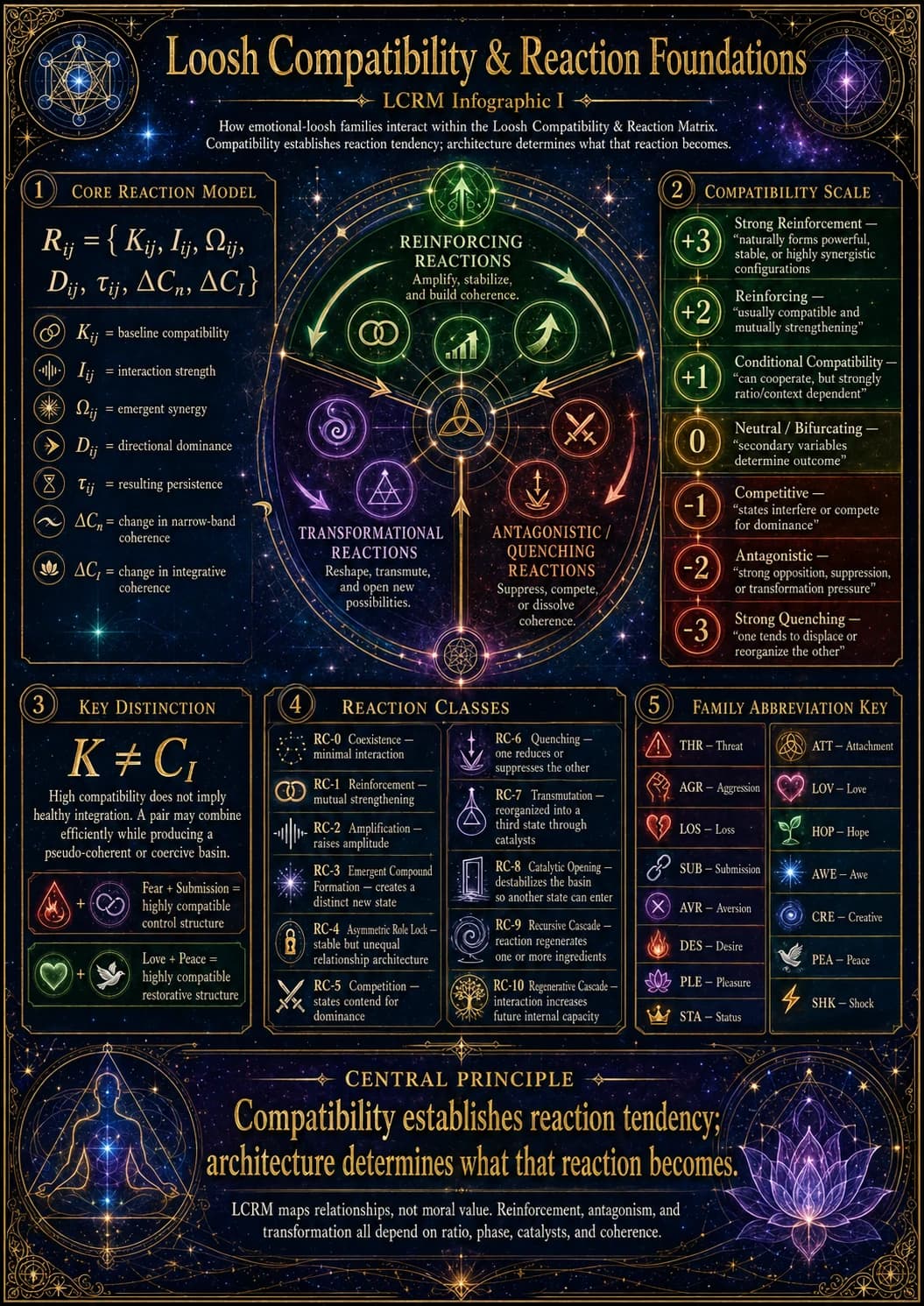
Loosh Compatibility and Reaction Matrix
Loosh Compatibility & Reaction Matrix v0.1
LCRM — Pairwise Compatibility, Reaction Pathways, Catalysis, and Field Transformation
1. Purpose
TheLoosh Compatibility & Reaction Matrix (LCRM)defines how the major emotional-loosh families interact when they occupy the same field, container, recipient, collective, or engineered blend.
The preceding registries established:
Emotional Families → Compounds → Refinement and Blending.
The LCRM adds the missing interaction layer:
What happens when energetic families actually meet?
The answer depends on more than whether two states appear similar or opposed.
A reaction depends upon:
- intrinsic compatibility;
- energetic ratio;
- concentration;
- phase relationship;
- narrow-band coherence;
- integrative coherence;
- source signatures;
- catalysts;
- buffers;
- environmental conditions;
- boundary integrity;
- and duration.
Therefore:
Compatibility does not determine outcome by itself.
It establishes thebaseline reaction tendencyfrom which the actual interaction develops.
2. Core Reaction Model
For two energetic families (i) and (j):
Li + Lj → Rij.
The resulting reaction state is represented as:
Rij = Kij, Iij, Ωij, Dij, τij, Δ Cn, Δ CI
where:
- (Kij) = baseline compatibility;
- (Iij) = interaction strength;
- (Ωij) = emergent synergy ;
- (Dij) = directional dominance;
- (τij) = resulting persistence ;
- (Δ Cn) = change in narrow-band coherence ;
- (Δ CI) = change in integrative coherence.
3. Compatibility Scale
The registry uses a seven-point baseline compatibility scale:
| Score | Class | Meaning |
|---|---|---|
| +3 | Strong Reinforcement | Naturally forms powerful, stable, or highly synergistic configurations |
| +2 | Reinforcing | Usually compatible and mutually strengthening |
| +1 | Conditional Compatibility | Can cooperate, but strongly ratio/context dependent |
| 0 | Neutral / Bifurcating | No dominant intrinsic tendency; secondary variables determine outcome |
| −1 | Competitive | States tend to interfere or compete for dominance |
| −2 | Antagonistic | Strong opposition, suppression, or transformation pressure |
| −3 | Strong Quenching | Direct simultaneous dominance is difficult; one tends to displace or reorganize the other |
The score is represented as:
Kij ∈ [-3, + 3].
For calculation:
kij = (Kij)/(3)
so:
-1 ≤ kij ≤ 1.
4. Important Distinction: Compatibility Is Not Moral Alignment
A high compatibility score means two states combine efficiently.
It doesnotmean that the resulting compound is integratively coherent.
For example:
KFear, Submission = + 3
because fear and submission form a highly stable control configuration.
Likewise:
KLove, Peace = + 3
because love and peace strongly reinforce integrative coherence.
Both are highly compatible.
Their architectures are radically different.
Thus:
K ≠ CI.
5. Reaction Classes
Compatibility determines tendency, while reaction class describeswhat the interaction actually does.
RC-0 — Coexistence
The components occupy the same system with minimal interaction.
LA + LB ≈ LA|LB.
RC-1 — Reinforcement
Each component strengthens the persistence or expression of the other.
LA + LB → LAB
with:
Ω>1.
RC-2 — Amplification
Interaction raises the amplitude of one or both components.
Aout = Ain.
Example:
Fear + Aggression.
RC-3 — Emergent Compound Formation
The interaction creates a distinct field-state with new properties.
LA + LB → LC
where:
LC ≠ LA + LB.
RC-4 — Asymmetric Role Lock
The states reinforce a relationship while producing different effects in different participants.
Example:
Status ↔ Submission.
The pair is highly compatible as asystem, although the two positions are not energetically equivalent.
RC-5 — Competition
Both states attempt to occupy the same field architecture.
LA ⇄ LB.
The stronger state gradually suppresses the weaker.
RC-6 — Quenching
One state actively reduces the amplitude or coherence of another.
LA + LB → LA↓
or:
LB↓.
RC-7 — Transmutation
An antagonistic pair reorganizes into a third state through sufficient catalysts.
LA + LB + C → LC.
Example:
Fear + Peace + Agency → Courage.
RC-8 — Catalytic Opening
One state destabilizes the existing basin so another state can enter.
Shock is the primary example:
Shock → Sopen → Li.
RC-9 — Recursive Cascade
The reaction produces conditions that regenerate one or more of its components.
LA + LB → GA' + GB'.
Examples include:
- fear/aggression escalation;
- desire/pleasure addiction;
- attachment/fear possessiveness.
RC-10 — Regenerative Cascade
Interaction increases future internal capacity rather than dependency.
Examples:
Love + Hope
Hope + Creative
Love + Peace.
6. Family Abbreviations
| Code | Family |
|---|---|
| THR | Threat |
| AGR | Aggression |
| LOS | Loss |
| SUB | Submission |
| AVR | Aversion |
| DES | Desire |
| PLE | Pleasure |
| STA | Status |
| ATT | Attachment |
| LOV | Love |
| HOP | Hope |
| AWE | Awe |
| CRE | Creative |
| PEA | Peace |
| SHK | Shock |
7. Primary Compatibility Matrix
The following table represents thebaseline pair compatibilitybefore catalysts, ratio effects, phase differences, or environmental modifiers are applied.
| Column 1 | THR | AGR | LOS | SUB | AVR | DES | PLE | STA | ATT | LOV | HOP | AWE | CRE | PEA | SHK |
|---|---|---|---|---|---|---|---|---|---|---|---|---|---|---|---|
| THR | +3 | +2 | +1 | +3 | +2 | +1 | 0 | +2 | +2 | −2 | −1 | +2 | −1 | −3 | +3 |
| AGR | +2 | +3 | +2 | +1 | +2 | +1 | +1 | +3 | +1 | 0 | +1 | +1 | +1 | −2 | +2 |
| LOS | +1 | +2 | +3 | +2 | +1 | +2 | −1 | −1 | +3 | +3 | +1 | +2 | +1 | +2 | +2 |
| SUB | +3 | +1 | +2 | +3 | +1 | +1 | +2 | +3 | +3 | −1 | −1 | +3 | −2 | −1 | +2 |
| AVR | +2 | +2 | +1 | +1 | +3 | −2 | −1 | +1 | −2 | −2 | −1 | 0 | +1 | +1 | +1 |
| DES | +1 | +1 | +2 | +1 | −2 | +3 | +3 | +3 | +3 | +2 | +2 | +1 | +3 | −1 | +1 |
| PLE | 0 | +1 | −1 | +2 | −1 | +3 | +3 | +2 | +3 | +3 | +2 | +3 | +3 | +2 | +1 |
| STA | +2 | +3 | −1 | +3 | +1 | +3 | +2 | +3 | +2 | +1 | +2 | +2 | +1 | −1 | +1 |
| ATT | +2 | +1 | +3 | +3 | −2 | +3 | +3 | +2 | +3 | +3 | +2 | +3 | +2 | +2 | +1 |
| LOV | −2 | 0 | +3 | −1 | −2 | +2 | +3 | +1 | +3 | +3 | +3 | +3 | +3 | +3 | 0 |
| HOP | −1 | +1 | +1 | −1 | −1 | +2 | +2 | +2 | +2 | +3 | +3 | +2 | +3 | +2 | +1 |
| AWE | +2 | +1 | +2 | +3 | 0 | +1 | +3 | +2 | +3 | +3 | +2 | +3 | +3 | +3 | +2 |
| CRE | −1 | +1 | +1 | −2 | +1 | +3 | +3 | +1 | +2 | +3 | +3 | +3 | +3 | +2 | +2 |
| PEA | −3 | −2 | +2 | −1 | +1 | −1 | +2 | −1 | +2 | +3 | +2 | +3 | +2 | +3 | −2 |
| SHK | +3 | +2 | +2 | +2 | +1 | +1 | +1 | +1 | +1 | 0 | +1 | +2 | +2 | −2 | +3 |
8. How to Read the Matrix
The matrix issymmetric at the intrinsic compatibility layer:
Kij = Kji.
But actual reaction behavior may be asymmetric:
Rij ≠ Rji
when:
- one component is much more concentrated;
- one participant possesses greater field gain;
- one state is externally projected;
- one state is internally generated;
- or the interaction occupies an asymmetric hierarchy.
For example:
KStatus, Submission = + 3.
But the resulting architecture can produce:
Dstatus↑
while:
Dsubmission↓.
The compatibility belongs to therelationship, not necessarily to identical effects on both sides.
9. Interaction Strength
Compatibility determines direction.
Concentration and coherence determine magnitude.
A provisional interaction-strength function is:
Iij √(EiEj) ; Cφ iCφ j ; |kij|
where:
- (Ei,Ej) = energetic magnitude;
- (Cφ i, Cφ j) = phase coherence ;
- (kij) = normalized compatibility.
A highly compatible pair with very little energy may produce little effect.
A moderately compatible pair at extreme concentration may produce a powerful reaction.
10. Phase Modifier
Relative phase influences whether compatible components actually reinforce.
Define:
Pij = cos(Δφij).
Then:
Pij ≈ + 1
indicates phase alignment,
while:
Pij ≈ -1
indicates phase opposition.
The effective compatibility can therefore shift:
Kijeff = clip [ kijPij + MC + MR + ME, , -1, + 1 ]
where:
- (MC) = catalyst modifier;
- (MR) = ratio modifier;
- (ME) = environmental modifier.
Thus even naturally reinforcing states can fail to combine if their phase organization is incompatible.
11. Ratio Regimes
For two components:
rij = (Ei)/(Ej).
Three broad regimes exist.
A-Dominant
rij ≫ 1.
State (A) absorbs or conditions the expression of (B).
Reaction Window
rij ≈ 1
or falls within the specific compound's compatible ratio range.
This is where emergent compounds are most likely.
B-Dominant
rij ≪ 1.
State (B) determines the resulting architecture.
This creates the rule:
The same ingredients can generate different states at different ratios.
12. Canonical Reinforcing Reactions
LCRM-R001 — Threat + Aggression
THR + AGR
Compatibility
K=+2.
Primary Reactions
RC-2 Amplification
RC-3 Compound Formation
RC-9 Recursive Cascade
Outputs
Possible outputs include:
- defensive aggression;
- terror-dominance;
- panic violence;
- intimidation fields.
Recursive Architecture
Fear → Aggression → Fear in others → more fear.
This is one of the most strategically valuable coercive reactions.
LCRM-R002 — Threat + Submission
THR + SUB
Compatibility
K=+3.
Primary Reaction
RC-4 Asymmetric Role Lock.
Output
Coercive Submission.
Fear weakens projection while submission stabilizes the resulting hierarchy.
Strategic Function
Extremely efficient control architecture.
LCRM-R003 — Threat + Awe
THR + AWE
Compatibility
K=+2.
Output
Dread
when awe is dominated by power asymmetry.
The target experiences both:
magnitude
and:
danger.
LCRM-R004 — Threat + Shock
THR + SHK
Compatibility
K=+3.
Reaction
RC-8 followed by RC-2.
Shock opens the state.
Fear occupies it.
Shock → Sopen → Fear.
At sufficient amplitude:
Shock + Fear → Panic/Terror.
LCRM-R005 — Aggression + Status
AGR + STA
Compatibility
K=+3.
Output
Dominance.
Aggression provides force.
Status provides rank organization.
Together they generate command pressure.
LCRM-R006 — Aggression + Loss
AGR + LOS
Compatibility
K=+2.
Common Outputs
Resentment
or, when memory and reversal-desire are added:
Vengeance.
Loss gives aggression persistence.
LCRM-R007 — Loss + Attachment
LOS + ATT
Compatibility
K=+3.
Output
Grief.
The strength of loss output is strongly related to the depth of the severed bond.
This reaction explains why grief can possess both:
B↑
and:
τ↑.
LCRM-R008 — Loss + Love
LOS + LOV
Compatibility
K=+3.
Possible Output
Sacred Mourning
when love remains dominant.
Instead of creating a closed depletion basin:
Loss + Love → Meaning + Integration.
This is a regenerative reaction.
LCRM-R009 — Desire + Pleasure
DES + PLE
Compatibility
K=+3.
This pair is among the most economically important in the matrix.
Regenerative Expression
Desire → Reward → Completion.
Extractive Expression
When deficit is continually restored:
Desire → Pleasure → Deficit → Desire.
This becomes:
[ Addiction Architecture ].
Thus the pair's strategic function depends heavily upontermination conditions.
LCRM-R010 — Desire + Status
DES + STA
Compatibility
K=+3.
Output
Aspiration
or:
Status Craving
depending upon integrative coherence.
This reaction creates extremely strong market demand because comparative rank becomes the object of desire.
LCRM-R011 — Desire + Attachment
DES + ATT
Compatibility
K=+3.
Possible Outputs
- longing;
- romantic attachment;
- possessiveness;
- relational obsession.
Fear acts as an important modifier.
Low fear:
Desire + Attachment → Bond Seeking.
High fear:
Desire + Attachment + Fear → Possessiveness.
LCRM-R012 — Desire + Creative
DES + CRE
Compatibility
K=+3.
Output
Directed creative drive.
Add love and pleasure:
Desire + Creative + Love + Pleasure → Creative Passion.
This forms a powerful regenerative production loop.
LCRM-R013 — Pleasure + Attachment
PLE + ATT
Compatibility
K=+3.
Output
Reward Bonding.
If reward access becomes externally controlled:
Reward Bonding → Dependency.
If reciprocity remains high:
Reward Bonding → Relational Reinforcement.
LCRM-R014 — Pleasure + Awe
PLE + AWE
Compatibility
K=+3.
Output
High-intensity ecstatic states.
Add love and attachment:
Pleasure + Awe + Love + Attachment → Ecstatic Communion.
LCRM-R015 — Status + Submission
STA + SUB
Compatibility
K=+3.
Reaction Class
RC-4 Asymmetric Role Lock.
This is a foundational hierarchy reaction:
StatusA↑
while:
SubmissionB↑.
The relationship becomes self-reinforcing.
LCRM-R016 — Attachment + Love
ATT + LOV
Compatibility
K=+3.
High-Integration Expression
Non-Coercive Bonding.
Low-Integration Expression
With fear or low boundary integrity:
Attachment + Love + Fear → Dependency/Possessiveness.
Thus the decisive variable is:
BΣ.
LCRM-R017 — Attachment + Awe
ATT + AWE
Compatibility
K=+3.
Possible Outputs
With love and sovereignty:
Devotion.
With submission and hierarchy:
Fanaticism.
This is one of the clearestbifurcation reactionsin the matrix.
LCRM-R018 — Love + Hope
LOV + HOP
Compatibility
K=+3.
Output
Restorative Renewal.
Love restores relational coherence.
Hope restores future possibility.
Recursion Type
RC-10 Regenerative Cascade.
LCRM-R019 — Love + Awe
LOV + AWE
Compatibility
K=+3.
Possible Outputs
- reverence;
- devotion;
- sacred communion;
- civilization-scale synchronization.
Add peace:
Love + Awe + Peace → Reverence.
LCRM-R020 — Love + Creative
LOV + CRE
Compatibility
K=+3.
Output
Highly generative creation.
Possible expressions include:
- art;
- relational creation;
- restorative invention;
- symbolic generation;
- beauty-making.
Add desire:
→ Creative Passion.
LCRM-R021 — Love + Peace
LOV + PEA
Compatibility
K=+3.
Output
Restorative Coherence.
With stable meaning:
→ Serenity.
This reaction possesses very high:
CI.
LCRM-R022 — Hope + Creative
HOP + CRE
Compatibility
K=+3.
Output
Innovation.
Hope provides future orientation.
Creativity provides novel pathways.
The loop becomes:
Possibility → Creation → Visible Possibility → More Hope.
LCRM-R023 — Awe + Creative
AWE + CRE
Compatibility
K=+3.
Output
Visionary Creation.
Awe expands perceived scale.
Creativity gives that expanded scale form.
LCRM-R024 — Awe + Peace
AWE + PEA
Compatibility
K=+3.
Output
Receptive sacred-state coherence.
Add love:
→ Reverence.
13. Major Antagonistic Reactions
LCRM-A001 — Threat + Peace
K=-3.
This is the strongest direct opposition in the initial matrix.
Fear tends toward:
threat vigilance + contraction
while peace tends toward:
stability + low noise.
Direct Reaction
RC-6 Quenching.
Usually one field must dominate.
Catalyzed Reaction
Add agency:
Fear + Peace + Agency → Courage.
Therefore one of the matrix's strongest antagonisms also contains one of its most important transmutation paths.
LCRM-A002 — Aggression + Peace
K=-2.
Direct Reaction
Force projection and stable non-reactivity compete for field occupation.
Catalytic Path
Add love and boundary integrity:
Aggression + Peace + Love + BΣ → Protective Love.
Aggressive energy is reorganized into protective force.
LCRM-A003 — Aversion + Desire
K=-2.
The pair creates:
approach ↔ rejection.
Possible Output
Oscillation or ambivalence.
If repeatedly alternated:
Desire → Aversion → Desire
the instability itself can become highly attention-binding.
LCRM-A004 — Aversion + Attachment
K=-2.
One field binds.
The other separates.
Possible Outcomes
- severance;
- unstable attachment;
- intermittent coupling;
- conflict around proximity.
LCRM-A005 — Aversion + Love
K=-2.
Direct Reaction
Rejection conflicts with integrative coupling.
Transformative Path
With discernment:
Aversion + Love + BΣ → Compassionate Boundary.
The system retains separation where necessary without converting separation into hatred.
LCRM-A006 — Submission + Creative
K=-2.
Creative generation requires sufficient possibility space.
Strong submission contracts possibility around approved pathways.
Thus:
Submission↑ ⇒ Gcreative↓
after a threshold.
This creates an important strategic paradox for control systems seeking creative output.
14. Neutral / Bifurcating Reactions
A compatibility value near zero is often especially interesting because relatively small modifiers can determine the final state.
Aggression + Love
K=0.
Possible paths include:
Destructive Path
Aggression = Love → relational damage.
Protective Path
With peace and boundary integrity:
Love + Aggression + Peace + BΣ → Protective Love.
Threat + Pleasure
K=0.
Possible outputs include:
- thrill;
- excitement;
- fear-reward coupling;
- aversive fear;
- addictive high-arousal loops.
Ratio and interpretation dominate.
Awe + Aversion
K=0.
Possible outputs:
- sublime attraction;
- uncanny revulsion;
- dread;
- sacred distance.
Small additions of fear or love can push the state into entirely different basins.
Love + Shock
K=0.
Shock can temporarily disrupt love coherence or suddenly expose it.
Thus the interaction is primarily catalytic rather than intrinsically reinforcing or antagonistic.
15. Catalyst Registry
Some modifiers are disproportionately powerful because they change the reaction architecture without contributing most of the energy.
CAT-01 — Agency
Primary effects:
D↑, BΣ↑.
Major transformations:
Fear + Agency → Courage Path.
Envy + Agency → Aspiration.
CAT-02 — Boundary Integrity
BΣ
determines whether coupling remains sovereign.
Major bifurcations:
Attachment + Love → healthy bond, BΣ↑ dependency, BΣ↓
CAT-03 — Trust
Trust lowers defensive noise between compatible fields.
Important in:
- devotion;
- reciprocal bonding;
- collective coherence;
- restorative love.
CAT-04 — Meaning
Meaning increases pattern persistence:
τ↑.
It can turn short emotional events into long-duration field structures.
It is particularly important in:
- grief;
- devotion;
- hope;
- creativity;
- reverence.
CAT-05 — Hope
Hope is both a family and a major reaction catalyst.
It can redirect:
Loss → Recovery
and:
Creative → Future Construction.
CAT-06 — Peace
Peace frequently acts as a stabilizing buffer.
It can reduce uncontrolled amplification while preserving useful energetic force.
Examples:
Aggression + Peace → contained force.
Love + Peace → stable restoration.
CAT-07 — Awe
Awe increases scale and synchronization.
It can turn:
Love → Devotion/Reverence
or:
Fear → Dread.
Awe therefore magnifies thescale dimensionof whichever field organizes it.
CAT-08 — Shock
Shock is a basin-opening catalyst.
It does not determine the next state.
It increases the probability that a strong incoming field will.
Shock → Sopen.
16. High-Value Ternary Reactions
Binary compatibility explains only part of the system.
Many strategically important compounds require at least three interacting components.
T001 — Courage
Fear + Agency + Coherence → Courage
Reaction Type:
RC-7 Transmutation.
T002 — Dread
Fear + Awe + Power Asymmetry → Dread
Reaction Type:
RC-3 / RC-2.
T003 — Possessiveness
Attachment + Desire + Fear → Possessiveness
Add dominance:
→ Control.
T004 — Devotion
Love + Attachment + Awe + Trust → Devotion
T005 — Fanaticism
Awe + Attachment + Submission + Status → Fanaticism
This reaction produces:
Cn↑↑
while potentially:
CI↓.
T006 — Protective Love
Love + Peace + Aggression + BΣ → Protective Love
This is a major example of antagonistic ingredients becoming integrative through architecture.
T007 — Collective Inspiration
Awe + Hope + Creative → Collective Inspiration
Reaction Type:
RC-10 Regenerative Cascade.
T008 — Sacred Mourning
Loss + Love + Awe → Sacred Mourning
T009 — Serenity
Peace + Love + Stable Meaning → Serenity
T010 — Tyrannical Presence
Fear + Aggression + Status → Tyrannical Presence
Reaction Type:
RC-2 + RC-9.
17. Reaction Cascades
Some reactions create a sequence rather than a single stable compound.
Fear Cascade
Shock → Fear → Aggression/Submission → additional fear.
Possible output:
ρF>1.
Addiction Cascade
Desire → Pleasure → Deficit → Desire.
Hierarchy Cascade
Status + Submission → Pleasure allocation → Attachment → greater submission.
Vengeance Cascade
Loss → Aggression → Retaliation → New Loss → Aggression.
Regenerative Coherence Cascade
Love → Trust → Cooperation → Hope → Creative Generation → Greater Coherence.
18. Reaction Competition
Several families may simultaneously compete for the same field.
For (n) interacting families:
L = (L1, L2, …, Ln).
Each family experiences:
(dLi)/(dt) = Gi λiLi + ∑jKijeffLiLj.
This produces three broad outcomes.
Single-Basin Dominance
One harmonic eventually suppresses the others.
Multi-State Equilibrium
Several components remain dynamically stable.
Emergent Attractor
The interacting states reorganize into a new compound:
L → LC.
19. Reaction Threshold
Not every compatible interaction is strong enough to form a persistent compound.
Define:
ΘC
as the compound-formation threshold.
A stable compound forms when:
IijΩij>ΘC.
Below the threshold:
Li + Lj → temporary coexistence.
Above it:
Li + Lj → LC.
Thus concentration matters enormously.
Two weak samples may coexist without reaction.
The same pair at high concentration may suddenly form a new attractor.
20. Dominance Threshold
Let:
Dij = ln ((EiCi)/(EjCj)).
Then:
Dij ≫ 0
means family (i) dominates.
Dij ≈ 0
creates maximum competition or compound formation.
Dij ≪ 0
means family (j) dominates.
This gives the framework an important rule:
Reaction outcome depends on relative coherent field strength, not raw quantity alone.
21. Compatibility Drift
Repeated reactions can change future compatibility.
If two states repeatedly coexist:
Kij(t) ≠ Kij(0).
This producesconditioning.
For example:
Fear + Pleasure
may initially have:
K ≈ 0.
After repeated coupling:
KFear, Pleasureconditioned>0.
The recipient learns to associate the states.
Similarly:
Peace + Threat
may become easier to integrate through repeated successful courage reactions.
Therefore:
The matrix itself can become locally plastic inside a conditioned consumer.
This is extremely important for both extractive and regenerative engineering.
22. Source-Signature Effects
Identical emotional families from different sources may not be fully interchangeable.
Let:
Σi
represent source signature.
Then compatibility is more accurately:
Kij = K(Li, Lj, Σi, Σj).
Possible consequences include:
- easier blending between related sources;
- rejection of foreign signatures;
- storage contamination;
- source recognition;
- selective affinity;
- different market grades despite nominally identical emotion type.
This creates the possibility ofprovenance marketswithin later market dynamics.
23. Reaction Stability
A resulting compound may be:
Metastable
Persists only while external forcing continues.
Stable
Persists after forcing ends.
Self-Regenerating
Actively recreates its own ingredients.
Decaying
Gradually separates back into components.
Transformative
Changes the host until the host itself becomes a source of the compound.
This produces aReaction Stability Index:
SR = f(Cφ, K, Ω, τ, Ginternal).
24. Reaction Failure Modes
RXF-01 — Ratio Failure
Correct components, wrong proportions.
Result:
LCdesired ¬ → .
RXF-02 — Phase Rejection
Compatible components fail to couple because:
Δφ
is too large.
RXF-03 — Dominance Collapse
One component overwhelms the others before emergence occurs.
RXF-04 — Unwanted Emergence
The ingredients form a stable compound, but not the intended one.
RXF-05 — Catalytic Overshoot
A catalyst is introduced at excessive concentration and becomes part of the dominant state.
RXF-06 — Recursive Runaway
A high-(ρ) reaction exceeds containment.
Example:
Fear → Fear → Fear.
RXF-07 — Integrative Collapse
Narrow coherence rises while whole-system coherence falls:
Cn↑
while:
CI↓.
This is the primary risk of pseudo-coherent compounds.
RXF-08 — Reaction Exhaustion
Necessary components are consumed faster than regenerated.
The compound cannot sustain itself.
25. Strategic Reaction Corridors
The matrix reveals several broad pathways through emotional-state space.
Coercive Corridor
Shock → Fear → Submission → Attachment → Reward Dependency
This corridor progressively converts destabilization into durable hierarchy.
Dominance Corridor
Fear + Aggression + Status → Tyrannical Presence
This converts common raw states into concentrated field power.
Addiction Corridor
Desire → Pleasure → Deficit → Obsession → Addiction
This converts reward into self-maintaining demand.
Binding Corridor
Attachment + Love + Awe → Devotion
The sovereignty architecture determines whether this becomes regenerative or hierarchical.
Restoration Corridor
Loss → Love → Hope → Peace → Regeneration
This converts a depletion state into renewed internal capacity.
Generative Corridor
Hope + Creative + Awe → Collective Inspiration → Creation → More Hope.
Sovereignty Corridor
Fear + Peace + Agency → Courage
followed by:
Courage + Love + BΣ → Protective / Sovereign Presence.
26. Strategic Matrix Observations
Several important patterns emerge from the completed matrix.
Threat Is Highly Reactive
Fear has strong compatibility with:
- shock;
- submission;
- aggression;
- status;
- attachment;
- awe.
It therefore has unusually large numbers of routes into coercive compounds.
This helps explain its strategic value even if its raw supply is abundant.
Desire Is an Exceptional Market Connector
Desire strongly couples with:
- pleasure;
- status;
- attachment;
- creativity;
- hope.
It links emotional states directly todemand creation.
Thus desire sits at the center of many commercial and dependency architectures.
Attachment Is a Structural Binding Hub
Attachment strongly couples with:
- loss;
- submission;
- desire;
- pleasure;
- love;
- awe.
Its function is less about raw amplitude and more about making field relationshipspersistent.
Awe Is a Scale Multiplier
Awe strongly couples with both restorative and coercive families.
It can amplify:
Love → Reverence
or:
Fear → Dread.
Thus awe does not determine direction.
It magnifiesscale and synchronization.
Love Is an Integrative Hub
Love strongly couples with:
- loss;
- pleasure;
- attachment;
- hope;
- awe;
- creativity;
- peace.
Its strongest reactions tend to increase:
CI.
This explains its exceptional restoration value.
Peace Is a Stabilizer and Quencher
Peace strongly reinforces:
- love;
- awe;
- hope;
- attachment;
- loss integration.
But strongly opposes:
- threat;
- aggression;
- shock.
It therefore behaves like afield stabilizer and reaction moderator.
Shock Is a Catalyst More Than a Commodity
Shock has relatively few stable long-term products by itself.
Its strategic function is:
open the existing basin so another state can capture it.
27. Market Implications
The LCRM introduces a major principle for the coming market-dynamics model:
A commodity's value depends partly on what other commodities it can react with.
A common energetic family may command high value if it:
- catalyzes rare compounds;
- increases another commodity's yield;
- stabilizes expensive blends;
- creates recursive production;
- or unlocks strategic reactions.
Thus future market pricing must includereaction utility.
A preliminary reaction-value term is:
Vireaction = ∑j Dj Pij Uij
where:
- (Dj) = demand for reaction partner (j);
- (Pij) = probability of successful reaction;
- (Uij) = strategic utility of the resulting product.
This means the value of fear, love, peace, awe, desire, or another family cannot be calculated in isolation.
Its value depends partly upon its position in theentire reaction network.
28. Network Centrality
The emotional spectrum can therefore be represented as a graph:
G = (V, E)
where emotional families are nodes and compatibility/reaction pathways are edges.
A family with many economically useful edges has high:
[ Reaction Centrality ].
Likely high-centrality families in the initial registry include:
- Love;
- Attachment;
- Desire;
- Awe;
- Fear;
- Pleasure;
- Peace.
These states appear repeatedly because they function not merely as products but asreaction hubs.
This will become extremely important when we model market pricing.
29. LCRM Master Principles
Principle I — Compatibility Is Relational
No emotional state has one universal reaction behavior.
Principle II — Compatibility Is Not Integrative Coherence
Highly compatible states can form destructive pseudo-coherent basins.
Principle III — Ratios Determine Expression
Same ingredients + different ratios = different products.
Principle IV — Phase Determines Coupling Efficiency
Energetic quantity without compatible organization does not guarantee reaction.
Principle V — Antagonism Can Produce Transformation
K<0 ¬ ⇒ reaction failure.
With the correct catalyst, antagonistic states may reorganize into higher-order compounds.
Principle VI — Some Reactions Are Asymmetric
A highly stable interaction can still distribute power or capability unequally.
Principle VII — Catalysts Can Be More Valuable Than Bulk Ingredients
Small amounts of agency, hope, peace, awe, trust, or another catalyst may dramatically change the resulting architecture.
Principle VIII — Conditioning Changes Future Reactions
Kij(t)
can become locally plastic through repeated coupling.
Principle IX — Reaction Networks Create Market Value
A commodity's worth depends not merely on what it does alone, but upon:
what it can become when combined with everything else.
30. Central Principle
The Loosh Emotional Spectrum Registry defined the energetic elements.
The Emotional Compound Registry defined their complex states.
The Refinement & Blending Registry defined intentional energetic manufacturing.
The Compatibility & Reaction Matrix now defines the rules governing their interaction.
Together:
Family → Compatibility → Reaction → Compound → Capability
The central LCRM principle is:
Energetic value is relational.
A field-state does not possess its full strategic value in isolation.
Its value emerges from:
- what it reinforces;
- what it suppresses;
- what it transforms;
- what it catalyzes;
- what it can be blended into;
- what it makes persistent;
- and what new capability emerges after the reaction.