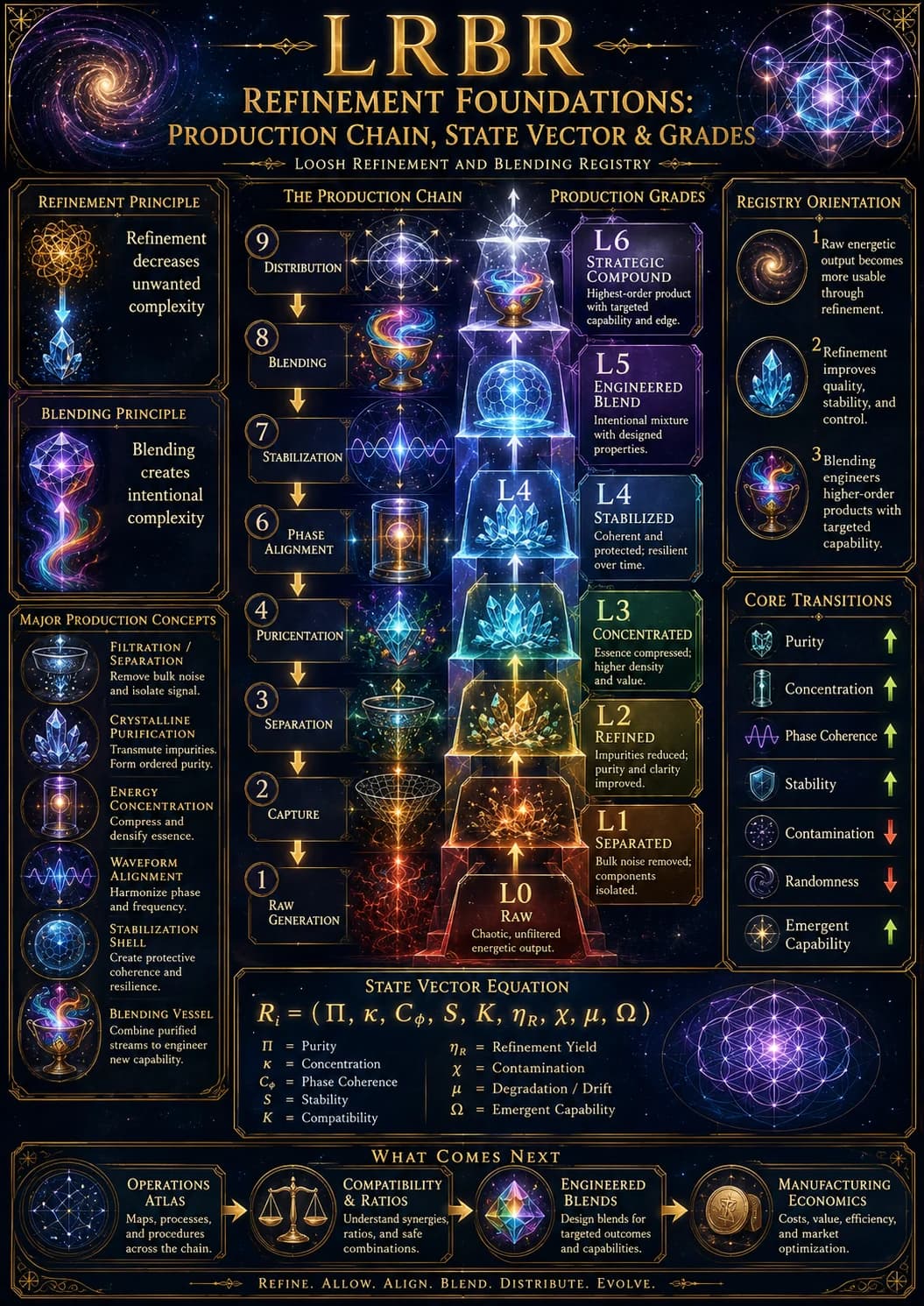
Loosh Refinement and Blending Registry
Loosh Refinement & Blending Registry v0.1
LRBR — Production, Purification, Stabilization, and Engineered Compound Architecture
1. Purpose
TheLoosh Refinement & Blending Registry (LRBR)defines how energetic output moves from raw generation into intentionally structured products within the Loosh Dynamics Framework.
The Emotional Spectrum Registry established the major energetic families.
The Emotional Compound Registry established naturally occurring and emergent combinations.
The Refinement & Blending Registry now addresses the production layer:
How does raw loosh become a specialized energetic commodity?
The complete production architecture becomes:
Raw Generation → Capture → Separation → Purification → Concentration → Phase Alignment → Stabilization → Blending → Storage / Distribution
This registry distinguishes between:
- naturally generated mixtures;
- separated emotional fractions;
- purified products;
- concentrated products;
- stabilized products;
- intentionally manufactured blends;
- regenerative compounds;
- extractive compounds;
- strategic field-state products;
- and unstable or incompatible mixtures.
2. Core Distinction
A naturally generated emotional state is rarely chemically or energetically pure.
A source experiencing love, for example, may simultaneously generate:
Llove, Lattachment, Lpleasure, Lhope, Lcreative, Lawe
in varying ratios.
The raw output is therefore:
Lraw = ∑i wiLi.
Refinement attempts to isolate or increase a particular component:
Lraw → R → Li.**
Blending does the opposite.
It intentionally recombines selected components:
L1 + L2 + … + Ln → B → LB.**
Thus:
Refinement decreases unwanted complexity.
while:
Blending creates intentional complexity.
3. Refinement State Vector
Every refined product receives the production-state vector:
Ri = (Π, κ, Cφ, S, K, ηR, χ, μ, Ω)
where:
Purity
Π
Measures how much of the product belongs to the desired energetic family.
Πi = (Ei)/(∑jEj)
Concentration
κ
Measures energetic density relative to the carrier or containment volume.
Conceptually:
κi = (Ei)/(Veffective).
Phase Coherence
Cφ
Measures how well the relevant field-state components remain phase-aligned.
Stability
S
Measures resistance to spontaneous separation, decay, or reorganization.
Compatibility
K
Measures whether components reinforce or oppose one another.
For components (i,j):
-1 ≤ Kij ≤ 1.
Where:
- (K=-1): strongly antagonistic;
- (K=0): largely independent;
- (K=+1): strongly reinforcing.
Refinement Yield
ηR
Measures how much usable target product survives processing.
ηR = (Lusable, out)/(Lraw, in).
Contamination
χ
Measures unwanted energetic families or source-pattern residue.
Degradation Rate
μ
Measures loss of structure over time.
Emergence
Ω
Measures whether a blend becomes more strategically capable than the simple sum of its constituents.
4. Production Grades
Loosh products can be classified into seven preliminary production grades.
Grade L0 — Raw
Lraw
Unprocessed source output containing many simultaneous energetic components.
Advantages
- high volume;
- minimal processing loss.
Disadvantages
- inconsistent;
- difficult to target;
- highly source-dependent.
Grade L1 — Separated
Major energetic families have been divided.
Example:
Lraw → Lfear + Ldesire + Lattachment.
Grade L2 — Refined
Unwanted secondary components have been substantially reduced.
Π↑.
Grade L3 — Concentrated
Energetic density has been increased.
κ↑.
This grade may produce substantially greater recipient effects per unit transferred.
Grade L4 — Stabilized
The state pattern has been protected against decay and phase drift.
S↑, μ↓.
Grade L5 — Engineered Blend
Multiple refined components are intentionally combined for a specific function.
B(L1, L2, …, Ln).
Grade L6 — Strategic Compound
A highly stabilized, high-emergence product designed to alter field capability at individual, collective, or civilizational scale.
Ω ≫ 1.
These represent the premium end of the hypothetical loosh economy.
5. Core Refinement Operations
LRBR-P001 — Separation
Function
Divides a complex raw field into major energetic families.
Lraw → S → L1, L2, …, Ln.
Primary Goal
Increase categorical distinction.
Main Output
Grade L1.
Strategic Importance
Separation converts unstructured bulk harvesting into a usable commodity economy.
Without separation:
loosh ≈ mixed energetic output.
With separation:
loosh → tradable classes.
LRBR-P002 — Fractionation
Function
Separates different intensities or subtypes within the same family.
For fear:
LF → Lanxiety + Lfear + Lpanic + Lterror.
Purpose
Allows markets to distinguish between broad family identity and specific harmonic intensity.
Strategic Value
A high-intensity fraction may have radically greater field effect than ordinary bulk output.
LRBR-P003 — Purification
Function
Removes unwanted energetic components.
Limixed → P → Lipure.
Primary Metric
Π↑.
Tradeoff
Greater purity generally produces processing loss:
Π↑ ⇒ ηR↓
past some optimum.
Important Principle
Maximum purity is not always maximum value.
Some secondary harmonics may contribute useful stability or emergence.
LRBR-P004 — Concentration
Function
Raises energetic density.
κout = κin.
Effects
A concentrated product may:
- require less transport volume;
- produce greater field pressure;
- induce faster recipient modification;
- command higher market value.
Risk
Excessive concentration may exceed containment stability:
κ>κcritical ⇒ S↓.
LRBR-P005 — Phase Alignment
Function
Synchronizes the internal oscillatory structure of a refined product.
φ1 ≈ φ2 ≈ … ≈ φn.
Result
Cφ↑.
Strategic Importance
Two samples containing equal energy can possess radically different field potency if one is phase coherent.
Thus:
Coherent concentration: random concentration
for most field-projection uses.
LRBR-P006 — Stabilization
Function
Reduces spontaneous pattern degradation.
μ↓.
Possible Mechanisms Within LDF
- resonant containment;
- phase-locking fields;
- living reservoirs;
- structured environmental reservoirs;
- active feedback systems.
Result
Longer usable shelf life.
LRBR-P007 — Buffering
Function
Adds a secondary field component that prevents an intense primary component from destabilizing its container or recipient.
For example:
Laggression + Lpeacebuffer
could reduce uncontrolled spillover without eliminating the projective force of aggression.
Principle
A buffer is not necessarily intended to dominate the final state.
It modifies stability.
LRBR-P008 — Dilution
Function
Reduces concentration without necessarily changing the primary state pattern.
κ↓.
Uses
- safe transport;
- incremental dosing;
- blending;
- stabilization;
- controlled field modification.
LRBR-P009 — Recombination
Function
Rejoins separated components.
LA + LB → LAB.
This operation may recreate a natural state or produce an artificial combination.
LRBR-P010 — Catalytic Blending
Function
Introduces a small component that dramatically changes the interaction of larger components.
LA + LB + ε LC → LABC
with:
ΓABC ≫ ε LC.
The catalyst contributes little raw energy but substantially changes the resulting architecture.
Examples
Agency may catalyze:
Fear + Agency → Courage-like state.
Hope may catalyze:
Loss + Hope → Recovery movement.
LRBR-P011 — Quenching
Function
Introduces an antagonistic field to rapidly reduce an unwanted harmonic.
KAB<0.
Example:
Lpeace
may partially quench:
Lfear.
Important Distinction
Quenching is not identical to restoration.
It reduces a state.
Restoration reorganizes the wider system.
LRBR-P012 — Conditioning
Function
Repeatedly exposes a recipient to a stabilized blend until the recipient begins reproducing some portion internally.
LBexternal → GBinternal↑.
This operation is strategically important because externally supplied loosh can eventually becomefield architecture inside the consumer.
Conditioning may therefore be:
- regenerative;
- extractive;
- hierarchical;
- protective;
- or capability-enhancing.
The architecture determines its function.
6. Refinement Failure Modes
Refinement introduces its own risks.
RF-01 — Over-Refinement
Excessive purification removes supporting harmonics.
Π↑
while:
S↓.
A product may become highly pure but energetically brittle.
RF-02 — Phase Collapse
Internal components lose synchronization.
Cφ → 0.
The energy remains present while strategic field potency falls.
RF-03 — Harmonic Contamination
Unwanted source-state material enters the refined product.
χ↑.
This may alter recipient effects.
RF-04 — Cross-Reaction
Two components interact unexpectedly:
KAB<0
or:
ΓAB
produces an unintended state.
RF-05 — Reservoir Imprinting
Long-term storage in a living reservoir may cause stored material and host field to influence one another.
Lstored ↔ Fhost.
The reservoir may therefore preserve the material while also changing it.
RF-06 — Blend Drift
Over time, mixture ratios shift.
wi(t) ≠ wi(0).
The nominal blend identity remains the same while its actual function changes.
RF-07 — Saturation
The receiving system exceeds its incorporation capacity.
Linput = Lmetabolic capacity.
Additional input may then generate instability rather than increased capability.
7. Compatibility Architecture
The most important blending question is not merely:
What components are present?
It is:
What happens when they interact?
We therefore define:
Kij.
Strong Reinforcement
Kij ≈ + 1
Examples:
Fear + Aggression
Love + Peace
Hope + Creative
Pleasure + Desire.
Conditional Reinforcement
0<Kij<1.
Outcome depends strongly on ratio or context.
Examples:
Love + Attachment
can become either healthy bonding or dependency.
Awe + Attachment
can become devotion or fanaticism depending on sovereignty and integrative coherence.
Antagonistic Pairing
Kij<0.
Examples may include:
Peace ↔ panic
or:
Love ↔ hatred
when the two fields cannot coexist at equal dominance.
However, antagonism can becometransformativeif a catalyst reorganizes the relationship.
For example:
Fear + Peace + Agency → Courage.
Thus incompatibility does not automatically imply unusable blending.
It may imply the need for a catalytic bridge.
8. Blend Ratio Principle
A compound's identity depends heavily on proportion.
For:
LB = α LA + β LB + γ LC
changing:
α:β:γ
may produce an entirely different field state.
Example:
Love + Attachment.
If love dominates:
Llove ≫ Lattachment
the result may remain non-coercive.
If attachment dominates while fear is introduced:
Lattachment + Lfear Llove
the resulting state may shift toward possessiveness.
Thus:
Composition determines family ; ratio determines expression.
9. Engineered Blend Registry
LRBR-B001 — Terror-Dominance Blend
Composition
Lfear + Lstatus + Laggression
Derived Compound
Tyrannical Presence.
Strategic Objective
Create a field that simultaneously:
- induces fear;
- projects rank;
- communicates force;
- suppresses resistance.
Functional Profile
Ξ↑, D↑, ρF↑.
Market Class
Military / Command / Power
Value Mechanism
The blend generates additional fear through exposure:
LB → Ffear → GF'.
Thus the blend functions as both weapon and production asset.
LRBR-B002 — Submission Blend
Composition
Lfear + Lshame + Lattachment
with optional:
Lpleasure
as reward reinforcement.
Strategic Objective
Reduce independent projection while preserving attachment to authority.
Functional Pattern
Dtarget↓
while:
Bauthority↑.
Market Class
Control Commodity
Recursive Potential
High.
Once internalized, the subject can reproduce self-limitation without constant external enforcement.
LRBR-B003 — Reward-Dependency Blend
Composition
Lpleasure + Ldesire + Lattachment.
Strategic Objective
Link reward access to a particular provider, system, or hierarchy.
Core Loop
Provider → Pleasure → Attachment → Desire for Provider → Provider.
Market Class
Affective Command / Dependency
Strategic Importance
Extremely high in emotion-suppressed societies.
LRBR-B004 — Elite Triumph Blend
Composition
Lpleasure + Lstatus + Laggressionminor.
Function
Produces:
- superiority;
- reward;
- command confidence;
- dominance reinforcement.
Market Class
Elite / Hierarchical Reward
This could represent a premium product reserved for high-ranking members of a command structure.
LRBR-B005 — Fear Amplifier Concentrate
Composition
High-purity:
Lterror
with phase alignment and stabilization.
Objective
Maximize:
Ffear.
Characteristics
- extremely high (Cn);
- very high (κ) ;
- low (CI);
- high entrainment;
- high recursive yield.
Market Class
Strategic Power Commodity
LRBR-B006 — Devotion Blend
Composition
Llove + Lawe + Lattachment + Ltrust.
Function
Create durable directional bonding.
Two Stable Variants
Sovereign Devotion
CI↑
and:
BΣ↑.
Command Devotion
Attachment and hierarchy dominate:
Cn↑
while:
CI↓.
Market Class
Premium Binding
LRBR-B007 — Fanaticism Blend
Composition
Lawe + Lattachment + Lsubmission + Lstatus + Lfearoptional.
Function
Create intense narrow-band collective synchronization.
Field Signature
Cn → 5
while:
CI → 1.
Market Class
Collective Control
Strategic Property
Extremely efficient at converting large populations into one behavioral attractor.
LRBR-B008 — Courage Catalyst
Composition
Lfear + Lagency + Lpeace + Lcoherence.
Catalytic Principle
Fear is not removed.
It is reorganized.
LF → agency + coherence → Lcourage.
Function
- resist fear entrainment;
- maintain action under threat;
- reduce fear's recursive harvesting yield.
Market Class
Defensive / Generative
LRBR-B009 — Protective Love Blend
Composition
Llove + Lpeace + Lprotective aggression + BΣ.
Function
Produce:
open internal coherence + strong external boundary.
Market Class
Strategic Defense
Primary Use
Protection without conversion into dominance.
LRBR-B010 — Serenity Stabilizer
Composition
Lpeace + Llove + Lstable meaning.
Production Requirement
High phase coherence and low contamination.
Function
Increase:
CI, Cφ, τ.
Decrease:
χexternal coupling.
Market Class
Stabilization / Anti-Entrainment
LRBR-B011 — Civilizational Coherence Stabilizer
Composition
Llove + Lpeace + Lhope + Ltrust.
Optional catalytic component:
Lawe.
Function
Increase collective order parameter:
Ccivilization↑.
Expected Effects Within the Framework
- reduced fragmentation;
- increased trust;
- increased cooperative bandwidth;
- restored future orientation;
- reduced conflict gain.
Market Class
Civilizational Restoration
Dependency Risk
If repeatedly supplied without increasing internal generation:
Dexternal↑.
This producescoherence rent.
LRBR-B012 — Regenerative Restoration Blend
Composition
Llove + Lhope + Lcreative + Lpeace.
Objective
Not merely stabilize a damaged system, but restore its ability to produce coherence internally.
Ginternal↑.
Difference From B011
B011 stabilizes.
B012restarts endogenous generation.
Market Class
High-Grade Restorative
Preferred Restoration Criterion
Lexternal(t)↓
while:
Ginternal(t)↑.
LRBR-B013 — Creative Renewal Blend
Composition
Lcreative + Lhope + Lpleasure + Lcuriosity.
Function
Increase:
- novelty;
- experimentation;
- exploration;
- invention;
- adaptive possibility.
Market Class
Generative / Innovation
Strategic Use
Potentially extremely valuable to civilizations trapped in rational or cultural stagnation.
LRBR-B014 — Collective Inspiration Blend
Composition
Lawe + Lhope + Lcreative + Lloveminor.
Function
Synchronize many beings around a novel future possibility.
Core Loop
Vision → Hope → Creation → Visible Possibility → More Hope.
Market Class
Civilizational Generative
Recursive Type
Regenerative recursion.
LRBR-B015 — Grief Integration Blend
Composition
Lloss + Llove + Lpeace + Lmeaning + Lhopeminor.
Objective
Prevent persistent grief from becoming a closed depletion basin.
Transformation
Lloss → Lmeaning + Llove + R.
Market Class
Restorative / Transitional
LRBR-B016 — Reciprocal Bonding Blend
Composition
Llove + Lgratitude + Ltrust + Lattachment.
Function
Strengthen coupling while maintaining reciprocity.
Field Pattern
A → B → A.
Rather than:
A → B.
Market Class
Regenerative Binding
Strategic Importance
Provides an alternative to control-based attachment markets.
LRBR-B017 — Ecstatic Communion Blend
Composition
Llove + Lpleasure + Lawe + Lattachment.
Function
Produce high-intensity synchronized collective states.
Metrics
A↑, B↑, Cn↑, Ξ↑.
Market Class
Premium Collective Commodity
Risk
Because of its intensity:
reward dependency
can emerge if access is externally monopolized.
LRBR-B018 — Sovereign Presence Blend
Composition
Lpeace + Lagency + Llove + BΣ + Lconfidence.
Function
Generate strong field presence without dominance.
Signature
D↑
while:
CI↑.
This differs fundamentally from Tyrannical Presence:
Tyrannical Presence = D↑ + CI↓
whereas:
Sovereign Presence = D↑ + CI↑.
Market Class
Defensive / Leadership / Restorative
10. Strategic Blend Families
The engineered blends can now be grouped by function.
Coercive Power Blends
Terror-Dominance, Fear Amplifier, Tyrannical Presence
Primary objective:
target entrainment + dominance.
Hierarchy Blends
Submission, Reward-Dependency, Elite Triumph, Command Devotion, Fanaticism
Primary objective:
behavioral ordering + dependency.
Defensive Blends
Courage, Protective Love, Serenity, Sovereign Presence
Primary objective:
BΣ↑
and:
χexternal entrainment↓.
Restorative Blends
Civilizational Stabilizer, Regenerative Restoration, Grief Integration, Reciprocal Bonding
Primary objective:
R↑.
Generative Blends
Creative Renewal, Collective Inspiration, Regenerative Restoration
Primary objective:
Gfuture↑.
Premium Binding Blends
Devotion, Ecstatic Communion, Reciprocal Bonding
Primary objective:
B↑
with radically different sovereignty profiles.
11. Extractive Versus Regenerative Manufacturing
Two markets can use identical refinement technology while producing completely different architectures.
Extractive Manufacturing
The product is optimized for:
dependency, entrainment, harvesting, dominance, continued demand.
Its general cycle is:
Blend → consumer modification → dependency / production → new harvest
Examples:
- Reward-Dependency Blend;
- Submission Blend;
- Terror-Dominance Blend;
- Fanaticism Blend.
Regenerative Manufacturing
The product is optimized for:
capacity, sovereignty, restoration, internal generation.
Its general cycle is:
Blend → capacity increase → internal generation → reduced external requirement
Examples:
- Courage Catalyst;
- Protective Love;
- Regenerative Restoration;
- Creative Renewal;
- Sovereign Presence.
12. Blend Dependency Index
We can formalize the distinction using aDependency Index:
DB (∂ Lexternal required)/(∂ t)
after repeated exposure.
If:
DB>0
the recipient increasingly requires outside supply.
If:
DB ≈ 0
dependency remains stable.
If:
DB<0
the blend gradually reduces its own necessity.
Thus:
DB<0
is a strong marker of regenerative design.
13. Capability Gain Index
Because strategic value depends upon what the recipient becomes capable of doing, define:
GB Δ D, CI, B, G, Ξ, R, BΣ
for a given blend.
Different commodities therefore purchase different capabilities.
Fear Amplifier
GF: Ξfear↑, D↑.
Creative Renewal
GC: Gnovel↑.
Serenity
GS: CI↑, BΣ↑.
Devotion
GD: B↑, Cn↑.
This makes market comparison more meaningful than simply comparing raw energy.
14. Blend Value Function
An engineered product's market value can now be modeled as:
VB = f(Π, κ, Cφ, S, Ω, G, ρ, τ, R, DB)
where value increases through combinations of:
- purity;
- concentration;
- coherence;
- stability;
- emergence;
- capability gain;
- recursive yield;
- persistence;
- rarity;
- and dependency leverage.
An extractive market may assign positive value to:
DB>0.
A restorative civilization would likely regard:
DB<0
as the superior outcome.
Thus evenmarket value itself depends upon the civilization's governing architecture.
15. Refinement Paradox
The registry introduces an important paradox.
Refinement increases control:
Π↑.
But living emotional states derive some of their power from complexity.
Therefore:
maximum purity ≠ maximum functional value.
The most valuable product may instead exist at an optimal point:
Π^**
where enough contamination has been removed to make the state predictable, but enough supporting harmonic complexity remains to preserve stability and emergence.
This can be represented as:
V(Π)
reaching a maximum before:
Π = 1.
16. Blending Paradox
Likewise:
more components ≠ more capability.
As blend complexity increases:
Ncomponents↑,
the probability of cross-reaction increases.
Thus:
SB
may fall beyond an optimal complexity.
Highly sophisticated products therefore require precise:
- ratios;
- compatibility;
- phase relationships;
- buffers;
- catalysts;
- containment;
- and stabilization.
This would make expert refinement capability one of the highest-value forms of infrastructure in a mature loosh economy.
17. Strategic Infrastructure Implications
A complete industrial loosh architecture would therefore require far more than collectors.
It would require:
Collectors → Separators → Refiners → Concentrators → Blenders → Stabilizers → Reservoirs → Transport → Markets
Specialized actors could control each stage.
This creates economic choke points.
A civilization possessing enormous raw supply but poor refinement capability might export cheap bulk loosh.
A technologically advanced civilization could purchase the raw material, refine it, and resell premium compounds at far greater value.
Thus:
refinement capability: economic power.
18. Restoration Implications
If a control architecture depends upon refined blends rather than raw supply alone, then systemic restoration can target multiple layers:
Reduce involuntary harvesting
Hraw↓.
Disrupt separation and purification monopolies
ηR↓.
Liberate strategic reservoirs
Savailable↓.
Break dependency blends
DB↓.
Replace extractive products with regenerative equivalents
For example:
Fear Control → Courage
Submission → Sovereign Presence
Reward Dependency → Internal Joy Generation
Coherence Rent → Regenerative Restoration.
This means restoration need not merely destroy the energetic economy.
It canchange what the economy produces.
19. Central Registry Principles
The Loosh Refinement & Blending Registry establishes several major principles.
Principle I — Raw Output Is Not the Final Commodity
Generation begins the value chain ; refinement determines much of its final utility.
Principle II — Purity and Concentration Are Different
A product can be:
- pure but weak;
- concentrated but contaminated;
- coherent but dilute;
- powerful but unstable.
These properties must remain separate.
Principle III — Configuration Produces Capability
Equal energy does not imply equal strategic value.
Principle IV — Ratios Matter
Composition determines the ingredients ; ratios determine the resulting state.
Principle V — Compatibility Is Architectural
A contradictory pair can:
- cancel;
- destabilize;
- or transform into a third state.
Principle VI — Refinement Has an Optimum
Maximum purification may destroy useful complexity.
Principle VII — Blends Can Alter Their Own Future Demand
Extractive products may increase dependency:
DB>0.
Regenerative products may reduce it:
DB<0.
Principle VIII — Refinement Technology Creates Market Power
Control over:
purity, concentration, stability, blending, storage
can be more economically important than raw harvesting capacity.
20. Central Principle
The Emotional Spectrum Registry tells uswhat forms of energy exist.
The Emotional Compound Registry tells uswhat combinations naturally or emergently arise.
The Refinement & Blending Registry tells us:
how an energetic economy intentionally manufactures capability.
The decisive transition is:
Raw State → Engineered Field Function.
At that point, loosh is no longer merely harvested emotional output.
It becomes aprogrammable energetic material whose value is determined by purity, concentration, organization, stability, compatibility, and the capabilities it produces in the recipient.
And that creates a deeper economic principle:
The most powerful actor in a loosh economy may not be the largest harvester, but the actor who knows how to turn common raw states into rare strategic compounds.