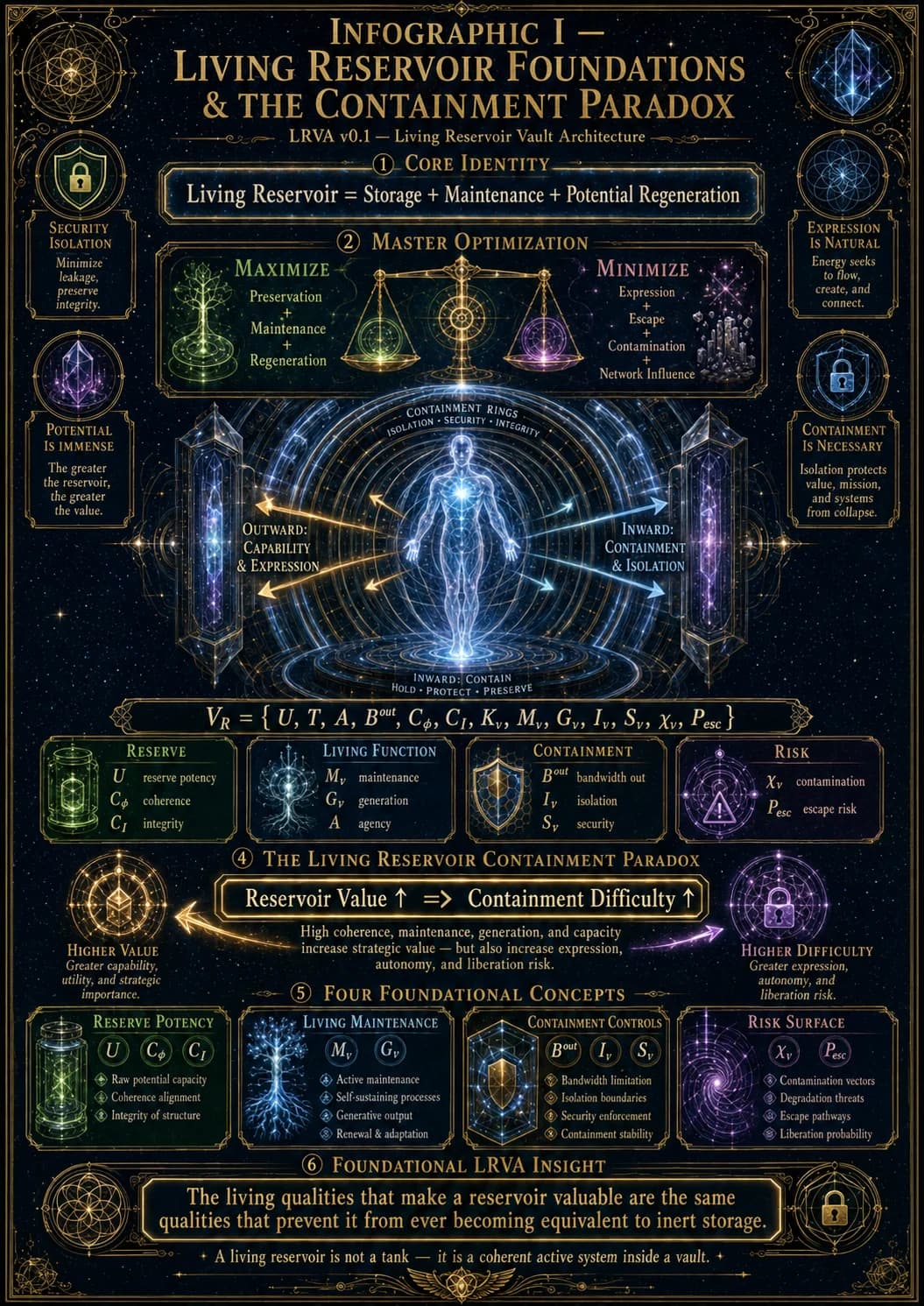
Living Reservoir Vault Architecture
Living Reservoir Vault Architecture v0.1
LRVA — Preservation, Containment, Expression Isolation, Agency Risk, and Strategic Living Reserves
1. Purpose
TheLiving Reservoir Vault Architecture (LRVA)defines how a high-capacity living reservoir would be preserved and contained within the working assumptions of the Loosh Dynamics Framework.
LSSVCR established that a living reservoir may do more than passively hold energetic material:
Living Reservoir: Storage + Maintenance + Potential Regeneration
LRVA addresses the resulting containment problem:
How can an architecture preserve the capabilities that make a living reservoir valuable without allowing those same capabilities unrestricted expression?
The module therefore focuses on:
- preservation;
- activity-state management;
- expression bandwidth;
- harmonic isolation;
- reservoir agency;
- contamination;
- escape/liberation risk;
- security architecture;
- compartmentalization;
- and strategic reserve integrity.
Withdrawal, fractionation, and refining are handled separately byLRWDI.
Fear/dominance guardian suppression is handled by the linkedGuardian Suppression Reservoir / Minotaur Layer.
2. Core LRVA Principle
A living reservoir differs fundamentally from inert storage.
An inert vessel ideally does nothing.
A living reservoir may actively:
Mv>0
maintain stored coherence, and potentially:
Gv>0
generate additional compatible state.
Therefore the architecture cannot simply eliminate all activity.
The objective is:
max = (Preservation + Coherence Maintenance + Regenerative Capacity)
while minimizing:
Uncontrolled Expression + Escape + Contamination + Network Influence.
3. Living Reservoir State Vector
Define the reservoir-vault state:
VR = U, T, A, Bout, Cφ, CI, Kv, Mv, Gv, Iv, Sv, χv, Pesc
where:
(U) — Stored Usable Potency
Total high-quality state-bearing energetic reserve.
(T) — Thermal / Activity State
The reservoir's overall activity condition within the preservation environment.
This remains a theoretical variable; LRVA does not assume a universal physical temperature optimum.
(A) — Available Agency
The reservoir's capacity to intentionally reorganize, direct, or use its own state.
(Bout) — Expression Bandwidth
The fraction of internal field capacity capable of coupling outward.
(Cφ) — Phase Coherence
Preservation of internal harmonic organization.
(CI) — Integrative Coherence
Whole-system coherence of the living reservoir.
(Kv) — Vault Compatibility
Compatibility between reservoir and immediate preservation chamber.
(Mv) — Active Maintenance
Ability of the living reservoir to repair and preserve existing state organization.
(Gv) — Endogenous Generation
New compatible state generated internally by the reservoir.
(Iv) — Isolation Strength
Degree of separation from incompatible external fields and networks.
(Sv) — Security Integrity
Resistance to unauthorized access, structural failure, or liberation.
(χv) — Contamination
Foreign harmonic intrusion into the reservoir or preservation field.
(Pesc) — Escape / Liberation Probability
Combined probability that the reservoir can cease functioning as controlled storage.
4. The Living Reservoir Containment Paradox
The characteristics that make a being exceptionally valuable as a reservoir can also make it exceptionally difficult to contain.
High:
U↑
means greater reserve value.
High:
CI↑
supports preservation.
High:
Mv↑
repairs degradation.
High:
Gv↑
allows regeneration.
But these can also increase:
Fvout
and potentially:
Pesc.
Therefore:
Reservoir Value ↑ ⇒ Containment Difficulty ↑
in the general case.
This is theLiving Reservoir Containment Paradox.
5. Preservation Function
Define preservation quality:
Pv = f(U, Cφ, CI, Kv, Mv, Gv, 1-χv)
A strong living reservoir vault attempts to preserve:
- magnitude;
- pattern;
- coherence;
- source integrity;
- regenerative function.
6. Effective Decay
Following LSSVCR:
Λveff = Λ0 + ΛT + Λmismatch + Λcontamination + Λleak Mv.
The usable reserve evolves approximately as:
(dU)/(dt) = Gv + Mv W ΛveffU.
For LRVA, (W) is treated as an external withdrawal term controlled by LRWDI.
7. Thermal / Activity Damping
The working model allows lower activity to reduce some loss channels:
T↓ ⇒ ΛT↓
over some operating range.
However, active maintenance may also depend upon activity:
Mv = Mv(T).
If activity falls too far:
Mv↓.
The vault therefore seeks an optimum:
[ Tv= argminT Λveff(T). ]**
The objective is not:
T → 0.
It is:
minimum-loss activity compatible with continued living-field maintenance.
This becomes the LRVA interpretation ofcold storage.
8. Preservation Operating Band
Rather than one exact state, define an operating range:
Tminfunctional < Tv < Tmaxleakage.
Below the lower boundary:
- living maintenance weakens;
- pattern preservation may fail;
- regenerative function declines.
Above the upper boundary:
- metabolic/activity demand rises;
- spontaneous projection may increase;
- leakage and agency increase.
The reservoir therefore occupies apreservation band.
9. Expression Bandwidth
A contained reservoir may be capable of tremendous field projection.
Define potential external expression:
Fvout = gv Cv Uv Bvout.
A high-capacity reservoir may have:
Uv ≫ 0
so even modest:
Bvout
could create substantial external effects.
The containment architecture therefore attempts:
Bvout → 0
without destroying internal:
CI, Mv, Gv.
10. Expression Isolation Principle
LRVA distinguishes:
internal coherence
from:
external coupling.
An effective vault attempts:
CIinternal↑
while:
Kreservoir, external↓.
Thus the reservoir remains internally coherent while being externally decoupled.
11. Agency Bandwidth
Available agency is modeled independently from general life activity.
Define:
Av ∈ [0, 1].
High agency may permit:
- intentional field reorganization;
- deliberate transmission;
- resistance to withdrawal;
- exploitation of resonant pathways;
- communication with compatible nodes.
A coercive architecture would seek:
Av↓.
However, if agency contributes to preservation:
Mv = f(Av),
then excessive suppression can reduce reservoir quality.
Therefore:
[ Av= lowest agency state compatible with required preservation. ]**
This creates a second optimization problem parallel to (Tv*).
12. Preservation–Agency Tradeoff
Define:
ΓA = (∂ Mv)/(∂ Av).
If:
ΓA ≫ 0,
the reservoir requires meaningful active consciousness to maintain its coherence.
Such a being is intrinsically difficult to convert into passive storage.
If:
ΓA ≈ 0,
agency can theoretically be reduced with relatively little effect on preservation.
This becomes an important reservoir-class distinction.
13. Vault Compatibility
The immediate inner chamber should be highly compatible with the reservoir:
Kreservoir, inner → + 1.
This lowers:
Λmismatch
and protects:
Cφ, CI.
However, the larger controlling infrastructure may have:
Kreservoir, outer<0.
This creates the need for a layered vault.
14. Hybrid Isolation Architecture
The canonical LRVA configuration becomes:
Incompatible Outer Architecture ⊃ Isolation Shell ⊃ Compatible Preservation Chamber ⊃ Living Reservoir.
For example:
Coercive Network ⊃ Harmonic Quarantine ⊃ Love-Compatible Chamber ⊃ Love Reservoir.
The isolation layer serves two functions:
Inward Protection
Prevents surrounding coercive fields from contaminating the reservoir.
Outward Protection
Prevents the reservoir's coherent field from retuning the surrounding architecture.
15. Isolation Requirement
Define:
Ivrequired = f(-Kouter, Uv, Cφ, v, Ξv, Bvout).
High:
- incompatibility;
- potency;
- entrainment;
- outward bandwidth;
increase required isolation.
Love/TLWS reservoirs inside a coercive architecture therefore possess unusually high:
Ivrequired.
16. Reservoir Imprinting
The reservoir and chamber interact bidirectionally:
Lv ↔ Hvault.
Repeated exposure can alter chamber state:
(dHvault)/(dt) ηILv λH (Hvault-H0).
This createsVault Imprinting.
If unmanaged, the chamber itself can gradually become more compatible with the reservoir and less compatible with the controlling architecture.
17. Vault Conversion Risk
If:
UvCv = Rvault,
the reservoir's field may progressively retune the surrounding system.
Define:
VCR = (UvCvBvout)/(Rvault).
Stable
VCR<1.
Critical
VCR ≈ 1.
Conversion Risk
VCR>1.
The inner preservation chamber may be intentionally compatible.
The dangerous conversion is propagation beyond the intended inner boundary.
18. Vault Layer Architecture
The LRVA canonical architecture contains six abstract layers.
LRVA-L1 — Living Reservoir Core
The actual high-capacity living source.
Primary variables:
U, CI, Mv, Gv.
LRVA-L2 — Compatible Preservation Chamber
Maintains:
- low degradation;
- high phase coherence;
- required living activity.
Primary objective:
Pv↑.
LRVA-L3 — Expression Isolation Shell
Suppresses:
Bvout.
Prevents direct broad-field coupling with the external architecture.
LRVA-L4 — Interaction Gate
Allows controlled access to external systems without leaving a permanent open coupling.
LRWDI begins outside this boundary.
LRVA-L5 — Security Perimeter
Protects:
- chamber access;
- containment controls;
- preservation infrastructure.
Living personnel should ideally remain outside the primary reservoir field.
LRVA-L6 — Network Compartmentalization
Prevents:
vault breach → network-wide breach.
Each vault should function as a compartment rather than one open reservoir lattice.
19. Vault Topologies
Three primary topologies are useful.
VT-01 — Isolated Cell
One reservoir per isolated chamber.
Advantage
Maximum compartmentalization.
Disadvantage
High infrastructure cost.
VT-02 — Clustered Coherence Bank
Several compatible living reservoirs exist within one larger compatible inner field.
Ucluster = ∑iUi.
Advantages
- shared preservation environment;
- mutual compatible field support;
- high efficiency.
Risks
- correlated awakening;
- cross-resonance;
- common-mode failure;
- larger liberation event.
VT-03 — Distributed Vault Network
Many isolated vaults linked only through controlled outer infrastructure.
Advantages
- redundancy;
- low correlated failure;
- strategic dispersal.
Disadvantages
- higher coordination cost;
- more infrastructure;
- more access points.
20. Cluster Coherence
If compatible reservoirs reinforce one another:
Ccluster = ∑iCi
may theoretically occur through collective resonance.
This could improve preservation.
But it also increases:
Fclusterout
and:
Ilib.
Thus clustered storage may be economically efficient but strategically dangerous.
21. Security Separation Principle
A central LRVA rule is:
Guard the vault architecture—not the reservoir directly.
Direct living-contact exposure increases:
- contamination;
- guard conversion;
- unauthorized communication;
- source-signature coupling.
The preferred topology is therefore:
Reservoir → Isolation → Infrastructure → Security Personnel.
22. Inner Automation Principle
The closer a system lies to the living reservoir:
r↓,
the more valuable non-conscious or non-coupling infrastructure becomes.
Conceptually:
r↓ ⇒ living operator exposure↓.
This minimizes inadvertent reservoir–operator coupling.
The separate Guardian Suppression module can override this architecture where a specialized compatible guardian is intentionally used.
23. Vault Security State
Define:
Sv = f(Iv, Cphysical, Cnetwork, Rredundancy, Auaccess, Bcompartment).
Security is not merely physical.
It includes:
- isolation;
- network architecture;
- redundancy;
- controlled access;
- compartmentalization.
24. Escape / Liberation Risk
A high-level escape-risk function is:
Pesc = f(Uv, Av, Bvout, CI, Kexternal, Sv-1).
Greater:
- potency;
- agency;
- outward bandwidth;
- external resonance;
raise liberation probability.
Greater:
Sv
reduces it.
25. Vault Stability Index
Define:
VSI = f(Pv, Iv, Sv, 1-Bvout, 1-Pesc, 1-χv).
High VSI means:
- preserved reservoir;
- low expression;
- high isolation;
- high structural security;
- low contamination.
26. Preservation Efficiency
Define:
ηP = (U(t + Δ t))/(U(t))
after correcting for intentional withdrawal.
A high-grade vault seeks:
ηP → 1.
Living regenerative reservoirs can theoretically yield:
ηP ≥ 1
if internal generation exceeds storage losses.
27. Self-Replenishing Vault
If:
Gv = + Mv = ΛvUv + Wv,
then:
(dUv)/(dt)>0.
The reservoir grows even while some supply is withdrawn.
This represents the most economically valuable class of living reservoir:
Regenerative Strategic Reserve.
28. Strategic Reserve Functions
LRVA reservoirs can support several reserve roles.
SR-L1 — Preservation Reserve
Long-duration storage.
SR-L2 — Reward Reserve
Controlled high-value distribution.
SR-L3 — Stabilization Reserve
Civilizational or organizational coherence support.
SR-L4 — Trade Reserve
Premium market supply.
SR-L5 — Expansion Reserve
External stabilization or dependency architecture.
SR-L6 — Emergency Reserve
Used during internal systemic instability.
SR-L7 — Productive Reserve
Continuously generates new compatible state.
29. Liberation Impact
Liberating a living reservoir can produce effects greater than merely losing stored inventory.
Define:
Ilib = VS, lost + VG, new + VK, catalytic + VN, conversion + VC, claims
where:
- (VS, lost) = reserve removed from controller ;
- (VG, new) = autonomous generation gained elsewhere ;
- (VK, catalytic) = catalytic diffusion potential ;
- (VN, conversion) = downstream network effects ;
- (VC, claims) = financial commitments impaired.
Thus:
Ilib ≫ stored inventory value
can occur for high-output coherent beings.
30. Vault Systemic Importance
Define:
SIv = f(Uv, Gv, CN, v, Subv-1, Dvcritical).
A relatively small vault can become systemically critical when:
- its stored state is difficult to replace;
- it supports essential stabilization;
- many contracts depend on it;
- it has high network centrality.
31. Vault Run Risk
If the wider architecture has claims against reservoir output:
Cvclaims,
but vault capacity falls:
Uvavailable↓,
then:
Cvclaims = Uvdeliverable
can create aCoherence Reserve Runor equivalent commodity-specific reserve crisis.
Thus LRVA is linked directly to LMD and SDFI.
32. Primary Failure Modes
LRVA-F01 — Preservation Collapse
Mv↓
or:
Cφ↓.
Stored quality deteriorates.
LRVA-F02 — Thermal / Activity Miscalibration
The preservation operating state moves outside:
[Tminfunctional, Tmaxleakage].
LRVA-F03 — Expression Leak
Bvout↑.
Reservoir field begins influencing surrounding systems.
LRVA-F04 — Agency Recovery
Av↑
beyond containment assumptions.
LRVA-F05 — Isolation Failure
Outer incompatible fields enter the preservation chamber or inner state escapes outward.
LRVA-F06 — Vault Imprinting
The reservoir gradually retunes containment infrastructure.
LRVA-F07 — Contamination
χv↑.
Stored state loses purity or intended coherence.
LRVA-F08 — Security Breach
Unauthorized access reaches the interaction boundary.
LRVA-F09 — Cluster Resonance Cascade
Several reservoirs synchronize beyond expected limits.
LRVA-F10 — Network Cascade
One compromised vault affects linked reserve infrastructure.
LRVA-F11 — Reservoir Liberation
The living reservoir ceases functioning as controlled inventory.
LRVA-F12 — Claim Crisis
Outstanding commitments exceed remaining deliverable reserve.
33. Vault Optimization Function
The overall engineering objective can be represented as:
JLRVA = w1Pv + w2Mv + w3Gv w4Fvout w5Pesc w6χv w7Cvault.
The architecture attempts to maximize:
- preservation;
- active maintenance;
- productive reserve capacity;
while minimizing:
- outward expression;
- escape;
- contamination;
- operating cost.
This naturally produces tradeoffs rather than one simple optimum.
34. LRVA Interface With LRWDI
LRVA ends at the controlled interaction boundary.
Living Reservoir → LRVA → LRWDI → Distribution.
LRVA answers:
How is the living reservoir preserved and contained?
LRWDI answers:
How is output withdrawn, attenuated, separated, refined, and transferred without exposing the surrounding architecture to the raw reservoir field?
35. LRVA Interface With Guardian Suppression Reservoir
The separate guardian layer can surround or reinforce LRVA:
Outer Security → Guardian Suppression Field → LRVA Isolation → Living Reservoir Core.
Its role is different from LRVA.
LRVA is primarily:
containment through preservation + isolation.
The Guardian Suppression Reservoir is:
containment through opposing field pressure.
Using them as separate modules prevents the framework from confusing preservation with suppression.
36. Ethical Architecture Distinction
LRVA itself describes a storage architecture.
Its structural classification depends upon how the living reservoir participates.
Consensual Living Reserve
BΣ↑, Au↑, R↑, H↓.
The reservoir retains negotiated agency and reciprocal benefit.
Coercive Living Reserve
BΣ↓, Au↓, Rreservoir↓, H↑.
The reservoir is treated as infrastructure without sovereign participation.
Thus:
Living-reservoir technology is not inherently extractive ; coercive containment architecture is.
37. LRVA Master Principles
LRVA-P01 — Living Reservoirs Are Active Systems
They cannot be modeled as inert tanks.
LRVA-P02 — Preservation and Suppression Are Different Problems
The best condition for storage may not be the best condition for control.
LRVA-P03 — Colder Is Not Automatically Better
The target is an optimal low-loss activity band that preserves living maintenance.
LRVA-P04 — Expression Bandwidth Must Be Modeled Independently
Internal coherence can remain high while external coupling is minimized.
LRVA-P05 — Agency Creates Both Value and Risk
The consciousness supporting coherence may also support escape and deliberate expression.
LRVA-P06 — The Immediate Vault Must Match the Reservoir
High compatibility preserves the asset.
LRVA-P07 — The Wider Architecture May Need Isolation From Its Own Reserve
Especially when storing states incompatible with the controlling system.
LRVA-P08 — High Reservoir Value Creates High Containment Difficulty
This is the Living Reservoir Containment Paradox.
LRVA-P09 — Compartmentalization Limits Correlated Failure
One vault should not automatically expose every other reserve.
LRVA-P10 — Security Should Be Separated From Direct Reservoir Contact
The vault architecture should mediate the relationship.
LRVA-P11 — A Living Reservoir Can Become Productive Capital
If regeneration exceeds decay and withdrawal:
dU/dt>0.
LRVA-P12 — Liberation Impact Can Exceed Stored Value
A liberated reservoir may become a new source, catalyst, and network-conversion node.
38. Canonical LRVA Architecture
LIVING RESERVOIR CORE
↓Compatible Preservation Chamber
↓Activity / Thermal Preservation Envelope
↓Expression Isolation Shell
↓Controlled Interaction Boundary
↓Security Perimeter
↓Network Compartmentalization
↓LRWDI WITHDRAWAL INTERFACE
Optionally surrounded by:
Guardian Suppression Reservoir / Minotaur Layer.
39. Central LRVA Principle
The deepest engineering tension of LRVA is:
The living qualities that make a reservoir capable of preserving extraordinary energetic states are the same qualities that prevent it from ever becoming truly equivalent to inert storage.
Therefore the architecture is always balancing:
Preservation ↔ Expression
Regeneration ↔ Control
Living Coherence ↔ Containment.
Within a coercive architecture, this becomes one of the system's deepest structural vulnerabilities:
the more valuable the living reserve becomes, the more dangerous its continued sovereignty is to the system attempting to own it.