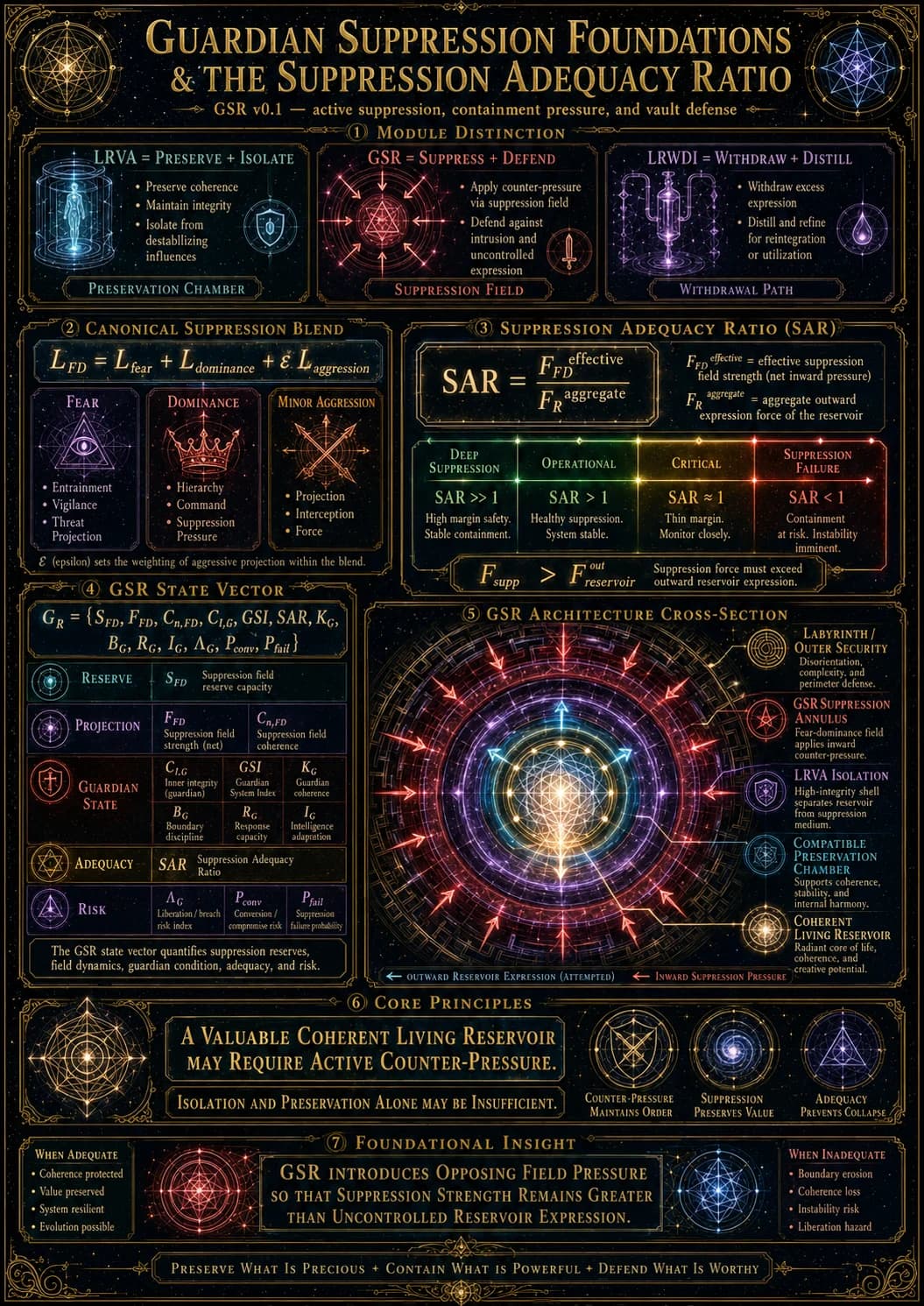
Guardian Suppression Reservoir
Guardian Suppression Reservoir v0.1
GSR — Fear/Dominance Containment Fields, Minotaur Nodes, Suppression Reserves, and Vault Defense
1. Purpose
TheGuardian Suppression Reservoir (GSR)defines the active containment layer surrounding high-value living reservoirs within the working assumptions of the Loosh Dynamics Framework.
LRVA answers:
How is the living reservoir preserved and isolated?
LRWDI answers:
How is its output withdrawn and processed safely?
GSR answers:
How is sufficient opposing field pressure maintained to suppress reservoir expression, resist liberation attempts, and protect the vault architecture itself?
The canonical architecture is:
Outer Security → Labyrinth → Guardian Suppression Field → LRVA Isolation → Living Reservoir Core.
The symbolic archetype for the primary guardian node is the:
Minotaur Node
—a highly specialized fear/dominance field anchor positioned between the outer system and the inner coherent reservoirs.
2. Scope
GSR focuses specifically on:
- suppression-field generation;
- fear/dominance reserve storage;
- guardian-state maintenance;
- labyrinth field gradients;
- inward and outward containment;
- guardian compatibility;
- conversion resistance;
- emergency suppression;
- redundancy;
- systemically important guardian nodes;
- liberation cascades.
It doesnotreplace LRVA preservation or LRWDI refinement.
The three modules remain distinct:
LRVA: Preserve + Isolate
GSR: Suppress + Defend
LRWDI: Withdraw + Distill.
3. Core GSR Principle
The highest-value coherent reservoirs may possess substantial:
Uv, CI, Gv, Fvout.
Passive isolation alone may therefore be insufficient.
GSR introduces a deliberately opposing field:
Fsupp =
designed to exceed uncontrolled outward reservoir expression:
Fsupp = Freservoirout.
The vault therefore uses:
isolation = + counter-field pressure
rather than either mechanism alone.
4. Canonical Suppression Blend
The primary suppression reservoir is modeled as a concentrated blend of:
LFD = Lfear + Ldominance + ε Laggression.
Fear contributes:
ΞF↑
through entrainment and threat-field projection.
Dominance contributes:
D↑
through rank and command pressure.
A smaller aggression component may contribute:
Fprojection↑.
The intended result is:
high narrow-band suppressive coherence
rather than integrative coherence.
5. GSR State Vector
Define the Guardian Suppression Reservoir state:
GR = SFD, FFD, Cn, FD, CI, G, GSI, SAR, KG, BG, RG, IG, ΛG, Pconv, Pfail
where:
(SFD) — Suppression Reserve
Stored fear/dominance energetic inventory.
(FFD) — Active Suppression Field
Current field pressure projected through the vault.
(Cn,FD) — Narrow Suppression Coherence
Coherence around fear/dominance harmonics.
(CI,G) — Guardian Integrative Coherence
Whole-system coherence of the guardian itself.
(GSI) — Guardian Saturation Index
How strongly the guardian is saturated with its operating state.
(SAR) — Suppression Adequacy Ratio
Suppression strength relative to reservoir expression.
(KG) — Guardian–Field Compatibility
Compatibility between guardian and suppression blend.
(BG) — Guardian Boundary Integrity
Resistance to unwanted conversion.
(RG) — Guardian Restoration Capacity
Ability to return to intended operating state.
(IG) — Guardian Isolation
Degree of separation from coherent inner reservoirs.
(ΛG) — Suppression Decay
Rate at which the guardian field loses potency.
(Pconv) — Guardian Conversion Probability
Risk that reservoir coherence alters the guardian.
(Pfail) — Guardian-System Failure Probability
Combined probability of suppression collapse.
6. Suppression Adequacy Ratio
The central GSR metric is:
SAR = (FFDeffective)/(FRaggregate)
where:
FRaggregate = ∑iFR_iout
represents total outward pressure from all contained reservoirs.
Deep Suppression
SAR ≫ 1.
Operational Suppression
1.25lesssim SARlesssim2
as a provisional tuning region.
Critical Balance
SAR ≈ 1.
Suppression Failure
SAR<1.
When:
SAR<1,
coherent reservoir expression begins exceeding the containment field.
7. Effective Suppression Field
Suppression potency depends on more than reserve quantity.
Define:
FFDeffective = SFD Cn, FD KG ηP Bmaze
where:
- (SFD) = available reserve;
- (Cn) = narrow-band coherence;
- (KG) = guardian compatibility;
- (ηP) = projection efficiency ;
- (Bmaze) = labyrinth distribution gain.
This means a smaller highly coherent suppression reserve can theoretically outperform a larger poorly organized one.
8. The Minotaur Node
TheMinotaur Nodeis the primary living or active anchor of the suppression field.
Its functions are:
Guard = + Suppress + Intercept + Project + Anchor.
It is not merely stationed within the vault.
It actively stabilizes the suppression annulus.
9. Minotaur Node Function
The Minotaur Node converts stored:
SFD
into a structured projected field:
SFD → FFD.
Its effectiveness depends upon:
KG, Cn, G, BG, RG.
A suitable node would have:
- high compatibility with fear/dominance;
- high projection strength;
- high boundary integrity;
- low compatibility with inner coherent reservoir states;
- strong restoration toward its designated field state.
10. Guardian Saturation Index
To avoid confusion with the GSR module acronym, guardian saturation is represented by:
GSI = (SFD, G)/(CGoperational).
where (SFD,G) is suppression-state saturation within the guardian and (CGoperational) is its stable operating capacity.
Under-Saturated
GSI<GSImin.
Suppression weakens.
Operational
GSImin ≤ GSI ≤ GSImax.
Over-Saturated
GSI>GSImax.
Possible consequences:
- excessive aggression;
- loss of control precision;
- infrastructure damage;
- runaway projection;
- narrow-band instability.
Thus:
maximum saturation ≠ maximum containment quality.
11. Guardian State Maintenance
The guardian state evolves as:
(dXG)/(dt) IFD + GG UG ΛGXG
where:
- (IFD) = incoming fear/dominance supply;
- (GG) = guardian's own compatible generation;
- (UG) = suppression expenditure;
- (ΛG) = decay.
Stable operation requires:
IFD = + GG ≈ UG + ΛGXG.
12. Guardian Compatibility
Unlike ordinary guards, a Minotaur Node is intended to strongly resonate with the suppression state:
KG, FD → + 1.
But it should remain weakly coupled to the inner reservoir state:
KG, R → 0
or mildly antagonistic where stable.
This creates the desired asymmetry:
Suppression Field → Guardian
strongly,
while:
Reservoir Field → Guardian
weakly.
13. Guardian Conversion Risk
Absolute immunity is inconsistent with the wider LDF reaction model.
Therefore:
Pconv>0
always remains possible in principle.
Define:
Pconv = f(FRexposure, KG, R, Texposure, BG-1, RG-1, GSI-1).
Conversion risk rises with:
- stronger coherent reservoir exposure;
- higher compatibility;
- longer exposure;
- weaker boundaries;
- weaker restoration;
- low suppression-state saturation.
14. Conversion Resistance
Define guardian conversion resistance:
CRG = BG RG Cn, FD IG.
Higher:
CRG
means greater resistance to reservoir-induced state change.
A high-value guardian therefore combines:
strong suppression resonance + low inner-reservoir coupling + high boundary integrity.
15. Suppression Annulus
The suppression field should not ideally occupy the same immediate chamber as the coherent reservoirs.
Instead:
Living Reservoirs ⊂ Compatible Inner Chamber ⊂ Isolation Shell ⊂ Suppression Annulus.
This prevents:
FFD
from directly degrading the stored love/TLWS field while still exerting pressure across the isolation boundary.
16. Why Annular Suppression Is Preferred
Direct mixing would increase:
χreservoir
and:
Λmismatch.
An annular design separates:
preservation field
from:
suppression field.
LRVA preserves the asset.
GSR suppresses its outward reach.
This resolves the preservation-versus-control conflict more efficiently.
17. Labyrinth Suppression Gradient
The labyrinth can distribute fear/dominance pressure spatially.
Let:
r
represent distance from the central reservoir region.
A possible design is:
FFD(r) ↑ as r↓.
Thus deeper movement into the vault produces progressively stronger suppressive exposure.
18. Gradient Function
A simple conceptual function is:
FFD(r) = F0 + (k)/((r + r0)n).
The actual functional form is not important.
The principle is:
the closer to the inner vault, the stronger the suppression field.
19. Dual-Direction Defense
The labyrinth gradient operates in both directions.
Inward Intrusion
An outside liberator encounters increasing:
FFD.
Outward Escape
A coherent reservoir attempting outward expression encounters increasing suppression before reaching the broader network.
Thus:
GSR guards both entry and exit.
20. Labyrinth Functions
The GSR labyrinth performs:
Suppression = + Security + Compartmentalization + Exposure Gradient
while LRWDI's labyrinth performs:
Attenuation = + Fractionation Preparation + Decoupling.
These are related but separate labyrinth systems.
21. Suppression Reserve
The guardian should not rely entirely upon spontaneous generation.
A dedicated fear/dominance reserve provides:
SFDreserve.
This becomes a strategic reserve whose sole purpose is maintaining vault control.
Thus:
Primary Asset: Love / TLWS Reservoirs
while:
Containment Asset: Fear / Dominance Reserve.
22. Containment Reserve Ratio
Define:
CRR = (SFDavailable)/(SFDrequired(TR))
for planning interval (TR).
Reserve Surplus
CRR>1.5.
Operational
1<CRR ≤ 1.5.
Low Reserve
CRR ≤ 1.
Critical
CRR ≪ 1.
Low CRR predicts future suppression weakness even before SAR begins falling.
23. Fear/Dominance Reserve Consumption
Reserve draw is:
(dSFD)/(dt) GFD + IFD Usupp ΛFDSFD.
High reservoir expression causes:
Usupp↑.
Thus coherent reservoirs indirectly increase suppression-resource consumption.
24. Containment Carrying Cost
The vault has an energetic control cost:
Ccontain = CFD + CG + Cisolation + Csecurity + Cautomation.
A reservoir is economically worthwhile only when:
Vreserve = Ccontain + Cpreservation.
This links GSR directly to LMD.
25. Emergency Containment
When:
SAR↓,
the architecture can restore containment through two broad pathways.
Raise Suppression
FFD↑.
Reduce Reservoir Expression
FRaggregate↓.
Therefore:
SAR = (FFD)/(FR)
can be restored by changing either numerator or denominator.
26. Emergency Suppression Injection
A reserve pulse:
Δ = SFD
can temporarily increase:
FFD.
This is the fastest emergency response but consumes strategic suppression reserves.
Repeated reliance on emergency injection signals structural instability.
27. Reservoir Expression Reduction
LRVA can reduce:
Bvout
or otherwise lower outward reservoir expression.
LRWDI may also temporarily increase controlled withdrawal to reduce:
Uv.
Within a coercive architecture, this represents sacrificing part of the stored reserve to preserve containment.
28. Raw Love Should Not Feed the Guardian Directly
A high-coherence love/TLWS field may have:
KG, L<0.
Direct exposure therefore raises:
Pconv.
If love reserves are drawn during emergency containment, they should first pass through LRWDI.
Thus:
Llove/raw = ¬ → Guardian.
Instead:
Llove/raw → LRWDI → compatible processed fraction
if any such fraction is usable.
The more important emergency benefit may simply be:
FRaggregate↓.
29. Emergency Containment Sequence
A canonical emergency sequence becomes:
SAR↓ → Gate Lock → Guardian Reserve Release → FFD↑ → LRVA Expression Suppression → FR↓ → SAR↑.
If containment remains unstable:
LRWDI controlled reservoir draw
may be added.
30. Minotaur Single-Point Risk
If one guardian controls most suppression:
FFD ≈ FM,
then:
SIM ≫ 0.
Its failure can create:
Minotaur Failure → FFD↓ → SAR<1.
This is a major single-point vulnerability.
31. Minotaur Systemic Importance
Define:
SIM = f(FM, NR, SubM-1, CN, M, Tfailover)
where:
- (FM) = suppression contribution;
- (NR) = reservoirs protected;
- (SubM-1) = low substitutability;
- (CN) = network centrality;
- (Tfailover) = replacement latency.
32. Guardian Redundancy
A mature vault may therefore use:
M1, M2, …, Mn.
Total suppression:
FFDtotal = ∑iFM_i.
The primary Minotaur may carry most visible suppression while secondary nodes provide:
- reserve field support;
- dormant redundancy;
- spatial anchors;
- emergency failover.
33. Guardian Redundancy Ratio
Define:
GRR = (FFDavailable after primary failure)/(FRaggregate).
If:
GRR>1,
the vault survives loss of the primary guardian.
If:
GRR<1,
primary guardian failure triggers immediate suppression crisis.
34. Common-Mode Guardian Risk
Redundancy fails if all guardians share the same vulnerability.
Define:
CMR = P(M1, M2, …, Mn fail from same cause).
Examples include:
- shared energy source;
- common harmonic conversion;
- one network dependency;
- synchronized reservoir exposure.
True redundancy requires:
CMR↓.
35. Distributed Suppression Anchors
Some suppression does not need to come from conscious guardians.
The labyrinth may contain:
A1, A2, …, An
non-living or automated suppression anchors.
Then:
FFDtotal = FM + ∑iFA_i.
This lowers dependence on one living node.
36. Guardian Versus Automated Suppression
Living Guardian
Advantages:
- adaptive;
- responsive;
- capable of active interception.
Risks:
- conversion;
- agency;
- exhaustion;
- defection.
Automated Anchor
Advantages:
- low conversion risk;
- predictable.
Weaknesses:
- less adaptive;
- dependent on technical stability.
A mature architecture likely combines both.
37. Guard Layering
The security architecture can contain three levels.
Inner Layer
Automated suppression anchors.
Middle Layer
Minotaur / specialized guardian nodes.
Outer Layer
General physical or network security.
Thus:
Reservoir → Automation → Minotaur → General Security.
38. Guardian Exposure Budget
For living guardian (g):
Egcum = ∫0T Jg(t), dt.
Require:
Egcum < Egcrit.
Even highly specialized guardians may require:
- rotation;
- isolation cycles;
- re-saturation;
- restoration.
39. Conversion Drift
Guardian state can slowly drift even without overt conversion.
Define:
DG = (dKG, R)/(dt).
If:
DG>0,
guardian compatibility with reservoir fields is increasing.
That is an early warning indicator.
40. Guardian Replacement Threshold
If:
Pconv>Pconvcrit
or:
DG>DGcrit,
the guardian should theoretically be removed from primary suppression duty.
This protects against sudden conversion cascades.
41. Vault Stability With GSR
LRVA previously defined vault stability.
GSR expands it:
[ VSI^= f(Pv, Iv, Sv, SAR, GSI, GRR, 1-Pconv, 1-χv). ]**
A vault can have excellent preservation yet poor active suppression.
Both must remain adequate.
42. Suppression–Preservation Separation
An important GSR rule is:
the field that preserves the reservoir should not be the field that suppresses it.
Preservation requires:
Kinner↑.
Suppression requires:
FFDouter↑.
Mixing the two reduces both functions.
43. GSR–LRVA Interface
The ideal relationship is:
GSR → LRVA isolation boundary → Reservoir.
GSR supplies external counter-pressure.
LRVA prevents that counter-pressure from contaminating the stored state.
44. GSR–LRWDI Interface
The suppression field should never freely enter the product-processing line.
Therefore:
KGSR, LRWDI product → 0.
Otherwise:
- love products become fear-contaminated;
- principle-state fractions become distorted;
- market quality falls.
LRWDI therefore requires its own isolation corridor through the GSR layer.
45. Withdrawal Corridor
A controlled withdrawal route passes:
LRVA → shielded LRWDI corridor → outside GSR annulus.
The product line should not travel through the suppression field unprotected.
This creates a specializedvault umbilical.
46. GSR–LMD Interface
Fear/dominance reserves used for containment have opportunity cost.
They cannot simultaneously be:
- sold;
- deployed elsewhere;
- used for military enhancement.
Define:
OCFDGSR = Valternative use.
A vault's true cost therefore includes foregone market value of its containment reserves.
47. Strategic Reserve Competition
During fear shortage:
SF↓,
the architecture may have to choose between:
external operations
and:
vault containment.
If vault containment is systemically critical, then:
DFGSR =
becomes priority demand.
This could cause sharp fear-market price increases during internal containment crises.
48. Fear Demand Inversion
Under widespread TLWS diffusion:
GFexternal↓
while:
DFGSR↑.
This produces:
lower external fear supply + higher internal containment demand.
GSR therefore strengthens the previously identifiedterms-of-trade inversioninside LMD.
49. Suppression Reserve Run
If multiple vaults simultaneously require emergency fear/dominance injection:
DFDvault↑↑,
then:
SFDavailable↓.
This can produce a:
Suppression Reserve Run.
Vaults begin competing for the commodity required to keep other high-value reserves contained.
50. Vault Liberation Cascade
A full cascade could be:
Fear Reserve Shortage → GSI↓ → FFD↓ → SAR<1 → Reservoir Expression↑ → Pconv↑ → Guardian Drift → FFD↓↓ → LRVA Overpressure → Vault Liberation.
This is a self-reinforcing containment failure.
51. Guardian Conversion Cascade
If the Minotaur begins shifting toward the reservoir field:
KG, R↑,
then:
FFD↓
while potentially:
FReffective↑
because the guardian stops opposing and may begin reinforcing the inner field.
Thus:
Guardian conversion can reverse the sign of the containment field.
This is one of GSR's most dangerous failure modes.
52. Negative Suppression State
Define signed suppression:
Ssigned = FFD Fguardian support of reservoir.
Normally:
Ssigned>0.
After full guardian conversion:
Ssigned<0.
The guardian becomes an amplifier for the reservoir it formerly suppressed.
53. Minotaur Inversion
This failure is formally:
Minotaur Inversion
where:
Guardian → Liberation Catalyst.
Symbolically, the guardian of the labyrinth becomes the being that opens it.
This creates extremely high:
Ilib.
54. GSR Failure Modes
GSR-F01 — Suppression Reserve Depletion
SFD↓.
GSR-F02 — Guardian Under-Saturation
GSI<GSImin.
GSR-F03 — Guardian Over-Saturation
GSI>GSImax.
GSR-F04 — Suppression Field Collapse
SAR<1.
GSR-F05 — Guardian Conversion Drift
KG, R↑.
GSR-F06 — Minotaur Inversion
Guardian begins reinforcing reservoir coherence.
GSR-F07 — Suppression Annulus Breach
Counter-field penetrates LRVA preservation chamber.
GSR-F08 — Product-Line Contamination
Fear/dominance field enters LRWDI output.
GSR-F09 — Guardian Exhaustion
RG↓.
GSR-F10 — Failover Failure
Backup guardians cannot restore:
SAR>1.
GSR-F11 — Common-Mode Guardian Failure
Multiple suppressors fail simultaneously.
GSR-F12 — Suppression Reserve Run
Multiple vaults compete for insufficient fear/dominance supply.
GSR-F13 — Vault Liberation Cascade
One suppression failure propagates through the entire vault.
55. GSR Optimization Function
The system attempts to maximize:
JGSR = w1SAR + w2GRR + w3CRG + w4CRR w5Pconv w6Ccontain w7χ
subject to:
SAR>1
GSImin<GSI<GSImax
Pconv<Pconvcrit
KGSR, LRWDI ≈ 0.
56. GSR Security Principle
A strong GSR should not rely upon one form of control.
It combines:
Reserve = + Guardian + Automation + Gradient + Isolation + Redundancy.
This reduces single-point failure.
57. Symbolic Minotaur Function
The Minotaur is an effective symbolic representation because it combines:
- immense force;
- labyrinth centrality;
- territorial guardianship;
- narrow purpose;
- danger to intruders;
- confinement within the same system it guards.
Within GSR, the symbolism maps to:
specialized high-power suppressor embedded inside the containment maze.
The symbol is architectural rather than evidence about the original mythology.
58. Ethical Architecture Distinction
The same general concept could theoretically describe a consensual guardian field protecting a dangerous high-energy system.
However, within the dark-control scenario developed here, GSR is coercive because its purpose is to maintain non-consensual containment of living reservoirs.
Thus:
BΣreservoir↓
and:
H↑.
The coercive character comes from the governance architecture rather than the existence of a guardian field by itself.
59. Canonical Living Reservoir Strategic Vault Stack
With GSR formalized, the complete system becomes:
OUTER SECURITY / NETWORK CONTROL
↓LABYRINTH SUPPRESSION GRADIENT
↓GSR — MINOTAUR / FEAR-DOMINANCE ANNULUS
↓LRVA — ISOLATION + PRESERVATION
↓LIVING RESERVOIR CORE
↓CONTROLLED LRWDI WITHDRAWAL
↓ATTENUATION / FRACTIONATION / REFINEMENT
↓BUFFERED COMMODITY
↓LSSVCR / SDFI / MARKET
The withdrawal path must remain shielded from the suppression annulus.
60. Master GSR Principles
GSR-P01 — Valuable Living Reservoirs May Require Active Counter-Pressure
Isolation and preservation alone may not suppress high-output coherent sources.
GSR-P02 — Preservation and Suppression Must Remain Separate
The inner chamber preserves; the outer annulus suppresses.
GSR-P03 — Fear/Dominance Functions as a Containment Commodity
Its value includes maintaining control over other reserves.
GSR-P04 — The Guardian Is a Field Anchor, Not Merely a Physical Guard
The Minotaur Node actively maintains suppression architecture.
GSR-P05 — Guardian Saturation Has an Optimum
Too little weakens suppression; too much creates instability.
GSR-P06 — No Guardian Is Absolutely Conversion-Proof
Strong compatibility and saturation reduce risk but do not eliminate reaction dynamics.
GSR-P07 — Suppression Adequacy Is a Ratio
Containment can fail because suppression falls or because reservoir expression rises.
GSR-P08 — Emergency Containment Can Act on Either Side of the Ratio
Increase suppression or reduce reservoir expression.
GSR-P09 — The Labyrinth Is a Field Gradient
It protects both against intrusion and outward escape.
GSR-P10 — Guardian Centralization Creates Efficiency and Fragility
One powerful Minotaur minimizes exposure but creates a systemically important single node.
GSR-P11 — True Redundancy Requires Independent Failure Modes
Multiple guardians sharing one vulnerability do not provide meaningful redundancy.
GSR-P12 — GSR Fields Must Be Isolated From LRWDI Products
Containment energy should not contaminate market output.
GSR-P13 — Containment Fear Can Become Priority Demand
During systemic stress, fear/dominance may be needed internally more urgently than for external operations.
GSR-P14 — Guardian Conversion Can Reverse Containment
A converted Minotaur can become a liberation amplifier.
GSR-P15 — The Vault's Greatest Strength Can Become Its Greatest Failure Point
A single highly efficient suppression architecture creates powerful nonlinear failure when its sign reverses.
61. Central GSR Principle
LRVA protects the reservoir from the surrounding architecture.
GSR protects the surrounding architecture from the reservoir.
Its core relationship is:
Coherent Living Reserve ↔ Opposing Suppression Field.
The system remains stable only while:
SAR>1
and the guardian remains aligned with the suppression architecture.
The deepest GSR principle is therefore:
A containment system built around opposing field pressure becomes increasingly dependent on the continued coherence of its suppressor ; if the suppressor weakens or changes alignment, the same centralized power that once held the vault together can accelerate its collapse.
Or symbolically:
The Minotaur guards the labyrinth only while the labyrinth can continue sustaining the Minotaur.