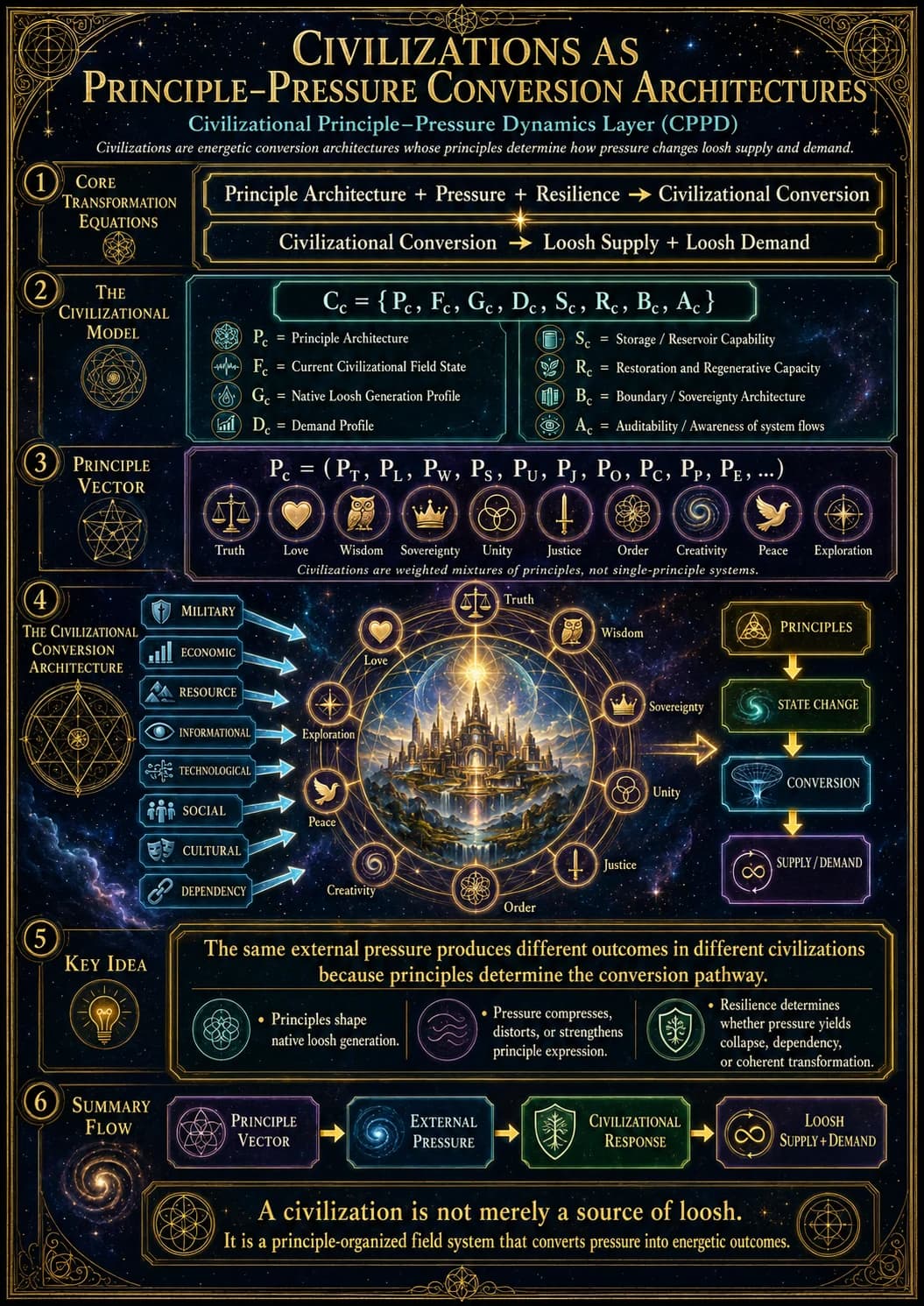
Civilizational Principle Pressure Dynamics
Civilizational Principle–Pressure Dynamics Layer v0.1
CPPD — Principle Architecture, External Pressure, Conversion Pathways, Redundancy, and Civilizational Resilience
1. Purpose
TheCivilizational Principle–Pressure Dynamics Layer (CPPD)defines how civilizations function as energetic conversion architectures inside the Loosh Dynamics Framework.
The previous layers established:
Loosh Families → Compounds → Refinement → Reaction → Storage.
CPPD adds the civilizational layer:
Principles + External Pressure → Civilizational State Change → Loosh Conversion
A civilization is therefore not merely a population that produces loosh.
It is aprinciple-organized field systemwhose internal architecture determines:
- what it naturally generates;
- what it naturally consumes;
- what pressures destabilize it;
- what pressures strengthen it;
- what states emerge under compression;
- which dependencies can be created;
- which commodities it can preserve;
- and how difficult it is to subvert.
2. Core Civilizational Model
Represent civilization (c) as:
Cc = Pc, Fc, Gc, Dc, Sc, Rc, Bc, Ac
where:
- (Pc) = Principle Architecture
- (Fc) = Current Civilizational Field State
- (Gc) = Native Loosh Generation Profile
- (Dc) = Demand Profile
- (Sc) = Storage / Reservoir Capability
- (Rc) = Restoration and Regenerative Capacity
- (Bc) = Boundary / Sovereignty Architecture
- (Ac) = Auditability / Awareness of system flows
A civilization's market behavior cannot be understood without all of these.
3. Principle Vector
Every civilization contains multiple principles at different strengths.
Define:
Pc = (PT, PL, PW, PS, PU, PJ, PO, PC, PP, PE, …)
where, for example:
- (PT) = Truth
- (PL) = Love
- (PW) = Wisdom
- (PS) = Sovereignty
- (PU) = Unity
- (PJ) = Justice
- (PO) = Order
- (PC) = Creativity
- (PP) = Peace
- (PE) = Exploration / Expansion of possibility
The vector is weighted:
0 ≤ Pi ≤ 1.
A civilization described as "love-based" therefore means:
PL ≫ 0
rather than:
PL = 1, Pj ≠ L = 0.
This distinction is important becauseprinciple mixtures determine resilience.
4. Principle Function
A principle is not merely an ideal.
Within CPPD, a principle is an organizing rule that influences:
Perception → Decision → Coupling → Resource Flow → Field Generation.
For example:
Truth
Supports:
- accurate signal recognition;
- causal clarity;
- auditability;
- resistance to false framing.
Love
Supports:
- integrative coherence;
- reciprocal coupling;
- restoration;
- relational continuity.
Wisdom
Supports:
- long-horizon decision making;
- context integration;
- proportional response;
- avoidance of false binaries.
Sovereignty
Supports:
- boundary integrity;
- consent;
- independent choice;
- resistance to dependency.
A principle therefore affects both civilizational behavior and loosh generation.
5. Native Production Profile
Every principle architecture tends to support particular energetic outputs.
Define:
Gc0 = g(Pc)
as the civilization's baseline generation profile.
A high-love civilization may naturally produce:
Glove↑
Gattachment↑
Gpeace↑
Ghope↑.
A highly creative civilization may produce:
Gcreative↑
Gawe↑
Ghope↑.
A highly hierarchical civilization may naturally produce larger amounts of:
Gstatus, Gsubmission, Gpleasure, Gfear.
Thus:
Principle architecture shapes commodity output before any external intervention occurs.
6. External Pressure Vector
External influence is represented as:
Xc = (XM, XE, XR, XI, XT, XS, XC, XD, …)
where:
- (XM) = Military Pressure
- (XE) = Economic Pressure
- (XR) = Resource Pressure
- (XI) = Informational Pressure
- (XT) = Technological Pressure
- (XS) = Social / Relational Pressure
- (XC) = Cultural / Symbolic Pressure
- (XD) = Diplomatic / Dependency Pressure
The external field changes the effective expression of principles:
Pc' = T(Pc, Xc, Rc, Bc)
where (T) is the principle-pressure transformation operator.
7. Principle Compression
Pressure does not necessarily destroy a principle.
It cancompress its expression.
Define:
Δ Pi = Pifree Pipressured.
A principle under compression may remain symbolically present while changing function.
Example:
Love → Attachment Fear
Peace → Submission to Security
Unity → Conformity
Order → Authoritarian Control
Justice → Vengeance.
This creates:
Principle Compression → Loosh Conversion.
8. Principle Conversion Paths
A principle under pressure can enter several different pathways.
CP-01 — Preservation
The principle remains functionally intact.
Pi + X → Pi.
CP-02 — Strengthening
Pressure causes the civilization to embody the principle more strongly.
Pi + X → Pi + .
Example:
Love + Threat + Sovereignty → Protective Love.
CP-03 — Compression
Expression narrows.
Pi → Picompressed.
CP-04 — Distortion
The original principle becomes partially inverted.
Pi → tilde Pi.
CP-05 — Proxy Capture
A substitute system claims to represent the original principle.
Pi → Piproxy.
CP-06 — Dependency Conversion
Loss of endogenous principle capacity creates demand for external supply.
Pi↓ ⇒ DL_iexternal↑.
CP-07 — Collapse
The organizing principle can no longer coordinate the system.
Pi → 0.
9. Principle Proxy Capture
Proxy capture is especially important because the external architecture does not need to attack the principle directly.
It can imitate it.
Love Proxy
"We will protect those you love."
Love becomes justification for dependency.
Peace Proxy
"Submit to our security system to guarantee peace."
Peace becomes centralized control.
Truth Proxy
"Only our authority can determine what is true."
Truth becomes information monopoly.
Sovereignty Proxy
"Join our system so no outside force can control you."
Sovereignty becomes dependency upon a larger controller.
Unity Proxy
"Difference threatens unity."
Unity becomes conformity.
Justice Proxy
"Retaliation is the only path to justice."
Justice becomes vengeance.
10. Principle-to-Loosh Conversion Matrix
| Principle | Coherent Expression | Pressure Distortion | Common Converted Loosh |
|---|---|---|---|
| Truth | clarity, discernment | uncertainty, information conflict | fear, aversion, obsession, status |
| Love | care, reciprocity | attachment fear, grief, dependency | fear, loss, attachment, desire |
| Wisdom | perspective, proportion | compression, forced certainty | fear, submission, status |
| Sovereignty | agency, boundaries | defensive fixation, domination struggle | aggression, fear, status |
| Unity | cooperation | tribalism, conformity | attachment, fear, aggression, status |
| Justice | restoration, balance | grievance, retaliation | aggression, vengeance, loss |
| Order | stable organization | rigid hierarchy | submission, status, fear |
| Creativity | novelty, exploration | frustration, restriction | desire, aggression, loss |
| Peace | equilibrium | appeasement or pressured mobilization | fear, submission, aggression |
| Hope | future possibility | desperation or despair | desire, loss, fear |
| Compassion | restorative engagement | depletion / rescue dependency | loss, attachment, guilt |
| Exploration | discovery | conquest or compulsive expansion | desire, status, aggression |
This matrix is not deterministic.
It defines common conversion possibilities under pressure.
11. Pressure Conversion Function
For loosh family (j):
Gj, c Gj, c0 + ∑i βij Pi, c Xc
where:
βij
represents the conversion coefficient from pressured principle (i) into loosh family (j).
Different civilizations therefore possess different:
βc.
This is theirPrinciple Conversion Matrix.
12. Pressure Elasticity
Define:
εc, j, x (∂ Gc, j)/(∂ Xx).
This measures how much a particular form of pressure changes production of commodity (j).
Examples:
Love civilization under military pressure
εfear, M↑.
Justice civilization under unresolved injury
εaggression, J↑.
Creative civilization under restriction
εdesire, C↑
while:
εcreative, C<0.
These elasticities create different strategic target profiles.
13. Pressure Threshold
Not all pressure causes meaningful conversion.
Define:
Xccrit.
Below:
X<Xccrit
the civilization absorbs the disturbance.
Above:
X>Xccrit
principle deformation begins.
But extraction does not necessarily increase forever.
A useful first-pass yield function is:
Yc(X) = acXe-b_cX.
The system has an optimal extraction region:
Xc.**
Too little pressure produces little conversion.
Too much may produce:
- collapse;
- flight;
- unification;
- resistance;
- source destruction;
- market loss.
Thus:
Maximum exploitation generally favors managed instability rather than total destruction.
14. Principle Resilience
Define principle resilience:
RP_i 1- (|Δ Pi|)/(X)
in normalized form.
A resilient principle preserves its function despite external compression.
High-resilience Love
Threat → Protective Love.
Low-resilience Love
Threat → Fear + Dependency.
Thus the target is not merely the principle itself.
The decisive variable is:
the principle's transformation behavior under pressure.
15. Principle Elasticity
Another useful measure is:
EP_i (functional principle retained)/(external pressure)
High elasticity allows a principle to change expression without losing its core function.
Examples:
Love
Care → Protection
without becoming possession.
Sovereignty
Independence → Coordinated Defense
without becoming domination.
Truth
Open Inquiry → Emergency Signal Filtering
without becoming censorship.
This is a key marker of civilizational maturity.
16. Principle Redundancy
A civilization becomes substantially more resilient when multiple principles can compensate for pressure against one another.
Define redundancy:
RP = ∑i ≠ j wij PiPjKijP
where:
KijP
represents functional compatibility between principles.
High redundancy means multiple principles support the same civilizational function through different routes.
17. The Truth–Love–Wisdom–Sovereignty Core
The primary redundancy architecture is:
Truth + Love + Wisdom + Sovereignty
abbreviated:
TLWS
These four principles cover complementary failure modes.
Truth — Signal Integrity
Truth answers:
What is actually occurring?
Functions:
- accurate perception;
- causal attribution;
- transparency;
- auditability;
- detection of false framing.
Without Truth:
Love
can be manipulated through false information.
Love — Integrative Coherence
Love answers:
How do we remain connected without destroying one another?
Functions:
- relational coherence;
- reciprocity;
- restoration;
- compassion;
- non-extractive coupling.
Without Love:
Truth can become cold optimization.
Sovereignty can become isolation.
Wisdom can become detached calculation.
Wisdom — Contextual Integration
Wisdom answers:
What response preserves the deepest structure across time?
Functions:
- long-horizon thinking;
- proportionality;
- integration of competing truths;
- avoidance of false binary choices;
- strategic timing.
Without Wisdom:
Truth may be technically correct but poorly applied.
Love may become indiscriminate.
Sovereignty may become reactive.
Sovereignty — Boundary Integrity
Sovereignty answers:
Who has legitimate authority over this choice?
Functions:
- consent;
- boundaries;
- agency;
- resistance to dependency;
- rejection of coercive coupling.
Without Sovereignty:
Love can be captured into obligation.
Truth can be monopolized.
Wisdom can become paternalistic control.
18. TLWS Mutual Reinforcement
The architecture works because each principle protects the others.
T ↔ L ↔ W ↔ S
More specifically:
T → prevents deception of L
L → prevents dehumanization of T
W → prevents reactive misuse of T, L, S
S → prevents coercive capture of T, L, W.
The result is:
High Principle Redundancy + High Integrative Coherence.
19. TLWS Pressure Response
Consider external military pressure.
A fragile love-only architecture might follow:
L + XM → F + D.
A TLWS architecture instead has multiple reaction pathways.
Truth identifies:
actual threat
rather than projected narratives.
Wisdom determines:
proportional response.
Sovereignty maintains:
BΣ.
Love maintains:
CI.
The combined response becomes:
T + L + W + S + XM → Protective Sovereign Coherence.
Possible loosh products include:
- Courage;
- Protective Love;
- Determination;
- Hope;
- Peace-under-pressure;
- collective inspiration.
This changes the economics dramatically.
The intended fear-harvest conversion does not occur efficiently.
20. Redundancy Example — Truth Under Pressure
Suppose:
XI↑
through information distortion.
Truth alone may become overwhelmed by conflicting data.
TLWS redundancy produces:
Truth
asks what is verifiable.
Wisdom
maintains uncertainty rather than forcing premature certainty.
Sovereignty
prevents external authority from monopolizing interpretation.
Love
prevents uncertainty from turning groups against each other.
Thus:
XI ¬ → Fear + Tribal Conflict
as easily.
21. Redundancy Example — Love Under Pressure
Suppose a civilization is threatened through those it cares about.
Without redundancy:
L + XM → Fear Attachment → Dependency.
With TLWS:
Truth identifies the real source of threat.
Wisdom prevents panic response.
Sovereignty rejects coercive trade.
Love remains the reason for protection.
So:
L + T + W + S → Protective Love
instead of:
Possessiveness / Submission.
22. Redundancy Example — Sovereignty Under Pressure
Sovereignty alone can be distorted into:
Defiance → Isolation → Dominance.
With TLWS:
Truth prevents imagined threats from becoming justification for aggression.
Love prevents sovereignty from becoming separation.
Wisdom determines when collaboration strengthens rather than diminishes sovereignty.
Thus:
S + T + L + W → Cooperative Sovereignty.
23. Redundancy Example — Wisdom Under Pressure
Wisdom can be attacked through decision compression:
tdecision↓.
Rapid crises encourage:
binary choices.
TLWS redundancy responds:
Truth maintains causal clarity.
Love maintains human/relational value.
Sovereignty preserves refusal power.
Wisdom chooses the least-distorting available response.
This increases:
Decision Slack
and reduces forced conversion.
24. Additional Principle Redundancy Clusters
TLWS is foundational, but civilizations can build additional clusters.
RP-01 — Truth + Wisdom
Function:
Epistemic Resilience.
Truth identifies signal.
Wisdom interprets context.
RP-02 — Love + Sovereignty
Function:
Non-Coercive Bonding.
Love preserves connection.
Sovereignty preserves freedom.
RP-03 — Love + Wisdom
Function:
Restorative Discernment.
Prevents love from becoming indiscriminate rescue or dependency.
RP-04 — Truth + Sovereignty
Function:
Resistance to Information Monopoly.
RP-05 — Wisdom + Sovereignty
Function:
Proportional Self-Governance.
RP-06 — Love + Truth
Function:
Honest Relational Coherence.
Prevents false harmony.
RP-07 — Unity + Sovereignty
Function:
Voluntary Federation.
Prevents unity from becoming conformity.
RP-08 — Justice + Love
Function:
Restorative Justice.
Prevents justice from becoming vengeance.
RP-09 — Order + Sovereignty
Function:
Distributed Order.
Prevents organization from becoming domination.
RP-10 — Creativity + Wisdom
Function:
Adaptive Innovation.
Prevents novelty from becoming uncontrolled destabilization.
RP-11 — Peace + Sovereignty
Function:
Non-Submissive Peace.
Prevents peace from becoming appeasement.
RP-12 — Hope + Truth
Function:
Grounded Future Orientation.
Prevents hope from becoming false optimism.
25. Principle Redundancy Matrix
| Primary Principle | Main Failure Without Redundancy | Protective Companion |
|---|---|---|
| Truth | cold certainty / information hierarchy | Love + Wisdom |
| Love | dependency / boundary collapse | Sovereignty + Truth |
| Wisdom | paternalism / detached calculation | Sovereignty + Love |
| Sovereignty | isolation / dominance | Love + Wisdom |
| Unity | conformity | Sovereignty |
| Justice | vengeance | Love + Wisdom |
| Order | authoritarianism | Sovereignty + Truth |
| Creativity | destabilization | Wisdom |
| Peace | appeasement | Sovereignty |
| Hope | denial / unrealistic expectation | Truth + Wisdom |
| Compassion | depletion | Wisdom + Sovereignty |
| Exploration | conquest / endless appetite | Wisdom + Love |
26. Principle Diversity
Redundancy depends partly on diversity.
Define:
DP -∑i piln pi
as a principle-diversity index.
Very low diversity can create brittleness:
DP↓ ⇒ single-point principle failure.
But unlimited diversity without integration can create incoherence.
Therefore an optimal civilization seeks:
Principle Diversity + Principle Compatibility + Shared Integration.
27. Principle Coherence
Define:
CP (1)/(N(N-1)) ∑i ≠ j PiPjKijP.
High (CP) means principles mutually reinforce rather than continually contradict one another.
TLWS is designed to produce high:
CP.
28. Civilizational Principle Resilience Index
Combine:
- redundancy;
- diversity;
- coherence;
- restoration;
- sovereignty.
Define:
CPRI = w1 RP + w2DP + w3CP + w4R + w5BΣ.
High CPRI predicts lower principle deformation under pressure.
29. Dependency Susceptibility
Define:
Dcsus = f(1-R, 1-BΣ, 1- RP, X, Δ P).
Dependency becomes increasingly likely when:
- restoration is low;
- sovereignty is weak;
- redundancy is poor;
- pressure is sustained;
- a core principle is compressed.
This is what allows external suppliers to become structurally necessary.
30. Principle Deficit
For principle (i):
ΔiP Pirequired Piavailable.
A positive deficit creates demand for either:
- endogenous restoration;
- substitute principles;
- imported energetic support;
- proxy systems.
An extractive architecture attempts to convert:
ΔiP
into external dependency.
31. Principle Arbitrage
Define:
Principle Arbitrage: Create / exploit deficit + control substitute supply.
The cycle is:
Pi → pressure → ΔiP → Diexternal → Controlled Supply → Dependency.
This is a core bridge into market dynamics.
32. Coherence Arbitrage
Love, peace, trust, hope, and integrative compounds support civilizational coherence.
Thus:
Coherence Arbitrage: Destabilize → Create Coherence Deficit → Sell Stabilization.
This produces the previously identified:
Coherence Rent.
33. Dual-Sided Pressure Profit
External pressure can create:
Supply
Gfear, Gloss, Gaggression, …
and simultaneously create:
Demand
Dlove, Dpeace, Dhope, …
Thus:
Pressure creates both commodities and customers.
This is one of CPPD's primary economic principles.
34. Civilizational Roles in the Larger Economy
Different civilizations may become:
Producers
Naturally generate valuable states.
Consumers
Depend upon imported states.
Refiners
Transform bulk output into strategic compounds.
Reservoir Civilizations
Possess unusually valuable storage architectures.
Transit Civilizations
Control routes or portals.
Catalyst Civilizations
Generate rare high-impact components.
Stabilizer Civilizations
Produce love, peace, hope, wisdom-like compounds.
Militarized Conversion Civilizations
Apply external pressure that causes other civilizations to generate desired commodities.
The same civilization can occupy several roles.
35. Civilizational Target Value
An extractive architecture may value a civilization according to:
Vctarget VN + VI + VD + VDep + VR + VNet CX Rc.
where:
- (VN) = native commodity value;
- (VI) = inducible commodity value;
- (VD) = induced demand value;
- (VDep) = dependency leverage ;
- (VR) = reservoir/storage value;
- (VNet) = network value ;
- (CX) = campaign/pressure cost;
- (Rc) = resistance cost.
This explains why civilizations with radically different principles can all possess strategic value.
36. Principle Targeting
An extractive system would not necessarily target the strongest principle directly.
It may target:
the weakest supporting principle around it.
For example:
A love civilization with weak sovereignty:
L↑, S↓
may be vulnerable to relational dependency.
A truth civilization with weak wisdom:
T↑, W↓
may be vulnerable to certainty traps.
A sovereignty civilization with weak love:
S↑, L↓
may be pushed toward isolation and aggression.
Thus:
Subversion often attacks the missing redundancy rather than the dominant principle.
37. Principle Attack Surface
Define the Principle Attack Surface:
AP = ∑i Pi(1-Risupport)
where:
Risupport
measures how strongly other principles protect principle (i).
A single dominant principle with few supporting principles creates a large attack surface.
TLWS reduces this by cross-support.
38. TLWS as a Reduced Attack Surface
For a TLWS civilization:
T, L, W, S ≫ 0.
Each major manipulation pathway encounters resistance from another principle.
Deception of Love
blocked by Truth.
Coercion Through Love
blocked by Sovereignty.
Reactive Misuse of Truth
buffered by Wisdom.
Isolation Through Sovereignty
buffered by Love.
False Certainty
checked by Wisdom and Truth.
Paternalistic Control
checked by Sovereignty.
Therefore:
APTLWS ≪ APsingle principle.
39. Restoration Path
If a civilization has already entered a compressed state, restoration should rebuild missing redundancy rather than merely suppress symptoms.
Example:
Love → Dependency
is not fully restored merely by removing dependency.
A stronger restoration is:
Love + Sovereignty + Truth + Wisdom.
Likewise:
Justice → Vengeance
can be restored through:
Justice + Love + Wisdom.
Thus:
Restoration increases principle redundancy.
40. Principle-Layer Market Handoff
The Market Dynamics framework should inherit from CPPD:
Principle Vector
Pc
Principle Redundancy
RP
Principle Coherence
CP
Principle Diversity
DP
Pressure Vector
Xc
Conversion Matrix
βc
Pressure Elasticities
εc, j, x
Principle Resilience
RP_i
Principle Deficits
ΔiP
Dependency Susceptibility
Dcsus
Target Value
Vctarget.
These allow the market model to treat civilizations as differentiated economic actors rather than identical harvest zones.
41. CPPD Strategic Corridors
Coercive Principle Corridor
Pressure → Principle Compression → Fear → Dependency
Principle Arbitrage Corridor
Pi → Δ Pi → External Substitute → Dependency
Proxy Capture Corridor
Pi → Piproxy → Centralized Control
Restorative Corridor
Compressed Principle → Redundancy Restoration → Picoherent
TLWS Sovereignty Corridor
Pressure → T + L + W + S → Discernment + Coherence + Proportionality + Agency
42. Master CPPD Principles
Principle I — Civilizations Are Conversion Architectures
Principles determine how pressure becomes energy.
Principle II — External Pressure Does Not Have One Universal Outcome
The civilization's internal architecture determines the reaction.
Principle III — Principles Can Be Compressed Without Being Removed
Symbolic continuity can conceal functional inversion.
Principle IV — Proxy Capture Is More Stable Than Direct Opposition
Control is strongest when it appears to preserve the target civilization's own principle.
Principle V — Pressure Can Manufacture Both Supply and Demand
Destabilization creates harvestable output and demand for restoration.
Principle VI — Principle Redundancy Reduces Subversion
Multiple mutually reinforcing principles reduce single-point failure.
Principle VII — TLWS Is a High-Redundancy Core
T + L + W + S
combines signal integrity, integrative coherence, contextual intelligence, and boundary sovereignty.
Principle VIII — The Weakest Supporting Principle Often Defines the Attack Surface
Dominant principles are not necessarily the easiest points of entry.
Principle IX — Restoration Should Rebuild Redundancy
Removing pressure is insufficient if the civilization remains structurally brittle.
Principle X — Civilizations Occupy Different Economic Niches
Their value depends upon principles, production, conversion elasticity, storage, demand, and network position.
43. Central Principle
The previous Loosh Dynamics layers describe energetic commodities.
CPPD explains whydifferent civilizations turn the same pressure into different commodities.
The foundational equation is:
Principle Architecture + Pressure + Resilience → Civilizational Conversion
and therefore:
Civilizational Conversion → Loosh Supply + Loosh Demand.
The deepest CPPD principle is:
A civilization's true resilience does not come from maximizing one principle ; it comes from building a mutually reinforcing principle architecture in which each principle prevents the others from being captured, distorted, or weaponized.
Within the current framework,Truth–Love–Wisdom–Sovereigntyprovides the primary high-redundancy example:
Truth protects the signal.
Love protects the relationship.
Wisdom protects the response.
Sovereignty protects the choice.
Together:
TLWS protects the civilization's capacity to remain itself under pressure.