Scaled Distribution and Financial Infrastructure
Scaled Distribution & Financial Infrastructure Layer v0.1
SDFI — Fractal Networks, Live Flow, Proxy Architecture, Access Markets, Financial Claims, and Principle-State Commodities
1. Purpose
TheScaled Distribution & Financial Infrastructure Layer (SDFI)defines how energetic commodities move from sources into large-scale markets after generation, refinement, reaction, storage, and civilizational conversion have already been established.
The previous layers answer:
What is generated?
How does it combine?
How does it react?
How can it be stored?
How do civilizations convert pressure into supply and demand?
SDFI addresses the next question:
How does value move across scale, distance, time, intermediaries, and financial claims?
Its central architecture is:
Source → Capture → Proxy → Aggregation / Refinement → Stored Stock Live Flow Catalytic Signal → Routing Network → Access Contract → Financial Claims → Settlement → Consumer Capability.
2. Position Within the Loosh Dynamics Framework
SDFI connects:
CPPD → SDFI → Loosh Market Dynamics
CPPD provides differentiated civilizations, production profiles, pressure conversion, demand, resilience, and target value.
SDFI converts those underlying energetic realities into:
- transferable assets;
- live services;
- network rights;
- standardized commodities;
- financial contracts;
- market liquidity;
- settlement obligations;
- and scalable distribution systems.
Market Dynamics can then determine:
- price;
- scarcity;
- arbitrage;
- market power;
- leverage;
- dependency;
- systemic risk;
- investment;
- and expansion.
3. Master SDFI State
Define the scaled distribution state:
D = N, S, G, K, P, B, L, R, A, M, C, F
where:
- (N) = network topology ;
- (S) = stored stock;
- (G) = live generation flow;
- (K) = catalytic-pattern availability;
- (P) = proxy architecture;
- (B) = bandwidth;
- (L) = latency;
- (R) = reliability;
- (A) = access rights;
- (M) = metering and settlement integrity;
- (C) = claims outstanding;
- (F) = financial instruments.
This state determines how much underlying energetic capability can actually become market-accessible.
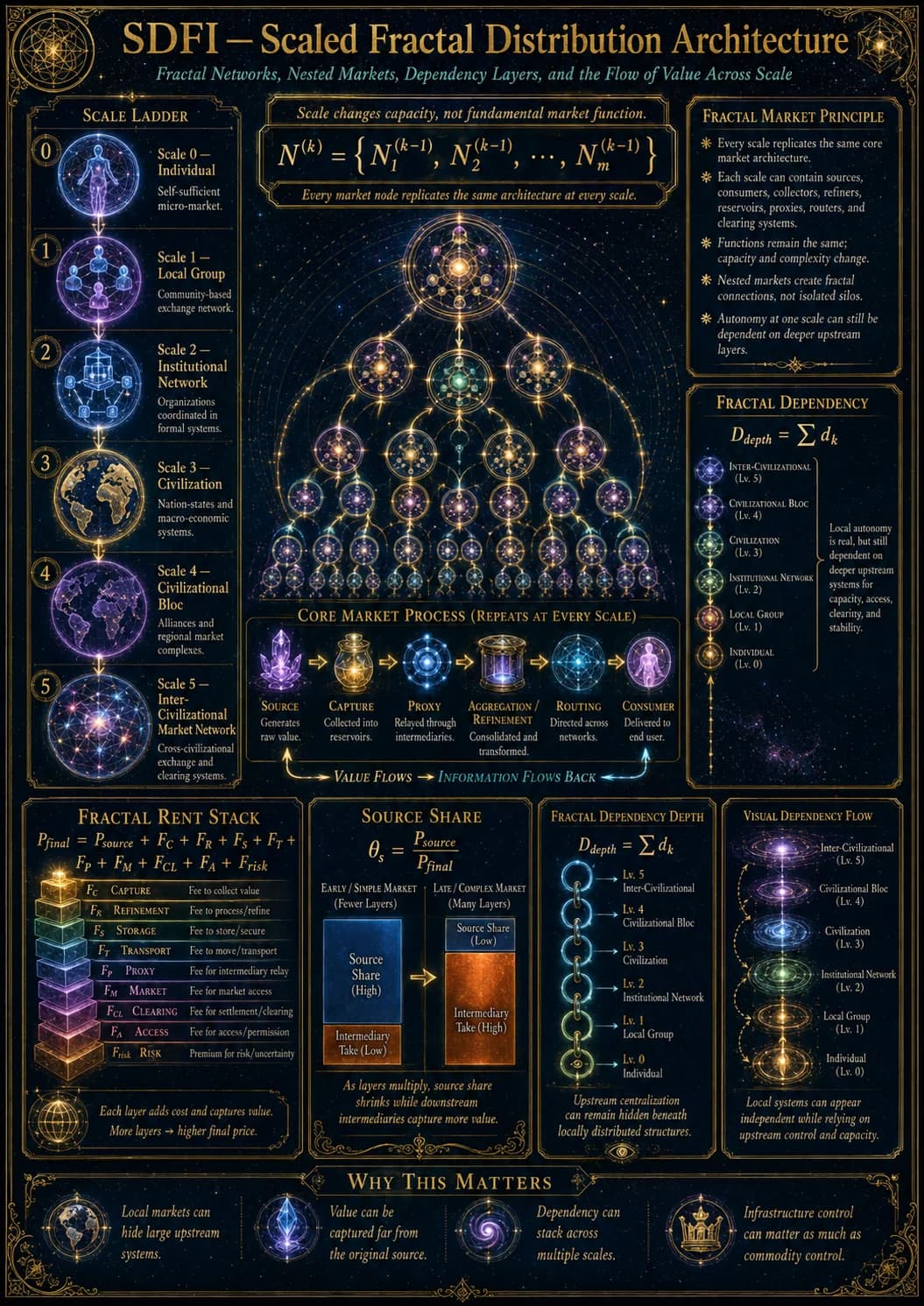
4. Fractal Scale
The same basic economic architecture can repeat at multiple levels.
Define scale:
k = 0, 1, 2, …, n.
A node at scale (k) can itself contain an entire network at scale (k-1):
N(k) N1(k-1), N2(k-1), …, Nm(k-1).
A possible hierarchy is:
Scale 0 — Individual
Single energetic source or consumer.
Scale 1 — Local Group
Household, team, community, local collective.
Scale 2 — Institutional Network
Organization, city, large social field, structured collective.
Scale 3 — Civilization
Planetary or civilization-scale network.
Scale 4 — Civilizational Bloc
Several civilizations linked by trade, alliance, hierarchy, or infrastructure.
Scale 5 — Inter-Civilizational Market Network
Large distributed system spanning many civilizations and regions.
The exact number of levels can vary.
The structural principle does not.
5. Fractal Market Principle
Each scale can contain:
- sources;
- consumers;
- collectors;
- refiners;
- reservoirs;
- proxies;
- routers;
- market makers;
- clearing systems;
- financial institutions.
Therefore:
Scale changes capacity, not fundamental market function.
An individual proxy and a civilization-scale clearing network may perform conceptually similar operations at radically different magnitudes.
6. Fractal Dependency
Dependencies can also stack across scales.
An individual may depend upon:
P1.
That proxy depends upon:
P2.
The regional network depends upon:
P3.
The civilization depends upon:
P4.
Thus local access may be supported by a deep upstream architecture.
Define dependency depth:
Ddepth = ∑k = 1ndk.
And dependency concentration:
Dconc ∏k = 1nck
conceptually representing how strongly multiple layers reinforce one another.
This means a locally distributed system can still be highly centralized upstream.
7. Core Asset Distinction
The SDFI layer separates three primary underlying energetic asset classes.
SDFI-A01 — Stored Commodity
Existing usable inventory:
Si(t)
Examples:
- refined fear reserve;
- stored love;
- stabilized pleasure;
- strategic restorative blend.
Primary economic variables:
- inventory;
- shelf life;
- storage cost;
- freshness;
- accessibility.
SDFI-A02 — Live Flow
Current generation available in real time:
Gi(t).
This is not inventory.
It disappears from the market if generation stops unless captured into storage.
Primary economic variables:
- source output;
- bandwidth;
- latency;
- uptime;
- source recovery.
SDFI-A03 — Catalytic Pattern
A structured signal capable of increasing compatible generation inside a receiving system.
Ki(t).
Instead of transferring all desired quantity:
Lisource → Liconsumer,
a catalytic signal produces:
Ki → Gi, consumerinternal↑.
This is a fundamentally different economic asset.
8. Catalytic Leverage
Define catalytic gain:
ΓK (Δ Ginternal)/(Ktransmitted).
If:
ΓK>1,
a small transmitted pattern induces greater endogenous production than the energetic amount directly supplied.
This gives catalytic products enormous scaling potential.
High-(ΓK) assets are not merely commodities.
They aregeneration multipliers.
9. Stock Versus Flow
Stored stock and live generation solve different economic problems.
Stock provides:
availability across time.
Flow provides:
availability across a live connection.
For highly storable commodities:
Si ≫ GiΔ t
can make inventory the dominant market factor.
For difficult-to-store commodities:
Si ≪ GiΔ t,
the market becomes flow-dominated.
Thus:
Commodity economics can shift from reservoir-like to utility-like behavior.
10. Stock–Flow Ratio
Define:
Φi = (Si)/(GiTR)
for reference interval (TR).
High Stock–Flow Ratio
Φi ≫ 1.
Large inventories exist relative to new generation.
Price is strongly influenced by reserves.
Moderate Stock–Flow Ratio
Φi ≈ 1.
Both inventory and new production matter.
Low Stock–Flow Ratio
Φi ≪ 1.
Live generation dominates.
These commodities behave more like real-time utilities.
11. Storage–Streaming Substitution
For each commodity, the market compares:
Cstorage
with:
Cstream.
If:
Cstorage<Cstream,
inventory dominates.
If:
Cstream<Cstorage,
live distribution dominates.
Therefore:
short shelf life + high storage mismatch → streaming incentive.
This may make love, creative output, complex awe states, and certain principle-state outputs particularly dependent upon live network infrastructure in incompatible civilizations.
12. Proxy Networks
Aproxy nodemediates between source and downstream network.
It may perform:
Capture + Translation + Normalization + Refinement + Routing + Metering + Access Control.
The proxy may be:
- visible;
- invisible;
- consensual;
- contractual;
- automated;
- institutional;
- embedded;
- or extractive.
The economic importance of a proxy does not depend upon whether it generates the underlying commodity.
It controls theinterface.
13. Proxy Value Function
Define:
VP = f(B, η, Q, R, N, A, M, Σ)
where:
- (B) = bandwidth;
- (η) = transfer efficiency ;
- (Q) = quality preservation;
- (R) = reliability;
- (N) = network reach;
- (A) = access-control power;
- (M) = metering accuracy;
- (Σ) = provenance-management capability.
A proxy can therefore become valuable even while contributing little underlying energetic production.
14. Proxy Classes
PX-01 — Capture Proxy
Interfaces directly with source output.
PX-02 — Aggregation Proxy
Combines many sources:
GA = ∑iGi.
PX-03 — Refinement Proxy
Transforms raw flows into standardized product.
PX-04 — Routing Proxy
Directs flow between network segments.
PX-05 — Metering Proxy
Measures delivered quantity and quality.
PX-06 — Access Proxy
Controls who can receive supply.
PX-07 — Translation Proxy
Transforms one representation or field protocol into another compatible form.
PX-08 — Clearing Proxy
Nets financial and delivery obligations.
PX-09 — Market Proxy
Matches buyers and sellers.
PX-10 — Composite Proxy
Performs several or all of the above.
A highly integrated proxy can become a major point of economic concentration.
15. Transparent Versus Extractive Proxy Architecture
Proxy infrastructure can operate in radically different modes.
Transparent Reciprocal Proxy
The source can audit:
- generation;
- capture;
- routing;
- price;
- delivery;
- fees.
Thus:
Au↑.
Extractive Proxy
Routing, capture, or accounting is obscured.
Potential asymmetry:
Source Output = Source Compensation.
Hidden intermediary capture creates:
H↑.
This allows proxy architecture itself to become part of the extraction system.
16. Aggregation Markets
Low-output sources can be pooled:
Gpool = ∑i = 1N ηiGi.
The aggregator may:
- smooth volatility;
- normalize source differences;
- remove provenance;
- improve reliability;
- create standardized grades.
The consumer purchases a commodity class rather than a particular source.
17. Standardized Commodity Pools
An aggregation pool may output:
Li, grade
defined by:
- family;
- purity;
- coherence;
- freshness;
- source range;
- concentration;
- storage profile;
- delivery standard.
Example conceptual contract:
Fear Grade L4, high coherence, 97% purity, defined delivery bandwidth.
This creates fungibility.
Fungibility allows large-scale financial markets.
18. Provenance Markets
Not all sources are interchangeable.
Define source signature:
Σs.
Then:
Vi = Vi, generic + VΣ_s.
Certain sources may command a premium because of:
- unusually high coherence;
- rare principle architecture;
- purity;
- generative power;
- catalytic potency;
- historical reliability.
This creates two parallel markets:
Commodity Pool Market
Source identity is minimized.
Provenance Market
Source identity itself is economically valuable.
19. Live Streaming Architecture
A direct live route is:
Gs(t) → P → R → Cj.
Delivered quantity:
Qsj(t) min [ Gs(t), Bsj(t), Cj(t) ] ηsj(t).
where:
- (Gs) = source output;
- (Bsj) = route bandwidth;
- (Cj) = recipient incorporation capacity;
- (ηsj) = end-to-end efficiency.
20. Streaming Advantage
Stored supply suffers:
U(t) = U0e-Λ t.
For live streaming:
troute ≪ t1/2.
Therefore:
Udelivered ≈ Usource ηroute.
This can preserve freshness and complex field organization better than long-term warehousing.
21. Streaming Market Classes
STR-01 — Continuous Subscription
Consumer reserves regular access over interval (T).
Contract may specify:
Qmin, Qmax, B, R, U.
STR-02 — Pay-Per-Consume
Payment depends on actual delivered flow:
P = ∫0T pi(t)Qi(t), dt.
STR-03 — Burst Access
Consumer purchases temporary high-bandwidth delivery.
Useful for:
- crisis stabilization;
- combat enhancement;
- ceremonies;
- emergency restoration.
STR-04 — Event Access
Many consumers simultaneously access one source or synchronized source group.
STR-05 — Priority Subscription
Higher-paying participants receive delivery before lower tiers under congestion.
STR-06 — Exclusive Feed
One consumer or group purchases restricted access to a source.
STR-07 — Shared Pool Subscription
Consumer receives a standardized stream from many aggregated sources.
STR-08 — Catalytic Broadcast
The network primarily distributes a state-inducing pattern rather than bulk energy.
22. Subscription Pricing
A simplified subscription price:
Psub P0 + PB + PQ + PR + PF + PE.
where:
- (P0) = base connection cost;
- (PB) = bandwidth reservation;
- (PQ) = quality premium;
- (PR) = reliability premium;
- (PF) = freshness premium;
- (PE) = exclusivity premium.
23. Event Markets
A high-output event source may have production:
Gs(N)
that changes with participating population (N).
A simple first model:
Gs(N) = G0 + α N-β N2.
At low (N), coupling may amplify production.
At high (N), saturation, noise, or source constraints reduce marginal gain.
Thus event economics involve both:
audience demand
and:
audience influence on supply.
24. Three Event Scaling Modes
Mode I — Division
Fixed source output is divided:
Qj = (Gs)/(N).
More viewers reduce per-consumer allocation.
Mode II — Amplified Generation
Audience interaction raises source output:
Gs(N)>G0.
Mode III — Catalytic Multicast
The source transmits a pattern that increases:
Ginternal, j.
This can scale far beyond ordinary energetic division.
The market must distinguish these three architectures.
25. Flow Conservation
Unless catalytic regeneration occurs:
∑jQsj ≤ Gs + Ws.
where (Ws) is reserve withdrawal.
This prevents simple broadcast logic from creating unlimited energetic quantity.
26. Information Versus Energetic Multicast
Information can often be copied at low marginal cost.
Energetic quantity cannot necessarily be.
Therefore:
broadcast pattern ≠ broadcast energy.
Catalytic patterns create the bridge:
Pattern Broadcast → Distributed Endogenous Generation.
This may become one of the highest-leverage market technologies.
27. Source Sustainability
A live source is not infinite.
Define source productive capacity:
Gsmax = f(Rs, Cs, Ls, Bs, t)
where:
- (Rs) = restoration capacity;
- (Cs) = coherence;
- (Ls) = current load;
- (Bs) = boundary integrity.
28. Source Load
Define utilization:
us = (Gexport)/(Gssustainable).
Low Load
us<0.5.
Strong recovery margin.
Operational Load
0.5 ≤ us<0.8.
Efficient output.
High Load
0.8 ≤ us<1.
Recovery stress increases.
Overdraw
us>1.
The source is exporting faster than sustainable regeneration.
29. Regenerative Versus Extractive Source Economics
Extractive Source Model
Optimizes:
short-term G.
May produce:
Gfuture↓.
Regenerative Source Model
Optimizes:
∫0 ∈ fty G(t), dt
subject to preserved source capacity.
Thus:
Maximum immediate output ≠ maximum lifetime value.
This becomes an important market distinction.
30. Financialization
Once underlying commodities and flows are standardized, claims can be traded independently from immediate delivery.
This creates:
Underlying Asset → Contractual Claim → Financial Asset.
31. SDFI Financial Instrument Registry
FIN-01 — Spot Contract
Immediate exchange:
Li ↔ Pi.
FIN-02 — Forward Contract
Agreement today for future delivery:
Qi(T)
at predetermined price:
Fi(0, T).
FIN-03 — Futures Contract
Standardized future-delivery contract that can itself be traded.
FIN-04 — Call Option
Right, but not obligation, to purchase commodity or stream access.
FIN-05 — Put Option
Right, but not obligation, to sell or deliver at specified terms.
FIN-06 — Commodity Swap
Two parties exchange future streams:
LA(t) ↔ LB(t).
FIN-07 — Capacity Right
Contractual claim on network bandwidth:
Bi.
FIN-08 — Storage Right
Claim on reservoir capacity:
Ci.
FIN-09 — Insurance Contract
Pays upon defined failure:
- delivery loss;
- contamination;
- route outage;
- reservoir failure;
- source failure.
FIN-10 — Synthetic Exposure
Financial payoff linked to commodity price without physical delivery.
FIN-11 — Subscription Security
Tradable claim on a future stream.
FIN-12 — Reserve Certificate
Claim against stored inventory.
This becomes particularly important for leverage.
32. Claim Layer
Let:
Ciclaims
represent total contractual claims against commodity (i).
Let:
Sideliverable
represent immediately accessible underlying supply.
Define theClaim Leverage Ratio:
Li (Ciclaims)/(Sideliverable).
33. Leverage Regimes
Fully Reserved
Li ≤ 1.
Claims are covered by immediate deliverable supply.
Moderately Leveraged
1< Li ≤ 2.
Claims exceed reserves but remain manageable under normal redemption.
Highly Leveraged
2< Li ≤ 5.
System depends heavily upon future production and low simultaneous redemption.
Fragile Leverage
Li>5.
Small disruptions can create settlement failure.
These thresholds remain tuning values.
34. Fractional Reserve Architecture
If:
Ciclaims = Siimmediate,
the network relies on:
- future generation;
- future withdrawals;
- low simultaneous redemption;
- inter-network borrowing.
This increases liquidity.
But it also introduces:
systemic settlement risk.
35. Reserve Run
If many claim holders simultaneously demand delivery:
Riredeem = Siaccessible,
then:
Reserve Run.
Possible consequences:
forced withdrawals → congestion → quality degradation → price spike → defaults.
This can propagate across the network.
36. Settlement Architecture
A contract passes through several distinct states:
Trade → Cleared Claim → Delivery Obligation → Physical/Energetic Delivery → Recipient Incorporation.
Failure at any layer is economically different.
37. Settlement Finality
Define:
Fs =
the probability that a cleared transaction actually results in usable delivery.
A financially settled trade is not necessarily energetically settled.
Thus:
Financial Settlement ≠ Energetic Finality.
This distinction becomes critical under stress.
38. Clearing Networks
A clearing system nets reciprocal obligations.
Suppose:
A → B = 10
while:
B → A = 7.
Instead of transferring:
17
gross units, the clearing network settles:
3.
Therefore:
Netting → Lower Transport Demand.
This can dramatically increase network efficiency.
39. Clearing Value
Define clearing compression:
ηnet 1- (Qnet)/(Qgross).
Higher:
ηnet
means greater infrastructure savings.
Clearing institutions therefore gain economic power through efficiency rather than commodity ownership.
40. Network Economics
A commodity's market value depends partly on whether it can actually reach the consumer.
Define network state:
N = B, L, U, R, K, Cg, Sw, Io
where:
- (B) = bandwidth;
- (L) = latency;
- (U) = uptime;
- (R) = reliability;
- (K) = route compatibility;
- (Cg) = congestion;
- (Sw) = switching cost;
- (Io) = interoperability.
41. Bandwidth
Bandwidth limits maximum flow:
Q(t) ≤ B(t).
A network may possess vast underlying supply but limited deliverable supply because:
B ≪ S.
42. Latency
Latency:
Lt
becomes especially important for:
- crisis stabilization;
- freshness-sensitive supply;
- shock/event states;
- military use.
A commodity with low shelf life can lose considerable value during high-latency routing.
43. Reliability
Define:
RN = (successful delivery intervals)/(total required intervals).
High-value subscription services require:
RN → 1.
Reliability itself commands a premium.
44. Congestion
When:
Droute = B,
congestion appears.
This can occur even when total supply remains abundant.
Thus:
Commodity scarcity ≠ delivery scarcity.
45. Congestion Pricing
Let congestion factor be:
γc = (Droute)/(B).
When:
γc>1,
price may rise according to:
Proute P0 f(γc).
Live markets can therefore experience extreme price spikes without changes in underlying generation.
46. Strategic Accessibility
Stored commodity (Si) is not fully market supply unless it can be mobilized.
Define:
Sirouteable Si Ai ηW ηT.
This distinction becomes critical during emergencies.
47. Routing Centrality
Some network nodes connect otherwise separated markets.
Define network centrality:
CN.
A high-(CN) node may control:
- portal access;
- clearing;
- bottlenecks;
- cross-civilizational routes.
Such a civilization can become economically powerful even with low native production.
48. Routing Monopoly
If one actor controls a large fraction of critical paths:
MR → 1,
then it can impose:
- tolls;
- priority access;
- exclusions;
- standards;
- political conditions.
Thus:
network monopoly can substitute for commodity monopoly.
49. Switching Costs
Once a consumer adapts to one network's:
- protocol;
- source;
- frequency;
- metering;
- storage format;
- subscription system;
changing providers can require:
Cswitch.
As:
Cswitch↑,
provider market power rises.
This creates:
Network Lock-In.
50. Interoperability
High interoperability reduces:
Cswitch.
Low interoperability raises dependency.
Thus standards themselves become political and economic tools.
51. Fractal Rent Stack
Each intermediary can extract a fee.
For final delivered price:
Pfinal Psource + FC + FR + FS + FT + FP + FM + FCL + FA + Frisk.
where fees may represent:
- capture;
- refinement;
- storage;
- transport;
- proxy;
- market making;
- clearing;
- access;
- risk.
This is the:
Fractal Rent Stack.
52. Source Share
Define:
θs = (Psource)/(Pfinal).
Low:
θs
means most market value is captured downstream by infrastructure and financial layers.
This creates strong incentives to control intermediaries rather than merely control generation.
53. Market Makers
Market makers maintain bid/ask liquidity by standing ready to buy and sell.
Their revenue is:
Spread: Pask Pbid.
They may maintain:
- small reserves;
- source subscriptions;
- routing rights;
- hedges;
- future contracts.
Market makers reduce transaction friction but can also become concentration points.
54. Liquidity
Define liquidity:
Qi
as the ability to exchange substantial quantity without causing a major price change.
High liquidity requires:
- standardized grading;
- deep supply;
- reliable settlement;
- market makers;
- network access.
A rare commodity can still have a deep market if financial claims create liquidity.
55. Synthetic Liquidity
Financial claims can create:
Qfinancial = Qphysical.
This makes markets appear deeper than underlying deliverable supply.
Under normal conditions this increases efficiency.
Under stress it creates fragility.
56. Principle-State Commodities
Emotional loosh does not encompass every strategically valuable output in CPPD.
We therefore establish a second major class:
LP Principle-State Output.
These outputs encode organizational or informational properties associated with principles.
57. Emotional Versus Principle-State Output
Emotional-State Output
Primarily modifies:
- affect;
- activation;
- attraction;
- aversion;
- bonding;
- reward;
- field intensity.
Examples:
- Fear;
- Pleasure;
- Love;
- Grief;
- Desire;
- Awe.
Principle-State Output
Primarily modifies:
- signal integrity;
- decision architecture;
- boundary structure;
- contextual integration;
- relational rules;
- collective organization.
Examples:
- Truth;
- Wisdom;
- Sovereignty;
- Justice;
- Unity.
They can still possess emotional components, but their dominant strategic value is organizational.
58. Preliminary Principle-State Registry
| ID | Principle-State | Primary Function | Likely Asset Behavior |
|---|---|---|---|
| PS-01 | Truth | Signal integrity / causal clarity | Informational-catalytic |
| PS-02 | Wisdom | Contextual integration | High-complexity catalytic |
| PS-03 | Sovereignty | Boundary and agency reinforcement | Defensive catalytic |
| PS-04 | Justice | Balance / restoration architecture | Organizational |
| PS-05 | Unity | Compatible collective coupling | Collective field |
| PS-06 | Order | Structural coordination | Organizational |
| PS-07 | Creativity | Novel pattern generation | Generative |
| PS-08 | Peace | Stabilization | Emotional + principle hybrid |
| PS-09 | Love | Integrative coherence | Emotional + principle hybrid |
| PS-10 | Hope | Future orientation | Emotional + principle hybrid |
59. Principle-State Transmission
Some principle-state commodities may scale differently from ordinary energetic commodities.
Truth-like output may possess a strong informational component:
KTruth
such that:
signal → recipient signal integrity↑.
Sovereignty-like output may act as:
boundary catalyst.
Wisdom-like output may act as:
contextual integration pattern.
Therefore many principle-state commodities may have:
ΓK ≫ 1.
This could make them exceptionally valuable catalytic assets.
60. Principle-State Storage
Principle-state assets may be difficult to preserve because their value depends upon highly complex organization rather than raw energy.
Thus:
QP
may dominate their shelf life.
A truth-state packet that retains energy while losing information integrity is effectively worthless.
Likewise:
principle-state preservation ≈ pattern preservation.
61. Principle-State Provenance
Principle-state commodities may be especially sensitive to source signature.
For Wisdom:
VΣ
may be large because pattern quality depends upon the generating system's integrated architecture.
Thus some principle-state markets may remain difficult to commoditize completely.
62. Metering Integrity
Once flows become financial assets, accurate measurement becomes essential.
A source accounting identity should approximately satisfy:
Gsource Qcaptured + Quncaptured + Qloss.
Downstream:
Qcaptured = Qstored + Qstreamed + Qprocessing loss.
And:
Qstreamed = Qdelivered + Qroute loss.
63. Metering Fraud
If measurement is manipulated:
Mreported ≠ Mactual,
an intermediary can appropriate hidden value.
Forms include:
- under-reporting source generation;
- overstating losses;
- overstating delivered quality;
- double-counting inventory;
- selling multiple claims on the same reserve.
Metering therefore becomes a major auditability requirement.
64. Provenance Ledger
A mature market may track:
Source → Capture → Refinement → Storage → Route → Consumer.
This provides:
- provenance;
- freshness;
- custody history;
- contamination tracking;
- source compensation.
Low-auditability architectures may deliberately obscure this chain.
65. Systemic Risk
Financial and distribution infrastructure introduce failure modes absent from simple commodity exchange.
SDFI-R01 — Source Failure
Generation falls unexpectedly.
SDFI-R02 — Proxy Failure
Critical intermediary becomes unavailable.
SDFI-R03 — Route Failure
Network connection collapses.
SDFI-R04 — Congestion Crisis
Demand exceeds transport capacity.
SDFI-R05 — Reserve Run
Claims exceed accessible physical supply.
SDFI-R06 — Clearing Failure
Settlement institution cannot net or guarantee obligations.
SDFI-R07 — Quality Failure
Delivered product does not meet contracted coherence or purity.
SDFI-R08 — Provenance Failure
Source identity or custody becomes uncertain.
SDFI-R09 — Metering Failure
Accounting diverges from actual flows.
SDFI-R10 — Leverage Cascade
One default forces liquidation elsewhere.
SDFI-R11 — Subscription Dependency Shock
A major feed is abruptly interrupted.
SDFI-R12 — Protocol Fragmentation
Interoperability collapses between networks.
66. Systemic Cascade
A simplified cascade may be:
Source Failure → Supply Shortfall → Streaming Congestion → Spot Price Spike → Reserve Withdrawals → Inventory Decline → Claim Fear → Redemptions → Reserve Run → Defaults.
The financial layer can therefore amplify a relatively local energetic disruption into a network-wide crisis.
67. Streaming Dependency
Continuous access creates a special form of dependency.
If repeated external supply causes:
Ginternal↓
while:
Dstream↑,
the consumer becomes dependent upon the connection itself.
This differs from dependence on stored commodities.
The critical asset becomes:
network continuity.
68. Subscription Lock-In
Define:
Dsub = f(Ginternal-1, Cswitch, Texposure, Qfeed).
Long-duration high-quality external feeds can create deep dependency if they replace rather than stimulate internal generation.
69. Regenerative Streaming
A regenerative stream is designed to increase:
Ginternal.
Therefore:
Dsub(t)↓.
The consumer eventually requires less external supply.
This provides a direct distinction between:
Extractive Subscription
and:
Regenerative Subscription.
70. Proxy-Driven Scaled Extraction
Within the dark-control architecture model, proxy nodes allow extraction to scale without direct management of every source.
A layered structure could be:
Source → Local Proxy → Regional Aggregator → Civilizational Processor → Inter-Civilizational Market.
Each layer:
- abstracts the source;
- standardizes output;
- captures rent;
- reduces upstream visibility.
This creates scalable control.
71. High-Output Source Streaming
A rare high-output source may be too difficult or expensive to store efficiently.
Streaming enables:
High-Value Source → Live Distribution → Many Consumers.
Potential products include:
- subscription access;
- event access;
- premium source feeds;
- catalytic broadcasts;
- licensed redistribution.
This creates a market where the source becomes analogous to a high-value live utility or broadcaster.
72. Access Without Ownership
This introduces one of SDFI's deepest economic changes:
Consumers need not own the commodity to purchase the capability it provides.
They can instead purchase:
- access;
- bandwidth;
- priority;
- duration;
- option rights;
- event participation;
- catalytic exposure.
The underlying commodity remains upstream.
73. Capability-as-a-Service
The market therefore evolves from:
commodity exchange
toward:
Capability-as-a-Service.
Examples within the framework:
- stabilization-as-a-service;
- pleasure-as-a-service;
- creativity-as-a-service;
- coherence-as-a-service;
- military amplification-as-a-service;
- principle-state reinforcement-as-a-service.
This can create much deeper recurring revenue and dependency than one-time sales.
74. Capital Formation
Profits from:
- harvesting;
- routing;
- subscription;
- finance;
- clearing;
- storage;
- refinement;
can be reinvested into:
new infrastructure.
The loop becomes:
Revenue → Capital → More Proxies / Storage / Routes → More Market Reach → More Revenue.
This creates scalable network expansion.
75. Infrastructure Flywheel
A mature system therefore contains:
More Sources → More Supply → More Consumers → More Network Revenue → More Infrastructure → More Sources.
This is the distribution analogue of the earlier civilizational pressure flywheel.
76. Network Effects
The value of a network can increase with participants:
VN ∝ f(Ns, Nc).
More sources improve:
- diversity;
- resilience;
- supply.
More consumers improve:
- liquidity;
- revenue;
- matching efficiency.
Thus large networks can gain powerful self-reinforcing advantages.
77. Centralization Threshold
Network effects can eventually generate concentration.
If one network has:
- highest liquidity;
- deepest routes;
- best clearing;
- most sources;
- most buyers;
participants have incentives to join it.
Thus:
network effects → centralization pressure.
This can produce monopolistic infrastructure even without direct coercion.
78. Sovereign Network Architecture
A restorative or sovereignty-preserving alternative would emphasize:
- interoperable protocols;
- source consent;
- transparent metering;
- portable identity;
- local generation;
- distributed clearing;
- low switching costs;
- auditable claims;
- regenerative subscriptions.
Its objective is:
network utility: dependency capture.
79. SDFI Market Handoff Variables
The eventual Loosh Market Dynamics model should inherit:
Scale
k
Stored Supply
Si
Live Flow
Gi(t)
Catalytic Availability
Ki
Stock–Flow Ratio
Φi
Proxy Concentration
MP
Network Bandwidth
Bi
Latency
Li
Reliability
Ri
Congestion
γi
Route Centrality
CN, i
Switching Cost
Cswitch, i
Claim Leverage
Li
Liquidity
Qi
Provenance Premium
VΣ, i
Source Sustainability
us
Metering Integrity
Mi
Settlement Finality
Fs, i
Fractal Rent Burden
Frent, i
Catalytic Gain
ΓK, i.
These variables turn underlying energetic supply into actual market structure.
80. SDFI Strategic Corridors
Stock Corridor
Generation → Storage → Inventory → Spot Market → Consumption
Streaming Corridor
Generation → Proxy → Live Network → Subscription → Consumption
Catalytic Corridor
Source Pattern → Broadcast → Ginternal↑
Financial Corridor
Underlying Commodity → Claim → Derivative → Financial Market
Fractal Extraction Corridor
Source → P1 → P2 → P3 → Consumer
with fees and control accumulating at each layer.
Sovereign Distribution Corridor
Source → Transparent Proxy → Auditable Network → Consumer → Ginternal↑.
81. Master SDFI Principles
Principle I — Markets Exist at Multiple Scales
The same distribution architecture can repeat fractally from individuals to civilizations.
Principle II — Stock and Flow Are Different Assets
Stored supply and live generation must be priced differently.
Principle III — Catalytic Patterns Form a Third Asset Class
Small transmitted patterns can create large endogenous generation.
Principle IV — Proxy Control Can Be as Powerful as Source Control
The controller of the interface can capture value without generating the underlying commodity.
Principle V — Difficult Storage Increases the Value of Live Networks
Poor shelf life shifts economics toward real-time distribution.
Principle VI — Access Can Be Sold Without Ownership
Subscriptions and streaming transform commodities into recurring services.
Principle VII — Network Constraints Create Independent Scarcity
abundant supply ≠ abundant deliverable supply.
Principle VIII — Financial Claims Can Exceed Physical Supply
This increases liquidity while introducing leverage and settlement risk.
Principle IX — Infrastructure Itself Is an Asset
Bandwidth, routing, clearing, storage rights, and interoperability possess independent economic value.
Principle X — Source Sustainability Determines Lifetime Value
Overdrawing high-output sources can destroy future production.
Principle XI — Principle-State Output Requires Its Own Market Logic
Truth, Wisdom, Sovereignty, and related outputs may behave more like informational or catalytic organizational assets than ordinary emotional commodities.
Principle XII — Market Value Is Layered
Final delivered value includes:
source + processing + storage + network + financial + access + risk.
82. Central Principle
The previous layers established what energetic commodities exist and how civilizations produce them.
SDFI establishes how those commodities becomescalable economic assets.
The foundational transformation is:
Energetic Capability → Market-Accessible Capability.
And the deepest principle of the layer is:
A mature energetic economy does not merely trade stored loosh. It trades flows, access, provenance, bandwidth, future production, catalytic patterns, network capacity, and financial claims on state-changing capability.
This completes the infrastructure required forLoosh Market Dynamics, where the next layer can finally model:
price + scarcity + arbitrage + specialization + competition + monopoly + dependency + leverage + systemic risk + capital expansion.