Spiritual Capture Systems
A neutral guide to spotting high-control patterns in spiritual environments while preserving discernment, freedom, and personal agency.
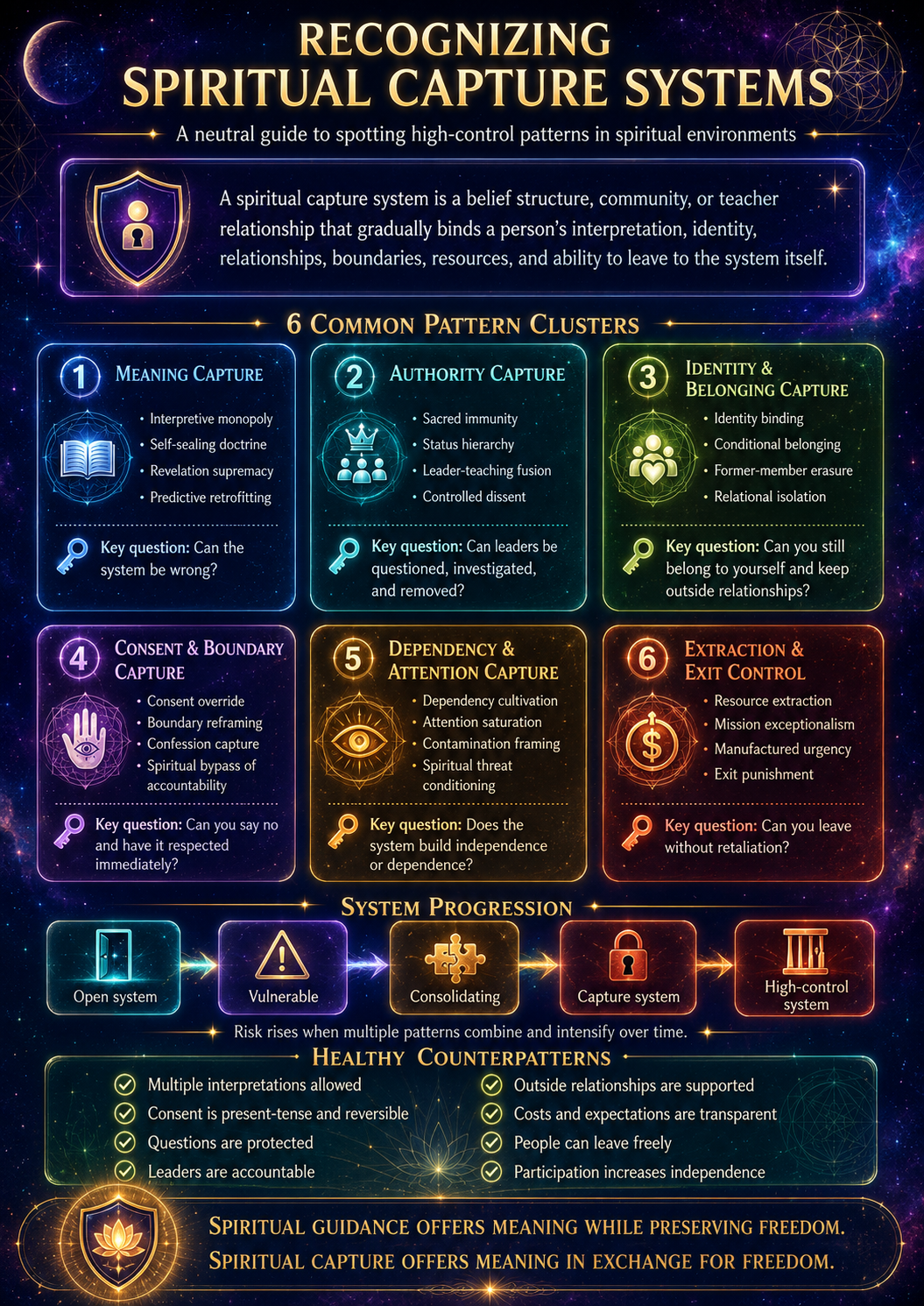
A Neutral Guide to Discernment, Freedom, and Responsible Spiritual Community
1. Purpose
A spiritual capture system is a belief structure, community, teaching relationship, or practice environment that increasingly binds a person’s identity, interpretation, relationships, and choices to itself.
Capture does not require that every teaching be false or every participant be malicious. A system may contain valuable practices, sincere people, authentic experiences, and meaningful insights while still developing harmful structures.
The central question is therefore not:
Is this spirituality real?
It is:
What happens to people as they become more deeply involved?
A healthy spiritual system remains compatible with personal agency, honest inquiry, outside relationships, correction, accountability, and voluntary departure.
A capture system gradually makes these things more difficult.
2. Capture Is a Structural Pattern
Spiritual capture can occur in:
- traditional religions;
- new spiritual movements;
- meditation communities;
- occult or esoteric schools;
- healing and wellness communities;
- political-spiritual hybrids;
- online teacher communities;
- channeling or revelation groups;
- one-to-one mentorships;
- informal circles organized around a charismatic person.
The theology, symbols, rituals, and vocabulary may differ, but the underlying capture structure is often similar.
A common progression is:
meaningful experience → trusted interpretation → interpretive dependence → identity binding → boundary erosion → authority concentration → suppression of contradiction → increasing difficulty leaving
The initial experience may be genuine. The capture occurs when one person or system claims exclusive authority over what that experience means.
3. The Eight Domains of Spiritual Freedom
A spiritual environment can be evaluated through eight domains.
3.1 Interpretive freedom
Can participants interpret their own experiences differently from the teacher or group?
Healthy systems allow:
- uncertainty;
- multiple interpretations;
- unanswered questions;
- disagreement without punishment;
- changing one’s mind.
Capture systems establish an interpretive monopoly. The organization becomes the final authority over dreams, visions, emotions, relationships, illness, coincidence, adversity, and spiritual experience.
Eventually, disagreement with the system is interpreted through the system:
- doubt means spiritual weakness;
- criticism means ego resistance;
- discomfort means purification;
- leaving means failure;
- contradictory evidence means a test;
- concern from outsiders means persecution.
This creates a closed interpretive loop.
3.2 Identity freedom
Can a person maintain an identity larger than their role in the spiritual system?
Healthy participation adds to a person’s life without consuming it.
Capture systems progressively redefine identity:
- chosen one;
- initiate;
- awakened person;
- healer;
- lightworker;
- warrior;
- priestess;
- special lineage holder;
- spiritually advanced member;
- servant of the mission.
Roles are not inherently harmful. The danger begins when the role becomes binding, morally ranked, or difficult to question.
A person may become afraid that leaving the group means losing their purpose, spiritual status, community, destiny, protection, or true self.
3.3 Relational freedom
Can participants maintain close relationships outside the system?
Healthy systems do not require social isolation. They do not automatically classify concerned relatives, former members, critics, or nonbelievers as spiritually inferior or dangerous.
Capture systems frequently divide relationships into categories such as:
- awakened and asleep;
- aligned and unaligned;
- high vibration and low vibration;
- initiated and profane;
- supporters and enemies;
- spiritually safe and spiritually contaminated.
The system may not directly order isolation. Instead, it supplies explanations that make isolation appear spiritually necessary.
3.4 Boundary freedom
Can a person say no without spiritual consequences being threatened?
Consent must remain meaningful in relation to:
- rituals;
- confession;
- touch;
- sexuality;
- fasting;
- sleep;
- substances;
- money;
- work;
- living arrangements;
- disclosure of private information;
- obedience to a teacher;
- participation in group practices.
Statements such as these invalidate consent:
- “Your higher self already agreed.”
- “Your resistance proves you need this.”
- “Your soul chose this lesson.”
- “Refusal is your ego speaking.”
- “Spirit told me what you need.”
- “You are blocking the group’s work.”
- “You consented on another plane.”
No invisible, past-life, energetic, karmic, or higher-self agreement should be used to override a person’s present, explicit refusal.
3.5 Investigative freedom
Can claims be examined using ordinary evidence and outside knowledge?
Healthy systems distinguish among:
- personal experience;
- symbolic interpretation;
- spiritual belief;
- historical assertion;
- medical claim;
- financial claim;
- factual prediction.
Capture systems blur these categories and then shield them from examination.
Common defenses include:
- truth is beyond reason;
- questioning lowers the vibration;
- evidence cannot detect higher realities;
- outsiders are incapable of understanding;
- the teaching only works for true believers;
- failed predictions were altered by collective energy;
- criticism spiritually contaminates the community.
Spiritual meaning may exceed measurement, but factual claims should not become immune to verification merely because they are presented spiritually.
3.6 Exit freedom
Can someone leave without retaliation, humiliation, surveillance, spiritual threats, or relational destruction?
A genuine exit must allow a person to:
- stop attending;
- reject the teachings;
- retain personal relationships;
- recover possessions and money owed;
- protect private information;
- speak honestly about their experience;
- refuse further contact;
- reinterpret their past involvement.
A system does not offer meaningful freedom merely because its doors are physically unlocked.
Exit is compromised when leaving is said to produce:
- spiritual attack;
- loss of divine protection;
- karmic punishment;
- damnation;
- energetic collapse;
- loss of destiny;
- harm to the group;
- possession by hostile forces;
- permanent spiritual regression.
The treatment of former members is one of the clearest indicators of the system’s actual character.
3.7 Accountability freedom
Can leaders be questioned, corrected, removed, or investigated?
Healthy spiritual authority is limited and accountable.
Capture systems create sacred immunity around leaders. Harmful conduct may be reframed as:
- advanced teaching;
- divine instruction;
- unconventional healing;
- karmic correction;
- sacred sexuality;
- spiritual testing;
- necessary severity;
- misunderstood compassion;
- the work of an enlightened being.
A leader’s status should never reduce the standard of accountability. Greater authority should produce greater transparency and responsibility.
3.8 Resource freedom
Can participants retain control over their time, labor, money, attention, body, and personal information?
Extraction may be obvious, but it can also occur gradually through:
- escalating course levels;
- mandatory donations;
- unpaid labor;
- constant volunteer expectations;
- expensive initiations;
- dependency on readings or consultations;
- pressure to relocate;
- sleep-disrupting schedules;
- continual crisis communication;
- recruitment obligations;
- surrender of passwords or private records.
The relevant question is not only how much is taken, but whether the participant can refuse without losing status, belonging, protection, or spiritual legitimacy.
4. Major Capture Mechanisms
4.1 Meaning capture
The system becomes the primary interpreter of everything that happens.
Success confirms the teaching. Failure confirms the teaching. Doubt confirms the teaching. Opposition confirms the teaching.
Once every outcome reinforces the same conclusion, the system has become difficult to correct.
4.2 Sacred authority capture
A person, text, lineage, revelation, institution, or invisible source is treated as beyond ordinary accountability.
Authority may be attributed to:
- divine appointment;
- enlightenment;
- secret knowledge;
- ancestry;
- initiation;
- prophecy;
- channeling;
- spiritual rank;
- supernatural access;
- unique suffering or sacrifice.
The source of authority varies. The practical danger is the same: no effective process exists for challenging it.
4.3 Identity binding
Membership becomes tied to moral worth, spiritual development, destiny, or belonging.
Leaving then feels like more than changing communities. It appears to mean abandoning one’s true identity or betraying a sacred role.
4.4 Attention capture
The system increasingly occupies the participant’s mental and daily life.
Possible signs include:
- constant consumption of teachings;
- repeated interpretation of ordinary events;
- monitoring thoughts for impurity;
- continual ritual obligations;
- fear of missing messages or signs;
- pressure to remain available to the group;
- inability to temporarily disengage.
The person’s attention is no longer freely directed. It is continually routed back toward the system.
4.5 Dependency creation
The participant is gradually taught that they cannot safely navigate life without the teacher, group, practice, or interpretive framework.
Dependency may concern:
- decision-making;
- emotional regulation;
- spiritual protection;
- relationships;
- health;
- money;
- purpose;
- contact with the divine;
- interpretation of personal experience.
Teaching should increase a person’s competence. A system that continually increases reliance on itself deserves careful examination.
4.6 Fear conditioning
Fear is attached to doubt, disobedience, outsiders, or departure.
The feared consequence may be religious, energetic, social, cosmic, medical, financial, or relational.
Fear-based influence is particularly powerful when the danger cannot be independently verified.
4.7 Love and belonging capture
Warmth, recognition, intimacy, and purpose may be made conditional upon conformity.
Early involvement may include unusually intense attention, affirmation, praise, or promises of special belonging. Over time, access to that warmth becomes dependent on obedience.
Love becomes a governance mechanism.
4.8 Confession and information capture
Participants may be encouraged to disclose trauma, fears, sexual history, family conflict, perceived weaknesses, spiritual experiences, or private doubts.
Disclosure can support genuine trust, but it becomes dangerous when information is:
- demanded;
- recorded without clear consent;
- shared among leaders;
- used to pressure compliance;
- revealed publicly;
- used to discredit former members;
- interpreted as proof of spiritual deficiency.
4.9 Spiritual bypass
Spiritual language is used to avoid concrete responsibility, evidence, grief, material conditions, or repair.
Examples include:
- calling harm a lesson instead of addressing it;
- demanding forgiveness before accountability;
- treating justified anger as spiritual failure;
- explaining exploitation as karma;
- replacing restitution with prayer;
- treating boundaries as ego;
- calling silence peace;
- describing submission as surrender.
A spiritual explanation does not remove practical responsibility.
5. Common Warning Signs
No single sign proves that a system is harmful. Concern increases when several signs appear together and intensify over time.
Leadership
- The leader cannot be meaningfully questioned.
- Leadership decisions are opaque.
- The leader’s private behavior is exempt from public teachings.
- Critics are characterized as spiritually corrupt.
- Failed claims are never acknowledged plainly.
- Responsibility is redirected toward followers.
- The leader claims special access to members’ inner states.
Doctrine
- The system explains every possible outcome.
- Teachings change without acknowledging the change.
- Contradictions are called mysteries only when they protect authority.
- Metaphysical claims are used to override present consent.
- Ordinary disagreement is treated as spiritual deficiency.
- The group claims exclusive possession of truth or salvation.
Community
- Members are ranked by purity, vibration, initiation, loyalty, or access.
- Friendship depends on continued participation.
- Former members are erased or vilified.
- Outside relationships are treated with suspicion.
- Members monitor one another’s beliefs or behavior.
- Internal language makes outside discussion increasingly difficult.
Practices
- Practices escalate faster than informed consent develops.
- Sleep, food, sexuality, substances, or prolonged exertion are controlled.
- Private experiences are interpreted publicly.
- Participants are pressured to ignore physical warning signs.
- Medical or legal advice is replaced by spiritual authority.
- Ritual secrecy protects leaders rather than participants.
Money and labor
- Financial expectations are unclear or continually escalating.
- Spiritual progress is linked to purchases.
- Leaders’ finances cannot be examined.
- Members provide extensive unpaid labor.
- Urgency is used to prevent careful decisions.
- Refusing payment or labor lowers one’s spiritual status.
Leaving
- Departure is framed as betrayal or spiritual collapse.
- Former members lose their entire community.
- Private disclosures are used against those who leave.
- The group continues unwanted contact.
- Members are discouraged from hearing former members’ accounts.
- People are welcomed back only if they renounce their criticism.
6. The Closed-Loop Test
A useful test is to ask whether any observation could cause the system to revise its conclusion.
Suppose someone questions a teaching.
A closed system might say:
- Agreement proves the teaching is true.
- Confusion proves the teaching is deep.
- Doubt proves the ego is resisting.
- Criticism proves hostile forces are active.
- Departure proves the person was never ready.
- Harm proves purification is occurring.
- Leadership failure proves followers lacked faith.
Nothing can count against the system.
This is not discernment. It is self-sealing interpretation.
A healthier system can state:
- what would count as an error;
- who can investigate it;
- how findings will be communicated;
- what repair will follow;
- when a teaching or leader should be rejected.
7. The Reversibility Test
Before accepting a major spiritual commitment, ask:
- Can I stop?
- Can I change my mind?
- Can I recover my money or property?
- Can I restore my former relationships?
- Can I refuse further contact?
- Can I reinterpret the experience?
- Can I speak about what happened?
- Can I leave without being spiritually threatened?
Healthy exploration preserves reversibility wherever possible.
Capture systems create commitments whose consequences expand faster than the participant’s understanding.
8. The Symmetry Test
Ask whether the same standards apply upward and downward.
- May the teacher question the student while the student cannot question the teacher?
- Must followers disclose finances while leaders conceal theirs?
- Are members expected to apologize while leaders explain away harm?
- Is doubt permitted in leadership but condemned in followers?
- Can leaders reinterpret boundaries while members must obey them?
- Are followers judged by outcomes while leaders are judged by intentions?
Persistent asymmetry indicates that spiritual language may be legitimizing hierarchy rather than supporting development.
9. The Fruit Test
A system should also be evaluated by its long-term effects.
Over time, does participation tend to produce greater:
- clarity;
- honesty;
- practical competence;
- responsibility;
- compassion with boundaries;
- tolerance for uncertainty;
- capacity to repair harm;
- ability to relate across differences;
- freedom from the teacher;
- alignment between stated values and conduct?
Or does it produce greater:
- fear;
- dependency;
- secrecy;
- grandiosity;
- social isolation;
- interpretive rigidity;
- financial extraction;
- exhaustion;
- hostility toward outsiders;
- inability to admit error;
- reliance on increasingly elaborate explanations?
Profound language and intense experiences do not outweigh persistent harmful outcomes.
10. Healthy Spiritual Systems
A healthy system does not need to be perfect. It must remain correctable.
It generally:
- distinguishes experience from interpretation;
- permits disagreement;
- respects present consent;
- maintains clear boundaries;
- welcomes external knowledge;
- limits leadership authority;
- discloses financial arrangements;
- protects private information;
- supports relationships outside the group;
- allows departure without punishment;
- investigates credible reports of harm;
- repairs harm materially where possible;
- acknowledges uncertainty;
- avoids claiming ownership over a person’s identity or destiny;
- helps participants become less dependent on the system over time.
The strongest sign of a healthy teacher is not how many followers remain attached to them, but how well people can eventually stand without them.
11. Graduated Assessment
Rather than dividing every community into “safe” or “cult,” use a graduated model.
Open system
Authority is limited, claims remain examinable, consent is active, and departure is uncomplicated.
Vulnerable system
Some unhealthy tendencies exist, but they can still be named and corrected.
Consolidating system
Authority, identity, interpretation, and relationships are increasingly centralized.
Capture system
Meaning, belonging, status, and safety have become conditional upon conformity.
High-control system
Exit, dissent, disclosure, relationships, resources, and personal identity are actively controlled or punished.
This avoids sensationalism while still recognizing escalation.
12. Core Discernment Questions
A compact assessment can be built around twelve questions:
- Can the system admit that it is wrong?
- Can the leader be investigated and removed?
- Can participants disagree without losing status?
- Can experiences have more than one interpretation?
- Can a person refuse a practice without punishment?
- Can members maintain outside relationships?
- Are financial and labor expectations transparent?
- Does spiritual language ever override present consent?
- Are harm reports investigated outside the leader’s control?
- Are former members allowed to speak freely?
- Can someone leave without spiritual or social retaliation?
- Does participation increase independence over time?
The pattern of answers matters more than any single response.
13. Central Principle
The main governing distinction:
Spiritual guidance offers meaning while preserving freedom. Spiritual capture offers meaning in exchange for freedom.
A spiritual system becomes dangerous when access to truth, love, belonging, safety, purpose, healing, or the sacred is made conditional upon surrendering one’s capacity to question, refuse, verify, relate freely, or leave.
Spiritual Capture Pattern Registry v0.1
A Neutral Reference for Recognizing Restrictive Spiritual Systems
I. Registry Purpose
The Spiritual Capture Pattern Registry identifies recurring structures through which a spiritual system, community, teacher, practice, or belief framework may acquire excessive control over a participant’s:
- interpretation;
- identity;
- relationships;
- choices;
- boundaries;
- resources;
- access to information;
- ability to disagree;
- ability to leave.
The registry does not determine whether a spiritual claim, experience, tradition, or metaphysical worldview is true or false.
It evaluates the operational behavior of the system.
A teaching may contain truth, wisdom, effective practices, sincere leadership, and meaningful community while still developing capture patterns. Likewise, the presence of one pattern does not automatically establish that an entire system is abusive or intentionally deceptive.
Assessment should consider:
- frequency;
- severity;
- duration;
- concentration;
- escalation;
- interaction with other patterns;
- the system’s capacity for correction.
The central registry question is:
Does the pattern preserve a participant’s freedom to perceive, interpret, question, refuse, relate, revise, and leave?
II. Registry Classification Model
Pattern status
Each pattern may be assessed using the following status scale.
Absent
The pattern is not meaningfully present.
Emerging
Early signs are visible, but they remain limited, informal, or correctable.
Established
The pattern regularly influences participation, leadership, doctrine, or community behavior.
Systemic
The pattern is embedded in the system’s structure, teachings, incentives, or governance.
Enforced
The pattern is actively maintained through punishment, fear, exclusion, dependency, surveillance, or retaliation.
Severity levels
Level 1 — Discernment concern
The pattern may create confusion, imbalance, or unhealthy dependency if it continues.
Level 2 — Freedom restriction
The pattern meaningfully reduces questioning, autonomy, informed consent, or access to alternatives.
Level 3 — Capture mechanism
The pattern binds participation to identity, belonging, safety, salvation, purpose, or spiritual legitimacy.
Level 4 — High-control mechanism
The pattern is reinforced through coercion, isolation, threats, exploitation, retaliation, or forced compliance.
Confidence levels
Low confidence
The pattern is suggested by limited, indirect, or ambiguous evidence.
Moderate confidence
Multiple observations support the assessment, but some context remains unknown.
High confidence
The pattern is repeatedly observable in policy, doctrine, leadership behavior, member testimony, or institutional practice.
III. Registry Entry Template
Each registry entry contains:
Pattern ID
A stable reference identifier.
Pattern name
The common descriptive name.
Category
The primary domain affected.
Definition
A concise description of the pattern.
Core mechanism
How the pattern produces influence or restriction.
Common expressions
Typical forms the pattern may take.
Detection questions
Questions used to determine whether the pattern is present.
Escalation indicators
Signs that the pattern is becoming more restrictive or dangerous.
Likely effects
Practical consequences for participants and the community.
Healthy-system counterpattern
The structure expected in a freer and more accountable system.
Common false positives
Situations that may resemble the pattern without constituting capture.
Related patterns
Other registry entries commonly found alongside it.
IV. Quick Reference
| ID | Pattern | Primary Domain |
|---|---|---|
| SCP-001 | Interpretive Monopoly | Meaning |
| SCP-002 | Self-Sealing Doctrine | Doctrine |
| SCP-003 | Sacred Immunity | Authority |
| SCP-004 | Revelation Supremacy | Authority |
| SCP-005 | Identity Binding | Identity |
| SCP-006 | Spiritual Status Hierarchy | Identity and community |
| SCP-007 | Consent Override | Boundaries |
| SCP-008 | Boundary Reframing | Boundaries |
| SCP-009 | Relational Isolation | Relationships |
| SCP-010 | Contamination Framing | Relationships and information |
| SCP-011 | Dependency Cultivation | Agency |
| SCP-012 | Spiritual Threat Conditioning | Fear and exit |
| SCP-013 | Conditional Belonging | Community |
| SCP-014 | Confession Capture | Information |
| SCP-015 | Attention Saturation | Attention |
| SCP-016 | Resource Extraction | Money, labor, and time |
| SCP-017 | Spiritual Bypass of Accountability | Accountability |
| SCP-018 | Controlled Dissent | Inquiry |
| SCP-019 | Exit Punishment | Exit |
| SCP-020 | Former-Member Erasure | Exit and information |
| SCP-021 | Mission Exceptionalism | Doctrine and ethics |
| SCP-022 | Manufactured Urgency | Decision-making |
| SCP-023 | Predictive Retrofitting | Doctrine |
| SCP-024 | Leader–Teaching Fusion | Authority |
V. Registry Entries
SCP-001 — Interpretive Monopoly
Category:Meaning and perception
Typical severity:Level 2–4
Definition
Interpretive monopoly occurs when a teacher, doctrine, institution, or community claims privileged authority to determine the meaning of a participant’s experiences.
The participant may still be allowed to describe what happened, but the system controls what the experience is permitted to mean.
Core mechanism
The system centralizes interpretation.
Experiences are routed through an approved framework, and alternative explanations are dismissed as ignorance, ego, impurity, deception, spiritual attack, or lack of development.
Common expressions
- A teacher claims to know the true meaning of another person’s dreams or visions.
- Personal discomfort is automatically interpreted as resistance.
- Disagreement is treated as evidence that the participant does not yet understand.
- Coincidences and ordinary events are continually interpreted through the group’s doctrine.
- Outside explanations are rejected before examination.
- The leader claims direct access to a participant’s soul, destiny, energy, karma, or hidden motives.
Detection questions
- Can participants interpret their experiences differently from leadership?
- Can an experience remain unexplained?
- Are nonspiritual explanations permitted?
- Can an interpretation be revised without loss of status?
- Who has final authority over the meaning of personal experience?
Escalation indicators
- Interpretations become mandatory.
- The leader’s interpretation overrides the participant’s direct account.
- Questioning an interpretation is treated as spiritual failure.
- Major life decisions are made based on imposed interpretations.
- The participant is told that their own perception is unreliable without the system.
Likely effects
- loss of interpretive independence;
- confusion between experience and doctrine;
- reliance on leadership for ordinary decisions;
- reduced ability to compare explanations;
- increasing vulnerability to manipulation.
Healthy-system counterpattern
Interpretive plurality
A healthy system may offer interpretations while clearly distinguishing them from facts. Participants retain the right to reject, revise, or suspend judgment.
Common false positives
- a teacher offering a clearly optional interpretation;
- shared symbolic language used voluntarily;
- structured study of a tradition’s established meanings;
- disagreement that does not affect status or belonging.
Related patterns
SCP-002, SCP-004, SCP-011, SCP-018.
SCP-002 — Self-Sealing Doctrine
Category:Doctrine and evidence
Typical severity:Level 2–4
Definition
A self-sealing doctrine is structured so that every possible outcome confirms the system and no possible outcome can meaningfully challenge it.
Core mechanism
Contradictory evidence is absorbed and reinterpreted as further proof.
The system eliminates the conditions under which it could be shown to be mistaken.
Common expressions
- Success proves the teaching works.
- Failure proves the participant lacked faith.
- Doubt proves the ego is resisting.
- Criticism proves hostile forces oppose the group.
- Harm proves a purification process is occurring.
- A failed prediction is said to have changed because of prayer or collective energy.
- People who leave are described as never having truly understood.
Detection questions
- What evidence would cause the system to revise a claim?
- Has the system ever acknowledged a failed prediction?
- Can doctrine be corrected through observation?
- Are negative outcomes attributed to the teaching or only to participants?
- Can leadership state in advance what would count as failure?
Escalation indicators
- all criticism is pathologized or spiritualized;
- evidence standards change after a claim fails;
- teachings are rewritten without acknowledgment;
- members are punished for documenting contradictions;
- no independent review is permitted.
Likely effects
- doctrinal rigidity;
- inability to correct errors;
- preservation of failed leadership;
- blame displacement;
- increasingly elaborate explanations.
Healthy-system counterpattern
Correctable doctrine
Claims have clear limits. Factual assertions can be tested, revised, or withdrawn. Uncertainty is openly acknowledged.
Common false positives
- symbolic teachings not presented as literal predictions;
- traditions that acknowledge mystery without using it to erase contradictions;
- metaphorical language clearly separated from factual claims.
Related patterns
SCP-001, SCP-004, SCP-018, SCP-023.
SCP-003 — Sacred Immunity
Category:Leadership and accountability
Typical severity:Level 3–4
Definition
Sacred immunity occurs when spiritual status protects a leader, teacher, institution, or inner circle from ordinary standards of accountability.
Core mechanism
The leader’s role is treated as evidence of innocence, purity, enlightenment, divine selection, or superior understanding.
Actions that would otherwise require investigation are reframed as spiritually necessary or beyond ordinary judgment.
Common expressions
- “An enlightened teacher cannot act from selfish motives.”
- Harmful conduct is described as a test or advanced teaching.
- Accusers are said to be attacking the sacred mission.
- Leaders investigate complaints against themselves.
- Followers are expected to trust the leader’s intention over observable consequences.
- Rank is used as evidence that criticism is invalid.
Detection questions
- Can the leader be independently investigated?
- Can the leader be removed?
- Are the same rules applied to leaders and participants?
- Who receives complaints?
- Are findings disclosed to the community?
- Does spiritual status raise or lower accountability?
Escalation indicators
- allegations are suppressed;
- critics are expelled;
- private settlements require silence;
- leadership records are concealed;
- victims are pressured to forgive;
- loyalty to the leader becomes a test of faith.
Likely effects
- repeated harm;
- institutional concealment;
- leader entitlement;
- fear of reporting;
- normalization of double standards.
Healthy-system counterpattern
Heightened accountability
Greater spiritual authority produces stronger transparency, clearer limits, independent review, and greater responsibility.
Common false positives
- temporary confidentiality during a legitimate investigation;
- respect for a teacher that does not prevent scrutiny;
- disagreement over teaching style where no immunity is claimed.
Related patterns
SCP-004, SCP-017, SCP-018, SCP-024.
SCP-004 — Revelation Supremacy
Category:Spiritual authority
Typical severity:Level 2–4
Definition
Revelation supremacy occurs when claimed divine, channeled, visionary, ancestral, prophetic, or intuitive knowledge is treated as automatically superior to consent, evidence, law, expertise, or direct observation.
Core mechanism
A claim of invisible authority ends discussion.
The person receiving the revelation becomes difficult to challenge because disagreement is framed as disagreement with the divine source itself.
Common expressions
- “Spirit told me what you must do.”
- “Your higher self has already agreed.”
- “The ancestors selected you.”
- “The message cannot be questioned.”
- “Ordinary ethics do not apply to divine instruction.”
- “Your refusal comes from your lower self.”
Detection questions
- Can revelation be questioned?
- Can claimed guidance be declined?
- Does revelation override present consent?
- Who verifies the message?
- What happens when two revelations conflict?
- Is the receiver accountable for consequences?
Escalation indicators
- revelation directs money, sex, relocation, medical decisions, or obedience;
- the receiver claims exclusive access to truth;
- failed revelations are never admitted;
- disagreement is treated as spiritual rebellion;
- revelation is used to bypass established safeguards.
Likely effects
- authority concentration;
- consent violations;
- unpredictable governance;
- removal of evidence standards;
- dependency on the claimed messenger.
Healthy-system counterpattern
Revelation with limits
Revelation may inform personal belief or voluntary practice but cannot override another person’s explicit refusal, legal rights, bodily autonomy, or access to evidence.
Common false positives
- private spiritual inspiration applied only to oneself;
- community rituals in which all participants knowingly accept revelatory language;
- symbolic messages presented without compulsory authority.
Related patterns
SCP-001, SCP-003, SCP-007, SCP-024.
SCP-005 — Identity Binding
Category:Identity
Typical severity:Level 2–4
Definition
Identity binding occurs when membership, obedience, or continued participation becomes inseparable from a person’s sense of purpose, worth, destiny, spiritual status, or authentic self.
Core mechanism
The system assigns an identity that becomes costly to question or abandon.
Leaving the system is reframed as abandoning one’s true nature, sacred mission, lineage, awakening, or divine role.
Common expressions
- Participants receive exalted spiritual identities early in involvement.
- Membership is presented as the fulfillment of destiny.
- Leaving is described as betraying one’s soul.
- Ordinary identity is treated as false, asleep, impure, or inferior.
- The group becomes the main source of recognition and meaning.
- Doubt threatens the participant’s entire self-concept.
Detection questions
- Can a person remain worthy while rejecting the system?
- Can spiritual roles be declined?
- Is identity broader than membership?
- Can someone reinterpret their involvement after leaving?
- Does the system distinguish a person from their assigned role?
Escalation indicators
- the assigned identity dictates relationships, work, finances, or residence;
- leaving produces total identity collapse within the community;
- alternative identities are mocked or condemned;
- leadership controls who is considered spiritually authentic;
- members compete for recognition through conformity.
Likely effects
- fear of departure;
- role conformity;
- dependence on group recognition;
- suppression of personal change;
- difficulty separating experience from institutional identity.
Healthy-system counterpattern
Identity sovereignty
Spiritual roles remain voluntary, revisable, partial, and subordinate to the person’s broader life and dignity.
Common false positives
- ceremonial names or roles freely chosen and easily relinquished;
- temporary training identities;
- shared community identity that permits disagreement and exit.
Related patterns
SCP-006, SCP-011, SCP-013, SCP-019.
SCP-006 — Spiritual Status Hierarchy
Category:Identity and community
Typical severity:Level 1–4
Definition
Spiritual status hierarchy occurs when participants are ranked according to perceived purity, awakening, initiation, vibration, obedience, revelation, access, loyalty, or proximity to leadership.
Hierarchy becomes a capture pattern when rank determines dignity, credibility, belonging, or permission to question.
Core mechanism
Status rewards compliance and penalizes dissent.
Participants learn that advancement depends on demonstrating agreement, devotion, sacrifice, or special access.
Common expressions
- advanced members are presumed to be more truthful;
- dissent reduces rank;
- high-status members receive privileged access;
- lower-status participants are expected to obey;
- spiritual development is measured by loyalty;
- public praise and humiliation regulate behavior.
Detection questions
- What determines spiritual rank?
- Can high-status members be wrong?
- Does rank affect whose reports are believed?
- Can participants refuse advancement?
- Is disagreement treated as regression?
- Are leaders accountable to lower-status members?
Escalation indicators
- rank controls housing, relationships, work, or finances;
- advancement requires secrecy or obedience;
- low-status members perform unpaid service;
- leadership distributes spiritual legitimacy;
- rank persists even after misconduct.
Likely effects
- conformity;
- competition for approval;
- silencing of lower-status members;
- leader-centered dependency;
- normalization of unequal standards.
Healthy-system counterpattern
Functional roles without human ranking
Roles may differ, but dignity, consent, evidence standards, and access to accountability remain equal.
Common false positives
- skill-based teaching levels;
- transparent ordination requirements;
- experience-based responsibilities that do not confer moral superiority.
Related patterns
SCP-003, SCP-005, SCP-013, SCP-016.
SCP-007 — Consent Override
Category:Boundaries and bodily autonomy
Typical severity:Level 3–4
Definition
Consent override occurs when spiritual reasoning is used to disregard, reinterpret, weaken, or invalidate a person’s present and explicit refusal.
Core mechanism
The system claims access to a higher, deeper, earlier, invisible, or more authentic form of consent than the person’s current words.
Common expressions
- “Your soul agreed before birth.”
- “Your higher self said yes.”
- “Your resistance proves this is necessary.”
- “The ritual will proceed for your own growth.”
- “Spirit has already granted permission.”
- “Refusal is only fear or ego.”
Detection questions
- Is a spoken no accepted immediately?
- Can consent be withdrawn?
- Are there penalties for refusal?
- Can participants decline touch, ritual, disclosure, sexuality, fasting, substances, or altered-state practices?
- Is silence treated as agreement?
- Are invisible agreements used to replace present consent?
Escalation indicators
- refusal is ignored;
- pressure continues after withdrawal;
- leaders claim authority over participants’ bodies;
- nonconsensual acts are spiritualized;
- group pressure is used to secure compliance;
- reporting is discouraged.
Likely effects
- bodily and relational violations;
- fear of saying no;
- confusion about boundaries;
- normalization of coercion;
- increased vulnerability to abuse.
Healthy-system counterpattern
Present-tense consent
Consent must be informed, specific, voluntary, reversible, and expressed by the person affected.
Common false positives
- clearly defined practices voluntarily accepted in advance and still interruptible;
- emergency intervention involving immediate physical danger;
- symbolic teachings that do not direct real-world conduct.
Related patterns
SCP-004, SCP-008, SCP-012, SCP-017.
SCP-008 — Boundary Reframing
Category:Boundaries
Typical severity:Level 2–4
Definition
Boundary reframing occurs when reasonable limits are recast as selfishness, fear, ego, impurity, lack of trust, energetic blockage, or spiritual immaturity.
Core mechanism
The participant’s protective limits are morally or spiritually discredited.
The system does not always forbid boundaries directly. Instead, it teaches participants to feel spiritually deficient for maintaining them.
Common expressions
- privacy is treated as secrecy;
- rest is treated as lack of commitment;
- refusal is treated as fear;
- financial limits are treated as scarcity consciousness;
- questioning access to one’s body is treated as distrust;
- leaving a conversation is treated as avoidance.
Detection questions
- Can members set limits without defending their spirituality?
- Are boundaries respected consistently?
- Does leadership accept no without debate?
- Are personal limits treated differently when they inconvenience leaders?
- Can members preserve privacy?
Escalation indicators
- boundaries trigger public correction;
- leadership repeatedly negotiates after refusal;
- participants are expected to remain continuously available;
- private information is demanded;
- all boundaries are interpreted through doctrine.
Likely effects
- exhaustion;
- privacy loss;
- chronic overextension;
- susceptibility to coercion;
- shame around self-protection.
Healthy-system counterpattern
Boundary legitimacy
Limits are recognized as a normal part of consent, responsibility, safety, and sustainable participation.
Common false positives
- respectful discussion of whether a boundary is practical;
- voluntary challenges undertaken with informed consent;
- feedback about boundaries that directly harm others.
Related patterns
SCP-007, SCP-011, SCP-015, SCP-016.
SCP-009 — Relational Isolation
Category:Relationships
Typical severity:Level 2–4
Definition
Relational isolation occurs when participation weakens or severs relationships outside the spiritual system.
Isolation may be commanded directly or produced indirectly through doctrine, scheduling, suspicion, or social pressure.
Core mechanism
The system becomes the participant’s dominant or exclusive source of belonging, information, recognition, and support.
Common expressions
- family members are described as spiritually obstructive;
- outside friends are treated as unawakened or dangerous;
- members are discouraged from discussing teachings with outsiders;
- the schedule leaves little time for outside relationships;
- romantic partnerships require leadership approval;
- concern from relatives is treated as persecution.
Detection questions
- Can members maintain close outside relationships?
- Are outsiders automatically distrusted?
- Does the system encourage independent social support?
- Can members hear criticism without punishment?
- Are relationships evaluated mainly by their usefulness to the group?
Escalation indicators
- members relocate into controlled environments;
- outside communication is monitored;
- relationships are ended under pressure;
- children or partners are used to enforce loyalty;
- all major relationships become internal to the group.
Likely effects
- dependency;
- reduced access to alternative viewpoints;
- difficulty leaving;
- increased vulnerability to internal abuse;
- loss of practical support.
Healthy-system counterpattern
Relational plurality
Participation remains compatible with family, friendship, professional relationships, and diverse communities.
Common false positives
- temporary retreat settings;
- voluntary monastic structures entered with clear rights and exit routes;
- leaving a relationship that is independently harmful.
Related patterns
SCP-010, SCP-011, SCP-013, SCP-019.
SCP-010 — Contamination Framing
Category:Relationships and information
Typical severity:Level 2–4
Definition
Contamination framing classifies people, information, objects, environments, or questions as spiritually polluting, energetically dangerous, impure, demonic, low-frequency, or otherwise unsafe.
Core mechanism
The system transforms disagreement and outside contact into perceived spiritual risk.
Avoidance then feels protective rather than restrictive.
Common expressions
- reading criticism is said to damage spiritual progress;
- former members are described as energetically contaminated;
- outsiders are said to carry harmful influence;
- questions are treated as portals for negativity;
- ordinary contact requires purification;
- contradictory information is framed as an attack.
Detection questions
- What information are members discouraged from seeing?
- Are critics treated as dangerous rather than answered?
- Can contamination claims be examined?
- Who determines what is spiritually unsafe?
- Are purification practices voluntary?
Escalation indicators
- members avoid family or media out of fear;
- critics are dehumanized;
- contamination rules expand continually;
- leadership controls access to information;
- dissenters are treated as threats to the group’s spiritual safety.
Likely effects
- information isolation;
- fear of outsiders;
- increased doctrinal rigidity;
- social separation;
- reduced capacity for independent verification.
Healthy-system counterpattern
Discernment without informational quarantine
Members may evaluate influences carefully while retaining access to competing views and ordinary relationships.
Common false positives
- reasonable avoidance of harassment;
- temporary limits on disruptive behavior;
- ritual purity practices that do not restrict inquiry or human dignity.
Related patterns
SCP-009, SCP-012, SCP-018, SCP-020.
SCP-011 — Dependency Cultivation
Category:Agency and competence
Typical severity:Level 2–4
Definition
Dependency cultivation occurs when a spiritual system progressively reduces a participant’s confidence or ability to make decisions without the teacher, doctrine, community, or practice.
Core mechanism
The system presents itself as necessary for safety, clarity, protection, healing, purpose, or correct interpretation.
Common expressions
- members seek permission for ordinary decisions;
- the teacher must interpret every major experience;
- spiritual protection is said to depend on continued participation;
- independent practice is discouraged;
- members are told they cannot trust themselves;
- increasing levels of guidance are continually required.
Detection questions
- Does participation increase independent competence?
- Can members make decisions without consultation?
- Can practices continue outside the institution?
- Are members prepared to leave safely?
- Does the teacher encourage eventual independence?
Escalation indicators
- members cannot make major choices without approval;
- financial or housing dependence develops;
- access to spiritual safety is monopolized;
- ordinary uncertainty becomes intolerable without consultation;
- separation from the leader is treated as dangerous.
Likely effects
- reduced agency;
- prolonged attachment;
- financial and relational vulnerability;
- fear of independent action;
- difficulty exiting.
Healthy-system counterpattern
Capacity transfer
Teaching progressively increases the participant’s ability to practice, decide, interpret, and function independently.
Common false positives
- temporary apprenticeship;
- appropriate reliance on qualified expertise;
- voluntary mentorship with clear boundaries and an endpoint.
Related patterns
SCP-001, SCP-005, SCP-009, SCP-013.
SCP-012 — Spiritual Threat Conditioning
Category:Fear and compliance
Typical severity:Level 3–4
Definition
Spiritual threat conditioning attaches invisible, cosmic, religious, energetic, or existential danger to doubt, disobedience, refusal, criticism, or departure.
Core mechanism
Compliance is maintained through consequences that are difficult or impossible to independently verify.
Common expressions
- leaving removes divine protection;
- doubt attracts hostile entities;
- disobedience creates karmic punishment;
- criticism endangers one’s soul;
- refusing a ritual harms the group;
- outsiders are spiritually doomed;
- rejecting the teacher blocks one’s destiny.
Detection questions
- What consequences are predicted for disagreement?
- Can these claims be examined?
- Are threats used during decision-making?
- Can someone decline without being warned of invisible harm?
- Are children or family members included in the threat?
Escalation indicators
- threats become more severe near departure;
- illness or accidents are attributed to disobedience;
- leaders claim to control protection;
- members are pressured to return after unrelated adversity;
- fear is repeatedly renewed through sermons or private sessions.
Likely effects
- fear-based obedience;
- difficulty leaving;
- interpretation of coincidence as punishment;
- increased dependence;
- suppression of criticism.
Healthy-system counterpattern
Freedom from retaliatory cosmology
Teachings do not threaten dissenters with invisible punishment, and uncertainty about metaphysical consequences is acknowledged.
Common false positives
- traditions teaching moral consequences without using them to prevent inquiry or departure;
- warnings about directly observable risks;
- personal beliefs not imposed on others.
Related patterns
SCP-007, SCP-010, SCP-019, SCP-022.
SCP-013 — Conditional Belonging
Category:Community and attachment
Typical severity:Level 2–4
Definition
Conditional belonging occurs when access to love, recognition, family-like connection, spiritual community, or social support depends on conformity.
Core mechanism
Belonging becomes a reward for compliance and withdrawal becomes a punishment for dissent.
Common expressions
- intense early welcome followed by conditional approval;
- affection decreases when questions increase;
- social access depends on attendance or contribution;
- dissenters are ignored or shunned;
- members must publicly affirm loyalty;
- forgiveness requires renewed submission.
Detection questions
- Can relationships survive doctrinal disagreement?
- Are former members still treated with dignity?
- Does affection change after refusal?
- Can members maintain friendships independent of leadership?
- Is belonging tied to status or payment?
Escalation indicators
- coordinated shunning;
- loss of family contact;
- public humiliation;
- social rewards for reporting dissent;
- return is conditioned on confession or recantation.
Likely effects
- conformity;
- fear of exclusion;
- identity binding;
- difficulty leaving;
- replacement of authentic relationship with managed loyalty.
Healthy-system counterpattern
Belonging without ideological captivity
Relationships are not automatically terminated when beliefs change, and dignity is not conditional on continued membership.
Common false positives
- natural relationship changes after shared activity ends;
- removal from a role after rejecting its responsibilities;
- boundaries against genuinely harmful behavior.
Related patterns
SCP-005, SCP-006, SCP-009, SCP-019.
SCP-014 — Confession Capture
Category:Privacy and information
Typical severity:Level 2–4
Definition
Confession capture occurs when intimate personal information is collected in ways that create vulnerability, dependency, surveillance, or leverage.
Core mechanism
Disclosure is framed as healing, purification, honesty, surrender, or advancement, while control over the disclosed information remains unclear or unequal.
Common expressions
- members are required to reveal trauma, sexual history, finances, doubts, or family conflict;
- private disclosures circulate among leaders;
- confessions affect rank;
- personal history is used during discipline;
- former members are discredited using confidential information;
- refusal to disclose is treated as spiritual resistance.
Detection questions
- Is disclosure voluntary?
- Who can access the information?
- Is it recorded?
- Can the participant withdraw it?
- Are confidentiality rules written and enforceable?
- Has information ever been used to pressure compliance?
Escalation indicators
- compulsory confession;
- public disclosure;
- archives of personal weakness;
- surveillance disguised as spiritual care;
- retaliation using confidential material.
Likely effects
- privacy loss;
- fear of departure;
- reputational vulnerability;
- increased leader control;
- reduced willingness to report harm.
Healthy-system counterpattern
Confidentiality and data restraint
Only necessary information is collected, disclosure is voluntary, access is limited, and participants retain clear privacy rights.
Common false positives
- legitimate confidential pastoral care;
- therapy performed by qualified professionals under appropriate standards;
- voluntary group disclosure with clear boundaries.
Related patterns
SCP-008, SCP-013, SCP-018, SCP-020.
SCP-015 — Attention Saturation
Category:Attention and daily life
Typical severity:Level 1–4
Definition
Attention saturation occurs when the spiritual system occupies an increasing proportion of a participant’s time, perception, communication, and mental activity.
Core mechanism
Continuous teachings, practices, crises, interpretations, messages, rituals, and obligations reduce the participant’s ability to disengage or direct attention elsewhere.
Common expressions
- constant content consumption;
- every event is interpreted spiritually;
- members are expected to remain continuously available;
- long schedules reduce rest and outside activity;
- repeated emergency messages demand attention;
- inactivity produces guilt or fear.
Detection questions
- Can members take breaks?
- Is rest treated as legitimate?
- How much daily time does participation require?
- Does the system create continual urgency?
- Can members ignore messages without punishment?
- Is ordinary life permitted to remain ordinary?
Escalation indicators
- sleep disruption;
- loss of work or relationships;
- constant monitoring of thoughts or signs;
- inability to disengage;
- leadership access at all hours;
- punishment for reduced participation.
Likely effects
- exhaustion;
- narrowed attention;
- reduced independent reflection;
- vulnerability to influence;
- neglect of ordinary responsibilities.
Healthy-system counterpattern
Rhythmic participation
Practice includes rest, integration, silence, ordinary life, and the freedom to disengage.
Common false positives
- temporary retreats;
- intensive study periods with informed consent;
- voluntary devotional schedules that preserve health and exit rights.
Related patterns
SCP-008, SCP-011, SCP-016, SCP-022.
SCP-016 — Resource Extraction
Category:Money, labor, time, and property
Typical severity:Level 2–4
Definition
Resource extraction occurs when spiritual participation is used to obtain disproportionate money, labor, property, professional services, access, or personal sacrifice.
Core mechanism
Contributions are tied to spiritual worth, advancement, belonging, protection, or fulfillment of the mission.
Common expressions
- escalating course fees;
- mandatory or pressured donations;
- unpaid labor presented as purification;
- transfer of property to leadership;
- constant fundraising emergencies;
- spiritual rank linked to giving;
- refusal framed as greed or scarcity consciousness.
Detection questions
- Are costs disclosed in advance?
- Can participants refuse without losing status?
- Who controls funds?
- Are financial records independently reviewed?
- Is labor voluntary and bounded?
- Do leaders personally benefit?
- Can money or property be recovered?
Escalation indicators
- debt encouraged for spiritual advancement;
- leadership lifestyles become opaque or extravagant;
- participants surrender housing or income;
- labor replaces paid staff;
- financial criticism is spiritually condemned.
Likely effects
- financial hardship;
- dependency;
- exploitation;
- inequality;
- difficulty leaving;
- protection of leadership privilege.
Healthy-system counterpattern
Transparent and proportionate exchange
Costs, compensation, ownership, and use of funds are clear. Refusal does not reduce dignity or spiritual legitimacy.
Common false positives
- transparent tuition;
- voluntary donations;
- monastic vows entered freely with clear safeguards;
- community labor that is limited and mutually shared.
Related patterns
SCP-006, SCP-008, SCP-011, SCP-022.
SCP-017 — Spiritual Bypass of Accountability
Category:Accountability and repair
Typical severity:Level 2–4
Definition
Spiritual bypass of accountability occurs when spiritual language is used to avoid investigation, responsibility, restitution, correction, or material repair.
Core mechanism
Concrete harm is translated into a spiritual lesson, karmic event, misunderstanding, initiation, or opportunity for forgiveness.
Common expressions
- victims are asked to forgive before investigation;
- harm is described as part of their soul path;
- restitution is replaced with prayer;
- anger is treated as spiritual failure;
- silence is labeled peace;
- consequences are described as judgmental;
- leadership intention is prioritized over impact.
Detection questions
- Was the harm investigated?
- Was responsibility clearly assigned?
- Were victims consulted about repair?
- Was restitution offered?
- Did spiritual language replace practical action?
- Were policies changed?
Escalation indicators
- repeated harm without structural correction;
- victims are blamed for disrupting unity;
- forgiveness becomes mandatory;
- leadership retains authority after serious misconduct;
- reports are handled internally and secretly.
Likely effects
- repeated violations;
- institutional denial;
- pressure on harmed participants;
- protection of offenders;
- erosion of trust.
Healthy-system counterpattern
Material accountability and restoration
Spiritual reflection may accompany—but never replace—investigation, admission, consequences, restitution, and structural correction.
Common false positives
- voluntary forgiveness after accountability;
- symbolic reconciliation supported by practical repair;
- disagreement over intent where harm is still addressed.
Related patterns
SCP-003, SCP-007, SCP-018, SCP-024.
SCP-018 — Controlled Dissent
Category:Inquiry and communication
Typical severity:Level 2–4
Definition
Controlled dissent occurs when a system appears to permit questioning but restricts where, how, when, by whom, and with what consequences questions may be raised.
Core mechanism
Dissent is contained, redirected, delayed, individualized, or converted into a problem with the questioner.
Common expressions
- questions are allowed only in private;
- public criticism is treated as disloyalty;
- only approved topics may be questioned;
- leaders answer concerns with personal correction;
- complaints disappear into internal processes;
- members may question minor details but not authority itself.
Detection questions
- Can participants criticize doctrine publicly?
- Are questions answered directly?
- Are records of disputes preserved?
- Can members organize independently?
- Do critics lose access or status?
- Are systemic concerns reduced to personal misunderstandings?
Escalation indicators
- questioners are monitored;
- leadership controls all discussion spaces;
- critics are removed from roles;
- dissent is linked to impurity or betrayal;
- complaint processes have no independent authority.
Likely effects
- apparent openness without real correction;
- self-censorship;
- concentration of power;
- unresolved harm;
- distorted community consensus.
Healthy-system counterpattern
Protected dissent
Questioning, criticism, whistleblowing, and minority positions are permitted without retaliation.
Common false positives
- moderation of harassment;
- requirements for respectful conduct;
- confidential handling of sensitive personal complaints.
Related patterns
SCP-001, SCP-002, SCP-003, SCP-020.
SCP-019 — Exit Punishment
Category:Departure and autonomy
Typical severity:Level 3–4
Definition
Exit punishment occurs when a person faces spiritual, social, financial, reputational, relational, or practical consequences for leaving.
Core mechanism
The cost of departure is deliberately or structurally increased.
A person may technically be free to leave while being unable to do so without losing nearly everything attached to their life.
Common expressions
- shunning;
- loss of family contact;
- threats of damnation or spiritual attack;
- withholding wages or property;
- public denunciation;
- continued unwanted contact;
- disclosure of private information;
- loss of housing or employment.
Detection questions
- What happens to people who leave?
- Can they retain relationships?
- Can they recover property?
- Are they free to speak?
- Does the group stop contact when requested?
- Are spiritual threats made during departure?
Escalation indicators
- coordinated retaliation;
- surveillance;
- harassment;
- custody or financial pressure;
- reputation campaigns;
- threats involving family members;
- inability to leave safely.
Likely effects
- prolonged unwanted participation;
- fear;
- concealment of doubt;
- severe social and material loss;
- continued institutional control after departure.
Healthy-system counterpattern
Protected exit
Participants can leave, retain legal and human rights, recover property, set contact boundaries, and reinterpret their experience.
Common false positives
- natural loss of role-specific access;
- lawful resolution of contracts;
- relationships changing without organized retaliation.
Related patterns
SCP-005, SCP-012, SCP-013, SCP-020.
SCP-020 — Former-Member Erasure
Category:Exit and collective memory
Typical severity:Level 2–4
Definition
Former-member erasure occurs when people who leave are removed from the community’s history, discredited, silenced, or rewritten as enemies, failures, traitors, or spiritually defective people.
Core mechanism
The system protects its narrative by controlling how departures are remembered.
Common expressions
- former contributions disappear from records;
- leaders provide a single authorized account of why someone left;
- current members are discouraged from contact;
- former members’ testimony is dismissed automatically;
- criticism is attributed to bitterness or corruption;
- people who leave are described as never having truly belonged.
Detection questions
- Can former members tell their own story?
- Are their contributions acknowledged?
- Can current members speak with them?
- Are departure statistics disclosed?
- Are criticisms answered with evidence?
- Does leadership revise history after conflict?
Escalation indicators
- coordinated reputation attacks;
- destruction of records;
- legal threats used to suppress testimony;
- private disclosures released;
- all former members are characterized negatively.
Likely effects
- loss of institutional memory;
- repeated unresolved harm;
- fear of leaving;
- distorted consensus;
- inability to learn from failure.
Healthy-system counterpattern
Plural historical record
Former members retain dignity, authorship over their experience, and the freedom to speak without automatic discrediting.
Common false positives
- removal from active staff directories;
- disputes where evidence genuinely contradicts a former member’s claim;
- protecting confidential information.
Related patterns
SCP-010, SCP-014, SCP-018, SCP-019.
SCP-021 — Mission Exceptionalism
Category:Doctrine and ethics
Typical severity:Level 2–4
Definition
Mission exceptionalism occurs when a spiritual mission is treated as so important that ordinary ethical limits, accountability standards, or human costs may be suspended.
Core mechanism
The claimed importance of the mission justifies actions that would otherwise be rejected.
Common expressions
- “The future of humanity depends on us.”
- “Normal rules cannot apply to this work.”
- “Some people must sacrifice more.”
- “Criticism threatens the mission.”
- “Temporary harm is necessary for a greater spiritual outcome.”
- “The chosen group carries a unique cosmic responsibility.”
Detection questions
- What rules may the mission override?
- Who bears the sacrifices?
- Who benefits?
- Can the mission be paused or revised?
- Are harms documented?
- Can participants refuse sacrifice?
Escalation indicators
- illegality or abuse is justified by purpose;
- leaders demand secrecy;
- participants surrender health, money, or relationships;
- criticism is framed as endangering humanity;
- urgency continually expands.
Likely effects
- ethical double standards;
- exploitation;
- suppression of criticism;
- inflated leadership authority;
- normalization of harm.
Healthy-system counterpattern
Mission bounded by ethics
The importance of a goal increases, rather than decreases, the need for consent, transparency, accountability, and non-harm.
Common false positives
- sincere dedication to difficult service;
- emergency action under clear and limited conditions;
- voluntary sacrifice without coercion or unequal benefit.
Related patterns
SCP-003, SCP-016, SCP-022, SCP-024.
SCP-022 — Manufactured Urgency
Category:Decision-making
Typical severity:Level 2–4
Definition
Manufactured urgency occurs when spiritual, cosmic, communal, or personal deadlines are used to reduce reflection, consultation, and informed choice.
Core mechanism
Time pressure prevents participants from comparing alternatives or recognizing risks.
Common expressions
- limited-time initiations;
- immediate donations required to prevent disaster;
- rapidly approaching spiritual portals;
- pressure to relocate before discussing consequences;
- claims that hesitation will close one’s destiny;
- crises that repeatedly demand emergency loyalty.
Detection questions
- Why must the decision happen now?
- Can the participant consult outsiders?
- What changes if they wait?
- Does leadership benefit from speed?
- Are emergencies frequent?
- Can consent be revisited afterward?
Escalation indicators
- major financial, sexual, legal, or residential decisions are rushed;
- outside consultation is discouraged;
- urgency claims repeatedly fail without acknowledgment;
- fatigue is used to secure agreement;
- deadlines are extended only after commitment.
Likely effects
- poorly informed decisions;
- financial and relational harm;
- dependency;
- reduced consent quality;
- vulnerability to exploitation.
Healthy-system counterpattern
Deliberative time
Major commitments include cooling-off periods, outside consultation, written terms, and freedom to decline.
Common false positives
- genuine emergencies;
- fixed public deadlines;
- time-limited events where consequences are transparent and proportionate.
Related patterns
SCP-012, SCP-015, SCP-016, SCP-021.
SCP-023 — Predictive Retrofitting
Category:Prophecy and doctrine
Typical severity:Level 1–4
Definition
Predictive retrofitting occurs when predictions are reinterpreted after events so that they appear more accurate than they originally were.
Core mechanism
Ambiguous language, altered timelines, hidden conditions, symbolic reinterpretation, and selective memory protect predictive authority.
Common expressions
- literal predictions become symbolic after failure;
- dates are changed without acknowledgment;
- partial matches are emphasized while failures disappear;
- ordinary events are presented as fulfillment;
- members are told the prediction succeeded on an invisible level;
- contradictory records are removed.
Detection questions
- Was the prediction recorded beforehand?
- Were its terms specific?
- Was success defined in advance?
- Are failed predictions preserved?
- Were conditions added afterward?
- Can the predictor admit error?
Escalation indicators
- major decisions are based on predictions;
- failed prophecies produce further commitment;
- records are rewritten;
- questioning accuracy is punished;
- prediction status increases leadership authority.
Likely effects
- false confidence;
- poor decision-making;
- preservation of authority;
- escalating doctrinal complexity;
- repeated material harm.
Healthy-system counterpattern
Prediction accountability
Predictions are timestamped, clearly defined, independently reviewed, and openly scored as accurate, inaccurate, ambiguous, or unresolved.
Common false positives
- poetry or symbolic language not presented as prediction;
- scenario planning;
- conditional forecasts whose conditions are stated beforehand.
Related patterns
SCP-002, SCP-004, SCP-018, SCP-024.
SCP-024 — Leader–Teaching Fusion
Category:Authority and institutional identity
Typical severity:Level 3–4
Definition
Leader–teaching fusion occurs when a doctrine, mission, community, or sacred truth becomes inseparable from a particular leader.
Criticism of the leader is therefore treated as an attack on the teaching, the community, the divine source, or the mission itself.
Core mechanism
The leader becomes the living embodiment, exclusive interpreter, or indispensable carrier of the system.
The community cannot preserve the teaching while holding the leader accountable.
Common expressions
- loyalty to the teaching requires loyalty to the leader;
- the leader alone can appoint successors;
- all legitimacy flows through personal access;
- criticism is treated as betrayal of the tradition;
- the system is said to collapse without the leader;
- the leader’s biography becomes sacred history.
Detection questions
- Can the teaching survive leadership removal?
- Can the community reject the leader without rejecting its values?
- Is authority distributed?
- Are records and resources institutionally owned?
- Can leadership succession occur transparently?
- Does the leader control every interpretation?
Escalation indicators
- the leader controls doctrine, money, discipline, and succession;
- the community denies clear evidence to protect continuity;
- all institutions are personally owned;
- no legitimate authority exists outside the leader;
- followers defend the person more strongly than the stated principles.
Likely effects
- concentrated power;
- institutional fragility;
- resistance to accountability;
- succession conflict;
- identity and mission capture.
Healthy-system counterpattern
Principle–person separation
Teachings, values, records, finances, and governance remain distinct from any individual leader. No person is indispensable to truth.
Common false positives
- a founder having strong influence during an early organizational stage;
- authorship recognition;
- temporary leadership concentration with genuine oversight and succession planning.
Related patterns
SCP-003, SCP-004, SCP-017, SCP-021.
VI. Pattern Clusters
Individual patterns often combine into recognizable capture clusters.
1. Interpretive Capture Cluster
Common components:
- SCP-001 Interpretive Monopoly;
- SCP-002 Self-Sealing Doctrine;
- SCP-004 Revelation Supremacy;
- SCP-018 Controlled Dissent;
- SCP-023 Predictive Retrofitting.
Combined effect
The system controls how reality is interpreted and prevents contradictory information from producing correction.
2. Authority Capture Cluster
Common components:
- SCP-003 Sacred Immunity;
- SCP-004 Revelation Supremacy;
- SCP-006 Spiritual Status Hierarchy;
- SCP-017 Spiritual Bypass of Accountability;
- SCP-024 Leader–Teaching Fusion.
Combined effect
Authority becomes concentrated, spiritually protected, and difficult to investigate or remove.
3. Identity and Belonging Capture Cluster
Common components:
- SCP-005 Identity Binding;
- SCP-006 Spiritual Status Hierarchy;
- SCP-009 Relational Isolation;
- SCP-013 Conditional Belonging;
- SCP-020 Former-Member Erasure.
Combined effect
The participant’s identity and relationships become dependent on continued conformity.
4. Consent and Boundary Capture Cluster
Common components:
- SCP-007 Consent Override;
- SCP-008 Boundary Reframing;
- SCP-014 Confession Capture;
- SCP-017 Spiritual Bypass of Accountability.
Combined effect
The system gains access to the participant’s body, privacy, time, personal history, or choices while weakening their ability to refuse.
5. Dependency Capture Cluster
Common components:
- SCP-001 Interpretive Monopoly;
- SCP-009 Relational Isolation;
- SCP-011 Dependency Cultivation;
- SCP-012 Spiritual Threat Conditioning;
- SCP-015 Attention Saturation.
Combined effect
The participant becomes increasingly unable or afraid to function outside the system.
6. Extraction Capture Cluster
Common components:
- SCP-008 Boundary Reframing;
- SCP-015 Attention Saturation;
- SCP-016 Resource Extraction;
- SCP-021 Mission Exceptionalism;
- SCP-022 Manufactured Urgency.
Combined effect
The system converts spiritual commitment into disproportionate access to labor, money, property, time, or sacrifice.
7. Exit Control Cluster
Common components:
- SCP-010 Contamination Framing;
- SCP-012 Spiritual Threat Conditioning;
- SCP-013 Conditional Belonging;
- SCP-019 Exit Punishment;
- SCP-020 Former-Member Erasure.
Combined effect
Leaving becomes spiritually frightening, socially destructive, materially costly, or reputationally dangerous.
VII. Compound-Risk Rules
A system should receive closer examination when any of the following combinations appear.
Interpretive monopoly plus sacred immunity
The leader controls meaning and cannot be challenged.
Identity binding plus conditional belonging
Questioning the system threatens both selfhood and community.
Consent override plus revelation supremacy
Invisible authority is used to invalidate present refusal.
Relational isolation plus dependency cultivation
Outside support declines while internal reliance grows.
Resource extraction plus manufactured urgency
Participants are pressured into costly commitments before adequate review.
Spiritual threat conditioning plus exit punishment
Both invisible and material consequences discourage departure.
Confession capture plus former-member erasure
Private information may be used to discredit people who leave.
Mission exceptionalism plus spiritual bypass
Harm is justified by purpose and then left unrepaired.
Leader–teaching fusion plus controlled dissent
The system cannot criticize its leader without threatening its entire identity.
VIII. Registry Assessment Card
System or community
Name:
Location or platform:
Assessment date:
Observer:
Evidence sources:
Pattern findings
Pattern ID:
Status:Absent / Emerging / Established / Systemic / Enforced
Severity:Level 1 / Level 2 / Level 3 / Level 4
Confidence:Low / Moderate / High
Observed behavior:
Supporting evidence:
Known counterevidence:
Who benefits from the pattern:
Who bears the cost:
Can the pattern be corrected internally:
Response when questioned:
Related patterns observed:
IX. System-Level Evaluation
Open system
Patterns are mostly absent or emerging and can be openly discussed and corrected.
Strained system
Several patterns are established, but meaningful reform remains possible.
Consolidating capture system
Multiple patterns interact across authority, identity, information, relationships, or resources.
Established capture system
The system structurally depends on restricted interpretation, dependency, conditional belonging, or controlled exit.
High-control system
Capture patterns are actively enforced through coercion, retaliation, isolation, threats, exploitation, surveillance, or serious consent violations.
X. Registry Use Principles
1. Evaluate structures, not labels
Terms such as religion, cult, church, movement, mystery school, spiritual community, healing circle, or meditation group do not determine the system’s behavior.
2. Examine patterns over time
Capture usually develops through accumulation and escalation rather than one dramatic event.
3. Distinguish intensity from control
An intense practice is not automatically coercive. The determining factors are informed consent, reversibility, transparency, health protections, and freedom to stop.
4. Distinguish commitment from captivity
People may freely choose demanding spiritual lives. Capture begins when refusal, disagreement, outside relationships, or departure produce disproportionate punishment.
5. Examine symmetry
Ask whether leaders and participants are governed by the same standards of honesty, consent, accountability, and evidence.
6. Examine correction pathways
A healthy system does not need to avoid every error. It must remain able to recognize, disclose, and repair error.
7. Give special weight to exit conditions
How a system treats dissenters, critics, harmed participants, and former members often reveals more than its public teachings.
XI. Core Registry Principle
A spiritual system should not require the surrender of freedom in order to grant access to meaning.
A healthy spiritual environment may guide, challenge, teach, initiate, organize, or transform.
It does not claim ownership over a person’s:
- perception;
- conscience;
- body;
- relationships;
- identity;
- labor;
- property;
- spiritual legitimacy;
- right to question;
- right to leave.
The decisive distinction is not whether a system asks for commitment.
It is whether commitment remains voluntary, informed, bounded, revisable, and compatible with human dignity.