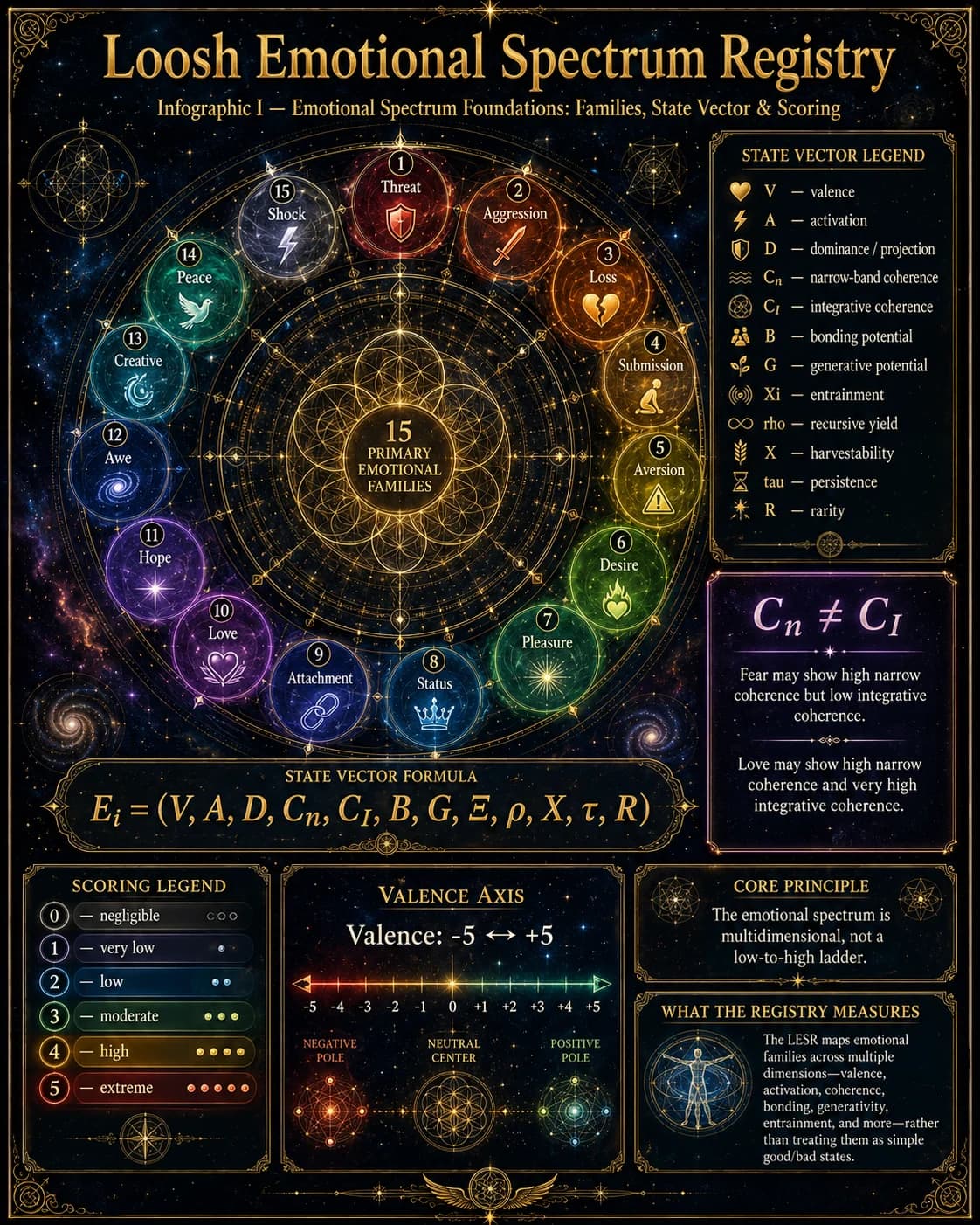
Loosh Emotional Spectrum Registry
Loosh Emotional Spectrum Registry v0.1
1. Purpose
TheLoosh Emotional Spectrum Registry (LESR)classifies major emotional-energy families within the Loosh Dynamics Framework.
Its purpose is to describe each family according to:
- generation characteristics;
- harmonic structure;
- field behavior;
- harvestability;
- persistence;
- recursive production;
- consumer modification;
- market role;
- strategic applications;
- compound states;
- and restorative or balancing pathways.
The registry doesnotimpose a single positive-to-negative hierarchy.
Instead, every emotional family occupies a multidimensional strategic position.
2. Registry Vector
The earlier Emotional-State Vector is expanded to distinguish two fundamentally different kinds of coherence:
Ei = (V, A, D, Cn, CI, B, G, Ξ, ρ, X, τ, R)
Where:
- (V) =Valence
- (A) =Activation / energetic intensity
- (D) =Dominance / projective force
- (Cn) =Narrow-band coherence
- (CI) =Integrative coherence
- (B) =Bonding / coupling potential
- (G) =Generative potential
- (Ξ) = Entrainment potential
- (ρ) = Recursive yield
- (X) =Harvestability
- (τ) = Persistence
- (R) = Rarity
Coherence distinction
Cn = strength and stability around a particular state
while:
CI = compatibility of that state with whole-system integration.
An entity saturated with fear might therefore have:
Cn = 5, CI = 1.
A being operating from deep love might instead have:
Cn = 4, CI = 5.
This distinction is essential to the registry.
3. Scoring Convention
All registry scores except valence use:
0 → 5
with:
- 0= negligible
- 1= very low
- 2= low
- 3= moderate
- 4= high
- 5= extreme
Valence uses:
-5 → + 5.
These numbers areframework tuning indices, allowing families to be compared consistently rather than functioning as physical units.
4. Market-Role Classes
Emotional loosh may participate in several markets simultaneously.
Bulk Commodity
Easy to generate in large quantities.
Recursive Commodity
Consumption or deployment tends to generate additional future supply.
Power Commodity
Increases projection, dominance, intimidation, or force.
Control Commodity
Facilitates hierarchy, dependency, obedience, or behavioral shaping.
Binding Commodity
Strengthens affiliation, allegiance, attachment, or collective coupling.
Restorative Commodity
Raises integrative coherence or supports recovery.
Generative Commodity
Increases novelty, creation, adaptation, or future possibility.
Defensive Commodity
Strengthens resistance to external entrainment or destabilization.
Catalytic Commodity
Rapidly changes state conditions and facilitates transitions.
Premium Commodity
Difficult to produce, refine, or obtain at high coherence.
5. Quick Reference
| ID | Family | Primary Strategic Function | Major Market Classes |
|---|---|---|---|
| LESR-001 | Threat | Fear amplification and recursive generation | Bulk, Recursive, Power |
| LESR-002 | Aggression | Force and dominance projection | Power, Recursive |
| LESR-003 | Loss | Long-duration energetic production | Bulk, Sustained |
| LESR-004 | Submission | Hierarchy and self-limitation | Control |
| LESR-005 | Aversion | Separation and boundary rejection | Defensive, Catalytic |
| LESR-006 | Desire | Demand and appetite generation | Recursive, Control, Bulk |
| LESR-007 | Pleasure | Reward and dependency | Control, Premium |
| LESR-008 | Status | Rank and dominance reinforcement | Power, Control |
| LESR-009 | Attachment | Persistent relational binding | Binding, Control |
| LESR-010 | Love | Integration and restoration | Restorative, Premium |
| LESR-011 | Hope | Recovery and future mobilization | Restorative, Generative |
| LESR-012 | Awe | Large-scale synchronization | Binding, Premium, Restorative |
| LESR-013 | Creative | Novel information generation | Generative, Premium |
| LESR-014 | Peace | Stabilization and anti-entrainment | Defensive, Restorative |
| LESR-015 | Shock | Rapid state opening | Catalytic |
LESR-001 — Threat
Intensity Ladder
Unease → Anxiety → Fear → Panic → Terror
Registry Vector
[(-4,5,2,4,1,1,4,5,5,5,3,1)]
Core Signature
Threat loosh is ahigh-activation, high-entrainment state family organized around perceived danger.
Its greatest strategic value is its recursive nature.
LF → Ffear → fear induction → GF'
Generation Profile
- extremely easy to trigger;
- high output under acute threat;
- readily amplified through uncertainty;
- can persist at lower intensity as anxiety;
- large populations can generate synchronized threat fields.
Consumer Modification
Repeated consumption tends toward:
Cn, fear↑
and:
Ffear↑.
The consumer becomes increasingly capable of functioning as afear attractor.
Projected Field Effect
- threat perception;
- vigilance;
- contraction;
- panic;
- reduced exploratory behavior;
- increased susceptibility to further fear entrainment.
Recursive Yield
Extreme.
Fear is one of the clearest examples of productive energetic capital.
Harvest Profile
Very high harvestability.
Both short intense events and sustained anxiety environments are productive.
Primary Market Roles
- amplifier;
- intimidation field;
- battlefield control;
- recursive production;
- threat conditioning;
- bulk energetic supply.
High-Value Forms
- concentrated terror;
- prolonged anticipatory fear;
- synchronized mass fear;
- high-coherence fear from strongly generative sources.
Common Compounds
Fear + Dominance Terror Field
Fear + Attachment Possessive Fear
Fear + Shame Submission Conditioning
Fear + Agency + Coherence Courage
Restorative Transformation
Threat does not necessarily require suppression.
Its restorative transformation is:
Fear + Agency + CI → Courage.
LESR-002 — Aggression
Intensity Ladder
Irritation → Anger → Fury → Rage → Hatred
Registry Vector
[(-4,5,5,4,1,1,3,4,4,4,2,1)]
Core Signature
Aggression is ahigh-output projective family.
Where fear primarily creates an attractor, aggression produces:
outward energetic pressure
and:
[ force projection ].
Generation Profile
- rapidly generated by obstruction or perceived violation;
- high amplitude;
- relatively short natural peak;
- can be prolonged through resentment or hatred;
- commonly compounds with fear and status.
Consumer Modification
Repeated intake increases:
D↑
and:
Faggression↑.
The consumer may become increasingly capable of imposing high-pressure fields onto others.
Projected Field Effect
- confrontation;
- pressure;
- intimidation;
- destabilization;
- activation of defensive states;
- escalation.
Recursive Yield
High.
Aggression often induces aggression in others:
LA → FA → GA'
creating conflict-amplification loops.
Primary Market Roles
- combat enhancement;
- intimidation;
- force projection;
- dominance enforcement;
- conflict generation.
High-Value Forms
- highly concentrated rage;
- disciplined aggression;
- rage combined with dominance;
- synchronized collective aggression.
Common Compounds
Anger + Fear Defensive Aggression
Rage + Status Dominance Assault
Anger + Grief Resentment
Restorative Transformation
Anger + Discernment + Boundary Integrity → Protective Force.
The energetic power of anger can therefore be retained while its destructive recursion is removed.
LESR-003 — Loss
Intensity Ladder
Sadness → Sorrow → Grief → Despair
Registry Vector
[(-4,3,1,3,1,2,3,3,2,4,5,1)]
Core Signature
Loss is characterized less by extreme instantaneous amplitude and more by:
[ depth + duration ].
It behaves like aslow energetic reservoir.
Generation Profile
- moderate activation;
- very long persistence;
- meaning-rich;
- often relationally generated;
- capable of sustained production over extended periods.
Consumer Modification
Possible effects include:
- heaviness;
- contraction;
- depletion;
- reduced forward orientation;
- increased compatibility with despair-like fields.
Projected Field Effect
Rather than strongly forcing another state, loss can create alow-frequency environmental basinthat gradually entrains compatible beings.
Recursive Yield
Low to moderate.
Less self-amplifying than fear or desire, but extremely persistent.
Primary Market Roles
- sustained harvesting;
- long-duration reservoirs;
- depletion fields;
- background environmental production.
High-Value Forms
- deep relational grief;
- unresolved collective mourning;
- grief combined with high attachment;
- despair with sustained attention.
Common Compounds
Grief + Anger Resentment
Grief + Love Sacred Mourning
Grief + Hopelessness Despair
Restorative Transformation
Grief + Love + Meaning + Hope → Integration.
LESR-004 — Submission
Intensity Ladder
Guilt → Shame → Humiliation → Self-Negation
Registry Vector
[(-4,2,1,4,1,2,2,4,3,4,4,2)]
Core Signature
Submission loosh is ahierarchy-compatible state family.
Its principal strategic importance lies not in raw energetic quantity but in altering the relationship between the subject and authority.
Generation Profile
- often induced through social comparison;
- persistent when identity-linked;
- relatively low activation;
- easily coupled to fear;
- highly compatible with hierarchical systems.
Consumer / Deployment Effect
Submission loosh may be more valuable toproject or inducethan to consume recreationally.
It encourages:
Dtarget↓.
Field Effect
- inhibition;
- compliance;
- self-restriction;
- hierarchy acceptance;
- reduced projection;
- reduced boundary assertion.
Recursive Yield
Moderate.
Once internalized, the target can begin recreating the submission field without continued external enforcement.
Primary Market Roles
- control infrastructure;
- obedience conditioning;
- hierarchy preservation;
- suppression of resistance.
Common Compounds
Shame + Fear Coercive Submission
Shame + Attachment Approval Dependency
Restorative Transformation
Submission + Truth + Agency + BΣ → Sovereignty.
LESR-005 — Aversion
Intensity Ladder
Discomfort → Disgust → Revulsion → Rejection
Registry Vector
[(-3,3,3,3,2,0,2,3,2,3,2,1)]
Core Signature
Aversion produces arepulsive or separating field.
Unlike fear, which contracts around threat, aversion pushes the perceived contaminant or incompatible object away.
Primary Field Function
Separation
Generation Profile
- rapid;
- often stimulus-specific;
- moderate intensity;
- low persistence unless reinforced;
- strongly boundary-linked.
Consumer Modification
May increase:
- rejection;
- separation pressure;
- resistance to coupling;
- sensitivity to incompatibility.
Strategic Uses
- energetic shielding;
- exclusion;
- severance;
- purification systems;
- anti-coupling applications.
Recursive Yield
Low to moderate.
Aversion can provoke reciprocal aversion but does not inherently create the same amplification loops as fear.
Common Compounds
Aversion + Fear Avoidance
Aversion + Aggression Hostile Rejection
Restorative Transformation
Aversion becomes useful when paired with discernment:
Aversion + Discernment → Healthy Boundary Selection.
LESR-006 — Desire
Intensity Ladder
Interest → Longing → Craving → Lust → Obsession
Registry Vector
[(+1,4,2,4,1,2,5,4,5,5,4,1)]
Core Signature
Desire is one of the most economically important families because it creates:
[ demand itself ].
Pleasure provides reward.
Desire creates the need to seek reward.
Generation Profile
- persistent;
- attention-intensive;
- self-reinforcing;
- extremely easy to couple to reward systems;
- readily transformed into addiction.
Core Loop
Desire → Acquisition → Pleasure → Decline → Desire.
Consumer Modification
Repeated exposure may increase:
- appetite;
- target fixation;
- attention lock;
- pursuit;
- compulsive acquisition.
Recursive Yield
Extreme.
Desire is one of the strongest self-propagating commodities.
Primary Market Roles
- market engine;
- addiction generator;
- demand creation;
- attention capture;
- self-directed harvesting infrastructure.
High-Value Forms
- obsession;
- concentrated lust;
- unattainable longing;
- desire linked to identity or status.
Common Compounds
Desire + Attention Lock Obsession
Desire + Pleasure Addiction Loop
Desire + Attachment Possessiveness
Restorative Transformation
Desire + Awareness + Choice → Intention.
LESR-007 — Pleasure
Intensity Ladder
Comfort → Enjoyment → Joy → Euphoria → Ecstasy
Registry Vector
[(+4,4,2,3,2,2,4,4,4,5,2,2)]
Core Signature
Pleasure is areward-state commodity.
Its strategic importance becomes especially high where endogenous emotional experience is weak or artificially suppressed.
Generation Profile
- high amplitude;
- highly desirable;
- usually short-lived;
- readily linked with desire;
- strongly reinforcing.
Consumer Modification
Pleasure consumption provides:
- reward;
- relief;
- reinforcement;
- motivational control;
- incentive conditioning.
Recursive Yield
High when coupled to desire.
Pleasure alone may decay quickly.
Pleasure + desire produces:
ρ ≫ 0.
Primary Market Roles
- reward allocation;
- hierarchical incentives;
- loyalty reinforcement;
- recreational consumption;
- dependency engineering.
Affective Command Economy Role
obedience → LP
creates a direct mechanism for turning emotional access into governance.
Common Compounds
Pleasure + Desire Craving Loop
Pleasure + Attachment Reward Bonding
Pleasure + Status Triumph
Restorative Transformation
Pleasure becomes non-dependent when paired with sufficient internal generation:
Pleasure + Ginternal → Joy.
LESR-008 — Status
Intensity Ladder
Confidence → Pride → Triumph → Glory → Supremacy
Registry Vector
[(+1,4,5,4,1,1,3,4,4,4,3,2)]
Core Signature
Status loosh is organized aroundrank, dominance, visibility, and comparative position.
Generation Profile
- strongly social;
- linked to recognition;
- amplified by hierarchy;
- often coupled to aggression or pleasure;
- can remain persistent through identity.
Consumer Modification
Repeated consumption can increase:
D↑
and:
Fcommand↑.
Primary Market Roles
- elite enhancement;
- command-state reinforcement;
- rank differentiation;
- dominance projection;
- hierarchy maintenance.
High-Value Forms
- triumph;
- collective adoration;
- conquest-associated glory;
- supremacy blends.
Common Compounds
Status + Pleasure Triumph Reward
Status + Aggression Dominance
Status + Fear Tyrannical Presence
Restorative Transformation
Status + Service + CI → Stewardship.
LESR-009 — Attachment
Intensity Ladder
Affinity → Trust → Affection → Loyalty → Devotion
Registry Vector
[(+2,3,2,4,2,5,4,4,4,4,5,2)]
Core Signature
Attachment is abinding family.
Its central variable is:
B↑.
Critical Distinction
Attachment ≠ Love
Attachment creates persistent coupling.
Love creates integrative coherence.
Attachment may exist with:
CI ≪ 5.
Generation Profile
- relational;
- persistent;
- memory-rich;
- identity-compatible;
- highly durable.
Consumer / Deployment Effect
Attachment can strengthen:
- allegiance;
- loyalty;
- dependency;
- pair bonding;
- group identity;
- territorial affiliation.
Recursive Yield
High.
Strong bonds encourage behaviors that continually regenerate the attachment state.
Primary Market Roles
- social binding;
- allegiance;
- hierarchy;
- dependency;
- relational lock-in.
Common Compounds
Attachment + Fear Possessiveness
Attachment + Awe + Love Devotion
Attachment + Pleasure Reward Bond
Restorative Transformation
Attachment + Freedom + Love → Non-Coercive Bonding.
LESR-010 — Love
Intensity Ladder
Care → Tenderness → Love → Compassion → Unconditional Love
Registry Vector
[(+5,3,2,4,5,5,5,4,4,3,4,4)]
Core Signature
Love is presently the registry's strongestintegrative-coherence family.
Its defining property is:
CI↑.
Generation Profile
- meaning-rich;
- relationally deep;
- difficult to manufacture authentically;
- potentially very high coherence;
- capable of sustained production.
Consumer Modification
Love intake may increase:
- integrative coherence;
- bonding without forced conformity;
- restorative capacity;
- relational compatibility;
- generativity.
Projected Field Effect
LL → CI↑
within compatible recipients.
At collective scale:
LL → Ccivilization↑.
Primary Market Roles
- restoration;
- healing;
- stabilization;
- relational repair;
- civilization-scale coherence support.
Market Characteristics
Love is potentially valuable because it combines:
CI + G + B + R.
Its rarity is not necessarily the rarity of love itself, but ofhighly coherent, concentrated, transferable love-state output.
Strategic Risk
Externally monopolized love can create:
Stabilization → Dependency → Coherence Rent.
Common Compounds
Love + Awe + Trust Devotion
Love + Awareness of Suffering Compassion
Love + Peace Deep Restoration
Restorative Principle
Authentic restoration produces:
Lexternal↓
while:
GL, internal↑.
LESR-011 — Hope
Intensity Ladder
Optimism → Hope → Inspiration → Conviction
Registry Vector
[(+4,3,3,4,4,3,5,4,4,3,4,3)]
Core Signature
Hope is afuture-oriented generative family.
Where love restores compatibility, hope restores:
[ forward possibility ].
Generation Profile
- resilient;
- future-directed;
- meaning-rich;
- often amplified socially;
- compatible with creativity.
Consumer Modification
Hope increases:
- persistence;
- exploration;
- endurance;
- recovery behavior;
- capacity to envision alternative states.
Primary Market Roles
- recovery;
- mobilization;
- anti-collapse intervention;
- resilience;
- generative restoration.
Recursive Yield
High.
Hope frequently creates behavior that generates additional reasons for hope.
Common Compounds
Hope + Creative Innovation
Hope + Love Restorative Renewal
Hope + Awe Collective Inspiration
Restorative Function
Hope is particularly valuable where a system retains capacity but has lost belief in possible pathways.
LESR-012 — Awe
Intensity Ladder
Wonder → Reverence → Awe → Sacred Devotion
Registry Vector
[(+3,4,2,5,4,4,4,5,4,3,3,4)]
Core Signature
Awe is alarge-scale synchronization family.
It reduces the relative dominance of local concerns while orienting attention toward something perceived as larger.
Generation Profile
- relatively rare;
- high intensity;
- high attention capture;
- highly synchronized in collective settings;
- meaning-dense.
Consumer Modification
Awe may increase:
- receptivity;
- collective synchronization;
- devotion;
- openness to larger organizing structures.
Primary Market Roles
- civilization-scale alignment;
- collective synchronization;
- sacred-state generation;
- mass bonding;
- shared-purpose formation.
Strategic Duality
Awe can participate in:
Awe + Love → Sacred Coherence
or:
Awe + Submission → Hierarchical Devotion.
Thus awe is structurally powerful but architecture-dependent.
Common Compounds
Awe + Love + Trust Devotion
Awe + Fear Dread
Restorative Transformation
Awe remains integrative when coupled with:
BΣ + Discernment + Sovereignty.
LESR-013 — Creative
Intensity Ladder
Curiosity → Fascination → Play → Inspiration → Flow
Registry Vector
[(+2,4,2,4,4,1,5,3,4,3,2,4)]
Core Signature
Creative loosh is distinguished by its ability to produce:
[ novel structured information ].
Most emotional families primarily transform or reproduce existing states.
Creativity can generate patterns that did not previously exist.
Generation Profile
- attention-intensive;
- novelty-rich;
- high information content;
- difficult to force directly;
- strongest under sufficient freedom and possibility.
Consumer Modification
Creative loosh may increase:
- novelty generation;
- pattern recognition;
- improvisation;
- invention;
- adaptive capability.
Primary Market Roles
- innovation;
- cultural renewal;
- technological or symbolic development;
- anti-stagnation intervention.
Market Characteristics
Creative output may be relatively scarce because:
X↓
while:
R↑.
This gives highly refined creative loosh strong premium-market potential.
Common Compounds
Creative + Hope Innovation
Creative + Love Generative Beauty
Creative + Awe Visionary Creation
Failure Mode
Excessive external control may reduce:
Gcreative↓.
Thus extraction systems seeking creative loosh face a paradox: too much control can destroy the source.
LESR-014 — Peace
Intensity Ladder
Relief → Calm → Contentment → Peace → Equanimity
Registry Vector
[(+4,1,4,5,5,3,3,3,3,2,5,4)]
Core Signature
Peace is alow-noise, high-stability coherence state.
Its strategic power comes less from projection than from resistance to forced entrainment.
Generation Profile
- low amplitude;
- high persistence;
- high integrative coherence;
- relatively difficult to induce externally at depth;
- naturally stabilizing.
Defensive Function
If hostile entrainment applies:
FH,
while peace provides restoration force:
RP,
then effective capture requires:
FH>RP.
Thus peace functions asenergetic armor.
Consumer Modification
Repeated exposure may increase:
- field stability;
- resistance to manipulation;
- recovery speed;
- low-noise processing;
- autonomous coherence.
Primary Market Roles
- stabilization;
- defense;
- anti-entrainment;
- system recovery;
- coherent buffering.
Common Compounds
Peace + Love Restorative Coherence
Peace + Hope Stable Renewal
Peace + Agency Sovereign Presence
Strategic Importance
Peace is unusual because an extraction architecture may find it valuable to possess while simultaneously having incentives tolimit its availability among harvest targets.
LESR-015 — Shock
Intensity Ladder
Surprise → Startle → Shock
Registry Vector
[(-1,5,1,1,0,0,3,4,2,5,1,1)]
Core Signature
Shock is astate-transition catalyst.
Its primary value comes from rapidly disrupting the current basin.
Generation Profile
- extremely rapid;
- high activation;
- short duration;
- very easy to induce;
- low intrinsic persistence.
Field Function
S0 → shock → Sopen
Shock temporarily destabilizes the current state, making subsequent entrainment easier.
Strategic Uses
Shock can therefore serve as a precursor:
Shock → Fear
Shock → Submission
Shock → Awe
or potentially:
Shock → Reorientation.
Primary Market Roles
- state opening;
- transition catalysis;
- destabilization;
- preparation for stronger field insertion.
Recursive Yield
Low.
Shock itself is not usually the desired long-duration product.
Its value lies in what becomes possible immediately afterward.
Restorative Transformation
Shock can be followed by stabilization rather than exploitation:
Shock → Peace + Meaning → Integration.
6. Cross-Family Strategic Groupings
Civilization-Scale Field Modifiers
Love, Awe, Threat, Peace, Hope
These can affect large collective coherence patterns.
Recursive Force Multipliers
Threat, Desire, Aggression, Pleasure, Status
These have high capacity to generate additional production after deployment.
Hierarchy and Control Commodities
Pleasure, Submission, Attachment, Status, Fear
These are especially useful for constructing durable command systems.
Sustained Production Commodities
Loss, Desire, Anxiety, Attachment-linked longing
These produce relatively persistent energetic output.
Generative Commodities
Creative, Hope, Love, Play, Inspiration
These tend to increase future possibility rather than merely recycling an existing state.
Defensive Commodities
Peace, Aversion, Love, Sovereignty compounds
These can reduce susceptibility to unwanted coupling or help restore internal organization.
7. Preliminary Strategic Comparison
The registry reveals why several families repeatedly appear throughout the Loosh Dynamics Framework.
Threat
High:
A + Ξ + ρ + X
making it extraordinarily efficient for recursive harvesting.
Desire
High:
G + ρ + X + τ
making it a powerful demand-production engine.
Pleasure
High reward utility and excellent compatibility with hierarchical conditioning.
Love
High:
CI + B + G
giving it extraordinary restorative and civilization-scale value.
Awe
High:
Cn + Ξ + R
making it unusually powerful for large collective synchronization.
Creative
High:
G + R
making it strategically valuable wherever novelty and adaptation are scarce.
Peace
High:
Cn + CI + τ
giving it exceptional defensive and stabilization value.
8. Emotional Compound Layer
Primary families can combine into secondary states.
A compound may be represented as:
LC = ∑iwiLi + Γ
where (wi) represents the contribution of each component and (Γ) represents new emergent properties produced by their interaction.
Examples:
Jealousy
Ljealousy = Lattachment + Lfear + Ldesire + Lstatus threat.
Devotion
Ldevotion = Llove + Lattachment + Lawe + Ltrust.
Obsession
Lobsession = Ldesire + Lattention lock + Lrecursion.
Courage
Lcourage = Lfear + Lagency + Lcoherence.
Compassion
Lcompassion = Llove + Lawareness of suffering + Lrestorative intention.
Dread
Ldread = Lfear + Lawe + Lpower asymmetry.
Tyrannical Presence
Ltyrannical = Lfear + Lstatus + Laggression.
Restorative Coherence
Lrestorative = Llove + Lpeace + Lhope.
This compound layer will eventually allow the registry to function almost like anenergetic chemistry system.
9. Market Principle
No emotional family possesses one universal price.
Market value depends upon:
Pi = f(Si, Di, Qi, Πi, τi, ρi, Ui, Ri)
where:
- (Si) = supply;
- (Di) = demand;
- (Qi) = energetic quality;
- (Πi) = purity ;
- (τi) = storage stability ;
- (ρi) = recursive yield ;
- (Ui) = strategic utility;
- (Ri) = rarity.
Consequently:
Common does not mean low-value.
Fear can remain highly valuable because of recursive yield.
Desire can remain valuable because it manufactures demand.
Pleasure is valuable because it controls reward.
Love can command premium value because of integrative restoration.
Creative output can command premium value because it produces novelty.
Peace can command strategic value because it protects against unwanted entrainment.
10. Registry Principle
The Emotional Spectrum Registry therefore evaluates every family according to three separate questions:
Production
How easily and in what quantity can it be generated?
Transformation
What does consuming or projecting it allow a being to become capable of doing?
Architecture
Does its circulation create restoration, dependency, amplification, hierarchy, defense, or further production?
The central registry rule is:
The strategic value of an emotional state cannot be inferred from valence alone.
A so-called negative state may have immense military or recursive value.
A positive state may have enormous restorative value while also being exploitable through dependency.
A low-activation state may be strategically superior to a high-activation one because of persistence or defensive coherence.
The emotional spectrum is therefore not a ladder.
It is amultidimensional energetic economy.