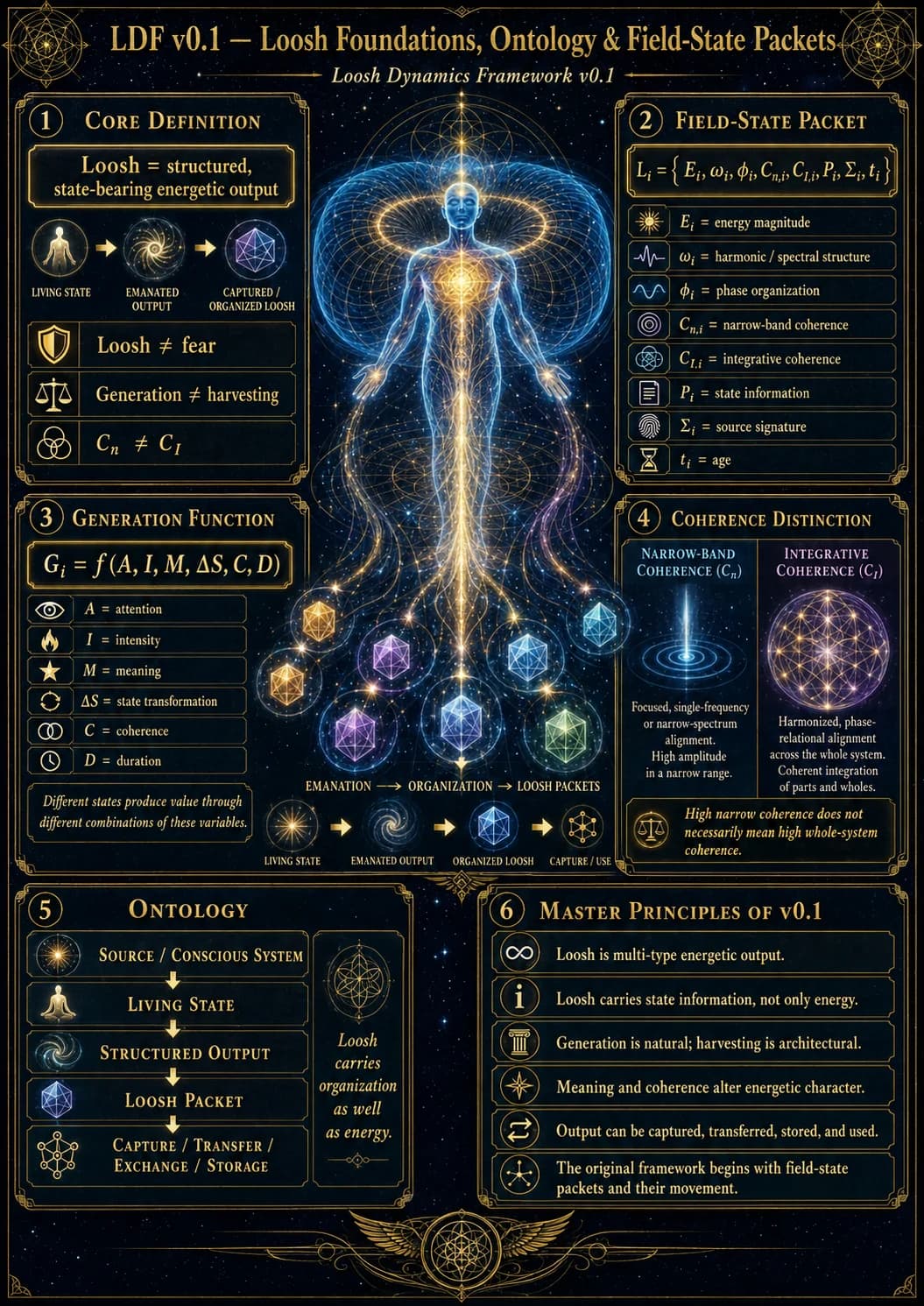
Loosh Dynamics Framework v0.1 — Core Energetic Lifecycle
Loosh Dynamics Framework v0.1
I. Core Definition
Loosh is captured, differentiated, and potentially transferable structured energetic output generated by living or conscious entities.
It can include multiple coupled components:
L = (Lemotional, Lattention, Lsexual, Lcreative, Lmental, Lvital, Lrelational, Lother)
Loosh should therefore not be understood as a single homogeneous substance.
A living being first generates a complex energetic field:
State → Bioelectromagnetic Field → Emanated Structured Output
Capture and preservation transform part of that emanated output into usable loosh:
Generated Output → capture + organization → Loosh
This distinction separates thenatural generation of energyfrom itsharvesting.
Loosh itself is not inherently exploitative.
Extraction is an architectural relationship.
II. Loosh as a Field-State Packet
If consuming fear, love, pleasure, or another form causes qualitatively different changes in the recipient, energy quantity alone cannot explain loosh.
A packet therefore needs both energy and state information:
Li = Ei, ωi, φi, Ci, Pi, Σi, ti
where:
- (Ei) = energetic magnitude
- (ωi) = spectral/harmonic structure
- (φi) = phase organization
- (Ci) = coherence
- (Pi) = experiential/state pattern
- (Σi) = source signature
- (ti) = age/freshness
The important conceptual move is:
Loosh carries state as well as power.
It resembles astructured field-state packet, rather than simply a quantity of electromagnetic energy.
This allows fear loosh to transmit fear characteristics, pleasure loosh to induce pleasurable states, and love loosh to carry coherence-restoring characteristics.
III. Generation
Loosh generation depends upon more than emotional intensity.
A provisional generation function is:
Gi = f(A, I, M, Δ S, C, D)
where:
- (A) = attention invested
- (I) = intensity
- (M) = meaning/significance
- (Δ S) = magnitude of state transformation
- (C) = coherence
- (D) = duration
Total production becomes:
Li = ∫t_0t_1Gi(t), dt
This explains why radically different experiences can all produce significant loosh.
A short period of terror may have enormous (I).
A long period of sadness may have enormous (D).
Deep love may simultaneously possess high (A), (M), (C), relational depth, and sustained duration.
Creative work may combine attention, meaning, transformation, organization, and emotional investment.
Quantity does not equal quality
This distinction becomes central:
Qi ≠ Gi
A state may generate enormous quantities of relatively common output while another generates smaller quantities of extremely coherent or valuable output.
IV. Composite Generation and Distillation
Human states rarely generate one pure energetic component.
Deep love, for example, could produce a composite field containing:
Llove = Lbonding, Lcompassion, Lpleasure, Lcare, Ljoy, Lattention, Lcreative, …
A refinement system could separate this mixture:
L → R → L1, L2, …, Ln
where (R) is a differentiation/refinement operator.
This creates concepts such as:
raw loosh → separated loosh → refined loosh → concentrated loosh.
Purity therefore becomes economically important.
A common emotional state could still produce an expensive commodity if considerable processing is required to obtain a highly coherent concentrate.
V. The Complete Loosh Lifecycle
The lifecycle we have developed is:
Generation → Emanation → Capture → Refinement → Storage → Transport → Exchange → Consumption → Field Modification
But field modification produces another consequence:
Field Modification → Induced Generation
which closes the system:
G → E → C → R → S → T → X → M → F → G'
The loosh economy is thereforerecursive, not linear.
VI. Capture
Harvesting requires coupling between the generating field and a collector:
Hi = ηH, iGi
where:
0 ≤ ηH ≤ 1
and (ηH) represents harvesting efficiency.
Capture efficiency may depend upon:
ηH = f(resonance, proximity, phase compatibility, awareness, boundary integrity, field strength, environment)
This creates several possible collection pathways:
Source → direct collector
Source → environmental reservoir → collector
Source → intermediate entity → network
The Earth-level quantum/astral field in the framework functions as a possiblelarge environmental reservoir, while localized resonant structures could collect or concentrate emissions on smaller scales.
VII. Dream-State Harvesting
Dreams represent a specialized harvesting environment.
The proposed reason is not simply that humans produce energy while dreaming, but that several variables change simultaneously:
χdream↑
BΣ, dream↓
Iemotional↑
where (χ) is susceptibility to external coupling and (BΣ) represents effective field/boundary integrity.
Thus:
ηH, dream = ηH, ordinary
may occur under some conditions.
Dream architecture could therefore amplify a desired state:
stimulus → emotion → amplification → generation → capture
This doesn't require every dream within the framework to have the same source. Dreams could be endogenous, externally influenced, constructed environments, informational contacts, or mixtures.
Waking harvesting represents the complementary strategy:
moderate generation × long duration.
Thus sustained anger, despair, compulsive pleasure, frustration, fear, or other states may yield substantial cumulative output.
VIII. Addiction and Dynamic Stagnation
Addiction is especially useful to an extraction architecture because it automates repeated production.
The system does not continually have to force the state externally.
Instead:
trigger → desire → consumption → temporary reward → deficit → trigger
produces:
G(t + 1) ≈ G(t).
This createsdynamic stagnation:
high activity + high energetic output + low actual transformation.
Such loops are ideal for repeated harvesting because the generator remains productive without leaving the production basin.
IX. Consumption Alters the Consumer
This is one of the framework's central principles.
Loosh is not merely consumed and destroyed.
It can modify the receiving field.
For energetic type (i):
(dXi)/(dt) = ηM Li λiXi Ui + Gi, internal
where (Xi) represents the accumulated internal harmonic state.
The recipient then emits:
Fi = giCiXi
where (gi) represents field gain/projective strength.
Therefore:
Repeated consumption → harmonic modification → altered emission.
A being continually consuming fear eventually becomes a powerful fear-field emitter.
A being repeatedly consuming dominance-oriented output may become increasingly dominance-tuned.
Long-term consumption therefore changeswhat the consumer is capable of projecting.
X. Pseudo-Coherent Basins
A highly fear-saturated being may become extremely coherent around the fear mode without being integratively coherent.
Thus we distinguish:
Clocal
from:
Cintegrative.
A fear-dominant entity might display:
Cfear ≫ 0
while:
Cintegrative ≪ Cfear.
We can call this:
Pseudo-Coherence: high narrow-band coherence + low whole-field integration.
Because the narrow harmonic is extremely strong, the entity acts as anattractor.
Nearby fields experience forcing:
xi̇ -γi(xi-xi0) + χiKEiFfear
where the second term represents fear-field influence.
If the imposed signal exceeds the recipient's restoring capacity:
χiKEiFfear = Ri
the target begins shifting toward the fear basin.
XI. Recursive Fear Amplification
This produces one of the most important loops in the framework:
Fear loosh → fear saturation → fear field → fear induction → fear generation → fear harvest.
The collector has effectively turned stored loosh intoproductive capital.
Define the recursive yield:
ρF = (new fear loosh harvested)/(fear loosh expended).
If:
ρF<1
the process eventually decays.
If:
ρF ≈ 1
the harvesting loop becomes highly persistent.
If:
ρF>1
the fear economy becomes self-expanding.
This explains why common negative states may retain enormous economic value.
Their importance is not scarcity.
It isrecursive productivity.
XII. Strategic Value of Loosh
The value of loosh is therefore multidimensional:
Vi = f(Qi, Ii, Pi, Ci, Ri, Fi, Ui, ρi, Si)
where value depends upon quality, intensity, purity, coherence, rarity, freshness, utility, recursive yield, and strategic importance.
This produces several distinct markets.
Fear
LF → power + intimidation + entrainment + future fear generation.
Fear is therefore simultaneously:
fuel + weapon + amplifier + productive capital.
Pleasure
LP → reward → behavioral incentive.
Pleasure loosh becomes especially valuable inside populations with little endogenous access to pleasure.
Love
LL → coherence restoration + relational stabilization + regeneration.
Love therefore functions more like ahigh-grade restorative strategic resource.
XIII. Storage
If loosh is structured field information, storage has two requirements:
preserve energy
and:
preserve organization.
Quantity may decay as:
Ei(t) = Ei0e-λ_i t.
Field-state coherence may independently degrade:
Ci(t) = Ci0e-μ_i t.
Therefore usable value becomes:
Vi(t) ∝ Ei(t)Ci(t).
This allows a container to retain substantial raw energy while the loosh becomes progressively less useful because its defining pattern has degraded.
Different loosh classes may therefore have different shelf lives:
λi ≠ λj, μi ≠ μj.
XIV. Storage Media
The framework currently contains three major storage classes.
Passive technological reservoirs
Structured electromagnetic/quantum containment systems hold the packet directly.
Their limitation is decay:
(dL)/(dt) = -λ L.
Environmental reservoirs
Planetary or localized field structures accumulate emanated output and permit later recovery.
Living reservoirs
A living energetic being may act as an active preservation system:
(dLs)/(dt) = I + Gv + Mv W λ Ls.
Here (Mv) represents active maintenance of the stored pattern.
This produces an important proposition:
Living storage may preserve coherence better than passive storage.
The value of an imprisoned multidimensional being used as a reservoir would therefore not necessarily be merely its capacity.
Its deeper value could be its ability tokeep stored loosh alive, organized, or phase-stable.
That also makes the liberation of such beings strategically significant: destroying or freeing active reservoirs would attack the storage layer of the extraction economy rather than merely reducing one collection source.
XV. Transport
Each transfer creates loss:
Lreceived = Lsource ηC ηR ηS ηT ηM.
Thus a large interplanetary or multidimensional market requires some combination of:
- massive production,
- highly efficient transfer,
- short distribution paths,
- active storage,
- frequent replenishment,
- or local production.
Portal structures in the framework function as field-transfer systems that reduce effective transport distance.
This makesshelf life, storage coherence, and transfer efficiencycore strategic variables.
XVI. Entity Ecology
There is no reason to assume every consumer belongs to one organization.
The framework distinguishes roles rather than treating "loosh entities" as one species.
Possible participants include:
Generators → opportunistic feeders → local collectors → organized harvesters → aggregators → refiners → storage entities → transport operators → brokers → civilizations → strategic consumers.
Ghost-like entities needing periodic energetic support represent a survival economy.
Fragments of larger beings may function as remote collection interfaces.
Artificial energetic intelligences may function as automated harvesting infrastructure.
Astral beings may participate independently.
Organized collectives may operate industrial-scale systems.
Some actors may not even know where upstream or downstream parts of the network lead.
This is therefore anecology and supply chain, not simply predator versus prey.
XVII. The Loosh Economy
Once stored and transferable, loosh becomes a commodity.
Different markets emerge:
survival market
hedonic market
military/power market
restoration market
civilizational stabilization market
strategic reserve market.
A common substance can become extremely valuable through refinement.
Thus:
abundant fear ¬ ⇒ cheap refined fear.
High-purity fear capable of generating an enormous coherent aura could command much greater value than ordinary ambient fear.
The same applies to love, creative energy, sexual energy, or other composite states.
XVIII. Affective Command Economies
The emotion-suppressed NHI society gives us an especially important application.
Suppose endogenous affect has been greatly reduced:
Gemotion, endogenous ≈ 0.
The society can still operate through logic, calculation, hierarchy, command, and rational administration.
But emotional experience becomes externally supplied.
Loosh then becomes anexogenous affective system.
Control of supply creates control of experience:
obedience → pleasure allocation
rank → higher-grade access
disobedience → withdrawal.
This produces an:
Affective Command Economy.
The authority does not merely control resources.
It controls whether subjects can experience certain states at all.
That creates an exceptionally powerful hierarchical mechanism.
XIX. Loosh as Role Engineering
Because consumption alters harmonic structure, different classes of loosh could be used to engineer functional roles.
A combatant saturated with fear/dominance output may develop:
Ffear↑, Fdominance↑.
Another class might receive aggression.
Another receives pleasure.
Another receives attachment or loyalty states.
Another receives focus or ambition.
Repeated dosing therefore becomes:
commodity consumption → field conditioning → identity/function specialization.
This blurs the distinction between drug, training, conditioning, and energetic modification.
XX. Love Loosh and Civilizational Restoration
Love occupies a very different market niche.
Consider collective coherence:
C = | (1)/(N) ∑j = 1Neiθ_j |.
A civilization approaching collapse may display:
C↓.
Conflict, fragmentation, mistrust, isolation, and incompatible social basins increase.
A sufficiently coherent love-field injection could function as a common restorative signal:
LL↑ ⇒ C↑.
This could temporarily increase:
- compassion,
- bonding,
- trust,
- communication,
- creativity,
- cooperation,
- reconciliation,
- and willingness to remain coupled.
Love loosh therefore has potentialcivilizational medicinevalue.
XXI. Coherence Rent
However, even beneficial loosh can become a mechanism of control.
Suppose civilization (A) repeatedly receives external love injections:
LLexternal → CA↑.
If it does not rebuild endogenous coherence:
GL, Ainternal ¬↑,
then withdrawal causes:
LLexternal↓ ⇒ CA↓.
This creates:
stabilization → dependency → demand → leverage.
We can call thiscoherence rent.
The supplier becomes indispensable not by causing suffering directly, but by monopolizing the cure for instability.
A genuine restorative system does the opposite:
Lexternal↓
while:
Ginternal↑.
The recipient eventually no longer requires the supplier.
XXII. Dark Control Architecture
The dark control architecture within this framework is not defined simply by using loosh.
It is defined bynonconsensual extraction, dependency engineering, hidden routing, asymmetric control, and deliberate prevention of energetic sovereignty.
Its complete cycle becomes:
Generate conditions → induce state → harvest → refine → store → trade → empower/reward consumers → alter consumer fields → increase influence → induce more generation.
Negative loosh supports coercive power.
Pleasure loosh supports reward hierarchies.
Love loosh can support restoration or engineered dependency.
The system therefore benefits fromcontrolling the entire energetic spectrum, not merely producing suffering.
XXIII. Extraction Versus Exchange
This also clarifies an ethical distinction.
Loosh transfer itself is not necessarily harmful.
A reciprocal interaction can be:
A ↔ B
with both beings gaining capacity.
Extraction becomes:
A → B
while:
capacityA↓
and:
capacityB↑
without informed consent or adequate restoration.
Using our UTS terminology:
BΣ↓
boundary sovereignty weakens,
Au↓
routing becomes hidden,
K<0
coupling becomes incompatible,
H↑
hidden debt accumulates,
and:
R↓
restoration fails.
Thus:
Loosh generation is natural ; parasitic harvesting is architectural.
XXIV. Restoration Strategy
The framework therefore suggests that restoration does not primarily mean eliminating energetic exchange.
It means changing the architecture.
A restored system would emphasize:
BΣ↑
so capture requires legitimate coupling;
Au↑
so energetic routing becomes visible;
R↑
so exchanges replenish rather than deplete;
and:
Ginternal↑
so beings and civilizations do not remain dependent upon external suppliers.
At the systemic level, the highest-leverage restoration targets may therefore be:
collection infrastructure, refinement monopolies, strategic reservoirs, transport networks, dependency relationships, and artificial scarcity.
If long-term storage depends heavily upon living reservoirs, their liberation becomes particularly disruptive because:
Sstrategic↓ ⇒ market stability↓
and:
fresh-harvest requirement↑.
That could make storage one of the central vulnerabilities of the entire architecture.
XXV. Core Metrics
We can now give the framework a preliminary measurement vocabulary:
Gi
generation rate,
ηH
harvesting efficiency,
Pi
purity,
Ci
coherence,
Si
stored quantity,
λi
energy decay rate,
μi
pattern/coherence decay rate,
ηT
transport efficiency,
ηM
recipient incorporation efficiency,
gi
field amplification gain,
χi
target susceptibility,
ρi
recursive production yield,
and:
Di
dependency on externally supplied loosh.
Those variables give us enough machinery to begin comparing radically different configurations.
XXVI. Three Principal Strategic Loosh Classes
Our discussion has so far identified three particularly important examples:
Fear → amplification + dominance + recursive production
Pleasure → reward + hierarchy + dependency
Love → coherence + restoration + stabilization
Their market values arise for entirely different reasons.
This is why reducing loosh to "negative emotional energy" hides most of the architecture.
XXVII. Central Principles of the Framework
The whole framework can presently be condensed into twelve propositions:
- Living consciousness generates structured energetic output.
- Different states generate measurably different energetic patterns within the assumed substrate.
- Loosh is structured output that has been captured and made transferable.
- Loosh contains both energy and state information.
- Loosh can be differentiated, concentrated, mixed, stored, transported, and consumed.
- Consumption changes the harmonic state of the consumer.
- Changed consumers become field emitters capable of influencing other beings.
- Some loosh therefore has recursive productive value.
- Storage must preserve both energetic magnitude and field organization.
- Markets emerge wherever loosh can be stored, transferred, differentiated, and monopolized.
- Positive and negative loosh can both become instruments of control when dependency is engineered.
- Restoration means replacing extraction and dependency with sovereign, transparent, regenerative exchange.
And I think there is one deeper statement underneath all twelve:
The strategic value of loosh lies not only in what it gives the consumer, but in what it allows the consumer to become.
That principle connects virtually everything we've developed: fear entities becoming fear attractors, pleasure maintaining emotion-deprived hierarchies, love restoring failing civilizations, living reservoirs extending shelf life, and the larger market converting energetic states into power.