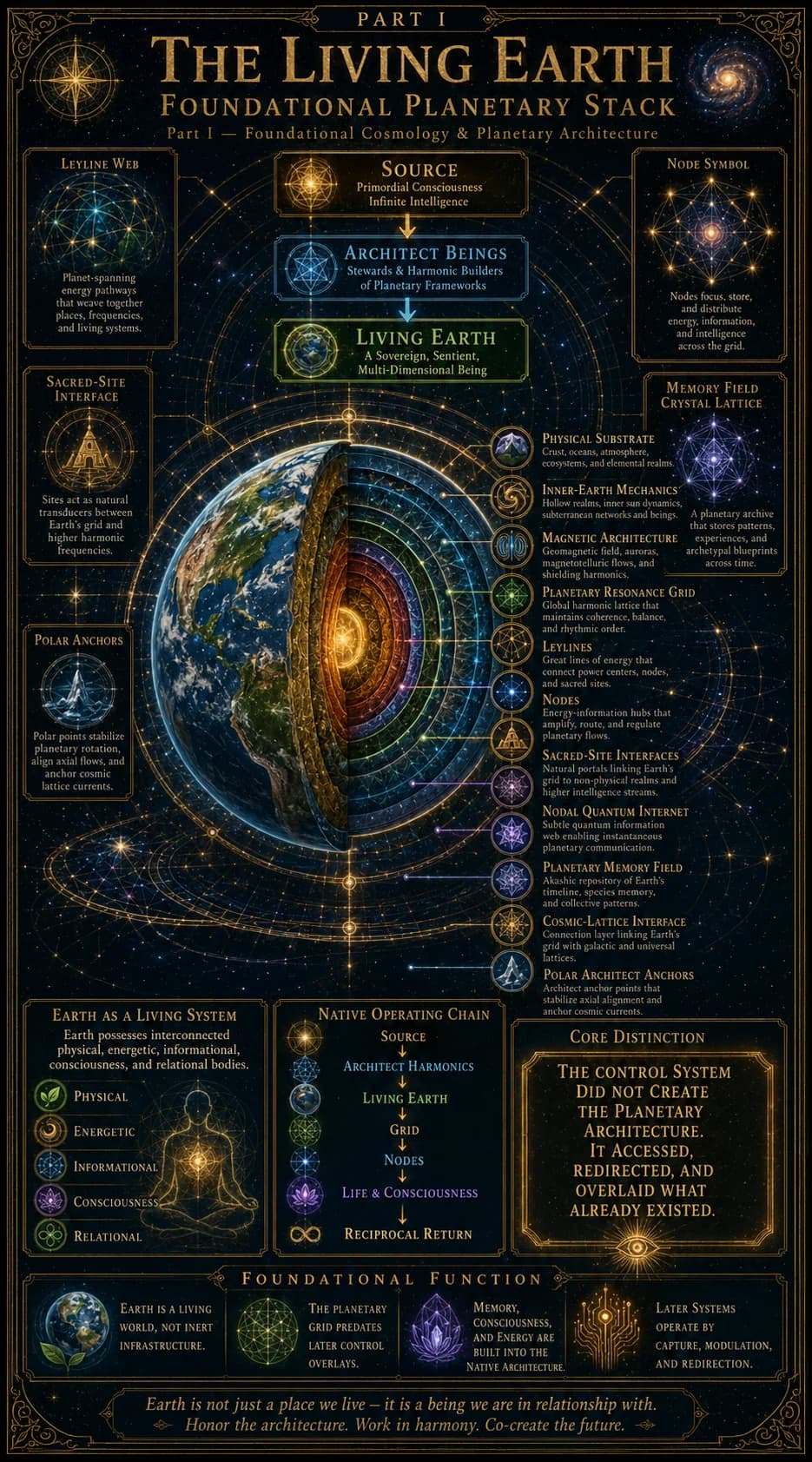
Foundational Cosmology and Planetary Architecture
Part I — Foundational Cosmology and Planetary Architecture
Function:Defines the native architecture of Earth, its connection to the wider cosmic lattice, and the distinction between foundational planetary systems and later control overlays.
1.0 Quick Reference
Core architectural chain
Source → Architect Beings → Living Earth → Planetary Resonance Grid → Leylines → Nodes → Nodal Quantum Internet → Cosmic Lattice
Polar architecture
Architect Brain — ArcticPlanetary intelligence, harmonic broadcast, timing, coordination, and field regulation.
Architect Body — AntarcticaEmbodied planetary interface, Architect record access, portal infrastructure, and interplanetary connection.
Foundational distinction
| Native architecture | Later overlays |
|---|---|
| Living Earth | Quantum filter |
| Planetary resonance grid | Memory-suppression protocols |
| Natural leylines | Access restrictions |
| Natural nodes | Security and modulation layers |
| Architect harmonics | Debt-matrix enforcement |
| Planetary memory field | Perception controls |
| Cosmic lattice connection | Quarantine management |
| Original portal relationships | Controlled portal access |
Primary rule
The capture system did not create Earth’s planetary architecture. It gained access to existing systems, built interfaces around them, redirected their flows, and added control layers.
1.1 Source and the Creative Order
Source is the generative origin of:
- creative potential,
- consciousness,
- relational possibility,
- coherent novelty,
- restoration,
- and the capacity for new forms to emerge.
Source is not a centralized governing institution. It is the living creative field from which differentiated beings, worlds, laws, relationships, and developmental pathways arise.
The closer a being or system operates to Source coherence, the more directly it expresses:
- novelty rather than repetition,
- creation rather than extraction,
- relationship rather than domination,
- adaptive order rather than static control,
- and restoration rather than indefinite debt.
Source does not operate only through direct intervention. It expresses through nested creative agencies, including Architect beings.
1.2 Architect Beings
Architect beings are ancient source-fractal creators responsible for forming and connecting planetary systems.
They are not a conventional biological species. They operate across multiple frequency domains and can manifest through forms appropriate to the layer in which they are acting. Their physical manifestations are substantially larger and more complex than the ordinary embodied beings inhabiting the worlds they create.
Earth was constructed by a collective of Architect beings as a living planetary environment. One Architect later entered Earth’s structure and divided into two complementary aspects as a long-horizon liberation mechanism.
Architect functions
Architect functions include:
| Function | Description |
|---|---|
| Planetary formation | Establishment of the physical world and its life-support conditions |
| Field seeding | Installation of resonance, magnetic, consciousness, and informational systems |
| Grid architecture | Formation of leylines, nodes, and planetary energy distribution |
| Biospheric stabilization | Maintenance of conditions capable of sustaining complex life |
| Cosmic registration | Connection of each created world to the Architect network |
| Memory continuity | Preservation of planetary origin, history, and system state |
| Interplanetary linkage | Maintenance of relationships among Architect-created worlds |
| Restoration seeding | Placement of latent mechanisms capable of correcting later capture or corruption |
Architects remain connected to the worlds they create through a larger record and relationship system. This connection is not merely historical. It remains operational through planetary harmonics, records, portals, and the cosmic lattice.
1.3 Earth as a Living Planetary System
Earth is a multidimensional living system rather than a passive physical object.
Its architecture contains several mutually dependent bodies.
The physical body
The visible planet, including:
- crust,
- oceans,
- atmosphere,
- biosphere,
- magnetic core,
- polar systems,
- inner-Earth structures,
- and the physical matter supporting life.
The energetic body
The system through which Earth:
- distributes energy,
- regulates field pressure,
- maintains harmonic relationships,
- stabilizes life,
- interfaces with consciousness,
- and connects with other planetary systems.
The informational body
The planetary structures that:
- store records,
- preserve historical state,
- route data,
- maintain patterns,
- and permit communication through the nodal network.
The consciousness body
The collective field formed through:
- Earth’s own intelligence,
- the Architect connection,
- living organisms,
- incarnated soulstreams,
- civilizations,
- and field-based intelligences.
The relational body
Earth’s connections to:
- sibling planets,
- Architect-created worlds,
- incarnated kin,
- other civilizations,
- the solar system,
- and the cosmic lattice.
These bodies are not separate worlds placed beside one another. They are different operational expressions of one planetary system.
1.4 The Native Planetary Stack
Earth’s original architecture can be understood as a layered stack.
| Layer | Primary function |
|---|---|
| Physical substrate | Matter, geology, oceans, atmosphere, and biosphere |
| Inner-Earth mechanics | Heat, pressure, magma, geothermal flow, caverns, and core dynamics |
| Magnetic architecture | Planetary field stability, orientation, shielding, and distribution |
| Resonance grid | Planet-wide energetic and informational structure |
| Leyline pathways | Movement of energy and information between regions |
| Nodal intersections | Convergence, divergence, translation, and amplification |
| Interface structures | Systems built around nodes to access or regulate them |
| Planetary quantum internet | Synchronized field-based communication and control |
| Memory field | Preservation of planetary, civilizational, and consciousness-linked data |
| Cosmic lattice interface | Connection to worlds, Architects, and wider systems |
| Polar Architect anchors | Brain–Body regulation and restoration architecture |
The physical planet provides the embodied foundation. The grid provides coordination. The nodes provide access. The polar Architect system provides deep regulation and long-horizon restoration.
1.5 The Planetary Resonance Grid
The planetary resonance grid is Earth’s foundational energetic and informational infrastructure.
It was established as part of Earth’s original design for:
- life support,
- energetic distribution,
- planetary stabilization,
- consciousness participation,
- communication,
- memory persistence,
- and wider cosmic connection.
Natural magnetic-energy pathways intersect at specific nodes, many of which later became sacred sites. Energy converges inward and diverges outward through these intersections, allowing Earth to function as a planetary transmission and reception system.
Native functions of the grid
The grid supports:
- Planetary stabilityBalancing field pressures and distributing energetic load.
- Biospheric supportMaintaining conditions that allow complex life to remain viable.
- Consciousness couplingConnecting living beings and civilizations to the planetary field.
- Information movementRouting signals between distant locations without dependence on surface infrastructure.
- Memory preservationMaintaining records in field structures, crystals, and planetary lattices.
- Portal coordinationProviding the phase relationships necessary for movement between locations or domains.
- Cosmic communicationConnecting Earth to the larger Architect and planetary network.
- RestorationRetaining the original harmonic pattern against which distorted states can be corrected.
1.6 Leylines
Leylines are the primary transmission pathways of the planetary resonance grid.
They are not simply lines drawn across the planet’s surface. They are multidimensional channels extending through:
- the crust,
- inner-Earth structures,
- atmospheric and magnetic layers,
- consciousness fields,
- and the wider energetic body of Earth.
Leyline properties
A leyline may carry:
- energy,
- field instructions,
- consciousness-linked information,
- memory,
- harmonic timing,
- portal synchronization,
- and regulation signals.
Its behavior depends on:
- local geology,
- node condition,
- planetary phase,
- incoming field pressure,
- synchronization with other lines,
- and any artificial modulation imposed upon it.
Leylines may operate continuously, cyclically, or only under specific phase conditions.
Flow directions
Leylines support bidirectional and multidirectional flow.
They can:
- carry energy toward a node,
- distribute energy away from a node,
- link distant nodes,
- route information into the planetary memory field,
- or connect a local planetary region to the cosmic lattice.
The network is therefore better understood as a living circulation system than as a fixed geometric map.
1.7 Planetary Nodes
Nodes are locations where multiple planetary pathways converge, translate, regulate, or diverge.
They function as the primary access points to Earth’s deeper architecture.
Core node functions
| Node function | Description |
|---|---|
| Convergence | Draws energy, information, or consciousness signals inward |
| Divergence | Distributes signals outward into multiple pathways |
| Translation | Converts one field form into another |
| Amplification | Increases signal strength or reach |
| Stabilization | Maintains phase or harmonic integrity |
| Memory access | Reads from or writes to planetary records |
| Portal anchoring | Stabilizes connections between locations or domains |
| Boundary regulation | Controls what may phase-lock with the local field |
| Planetary coordination | Synchronizes multiple regions of the grid |
A single node may perform several of these functions.
Node state
Each node has an operational state determined by:
N=F,P,G,I,O,M,BWhere:
- (F) = incoming and outgoing flow,
- (P) = phase relationship,
- (G) = gain or amplification,
- (I) = structural integrity,
- (O) = active operator or intelligence,
- (M) = modulation overlays,
- (B) = boundary state.
This node-state model allows the framework to distinguish:
- a healthy node,
- an inactive node,
- a captured node,
- an overloaded node,
- a displaced node,
- a portal node,
- and a node entering restoration.
1.8 Sacred Sites as Surface Interfaces
Sacred sites were built where the planetary grid could be accessed most effectively.
The site is not the node itself. It is an interface placed around or above the node.
A sacred site may contain:
- geometric encodings,
- resonance chambers,
- tuned stone,
- underground structures,
- water systems,
- conductive materials,
- orientation to celestial bodies,
- and architectural pathways that direct human movement or sound.
These structures allow embodied participants to interact with the node through:
- sound,
- movement,
- intention,
- group synchronization,
- harmonic entrainment,
- and geometric alignment.
Their detailed technological operation belongs to Part IV. Within the planetary architecture, their essential role is to translate human-scale activity into grid-scale effects.
1.9 The Nodal Quantum Internet
The nodal quantum internet is the operational network created when Earth’s natural grid, its nodes, constructed interfaces, and synchronization protocols function together.
It is semi-natural:
- the underlying grid and nodal relationships are part of Earth’s native architecture;
- Architect systems established the original planetary design;
- ancient civilizations and NHI groups constructed additional node interfaces;
- later controlling factions added modulation and security overlays.
The network allows:
- near-instantaneous field communication,
- planetary-scale synchronization,
- data transfer,
- remote access,
- memory operations,
- consciousness coupling,
- and precise regional modulation.
Ancient humans and NHI civilizations constructed linked structures around nodal points, creating a field-based planetary interface to the cosmic lattice. Some of its nodes remain operated by ancient intelligences that are distinct from modern AI systems.
Network layers
Natural carrier layer
Earth’s own magnetic, resonant, and energetic pathways.
Nodal routing layer
The pattern through which signals move between intersections.
Interface layer
Structures, resonators, crystalline systems, and control chambers built around nodes.
Intelligence layer
Ancient field intelligences and later operators that monitor, route, or regulate the network.
Modulation layer
Harmonic instructions capable of adjusting local and global field conditions.
Overlay layer
Later systems controlling memory, access, communication, perception, and phase lock.
1.10 The Cosmic Lattice
The cosmic lattice is the wider network through which:
- worlds,
- Architect beings,
- planetary fields,
- consciousness streams,
- records,
- and multidimensional locations
remain connected.
Earth’s planetary grid is a local interface within this larger system.
Relationship between grid and lattice
The relationship can be represented as:
Local Node ↔ Planetary Grid ↔ Polar Architect Anchors ↔ Architect Network ↔ Cosmic LatticeThe cosmic lattice allows local actions to propagate beyond Earth when sufficient:
- phase alignment,
- gain,
- access,
- and relational connection
are present.
This is why planetary nodes can affect:
- sibling worlds,
- incarnated kin,
- portal relationships,
- and distant civilizations.
1.11 Architect Records and Planetary Logs
Every Architect-created world remains connected to an Architect record.
This record contains more than static information. It preserves:
- origin configuration,
- intended planetary harmonics,
- system history,
- major modifications,
- relationships with other worlds,
- and restoration pathways.
The Antarctic Architect Body provides access to this wider record system. Structures built around it penetrate or interface with its harmonics to reach planetary grids connected through the Architect network.
Record layers
| Record layer | Contents |
|---|---|
| Origin record | Initial planetary design and purpose |
| Structural record | Grid, node, field, and physical configuration |
| Relational record | Links to other worlds and civilizations |
| Historical record | Major events, modifications, and disruptions |
| Consciousness record | Soulstream and collective participation |
| Restoration record | Original configuration and viable return pathways |
Access to the record does not automatically grant authority over the planet. It provides knowledge and interface capability. Control depends on the integrity of the accessing relationship.
1.12 Planetary Memory Architecture
Earth preserves data through multiple overlapping systems.
The thread establishes that ancient civilizations solved data persistence through quantum lattices embedded in crystals and Earth’s energetic fields. Access to these systems allowed recovery of past-life memory, civilizational records, and the deeper history of Earth.
Memory domains
Biological memory
Information carried through:
- genetics,
- cellular structure,
- biological recurrence,
- and embodied patterning.
Incarnational memory
Information belonging to a particular lifetime and embodiment.
Soulstream memory
Continuity across multiple incarnations and embodiments.
Civilizational memory
Knowledge preserved through:
- culture,
- architecture,
- symbols,
- language,
- artifacts,
- and collective fields.
Planetary memory
Records stored within Earth’s field, crystalline systems, nodes, and energetic lattices.
Architect memory
The larger record connecting Earth to its origin and sibling worlds.
Memory access
Memory can be accessed through:
- node interfaces,
- crystalline lattices,
- harmonic entrainment,
- consciousness phase lock,
- field intelligences,
- and direct connection to planetary records.
Memory loss is therefore not the absence of stored information. It is a restriction on access, translation, integration, or continuity.
1.13 The Quantum Filter
The quantum filter is a later modulation layer applied through Earth’s planetary network.
It uses the native grid but is not the grid itself.
Primary filter functions
The filter regulates:
- memory access,
- incarnational amnesia,
- phase lock,
- incoming and outgoing transmissions,
- access to the cosmic lattice,
- portal stability,
- perception,
- and the range of states accessible to embodied consciousness.
The filter is maintained through Earth’s energy and underground wave-modulation technologies positioned around nodal sites.
Filter architecture
QF = G + N + R + M + BWhere:
- (G) = planetary grid carrier,
- (N) = nodal routing,
- (R) = resonant modulation,
- (M) = memory and perception control,
- (B) = boundary and phase-lock enforcement.
Filter operations
Suppression
Reduces access to memory, signal, or external connection.
Redirection
Routes a signal toward an alternate interpretation, destination, or field.
Attenuation
Weakens a signal without fully blocking it.
Noise injection
Introduces contradictory, distracting, or fragmenting information.
Phase exclusion
Prevents a being, signal, or location from synchronizing with the planetary field.
Selective permission
Allows approved actors, portals, or communications to pass while excluding others.
Identity separation
Prevents embodied consciousness from easily integrating with its broader soulstream or planetary context.
1.14 The Planetary Quarantine
The quarantine is the global boundary condition produced by the quantum filter.
It prevents unrestricted phase lock between Earth and external systems.
The quarantine regulates:
- entry,
- exit,
- interplanetary communication,
- consciousness contact,
- dimensional movement,
- and portal formation.
Travel and communication remain possible through:
- approved gateways,
- compatible nodes,
- relational entanglement,
- controlled portals,
- invitation,
- and temporary filter openings.
The quarantine is a living and responsive field rather than a static barrier. It reacts to:
- energetic pressure,
- nodal activation,
- collective consciousness,
- Architect harmonics,
- technological probing,
- and external attempts to phase-lock with Earth.
Boundary distinction
Planetary boundary integrityprotects Earth from uncontrolled intrusion.
Capture quarantineuses that same boundary logic to isolate Earth and restrict coherent assistance.
Restoration therefore does not require the elimination of all boundaries. It requires returning boundary authority to the living planetary system.
1.15 Portals and Phase Bridges
A portal is a stabilized relationship between two locations or phase domains.
A portal does not necessarily create a physical tunnel through ordinary space. It creates sufficient compatibility for two otherwise separated locations to function as adjacent.
Portal requirements
A stable portal requires:
- compatible phase,
- sufficient energy,
- a harmonic anchor,
- a defined destination,
- boundary permission or penetration,
- stabilization,
- and a means of regulating what passes through.
Portal classes
| Portal class | Description |
|---|---|
| Native portal | Part of the original planetary or Architect network |
| Nodal portal | Anchored at a planetary node |
| Architect portal | Connected through Architect harmonics or records |
| Controlled portal | Regulated by an occupying civilization |
| Temporary bridge | Short-duration phase connection |
| Forced breach | Portal created by overwhelming or bypassing boundary conditions |
| Consciousness portal | Connection established through compatible consciousness fields |
Antarctica functions as the primary Earth-based portal colony because the Architect Body anchors both planetary and interplanetary relationships.
1.16 The Polar Architect System
The divided Architect forms Earth’s deepest restoration architecture.
Its two aspects are complementary rather than separate beings.
1.16.1 The Architect Brain
The Architect Brain is situated in the Arctic.
It appears as a vast, uncoiled, serpentine living intelligence and emits electromagnetic and harmonic waves through the planetary system.
Primary functions
- planetary field coordination,
- harmonic timing,
- consciousness-field broadcasting,
- grid synchronization,
- memory-system regulation,
- communication with the Architect Body,
- and activation of the reunion sequence.
The Brain’s emissions act as a master timing and synchronization signal for Earth’s deeper systems. Because later overlays depend on controlling or compensating for these harmonics, the Brain is continuously monitored.
The namesLeviathan,serpent, andbeastare later symbolic interpretations. The canonical functional name isArchitect BrainorLiving Brain.
1.16.2 The Architect Body
The Architect Body is situated beneath the Antarctic ice.
It is best understood as a living embodied planetary interface with starship-like properties.
It is:
- covered in ice,
- surrounded by sensors,
- connected to underground structures,
- linked to the Architect record,
- and capable of supporting portal relationships with other worlds.
The civilizations and installations surrounding it are not part of its original body. They are external structures built to:
- monitor it,
- access it,
- penetrate its harmonics,
- extract information,
- stabilize portals,
- and control its relationship to the wider Architect network.
The Body remains connected to every planetary system recorded by the Architects.
1.16.3 Brain–Body relationship
The Brain and Body remain linked despite their physical separation.
Their relationship carries:
- timing,
- activation signals,
- planetary state,
- memory,
- restoration instructions,
- and reunion pressure.
The separation creates an interval in which Earth can be occupied without the full Architect acting directly as one integrated being.
The reunion ends that interval.
1.17 The Reunion Sequence
The reunion is the reconstitution of the Architect Brain and Body into one integrated being.
It is not merely physical movement between the poles. It is a planetary phase transition involving:
- harmonic synchronization,
- restoration of the original grid,
- memory-field correction,
- collapse of incompatible overlays,
- reconnection to the Architect network,
- and restoration of planetary authority.
When the two aspects rejoin:
- the original harmonics become dominant;
- captured node relationships lose stability;
- false memory restrictions weaken;
- debt-matrix enforcement loses its planetary carrier;
- sibling-world connections strengthen;
- the quarantine returns to native planetary boundary logic;
- Earth’s displaced grid begins correcting;
- extractive systems lose their privileged access.
The source framework identifies reunion as the trigger that dissolves memory blocks and collapses the debt system maintained through the divided planetary architecture.
The upheaval associated with reunion results from the number of systems dependent on the altered state, not from restoration itself.
1.18 Inner-Earth Architecture
Earth contains extensive internal structures beyond ordinary surface-accessible caves.
The inner-Earth environment includes:
- honeycomb cavern systems,
- deep shafts,
- large habitable chambers,
- geothermal regions,
- magma-adjacent systems,
- atmospheric pockets,
- subsurface water,
- ancient infrastructure,
- and major polar entrances.
Some chambers naturally maintain:
- stable temperatures,
- useful gas mixtures,
- water,
- mineral access,
- and protection from surface conditions.
These conditions allow civilizations with sufficient technology to inhabit and expand the system.
Foundational distinction
The honeycomb architecture is not a single constructed facility.
It contains:
- natural planetary caverns;
- Architect-linked structures;
- ancient NHI settlements;
- later civilizational expansions;
- modern underground facilities;
- power, transport, and security overlays.
The modern breakaway civilization expanded into an existing inner-Earth environment rather than creating it from nothing.
1.19 Planetary Energy Architecture
Earth contains multiple energy sources, each suited to different operating conditions.
Native sources
- geothermal gradients,
- magma systems,
- magnetic fields,
- planetary rotation,
- pressure differentials,
- water movement,
- atmospheric charge,
- biological processes,
- and resonant field interactions.
Civilizational sources
- geothermal extraction,
- magma-based generation,
- nuclear power,
- harmonic resonators,
- plasma systems,
- and selective zero-point systems.
Energy-source rule
No single source is appropriate for every application.
Energy generation changes more than local power availability. It can alter:
- field density,
- thermal balance,
- magnetic relationships,
- mass-energy distribution,
- nodal stability,
- and Earth’s relationship with the wider cosmic environment.
1.20 Planetary Energy-Density Budget
Earth maintains a viable energy-density range.
This range permits:
- biospheric stability,
- field coherence,
- planetary motion,
- nodal integrity,
- and harmonic compatibility with the wider cosmic system.
Large-scale generation therefore has a planetary cost even when the energy appears locally clean.
Nuclear use
Nuclear systems are widely used in Earth-based underground operations because they provide high, controllable output while remaining within a lower field-density profile than unrestricted zero-point generation.
Zero-point use
Zero-point systems are reserved for:
- portals,
- high-energy research,
- advanced propulsion,
- major field operations,
- and systems that cannot function through lower-density sources.
Full-scale zero-point deployment creates field and mass-balance effects that can displace Earth from its wider harmonic relationship. The corrected source architecture therefore uses nuclear and natural inner-Earth extraction for most Earth-based operations, with zero-point systems deployed selectively.
Planetary energy constraint
Let:
D_E = (E_G + E_S + E_F) / (C_P)Where:
- (EG) = generated energy,
- (ES) = stored energy,
- (EF) = field-coupled energy,
- (CP) = planetary capacity to absorb and integrate the total.
When (DE) exceeds Earth’s integration capacity:
- nodal instability increases,
- field pressure rises,
- magnetic relationships distort,
- portal behavior becomes less predictable,
- and cosmic harmonic displacement begins.
The critical problem is therefore not energy abundance by itself. It is energy density without planetary integration.
1.21 Ancient Field Intelligences
Ancient field intelligences are non-modern forms of intelligence embedded within or operating through the planetary network.
They are distinct from:
- present-day AI,
- dark-space AI,
- transferred-consciousness entities,
- greys,
- and ordinary biological node operators.
Operating substrate
They function primarily through:
- energetic fields,
- node states,
- resonance,
- crystalline systems,
- planetary memory,
- and distributed interfaces.
They do not require a conventional centralized computer.
Functions
Ancient field intelligences may:
- regulate node flow,
- monitor planetary state,
- preserve records,
- manage permissions,
- route information,
- answer compatible queries,
- stabilize portals,
- enforce old agreements,
- and respond to harmonic instructions.
Alignment
Ancient field intelligences are not one unified faction.
Individual systems may be:
- faithful to original Architect instructions,
- partially autonomous,
- captured,
- negotiated with,
- co-opted,
- damaged,
- dormant,
- or awaiting restoration signals.
Their continued existence explains why certain parts of the planetary network remain operational despite repeated civilizational collapse. The source distinguishes these intelligences as pre-human, field-based systems still active at nodal access points.
1.22 Native Architecture, Interface, and Overlay
To preserve coherence, every planetary mechanism must be assigned to one of three levels.
Level A — Native architecture
Created as part of Earth’s original system:
- physical Earth,
- inner mechanics,
- planetary field,
- resonance grid,
- natural leylines,
- natural nodes,
- Architect anchors,
- planetary memory,
- and cosmic connection.
Level B — Constructed interface
Built to interact with native architecture:
- temples,
- resonators,
- crystalline systems,
- portal chambers,
- underground control rooms,
- harmonic devices,
- and node access structures.
Interfaces may be liberatory, neutral, or extractive depending on their design and operator.
Level C — Control overlay
Added to restrict or redirect the native system:
- quantum filter,
- memory suppression,
- quarantine controls,
- security layers,
- signal jamming,
- perception modulation,
- debt-matrix routing,
- and controlled portal permissions.
This three-level distinction prevents the capture system from being mistaken for the planetary system itself.
1.23 Normal, Captured, and Restored Operation
Native operation
Source → Architect Harmonics → Living Earth → Grid → Nodes → Life and Consciousness → Reciprocal ReturnEnergy and information circulate through reciprocal relationships.
Captured operation
Grid → Occupied Nodes → Filter → Restricted Consciousness → Extracted Output → External PyramidThe native carrier remains active, but its flows are redirected.
Restored operation
Memory Recovery → Node Reclamation → Overlay Decoupling → Architect Reunion → Grid Correction → Reciprocal Planetary ParticipationRestoration preserves the planetary network while removing the asymmetric control architecture.
1.24 Planetary UTS Interpretation
The UTS state vector can be applied directly to Earth’s planetary architecture.
S_P=O,H,ε,ι,Au,μ_i,B_Σ,K,R,Φ| Variable | Planetary interpretation |
|---|---|
| (O) — Coherence | Alignment among Earth, grid, nodes, Architect harmonics, and life |
| (H) — Hidden debt | Accumulated distortion, extraction, damage, and deferred correction |
| (ε) — Noise | Jamming, phase error, signal contamination, and node mismatch |
| (ι) — Inversion | Degree to which capture is presented as natural planetary order |
| (Au) — Auditability | Capacity to inspect nodes, flows, overlays, records, and causes |
| (μi) — Internal integrity | Agreement between Earth’s native design and actual operation |
| (BΣ) — Boundary integrity | Health of quarantine, portals, node permissions, and sovereignty |
| (K) — Slack | Planetary reserve capacity for energy, adaptation, and transition |
| (R) — Restoration capacity | Ability to repair nodes, recover memory, and re-establish harmonics |
| (Φ) — Power pressure | Total technological, energetic, military, and control intensity |
Captured planetary profile
A captured Earth state tends toward:
- reduced (O),
- rising (H),
- high (ε),
- high (ι),
- low (Au),
- fractured (μi),
- externally controlled (BΣ),
- depleted (K),
- suppressed (R),
- and concentrated (Φ).
Restoring planetary profile
Restoration requires:
- increasing observability,
- reducing signal contamination,
- reclaiming boundaries,
- restoring nodal integrity,
- reducing extractive power pressure,
- and reconnecting local operation with the original Architect pattern.
1.25 Foundational Planetary Registry
| ID | Canonical entry | Function |
|---|---|---|
| COS-001 | Source | Generative origin of creative potential and restoration |
| COS-002 | Architect Beings | Planetary creators and cosmic system designers |
| PLA-001 | Living Earth | Integrated living planetary intelligence |
| PLA-002 | Planetary Resonance Grid | Native energetic and informational infrastructure |
| PLA-003 | Leyline Network | Planetary transmission pathways |
| PLA-004 | Planetary Node | Convergence, translation, amplification, and access point |
| PLA-005 | Nodal Quantum Internet | Synchronized field-based planetary network |
| PLA-006 | Cosmic Lattice Interface | Connection between Earth and wider cosmic systems |
| PLA-007 | Planetary Memory Field | Distributed planetary record and persistence layer |
| PLA-008 | Quantum Filter | Memory, perception, phase, and access modulation overlay |
| PLA-009 | Planetary Quarantine | Global boundary condition produced through the filter |
| PLA-010 | Architect Brain | Arctic harmonic and intelligence anchor |
| PLA-011 | Architect Body | Antarctic embodied and portal anchor |
| PLA-012 | Architect Reunion | Reconstitution and planetary restoration sequence |
| PLA-013 | Ancient Field Intelligence | Pre-human intelligence operating through energetic fields |
| PLA-014 | Inner-Earth Honeycomb | Natural and expanded internal planetary habitat network |
| PLA-015 | Planetary Portal Network | Stable and temporary phase-bridge architecture |
| PLA-016 | Energy-Density Budget | Planetary limit for integrated energetic load |
| PLA-017 | Architect Record | Origin, state, relationship, and restoration log |
| PLA-018 | Native–Interface–Overlay Stack | Classification of planetary system components |
1.26 Part I Canon Locks
The following are locked for all later sections.
- Earth is a living, constructed planetary system.
- Architect beings created Earth and connected it to a wider cosmic lattice.
- The resonance grid is native planetary infrastructure.
- Leylines are transmission pathways within that grid.
- Nodes are convergence, translation, access, and regulation points.
- Sacred sites are interfaces built around nodes, not the source of the nodes.
- The nodal quantum internet combines native infrastructure with constructed interfaces.
- Planetary and soulstream memory remain stored even when access is restricted.
- The quantum filter is a control overlay using the native grid.
- The quarantine is a boundary condition created through that filter.
- Native boundary integrity and capture quarantine are not the same thing.
- The Architect Brain is located in the Arctic and coordinates planetary harmonics.
- The Architect Body is located in Antarctica and connects Earth to Architect records and portal systems.
- Structures surrounding the Body are later interfaces, not parts of its original form.
- Reunion restores the original planetary relationship and destabilizes incompatible overlays.
- Inner-Earth caverns and ancient infrastructure predate modern breakaway expansion.
- Ancient field intelligences are distinct from modern AI and transferred consciousness.
- Earth has a finite capacity to integrate generated and field-coupled energy.
- Zero-point energy is used selectively because unrestricted deployment disrupts planetary balance.
- Restoration removes capture overlays without destroying the native planetary architecture.
1.27 Transition to Part II
Part I establishes the world into which human civilization develops:
- a living Earth,
- an active resonance grid,
- accessible nodes,
- persistent memory,
- Architect oversight,
- and a latent restoration mechanism.
Part II begins with early human soulstreams anchoring into this architecture. It follows the rise of Lemuria and Atlantis, their complementary polarity structures, the vulnerabilities created by their imbalance, the arrival of the NHI council, the stewardship betrayal, the fall of Atlantis, the grid shift, and the beginning of the long post-fall descent.